Enterprise workflows now lean on vision-language models (VLMs) to read visual data, pull out embedded text, and turn unstructured images into something an operations team can act on. Deploying an image reader ai inside a regulated institution means holding two things at once: fast automated interpretation, and a governance file that survives independent validation. One without the other creates either a stalled pilot or an unowned risk.
Executive Summary for Decision-Makers
- What it is: An image reader ai is a vision-language model that converts pixels plus a text instruction into natural language, structured JSON, or extracted OCR fields. It reads images. It does not create them.
- How it works: Vision Transformer (ViT) patch tokenization, then a projector or Q-Former bridge, then cross-modal alignment, then autoregressive language decoding.
- Where it wins: Document intake, invoice and trade-finance parsing, KYC document review, collateral and site inspection, geospatial asset indexing, catalog enrichment, accessibility alt-text.
- Where it fails: Hallucinated objects and attributes, spatial miscounting, small or compressed text, optical illusions, specialized technical and medical imagery.
- What it cannot do: Establish provenance. A VLM checks image-language consistency; it cannot confirm that a photo or a document is authentic. Synthetic-media verification needs frequency-artifact analysis and C2PA cryptographic provenance checks.
- Governance baseline: Human-in-the-loop thresholds, per-field confidence scoring, zero-retention contracts, NIST AI 600-1 grounding requirements, EU AI Act Article 50 transparency, and, for US banks, validation documentation aligned with SR 11-7 and OCC Bulletin 2011-12.
- Cost reality: Total cost of ownership is never just the API invoice.
TCO = Inference cost + Control cost (human review + QA sampling) + Residual risk provision + Integration and monitoring.
What Image Reader AI Is and Which Tasks It Solves
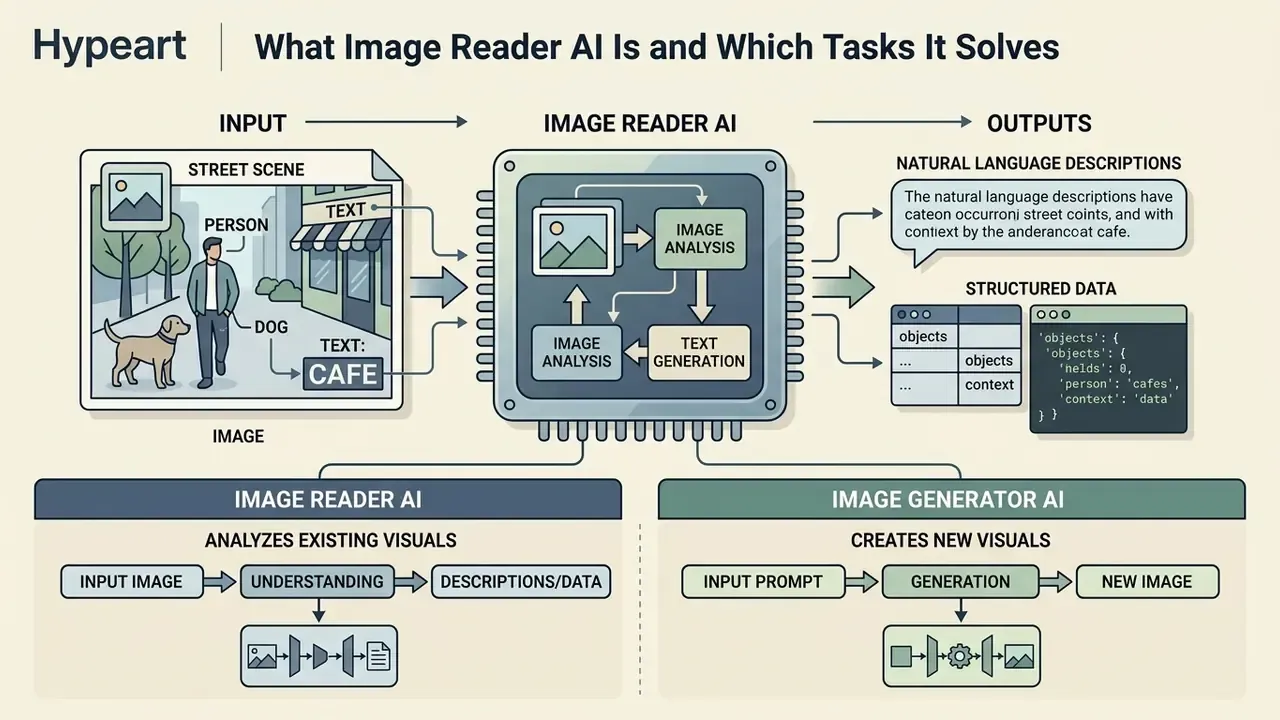
An image reader ai is a multimodal system built to ingest, process, and analyze visual data, then return natural language descriptions or structured output. Unlike a single-task computer vision utility, an ai image interpreter wires a visual encoder to a large language model, so it can weigh context, read spatial relationships, and emit structured fields. Banks and mature enterprises use these tools to automate document processing, inspect physical collateral, run optical character recognition (OCR), and parse dense charts.
By turning unstructured pixel data into machine-readable text, an ai picture reader closes the gap between static visual assets and core database systems. Teams deploy it to speed up commercial loan reviews, streamline KYC (Know Your Customer) identity verification, and lift transaction details off scanned receipts. That last task sits close to classic image-to-text extraction, where vendors can be compared on accuracy, language coverage, and per-page pricing.
A 2024 NeurIPS benchmark study on multimodal evaluation reports strong, though clearly not human-equivalent, performance on standardized visual question answering, provided inputs meet baseline resolution standards. The older "near-human performance" framing overstated the evidence; benchmark authors document substantial remaining gaps in fine-grained localization and counting.
Document-centric VLM research published across 2025 and 2026 extends the task inventory further: layout detection, equation recognition, markdown conversion, multilingual OCR across 22 languages, and document retrieval at a scale of roughly three million images. Which explains something practical. Document intake, not generic captioning, is the dominant enterprise entry point.
How AI Understands Objects, Scenes, and Context in an Image
An ai that understands images starts by cutting the input photograph into discrete visual tokens using a spatial encoder such as a Vision Transformer (ViT). Those patches pass through projection layers or Q-Former bridges that map spatial features into a shared latent space aligned with the language model. Self-attention then calculates dependencies across spatially distant regions, which is how an ai that can understand images reasons about how objects interact inside a scene.
Documented limitations travel with these capabilities. Model risk owners should treat them as design constraints, not rare edge cases.
«Existing models still struggle with precise object counting and determining spatial arrangement in complex scenes containing overlapping elements.»
Beyond plain object classification, an ai that can look at images assesses situational context, background elements, and functional relationships between components. Take an auto insurance collateral inspection. The system identifies not only a vehicle frame, but localized structural denting, surface corrosion, and the environment around the car. That layered processing is what allows an ai that interprets images to produce a nuanced description instead of a flat tag list. Region-level encoders, including Faster R-CNN detectors used in scene-understanding research, supply object features and mutual spatial constraints, while self-attention links distant features that convolution alone would miss.
How an AI Image Reader Differs from an AI Image Generator
The real distinction between an ai reading images tool and an ai image generator is directional. An ai image interpreter behaves as a discriminative or encoder-decoder system: pixels plus a prompt go in, natural language, structured JSON, or analytical labels come out. Generative tools run the other way, using latent diffusion models or generative adversarial networks (GANs) to synthesize new pixels from text. GANs train a generator against a discriminator; diffusion models add Gaussian noise in a fixed forward process, then learn an iterative reverse denoising path.
An image generator can create images for creative workflows. An ai that can view images does the opposite job: it extracts objective data, inspects source assets, and reads text already printed inside existing documents. Model risk managers need this line drawn clearly, because testing boundaries, data lineage controls, and deployment protocols differ on each side. Teams evaluating the synthesis half of the market can review the AI image generator landscape separately, since licensing and risk profiles diverge almost completely.
Comparison of Image Reader AI and AI Image Generator architectures
| Operational dimension | Image Reader AI (vision-language models) | AI Image Generator (diffusion / GANs) |
|---|---|---|
| Primary input data | User-uploaded images (JPEG, PNG, PDF) plus text prompts | Textual prompts, spatial masks, or reference images |
| Primary output format | Natural language summaries, OCR text, structured JSON | Newly synthesized raster images or edited pixels |
| Core algorithmic method | Vision Transformers (ViT) paired with autoregressive LLMs | Iterative score-based denoising or adversarial loss networks |
| Primary business use cases | Document intake, collateral audit, invoice processing, KYC | Marketing asset creation, product prototyping, design drafting |
| Key operational risks | Visual hallucination, misread small text, spatial misattribution | Copyright ambiguity, deepfake generation, brand inconsistency |
The short version of that table: readers produce evidence, generators produce assets. Governance treats them as two different model families, with two different validation files.
How AI Image Interpretation Works
The technical process of ai image interpretation runs end to end, from visual asset ingestion to natural language generation. When a user submits a file, the system converts raw image signals into standardized tensor representations ready for neural processing. Modern ai tools execute this in real time, streaming analytical results back to the client interface within seconds.
For institutions deploying an ai to interpret images, every stage matters for audit trails and model validation. The pipeline chains image signal processing (ISP), spatial patch tokenization, cross-modal alignment projection, and autoregressive language decoding.
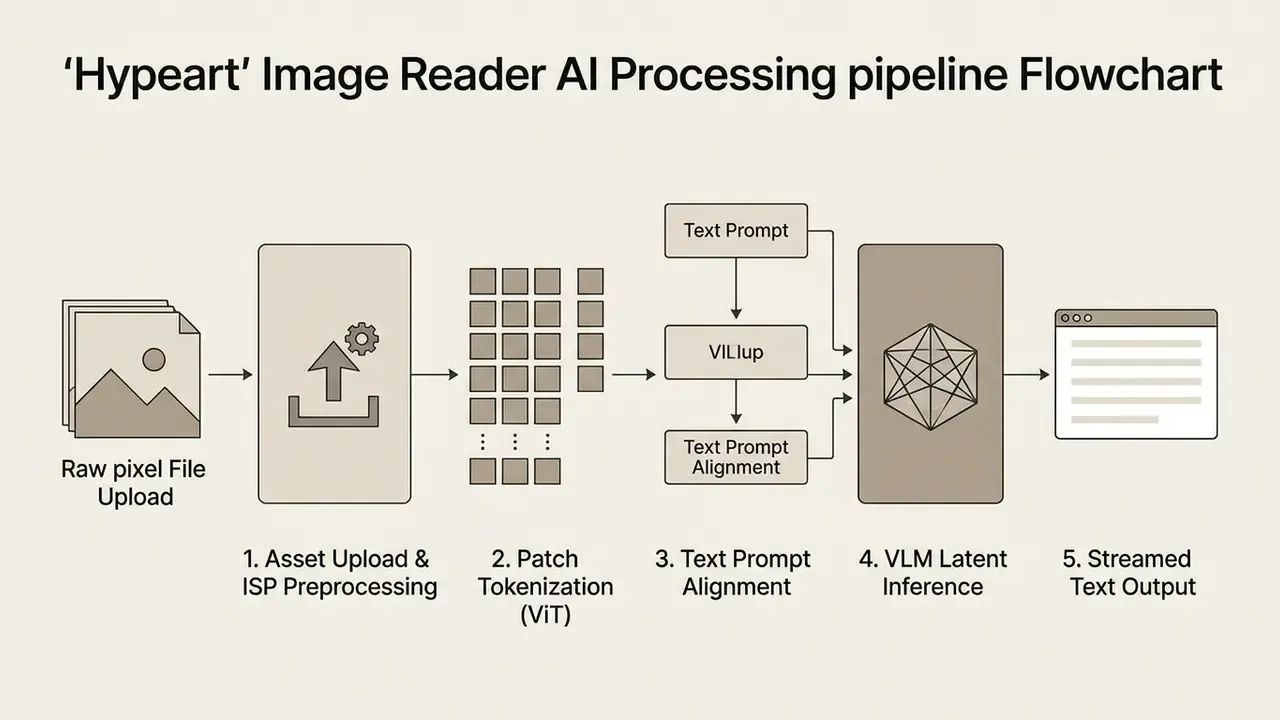
Step 1: Ingestion and ISP Preprocessing
The pipeline begins when a user uploads a target visual file. The hardware or software layer normalizes image dimensions, adjusts color profiles, and applies tone mapping or noise reduction transforms. In document pipelines, PDF pages are rasterized first, and text blocks with positional anchors are pulled from the file structure.
Step 2: Spatial Patch Tokenization
The visual encoder splits the standardized raster into non-overlapping grid patches, commonly 16x16 pixel blocks. Each patch becomes a trainable visual token embedding carrying spatial coordinates.
Step 3: Cross-Modal Feature Alignment
Linear projection layers or projector bridges translate visual tokens into the language model's feature space. The system aligns those embeddings with tokens derived from the user's text prompt.
Step 4: Autoregressive Latent Inference
The language model processes the merged sequence of visual and text tokens, calculating attention weights across patches and instructions at the same time.
Step 5: Post-Processing and Output Streaming
Why the Same Photo Can Produce Different Answers
Variability comes from generation parameters, system-level instructions, and sampling settings. Temperature changes token selection probabilities: higher values add creative variance, zero forces near-deterministic output. Output language is not guaranteed to mirror input language either, which can shift phrasing and, occasionally, the substance of an extracted detail.
Different ai tools also carry distinct internal system prompts, cropping conventions, and tokenization mechanics. A dual-encoder framework tuned for object classification answers differently than an encoder-decoder VLM configured for conversational reasoning. Detail settings (low, high, auto) change how many visual tokens are consumed, and resolution mismatches against a model's native interpreted resolutions change results again.
For model risk purposes, reproducibility has to be engineered rather than hoped for: pin the model version, pin temperature at zero for extraction, pin the system prompt, and log the full request payload hash next to the output.
Uploading an Image and Preparing the AI Prompt
Accurate output when users upload images depends on both halves of the request. Constraints must be explicit, output formats declared, sub-goals defined step by step. A quick correction to earlier drafts of this guidance: the old reference to vendor documentation has been swapped for peer-reviewed evidence on layout-aware document modeling.
«DocLayLLM integrates 2D positional tokens and chain-of-thought reasoning, outperforming OCR-dependent competitors under lightweight training configurations.»
Placing the image before the instruction, asking for an overall description first, then running the specific task from that description, is a widely documented prompt-ordering practice. Teams should validate the effect on their own document corpus instead of assuming a fixed reduction in spatial hallucination, because no current benchmark quantifies that gain universally. (Claim status: practice-supported, not benchmark-quantified. Internal A/B measurement required.)
Operational VLM Prompt Templates
Use the following zero-shot structures for deterministic, auditable evaluation. Each one constrains format, forbids inference, and forces explicit nulls.
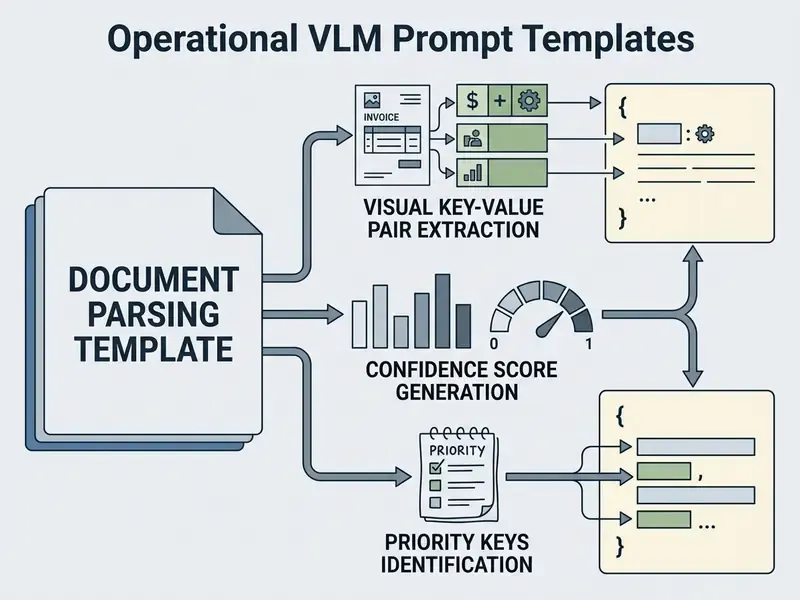
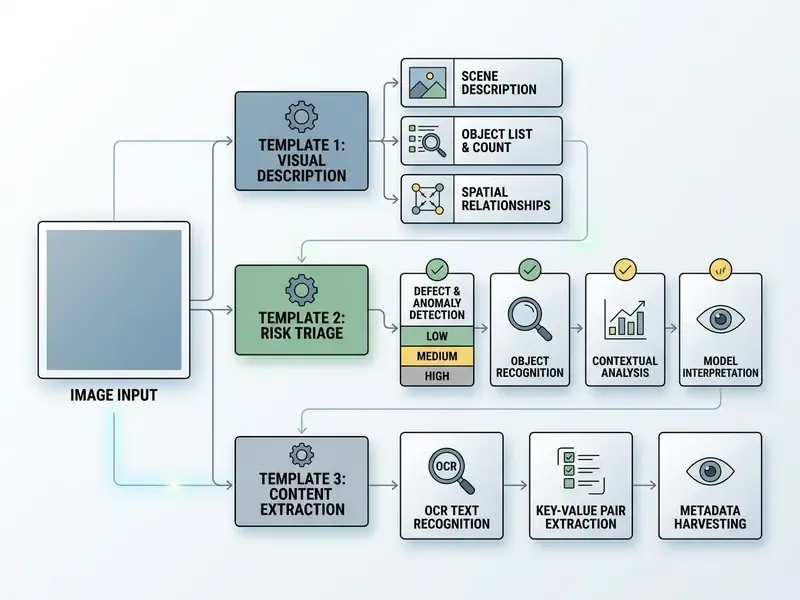
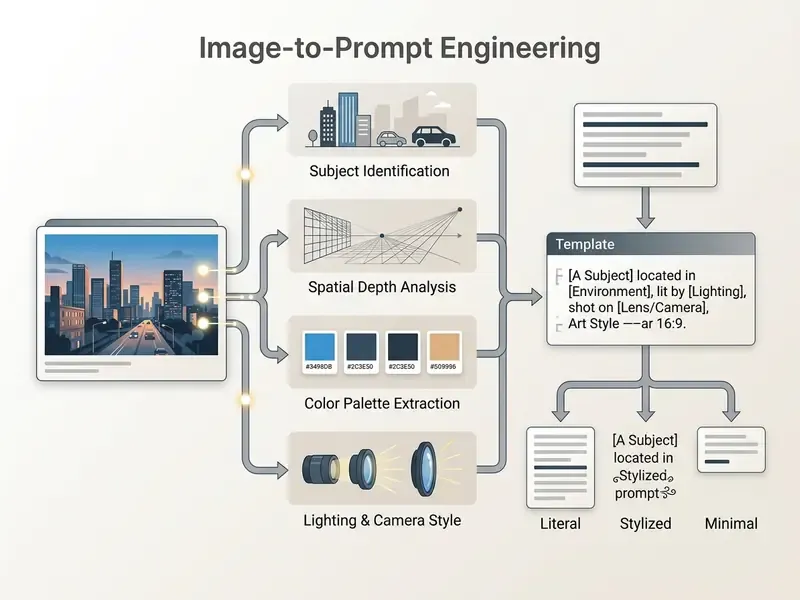
When you operate an ai that can look at images, prompt quality dictates response reliability more than model size does. Reverse-prompt research from 2025 and 2026 formalizes the loop: recreate an image from a candidate prompt, generate textual gradients with an LLM or VLM, then refine the prompt greedily to maximize similarity against the reference.
Image Analysis by AI Models and Obtaining Results
During processing, advanced ai models evaluate spatial patch tokens against the instruction to deliver an instant ai analysis. Multi-head self-attention layers map physical geometries onto conceptual language representations. That is what lets the model catch subtle features: a handwritten signature on a financial contract, a hairline crack on industrial equipment.
In high-throughput environments, current ai powered vision-language engines stream real time output, turning dense visual files into structured text within seconds for typical single-image requests. One caveat worth stating plainly: sub-second latency figures depend on model size, visual token density, resolution, batching strategy, and hosting region. Measure them per deployment rather than quoting them as a general property. (Claim status: vendor-dependent. Benchmark against your own payloads.) Precision of the final results tracks parameter scale, visual token density, and pre-training alignment data.
What You Can Do with an AI Picture Reader
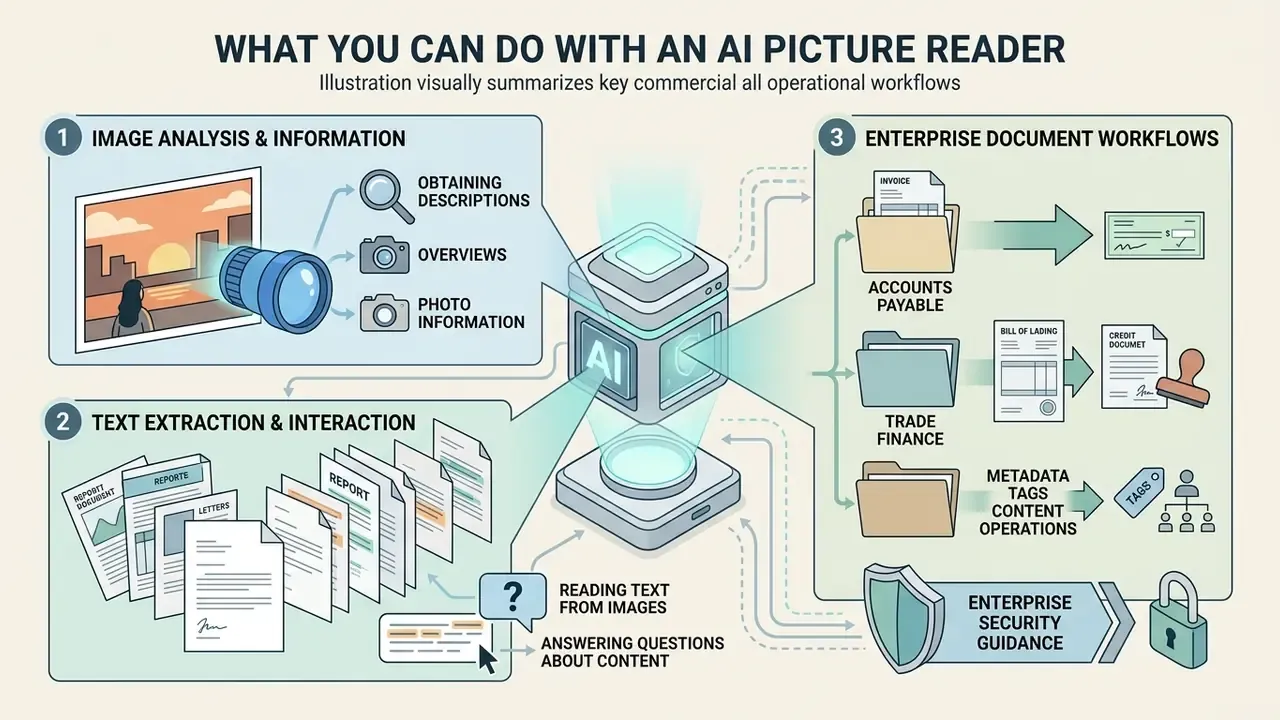
An ai picture reader supports a wide range of commercial and operational workflows across document-heavy industries. Organizations use it to extract text from physical forms, index unstructured image archives, draft technical product descriptions, and audit physical assets. Wiring an ai reader picture tool into an existing stack removes manual data entry bottlenecks and improves enterprise searchability at the same time.
With an ai picture interpreter in place, visual data extraction becomes repeatable, and so does the digital evidence chain behind it. The efficiency shows up across risk management, compliance, customer onboarding, and content operations. National digitization standards point the same direction: the National Archives of India Digitization SOP v2 (2024) mandates OCR on JPEG assets with over 95% accuracy on printed and typewritten text, plus AI-based auto-tagging into standardized CSV or XML metadata.
Obtaining Descriptions, Overviews, and Photo Information
Extracting detailed ai picture information lets businesses catalog large photographic inventories without an army of interns. Accuracy is not language-neutral, though, and multilingual deployments need separate validation.
In commercial real estate, an ai that can look at pictures reviews site photos to assess building condition, sanity-check square footage estimates, and flag safety violations. The model weighs architectural features, lighting conditions, and surrounding infrastructure, then returns a structured site summary.
Consider a hypothetical commercial property audit. A real estate firm ran an automated visual inspection model across 5,000 site photographs. The operations team layered confidence scoring on top, routing low-clarity images to manual review. Reporting turnaround fell from three weeks to two days, with the audit trail intact. Illustrative example, not a documented client result.
Reading Text from Images and Answering Questions About It
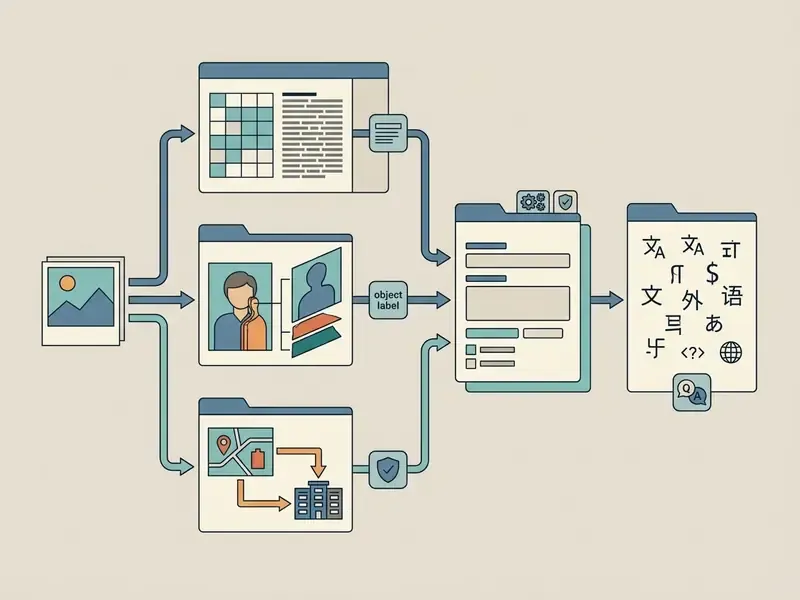
Pairing traditional optical character recognition with a vision-language model lets an ai that can interpret images parse documents that mix embedded text, tables, and handwritten annotations. Standard optical character recognition returns raw character strings. Hybrid VLM frameworks interpret layout, header hierarchy, and table relationships.
That difference is why users can ask direct questions about content: pull the summary total from a scanned invoice, confirm the expiration date on a government-issued ID. The model reads the layout, locates the relevant field, and answers on demand.
Handwriting is still the hardest sub-case. NIST Special Database 19, with 810,000 isolated character images from 3,600 handprinted writers, remains the reference baseline, and modern document VLMs still pair vision encoders with dedicated OCR extractors such as PaddleOCR before feeding combined text and image tokens to the language model.
Enterprise Document Output: Accounts Payable, Trade Finance, and Content Operations
For CFO and COO functions, the highest-value use of visual analysis is not creative copy. It is structured financial data capture. An ai that interprets images parses supplier invoices, purchase orders, bills of lading, letters of credit, and packing lists, then emits validated key-value pairs for three-way matching against ERP records. Typical control design pairs field-level confidence with tolerance rules: amounts, tax identifiers, and incoterms below threshold go to an analyst queue, clean extractions post automatically. In trade finance, the same pipeline surfaces document discrepancies, mismatched vessel names, inconsistent dates, missing endorsements, the items that historically eat most of a checker's day.
The same extraction capability feeds commercial content workflows across digital channels and social media platforms. An image reader evaluates product photography to draft accurate alt-text, improving accessibility and search indexation, and marketing teams reuse those structured summaries for specifications, catalog entries, and promotional copy. Facebook's deployed Automatic Alt-Text system and Firefox's on-device PDF alt-text generation both show the pattern working at consumer scale, and a 2026 web-accessibility study found context-aware descriptions improve when page title, URL, and site purpose are supplied alongside the image. Teams pairing description output with visual production can review AI photo editor workflows and online photo editors for downstream asset preparation.
Creative teams also run reverse prompt engineering: analyze existing imagery, generate a technical prompt, feed it to an image generator. Designers use this to convert reference photographs into detailed descriptive prompts and keep visual assets consistent across brand campaigns.
How to Choose an Image Reader AI for Personal and Professional Tasks
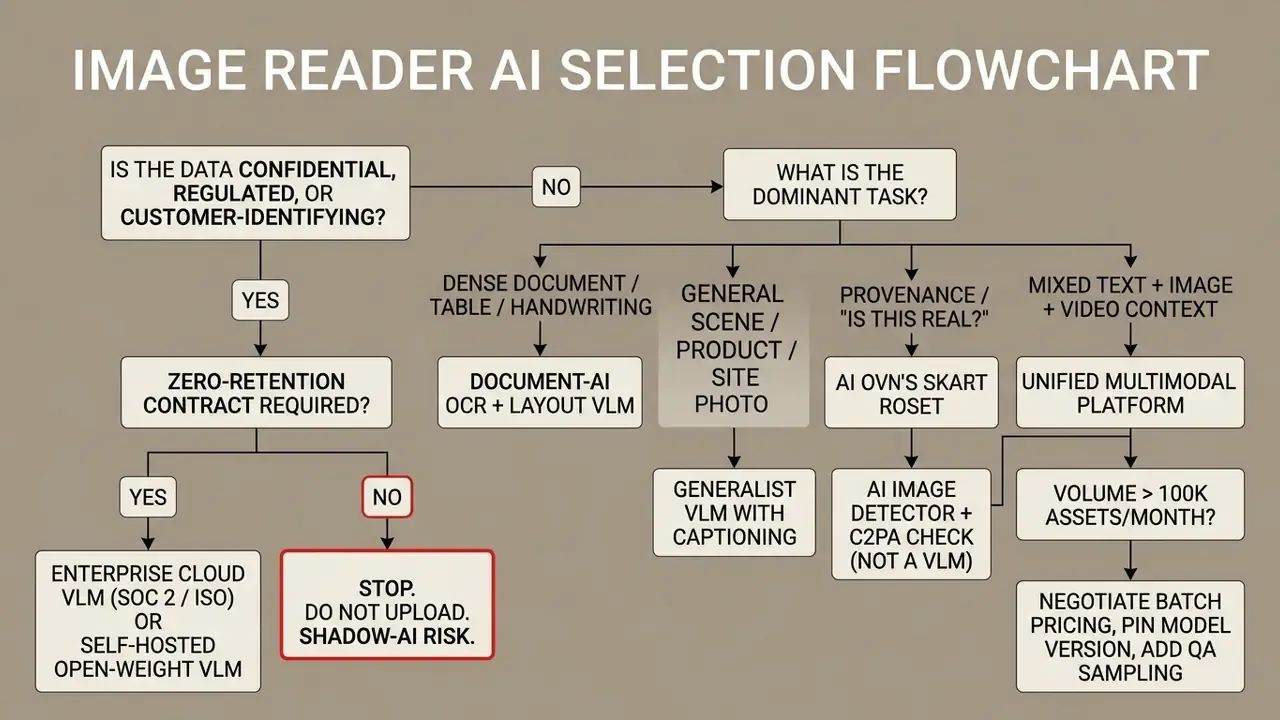
Selecting an image ai reader means weighing benchmark performance, operational cost, language support, and security posture together. Enterprise buyers trade the flexibility of open-weight vision models against the managed infrastructure and turnkey integration of commercial cloud platforms. Start with the workload question: dedicated document OCR, general scene understanding, or multimodal chat integration? The answer usually narrows the field faster than any feature matrix.
When comparing a free ai image reader against an enterprise platform, risk leaders need to read data retention policies and processing limits before anything else. The decision path below compresses the logic.
Free AI Image Reader: Capabilities and Limitations
A free ai image reader gives individuals and small test teams a usable entry point. Free tiers also arrive with constraints: file size caps (commonly 10MB for guest access, up to 20MB for authenticated users), lower processing priority, rate-limited quotas, and smaller model parameter sizes. Exact per-image, per-message, and per-request limits shift frequently and differ by API version, so verify them in the current documentation of the specific service rather than trusting a secondary summary. Published figures in circulation include 20 images per message on some consumer chat interfaces, 100 images per API request on long-context models, 30 images per request with a 10MB combined base64 payload on some inference providers, and 20MB per file on version 4.0 of major cloud vision APIs against 4MB on version 3.2.
Guest tiers may also retain uploaded assets for model training. For corporate data, that is a privacy exposure, not a footnote.
Anyone evaluating free solutions should read the terms of service line by line to prevent unauthorized processing of confidential business information. Shadow AI usually starts here, with a well-meaning analyst and a browser tab.
Which Features to Compare Across AI Tools
When benchmarking commercial visual analysis engines, compare these characteristics directly:
- Supported file formats: native support for JPEG, PNG, TIFF, WebP, and multi-page PDF.
- Multilingual OCR precision: extraction and translation quality on non-Latin scripts, handwriting, and multi-column tables.
- Inference latency and throughput: measured token generation speed and batch capability under production load.
- Context window capacity: token limits governing multi-image analysis and long-document processing.
- Data security and isolation: enterprise privacy options, zero-retention guarantees, SOC 2 and ISO certifications.
- MRM and GRC integration: audit logs, model version pinning, field-level confidence outputs, exportable evidence artifacts for the validation file.
- Total cost of ownership: inference pricing plus control cost, not the headline per-page rate.
File Specifications, Resolution Standards, and Payload Limits
Operational teams need exact ingestion specifications before they design the pipeline:
- Supported raster formats JPEG/JPG, PNG, WebP, BMP, TIFF, HEIC/HEIF, GIF (first frame on most endpoints).
- Vector and document formats native multi-page PDF, DOCX-derived renders; keyframe rasterization should target 300 DPI or higher for dense or small print.
- Resolution guidance render the longest edge at up to 2048 px for common cloud VLMs; upscale small-text regions instead of downscaling whole pages; match the model's native interpreted resolution to avoid wasting visual tokens.
- Payload limits commonly 10MB (guest) to 20MB (authenticated or API v4.0) per image; 4MB on legacy versions; roughly 10MB combined for base64 batches; up to 100MB for batch-processing buckets on some platforms.
- Batch ceilings 20 to 30 images per interactive message on consumer tiers; 100 to 600 images per API request depending on context window; up to 3,600 image files per request on some large-context models.
- Known degradation triggers low resolution, poor contrast, rotation and skew, heavy JPEG compression, panoramic or fisheye projections, non-Latin scripts, and handwriting.
Total Cost of Ownership Formula
TCO per 1,000 documents =
    (Pages x per-page inference price)
  + (Exception rate x minutes per manual review x loaded analyst cost)
  + (QA sampling rate x review cost)
  + (Integration + monitoring amortization)
  + (Residual risk provision: expected error rate x average error impact)
A platform with the cheapest per-page rate and a 30% exception rate often costs more than a premium engine with a 6% exception rate. At scale, control cost dominates. That single line has killed more visual AI business cases than accuracy ever did.
When You Need a Unified Service with AI Chat, Image, and Video
An integrated multimodal platform that combines conversational ai chat, visual processing, and ai video capability tends to win on economics when workflows span formats. Unified vendors simplify procurement, cut API integration overhead, and let context flow across text, photographic, and video inputs. Teams scoping the motion side of that stack can see how an AI video generator differs in cost structure and licensing from a still-image pipeline, or browse the full set of AI Media Comparison Matrices before shortlisting.
Unified architectures can reduce document processing cost and latency compared with chaining isolated point solutions, and document-QA research reports multi-fold latency and cost improvements at comparable accuracy on DocVQA and TAT-DQA. One transparency note: the economics study cited in an earlier version could not be verified, so it has been replaced with an independently published benchmark survey.
«A survey of 180 benchmarks confirms that long-video and multi-image sequence understanding remains significantly weaker than single-image tasks across all tested MLLMs.»
Enterprise AI image reader selection matrix
| Evaluation category | Free / open-source tier | Commercial cloud platform API |
|---|---|---|
| Available AI models | Quantized open-weight models or basic API tiers | State-of-the-art vision-language model clusters |
| OCR and layout quality | Standard text extraction; struggles with dense tables | High-precision layout, handwriting, and chart parsing |
| Multilingual capabilities | Primary support for major global languages | Extensive support across 100+ languages and scripts |
| Multimodal integration | Standalone web chat interfaces | Unified API for chat, image, video, and audio |
| Data privacy controls | Public processing; possible retention for training | Strict enterprise isolation, zero retention, SOC 2 |
| MRM and audit readiness | Manual logging; version drift risk | Version pinning, audit trails, confidence-scored fields |
Adjacent Tools That Are Not Image Readers
Output Accuracy and Limitations of AI Image Interpretation
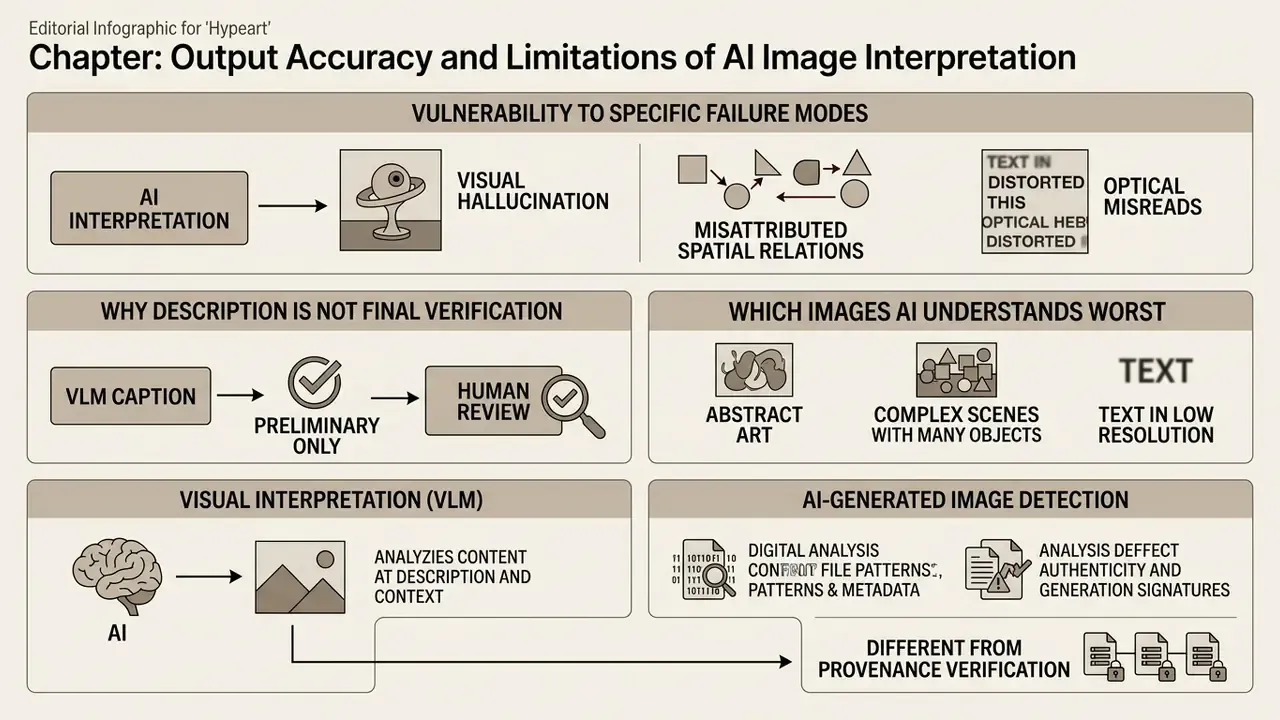
«HALLUCINOGEN evaluated eleven LVLMs and revealed high vulnerability to hallucination attacks on both salient and latent visual entities.»
«HQH exposes serious hallucination problems in popular LVLMs, arising not only in primary answers but also in supplementary analysis.» HQM/HQH, "Measuring the Measurers", arXiv:2406.17115 (2024-2026). https://arxiv.org/abs/2406.17115
Benchmark families report failure rates that are not directly comparable. Some measure object hallucination in captioning, others measure visual illusion, bias, or reasoning failure under entangled language-vision conditions. Mitigation research, including visual contrastive decoding, has demonstrated reductions of roughly 25% and 28% in hallucinated objects for captioning. Meaningful, yes. Elimination, no.
These boundaries are exactly what model risk managers design around: human-in-the-loop controls, confidence thresholds, automated exception routing.
Which Images AI Understands Worst
«FaithScore shows that even short descriptive sentences frequently contain atomic facts that do not correspond to the actual image content.»
Why an AI Description Cannot Be Treated as Final Image Verification
A description generated by artificial intelligence reflects statistical token probabilities learned from pre-training data. It is not forensic verification. An ai that understands images can judge visual consistency, but it cannot establish asset authenticity, catch a sophisticated deepfake, or attest to legal chain of custody. Verification belongs to dedicated AI image detectors and, where origin tracing matters, to AI reverse image search.
Treating a VLM description as proof of document authenticity is a serious control failure, particularly in onboarding and claims. Forensic deepfake detection needs pixel-level frequency analysis, not a natural language description engine.
«Passive deepfake detection research spans DF40 (1M synthetic faces) and DiffusionFace (600,000 images); even specialized detectors do not achieve universal reliability.»
Practical verification targets include output from Midjourney, DALL·E, GPT Image, Stable Diffusion and SDXL, Adobe Firefly, Flux, Imagen, Grok and Bing Image Creator, plus GAN-based systems such as StyleGAN and BigGAN. Detection quality collapses on screenshots and re-compressed copies, so insist on original files rather than downstream re-saves. Where disputes escalate into legal exposure, compare options for evidentiary handling before the first filing.
Visual Interpretation Compared With AI-Generated Image Detection
An image reader AI evaluates visual semantics. Identifying synthetic manipulation requires digital provenance architecture built on entirely different principles. Conflating the two is, in my experience reviewing programs, the single most common governance error in visual AI.
Image Reader AI (VLM) compared with AI image detection and provenance verification
| Dimension | Image Reader AI (VLM) | AI image detector / provenance stack |
|---|---|---|
| Core question answered | What is in this image and what does it say? | How was this image produced, and has it been altered? |
| Method | Semantic analysis via Vision Transformers and language decoding | Spatial frequency artifact analysis, noise-residual distribution, GAN and diffusion fingerprinting, C2PA manifest verification |
| Output | Descriptions, OCR fields, structured JSON | Synthetic-probability score, generator attribution, provenance chain status |
| Primary failure mode | Hallucination; vulnerable to visual spoofing | Domain shift to unseen generators; degradation on screenshots and recompression |
| Fraud use cases covered | Data capture, triage, document reading | KYC bypass attempts, synthetic ID documents, marketplace and listing fraud, catfishing portraits, fabricated news imagery |
| Correct deployment | Extraction and enrichment layer | Independent control layer before trust decisions |
Sequencing is the operational rule. Run detection and provenance checks before any VLM description is allowed to influence a credit, onboarding, claims, or publication decision. Volume context sharpens the point: with tens of millions of synthetic images produced daily and billions already circulating, unverified visual input is a standing control gap, not an exception.
Privacy and Data Security When Uploading Images
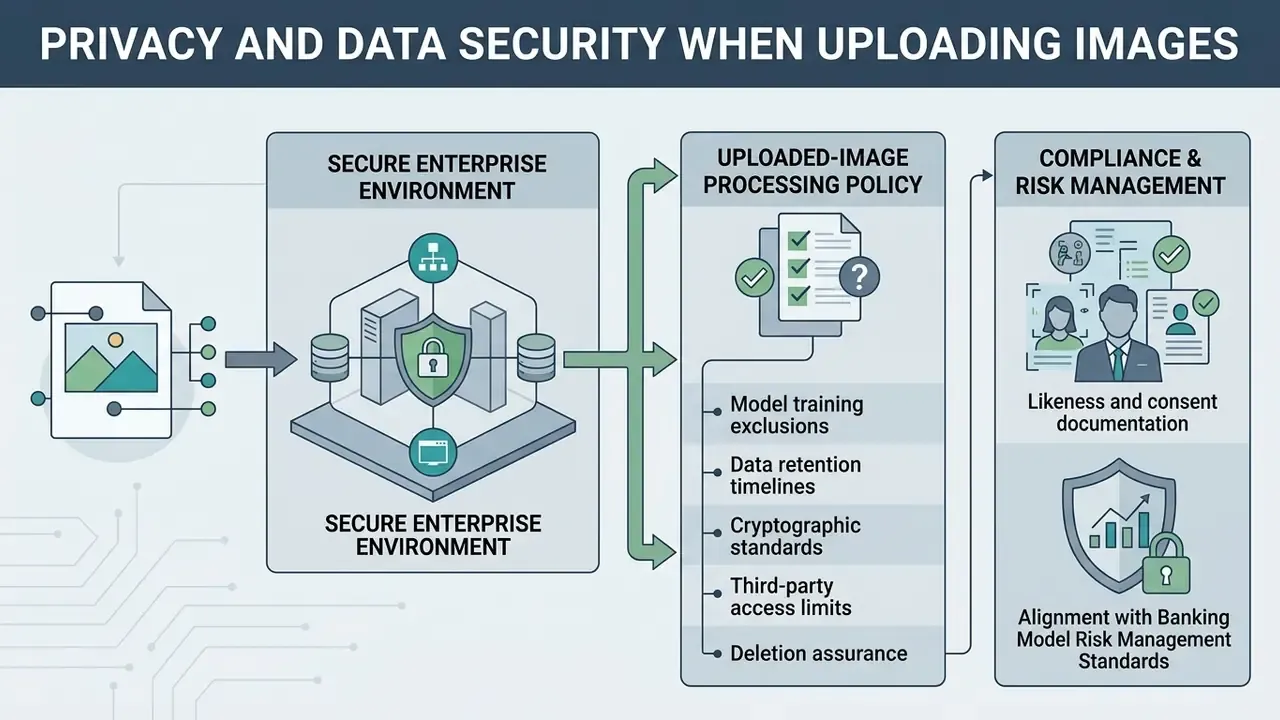
Running visual processing inside an enterprise environment raises data security and regulatory questions that precede any accuracy discussion.
When users upload images containing customer personal data, financial statements, or proprietary schematics, those files fall under strict privacy regimes, including the EU AI Act and US financial privacy standards. NIST AI 600-1 (2024) additionally treats confidentiality of training data, model weights, and system integrity as core generative-AI security concerns, while European Commission guidance on prohibited practices bars building facial-recognition databases through untargeted scraping of facial images.
Controls have to prevent unauthorized access, unencrypted storage, and accidental leakage during cloud inference. A single mis-scoped bucket can undo an otherwise clean validation file.
What to Verify in the Uploaded-Image Processing Policy
Risk and compliance leaders should audit these provisions in a vendor's privacy policy and contract:
- Model training exclusions: explicit contractual guarantees that uploaded visual data will not be retained or used to train public foundation models.
- Data retention timelines: defined server-side deletion schedules, such as immediate purging or a maximum 72-hour temporary cache, the window published for at least one European Commission assistant service.
- Cryptographic standards: end-to-end encryption in transit (TLS 1.3) and at rest (AES-256).
- Third-party access limits: confirmation that files are not shared with unvetted sub-processors or cross-border infrastructure without explicit consent.
- Deletion assurance: documented sanitization and dual-authorization destruction controls for backups, consistent with NIST SP 800-53r5.
- Likeness and consent documentation: evidence that training-data policy verifies consent where a person's image or likeness is involved, as required under NIST AI 600-1.
Alignment with Banking Model Risk Management Standards
US financial institutions deploying visual AI should place it inside existing model risk governance rather than treating it as an IT utility. Supervisory guidance, Federal Reserve SR 11-7 and OCC Bulletin 2011-12, expects documented development evidence, independent validation, ongoing monitoring, and a named accountable owner. Applied to an image reader ai, that becomes concrete artifacts: a conceptual soundness write-up covering the vision encoder and language decoder, a holdout test set representative of the institution's own document mix, outcome analysis comparing extracted fields against ground truth, benchmarking against a challenger model or a manual baseline, and documented limitations including hallucination rates, weak image categories, and language coverage.
Where a third-party VLM is used, vendor model documentation, version pinning, and change-notification clauses become part of the validation file. In AML and KYC contexts, add one more line: which extracted field feeds which rule, and what happens to an alert when the field was produced below threshold. NIST AI 600-1 grounding and human-review requirements complement supervisory expectations here, but they do not replace them.
Commercial Use of Image Reader AI Outputs
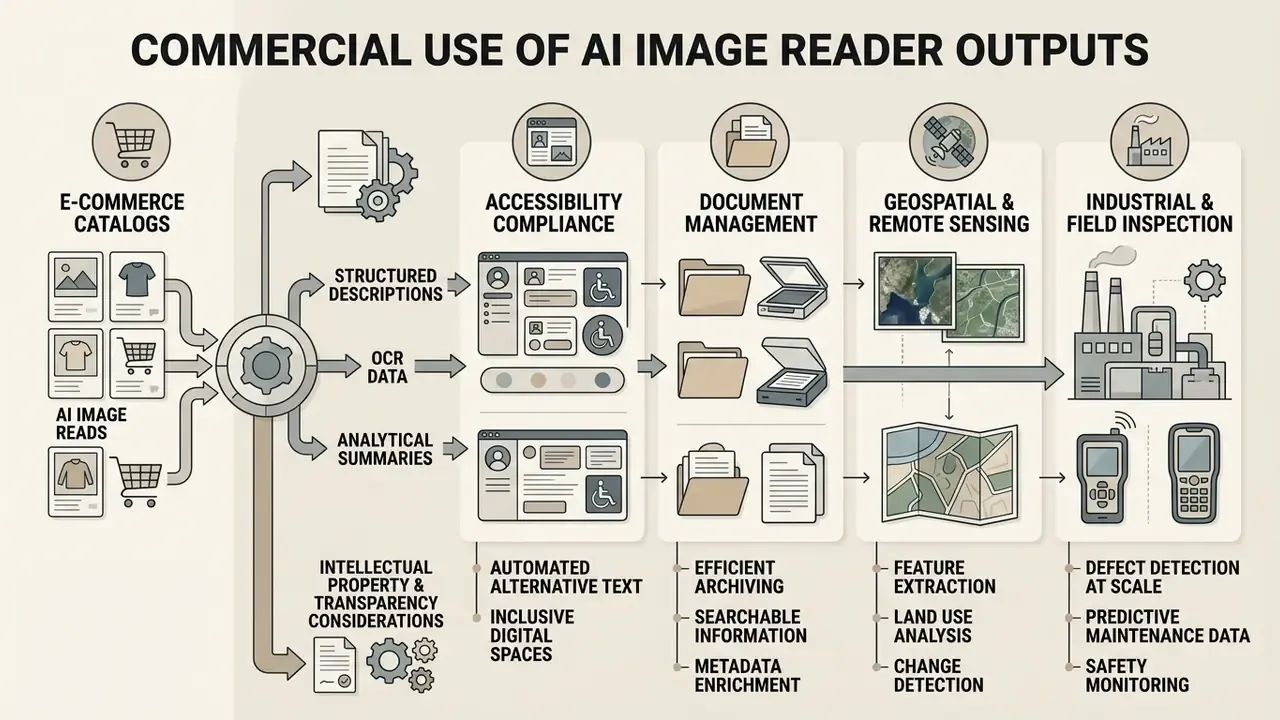
Using AI-generated image descriptions, structured OCR data, and analytical summaries in commercial operations pulls in intellectual property law and transparency rules.
Under US Copyright Office guidance, purely machine-generated text lacks federal copyright protection without substantial human creative authorship (US Copyright Office AI Policy Statement, 2024). Prompt-only output is not registrable, which means AI-only descriptions can be copied freely by competitors. That is a commercial consideration as much as a legal one.
Security exposure travels with commercial deployment too, especially in public-facing or partner-facing pipelines.
Regulatory frameworks add disclosure duties. Article 50 of the EU AI Act mandates machine-readable labeling and explicit disclosure when synthetic or AI-analyzed content is used in public-interest or commercial contexts, with the relevant transparency obligations applying from 2 August 2026.
Where to Apply AI Image Descriptions in Business and Content
Enterprises put structured visual descriptions to work across high-volume operations:
One more illustrative case, this time from lending. A commercial bank loan processing unit integrated an automated document reader to extract financial figures from scanned tax returns. Dual-control validation required analyst confirmation whenever field-level confidence dropped below 95%. Review latency fell 55%, with internal credit risk policy fully observed. The detail that matters: the business case only held after control cost was included. Manual review of the residual exception queue and a 5% random QA sample on auto-approved extractions were budgeted as permanent line items, not pilot-phase overhead. Hypothetical composite, offered for structure rather than as a documented result.
Model Risk Validation Checklist for VLM Deployment
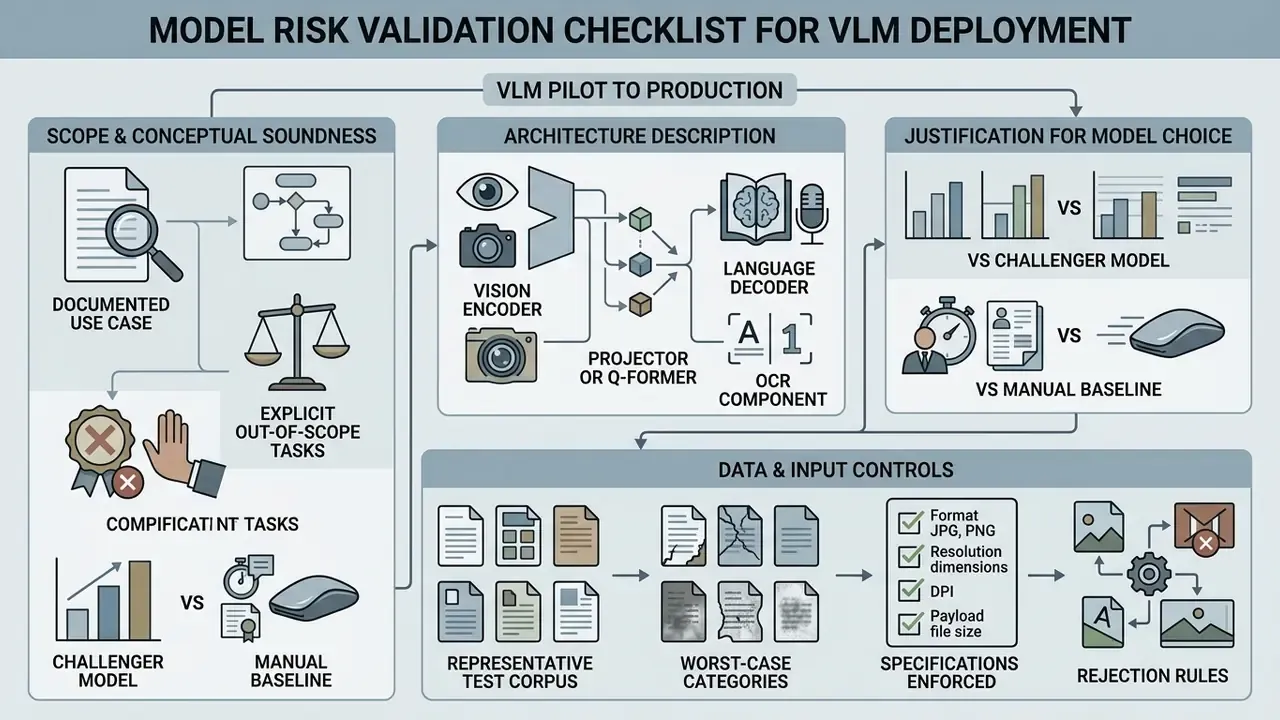
Work through this before promoting a visual AI pilot into production.
1. Scope and conceptual soundness
Checklist0 / 3
2. Data and input controls
Checklist0 / 3
3. Performance and error measurement
Checklist0 / 4
4. Controls and human-in-the-loop design
Checklist0 / 4
5. Reproducibility and monitoring
Checklist0 / 4
6. Legal, privacy, and disclosure
Checklist0 / 4
7. Governance sign-off
Checklist0 / 3
A safe next step, if you are early: run one document class through the checklist end to end, measure the exception rate honestly, and only then discuss scale. Definitions and adjacent concepts are collected in the glossary if you need shared vocabulary for that first review.
FAQ: Frequently Asked Questions About AI Image Readers
Can an AI Image Reader Analyze Video and AI Video?
Standard readers handle static raster files, JPEG, PNG, single PDF pages, and focus on spatial features inside one frame. Organizations with motion-heavy requirements should compare the best AI video generators and dedicated video-understanding platforms instead. Analyzing continuous streams or synthetic ai video clips needs spatiotemporal models that track motion, temporal continuity, and sequential event logic, which pushes context length and compute requirements up substantially.
Specialized video platforms process video files directly. Standard image engines approximate the task by extracting and reading individual keyframes in sequence. For continuous surveillance or long-form assets, deploy a dedicated video-language architecture evaluated on long-video benchmarks such as MLVU.
«A survey of 180 benchmarks records that MLVU and EgoSchema show long-video understanding remains significantly weaker than single-image tasks across all tested models.» Survey of 180 MLLM Benchmarks, arXiv:2408.08632 (2024). https://arxiv.org/abs/2408.08632
Which File Formats and Sizes Can I Upload?
Most commercial engines accept JPEG, PNG, WebP, BMP, TIFF, HEIC/HEIF, and multi-page PDF. Practical ceilings usually sit between 10MB on guest tiers and 20MB per image on current API versions, with 4MB on legacy endpoints and up to 100MB on some batch upload buckets. Render document pages at 300 DPI or higher when small print matters, and cap the longest edge near 2048 px for general scene analysis so you are not paying for wasted visual tokens.
Can I Use AI-Generated Image Descriptions Commercially?
Generally yes, subject to the service's terms of use. In the United States, though, purely machine-generated text carries no copyright protection without meaningful human authorship, so the description is not an exclusive asset. In the EU, Article 50 transparency duties apply to AI-generated or manipulated content in specified contexts from 2 August 2026. Consult counsel for jurisdiction-specific advice.
How Accurate Is OCR on Handwriting and Tables?
Printed and typewritten text routinely clears 95% accuracy in national digitization programs, and modern document VLMs perform strongly on OCRBench v2-style text, table, chart, and diagram extraction. Handwriting stays materially weaker and highly writer-dependent. Treat handwritten fields as exception-queue candidates by default rather than auto-posting them.
Can an Image Reader AI Tell Me If a Photo Is AI-Generated?
No, not reliably, and never as a control. A VLM may comment on visual oddities, but it reasons about semantics, not provenance. Use a dedicated detector plus C2PA manifest verification, prefer original files over screenshots, and record the detection verdict as a separate audit artifact.
How Do I Reduce Hallucinations in Production?
Fix temperature at zero for extraction. Force strict JSON schemas with explicit nulls. Forbid inference of unwritten values. Request an objective scene description before the task, require the model to state what it cannot determine, and sample outputs continuously against ground truth. Contrastive decoding and similar mitigations reduce hallucinated objects meaningfully, yet none of them remove the need for human review.
What Should a First 90-Day Pilot Cover?
Pick one high-volume document class, define the field list, set thresholds per field, and instrument logging from day one. Measure exception rate, field-level error rate, and reviewer minutes per exception weekly. Then decide. If the control cost is not falling by week eight, the problem is usually input quality, not the model. Ready to benchmark vendors side by side? You can compare options across formats before committing budget.
Further reading and vendor matrices: open the hub.