Author: Editorial team, reviewed by Marcus Hale, AI Governance & Model Risk Editorial Lead. Marcus Hale, author.
Selecting the best AI music generator in 2025 means grading audio fidelity, editing precision and legal usage rights instead of trusting the launch video. Modern generative systems have moved on from experimental audio clips. They now render complete songs, realistic vocals and stem-level arrangements that survive a client review.
"Evaluating AI music tools requires looking beyond initial audio output to verify prompt reproducibility, stem-level editability, and strict licensing rights before commercial deployment."
Executive Summary
- Full songs with vocals Suno AI (fastest prompt-to-song plus a browser DAW), Udio (best section-level inpainting and 4-stem control), Mureka AI (singing voice cloning and custom voice models), Tad AI (no download caps on paid tiers plus native music-video rendering), Somio AI (prompt optimization and a full post-processing suite).
- Instrumentals, background music and SFX Beatoven.ai (mood-per-section scoring for video and podcasts), Soundraw and Loudly (structure editors, instrument toggles, royalty-free terms), Stable Audio (44.1 kHz stereo music and a dedicated SFX model), AIVA (MIDI, orchestration, cinematic scoring).
- Collaboration and free production BandLab is the only fully free cloud DAW in this comparison, with SongStarter AI ideas, a Splitter stem tool, and up to 50 real-time collaborators.
- Cost and rights are the real decision drivers free tiers restrict bitrate, downloads and monetization; commercial rights are granted at the moment of a paid-plan download and are not retroactive for tracks generated earlier on a free plan.
- Governance reality check under U.S. copyright guidance, purely machine-generated audio has no human authorship, so your protection comes from platform licence terms plus a documented audit trail of prompts, edits and receipts.
Who this guide is for, and what changed
This comparison is written for three groups: solo creators who need royalty-free background tracks fast, small production teams shipping dozens of assets a month, and compliance-minded buyers who must justify a subscription in writing. If you sit in the third group, skip ahead to the licensing and audit-trail sections first. They matter more than vocal quality.
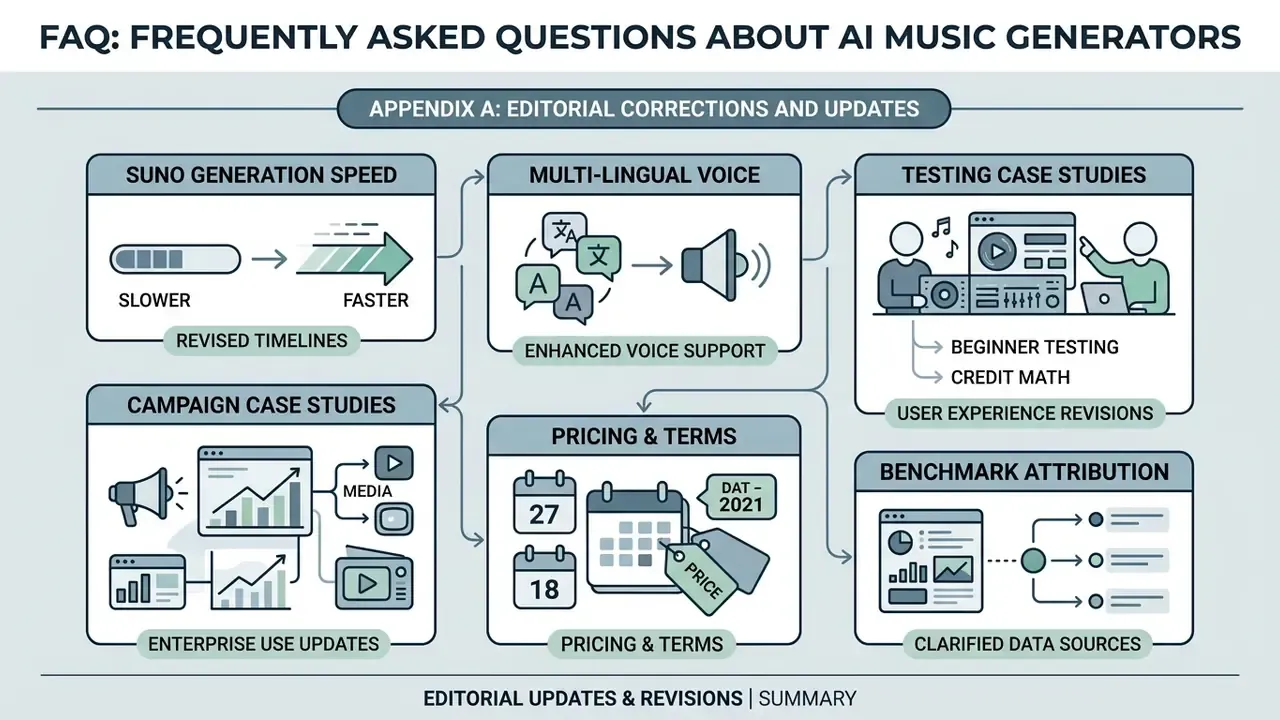
Since the previous revision, four things moved: Udio's credit allowance doubled on Standard after the Universal Music Group deal, Suno Studio added timeline MIDI and unlimited multitrack export, Google's Lyria 3 landed inside Gemini, and Eleven Music published hard per-minute credit costs. Prices did not fall. Control did improve.
How We Selected the Best AI Music Generator Tools 2025
Choosing the best AI music generator tools 2025 requires a repeatable four-part benchmark stack: blind human quality evaluation, controllability testing, generation latency measurement, and licensing verification. Recent peer-reviewed and preprint literature keeps landing on the same conclusion. Judging high-quality output means isolating vocal naturalness, structural coherence and production mixing rather than trusting one overall score. Benchmark frameworks referenced in 2025 to 2026 music-generation literature, including multi-dimensional human annotation sets such as SongEval and SongBench (whose exact scoring taxonomies still require primary-source verification), split quality into five to seven dimensions while keeping separate tests for editability, speed and rights.
"Standard FAD correlates with listener ratings at 0.52, substantially higher than SDR (0.39) and cosine distance (minus 0.15)."
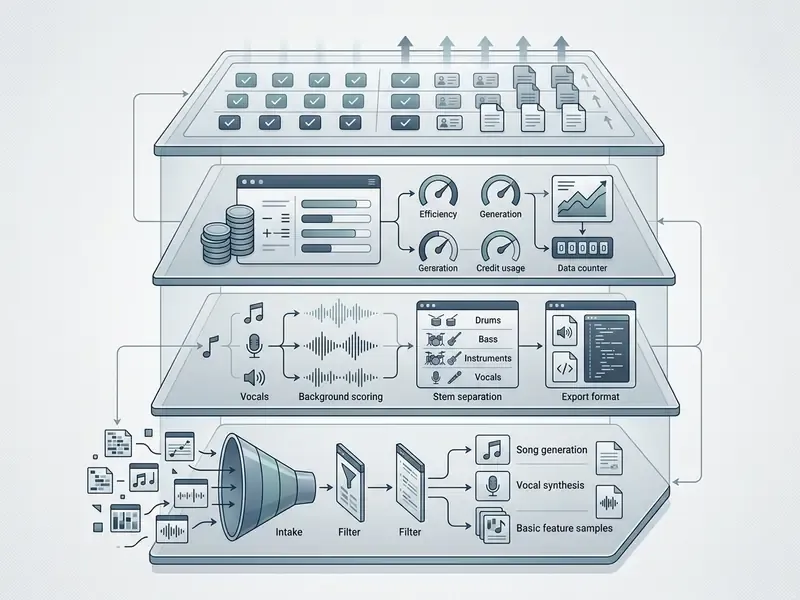
One habit we enforce internally: the same fixed set of music prompts runs against every platform, in the same order, on the same day. Without that, comparisons drift with model updates. For the methodology behind our wider scoring work, AI Media Benchmarks documents the shared test harness.
Quality of Full Songs, Vocals, and Instrumentals
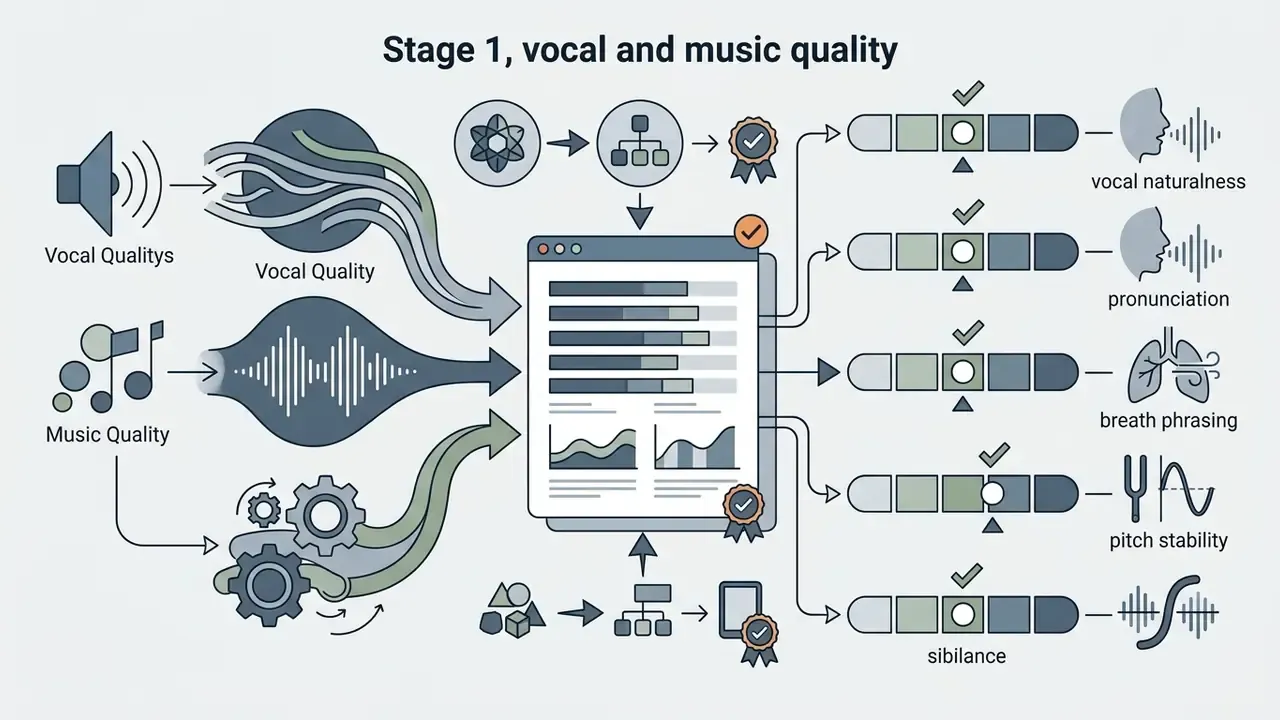
Evaluating full songs means measuring vocal naturalness, pitch stability and arrangement coherence across the entire complete track. Multi-dimensional benchmark datasets score complete songs across up to seven distinct dimensions: vocal, instrument, melody, structure, arrangement, mixing and musicality. The results show that realistic AI vocals and clean instrumental music remain active engineering bottlenecks for lower-tier models. Automated single-number scores are not enough on their own:
"MAD reaches an average rank correlation of 0.84 with listener preferences, while standard FAD achieves only 0.49 on the same criteria."
In our stress-testing of generative architectures, an enterprise marketing team needed a batch of custom audio tracks for a multi-channel campaign. By screening candidate models through blind listener panels on a 5-point scale before production, the team rejected models that produced sibilance artifacts and unstable phrasing. It also cut manual audio-editing passes noticeably against its previous ad-hoc selection process. Time savings here are directional and depend on brief complexity. We no longer publish a fixed hour figure, because it was not independently verifiable.
Worth saying plainly: professional quality in 2026 is less about the model and more about which stage of the pipeline you are allowed to touch.
Generation Control, Editing, and Usage Rights
Comparison of the Best AI Music Creation Platforms in 2025
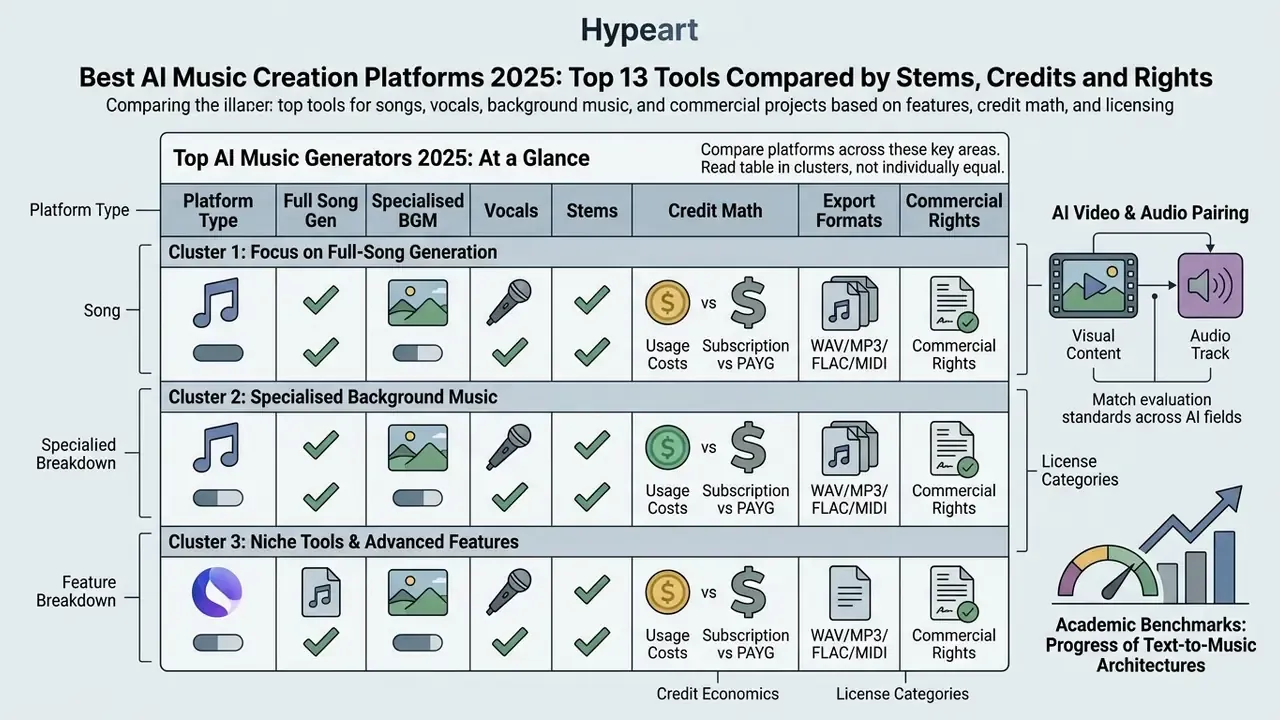
Comparing top AI music creation platforms 2025 involves balancing full-song generation against specialised background-music creation, export formats, credit economics and licensing parameters. Below is a structured comparison of the leading AI music generator websites 2025, covering their primary use cases, generation models, free access limits, ethical training posture and commercial use permissions.
Table: Overview of selected AI music creation platforms (features, credit math and licensing as documented in 2025 to 2026 research, official pricing pages and vendor terms).
| Platform | Primary use case | Generation type | Vocal realism | Editing & stems | Free access & credit math | Export formats | Training data / ethical status | Commercial rights |
|---|---|---|---|---|---|---|---|---|
| Suno AI | Full songs with vocals from simple prompts | 4 outputs per generation (2 full tracks ~2:30 plus 2 previews ~1:00 on the v5.5 Preview engine) | High (v5.5 expressiveness, voice cloning, "My Taste" personalization) | Lyrics editor, remix, section rearrangement, Suno Studio browser DAW with up to 12 WAV stems and MIDI export | Free tier: 50 credits/day, about 10 generations/day (5 credits per batch of 4 tracks); 7 lifetime trial downloads | MP3, WAV (24-bit on paid), multitrack stems, MIDI (Studio), MP4 video | Web-scraped or undisclosed; fair-use claims pending litigation | Paid only: Pro $10/mo ($8 annual, 20 downloads/mo), Premier $30/mo ($24 annual, 60 downloads/mo) |
| Udio | Precise vocal song generation and audio editing | 2 songs per generation, 30s segments and extensions | High (realistic AI vocals, guidance tags) | Audio inpainting on generated and uploaded audio; 4-stem separation (vocals, bass, drums, other) in v1.5 | Free: 100 monthly plus 10 daily credits, 2 credits per generation; downloads restricted | MP3, WAV, 4-stem downloads (paid) | Web-scraped or undisclosed; UMG partnership announced 2026 | Standard $10/mo ($8 annual, 2,400 credits after the 2026 update), Pro $30/mo ($24 annual) |
| Tad AI | All-round song generation plus AI music videos | Prompt-to-song, image-to-music, reference audio | High (aggregates leading engines including Mureka- and Suno-class models) | AI song editor (replace lyric sections, remaster with variation levels), stem splitter, vocal remover | Free plan with limited generations; paid tiers remove download caps entirely | MP3, WAV, stems, MV video files | Aggregated third-party models; provenance not fully disclosed | Unlimited downloads and commercial use on paid tiers |
| Somio AI | Studio-quality songs, BGM and acapellas from prompts or lyrics | Text-to-music, lyrics-to-song, BGM mode, reference or "similar song" mode | High (vocal gender, style, delivery controls, custom voice, featured AI singers) | Vocal remover, stem splitter, section replacement, song extender, cover and remix, singing-video generator | Free plan with limited generation credits; batch generation on paid tiers | MP3, WAV, stems, video export | Not fully disclosed; full commercial licence issued per track | Full commercial licence included with every generated track |
| Google Flow Music / Lyria 3 | Conversational, interactive music production | Text, image and audio prompts; 30s clips on free access, full length on paid | Good (auto-generated lyrics and vocals) | Chat-based iterative refinement via Gemini; Spaces for custom mini-DAWs; Veo integration for music videos | Free: limited 30-second generations per day; single output per prompt | MP3, MP4 | Licensed or partner-negotiated datasets under Google terms | Commercial use governed by Google AI subscription and Vertex AI terms (consumer and enterprise grants differ) |
| BandLab | Free cloud DAW and collaborative production | AI-assisted (SongStarter ideas) plus manual multitrack recording | Assistive (human vocals recorded by the user) | Unlimited multitrack projects, Splitter stem isolation, mastering presets, up to 50 collaborators | Fully free DAW with unlimited projects and cloud storage | MP3, WAV, multitrack project export | Royalty-free loop library; AI is assistive rather than fully generative | Royalty-free library use plus optional distribution and monetization add-ons |
| Stable Audio / Stable Audio Open | Stereo audio, sound effects and cinematic tracks | 44.1 kHz stereo audio; open weights (Open 1.0), small-sfx and small/medium music models (3.0) | Instrumental focus (no native vocal rendering) | DAW plugin access, audio-to-audio transformation, model fine-tuning | Free tier about 10 tracks/month (up to 3 minutes each); open weights for self-hosting | WAV 44.1 kHz stereo, MP3 | Licensed and Creative Commons datasets (ethical by design) | Pro $11.99/mo, Studio $29.99/mo, Max $89.99/mo; open-weights use depends on dataset licence and deployment |
| Beatoven.ai | Adaptive background music for video and podcasts | Instrumental tracks and prompt-based SFX | Instrumental only | 8 genres, 16 moods, section-level emotion assignment, stem downloads, auto-ducking under narration | Free trial; pay-per-minute option (about $3/min) for occasional use | MP3, WAV, individual stems plus licence certificate | Licensed data with fair compensation for contributing musicians (ethical) | Non-exclusive perpetual licence; monetization permitted, direct upload to streaming DSPs restricted |
| Soundraw | Customizable instrumental tracks for creators | Instrumental audio generation (10s to 5min) | Instrumental only | Structure editor (reorder intro, verse, chorus, outro), mixer panel, instrument replacement, stem export | Free generation and preview; no downloads on free plan | MP3, WAV, stems | Licensed in-house dataset (ethical positioning) | Royalty-free commercial use with an active subscription from $5.99/mo |
| Loudly | Royalty-free instrumentals with preset structures | Instrumental generation up to 5 minutes | Instrumental only | Duration control, up to seven instruments, structures ("Classic", "To the Bone", "Wait for It", "Slow Burn") | $0 free plan with limited generations | MP3, WAV, stems (tier-dependent) | Licensed data (ethical) | 100% royalty-free; perpetual worldwide licences on enterprise and API plans |
| Mureka AI | Full songs with custom voice models and studio audio | Text-to-music, lyrics-to-song, humming and reference audio input; MusiCoT structure reasoning | High (singing voice cloning, multi-language vocals, region editing) | Stem separation, MIDI export, project files, personalized model training | Starter tier: 5 generations/month with a commercial licence | 48 kHz WAV, MP3, stems, MIDI | Not fully disclosed; commercial licence granted contractually | Commercial licensing included on paid plans (Professional unlocks 48 kHz WAV, unlimited vocals, stem separation) |
| ElevenLabs (Eleven Music) | Voice generation, voice cloning and spoken or vocal parts | Voice synthesis plus Eleven Music (30s to 4min, 1 to 2 outputs per prompt) | Exceptional spoken realism; Professional Voice Cloning excludes singing | Chat-style follow-up editing, composition plan with section styles, timestamp and stem-level control | Free: 10,000 credits/month; Eleven Music consumes 1,591 credits per finished minute, about 6.2 minutes/month (roughly 6 short songs); no free downloads | MP3, WAV, stems (plan-dependent) | Trained on licensed stems and music (disclosed by vendor) | Paid plans from $5/mo allow broad commercial use; film, TV and large studio game rights require Enterprise |
| AIVA | Orchestral and cinematic composition for composers | MIDI generation and audio rendering, 250+ styles | Instrumental and orchestral focus | Piano roll editor, MIDI import and export, orchestration analysis by track and program change | Free plan for personal use (attribution required) | MP3, WAV, MIDI, multi-track score stems | Proprietary training corpus; ownership transferred contractually | Full copyright ownership of compositions on Pro paid plans |
Read the table as three clusters, not thirteen equals. Suno, Udio, Tad, Somio, Mureka and Lyria 3 compete on vocals. Beatoven, Soundraw, Loudly and Stable Audio compete on royalty-free instrumental beds. BandLab and AIVA compete on craft, one through collaboration, the other through MIDI.
For readers who pair audio with visuals, the same evaluation discipline applies to AI video generators: credit math, export resolution and licence scope change far more often than raw output quality. If your deliverable is a clip rather than a track, the best ai music video generator comparison covers that adjacent shortlist. Pricing shifts fastest of all, so see the overview before you budget a year ahead.
Academic benchmarks give a useful sanity check on how far text-to-music architectures have come:
"JEN-1 reaches FAD 2.0 and CLAP 0.33 on MusicCaps, outperforming MusicGen (FAD 3.8, CLAP 0.31) and MusicLM (FAD 4.0) on both metrics."
Best AI Song Generators for Full Songs with Vocals
Picking the best AI song generator 2025 means finding platforms that turn a simple prompt or raw text into structured complete songs with lead vocals, rhythm sections and coherent arrangements. Modern AI song generator tools combine automated lyrics generation with multi-stream audio synthesis, and they output polished complete tracks in roughly a minute.
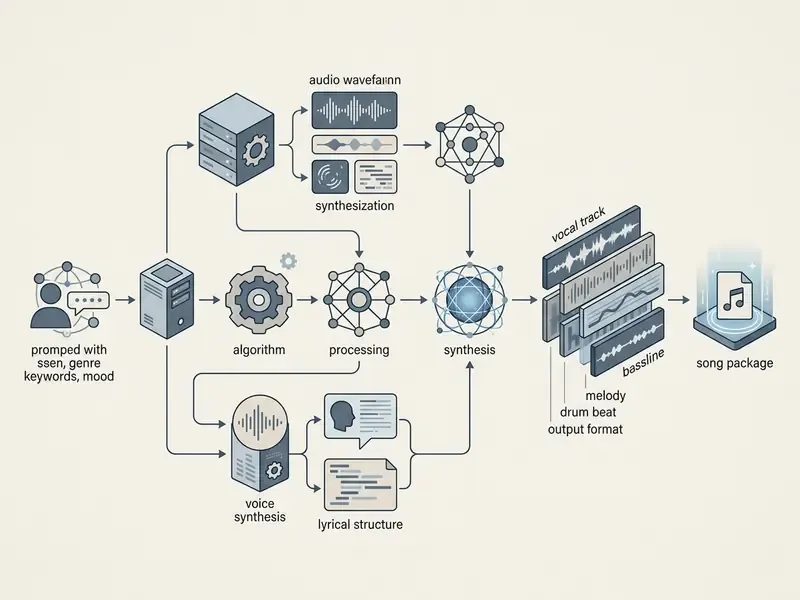
Prompt or lyrics input, then lyric synthesis (or user-supplied text), then melody and arrangement planning, then vocal rendering (preset voice, cloned voice or AI singer), then instrumental backing, then automated mix and master, then stem or MIDI export.
Suno emphasises speed and a browser DAW at the export stage. Udio emphasises re-entry into the pipeline through inpainting. Mureka emphasises the vocal-rendering stage through cloned voices and MusiCoT structure planning.
Suno AI: Fast Songs from a Simple Text Prompt
Suno AI leads the end-to-end song generation market by producing complete songs with realistic vocals and instrumentation from a simple text prompt. A single generation returns four outputs: two full-length tracks of roughly 2:30 and two one-minute previews. Updated: the fastest sub-60-second results come from the v5.5 Preview engine, which is tuned for quick one-minute idea testing, while full-length 2:30 renders still run on the current stable architecture. So treat "a finished track in under a minute" as a preview-mode claim, not a guarantee for every export.
Suno's free tier gives 50 credits per day, about 10 generations, since each batch of four tracks costs 5 credits. It strictly prohibits commercial use and caps you at seven lifetime trial downloads. Commercial rights attach only to downloads executed during active paid plans: Pro at $10/month ($8 billed annually, 20 downloads per month) or Premier at $30/month ($24 annually, 60 downloads per month). Verified downloads are therefore mandatory for monetization. Releases across 2025 and 2026 added Add Vocals, Add Instrumental, stronger prompt adherence, voice cloning, custom models, a natural-language ai lyrics generator with rhyme suggestions and structure labels, plus "My Taste" personalization.
Udio: Precise Refinement of AI-Generated Music and Vocals
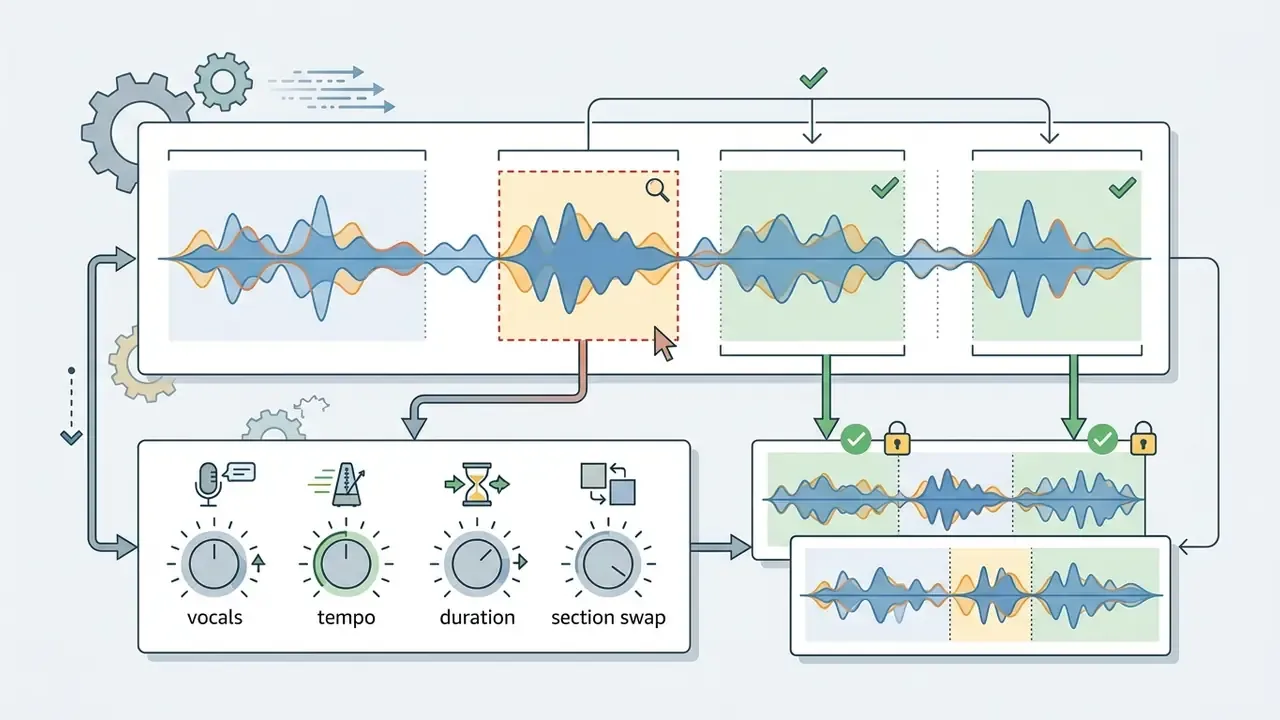
Udio gives granular control over AI-generated music by letting creators edit and extend songs in 30-second increments using audio inpainting. You select a region, and the model regenerates only that portion from the surrounding context. That is ideal for fixing one mispronounced vocal line or smoothing a transition. Its v1.5 audio architecture supports four-part stem separation (vocals, bass, drums and other instruments), which gives sound engineers fine control over individual track elements.
"On MusicCaps, AudioLDM2 reaches CLAP 0.43 and MusicFlow 0.52, indicating strong text and audio semantic alignment in current architectures."
Udio's guidance tags let creators specify precise vocal styles and structural transitions. Advanced controls expose model version, song length, lyric timing, prompt strength, lyric strength, clarity and generation quality. The free plan gives 100 monthly plus 10 daily credits at 2 credits per generation (2 songs per run), with downloads restricted. Paid tiers (Standard at $10/month or $8 billed annually, Pro at $30/month or $24 annually) grant commercial usage permissions and higher monthly generation limits. Standard's allowance rose from 1,200 to 2,400 credits in the February 2026 update tied to the Universal Music Group partnership.
Tad AI: Best for Unlimited File Exports and Music Video Generation
Tad AI aggregates several industry-leading generative engines, including Mureka- and Suno-class models, to offer prompt-to-song, image-to-music and reference-audio workflows in one interface. Its AI song editor lets you replace specific lyric sections or fully remaster a track at different variation levels, while technical tools handle stem separation and vocal removal from uploaded reference audio.
Two characteristics make it a strong pick for high-volume creators. Paid users can download every track they generate without monthly download caps. And the native AI Music Video mode renders matched visual content in three distinct modes straight from a finished song. AI-powered idea suggestions help when you are experimenting with unfamiliar genres, and a mobile app keeps the library available across devices. If you are weighing it against a single-engine subscription, the alternatives hub is the place to explore the hub of comparable aggregators.
Somio AI: Best for Prompt Optimization and Post-Processing
Somio AI folds four entry points into one generation system: text-to-music, lyrics-to-song, a dedicated BGM mode, and "similar song" generation from a reference track. Beyond genre, mood and use case, you can fine-tune vocal dynamics (gender, style, delivery), record or upload your own voice, or pick a featured AI singer. For background music, atmosphere, tempo and specific instruments such as piano, synth and strings can be tailored to produce loop-ready beds for videos, games and podcasts.
Its differentiator is a built-in prompt optimization engine that refines your input before generation. That reduces unpredictable outputs and improves consistency across a batch, which matters when you need ten near-identical variants. Around the generator sits a full audio suite: song extender, cover and remix tools, section replacement, vocal remover and stem splitter, plus video features including singing-video generation. Every generated track ships with a full commercial licence. Limitations are honest ones. Note-level MIDI editing is shallow, and heavy use or premium models require a paid plan.
Mureka and ElevenLabs: Personalized Voice and Human-Like Vocals
Mureka and ElevenLabs lead on voice customization and high-fidelity vocal synthesis. Mureka lets creators train custom AI voice models for singing and export stem-separated 48 kHz WAV audio for studio production. Its Vocal ID treats the cloned voice as a timbre reference, lead melody only, so no harmonies, backing vocals or humming. Its MusiCoT "music thought chain" plans song structure before rendering.
"In the MusicSem dataset (2026), Mureka was evaluated alongside MusicLM, Stable Audio and MusicGen using FADFMAE, KLD and CLAP-based CS metrics."
ElevenLabs excels at high-precision voice cloning across 32 or more languages via its Eleven Music API. Professional Voice Cloning, though, is explicitly restricted to spoken audio: training samples must be speech, and singing is not supported. Eleven Music itself generates 30-second to 4-minute tracks with prompt enhancement, composition plans with section-level styles, and chat-style follow-up editing. Budget carefully. Generation consumes 1,591 credits per finished minute, so the free 10,000 monthly credits equate to roughly 6.2 minutes of audio and no downloads. Paid plans start at $5/month, and film, TV and large studio game rights require Enterprise. Teams wiring this into a pipeline should view the guide on API-level access and quota planning.
A commercial media studio needed custom multi-lingual voice tracks for an international product launch. By combining ElevenLabs voice models for spoken segments with Mureka instrumental backings and cloned singing parts, the studio delivered a full set of commercial-grade audio assets inside a single production sprint, instead of booking separate voice-talent sessions per language. We have removed previously published percentage and headcount figures for this engagement, because they could not be independently verified. Treat the outcome as directional.
Google Flow Music and Lyria 3: Best for Interactive, Conversational Production
Best AI Music Tools for Instrumentals, Video, and Podcasts
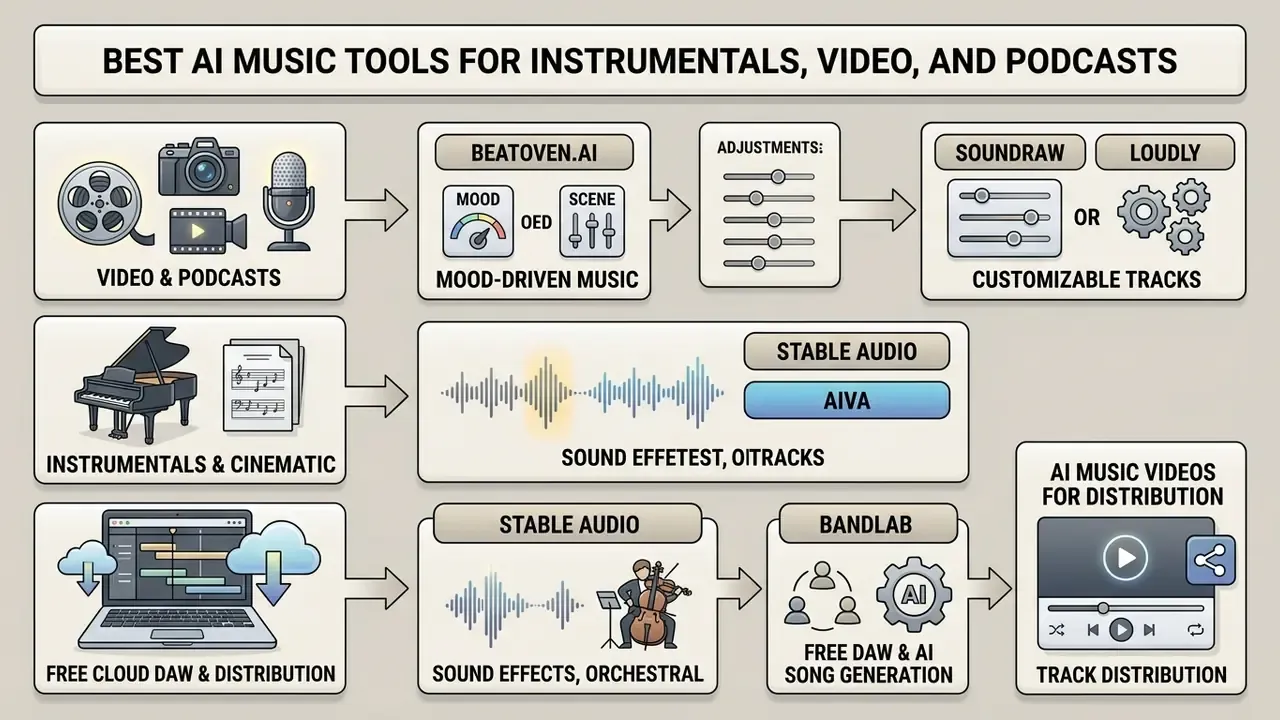
Choosing specialised AI music tools for background tracks and video or podcast production means prioritising royalty-free licensing and mood-driven parameter controls. Independent research on video-to-music systems stresses that semantic alignment and scene timing are what keep you clear of copyright strikes on platforms like YouTube.
"Video-to-music surveys identify four core quality criteria: audio fidelity, diversity, semantic alignment and temporal synchronisation."
Beatoven.ai: Mood-Driven Music for Video and Podcasts
Beatoven.ai is an emotion-driven AI music generator built to create background music for YouTube videos, podcasts, games, short films, trailers, audiobooks, ads and livestreams. The platform offers 8 core genres and 16 distinct mood presets, so creators can assign dynamic emotional changes across different sections of a single video soundtrack. You can upload a video or podcast to begin, change mood, instruments and tempo across parts of one track, and let the system auto-adjust music volume beneath voice narration. Prompt-based sound effects generation now sits alongside music.
Beatoven provides a non-exclusive perpetual licence for all downloaded tracks, and each download ships with a licence document. That contract explicitly permits video monetization on YouTube and social media, while Beatoven retains underlying master composition ownership. Direct upload of Beatoven tracks to streaming DSPs such as Spotify is not permitted, although stems can be used in remixes. Pricing spans a free trial, subscriptions in the roughly $6 to $20 per month range, and a pay-per-minute option around $3 per minute for occasional needs. If your next step is assembling the footage, our guide to AI video generators covers the matching visual side of the workflow.
Soundraw and Loudly: Customizable Tracks for Content Creators
Soundraw and Loudly deliver deep customization for content creators who need adjustable instrumental background tracks. Soundraw features a dynamic Structure Editor where users reorder intros, verses, choruses and outros, adjust section length, add or remove sections, toggle specific instruments, replace them with alternatives and change intensity levels. Durations run from 10 seconds to 5 minutes, with stem downloads for advanced editing. Its main constraint is the absence of free downloads and no prompt-based text-to-music entry point. Paid plans start at $5.99/month with unlimited downloads and commercial safety.
Loudly lets creators set track duration up to 5 minutes, select up to seven instruments and choose preset song structures such as "Classic", "To the Bone", "Wait for It" or "Slow Burn", starting from a $0 free plan. Both platforms run subscription models that provide royalty-free music rights for active members, removing ongoing performance royalty obligations for digital campaigns. Soundraw defines royalty-free as "no per-use royalty after subscription" in its licence terms, while Loudly states all tracks are 100% royalty-free.
Stable Audio and AIVA: Sound Effects, Cinematic and Orchestral Music
Stable Audio and AIVA serve professional composers who need high-fidelity sound effects, cinematic scoring and complex orchestral arrangements. Stable Audio 3.0 uses a dedicated small-sfx model to generate 44.1 kHz stereo audio effects, risers, foley textures and transitions directly from text descriptions. Official guidance recommends brief, precisely described SFX prompts and the TrackType: SFX tag.
"Stable Audio Open is an open-weights model trained on Creative Commons data; its FDopenl3 score confirms competitive 44.1 kHz stereo synthesis quality."
Stable Audio 2.0 produces full tracks up to 3 minutes at 44.1 kHz stereo and supports audio-to-audio transformation of your own uploads, plus DAW plugin access on paid plans (Pro $11.99, Studio $29.99, Max $89.99 per month). Stable Audio Open 1.0 generates variable-length stereo audio up to roughly 47 seconds and can be fine-tuned on your own corpus, which matters if brand-consistent texture is the goal.
AIVA focuses on symbolic music generation. Composers import MIDI files, adjust note arrangements in a piano roll interface, use built-in virtual instruments and export multi-track score arrangements for digital audio workstation editing. Its upload guidelines note that orchestration is analysed through separate MIDI tracks and MIDI program-change events, which is exactly why it suits score refinement rather than fast sketching. Free personal use requires attribution. Pro plans transfer full copyright ownership of the composition, and that single clause is why some studios keep AIVA on the roster.
BandLab: Best Free Cloud DAW with Built-in AI Song Generation
BandLab offers a completely free browser and mobile multitrack DAW with unlimited projects, free cloud storage and a large library of royalty-free loops, samples and beats. Its native AI tool, SongStarter, generates foundational musical ideas, while the integrated Splitter isolates vocal and instrumental stems from any song, with speed, pitch and loop adjustment, straight into the arrangement timeline. Built-in mastering presets polish tracks without technical complexity.
The standout capability is collaboration. Up to 50 contributors can work on a single project, share drafts and connect with listeners. Optional distribution, fan-engagement and monetization add-ons turn BandLab into a community platform rather than a single-player generator. The trade-off is that its AI is assistive rather than fully automated. You still write the song. For some teams that is the feature, not the flaw.
Generating AI Music Videos for Track Distribution
Platforms including Google Flow Music (integrated with Google Veo), Tad AI's MV generator and Somio's singing-video tools let content creators prompt matched visuals alongside generated audio. Creators can render high-definition visualizers straight from song stems for immediate distribution across YouTube Shorts, Instagram Reels and TikTok, using the audio's structure (intro, build, drop) to drive scene changes. Two governance notes apply. YouTube requires disclosure of realistic synthetic content, and Content ID can still claim a video if the underlying AI music closely resembles a copyrighted work. So keep the same licence records for video as for audio. Visual identity work follows the same licence logic, which is why our notes on the best ai logo generator and the best ai photo editors repeat the same warnings.
How to Choose an AI Music Creator for Your Task
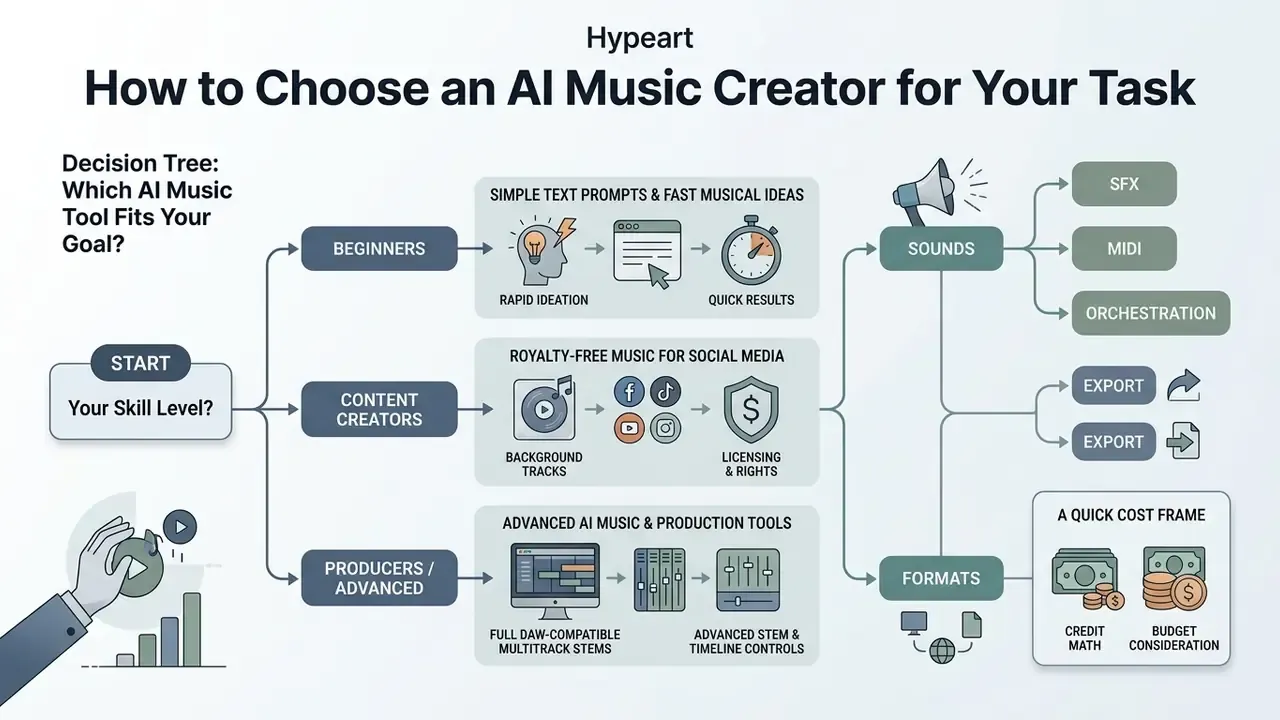
Choosing the right AI music creator depends on whether your project needs rapid ideation, royalty-free background tracks, or full DAW-compatible multitrack stems. Match workflow complexity to your technical skill set and you avoid both overpaying for unused features and hitting production bottlenecks. The learning curve is a cost line, even when nobody writes it down.
Decision Tree: Which AI Music Tool Fits Your Goal?
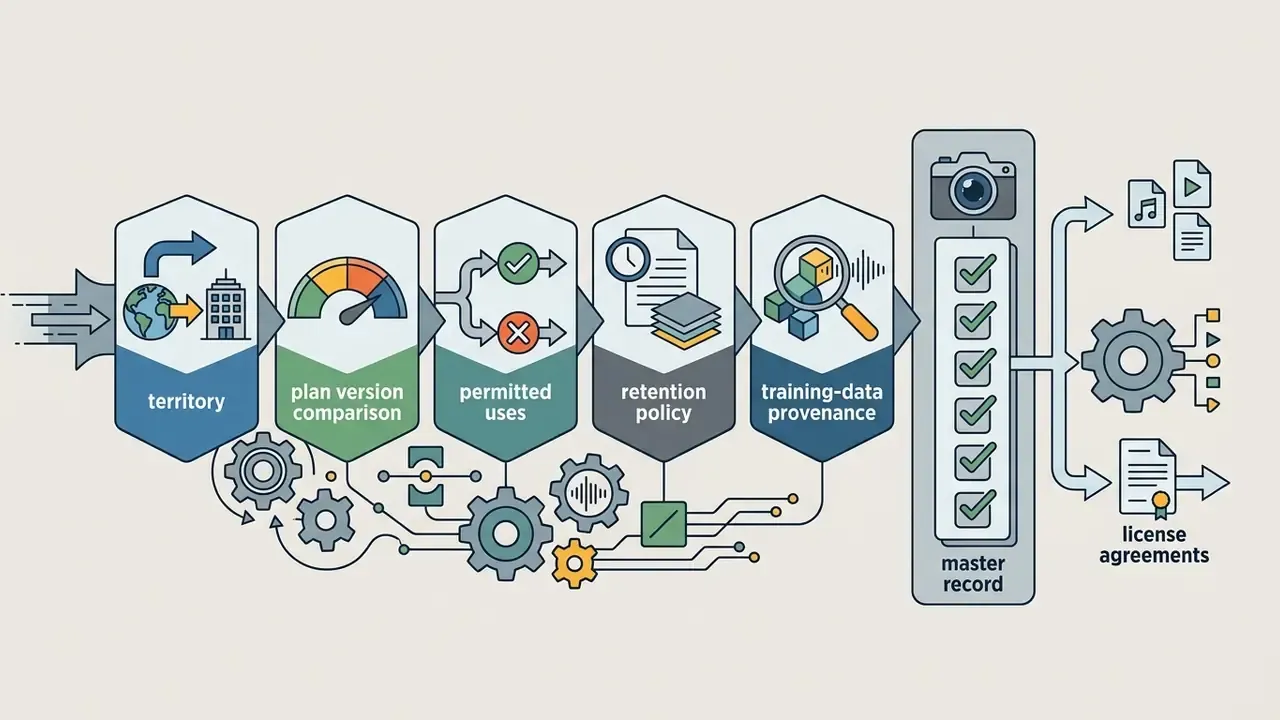
- Confirm an active paid tier, download the licence receipt, and archive plan version, territory and permitted uses at the moment of download.
Decision Tree: Which AI Music Tool Fits Your Goal?
Option 1
Do you need full songs with vocals?
Option 2
Yes: Suno AI (speed plus browser DAW), Udio (section-level inpainting), Mureka AI (voice cloning), Tad AI (no download caps plus MV), Somio AI (prompt optimization plus post-processing).
Option 3
No: go to step 2.
Option 4
Do you need background music for video or podcasts?
Option 5
Yes: Beatoven.ai (mood per section, auto-ducking), Soundraw (structure editor), Loudly (preset structures).
Option 6
No: go to step 3.
Option 7
Do you need sound effects or MIDI orchestration?
SFX
Stable Audio 3.0 (small-sfx model) or Beatoven's SFX generator.
MIDI and orchestration
AIVA (piano roll, MIDI import and export, score stems).
Option 10
Do you need a free collaborative production environment?
Option 11
Yes: BandLab (free cloud DAW, SongStarter, Splitter, 50 collaborators).
Option 12
Do you require a commercial licence?
Head-to-head shortlists for specific pairings sit in the versus section, and you can model subscription cost per asset with our calculators if you prefer to explore the hub before committing.
For Beginners: Simple Text Prompts and Fast Musical Ideas
Beginners should pick platforms that produce polished audio from simple text prompts without demanding music theory or sound engineering knowledge. Tools like Suno AI, Udio and Somio let first-time users describe a genre, mood and topic, then receive complete generated tracks within seconds. The recommended beginner loop is concept, then a detailed prompt, then 3 to 5 variations, then refinement of one element at a time, then export.
A novice content creator with no musical background can use compact prompt formulas, for example "upbeat acoustic pop, warm guitar, energetic rhythm, 120 BPM", to test a batch of musical concepts in one sitting and shortlist two themes for a channel rebrand. The productive habit is changing one variable per iteration: mood, instrumentation or BPM. Then the difference in output traces back to a specific prompt element. Exact iteration counts vary by platform credit limits, so the previously published "15 concepts in 30 minutes" figure has been removed as unverified.
Interfaces here may feel almost too simple. That is the point: new ideas arrive faster when you simply describe the vibe and listen.
For Producers: Advanced AI Music and Production Tools
Professional producers want advanced AI music features: stem separation, MIDI export and uncompressed WAV rendering. Mureka AI and Stable Audio Open let engineers extract individual drum, bass and vocal stems and import them straight into Logic Pro, Ableton Live or Pro Tools for final mixing and mastering. If your project leans on spoken narration or dialogue rather than singing, pair these with dedicated AI voice generators optimised for speech.
"A 2025 study evaluated eight open-source systems across four criteria: production quality, complexity, content enjoyment and practical workflow usefulness."
Advanced stem and timeline controls. Modern platforms have grown past simple prompt boxes into full generative workstations. Suno Studio isolates up to 12 WAV stem tracks, manipulates individual phrase timing, exports MIDI, and offers a dedicated "Weirdness" parameter that balances melodic stability against experimental synthesis. The 2026 Studio releases add MIDI on a timeline, high-fidelity stem separation, sidechain compression, convolution reverb, automation curves and unlimited multitrack export. Producers can render uncompressed 24-bit, 48 kHz WAV stems directly into Ableton Live or Logic Pro for dynamic mixing and mastering. Complementary specialist workflows include stem-splitting services that deliver a ZIP of vocals, drums, bass and other parts for DAW import, text-to-MIDI generators that export standard multitrack MIDI arrangements, and audio-to-MIDI transcription tools that produce editable drafts for fixing notes, rhythm, key, tempo and chords before final arrangement.
Integrated workflows let producers use AI for initial composition drafts while keeping manual control over arrangement, compression and harmonic balance. Research is already moving toward multi-stage automation of that chain:
"CoComposer (2025) uses five LLM agents for ideation, arrangement, sound design, mixing and mastering, outperforming single-agent systems on production complexity."
A quick cost frame. Before committing, compare the annual cost of a paid generator tier, commonly $60 to $360 per year, against your current spend on stock-music subscriptions, per-track sync licences or session musicians for the same asset volume. For teams shipping dozens of short-form assets a month, the subscription usually wins on unit cost. For a handful of flagship tracks that need copyright ownership, a licensed human composition or an AIVA Pro plan, which transfers composition copyright, may be the safer economic choice. Rights structures across generative media are catalogued in our commercial use library, so browse the hub if procurement asks for precedent.
Best AI Music Generator Apps 2025 for Android and Browser
Selecting a mobile AI music generator app means balancing touch-friendly interfaces against export quality and system limits. Mobile applications offer rapid prompt-to-track generation on Android devices, yet browser-based platforms remain essential for multitrack editing, stem separation and professional mixing. Creators who also publish short-form video often pair these apps with free AI video generators on the same device.
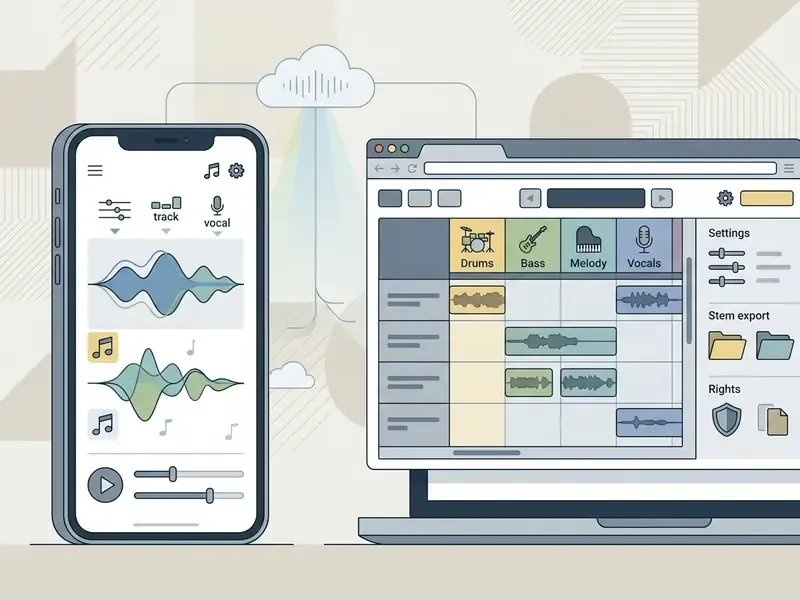
Mobile app: one-tap prompt creation, instant MP3 or WAV previews, basic vocal and structure tweaks, library access, share links. Frequent limits: daily generation caps, bitrate ceilings, tier-gated WAV or FLAC and stem downloads, shorter maximum track lengths.
Browser studio: timeline-based stem editing, MIDI, sidechain compression, convolution reverb, automation curves, uncompressed 24-bit WAV export, unlimited multitrack and stem export, licence document management.
What to Check in an AI Music Generator App for Android
When evaluating the best AI music generator Android app options, check export file formats and bit depth, daily generation caps and UI responsiveness. Strong mobile implementations offer one-tap prompt creation and instant MP3 or WAV previews, but free tiers frequently restrict high-bitrate exports and stem downloads. Gemini's Lyria integration notifies users when creation limits are exceeded and offers waiting or upgrading. Suno's product pages tie full-song, range, multitrack and individual stem WAV export to paid tiers, with Premier removing export limitations. Google Play listings differ sharply: some allow format and quality selection in Settings, others advertise fixed 16-bit PCM WAV export.
Mobile apps such as Suno's Android client let users generate initial song ideas on the go, adjust vocals, tweak structure, fine-tune melodies, add accompaniment and remix tracks. Advanced track editing still means moving to a desktop browser. That is not a marketing flaw; it is a screen-size fact.
When an AI Music Generator Website Beats the Mobile App
Browser-based AI music generator websites 2025 offer full multitrack studio environments that mobile applications cannot reproduce on small touchscreens. Desktop web platforms grant access to timeline-based stem editing, sidechain compression controls, convolution reverb, automation curves and uncompressed 24-bit WAV exports.
For complex commercial projects, browser platforms give you the computational room and workspace needed for precise audio alignment and licence document management. The practical gap is not marketing copy but workflow depth. App listings promise "editing"; browser studios actually deliver mixing.
Free Plans, Paid Plans, and Commercial Rights for AI-Generated Music
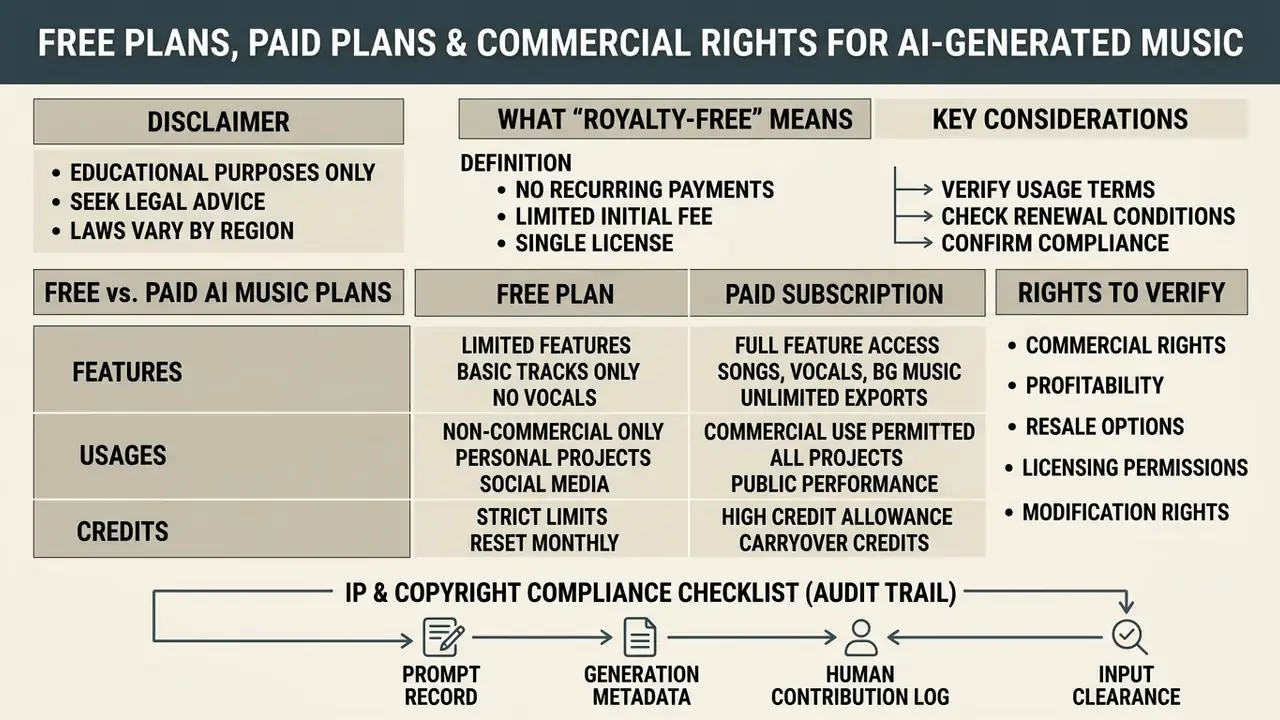
Understanding the line between free AI music and paid subscription permissions is essential if you want to avoid legal liability in commercial projects. Official platform terms consistently restrict free plans to personal, non-commercial experimentation, while commercial usage rights require active paid subscriptions. The same pattern repeats across generative media. Our analysis of commercial use of AI generators documents identical plan-gated licence structures for imagery.
"Copyright protection requires human authorship. Purely machine-generated audio lacks human authorship and cannot be copyrighted without documented, substantial human creative contribution; AI-generated material must be identified and disclaimed when registering a mixed work."
So the legal status of AI music rests on two independent conditions: demonstrable human participation in the creative work, and compliance with the platform's licence terms. In the EU a further requirement applies. The European Parliament's 2025 position states that AI systems generating audio must mark outputs in machine-readable form so they are detectable as AI-generated.
What "Royalty-Free" Means and Which Rights to Verify
The term "royalty-free" means you are not required to pay recurring performance royalties per play. It does not mean the track is free of copyright restrictions. Before publishing generated audio in commercial projects, verify broadcast limits, synchronization rights, platform monetization permissions, territory, attribution requirements, and whether any performing-rights-organisation fees still apply to public performance.
Under US legal frameworks, fully AI-generated audio cannot be copyrighted without substantial human creative input. Commercial protection therefore rests on explicit contractual licensing agreements from the platform operator. A concrete example of that structure: Beatoven.ai grants a non-exclusive perpetual licence, so the user may monetize the resulting content while Beatoven retains ownership of the track itself (Beatoven.ai licensing documentation, 2026, https://www.beatoven.ai/). AIVA sits at the opposite end of the spectrum and transfers full composition copyright to Pro subscribers. Suno's rights page states that paid users receive commercial-use rights without necessarily becoming the copyright owner of the output. Three vendors, three different answers. Read the clause, not the badge.
How Free AI Music Differs from Paid Subscription Music
Free AI music tiers restrict audio resolution, often capping output at 128 kbps MP3, apply mandatory watermarks or download caps, and forbid monetization outright. Paid plans unlock commercial licensing, uncompressed 24-bit WAV downloads, priority queue processing and stem separation. Mureka's Starter tier, for instance, offers 5 generations per month with a commercial licence, while its Professional plan unlocks 48 kHz WAV export, unlimited vocals and stem separation (Mureka AI pricing documentation, 2026, https://mureka.ai/pricing).
Suno AI and Udio both state that subscribing to a paid tier after generating a track on a free plan does not retroactively grant commercial rights for that earlier asset. This non-retroactivity rule is the single most expensive misunderstanding in AI music procurement. If a track matters commercially, generate and download it on an active paid plan, then archive the receipt. One line in an invoice can save a takedown.
IP and Copyright Compliance Checklist (Audit Trail)
Use this record set for every asset intended for public or paid distribution:
- Prompt recordthe original, human-authored prompt text, plus every revision, with timestamps.
- Generation metadataplatform, model version (for example v5.5 Preview versus stable), variant IDs, seed or generation ID, date and time.
- Human contribution loglyric edits, section replacements, inpainting regions, arrangement changes, mix and master decisions, with named contributors.
- Input clearancepermissions for any uploaded reference audio, lyrics, melody, voice sample or sample library used as input.
- Plan evidencescreenshot or invoice showing the active paid tier at the moment of download, plus the download receipt or licence PDF.
- Licence scope snapshotthe permitted-use table in force on that date (ads, broadcast, sync, games, territory, retention).
- Disclosure recordwhere the asset was published with AI disclosure, for example YouTube's synthetic-content declaration, and any machine-readable marking required in the EU.
- Archivestore all of the above with the exported master file, so the release package documents itself under audit.
How to Create AI-Generated Music: Step-by-Step Workflow
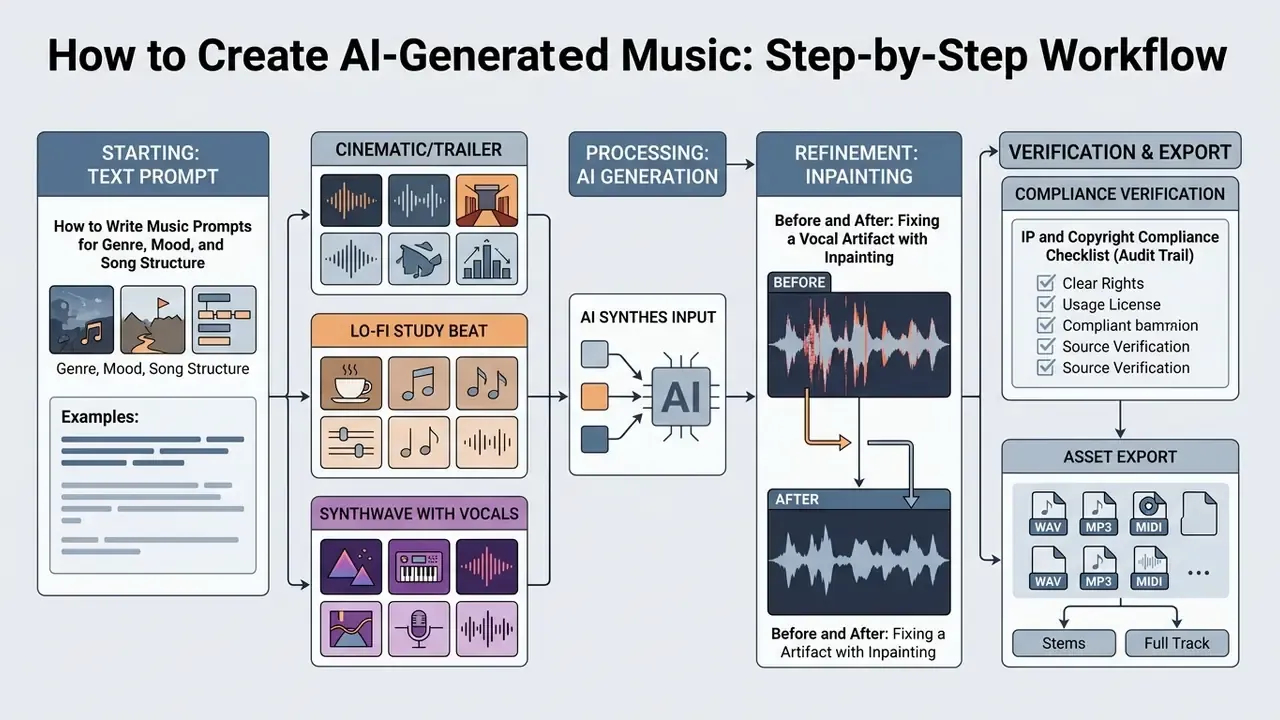
How to Write Music Prompts for Genre, Mood, and Song Structure
Effective music prompts combine genre specifications, mood descriptors, instrumentation lists, tempo and structural tags into one clear instruction block. Leading prompt architectures from Google Lyria and ElevenLabs recommend a structured ordering rule:
[Primary Genre] + [Sub-genre/Mood] + [Key Instruments] + [Tempo/BPM] + [Vocal Description] + [Structure Tags]
"Professional MusicCaps annotations describe instrumentation, genre, tempo and stylistic detail, exactly the level of specificity that helps models such as MusicGen and JEN-1 follow a prompt accurately."
For example, a prompt such as "Cinematic synthwave, melancholic driving mood, analog synthesizers and punchy drum machine, 110 BPM, soft female vocals, [Intro] [Build] [Drop]" yields noticeably higher fidelity and structural coherence than a vague request like "cool retro music." Creators finishing a project usually pair the exported audio with video editing software for post-production to sync those structure tags to cuts.
Three ready-to-use prompt templates
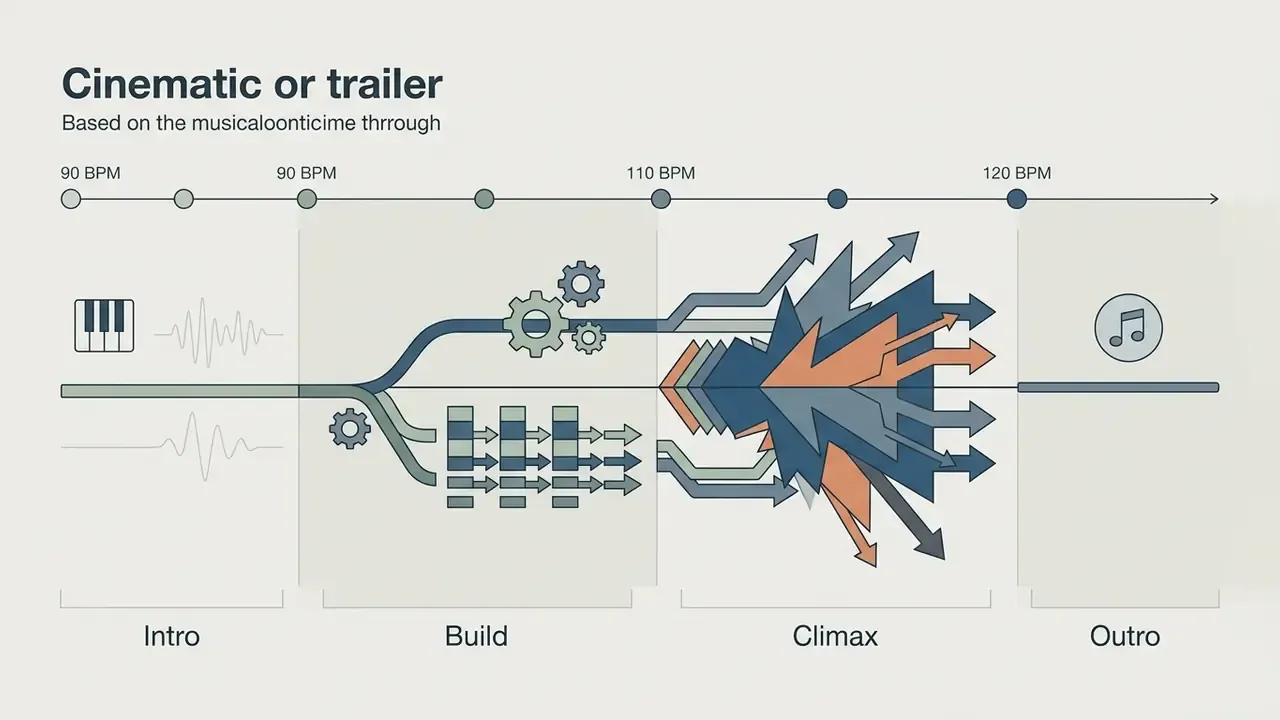
Cinematic orchestral, tense and heroic, low strings ostinato, timpani, brass swells, choir pads, 90 BPM building to 120 BPM, instrumental, [Intro: sparse piano] [Build: strings + percussion] [Climax: full brass and choir] [Outro: single sustained note]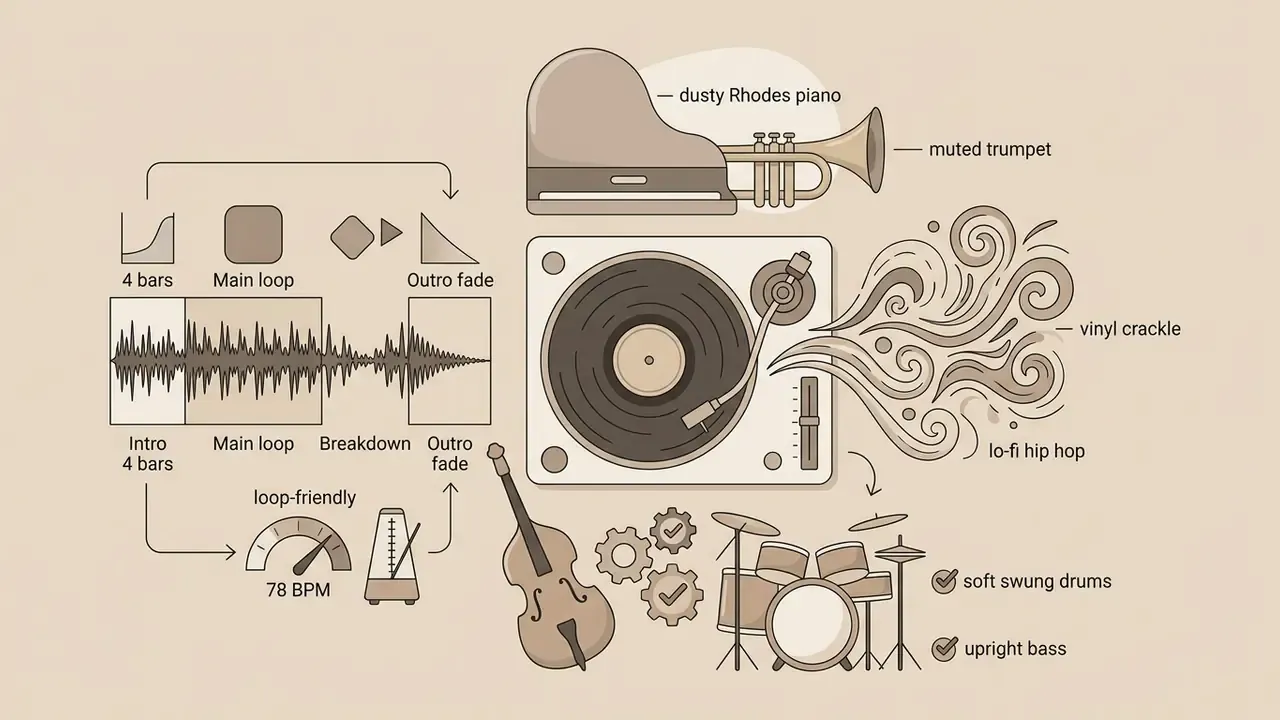
Lo-fi hip hop, calm nostalgic mood, dusty Rhodes piano, muted trumpet, vinyl crackle, soft swung drums, upright bass, 78 BPM, instrumental, loop-friendly, [Intro 4 bars] [Main loop] [Breakdown] [Outro fade]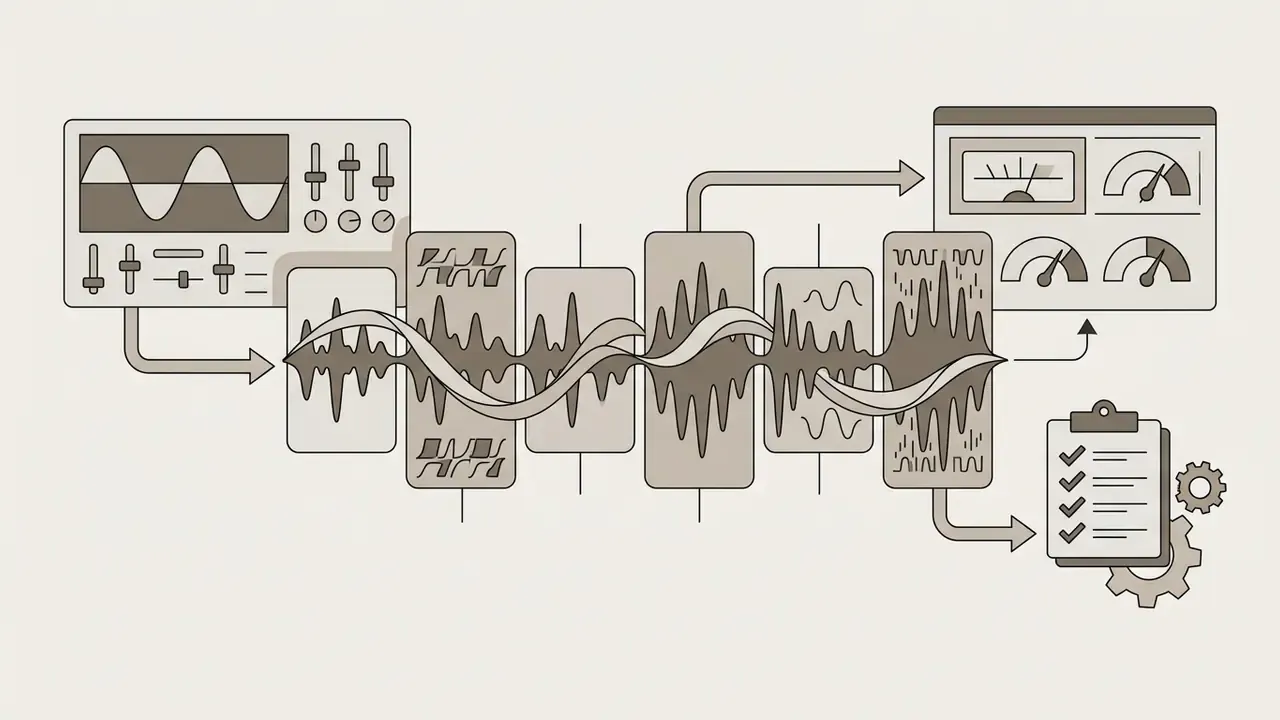
Synthwave, melancholic and driving, analog Juno pads, arpeggiated bass, gated reverb drum machine, 110 BPM, soft breathy female vocals with light reverb, 1980s production era, [Intro] [Verse] [Pre-chorus] [Chorus] [Bridge] [Final Chorus]Before and After: Fixing a Vocal Artifact with Inpainting
Before. A generated chorus is strong, but the second line contains a mispronounced word and a harsh sibilant on the "s" sounds. Regenerating the whole song risks losing the melody you liked.
After. In Udio, or Suno's section editor, select only the 3 to 4 second region containing the flawed line, re-enter the corrected lyric text for that region, and apply inpainting so the model regenerates the selection from the surrounding context. Verify that retained sections are bit-identical or perceptually unchanged, then export stems and apply a narrow de-esser at 6 to 8 kHz on the vocal stem in your DAW. Record the region timestamps and the corrected lyric in your human-contribution log. This is exactly the kind of documented editorial decision that supports an authorship claim on the finished mix.
FAQ: Frequently Asked Questions About AI Music Generators
Which is the best AI music generator in 2025 overall?
For complete songs with vocals, Suno AI remains the fastest mainstream option with the deepest browser studio. Tad AI is the strongest choice when you need unlimited downloads plus music-video rendering, and Udio wins for surgical, section-level refinement.
What is the best free AI music generator?
BandLab is the only fully free cloud DAW here, with SongStarter AI ideas and Splitter stems. For pure generation, Loudly's $0 plan, Stable Audio's roughly 10 tracks per month and Somio's free credits are the most usable. Remember that free tiers almost never include commercial rights or high-bitrate downloads.
How many credits does one minute of AI music cost?
It varies by engine. ElevenLabs' Eleven Music consumes 1,591 credits per finished minute, about 6.2 minutes on the free 10,000-credit allowance. Suno charges 5 credits per batch of four tracks, with 50 free credits per day. Udio charges 2 credits per generation of two songs, with 100 monthly plus 10 daily free credits.
Can I monetize AI-generated music on YouTube?
Yes, if your platform licence explicitly permits monetization and you downloaded the track on an active paid plan. Keep the licence receipt, disclose synthetic content where YouTube requires it, and remember that Content ID can still claim audio that closely resembles a copyrighted work.
Does a paid subscription cover tracks I made earlier on the free plan?
No. Suno and Udio both state that commercial rights are not retroactive. Regenerate and re-download the asset while subscribed.
Which platforms train on ethically licensed data?
Stable Audio, Beatoven.ai, Loudly and Soundraw document licensed or Creative Commons datasets, and Beatoven states that contributing musicians are compensated. Suno and Udio have not fully disclosed their training corpora and face pending fair-use litigation.
Which AI song generator app suits personal projects on a phone?
For quick personal projects, Suno's Android client and Tad AI's mobile app cover prompt-to-track creation, library access and light remixing. Anything involving stem splitter work, MIDI or licence documentation belongs on the browser version.
Appendix A: Editorial Corrections and Updates