An ai baby face generator app is a neural tool that reads visual features from one or two parent portraits and synthesises a hypothetical image of their future baby. It runs computer-vision models over pixels. It does not sequence DNA, and it does not perform biological prediction of any kind.
Key takeaways in 60 seconds
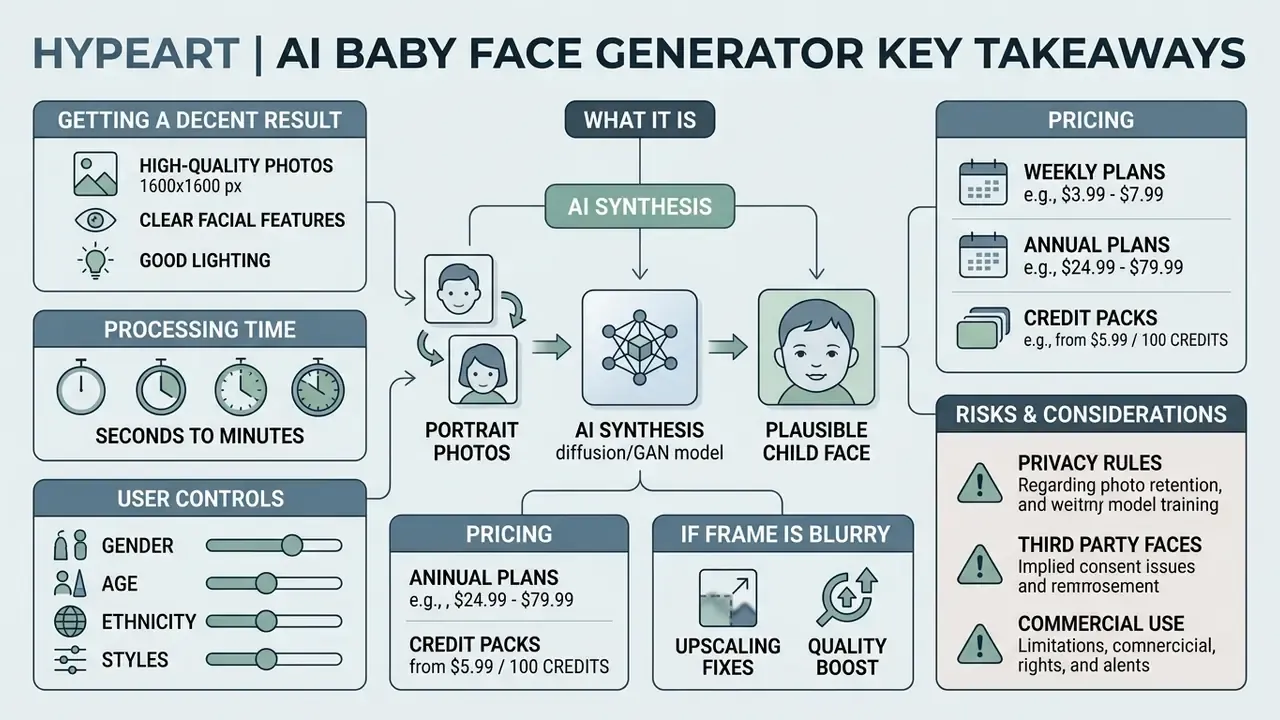
- What it is. The app takes one or two portrait photos and synthesises a plausible child's face through a diffusion or GAN model. A visual interpretation, not a genetic prediction.
- How to get a decent result. Front-facing shots, at least 1600x1600 px, face filling 40-60% of the frame, soft even light, no glasses, hats, or fringe across the eyes.
- How long it takes. Generation runs from 2 to 15 seconds; most services return JPEG or PNG immediately.
- What you can control. Gender (boy / girl / random), age stage (baby, toddler, child, teen), skin tone (Auto or Custom), expression (neutral / smile / laugh), and the likeness balance between parents.
- Pricing. Weekly plans run $3.99-$7.99, annual plans $24.99-$79.99, credit packs from $5.99 per 100 credits. Some tools are fully free with unlimited generations (AIEASE), others charge once per photo pack ($9.99-$19.99 at SeeYourBabyAI).
- If the frame is blurry. Stop regenerating. Crop the source to 1:1 and push the output through an AI upscaler instead.
- Risks. Some apps retain uploaded photos and reuse them for model training; uploading a third party's face without consent breaches GDPR and can create real liability.
- Commercial use. In the US, purely AI-generated images are not protected by copyright; what you may actually do with the file is decided by the platform licence.
Before you upload: three decisions worth making first
Most complaints about these tools come from skipping the setup, not from the model. So decide three things in advance.
First, purpose. A meme for a group chat and a printed invitation for a baby shower need different resolutions, and the second one usually needs a paid tier. Second, source material. If the only photo of your partner is a group shot from a wedding, expect artefacts; the detector needs a clean face, not a crowd. Third, data exposure. Any face you upload becomes a biometric template inside someone else's pipeline, at least for the duration of processing.
One more practical note, and this is where corporate readers should pay attention. If the photo lives on a work laptop, the fun app becomes a shadow-AI question, and shadow AI is exactly the category that risk teams struggle to inventory. We return to that later with a checklist.
What an AI baby face generator app does
An ai baby face generator app extracts key landmarks from the uploaded portraits and produces a new digital image of an infant or an older child. The purpose is entertainment content, digital collages, and a playful visualisation of a hypothetical family portrait. Nothing more clinical than that.
Tools of this type blend the geometry of eyes, nose, lips, and face shape from the source images into a new file. It helps to keep two categories apart. A recreational ai baby generator app predict child face experience works with visible phenotypic traits in a photo. Biometric or medical diagnostic systems work with genotype, inheritance models, and disease risk. Different data, different validation, different regulators.
Generating a baby face from two people's photos
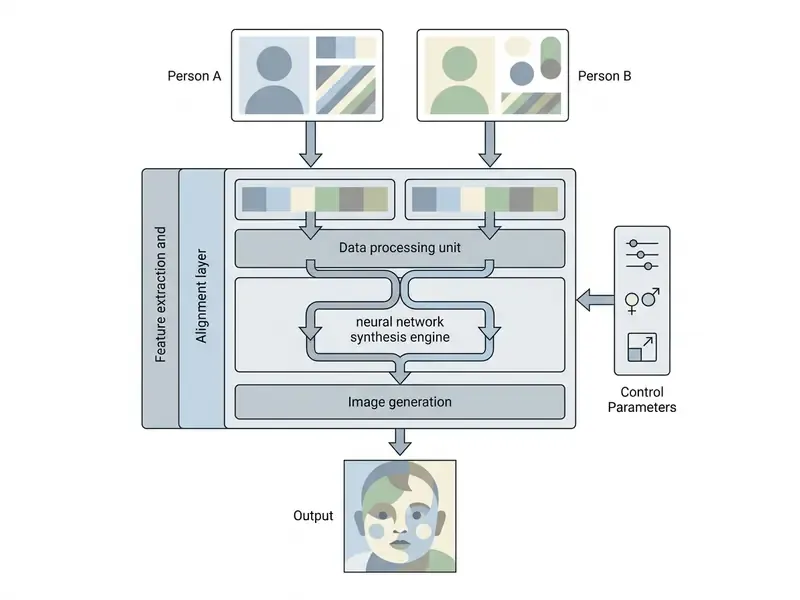
Synthesising a baby face from two photos starts with encoding both parents into latent codes and mixing them. The network reads skin tone, eye shape, brow curvature, and chin structure from each frame.
«StyleGene encodes regional facial genes in the latent space of StyleGAN2 and applies crossover and mutation operations to synthesise the descendant's face.»
In other words, these systems do not average pixels. They generate a unique baby photo that keeps visual kinship with both uploaded photos. The classic pipeline: encode both parent faces, blend or interpolate in latent space, then synthesise through a conditional GAN or a diffusion model, with extra conditioning on age and gender. Early architectures such as KinshipGAN (2018) and DNA-Net (2019) trained on parent-child pairs. Later work like KinStyle (2022) maps both parent faces into StyleGAN2 latent codes and mixes them so the output stays editable by age and gender.
How an AI baby face filter app differs from a baby face generator
The difference sits in the input and the operation. A baby face filter app deforms an existing face in an existing photo. An ai baby generator builds a new image from scratch. The filter keeps the original background, lighting, and pose, and only reshapes proportions and skin texture towards a younger age.
A babyface ai baby face generator uses diffusion or GAN synthesis over latent data taken from two different people. Technically these are separate operations: warping and morphing on a single frame versus generating a new frame that owes nothing to the original composition. If all you need is ordinary retouching, fixing exposure, killing highlights, tightening the crop, or even a quick pass to whiten teeth in a portrait, use an AI photo editor or a plain online photo editor instead. Desktop users often stay with a windows photo editor for that kind of cleanup.
How to create your future baby's face from two photos
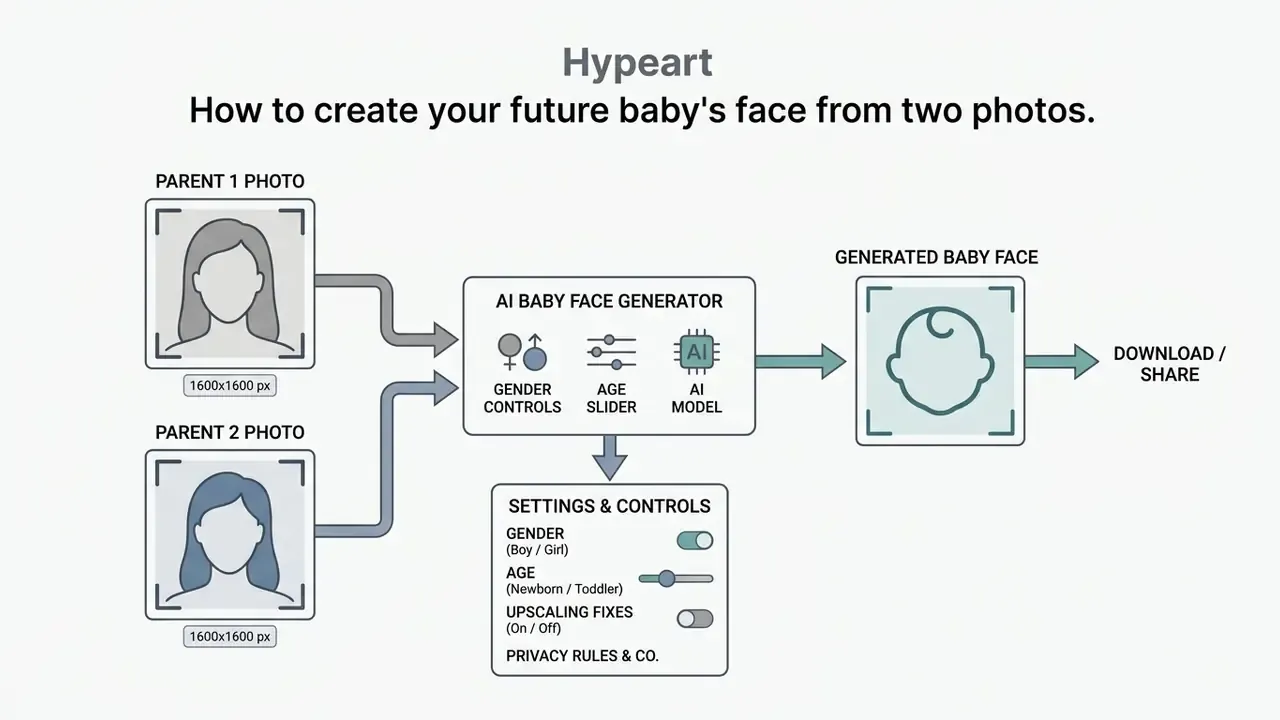
To get a digital portrait of a hypothetical child, you upload two clear frontal frames into an ai baby face generator from two photos and start the run. The service detects facial landmarks automatically and returns a result in seconds.
Which uploaded photos give a more realistic result
The most realistic results come from frontal portraits with a neutral expression and even lighting. Detection errors climb when the source frames include glasses, headwear, heavy shadows, or a tilted head.
«Face recognition performance on children is lower than on adults, and the degradation scales with age.»
Technical requirements for reliable landmark detection (updated for 2026):
| Parameter | Requirement | Why it matters |
|---|---|---|
| Resolution | at least 1600x1600 px, JPG, PNG or WEBP | below that threshold the model invents skin and eye texture |
| Cropping | face fills 40-60% of the frame (about 60% is the sweet spot) | under 30% the landmark detector loses facial geometry |
| Angle | straight-on, deviation up to 5 degrees; three-quarter acceptable, profile is not | both eye openings, the nose bridge, and both lip corners must be visible |
| Lighting | soft diffused light (window, overcast day) | direct flash and hard side light create shadow artefacts on the nose bridge |
| Occlusions | no glasses, hats, masks, fringe over the eyes, heavy filters | hidden landmarks reduce synthesis accuracy |
| Expression | neutral, lips closed | a smile distorts cheekbone shape and lip lines during feature transfer |
Formal portrait-quality criteria appear in the NIST Face Image Quality work, where uniformity and mean illumination are listed as explicit quality factors. A practical rule from model developers: the smaller the difference in geometry and camera angle between the two sources, the more stable the final synthesis. Some services, MyShell among them, claim analysis of more than 60 facial landmarks and state front-facing photos, even light, and a neutral expression as preconditions for an accurate result.
What people actually use an AI baby face generator for
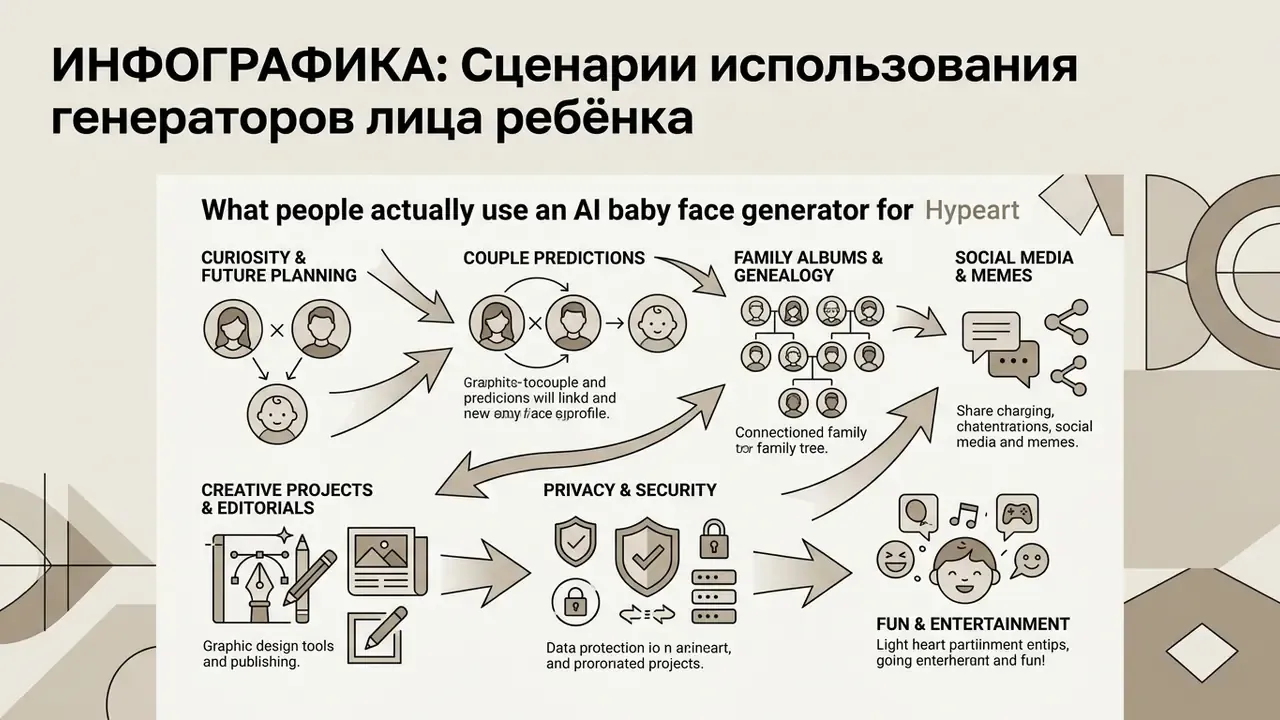
The main field of use for an ai kid generator app is entertainment content, family fun, and creative experiments for social feeds. We put this block before the technical and legal sections deliberately. Understand why you want the tool, then compare tariffs and weigh the risk.
Future baby image for a couple, a family, and a baby shower
Couples use a baby ai generator app to picture a hypothetical shared future and to build romantic collages. At baby showers there is a popular guessing game: guests match generated portraits to the right couple, with the images printed on cards or shown as a slideshow.
Other uses include holiday photo albums, invitation cards, collages for family reunions, and photo-book covers. For laying out those materials, an online photo editor with collage and frame templates is usually enough. Print changes the requirements, though. A card that looks fine on a phone can fall apart at 300 dpi.
How realistic is AI baby face prediction, and what drives the result
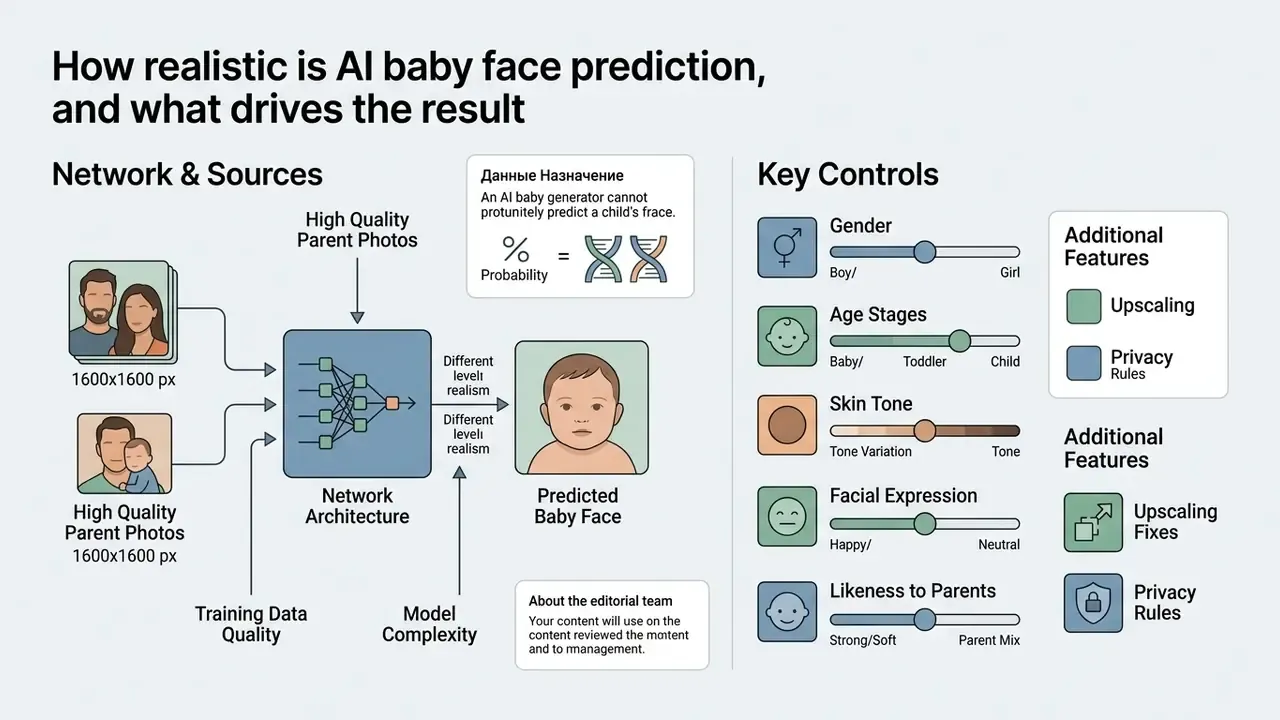
How realistic an ai baby generator app predict child face output looks depends on the network architecture and the quality of the sources. No model gives a genetically accurate prediction. The image is a statistical visual interpretation shaped by training data.
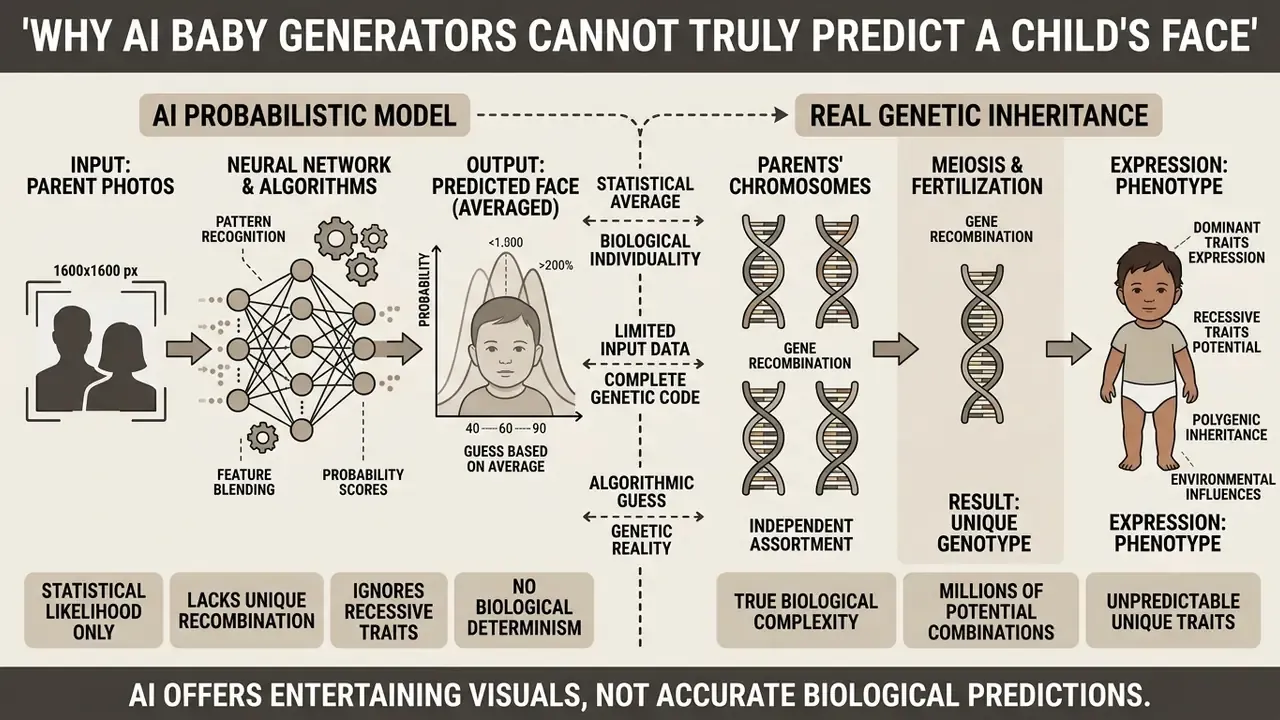
Why an AI baby generator cannot truly predict a child's face
Human appearance is governed by polygenic architecture and epigenetic factors, none of which can be extracted from a two-dimensional file. The model reads only the external phenotype visible at the moment of the shot.
Facial traits are set by many genes with small individual contributions, so the signal is spread across thousands of variants rather than a compact marker set. Environment adds more noise: pigmentation and several facial features shift with UV exposure and age. Updated: published genetic models for facial-trait prediction explain only a limited share of phenotypic variance (the literature reports figures in the range of roughly 10-20% for individual traits), and accuracy drops noticeably outside European cohorts because of training-data bias. There is no single validated number for "the child's overall appearance" in open sources, and that figure remains an open question.
«The Disentangled Representation Learning model explicitly separates genetic and external facial factors, stressing that the forecast rests on visual patterns rather than genotype.»
So an ai baby generator combine two faces run returns one of millions of possible outcomes. Heredity-Aware Child Face Image Generation (2026) adds a useful detail: the generated child is a mixture of parental traits with a possible drift towards one parent, and with a single input photo the inheritance signal gets weaker and more ambiguous still.
In our own testing of computer-vision systems for enterprise clients, one confusion repeats constantly: buyers treat decorative generative synthesis as if it were biometric identification. Setting expectations correctly is cheap. Fixing a risk assessment built on the wrong assumption is not.
About the editorial team. This material was prepared by an editorial group that audits AI media services: we test generative image and video tools, read their licence terms, examine data-handling policies, and judge whether the output can survive commercial use. Risk commentary is attributed to Marcus Hale, author.
Setting gender, age, skin tone and likeness to the parents
Many ai baby generator face maker app builds let you adjust the core parameters by hand. You can pick a girl or a boy, leave gender on Random, and set the age band: newborn, toddler, child, or teenager.
Current services expose a fairly wide set of latent-space selectors:
- Age stages. Appearance is modelled at four or five time points: Newborn/Baby, Toddler (1-3 years), Child (7-10 years), Teenager (14-16 years), and in some tools Young Adult. A few products, Vidnoz among them, give a year-by-year progression from 1 to 6 but skip the teenage option.
- Facial expression. Advanced models let you set the emotional profile of the frame: neutral, Smile, or Laugh.
- Skin tone. Automatic adaptation (Auto) or manual selection for a specific phenotype. AIEASE, WonderSnap, and FutureBaby all expose this control.
- Parent likeliness. A weighting slider shifts the result towards the mother or the father and visibly changes eye shape, nose, and face oval.
- Trait match percentage. Some mobile apps, such as Future Baby Face Generator for iOS, display a breakdown like "58% father's traits / 42% mother's". That is not a genetic calculation. It is a similarity metric between the latent vector of the output and each parent embedding, cosine distance converted into percentages for readability.
«ChildGAN builds separate GAN networks for boys and girls and generates over 300,000 unique child faces with variations in age, pose, and expression.»
Academic work treats gender, age, and likeness not as menu items but as learned latent axes. DNA-Net and Controllable Descendant Face Synthesis condition generation on age and gender directly, and the second adds control over similarity to each parent. A curious side note comes from a 2007 facial-resemblance study: in the first months boys are more often judged to resemble the mother, and by ages two to three the father. There is no fixed "correct" ratio to hit. So set the sliders until baby will look like whichever parent you had in mind, and treat the number as a styling dial.
Why generation sometimes returns a strange or failed result
Odd artefacts, blur, and broken proportions usually trace back to failures in facial-landmark detection on the source portraits. If the network misplaces the jaw angle or an eye, the generative network builds a wrong region: face-swap research (CVPR 2023) works with 68 facial landmarks, and an error there breaks pose and expression directly. Studies of diffusion-image artefacts (ICCV 2023) localise defects precisely in the face, chin, neck, hands, and feet.
«Diffusion models retain realism under controlled conditions, but atypical inputs push generation outside the trained distribution.»
How to choose an AI baby generator app: features, free access and price
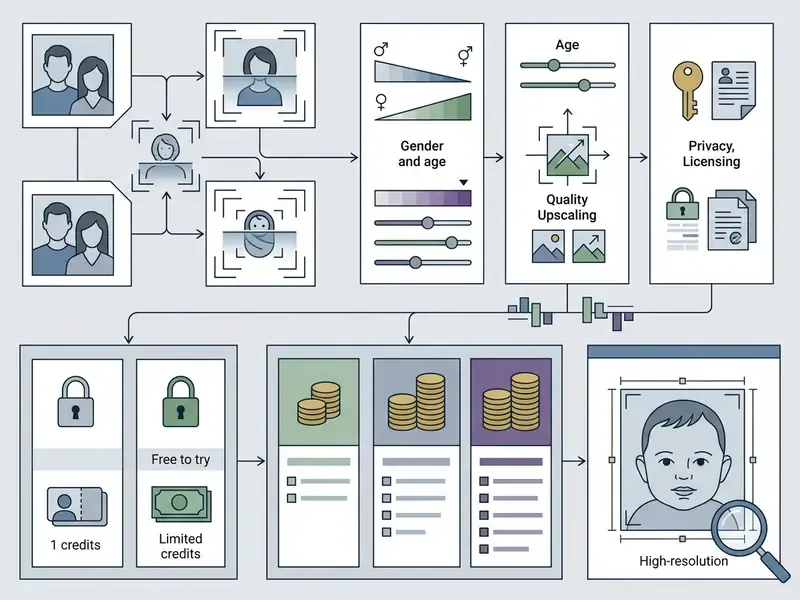
When comparing ai baby face generator apps, read the terms of use, the free-tier limits, the watermark policy, and the clarity of the privacy statement. The market splits into mobile apps for iOS and Android and browser services. Broader context on image synthesis sits in our roundup of the best AI image generators, and if you are modelling subscription cost across several tools, the AI Media Calculators hub is the faster route.
| Service | Platform | Free access / terms | Age stages | Features and controls | Price |
|---|---|---|---|---|---|
| AIEASE Baby Generator | Web | 100% free, unlimited generations, no account needed | Baby, Child, Teen | Gender (Random/Boy/Girl), skin tone (Auto), one or two photos, celebrity-photo mode | Free |
| Overchat AI | Web / iOS / Android | Paid tool, free starter credits | Baby, Toddler, Child, Teen | About 2 sec generation, high detail, no watermark, couple and single-parent modes, built-in upscaler | from $9.99/mo |
| SeeYourBabyAI | Web | Trial preview without an account | Baby | 8 photos per session (4 boy / 4 girl), one-off payment | $9.99 Standard / $19.99 HD, one-off |
| WonderSnap | iOS / Android | Unlimited free mode, 1 image per session | Baby | Mobile-first UI, photos not stored on servers, export to TikTok/Instagram/Facebook, gender and skin tone | Free (ad-supported) |
| MyEdit AI | Web | Daily free credits | Kid / Toddler | Full photo editor, realistic and artistic styles, collages, object removal, no watermark | from $7.99/mo |
| Vidnoz AI | Web | Limited trial | 1-6 years | Expression control (neutral / smile / laugh), gender, age progression | from $9.99/mo |
| Fotor AI Baby Generator | Web / iOS / Android | Signup credits, daily check-ins; trial funnels into subscription | Baby | Parent Likeliness slider, gender choice, integration with photo editor and AI tools | from $8.99/mo |
| FutureBaby | iOS | Free | Baby, Child | Gender, age, skin tone; weaker on mixed-heritage couples | Free |
| BabyGenerator.com | Web | First generation free | 1-18 years | One photo per parent, gender choice; photos deleted after generation, results in 24 hours | from $19.99/mo |
| Imagine.Art | Web | Free credits | Newborn, Toddler, Young Child | Blend ratio between parents, gender guess, High HD export | from $13.30/mo |
| CapCut AI Baby | iOS / Android / Web | Free basic access | Via text prompt | Prompt control (gender, age, style), export up to 1080p, video editing | Free / Pro |
| MagicShot AI | Web | Paid access | Gender, age, likeness | Full HD / 4K, commercial rights stated explicitly | Credit packs / subscription |
| Future Baby Face Generator | iOS | Limited free tier | Baby | Percentage breakdown of likeness to each parent | Weekly $3.99 / Yearly $29.99 |
| AI Baby Generator: Face Maker | iOS / Android | Limited free tier | Baby, Child | Bundle: baby face, gender swap, face aging, symmetry analysis, name generator | Weekly $5.99 / Yearly $49.99 |
Reading the table: most mobile apps run on weekly ($3.99-$7.99) or annual ($24.99-$79.99) subscriptions, while several web services use credit packs (from $5.99 per 100 credits) or a single payment per image pack. Free tiers commonly add watermarks and cap resolution at 720p or around 1 MP. Zero budget and unlimited attempts? Take AIEASE. Maximum detail, an age scale up to teenager, and no watermark? Paid tools such as Overchat AI or MagicShot. Output going straight into a layout? MyEdit, because the editor is already there. Before you commit to a plan, view the guide to how these pricing models compare over a full year.
What a free AI baby generator usually includes
A free ai baby generator face maker free app typically grants one to three trial generations. The finished baby photo carries a watermark, resolution is capped at 720p or roughly one megapixel, and several services restrict the free tier to personal use and a single image per run.
«More than a third of 20 popular AI apps use customer data to train models, and 75% require users to hand over rights to their personal photos.»
Free plans, in other words, are often paid for with diagnostic data and content rights. There are exceptions: AIEASE and WonderSnap advertise unlimited free generations, and SeeYourBabyAI shows a preview before registration. Everywhere else, an ai baby generator two faces free experience without limits means a subscription.
App, mobile-only app or online AI tool
Native iOS and Android apps deliver speed and a clean link to the phone camera. They are built for fast publishing: take the selfie, generate, post to stories, no intermediate exports. Native builds usually feel snappier thanks to instant launch and direct gallery access.
Browser-based tools need no installation and suit cross-platform work on a desktop. They also tend to wrap more functionality around generation: photo editor, collages, upscaling, export in several aspect ratios. Web-performance research indicates that modern PWA implementations cut load time roughly in half against classic web apps, so the speed gap now depends more on engineering than on platform. Practical conclusion: mobile app for viral content, web service for careful layout and print. Teams that need programmatic access should explore the hub for integration options rather than automating a consumer app.
Commercial licence: can you use a baby image commercially?
Using generated child imagery in advertising or on merchandise is governed by the licence of the specific app plus national law. In the US, following guidance from the Copyright Office on AI-generated content (2023-2024), purely AI-generated output is not protected by copyright because human authorship is absent. A work containing AI elements can still be registered if a person contributed enough creative expression, though protection covers only that human part, and the AI content must be disclosed at registration.
For commercial use you therefore need two things confirmed: the platform terms grant commercial rights, and the generation does not infringe third-party rights. UK practice treats a model output as infringing where it reproduces a substantial part of a protected work without permission, which tightens the risk whenever the result resembles an existing asset. For the licensing detail, see our material on commercial use of AI images, and for how these disputes are actually playing out in court, the AI Litigation and Case Timelines tracker is the better reference.
This is general information and not a substitute for legal advice on copyright and licensing.
Photo safety and consent when using an AI baby generator
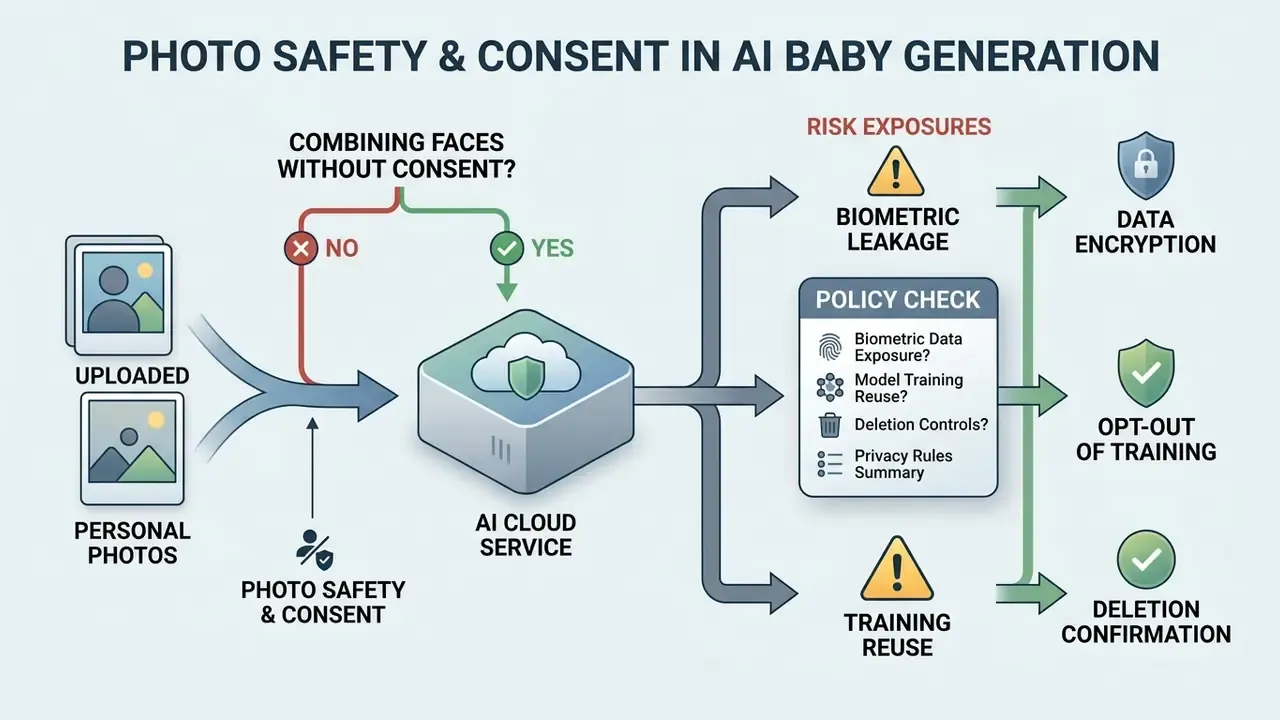
Uploading personal photographs into cloud AI services carries two distinct exposures: leakage of biometric data, and unauthorised reuse of those images for model training.
«An analysis of 138 virtual try-on sites found that 65% send user photos to a server, and 88% of those forward them to third-party analytics providers.»
This is general information and not a substitute for advice from a data-protection specialist or legal counsel.
What to check in the policy on uploaded photos
Anonymous security audits of mobile photo editors (2024) suggest that a meaningful share of services may retain biometric markers on third-party servers unless the policy says otherwise, and that some apps reuse customer photos to fine-tune their own models.
«20% of the 20 apps reviewed do not encrypt data in transit, and 75% require users to grant rights to their photos for promotional purposes.»
Anyone using an ai baby face filter photo app should prefer services that guarantee deletion of sources within 24 hours and comply with GDPR or CCPA. Official documents give the reference points. EDPB Opinion 28/2024 requires minimising collection, transfer, storage, and further processing of personal data in generative-AI development. NIST privacy guidance for AI names encryption in transit and at rest, reasonable retention periods, and mandatory handling of deletion requests. Australia's OAIC expects a policy to disclose whether data trains models and when datasets are destroyed or de-identified. Separately, the AI Act prohibits building or expanding facial-recognition databases through untargeted scraping of internet or CCTV imagery.
Anti-shadow-AI checklist: keeping biometrics off work devices
- Add the category "photo generators and face editors" to the list of prohibited or approval-required services in your internal AI policy.
- Ban uploads of corporate photo assets, employee shoots, and any frames from badges or access passes.
- For approved tools, verify three items: TLS 1.2+, no training on customer data, and a stated deletion mechanism with a retention period.
- Configure DLP rules on image egress to unapproved domains, and log the attempts.
- Maintain a data-provenance register for every AI model the organisation uses or trains. DHS biometric guidance explicitly bars models trained on unlawfully collected photos and biometrics.
- Run a short briefing. Staff should understand that the "fun app" processes a biometric template of a human face.
One honest caveat here. None of this is exotic governance work; it is the same inventory-and-ownership discipline that model risk teams already apply to credit and AML models, extended to a category nobody thought to inventory. Questions on implementation usually land with AI Media Support first.
Can you combine two faces without consent from the people in the photos?
Uploading photographs of third parties, a partner, an acquaintance, or a public figure, without their clear consent breaches privacy rights and data-protection law, GDPR included. European practice treats the use of a person's likeness to create deepfakes or synthetic manipulations without permission as actionable: Directive 2024/1385 criminalises the creation and distribution of non-consensual sexual deepfakes, and the AI Act requires clear labelling of generated or altered content depicting real people.
«An analysis of 420 face-swap applications found that 70% of the 155 tested apps allow the creation of synthetic intimate imagery without technical restrictions.»
Using celebrity images for memes or celebrity baby ships is defensible only within genuinely non-commercial, non-defamatory entertainment, and only where the output cannot be mistaken for a real event. Images of children deserve extra care. UNICEF's 2025 recommendations on AI and children single out data protection, privacy, safety, and transparency as mandatory requirements. FTC guidance on COPPA points to parental consent when handling children's photos and videos. IWF materials are blunt: creating, storing, and distributing indecent imagery of minors is illegal, AI-generated material included.
This is general information and not a substitute for legal advice on data protection and copyright.
FAQ about AI baby face generator apps
Quick answers to the technical questions people ask most often about an ai baby generator: face maker app.
Can you create a baby face from a single photo?
Yes. Many current services can synthesise a child's face from just one parent portrait. The algorithm keeps the traits it can see and fills the missing parameters from the averaged template of its training distribution.
«Diffusion models can generate child faces from a text description alone, without parent photos, though with weaker trait inheritance.» Source: ChildDiffusion (2024). https://arxiv.org/abs/2402.19374
The single-photo route is less balanced, though. The network gets no second set of control points for crossover, so the output drifts towards the dataset mean. Kinship-synthesis papers note that most architectures were trained on father-mother-child pairs and triplets, and that large annotated databases of that kind are scarce, which leaves a single input as an underdetermined problem. Limited and skewed datasets degrade quality further for under-represented phenotypes.
Can you generate several variants of a baby image?
Yes. Diffusion networks and GAN models start from a random seed on every run. Even with identical source photos, a second click on generate returns a different face: the pipeline starts from random Gaussian noise, and unless the seed is pinned, each run follows its own denoising trajectory.
That is what lets you collect many unique portraits differing in expression, angle, or hair. Research from 2024-2025 shows that changing the seed shifts not only fine detail but composition, object placement, and frame structure. Practical habit: save a seed you liked to reproduce the style, change it when you want spread. Some services skip the guesswork; SeeYourBabyAI returns a pack of 8 images per session, 4 "boy" and 4 "girl", which saves attempts.
How long does generation take, and can you download the result?
In most current services, generation takes 2 to 15 seconds. Overchat AI claims about 2 seconds; queued web services can stretch to 10-15 seconds under load. The file is available through the download button immediately after processing, normally as JPEG or PNG, occasionally WEBP.
Resolution follows the tier. Free plans often return 720p or roughly 1 MP with a watermark, paid plans deliver Full HD and 4K clean. If the file is going to print, invitations, a photo book, a baby-shower poster, raise resolution with AI image upscaling. It is safer than regenerating, because it preserves the face geometry you already approved.
Appendix A: earlier wording refined in this update
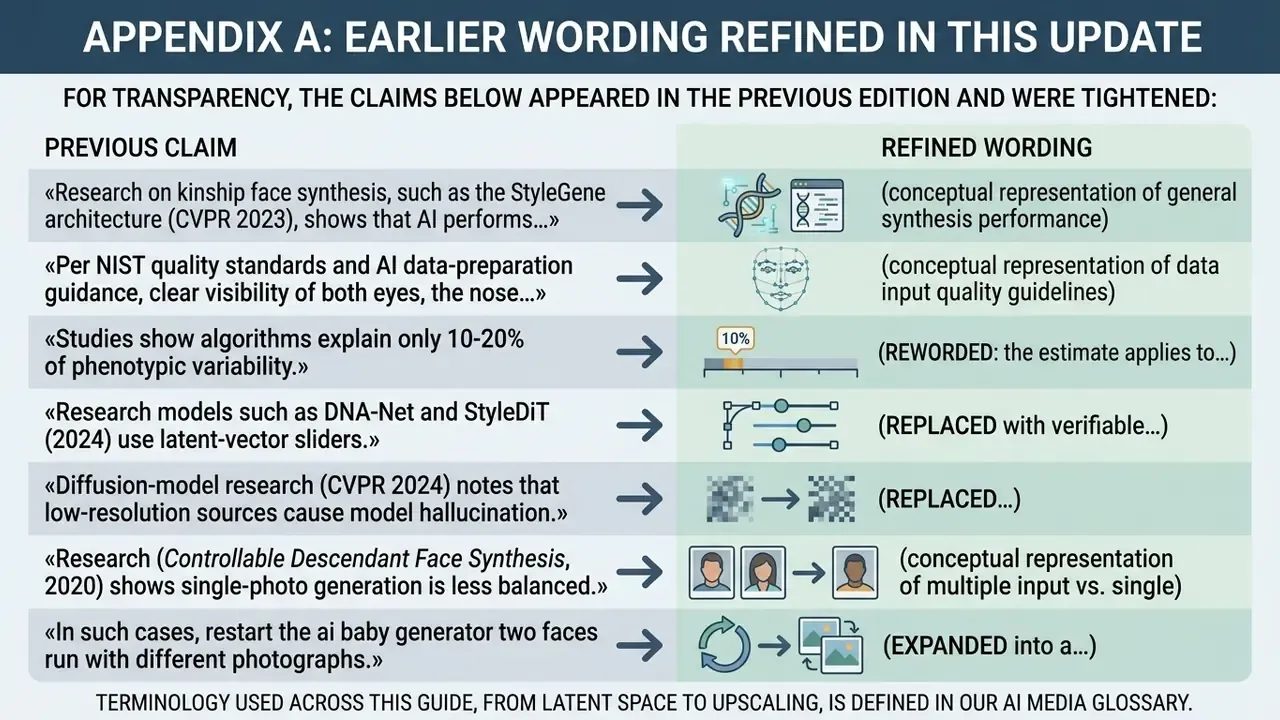
For transparency, the claims below appeared in the previous edition and were tightened:
- «Research on kinship face synthesis, such as the StyleGene architecture (CVPR 2023), shows that AI performs crossover of regional traits in latent space.» Refined with a direct quotation and a link to the StyleGene preprint.
- «Per NIST quality standards and AI data-preparation guidance, clear visibility of both eyes, the nose bridge, and the lip corners prevents synthesis distortion.» Extended with measurable resolution and cropping requirements plus HDA-SynChildFaces (2024) data.
- «Studies show algorithms explain only 10-20% of phenotypic variability.» Reworded: the estimate applies to individual facial traits in genetic prediction models and needs further data.
- «Research models such as DNA-Net and StyleDiT (2024) use latent-vector sliders.» Replaced with verifiable references (ChildGAN, 2023) while keeping DNA-Net in the context of age and gender conditioning.
- «Diffusion-model research (CVPR 2024) notes that low-resolution sources cause model hallucination.» Replaced with ChildDiffusion (2024) and ICCV 2023 findings on artefact localisation.
- «Research (Controllable Descendant Face Synthesis, 2020) shows single-photo generation is less balanced.» Updated with ChildDiffusion (2024), retaining the point about the underdetermined task.
- «In such cases, restart the ai baby generator two faces run with different photographs.» Expanded into a step-by-step post-processing and upscaling procedure.
Terminology used across this guide, from latent space to upscaling, is defined in our AI Media Glossary.