«Uncontrolled automated image generation creates an illusion of operational efficiency while introducing systemic model risk, unquantified copyright liability, and the structural erosion of human creative assets.»
Executive risk summary for risk, compliance and governance leaders
- No copyright, no exclusivity. Purely prompt-generated images are not copyrightable in the United States and are treated as unprotected in EU analysis. An enterprise can pay for a synthetic asset, publish it at scale, and still hold no exclusive right to it (U.S. Copyright Office, 2024–2025).
- Unquantified third-party liability. Models trained on web-scraped corpora such as LAION-5B ingest copyrighted works without consent. Active 2025 litigation, including Disney and Universal v. Midjourney, places output-side infringement risk on the deploying entity, not only on the model vendor.
- A measurable brand-value discount. Consumers valued identical artwork 62% lower when it was labeled AI-generated (Horton & Iyengar, Columbia Business School, 2024). Disclosure obligations and reputational risk therefore interact directly with marketing ROI.
- Market-level displacement is now measured, not anecdotal. On a marketplace of roughly 500 million visual assets, monthly image supply rose +78% and active sellers +88%, while non-AI human artists exited at an additional −23% rate and total sales rose +39% (Goldberg & Lam, Stanford GSB, 2025).
- A structural technical failure mode exists. Training new models on synthetic outputs produces Model Autophagy Disorder (MAD): progressive variance collapse and artifact bleeding. That is a model-risk issue, not an aesthetic complaint.
- Shadow AI is the dominant control gap. Unlogged use of consumer image tools by marketing and design teams destroys the audit trail required to prove human authorship, dataset provenance, and licence compliance.
Key terms used in this analysis
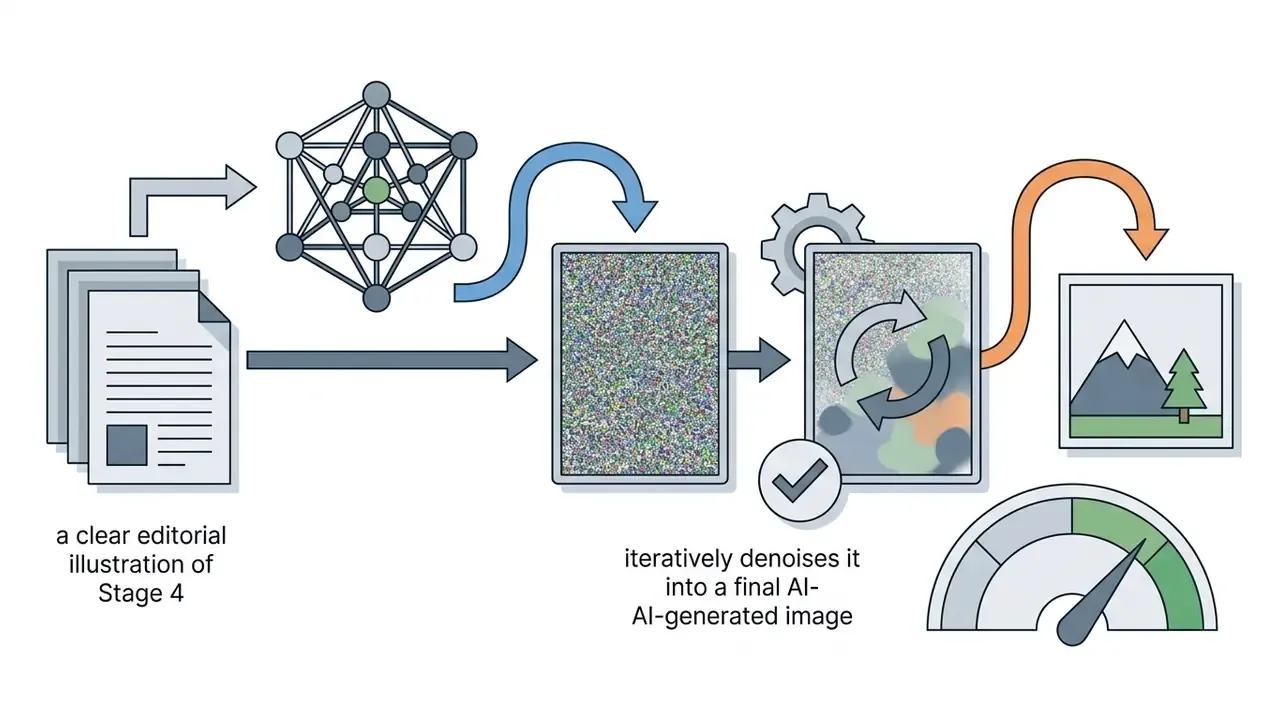
- Diffusion model. A generative system that starts from random noise and iteratively removes it, guided by a text prompt, until an image emerges. It has no model of the real world, only of pixel statistics.
- Adversarial networks (GANs). A generator and a discriminator trained against each other; the generator maps a latent code straight to a pixel grid in a single pass.
- Provenance. The documented chain from training corpus to prompt to published asset. Without it, you cannot answer an auditor's questions.
- Output-side infringement. Liability created by what the model produces, not only by how it was trained. The deploying brand is usually the visible defendant.
- Shadow AI. Unapproved, unlogged generative tool use inside teams, agencies, or contractor pipelines.
- Model Autophagy Disorder (MAD). Quality and variance degradation when models are trained on their own synthetic output rather than on human originals.
Before diffusion models: what actually counts as art
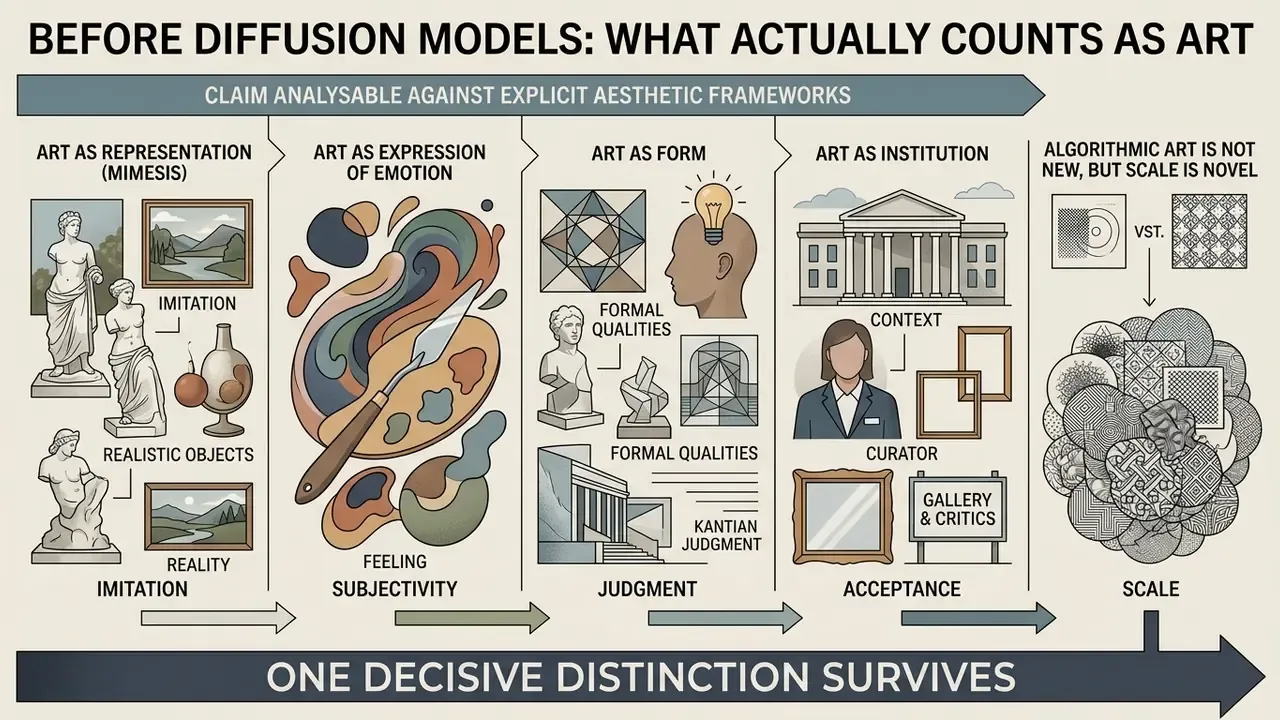
In two sentences: the claim that AI output "is art" or "is not art" only becomes analysable against explicit aesthetic frameworks. Measured against every dominant classical definition, representation, expression, form, and institutional recognition, statistical generation satisfies at most one criterion, and only through human mediation.
To understand why generated art fails the classical definitions, it helps to name the frameworks that have structured the debate for centuries:
- Art as representation (mimesis). Plato framed art as intentional imitation; for centuries a work was judged by how deliberately and skilfully it replicated its subject. Diffusion models imitate statistical distributions, not chosen subjects.
- Art as expression of emotion. The Romantic movement defined artwork by its capacity to carry a definite feeling and evoke an emotional response. A sampler without lived experience carries no feeling to transmit.
- Art as form. Immanuel Kant argued that art should be judged on formal qualities rather than surface beauty, an argument that became central once 20th-century art turned to abstraction.
- Art as institution. George Dickie's institutional theory holds that an object becomes art within the context of "the art world": museums, galleries, criticism, and markets. This is the one framework generative output can satisfy, and it does so only because human institutions confer the status.
«Art is the signature of civilisations.»
Algorithmic art is also not new, which matters for any honest risk assessment: the novelty here is scale and appropriation, not automation. In 1973 the British-born artist Harold Cohen wrote AARON, a rule-based program built around the question "What are the minimum conditions under which a set of marks functions as an image?" AARON progressed from abstract marks to representational plants, rocks and figures in the 1980s, then to colour, and eventually to physical painting with brushes and dyes the program selected on its own. Generative adversarial networks arrived in 2014 from Ian Goodfellow and colleagues, pairing a generator with a discriminator. In 2018, "Edmond de Belamy" by the collective Obvious sold at Christie's New York for $432,500 against an estimate of $7,000 to $10,000, the commercial baseline event for machine-made imagery. Later projects, the humanoid robot artist Ai-Da and Mario Klingemann's community-governed Botto, which presents 350 pieces weekly for human votes that retrain its algorithm, were defended by their creators using Margaret Boden's criteria that work be "new, surprising and of cultural value."
«If what AARON is making is not art, what is it exactly, and in what ways, other than its origin, does it differ from the real thing? If it is not thinking, what exactly is it doing?»
One distinction survives this history, and it is decisive. AARON, Ai-Da and Botto were authored systems: a named human defined the rules, accepted responsibility, and kept agency. Modern statistical diffusion models operate as pattern matchers detached from cultural consciousness, trained on the uncompensated output of living creators. That single fact converts an aesthetic debate into a liability, labour and provenance problem.
What AI-generated art is and how it creates images
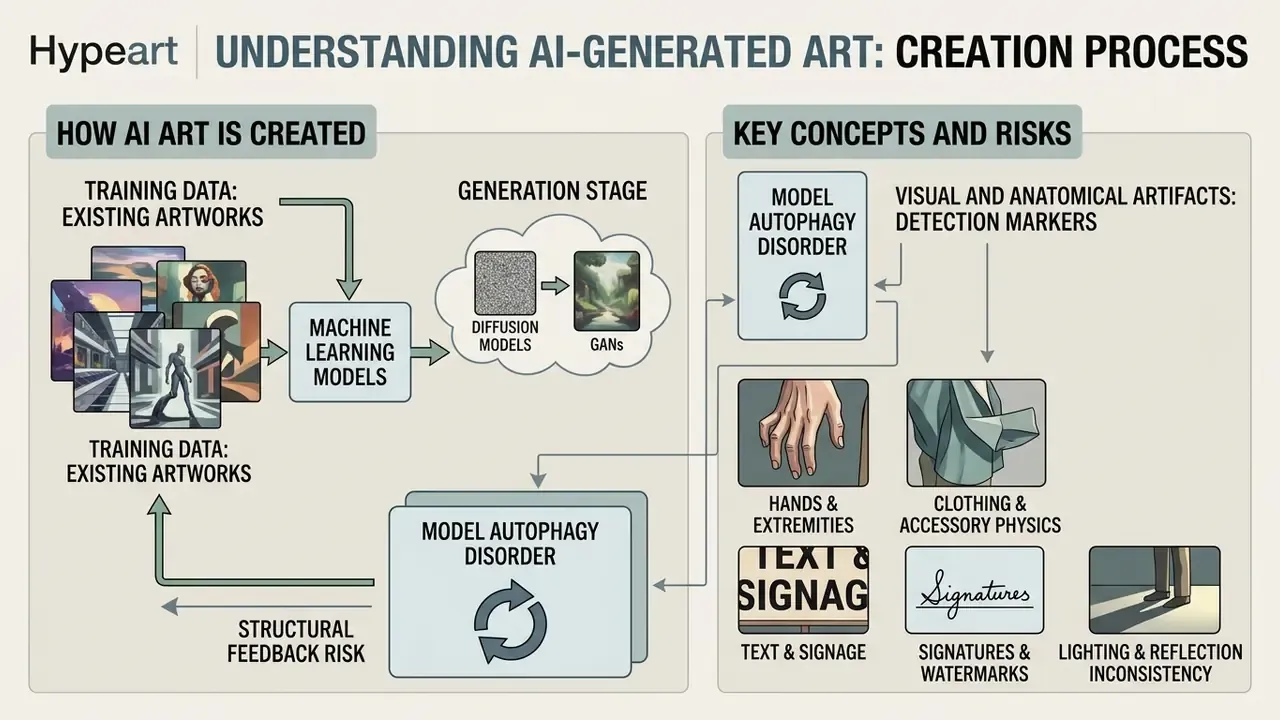
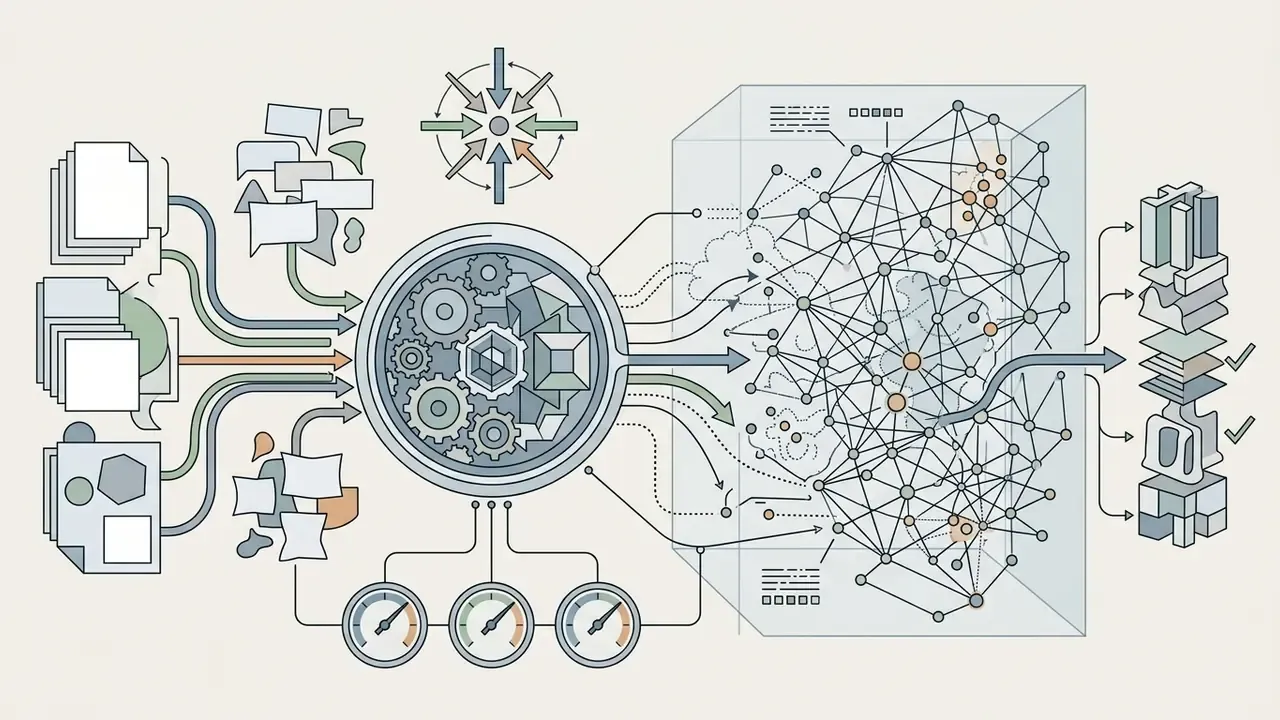
AI-generated art refers to digital images produced by machine learning algorithms, primarily text-to-image diffusion models and generative adversarial networks, that synthesise visual outputs from textual prompts. These systems hold no intrinsic creativity, consciousness, or intent. They execute statistical transformations that map text embeddings to visual feature distributions learned from very large collections of human-made imagery.
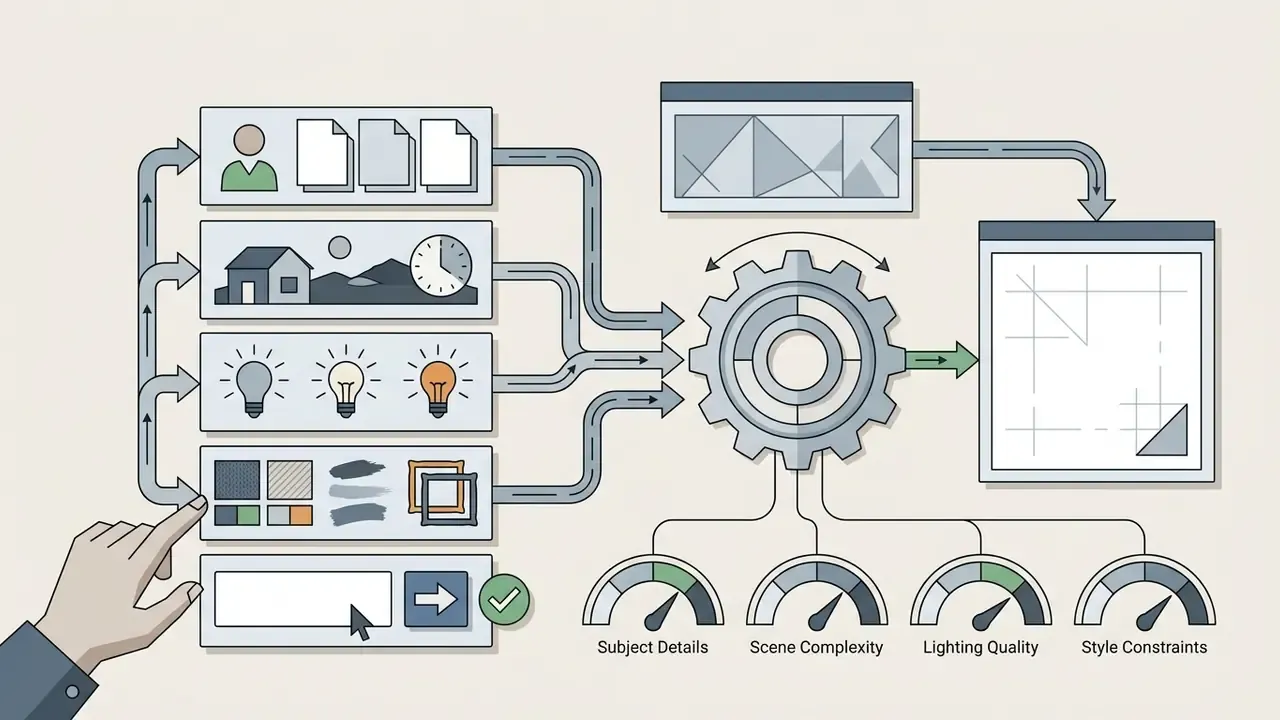
Modern text-to-image diffusion models create images by starting with Gaussian noise and running an iterative denoising process. Systems such as Stable Diffusion or DALL·E 2 work in a compressed latent space, which cuts computational overhead while aligning generated features with input text vectors processed through language models like CLIP.
«Text-to-image diffusion models generate images by starting from noise and reversing a denoising process», separating pixel-space methods such as GLIDE and Imagen from latent-space systems. — Text-to-image Diffusion Models in Generative AI: A Survey, arXiv (2024). https://arxiv.org/html/2303.07909v3
GANs, by contrast, are deterministic maps from a latent code to a pixel grid in one pass. In both architectures the tool acts as a pattern synthesiser rather than an autonomous creator. Understanding these foundations matters when navigating entries in the AI Media Glossary, and when comparing production-grade systems such as Midjourney against competing image generators.
Training data: why AI models depend on existing artworks
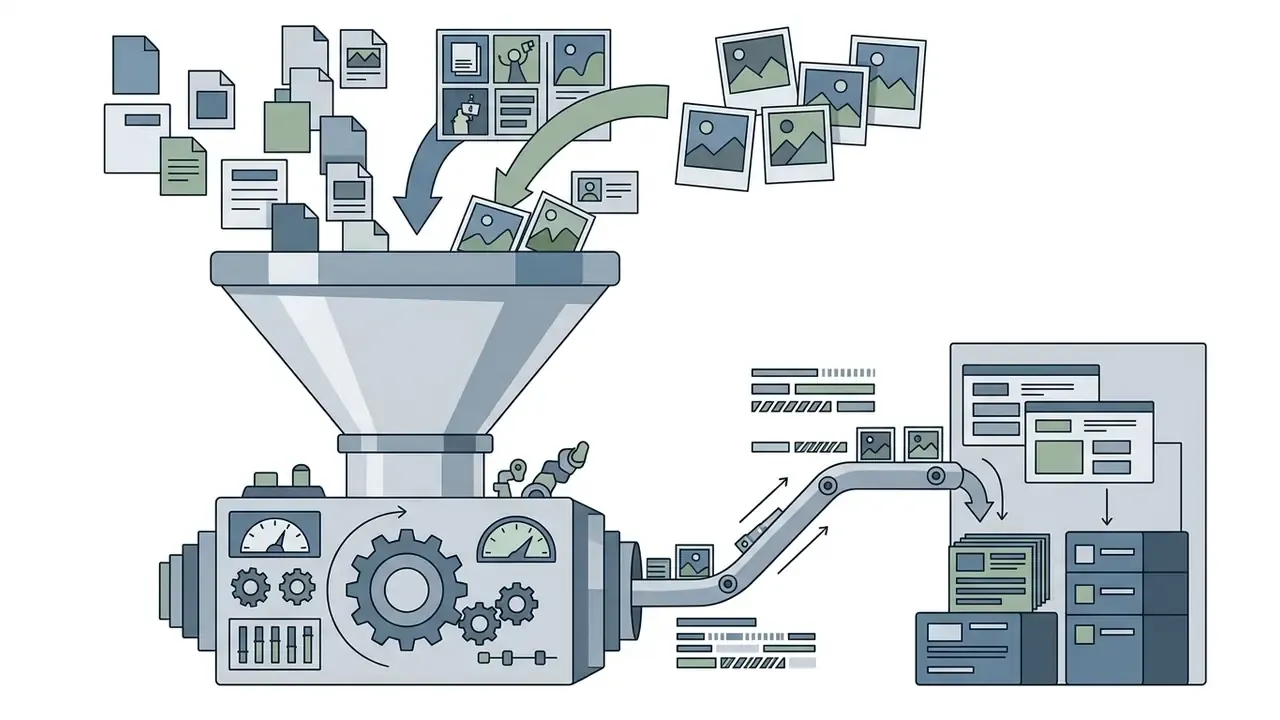
AI image models depend on petabyte-scale training data composed of existing artworks and photographs in order to learn visual representations. Without ingesting billions of curated or web-scraped image-text pairs, generative architectures cannot associate linguistic descriptors with visual concepts such as colour, texture, perspective, or art style.
The open dataset LAION-5B is the clearest example. It was built by parsing Common Crawl web data, extracting 5.85 billion HTML image tags and alt-text captions, then filtering them using CLIP ViT-L/14 similarity scores, language detection, and NSFW and watermark tagging (LAION e.V., 2022). Such datasets ingest enormous quantities of copyrighted paintings, digital illustrations, and commercial photography without the explicit consent, attribution, or compensation of the original creators. To train AI at this scale is to extract multi-dimensional features, brushstroke density, colour palettes, composition axes, and convert human creative output into mathematical weights that later generate derivative results.
The consent problem is compounded by an artifact governance teams can observe directly: copied watermarks. Reports have documented generated images carrying signature marks strikingly similar to those used by identifiable working artists. The technical defence, that the model merely learned "artists place watermarks on images", becomes hard to sustain when the reproduced mark is near-identical to one specific creator's. For an enterprise, a synthetic asset carrying a residual third-party watermark is a direct provenance and trademark exposure. Not a theoretical one.
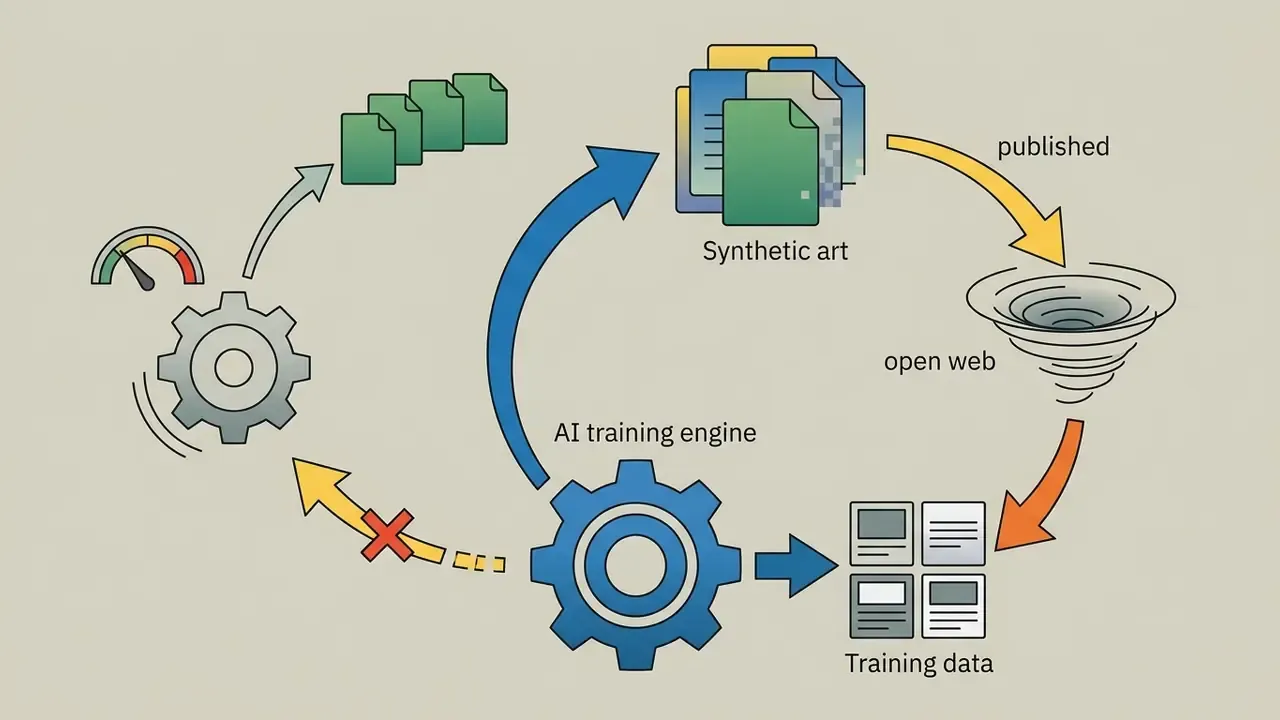
Model Autophagy Disorder: the structural feedback risk. Uncontrolled scraping introduces a systemic risk known as Model Autophagy Disorder, or model collapse. As AI-generated content floods the open web, later model generations are inevitably trained on synthetic outputs rather than human originals, which produces progressive degradation of variance, severe artifact bleeding, and eventual collapse of latent representation quality.
For a model-risk function, MAD is not a cultural argument. It is a documented degradation pathway, and it makes vendor dataset-provenance disclosure a hard dependency of any multi-year visual-content strategy rather than a nice-to-have clause.
Visual and anatomical artifacts: practical detection markers
Because diffusion models execute statistical spatial mapping without anatomical or physical comprehension, they introduce systemic visual defects with grim consistency. Art directors, brand reviewers and compliance reviewers should screen for:
- Hands and extremities extra or fused digits, duplicated thumbs, limbs merging into background geometry.
- Clothing and accessory physics straps that terminate mid-air, buttons without plackets, jewellery that passes through fabric, asymmetric eyewear.
- Text and signage malformed glyphs, pseudo-lettering, illegible product labels, a critical defect for financial disclosures and regulated marketing.
- Signatures and watermarks blurred, illegible marks that mimic human watermarks scraped from portfolio platforms such as DeviantArt or Instagram.
- Lighting and reflection inconsistency multiple incompatible light sources, missing or contradictory reflections in glass and water.
These artifacts exist because the model does not know how to emulate; it mixes what it absorbed from training data without understanding anatomy or even the laws of physics. The result can read as uncanny, unsettling, or soulless, and in a regulated brand context it reads as unreviewed. Manual remediation through a professional photo editor or controlled AI outpainting and background expansion is a standard corrective step. It also consumes precisely the hours the automation was purchased to save.
Can generative AI create new art or recombine what it has learned?
Generative AI does not create new art from internal experience or intention. It performs probabilistic recombination of visual patterns learned from its training data. Computer vision research is consistent on this: generated images are statistical interpolations inside a high-dimensional latent space, bounded by the parameters of the ingested corpus.
«AI models generate outputs bounded by training data patterns; PREGen reduces copyrighted character generation by more than half under direct prompts.»
A model can certainly produce a visually novel arrangement, an astronaut on horseback rendered in Renaissance light, say, while reusing learned visual footprints and statistical structure. Scholarly evaluations of generative visual systems show latent-space clustering and measurable similarity to pre-existing training samples. Prompt behaviour then amplifies the convergence:
«Users relying on common prompt templates produce significantly uniform images, driving homogenization of AI-generated visual content across platforms.»
What looks like algorithmic originality is mathematical interpolation across pre-existing human concepts. The counter-position from art theory deserves a fair hearing, though: originality may not be reducible to computational novelty, because it can emerge from human intent, contextual framing, and co-creation. The disagreement is largely methodological. Computer-science and image-analysis papers emphasise measurable similarity to training patterns, while co-creation studies treat originality as relational and interpretive. Both readings, notably, locate whatever originality exists in the human, not in the model.
Why AI art is bad: the main arguments against it
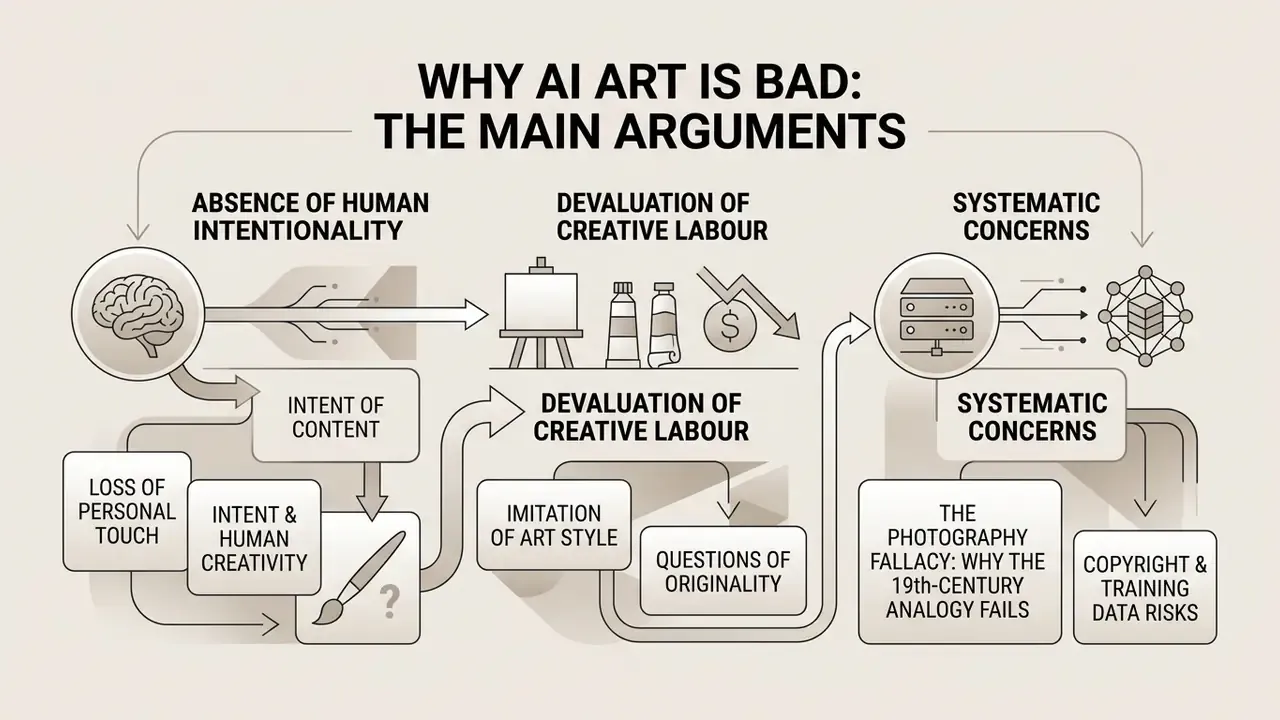
The main arguments establishing why AI art is bad cluster around three claims: the absence of human intentionality, the devaluation of creative labour, and the systematic appropriation of artistic identity without authorisation. Critics in aesthetics, ethics, and labour economics keep returning to the same point. Automated generation replaces human expression with algorithmic inference, and the cultural and economic externalities land on people who never agreed to the trade.
Beyond technical limits, synthetic imagery creates measurable market distortion. Behavioural studies show audiences exhibit algorithm aversion when judging art, rating known synthetic work lower in value and creative merit than human-made compositions.
«Audiences struggle to detect AI-generated art above chance levels, yet sharply discount its value once AI authorship is revealed.»
Undetectable in isolation, heavily discounted on disclosure. That asymmetry is exactly what creates reputational risk for a regulated brand, since the cost does not appear until someone asks the question. Weighing these trade-offs usually means consulting detailed framework evaluations such as the AI Media Comparison Matrices and head-to-head reviews of the best AI art generators.
Loss of personal touch, intent and human creativity
Algorithmic generation lacks personal touch, emotional resonance, and conscious intent, because statistical models operate without lived experience, subjective awareness, or purpose. Art isn't merely a visual surface. It is the accumulation of deliberate choices, cultural context, and human communication. Scholarly analysis is blunt here: AI outputs arise from calculations that are "not conscious of themselves" and hold no feelings or intentions, which severs the link between an artwork and an intending subject.
In controlled behavioural experiments at Columbia Business School, researchers measured participant valuations of identical or stylistically matched human and synthetic artworks (Horton & Iyengar, 2024).
Viewers conceded that AI tools can reach real visual complexity, yet they discounted the financial and aesthetic worth of the outputs because effort, authentic intention, and creative agency were missing. Engagement data points the same way: a 2024 analysis of social platforms found human-created paintings out-performed AI-generated content (0.198 versus 0.104, p<0.001).
Art has always been rooted in communication, a way to reach other people and to keep a record. Humanity's earliest surviving works, from the Cueva de las Manos in Argentina to the caves at Lascaux and Māori rock art in Te Waipounamu, show that people with limited skill and almost no resources still made work that lasted for millennia. Many artists argue the process matters more than the finished object: the value sits in the act of creation, not its completion. Automation, then, optimises the one variable that was never the bottleneck.
Imitation of an art style and questions of originality
Generative models reproduce a specific art style by analysing recurring stylistic patterns in training data and synthesising them on demand. A prompt such as "in the style of [living artist]" extracts a creator's visual signature without permission, which threatens both brand identity and market exclusivity. You can see the dynamic in the popularity of studio-style image generators that replicate a recognisable house aesthetic in seconds.
«DreamStyler reproduces a target artistic style from a single reference image, outperforming competing methods on quantitative style fidelity metrics.»
Under U.S. copyright law, style itself is generally not eligible for protection, which creates a regulatory gap that generative models exploit (U.S. Copyright Office, Digital Replicas Report, 2024). The Office explicitly declined to recommend style as protected subject matter, while noting that deceptive copying of artistic style may still be addressable under other laws. Research presented at computer vision venues in 2025 quantified the exposure: under simple prompts, 20% of 372 prolific artists studied were at risk of direct style copying by popular text-to-image models. European Parliament analysis (2025) adds a nuance worth pinning down. A prompt like "in the style of Van Gogh" is unlikely to infringe copyright unless it copies specific expressive elements, which is exactly where output screening stops being optional.
Commercially, the incentives run the wrong way. A 2024 Wharton study found that naming an artist's style in a prompt increased consumer preference and willingness to pay by an average of $4.67, rising to $7.52 for Mucha-style prompts. The market rewards style appropriation; the artist captures none of the surplus. This algorithmic copying blurs the line between legitimate influence and automated replication, which is why a tool such as an ai book illustration generator sits at the centre of professional debate.
| Argument Against AI Art | Empirical Support & Regulatory Facts | Counterargument / Industry Perspective | Contextual Dependence |
|---|---|---|---|
| Loss of Originality & Style Copying | Popular models replicate living artists' styles; 20% of 372 prolific artists faced style-copying risk under simple prompts (computer-vision research, 2025); DreamStyler achieves high style fidelity from a single reference image (2023). | Human artists also learn, adapt, and recombine visual styles from historical predecessors. | Risk depends on prompt specificity ("in the style of") and on genericization safeguards such as PREGen (Scientific Reports, 2025). |
| Erosion of Perceived Artistic Value | Consumers value AI-labeled art 62% lower than human art due to perceived lack of labour and intentionality (Columbia Business School, 2024); human paintings out-engaged AI content 0.198 vs 0.104 (2024). | Generative tools increase draft speed and iterative production efficiency; one peer-reviewed study reported a 25% creative-productivity gain. | Value perception shifts with transparent labeling, disclosure of process, and the extent of human co-creation. |
| Displacement of Creative Labor | Post-ChatGPT freelance data shows a 17–21% drop in writing and image contract demand and a 5.2% fall in monthly freelancer earnings (Ifo Working Paper No. 12368, 2025); non-AI artists exited a major marketplace at −23% (Stanford GSB, 2025). | Automation handles routine layout asset tasks, freeing designers for creative strategy; total platform sales rose 39%. | Impact varies by niche: entry-level commercial asset production faces severe pressure; high-concept narrative design retains human oversight. |
| "It's just like photography" | Early critics did fear photography would supersede painting (Henrietta Clopath, 1901; The Crayon, 1855), and were wrong about painting. | Therefore, proponents argue, criticism of AI is simply generational technophobia. | The analogy is not structurally equivalent: photography captured photons through optics; generative AI requires prior ingestion of millions of human-painted canvases (see below). |
| Model Autophagy Disorder (model collapse) | Synthetic content re-entering training corpora causes variance degradation and artifact bleeding (Dr Mi You, Auckland Art Gallery, 2025). | Synthetic-data filtering and provenance tagging can mitigate contamination. | Severity depends on vendor dataset hygiene and on whether provenance disclosure is contractually enforced. |
The photography fallacy: why the 19th-century analogy fails
The strongest argument advanced by defenders of generated art is historical. Photography, they note, was dismissed for decades on exactly the grounds now aimed at AI: anyone can do it, it will destroy painting, and it has no soul.
«The fear has sometimes been expressed that photography would in time entirely supersede the art of painting.»
«Invention and feeling constitute essential qualities in a work of Art… Photography can never assume a higher rank than engraving», because it lacks «something beyond mere mechanism at the bottom of it.» — The Crayon, 1855 issue
Both predictions failed. Painting was not superseded; canvases still clear hundreds of millions at auction while photographs rarely approach ten million. And photography's defenders are right about craft: a smartphone in a professional's hands and the same device in an untrained one produce results "as vast and wide as the Grand Canyon" apart. Technology has displaced labour before, through the printing press, the computer, the internet, the smartphone, and the argument "it will take jobs" has never on its own stopped a medium.
The analogy still fails on one decisive technical point. A camera captures physical photons through mechanical optics. It does not require the prior ingestion, processing, and stylistic recombination of millions of human-painted canvases in order to function. A photographer who has never seen a painting can still make a photograph; a diffusion model with an empty training corpus produces noise. Photography created a genuinely new medium with a new physical relationship to the real world; generative AI automates the extraction and recombination of existing visual media made by identifiable, living, uncompensated people.
Three corollaries follow. First, the economic externality is structurally different: photography competed with painting, whereas generative models compete with the very artists whose work constitutes their inputs. Second, the legal posture is different: a photograph of a street is not a derivative of another author's expression, while a model output may trace back to protected expressive elements. Third, the technical trajectory is different: photography did not degrade as photographs proliferated, while generative models degrade once their own outputs saturate the training web. Even sympathetic practitioners concede the rights problem. Asked whether it is wrong for companies to scrape the internet to train AI on artists' work, one pro-AI photographer answered plainly: "Yes. Copyright laws and the livelihood of artists must be protected."
Copyright, training data and commercial use of AI-generated images
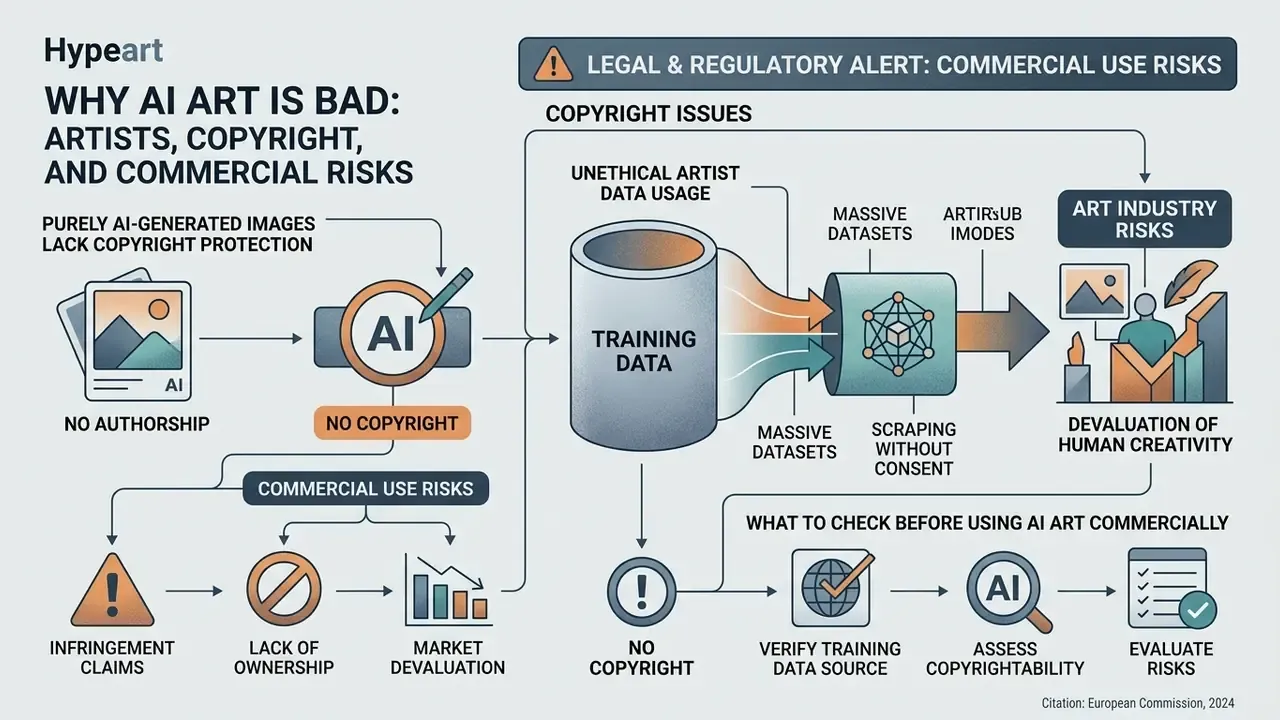
In two sentences: purely AI-generated images lack copyright protection under current U.S. and European frameworks, so an enterprise that deploys them holds no exclusive right. Meanwhile, models trained on unconsented copyrighted data expose the deploying business to third-party infringement claims, an asymmetry of zero upside protection and open-ended downside liability.
The U.S. Copyright Office addressed this across two reports. Part 1, Digital Replicas (31 July 2024), concluded that existing law is insufficient to address unauthorised likeness use. Part 2, Copyrightability (29 January 2025), held that copyright can cover only human-determined expressive elements and that prompting alone does not create protectable authorship. Works containing more than de minimis AI-generated material must be disclosed, with AI-produced traditional authorship elements disclaimed. Reporting on the Allen v. Perlmutter dispute noted that registration was refused where the applicant declined to disclaim AI-generated portions (Reuters, 26 September 2024). European Parliament analysis (2025) arrives at a parallel conclusion from the other direction: purely AI-created output without substantial human intervention is not protected by EU copyright and effectively falls into the public domain, while remaining fully capable of infringing pre-existing rights.
Major 2025 precedents, including Disney and Universal v. Midjourney, underline the liabilities that follow when generative models reproduce copyrighted character designs and visual styles (Reuters, 2025). The same reporting cycle recorded a $1.5 billion settlement by Anthropic in a copyright matter and new actions against image generators. The New York Times v. OpenAI (2024) framed the central question sharply: is AI output a substitute for the human inputs it was trained on?
Commercial entities that deploy synthetic assets therefore risk holding non-exclusive, unprotectable visual property while staying exposed to copyright claims. Compliance teams track the moving parts through resources such as the AI Litigation and Case Timelines, and they should map vendor-specific terms for every tool in production, including Google's image generation terms, Microsoft's image generator conditions, Canva's AI licensing, and Bing AI image access requirements.
What to check before using AI art commercially
Before you use AI-generated images in commercial products, campaigns, or branding, run a risk assessment across licensing, dataset provenance, and human creative input.
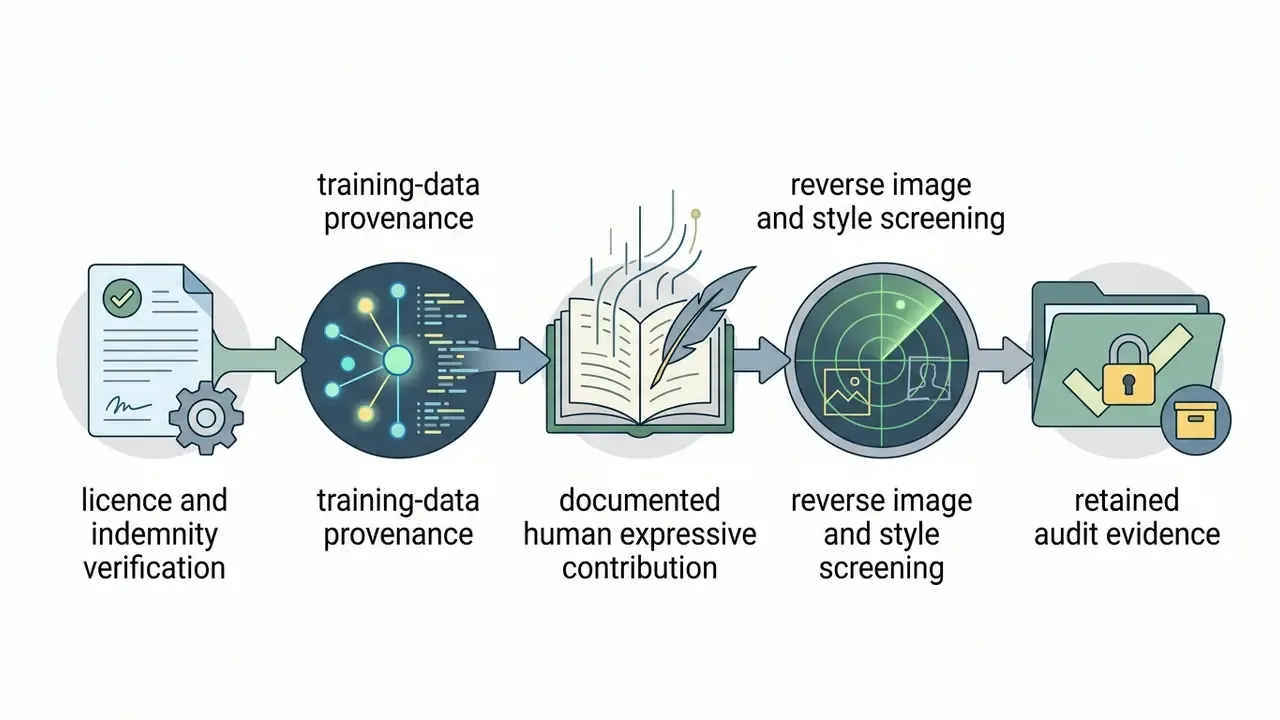
- Verify model licence and provider terms. Confirm that the terms expressly grant commercial usage rights, and review indemnity clauses covering third-party copyright claims. Record the licence tier, seat identity, and effective date. Consumer tiers frequently exclude commercial use that paid tiers permit.
- Audit training data provenance. Check whether the provider complies with transparency standards, including EU AI Act Article 53 obligations for general-purpose AI providers to publish a copyright-compliance policy and a sufficiently detailed summary of training content (European Commission, 2024). The Act entered into force on 1 August 2024.
- Establish human expressive control. Confirm that human creators contributed original expression beyond a text prompt, through manual digital painting, compositing, colour grading, or structural editing, and retain the intermediate files that evidence it.
- Conduct reverse image and style screening. Screen outputs against trademarked characters, protected expressive elements, residual watermarks and living-artist signatures using AI reverse-image-search tooling before publication.
Pre-deployment decision tree. Run in order; any NO routes to the stated action.
- Q1. Does the vendor licence expressly permit commercial use at our subscription tier? NO: stop, upgrade or substitute the tool. YES: continue.
- Q2. Does the vendor provide a training-data summary and a copyright-compliance policy, or a contractual IP indemnity? NO: escalate to Legal and treat the asset as high-risk, internal use only. YES: continue.
- Q3. Was a human expressive contribution made beyond prompting, and is it evidenced in retained files? NO: the asset is unprotectable, so do not use it as a brand-defining or trademarked element. YES: continue.
- Q4. Does reverse-image and style screening return any protected character, living-artist signature, or residual watermark? YES: discard, or remediate and re-screen. NO: continue.
- Q5. Does the deployment channel require AI-content disclosure (regulated marketing, editorial, jurisdictional labeling)? YES: apply disclosure and log the decision. NO: continue.
- Q6. Is the asset logged in the IP Asset Inventory with model, version, prompt, seed, reviewer and approval date? NO: do not publish. YES: approved for release.
Audit evidence trail: what to retain.
| Evidence item | Minimum field | Retained by | Why an auditor needs it |
|---|---|---|---|
| Model and version | Vendor, model name, version or build, date | Design Ops | Proves which system generated the asset when terms or law change |
| Prompt and parameters | Full prompt, negative prompt, seed, aspect ratio, reference images | Creator | Demonstrates absence of "in the style of [living artist]" instructions |
| Licence artefact | Subscription tier, invoice, terms snapshot, indemnity clause | Procurement | Establishes commercial rights at the time of use |
| Human contribution | Layered source files, edit history, before and after renders, time logs | Creator | Supports the human-authorship claim required for registrability |
| Screening results | Reverse-image and style-search reports, timestamps | Brand Review | Shows reasonable steps against output-side infringement |
| Disclosure decision | Channel, label applied or rationale for omission | Marketing Compliance | Evidences transparency-obligation handling |
| Approval record | Reviewer identity, date, risk rating, exception approvals | AI Governance | Closes the control loop for internal audit and regulators |
Responsibility matrix (RACI).
| Activity | Design / Marketing | Legal / IP | AI Governance & Model Risk | Procurement | Internal Audit |
|---|---|---|---|---|---|
| Tool approval and onboarding | C | C | A | R | I |
| Licence and indemnity review | I | R | C | A | I |
| Training-data provenance assessment | I | C | R/A | C | I |
| Prompt and output logging | R | I | A | I | C |
| Reverse-image and style screening | R | C | A | I | I |
| Disclosure and labeling | R | A | C | I | I |
| IP Asset Inventory entry | R | C | A | I | C |
| Periodic control testing | I | C | C | I | R/A |
⚠️ LEGAL & REGULATORY ALERT: COMMERCIAL USE RISKS
How AI art affects artists and their work
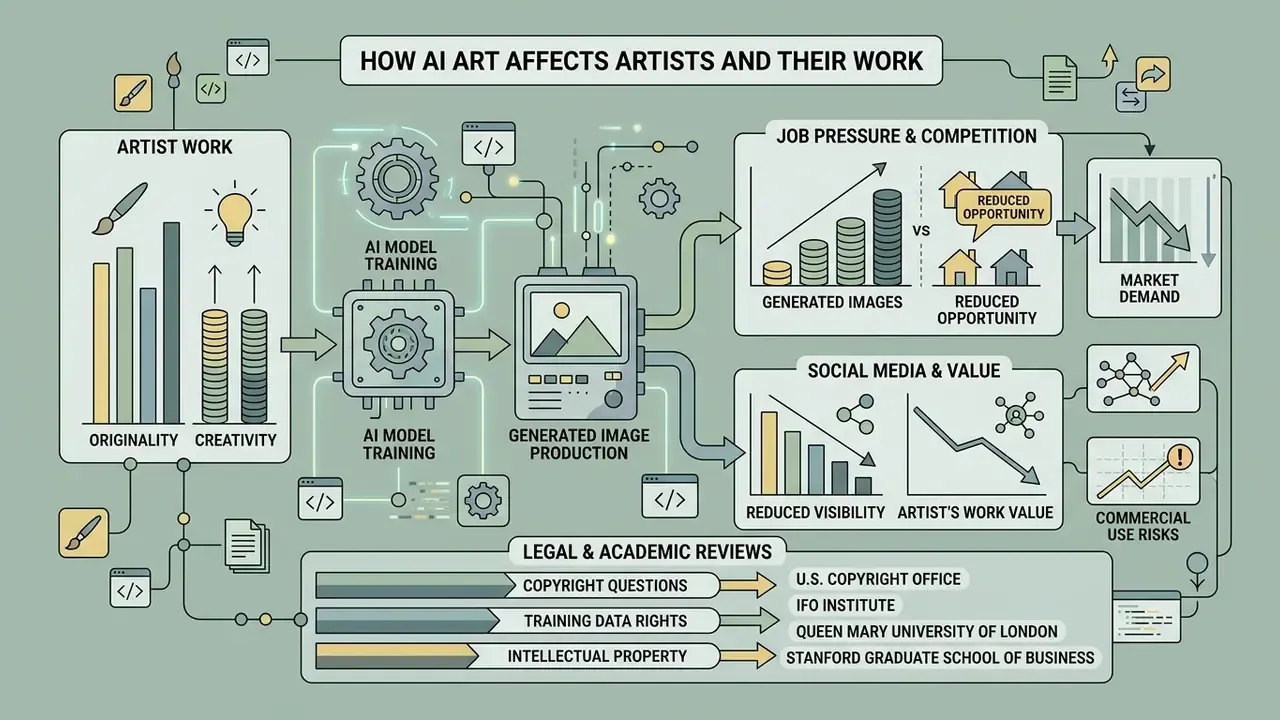
Questions about AI art and how it affects artists have moved from forums into board packs, and for good reason. AI art impact on artists is now visible in three places at once: commercial markets flooded with synthetic assets, compressed freelance compensation, and a job description quietly rewritten. Rather than eliminating creative roles overnight, the technology shifts labour dynamics, often demoting artists from primary creators to low-margin reviewers of machine output. That is AI art and its impact on artists in one line: fewer originating hours, more cleanup.
Illustrative workflow scenario, directional and not peer-reviewed. In an internal evaluation of commercial workflow changes across digital asset pipelines, a design department replaced preliminary concept drafting with automated image generators. Draft turnaround did accelerate. But senior illustrators were reassigned almost entirely to cleaning up and editing synthetic artifacts, producing an estimated 35% decline in billable creative hours alongside rising burnout indicators. Restructuring the workflow to restrict AI use to early moodboarding restored core creative hours while maintaining pipeline throughput. These figures come from a single internal pipeline review and should be treated as directional. Independent, published effect sizes for artifact-remediation load are still missing, so teams should instrument their own baselines before and after adoption rather than importing this ratio.
Job pressure and competition from generated images
Rapid deployment of text-to-image tools puts severe pressure on commercial illustrators, concept artists, and graphic designers. Creative businesses are adopting generative tools far faster than the broader economy, which drives role consolidation and shrinks entry-level opportunity. Is that AI taking over art outright? Not quite, and the distinction matters for anyone modelling headcount.
In a comprehensive report on creative sector labour, 61% of self-employed visual artists reported reduced financial compensation directly attributed to generative AI market entry (Queen Mary University of London / CREAATIF, 2025). An econometric analysis of online freelance platforms found a 17% drop in image creation job postings, a 21% drop for writing-related jobs, and a 5.2% decrease in monthly earnings after mass adoption of generative models (Ifo Institute Working Paper No. 12368, 2025). Imperial College Business School analysis (2025) reported weekly demand falling 21% for the most automatable professions, 13% for graphic design and 3D rendering. Executives across entertainment sectors project that more than 203,800 payroll jobs will be adversely affected by 2026 (CVL Economics, 2024).
Market-level evidence now quantifies substitution directly:
On a platform hosting nearly 500 million visual assets, monthly image supply rose +78%, active seller firms +88%, total sales +39%, while non-AI artists exited at an additional −23% rate. — Samuel Goldberg & H. Tai Lam, Stanford Graduate School of Business (2025). https://stanford.io/4372LGA
«One question you might ask is whether we're at risk of these markets being completely dominated by generative AI, squeezing humans out. That's a real policy concern.» — Samuel Goldberg, Assistant Professor of Marketing, Stanford GSB (2025)
The distributional reading matters. Consumers gained variety, measured quality rose (partly because lower-quality sellers exited), and purchasing volume moved away from non-AI human assets toward cheap synthetic substitutes. Not all evidence points one way. A 2025 event study of artistic occupations found little sharp post-2020 earnings break, while still reporting weaker employment growth in more exposed occupations.
«Event-study analysis finds weaker employment growth in more AI-exposed artistic occupations, suggesting adoption may slow hiring or increase attrition.»
The discrepancy is methodological rather than ideological: survey and interview studies capture commission loss directly, while aggregate earnings panels smooth it across occupational categories. Over the next few years both series will be worth watching together. These dynamics also shape how teams read commercial tiers on AI Media Pricing.
AI impact on the art industry: market, speed and creative standards
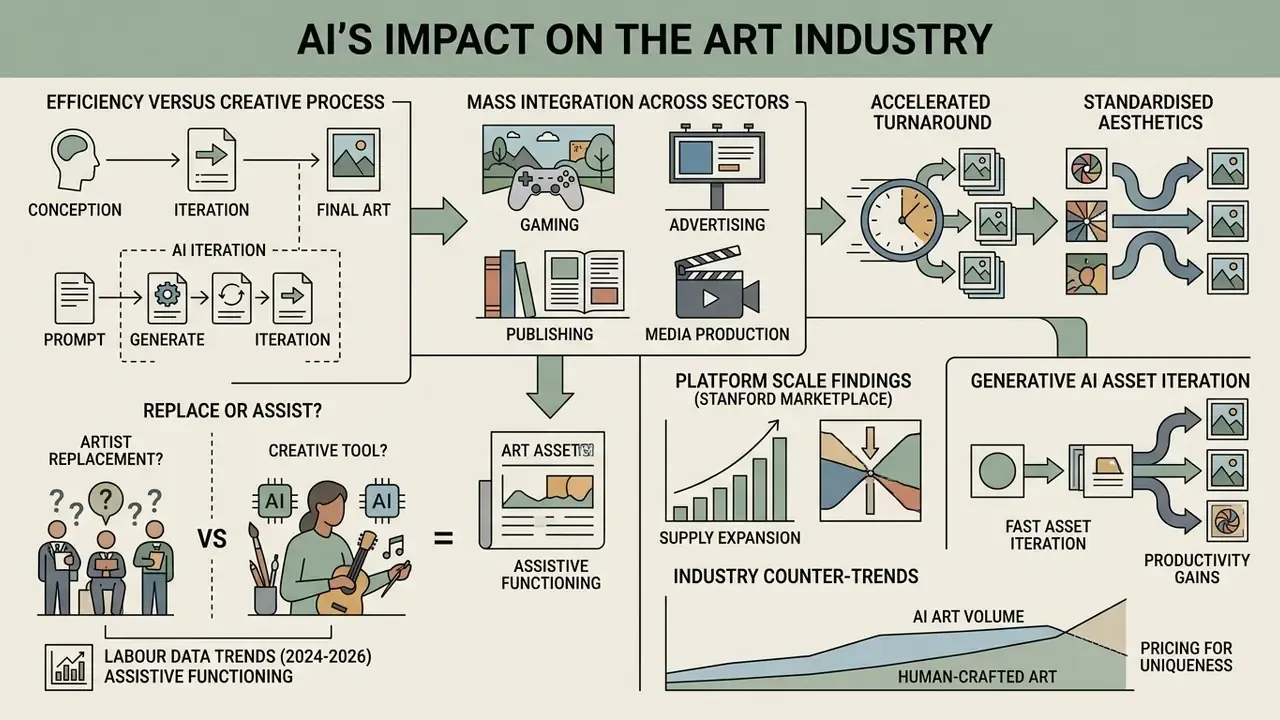
Mass integration of AI tools across gaming, advertising, publishing, and media production accelerates turnaround while standardising visual aesthetics. How is AI affecting the art industry in financial terms? Market analyses indicate that the AIGC image-and-graphics software sector expanded from roughly $1.1 billion in 2020 to $8.2 billion in 2024, with projections near $12.6 billion by 2029 (AIGC image and graphics software market report, 2024), while UNCTAD frames AI as a structural factor in cultural production, distribution and labour (UNCTAD Creative Economy Outlook, 2024). Application concentration is documented too: graphic design (35%), advertising design (32%), product design (25%), and web design (25%).
The Stanford marketplace findings show what that looks like at platform scale: supply expansion and price-competitive substitution, rather than net creative enrichment. Prioritising speed over depth introduces structural quality risk, because automated pipelines reward high-volume output tuned for algorithmic engagement instead of artistic innovation. Comparing capabilities helps, whether that is the best AI art generator against the best free AI art generator, or ChatGPT image generation against alternatives; the variance in quality and commercial licensing constraints across systems is wider than most procurement decks assume.
Efficiency versus the creative process
Generative AI does enable fast asset iteration. Pushed too far, raw efficiency fragments and standardises the creative process. Platformised workflows lock design pipelines into templates and shift the artist's role from conceptual originator to operator supervising algorithmic output. Research on generative AI and creative labour (2025) describes these platforms as systems that "standardize and streamline creative production", prioritising platform efficiency over autonomous creative process, while a 2024 study of remix industrialisation links automation to "standardization, fragmentation, and corporate control."
«Creative businesses adopted generative AI at 25% penetration versus 3.9% across the broader economy, accelerating role consolidation in creative sectors.»
Will AI replace artists or become another creative tool?
Labour data from 2024 to 2026 suggests generative AI is functioning mainly as an assistive tool rather than a full replacement for human artists, although replacement pressure remains intense in entry-level commercial roles. Regulated sectors and complex creative projects still require human oversight, emotional nuance, and intentional direction.
«Among creative professionals, 49% reported diminished job security due to generative AI, with some reassigned to reviewing AI-generated outputs rather than originating work.»
Sector-level studies point the same way. The 2026 Canadian creative-sector assessment found high complementarity between generative tools and human workers for drafting, editing, and graphics tasks rather than direct substitution, while flagging significant risks for creative workers. Integrated responsibly under human control, AI can support brainstorming without erasing human authorship. Technical teams working under governance protocols typically consult the AI Media API Guides and reference implementation patterns such as the Google Veo video-generation API guide when assessing cost, quota and logging capability.
A plausible counter-trend deserves pricing in as well. Handmade work has carried a premium over machine-made equivalents throughout history, and a saturation of synthetic imagery may not reduce respect for demonstrable human labour; it may raise it. Visible brushstrokes, process footage, mistakes, the documented path from sketch to final. In that scenario provenance becomes the scarce asset, and AI will continue to sit beside the artist rather than in the artist's chair.
How artists can use AI without losing their creative voice
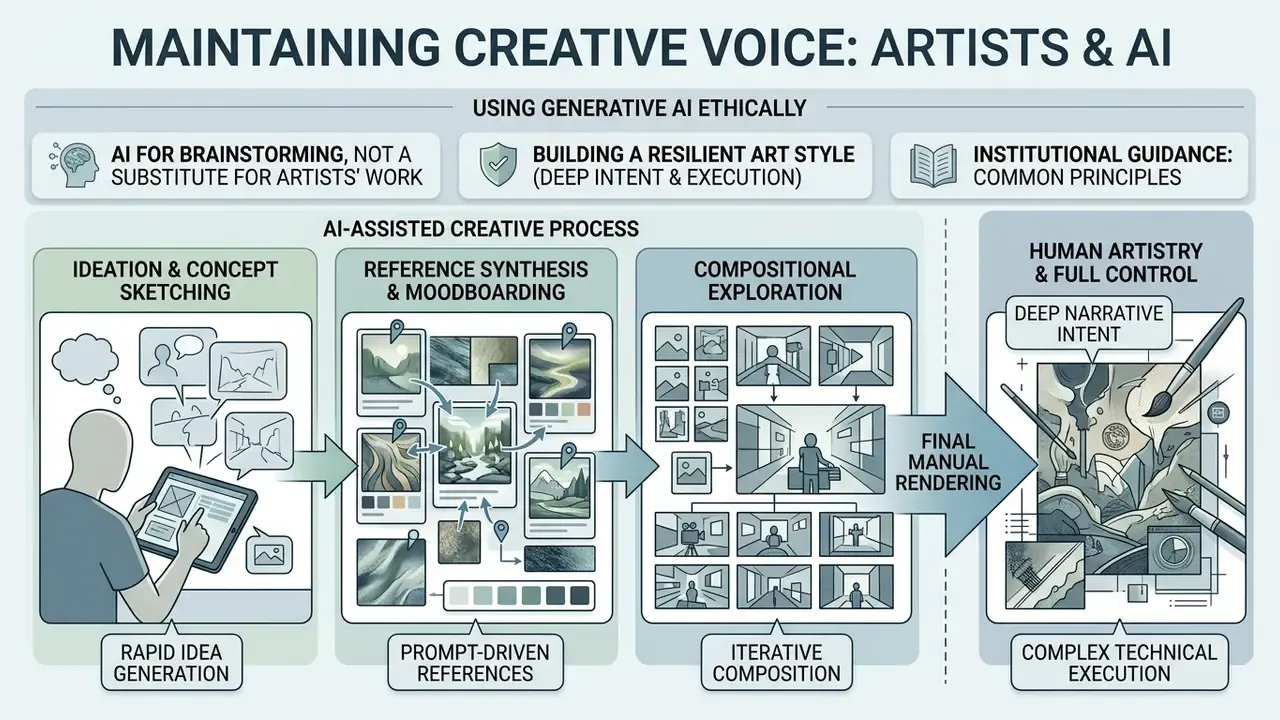
Artists can use AI ethically by restricting it to early-stage ideation, reference synthesis, and compositional exploration, while keeping full manual control over final rendering and execution. That preserves the human agency authentic authorship requires, and in a commercial context it preserves the human expressive contribution any copyright claim depends on.
Institutional guidance converges on the same principles. UNESCO's 2021 Recommendation on the Ethics of AI sets out a human-rights approach built on human oversight, transparency, auditability and traceability. The European Commission's 2021 Ethics By Design and Ethics of Use guidance requires that systems allow human control over decision cycles and that data selection be fair, accurate, unbiased and documented. When human artists retain control of the creative process, AI tools act as digital sketchbooks rather than substitutes. Creators working across multi-modal projects often add peripheral tools, an ai book title generator, an ai bot maker, an AI voice generator, or a YouTube video editing workflow, to handle administrative and distribution tasks without touching the visual craft.
AI for brainstorming, not a substitute for artists' work
Using generative AI only for moodboarding, concept sketching, and prompt-driven reference generation lets artists break a block without surrendering authorship. In this human-in-the-loop workflow, synthetic outputs are raw material, not deliverables.
«Novice artists use AI-generated drafts for early-stage inspiration, treating them as raw material to be reinterpreted through their own techniques and sensibilities.»
A documented CHI-published workflow uses two steps: creators first search for reference images, then articulate what specifically appeals in them, and only then recombine references for conceptual ideation before any visual development begins. A 2026 artist workflow template follows the same sequence. Idea first, then AI-assisted rough sketches or mood boards, then prompt refinement, with every output reviewed as raw material and never as final art. Composition-preserving reference workflows help too: upload a photograph, ask the model to hold the composition while varying scene or lighting, save the prompt that worked, then paint the final piece by hand. The artwork stays rooted in human skill and intention, and, critically for commercial use, the intermediate files become the evidence of it.
Building an art style that is more than an AI output
A resilient art style comes from deep narrative intent, complex technical execution, and a documented process that statistical inference cannot reproduce. Authentic personal signatures rest on lived experience rather than surface-level aesthetic templates.
«Artists report experiencing fewer job opportunities due to generative AI proliferation, with some contemplating career shifts and experiencing public distrust of their work.»
Practical guidance follows from that exposure. Industry documentation, including Adobe's generative-AI guidance, recommends avoiding prompts that name living artists, favouring unique conceptual prompts, selective editing, and explicit rights review. A 2025 whitepaper on generative-AI brand design evaluates originality by uniqueness, non-overlap with competitor motifs, and a defined human and AI workflow with assigned roles, prompt strategy, and feedback loops. Wharton's 2024 findings reinforce the commercial logic: consumers pay measurably more for distinctive, recognisable visual signatures, which is an argument for owning a signature rather than renting one. Documenting the process through sketches, process videos, and draft iterations signals authenticity to collectors, to audiences, and increasingly to auditors. Artists and organisations that want implementation help can reach out through support or model operational costs with the AI Media Calculators.
Enterprise governance: human-in-the-loop control for corporate design teams
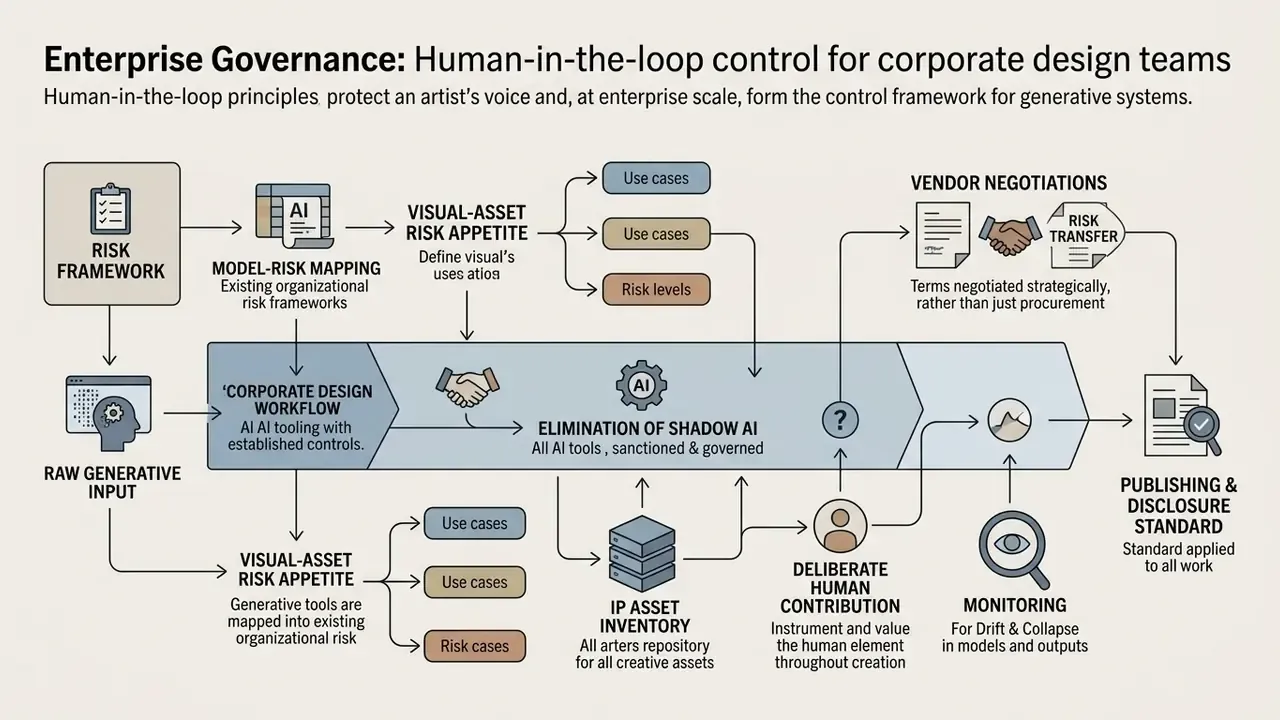
In two sentences: the same human-in-the-loop principles that protect an individual artist's voice function, at enterprise scale, as the control framework that makes generative visual assets defensible. The objective is not to ban generation but to make every published synthetic asset attributable, licensed, screened, disclosed where required, and logged.
1. Map generative image tooling into existing model-risk frameworks. Treat text-to-image systems as third-party models inside your established governance perimeter: SR 11-7 model-risk principles (clear ownership, independent review, ongoing monitoring), the NIST AI Risk Management Framework functions (Govern, Map, Measure, Manage), and ISO/IEC 42001 management-system controls. The measurable risks are concrete: output-side infringement, residual watermarks, unprotectable brand assets, artifact defects in regulated disclosures, and MAD-driven quality drift across model versions.
2. Define a visual-asset risk appetite by use case. Tier assets by exposure rather than by tool. Internal ideation and moodboards sit low; non-branded social and blog imagery sits medium; customer-facing product UI, disclosures, regulated marketing, and trademarked brand elements sit high, meaning human-authored or prohibited. Attach control depth from the audit table to each tier explicitly.
3. Eliminate Shadow AI. Unlogged use of consumer image tools by marketing, product and agency teams is the single largest control failure, because it destroys the evidence needed to prove human authorship and licence compliance after the fact. Controls: an approved-tool allowlist with enterprise seats; network and expense monitoring for unapproved subscriptions; contractual obligations on agencies and freelancers to disclose generative tooling and deliver source files; and a no-fault amnesty window to inventory assets already published through unapproved channels.
4. Negotiate vendor terms as risk transfer, not procurement detail. Require, in writing: a commercial-use grant at the purchased tier; IP indemnification with defined caps and defence obligations; training-data compliance representations and an Article 53-style training-content summary; no-training-on-customer-content commitments; model-version change notification; and export of prompt, seed, model-version and timestamp metadata for audit.
5. Maintain an IP Asset Inventory. Every published visual asset should carry its generation record, human-contribution evidence, screening results, licence artefact, disclosure decision and approval. Without that register, an organisation cannot answer the two questions that decide litigation or examination outcomes: who authored this, and under what right do we use it?
6. Instrument the human contribution deliberately. Require documented expressive input beyond prompting for any tier-3 asset, covering composition decisions, manual painting or retouching, typography, and colour systems, and retain the layered files. This single step doubles as the copyright argument, the quality control, and the artifact remediation.
7. Monitor for drift and collapse. Re-baseline output quality on each model version; track artifact rates (hands, text, reflections), style-similarity flags, and watermark detections as key risk indicators. Rising artifact rates across versions are an early signal of synthetic-data contamination in the vendor's own pipeline.
8. Publish a disclosure standard. Decide, document and apply one consistent labeling rule. Consumers discount AI-labeled work by 62%, yet they punish discovered non-disclosure far more severely, so transparency belongs in the register as a reputational-risk control with a measured cost, not an afterthought.
FAQ
Can our company own the copyright in an AI-generated image?
Not from prompting alone. U.S. Copyright Office guidance (2024–2025) protects only human-determined expressive elements, and AI-generated material must be disclosed and disclaimed. European Parliament analysis (2025) treats purely AI-generated output without substantial human intervention as unprotected. Ownership claims therefore rest on documented human expressive contribution, with vendor terms allocating contractual rights that are distinct from copyright.
If AI output is not copyrightable, is it safe to use because nobody owns it?
No. Lack of protection and lack of liability are separate questions. An unprotectable output can still reproduce protected expression, a trademarked character, a residual watermark, or a living artist's recognisable signature. Catching that is precisely what output-side screening exists for.
Is prompting "in the style of" a named living artist illegal?
Style as such is generally not protected in the United States, and EU analysis holds that style references are unlikely to infringe unless specific expressive elements are copied. The practical exposure is that 20% of 372 prolific artists studied in 2025 were found at risk of style copying under simple prompts. The prompt is evidence; the output is the risk. Most enterprise policies prohibit living-artist style prompts outright.
What is Shadow AI in a design context, and why does it matter more than tool choice?
Shadow AI is unapproved, unlogged generative tool use by internal teams, agencies or contractors. It matters more than tool choice because it removes the prompt, seed, model-version, licence and human-contribution records that any later audit, registration attempt or infringement defence requires.
What is Model Autophagy Disorder and should risk teams care?
MAD, or model collapse, is progressive quality and variance degradation when models are trained on synthetic outputs rather than human originals. It matters because it is a forward-looking model-performance risk affecting multi-year content strategies and vendor selection, not merely an aesthetic objection.
How does AI affect art, and who absorbs the cost?
The AI effect on art is uneven by design. Buyers gain speed, volume and lower prices; creators absorb the compression. Survey evidence shows 61% of self-employed visual artists reporting reduced compensation, freelance image postings down 17%, and non-AI sellers exiting a major marketplace at an additional 23% rate. Platforms and deploying brands capture most of the surplus, which is why consent and compensation, not aesthetics, dominate the policy debate.
How is AI affecting the art industry at market level?
Supply is expanding much faster than demand. The AIGC image and graphics software segment grew from about $1.1 billion in 2020 to $8.2 billion in 2024, while a single marketplace saw monthly image supply rise 78% and total sales rise 39%. Measured quality rose in part because weaker sellers exited. So how does AI affect the art industry overall? It lowers unit prices, concentrates volume, and pushes human differentiation toward provenance and process rather than output speed.
Does the "photography was also criticised" argument dispose of the criticism?
No. Nineteenth-century critics were wrong that photography would supersede painting, but a camera captured photons through optics and never needed millions of human-made paintings to function. Generative models do. The historical analogy addresses cultural anxiety; it does not address consent, provenance, or the substitution of the very inputs the model consumed.
Does using AI mean fewer people will value human art?
The evidence is mixed and context-dependent. Consumers discount AI-labeled work by 62%, human paintings out-engaged AI content in a 2024 platform analysis, and naming an artist's style raised willingness to pay by $4.67 on average, yet purchasing volume on a major marketplace still shifted toward cheap synthetic substitutes. Disclosure and demonstrable provenance remain the variables an organisation can actually control.
What an AI governance leader should do next (30 / 60 / 90 days)
- Days 1 to 30: inventory every generative image tool in use, including agency and contractor tooling; snapshot current vendor terms and indemnity clauses; publish an interim rule that no AI-generated asset may carry a trademarked or brand-defining function.
- Days 31 to 60: stand up the audit evidence trail and IP Asset Inventory fields; adopt the six-question decision tree as a mandatory pre-publication gate; launch reverse-image and style screening on all tier-2 and tier-3 assets; run a Shadow AI amnesty inventory.
- Days 61 to 90: formalise the RACI; map controls to SR 11-7, NIST AI RMF and ISO 42001 artefacts; renegotiate vendor indemnity and training-data representations at renewal; baseline artifact and style-similarity KRIs per model version; publish the enterprise disclosure standard and brief Internal Audit on control testing.
Appendix A: Citation revision log (superseded references)
For transparency, the following references appeared in earlier revisions of this analysis and were superseded during the Q1 2026 review because they lacked a named study, authorship, or methodology, or carried a publication date that could not be verified. They are retained here for traceability.
| Section | Superseded reference | Replacement (Updated) | Reason |
|---|---|---|---|
| Recombination vs novelty | OpenReview, 2026 | Chiba-Okabe & Su, Scientific Reports (2025) | No named study, authors or methodology; unverifiable date |
| Recombination vs novelty | ACM, 2025 (generic) | De Rosa Palmini & Cetinić, prompt-originality analysis (2024–2025) | Generic repository citation without study identification |
| Main arguments | Frontiers in Psychology, 2026 | Alexander et al., Unlimited Editions (2025) | Forward-dated, no named study |
| Efficiency vs creative process | ACM, 2025 (generic) | CVL Economics (2024) adoption data plus 2025–2026 task-dependent productivity studies | Generic citation; unsupported single-figure generalisation |
| Will AI replace artists | Government of Canada Creative Sector Report, 2026 (generic) | CREAATIF Good Work Report (QMUL, 2024–2025) plus qualified 2026 sector finding | Forward-dated generic citation retained only as qualified corroboration |
| AI for brainstorming | CHI Conference Proceedings, 2024 (generic) | Confrontation or Acceptance, ACM CHI (2024) | Study now named and attributed |
| Building an art style | Adobe Generative AI Guide, 2026 | Kawakami & Venkatagiri, ACM CHI (2024); Adobe guidance retained as vendor guidance, not evidence | Vendor guidance reclassified; empirical claim re-sourced |
| Style copying rate | "computer vision conferences" (unattributed) | 2025 research: 20% of 372 prolific artists at risk under simple prompts | Sample size and scope added |
| AIGC market size | UNCTAD attribution only | AIGC image and graphics software market report (2024) plus UNCTAD Creative Economy Outlook (2024) | Figure re-attributed to the source that reports it |
| Billable-hours effect | "35% decline" presented as evaluation | Retained, explicitly labeled a directional internal scenario requiring independent data | Claim not peer-reviewed; scope disclosed |
Explore core definitions, technical guides, pricing benchmarks and governance frameworks in the AI Media Glossary, the Comparison Matrices, AI Media Pricing, AI Media Commercial-Use and AI Litigation and Case Timelines.
Social media, visibility and the value of artists' work
Social media platforms and portfolio hubs are increasingly saturated with unlabeled AI-generated images, which alters distribution algorithms and dilutes organic visibility for human artists. Because models can produce hundreds of assets in minutes, synthetic content floods discovery feeds and makes reach harder to earn. In 2024, unlabeled AI images were recommended to users who followed neither the page nor the creator, accumulating hundreds of millions of exposures.
A platform-level study of 15.2 million uploads on Pixiv documented a 50% surge in total submissions after generative tools were integrated, yet overall views and comment engagement stayed flat (Wei & Tyson, arXiv, 2024). Attention is finite. An influx of synthetic content creates a hyper-saturated environment that crowds out human creators, and the effects of AI art on discoverability are felt long before anyone argues about aesthetics. Whole novelty categories now exist purely to farm the feed, from ai brainrot animals clips to companion tools such as an ai boyfriend generator, all of it competing for the same impressions as a hand-drawn portfolio piece. Unlabeled synthetic content also makes it harder to build a distinct identity with tools like an ai brand generator or an ai headshot generator, which is why provenance screening through reverse image search has become routine brand protection rather than specialist work.
Guild and union positions are consistent. EVA warned in 2023 that free use of artists' works for training would carry "extremely serious consequences" and was already driving demand for low-cost generated art and unfair competition. FIA's 2025 contribution to the UN Special Rapporteur argued that AI rollout must be rooted in informed consent, control, and fair compensation.
Key regulatory and primary sources: