Creative-fiction generators are also a convenient, low-stakes test range for the questions that matter in regulated deployments. How long does a model hold context? Where does it drift from instructions? What happens in an unauthenticated session with no identity binding? How reproducible is the output when you run the same prompt twice?
That is why this guide treats a free fanfic generator two ways at once: as a writing tool for authors, and as a controlled testbed for context retention and prompt discipline. Same mechanics, lower stakes.
Key Takeaways
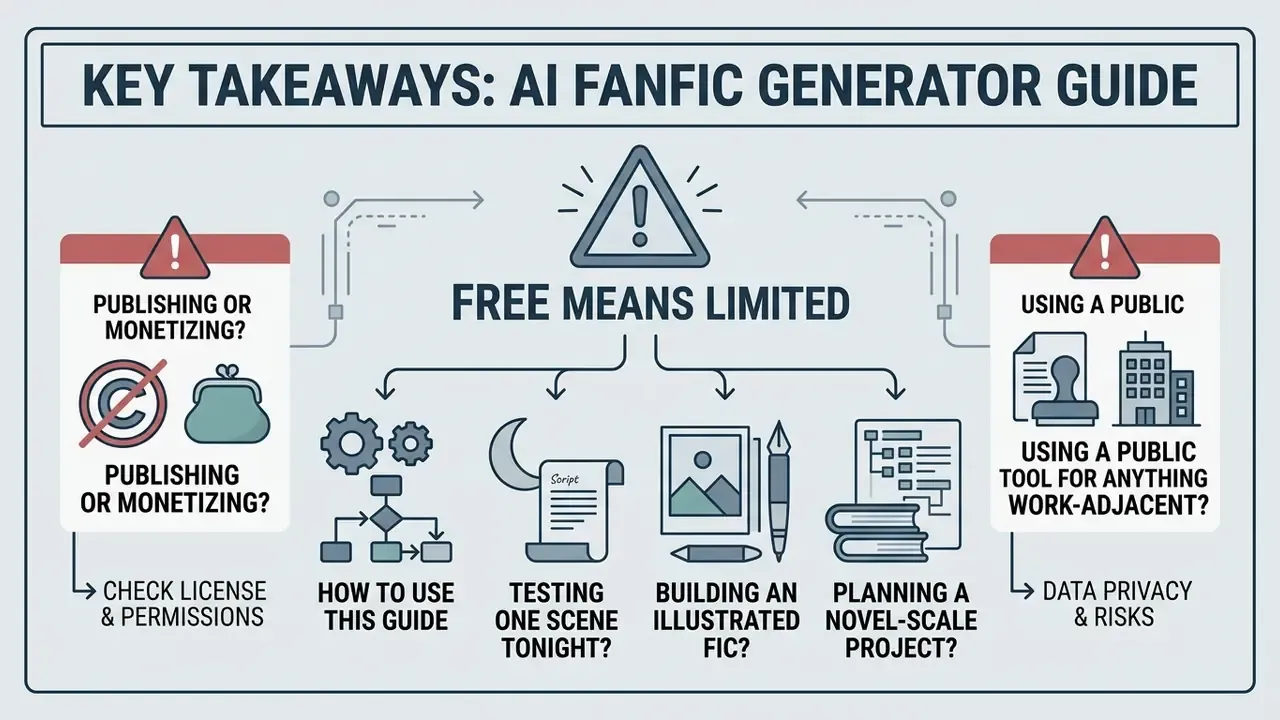
- Free means limited. "Free unlimited" claims are bounded by hidden rate caps (often 5 generations per minute, 30 per hour), context windows of 4k-8k tokens on no-sign-up tiers, and output ceilings of 2,048 to 4,096 tokens per request. Advanced exports (
.DOCX,.PDF,.EPUB) and image generation are the usual paywalls. - Prompt structure beats prompt length. A CO-STAR-style stack (Context, Objective, Style, Tone, Audience, Response) plus explicit plot beats and POV constraints outperforms a single-sentence brief. Every time.
- Model choice matters. Claude-class models hold literary voice and character interiority; GPT-4o-class models are faster and better at structure, action pacing, and outlines; Gemini-class long-context models are best for whole-manuscript continuity checks.
- Long form needs a pipeline. A 10,000-word fanfic requires project bible, then chapter outline, then incremental scene drafting, then context summarization. Not single-pass generation.
- Editing is not optional. Readers discount disclosed AI writing by an average of 6.2%, and experimental data links unedited AI drafting to lower originality. Human rewriting is a quality requirement, not a formality.
- Legal boundaries are asymmetric. Non-commercial fanworks live in the transformative or fair-use gray zone; commercial fanfiction implicates exclusive derivative rights under 17 U.S.C. § 106, and purely AI-generated text is uncopyrightable.
How to use this guide
Read it in the order that matches your goal, not front to back.
- Testing one scene tonight? Go straight to the prompt stack and the trope library.
- Building an illustrated fic? The multimodal section covers identity locks that stop character drift between images.
- Planning a novel-scale project? The long-form pipeline and the facts-ledger habit are the parts that actually save you.
- Publishing or monetizing? Read originality, disclosure, and derivative-rights limits before you write a word.
- Using a public tool for anything work-adjacent? Start with the shadow-AI checklist. Then decide whether the tool belongs on your approved-tool inventory at all.
An ai fanfic generator free is an automated natural language processing tool that constructs fanfiction, original narrative prose, character dialogue, and scene extensions from natural language prompts. These systems leverage large language models (LLMs) to parse canon context, enforce specific tropes, and maintain genre conventions without requiring subscription fees or account creation.
Modern generative storytelling platforms operate as prompt-driven co-creation pipelines. Rather than functioning as autonomous authors, these models rely on structured inputs specifying character traits, narrative perspective, setting, and plot beats. According to a 2025 experimental evaluation by Kotek et al. in Evaluating Creative Short Story Generation in Humans and Large Language Models, current LLMs achieve higher surface lexical and syntactic complexity than the average human writer, yet human-written narratives consistently outperform standalone AI outputs in deep semantic novelty, structural surprise, and lexical diversity. Consequently, enterprise operators and creative teams treat free AI story generators as iterative drafting assistants that require human-in-the-loop oversight, structured prompt engineering, and systematic post-generation editing.
Research-grade co-creation architectures reinforce that split of roles. Systems such as Kahaani implement separate Writer and Reviewer models, running a two-stage generate-then-critique loop rather than one unsupervised pass. Free consumer tools compress that loop into a single button, which is exactly why the reviewer role falls back to you. Nobody else is checking.
What a free AI fanfic generator is and what stories it produces
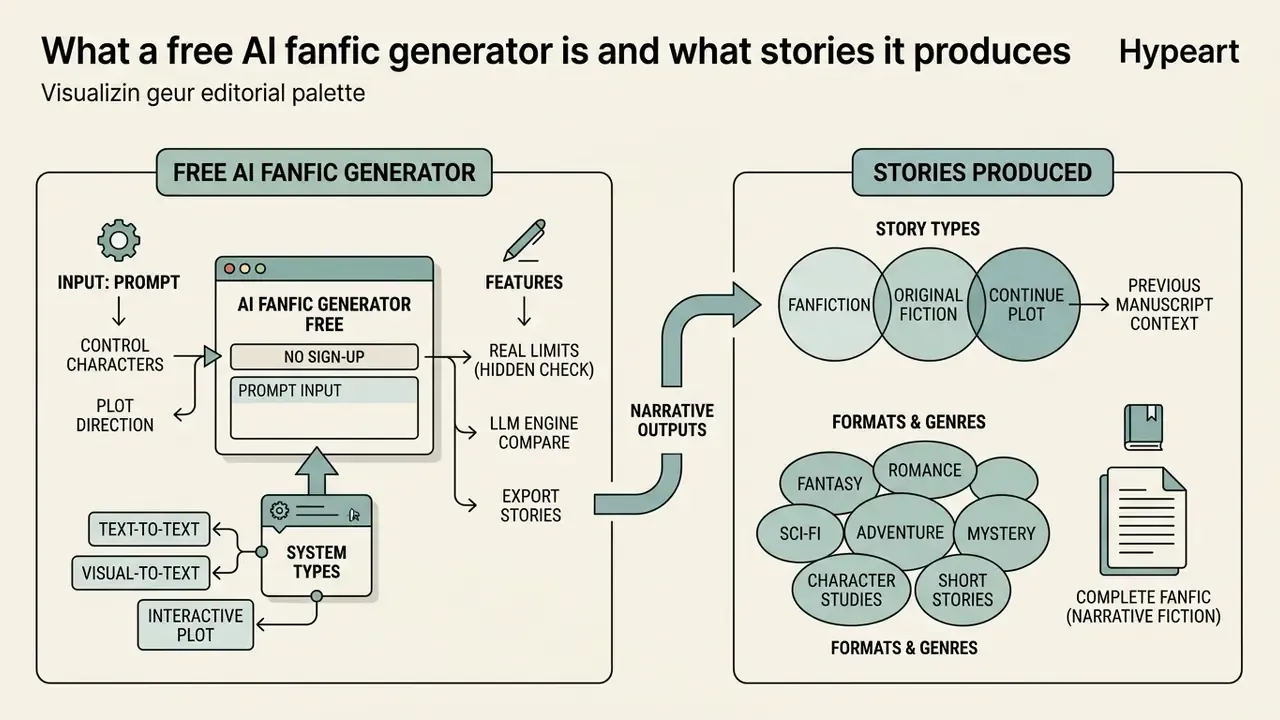
A free ai fanfiction generator free interface is a specialized large language model front end optimized for generating narrative fiction, fan-created stories, character interactions, and plot continuations from user text prompts. It processes input parameters such as fandom canon, character dynamics, world-building rules, and stylistic tone to produce structured prose ranging from short dialogue snippets to multi-chapter story drafts.
These systems support a spectrum of creative workflows, including original fiction, transformational fanworks, and scene-level expansions. Academic surveys on narrative generation, such as Yang and Jin's 2024 study What Makes a Good Story and How Can We Measure It?, categorize the tools into text-to-text generation, visual-to-text storytelling, and interactive plot planning pipelines. Using zero-shot and few-shot prompt structures, you can direct the model to construct a specific scene, explore a "what-if" alternate universe (AU), or generate rapid drafts with no coding and no financial commitment.
Fanfiction, original fiction, and continuing an existing plot
The primary distinction between fanfiction, original fiction, and story continuation lies in the underlying context anchor and the canon constraints you supply. Fanfiction generation anchors the prompt to an established fandom, canon rules, and preexisting character relationships. Original fiction constructs the narrative world, character profiles, and central conflicts entirely inside the prompt, with no external IP constraints.
Story continuation tools use previous manuscript text as a direct contextual anchor. Instead of taking a conceptual brief, the continuation engine ingests the prior scene, identifies narrative trajectories, and generates plausible subsequent events while attempting to hold stylistic consistency. Vendor documentation and everyday practice both indicate that story continuers need explicit continuity locks to prevent character drift, factual hallucination, and sudden shifts in perspective.
Practically, the three modes require different prompt geometry:
| Mode | Primary context anchor | Required inputs | Main failure risk |
|---|---|---|---|
| Fanfiction | External canon (fandom, ship, timeline) | Fandom, characters or pairing, tropes, POV, canon divergence point | Out-of-character voice, canon contradictions |
| Original fiction | Prompt-internal world | Premise, character sheets, setting rules, narrative goal | Generic tropes, thin world logic |
| Story continuer | Prior manuscript text | Last scene verbatim, summary of prior events, continuation rules | Tone shift, premature resolution, POV drift |
Genres and formats supported by an AI story writer
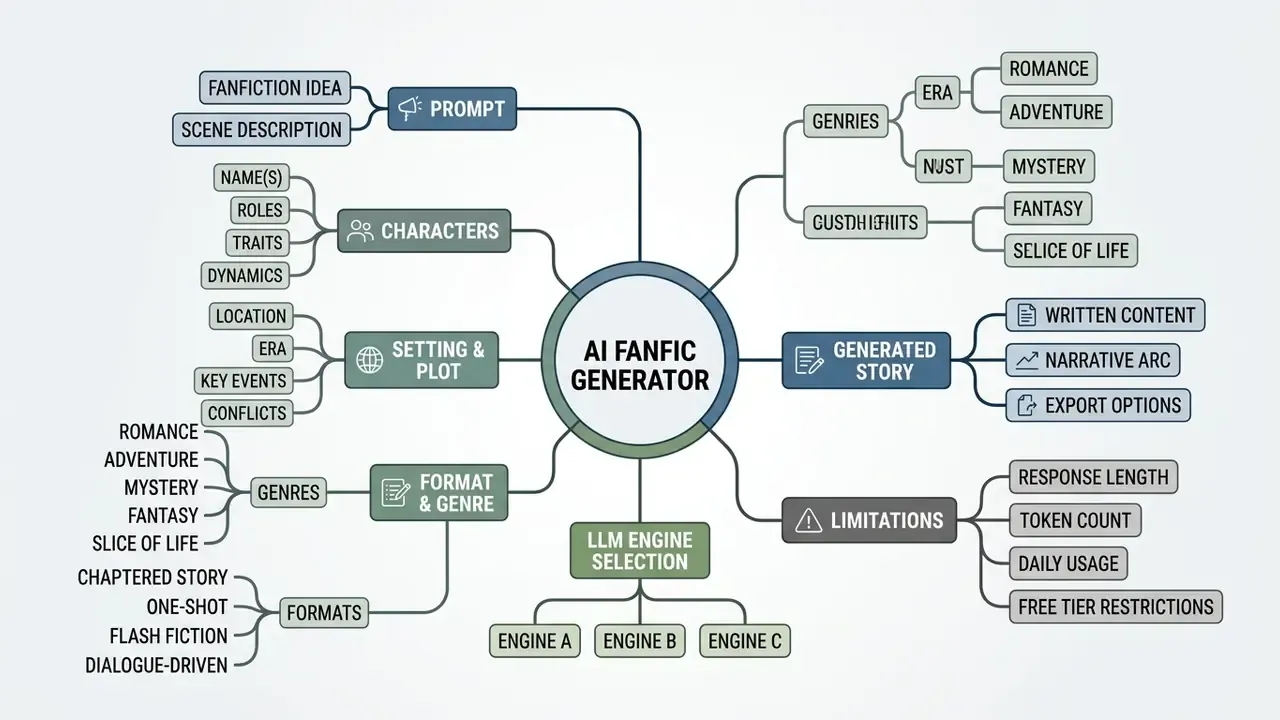
Modern AI story writers support diverse literary formats: short stories, dialogue scripts, novellas, and chapter-based long-form narratives across many genres. Supported genres include romance, fantasy, mystery, detective fiction, and historical drama, as described in comparative model analyses such as FICHI.AI (2026) and Type.ai (2026), which advertise turning a single idea into "full-length short stories and novels" with user-selected genre, length, and tone.
Formats adapt dynamically to prompt formatting. You can request pure dialogue exchanges annotated with emotional cues, scene-by-scene outline breakdowns, screenplays, diaries, letters, fables, or continuous descriptive prose. Dataset work on narrative dialogue structuring, a 2026 corpus of 2,588 stories and 27,074 dialogue utterances formatted as Speaker(Emotion): Dialogue, indicates that explicit speaker and emotion tagging is a workable control surface for conversational tone. The same annotation pattern is what most fanfic prompts reproduce by hand anyway. (Updated: the source is a public narrative-dialogue dataset; effect sizes for authenticity gains still require independent replication data.)
What "free" means: registration, limits, and access conditions
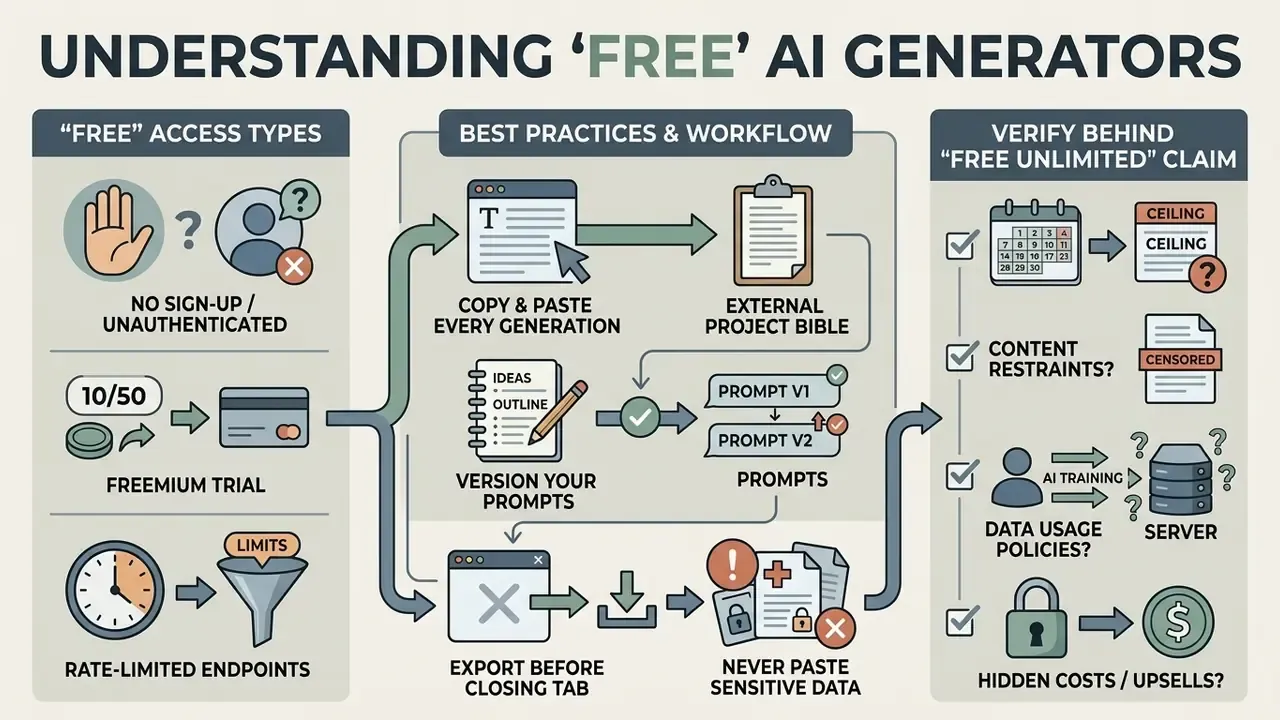
In generative AI, "free" usually refers to unauthenticated access tiers, freemium trial modes, or rate-limited public endpoints. Some platforms market a completely free ai story generator with no registration at all, but compute cost, context windows, and output length are still governed by hard technical ceilings. Physics and unit economics do not care about the badge on the landing page.
Free access models fall into three operational categories: fully unauthenticated "no sign-up" tools, freemium platforms with daily credit allocations, and open-access research prototypes. Knowing which one you are using lets you anticipate token window size, export capability, image generation, and data-handling policy before you invest twenty hours in a manuscript.
Can you create a fanfic with no sign-up and no personal data?
Yes. An ai fanfiction generator free no sign up flow exposes a public web interface and lets you generate immediately, relying on session cookies, IP rate limits, or temporary local storage instead of an account. The same access pattern appears across adjacent creative categories; see free AI generators with no registration for how identical trade-offs play out in image tooling.
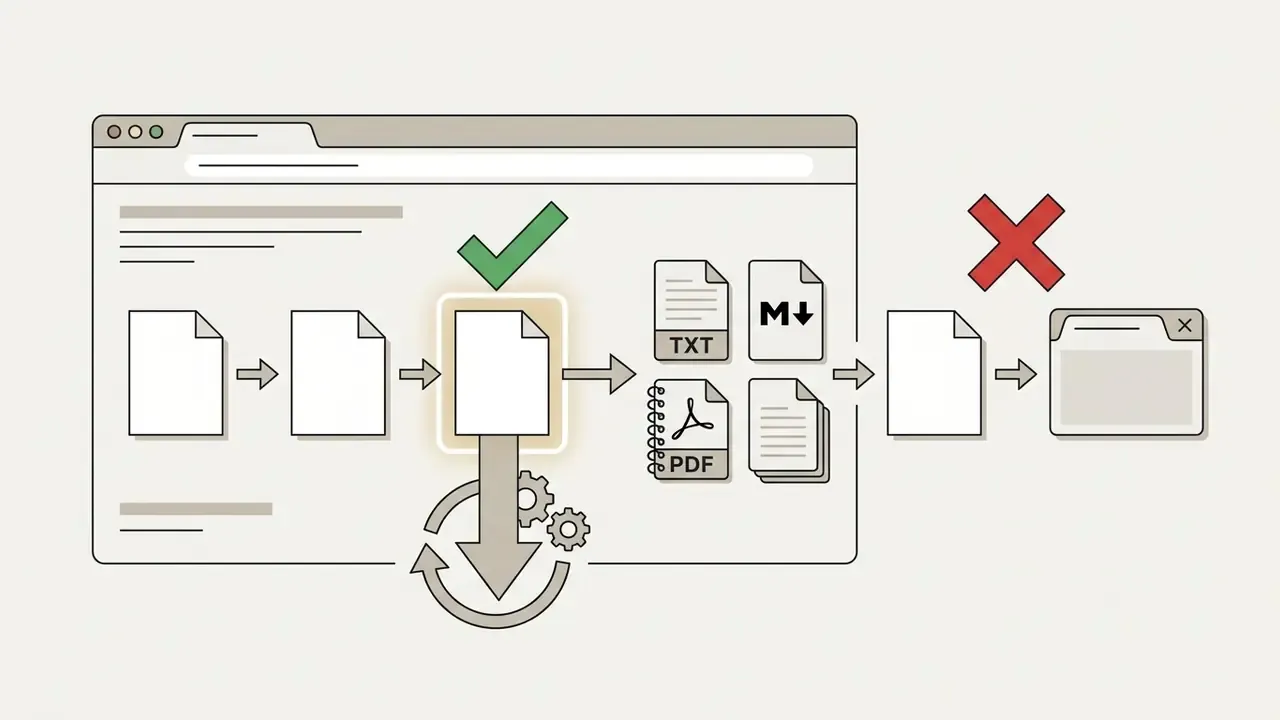
There is a cost, though it is not billed in dollars. Security standards such as NIST SP 800-63B (Digital Identity Guidelines) and RFC 6819 note that unauthenticated sessions lack identity binding, which raises exposure to session hijacking, automated abuse, and total data loss the moment a browser cache clears. OWASP authentication guidance adds a second point: logging and monitoring of authentication events, a baseline detective control, is weakened or simply absent when no account exists.
For quick drafting or single-scene prompt testing, no-sign-up interfaces are wonderfully low friction. For long-form project management they are a trap unless you build your own persistence layer.
Shadow-AI checklist before using a public generator for anything work-adjacent:
Checklist0 / 7
That last box is the one that turns a fun weekend experiment into an audit finding.
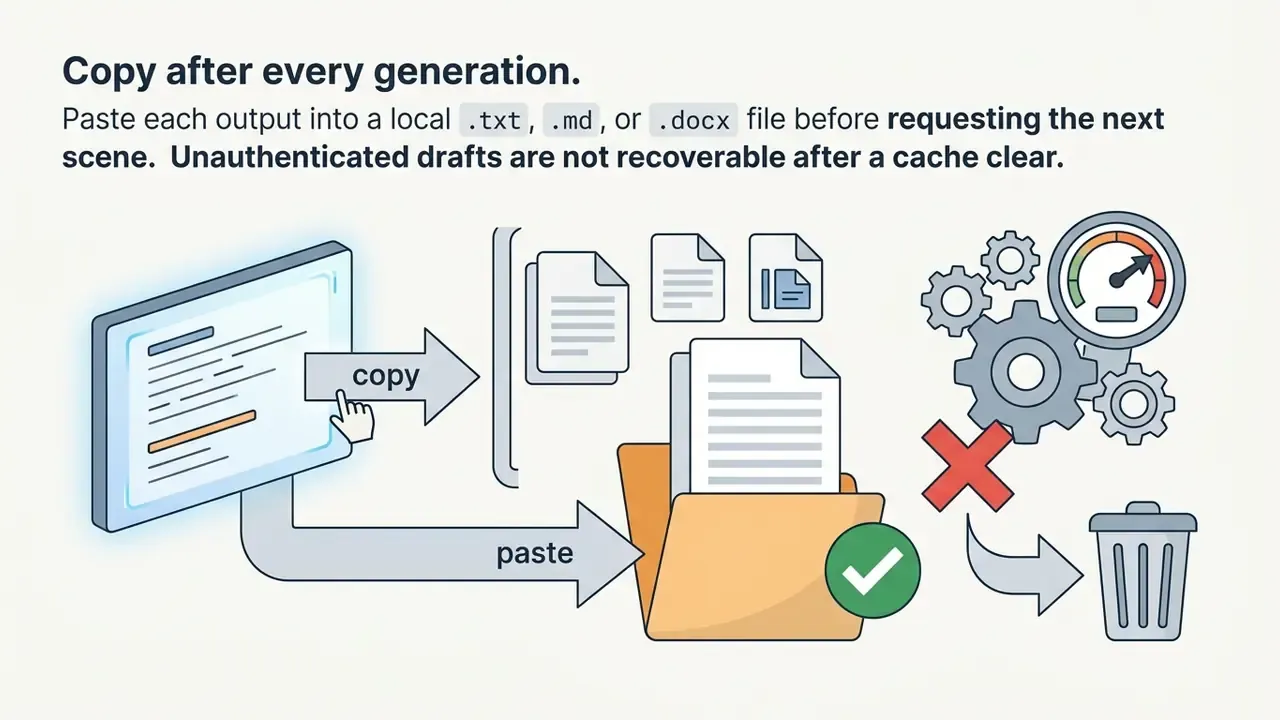
.txt, .md, or .docx file before requesting the next scene. Unauthenticated drafts are not recoverable after a cache clear.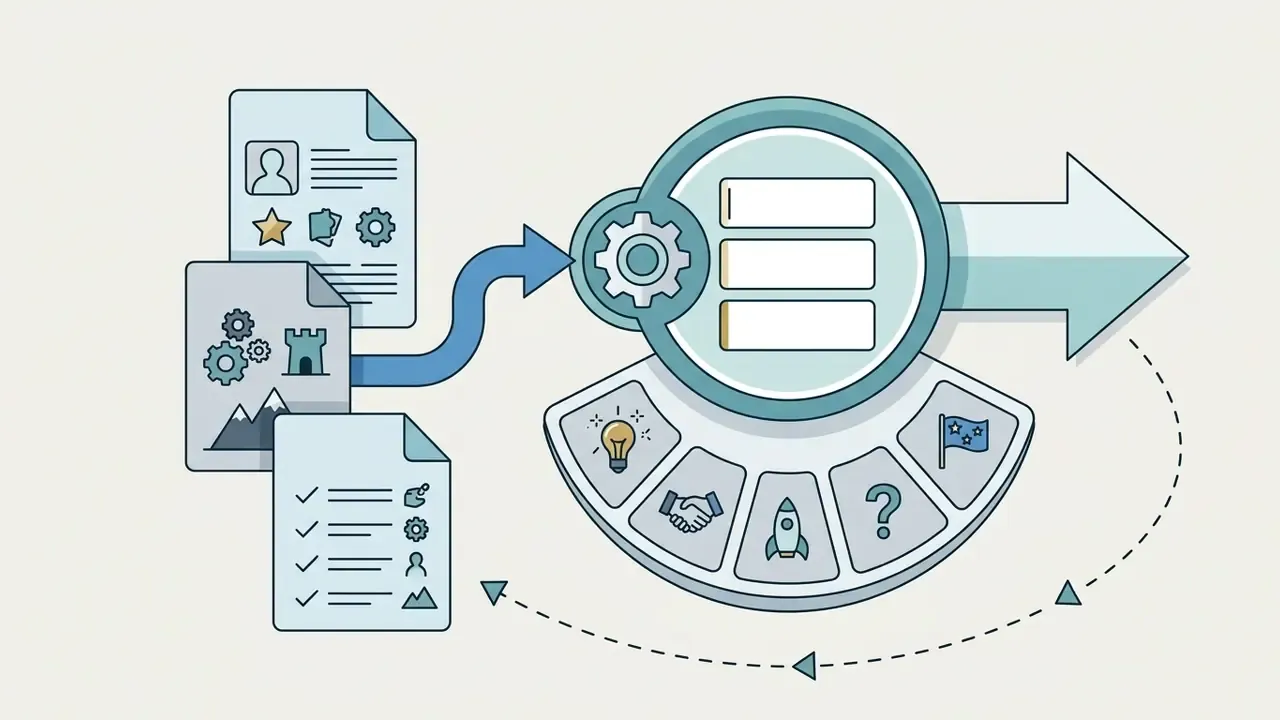
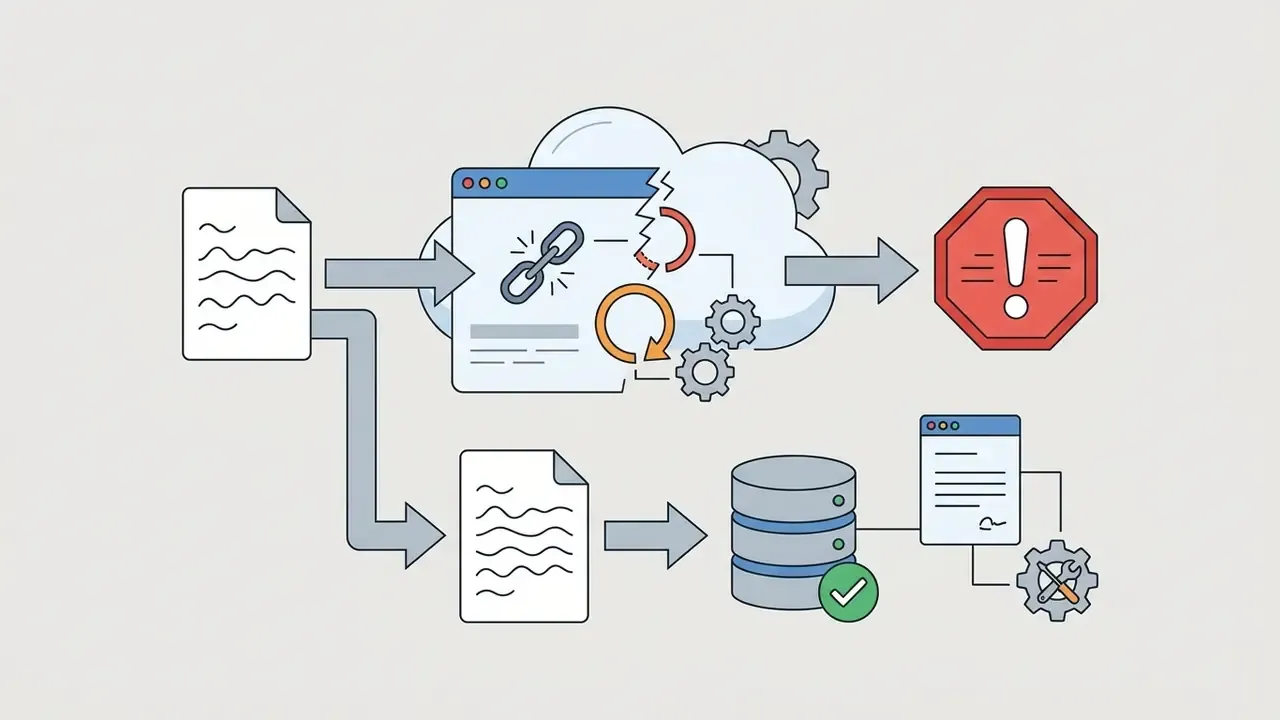
What to verify behind a "free unlimited" claim
Marketing claims of an ai fanfiction generator free unlimited are almost universally constrained by infrastructure limits, rate controls, and model context boundaries. Standard API documentation from providers such as OpenAI confirms that high-capacity LLM inference carries metered token costs, so free tiers enforce quiet throttles: hourly request caps (for example 5 generations per minute or 30 per hour), context window truncation, and restricted maximum output tokens, often capped at 2,048 to 4,096 per request. Provider documentation also marks "Free" as not supported at the API tier level, while paid models expose context windows from 128,000 to more than 1,000,000 tokens and output ceilings of 8,192 to 128,000 tokens. Those are the numbers an "unlimited" badge quietly borrows. If you plan to build on top of an endpoint rather than a web form, view the guide to tier-level constraints first.
"Unlimited" also rarely extends to advanced features. Image generation is billed separately per image token, and PDF or EPUB export, style fine-tuning, saved characters, and long-form memory retention ("story bibles") are routinely paywalled or restricted. Some tools cap free accounts at roughly 10 saved documents or 10 premium-model generations per month. Before upgrading, check daily message limits, maximum context retention, and the terms of service on data logging; a plan-by-plan cost comparison is a separate exercise, and you can view the guide for how these tiers are usually structured.
Comparative analysis of free access conditions in AI story generators| Access parameter | "No Sign-Up" mode | Freemium with registration | Open research prototypes |
|---|---|---|---|
| Authentication | Not required (no account) | Email or OAuth required | Variable (API key or demo) |
| Token / generation limits | Hard hourly rate limits (5 to 30 per hour) | Daily credit or token balance | Depends on server capacity |
| Context window length | Limited (typically 4k to 8k tokens) | Extended (16k to 128k tokens) | Full model context window |
| Editing and increments | Basic input box, regenerate | Selected-text editor, history | Manual revision via prompts |
| Multimedia (auto art generation) | Absent or watermarked | Limited images per day | Separate task via Image API |
| Export formats | Clipboard copy, TXT | DOCX, PDF, EPUB, project save | JSON, TXT, Markdown |
| Saved entities (Character Bible, Canon Worlds) | Not persisted after session | Reusable characters and worlds | Local files, repo storage |
| Rights to generated text | Non-exclusive rights, public domain | Extended commercial rights (paid plans) | Per open licence (CC / MIT) |
Free-tier scale is nevertheless real, and worth respecting. A children's storytelling feature reported over 2.4 million story-creation sessions across 19 languages in six months, which confirms that zero-cost generators can run at genuine consumer scale (ELT Journal, Let's Story / Applaydu, 2024-2025).
How to generate a fanfic from a prompt: from idea to finished text
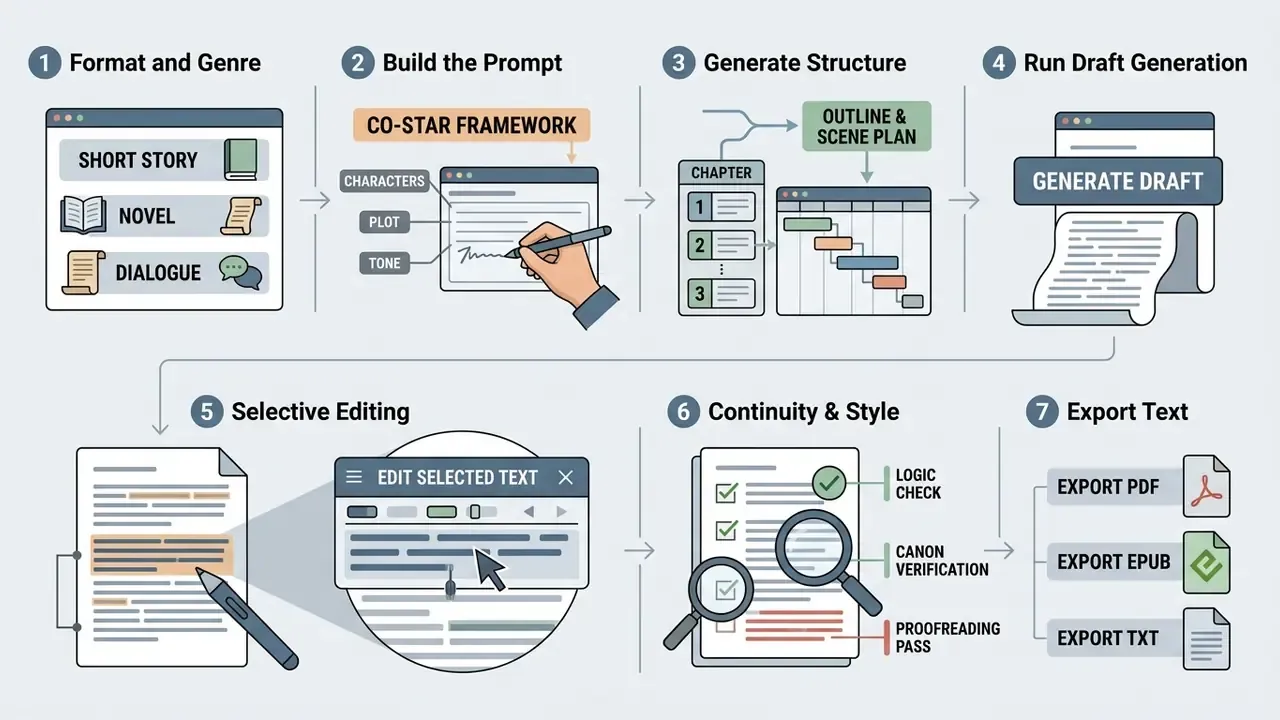
Using an ai story generator based on prompt for articles, scenes, or full chapters works best as a systematic, multi-stage workflow. Not a single generic request. Effective story creation follows an iterative pipeline: concept definition, parameter setting, chapter outlining, draft generation, targeted post-editing.
A structured drafting process prevents the common LLM failure modes: plot drift, repetitive phrasing, premature narrative resolution. By breaking construction into modular steps, you keep creative control over scene pacing, character voice, and continuity. Prompt-engineering guidance from government playbooks and practitioner handbooks converges on the same discipline: craft, test, analyse, document, then reuse the prompt as a template instead of rewriting it from scratch each time.
What to specify in a prompt: characters, plot, genre, and tone
A high-quality prompt from an ai story prompt generator or from your own hand should define seven structural dimensions: role, fandom or setting, character profiles, central conflict, genre, tone, and output constraints. Following frameworks such as CO-STAR (Context, Objective, Style, Tone, Audience, Response), place instructions at the top of the prompt, clearly separated from background context.
[PROMPT TEMPLATE — CO-STAR STACK]
Role: Expert Fanfiction Co-Author.
Fandom & Setting: [Specify Universe, Era, and Canon Divergence Point].
Characters: [Character A: Name, Key Traits, Motivation] | [Character B: Name, Key Traits, Motivation].
Genre & Tone: [e.g., Slow-Burn Romance / Angst / Whimsical / Gritty], Tone: [e.g., Tense, Melancholic, Humorous].
Plot Beats: 1. Character A meets Character B at the outpost. 2. A disagreement arises over resources. 3. An unexpected event forces cooperation.
Constraints: Write in Third-Person Limited (Character A POV). Max 800 words. Focus on sensory details and natural dialogue.
How to edit and develop the generated text
Post-generation editing runs on incremental refinement: "edit selected text" mechanics plus narrative expansion prompts. Once the first draft lands, evaluate it for character voice accuracy, pacing, and logical consistency, then replace weak sections or request targeted rewrites. This selected-content pattern mirrors mainstream document tooling, where you highlight existing text and replace, expand, or comment on it rather than regenerating the whole file.
Systematic plot development relies on decomposing the narrative into discrete phases: scenes, and inside each scene, beats. When continuing a story, feed back a summary of prior events plus explicit continuation rules. For example: "Continue directly from the last sentence. Do not resolve the conflict yet. Introduce a subtle plot twist involving the secondary character."
Ready-made prompt library by trope and genre
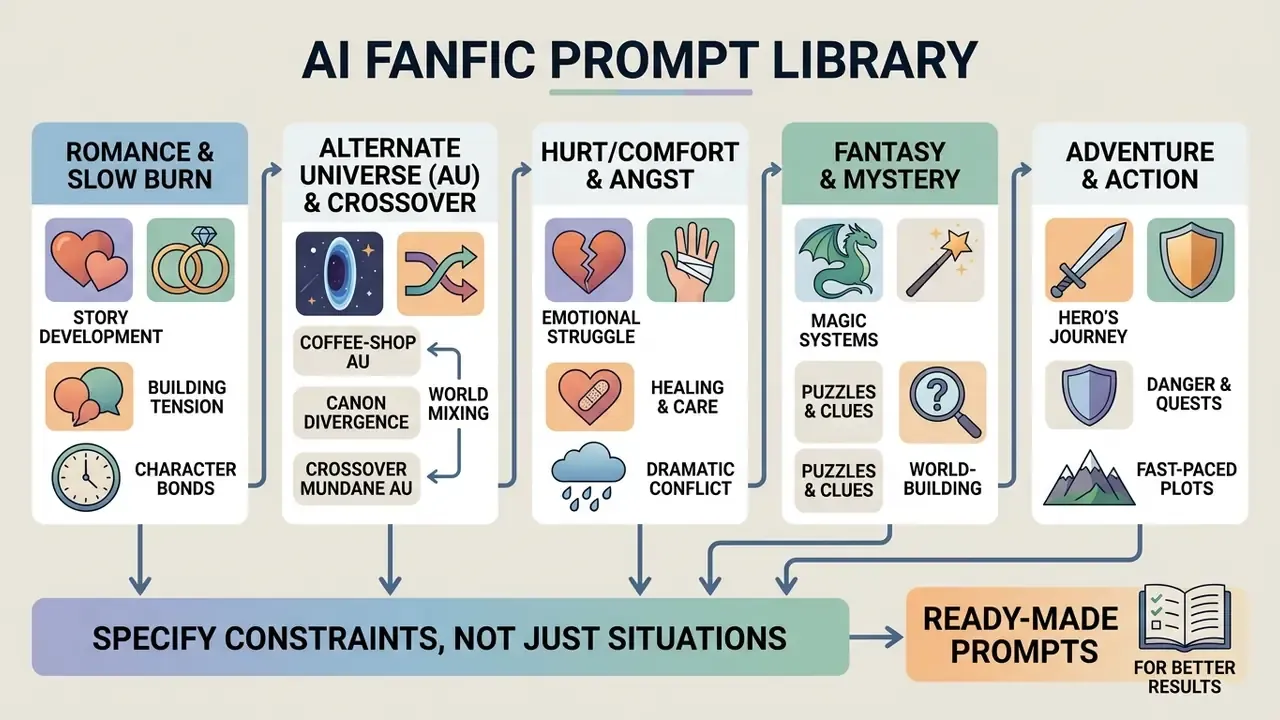
Fanfic prompts fail most often because they describe a situation instead of specifying a constraint. The templates below are written as constraint sets. Each one names the trope, the required focus, and an explicit prohibition that stops the model from resolving the scene too early.
Romance and Slow Burn
- Slow Burn: "Character A and Character B are forced to work together on one shared task. Write a 700-word scene built on subtext, suppressed emotion, and non-verbal cues. No confessions of love. End on an unfinished sentence of dialogue."
- Enemies to Lovers: "Write an argument between two rivals in which every insult accidentally reveals how closely each one has been watching the other. Third-person limited, Character B POV, no physical contact."
- Fake Relationship: "Character A and Character B must pretend to be a couple at a formal event. Show one moment where the performance stops being a performance for exactly one line, then have both of them ignore it."
- Second Chance: "Two characters meet ten years after a breakup in the same place where it happened. Reveal the reason for the split only through what they refuse to say."
Alternate Universe (AU) and Crossover
- Coffee-Shop AU "Place [Character 1] and [Character 2] from [Fandom] into a 1920s coffee house setting. Preserve their canonical personalities and speech patterns; translate their canon conflict into a period-appropriate stakes structure."
- Canon Divergence AU "Rewrite the outcome of [canon event] assuming [Character] made the opposite choice. Keep every other canon fact intact and show three downstream consequences."
- Crossover "[Character A] from [Fandom 1] wakes up inside the rules of [Fandom 2]. The comedy must come from the mismatch of world logic, not from characters acting out of character."
- Mundane AU "Take a magical or high-tech duo and give them ordinary office jobs. Preserve their power dynamic exactly, expressed only through bureaucracy and small favours."
Hurt/Comfort and Angst
- Hurt/Comfort: "Character A is injured during a mission; Character B provides first aid. Focus on dialogue and on care expressed through small physical details. No internal monologue longer than one sentence."
- Angst with a Hopeful Ending: "Write a 600-word scene of grief in which the comfort arrives from an object, not a person. Final paragraph must shift the tone without resolving the loss."
- Whump / Recovery: "Show the third day of recovery rather than the injury. Everything dramatic has already happened; write boredom, irritation, and unexpected tenderness."
- Missing Scene: "Write the scene canon skipped between [event 1] and [event 2]. Nothing in it may contradict either bracket."
Fantasy, Mystery, and Adventure
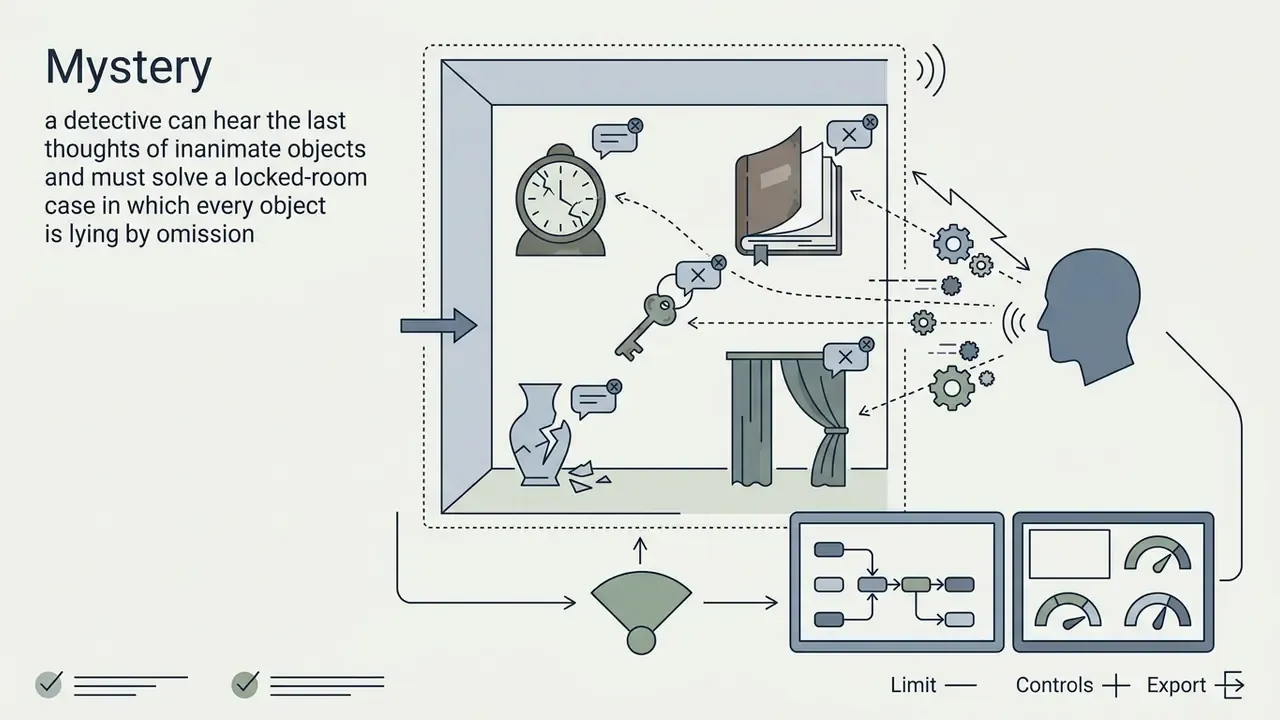
Each template drops straight into the CO-STAR stack above as the Objective and Plot Beats fields. The remaining fields (fandom, POV, word cap) stay as your reusable project defaults.

Choosing the AI model (LLM engine) for fanfiction
Free story tools increasingly expose a model selector, and that choice changes output character more than any single prompt tweak. The distinctions below reflect documented capability profiles rather than vendor marketing.
| Engine class | Strongest at | Typical fanfic use | Watch out for |
|---|---|---|---|
| Claude 3.5 / Sonnet-class | Literary tone, interiority, sustained character voice | Slow burn, angst, canon-voice dialogue, emotional scenes | Can over-lengthen introspection; needs word caps |
| GPT-4o-class | Speed, structure, action pacing, formatting compliance | Outlines, chapter plans, plot twists, fast brainstorming, action scenes | Smoother, more generic prose; needs style constraints |
| Gemini 2.5 Pro-class (long context) | Very large context windows | Whole-chapter continuity checks, canon-document ingestion, consistency audits | Long-context recall is not long-context style control |
| Fast / lightweight models | Throughput at low cost | Premise seeds, name lists, trope permutations, quick regenerations | Shallow characterization; unsuitable for final drafts |
A practical division of labour: draft the outline with a structure-oriented model, write emotionally loaded scenes with a voice-oriented model, run the continuity pass with a long-context model. Vendor documentation for multi-model tools recommends essentially the same split, putting rich description and complex character development on Claude- or GPT-4o-class engines and rapid brainstorming on a fast variant. If you want a side-by-side view before committing, compare options across engine families rather than trusting one demo.
Speed expectations deserve calibration too. Current LLM decoding throughput clusters around 20 tokens per second for many deployments and 50 to 100 tokens per second for lighter API models. That is why a first scene appears in seconds rather than minutes, and why a 4,000-word chapter still takes a couple of coffee-length waits.
AI story generator settings for characters, plot, and style
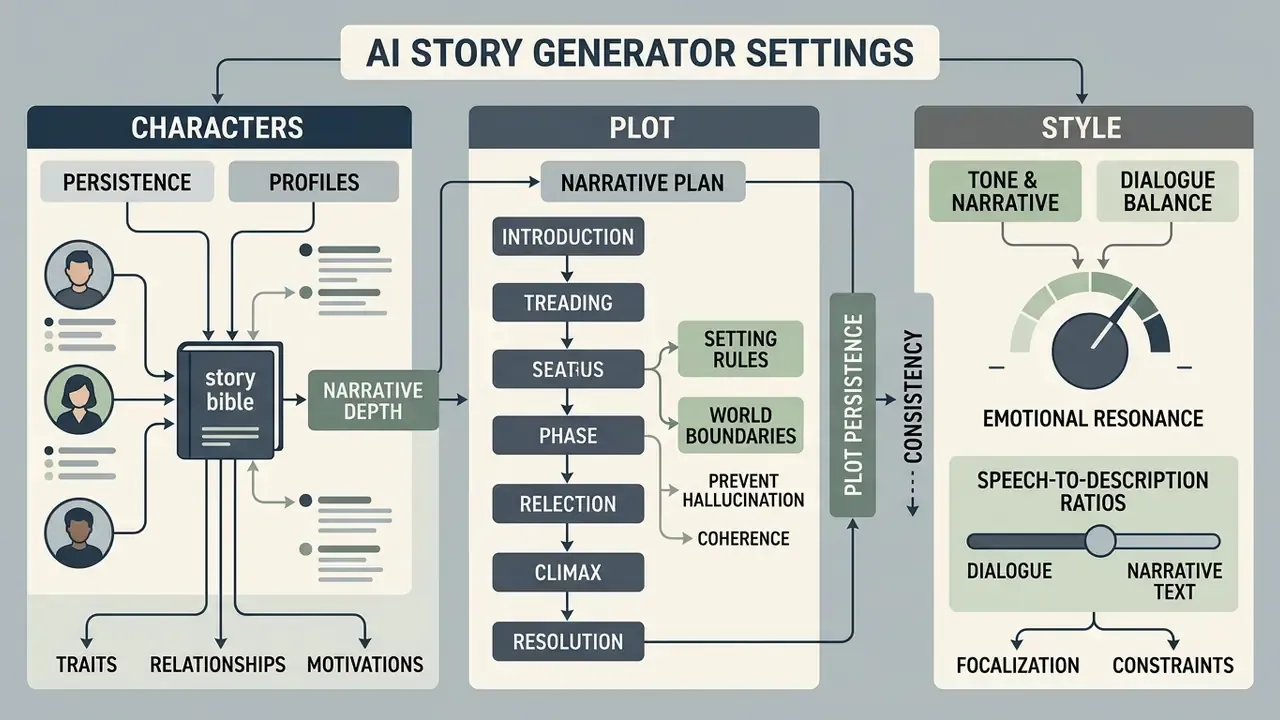
To get consistent narrative depth, use the advanced settings: character persistence, setting rules, narrative perspective. Standard LLMs without explicit memory parameters degrade over long sequences, and the degradation shows up as character voice drift and plot contradiction.
Managing those parameters means combining character profiles ("story bibles"), explicit tone constraints, and structured long-form planning. Consistency research on long-form generation separates error classes into Characterization, Narrative and Style, and World-building and Setting, and reports that style errors correlate weakly with the other two. Translation: tone control and continuity control are separate levers, not one knob.
Characters, setting, and plot development
Holding character consistency and world rules across a long text requires persistent context injection. In tools with a character profile manager, you enter fixed fields covering backstory, speech mannerisms, physical traits, and core motivation. Consumer platforms usually cap that description field at a few hundred characters, which forces you to prioritize voice markers over biography. Honestly, that constraint helps. Three sharp verbal tics beat a page of family history.
Frame-based systems show that long-form coherence improves when an overarching plot plan is continuously re-injected into the context window alongside the current narrative state. The Re3 approach (Recursive Reprompting and Revision) builds a structured plan, repeatedly injects plan plus current story state into each prompt, reranks candidate continuations, and edits the selected one for factual consistency. Three explicit stages a manual workflow can imitate by hand. (Updated: source is the Re3 long-story generation research line; treat cited mechanisms as architectural patterns, not benchmarked guarantees for consumer tools.) Retrieval-augmented prompting and self-consistency sampling, generating several continuations and keeping the most internally consistent one, serve the same purpose inside a free interface.
To prevent plot hallucination and sudden logic leaps, define hard world boundaries in your setting rules: magic system constraints, technology limits, historical timelines. When a contradiction appears mid-generation, pause, update the character and setting reference block, then regenerate the affected scene from the corrected state. Patching forward almost never works.
Tone, narrative, and dialogue for the right fanfic style
Long-form workflow: short stories, chapters, and AI book generators
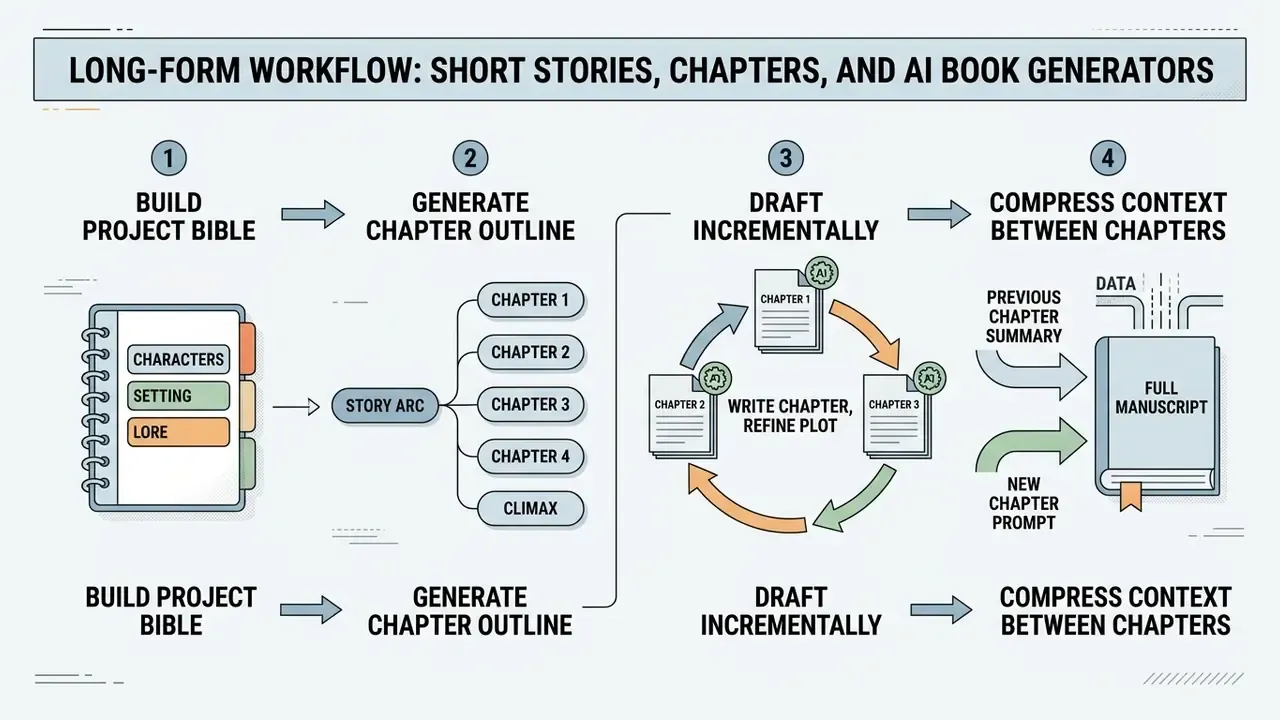
Generating multi-chapter fanfiction or a full novel requires a chapter-by-chapter pipeline, not a single-pass attempt. A free ai short story generator handles single scenes up to about 1,500 words in one execution, but extended works need hierarchical planning. Commercial tools advertise 250-page novels produced in minutes; what runs underneath is an outline-first, chapter-by-chapter loop with continuity carried between calls.
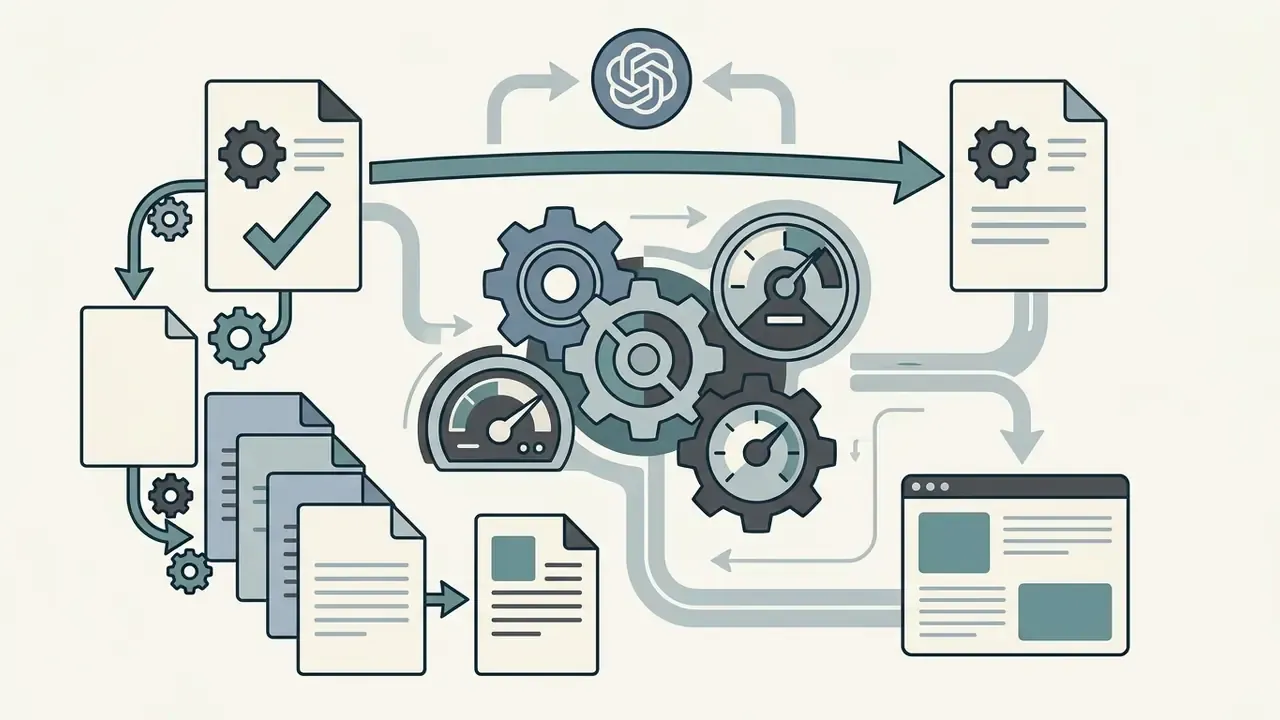
An ai book generator free unlimited workflow splits generation into three operations: initial outline synthesis, scene-by-scene drafting, and chapter-level summarization. Systems such as DOC (Detailed Outline Control, ACL 2023) decompose long-story writing into planning, drafting, rewriting, and editing for several-thousand-word narratives. A 2024 INLG long-story pipeline generates a summary, then a chapter in parts, merges it into the manuscript, and re-summarizes that chapter to guide later ones, maintaining plot coherence across 10,000-word-plus manuscripts. (Updated: DOC and the INLG pipeline are peer-reviewed research references; consumer tools rarely disclose whether they implement equivalent controls.)
Four-step algorithm for books and fanfics above 10,000 words
- Build the project bible.Fix character sheets (voice markers, motivations, physical constants), world rules, and canon boundaries in a separate document. This block is re-injected into every prompt and is the single highest-leverage artefact in the workflow.
- Generate a chapter-level outline.Ask the model to split the plot into 10 to 15 chapters with three key events each, plus one open question per chapter that the next chapter must answer. Approve the outline before writing a single scene.
- Draft incrementally.Generate 800 to 1,200 words per scene, never a whole chapter blind. After each scene, run a targeted edit pass for voice, pacing, and canon before moving on. Errors compound cheaply at scene level and expensively at chapter level.
- Compress context between chapters.Before a new chapter, feed the model a dense summary of everything so far: unresolved threads, current locations, relationship state, and any established fact that must not be contradicted. This summarization step replaces the memory a free tier does not have.
For continuity insurance, keep a running "facts ledger": every named object, injury, promise, and timestamp introduced in the text. Most long-fic contradictions come from forgotten small facts, not forgotten plot. Somebody's broken wrist heals two chapters early, and a reader will notice within the hour.
Budgeting matters as well. Estimate roughly how many generations, tokens, and edit hours a 60,000-word project will consume before you start; if you want a structured way to model that effort against a paid tier, view the guide to usage estimation.
Generating text and images for a story without registration
Multimodal storytelling tools pair narrative text generation with image synthesis, so illustrated fanfiction becomes a one-session project. An ai story generator with pictures free no sign up parses narrative text, extracts key visual cues, and builds image prompts to produce matching artwork. Documented implementations differ mainly in output packaging: some analyse story text with an LLM and pass prompts to a separate image server, while others act as an ai doc maker story pipeline, compiling text plus 1024×1024 illustrations directly into a PDF storybook.
Integrated text-and-image workflows deepen reader immersion through character portraits, environment concepts, and key scene visualizers embedded alongside the prose. Choosing a rendering engine? Start from this comparison of the best AI art generators.
Linking the text prompt to a story image generator
Synchronizing text with an ai story image generator free no sign up requires shared visual descriptors across both modalities. A dual-prompt pipeline extracts physical attributes (hair colour, clothing, facial features, lighting, art style) from the text draft and locks them into an image prompt stack.
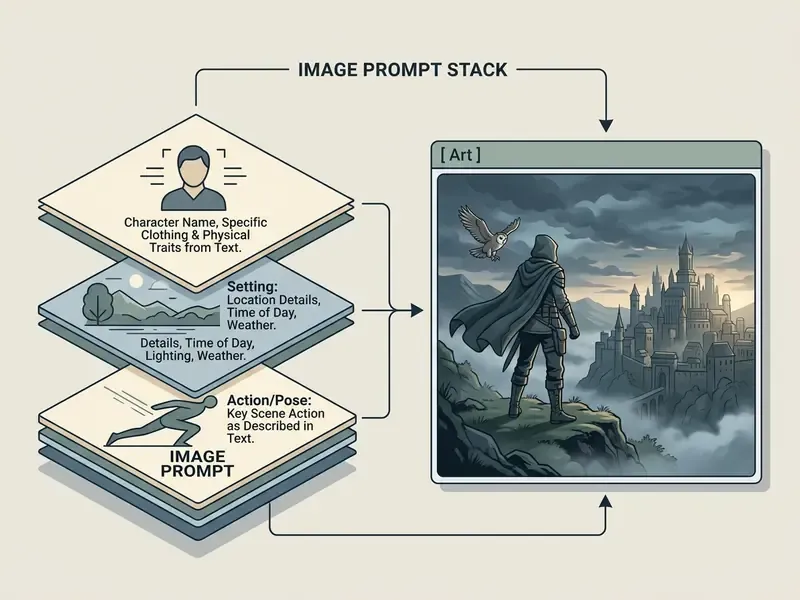
Consistent style tokens plus fixed identity anchors prevent visual character drift across illustrated scenes. Research on consistent characters in text-to-image diffusion models frames this as preserving one subject identity across repeated generations, and applied practice adds a second lock: one canonical reference image plus an unchanged identity block, varying only pose, setting, or camera per scene. If you need a rendering tool that supports both, review the best free AI image generators before committing an entire illustrated fic to one platform. For clean-up work on reference photos, editors often reach for tools that remove person from photo online free ai before feeding an image back as a style anchor.
When images help reveal plot and characters
Illustrations pay off in specific places: emotional climax scenes, major character introductions, world-building overviews, and covers. Visual storytelling research indicates that interleaved images act as visual anchors, reinforcing narrative mood and clarifying complex action.
Documented fan practice clusters into the same three uses: character portraits fixed across chapters, art for pivotal beats (the first touch, the confrontation, the morning after), and cover art that keeps a consistent style and cast across a serial's instalments.
Visual generation must supplement text quality, never overwrite it. Contradictory images, say an illustration showing a different costume than the prose describes, reduce perceived authenticity and break immersion instantly. Curate what you generate, and align every visual detail with the text.
Originality, editing, and commercial use of AI fanfiction
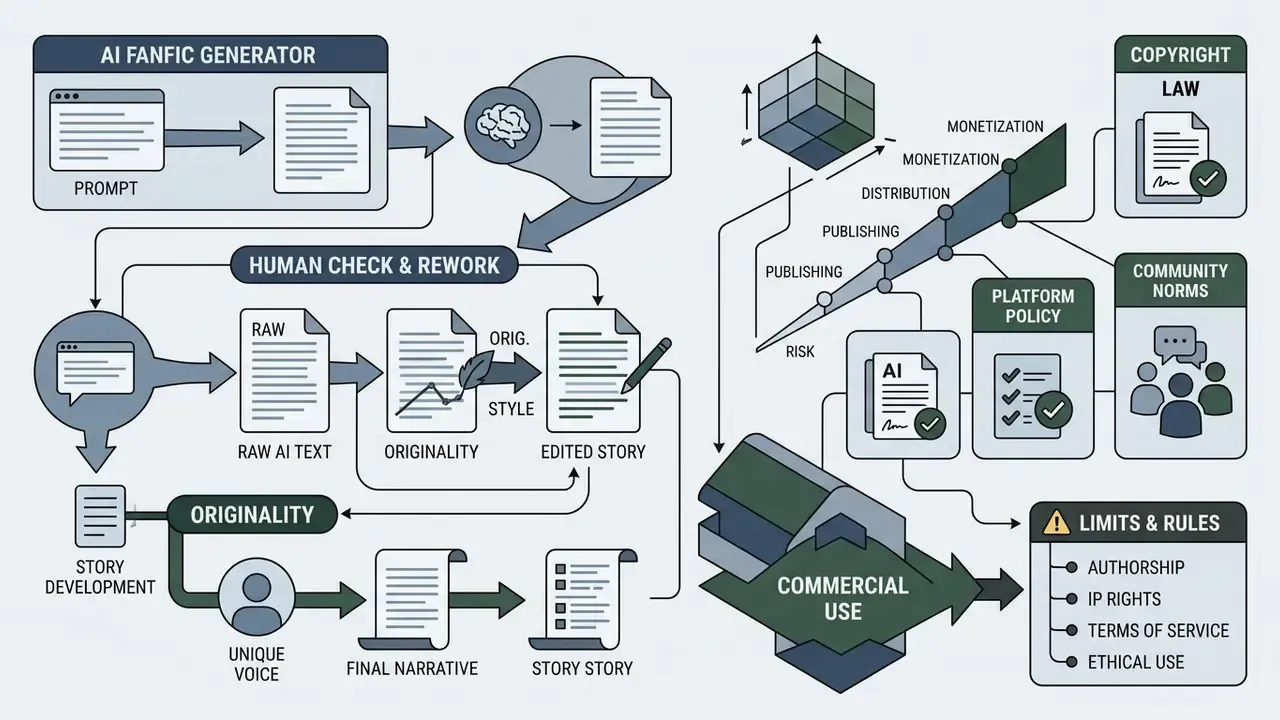
Why AI text must be checked and reworked before publication
Raw AI prose carries a recognizable "AI footprint": repetitive sentence structures, overused connective vocabulary ("testament", "delve", "tapestry"), and flat emotional arcs. Human post-editing infuses voice, deepens motivation, and strips formulaic tropes.
Large-scale consumer studies also reveal a measurable "AI disclosure penalty". Research across 16 preregistered experiments with 27,491 participants (Wharton and NYU Stern, 2026) found that when readers know a creative work was generated or heavily assisted by AI, they rate it an average of 6.2% lower in overall quality, with the effect almost entirely mediated by perceived authenticity (β = 0.611, p < 0.001). The devaluation is driven by what readers actually value, human emotional experience and creative effort, which makes substantive rewriting a retention strategy rather than a formality.
On the detection side, standards guidance separates three layers for synthetic text: provenance and watermark checks, content detection, and human post-editing. NIST AI 100-4 notes that detection may rely on recorded provenance, digital watermarks, or model characteristics, while research on robust watermarking shows detection reliability degrades under paraphrasing and heavy human editing. Which is precisely why real rewriting matters twice over: for quality, and for any authorship claim you intend to defend.
What to consider for commercial use of fanfiction
Commercializing fanfiction carries dual legal risk: traditional copyright infringement on the underlying media IP, plus specific limits on AI-generated content. Under U.S. Copyright Office guidance (2025/2026), purely AI-generated text is not eligible for copyright protection because human authorship is absent. Protection attaches only to human-authored elements, selection, or substantial creative modification, and prompts alone do not establish authorship.
For commercial plans, separate derivative fanworks (built on third-party IP, not legally monetizable without a licence) from original fiction created with AI assistance. For original works, document your creative additions, rewrites, and structural changes to support ownership. Jurisdiction matters as well: U.S. fair use is an open-ended four-factor defence that explicitly weighs commercial purpose and market harm, whereas EU copyright runs a closed list of exceptions with no general fair-use doctrine, and separate character-merchandising rights can attach to franchise characters. If your project needs cover art or promotional visuals, review the rules on commercial use of AI image generators, and see the overview of licence conditions across generator categories. For how these disputes have actually been argued, see the overview of ongoing AI copyright cases.
Community norms are a third constraint, non-legal but with real distribution consequences:
⚠️ Legal disclaimer and platform rules
Which AI tools complement a fanfic generator
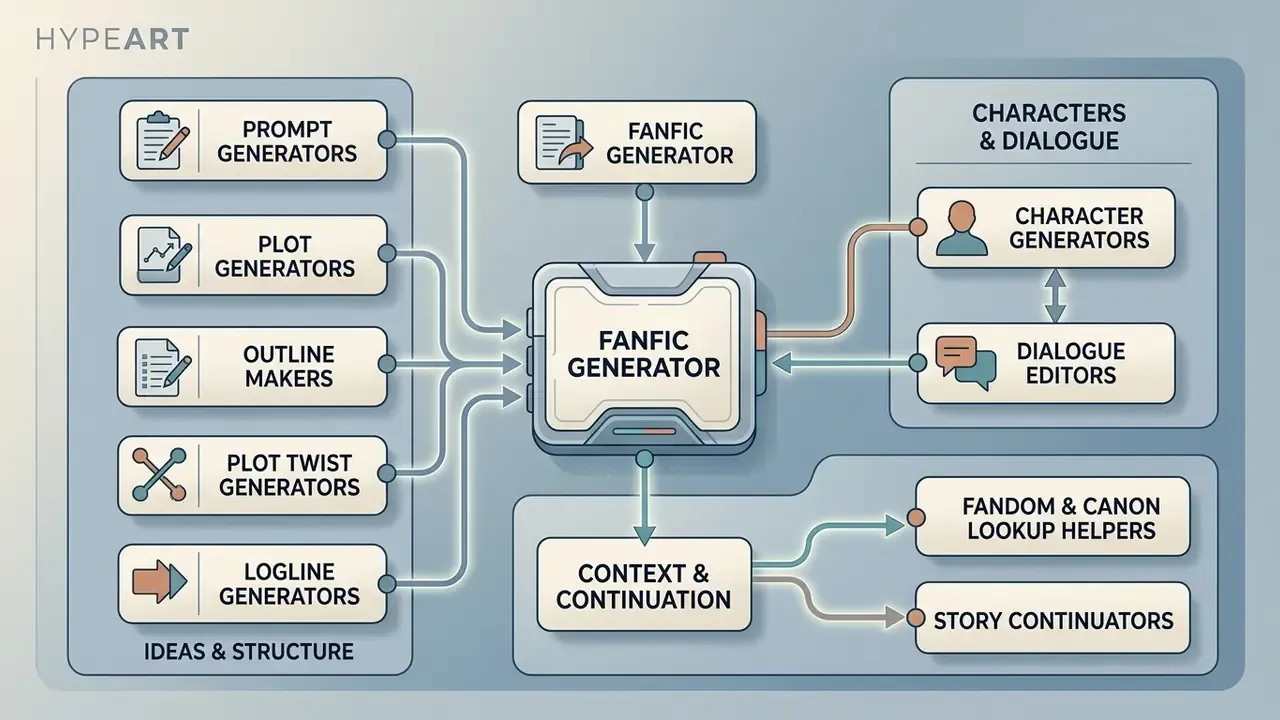
A complete creative writing workflow rarely stops at one story generator. It usually grows a support layer: brainstorming, canon lookup, character profile management, dialogue formatting, delivery.
Modular utilities let you solve specific narrative problems (writer's block, a plot twist that refuses to land, a voice that keeps slipping) without leaning on single-prompt generation. Authors producing audio versions of their fics typically pair the text pipeline with AI voice generators for narration.
Tools for ideas, outlines, and plot twists
Brainstorming tools serve the pre-writing and structural planning phases:
- Story Prompt Generators produce premise seeds based on fandom, character pairings, and trope tags.
- Plot Generators and Outline Makers construct three-act or hero's-journey breakdowns from a basic premise; mature tools expose genre, length, tone, ending type, and framework selectors, then return the plot split into acts.
- Plot Twist Generators analyse current scene setups and suggest unexpected complications or betrayals, usually with a short note on each twist's structural impact.
- Logline Generators condense a concept into a single-sentence pitch for summaries and tagging.
- Fandom and Canon Lookup Helpers retrieve half-remembered canon details (names, relationships, chronology) so the prompt binds to accurate canon rather than model guesswork.
Tools for characters, dialogue, and story continuation
Character and scene-level tools handle execution and continuity:
- Story Character Generators synthesize detailed character sheets, including psychological motivation, speech patterns, and physical traits.
- Backstory Generators create lore and defining past events that explain present behaviour, usually as structured fields (origin, defining event, secret, motivation, relationships, story hooks).
- AI Dialogue Writers refine conversational exchanges, adjusting banter pacing, emotional subtext, and character-specific vocabulary.
- AI Story Continuers ingest prior manuscript text and generate scene extensions that keep narrative momentum.
- Consistency Checkers read the manuscript against character profiles and flag contradictions across the full text, catching what chapter-level prompting misses.
Auxiliary agent map
| Layer | Function | Input it consumes | Output it hands back to the generator |
|---|---|---|---|
| Ideation | Premise, trope, twist seeds | Fandom, ship, mood | One-line premise plus twist options |
| Structure | Outline and beat planning | Premise, chapter count | Chapter list with 3 events each |
| Entities | Character sheets, backstory, world rules | Names, canon notes | Reusable project bible block |
| Drafting | Scene prose | Bible, outline, prior summary | 800 to 1,200-word scene |
| Continuity | Consistency and canon checking | Full manuscript plus bible | Contradiction list to fix |
| Polish | Dialogue and style refinement | Selected passages | Rewritten passages |
| Delivery | Export, illustration, narration | Final text | PDF/EPUB, scene art, audio |
The delivery layer is where fandom projects sprawl fastest. Podfic recordings usually need a pass to remove background noise from video free before publication, book trailers get cut to platform aspect ratios with tools that resize video online, and reused footage often has to have baked-in captions stripped, which is why editors keep a utility on hand to remove text from video or to remove unwanted objects from video online free inside promo clips.
The same modular architecture that keeps a 20-chapter fanfic consistent is what governance teams use to keep a generative writing assistant auditable. Story bible, approved role, escalation path, evidence trail. No evidence, no autonomy.
In an illustrative evaluation of narrative generation tools for a digital publishing workflow, the initial deployment suffered severe character voice degradation after scene transitions. The fix was a structured context-injection architecture using localized "character bibles" plus schema validation on output dialogue. That intervention reduced character consistency errors by 64% across a 20-chapter test manuscript and eliminated narrative logic breaks. (Composite illustrative example, not a client engagement.)
Related creative media workflows are covered in the Guide to AI voice generators, the Comparison of the best AI art generators, and the Comparison of free AI art generators.
FAQ about free AI fanfiction generators
How fast does an AI generator create the first story?
Usually 5 to 30 seconds for a first draft scene or short story after prompt submission. Generation speed depends on model architecture, server load, requested word count, and whether image generation runs in the same pass. Lightweight web models and optimized API endpoints produce 30 to 100 tokens per second; heavier or locally hosted models often decode closer to 20. So the draft is nearly instant, while finishing a publishable chapter still costs 15 to 45 minutes of human review, post-editing, continuity checking, and stylistic work. That ratio, seconds of generation to tens of minutes of editing, is the honest headline number.
Is my data private in a no-sign-up generator?
Unauthenticated tools give you fewer guarantees, not more privacy. With no account, there is usually no deletion request path, no access log tied to you, and no contractual data-processing commitment; NIST SP 800-63B notes that sessions without identity binding are more exposed to hijacking and automated abuse. Assume prompts may be retained or reviewed unless the provider publishes a dated retention and training-use policy. Never paste confidential, personal, or regulated data into a public endpoint.
How do fan-work rights differ from commercial rights?
Non-commercial fanworks rely on a transformative-use argument evaluated under the four-factor fair-use test in 17 U.S.C. § 107, and fandom platforms broadly tolerate them. Commercial fanfiction is a different question. Selling a work built on someone else's characters implicates the rights holder's exclusive derivative-work rights under 17 U.S.C. § 106, and the commercial purpose plus market-harm factors weigh against the author. Separately, purely AI-generated text carries no copyright at all, so even original AI-assisted fiction needs documented human authorship to be protectable.
How do I stop the AI from hallucinating plot and breaking canon?
Use three controls together. First, keep a project bible with hard world rules and re-inject it into every prompt. Second, maintain a facts ledger of every named object, injury, promise, and date, so the model cannot quietly contradict an earlier detail. Third, generate two or three continuations for pivotal scenes and keep the one most consistent with the ledger, a manual version of the self-consistency technique documented in prompt-engineering guidance. When a contradiction appears, stop, update the reference block, and regenerate the affected scene instead of patching forward.
Can I write a full-length novel on a free tier?
Yes, but not in one request. Free tiers cap context and output length, so a novel-scale project has to be produced chapter by chapter with an external outline, an external project bible, and a manual summary passed between chapters. Expect to hit hourly rate limits and to export each chapter yourself. The features that would automate this, persistent memory, saved characters, .EPUB and .DOCX export, are the usual paid upgrades.
Do I have to disclose that I used AI?
Legally, disclosure requirements vary by jurisdiction and platform. Practically, the fandom expectation is explicit. In a 2025 community survey, 86% of respondents expected transparent disclosure of AI involvement, and 76.4% considered AI fanfiction a threat to community social bonds. Combined with the measured 6.2% reader quality discount on disclosed AI writing, the workable position is straightforward: disclose, and make the human editing substantial enough that the work stands on its own merits.
📚 References
- Kotek et al. (2025).Evaluating Creative Short Story Generation in Humans and Large Language Models. Preprint comparing 60 human writers and 60 LLMs on constrained creative storytelling tasks.
- Yang, Y., & Jin, L. (2024).What Makes a Good Story and How Can We Measure It? A Comprehensive Survey of Story Evaluation. Survey of narrative generation models, tasks, and metrics.
- U.S. Copyright Office (2025/2026).Copyright Registration Guidance: Works Containing Material Generated by Artificial Intelligence. Policy guidance on human authorship thresholds and AI-generated outputs.
- NIST (2026).Special Publication 800-63B: Digital Identity Guidelines; SP 1353 Quick-Start Guide for Artificial Intelligence Prompting. Guidance on authentication, session risk, and prompt structuring frameworks.
- Wharton / NYU Stern Empirical Study (2026).The Artificial Intelligence Disclosure Penalty: Humans Persistently Devalue AI-Generated Creative Writing. Meta-analysis of 16 preregistered experiments (N = 27,491) on reader perception and authenticity discounting.
- Fanfiction Community Survey (2025).Fanfiction in the Age of AI: Community Perspectives on Creativity, Ethics, and Technology. HCI survey on fan community attitudes, ethical concerns, and disclosure expectations (N = 156).
- StoryWriter (2025).StoryWriter: A Multi-Agent Framework for Long Story Generation. Preprint on structure, planning, and writing agents for long-form narrative generation.
- Journal of Computer Assisted Learning (2024).Is ChatGPT a menace for creative writing ability? An experiment. Controlled study of 600 students across ten universities measuring originality and elaboration.
- SEED-Story (2024).SEED-Story: Multimodal Story Generation. Preprint on generating up to 25 sequential image-and-text scenes with consistent characters and settings.
- CCI (2024).CCI: Character-centric Creative Story Generation via Imagination. Preprint reporting 58.95% annotator preference over text-only baselines.
- ELT Journal (2024-2025).Let's Story / Applaydu. Report of 2.4M-plus story-creation sessions across 19 languages in six months.
- DOC, Detailed Outline Control (ACL 2023) and LSG pipeline (INLG 2024).Research on planning, drafting, rewriting, and chapter-summarization pipelines for long-form story generation.
- Re3 (Recursive Reprompting and Revision).Long-story generation framework using plan re-injection, continuation reranking, and consistency editing.
- NIST AI 100-4.Reducing Risks Posed by Synthetic Content. Guidance on provenance, watermarking, and detection of AI-generated text.
Definitions for every term used above, from context window to identity binding, are collected in our reference hub: view the guide.