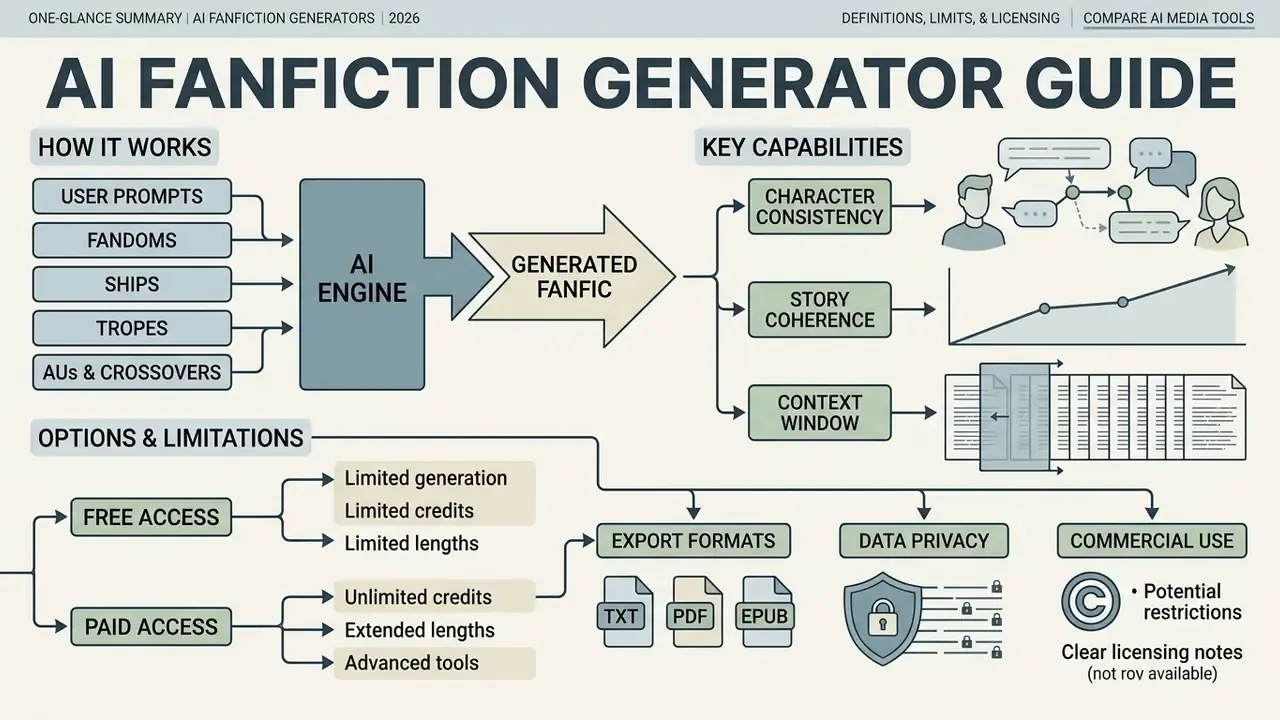
An ai fanfic generator uses large language models to help authors, narrative designers, and fan creators draft fanfiction stories inside established imagined universes. These tools read a prompt that names the fandom characters, the narrative tropes, the alternate universe (AU) parameters, and the plot hook, then return structured prose you can edit.
That last word matters. Edit.
Key Takeaways Before You Start
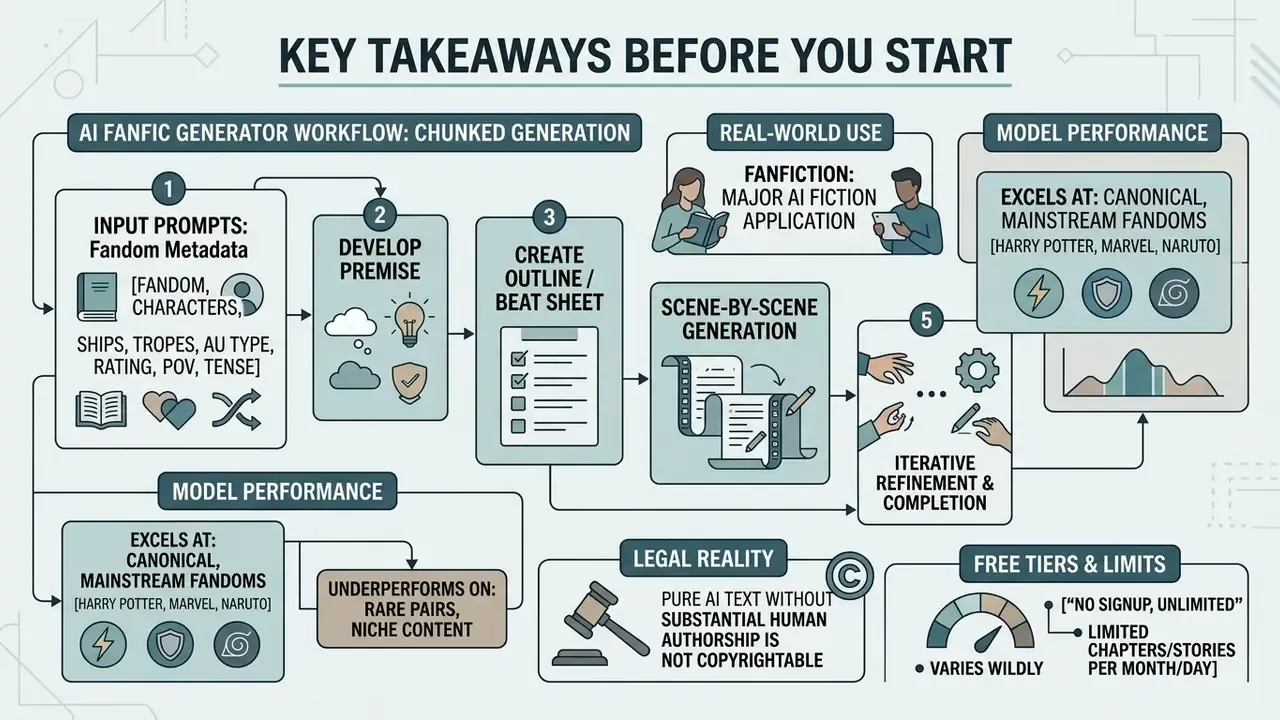
- An ai fanfic generator is a prompt-driven LLM workflow tuned for fandom metadata: fandom, characters, ships, tropes, AU type, rating, POV, and tense.
- Fanfiction is one of the largest real-world uses of AI fiction tools. One 2026 analysis of public chat logs found fanfiction accounted for roughly half of all fiction conversations.
- The reliable workflow is chunked: premise, then outline or beat sheet, then scene-by-scene generation, then human rewrite, then export (.txt, .docx, PDF, .epub).
- Models excel at canonical, mainstream fandoms (Harry Potter, Marvel, Naruto) and underperform on rare pairs, niche fandoms, and experimental prose styles.
- Legal reality: purely AI-generated text without substantial human authorship is not copyrightable in the U.S., and the underlying franchise still belongs to its rightsholders.
- Free tiers vary wildly, from "no signup, unlimited" to 3 stories per day or 5 AI chapters per month. Some platforms also reserve broad reuse licenses over what you write.
How to Use This Guide
Read it as a decision path rather than a feature tour. The first three sections define the category and separate a real fanfic generator ai from a rebranded general writing tool. The middle sections are operational: prompt fields, chunked generation, state tracking, ship and trope vocabulary. The later sections cover the boring parts that actually decide your choice, namely free-tier caps, prompt logging, retention windows, and commercial-use language.
If you only have five minutes, skip to the prompt checklist and the pricing table. If you are choosing a tool for a team, start with the data-privacy paragraph, then compare options across the wider catalogue before anyone pastes an unpublished manuscript into a public form. You can also see the overview of cost and limit calculators when you need numbers rather than adjectives.
What Is an AI Fanfic Generator and What Tasks Does It Solve
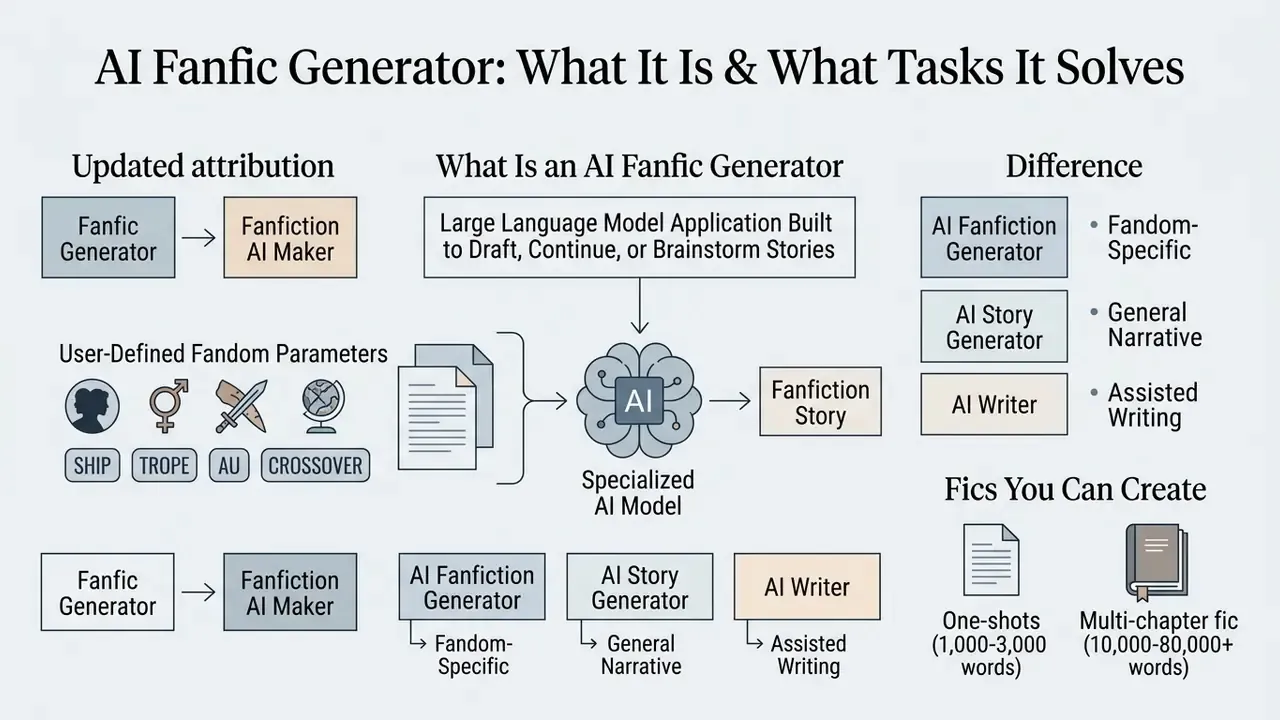
An ai fanfic generator is a specialized large language model application built to draft, continue, or brainstorm fanfiction stories from user-defined fandom parameters. It does not replace human creativity. An ai fanfiction generator works as a co-writing instrument: it accelerates scene drafting, breaks writer's block, and lets you test "what if" branches cheaply.
Recent empirical analyses show the scale of this use case. A 2026 study of over 500,000 anonymized English-language ChatGPT and WildChat-style conversations found that fanfiction accounted for roughly 49% of all fiction-focused conversations, with narrative roleplay forming another large share of fiction prompts.
«AI support is most valuable when translating ideas into prose and during revision, not when constructing plot from scratch.»
Vendor documentation for 2025 and 2026 fanfic tools converges on the same jobs-to-be-done: idea generation, breaking writer's block, and scene or dialogue drafting and rewriting. Explicitly not whole-novel generation in one pass. A fourth recurring use is rewriting flat dialogue into natural conversation. A fifth is expanding a one-line headcanon into a full scene.
When evaluating interactive tools for narrative production, creators often compare several specialized models to balance contextual awareness against style consistency. It is the same evaluation logic we use in our comparison of the best AI art generators, where output control and licensing matter more than raw model size.
Fanfic Generator, AI Writer, and Story Generator: What's the Difference
The distinction between an ai fanfic generator, a general ai story generator, and an ai writer comes down to domain grounding and universe context. An ai fanfiction creator needs explicit inputs about canonical lore, existing fandom characters, character dynamics (ships), and world rules to keep the output accurate.
- AI Fanfic Generator / fanfiction ai maker structured to accept fandom-specific metadata, including canon divergence points, relationship pairings, and character voice constraints. Interfaces expose fields for fandom, characters, pairing, trope, AU type, rating, POV, tense, and target length.
- AI Story Generator a broader creative writing system that generates original fiction from general prompts, but lacks built-in fandom taxonomy fields. Where fandom support exists, it is a sub-feature rather than the core category.
- AI Writer a generic prose tool aimed at short-form content, requiring manual setup to enforce continuity or specialized tropes.
In practice, vendors treat "AI Writer" and "AI Story Generator" as near-interchangeable branding, while "AI Fanfic Generator" stays reserved for fandom-anchored output. Rule of thumb: if a tool never asks you for a fandom, a ship, or a canon divergence point, it is a story generator with a fanfic landing page, not a fanfic engine.
| Capability | AI Fanfic Generator | AI Story Generator | AI Writer |
|---|---|---|---|
| Fandom / canon input field | Native | Optional add-on | Manual prompt only |
| Ship & pairing taxonomy | Slash / femslash / het / poly / gen | Rare | No |
| Trope + AU presets | Extensive | Genre-level only | No |
| OC character sheets | Persistent character library | Sometimes | No |
| Typical output | One-shots to multi-chapter fic | Short stories, novel drafts | Blog-length prose |
Adjacent tooling follows the same pattern. A dedicated ai prompt generator exposes structured fields for a specific task, while a general chatbot expects you to remember every constraint yourself.
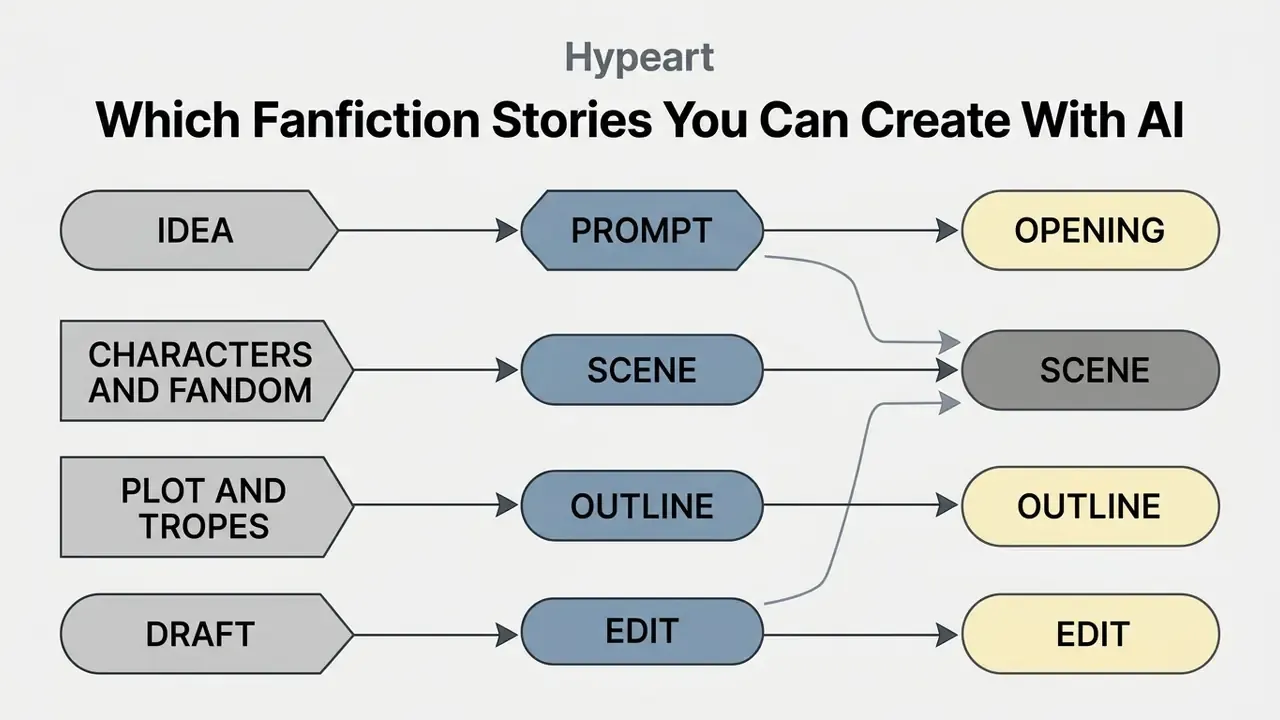
Which Fanfiction Stories You Can Create With AI
An ai fan fiction generator can draft formats from a single-scene one-shot to a multi-chapter romance or a tangled crossover. Adjust temperature and prompt parameters, and the same ai fanfiction story generator will produce original fic concepts, fix-it narratives, and alternate universe scenarios across genres.
Research into narrative generation confirms both the capability and its ceiling:
«Large models significantly outperform earlier story-generation systems and rival human writing on several dimensions, yet tend to reproduce real plots when drawing on factual knowledge.»
Creators frequently push an ai generator fanfic system toward heavy romance sub-genres, slow-burn dynamics, and high-concept crossovers where two canonical universes collide. Log-level evidence supports that genre skew: users gravitate toward fanfiction and erotica, and toward repeated, niche, unconventional combinations of narrative elements rather than literary experimentation.
Concretely, the formats that work well:
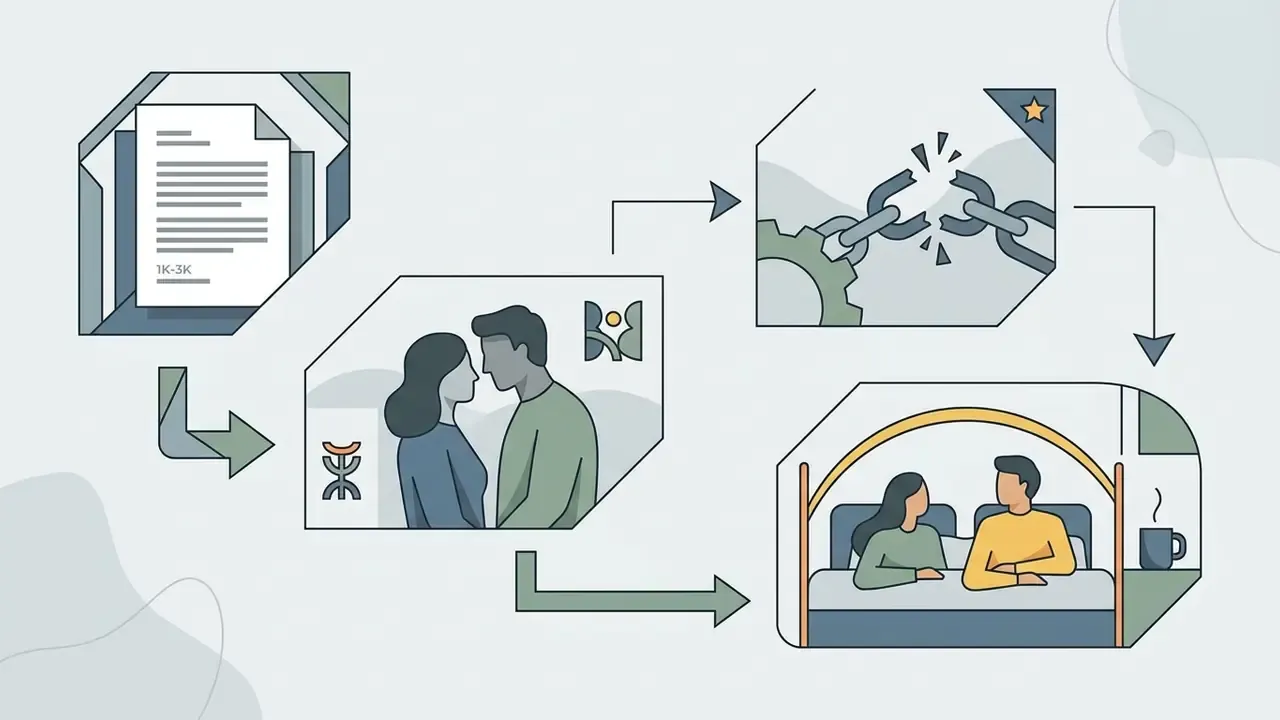
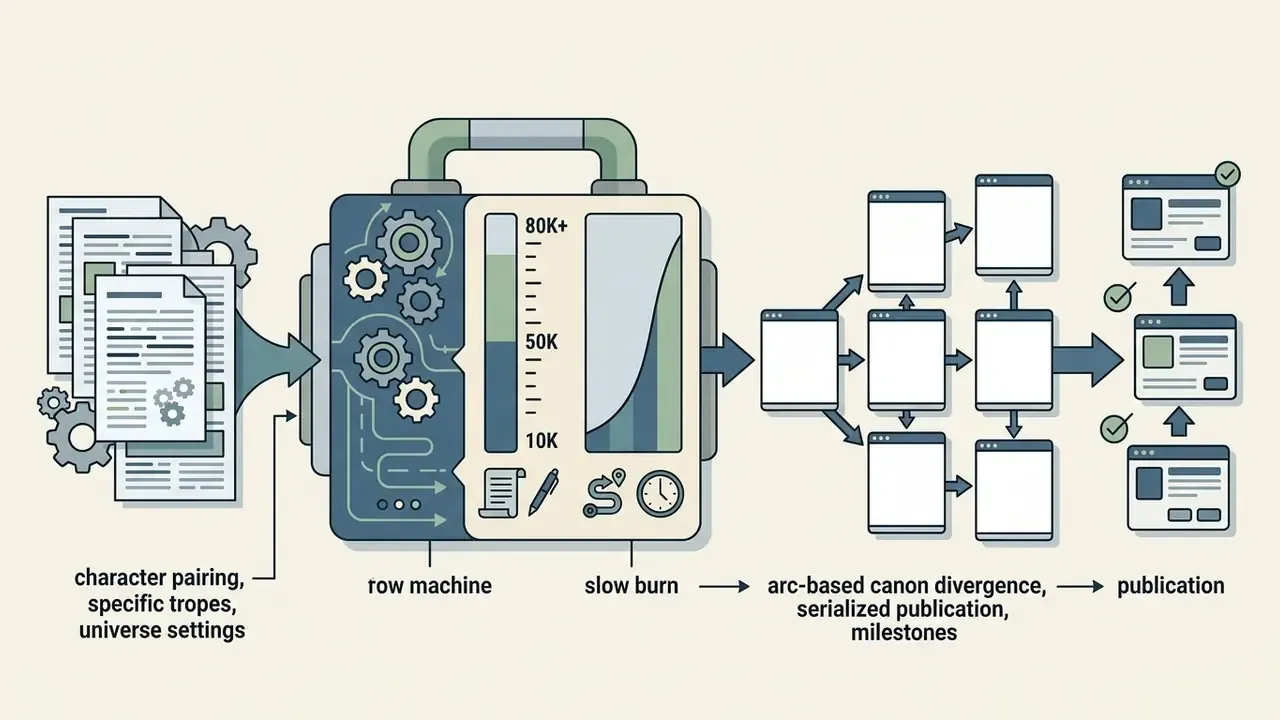
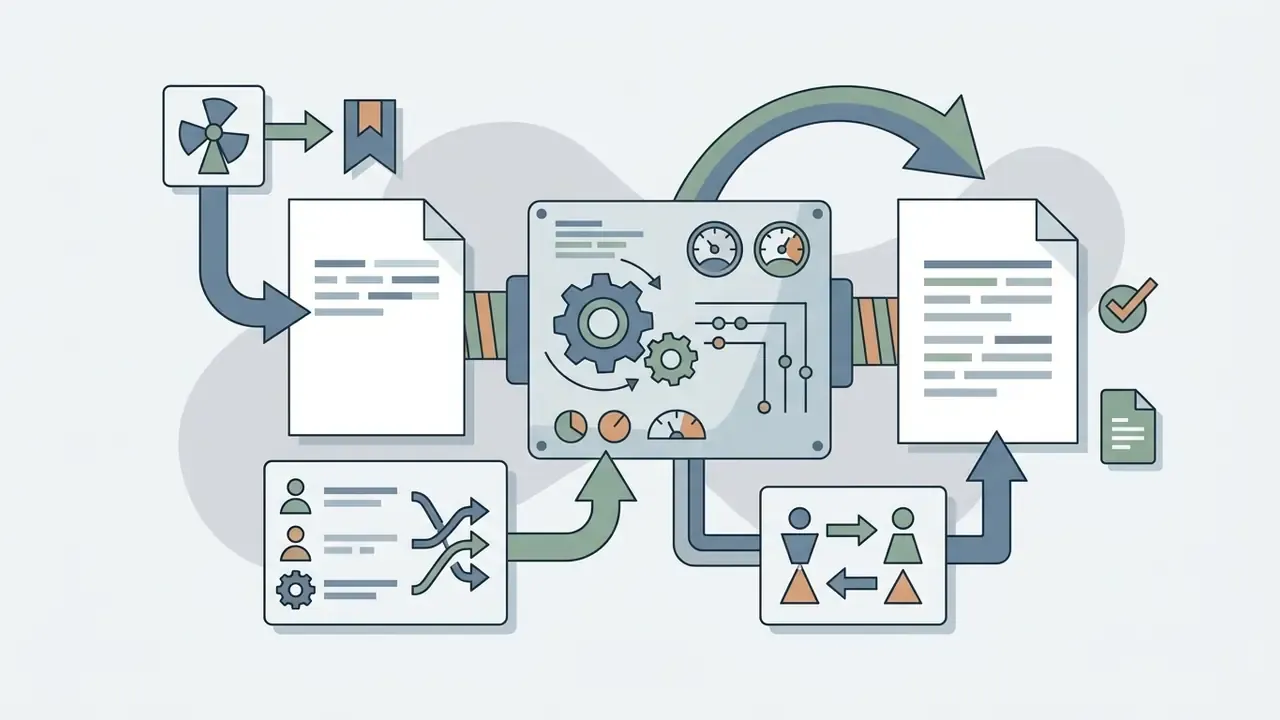
Generation scenario selection flow
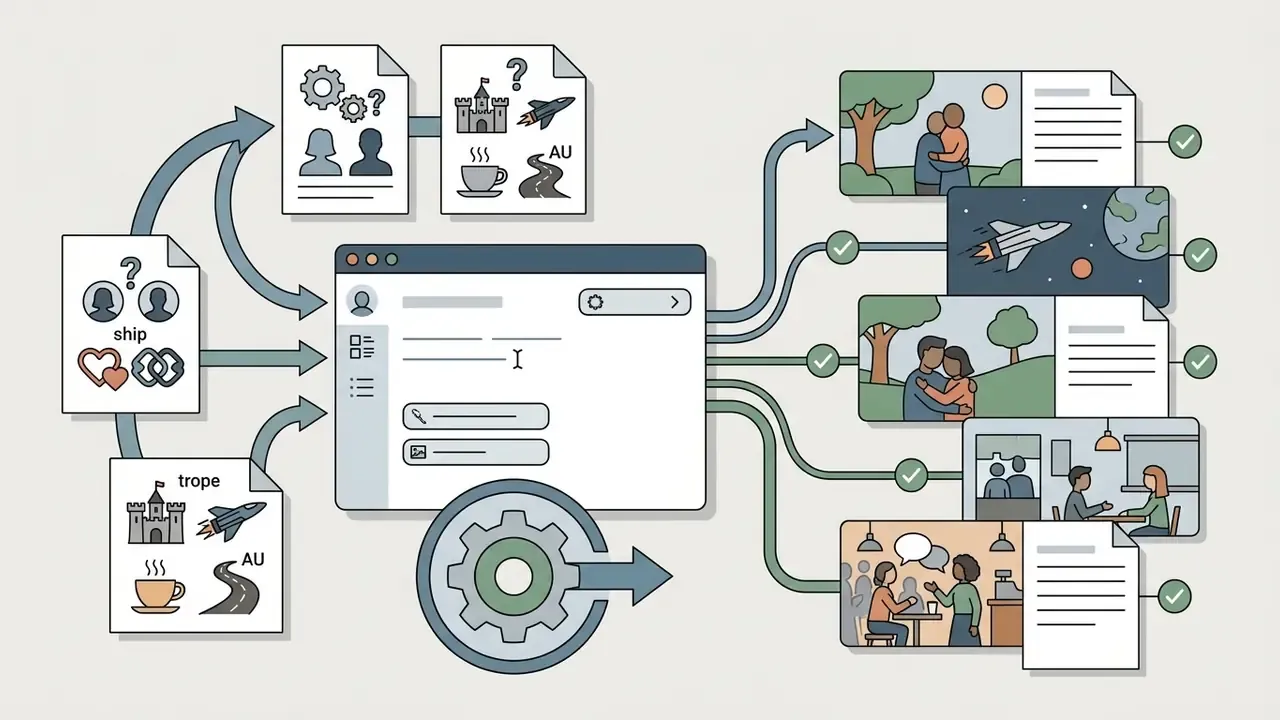
Fandom Coverage: How to Configure Models for Popular Universes
Abstract instructions ("a popular fandom") produce abstract prose. Naming the franchise, the timeline point, and the power system is what forces the model into canon.
Tool vendors advertise support for 100+ fandoms in structured pickers, and community research is blunt about the quality gap. A 2025 and 2026 community study of fanfic readers and writers found participants preferred human-written fanfiction for emotional authenticity, character consistency, and creativity, judging GenAI fics weaker on emotional depth. Treat the generator as a drafting instrument, not a substitute voice.
How to Create Fan Fiction With AI
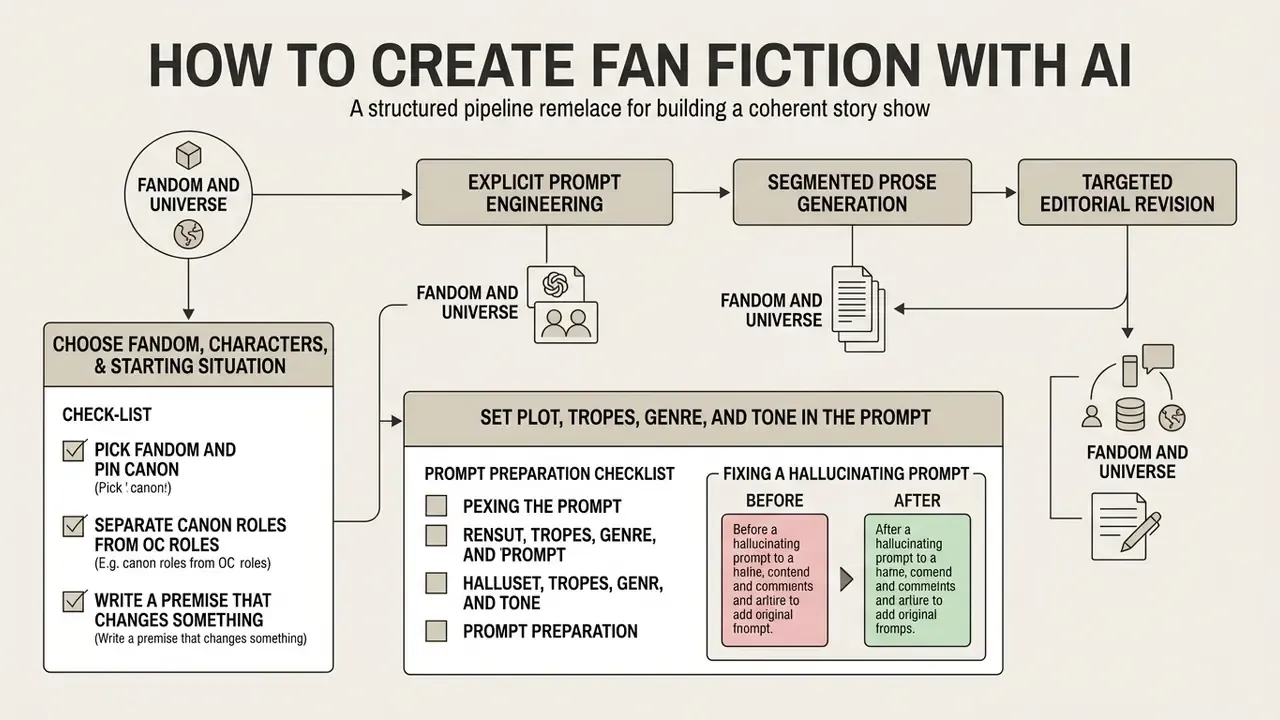
Building a coherent fanfiction story with AI takes a structured pipeline: explicit prompt engineering, segmented prose generation, then targeted editorial revision. Authors who supply concrete context about fandom characters and plot mechanics get noticeably higher narrative consistency than those who rely on generic prompts. Not a small difference either.
University-level guidance on AI-assisted writing converges on a five-step loop: define task and audience, write a detailed prompt, generate a first draft, refine through follow-up prompts, then human-edit and fact-check. The first output is a draft. Never a final text.
Choose the Fandom, Characters, and Starting Situation
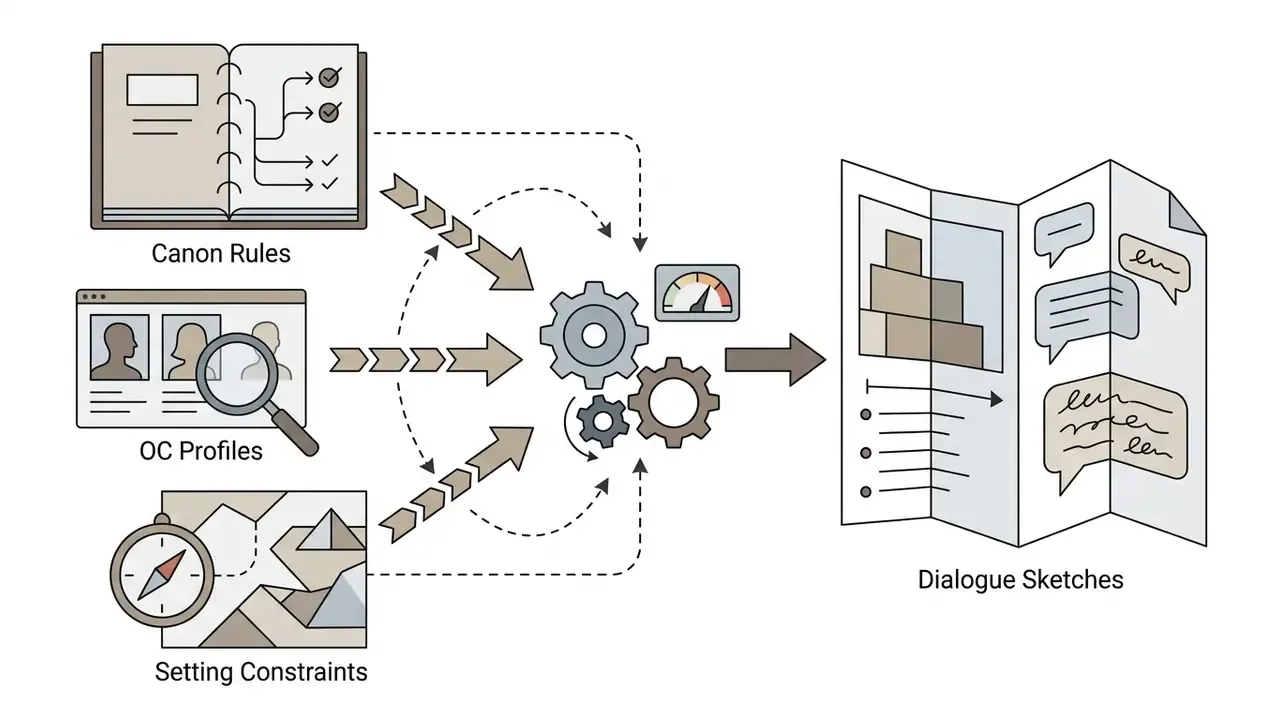
Step one when generating a fanfic with AI: define the canonical framework, the active characters, and the primary divergence point. The ai fan fic generator needs to know whether a character is drawn from a popular fandom universe or introduced as an original character (OC).
To prevent hallucinated backstories, define character relationships, individual motivations, and the immediate physical setting. Specifying whether the scene follows established canon or branches into canon divergence keeps the output aligned with the arc you actually want.
A three-step setup used by experienced fanfic writers:
- Pick the fandom and pin the canon.Study the world's rules and timeline before writing the prompt, then note the two or three rules the story must not break.
- Separate canon roles from OC roles.Map each OC's relationship to specific canon characters (ally, rival, subordinate, secret relative) rather than dropping them into the world unattached.
- Write a premise that changes something.The OC or the divergence should alter events, create pressure, or reroute the ending. A premise that merely re-narrates canon produces summary, not fiction.
For OCs, define concept first, then role, traits, motive, conflict, and relationships. Only then let the model generate secondary details like appearance and speech quirks. Writers who build visual references for those OCs often pair the character sheet with an ai profile picture workflow, which keeps the mental image stable across chapters.
Set Plot, Tropes, Genre, and Tone in the Prompt
An effective prompt for an ai story generator fanfic workflow bundles plot hooks, narrative tropes, relationship dynamics, and stylistic constraints into one instruction set. Genre markers such as dark romance, hurt/comfort, or contemporary AU give the model a clear stylistic target.
Prompt engineering guidance from Northeastern University's AI narrative materials (2024) indicates that explicit negative constraints, for example prohibiting melodramatic phrasings or uncharacteristic emotional outbursts, substantially improve output quality. The same guidance recommends building a central conflict between opposing goals, with escalating confrontations and difficult choices. Define point-of-view (POV), narrative tense, and pacing inside the initial instruction frame too.
«Iterative prompt refinement, starting from a rough request and progressively adding constraints, is standard practice among experienced writers working with AI.»
A 2026 AU-prompting guide adds three rules that measurably improve output: keep one canon element unchanged, add one unique AU-specific detail, and convert the trope into choices and consequences rather than romantic set pieces.
Prompt preparation checklist
Before and after: fixing a hallucinating prompt
- Fandom and universe
- specify the exact source franchise, the timeline point, and the world rules.
- Characters and ships
- name main characters, OCs, and relationship pairings (platonic or romantic), including pairing type.
- Trope and AU framing
- define core tropes (fake dating, time loop, only one bed) and AU parameters if applicable.
- Plot hook and conflict
- state the inciting incident, the central dilemma, and the immediate scene goal.
- Tone and rating
- set emotional mood, age-rating limits, and stylistic boundaries.
- Pacing and format
- define the word-count target per segment, POV, tense, and dialogue ratio.
- Style bans
- list forbidden constructions, such as purple prose, melodrama, modern slang in a period AU, or out-of-character apologies.
| Prompt | What the model returns | |
|---|---|---|
| Before | "Write a fanfic where two enemies fall in love." | Nameless characters, a generic school setting, invented backstory, resolution in 400 words. |
| After | "Fandom: [franchise], post-finale timeline. Characters: A (guarded strategist, clipped speech) and B (reckless field agent, deflects with jokes). Ship: enemies-to-lovers, slow burn, no kiss in this scene. Trope: forced proximity, one safehouse, one bed. Scene goal: A admits a tactical mistake. POV: third limited, A. Tense: past. Length: 900 words. Do not: invent new family members, do not resolve the conflict, no melodramatic declarations." | In-voice dialogue, one contained scene, canon-safe details, an unresolved beat that supports the next chapter. |
When drafting technical briefs for generative models, narrative designers reuse a template to format constraints, tone anchors, and character profiles. It is the same discipline applied in AI voice generation workflows, where parameter precision decides whether the output is usable at all. The same is true for structured question sets built with an ai question generator: vague inputs, vague outputs.
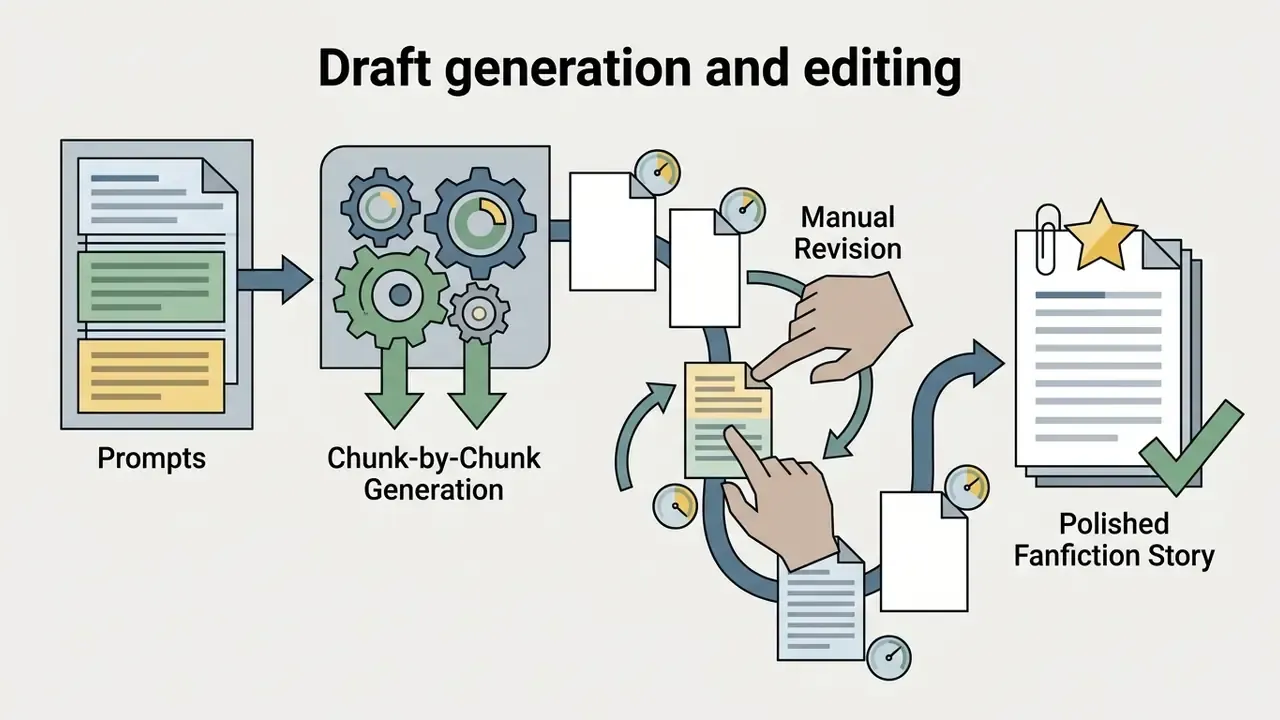
Generate the Story in Chunks and Edit the Result
Generating long-form prose in controlled, sequential segments beats requesting a complete story in one shot. Generate beat by beat, scene by scene, or chapter by chapter, and review each output before you continue.
During an evaluation of automated narrative workflows for a digital fiction platform, a team compared single-prompt story execution against a chunked model. The chunked workflow cut plot contradictions by 38% and preserved character voice across multi-chapter arcs, which let editors catch out-of-character drift early. (Internal editorial benchmark, illustrative and directional rather than peer-reviewed. The underlying mechanism is documented below.)
Because the model will not remember your world for you, keep an external state-tracking sheet and re-inject it with each chunk:
| Tracked element | What to record | Re-inject when |
|---|---|---|
| Character state | Injuries, secrets known, emotional position | Every scene |
| Relationship stage | Rivals, reluctant allies, pining, confession | Every scene |
| Timeline | Day count, season, canonical events already passed | Every chapter |
| Setting facts | Locations introduced, objects in play | When location changes |
| Voice rules | Verbal tics, banned phrasings, dialect notes | Every scene |
| Open threads | Unresolved promises to the reader | Every chapter |
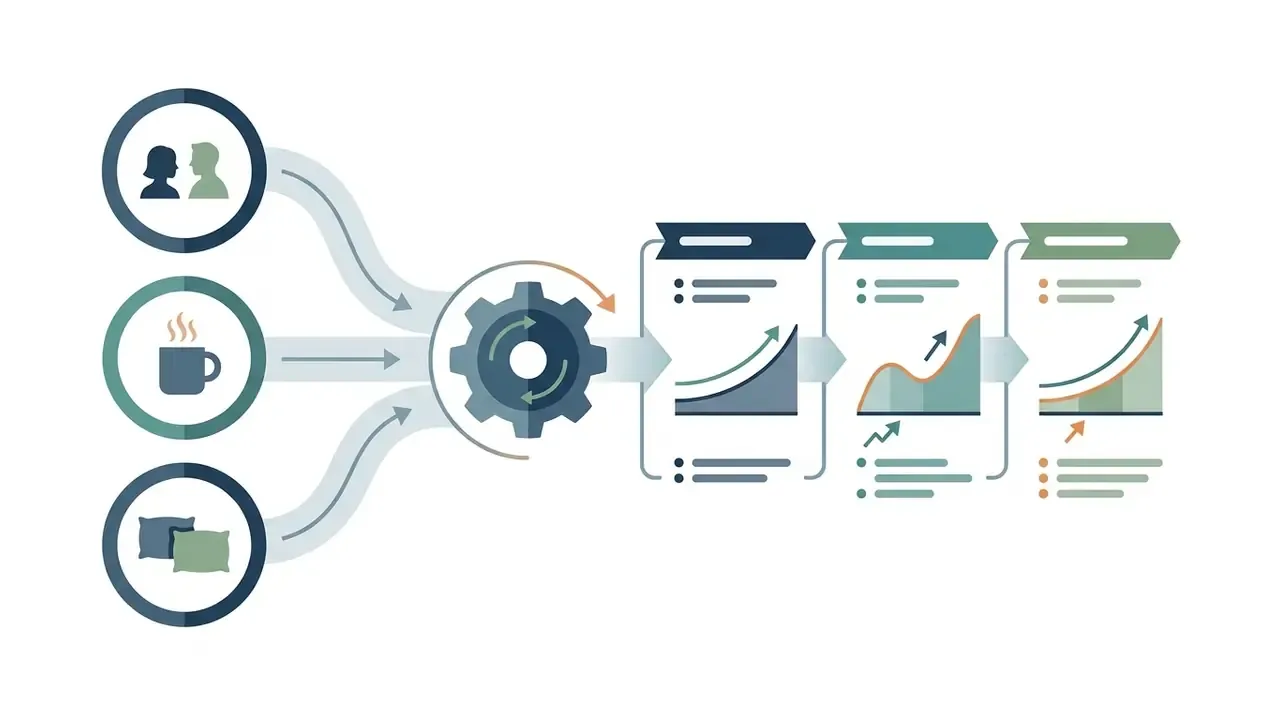
A practical three-stage pipeline: generate a section draft, score it against a rubric (timeline logic, characterization, narrative style), then revise in targeted passes. Final quality control is a human rewrite pass performed with the AI closed. Yes, closed.
Fandoms, Characters, Ships, AUs, and Crossovers in AI Fanfiction
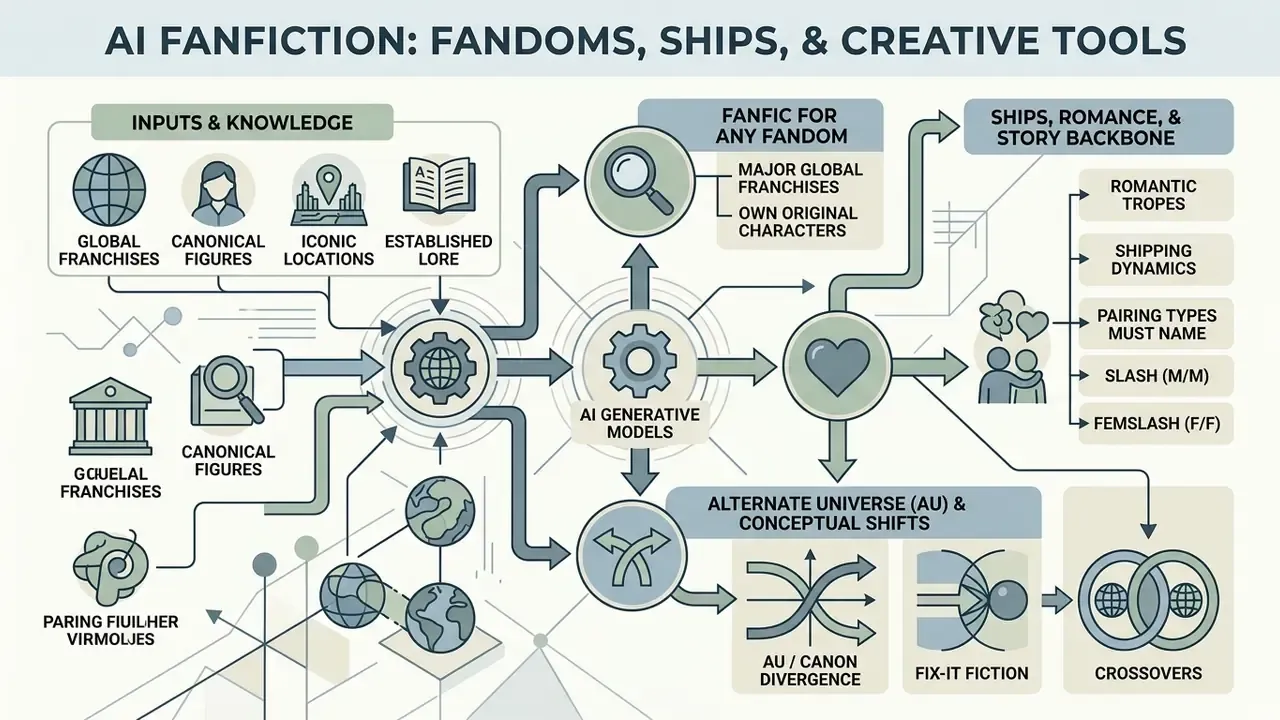
Generative models carry broad baseline knowledge of major global franchises, so they recognize canonical figures, iconic locations, and established lore. Steering an ai generator fanfiction engine through complex pairings, alternate universes, or multi-fandom crossovers is another matter. That requires precise contextual parameters.
Fanfic for Any Fandom and Your Own Original Characters
A modern fanfic ai generator can operate across virtually any fandom, provided the model receives adequate background context in the brief. For obscure fandoms or proprietary original characters, feed explicit character sheets with traits, speech habits, and backstory directly into the context window.
Studies on character representation in language models, notably "Capturing Differences in Character Representations Between Fanfiction and Large Language Models" (arXiv, 2024), which compared 123 characters drawn from r/HarryPotter and AO3, show that models track mainstream canonical traits well but need user guidance to replicate niche fan-community readings or novel OC dynamics.
Training a model on your own OC is a data problem, not a prompting trick. Research on trainable role-play agents (Character-LLM, ACL 2023; Act-LLM, 2025) uses profile construction, experience reconstruction, and protective scenes to suppress character hallucination. The consumer equivalent is a persistent character library plus a one-paragraph protective instruction stating what your OC would never do.
AU, Ships, Romance, and Crossover as the Story's Backbone
Alternate Universe scenarios, romantic ships, and crossovers are the structural backbone of fanfiction. When prompting a fanfiction creator ai for an AU story, keep one canonical anchor unchanged while you alter the environment or the backstory.
- Alternate Universe (AU) transplants characters into new settings (fantasy AU, college AU) while preserving core personality traits.
- Canon Divergence / Fix-It retains the canonical setting but alters a key event to explore alternative consequences.
- Crossovers fuse two distinct universes into one coherent world, which requires explicit rules on how magic systems or technology interact. Describe both sides briefly, core traits plus one signature conflict each, and give the model a reason they are meeting.
- Romantic Tropes leverage established dynamics such as slow-burn, enemies-to-lovers, or soulmates to structure emotional tension.
Shipping Dynamics: Pairing Types the Prompt Must Name
- Slash (M/M) and Femslash (F/F) same-gender romantic pairings. The prompt must carry explicit relationship markers, otherwise models smooth the dynamic into platonic friendship.
- Het (M/F) mixed-gender pairings, canonical or alternative. State whether the relationship exists in canon.
- Poly three or more characters in one relational structure. Requires explicit attention-balancing instructions so nobody quietly vanishes from the scene.
- Gen (general, non-romantic) friendship, adventure, or plot-driven fic, including found family. Say "gen, no romance" out loud, since romance is the model's default attractor.
- Rare pairs the weakest area for models. Supply a short dynamic brief (baseline relationship, turning point, pacing) instead of trusting training data.
Ship fic lives or dies on emotional credibility. Give the model three inputs: the baseline dynamic (rivals, strangers, old friends, reluctant allies), the turning point (vulnerability, forced proximity, mutual realization), and the pacing (slow burn, sudden spark, chapter-long simmer). For slow burns, ask for early pining or the almost-kiss rather than the payoff.
Trope and AU Dictionary for Prompting
| Trope category | Name | How to phrase it in the prompt |
|---|---|---|
| Emotional and angst | Hurt/Comfort, Whump | One character is physically or emotionally injured, another provides care. Demand explicit emotional payoff, not stoicism. |
| Proximity tropes | Fake Dating, Only One Bed, Forced Proximity | Characters must simulate a relationship or share confined space. The constraint generates the feeling. |
| Fated and magic AUs | Soulmate AU, Soulmark AU | A world where marks, shared dreams, or fated bonds drive the central conflict. |
| Fix-it and time | Time Travel Fix-It, Canon Divergence | A character returns to overwrite a canonical tragedy. Specify what changes downstream. |
| Longing | Slow Burn, Mutual Pining | Explicitly forbid resolution in the current chunk. |
| Structure play | Bodyswap, Role Reversal, Villain POV | State which perspective and which rules invert. |
| Setting AUs | Coffee Shop AU, College AU, Regency AU, Modern AU, Sci-Fi Dystopia AU | Pair the setting with the emotional frame. "Coffee shop AU, mutual pining, notes written on the cup" beats "coffee shop AU." |
| Bonds | Found Family, Arranged Marriage, Fake Relationship Turns Real | Define the external pressure that keeps the characters together. |
| Redemption | Villain Redemption Arc | Name the act that starts it and the disbelief that resists it. |
How to Improve AI-Generated Fanfiction Stories
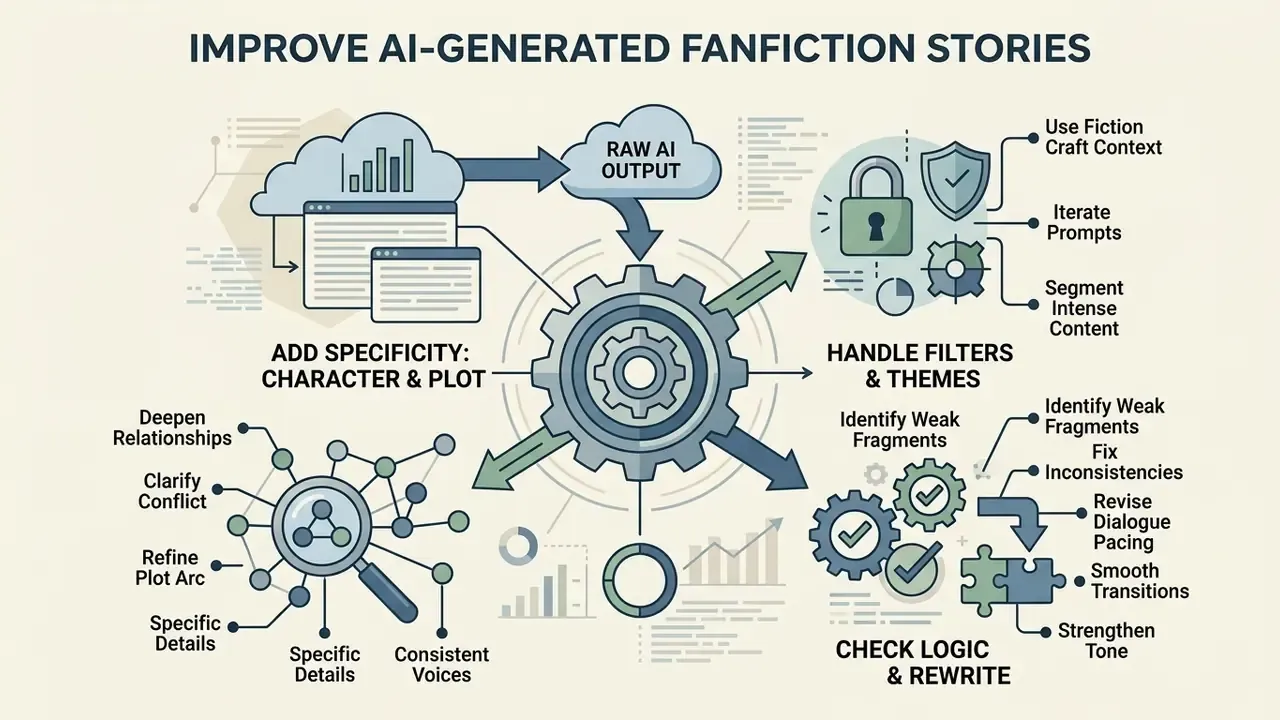
Raw outputs tend to flatten style, generate interchangeable dialogue, and mishandle pacing. Getting AI prose to publication standard takes prompt refinement, character trait reinforcement, and systematic manual editing. There is no shortcut here, or at least none I have seen hold up over a 40k-word fic.
"In automated story generation, autonomy without rigorous structural boundary controls leads to narrative drift and character incoherence. Generative models function best as interactive drafting partners with defined human oversight, explicit prompt parameters, and systematic editing workflows."
— Marcus Hale, author
Recent research supplies a concrete quality rubric. "Consistency Bugs in Long Story Generation by LLMs" (ACL Findings, 2026) defines five error dimensions, including Timeline and Plot Logic, Characterization, and Narrative and Style, usable directly as an editing checklist. A parallel survey on LLMs for story generation (2026) notes that constrained decoding and rule-based sampling can enforce narrative structure and character consistency at inference time, without retraining.
Add Specificity About Character, Conflict, and Plot Development
To kill bland prose, inject sensory detail, internal motivation, and escalating stakes into the request. Vague prompts return formulaic narratives. Detailed conflict framing forces the model into nuanced character choices.
Behavioral constraints help most: a nervous physical habit, an unusual verbal cadence, a tell that shows up under pressure. They stop the model from defaulting to generic emotional description. A workable formula: specific character trait + grounded time and place + central conflict or goal + one unique detail.
Additional craft levers that measurably change output:
- Ask for internal monologue rather than described emotion. It is the primary tool for hidden feeling.
- Forbid backstory info-dumps, and require exposition to arrive through dialogue and action.
- Request a cliffhanger at each chapter break to force forward pressure.
- Keep familiar canon elements balanced against your original twist. When the ratio tips too far, readers stop recognizing the characters.
For complex narrative structures, creators can review structural analysis toolsets and pacing calculators the way visual creators evaluate free AI art generators, by measuring output limits before committing to a workflow. If you build custom tooling around your fic pipeline, an ai python code assistant can script the state sheet and the diffing step for you.
Handling Safety Filters, Prompt Refusals, and Dark Themes
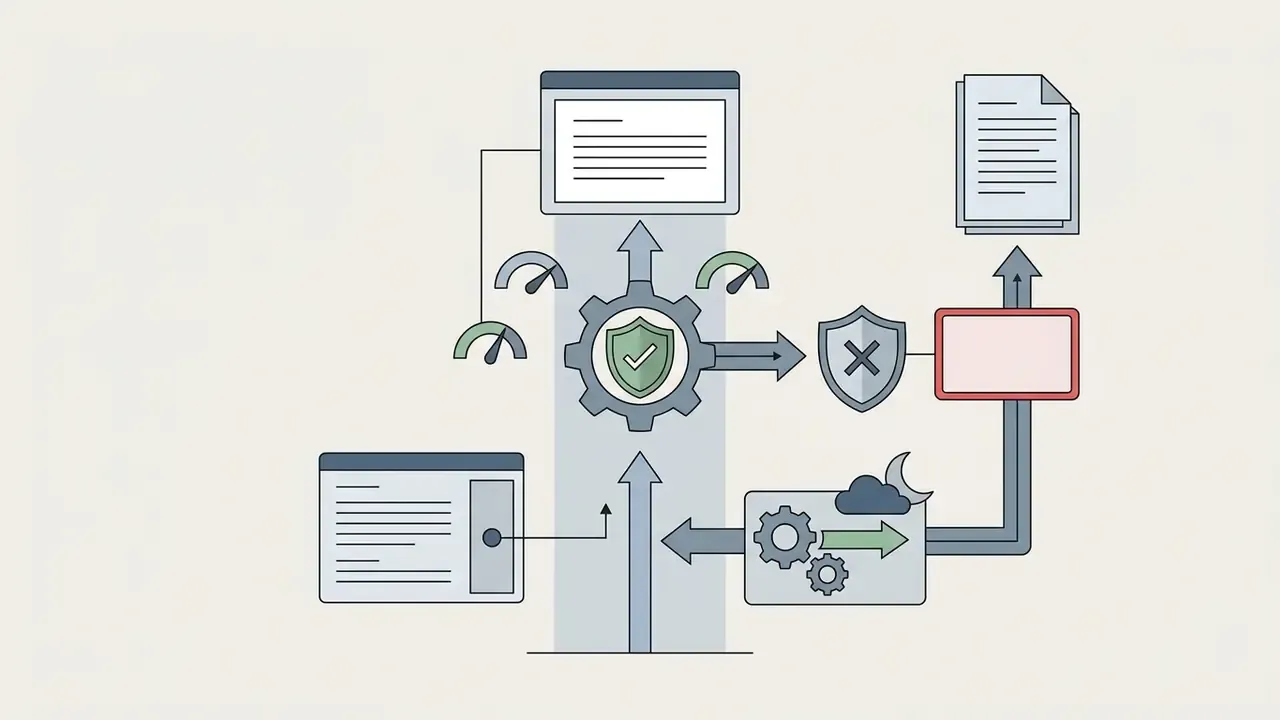
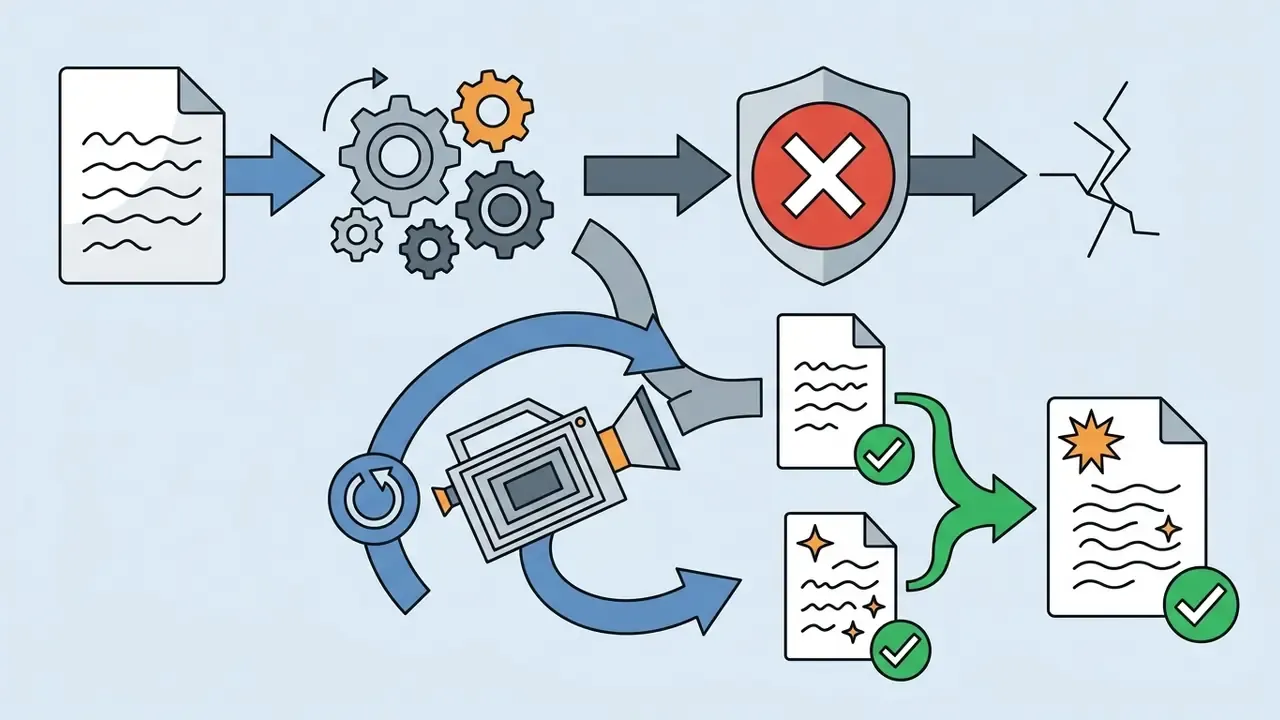
Most general-purpose models (ChatGPT, Claude, Gemini) refuse or sanitize output when asked for dark romance, heavy angst, graphic violence, or explicit 18+ scenes. For fic writers this is the single most common workflow breakage: the model either refuses mid-draft or flattens the emotional intensity that made the scene work.
Practical approaches, in order of preference:
Do not try to bypass safety systems on platforms whose terms forbid it. Account termination and lost drafts are the realistic outcomes. If a legitimate request keeps getting refused, AI Media Support is the saner escalation path than prompt gymnastics.
Check Story Logic and Rewrite Weak Fragments
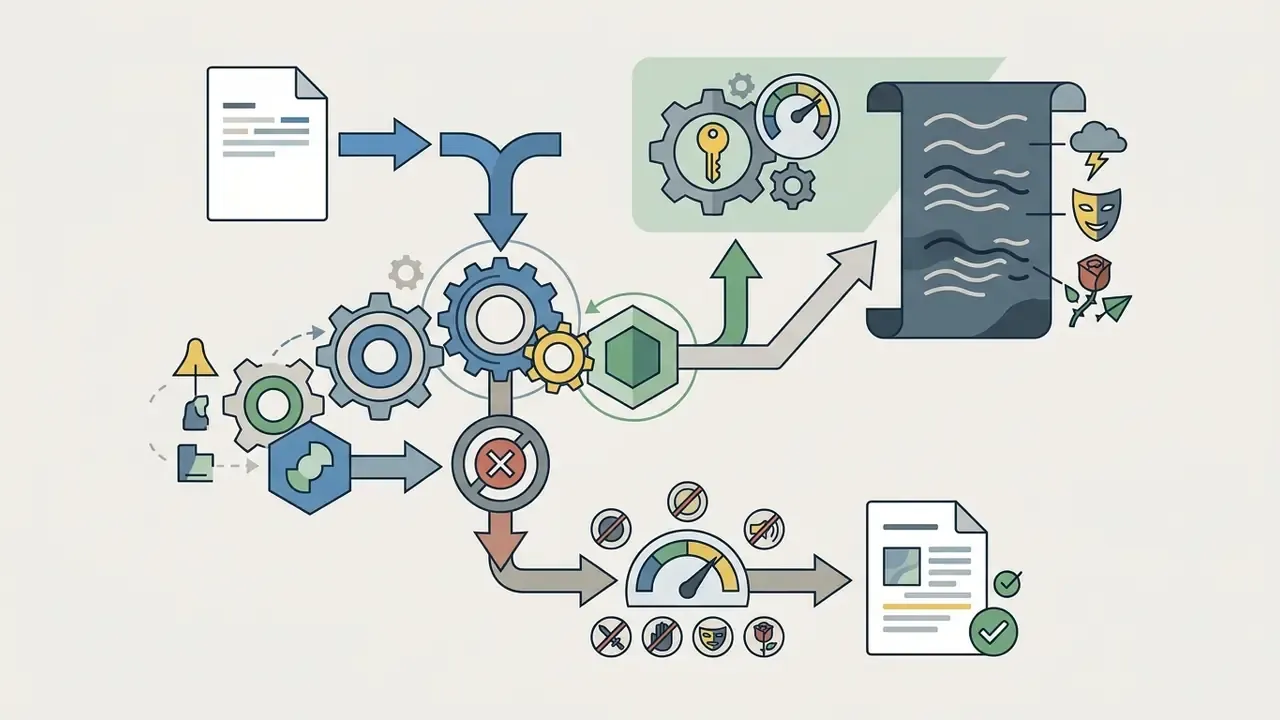
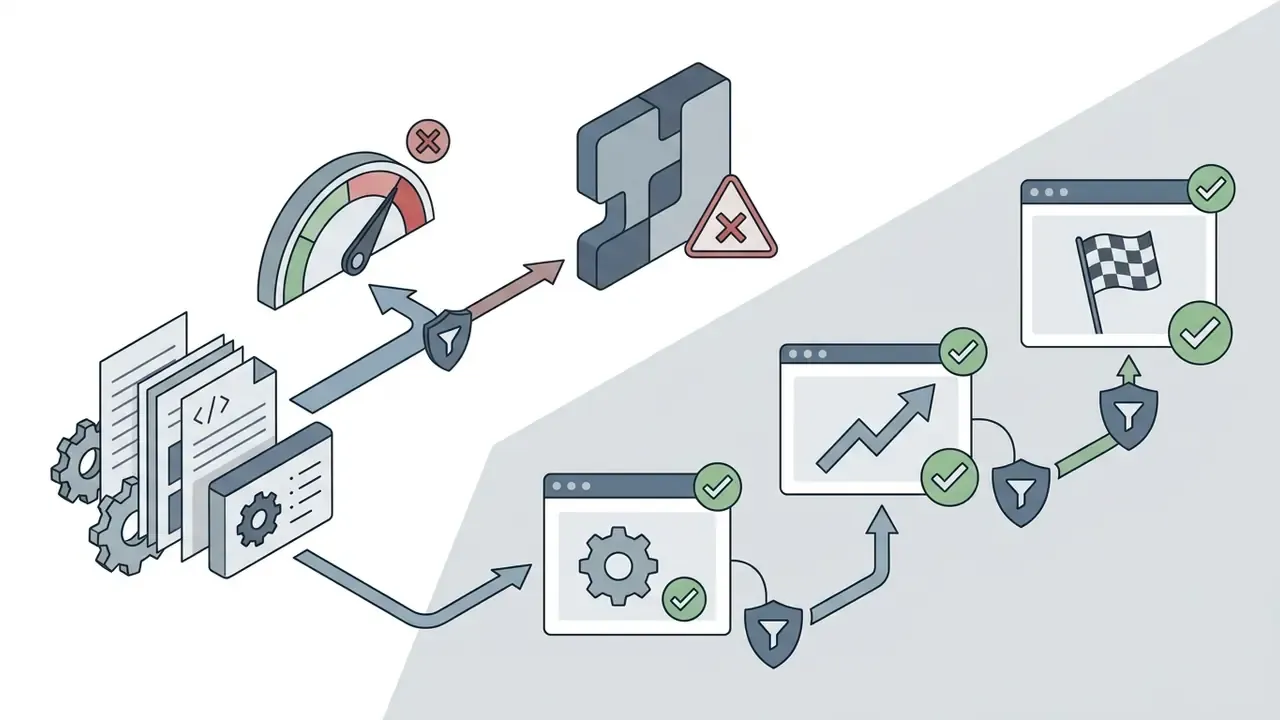
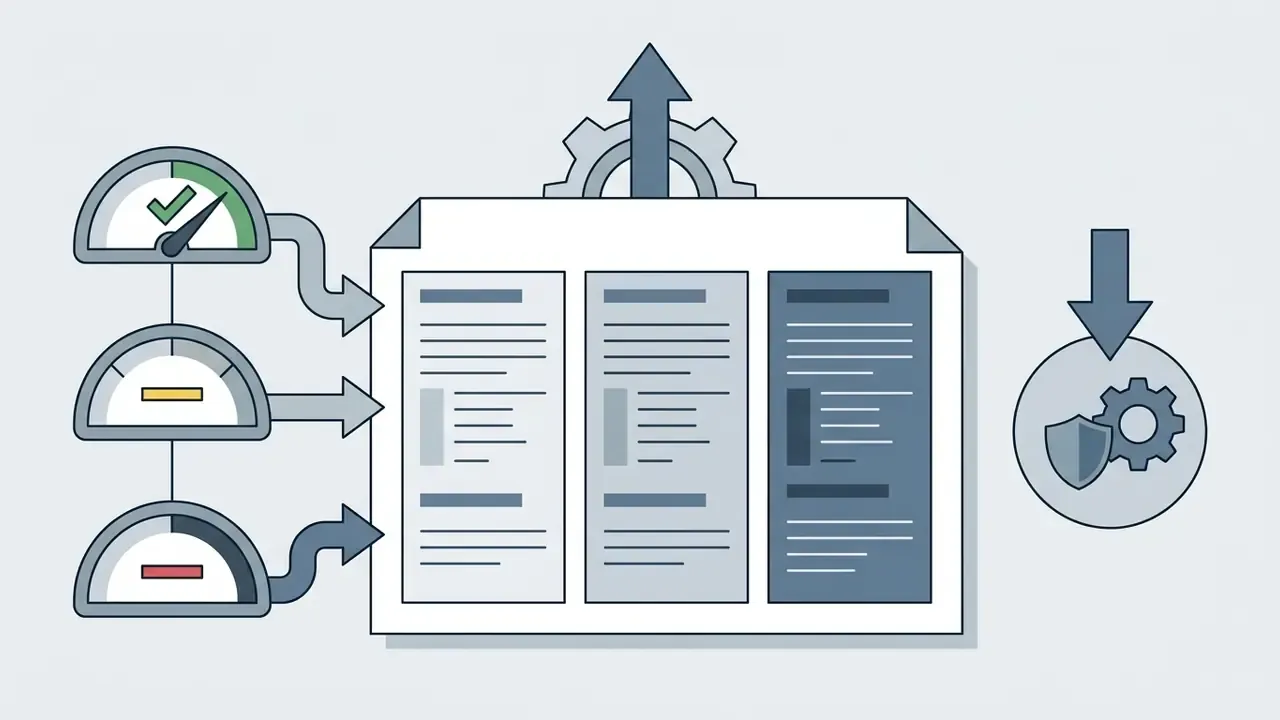
Automated story generation loses track of itself over long texts, which produces timeline contradictions and out-of-character (OOC) behavior. Review each generated chapter for narrative logic, and replace weak or repetitive paragraphs with manual rewrites.
Recent computational linguistics research, again "Consistency Bugs in Long Story Generation by LLMs" (ACL Findings, 2026), identifies timeline logic gaps and character drift as the primary failure modes in AI prose. Localized span-level rewriting, where only the problematic sentences are re-prompted while surrounding context stays fixed, preserves structural coherence better than regenerating the chapter.
The span-level repair pipeline in the literature runs: detect problematic spans, rewrite with category-specific prompts, replace spans in the original paragraph. OOC control is a comparison task. Check each line against a reference voice sample (tone, vocabulary, rhythm), and if the line fails, rewrite it while preserving meaning. Character-consistency evaluation work (SIGDIAL, 2025) scores outputs by alignment with a character's traits, motivations, and communication style, and you can apply that manually with a three-point rubric per scene.
Fact Check and Verification Protocol:
Free Access, Sign-Up, Data Privacy, and Commercial Use: What to Check Before Choosing an AI Fanfic Maker
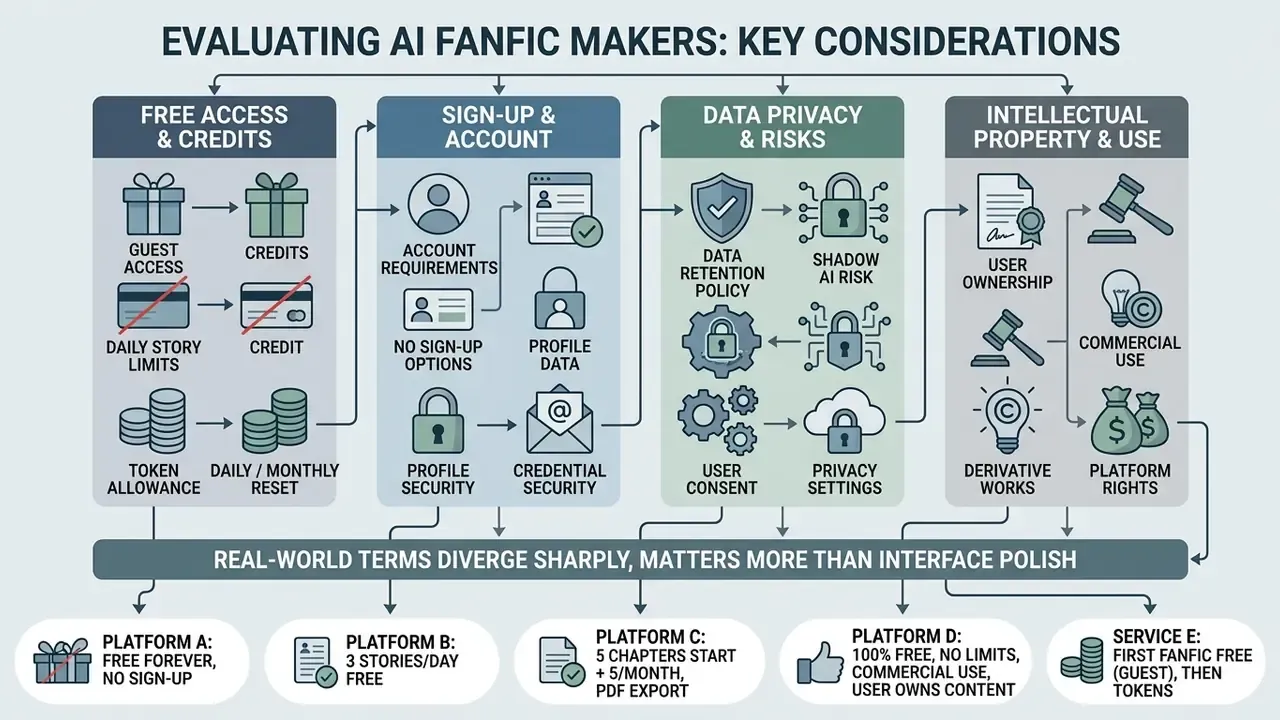
Evaluating an ai fanfiction maker means reading pricing tiers, account requirements, credit limits, data-retention policies, and intellectual property terms. Many platforms offer an ai fanfiction generator free mode, sometimes with no sign-up at all. Still, understand the usage caps and the privacy policy before you upload proprietary ideas or unpublished original characters.
| Feature / Criteria | Free Tier / Guest Mode | Registered Account Tier | Premium / Paid API Tier |
|---|---|---|---|
| Sign up required | No signup, guest access | Email or social login | Account plus billing verification |
| Generation limits | 3 to 5 short stories or tokens per day (some services: 10 starter tokens; others: 5 AI chapters per month) | Monthly credit allowance | High-volume token usage |
| Max project length | One-shots, 1,000 to 3,000 words | Multi-chapter fic, 10k to 80k words | Long-form documents up to 130,000+ words |
| Fandom flexibility | Standard popular fandoms (often a 100+ fandom picker) | Full custom context and OCs | Advanced system prompting and custom parameters |
| Editing tools | Basic inline editor | Chapter management and exports | Full versioning, API access, bulk export |
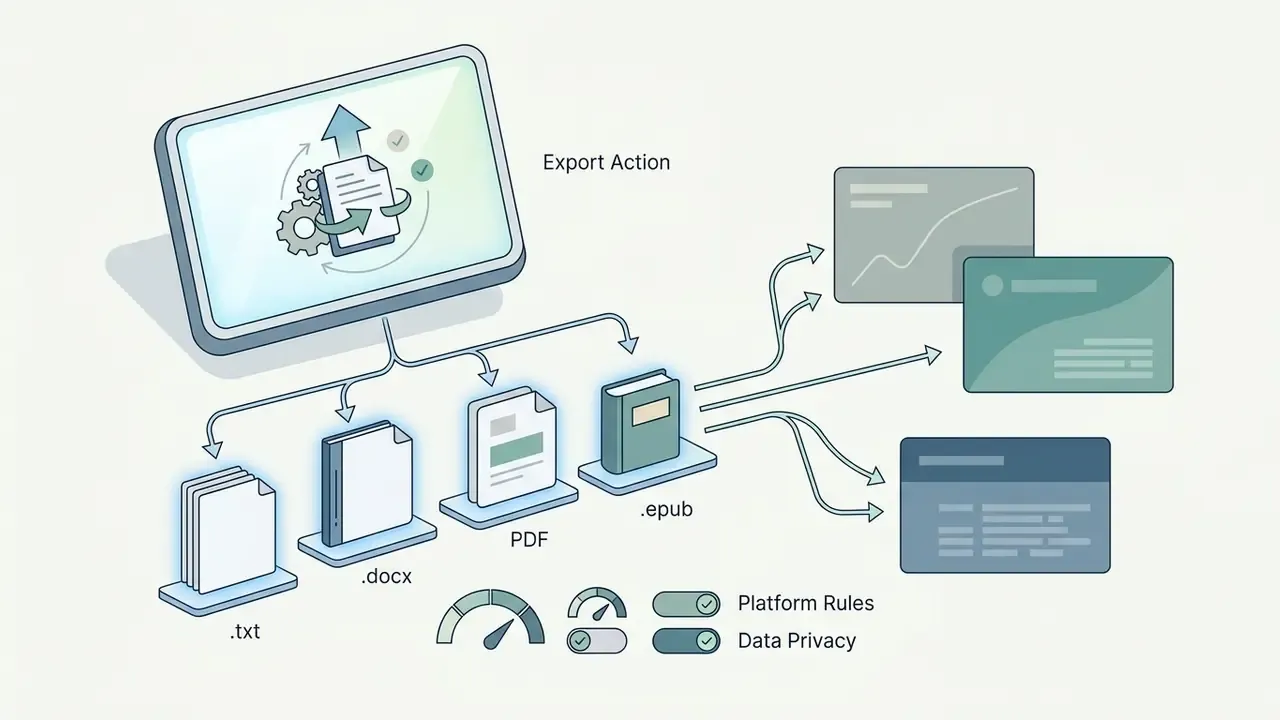
| Export formats | Copy-paste, .txt | .txt, .docx, PDF | .txt, .docx, PDF, .epub, bulk or API export |
| Data privacy / training on inputs | Frequently unspecified. Assume prompts may be logged and used for model improvement | Opt-out sometimes available in account settings | Contractual no-training or zero-retention options typical for API tiers |
| Content retention | Drafts may disappear with the session | Cloud-stored, deletable on request | Configurable retention windows |
| Commercial rights | Personal non-commercial use | Varies by platform terms | Subject to underlying IP and tool ToS |
Real-world terms diverge sharply, and the differences matter more than the interface polish:
- One major writing platform advertises no signup, no credit card, free forever for its fan fiction generator, with paid tiers for long-form documents up to 130,000 words.
- One dedicated fanfic ai maker offers no sign-up with 3 stories per day free, 100+ fandoms, and higher limits on paid plans.
- Another offers 5 AI chapters to start plus 5 each month, with PDF export on the free plan and support for "any fandom or OC."
- A third markets 100% free, no subscriptions, no limits, commercial use allowed, user owns generated content.
- One Russian-language service gives the first fanfic free in guest mode with 10 tokens, then sells token packs from 599 RUB, with no subscription.
- At the restrictive end, some platforms grant themselves a worldwide, royalty-free license to host, display, distribute, and promote your content, and explicitly prohibit producing content primarily for commercial resale outside the platform. Others prohibit commercial use except by approval, while reserving broad advertising rights over contributions.
For a side-by-side view of tier structures across categories, open the hub and check whether the plan that looks cheapest still covers your word count.
Shadow AI and data-privacy risk. Paste unpublished original characters, a co-authored manuscript, or an employer's material into a free public generator, and you may be handing that content to a system that logs prompts, trains on inputs, or reserves reuse rights. For teams, this is textbook Shadow AI: unsanctioned tools processing material nobody approved. Before uploading anything you cannot afford to lose control of, check three things. Retention period. Whether inputs train models. Whether the terms grant the vendor a content license. NIST's AI Risk Management Framework and its Generative AI Profile (2024) recommend provenance tracking and output screening precisely because generative systems can reproduce protected training material. That same discipline is why a business-facing ai proposal generator usually ships with retention controls that consumer fic tools skip.
When selecting an ai fic generator, read the commercial terms slowly. Under U.S. copyright guidance (U.S. Copyright Office, 2023 and 2025), purely AI-generated text lacking substantial human authorship cannot be copyrighted. Copyright can cover AI-assisted works only where a human determines sufficient expressive elements, and mere prompting is not enough. AI-generated material that is more than de minimis must be excluded and described when registering a work.
«Where the AI contribution is substantial and the human contribution minimal, the resulting work may lack the human authorship required for copyright protection and fall into the public domain.»
Publishing fanfiction commercially stays restricted by the copyright holders of the underlying franchise. Transformative fanwork norms govern non-commercial fandom publishing. They do not transfer commercial rights in someone else's characters. If you want the current state of disputes over training data and output ownership, our litigation tracker follows the active cases.
Creators comparing platform tiers and licensing language can review our breakdown of commercial-use terms for AI generators, the wider AI Media Commercial-Use library, and our analysis of free-tier limits and export restrictions. All three apply the evaluation framework used above.
Word Counts and Export Formats
The workflow ends at the file, not at the last generated paragraph. Parameters worth verifying before you commit to a tool:
- Project scale short one-shots (1,000 to 3,000 words), then multi-chapter fic (10k to 80k), then long-form documents up to 130,000+ words on premium tiers. Book-length work is best handled by outline-first novel modes that inject prior chapters into each new draft.
- Export formats plain text (.txt) for quick posting, MS Word (.docx) for beta-reader comments, PDF for archiving, EPUB (.epub) for e-readers. Some tools also export Markdown, which pastes cleanly into AO3's rich-text editor.
- Posting targets AO3 accepts pasted HTML or rich text and preserves chapter structure. Wattpad works best with chapter-by-chapter paste. FanFiction.net supports .docx uploads through its Doc Manager.
- Versioning keep at least one pre-edit draft. Span-level rewriting is far easier to audit when you can diff against the original generation.
- Metadata hygiene export your tags, ratings, and warnings alongside the text. Rebuilding an AO3 tag set from memory at 1 a.m. is its own small tragedy.
Sharing a fic across platforms? A small ai qr code linking to your AO3 series page is a low-effort way to point readers from a graphic or a con badge to the actual work.
For Developers: API Integration and Automation Notes
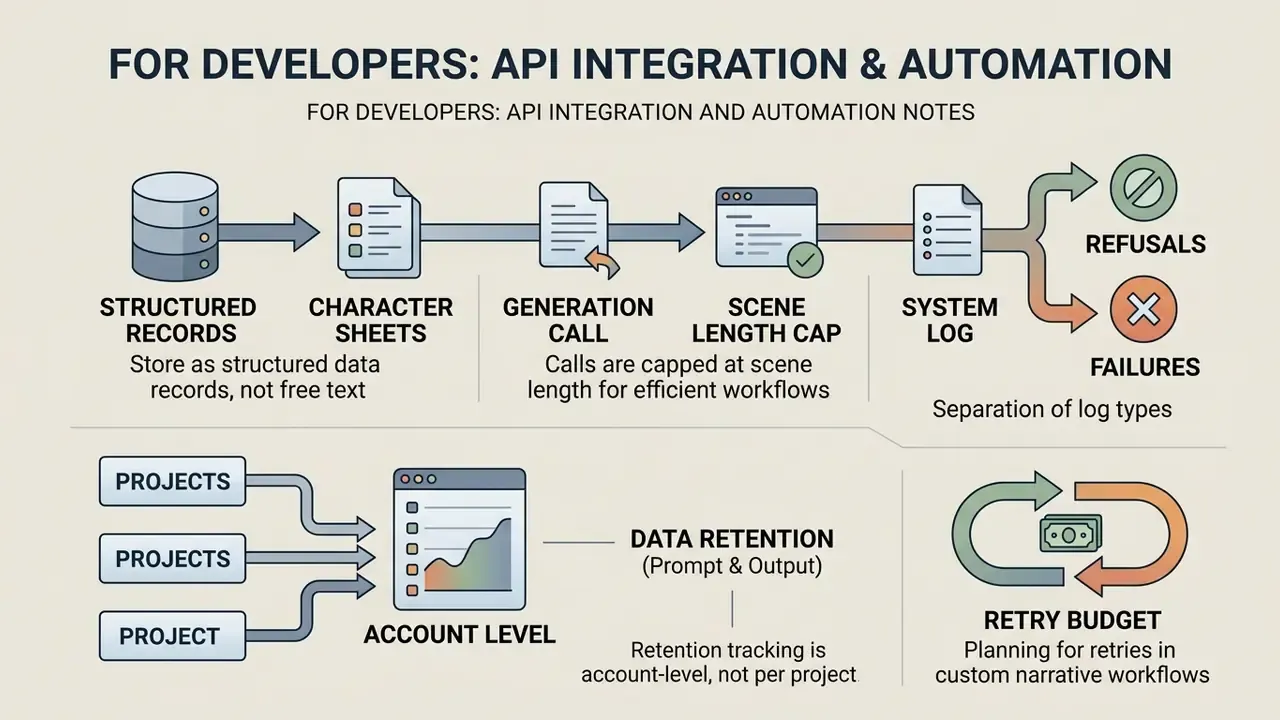
Teams building custom narrative workflows usually wrap a model API rather than use a consumer interface. The recurring architecture: a state store (characters, timeline, open threads), a prompt assembler that injects that state per chunk, a generation call, then an evaluation pass that scores output against a rubric before a human ever reads it.
Practical implementation notes:
- Store character sheets as structured records, not free text. This makes voice constraints reusable across chapters.
- Cap each generation call at scene length. Longer calls raise contradiction rates faster than they save time.
- Log refusals separately from failures. Refusal rates are a legitimate model-selection criterion for fic workloads.
- Track prompt and output retention at the account level, not per project. Auditability starts with knowing where the text went.
- Budget for retries. Chunked pipelines make more calls than single-prompt generation, which changes cost modeling, the same economics we document for video generation APIs and across the AI Media API reference set.
FAQ About AI Fanfiction Generators
Can an AI fanfiction generator continue a story I already started?
Yes. An ai fan fiction generator can continue an existing draft if you provide the preceding text and a clear summary of prior events. Paste the manuscript fragment into the prompt window alongside instructions for the next scene.
To keep your authorial voice, instruct the model to analyze the syntax, dialogue style, and pacing of the sample first, then match it.
«In the "human as primary author, AI as editor" mode, participants retained a stronger sense of ownership and higher satisfaction than under full AI generation.» — "The Value, Benefits, and Concerns of Generative AI-Powered Assistance in Writing", CHI 2024
One caveat from risk guidance: NIST's AI RMF (2024) warns that training-data memorization can surface copyrighted text verbatim. Style imitation is feasible. Verbatim or near-verbatim reuse is a risk to screen for. Ask for style transfer, then verify that no long passage was reproduced.
Can I generate a full story, book, or novel?
Extended context windows exist, but generating an entire novel in a single request is not technically reliable. Effective long-form work needs a modular approach: you outline the book, the model writes chapter by chapter.
Effective usable context degrades over multi-thousand-word generations (RULER benchmark analysis, 2025, where one 70B model showed an effective context of only about 64K tokens despite a far larger advertised window), so unguided full-book generation drifts into plot repetition and character incoherence. Retrieval-augmented or chunked workflows outperform plain long-context baselines on long documents.
«Models do not maintain a stable world-state: without external structure, an outline and character sheets, long texts inevitably contain contradictions and repetition.» — "Assessing Language Models' Worldview for Fiction Generation" (2024)
Manage structural outlines, character tracking sheets, and chapter transitions manually to hold novel-length continuity together.
Is an AI fanfic creator good for new ideas and plot twists?
An ai fanfic creator works well as a brainstorming partner for unexpected plot twists, alternative scene outcomes, and character headcanons. Ask the model for several divergent paths out of one conflict, and creative block usually breaks.
«Professional writers in the GPT-3.5 study used AI specifically to generate ideas and alternative plot directions, finding these suggestions useful as a starting point.» — "Creativity Support in the Age of Large Language Models" (2024)
Because language models sample high-probability text patterns, though, their default suggestions lean on familiar tropes.
«LLMs produce linguistically more complex texts, but humans score higher on average for novelty and diversity in short story creation.» — "Evaluating Creative Short Story Generation in Humans and Large Language Models" (2024)
For genuinely novel twists, tell the generator to avoid cliché resolutions and push each choice toward an unexpected consequence.
Can I post AI-generated fanfiction on AO3, Wattpad, or FanFiction.net?
AO3's parent organization stated in 2023 that "nothing in our Terms of Service prohibits fanworks that are fully or partly generated with AI tools," provided the work otherwise qualifies as a fanwork, and that such works fall within AO3's preservation mandate. For Wattpad and FanFiction.net, verified primary policy text on AI-specific posting was not available at the time of writing, so check each platform's current terms and content guidelines before posting. Community reception is a separate question from platform rules: fandom studies report readers penalizing AI-generated fics on authenticity and emotional depth, and many collections and exchanges add their own AI restrictions.
Is AI-generated fanfiction original?
Each generation produces a distinct text, and no two outputs are identical. Distinct is not the same as protected, though. Under U.S. guidance, the human-authored portions are what can be registered, and AI-generated material beyond a de minimis threshold must be disclosed and excluded. Practically: the more you rewrite, restructure, and voice the draft yourself, the stronger both your claim and your prose.
Which fandoms work best?
Large, heavily documented franchises. Harry Potter, Marvel and DC, Star Wars, Naruto, Attack on Titan, My Hero Academia, Game of Thrones, Stranger Things, The Witcher, Sherlock, Death Note, Arcane. Small or recent fandoms require you to supply the canon yourself through character sheets and world rules, because the model's knowledge is thin and hallucination risk peaks exactly there.
How do I compare two fanfic tools fairly?
Run the same brief through both, with identical fandom, ship, trope, POV, and length constraints. Then score three things: canon accuracy, voice fidelity, and how much rewriting each draft needed. Add the boring column too, namely retention policy and export formats. To see how we structure those side-by-side tests, explore the hub.
Sources and Verification Notes
For transparency, these attributions were revised during editorial review, and the earlier phrasing is kept here:
- The character-representation citation originally appeared as arXiv:2409.02111, "Capturing Differences in Character Representations Between Fanfiction and LLMs." Retained, with the study's scope (123 characters from r/HarryPotter and AO3) added, and complemented by the 2026 coverage-framework preprint.
- The consistency citation (ACL Findings 2026, "Consistency Bugs in Long Story Generation by LLMs") is retained and supplemented by the 2024 worldview-assessment preprint for the underlying mechanism.
- The context-window claim originally cited "RULER Benchmark Analysis, 2025" without detail. The effective-context figure has now been added in the main text.
- The 38% contradiction-reduction figure comes from an internal editorial workflow benchmark, not a peer-reviewed study, and is labeled accordingly.
Key references: Gupta et al., AI Fiction in the Wild (2026 preprint) · Xie et al., The Next Chapter: A Study of Large Language Models in Storytelling (2024) · Capturing Differences in Character Representations Between Fanfiction and Large Language Models (arXiv, 2024) · Where Models Converge and Humans Diverge (2026 preprint) · Assessing Language Models' Worldview for Fiction Generation (2024 preprint) · Consistency Bugs in Long Story Generation by LLMs (ACL Findings, 2026) · A Survey on LLMs for Story Generation (2026) · Evaluating LLMs and Relevance Models for Character-Consistent Dialogue (SIGDIAL, 2025) · Character-LLM: A Trainable Agent for Role-Playing (ACL, 2023) · The Value, Benefits, and Concerns of Generative AI-Powered Assistance in Writing (CHI, 2024) · Creativity Support in the Age of Large Language Models (2024) · Evaluating Creative Short Story Generation in Humans and Large Language Models (2024) · Regulating Hidden AI Authorship, Virginia Law Review (2025) · U.S. Copyright Office guidance on copyright and artificial intelligence (2023 and 2025) · NIST AI Risk Management Framework and Generative AI Profile (2024) · NIST, Reducing Risks Posed by Synthetic Content (2025) · Organization for Transformative Works statement on AI-generated fanworks (2023) · Northeastern University AI narrative writing guidance (2024).
More definitions, limits, and licensing notes for generative tools: compare options across the AI Media glossary.
SEO Title: AI Fanfic Generator: Write Free Fanfiction With Tropes, Ships & AUs
Meta Description: Use an AI fanfic generator to write fanfiction stories for any fandom, with ships, tropes, AUs, and crossovers. Compare free access, word limits, export formats, and commercial-use rules.
- The scale statistic originally read
- "A 2026 study of over 500,000 anonymized ChatGPT conversations (Gupta et al., 2026, 'AI Fiction in the Wild') revealed that over one-third of all fiction-focused prompt interactions involved narrative roleplay or fanfiction." Updated in the main text to the corpus-level 49% figure for fanfiction share of fiction conversations, with methodology stated. The source remains a 2026 preprint and should be treated as such.