Why should a CRO or a Head of Model Risk care about prompt tooling at all? Because the prompt is now part of the model input, and unrecorded inputs are unverifiable inputs.
Executive summary
- Variance control. Structured prompt generation converts implicit assumptions into explicit constraints. That lowers output variance, format errors and hallucination frequency across repeated runs.
- Auditability. Prompt versioning, labels and immutable snapshots create the evidence trail that internal audit, model validation and second-line risk functions expect before a workflow reaches production.
- Cost and rights clarity. Free tiers cover experimentation. Enterprise tiers add zero-data-retention terms, role-based access and explicit commercial licensing, which are the three variables that dominate total cost of ownership.
On this page: what a prompt generator is, prompt types by modality (text, code, image, video, reasoning), image-to-prompt extraction, a step-by-step online workflow, accuracy techniques and pre-execution validation, free versus premium, governance, commercial use, FAQ.
What Is an AI Prompt Generator and What Problems Does It Solve?
An AI prompt generator is a software tool that converts unstructured ideas into optimized, structured prompts for large language models and diffusion systems. It removes prompt ambiguity, lowers model output variance and shortens the path from pilot to operational workflow.
The practical problem is mundane. Most users know the outcome they want, but not the instruction format the target model expects. A generator supplies the missing scaffolding: role, task, context, constraints, output schema and examples. The same idea then produces the same class of result on Monday and on Friday.
One more benefit, easy to miss. When prompts live inside a tool instead of a private chat window, the institution finally has an inventory item to point at during a review.
How a Prompt Generator Turns Ideas into Ready AI Prompts
An AI generator prompt tool converts a basic topic into a structured instruction set by applying system roles, task boundaries, context and output formats. Structured frameworks make explicit what would otherwise stay implicit in a model request, using dedicated sections for task, context, constraints, examples and output format.
«Prompt frameworks make explicit what would otherwise be implicit in an LLM request.»
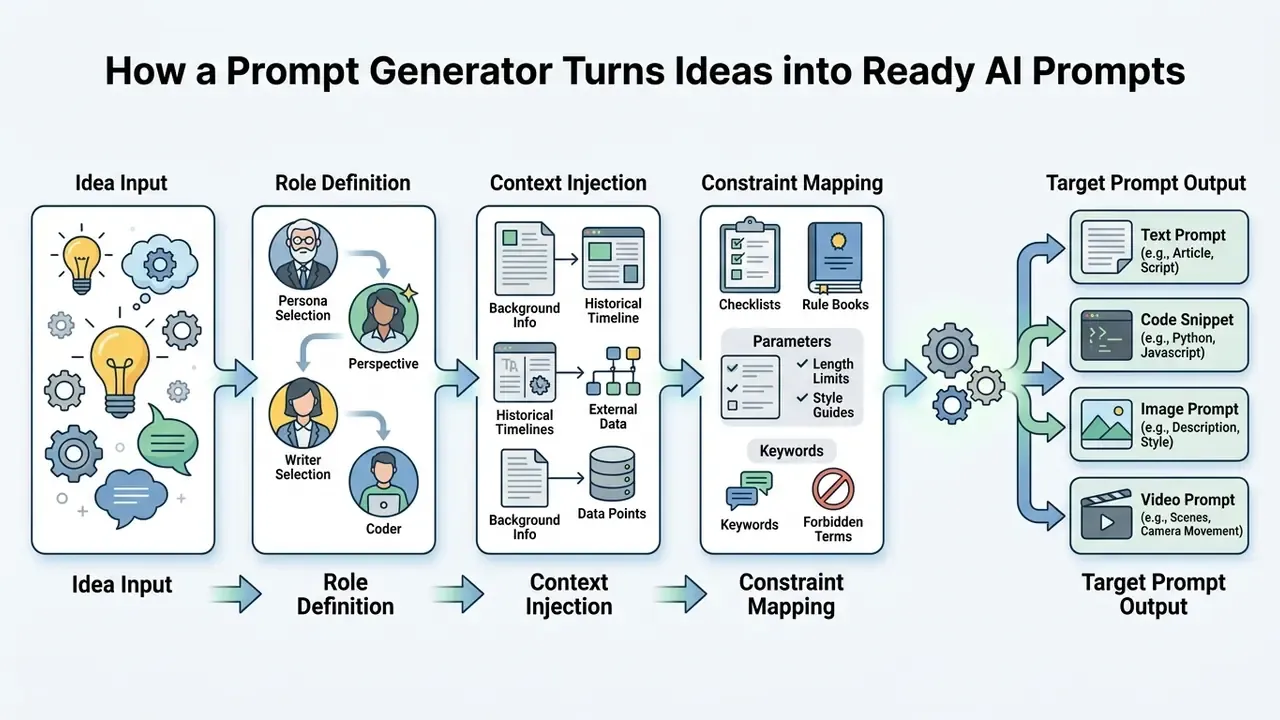
The process starts when a user enters a raw task description. The AI prompt creator then evaluates the target model architecture, injects required variables and appends explicit formatting instructions. This transformation is what makes the final AI generator text prompt repeatable rather than lucky.
«PE2 outperforms the "let's think step by step" baseline by 6.3 points on MultiArith and 3.1 points on GSM8K.»
That gap matters operationally. Meta-prompting, meaning you use a model to rewrite the instruction rather than the answer, is measurably better than a generic heuristic pasted at the end of a request.
Dynamic AI Prompt Generators vs. Static Prompt Libraries
Dynamic AI prompt creation tools construct tailored instructions in real time. Static prompt libraries offer generic, pre-written templates. Static libraries force manual editing of bracketed variables, which creates friction and quiet inconsistencies between team members. University prompt libraries confirm the design intent: you copy a template and replace bracketed sections with your own information, so the value is standardization rather than per-task generation.
A dynamic AI prompt examples generator adapts parameters to the specific context, model constraints and task goal.
Organizations using dynamic creation can refine prompts instantly, copy the generated code and keep an audit trail. The trade-off is discipline. Dynamic prompts must still land in a registry, otherwise every improvement disappears into private chat histories. That is the classic Shadow AI failure mode, and it usually surfaces during an audit rather than before one.
Types of Prompts You Can Create: Text, Code, Image and Video
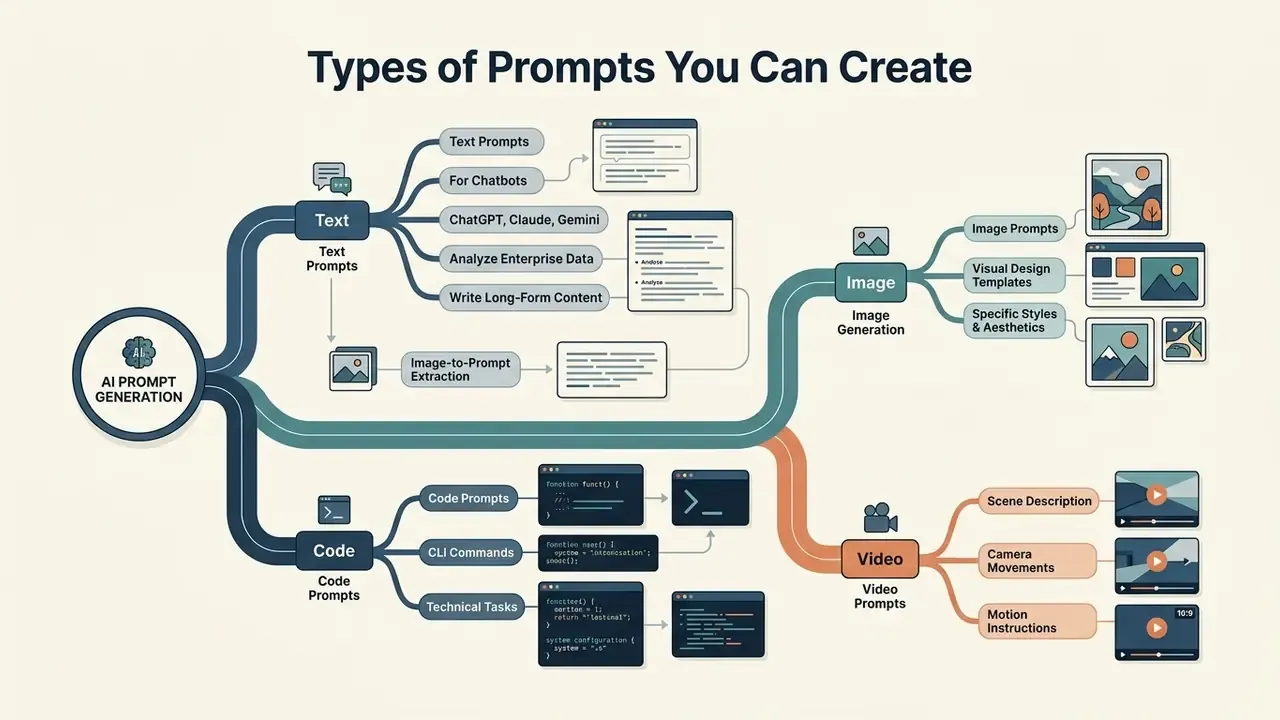
Modern prompt generation platforms support multimodal workflows across text, code, image and video inputs. Each modality needs its own parameter controls to keep execution stable. Text and code prompts prioritize constraints and correctness. Image and video prompts prioritize composition and temporal motion.
Prompts for ChatGPT, Claude, Gemini and AI Chatbots
An AI chatbot prompt generator structures conversational instructions for leading LLMs using system roles, developer messages and context boundaries. Syntax strategies differ by target architecture, and the differences are not cosmetic.
Anthropic Claude models respond best to top-loaded context enclosed in XML tags such as <document> and <document_content>, and they benefit from being asked to quote relevant passages before answering. OpenAI ChatGPT models prioritize developer instructions over user input. Google Gemini models recommend placing long background context first and the explicit query at the end. Picking the right generator AI workflow is what keeps response accuracy stable across a team.
Advanced reasoning models such as DeepSeek R1 and OpenAI o1/o3 need prompt structures focused on reasoning effort and explicit verification steps rather than rigid step-by-step scripts, because the chain of thought is generated internally. For open-weights architectures such as Llama 3 and Mistral, explicit system-prompt boundaries are mandatory to prevent scope drift across multi-turn execution.
Copy-paste template, enterprise analysis prompt:
[SYSTEM ROLE]: You are a senior financial analyst supporting a second-line model risk function.
[TASK]: Summarize the attached quarterly reconciliation report for a risk committee audience.
[CONTEXT]: Audience = CRO and Head of Model Risk. Reporting period = Q3. Materiality threshold = USD 250,000.
[CONSTRAINTS]:
- Maximum 300 words, no marketing language, no speculation.
- Flag every unreconciled item above the materiality threshold in a Markdown table.
- If a figure is missing from the source text, write "NOT IN SOURCE" instead of estimating.
[OUTPUT FORMAT]: 1) Three-bullet summary 2) Exceptions table 3) Recommended next action.
[INPUT DATA]: {paste_report_here}
Prompts for Image Generation and Visual Design
An AI design prompt generator creates descriptive prompts for visual models such as Midjourney, Stable Diffusion XL, DALL·E 3 and FLUX. It structures subject descriptions, stylistic references, camera framing and lighting conditions. Readers evaluating engines before writing prompts can compare output quality in our review of the best AI art generators, or study licensing nuances in the Ghibli-style AI image generator comparison. Adjacent visual workflows follow the same logic: a concept sketch pipeline built with an ai sketch generator needs the same subject and style separation as a photoreal product shot.
For visual projects, precise parameters steer artistic output. Strict subject and style separation prevents the model from blending a rendering technique into the object itself. In Midjourney, --ar 16:9 sets aspect ratio, --no handles negative exclusions, and --s (stylize) plus --chaos control artistic strength and variation, according to the official Midjourney parameter list (https://docs.midjourney.com/hc/en-us/articles/32859204029709-Parameter-List).
«A user-friendly prompt-generation framework improved visual appeal and text to image alignment by roughly 5% across six quality metrics.»
Midjourney and SDXL engineering parameter quick reference
| Use case / platform | Aspect ratio parameter | Negative prompt snippet | Stylize / quality flags |
|---|---|---|---|
| Social reels / TikTok (9:16) | --ar 9:16 | --no blur, cropped, oversaturated | --s 250 |
| Cinematic landscape (21:9) | --ar 21:9 | --no text, watermark, vignette | --style raw --s 750 |
| E-commerce product (1:1) | --ar 1:1 | --no shadow artifacts, bad hands, clutter | --q 2 |
| Presentation / slide hero (16:9) | --ar 16:9 | --no logos, extra limbs, distorted text | --s 100 --chaos 10 |
Not every engine accepts free-form ratios. OpenAI's image models expose fixed output sizes (1024×1024, 1536×1024, 1024×1536), so "aspect ratio" is set through the size parameter rather than a flag. Worth checking before you standardize a brand kit.
Copy-paste template, image prompt:
/imagine prompt: [primary subject + action], [environment and background detail],
[medium or artistic style: 35mm film / studio product photography / isometric 3D render],
[lighting: softbox key light, rim light, golden hour, volumetric],
[composition: rule of thirds, centered, low angle], [color palette]
--ar 16:9 --s 250 --no text, watermark, extra limbs, distorted hands
Two neighbouring cases deserve a caution. Branded typography work produced through an ai sign generator and identity artefacts produced through an ai signature generator touch trademark and authentication questions, so they belong in an approved workspace with logging, not in a random public utility.
Image-to-Prompt Extraction: Converting Visuals into Text Instructions
An image to prompt generator reverses the creative workflow. Instead of writing a description, you upload a reference image or paste a URL, and a multimodal model extracts the attributes that recreate it: subject matter, visual style, camera framing, lens characteristics, lighting setup and colour palette. Teams use it for moodboard replication, brand-consistent ad variants and reverse-engineering a competitor's visual language into a reusable prompt.
When using multimodal models such as GPT-4o, Gemini or Claude for extraction, run a structured analysis prompt rather than a vague "describe this image" request:
Analyze the uploaded image and generate a production-ready Midjourney prompt.
Break the analysis into:
1. Primary subject and action
2. Environment and background details
3. Artistic style / photographic medium (e.g., 35mm film, volumetric lighting)
4. Camera parameters (aspect ratio, focal length, depth of field)
5. Elements to exclude
Final output format:
"/imagine prompt: [subject], [environment], [lighting], [camera specs] --ar 16:9 --no [exclusions]"
Two governance caveats apply. First, an extracted prompt does not transfer rights: replicating a protected work through description can still infringe. Second, uploaded reference images may carry personal data or confidential product designs, so extraction should run inside an approved workspace rather than a public web utility. Reverse-lookup workflows are covered in more detail in our guide to AI reverse image search tools.
Prompts for Code, CLI Commands and Technical Tasks
An AI code prompt generator builds structured prompts for software development, terminal scripting and automated refactoring. It supplies explicit specifications: programming language versions, expected inputs and outputs, edge cases and unit tests. Vendor guidance separates two patterns. Completion prompts pair partial code with language and context. Debugging prompts pair an error message with reproduction conditions and a constraint on the fix.
Engineers using an AI command generator or AI command prompt generator cut syntax errors in shell scripts, which sounds small until a misquoted flag hits a production job. An AI prompt code generator enforces rigid output constraints, such as raw JSON or executable code blocks with no explanatory prose. Vague wording like "handle the error gracefully" should be replaced with explicit exception types and required messages.
Copy-paste template, code prompt:
[SYSTEM ROLE]: You are a senior backend engineer specializing in Python 3.12.
[TASK]: Refactor the attached function to reduce execution time and memory usage.
[CONTEXT]: The input stream receives 50,000 JSON payloads per second; the service runs in a container with 512 MB RAM.
[CONSTRAINTS]:
- Output ONLY executable Python code inside Markdown blocks.
- Include docstrings and full type hinting.
- Raise ValueError with the message "malformed payload" on schema mismatch.
- Zero explanatory text outside the code block.
[TESTS]: Provide three pytest cases, including one edge case with an empty payload.
[INPUT DATA]: {paste_code_here}
Prompts for Essays, Articles and Long-Form Content
| Modality | Primary focus | Target models | Key control parameters |
|---|---|---|---|
| Text and essay | Goal, tone, structure, audience | ChatGPT, Claude, Gemini | Developer instructions, context delimiters, length |
| Code and commands | Runtime, inputs and outputs, unit tests | Copilot, ChatGPT, Claude, DeepSeek Coder | Syntax rules, edge cases, zero explanations |
| Deep reasoning and math | Verification, decomposition, self-checking | DeepSeek R1, OpenAI o1/o3 | Reasoning effort level, explicit verification constraints, raw chain-of-thought preservation |
| Image and design | Subject, style, lighting, composition | Midjourney, SDXL, DALL·E 3, FLUX | Aspect ratio (--ar), negative prompts (--no), stylize (--s) |
| Image-to-prompt extraction | Attribute decomposition from a reference visual | GPT-4o, Gemini, Claude (multimodal) | Extraction schema, style vocabulary, exclusion list |
| Cinematic video | Motion, timing, camera angle, continuity | Sora, Veo 3, Kling, Runway Gen-3 | Camera motion (pan, tilt, zoom), frame rate, clip duration, shot transition |
Read the table as a routing map: the modality determines which control field you cannot skip. Teams selecting a video engine before writing motion prompts can review our comparison of free AI video generators and the implementation notes in the Google Veo API guide.
How to Use an AI Prompt Generator Online: Step-by-Step Guide
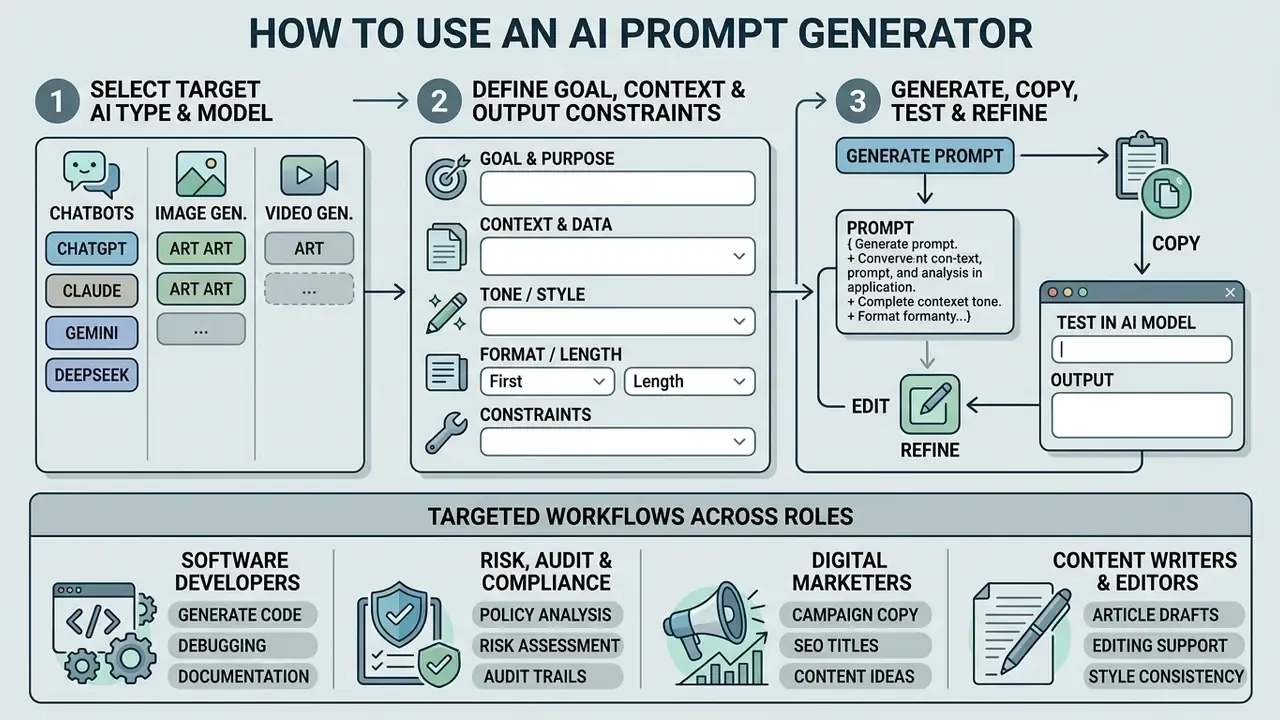
Using an AI prompt generator online takes a structured sequence to move from brief concept to executable prompt. A standardized workflow prevents prompt drift and lifts output quality.
1. Select Your Target AI Type and Model
Pick the target model family before drafting instructions, because syntax rules vary across providers. Deciding whether you run text, code, image, video or reasoning workflows determines the required control fields. Selection criteria mirror the foundation-model checklist used in public-sector guidance: task fit, data type, accuracy and latency needs, deployment constraints, privacy requirements, integration capability.
Illustrative case, composite and hypothetical: a financial engineering team evaluated automated documentation using generative AI. They configured an AI prompt creator to target Claude 3.5 Sonnet for code reviews and ChatGPT for executive summaries. After this model alignment, the team logged a materially lower rate of output-format rejections in their internal review queue. The exact reduction depends on baseline prompt quality and is not a portable benchmark.
«Model-specific optimized prompts show better transferability across tasks and across models.»
2. Define Goal, Context and Output Constraints
Enter the primary objective, domain background, tone, target audience and output constraints into the interface. An effective AI prompt generator online free tool uses these inputs to construct precise instructions. Keep context relevant and bounded, use Markdown or XML delimiters to separate instruction from data, and state both what the model must do and what it must never do.
When building brand collateral, teams often combine a motion prompt for text-to-video AI tools with dedicated text parameters, then compress deliverables with a video compressor before distribution. Clear constraints eliminate the ambiguous responses that force a second and third run.
3. Generate, Copy, Test and Refine
Click generate to create the structured prompt. Copy the resulting text into the target neural network, review the response, and adjust parameters where needed. Vendor engineering guidance is blunt on sequence: build representative fixtures, tests and evaluation checks before changing a prompt that already runs in production.
Advanced platforms offer version control for tracking prompt modifications over time, with immutable version snapshots and labels for release management. You can examine complete system capabilities in our AI Media Comparison breakdown. Developers looking for programmatic execution can open the hub for integration patterns.
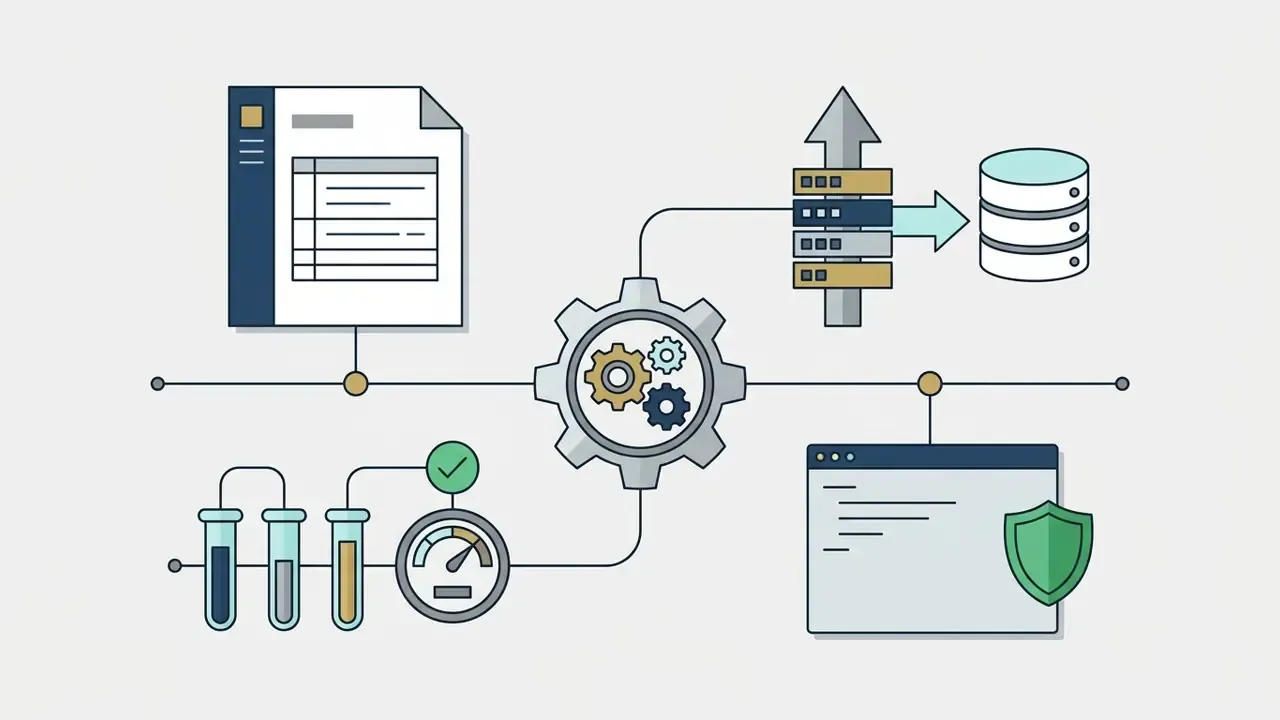
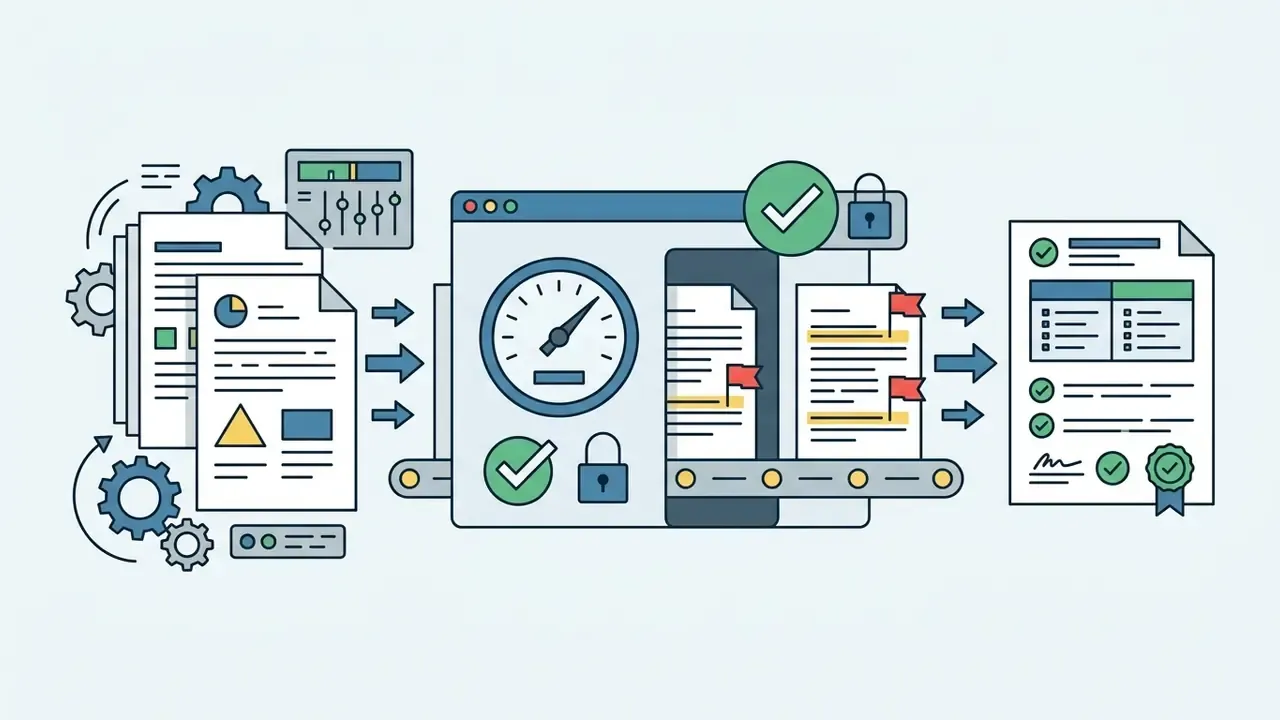
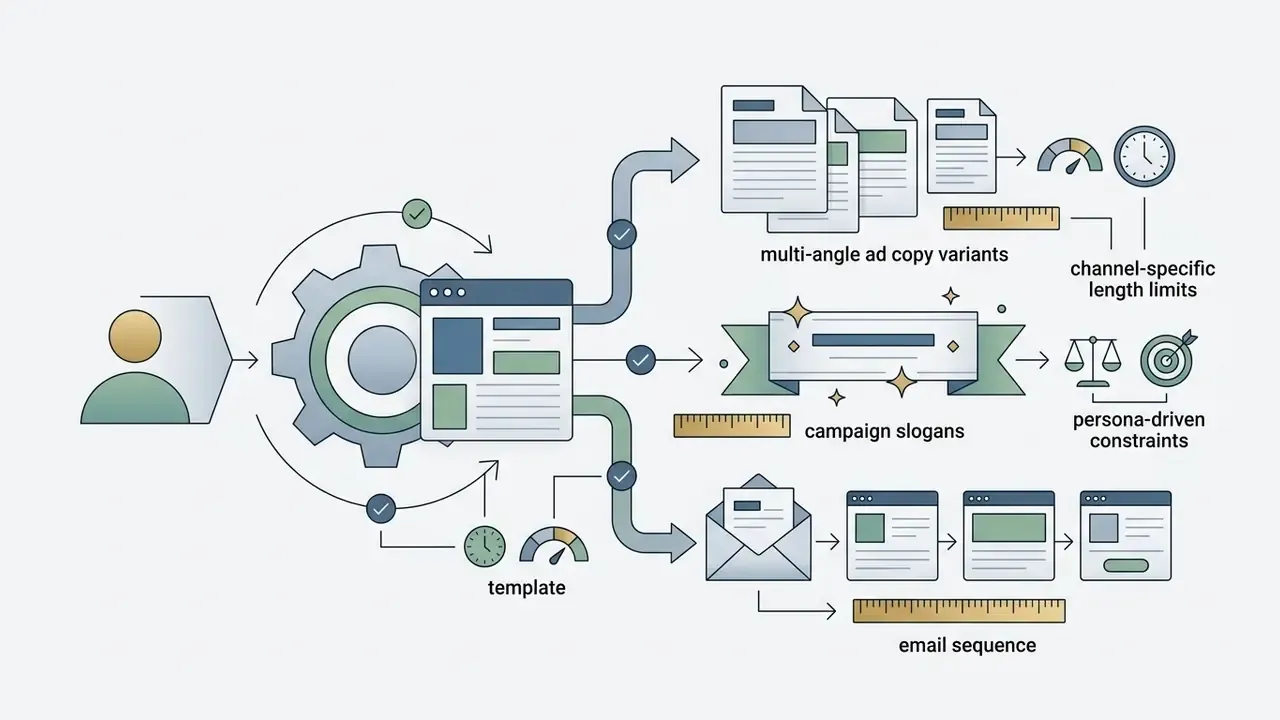
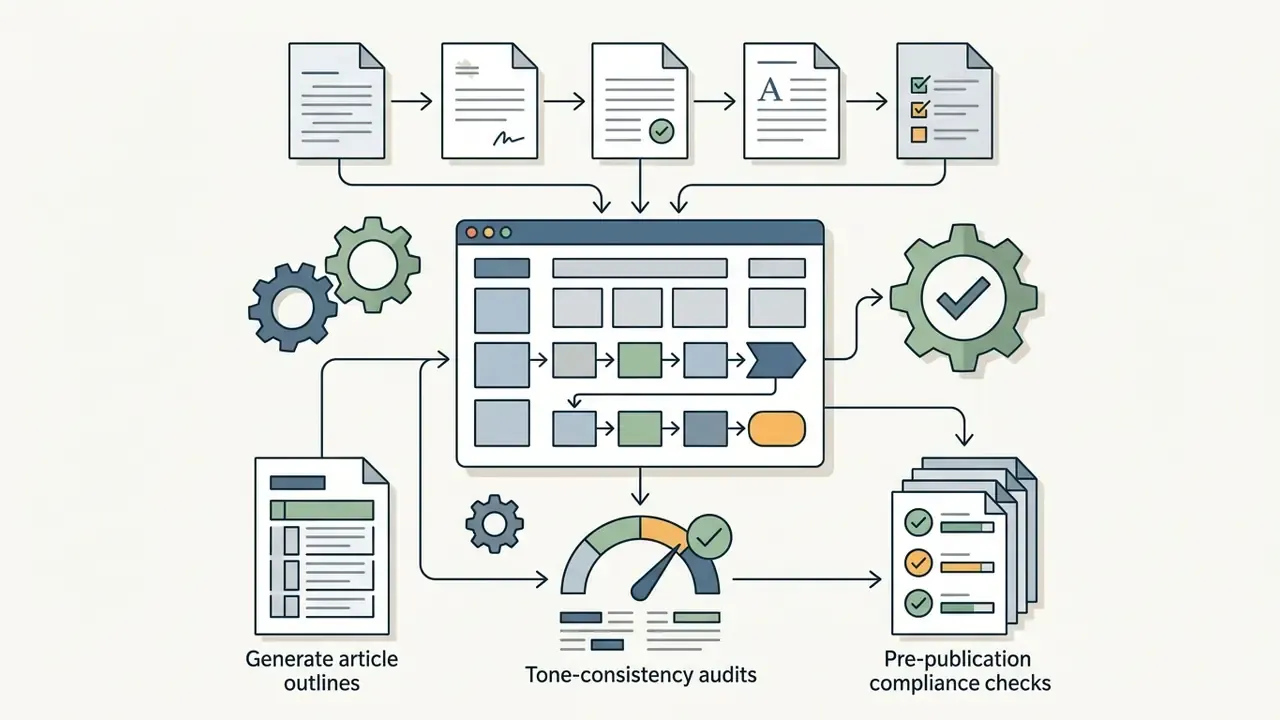
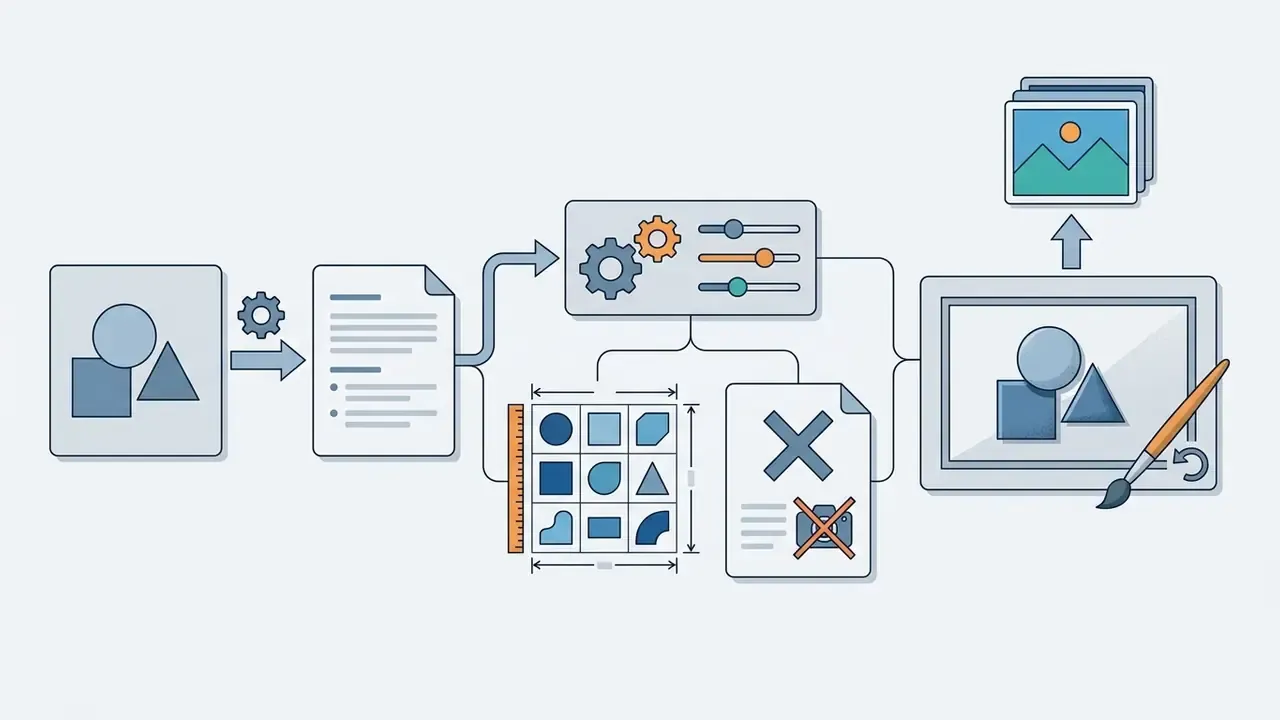
Targeted Workflows Across Professional Roles
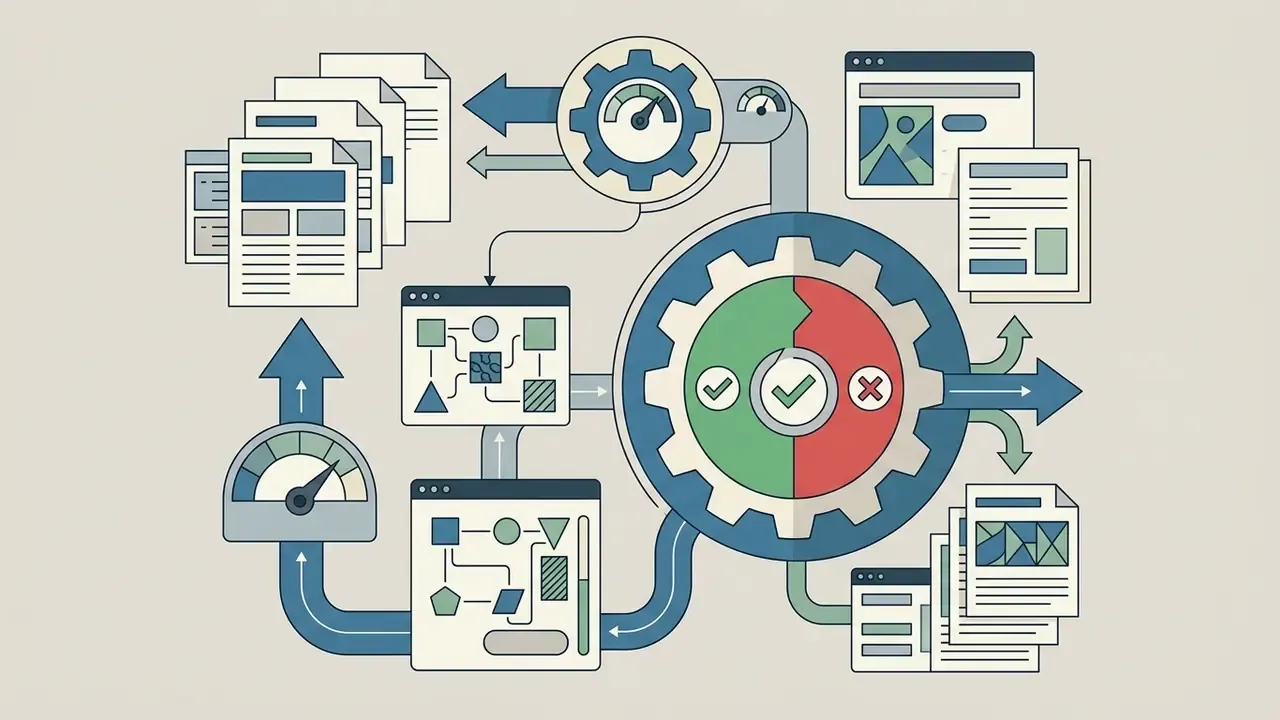
How to Get More Accurate Results from AI Prompts
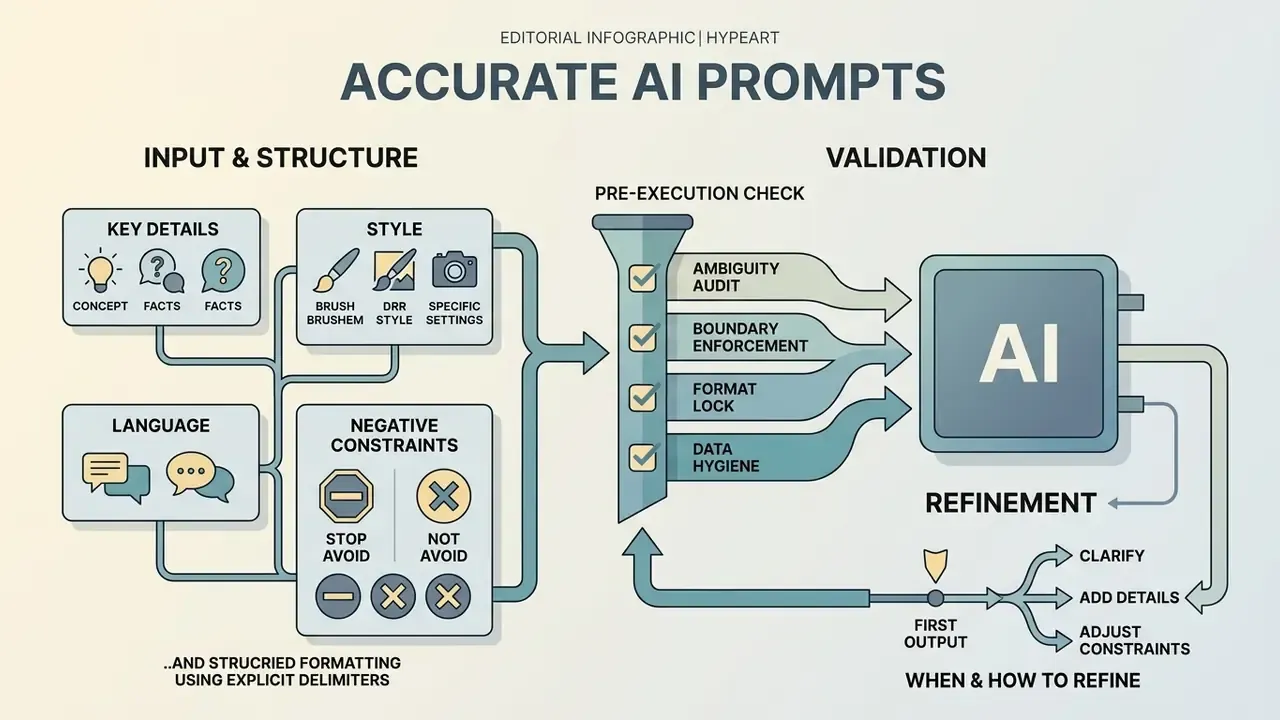
Prompt accuracy rests on clarity, structural delimiters, explicit constraints and iterative refinement. Unclear prompts raise output variance and invite hallucination.
Key Details to Include in Your Prompt
Every production-grade prompt should specify system role, task objective, context boundaries and output formatting rules. Omit those details and the model falls back on defaults you never approved. Public standards documentation groups the elements as context, style, tone, audience and response format, where "response" carries the explicit structure requirement.
Direct few-shot examples guide the model toward the expected formatting pattern.
Grounding rules matter as much as examples. Place the context block before the query, and define fallback behaviour explicitly, for instance: "if the answer is not present in the supplied context, reply NOT IN SOURCE." That single line removes a large share of confident invention.
Using Style, Language and Negative Constraints
Explicit style guidelines, language parameters and negative prompts suppress unwanted output elements. In image generation, negative prompts remove visual artifacts such as blurred background text, watermarks or extra limbs. Typical exclusion vocabulary includes blur, watermark, text, bad anatomy, extra limbs, plus style inverses such as cartoon when the target is photorealism.
Text models benefit from the same discipline: "do not include marketing buzzwords", "do not invent citations". Language handling has two viable strategies. Translate the instruction into English before inference, or keep prompt and answer language matched. Recent multilingual evaluations treat prompt language as an experimental variable rather than a fixed rule, so test both on your own task. Teams evaluating tool pricing can view the guide to estimate operational costs, or consult AI Media Support for technical troubleshooting.
When and How to Refine Your Prompt After the First Output
Refine when the output misses structural constraints, hallucinates facts or drifts from the assigned persona. The loop is empirical: generate output, identify specific defects, map each defect to one explicit prompt change, regenerate, stop when improvement falls below your threshold. One change per cycle, otherwise you cannot attribute the gain.
Stanford University's prompt-engineering primer makes the same point from the practitioner side: prompt engineering "often involves testing and refining prompts through multiple iterations", and added context improves relevance and precision (AI Demystified: What is Prompt Engineering?, Stanford University, 2024). If quality degrades, re-examine the system instruction before piling on more contextual text. Length is not a substitute for constraint.
Pre-Execution Check: Validating Prompt Quality
Before running high-cost API workflows or customer-facing generations, validate the generated prompt against four gates:
- Ambiguity audit.Does the prompt contain relative words such as "long", "short" or "fast"? Replace them with exact values ("300 words", "under 200 ms").
- Boundary enforcement.Did you state what the model must not do, and what to output when data is missing?
- Format lock.Is the output structure defined through an explicit schema (JSON, XML or a Markdown table) rather than described in prose?
- Data hygiene.Has personal or confidential data been removed, masked or tokenized before the prompt leaves your environment?
Fact check and verification:
Free AI Prompt Generator: Limits, Pricing and Commercial Use
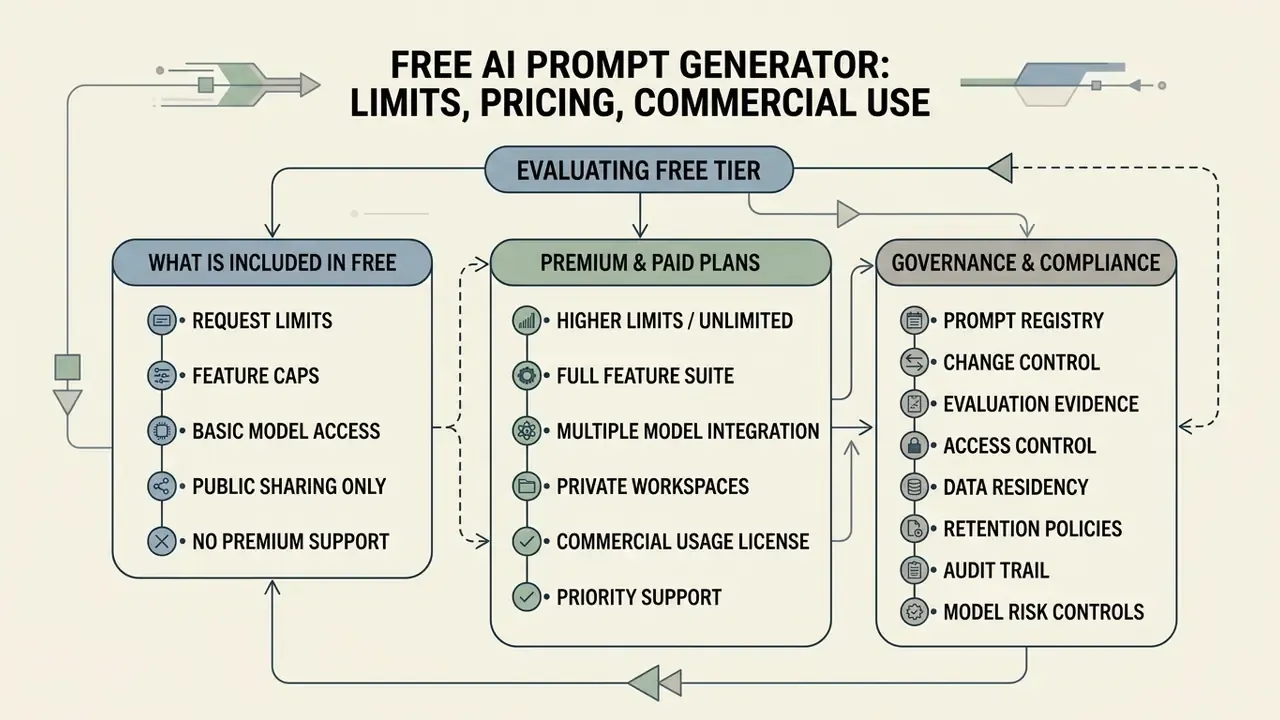
Evaluating an AI prompt generator free tier means reading three things: request limits, feature caps, business licensing terms. Keep basic web utilities and enterprise platforms in separate mental buckets.
What Is Included in the Free Online Generator
A basic AI prompt generator free online tool gives instant access to template generation without registration. You can build standard prompts for text and image models inside daily usage caps. Publicly documented free tiers range from "no limit, no account" to fixed guest caps of 1, 3, 5 or 10 generations per day, and as of early 2026 those caps still change without notice. Readers who specifically want free tools without sign-up should still verify the retention policy, because "no account" does not mean "no logging".
An AI free prompt generator usually restricts advanced features: bulk prompt optimization, custom system roles, historical versioning. Users looking for a simple AI prompt generator free tool can work through standard web interfaces without upfront fees. Comparable trade-offs in adjacent categories are documented in our review of free photo editors.
Governance, Audit Trail and Model Risk Controls
In regulated environments the differentiator is not prompt quality but evidence. A prompt that cannot be reproduced cannot be validated, and a workflow that cannot be validated should not reach production.
- Prompt registry. Store every production prompt as an immutable, versioned artifact with an owner, purpose, target model and effective date. Cloud prompt-management services define a version explicitly as a point-in-time snapshot used for deployment.
- Change control. Treat prompt edits like code: pull-request review, release tags, rollback paths. Version-controlling prompts and agent configurations is the documented practice for rollback and auditability.
- Evaluation evidence. Retain fixtures, test cases and evaluation results for each version so validators can reproduce the reported performance.
- Access control. Apply role-based permissions and separate who may experiment from who may save or publish to production. Some enterprise platforms enforce exactly this split at the role level.
- Data residency and retention. Confirm where prompts are stored, whether they are region-bound, and whether inputs are excluded from model training. Major enterprise providers state that customer prompts, grounding data and outputs are not used to train foundation models.
- Human oversight. Document the review step, the reviewer's role and the escalation path for anomalous output. That is the same expectation that model-risk frameworks such as the U.S. Federal Reserve and OCC supervisory guidance on model risk management (SR 11-7 / OCC 2011-12) and the NIST AI Risk Management Framework place on any quantitative tool used in decision-making.
Prompt risk checklist, five gates before production: no personal or material non-public information in the prompt body; explicit context boundaries and a documented fallback for missing data; a named output schema; a recorded prompt version and owner; documented human review before external use.
Limitations and Open Questions
Some things remain unresolved, and pretending otherwise would be dishonest. Prompt-level controls do not cover model updates pushed by a vendor, so a prompt validated in January may behave differently in June against a silently upgraded endpoint. Evaluation metrics for generative output are still weak proxies for business risk, especially in KYC, AML alert triage and credit narrative drafting, where a fluent wrong answer is more dangerous than an obviously broken one. Agentic workflows add a further gap: a prompt registry records instructions, not the tool calls an agent chose at runtime, so you also need action logs, defined access limits and a shutdown mechanism. No evidence, no autonomy.
Treat all of that as hypotheses to test with your own analytics and validation results rather than settled practice.
Commercial Usage Rights, Copyright and Privacy
This section is general information, not legal advice. Copyright, licensing and AI-content disclosure requirements vary by jurisdiction and by provider contract. Consult qualified counsel before commercial deployment.
Verify copyright ownership, data retention policies and public-training clauses before using generated prompts in business operations.
«Prompts alone do not provide sufficient human control to make users of an AI system the authors of the output.»
Two practical consequences follow. First, AI-generated material is registrable only for the human-authored contributions, which must be disclosed and separable. Second, a prompt itself may be protected if it is sufficiently creative, but that protection does not automatically extend to the generated file.
«Large-scale analysis of generative-art prompts shows users focus heavily on surface aesthetics rather than semantic content, which shapes authorship questions.»
Commercial deployment also means checking that provider terms prohibit training public models on customer inputs, and assessing publicity-rights exposure when outputs resemble a real person's voice or likeness. For business deployment frameworks, teams can open the hub to review licensing guidelines, examine platform-specific terms such as those covering the Canva AI generator, and view the guide on litigation and IP disclosure.
Comparison of free vs. premium AI prompt generator features
| Feature category | Free tier scenario | Premium enterprise tier scenario |
|---|---|---|
| Daily request limits | 1 to 10 generations per day (guest caps) | Unlimited or high-volume API quotas |
| Model support | Standard base models | All major LLM, reasoning and diffusion models |
| Version history | Not retained, or local storage only | Full cloud history, labels, instant rollback |
| Access control | Single user, no roles | Role-based permissions; separate save and publish rights |
| Audit trail | None or session-only | Exportable logs for GRC and model validation |
| Data privacy | Standard terms; queries may be logged | Zero data retention; encryption; region-bound storage |
| Commercial usage rights | Subject to base platform terms | Explicit commercial license and SLA |
Conditions and available features shift often, so confirm the current terms on the service page before you commit a workflow to a tier.
FAQ: AI Prompt Generator Questions
Can I create prompts in different languages?
Yes. An AI prompt generator free online platform supports multi-lingual prompt generation. You can enter task parameters in your native language and translate instructions into English to optimize performance on English-centric models such as Midjourney. Recent multilingual studies treat prompt language as a variable, so test both language-matched and English-translated versions on your specific task.
Do I need to register to use a free prompt generator?
Basic features in an AI prompt generator online free tool usually do not require account registration, and several public generators state that no account, email or credit card is needed. Premium capabilities are different: prompt version history, private storage, role-based access and API execution all require authentication.
Can I save and reuse generated prompts?
Yes. Advanced AI prompt creation tools let you save, tag, version-control and export prompts, and enterprise prompt-management services store each version as an immutable snapshot for deployment. A registry gives you auditability and team-wide reuse. Reuse should still include re-testing, since an optimized prompt can underperform once it is transplanted to a different task or model.
Can a prompt generator turn an image back into a prompt?
Yes. Multimodal models analyze an uploaded image or URL and return subject, environment, style, lighting and camera parameters as a reusable prompt. Use a structured extraction schema rather than an open-ended "describe this image" request, and keep confidential or personal images out of public tools.
Does a generated prompt give me copyright over the output?
No. According to the U.S. Copyright Office (2025), prompts alone do not establish human authorship of AI-generated output. Only separable human-authored contributions are registrable, and AI-generated material must be disclosed. This is general information, not legal advice.
Which models are worth targeting for reasoning-heavy tasks?
Reasoning-optimized models such as DeepSeek R1 and OpenAI o1/o3 handle decomposition internally, so prompts should set verification requirements and reasoning effort rather than dictate step-by-step scripts. For open-weights models such as Llama 3 and Mistral, keep explicit system-prompt boundaries to prevent scope drift across turns.
What is a safe next step for a regulated institution?
Start narrow. Pick one non-customer-facing workflow, register the prompt with an owner and a target model, define the fallback for missing data, and run a documented human review for a fixed period. If the evidence holds up under validation, widen the scope. If it does not, you have lost a quarter, not a control.
Footer / Hub Navigation
To explore our complete glossary of generative tools and model governance resources, open the hub for full technical documentation.