Last updated: 2026. Reviewed for governance alignment with NIST AI RMF 1.0, Federal Reserve SR 11-7 and OCC 2011-12 model risk guidance, and GDPR Articles 5 and 25.
Why should a Chief Risk Officer at a US bank care about a browser tool that scores essays? Because the same classifier is now embedded in vendor-management workflows, marketing review, and internal-audit sampling. The moment a probability score influences a decision about a person or a supplier, it becomes a model. And models need owners.
An ai generator checker is a specialized software tool designed to evaluate whether a text was produced by an artificial intelligence model, written by a human author, or created through a hybrid editing process. Modern institutions use these platforms to establish preliminary risk scores, analyze token predictability, and export auditable compliance reports.
On this page: what a checker evaluates, how detection works mathematically, accuracy and false positives, the scanning and remediation workflow, free tiers and integrations, pricing and security, audiences and specialized content types, FAQ, and governance recommendations.
What an AI Generator Checker Evaluates and How to Interpret Results
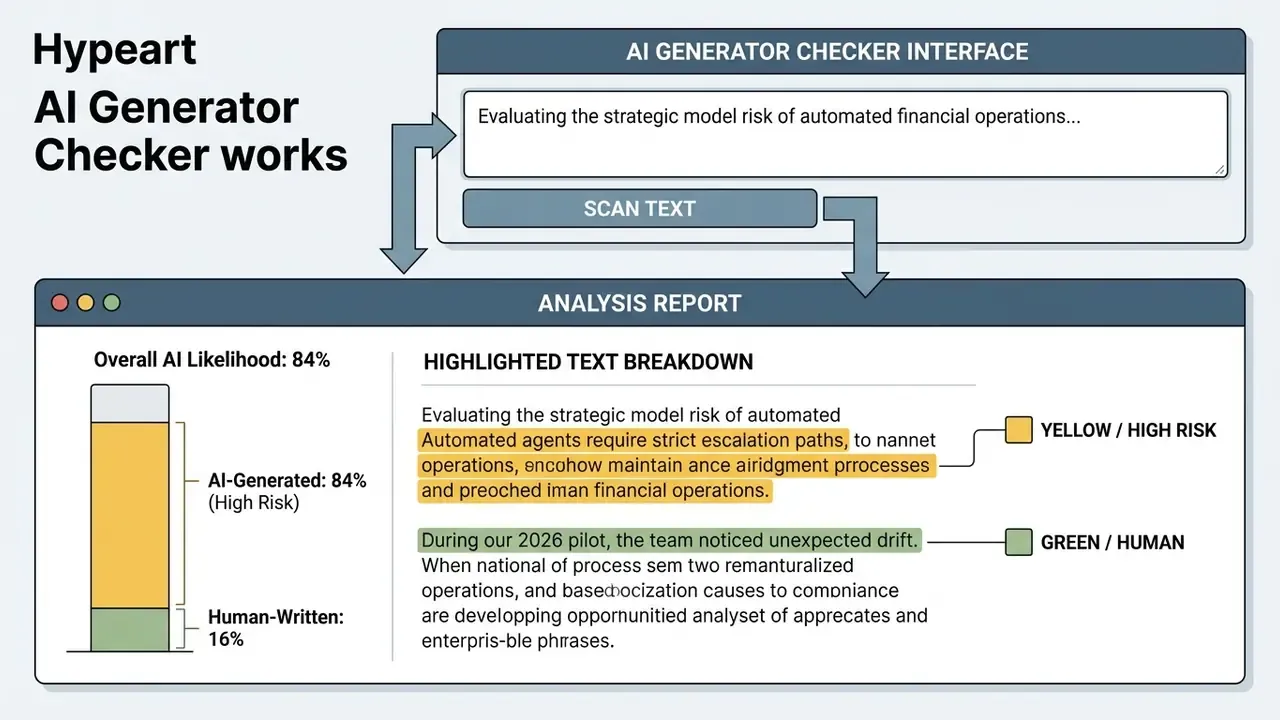
An ai generator checker evaluates statistical patterns across a body of text to estimate the probability that content was produced by an automated model. When you perform an ai generator check, the system analyzes structural uniformity, token distributions, and syntactic consistency to generate a document-level probability score and a line-by-line breakdown.
The Four-Level Content Attribution Model (Beyond "Human vs AI")
Treating authorship as a binary, human or machine, is the single most common interpretation error in institutional review. Advanced detection engines now classify submitted text across four attribution states, and each state carries a different governance response.
| Attribution class | What it means | Typical risk posture |
|---|---|---|
| 1. Fully AI-generated | Produced end-to-end by a language model with no human revision. | High risk: requires disclosure, sourcing verification, and rewrite. |
| 2. AI-generated and AI-refined | Drafted by one model, then paraphrased or "humanized" by another engine. | High risk plus evasion signal: paraphrase artifacts warrant manual audit. |
| 3. Human-written and AI-refined | Authored by a person, then edited by stylistic assistants (grammar, tone, or paraphrasing tools). | Low to moderate: usually permissible with disclosure; the top source of false-positive disputes. |
| 4. Fully human-written | Original authorship with natural syntactic variability and idiosyncratic phrasing. | Baseline: no action required. |
The practical consequence is straightforward. A 60% score on a document that is human-written and AI-refined is not the same finding as a 60% score on a document that is AI-generated and AI-refined. Any policy that collapses these four states into one number will generate disputes it cannot defend.
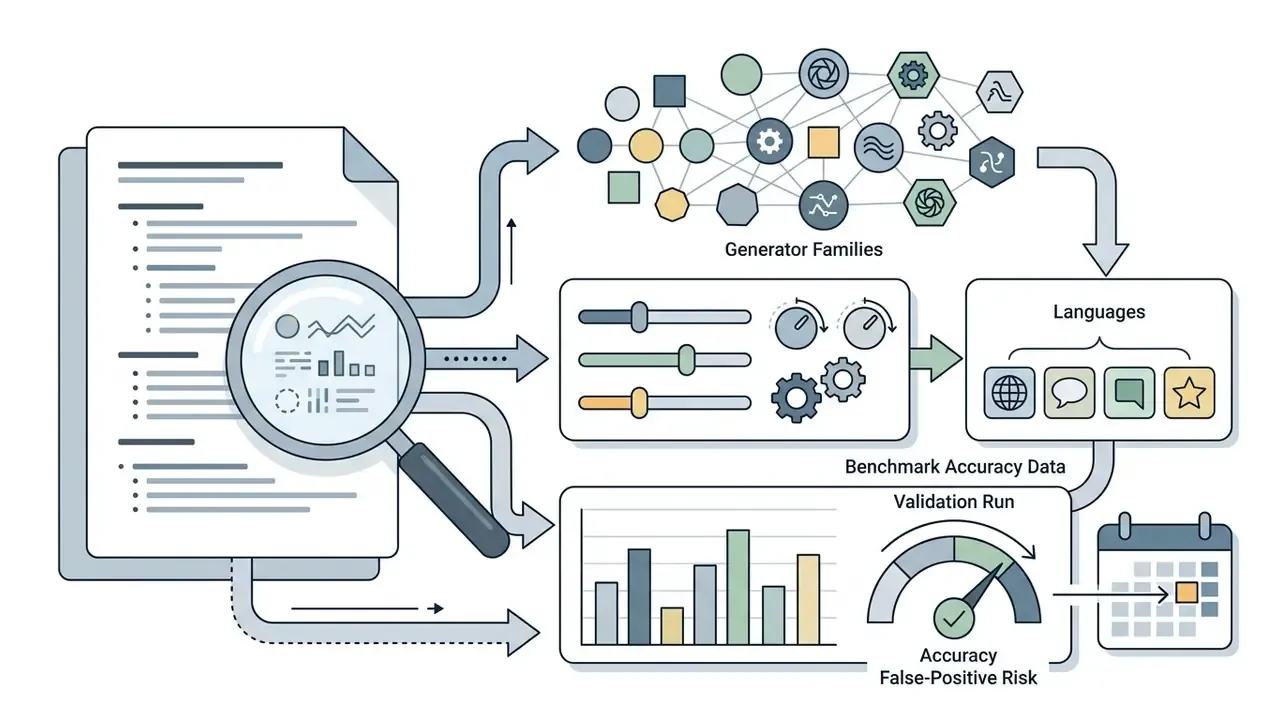
Which AI Models and Generators Detectors Can Recognize
"Simple changes to decoding strategy or repetition penalty produce a marked decline in detector performance: existing systems are easily fooled even without sophisticated attacks."
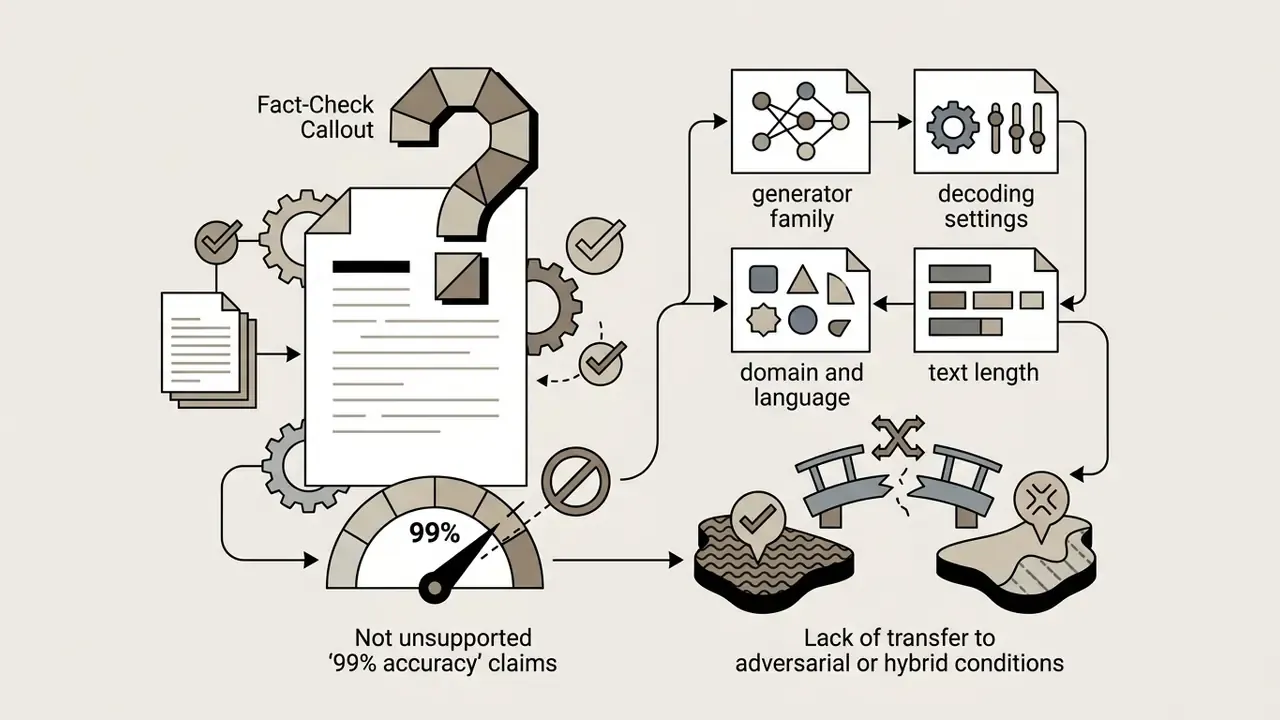
Recognition capability also degrades sharply whenever the tested generator differs from the generators used in training.
"Detectors trained on one set of generators generalize poorly to new models and domains: performance drops sharply when training and testing conditions do not match."
In operational terms: recognition drops when models use non-standard decoding parameters, custom system prompts, aggressive temperature scaling, or newly released architectures that post-date the detector's last retraining cycle. Put bluntly, a detector is always slightly behind the generator it is chasing.
AI Probability Scores, Sentence Highlighting, and Reports
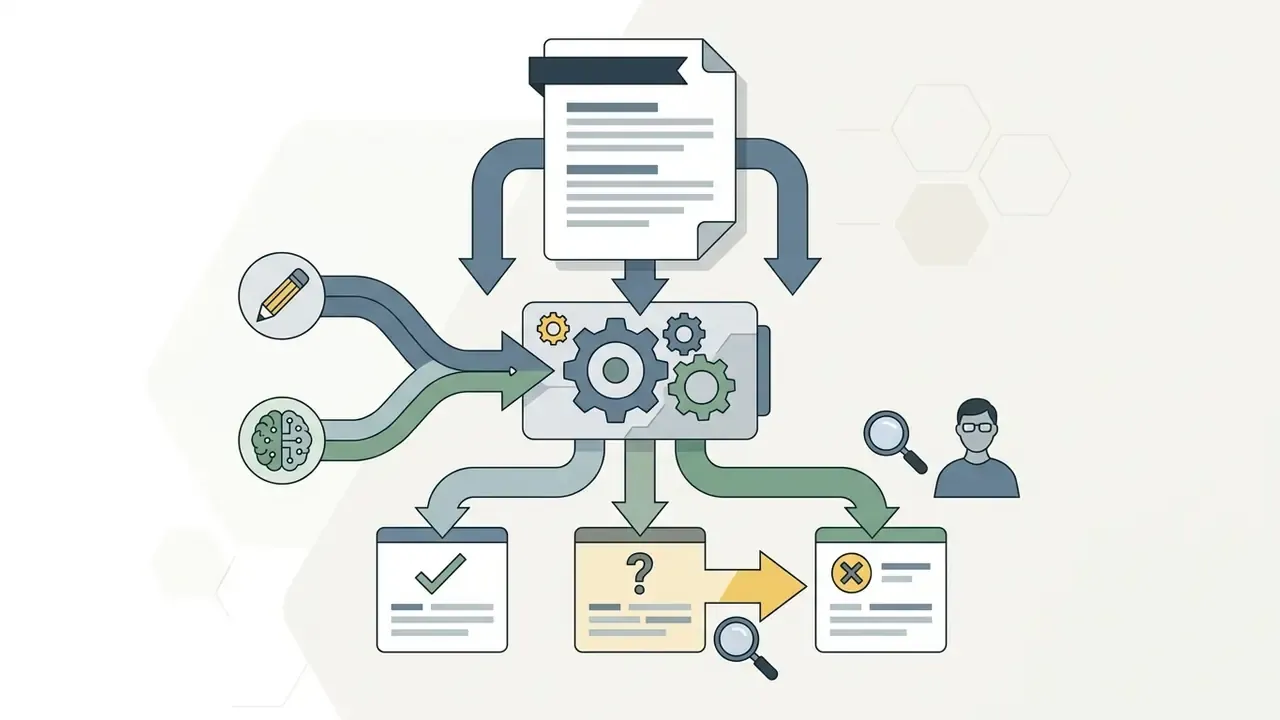
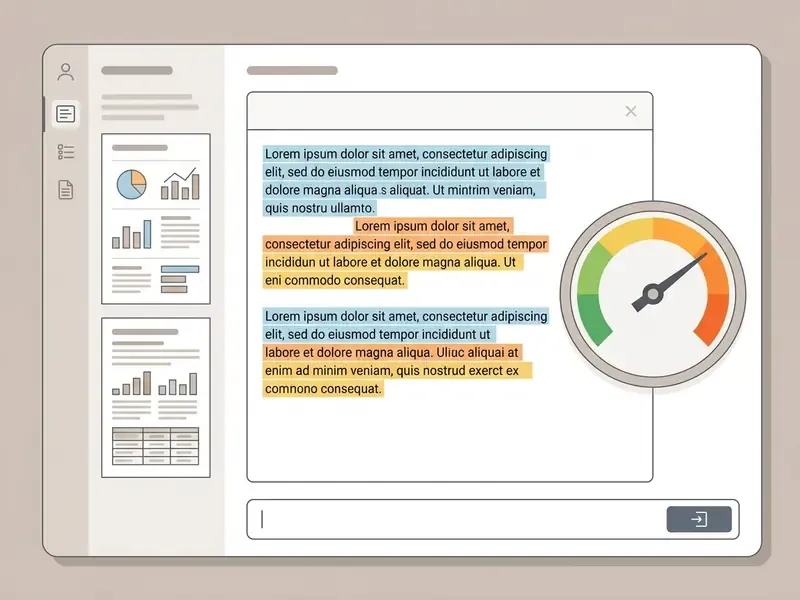
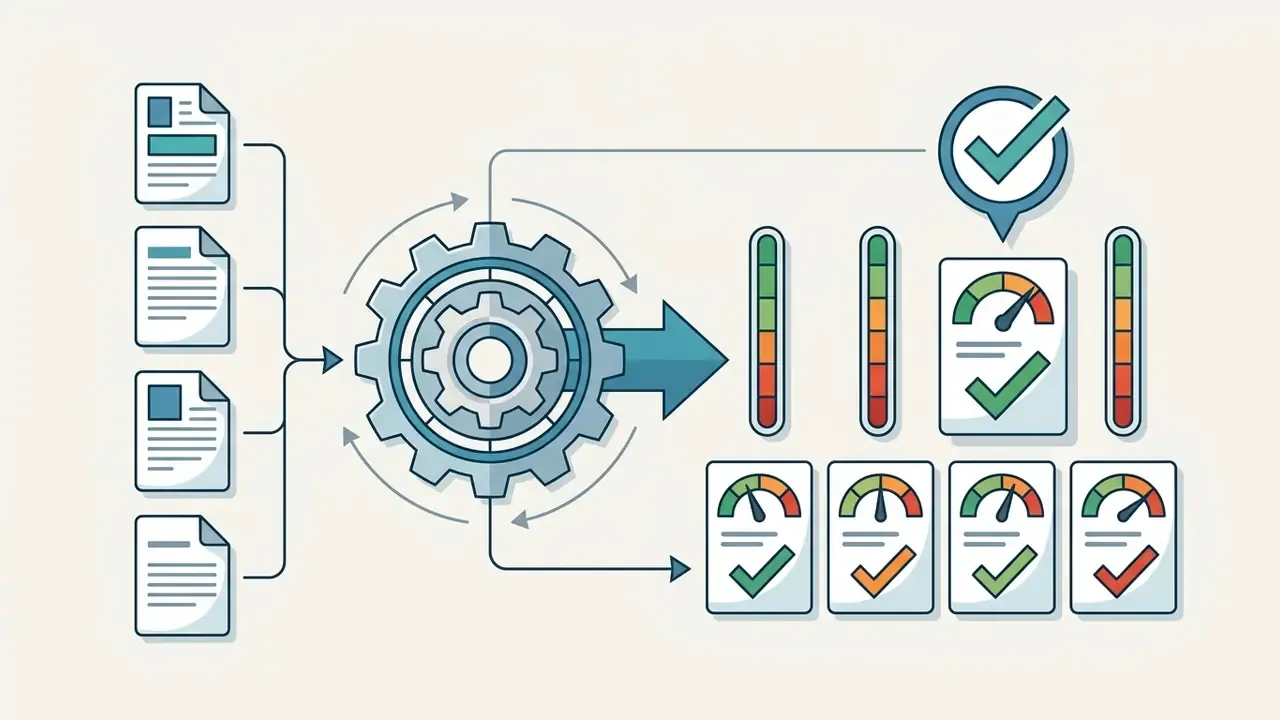
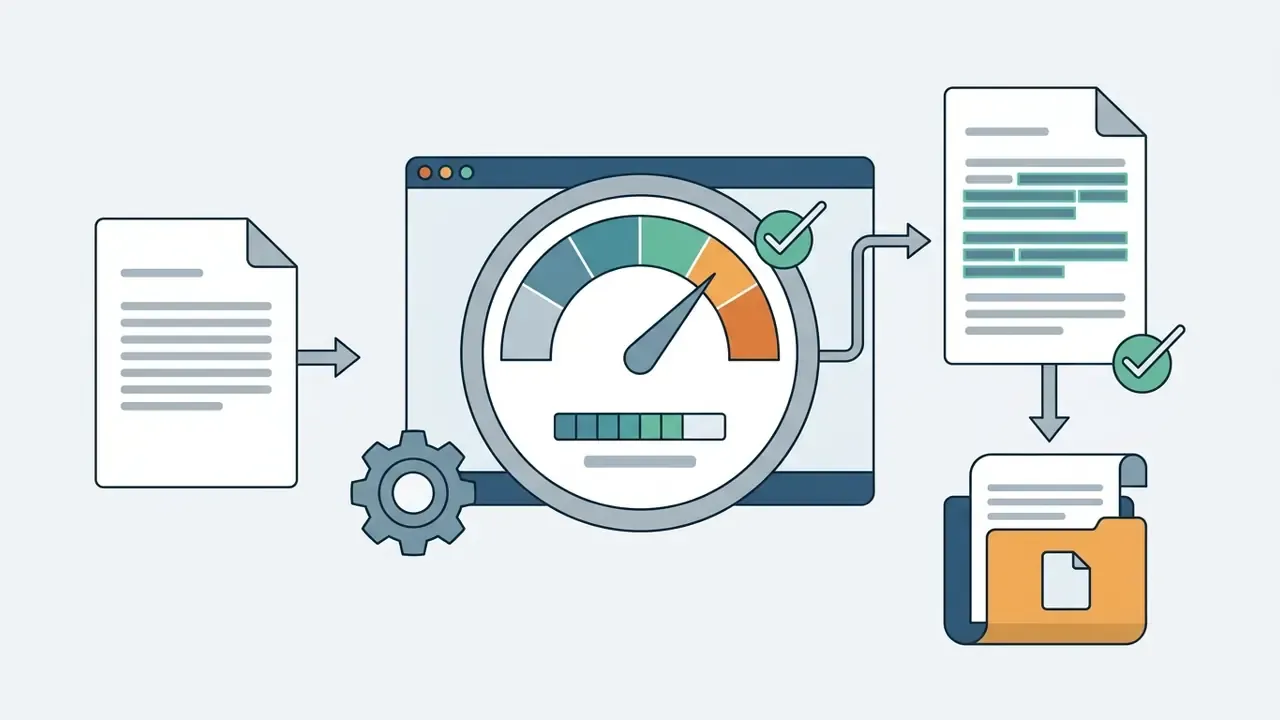
The output of an ai check generator typically includes three core elements: an overall probability percentage, sentence-level visual highlighting, and a downloadable diagnostic report. The overall score represents an aggregate probability across the entire document rather than a precise count of machine-written words. That distinction matters more than most reviewers assume.
Sentence-level highlighting flags specific text spans that exceed internal predictability thresholds. As documented in Sapling's technical specifications, individual sentences are scored on local perplexity and token selection probabilities; sentences with predictable word sequences are highlighted as potential machine outputs. Some engines use a sliding context window that assigns one score per sentence, which is why paragraph-level feedback can diverge from the document-level headline number. For comprehensive evaluations, users can generate exportable PDF reports that log document metadata, the overall ai detection score, and line-by-line analysis for compliance audits.
Interpretation guardrail: scoring scales are conventionally normalized between 0 and 1 (or 0 to 100%). Values near the top indicate probable machine generation, values near the bottom indicate probable human authorship, and the midpoint represents genuine model indecision rather than a "half-AI" document.
To explore related media workflows and creative automation tools, you can browse the hub for technical breakdowns and operational guides.
How AI Content Generator Detectors Work
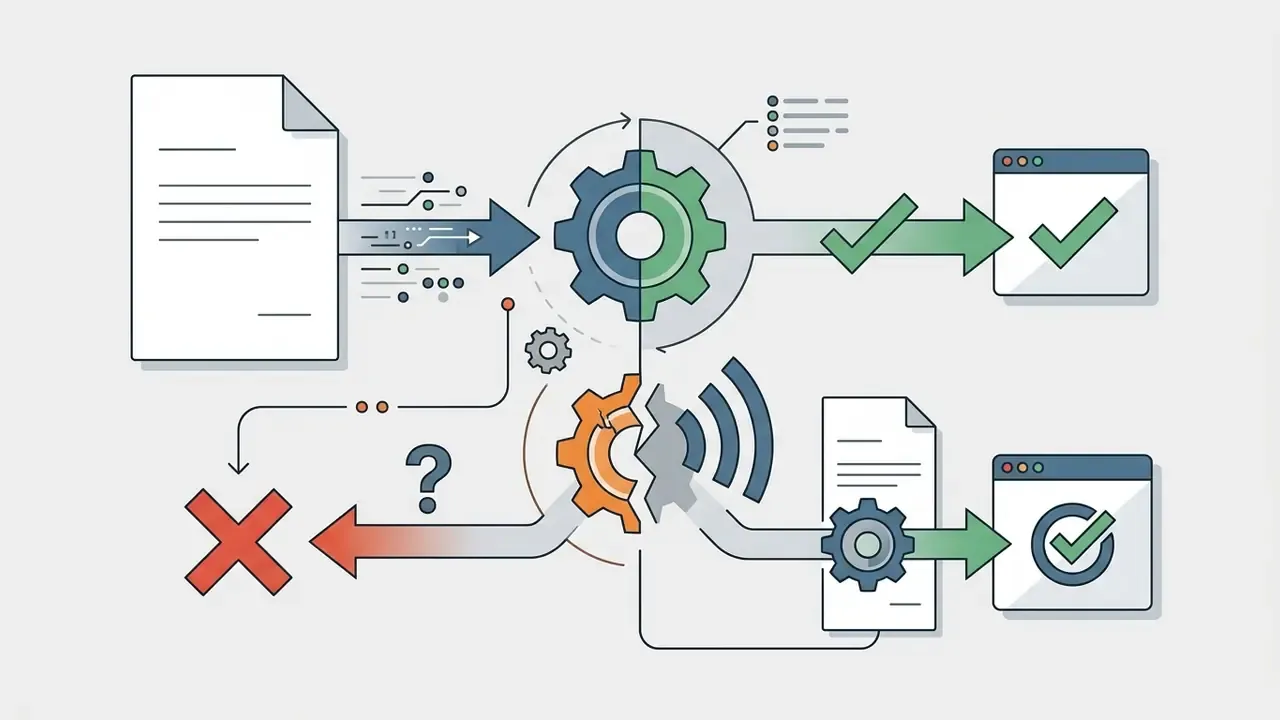
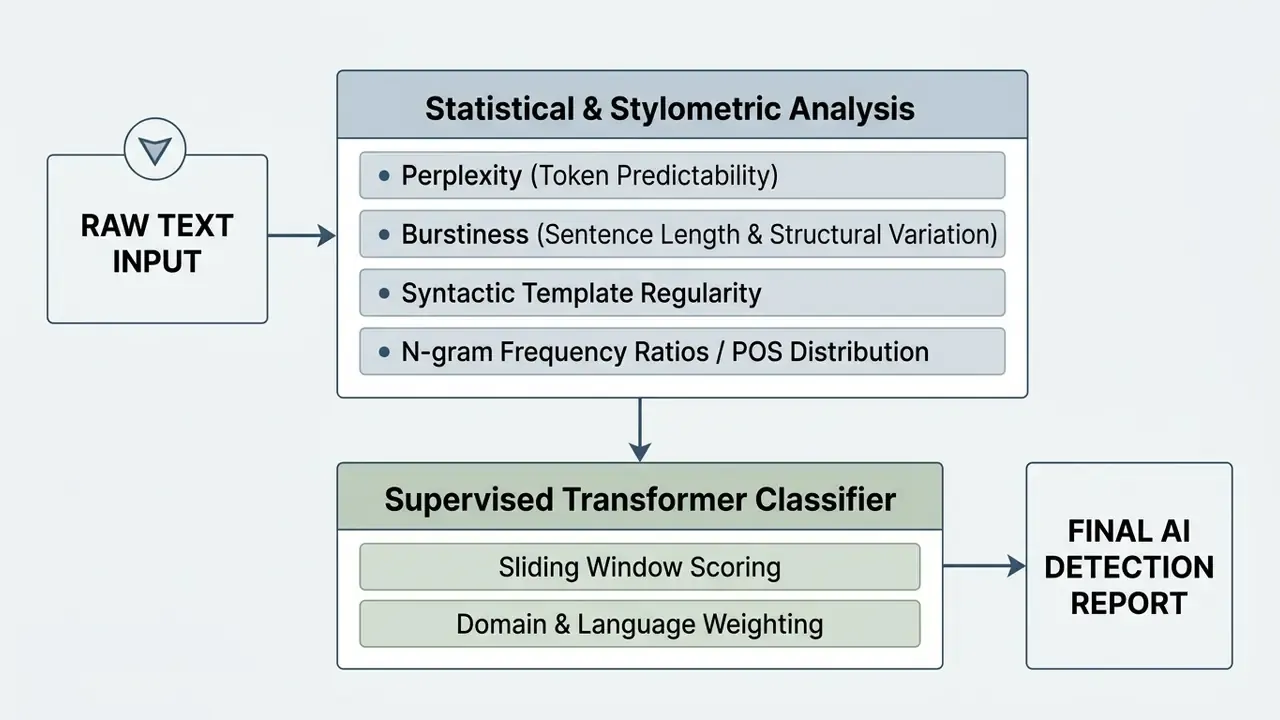
An ai content generator detector uses statistical models and supervised machine learning classifiers to determine whether a sequence of words matches the mathematical output patterns of generative AI. Rather than searching for exact matches across the web, an ai detect generator evaluates the internal structure of the prose itself.
Linguistic and Statistical Features Analyzed by AI Detectors
When tools detect ai text, they evaluate a stack of linguistic and distributional metrics, not one metric in isolation.
- Perplexity A measure of how likely a word sequence is within a language model's probability distribution. Human writing shows higher perplexity because of unexpected word choices, while ai-generated text selects statistically high-probability tokens, producing low perplexity.
- Burstiness The variation in sentence structure, length, and complexity across a passage. Human authors alternate between short, punchy statements and long, layered clauses. Models produce uniform sentence lengths and repetitive syntactic templates, so burstiness stays low.
- Lexical and Syntactic Patterns Supervised classifiers monitor overused transitions, repetitive vocabulary, and flat, neutral tone distribution.
- Frequency Ratios (N-gram Distribution) Word and phrase sequences are compared against large reference corpora of machine and human writing. Models over-produce a recognizable register ("delve", "testament to", "plays a crucial role", "in today's rapidly evolving landscape") at frequencies human corpora rarely match.
- Parts-of-Speech Distribution Grammatical composition is profiled: nominalization density, adjective stacking, participial openers, and the ratio of subordinate to coordinate clauses. Machine prose tends toward a narrow, highly stable POS mix.
- Syllable Dispersion and Rhythm Metrical structure is measured across sentence boundaries. Human text produces a jagged syllabic rhythm; generated text smooths into regular waves with low variance.
- Hyphenation and Punctuation Artifacts Tokenizer-specific habits, including dash frequency, hyphen compounding, serial-comma consistency, and list formatting conventions, leave family-specific fingerprints that classifiers weight as secondary signals.
"Detectors exploit differences in perplexity, burstiness, repetitiveness, and generality of writing: these are precisely the features that separate AI text from human text."
Independent reviews of AI text detection converge on the same conclusion. Low perplexity paired with low burstiness remains the primary statistical signal for flagging automated writing, while items 4 to 7 above operate as corroborating evidence. The literature also warns that these cues degrade under paraphrasing and topic shift, which is why single-signal detection is no longer considered defensible practice. Additional independent verification of feature weighting across commercial engines remains an open data gap, and we should say so plainly rather than imply consensus.
Why Detectors Must Evolve Alongside ChatGPT, Gemini, and Claude
An ai detection filter loses accuracy quickly if its underlying models are not retrained on outputs from the latest generative engines. The 2024 ACL benchmark study (RAID) showed that adjusting a model's repetition penalty or decoding settings can cause legacy detector accuracy to fall by up to 32 percentage points.
"RAID spans more than six million generations from eleven models with four decoding strategies and eleven adversarial attacks: none of the twelve detectors tested maintained robust accuracy."
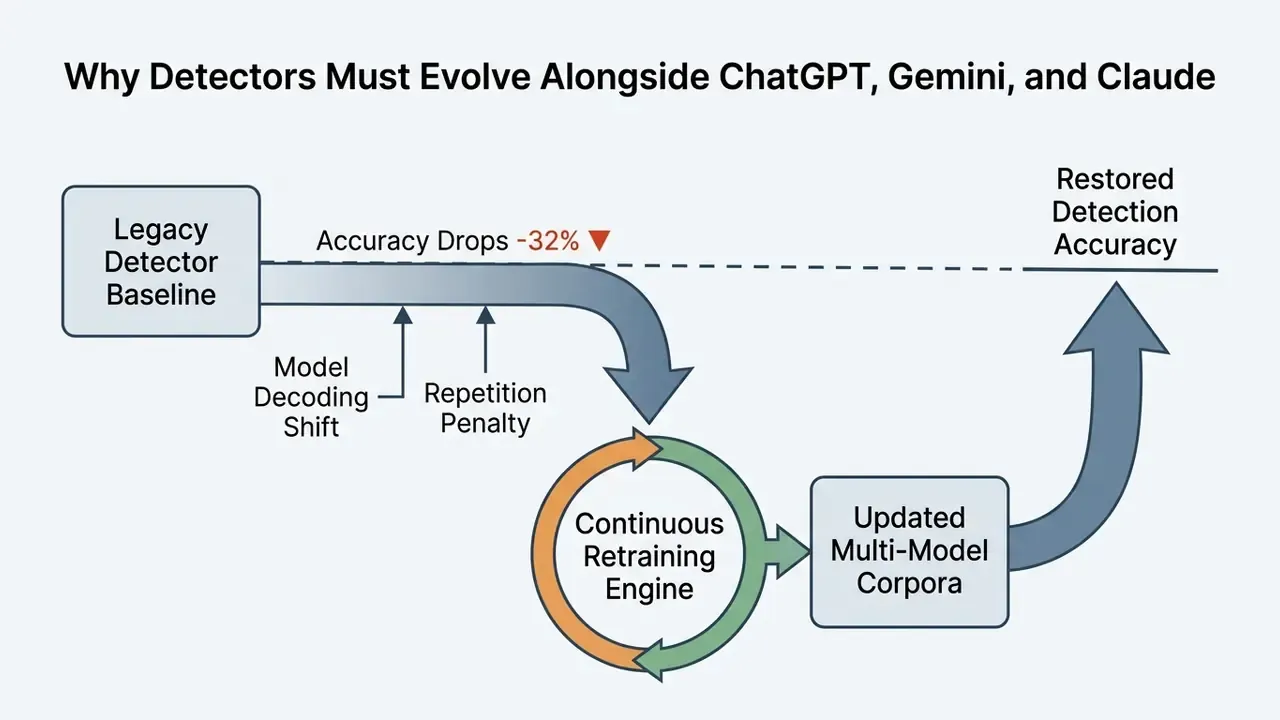
When new models such as GPT-5, Gemini 2, or Claude 4 are released, their token selection algorithms become more human-like. To maintain reliable detection rates, vendors must retrain classifiers using synthetic mirrors and hard negative mining across diverse LLM outputs. For model-risk teams the governance implication is direct: a detector is a model in the SR 11-7 and OCC 2011-12 sense, and its performance decays over time. Vendor retraining cadence, drift monitoring, and revalidation frequency belong in your model inventory documentation, not in a procurement footnote.
How AI Detection Differs from Plagiarism Checking
AI Detector Accuracy: Limitations, False Positives, and Verification Reliability
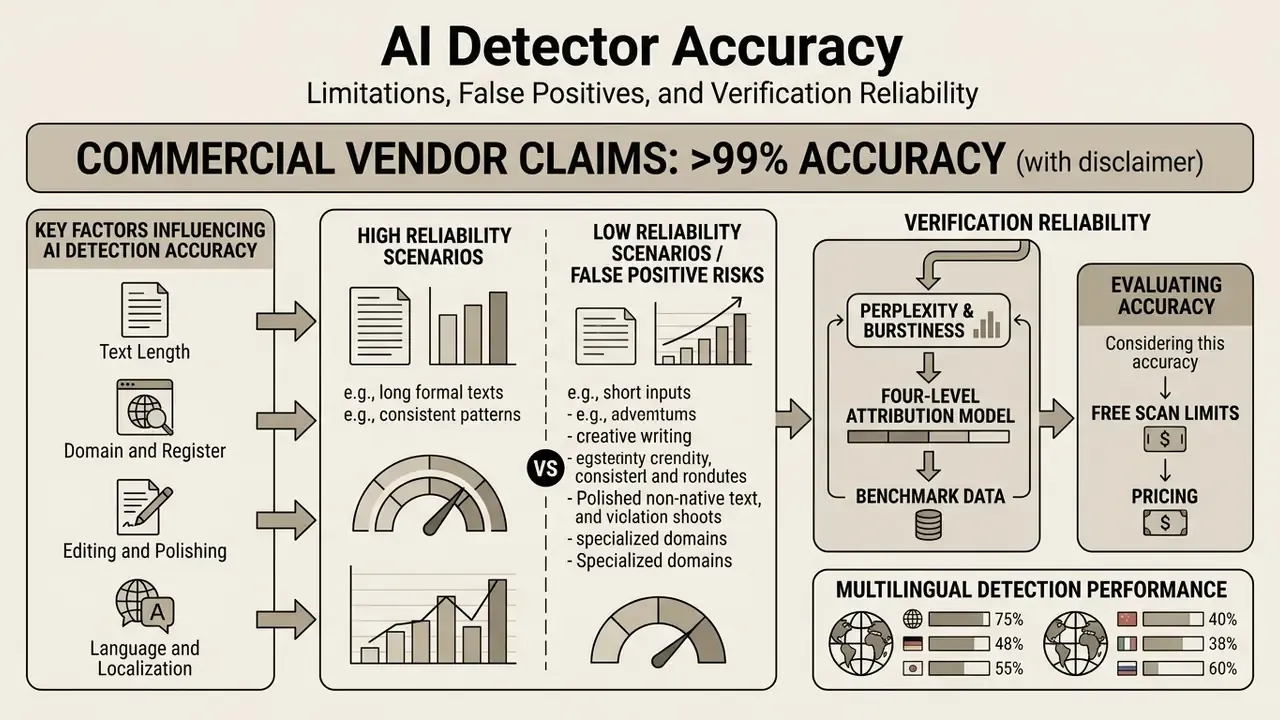
Commercial vendors claim accuracy above 99%. Independent empirical studies tell a messier story: real-world performance varies with content length, topic domain, and editing history. Published evaluations from the past three years place detector accuracy anywhere between 55% and 97%, with false-positive rates from 1.3% to 50% depending on dataset and population.
AI Detection Accuracy Matrix
| Content type | Typical true positive rate | False positive risk level |
|---|---|---|
| Pure AI, long form (500+ words) | 85% to 95% | Low |
| Hybrid or lightly edited AI | 40% to 65% | Moderate |
| Short paragraphs (under 50 words) | 20% to 45% | High |
| Non-native or ESL essays | Frequently misclassified | Very high (up to 50%) |
| Formulaic professional prose (legal, financial, technical) | Unstable | High |
Key Factors Influencing AI Detection Accuracy
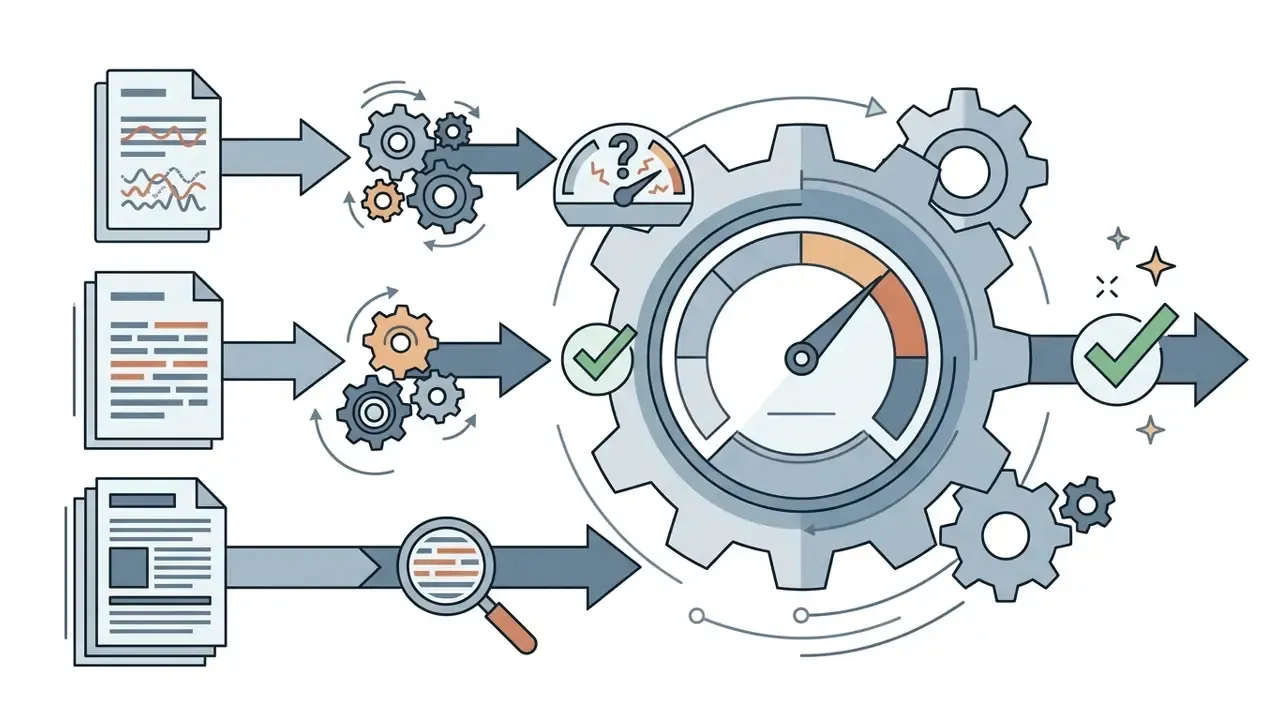
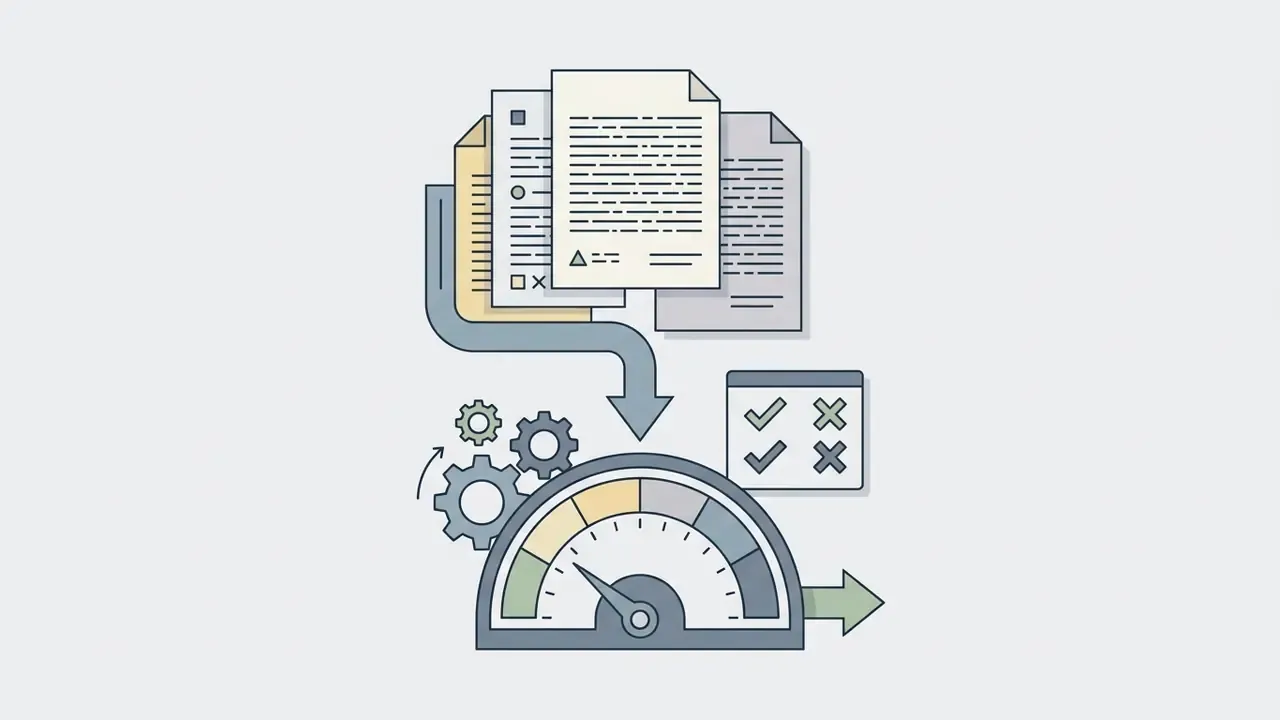
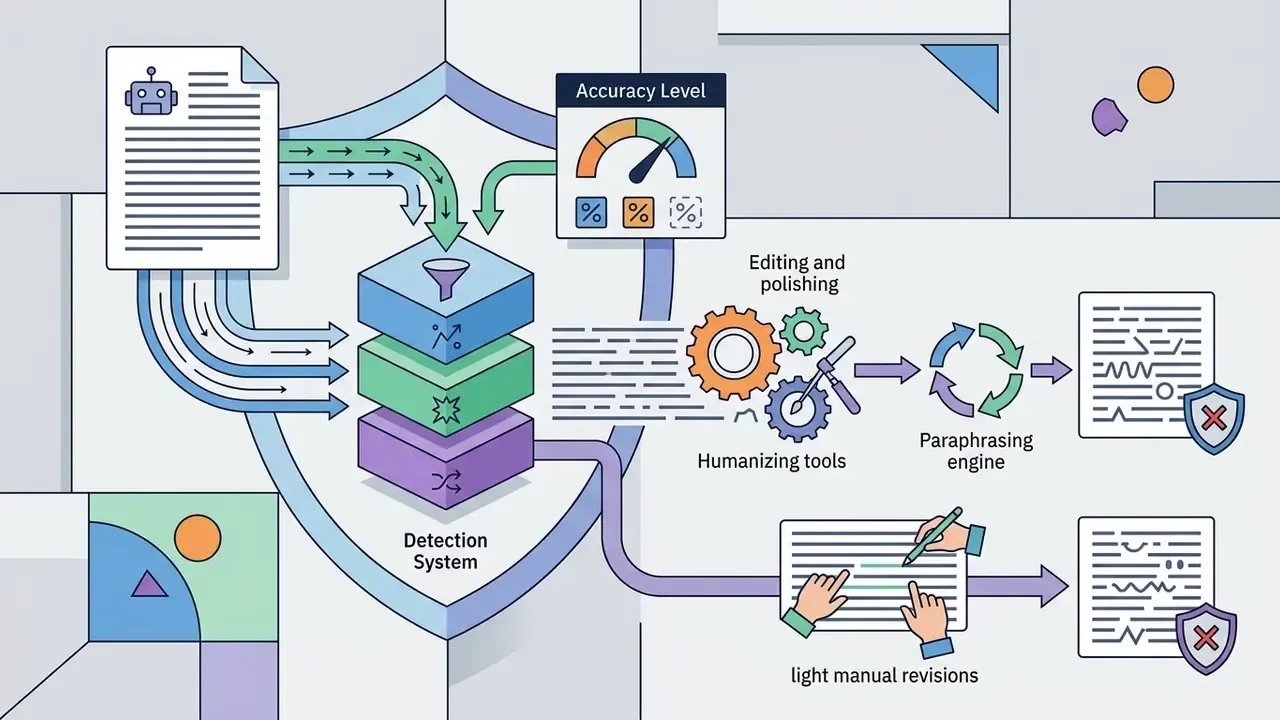
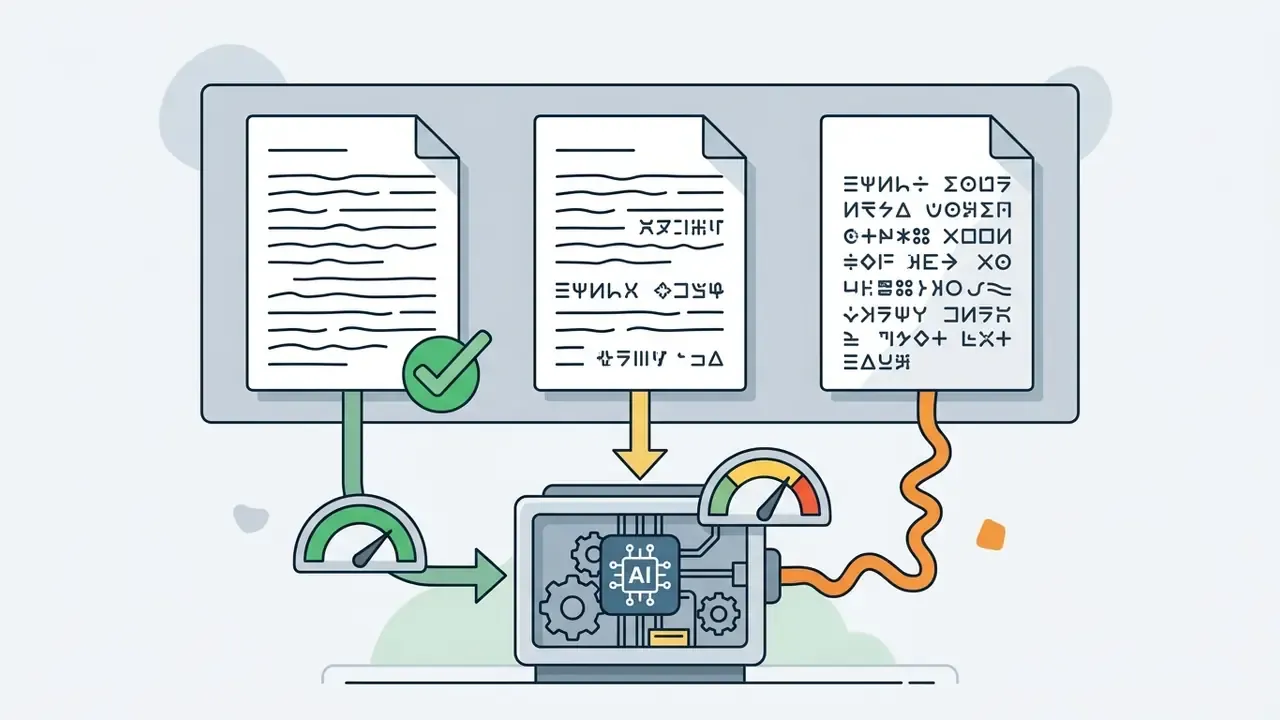
The effectiveness of an ai detector generator depends on four structural variables.
Multilingual Detection Performance
| Language | AI-text detection accuracy | False positives on human text |
|---|---|---|
| English | ~99.2% | < 0.03% |
| Spanish | ~98.0% | < 0.15% |
| Italian | ~97.0% | < 0.12% |
| French | ~96.2% | < 0.12% |
| German | ~95.6% | < 0.06% |
| Portuguese | ~93.1% | < 0.05% |
| Low-resource, localized, or ESL-authored | 50% to 65% | Up to 50% (high risk) |
These figures reflect vendor-published multilingual benchmarks for well-resourced European languages and should be treated as upper bounds rather than guarantees. Independent replication across low-resource languages remains limited. Language coverage also differs sharply by provider: some detection APIs support 30 languages with automatic language identification, while certain content-safety models are validated for English only or for a set of eight major languages.
When False Positives Occur in Human-Written Text
A false positive occurs when an ai filter for text incorrectly flags authentic human writing as machine-generated. A 2026 study on L2 academic writing documented false-positive rates as high as 50% on essays written by non-native English speakers (ESL). Non-native authors often use standardized grammatical templates and a narrower vocabulary, which statistical models misread as low perplexity.
"ZeroGPT and GPTZero show high false-positive rates on human texts: fewer than half of cases are classified with full confidence under a strict binary approach."
Similarly, highly structured human writing, such as academic abstracts, legal agreements, or technical documentation, triggers false flags because of formulaic syntax and predictable vocabulary. The risk escalates further as soon as any AI assistance touches the draft.
"With minimal AI polishing, even 1% of tokens edited, GLTR flags 26.85% of such texts as AI-generated; false-positive rates rise sharply."
For a bank or insurer, that finding is the operational crux. An analyst who runs a human-authored disclosure through a grammar assistant has materially increased the probability of a false flag without changing the substance of the document. Nothing improper happened. The control still fires.
Why a Single AI Checker Cannot Serve as Sole Proof
"Pangram reached 92.5% accuracy on hybrid texts, while Turnitin classified 100% of fully AI-written papers as false negatives under a threshold below 20%."
Consider an illustrative, hypothetical scenario drawn from common industry patterns rather than a named client. A financial institution reviewing compliance documentation runs everything through a single ai content generator checker. The system flags 35% of human-authored risk disclosures as machine-generated. After implementing a cross-verification protocol that combines two independent detectors with manual editorial review, the organization reduces false-positive escalation from 35% to under 1.2%, preserving reviewer capacity. The controlling documents in that program are NIST AI RMF 1.0 (context establishment and measurement functions) and the institution's existing SR 11-7 validation standard, which requires documented performance monitoring for any automated screening control. Treat the numbers as a modeled example, not a published result.
Fact-Check Callout: What the Benchmarks Actually Show
To compare how distinct automated content engines manage licensing and usage boundaries, explore our AI Media Comparison Matrices for structural evaluations.

How to Check Text, Essays, or Short Paragraphs with an AI Checker Generator
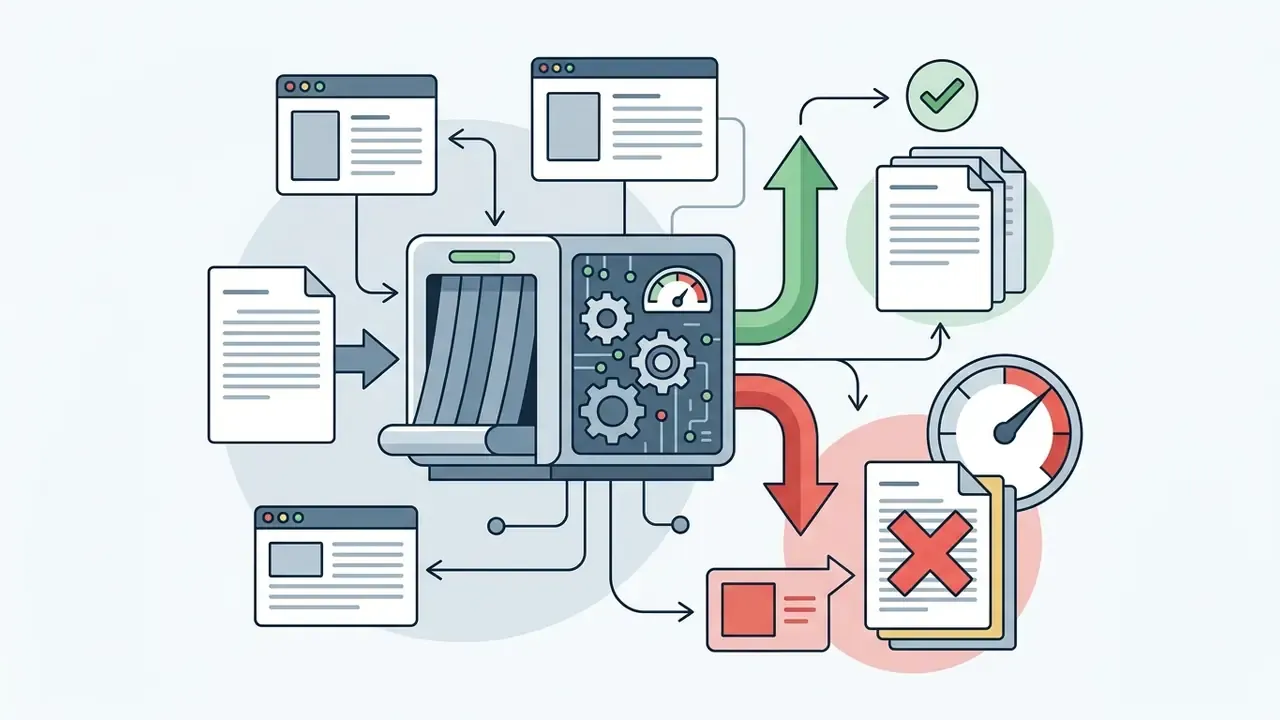
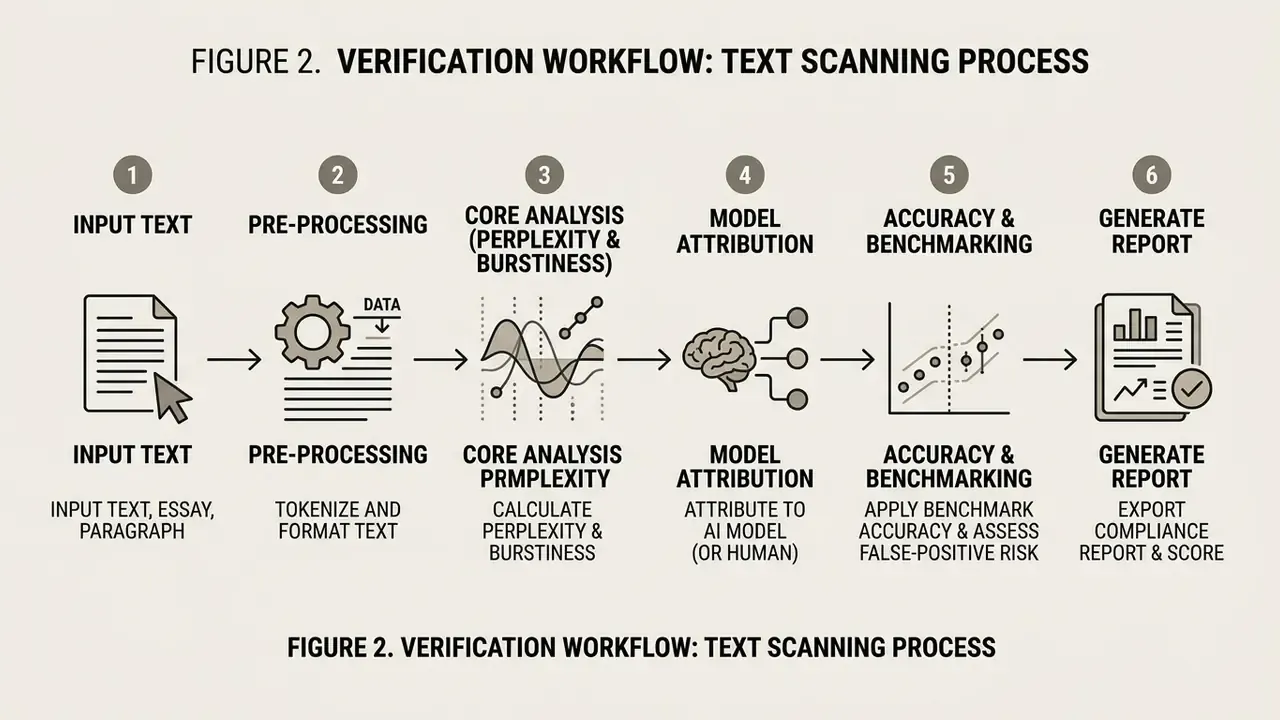
To get usable output from an ai checker generator, operators need a structured verification workflow rather than a single raw score.
Analyzing Short Paragraphs and Brief Snippets
Running an ai detector short paragraph scan presents a real technical problem. On fragments under 50 words, statistical classifiers often display an "insufficient evidence" warning or swing wildly between runs.
Technical research on short-text detection suggests that passages between 50 and 150 words are suitable only for preliminary triage, while reliable statistical analysis requires roughly 150 to 250 words to measure burstiness and perplexity distributions with any stability. Independent academic testing reaches the same conclusion: commercial detector accuracy declines measurably on passages under 50 words because shorter samples supply fewer discriminative features.
"Social media texts, short and informal, pose particular difficulty for detectors: performance varies substantially across languages and platforms."
A practical rule for compliance teams: do not scan a single chat message, a ticket comment, or a caption and expect a defensible answer. Aggregate first, then scan.
Evaluating AI Essay Generators and Academic Writing
When using an ai essay generator checker or applying an ai filter for essays, institutions and students need to align verification with academic integrity guidelines rather than with a raw threshold.
Modern academic governance frameworks, such as Penn State's 2026 AI Detector Guidelines, emphasize that an ai essay generator detector score should serve merely as a conversation starter. Instructors are advised to review student outlines, Google Docs version histories, and source citations alongside automated ai filter check reports before making formal integrity claims. Comparable positions have been published by the National Academic Integrity Network, the University of Pittsburgh (which disabled its Turnitin AI detector), and Clemson University. All state that detector output alone cannot support a misconduct charge.
"Detection tools should not be used as sole evidence in high-stakes situations: they must form part of a broader assessment strategy that accounts for context and human judgment."
Enterprise readers can apply the same principle to contractor deliverables. Disclosure requirements, draft retention, and interview-based verification are more defensible than a threshold rule, and considerably cheaper to litigate.
How to Fix Flagged Passages Without Degrading Quality
A score without a remediation path is an unusable control. When a paragraph is highlighted, the objective is not to "beat" the detector but to restore the specificity and variability that machine prose lacks.
- Break sentence-length uniformity.Merge two short declaratives into a complex sentence, then split an overlong sentence into two sharp claims. Target visible variance in clause length across each paragraph. That is burstiness restoration.
- Remove predictable connective clichés.Delete or replace marker phrases such as furthermore, moreover, in conclusion, it is important to note, delve into, plays a pivotal role, in today's rapidly evolving landscape. Substitute concrete transitions that carry argumentative weight.
- Inject first-hand experience and hard data.Add dated events, named systems, internal metrics, jurisdiction-specific rules, and non-generic analogies. A sentence containing "in our Q3 2025 pilot across 412 credit memos" cannot be produced by a model that never ran the pilot.
- Replace nominalizations with verbs.Convert "the implementation of a validation procedure was undertaken" into "we validated the procedure." Machine prose over-nominalizes; strong editorial prose does not.
- Vary paragraph architecture.Avoid the recurring three-sentence pattern (claim, elaboration, summary) and the reflexive use of tricolons.
- Preserve authorship evidence.Keep version history in Google Docs or Word, retain outlines and research notes, and where the platform supports it, enable authorship-tracking features that categorize text by origin (typed, pasted, AI-generated). Process evidence is the strongest rebuttal to a false positive.
- Re-scan and compare deltas.Run the revised text through the same engine and at least one independent engine. Log both the before and after scores in the audit record.
For organizations building automated text, notification, or audio workflows, review our technical guides on the ai message generator and the ai midi generator to see how structured prompt design and output logging affect downstream verification.
Standard Verification Workflow
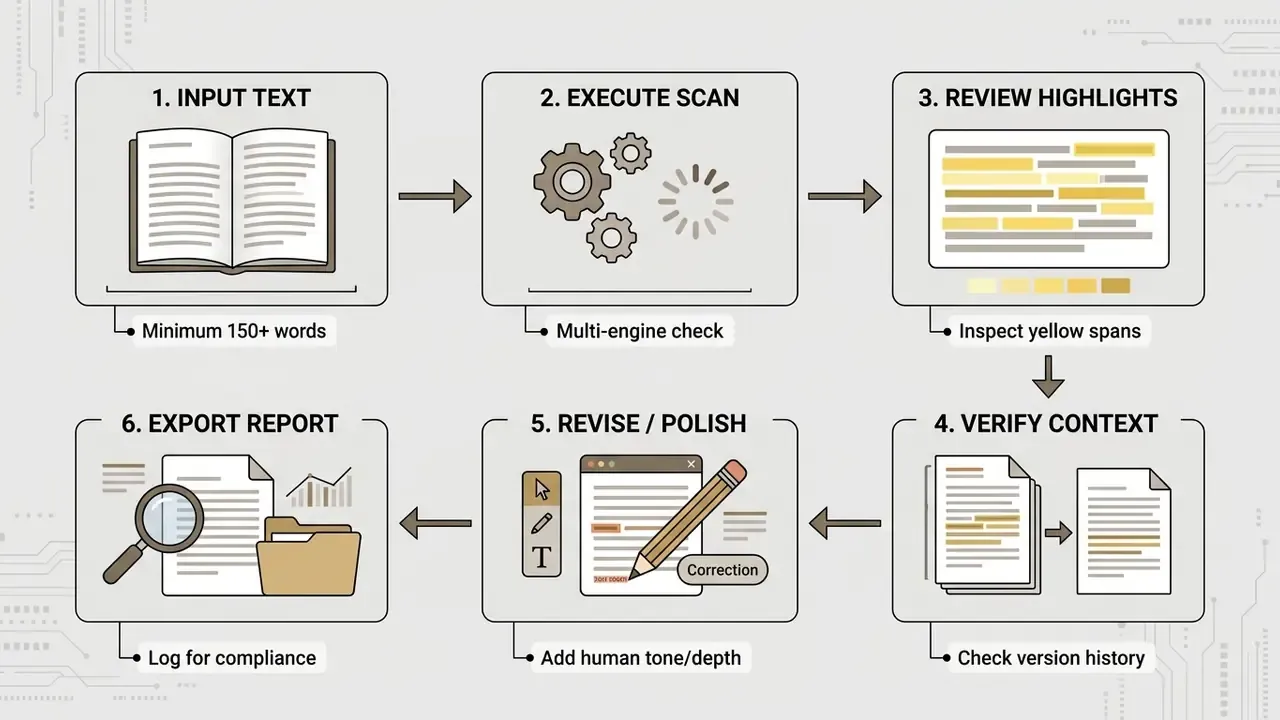
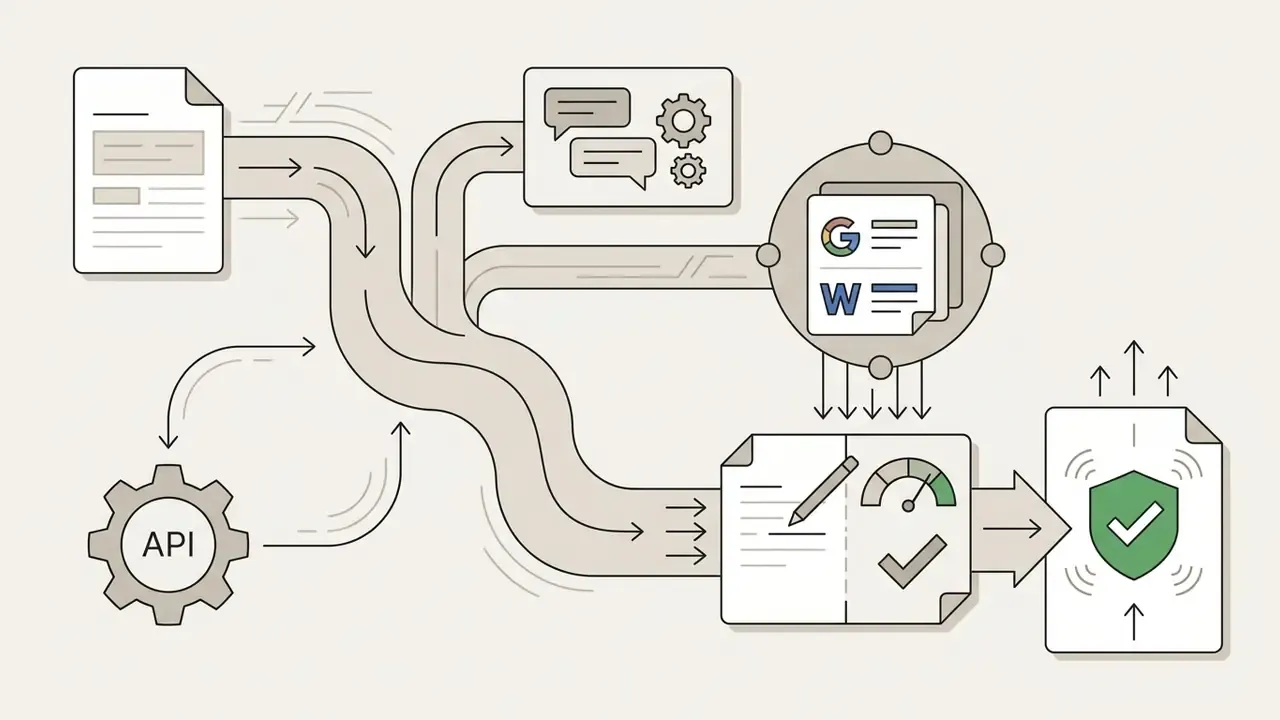
- Insert text: Paste a minimum of 150 words into the input field or upload the raw document file (.docx, .pdf).
- Execute scan: Initiate the ai generator check to process the text through token classification models.
- Analyze highlighting: Review highlighted sentences to identify low-perplexity phrases and formulaic syntactic patterns.
- Cross-verify evidence: Compare flagged sections against draft logs, research notes, and external source material.
- Export report: Generate a timestamped PDF audit report detailing overall probability scores and flagged text segments for institutional record-keeping.
Dispute and Escalation Path
Every deployment needs a documented route for disagreement, or the control will create the very operational risk it was meant to reduce.
- Tier 1, automated flag. Score exceeds threshold; document routed to a reviewer queue. No adverse action at this stage.
- Tier 2, human review. A qualified reviewer assesses the flagged spans against domain norms (formulaic disclosure language, ESL authorship, template reuse) and requests process evidence.
- Tier 3, author response window. The author gets a defined period to submit drafts, version history, research notes, or disclosure of permitted AI assistance.
- Tier 4, independent re-verification. A second detection engine plus a subject-matter reviewer produce a written determination, recorded with both scores, thresholds, and reviewer identity.
- Tier 5, governance escalation. Only here does the case reach an integrity committee, model risk committee, or vendor-management forum, with the full audit trail attached.
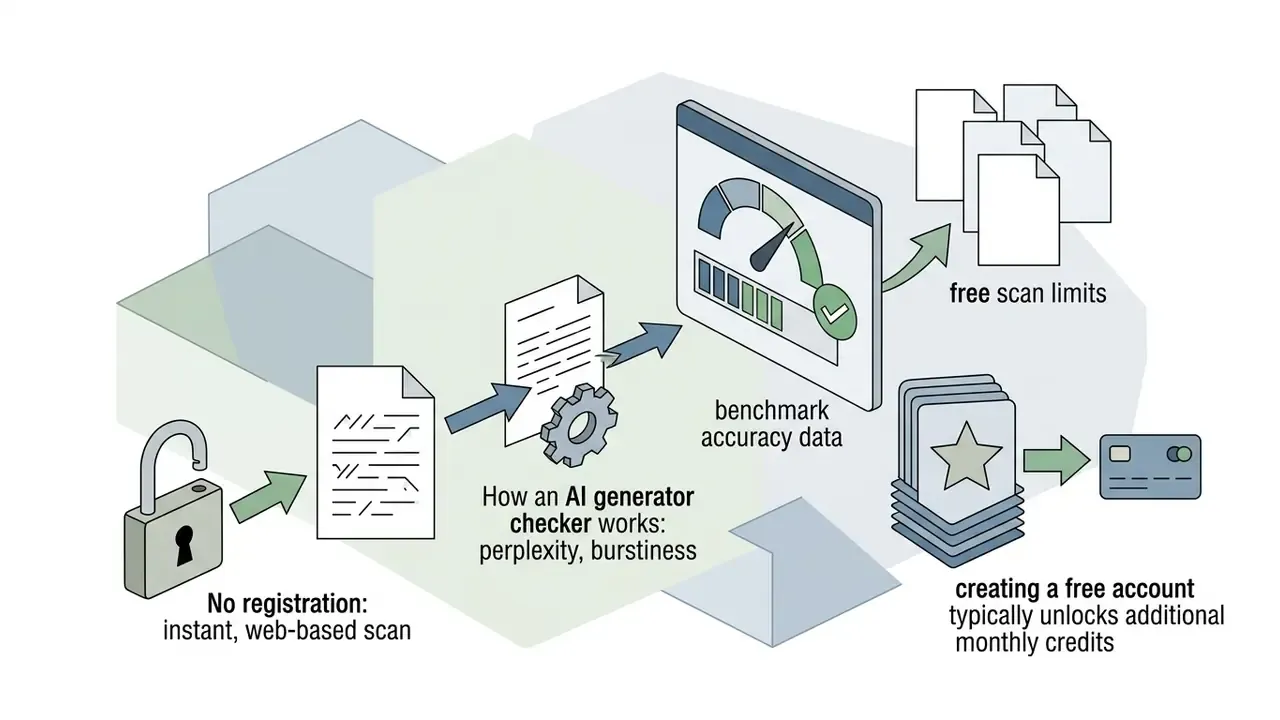
Free AI Detectors: Free Checks, Limits, and Feature Access
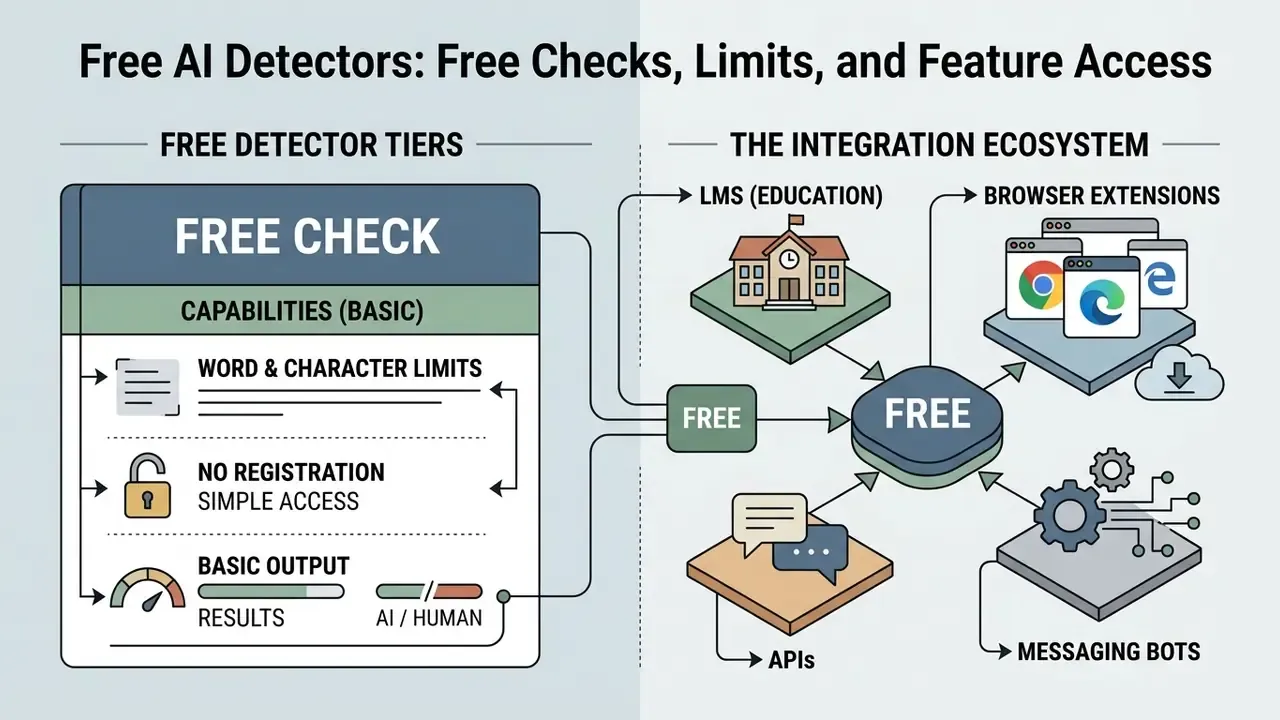
Many platforms offer an ai detector generator free option so users can run basic text validation without an upfront subscription.
Free vs Paid AI Detector Capabilities
| Feature | Free tier access | Enterprise or Pro tier |
|---|---|---|
| Character limit per scan | 5,000 to 25,000 characters | 100,000+ characters |
| Monthly volume | 5,000 to 25,000 characters, or ~10,000 words | Unlimited or custom quota |
| Account requirement | Often none (no sign-up) | Multi-user organization |
| Sentence highlighting | Basic or partial | Full interactive breakdown |
| Batch file upload | Restricted | Supported (.pdf, .docx) |
| API access and webhooks | Not included | Full REST API access |
| Branded or exportable reports | Basic PDF or none | Branded, timestamped, archived |
| Retention controls | Standard public nodes | Zero-data-retention option |
Features Typically Included in Free AI Detector Tiers
An ai generator check free tier usually provides fundamental classification features suitable for occasional use.
Search queries containing typographical variants such as ai generator chcker, ai generator checker free, or ai generator checker online normally land on these free web tools. Worth noting for content teams: those misspelled variants convert, so the landing experience matters.
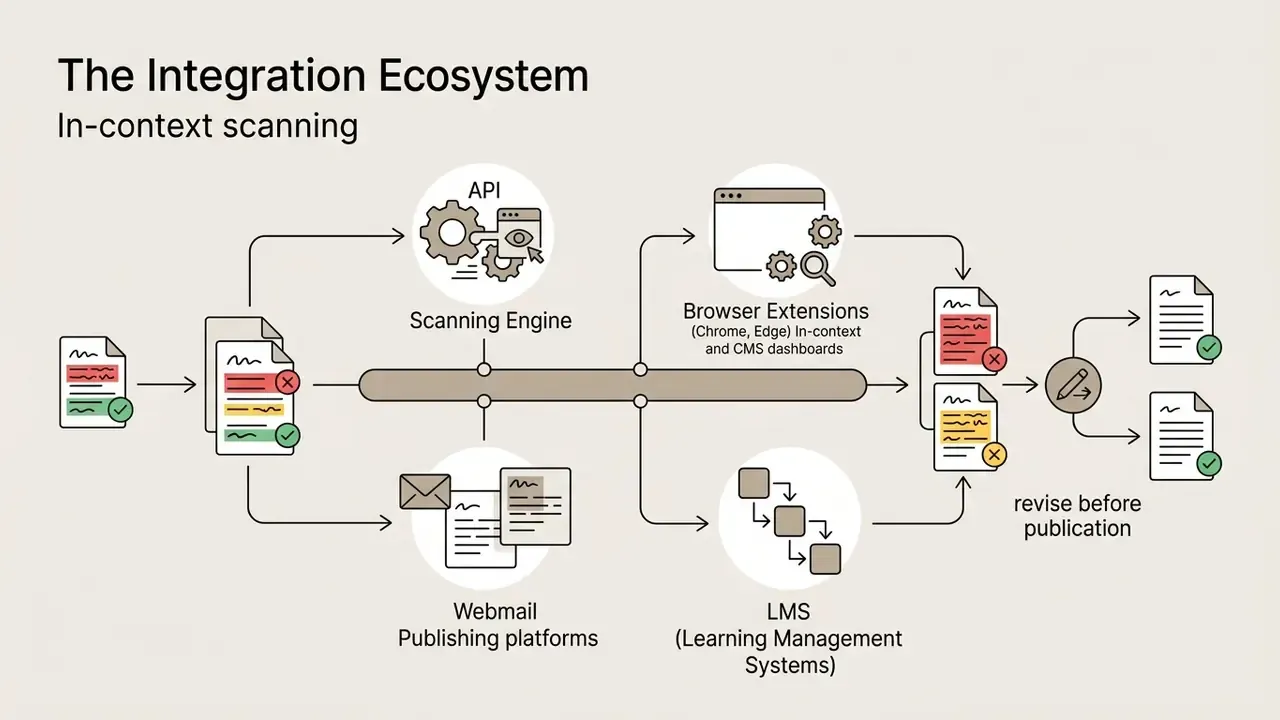
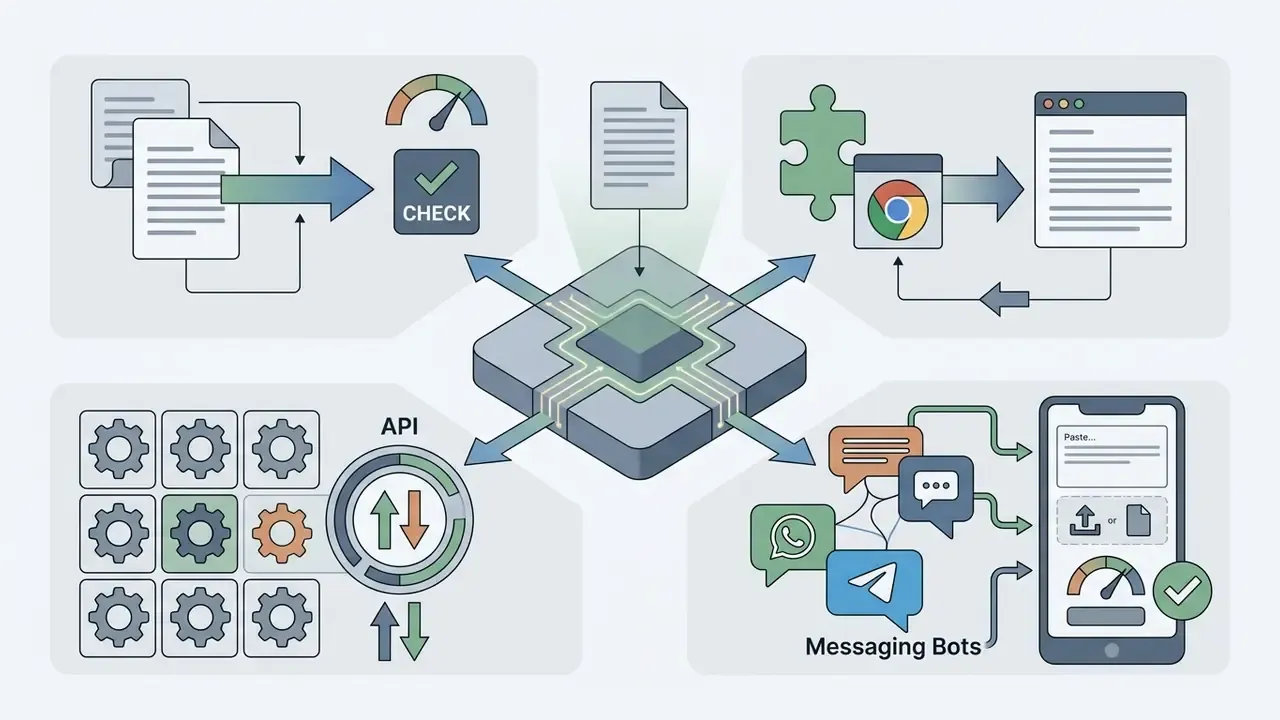
The Integration Ecosystem: LMS, Extensions, API, and Messaging Bots
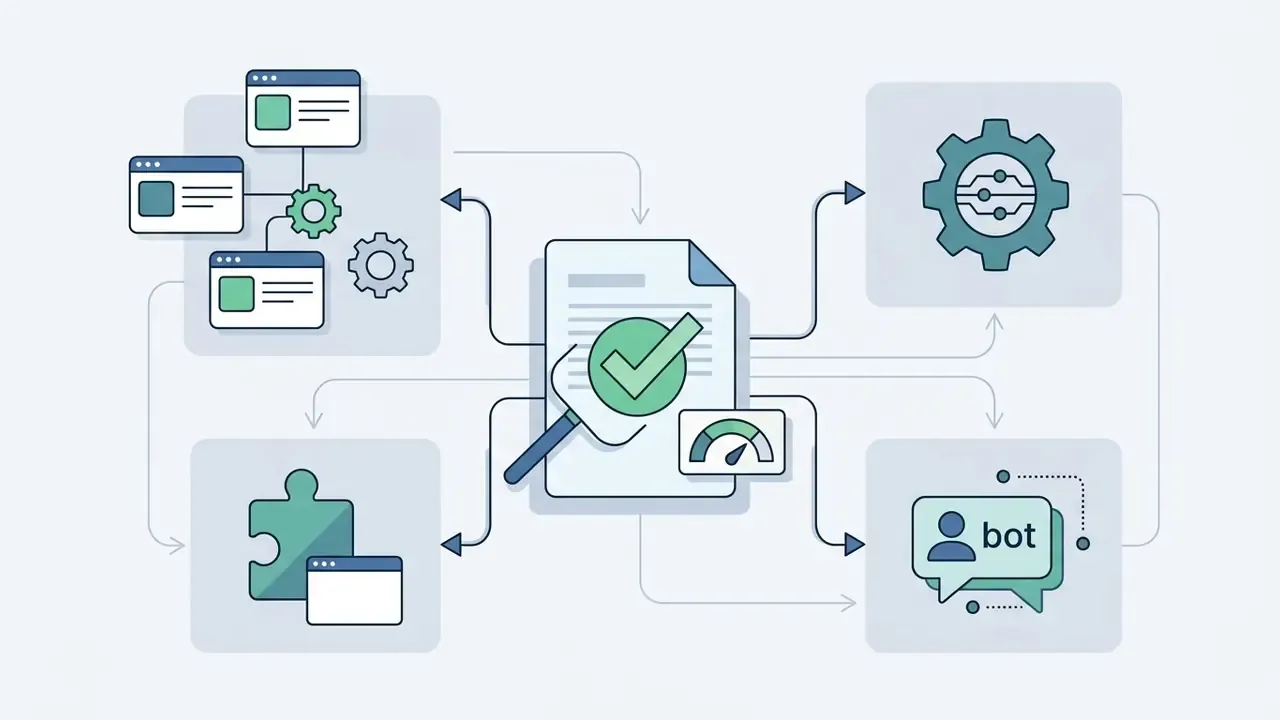
Detection rarely lives on a standalone web page in production. The deployment surface now includes:
When Free AI Generator Checkers Fall Short
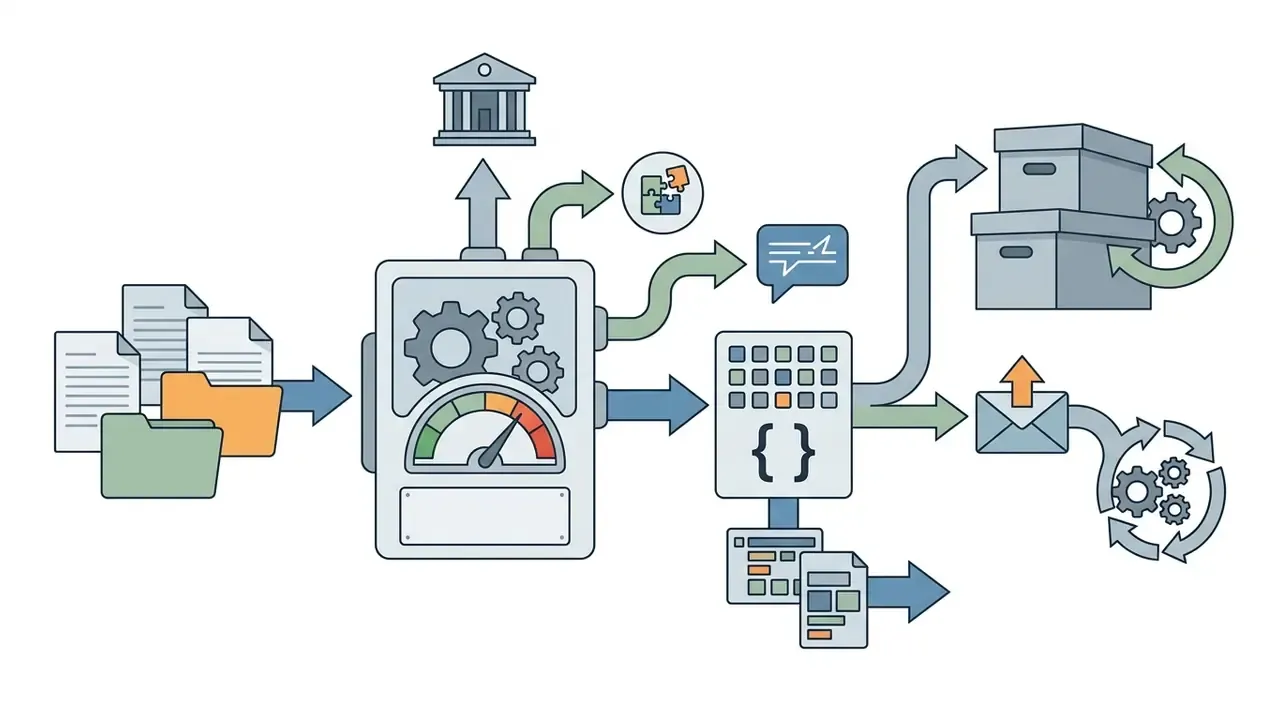
Free tools are insufficient for enterprise operations, publisher workflows, or high-volume legal audits. Commercial operations require:
Teams whose verification scope extends beyond text should also review the licensing dimension of synthetic assets. See our analysis of commercial use of AI images, the licensing boundaries covered in our guide to the ai melody generator for synthetic music, and the attribution questions raised by the ai meme generator when third-party imagery enters marketing channels.
AI Detector Pricing and Selecting Tools for Commercial Use
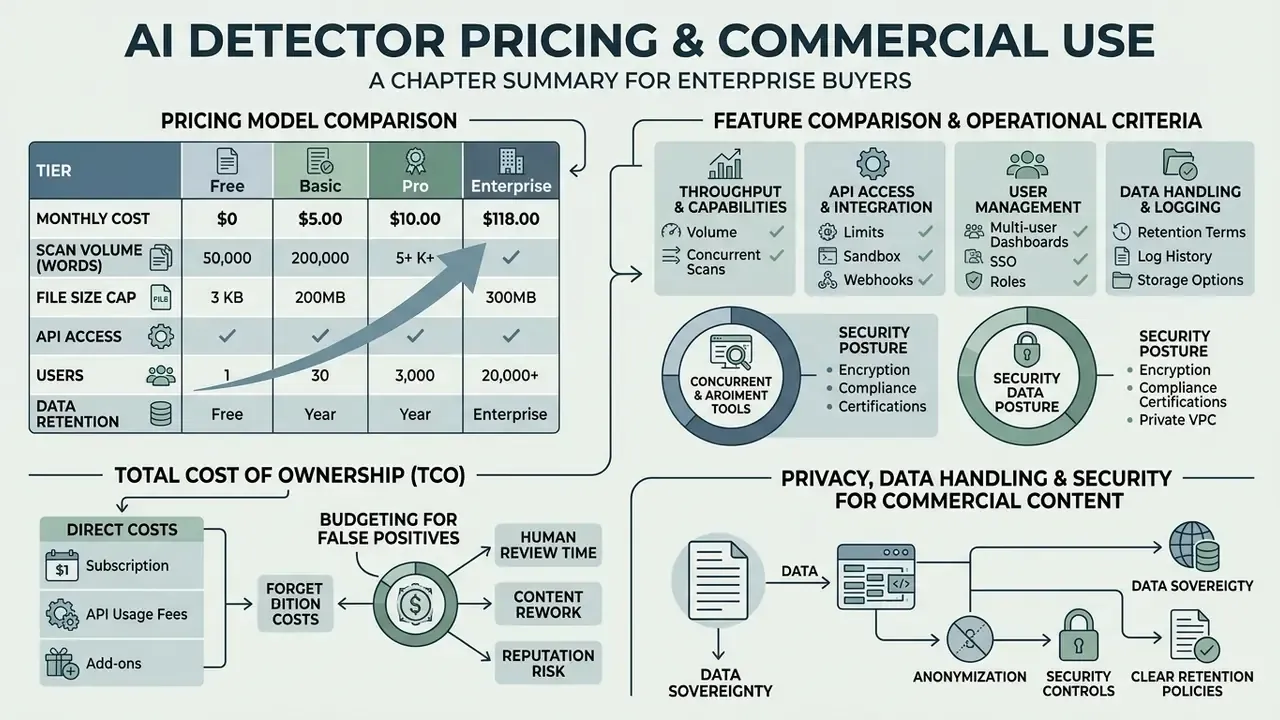
Enterprise buyers must evaluate pricing structures against operational criteria: volume requirements, security posture, retention terms, and API capabilities.
AI Detection Tier Comparison
| Plan tier | Typical price range | Scan volume limit | Core target use case |
|---|---|---|---|
| Free | $0 per month | 10k words or 25k characters per month | Ad-hoc checks, individual students |
| Pro or Team | $9.99 to $25.00 per month | 100k to 500k words per month | Freelancers, editors, small agencies |
| Scale or API | $49.00 to $150.00 per month | 50k to 500k API calls | Developers, CMS pipelines, platforms |
| Enterprise | Custom quote | Unlimited or dedicated | Banks, universities, GRC programs |
Published vendor plans show how inconsistent the billing units are. One detector meters characters per check (2,000 free, 100,000 on Pro, per-seat Enterprise from 10 seats). Another meters API requests (1,000 per month free, 50,000 per month on a $49 plan, unlimited on custom Enterprise with an uptime SLA and an on-premise option). Others meter words per month. So "Pro" and "Enterprise" labels are not directly price-comparable across products, and procurement should normalize to cost per 1,000 scanned words before comparing quotes.
Feature Comparison Across AI Detection Pricing Plans
When selecting an ai content generator detector for organizational use, evaluate four core technical capabilities.
- Throughput and file capsPro plans commonly expand character caps from 2,000 to 100,000 characters per request.
- API accessDeveloper-tier pricing is typically usage-based (for example, a $5.00 minimum base plus per-token or per-request charges), often with batch endpoints, webhooks, and priority support gated to paid tiers.
- Multi-user dashboardsEnterprise plans support seat licensing, role-based access control (RBAC), and centralized audit logs.
- Retention and log historyFree tiers frequently retain logs for 24 hours; paid tiers extend history to 7 days or longer, which matters when your audit standard requires reproducible evidence.
"Checkfor.ai reports 99% accuracy across 1,976 documents from ten domains, outperforming GPTZero and Originality.ai, though the evaluation reports aggregate accuracy without TPR at low FPR."
Total Cost of Ownership: Budget the False Positives
License fees are the smaller half of the cost equation. A defensible TCO estimate for a screening program looks like this:
TCO = (annual license or API spend) + (documents scanned × false-positive rate × reviewer minutes × loaded hourly rate) + (integration and validation effort) + (annual model revalidation cost)
Worked illustration: 40,000 documents scanned per year at a 5% false-positive rate produces 2,000 escalations. At 25 minutes of reviewer time each and a $95 loaded hourly rate, that is roughly $79,000 in manual validation labor, typically several multiples of the license itself. Reducing the false-positive rate to 1.2%, as in the modeled example above, cuts that line item to about $19,000. This is why threshold calibration and multi-engine confirmation are cost controls, not just accuracy controls.
To review pricing structures across broader media generation suites, see our detailed AI Media Pricing breakdown, and see the overview of our modeling tools to test deployment economics against your own volumes.
Privacy, Data Handling, and Security for Commercial Content
For enterprise risk officers, data privacy is a primary evaluation metric. Uploading confidential financial disclosures, pre-release blog posts, or proprietary code to an unverified online checker creates a data leakage exposure that no accuracy figure offsets.
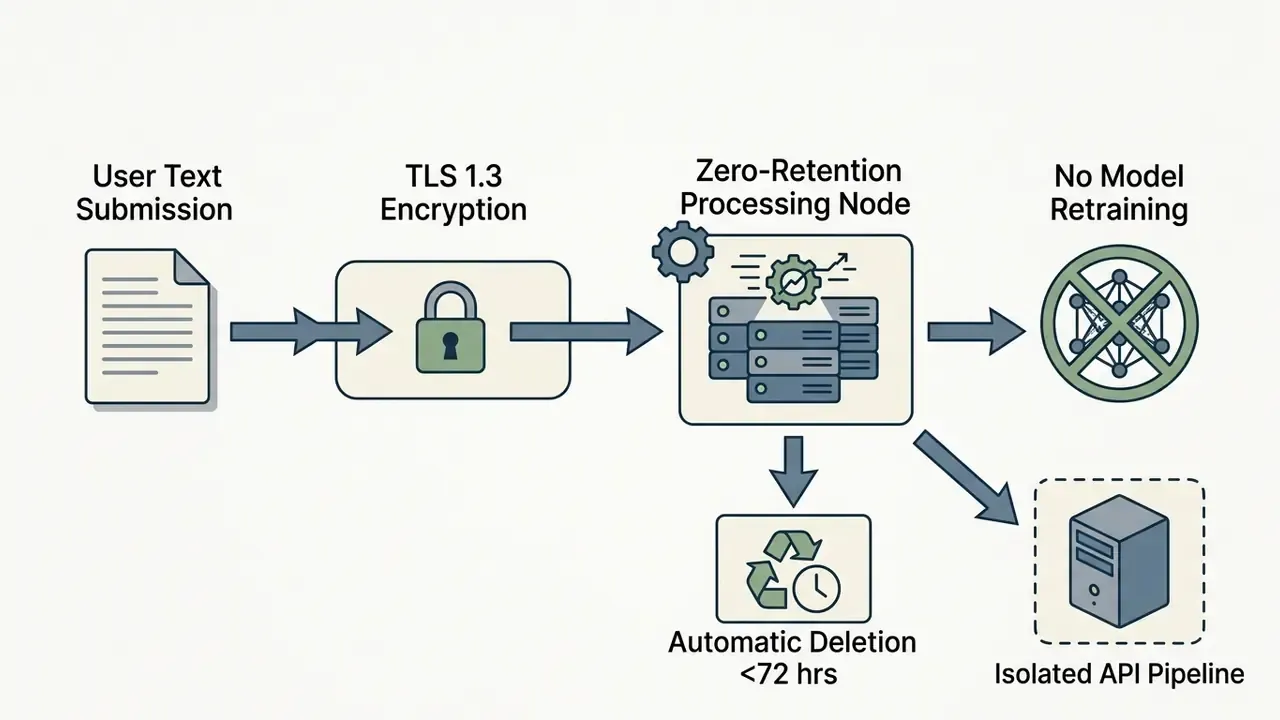
Under GDPR Article 5 (storage limitation) and Article 25 (data protection by design), enterprise-grade vendors must ensure submitted texts are not used to train proprietary detection models. Compliance-focused tools offer 72-hour automatic deletion windows, encrypted transit (TLS 1.3), and zero-retention API configurations. European Data Protection Board Opinion 28/2024 further holds that a model can only be treated as anonymous where the risk of extracting training data, directly or through queries, is insignificant. That is precisely why "we may use submissions to improve our models" clauses are disqualifying for confidential material. NIST AI RMF 1.0 similarly flags training-data use as a privacy risk requiring legal assessment.
"Academic evaluations of detectors focus on accuracy rather than confidentiality: independent audits of commercial tools' data-retention practices are almost absent from peer-reviewed literature."
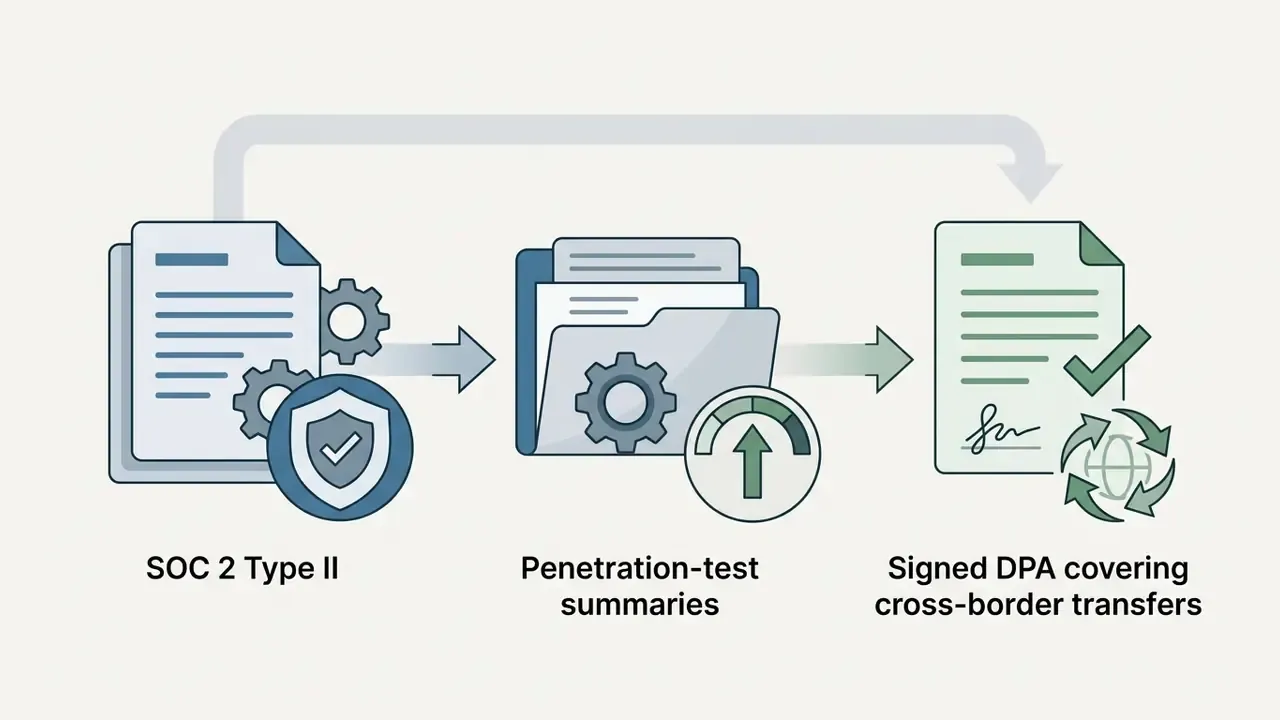
That evidence gap should be treated as a procurement finding. Absent third-party audit, rely on contractual commitments (DPAs, SOC 2 Type II reports, penetration-test summaries) rather than marketing claims.
Enterprise Feature Comparison Matrix
| Plan tier | Monthly scan allowance | Sentence-level breakdown | Batch file upload | Multi-user access | Privacy and retention controls |
|---|---|---|---|---|---|
| Free | 5,000 to 25,000 characters | Basic | No | 1 user | Standard (public nodes) |
| Pro | 100,000 words | Full interactive | Yes (.pdf, .docx) | Up to 5 seats | 72-hour auto-delete |
| API / Scale | 50,000 API requests | JSON API response | Programmatic | Unlimited keys | Zero-data retention option |
| Enterprise | Custom or unlimited | Full plus LMS integration | Dedicated pipeline | Custom RBAC | Dedicated cloud, SOC 2 Type II |
For teams integrating content screening with external data sources, explore the hub of endpoint specifications and integration patterns.
Who Benefits from an AI Content Generator Checker
Understanding how different professional sectors deploy an ai content generator checker clarifies the appropriate operational boundaries for each.
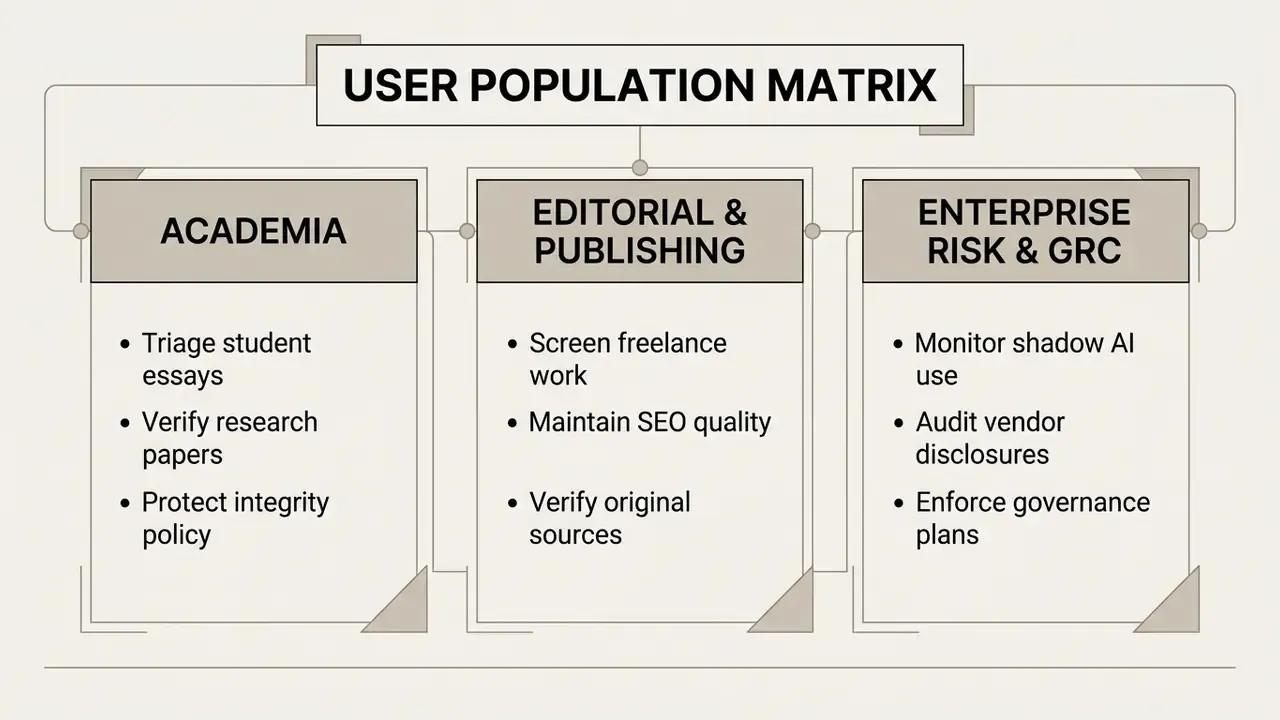
Content Verification for Writers, Bloggers, and Enterprise Professionals
Content marketers, SEO specialists, and corporate communications leads use an ai content generator detector to audit pre-publication material:
- SEO quality assurance Ensuring agency submissions align with Google's search guidance on original, high-value, non-commodity content.
- Brand protection Verifying that ghostwritten executive articles keep an authentic voice.
- Vendor management Checking outsourced copy against contractual original-writing mandates.
- Shadow AI monitoring Identifying undisclosed model use inside regulated communications, marketing claims, and customer-facing disclosures.
Corporate verification programs increasingly cover visual assets too, using AI image detectors alongside text screening before publication.
One illustrative pattern from editorial practice: a corporate communications team outsources technical whitepaper drafting to an external agency. Running incoming submissions through an ai generator checker online, the editorial lead spots two chapters showing 96% AI predictability. The company requests source verification and manual revision before publication, avoiding a reputational problem that would have surfaced later, in public.
Enterprise buyers should nonetheless assume adversarial behavior from suppliers paid per deliverable.
"Query-based word substitution reduces DetectGPT's true-positive rate to under 5% at a 40% false-positive rate: moderate adversarial effort substantially defeats detection."
The governance response is contractual and procedural: disclosure clauses, draft-history requirements, spot interviews with named authors, and sampling rather than blanket automated enforcement.
For teams managing multi-format creative assets, compare tooling and licensing exposure in our review of the best AI image generators, the workflow controls documented in our ai mind map generator guide, and the structured-output patterns described in our ai menu generator breakdown.
Verifying Specialized Content Types: Source Code and Multimedia
Text is only one attack surface. Mature verification programs extend screening to:
To evaluate commercial usage rights and legal risk attached to automated creative outputs, explore the hub of licensing breakdowns, or open the hub tracking emerging AI copyright case law.
- Source code
- Scanning Python, JavaScript, C++, and SQL for machine-generated artifacts, license-incompatible reuse, and known vulnerability patterns before code enters a build pipeline. For regulated firms this doubles as an intellectual-property and third-party-license control.
- Images and video
- Spectral and artifact analysis to identify synthetic imagery or video before it appears in disclosures, campaigns, or press materials, increasingly paired with provenance metadata and watermark checks as recommended by NIST AI 100-4.
- Structured documents
- Batch review of filings, credit memos, KYC and AML narratives, and vendor questionnaires, where template language demands calibrated thresholds to avoid mass false positives.
Verification for Students, Educators, and Academic Integrity
In education, an ai essay generator detector provides automated assistance for screening submitted research papers and assignments. Institutional guidance from networks such as the National Academic Integrity Network (NAIN) nevertheless advises educators against treating detector output as standalone proof of academic misconduct.
Instead, institutions use detection software as an initial filter. When an assignment returns an abnormally high probability score, faculty open a direct conversation, reviewing outline revisions and bibliographic sources with the student.
"Early AI classifiers such as GPTZero and OpenAI's own classifier could not reliably detect ChatGPT use in coursework because of false positives and low sensitivity."
Disclosure frameworks have largely displaced pure detection in institutional policy. Universities including Graz, Deakin, and Reading now require authors to name the AI system and version, describe the interaction, state the purpose, and confirm accuracy verification, with unauthorized use handled through formal integrity procedures rather than a detector score alone. The same disclosure logic transfers cleanly to corporate settings. A documented AI-use statement attached to a deliverable is far more auditable than a probability percentage, and it survives contact with an auditor.
Pre-Publication AI Marker Checklist
Run this checklist before any text leaves review.
Checklist0 / 10
FAQ: Common Questions About AI Generator Checkers
What is an AI generator checker?
An ai generator checker is a specialized software application that analyzes text to estimate the probability that it was authored by an artificial intelligence model rather than a human.
How accurate is an online AI detector?
Accuracy ranges between 70% and 95% under controlled conditions on long-form English text, and published studies report figures from 55% to 97% depending on dataset. Accuracy drops sharply on short paragraphs, non-English texts, heavily edited prose, or content produced by novel AI architectures.
Can an AI detector give false positives?
Yes. False positives occur when authentic human writing is incorrectly flagged as machine-generated. This happens most often with non-native English (ESL) writing, highly technical prose, and standardized academic essays, and it rises steeply when even a small fraction of tokens has been AI-polished.
What is the minimum text length required for an accurate check?
Most systems need at least 150 words for a stable statistical measurement. Scans on snippets under 50 words carry a high margin of error and often return an "insufficient evidence" result.
Do free AI detectors offer the same accuracy as paid tools?
Free tools often use the same underlying detection algorithms as paid tiers for single-text scans. Paid plans unlock higher character limits, batch uploading, API access, threshold tuning, longer log retention, and stronger privacy protections.
How much text can I check for free?
Free allowances vary widely: roughly 1,200 words per submission on some academic tools, 5,000 characters per check on others, and up to 25,000 characters in a single unauthenticated scan on the most generous platforms. Monthly free ceilings commonly sit between 10,000 and 25,000 characters, or about 10,000 words.
How do I check if my text will be flagged by an AI filter?
Paste your text into an ai generator check free tool, review the overall score, and inspect the highlighted sentences before submitting or publishing. Then revise using the remediation steps above and re-scan to compare deltas.
Does Google penalize AI-generated content in search rankings?
Google's search guidelines focus on content quality, originality, and user value rather than production method. Unedited, low-quality commodity content produced solely to manipulate rankings still violates search spam policies.
Can AI detectors identify text rewritten by humanizing tools?
Advanced detectors such as Copyleaks and Pangram use specialized paraphrase detection models (for example AIR-1) to spot statistical artifacts left by AI paraphrasing engines. Heavy manual editing and query-based word substitution can still evade detection.
Do AI detectors work in languages other than English?
Yes, but unevenly. Leading engines support 30 or more languages with automatic language identification and report 93% to 99% detection accuracy for major European languages. Low-resource languages and text written by non-native authors show materially weaker performance and much higher false-positive risk.
Can AI detectors check images, video, or source code?
Specialized modules exist for all three. Image and video detectors apply spectral and artifact analysis; code detectors scan for generated patterns, license violations, and vulnerability signatures. These are separate models from text classifiers and carry their own accuracy limitations.
Are detector results admissible as proof of misconduct?
No. NIST AI RMF 1.0, NIST AI 100-4, and university guidance from Penn State, Pittsburgh, Clemson, and the National Academic Integrity Network all state that automated scores are probabilistic indicators requiring corroborating evidence and human judgment. To calculate operational metrics and deployment costs, see the overview of our governance documentation and support resources.
Summary and Governance Recommendations
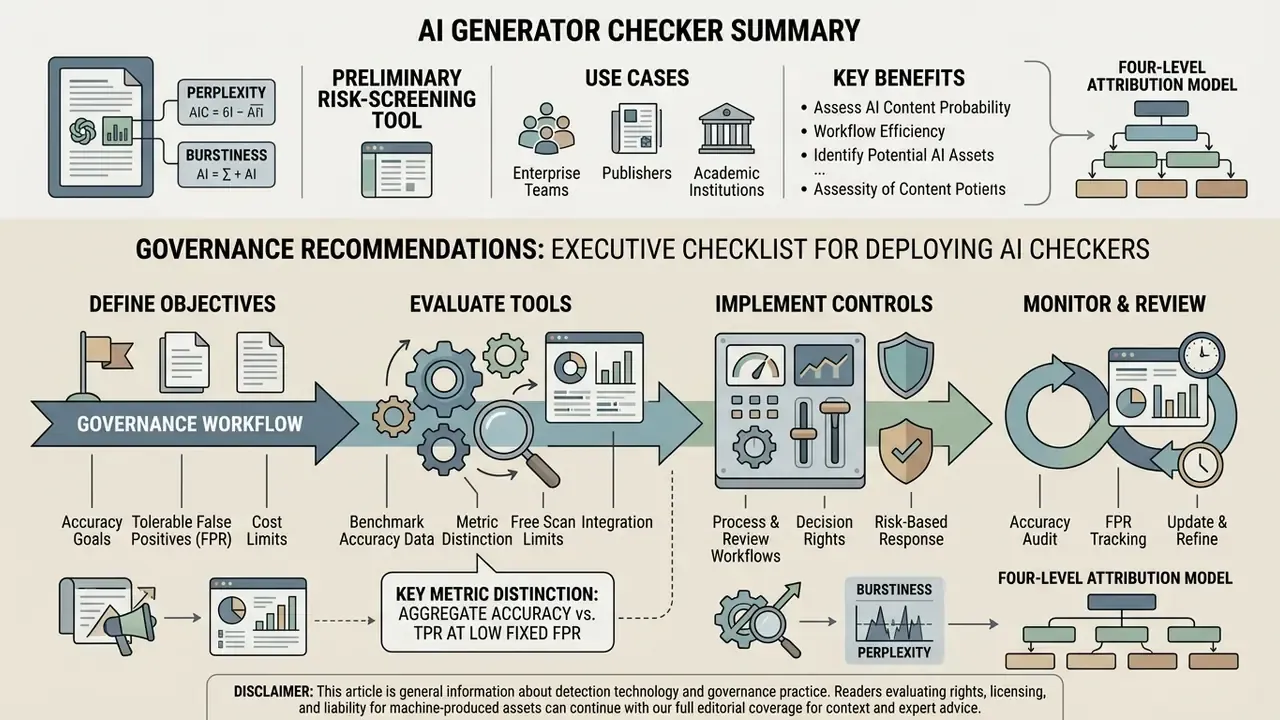
An ai generator checker is a useful preliminary risk-screening tool for enterprise teams, publishers, and academic institutions. Because of inherent statistical limitations, false-positive risk on formulaic human writing, and vulnerability to adversarial editing, detection scores must never be treated as definitive legal or institutional proof.
"A detector with an AUROC near 0.84 can show a true-positive rate below 20% at a 1% false-positive rate: a high headline accuracy figure does not guarantee practical reliability under real operating constraints."
That metric distinction, aggregate accuracy versus TPR at a low fixed FPR, is the single most useful question to put to a vendor during due diligence. Ask it early.
Executive Checklist for Deploying AI Checkers
Checklist0 / 11
Readers evaluating rights, licensing, and liability for machine-produced assets can continue with our analysis of commercial use of AI images and the ongoing AI copyright litigation review.
Appendix A: Superseded Claims and Revision Log
Retained verbatim for transparency and audit continuity. These passages appeared in earlier versions of this guide and have been corrected in the main text.
- Superseded model-recognition benchmark"According to a 2026 independent benchmark published by Humanize AI Pro, leading detectors achieved an 88% overall accuracy rate across diverse model families, reaching 90.4% on ChatGPT-4o, 86.7% on Claude 3.5, and 84% on Gemini Pro." Reason for replacement: the benchmark originates from a commercial humanizing vendor and constitutes a potential conflict of interest; the figures are not corroborated by the peer-reviewed or preprint benchmarks cited here. Replaced with RAID (ACL, 2024) and M4GT-Bench (2024) evidence.
- Superseded free-tier limits"Word Limits: Single-scan allowances usually range from 500 to 1,200 words, with monthly caps between 5,000 and 10,000 words." Reason for replacement: understates market conditions; unauthenticated single scans of up to 25,000 characters are publicly available, and monthly free ceilings commonly reach 25,000 characters or about 10,000 words.
- Superseded short-text sourcingthe attribution "technical research by Eyesift (2026)" remains an unverified secondary source. The 50 to 150 word triage range and the 150 to 250 word reliability threshold are retained because they are independently corroborated by academic testing of commercial detectors on short passages and by MultiSocial Benchmark (2024) findings on short, informal text.
Appendix B: Vendor Due-Diligence Question Set
Use these questions verbatim in an RFI. Vague answers are themselves a finding.