An AI mind map generator is an automated software tool that converts unstructured text, prompts, notes, documents, media links and images into structured, editable visual diagrams. By extracting core concepts and hierarchical relationships, these systems let teams and analysts visualize complex information quickly and tighten operational planning.
Why does this matter to a risk or finance leader, and not only to a student cramming for an exam? Because the moment someone drops a supervisory letter or a model validation report into a free web diagramming tool, you have a data-transfer event on your hands, not a formatting convenience. The tooling is genuinely useful. The governance around it is usually missing.
Executive summary
This guide moves from definition to workflow, then to inputs, features, security, reproducibility, pricing and licensing. The security and validation sections are the ones a second-line reviewer will actually ask about, so they carry checklists you can lift into an internal standard.

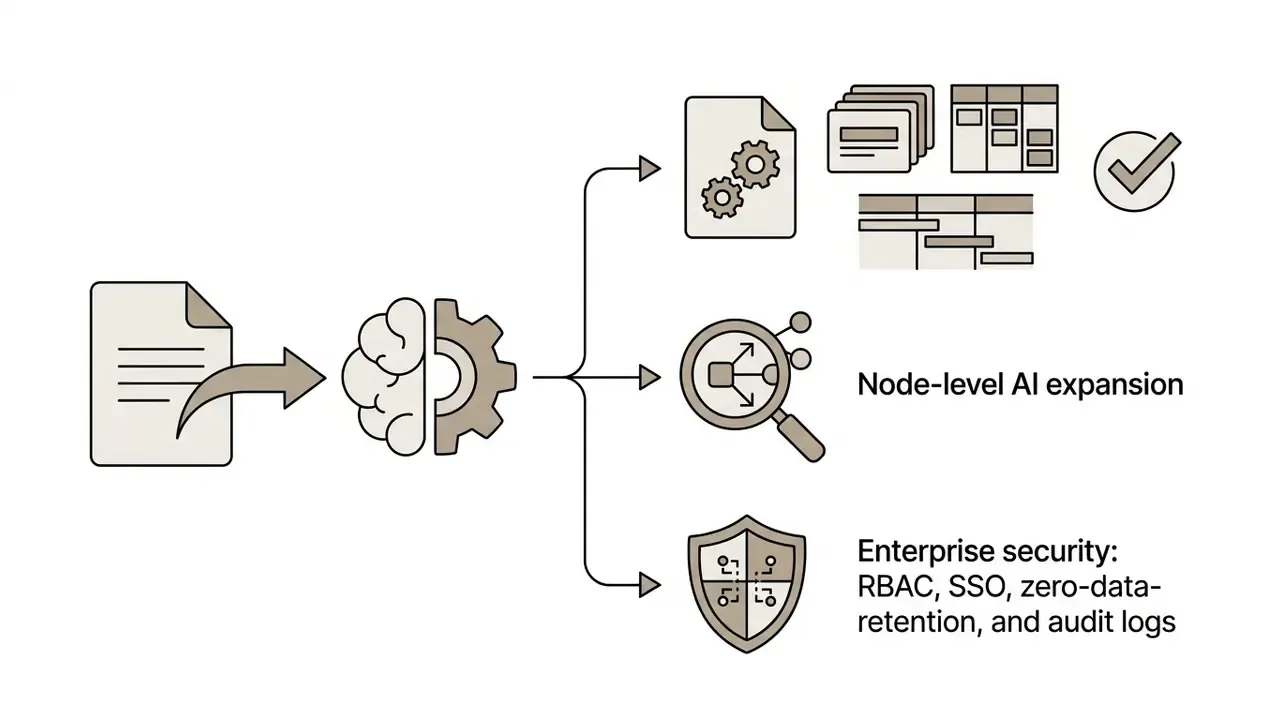
.xmind / SVG / OPML / Markdown export, one-click conversion into slides, Kanban and Gantt views, node-level AI expansion, RBAC, SSO, zero-data-retention terms and audit logs.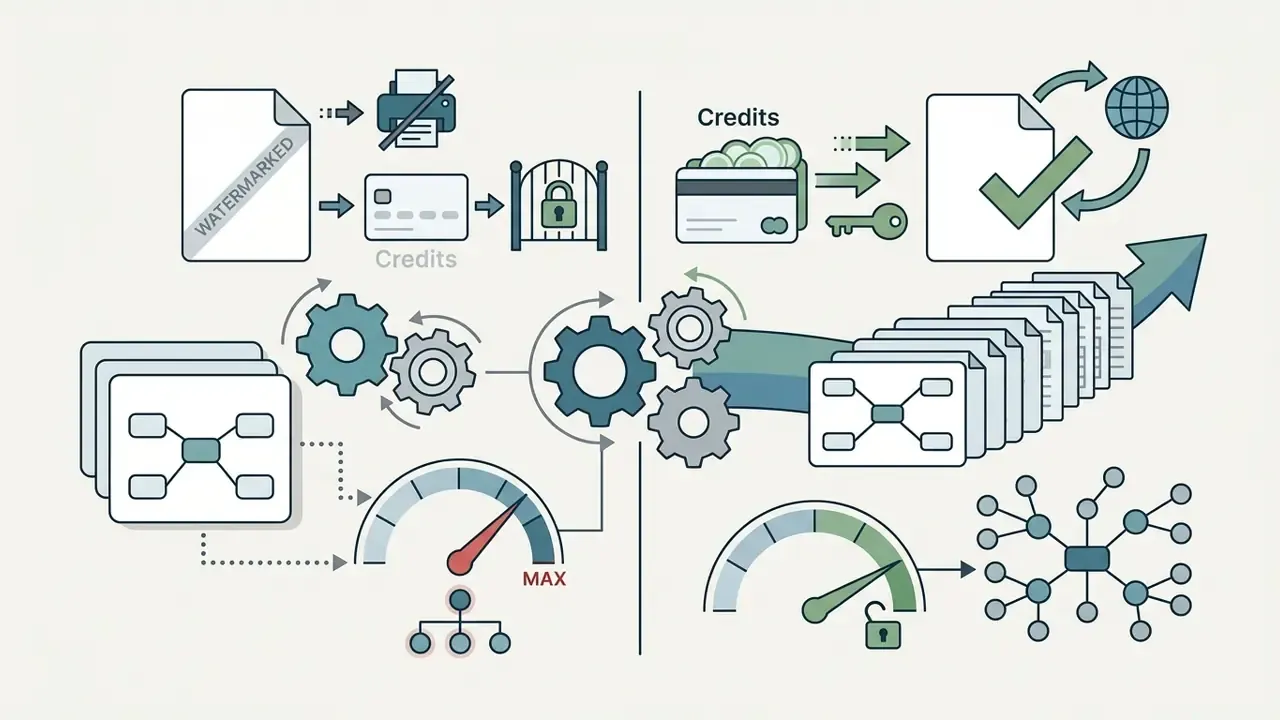
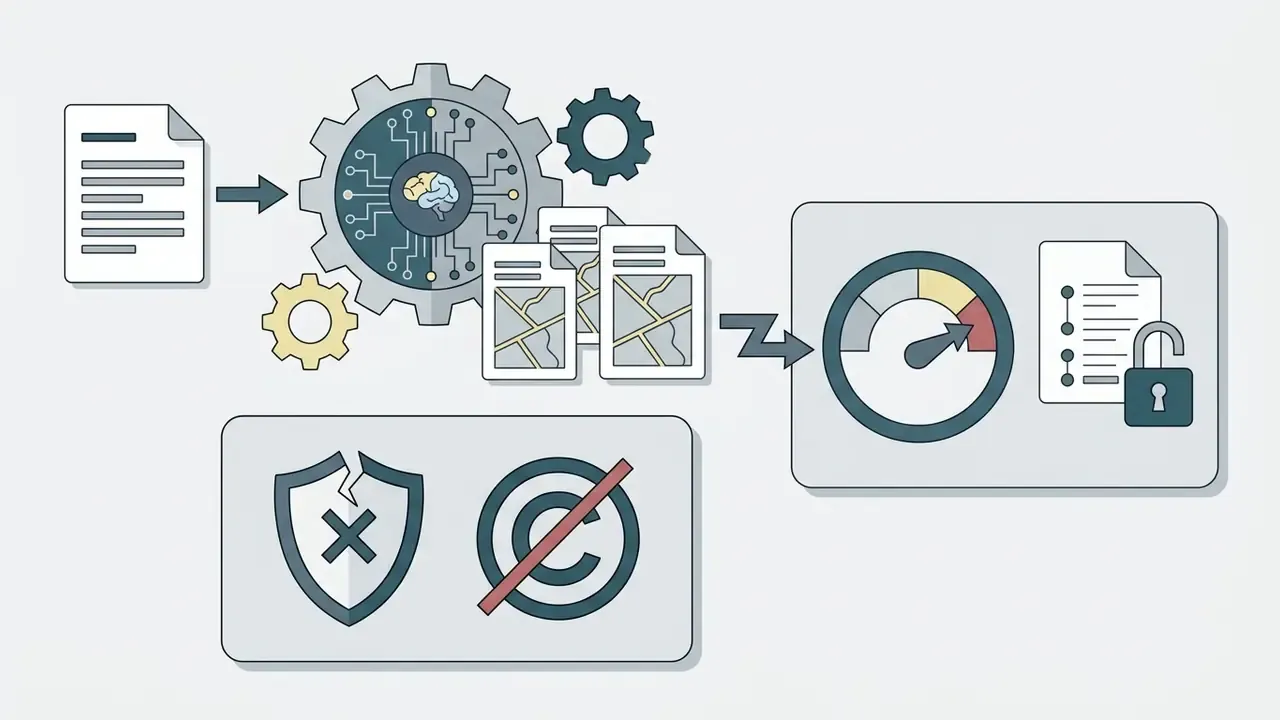
What is an AI mind map generator and what can it do?
An AI mind map generator is a digital application powered by natural language processing (NLP) that automatically transforms raw text, meeting notes, or unstructured ideas into a multi-tiered visual map. The software identifies the central subject, establishes primary topic branches, and populates sub-branches with supporting evidence or tasks.
Using an ai mind map generator speeds up initial content organization while keeping every generated node fully editable. Users refine relationships, adjust layouts, or append new nodes by hand. In research evaluating structured representations, large language models generating mind maps reduced text comprehension time by 31.9% compared with reading raw text alone, without loss of factual accuracy.
«Users answered questions 31.9% faster with mind maps and 42.9% faster with tables, with no loss of accuracy.»
So an ai mind map tool works as an operational starting point for brainstorming, structured planning and rapid content organization. A starting point. Not a finished artifact.
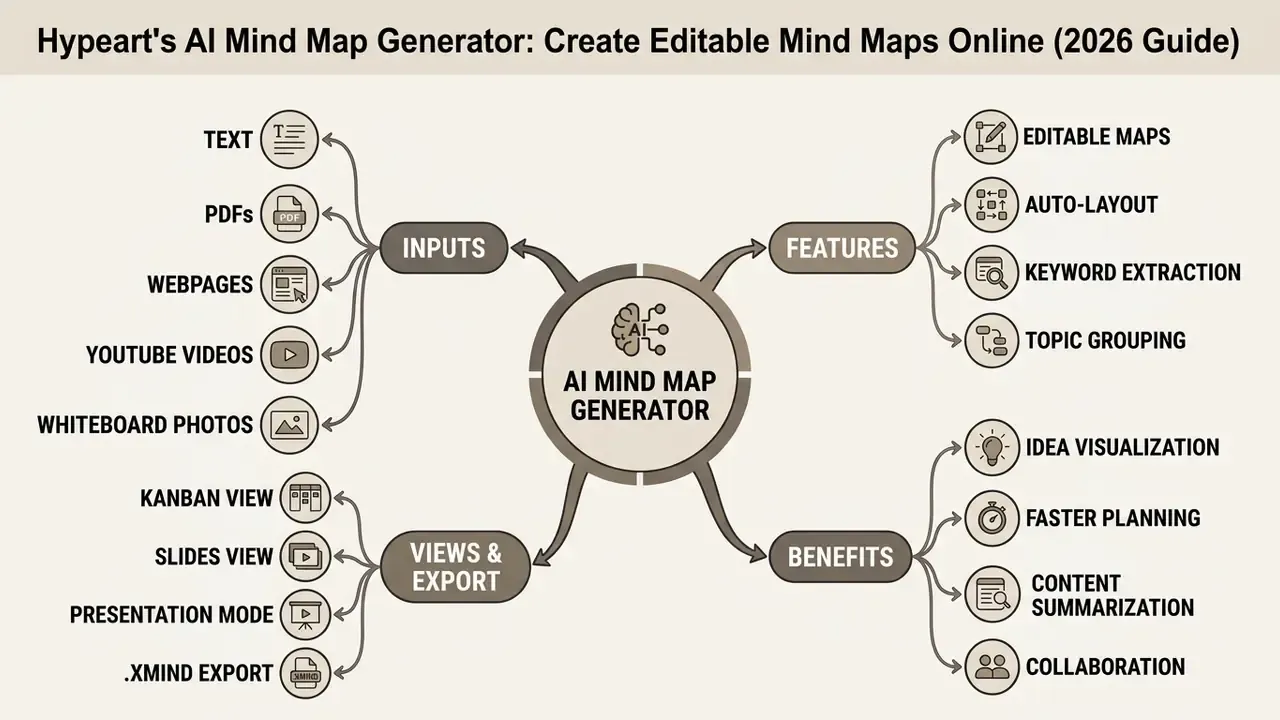
Textual representation of the demonstration map:
- Central topic
- AI Mind Map Generator
- Text
- natural language processing, raw text parsing, prompt inputs
- Notes
- lecture summaries, meeting transcripts, bullet points
- Documents
- PDF reports, Word files, Markdown documentation
- Ideas
- strategic themes, policy drafts, exploratory concepts
- Planning
- task allocation, timelines, operational controls
- Team
- collaborative editing, role permissions, feedback loops
Mind map vs concept map: key structural differences
Understanding the difference between a mind map and a concept map keeps you from picking the wrong visualization model for your data.
- Mind map a strictly hierarchical tree expanding outward from a single central root topic. Sub-topics branch radially, which suits brainstorming, note summarization and single-subject breakdowns.
- Concept map a cross-linked network in which relationships between multiple independent nodes are explicitly labeled with linking verbs (for example "leads to", "requires", "causes"). Better for systems engineering, control mapping and domain-wide ontology work.
Rule of thumb: if a reader must follow one subject downward into detail, generate a mind map. If a reader must trace how several independent entities influence one another, say how a model, a control, a policy and an owner interlock, generate a concept map with labeled edges. Most AI generators produce trees by default, so labeled cross-links have to be requested explicitly in the prompt.
When AI mind mapping is useful for ideas, notes and planning
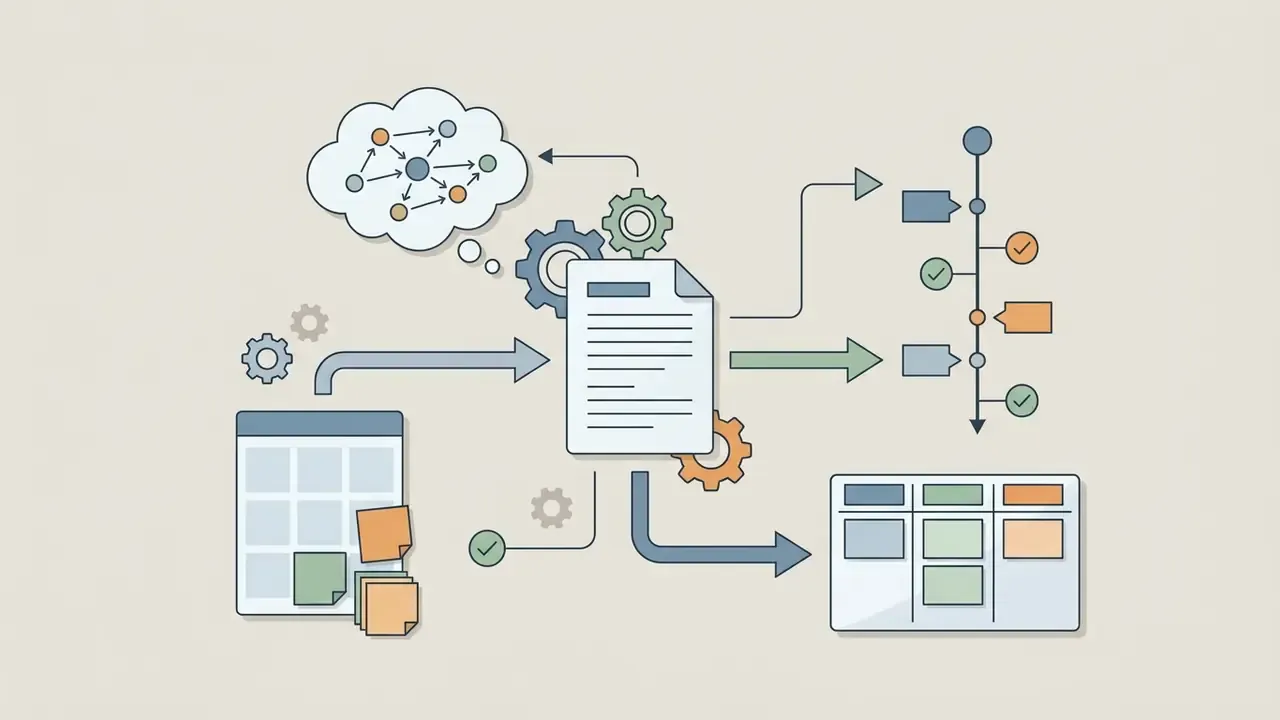
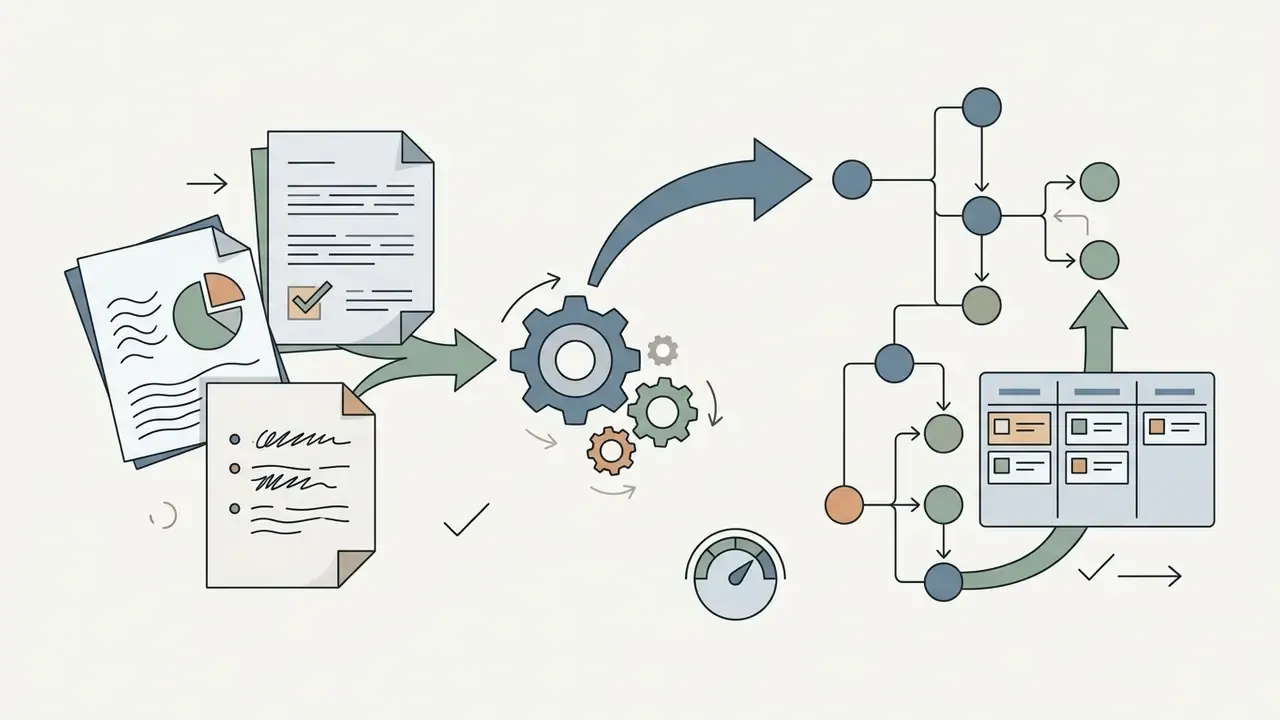
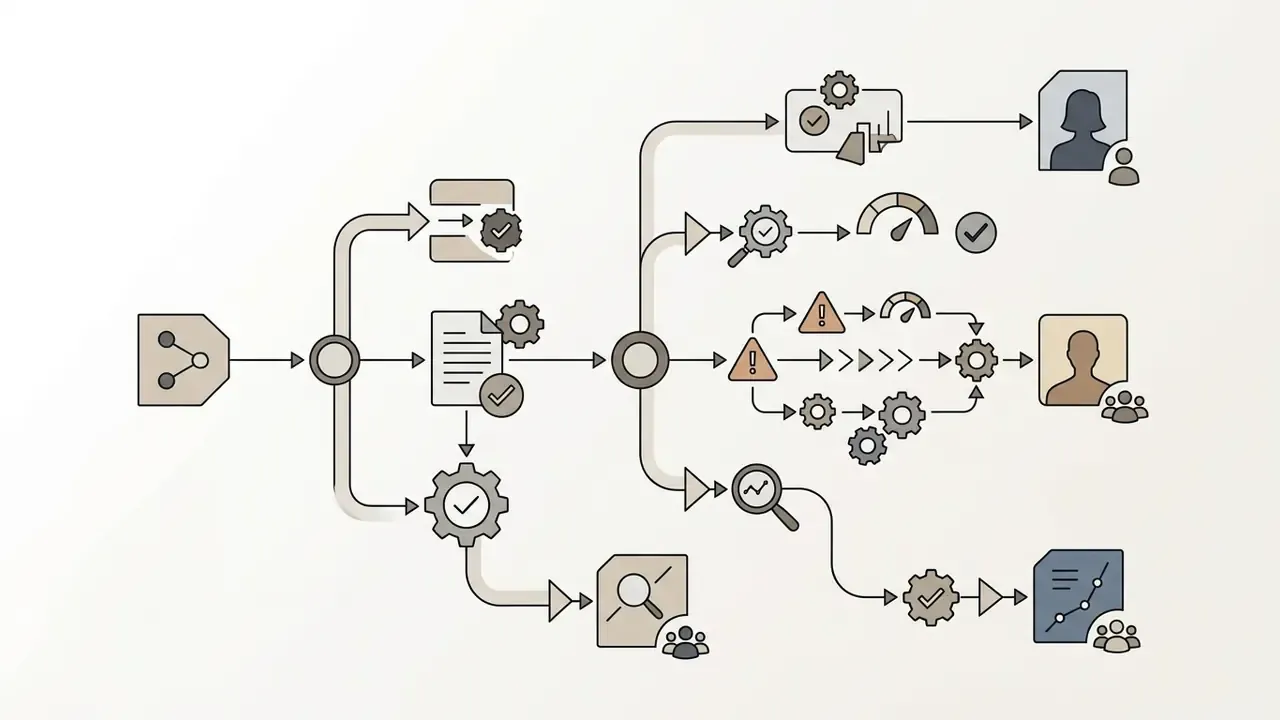
AI-driven mind mapping delivers measurable utility across four operational scenarios: strategic brainstorming, note summarization, project plan structuring and content planning. When teams face unstructured inputs, an ai mind map creator helps externalize broad ideas into a logical framework fast.
During risk assessments or project scoping, pulling complex documentation into visual nodes reduces the odds that a mandatory section quietly goes missing.
«AI-supported teams generated 48% more impact items than unassisted teams, scoring higher on six of eight quality measures.»
The resulting visual hierarchy gives teams a structured overview and turns raw notes into actionable project steps sooner.
Tactical application scenarios
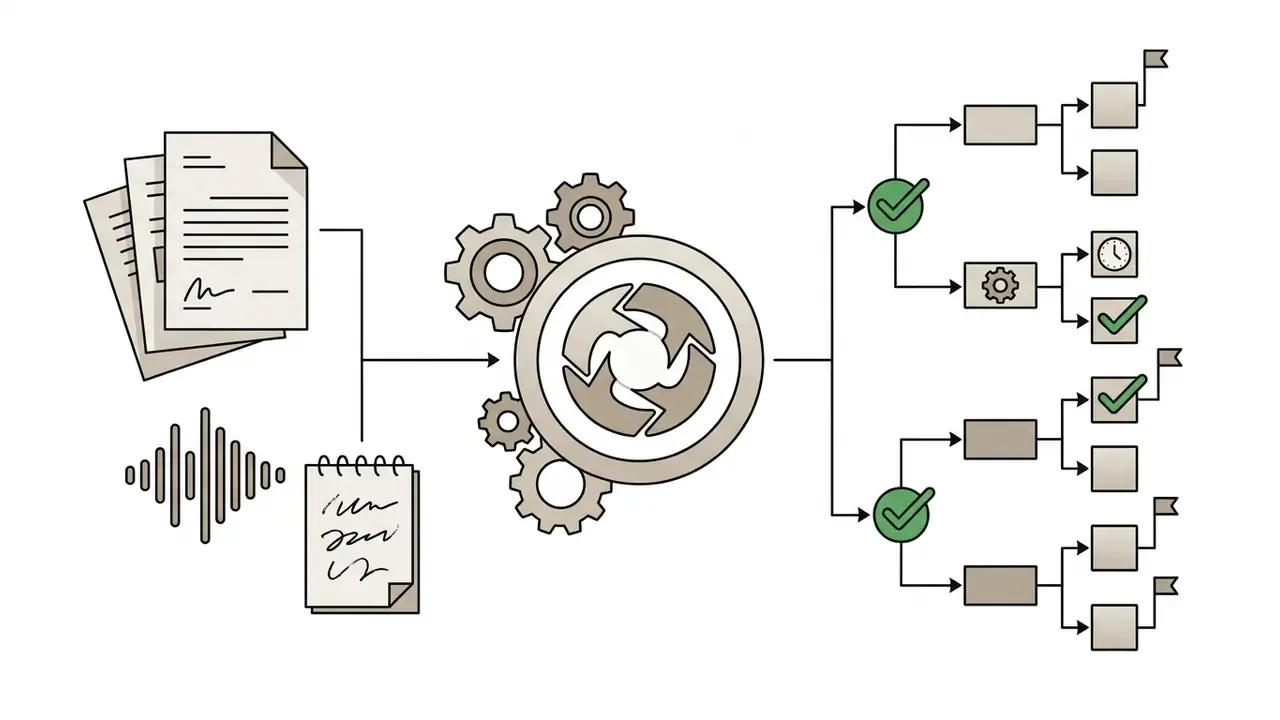
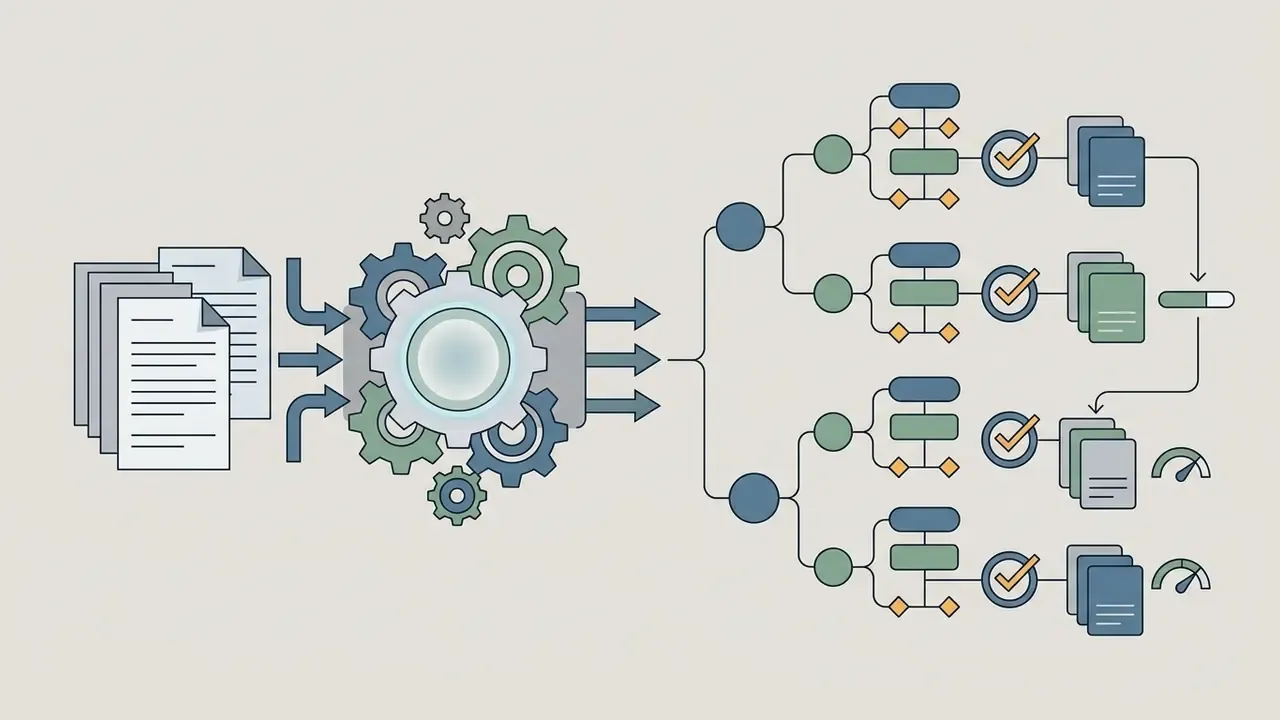
AI mind map vs manual mind mapping
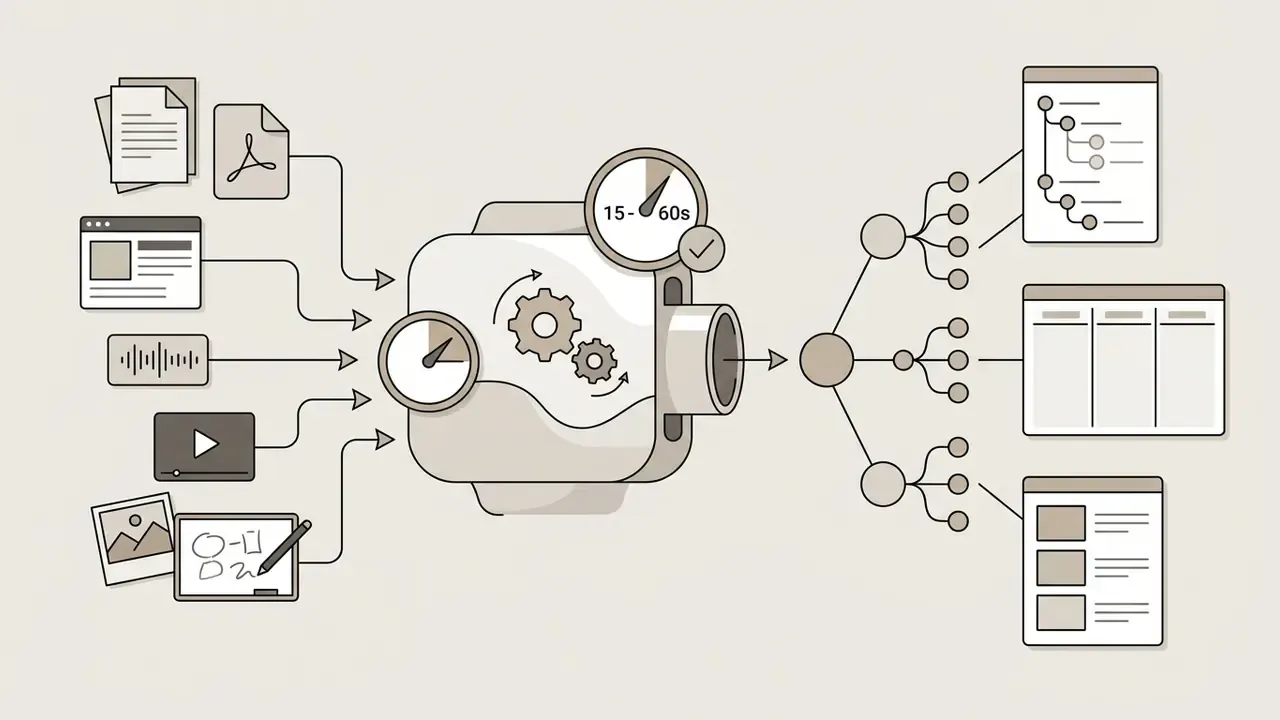
Generating a mind map with AI emphasizes speed, source traceability and automated hierarchy creation. Manual mind mapping gives total granular control over every connection from the first stroke, but it costs time, often 30 to 60 minutes for a long technical document versus under 60 seconds with automated ingestion.
| Evaluation metric | AI mind map generation | Manual mind mapping |
|---|---|---|
| Ingestion speed | 15 to 60 seconds per document | 30 to 60 minutes per document |
| Structural consistency | Standardized hierarchical tree | Variable, depends on individual style |
| Source traceability | High (node-to-text alignment) | Manual annotation required |
| Customization effort | Low (post-generation editing) | High (drawn or configured from scratch) |
| Depth of context | Algorithmic summary | Human-driven nuance and interpretation |
| Auditability | Depends on vendor logging and lineage features | Fully attributable to a named author |
Manual methods still win on subjective nuance. AI-assisted methods win on structural consistency across large volumes. Earlier computer-aided mapping experiments reported roughly 80% average structural similarity to expert reference maps, though those tests predate current large language models and disclosed neither sample size nor scoring methodology. Treat that number as weak evidence. More recent, methodologically transparent work is stronger on completeness:
«Students rated ChatGPT maps as more complete: only 8.23% of responses flagged missing concepts, and node arrangement was judged better than in expert-built maps.»
Semi-automatic workflows sit between the extremes. Published mapping tests found semi-automatic maps materially more accurate than fully automatic output, which is exactly why users keep full authority to edit generated branches. Balance computational speed against analytical depth instead of committing to one mode.
How to create a mind map with AI
To create a mind map with ai, you supply source material, start the parsing run, review the generated structure, modify nodes and export the finalized file. Five steps, in the same order every time, which is what makes the output reviewable.
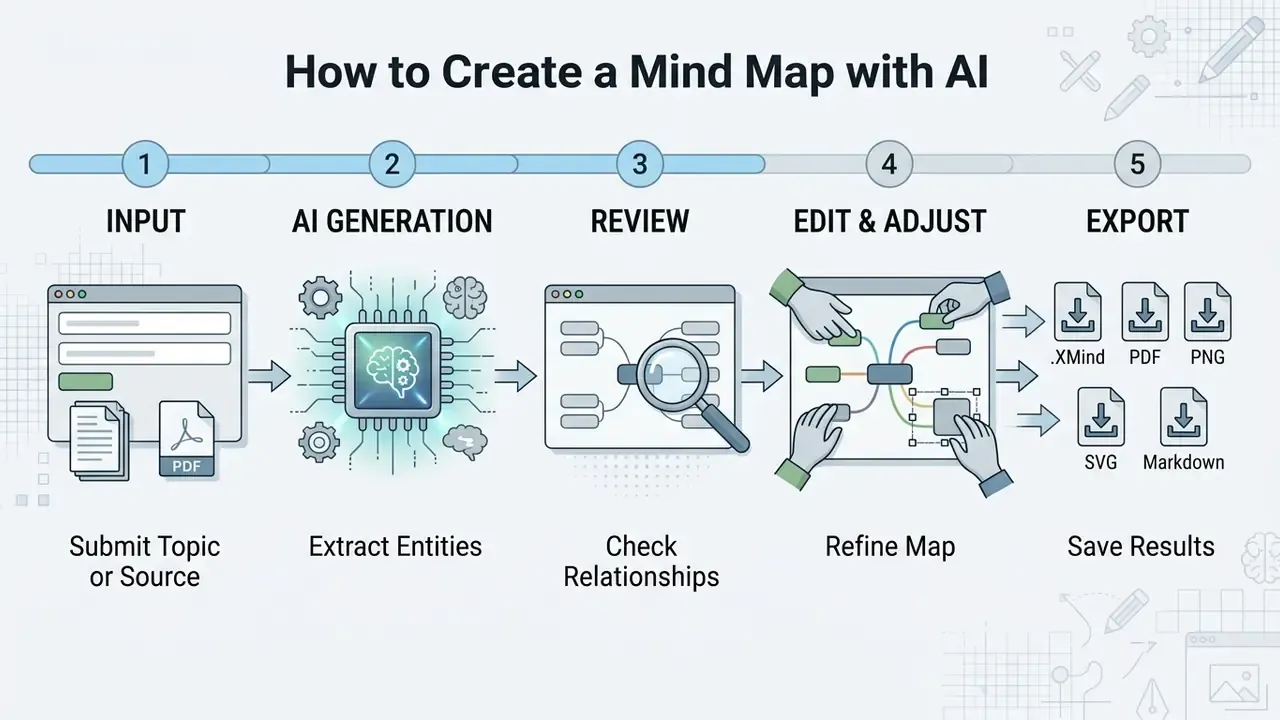
- Enter inputsupply a central topic, a detailed prompt, raw notes, an uploaded document, a webpage URL, an audio file or a video link.
- Generate structurethe AI processes the input and builds a radial or tree-structured diagram.
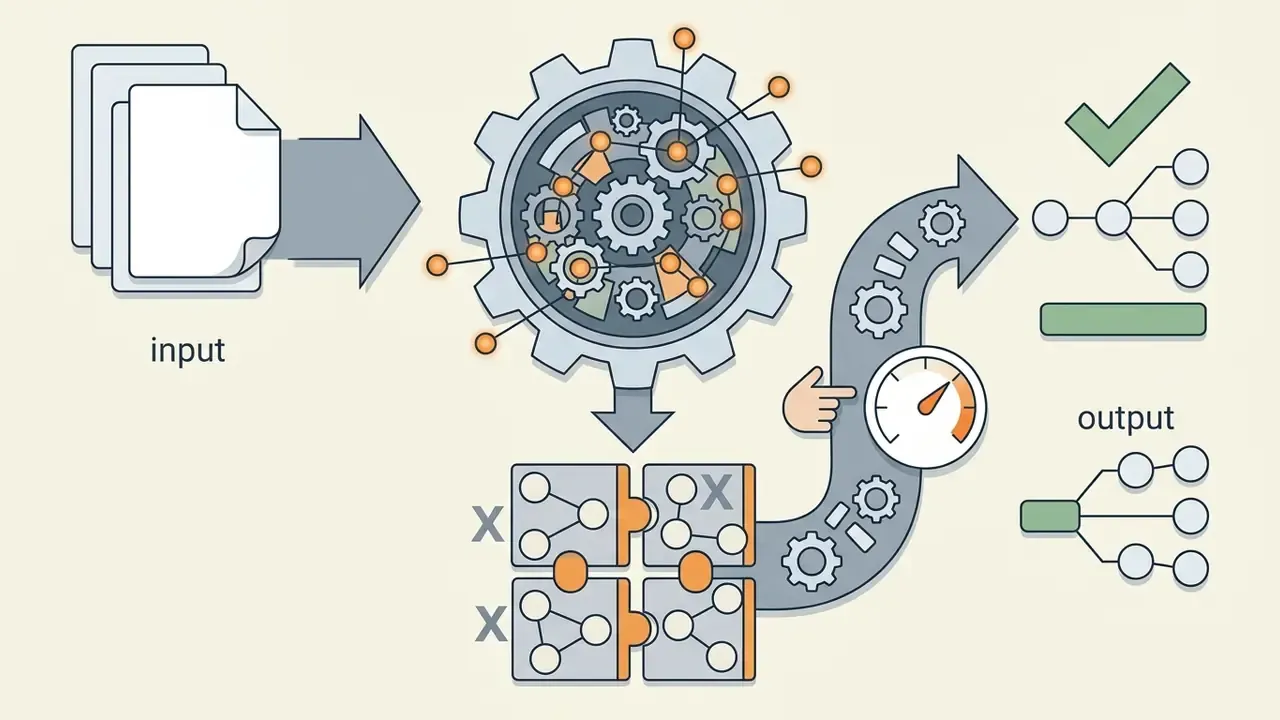
- Review hierarchycheck main branches and child nodes against source facts to verify the logical relationships hold.
- Edit branchesrename, drag, reorder or expand nodes to add context and custom data.
- Export and sharedownload the map as
.xmind, PDF, SVG, PNG, OPML or Markdown.
Start with a topic, prompt or text
A clean map starts with structured input. When users create mind map with ai, background context plus explicit constraints produces noticeably better node arrangement than a bare topic string.
Vendor prompting documentation, including OpenAI's prompt engineering guidance (2024 to 2025) and Anthropic's prompt engineering overview (2025), recommends placing operational instructions first, separating instruction from context with clear delimiters, and specifying outcome, depth and format. That is practitioner guidance, not peer-reviewed research, and it should be read that way. Instructing an ai to create mind map architectures with three levels of depth prevents over-clustering. Naming the required top-level branches keeps the taxonomy aligned with a framework you already use, which matters if the map will sit in a control library.
«Students using structured prompts to co-create maps with ChatGPT reported that the maps revealed causal links and event sequences.»
Illustrative example, hypothetical but typical: an internal policy team ingested a 40-page regulatory guide into an automated diagramming tool. The software returned a 4-tier risk taxonomy in about 30 seconds, mapped to the framework's own control families. The team then reviewed each branch against the regulatory baseline, corrected two mislabeled definitions, and recorded reviewer initials on the parent nodes before circulation. Two corrections in forty pages is not a rounding error, incidentally. It is the reason the review step exists. To compare specialized media and diagramming capabilities side by side, teams can see the overview of available tools.
Review, expand and edit the generated map
Once the first diagram appears, human review carries the accuracy burden. Double-click any node to change its label, delete redundant sub-branches, or drop in a manual note.
«In anatomy education, LLM-generated maps scored highest for clarity, yet human-built maps were consistently preferred for depth of understanding and engagement.»
Manual editing therefore stays vital for domain-specific terminology and interpretive depth. To deepen one idea without regenerating everything, use interactive AI node expansion. Right-clicking a sub-node opens a contextual prompt engine with options such as "Generate sub-topics", "Suggest action items" or "Provide counter-arguments". The AI reads the branch context and appends child nodes under the selected topic only, so the reviewed part of the structure stays untouched.
Published editor research describes the same primitives: double-click to add a child node with an automatic parent-child link, delete any selected node or edge to fix a faulty relationship, and adjust force-directed layout sliders to re-space a crowded canvas. Small mechanics, but they decide whether a reviewer fixes the map or gives up and rewrites it in a document.
What content can an AI mind map creator turn into a map?
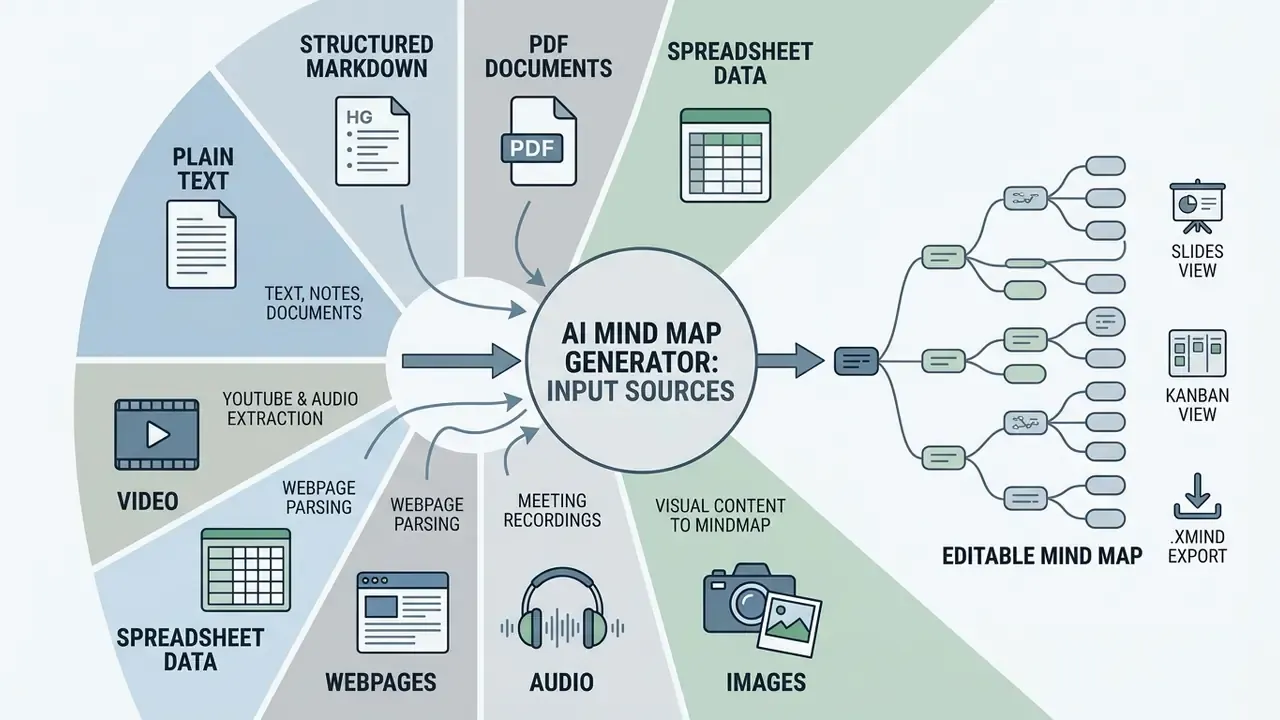
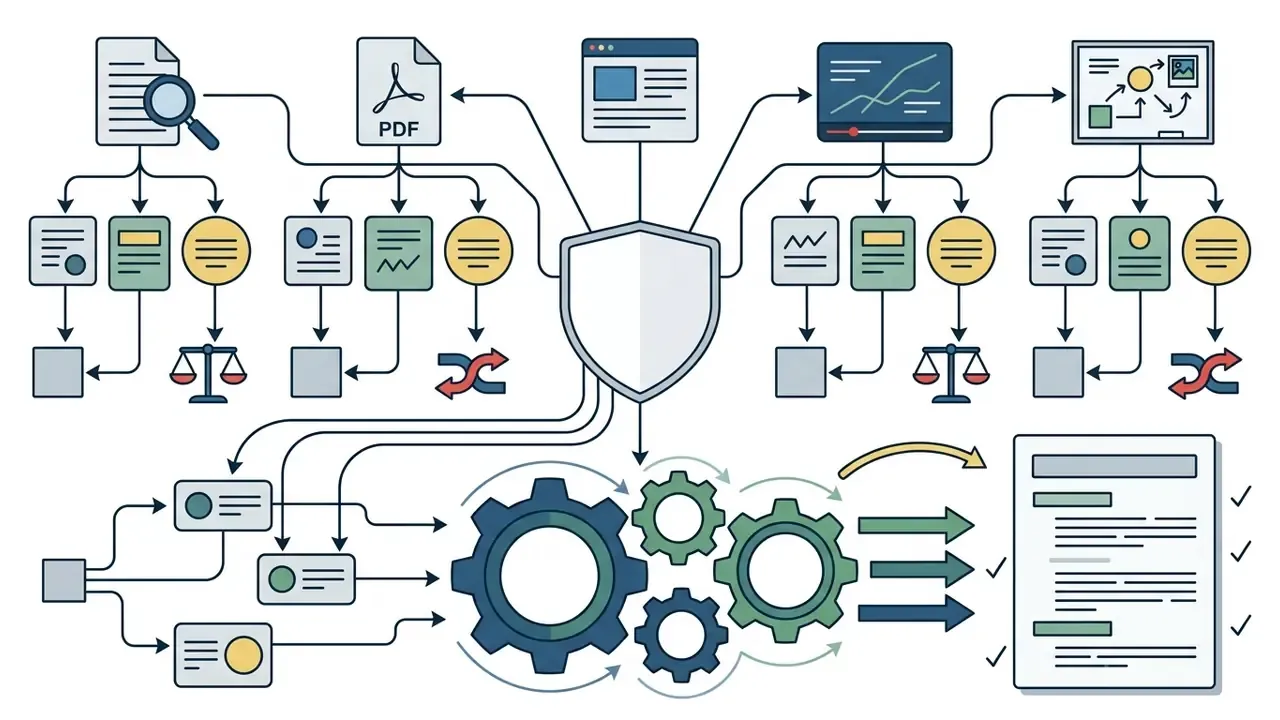
An ai mind map creator handles plain text, structured Markdown, PDF documents, spreadsheet data, webpages, audio, video and images. That range is what lets one team unify scattered sources into a single visual standard.
Generate a mind map from text, notes and documents
Text-to-mind-map algorithms parse paragraphs, meeting transcripts and long-form documents by identifying semantic headings, key statements and supporting points. The parser converts those elements into a hierarchical YAML or JSON structure before rendering the canvas.
With scientific papers or dense corporate reports, current systems extract main arguments and cluster citations under dedicated topic branches, then let you prune irrelevant branches so the hierarchy stays readable. Depth control belongs in the generation step: mainstream tools expose complexity settings from one to four or more levels, which works better than trimming an over-generated map afterwards. Teams planning the visual assets that accompany an outline can review adjacent creative tooling such as AI art generators or a reference library of pictures of ai to coordinate imagery with the approved structure.
Convert YouTube videos, audio and website links into mind maps
Modern AI mind map generators read online media streams and web URLs directly, with no manual copy-paste.
Practical caveat: transcript quality drives map quality. Heavy accents, crosstalk and unlabeled speakers flatten branches, so verifying the transcript before generation beats repairing a distorted map afterwards. Learned that one the hard way on a three-speaker recorded committee call.
Use an AI image to mindmap tool for visual content
An ai image to mindmap tool combines optical character recognition (OCR) with computer vision to convert diagrams, handwritten notes and whiteboard photos into editable digital maps. Readers evaluating the extraction layer can compare dedicated image-to-text and OCR tools used to clean up captures before ingestion.
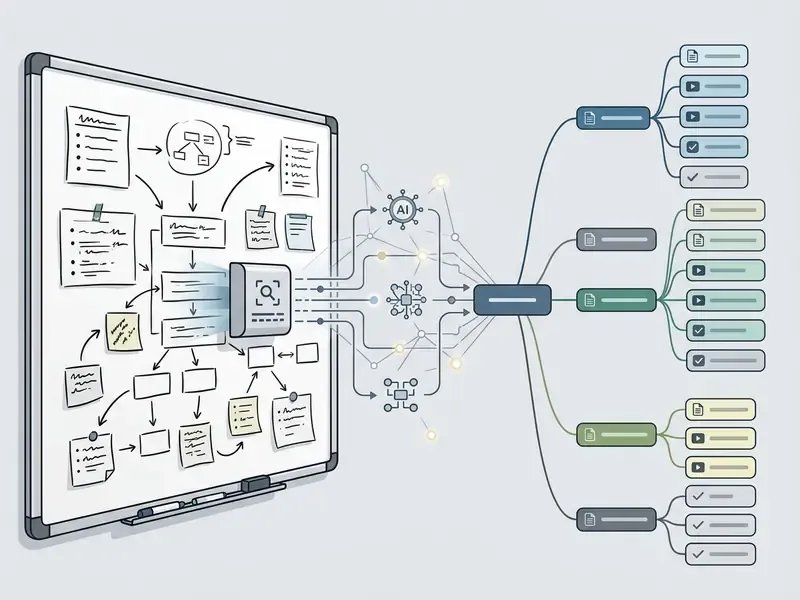
Vision algorithms scan line connections, spatial grouping and written text, then reconstruct the physical layout as a digital node tree. Workshop output moves into a managed environment without retyping. One distinction deserves attention: text-layer PDFs parse cleanly, while image-only scanned PDFs must pass through OCR first. Skip that and the generator receives no extractable text, returning a shallow, generic map that looks plausible and says nothing.
Features to look for in AI mind map generator tools
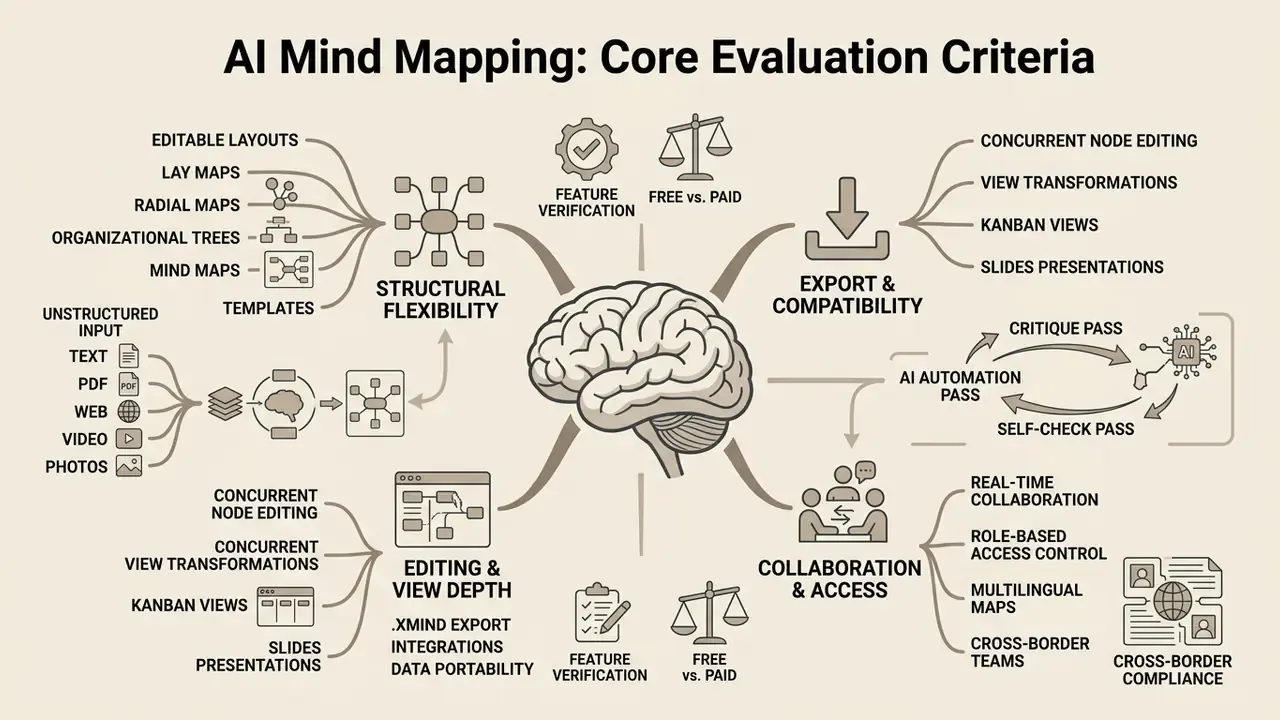
Choosing an ai mind map generator tool means weighing structural flexibility, editing depth, export formats, view transformations, collaboration, security controls and multi-language support. A serious system has to slot into existing technical and compliance workflows, not sit beside them.
Editable layouts, templates and exports
Core administrative features include customizable layouts such as radial maps, organizational trees, fishbone diagrams and logic charts, plus broad export support. Advanced platforms export native .xmind files for desktop editing alongside vector formats (SVG, PDF), Markdown, OPML, DOC/TXT and raster images (PNG, JPEG). Top-tier tools also offer one-click transformations that turn a mind map hierarchy into presentation slides, Gantt timelines or Kanban boards, so the same nodes become agenda items, milestones or cards without re-authoring.
«Targeted critiques and prompting strategies raised mind map accuracy by 37 percentage points, to 79%, demonstrating the value of built-in validation.»
That finding has a blunt product implication: prefer tools that expose a critique or self-check pass, node-level regeneration and structural constraints, not just prettier themes. Flexible export formats let maps live inside documentation, move to project boards, or feed developer pipelines. For technical options, teams can browse the hub covering developer documentation and API integrations, including programmatic ingestion from SharePoint, S3 or Confluence repositories where the vendor supports it.
Collaboration and multilingual mind maps
Enterprise deployments need real-time collaboration: role-based access control, concurrent node editing, node-anchored comment threads and visible presence indicators. Multilingual support lets international teams ingest content in one language and generate translated diagrams in 20 to 50 languages, depending on the vendor.
«In a 75-participant experiment, human-AI dyads outperformed solo participants on idea fluency and flexibility, with complementary results on novelty and value.»
Verified feature comparison of key AI mind mapping tools (source review August 2025, re-checked January 2026 against public vendor documentation)
| Tool | Verification date | Input formats supported | Export formats | Multilingual support | Collaboration features |
|---|---|---|---|---|---|
| Miro | Re-checked January 2026 | Text, sticky notes, prompts | PDF, PNG, board export | Multi-language prompts | Real-time co-editing, comments, permissions |
| Taskade | Re-checked January 2026 | Text, documents, whiteboard photos | PDF, image, mind map, flowchart | Multi-language processing | Team workspaces, role control, live chat |
| GitMind | Re-checked January 2026 | Text, OCR images, documents | Image, PDF, Word, TXT | Output in 10+ languages | Link sharing, collaborative editing |
Enterprise security, data privacy and Shadow AI risk
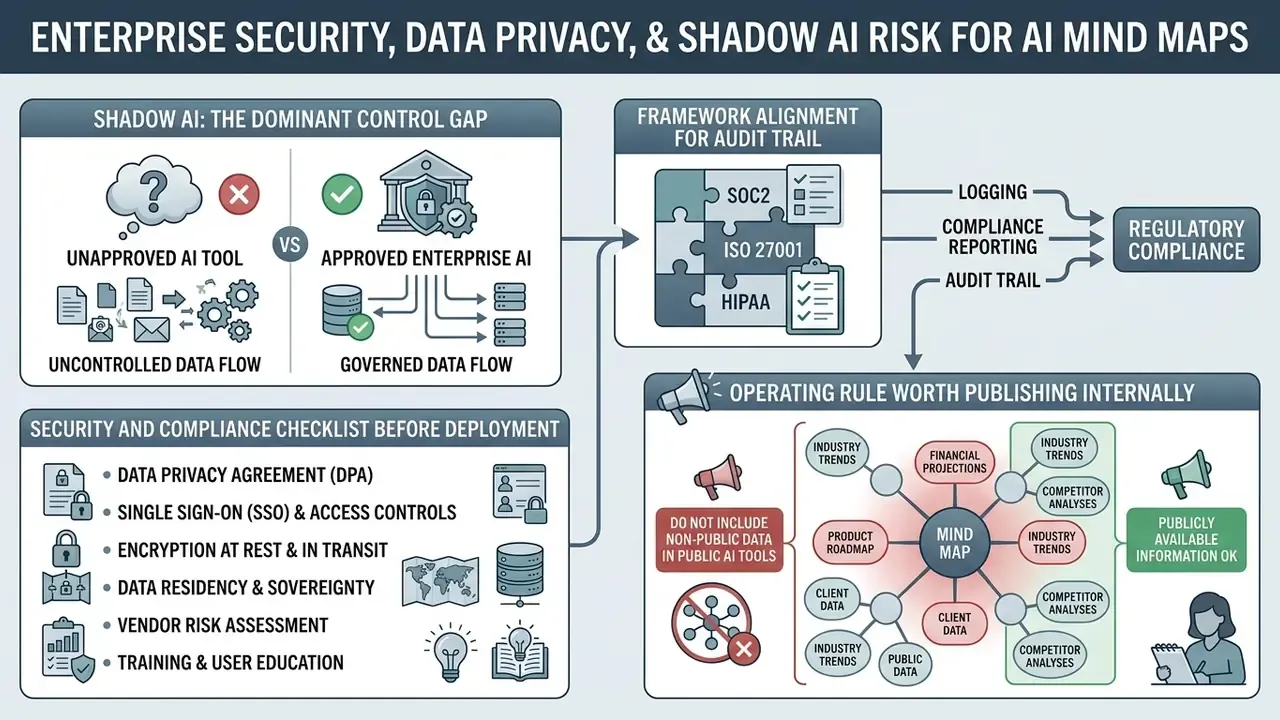
For regulated organizations the decisive question is not whether an ai mindmap generator produces a tidy tree. It is where the source document travels once it leaves the desktop. Uploading a supervisory letter, a model validation report or a customer file into a consumer web tool is a data-transfer event with contractual consequences.
Shadow AI is the dominant control gap. Free, no-signup generators attract users precisely because they bypass procurement, which means confidential material lands on an unvetted endpoint with no logging, no retention limit and no recourse. Mitigation is procedural as much as technical: publish an approved-tool list, block unapproved diagramming domains at the egress layer, and offer a sanctioned alternative fast enough that staff do not route around it. If the approved path takes ten clicks and a ticket, people will paste into the free tool. Every time.
Security and compliance checklist before deployment
| Control area | What to verify | Evidence to request |
|---|---|---|
| Data retention | Zero Data Retention (ZDR) or a contractually bounded retention window | Signed DPA clause, retention schedule |
| Model training | Explicit contractual guarantee that prompts and files are excluded from training corpora | Terms of service section, vendor attestation |
| Encryption | TLS 1.2+ in transit, AES-256 at rest, key management ownership | Architecture diagram, SOC 2 report section |
| Access control | RBAC, SSO/SAML or OIDC, SCIM provisioning, guest-link expiry | Admin console screenshots, config guide |
| Tenancy | Private workspace, single-tenant or VPC deployment option | Deployment options document |
| PII / NPI handling | Redaction or DLP pre-scan before upload, prohibition on customer identifiers | DLP policy mapping, upload allow-list |
| Logging | Immutable audit log of generation events, edits, exports and shares | Sample export of audit log |
| Sub-processors | List of LLM providers and hosting regions, data residency commitment | Sub-processor register |
| Certifications | SOC 2 Type II, ISO 27001, GDPR posture | Current reports, not marketing badges |
| Exit | Bulk export in open formats (.xmind, OPML, Markdown) and deletion on termination | Export test, deletion confirmation process |
Framework alignment matters for the audit trail. NIST AI RMF 1.0 (NIST, 2023) expects AI output to be compared against ground truth using both human and automated evaluation for accuracy, reliability and authenticity. That comparison is precisely the review step that turns a generated map into a defensible artifact. Institutions under model risk supervision usually map the same activity to their internal model documentation and change-control standards, and EU-based entities should confirm transparency obligations under the EU AI Act for the tooling class in scope. Where disputes over generated assets are a live concern, counsel-facing readers can see the overview of documented cases before setting policy.
Operating rule worth publishing internally: maps generated in public AI tools must not contain non-public personal information, customer identifiers, unreleased financials or supervisory correspondence. Where such content must be mapped, use an approved private-tenant deployment or de-identify the source first.
Reproducibility, traceability and model-risk validation
Generative output is probabilistic. The same prompt and the same PDF can return different branch labels across runs. For audit and model risk purposes, reproducibility has to be engineered, never assumed.
Traceability requirements (node-to-source lineage):
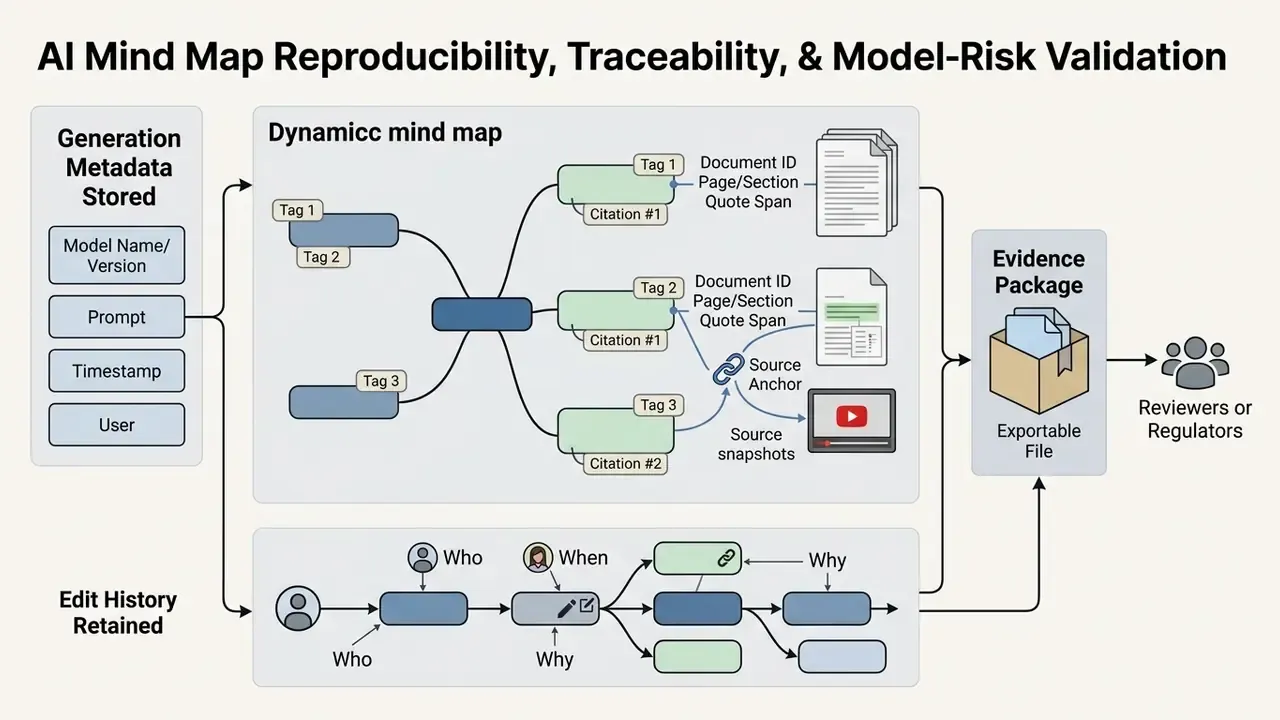
If a vendor cannot attach page-level citations, generate section by section rather than document by document, so each branch is provably derived from a bounded, named extract. Store the prompt text next to the exported map. Without the prompt, the artifact cannot be reproduced or challenged, and an unchallengeable artifact is not evidence.
Model risk validation checklist for AI-generated maps
ROI estimation with validation cost included
Time savings are real, but they must be netted against review effort. A defensible estimate:
Net hours saved = (T_manual - T_generate - T_review - T_remediation) x N_documents
Net value = Net hours saved x Fully loaded hourly rate
            - Licence cost
            - (Residual error rate x Expected cost per error)
Worked illustration: a 40-page policy document that took 50 minutes to map by hand now takes 1 minute to generate plus 12 minutes to verify and correct, a net saving of roughly 37 minutes per document. Across 60 documents per quarter that is about 37 hours, before licence cost and before any provision for residual error. Teams modelling resource usage can also use interactive calculators to test their own assumptions on volume, rate and error cost. One honest caveat: remediation time is the variable most often understated, and it rises sharply with poor source quality.
Free AI mind map generator tools, pricing and commercial-use choice
Evaluating an ai mind map generator free tier means finding the functional ceilings: monthly generation credits, restricted export formats, watermark enforcement. Business use usually forces an upgrade, mostly for data privacy terms and explicit commercial usage rights.
| Tier / feature | Free plan availability | Paid / enterprise tier | Commercial consideration |
|---|---|---|---|
| Map creation limits | 3 to 5 total maps, or 10 to 50 AI credits per month | Unlimited maps, expanded credits | Free tiers cap monthly generation volume |
| Export formats | PNG, JPEG or watermarked PDF | .xmind, SVG, vector PDF, OPML, Markdown | Vector and native exports needed for publication and re-editing |
| Node limits | Capped at 50 to 60 nodes per map | Unlimited nodes and attachments | Large document ingestion needs a paid tier |
| Data privacy | Public boards or server-logged prompts | Private workspaces, SOC 2 compliance, ZDR terms | Critical for confidential business data |
| Team controls | Link sharing only | SSO/SAML, RBAC, SCIM, audit logs | Required for regulated deployments |
| Commercial rights | Restricted or personal use only | Full commercial ownership | Explicit terms needed for client deliverables |
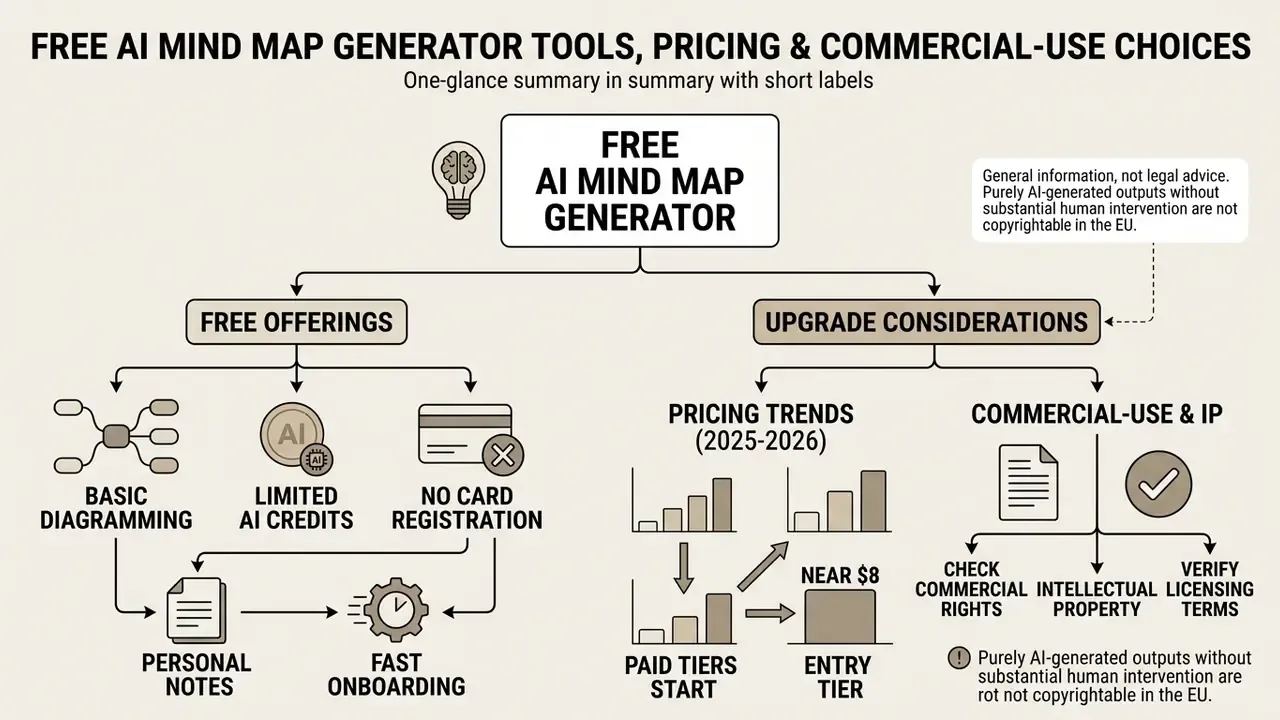
Public price points from 2025 into early 2026 illustrate the range: entry paid tiers commonly start near $8 per member per month billed annually, mid-tier business plans sit around $20 to $25 per member per month, and some vendors publish personal tiers from roughly $3.50 per user per month. Free tiers cluster tightly around three saved maps, 50 to 60 nodes and 10 to 50 AI credits monthly. Prices move, so verify at the point of purchase. To review current cost details, users can explore the hub.
What "free" includes in an AI mind map generator online
A free ai mind map generator typically covers basic diagramming, a limited pool of AI generation credits and standard image exports. Platforms offering an ai mind map generator online free mode may limit cloud storage to 3 active maps, enforce a node cap per diagram, restrict image attachments to two per map, and cap storage around 100 MB.
Anyone looking for an ai mind map maker free utility for personal notes gets fast onboarding with no card required. Several tools run without registration at all and keep maps in local browser storage, which is convenient and also means one cleared cache away from gone. Larger documents, watermark removal, scalable SVG and native .xmind files sit behind a subscription in almost every case. Teams comparing ai mind map generator tools in 2026 can also see the overview of platform terms to understand usage conditions before rollout.
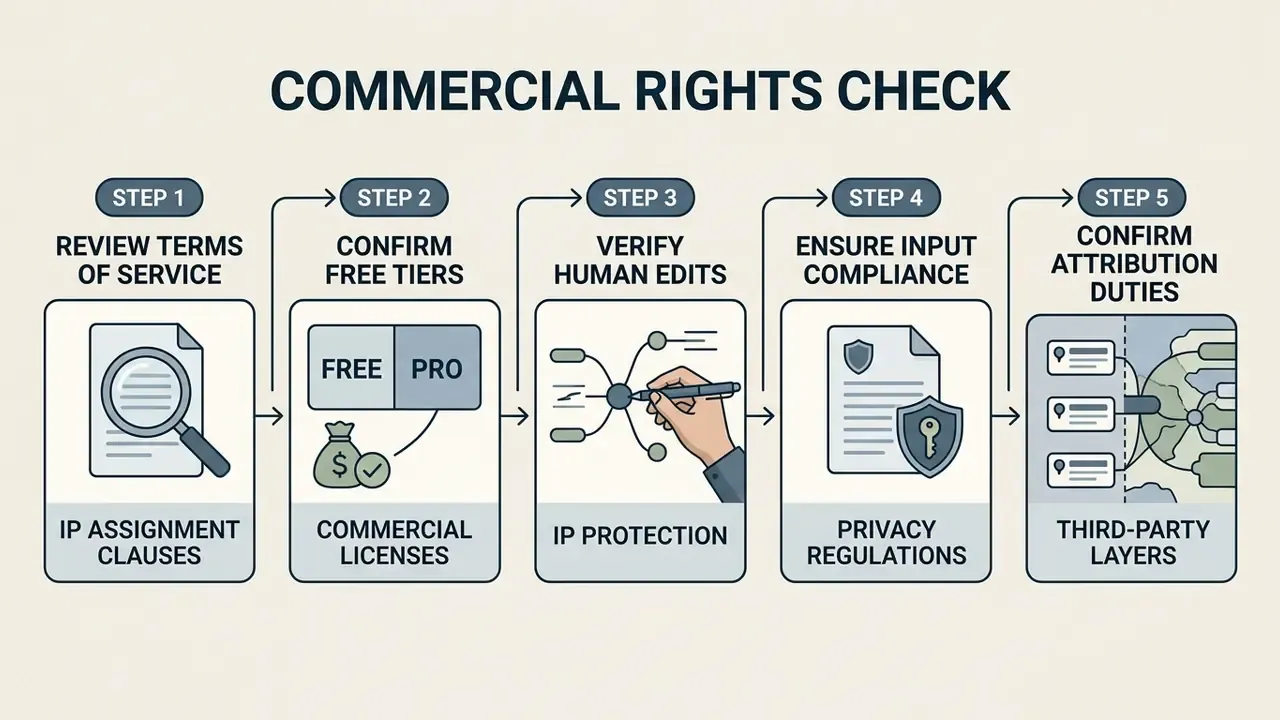
How to check commercial-use rights before choosing a tool
This section is general information, not legal advice. It does not replace consultation with qualified counsel on intellectual property, licensing and data protection in your jurisdiction.
Verifying IP rights and commercial licensing terms is essential before publishing AI-generated mind maps in commercial products or client reports. Legal frameworks in major jurisdictions hold that purely AI-generated output lacking human authorship cannot be copyrighted.
«AI-generated material lacking human authorship is not protected by copyright; only human-authored contributions can be claimed.»
«Purely AI-generated outputs without substantial human intervention are not copyrightable in the EU and may be freely used, reproduced or adapted.» Generative AI and Copyright, European Parliament study (2025). europarl.europa.eu
FAQ about AI mind map makers
Do I need an account to use an AI mind map generator online?
No. Several online utilities let you create mind maps immediately without registering. These web-based tools process input in the browser or offer trial generations on the page, and some store maps only in local browser storage. An account becomes necessary once you need cloud saving, real-time collaboration or advanced exports such as SVG, .xmind and OPML. Temporary drafts are fine anonymously. Enterprise teams should use authenticated accounts with SSO to keep retention control, permissions and version history intact.
What is the difference between a mind map and a concept map?
A mind map is a strictly hierarchical tree radiating from one root topic, best for outlining a single subject. A concept map is a network where any two concepts can be joined by a labeled relationship, better for showing how ideas connect across a wider domain or control environment. Most ai mind maps maker products default to trees unless labeled cross-links are requested explicitly.
Can I turn a YouTube video, a webpage or an audio file into a mind map?
Yes. Leading tools accept a YouTube URL, an article link, or an uploaded audio or video file. The system transcribes speech with automatic speech recognition or parses the page's main content, discards navigation and filler, and builds branches around the key arguments, often with timestamps for media sources. File-size ceilings near 50 MB per upload are common on standard plans, so long recordings may need splitting first.
Can I export the map to XMind, or turn it into slides or a Kanban board?
Yes on both counts, vendor permitting. Native .xmind export preserves the editable hierarchy for desktop refinement, SVG and vector PDF suit publication, and Markdown or OPML feed documentation pipelines. Several platforms also convert the same hierarchy into slides, Gantt timelines, Kanban boards, outlines or tables with one click, so a brainstorm becomes a plan without re-authoring.
Can AI understand professional terminology and complex topics?
Modern large language models recognize specialized terminology across financial, legal, medical and technical domains. In medical education evaluations, LLM-generated concept maps achieved high clarity scores when structuring complex anatomical relationships (Qatar University anatomy study, 2025).
«AI mind mapping proved an effective pedagogical approach for improving vocabulary recall and retention among non-English-major students.» Quasi-experimental study on AI-powered mind mapping for vocabulary acquisition (2024 to 2025). Clarity is not accuracy, though. Models still misread rare jargon and invent facts, and terminology research shows the typical failure mode is a plausible but non-existent or out-of-domain term. Those are the ones that survive a quick skim. «Current LLMs struggle with consistent global and local structure in mind map outputs; carefully designed prompts can substantially improve factual and structural accuracy.» Jain et al., STRUCTSUM Generation, arXiv / ACL (2024). arxiv.org Standard risk management practice therefore requires subject matter experts to review and validate every AI-generated node before a map enters an operational environment, consistent with the ground-truth comparison expected by NIST AI RMF 1.0 (2023) and the terminology-management discipline described in ISO 29383:2020. Current generators run on foundation models such as OpenAI's GPT-4o, Anthropic's Claude 3.5 Sonnet or Google's Gemini 1.5 Pro, which improves jargon parsing and context-aware node organization. It does not remove the review requirement.
How much text can I add to create a mind map with AI?
Input limits depend on the model's token capacity and the platform's upload rules. Browser-based tools generally accept direct text between 1,000 and 10,000 words, and some cap input at 5,000 characters per generation. Vendor API documentation from 2024 to 2025 indicates that advanced document-parsing engines handle PDFs up to roughly 50 MB, in Google's case up to about 1,000 pages where a page consumes approximately 258 tokens, while OpenAI documents a 50 MB per-file and per-request limit with PDF parsing consuming both extracted text and page images. These are product specifications, not research findings, and they change with model releases. For very long texts, algorithms chunk the material into logical sections to preserve depth. With multi-chapter reports, splitting the document before generation produces clearer, better-balanced child branches, and as a side benefit tighter node-to-source traceability. Where a file exceeds the hard ceiling, the documented workarounds are splitting the PDF, reducing image resolution, or sending smaller inline extracts.
Is it safe to use a public AI mind map generator for confidential documents?
Not by default. Free and consumer tiers frequently log prompts, may retain uploads, and rarely offer contractual exclusion from model training. Confidential, non-public personal or supervisory material should be mapped only in an approved private workspace with a signed data processing agreement, zero or bounded retention, encryption in transit and at rest, RBAC and audit logging, the controls listed in the compliance checklist above.
How reproducible are AI-generated mind maps?
Partially. Because generation is probabilistic, identical inputs can produce different labels and groupings across runs. Reproducibility comes from storing the model name and version, the exact prompt, the source file hash and the timestamp alongside the exported map, plus one re-run during validation to document material divergence. If a reviewer cannot reconstruct the map from stored inputs, treat it as an illustration rather than evidence.
Who owns the AI-generated mind map inside an organization?
Ownership should be recorded like any other controlled artifact: a named owner, an approved use, a review date and a retirement trigger. Free-tier terms often reserve broad vendor rights, while paid business tiers typically assign output rights to the customer. Copyright protection still depends on substantial human contribution, so the edit history doubles as the ownership record. When preparing large media files for ingestion, readers can also review the guide to video compressors.
Footer navigation
To review comprehensive term definitions and technical guides, browse the hub for full access to the knowledge repository. Pricing details sit in the pricing hub, developer integration details in the API hub, and licensing guidance in the AI Media Commercial-Use section. Disclaimer: this article provides general information on software capabilities, pricing patterns and governance practice. It is not legal, compliance or financial advice. Verify vendor terms, certifications and licensing directly with the provider and with qualified counsel before deploying any tool on confidential or regulated data.