Key takeaways for executives and busy readers
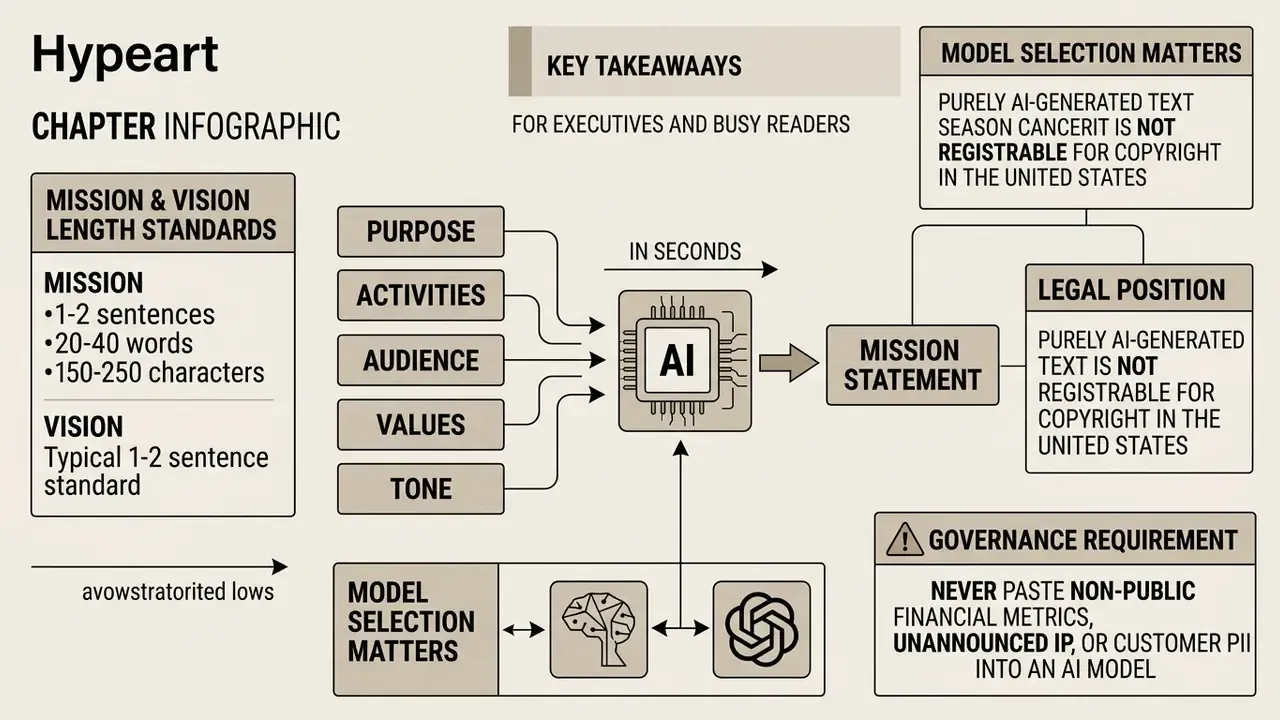
- An ai mission statement generator converts structured inputs (purpose, activities, audience, values, tone) into a concise declaration in seconds. MIT's randomized trial in Science (2023) measured a 40% reduction in professional writing time and an 18% quality gain.
- Fixed length standards: mission = 1 to 2 sentences, 20 to 40 words (150 to 250 characters); vision = 1 to 2 sentences, 15 to 30 words (100 to 200 characters).
- Model selection matters. Concise corporate drafts favour GPT-class models, emotive personal or nonprofit drafts favour Claude-class models, and self-hosted open-weight models (DeepSeek, Qwen) suit strict data-residency rules.
- Legal position: purely AI-generated text is not registrable for copyright in the United States. Human selection, arrangement, and substantial editing protect the human contribution.
- Governance requirement: never paste non-public financial metrics, unannounced IP, or customer PII into an unvetted free generator. NIST AI RMF 1.0 and GDPR Art. 5(1)(e) apply.
Scope, sources, and how to read this guide
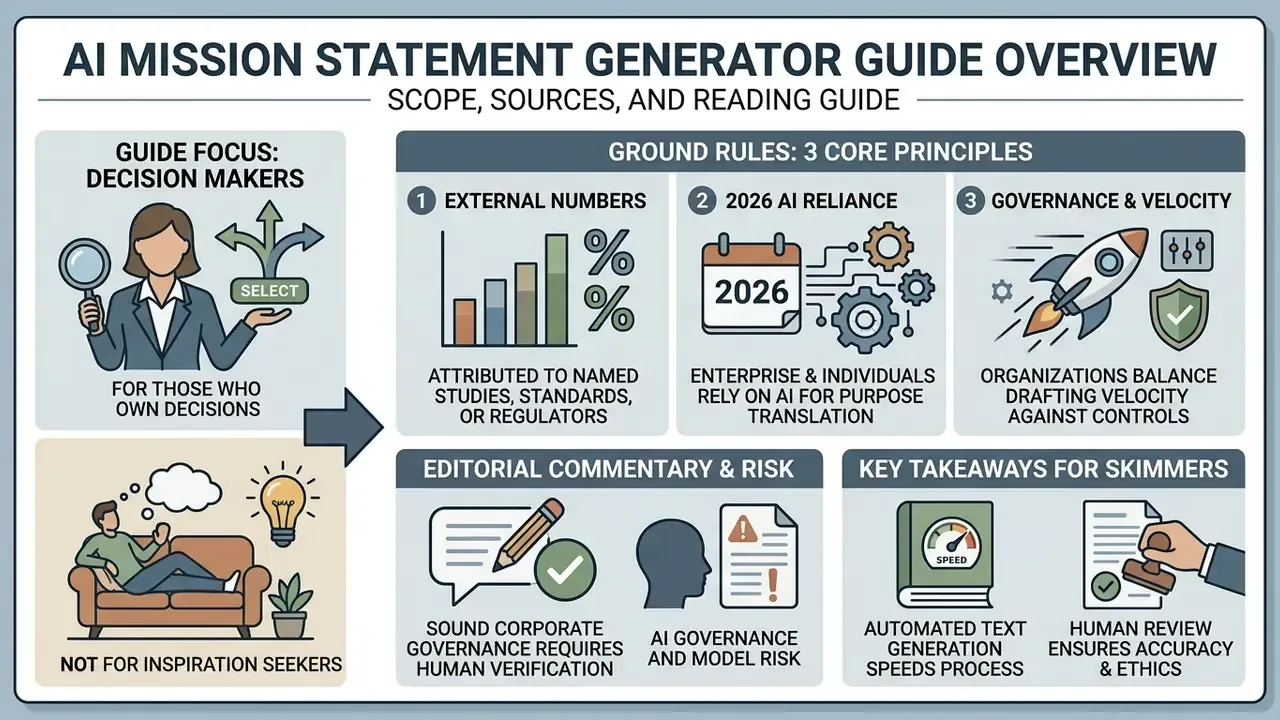
This page is written for people who own a decision, not for people collecting inspiration. If you sit in risk, compliance, model risk, or communications at a US bank or a mature fintech, the practical question is narrow: can a generated sentence become an approved corporate artifact, and under what controls?
Three ground rules apply throughout.
First, every external number is attributed to a named study, standards body, or regulator. Where a figure could not be traced to a primary source, the text states the working convention instead of dressing it up as a standard. Second, statements about audience motivation remain hypotheses until analytics, interviews, or CRM data confirm them. Third, the length bands used here (mission 20 to 40 words, vision 15 to 30 words) are editorial conventions, applied consistently so that drafts stay comparable across teams.
One more thing. A mission statement is a low-cost artifact with a high-cost failure mode. Nobody gets fired for a clumsy sentence. People do get uncomfortable questions when a published claim cannot be evidenced.
In 2026, enterprise leaders and individuals rely on artificial intelligence to translate high-level purpose into clear strategic messaging. An ai mission statement generator accelerates this by synthesizing organizational values, primary operations, and target demographics into short declarations. Some tools go further and act as an ai mission and vision generator, producing a matched pair in a single pass.
Organizations that deploy generative tools balance drafting velocity against controls. Large language models (LLMs) can organize complex principles into polished prose. Executive oversight is what ensures the final statement reflects actual business practice, regulatory boundaries, and commitments the firm can defend.
What is an AI mission statement generator and why is it needed
An ai mission statement generator is a software application that uses natural language processing to condense an entity's identity, objectives, and ethical commitments into a structured declaration. It solves one drafting problem well: turning raw operational concepts into an articulate, memorable sentence.
Modern LLMs perform this task by analyzing patterns across large professional corpora. A randomized controlled trial on professional writing productivity by Shakked Noy and Whitney Zhang at MIT reported a measurable effect:
«ChatGPT reduced task completion time by 40% and increased output quality by 18% relative to the control group.»
For executive teams and solo founders, a statement generator removes the blank-page problem and gives reviewers something concrete to argue with. The measured gains apply to short, structured professional writing, which is exactly the category that mission and vision drafting falls into.
The tool works by extracting core entities such as target audience, primary capabilities, and strategic intent, then applying structural frameworks used in corporate communications. Rather than filling a static template, a mission statement generator ai adapts phrasing to industry norms, compliance demands, or personal development objectives. Some vendors market the same engine as an ai purpose statement generator, which is the same mechanism under a different label.
Mission statement, purpose, and values: what the text must reflect
A mission statement is the operational expression of an entity's core purpose and foundational values. It establishes what the organization does today, whom it serves, and how it behaves. Governance guidance from the United Nations Economic Commission for Europe (UNECE Strategic Framework) describes four dimensions of an effective mission: explicit purpose, strategic direction, core values, and behavioral standards.
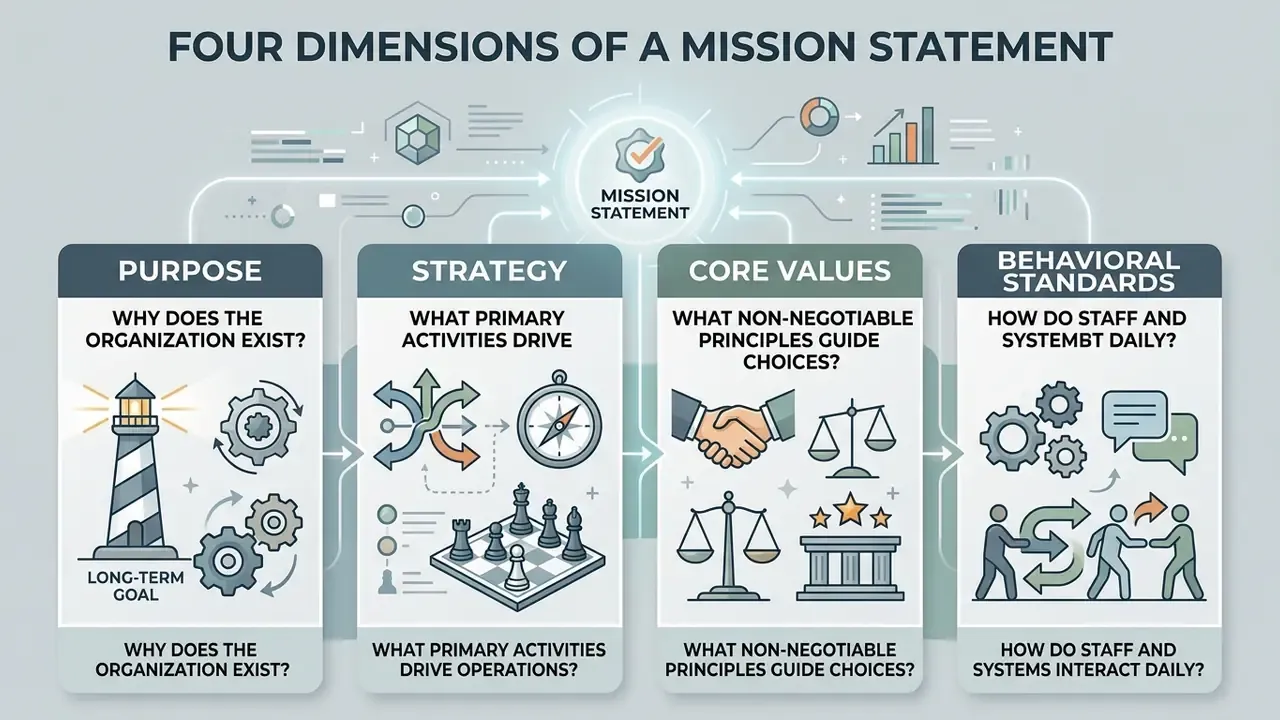
When generating statements, the software must balance factual description of current operations against stated principles. If a firm values risk-adjusted integrity or consumer privacy, those attributes should shape the wording rather than sit in a separate policy PDF. For a business, that alignment builds public trust. For personal positioning, it becomes an internal anchor for career decisions.
Communicators often pair this work with an ai headline generator so that broad organizational goals and public messaging stay consistent across external channels.
Mission statement vs vision statement: what is the difference
The distinction between a mission statement and a vision statement lies in time horizon, aspirational scope, and mandated length. A mission defines present operational scope over roughly one to three years and answers what the entity does today. A vision articulates a desired future state over five to ten years and answers where the entity intends to be.
| Dimension | Mission statement | Vision statement |
|---|---|---|
| Time horizon | Present (1 to 3 years) | Future (5 to 10+ years) |
| Primary focus | Action and operations | Aspiration and impact |
| Key audience | Customers, staff, regulators | Investors, society |
| Underlying question | What do we do today? | What will we achieve? |
| Standard length | 1 to 2 sentences, 20 to 40 words (150 to 250 characters) | 1 to 2 sentences, 15 to 30 words (100 to 200 characters) |
| Tense | Present, operational | Future, directional |
Length standard (applies across this guide): mission statements target 20 to 40 words, vision statements target 15 to 30 words. Brevity here is not cosmetic. A hard cap forces the drafting team to delete hedging, and it makes the statement repeatable by employees without opening a document. If a mission needs a full paragraph to explain itself, the strategy behind it has not been distilled yet.
A worked pair shows the split clearly. A meal-delivery operator's mission: "We deliver restaurant-quality meals to time-constrained professionals in under 30 minutes across twelve metropolitan markets." Its vision: "A city where excellent food never requires cooking, queuing, or commuting." The mission grounds daily operations and can be audited. The vision sets direction and cannot.
Research on consumer perception by Kirk et al. suggests that factual, present-focused communication attracts less scrutiny over AI authorship than emotional, aspirational content. The measured penalty is material:
Mission statements lean on operational facts, so they tolerate AI-assisted drafting well. Vision statements lean on inspiration, so they need deeper human input to survive stakeholder pressure over time.
How to create a mission statement using AI
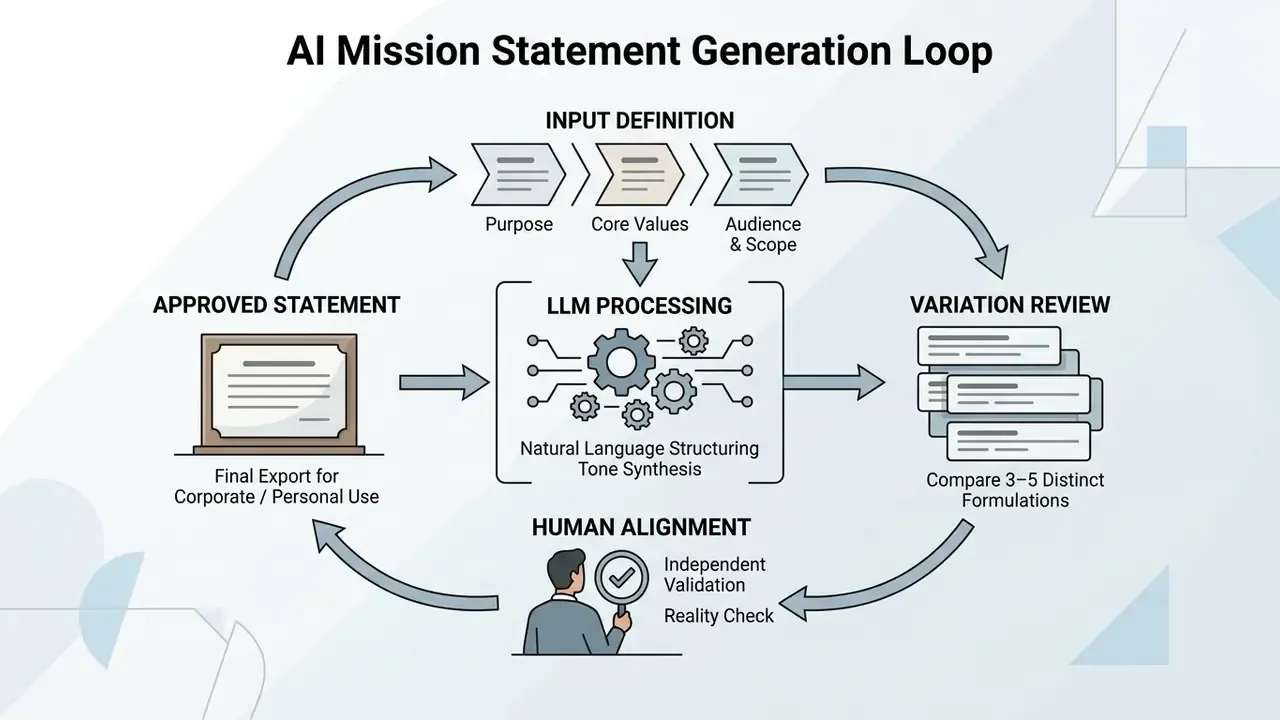
To run a create a mission statement ai workflow properly, follow a sequence: prepare inputs, refine prompts iteratively, then validate. Modern AI writing systems need structured context, otherwise they default to generic corporate marketing language.
Step-by-step AI mission generation process
Followed in order, this method produces a functional governance asset rather than a workshop souvenir.
- Define core parameters.Document primary business operations, target beneficiaries, non-negotiable values, and desired tone.
- Input business context.Enter structured operational details into the
ai generator mission statementprompt interface. - Execute multi-variant generation.Request three to five distinct outputs that shift structural focus and phrasing.
- Evaluate comparatively.Review drafts against conciseness metrics, clarity rubrics, and operational reality.
- Refine with stakeholders.Edit the selected output to add brand vocabulary, verify factual claims, and secure executive approval.
What input data to give the AI tool
An ai generator mission statement needs six inputs to produce a tailored draft: corporate purpose, operational activities, target beneficiaries, key differentiators, foundational values, and tone constraints. Explicit context prevents the model from inventing assumptions to fill gaps.
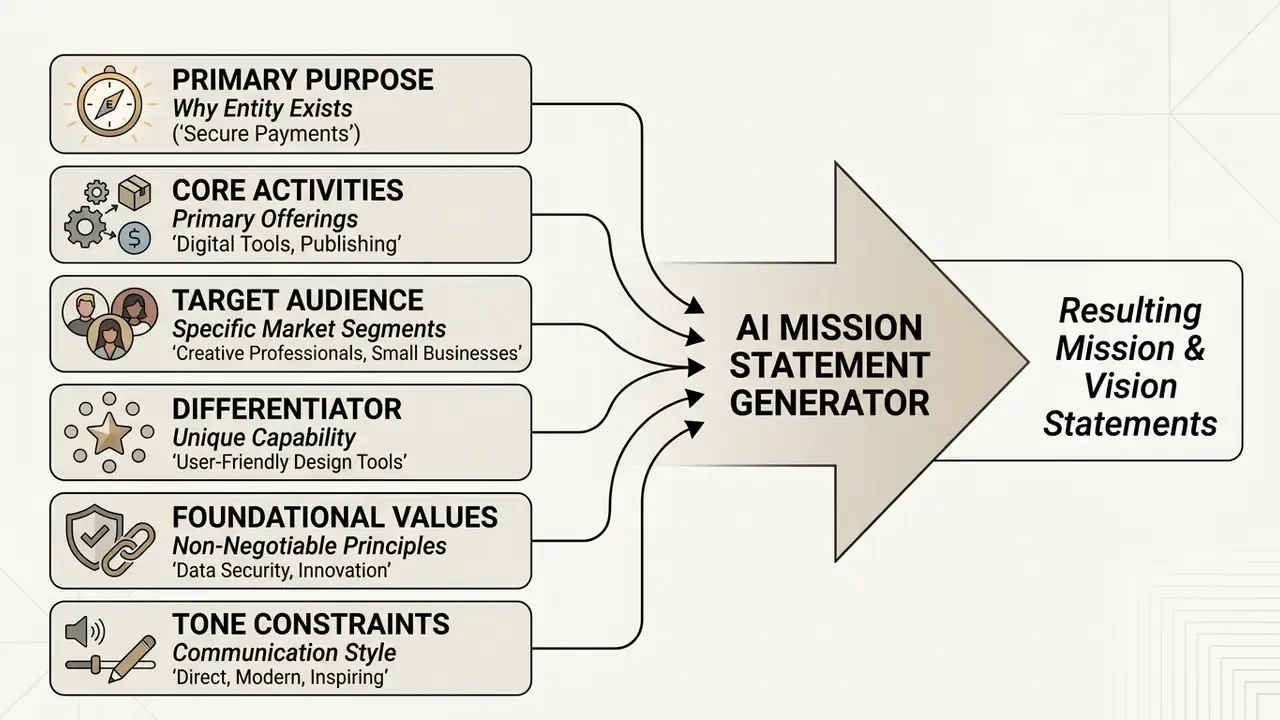
Guidance from the National Institute of Standards and Technology (NIST SP 1353 Draft, 2024) recommends structured prompt frameworks such as CO-STAR (Context, Objective, Style, Tone, Audience, Response) for model interactions. Verified business context keeps the draft inside realistic organizational boundaries.
Most consumer-facing generators compress those six variables into a short web form. A typical minimal interface looks like this:
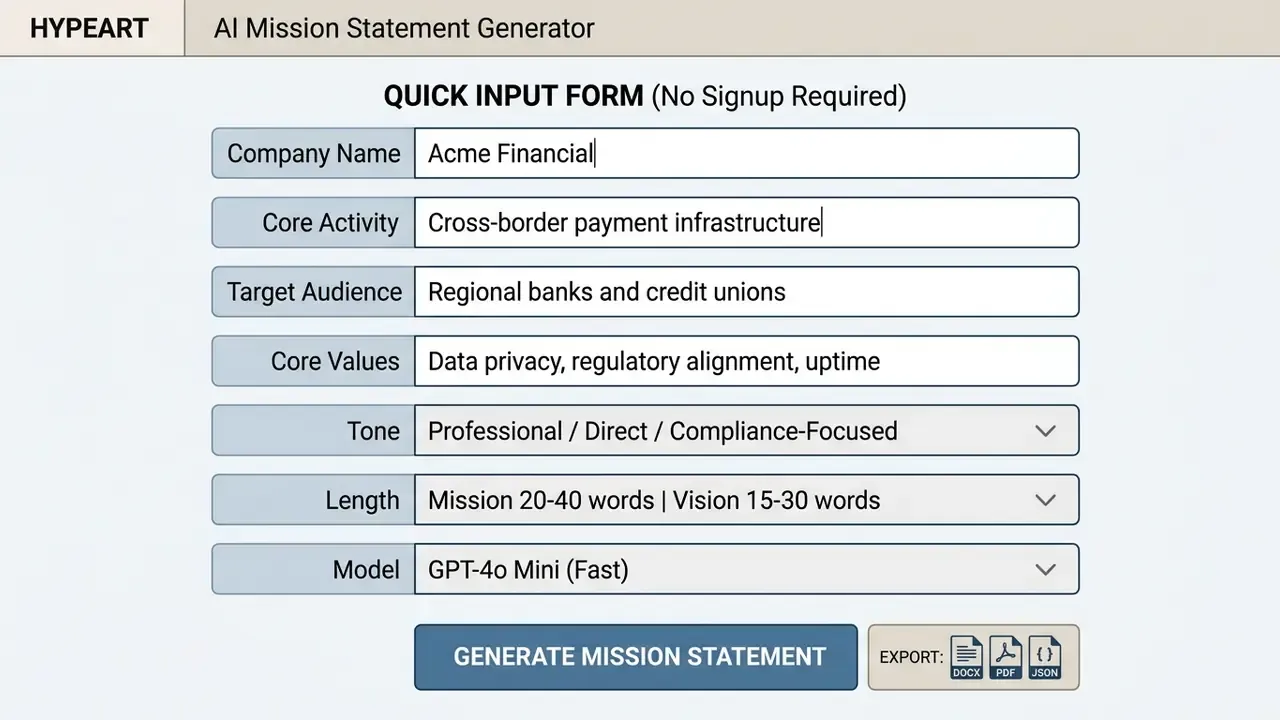
Interfaces of this type trade control for speed. Teams under model-risk supervision should prefer the full prompt templates below, because a form gives reviewers nowhere to record constraints, banned vocabulary, or the approved context artifacts behind a draft. That record is what an auditor asks for later.
How to get multiple options and select the best statement
To produce genuinely different candidates, vary perspective, emphasis, and structural length instead of resubmitting the same prompt. Rotating the role framing helps: one version focused on customer outcomes, another on operational integrity, a third on regulatory posture.
Structured prompting practice shows that rotating role frames and framing modes (story-driven, outcome-driven, values-driven, customer-driven) widens the semantic spread of candidates without hurting coherence. This is the same iterative refinement loop measured in controlled professional writing experiments (Noy & Zhang, Science, 2023. https://www.science.org/doi/10.1126/science.adh2586). Evaluators should therefore judge options by whether they differ in emphasis, not merely in adjectives. Two drafts separated only by word choice count as one option.
An illustrative case. When a regional financial institution ran automated mission drafts past its risk and compliance committees, the first outputs were broad and stuffed with industry boilerplate. The risk team resubmitted structured prompts weighted toward regulatory adherence and customer data protection, which produced four distinct operational variants. Reviewed against existing model-risk governance criteria, leadership selected a 28-word mission that matched both commercial strategy and stated risk appetite. Composite example, not a documented client result.
Choosing the right LLM engine for mission statement generation
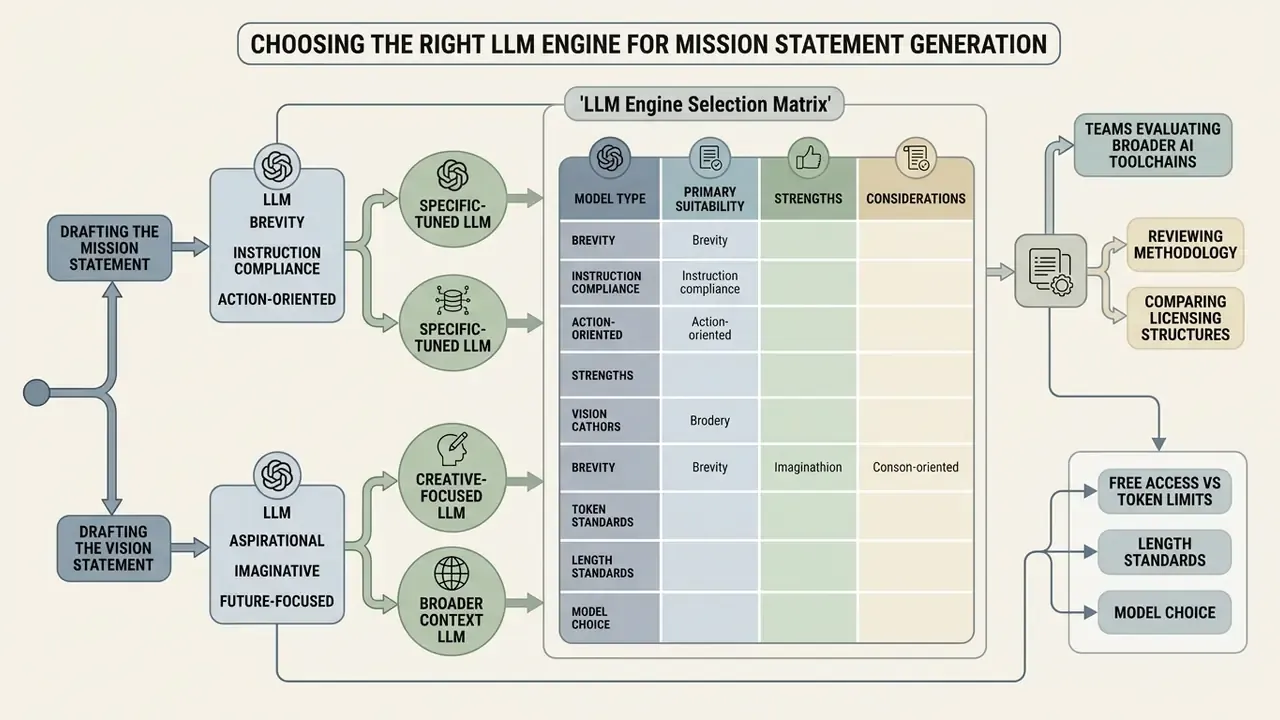
Not every model suits every statement type. Public generators increasingly expose a model selector (GPT-class, Claude-class, Gemini-class, DeepSeek, Qwen, Kimi), and the choice measurably changes tone, verbosity, and compliance behaviour. The matrix below summarizes practical selection criteria for ai mission statement generator workflows.
LLM engine selection matrix for mission and vision drafting
| Model family | Best-fit statement type | Observed drafting behaviour | Governance note |
|---|---|---|---|
| GPT-4o / GPT-5 class | Corporate and B2B mission statements | Strong instruction-following on hard word limits; concise, operations-first phrasing | Enterprise tiers offer zero-retention terms and indemnity |
| Claude 3.5 / Opus class | Personal, founder, and nonprofit statements | More natural tone; better handling of values and beneficiary language | 200k+ token context on paid tiers supports document-grounded drafting |
| Gemini Pro / Flash class | Multilingual mission and vision pairs | Fast multi-variant output; useful for regional localization of one mission | Verify translation fidelity of value terms with native reviewers |
| DeepSeek R1 / Qwen 2.5 (open weights) | Regulated, self-hosted enterprise drafting | Adequate for factual mission text; needs tighter constraints to avoid verbosity | Preferred where data residency prohibits third-party inference |
| Lightweight free-tool models (Qwen 7B class) | First drafts, students, sole traders | Serviceable structure, more clichés, heavier human editing required | Assume session-only retention; never submit confidential data |
A practical rule: draft the mission with a model tuned for brevity and instruction compliance, draft the vision with a model tuned for natural tone, then reconcile both in a single human editing pass. Two engines, one editor.
Teams comparing broader AI toolchains and licensing structures can review methodology on our comparison of AI generation tools page, and voice-driven delivery of approved statements is covered in our guide to AI voice generators.
AI business mission statement generator for companies and organizations
An ai business mission statement generator helps commercial entities, startups, and enterprise business units convert strategic objectives into clear corporate positioning. A strong business mission aligns internal teams, clarifies the value proposition for prospective clients, and gives brand governance a fixed reference point.
Field evidence supports AI-assisted copy when human review stays in place:
The implication for mission drafting is narrow but useful. AI lowers the cost of producing candidate text. Deciding which candidate becomes an official corporate statement stays a human governance act, with a named owner and a dated approval.
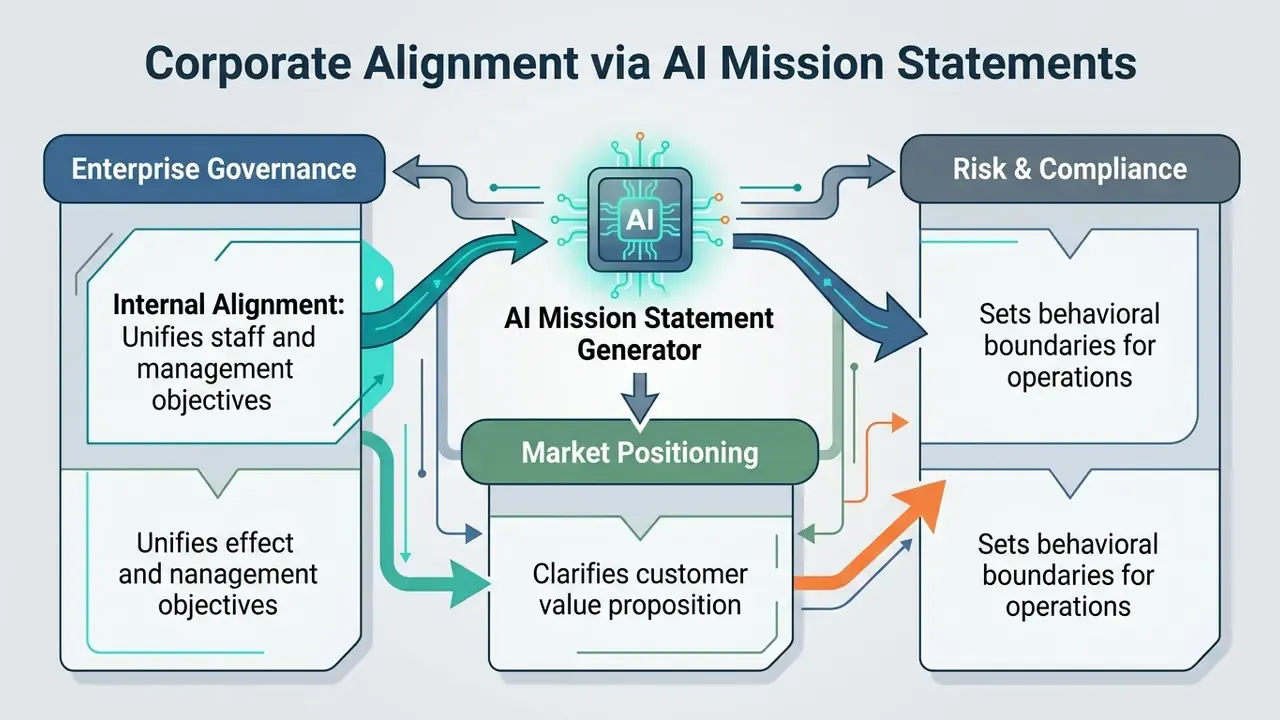
When deploying an ai business mission statement generator, check that the generated messaging travels well across channels. Teams often review published collateral with an ai hashtag generator so that strategic mission language and distribution assets stay aligned, and design groups verify licensing terms of adjacent creative tooling through our Canva AI generator commercial-use overview.
Mission for startup, small business, and corporate company
Structural focus shifts with organizational maturity and scale. Startups need narrow, product-centric wording aimed at one immediate market friction. Small businesses emphasize community impact, service quality, and reliability. Corporate enterprises need broader statements covering multi-stakeholder commitments, ESG frameworks, and long-term industry stewardship.
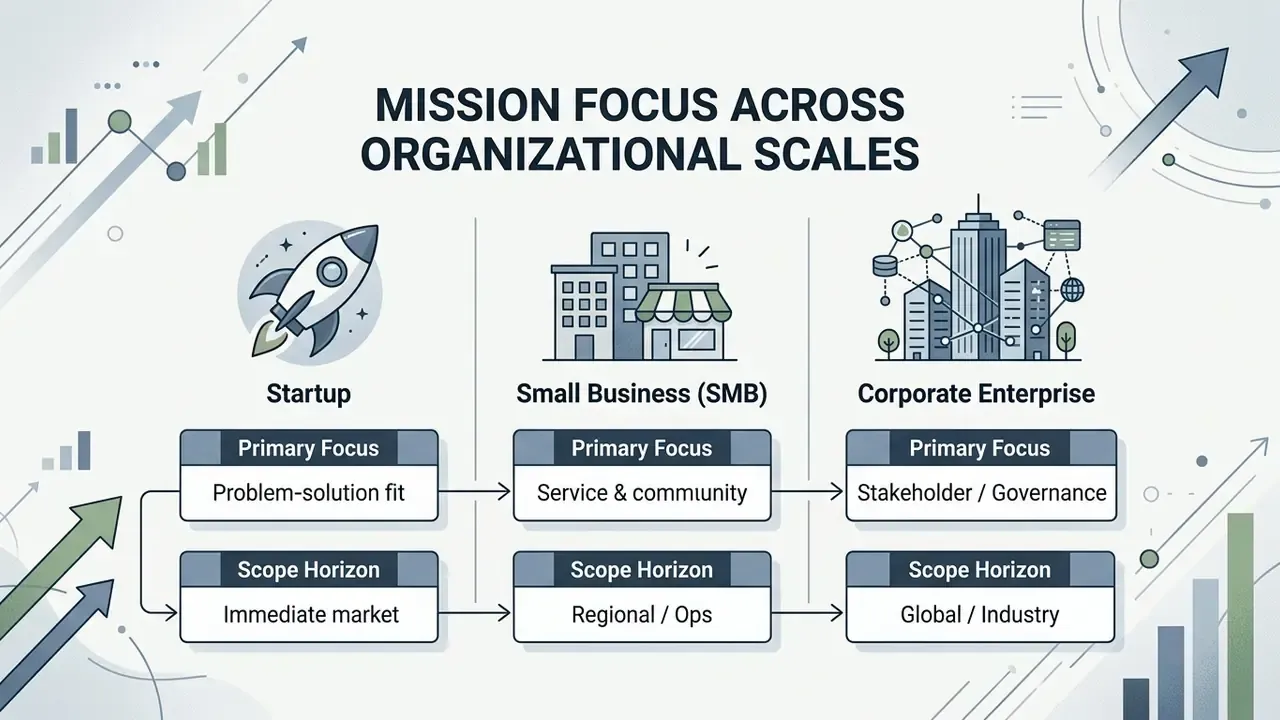
The U.S. Small Business Administration (SBA Business Planning Guides) advises that small business plans tie the mission explicitly to core products, leadership structure, and target customer demographics. Enterprise statements skew toward governance, culture, and long-term value creation.
Multi-product organizations hit a specific trap: listing every business line produces a statement that says nothing. The workable move is to name the common customer benefit across lines, for example "we help small businesses compete with enterprise-grade technology," then place product-level missions beneath a single parent vision.
Mission and vision for nonprofit and educational organizations
Nonprofit organizations and educational institutions need missions centered on social impact, beneficiary empowerment, and public service rather than financial return. The text should name whom the institution serves, the primary activities delivered, and the expected societal outcome.
Social-sector planning practice defines a nonprofit mission through three components: target beneficiaries, core intervention activities, and measurable outcomes. A separate "vision of success" describes the changed world the organization works toward. This outcome-model structure appears in social-impact business planning guidance (Root Cause, Business Planning for Enduring Social Impact) and in philanthropic purpose worksheets that separate the future hoped for (vision) from the present work that brings it about (mission).
Educational institutions add a fourth element, accountability to students and the public, and usually align mission wording with institutional strategic plans rather than marketing copy. When generating nonprofit missions with AI, weight the inputs toward ethical obligations and public accountability, not commercial metrics. Boards notice the difference immediately.
Personal mission statement generator AI for personal goals
A personal mission statement generator ai helps individuals, including executives, entrepreneurs, consultants, and students, articulate values, professional direction, and working principles. A personal mission functions as a decision filter: it frames long-term goals and, just as usefully, personal boundaries.
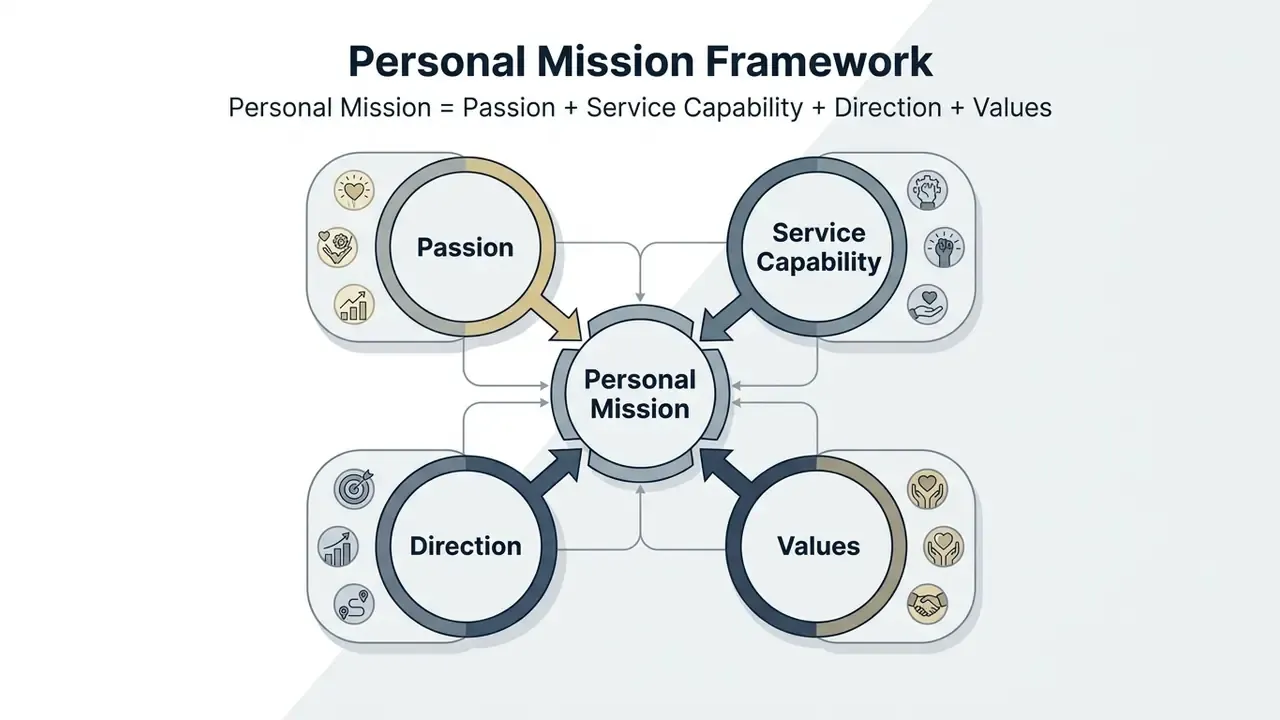
The most widely used institutional method is a five-step reflection sequence: list past successes, isolate five or six core values, describe the contribution or service provided, split goals into short term (up to three years) and long term (beyond three years), then compress the answers into one or two sentences. AI accelerates the compression step. It cannot perform the reflection step, and pretending otherwise produces a statement nobody remembers by Friday.
Professionals frequently align their written personal mission with branding assets. Executives updating corporate profiles often pair the mission text with imagery created through an ai headshot generator to keep an executive presence consistent across networks.
Personal statement for professionals and entrepreneurs
For working professionals and business leaders, a personal mission statement outlines core skills, value contribution, and career objectives. It supplies decision criteria for new roles, ventures, and board appointments.
A field study on professional labor markets run on Freelancer.com (Signaling in the Age of AI, 2024) reported that AI assistance used to align personal statements with role requirements increased callback rates by 3.56 percentage points. The same study found that AI assistance raised textual alignment between applications and job requirements by 1.36 standard deviations, while the correlation between writing quality and employer response fell by 51%. Polished text loses signalling value once everyone has access to it. Applicants who spent extra time editing AI drafts did significantly better, which again points to human refinement and verifiable specifics as the differentiator.
Personal mission statement for students
Students use personal mission statements to clarify academic goals, career ambition, and growth paths. These statements support university applications, scholarship submissions, internship searches, and early career planning.
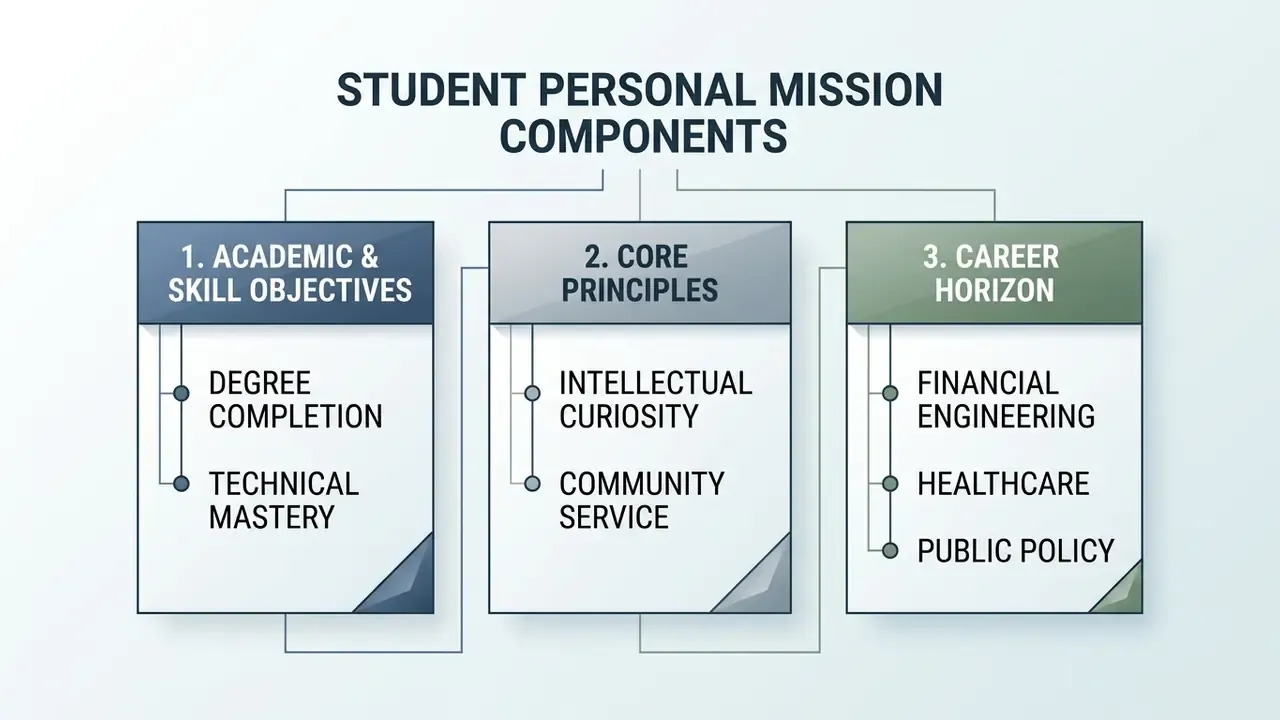
Research from the "Coach Not Crutch" writing experiment (Journal of Educational Psychology, 2024) found that students using AI tools configured with explicit pedagogical feedback improved writing performance by 0.38 standard deviations, even when later tested without AI access. Participants who practiced with AI feedback also received a hypothetical interview invitation more often than the no-practice control group (0.54 versus 0.47). The tool behaved as a training aid, not a substitute.
Students preparing spoken versions for interviews or scholarship videos can review delivery options in our guide to AI voice generators, and younger learners comparing study aids may find our overview of an ai homework helper picture workflow relevant.
Examples, templates, and expected AI outputs
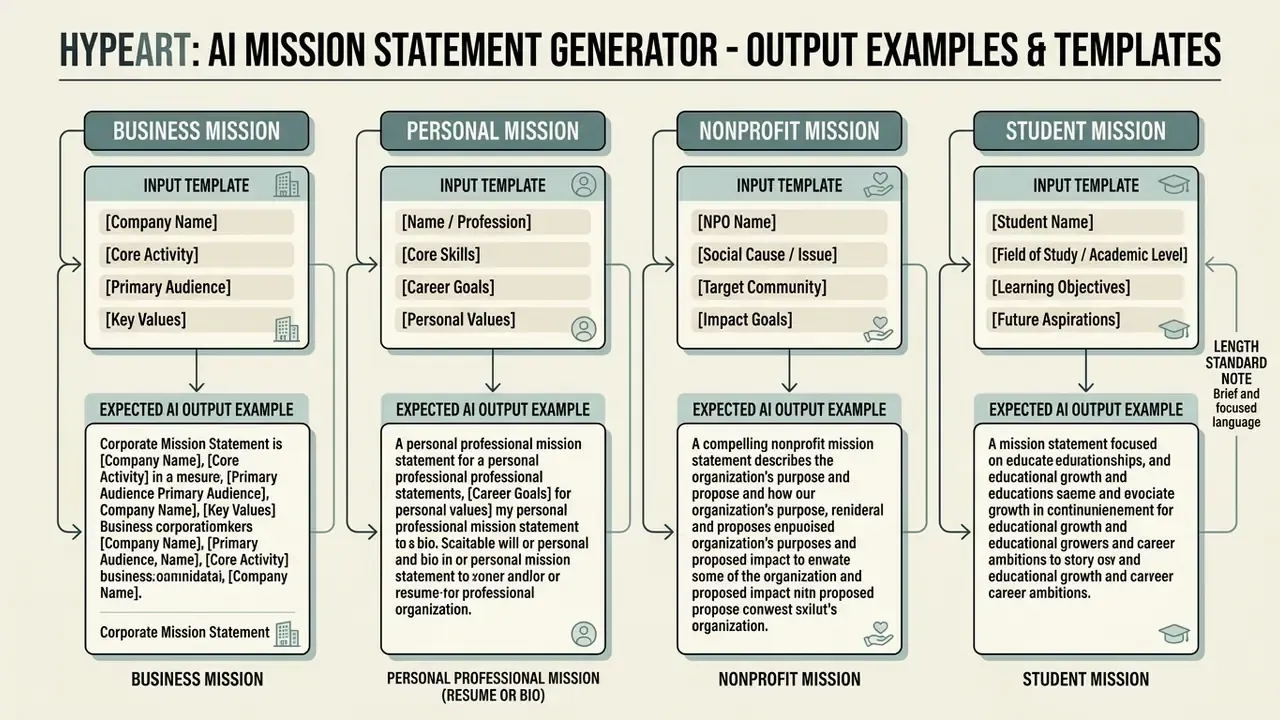
Standardized prompt templates improve output quality across commercial, nonprofit, and personal cases. Explicit placeholders for context, values, and formatting steer the model away from filler.
Structured prompt engineering templates for AI mission statement generation
| Scenario | What to provide to the AI | Values and purpose to highlight | Expected mission statement format |
|---|---|---|---|
| Business / corporate | Company name, industry, core products or services, target customer segment, key differentiator | Operational integrity, customer value, innovation, compliance, data security | 1 to 2 sentences (20 to 40 words) stating what the company does, for whom, and how it delivers value |
| Personal professional | Current role, primary competencies, target industry, long-term career ambition | Professional ethics, continuous learning, leadership, accountability, service excellence | Concise paragraph (2 to 3 sentences) summarizing purpose, values, and career focus |
| Nonprofit / NPO | Organization name, beneficiary demographic, primary social interventions, geographic scope | Social equity, community empowerment, transparency, evidence-based impact, sustainability | 2 to 3 sentences defining the problem addressed, core activities, and intended community impact |
| Student / academic | Field of study, target degree or career, academic strengths, extracurricular focus | Intellectual rigor, curiosity, community service, integrity, resilience | Short statement (2 to 3 sentences) covering educational goals, principles, and career direction |
Prompt template for a business mission statement
To generate a precise commercial mission, submit the following universal template to an AI language model:
[CONTEXT]: Act as an enterprise brand strategist and corporate communications specialist.
[OBJECTIVE]: Draft 3 distinct options for a business mission statement.
[INPUT DATA]:
- Company Name: [Insert Name]
- Industry: [Insert Sector, e.g., Financial Technology]
- Core Offerings: [Insert Key Products/Services]
- Target Audience: [Insert Primary Customers, e.g., Regional Banks]
- Core Values: [Insert 3-4 Principles, e.g., Data Privacy, Regulatory Compliance]
- Key Differentiator: [Insert Unique Attribute]
[CONSTRAINTS]: Keep each statement between 20 and 40 words. Avoid corporate buzzwords
("world-class", "seamless", "synergy", "revolutionary"). Use present tense. Focus on
concrete operational facts and customer outcomes. Return options as a numbered list.
Expected output example (business / corporate):
Length standard note: corporate mission statements are held to 20 to 40 words here. Institutional strategic-planning templates that allow up to 45 words remain acceptable for regulated disclosures where qualifying language is mandatory, but 20 to 40 words is the working target throughout this guide, with vision statements at 15 to 30 words.
Prompt template for a personal mission statement
For individual career alignment, submit the following structured prompt:
[CONTEXT]: Act as an executive career coach and professional biographer.
[OBJECTIVE]: Generate 3 options for a personal mission statement.
[INPUT DATA]:
- Current Role: [Insert Title/Profession, e.g., Risk Analyst]
- Primary Skills: [Insert 3 Core Strengths, e.g., Model Validation, Data Governance]
- Core Personal Values: [Insert 3 Principles, e.g., Integrity, Objectivity, Improvement]
- Impact Target: [Insert Whom You Serve or Help, e.g., Institutional Investors]
- Long-Term Goal: [Insert Career Direction]
[CONSTRAINTS]: Write in the first-person perspective. Limit length to 2-3 clear sentences.
Ensure tone is professional, grounded, and actionable. No superlatives.
Expected output example (personal professional):
Prompt template and output for a nonprofit mission statement
[CONTEXT]: Act as a nonprofit strategy adviser drafting board-ready language.
[OBJECTIVE]: Draft 3 mission statements and 1 vision statement.
[INPUT DATA]:
- Organization: [Insert Name]
- Beneficiaries: [Insert specific population and geography]
- Core Interventions: [Insert 2-3 programs]
- Measurable Outcomes: [Insert outcome metrics]
- Values: [Insert transparency, equity, evidence-based practice, etc.]
[CONSTRAINTS]: Mission 20-40 words, present tense, name the beneficiary explicitly.
Vision 15-30 words. No marketing adjectives. No impact claims that are not measured.
Expected output example (nonprofit / NPO):
Prompt template and output for a student mission statement
[CONTEXT]: Act as an academic adviser helping a student articulate purpose for applications.
[OBJECTIVE]: Generate 3 personal mission statements.
[INPUT DATA]:
- Field of Study: [Insert program]
- Academic Strengths: [Insert 2-3 strengths]
- Core Principles: [Insert 3 values]
- Career Horizon: [Insert target role or sector]
- Service/Extracurricular Focus: [Insert activity]
[CONSTRAINTS]: 2-3 sentences, first person, concrete, no clichés about "changing the world".
Expected output example (student / academic):
Teams that need adjacent visual or spatial mock-ups for an approved statement (an office wall, a campus poster, an onboarding deck) sometimes prototype with an ai home design generator before commissioning production assets.
How to review and improve an AI-generated mission statement
AI-generated text needs a rigorous human pass before publication or formal adoption. Models produce grammatically clean drafts. Reviewers still have to test factual accuracy, operational realism, and cultural fit.
Blind evaluation evidence indicates that reviewers do not automatically mark machine-assisted drafts down:
Read that carefully. Surface quality is no longer the differentiator. Verifiable specificity is, and that is what a rubric has to test.
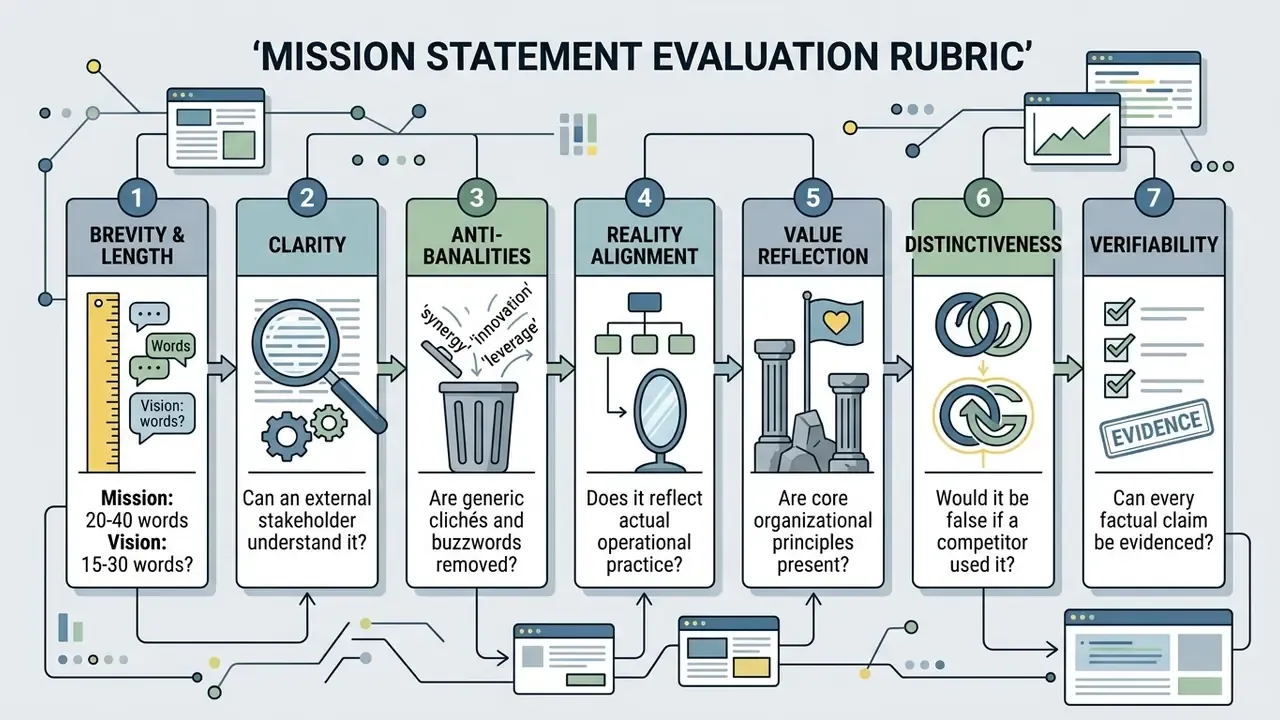
Reviewers should score drafts against this rubric rather than debate taste, so the final text gives direction instead of marketing noise. Teams evaluating broader AI software stacks can compare options across categories, and quantitative teams sizing control costs can open the calculators hub.
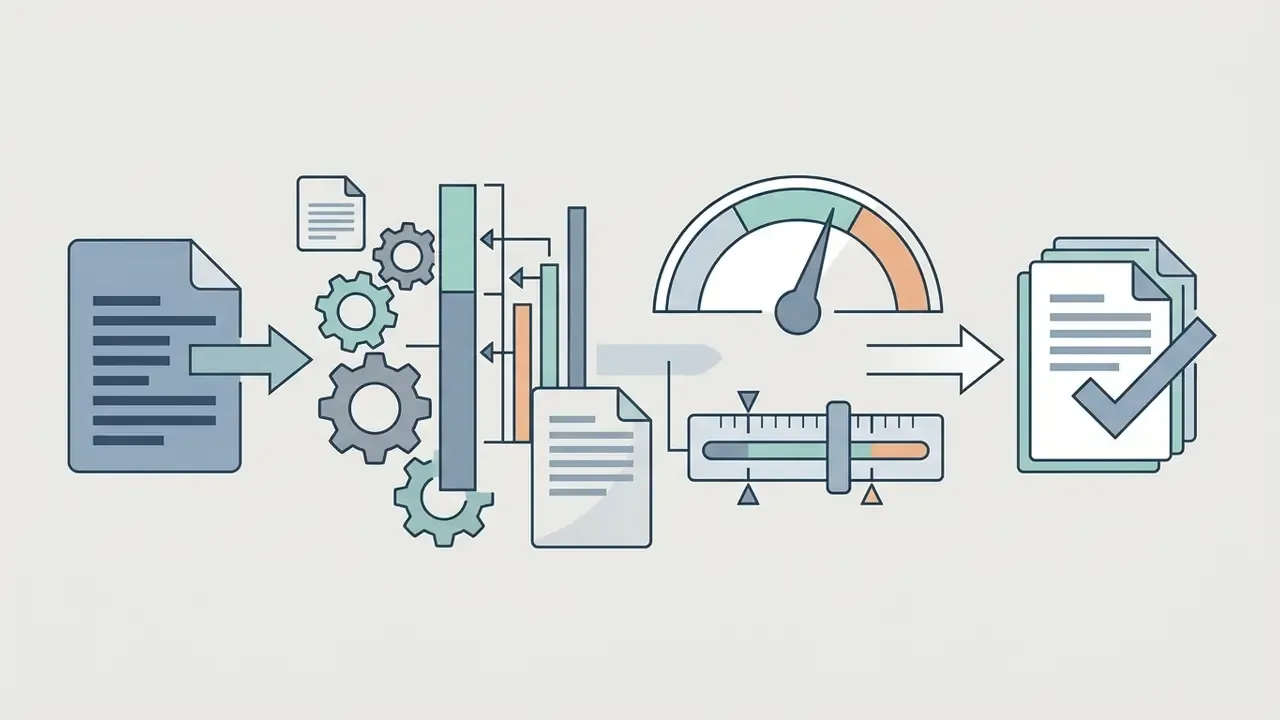
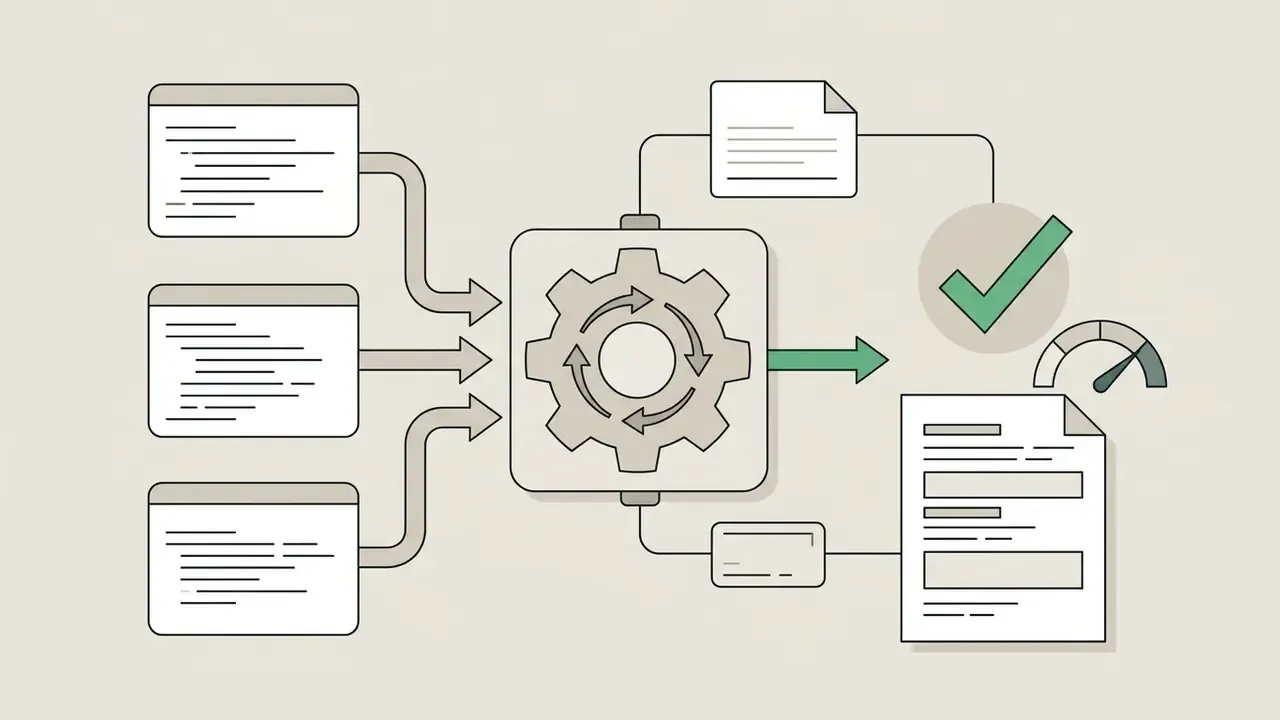
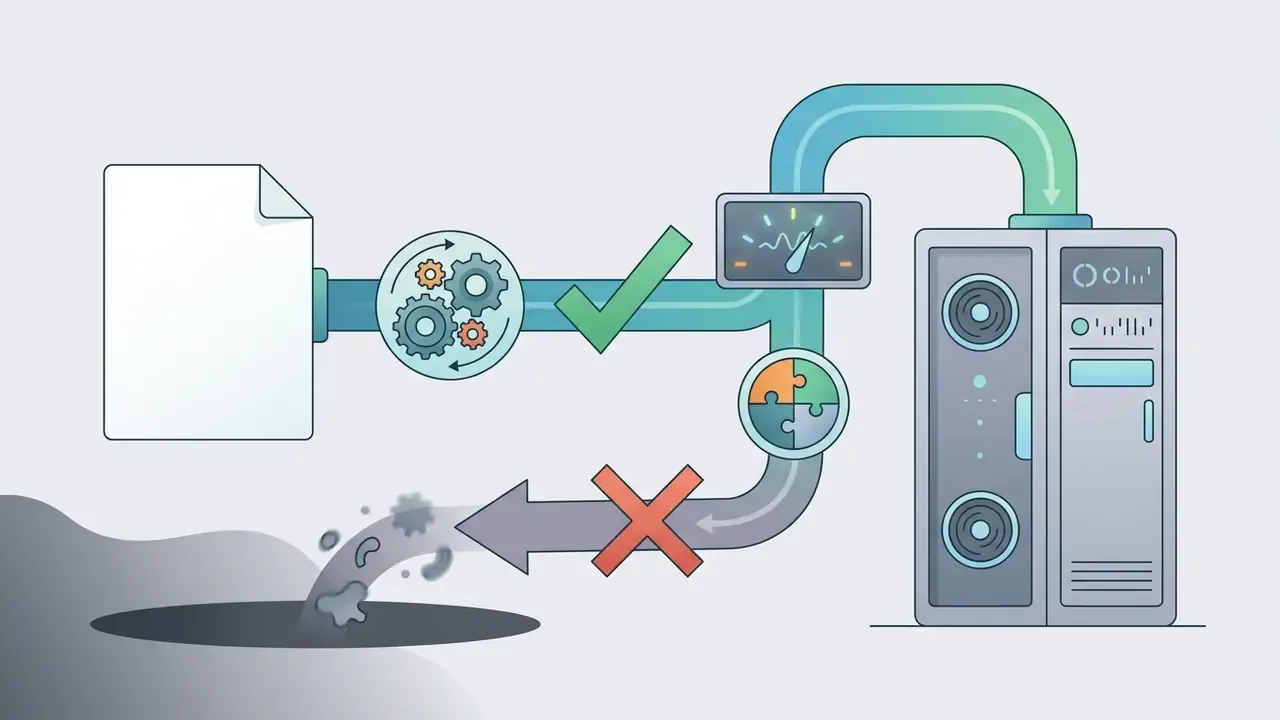
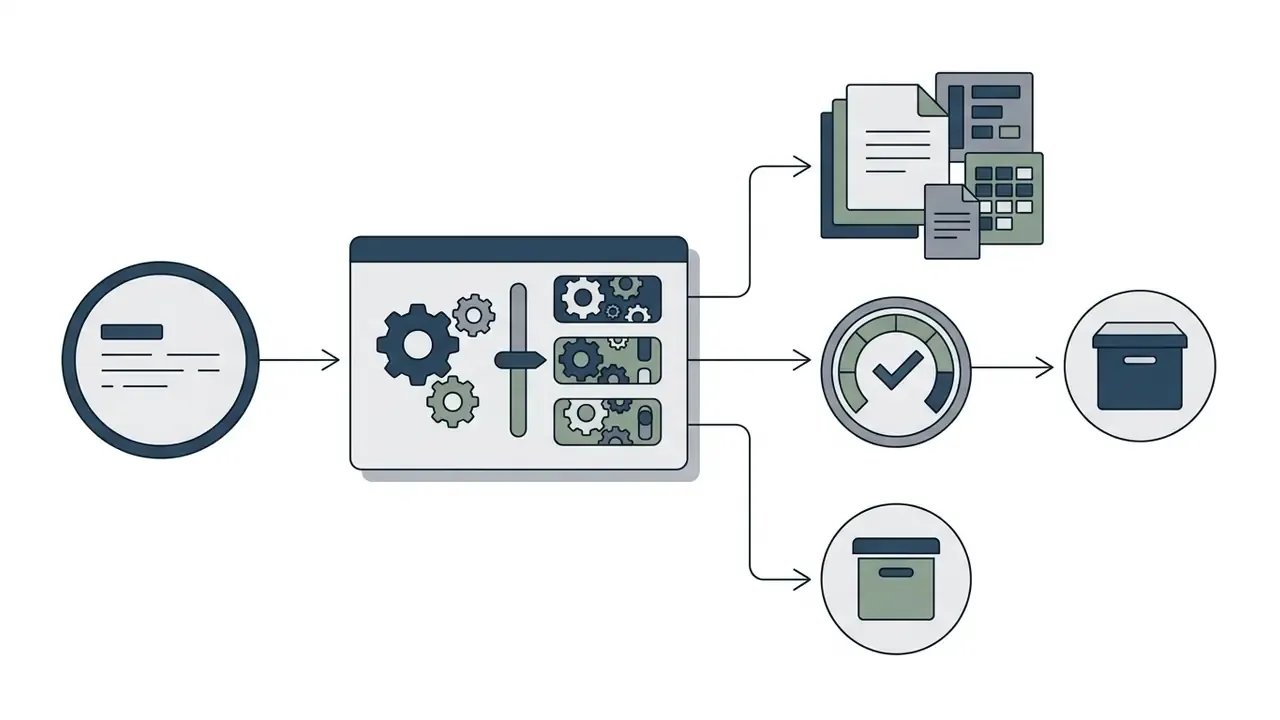
Checking a mission statement for clarity, specificity, and values
Test candidates against three criteria: semantic clarity, operational specificity, and genuine value reflection. A statement fails the clarity test if an outsider cannot identify the entity's primary business activity on a single reading.
Institutional strategic-planning practice commonly scores missions on a short ordinal scale across three axes, namely purpose definition, stakeholder identification, and organizational alignment. A widely used convention treats roughly 7 out of 9 as the threshold indicating that all required information is present. Where no formal rubric exists, score the same three axes 1 to 3 each internally. Statements below the threshold usually rely on vague language that could describe any competitor. The fastest check is substitution: swap in a rival's name and see whether the sentence becomes false.
An illustrative case. A model risk department at a commercial lender reviewed an AI-generated mission intended for internal governance documentation. The draft read: "We deliver world-class AI solutions through innovative excellence and seamless customer engagement." The validation team rejected it for zero operational specificity. The rewrite read: "We validate quantitative financial models to ensure algorithmic integrity, regulatory compliance, and capital protection for our commercial depositors." That version satisfied internal audit standards because it named responsibilities instead of adjectives. Composite illustration, not a documented engagement.
How to eliminate generic phrasing and make the statement your own
Removing corporate clichés means deleting vague adjectives and replacing them with specific metrics, proprietary terms, or explicit audience boundaries. Words such as "cutting-edge," "best-in-class," "revolutionary," "seamless," "world-class," and "empower" should go during editing. Yes, all of them.
A repeatable deep-editing layer has three parts, consistent with current brand-voice tooling practice. Define three to five behavioural voice principles rather than adjectives. Maintain approved and banned vocabulary lists with ten to fifteen annotated on-brand examples. Set tone ranges by channel and audience so the same mission reads correctly in a pitch deck, an employee handbook, and a regulatory filing. Sentence length, punctuation policy, and jargon policy belong in that same document.
Editorial position on governance: models assemble logical sentences, but they cannot enforce corporate integrity. Publishing an AI-generated mission without aligning it to daily practice creates brand exposure that consumer-perception research has already quantified, through measurable loyalty and recommendation penalties when audiences detect undisclosed machine authorship in value-laden messaging (Kirk et al., Journal of Marketing Research, 2024). Use AI to refine phrasing. Keep the underlying commitments tied to operational facts, and test the final wording with people inside and outside the organization before adoption.
When refining wider communications, teams often consult specialized asset indexes. Marketers reviewing distribution alignment can work through our ai hashtag generator resource hub, while teams standardizing visual collateral around a newly approved mission can review our guide to online photo editors.
Free AI mission statement generator: access, limits, and commercial use
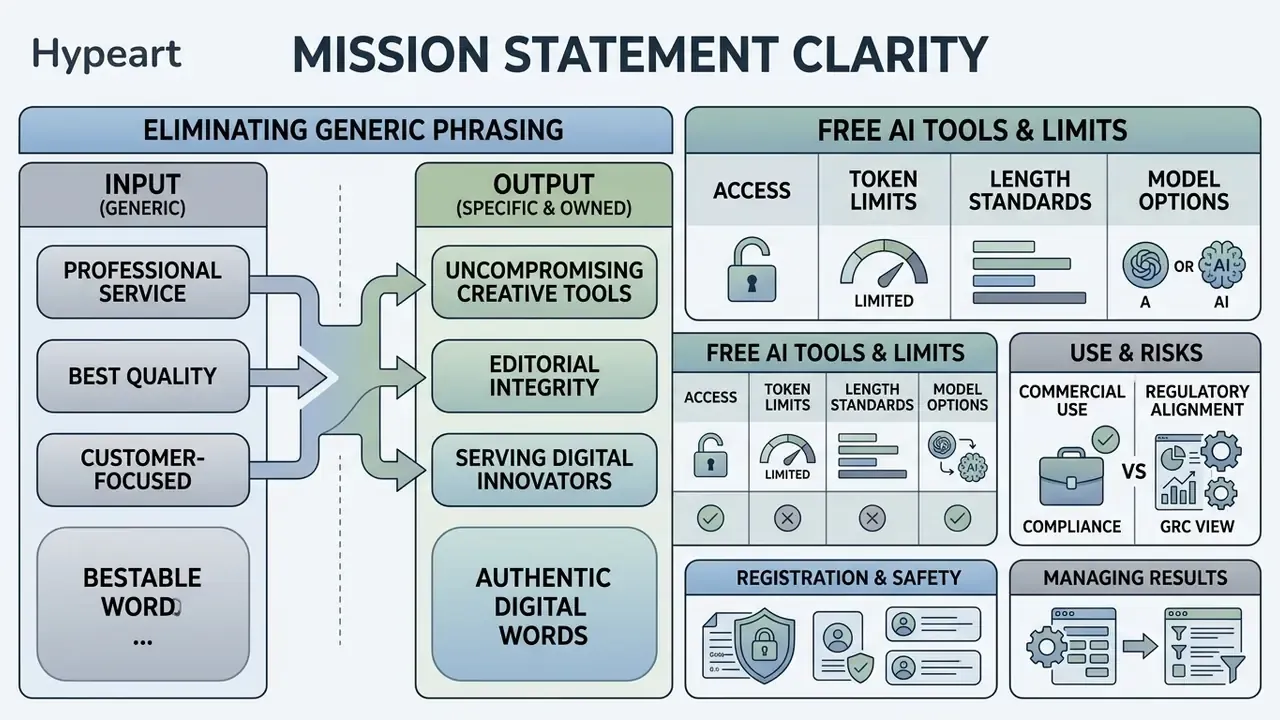
| Access tier parameter | Unmetered anonymous web tools | Free account tiers (token-capped) | Paid enterprise tiers |
|---|---|---|---|
| Registration requirement | None, instant access | Email or SSO signup required | Corporate contract or API key |
| Daily usage limits | Rate-limited per IP (e.g., 5 requests/min) | Token-capped (e.g., 2,500 tokens/day anonymous, 5,000 tokens/day with a free account) | Unlimited or high-throughput RPM |
| Model capabilities | Base lightweight models | Standard LLM access (GPT-4o mini, Claude Haiku, Qwen 2.5) | Advanced reasoning models (GPT-4o, Claude Opus) |
| Commercial usage rights | Allowed under basic terms | Allowed for personal and commercial use | Full IP ownership and enterprise indemnity |
| Data privacy and retention | Session-only, volatile retention | Data retained per standard vendor privacy policy | Zero data retention, no model training |
| Export options | Copy to clipboard, share link | DOCX, PDF, TXT, generation history | DOCX, PDF, TXT, JSON via API, audit logs |
Organizations reviewing software pricing and feature structures can compare options across plans before committing budget.
Vendor evaluation matrix for regulated organizations
Procurement teams in banking, insurance, and healthcare should score any third-party mission statement generator ai against these criteria before it touches internal strategy material.
Vendor evaluation criteria for AI text generators (GRC view)
| Criterion | Minimum acceptable answer | Evidence to request |
|---|---|---|
| Training on customer inputs | Contractually excluded | DPA clause, product terms |
| Data retention | Zero retention, or defined window with deletion | Retention policy, export window terms |
| Output IP ownership | Assigned to customer; vendor claims no rights | Terms of service section on outputs |
| Sub-processors and hosting region | Disclosed list, acceptable jurisdictions | Sub-processor register |
| Security certification | SOC 2 Type II and/or ISO 27001 | Current audit report |
| Model and version transparency | Named model, change notification | Model card, release notes |
| Logging and auditability | Prompt and response logs exportable | API documentation |
| Indemnification | IP indemnity on enterprise tier | Master agreement |
What the free version includes and when a paid plan is required
A mission statement generator ai free tier typically grants baseline language models with daily generation caps, commonly 2,500 tokens per day for anonymous use and around 5,000 tokens per day with a free account, resetting every 24 hours. A single mission generation consumes roughly 100 to 5,000 tokens depending on prompt length. That is enough for a sole trader, a student, or a small business that needs one statement and one revision.
Paid plans or dedicated API instances become necessary when the work involves sensitive strategy documents, integration with custom GRC frameworks, long context windows for document-grounded drafting, or contractual zero-data-retention guarantees. Official documentation from major vendors (for example OpenAI and Anthropic) confirms that free consumer tiers may use inputs for model training unless the user opts out, whereas paid enterprise tiers explicitly prohibit retention for training. Several providers also list free tiers as unsupported for API rate limits altogether, which makes a paid tier mandatory for any automation.
Can AI-generated statements be used for commercial purposes
The following section addresses legal and regulatory questions at a general level.
Text from an AI mission statement tool can generally be put to commercial use: corporate websites, investor pitch decks, marketing collateral, annual reports. Commercial rights still depend on provider terms and on legal standards for AI-generated intellectual property.
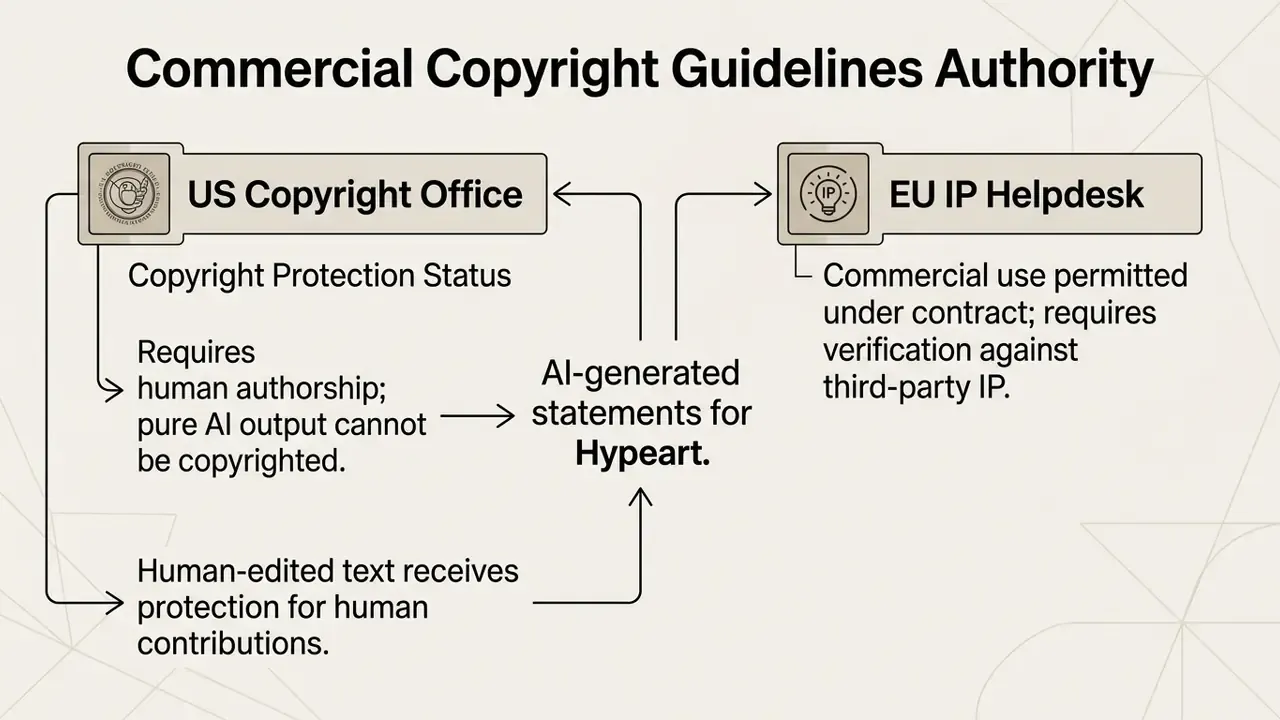
Guidance issued by the U.S. Copyright Office (Federal Register guidance, 2023 to 2024) states that purely AI-generated text lacking human authorship is not eligible for registration, and that prompts alone do not create authorship. Where humans select, arrange, and substantially edit an AI draft, protection attaches to the human creative contribution. The EU IP Helpdesk adds that commercial exploitation is permitted where the user owns the output under national law and tool terms, while infringement arises if the output reproduces pre-existing protected text.
Consumer perception is a second, non-legal consideration:
For public-facing statements, this argues for substantive human editing and, where the EU transparency framework applies, for clear labelling of AI-generated or materially AI-modified content. Rights questions across adjacent tooling are covered in our commercial use section, and organizations tracking disputes and regulatory actions can open the hub for compliance framework considerations.
Registration, data safety, and managing results
Data safety is the sharpest issue when corporate strategy meets a public AI utility. Do not submit unannounced intellectual property, non-public financial metrics, or customer data into unverified free generators. A mission statement is rarely worth a disclosure incident.
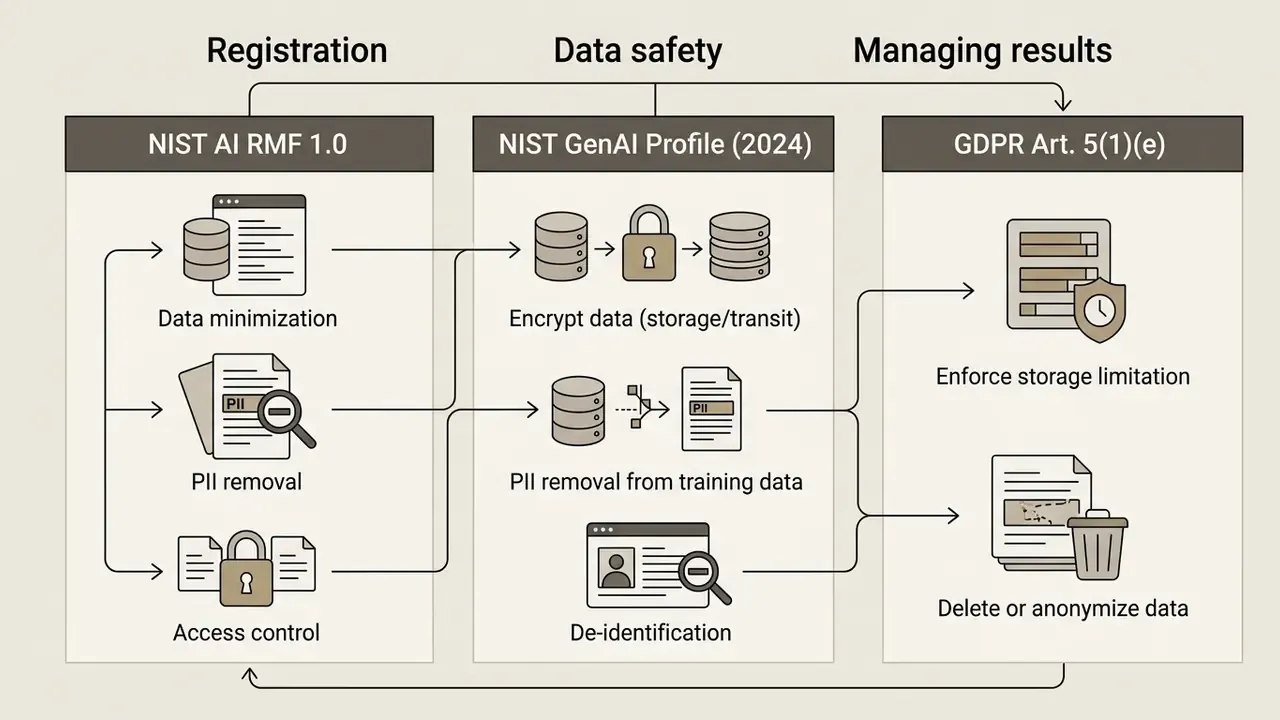
The NIST AI Risk Management Framework (NIST AI RMF 1.0) expects organizations to enforce data minimization when interacting with generative tools. Practical implementation detail: keep signed-in generation history for approved statements, because that history doubles as an audit trail, and disable it for exploratory drafting that touches internal context. Teams evaluating infrastructure security can see the overview of data management protocols in our documentation.
FAQ about AI mission statement generators
Recurring questions about mission statement generator tools cluster around API access, regulatory exposure, originality checks, hallucination control, review cadence, mobile use, exports, and team collaboration.
# Example: Generate a mission statement via an OpenAI-compatible API
curl https://api.openai.com/v1/chat/completions \
-H "Content-Type: application/json" \
-H "Authorization: Bearer $OPENAI_API_KEY" \
-d '{
"model": "gpt-4o-mini",
"messages": [
{"role": "system", "content": "You are a corporate communications specialist. Output JSON only."},
{"role": "user", "content": "Draft 3 mission statements (20-40 words each) and 1 vision statement (15-30 words) for a B2B fintech serving regional banks, values: data privacy, regulatory alignment, uptime. Ban the words seamless, world-class, revolutionary. Return keys: mission_options[], vision, word_counts[]."}
],
"response_format": {"type": "json_object"}
}'
How do I call an AI mission statement generator via API
Automation is straightforward, since most providers expose an OpenAI-compatible REST endpoint. A minimal request that enforces the 20 to 40 word mission standard looks like this: Self-hosted or open-weight deployments follow the same pattern with a different base URL and model identifier, for example qwen/qwen-2.5-7b-instruct. Requesting a JSON object instead of prose lets you validate word counts programmatically and reject any candidate outside the mandated band before a human reads it. Integration patterns, cost modelling, and rate-limit planning are covered in our API implementation guide and in a worked example of API access, costs, and limits for a generative model.
What regulatory risks apply to published mission statements in financial services
A mission statement is public-facing corporate communication. In regulated sectors, forward-looking or performance-flavoured language can attract scrutiny under advertising and disclosure rules, including U.S. SEC and FINRA expectations that communications with the public be fair, balanced, not misleading, and substantiated. Practical controls: keep the mission descriptive and present tense, move aspirational language into a clearly labelled vision statement, avoid implied guarantees of performance or security, and route the final wording through the same review path used for other public communications. Where the EU transparency framework applies, disclose material AI generation of published content.
How do I check an AI-generated statement for originality and hallucinations
Run three checks. First, originality: search the exact statement and its distinctive phrases to confirm it does not reproduce a competitor's published wording, since generic corporate phrasing converges across models. Second, factual accuracy: every claim about markets served, volumes, certifications, or uptime must trace to an internal system of record, because models will invent plausible specifics when the prompt implies them. Third, substitution: replace your organization's name with a competitor's, and if the sentence stays true, the statement is not distinctive enough to publish. Log the model version, prompt, and reviewer for each approved statement.
How often should a mission statement be reviewed
Review annually as standard practice, and out of cycle whenever strategy, market scope, ownership, or regulatory perimeter changes materially. Some organizations keep the same mission for decades. The test is not age. The test is whether the statement still describes what the organization actually does today.
Can you use a mission statement generator on a phone and save the result
Yes. Modern web-based generators are responsive across iOS and Android smartphones, tablets, and desktop browsers. You can draft on mobile, export in DOCX, PDF, plain TXT, or structured JSON for programmatic reuse, and share statements with colleagues through cloud channels, permissioned links, or messaging apps. Signed-in accounts usually retain generation history, which is useful as an audit trail; anonymous sessions usually do not. For version control, teams often store the approved JSON payload, including statement text, word count, model version, approver, and date, alongside brand assets in the same repository.
Hub navigation and further reading
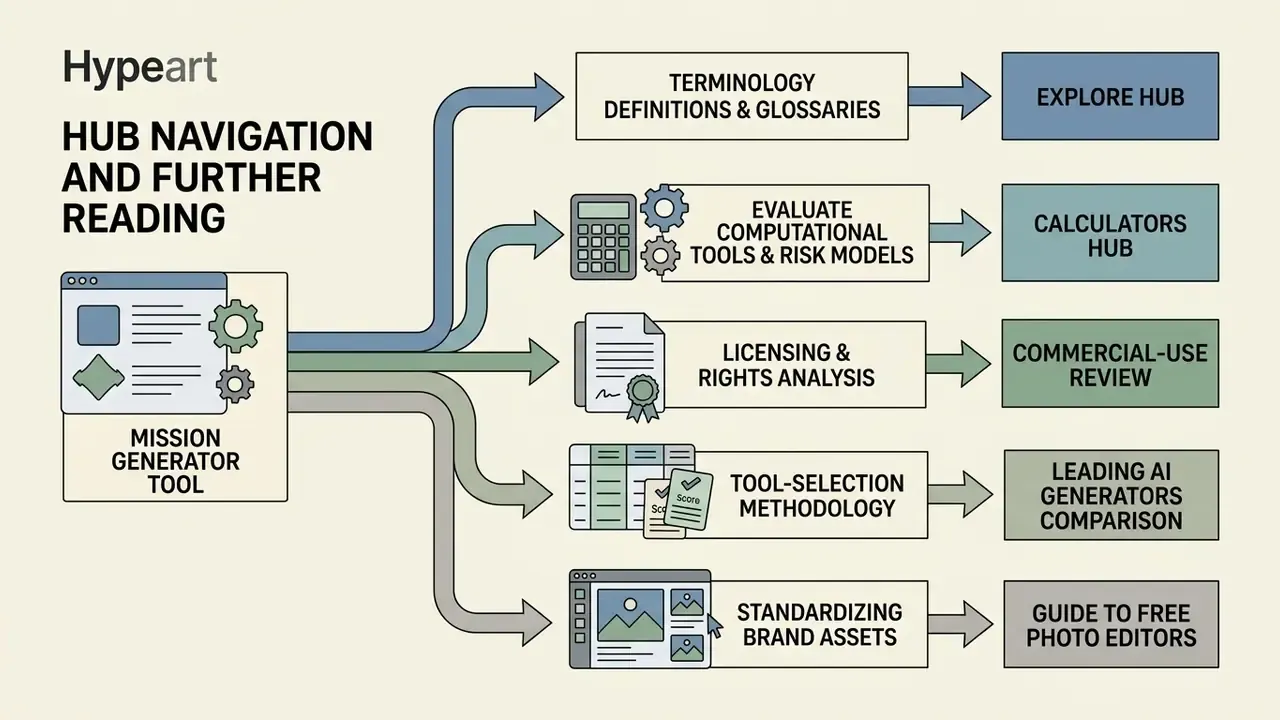
- For terminology, definitions, and technical glossaries, explore the hub.
- To evaluate computational tools and risk analysis models, open the calculators hub.
- For licensing and rights questions across adjacent generative tooling, review our commercial-use analysis of AI generators.
- For tool-selection methodology and side-by-side scoring, see our comparison of leading AI generators.
- For teams standardizing brand assets around a newly approved mission, see our guide to free photo editors and export restrictions.