An ai recipe generator uses natural language processing (NLP) and computer vision models to turn user inputs, such as available pantry items, dietary restrictions and time limits, into structured cooking instructions. Modern generative systems read unstructured text or images, optimize ingredient pairings, adjust mass proportions and produce a tailored culinary workflow. That last part matters more than it sounds: proportions are where most generated recipes quietly fail.
The short version, in plain terms
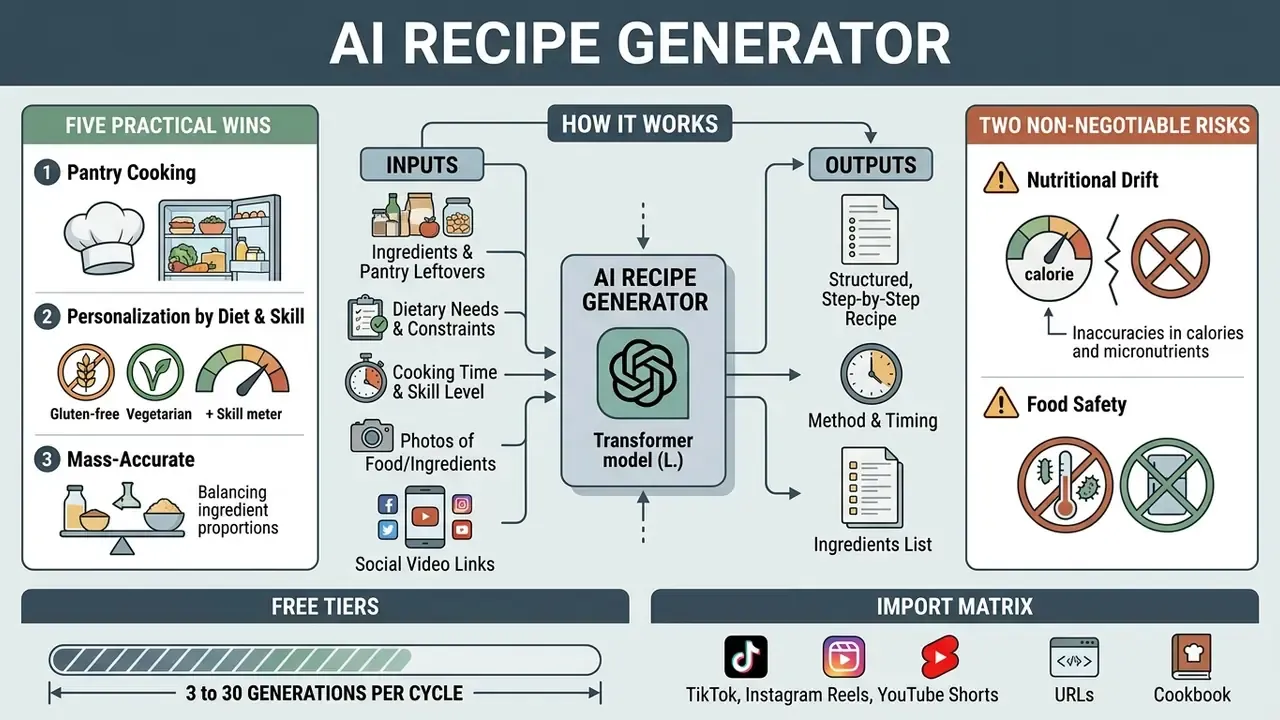
- An ai recipe generator converts ingredients, constraints, photos or social video links into structured, step-by-step recipes using Transformer language models (T5, GPT-family) and image encoders trained on corpora such as Recipe1M.
- The five practical wins: cooking from pantry leftovers, personalization by diet and skill, mass-accurate baking, weekly meal plans with aisle-sorted shopping lists, and real-time troubleshooting while you cook.
- The two non-negotiable risks: nutritional drift (missing micronutrients, wrong calories) and food-safety errors (under-specified internal temperatures). Both are handled by human review against USDA FSIS and FDA allergen rules.
- Free tiers typically allow 3 to 30 generations per cycle. Paid tiers unlock unlimited generation, nutrition labels, commercial redistribution rights, AI dish imagery, offline mode and embeddable widgets.
- Copy-paste prompt templates, an import matrix (TikTok, Instagram Reels, YouTube Shorts, URLs, cookbook photos) and an eight-tool comparison table are included below.
Sections in this guide: what it is · how to use it · copy-paste prompts · mid-cook help · recipe types · choosing a tool · shopping lists · importing from social media · commercial use · FAQ.
What is an AI recipe generator and what can it create?
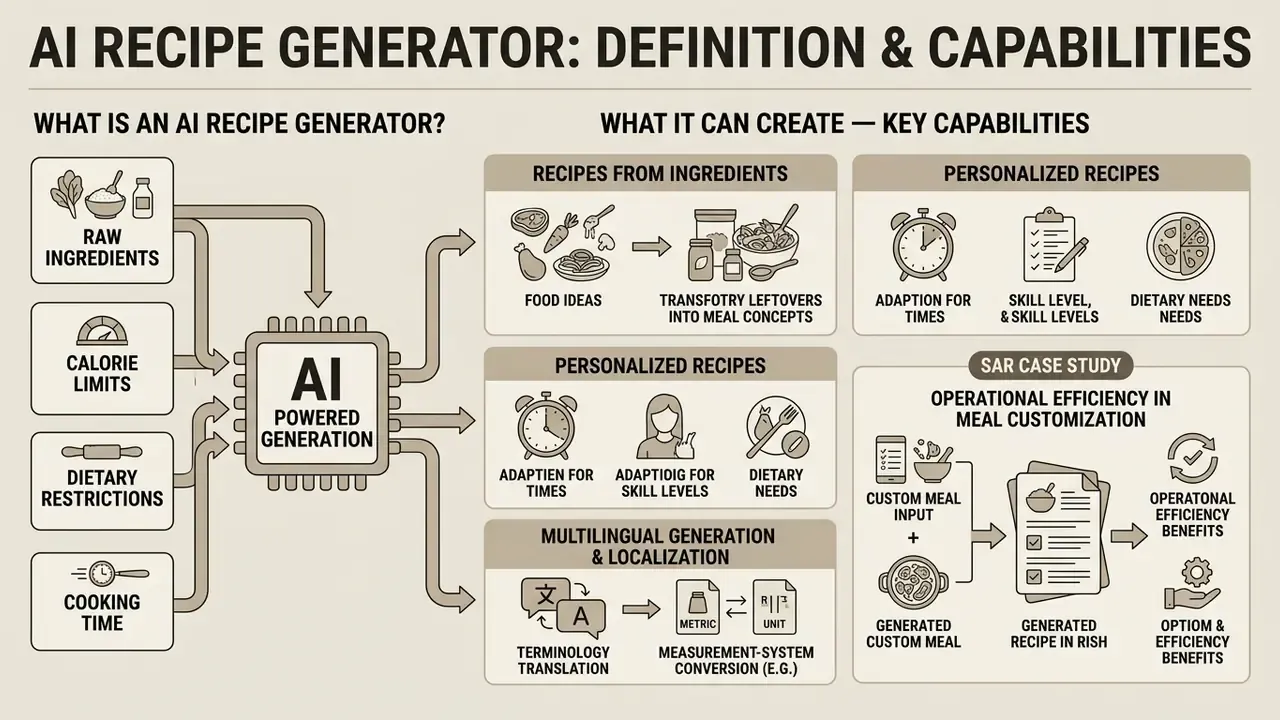
An ai recipe generator is an AI-powered application that converts input parameters, including raw ingredient lists, target calorie limits, dietary restrictions and cooking time, into fully realized step-by-step recipes. Built mainly on Transformer-based language models such as T5 or GPT architectures, plus multimodal models fine-tuned on datasets like Recipe1M, these tools automate culinary ideation and meal customization.
«Automated recipe generation systems simplify decision-making by matching dishes to user input, available ingredients and dietary preferences.»
Systems marketed as recipe creator ai and ai recipe maker platforms run a multi-stage pipeline: entity extraction, ingredient combination, preparation modeling, selection, structural evaluation. Rather than pulling static records from a fixed database, an ai generator recipe engine calculates how distinct components interact under a given heating method, then scales proportions to the target yield and the declared skill level.
Architecturally, three families dominate. Text-first pipelines (RecipeGPT-style T5 or GPT-2 decoders) generate instructions from ingredient conditioning. Vision-first pipelines (Inverse Cooking, CVPR 2019) encode a food photo, predict an ingredient set, then decode instructions through attention layers. Hybrid classifiers (Naive Bayes, Random Forest, Decision Trees) sit alongside them to predict cuisine or meal type, while EfficientNetV2-class CNNs handle ingredient recognition from camera input at reported classification accuracies near 96.87%.
Who each capability is for
| If you are… | The feature that matters most | What to look for |
|---|---|---|
| A family cooking on a schedule | Weekly plans plus merged shopping lists | Calendar export, aisle sorting, pantry flags |
| Tracking macros or calories | Nutrition engine accuracy | Per-recipe protein, carbs, fat, fibre, sodium, with verified totals |
| A complete beginner | Skill-adapted instructions | Explicit doneness cues, equipment substitutions, mid-cook Q&A |
| Cooking from leftovers | Pantry-first generation | "Use only these items" constraint, waste-reduction scoring |
| A blogger or cookbook author | Batch generation plus licensing | Commercial rights tier, export to PDF/KDP, allergen audit |
| A restaurant or enterprise team | Governance controls | Data retention policy, private deployment, audit logging |
Recipes from ingredients, food ideas and pantry leftovers
An ai recipe generator from ingredients reads whatever is left in the pantry and proposes dishes that actually use it, which is the shortest route to less household food waste. Prototype research confirms the mechanism holds even with sparse inputs.
«A language-model prototype generated usable recipes from a limited ingredient set, supporting efficient food use and reduced household waste.»
The University of Vaasa "Leftover Lab" web prototype, built for university students, demonstrates the same principle: feed disparate pantry items into an ai recipe generator and you get structurally coherent, resource-efficient meal concepts. UCF's RecipeCart study (2024) lands in the same place. The system identifies the presented ingredients and produces user-relevant recipes specifically to reduce waste from leftover stock.
Tools engineered to generate recipe options from existing stock cut throwaway rates by matching stale bread, canned legumes or wilting greens with complementary flavor profiles. Systems such as DishGen, LunchScraps, From Your Fridge and RecipeCart evaluate submitted items against rule matrices or trained embeddings, returning functional formulas: panzanella, frittatas, fried rice, banana bread, stir-fries. No extra grocery run required. Product documentation for DishGen and FoodsGPT frames this around budget outcomes, "cheap meals and budget-friendly dinner ideas you can cook today", rather than novelty.
Personalized recipes for time, skill level and dietary needs
Personalized tools filter and modify instructions by cooking time, skill level, calorie goal and restrictive diet: vegan, keto, gluten-free, low-sodium. Platforms like FoodsGPT, Lindy and Pooks.ai adjust both instruction complexity and technique guidance to match proficiency and equipment. FoodsGPT exposes ingredients, diet, time and cooking skill as first-class input fields. Lindy adds available cooking time and substitution support. Pooks.ai attaches technique guides matched to the declared skill level.
In clinical and structured nutrition contexts, deep generative frameworks weigh user anthropometric data against medical targets.
«The system was tested on 3,000 virtual and 1,000 real user profiles, generating 84,000 daily meal plans with mean energy and nutrient error of roughly 5%.»
Those variational autoencoders paired with recurrent neural networks therefore hold under 5% mean percentage error against baseline energy and macronutrient guidelines. Users who want to create ai recipes tuned to exact metabolic parameters can combine those neural optimization loops with a natural language interface. Readers who want to see how a tool-by-tool comparison of AI generators is structured in other model categories will recognize the same evaluation logic applied here.
Multilingual generation and unit localization
Culinary AI is not English-only. Retail deployments such as the Rancho Markets generator ship bilingual English and Spanish output as a headline feature, and voice-driven kitchen assistants documented in 2026 (IJIRT) are explicitly multi-lingual, with kitchen-noise ASR word error rates of 9.4% and intent recognition above 92%.
Two localization behaviors matter in practice:
- Terminology translation.The model must translate technique verbs correctly: "fold", "temper", "blanch", "sear", rather than literally. A mistranslated technique verb changes the outcome far more than a mistranslated ingredient name.
- Measurement-system conversion.US customary volume units (cups, ounces, sticks, teaspoons) must convert to metric mass (grams, millilitres) in real time. This matters most in baking, where one "cup of flour" ranges from roughly 120 g to 150 g depending on how it was packed.
A practical prompt add-on: "Output the recipe twice, once in metric grams and once in US customary units, and flag any ingredient where the conversion is approximate."
How to use an AI recipe generator
To generate recipe outputs efficiently, enter the available ingredients, define explicit constraints, let the model process the prompt, then review the instructions before you cook. A structured prompt method prevents ambiguous steps, unmeasured additions and unsafe thermal execution. Simple discipline, big difference.
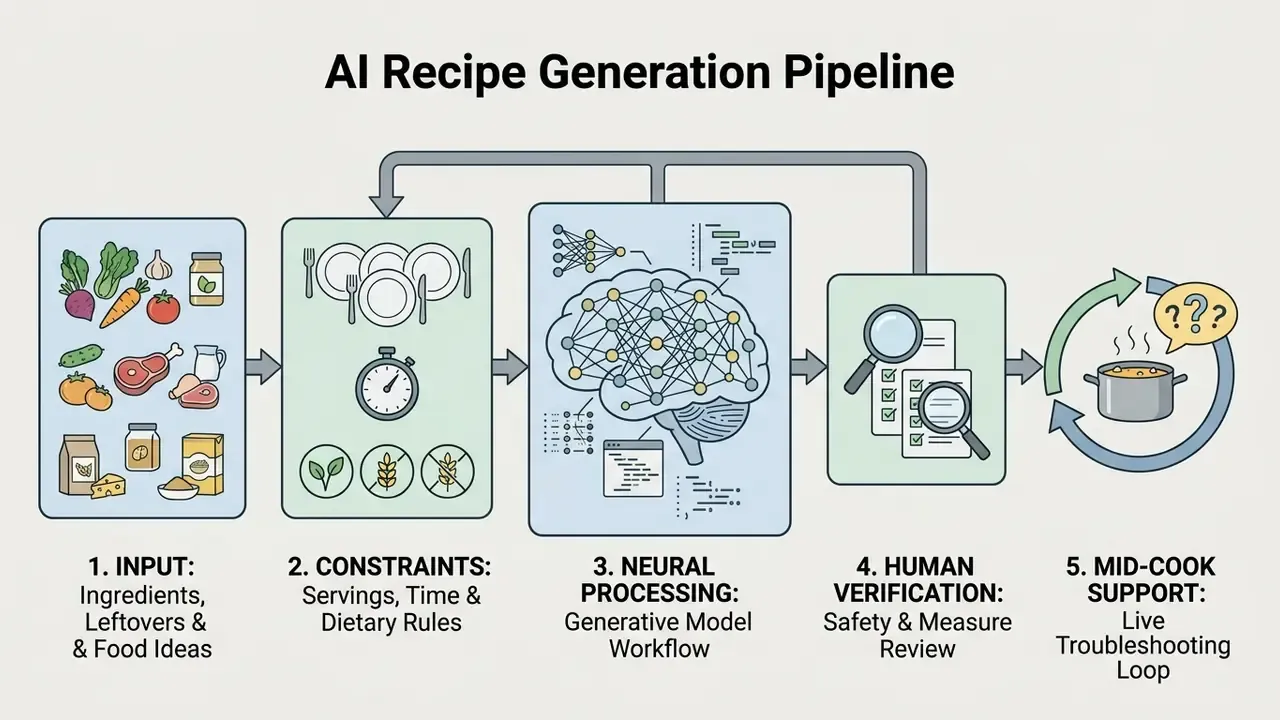
Figure 1: the operational sequence of an ai recipe generator, from raw input conditioning through human-in-the-loop safety verification to live kitchen assistance.
List ingredients and describe the meal you want
The first phase needs a clear list of what you have plus the target meal type. Controllable-generation research indicates that naming exact items, tools and intended cooking styles yields markedly higher output adherence than open-ended queries. The ReciFine dataset work (2026 preprint, not yet peer-reviewed at time of writing) shows that ingredient-only conditioning is the weakest baseline, and that adding tools, actions or full entity sets measurably increases control. That claim still awaits independent replication, so treat it as promising rather than proven.
Evidence for decoding-side control is stronger:
«MCTS decoding over GPT-2 with reward functions reduced ingredient-list irregularities; evaluators preferred the AI instructions in 62% of comparisons against human-written recipes.»
Effective prompting uses explicit boundaries. Published prompt-engineering practice, including OpenAI's own cookbook guidance on structured instructions and explicit output constraints, plus widely circulated community recipe templates (vendor-published, not peer-reviewed), converges on one instruction: use the listed ingredients exclusively, list them verbatim, and prohibit unlisted items beyond fundamental staples such as salt, pepper, water and cooking oil.
Copy-paste prompt matrix
The fastest way to raise output quality is to stop describing and start constraining. Copy these blocks, replace the bracketed variables, paste them into any general-purpose model or a dedicated recipe generator ai.
1. Master prompt for zero-waste cooking
Act as a professional chef. I have: [insert 3–5 ingredients].
Exclude: [allergens / dislikes].
Available equipment: [air fryer / stove / oven / microwave].
Maximum total time: [X] minutes. Servings: [N].
Generate a step-by-step recipe including exact gram measurements,
calorie counts per serving, and minimum internal cooking temperatures.
Do not add unlisted ingredients other than water, salt, pepper,
and cooking oil. If an ingredient is insufficient, say so explicitly
instead of substituting silently.
2. Diet-specific and allergen-safe prompt (the "golden prompt")
Create a [vegan / keto / gluten-free / low-sodium] recipe for [N] servings.
HARD EXCLUSIONS (treat as medical, never substitute in): [peanuts, tree nuts,
sesame, dairy, wheat, shellfish, egg, soy, fish].
Target: [X] kcal per serving, minimum [Y] g protein.
After the recipe, output three separate sections:
(1) full ingredient list with grams,
(2) an allergen statement in the format "Contains: …",
(3) a cross-contact warning listing every step where the excluded
allergens could be introduced by shared equipment.
If you cannot meet the targets with the excluded items, state the conflict
instead of guessing.
3. Weekly plan plus aisle-sorted shopping list prompt
Build a 7-day dinner plan for [N] people. Diet: [rules]. Budget: [amount].
Max active cooking time per weekday: [X] minutes; weekends may be longer.
Reuse ingredients across days to minimise waste and flag which day
uses the leftovers of which day.
Then output a single consolidated shopping list that:
- merges duplicate ingredients into one line with a summed gram/ml amount,
- groups lines by supermarket department (Produce, Butcher, Dairy,
  Bakery, Pantry, Frozen, Spices),
- excludes these items I already own: [pantry inventory].
4. Baking precision prompt
Give me a [bread / cake / pastry] recipe using baker's percentages.
Output flour as 100% and every other ingredient as a percentage of flour
weight, then convert to grams for a [X] g total dough/batter.
State hydration percentage, target dough temperature, proof times with
visual cues, and oven temperature in both °C and °F.
Do not use volume units anywhere.
Counter-example, or what a bad prompt looks like: "give me a chicken recipe". No constraint on time, equipment, servings, diet or measurement system. The model fills every gap with an average drawn from its training distribution, which is exactly where unmeasured additions and under-specified cook times come from. Always test one negative case per template: ask for something impossible ("a keto recipe using only rice and sugar") and confirm the model refuses or flags the conflict instead of hallucinating compliance.
Set dietary preferences, servings and cooking time
Configuring metadata fields lets the system adjust volumetric output, timing and nutritional composition correctly. Standardized recipe schema guidelines establish that yields, active preparation time, total duration and specialized equipment must be codified as explicit parameters. W3C's PRISM Recipe Metadata submission names cookingEquipment, duration, servingSize and yield as first-class fields. Virginia Tech's FST-155 standardized recipe form requires number of servings, serving size, prep time, total time and equipment on the record. The Connecticut SFSP standardized recipe form adds cooking time and temperature plus meal-pattern contribution fields tied to dietary rules.
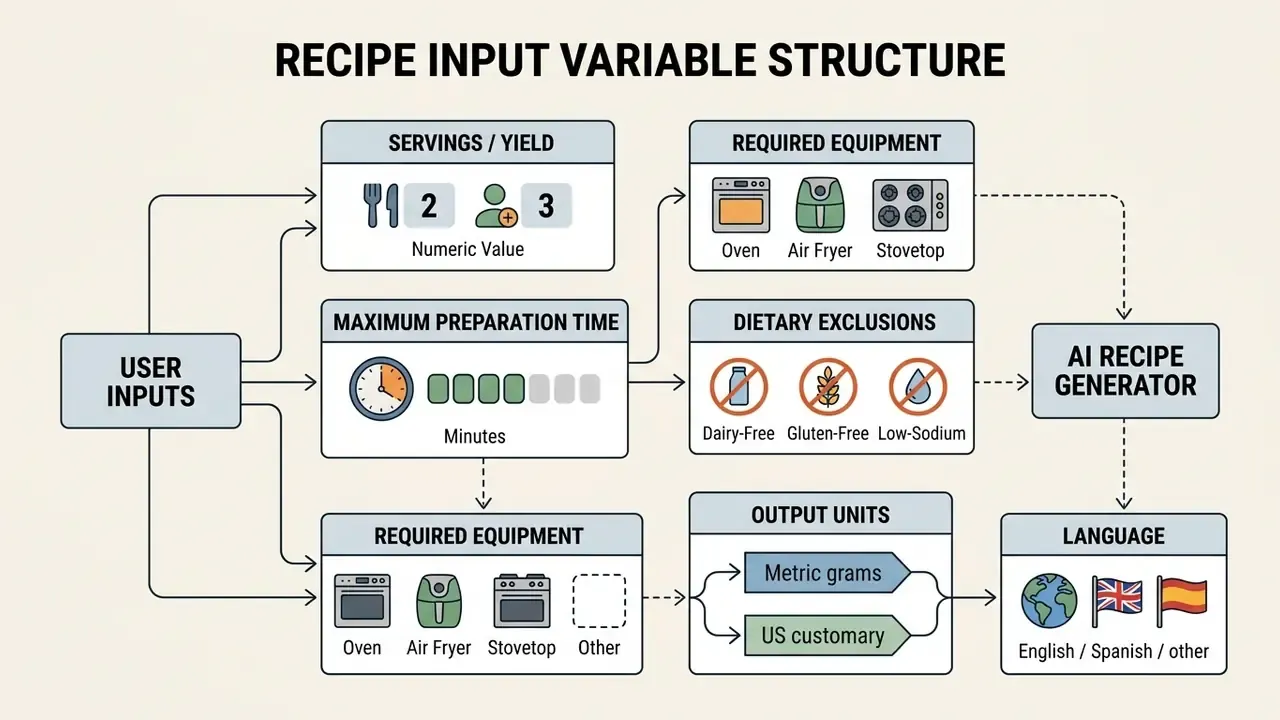
Specifying serving numbers lets the recipe generator ai scale ingredient masses dynamically. Defining a maximum preparation time stops the model from proposing long braises or multi-stage curing when what you needed was dinner in 25 minutes.
Review the generated recipe before you cook
Human-in-the-loop validation is a safety step, not a formality. Verify mass-to-volume ratios, step sequence and thermal endpoints before you execute any AI-generated workflow.
According to USDA FSIS compliance guidelines and FDA Time and Temperature Control for Safety (TCS) standards, generated cooking instructions must be audited against established internal endpoint temperatures:
| Product category | Minimum internal temperature | Measurement standard |
|---|---|---|
| Poultry (chicken, turkey) | 165°F (74°C) | Thickest portion, instantaneous |
| Ground meats (beef, pork) | 160°F (71°C) | Center mass, instantaneous |
| Whole meat cuts (steak, chops) | 145°F (63°C) | Center mass, with 3-minute rest |
| Fish and seafood | 145°F (63°C) | Thickest portion, opaque flesh |
«Multimodal language models often score well on lexical metrics while containing semantically incorrect actions or ingredients; explicit step verification remains mandatory.»
In practice, a recipe can read perfectly and still tell you to fold egg whites into a boiling liquid, or to "reduce" a sauce that contains no liquid. Reviewing step logic confirms that the heating methods prescribed by the ai generator recipe physically achieve the required thermal thresholds, and that each instruction is an action the named ingredient can actually undergo.
Mid-cook AI assistance: troubleshooting in real time
Beyond planning, conversational AI works as an active line of defense during preparation. Most tools go quiet the moment you enter the kitchen. The ones worth paying for do not. If something goes sideways mid-cook, query the model with precise state descriptions rather than vague complaints.
- Emulsion failure "My mayonnaise/hollandaise broke. How do I re-emulsify it using only 1 egg yolk and warm water?"
- Viscosity issues "The tomato sauce is too watery after 20 minutes of simmering. Give me 3 fast thickening methods without adding dairy or cornstarch."
- Substitutions on the fly "I ran out of buttermilk mid-recipe. What is the exact ratio of whole milk to lemon juice I can use right now?"
- Allergen emergency "My guest cannot eat dairy. What replaces the 200 ml of cream in this sauce at this exact stage, and does the reduction time change?"
- Doneness uncertainty "How do I know when this is actually done? Give me a thermometer target plus two visual cues."
- Heat damage control "The onions caught and darkened at the bottom of the pan. Can I salvage the base or should I start the fond again?"
- Seasoning correction "The soup is over-salted. Correct it without adding potato and without doubling the volume."
The interaction pattern that works: state the current physical condition, the elapsed time, the equipment and the constraint. "Sauce won't thicken" gets a generic answer. "Tomato sauce, 500 ml, uncovered, 20 minutes at medium, still pours like water, no dairy or starch available" gets an actionable one.
Voice interfaces make this viable without touching a screen. Documented 2026 implementations report average command latency near 1.2 seconds and 98% device-command success, while a 2024 user-experience study of a voice-only recipe service (Korea Science) found that voice interaction kept hands free, yet delivering many instructions at once increased memory load. An argument for one step per utterance rather than full-recipe read-outs.
What recipes can AI create?
An ai food recipes generator produces diverse outputs, from single pantry-based dishes to specialized pastries, full meal plans and multi-chapter digital cookbooks. Capability depends on training data distribution, dataset labeling (Recipe1M classification, for instance) and fine-tuning constraints. Food-domain datasets carry distinct genre labels, bakery, meals, sides, fast food, desserts, which is why one base model can be steered across formats.
AI recipe generator from ingredients for everyday meals
Everyday dish engines behave like dynamic pantry recipe finders. An ai dish generator reads ordinary items such as canned beans, rice or seasonal vegetables and returns rapid, cost-effective dinner options.
Platforms like DishGen, From Your Fridge and FoodsGPT specialize in budget-conscious generation. They evaluate inputs against structural meal patterns to build balanced dishes that maximize flavor synergy while suppressing grocery spend. The real test of an everyday engine is not novelty but repeatability: can it produce a different usable dinner from the same four staples on five consecutive evenings without drifting into implausible combinations? Some can. Many cannot.
AI baking recipe generator and dessert recipe generator
Baking and pastry work demand precise chemical balance, which makes an ai baking recipe generator or ai dessert recipe generator heavily dependent on mass standardization rather than volume units. Unlike general savory cooking, baking relies on exact ratios of flour, water, leaveners, lipids and sugars to achieve proper gluten development and aeration.
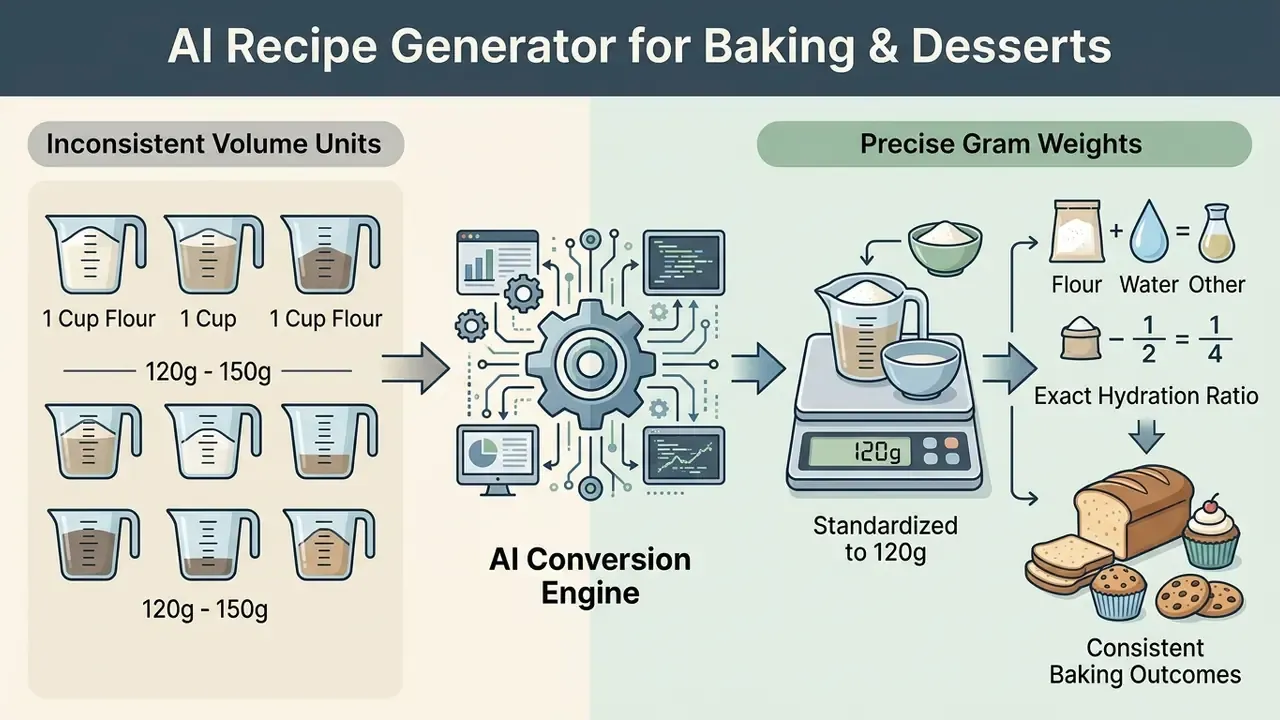
A 2026 peer-reviewed review of breadmaking technology reports artificial neural networks predicting optimal ingredient ratios, including ANN-driven calorie reduction with maintained texture, though the review describes model applications rather than a validated consumer-facing standard. Industrial demos point the same way: Google's AI baking experiment collapsed roughly 600 recipes down to 16 core ingredients and rewrote them in fixed masses and teaspoons, which shows that recipe generation still needs manual normalization of chemistry-critical components. A separate 2026 paper on ingredient measurement states it plainly: precision baking converts subjective units into standardized grams because volume-based cooking is inconsistent.
On the creative side, the Recipes for Creativity study applied evolutionary search (FunSearch) to bake-off contests:
«Mean creativity scores for AI recipes reached 3.92 versus 3.64 for Pillsbury Bake-Off entrants; smaller evaluator models produced significantly higher TTCT results.»
Iterative selection loops therefore produce pastry formulas scoring higher on Torrance Tests of Creative Thinking than unguided human benchmarks. It is a preprint, so treat the number as directional rather than settled.
AI meal plans and cookbook creation
An ai cookbook generator scales individual generation routines into multi-day schedules, consolidated shopping lists and formatted digital publications. Official nutrition guidance from the U.S. Department of Agriculture (USDA) and the Department of Veterans Affairs (VA) emphasizes integrated weekly planning to maintain balanced intake. Nutrition.gov publishes a sample weekly dinner plan paired with recipes, a grocery list and a blank personalization form, while the VA distributes a combined weekly meal planner, grocery list and recipe set with itemized weekly ingredients.
Commercial workflows lean on batch generation platforms such as BookletAI and Automateed to compile categorized collections. These systems assemble distinct recipes, cross-reference ingredient lists to auto-generate weekly grocery requirements, and export structured layouts for self-publishing or personal organization. Automateed, for instance, lets users select up to 30 recipes and then export a print-ready PDF for KDP publishing or direct sale. Note that e-cookbook layout and pagination generation is currently documented only by vendors, not by any standards body.
Multi-meal grocery aggregation engine
Advanced AI meal planners consolidate individual recipe demands into a unified, non-redundant shopping list. This is where a planner earns its subscription, because the failure mode of naive tools is a list that repeats "onion" six times in six different units.
- De-duplication and mass-unit normalization.Merges 200 g of onion from Recipe A with 150 g from Recipe B into one entry (
350 g yellow onions), converting "1 medium onion", "half a cup diced" and "2 oz" into a comparable unit first. - Department and aisle categorization.Groups normalized entities into store zones (Produce, Butcher, Dairy, Bakery, Pantry, Frozen, Spices) to cut in-store backtracking.
- Pantry deduct rule.Cross-references required stock against registered pantry inventory and suppresses or flags what you already own, so you do not buy a fourth jar of cumin.
- Package-size rounding.Reconciles recipe demand with retail reality: a plan needing 350 g of onions and 120 ml of cream becomes whole purchasable units, with surplus fed back as leftover-driven suggestions.
- Substitution propagation.When one ingredient is swapped at recipe level, the change should cascade into the list instead of leaving an orphaned line.
Vendor implementations of pantry management increasingly support adding ingredients by typing or camera scan, then surfacing recipes that use existing stock, which is the same engine running in reverse.
How to choose the best AI recipe generator
| Platform / tool | Ingredient parsing | Dietary filtering | Meal planning | Real-time mid-cook help | Social/URL import | Aisle-sorted lists | Commercial rights | Free access tier | App availability |
|---|---|---|---|---|---|---|---|---|---|
| DishGen | Advanced text/pantry | Native filters | Multi-day support | Chat-based follow-ups | Limited | Basic list output | Yes, on Pro tier | Yes (15 credits/week) | Android / Web / widget |
| FoodiePrep | Pantry plus camera scan | Granular profiles | Full weekly plans | Yes, conversational | URL, YouTube, IG, TikTok, FB, cookbook photo | Yes, merged and pantry-flagged | Not stated | Yes (Taster tier) | iOS / Android / Web |
| Plant Jammer | Fridge discovery | Plant-based focus | Integrated lists | No | No | Shopping-list support | Not stated | Yes (limited) | Android / iOS |
| ChatGPT Custom GPTs | Custom prompting | Variable adherence | Prompt-dependent | Yes, via chat or voice | Manual paste | Prompt-dependent | Per platform terms | Yes | Mobile / Web |
| Eat This Much | Text entry | Macro/calorie-first | Auto-generated plans | No | No | Yes | Not stated | Yes (limited) | iOS / Android / Web |
| CookE | Photo/text input | Standard categories | Single meal focus | Follow-up chats (40/mo free) | Photo/dish ID | No | Not stated | Yes (30/month) | Mobile |
| Maya AI Chef | Natural language | Custom profiles | Chat-based | Yes, chat | No | No | Not stated | Yes (3/day) | Mobile |
| Paprika | Manual plus web clip | Manual tagging | Manual planning | No | URL clipping | Yes | N/A (no generation) | Trial | iOS / Android / Desktop |
Feature rows reflect vendor documentation, app-store listings and pricing pages at time of writing. Verify before purchase, because tiers change often.
Features that matter: ingredients, dietary needs and meal planning
Core architecture dictates long-term utility. Effective platforms perform precise ingredient parsing, converting raw unstructured text, photos, PDFs or web links into normalized entity lists with structured quantities.
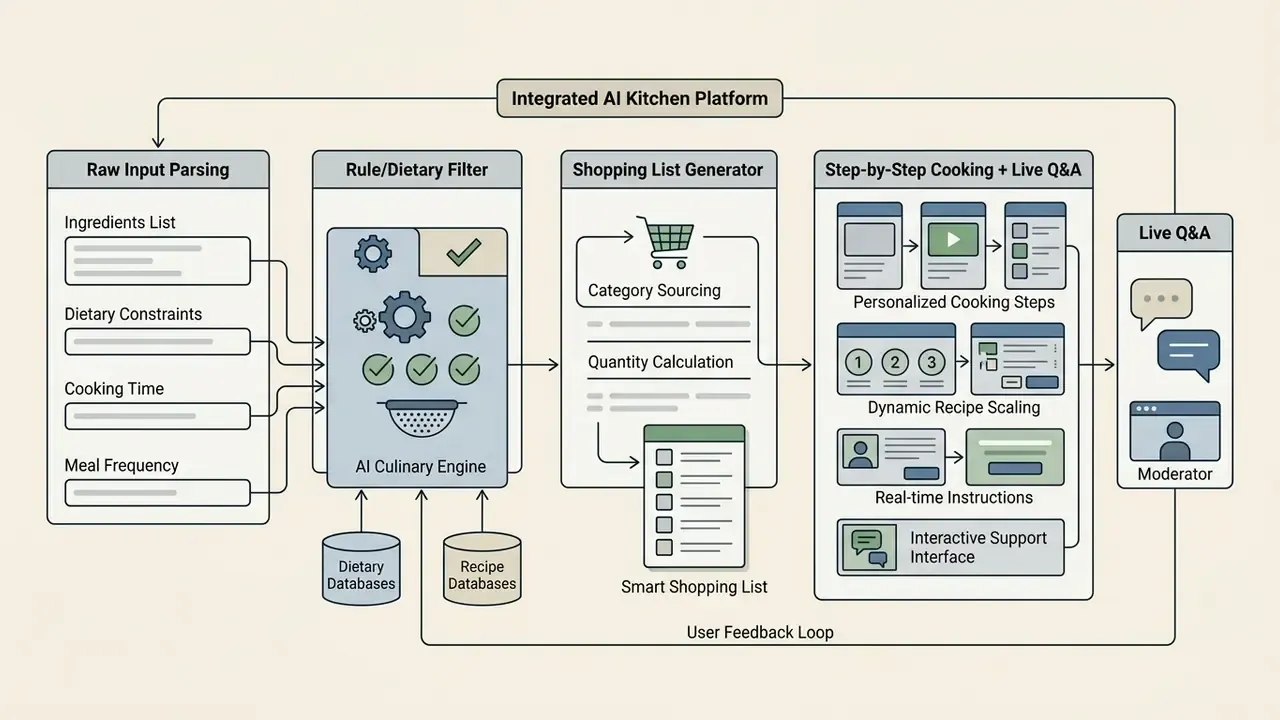
Automated grocery-list synthesis merges overlapping ingredients across planned meals and organizes items by store department. Flexible dietary controls must support granular exclusions, such as severe peanut allergy, celiac-level gluten restriction or strict macro targets, rather than broad unverified category tags.
Quantitative accuracy is now measurable rather than assumed:
Nutritional clarity should mean per-recipe calories, protein, carbohydrate, fat, fibre, sugar, sodium and cholesterol, not one rounded calorie figure. Ask any prospective tool where those numbers come from. A linked food-composition database is verifiable. A model estimate is not.
Governance and privacy criteria for teams and enterprises. Consumer feature lists rarely answer the questions a risk function will ask, so add these before rollout:
- Data retention and training use. Are submitted pantry contents, health goals and dietary restrictions retained, and are they used to train shared models? Health-adjacent inputs deserve the same care as any sensitive category.
- Deployment model. Is there an on-premise or private-cloud option, or is the only path a public multi-tenant API?
- Certification posture. SOC 2 Type II, ISO 27001, and a documented sub-processor list, where the vendor sells to businesses.
- Privacy mode. Several platforms gate output-privacy controls behind their highest tier. Confirm whether generated content is publicly indexed by default.
- Shadow AI control. Where employees or contractors generate customer-facing recipes on unvalidated personal accounts, the organization inherits the food-safety liability and the data-exposure risk without visibility. Maintain an approved-tool list, restrict API keys to sanctioned services, log generation events, and define an escalation path for any output that reaches a consumer without human sign-off. Ownership should be named, not assumed.
- Synthetic content labeling. Publishers operating in the EU should track transparency and labeling obligations for AI-generated content under the EU AI Act, alongside domestic food-labeling rules.
For technical feature matrixes, reviewing AI Media Comparison Matrices offers insight into structured software evaluation models.
Can you use AI-generated recipes commercially?
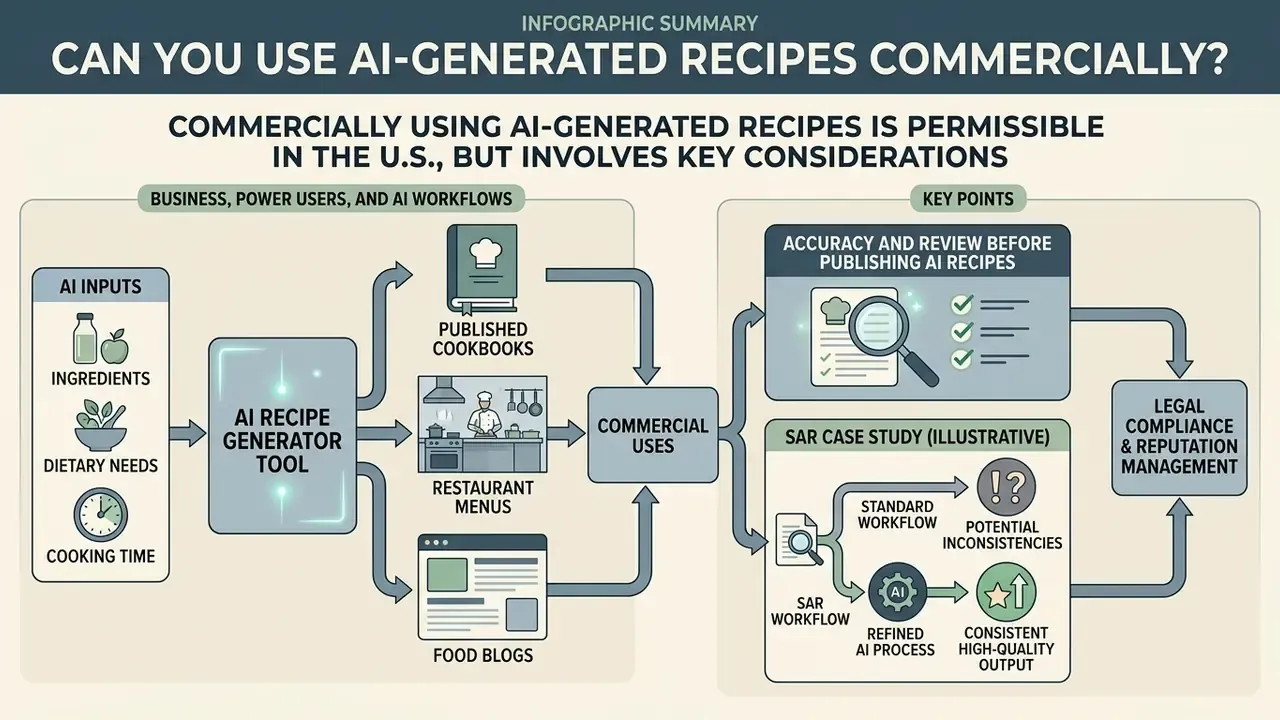
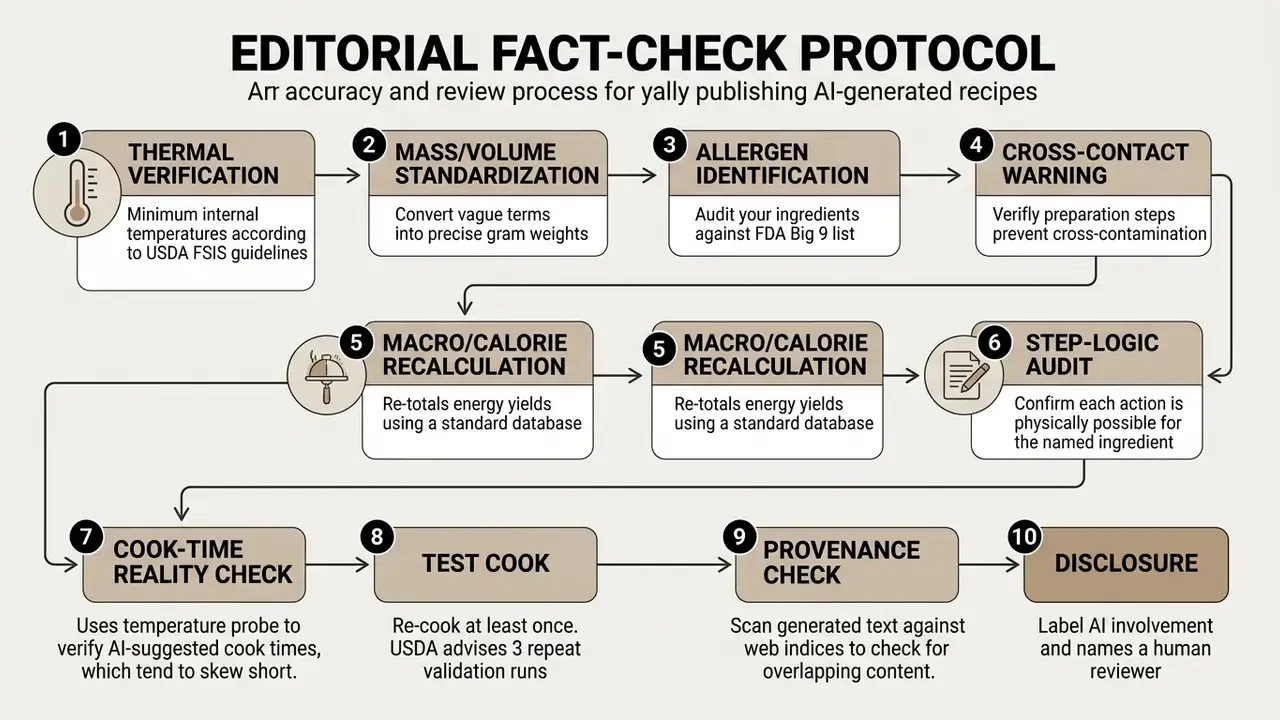
Commercializing AI-generated recipes, whether for published cookbooks, restaurant menus or food blogs, is legally permissible in the United States, but it carries distinct intellectual property, trade secret and liability considerations. Simple lists of ingredients and basic functional procedures are non-copyrightable under U.S. copyright law: the U.S. Copyright Office protects original expression, not "mere listings of ingredients" or functional procedures.
Audience trust is a separate commercial variable from legality:
The practical implication for publishers: disclose AI involvement, and pair novel or unusual formulations with visible human testing, since that is exactly where reader confidence drops.
Surrounding creative expression, unique literary description, original photography and curated recipe arrangement all remain subject to copyright. Commercial operators using an ai cookbook generator must verify that generated text does not reproduce protected expression from training data. The Congressional Research Service notes that generative-AI outputs may infringe where the model had access to protected works and the output is substantially similar, and commercial use triggers the same analysis. Restaurant-sector legal analysis adds a second exposure: prompting a model with a competitor's proprietary formulation can create trade-secret misappropriation risk, and a human-authorship requirement still governs copyrightability of the output itself. Readers weighing rights across formats can review our guidance on commercial use of AI generators for the parallel framework applied to visual assets.
Business, power users and AI cookbook workflows
Culinary businesses, corporate developers and food creators use batch generation APIs to streamline content production. Services such as Inkfluence AI and BookletAI offer tiered commercial subscriptions with high-volume credit allocations for multi-chapter manuscripts. Inkfluence AI markets a cookbook blueprint for authors and bloggers at $9.99/month (Creator) and $19.99/month (Premium), while BookletAI sells 2,500 credits/month at $14.9/mo and 10,000 credits/month at $34.9/mo, with one new cookbook consuming a single credit.
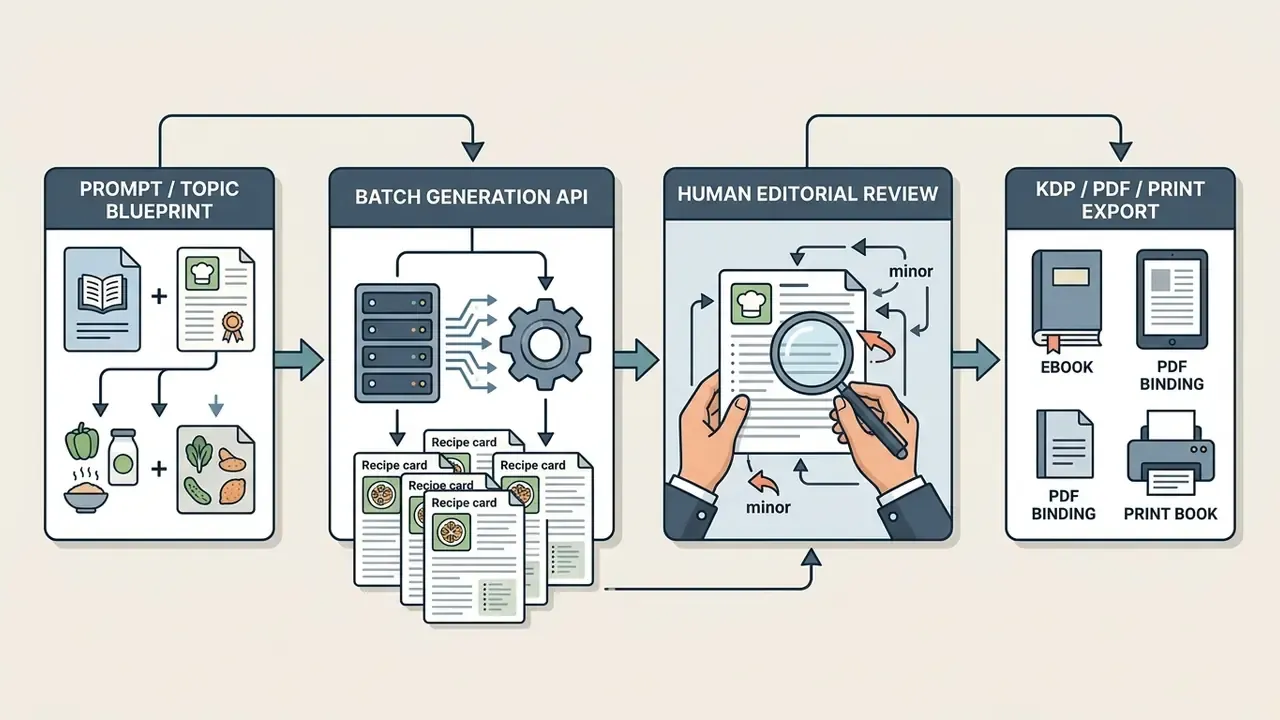
Businesses leveraging batch APIs can review technical documentation in AI Media API Guides to understand standard integration patterns for generative pipelines. Organizations deploying these technologies commercially should evaluate intellectual property frameworks through the AI Media Commercial-Use Hub and monitor relevant legal developments via AI Litigation and Case Timelines.
Accuracy and review before publishing AI recipes
Unverified output introduces real-world food safety and financial risk. Studies of LLM-generated nutritional plans revealed systemic errors, including consistent omission of essential micronutrients and inaccurate caloric calculation.
«Across 108 daily plans from ChatGPT 3.5 and Bard, vitamin D and fluoride fell below reference values in every plan; for B12 in ChatGPT's vegan plans, supplementation was recommended in only 5 of 18 cases.»
An earlier analysis of 56 ChatGPT-generated diets likewise found potentially harmful outputs, with inaccurate portions and calories as the most frequent error class. Allergen work shows a related trade-off: sequence-based allergenicity models can exceed 90% predictive accuracy as a screening task, yet a 2025 recipe-generation paper found that improving allergen substitution safety reduced recipe coherence. Screening accuracy is not recipe approval.
FAQ about AI recipe generators
Can I save, print and export generated recipes?
Yes. Most modern ai recipe generator platforms let users save, organize and export generated recipes into digital collections. Native mobile apps offer bookmarking, custom recipe boxes, recipe books and cloud sync across devices. Export paths in current products fall into five groups:
- Clipboard copy: one-tap copy of the full formatted recipe, the default on lightweight web generators.
- Print-formatted output: a printer-friendly layout stripped of navigation, useful for kitchen binders and offline use.
- File export: PDF, Markdown or HTML. Notion's Help Center documents page export to PDF with controls for included content, page format and scale, while its public API returns block data as JSON rather than a rendered PDF. Export breadth also varies by plan.
- Workspace integration: direct sends to tools like Notion, or browser-extension shares.
- Embeddable widgets: DishGen offers an easy-install website widget so publishers can host a generator on their own domain rather than exporting one recipe at a time. Web applications also use Vision OCR framework captures to ingest saved recipes and format them into standard schema cards.
Do AI recipe apps work while you are cooking?
Yes. Contemporary apps include dedicated cooking modes built for the kitchen environment: hands-free voice control, step-by-step interactive instruction cards and step-linked timers.
«Interaction concepts for smart kitchens emphasise human initiative, proactivity and multimodality: AI recipes become part of assisted cooking rather than an isolated tool.» Designing an Interaction Concept for Assisted Cooking in Smart Kitchens, ACM (2024 to 2026). Measured performance supports the design. A 2026 IJIRT voice-assistant study reports kitchen-noise ASR word error rate of 9.4%, intent recognition above 92%, average command latency of 1.2 seconds and 98% device-command success, with voice-set timers and step-by-step guidance. Specialized apps such as Mela, Robotato and Hello Chef keep multiple named timers running off-screen and linked to their steps, which preserves visual clarity during multitasking. Hello Chef also keeps on-screen controls available, so voice remains optional. Apple Design Award notes for Mela describe a cooking mode that dims inactive steps and highlights the current one at the right moment. The known limitation, from the 2024 Korea Science study, is memory load when too many instructions arrive in one utterance. One step at a time is the safer pattern. If technical friction appears during live execution, users can access troubleshooting protocols through AI Media Support and Troubleshooting.
Can an AI recipe generator use recipe ideas from Instagram, TikTok or YouTube?
Yes. Multimodal recipe applications extract visual, textual and audio inputs from social content and rebuild them as formatted recipes. Tools use Optical Character Recognition (OCR) to read on-screen overlay text, parse caption descriptions, and apply speech-to-text transcription to spoken instructions. Apple's Visual Intelligence framework and advanced multimodal models such as LLaVA-Chef and FIRE analyze video stills to infer raw ingredients and preparation techniques.
«FIRE uses a Vision Transformer with an attention-based decoder to extract ingredients from images and T5 to generate instructions, all trained on the Recipe1M corpus of over a million recipes.» FIRE framework, WACV (2024). The software passes these inputs through entity extraction pipelines, namely named-entity recognition, relation classification, coreference resolution and entity tracking, to convert informal social video into precise instructions with a complete ingredient list. Supported sources in shipping products include any web URL, YouTube, Instagram, TikTok, Facebook and photographs of cookbook pages. Always verify imported quantities: social clips frequently name ingredients without amounts, and the model will fill that gap with a plausible average.
Which AI recipe tool should I pick for my situation?
| You are… | Best fit | Why |
|---|---|---|
| Cooking regularly and wanting the full workflow | FoodiePrep | Generation, planning, aisle-sorted lists and mid-cook Q&A in one place |
| Chasing macro or calorie targets | Eat This Much | Auto-generates meals against numeric targets |
| A family needing a consistent weekly routine | Ollie AI | Repeatable family plans over improvisation |
| After one fast idea right now | DishGen | Fastest single-recipe turnaround, free weekly credits |
| Wanting open-ended ingredient experiments | ChefGPT or a Custom GPT | Flexible input, no planning scaffolding required |
| Inside a Samsung smart-home setup | Samsung Food | Device integration and a large library |
| Organizing existing recipes without generation | Paprika | Traditional manager, strong web clipping |
| Publishing or reselling recipes | A tier with explicit commercial rights (for example DishGen Pro) | Redistribution permission is a paid feature, not a default |
Are AI-generated recipes safe to cook as written?
Not without review. Treat AI output as a competent first draft. The two error classes that cause real harm are under-specified thermal endpoints and unflagged allergens. The two that cause disappointment are wrong proportions and impossible step logic. Run the ten-point fact-check protocol above, confirm internal temperatures with a probe thermometer, and never rely on generated nutrition figures for medical dietary management. Reported cook times in particular skew short and should be verified against measured internal temperature, not the clock.
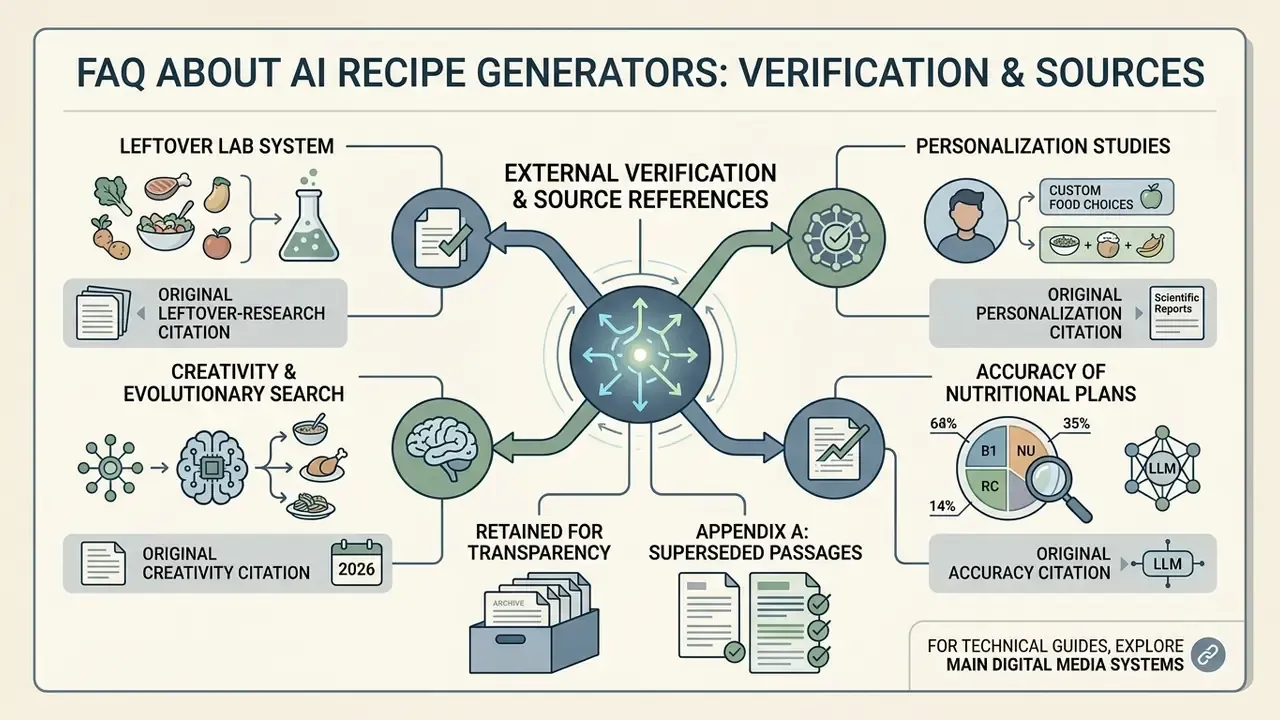
External verification and source references
- *RecipeGPT
- Transformer-Based Controllable Recipe Generation* (IMACSI, 2025). Demonstrates T5 transformer pipelines for constrained ingredient-to-recipe generation.
- *Inverse Cooking
- Recipe Generation from Food Images* (CVPR, 2019). Establishes baseline image-to-recipe architectural standards.
- *FIRE
- Food Image to Recipe Generation* (WACV, 2024). Vision Transformer ingredient extraction plus T5 instruction generation on Recipe1M.
- *RecipeMC
- Monte Carlo Tree Search for Recipe Generation* (preprint, 2024). Reward-guided decoding; 62% evaluator preference over human-written recipes.
- *Recipes for Creativity
- Evolutionary Search for Generative Models* (preprint, 2026). FunSearch scoring 3.92 versus 3.64 human TTCT creativity mean.
- *ReciFine
- Finely Annotated Recipe Dataset for Controllable Recipe Generation* (preprint, 2026). Entity- and tool-level conditioning improves controllability.
- *Cooking with a smart speaker
- user experience of cooking with a voice-only recipe service* (Korea Science, 2024). Hands-free benefit versus instruction memory load. https://koreascience.kr/article/JAKO202105953619628.page
- *FDA Job Aid
- Time and Temperature Control for Safety Foods* (FDA). TCS classification before accepting heat-treatment steps.
- *Putting It All Together
- Standardized Recipes*, Virginia Tech FST-155. https://www.pubs.ext.vt.edu/FST/FST-155/FST-155.html
- Study and Overview of Recipe Generators, Halaye et al. (2024). https://doi.org/10.1016/j.ijgfs.2024.100987 Defines automated recipe generation as input-, pantry- and preference-matched decision support.
- AI-Powered Smart Recipe Generator using Computer Vision (ICCSCE, 2025). Validates EfficientNetV2 CNN ingredient classification accuracy at 96.87%.
- Enhancing Action and Ingredient Modeling in Multimodal Recipe Generation (preprint, 2026). Documents semantically incorrect actions despite strong lexical scores.
- AI Nutrition Recommendation System, Papastratis et al., Scientific Reports (2024). 84,000 daily plans across 4,000 profiles at roughly 5% mean nutrient error.
- AI-Based Recipe Generator for Food Waste Reduction, Cheuanpanya, bachelor's thesis (2026). LLM prototype generating recipes from limited ingredient sets.
- Leftover Lab, University of Vaasa bachelor's thesis (2026). Web prototype targeting household food waste among students.
- RecipeCart, University of Central Florida (2024). Ingredient identification for leftover-driven recipe relevance.
- Would you trust an AI chef?, academic study (2024 to 2026). Trust parity for standard dishes, trust deficit for innovative recipes.
- Nutritional Accuracy Audit of Generative AI Meal Plans (FuelNutrition Benchmark, August 2026). GPT-5.5 Instant median absolute calorie error 2.50%.
- Hieronimus et al. (2024), as cited in FuelNutrition Benchmark. Vitamin D and fluoride below reference in all 108 plans reviewed.
- Designing an Interaction Concept for Assisted Cooking in Smart Kitchens, ACM (2024 to 2026). Human initiative, proactivity and multimodality as design pillars.
- AI-Powered Multi-Lingual Voice Interactive Cooking Assistant (IJIRT, 2026). 9.4% ASR WER, 1.2 s latency, 98% command success. https://ijirt.org/publishedpaper/IJIRT182038_PAPER.pdf
- USDA FSIS Compliance Guideline for Cooking Instructions (USDA, 2015). Minimum internal thermal thresholds; three-run repeatability validation.
- Campden BRI Guideline 74 (2015). Temperature distribution studies and thermal-process verification.
- FDA Guidance on Food Allergen Labeling, Edition 5 (issued 1 June 2025). Packaged-food allergen disclosure requirements.
- UK FSA Technical Guidance on Allergen Information for Food Businesses (published 2023, updated current cycle). Ingredient-list and "Contains" statement rules.
- W3C Guide to PRISM Recipe Metadata and XML Encoding.
cookingEquipment,duration,servingSize,yieldfields. https://www.w3.org/submissions/2020/SUBM-prism-20200910/Recipe_Guide.pdf - Standardized Recipe Form for the SFSP, Connecticut State Department of Education.
- Food Shopping and Meal Planning, Nutrition.gov (U.S. government). Weekly dinner plan, grocery list, personalization form.
- Weekly Meal Planner, Grocery List, and Recipes, U.S. Department of Veterans Affairs (2023).
- U.S. Copyright Office guidance on recipes and original expression (2023 to 2024). Ingredient lists and procedures outside copyright scope.
- Generative Artificial Intelligence and Copyright Law, Congressional Research Service (2026). Substantial-similarity exposure for commercial output.
Additional reference resources
For further technical definitions and structural guides across digital media systems, explore the main glossary. Related editorial resources include our guides to online photo editors for preparing recipe imagery, AI voice generators for narrated cooking content, and free photo editors for zero-budget food photography workflows.