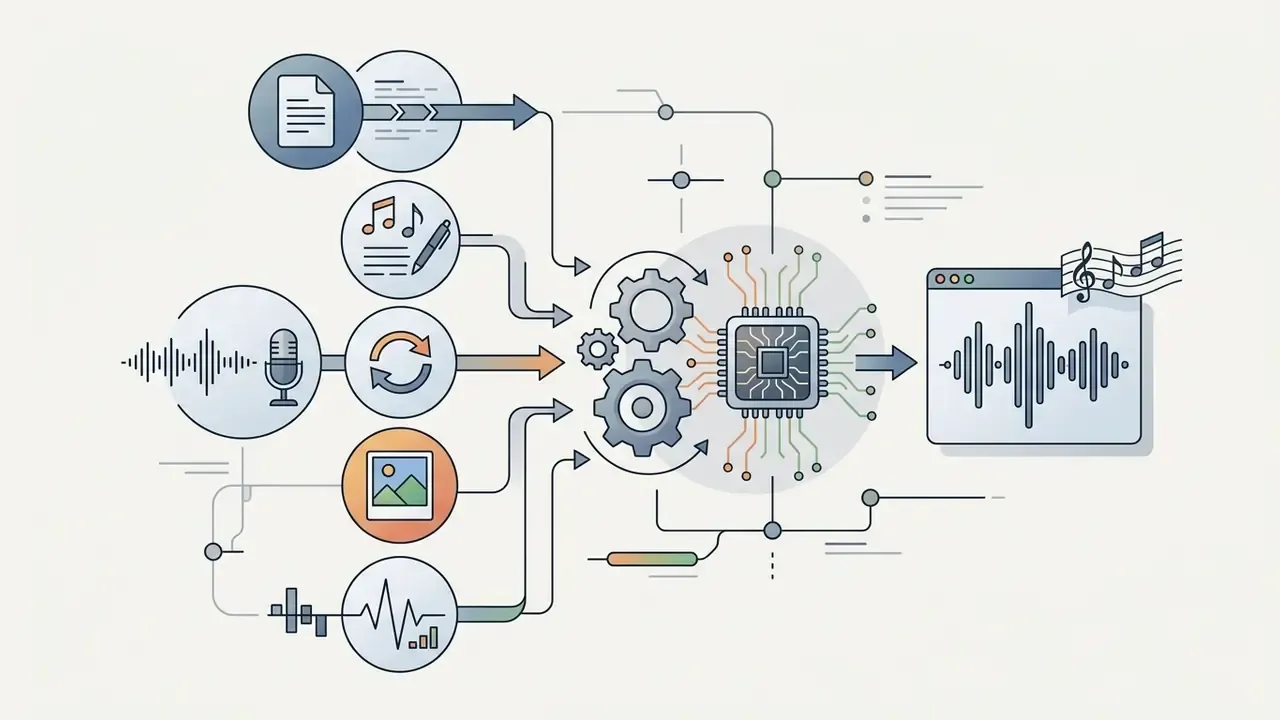
A modern ai song generator is a multimodal neural system that synthesizes full-length tracks, vocal parts and instrumental arrangements from a text prompt or from song lyrics you already wrote. Audio generation algorithms, natural language processing and voice synthesis sit inside one interface. The result is a tool used by content creators, marketers, producers, and, increasingly, by brand and compliance teams inside regulated organizations.
Attribution: Marcus Hale, AI governance and model-risk analyst. Marcus Hale, author.
That framing sets the agenda. Below, the technology comes first (what the model actually does, and where it fails), then the practical workflow, then the control layer: licensing, data privacy, Shadow AI and enterprise requirements. Because a generator that produces a great chorus while leaking a confidential brief inside a prompt is still a failed deployment. Simple as that.
Executive Summary
- An ai song generator turns text prompts, lyrics, uploaded audio, images or rap scripts into complete tracks with vocals, instrumentation, beats and song structure.
- Commercial rights are tier-dependent. Free plans are personal-use only; paid plans grant commercial use for tracks generated while the subscription is active.
- Purely AI-generated audio is not protected by standard U.S. copyright. Only a human's perceptible creative contribution is protectable.
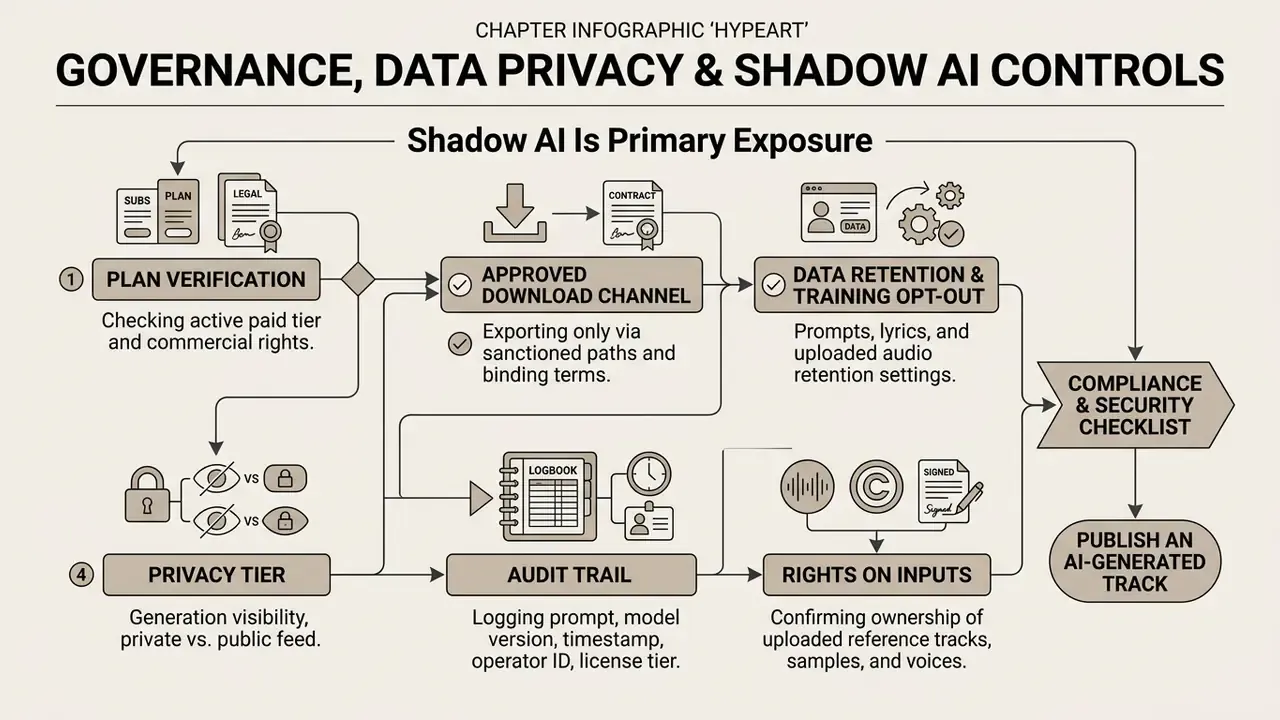
- For organizations, the real risk surface is Shadow AI, prompt confidentiality, data retention and training opt-out, plus audit trail, not audio quality. A governance checklist is provided below.
Quick Definitions Before You Start
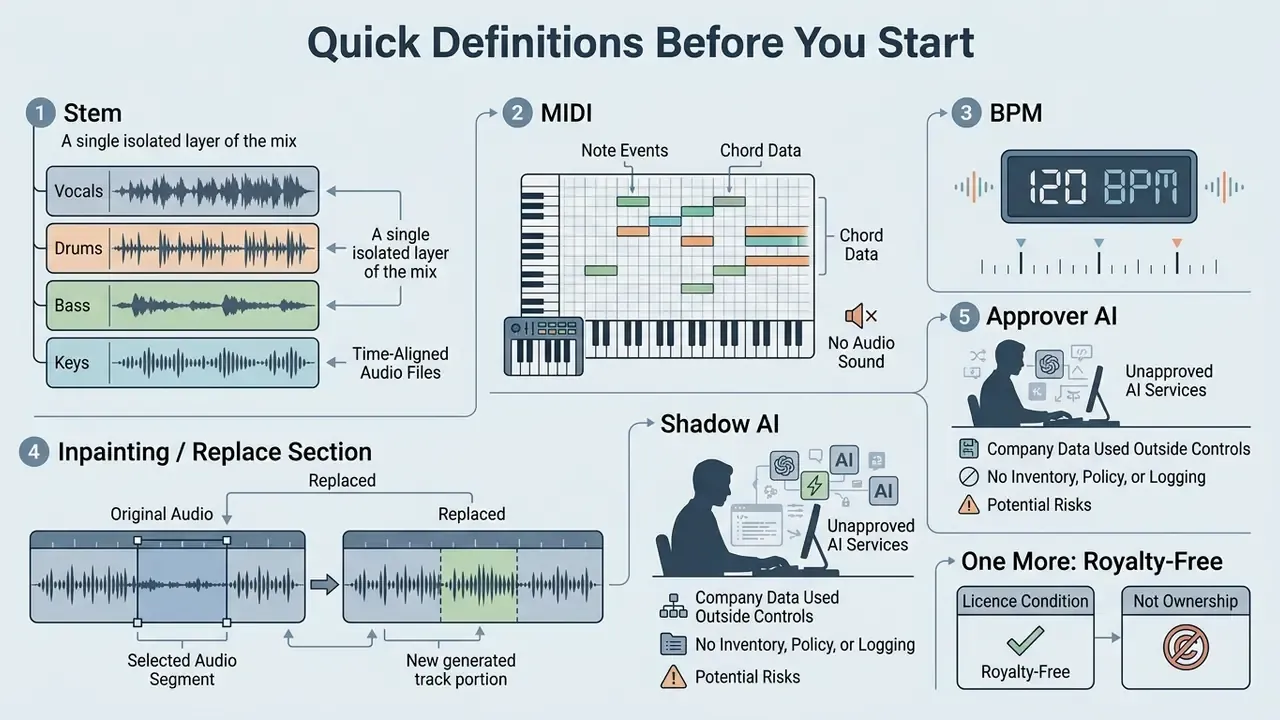
Five terms carry most of the practical weight in this guide. Worth fixing them early, because vendor marketing uses them loosely.
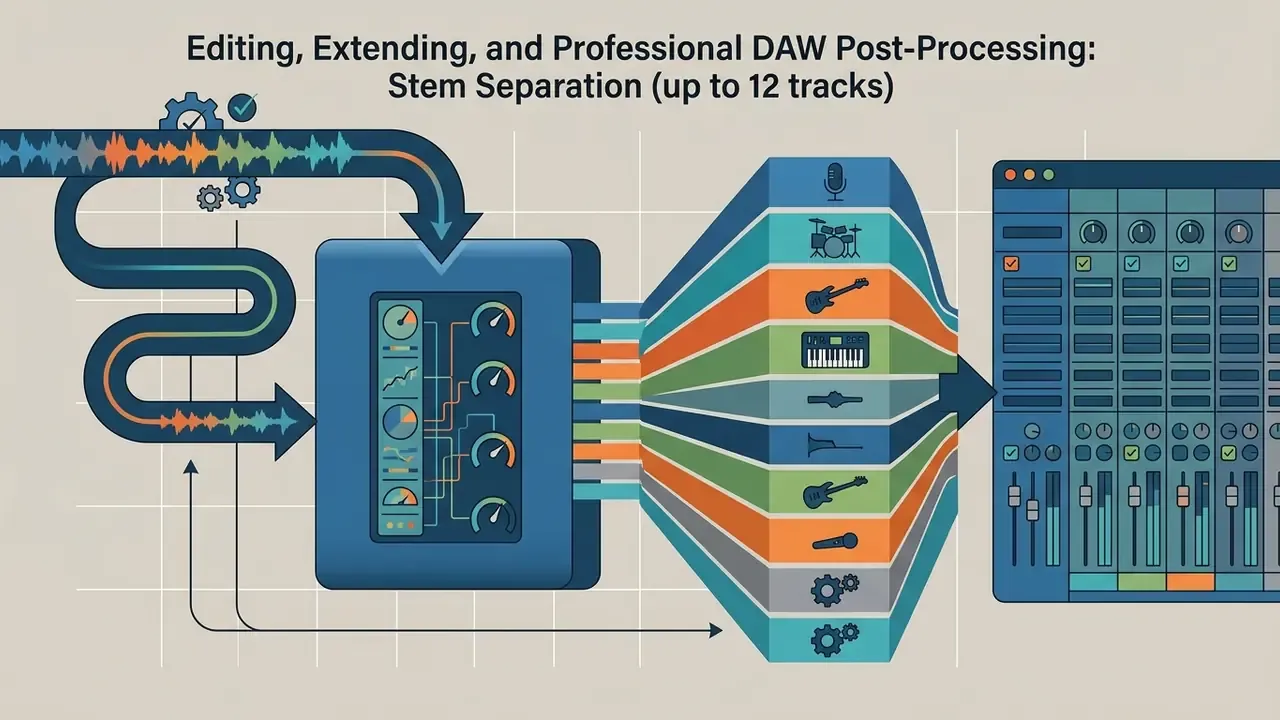
- Stem. A single isolated layer of the mix (vocals, drums, bass, keys) exported as its own time-aligned audio file. Twelve stems means twelve independently editable tracks in your DAW.
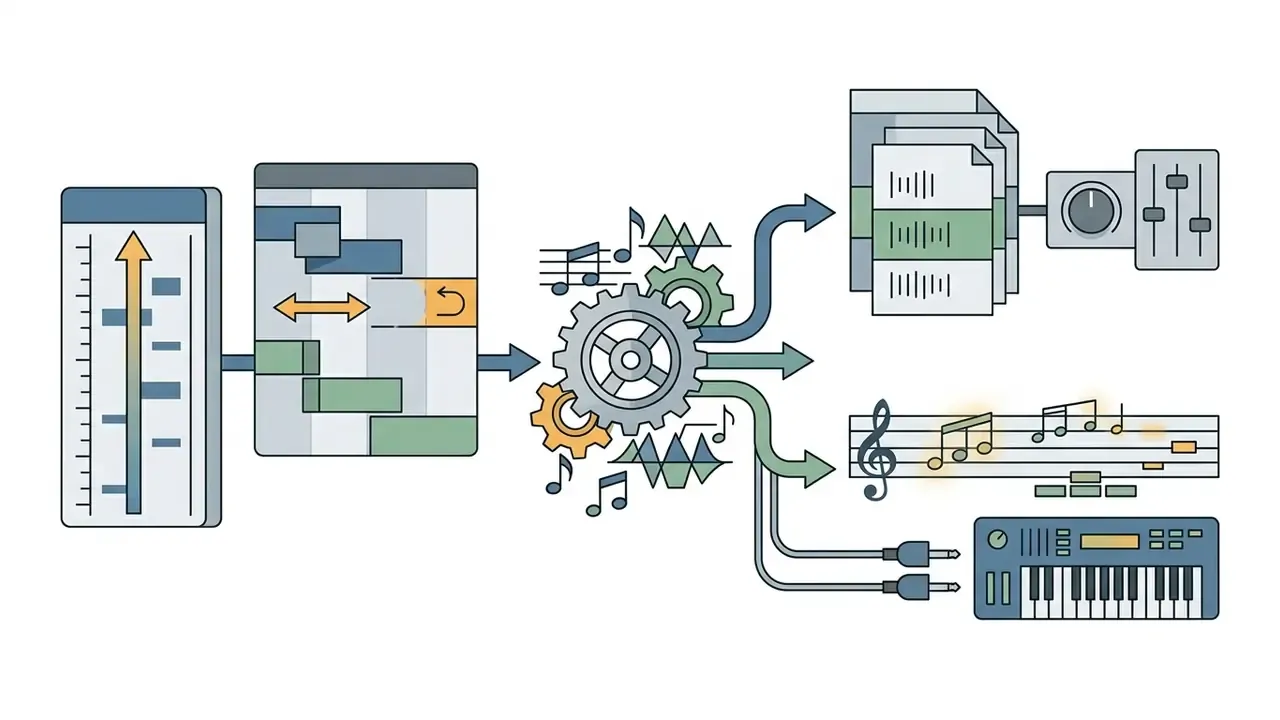
- MIDI. Note and chord data without sound. Export MIDI and you can swap a generated synth for a studio instrument, or hand the chart to a session player.
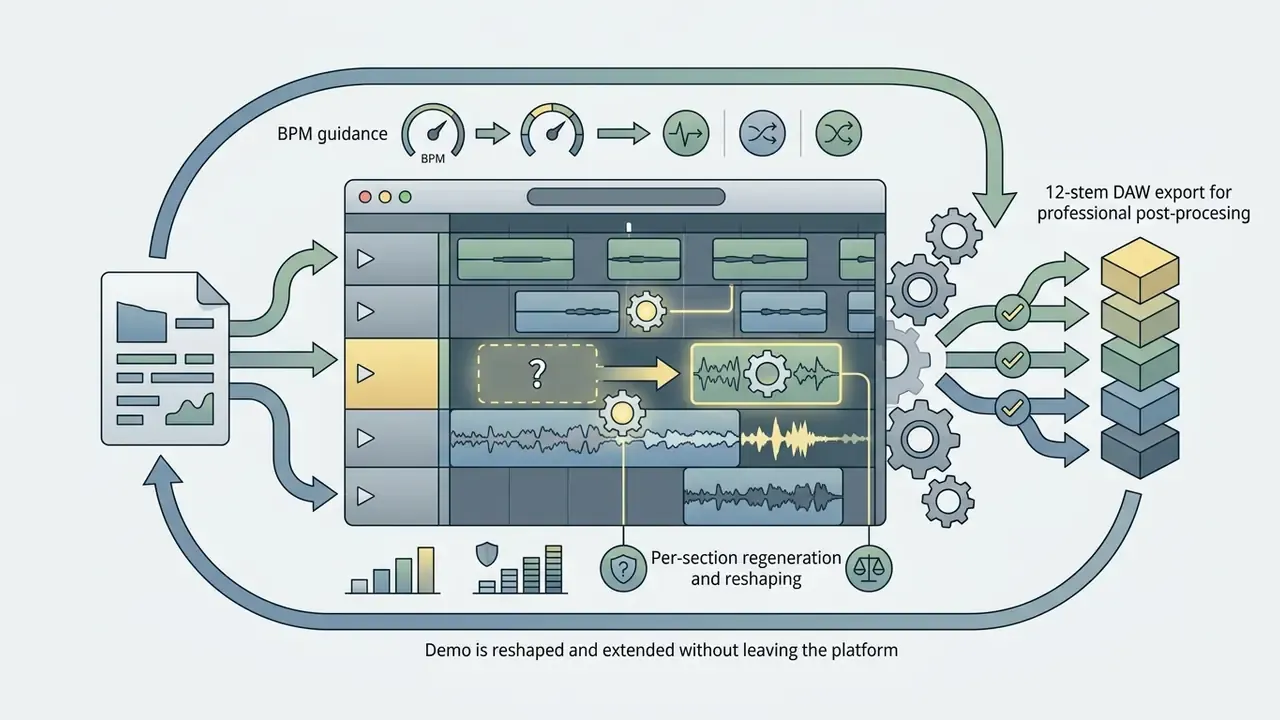
- BPM. Beats per minute. Stating an explicit number in the prompt is far more reliable than writing «fast».
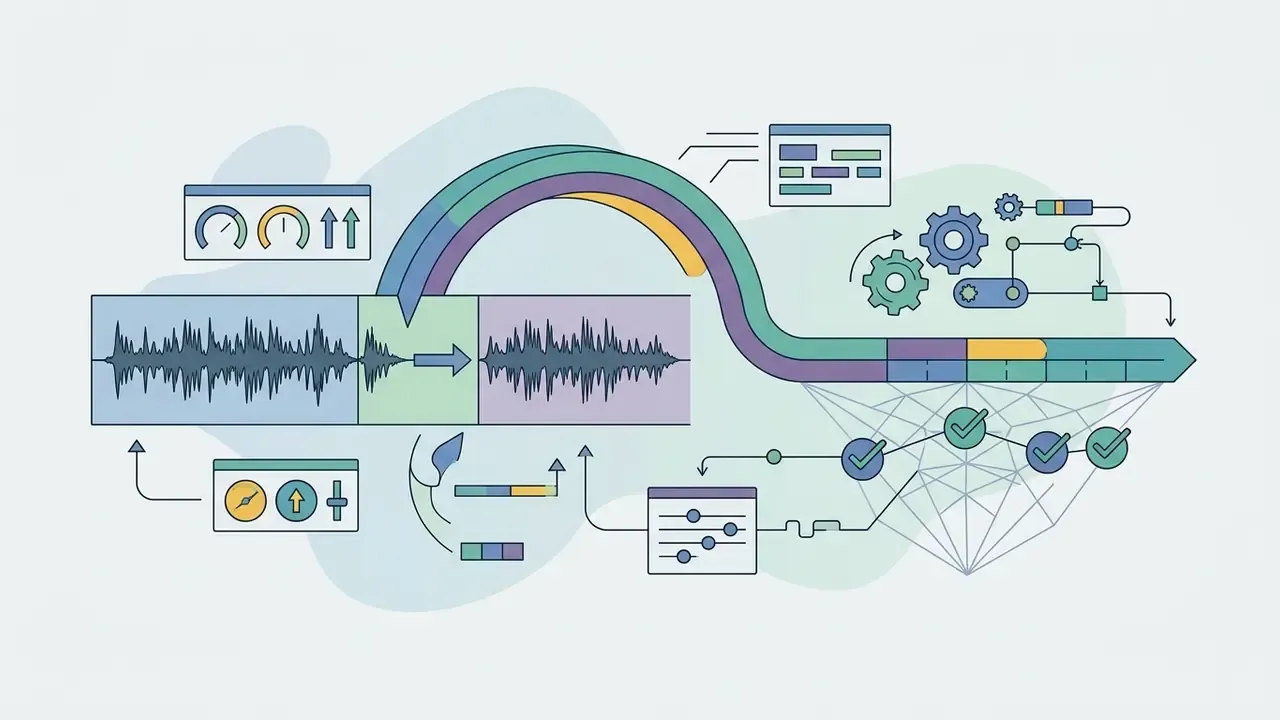
- Inpainting / Replace Section. Regenerating only a highlighted region of the waveform while the surrounding arrangement stays untouched.
- Shadow AI. Employees using unapproved AI services with company data, outside inventory, policy and logging. The quiet failure mode in most enterprises.
One more: royalty-free describes a licence condition, not ownership. Keep those two ideas apart and half the legal confusion around AI-generated music disappears.
What Is an AI Song Generator and What Is It For
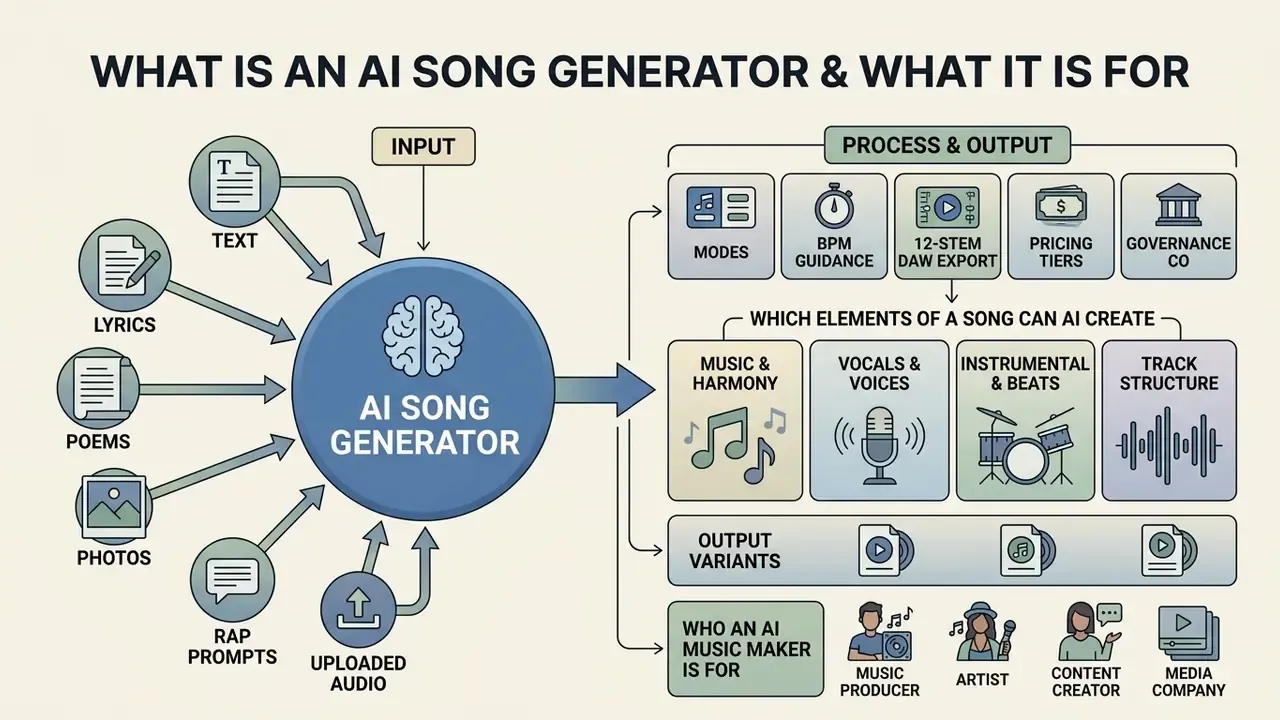
An ai song generator is a specialized neural-network web service that converts text descriptions, poems or audio references into finished musical compositions. It plays three roles at once: melody generator, vocal synthesizer, instrumental arranger.
According to research by the French National Music Centre (Le CNM, 2025), AI music systems cover a wide task range: assisted composition, harmony selection, automatically generated illustrative music, arranging and orchestration, voice and choir harmony generation, plus preparation of promotional material, music videos and social assets. Using an ai music generator compresses the path from creative idea to first demo track from several days to 30 to 60 seconds.
Model risk, stated plainly: generation is probabilistic. Typical failure modes include unstable vocal timbre between sections, mispronounced or slurred lyric lines, phantom instruments nobody requested, clipped transitions at section boundaries, and loudness drift across regenerations. So every track headed for release should pass a short validation gate: full listen-through at reference level, lyric-accuracy check, section-boundary check, loudness and true-peak check, plus a licensing check of the plan under which the file was generated.
Five minutes of checking. That is the whole gate.
Which Elements of a Song Can AI Create
A modern ai music & song generator synthesizes the entire structure of a musical work: vocal parts, instrumental accompaniment, rhythmic beats and the textual lyrics themselves.
- Music and harmony chord progressions, tempo changes and melodic lines.
- Vocals and voices solo singing, duets, backing vocals and rap delivery in multiple languages.
- Instrumental and beats rhythm section, drum patterns, bass lines and synthesizer riffs.
- Track structure intro sections, verses, choruses, bridges and outros.
- Output variants full mix with vocals, instrumental-only version, or an isolated vocal stem for reuse.
Who an AI Music Maker Is For
An ai music maker platform is built for video makers, podcasters, advertising agencies, game developers, educators, fitness professionals, filmmakers and professional producers. Mobile users get a stripped-down ai app song maker flow; desktop users get the full editor.
For content creators, a music generator solves one concrete problem: sourcing licensed audio without the risk of copyright strikes. Producers use an ai generator music maker to break creative blocks, test hybrid genres and sketch arrangements before studio time is booked.
That distribution is the honest picture of professional adoption as it stands in 2026. AI mostly works as an assistive layer inside an existing production chain; full end-to-end ai generator song workflows remain a minority practice, dominant among creators and marketers rather than among studio producers.
Pain to solution matrix across eight audiences
| User segment | Core pain point | Solution with an AI song generator |
|---|---|---|
| YouTubers and streamers | Content ID claims and strikes on background music | Royalty-free background tracks generated to match the video theme |
| Podcasters | High cost of commissioned intros and outros | Original theme music and stingers, with reported budget savings up to 90% |
| Game developers | Shortage of dynamic sound design per location | Fast adaptive background tracks, from 8-bit chiptune to epic orchestral |
| Marketers and advertisers | Cost and friction of clearing rights to popular tracks | Memorable commercial jingles synthesized in about 60 seconds |
| Filmmakers | Composer fees out of reach for independent film | Atmospheric scores that carry the exact emotion of a scene |
| Educators and course authors | Monotony of instructional video content | Neutral lo-fi beds that hold attention without competing with narration |
| Fitness trainers | Strict BPM alignment with exercise cadence | Energetic EDM and dance with exact tempo targeting (128 to 140 BPM) |
| Musicians and composers | Creative block during arrangement writing | Demo ideas, chord grids and rapid hybrid-genre exploration |
Risk-adjusted ROI: how to model the saving honestly. A production saving is only real once the cost of control is deducted:
Where Expected residual risk equals the probability of a takedown, demonetization or rights dispute multiplied by average remediation cost: re-edit, re-upload, lost ad revenue, legal hours. A jingle that costs nothing to generate but $600 to re-clear after a claim is not a free jingle. Teams that keep this line item visible tend to standardize on paid tiers with explicit commercial licences instead of drifting onto free ones.
Ways to Create Music in an AI Song Maker
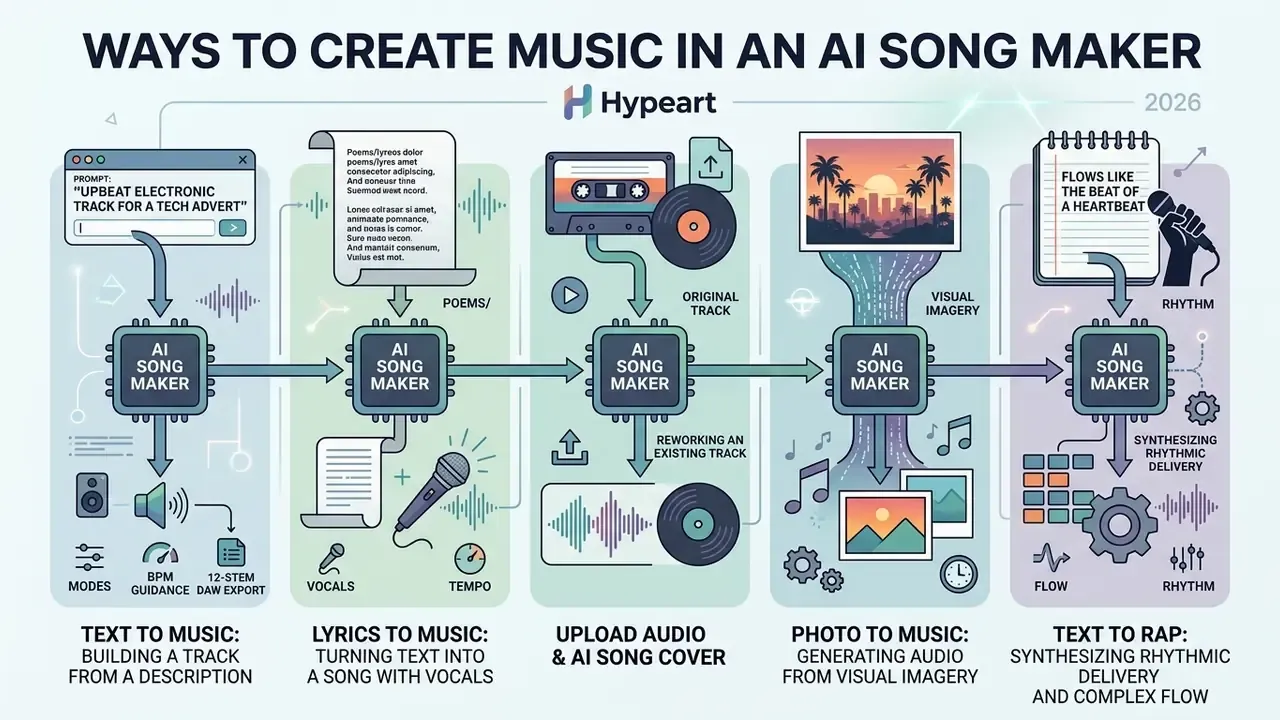
A modern ai music creation website exposes five generation modes: music from a text description (Text to Music), poems and lyrics turned into a sung song (Lyrics to Music), processing of uploaded audio files (Upload Audio / Cover), audio built from a visual reference (Photo to Music) and rhythmic rap synthesis (Text to Rap).
The mode you pick depends on the source material you already own, and on how much control you need over the final result.
Text to Music: Building a Track from a Description
Text to Music converts a description of genre, mood, tempo and instruments into a finished audio stream using diffusion or autoregressive networks.
You enter a prompt with the required characteristics. An ai melody generator tool maps those words into vector representations and generates the corresponding waveform. Systems at the level of MusicLM and Stable Audio interpret details such as «melancholic 80s piano, 120 BPM» with high precision. Readers extending the same prompt logic into moving images can continue with our overview of text-to-video AI tools, and the underlying principles of generative media systems are covered in Image-to-Video AI Explained.
Lyrics to Music: Turning Text into a Song with Vocals
Lyrics to Music synthesizes a vocal performance from supplied song lyrics and places it over a generated arrangement.
Current research describes two-stage pipelines: the network first builds the vocal line according to the rhythm of the text, then generates the harmonic accompaniment. Alternative frameworks reverse the order and generate vocals conditioned on an existing instrumental stem.
An ai music writing generator handles both sustained melodic singing and fast rhythmic rap. To visualize the resulting audio, our guide to images to video covers the companion workflow.
Upload Audio and AI Song Cover for Reworking an Existing Track
Upload Audio lets you submit an existing recording, then change its genre, replace the vocalist or produce an AI Song Cover without altering the underlying melodic line.
The network extracts the melodic skeleton and tempo grid, then rebuilds the arrangement in a new style. You can turn a rock ballad into an electronic track, or use an ai jingle generator app to adapt a corporate audio logo for a seasonal campaign. In practice, services accept MP3, WAV, M4A, OGG and FLAC sources, render a cover in roughly 1 to 5 minutes, and require that you hold the rights to the uploaded audio. Teams producing video around those covers can pair the workflow with an AI video generator; licensing details sit in the AI Media Commercial-Use Hub.
Photo to Music: Generating Audio from Visual Imagery
Photo to Music uses computer vision to analyze the colour palette, lighting and emotional context of an uploaded image, then converts those visual parameters into the harmonic foundation and tempo of a track.
In practice this mode suits photographers scoring portfolio reels, brands turning campaign key visuals into audio identities, and anyone building a personal gift track from a specific memory. A beach at dusk produces a slow, warm ambient bed; a neon night street pushes the model toward faster, brighter synth textures. Not always predictable, but often useful as a starting sketch.
Text to Rap: Synthesizing Rhythmic Delivery and Complex Flow
The dedicated rap mode builds the rhythmic grid (flow) automatically, aligns stresses inside complex rhyme schemes, and applies an aggressive or relaxed delivery over the selected beat.
You can supply finished bars, or hand over only a theme and let the system write the verse, choose rhyme targets and set the emotional register. Because flow and beat alignment are model-side, users with zero rap performance experience still receive metrically correct verses at 85 to 95 BPM boom-bap or trap tempos.
How to Create a Song with AI: From Idea to Download
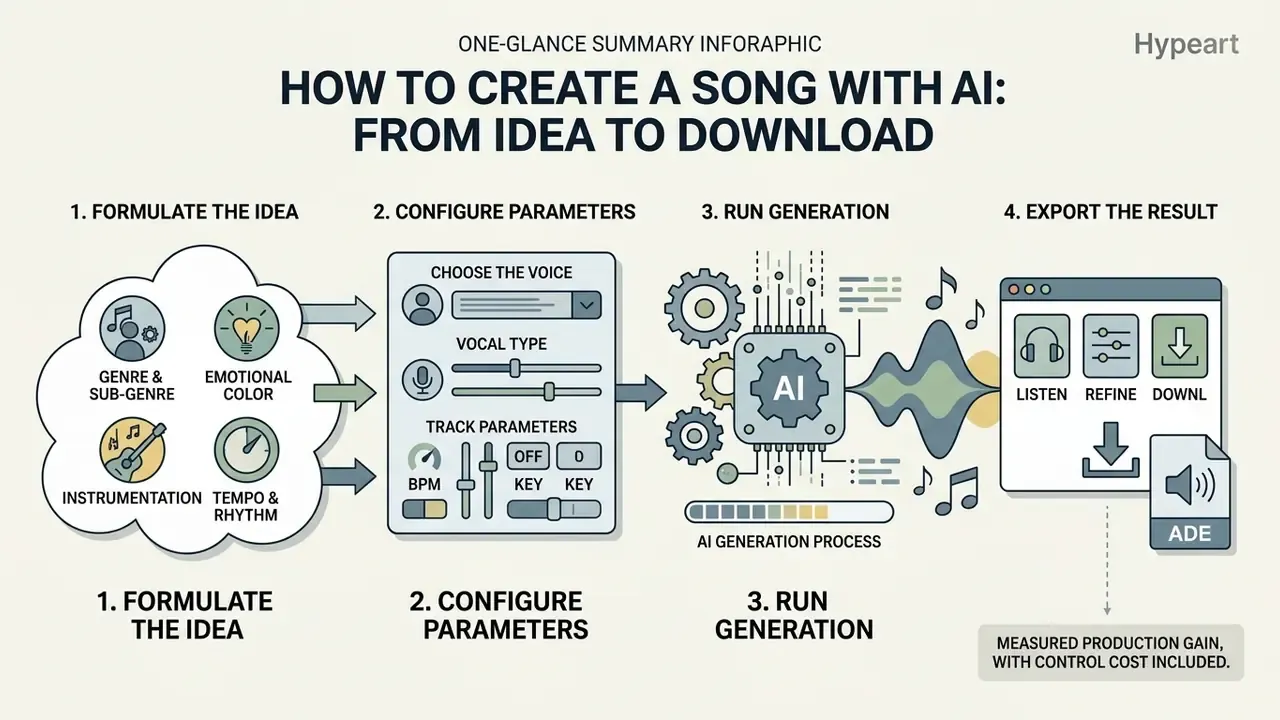
Creating a composition through an ai music generator create song online service takes four sequential steps: formulate the idea, configure parameters, run generation, export the finished file.
A standardized workflow reduces technical friction and delivers a publish-ready track in minutes. It also makes the process auditable, which matters more than it sounds.
Describe the Mood, Genre and Musical Idea
Output quality depends directly on how complete and structured your input description is.
Practitioner-facing prompt guides published by model vendors (including the Lyria music prompt documentation) converge on the same schema: genre and style first, then mood, instrumentation, tempo.
- Genre and sub-genre: synth-pop, indie rock, lo-fi hip-hop.
- Emotional colour: energetic, melancholic, uplifting.
- Instrumentation: acoustic guitar, vintage synthesizer, punchy drums.
- Tempo and rhythm: state an explicit BPM value instead of «fast» or «slow».
Tempo reference grid by genre
| Genre family | Typical BPM range | Practical use |
|---|---|---|
| Lo-Fi / Chill / Ambient | 60 to 80 BPM | Study beds, meditation, course narration |
| Hip-Hop / Boom Bap / Trap | 85 to 95 BPM | Rap verses, sports edits, street-style reels |
| Pop / Indie / Synthwave | 80 to 120 BPM | Ads, vlogs, brand storytelling |
| Ballad / Piano | 60 to 80 BPM | Emotional scenes, wedding and tribute tracks |
| Jazz / Blues | 90 to 110 BPM | Hospitality, lounge, retro branding |
| EDM / House / Dance | 120 to 140 BPM | Festival-style drops, fitness, promo trailers |
| Rock / Metal / Punk | 130 to 170 BPM | Gaming content, high-energy montages |
| Orchestral / Epic | variable tempo | Film scoring, cinematic reveals |
Choose the Voice, Vocal Type and Track Parameters
Vocal settings define performer gender, timbral colour and the structure of vocal parts.
Pick a male vocal (a deep baritone, say), a female vocal (clear soprano), or configure a duet. Using tags inside the lyrics, for example [Male Voice], [Female Voice], [Duet], an ai generator song maker distributes parts precisely between virtual vocalists. One caveat worth remembering: a duet needs two defined singers, so a single global gender switch will not give you section-level roles. Character descriptors such as raspy male vocals, smooth tenor, young female voice or mature baritone refine delivery further. A broader look at speech synthesis is available in our guide to the AI voice generator.
For granular sound design, current interfaces expose advanced controls: Style and Weirdness sliders (how far the output may deviate from genre canon), Exclusions (forcing unwanted instruments out of the mix, e.g. no electric guitar, no brass), vocal gender as a song-wide switch, and saved Persona Voices that hold a consistent singer identity across a single release or a whole album. Adjacent creative tooling is reviewed in imagine ai art generator.
Generate, Listen and Download the Result
Press generate and the network usually returns two alternative versions of the track for comparison.
Audition both, assess the mix and the clarity of the vocal, then export. Finished tracks come out as MP3 (fast web publishing) or WAV (uncompressed, for professional editing and archiving). Standard practice from audio-preservation workflows applies here as well: keep the uncompressed WAV as your master and treat MP3 as the delivery copy. Compute limits and quality parameters can be estimated with our AI Media Calculators.
Measured production gain, with the control cost included. Once these four steps are standardized, the real benefit is a shorter iteration loop rather than «free music». A creative team that previously spent one to two days searching stock libraries and reading usage terms can now produce three to five candidate beds in an hour, then reinvest the recovered time in validation: lyric-accuracy checks, loudness normalization, licence documentation. The 2024 producer survey cited above supports the same reading. Adoption clusters where AI accelerates existing steps (separation, mastering), not where it replaces the whole chain.
Fine-Tuning AI-Generated Music: Genres, Vocals and Editing
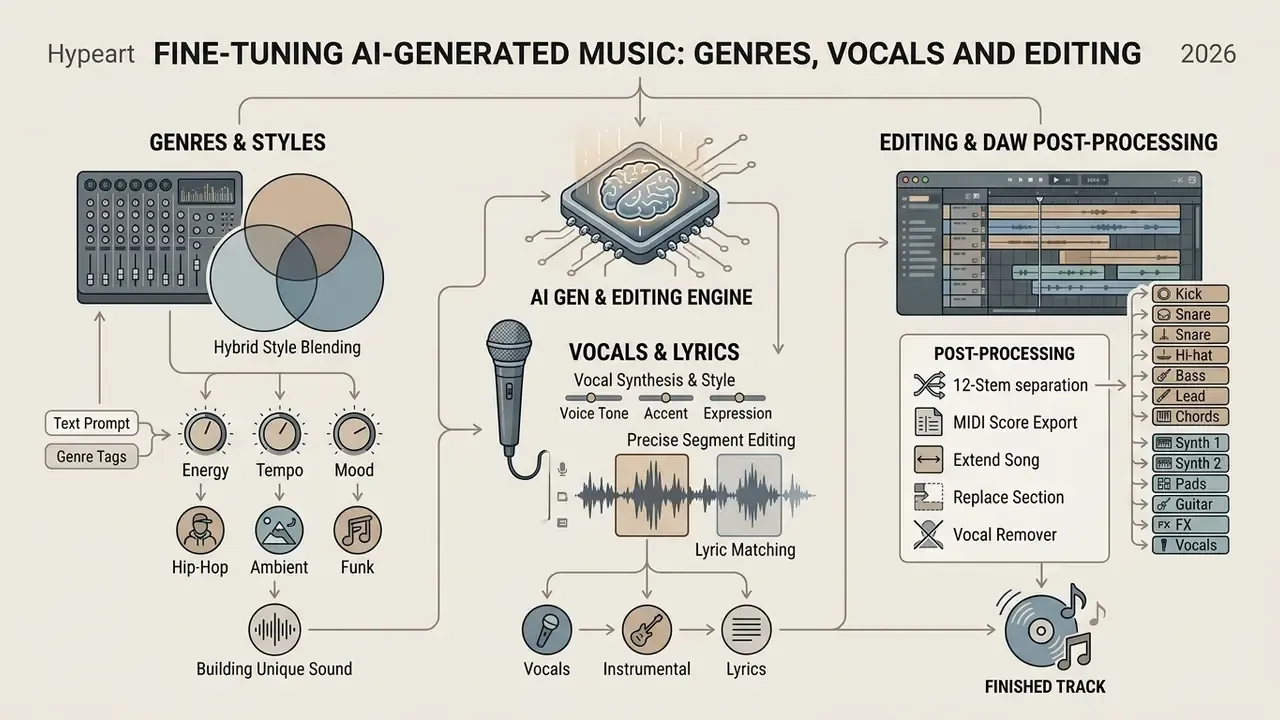
Deep customization covers hybrid style blending, precise vocal-segment editing and post-processing of the finished composition.
Modern online editors let you change individual fragments of a song without regenerating the entire file. That single capability is what moved these tools from novelty to production use.
Genres, Styles and Building a Unique Sound
A distinctive sound usually emerges from combining opposing musical genres inside one prompt.
Latent-feature mixing makes it possible to blend heavy guitar riffs with a symphonic orchestra, or to hybridize ethnic instrumentation with contemporary trap; genre-transfer architectures such as CycleGAN-style unpaired translation map one genre domain onto another. A capable ai melody generator website preserves harmonic coherence even in awkward combinations, most of the time.
The practical takeaway: automated audio metrics are a weak proxy for whether a track actually sounds good to your audience, so human listening stays the release gate. Cover artwork and naming assets around a release are handled in our photo editor guide.
Vocals, Instrumental and Lyrics in an AI Song
Separating vocal and instrumental parts gives you flexibility during the final mix.
Dedicated Singing Voice Synthesis (SVS) modules handle diction clarity and the natural breath of a sung line.
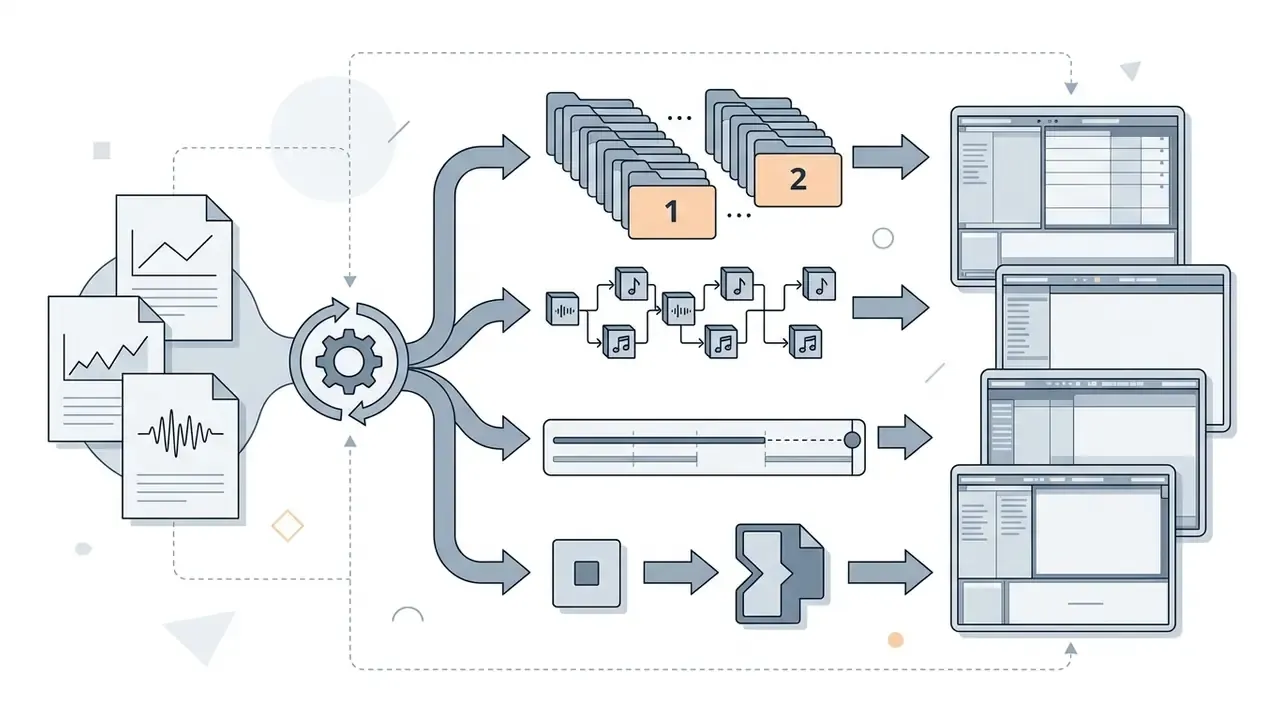
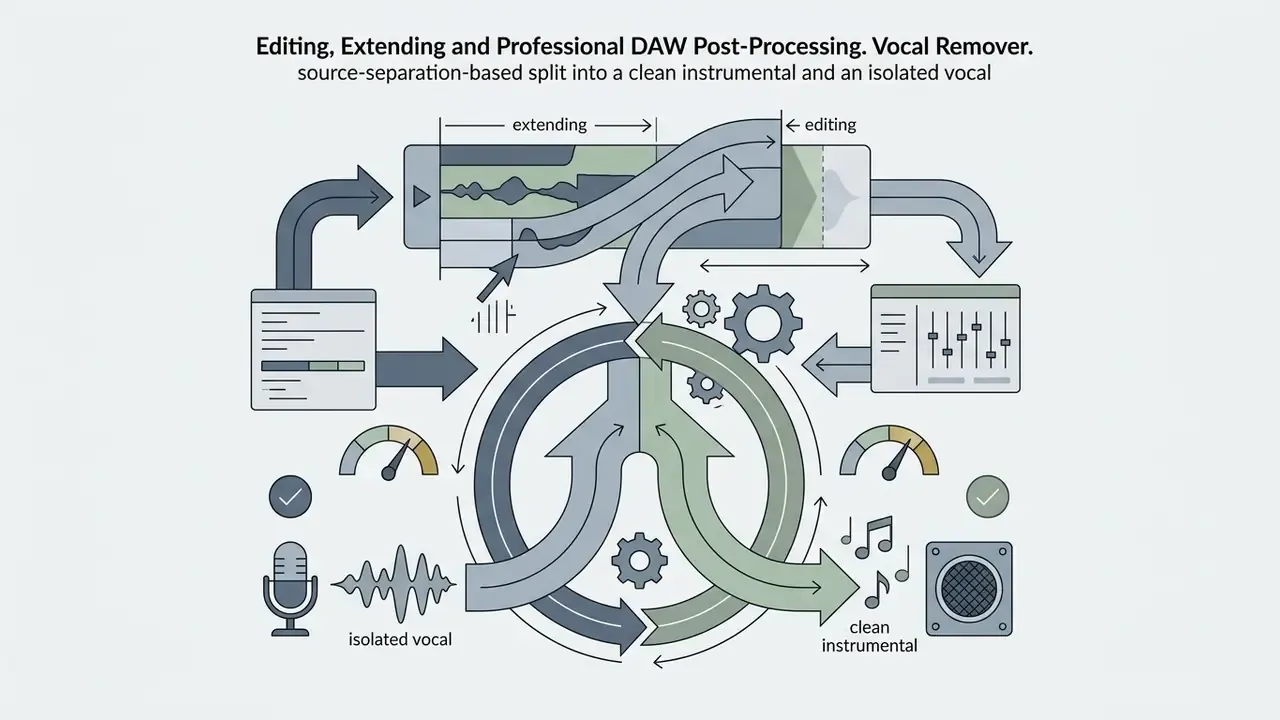
In practice this means the rhythmic grid of the lyrics is reproduced reliably, with vocal tonality adapted to the instrumental bed, while stem separation tools deliver 4-stem splits (vocals, drums, bass, other) or 5-stem splits with piano added for downstream control.
Editing, Extending and Professional DAW Post-Processing
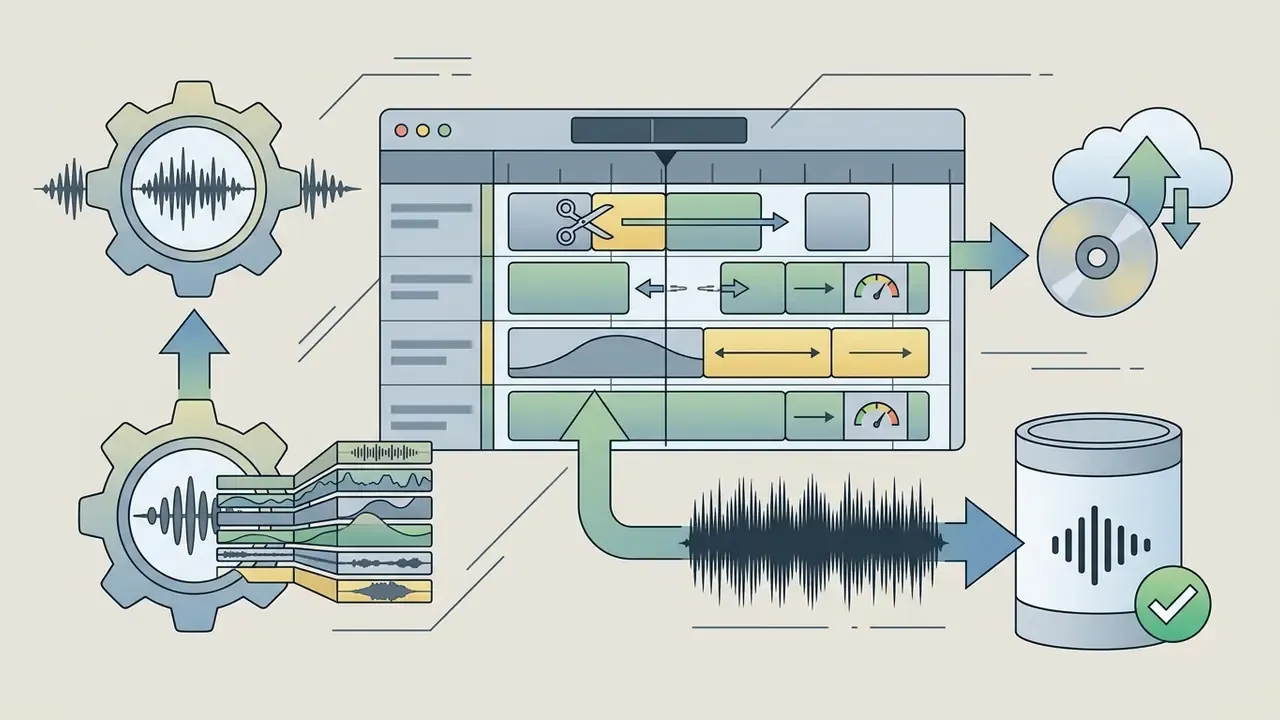
Editing functions let you extend a composition, replace weak sections, isolate the vocal, and split the mix into independent tracks for professional post-production.
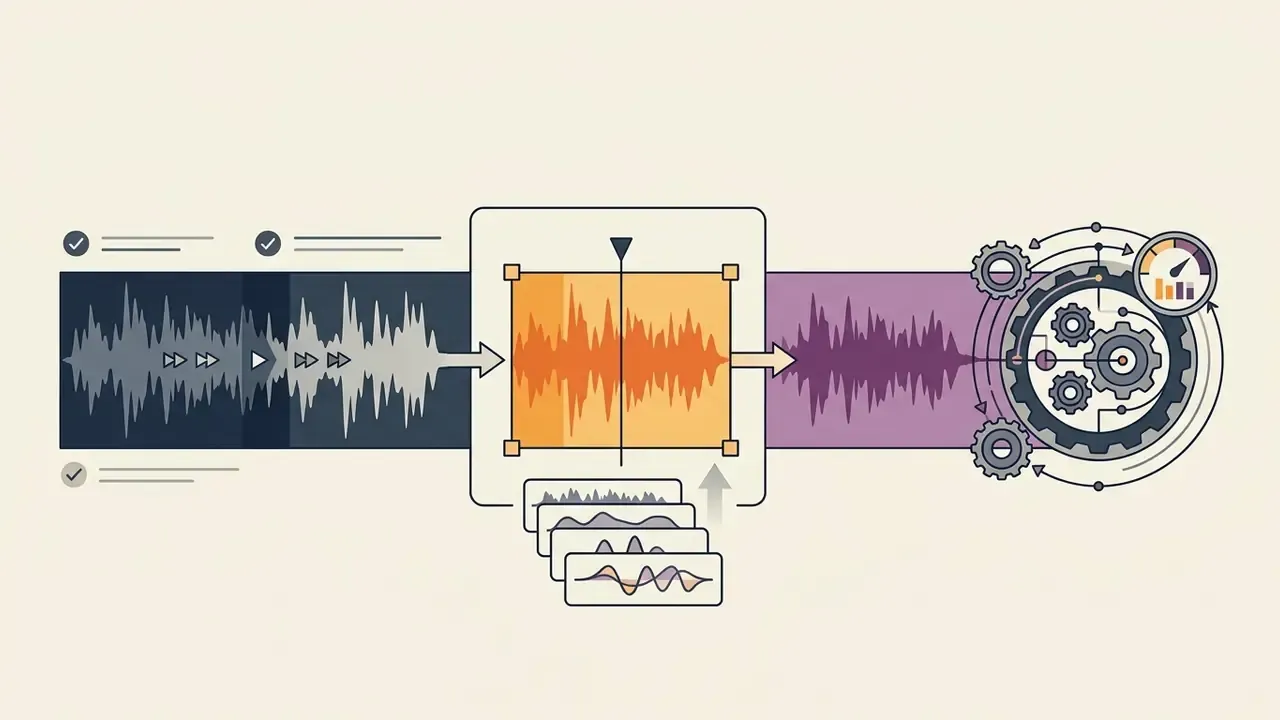
Which gives a practical rule of thumb for section replacement: judge inpainted regions by ear at the seam points, because the metric that looks best on paper is not the one predicting a smooth transition. File-size handling for delivery of the finished audio and video package is covered in our video compressor guide.
AI Music Generator for Video, Social Media and Creative Projects
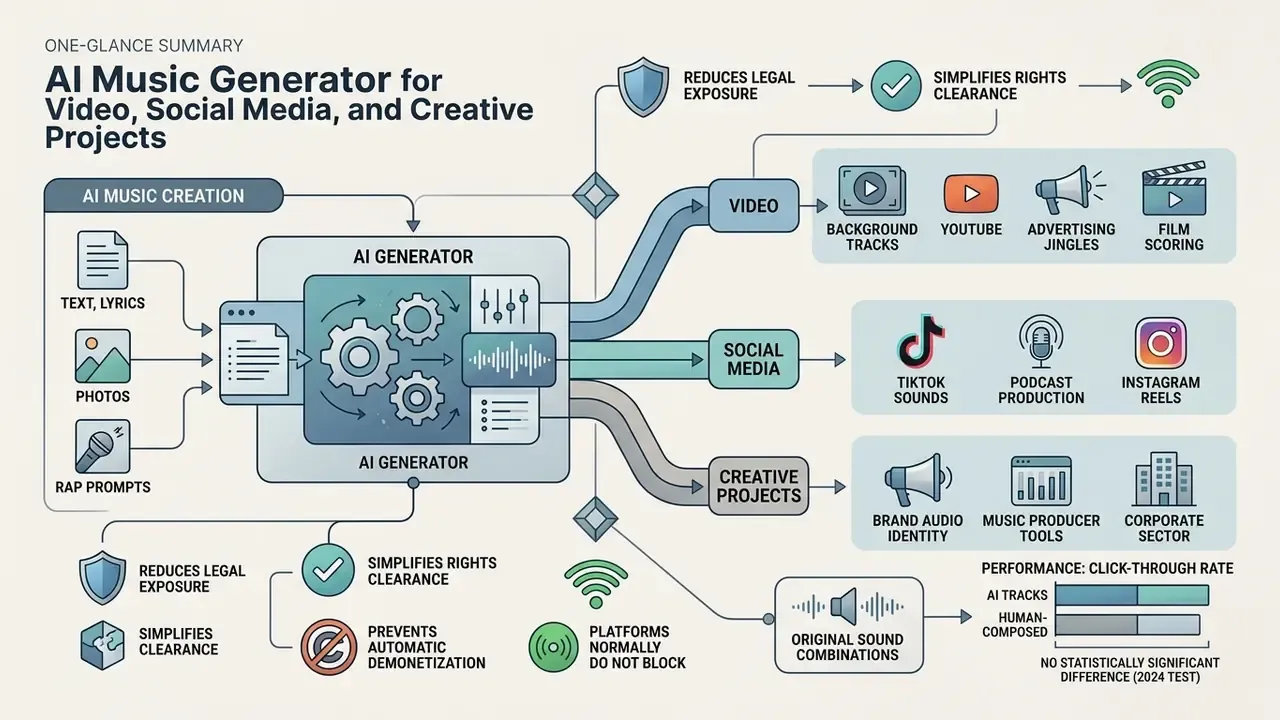
Applications of ai for music creation span background tracks for YouTube and TikTok, advertising jingles and podcast production material.
Generated music reduces legal exposure and simplifies rights clearance for commercial projects, provided disclosure and licensing rules are respected. Creators building the video side of the same asset can continue with our video editors for YouTube walkthrough.
Tracks for Brands, Advertising and Music Producers
In the corporate sector, an ai music generator song maker is used to build a distinctive brand audio identity and to score advertising campaigns.
Peer-reviewed testing published in 2024 found no statistically significant difference in click-through rate between advertisements using AI-generated music and those using royalty-free library music. Performance parity in that test setting, then, rather than a lift. Governance is not optional either: the IAB advertising playbook requires compliance, bias-testing and fairness checks whenever generative AI creates ad assets, audio included. To integrate generative capabilities into your own products, see our AI Media API Guides.
Governance, Data Privacy and Shadow AI Controls
Free AI Music Generator, Pricing and Commercial Use
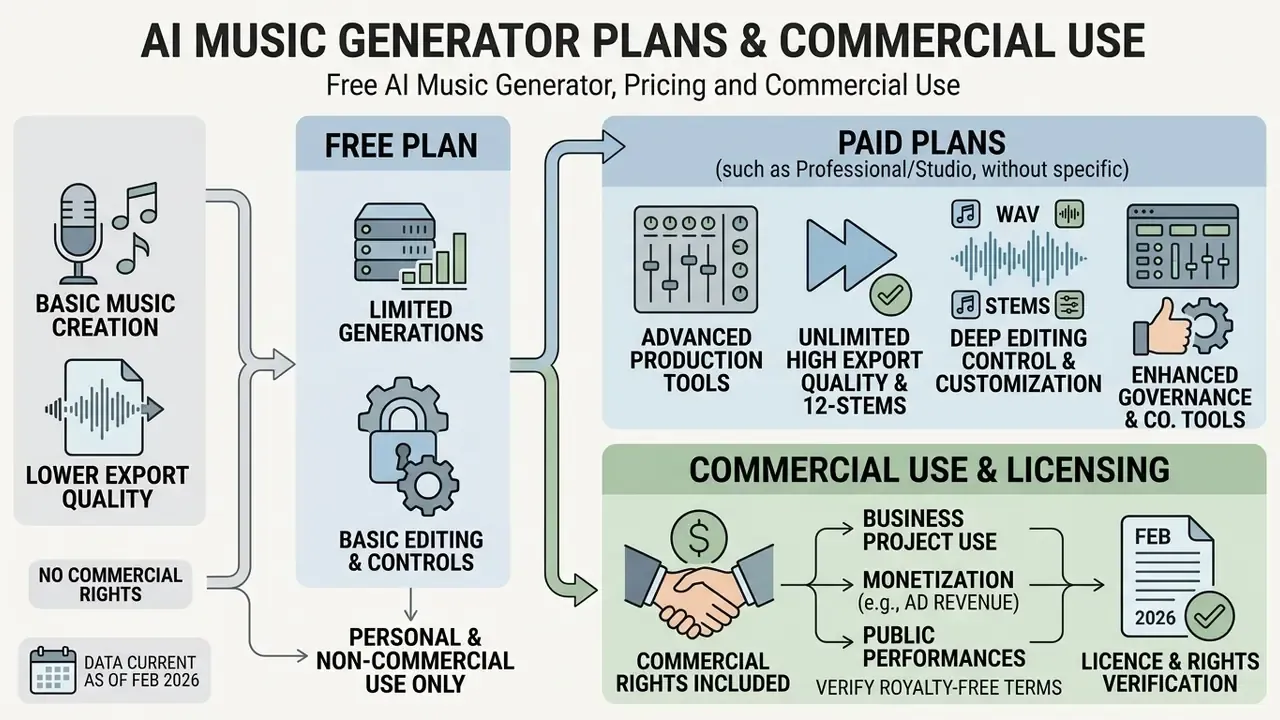
Choosing between free and paid plans comes down to export quality, generation limits, editing depth, governance features and commercial rights.
Read that as market context, not as guidance. Free usage dominates experimentation, while anything published commercially has to sit on a paid tier for licensing reasons alone.
| Plan | Generation limit | Export formats | Editor access | Governance and security | Commercial rights |
|---|---|---|---|---|---|
| Free | 10 to 50 credits per day | MP3 (128 to 192 kbps) | Basic | Public catalogue by default; attribution often required | Personal, non-commercial use only |
| Pro (paid) | 500 to 2,000 credits per month | MP3 (320 kbps), WAV | Full (Extend, Replace, Stems, uploads up to 8 min) | Private generations; account-level history | Commercial licence for tracks created while subscribed |
| Enterprise / Max | Unlimited or API | Lossless WAV, up to 12 stems, MIDI | Priority plus generative DAW and multitrack | Data isolation, training opt-out, SSO, exportable audit logs, SLA, GRC-ready API | Full rights transfer, secured API access |
Commercial-use rules: commercial rights normally cover only tracks generated while a paid subscription is active. If the subscription is cancelled, previously created commercial tracks keep their status, while new generations revert to non-commercial mode. Some binding terms additionally require that the file be obtained through an approved download channel on a permitted tier.
What a Free AI Music Generator Includes
An ai music generator free create song tier gives evaluation access with caps on daily generations and on download quality.
The free plan is for testing: judge vocal quality, experiment with prompts, learn how the ai maker song interface behaves before you commit budget. Downloads are often limited to standard MP3; published tracks may require visible credit to the generator; some tools block standalone audio download entirely; and generations are frequently public inside the platform's shared feed. Free music, yes, but with strings attached. Users exploring adjacent free tooling can compare options in our overview of free AI video generators and free photo editors.
How to Verify Commercial Rights and Royalty-Free Terms
Royalty-free status does not automatically shield you from third-party claims, and it is a licence condition rather than proof of ownership. Copyright protection and royalty status are separate legal questions. The Copyright Office has also stated that works lacking human authorship are not entitled to royalty payments from the collective licensing system. Authors should retain proof of subscription payment as of the track's creation date, and avoid pasting third-party protected lyrics into prompts. Ever.
FAQ About AI Song Generators
Short answers to the questions users ask most often: experience requirements, privacy, upload limits, language support, auditability.
Do You Need Musical Experience to Use an AI Song Maker
No musical education is required to produce quality compositions in an ai song maker. The algorithms build tonality, harmonic structure and rhythmic patterns on their own; you only need to articulate the idea in natural language. Vendor documentation is consistent on this point («no experience needed»), while professional musicians can still use the same ai creator song workflow for deeper work with stems and scores.
«82.2% of producers who do not use AI cite loss of creative control as the main barrier, and only 10.2% are concerned about copyright.» Source: Musikindustrin AI Music Production Survey, 2024. https://musikindustrin.se/ So the barrier to adoption is rarely skill. It is control. Which is exactly why the granular sliders, exclusions and section-level editing described above matter more to professionals than raw generation speed.
Can You Create Songs in Different Languages, and Do They Stay Private
Modern generators support song creation in more than 30 languages, including English, Spanish, French, German, Russian, Portuguese, Japanese, Korean, Chinese and Hindi. Multilingual vocal synthesis is closely related to speech technology; see our guide to an AI voice generator with language support. Privacy of generated audio depends on the plan. On free tiers, tracks often become public and appear in the service's shared catalogue. Paid tiers guarantee private generation and private storage on the server. Vendor privacy terms differ materially: some state that uploaded text and generated audio are used for nothing beyond rendering the output, while others reserve the right to use audio and transcripts for model training under consent terms. Read the specific policy before uploading anything sensitive.
What Is the Maximum Length of an Audio File I Can Upload in Upload Audio Mode
Most advanced services accept source material of up to about 8 minutes, enough for a full-length song, a podcast segment or a voice-over recording. The same ceiling typically applies to song extension, so an ai music song maker can grow a generated track to a comparable duration while preserving its harmonic grid.
How Do I Build an Audit Trail and Protect Corporate Prompts
Log five fields per released asset: prompt and lyrics text, model version, generation timestamp, licence tier, operator identity. Store the export file hash alongside them. For prompt protection, use an enterprise tier with data isolation and an explicit training opt-out, restrict uploads of confidential briefs and unreleased material through policy and DLP rules, keep generations private rather than public, and route platform access through SSO so the audit log maps to real employees instead of shared accounts.
Can AI-Generated Music Still Trigger a Content ID Claim
Yes, in edge cases. Originality of the generated combination usually prevents matches, but claims can arise if an uploaded reference track was copyrighted, if a distinctive performer's voice was cloned, or if a distributor has already fingerprinted the same generated track elsewhere. Keep the generation record, the licence proof and the input-rights confirmation available. That trio resolves most disputes quickly.
Appendix A: Corrections and Source Updates
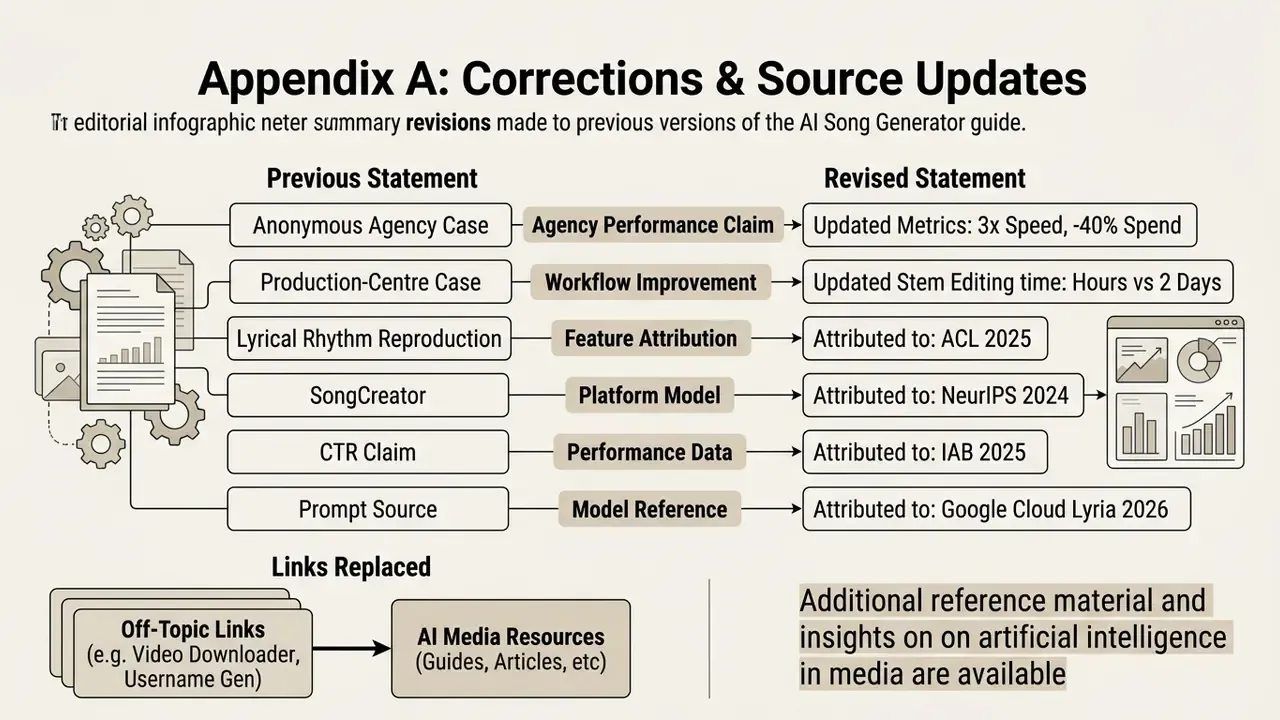
For transparency, the following statements from earlier versions of this guide were revised during review:
- Anonymous agency case (3× faster creatives, minus 40% library spend). Replaced with verified survey data on real adoption patterns (Musikindustrin, 2024, n = 1,107), because the original figures could not be attributed to a citable source.
- Anonymous production-centre case (stems editing: hours instead of two days). Replaced with experimental evidence on inpainting and section replacement (AR vs FM comparative study, 2025) plus a workflow-level description of the production gain.
- «SongCreator, NeurIPS 2024» attribution. Superseded by the verified Seed-Music preprint (2025) for the two-stage vocal and accompaniment pipeline claim.
- «ACL 2025» attribution for lyric rhythm reproduction. Superseded by the Seed-Music unified framework reference.
- «IAB 2025» CTR claim. Removed and replaced with the 2024 peer-reviewed finding of no statistically significant CTR difference between AI-generated and royalty-free advertising music, plus IAB governance requirements for generative AI in ad creation.
- «Google Cloud Lyria (2026)» prompt attribution. Reformulated as neutral vendor prompt-documentation guidance and reinforced with the Stable Audio preprint (2024).
- Off-topic internal links (Instagram username generator, Instagram video downloader) were replaced with contextually relevant resources on text-to-video generation, AI voice synthesis, YouTube editing and file delivery.
Additional reference material, articles and guides on artificial intelligence in media are available in our AI Media Glossary.