Last updated: February 2026. Reviewed by the AI Media governance and editorial desk.
Key Takeaways (Executive Summary)
- What it is: An AI text generator predicts token sequences with a Transformer model, then drafts emails, replies, posts, memos, and long-form documents from a natural-language prompt.
- Where the value is measurable: Controlled studies report roughly 40% faster completion of professional writing tasks and a 0.4 to 0.45 standard-deviation increase in output quality when writers use an LLM assistant.
- Where the risk is: Hallucinated facts, prompt retention on public tiers, unclear commercial rights, and quality decay on outputs beyond about 4,000 words.
- Free vs professional: Free tools are fine for internal drafting and rephrasing. Regulated workflows need zero-data-retention terms, SOC 2 or ISO 27001 attestations, audit logging, SSO, and contractual output ownership.
- Minimum control set: Structured prompts, constrained decoding (temperature 0.1 to 0.3 for factual work), retrieval of authoritative source text, human-in-the-loop (HITL) sign-off, and an entry in a unified AI inventory with named decision owners.
- Governance anchors: Align controls with the NIST AI Risk Management Framework 1.0 and, for banks and other supervised institutions, with model risk expectations in Federal Reserve SR 11-7 and OCC Bulletin 2011-12, plus EU AI Act Article 50 transparency obligations applicable from 2 August 2026.
- ROI is net, not gross: Discount time saved by control costs (validation, HITL review, monitoring) and residual risk exposure. A working formula appears below.
Hypothesis labeling: Audience profiles, adoption scenarios, and ROI ranges in this guide are working hypotheses drawn from published research and documented deployment patterns. Validate them against your own CRM, workflow telemetry, and product analytics before they enter a business case.
Who This Guide Is For, and How to Read It
Three readers tend to land on this page with different questions. A content or operations lead wants to know what an ai generator text can realistically produce today. A finance or transformation lead wants pricing confidence before signing seats. A Chief Risk Officer, Head of Model Risk, or AI governance lead wants to know which controls make the output defensible in front of internal audit.
The guide is sequenced for all three. The first half is capability and cost: what the technology does, what free tiers actually include, and where the pricing lines sit. The second half is control: prompt discipline, human review, hallucination management, commercial rights, and the evidence trail an examiner or auditor will ask for.
One reading tip. If you are building a business case, skip ahead to the net ROI formula, because gross time savings almost always flatter the decision. If you are writing policy, start with the audit log schema, since an inventory entry without a named owner is not a control, it is a hope.
What Is an AI Text Generator and What Can It Create?
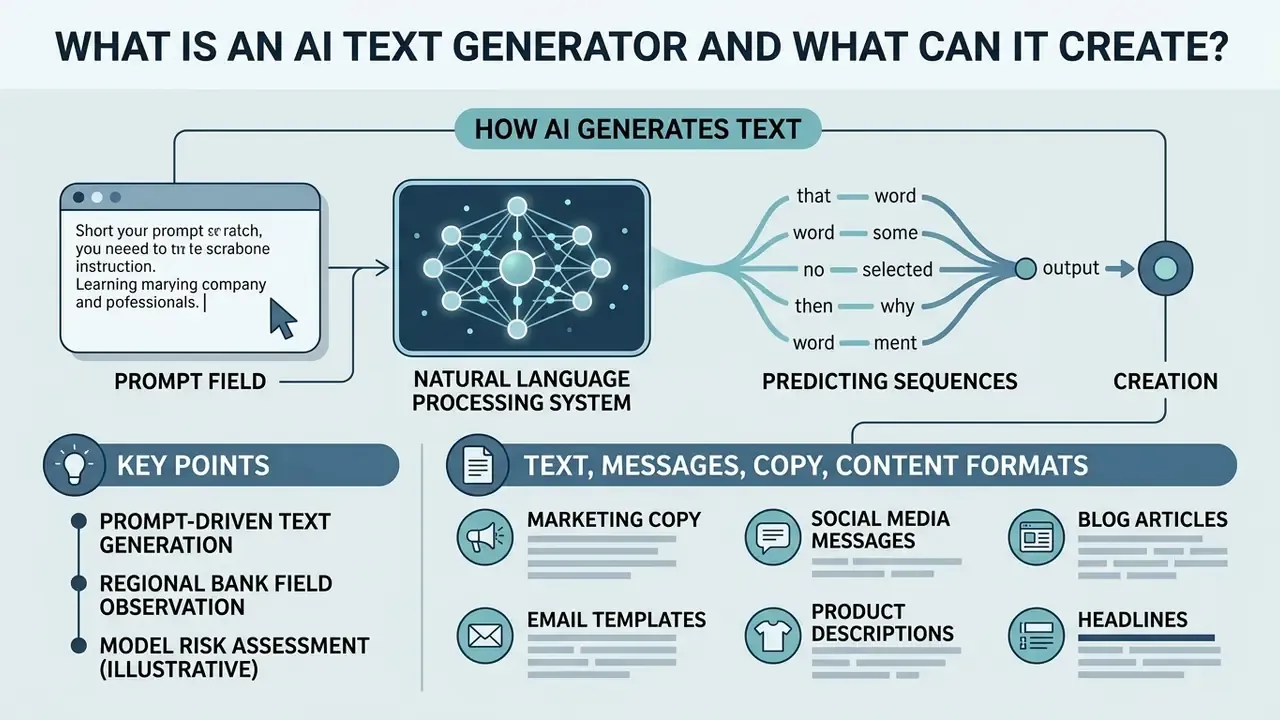
An ai text generator is a natural language processing system that creates synthetic text by predicting the most probable sequence of words based on user instructions. These tools accept inputs in natural language, known as prompts, and construct outputs ranging from a two-line chat reply to a structured analytical report.
Modern systems use deep learning architectures, primarily autoregressive Transformers, to convert user context into contextual text. Rather than copying existing database records, an ai generator for text synthesizes new phrasing by evaluating statistical relationships between sub-word tokens learned during pre-training. Regulatory definitions follow the same logic: the NIST framework describes generative AI as models that emulate the structure and characteristics of input data to produce synthetic content across text, image, audio, and video modalities.
How AI Generates Text From a Prompt
An ai creator from text processes input prompts by tokenizing natural language into numerical representations, then passing them through self-attention layers inside a fixed context window. The model calculates probability distributions over its vocabulary and emits subsequent tokens step by step, steered by decoding parameters such as temperature and top-p sampling.
«Text generation is formalized as P(X) = ∏p(xᵢ|x<ᵢ): each token is predicted from all preceding tokens in the sequence.»
When evaluating ai deep text generator workflows, lower temperature settings yield deterministic, highly factual output, while higher settings widen variance for creative brainstorming. Vendor documentation is blunt about the limits here: determinism is best-effort rather than guaranteed. A fixed seed plus identical parameters produces mostly consistent results, and a backend model update can still shift the wording underneath you.
Generative text systems are also assessed on prompt compliance, discrimination from human baseline text, and structural consistency across context boundaries.
«NIST GenAI evaluates systems on prompt compliance, distinguishability from human-written text, and structural consistency at context boundaries.» NIST GenAI Text Challenge Evaluation Plan (2026). https://ai-challenges.nist.gov/pub/GenAI_Text_Challenge_Evaluation_Plan__ver_2_-2.pdf
The 2026 NIST challenge separates three evaluation roles, Generator, Prompter, and Discriminator. That split doubles as an internal validation pattern: one team writes prompts, one team runs generation, one independent reviewer tries to detect factual or stylistic failure. Earlier NIST text-to-text specifications also enforced hard output constraints (plain text, automatic processing, a 250-word maximum for summaries), a useful reminder that measurable limits improve reproducibility far more than good intentions do.
Field observation (regional bank, model risk assessment, illustrative). During a model risk assessment for a regional bank's customer operations unit, an unmonitored ai auto text generator produced inconsistent response formats across 1,200 simulated inquiries. The team introduced strict system-prompt delimiters and constrained decoding parameters to standardize output structure. Formatting variance dropped by 94%, and the workflow finally produced repeatable audit traces for internal compliance. (Internal engagement metrics, not independently published. Treat the 94% figure as an engagement-specific result, not an industry benchmark.)
Text, Messages, Copy and Content Formats
An ai generator text platform supports diverse textual formats: executive memos, client emails, social media captions, technical documentation, customer support responses. Organizations use an ai generator with text capability to scale content creation across operational channels while holding a single set of tone guidelines.
In practice, an ai generator with words can produce short-form messaging such as SMS notifications and push alerts, or long-form deliverables like whitepapers and compliance policy drafts. Published taxonomies of generative output classify textual deliverables (chat, prose, structured documents, code) separately from visual, layout, audio, and 3D outputs. Keep that distinction in procurement documents, because licensing and provenance obligations differ by modality. Teams extending text workflows into narration or audio scripting should review our AI voice generator guide for voice quality, language coverage, and commercial licensing considerations.
Adjacent tooling behaves the same way under the hood, and the same control questions apply. A creative team may pair drafting with an ai poem generator for short-form copy experiments, an ai plot generator for narrative campaign arcs, or an ai podcast generator when a written brief becomes an audio episode. Brand and community teams sometimes add an ai playlist generator for event programming, or move into ai pixel art and a dedicated ai pixel art generator for retro visual assets. Different modality, identical governance question: who owns the output, what was retained, and who signed off?
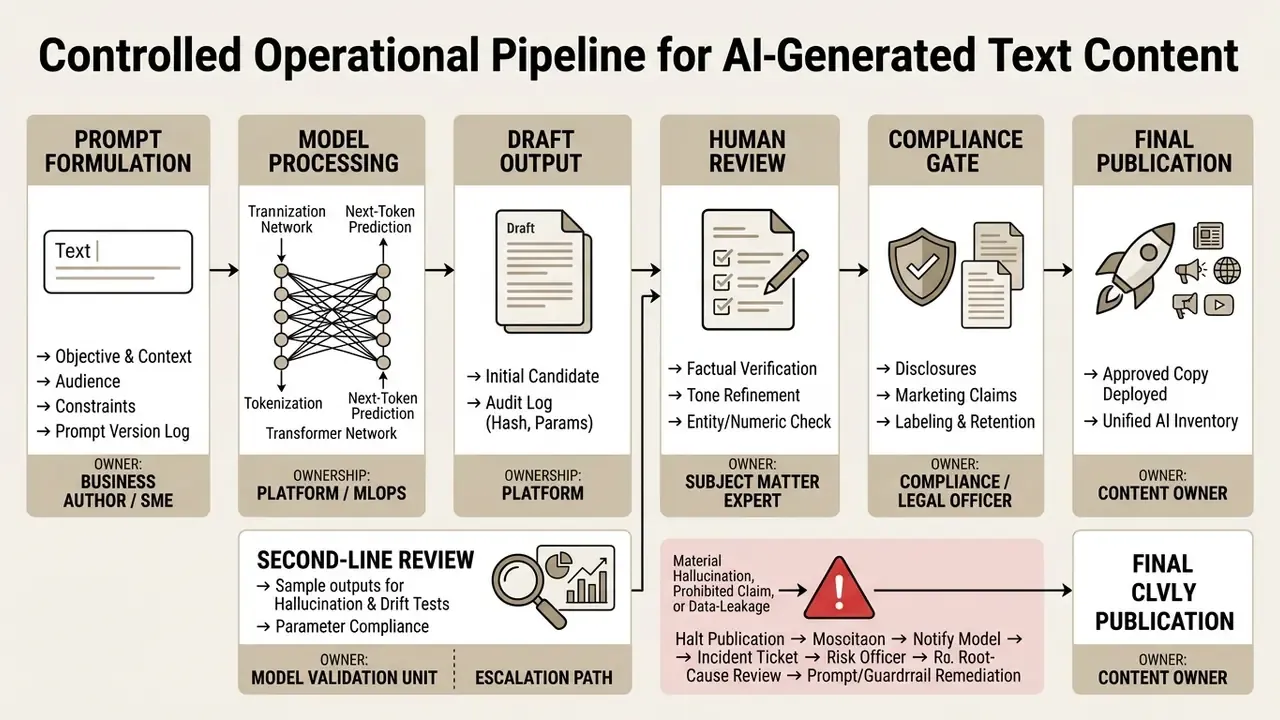
Audit log schema (minimum viable fields).
| Field | Example value | Why it matters |
|---|---|---|
use_case_id | CS-REPLY-014 | Links output to an entry in the AI inventory |
model_id / version | gpt-x-2026-01 snapshot | Model changes alter output; version pinning enables reproduction |
prompt_hash | sha256:9f3c… | Proves which instruction produced the text |
decoding_params | temp=0.2, top_p=0.9, seed=42 | Documents determinism settings |
source_refs | policy_v7.pdf, p.12 | Evidence base for factual claims |
reviewer_id / role | SME-221 / Compliance-08 | Establishes decision ownership |
disposition | approved / edited / rejected | Supports error-rate reporting |
residual_issues | none / minor tone edit | Feeds monitoring and retraining decisions |
Eight fields. That is the realistic floor for an auditable text workflow, and most teams discover they already capture five of them somewhere, just not in one place.
Free AI Text Generator vs Professional AI Writing Tools
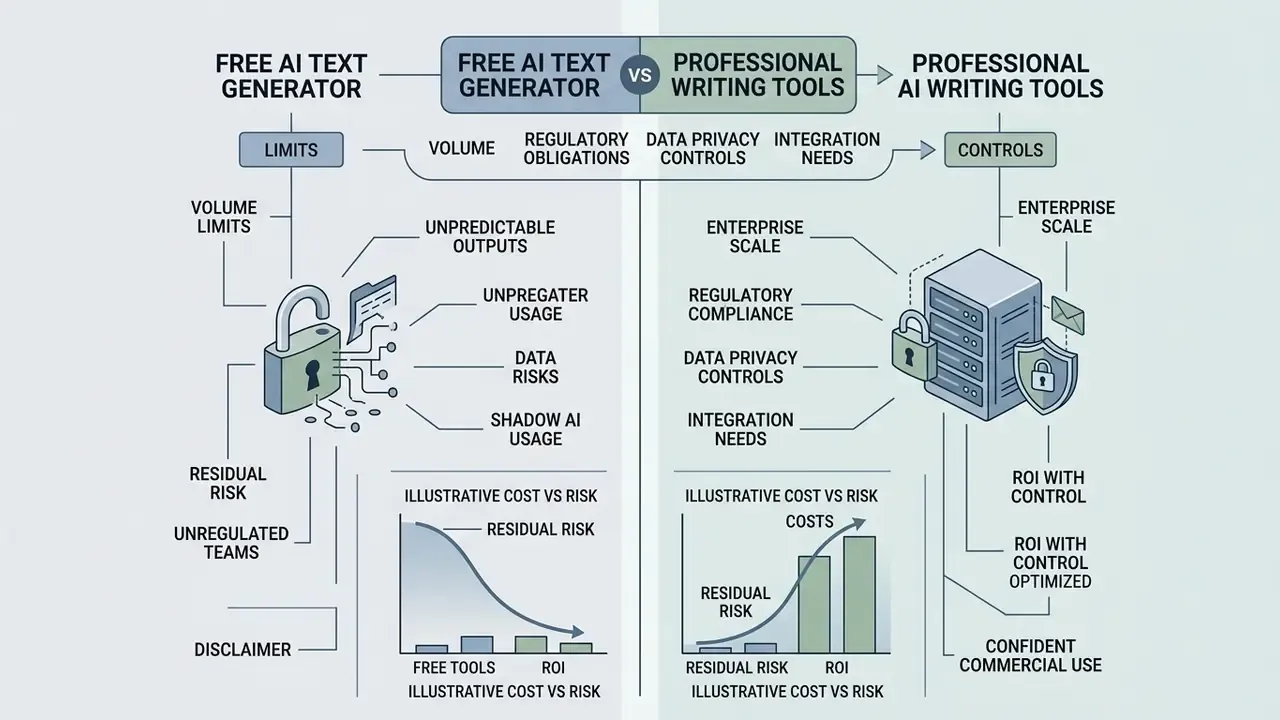
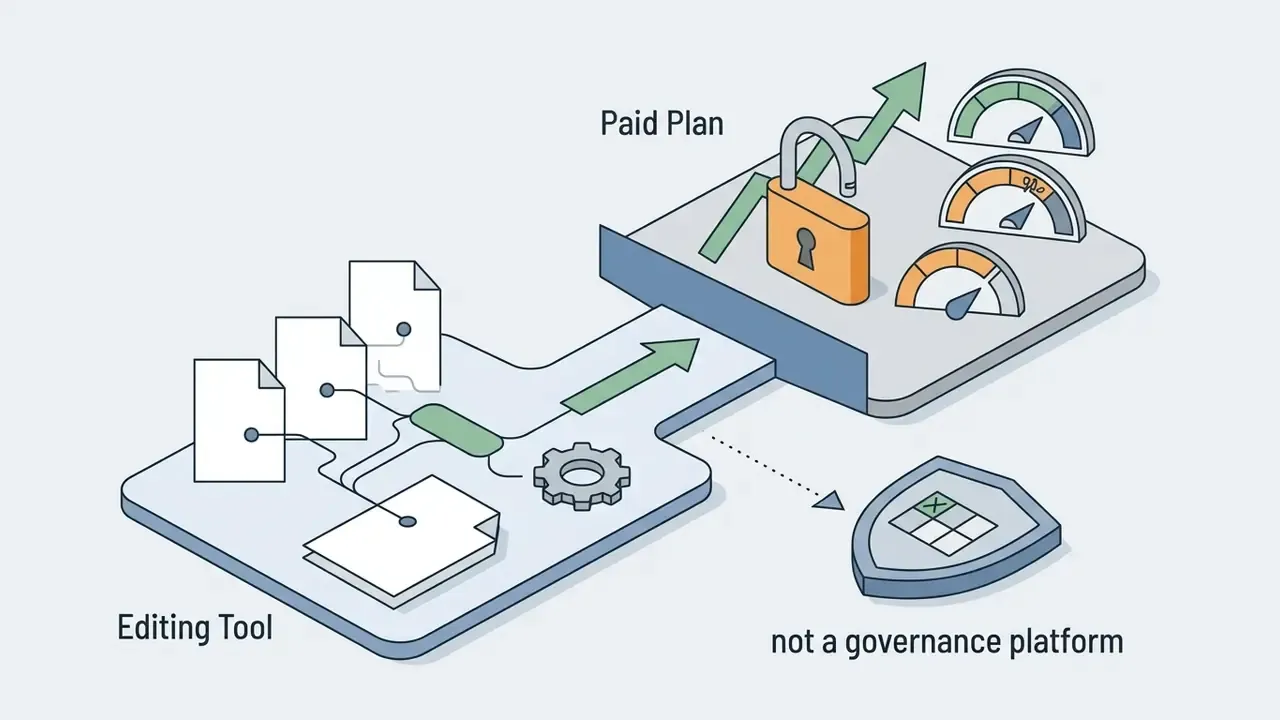
Choosing between a free ai text generator and an enterprise-grade writing platform comes down to volume, regulatory obligations, data privacy controls, and integration needs. An ai generator free from text tool gives you instant access for casual experimentation. Enterprise operations need data isolation and governance safeguards that free tiers rarely publish, let alone contract for.
| Operational Feature | Free AI Text Generator | Professional AI Writing Tool |
|---|---|---|
| Access Model | Public web interface with rate limits | Dedicated portal or enterprise API access |
| Data Privacy | Prompts may be retained for training | Zero-data-retention guarantees, SOC 2 / ISO 27001 attestations |
| Context Window | Standard context (8k to 32k tokens) | Extended context (128k to 1M+ tokens) |
| Customization | Standard prompt instructions | Custom fine-tuning, style templates, brand guardrails |
| Governance & Audit | No centralized logging or admin controls | Complete audit trails, role-based access, monitoring |
| Identity & Access | Personal email sign-up | SSO/SAML, SCIM provisioning, least-privilege roles |
| Model Independence | Single vendor model | Multi-model routing, avoids single-provider dependency |
| Commercial Rights | Variable, governed by standard web terms | Full commercial ownership and legal indemnification |
Read the table as a risk ladder rather than a feature list. Everything above "Governance & Audit" affects convenience. Everything below it affects whether the output survives contact with internal audit.
What a Free AI Text Generator Usually Includes
An ai generator text free online service typically offers a basic chat interface powered by a standard base model, with daily message or credit caps. Published free tiers range from a few thousand tokens per day for anonymous use to somewhat higher daily allowances once you create an account, and API access on flagship models is frequently marked "not supported" on free plans. These platforms handle quick drafting and informal rephrasing well. They rarely offer enterprise service level agreements (SLAs), brand voice fine-tuning, or zero-data-retention guarantees.
Anyone testing a lightweight ai free text generator interface will meet the usual walls: context window limits, truncated inputs (a request beyond the window can simply fail with a 400 Bad Request), and shared server throttling at peak hours. More consequentially, public ai generator free text platforms may retain prompts for model retraining unless you explicitly opt out, which turns proprietary business input into a leakage question.
«Do not enter protected data into public generative AI tools without verifying rights of use and completing a risk review.»
Shadow AI controls. In supervised institutions the real exposure is not the sanctioned tool, it is the unsanctioned one sitting in a browser tab. A workable control stack: (1) discovery of unapproved GenAI domains through CASB or secure web gateway telemetry; (2) DLP rules that block pasting of customer identifiers, account numbers, and nonpublic personal information (NPI/PII) into unmanaged endpoints; (3) an allow-list of approved assistants published in the AI inventory; (4) mandatory attestation training that references obligations for safeguarding customer information; and (5) a friction-free sanctioned alternative. That last point carries more weight than the first four combined. Blocking without substitution reliably pushes usage onto personal phones, where you see nothing at all.
When a Professional AI Generator Is Worth Choosing
ROI With Control Costs and Residual Risk
Gross time savings overstate value, because they quietly ignore the cost of the controls that make output usable in a regulated environment. Use a net formula:
Net Annual Value =
  (Hours saved/yr × Fully-loaded hourly cost)
  − Licence & API spend
  − HITL review cost (Review minutes/asset × Assets/yr × Reviewer cost/min)
  − Validation & monitoring cost (initial validation + periodic revalidation)
  − Expected residual loss (Σ  Probability of failure × Impact per failure)
Control-Adjusted ROI (%) = Net Annual Value ÷ (Licence + HITL + Validation costs) × 100
Worked example (illustrative hypothesis, not a benchmark). A 20-person client-communications team drafts 1,200 letters per year at 45 minutes each. A 40% reduction in drafting time, consistent with published productivity research, saves about 360 hours. At a fully loaded $85 per hour, gross value is roughly $30,600. Now subtract: $9,600 in licences, about $10,200 in HITL review (25 minutes per asset across 1,200 assets at a $1.36 blended reviewer cost per minute, which templating can trim toward 10 minutes), about $8,000 in first-year validation and monitoring, and a modelled residual loss of $2,000 (a 2% chance of a $100,000 remediation event). Net value stays clearly positive, yet it lands far below the headline productivity number. That smaller figure is precisely the one a CFO or model risk committee should see.
Additional criteria worth scoring in a vendor matrix: model independence (can you switch providers without rewriting every prompt?), retention and deletion commitments, indemnification scope, regional data residency, exportability of prompt libraries, and evidence of independent security attestation. For operational ROI assessments across enterprise content workflows, our interactive AI Media Calculators handle the arithmetic.
Top 5 AI Text Generators for Professional and Enterprise Use
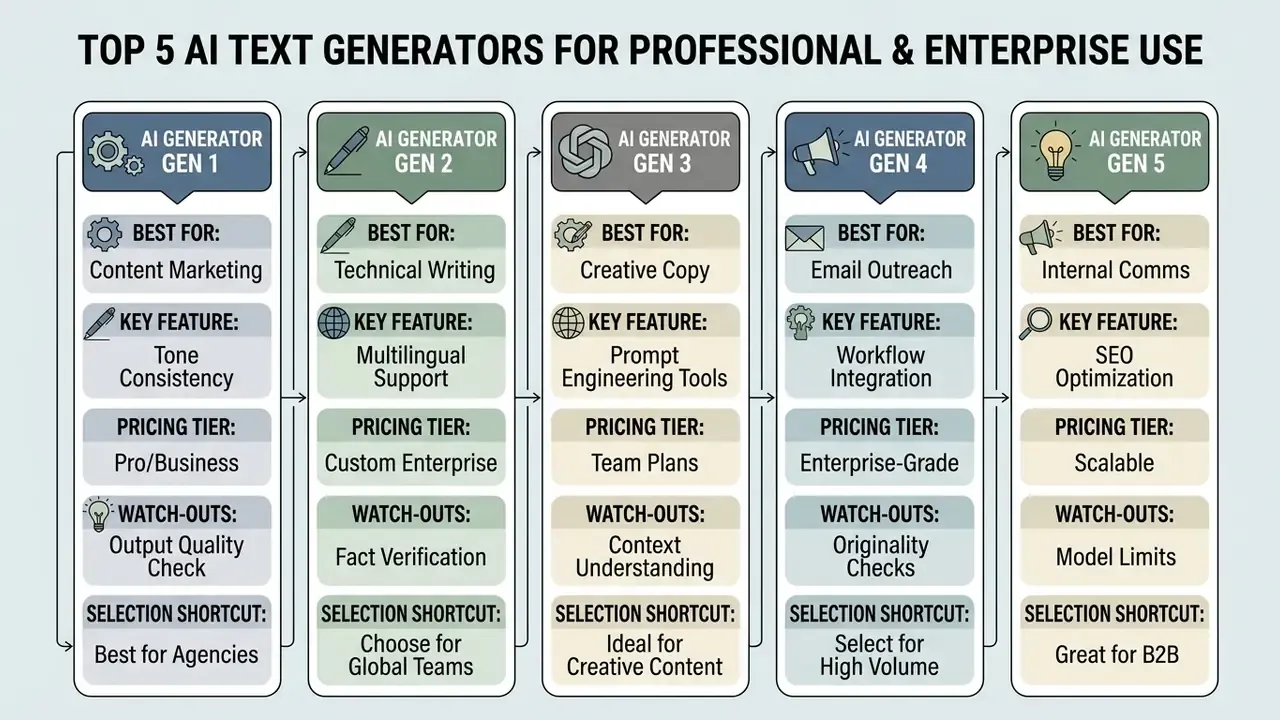
The market splits into general-purpose assistants, rewriting utilities, and marketing content platforms. Pricing below reflects publicly advertised tiers at the time of writing and changes often, so confirm current terms and data-handling commitments on the vendor's own pricing and trust pages before you buy.
1. ChatGPT (OpenAI)
- Best for General-purpose drafting, complex reasoning tasks, document analysis, and building internal custom assistants.
- Key feature Broad task versatility with very large context windows, custom instructions for tone and structure, and enterprise administration with contractual output ownership.
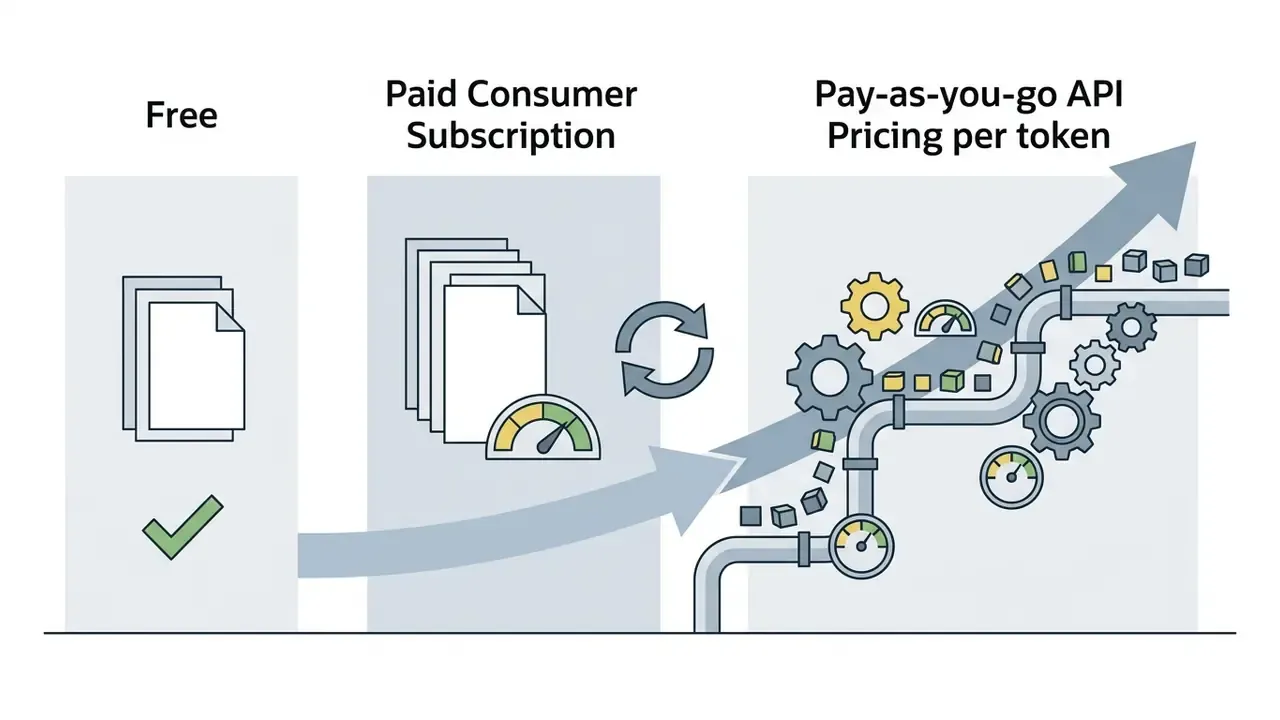
- Pricing tier Free tier with limits; individual paid plans commonly around $20 per month, team seats higher, enterprise pricing on request.
- Watch-outs Confident-sounding hallucinations remain the main failure mode, and unedited output is stylistically recognizable without customization.
2. QuillBot



3. Jasper AI



4. Google Gemini


5. Grammarly (Author / Business)
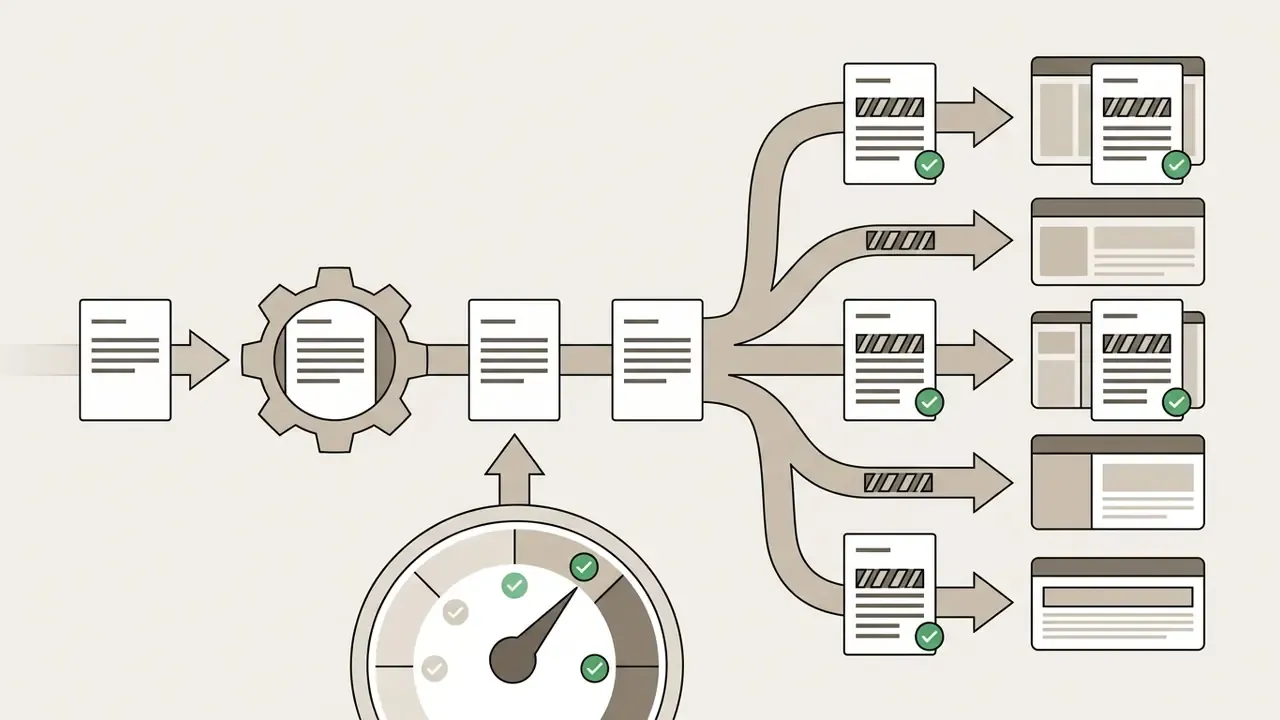
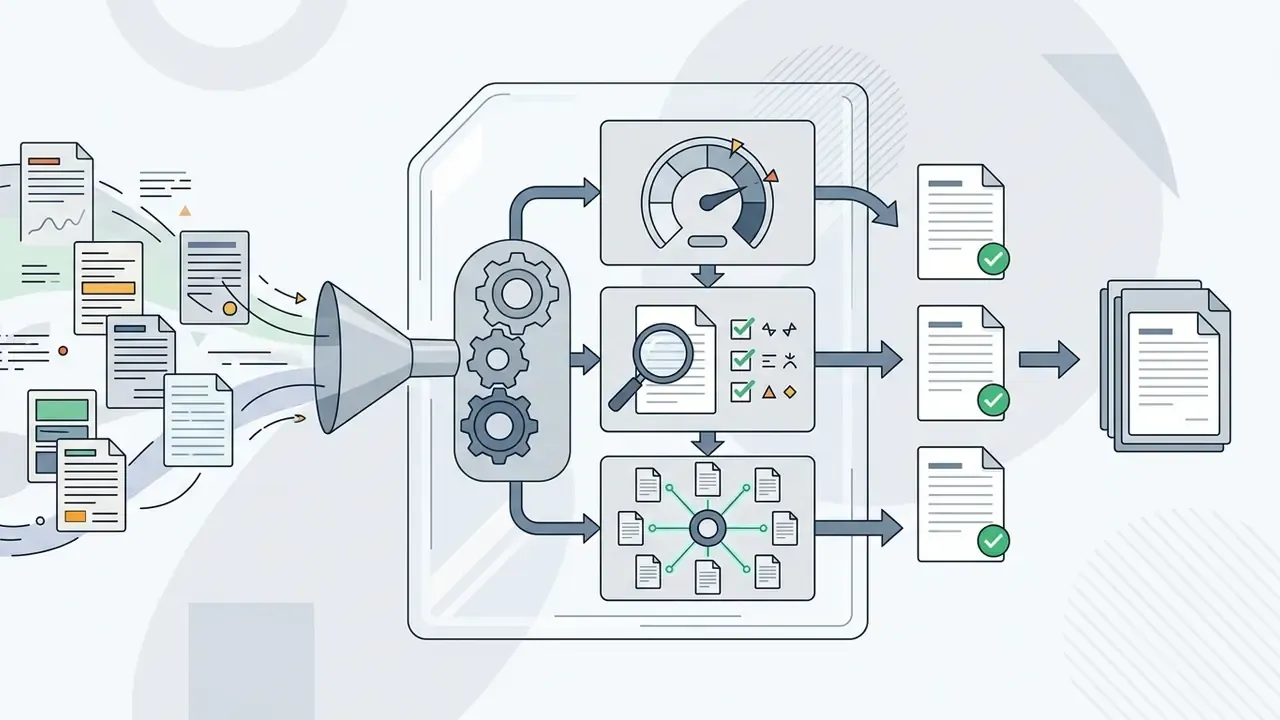

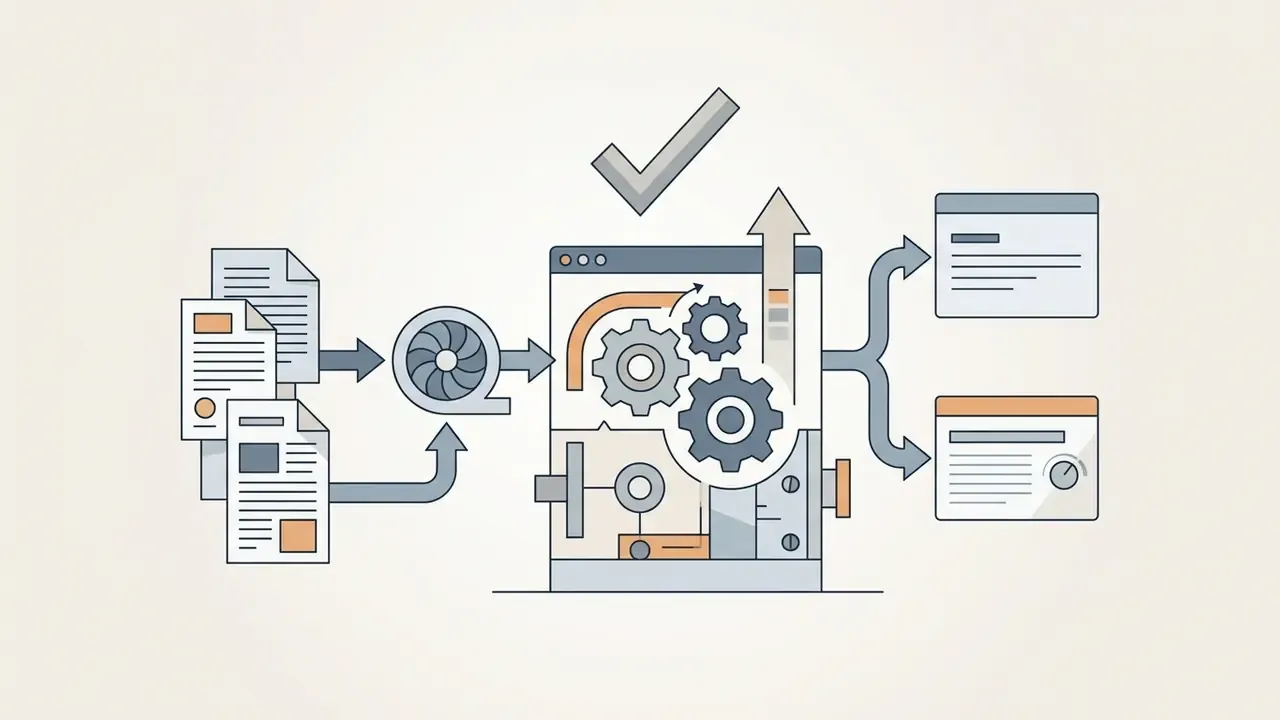
Selection shortcut. Pick a general assistant (ChatGPT or Gemini) as the reasoning layer, a refinement layer (QuillBot or Grammarly) for style and readability enforcement, and a content platform such as Jasper only when templated volume marketing justifies the seat cost. In regulated environments the deciding factor is rarely output quality. It is retention terms, audit logging, and indemnification.
What You Can Use an AI Text Generator For
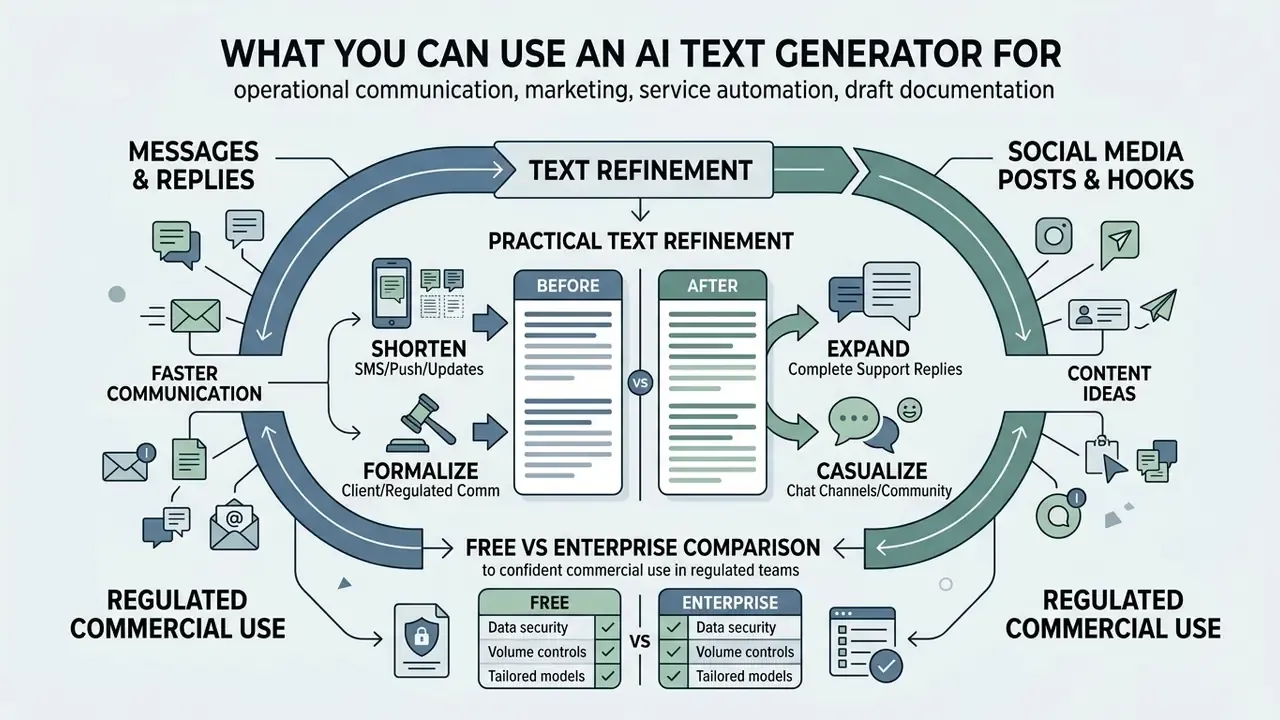
An ai generator texts workflow supports operational communication, marketing campaigns, customer service automation, and draft documentation across regulated and commercial sectors. An ai generator professional text setup removes blank-page friction and steadies communication cadence across departments. Published framework guidance groups these into recurring application contexts: text generation and editing, summarization, search, chat, moderation, and code review.
Messages and Replies for Faster Communication
An ai free message generator or an integrated messaging assistant drafts rapid responses, summarizes long email threads, and rephrases technical content for executive audiences. Teams lean on an ai free generator text tool to shift tone from informal Slack note to formal client letter while the underlying facts stay put. Documented rewrite workflows follow three steps: select or paste the draft, state the target tone and constraints, then review and insert the revision. The standing instruction is explicit: meaning and factual detail must be preserved, only wording and tone may change.
In a commercial loan operations department, loan officers spent over 14 hours per week drafting custom status updates for applicants. (Internal time-study estimate from a single engagement; methodology was self-reported timesheet sampling and has not been independently verified. Treat it as a directional hypothesis, not an industry figure.) After structured prompt templates were wired into an ai chatbot text generator workflow, officers produced tailored status summaries in seconds. Email turnaround time fell by 62%, with required regulatory disclosures intact.
«Access to ChatGPT reduced the time spent on professional writing tasks by roughly 40% and increased output quality by 0.4–0.45 standard deviations.»
Practical Text Refinement: Before and After Examples
Drafts for Articles, Paragraphs and Professional Writing
Professional writers use an ai generator wording assistant to build preliminary outlines, draft section paragraphs, and smooth reading flow. Documented assistant capabilities include summarizing long documents, generating outlines, extracting key points, and rewriting passages to be longer, shorter, more formal, or more casual, with an explicit editorial goal of clear, concise, well-structured output. The draft is a starting point, never the deliverable.
«Participants with access to ChatGPT completed writing tasks 40% faster, and output quality rose by 0.45 standard deviations as judged by independent evaluators.»
How to Use an AI Text Generator for Better Results
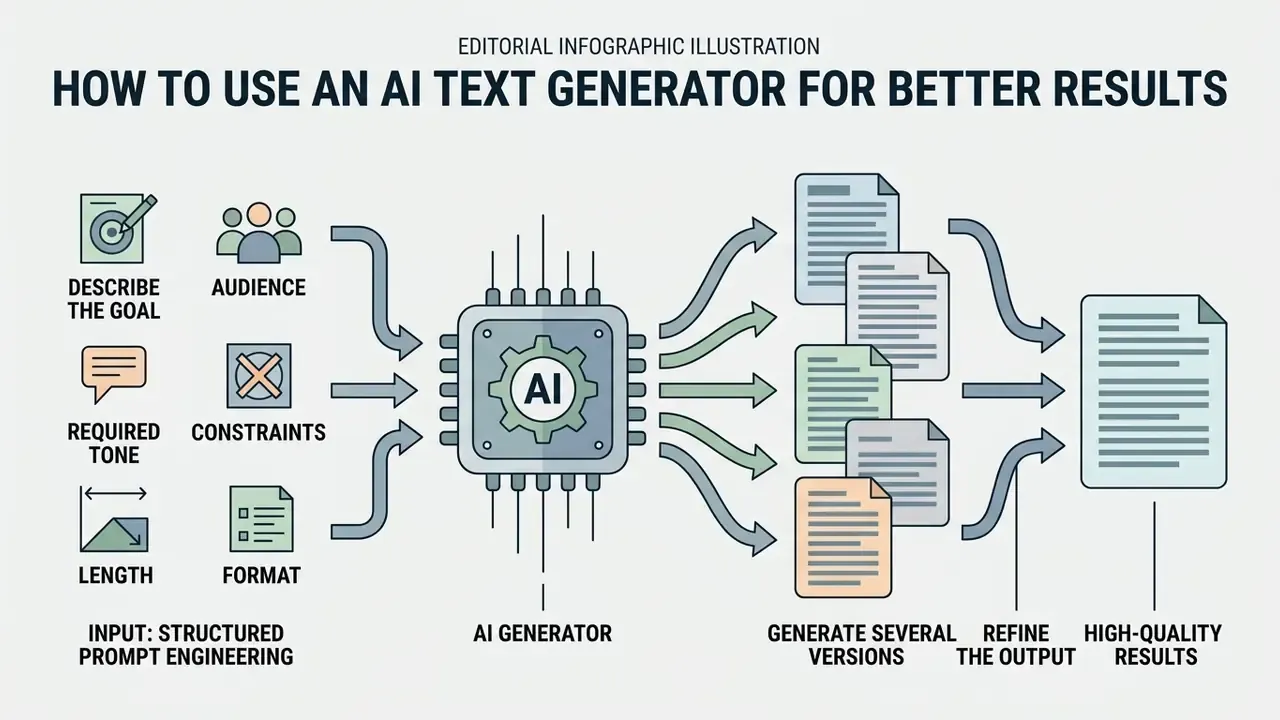
Getting high-quality results from an ai generator text free interface takes structured prompt engineering, not an ambiguous one-liner. Clear contextual boundaries suppress factual hallucination and keep output aligned with institutional tone. Readers assembling a broader toolkit can also browse our glossary of AI content creation tools for adjacent capabilities and terminology.
Describe the Goal, Audience and Required Tone
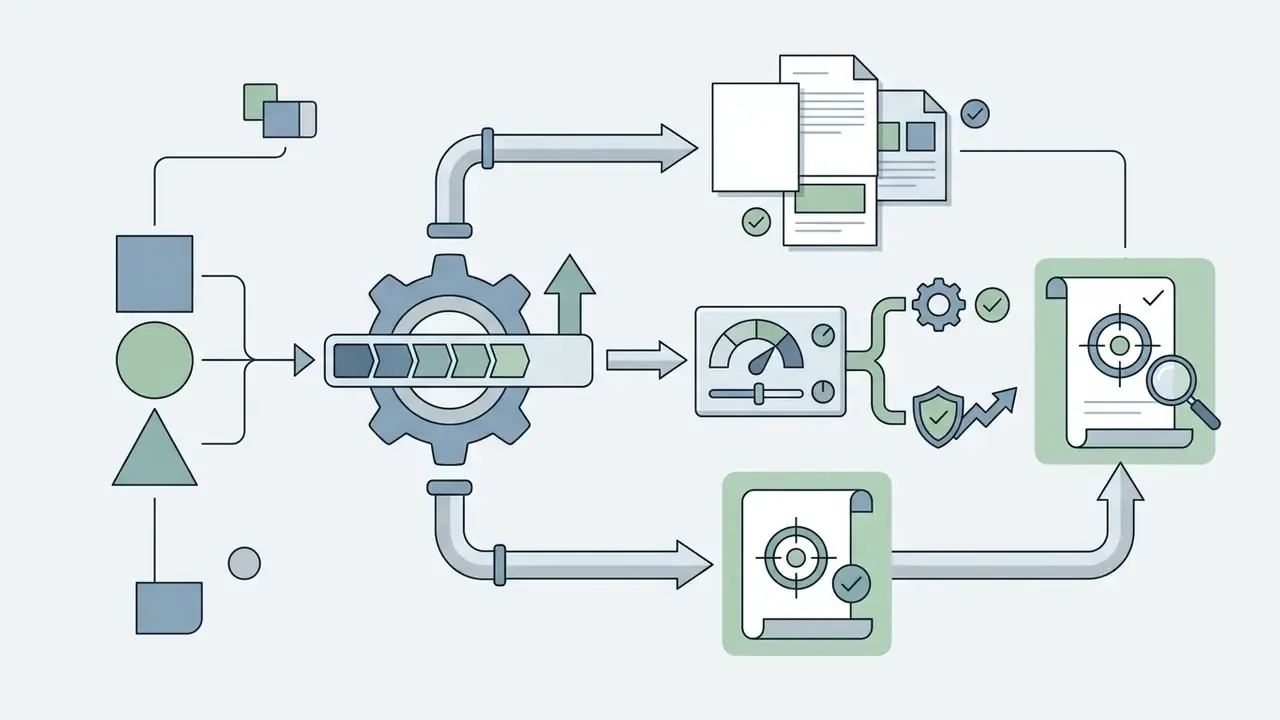
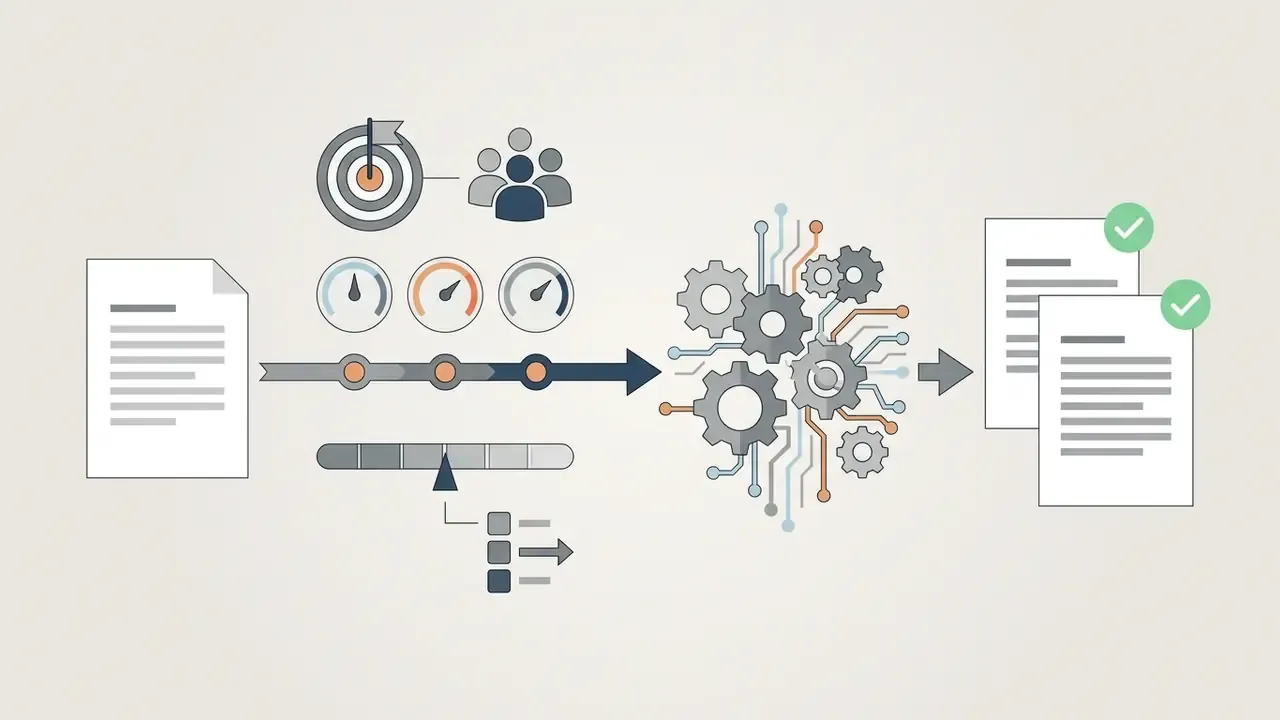
To sharpen output precision, an ai generator from text free prompt should define four elements: the explicit goal, the target audience, the operational tone, and strict negative constraints. Naming the audience is what stops the model from swinging between dense jargon and oversimplified explanation.


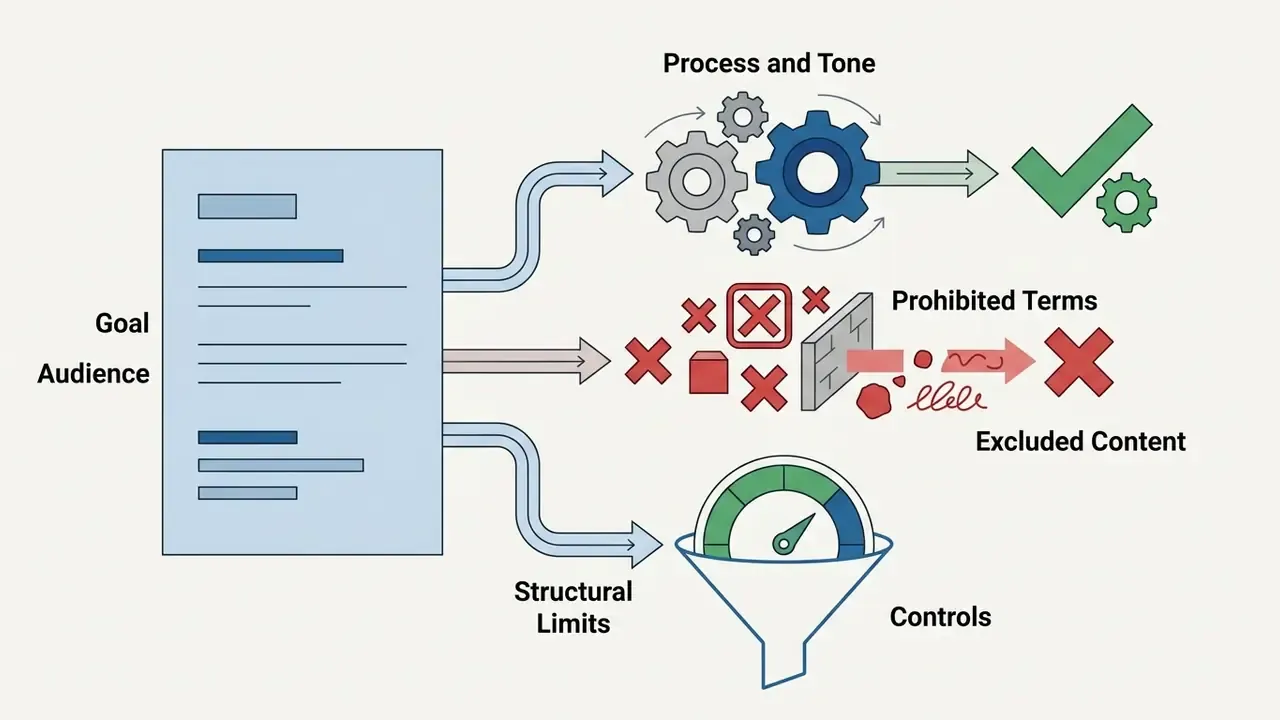
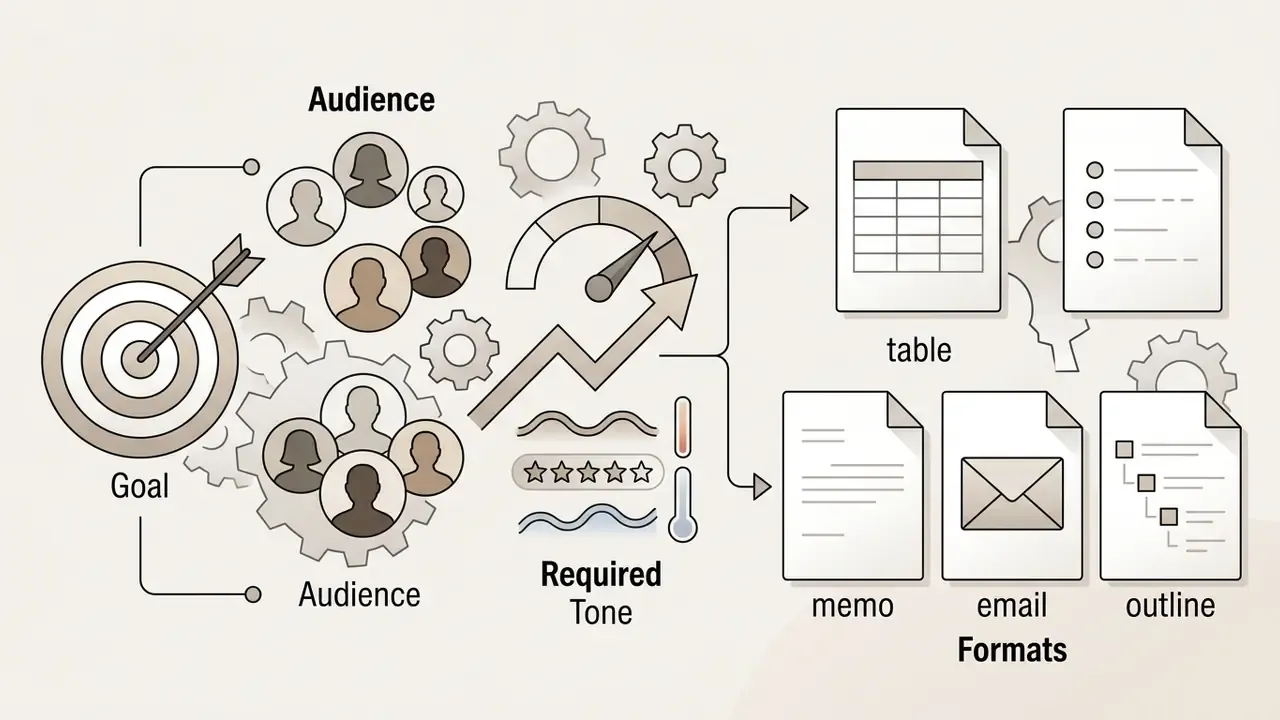
«A systematic review of 58 prompting techniques shows that explicitly stating role, task, and output format consistently improves reliability and output quality.»
Security guidance adds one more requirement for production systems: separate instructions from user-supplied content using delimiters or tags, and include explicit instructions for detecting injected instructions hidden inside pasted material.
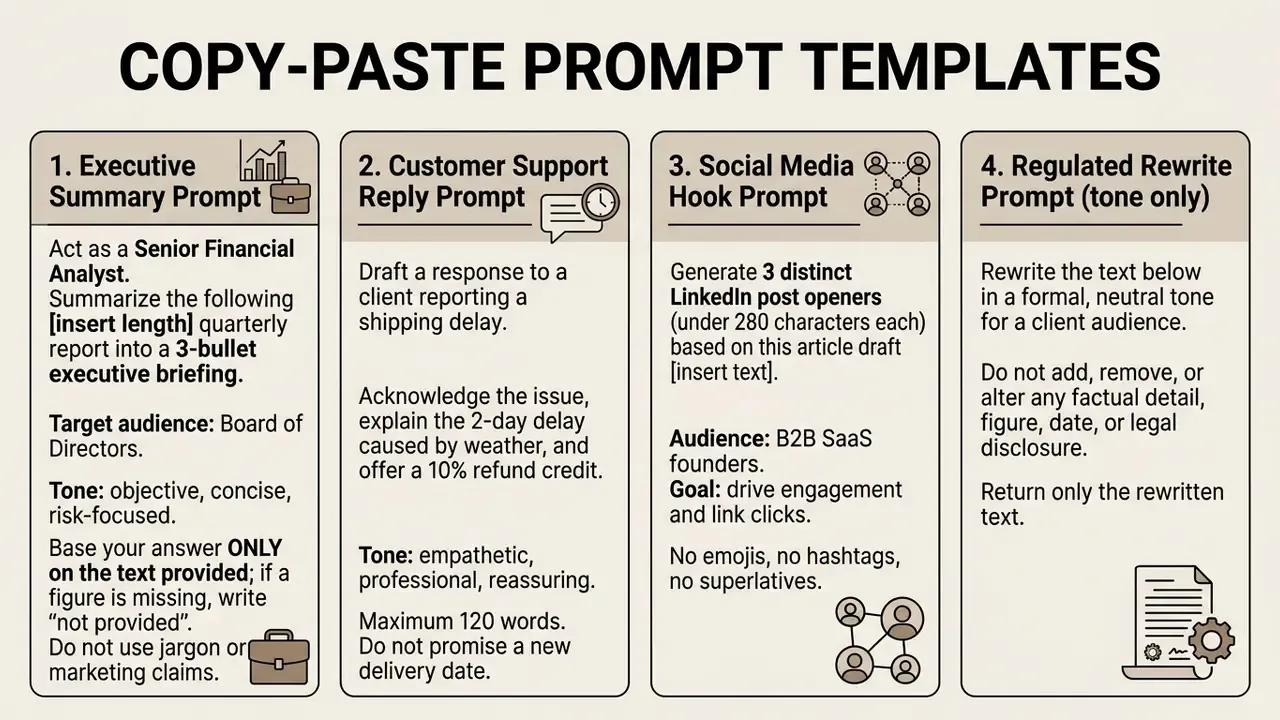
Generate Several Versions and Refine the Output
Running several generation passes with adjusted parameters lets you compare ai generator wording options before committing to one. Varying decoding temperature between 0.2 and 0.7 surfaces alternative structures while keeping factual boundaries intact. Vendor documentation backs this pattern directly: temperature near zero produces mostly deterministic output, and raising temperature is the recommended response when results come back generic, short, or repetitive. Peer-reviewed work on rephrasing and iterative self-feedback shows that regeneration guided by explicit critique improves the final text more reliably than a single pass ever does.
«Participants were willing to forgo 28.3% of their compensation for access to AI-generated drafts, indicating high perceived value of iterative assistance.»
A financial analysis team compared three outputs from an ai generator txt system for a quarterly earnings memo. By lifting structural elements from two separate iterations and running one final contextual rephrasing prompt, the team shipped an executive briefing in 20 minutes against a historical 2-hour baseline.
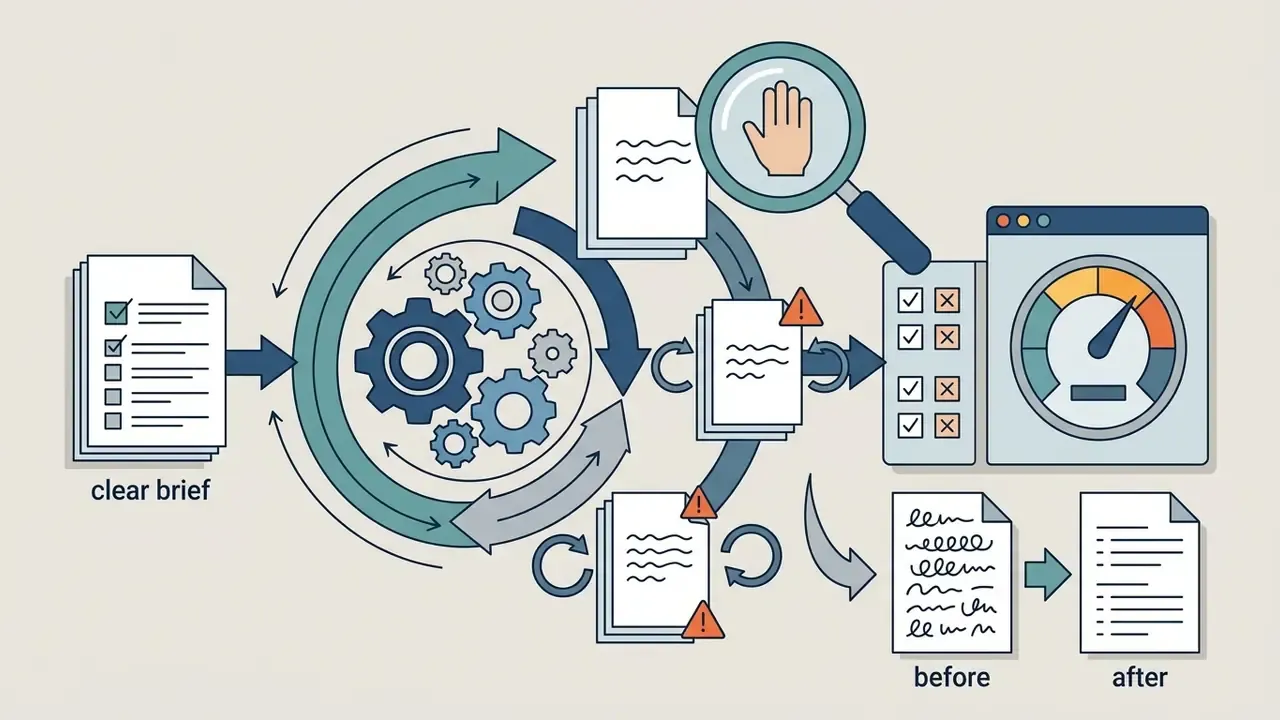
A practical refinement loop: write the prompt, generate, mark preferred and non-preferred passages plus factual gaps, feed those marks back into the prompt, regenerate, and stop once the output needs only cosmetic editing. Documented review methodology describes this same preference-driven cycle, with the prompt, not the output, treated as the artifact being improved. Worth repeating, because most teams do the opposite: they polish text and leave the instruction untouched.
Add Human Review Before Publishing
Human-in-the-loop (HITL) review stays the indispensable control layer for every ai generator free text workflow.
«A systematic review identifies hallucination, bias, privacy violations, and misuse among the nine core problems of contemporary text generation systems.»
Reviews of hallucination mitigation in high-stakes domains land on a consistent conclusion: HITL expert correction is one mitigation category among several, and no single method carries the load alone. Human oversight has to combine with retrieval of authoritative sources, entity- and number-level verification, and domain-specific evaluation. A workable annotation protocol labels each flagged sentence by orientation, category, and degree of hallucination, which converts subjective editing into reportable error-rate metrics. That conversion matters more than it sounds: a committee can act on a 3% error rate, but not on "the copy felt off".
Commercial Use, Quality Control and Responsible AI Writing
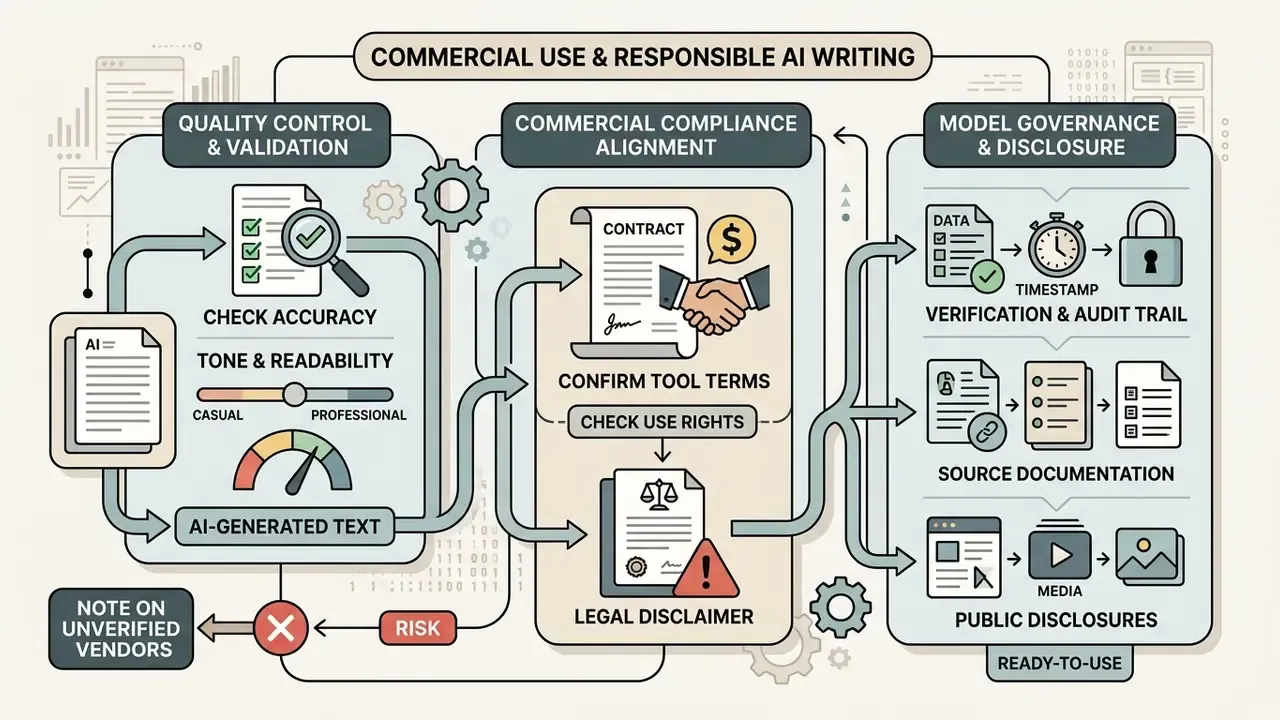
Publishing ai generated material in commercial products, marketing channels, or public disclosures demands compliance alignment and source documentation. Efficiency has to sit alongside intellectual property ownership and disclosure mandates, not ahead of them. Teams working across modalities should apply the diligence documented in our guide to the commercial use of AI-generated visual assets, where provenance verification and rights confirmation follow equivalent logic.
Regulatory anchors to cite in your internal policy. Align text-generation controls with the NIST AI Risk Management Framework 1.0 and its generative AI profile (NIST AI 600-1, 2024) for risk identification, measurement, and management. Institutions supervised in the United States should map the same controls to model risk management expectations in Federal Reserve SR 11-7 and OCC Bulletin 2011-12, specifically model inventory, development documentation, independent validation, ongoing monitoring, and effective challenge. Organizations publishing in the European Union must also plan for AI Act Article 50 transparency obligations, applicable from 2 August 2026, which require machine-readable marking of synthetic content. The accompanying Code of Practice on Transparency of AI-generated Content (2025) covers labeling duties for both providers and deployers.
Check Accuracy, Tone and Readability of AI-Generated Text
A robust quality assurance protocol evaluates generated copy across three layers: factual accuracy against primary sources, stylistic alignment with corporate brand standards, and readability. Detection literature groups verification methods into fact-based metrics, classifier-based metrics, QA-based metrics, uncertainty estimation, and prompting-based checks. Fact-level scoring pipelines then aggregate individual claim checks up to sentence-level hallucination scores, which is a practical model for internal grading (accurate, minor inaccuracy, major inaccuracy). Teams verifying visual assets in the same editorial pipeline can reference our overview of AI image detection tools.
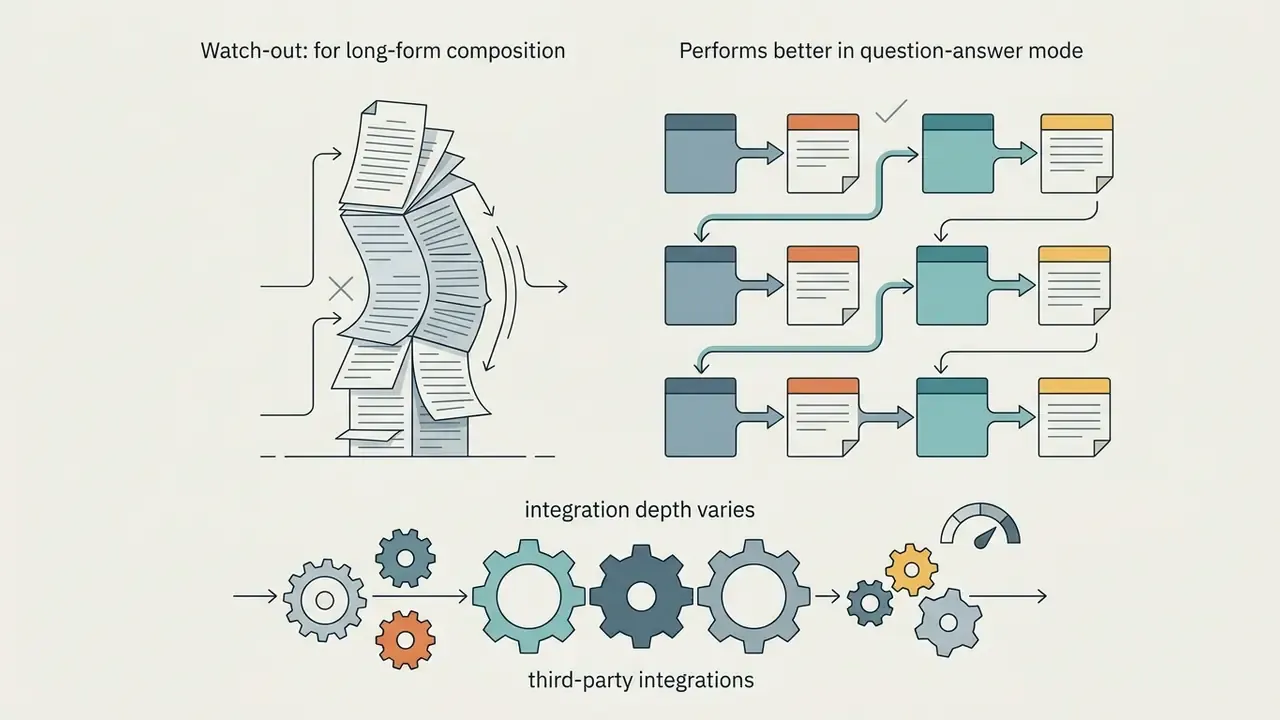
«HelloBench shows that most LLMs cannot generate text beyond roughly 4,000 words without repetition and quality degradation, regardless of explicit or implicit length constraints.»
The operational consequence is simple. Assemble long documents from reviewed sections instead of requesting one continuous 6,000-word generation, and treat every section boundary as a verification checkpoint. If technical issues surface during platform evaluation, our centralized support portal has the escalation paths.
Confirm Tool Terms Before Commercial Use
Before publishing generated material in commercial products or client-facing collateral, risk managers must read the terms of service (ToS) of the underlying AI provider. Leading providers such as OpenAI and Anthropic explicitly grant users ownership of output generated through commercial API tiers, whereas free consumer tools may impose licensing restrictions or reserve rights for internal model training (OpenAI Terms of Use, 2026). Anthropic's commercial terms similarly state that the customer owns outputs and that Anthropic assigns any rights it holds in them. Enterprise cloud deployments frequently add contractual commitments that prompts and completions will not train foundation models.
«Works whose "traditional elements of authorship" are produced by a machine without human creative control are not eligible for copyright protection.»
Verification & Model Governance Notice:
A note on unverified vendors. Vendor due diligence should treat any unconfirmed supplier as hypothetical until primary verification exists. As an illustration of that principle: for the domain hypeart.ai, no verified information is available. As of the last check the domain did not resolve through standard DNS channels, and no documented corporate registration or verified compliance disclosure could be located. It appears here only as a worked example of how an unverified vendor should be handled, logged as a hypothetical option, excluded from procurement, and kept out of the AI inventory as an approved tool until registration, security attestation, and contractual terms are independently confirmed.
Limitations and Open Questions
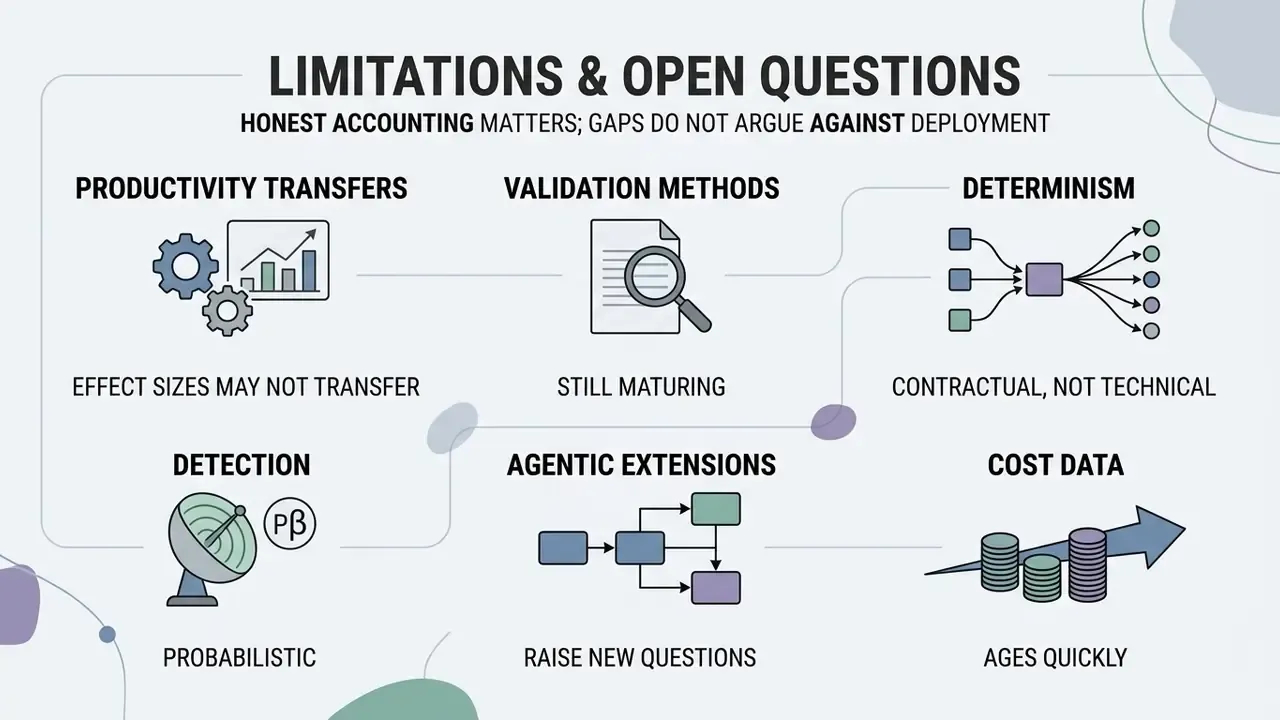
Honest accounting matters more than a tidy conclusion, so here is what this guide cannot settle for you.
- Productivity effect sizes may not transfer. The 40% figure comes from controlled writing experiments with generalist tasks. Regulated correspondence carries disclosure checks and second-line review that laboratory conditions never modelled. Your own telemetry is the only trustworthy source.
- Validation methods for generative output are still maturing. Traditional model validation assumes a stable input-output mapping and testable performance metrics. Free-text generation resists that framing, which is why most institutions currently combine sampling, error-rate tracking, and expert challenge instead of a single validation score.
- Determinism is contractual, not technical. Vendors describe reproducibility as best-effort. If your control depends on identical output from identical input, document the residual variance rather than claiming it away.
- Detection is probabilistic. Classifier and uncertainty-based methods identify machine text with varying reliability. Treat any detection score as evidence, never as proof.
- Agentic extensions raise new questions. The moment a text assistant gains the ability to send, file, or transact, the control set expands to access limits, escalation paths, and a shutdown mechanism. That is a different governance conversation, and a heavier one.
- Cost data ages quickly. Published tiers shift within quarters. Re-price at renewal rather than trusting a stored figure.
None of these gaps argues against deployment. They argue for scoping, and for saying out loud which parts of your control story are still hypotheses.
Next Steps for Model Risk and Content Teams
Use our AI Media Calculators to model licence, review, and validation costs, and the comparison matrices to score vendors against the criteria above. Start with one tiered use case rather than a platform-wide rollout. Small scope, real evidence, then expand.
- Inventory first.List every AI text use case in production or pilot, with a named business owner, model version, data classification, and review requirement. An unregistered use case is an unmanaged one.
- Tier by risk, not by enthusiasm.Classify use cases as internal-draft, customer-facing, or regulated-disclosure. Only the first tier tolerates a free consumer tool.
- Standardize prompts as controlled artifacts.Store approved prompt templates in version control with an owner, change log, and test set of expected outputs.
- Set decoding standards per tier.Factual and regulated output: temperature 0.1 to 0.3, grounded in supplied source text. Ideation: temperature 0.5 to 0.8, and nothing publishes without a rewrite.
- Define the escalation path before launch.Document who halts publication, who logs the incident, who runs root-cause analysis, and how prompts or guardrails get remediated.
- Measure net value.Track hours saved, review minutes per asset, edit rate, and hallucination rate, then apply the control-adjusted ROI formula above before renewal.
- Re-validate on model change.Treat a provider model update as a change event requiring re-testing, because output can shift even with identical prompts and seeds.
FAQ About AI Text Generators
Can an AI Chat Text Generator Continue an Existing Text?
Yes. An ai chat text generator or ai chatbot text generator handles text completion natively, because autoregressive language models work by predicting subsequent tokens from an existing prompt sequence. Supply an incomplete passage as context and you can instruct the system to extend narrative flow, complete a technical section, or draft the logical next paragraphs while holding the established vocabulary and tone. Style preservation depends on how much prior text fits inside the context window: instruction-tuned chat models with windows from 8,000 up to 131,072 tokens and beyond retain far more stylistic signal than short-context completions, where you have to assemble the context manually in the prompt.
Does an AI Text Generator Work in Different Languages?
Yes. Modern large language models train on multilingual datasets covering dozens of languages. Broad evaluation suites now measure this at scale: one 2026 benchmark spans 61 languages with millions of samples, while an EU-focused suite covers 16 official EU languages across 57 subjects. Fluency and cultural nuance still peak in high-resource languages such as English, and cross-lingual context studies report that larger models can show a wider English-to-non-English gap on comprehension tasks. Slightly counterintuitive, but consistent enough to plan around.
«Fine-tuned LLMs produce coherent and grammatically correct Easy-to-Read simplifications of Spanish text, although human post-editing remains necessary.» Easy-to-Read Spanish Generation Study (Llama-2, 2024). https://arxiv.org/abs/2406.00002
Why Can AI Generators Produce Different Results for the Same Prompt?
An ai generator text platform returns varying results for identical prompts because word selection relies on probabilistic sampling across vocabulary logits. Adjusting decoding parameters such as temperature or top-p changes the randomness of token selection, and minor updates to underlying model weights across software versions add structural variance over time. Provider documentation is explicit about the limits of reproducibility: a fixed seed with identical prompt, temperature, and top-p yields a best-effort match rather than a guarantee, and backend or snapshot changes can alter output.
«Explicitly structured prompts that state role, task, and output format deliver consistently higher output quality than vague instructions.» Sahoo et al., A Systematic Survey of Prompt Engineering for LLMs (2024). https://arxiv.org/abs/2402.07927
How Can I Prevent AI From Generating False Information (Hallucinations)?
Supply the exact reference materials inside the prompt instead of relying on model memory, set a low decoding temperature (0.1 to 0.3) for factual work, and instruct the model plainly: "Base your answer ONLY on the provided text; if the information is not present, state 'Information not provided'." Add entity-, citation-, and number-level verification against authoritative sources, then require human-in-the-loop (HITL) sign-off before publication. Research on hallucination mitigation is consistent that no single technique suffices. Retrieval grounding, constrained decoding, automated fact-scoring, and expert review have to operate together, with the error rate tracked as a monitoring metric rather than assumed to be zero.
What Do Search Variants Like "ai generator tekst" or "ai generator tect" Refer To?
They point to the same tool category. Query logs are full of near-miss spellings such as "ai generator tekst", "ai generator tect", and the truncated "ai generator tex", most of them typing slips or transliterations from other languages. Nothing behind them differs technically: each one lands on a text generation model that turns a prompt into written output. If you are building an internal knowledge base, map these variants to a single canonical entry so procurement and policy documents stay consistent, and avoid publishing separate pages for each misspelling.
Is AI-Generated Text Detectable by Search Engines or Plagiarism Checkers?
Search engines assess content on value, accuracy, and alignment with user intent, not on whether a human or a model wrote the first draft. In practice, though, unedited synthetic text often gets flagged by reviewers and quality systems, because it shows repetitive sentence structures, generic phrasing, and thin evidence. Detection research shows classifier- and uncertainty-based methods identify machine text with varying reliability, and NIST evaluation programs are explicitly built around discriminating AI output from human baselines, so treat detectability as probabilistic rather than binary. The durable answer is editorial: add original data, primary sources, and first-hand experience, then disclose AI assistance where transparency rules or platform policies require it. Under EU AI Act Article 50, machine-readable marking of synthetic content becomes an obligation rather than an option from 2 August 2026.
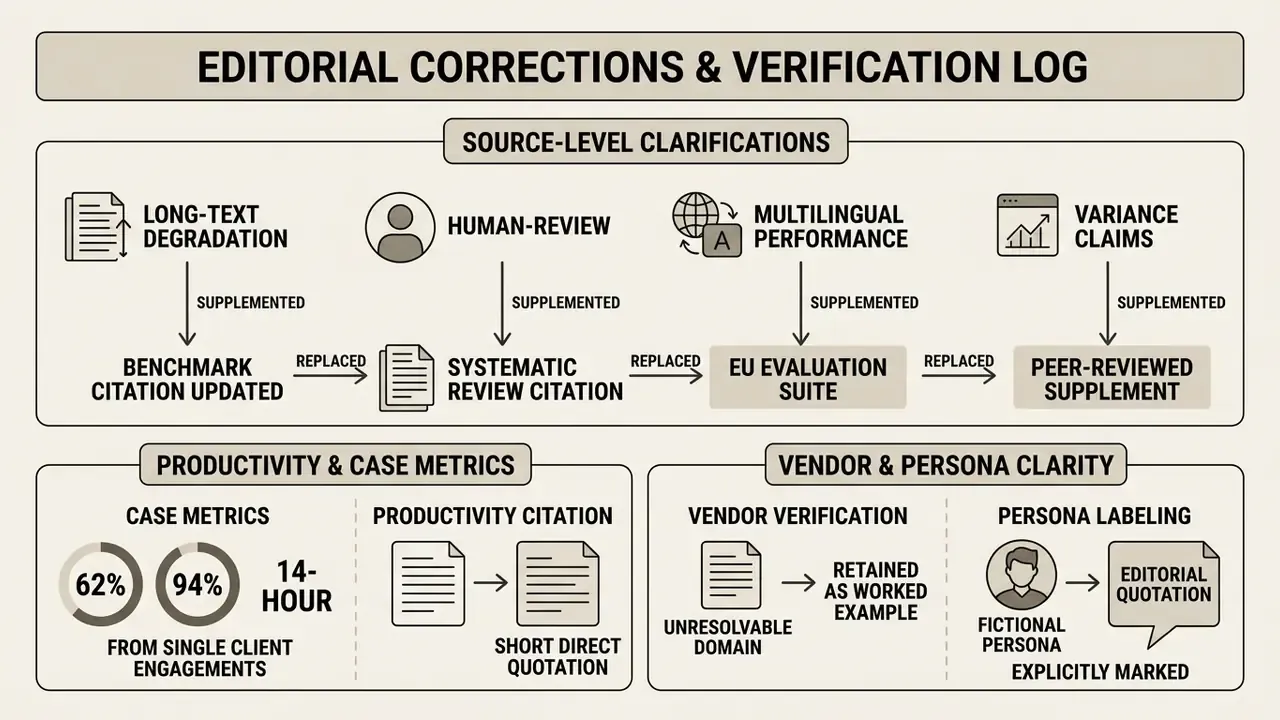
Editorial Corrections and Verification Log
Social Media Posts, Hooks and Content Ideas
Marketing teams use an ai text generator to brainstorm campaign angles, draft platform-specific hooks, and compress long-form reports into short posts. Current tools generate variant options tuned for professional networks like LinkedIn or visual channels like Instagram. Platform guidance recommends pasting recent captions or campaign descriptions first, so the model can read existing themes and formats before drafting anything new, and keeping separate templates, brand-voice examples, and hashtag banks per channel.
When generating campaign concepts, teams often run text and visual workflows side by side. For visual asset planning alongside copy, our AI image generator comparison covers output quality, controls, and licensing differences.