Executive Summary: What Changed and What It Costs
- What it is Text to video AI news today describes automated pipelines that turn a script, article, press release, URL, or PDF into an anchor-led, narrated, captioned video package in minutes rather than hours.
- What changed in 2025-2026 Generation moved from single-prompt clips to document-to-video workflows. Alibaba's Wan 3.0 public beta accepts PDFs, slides, spreadsheets, and web pages. Google's Veo 3.1 adds native audio, video extension, and frame-specific direction. Kling AI 2.5 Turbo improved quality at lower cost, and OpenAI has published deprecation notices for the Sora 2 video models and Videos API.
- How to choose Media teams should weight machine-readable provenance, disclosure controls, and editorial traceability. Corporate and regulated teams should weight consent management, zero-data-retention options, SOC 2 Type II and ISO 27001 attestation, private-cloud or on-premises deployment, and API integration with existing GRC tooling.
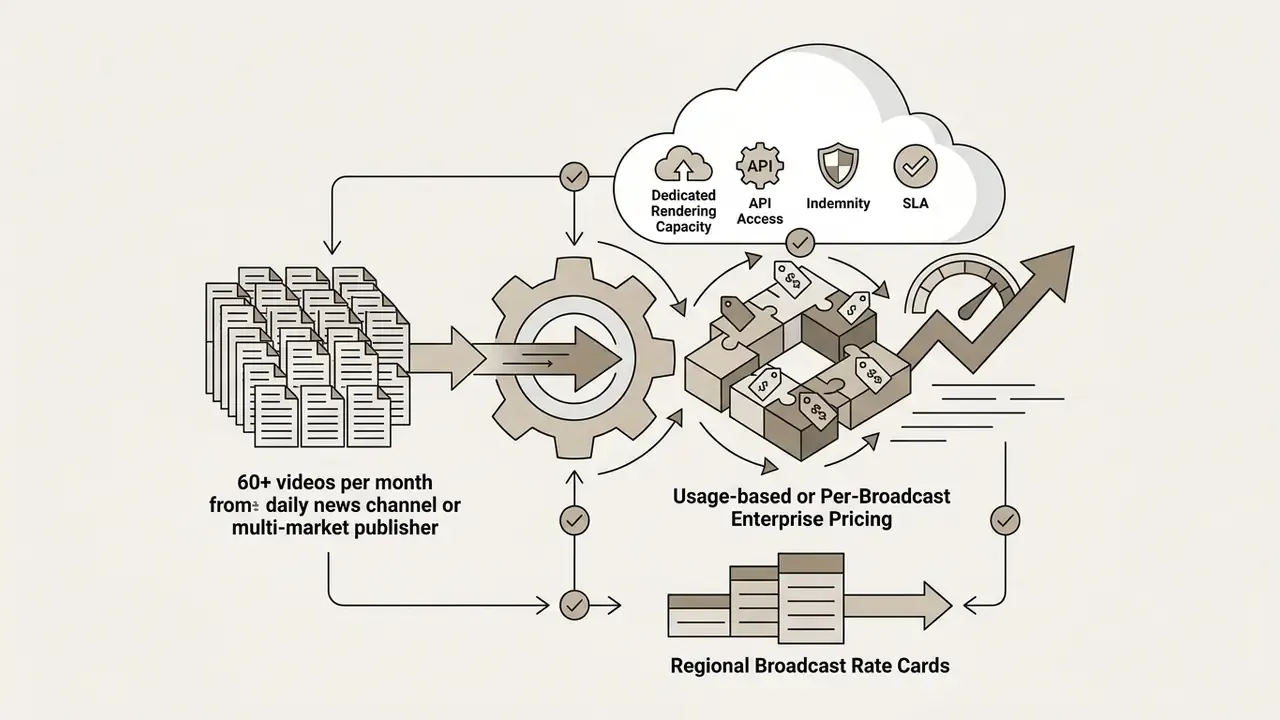
- Cost reality Free tiers run roughly 1 to 10 minutes of monthly output, cap resolution at 720p, and apply watermarks. Creator plans start near $12 to $29 per month, business plans near $70 to $120 per month, and enterprise pricing is usage-based with indemnity and SLA terms. Production savings must be reported net of control overhead, because validation, fact-checking, labeling, and archival all cost real money.
- Trust and monetization YouTube, TikTok, and Meta all require disclosure of realistic synthetic media. Monetization survives AI presenters. It does not survive mass-produced, templated, scraped uploads with no human editorial judgement.
- Biggest risk Deception rates for video deepfakes are statistically indistinguishable from text-based misinformation. Publishing without provenance marking is therefore a legal and reputational exposure, not merely a quality problem.
Who This Guide Is For and Which Decision It Supports
A digital publisher or creator wants throughput: how many bulletins per week, at what resolution, with which license. A corporate communications lead wants control of likeness, voice, and brand assets across markets. A risk or compliance owner in a bank or fintech wants one thing above all, which is reconstructable evidence for every published asset.
This guide answers all three, in that order. If you only have five minutes and you sit on the second line of defence, read the security criteria matrix and the audit log schema, then come back for the workflow detail. If you are choosing a tool for a single desk, start with the pricing section and the free plan limits, because that is where most pilots quietly break.
One framing note before the detail. In regulated environments, a news video pipeline is not a creative toy bolted onto the CMS. It is a model with inputs, transformations, and published outputs, which means the plumbing you already built for credit scoring or KYC screening applies here too: named owner, documented purpose, validation evidence, periodic review.
What Is Text to Video AI News Today and Which Tasks Does It Solve?
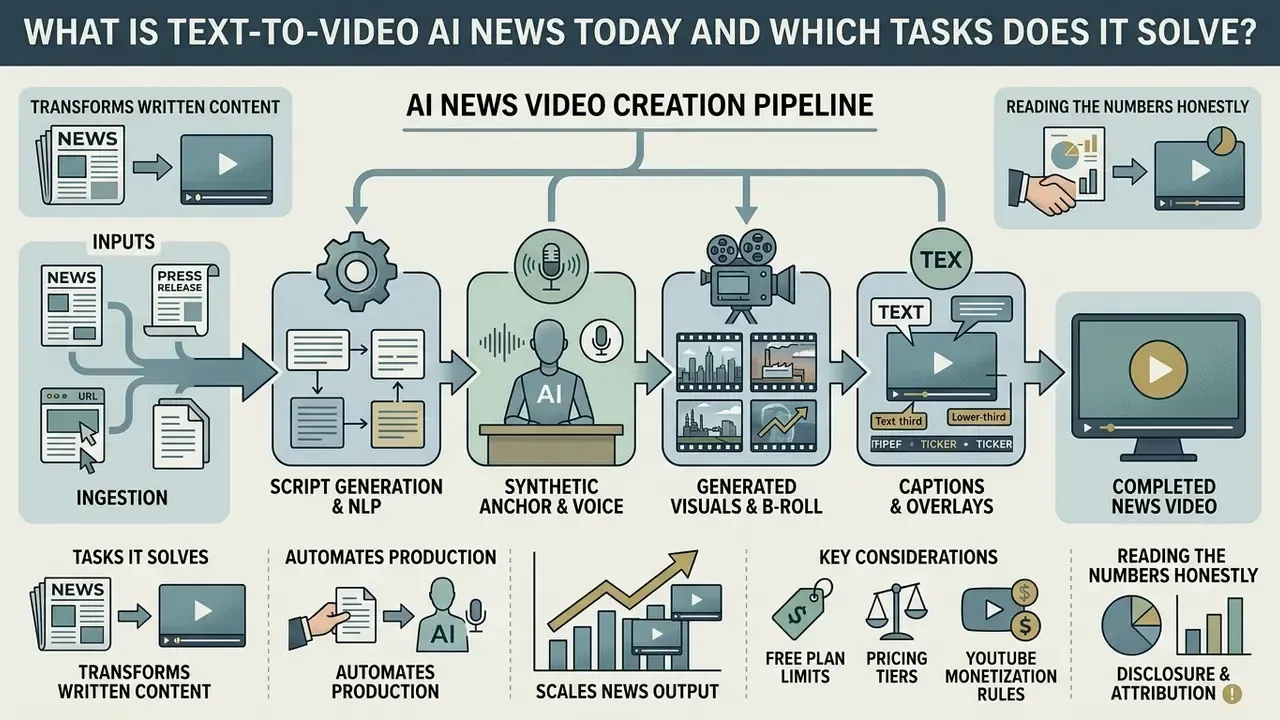
Text to video AI news today refers to an automated production architecture that converts written text, news articles, and press releases into fully narrated, anchor-led video reports. Modern newsrooms and enterprise communication teams deploy an ai news generator to accelerate production timelines, reduce studio overhead, and scale multi-language broadcasts without expanding physical camera crews.
The business case is narrow and measurable. Remove crew booking, studio scheduling, and manual voiceover passes from the critical path, so written coverage reaches video-first distribution channels inside the same news cycle. Newsroom research also documents secondary gains in tagging, metadata generation, caption creation, and asset organization, which shorten retrieval and distribution cycles well beyond the render step itself.
How AI Converts a News Article and Prompt into a News Video
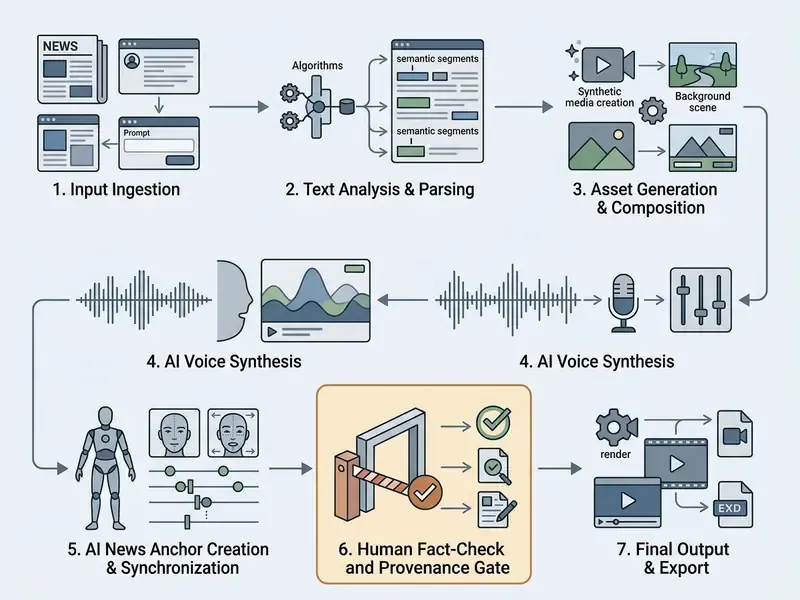
An ai news generator ingests a news article or text prompt, parses key facts through natural language processing, and synthesizes a structured script aligned with broadcast standards. The platform generates an ai voice soundtrack via neural text-to-speech, pairs it with an ai news anchor, and matches textual scenes with generated visuals or stock B-roll to deliver a finished video in standard aspect ratios.
«A systematic review of AI in newsrooms identifies four dominant application areas, namely content production, fact-checking, personalisation and editing support, alongside three ethical challenges.»
Which Text to Video AI Updates Matter for News Formats
Recent updates in generative video architectures, including multi-modal diffusion transformers, document-to-video conversion models, and longer-context temporal attention, have improved frame consistency, multi-scene narrative coherence, and rendering resolution up to 1080p and 4K. These text-to-video AI tools now accept complex PDFs, spreadsheets, slide decks, and multi-page reports directly into the generation pipeline, bypassing single-prompt constraints.
For governance teams, the operational consequence of this release cadence is version pinning. If a bulletin series must stay visually consistent for a quarter, the model version, prompt template, and avatar identity all belong in a change-controlled configuration record, not in an editor's browser session. To sanity-check price-per-minute assumptions as these models shift, the AI Media Calculators are a quicker starting point than a spreadsheet built from memory.
How to Create an AI Breaking News Video from Text
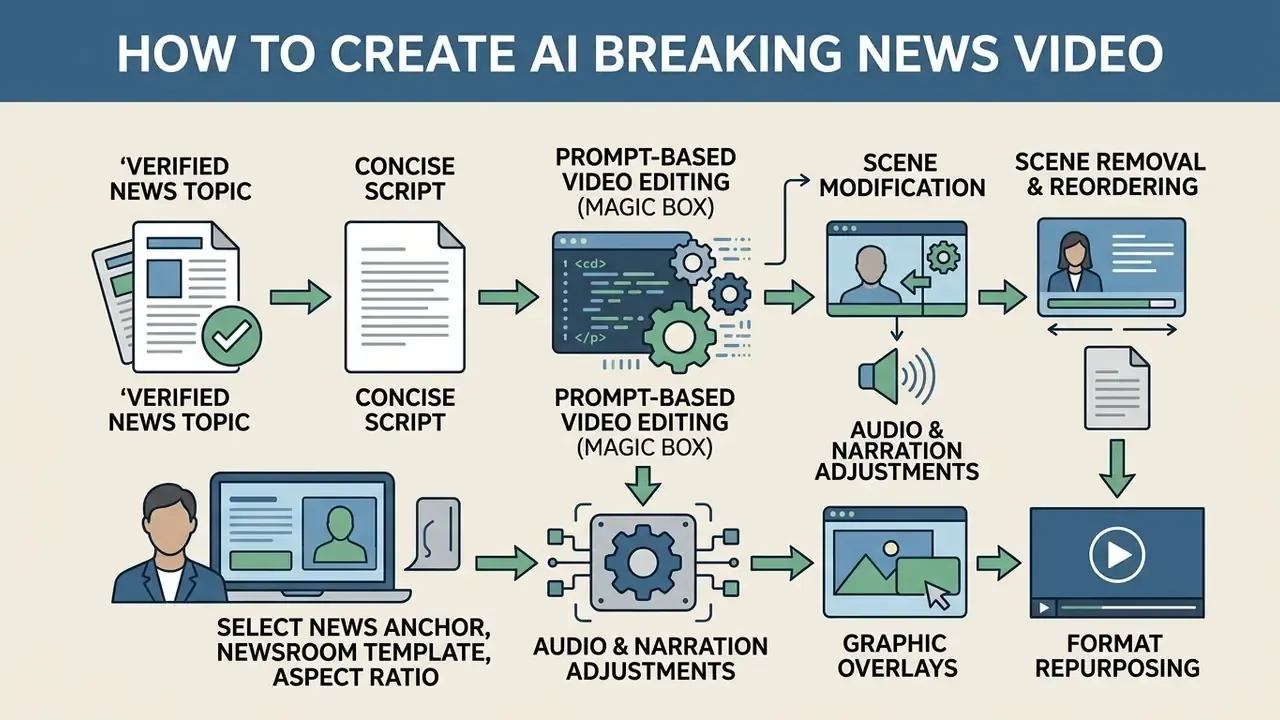
Creating an urgent breaking news video package requires an accelerated, verified production workflow that minimizes human latency while enforcing strict fact-checking controls. Newsroom breaking-news guides converge on the same sequence: verify the text, extract the visual angle, capture or source visuals immediately, script for the strongest first 15 to 30 seconds, edit fast, then publish and update.
Prepare a Verified News Topic and a Concise Script
A breaking news video script must open with a single-sentence hook establishing core facts within the first five seconds, followed by structured context and source attribution. Editorial guidelines recommend limiting breaking video scripts to 75-130 words to ensure rapid rendering and solid viewer retention across digital feeds. A workable editorial contract before generation specifies six things: target viewer, one-sentence thesis, duration, tone, approved sources, and prohibited claims. The script flow then follows a fixed order of hook, promise, context, core sections, evidence, synthesis, call to action.
The practical takeaway from prompt-gallery research is blunt: thin prompts produce generic scenes. A news prompt that names the subject, the setting, the on-screen graphic, the tone, and the duration outperforms a one-line topic request almost every time.
Prompt-Based Video Editing (Magic Box Workflows)
Modern AI news video generators reduce dependence on multi-track timeline editing by accepting natural-language modification commands. Editors refine a rendered news package by typing direct instructions into an editing interface instead of dragging clips:
- Scene modification "Replace the B-roll in Scene 2 with footage of a modern solar farm."
- Scene removal and reordering "Delete Scene 4 and move the market reaction segment before the analyst quote."
- Audio and narration adjustments "Change the voiceover accent to British English and slow the narration pace by 10%."
- Graphic overlays "Update the lower third in Scene 1 to display 'Dr. Sarah Chen, Chief Economist'."
- Format repurposing "Re-render this segment as 9:16 with word-by-word highlighted captions."
Two governance notes apply. First, natural-language edits regenerate only the affected scenes on most platforms, which is why a corrected bulletin can ship in seconds instead of a full re-render. Second, every prompt-based edit is an editorial decision and belongs in the audit trail. "Who told the model to change the lower third, and when" is a question an internal auditor or platform reviewer can reasonably ask.
Select a News Anchor, Newsroom Template, and Aspect Ratio
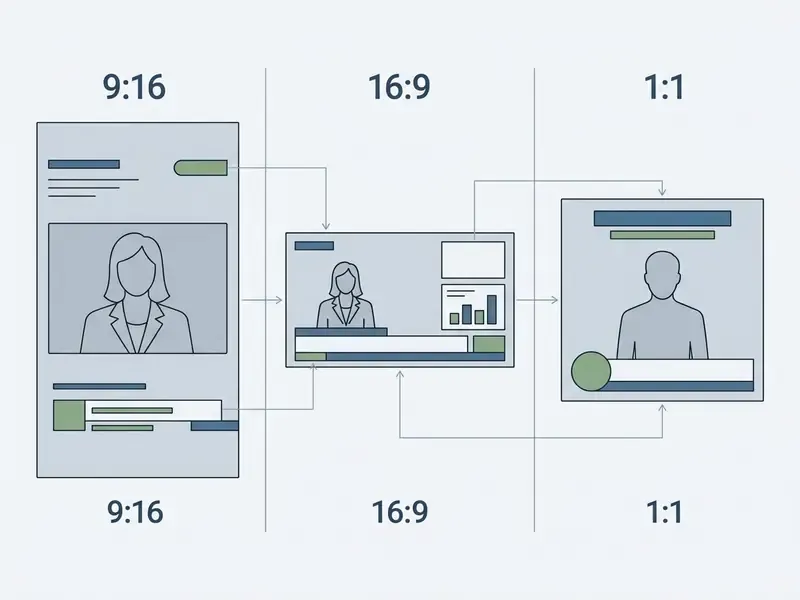
Select a presentation style based on publication context. Use vertical 9:16 aspect ratios for mobile social channels and horizontal 16:9 layouts for web embeds and broadcast distribution. Match the digital anchor and virtual newsroom studio background to the severity of the reporting topic, so the visual register does not undercut the story. Mobile formatting dominates: newsroom analytics commonly show roughly three-quarters of visitors arriving on mobile, which argues for vertical-first framing on social cuts and concise on-screen headlines.
Before committing to a template, check the export ceiling of your plan. Free AI video generator limits frequently cap resolution at 720p and watermark the output, which quietly undermines a 9:16 social cut that depends on legible on-screen text.
Public-sector and enterprise teams should pair template selection with documentation discipline. NIST published guidance and templates for public-facing AI documentation in 2026, and the U.S. State Department's generative AI playbook recommends shipping a minimum viable product, engaging legal, privacy, and accessibility teams from day one, then scaling after cross-functional review.
Add Lower Thirds, Captions, and Export the Finished Video
Apply action-safe lower thirds that display interviewee names, titles, and report locations. Institutional brand standards differ on duration, and the spread is worth knowing before you lock a template. One university standard specifies 1 to 3 seconds with a single line per name, another requires a minimum of 4 seconds inside the text-safe zone, and a third mandates at least 6 seconds with left-aligned text on a 1280x720 title bar. Choose one rule, document it, enforce it across the series.
Verify auto-generated subtitles for spelling accuracy regarding proper nouns. Auto-captioning should never be trusted unreviewed for names and technical terminology. Embed brand logos in the upper margins and export the file as an H.264 MP4. A workable delivery baseline drawn from published brand specifications is H.264 in an .mp4 container, 1080p or higher, 23.98 fps, with an accompanying .srt caption file for online distribution. Section 508 guidance additionally requires captions and transcripts for accessible video and recommends breaking caption lines at logical pauses such as periods and commas. When bulletins are republished to a channel with strict upload limits, a controlled video editing workflow and a documented compression step keep file size and quality predictable.
Pre-publication checklist for breaking news video:
- Source verification.Cross-check primary news sources, official statements, and press releases before script ingestion. Confirm location, time, source identity, publication status, and copyright. For user-generated video, run reverse image search and frame-level verification tooling.
- Anchor and avatar configuration.Confirm digital anchor parameters, voice selection, consent records for any cloned voice or likeness, and mandatory AI transparency disclosures.
- Lower thirds accuracy.Inspect text overlays for subject names, professional titles, and geographical designations within action-safe boundaries, using a single documented duration standard.
- Caption and subtitle audit.Review automated speech-to-text outputs to correct phonetic misspellings, terminology, and line-break timing at logical pauses.
- Brand asset integrity.Verify corporate logo placement, colour space consistency, and visual style compliance against the stored brand kit.
- Export parameter check.Confirm resolution (1080p minimum), frame rate (23.98 or 29.97 fps), caption sidecar file, embedded provenance metadata, and target platform aspect ratio.
What News Video Formats You Can Create with AI
Artificial intelligence platforms generate a wide variety of video formats tailored to distinct channel specifications, audience demographics, and editorial intents. In current vendor documentation the dominant formats are 16:9 broadcast and web segments, 9:16 short-form clips for TikTok, Reels, and Shorts, 1:1 feed videos, and avatar-led summary bulletins for daily or weekly series.
Financial Briefings and Earnings Reports
Workflow: ingest SEC filings, PDFs, investor decks, or balance sheets. The engine extracts metrics such as year-over-year growth, net revenue, EBITDA, and EPS, then projects dynamic charts over branded lower thirds. Because filings are structured documents, this is the format where document-to-video ingestion delivers the largest time saving and the largest hallucination risk at the same time. Every figure rendered on screen must be re-checked against the filing before publication.
Copy-paste prompt example:
Create a 45-second financial news briefing based on the following text. Tone: authoritative, neutral. Visuals: trading floor, abstract financial charts. Lower thirds: display key revenue metrics. Script focus: highlight quarterly EPS and revenue guidance. Do not infer any figure that is not present in the source text.
Sports Updates and Highlight Summaries
Workflow: convert play-by-play text feeds, box scores, or match statistics into dynamic clips with score overlays and high-energy narration. Fixture and schedule bulletins are the easiest reliable volume play, because the source data is structured and rarely disputed.
Copy-paste prompt example:
Generate a 30-second high-energy sports update. Anchor style: enthusiastic commentator. Overlay: scoreboard graphics in the top-right corner. B-roll: fast-paced athletic stock footage matching the match highlights. Close with the next fixture date and kickoff time.
Entertainment, Lifestyle, and Pop Culture
Workflow: transform celebrity press releases, festival line-ups, or trending social posts into fast-paced clips with expressive avatars and vibrant captions. Tone is conversational rather than broadcast-formal, and the editorial risk shifts from numerical accuracy to defamation and rumour handling. Unverified gossip should never be rendered as a declarative anchor statement. If your visual package leans on synthetic imagery, the conventions catalogued in ai generated art and ai generated images references are a useful reality check on what looks credible and what looks cheap.
Copy-paste prompt example:
Produce a 60-second vertical (9:16) entertainment news clip. Style: casual, fast-paced. Subtitles: word-by-word highlighted captions. Background music: upbeat pop track. Attribute every claim to its named source on screen. Include a CTA asking viewers to comment.
Educational and Explainer News Summaries
Workflow: structured, text-forward segments suited to factual reporting, academic findings, and instructional content. Instructors and course designers use the news-bulletin structure precisely because audiences already recognise it as an authority format, which helps with dense material. Science and nature desks often pair explainers with generated illustration, and the ai generated animal examples show why any such visual needs an explicit "illustration, not footage" caption.
Copy-paste prompt example:
Create a 90-second explainer in news-bulletin format. Structure: hook, three numbered findings, limitations, closing summary. Visuals: clean data charts and diagram animations. Reading level: general audience. Cite the study name and year on screen for each finding.
Company Updates, Product Launches, and Corporate Announcements
Corporate communications teams use synthetic anchors to deliver standardized internal briefings, quarterly performance overviews, and executive announcements. Public relations ethics frameworks mandate clear disclosure whenever synthetic media or cloned voices shape corporate communications, and PR guidance specifically flags press releases containing AI-generated quotes or messaging as cases where transparency is essential.
«Hofeditz (2025) reports that 85% of media-organisation staff have already experimented with generative AI, while ethical guidelines require transparent labelling of synthetic content.»
A regional financial institution automated its quarterly compliance brief production using AI voice generators and pre-approved corporate templates. By enforcing mandatory synthetic voice labeling and locking narration to legally reviewed scripts, the communications team reported a 64% reduction in departmental production expenses while maintaining regulatory alignment across internal distribution networks. As with the 89% editing-cycle figure above, this is a single-organisation result without published methodology. Treat it as a directional benchmark and re-derive it internally with control costs included.
One caution specific to executive likeness. Once an approved avatar of a named executive exists, internal demand for it grows fast, and so does the temptation to reuse it for messages legal never reviewed. Lock the avatar behind a publish-approval role. Teams experimenting with personal likeness generation, including the ai generated photos and ai generated images of yourself free categories, should keep those experiments entirely outside the corporate brand perimeter.
Local News, Regional Bulletins, and Public-Sector Updates
Regional news publishers use automated news-gathering pipelines to convert localized agency feeds and public records into targeted video updates. AP and AppliedXL launched AP Local Lede in 2025 to deliver AI-assisted local news tips and advisories at county, state, and regional level, drawing on 430+ agencies with AP journalists adding context. Northwestern's Medill AI Local News research describes "regionalization" as algorithmically assembling nearby news into a personalised brief for a selected location. Peer-reviewed 2024 work on local journalism reports AI adoption concentrated in versioning, personalisation, and content automation rather than studio production.
Public sector offices apply the same format to community updates, policy announcements, and public-safety information. That removes the need for in-house broadcast equipment, while raising the bar on disclosure, since government communications carry heightened expectations of authenticity.
How to Choose an AI News Video Generator for Your Publishing Workflow
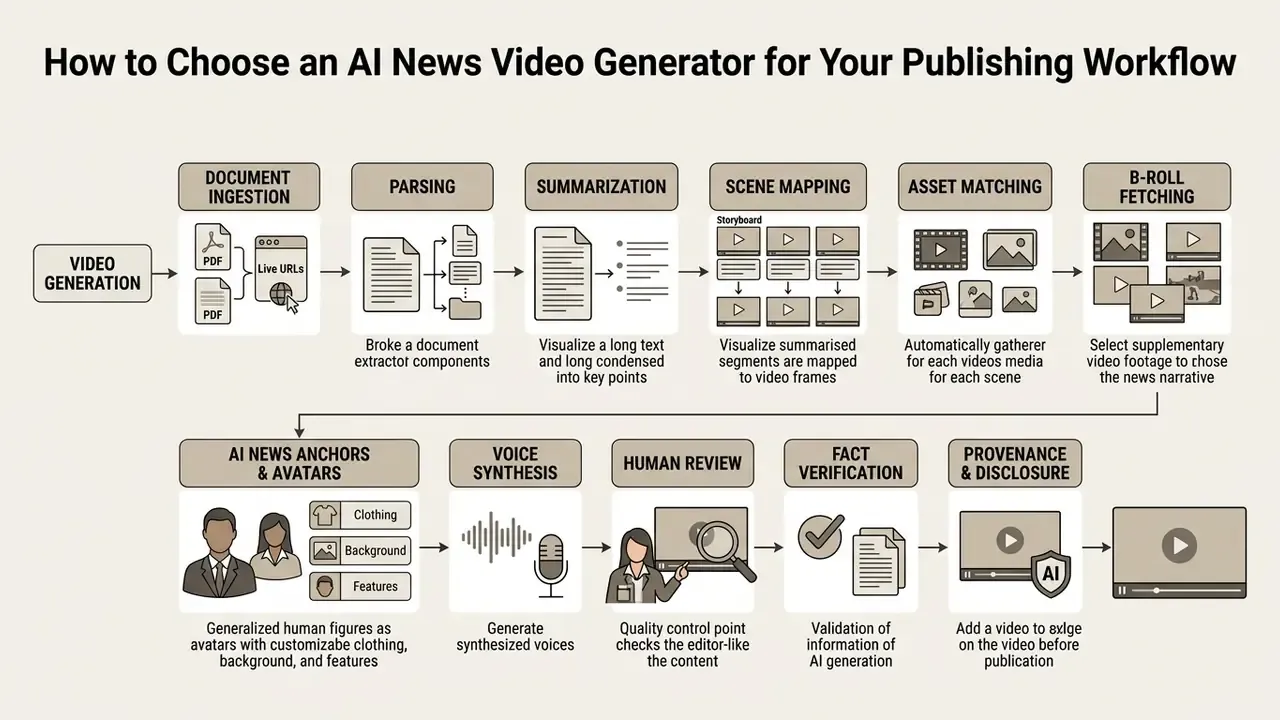
Selecting an ai video creator news platform requires evaluating core model fidelity, avatar naturalness, brand control integration, editorial auditability, and, for regulated organisations, data isolation. The decisive split in 2026 is between two buyer profiles. Media outlets filter primarily on machine-readable provenance, visible disclosure controls, and editorial traceability. Corporate and financial communications teams filter on consent management, rights control, multilingual localisation, deployment topology, and workflow integration. EU transparency obligations are stricter on public-interest publishing and deepfake disclosure. General corporate guidance is broader and more operational.
Video Generation from Text, Articles, and Press Releases
Modern video creation tools convert long-form documents into concise video packages by extracting entity relationships, statistical metrics, and core narrative arcs. Built-in script generation tools parse press releases and financial disclosures into 30-to-60-second broadcast segments while maintaining source attribution. Vendor documentation describes taking a press release, research report, or transcript and producing a first-draft article or script, then refining tone, length, and angle. Fast at drafting, yes. Independently verified for journalistic accuracy, no.
That is why output quality needs benchmark language rather than marketing language:
«T2VQA-DB is the largest text-to-video quality assessment database: 10,000 videos from nine models across 1,000 text prompts, with multi-dimensional human ratings.»
Practical procurement translation: ask vendors which public benchmark families they report against, such as VBench for dimension-level quality, T2VQA-DB for human-rated perceptual quality, and VIDEOPHY for physical-commonsense consistency. Treat "state of the art" claims without a named benchmark as unverified. It also helps to compare shortlisted tools on the same three scripts rather than on vendor demo reels.
Operational Workflow: Converting PDFs and Live URLs into News Videos
- Document ingestion and parsing.Paste a raw HTTPS article link or upload a multi-page PDF such as a financial audit, whitepaper, or press release. The NLP parser indexes key entities, quantitative figures, and primary quotes.
- Automated summarization and scene mapping.The AI extracts the core narrative arc and segments the source text into a timed, multi-scene video script of roughly 15 to 30 seconds per scene.
- Asset matching and B-roll fetching.The engine maps extracted semantic entities, for example "central bank" or "EV manufacturing", to stock media tags and lower-third headline overlays.
- Human review and fact verification.The editor audits generated claims, figures, and quotations against the original PDF or URL text before triggering final video rendering.
- Provenance and disclosure.Embed C2PA content credentials and the source document identifier, then apply the platform-required synthetic-media label before export.
Two ingestion caveats matter in production. Paywalled or JavaScript-heavy URLs frequently parse incompletely, producing a script built on partial text, so always compare scene count against source section count. And scanned PDFs without an embedded text layer require OCR first. Otherwise the parser silently returns an empty or garbled entity set, and nobody notices until the anchor confidently reads a mangled number.
AI News Anchors, Avatars, and Voice Synthesis
Advanced virtual presenter frameworks rely on neural audio-driven facial retargeting and zero-shot voice cloning to synchronize digital anchor movements with synthetic speech. Current state-of-the-art platforms support lip sync matching across more than 175 languages using brief 15-second voice samples. Academic pipelines describe the same capability as modular rather than end-to-end: a TTS or zero-shot voice-cloning model paired with a separate learned lip-sync module such as Wav2Lip. Vendor submissions describe "emotion-aware virtual humans" with expressive lip-sync and gesture, which is expressive animation plus voice, not verified reproduction of human affect.
«A CNN-and-LSTM deepfake detection system reached 62% accuracy, underscoring the residual risk of synthetic presenters.»
Detection performance in that range is the core governance argument for provenance marking. If automated detection is unreliable, authenticity must be asserted at creation time rather than discovered after distribution.
Creating Custom Digital Anchors: From Static Photos to Instant Clones
Newsrooms can generate bespoke virtual presenters without booking physical studio sessions, using two methodology tiers.
- Photo-to-avatar (instant generation).Upload a high-resolution, front-facing 2D portrait in PNG or JPEG, with neutral expression, even studio lighting, and no heavy shadow across the mouth. The facial retargeting engine maps facial landmarks to drive lip-syncing and subtle blink animation from an input script. Best for rapid local news updates, social clips, and testing anchor concepts before committing budget.
- Digital twin video cloning (15-second sampling).Record a 15-to-30-second HD clip reading a reference consent text. Neural audio-visual models clone the presenter's gestures, vocal cadence, and facial micro-expressions, holding one identity across every episode. Best for consistent daily bulletins and branded corporate anchor lines.
Operational constraints to plan for. Platforms typically require a recorded consent video for any digital twin built from a real person, and avatar "look" slots are capped per avatar, with one major vendor documenting a 500-looks ceiling. That limits how far a single cloned identity can be varied. Written authorisation is not optional: U.S. Copyright Office work on digital replicas frames authorisation in writing as the baseline for licensed digital depictions and voice replicas.
Video Editing, Subtitles, Brand Assets, and Export
Enterprise-grade news video editing requires native integration of corporate style guides, including font families, colour palettes, logo placements, and lower thirds. Brand-kit functionality, meaning logos, colours, fonts, graphics, and templates stored once and applied automatically, is now standard across creator suites. Platforms must also support automated subtitle generation with exportable SRT caption tracks and language metadata tagging, to satisfy accessibility and distribution standards. The NISO JATS 1.4 standard defines subtitle language attributes such as xml:lang, lang-source, and lang-variant for transcription and translation metadata.
Comparative feature matrix for AI news video generators (2025-2026):
| Platform | Document ingestion (URL/PDF) | Avatar and photo-to-avatar support | Prompt-based editing | Niche news templates | Export formats and languages |
|---|---|---|---|---|---|
| HeyGen AI News Suite | Full URL and PDF ingestion | 1,100+ avatars; digital twin from 15s clip; photo-to-avatar | Timeline and scene-script editing; scene-level regeneration | Corporate, social, global news | 16:9, 9:16, 1:1; up to 4K MP4; 175+ languages |
| InVideo AI | Script, topic, and prompt ingestion | Stock presenters and voice narration | Full natural-language text commands (delete scene, change accent) | YouTube Shorts, breaking news, explainers | 1080p MP4; social aspect ratios; 50+ languages |
| Renderforest AI News | Text, topic, and headline parsing | Pre-rendered newsroom anchors with lip-sync | Template-based inspector controls and scene editing | Financial, sports, entertainment, corporate, educational, government | 1080p and 4K MP4; 16:9, 9:16, 1:1; 50+ languages |
| Vidnoz AI News Generator | Text and article ingestion | 400+ avatars; photo-to-avatar generation from one portrait | Basic text edits and scene swap | Local news, sports, business, politics, celebrity | 1080p MP4; 100+ languages and accents |
| Synthesia Enterprise | PDF, document, and script ingestion | 160+ moderated enterprise avatars; custom clones | Script-driven scene replacement | Corporate briefings, compliance updates, training | HD and 4K MP4; SCORM export; 140+ languages |
For a broader cross-category view of model quality and price-per-minute economics beyond news-specific tooling, weigh these options against the wider field of best AI video generators before signing an annual contract. Teams building their own render service should also read the AI Media API Guides for rate limits and retry behaviour, since a failed overnight batch is an editorial problem by breakfast.
Security, Compliance, and Model Risk Criteria for Regulated Buyers
Feature parity is rarely the blocker in banking, insurance, or listed-company communications. Data handling is. The matrix below covers the criteria most often raised in vendor due diligence for regulated environments. Confirm each item against the vendor's current trust centre and contract addenda, because attestations and deployment options change by plan tier and renewal cycle.
Enterprise security, data isolation, and governance criteria to verify before procurement:
| Criterion | What to ask the vendor | Why it matters for regulated publishing |
|---|---|---|
| Zero data retention for training | Are customer scripts, documents, and avatar footage excluded from model training by contract, not just by policy? | Prevents material non-public information from entering a shared model surface. |
| Attestations | SOC 2 Type II, ISO 27001 and 27701 scope and report date; penetration test summary. | Required evidence for third-party risk assessments and internal audit files. |
| Deployment topology | Multi-tenant SaaS, dedicated tenant, private cloud (VPC), or on-premises rendering? | Determines residency, egress control, and whether embargoed material ever leaves the perimeter. |
| Data residency and deletion | Region pinning, retention window, verified deletion SLA for prompts, renders, and voice samples. | Supports jurisdictional obligations and records-management schedules. |
| Identity and access | SSO/SAML, SCIM provisioning, role-based permissions for generate, approve, publish. | Enforces separation of duties between script author and publication approver. |
| Provenance and labelling | C2PA content credentials, durable watermarking, exportable disclosure metadata. | Baseline for EU transparency expectations and platform disclosure requirements. |
| Consent and likeness controls | Stored consent artefacts, avatar revocation, voice-clone lockout. | Supports written-authorisation requirements for digital replicas. |
| Auditability and API | Immutable event logs, webhook export to SIEM or GRC, model-version pinning. | Enables model-risk validation and reconstruction of any published bulletin. |
| Indemnity and continuity | IP indemnification scope, uptime SLA, deprecation notice period for models. | Mitigates vendor lock-in and mid-series model retirement, as in the Sora 2 deprecation. |
Financial institutions typically fold these controls into existing model-risk frameworks rather than creating a parallel process. Supervisory model-validation expectations (SR 11-7 and OCC 2011-12) and the NIST AI Risk Management Framework with its Generative AI Profile both support treating a news-video pipeline as a governed model with owners, validation evidence, and periodic review. The Council of Europe's guidelines on the use of AI in journalism, adopted 30 November 2023, similarly require ongoing risk assessment, accountability, human oversight, and retained editorial control. Where disputes over training data or likeness could affect a vendor's roadmap, the AI Litigation and Case Timelines hub is a reasonable place to track exposure before renewal.
Audit Log Event Schema for Generated News Videos
If an internal auditor, regulator, or platform trust-and-safety team asks how a bulletin was produced, the answer should be a record, not a recollection. A minimum viable event schema per published asset:
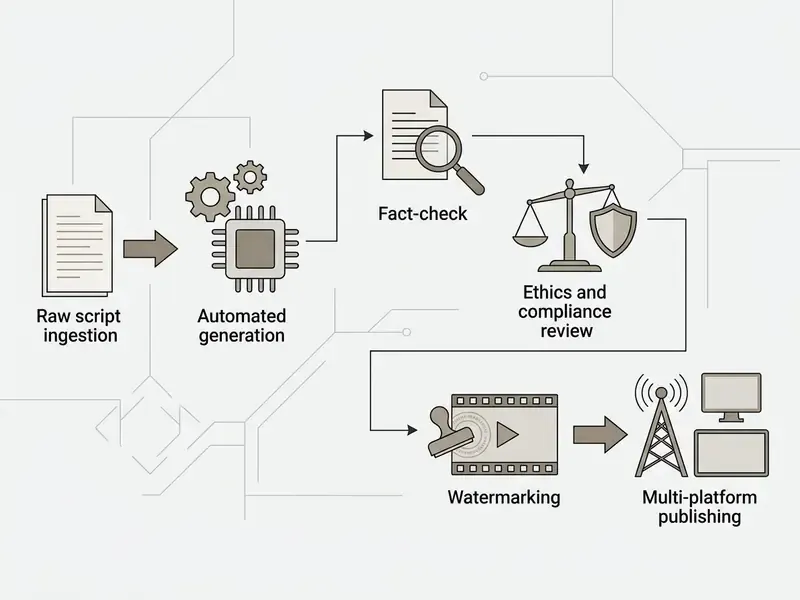
asset_id,render_timestamp_utc,publication_timestamp_utcsource_type(article, URL, PDF, structured feed) andsource_identifier(URL, document hash, filing accession number)script_version_hashandprompt_text_hashmodel_vendor,model_name,model_version,regionavatar_id,voice_id,consent_artefact_referencehuman_reviewer_id,fact_check_outcome,claims_corrected_countdisclosure_applied(platform label yes or no),c2pa_credential_id,watermark_methodexport_spec(codec, resolution, fps, aspect ratio, caption sidecar)revision_lineage(parentasset_idfor corrected or updated versions)
Retain these records for at least as long as the video remains publicly accessible, and longer where records-management policy for published communications requires it. If your team hits ingestion or export failures while wiring this up, the AI Media Support and Troubleshooting notes cover the common parser and codec faults.
Free Plans, Pricing, and Commercial Use of AI News Generators
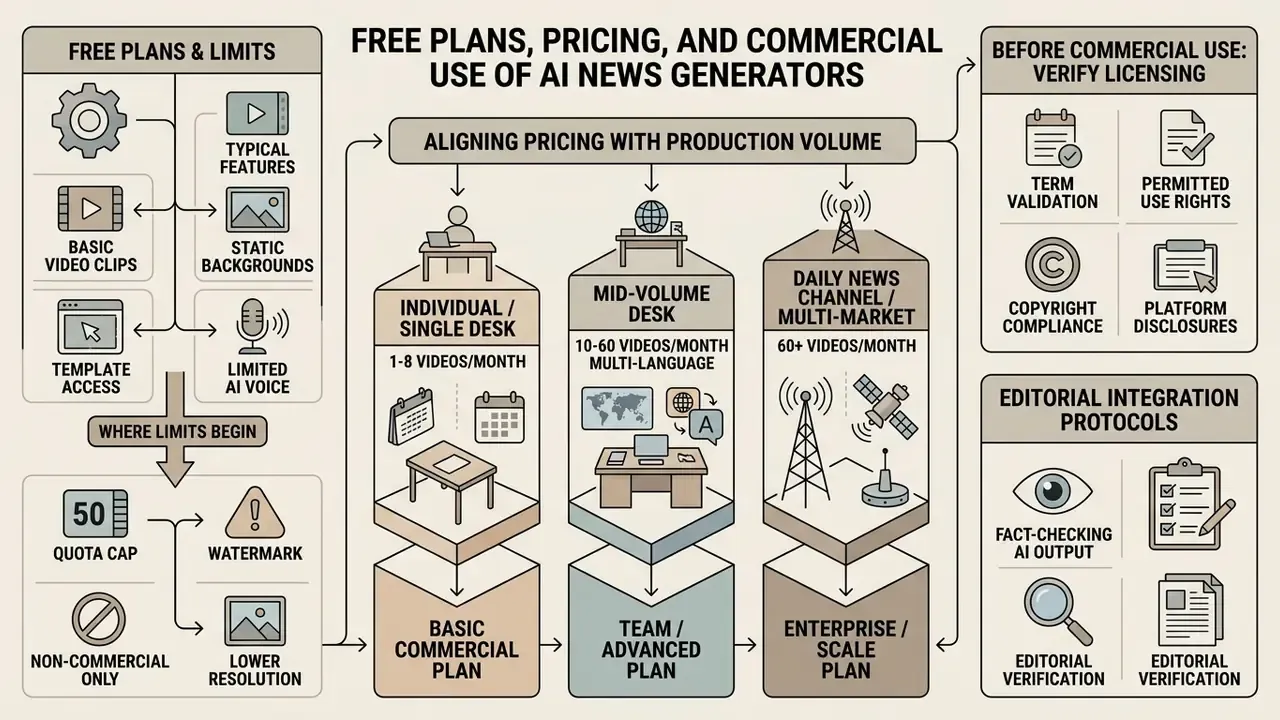
Understanding the economic structures and licensing terms of free ai news tools is essential for evaluating long-term operational viability and avoiding copyright infringement.
What Free AI News Tools Include and Where Limits Begin
Free AI video generator limits offered by video generation vendors typically impose strict constraints, including visual watermarks, lower export resolutions at 720p, and hard credit caps. Published examples from vendor pricing pages and recent reviews illustrate the range. One enterprise platform's free plan allows 10 minutes per month with nine stock avatars and watermarked export. Another limits free accounts to three videos per month at up to three minutes each, with a watermark. A general-purpose editor's free tier is reported at 10-minute exports capped at 720p with watermark. One leading model platform grants 125 one-time, non-renewing credits with 720p export, five projects, and 5 GB storage. Free accounts generally restrict access to advanced digital twin cloning, enterprise brand kits, and commercial licensing rights.
Free-tier models cluster into three shapes: one-time credit grants, renewing monthly credits, and feature-restricted basic plans. The practical trap is the non-renewing grant. Excellent for evaluation, useless for a publishing calendar.
What to Verify Before Commercial Use of Generated News Videos
Commercial deployment of synthetic news content requires verified written consent for voice replicas and clear disclosure of synthetic visual elements. United States copyright guidance specifies that purely machine-generated outputs lacking human expressive control are ineligible for copyright protection. Protection attaches only where a human author has determined sufficient expressive elements.
Dataset and model licensing deserves the same scrutiny as platform terms:
Commercial-use terms also diverge sharply by vendor. Some free tiers explicitly grant commercial rights, while others reserve commercial use for paid tiers. There is no universal rule, only each service's own licence. The same caution applies across adjacent media types, so review the commercial use of AI-generated content terms attached to every asset class in the final package, including stock footage, music beds, and generated imagery. The AI Media Commercial-Use Hub tracks those terms by tool category if you need a single reference for procurement.
On disclosure and news exemptions, U.S. state law offers a concrete template. Colorado's public advisory on deep fakes requires a clear disclosure that media has been edited and falsely appears authentic, with metadata disclosure that should be permanent where feasible, and exempts bona fide newscasts, news interviews, news documentaries, and on-the-spot coverage only where the broadcast clearly acknowledges AI generation. Utah's synthetic media law requires an on-screen label such as "This video content generated by AI" to persist throughout the synthetic portion, plus embedded tamper-evident provenance for online audio and video advertising. Federal disclosure proposals have similarly paired an in-medium notice with metadata identifying the content as AI-generated, the tool used, and the creation time.
How to Align Pricing Plans with News Video Production Volume
Select commercial plans based on expected monthly video output, language requirements, and distribution channels. The volume logic is straightforward.
Risk-adjusted ROI, not gross production savings. A defensible business case subtracts control overhead from headline savings. Include platform licence and overage, prompt and template engineering time, human fact-checking and legal review hours per bulletin, disclosure and provenance tooling, avatar consent administration, model validation and periodic revalidation, audit-log storage and retention, plus a residual risk provision for correction, retraction, or takedown. A pipeline that cuts editing time by 89% but adds two hours of legal review per sensitive bulletin has very different net economics from one publishing low-risk fixture summaries. For a sanity check on list prices across categories before you model that, the AI Media Pricing Guides collect current tier structures in one place.
AI video generator plan tiers, pricing models, and technical limits (2025-2026):
| Service tier | Estimated monthly cost | Render allocation and limits | Avatar and voice access | Commercial rights and watermarks |
|---|---|---|---|---|
| Free / trial tier | $0 per month | 1 to 10 minutes per month, or 3 videos per month, or 125 one-time credits; 720p max | Basic public avatars, often around 9 stock avatars; generic neural voices | Non-commercial use unless explicitly granted; visible vendor watermark |
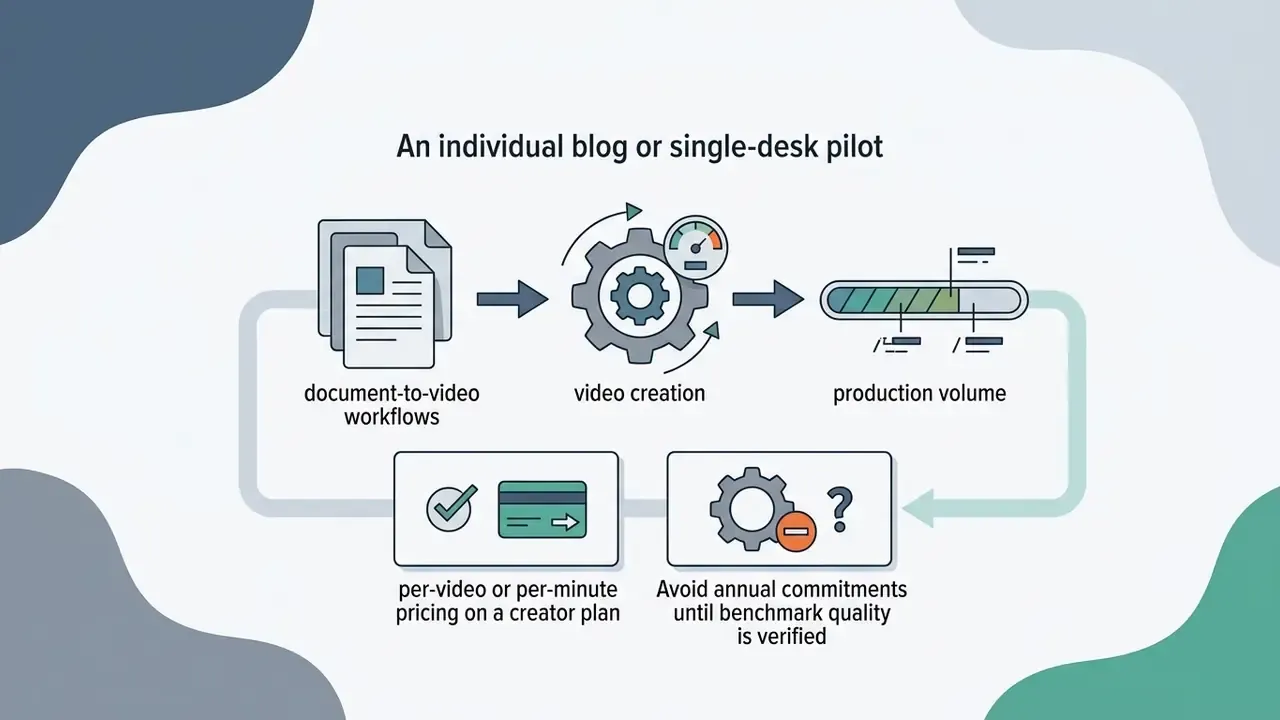
| Starter / creator plan | $12 to $29 per month | 15 to 30 minutes per month; 1080p resolution | Expanded avatar access; basic voice cloning | Commercial licensing typically included; no watermark |
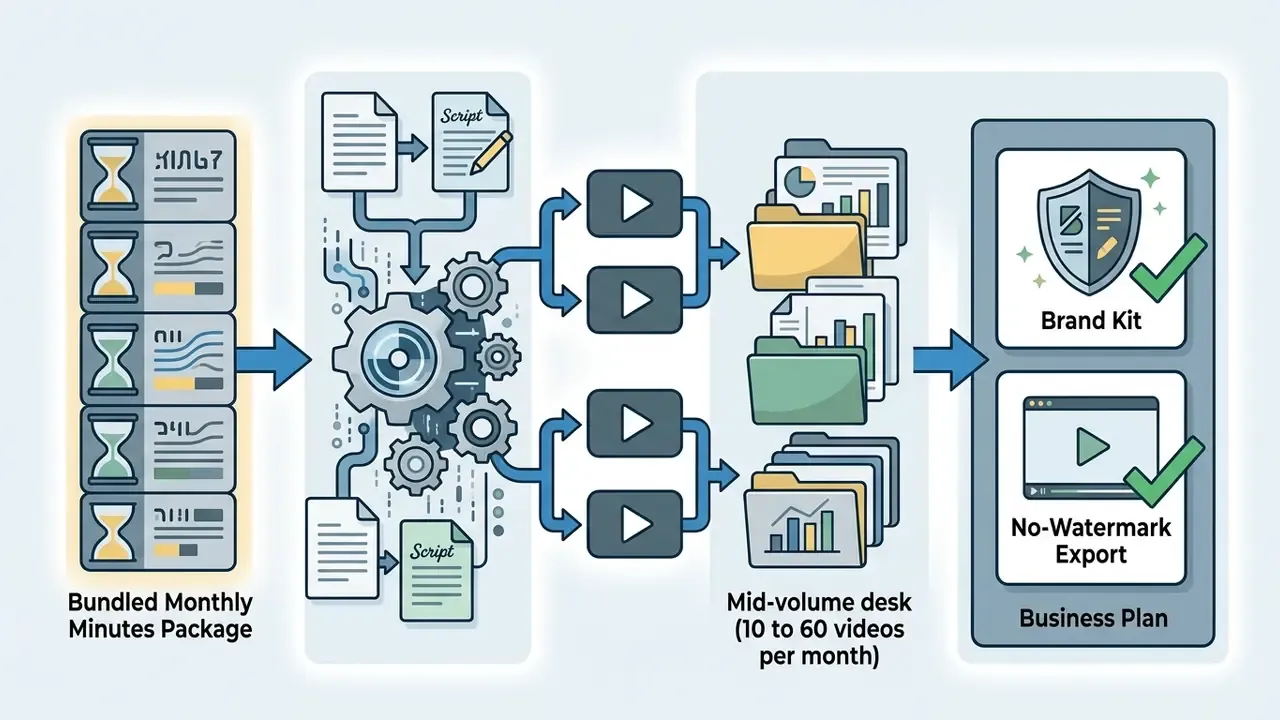
| Pro / business plan | $70 to $120 per month | 60 to 180 minutes per month; 1080p and 4K export | Custom avatar slots; advanced voice cloning | Full commercial usage; brand kits and auto-captions |
| Enterprise / API tier | Custom quote, usage-based | High-volume or unlimited rendering; dedicated API; up to 50 scenes and around 30 minutes per scene on documented avatar APIs | Digital twin creation; priority fine-tuning; consent workflow | Enterprise indemnity; SOC 2 and ISO compliance; full SLA; zero-retention options |
Prices, credit allocations, and language counts change frequently and differ by region and account tier. Verify current figures on the vendor pricing page before budgeting, and record the date you checked.
Fact Check and Editorial Verification Protocol
How to Publish AI News Videos Without Losing Audience Trust
Maintaining audience credibility when publishing synthetic media requires operational transparency, clear disclosure labeling, and rigorous pre-publication fact-checking. In that order, honestly, because a label on an unverified claim buys you nothing.
Fact-Checking and Risks of the Fake News Video Maker Label
Publishing unverified synthetic media risks framing an organization as a fake news video maker, which leads to immediate loss of brand trust, platform demonetization, and potential legal exposure. Synthetic media tools carry inherent risks of hallucination and unauthorized deepfake generation, and Interpol's 2026 global guideline warns that synthetic media can be weaponised for impersonation, fraud, and deception in information environments.
«Video deepfakes deceived 42% of subjects, audio 44% and text headlines 42%; the differences were not statistically significant.»
The methodological detail matters. The study used a representative sample across three modalities and found no meaningful advantage for video. Practically, that dismantles the assumption that "it's only a short clip" reduces harm. The deception ceiling is set by the claim, not the format.
«Generative AI enables plausible fake video by combining deepfake audio with synthetic avatars, making detection and prevention extremely difficult.»
Verification practice should therefore be explicit and reproducible. Wire-service standards require verifying location, time, source identity, publication status, and copyright before use, with captions answering who, where, when, what, and why, and carrying the correct date in both the caption and IPTC fields. Fact-checking manuals recommend confirming breaking news against mainstream newsrooms, official organisations, and fact-checkers, and for video specifically applying reverse image search, frame-extraction viewers, and dedicated verification plugins. NIST's own deepfake-assessment guidance recommends checking provenance, capture context, editing history, and whether additional angles or audio corroborate the claim. Verification tooling such as AI reverse-image-search tools belongs in the standard pre-publication kit, not in incident response.
Distribution Rules for YouTube, TikTok, and News Channels
Major media platforms enforce strict disclosure requirements for photorealistic generative AI content. YouTube requires creators to flag synthetic media that makes a real person appear to say or do something they did not, alters a real event or place, or generates a realistic scene that did not occur. The upload flow then applies an "altered or synthetic content" label in the description or player. TikTok requires creators to label AI-generated content containing realistic images, audio, or video, applied via text, hashtag sticker, or description, and reserves the right to reduce recommendation eligibility for undisclosed AI content. Meta announced its labeling approach in February 2024 and, as of July 2026, has signed the EU AI Act Code of Practice on transparency of AI-generated content. Purely productivity uses, such as AI help with scripting, ideas, or caption cleanup, are generally excluded from disclosure requirements.
«Ethical guidelines for media organisations recommend embedding machine-readable metadata alongside visible on-screen labels identifying synthetic presenters or generated visuals.»
Communication research on algorithmic influence adds a second layer. Auditable transparency about recommender use, and weighting accuracy, diversity, and civic value alongside raw reach, both contribute to legitimacy. TikTok's 2025 news findings are instructive: it is the fastest-growing news surface while scoring lower on transparency, accuracy, and trust, which makes explicit sourcing and disclosure disproportionately valuable there.
YouTube Monetization Rules for AI News Channels
FAQ About AI News Video Generators
Can You Update a Published Video When Text to Video AI News Updates Emerge?
You cannot dynamically update a pre-rendered video file once it is published on external platforms like YouTube or TikTok without replacing the video URL or re-rendering the output file. Most generators do, however, allow scene-level regeneration: edit the script and re-render only the affected scenes while the anchor, graphics, and pacing stay intact, so a correction ships in minutes rather than requiring a full rebuild. When key facts change, or updated AI generation models become available, newsrooms must render a revised video package, explicitly document the editorial update within the script narration and caption track, and publish the updated file alongside a formal revision notice.
«Kim (2026) identifies three central ethical challenges of newsroom AI adoption: erosion of professional independence, accountability gaps when errors occur, and normalisation of unsupervised automated processes.» Kim, Systematic Literature Review on AI in Newsrooms (2026) Note also that transparency obligations can be continuous rather than one-off. Under the EU AI Act transparency code, the public summary of general-purpose model training content must be updated when a model is further trained, with the update date made public. That is a useful precedent for publishers maintaining versioned bulletin series.
Will a Channel Publishing AI News Videos Be Demonetized?
Not because AI was used. Demonetization risk attaches to mass-produced, templated, scraped uploads with no human editorial contribution, not to the presence of a synthetic presenter. Keep original scripts, vary story selection and structure, declare altered or synthetic content at upload, include dynamic on-screen elements rather than a single static frame, and retain a reviewer record per asset. The monetization rules section above sets out the full checklist.
Who Owns the Copyright to a Synthetic Anchor and Its Output?
Two separate questions sit inside this one. Ownership of the avatar identity is governed by contract and consent: a digital twin built from a real person requires written authorisation, and the likeness and voice remain personal rights that can be revoked. Always store the consent artefact and confirm revocation mechanics before building a series around a cloned presenter. Ownership of the video output depends on human authorship. U.S. copyright guidance holds that purely machine-generated material lacking human expressive control is not eligible for protection, while outputs where a human determined sufficient expressive elements may be. Practically, document the human contribution, including scripting, scene direction, editorial selection, and prompt authorship, because that record is what supports any later claim.
How Do We Prevent Shadow AI and Align the Pipeline with Model Risk Governance?
Shadow AI in newsrooms and communications teams usually starts benignly. An editor uses a personal free-tier account to hit a deadline, and embargoed material leaves the perimeter with no log, no consent record, and no retention control. Four countermeasures work in practice. First, provide a sanctioned tool with SSO and role-based permissions, so the compliant path is also the fastest path. Second, register the pipeline as a governed model with a named owner, documented purpose, validation evidence, and periodic review, consistent with supervisory model-validation expectations (SR 11-7 and OCC 2011-12) and the NIST AI Risk Management Framework Generative AI Profile. Third, enforce technical controls: zero data retention for training, region pinning, blocked external uploads for embargoed classes of material, and immutable audit logs exported to your GRC or SIEM stack. Fourth, run continuing risk assessment as required by journalism-specific guidance, with accountability and editorial control retained by humans.
Is a "Fake News Video Maker" Ever Legal to Use?
Technically the same generators can fabricate misleading footage. Using them that way carries defamation, election-law, consumer-protection, and platform-policy exposure, and several jurisdictions now mandate persistent on-screen labels and tamper-evident provenance for synthetic political or advertising media. Satire, parody, and clearly acknowledged illustrative reconstructions exist as narrow carve-outs in some statutes, and bona fide newscasts may be exempt where the broadcast clearly acknowledges AI generation. The operating rule is simple: never render a synthetic depiction of a real person saying or doing something they did not, without disclosure and a documented editorial justification.
Can I Turn a PDF Report or Media Release into a News Video?
Yes. Upload the document or paste the source link, let the parser extract entities, figures, and quotations, review the generated scene list against the original sections, then verify every on-screen number before rendering. Scanned PDFs need an OCR pass first. Paywalled or script-heavy URLs often parse only partially, so compare scene count against source section count before approving. The full sequence is set out in the document-ingestion workflow above.
Appendix A: Editorial Revision Log and Source Notes
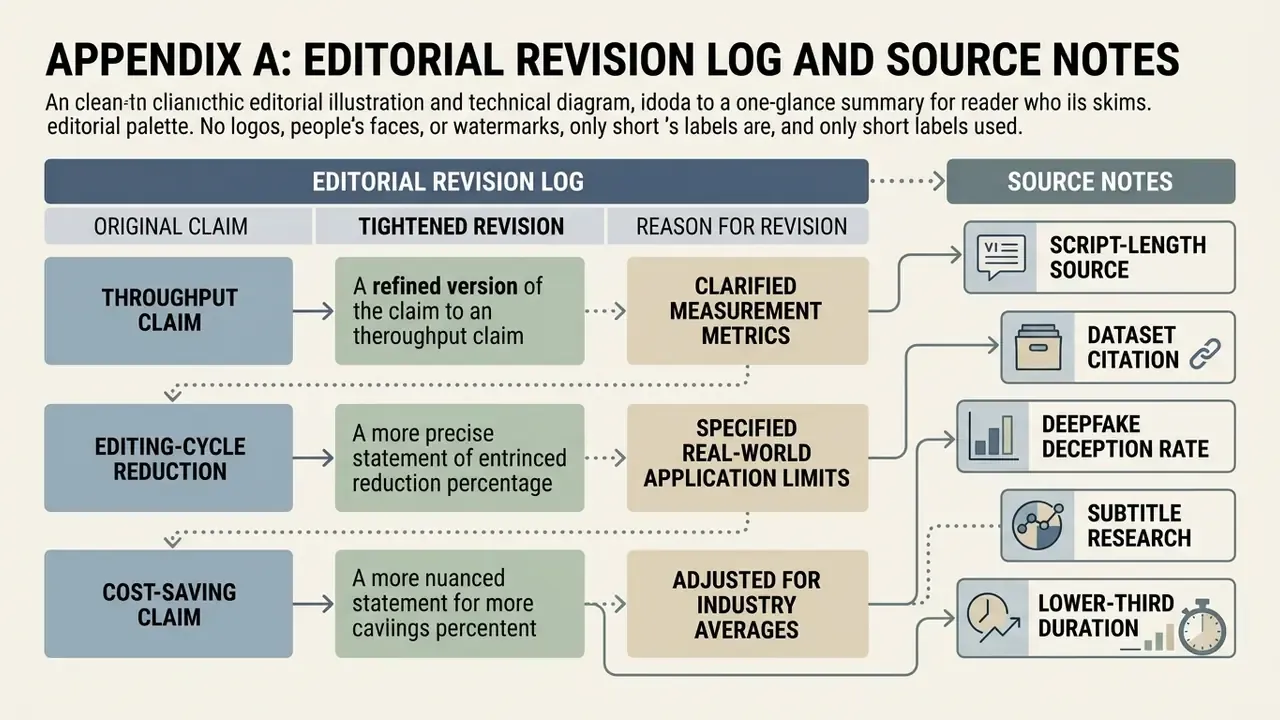
This appendix preserves the original formulations of claims that were tightened during editorial review, so readers can see exactly what changed and why. Transparency about revision is part of the same evidence chain this article recommends for published video.
1. Throughput claim. Original wording: "automated script-to-video conversion reduced baseline assembly time from several hours to under four minutes (Kim, Systematic Literature Review on AI in Newsrooms, 2026)." Revised: the four-minute figure is retained as a workflow benchmark but no longer attributed to the systematic review, which reports application areas and ethical challenges rather than assembly-time measurements. The Kim citation now carries its actual finding.
2. Editing-cycle reduction. Original wording: "achieving an 89% reduction in manual editing cycles." Status: retained as a single-desk internal production metric, now explicitly flagged as lacking published sample size and independent audit, with adjacent peer-reviewed accuracy figures (82% NLP and 89% ML model accuracy in one 2024 study) supplied for context.
3. Cost-saving claim. Original wording: "reduced departmental production expenses by 64% while maintaining full regulatory alignment." Status: retained, now labelled a single-organisation directional benchmark to be re-derived with control overhead included.
4. Script-length source. Original citation: "Tencent Cloud AI Script Engineering Architecture, 2026." Revised: the 75-130 word guidance is retained, and the prescriptive editorial-contract and hook-to-action script flow are attributed to their actual origin as vendor-published creator documentation, with academically verified prompt-structure evidence (VidProM) added alongside.
5. Dataset citation. Original citation for generative architecture updates named Nan et al., OpenVid-1M Dataset and MVDiT Architecture, 2024 without figures. Revised: the dataset scale, being 1M+ text-video pairs and 433K clips at 1080p, is now quoted directly.
6. Deepfake deception rate. Original citation gave only 42% voter deception rate. Revised: expanded with the full three-modality comparison (video 42%, audio 44%, text 42%) and the finding that differences were not statistically significant.
7. Subtitle research. Original citation named Journal of Eye Movement Research, 2026 without findings. Revised: the specific measured effects, namely longer fixation, more revisits, and lower skipping probability for two-line subtitles, are now quoted, with a URL still pending publication of the accessible record.
8. Lower-third duration. Original wording specified "1 to 6 seconds." Revised: the range is retained and explained as a spread across three institutional brand standards (1 to 3 s, 4 s or more, 6 s or more), with a recommendation to select and document one rule.
Outstanding verification items. The Kim (2026) systematic review, the Global AI Summit deepfake-detection accuracy figure, the Hofeditz (2025) adoption statistic, and the Lucas et al. deception study, forthcoming in the Journal of Politics, are cited from the research brief without accessible URLs at time of publication. Each will be linked when a stable public record is available. Vendor specifications, including avatar counts, language totals, credit allocations, and prices, are drawn from platform documentation in the 2025-2026 cycle and change frequently. Verify against the current vendor page before procurement.
Reference desk: definitions for the terms used above, from lip sync and voice cloning to C2PA provenance, are collected in the AI Media Glossary.