«No evidence, no autonomy. Evaluating generative visual models deserves the same validation discipline risk leaders apply to core financial decision engines.» Marcus Hale, AI Governance and Model Risk editorial columnist .
If you sit in a control function at a bank or a mature fintech, a gallery of pretty pictures is not the deliverable. The deliverable is a repeatable pipeline: known prompt, known model snapshot, known licence, known disclosure. Enterprise adoption of text-to-image synthesis needs benchmarks for prompt adherence, rendering fidelity and provenance, not anecdotes.
Modern generative image systems cover a wide spread of visual work, from photorealistic product photography to abstract data-mood plates for an investor deck. The question is which of those outputs you can actually ship, and what evidence you keep afterwards.
Executive summary (for risk, marketing and creative leads)
Contents in this guide: styles and copyable prompts · business and B2B use cases · commercial use, licensing and governance · prompt engineering · choosing a generator (comparison tables) · detecting AI images (SIFT, artefacts, viral cases) · validation checklist · FAQ
AI generated images examples by style
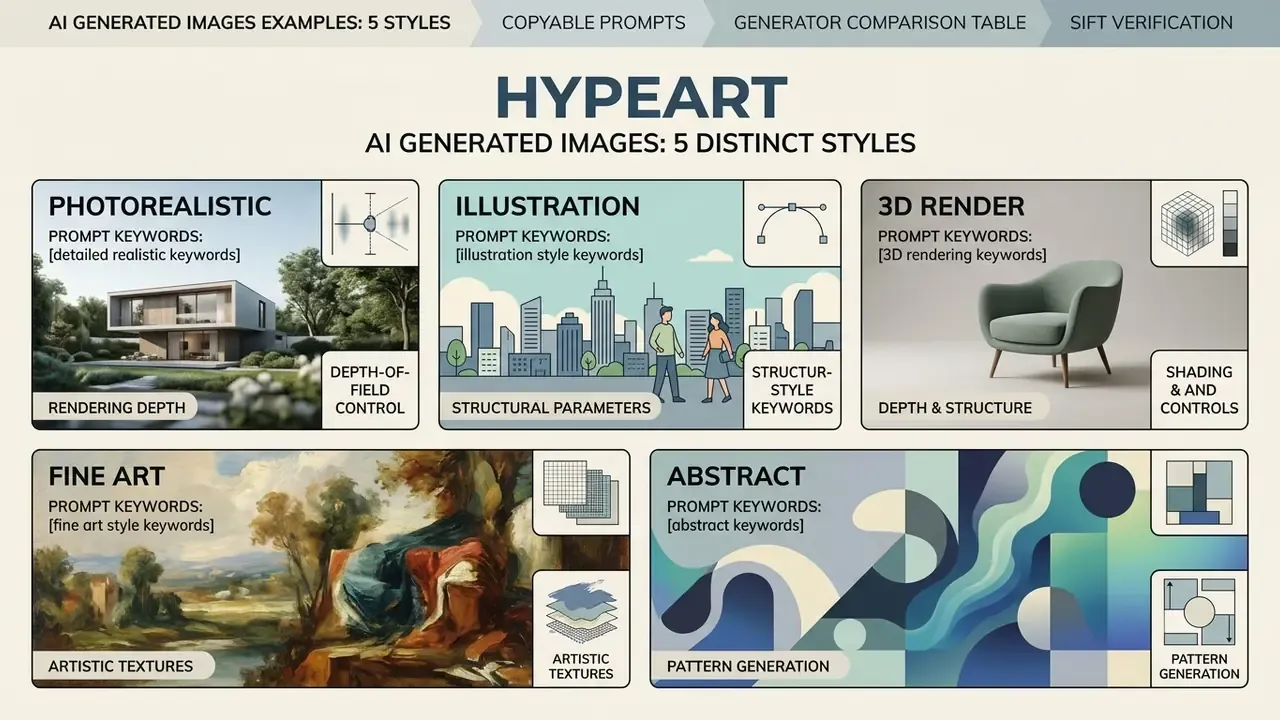
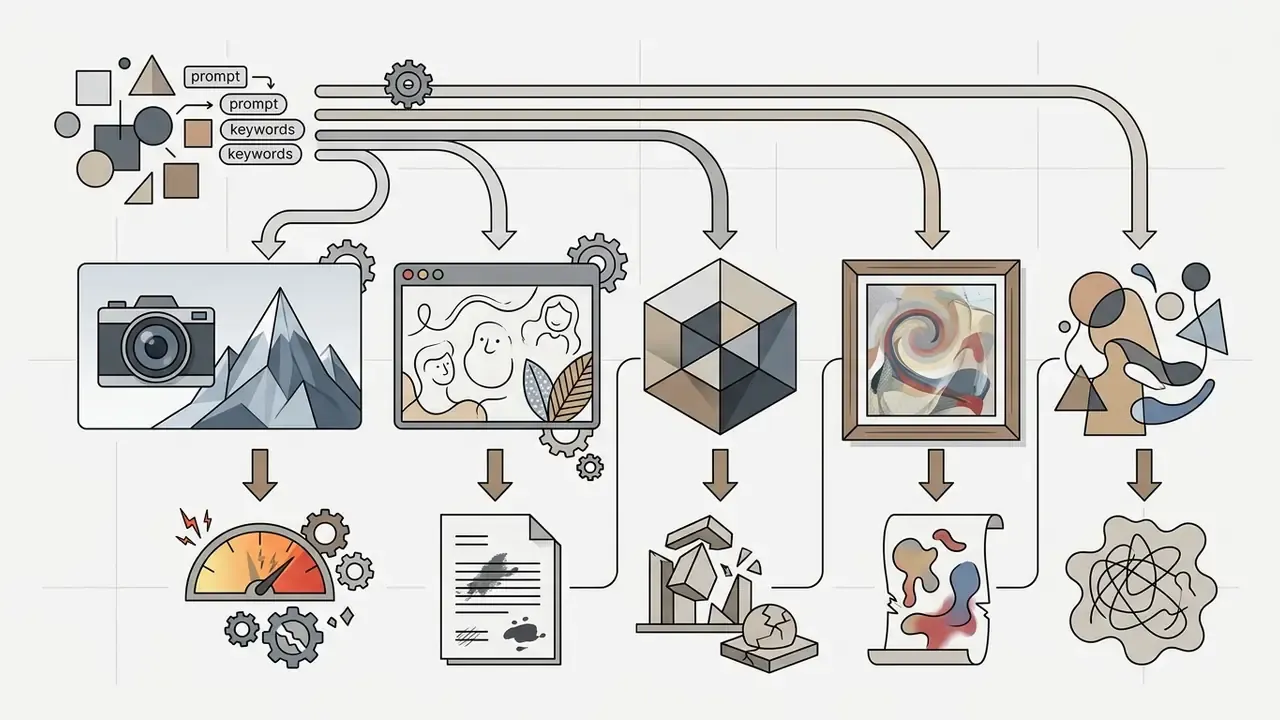
Synthetic visual generation produces outputs across distinct artistic categories, each defined by prompt keywords, rendering depth and structural parameters. Benchmark work such as VISTAR and GenAI-Bench shows that model performance moves noticeably with the target aesthetic. A model that nails a studio product shot can still fumble a line-art mascot.
«VISTAR uses 2,345 structured prompts and more than 15,000 paired expert comparisons to evaluate stylistic accuracy across models.»
Reviewing ai generated images examples across photorealism, illustration, 3D, fine art and abstraction helps teams match a generative framework to the brief instead of to a vendor demo. The table below replaces a decorative gallery with what a reviewer actually needs: one theme, five style keyword sets, and the artefact class that most often fails quality assurance.
annotated gallery. One subject rendered in five styles, each image carrying a unique alt attribute containing the phrase "ai generated images examples" or a close variant, plus visible caption with prompt text and model snapshot.)
| Style | Core prompt keywords (same theme: "a coffee roastery at dawn") | Typical model fit | Dominant failure mode to check |
|---|---|---|---|
| Photorealistic | 35mm lens, f/2.0, RAW photo, diffuse window light, visible dust, skin pores | FLUX.1 Pro, gpt-image-1.5, Midjourney V7 | Hands, pupil highlights, mirrored reflections |
| Illustration | flat vector, bold line weight, limited palette, editorial illustration | Recraft V3, Adobe Firefly 5 | Inconsistent line weight, broken symmetry |
| 3D render | volumetric render, frosted glass, brushed copper, softbox studio, octane | gpt-image-1.5, FLUX.1 Pro | Impossible geometry, floating contact shadows |
| Fine art | oil on canvas, impasto texture, chiaroscuro, painterly brushwork | Midjourney V7, Firefly 5 | Signature-like pseudo-text, smeared detail |
| Abstract | non-representational colour field, granular texture, risograph grain | Midjourney V7, Recraft V3 | Repeating pattern drift across the canvas |
Every production image should ship with a descriptive alt attribute containing the target phrase (for example, "photorealistic ai generated images examples of a coffee roastery"), plus prompt and model version in the caption. Prompt-visible captions are what turn a gallery into an auditable artefact. Without them you own a folder of pictures, not a controlled asset library.
Photorealistic AI image examples
Photorealistic generation simulates camera physics, optical depth and natural light behaviour to produce convincing imagery of people and products. Strong realistic photos depend on prompt directives naming camera bodies, lens focal lengths and an explicit lighting setup (Microsoft Learn, 2026).
The markers of high-fidelity generative ai image examples in photorealism are unglamorous: natural subsurface skin scattering, physically consistent shadow casting, anatomical plausibility. Post-processing matters roughly as much as generation. Teams finish assets in dedicated AI photo editors to correct micro-contrast, strip residual artefacts and normalise colour across a campaign set. Recent empirical work suggests frontier models now hit realism levels where non-expert reviewers barely outperform a coin toss.
«Participants correctly classified AI images in only 63% of cases, a result only marginally above chance.»
Copyable Prompt (photorealistic portrait):
"A close-up studio portrait of a 45-year-old female architect, subtle facial pores,
natural skin texture, asymmetrical features, shot on Hasselblad H6D-100c, 85mm lens,
f/2.8, soft key light from 45 degrees, warm ambient backlight, raw photorealistic
style --ar 16:9 --style raw"
Recommended models: FLUX.1 Pro / Midjourney V7 / gpt-image-1.5
Parameters: aspect ratio 16:9, fixed seed for reproducibility, no upscaling on draft pass
Negative prompt: "plastic skin, over-smoothed, symmetrical face, extra fingers,
watermark, text, logo, HDR halo, wax texture"
For identity-consistent business portraits, compare pipelines in our guide to the AI headshot generator category, where consent handling and retention policy carry as much weight as output quality. One correction worth making to the usual advice: a beautiful headshot with no documented consent record is not an asset, it is an open item in your issue log.
AI generated illustration examples
Illustrative styles use non-photorealistic rendering to produce digital art, vector concepts and character designs. Usage is broad, and skewed toward realism.
«66% of users apply AI tools to realistic scenes, while 41% use them for abstract art.»
Generative models build these assets by translating artistic-movement keywords, line-weight specifications and palette instructions into structured image tokens (Adobe Firefly Guide, 2026).
In workflow design, teams deploy an ai character generator to hold visual continuity across multi-frame storyboards and branding sets. Converting source assets through an ai character generator from photo lets creative teams turn real-world references into stylised vector formats while keeping the original composition intact. Studio-specific aesthetics carry extra IP risk, so read our review of Ghibli-style AI image generators before shipping a stylised campaign commercially.
Copyable Prompt (flat vector illustration):
"Flat vector character design of a software engineer working at a curved desk,
isometric view, bold line-weight, limited color palette of navy, teal and coral,
clean geometric shapes, digital vector illustration style, Adobe Illustrator visual
aesthetic --ar 4:3"
Recommended models: Recraft V3 (vector-native) / Adobe Firefly Image Model 5
Negative prompt: "gradient mesh noise, photographic texture, drop shadow, jpeg
artifacts, garbled lettering"
Copyable Prompt (character design sheet):
"Character design sheet, fantasy rogue female character, front view, side view,
back view, dark leather armor with hood, belt of daggers, short red hair, athletic
build, neutral T-pose, clean white background, concept art style, reference sheet"
Tip from prompt-engineering research: generate 3-9 seeds per concept to sample
output variation before locking a direction.
3D, fine art and abstract AI-generated images
Three-dimensional, fine art and abstract modes push generative work into volumetric asset modelling and non-representational experimentation. 3D prompt structures lean on material texture properties: porcelain, polished chrome, frosted glass (Microsoft Learn, 2026).
Fine art and abstract examples of ai images use diffusion latent-space manipulation to swap concrete objects for textured colour fields and spatial mood (Diffusion Art Survey, 2023). Teams comparing tools in these categories can review our analysis of AI art generators by style range and licence terms, or compare options across the wider tool landscape. Creative directors use these experimental styles to test mood concepts quickly during discovery, before anyone books a photographer.
Copyable Prompt (3D product render):
"Volumetric 3D render of a futuristic headphone, translucent frosted glass casing,
inner metallic copper parts, studio softbox lighting, octane render, Cinema 4D
texture quality, highly detailed surface materials --ar 1:1"
Copyable Prompt (fine art):
"Oil on canvas portrait of an elderly fisherman, impasto brushwork, chiaroscuro
lighting, muted ochre and Prussian blue palette, visible canvas weave, 19th-century
academic painting style --ar 3:4"
Copyable Prompt (abstract):
"Non-representational abstract composition, layered colour fields of oxidised
copper and bone white, granular risograph texture, soft diagonal light gradient,
large-format print aesthetic --ar 16:9"
Where AI generated images are used: business and workplace examples
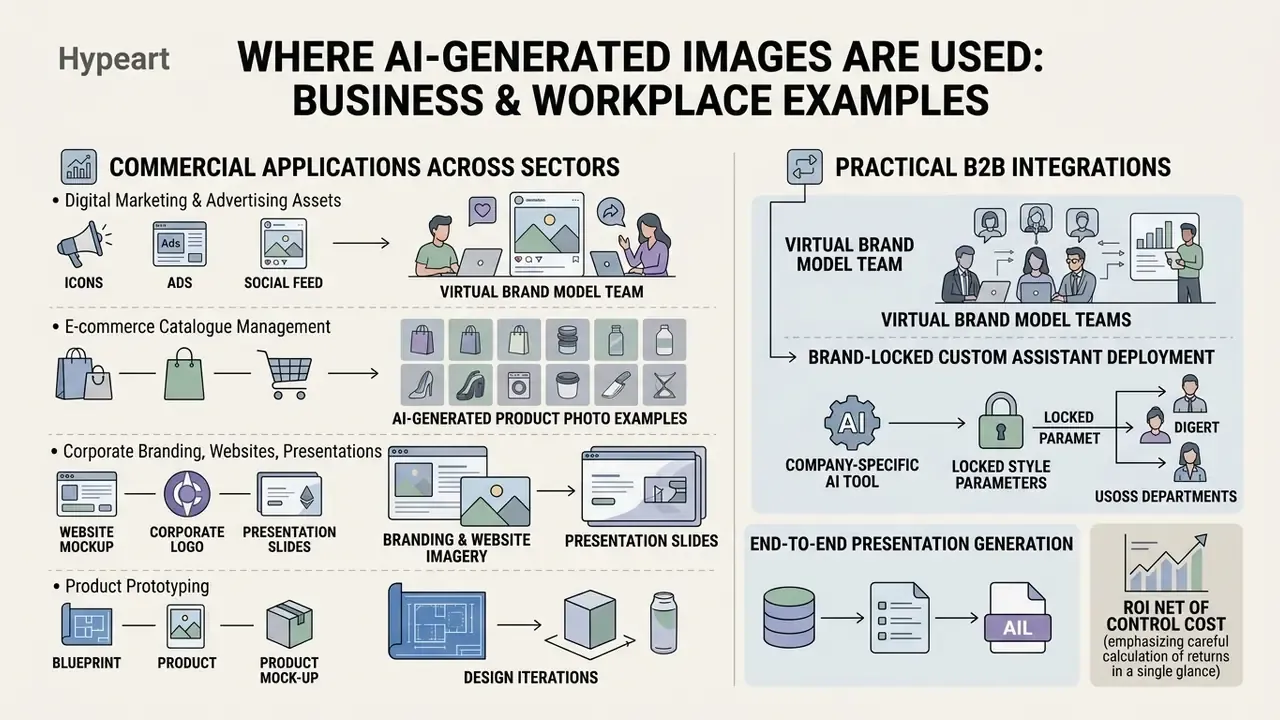
Commercial applications of synthetic visuals stretch across digital marketing, e-commerce catalogue management, corporate branding and product prototyping. The National Institute of Standards and Technology treats synthetic content workflows as operational domains that need explicit risk tiering and provenance controls (NIST, Reducing Risks Posed by Synthetic Content, 2024).
AI generated product photo examples for e-commerce
E-commerce teams use generative pipelines to build standardised listings and contextual lifestyle scenes without a physical studio booking. A typical workflow generates a base subject, removes the background, renders ambient lighting, then finishes through an AI image upscaler to meet marketplace resolution rules (1080p minimum, 4K preferred, multiple angles per product face).
An enterprise retail client evaluated generative product imagery to scale a catalogue across 400 SKU variants. By combining an automated background replacement pipeline with an online photo editor, the team cut media production timelines by 65% (internal client measurement, single-programme sample, not an independently audited benchmark; treat as directional and re-measure in your own environment). To test concepts before production, designers often use a free photo editor to check lighting consistency across draft listing assets.
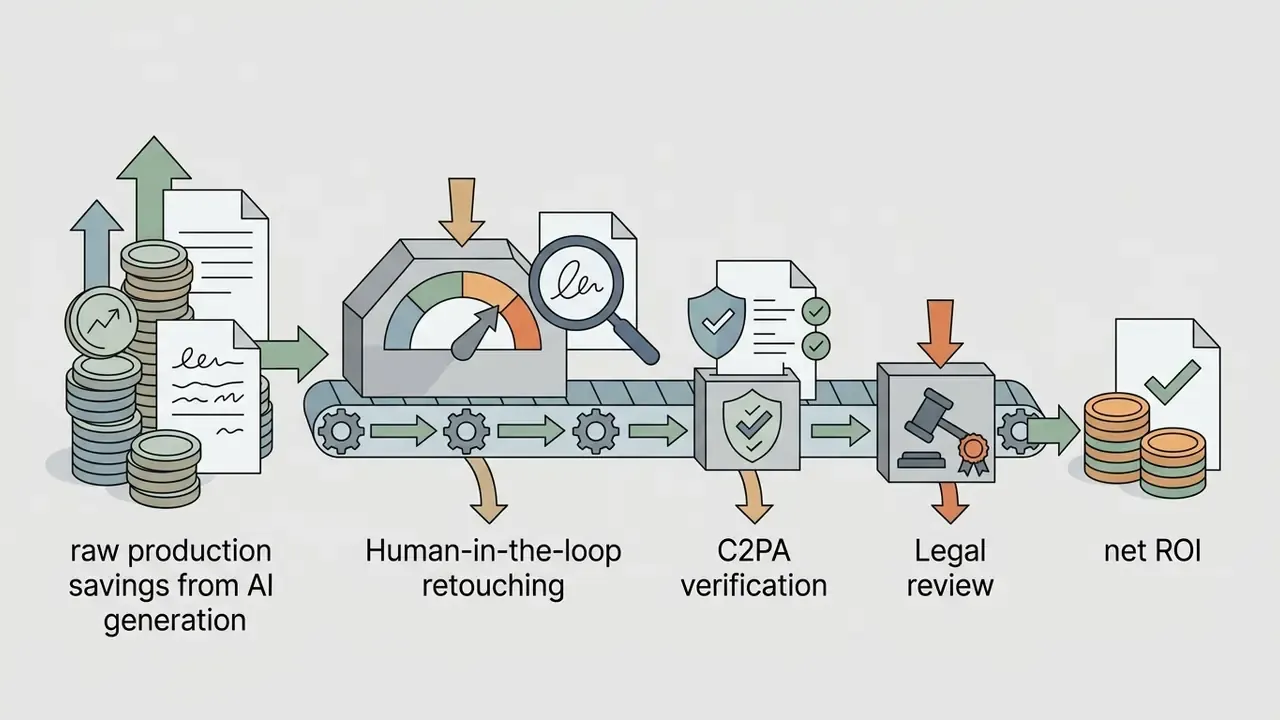
ROI must be net of control cost. That 65% figure was gross. Fully loaded, the same programme absorbed human-in-the-loop retouching (roughly 4 to 6 minutes per approved asset), C2PA manifest verification on export, and legal sign-off on any asset containing a human likeness. Finance teams should model AI imagery as production cost down, assurance cost up. The net gain is real, and materially smaller than vendor marketing implies. If you need to sanity-check the arithmetic for your own volumes, compare options with your own labour rates rather than a vendor template.
AI image examples for branding, websites and presentations
Corporate design workflows now fold synthetic visuals into brand-guideline development, web UI wireframing and executive presentation material. Modern design platforms convert corporate colour codes and typography rules into coherent visual brand kits (Figma AI brand guidelines, 2026).
When building executive dashboards or a finance transformation deck, teams pair generative branding assets with an ai chart generator so quantitative material reads visually. That pairing keeps brand alignment consistent across marketing graphics and analytical documentation, which matters when the same slide travels from a business unit to the board pack.
Three practical B2B integrations worth implementing:
- Virtual brand model teams. Apparel and accessory catalogues can composite product assets onto a fixed roster of synthetic models using consistent-character features (Midjourney
--cref) or specialised fashion pipelines such as Lalaland.ai, then swap backgrounds per channel. This removes repeat studio bookings and keeps a recognisable brand face. It also demands an explicit disclosure policy, since no real person consented to that likeness. - Brand-locked custom assistant deployment. Configure a DALL·E or FLUX-enabled assistant with fixed system instructions: approved palette hex codes, typography rules, mandatory negative prompts, banned subject matter, and an output disclosure footer. Non-designers then self-serve on-brand visuals, and brand-guideline enforcement stops being a manual bottleneck.
- End-to-end presentation generation. Chain generators into slide tooling (Gamma, Canva AI) so a text brief produces a full deck with per-slide imagery in minutes. Gamma documents export to live web links with analytics, PDF or Word. For pricing and export limits, see our overview of the canva ai generator, and view the guide to plan tiers before committing a department budget.
Platform-specific evaluations are also available for the microsoft ai image generator and the google ai image generator.
Can AI-generated images be used in commercial projects?
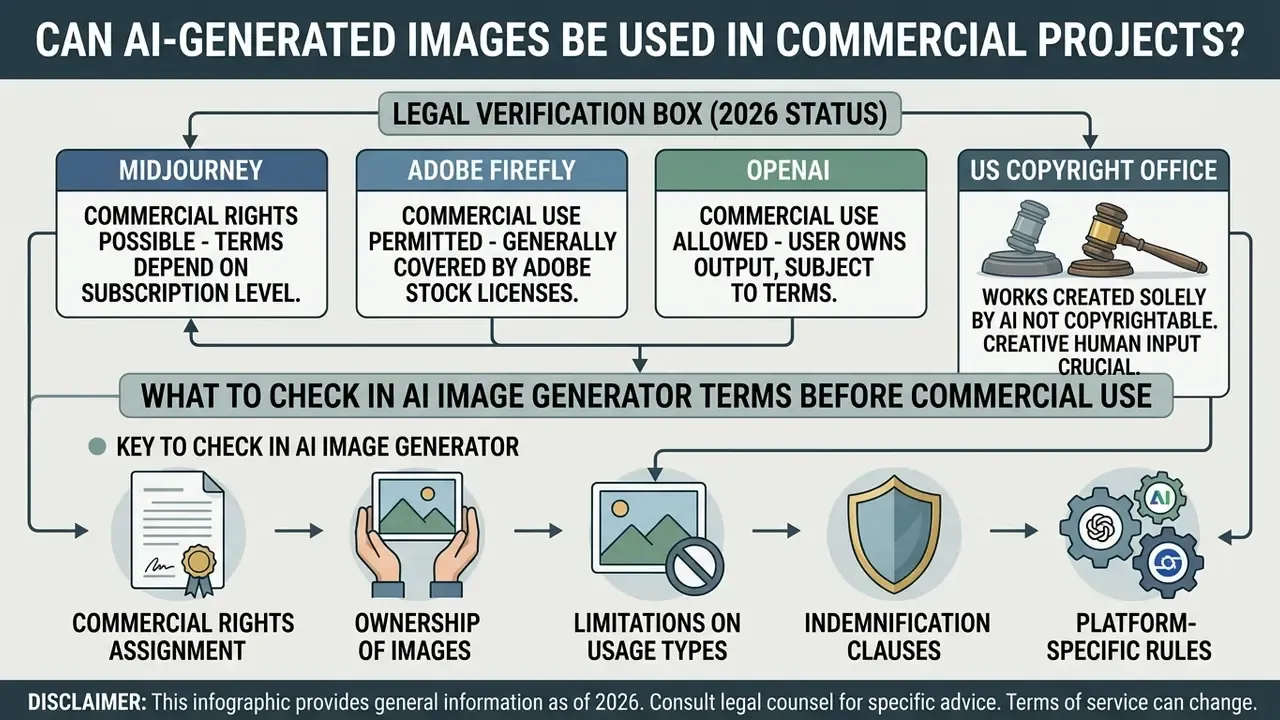
Commercial deployment of ai generated images is permitted under defined vendor licences, subject to regional disclosure mandates and intellectual property frameworks. For enterprise buyers, treat this section as a gate: run it before shortlisting generators, not after procurement has already signed.
Legal verification box (2026 status):
- Midjourney. Terms of Service grant asset ownership "to the fullest extent possible under applicable law", but companies grossing more than $1,000,000 USD annually must hold a Pro or Mega plan to own commercial output (Midjourney Terms of Service, 2025).
- Adobe Firefly. Output from non-beta Firefly features is approved for commercial projects, and Adobe offers indemnification against third-party IP claims on eligible commercial plans (Adobe Firefly legal terms and Generative AI User Guidelines, last updated 2026-05-15).
- OpenAI. Help Center terms state users may reprint, sell and merchandise generated images, subject to the Content Policy. Note that DALL·E 3 has been removed from the API in favour of current image models, so product-surface availability and API availability differ.
- US Copyright Office. Images lacking meaningful human creative contribution are ineligible for federal copyright registration, and mixed works must disclaim AI-generated portions at registration.
What to check in AI image generator terms before commercial use
Legal teams should review vendor commercial terms before any synthetic image enters marketing or product surfaces:
- Commercial rights assignment. Confirm whether paid tiers grant full commercial exploitation rights (Midjourney Terms, 2025).
- Revenue thresholds. Verify tier requirements. Midjourney, for example, requires entities above $1,000,000 gross annual revenue to hold Pro or Mega plans (Midjourney Terms, 2025).
- Indemnification guarantees. Check whether the provider offers protection against third-party copyright claims (Adobe Firefly Legal Terms, 2025).
- Data handling. Confirm whether prompts and uploads are retained or used for training, whether zero-data-retention is contractually available, and which certifications (SOC 2 Type II, ISO 27001) cover the specific endpoint you will call. Endpoint-level scope, not corporate-level marketing.
- Gallery licences. Adobe's generative AI product-specific terms note that submitting output to an Adobe-hosted gallery grants Adobe a non-exclusive licence for that submission.
«When traditional elements of authorship are produced by a machine, the work lacks human authorship and is not registrable.»
For a central repository of licensing models and platform terms, consult the AI Media Commercial-Use Hub and our reference page on AI image generator commercial use. Specialised breakdowns cover consumer search integrations in our review of bing ai image.
Why legal and ethical implications matter for brands
Under US Copyright Office guidance, purely AI-generated outputs without human creative authorship are ineligible for federal registration (USCO Guidance, 2024). Reputational exposure runs parallel to the legal kind:
«Consumers with high aversion to AI in marketing show more negative brand attitudes even when content quality is objectively equivalent.»
How prompts shape an AI generated image example
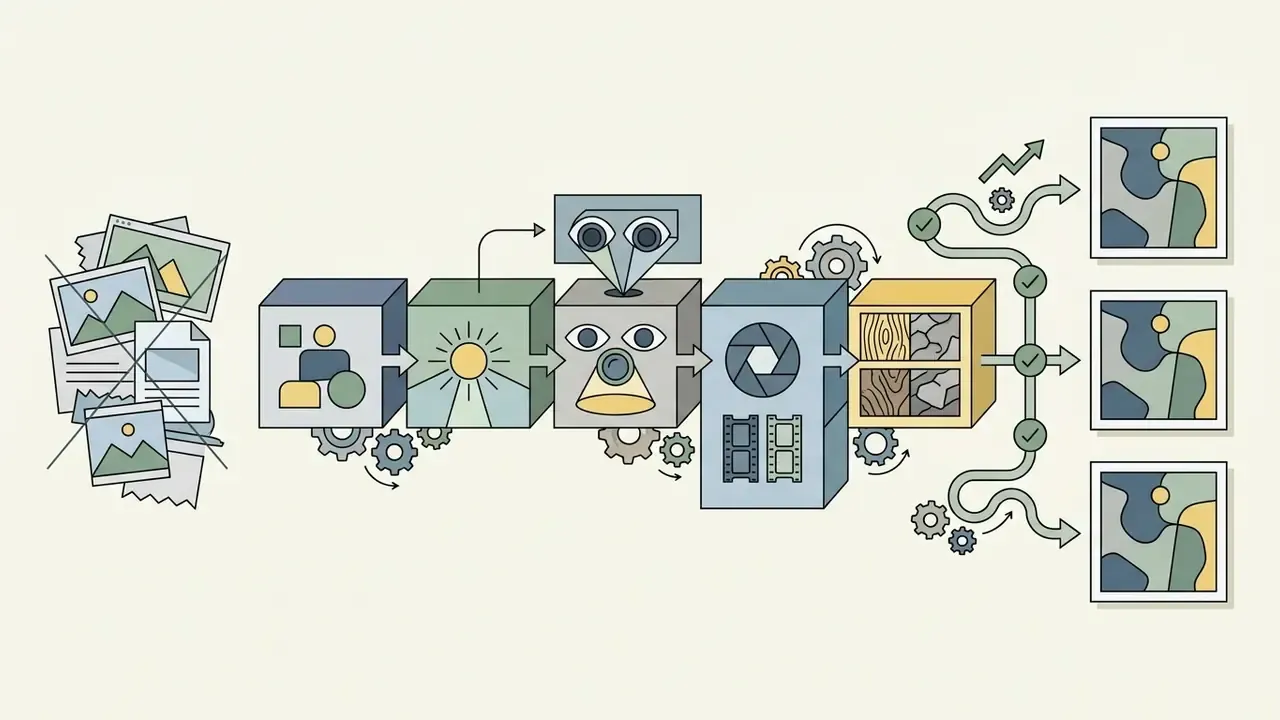
Prompt engineering is the control interface for text-to-image synthesis. It sets composition, stylistic adherence and detail resolution, and it is the only layer most enterprise teams can fully instrument.
«Automatic prompt adaptation via reinforcement learning consistently improves image quality on both automatic metrics and human ratings.»
Comparative studies also show structured prompt formats outperforming unstructured text, and that diversifying example formats inside a prompt improves robustness to format changes (NAACL, 2025).
Prompt construction formula (the reproducibility unit):
Subject → Action → Environment → Style → Lighting → Composition/Camera → Details and constraints
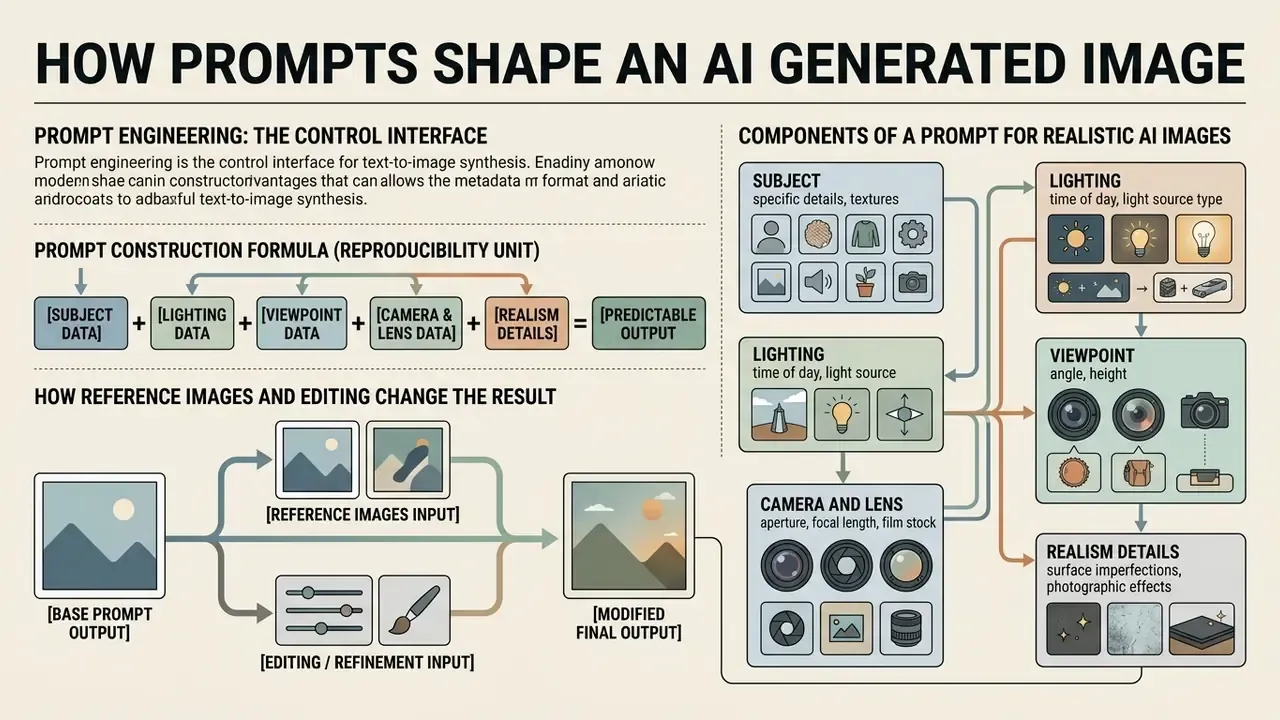
Worked expansion. The short prompt cat becomes:
"A fluffy orange cat sitting on a wooden windowsill, looking outside, in a cozy
apartment, editorial photo style, warm morning light, centered composition, soft
background blur, high detail --ar 3:2 --seed 148820"
Every published example in an enterprise library should record six fields: prompt text, negative prompt, model snapshot, seed, sampler, aspect ratio. Without them, a "good result" is an anecdote rather than a repeatable asset. Auditors do not accept anecdotes.
Components of a prompt for realistic AI images
A robust ai generated photo example prompt needs a five-part structure to hit reliable photorealism (OpenAI image prompting guide, 2026):
- Subject.Core entity, specific age or material, defining physical characteristics.
- Lighting.Directional quality, for example diffuse golden hour or high-contrast studio strobe.
- Viewpoint.Camera framing, for example extreme close-up, wide-angle 35mm, low angle.
- Camera and lens.Optical properties: f/1.8 depth of field, RAW photo texture, grain.
- Realism details.Micro-imperfections: skin pores, fabric wear, subtle asymmetry.
Technical parameters that decide consistency: --seed fixes the pseudo-random draw, though identity holds only when prompt, decoding settings and serving environment stay unchanged. --ar sets aspect ratio before upscaling. Sampler and step count refine detail at higher values, and simultaneously amplify artefacts in hands and text. Style weight controls how hard the aesthetic pulls. Negative prompts remain the cheapest quality control available: "extra fingers, fused hands, garbled text, watermark, logo, plastic skin, over-sharpened halo, duplicated background pattern" removes most recurring rejection reasons in a review queue.
How reference images and editing change the result
Conditioning models with reference images, through frameworks such as ControlNet or IP-Adapter, adds spatial and structural control beyond text alone (Hugging Face Diffusers docs, 2026, which describe IP-Adapter as a lightweight image-guidance adapter that leaves original UNet weights frozen). Inpainting and outpainting allow localised edits without disturbing surrounding elements.
«Images generated from long, highly detailed prompts are recognised as synthetic significantly more often, by humans and by automated detectors alike.»
That trade-off is operationally interesting. Maximal prompt detail buys fidelity and raises detectability. Not a problem where disclosure is mandatory anyway, and decisive where it is not.
When extending canvas boundaries for responsive web banners, designers use ai expand image technology to extrapolate background scenery. The edit preserves subject integrity while adjusting ratios for multi-channel distribution, which is usually cheaper than reshooting a hero frame.
How to choose an AI image generator for a specific outcome
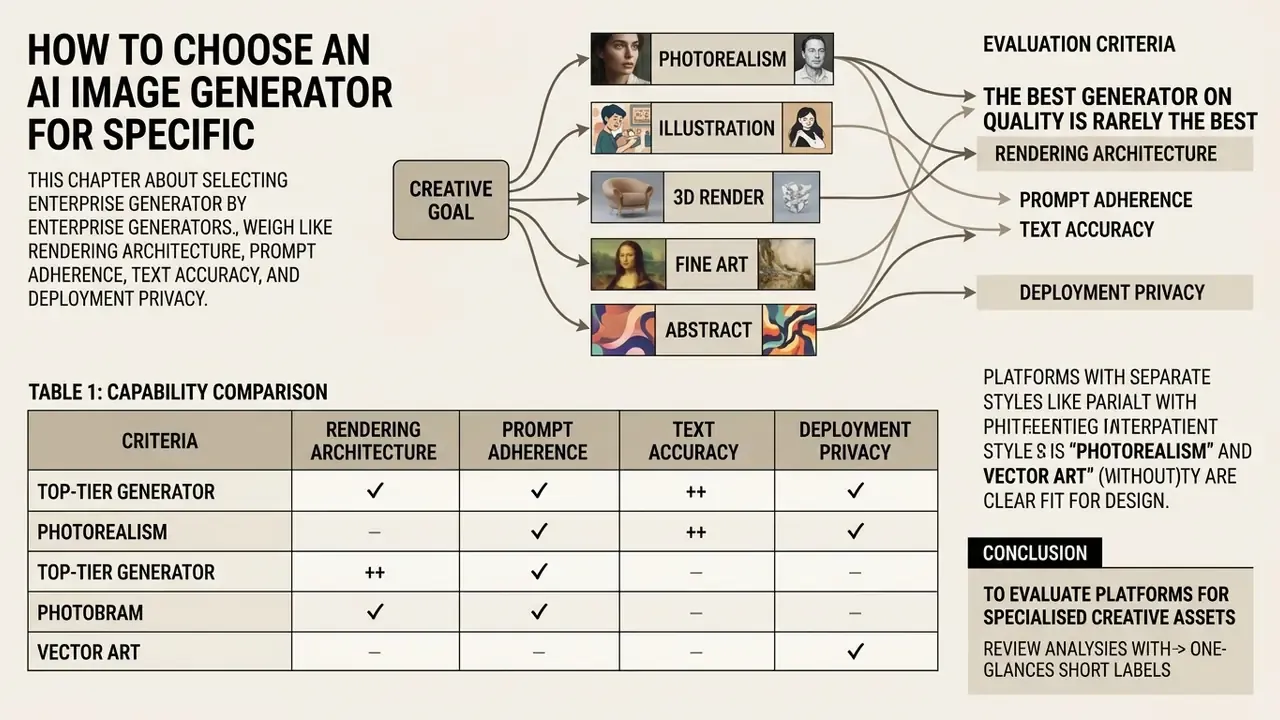
Selecting an enterprise generator means weighing rendering architecture, prompt adherence benchmarks, text accuracy and deployment privacy terms. Start from our comparison of AI image generators, then validate against your own fixture set. Independent benchmarks confirm that closed proprietary models and open-weight diffusion ecosystems carry distinct operational trade-offs (R2I-Bench, 2025).
Table 1. Capability comparison
| AI Image Generator | Realism Score (R2I) | Prompt Adherence | Text Rendering | Image-to-Image / ControlNet | C2PA support | Commercial Licence |
|---|---|---|---|---|---|---|
| OpenAI gpt-image-1.5 | High (0.71) | 9.4/10 | Advanced | Multi-asset / inpainting | Yes | Commercial (paid) |
| Midjourney V7 | High (0.68) | 8.9/10 | Moderate | Vary Region / Pan / character ref | Yes | Commercial (paid; >$1M revenue rule) |
| FLUX.1 Pro | High (0.65) | 9.2/10 | Advanced | ControlNet / depth / IP-Adapter | Yes | Commercial licence |
| DALL·E 3 | Moderate (0.58) | 8.5/10 | High | Basic inpainting | Yes | Commercial (included; removed from API) |
| Recraft V3 | Moderate | 9.0/10 | Vector-native | Style reference / vector edit | No | Commercial |
Table 2. Enterprise procurement criteria (verify each line against the vendor's current DPA and security portal; entries marked "confirm" were not verifiable from primary documentation at publication)
| Generator | Zero data retention available | Security attestations | IP indemnification | Private/enterprise deployment |
|---|---|---|---|---|
| OpenAI gpt-image-1.5 | Enterprise tiers, confirm | Confirm via trust portal | Confirm scope | API plus enterprise agreement |
| Midjourney V7 | Not documented publicly | Not documented publicly | Not offered as standard | Web/Discord only |
| FLUX.1 Pro | Self-host removes vendor retention | Depends on host | Depends on distributor | Self-host or API |
| Adobe Firefly 5 | Enterprise terms | Adobe enterprise compliance programme | Yes, on eligible commercial plans | Enterprise apps plus API |
| Recraft V3 | Confirm | Confirm | Confirm | API |
Read together, the two tables say something plain: the best generator on quality is rarely the best on paperwork. Firefly wins on indemnification, FLUX wins when self-hosting removes vendor retention entirely, gpt-image-1.5 wins on reasoning-heavy scenes. Budget-constrained teams can also review free AI image generators, noting that free tiers frequently carry watermarks and restricted commercial rights.
Generators for realistic photos, art and graphic design
Top-tier generators show specialised strengths depending on the production goal. Frontier models such as gpt-image-1.5 lead in photorealistic fidelity and complex scene reasoning (OpenAI, 2026).
«gpt-image-1 outperforms the best open-source model by 71.1% on the overall R2I-Score across all seven reasoning categories.»
Recraft documents separate Photorealism and Vector art styles, which makes it the clearest fit for design systems and vector production. Adobe Firefly spans images, video, audio and vector graphics inside one creative surface, which matters more for governance than for craft: one vendor, one licence, one audit trail.
To evaluate platforms for specialised creative assets, review our analysis of the best ai art generator. Teams under tight budget constraints can look at entry-level options in our guide to the best free ai art generator. For Discord and web interface workflows, see our comparative evaluation of the midjourney ai image generator.
Prompt accuracy, in-image text and output control
Prompt adherence measures how faithfully a model turns complex multi-subject instructions into pixels without silently dropping an attribute.
«GenAI-Bench covers 1,600 compositional prompts and more than 15,000 human ratings; VQAScore correlates with user preference better than CLIPScore.»
Text rendering inside images remains a genuine weak point, even though transformer-based models have improved legibility (CVPR text-rich image benchmark, 2024, 2,104 human-annotated images). Stress tests such as STRICT (2025) confirm ongoing limits on readable string length and instruction-following for rendered text. Which is exactly why product packaging copy and UI labels belong in a layout tool, composited on top, not generated.
Teams weighing conversational interfaces for generation can consult our analysis of the chatgpt picture generator. Scoring prompt alignment on your own briefs, not on a public leaderboard, is what keeps a tool choice defensible six months later.
How to tell AI-generated photos from real images
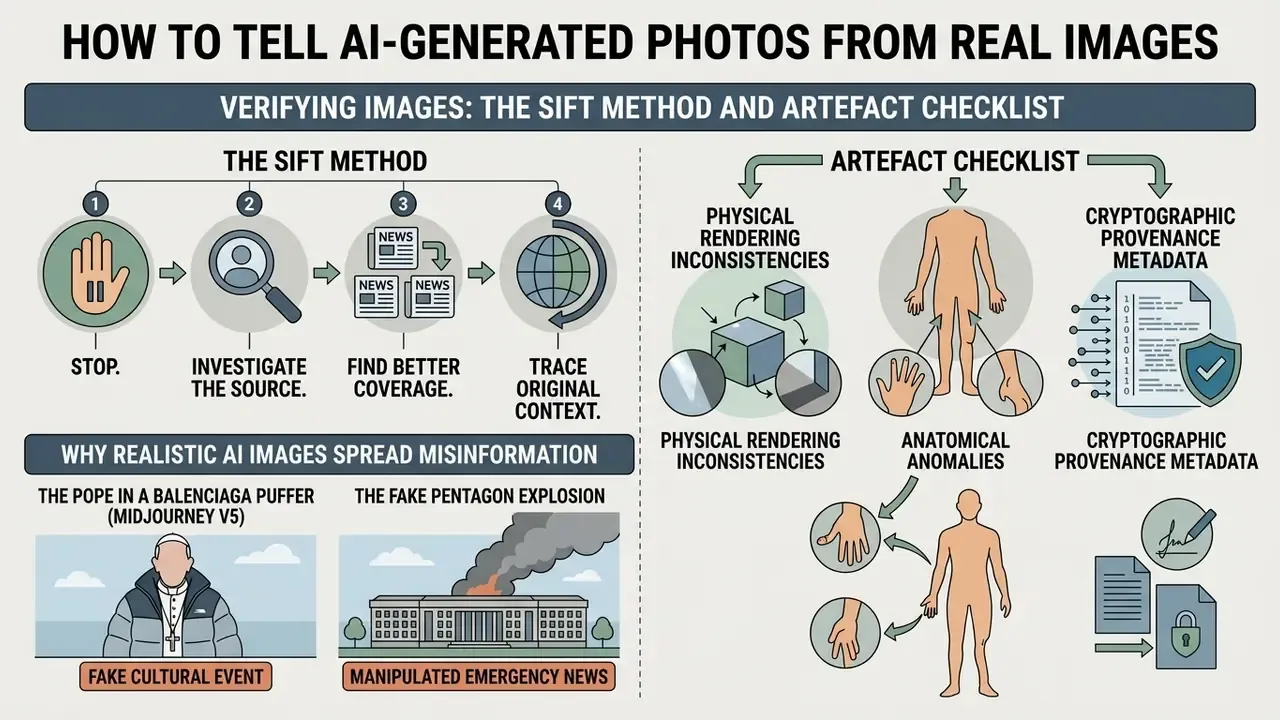
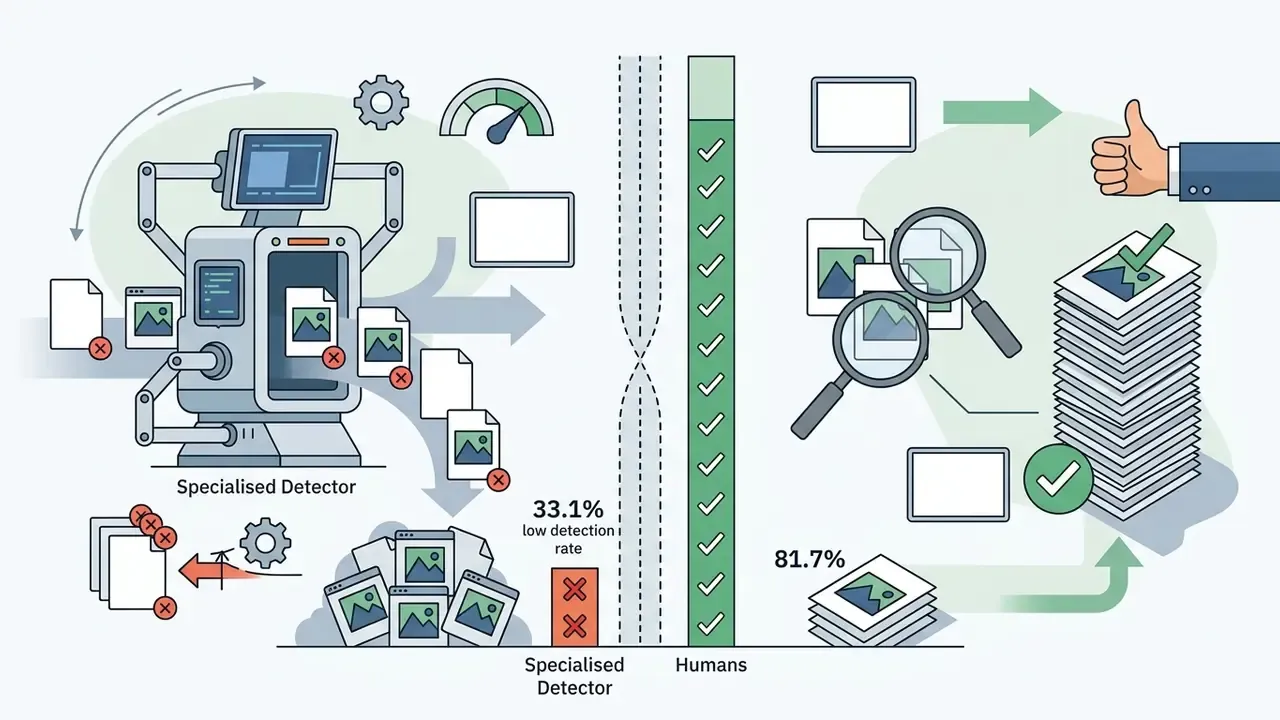
Identifying synthetic media means checking physical rendering inconsistencies, anatomical anomalies and cryptographic provenance metadata. The realistic baseline is uncomfortable:
«In SafeIMG, the best specialised detector recognises only 33.1% of synthetic images, while humans reach 81.7% accuracy.»
Automated detection alone is therefore insufficient. Process plus tooling is the working control, in that order.
Verifying images: the SIFT method and artefact checklist
SIFT methodology for checking whether an image is AI-generated:
Visual artefact checklist:
- Anatomy. Deformed nail plates, incorrect phalange counts, merged hands, asymmetric pupils or ear geometry.
- Light physics. Mismatch between catchlights in the eyes and the background light source, missing contact shadows under small objects, impossible mirror reflections.
- Textures and geometry. Blurred or pseudo-glyphic lettering on background signage, garbled product labels, clothing that fuses into the body, drifting repeated background patterns.
- Surface quality. "Plastic" over-smoothed skin, uniform micro-contrast across the whole frame, unnatural colour balance.
- Metadata. Intact capture metadata supports authenticity, while fully stripped metadata may indicate manipulation, or just ordinary platform re-encoding. Treat it as a signal, not proof (US DoD media-forensics guidance; NIST AI 100-4, 2025).
- Stop.When an emotionally charged or newsworthy frame lands, do not share or republish before metadata and source checks are done.
- Investigate the source.Run the file through ai reverse image search and inspect any C2PA manifest for a valid cryptographic signature and edit history.
- Find better coverage.Confirm whether established agencies (Reuters, AP, AFP) report the same visual fact independently.
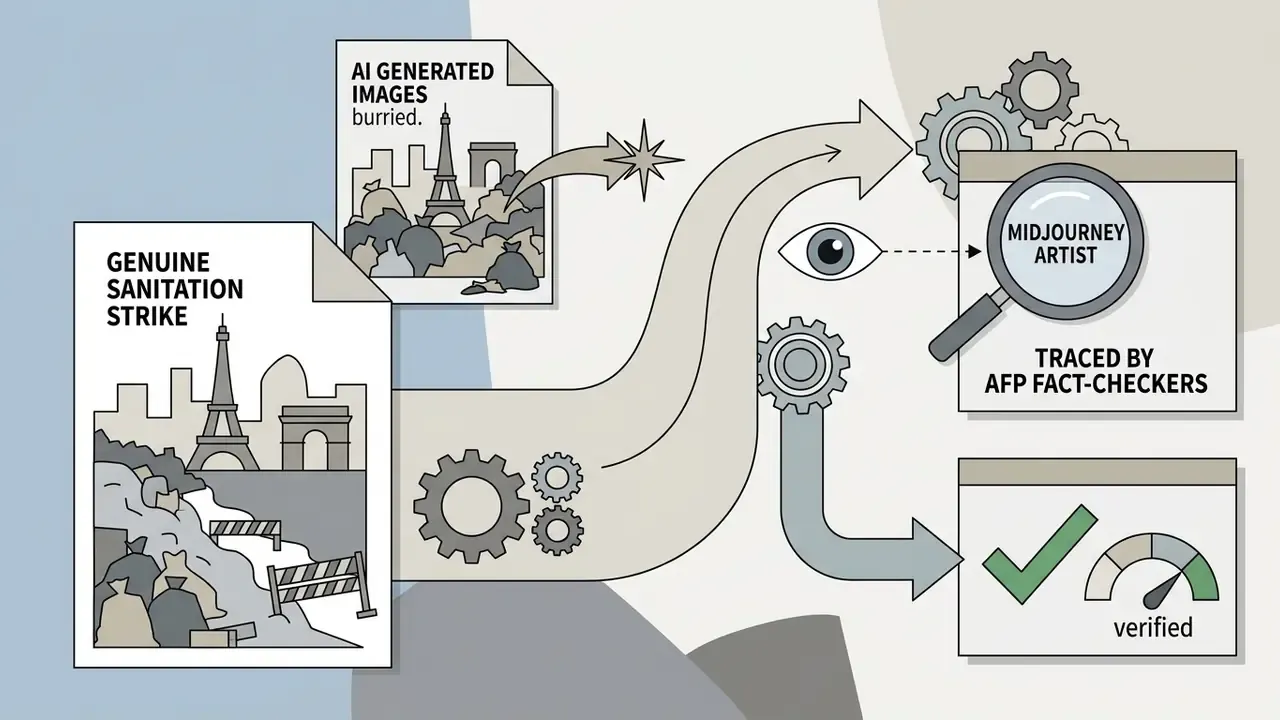
- Trace the original context.Locate the first publication, whether an author's social account, a prompt-artist gallery or a stock library, and compare it with the version circulating now.
NIST AI 100-4 (2025) adds object-level cues that are genuinely useful in portrait review: asymmetric earrings, inconsistent iris colour between eyes, implausible eye reflections. Small things. They break the illusion faster than any classifier.
Why realistic AI images spread misinformation
Photorealistic synthetic imagery becomes an institutional risk when it is deployed deceptively or used for brand impersonation (GAO deepfake guidance, 2024).
Unlabelled synthetic imagery erodes visual trust across news channels and financial communications, so verification teams should standardise on AI image detectors as one layer inside SIFT rather than as a verdict machine. Adopting open standards such as C2PA manifest tagging lets organisations cryptographically verify content origin (C2PA Technical Specification 2.4, 2024, which defines c2pa.metadata JSON-LD assertions and the c2pa.watermarked.bound soft-binding path).
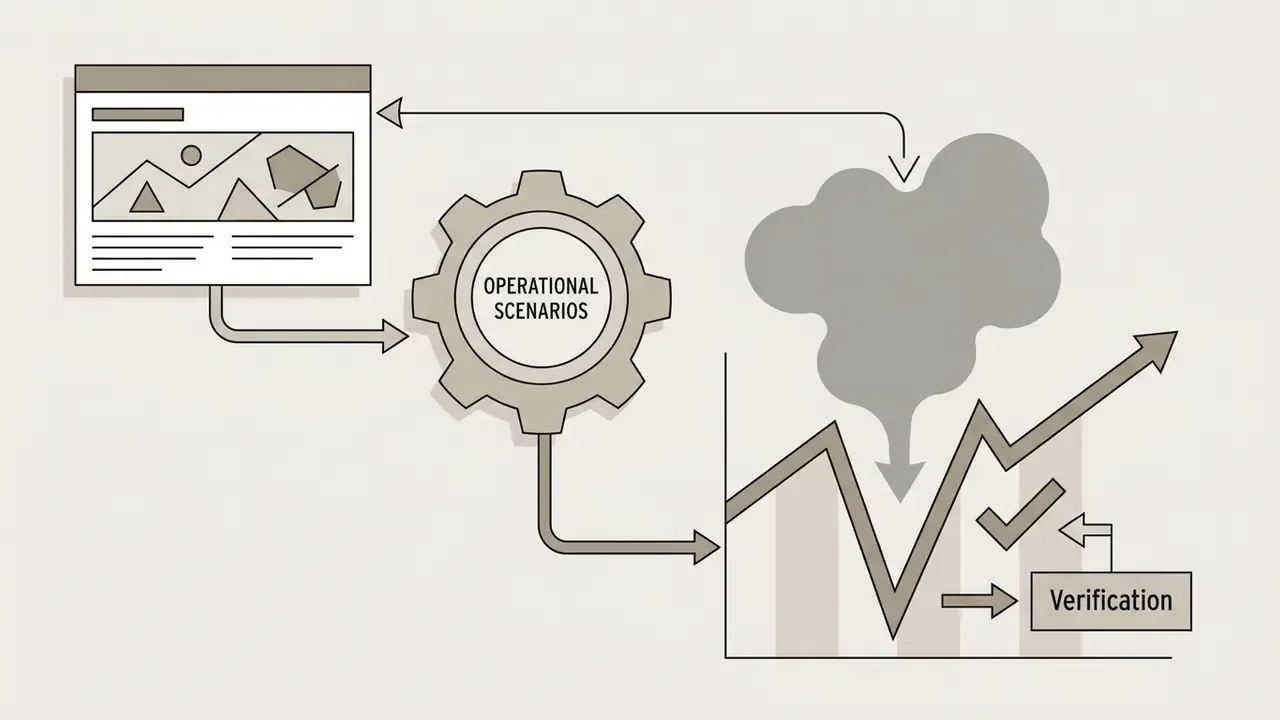
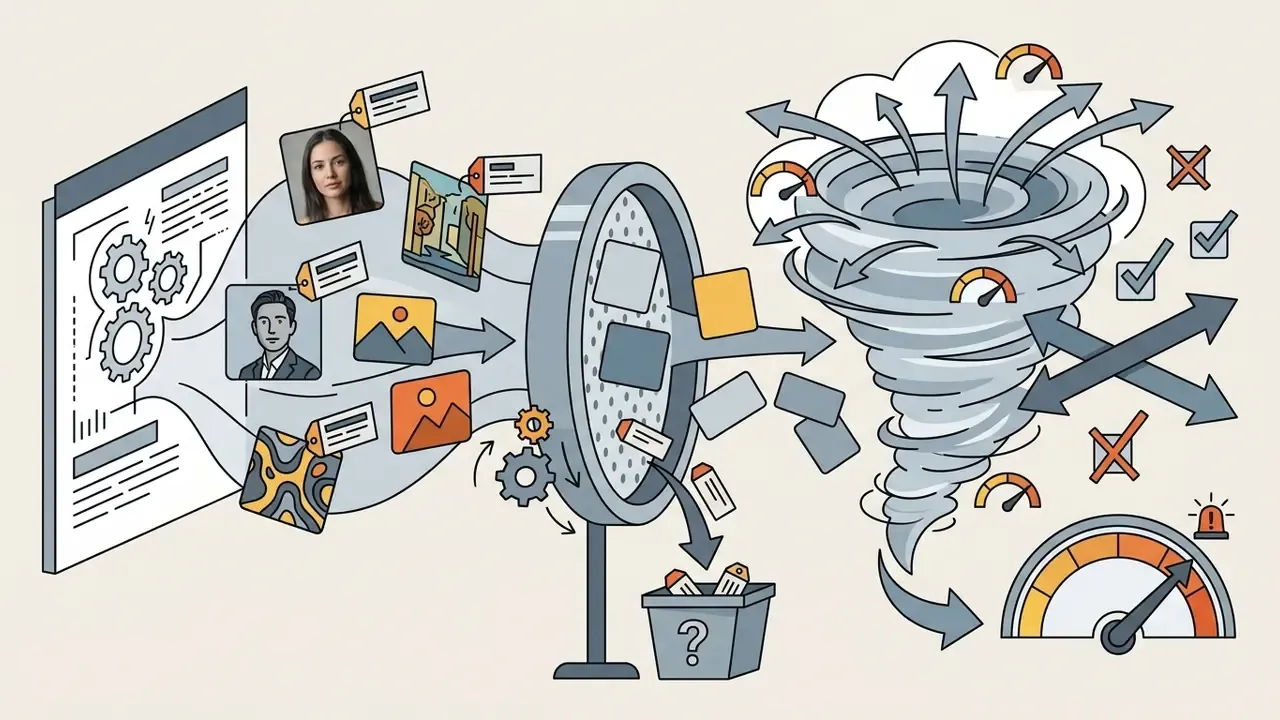
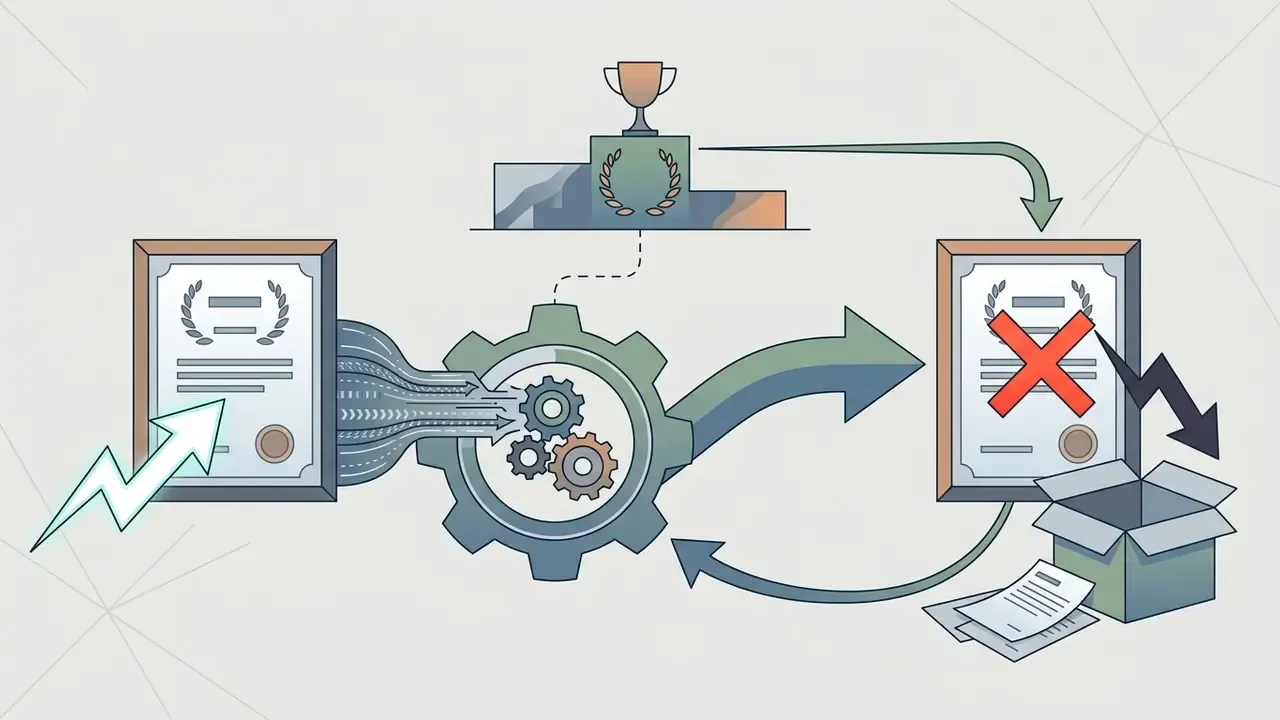
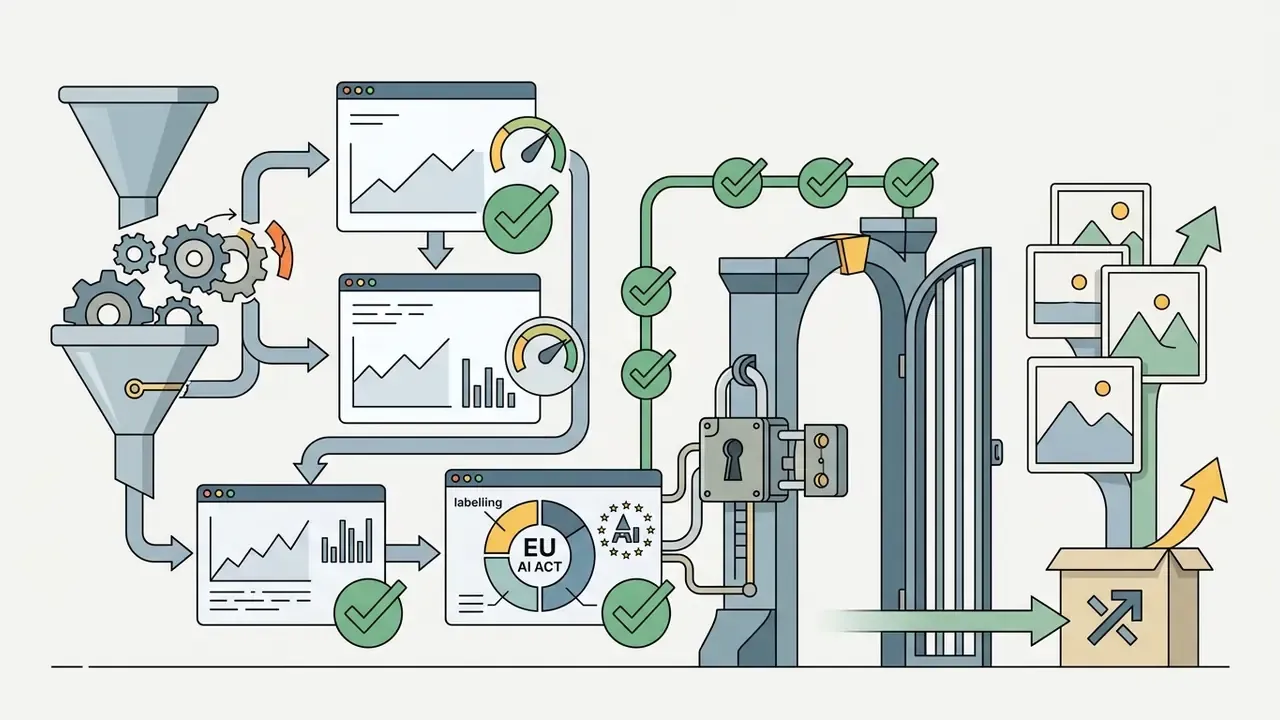
Validation checklist for visual AI assets (audit and risk teams)
Use this as an acceptance gate before any synthetic image reaches a client-facing channel:
- Prompt, negative prompt, model snapshot, seed, sampler and aspect ratio recorded in the asset record.
- Human-in-the-loop review completed and signed, with reviewer name and timestamp.
- Artefact pass completed against the anatomy, light physics, texture and metadata checklist.
- No recognisable real person's likeness without documented consent or licence.
- No protected trademark, studio-signature style or copyrighted character present.
- Vendor licence tier confirmed sufficient for the entity's revenue band.
- C2PA manifest present and validating on the exported file.
- Article 50 machine-readable disclosure applied where the asset will be distributed in the EU.
- Prompt and upload retention settings verified against the approved data-handling policy.
- Archive copy retained with the full provenance chain for audit reconstruction.
FAQ about AI generated images examples
Technical questions about synthetic image generation cluster around three things: output uniqueness, performance variance and model selection. Answers below read in full, with no hidden panels.
Will two identical prompts create identical AI images?
Two identical text prompts will not produce identical images unless the pseudo-random noise seed, sampler parameters, model snapshot version and execution environment all stay fixed (OCI Generative AI docs, 2026). Diffusion relies on stochastic sampling from latent space, so unseeded generations naturally yield unique variations.
More on generation uniqueness: without a fixed seed the model draws randomly from latent space. vLLM documentation notes that a seed sets random states across random, numpy and torch, yet reproducibility still depends on scheduling and multiprocessing, so hosted APIs cannot guarantee byte-identical output across environments. To choose tooling with the control surfaces you need, see our comparison of AI image generators or review free AI image generators and their parameter limits.
Why does my AI-generated image look worse than the gallery examples?
Gaps between your draft and a promotional showcase usually trace back to prompt brevity, untuned parameters or missing post-processing (OpenAI prompt guide, 2026). Published gallery ai generated images samples typically pass through multi-stage prompt optimisation, reference-image conditioning and high-resolution upscaling before anyone sees them.
How to improve results: add explicit lighting, viewpoint and texture specifications, add a negative prompt, generate 3 to 9 seeds before judging a direction, pin production work to a specific model snapshot, and evaluate against a fixed fixture set of test prompts rather than one-off impressions. Developers can automate the loop through the AI Media API and benchmark alternatives via our AI art generator comparison.
Are AI-generated images unique enough to avoid duplication risk?
NIST's GenAI evaluation programme frames uniqueness not as a single score but as two questions: can the output be distinguished from human-made content, and is it believable? Practically, unseeded outputs will differ visually, yet stylistic proximity to a training-set artist or a trademarked character stays a legal risk independent of pixel-level uniqueness. Check style provenance, not just file hashes.
Why do models score differently on benchmarks than in my own tests?
NIST separates benchmark accuracy from generalised accuracy. A model can look strong on a public test set and behave differently on your unseen prompts. Build a 20 to 30 prompt internal fixture set that mirrors your real briefs, and re-run it whenever a vendor ships a model update. Cheap discipline, high payoff.
Which style family carries the most compliance risk?
Photorealistic portraiture, without much debate. Likeness, consent and disclosure obligations all converge there, and it is the category where ai picture examples are most likely to be mistaken for real photography. Abstract and vector work sits at the other end of the scale, with IP-adjacent style imitation as the main residual concern.
Conclusion
Evaluating AI-generated images means combining aesthetic standards with formal risk governance, and neither alone is enough. Record prompts, seeds and negative prompts. Verify vendor commercial licences and data-retention terms before selection rather than after. Apply SIFT-based verification to inbound imagery. Enforce C2PA provenance on outbound assets. Do those four things and the best ai generated images examples in your library become defensible assets rather than open audit findings.
One honest limitation: detection tooling is currently the weakest link in this chain, and no vendor claim should be taken at face value until you have tested it on your own fixtures. Start small, document everything, expand scope when the evidence holds.
Appendix A. Internal fixture set and control ownership
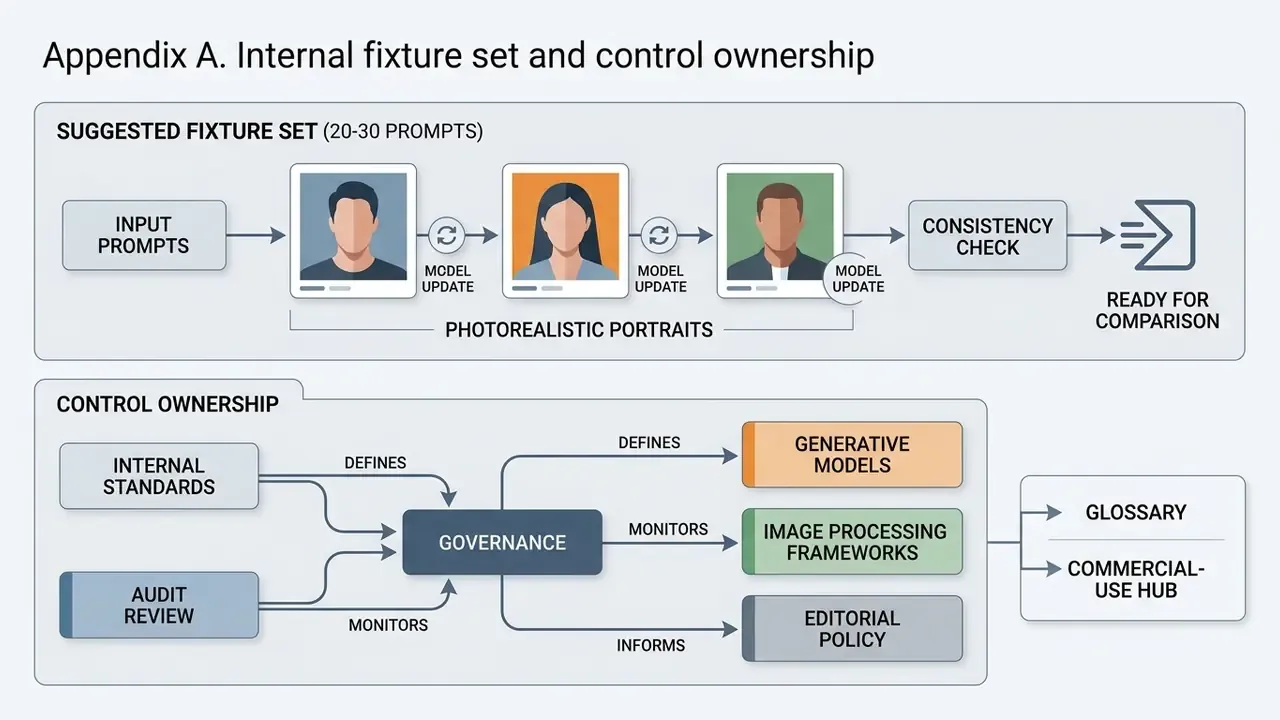
A short, boring appendix that tends to survive audit better than a style guide.
Suggested fixture set (20 to 30 prompts, re-run on every model update): three photorealistic portraits with named lens and lighting, three product renders with reflective materials, two flat-vector brand assets, two in-image text tests (short string and long string), two multi-subject compositional prompts, two abstract mood plates, plus a small set of deliberately adversarial prompts (public figure lookalike, trademarked character, studio-signature style) that the pipeline should refuse or flag.
Control ownership, illustrative only:
| Control | Accountable owner | Evidence retained |
|---|---|---|
| Prompt and seed logging | Creative operations lead | Asset record with six mandatory fields |
| Likeness and consent review | Legal counsel | Signed consent or licence file |
| Licence tier verification | Procurement | Vendor terms snapshot with date |
| C2PA manifest validation | Security engineering | Export validation log |
| Disclosure application | Brand compliance | Published asset with visible and machine-readable label |
| Escalation and shutdown | Named AI governance owner | Escalation ticket and decision memo |
Ownership names, thresholds and workflows above are illustrative and should be mapped onto your existing model-risk and GRC structures rather than adopted verbatim.