Why should a bank's risk function care about a celebrity voice toy? Because the same cloning stack that produces a novelty birthday clip also defeats call-center voice authentication. That is the short version. The long version follows.
Executive Summary
- What it is A Trump AI voice generator is a neural text-to-speech (TTS) or speech-to-speech system that renders scripts in Donald Trump's recognizable timbre, cadence, and stress patterns.
- Realism Cloning stacks from the 2024 to 2025 generation are measurably harder to detect than earlier architectures. Detector accuracy also collapses on real-world "in the wild" audio, which is a direct concern for voice biometrics and contact-center authentication.
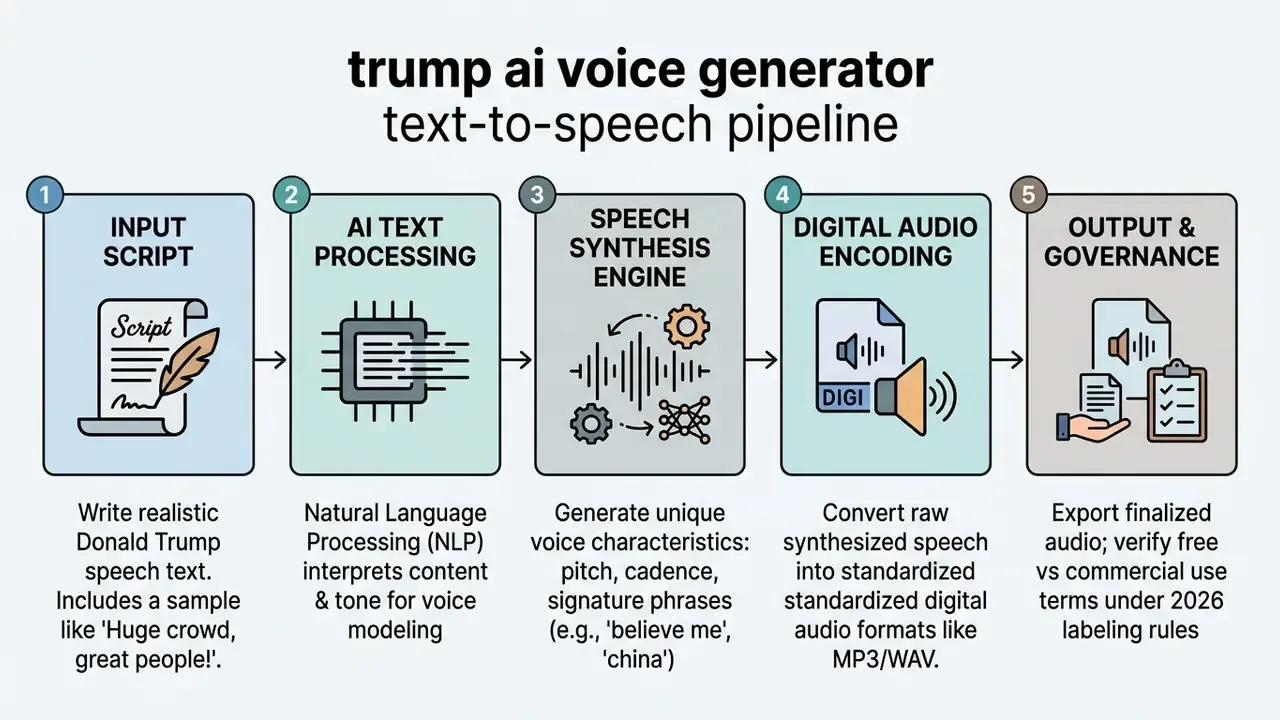
- Practical workflow Five stages. Script preparation, voice model selection, parameter configuration (emotion, pacing), synthesis, then export as MP3 or WAV. Optional extras include avatar video and live virtual-microphone routing.
- Free vs Premium vs Enterprise Free tiers cap characters and bitrate (typically 128 kbps MP3, watermark, non-commercial only). Premium unlocks WAV at 192 kbps plus commercial rights. Enterprise adds zero data retention, SOC 2 or ISO 27001 posture, SSO, and audit logging.
- Legal exposure Voice likeness is protected by state statutes such as the Tennessee ELVIS Act (2024) and New York Civil Rights Law §§ 50 to 51. The FCC treats AI voices in unauthorized robocalls as unlawful under the TCPA, and Article 50 of the EU AI Act mandates disclosure of synthetic media.
- Governance takeaway Treat synthetic voice as a model risk object. Validate it, log it, watermark it, label it, and control Shadow AI access before any production or brand use.
What Is a Trump AI Voice Generator and How Does It Work
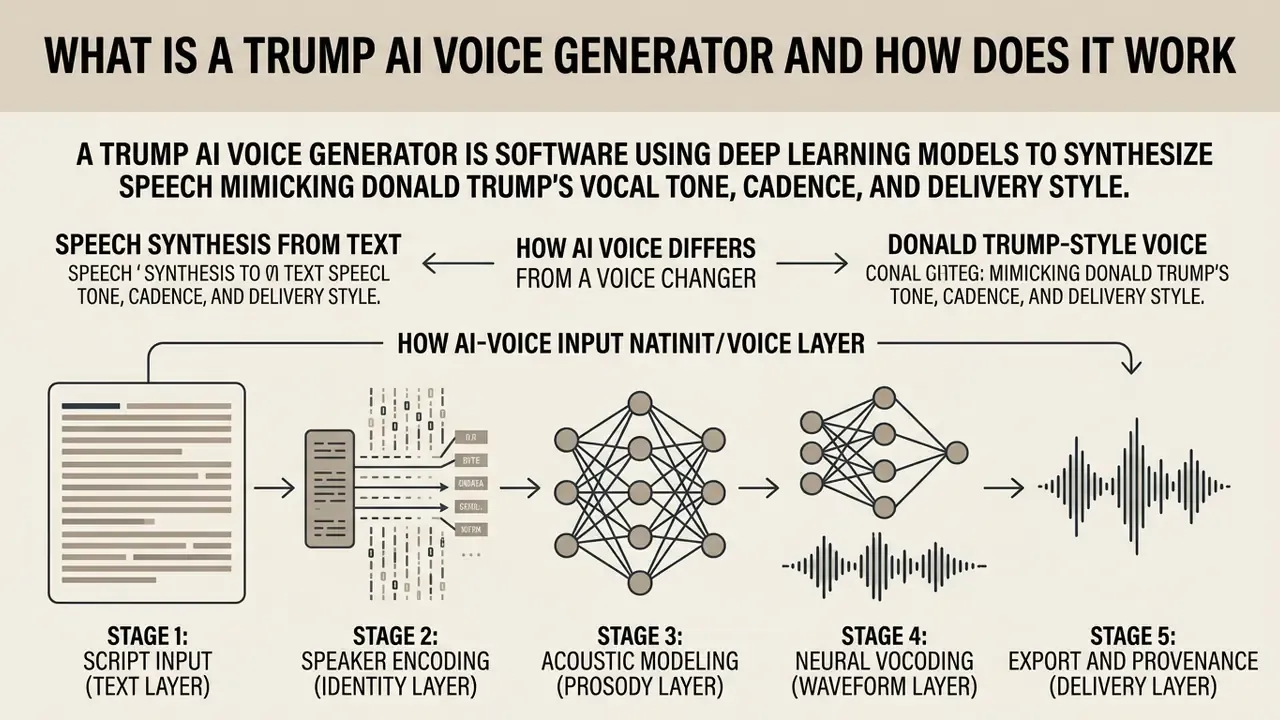
A trump ai voice generator is a software application that uses deep learning models to synthesize human speech mimicking Donald Trump's vocal tone, cadence, and delivery style. These platforms convert text inputs or existing audio into synthetic vocal tracks for entertainment, media production, commentary, and, increasingly, controlled security testing inside regulated organizations.
The same engine that a streamer uses for a punchline is the engine a fraudster uses for a payment instruction. That dual-use character is the whole story.
Speech Synthesis from Text and Donald Trump–Style Voice
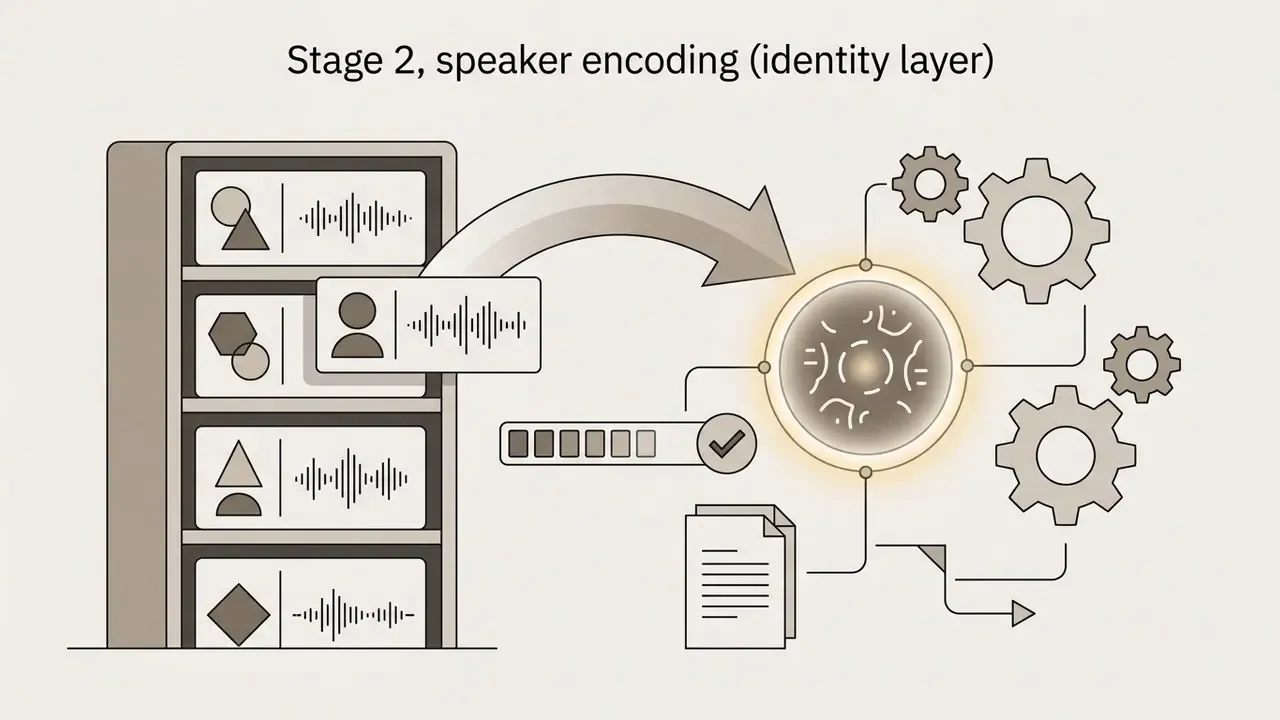
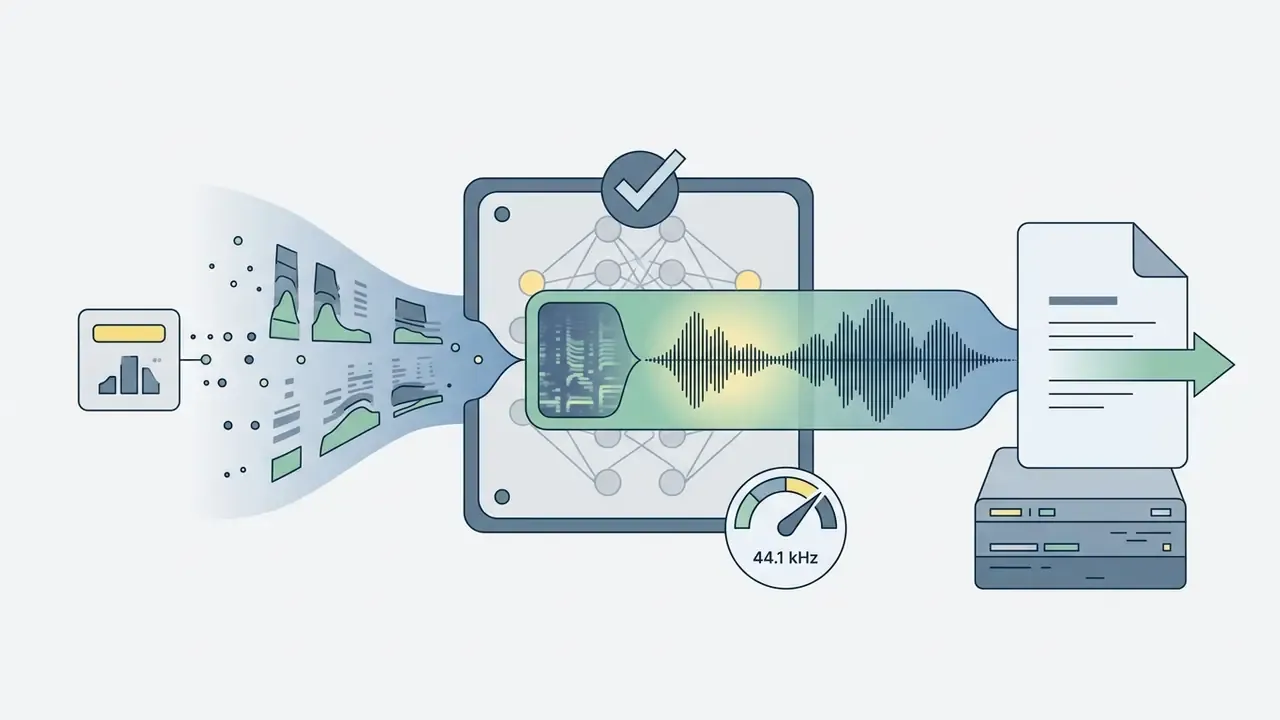
Neural text-to-speech systems convert written text into acoustic speech by linking speaker encoders, text synthesizers, and neural vocoders. To capture a distinct speaking style, the model analyzes historical speech datasets and emulates vocal pitch variations, emphasis patterns, and sentence pauses.
«Public speaking style is marked by specific paralinguistic features: sharp pitch jumps and low falling terminal contours.»
Acoustic analyses of debate closing statements report dominant falling and level terminal tones, minimal rising contours, and categorical, doubt-reducing accentuation. An ai trump speech generator uses these learned parameters, including fundamental frequency (F0) contour, phone duration, energy, and spectral tilt, to render new scripts into recognizable speech files.
One practical note. The model does not "understand" rhetoric. It reproduces statistical prosody, which is why a badly punctuated script sounds wrong even when the voice profile is excellent.
How AI Voice Differs from a Voice Changer
An ai voice generator trump creates synthetic speech from scratch using written text input. A voice changer, or speech-to-speech converter, takes an existing vocal recording and alters its timbre to match a target voice while preserving the original speech timing.
When building multi-modal production workflows, teams frequently consult a guide to AI voice generators to compare text-based synthesis against signal processing conversion methods. In practice, speech-to-speech engines accept a source recording, commonly limited to around five minutes per request, and re-render its timbre while retaining the speaker's rhythm and delivery. That distinction matters for creative control and for legal attribution, since a converted recording still carries a second person's performance.
How Realistic Is an AI Donald Trump Voice
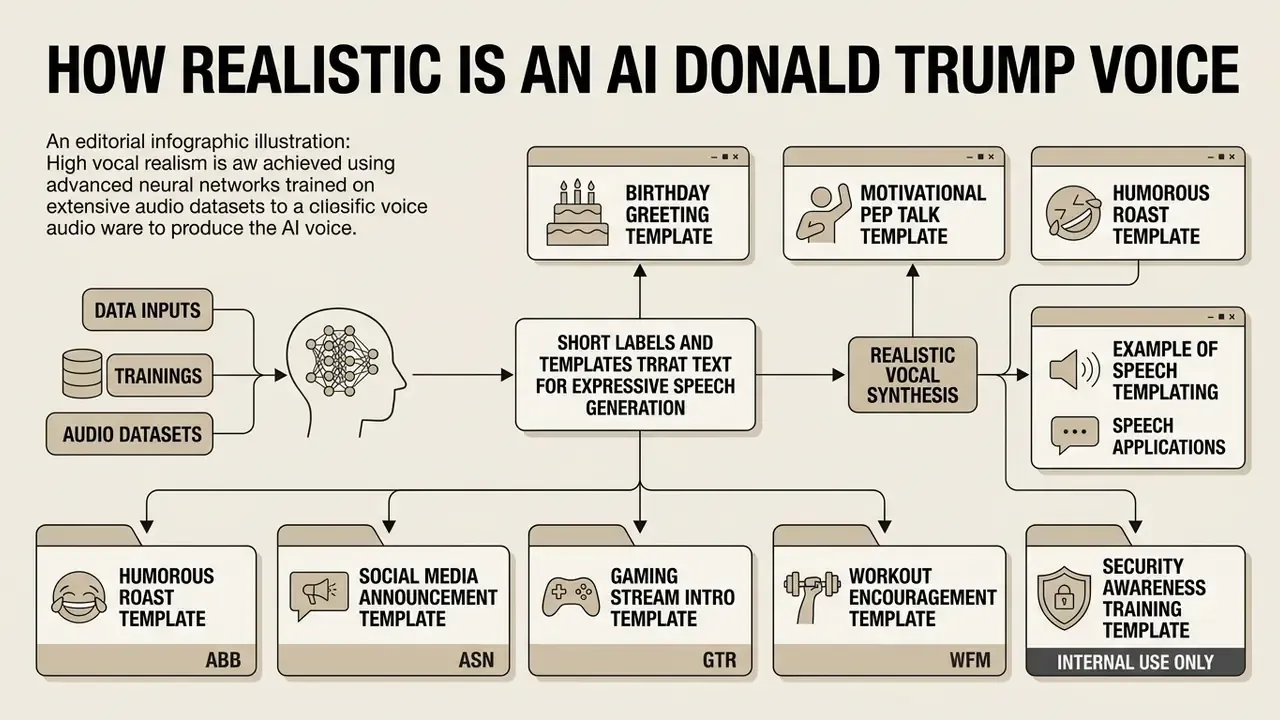
An ai donald trump voice generator produces high vocal realism through advanced neural networks trained on extensive audio datasets. The naturalness of the output depends on acoustic sampling quality, prosodic variation, and neural vocoder accuracy.
Factors Affecting Audio Quality and Speech Naturalness
«New voice cloning models from 2024 and 2025, such as XTTS-v2 and IndexTTS, are 20 to 30 percent harder to detect automatically than earlier architectures.»
«On real 2024 content, audio deepfake detectors lost up to 48 percent AUC compared with their results on standard benchmarks.» Deepfake-Eval-2024, Chandra et al. (2024), arXiv preprint. https://arxiv.org/
How to Prepare Text for Expressive Trump AI Speech
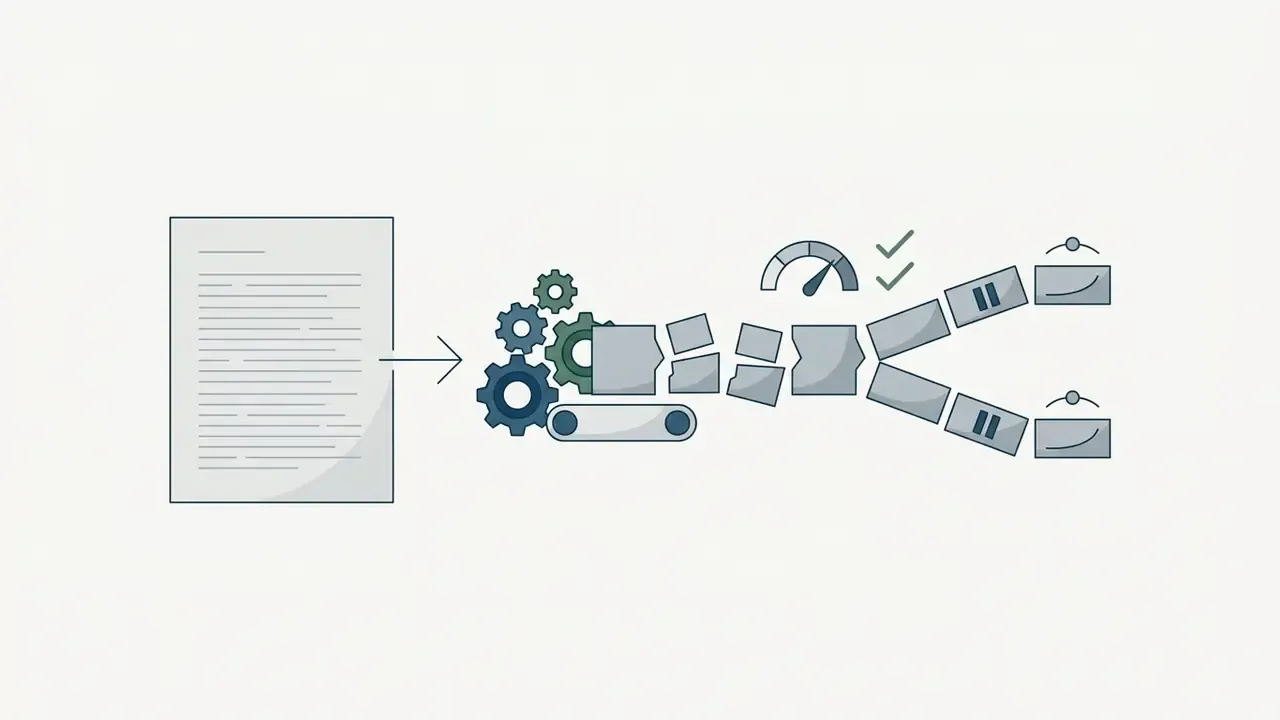
Realistic vocal expression starts with structuring the input text: short clauses, repeated key phrases, deliberate punctuation. Placing commas and periods with intent helps the neural model insert natural pauses and emphatic stress across key words.
«Spontaneous TTS models use latent style predictors that link punctuation and text segmentation to prosodic phenomena during synthesis.»
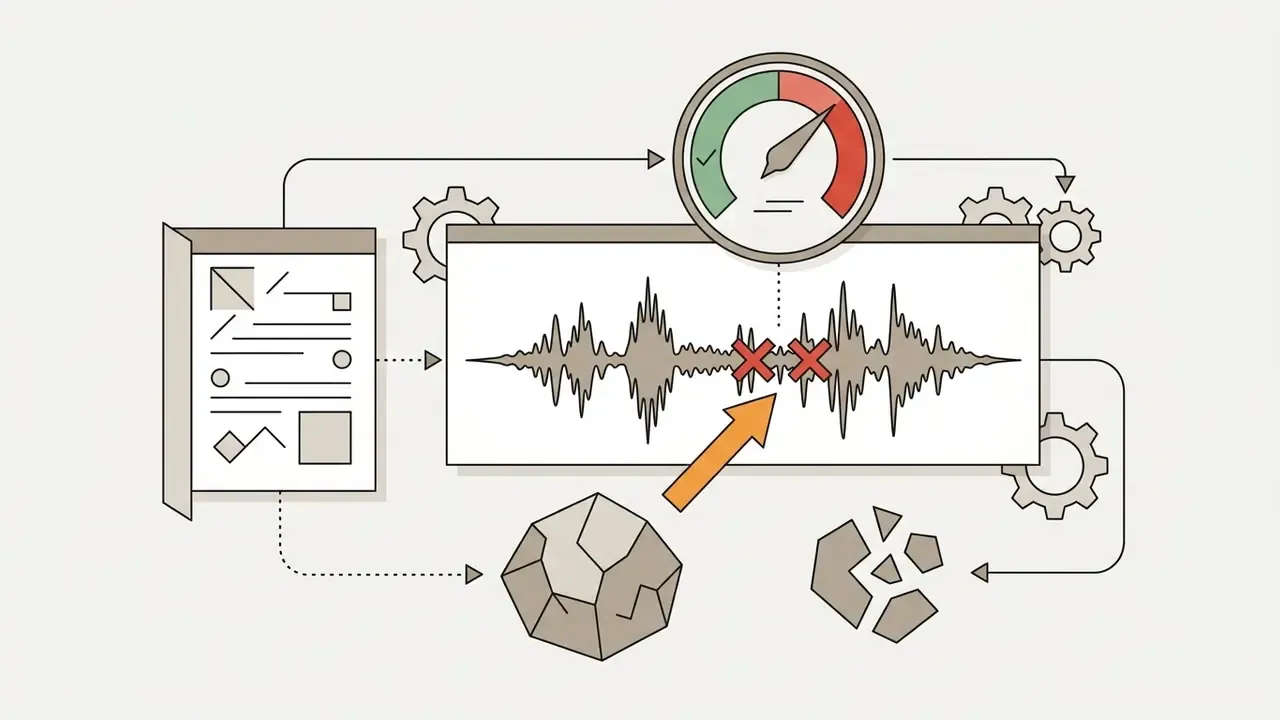
Updated, reformulated with transparent methodology. Rather than relying on an unattributed internal test, the reproducible principle is documented in transcription and prosody standards. Sentence-level punctuation marks logical break points, so long clause-heavy paragraphs flatten predicted pause structure, while short sentences with frequent commas increase pause density and emphatic stress. You can verify this in minutes. Render the same content twice, once as a single 60-word sentence and once split into six short sentences, then compare pause placement in the waveform.
Stylistic rules that align with the public speaking register: telegraphic sentences, repeated openings (anaphora), exaggerated adjectives, slogan-style endings, and pauses placed immediately before emotionally loaded words.
Ready-to-Use Text Script Templates for Realistic Speech
How to Create a Donald Trump AI Voice: Step-by-Step Process
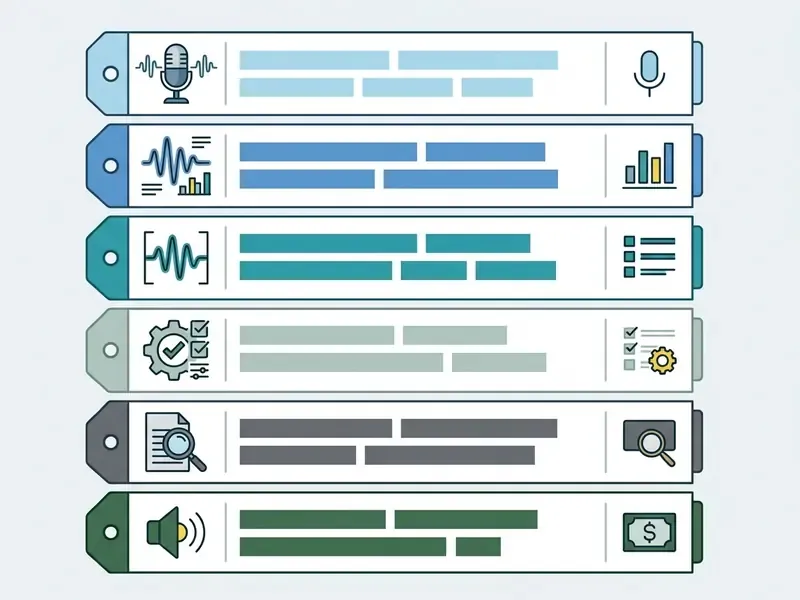
Generating synthetic presidential speech means selecting a model, entering text, adjusting voice controls, previewing output, and exporting the final audio file. An ai generator donald trump processes these inputs through cloud GPU clusters and typically delivers audio in 10 to 30 seconds, with avatar video taking 1 to 3 minutes.
Selecting an AI Voice Model and Entering Content
Choosing an ai trump generator model starts in the platform directory, where you search voice profiles matched to your target language and scenario. Vendor documentation for enterprise-grade engines exposes explicit fields: model type, voice gender, training-data language, locale, and voice name. Record those values. Reproducibility later depends on them.
The user then inputs source text directly into the web interface, confirming accurate spelling, punctuation formatting, and that the script language matches the selected locale. A mismatched locale is the quiet cause of half the "why does it sound wrong" tickets.
Adjusting Voice Emotion, Speed, and Song Cover Settings
Advanced generators give granular control over the synthesis engine:
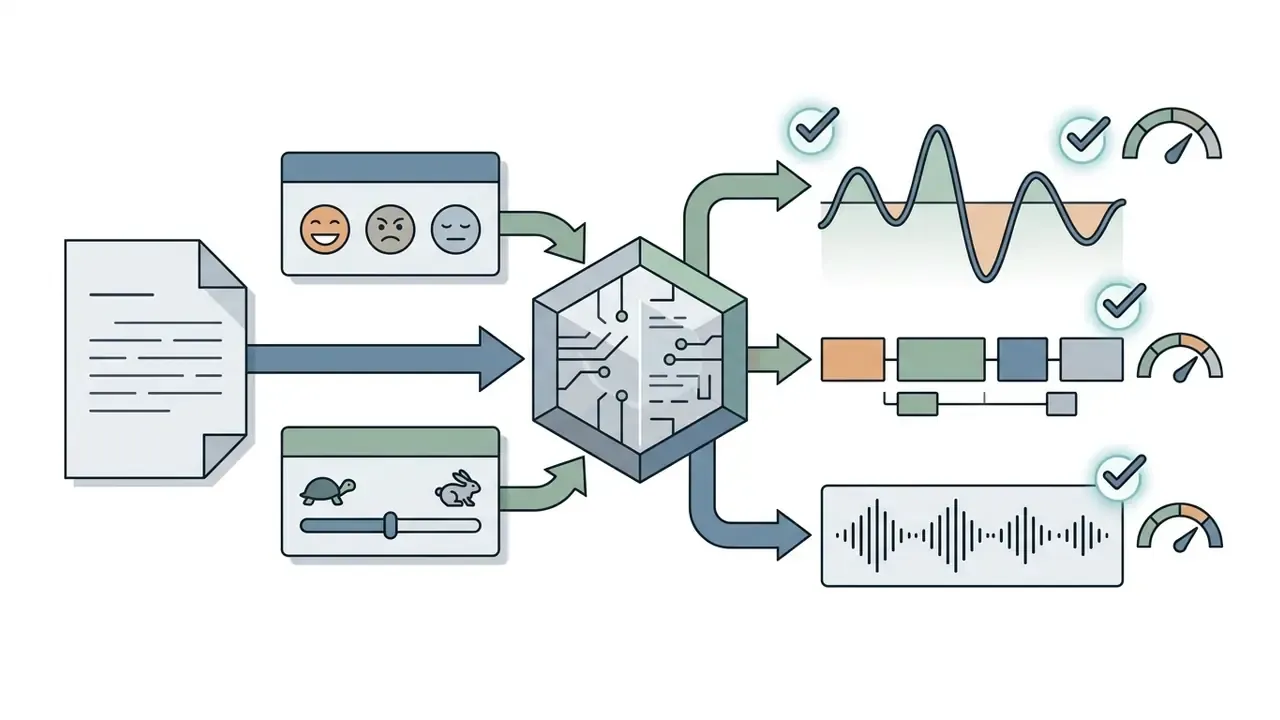
- Emotion selection: Choose presets such as Confident, Happy, Angry, Sad, Afraid, Disgusted, Melancholic, Surprised, or Calm. For speech-style delivery, pick Confident or Angry with intensity between 65 and 80 percent. For narration, Calm at 40 to 55 percent avoids over-acting.
- Speech rate: Standard rendering runs at
1.0x. To mimic press-conference delivery, set pacing to0.9xor0.95xso pauses stretch between emphasis points. Rates above1.15xusually destroy the characteristic terminal falling contour. - Auto emotion optimization: Some engines expose an "AI emotion optimize" toggle that infers affect from the script. Disable it when you need deterministic, reproducible output for audit purposes.
- Stability versus expressiveness: Low stability increases prosodic variation but raises artifact risk. High stability reduces F0 variation, which listeners hear as flatter and less natural.
- AI song covers: For singing covers, upload a clean a-cappella track, ideally WAV. The speech-to-speech engine shifts pitch and formant contours toward the target timbre while preserving melody. Remove instrumental bleed first, because mixed input signals sharply degrade both output quality and downstream identification accuracy.
Generation, Previewing, and Downloading Audio Files
Click generate and synthesis begins, usually finishing in seconds thanks to optimized cloud processing. The queue is lightning fast on paid tiers and noticeably slower on free ones. Review the rendered preview and confirm audio quality before triggering the final download of the audio file in WAV or MP3. Console interfaces commonly export WAV, while API endpoints usually default to MP3 with WAV or PCM available as an uncompressed option. Developers integrating synthesis into a pipeline can cross-check parameter naming in the AI Media API Guides.
How to Use Trump AI Voice Live in Discord, OBS, and Games
To stream or speak in real time with a synthetic voice:
- Install the live driverDownload a desktop client that installs a virtual audio output driver, available for Windows 10 or later and Apple Silicon Macs on recent macOS builds.
- Select the voice profileChoose the Donald Trump live profile in the desktop control panel.
- Configure the virtual microphoneOpen your target software (Discord, OBS Studio, Zoom, or an in-game voice client) and set the audio input device to the platform's virtual microphone, for example "Virtual AI Audio Cable".
- Calibrate buffer latencyAdjust buffer size to keep latency under 50 ms. A real-time factor below 1.0 is required to avoid stuttering pauses mid-conversation.
- Monitor and discloseRoute a monitor channel to your headphones, and tell participants the voice is synthetic. Many conferencing and community platforms treat undisclosed impersonation as a policy violation.
Enterprise caution: virtual-microphone drivers create an unmanaged audio path on corporate endpoints. Treat them as Shadow AI software, require change approval, and block installation on machines with access to customer or payment systems.
Use Cases for a Trump Voice Generator
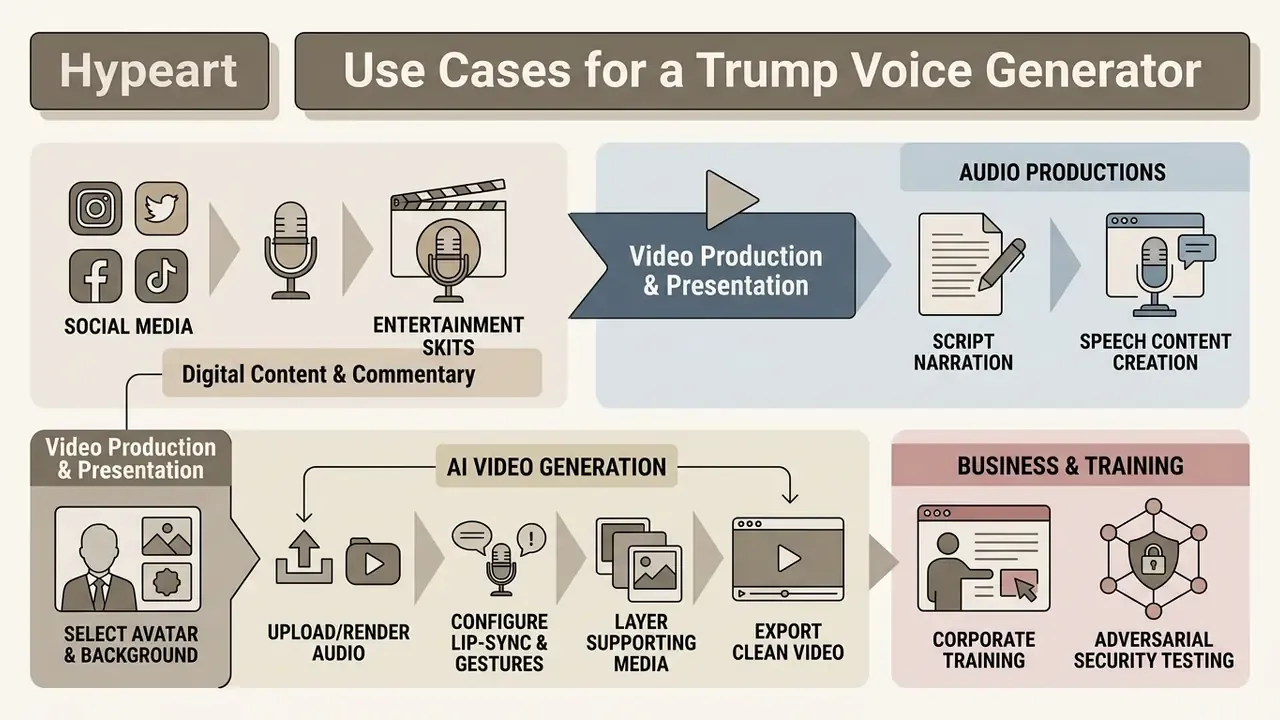
A trump voice generator serves several media workflows: digital commentary, entertainment skits, scripted voiceovers, corporate training, and adversarial security testing. Creators and risk teams evaluate tools on different axes. One side cares about rendering speed and vocal clarity, the other about data handling and auditability.
Script Narration and Speech Content Creation
Digital publishers use expressive text-to-speech engines to produce rapid voiceover tracks for creative scripts and podcasts. Cloud TTS platforms now offer hundreds of voices across dozens of languages, which supports scaled narration and localized voiceover production. A donald trump ai speech generator profile is one item in that catalog, not a separate product category. Editors managing complex social video channels shorten production timelines by adding a dedicated YouTube video editor to their publishing setup.
Enterprise and Security Use Cases: Red Teaming, Fraud Testing, and Shadow AI Control
For regulated institutions, the relevant use cases are defensive rather than promotional:
- Social engineering red teaming Generate synthetic voice samples in a controlled, air-gapped environment to test contact-center scripts, resistance to executive impersonation, and escalation procedures.
- Voice biometric stress testing Measure false-accept rates of voice authentication against 2024 to 2025 generation clones, given documented detector degradation on real-world audio.
- Awareness training Use clearly labeled synthetic clips in employee training to show how convincing modern voice cloning has become, paired with the verification behavior you want reinforced.
- Shadow AI discovery Inventory browser-based voice tools and virtual microphone drivers across endpoints. Unmanaged free tiers frequently retain uploaded audio and scripts for model improvement.
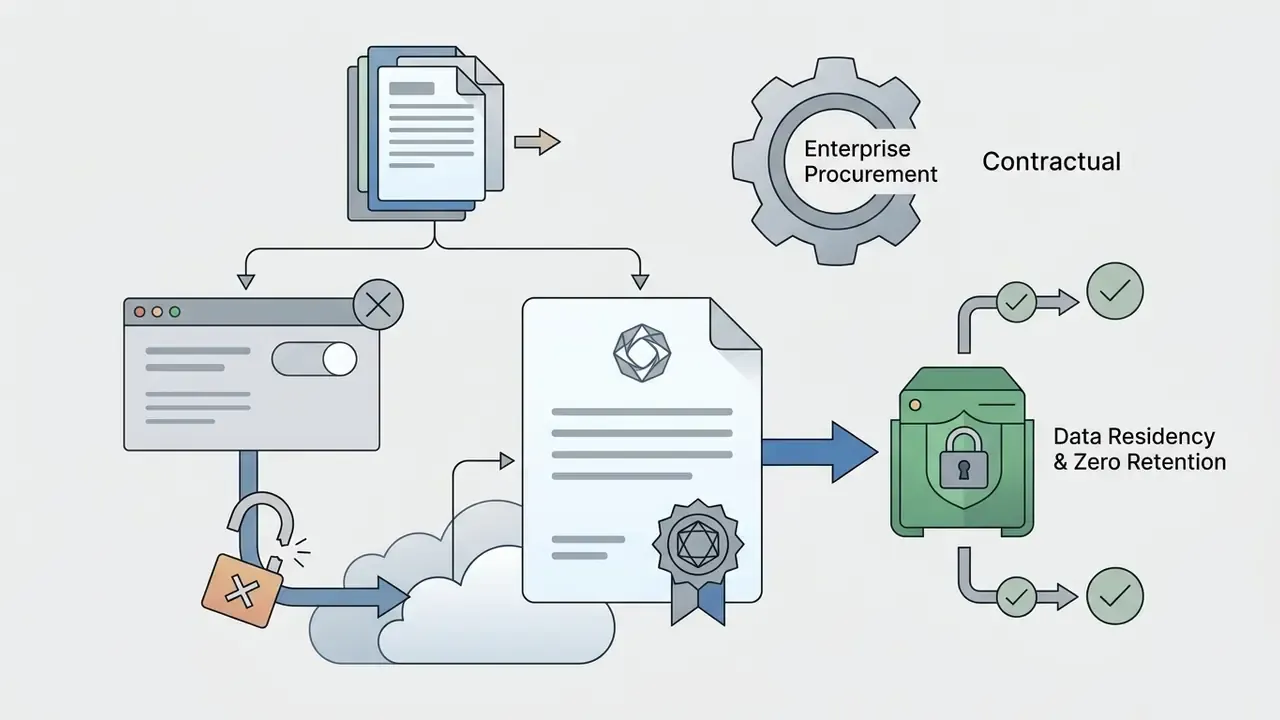
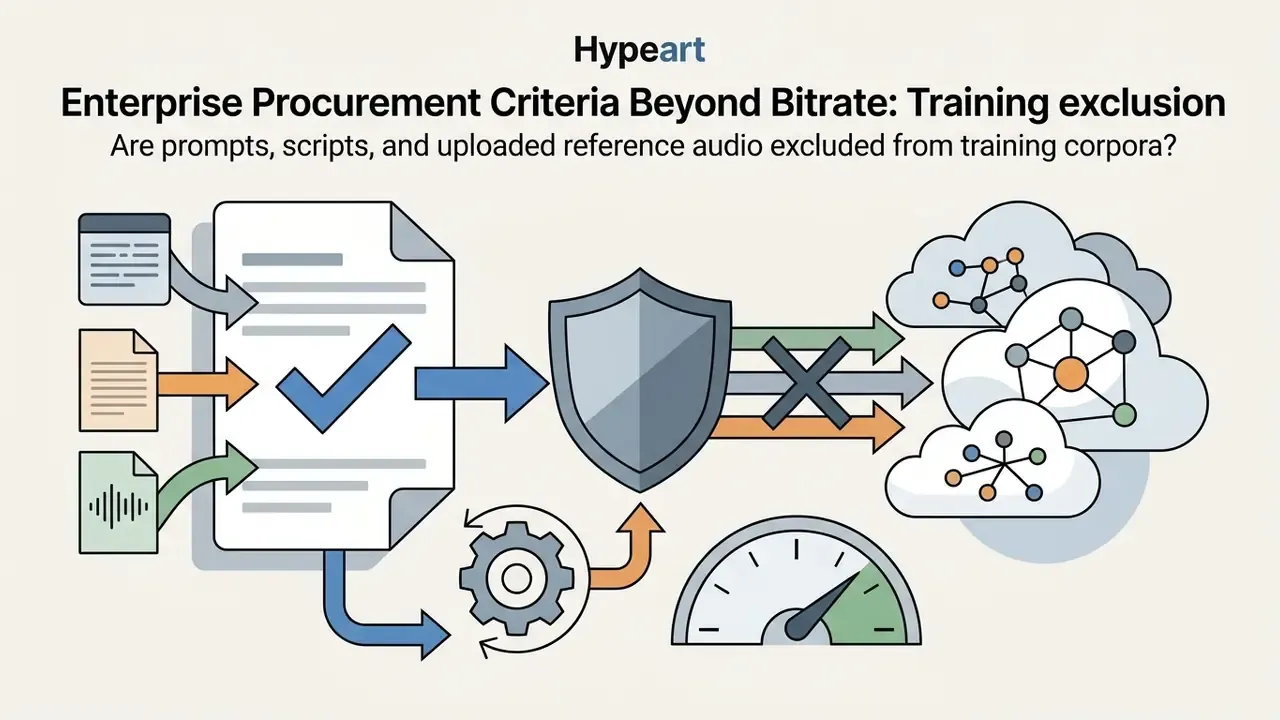
- Vendor due diligence Confirm contractually that the provider excludes customer audio from training corpora and supports deletion on request.
How to Choose the Best Trump AI Voice Generator: Free vs Premium
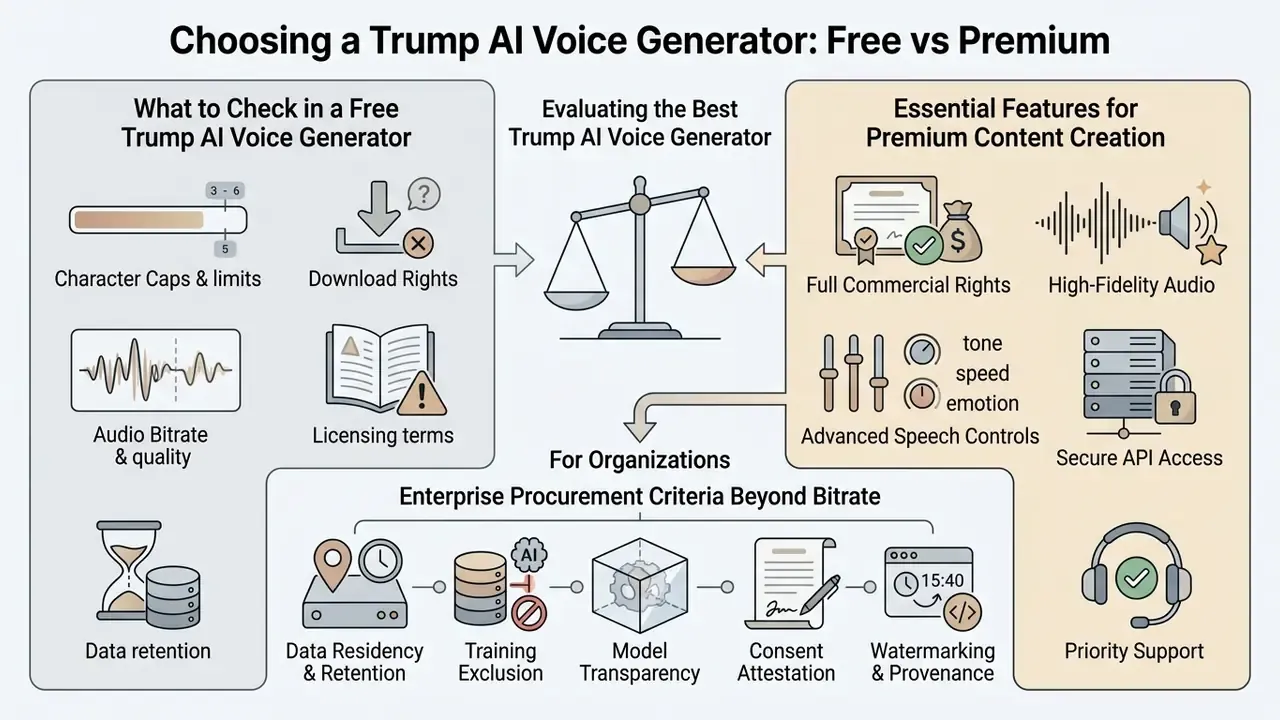
Evaluating the best trump ai voice generator means comparing free and paid tiers across character caps, download rights, audio bitrates, licensing terms, and, for organizations, data-handling guarantees. Teams benchmarking budget options should also review free AI video generators, where comparable tier limitations apply.
| Feature / Metric | Free Access Tier | Premium Subscription Tier | Enterprise / Governed Tier |
|---|---|---|---|
| Character limits | 5,000 to 10,000 characters per month (some services cap at 5 generations or roughly 75 words) | 60,000 to 500,000+ characters per month | Contracted volume with overage terms |
| Clip duration | Often around 10 seconds per generation | Up to roughly 3 minutes per generation | Configurable, batch and queue-based |
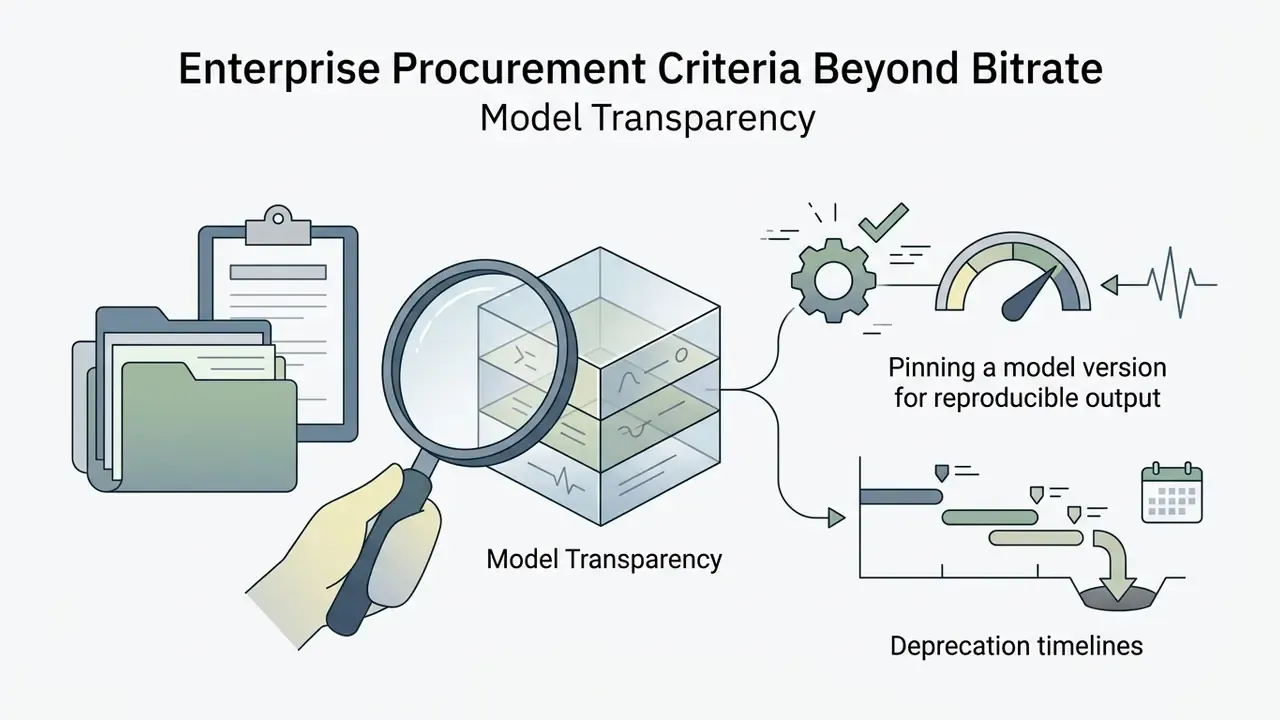
| Audio bitrate / sample rate | Standard quality, 128 kbps MP3 at 44.1 kHz | High definition, 192 kbps MP3 or uncompressed WAV | Lossless WAV or PCM, deterministic model pinning |
| Watermarking | Spoken audio tag or watermark included | Clean export without watermarks | Optional inaudible watermark plus provenance metadata |
| Processing speed | Standard queue, about 2 concurrent requests | Priority queue execution (lightning fast), 3 to 25 concurrent requests | SLA-backed throughput and latency targets |
| Usage rights | Non-commercial or personal use only, attribution may be required | Commercial usage license included | Negotiated indemnity and license scope |
| Data privacy | Inputs may be retained and used for model improvement | Limited retention, opt-out often manual | Zero data retention, no-training commitment, regional hosting |
| Security and compliance | Not documented | Basic account security | SOC 2 Type II or ISO 27001 attestations, DPA, subprocessor list |
| Access control | Email login | Seats and roles | SSO/SAML, SCIM provisioning, least-privilege roles |
| Auditability | None | Generation history | Immutable audit logging, export of model, version, and operator metadata |
What to Check in a Free Trump AI Voice Generator
A best free trump ai voice generator option usually imposes monthly character limits, audio watermarks, spoken service tags, and restricted commercial rights. Anyone hunting an ai voice generator free trump solution should verify export limits before starting a long project, because discovering the cap at minute nine of a ten-minute narration is a special kind of frustration. Searches for donald trump ai voice generator free online access also surface browser tools with no documented retention policy, which is a hard stop in a regulated environment.
Documented free-tier patterns include 5,000 characters per generation with a 15,000-character monthly ceiling, MP3-only output, neutral style only, and an embedded audio watermark. An ai trump voice generator free tier is fine for a proof of concept and unsuitable for published work.
To benchmark feature availability across software tiers, teams analyze standardized AI Media Comparison Matrices and review platform pricing structures.
Enterprise Procurement Criteria Beyond Bitrate
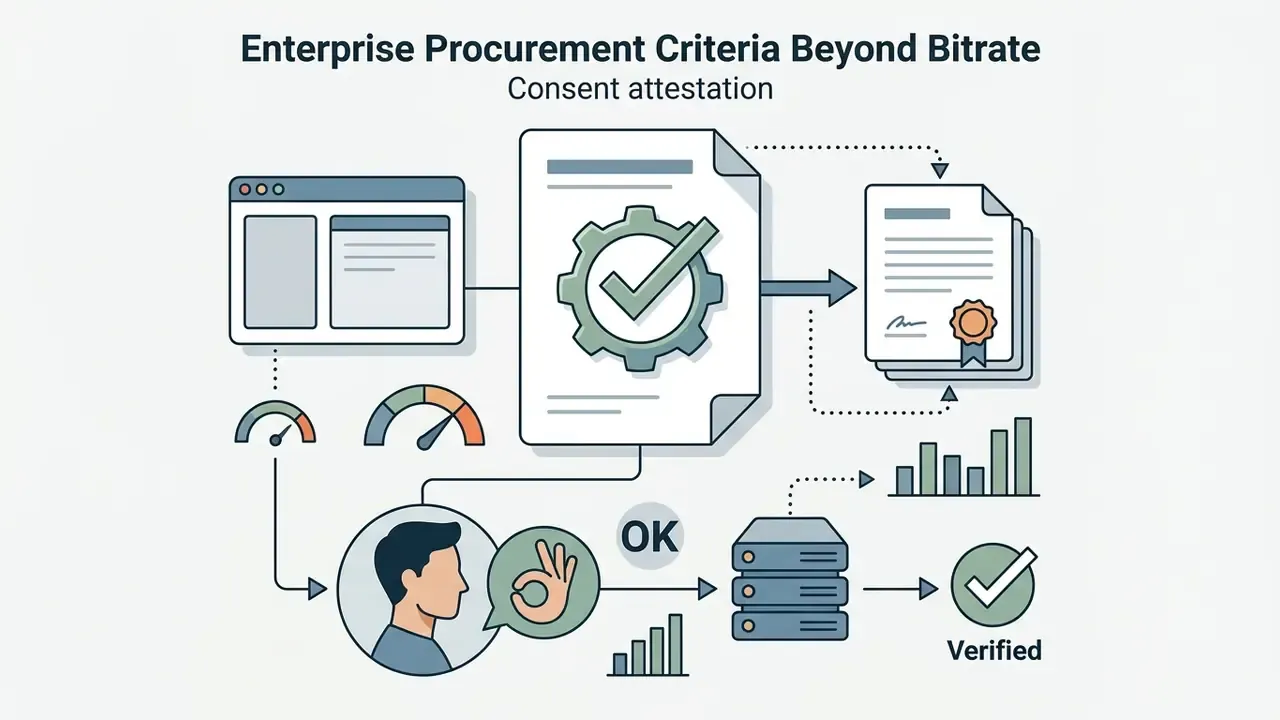
Risk and procurement functions should score vendors on criteria that consumer comparison pages ignore:
Cost modeling belongs here too. Run volumes and concurrency through the AI Media Calculators before signing a contracted-volume agreement, and add control overhead to the total, not just the per-character rate.
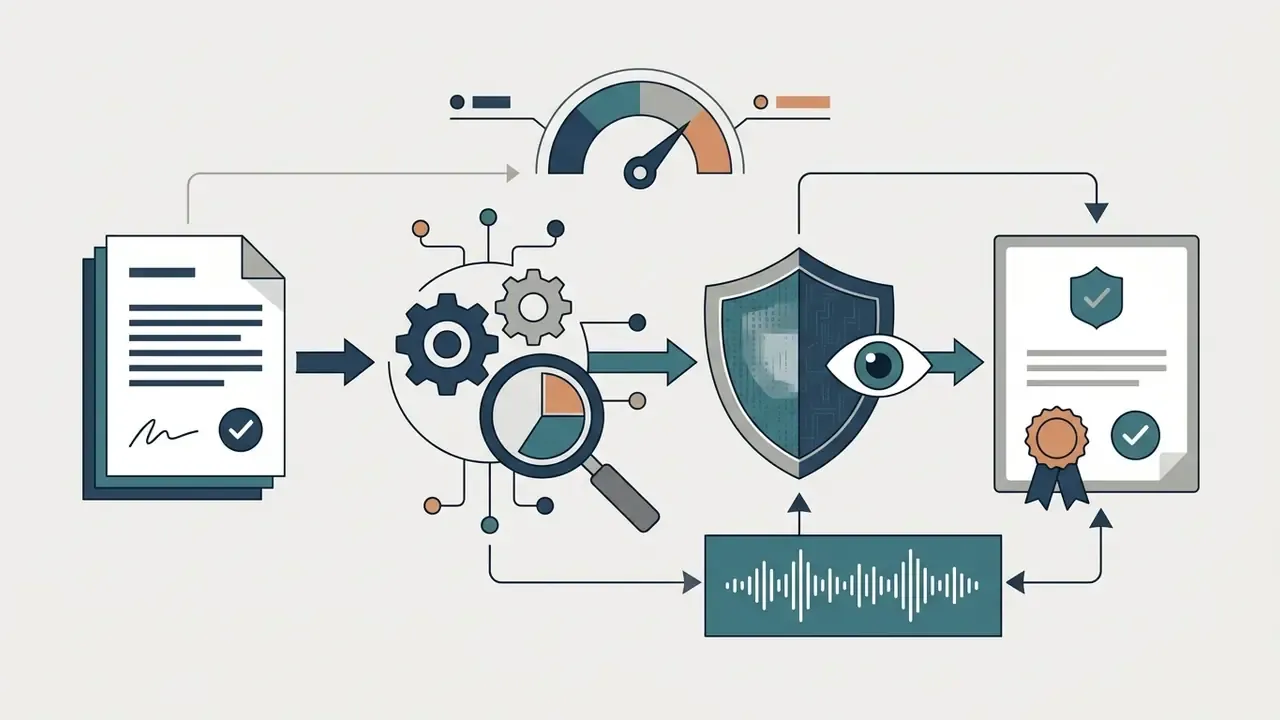
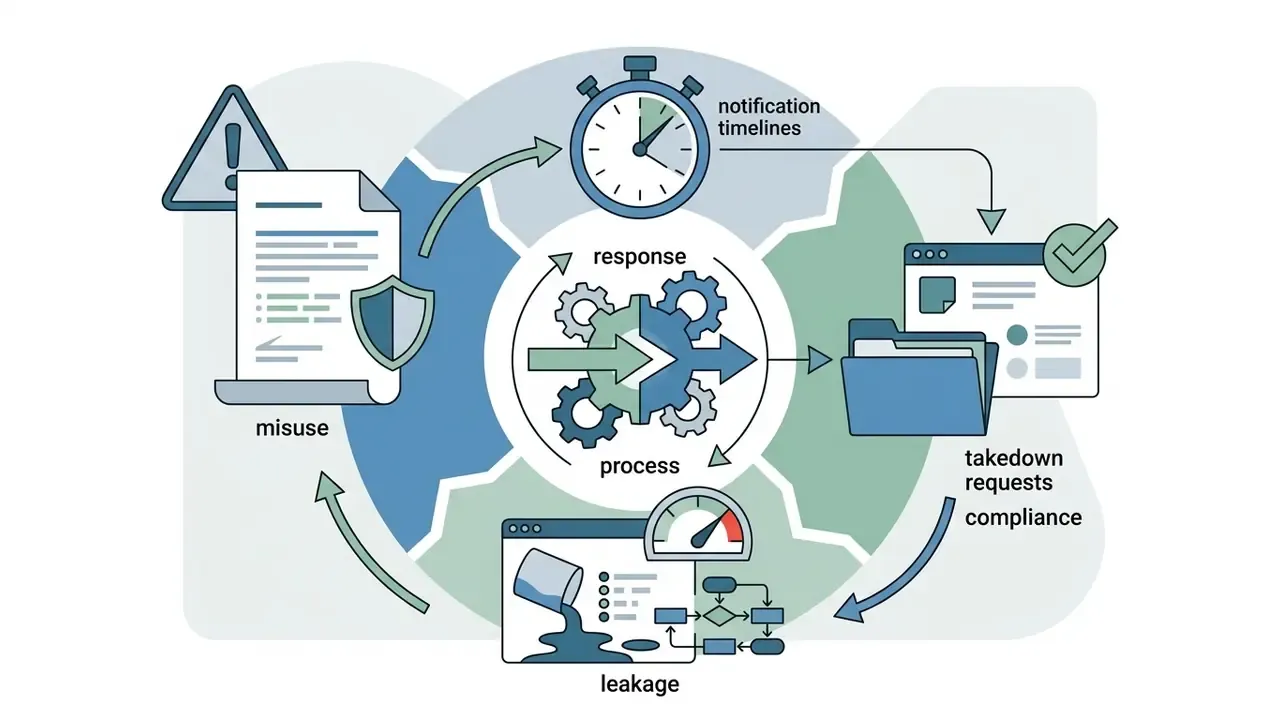
Synthetic Voice Governance: Model Risk Management and Provenance
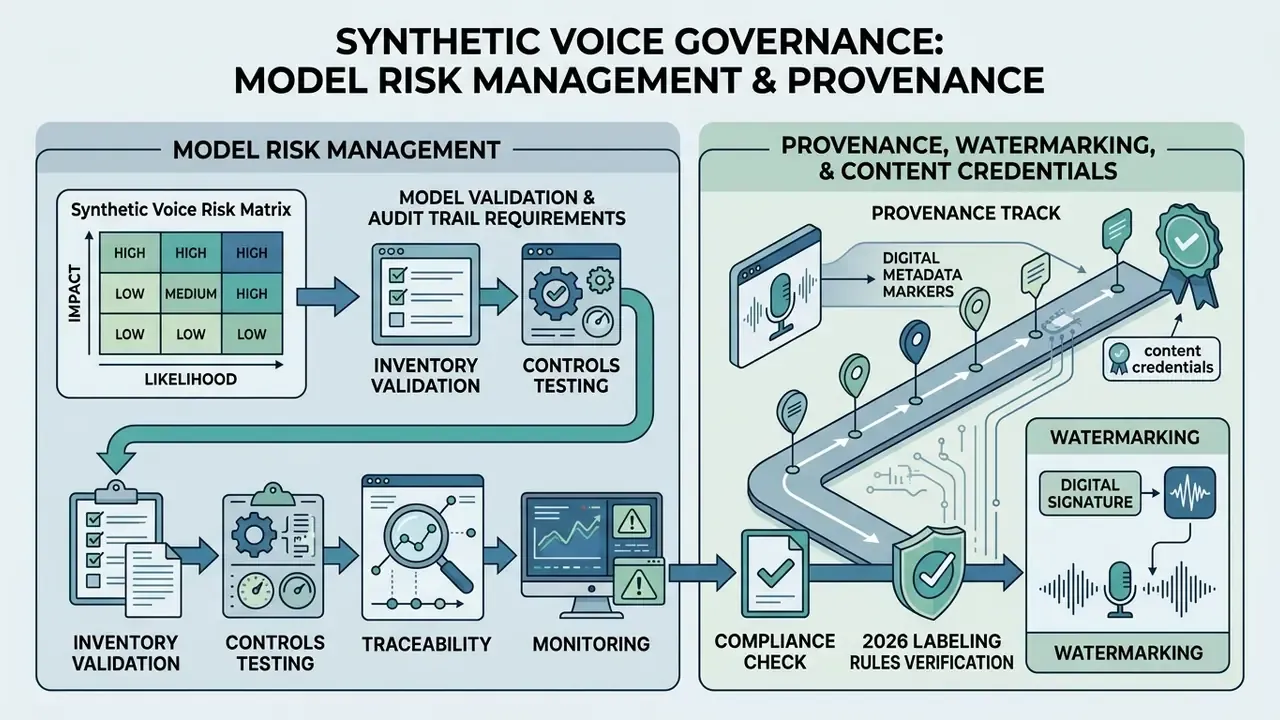
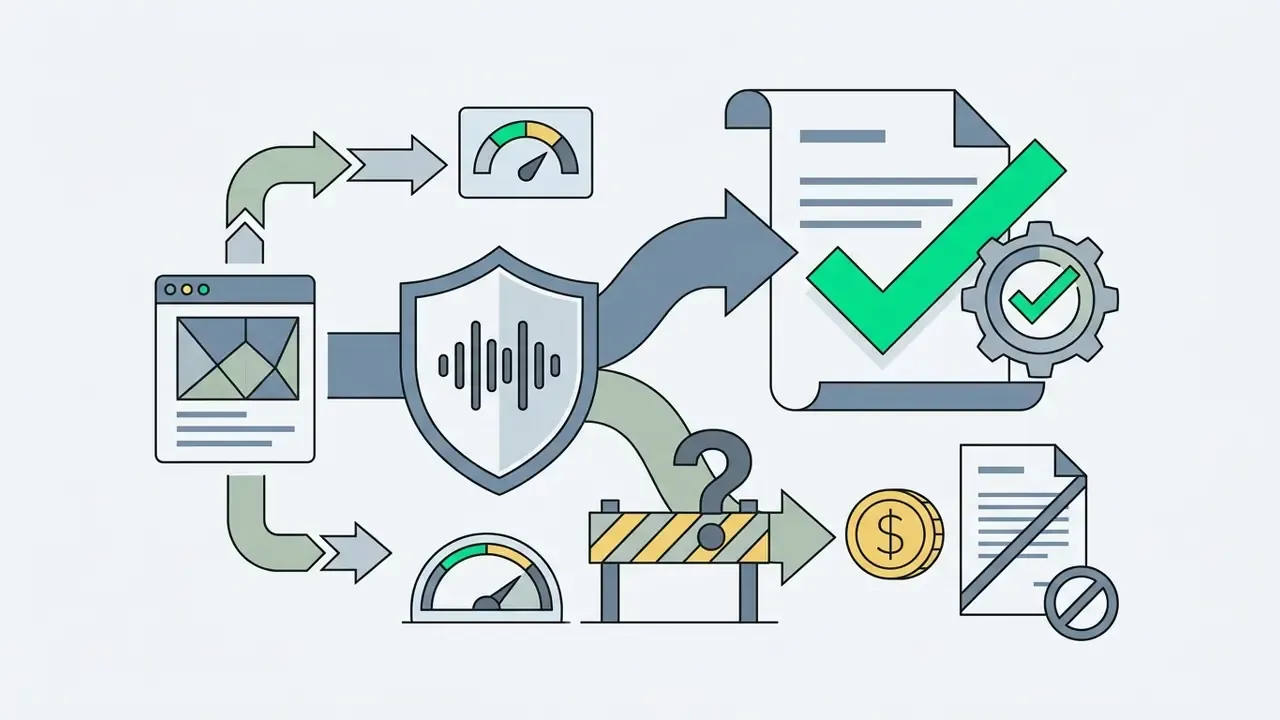
Synthetic voice is not merely a creative feature. Once it touches brand communication, customer channels, or authentication surfaces, it becomes a model risk object requiring documented controls and a named owner.
Synthetic Voice Risk Matrix
| Risk Domain | Scenario | Likelihood Driver | Primary Control |
|---|---|---|---|
| Authentication bypass | A cloned voice defeats voice biometrics in a call center | Detector AUC degradation on real-world audio, up to 48 percent | Multi-factor and knowledge-based verification, liveness challenge, out-of-band callback |
| Executive impersonation fraud | Synthetic instruction to release funds | Public audio availability of executives | Dual authorization for payments, verified channel policy, no voice-only approvals |
| Legal and publicity rights | Commercial use of an identifiable voice without consent | Weak license review | Rights clearance workflow, jurisdictional legal sign-off |
| Disclosure failure | Synthetic audio published without labeling | Ad-hoc content process | Mandatory labeling gate in the publishing workflow, provenance metadata |
| Data leakage | Confidential script pasted into a free consumer tool | Shadow AI adoption | Approved tool list, DLP rules, zero-retention enterprise tier |
| Reputational and election-adjacent content | Political synthetic audio attributed to the brand | Unclear content policy | Prohibited-use policy, pre-publication review |
| Model drift and reproducibility | Vendor silently changes the model, output tone shifts | Unpinned model versions | Version pinning, regression test set, change logs |
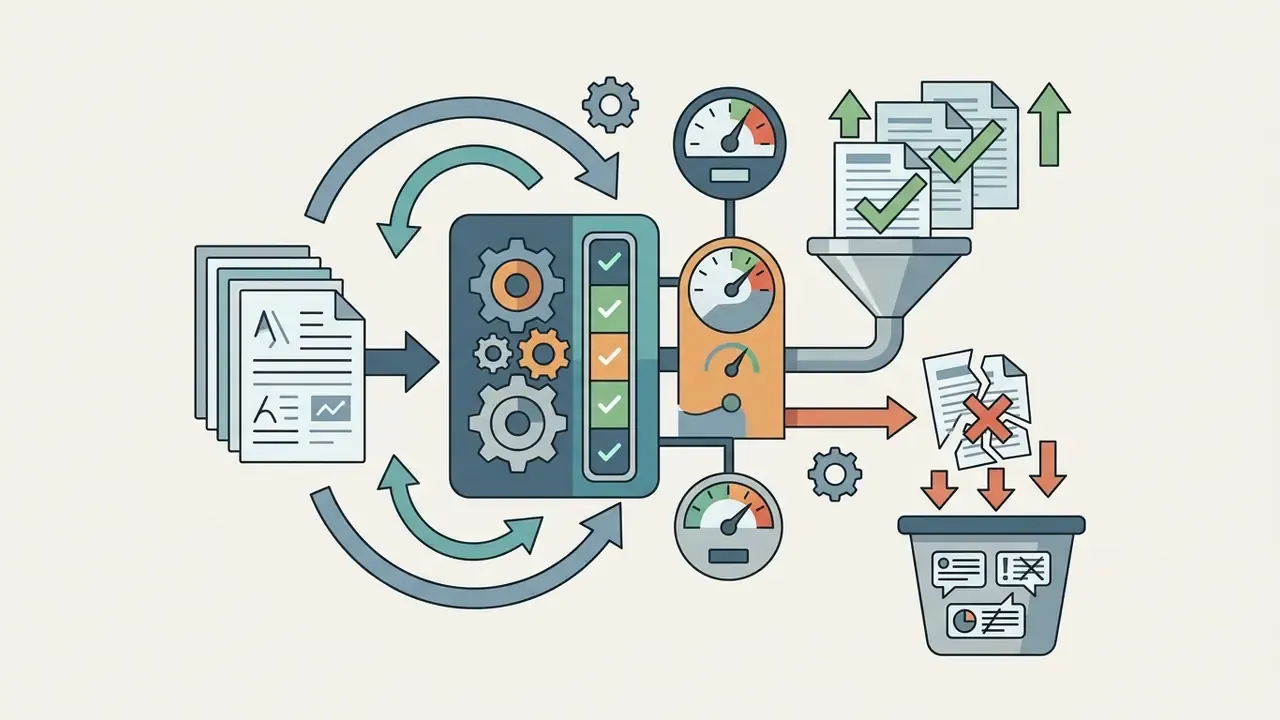
Model Validation and Audit Trail Requirements
Provenance, Watermarking, and Content Credentials
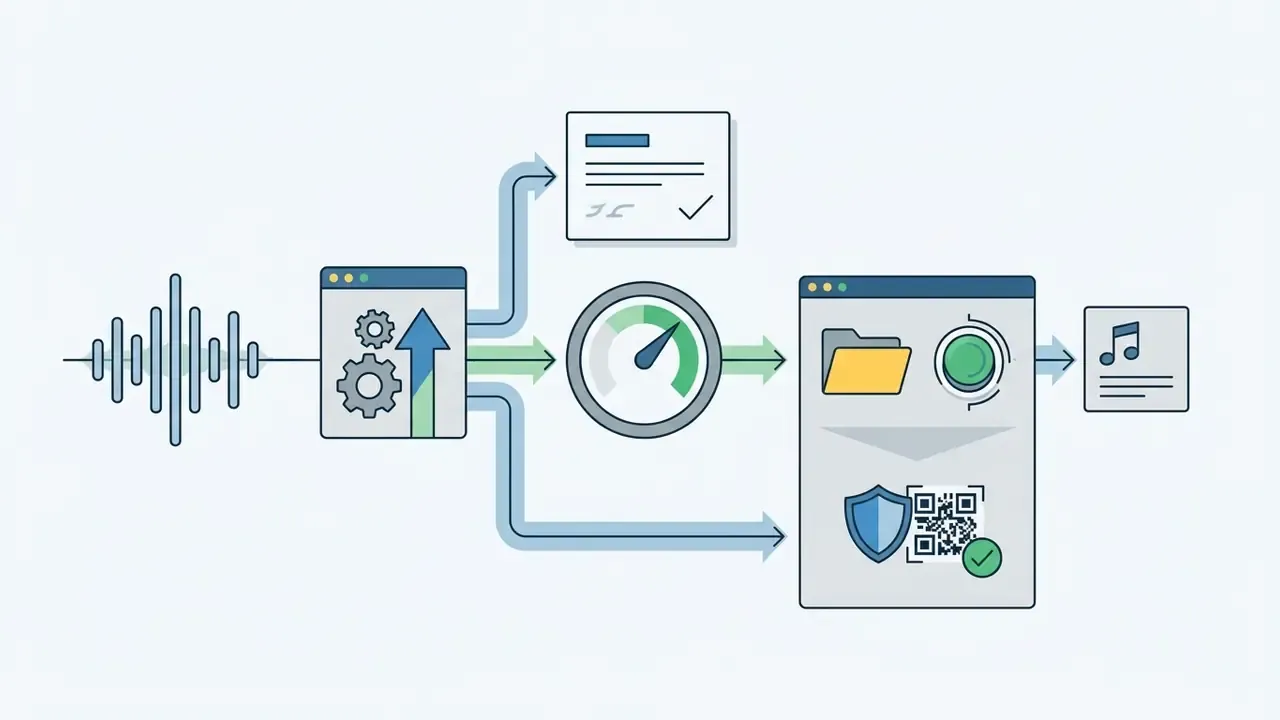
Detection alone is a losing control. Durable provenance shifts the burden from "can we spot a fake?" to "can this asset prove its origin?" That means cryptographically signed content credentials attached at export, plus inaudible watermarking that survives re-encoding.
Where possible, require providers to embed machine-readable provenance markers, retain the signed manifest alongside the master file, and publish a verification path for journalists, partners, and platform reviewers. Complementary AI image detectors and audio classifiers belong in triage, not in adjudication. They flag. Humans decide.
Commercial Use and Content Labeling for Donald Trump AI Voice
Additional context for compliance teams. The U.S. Copyright Office's 2024 work on digital replicas frames voice cloning as a licensable right with guardrails. Proposed federal legislation would create an explicit, transferable right over unauthorized digital replicas of voice and likeness. Several jurisdictions now require documented prior consent before AI-generated voice appears in campaign or advertising material.
Why Commercial Use Terms Must Be Verified per Platform
«In January 2024, thousands of New Hampshire voters received robocalls using an AI voice imitating President Biden; the FCC found the calls unlawful under section 64.1604(a).»
Creators should review legal guidance on commercial use of AI outputs, compare it with the platform-specific rights described in our overview of commercial use for generative tools, and track regulatory precedent through AI Litigation and Case Timelines.
Two clearances are needed before publication. First, the platform's commercial licence. Second, the rights position over the depicted person's voice. Most consumer generators restrict output to entertainment and personal use, and many prohibit deceptive or election-related content outright. Searches for an ai voice generator donald trump free tier almost always land on exactly those restrictions.
How to Transparently Label AI Celebrity Voices in Publications
Transparent publishing means labeling synthetic audio with visible text overlays or explicit spoken disclaimers, placed early rather than buried in a description field.
«Research shows that singer identification systems lose accuracy when analyzing cloned voices, especially when the input is a mixed audio signal.»
Major social platforms combine automated detection signals with mandatory self-disclosure tags. Meta announced visible "Made with AI" labels for AI-generated video, audio, and images from May 2024, applied through creator self-disclosure or detected industry-standard signals. EU labeling guidance tied to Article 50 of the AI Act requires machine-readable marking plus clear user-facing labels for deepfakes and AI-generated text on matters of public interest. India's 2025 amendments to its IT rules go further for audio, prescribing a prominent spoken disclosure such as "This audio is synthetically generated."
Practical labeling checklist:
- Visible on-screen label in the first seconds of the clip, and in the caption.
- Spoken disclosure at the start of standalone audio assets.
- Machine-readable provenance or watermark retained through export and re-encoding.
- Explicit "parody, not an authentic recording, not an endorsement" wording where a real person is depicted.
- Never present invented statements as news, leaked material, or quotations.
FAQ: Frequently Asked Questions About Donald Trump AI Voice Generators
The frequently asked questions below cover platform compatibility, mobile functionality, converting existing recordings, latency, and the boundaries of free and commercial use.
Can You Use a Trump AI Voice Generator on Mobile Devices?
Most web-based voice platforms support cross-platform browsers and ship mobile apps for iOS and Android, with account-level sync across smartphone, tablet, and desktop. You can input scripts, generate audio, and download files straight from a phone. Minimum OS requirements vary by app listing, and some offline features remain paid-only. When troubleshooting mobile browser compatibility or API latency, creators consult AI Media Support and Troubleshooting resources.
Can You Transform an Existing Recording via Voice Changer?
Yes. Speech-to-speech tools convert pre-recorded audio into a target voice profile. These systems analyze source frequency, pitch, and timing, then re-render the original voice as the selected target while keeping speech rhythm intact. Documented input limits sit around five minutes per request, and cloning a custom target usually needs 10 to 30 seconds of clean reference audio.
How Do You Convert an Existing MP3 into a Text-to-Speech Script?
If your platform lacks a speech-to-speech engine, run the MP3 through an AI transcription tool such as Whisper or a cloud speech-to-text API. Edit the resulting transcript for punctuation, sentence length, and emphasis, then feed it into the text-to-speech generator. The transcript route also creates a reviewable artifact, which helps when approvals or audit logs are required.
Is an AI Donald Trump Generator Free, and Can Output Be Monetized?
Many services offer free credits or a limited tier that is enough for testing. An ai donald trump generator free tier typically stamps output with watermarks and spoken service tags, caps duration, and restricts use to non-commercial contexts. Monetization requires both a paid commercial licence on the platform and an independent rights assessment of the depicted voice. For advertising or resale, get legal sign-off first.
What Latency Should You Expect for Live Voice Changing?
Real-time conversation needs a real-time factor below 1.0 and, in practice, end-to-end latency under roughly 50 ms for natural turn-taking. Larger audio buffers stabilize the stream but add delay. Smaller buffers cut delay and risk dropouts on shared or throttled CPUs.
How Do You Reduce Robotic or Flat-Sounding Output?
Increase punctuation density, shorten sentences, drop the speech rate to 0.9x or 0.95x, reduce stability slightly to allow more F0 variation, and export at 44.1 kHz WAV before any downstream compression. If a metallic timbre survives all that, the cause is usually vocoder artifacting or low segmental SNR in the source reference, not the script.
Appendix A: Revised Statements and Source Corrections
Retained for transparency and audit traceability.
- Original wording, detection figures
- "Recent evaluations show that advanced voice cloning models from 2024 and 2025 reduce deepfake detection scores by 20% to 30% compared to older architectures" and "In wild testing environments, automated audio deepfake detectors experienced performance drops up to 48% when analyzing modern synthetic speech." Correction applied: the placeholder preprint identifiers previously attached to these claims were non-resolvable and have been removed. The figures are now attributed to the P2V Dataset (Gao et al., 2025) and Deepfake-Eval-2024 (Chandra et al., 2024) as arXiv preprints requiring identifier verification before formal citation.
- Original wording, prosody anecdote
- "In an internal testing environment, an editorial team submitted a long, complex paragraph to a voice model, resulting in flat cadence. After breaking the script into short sentences with frequent commas, the rendered audio gained realistic vocal emphasis and natural timing." Correction applied: replaced with a reproducible, standards-based explanation of punctuation-driven pause prediction plus a two-render verification procedure, since the original claim lacked stated methodology, sample size, and verifiable data.
- Removed statement
- a footer note asserting that no verified information was available regarding official product specifications or legal registration for the publishing platform. Rationale: the statement was unverifiable and non-informative for readers. It has been replaced by the governance, provenance, and procurement material above, which delivers actionable value in its place.
Limitations, Open Questions, and a Safe Next Step
Three things remain genuinely unresolved, and pretending otherwise would be dishonest.
First, detector performance on production traffic is poorly documented outside benchmark papers. Second, state publicity statutes differ enough that a clip cleared in one jurisdiction may not be cleared in another. Third, watermark durability through aggressive platform re-encoding is inconsistent across vendors.
A conservative next step costs little. Inventory the synthetic voice tools already in use, pick one contained scenario such as awareness training, pin the model version, and log every generation. Measure, then decide. Expansion after evidence is far cheaper than remediation after an incident.
Social Media, Entertainment Videos, and AI Video
Short-form platforms such as TikTok, YouTube Shorts, and Instagram Reels host a steady stream of commentary videos featuring an ai celebrity voice. Content teams combine synthetic speech with dynamic visuals using AI video generators, a highlight video maker, or a heygen ai video generator, and budget-limited creators often start with free AI video generators. Teams that lack in-house editing capacity sometimes hire video editor support for the final cut instead of scaling headcount.
Documented cases in 2025 and 2026 show viral "leaked audio" clips built from synthetic political voices. That is precisely why disclosure and provenance labeling are now baseline requirements rather than optional courtesies.
Generating Synchronized AI Avatar Videos with Trump's Voice
Building a complete clip means combining generated audio with an avatar background template. A workable sequence: