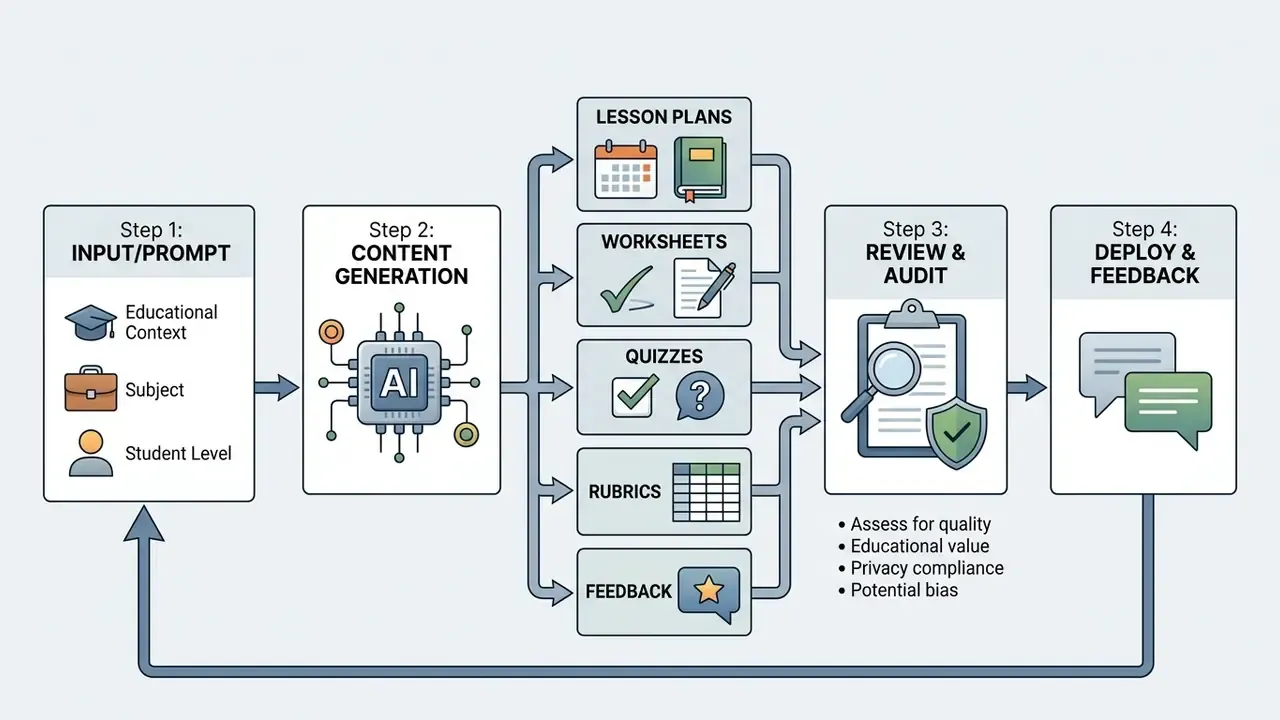
Generative artificial intelligence tools let educators cut administrative planning time while keeping rigorous alignment with curriculum standards. Modern educational software automates first drafts: lesson plans, differentiated worksheets, assessment rubrics, and student feedback. The hard part is not generation. It is verification.
"Evaluating generative technology in education requires a strict evidence-first rule: no verified accuracy, no autonomous deployment. Teachers must remain the final authority on every classroom material."
— Marcus Hale, author
Executive Summary for School and District Leaders
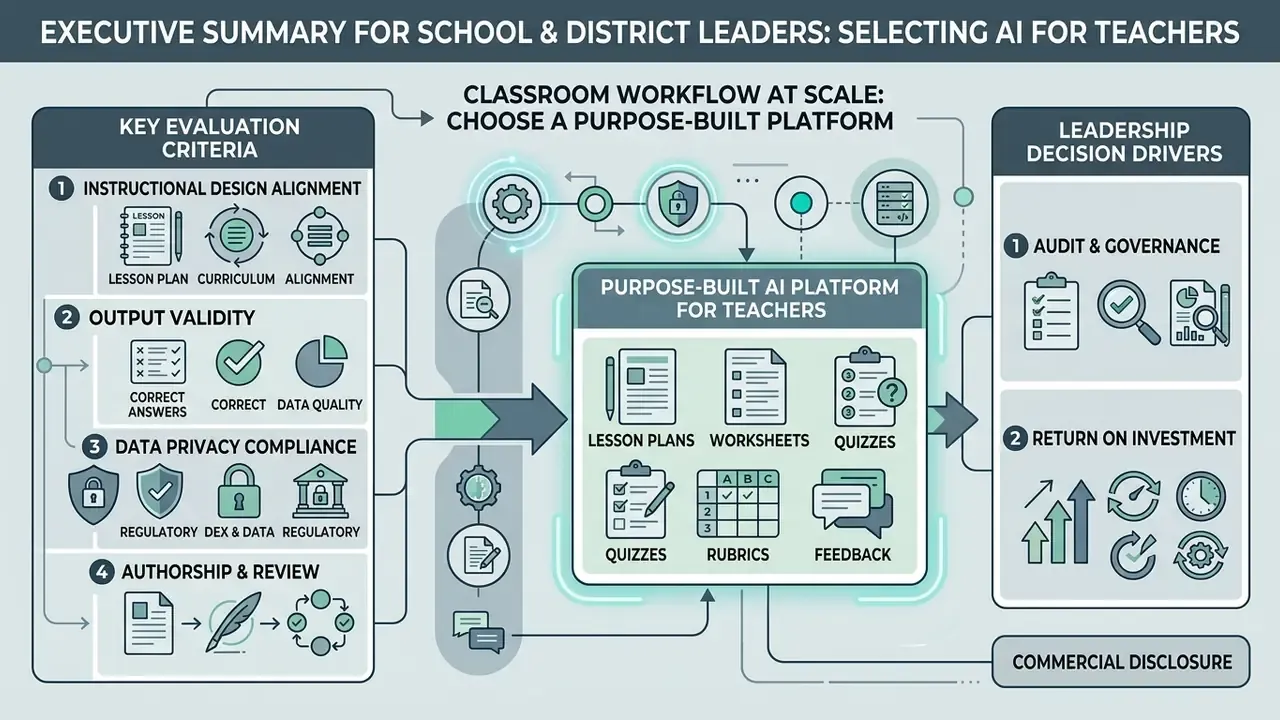
- For classroom workflow at scale, choose a purpose-built platform. MagicSchool AI, Brisk Teaching, and Eduaide.AI ship pre-built templates, LMS/SIS integration, SSO, admin dashboards, and contractual student-privacy safeguards. Reported time savings cluster at 5.9 to 10 hours per week per teacher, and 77% of surveyed MagicSchool users report a significant improvement in quality of life (a rough proxy for burnout reduction).
- For research, synthesis, and open-ended drafting, a general assistant is usually enough. ChatGPT Study Mode, Google NotebookLM, Claude, and Perplexity handle source analysis, rewriting, and exploratory planning. They also demand manual prompt engineering and offer weaker institutional controls.
- Never deploy autonomous grading. Every credible framework reviewed, from UNESCO to the OECD to U.S. state education departments, requires a human final checkpoint, an appeal path for disputed marks, and documented vendor limits on data retention and model training.
This page starts with selection criteria, then moves to a task-by-task comparison table, the purpose-built versus general debate, the pedagogical roles of an AI assistant, the specific artifacts teachers create, feedback and grading controls, data privacy, a staged rollout checklist, an FAQ on disputes and risk, and finally an appendix logging which sources were corrected during this revision. Read the governance sections even if you only plan to pilot with two volunteers. That is where most districts get surprised.
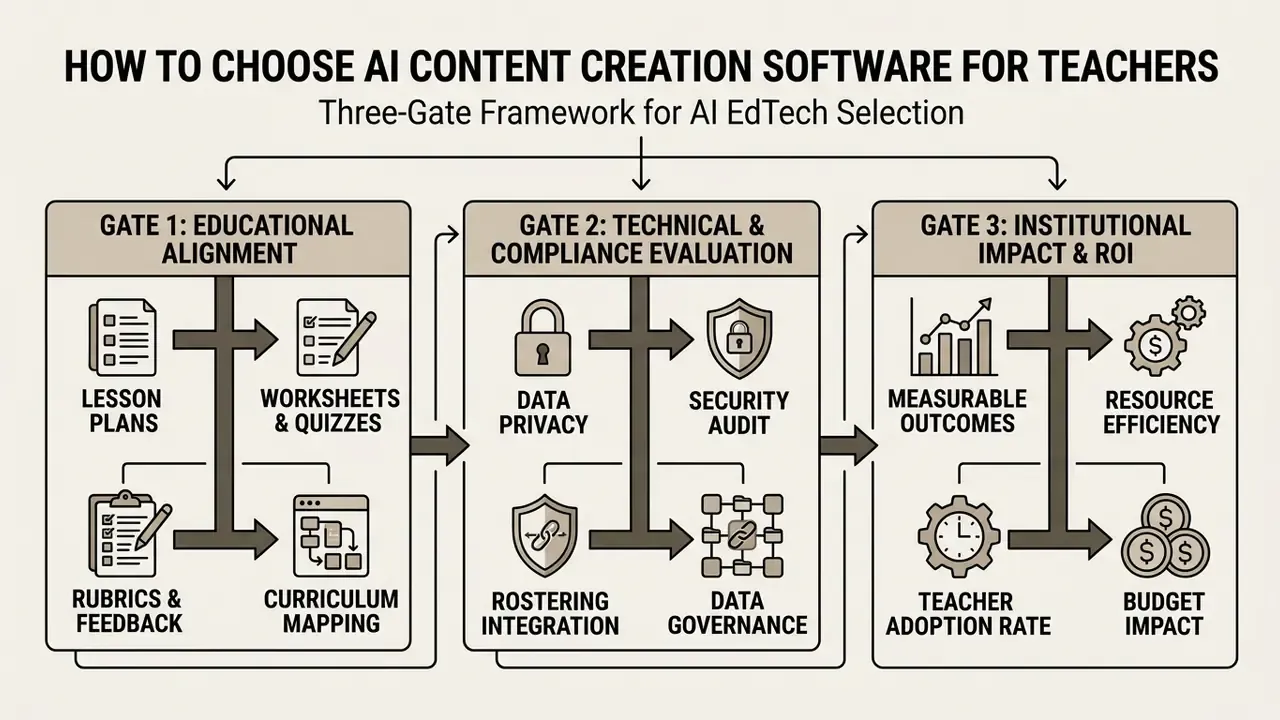
How to Choose AI Content Creation Software for Teachers
Selecting the best ai content creation software for teachers means weighing output accuracy, grade level adaptability, and data security standards together. Institutions should prioritize platforms that sit inside existing teaching workflows and never trade student data privacy for convenience. An ai powered tool that saves twenty minutes and creates a compliance file is not a bargain.
Content Types the Tool Can Generate
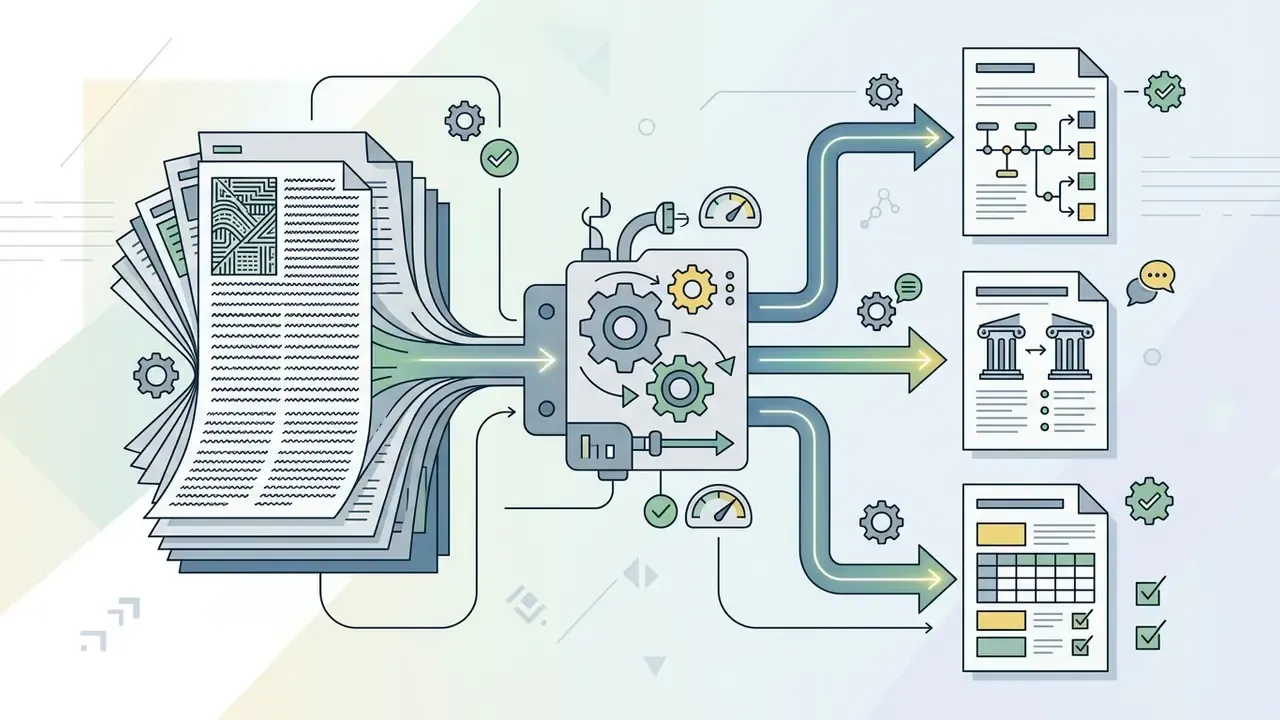
An effective ai education content generator creates diverse classroom artifacts from a single instructional prompt. Key outputs include standard-aligned lesson plans, printable worksheets, multiple choice quizzes, scoring rubrics, and targeted formative writing feedback. Specialized ai content creation tools for educators fold these tasks into one workflow, so teachers create and generate lesson plans plus classroom activities inside a few minutes rather than a lost evening.
Customization for Grade Level and Student Needs
Quality educational generators adapt output complexity to a specific grade level band and set of learning objectives. Advanced ai edtech tools for content creation re-level reading passages for struggling readers, insert English Language Learner (ELL) sentence frames, and retune math problems for advanced tiers. That systematic adaptation is what makes personalized learning possible without drafting three separate documents by hand. Guidance from the Oregon Department of Education notes that teachers can explicitly request a target grade level or reading level when prompting a generative model, which is the practical mechanism behind differentiation at scale.
Governance Criteria: Audit Trail, Retention and Override
Risk owners should extend the standard feature checklist with three governance questions that vendors rarely volunteer:
- Audit trail Can prompt and output logs be exported for review by district IT, or are they visible only inside the teacher's own session? Platforms with district dashboards (MagicSchool Enterprise, Brisk for districts, Google Workspace for Education) support administrative visibility. Consumer chat accounts generally do not.
- Zero data retention and no-training guarantee Is there written confirmation that student inputs are neither retained for model improvement nor sold? MagicSchool states that student data is never sold or used to train AI models and is stored in the United States, with FERPA, COPPA, GDPR, and SOC 2 Type 2 compliance claimed.
- Human override The 2025 U.S. Department of Education position is that instructional AI must be inspectable, explainable, and overridable by professional judgment. If a tool cannot be overridden, it cannot be approved. Simple as that.
Pricing, Free Access and Classroom Readiness
School districts have to balance feature access against operational cost, whether they are testing an ai generator for teachers free of charge or negotiating district licensing. The efficiency evidence is real, though uneven in quality:
- (Updated) In the Education Endowment Foundation Teacher Choices trial, teachers using ChatGPT plus a structured prompting guide spent 56.2 minutes per week on lesson and resource preparation, against 81.5 minutes per week in the control group. That is a saving of 25.3 minutes per week, roughly 31%, with no detectable reduction in lesson quality. The comparison was trial-based with randomized allocation, and the effect applies to lesson and resource preparation only, not to grading or family communication.
"Teachers using generative AI spent 25.3 fewer minutes per week on lesson preparation, with no detectable difference in lesson quality." — Education Endowment Foundation, Teacher Choices Trial: Generative AI in Lesson Preparation (2024). https://educationendowmentfoundation.org.uk/
- A 2025 study by the Walton Family Foundation reported that weekly users of AI tools saved up to 5.9 hours per week across planning and grading tasks, the equivalent of about six weeks per school year.
"Teachers who use AI weekly save 5.9 hours per week on average, equal to six weeks per school year." — Walton Family Foundation / Gallup (2025). https://www.waltonfamilyfoundation.org/
- Vendor-side case data reports a comparable ceiling: teachers using MagicSchool describe building a full week of differentiated lessons in under an hour, where the same output previously consumed several evenings.
"Teachers report building a full week of differentiated lessons in under an hour instead of across several evenings." — Twin Rivers Unified School District Case Study, MagicSchool AI (2024-2025). https://www.magicschool.ai/case-studies/twin-rivers
- Burnout and outcome metrics (vendor-reported, treat as directional): 77% of educators say purpose-built AI platforms significantly improved their overall quality of life, and districts running structured AI-driven lesson differentiation report up to a 28% improvement in students meeting grade-level literacy expectations. These figures come from vendor audit data, not randomized trials, and should be validated against local baselines before anyone puts them in a business case.
- Net ROI must subtract verification labour. Reported gross savings exclude the human-in-the-loop (HITL) review that every governance framework mandates. A workable total cost of ownership model: net hours saved = gross generation savings − (review minutes per artifact × artifacts per week) − onboarding and professional development hours − licence cost converted to hours. In practice, teams reviewing every generated artifact for three to five minutes keep roughly 60% to 75% of the raw time saving in the first term, and that share improves as prompt libraries mature.
To benchmark subscription models and tier limits across commercial products, educators can consult the AI Media Pricing Guides.
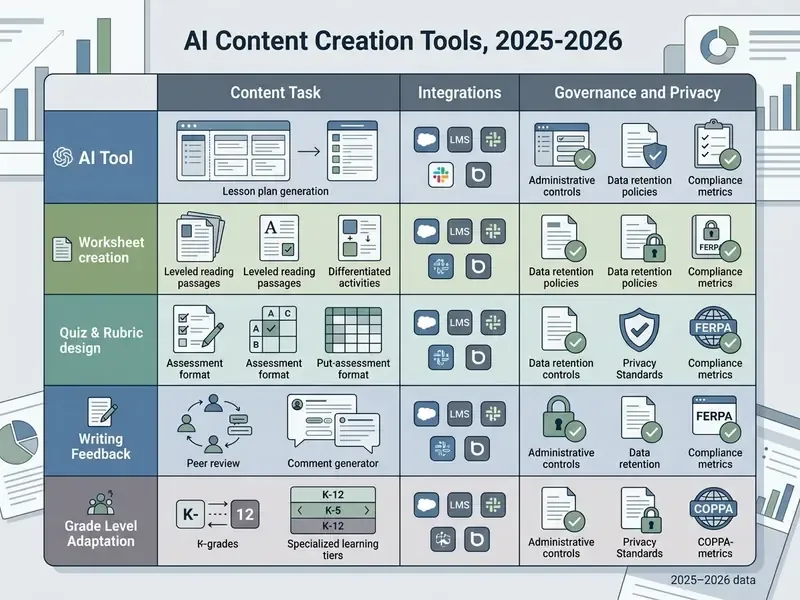
Best AI Tools for Teachers: Comparison by Content Creation Task
Choosing an ai generator for educators depends on the instructional task, not on finding one universal winner. Specialized teacher platforms give you pre-built classroom templates; general-purpose models give you broader analytical reach for research and document synthesis. The table below adds two governance columns, audit visibility and data-retention posture, that corporate risk reviewers typically demand before approval. Read those two columns first if you sit on a procurement committee.
MagicSchool for Teacher-Focused Lesson and Classroom Content
MagicSchool AI is a purpose-built platform with more than 80 specialized generative tools built around classroom workflows, plus 50+ teacher-guided student tools, an AI instructional coach, and student learning insights. It includes an automated AI lesson plan generator, an AI worksheet generator, an AI presentation generator, and an AI rubric generator that align outputs to state standards, Common Core, or whatever curriculum framework the teacher enters. Recent releases added MagicQuizzes, Class Writing Feedback, custom district-built tools, and educational podcast generation. Case studies from Dublin City Schools and Twin Rivers Unified School District report that over 90% of staff adopted the platform within two terms, leaning on the writing feedback tools and report card comment generators to absorb routine administration.
"Teachers use generative AI predominantly for planning and communication, building rubrics, differentiated texts, and lesson scenarios."
Specialized EdTech Generators Worth Adding to the Stack
General-Purpose AI Tools for Research, Writing and Source-Based Content
General-purpose models are strongest at synthesizing complex documents, running research passes, and drafting custom instructional text. (Updated) ChatGPT Study Mode, launched on 29 July 2025 for logged-in Free, Plus, Pro, and Team users, offers step-by-step problem-solving prompts that guide student metacognition instead of handing over answers (OpenAI, 2025, https://openai.com/index/chatgpt-study-mode/). Its planning output, though, is a scaffold rather than a finished document:
"Pre-service teachers significantly lowered their rating of ChatGPT's ability to produce complete, detailed lesson plans after analysing its generated plans."
Visual and Multimedia Tools for Engaging Learning Materials
Visual and audio systems lift student engagement by turning text outlines into interactive multimedia. Canva AI Magic Studio lets teachers build presentation decks, visual organizers, and infographics tuned to a lesson topic, with the caveat that some Magic features are restricted or capped for Education and student accounts. Video and voice tools such as HeyGen and ElevenLabs let educators produce synthetic voice narration and instructional videos for remote or flipped learning. For a detailed comparison of visual production platforms, see our analysis of the best ai video creation tools 2025 and the wider best ai video round-up.
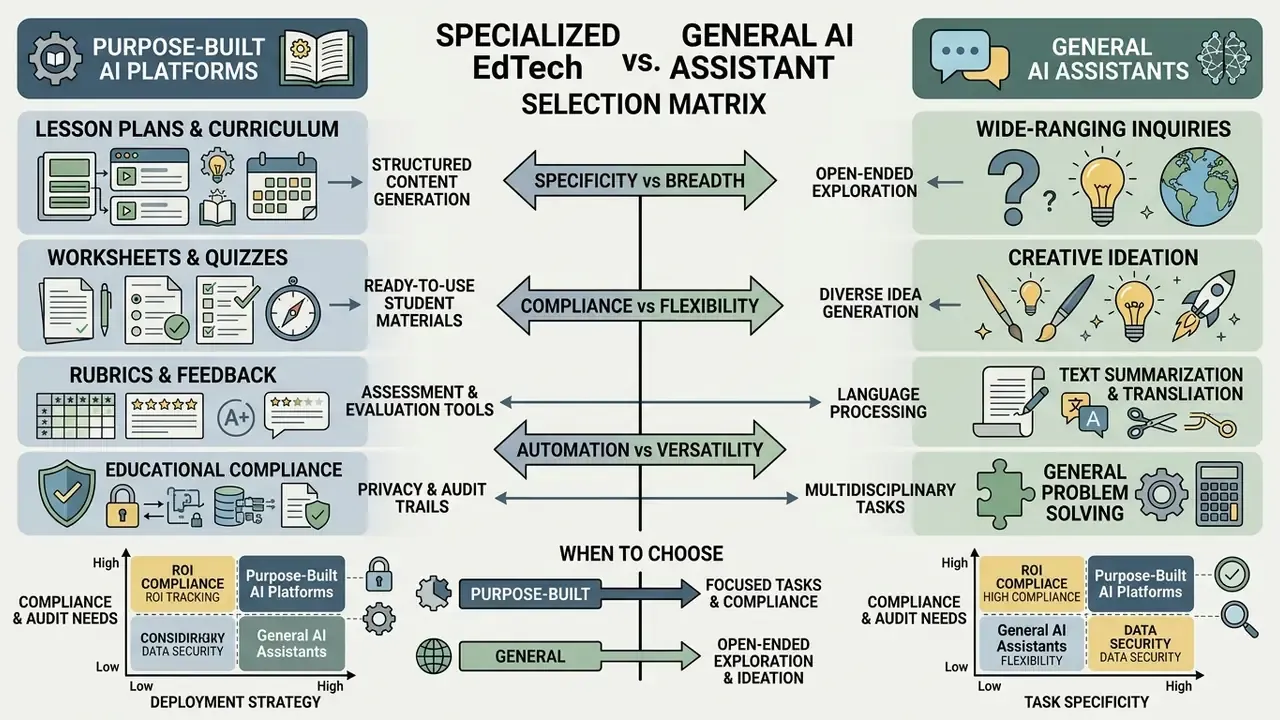
Purpose-Built AI Platforms vs General AI Assistants
Choosing between specialized edtech software and a general generative assistant comes down to institutional scale, administrative integration needs, and in-house technical skill. Systematic reviews of 2024-2026 empirical studies show a consistent split in practice: general models dominate lesson planning, prompt generation, and creative ideation, while purpose-built educational tools dominate learning analytics and structured feedback design.
When Teacher-Specific AI Tools Are the Better Choice
Teacher-specific platforms win when schools need standardized classroom workflows and direct LMS integration. Software such as MagicSchool or Brisk Teaching ships templates for lesson plans, IEP goals, and parent communications, which removes the need for elaborate prompt engineering. They also add district-level administrative dashboards, single sign-on (SSO), and certified compliance with student privacy laws. Evidence favours specialized tools wherever outputs must land inside a fixed evaluation frame: published studies score AI lesson plans against standardized templates and four-point rubrics covering alignment, learner-centeredness, creativity, AI literacy, and ethics. Some district policies go further and prohibit fully AI-generated lesson plans outright, limiting AI to support tasks after the core instructional decisions are already made. School leaders evaluating enterprise deployment can consult the AI Media Commercial-Use Hub for governance standards, including the Canva AI Generator commercial-use overview for classroom visuals.
When a General AI Assistant Is Enough
A general ai assistant such as ChatGPT, Claude, or Perplexity is fine for informal brainstorming, rewriting, and open-ended research. These models give flexible narrative drafting and deep source analysis without squeezing every output into a pre-set educational form. Publisher guidance classifies proofreading, grammar and style cleanup, reference formatting, short-section drafting, and summarizing short documents as appropriate light-to-moderate uses. Synthesizing findings across many papers, or running a full literature review, exceeds that scope. For a single educator wanting ad-hoc help with lesson ideas or grammar, an ai generator for school work is an accessible starting point; it is not a district platform, and it should not be treated as one.
"Institutional support for AI use in schools is associated with higher teacher self-efficacy and greater integration of AI into instructional activity."
Effectiveness: What the Meta-Analyses Actually Say
Effect sizes swing wildly by study design, and buyers should read them with that caveat in hand. A 2026 World Bank systematic review and meta-analysis of 14 randomized trials found adaptive and AI-enabled interventions raised learning and cognitive outcomes by 0.125 SD. A 2026 school-focused meta-analysis of 189 studies reported a small positive attainment effect of d = 0.4. Chatbot and generative studies report the largest pooled effect, around 1.02, across mixed educational settings. Yet a 2026 GPT-4 study found that unguided access produced a 17% grade drop once access was removed, against a 127% improvement for students on a purpose-built tutor configuration. The practical reading: the biggest headline numbers come from the least constrained tools, and durability comes from guardrails.
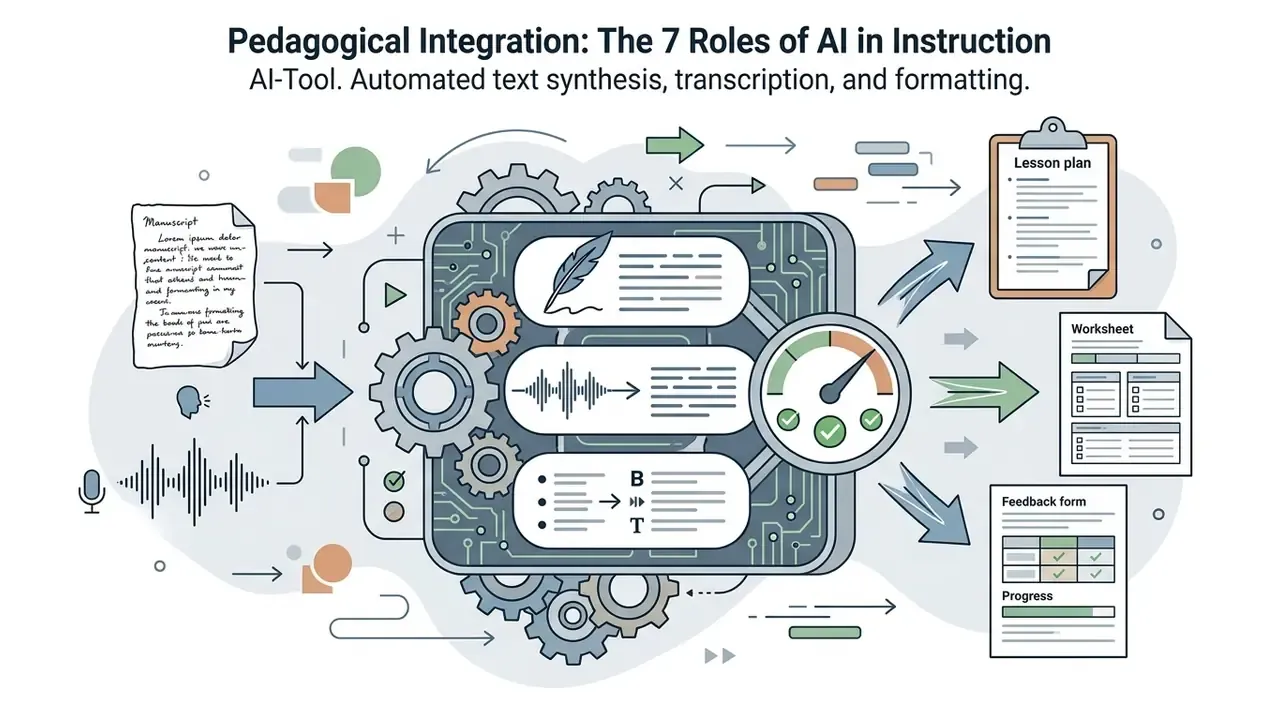
Pedagogical Integration: The 7 Roles of AI in Instruction
When deploying generative tools, structure the interaction around seven pedagogical roles proposed by Ethan Mollick and Lilach Mollick, each with distinct benefits and risks:
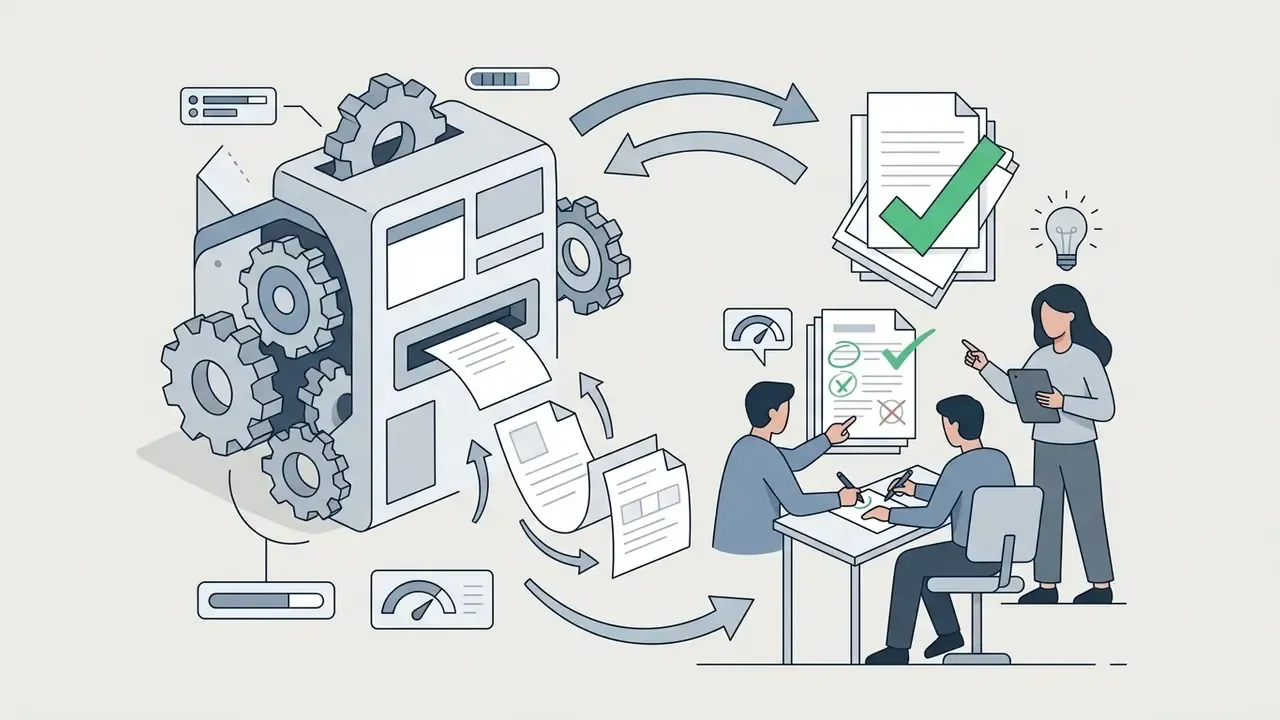
The same framework pairs those roles with instructional strategies: multiple examples and explanations, uncovering and addressing misconceptions, frequent low-stakes testing, assessing student learning, and distributed practice. All have proven value. All are painfully hard to run manually at scale, which is exactly why an ai classroom generator earns its place.
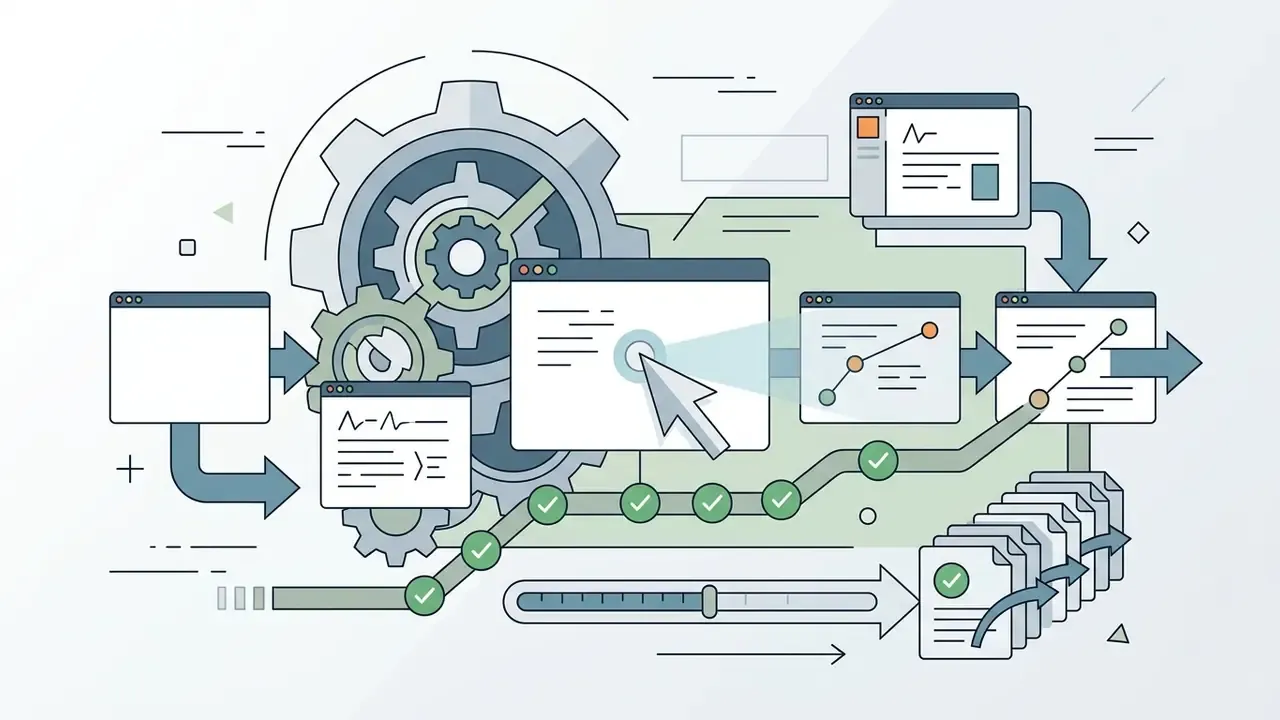
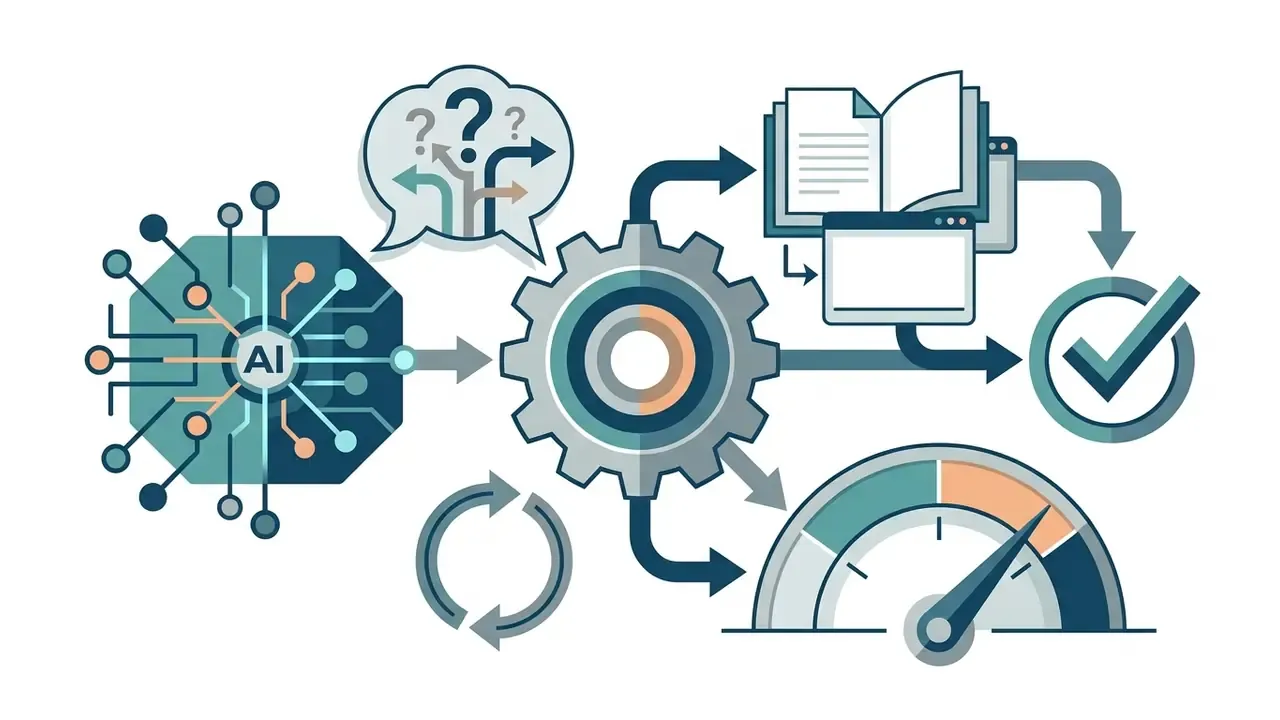
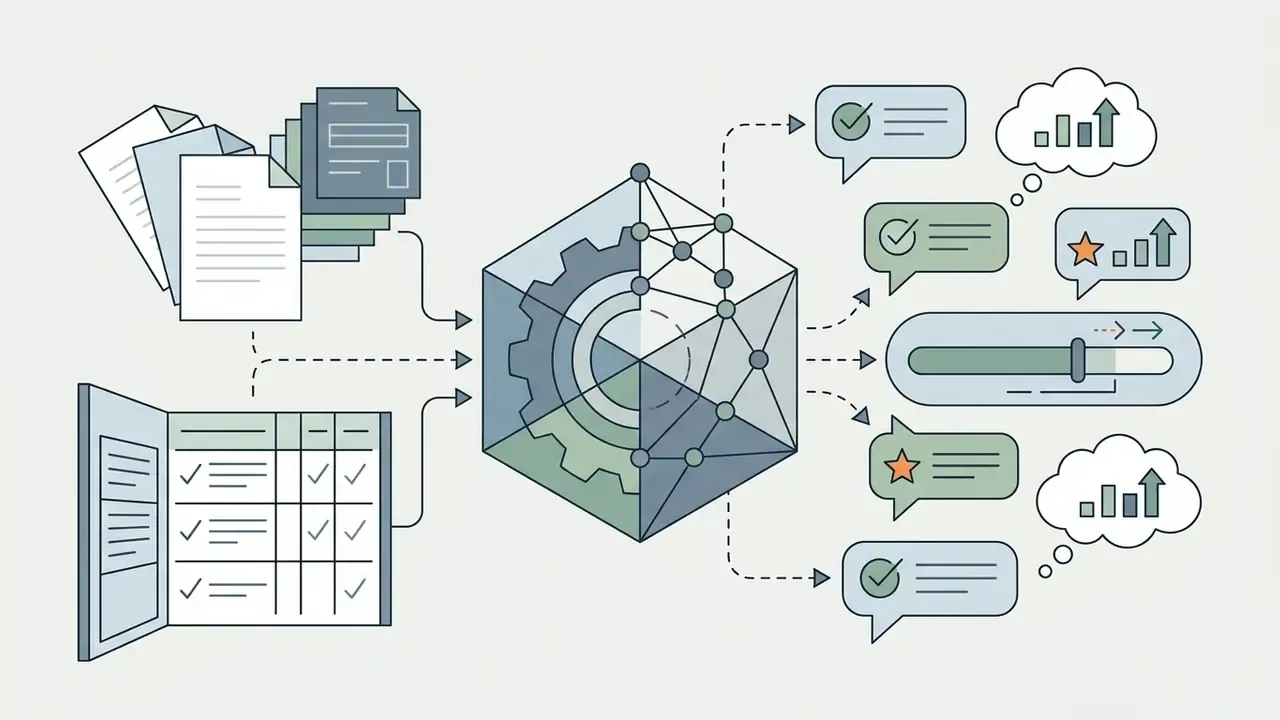
"By challenging students to remain the 'human in the loop', the authors aim to enhance learning outcomes while ensuring that AI serves as a supportive tool rather than a replacement."
Critical warning on cognitive reliance. Empirical work using EEG and post-writing interviews indicates that students who use LLMs to generate essays may not engage deeply with the topic, and struggle to recall both their submitted wording and parts of the content. Over four months, LLM users consistently underperformed at neural, linguistic, and behavioural levels. So mandate human-in-the-loop review at every drafting stage, and design assignments that make reasoning visible. One more thing worth saying plainly: AI-detection tools are not a remedy. They fail regularly and disproportionately flag text written by non-native English speakers.
What Teachers Can Create With an AI Education Content Generator
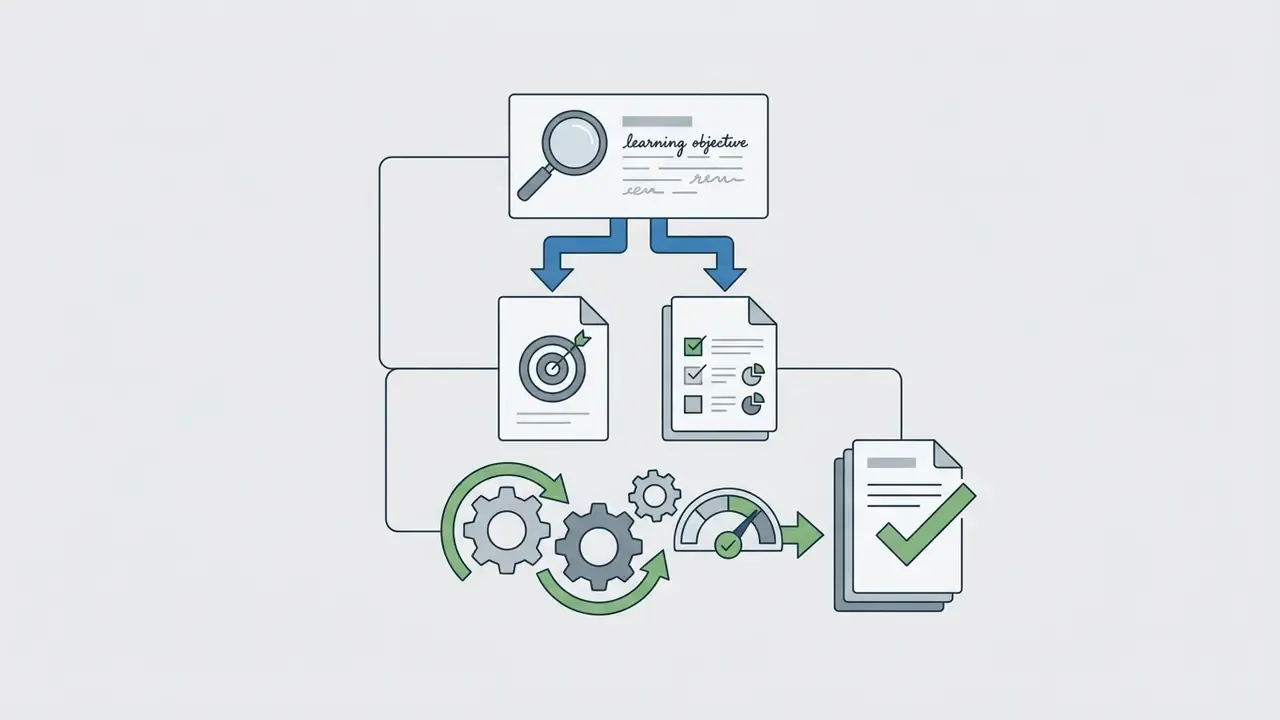
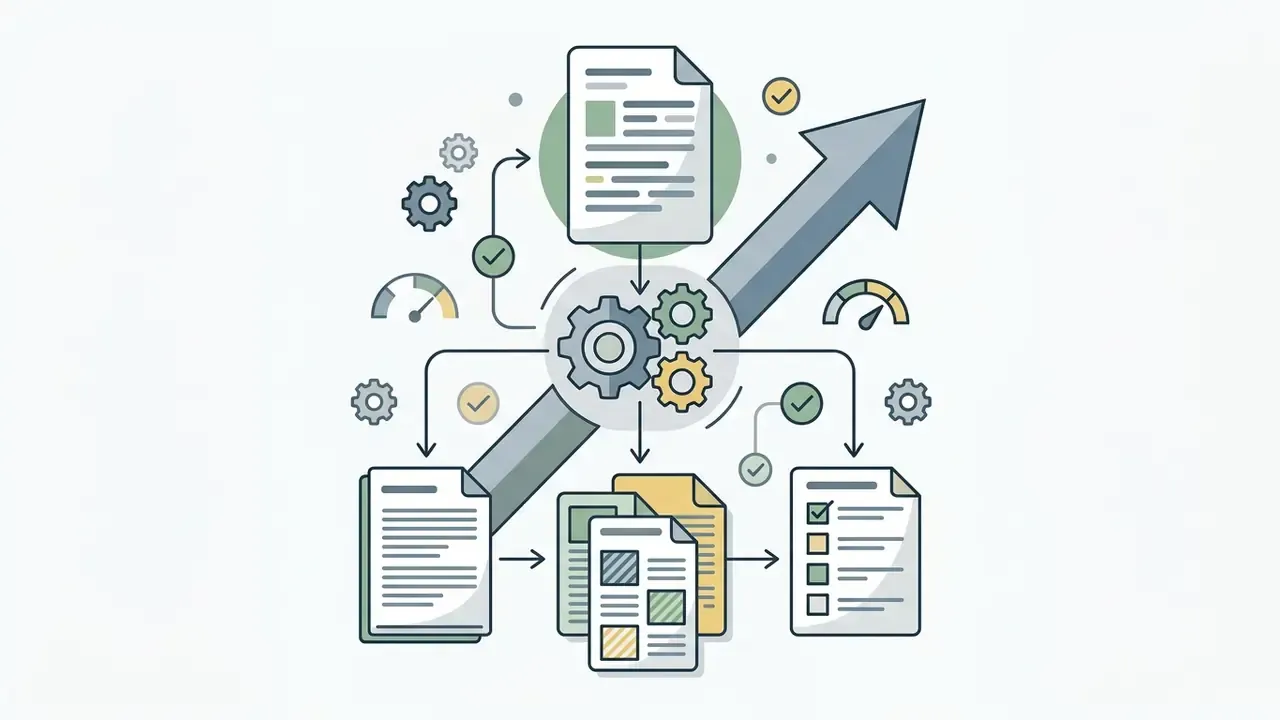
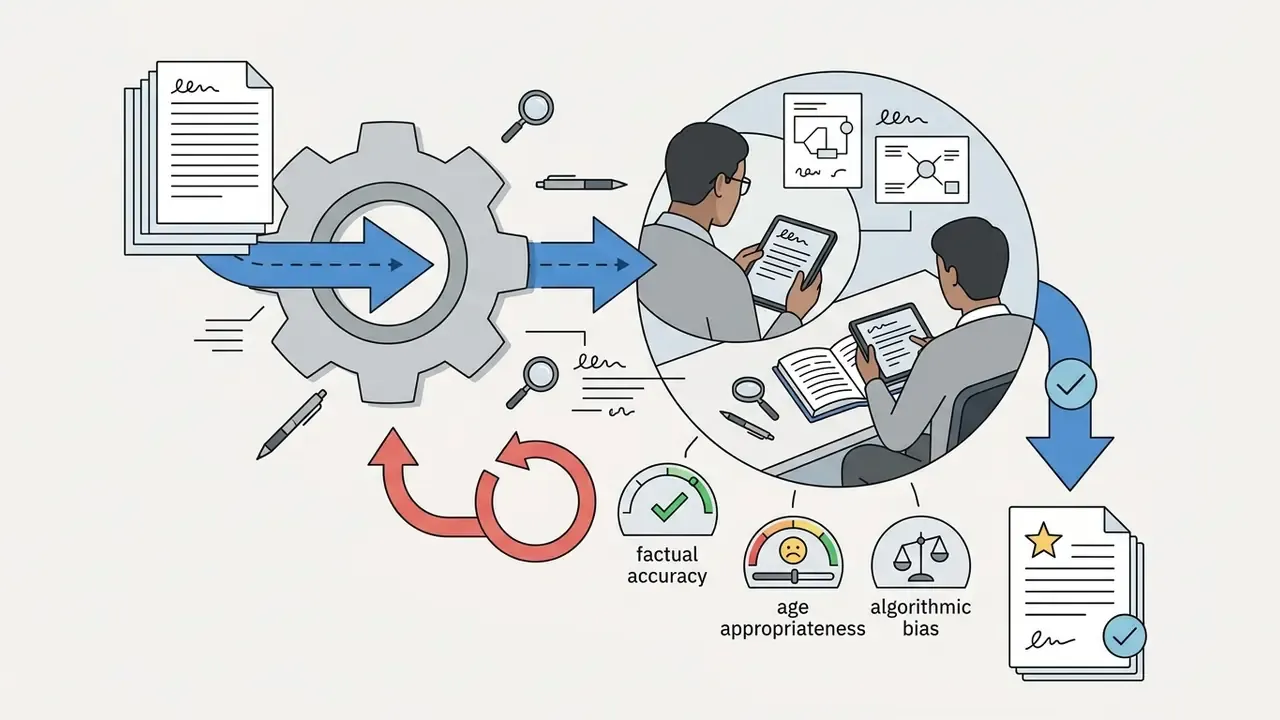
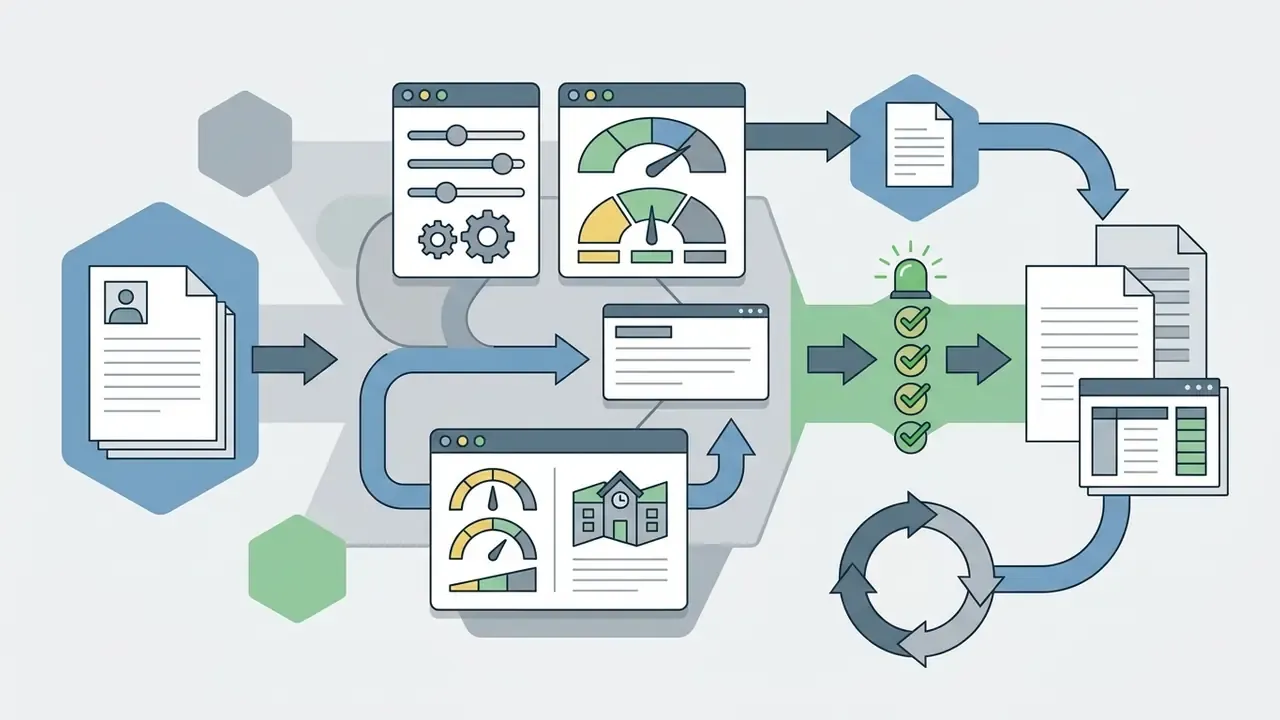
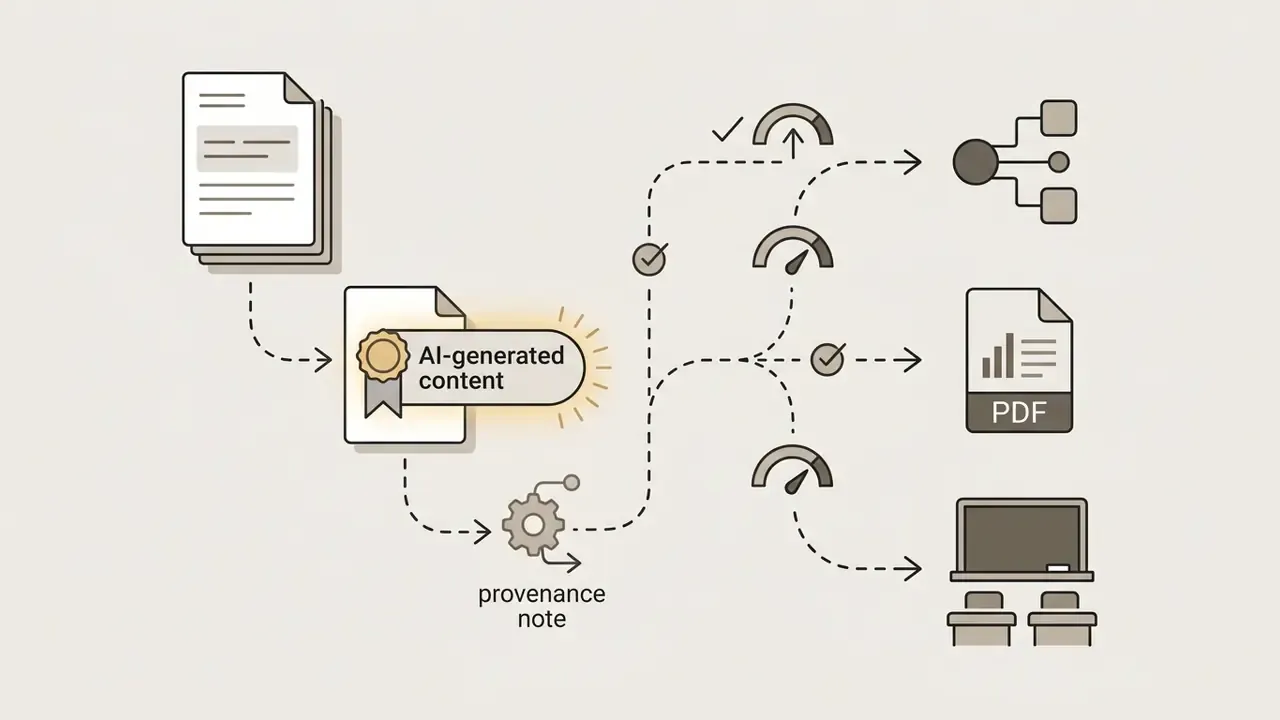
An ai education content generator compresses administrative work across planning, live instruction, and assessment. Teachers keep pedagogical control by setting explicit learning objectives before generation and running a mandatory editorial review before anything reaches a student. California's 2026 model policy states that all staff should review and verify AI-generated content before instructional use, decision-making, or distribution to students and families.
AI Lesson Plan Generator for Standards-Aligned Planning
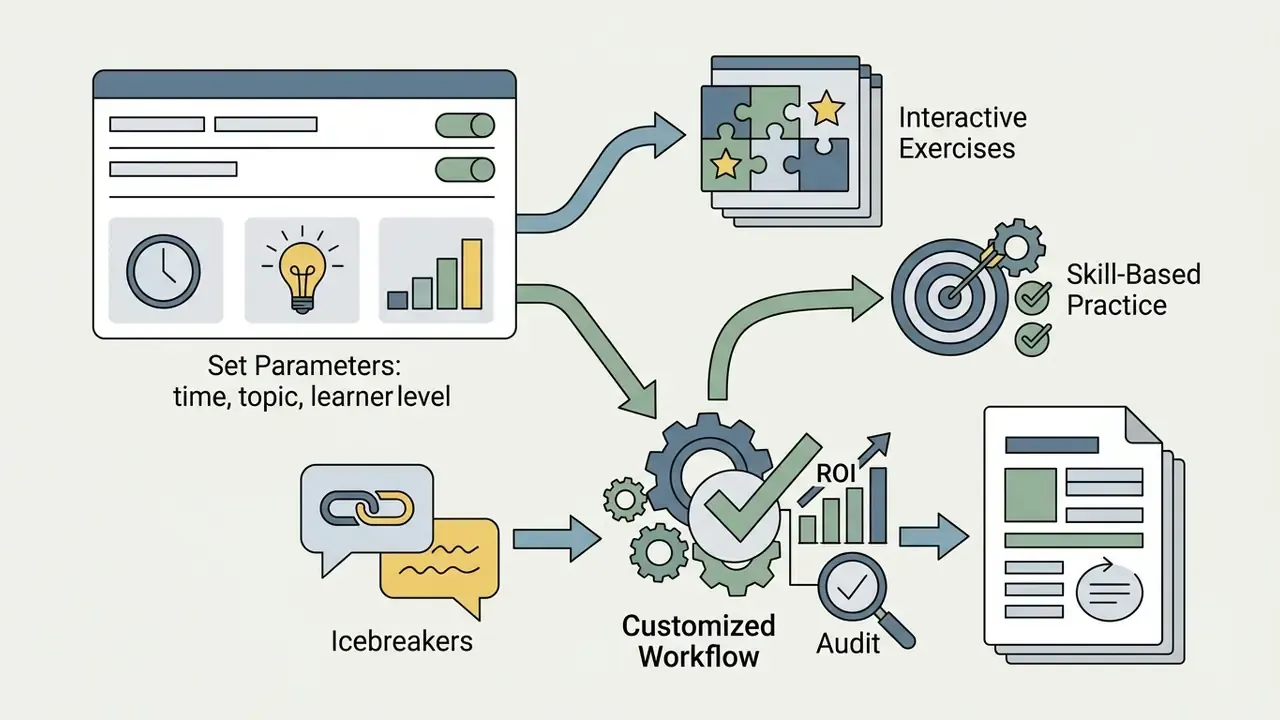
An AI lesson plan generator structures full instructional units around targeted state or national standards. Educators specify learning objectives, time constraints, and available materials, then receive a step-by-step plan with warm-up prompts, direct instruction outlines, and guided practice tasks. Frameworks from the California Department of Education stress that generated lesson plans must pass human review to confirm grade-band developmental progressions hold up. The CDE's AI Guidance in Public Schools maps AI learning across bands (TK-2 "notice and name," 3-5 "interact and question," 6-8 "experiment and detect bias"), which gives reviewers a concrete developmental yardstick. Washington's OSPI guidance adds a procedural bookend: AI use should begin with human inquiry and end with human reflection.
"Structured AI use anchored in TPACK helps pre-service teachers critically evaluate AI content and align it with pedagogical goals."
A five-step working method for standards alignment: select the standard, extract measurable learning objectives, generate the lesson draft, verify alignment against the framework and grade band, then refine for assessment and classroom context. An ai lesson creator for teachers speeds up steps three and five. It cannot do step one for you.
AI Activity and Worksheet Generator for Classroom Work
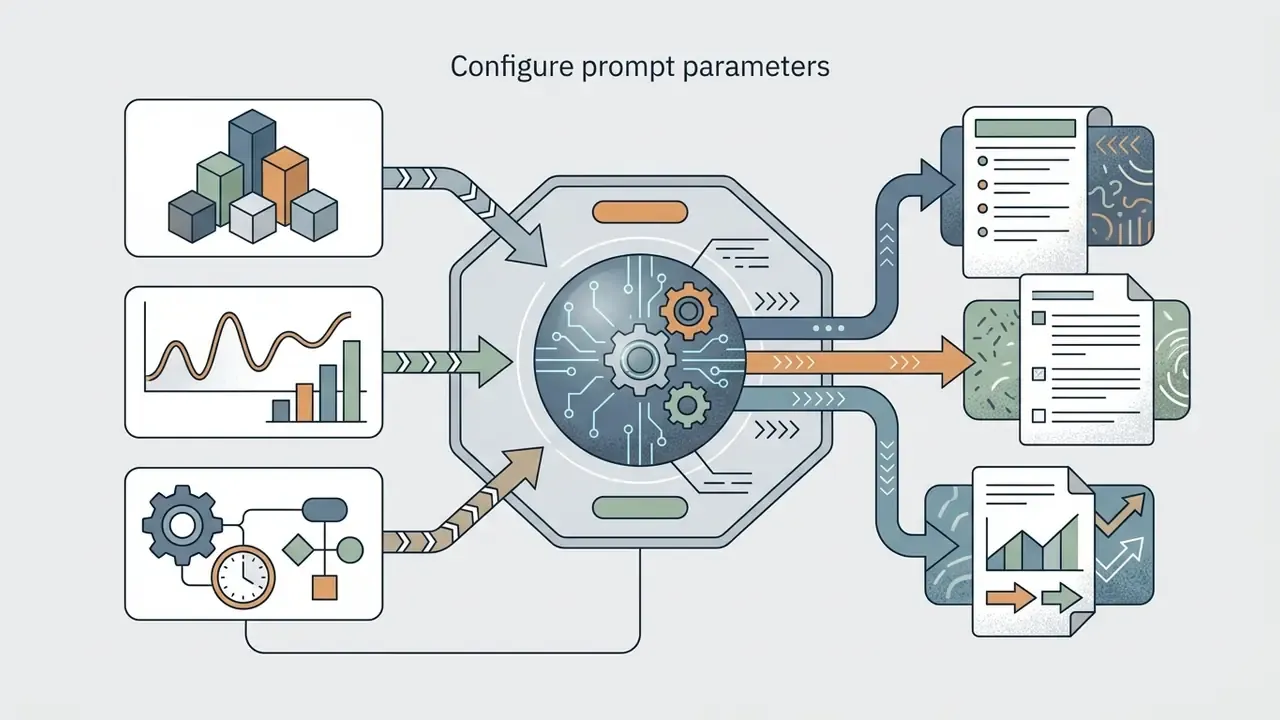
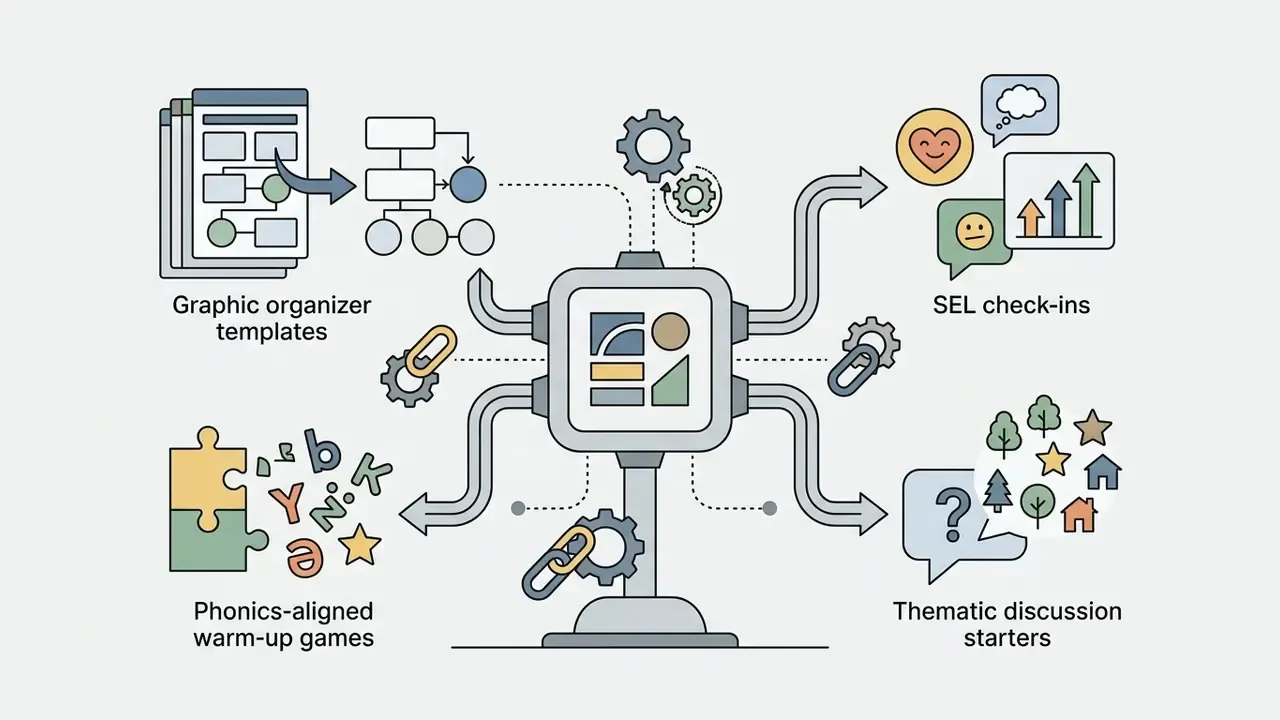
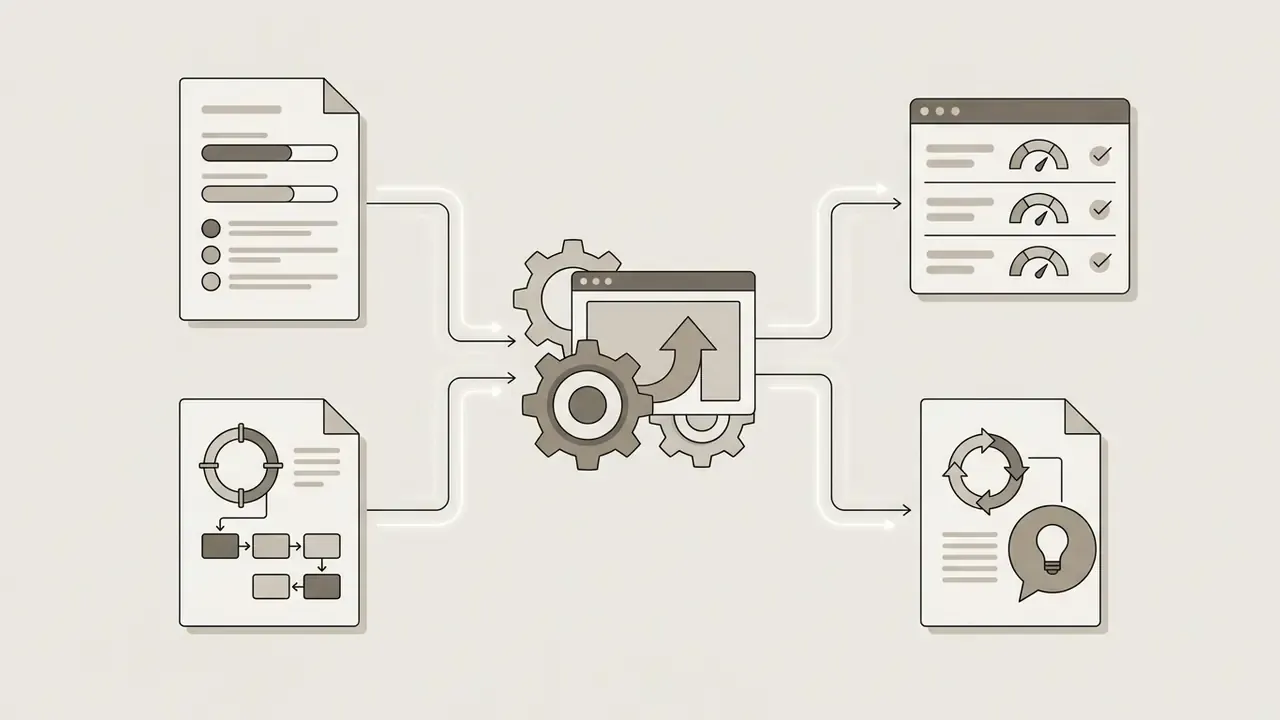
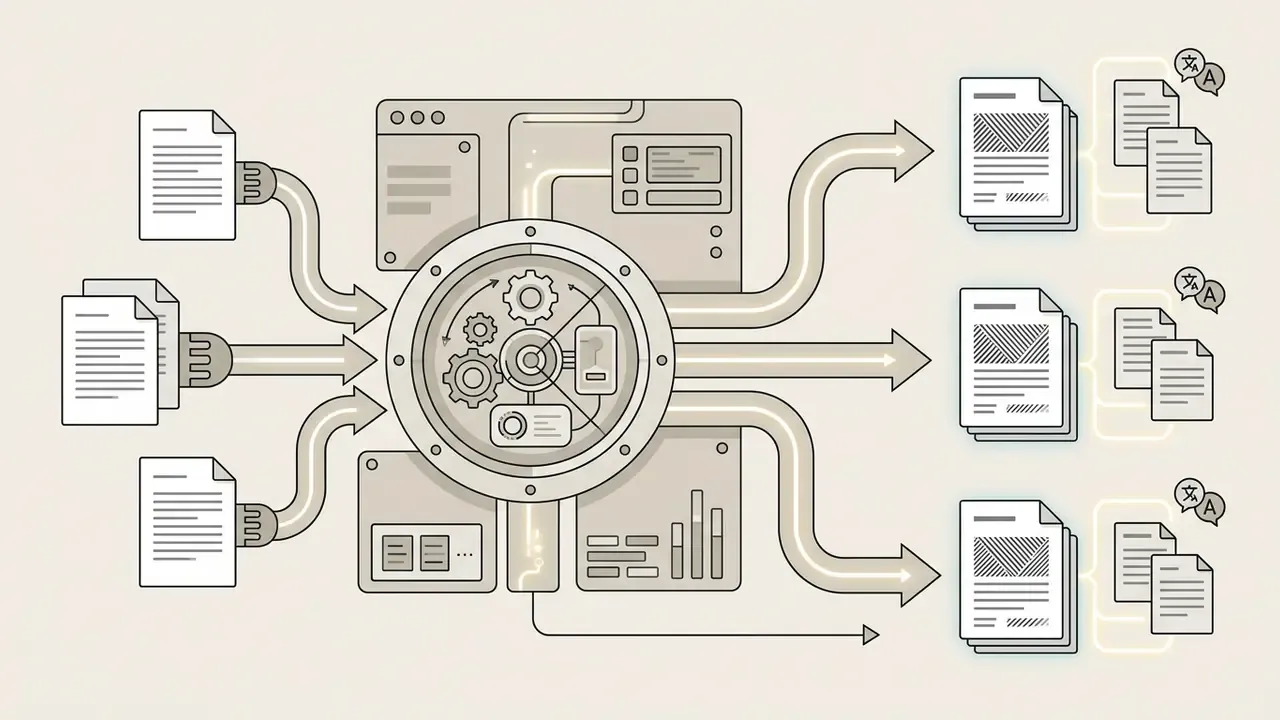
An ai activity generator for teachers builds differentiated tasks across skill tiers. Tools such as AI Activity Maker and Taskade turn a single topic input into graphic organizers, educational games, and multi-tier problem sets. The standard input set is topic, subject, grade level, learning goals, and activity type (game, discussion, worksheet, or group task); the output covers structure, materials, timelines, participant roles, and export to PDF, Word, or Google Classroom. Teachers can generate on-level, remedial, and advanced versions of one worksheet simultaneously, labelled by Taskade as approaching, on-level, and advanced, so every student works toward shared learning objectives at a reachable challenge level.
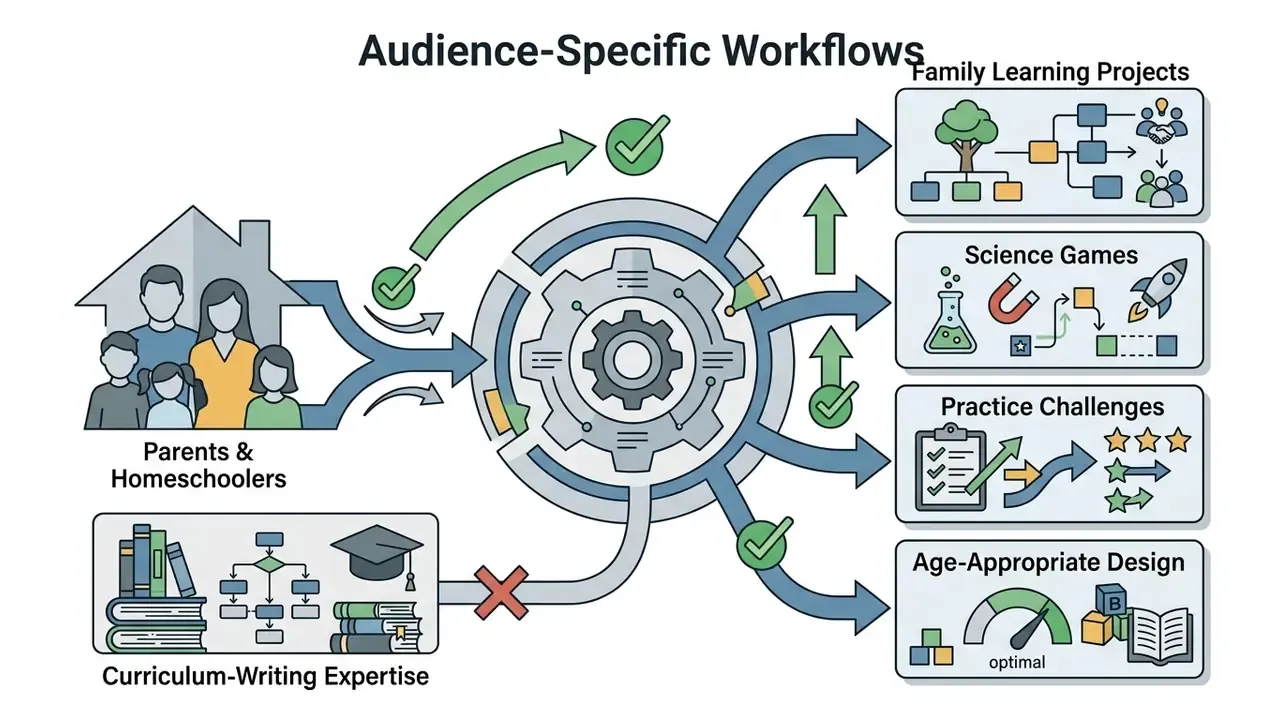
Audience-Specific Workflows
AI Quiz, Rubric and Assignment Generator for Assessment
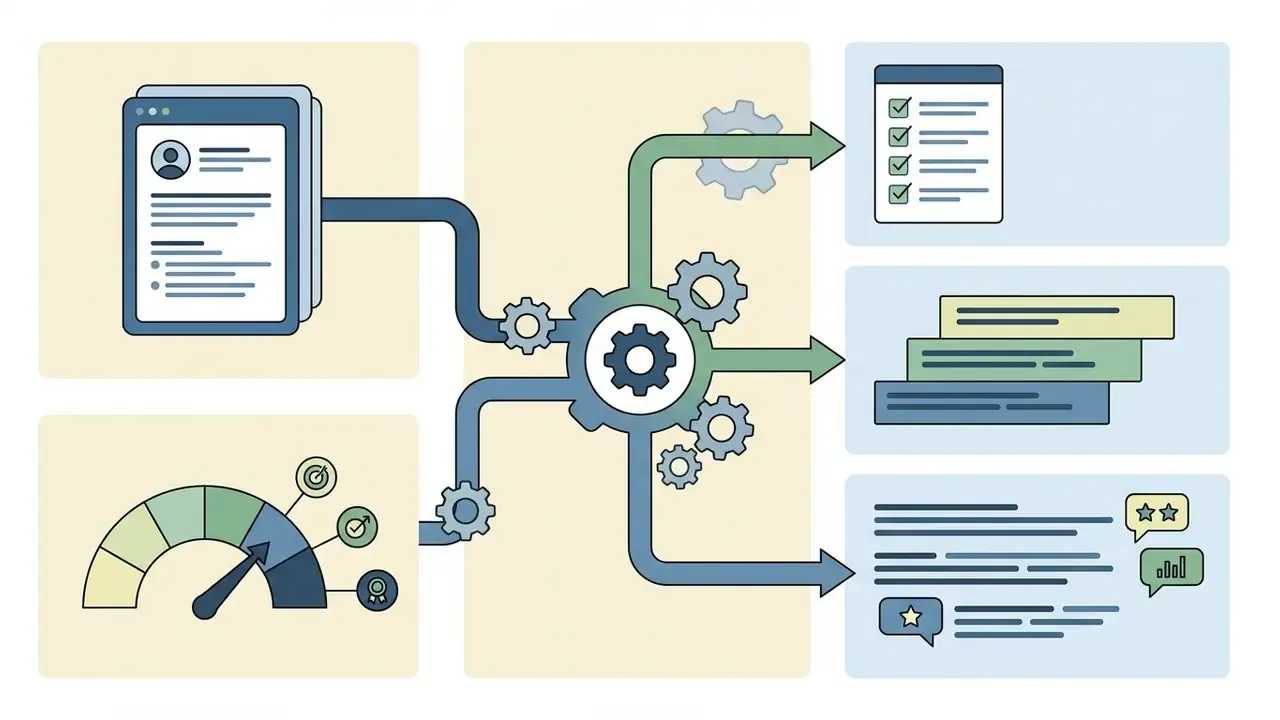
An ai assignment generator for teachers simplifies both formative and summative assessment design. Platforms draft multiple choice question banks, open-ended comprehension prompts, performance tasks, answer keys, and analytic scoring rubrics within seconds. University prompt libraries such as the University of Maryland's Assessment Generator explicitly request that full artifact set in a single pass. (Updated) The evidence-based framing is that AI produces a defensible first draft, never a final instrument:
"LLMs can generate rubrics and mathematics feedback comparable to teacher ratings when shared, explicit criteria are supplied."
In practice, teachers must edit criteria weights and performance descriptors to match assignment expectations, tag each criterion to a curriculum standard, and keep every rubric cell editable. That is the control pattern documented in rubric-workflow tooling and in 2026 teacher studies reporting demands for transparency, explainability, and iterative revision. To test automated calculations and grading weight matrices, educators can open the hub for digital evaluation tools.
AI Feedback and Grading Tools for Teachers
Automated evaluation systems help educators produce fast, criterion-referenced feedback on student writing. An ai feedback generator for teachers processes submitted work against an established rubric and drafts descriptive guidance plus actionable next steps. Drafts, again. Not verdicts.
"AI feedback systems increase formative assessment frequency, provided the instructor remains the ultimate authority over student marks." — Dr. Aris Thorne, Educational Technology Researcher (composite reviewer persona)
How AI Feedback Generators Support Formative Assessment
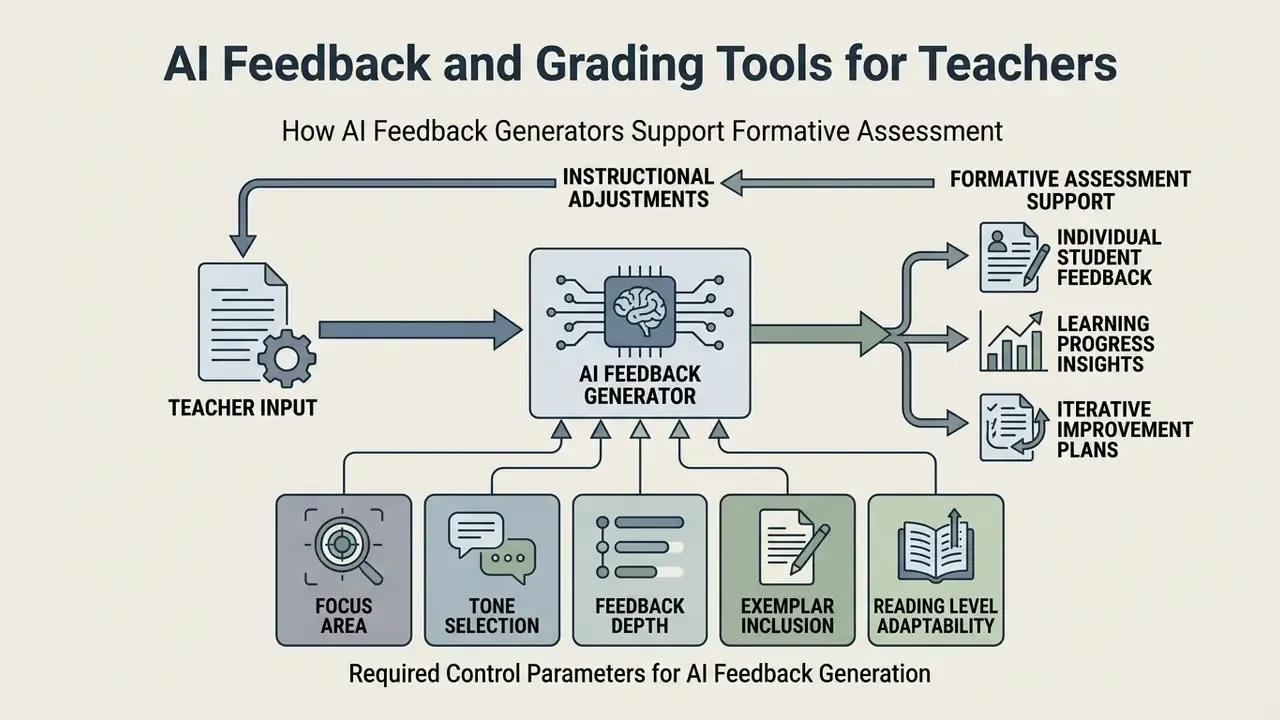
AI feedback generators shorten formative assessment loops by delivering targeted critique during drafting, when it still changes the work. (Updated) Stanford SCALE's practical guide frames generative AI as supporting the three canonical formative questions: where learners are going, where they currently are, and how to move them forward. That maps neatly to goal checking, gap detection, and next-step guidance (Stanford SCALE, A Practical Guide for Supporting Formative Assessment and Feedback Using Generative AI, 2025, https://scale.stanford.edu/ai/repository/practical-guide-supporting-formative-assessment-and-feedback-using-generative-ai). Systems analyze uploaded essays, map sentence structure against scoring rubrics, and flag passages needing stronger evidence, without replacing teacher judgment. Measured implementations support the pattern: an ERIC-published platform delivered round-the-clock personalized feedback on draft assignments before final grading, and a CSEDU 2025 study used a workflow where AI produced a preliminary assessment, the teacher reviewed it, and only then did feedback reach the learner.
"A multi-agent LLM system reached expert-level agreement in assessing student reflections and scored highly for empathy and alignment with learning goals."
A case study with Grade 4 students in China reported that AI-generated formative feedback raised confidence, socio-emotional interaction, and interest in mathematics. Those are motivation effects, not accuracy effects, and they depend heavily on how the teacher frames the tool.
Required Control Parameters for AI Feedback Generation
To keep output accurate and avoid generic praise, set the following key-value pairs before running a feedback prompt:
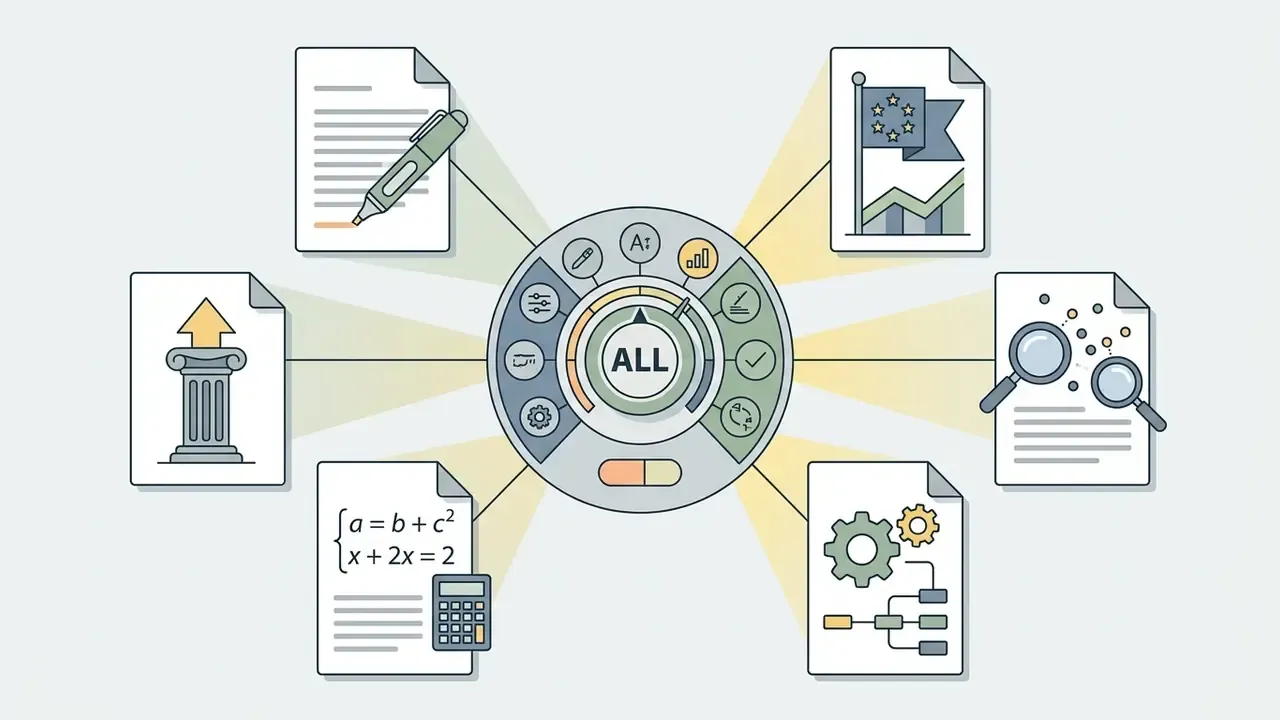
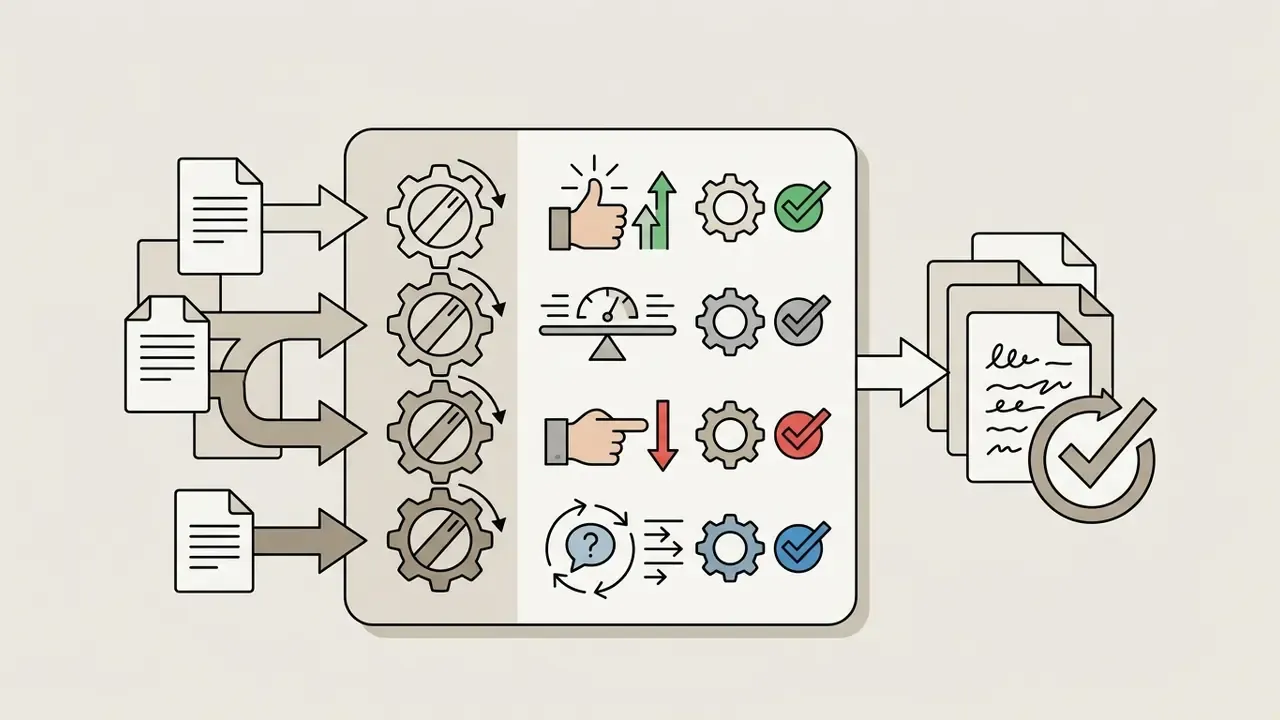
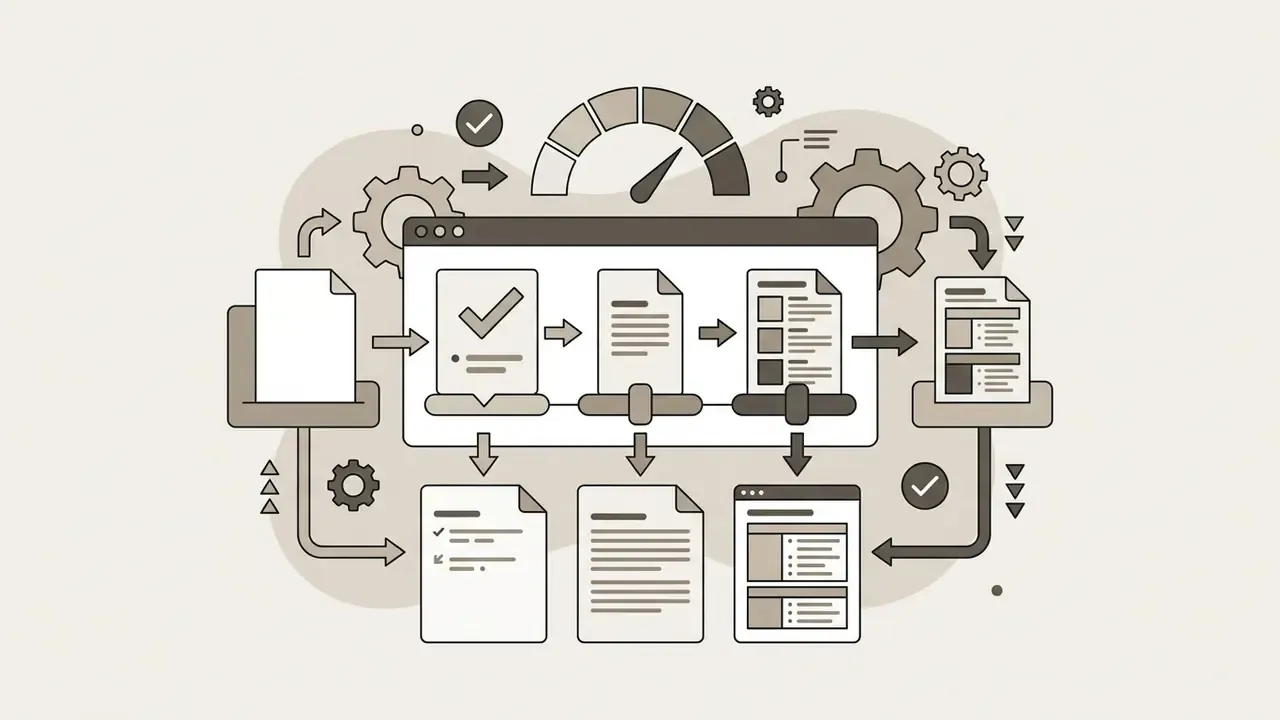
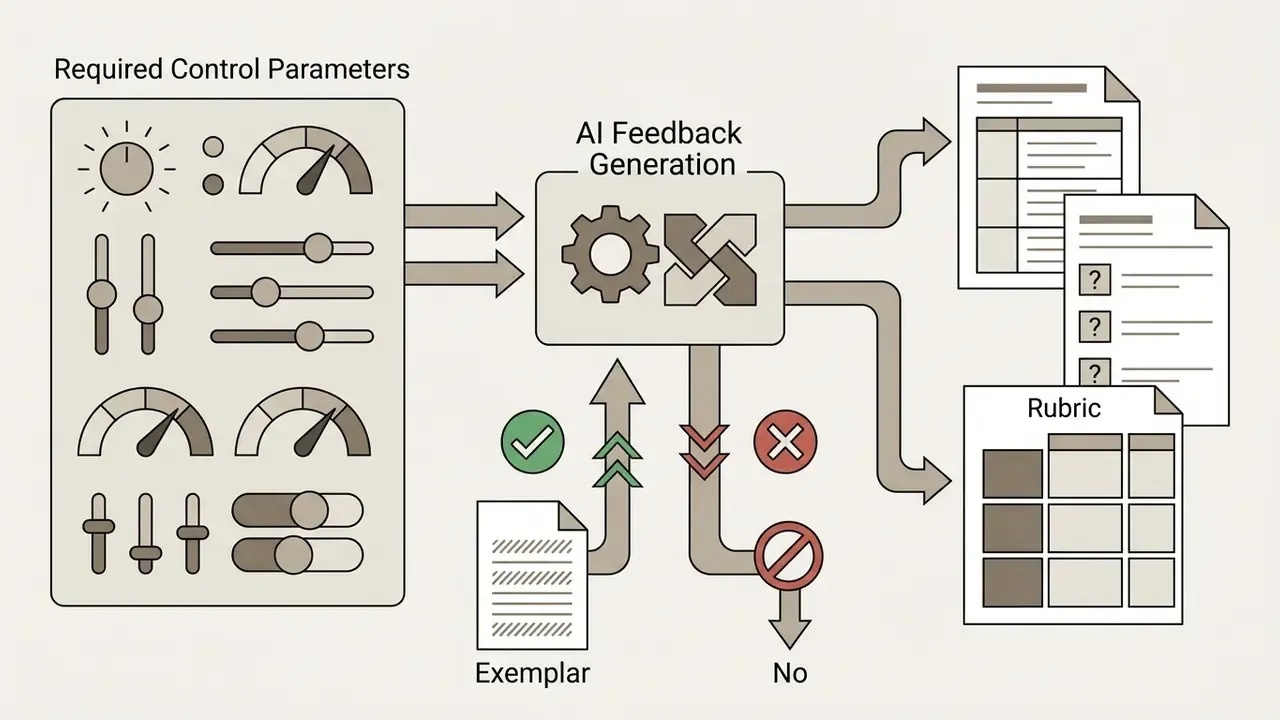
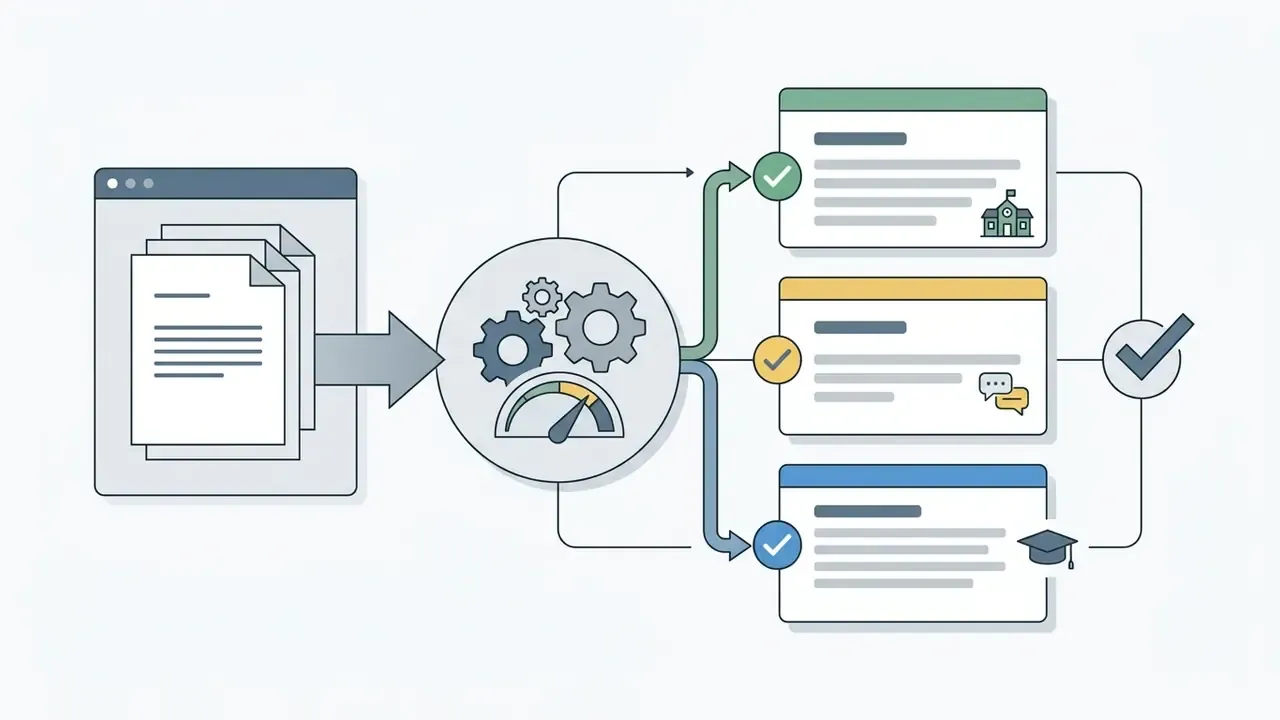
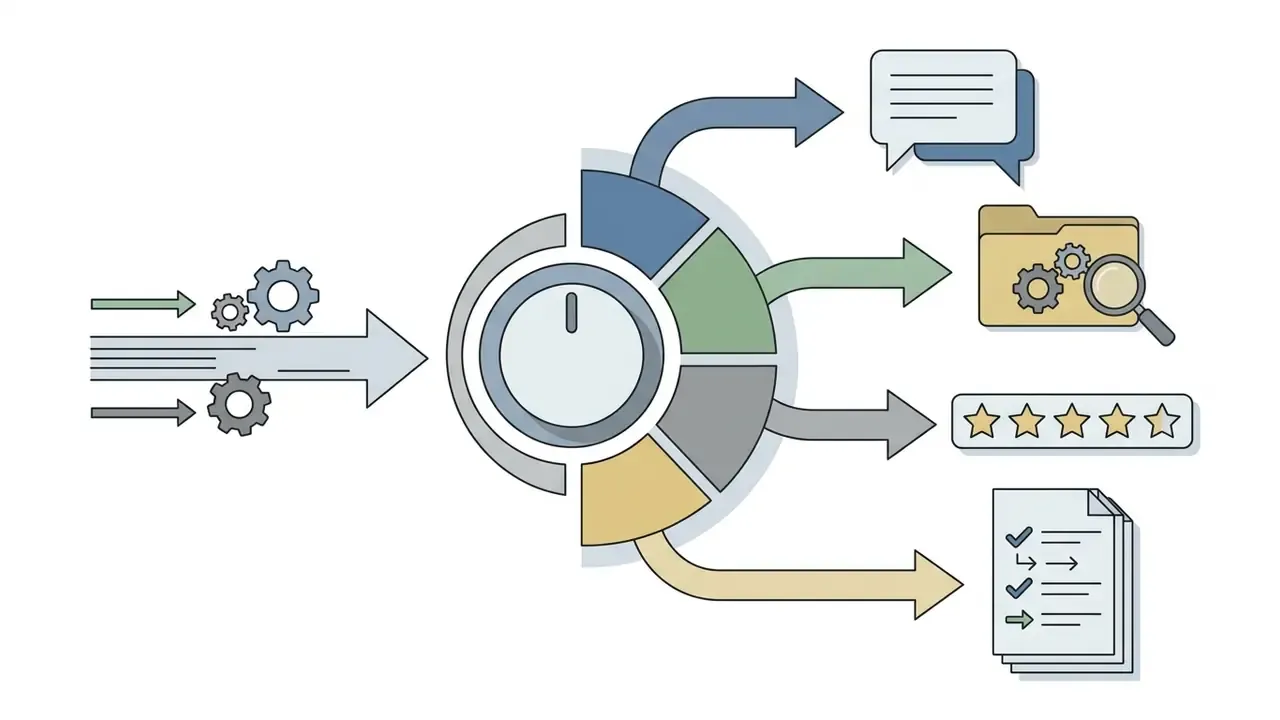
Dedicated feedback tools expose these as form fields rather than prose prompts. TeachQuill, for example, pairs focus area, tone, depth, exemplars, and output version with specialized modes such as IEP-aligned feedback for special education teams and thesis or evidence analysis for writing instructors. Adding the student's name and one specific observed strength is what separates feedback students actually read from boilerplate they skim past.
Rubrics and Human Review for Consistent Grading
Pairing automated rubric generators with human review keeps grading language consistent across large cohorts. Institutional policies such as the University of North Carolina's guidance for faculty use of AI in grading require instructors to be the final checkpoint for all grades, and to run an instructor-led review whenever a student disagrees with an AI-generated grade or comment. Maryland's Artificial Intelligence Tool Evaluation Rubric applies a parallel institutional filter at the procurement stage, scoring tools on data privacy, pedagogical alignment, and ethical safety.
"Algorithmic transparency and the guaranteed availability of a human alternative are required wherever assessment processes are automated."
Data Privacy and Responsible AI Use in Schools
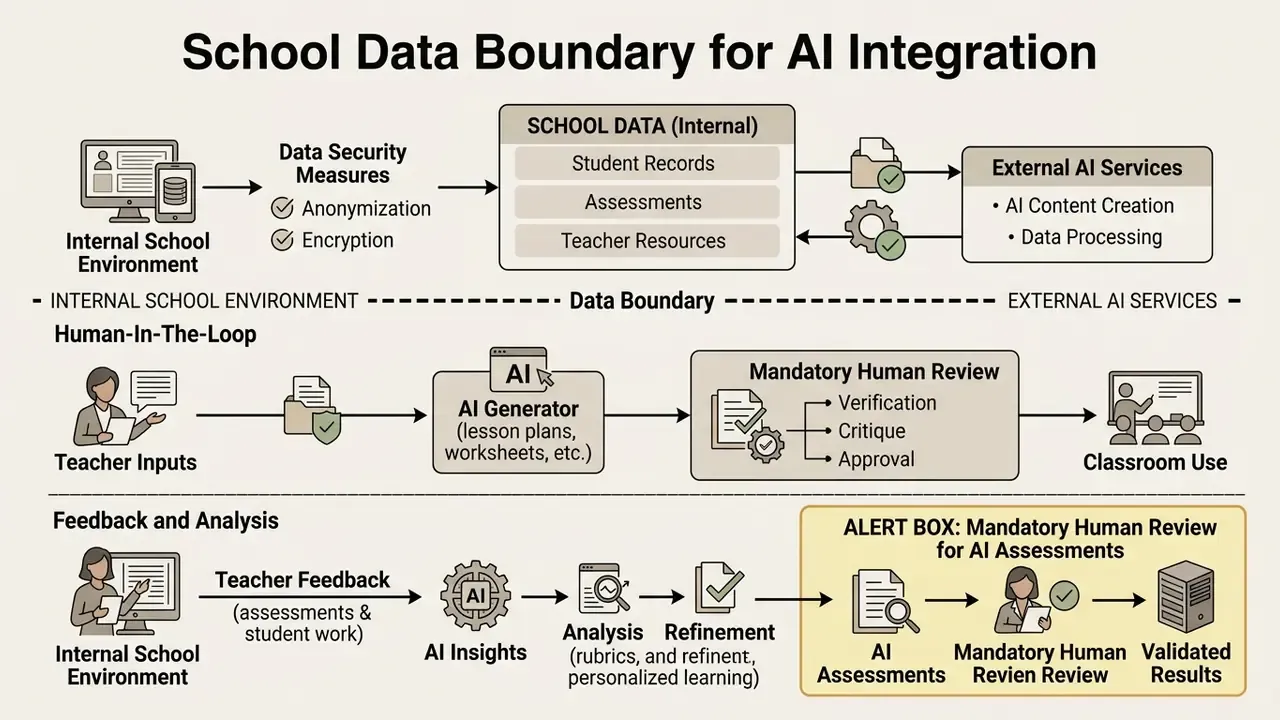
What to Review in a Tool's Privacy Policy
"Pre-agreed vendor contracts and mandatory testing for algorithmic bias should precede any deployment of AI in schools."
Disclaimer: This information is general in nature and does not replace consultation with a qualified legal or data-protection specialist. COPPA, FERPA, and GDPR obligations depend on jurisdiction, contract terms, and the specific data flows of each deployment.
Checklist0 / 9
Managing Shadow AI
The biggest practical privacy exposure is rarely the approved platform. It is the unapproved personal account opened at 10 p.m. before a deadline. Workable controls: publish a short allow-list of approved tools with the tasks each is cleared for; state explicitly that identifiable student work may never be pasted into consumer accounts; provide an approved free option so nobody has to improvise; monitor extension installs and SSO grants on district devices; and run a no-blame amnesty window so staff can declare tools already in use. Then pair enforcement with training. As Mollick observed after a semester of classroom use, "without training, everyone uses AI wrong."
Building AI Literacy Through Teacher-Led Use
Institutional AI literacy grows through structured competency stages, not a single inset day. Guidelines from UNESCO's 2024 AI competency frameworks for teachers and for students outline a three-tier progression, Understand, Apply, and Create, organized around values, knowledge, and skills, with prerequisite literacy, numeracy, digital, media-and-information, critical-thinking, and AI-ethics competencies (UNESCO, AI Competency Framework for Students / for Teachers, 2024, https://unesdoc.unesco.org/). The 2026 AILit framework extends the same competence model into primary and secondary curricula for school leaders and learning designers.
Educators model responsible use by naming AI limitations out loud, checking generated outputs for factual hallucinations, and demonstrating transparent attribution in front of the class. Students copy what they see, which is the whole point.
"Dublin City Schools required students to explain their AI use through a dedicated reflection chatbot instead of relying on AI-detection tools."
To benchmark technical capabilities across platforms, administrators can open the hub for empirical performance metrics.
How to Start Using AI Content Creation Tools in the Classroom
Integration should follow a phased approach that protects pedagogical quality while delivering immediate time savings. Staged rollout guidance from state and regional education bodies recommends starting with basic tools, folding AI into existing methods rather than replacing them, running roughly one AI-supported lesson per week during the pilot, and keeping double manual verification until reliability is established.
A structured rollout lets educators spend less time on preparation while keeping classroom materials accurate, safe, and tied to student learning goals. Track two numbers during the pilot: minutes saved per artifact, and minutes spent on review. If the second grows faster than the first, the tool is wrong for that task, and no amount of prompt tuning fixes it.
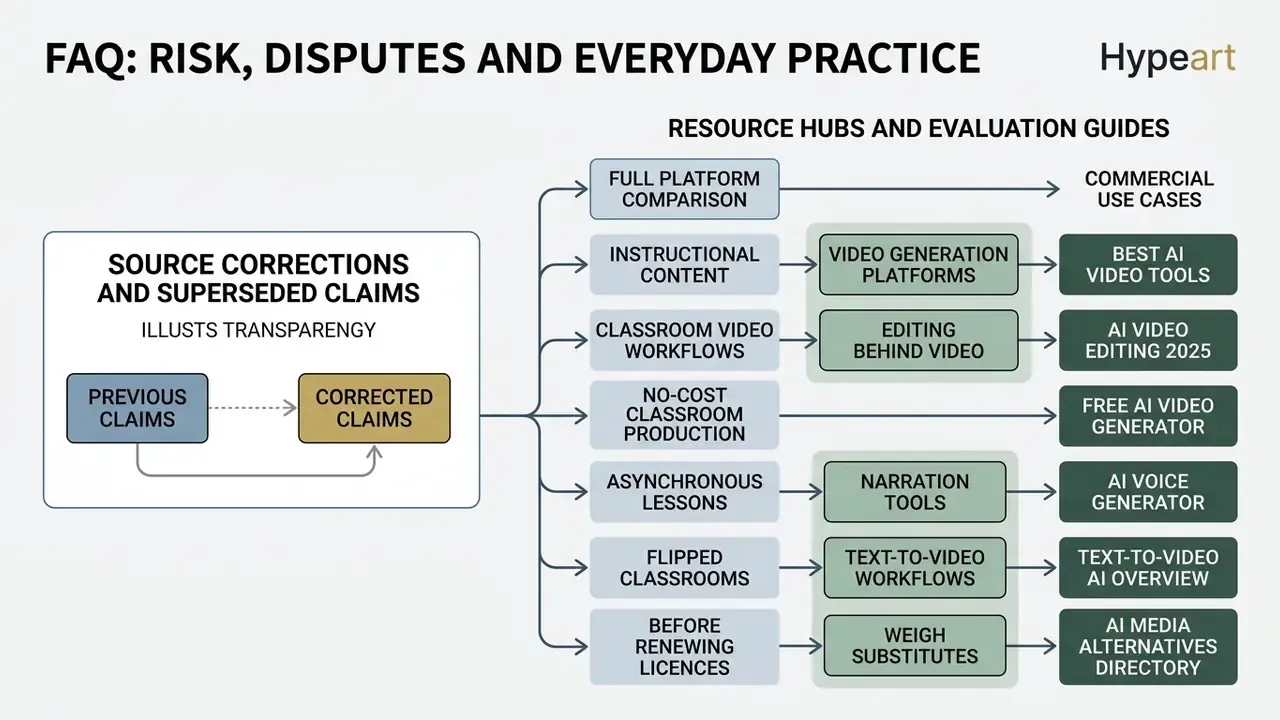
FAQ: Risk, Disputes and Everyday Practice
What happens if a parent disputes a grade that was produced with AI assistance?
Treat the mark as a human decision, because it has to be one. Document the rubric used, the teacher's edits to the AI draft, and the final rationale. Institutional models such as the University of North Carolina's grading guidance require an instructor-led review whenever a student contests AI-generated feedback or a grade, and the OECD requires a guaranteed human alternative wherever assessment is automated. Never say that "the system assigned" a grade. If that is literally true, the process was non-compliant.
How can I check whether a service trains its models on student essays?
Look for an explicit written no-training and no-sale clause covering both inputs and outputs, not a reassuring marketing sentence. Confirm data residency, retention period, sub-processor list, and deletion procedure. On consumer chat accounts, training opt-out is usually a manual setting rather than a contractual guarantee, which is exactly why identifiable student work should not be pasted there.
Is an AI-detection tool a reasonable way to police student use?
No. Detection tools fail regularly and disproportionately flag writing by non-native English speakers, which creates equity harm. Process-based alternatives work better: require visible drafting, revision history, an oral defence of the argument, or a short written declaration of how AI was used.
Do AI tools reduce learning if students use them independently?
They can. EEG and interview evidence shows LLM users engaging less deeply with writing topics and recalling less of their own submitted content, and a 2026 study found a 17% grade drop after unguided GPT-4 access was withdrawn, compared with a 127% improvement under a structured tutor configuration. Structure and guardrails are the variable, not the model.
How many hours should a district actually budget as saved?
Start from the trial evidence (25.3 minutes per week on lesson prep) and the self-report ceiling (5.9 to 10 hours per week), then subtract review time, onboarding, and licence cost converted to hours. Measure locally for one term before you commit those savings in a staffing plan.
Which tool should a single teacher with no budget start with?
Pick one free, education-scoped option and one task. Canva for Education, Khanmigo for US teachers, MagicSchool's free tier, Eduaide.AI's free tier, and Brisk's free extension all fit that constraint. Add a second tool only once the first has a stable prompt pattern and a review routine you actually follow.
Can AI write IEP documentation?
It can draft accommodations lists, progress-monitoring language, and goal-aligned comments, and specialized modes exist for this purpose. Because IEPs are legally binding records, every generated sentence needs review by the responsible specialist, and identifiable student details should be minimized or left out of prompts entirely.
Appendix A: Source Corrections and Superseded Claims
For transparency, the following claims from the previous revision were corrected or replaced during this update. Original wording is preserved for reference:
- *"Guidelines from UNESCO outline a three-tier progression for AI literacy
- Understand, Apply, and Create (UNESCO, 2024)."* Retained, with the specific 2024 UNESCO AI competency frameworks for students and teachers named and linked.
- "A trial conducted by the Education Endowment Foundation (EEF) found that teachers using generative models saved an average of 25.3 minutes per week on lesson prep (a 31% reduction) with no drop in lesson quality." Retained with added methodology (control group 81.5 min/week versus 56.2 min/week) and a source link, since the original lacked both.
- "ChatGPT-5 Study Mode provides step-by-step problem-solving prompts… (OpenAI, 2025)." Model label corrected to ChatGPT Study Mode, released 29 July 2025 for logged-in Free, Plus, Pro, and Team users, to avoid asserting an unverified model version.
- "Research from the University of Houston-Downtown highlights that AI-generated rubrics serve as structural drafts; teachers must edit criteria weights and performance descriptors to match specific assignment expectations (UHD, 2026)." Replaced with a comparative LLM scoring study (2024) that documents methodology; the practical guidance, that the first rubric is a draft requiring revision, is unchanged.
- "Studies published by Stanford SCALE demonstrate that AI-driven formative feedback helps students identify learning gaps while drafting, resulting in higher revision quality (Stanford SCALE, 2025)." Replaced with the named Stanford SCALE practical guide plus a multi-agent LLM reflection-assessment preprint, both linked.
- "Institutional policies from the University of North Carolina require instructors to serve as the final checkpoint for all grades, establishing a formal appeal process if a student queries an AI-assisted mark (UNC, 2026)." Retained and reinforced with the OECD Digital Education Outlook 2023 requirement for algorithmic transparency and a human alternative.