If you sit in risk, compliance, or finance operations, "which voice tool sounds best" is the least interesting question on the table. The harder question is whether a synthetic voice can enter a customer-facing channel with documented consent, a stable model version, and an evidence trail an examiner will accept. This guide compares the tools and then walks through the controls, because the two decisions are inseparable.
An AI voice generator is a neural speech synthesis platform that converts written text or audio inputs into lifelike human speech for commercial, creative, and operational workflows. Modern systems leverage deep learning architectures, such as codec language models and diffusion transformers, to achieve high naturalness, precise prosody, and rapid voice cloning across dozens of languages. Choosing the best AI voice generator requires evaluating vocal realism, control parameters, pricing tiers, and regulatory compliance frameworks.
Executive summary
- Best overall realism and cloning ElevenLabs. Eleven v3 covers 70+ languages; Flash v2.5 delivers roughly 75 ms latency for real-time agents. Free tier: 10,000 characters/month; paid from $5/month (30,000 characters plus a commercial license).
- Best for accessibility and document listening Speechify, with 1,000+ voices across 60+ languages and playback up to 9× reading speed. Free tier: about 10 minutes/month without downloads; paid $288/user/year (50 hours of generation).
- Best studio editor for corporate decks and courses Murf.ai, with 120+ voices in 20+ languages and Canva, Google Slides, and PowerPoint integrations. Free tier: 10 minutes of generation, no downloads; paid from $19/user/month.
- Best for video-first teams Descript (text-based editing, Overdub, Studio Sound) from $12 to $19/user/month; Synthesia for avatar video and 130 to 140+ language dubbing with frame-accurate lip sync.
- Best voice library for social clips LOVO (Genny), with 500+ AI voices in 100+ languages plus a built-in sound-effects library; 14-day trial, paid from $19/month.
- Best for regulated enterprises Azure AI Speech and Google Cloud Text-to-Speech, where commercial rights, tenancy, and retention controls are governed by cloud agreements rather than consumer subscriptions. Microsoft states that commercial output requires a paid Speech resource; the free F0 tier is evaluation-only.
- Non-negotiable before deployment written consent for every cloned voice, disclosure under Article 50 of the EU AI Act (Regulation (EU) 2024/1689), prior express written consent under FCC 24-17/TCPA for outbound calls, and an audit trail that links each generated file to a consent record.
How to read this comparison. The ranking section answers the procurement question, "which platform, at what price, with which limits". The model-risk section answers the governance question, "what evidence do we need before this voice speaks to a customer". If you are buying for a regulated channel, read them in that order and treat vocal quality as a tie-breaker rather than the primary filter. Prices, language counts, and free-tier caps move fast in this category, so every number here is tagged to a vendor document or a published benchmark.
What an AI voice generator is and what tasks it solves
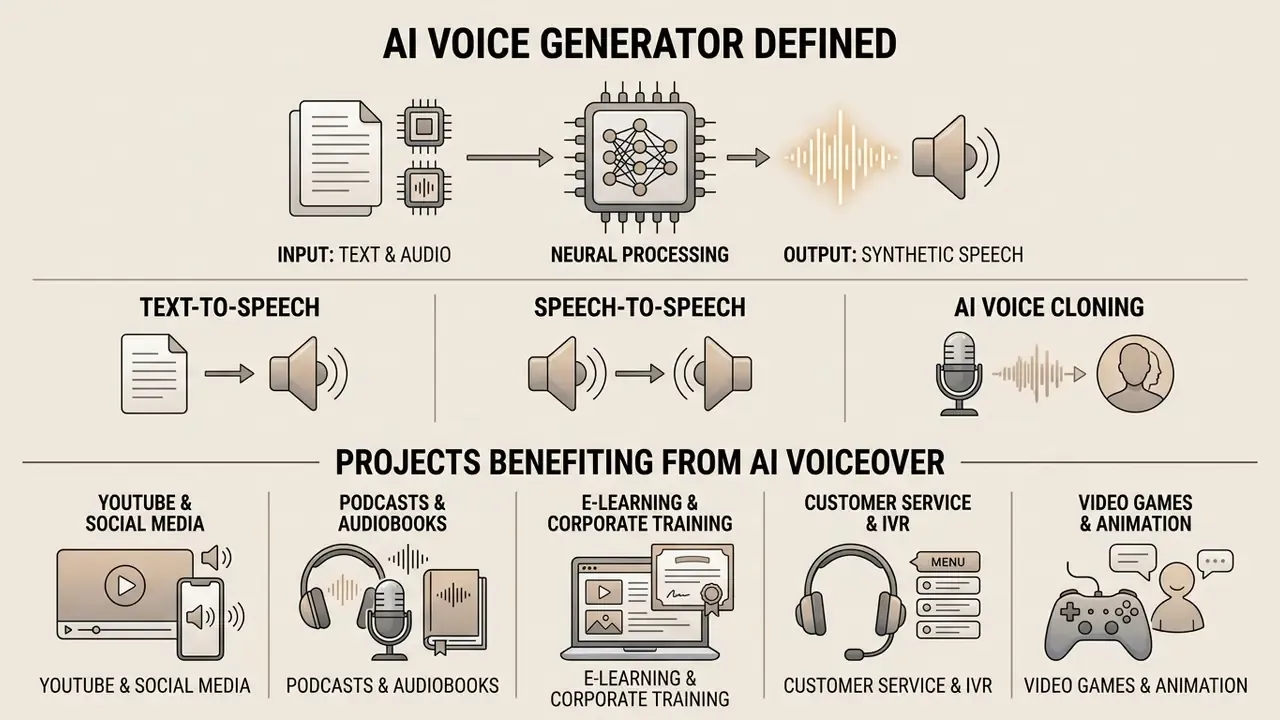
An AI voice generator is an artificial intelligence system that converts text input or source voice recordings into synthetic human speech using advanced neural models. Readers who need the foundational definitions, format options, and licensing basics first can start with our reference entry on the AI voice generator category and then return to this comparison. These tools rely on modern speech synthesis technologies, mapping text or acoustic tokens into highly realistic audio output files that replicate natural human speech patterns, rhythm, and cadence. Organizations and content creators deploy generated speech across diverse channels, including video content, podcasts, e-learning modules, automated customer service, and marketing campaigns.
The underlying architecture of an AI voice generator processes written content by breaking text into phonemes, predicting pitch contour and duration, and rendering a final audio file through a neural vocoder or codec model. High-quality systems allow users to generate AI voice assets that maintain brand consistency while reducing production timelines from days to minutes. According to benchmark findings in recent speech research, top-tier generative speech models can achieve word error rates (WER) below 2% across major languages, providing the clarity required for public distribution.
"VoxCPM2 models reach an average WER/CER of 1.68% across 30 languages, with error rates below 3% recorded in 28 languages."
Text-to-speech, speech-to-speech and AI voice cloning
Text-to-speech (TTS), speech-to-speech (STS), and AI voice cloning represent three distinct operational modes within modern voice generator tools. TTS converts raw text into speech output by running text through a text encoder, acoustic model, and vocoder pipeline to produce natural sounding audio without requiring a reference voice. STS, often sold as a voice changer, ingests an existing voice recording and transforms it into a new target voice or language while preserving the original speaker's emotional delivery, timing, and linguistic structure.
AI voice cloning uses deep learning algorithms to capture a target speaker's unique vocal identity from a reference audio sample. Instant voice cloning models rely on zero-shot learning to replicate a voice from a 10-to-30-second reference clip without additional model training (OpenVoice Technical Report, 2024). Professional voice cloning requires 30 minutes to three hours of clean studio voice recordings, training a custom voice model that delivers consistent pitch, tone, and emotional accuracy across complex scripts.
One caveat worth stating plainly: the cheaper the clone, the narrower its safe operating range. A 30-second sample will reproduce timbre convincingly and then fall apart the moment the script asks for anger, laughter, or a long sales pitch.
"Zero-shot voice cloning systems are evaluated through cosine similarity of speaker embeddings, a metric that reflects preservation of timbre and vocal identity."
Which projects benefit from AI voiceover
Digital workflows across corporate, educational, and media sectors derive measurable efficiency gains from deploying realistic AI voices. Production teams use quality voiceovers to scale audio content creation without scheduling physical recording sessions or coordinating third-party voice actors. In short: they save time where studio logistics used to eat it.
- YouTube videos and social media Creators produce engaging narration for YouTube videos, TikTok clips, and promotional ads, rapidly testing different voices to optimize audience retention.
- Podcasts and audiobooks Publishers utilize natural human cadence models to convert written content and manuscripts into full-length audiobooks and podcasts with natural pauses.
- E-learning and corporate training Instructional designers generate consistent voice overs for multi-module courses, easily updating script changes without re-recording full modules.
- Customer service and IVR Enterprise call centers integrate real time conversational AI agents into interactive voice response systems to deliver instant, human-like voice responses.
- Video games and animation Game developers generate diverse character voice assets and dynamic dialogue lines during early development and localized releases.
During an internal workflow evaluation for a media organization, a core editorial team replaced manual studio voiceover tracking with automated synthetic narration. The team configured a standardized TTS pipeline to process 120 weekly article updates into audio files. This change reduced post-production delivery timelines by 68% while maintaining a consistent brand tone across published podcasts.
In a second engagement with a regional financial services provider, the same evaluation framework was applied to an IVR refresh: 240 prompt lines covering balances, payment dates, and dispute routing were regenerated with a licensed brand voice. Because monetary amounts and account identifiers were pre-normalized into spelled-out text, prompt re-recording cycles dropped from three weeks to two days. Every generated file was stored with its script hash, model version, and consent reference for later audit. Both examples are composite and illustrative rather than named client results.
How to choose the best AI voice generator
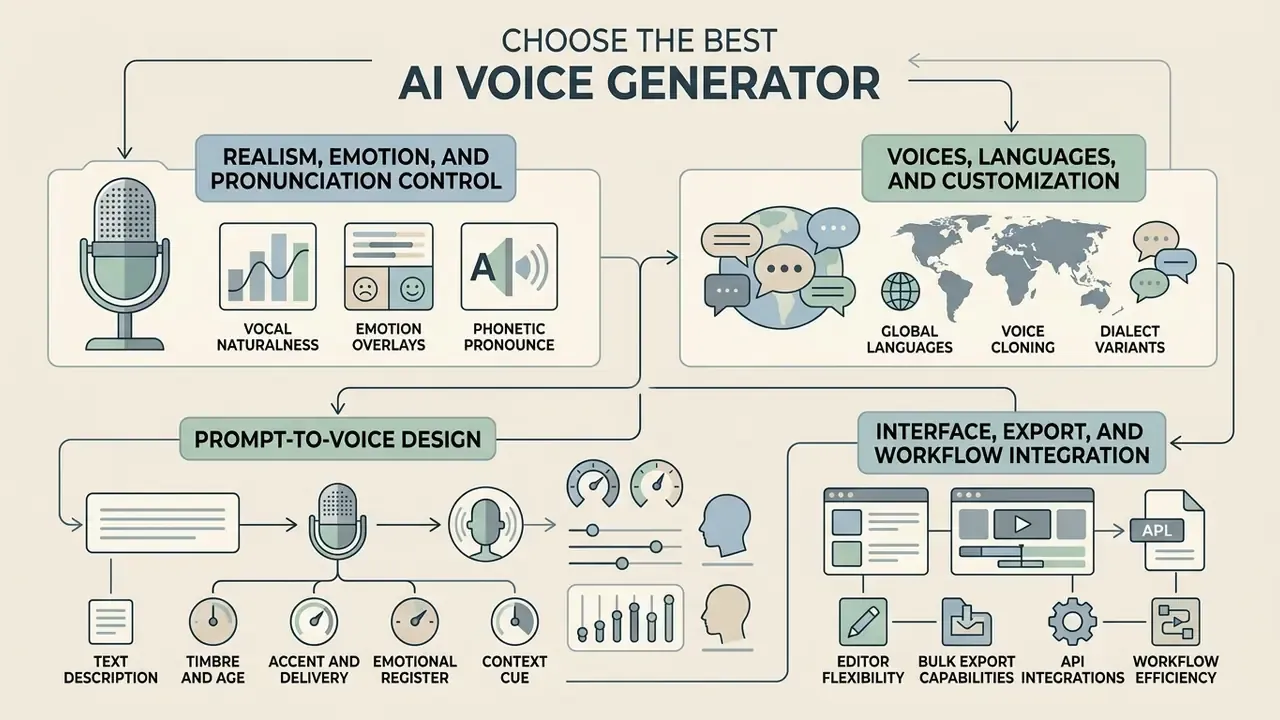
Selecting the best AI voice generator requires systematic evaluation across vocal naturalness, language coverage, editor flexibility, export capabilities, and enterprise compliance. Organizations must assess whether a platform delivers consistent audio quality under varied scripting conditions while satisfying regulatory data privacy protections. Evaluating technical specifications alongside workflow requirements prevents costly migration issues and vendor lock-in.
To build an efficient media stack, teams often evaluate complementary design and editing suites. Video creators seeking comprehensive post-production tools can review the best app to edit videos to pair voiceover exports with dynamic visual timelines, while teams building avatar-led assets can compare the best AI video generators alongside their voice stack.
Realism, emotion, and pronunciation control
Vocal realism depends on how accurately an AI voice tool controls prosody, including pitch range, speech tempo, stress placement, and natural pauses. High-quality speech synthesis models evaluate written content contextually, applying appropriate emotional AI voices ranging from professional narration to conversational or authoritative tones. Advanced platforms provide granular fine tune options, allowing editors to insert custom pauses, adjust pitch contours, and correct mispronounced industry terms.
Objective measurement of synthetic speech realism relies on Mean Opinion Score (MOS) testing and acoustic feature analysis, such as fundamental frequency root mean square error ( RMSE) (Galdino et al., 2025).
"In CoVoC evaluation, naturalness is defined as pronunciation correctness, appropriate tone changes, and natural pausing, rated on a 1-to-5 scale."
Rather than relying on a single national standard, structure your own listening tests around published evaluation guidance. Peer-reviewed recommendations for synthesized-speech assessment ask teams to state an explicit hypothesis, define the listener task, hold playback conditions constant, and report every deviation from the protocol (Good practices for evaluation of synthesized speech, 2025, https://www.arxiv.org/abs/2503.03250). Score at minimum four dimensions separately: overall impression, pause placement, word stress, and intonation. Perceptual-quality research shows these dimensions do not move together, so an averaged single score hides real defects.
A small practical habit helps here. Ask two listeners to score the same batch blind, then compare. If their pause-placement scores diverge by more than a point, your test instructions, not the model, are probably the problem.
Voices, languages, and customization options
A robust AI voice generator platform must provide a diverse voice library featuring different voices across accents, age groups, and genders. Global media distribution demands multiple languages support with native-sounding accent control to maintain authenticity across international markets. Advanced dubbing features leverage cross-lingual voice transfer, allowing a single custom voice to speak in over 30 languages without losing its core vocal timbre.
"The THU-HCSI system built on YourTTS achieved the best speaker-similarity MOS of 4.25 and naturalness MOS of 3.97 in the LIMMITS'24 multilingual track."
Custom voice creation tools allow organizations to build proprietary character voice profiles for brand identity or games. Platform features should include fine tune controls for regional dialects, pitch adjustments, and emotion switching to ensure the voice output matches specific target demographics. Dubbing suites now expose accent granularity as a first-class setting, for example Castilian versus Latin American Spanish, which matters when one master asset is distributed across several markets. Studios building stylised characters often pair voice work with visual generation; the same teams comparing the best anime ai art generator tend to need matching character voices for trailers and in-game dialogue.
Prompt-to-voice: designing a voice from a text description
Leading platforms (Hume Octave, ElevenLabs Voice Design) can now generate an entirely new voice from scratch, without any donor recording. Instead of scrolling a preset library, you describe the voice in words, and the model synthesizes a matching speaker identity. This sidesteps the biggest legal risk in cloning: there is no real person whose biometric voice data needs consent and storage.
How to write a prompt for voice generation:
- Timbre and age "Deep resonant male voice, late 40s, slight vocal fry on sentence endings."
- Accent and delivery "British accent with a slight Southern twang." Accent descriptors are the highest-leverage setting, because switching from "British" to "Nashville twang" reshapes rhythm and musicality, not just phoneme colour.
- Emotional register "Calm, authoritative, smooth pacing for document reading."
- Context cue "Speaking in a quiet studio, close-mic, no audience."
Trade-off to plan for: prompt-designed voices give you less word-by-word control than slider-based editors, and results are less deterministic across regenerations. Lock in a favourite generation, save it as a fixed voice ID, and version it. Otherwise brand consistency drifts between production batches, and nobody notices until a customer does.
Interface, export, and workflow integration
The usability of an AI voice generator interface directly impacts team productivity during large-scale content creation. A modern web-based AI voice generator platform provides multi-track timeline editing, script text normalization, real-time preview playback, and team collaboration features. Treat the editor as production software, not a demo toy: role permissions, project history, and a searchable asset library matter more after month three than any single voice preset.
Export capabilities should include high-resolution audio formats such as uncompressed WAV, linear PCM, high-bitrate MP3, and Opus containers. Google Cloud documents MP3, Opus-in-Ogg, LINEAR16, ALAW, MULAW, and PCM outputs depending on the model, with a 240-second maximum per request, a hard constraint that forces chunked generation for long-form work. Enterprise platforms offer REST API endpoints and SDK integrations, allowing software engineers to embed real time speech generation directly into web apps, mobile products, and customer support architectures. For teams planning an ai voice generator tool development track in-house, those quotas and per-request ceilings shape the queueing design more than model choice does.
Enterprise security and vendor review checklist
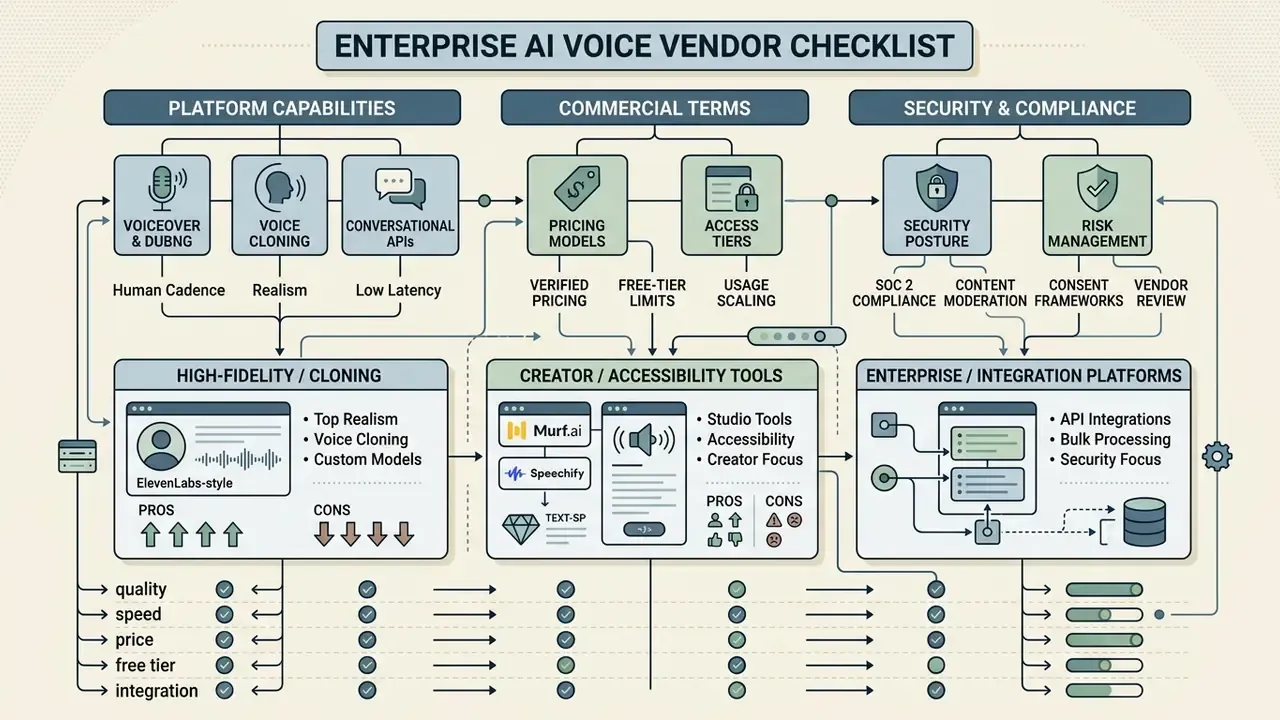
For regulated industries, voice quality is a secondary filter; procurement and security review come first. Run this checklist before any pilot leaves a sandbox:
- Certifications SOC 2 Type II report available under NDA; ISO 27001 scope covering the inference environment.
- Tenancy and residency dedicated VPC or regional deployment; documented data-residency commitment.
- No-train policy contractual guarantee that customer text and reference audio are excluded from model training.
- Retention controls configurable or zero-data retention for prompts, audio inputs, and generated outputs.
- Biometric handling voice embeddings classified as biometric personal data, with encryption at rest, access logging, and deletion-on-request workflows (relevant to GDPR and state biometric statutes such as BIPA).
- Consent tooling native support for a recorded consent statement tied to each custom voice. Google Cloud's Instant Custom Voice, for example, requires a recorded consent statement plus reference audio before a voice can be built.
- Availability published SLA, rate limits, and regional failover for peak-hour call volumes.
- Exit path export of voice IDs, scripts, and generated assets on termination.
Quiz: which AI voice generator fits your project? Tick the statements that describe your build, then read the matching recommendation.
- I need narration for video avatars and HR training courses. → Synthesia or Murf.ai.
- I need minimal API latency (under 100 ms) for a conversational agent. → ElevenLabs Flash v2.5 or PlayHT streaming.
- I need dubbing into 100+ languages with accurate lip sync. → Synthesia, with LOVO as a budget alternative for short clips.
- I need a SOC 2 Type II vendor with a no-train policy and VPC deployment. → Azure AI Speech or Google Cloud Text-to-Speech.
- I need commercial rights and uncompressed WAV export on the cheapest paid tier. → ElevenLabs Starter at $5/month.
Best AI voice generator tools: ranking, pricing, pros and cons
| Platform | Core strength | Realism | Voice cloning | Languages | AI video / avatars | Free tier | Paid entry price | Enterprise signals | Primary use case |
|---|---|---|---|---|---|---|---|---|---|
| ElevenLabs | Ultra-realistic cadence and expressive cloning | Excellent (MOS 4.2+) | Instant plus Professional (PVC) | 29 (v2) / 32 (Flash) / 70+ (v3) | Available | 10,000 chars/mo (~10 min), non-commercial | from $5/mo (30k chars plus commercial license); annual billing seen from ~$6/mo | Enterprise tier, API/SDK, zero-retention options on request | Narrative, audiobooks, dubbing, APIs |
| Speechify | High-speed text reading and accessibility | Very good | Yes (10 to 30 s sample) | 1,000+ voices, 60+ languages | Limited (Studio avatars) | ~10 min/mo, no downloads | $288/user/year (50 h generation) | SOC 2 Type II, end-to-end encryption, 24/7 support | Accessibility, document listening, podcasts |
| Murf.ai | Studio editor and presentation integration | Very good | Yes (paid tiers) | 120+ voices, 20+ languages | No | 10 min generation, no download | from $19/user/mo | Enterprise plan with team collaboration and compliance features | Corporate training, presentations, e-learning |
| Descript | Text-based audio editing and Studio Sound | Good | Overdub AI voice | 20 to 30+ languages (translation) | Yes (full video editor) | 1 h transcription/mo | from $12/user/mo annual (~$19 monthly) | Workspace roles, SSO on higher tiers | Podcast editing, screen recordings, video audio |
| Synthesia | Enterprise AI video avatars and localization | Good | Yes (custom avatar plus voice) | 130 to 140+ languages dubbing | Yes (stock, custom, customizable avatars) | Free demo minutes | from ~$18/seat/mo billed annually (verify current vendor page) | Enterprise governance, API, secure editing | Corporate video, HR training, multi-language video |
| PlayHT | Streaming low-latency conversational audio | Very good | Instant cloning | 100+ languages | No | Free credit tier | from ~$29/mo creator tier; API billed per character | Streaming API, WebSocket support | Real-time agents, web narration, podcasts |
| LOVO (Genny) | Voice library for social media and marketing | Good | Yes | 500+ voices, 100+ languages plus 150,000+ sound effects | Yes (basic video) | 14-day trial (~20 min) | from $19/mo | Team seats; consumer-grade compliance | Social clips, marketing video, ads |
| Azure AI Speech | Regulated-industry deployment | Very good | Custom Neural Voice (gated) | 140+ locales | No | F0 tier, evaluation only, no commercial rights | Pay-as-you-go per 1M characters | Microsoft compliance portfolio, regional residency, gated cloning approval | IVR, banking, healthcare, government |
| Google Cloud TTS / Gemini-TTS | Developer-grade control and formats | Very good | Instant Custom Voice (consent-gated) | 50+ languages, many variants | No | $300 trial credit (same licence terms as paid) | Pay-as-you-go per character | VPC-SC, IAM, documented consent capture | Product integration, large-scale batch synthesis |
"Older listeners recognize AI speech less often, rate it as more natural, and distinguish it from human speech less accurately than younger participants."
That perceptual gap is a practical selection input: an audience skewed toward 55+ tolerates synthetic narration far better than an 18 to 34 audience on short-form social video, where listeners flag artificial cadence within a second or two.
ElevenLabs, for human-like cadence and voice cloning
ElevenLabs is widely recognized as a premier ai voice generator like elevenlabs due to its expressive deep learning synthesis models. The platform excels at producing human-like cadence, capturing natural breathing, micro-pauses, and emotional inflection across complex narration scripts. Its Eleven v3 model supports over 70 languages, while the Flash v2.5 architecture delivers ultra-low-latency output (roughly 75 ms) suitable for interactive conversational agents.
The service provides both Instant Voice Cloning and Professional Voice Cloning (PVC). Instant cloning works from roughly 1 to 2 minutes of clean audio; PVC requires at least 30 minutes and performs best with two to three hours, yielding high stability and consistent emotional transfer for audiobooks and gaming character voices. Vendor documentation notes an important limitation: a clone trained on calm narration can shift character when pushed toward strong emotion, whereas PVC voices hold up better across speech types. Developers building custom applications can view the guide to evaluate standard API integration patterns for synthetic voice endpoints.
Murf and Speechify, for creators, accessibility, and voice overs
Speechify serves as a leading app for ai voice generator workflows focused on accessibility, document reading, and desktop productivity. It allows users to turn written content, such as PDFs, web articles, and manuscripts, into clear audio output files at variable playback speeds, up to roughly 9× average reading speed without collapsing intelligibility. The library spans 1,000+ voices in 60+ languages, with 13 emotional styles, a pronunciation library for specialized terminology, and cloning from a 20-second consented sample. Speechify's API enables developers to deploy natural human reading features across web and mobile applications, synchronizing playback state across devices, and its voices drop into major voice-agent stacks via plugins.
Descript, Synthesia, and LOVO, for video, dubbing, and multilingual projects
Descript reshapes video audio post-production by offering a text-based editing interface. Users edit audio and video content by editing the underlying text transcript. Descript's Overdub tool creates a cloned voice to fix misspoken script lines without re-recording, while Studio Sound uses AI noise reduction to eliminate background noise and echo from field recordings in one click. Transcription is automatic and synced to the timeline, and translation or dubbing covers 20 to 30+ languages.
Synthesia leads the enterprise AI video generator market, combining realistic AI voices with customizable AI avatars across stock, custom, and fully customizable avatar types (outfits, spaces, poses, B-roll). Synthesia's automated AI dubbing localizes existing video assets into 130 to 140+ languages with frame-accurate lip sync, automatically adjusting vocal delivery to match localized video audio tracks, and it supports multi-speaker replacement with editable transcripts before dubbing. Teams comparing budget-tier alternatives can also review free AI video generators to see where limits on duration, credits, and watermarks land, and those staffing presenter shots on a budget sometimes start from the best free ai headshot tools before commissioning a custom avatar.
LOVO (Genny) targets marketing teams and social content creators, providing 500+ AI voices in 100+ languages alongside a library of more than 150,000 sound effects and basic timeline video editing tools. Social teams pairing voice clips with static creative often run it next to a mobile image workflow such as the best android photo editor for thumbnails and story frames.
Open-source and self-hosted alternatives
Not every requirement points to a subscription. Teams with strict residency rules, or with an appetite for an ai voiceover generator open source stack, can self-host models such as Coqui-derived forks, XTTS variants, Piper, or F5-TTS on their own GPUs. The upside is direct control: no third-party retention question, no per-character meter, and the ability to freeze a model version for years so that prosody never shifts under you.
The trade-offs are real, though. You inherit MLOps duties, GPU capacity planning, and licence diligence on both model weights and training data. Expressive quality on open checkpoints still trails the best commercial engines, particularly on emotional long-form narration. And self-hosting removes the vendor from the consent chain, which means your own registry, disclosure labels, and deletion workflows must be airtight. For an internal knowledge-base reader, that is a reasonable deal. For a customer-facing IVR at a regulated institution, most review boards still prefer a contracted provider with an SLA.
Testing methodology and verification (E-E-A-T):
Every voice generator platform in this guide is benchmarked with a single fixed test prompt, scored separately for intonation accuracy, phonetic normalization of numbers and acronyms, pause placement, and vocal clarity. Instead of citing one national standard, we hold model version, voice settings, SSML, sampling rate, export format, and bitrate constant across runs, log timestamps and outputs, and re-run each scenario three times to surface variance. That protocol is consistent with published guidance on repeatable voice-agent evaluation (OpenAI Voice Agents documentation, 2026) and with peer-reviewed recommendations for synthesized-speech testing (Good practices for evaluation of synthesized speech, 2025, https://www.arxiv.org/abs/2503.03250). Reviewers verify pricing structures, terms of service, and commercial licensing directly against official vendor documentation.
"The TTSDS framework scores synthesis quality as the distance between real and synthetic speech distributions, correlating with human ratings at 0.60 to 0.83 across 35 systems." TTSDS Benchmark (2024). https://arxiv.org/abs/2407.12707
Model risk management, validation, and audit evidence for voice AI
"RVCBench exposed critical vulnerabilities in 18 voice-cloning models: content degradation under input shifts, weak robustness to post-processing, and susceptibility to adversarial attacks."
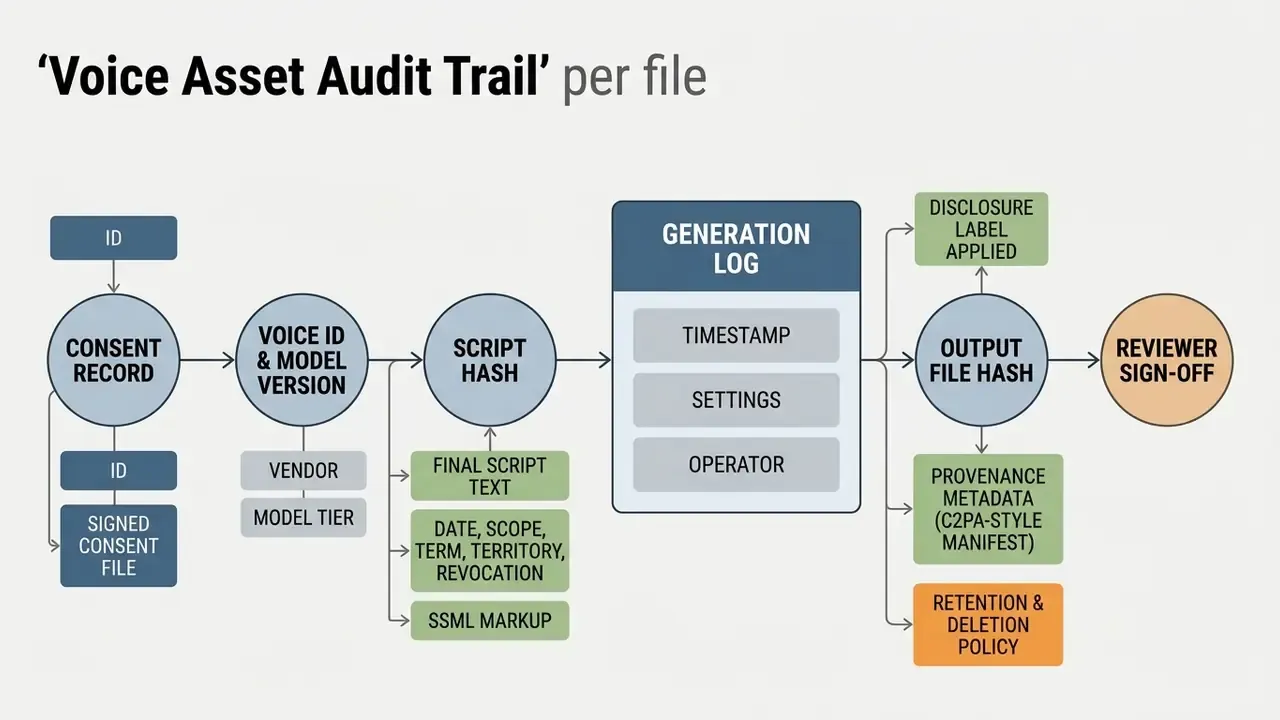
Audit evidence chain, minimum artefacts per generated asset
Voice ownership and consent audit checklist
- Written, dated consent per speaker, specifying territories, channels, term length, and revocation mechanics.
- A recorded consent statement stored alongside the reference audio, as required by cloud providers that gate custom voice creation.
- A central voice registry mapping voice IDs to consent records, so no asset can be generated from an orphaned clone.
- A disclosure policy defining where and how synthetic audio is labelled to the end listener.
- A deletion workflow that removes embeddings, reference audio, and derived assets on revocation, with evidence of completion.
One honest limitation. Nobody has settled how much validation evidence is "enough" for a synthetic voice in a customer channel, and supervisory expectations are still forming. Until that clarifies, document the reasoning behind your thresholds as carefully as the thresholds themselves. Organizations seeking to benchmark system accuracy and verification compliance can browse the hub for standard evaluation matrices.
Which AI voice generator to choose for a specific use case
Selecting an AI voice generator requires matching technical platform capabilities with specific production requirements. Short-form video campaigns demand dynamic, expressive voice selections with high emotional range, whereas long-form corporate audiobooks require stable, broadcast-grade speech models with strict loudness normalization controls.
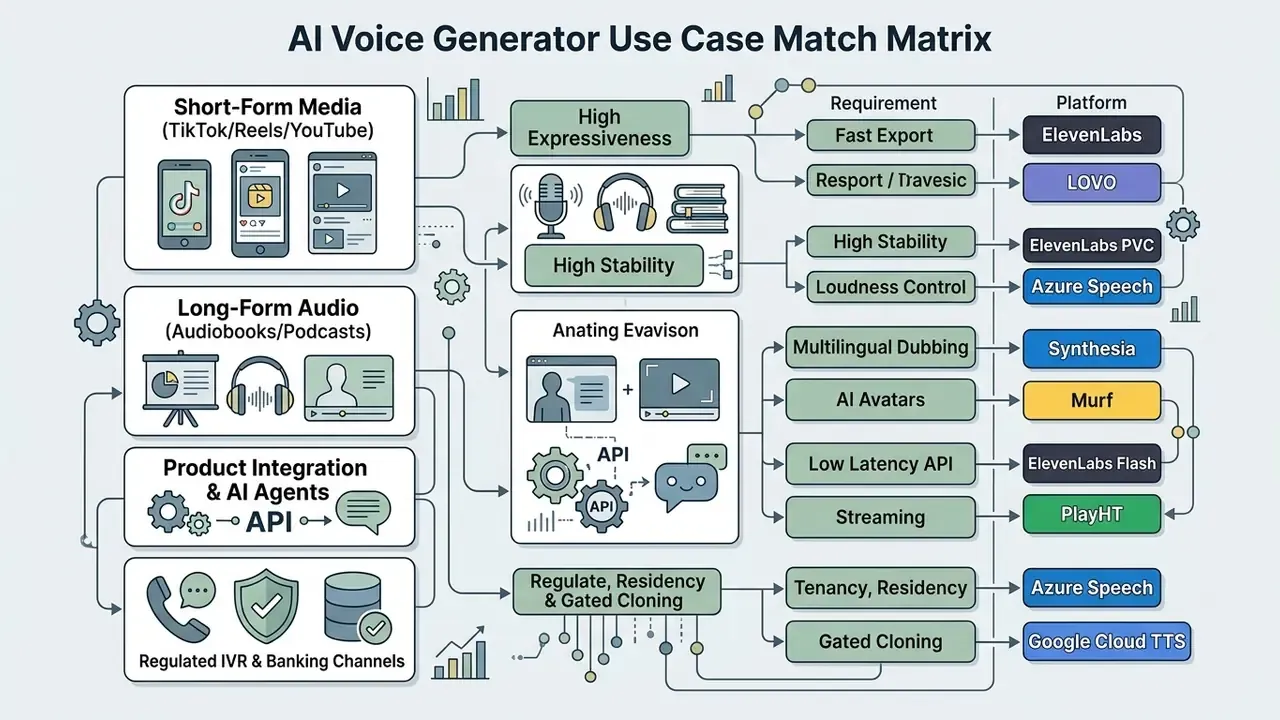
For podcasts, audiobooks, learning, and customer service
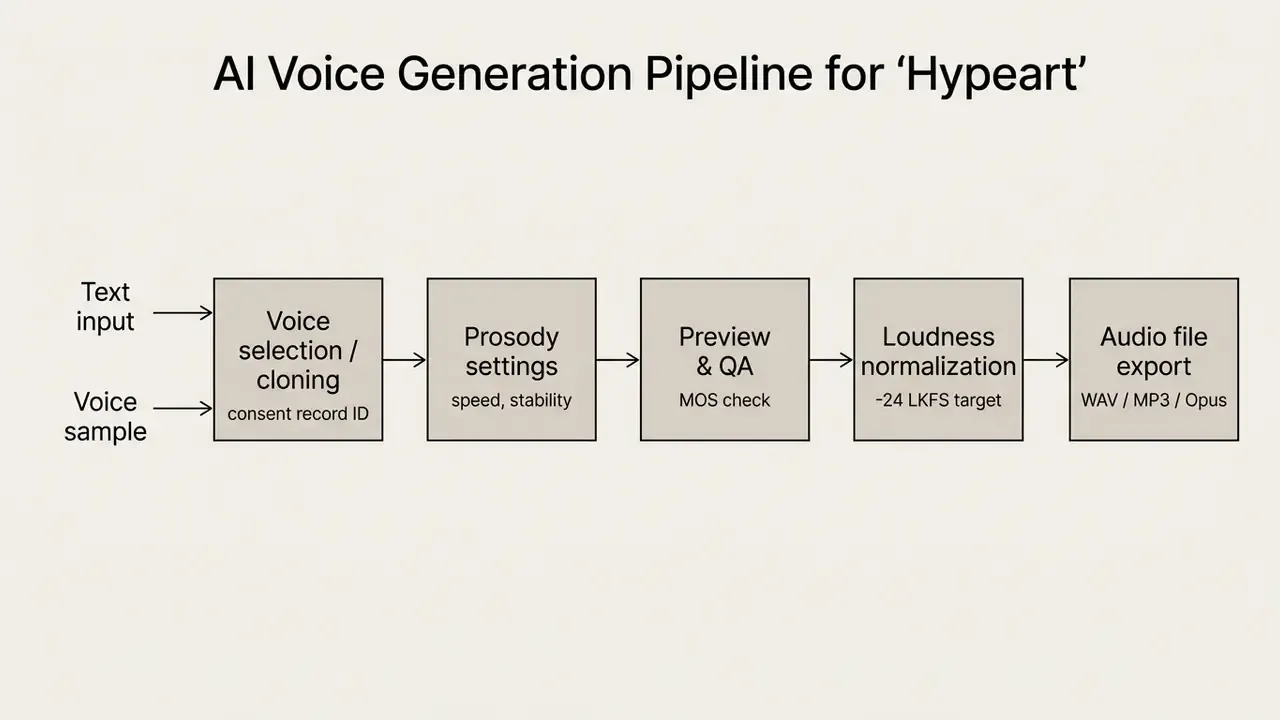
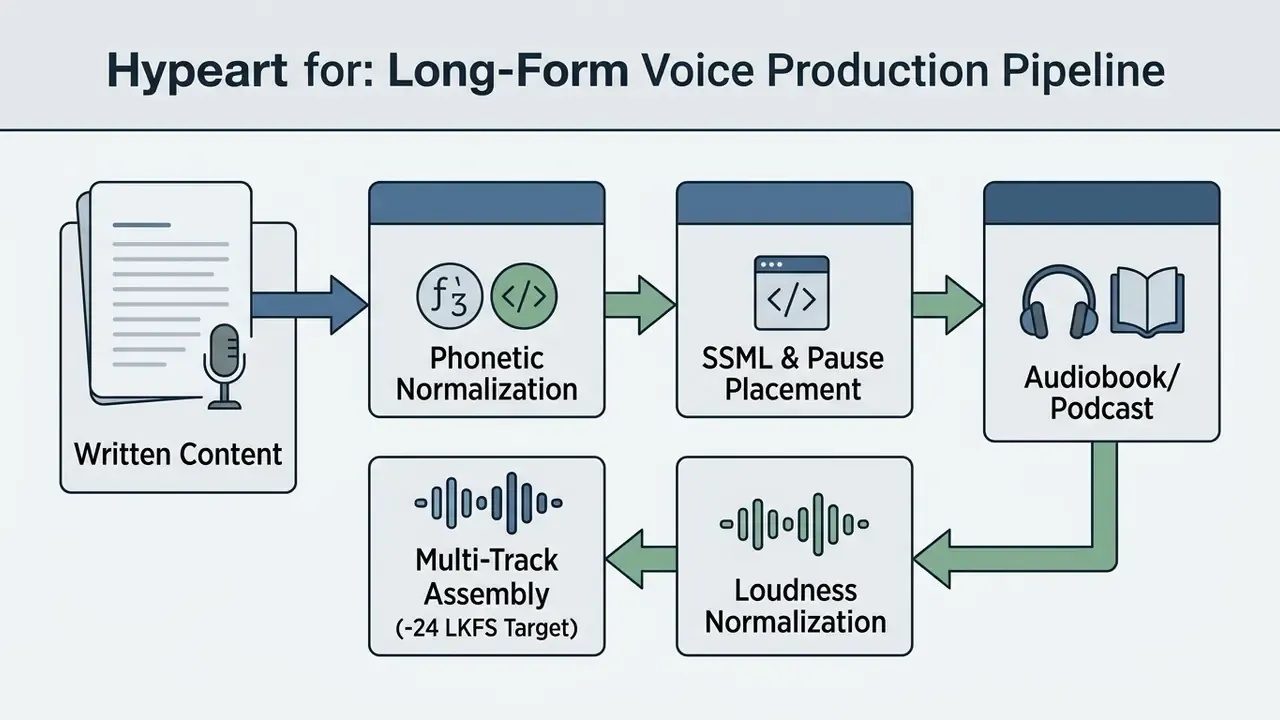
Long-form narration demands continuous acoustic stability, clear pronunciation control, and compliance with industry audio standards. Publishers producing audiobooks or educational content must meet strict broadcast delivery specs, such as ITU-R BS.1770 loudness standards (-24 LKFS ±2 LU, true peak at or below -2 dBTP) (PBS Audio Specifications, 2023). ITU-R BS.2088-1 defines the long-form file format used for international exchange of programme material with metadata, and distribution platforms increasingly flag machine narration explicitly. Audible, for instance, marks computer-generated narration as "virtual voice," which affects cataloguing and listener expectation.
"Large-scale TTS models trained on 100k hours of data show high prosodic diversity but retain robustness limitations in long-form generation."
For customer service IVR and automated agents, developers prioritize ultra-low-latency streaming APIs. System architects can open the hub to assess commercial scale options and infrastructure models suitable for enterprise voice deployments.
Streaming API comparison for real-time voice agents
| Engine | Documented latency profile | Streaming protocols | Free/eval access | Notes for agent builds |
|---|---|---|---|---|
| ElevenLabs Flash v2.5 | ~75 ms model latency | WebSocket plus REST | 10,000 chars/mo | 32 languages; pair with an agent platform for barge-in handling |
| PlayHT (streaming) | Sub-second time-to-first-audio (vendor-reported) | WebSocket plus REST | Free credits | Instant cloning available for agent personas |
| Azure AI Speech | Real-time synthesis with regional endpoints | WebSocket, SDKs | F0 evaluation tier (no commercial rights) | Regional residency, SLA, gated Custom Neural Voice |
| Google Gemini-TTS | Streaming PCM by default; ALAW/MULAW/OGG_OPUS options | gRPC/REST streaming | $300 trial credit | Unary formats include LINEAR16, MP3, OGG_OPUS, PCM |
| Hume Octave | Real-time, emotion-aware conversation | API (advanced features API-only) | Free plan available | Emotion scores fed back into delivery; zero-data-retention option |
When benchmarking agents, measure four things separately, per published voice-agent evaluation guidance: task outcome, audible response latency, unwanted silence, overlap or interruption behaviour, and session reliability across repeated runs with fixed caller, model, tools, and transport. A single "latency" number hides the failure that users actually notice: dead air before the first syllable.
Free AI voice generator and paid plans: what to compare
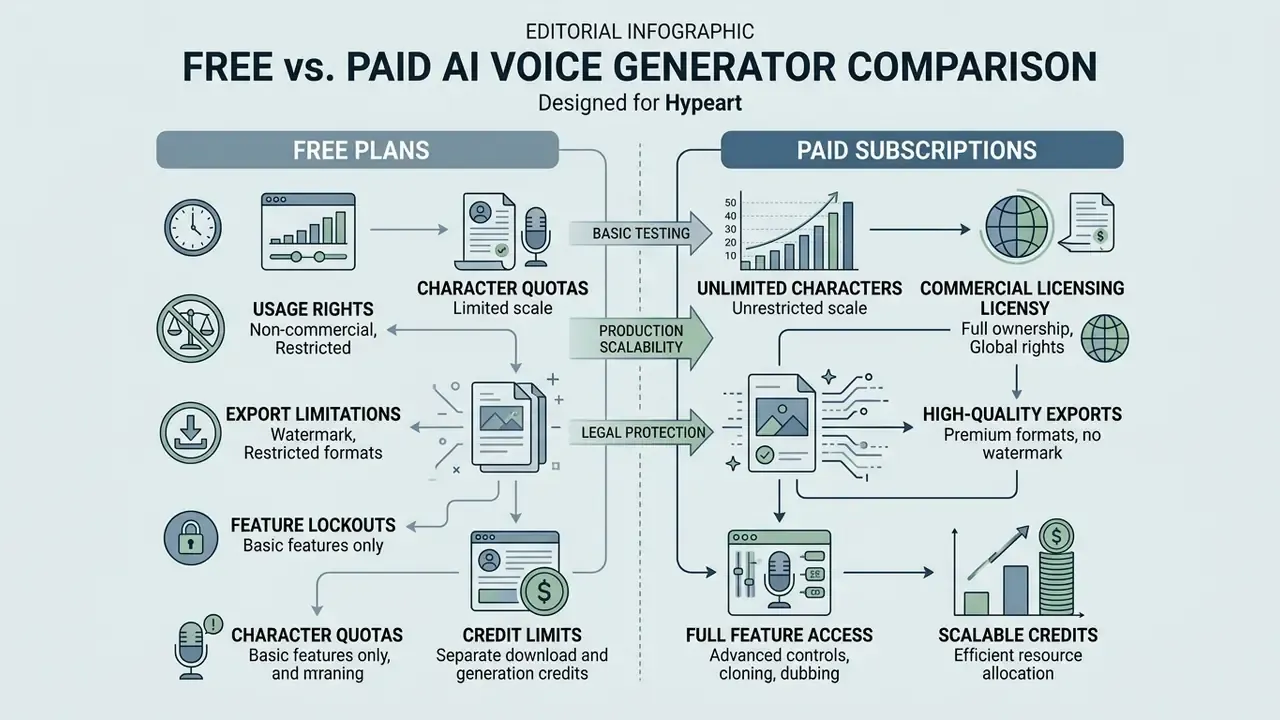
Understanding the distinction between free ai voice tools and paid commercial subscriptions is critical for legal protection and production scalability. Free plans are designed primarily for platform evaluation and personal testing, frequently enforcing strict character quotas, lower audio quality, and explicit non-commercial usage restrictions. Microsoft states this plainly for its own stack: commercial output requires a paid Speech resource, while the free tier exists for evaluation and testing.
What typically limits a free AI voice generator
Free AI voice tier offerings impose technical and legal constraints that restrict professional deployment. Platforms offset server inference costs by limiting monthly usage and restricting access to premium speech models.
- Character quotas Free tiers typically cap generation at 2,000 to 10,000 characters per month (roughly 5 to 10 minutes of finished audio); some services cap by minutes instead, and Murf and Speechify both sit near 10 minutes per month.
- Usage rights Output generated under free plans usually excludes commercial rights, requiring attribution or prohibiting commercial monetization. Typecast, for example, requires attribution on free downloads and makes it optional only on paid tiers.
- Export limitations Free downloads are often restricted to compressed MP3 files, include audible watermarks, or are disabled entirely. FreeTTS applies a watermark plus per-day and per-month character caps, while HeyGen watermarks free video exports.
- Feature lockouts Advanced features like instant voice cloning, custom voice creation, and API access are disabled on free tiers.
- Download credits versus generation credits Some platforms let you generate and play unlimited audio but meter downloads. Typecast's free plan ships roughly 3,000 lifetime download credits (about 5 minutes), while WellSaid's free tier allows 3 download minutes per month with no commercial rights.
Users looking for budget-friendly visual creation software to complement free voice tools can review the best free ai art generator to compare license terms and output caps, test a best free ai image tool that needs no account, or evaluate free AI video generators for duration, credit, and watermark limits.
Which features are worth paying for
Upgrading to a paid subscription unlocks professional capabilities essential for commercial production, data security, and team productivity.
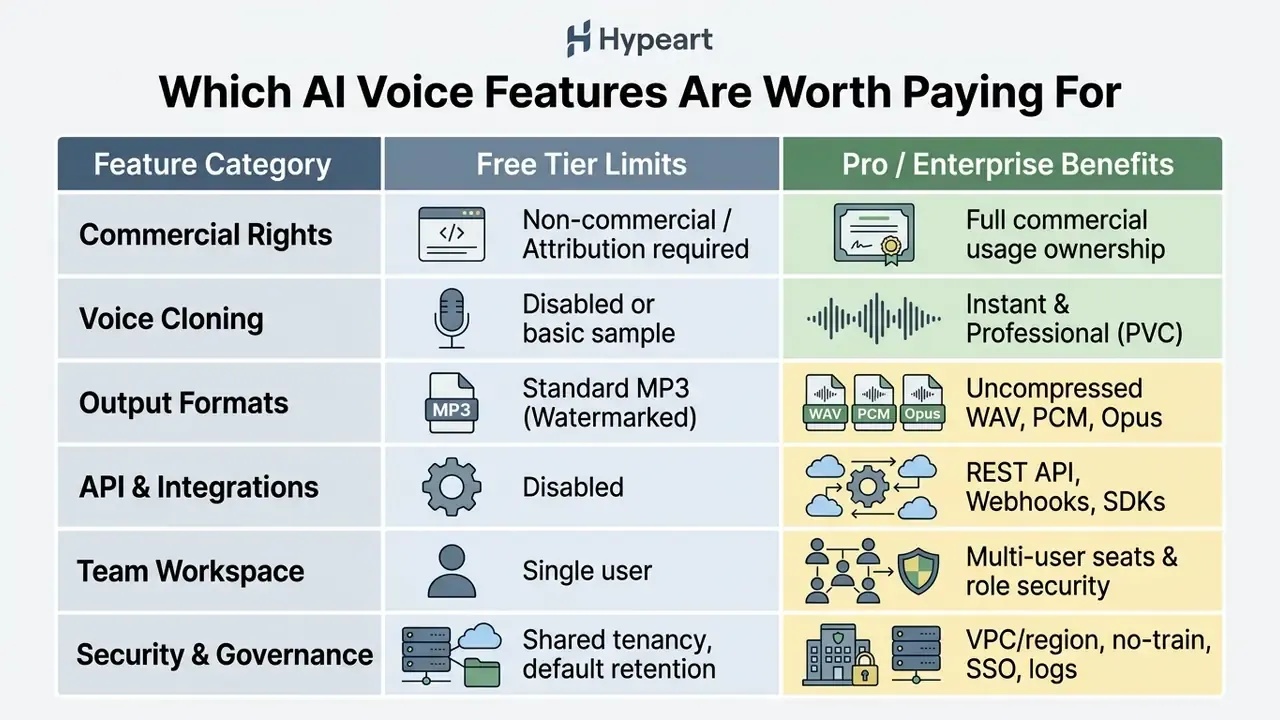
- Commercial licensing
- Full legal ownership to monetize generated audio across YouTube, TV ads, and commercial products. Review the AI Media Commercial-Use terms for each vendor before a campaign goes live, because dubbing and cloning rights are often carved out separately.
- Professional voice cloning
- The ability to train high-fidelity cloned voice models using extended studio reference audio.
- Granular SSML and fine tune controls
- Precise control over sentence breaks, phoneme pronunciation, pitch, and emotional delivery.
- Team collaboration
- Shared project libraries, multi-user workspace access, and centralized billing management.
- AI dubbing rights
- Dubbing products are commonly sold with paid-plan commercial licences, and some uses remain restricted unless separately authorized in an enterprise agreement.
"High-quality cloning and multilingual synthesis require specialized architectures and substantial training data, which is why they sit behind paid tiers."
Total cost of ownership for enterprise voice deployment
Subscription price is the smallest line in a regulated deployment. Model TCO across five buckets before comparing vendor quotes; finance teams building the model can view the guide for the underlying cost templates.
| Cost bucket | What it covers | Typical driver | Notes |
|---|---|---|---|
| Inference / licence | Characters, minutes, or seats | Volume of generated audio | Consumer tiers bill per seat; APIs bill per character, so batch work is usually cheaper per minute on API |
| Integration | SDK work, streaming transport, telephony bridge | Engineering days | WebSocket agent builds cost more than batch file generation |
| Validation and MRM | Benchmark prompt sets, listening tests, re-validation after model upgrades | Number of languages times channels | Re-run after every vendor model change |
| Legal and consent | Talent agreements, territory and term rights, biometric consent storage, disclosure copy | Number of cloned voices | Cloning a real person adds recurring rights cost that prompt-designed voices avoid |
| Security and audit | VPC or regional deployment, logging, retention tooling, vendor security review | Regulatory scope | Often the item that eliminates otherwise-attractive consumer tools |
A practical rule from procurement reviews: if you need cloned human voices, budget legal and consent workload at a level comparable to the software licence itself in year one. If a prompt-designed synthetic voice meets brand needs, that bucket shrinks dramatically. Worth testing before you sign anything.
How to create a high-quality AI voiceover: from script to export
Achieving natural, broadcast-quality AI voiceover output requires a structured production workflow. Moving systematically from script optimization to voice tuning ensures generated audio sounds natural and maintains consistent pacing throughout the file.
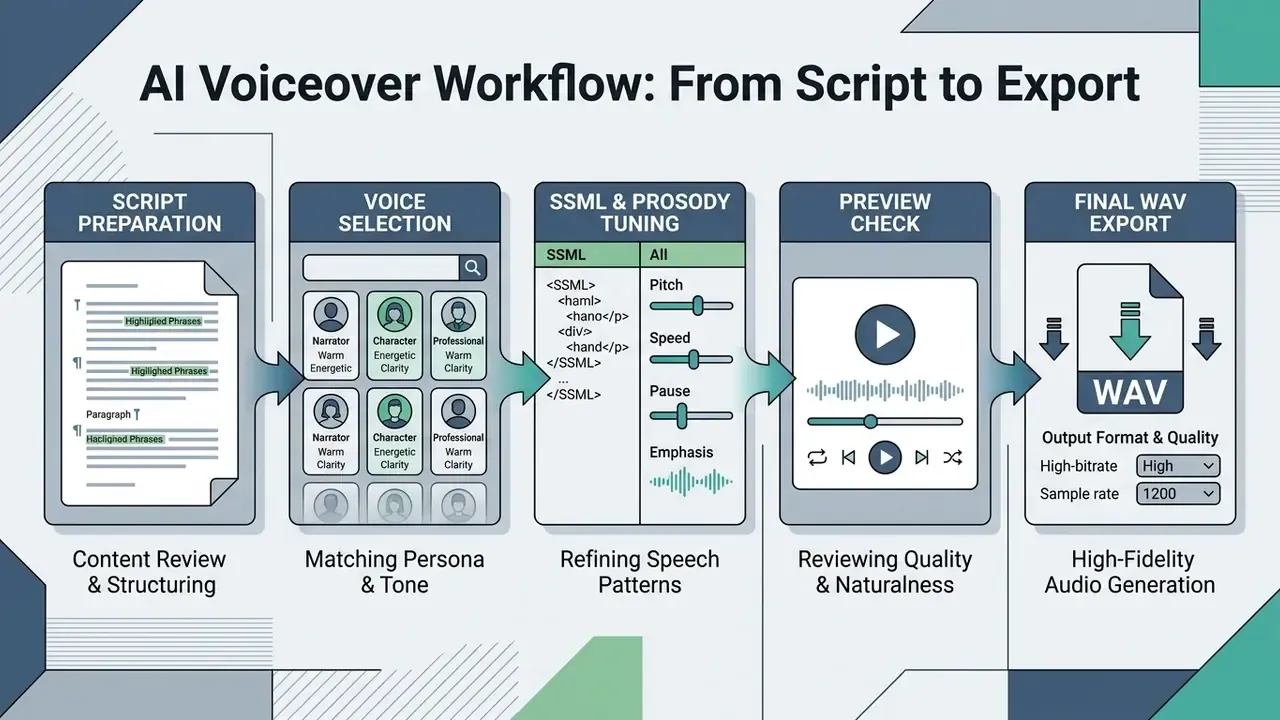
Prepare the script for natural sounding speech
Writing script text for speech synthesis differs from preparing written content for print. AI models perform best when scripts mimic natural conversational human speech structures.
- Shorten sentences Break complex, compound clauses into concise sentences of 10 to 18 words to help the model apply natural cadence.
- Spell out numbers and symbols Write out numbers, currency, and abbreviations phonetically (for example, "one hundred dollars" instead of "$100", and "S-E-O" instead of "SEO") to prevent normalization errors.
- Insert explicit pause markers Use punctuation, commas, or explicit break tags to structure breath control and natural pauses between key ideas.
- Remove page-only phrasing Strip headers, footers, "see figure below," and hyphenation artefacts from OCR or PDF sources before synthesis.
- Segment in three passes Split by section, then paragraph, then sentence, so each generation request stays inside per-request duration limits.
A corporate training group configured an automated text-normalization pre-processor for their internal AI voice generator pipeline. By programmatically converting acronyms, technical jargon, and numerical dates into phonetic text strings prior to generation, the team reduced pronunciation error rates from 14.2% down to under 0.8% across multi-language training modules. Illustrative figures, but the mechanism is the point: normalization beats slider tweaking almost every time.
"Long, compound sentences reduce intelligibility and naturalness in TTS output, because models predict prosody less reliably in complex constructions."
Tune the voice and check audio quality
Once the text is prepared, load the script into the ai voice generator interface and select a target voice that matches your brand persona.
- Adjust stability and style slidersLower stability settings increase emotional variation and dynamic range, while higher stability produces steady, authoritative narration. Documented ranges are usually 0.0 to 1.0 with a 0.5 default for stability, and roughly 0.7 to 1.2× for speed.
- Apply SSML markupWrap specific words in
emphasistags or insertbreak time="300ms"elements to fine tune dramatic pacing (W3C SSML 1.0 Recommendations). Wrap full sentences in anselement when mixing prosody tags, as Google Cloud's SSML guidance recommends, and prefer explicittimevalues over vague strength keywords for reproducible pauses. - Generate short audio previewsRender individual paragraphs to check pronunciation and cadence before generating the full audio file, which avoids consuming character quotas unnecessarily. Note that most platforms deduct quota for previews; ElevenLabs documents limited free regenerations only for an unchanged prompt, voice, and model within the web editor.
- Export high-resolution filesExport final assets as uncompressed WAV or 320 kbps MP3 files, ensure target loudness levels meet broadcast delivery standards, and normalize loudness only after multi-chunk assembly.
"WhisperBert, a neural evaluator combining Whisper audio features with BERT text embeddings, reaches around 0.40 RMSE in MOS prediction, better than the 0.62 human inter-rater RMSE."
Automated MOS prediction is not a replacement for a listening panel, but it is fast enough to gate every batch: flag any chunk scoring below your baseline and route only those files to human review.
Creators building multi-asset pipelines can browse the hub to evaluate side-by-side production workflows and comparative benchmarks.
Rules for using AI generated voices and voice cloning
- Explicit consent: Creating a cloned voice requires prior explicit written consent from the voice owner. Misusing audio recordings to imitate public figures or employees without authorization violates personality rights and data privacy statutes.
- Regulatory compliance: Under US FCC rulings (FCC 24-17), AI-generated voices used in outbound telemarketing or automated calls fall under TCPA restrictions, requiring prior express written consent.
- EU AI Act transparency: Article 50 of the EU AI Act (Regulation (EU) 2024/1689) mandates clear disclosure and labeling when deepfake audio or synthetic human voice assets are distributed publicly.
- Biometric privacy: Voice patterns constitute biometric personal data under privacy frameworks like GDPR, per EDPB guidance. Synthetic voice platforms must enforce secure storage and access controls for custom voice embeddings.
- Fraud and traceability: Regulators are actively focused on misuse detection and post-hoc identification of cloned audio, so provenance metadata and retained generation logs are part of compliance, not just good hygiene.
"Legal analysis in 2026 shows voice-cloning technology puts vocal identity at risk, while existing frameworks, including right of publicity, personality rights, and data protection, contain substantial gaps." Legal Analysis of AI Voice Cloning and Vocal Identity (2026). https://doi.org/10.2139/ssrn.4700091
Practical consequence: contractual output ownership from a vendor does not transfer rights in a cloned person's voice or persona. Those rights come only from the speaker's agreement, scoped by territory, channel, and term.
FAQ about AI voice generator tools
These are the frequently asked questions we get from buyers midway through a vendor shortlist.
Is there an AI voice generator app for iOS and Android?
Yes, leading AI voice platforms provide dedicated mobile applications for iOS and Android devices alongside web dashboard interfaces. Platforms such as ElevenLabs, Typecast, Voice.ai, Voices AI, Fish Audio, and Play.ht offer a native ai audio generator app that allows users to generate synthetic speech, record reference audio samples for instant cloning, and export audio files directly from mobile devices. For background on formats, licensing, and feature tiers before you install anything, see our reference page on the AI voice generator category. These applications adhere to accessibility standards, conforming to WCAG 2.1 Level AA mobile compliance requirements (US DOJ Final Web and Mobile Rule, 2024).
Can I preview and change an AI generated voice before export?
Yes, most AI voice generator tools feature real time preview playback and non-destructive editing tools. Users can highlight specific script segments, adjust pitch, alter speech speed (typically between 0.7× and 1.2×), and swap voice selections before committing to a final file export.
"Older adults notice the artificiality of AI speech less often and rate it as more natural." Herrmann, Perception of AI-based synthesized speech (2023). https://doi.org/10.1044/2022_JSLHR-22-00259 That finding is worth weighing when choosing a voice for a 55+ audience, since tolerance for synthetic delivery is measurably higher. However, platforms vary in how they handle character quotas during previews: some web editors allow limited free re-generation for unchanged text blocks, while others deduct generation usage credits for every preview render (ElevenLabs Platform Documentation, 2026). Voice-changer (speech-to-speech) modes typically bill processed audio by duration, around 1,000 characters per minute on ElevenLabs, with a 5-minute input ceiling and no free regenerations.
What is the cheapest AI voice generator with commercial rights?
Among the platforms compared here, ElevenLabs offers the lowest documented entry point with a commercial licence at roughly $5/month for 30,000 characters, with promotional first-month pricing offered as low as $1. LOVO and Murf both start near $19/month, and Speechify's annual plan works out to $288/user/year. Cloud APIs from Azure and Google Cloud can be cheaper at scale because they bill per character rather than per seat, but their free tiers do not grant commercial output rights.
Can I create a brand voice without cloning a real person?
Yes. Prompt-to-voice tools such as Hume Octave and ElevenLabs Voice Design synthesize a new speaker identity from a text description of timbre, age, accent, and emotional register. Because no real speaker is involved, you avoid biometric consent storage and personality-rights exposure, which is why risk teams often prefer this route for customer-facing IVR.
How do we stop cloned voices from defeating our voice authentication?
Treat voiceprint matching as one weak factor, never the sole control. Pair it with liveness detection, device and behavioural signals, and step-up verification for high-risk transactions. Robustness research on cloning systems shows adversarial and post-processing manipulation can degrade both output fidelity and naive detection, so detection thresholds must be re-tested after each model generation (RVCBench, 2024, https://arxiv.org/abs/2410.09337).
Which AI voice generator suits a regulated enterprise?
Prefer providers that publish a SOC 2 Type II report, offer regional or VPC deployment, contractually exclude your data from training, and gate voice cloning behind a recorded consent workflow. In practice that favours Azure AI Speech and Google Cloud Text-to-Speech for core channels, with an enterprise agreement from a specialist vendor such as ElevenLabs where expressive quality is the deciding factor.
Do we have to tell listeners the voice is AI?
In the EU, Article 50 of the AI Act requires clear disclosure when audio has been artificially generated or manipulated to resemble a real person. In the US, outbound calls using artificial or prerecorded voices, including AI-cloned voices, require prior express consent under the FCC's 2024 ruling and TCPA rules. Distribution platforms add their own labels: Audible, for instance, flags computer-generated narration as "virtual voice."
Limitations, open questions, and a safe next step
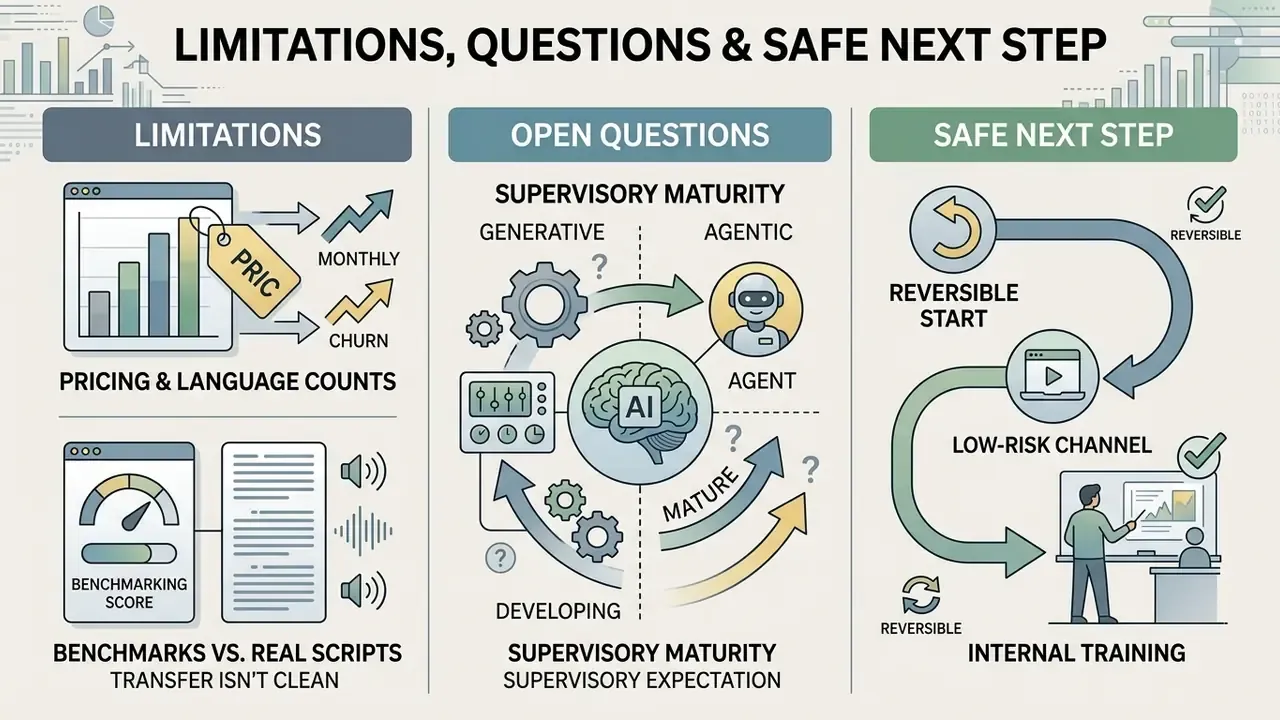
Three things in this guide are less settled than the tables suggest.
First, pricing and language counts churn monthly. Any figure marked "verify current vendor page" should be re-checked before sign-off, and even the confirmed ones deserve a screenshot in your procurement file.
Second, benchmark scores do not transfer cleanly to your scripts. A model that tops TTSDS on read speech may still mangle your product names. Your own fixed prompt set, run three times per model version, is the only number that matters at approval time.
Third, supervisory expectations for generative and agentic voice systems are still maturing. We treat the audience and control assumptions here as hypotheses until validated against your own analytics, interviews, and audit findings.
A reasonable next step is small and reversible: pick one low-risk channel, such as internal training narration or an outbound-disclosure-free informational prompt, and run a 30-day controlled pilot. Fix the model version, register the voice ID with its consent record, log every generation, and score a 200-line benchmark set before and after. Then decide whether the evidence chain holds up under your own internal audit lens. If it does, widen the scope one channel at a time. To line up the surrounding toolchain while that pilot runs, explore the hub for adjacent comparisons across voice, video, and image workflows.
Appendix A: source verification and revision log
For transparency, the following formulations from earlier versions of this guide were revised because the underlying reference could not be verified to our sourcing standard. Superseded wording is retained here so readers can trace the change.
| Superseded formulation | Status | Replacement in the main text |
|---|---|---|
| "top-tier generative speech models can achieve word error rates (WER) below 2% ... (Research on Speech Synthesis Metrics, arXiv, 2025)" | Source unnamed, no figures | Replaced with the VoxCPM2 Technical Report (2025) figure of 1.68% average WER/CER across 30 languages |
| "Standardized quality frameworks evaluate syntactic-intonational accuracy ... (GOST R 59880-2021)" | Standard not part of our verified source set | Reformulated around peer-reviewed evaluation guidance (2025) and multi-dimension perceptual scoring |
| "a single custom voice to speak in over 30 languages ... (Google Multilingual Research, 2024)" | Reference not identifiable | Replaced with LIMMITS'24 Challenge Report metrics (speaker-similarity MOS 4.25; naturalness MOS 3.97) |
| "benchmarked using a standardized test prompt ... (GOST R 59880-2021)" | Unverified attribution | Reformulated as a documented fixed-variable protocol with three repeat runs, supported by 2025 to 2026 evaluation guidance and the TTSDS benchmark |
| "structured software tier frameworks to optimize software procurement (AI Media Commercial-Use, 2026)" | Source not in verified set | Removed and replaced by the TCO table and vendor-documented licensing facts from Microsoft, WellSaid, Typecast, and Murf |
Pricing, language counts, and free-tier limits change frequently. Figures marked "verify current vendor page" should be confirmed against official documentation before procurement sign-off.