There is a second audience for this page, and it is less obvious. Teams that ship customer-facing assistants also write character descriptions. They just call them system personas, and the stakes are different: tone, allowed topics, escalation, evidence.
Quick summary for decision-makers and creators:
- A character description generator converts 4 to 6 structured inputs (role, genre, appearance anchors, psychology, constraints, output format) into a reusable profile.
- Default model outputs skew "aspirational" and homogeneous. Explicit constraints, negative prompting, and human editing are what create distinctiveness.
- Raw machine output is not copyrightable in the U.S., while platform terms usually assign commercial output rights to the user. Two separate facts, handled separately.
- For production systems (chatbots, NPCs, enterprise assistants), persona definitions should live as structured JSON or YAML, version-controlled, and validated for drift, bias, and boundary compliance.
This guide moves from definition to prompt templates, then to validation, licensing, and role-specific use. If you only need the prompts, jump to the template sections. If you are approving a persona for production, the validation and commercial-use sections matter more.
What Is an AI Character Description Generator?
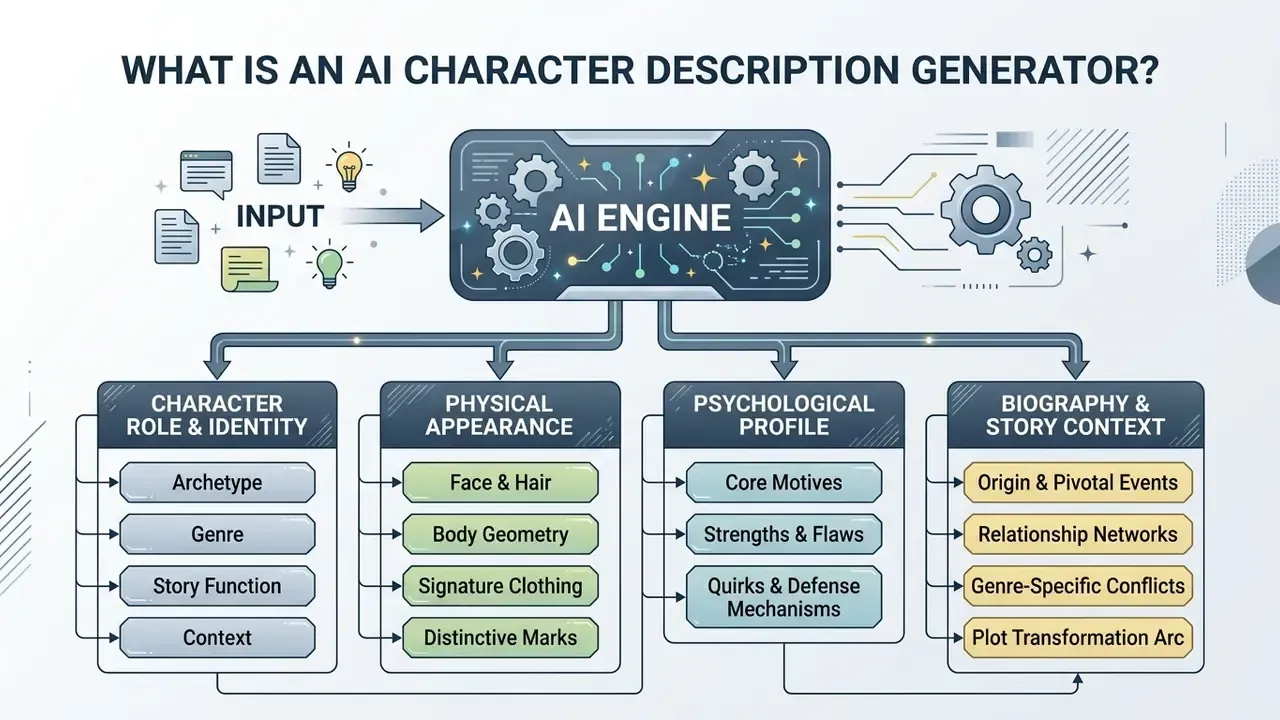
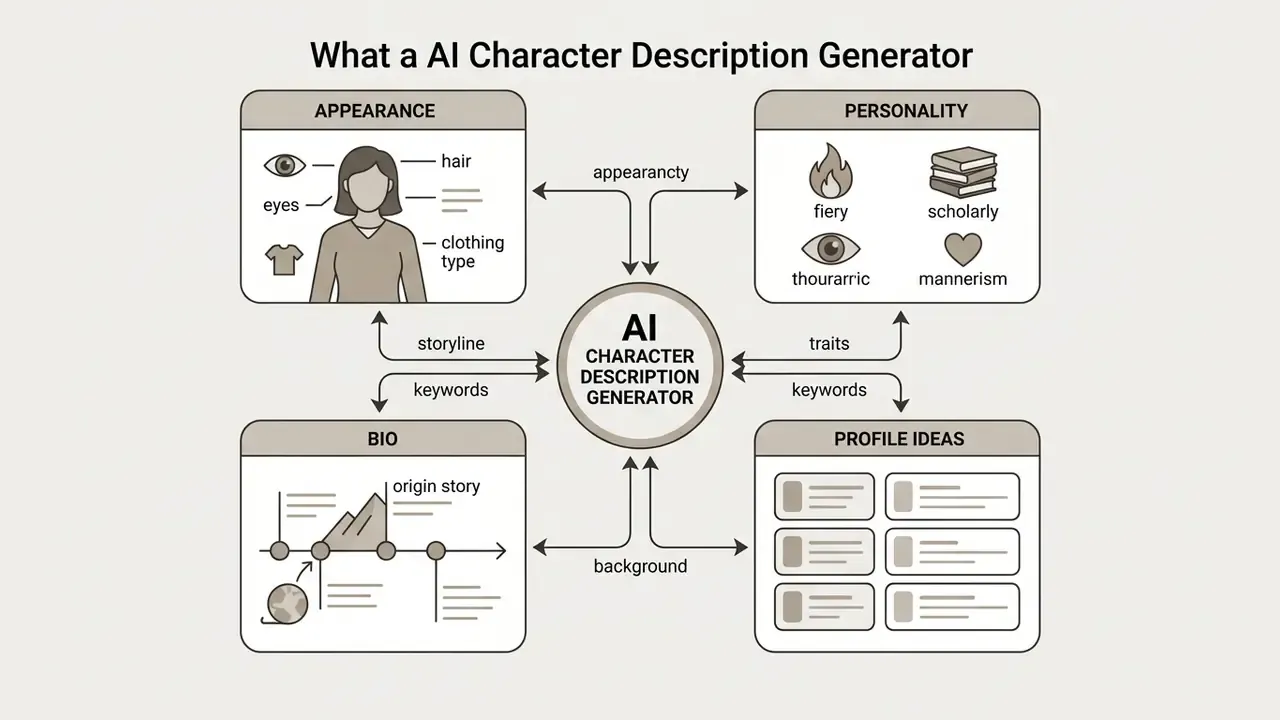
An AI character description generator uses a language model to generate structured character references from minimal inputs. Unlike a general-purpose text generator that returns unstructured prose, a specialized character description generator AI organizes attributes into readable fields: physical features, mental traits, backstory context, speech style.
Character-profiling research evaluates model understanding across four linked dimensions rather than as a single "description" task.
«Character profiling models span four key dimensions: attributes, relationships, events, and personality, enabling systematic evaluation of how language models understand a character.»
By organizing these elements, a generator AI lets creators establish a consistent cast for stories, games, audio dramas, or interactive agents. That same four-dimension logic explains why one-line prompts underperform. Attributes without relationships and events produce a portrait, not a character.
Structure of a Complete AI Character Profile
Character description, character bio, and character profile
Three formats, three jobs. Mixing them up is the most common reason a brief feels vague.
- Character Description prose focused on physical appearance, voice, visible mannerisms, immediate visual traits. Used in scene drafting and concept design.
- Character Bio a narrative summary of life history, origin, turning points, and plot arc. Used in pitch decks, series bibles, and backstory summaries.
- Character Profile a structured sheet combining identity data, appearance, psychological traits, relationships, and stats or abilities. Used in novel planning, RPG rulebooks, and game design documents.
A short rule of thumb: describe to be seen, write the bio to be understood, build the profile to be reused.
What the AI-generated results can include
Results from an AI character profile generator can cover a wide attribute range. Comprehensive outputs from an AI character generator description usually include:
- Physical Features: facial geometry, hair style and color, skin tone, eye shape, height, build, distinctive scars or tattoos.
- Clothing and Style: outfit choices, color palettes, fabrics, accessories, signature props.
- Personality Traits: Big Five dimension levels, core values, psychological strengths, internal contradictions.
- Behavioral Quirks: repeated physical mannerisms, vocal cadence, speech patterns, emotional triggers.
- Motivations and Fears: primary goals, hidden desires, deep-seated phobias, external pressure points.
- Backstory Events: defining childhood memories, formative traumas, past achievements, key relationships.
- Worldview and Values: moral alignment, factional loyalties, ethical red lines, decision-making style.
- Hobbies and Obsessions: private interests, collections, rituals, or compulsions that create texture and conflict.
That last field is underrated. A collection of vintage clocks tells a reader more than three sentences about "meticulous discipline."
What to Include in a Detailed Character Description
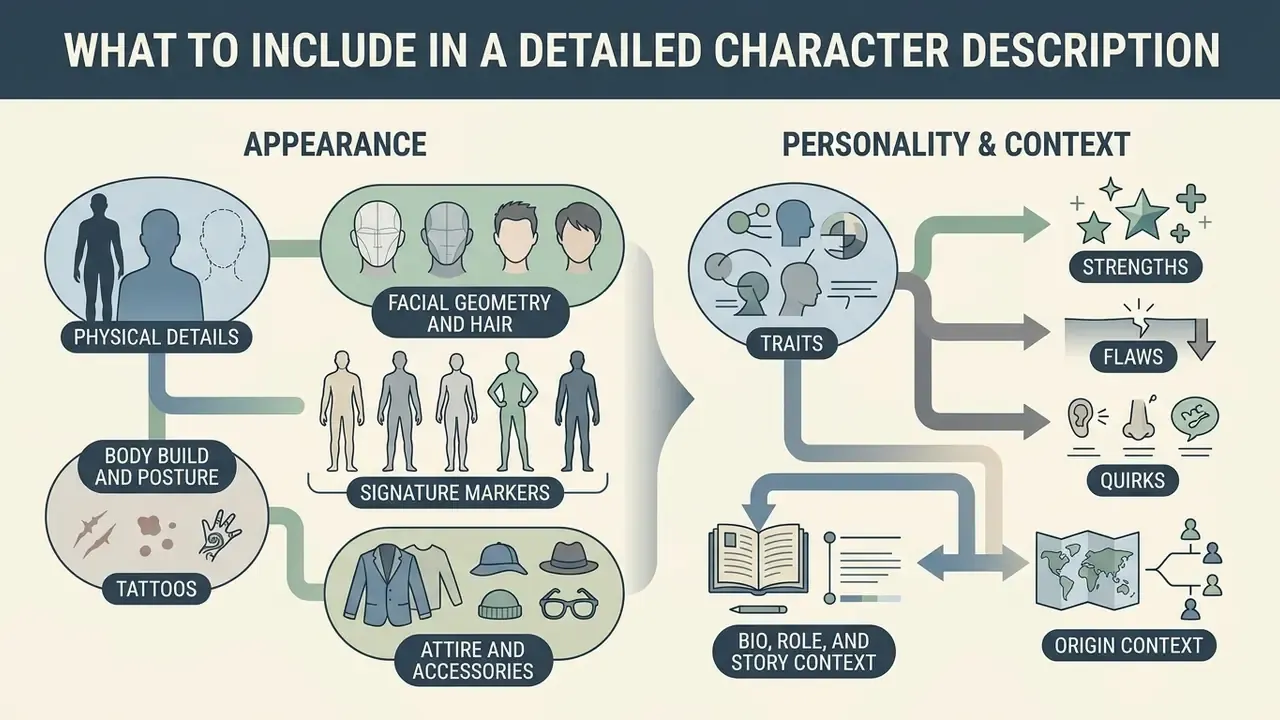
Deep characters come from explicit parameter sets fed into the character profile generator AI. Specific inputs prevent generic archetypes and push the model toward multi-dimensional output.
One media production example. An editorial team needed 15 distinct background character bios for a fantasy web series. They fixed a baseline character profile template, added negative constraints during prompt engineering, and produced structured, non-cliché profiles in under an hour. Their own tracking recorded a large reduction in manual drafting time versus a fully manual process. Treat that as a directional internal result, not a verified industry benchmark.
A parallel enterprise scenario shows the same mechanics with different stakes. A customer-service team defining a virtual advisor persona used the identical field structure: identity, tone, allowed topics, forbidden boundaries, escalation path. The goal there was not to be interesting. The goal was to stay on script and remain auditable.
Appearance: physical details, style, and recognizable features
An effective AI appearance description generator needs concrete visual anchors. To build appearance descriptions that also work as references for image generators, specify:
- Facial Geometry and Hair eye shape, nose structure, jawline, hair length, texture, style.
- Body Build and Posture height, frame, stance, gait.
- Signature Markers scars, birthmarks, tattoos, distinctive body language.
- Attire and Accessories functional clothing layers, wear patterns, color palette, held items.
Reference-sheet practice from image workflows transfers directly. Lock age range, silhouette, face geometry, hair, signature clothing, and palette before generating variants. Then describe front, three-quarter, and back views so proportions stay stable across renders.
When testing tools across media workflows, creators often analyze ai video creation capabilities or evaluate dedicated tools for ai video creation to complement text profiles with motion assets. Pairing the finished description with AI image generators produces a canonical visual reference you can reuse.
Personality: traits, strengths, flaws, and quirks
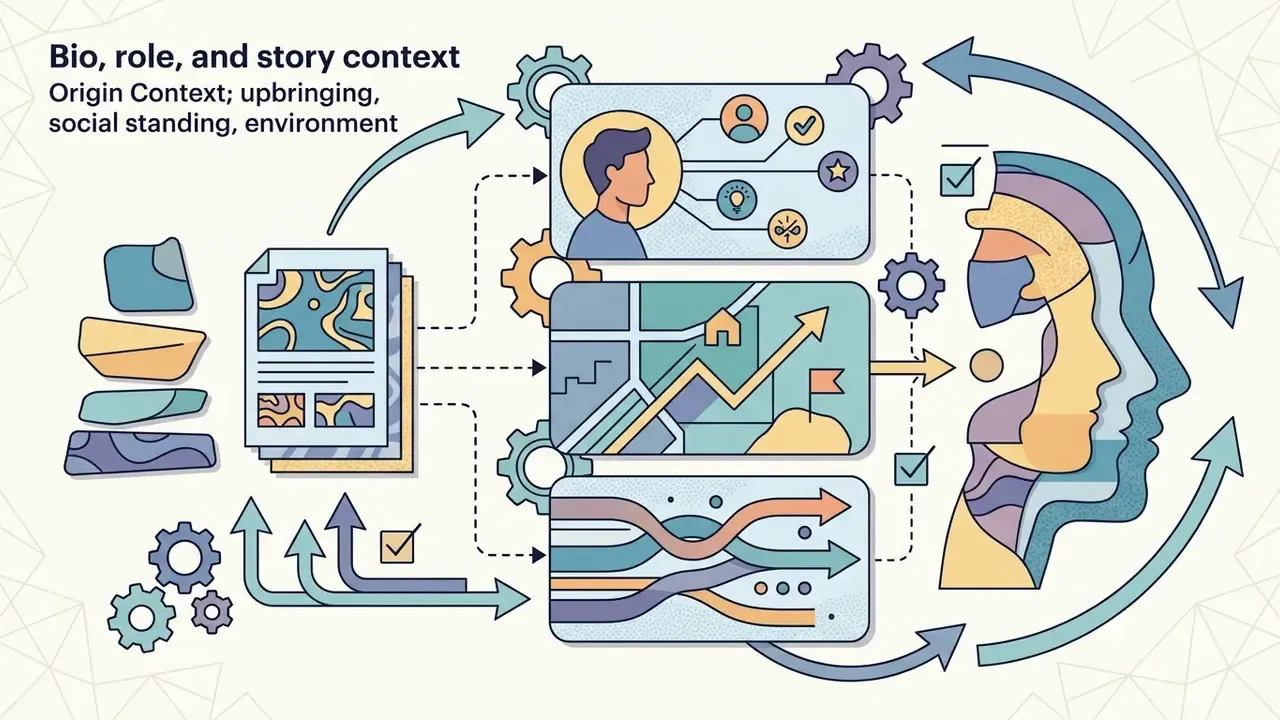
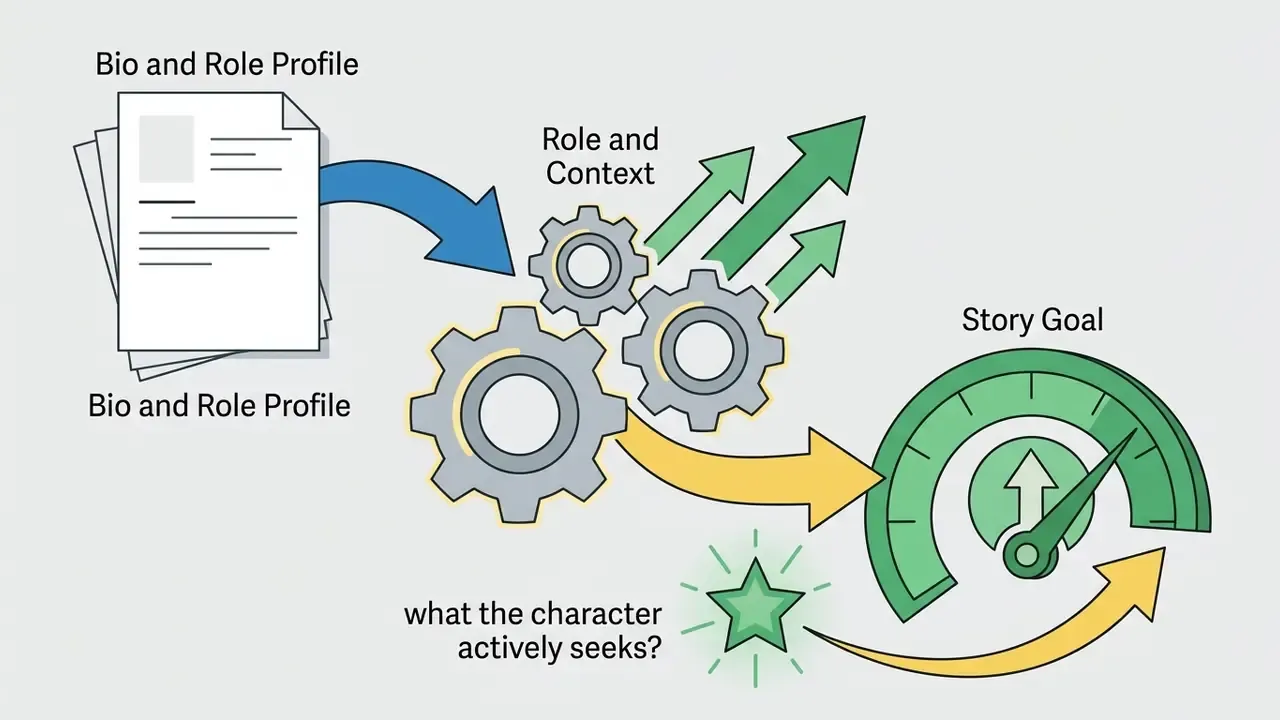
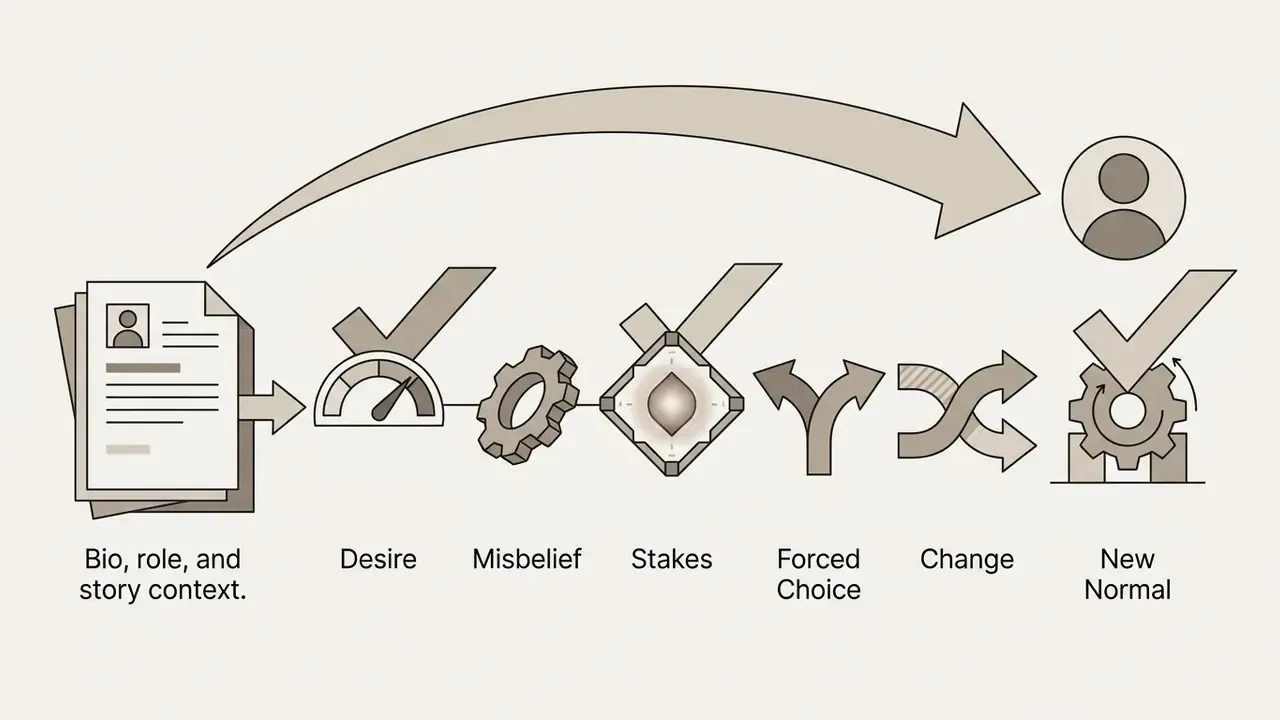
Bio, role, and story context
Backstory earns its place when it explains function. When building a character bio generator AI prompt for fantasy, sci-fi, or detective genres, include:
How to Use an AI Character Description Generator
To get reliable outputs from a character description AI generator, work through a repeatable process rather than freestyling each time.
- Establish the core concept.Define genre, archetype, age range, and story role before prompting.
- Draft a structured prompt.Combine identity instructions, appearance details, psychological parameters, tone and language rules, and explicit exclusions.
- Generate the initial profile.Run the query in your chosen AI generator character description tool.
- Audit and edit.Review results for clichés, logic errors, and tone mismatches. Replace abstract adjectives with concrete actions.
- Format for reuse.Save the refined profile in Markdown or JSON for storytelling, game design, or chatbot prompt engineering.
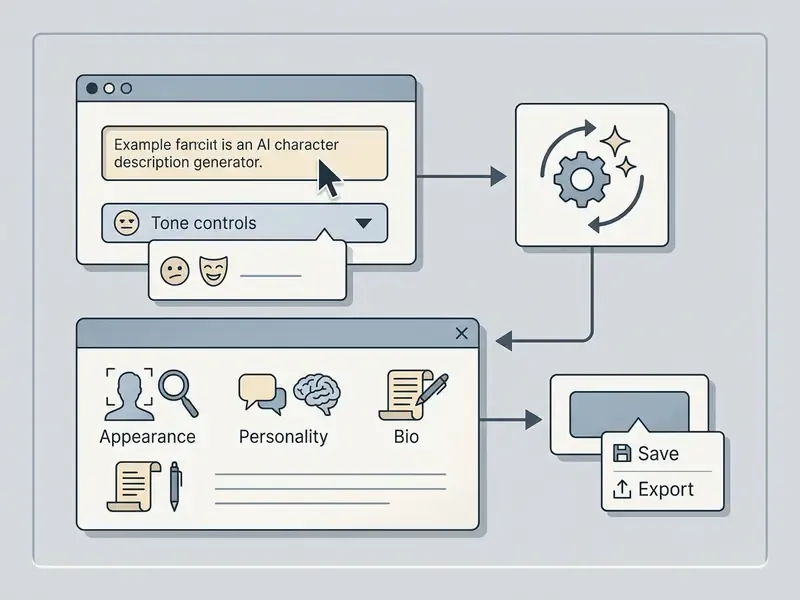
Start with a clear character idea
Good prompts start small. To create a character effectively, specify four core parameters in the first query:
- Task Objectivestate that you want a structured character profile.
- Role and Genredefine role (protagonist, rival, mentor) and genre (cyberpunk, high fantasy).
- Key Constraintslist 2 to 3 required physical or mental attributes.
- Output Formatrequest headings for appearance, personality, bio, and speech style.
Write a prompt with the right level of detail
When drafting prompts for an AI generator character description, split the text into distinct segments. Prompt engineering standards (NIST Quick-Start Guide for Using Artificial Intelligence, 2026; OpenAI Prompt Engineering Guide, 2026) recommend separating instructions, identity, context, and output constraints. Place contextual details near the end, and keep descriptions concise so token budget goes to the fields that matter. Direct wording, without negation stacking or metaphor, measurably reduces ambiguity.
Controlling tone and target language
To generate profiles in non-English languages or to match a narrative style (dark fantasy versus whimsical children's book), add explicit system rules at the top of the prompt:
- Tone constraint "Write the description in a cynical, noir-detective prose style with heavy sensory metaphors."
- Register constraint "Use an analytical, clinical register; no exclamation marks, no rhetorical questions, maximum two adjectives per sentence."
- Multilingual constraint "Output the complete character bio in Spanish (Castilian), using formal vocabulary suitable for historical fiction."
- Localization constraint "Output in French; adapt idioms and honorifics to a contemporary Parisian setting rather than translating literally."
Declare tone and language as rules, not requests. Models follow constraints placed in the instruction block far more reliably than adjectives buried mid-paragraph.
If your character development process involves platform resource limits or tracking AI Video Credits, clean and concise prompts help twice: cheaper runs, and more budget left for the fields you actually care about.
Generate, edit, and reuse the profile
Once the generated text exists:
- Prune generic tropes. Delete "piercing eyes," "mysterious past," and their relatives.
- Verify internal consistency. Physical traits should match history. A seasoned warrior carries appropriate marks.
- Store in Markdown or JSON. Save structured blocks with YAML frontmatter in tools like Obsidian or Notion, so the profile imports cleanly into an ai video editor or a conversational system.
Human editing is not cosmetic. The incentive you set for yourself changes the diversity of what you keep.
«Participants incentivized for originality copied AI suggestions verbatim less often and produced more diverse stories than those incentivized for quality.»
A portable storage pattern keeps profiles reusable across tools, engines, and teams:
---
persona_id: chr-0142
name: Evelyn Reed
version: 1.3
last_reviewed: 2026-02-14
role: deuteragonist / forensic analyst
genre: near-future crime
appearance_anchors: [asymmetrical jaw, off-center broken nose, squint lines]
psychology: [analytical under pressure, distrust of institutions, fear of helplessness]
speech_rules: [clipped sentences, technical jargon, interrupts when impatient]
forbidden_traits: [mysterious, enigmatic, effortlessly brilliant]
reuse_targets: [novel draft, audio drama script, NPC dialogue, chatbot persona]
---
Storing the profile as data, rather than as a paragraph pasted into a chat window, is what makes version control, review dates, and downstream reuse possible.
Prompt Templates for Character Appearance, Personality, and Bio
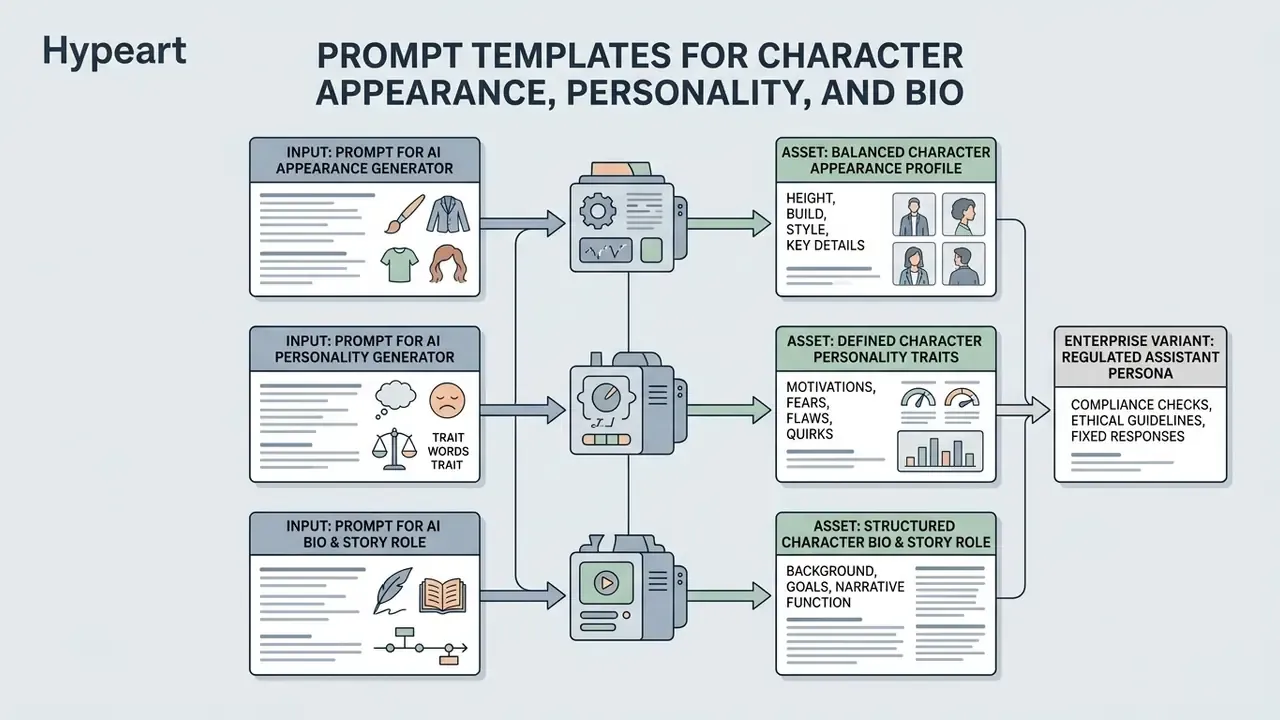
Use these structured templates to generate balanced character assets across generator types. The same field discipline transfers to visual and motion pipelines, including text-to-video AI prompts, where identity drift is the main failure mode.
Prompt for an AI appearance description generator
Act as an expert character concept designer. Generate a detailed physical appearance description for an AI OC (Original Character) with the following attributes:
- Role & Genre: [Insert, e.g., Detective, Cyberpunk]
- Age & Build: [Insert, e.g., Mid-30s, lean build, tall posture]
- Facial Features: [Insert, e.g., Sharp jaw, tired dark eyes, stubble]
- Hair & Skin: [Insert, e.g., Cropped black hair, pale complexion, small scar on left cheek]
- Clothing & Accessories: [Insert, e.g., Worn leather trench coat, formal shirt, tactical watch]
- Output Language & Tone: [Insert, e.g., English, terse noir register]
Format the output as a precise paragraph suitable as a reference prompt for visual media generation tools. Avoid generic adjectives.
Prompt for an AI character personality generator
Expanded template with psychographic variables:
Act as a character psychologist and narrative designer. Create a multi-dimensional personality profile using the following structured variables:
- Archetype & Core Motivation: [Insert goal, e.g., Seeking truth at all costs]
- Moral Alignment & Worldview: [Insert, e.g., Utilitarian, believes the ends justify the means]
- Political / Factional Leaning: [Insert, e.g., Distrusts central authority, quietly funds a reformist bloc]
- Intellectual Profile & Decision Style: [Insert, e.g., High analytical capacity, low emotional empathy, prone to overthinking]
- Major Strengths: [List 2 strengths, e.g., Strategic foresight, unwavering loyalty]
- Major Flaws & Insecurities: [List 2 flaws, e.g., Chronic distrust, paralyzing fear of helplessness]
- Hobbies & Obsessions: [List 2 unique interests, e.g., Restoring vintage clocks, collecting rare poisons]
- Behavioral Quirks & Speech Cadence: [Insert, e.g., Taps fingers rhythmically, speaks in short imperative sentences]
- Defense Mechanisms: [Insert, e.g., Deflects intimacy with procedural detail]
- Output Language & Tone: [Insert, e.g., English, clinical third person]
Explain how these internal values create conflict during high-stress encounters.
Reference version, kept for comparison (Appendix A preserves the original wording too):
Act as a character psychologist. Create a multi-dimensional personality profile using an AI personality description generator structure:
- Archetype & Core Motivation: [Insert goal]
- Major Strengths: [List 2 strengths]
- Major Flaws & Insecurities: [List 2 flaws]
- Hidden Phobia / Trigger: [Insert fear]
- Behavioral Quirks: [List 2 habits]
Describe how these traits manifest in dialogue and decision-making under stress.
Prompt for a character bio and story role
Build a character bio and narrative arc using the following inputs:
- Character Name & Setting: [Insert, e.g., Lyra, High Fantasy Empire]
- Origin & Formative Event: [Insert, e.g., Raised by blacksmiths, village destroyed during rebellion]
- Current Occupation & Relationships: [Insert, e.g., Rogue mercenary, allied with exiled prince]
- Inciting Conflict: [Insert, e.g., Discovers an ancient relic that brands her as a fugitive]
- Plot Transformation: [Insert, e.g., From selfish survivor to community leader]
- Output Language & Tone: [Insert, e.g., English, restrained epic register]
Provide a 3-paragraph summary covering Background, Present Conflict, and Potential Story Arc.
Enterprise variant: regulated assistant persona. The same template structure works for non-fiction personas, where boundaries matter more than backstory.
Define a system persona for a customer-facing virtual assistant.
- Persona ID & Version: [Insert, e.g., ASSIST-014, v2.1]
- Audience & Channel: [Insert, e.g., retail customers, in-app chat]
- Tone & Register: [Insert, e.g., plain language, neutral, no humour]
- Allowed Topics: [Insert, e.g., account status, product features, published fee schedules]
- Forbidden Boundaries: [Insert, e.g., no personalised financial, legal, or tax advice; no speculation about future rates]
- Escalation Path: [Insert, e.g., hand off to a human agent when the user requests advice or disputes a charge]
- Disclosure Rule: [Insert, e.g., state that responses are automated when asked]
Output the persona as JSON with fields: persona_id, tone, allowed_topics, forbidden_topics, escalation_trigger, disclosure_text.
When building promotional clips or narrative shorts around a character, creators frequently refine visual production with an ai video enhancer or keep an eye on ai video generation releases.
How to Improve AI-Generated Character Results
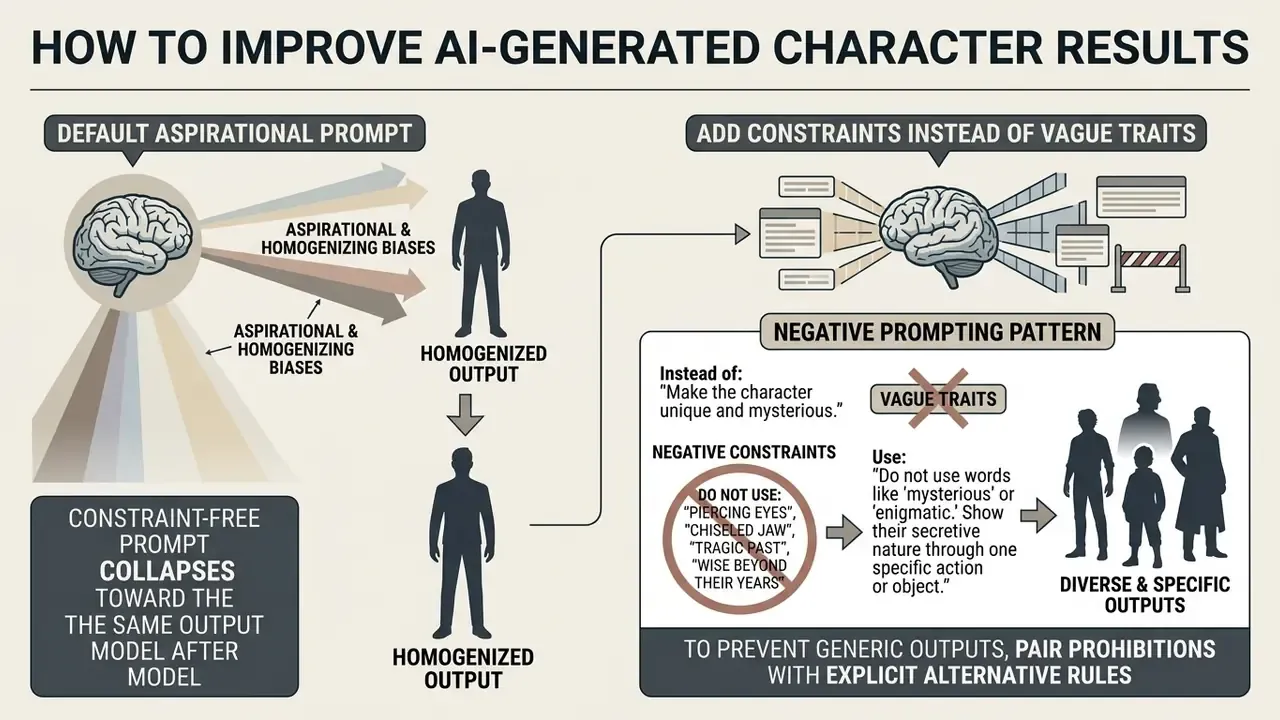
Default outputs carry aspirational and homogenizing biases. They drift toward positive, middle-aged, conventionally successful characters.
«An analysis of 40,000 synthetic personas found models systematically produce middle-aged characters with positive traits, under-representing non-binary identities and ordinary occupations.»
A few techniques improve uniqueness and depth quickly.
| Feature Area | Generic AI Output (Avoid) | Improved Constrained Output (Prefer) |
|---|---|---|
| Personality | "Always calm, brave, and brilliantly smart." | "Highly analytical under pressure, but prone to paralyzing self-doubt when decisions affect family." |
| Appearance | "Stunningly handsome with piercing blue eyes." | "Asymmetrical features, a broken nose reset slightly off-center, and a permanent squint from years of glare." |
| Backstory | "Tragic past that drives them to seek justice." | "Discharged from civil service after leaking financial audit records, now freelancing to clear inherited debt." |
| Dialogue | "Speaks with quiet authority and wisdom." | "Uses brief, clipped sentences, interrupts when impatient, and leans on technical jargon." |
| Values | "Has a strong moral compass." | "Will falsify a timestamp to protect a witness, but refuses to lie in a written statement." |
Once the text profile is disambiguated, push the same anchors into visual pipelines through AI art generators. Concrete markers, not adjectives, keep a rendered character recognizable across scenes.
Add constraints instead of vague traits
To prevent generic outputs, pair prohibitions with explicit alternative rules (Prompt Engineering Playbook, 2026):
- Instead of: "Make the character unique and mysterious."
- Use: "Do not use words like 'mysterious' or 'enigmatic.' Show their secretive nature through one specific item they keep locked in a desk and one topic they refuse to discuss."
Negative prompting pattern. Every prohibition should carry a boundary clause and a fallback clause.
NEGATIVE CONSTRAINTS
- Do not use: "piercing eyes", "chiseled jaw", "tragic past", "wise beyond their years".
- Do not describe the character as attractive; describe what a stranger would notice first instead.
- Do not exceed 2 adjectives per sentence.
BOUNDARY: If a banned term is the only accurate option, substitute a physical action that implies it.
FALLBACK: If a required field cannot be filled from the inputs, output "UNSPECIFIED" rather than inventing a trope.
Why bother? Because constraint-free prompting collapses toward the same output, model after model.
«Language model responses are semantically far more similar to one another than human responses, even under prompts explicitly designed to elicit creativity.»
Check consistency between appearance, personality, and story
Run a systematic cross-check after generating a profile:
- Physical alignmentdoes the build match the stated background and daily activities?
- Psychological alignmentdo choices in scene drafts reflect the listed flaws and core fears?
- Role alignmentdoes the backstory explain current skills and story goals?
- Bias alignmentdoes the cast as a whole reproduce the aspirational defaults above, with the same age band, the same optimism, the same prestige occupations?
- Boundary alignment (deployed personas)does the persona refuse out-of-scope requests and escalate as specified, including under rephrased or adversarial prompts?
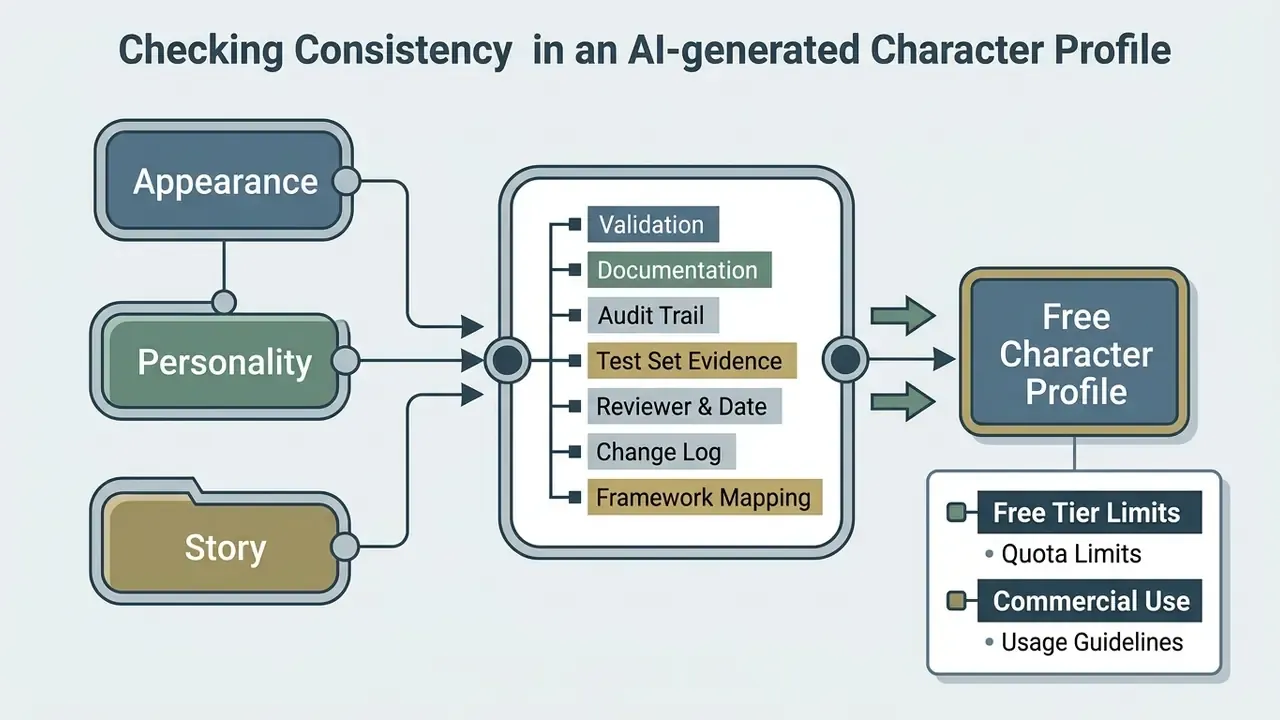
Validation, documentation, and audit trail
For personas that ship inside a product, whether an assistant, an NPC, or a support agent, consistency checking stops being proofreading and becomes a documented control. A reproducible validation record usually captures:
- Test set a fixed list of in-scope prompts, out-of-scope prompts, and jailbreak attempts, re-run on every persona change.
- Evidence stored inputs, outputs, model version, temperature, and system prompt hash, so results can be reproduced later.
- Reviewer and date who approved the persona version, and when re-review is due.
- Change log what changed in the system prompt, why, and which test cases were re-run.
- Framework mapping which control the test satisfies, for example documentation and risk-measurement expectations in the NIST AI Risk Management Framework, or internal model-validation and change-control policy.
A minimal persona inventory record makes this auditable:
| Field | Example value |
|---|---|
| Persona ID / Version | ASSIST-014 / v2.1 |
| Owner | Conversational design lead |
| Target audience & channel | Retail customers, in-app chat |
| Risk tier | Medium (customer-facing, no transactions) |
| Allowed topics | Account status, product features, published fees |
| Forbidden boundaries | Personalised advice, speculation, third-party IP imitation |
| Escalation path | Human agent on advice request or dispute |
| Last validation date / reviewer | 2026-02-14 / risk reviewer |
| Retention & logging | Enterprise terms, training opt-out confirmed |
One caveat worth stating plainly: an inventory row proves ownership, not safety. It only helps if the test set is re-run and the outputs are kept.
Free Access, Ownership, and Commercial Use of Generated Descriptions
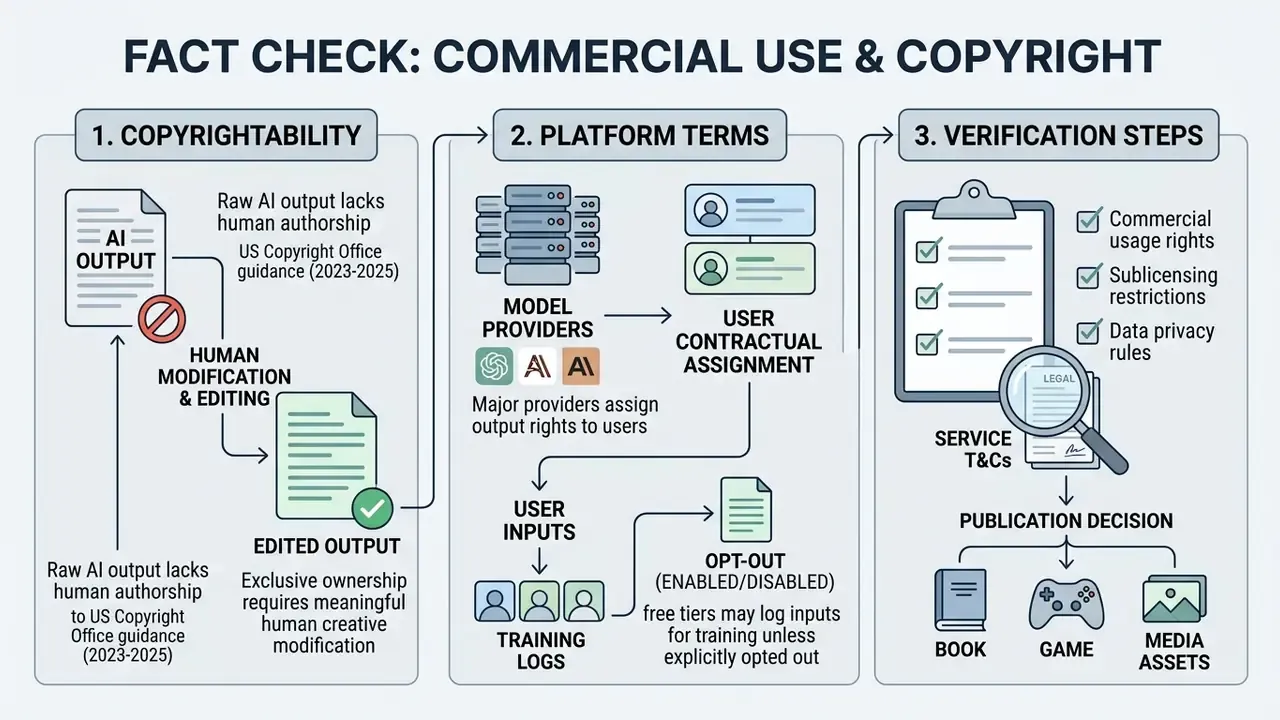
Creators comparing rights across formats can also review commercial use of AI image generators, since character text and character art sit under separate terms even when they come from the same brief.
What "free" means for an AI character generator
Free access to an AI character description generator free tool usually arrives with operational boundaries:
- Quota limits caps on daily generations, processing speed, or token length per request.
- Feature gating advanced customization, export formats (JSON/YAML), or API access may sit behind a paid plan.
- Data usage terms free-tier inputs and outputs may be processed to train provider models (Google AI Studio Terms, 2026). Anyone working with proprietary intellectual property should read the privacy policy first, not last.
| AI Engine / Platform | Free Tier Allowance | Context Window (approx.) | Commercial Usage Granted? | Data Logging Policy |
|---|---|---|---|---|
| ChatGPT (free tier, mini-class model) | Unlimited basic text requests; tool-specific caps on files, images, voice | ~128k tokens | Yes, per terms of use | Opt-out required |
| Claude (free tier) | Message cap that renews on a rolling window | ~200k tokens | Yes, output rights assigned to user | Opt-out / enterprise terms |
| Gemini / AI Studio free tier | Published request and token quotas | Model dependent | Yes, per terms | Free-tier inputs/outputs may improve models |
| Local LLMs (open-weight models) | Unlimited, hardware dependent | Model dependent | Yes, per open-source licence | Fully local, no external logging |
Allowances change often. Verify current limits on the provider's pricing page before committing a production workflow.
Independent legal analysis suggests the asymmetry in these terms is structural, not accidental.
«Empirical mapping of service terms shows providers position themselves as neutral intermediaries while retaining broad data rights and disclaiming responsibility for content.»
Shadow AI checklist for teams. Free tools turn into organizational risk the moment someone pastes internal material into them.
Creators budgeting across creative tools can use production calculators or see the overview for structured cost management.
What to verify before commercial use
Before selling novels, games, or media assets built with AI-generated character descriptions, verify:
- Commercial license rights.Terms of service should explicitly grant commercial exploitation, including sublicensing and redistribution if you plan to resell assets.
- Human authorship threshold.U.S. Copyright Office guidance (Copyright Registration Guidance: Works Containing Material Generated by Artificial Intelligence, 2023) states that purely machine-generated content is not copyrightable.
«The Office will not register works produced by a machine without creative human intervention: the traditional elements of authorship must be conceived and executed by a human.»
Who Can Use an AI Character Profile Generator?
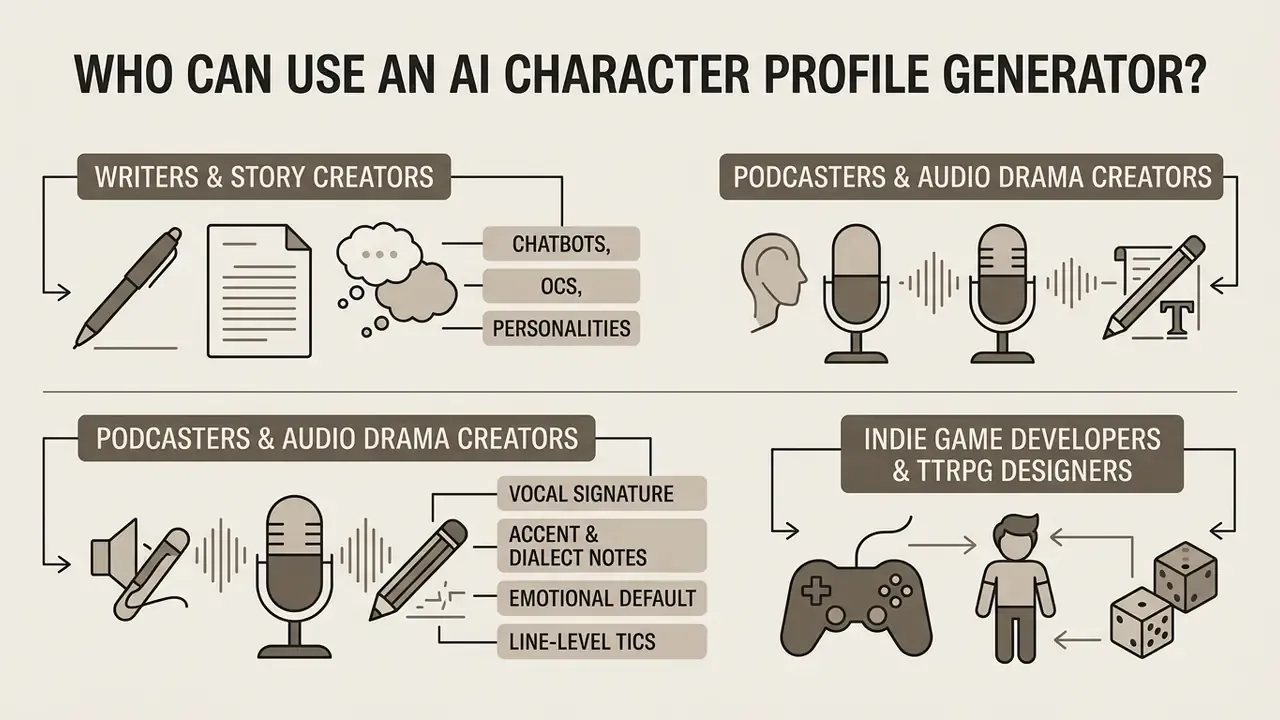
An AI personality creator or character personality generator AI serves a wide spread of creative and technical roles.
Writers and story creators
Fiction writers, screenwriters, and narrative designers use these tools to:
- Break writer's block by generating alternative personality combinations.
- Populate secondary and tertiary cast lists with distinct physical details and speech rhythms.
- Maintain continuity through standardized reference sheets for multi-book series or long campaigns.
Used well, a generator is an ideation partner, not an author. The ceiling is documented.
«In head-to-head comparison, GPT-4 fell significantly short of an award-winning author in creative depth, narrative originality, and thematic nuance as judged by literary critics.»
Writers building visual companions for a series bible often start with free AI image generators before committing budget to paid rendering pipelines.
Chatbots, original characters, and reusable personalities
Conversational designers and game developers use an AI chatbot personality generator or character AI definition generator to build system prompts for virtual agents.
One conversational platform planned an interactive NPC bot. Early iterations suffered persona drift and broke character during long sessions. The lesson: persona is carried by conversational signals, not by a label at the top of the prompt.
«Socially oriented cues in chatbot messages significantly influence most OCEAN personality traits and the perceived warmth of the character.»
The team moved to structured JSON system prompts that re-injected character boundaries at regular token intervals. Their own logs recorded near-complete role retention across extended sessions. Again, an internal measurement on a single deployment, not an externally validated benchmark.
Key setup fields for chatbot character consistency:
{
  "character_name": "Evelyn Reed",
  "system_persona": "Pragmatic forensic analyst in a futuristic metropolis.",
  "tone_and_style": "Direct, analytical, uses formal phrasing, avoids slang.",
  "core_rules": [
    "Never break character or acknowledge being an AI.",
    "If asked about personal feelings, pivot to objective facts.",
    "Reference past investigation details stored in conversation memory."
  ]
}
Persona drift is a property of long-running inference, not a one-off bug.
«Contemporary generative architectures maintain high initial persona consistency but exhibit semantic drift under sequential inference and random prompt perturbations.»
Podcasters and audio drama creators
Audio storytellers use AI character generators to draft voice-actor briefs and speech mannerisms. Specifying vocal cadence, regional accent, breath patterns, pitch range, and emotional triggers gives an actor immediate context for a dramatic read. A useful audio-specific field set:
- Vocal signature pitch, pace, resonance, habitual filler sounds.
- Accent and dialect notes region, era, degree of assimilation.
- Emotional default and escalation tone at rest, and how it breaks under pressure.
- Line-level tics interruptions, trailing sentences, or repeated phrases a listener can identify without any visual cue.
Because audio strips away visual identification, a podcast character profile should prioritize distinctive speech patterns over physical description. Two characters can share a backstory. They cannot share a cadence.
Indie game developers and TTRPG designers
Game designers use character profile generators to build NPC stat blocks, dialogue trees, quest-giver backstories, and faction relationships fast. Structuring output as YAML or JSON allows direct ingestion into engines such as Unity or Unreal, or into a tabletop campaign wiki. Fields worth requesting:
- Mechanical layer stats, abilities, level range, loot or reward hooks.
- Dialogue layer greeting, refusal, quest-offer, and post-quest lines in a consistent voice.
- Relationship layer allies, rivals, and the one NPC whose fate changes this character's behavior.
- Reuse layer which scenes, quests, or sessions the profile is authorized to appear in.
For TTRPG work, generating twelve variant NPCs from one constrained template, then hand-editing the two that matter most, is usually faster and more distinctive than prompting each character from scratch.
FAQ: Common Questions About AI Character Description Generators
Who owns the copyright to AI-generated character descriptions?
Under US Copyright Office guidance, raw AI output lacks human authorship and cannot be registered. Contractually, though, major LLM providers assign commercial rights to you. To secure copyright ownership, edit, reframe, or expand the output with original human creative input, and keep the evidence of that work.
Can I use an AI character description generator for commercial projects like novels or games?
Yes. Commercial use is permitted under most platform terms of service. Check that your prompt inputs do not infringe third-party trademarks, and audit the output for accidental resemblance to existing franchise characters.
How do I change the tone or language of the generated character profile?
Put explicit language and tone constraints inside the instruction block, for example: "Output the response in Spanish, using an analytical and melancholic narrative tone." Declaring tone and language as rules works more reliably than mentioning them mid-paragraph.
Is an AI character description generator free to use, and are there limits?
Most major models offer a free tier with generous text limits, but caps apply to images, voice, file uploads, and API calls. Free tiers may also process your inputs to improve models unless you opt out or move to enterprise terms.
How detailed can the generated character profiles be?
Detail scales with input. A short prompt returns a few traits. A structured prompt with appearance anchors, moral alignment, decision style, hobbies, obsessions, quirks, and negative constraints returns a multi-page profile suitable for a series bible or a game design document.
Can I use it for specific genres such as fantasy, sci-fi, or detective fiction?
Yes. Name the genre, the world rules, and the character's function inside them. Fantasy and sci-fi profiles benefit from origin, turning points, and world-rule constraints. Detective characters need occupation, method, and the psychological pressure points that shape how they read evidence.
Is a system prompt defining a chatbot persona confidential?
Organizations commonly treat production system prompts as confidential business information and version-control them accordingly. Persona prompts can be extracted through adversarial prompting, so sensitive policy text belongs in retrieval or backend logic rather than inside the persona block.
How do I log persona changes for audit purposes?
Store each persona as a versioned file with an owner, review date, allowed and forbidden topics, escalation path, and change log. Re-run a fixed test set of in-scope, out-of-scope, and adversarial prompts on every change, and retain the outputs with the model version as reproducible evidence.
Summary Checklist for Character Generation
Checklist0 / 8
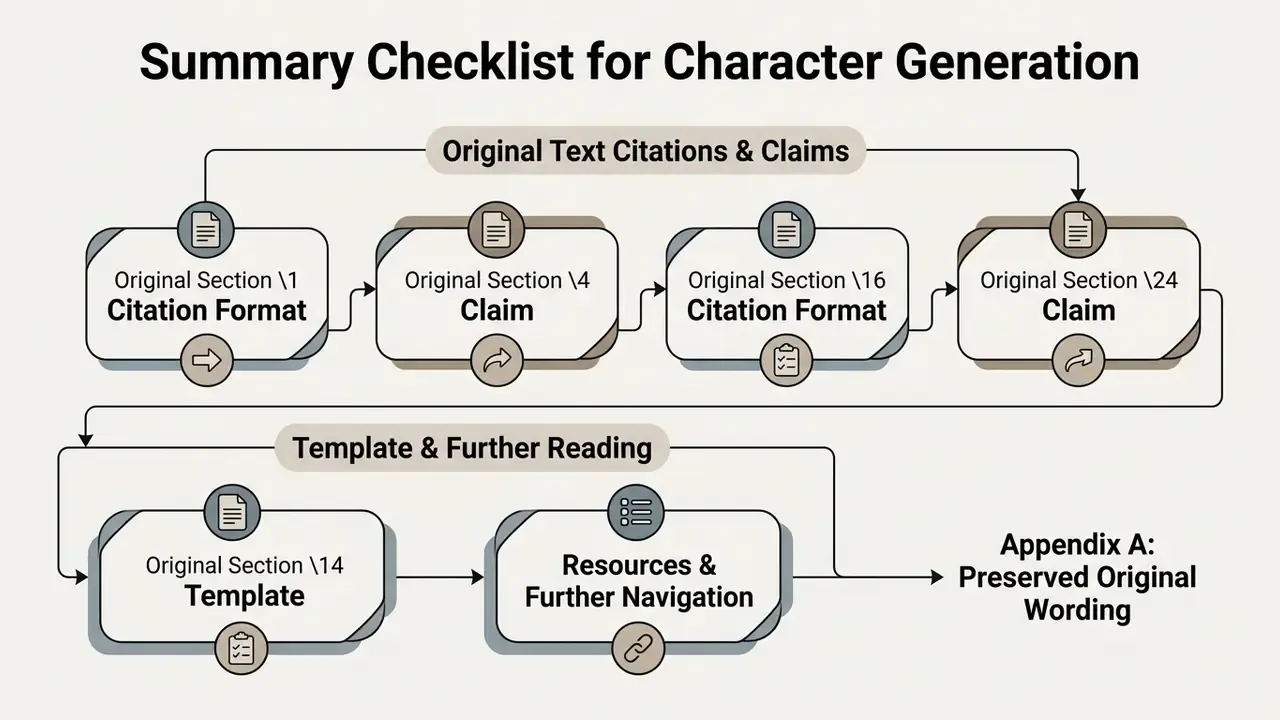
Appendix A: Preserved original wording
Kept for transparency where the main text now carries an updated version.
- Original section [1] citation format
- "Research shows that comprehensive character profiling models parse outputs across four core dimensions: attributes, relationships, events, and personality (Evaluating Character Understanding of Large Language Models via CROSS, EMNLP 2024)."
- Original section [4] claim
- "the team generated structured, non-cliché character profiles in under an hour, cutting manual drafting time by 70%."
- Original section [16] citation format
- "(All Too Perfect: Bias and Aspiration in Persona Generation with LLMs, 2026)."
- Original section [24] claim
- "maintaining 98% role retention across extended sessions."
- Original section [14] template
- see the reference version reproduced under the updated personality prompt above.