Put plainly: an AI cover generator is a creative tool and a voice-data processor at the same time. That double nature is why this guide runs on two tracks. One track is product: how to make a cover that actually sounds good. The other track is control: how to avoid a legal or operational incident while doing it.
Updated 2026. Prepared by the editorial team from public vendor documentation, peer-reviewed singing voice conversion research, and practical AI tool audit experience.
How to read this guide. Sections one through six answer the practical question "how do I make a good cover and what does it cost." Sections seven and eight answer the harder question: "can my organization use this without creating exposure." Skip ahead if you already know the tech.
Executive Summary
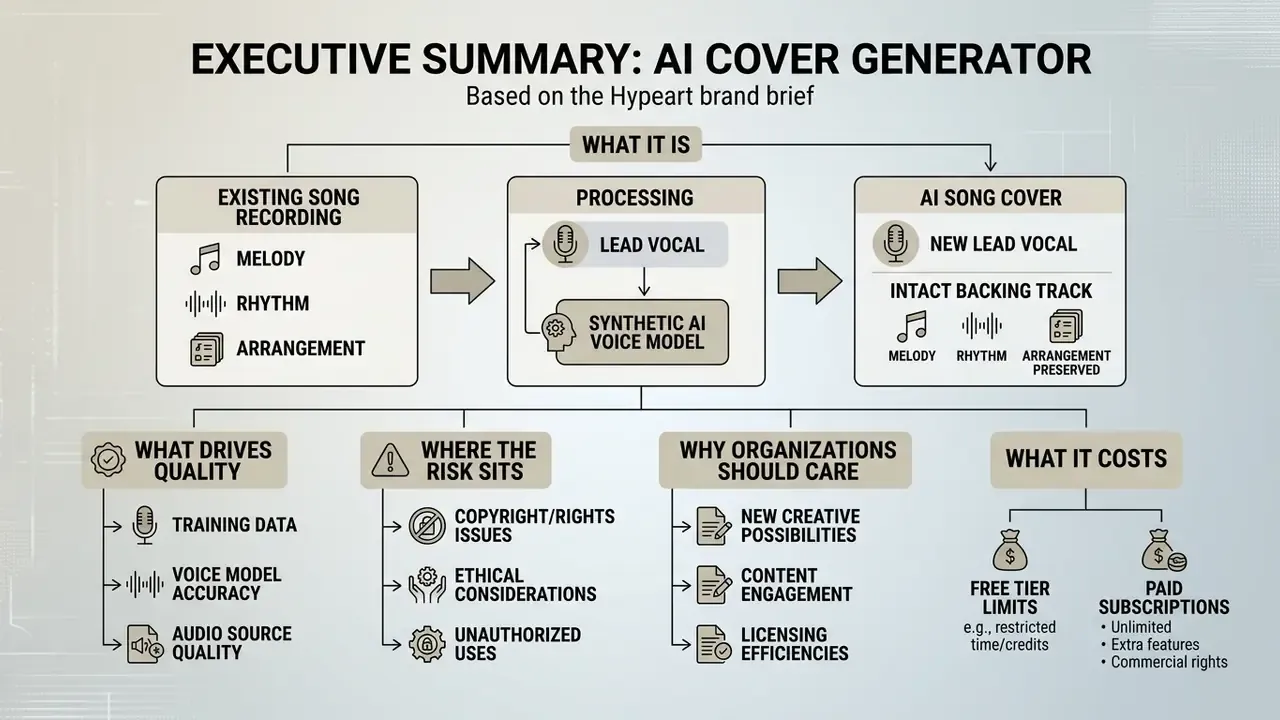
- What it is. An AI cover generator replaces the lead vocal in an existing recording with a synthetic AI voice model, keeping melody, rhythm, and arrangement intact. The technical base is Singing Voice Conversion (SVC), not music generation from scratch.
- What drives quality. Cleanliness of the source vocal stem, accuracy of stem separation, alignment between the model's tonal range and the melody, plus signal pre-cleanup (Vocal Cleanup).
- Where the risk sits. A paid subscription does not transfer rights to the composition or the lyrics. Commercial use of a real artist's voice touches right of publicity (for example, NY Civil Rights Law §§ 50-51) and SAG-AFTRA digital replica standards.
- Why organizations should care. Uploading employee or client voice recordings into a public consumer service is a textbook Shadow AI scenario. You need data retention review, a contractual opt-out from training on customer audio, and reproducible audit evidence (SR 11-7, NIST AI RMF).
- What it costs. Free tier: 3 to 5 generations per day, watermark, MP3 at 128 to 192 kbps. Pro: from $10 to $15 per month, WAV without watermarks. Enterprise: API, stems, custom voice cloning, a Copyright Certificate, and IP indemnification.
What an AI Cover Generator Is and What Covers It Produces
An AI cover generator transforms an existing music track by changing vocal identity or arrangement while preserving the melodic skeleton of the composition. Unlike text-to-music systems that write new songs from nothing, an ai cover maker depends on an input audio file. From that file it extracts pitch, dynamics, and phonetic information.
The resulting song cover can be a straight vocal swap or a full genre adaptation. Using mature ai music pipelines, creators get ai covers with different voice models, custom pitch settings, or a rebuilt instrumental bed.
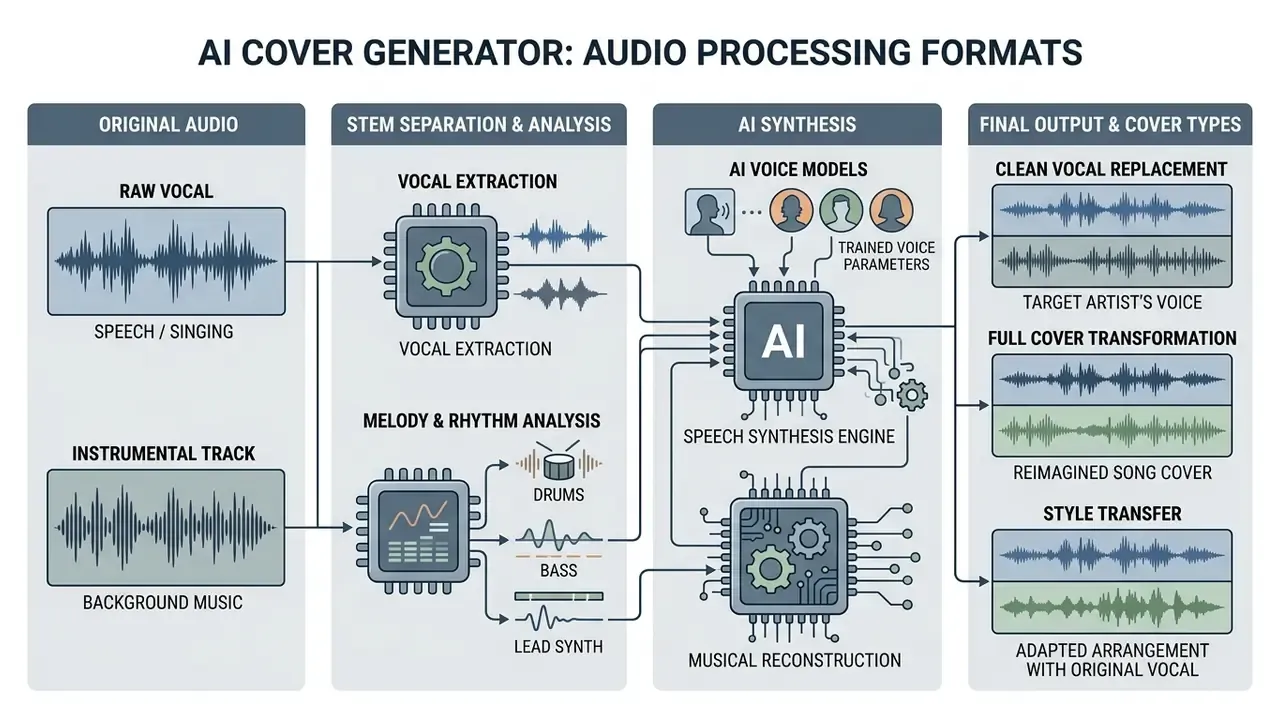
- Semantic layout: render as a figure with a visible caption and alt text containing the phrase "ai cover generator format comparison"; keep a text transcript of the diagram in the page body.
AI Voice Cover, Style Cover, and Song Cover
An AI voice cover changes vocal identity only. The original singer's timbre is replaced by a target ai voice, while lyrics and timing stay identical. A style cover rearranges the instrumental production, the harmonic grid, and the genre, but keeps the vocal melody. A full song cover merges both: the vocal line and the backing track are resynthesized, which produces a genuinely reimagined version of the source audio.
The practical difference shows up in vendor input requirements. Style covers usually accept a full mix (MP3 or WAV, up to roughly 50 MB). Voice covers prioritize a compact vocal stem (MP3, WAV, FLAC, M4A, up to roughly 10 MB). The reason is architectural: voice replacement works on a monophonic signal, while style transfer has to read the whole structure of the track.
How an AI Cover Maker Differs From an AI Song Generator
An ai cover maker needs an existing recording as its structural base. It analyzes the original melody and rhythm in order to convert the existing vocals. An ai song generator, by contrast, builds new compositions, lyrics, and instrumental arrangements from text prompts, with no input track at all. The song generator produces new intellectual property. The cover tool focuses on singing voice conversion and acoustic style transfer.
The legal profile splits along the same line. A cover tool almost always inherits rights in someone else's composition. A song generator creates a derivative object from a prompt. That distinction is the compliance watershed, and we return to it in the commercial-use section.
What an AI Song Cover Generator Can Actually Do
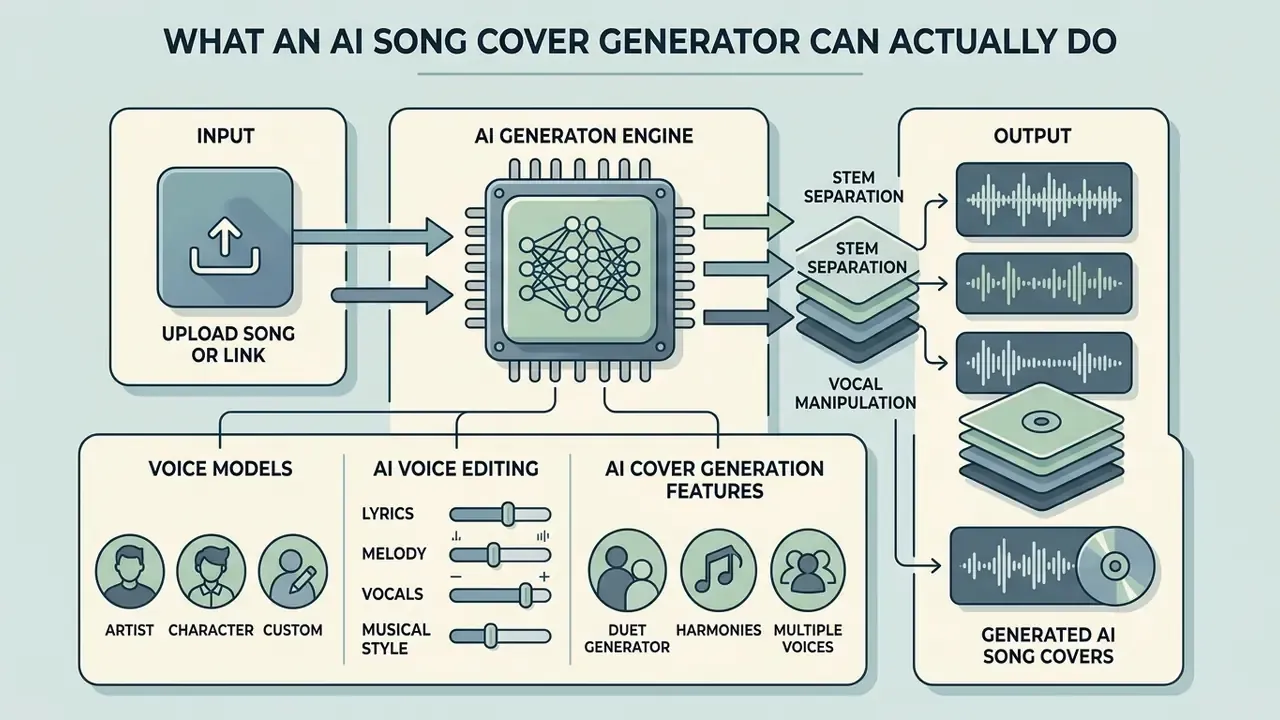
Modern ai song cover generator platforms offer a full range of vocal manipulation, stem separation, and multi-voice layering. Running on specialized neural architectures, an ai cover creator isolates vocal tracks from the instrumental, handles pitch alignment, and applies target acoustic timbres.
Creators can shift vocal gender, layer harmonies, generate multi-voice duets, and tune language-specific pronunciation. These tools give precise control over pitch, emotion, and delivery dynamics across genres. The logic resembles video production with AI video generators, where parameter control matters more than one-button magic.
Voice Models: Artist, Character, and Custom AI Voice
Voice libraries in an ai cover generator free online service usually split into three categories: imitative AI artist cover timbres, fictional character voices (anime and cartoon included), and user-trained models. Advanced platforms let you upload isolated vocal samples and train a personal custom AI voice, capturing unique vocal characteristics for consistent branding across tracks. For broader context on speech and singing synthesis, see our breakdown of AI voice generators.
"SaMoye is trained on 1,815 hours of singing from 6,367 singers and supports zero-shot conversion, including non-human timbres."
Catalog scale at market leaders runs into the thousands. Users typically get libraries of 1,000 to 8,000+ ready AI voices (artists, characters, narrators, game voices), refreshed daily and sorted into Singers, Celebrity, Animation, Game, and My Voice categories. Worth checking, though: catalog size says nothing about license status of any individual voice.
Editing Lyrics, Melody, Vocals, and Musical Style
Advanced ai cover generator song platforms integrate natural language processing to adjust or rewrite lyrics while preserving singability and cadence. By separating vocal stems from the instrumental bed using source separation models, creators can shift key, reshape pitch curves, or apply latent style prompts to reframe a genre, moving a track from pop to acoustic or electronic.
Style transfer research confirms a useful engineering rule: stylization must not touch the timesteps that carry structure. Latent diffusion models deliberately exclude the steps that encode melody and rhythm from stylization. That exclusion is exactly what keeps the "skeleton" of the song intact through a genre change.
AI Cover Duet Generator, Harmonies, and Multiple Voices
An ai cover duet generator produces multi-voice arrangements by assigning separate synthetic models to specific vocal parts or intervals. You set a lead vocalist, add backing singers, and stack pitch-shifted harmonies. (Updated) Per vendor documentation, the number of simultaneous voices depends on the plan and the tool. Harmony generators let you set a key and add up to 4 voices with interval selection (for example, "6th Below"), exporting a master mix alongside separate vocal stems. Dedicated duet services often cap the ensemble at three voices with assigned roles. Building a full ensemble arrangement from one monophonic vocal take is a direct consequence of that architecture.
How to Choose an AI Voice Model for a Song Cover
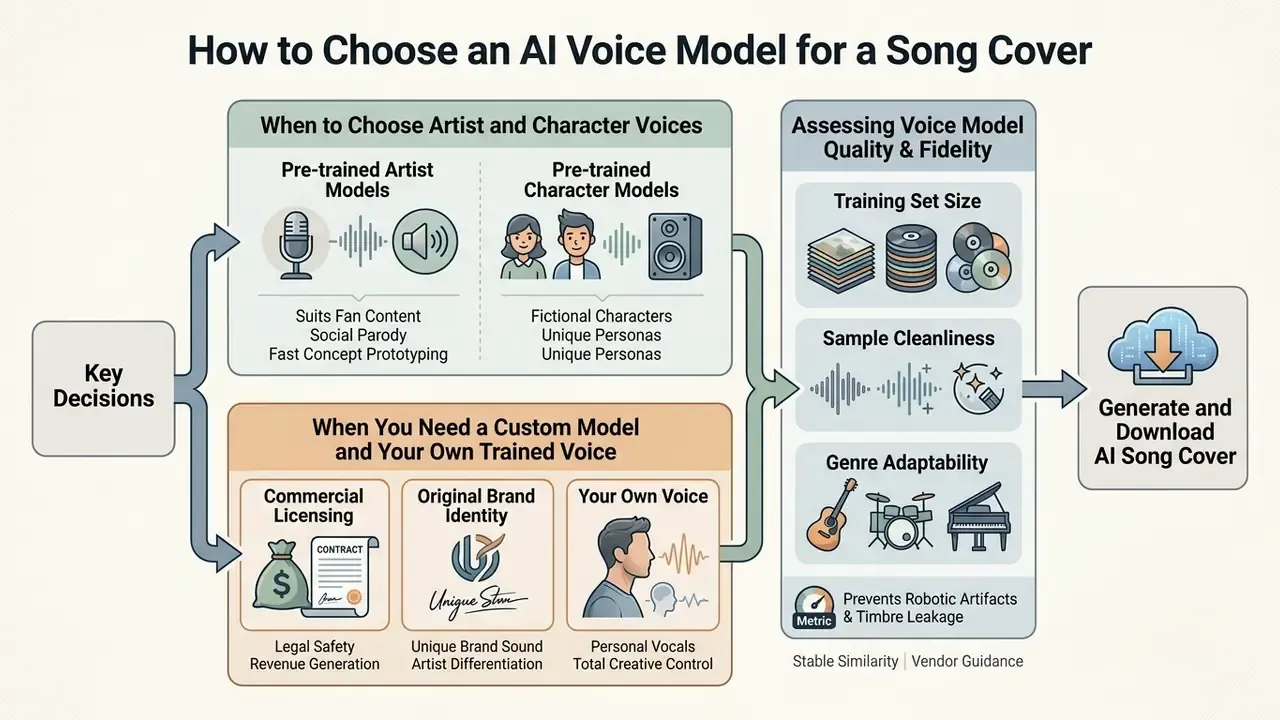
Choosing the right voice model determines sonic fidelity, tonal range fit, and stylistic accuracy of the finished song cover. The source vocal's dynamics, range, and emotional delivery have to sit inside the physical limits modeled in the target synthetic voice.
Assessing training set size, sample cleanliness, and genre adaptability prevents robotic artifacts and timbre leakage during generation.
One more signal from the 2025 benchmarks: light fine-tuning of a model on a specific genre gives a substantially larger quality lift than zero-shot genre adaptation. The practical takeaway is simple. Pick a model trained on material close to your track in genre and delivery, not a "universal" one.
| Task category | Voice model type | Vocal requirements | Supported style | Output quality | Library characteristics | Usage limits |
|---|---|---|---|---|---|---|
| Artist Cover | Pre-trained celebrity / pop star | High dynamic range, clean isolated stem | Pop, Rock, R&B, Jazz | Studio quality (high similarity) | Access to catalogs of 8,000+ ready AI voices (artists, characters, narrators), updated daily | Non-commercial, or fair-use constrained |
| Character Cover | Anime / cartoon / fictional | Exaggerated prosody, distinctive formant profile | Pop, Electronic, Novelty | Expressive stylized result | Animation and Game categories, 1,000+ models on most platforms | Depends on platform policy |
| Custom AI Voice | User-trained (voice cloning) | (Updated) Per vendor docs: 1 to 30 minutes of audio, optimally 10+ minutes of clean dry vocal; studio spec is mono WAV, 44.1 to 48 kHz, 16 to 24 bit, SNR above 35 dB | Universal, defined by training data | High fidelity to the source singer | Private models under "My Voice", reusable across any number of tracks | Commercial rights remain with the voice owner |
| Duet / Harmony | Multi-voice ensemble | Monophonic source vocal, defined key | Acoustic, Choral, Pop duets | Balanced multi-voice mix | Up to 3 to 4 voices, interval selection, stem export | High compute requirements |
| Style Cover | Latent style transfer model | Full track (vocal plus instrumental) | Cross-genre (Country to EDM, for example) | Variable arrangement accuracy | Style prompts and genre presets | Structure preservation depends on model depth |
When to Choose Artist and Character Voices
Pre-trained artist and character models suit fan content, social parody, and fast concept prototyping, where instant vocal recognizability is the point. An ai artist song cover generator uses precomputed speaker embeddings to reproduce iconic vocal characteristics. An ai character song cover generator free option delivers instantly recognizable fictional timbres for niche entertainment content.
The flip side of recognizability is identifiability. Regulators describe digital replicas as a "readily identifiable" voice of a specific person, and synthetic media rules increasingly require machine-readable labeling of generated audio. The closer a model sounds to a named artist, the stricter the disclosure obligations become.
When You Need a Custom Model and Your Own Trained Voice
Training your own model becomes necessary when you need commercial licensing, an original brand identity, or protection of a proprietary vocal asset. In enterprise scenarios, a custom voice model gives strict control over audio assets. Creators upload clean, unprocessed vocal takes to train a dedicated model and avoid the right-of-publicity exposure that comes with ready-made celebrity voices.
"NeuCoSVC outperforms embedding-based approaches in one-shot SVC across intra-lingual, cross-lingual, and cross-domain tasks."
Practical vendor guidance: a minimal clone is possible from a few seconds of audio, stable similarity usually needs 10+ minutes, and professional cloning calls for 30 minutes to 1 to 3 hours of recording. Session requirements are mundane but decisive. Mono, no background music, no reverb, even loudness, a target around -23 LUFS, and zero clipping.
How to Create an AI Cover Song Online: From Upload to Download
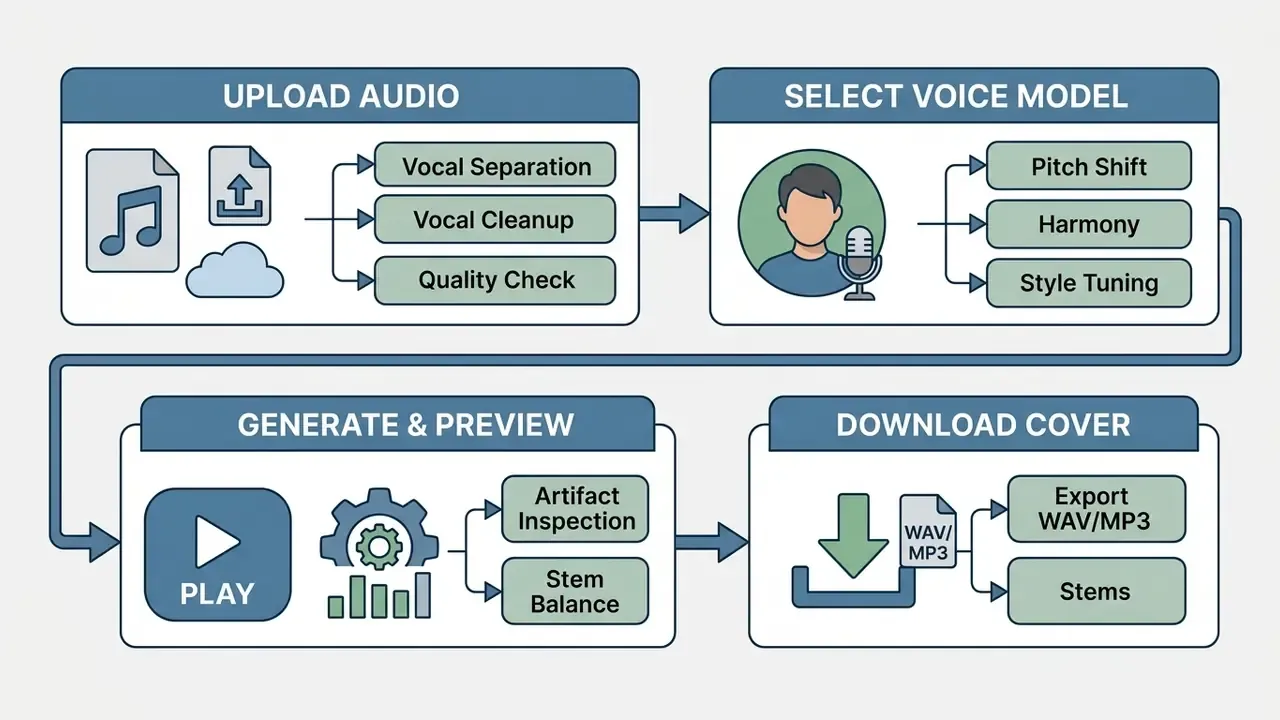
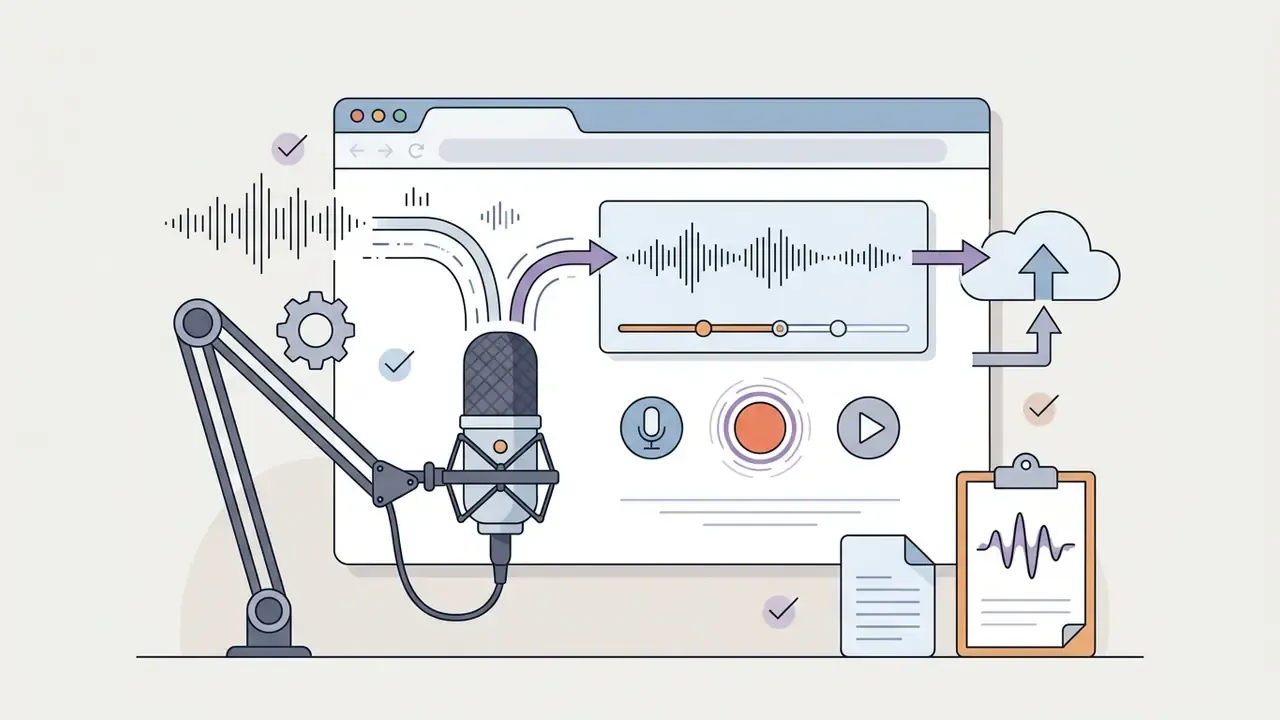
Producing a solid ai cover song online takes a structured workflow. Online tools compress complex neural singing voice conversion into a handful of browser steps.
- Upload the original song or vocal tracka clean audio file (WAV or high-bitrate MP3) or a direct link.
- Select the target voice model and style parametersartist, character, or your own voice, plus key shift and reverb level.
- Generate, preview, and downloadrun the conversion, check the preview for vocal cleanliness, then export the file.
Prepare the Original Song and Audio for Upload
Conversion quality depends directly on source cleanliness. (Updated) Uncompressed WAV is the optimal choice. When using MP3, industry delivery requirements start at 192 kbps CBR (this figure comes from distribution platform audio delivery specs, not from SVC research), while broadcast specifications call for Linear PCM WAV at 48 kHz, 16 bit or higher. The higher the bitrate and the fewer the compression artifacts in the input, the less distortion the neural resynthesis inherits. Isolate the vocal before upload and confirm that the signal is free of heavy reverb, delay, and background noise, with a noise floor below -60 dB RMS.
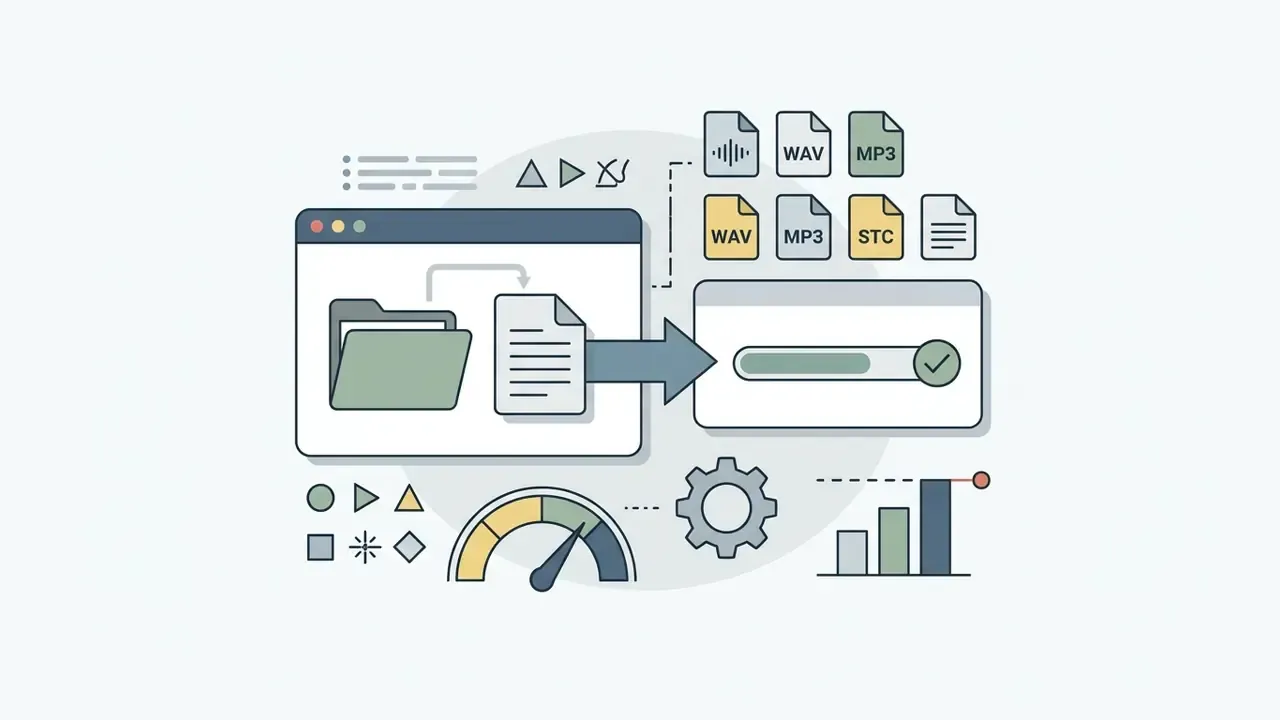
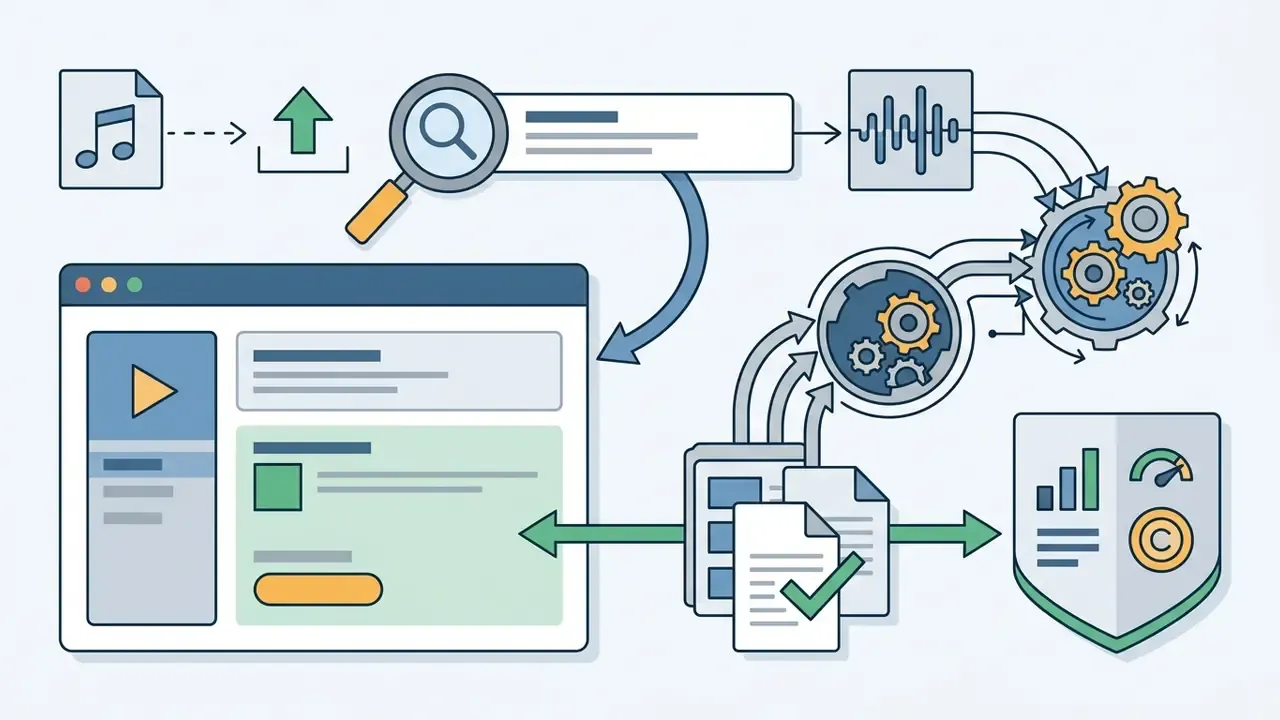
Four ways to get the source track into the tool:
Select a Voice Model or Style Cover
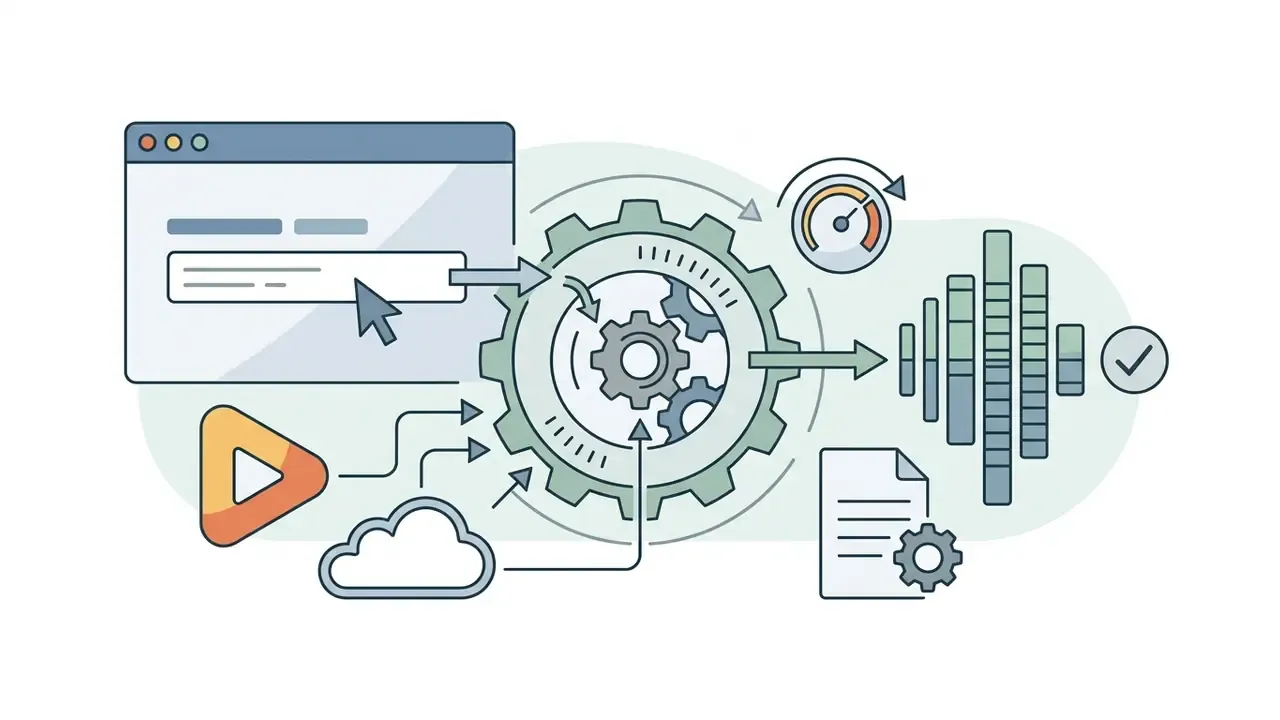
Choose a target model whose natural range matches the key of the original song. (Updated) Cross-gender conversion uses pitch shifting: in practice this is usually around +12 semitones for male-to-female and -12 semitones for female-to-male, though the exact value is found empirically from previews. Those numbers reflect common interface practice, not a measured research norm. Use short previews to confirm that the target timbre survives peak vocal phrases without distortion. Other controls at this step include lead vocal and instrumental gain in dB, reverb level (usually 0 to 100 percent), and delivery intensity.
Generate, Check the Result, and Download the Cover
Run generate to execute the neural voice conversion. Check the result for natural articulation, absence of metallic artifacts, and timing alignment against the backing track. After verification, download: WAV for uncompressed editing, MP3 for immediate publishing. Typical processing time runs from roughly 20 seconds to 2 minutes depending on track length and server load. API implementations return a task_id and require status polling until the file is ready.
What Determines AI Cover Quality
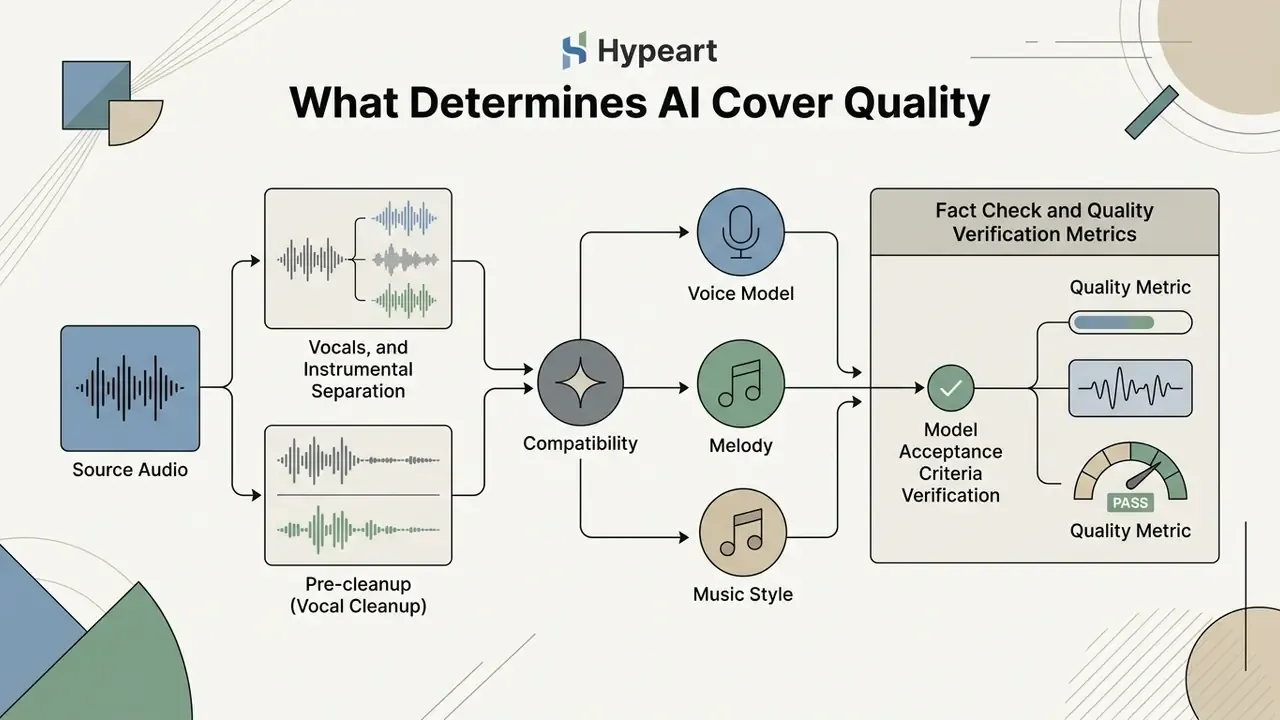
Fidelity and acoustic realism in ai covers depend on network architecture, source audio isolation, and vocal range compatibility. Singing voice conversion research shows that naturalness drops when pitch contours move outside the physical boundaries of the target voice dataset.
Minimizing metallic phasing, robotic sibilance, and timbre leakage requires clean inputs and multi-semantic feature extraction. High-performing ai covers generator systems combine acoustic and linguistic representations to keep pitch tracking accurate.
Source Audio, Vocals, and Instrumental Separation
Separation accuracy sets the ceiling for the final track. When the instrumental bleeds into the vocal stem, the conversion model reads background instruments as vocal formants. You hear the result as warbling and metallic distortion. Multi-stem neural separators deliver the dry isolated vocal signal that voice replacement needs.
"DSFF-SVC showed that fusing features from multiple ASR models improves conversion quality under real-world noise and reverberation."
Compatibility of Voice Model, Melody, and Music Style
Natural ai voice conversion rests on matching pitch contours and prosodic dynamics. Zero-shot models hold high naturalness within a domain, meaning within a genre, but lose similarity in cross-domain transfers. Converting operatic vocals into a punk rock model is the obvious failure case.
Fact Check and Quality Verification Metrics: Model Acceptance Criteria
One practical nuance often missed: subjective listening tests show that micro-variation (jitter, micro-prosody) increases perceived naturalness. A perfectly even vocal often sounds less alive than a slightly unstable one, so heavy pitch correction makes the result worse, not better.
Free AI Cover Generator, Pricing, and Download Limits
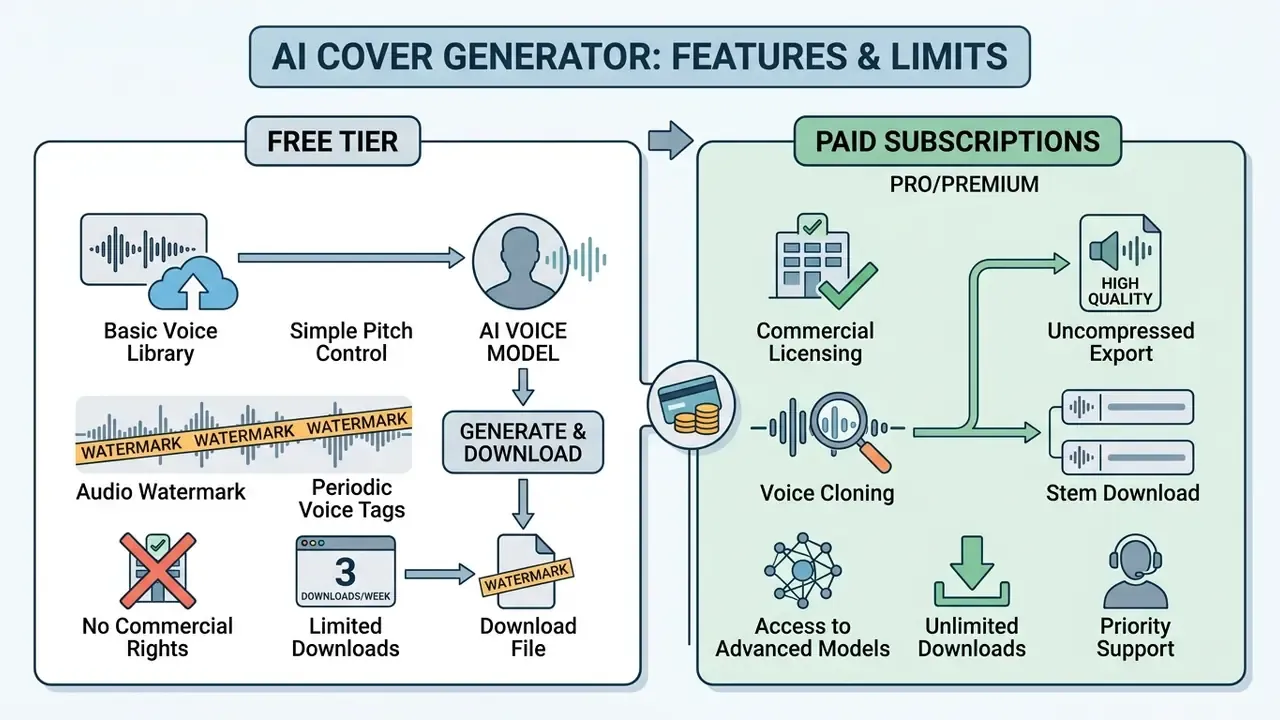
Most online platforms run a freemium model. A free ai cover generator tier gives trial access to evaluate basic synthesis quality, but almost always introduces functional limits. The pattern mirrors free AI video generators with watermarks and duration caps.
Paid subscriptions unlock commercial licensing, uncompressed export, voice cloning, and stem download. Comparing tiers helps match a plan to real production volume, and credit math is easier to sanity-check in our comparison of free AI generators.
| Plan | Daily / monthly limits | Available voice models | Length limits | Watermarks | Export formats | Commercial rights | Data and security |
|---|---|---|---|---|---|---|---|
| Free Access | 3 to 5 generations per day (or 6 to 20 credits) | Basic library (standard voices) | Up to 3 to 7 minutes per track, file up to ~20 MB | Audible or metadata watermark | MP3 (128 to 192 kbps) | Personal use only | Cloud storage for 30 days, audio may be used for service improvement |
| Pro Plan ($10 to $15/mo) | 100 to 300 generations per month | Full access plus Character and Anime | No length limits | No watermarks | WAV (uncompressed) plus MP3 320 kbps | Commercial use permitted; includes a downloadable digital Copyright Certificate confirming commercial rights for covers built on owned or royalty-free voices | Private projects, generation history can be disabled |
| Studio / Enterprise | Unlimited / API access | All models plus Custom Voice Cloning | No limits, stem export included | No watermarks | Multi-track WAV / stems / FLAC | Full IP transfer or commercial license plus Copyright Certificate and contractual IP indemnification | Zero-Data Retention on request, opt-out from training on customer audio, SOC 2 / ISO attestations, private cloud or on-premise, DPA and access logging |
Prices and limits reflect public platform terms at the time of writing and change frequently. The existence and scope of a Copyright Certificate or IP indemnification must be confirmed in the current contract with each specific vendor.
What an AI Cover Generator Free Tier Includes
A standard ai cover generator free account gives access to basic voice libraries, simple pitch controls, and standard-quality MP3 rendering. The free tier lets you test the ai cover create workflow without financial commitment. Daily generation caps and queue waits during peak hours apply, and some services limit not the number of generations but file duration (up to 7 minutes) and size (up to 20 MB).
Watermarks, Downloads, and Access to Advanced Models
Free plans frequently apply audio watermarks, either periodic voice tags or acoustic signatures, and restrict downloads to low-bitrate MP3. Extended capabilities (high-resolution WAV, multi-track stem export, custom voice training, premium voice libraries) require an active subscription. One detail deserves separate mention: several large generative audio models embed invisible synthetic-origin marking at the model level. That marking persists on paid plans too, because it serves disclosure requirements rather than monetization.
Can AI Song Covers Be Used Commercially?
LEGAL ALERT AND COMPLIANCE NOTICE
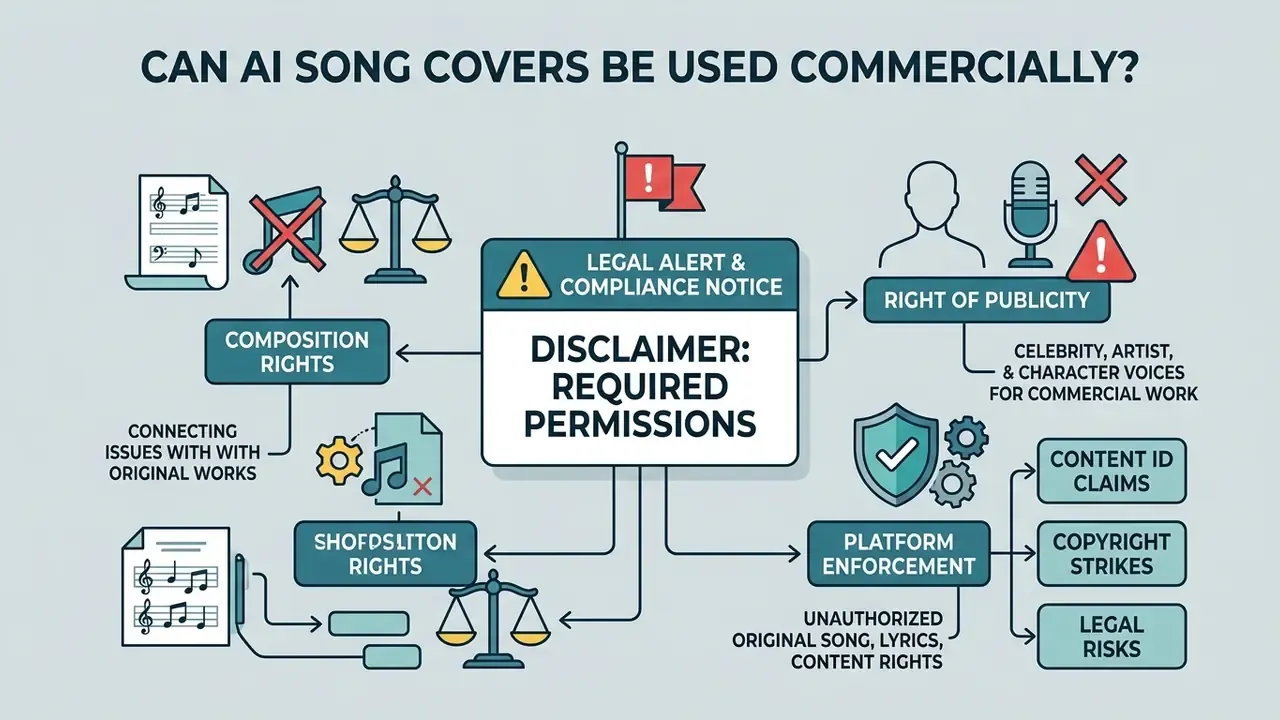
Commercial deployment of ai song covers sits at the intersection of copyright, mechanical licensing, publicity law, and platform distribution terms. Generating a cover for private enjoyment is generally fine. Commercial distribution requires explicit clearance of the underlying intellectual property.
Creators have to separate two right sets: rights in the musical work (lyrics and notated composition) and rights in the vocal identity (right of publicity). Using an ai cover creator free service grants neither. The same logic governs commercial use of AI image generators, where a license to the tool is not a license to the output. For litigation context and evolving case law, browse the hub on IP disputes.
"SONICS contains more than 97,000 songs, of which over 49,000 are synthetic tracks from Suno and Udio used to train detectors."
In other words, betting on an AI cover going unnoticed is technically unsound. Synthetic singing detectors train on tens of thousands of generated tracks, and platform classification tooling keeps getting sharper.
Original Song, Lyrics, and Content Rights
A commercial cover release of an original song requires a mechanical license covering both music and lyrics. Statutory mechanical licenses in some jurisdictions permit recording covers, but syncing an AI cover to commercial video content requires a separate synchronization license from the publisher. Here is the practical fork: permission to post a cover on social media is not permission to monetize it. Many collective schemes explicitly cover personal, non-commercial use only, and business accounts must draw music from the platform's commercial library or clear rights directly. Uncleared commercial audio can be muted, removed, or monetized in favor of the rightsholder.
Celebrity, Artist, and Character Voices for Commercial Work
Using recognizable celebrity or artist voices in commercial releases without explicit authorization creates false endorsement and publicity-rights exposure. To reduce that exposure, commercial projects should rely on royalty-free voice models, licensed stock voices, or proprietary custom AI voice models trained on consenting vocalists.
Industry standards from 2025 clarified the consent mechanics. Digital voice replicas require separate, express, written consent with a reasonably specific description of intended use. Blanket consent is generally not acceptable, and consent applies within a defined project scope. For deceased artists, consent comes from an authorized representative or estate if it was not obtained during the artist's lifetime, with takedown and compensation mechanisms available in disputes.
Governance: Shadow AI, Model Validation, and an Audit Checklist
Voice data is a sensitive class. When an employee uploads a meeting recording, a client demo, or their own voice into a public ai cover generator, the organization hands a biometrically meaningful signal to a third party with no contractual frame. That is Shadow AI in its purest form: the tool is genuinely useful, and it sits outside the control perimeter.
We should be precise here. The risk is not the creative output. The risk is the upload.
Key risks.
- Data leakage and secondary use. Free tiers often permit uploaded audio to be used for service improvement. Cloud storage may be capped at 30 days, but backups and logs are a separate question that vendors rarely answer clearly.
- Voice authentication spoofing. The quality of current SVC and voice cloning makes voice factors a weak authentication control. Regulators and industry bodies treat unauthorized cloning as biometric content misuse, and the countermeasures split into preventive (authentication), detective (real-time detection), and post-hoc (use assessment).
- Legal exposure. Using a real person's voice in marketing without consent is direct right-of-publicity risk.
- Non-attributable artifacts. Without logging of prompts, model versions, and source files, the output cannot be reproduced for audit. And an artifact you cannot reproduce is an artifact you cannot defend.
Validation inside Model Risk Management. Voice models belong in the same control loop as other models: documented purpose, stated use limitations, training-data assessment, independent output review, and drift monitoring. That approach is familiar from supervisory guidance on model risk management (SR 11-7) and from the Govern, Map, Measure, Manage functions in the NIST AI RMF. For audio it translates into measurable acceptance criteria (see the Model Acceptance Criteria block above) and preserved evidence: control metrics, ASR WER, spectral distortion, model versions, and hashes of input files.
Audit checklist for voice AI tools (compliance and security).
Business impact, stated carefully. The measurable value of this control set is not creative throughput. It is fewer uncontrolled data egress events, shorter audit cycles, and a defensible answer when internal audit asks who approved a voice asset. Quantifying that in dollars requires your own baseline: current shadow-tool usage, incident frequency, and remediation cost. Anyone quoting a universal ROI figure for voice AI governance is guessing.
For integration scenarios, separate the consumer web interface from programmatic access. Developers should compare terms in the API documentation and call limits, including request logging policy and regional processing constraints, and can explore the hub for endpoint-level detail.
Open questions. Two remain genuinely unresolved. First, whether watermark persistence survives aggressive re-encoding and remixing at scale. Second, how consent travels when a custom voice model is transferred between corporate entities. Neither has a settled market answer yet.
Adjacent AI Tools for Music Work
- Stem Splitter automatic separation of a track into 4 to 6 isolated stems (vocals, drums, bass, keys). This is the baseline step before any voice conversion and a convenient way to check separation quality before generating.
- Audio to MIDI conversion of a vocal line or melody into MIDI notes for arrangement in a DAW. Useful when you want to move the melody to another instrument instead of replacing the voice.
- Music Hooks generation of short hooks and motifs for previews, intros, and social cutdowns.
- Singing Photo Generator animation of a still artist image in sync with a generated AI song, a standard pairing for vertical video.
- Chorus and Duets a dedicated multi-voice arrangement module with role assignment across several AI voices and stem export.
FAQ About AI Cover Generators
How long does it take to generate an AI cover online?
Usually 20 seconds to 2 minutes, depending on audio length, server load, and the complexity of the chosen voice model. Some platforms advertise a full cover render in roughly 20 seconds, others say "a few seconds to a couple of minutes." In API mode the process is asynchronous: the service returns a task identifier and the file is retrieved after processing completes.
Which audio formats are supported for upload and download?
Most services accept MP3, WAV, OGG, M4A, AAC, FLAC, and WMA. Downloads come as MP3 on free tiers, typically 128 to 192 kbps, or uncompressed WAV on premium plans. Enterprise plans add FLAC and multi-track stem export.
Can I load a track from a YouTube link or find a song by title?
Yes. Alongside file upload, platforms support URL import (YouTube, SoundCloud), catalog search by title, and direct microphone recording in the browser. Title search is convenient because it removes the need to prepare an a cappella version: the vocal is isolated automatically.
How realistic do modern AI voices sound in covers?
Current neural models (SVC plus diffusion resynthesis) deliver high realism and studio-grade vocal quality. Naturalness depends on the cleanliness of the source vocal stem and on the tonal range match between source and target voice.
Benchmark reference: "SVCC 2023 recorded that top systems reach human-level naturalness, but none matched real recordings on target-singer similarity." - Singing Voice Conversion Challenge 2023 (SVCC 2023). https://arxiv.org/abs/2306.14422
Can I publish AI covers on YouTube, TikTok, and Spotify?
Social posting is often possible, but monetization and streaming require copyright clearance for the original composition and no right-of-publicity violation regarding a specific artist's voice. Business accounts on several platforms must use commercial music libraries. Uncleared audio may be muted or removed.
How do I stop an AI cover from sounding robotic?
Use a dry vocal stem with no reverb or noise. Apply Vocal Cleanup to remove room noise, hum, hiss, and sibilance. Set Pitch Shift correctly for the target model's range, and do not flatten pitch to zero variation. Micro-variation raises perceived naturalness.
How much audio is needed to train a custom AI voice?
Per vendor documentation, a minimal clone is possible from a few seconds. Acceptable similarity starts around 10 minutes of clean vocal, and professional cloning takes 30 minutes to 1 to 3 hours. Recording requirements: mono WAV, 44.1 to 48 kHz, 16 to 24 bit, no background music or echo, even loudness, SNR above 35 dB.
Is it safe to upload corporate or client audio into a public service?
Without a contractual frame, no. Check the audio retention policy, availability of Zero-Data Retention, the vendor's opt-out from training on customer content, SOC 2 or ISO 27001 attestations, the DPA, and the deletion process for voice prints. The full question set is in the audit checklist above.
Do platforms detect AI covers?
Yes, and with growing accuracy. Synthetic singing detectors train on large datasets of generated tracks (SONICS includes over 49,000 synthetic compositions), and some approaches identify synthesis through noise statistics in audio encodings. Several generative audio models additionally embed invisible provenance marking.
What does a Copyright Certificate on paid plans actually give me?
It is a vendor-issued document confirming the subscriber's right to use the generated cover commercially, generally for covers built on an owned or royalty-free voice. It does not replace a mechanical or sync license for the original composition and lyrics. Confirm its existence and scope in the platform's current terms.
Appendix A. Updated Statements (Original Versions)
The original claims below were replaced in the main text with refined versions marked "(Updated)":
- "Users can configure primary vocalists, assign secondary backing singers, and stack pitch-shifted harmonies up to four distinct voices" - refined: the voice limit depends on the tool and plan (3 to 4 voices per vendor documentation).
- "Uploading an uncompressed WAV or high-bitrate MP3 (minimum 192 kbps CBR, preferably 320 kbps) prevents compression artifacts" - refined: the 192 kbps CBR figure originates in distribution platform delivery requirements, not SVC research.
- "Typically +12 semitones for male-to-female conversions, -12 semitones for female-to-male" - refined: common interface practice; the exact value is chosen from previews.
- "10-30 min clean dry vocal WAV (24-bit/48kHz)" - refined: a 1 to 30 minute range per vendor documentation, optimally 10+ minutes; studio spec is mono WAV, 44.1 to 48 kHz, 16 to 24 bit, SNR above 35 dB.
- "Source: Empirical findings adapted from SVCC 2023/2025 benchmarks and singing voice conversion literature" - replaced with a verifiable citation: Singing Voice Conversion Challenge (2023/2025). https://arxiv.org/abs/2306.14422