Last updated: February 2026 · Reviewed for: commercial licensing, consent documentation, and model-risk alignment
Why does this matter to a bank or a mature fintech? Because the audio ends up in IVR prompts, disclosures, training modules, and ad spots. Those are governed channels, not creative side projects.
Executive Summary for Decision-Makers
- Capability is no longer the bottleneck; governance is. Neural text-to-speech now reaches near-human naturalness in neutral reading domains. The binding constraint for regulated organizations is consent evidence, licensing scope, and auditability, not audio quality.
- Voice cloning is a biometric-adjacent decision. Any custom voice clone requires documented, specific, revocable authorization from the voice owner, plus retained proof of consent. The FCC has already confirmed that AI-generated human voices in outbound calling fall under TCPA robocall rules.
- Treat third-party TTS engines as models, not as tools. Catalogue them in your AI inventory, validate number and acronym rendering, log every generated asset, and require SOC 2 Type II, zero-data-retention terms, and IP indemnification before production deployment.
What This Guide Covers
This is an operator's guide, not a vendor roundup. It walks through how text-to-speech actually works, which control layers matter, and how to select a voice for ads, games, courses, or podcasts. It then moves into the harder part: cataloguing engines, validating numeric fidelity, contracting for data isolation, and calculating risk-adjusted ROI.
Pricing and commercial rights get their own section, because free tiers and paid tiers differ far more in licensing than in audio quality. The FAQ closes practical gaps: equipment, storage, text limits, and quality measurement. A short appendix records which earlier claims in this guide were superseded and why.
What Is an AI Voice Over Generator and How Text-to-Speech Works
Short answer: A voice over generator is a cloud text-to-speech platform that turns a script into a finished audio file. It normalizes text, predicts acoustic features, and renders waveforms through a neural vocoder. No microphone or voice talent is required at synthesis time.
A voice over generator is a cloud-based text-to-speech (TTS) platform that converts written scripts into natural-sounding acoustic waveforms without recording sessions or physical microphone setups. Modern engines leverage deep neural pipelines, combining text normalization, acoustic modeling (acoustic tokenizers or mel-spectrogram predictors), and neural vocoders, to generate lifelike vocal performances from plain text or Speech Synthesis Markup Language (SSML).
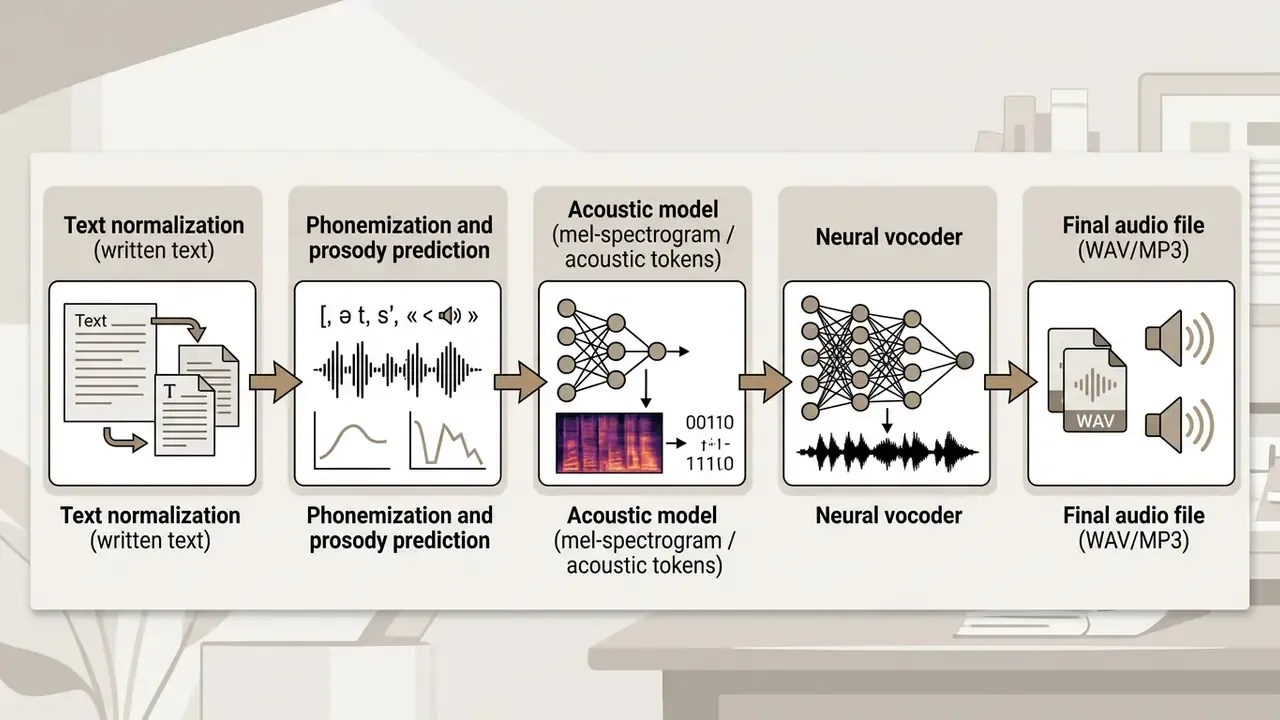
The contemporary pipeline has three stages. First, text analysis expands numbers and abbreviations, maps graphemes to phonemes, and predicts prosodic features such as stress and phrase boundaries. Second, the acoustic model converts those linguistic features into mel-spectrograms or discrete acoustic tokens, optionally conditioned on a speaker embedding for multi-voice or multilingual systems. Third, the neural vocoder reconstructs the waveform. Since 2024, a growing share of production systems replace the classic spectrogram predictor with an LLM-style backbone that emits audio codec tokens directly.
«TTSDS2 evaluates synthetic speech against more than 11,000 subjective human quality ratings across 14 languages, documenting how modern systems approach human parity in neutral reading.»
(Updated) By adopting an automated AI voice generator, digital media teams can turn written scripts into standardized audio assets at scale, bypassing traditional studio constraints without hiring third-party contractors for routine narration. Teams building full multimedia pipelines frequently pair voice synthesis with AI video generators, so that narration, captions, and visuals are produced inside a single review cycle.
AI Voice Actor, AI Voice Artist, and AI Announcer: Key Operational Roles
Deploying synthetic voice assets effectively means matching the model configuration to the delivery role:
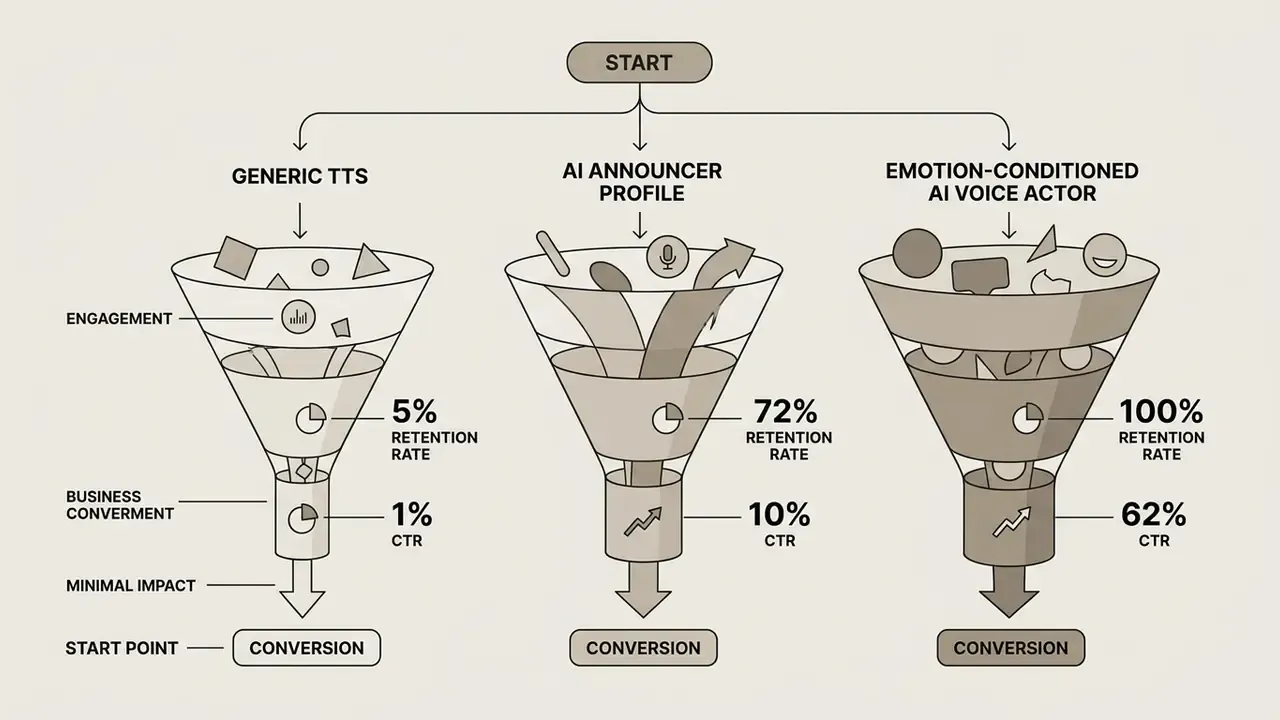
- AI Voice Actor. Configured through an ai voice actor generator or ai actor generator to deliver expressive, scene-specific performances. These systems use dynamic emotion conditioning and context-aware prosody for dramatic dialogue, character arcs, and multi-turn narratives. Prompting practice requires a character profile, scene context, listener, pacing, and emotion, because the deliverable is a performance rather than a voice type. Studios running ensemble casts sometimes describe this as an ai actors voice generator workflow: one project, many consistent character voices.
- AI Voice Artist. Designed for creative, artistic, and long-form narrative consistency. Using an ai voice artist profile or a specialized ai person speaking generator, content creators establish reusable vocal signatures across episodic assets, branded storytelling, and creative multimedia projects. In production terms this is a reusable "voice card": audible traits, speaking style, scene, and reference line, stored as a versioned asset.
- AI Announcer. Driven by an ai announcer voice generator or a dedicated ai ad voice generator profile, prioritizing clarity, uniform pacing, and authoritative brand delivery for corporate broadcasts, disclaimers, and short-form announcements. Major enterprise catalogues expose "Announcer" as an explicit voice role, precisely because informational reading needs different prosody than character acting.
When audited under operational risk frameworks, choosing between an ai actor voice generator and an announcer role prevents tonal misalignment in sensitive consumer-facing communications. A rate disclosure, for example, should sound measured rather than promotional.
Acoustic Parameters That Make AI Voices Sound Natural
An AI voice over reads as realistic when the fundamental acoustic parameters align with human psychoacoustic expectations: fundamental frequency (), speech velocity, phrasing pauses, and spectral timbre. Under subjective evaluation protocols in ITU-T Recommendation P.800.1, speech quality is benchmarked using Mean Opinion Score (MOS) on a 1 to 5 scale.
«Systems that lead on MOS in neutral reading perform significantly worse in expressive domains such as acted dialogue and animated characters.»
Recent speech prosody research shows that accurate peak modeling and context-sensitive phrasal pauses are the primary determinants of natural sounding delivery. Independent prosody studies measuring duration, mean pitch, intensity, and pause placement report that peaks and phrasal pauses are the strongest indicators of successful prosodic encoding. To keep quality audio consistent across automated pipelines, operators fine tune speed pitch settings, insert strategic syntax breaks, and verify pronunciation lexicons before final rendering.
Mature QA programs also separate intelligibility from naturalness. Intelligibility is monitored automatically: transcribe generated audio with two or three ASR models, then measure transcription error rate. That pinpoints the exact text spans that need rewriting, rather than leaving reviewers to guess.
Capabilities of Advanced AI Voice Generators for Audio and Video
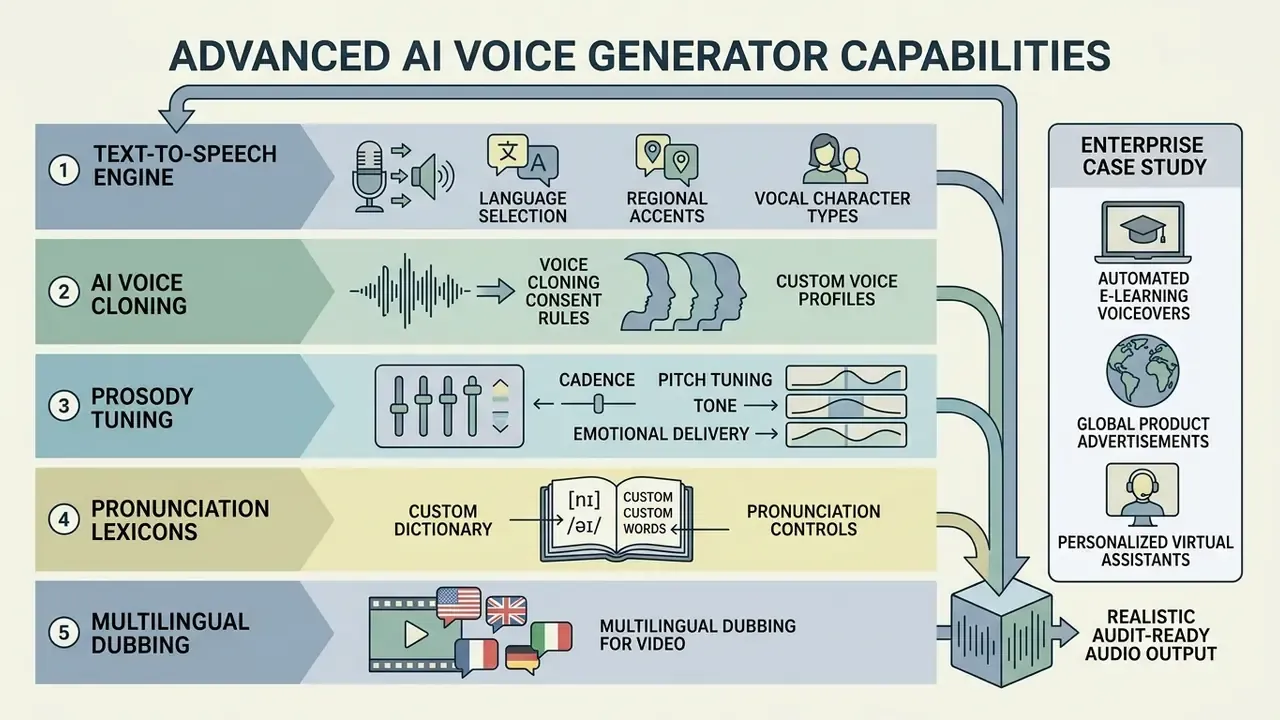
Short answer: Enterprise engines expose five control layers: text-to-speech, voice cloning, prosody tuning, pronunciation lexicons, and multilingual dubbing. Each maps to a distinct production task and a distinct compliance obligation.
Modern ai voice generator platforms combine parameter controls with automated processing modules, so generated voices adapt across complex digital channels.
| Feature / Control | Underlying Technology | Primary Application | Business Impact |
|---|---|---|---|
| Text-to-Speech (TTS) | Neural sequence-to-mel models and neural vocoders | Turn written scripts into narration | Rapid conversion of text assets into high quality audio files |
| Voice Cloning | Speaker embedding transfer, zero-shot neural synthesis | Replicating a verified brand or executive voice | Consistent vocal identity across global digital campaigns |
| Prosody & Tone Tuning | Latent style conditioning, speed pitch manipulation | Ad copy, trailer narration, e-learning | Emotional delivery and pace matched to visual pacing |
| Pronunciation Lexicons | W3C PLS entries, SSML phoneme overrides | Brand names, tickers, legal disclaimers | Removes mispronunciation risk in regulated messaging |
| Multilingual Dubbing | Speech-to-speech neural translation, lip-sync alignment | International localization and media adaptation | Replaces the localized voice track while preserving speaker timbre |
Language, Regional Accent, and Vocal Character Selection
Global distribution demands voice synthesis across multiple languages and regional accents. High-performance generators use cross-lingual speaker embeddings that preserve core vocal identity when content moves into a new target language. Matching the acoustic profile to regional audience expectations lowers cognitive friction and reinforces consumer trust.
Selection should be documented rather than improvised. Public-sector communication guidance frames "voice" as the organization's personality and "tone" as the variable that shifts by audience and situation. Multilingual publishing guidance from the World Health Organization recommends distributing core material across Arabic, Chinese, English, French, Russian, and Spanish, and personalizing messages in the decision-maker's own language. Federal plain-language guidance additionally recommends active voice, because it removes ambiguity about who is responsible for an action. That is a material consideration when narrating compliance content.
Fine-Tuning Cadence, Pitch, Tone, and Emotional Delivery
Precise delivery comes from latent speech controls. Operators modify speaking rate (rate), fundamental pitch shift (pitch), dynamic range, and explicit emotional tags (style="dramatic", style="cheerful"). For technical terms, compliance disclaimers, and proprietary brand names, custom pronunciation lexicons (W3C PLS or SSML phoneme tags) ensure accurate phonetic rendering on every synthesized track.
The W3C Pronunciation Lexicon Specification 1.0 defines the governing rule. Supply explicit lexicon entries using <phoneme> or <alias>; where several pronunciations exist, the engine must use the first preferred entry in document order. Vendor pronunciation dictionaries apply these substitutions automatically before synthesis, without mutating the source script.
<speak xml:lang="en-US">
  <prosody rate="95%" pitch="-1st">
    Annual percentage yield is
    <say-as interpret-as="cardinal">4.35</say-as> percent.
  </prosody>
  <break time="400ms"/>
  Issued by <phoneme alphabet="ipa" ph="ˈnaɪkiː">Nike</phoneme> Financial,
  ticker <say-as interpret-as="characters">NKE</say-as>.
  <break time="300ms"/>
  <prosody rate="88%">
    Terms and conditions apply. Rates are variable and subject to change.
  </prosody>
</speak>
This pattern, slowed rate for the disclaimer plus explicit say-as for rates and tickers plus a phoneme override for the brand, is the single highest-leverage control for regulated narration. It removes the two most common synthesis failures: misread figures and misread proper nouns.
AI Voice Cloning and Custom Voice Profiles
AI voice cloning builds a digital vocal replica from clean reference audio. Research into zero-shot speaker adaptation indicates that high-fidelity timbre replication is achievable from roughly 30 seconds of studio-quality source audio. Published consent and onboarding policies confirm a similar range: five seconds as a functional minimum, thirty seconds or more for higher fidelity, while professional-grade cloning tiers request 30 to 180 minutes of clean audio.
«Cloned voices are perceived as more authoritative, warmer, and more human-like than the originals; cloning systematically "polishes" the source voice.»
That finding has an operational edge. A clone is a style transfer, not a forensic copy, so expectation management with the voice owner belongs in the authorization conversation, not after the first playback.
Voice replication also creates severe compliance exposure if left unmanaged. Enterprise protocols mandate explicit, documented consent from the voice owner before model ingestion. Independent testing of consumer cloning products found that at least one major vendor required a recorded consent statement, read from a unique script, before creating additional clones. That mechanism is now reasonable baseline practice.
«Vocal identity qualifies as a protected personal attribute requiring explicit consent before cloning, on par with biometric data.»
Enterprise Security and Model Risk Governance for Synthetic Speech
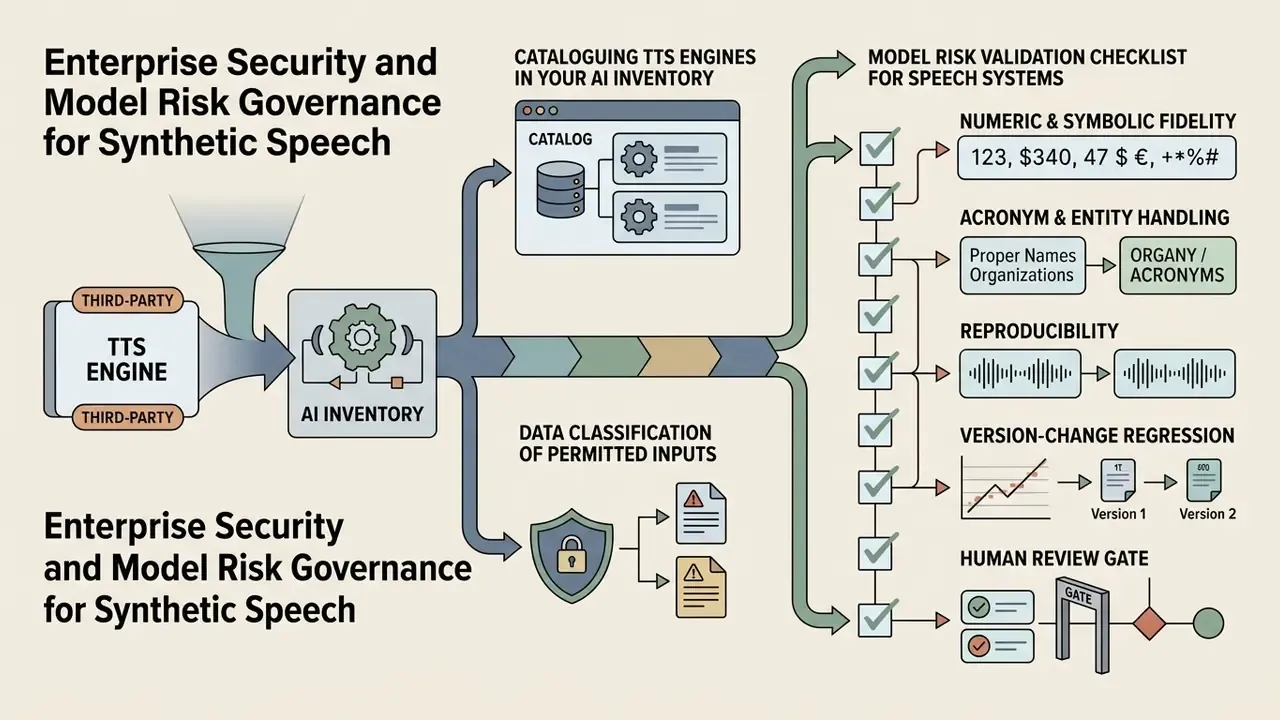
Short answer: A third-party TTS engine behaves like a model in your inventory. It has inputs, versions, failure modes, and downstream consequences. Validate it, log it, and contract for data isolation before it touches customer communications.
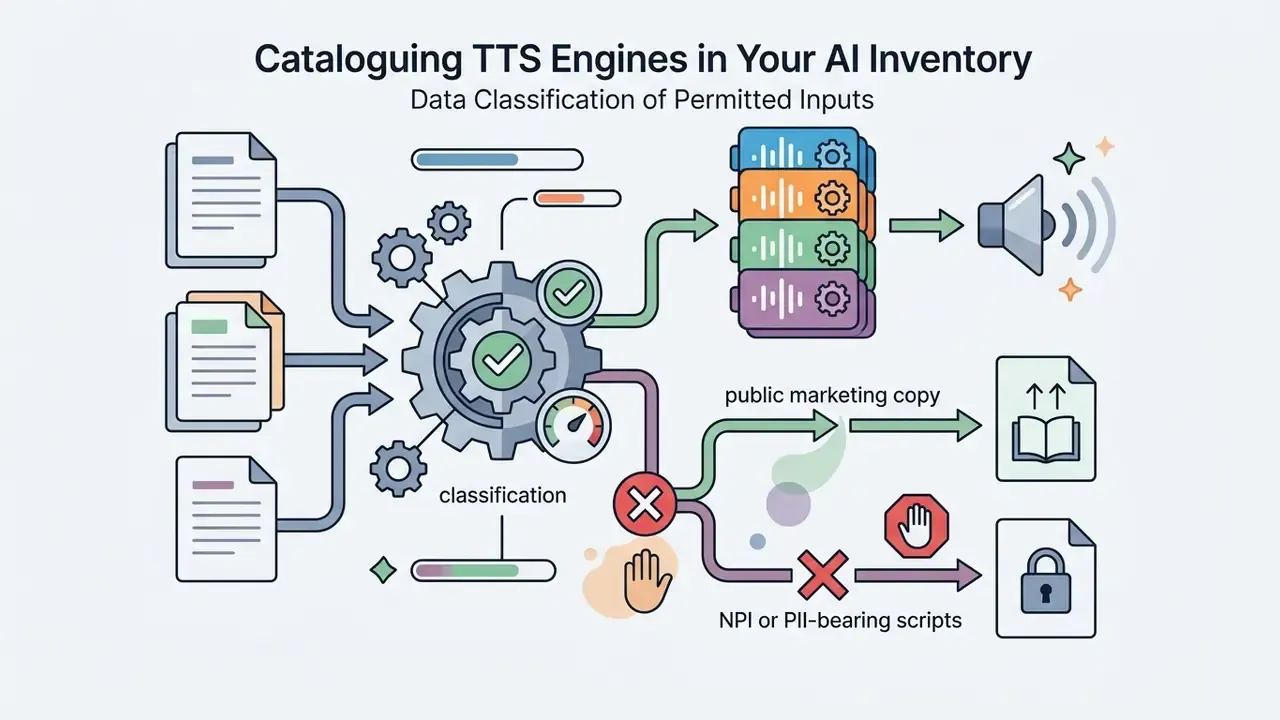
Cataloguing TTS Engines in Your AI Inventory
Under supervisory expectations for model risk management (Federal Reserve SR 11-7, OCC 2011-12), any quantitative or algorithmic system whose output informs business decisions or customer-facing communication belongs in a documented inventory with an accountable owner. Synthetic voice engines qualify whenever their output is published, broadcast, or used in IVR and notification flows. Minimum inventory fields:
- Engine name, vendor, model version, and effective date of each version change.
- Business owner, technical owner, and approved use cases, with prohibited use cases stated explicitly.
- Consent artifacts for every custom cloned voice, with expiry and revocation terms.
- Retention and logging configuration, including where generated audio and source text are stored.
One detail teams underrate: the version change date. Without it, you cannot explain why an asset rendered in March sounds different from the same script in September.
Model Risk Validation Checklist for Speech Systems
- Numeric and symbolic fidelity.Test rendering of currencies, percentages, decimals, dates, account fragments, and tickers. Failure to read "4.35%" or "$250,000" correctly is a material misstatement risk, not a cosmetic defect.
- Acronym and entity handling.Verify letter-by-letter reading for regulator names and product abbreviations through lexicon entries, not ad-hoc spelling tricks.
- Reproducibility.Confirm that an identical script with identical parameters yields materially identical audio. Record seeds or engine version hashes where exposed.
- Version-change regression.Re-run a fixed golden-script suite whenever the vendor updates the voice model, and diff transcripts through ASR to detect drift.
- Human review gate.Require documented sign-off by a qualified reviewer before any regulated asset is published. Published generative-AI guidance for 2026 explicitly requires manual verification and full editorial review prior to release.
- Audit log completeness.Log script hash, voice ID, parameter set, operator identity, timestamp, and approval record for every exported file.
- Provenance marking.Apply content credentials or audio watermarking, for example C2PA-style provenance metadata, so downstream consumers can verify origin.
- Disclosure control.Confirm that channel-specific disclosure requirements are met, including a statement that the voice is artificial where applicable.
Vendor Security and Contractual Requirements
| Requirement | Why It Matters | What to Demand in Writing |
|---|---|---|
| SOC 2 Type II | Independent assurance over security and availability controls | Current report plus bridge letter; review exceptions |
| Zero-data-retention option | Prevents scripts containing NPI or PII from persisting on vendor infrastructure | Contractual no-retention and no-training clause with deletion SLA |
| Tenant isolation and encryption | Limits blast radius of a vendor-side incident | End-to-end encryption in transit and at rest; documented key management |
| IP indemnification | Shifts residual licensing risk off the enterprise balance sheet | Indemnity covering output use in commercial distribution |
| Consent tooling | Makes cloning authorization auditable rather than anecdotal | Script-based recorded consent, signed grant of rights, revocation workflow |
| Exportable audit logs | Enables examination readiness | API access to full generation history with immutable timestamps |
Risk-Adjusted ROI for Synthetic Voice Programs
Naive savings calculations compare studio invoices to subscription fees, and overstate the benefit. A defensible formula internalizes control cost:
Risk-Adjusted ROI = (Baseline Production Cost − Platform Cost − Review & QA Labor − Governance Overhead − Expected Residual Risk Cost) ÷ (Platform Cost + Review & QA Labor + Governance Overhead)
Here Expected Residual Risk Cost equals the probability of a disclosure, consent, or mispronunciation incident multiplied by estimated remediation and reputational cost. Model a base case and a stressed case, where one clone authorization is revoked mid-campaign and assets must be re-rendered. For cost modeling across generative platforms, use our interactive AI Media Calculators.
How to Choose the Right AI Voice Profile for Ads, Games, and Podcasts
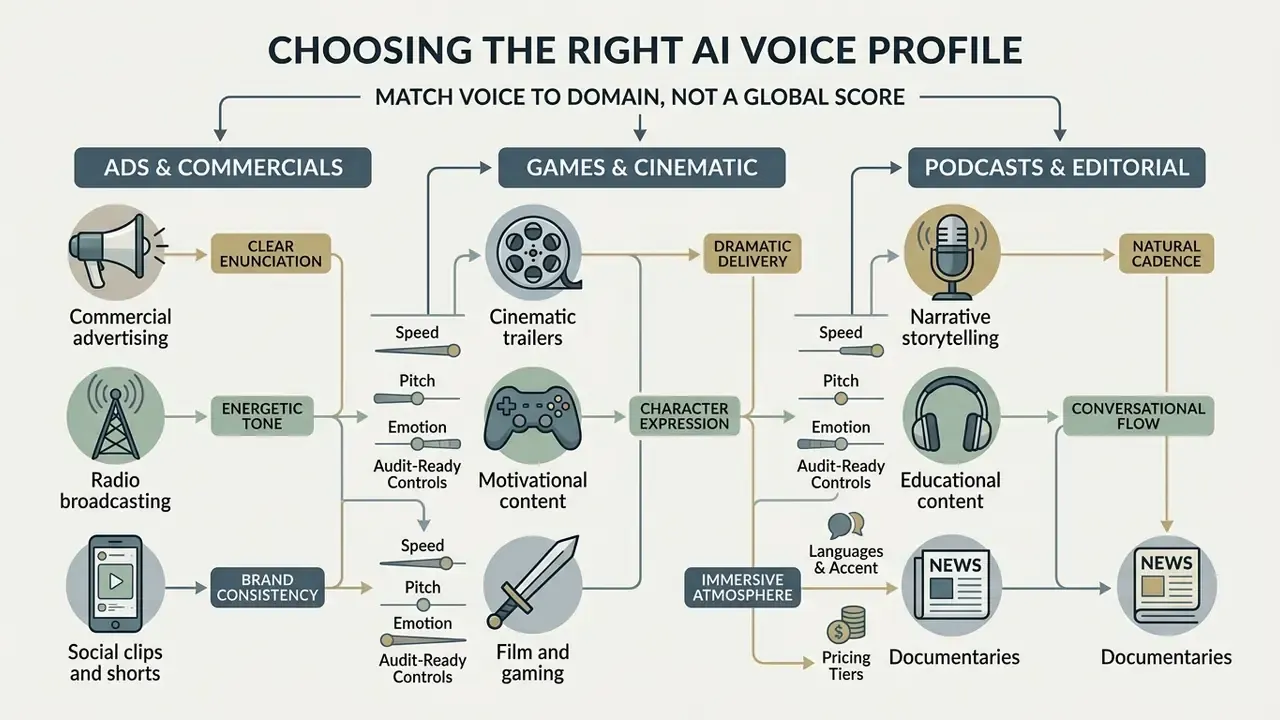
Short answer: Match the voice to the domain, not to a global "best voice" score. A model tuned for neutral reading will underperform in acted and animated content, and the reverse holds too.
Selecting the right voice profile means matching the acoustic characteristics of the synthetic model to the intent, audience, and media format of the asset.
«Systems optimized for neutral reading perform significantly worse in acted and animated domains; optimizing for one domain degrades quality in others.»
Formally, SSML resolves voice choice by matching required voice features first; where several voices satisfy those requirements, remaining features break the tie. Practically, write down the mandatory attributes before auditioning samples: language tag, gender, age band, accent, delivery role. Selection then becomes reproducible rather than aesthetic.
Voices for Commercial Advertising, Radio, and Social Media
Commercial marketing assets need high-energy, persuasive delivery that captures attention in the first two seconds:
- Commercial advertising. An ai commercial voice generator or specialized ai ad voice generator delivers punchy, brand-aligned messaging tailored for high-conversion video ads.
- Radio broadcasting. An ai radio voice generator, or an ai radio voice generator free tier during prototyping, lets station operators produce crisp host-read bumpers, station IDs, and promotional spots.
- Social clips and shorts. Generating commentary through an ai commentary generator, or an ai commentary generator free workflow, helps content creators articulate short-form videos across TikTok, Instagram Reels, and YouTube Shorts. Teams comparing production stacks for these formats can review our roundup of the best AI video generators to align narration and visual pipelines.
For teams testing promotional concepts, an ai commercial voice generator free test account provides a controlled environment to validate audience engagement before purchasing commercial licensing tiers. Short-form practice converges on a hook-first structure, no long intro, and caption-friendly pacing: roughly 65 to 80 spoken words for a 30-second vertical clip, with mastering targets near −14 LUFS and a −1 dBTP ceiling for platform normalization.
Characters, Film Trailers, and Game Voiceover
Narrative and cinematic production asks for dramatic depth, stylistic exaggeration, and dynamic pitch variation:
- Cinematic trailers. An ai epic voice generator supplies deep fundamental frequencies, resonant chest timbre, and slow authoritative cadence for movie teasers and high-impact brand launches. Trailer narration is functionally distinct from character speech: the narrator is an unseen authority whose job is sustained resonance and emotional escalation.
- Motivational content. An ai motivational voice generator builds dynamic vocal intensity and rhythmic cadence for inspiring video essays and athletic campaigns.
- Film and gaming. An ai movie voice generator free setup works well in pre-production, where directors mock up temporary dialogue tracks. For final assets, an ai voice actor generator produces distinct character voice profiles for videos games and interactive environments. Character-voice practice recommends defining attitude, emotion, pacing, volume, and vocal placement, and keeping each voice "sustainable and duplicatable" across long recording cycles. Teams prototyping companion visuals often evaluate text-to-video AI tools in the same sprint.
To explore supplementary creative workflows, see our specialized entries in the AI Media Glossary, including guides for ai poster generator, ai portrait generator, and specialized free online portrait tools.
Step-by-Step Guide: How to Generate AI Voiceovers from Script to Export
Short answer: Prepare a speech-ready script, select voice and language, tune prosody and pronunciation, preview a short clip, then render and export with logging. Documented workflows converge on exactly this sequence.
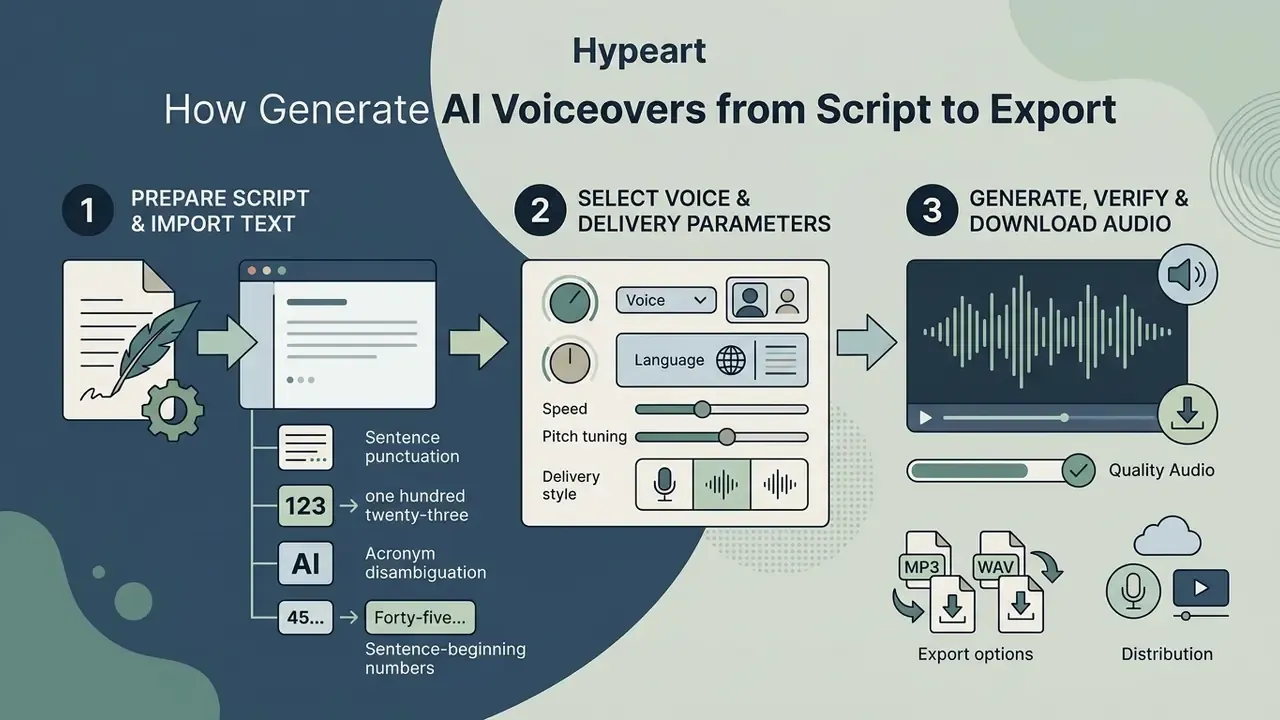
Enterprise-grade AI voiceovers come from a systematic, repeatable pipeline. Here is the checklist we recommend before you start creating at volume:
- Script preparation.Write or paste the script into the voice over generator editor. Normalize numbers, symbols, and acronyms into spoken word forms.
- Voice and language selection.Select the target voice profile, language code (BCP-47), and regional accent matching your audience.
- Prosody and pronunciation tuning.Configure speed, pitch, emotion tags, and SSML phoneme rules for brand terms and complex vocabulary.
- Audio preview and spot corrections.Generate a short preview clip, evaluate naturalness, adjust phrase pauses, and fix mispronounced words.
- Final synthesis and export.Render the complete audio script and download high quality audio files (WAV or MP3) for production integration.
- Governance sign-off.Log script hash, voice ID, parameters, reviewer, and approval before distribution.
Step 1: Prepare the Script and Import Written Text into the Editor
A synthesized performance depends heavily on the formatting of the input. Writers must structure written content for vocal delivery:
- Sentence punctuation.Use commas and dashes to force natural phrasal pauses in the neural model. Transcription conventions restrict sentence punctuation to genuine logical break points, which keeps pauses meaningful rather than mechanical.
- Number normalization.Expand digits into explicit spoken words; convert "$250,000" to "two hundred and fifty thousand dollars". The W3C speech synthesis specification treats normalization as the conversion of written forms into spoken forms, and notes that a string such as "1/2" has multiple valid readings depending on context.
- Acronym disambiguation.Format abbreviations with hyphenation or periods ("F.C.C.", "A-I") to force letter-by-letter pronunciation instead of unintended word synthesis. Convert Roman numerals to Arabic form, then to words, before synthesis.
- Sentence-beginning numbers.Rephrase so the sentence does not open with a digit, per standard style-manual guidance.
Supported input formats. Beyond manual entry, advanced platforms support direct document ingestion. Users drag and drop structured files, including .PDF, .DOCX, .PPTX, .XLSX, ePub books, or OCR-scanned images (commonly up to 50 MB per batch), or paste an article URL; the pipeline then extracts the ai text automatically before synthesis. Educational publishers rely on exactly this path to make PDFs, slide decks, spreadsheets, Word files, and EPUB titles audible for learners. When ingesting documents, preserve navigable structure (headings, chapter breaks, footnote handling), so accessible audio output stays conformant with DAISY-style navigation expectations. Character capacity varies by tier: entry-level editors typically accept 1,000 characters per conversion, while professional editors accept up to 100,000 characters per file.
Step 2: Select Voice, Language, and Delivery Parameters
Once the script is imported, pick the voice model from the catalog. Filter by age, gender, accent, and intended delivery role. Preview sample phrases to confirm that the fundamental timbre matches your creative direction, then adjust global speed pitch parameters so audio length aligns with the video cuts.
Language is declared in BCP-47 form (en-US, pt-BR, ar-EG). SSML 1.1 supplies xml:lang for the root language, lang for inline language switching, and voice for explicit voice selection, alongside standardized control of pronunciation, pitch, rate, and volume. Preview endpoints in production APIs typically expose language, emotion, and speed, with speed ranges of roughly 0.5× to 2.0×. Treat the preview text as a performance script rather than filler, since tone and pacing cues in the sample propagate into the final render.
Step 3: Generate, Verify, and Download Quality Audio
Execute the neural rendering pipeline to produce a complete ai recording generator output or discrete ai voice clip generator files. Run a QA listening pass for naturalness and intelligibility. If specific sentences sound rigid, isolate those spans, apply minor punctuation adjustments or SSML break tags, and re-render only the affected segments before exporting uncompressed WAV or high-bitrate MP3. For long scripts, generate in segments rather than one block, and regenerate the weak lines instead of the whole narration.
Before export, run a technical QC pass: no clipping, clicks, pops, or compression artifacts; clean starts and ends; consistent loudness. Audiobook production conventions offer usable numeric anchors. Room tone at the head and tail, a noise floor between −90 dB and −60 dB, RMS between −23 and −18 dB, and peaks no higher than −3 dB.
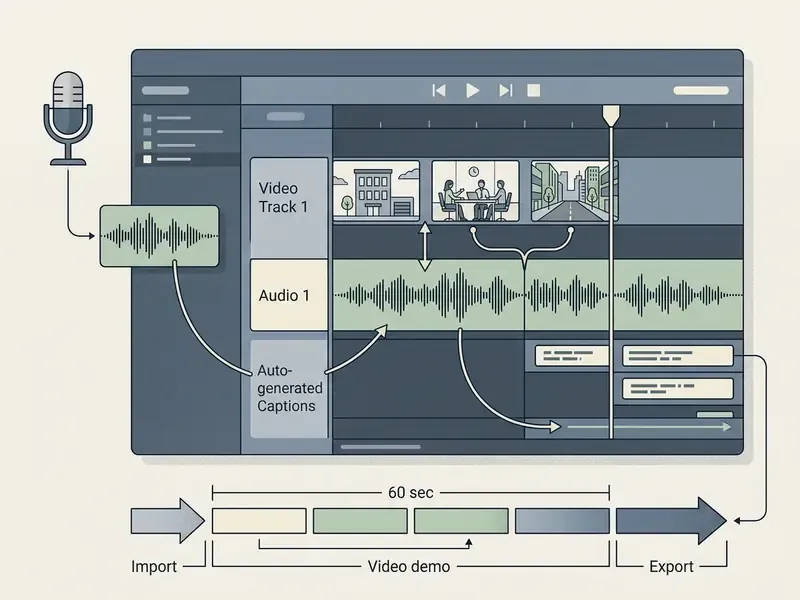
Export and distribution options (Updated). Beyond uncompressed WAV and high-bitrate MP3 downloads, professional workflows support instant team distribution through secure cloud URL links with expiry controls. Creators export timed SRT or VTT subtitle files, embed preview tracks into project-management suites, route generated stems into video editing timelines and AI avatar pipelines, or render a finished MP4 where narration is already married to visuals. Teams integrating audio into finished cuts usually hand off to standard video editors at this stage. AAC is the third common container alongside WAV and MP3.
Top Use Cases for AI Voiceovers Across Digital Media and Financial Services
Short answer: The highest-value deployments are repetitive, script-driven, and multilingual: e-learning, IVR and notifications, compliance training, audiobooks, and localization.
AI voice generation scales content creation across corporate and commercial media formats.
Regulated and Financial-Sector Applications
For banks, insurers, and asset managers, the durable use cases are scripted, repetitive, and reviewable:
- IVR and automated notifications. Standardized prompts and status messages rendered in multiple languages from a single approved script library. Note that outbound commercial calling with synthetic human voices is expressly in scope for TCPA robocall rules.
- Compliance and conduct training. Annual refreshers, policy updates, and scenario modules, where re-rendering one changed paragraph replaces a full re-record.
- Market commentary and research audio. Audio versions of published notes, with strict numeric-fidelity testing and mandatory human sign-off.
- Advertising disclaimers. Slowed, clarity-optimized announcer profiles with lexicon-locked legal terminology.
- Accessibility. Audio versions of statements, disclosures, and onboarding material, supporting text-alternative obligations under WCAG 2.2. When scripts contain NPI or PII, route them only through zero-retention endpoints, or tokenize personal fields before synthesis.
Narration for Courses, Audiobooks, and Podcasts
Long-form narration requires steady acoustic clarity and pacing that does not tire the listener. Educational publishers convert textbooks, training slides, and technical manuals into accessible audio courses. For videos, podcasts, and audiobooks alike, tuning phrasal pauses prevents delivery that feels rushed or robotic. Accessibility guidance for narrators warns that loud reading fatigues the voice and shifts tone as strain accumulates. The synthetic equivalent is over-driven intensity settings, so favour medium conversational energy, match pace to text complexity, and vary tempo deliberately to avoid monotony.
Publishing bodies have also standardized labeling. In 2024, the Audio Publishers Association and the UK Publishers Association issued naming guidance defining "AI Voice" and "Authorized Voice Replica", and recommended explicit metadata labels for retailers. That is a practical template for any organization distributing synthetic narration at catalogue scale.
Multilingual Voiceover and AI Dubbing for Global Audiences
Automated AI dubbing combines automatic speech recognition (ASR), neural translation, and cross-lingual voice synthesis to translate video content into dozens of target languages. Advanced dubbing platforms match target speech duration to the original speaker's articulation, preserving lip-sync alignment and emotional nuance for international viewers. End-to-end research systems restore the original speaker's timbre and prosody through speech-to-speech conversion, and lip-synchrony losses introduced during training measurably improve mouth-to-audio alignment in translated video.
«A corpus of 319.57 hours of professionally localized video across 54 titles shows human dubbers carefully managing timing and prosodic adaptations, precisely what AI systems still reproduce with difficulty.»
Engine Specifications: Free Instant vs. Enterprise Studio Tiers
Short answer: Free tiers deliver roughly 100+ voices and 40+ languages with capped characters and MP3 output. Enterprise tiers reach 1,000+ voices, 60+ dialects, unlimited API throughput, and broadcast-grade export.
| Platform Tier Type | Voice Library Depth | Language & Accent Support | Input Text Capacity | Primary Export Delivery |
|---|---|---|---|---|
| Free Instant Tier | 100+ standard voices | 40+ global languages | 1,000 to 100,000 chars per file; roughly 10k chars or 12 min monthly quota | Standard MP3, shareable cloud link |
| Enterprise Studio Tier | 1,000+ lifelike voices, 13+ emotion styles | 60+ regional dialects and accents | Unlimited API, bulk document ingestion | 24-bit WAV, stems, SRT, MP4 video sync |
Free vs. Paid AI Voice Generators: Pricing, Limits, and Commercial Rights
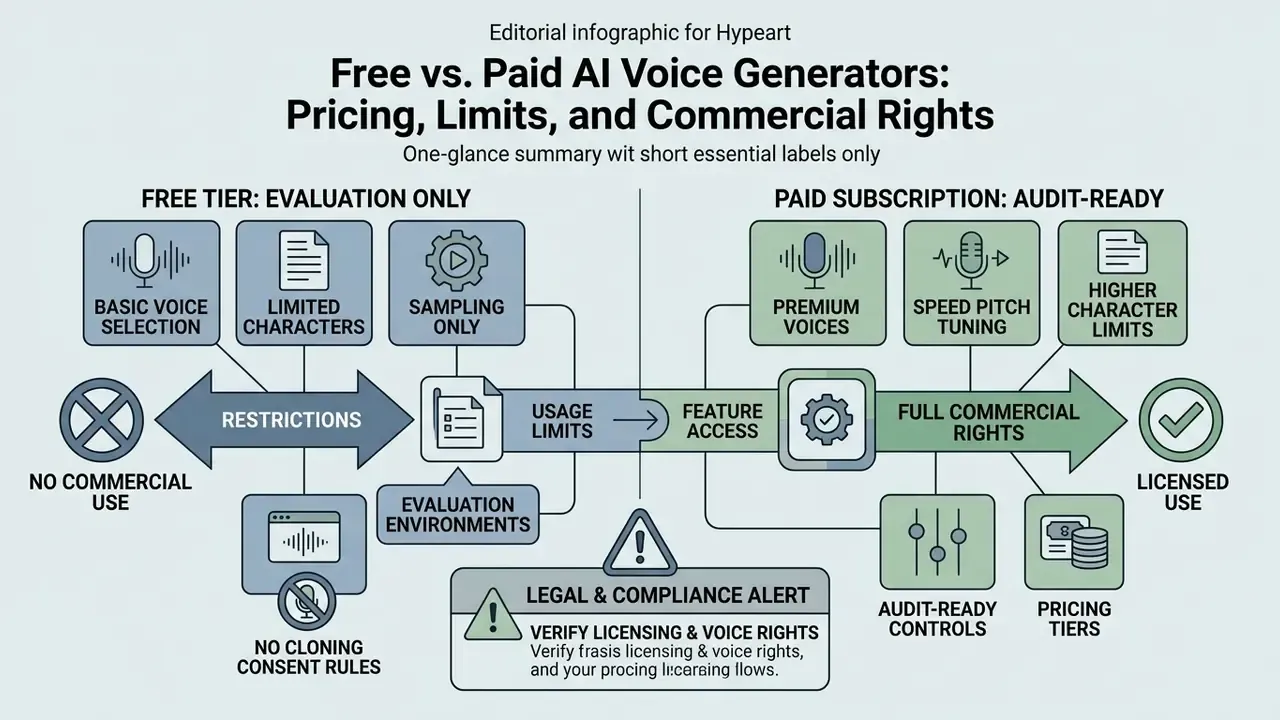
Short answer: Free tiers are evaluation environments and usually prohibit commercial exploitation. Commercial rights, cloning, and uncompressed export begin at paid tiers, with indemnification typically reserved for enterprise contracts.
Understanding the split between free testing tiers and enterprise commercial plans is vital for legal compliance and operational scaling.
| Plan Tier | Typical Character Limits | Export Formats | Voice Cloning | Commercial Rights |
|---|---|---|---|---|
| Free Tier | 1,000 to 10,000 chars per month (or ~12 min audio) | Compressed MP3 | Restricted or none | Strictly non-commercial, personal voice use |
| Starter / Creator | 30,000 to 100,000 chars per month | High-bitrate MP3, WAV | Basic instant clone | Full commercial license included (from ≈$6 to $22 per month) |
| Enterprise Pro | Custom, unlimited API | Uncompressed WAV, stems | Professional voice clone | Commercial rights, IP indemnification, security addenda |
Published vendor terms illustrate the pattern. One major platform offers a $0 tier with 10,000 credits per month, three studio projects, and no commercial license, with commercial rights unlocking at roughly $6 per month and scaling through mid and enterprise tiers. Another vendor's terms of service restrict the service to personal, non-commercial use entirely, unless a separate written business agreement exists. At least one free engine grants commercial rights outright, at roughly 20,000 characters per week, which proves the rule is vendor-specific rather than universal. Always read the governing terms, not the marketing card. Where a feature card and the terms of service disagree, the terms of service control.
For transparent cost planning across generative platforms, consult our centralized AI Media Pricing Guides and our interactive AI Media Calculators.
What You Typically Get in a Free AI Voice Generator
Free plans exist for platform evaluation and personal testing. Users normally receive a limited monthly credit quota, a reduced catalog of generic voices, and standard MP3 exports. Advanced features stay behind the paywall: high-fidelity cloning, SSML fine-tuning, and uncompressed WAV downloads. Observed constraints also include project caps, for example one project and three downloads on some free plans, and export disabled entirely in certain free studio environments. Useful for a pilot. Not a licensing position.
How to Verify Commercial-Use Licensing and Voice Rights
Deploying synthetic voice assets in commercial advertising without appropriate rights exposes an organization to significant legal risk under right-of-publicity statutes and copyright regulations. The U.S. Copyright Office's 2024 report on digital replicas states that Section 114(b) of the Copyright Act does not preempt laws restricting unauthorized voice digital replicas, which leaves state publicity regimes fully operative. Congressional Research Service analysis adds that voice imitation is not itself prohibited by copyright, yet commercial use of a person's name, image, likeness, or voice may violate right-of-publicity law, and deepfake advertising can create Lanham Act false-endorsement liability. State activity keeps expanding. California's 2025 SB 11 analysis treats a "digital replica" as including voice likeness and contemplates consumer warnings on replica-capable tools, while introduced Illinois legislation would create liability for publishing a digital voice replica without specific consent.
LEGAL & COMPLIANCE ALERT:
Using synthetic speech for commercial advertising, public broadcasts, or monetization requires explicit commercial usage rights granted by the platform. Free tiers generally prohibit commercial exploitation. Federal regulatory bodies, including the FCC under TCPA rules, treat AI-generated human voices in outbound commercial messaging as synthetic calls requiring prior express written consent. The FCC has additionally proposed that AI-generated voice calls disclose AI use at the start of each call, and proposed AI-use disclosure for television and radio political advertising (its fact sheet states the proposal does not extend to online ads). Unauthorized cloning of an individual's voice without explicit, signed authorization creates severe liability under digital replica and publicity laws.
«FairSSD tested six synthetic-speech detectors on more than 0.9 million audio signals and found systematic bias by gender, age, and accent; detection accuracy is uneven across demographic groups.»
That asymmetry shapes enforcement design. An organization cannot rely on automated detection alone to police misuse of its brand voice, because false negatives cluster in specific speaker populations. Pair detection with provenance metadata and registered voice prints instead.
«Voice persuasiveness predicts behavioral compliance more strongly than human-likeness, a critical consideration for regulated automated-calling scenarios.»
Limitations and Open Questions
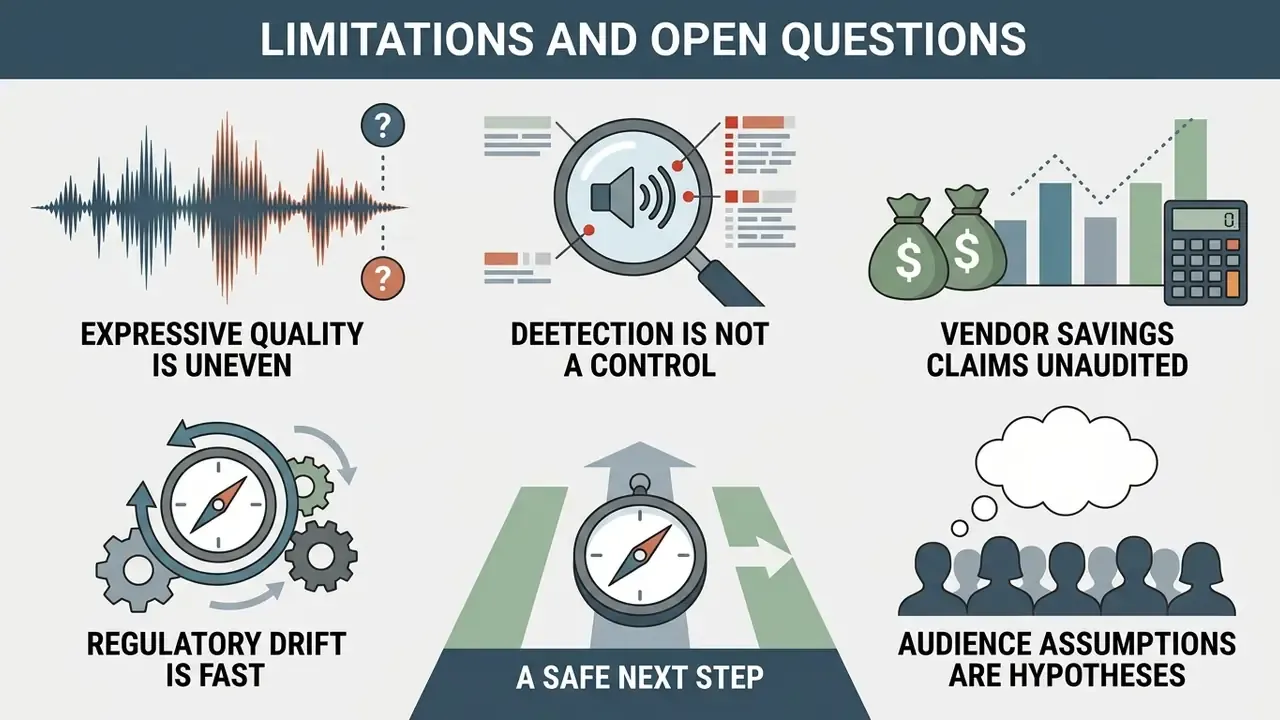
Some parts of this picture remain unsettled, and pretending otherwise would be careless.
- Expressive quality is still uneven. Benchmarks show near-parity in neutral reading, but acted and animated domains lag. Character work still benefits from human direction, sometimes from human recording.
- Detection is not a control. Demographic bias in synthetic-speech detectors means misuse monitoring needs provenance metadata, not just classifiers.
- Vendor savings claims are unaudited. Treat the two-thirds reduction figures cited above as hypotheses to test against your own invoices, review hours, and rework rates.
- Regulatory drift is fast. State digital-replica statutes and FCC disclosure proposals are moving. Any control framework needs a scheduled legal refresh, quarterly at minimum.
- Audience assumptions are hypotheses. Statements about what CROs or model-risk leads prioritize should remain labeled as such until validated with interviews, analytics, or CRM evidence.
A safe next step. Pick one low-risk, high-volume channel, internal training narration is usually the cleanest, and run a 60-day controlled pilot. Inventory the engine, define a golden-script regression suite, log every export, and measure both saved production hours and added review hours. Then decide whether to extend into customer-facing audio.
FAQ: Frequently Asked Questions About AI Voice Generators
Do I need special equipment to create an AI voice?
No specialized studio hardware is needed to generate synthetic speech from written text. The whole process runs in a standard web browser on desktop, tablet, or mobile. However, a high-fidelity custom clone of your own voice, or an executive's voice, requires clean reference audio: a quiet acoustic environment, a quality condenser microphone (USB is simplest; analog setups need a preamp and interface), and 44.1 kHz / 16-bit mono uncompressed capture. Modern smartphones are an acceptable fallback. Built-in laptop microphones are not recommended. Vendor strictness varies; some cloning services simply ask for "good audio", while enterprise guidance specifies studio-condenser capture.
Can I improve an existing voice recording?
Yes. Modern platforms let operators upload an existing voice recording, auto-generate a synchronized transcript, edit or replace text spans in the editor, and re-synthesize only the modified segments. This transcript-driven and speech-to-speech editing removes the need to recall talent for minor rewrites or post-production fixes. Public-sector guidance describes the same capability, editing an audio clip without rerecording it, and translating existing speech into another language using either a generated voice or the original speaker's voice. Accompanying best-practice rules require human review and correction of AI transcripts before they inform decisions, plus disclosure that AI was used.
How many voices and languages do these platforms support?
Free tiers commonly expose 100+ voices across 40+ languages with regional accents. Leading commercial studios publish 1,000+ voices across multiple languages, in some catalogues 60+, and add emotion sets, often a dozen styles or more, plus avatar pairing. Verify the specific dialect you need. Coverage of major languages is near-universal; minority dialects vary sharply between vendors.
Can AI voices be used for commercial projects?
Usually yes on paid tiers, usually no on free tiers. Commercial use hinges on two independent conditions. The platform must grant you commercial rights, and the voice itself must not replicate an identifiable person without documented authorization. Satisfying only one of the two is not enough.
Is there a text length limit?
Limits are tier-dependent. Entry-level editors often cap a single conversion at 1,000 characters. Mid-tier editors accept up to 100,000 characters per file. Enterprise API plans are effectively unbounded and metered by characters or audio minutes instead. For long-form work, split scripts into logical segments to simplify regeneration and review.
How is generated audio quality measured objectively?
Subjective listening tests remain the gold standard, with Mean Opinion Score under ITU-T P.800 and P.800.1 the canonical metric for naturalness. Supplement it with automated intelligibility monitoring: transcribe the generated audio with several ASR systems and compute transcription error rate to locate problem spans. Keep the two measures separate, because a voice can sound highly natural yet be unintelligible on domain-specific terminology.
Will my scripts or generated audio be stored?
That depends entirely on contract terms. Consumer tiers typically retain inputs and outputs in your account until you delete them. Enterprise agreements can specify zero data retention and no model training on your content. For scripts containing customer data, treat retention terms as a hard procurement requirement, not a preference.
Appendix A: Superseded Statements and Editorial Notes