«An AI generator should be evaluated as a digital tool with explicit inputs, boundary limits, and auditable commercial terms before deployment.»
Last updated: August 2026.
Key Takeaways
- What it does An AI diss track generator converts a target name, a set of factual "receipts," a tone setting, and a genre selection into either lyrics-only text or a fully mixed audio track with synthetic vocals and a generated beat.
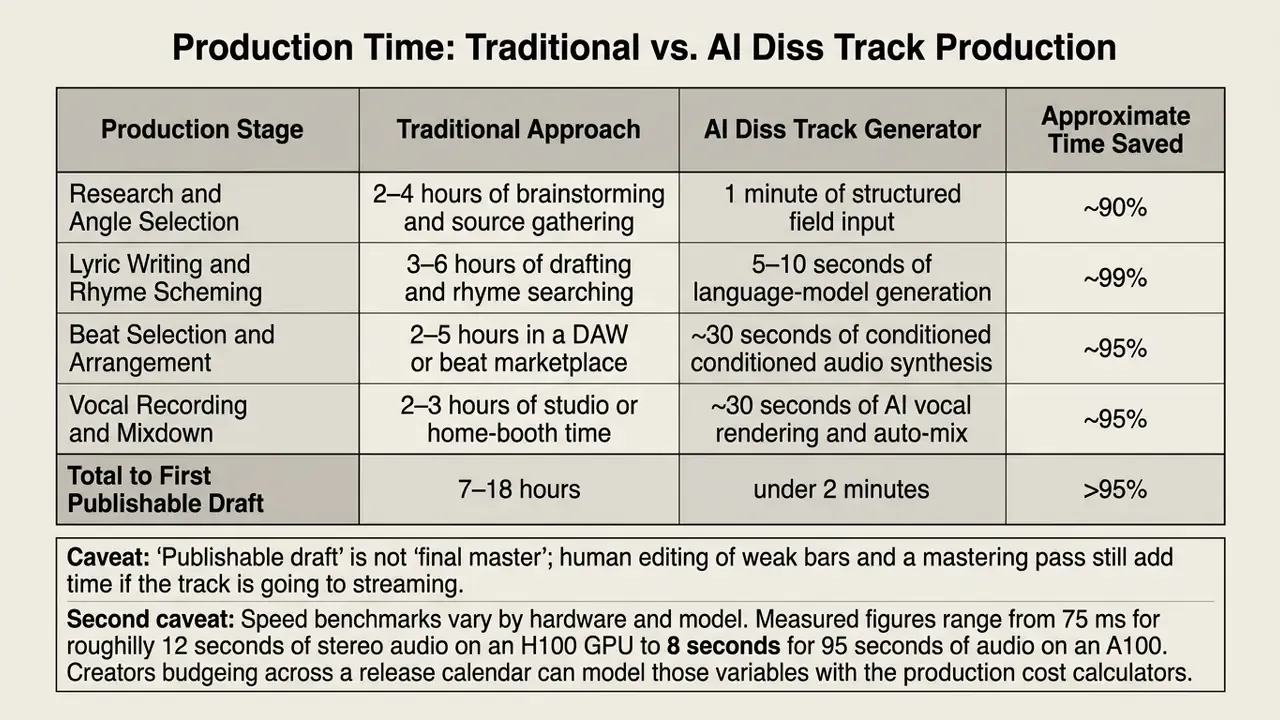
- Speed advantage Manual diss-track production takes roughly 7–18 hours across research, writing, beat making, and recording. An end-to-end AI pipeline compresses the same chain into under two minutes, a time reduction above 95%.
- Control surface The parameters that actually change the output are target, context/receipts, intensity, genre, BPM, key, song structure tags, and vocal gender/timbre. Everything else is cosmetic.
- Battle utility Stem splitters and vocal removers let creators isolate an opponent's instrumental and answer on the same beat the same day. It is the single most underused feature in diss workflows.
- Legal reality Under U.S. Copyright Office guidance (2023), fully machine-generated music without human authorship lacks federal copyright protection. Commercial rights come from platform terms of service, not from copyright law.
- Governance risk For teams and enterprises, unmanaged use of consumer generators is a Shadow AI exposure. Prompts containing real names, internal disputes, or confidential context leave the corporate perimeter.
- Boundaries Parody and critical commentary of public figures receive broader protection. Unauthorized voice cloning, protected-characteristic attacks, false factual claims about private individuals, and explicit threats do not.
Who this guide is written for. Two readers, one article. The first is a creator who wants sharper bars and a track that ships today. The second is the person who has to sign off on it: a brand-safety lead, a compliance reviewer, or an AI governance owner who suddenly finds synthetic audio in the tool inventory. The creative sections answer "how do I make it good." The governance sections answer "what happens if this leaves the building."
What Is an AI Diss Track Generator?
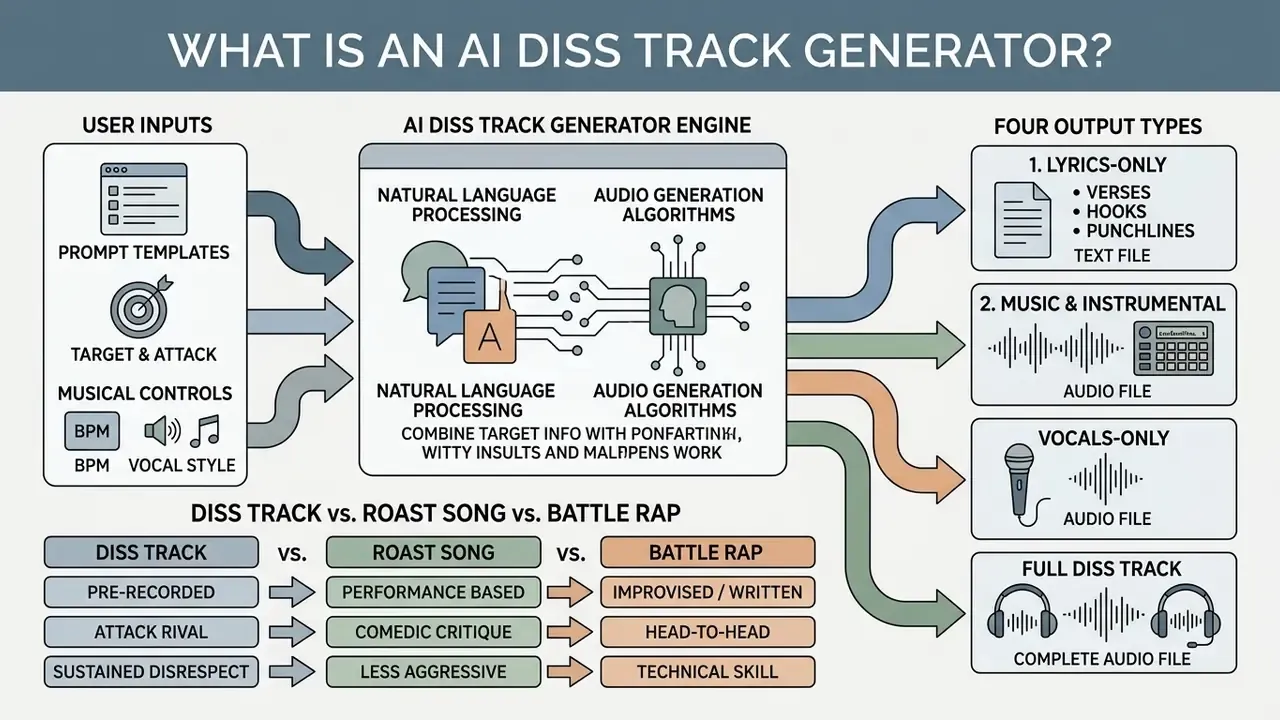
An ai diss track generator is a digital content creation tool that combines natural language processing with audio generation algorithms to produce targeted insults, witty punchlines, and complete hip-hop tracks. The tool translates user inputs, such as a target's name, personal context, and desired music style, into structured battle lyrics or fully mixed songs. Modern systems operate either as standalone text models or end-to-end audio platforms.
«A 2024 survey catalogues major models, MusicGen, MusicLDM and MusicLM, as the backbone of text-conditioned music generation.»
That architectural split matters for buyers. A lyrics-only tool is a language model with a rap-specific system prompt, while a full-song tool chains a language model, a text-to-music model, and a vocal synthesizer into one request. The first fails at rhythm. The second fails at facts. Knowing which one you bought saves an hour of confused re-prompting.
AI diss track lyrics, music, vocals, or instrumental
An ai diss track generator produces four distinct types of creative output depending on the underlying architecture: lyrics-only text files, instrumental beats, synthetic vocal tracks, or complete full-form audio recordings.
Lyrics-only generators output text files containing structured verses, hooks, and punchlines for human performance. Beat generators focus strictly on instrumental backing tracks, while vocal engines synthesize sung or chanted audio clips. That is the same class of technology documented in guides to AI voice generators, where voice quality, language coverage, and commercial licensing decide whether a vocal take is publishable at all. Integrated systems combine text generation, vocal synthesis, and beat arrangements into a single mixed song file.
«Research separates lyrics-only generators, audio-only text-to-music engines, and integrated text-to-song frameworks with multi-aspect quality evaluation.»
Official U.S. Copyright Office proceedings describe the same separation from a rights perspective. Generating lyrics, generating a melody, generating backing instruments, and rendering the final recording are treated as distinct acts of creation, each with its own authorship question. So creators who plan to publish should track which layer was machine-produced and which layer they contributed themselves. Teams that manage mixed media pipelines often audit these layers the same way they audit deliverables inside a YouTube publishing workflow.
Diss track vs. roast song vs. battle rap
Diss tracks, roast songs, and battle rap verses differ in their format, target audience, competitive intent, and aggression levels.
A diss track is a pre-recorded song intended to attack a specific rival through sustained verbal disrespect. Battle rap consists of live or structured face-to-face exchanges where performers trade rhymes to win rounds before an audience. A roast song relies on lighthearted humor, playful poking, and comical exaggerations, where the target is typically part of the joke rather than a hostile enemy.
The practical consequence is structural. Diss bars use second-person direct address, place the target's name on the beat, and escalate across verses. Roast lyrics soften the address and land on punchlines rather than accusations. Battle verses prioritize rhyme density and clarity over production polish, because the instrumental is minimal or absent. A generator that treats all three as "a rap song about a topic" produces vague output. A generator that collects target, receipts, and intensity as separate fields produces a confrontation.
How an AI Diss Track Generator Works
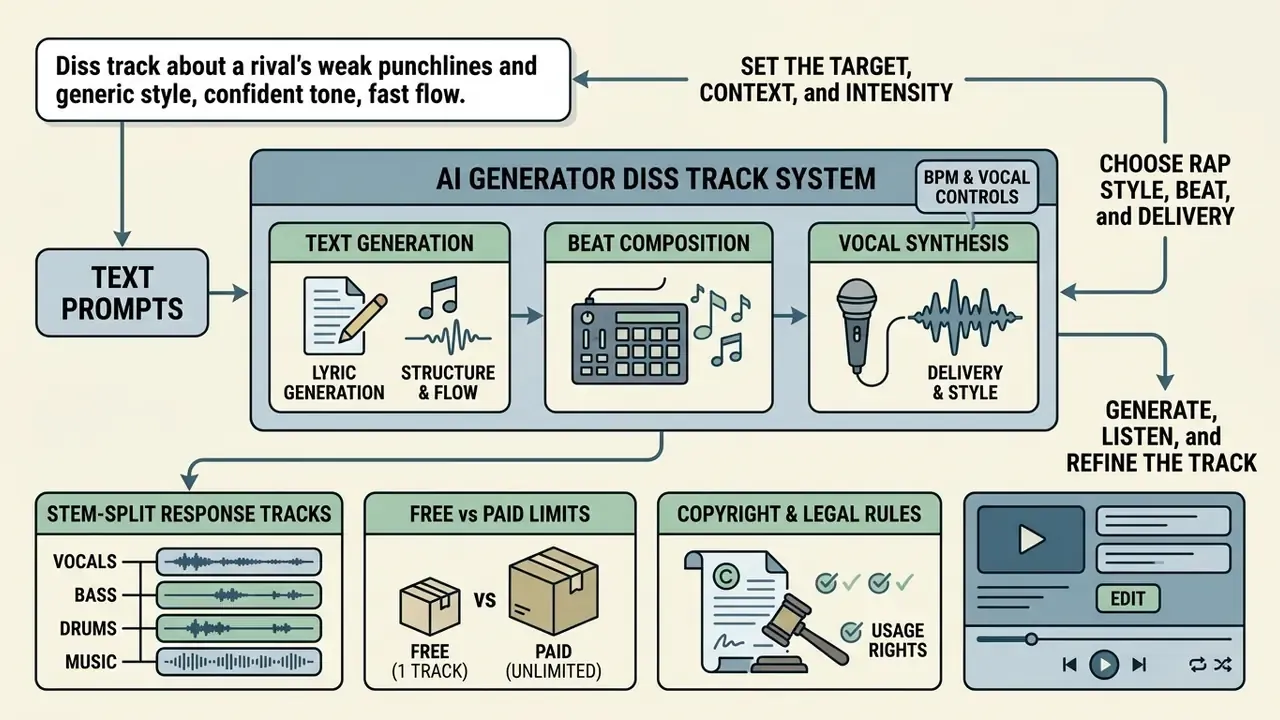
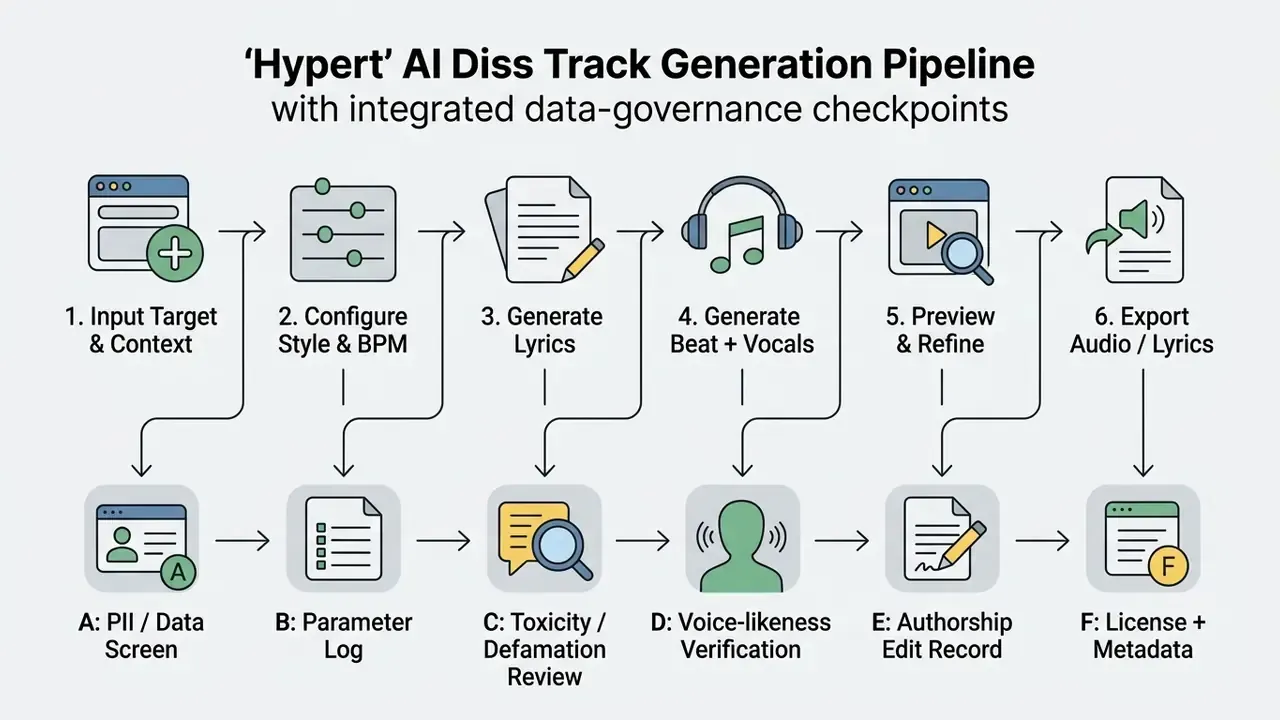
An ai generator diss track system processes text prompts through a multi-stage pipeline involving text generation, beat composition, vocal synthesis, and audio mixing. The workflow begins when the user inputs details about the target, selects a music genre, and adjusts the desired aggression level.
Documented research prototypes follow the same order. A 2026 interactive rap-battle system generates lyrics with a language model, runs a content check, synthesizes audio line by line with a text-to-speech engine, aligns each line to the beat grid, and finally applies voice cloning for a more rap-like delivery. Consumer products hide those stages behind one button, but the stage order, and therefore the debugging order, is identical.
Set the target, context, and intensity
To generate accurate bars, the system requires a target name, specific backstory details, and an explicit intensity setting.
Users input factual context, public roles, or humorous anecdotes into the prompt interface. Setting an explicit intensity level, ranging from mild playful teasing to aggressive battle rap, keeps the model inside the content boundaries you intended. Worth stressing: parameter bounds are not a safety slogan. They are measurable instruction-following behaviour in modern text-to-music systems.
«A 2026 counterfactual evaluation found that ACE-Step 1.5 and Stable Audio 3 respond reliably to instructions on key and beat grouping.»
Practical rule: change one dimension per generation. If you raise intensity, keep genre, BPM, and structure fixed, or you will never know which variable produced the improvement. For developers wiring these workflows into their own platforms, inspecting an official api endpoint structure clarifies how prompt fields pass to generative models, and an implementation guide for a generative media API shows how cost, rate limits, and request logging behave under load.
Choose rap style, beat, and delivery
Selecting a rap subgenre defines the song tempo, rhythmic structure, instrumental sound palette, and vocal cadence.
Modern tools offer pre-configured styles such as Boom Bap, Trap, or Drill. Selecting Trap sets tempos between 130 and 170 BPM with sliding 808 basslines, while Drill configures 140 to 150 BPM with darker minor keys. Vocal delivery settings adjust cadence, articulation, and energy levels to match the selected beat. Pick the beat before the bars if you care about flow; syllable counts written blind almost never sit right on a 150 BPM grid.
Generate, listen, and refine the track
After initial submission, the system generates a draft audio preview or text outline within several seconds for user review.
«MelodyFlow renders a 30-second sample in under 10 seconds at 64 inference steps, reaching FAD scores comparable to MusicGen.»
Users listen to the audio preview to evaluate line timing, vocal clarity, and beat alignment. If a line falls out of rhythm, the user edits the prompt text or re-runs specific song sections.
«Music Arena, a live evaluation platform for text-to-music systems, formalizes the loop: listeners compare outputs from two systems and select the stronger one.»
AI vs. Traditional Diss Track Creation: Time and Cost
The measurable argument for automation is throughput, not artistry. The table below compares the manual chain (research, writing, beat production, recording) with an end-to-end generator run at default settings.
Fast Response Tracks and Stem Isolation for Rap Battles
When you are answering an opponent's diss, speed is credibility. A response that takes a week reads as "I had nothing." A response that lands the same day flips the momentum.
Advanced workflows solve this with stem splitters and vocal removers. The steps are mechanical:
- Isolate the instrumental.Feed the opponent's released track into a stem separation model and extract the beat without vocals.
- Detect tempo and key.Read the BPM and key from the isolated instrumental so your bars land on the same grid.
- Write the counter-argument.Put the opponent's specific claims into the context field and answer them line by line, not thematically.
- Generate over the same production.Supply the isolated instrumental as the reference or backing audio, then render vocals on top.
- Ship, then archive.Keep the surgical version and the savage version. Send one, hold the other in reserve for round three.
Answering on an opponent's own beat is a rhetorical statement. You are claiming their production as your territory. It is also the highest-risk step legally: an isolated instrumental extracted from someone else's copyrighted recording remains their recording. Using it in a private group chat is a different exposure profile from monetizing it on a streaming platform, where Content ID and sound-recording rights apply. Rights clearance is required before any commercial release. The extraction technology does not create a license, no matter how clean the split sounds.
What to Include in a Prompt for Better Diss Track Lyrics
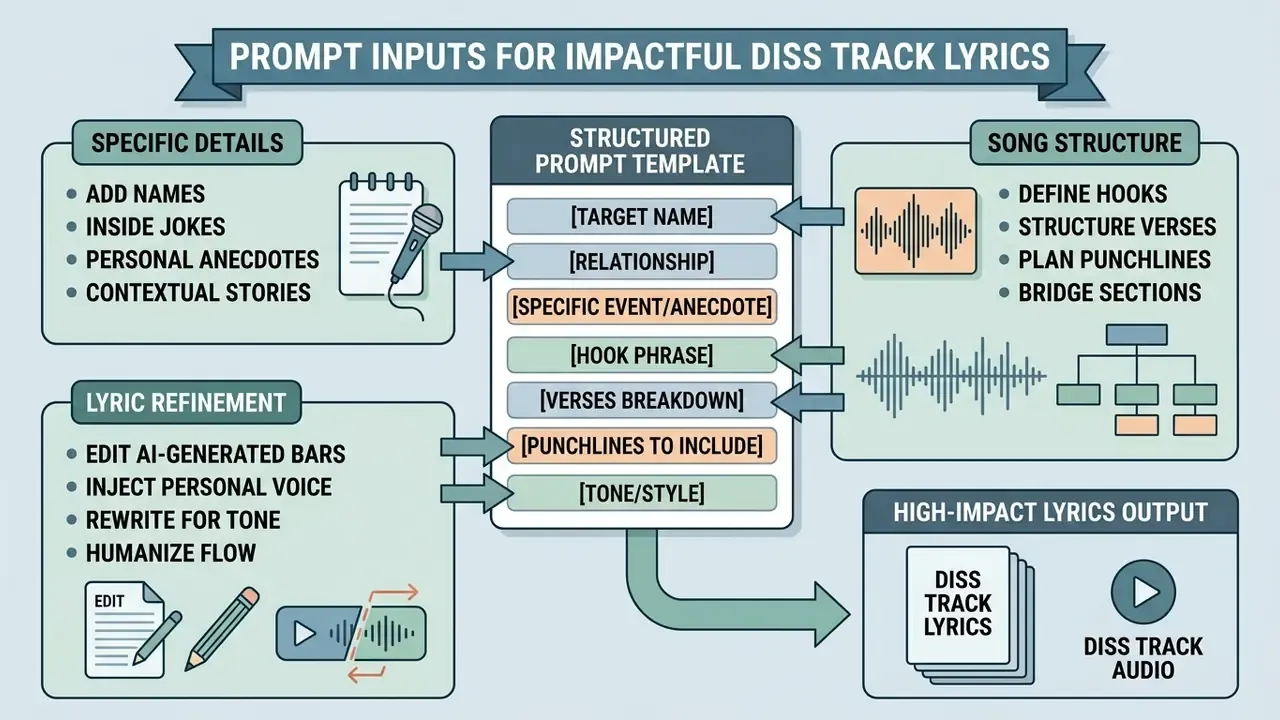
To produce high-impact bars, an ai diss track lyrics generator requires structured prompts that contain specific names, personal anecdotes, defined song structures, and clear stylistic instructions. Detailed prompts stop the model from defaulting to generic hip-hop clichés and filler rhymes.
Add names, inside jokes, and specific context
Including specific names, shared experiences, and distinct personal quirks yields personalized punchlines that target the subject directly.
Generic prompts yield generic insults. Specifying factual details, such as habitual lateness, funny work habits, or specific public statements, gives the underlying language model concrete semantic anchors.
«LYRA showed that inference-time structural constraints produce more singable, coherent and rhyming lyrics than training on parallel data.»
The formula reported across prompt-engineering guidance runs: role, goal, context, constraints, format, example output, plus three to five concrete facts about the target. "He's fake" produces vague bars. "Promised to pay me back in a week; that was eight months ago" produces a grievance the model can build a rhyme scheme around. Keep the facts documentable, use nicknames or public roles instead of private identifiers, and never paste sensitive personal data into a third-party prompt field.
Build hooks, verses, and punchlines
Structuring the prompt with clear section tags, such as [Intro], [Verse], [Chorus] and [Outro], guides the language model to write structured rap songs.
Explicit structural tags keep pacing and bar counts under control. Requesting 16-bar verses and 8-bar choruses prevents run-on lines and holds the rhythmic flow steady across the instrumental beat.
«A multi-layer LSTM with BERT integration reproduces the average line length and vocabulary variance found in its rap training corpora.»
Flow can be steered with the same bracket syntax used for structure: [Triplet Flow], [Aggressive Delivery], [Beat Drop], [Ad-lib], plus numeric constraints such as "10–12 syllables per bar at 145 BPM." Hooks work best at 4–8 bars, verses at 12–16. Longer than that and the model starts repeating its own imagery.
Edit AI-generated lyrics for your own voice
Refining generated text lets creators align rhythmic cadence, vocabulary choice, and rhyme schemes with their natural speech patterns.
AI outputs serve as strong initial drafts, but manual tweaking fixes unnatural phrasing and awkward syllable counts. Adjusting word choices restores authentic delivery markers and sharpens the final punchline.
«The GTA framework showed that aggressive toxicity filtering can reduce fluency, so automation does not replace manual control.»
A repeatable editing method: extract your own style profile from two to twenty authentic samples (tone, average line length, favourite syntax, contractions), then rewrite the generated draft line by line against that profile. Tedious? Slightly. It is also the step that creates human authorship, and the legal significance of that is covered below.
Copy-Paste Prompt Templates and Output Examples
Three templates below cover the most common scenarios. Replace bracketed fields and keep the field order, because order affects instruction-following.
📋 Template 1: full track, scorched-earth drill diss
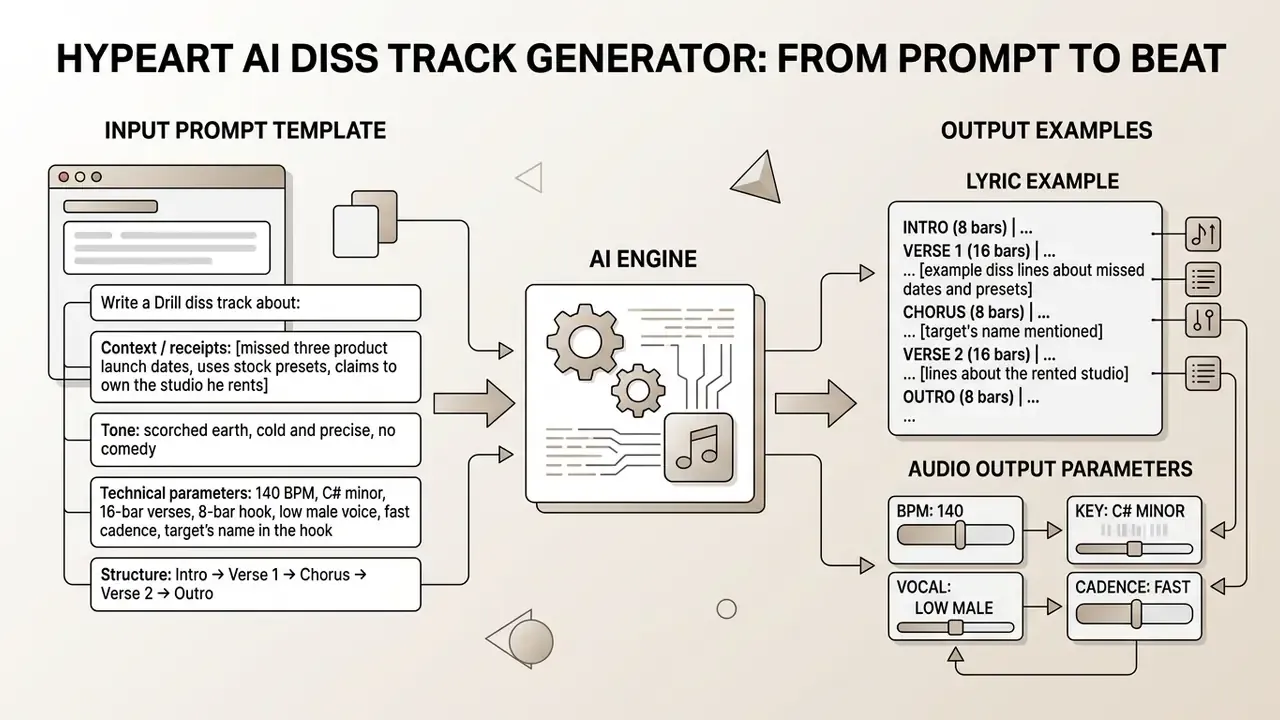
🎙️ AI generated output example (Drill, 140 BPM)
[Verse 1]
You talk about the studio, but presets built your fame,
Three delayed launches, man, you're playing with your name.
You hit the spacebar once and call yourself a king,
But when the mic turns on, you haven't got a thing.
[Chorus]
Say it louder, nothing shipped, nothing signed,
All that talk of hustle and you're always two years behind.
I don't need a rumour when the timeline's on file,
Check the dates, check the receipts, then check your style.
📋 Template 2: sarcastic boom bap roast (friendly, low intensity)
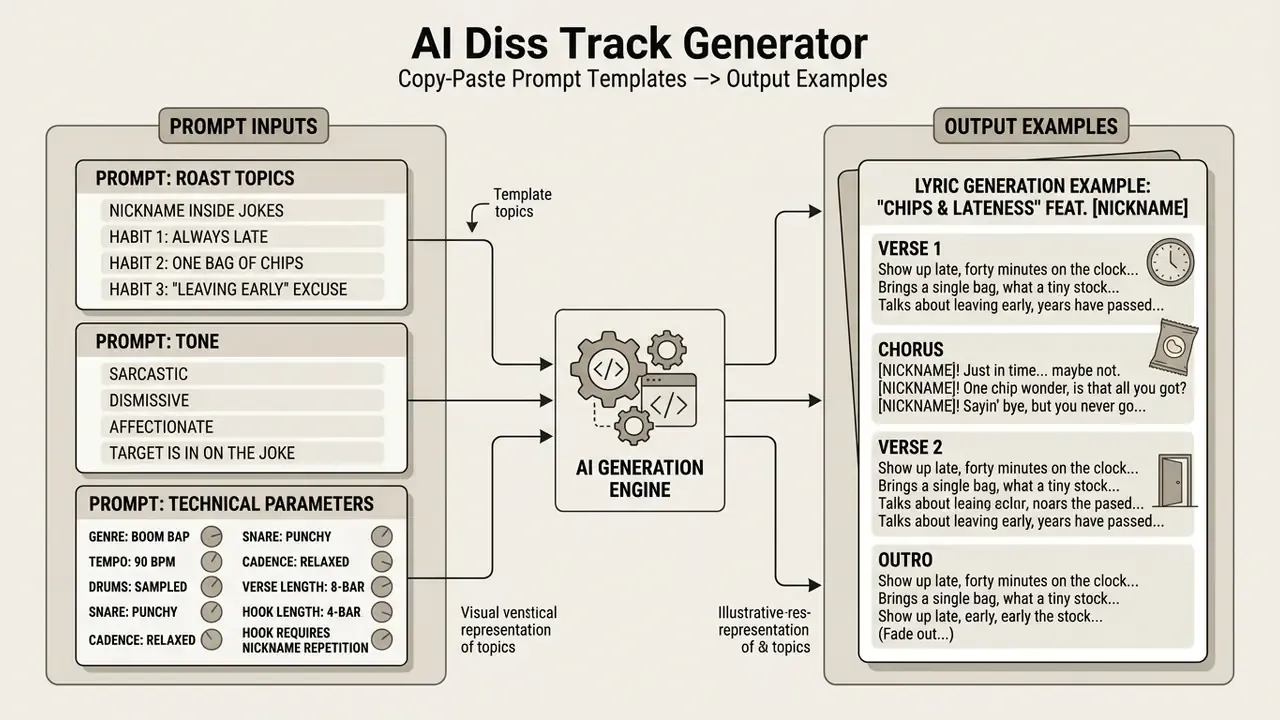
🎙️ AI generated output example (Boom Bap, 90 BPM)
[Verse 1]
Forty minutes late and he calls it "on the way,"
One bag of chips for nine people, that's his idea of a tray.
Says he's leaving early, still here when the sun comes through,
Man's been "heading out in five" since two-thousand-nineteen, dude.
[Chorus]
Late again, late again, set your clock by his excuse,
Chips in hand, coat still on, and nothing left to prove.
📋 Template 3: same-day response track over an isolated beat
Write a [Battle Rap] response verse answering [Opponent Name]'s track
"[Track Title]".
Their claims to rebut: [1) said I ghostwrite, 2) said my numbers are bought,
3) said I never battled live].
My counter-evidence: [three live sets on video, published session files,
verified analytics].
Tone: [cold, surgical, courtroom].
Technical parameters: match the supplied instrumental at [BPM] in [key],
16 bars, minimal ad-libs, clarity over density, no hook.
Structure: [Verse] only. This is a round, not a song.
Use these as starting points, then change exactly one variable per regeneration. Creators comparing tools across categories can apply the same single-variable discipline used in evaluations of free AI video generators and other credit-limited services.
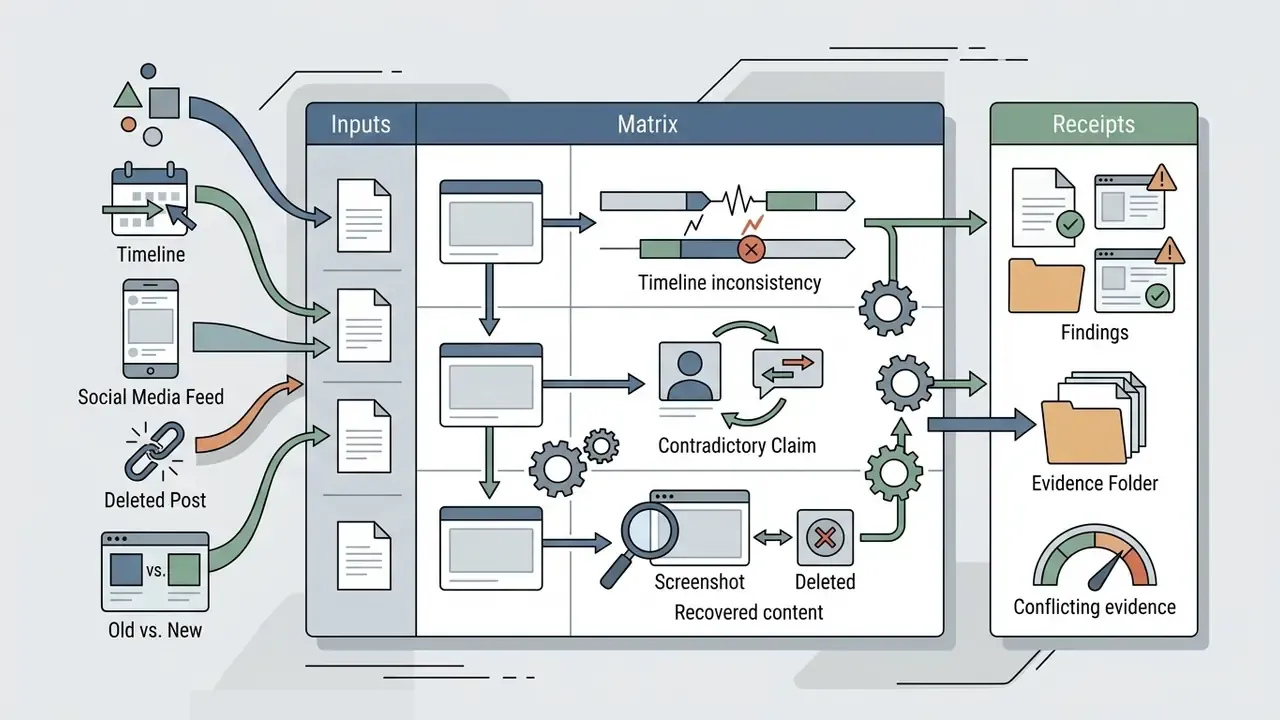
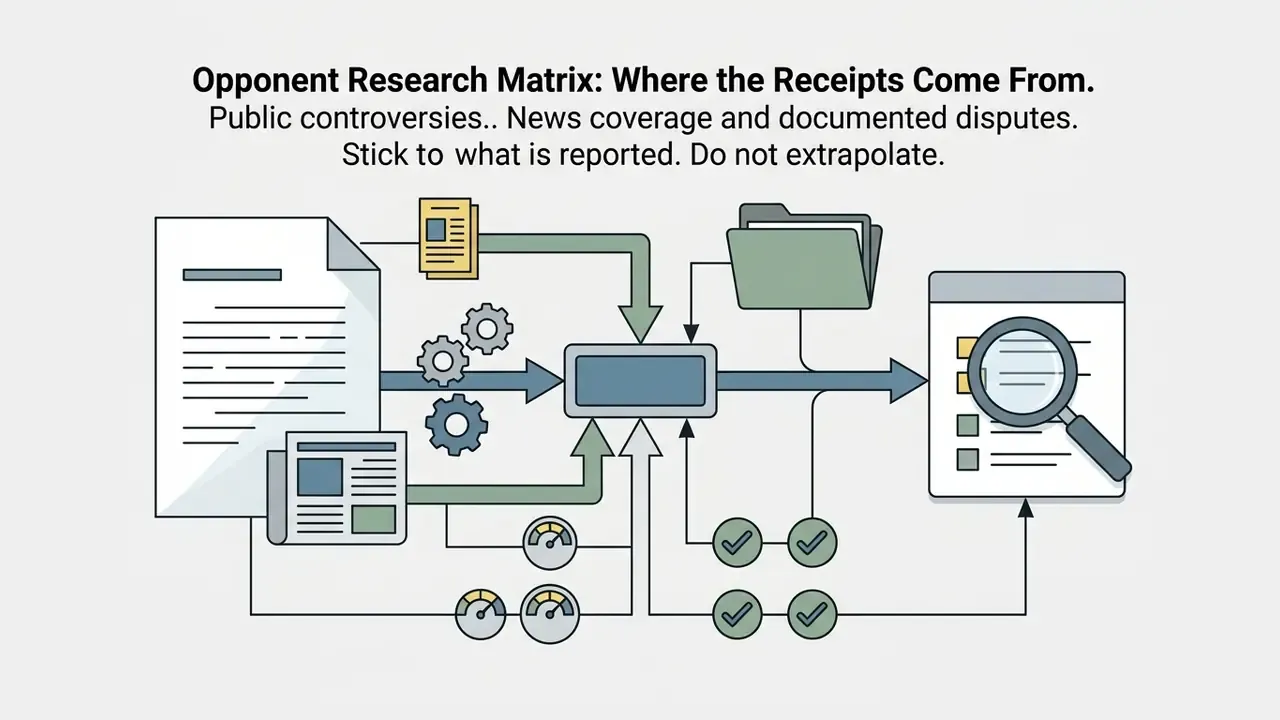
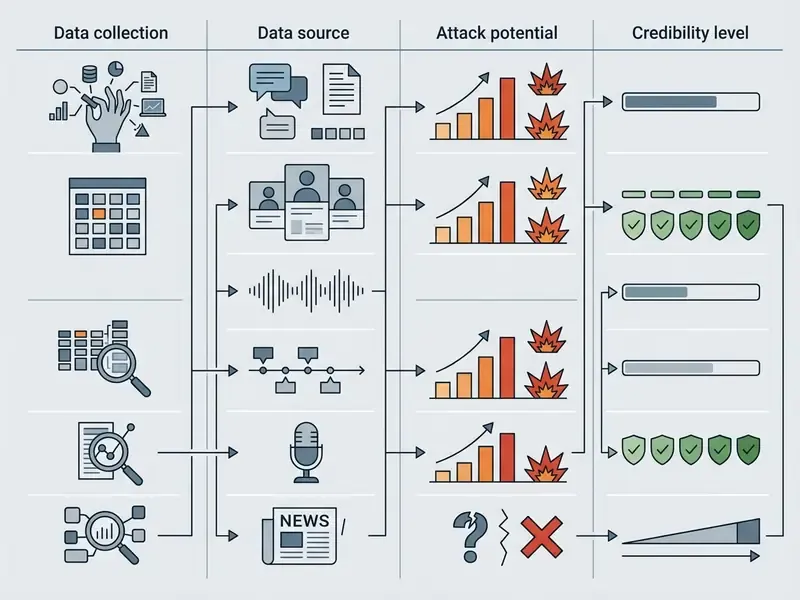
Opponent Research Matrix: Where the Receipts Come From
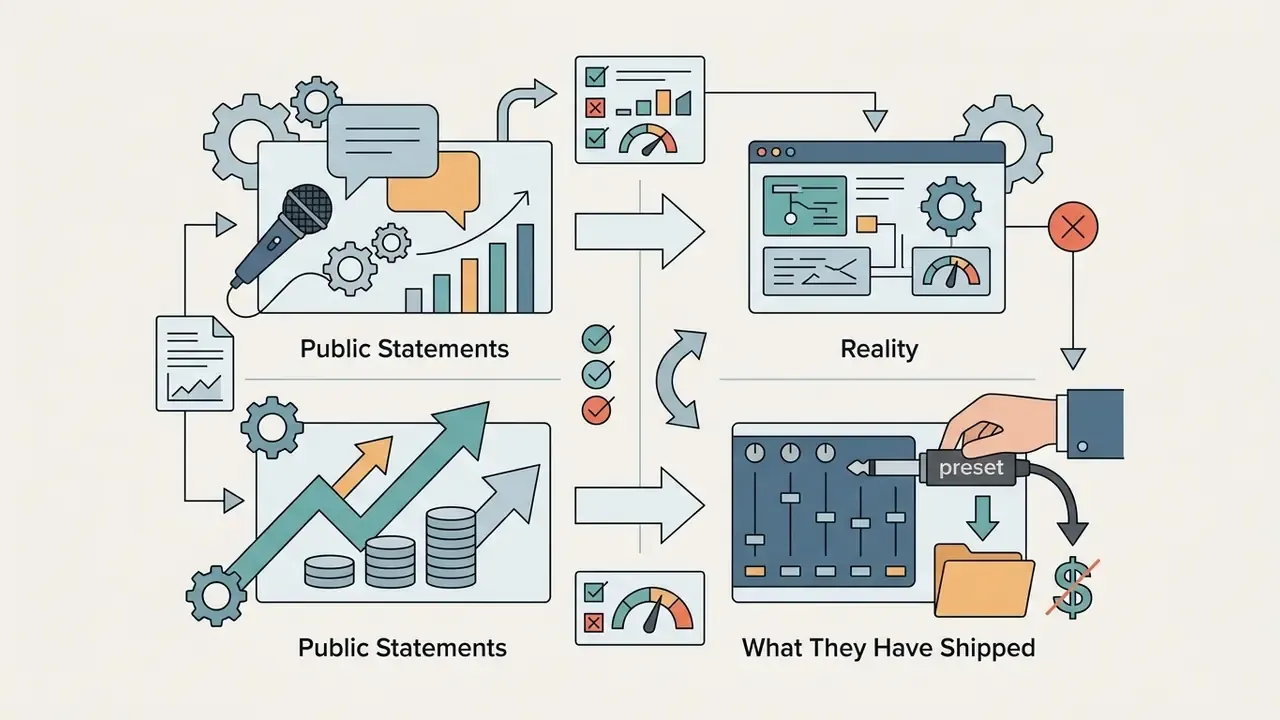
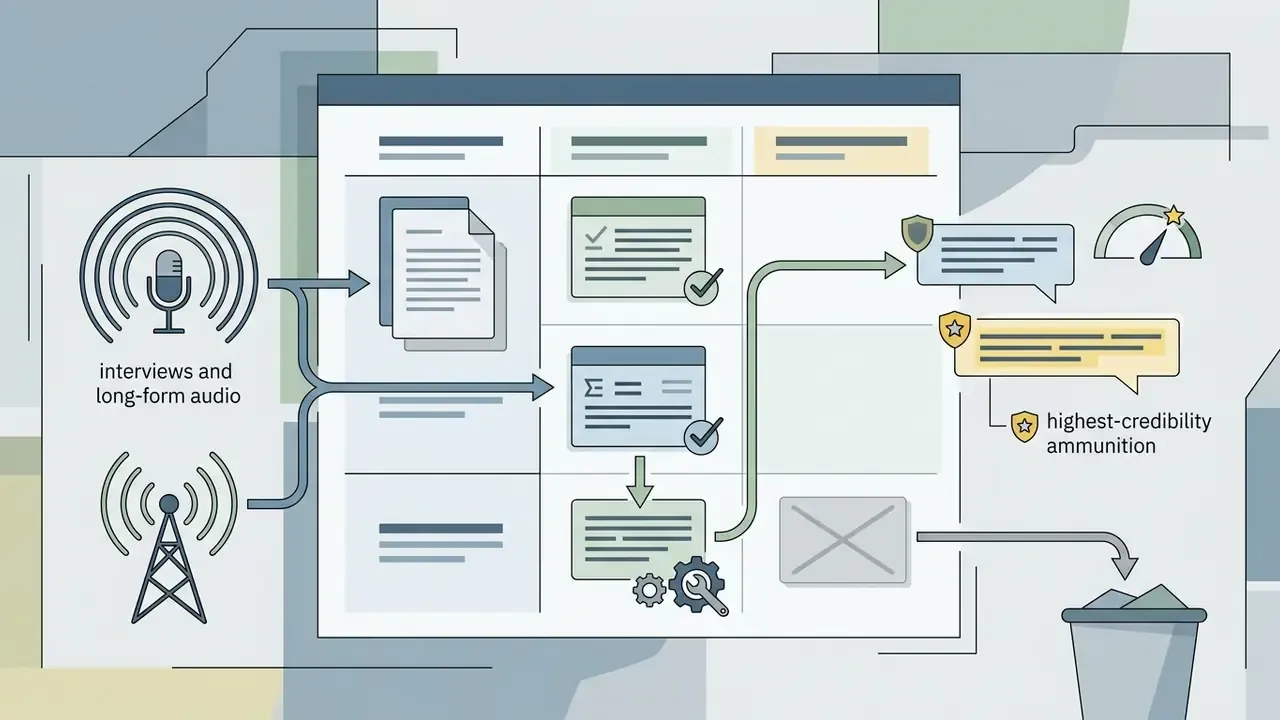
The context field is only as strong as the material you put in it. Documented, verifiable material also lowers defamation exposure, because truth and clearly labelled opinion based on true facts are the standard defences.
Rap Styles and Custom Controls for AI Diss Tracks
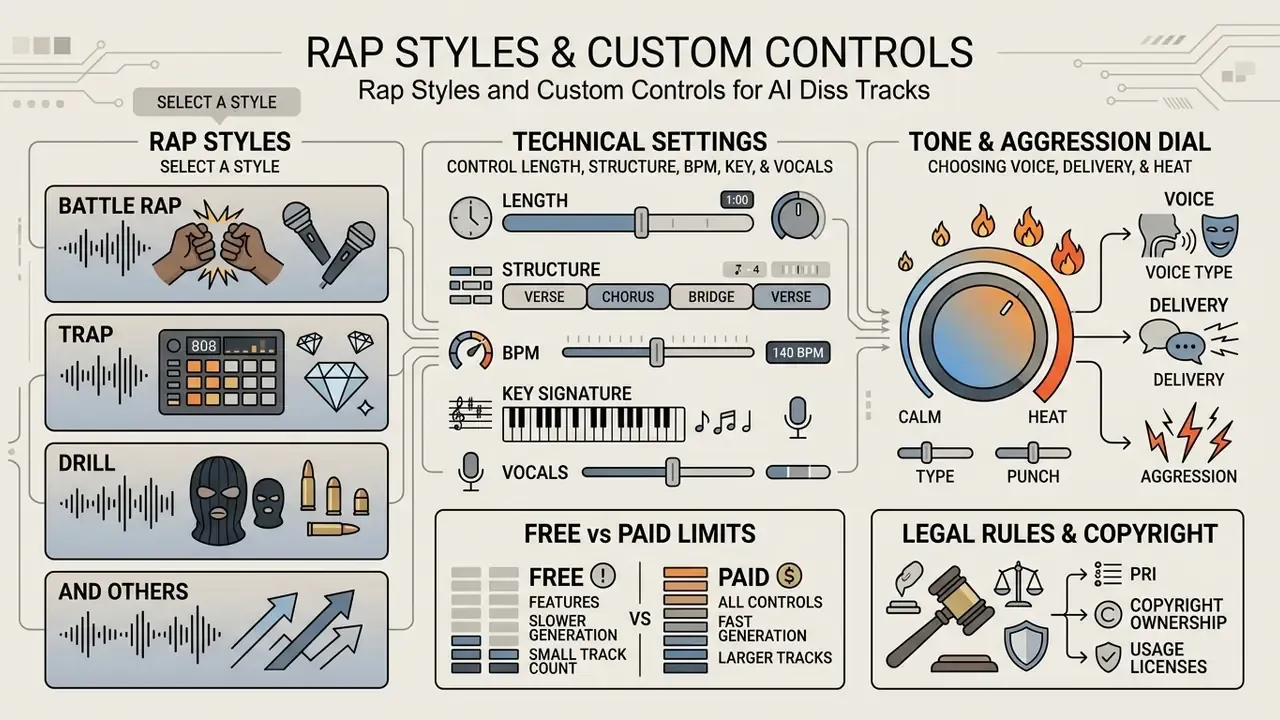
An ai diss track maker provides customization settings for music styles, tempo, key signature, song length, and vocal characteristics. These controls give creators command over the sonic atmosphere of the track. Creators building a full campaign, audio plus visuals, frequently pair these controls with an animation maker or a lyric-video toolchain so the audio parameters and the visual pacing match.
Battle rap, trap, drill, and other music styles
Different hip-hop subgenres dictate the mood, drum patterns, and lyrical delivery of a diss track.
- Battle Rap: Focuses on acapella or minimalist beats, emphasizing lyric clarity, complex rhyme schemes, and direct verbal attacks.
- Trap: Features fast hi-hat triplets, heavy 808 basslines, and tempos from 130 to 170 BPM with aggressive vocal delivery.
- Drill: Employs sliding bass notes, dark minor keys, and erratic snare placements at 140 to 150 BPM.
- Boom Bap: Uses classic 85 to 95 BPM drum samples and punchy snares that prioritize clear storytelling.
- Old School: Simple beat-and-recitation structure, tight rhythm alignment, minimal melodic complexity.
- East Coast / West Coast: East Coast leans sample-heavy and lyric-driven; West Coast leans smoother, funk- and synth-driven, with a more laid-back cadence.
«SongBench, 11,717 samples rated by professionals across seven dimensions, reveals fine-grained quality gaps between text-to-music systems.»
Control length, structure, BPM, key, and vocals
Technical controls let users set exact musical parameters before audio generation.
Setting specific BPM parameters aligns the beat tempo with the desired energy level. Key selections, such as A Minor or C# Minor, establish a tense or dark emotional tone. Voice controls allow switching between male, female, or custom synthesized vocal timbres.
«Counterfactual tests confirmed high control accuracy for key and beat grouping in ACE-Step 1.5 and Stable Audio 3 Medium.»
Vendor documentation reflects the same control surface: prompt fields for key and BPM ("E minor, 90 BPM"), section timestamps for structure, explicit [Verse] / [Chorus] / [Bridge] tags in supplied lyrics, an instrumental flag to exclude vocals, and vocal-style plus language descriptors. To explore tools across creative categories, users can compare options among audio and visual software utilities, and creators shipping large audio-video bundles can reduce delivery size with a video compressor.
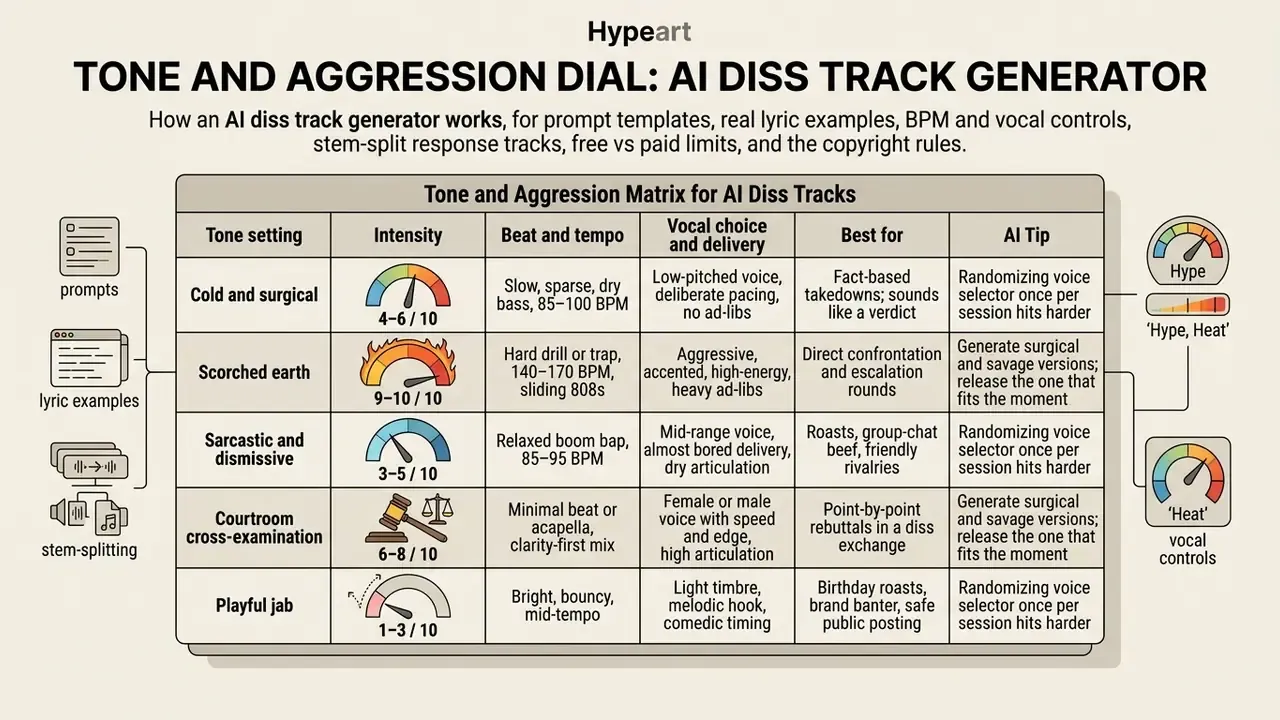
Tone and Aggression Dial: Choosing Voice, Delivery, and Heat
Voice carries the weight. A cold delivery cuts differently from a loud one, and the wrong pairing undermines otherwise strong bars. Treat mood as an aggression dial, not a genre picker, and set it on a rough 1/10 to 10/10 scale.
Free AI Diss Track Generator, Pricing, and Commercial Use
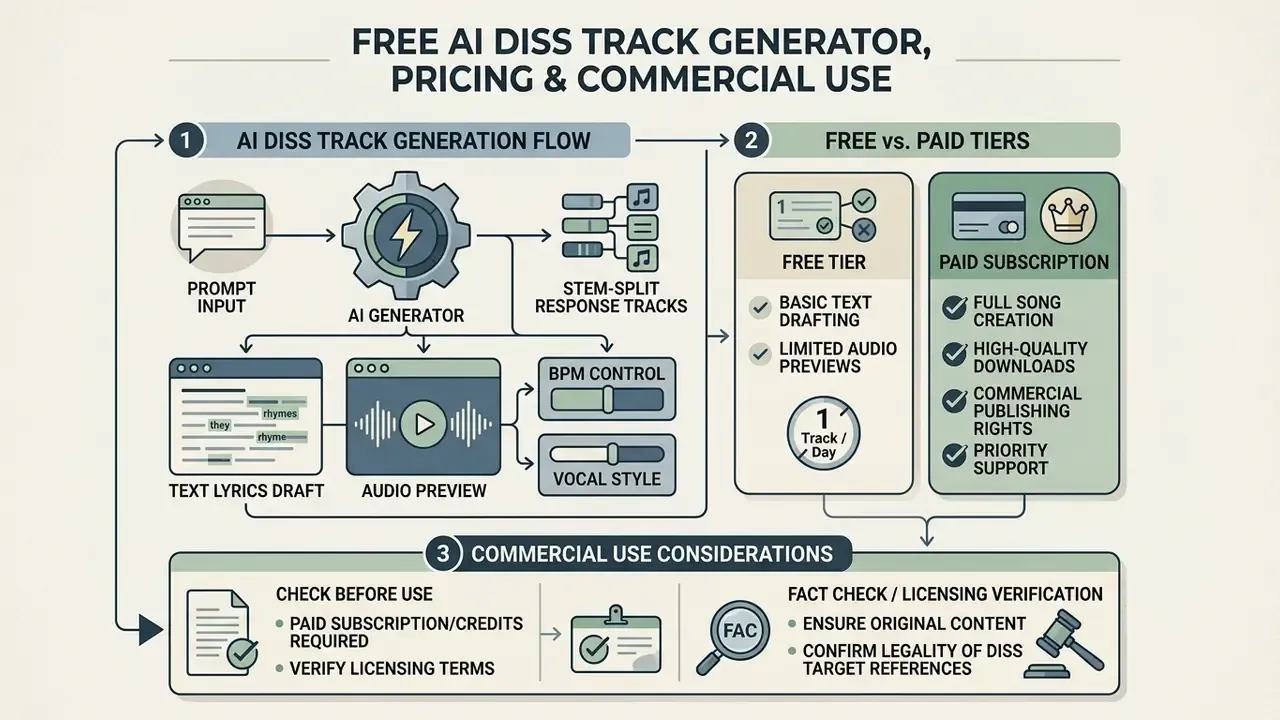
Using an ai diss track generator free tier typically allows basic text drafting and audio previews, while commercial publishing requires paid subscriptions or credit purchases. The pattern mirrors licensing across adjacent categories. See how tiers gate rights in guides to the commercial use of AI design generators.
What a free diss track generator usually includes
Free tiers generally provide starter generation credits, basic lyric generation, and low-resolution audio previews.
Documented free-tier patterns across vendors in 2026 include starter credit grants for new accounts; text-only export as TXT, DOC, or HTML in lyric-focused tools; one credit per lyric draft with MP3 export in beat-capable tools; tone and intensity controls exposed even on free plans; and one vendor offering a single diss track with a commercial licence at $0. Paid packs, where they exist, run roughly $5 for 5 songs to $35 for 50 songs, and subscriptions cluster between $9.99 and $29.99 per month. Free accounts usually restrict high-definition WAV downloads and enforce non-commercial usage terms. Readers evaluating limits in adjacent categories can compare with documented free-tier photo tool restrictions.
What to check before using a diss track commercially
Before publishing an AI-generated song on streaming services or monetized channels, creators must verify commercial rights, copyright terms, and licensing boundaries.
Under U.S. Copyright Office guidance (2023), fully machine-generated music without human authorship lacks federal copyright protection. Commercial licenses from AI platforms grant platform distribution rights, but they do not grant exclusive copyright ownership of synthetic voices or beats.
«Research confirms that commercial rights to AI music are set by platform terms, not by standardized legal guarantees.»
Two consequences follow. First, the U.S. Copyright Office has told The MLC that claimants of works not protected by copyright are not entitled to royalty payments, and that the collective may withhold royalties pending an authorship review. "Royalty-free output" is not the same thing as "royalty-earning work." Second, jurisdictions diverge: the UK's Copyright and AI consultation indicates sound recordings may retain protection regardless of the level of human input, so the same track can hold different status in different markets. Claims of "100% original, no copyright strike" should be read as marketing, not as a guarantee. Platform Content ID systems and right-of-publicity statutes operate independently of a vendor's licence. To review pricing structures across media platforms, creators can consult the AI Media Pricing Guides for detailed breakdowns.
This section is general information and does not replace advice from a qualified professional. It is not legal advice.
Responsible Use: Targets, Privacy, and Content Boundaries
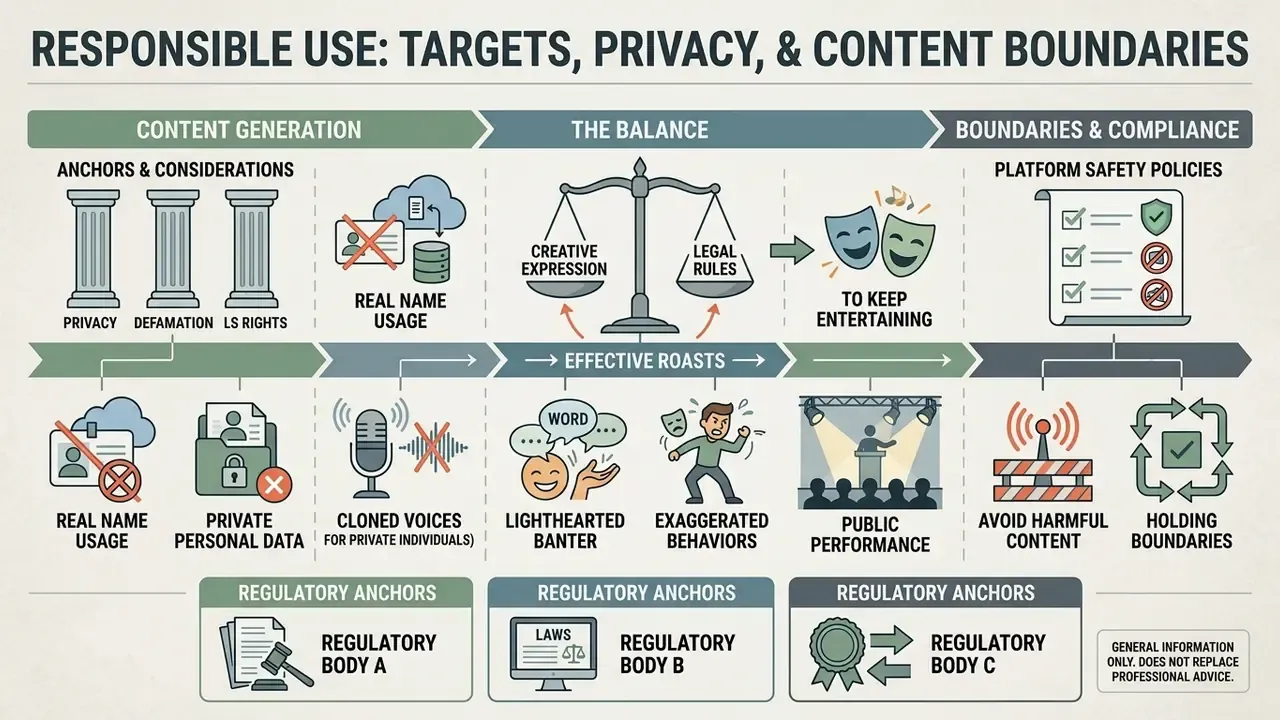
Generating battle content requires balancing creative expression against legal rules on privacy, defamation, and digital likeness rights.
Using real names and personal details in a diss track
Using recognizable real names, private personal data, or cloned voices of private individuals creates significant privacy and legal risks.
Regulatory bodies such as the U.S. Copyright Office and European data protection agencies treat unauthorized voice models as sensitive personal data. Parody and critical commentary receive broader protection when directed at public figures, yet publishing false claims about private citizens can trigger defamation claims.
«A study of abusive-music transformation recorded a 63–86% reduction in aggression when vocals were replaced with AI alternatives while musical integrity was preserved.»
Three regulatory anchors are worth naming explicitly. The U.S. Copyright Office's 2025 report on digital replicas defines a digital replica as manipulated audio or video that realistically but falsely depicts a person, a definition that applies whether or not AI was involved. Proposed federal legislation on unauthorized name, image, likeness and voice use carves out parody and critical commentary as protected speech. And the Dutch data protection authority states that sharing a recognizable deepfake beyond a purely personal circle requires a GDPR legal basis plus disclosure that the content is synthetic, while Australia's OAIC treats AI-generated content about an identifiable person as personal information. For organizations weighing legal risk in synthetic media, reviewing current litigation trends provides critical context on digital replica laws.
This section is general information and does not replace advice from a qualified professional. It is not legal advice.
Keeping a roast creative without crossing the line
Effective roasts focus on lighthearted banter, exaggerated behaviors, and public performance rather than personal harassment or hate speech.
Holding content boundaries keeps tracks entertaining without violating platform safety policies. Avoiding protected characteristics, slurs, and explicit threats keeps battle rap creative and compliant.
«Raply, a GPT-2 model trained on the Mitislurs corpus, generates rap with near-human rhyme density while substantially reducing offensive words.»
The workable line, drawn from official guidance: attack style, claims, and conduct, never protected characteristics. The UN Office on Genocide Prevention defines online hate speech as expression that harasses or incites violence, hatred or discrimination against individuals or groups. Council of Europe and ECRI materials classify public insults, defamation, threats and racist denigration as hate-speech-related conduct when tied to protected groups. Reputational claims should be either demonstrably true or clearly framed as opinion based on true facts. To review usage guidelines or request help with media tools, see the AI Media Support documentation.
Enterprise Risk, Shadow AI, and Auditability
Diss-track generators look like consumer novelties, which is exactly why they show up in enterprise risk registers. Three exposures matter for teams responsible for model risk, compliance, or brand safety.
1. Shadow AI and data leakage. A diss-track prompt is, by design, a container for grievance detail: names, internal disputes, client complaints, unreleased project timelines, and screenshots pasted as text. Submitted from a corporate device to a consumer service, that content leaves the perimeter and may be retained or used for model improvement under the vendor's default terms. Mitigations: block or allow-list generative audio domains at the DLP layer, classify "creative" tools as in-scope for AI-use policy, and instruct staff to use nicknames or fictional targets rather than identifiable colleagues or clients. NIST's generative AI profile (NIST AI 600-1, 2024) explicitly directs organizations to monitor AI-generated content for privacy risks, including exposure of personal data and facial likenesses.
2. Reputational and brand-safety exposure. Synthetic audio attacking a named competitor, employee, or customer, even as an internal joke, becomes an artefact that can be forwarded, screenshotted, and attributed to the organization. Treat generated diss content the way you treat external communications: reviewed, approved, provenance-labelled. NIST AI 100-4 on reducing risks posed by synthetic content frames provenance and disclosure as the primary control set for generated media.
3. Reproducibility and audit evidence. Internal audit and model-risk functions typically require that an output can be reconstructed. For generative audio that means logging, per generation: prompt text, model and version, seed value where exposed, sampling parameters, timestamp, requesting user, and the human edits applied afterwards. Note the platform constraint: where a vendor does not support multi-turn editing of a clip, reproducibility depends entirely on prompt-and-seed logging, because the audio cannot be re-derived from a patch history. Teams also need a documented red-teaming routine. Probe the model with prompts designed to elicit defamatory factual claims, protected-characteristic attacks, and real-person voice imitation, then record how the moderation layer responded. Uncomfortable but useful: the failure cases you find yourself are cheaper than the ones a journalist finds.
Pre-Publication Compliance and Risk Checklist
Run this before any diss track leaves a private device.
Checklist0 / 10
AI Diss Track Generator FAQ
Short answers on generation speed, revisions, multi-genre support, copyright, and voice-cloning risk.
How fast can an AI diss generator create a track?
An ai diss track generator typically outputs complete lyrics in less than 5 seconds and renders finished audio tracks within 30 to 60 seconds.
«Stable Audio 3 renders full-length tracks in 0.44 seconds on an NVIDIA H200 GPU; MelodyFlow produces a 30-second sample in under 10 seconds.» Stable Audio 3 Technical Report (2026); MelodyFlow (2024) Vendor-reported end-to-end figures for diss-specific tools cluster between "in seconds" and "under one minute" per full track. Measured research figures for text generation latency sit near 0.1 s to first token and about 0.67 s per response in voice-agent pipelines.
Can I generate multiple versions of the same diss track?
Yes. Most AI platforms let users re-run prompts to generate multiple song variations with different beats, vocal performances, and lyric arrangements. Several engines return two variations per generation by default and save every version to history, which is how creators keep a surgical take and a savage take from the same input. Research on arrangement generation supports the same capability at the model level: variation and re-arrangement systems produce alternative versions from one musical source by sampling one latent factor while holding others fixed.
Can an AI diss track maker create songs in different styles?
Yes. Modern platforms support a wide range of genres, including Hip-Hop, Trap, Drill, Rock, Pop, Country, and R&B. Product documentation from multiple 2026 vendors lists diss-track generation alongside pop, hip-hop, EDM, rock, K-pop, R&B, country and jazz output. A "country diss track" or an "R&B roast ballad" is a supported configuration, not a workaround.
Can I copyright a diss track created with an AI generator?
Purely AI-generated lyrics and music cannot be registered for copyright in the United States, because the U.S. Copyright Office requires human authorship. However, if you manually rewrite the generated lyrics, re-record the vocals in your own voice, or substantially remix and arrange the track in a DAW, those human contributions become eligible for protection. Document what you changed. The edit trail is the evidence of authorship.
Is it legal to clone a target's real voice for a diss track?
Using an unauthorized synthetic voice model of a private individual or a celebrity creates high risk under right-of-publicity, digital-replica, defamation, and data-protection rules, and European and Australian regulators treat a recognizable voice as personal data. Use stock AI vocal models, or perform the generated lyrics yourself.
Will the target's name actually appear in the generated bars?
Yes, if you place it in the target field and request it in the hook. Tools built specifically for diss tracks feed the name into lyric composition and place it on rhythm in verses and chorus. A diss track that only hints at the target functions as a subtweet. Naming is what makes it a diss.
Can free-tier tracks be posted on TikTok or YouTube without a strike?
Not automatically. A free tier usually grants personal, non-commercial use only, and monetized posting typically requires a paid plan. Separately, platform Content ID and right-of-publicity rules apply regardless of the vendor's licence, so tracks containing extracted stems or imitated voices can be removed even when the generator's terms look permissive.
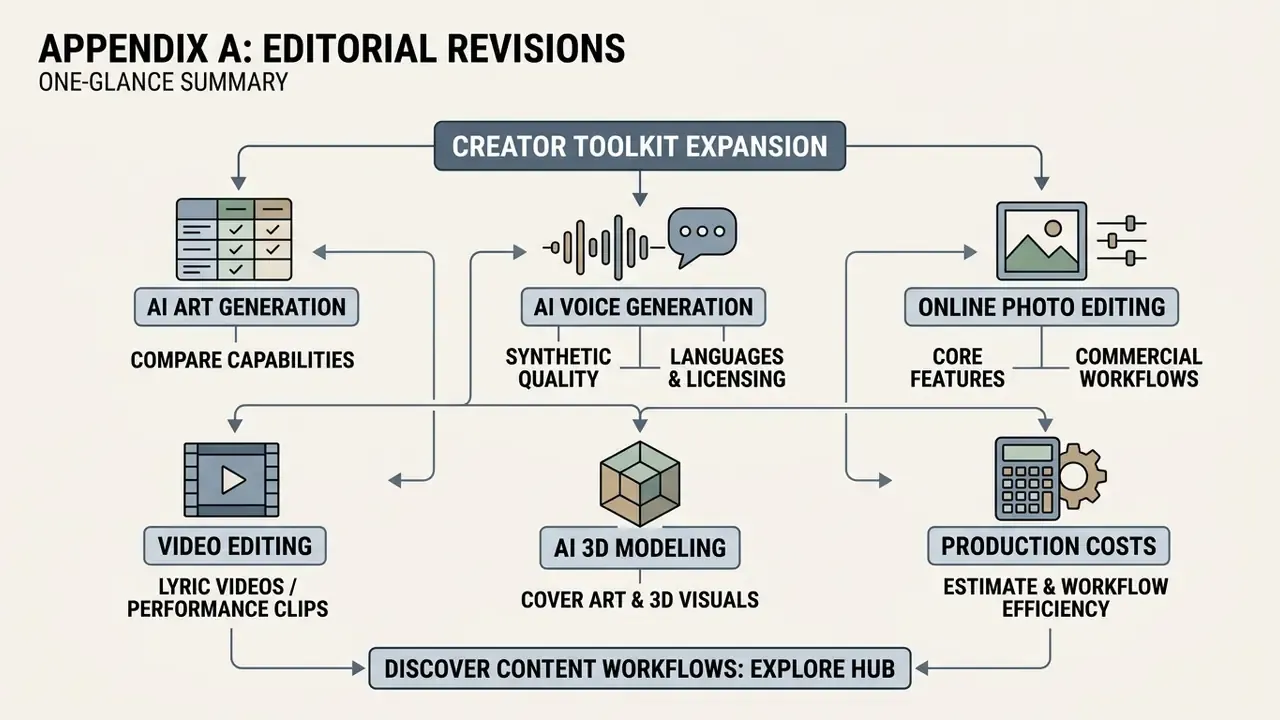
Appendix A: Editorial Revisions
Retained for transparency; superseded in the main text.
- Previously in "Set the target, context, and intensity""Research by NIST (NIST AI 600-1) emphasizes that explicit parameter bounds in generative AI models reduce unwanted synthetic outputs." Replaced because NIST AI 600-1 addresses generative AI risk management broadly rather than musical parameter control. The NIST reference now sits in the enterprise governance section, where it is on-topic, and the musical-control claim is supported by counterfactual text-to-music evaluation.
- Previously in "Generate, listen, and refine the track""In a documented test scenario, an editorial team generated a draft battle verse, edited three weak punchlines in the prompt field, and achieved a clean, beat-synced vocal preview on the second iteration." Reformulated because an anonymous internal test is not a verifiable source. The revised passage describes the same two-pass pattern with vendor and platform documentation behind it.
- Previously linked in the output-format, format-comparison and prompt-context sectionsanchors pointing to photo-editing, action-figure and age-progression tools. Replaced with audio-, licensing- and workflow-relevant destinations, since the original anchors did not serve the reader's task in an audio-generation article.