Last updated: 2026. Reviewed for licensing accuracy against current platform terms of service and US Copyright Office guidance.
Executive summary: what decision-makers need to know first
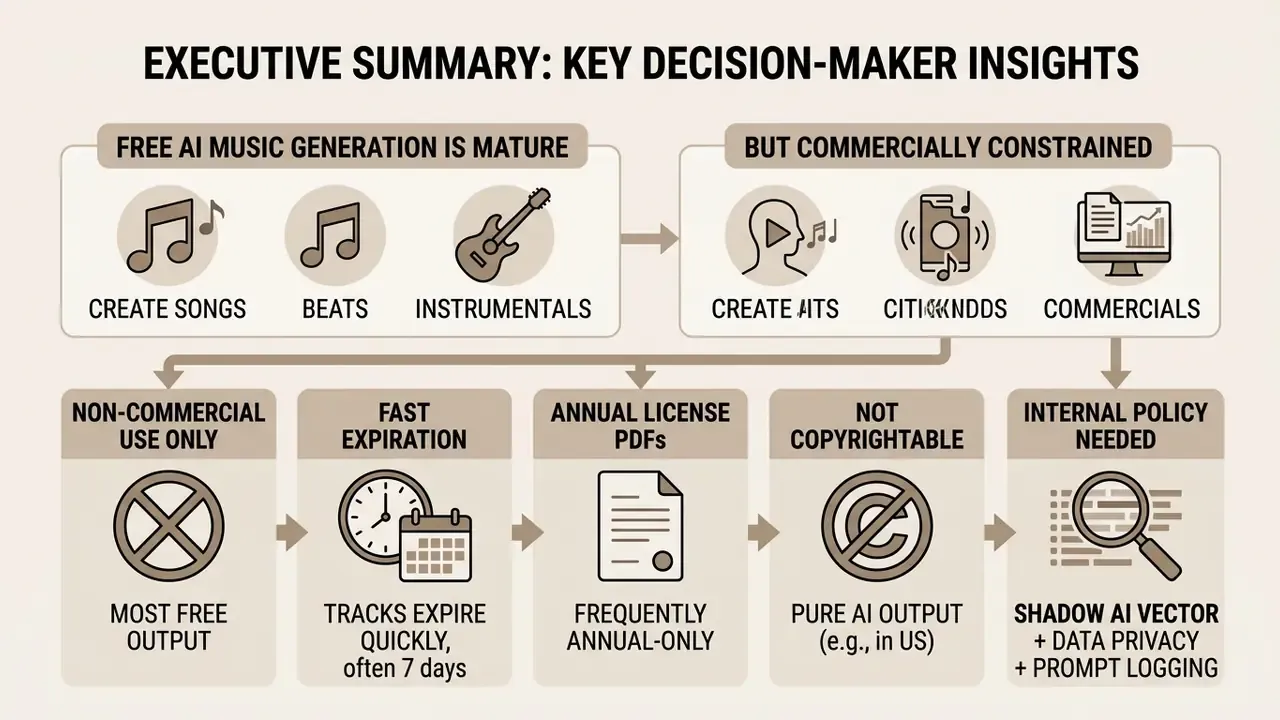
Free AI music generation is technically mature but commercially constrained. That gap is where most teams get hurt. Before an agency, marketing department, or regulated enterprise embeds generated audio into published work, five facts define the risk profile:
- Free output is usually non-commercial. Almost every commercial web platform restricts free-tier audio to personal testing and evaluation. Commercial rights attach to a paid subscription, not to the generated file itself.
- Free tracks expire fast. On guest-access and free-trial platforms such as AIMusic.so and MusicHero.ai, generated tracks are stored for 7 days before they are marked "Expired" and removed. Download immediately. Do not treat the platform library as storage.
- License PDFs are frequently annual-only. Downloadable Commercial License Certificates are, on several leading platforms, issued exclusively to active annual subscribers. Monthly and free users may hold usage permission without any written proof of it.
- Pure AI output is not copyrightable in the United States. Protection attaches only to human-authored contributions, which changes how audio assets can be defended, licensed onward, or monetized through collecting societies.
- Free tools are a Shadow AI vector. Guest generation without login means prompts, lyrics, briefs, and sometimes uploaded reference audio leave the corporate perimeter with no SOC 2 or ISO 27001 assurance and no audit trail.
Teams drafting an internal policy should read the sections on data privacy and prompt logging together with the audit evidence checklist further down, then consult qualified counsel before any commercial deployment. One more practical note: the cheapest control here is a naming convention plus a shared download folder. Really.
What is an AI music generator free and what can it create?
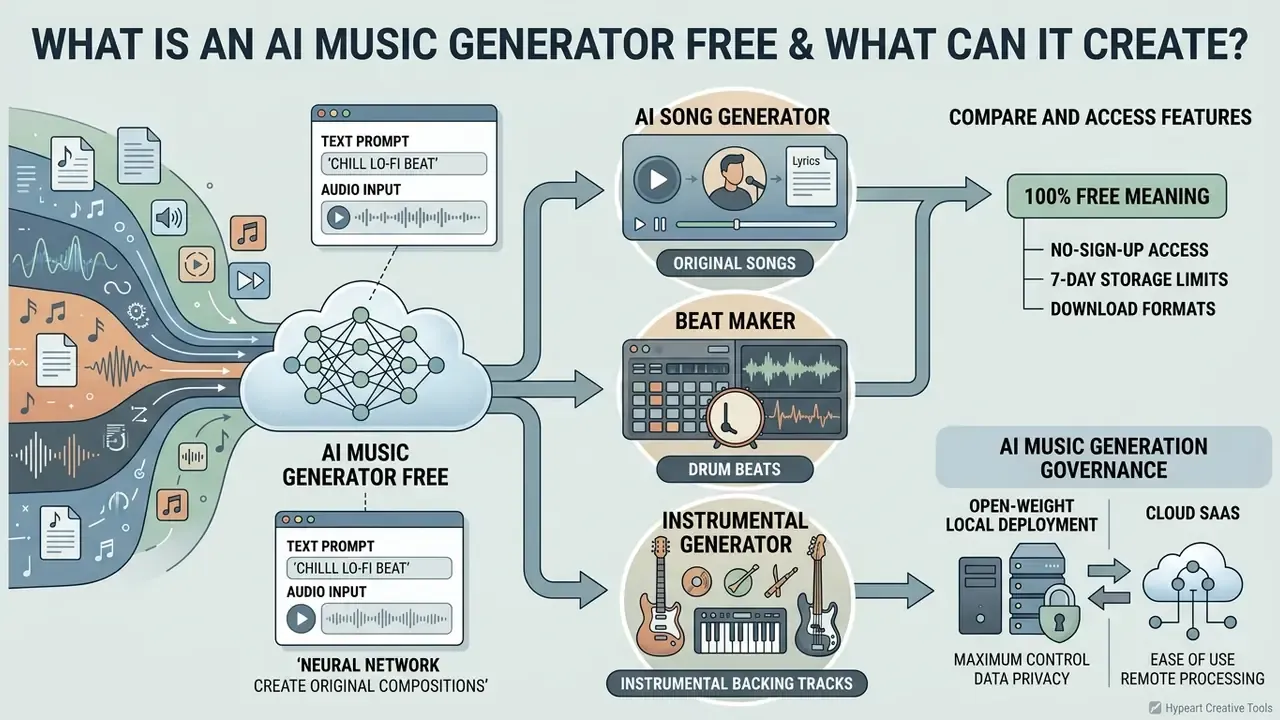
An AI music generator free is an online tool that uses neural network architectures to produce original songs, drum beats, and instrumental backing tracks from text or audio prompts, without an upfront subscription. These systems convert structured input into complete multi-minute compositions, rhythmic loops, or non-vocal background beds. In practice, three output classes cover almost every request: a full song with vocals, a beat, or an instrumental.
Industry forecasts indicate that the global generative music software sector is projected to expand from USD 1.18 billion in 2026 to USD 7.29 billion by 2036. That figure comes from a commercial market-research forecast rather than a peer-reviewed dataset, so treat it as a directional indicator that still needs independent verification before it enters a business case. What is measurable, and reproducible, is inference speed:
«Stable Audio 3 generates up to 190 seconds of audio in under one second on consumer hardware, making real-time online generation technically feasible.»
Modern architectures rely on latent diffusion transformers and flow-matching models to process user requests. Latent diffusion, in plain terms, means the model denoises a compressed representation of sound rather than raw waveform samples, which is why generation is fast enough to feel interactive. Teams can test specialized capabilities across production tasks by reviewing our AI Media Comparison Matrices.
AI song generator, beat maker and instrumental generator
An AI song generator creates full multi-part compositions with vocal melodies and synchronized lyrics. An AI beat maker, by contrast, focuses on percussive patterns, drum loops, and rhythmic sequencing. Some tools work purely as an AI beat maker from text, so a single sentence about tempo and drum character is enough to produce a usable loop.
An AI instrumental generator builds non-vocal audio beds for podcasts, videos, and game environments. Modern tools also work as an AI backing track generator free of charge on entry tiers, producing accompaniment designed to support a live vocalist or a lead instrument.
Technical implementations differ across these three categories. Song generators combine voice synthesis with harmonic arrangement models. Beat generators prioritize rhythmic quantization and low-frequency transient management, which is why a trap kick sits cleanly under an 808 instead of fighting it.
«MusiConGen generates realistic backing tracks from specified BPM and chord progressions without requiring reference audio at inference time.»
Instrumental generators optimize harmonic progression and background spectral balance. Efficiency is improving even at small data scales:
«MG2 outperforms open text-to-music models on MusicCaps and MusicBench using under one third of the parameters and 200x less training data.»
What "100% free" means for AI music generation
In generative audio, "100% free" usually means open-weight models that run locally with no subscription and no per-use fee. Commercial web platforms use a different definition: a free plan with daily generation quotas, shortened track limits, or non-commercial licensing restrictions. Both get marketed as a 100% free AI music generator. Only one of them is free in the legal sense as well as the financial one.
Fully open-weight models, such as Stable Audio 3 Medium, allow local execution on standard consumer hardware.
«The small and medium Stable Audio 3 weights are published and run on consumer hardware without a subscription, genuinely free access for technically prepared users.»
Web services such as Suno or Canva operate freemium tiers instead. Suno's free plan grants 50 daily credits, roughly 10 song generations, but withholds commercial usage rights. Canva's free allocation is documented at 900 tokens per month with up to 10 soundtracks per day, a 180-second duration ceiling, and no standalone audio download. Loudly's free plan has been reported at 25 generations per month, 30-second track lengths, and one download per day. That last figure comes from third-party roundups rather than a dated vendor page, so verify current limits in the platform's own pricing documentation before you rely on them.
Understanding these constraints prevents licensing conflicts later. Organizations evaluating automated creative workflows should examine enterprise tiers or see the overview for scalable API documentation, model total cost of ownership with the calculators in our explore the hub section, and compare adjacent tooling economics through our review of free AI video generators.
Open-weight local deployment versus cloud SaaS: a governance comparison
| Governance dimension | Open-weight local model (e.g. Stable Audio 3 Medium) | Cloud SaaS free tier (e.g. Suno, AIMusic, MusicHero) |
|---|---|---|
| Prompt data location | Stays on local or on-premise hardware | Transmitted to third-party servers |
| Telemetry / analytics | None by default | Usage and prompt telemetry typical |
| Model version control | Pinned weights, reproducible builds | Vendor updates models without notice |
| Security certifications | Inherited from your own infrastructure | Rarely published for free tiers (no SOC 2 / ISO 27001 assurance) |
| Output retention | Controlled by your storage policy | Often 7 days on free tiers, then expired |
| Reproducibility for audit | Seed plus weights plus prompt reproducible | Non-reproducible after a model update |
| Infrastructure requirement | Consumer GPU sufficient for short clips | None (browser only) |
The trade is simple enough to state in one line: local inference buys you control and reproducibility, cloud tiers buy you speed and zero setup.
Free plan, pricing limits and commercial-use rights
Navigating free AI music generation means separating non-commercial free access from paid commercial licensing. Platforms enforce daily generation caps, download restrictions, and explicit legal boundaries around ownership.
Comparison of free, paid and enterprise AI music generation tiers
| Metric / Parameter | Free tier / open mode | Paid subscription tier | Enterprise / API tier |
|---|---|---|---|
| Daily generation limit | 2 to 10 songs per day (e.g. 50 credits on Suno) | 500+ songs per month | Custom volume limits |
| Download formats | MP3 (128 to 192 kbps) or no direct download | High-quality MP3 and lossless WAV | Lossless WAV and multitrack stems |
| Commercial usage rights | Strictly prohibited (personal and testing only) | Full commercial grant during the active term | Perpetual commercial ownership and clearance |
| Royalty-free status | Non-royalty, non-licensed | Royalty-free for new output | Royalty-free with indemnification |
| License certificate | None provided | Downloadable PDF certificate, frequently restricted to annual subscribers | Enterprise agreement and SLA |
| Track retention | 7 days on most web platforms, then "Expired" | Indefinite or 365-day cloud storage | Contractual retention and export guarantees |
| Audio watermarking | Often applied silently; disclosure varies by vendor | Vendor-dependent; verify before distribution | Negotiable, with detection documentation |
Data verified against platform documentation as of 2026. Check the vendor's own pages before signing anything, because these tiers move quarterly.
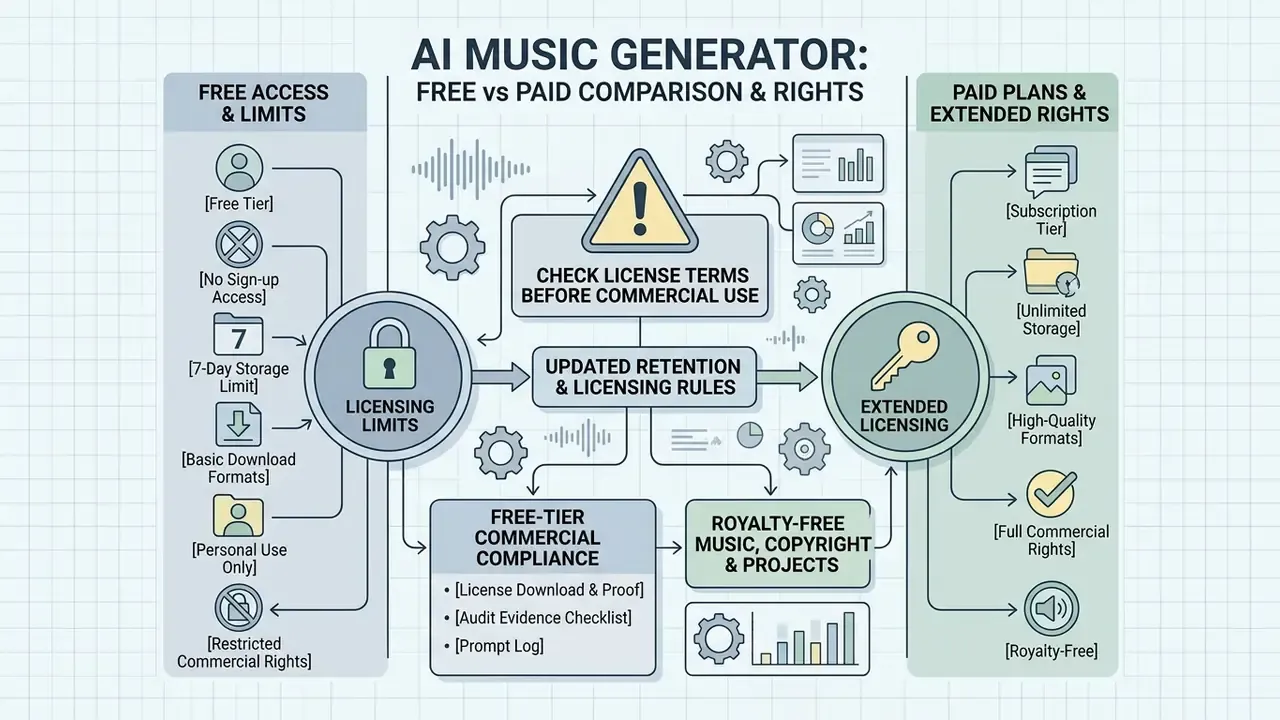
Free access versus paid music generator plans
Free tiers work best as evaluation sandboxes: a place to test prompts and audition model behaviour before money is involved. They typically cap monthly generations, shorten maximum track length to around 30 seconds, and limit exports to a single download per day. Loudly is the example most often cited for that pattern.
Updated retention and licensing rules. Paid subscriptions store generated tracks indefinitely, or on 365-day cloud plans as with MakeSong's Starter and Standard tiers. Free-tier creations on web platforms such as AIMusic.so and MusicHero.ai are typically retained for only 7 days before automatic deletion, after which the track shows as "Expired." Download the MP3 the moment it renders. Furthermore, downloadable PDF Commercial License Certificates are frequently restricted to annual paid subscribers, which leaves monthly and free users without written clearance even when the usage itself is permitted. That asymmetry catches procurement teams off guard more often than the price does.
Paid plans lift generation limits, unlock 24-bit/48 kHz WAV downloads, enable stem isolation, and grant commercial rights. For cost comparisons across related creative tools, browse the hub for detailed breakdowns.
Royalty-free music, copyright and commercial projects
"Royalty-free" means you are not required to pay ongoing per-play royalties while the track is used inside the granted licence scope. It does not hand you underlying copyright ownership. Those are two different things, and the confusion between them causes most takedown disputes.
In the United States, the Copyright Office maintains that works created entirely by artificial intelligence, with no human authorship, cannot be protected by copyright.
«Even where a platform presents tracks as original, instrumental similarity screening reveals a complex landscape of overlap with protected works.»
Hybrid compositions with substantial human arrangement or original lyric writing may qualify for protection, limited to those human contributions. The Copyright Office's 2026 correspondence on AI-created musical works adds that royalty eligibility follows protection: where the musical work is unprotected, the claimant is not entitled to collective royalties.
Monetizing AI music on YouTube or Spotify requires a verified commercial licence from the generation service. Unlicensed use of free-tier output can trigger copyright strikes, monetization claims, or removal. Legislative activity is still live: H.R.8994 in the 119th Congress would let music creators collectively negotiate or refuse licensing terms with generative AI companies, a signal that training-data rights remain unsettled. Teams standardizing policy across formats can review commercial use rights for AI-generated content as a parallel framework, and follow open disputes through our AI Litigation and Case Timelines.
License download and proof of usage rights
Audit evidence checklist for free-tier AI audio
Internal audit and model-risk functions need reproducible artifacts, not screenshots. Collect the following at the moment of generation:
- Prompt logthe exact prompt string, lyric text, negative prompts, and any style tags used, with a UTC timestamp.
- Model identifier and versionthe model name and version string (for example Suno v5, Lyria 3 Pro, Stable Audio 3 Medium), because vendors upgrade models quietly.
- Seed or generation IDthe platform-issued generation identifier, which is what supports later reproducibility questions.
- Human contribution recordarrangement edits, lyric authorship, section replacements, mix decisions. This is the only material that can attract copyright protection.
- License artifactthe PDF Commercial License Certificate, with a note on whether the plan is monthly or annual, since PDF issuance is often annual-only.
- Export copy with checksumthe WAV or MP3 archived in controlled storage with a hash, given the 7-day expiry on free tiers.
- Watermark and detection noteswhether the vendor applies inaudible watermarking, plus any detection report used for verification.
Seven fields. Two minutes per track. That is the whole control.
Data privacy, prompt logging and Shadow AI risk in free AI music tools
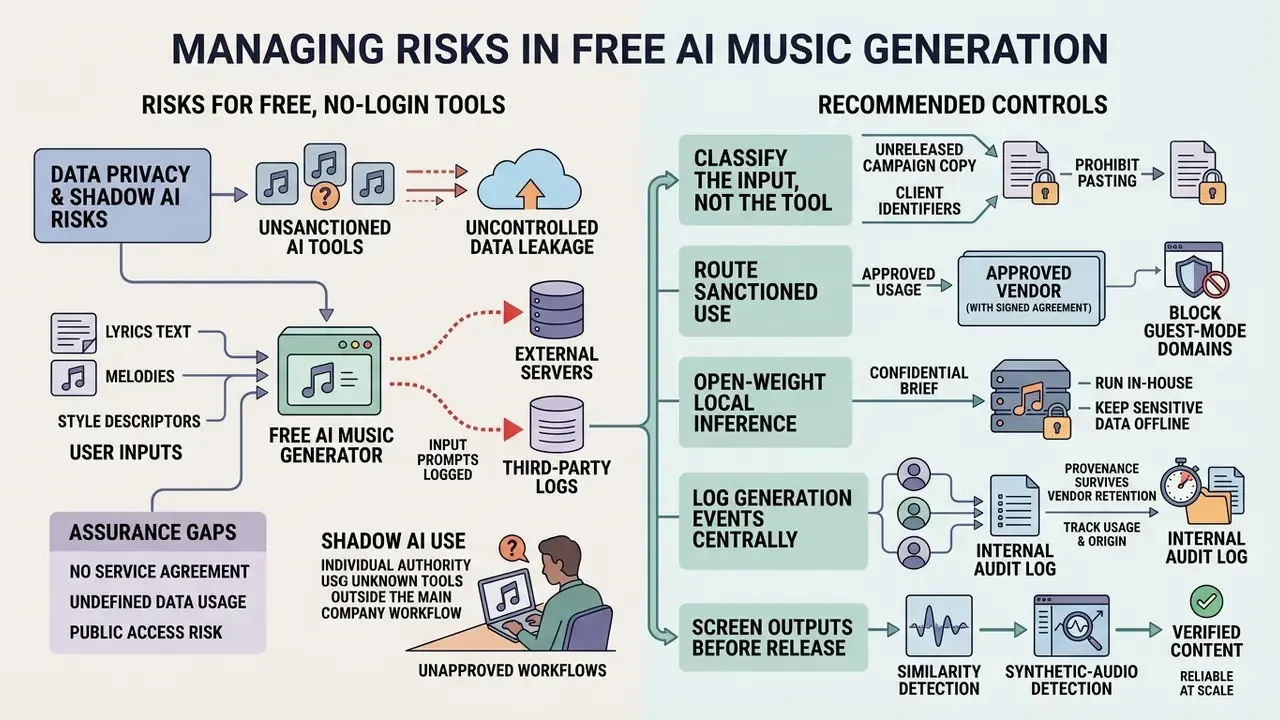
Free, no-login music generators are convenient precisely because they collect no account. That same property makes them a Shadow AI channel, because every prompt is an outbound data transfer.
What actually leaves the perimeter. Style prompts, full lyric texts, campaign briefs pasted into a "song description" box, client names in track titles, and uploaded reference audio (many platforms accept roughly 30 seconds of guide audio) all travel to third-party infrastructure. Where vendor terms reserve a licence for marketing or model-training purposes, a clause present in published 2025 to 2026 terms of service for several AI music services, that content may be reused well beyond the original request.
Assurance gaps typical of free tiers. Free and guest modes rarely publish SOC 2 Type II reports or ISO 27001 certificates, rarely offer a data-processing agreement, and rarely expose a deletion API. Retention is defined by the product ("7 days, then Expired"), not by your policy. No tenant isolation guarantee, no configurable region, no export of access logs.
Controls that work in practice.
- Classify the input, not the tool: prohibit pasting unreleased campaign copy, client identifiers, or unpublished lyrics into any consumer-tier generator.
- Route sanctioned use through one approved vendor with a signed agreement, then block guest-mode domains at the egress proxy for higher-risk business units.
- Prefer open-weight local inference for sensitive briefs. Local execution keeps prompts inside the perimeter and pins model versions for reproducibility, which lines up with NIST AI RMF measurement and documentation practices.
- Log generation events centrally so provenance survives the vendor's 7-day retention window.
- Screen outputs before release using similarity and synthetic-audio detection, which is now reliable at scale (see the detection metrics in the compliance summary below).
Create AI music from text, lyrics or a custom idea
Generating custom AI music from text prompts or written lyrics means translating a stylistic concept into concrete genre tags, tempo values, and structural markers. Modern models read descriptive language to control arrangement dynamics, instrument choices, and vocal character. An AI custom song generator free of charge on its entry tier will still respond to precise language; vague language is what produces vague music.
Research shows that structured prompt syntax improves output alignment.
«Genre vocabulary transfers from prompt to perception most reliably, while narrative-heavy prompts are the strongest predictor of semantic misalignment between request and result.»
The practical implication is direct: lead with genre and mood tokens, keep instrumentation concrete, and push story context into the lyric field instead of the style field.
Text-to-music prompts: genre, mood and style
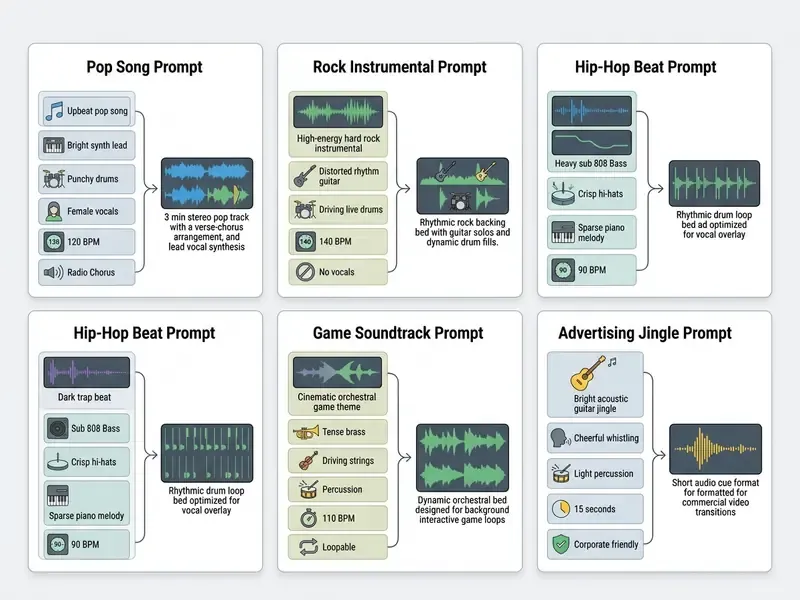
Text-to-music prompts work best in a clear sequence: genre, mood, instrumentation, tempo, vocal style. Supplying an explicit Beats Per Minute value helps the model lock rhythmic pacing instead of guessing at it.
According to Google's Lyria prompting guidance for music generation (2026), pairing genre tags with named instruments produces predictable output. The documented prompt order is genre/style, then mood, then instrumentation, then tempo/rhythm, then vocal style and language, then lyrics, with "instrumental" reserved as the token that excludes vocals. Requesting "120 BPM driving synth-pop with piano lead" yields far higher structural adherence than an abstract emotional description. Google Cloud's guide adds that Lyria 3 Pro accepts text, PDF files, or up to ten reference images to set a track's emotional baseline, while ElevenLabs Music v2 accepts roughly 30 seconds of uploaded reference audio to steer style.
Ready-to-use AI music prompt templates
Copy and adapt these tested formulas for consistent structure:
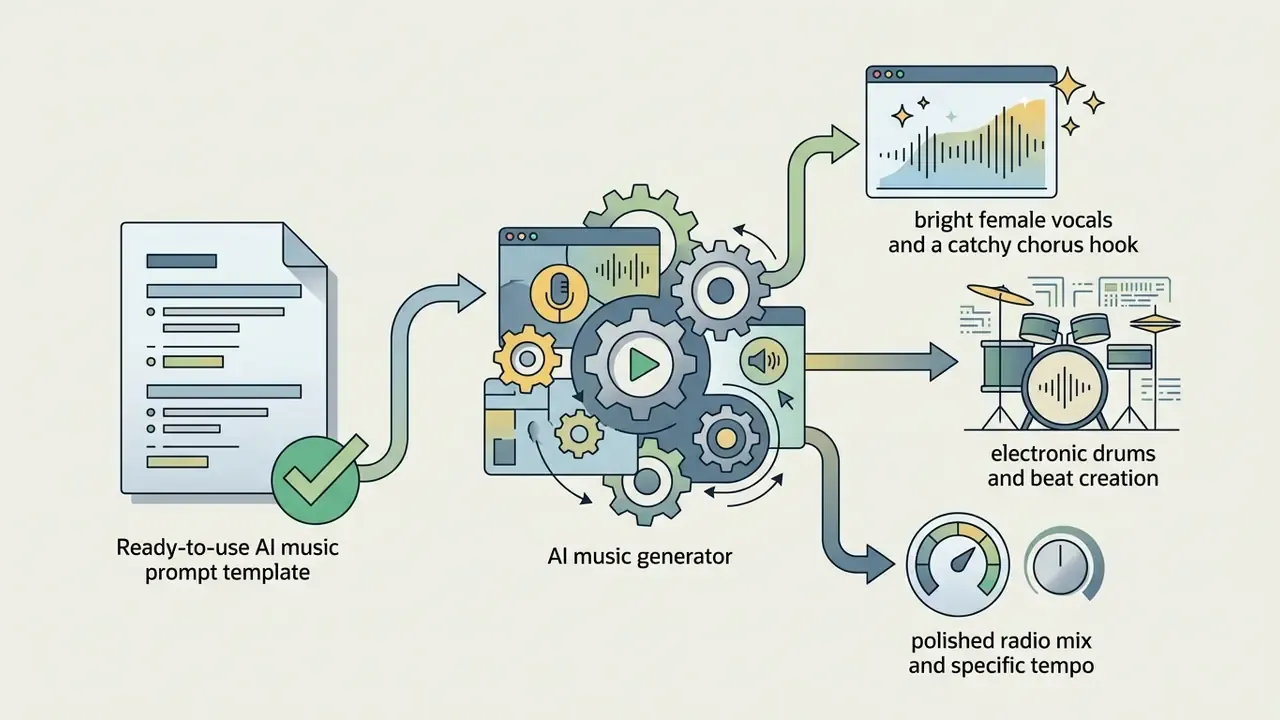
"Upbeat synth-pop, bright female vocals, catchy chorus hook, electronic drums, 120 BPM, polished radio mix"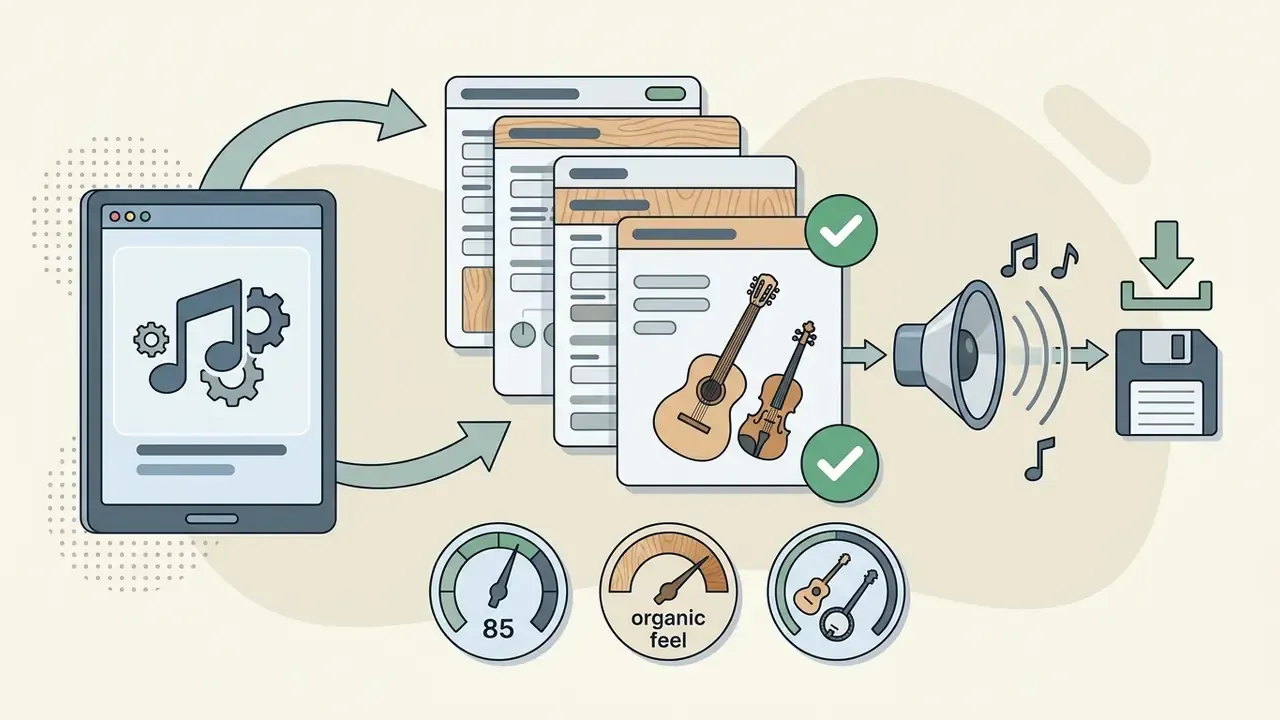
"Classic country ballad, nostalgic acoustic guitar, banjo and fiddle, warm male vocals, 85 BPM, back porch organic feel"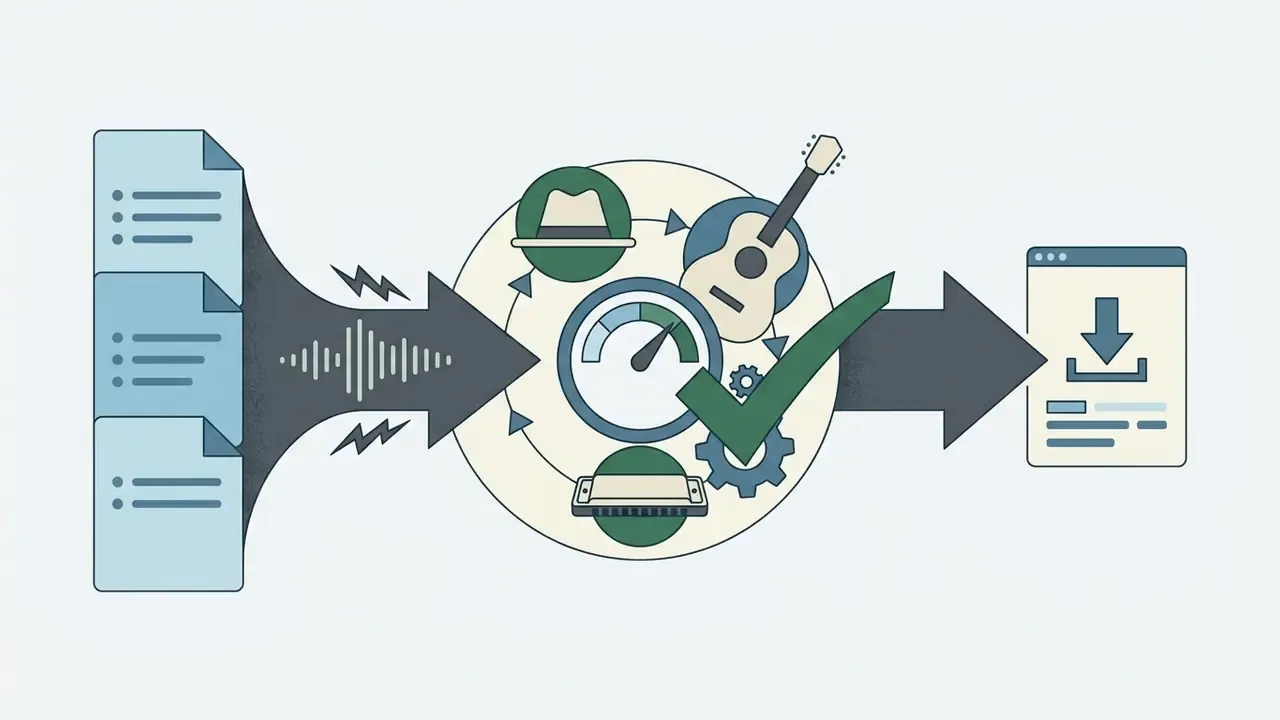
"Outlaw country, free-spirited and gritty, male singer, harmonica and slide guitar, 90 to 100 BPM"
"High-energy hard rock, distorted electric guitar riffs, driving live drums, aggressive male vocals, 135 BPM"
"Dark trap beat, heavy sub-808 bassline, crisp hi-hat rolls, sparse piano chords, female rapper, 95 BPM"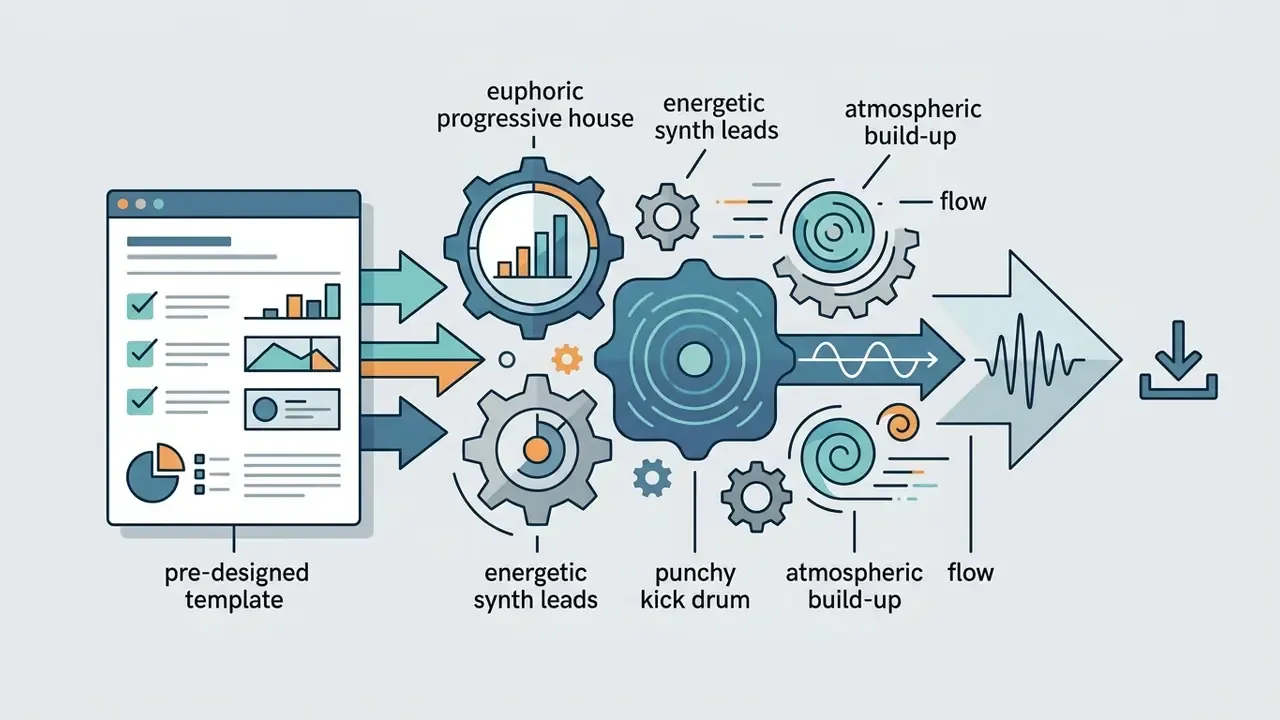
"Euphoric progressive house, energetic synth leads, punchy kick drum, atmospheric build-up, bass drop, 128 BPM"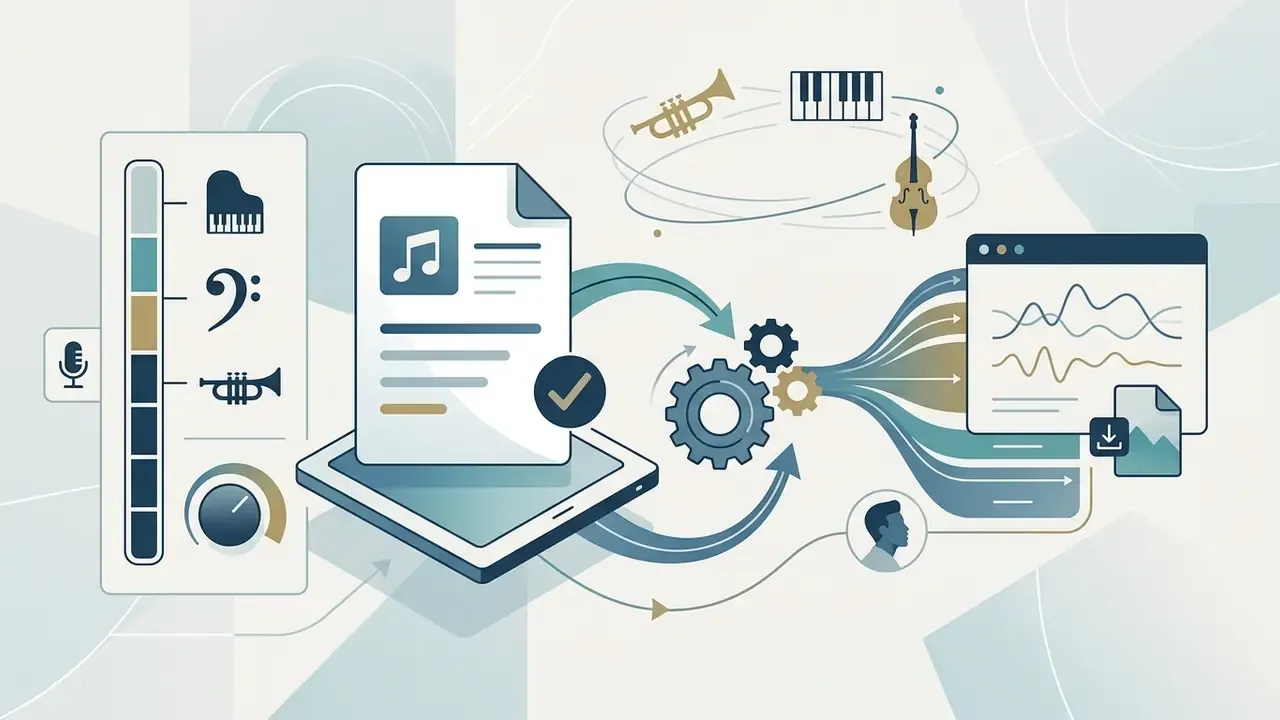
"Smooth classic jazz, intimate and romantic, male singer, piano, upright bass, trumpet, 70 to 80 BPM"
"Epic orchestral game soundtrack, tense string section, heavy brass, driving battle percussion, 110 BPM, loopable"
"Emotional pop ballad duet, male and female singers alternating verses, piano, strings, acoustic guitar, 90 BPM"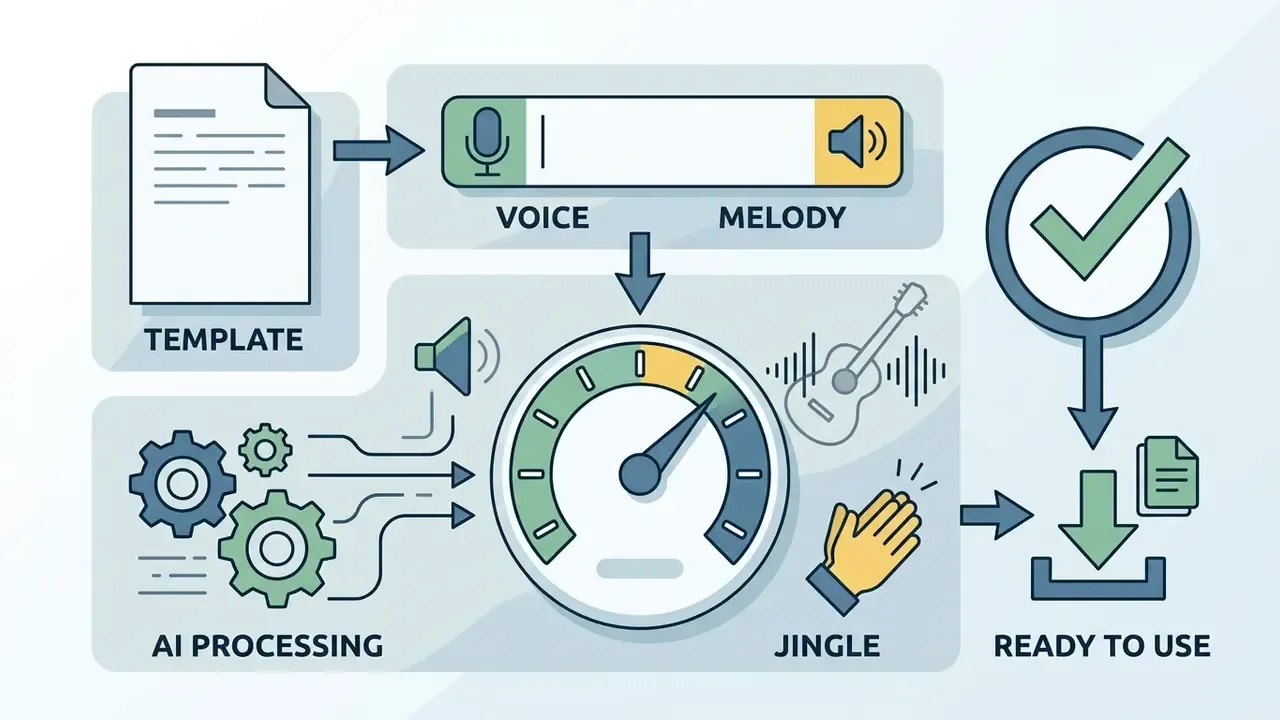
"Short brand jingle, memorable melody, clean vocals, bright acoustic guitar, claps, 15 seconds, upbeat and brand-friendly"When building media pipelines, most creators process footage before pairing it with audio. Teams converting video assets for social campaigns can consult our YouTube video editor workflow guide, and anyone cutting long video to short-form clips should generate the music at the final clip length rather than trimming a three-minute track down.
Turn lyrics into a song with vocals
Lyrics-to-music generation means pasting explicit lyric text into a dedicated vocal field while keeping genre and style parameters in the prompt field. Structural tags such as [Verse], [Chorus], and [Bridge] guide vocal phrasing and arrangement shifts. This is the workflow behind every search for an AI lyrics to music generator free of charge, and it is the one most sensitive to formatting discipline.
Format the lyric input with standardized bracket tags:
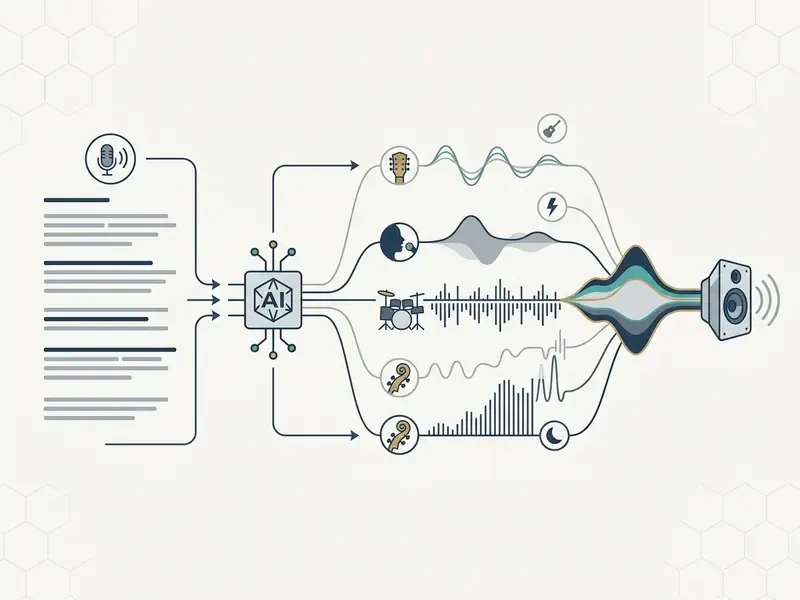
Modern singing voice synthesis models, such as TCSinger, separate vocal timbre, pitch content, and stylistic expression during generation. TCSinger (EMNLP 2024) uses audio or text prompts for zero-shot style transfer and multi-level style control, while Seed-Music (2025) accepts lyrics, style descriptions, reference audio, and scores as unified control inputs. The result preserves vocal clarity while aligning lyrical cadence with the accompaniment underneath.
«Vocal synthesis, lyric alignment, and long-term narrative coherence remain active research problems rather than solved capabilities.»
Note: This information is general. Vocal synthesis quality varies substantially between platforms and model versions; verify a specific service's current capability before committing it to a commercial delivery.
Keep lyric formatting separate from acoustic instructions. Placing a performance directive such as "sing softly" inside the lyric body can make the model sing that instruction out loud, which is funny exactly once. Projects that need spoken narration rather than singing are better served by dedicated AI voice generators, which expose separate controls for pacing, emphasis, and language.
Generate beats, backing tracks, jingles and game music
Specialized audio generation depends on prompt structures tailored to the target format. Beat creation emphasizes drum-machine parameters; a backing track needs harmonic arrangement that leaves frequency space for a lead vocal.
Advertising jingles want a tight 15-second or 30-second arc with one memorable melodic cue, which is why an AI jingle generator from text free tier is often enough for concept work. Game music depends on adaptive looping, tension parameters, and state-based atmospheric shifts. Practitioner tooling usually frames the prompt around a gameplay state (boss battle, exploration, puzzle) and then adjusts intensity, pacing, and instrumentation, sometimes switching styles in real time. An AI game music generator from text is at its strongest here, because the state names double as mood tokens.
Illustrative example: during a corporate media overhaul, a digital publishing team generated 40 custom background cues for an online video series using text-driven instrumental prompts. By standardizing prompt templates with fixed BPM tags, they cut media sourcing time by roughly 65 percent. The resulting library passed internal audio quality checks without external mixing.
How to use an AI music generator free online
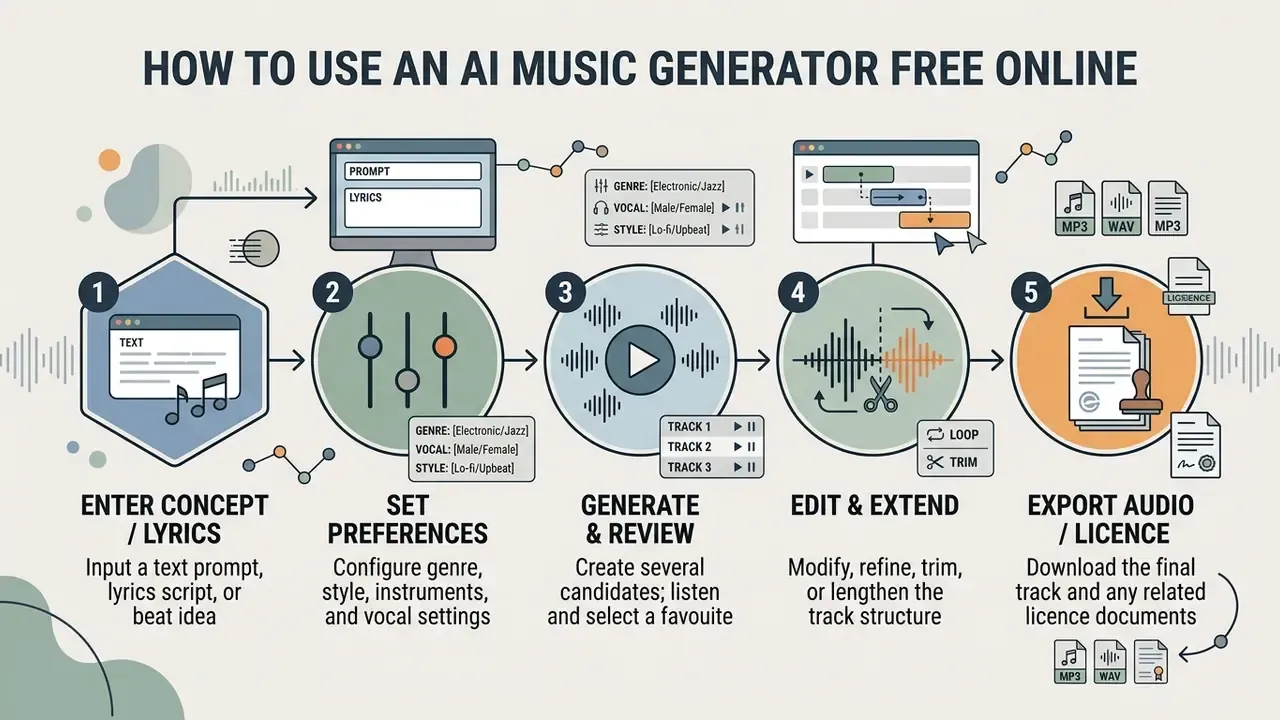
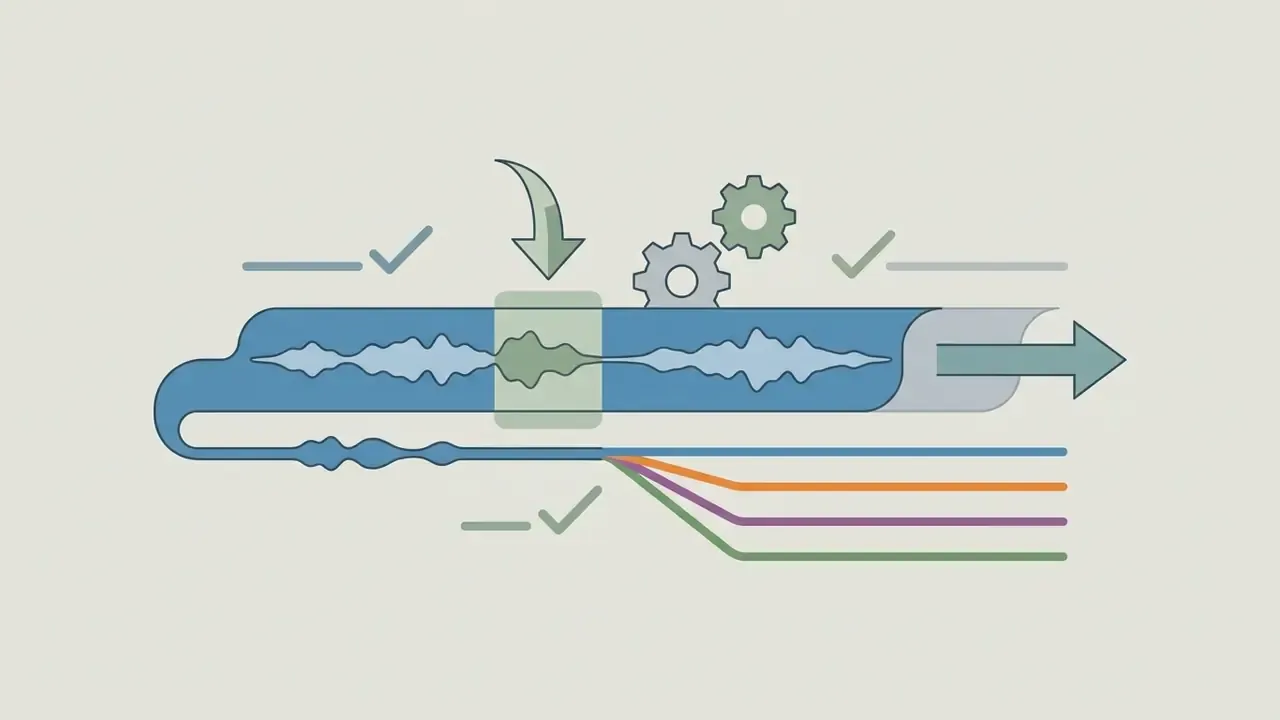
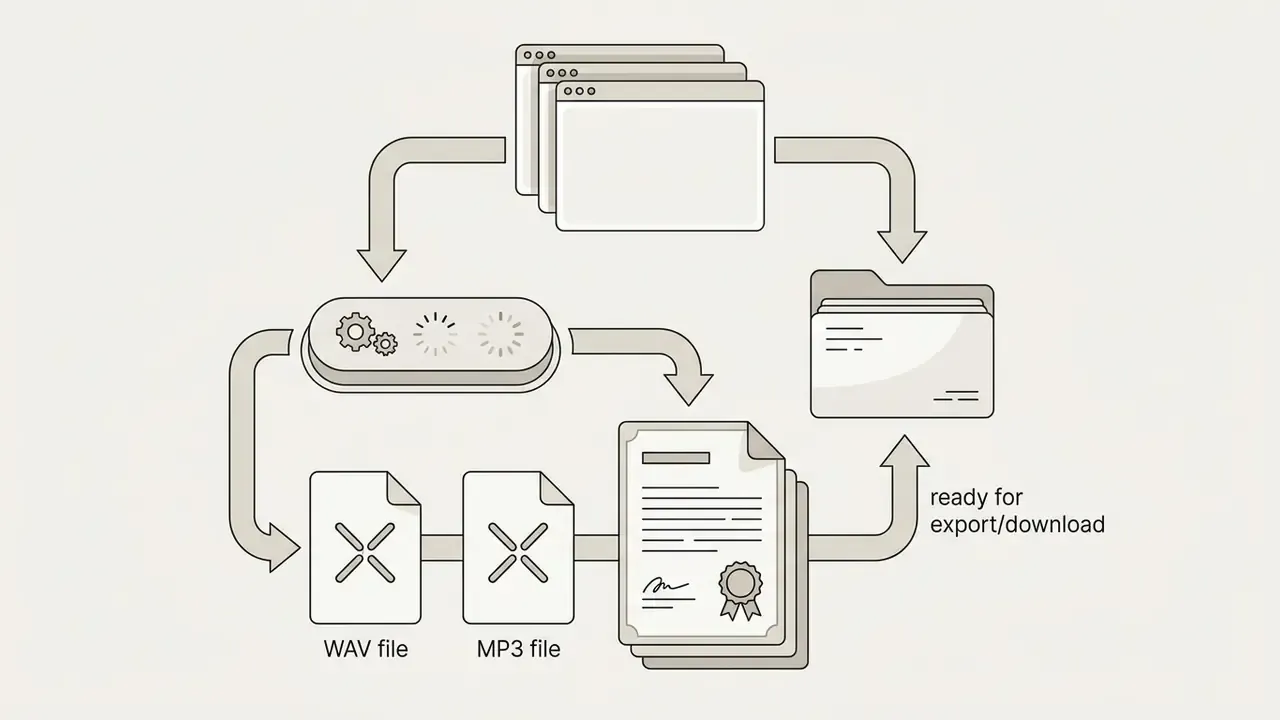
Creating AI music online comes down to five moves: enter a text prompt or lyric script, set arrangement preferences, generate candidates, edit, export. No composition experience required, which is both the appeal and the governance problem.
«Users perceive AI tools as valuable for idea generation and draft arrangement while retaining human control over final creative decisions.»
Step-by-step AI music generation process
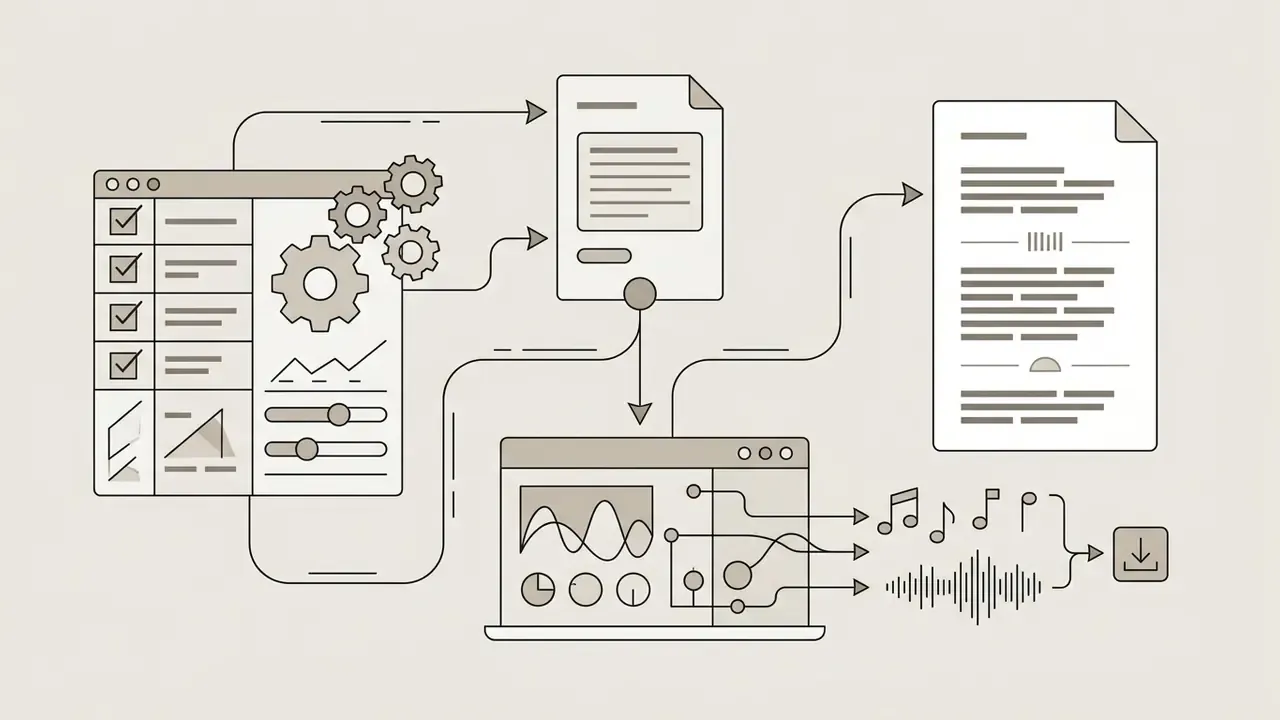
Enter a song description, lyrics or beat idea
The first decision is the operating mode. Text-to-music builds instrumental or vocal tracks entirely from a descriptive prompt, which is what most people mean by an AI free music generator from text.
Most web platforms now offer guest access ("no sign-up, no login required"), so you can test capabilities instantly without an account. AIMusic.so and MusicHero.ai both open generation straight from a "Generate Music" button, and the same pattern shows up in every AI beat generator free no sign up listing. The catch: guest generations are usually restricted to basic MP3 previews, do not persist history across browser sessions, and fall under the 7-day expiry rule. For anything that must be retrievable later, sign in before you generate.
Lyrics-to-music needs two separate fields: one for lyric text, one for musical style. Separating them stops the model from reading style instructions as sung text. Some APIs use a dedicated lyrics parameter; others accept lyrics inline after a Lyrics: prefix.
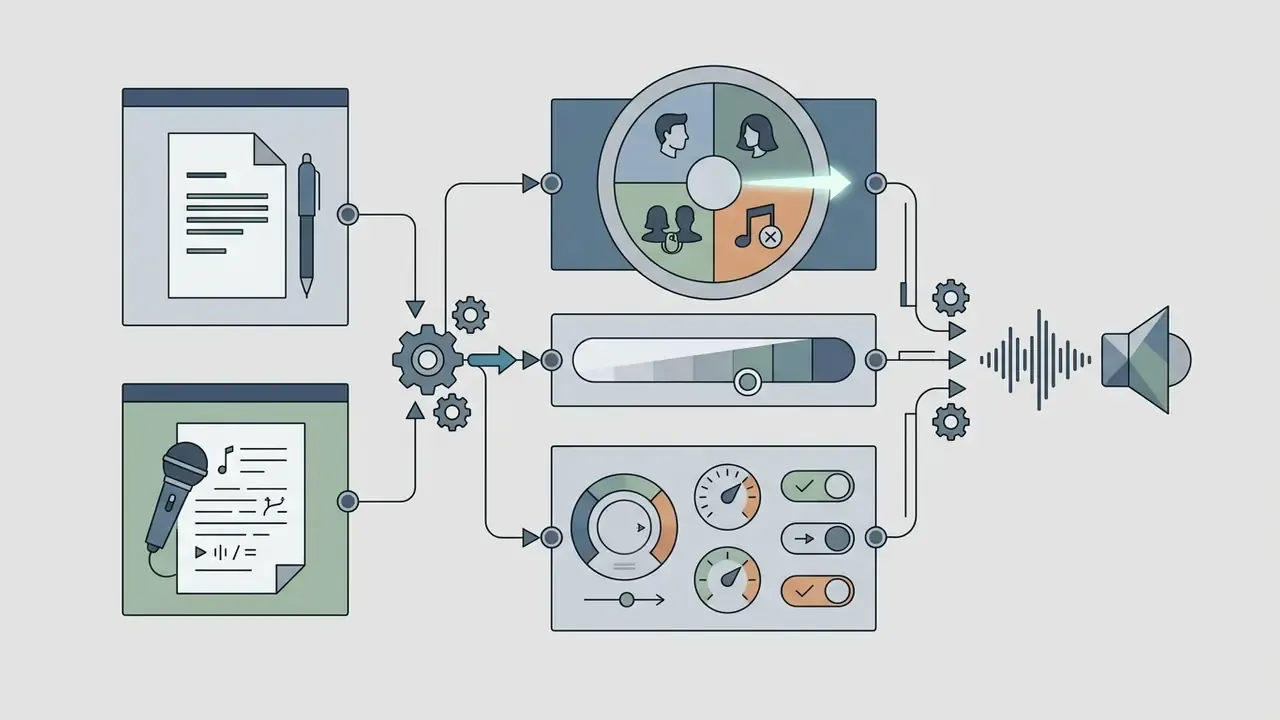
Choose genre, style, instruments and vocal settings
Generation controls typically cover primary subgenre, instrumental layers, vocal gender, and structural arrangement. Advanced models also accept key signature and target duration, and documented control surfaces include male, female, and duet vocal generation alongside segment-level structure labels.
Research published in Do Text-to-Music Models Really Follow Instructions? (2026) found that models such as Stable Audio 3 Medium reach high instruction accuracy (73.4%) when an explicit key signature is requested. Worth noting: this is a counterfactual measurement, not a raw hit rate.
«ACE-Step 1.5 and Stable Audio 3 Medium reached delta values of 0.609 and 0.698 for key control, confirmed steering rather than coincidental alignment with the model's prior distribution.»
Selecting a duet setting instructs the model to alternate vocal timbres across verse sections. Small parameter, large perceived difference.
Generate, review, edit and download the track
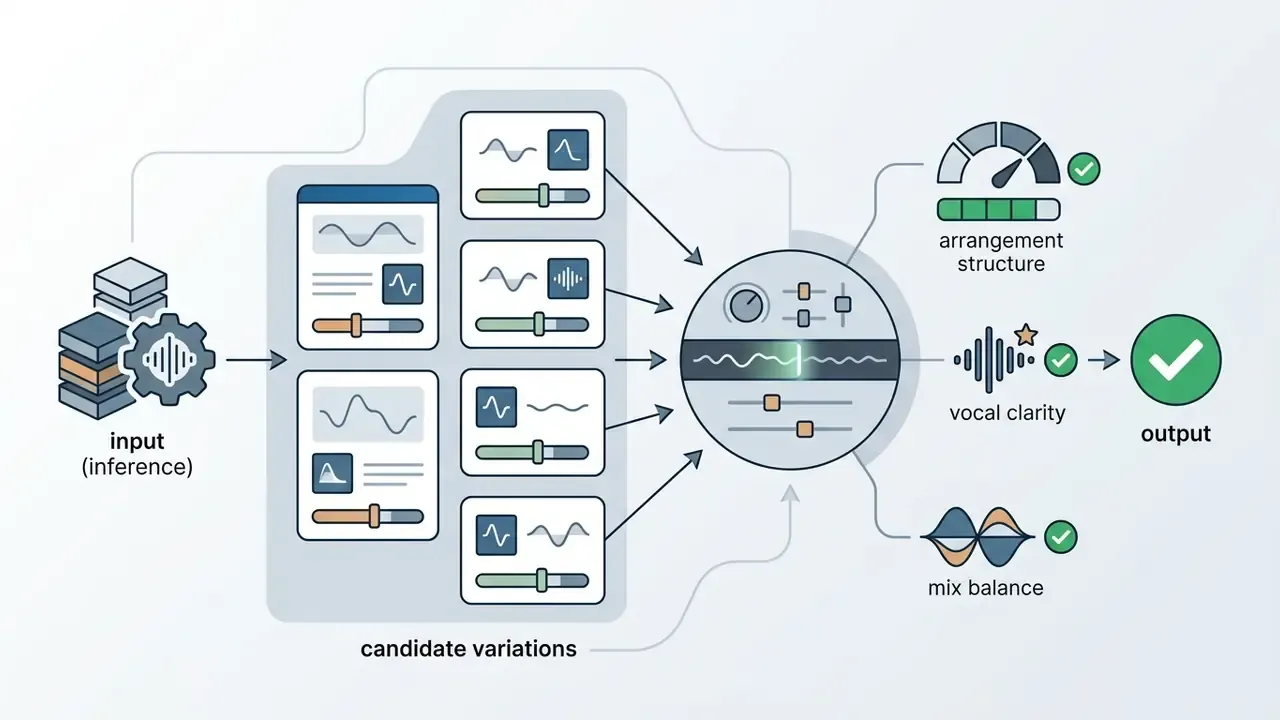
Once generation starts, inference builds candidate variations in roughly 10 to 60 seconds. Audition each option for mix quality, vocal alignment, and composition flow before you commit.
Post-generation editing covers inpainting, section extension, and stem separation. Research systems demonstrate the underlying capability set: token-masking models support inpainting, outpainting, continuation, looping with variation, and vamping, whereas autoregressive models such as MusicGen are limited to continuation without suffix conditioning. Commercial products surface the same ideas as "Replace Section," "Extend," and "Cover," letting users rewrite a specific segment or lengthen audio without disturbing the surrounding arrangement. Availability differs by platform, so verify against current product documentation rather than a blog post.
Export scope also varies. Some tools offer full-song download only; others expose selected time ranges and multitrack stems. Suno Studio, for example, provides Full Song, Selected Time Range, and Multitrack export options, plus per-clip WAV download from the timeline.
After refining the audio, download everything you might need later. For projects requiring custom video integration, review specialized tools or compare options for production support, benchmark visual pipelines against our roundup of the best free AI video generators, and test motion output with a luma ai video workflow if the campaign needs generated visuals as well as generated sound.
Music styles and generation options for free AI tracks
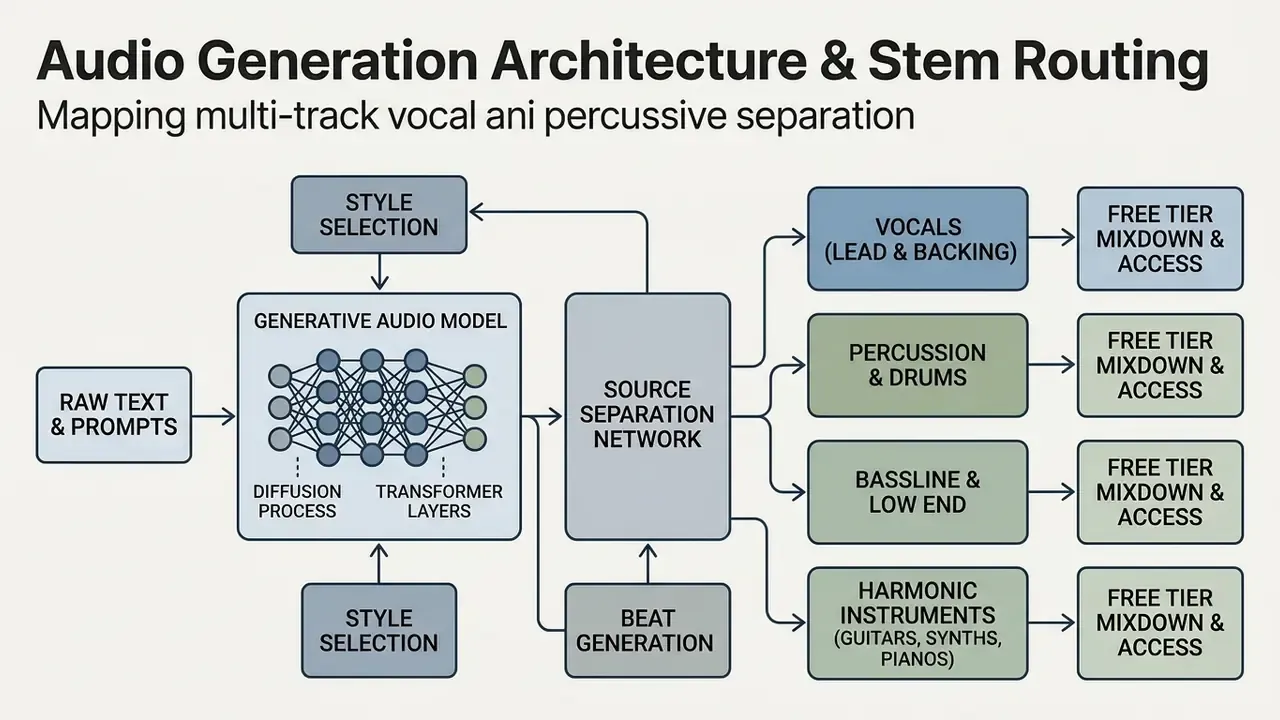
Generative music systems now cover a wide array of genres, structural configurations, and arrangement options. Users can customize instruments, vocal arrangements, and track length to fit the project. Duration ceilings vary sharply: Lyria 3 Clip is fixed at 30 seconds, the ElevenLabs Music API accepts 10 to 240 seconds through a length parameter, and product-level documentation describes songs up to roughly five minutes.
Genres: pop, rock, rap, classical and game music
Generative algorithms handle traditional genres by recognizing acoustic patterns, drum textures, and arrangement norms. Pop emphasizes a clear vocal hook, rock leans on distorted guitar layers, rap prioritizes heavy percussive bass, classical relies on complex orchestral writing. An AI beat generator online free of charge will usually handle trap and boom-bap well, and struggle with anything harmonically unusual.
An audit published in The Algorithmic Flattening of Sound (2026) showed that commercial models carry distinct acoustic signatures across genres. The two homogenization patterns are different in kind:
«Lyria compresses within-genre diversity toward the genre centre, whereas Suno erases acoustic distinctions between genres, both patterns reflecting learned priors rather than user prompts.»
Practically, a prompt asking for an unusual subgenre variant may get pulled back toward a generic centre, and a cross-genre fusion request may collapse into one blended texture. Explicit instrumentation and BPM constraints are the most effective counterweight available today.
Creators building interactive software often need dynamic game audio that reacts to player actions. Those arrangements depend on seamless looping, adjustable intensity layers, and a steady tempo grid; if you also need to loop video online for a matching background visual, keep the audio loop length and the video loop length in whole-bar multiples. Studios pairing generated audio with generated visuals can review implementation economics in our Google Veo API guide.
Vocal songs, instrumentals and original backing tracks
Choosing between a vocal composition, a pure instrumental, and a backing track depends on how the audio will sit in the final media. Vocal tracks push synthesized singing to the front of the mix, usually a few decibels above the accompaniment.
Instrumentals drop the lead vocal so harmonic and percussive layers carry the piece.
«In listening tests, Stable Audio 3 received the highest musicality ratings among open models for 120-second instrumental generations.»
Backing tracks isolate rhythm section and accompaniment, which makes them useful for live singers, voiceover beds, and corporate presentations. In conventional production, drums, bass, rhythm guitar, and keys get recorded first as the basic track, with vocals and solos overdubbed later. Generative tools mirror that habit by letting you render accompaniment separately and layer the performance on top.
Illustrative example: a software development team needed custom audio for an interactive prototype. They generated 15 loopable instrumental cues with a free local model, filtering out vocal artifacts that distracted testers. The assets integrated into the build with zero licensing fees and no external vendor review.
Integrated AI audio tools: vocal remover, lyrics video and SFX
Modern free AI music platforms do more than write tracks. The adjacent tools are often the actual reason a free tier is worth using, because they replace separate desktop software.
- AI vocal remover and stem separator isolate vocals from backing instruments in one click, then extract a clean acapella or build an instrumental karaoke version from a generated or uploaded song. Under the hood, separation models split audio into drums, bass, melody, vocals, and FX stems. SOUNDRAW exposes exactly that split on WAV plus Stems export, and research pipelines use tools such as Demucs to build aligned vocal and accompaniment pairs. Free tiers often allow separation previews while gating stem downloads behind a subscription.
- MP4 lyrics video generator combine generated audio and text with dynamic visual backgrounds, output in vertical 9:16 or horizontal 16:9 for TikTok, YouTube Shorts, and Instagram Reels. AIMusic.so and MusicHero.ai both ship MP4 lyric video generation next to their music engines, and MakeSong bundles an AI Music Video Generator plus an AI Singing Video Generator into paid plans.
- AI sound effects generator produce isolated atmospheric cues, UI clicks, foley elements, and cinematic risers from text-to-audio prompts without generating a full arrangement. Game and app teams use this to fill gaps in effect libraries; a 2024 study documented generating custom sounds for user-generated content using open audio models.
- AI lyrics generator draft verse and chorus text from a theme, keyword, or emotion, then feed the result into the music model's lyric field. This closes the loop for anyone with a concept but no written words.
- Cover, extend and replace-section tools regenerate a chorus, lengthen an outro, or re-perform an existing melody in a new style while keeping the surrounding arrangement intact.
A caution for governance teams, and this one matters: vocal removers and cover tools accept uploaded third-party audio. Uploading a commercially released recording to a free web service raises data-transfer and copyright questions that never arise with pure text-to-music generation.
Who can use free AI music for content and creative projects?
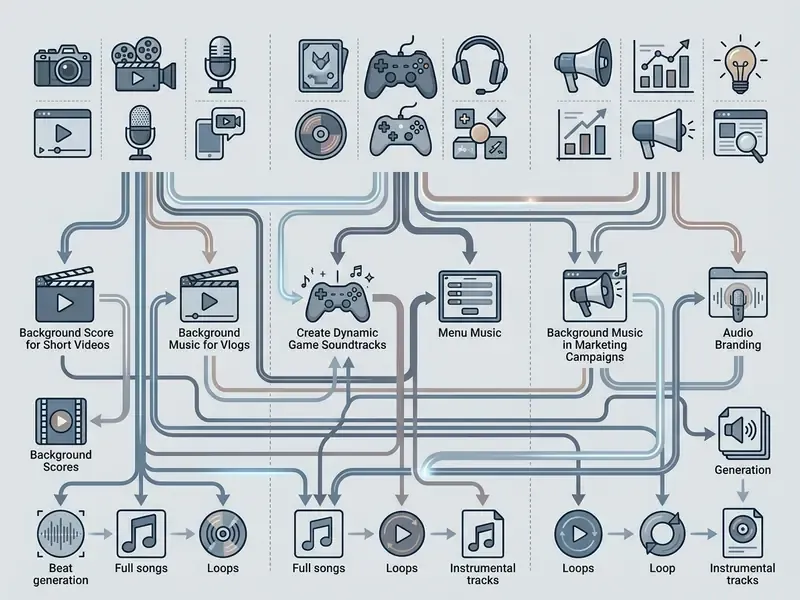
Generative music tools support a broad set of workflows, from solo creators to marketing departments inside regulated firms. A 2025 Centre National de la Musique study catalogued roughly 30 AI use cases across creation, production, marketing, promotion, and derivative exploitation, including music-video editing and automated promotional campaigns.
Custom tracks for games, films and music production
Indie game developers use generative models for adaptive soundtracks, atmospheric loops, and sound effects. Set style parameters per gameplay state and background audio can track player action; a 2024 AAAI paper reported emotionally directed adaptive soundtrack control for video games.
Film editors and music producers use these tools for temp tracks, demo concepts, and arrangement sketches during early production. Synthesized tracks act as creative blueprints before final studio sessions, which is a lower-stakes use of the technology and, arguably, the most defensible one.
Creators combining visual assets with custom audio can test a local ai video tool to build a complete offline media pipeline, prompts and all.
FAQ about AI music generator free
Can I generate AI music online without signing up or creating an account?
Yes. Platforms including AIMusic.so and MusicHero.ai advertise "no sign-up" and "no login required" generation, so you enter a description or lyrics and receive a track immediately. The same applies to most AI beat maker no sign up tools. Guest mode has three consistent limits: output is usually a compressed MP3 preview rather than lossless WAV, history is not preserved across sessions, and free-trial tracks expire after 7 days. If the audio feeds a deliverable, create an account and download the file at once.
What is the difference between an AI music generator and an AI vocal remover?
An AI music generator is a synthesis tool: it creates new audio from a text prompt or lyric input, producing arrangement, instrumentation, and optionally sung vocals. An AI vocal remover is a separation tool: it takes existing audio and splits it into stems, isolating the vocal from the instrumental so you can build a karaoke version, an acapella, or a remix. Generators answer "make me a track"; removers answer "split this track." Many platforms bundle both, plus stem export for drums, bass, melody, vocals, and FX.
What audio formats can I download for AI-generated music?
Free tiers generally limit exports to MP3 at 128 kbps or 192 kbps, and some platforms block direct download entirely. Paid tiers unlock uncompressed lossless WAV (24-bit, 44.1 or 48 kHz) and isolated multitrack stems separating drums, bass, vocals, and instruments. Some services additionally export MP4 for lyric videos and MIDI or project files for handoff into a DAW.
How long are generated songs available in the account?
Retention varies with the platform's infrastructure and storage limits. On leading free web platforms, free-trial and guest tracks are stored for 7 days and then marked "Expired," while paid subscriptions store output indefinitely or on defined 365-day cloud plans. Treat 7 to 30 days as the realistic planning window for any unpaid tier. Download preferred audio files and the associated PDF licence certificate to controlled local storage the same day.
Do free AI music tracks contain a watermark?
Vendor disclosure is inconsistent, which is itself a finding. Some services embed inaudible identifiers in generated audio, and independent detection research shows synthetic audio is identifiable from architectural artifacts regardless of vendor marking. Before distributing free-tier output, confirm the watermarking policy in writing and run a detection check if platform monetization is involved.
Can I use free-tier AI music in a monetized YouTube video or a client project?
Generally no. Free tiers on commercial platforms are licensed for personal evaluation, and the commercial grant usually starts with a paid plan. Even on paid plans, the downloadable Commercial License Certificate is frequently issued only to annual subscribers. Verify the specific plan's terms, retain the PDF, and remember that "royalty-free" describes the absence of recurring per-play fees inside the licence scope. It is not a transfer of copyright ownership.
Can AI-generated music be copyrighted?
Not in its purely machine-generated form under United States practice. Copyright requires human authorship, so protection extends only to identifiable human contributions such as written lyrics, substantive arrangement, or creative editing. The US Copyright Office's 2026 correspondence adds that where a musical work is unprotected, the claimant is not entitled to collective royalties. General information, not legal advice.
Verification and compliance summary
| Category | Primary rule / requirement | Verified source / reference |
|---|---|---|
| Editorial review | Reviewed by the media compliance desk; US business focus, pragmatically qualified tone. | Internal editorial standards, 2026 |
| US copyright policy | Pure AI output lacks human authorship; copyright applies only to human-authored elements. | US Copyright Office guidance (2026) |
| Commercial rights | Free tiers prohibit commercial monetization; paid tiers grant commercial usage licences; PDF certificates often annual-only. | Platform terms (Suno, AIMusicGen, MusicGPT, AIMusic.so, MusicHero.ai) |
| Free-tier retention | Free-trial tracks stored 7 days, then marked "Expired." | AIMusic.so FAQ; MusicHero.ai FAQ (2026) |
| Model spectral artifacts | Detection reaches 99.97% accuracy on real audio and 100% on Suno v3.5 synthetic content; artifacts arise from architecture, not training data. | Fourier-Based Analysis of AI-Music Artifacts (2024 to 2026) |
| Instruction following | Key-signature control confirmed counterfactually: delta 0.609 (ACE-Step 1.5), delta 0.698 (Stable Audio 3 Medium). | Do Text-to-Music Models Really Follow Instructions? (2026) |
| Market sizing | USD 1.18B (2026) to USD 7.29B (2036) is a commercial forecast requiring independent verification. | Third-party market report, 2026 |
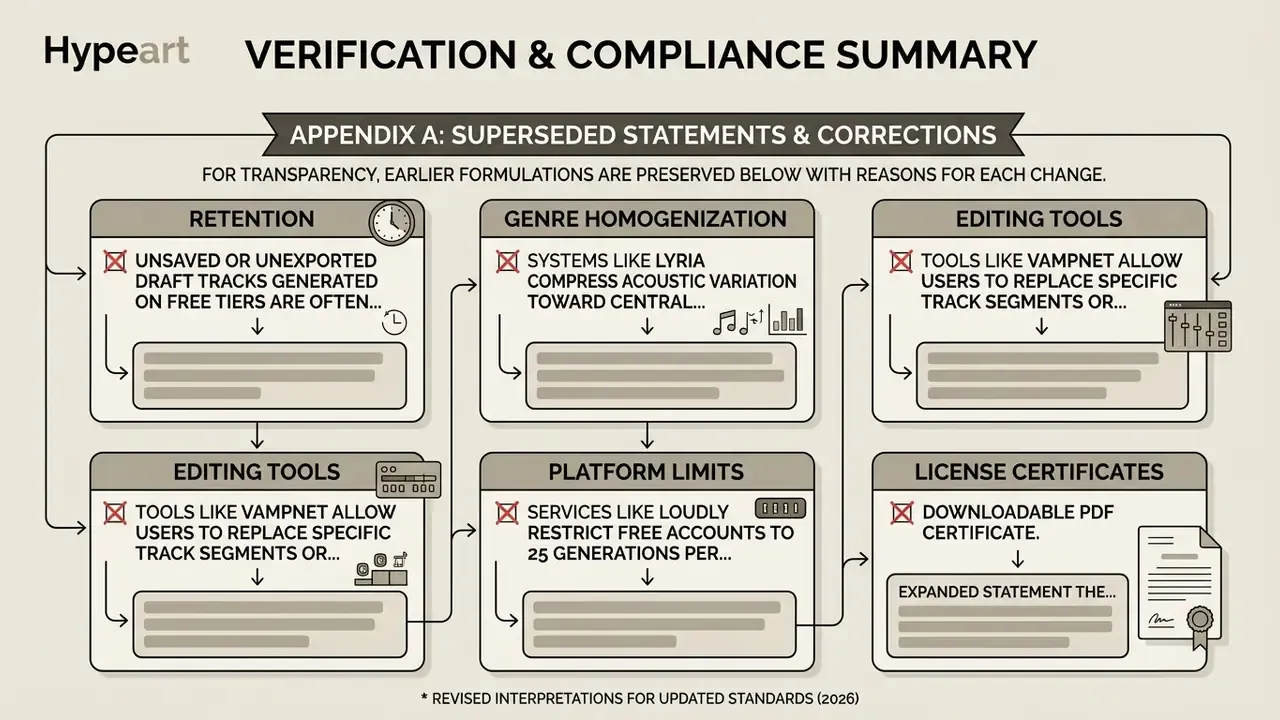
Appendix A: superseded statements and corrections
A safe next step for teams
If your organization is somewhere between curiosity and production, start narrow. Pick one approved vendor, one business unit, and one asset class, for example podcast intro beds. Log prompts and model versions from day one, download every licence PDF, and review the results after two cycles. If the evidence holds, widen the scope; if it does not, the pilot cost you nothing but a folder of MP3s. Open questions remain on training-data rights and watermark disclosure, and neither is settled in 2026, so document assumptions rather than asserting certainty.