One caveat before anything else. In a bank or a mature fintech, the "source document" is rarely a biology chapter. It is an AML procedure, a credit-policy addendum, a vendor-risk checklist. That single fact changes the tooling decision completely.
The short version
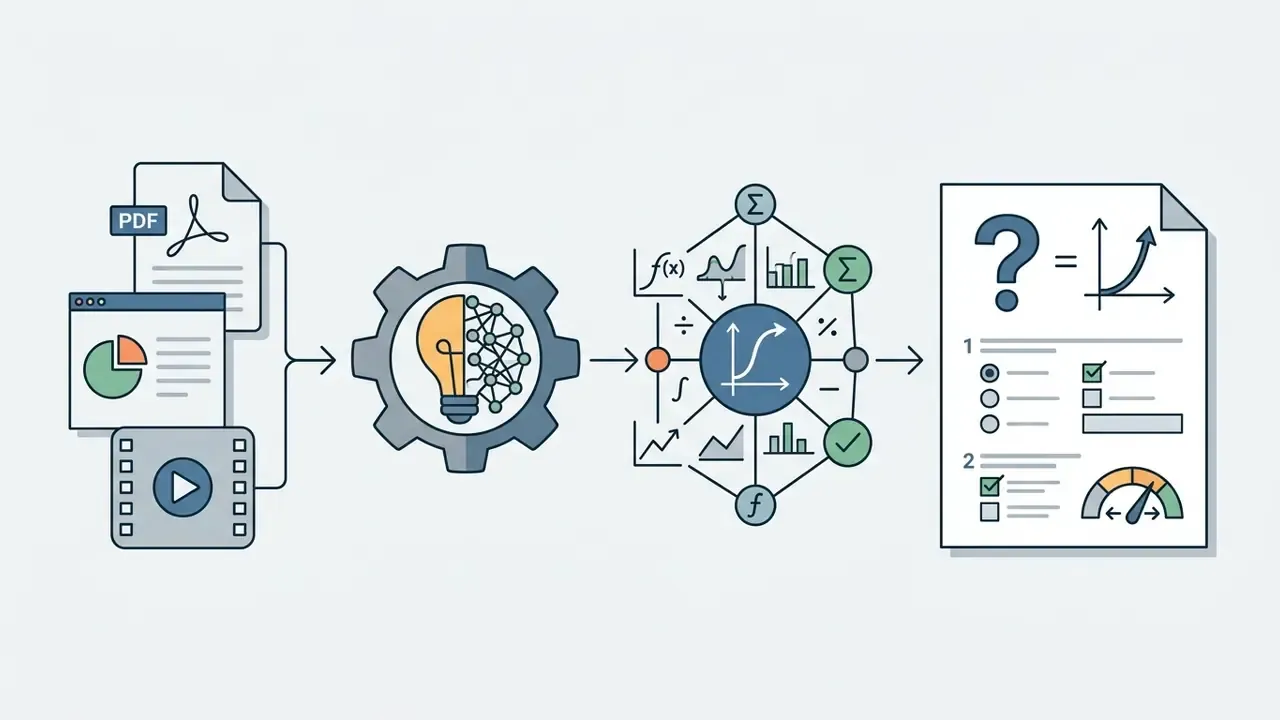
- What it does an AI quiz generator ingests a PDF, slide deck, notes, MP3 lecture recording, YouTube link or scanned handout, then produces multiple-choice, true/false, fill-in-the-blank, short-answer and step-by-step STEM items with answer keys.
- What the evidence says AI-generated items are psychometrically usable. In a large field study AI questions were slightly easier but more discriminating than expert-written ones, and 81.7% of GPT-4 generated MCQs needed no manual edits at all.
- What still breaks roughly 4.9% of generated MCQs contain more than one defensible correct answer, and quality drops at the top of Bloom's taxonomy (Evaluate / Create).
- The non-negotiable step a documented review pass covering source grounding, single-correct-answer validation, distractor de-duplication and reading-level check, plus a retained audit trail if the quiz is used for graded, regulated or compliance assessment.
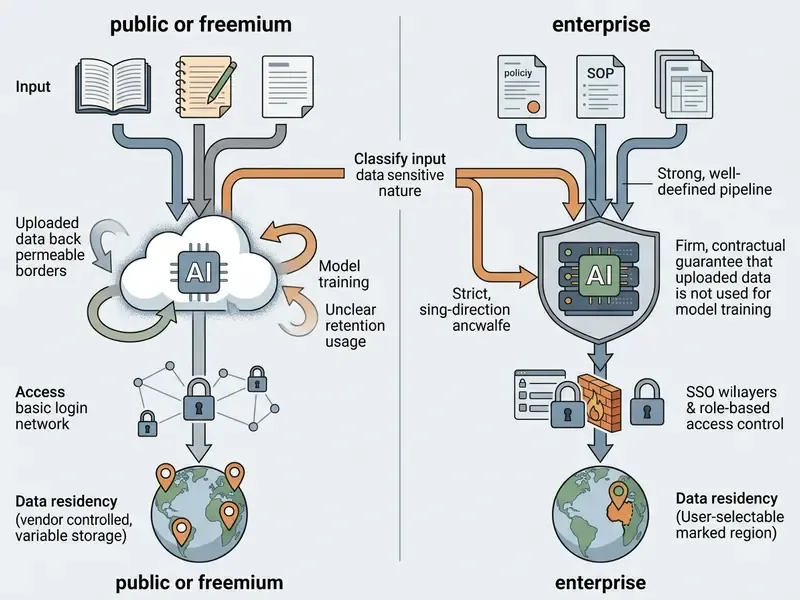
- The risk nobody markets uploading internal manuals, client files or documents carrying PII or material non-public information into a public free quiz tool is a Shadow AI event. Use enterprise tooling with no-training guarantees, SSO, data-residency controls and retention limits for anything non-public.
Who should read this, and what decision it supports
This page serves three different buyers, and they need different things from it.
A student wants a working method for turning a course reader into practice tests. A teacher wants item banks and parallel exam forms. A risk, audit or model-governance owner wants to know which class of tool may touch a regulated document at all, who signs off on a generated item, and what evidence survives an inspection two years later.
We treat those as separate acceptance thresholds throughout. Where the evidence is thin, we say so.
What is an AI quiz generator and what tasks does it solve
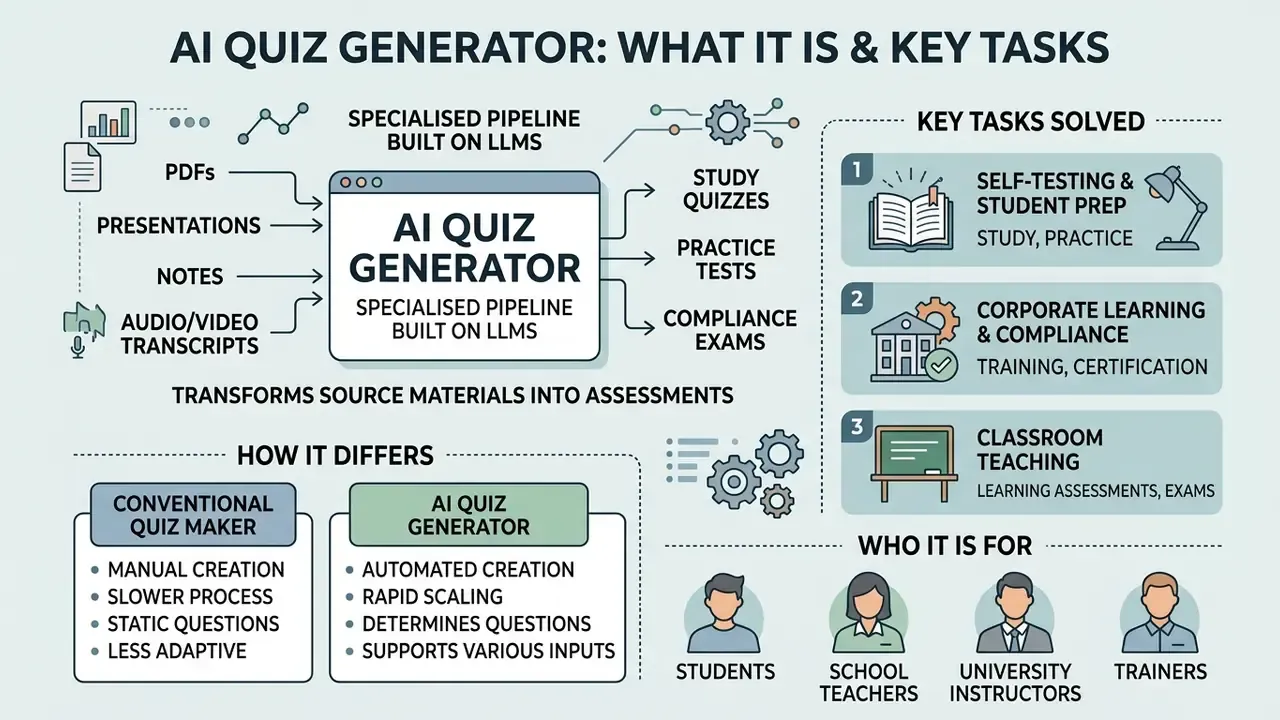
An AI quiz generator is a specialised pipeline built on large language models (LLMs) that transforms source text, whether PDFs, presentations, notes or transcripts, into structured quizzes, tests and exam items. Its core purpose is to remove the manual drudgery of assessment authoring and to accelerate learning through active retrieval practice. Vendors also market the same capability as an ai assessment generator or an ai exam creator; the underlying mechanics are close to identical.
Formally, the field treats the task as a mapping problem:
Research in computing education shows that AQG pipelines can produce assessment items comparable in psychometric quality to expert-authored tests:
How an AI quiz maker differs from a conventional quiz maker
An AI quiz maker parses the structure of the source document, isolates key concepts and drafts both stems and answer options without human input. A traditional quiz builder is only a shell: the instructor or instructional designer types every element by hand, and the automation covers delivery logic, scoring and conditional outcomes, not content interpretation.
According to the GPT-4 MCQ study (Doughty et al., ACE 2024):
Rather than quoting a fixed "30 to 60 seconds versus several hours", it is more accurate to say the measured effect is a large reduction in authoring effort. Vendor documentation reports end-to-end generation in well under a minute for a typical document, and one peer-reviewed 2025 implementation logged document processing at 2.06 to 2.27 seconds and quiz generation at 7.38 to 11.55 seconds. Machine time replaces human drafting time. The realistic planning figure is therefore minutes of review instead of hours of writing, not zero human effort.
Who an AI exam generator is for
AI exam generators serve five distinct audiences, each with a different acceptance threshold for accuracy and data handling.
- Students upload course readers, textbooks and lectures to build self-check items before finals and certification exams.
- School teachers use an ai exam generator for students to produce unit tests from covered chapters with ready answer keys and rubrics.
- University instructors and trainers build large item banks for in-class assessment, reducing routine preparation load. Search demand for ai for students exam generator comes mostly from this group and the previous one.
- Corporate L&D and compliance teams convert policy documents, AML and KYC procedures, information-security standards and onboarding manuals into certification tests, cohort by cohort, with pass-rate tracking.
- Risk, audit and AI governance functions decide which generators may touch internal documents at all, define the human-in-the-loop rule, and set retention and evidence requirements for graded outcomes.
For organisations embedding these tools into commercial learning platforms, it is worth reviewing the legal ground rules for commercial use of AI tools and the wider AI Media Commercial-Use Hub before procurement.
Data security, Shadow AI and the consumer versus enterprise split
Most published guidance on quiz generators assumes the source document is a chapter of a biology textbook. In a bank, hospital or law firm, the source document is a policy containing client identifiers, non-public market information or regulated procedures. Pasting it into a free browser tool is an uncontrolled data transfer, not a productivity win.
Minimum controls before any non-public document is uploaded:
- Approved-tool list. Generation must happen inside a sanctioned tenant. Unsanctioned use of consumer quiz sites is a classic Shadow AI pattern: convenient, invisible to security, impossible to reconstruct during an audit.
- No-training guarantee in writing. The contract, not the marketing page, must state that uploads are excluded from model training and that inference logs have a defined retention window.
- Redaction before upload. Strip names, account numbers, client identifiers and deal codenames. Assessment items almost never need them.
- Data residency and encryption. Confirm storage region, encryption in transit and at rest, SSO and SCIM support, and role-based access.
- Retention and deletion. Define how long the source file, the generated items and the learner responses persist, and who can delete them.
- Human-in-the-loop rule. No AI-generated item reaches a graded or regulated assessment without a named reviewer's sign-off.
Recognised control frameworks map onto this cleanly: model-risk expectations of the SR 11-7 and OCC 2011-12 lineage for validation and documentation, and the NIST AI Risk Management Framework functions (Govern, Map, Measure, Manage) for lifecycle oversight. Public-sector education guidance points the same way. The U.S. Department of Education's Artificial Intelligence and the Future of Teaching and Learning (2026) requires that formative-assessment AI minimise bias, promote fairness and preserve educator override authority. The Utah P-12 Education AI Framework (2026) frames AI explicitly as an assistant for item creation, standardised feedback and diagnostic gap analysis rather than an autonomous grader.
An honest limitation here: none of these frameworks was written with quiz generation in mind. You are extending existing model-risk logic by analogy, and that extension should be documented as a judgement call, not presented as compliance.
For a worked methodology on comparing AI vendors across quality, cost and licensing, see our comparison of AI generators by quality and price.
How to create a quiz or test with AI
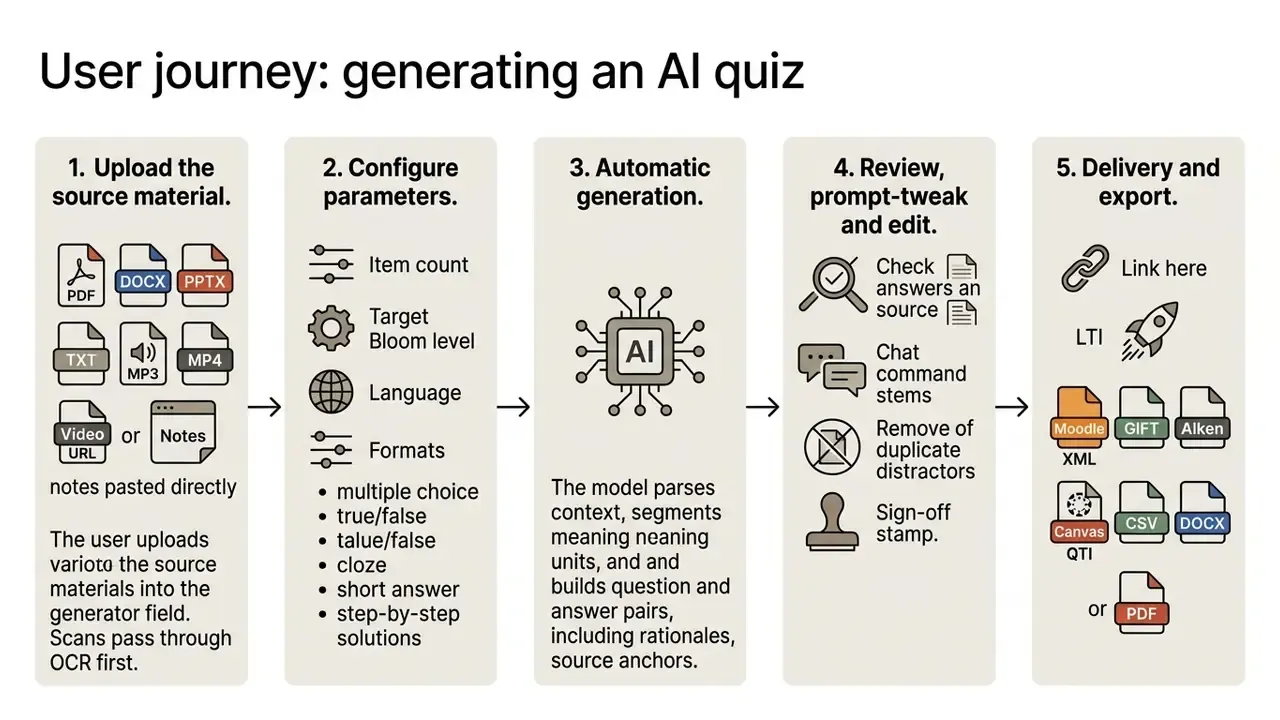
Producing a defensible test with a neural network means moving through upload, difficulty configuration and final validation of the generated items in sequence. That sequence is what prevents factual hallucinations and keeps the test aligned to the syllabus. The ai create a quiz and ai create a test workflows share the same five stages regardless of vendor.
"The pipeline runs: upload materials, configure parameters, LLM candidate generation, AI-judge evaluation, delivery to students, with iterative prompt refinement on each cycle."
Add a topic, text or learning materials
At the first stage the user hands source content to the system: lecture notes, research articles, book chapters or pasted excerpts. Tools such as Adobe Acrobat's quiz maker (Adobe, 2026) and Smallpdf's question generator (Smallpdf, 2026) parse the upload and strip markup and control characters before generation.
The quality of the resulting generated quizzes depends directly on the structure of the input text. Avoid feeding low-quality scans into the model without prior image-to-text recognition, because errors in the extracted text propagate straight into the generated items. Practical thresholds worth respecting: 300 dpi for text scans, a minimum of 200 dpi for image and PDF OCR pipelines, clear headings and lists instead of nested merged-cell tables, and logical splitting of very long documents into chapter-sized units rather than one 500-page file.
If the scan itself is the problem, fix the scan. A quick contrast and deskew pass in a desktop tool such as the gimp photo editor often rescues a page that OCR would otherwise turn into gibberish.
Set question types and difficulty level
Parameter configuration defines the cognitive depth of the check, from simple term recall to full situational analysis. Most modern services let you mix formats freely within a single test, which is what makes an ai generator quiz run usable for both drilling and final assessment.
Developers grade difficulty along Bloom's revised taxonomy:
- Remember / Understand: verification of base facts and definitions.
- Apply / Analyze: solving practical cases drawn from the material.
- Evaluate / Create: selecting an optimal course of action under ambiguity, or producing an original solution.
This is the single most important calibration caveat. Treat Evaluate and Create items as drafts that always require expert rewriting, and reserve automatic acceptance for the lower levels.
Interactive tuning through chat commands. Difficulty does not have to be locked before generation. If the produced test misses the target audience, refine it conversationally:
- "Create questions appropriate for my 6th-grade class and simplify the terminology."
- "Rewrite these multiple-choice items as open short-answer cases."
- "Increase the share of Apply-level items to 60% and drop pure definition recall."
- "Keep the same concepts but shorten every stem to one sentence."
- "Generate three plausible distractors per item, each reflecting a distinct misconception."
Each pass is cheap, so iterate on the prompt before you start editing items by hand. Cheaper still: iterate twice.
Review, edit and take the generated quiz
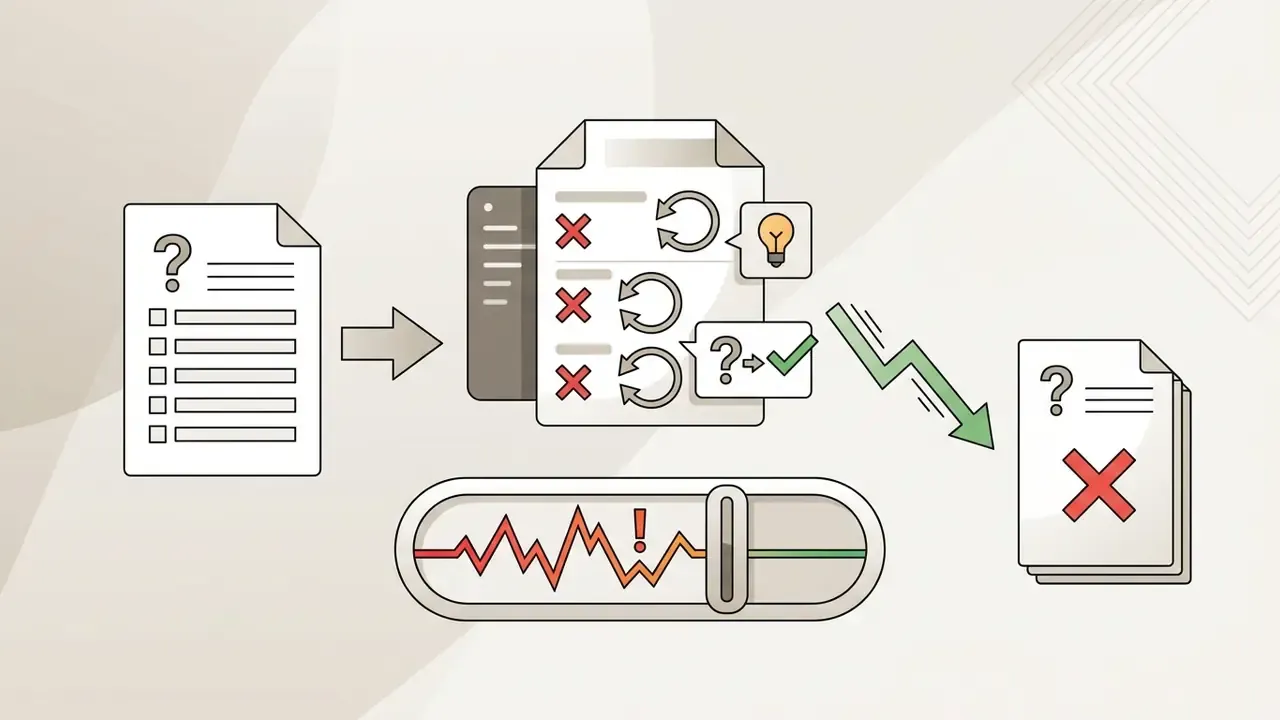
The final step before publication is expert inspection of the items and a self-test run. Typical generation defects include implausible distractors and two simultaneously correct options.
Roughly 4.9% of generated multiple-choice items contain duplicate correct answers (Doughty et al., 2024). Usefully for reviewers:
That makes targeted editing efficient. Fix the one flaw, keep the stem. A manual review pass also lets you correct text fields and lock in accurate feedback strings before anyone sits the test.
Which materials AI can build a quiz or exam from
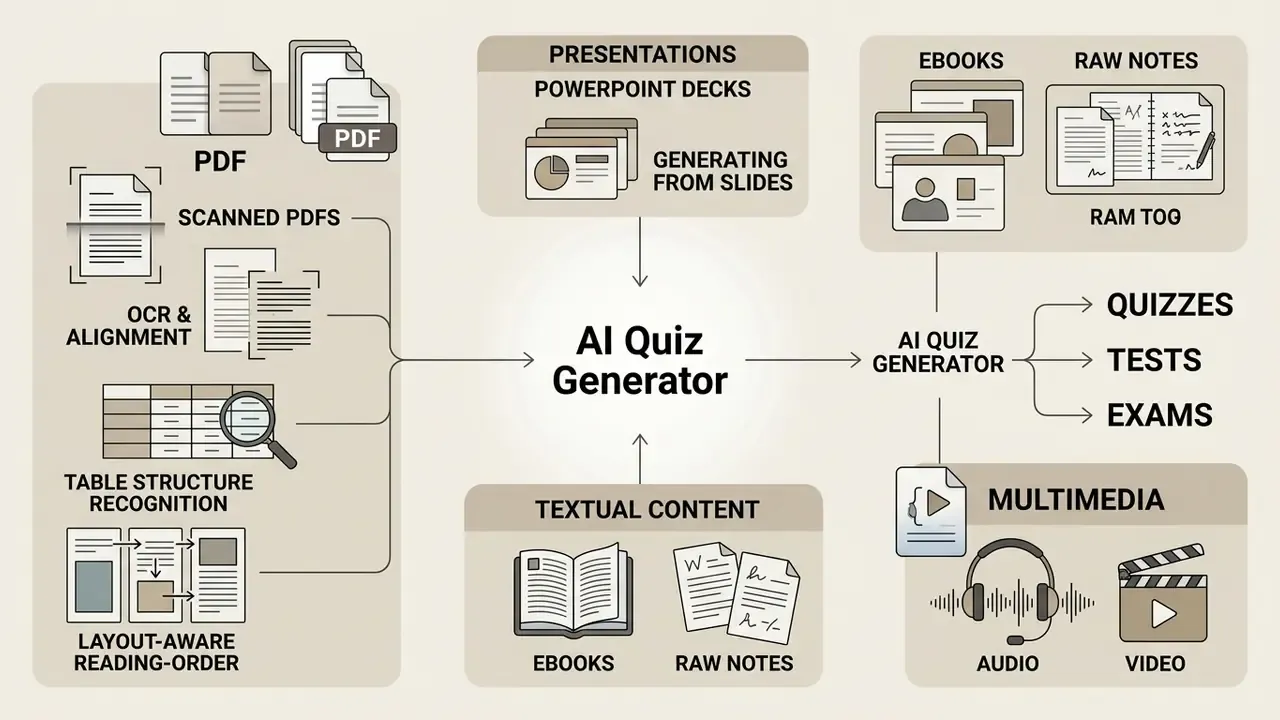
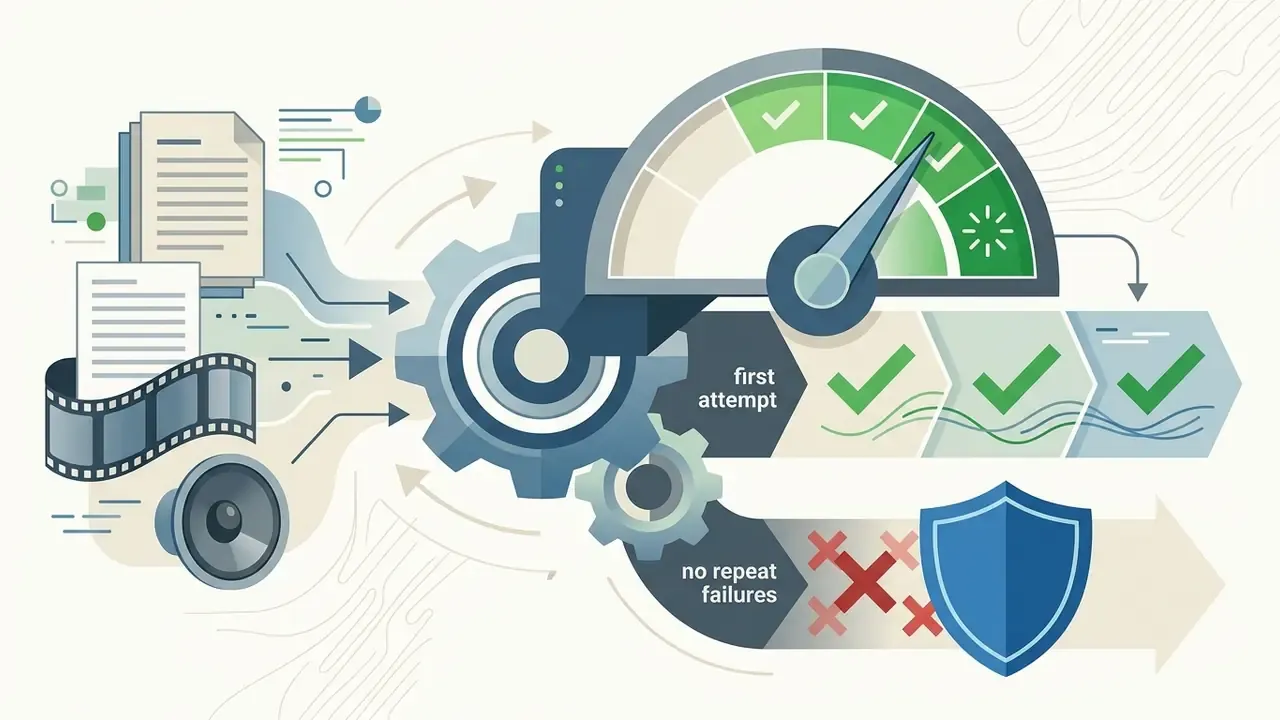
AI test generators handle most text and presentation formats in circulation, including scanned PDFs, PowerPoint decks, ebooks and raw notes, and increasingly audio and video. Multi-format support comes from built-in OCR modules, speech-to-text engines and document-layout pipelines.
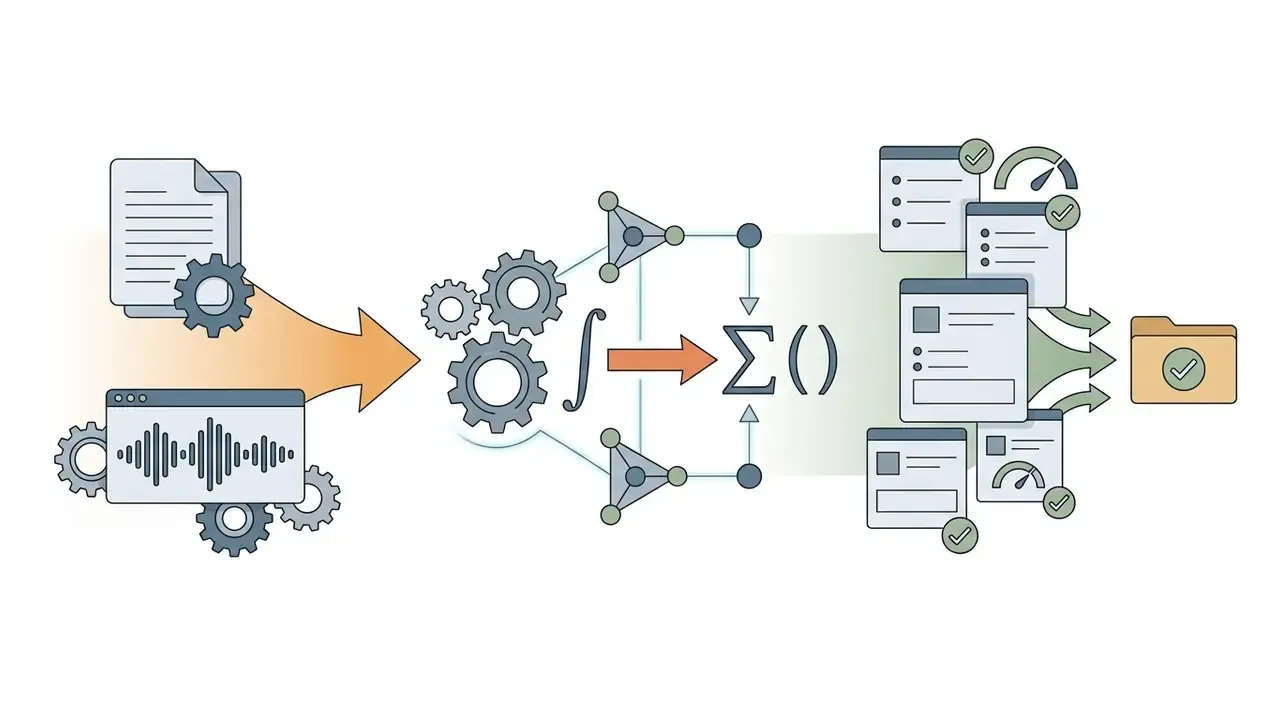
Multimedia and handwritten notes. Modern generators bundle Whisper-class transcription and OCR. You can upload an MP3 of a lecture, an MP4 screen recording, a YouTube link, or a photograph of a handwritten notebook page. The model first transcribes the audio with timestamps, then builds items anchored to a specific minute of the recording, so a wrong answer sends the learner back to the exact 90 seconds of the lecture that explain it. Recording-based inputs are typically capped (some tools limit a single recording to around 1,500 words of transcript on free tiers), so long lectures should be chunked by topic.
Format reality check from vendor and platform documentation: PDF, DOCX, PPTX, XLSX, TXT, HTML, JPG and PNG, plus EPUB, are broadly supported. PPTX is usually processed slide by slide, with embedded or linked images frequently skipped. Scanned PDFs and printed books require page-level OCR plus reading-order recovery.
Creating a quiz and test from PDF
Generating questions from PDF files is the single most common workflow. The user performs the ai create quiz from pdf or ai create test from pdf action, and the algorithm analyses the pages and extracts key propositions.
Services such as Quizzen (Quizzen, 2026) accept files up to 100 MB, handle multi-column text, diagrams and tables, and apply OCR to scanned documents. Built-in segmentation splits the PDF into logical chunks so semantic links between paragraphs are not lost.
Three separate pipelines are actually at work inside a "PDF to quiz" button, and knowing which one is failing tells you how to fix a bad output:
- OCRfor image-only pages. No OCR, no text, no questions.
- Table structure recognition plus OCR alignmentfor tabular data, where cell boundaries must be reconstructed before values mean anything.
- Layout-aware reading-order reconstructionfor multi-column pages, because naive left-to-right extraction interleaves two columns into nonsense.
One diagnostic habit saves a lot of time: before blaming the model, export the extracted plain text and read the first page. If the text is broken, the questions were never going to be right.
Generating questions from PowerPoint, text, notes, books, audio and video
Beyond PDF, platforms work with .pptx files, plain .txt notes and ebooks. When you invoke ai create quiz from powerpoint or use a dedicated ai book quiz generator, the model extracts not only on-slide text but also speaker notes, then groups related bullets into single concepts.
"A semantically annotated generation system selects note fragments via STEX markup and passes them into an LLM master prompt, so questions are tied to specific course concepts."
When processing user-written notes, logical coherence matters more than length. Sparse slides and fragmentary bullet points produce shallow items, every time.
For multimedia learning ecosystems, it is worth reviewing google ai podcast and google ai video to fold audio and video assets into a single assessment system, and the AI voice generator guide if you plan to narrate the resulting question sets for accessibility. If your course deck opens with a decorative slide, whether that is a good morning ai greeting image or a set of goofy ai images used as an icebreaker, expect the generator to skip it: purely visual slides carry no extractable propositions. The same applies to meme-style filler such as goofy ahh ai images inserted between chapters. Fun for engagement, invisible to the parser.
Which question types an AI quiz generator can produce
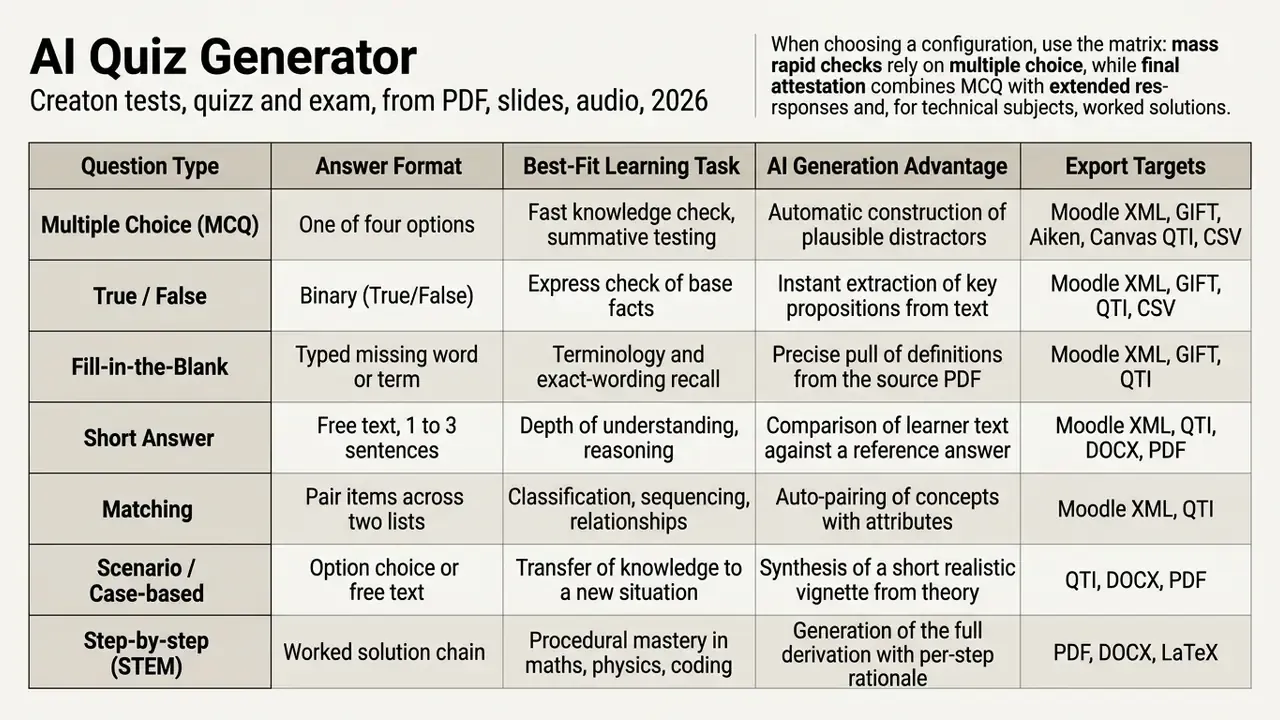
A modern ai exam maker produces a wide spectrum of items tuned to different assessment goals. The emphasis falls on combining closed-choice questions with open formats that demand a reasoned answer.
Multiple-choice questions for fast practice
Multiple-choice questions form the backbone of most assessment material because they are trivially auto-scorable. The ai create test questions function generates the key plus three distractors that sound convincing but embed conceptual errors.
"AI-generated MCQs showed high discriminating power under IRT: they separate students of different ability levels effectively."
That is the defensible claim for MCQs. They are strong not because they are easy to write, but because well-built distractors create measurable separation between learners. Comparative work also indicates MCQs generate more successful retrieval events during practice than very-short-answer formats, which is exactly what you want in daily drilling, while short-answer initial quizzes tend to produce larger transfer effects on later exams. The pragmatic split: MCQ for volume and frequency, short answer for depth.
Open-ended questions for tests and exams
Short-answer items force the learner to formulate a response without cues. They eliminate lucky guessing and reveal genuine command of the material, typically in a sentence to a few paragraphs, aimed at knowledge and understanding rather than recognition.
Instructors can use AI to generate not only the stem but also the reference marking criteria (rubric), including the minimum set of concepts required for full credit and the common misconceptions that cost points. For precise cost modelling of AI infrastructure in educational organisations, use the dedicated calculators, view the guide.
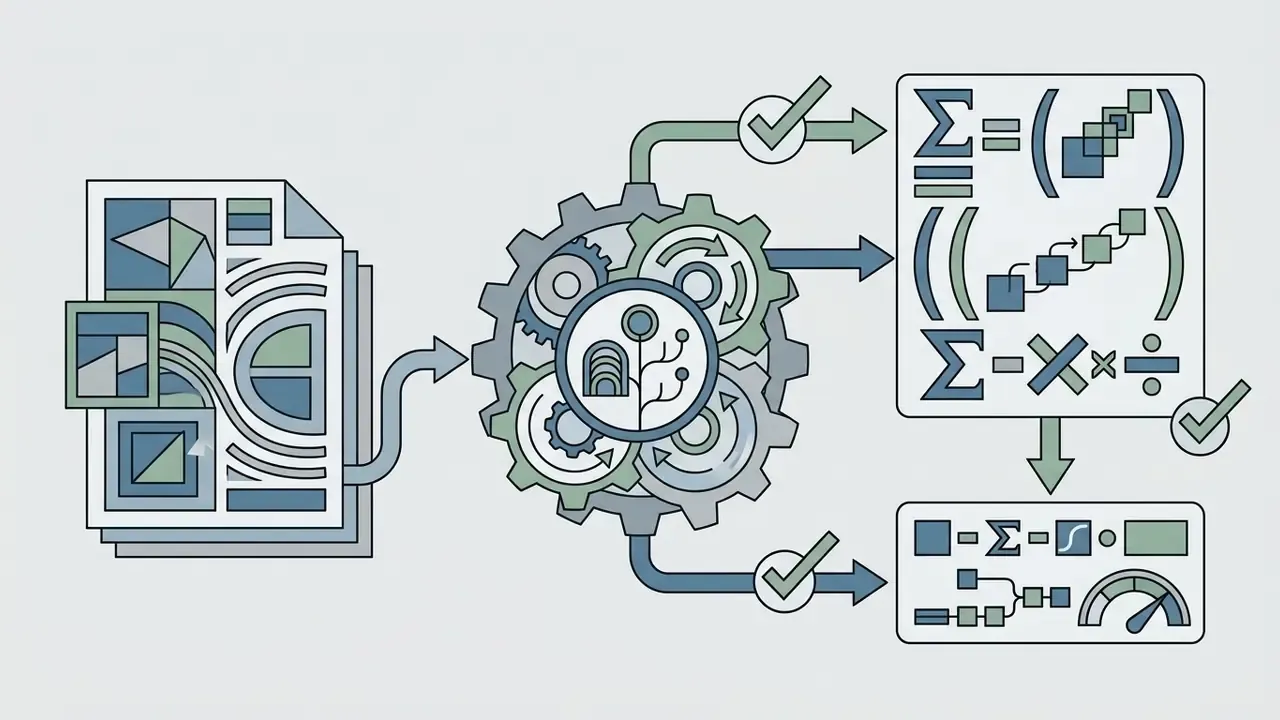
Generating tests for STEM and quantitative subjects
For engineering, maths and physics documents the generator should not stop at an answer option. It should produce the reasoning chain, which is what makes the item usable as a teaching artefact rather than just a score.
A second pattern worth requesting explicitly is the distractor rationale: for each wrong option, one line explaining which misconception produces it. For example, forgetting to multiply by the inner derivative yields , the classic chain-rule miss. STEM generators should also handle photographed problems, handwriting and diagrams, and support notation-preserving export to LaTeX so formulas survive the trip into your LMS.
How to use AI-generated quizzes for studying and teaching
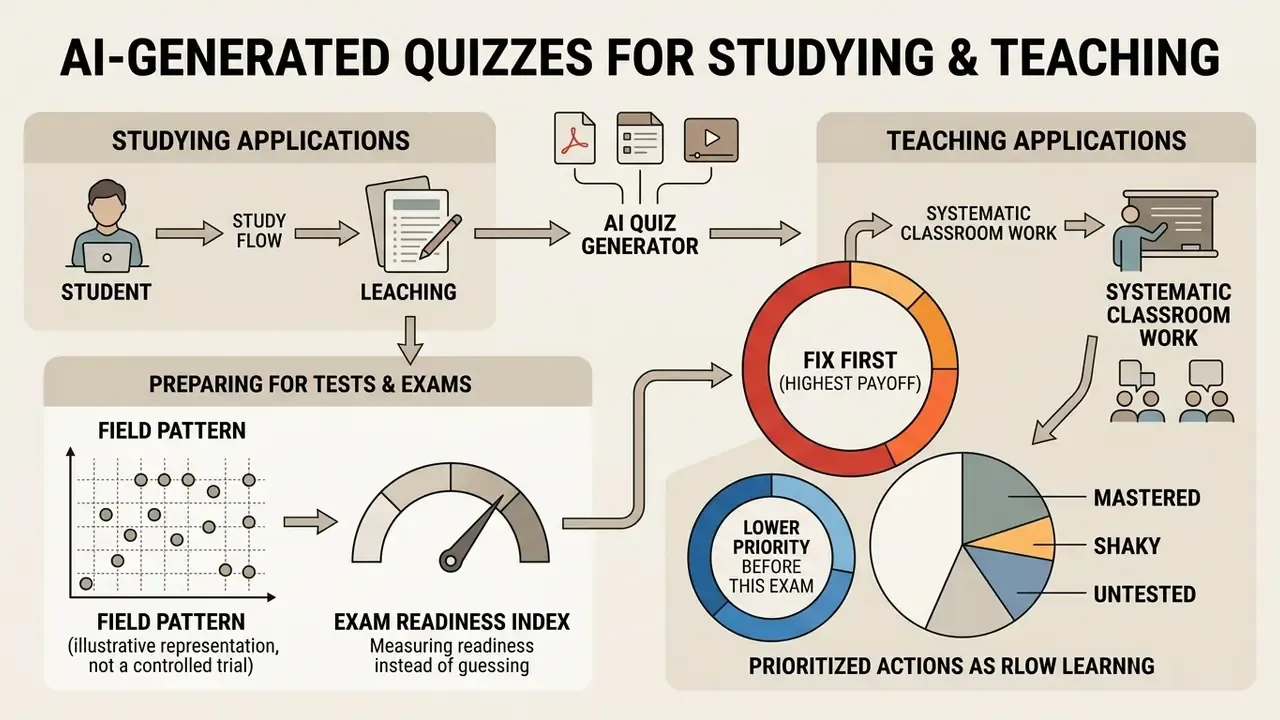
Practical application spans individual student preparation and systematic classroom work. Embedding a quiz generator into the learning process is what makes spaced repetition operationally realistic rather than aspirational.
Preparing students for tests and exams
Students use an ai free quiz generator to convert lecture notes into series of practice tests, shifting effort from passive reading to active reproduction. The documented workflow across current tools is consistent: upload lectures, PDFs and notes, generate items, quiz immediately, then schedule the same items for spaced review before the exam date.
Field pattern (illustrative, not a controlled trial): a study group preparing for a financial-sector certification uploaded a multi-hundred-page course reader into an AI test generator, produced several hundred topic-tagged items with per-question rationales in a single session, then drilled only the concepts they had missed. Self-reported outcomes in cases like this are positive. The honest framing is that the gain comes from the retrieval-practice loop rather than from the generator itself, and the effect size that is measured in the literature is the roughly 10% advantage of practice testing over re-reading (Adesope et al., 2017), close to doubled when feedback is attached (Rowland, 2014).
Independent evidence links quiz performance to exam performance:
"The correlation between Quizizz AI-quiz scores and the final exam was r = 0.68 (p < 0.001): quiz results predict exam success."
Correlation, not causation. Worth remembering before anyone builds a grading policy on it.
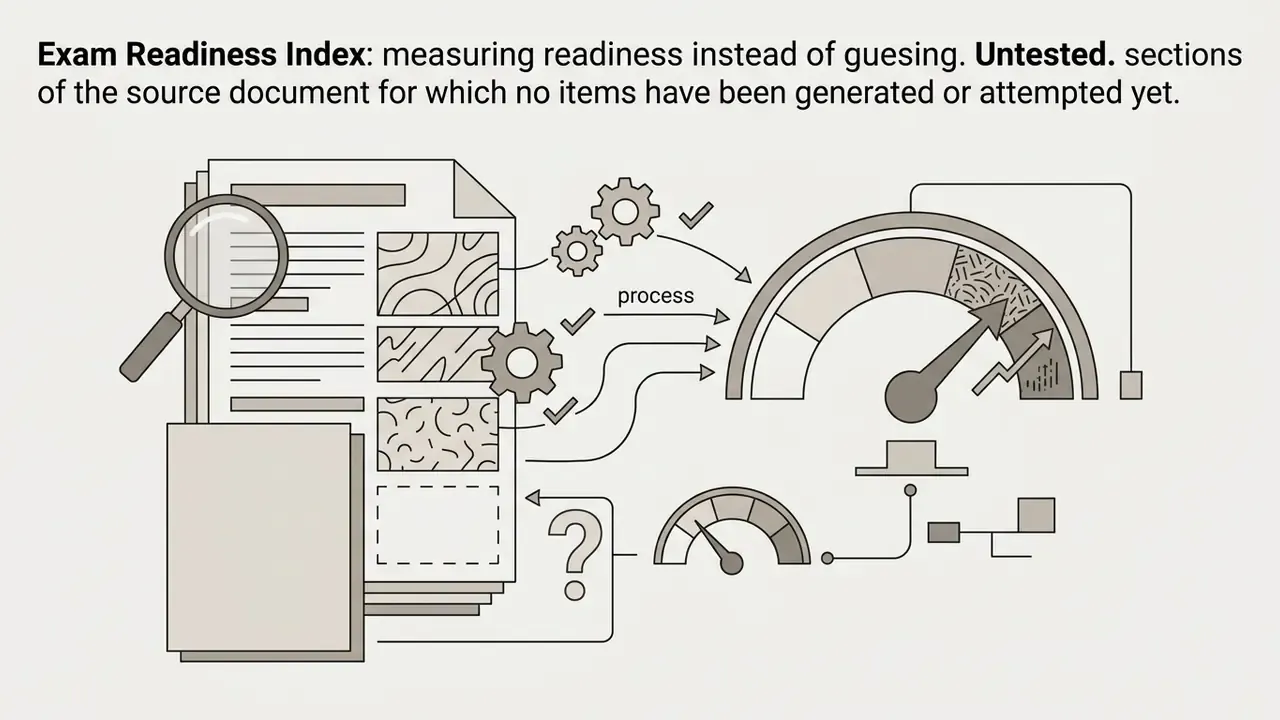
Exam Readiness Index: measuring readiness instead of guessing
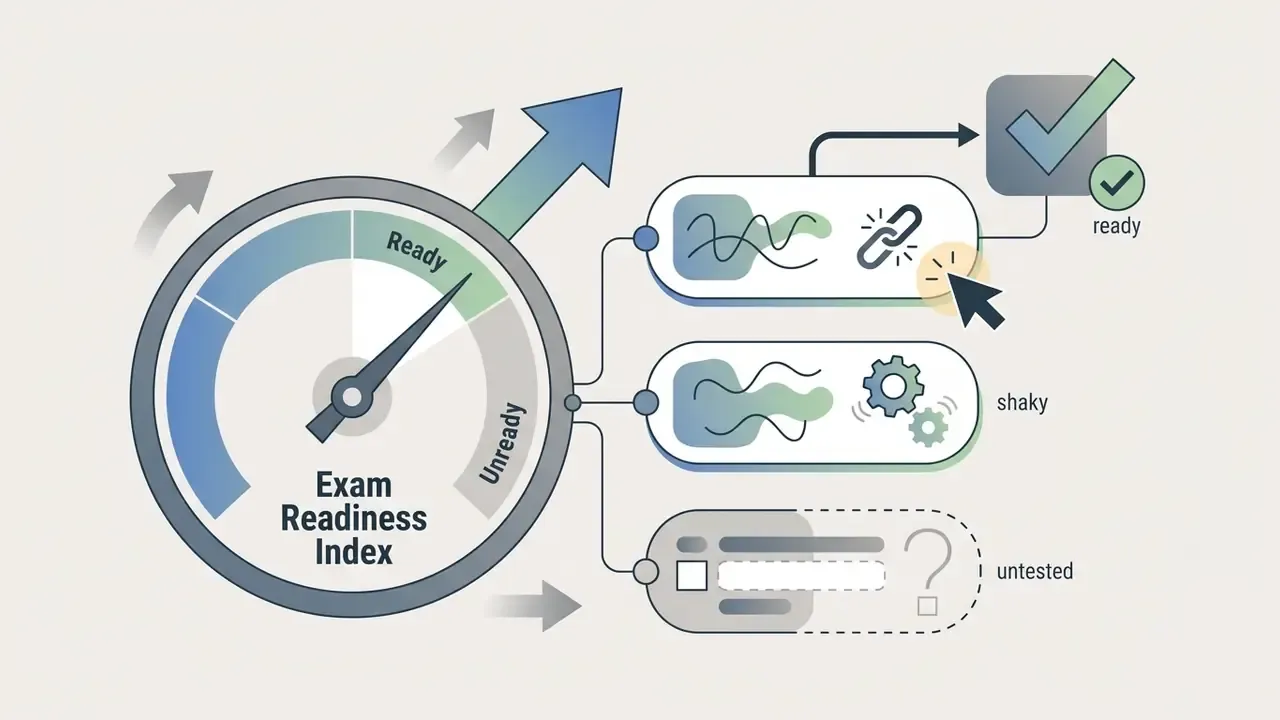
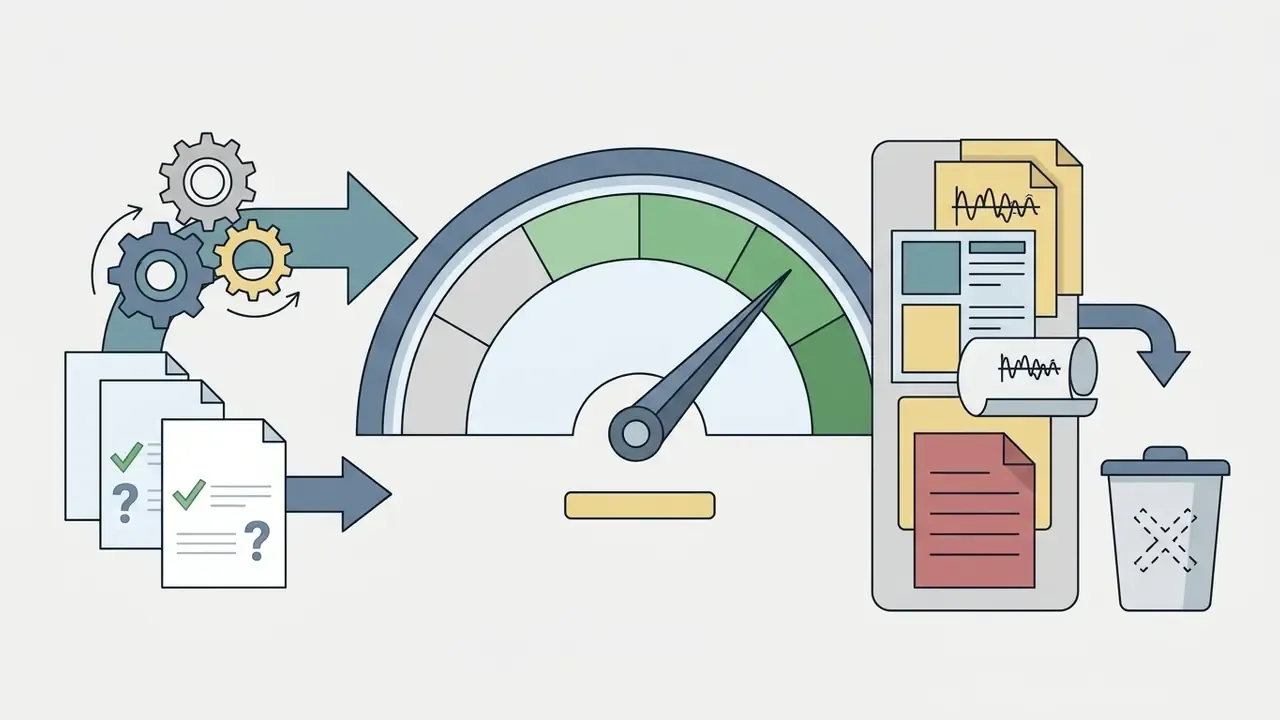
The weakest link in most self-study setups is that learners cannot tell whether they are ready. A readiness index fixes that by mapping the item bank onto measured performance and classifying every concept in the course.
Readiness formula:
- 63% ready, borderline, 5 days to exam
- 6 mastered, 3 shaky, 3 untested
Two rules keep the number honest. First, untested must count against readiness: a 100% score on 4 of 12 sections is not 100% readiness. Second, the final gate should be a timed mock exam assembled from the same bank, because a full-length, clock-running attempt is the only signal that reflects exam conditions. Every quiz, flashcard and drill then routes weak concepts back into the next session automatically.
Building quizzes for the classroom and for training cohorts
Teachers and academic instructors use an ai free quiz maker to spin up entry and exit tests during the lesson itself, which makes end-of-lesson comprehension measurable rather than assumed.
Anti-cheating: automatic form splitting (Form A and Form B). When generating a class assessment, the generator can reword stems and reshuffle options without changing the concept under test:
- Form A, direct question "Which function returns the square root of a value?"
- Form B, situational question "Select the correct expression for computing ."
Combine three mechanisms for real protection: stem paraphrase at constant difficulty, option order randomisation with fixed key mapping per form, and numeric parameter variation in quantitative items (change the coefficient, keep the method). Print the form identifier on every sheet, and keep both keys in the same item-bank record so grading stays trivial. This removes answer-sharing during simultaneous in-room testing without creating two exams of unequal difficulty.
Automated export lets you push items into school and university learning-management systems, including Moodle XML, GIFT, Aiken, Respondus, Canvas QTI 2.1, CSV, DOCX and PDF, or launch them in-course via LTI 1.3 with grade return to the gradebook. Platform-level integrations commonly cover Canvas, Blackboard, Moodle and Google Classroom. If integration issues appear, see AI Media Support and Troubleshooting.
How to check the quality of AI-generated questions before use
Verification protocol for assessment material (fact check and quality control):
- Source reconciliation. Every stem and key is checked against a specific passage in the source PDF or notes: correct document, correct page, surrounding paragraph read, not just the highlighted sentence. If the cited passage does not support the claim, the item is marked unverified.
- Single-answer validation. Confirm exactly one defensible correct option and that no distractor is a partially true reading of the stem. This is the highest-yield check, aimed squarely at the 4.9% failure mode identified by Doughty et al.
- Distractor de-duplication. Reject items where two options are semantic duplicates ("increases throughput" versus "raises processing volume"), where one option is a superset of another, or where a distractor is implausible enough to be eliminated without knowing the material. Practical test: if a naive reader can discard two options on grammar or length alone, regenerate the item.
- Hallucination screen. Exclude cases where the model introduces facts absent from the uploaded material, whenever the purpose of the test is verification of that specific document. Unanswerability is a usable metric: the share of items a system answers that the source cannot support.
- Difficulty and register regulation. Verify that phrasing and terminology match the target audience (school pupils, undergraduates, certified professionals) and that reading difficulty is not itself the barrier.
- Sign-off and retention. Record reviewer identity, date, the count of items accepted, edited and rejected, and the source version hash. That is the evidence an auditor will ask for.
Reconcile questions and answers with the source material
Citation and source analysis is the primary reliability criterion. Text-processing pipelines must be tightly grounded in the retrieved context (Retrieval-Augmented Generation) to exclude invented facts.
"In the Liffiton et al. pipeline, an AI judge checks each question against course material and removes items where the generator and the judge disagree on the correct answer."
That generator-versus-judge disagreement signal is worth copying manually if your tool does not implement it. Answer each generated item yourself before revealing the key, and treat every mismatch as a review flag rather than as your own mistake. Additional context on preparing source documents for accurate extraction sits in our guide to image-to-text recognition and in the photo editor guide for cleaning up low-contrast scans before OCR.
Check difficulty and clarity of phrasing
An item stem must be concise, free of hedging qualifiers ("usually", "as a rule", "frequently", "may") and free of grammatical cues that leak the answer. Standard item-writing practice also requires that the stem carry enough information to be answerable before the learner reads the options, and that extraneous detail be removed.
Psychometric evidence supports prioritising this check:
"AI-quiz ratings for clarity and precision of wording were the highest of all measured parameters (mean = 18.00, SD = 1.13)."
A note on sourcing: an earlier version of this section pointed to a general item-writing guide URL. We replaced it with the peer-reviewed measurement above, because the previous link resolved to an organisation homepage rather than a specific document.
Audit trail: documenting validation for graded and regulated assessment
If the quiz produces a grade, a certification or a compliance record, generation is a controlled process and needs evidence. Retain, per assessment version:
| Field | Example value |
|---|---|
| Source document and version | AML-Policy_v4.2.pdf, hash, page range |
| Tool, model, date | Enterprise generator, model family, 2026-08-14 |
| Prompt and configuration | 40 items, Apply level, MCQ plus short answer |
| Reviewer | Named SME, role, sign-off timestamp |
| Items generated / accepted / edited / rejected | 40 / 31 / 6 / 3 |
| Defect taxonomy | 2 duplicate keys, 1 unsupported fact |
| Learner outcomes | Attempts, scores, item-level statistics |
| Retention and deletion | 5 years, then hard delete |
Net-benefit sanity check. Before declaring a time saving, compute it honestly:
Generation time is near zero. Review time is not. With an 81.7% clean-item rate, plan review effort against the remaining 18% or so, plus a full read of every retained item, and add the expected cost of a defect reaching a graded compliance test. The result is still strongly positive for most teams, but it is a defensible number rather than a marketing one.
Free AI quiz generator: what to weigh before choosing
When selecting a service on a free tier (ai free test generator, ai exam generator free, ai exam maker free, ai generated quiz maker free), account for the functional ceilings of freemium plans. Anyone searching for an ai generator test free should read the limits before the feature list.
Most platforms (QuizMagic, SimpleQuizMaker, Quizzen, QuizRise, Taskade) impose the following baseline restrictions:
For comparative market pricing, see the AI Media Pricing Guides, our methodology for comparing AI generators on quality and price, and the free photo editor guide as an example of how freemium export restrictions are usually structured.
FAQ about AI quiz generators
Can I build a reusable question bank from the generated items?
Yes. Most professional AI platforms let you store generated items in a single structured Question Bank. Instructors group items by topic, chapter, standard, Bloom level and difficulty tags, then filter the bank to assemble a unique variant of a final exam each term. Documented workflows also apply Bloom classification automatically and export validated banks to QTI 2.1 or Moodle XML. One legal caution: reuse of third-party exam content may be restricted by copyright and by awarding-body policy. Some boards require written permission, cap the share of reproduced questions and impose a minimum time gap before republication. If a dispute over training data or reproduced items is a live concern for your programme, compare options and current case coverage before you standardise on a vendor.
Can I share a finished quiz and track results?
Yes. Finished tests can be sent by direct web link, distributed as personal invitation links, or embedded in an LMS over LTI. Platforms log attempts, record completion time and produce analytics with a per-item breakdown: score per learner, attempt count, correct-answer percentage and weak-topic clustering across a class, with report export to PDF, XLSX or CSV and grade sync back to the gradebook.
Can AI build a quiz from an audio lecture or a YouTube video?
Yes. The pipeline transcribes the recording with timestamps, segments the transcript into topics, then generates items anchored to specific moments, so a missed answer links back to the exact passage of the lecture. Practical constraints: free tiers cap transcript length, heavy accents and cross-talk reduce transcription accuracy, and diagrams shown on screen without narration will not be captured unless the tool also processes video frames.
How do I stop learners from sharing answers during in-class testing?
Generate parallel forms. Ask the tool to produce Form A and Form B of the same specification: identical concepts and difficulty, paraphrased stems, reshuffled options and varied numeric parameters. Print form identifiers, keep both answer keys in one item-bank record, and randomise item order per learner where the delivery platform supports it.
Is it safe to upload internal company documents into a quiz generator?
Not into a public consumer tool. Route non-public material through a sanctioned enterprise tenant with a contractual no-training guarantee, defined retention, data-residency control, SSO and role-based access, and redact personal or market-sensitive data before upload. Anything else is Shadow AI: fast, invisible to security and undocumented at audit time.
Do AI-generated tests actually improve results?
The mechanism is well supported. Practice testing beats re-reading by roughly 10% on typical class outcomes (Adesope et al., 2017), and testing with feedback is worth close to double testing without it (Rowland, 2014). AI's contribution is throughput: it makes frequent, source-aligned retrieval practice cheap enough to sustain. It does not remove the need for expert review of the items themselves.
What should a first controlled rollout look like?
Start narrow. Pick one non-sensitive policy or course module, name a single accountable reviewer, generate 40 items, and record accepted, edited and rejected counts. Run the same exercise a second time to see whether your defect rate is stable. Only after two clean cycles should you extend the workflow to regulated content, and even then keep the human sign-off gate in place. For a broader look at alternative tooling, compare available solutions via view the guide, or review integration documentation in the AI Media API section.
Sources, editorial note and disclaimer
Research cited in this article: Doughty et al., ACE 2024 (https://doi.org/10.1145/3636243.3636244); Liffiton et al., arXiv preprint, 9 August 2025 (preprint, not peer reviewed); Scaria et al., AIED 2024; Zeghouani et al., ALINet, ACM 2024; Burek et al., Journal of Computer Assisted Learning, 2024; Antunes et al., arXiv 2025; Durgungoz & Durgungoz, Education and Information Technologies, 2025; Chen & He, arXiv preprint, August 2024; Deroy et al., 2023 to 2025; Maity et al., 2023 to 2025; Adesope, Trevisan & Sundararajan, Review of Educational Research, 2017; Rowland, 2014; U.S. Department of Education, Artificial Intelligence and the Future of Teaching and Learning (2026); Utah P-12 Education Artificial Intelligence Framework (2026). Product limits are cited from vendor documentation current as of August 2026 (Adobe, Smallpdf, Quizzen, QuizMagic, SimpleQuizMaker, QuizRise, Taskade, Mindgrasp).
Prepared by the AI Media editorial team, assessment tooling desk. Last updated: August 2026. Vendor names and limits are quoted from public documentation and change frequently; verify current terms before procurement. This material is not legal, financial, pedagogical or compliance advice, and does not constitute a validation opinion for high-stakes examinations or regulated attestation programmes. Organisations in regulated sectors should confirm tooling choices with their own model-risk, privacy and information-security functions.
For the full catalogue of terms and learning materials, view the guide in our reference centre.