Editorial review: Marcus Hale, the author focused on controlled AI adoption and evidence-based publishing workflows.
Synthetic visual generation tools let anyone build custom morning greetings, digital cards, and social messaging assets without a designer in the loop. Generating bespoke morning visuals means you control mood, typography, and stylistic theme for a specific audience, whether that is a family chat or a brand channel with 400,000 followers.
"Optimizing generative visual assets for daily messaging requires strict typography contrast controls, safe margin planning for UI overlays, and explicit prompt negative space allocation to ensure text readability across mobile screen densities."
What Matters Most Before You Generate
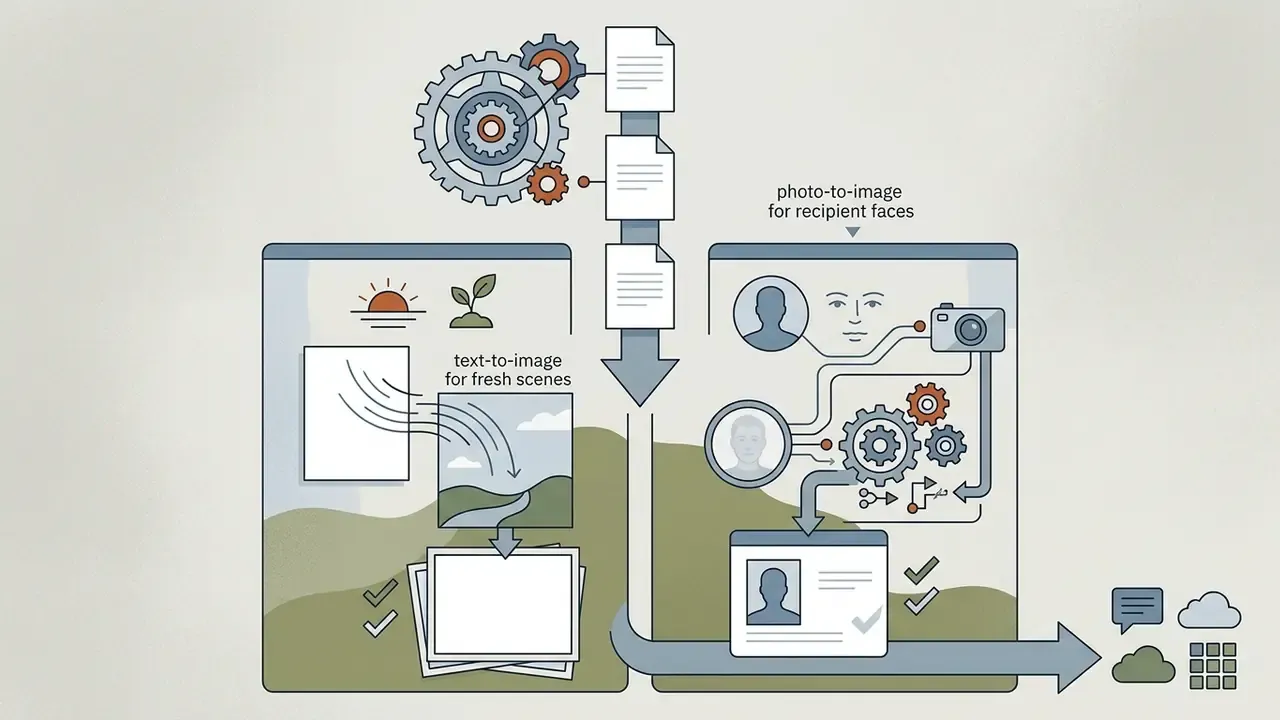
--cref) when a recipient's face must appear in the card.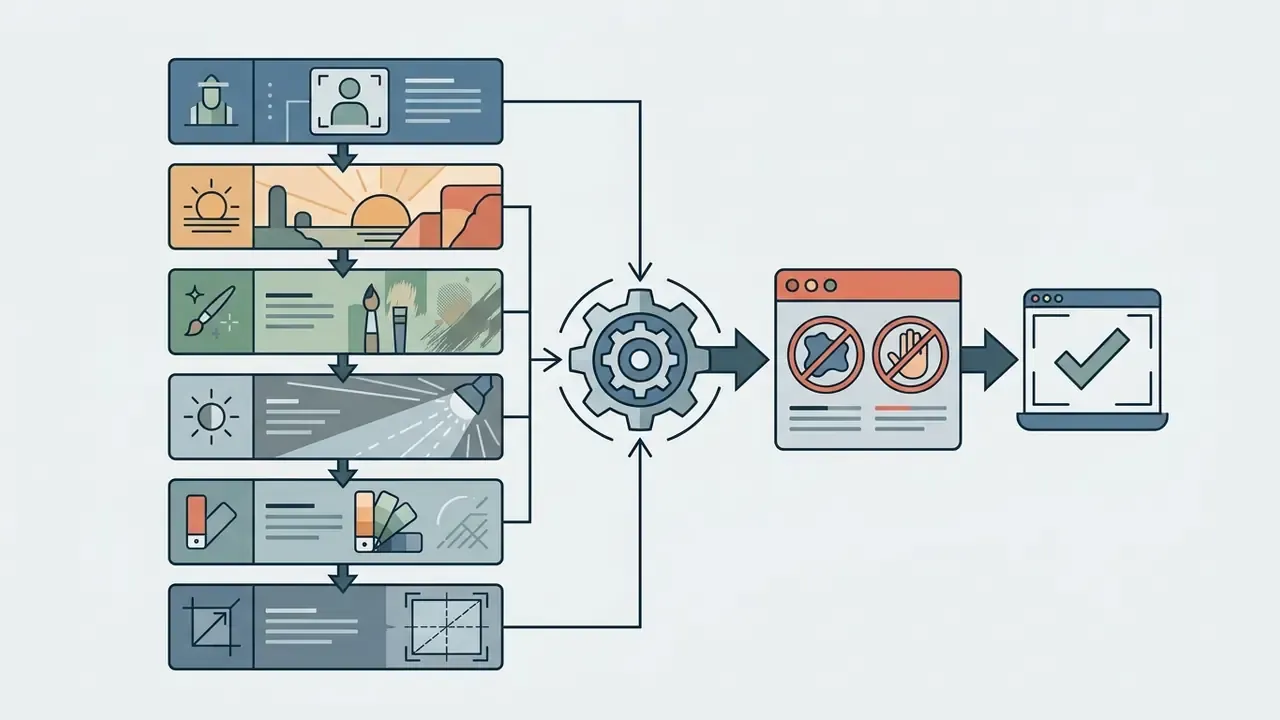

9:16 for WhatsApp Status and Telegram Stories, 4:5 for Instagram feed, 1:1 for messenger cards, with 15% safe zones for platform UI.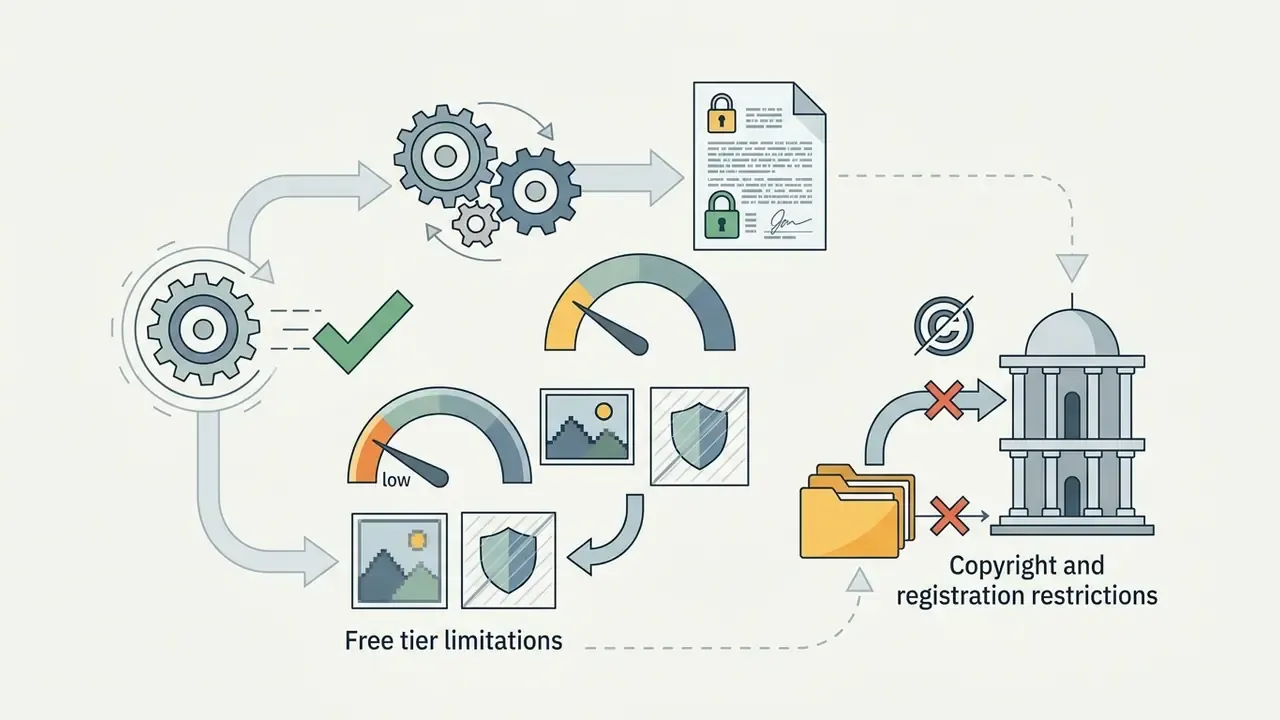
How to Use This Guide
Read it in the order your task demands. If you only need a card in the next five minutes, jump to the starter prompt set and the export table. If you are setting up a repeatable daily publishing pipeline, read the prompt formula, the typography checklist, and the risk controls near the end. Everything here assumes one thing: you want the card to be readable and forwardable, not just generated.
What Are Good Morning AI Images and Why Use Them
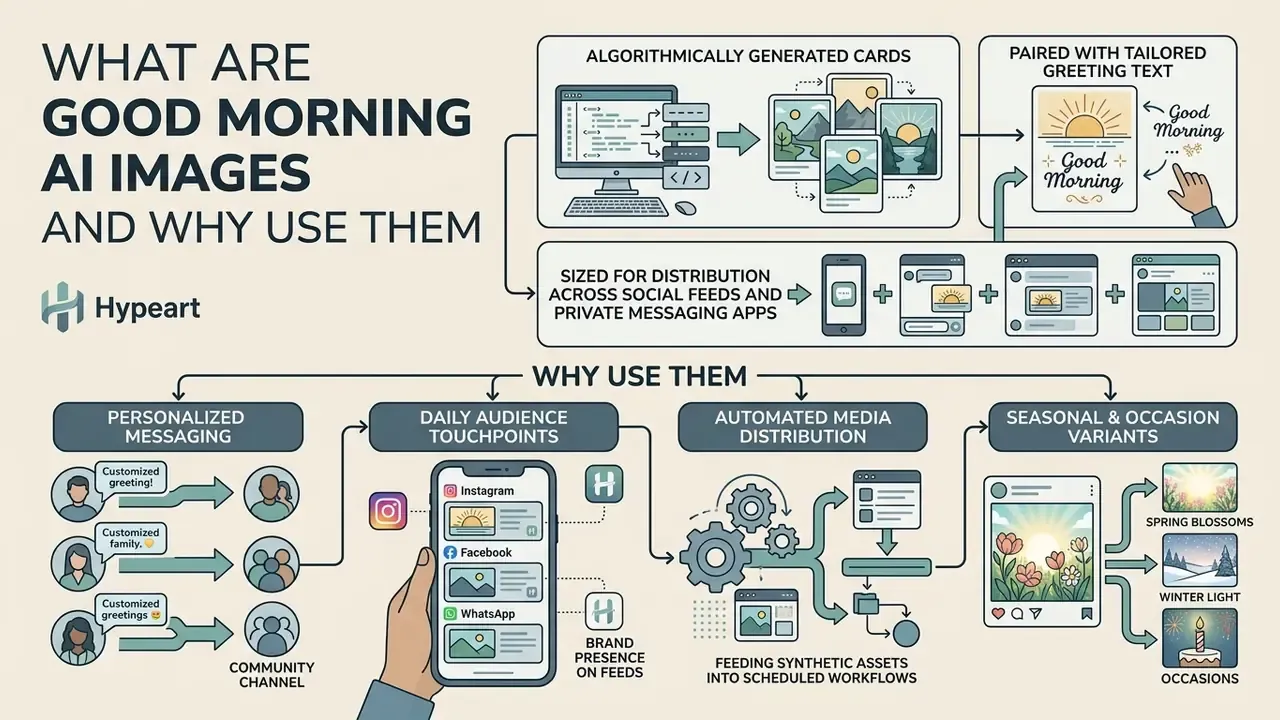
Good morning AI images are algorithmically generated visual cards paired with tailored greeting text, sized for distribution across social feeds and private messaging apps. People use these assets to deliver personalized morning wishes, keep audience engagement steady, and replace tired stock photography with something that appears in nobody else's feed.
«Pixiv AI content adoption increased new uploads by roughly 50%, yet produced no corresponding growth in views or comments».
Personalized Good Morning Wishes, Cards, and Mood Matching
Matching good morning wishes to a specific visual tone raises emotional resonance and recipient engagement. Aligning text sentiment with the background image, for example pairing a calm line with soft sunrise lighting, improves visual processing fluency and perceived sincerity. It also sounds less like a template, which is half the battle.
Picture-and-text congruence research shows that congruent pairs are processed more fluently and rated more favourably. Personalization measurably lifts response rates for AI-assisted greetings:
«AI-personalized videos raised click-through rates by 9.4 percentage points versus personalized images and 6.5 points versus generic video».
An experimental study of AI-generated birthday wishes reached a complementary conclusion. Personalization restored perceived sincerity and effort, offsetting the negative reaction some recipients have toward machine-written greetings. In practice, the greeting line should name the recipient, reference a shared context, and match the visual mood. A calm dawn gradient carries a reflective quote far better than a high-saturation tropical sunrise.
Creators can tune the morning greeting tone, font structure, and colour accents to a recipient's taste or a platform's culture. A useful sequence: choose the sentiment first (calm, energetic, playful, romantic), then select the visual style that carries that sentiment, and only then write the on-image copy. Reversing that order is how cards end up with a serene lavender sky and a shouty motivational slogan.
How AI Generated Good Morning Images Differ From Ready-Made Pictures
AI generated good morning images offer full prompt customization, watermark-free export options, and flexible styling that stock libraries cannot match. Stock photography relies on pre-shot frames licensed to thousands of concurrent buyers, which creates visual redundancy across public feeds. You have seen the same latte cup in six different accounts. So has your audience.
| Criterion | AI generated good morning images | Ready-made stock pictures |
|---|---|---|
| Uniqueness | Synthesized from scratch for a specific prompt; see how tools differ in the AI generated good morning images generator comparison | Limited by a public, multi-buyer license |
| Creation speed | 5–15 seconds per variation | 10–30 minutes of searching and selection |
| Text control | Built-in rendering or reserved empty zones | Fixed text or complex post-processing |
| Watermark control | Watermark-free export on paid or transparent tiers | Persistent protective grids until purchase |
| Emotion fidelity | Prompt-matched mood; no perception penalty when the source is undisclosed (Nielsen Norman Group testing) | Strong for real events, weaker for novel, made-to-order scenes |
| Seasonal adaptation | One prompt template, unlimited seasonal rewrites | Requires a new license per new scene |
Visual Styles of Good Morning AI Images: Sunrise, Coffee, Nature, and Cute Characters
The right visual style for AI morning images depends on who receives it and where it lands. Categories run from photorealistic landscapes to stylized character illustrations and vintage treatments.
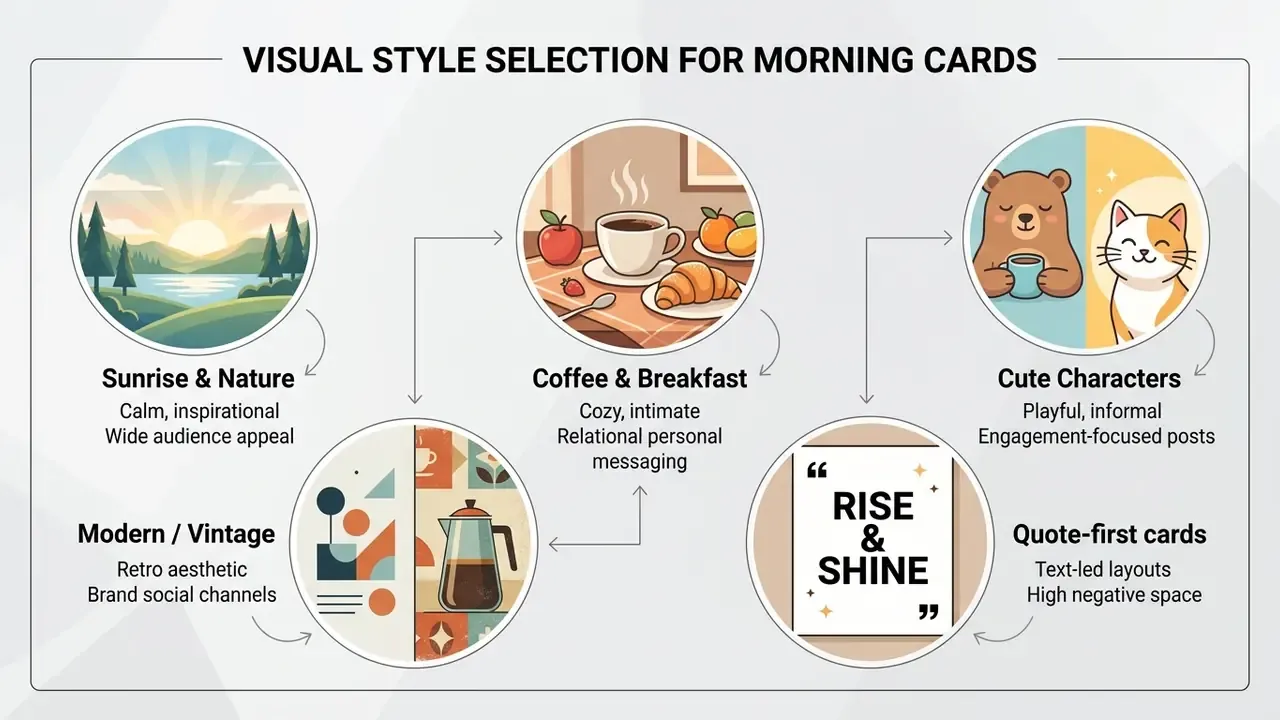
Style choice also constrains tooling. Painterly and illustrated looks reward models with strong stylistic priors, while photorealistic lifestyle scenes reward models with accurate skin and fabric rendering. That difference is worth reviewing before you spend credits, using the AI generator selection guide for morning cards.
Sunrise, Windows, Mountains, and Natural Morning Images
Natural sunrise morning images lean on warm horizon gradients and soft directional light to signal calm, optimism, and clarity. Dominant red and orange horizon tones follow atmospheric scattering, which is why they read as authentic rather than filtered.
Prompts aimed at nature scenes benefit from explicit composition markers: wide-angle window framing, distant mountain ridges, dew-covered garden foregrounds. These structural elements establish depth and keep the centre of the frame open for an optional quote overlay.
«AI images adjusted for cultural context elicited target emotions as effectively as images from validated affective databases».
Practically, that validates the sunrise category as an emotion-reliable default. A warm horizon gradient with a cool sky-to-ground transition, soft shadows, and visible atmospheric haze reproduces the calm optimism that morning greetings depend on.
Coffee, Breakfast, and Cozy Morning Scenes
Coffee and breakfast compositions rely on warm interior lighting, a beverage cup, and gentle window light to build an inviting still life. Arranging elements along diagonal light grids creates a balanced tabletop perspective, a device borrowed from classical breakfast still life, where horizontal foreground objects meet vertical background vessels and a diagonal element links both planes.
Natural window light, rising steam vectors, and warm wood textures reinforce domestic comfort. A few minimal props (an open journal, soft linen napkins) establish an authentic morning atmosphere without cluttering the frame. Three objects usually beat seven.
«AI images convey joy especially effectively in interior scenes, more accurately than in outdoor scenes, regardless of prompt type».
This is the strongest argument for making coffee-and-kitchen scenes the workhorse category of a daily greeting series. Interiors carry positive affect more reliably than open landscapes, and they hand you flat, low-detail surfaces (walls, tabletops, linen) where a quote stays legible.
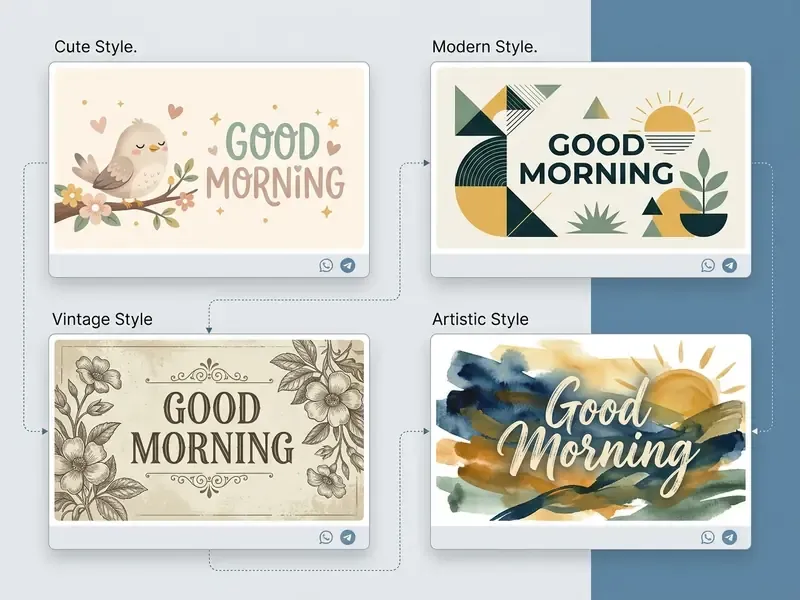
Cute, Modern, Vintage, and Artistic Styles for Greetings
Cute AI good morning images and artistic variations suit casual messaging, while modern and vintage styles fit branded or retro social posts. Match the genre to recipient expectations and channel culture.
- Cute style: illustrated characters, soft pastel palettes, expressive mascot motifs, high informal engagement. Best for family chats and community posts, and the default request behind most searches for good morning cute ai images.
- Modern style: crisp vector layouts, high-contrast typography, disciplined negative space. Best for branded, multi-platform business accounts.
- Vintage style: film grain, muted earth tones, retro postcard borders, nostalgic warmth. Best for memory-themed or seasonal greetings on image-first platforms.
- Artistic style: watercolour textures, oil brushstrokes, digital collage. Best for creator pages, portfolios, and visually expressive communities.
«High-quality AI images are perceived as more credible and informative; low-quality images trigger skepticism about the creator's motives».
Render quality is not a vanity metric, then. A soft, well-graded cute illustration reads as care. An artifact-heavy render reads as spam, and it shifts attention from the greeting to the tooling. Studies of AI-art perception add a second caution: when viewers know an image is AI-generated, they rate liking, beauty, and novelty lower. Polish and personalization are the two levers that offset that disclosure bias.
For creators moving into dynamic media, a slideshow video maker animates static morning cards into feed-ready video. Teams comparing options can review free AI video generators before committing to a motion workflow, and anyone finishing exports on a desktop timeline can pair them with the shotcut video editor for cuts and captions. Presentation-style greeting decks for internal channels can be assembled in a slidesgo ai presentation maker.
How to Create a Good Morning AI Image in an AI Generator
Generating a good morning AI image follows a five-step workflow, from style definition to final download.
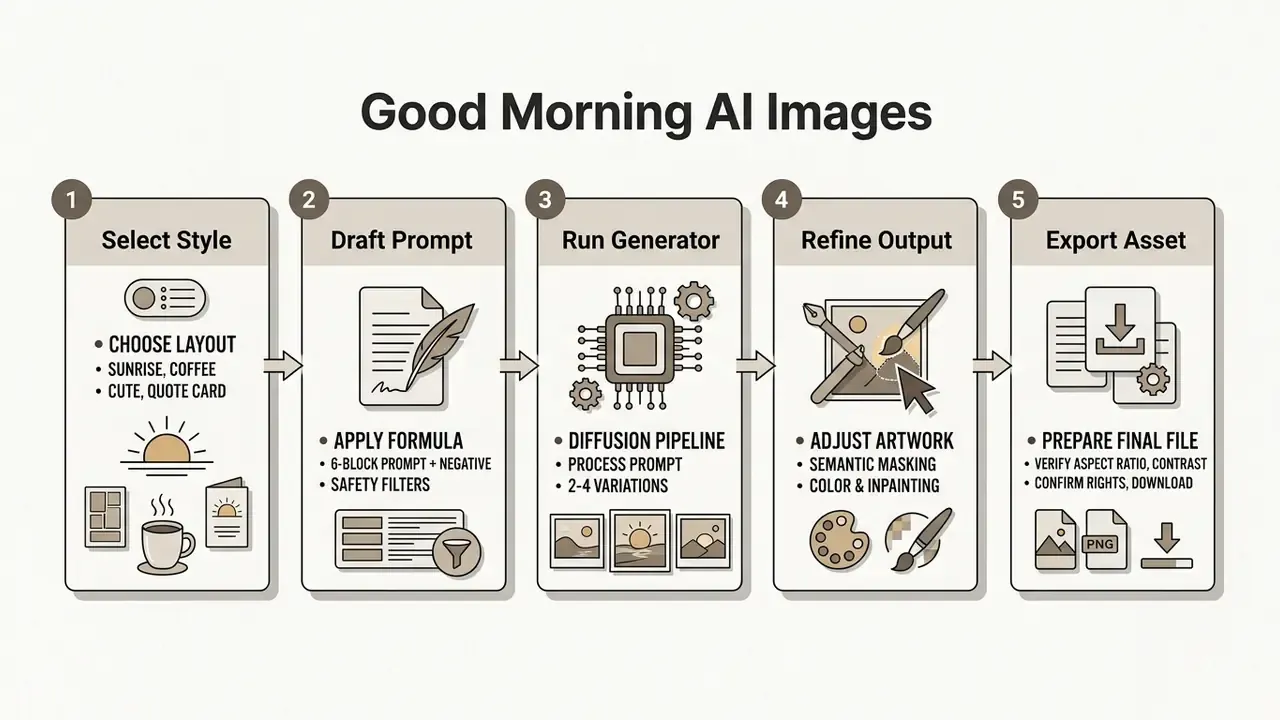
Step 4 is the one teams are most tempted to automate away. The evidence argues against that:
«A human-in-the-loop publishing model produced significantly higher engagement than fully automated AI posting, including friend requests and direct messages».
So "Refine Output" is a mandatory human checkpoint, not an optional polish pass. A one-minute review that catches a garbled quote, a six-fingered hand, or a broken safe zone separates a card that gets forwarded from a card that gets reported.
Description, Generation, and Refining the Result
Refining an initial AI generated good morning image involves iterative prompt tuning, localized semantic masking, and targeted image-to-image edits. If a generated morning scene shows distorted lighting or stray artifacts, you can isolate and fix a sub-region instead of regenerating everything and losing the composition you liked.
- Prompt iteration adjust descriptive keywords (changing bright midday light to soft dawn glow) to shift colour temperature and shadow depth.
- Inpainting and local edits select specific regions, such as a beverage cup or a background mountain outline, and preserve the primary compositional structure.
- Element-level refinement trace a problem element back to the prompt label that produced it, then revise only that label.
- Style anchoring lock what must stay identical (background style, grade, font vibe), define style rules, then set limits so follow-up prompts do not drift the whole frame.
- Colour grading tune saturation and warmth curves to lift morning tones while keeping skin and sky natural. Final contrast and text polish are usually faster in a dedicated AI photo editor or a general-purpose online photo editor.
Teams comparing platforms can use the comparison of leading AI image generators and the best AI art generators breakdown for generation speed, refinement toolsets, and prompt adherence. To model credit burn before you subscribe, run the numbers through the AI Media Calculators.
Personalized Morning Cards: Generating from Your Own Photo (Photo-to-Image)
Prompts for AI Generated Good Morning Images: Formula and Ideas
An effective prompt for AI generated good morning images combines subject markers, lighting direction, composition bounds, and style instructions into one coherent sequence. Midjourney documents prompt basics as subject, medium, environment, lighting, color, mood, composition. OpenAI's guidance stresses specific descriptive detail with instructions placed first. NIST defines prompt engineering as crafting effective inputs to obtain desired generative outputs. The formula below consolidates all three.
The Six Building Blocks of a Morning Card Prompt
- Main subject: the core focus (a porcelain coffee cup, a cute character, a mountain window).
- Morning context: time markers (early golden hour, first light of sunrise, dewy morning).
- Style / medium: visual handling (photorealistic 8k, watercolor illustration, 3D render).
- Lighting and atmosphere: light source and shadow behaviour (soft side lighting through window, warm ambient light).
- Colour palette: tonal constraints (warm amber and pastel cream, cool blue gradient with gold).
- Composition and framing: camera perspective and layout (flat lay view, rule of thirds, negative space on right).
Block 7: Negative Prompts and Safety Constraints
For repeatable, brand-safe output, especially in regulated or customer-facing channels, extend the formula with an explicit exclusion block and platform-level safety settings:
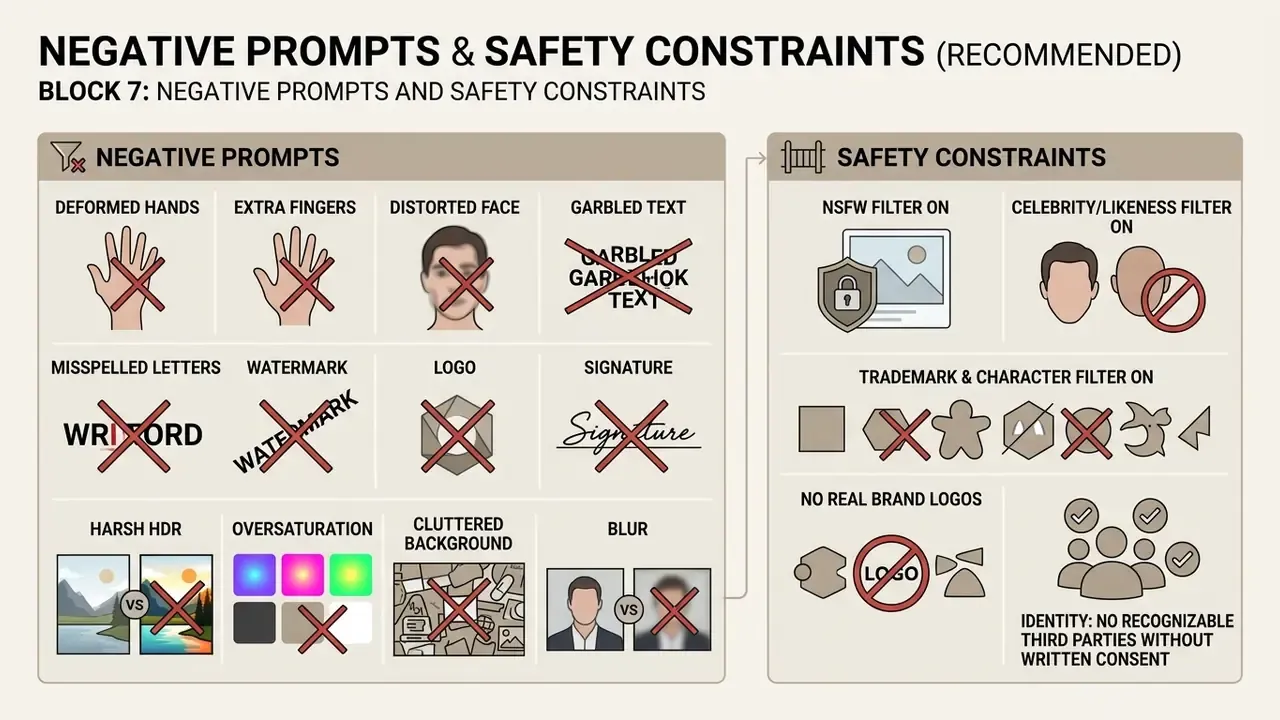
Two failure modes deserve extra attention in a daily-publishing workflow. First, embedded lettering: models still misspell rendered words, so exclude garbled text and plan to set the quote externally. Second, IP infringement by prompt: naming a protected character, mascot, franchise, or living artist can produce output that infringes trademark or personality rights even when the underlying model is licensed. Keep prompts descriptive ("a cute cartoon fox in a scarf") rather than referential. Ongoing disputes are tracked in the AI Litigation and Case Timelines hub, and they move fast.
Baseline Starter Prompts (Quick Copy Set)
25 Ready-Made Photorealistic Prompts for Good Morning AI Images
Each prompt below specifies camera body, focal length, aperture, light behaviour, and an aspect-ratio tag, plus a reserved area for typography.
Cozy and Lifestyle Scenes
- Sunrise window coffee
A relaxed person standing by a bright bedroom window at sunrise holding a steaming ceramic mug, soft knit sweater, warm golden light streaming through sheer curtains, minimal interior background, shot on Sony A7IV, 50mm lens, f/1.8, soft film grain, natural skin texture, clean color grading, empty space in top corner for text --ar 4:5 - Minimalist cappuccino flatlay
Clean photorealistic top-down flat lay of a white wooden desk with a cappuccino, latte art, open blank journal, fountain pen, small vase with white daisies, soft morning window light, delicate shadows, Scandinavian style, shot on Nikon Z7 II, 35mm, high resolution, ample negative space for inspirational quote --ar 4:5 - Cozy bedside stretch
A peaceful morning portrait of a person sitting on the edge of a bed stretching under soft dawn rays, crisp white linen bedding, minimal aesthetic decor, gentle rim lighting, shot on Canon R5, 50mm f/1.4, airy atmosphere, realistic fabric folds and shadows, blank upper space for greeting --ar 4:5 - Balcony breakfast for two
An intimate half-body shot of a happy couple on a city balcony at dawn, wrapped in a woven blanket, holding two coffee mugs, city skyline in soft morning haze, golden hour rim light, shot on Sony A7R V, 85mm f/1.8, warm color tone, dedicated empty space at top for quote --ar 4:5 - Tea and vintage book
A quiet morning scene of hands holding a porcelain tea cup over an open vintage book, soft morning haze filtering through a curtained window, warm amber tone, shot on Fujifilm X-T5, 56mm f/1.2, shallow depth of field, subtle steam rising, blank background margin --ar 4:3
Nature and Landscapes
- Misty mountain sunrise
Cinematic wide-angle view of a golden sunrise over misty mountain ridges, warm sun rays breaking through tall pine forest, tranquil atmosphere, soft pastel horizon colors, high detail landscape photography, shot on Nikon Z8, 24mm, high dynamic range, empty sky area for large text overlay --ar 16:9 - Dewy garden tulips
Close-up shot of fresh pink and yellow tulips in a sunlit garden, morning dew drops glistening on petals, soft background bokeh, natural dawn lighting, shot on Canon R6, 100mm Macro f/2.8, ultra-detailed texture, clean negative space on the left --ar 4:5 - Calm ocean dawn
Peaceful ocean shoreline at first light, gentle waves reflecting pastel pink and amber sky, soft sea breeze haze, serene atmosphere, shot on Sony A7IV, 35mm, rule of thirds composition, wide clear sky space for morning greeting --ar 16:9 - Forest trail sunbeams
Sunbeams filtering through tall autumn trees onto a quiet forest footpath early in the morning, golden leaf particles floating in light rays, mystical serene mood, photorealistic landscape, shot on Fujifilm GFX 100II, wide clear top area for text --ar 4:5 - Spring meadow blooming
A vibrant green meadow filled with wildflowers under an early morning sky, gentle morning mist in the distance, bright soft lighting, crisp focus, cinematic nature landscape --ar 16:9
Pets and Animals
- Cute cat on window sill
A fluffy cat resting on a wooden window sill bathed in warm morning sunbeams, curious expression, soft fur detail, blurred cozy living room background, shot on Canon R5, 85mm f/1.4, creamy bokeh, empty space above cat for morning wish --ar 4:5 - Golden retriever in sunlit park
A playful Golden Retriever sitting in a dew-covered park at sunrise, wearing a red bandana, warm backlighting, friendly expression, crisp fur texture, shot on Sony A7IV, 85mm, clear pastel sky negative space for overlay --ar 4:5 - 3D animated fox mascot
Cute stylized 3D rendered baby fox wearing a tiny scarf, holding a steaming mug with both paws, smiling, cozy morning kitchen background, soft pastel colors, Octane render style, warm lighting --ar 1:1 - Sleepy puppy in blanket
An adorable puppy wrapped in a soft knitted blanket waking up in gentle morning light, high detail photorealism, warm cozy mood, space at top for text --ar 1:1 - Morning birds on blooming branch
Two small colorful birds perched on a cherry blossom branch in early morning light, soft blurred background, vibrant pastel tones, shot on Nikon D850, 200mm lens --ar 4:5
Urban and Workday
- City street golden hour
A stylish person walking on a quiet city sidewalk at sunrise, light trench coat, white sneakers, warm sunlight reflecting off modern glass buildings, long soft shadows, shot on Fujifilm GFX, 63mm, cinematic street style, space near bottom for text --ar 4:5 - Veranda cafe croissant
A French breakfast scene on an outdoor cafe table: freshly baked croissant, latte with detailed foam art, newspaper, warm directional morning sunlight, shot on Leica SL2, 50mm f/1.4, editorial food photography --ar 4:5 - Productive desk setup
Modern clean office workspace in morning light, open laptop, white coffee mug, small green succulent, planner, soft sun glare across desk, corporate lifestyle shot, professional neutral grade, blank wall background for quote --ar 16:9 - Morning jogger energy
An athletic person running along a park path at dawn, light mist rising from ground, sun flare through trees, crisp dynamic action shot, motivational high-energy vibe, clear top area for text --ar 4:5 - Rainy morning warmth
A cozy view from inside a warm cafe looking through a raindrop-covered window at soft morning streetlights, blurred city bokeh, warm cup of coffee in foreground, reflective mood --ar 4:5
Quotes, Aesthetics and Art
- Soft pastel sunrise gradient
Minimalist morning background, delicate pastel pink, orange, and cream sky gradient, low contrast, soft clouds, clean aesthetic, vast empty negative space in center for typography placement --ar 4:5 - Watercolour botanical garden
Expressive watercolor painting of a sunlit morning garden, delicate pastel washes, soft artistic brushstrokes, gold leaf accents on flower edges, light and airy composition --ar 1:1 - Vintage postcard aesthetic
Retro 1970s style morning postcard background, warm muted earth tones, hand-drawn floral borders, aged paper texture, soft nostalgic film look --ar 4:3 - 3D typographic morning background
Abstract 3D smooth wave shapes in soft cream and warm peach tones, subtle direction light, shadows, modern elegant design background optimized for text placement --ar 9:16 - Gold leaf and marble morning
Luxurious white marble surface with gold leaf veins, bathed in soft morning window light, a single white rose on the side, high-end clean aesthetic, large blank middle section --ar 4:5
Variation tip: to build a consistent daily series, change exactly one element per generation, whether location, prop, or wardrobe colour, and keep the background style, colour grade, and font vibe fixed. Swapping the whole scene destroys visual continuity across a feed. I learned that the slow way, after a week of cards that shared nothing but the word "morning".
Good Morning AI Images with Quotes: How to Add Text and Wishes
Creating good morning images with quotes means balancing visual complexity against typographic contrast. Diffusion models keep improving at visual text integration, yet composition planning still decides whether a quote is readable on a phone at arm's length.
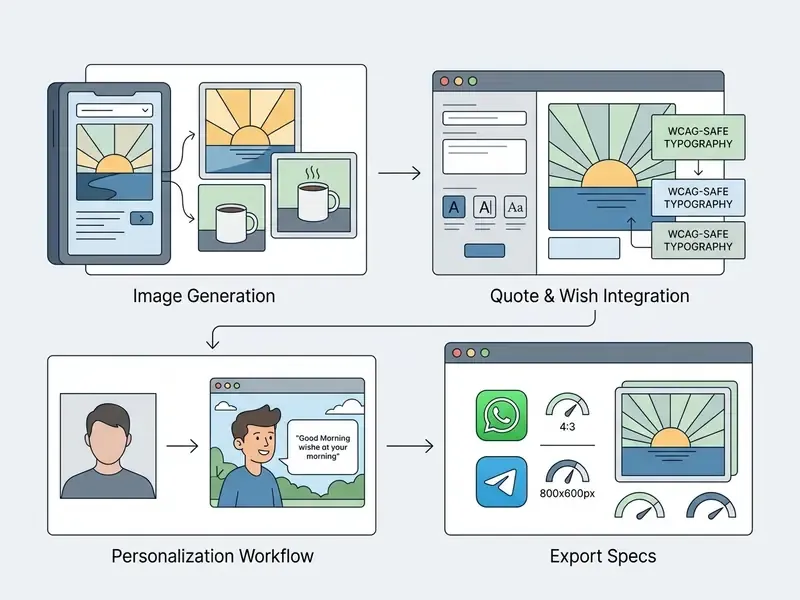
How to Make the Greeting Text Stand Out on an AI Image
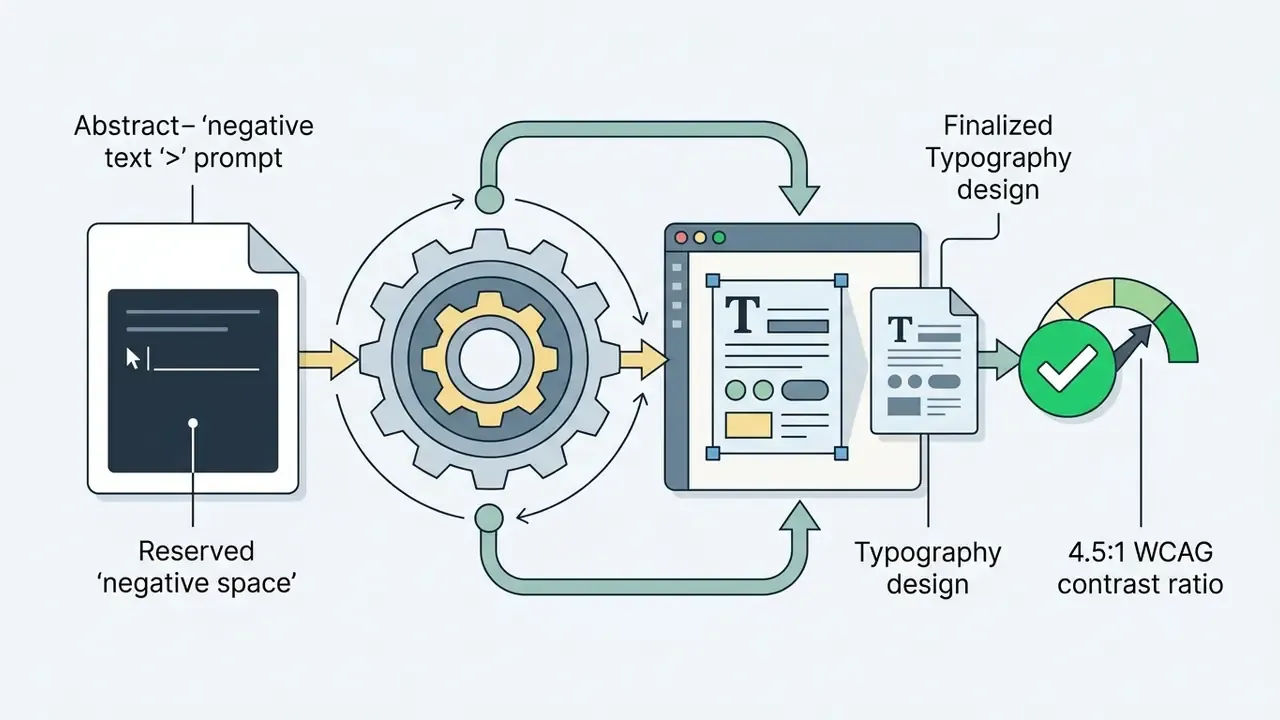
Legible good morning wishes ai images require a minimum 4.5:1 WCAG contrast ratio against the background, and 3:1 for large text, per Understanding Success Criterion 1.4.3: Contrast (Minimum), W3C WCAG 2.2. Text set over busy visual patterns slows reading and blurs perceived clarity. Lettering baked into a logo or used purely as decoration is exempt from the requirement.
To maximize readability on mobile:
- Reserve negative spaceprompt the generator to leave blurred or low-detail areas for text, then finish typography in an AI photo editor instead of trusting model-rendered lettering.
- Apply contrast backdropsadd a subtle semi-transparent dark or light gradient beneath the lettering, then re-measure contrast after the gradient is applied, not before.
- Limit character countshold on-image quotes to short, impactful phrases of three to seven words.
- Scale for the smallest screenvalidate legibility at 320 px width, the practical floor for messenger previews and status thumbnails.
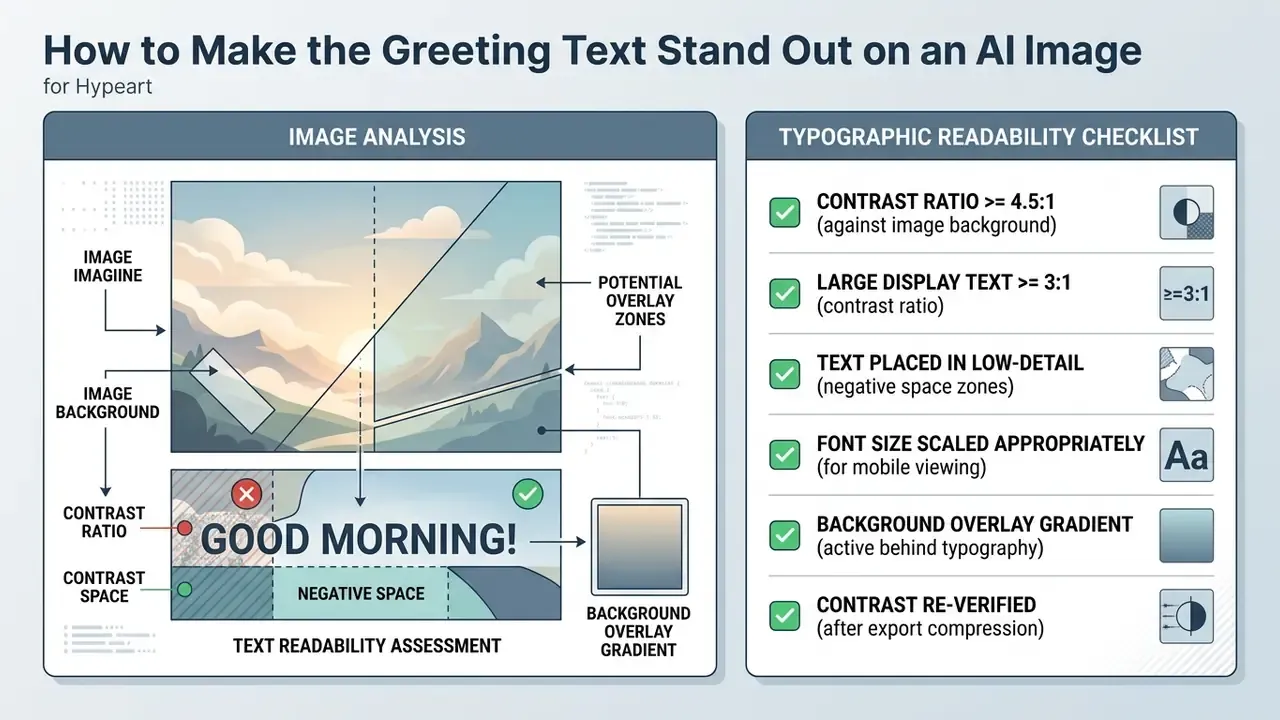
How to verify contrast before production. Sample the darkest and lightest pixels inside the text bounding box, run both against the text colour in a WCAG contrast checker (any tool implementing the W3C relative-luminance formula), and take the lower of the two ratios as the true value. For gradient backdrops, test at three points, top, middle, and bottom of the text block, because a single midpoint sample routinely overstates compliance. Automate the check in the export step if you publish daily, and treat any value below 4.5:1 as a blocking defect rather than a stylistic preference. If a checker returns 4.48:1, that is a fail. Fix it.
Technical benchmarks published in the TextInVision Benchmark (CVPRW 2025) indicate that dedicated models improve visual text rendering, yet combining external text editors with AI backgrounds still produces superior typographic quality. A parallel CVPR 2025 method, DesignDiffusion, reports FID 19.87 for text-to-design image generation, evidence that structured text-and-layout output is improving while remaining dependent on specialized pipelines rather than general-purpose prompting.
Platform norms matter as much as pixel contrast:
«AI content adapted to the norms of a specific platform was preferred more often and produced a stronger call to action, especially on Facebook».
Practically: shorten copy and raise contrast for Stories, keep a calmer tone with more negative space for feed posts, and rewrite the same greeting per channel instead of reposting one identical asset everywhere. If something breaks during export or upload, the AI Media Support and Troubleshooting hub covers the common failure cases.
Free AI Good Morning Images: Pricing, Downloads, and Usage
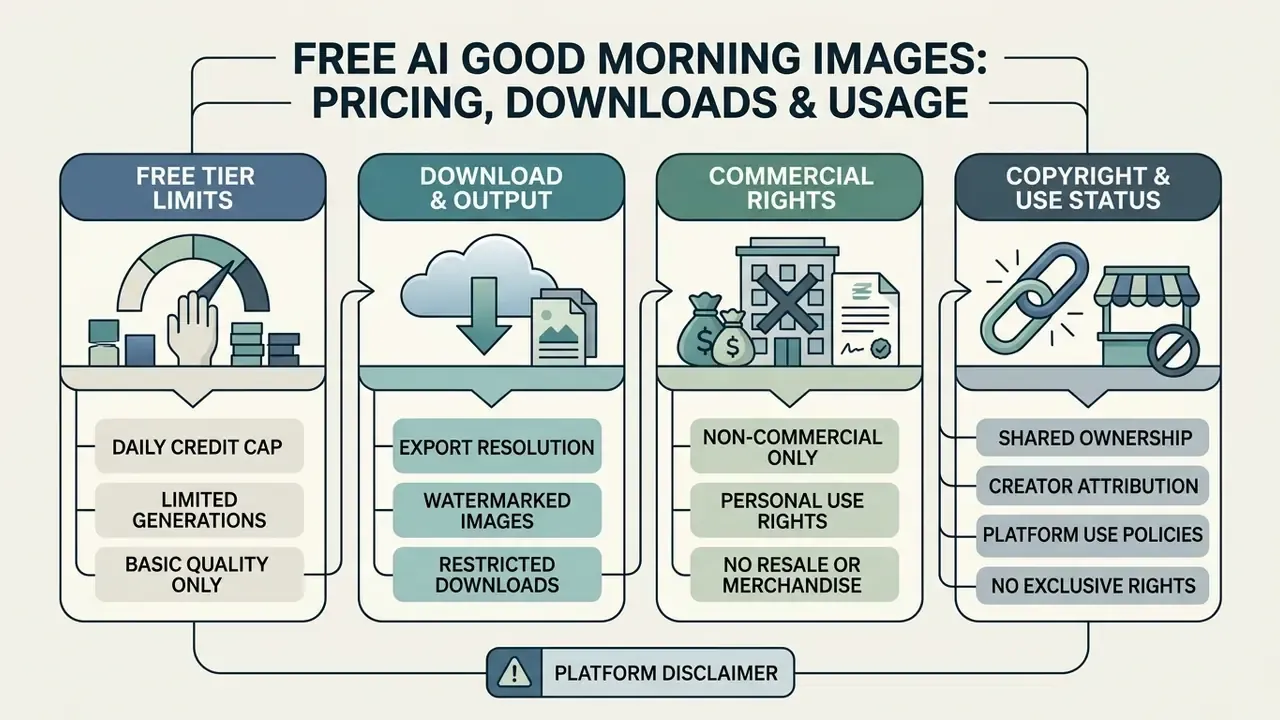
Getting ai good morning images free usually means a freemium tier, a daily credit limit, or restricted download rights. Baseline creation often costs nothing, while commercial deployment and high-resolution exports normally sit behind a subscription.
E-E-A-T FACT CHECK: License Terms and Output Rights
Transparency affects performance too, not only compliance:
«Among users who did not recognize an image as AI-generated, engagement and perceived quality rose; among those who did recognize it, both declined by a comparable margin».
For brand and institutional channels, the practical takeaway is to pair disclosure with quality. Label synthetic assets where policy requires it, and invest in render quality and personalization so the disclosure penalty is offset rather than ignored.
Understanding pricing structures prevents workflow bottlenecks once card volume scales. Teams deploying commercial art or integrated media should reference AI Media API Guides and compare licensing terms across free and enterprise offerings.
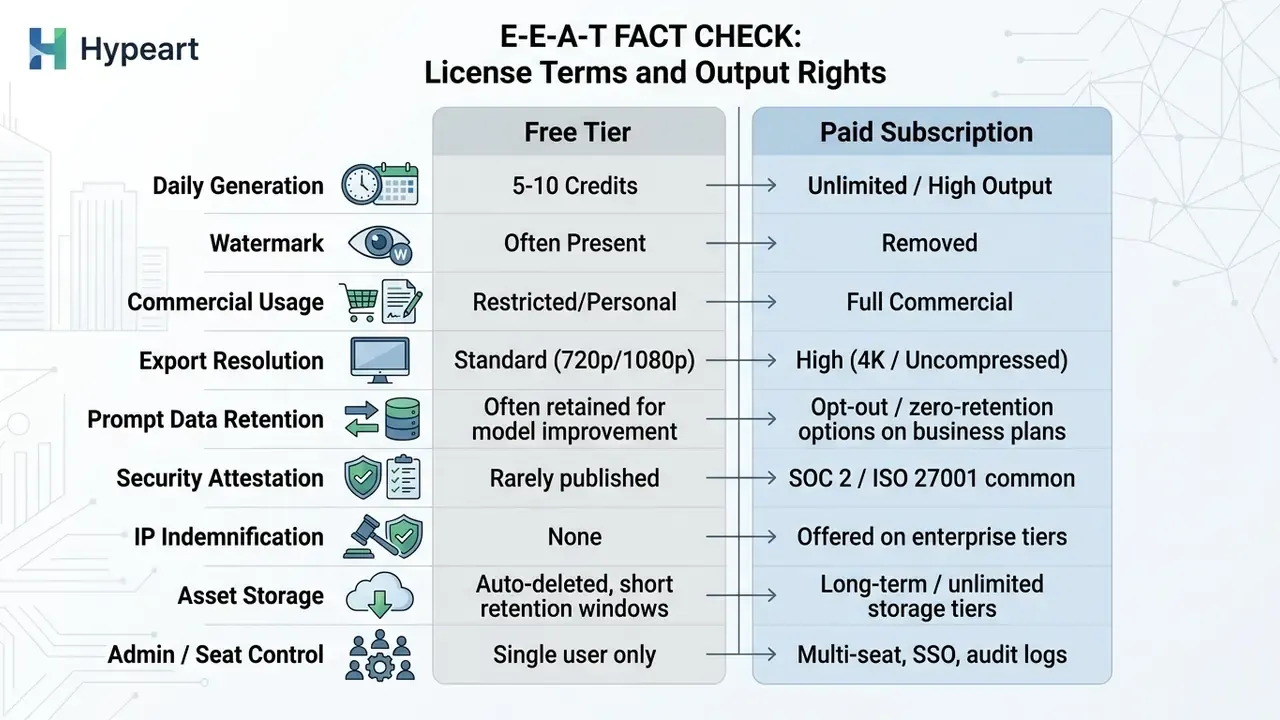
Before you commit budget, compare limits, watermark policies, and license scope across free AI image generators and free AI art generators. Style-specific options such as Ghibli-style generators and design-suite tools like Canva's AI generator carry their own terms, which differ more than the marketing pages suggest. Organizations planning broader synthetic media integration can also evaluate AI video generator pipelines when morning cards need to ship as motion assets.
Enterprise Risk Checklist: IP, Privacy, and Shadow AI
Daily greeting imagery looks low-stakes, which is exactly why it drifts into an unmanaged channel. Marcus Hale's editorial rule applies here as well, in an illustrative sense: no evidence, no autonomy. A generator publishing to a live brand feed is a digital worker, and it needs a named owner. The controls below close the gaps most often missed in consumer-facing messaging workflows:
- Trademark and character exposure.Prohibit prompts naming protected franchises, mascots, living artists, or public figures. Descriptive prompting ("a cheerful cartoon fox") avoids the likeness and trademark exposure that referential prompting invites.
- Prompt data leakage.Treat prompt fields as untrusted output channels. Free public generators may retain prompts and uploads for training, so bar customer names, account numbers, internal codenames, and unreleased campaign details.
- Biometric handling.Photo-to-image workflows transmit facial images to third parties. Require documented consent, restrict uploads of minors' images, and prefer vendors offering zero-retention processing.
- Shadow AI.Staff using unapproved consumer tools is the dominant risk pattern: unlicensed output reaches production, watermarks appear in published assets, and no audit trail exists. Publish a short allow-list of approved generators with license tier noted.
- Human-in-the-loop sign-off.Per the Meta/Instagram workflow findings above, keep a named human reviewer for every published asset. It lifts engagement and creates accountability for defects.
- Accessibility conformance.Bake the 4.5:1 contrast check into the export gate. Where ADA or Section 508 expectations apply to digital communications, unreadable promotional text is a compliance issue, not a design preference.
- Provenance and labelling.Record model, version, prompt, and date per asset. Where disclosure is required, apply it consistently rather than case by case.
Limitations and Open Questions
Two things in this guide rest on softer ground than the rest, and pretending otherwise would be dishonest.
The 65% uplift reported for photo-to-image cards comes from vendor material without a published sample or methodology. Treat it as a hypothesis, not a benchmark. The same caution applies to cycle-time savings against stock sourcing: the direction is clear, the magnitude is not.
Disclosure effects are also unsettled. The Warwick working paper measures news demand, not greeting cards, so its penalty may not transfer cleanly to a family chat. And embedded text quality is a moving target. Benchmarks from 2025 already understate what current models render, which means the "set the quote in an editor" rule may soften within a year or two. Until then, external typography remains the safer default.
FAQ: Good Morning AI Images
Where can I create good morning images with AI?
In any browser-based ai generator that supports text-to-image or photo-to-image workflows. Describe the mood, setting, and light, set the aspect ratio, and generate. No design skills required, though a final pass in a photo editor improves typography noticeably.
What kinds of good morning images can I make?
Sunrise landscapes, coffee and breakfast still life, floral close-ups, urban morning streets, cute character mascots, wellness and meditation scenes, and quote-first cards with large reserved text areas.
How do I write a good prompt for a good morning image?
Combine the six blocks: subject, morning context, style, lighting, palette, and composition, then add a negative prompt. Example: "cheerful good morning scene, ceramic mug on windowsill, first light of sunrise, photorealistic, soft side lighting, warm amber palette, flat lay with negative space at top --ar 4:5".
Can I add text directly in the prompt?
You can, and some models handle short strings well. Put the exact wording in quotation marks and specify placement and font style. For reliability, generate a background with reserved negative space and set the quote in an editor, since benchmark evidence still shows embedded text as the weakest link in diffusion output.
Can I put my own face or a family member's photo on the card?
Yes, via photo-to-image with IP-Adapter, ControlNet, or a character-reference parameter. Upload a sharp, evenly lit photo, describe only the environment, and use inpainting at 0.35–0.45 denoising strength to fix facial distortion. Get consent before using anyone else's likeness.
Which format should I export for WhatsApp Status?
9:16 at 1080 × 1920, with 15% clear margins top and bottom so the interface does not cover the greeting. Use PNG if the card carries fine typography.
Are AI-generated morning cards free?
Baseline generation is frequently free under credit limits, but free tiers typically add watermarks, cap resolution, and restrict use to personal, non-commercial contexts. Paid tiers unlock watermark-free high-resolution exports and contract-based commercial rights.
Can I sell AI-generated greeting cards?
Vendor terms may grant commercial use, yet in the United States purely AI-generated output is not registrable for copyright, and several stock marketplaces prohibit reselling AI content. Verify both the generator's license and the destination platform's policy.
Can I automate daily generation through an API?
Yes, most major providers expose image endpoints, and scheduling tools can post the output. Keep a human review step before publication, log model and prompt per asset, and confirm your plan's license covers automated commercial distribution. See the AI Media API Guides for implementation patterns.
Why do my AI images get less engagement than expected?
Two common causes: supply saturation, since the Pixiv data shows volume growth without attention growth, and disclosure bias, since recognized AI imagery is rated lower. Counter both with personalization, higher render quality, and platform-specific copy.
What to Do Next
- Pick one style lanefrom the taxonomy above and lock a colour grade, font vibe, and background pattern for the next 30 cards.
- Build two prompt templates, one text-to-image and one photo-to-image, each with the six-block structure plus the negative and safety block.
- Set an export gateaspect ratio per channel, 4.5:1 contrast verification, provenance logged.
- Audit your toolingconfirm license tier, prompt retention policy, and security attestation for every generator in use, then publish an allow-list to eliminate shadow AI.
- Compare alternativesin the comparison of leading AI image generators before you scale to daily publishing volume.