Author note: Marcus Hale writes about AI governance and model risk for this publication.
Executive Summary: What "Free" and "Unlimited" Actually Buy You
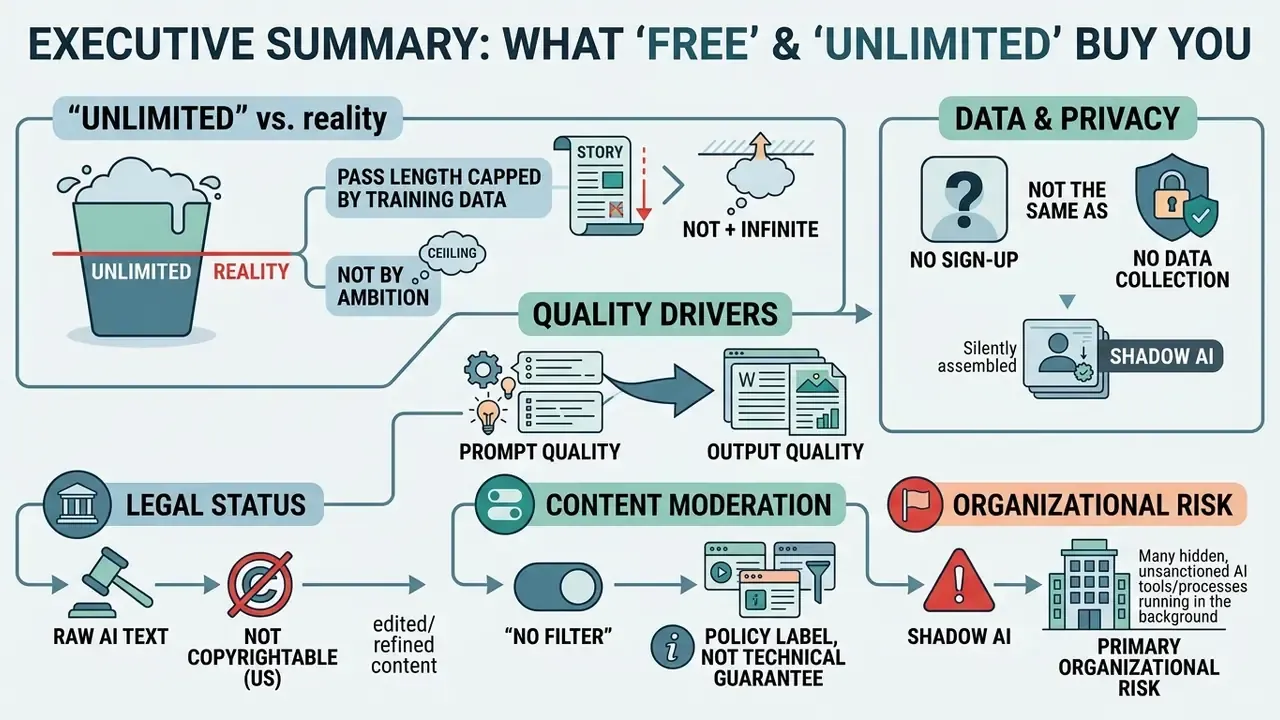
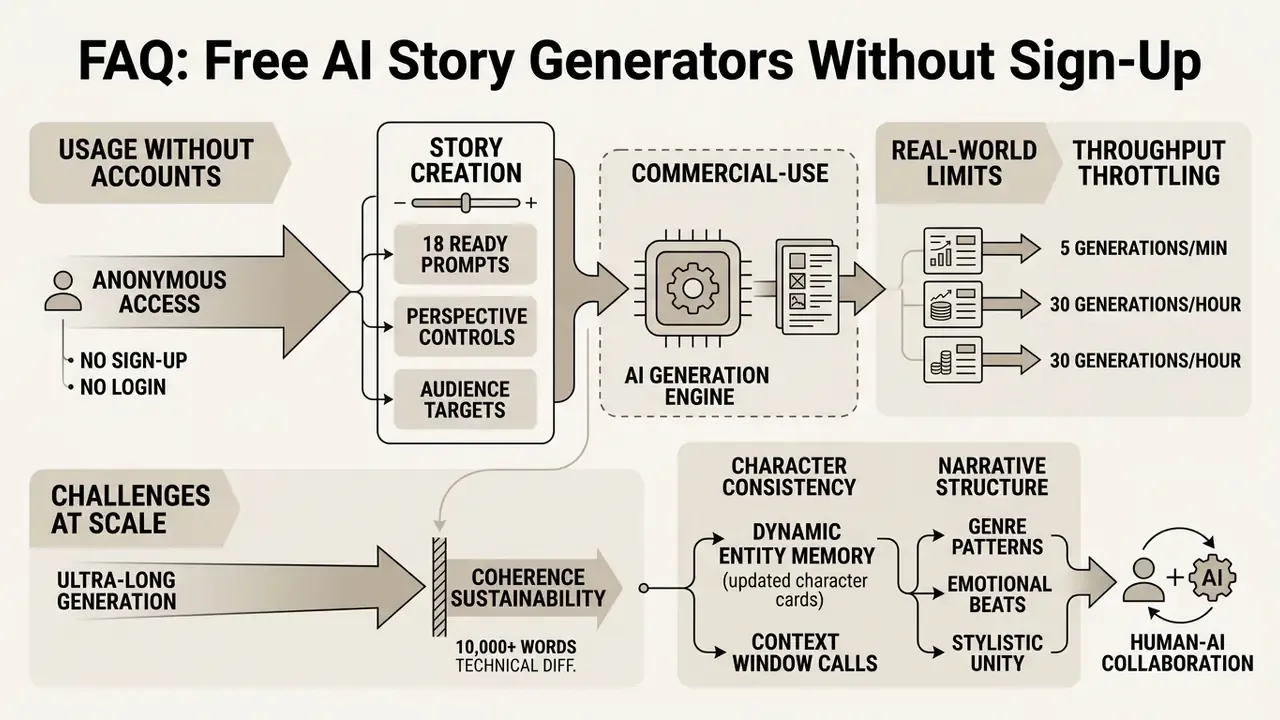
- "Unlimited" almost never means unlimited. Public generators advertise no subscription while enforcing five generations per minute, thirty per hour, or an undisclosed daily quota. "Free" means no upfront payment. "Unlimited" means no paywall, not unlimited throughput.
- Single-pass length is capped by training data, not by ambition. Standard models produce 1,000 to 2,000 coherent words per request unless a multi-pass agentic pipeline decomposes the task.
- No sign-up is not the same as no data collection. Anonymous sessions persist in browser
localStorageand are rate-limited by IP telemetry and device fingerprinting. Clear the cache and your drafts are gone for good. - Prompt quality drives output quality. Six mandatory components (genre, characters, setting, conflict, tone, formatting) separate a publishable draft from generic filler.
- Raw AI text is not copyrightable in the United States. Human creative revision, selection, and arrangement come first, publication second.
- "No filter" is a policy label, not a technical guarantee. Hosting-level and legal prohibitions stay enforced regardless of what the front end promises.
- Shadow AI is the primary organizational risk. Anonymous, unauthenticated generators bypass DLP controls and log prompts for telemetry or training.
Who This Guide Is For and How to Read It
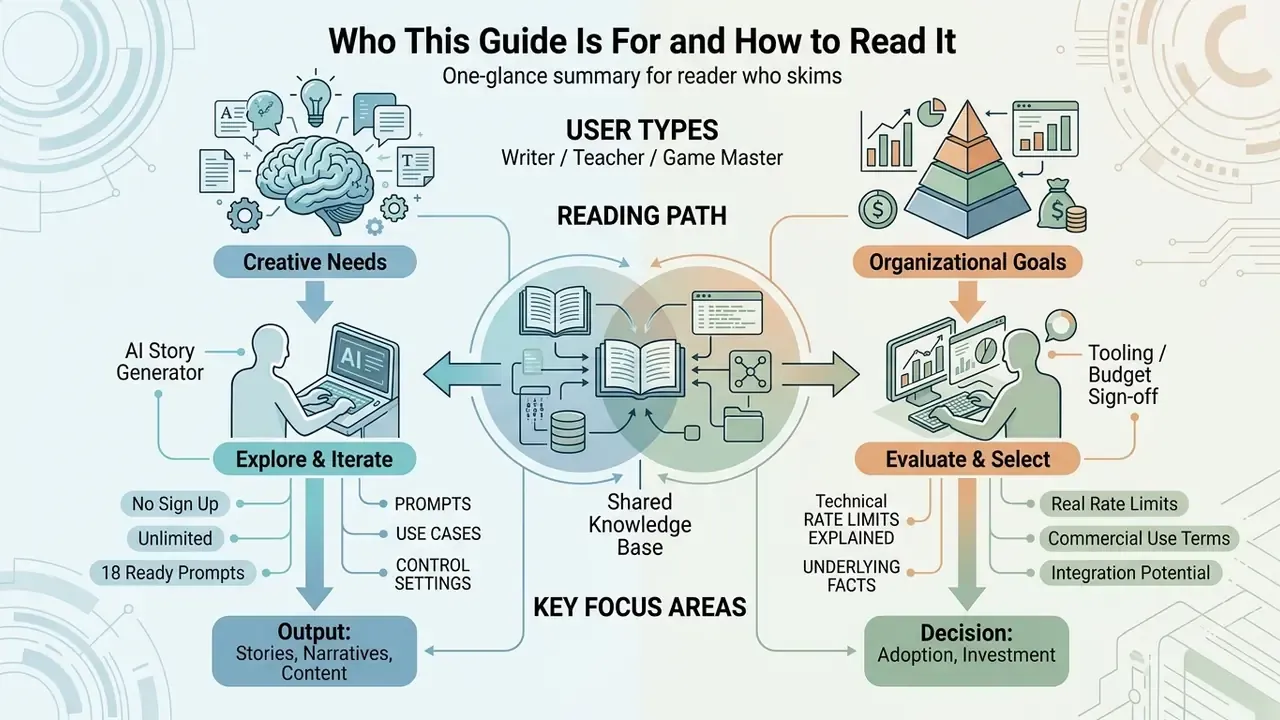
This page serves two very different readers, and they should not read it the same way.
The first reader is a writer, teacher, or game master. You want a story in the next ten minutes. Start with the creation pipeline, then jump straight to the prompt bank and the interface parameters. Everything you need to produce a usable draft sits in those three sections.
The second reader signs off on tooling. Heads of model risk, compliance officers, and AI governance leads keep finding "free unlimited AI story generator" in their proxy logs, usually under a marketing or L&D cost center. For that audience, the operationally relevant parts are the access-terms table, the Shadow AI assessment, and the commercial-use analysis. A no-login text generator looks trivial. It is still an unmanaged model endpoint receiving free-form employee input, and that is exactly the category most AI inventories miss.
Both readers need the same underlying fact base: what these tools genuinely do, where they stop, and who owns the output. Let's go through it.
Generative artificial intelligence changed text generation by putting instant narrative creation directly into a browser tab. Free, unlimited, no-signup story generators get used to test creative prompts, prototype fiction concepts, and produce structured narrative drafts. Using them well means understanding the trade-off between convenience, computational limits, model architecture, and copyright compliance.
What "AI Story Generator Free Unlimited" Actually Means
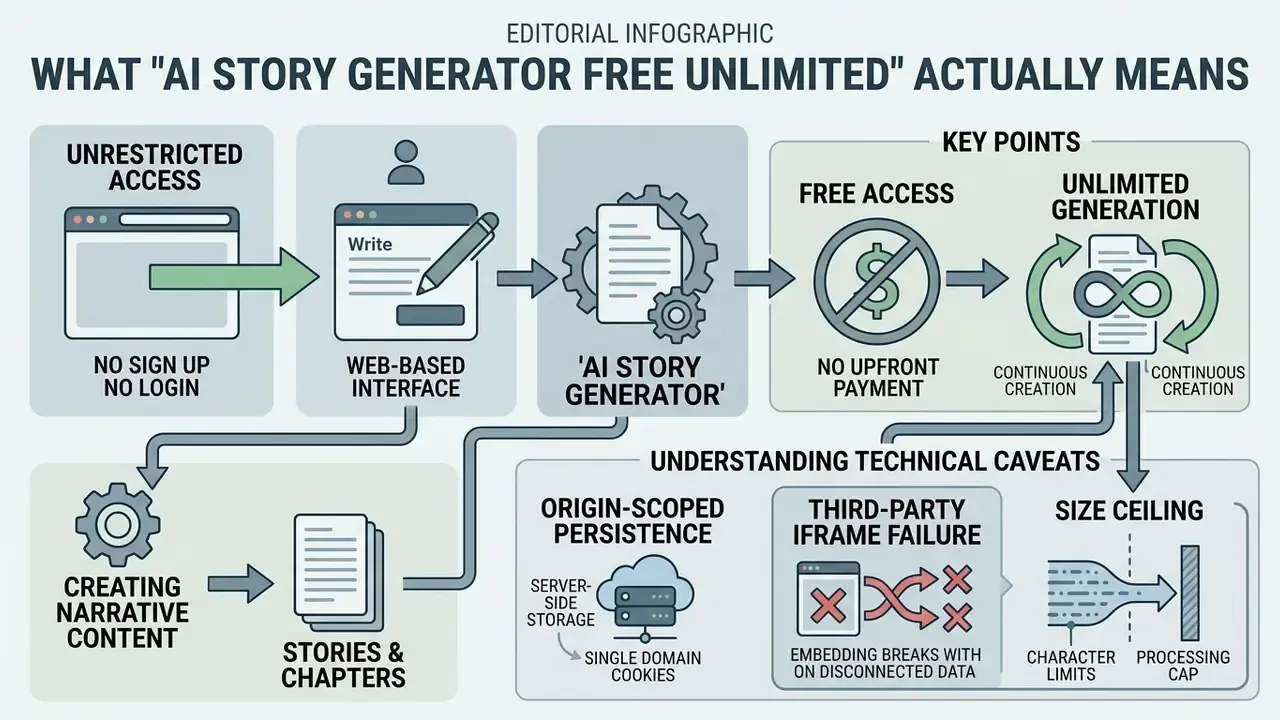
An AI story generator free unlimited is a web-based text-generation interface that lets you create narrative content without paying upfront, creating a profile, or submitting credentials. In technical practice, "unlimited" signals the absence of a hard monthly subscription paywall. It rarely signals unrestricted server throughput or infinite token generation per request.
Most public-access platforms implement anti-abuse rate limits, per-minute queueing, or daily compute allocations to control operating expense and block automated scraping. You can test ideas online with no initial barrier. Knowing the mechanics behind "free," "unlimited," and "no account" simply keeps expectations honest.
Table: Comparison of access terms and operational realities for online story generators
| Term | Promotional meaning | Technical and operational reality | Primary risk or constraint |
|---|---|---|---|
| Free | Zero upfront cost for narrative generation. | Supported by basic model tiers, ad monetization, or upsells to advanced models. | Lower-parameter models and standard generation queues. |
| Unlimited | No restriction on stories or words generated. | Governed by hidden rate limits, per-minute caps (for example five calls per minute, thirty per hour), or token output ceilings. | Throttling at peak load, context truncation on long drafts. |
| No sign up / no login | Immediate browser access with no email or credentials. | Session state persisted locally via browser localStorage (roughly a 5 MB ceiling) or session tokens. | Draft history lost when cache is cleared or the device changes. |
| No account | Fully anonymous creation with no user profiling. | Requests tracked via IP telemetry, device fingerprinting, or temporary cookies. | IP-based rate limits, no cloud backup for long-form projects. |
| Unmetered (launch phase) | Writing volume is not counted during a promotional window. | Short per-minute anti-abuse limits still apply; paid tiers with higher ceilings arrive as "coming soon." | Terms can change without notice mid-project. |
Long-tail search behaviour tells the same story. Queries like ai story generator free no sign up no limit, ai story generator no signup, and ai novel generator free unlimited all express one wish: no gate, no meter, no credit card. The gate is usually gone. The meter almost never is.
Free Access and the Concept of Unlimited Generation
Free story generation gives instant model access without subscription fees, but true unlimited generation runs into infrastructure and model-level walls. Providers distinguish between unlimited submission requests and unlimited word generation per response. That distinction matters operationally. A plan can allow hundreds of submissions while capping each output at 250 to 3,000 words, or allow long outputs while permitting three requests a month.
Commercial platforms often enforce throughput throttling, such as five generations per minute or thirty per hour, even while advertising "no daily limit." Other public tools publish a hard ceiling of 10,000 daily uses across all anonymous visitors, after which access resumes the next day or requires a subscription. Free tiers frequently gate advanced models, generation speed, and character-image counts while leaving the basic text engine open. If you need predictable ceilings, read the pricing tier definitions rather than the landing page.
Large language models are also constrained by their supervised fine-tuning data:
«The effective generation length of LLMs is limited by the output length in the SFT dataset. Without targeted alignment, models rarely produce coherent text beyond 2,000 words.»
Empirical work on ultra-long generation confirms the pattern: standard open-access models cap single-pass output somewhere between 1,000 and 2,000 words unless an agentic multi-pass pipeline breaks the task apart.
Table: Cost and compute reality behind "free" tiers
| Dimension | Free anonymous tier | Direct API usage |
|---|---|---|
| Marginal cost per 1,000-word story | Absorbed by the vendor (ad revenue or upsell funnel) | Billed per input and output token |
| Model tier | Smaller-parameter or distilled variant | Frontier model selectable |
| Queue priority | Shared anonymous queue, deprioritized at peak | Dedicated throughput, optional provisioned capacity |
| Latency at peak load | Highly variable (10 seconds to 60 seconds or more) | Predictable, SLA-backed on enterprise plans |
| Audit trail, SOC 2, ISO 27001 | Typically absent | Available on enterprise contracts |
Teams estimating token spend before moving from a free tab to a metered endpoint can model both paths with the AI Media Calculators and check integration limits against the AI Media API documentation.
Story Generator Without Registration, Login, or Account
No-signup, no-login, and no-account access removes onboarding friction: type a story prompt, receive text. The same pattern shows up across the wider tooling ecosystem, and our overview of free AI generators without registration shows how it behaves on adjacent creative tools. These interfaces store session parameters in the browser's origin-scoped localStorage or in temporary session storage.
Three technical caveats govern the architecture:
- Origin-scoped persistence.
localStoragesurvives browser restarts but is bound to one origin and one browser profile. A different browser, a different device, or an incognito window sees nothing at all. - Third-party iframe failure.When third-party cookies are disabled, Web Storage access can be denied inside embedded iframes. This is the most common cause of "my draft disappeared" reports on generators embedded as blog widgets. Our AI Media Support and Troubleshooting notes cover the recovery steps, such as they are.
- Size ceiling.Web Storage caps out around 5 MB, and cookies travel with every HTTP request, which makes both unsuitable for a full manuscript.
The result is fast testing and basic privacy, with zero cloud synchronization. Clear your cache, open an incognito window, or switch laptops, and saved drafts plus character profiles are erased permanently. Anyone working seriously in an anonymous generator should keep local backups of prompts and outputs. Not eventually. From the first session.
One correction to a common assumption, since it matters more than the storage detail: "no sign up" does not equal "no data collection." No account removes credential storage, not server-side logging. Rate limiting itself needs a request-level identifier, usually an IP address or a fingerprint, which is collected by definition.
How to Create a Story With AI Without Registration
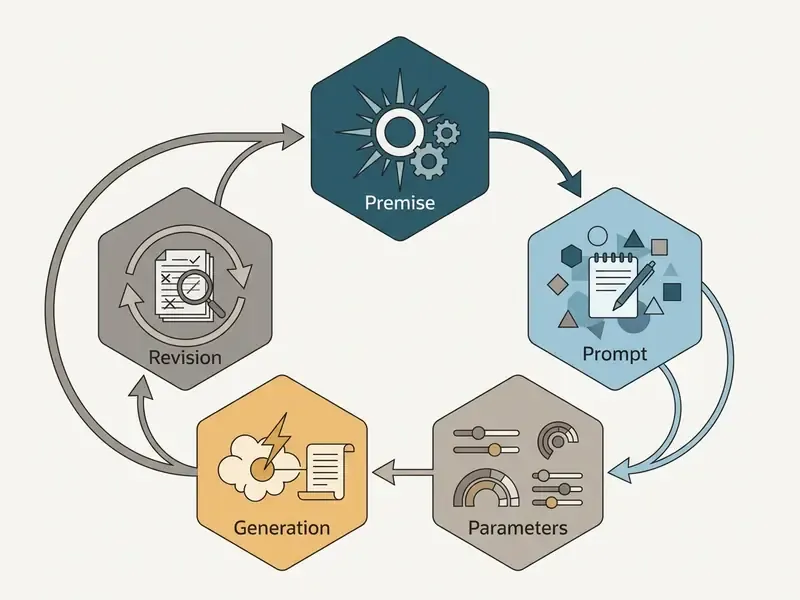
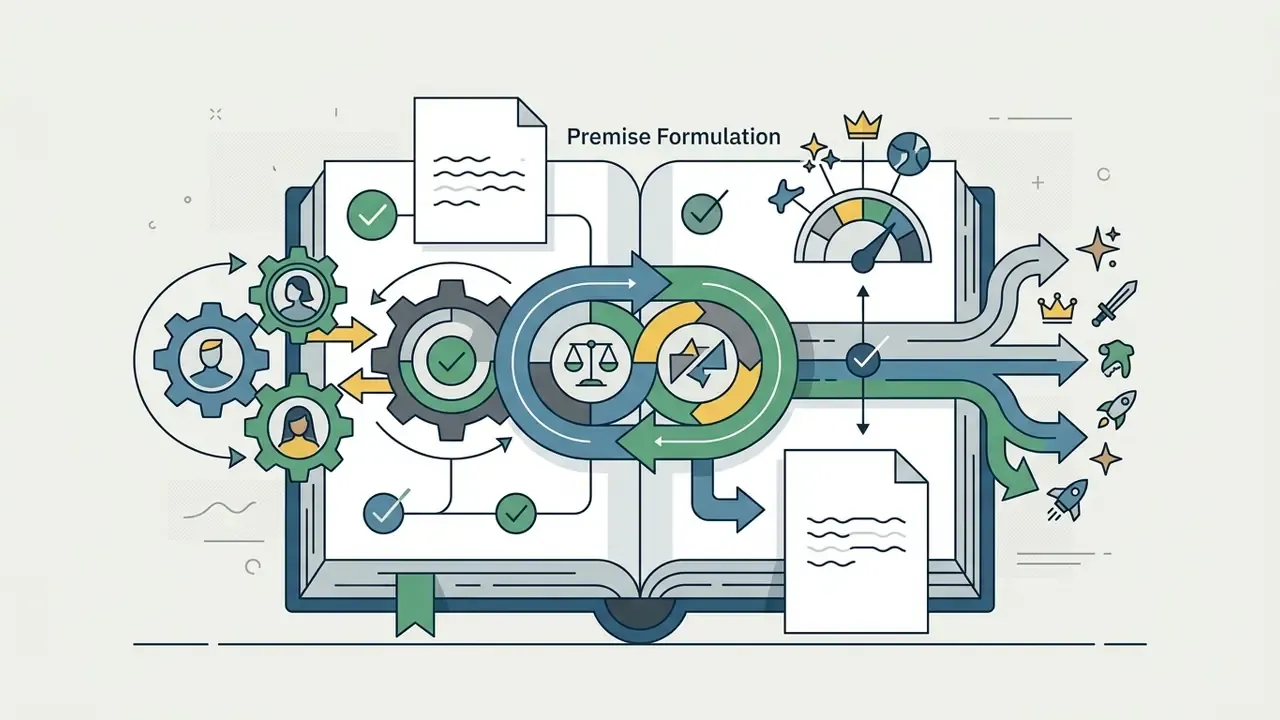
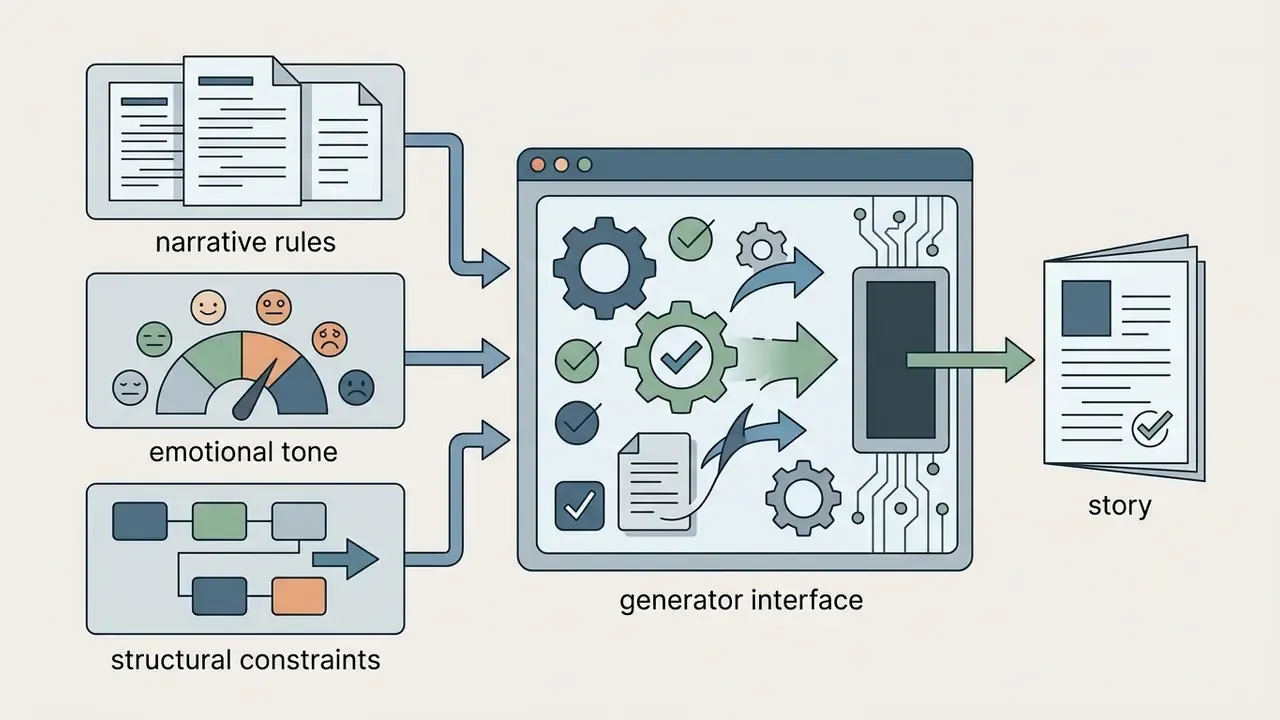
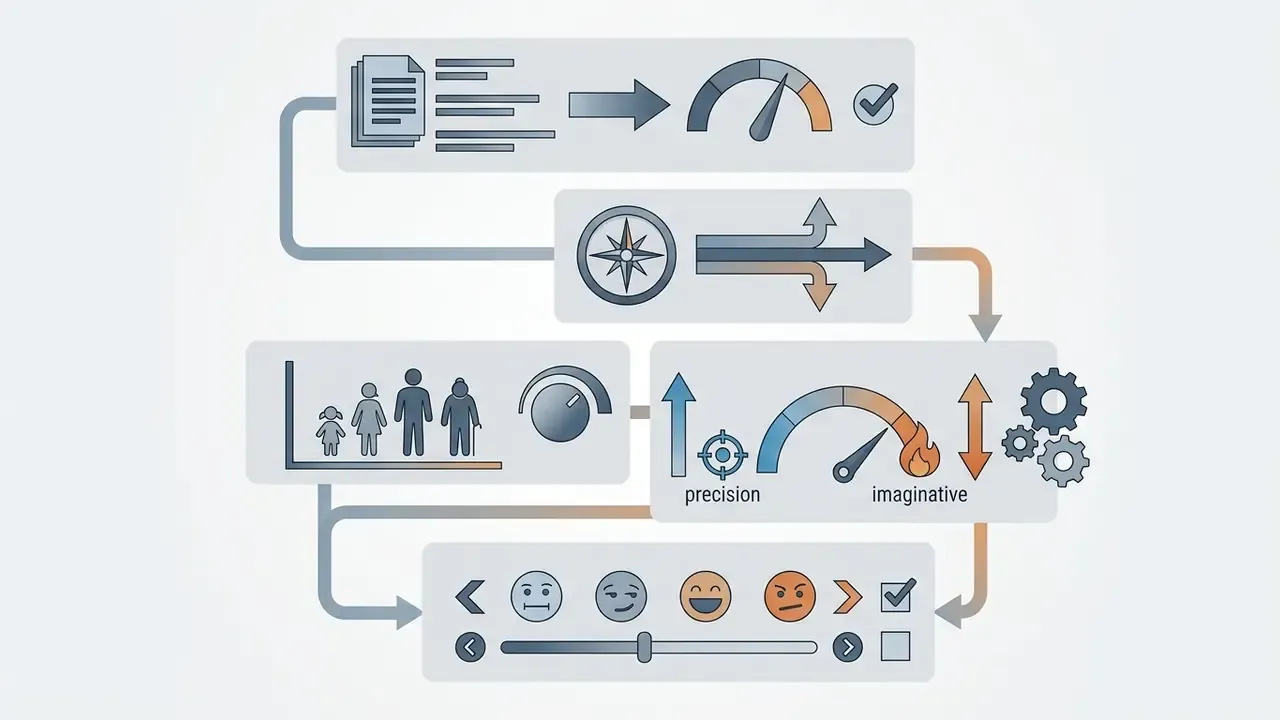
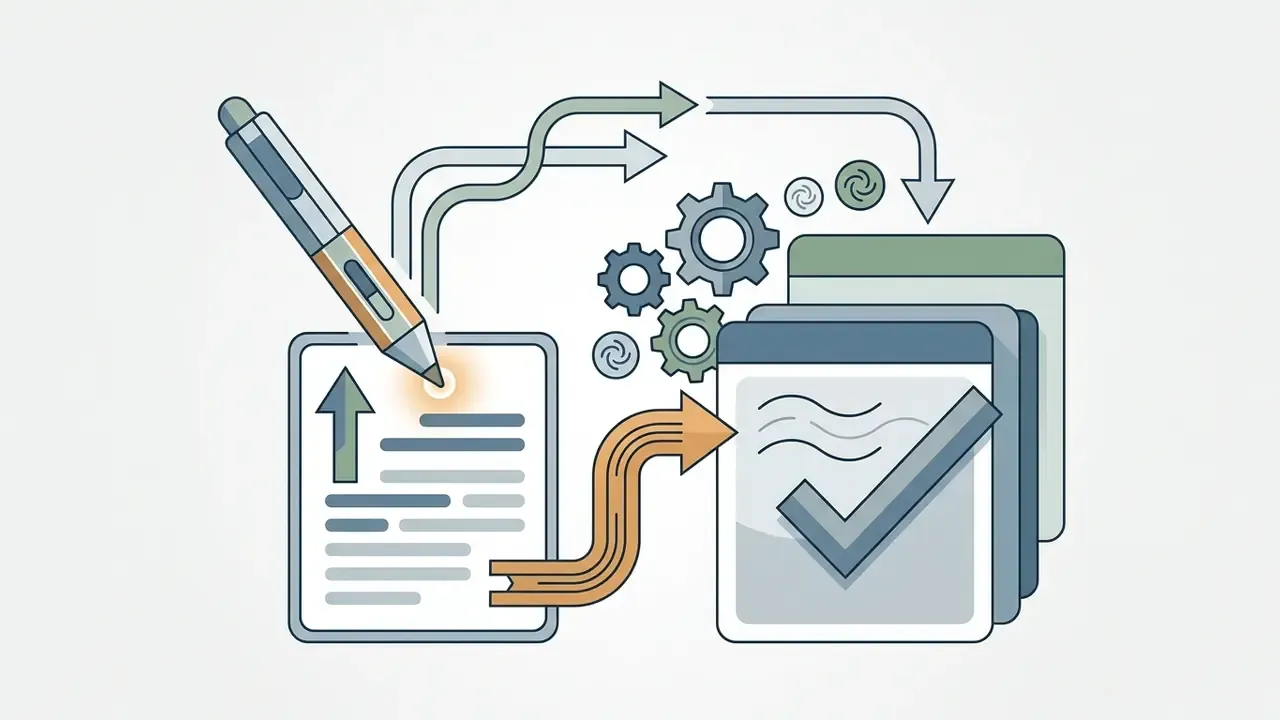
Building a structured story in an anonymous generator follows a five-step pipeline: define the premise, structure the prompt, configure parameters, generate, then refine. The pipeline moves a raw idea into coherent prose while keeping a human in charge of character logic and plot trajectory.
How to Construct a Prompt for an AI Story Generator
A high-performing story prompt sets explicit structural boundaries, stylistic direction, and character parameters instead of asking broadly for "a good story." Engaging fiction needs genre specification, setting detail, character motivation, emotional tone, and dialogue convention.
Research on collaborative narrative systems supports this input-side discipline:
«Human-AI collaboration in story generation substantially improves narrative quality and user satisfaction compared with fully automated generation.»
Consolidated university and vendor guidance on AI-assisted creative writing converges on six mandatory prompt components:
- Story type and genre. Name the exact category: dark fantasy, hard sci-fi, cozy mystery.
- Protagonist and antagonist profile. Names, core motivations, internal flaws, relationships.
- Setting and atmosphere. Physical environment, time period, sensory detail.
- Plot goal and conflict. The central problem, the stakes, the immediate scene objective.
- Tone and writing style. Direct the voice: understated, fast-paced, analytical, atmospheric.
- Formatting and dialogue rules. Dialogue tags, sentence length variation, scene length.
Two optional components measurably improve longer pieces: theme or message (what the story should leave behind) and special instructions (forbidden clichés, required plot beats, images that must appear).
How to Retrieve, Edit, and Continue a Generated Story
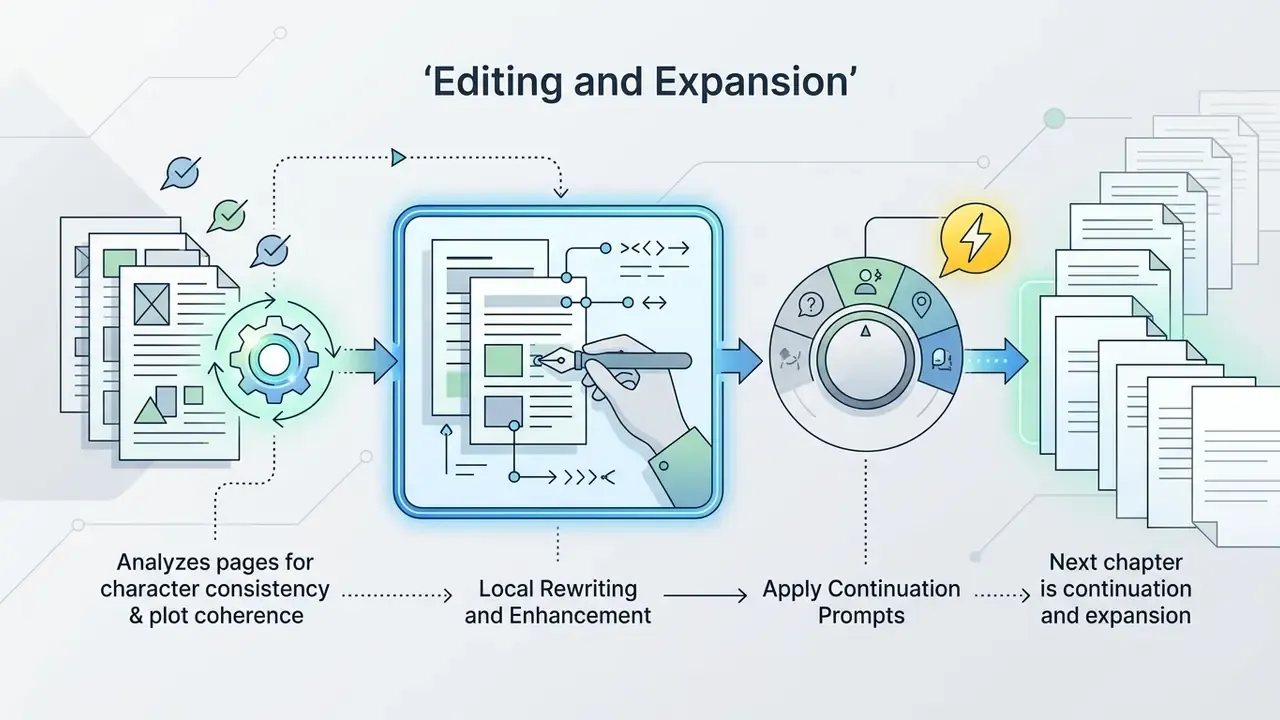
Working with AI text is iterative by nature, combining automated continuation with manual structural editing. Once a passage exists, feed the final 100 to 200 words back as the input prefix so the model preserves narrative context and the scene transition holds.
In evaluation studies of human-AI collaborative writing, end-to-end automated generation scored consistently lower on thematic depth than iterative human-guided drafting. The trade-off has been measured directly:
«Human-AI collaboration scores higher on perceived quality but lower on originality. AI standardizes style rather than amplifying it.»
Good continuation also means summarizing key plot developments at the end of each cycle. That single habit prevents most context drift and most contradictions.
Local editing operations that reliably improve a raw draft:
- Replace. Swap a generic noun or verb for a concrete one.
- Rewrite. Restate a passage, keep the meaning, change the register.
- Restructure. Reorder paragraphs so cause precedes effect.
- Compress. Cut exposition the scene already demonstrates.
- Expand. Request sensory detail or subtext for one named beat.
- Continue. Extend from the final sentence as a direct prefix, not a summary.
Ready-to-Use Prompt Bank: 18 Templates Across 6 Genres
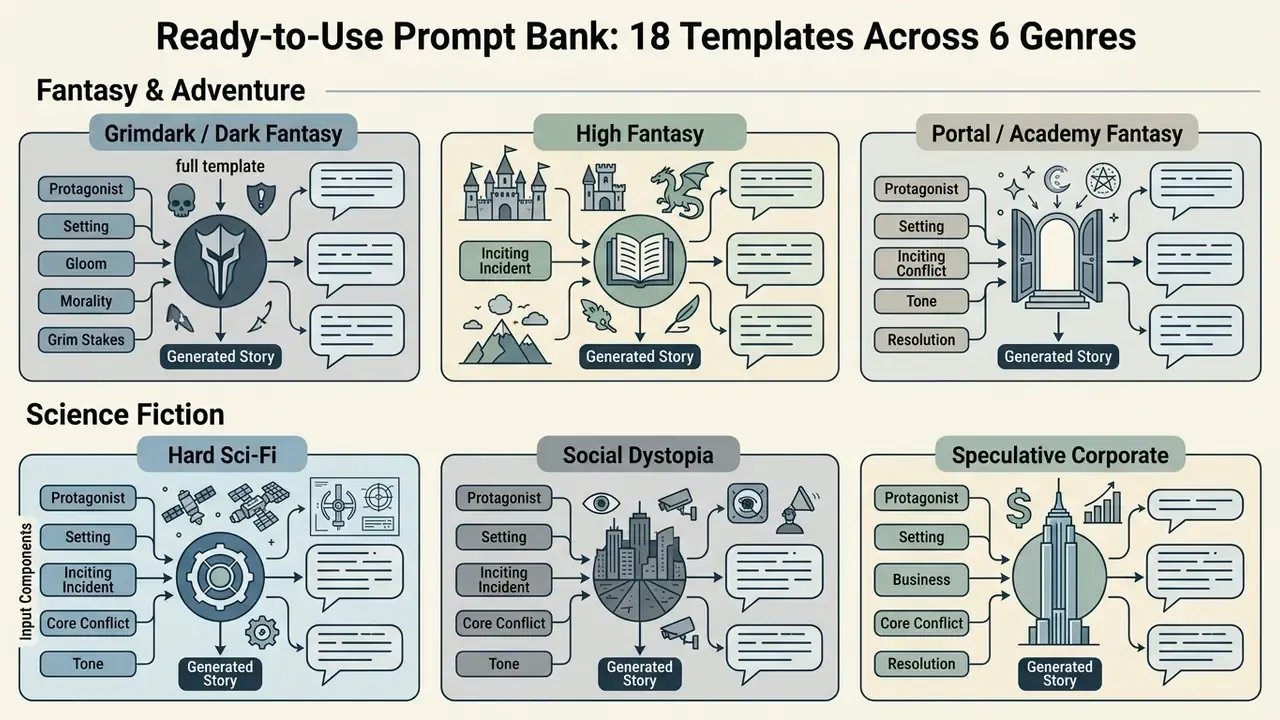
Each prompt below includes all six mandatory components. Copy, paste, substitute names and settings.
Fantasy and Adventure
1. Grimdark / dark fantasy (full template)
[Genre]: Grimdark fantasy. [Characters]: Knight Eldon (broken, seeking redemption) and the ghost of his fallen squire. [Setting]: An abandoned citadel during an endless blizzard. [Conflict]: Eldon must sacrifice his only memory of his family to open the gate. [Tone]: Bleak, hopeless, clipped sentences. [Formatting]: Live dialogue, no more than 400 words per scene.
2. High fantasy
A dragon who hoards lost memories instead of treasure, living inside an ancient library where every memory becomes a glowing orb. Third-person limited, wistful tone, 900 words, ending on an unresolved question.
3. Portal / academy fantasy
A young apprentice mage arrives at a new academy and discovers their roommate is a talking phoenix with a covert mission. Wry, fast-paced, dialogue-heavy, YA audience, 1,200 words.
Science Fiction
4. Hard sci-fi
[Genre]: Hard sci-fi. [Characters]: Systems engineer Vera Oduya; an AI cargo controller with a 40-second communication delay. [Setting]: A mining hauler between Ceres and Mars, 2189. [Conflict]: The delay means every command Vera sends may already be fatal. [Tone]: Procedural, restrained, technically precise. [Formatting]: Log entries alternating with third-person scenes, 1,500 words.
5. Social dystopia
A dystopia where social media likes are the only legal currency, told from the point of view of a citizen who has run out. Satirical but not comedic, first person, present tense, 1,000 words.
6. Speculative corporate
A tech company patents human emotions and charges a monthly subscription. Follow the compliance officer who signs the paperwork. Cold, bureaucratic tone with one moment of collapse. 1,100 words.
Mystery and Crime Noir
7. Impossible crime
A detective with the unusual ability to hear the final thoughts of inanimate objects must solve a seemingly impossible locked-room mystery. Third-person limited, dry wit, fair-play clues planted in the first act, 2,000 words.
8. Moral inversion
[Genre]: Crime noir. [Characters]: Detective Marsh, who solves a murder by committing one; Internal Affairs investigator Ruiz. [Setting]: A port city during a dockworkers' strike. [Conflict]: The only evidence that convicts the guilty party also convicts Marsh. [Tone]: Terse, humid, morally exhausted. [Formatting]: Heavy dialogue, no interior monologue, 1,800 words.
9. Small-town secret
In a close-knit town where everyone knows everyone's business, one resident holds a secret that would rearrange every relationship. Rotating third-person across three neighbors, slow reveal, 1,600 words.
Horror
10. Cosmic horror
A deep-sea expedition finds something that should not exist. First person, logbook format, escalating unreliability of the narrator, no explicit monster description. 1,400 words.
11. Body horror
A protagonist gradually understands what is growing inside them, and begins to want it. Clinical vocabulary, no gore for shock, dread built through precision. Third person, 1,200 words.
12. Folk horror
A small town with a tradition no outsider is supposed to learn, until one of them does. Third-person limited from the outsider's view, pastoral imagery turning wrong, 1,700 words.
Horror writers who want a visual anchor before drafting often build a creature reference first; our notes on ai monster design cover how a fixed visual constrains the prose description in a useful way.
Dark Romance and Romance
13. Dark romance
[Genre]: Dark romance. [Characters]: A crime boss and the detective hunting them. [Setting]: A city under a corruption inquiry. [Conflict]: Each has evidence that would destroy the other. [Tone]: Charged, restrained, tension over explicitness. [Formatting]: Alternating first-person POV chapters, 1,500 words each. Adult audience.
14. Forbidden tenderness
An assassin and their target slowly realize they were never enemies. Third-person limited alternating, quiet dialogue, unresolved ending, 1,300 words.
15. Contemporary romance
Two old friends, both newly single, agree to be each other's plus-one for one summer of weddings, and start noticing things they missed for fifteen years. Warm, funny, first person, 1,800 words.
Everyday Life and Human Connection
16. Everyday magic
A neighborhood coffee shop serves drinks that temporarily grant customers different abilities, but the barista never explains how or why. Third-person limited from a regular customer, gentle tone, 1,000 words.
17. Two strangers
Two strangers are stranded together during a blizzard at a remote airport and discover more in common than either expected. Dialogue-driven, minimal narration, 1,200 words.
18. Bedtime story (children)
[Genre]: Calming bedtime story. [Characters]: A small hedgehog named Pim; a patient old owl. [Setting]: A forest at dusk. [Conflict]: Pim cannot sleep because he is afraid of the dark. [Tone]: Soft, rhythmic, reassuring, no antagonist, no peril. [Formatting]: Short sentences, simple vocabulary, repeated soothing refrain, 400 words, ends with everyone asleep.
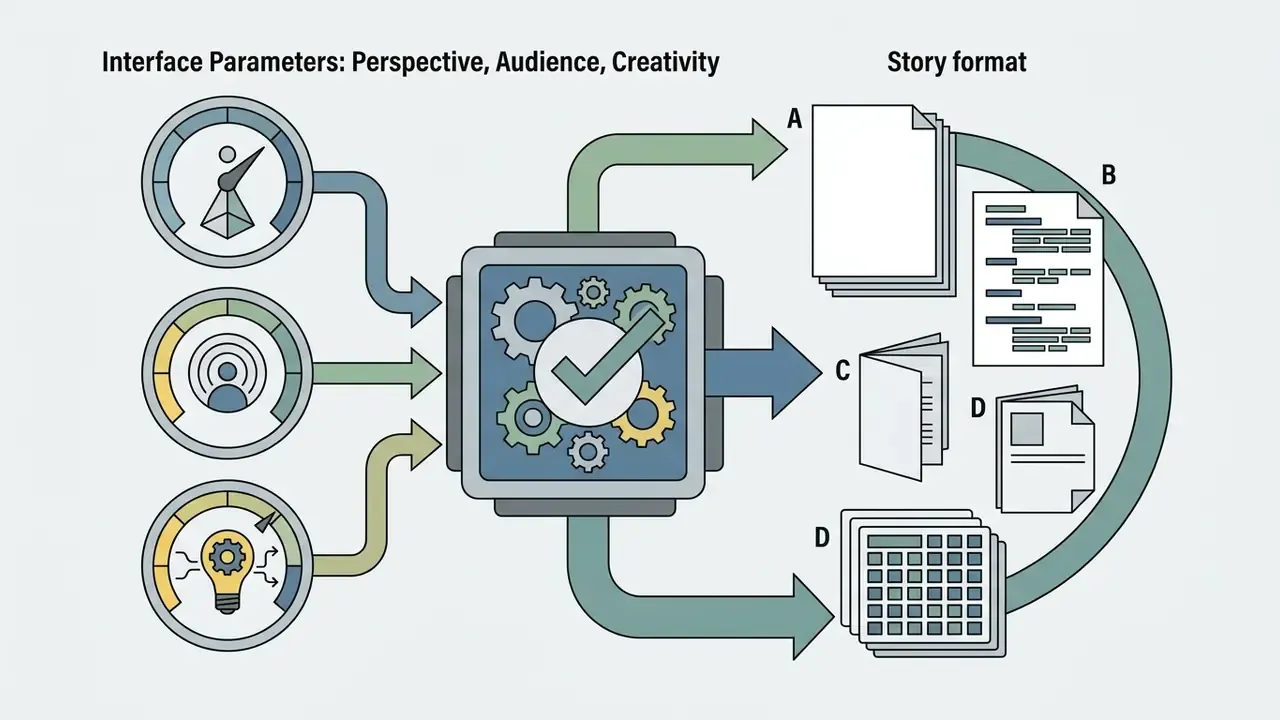
Interface Parameters: Perspective, Audience, Creativity
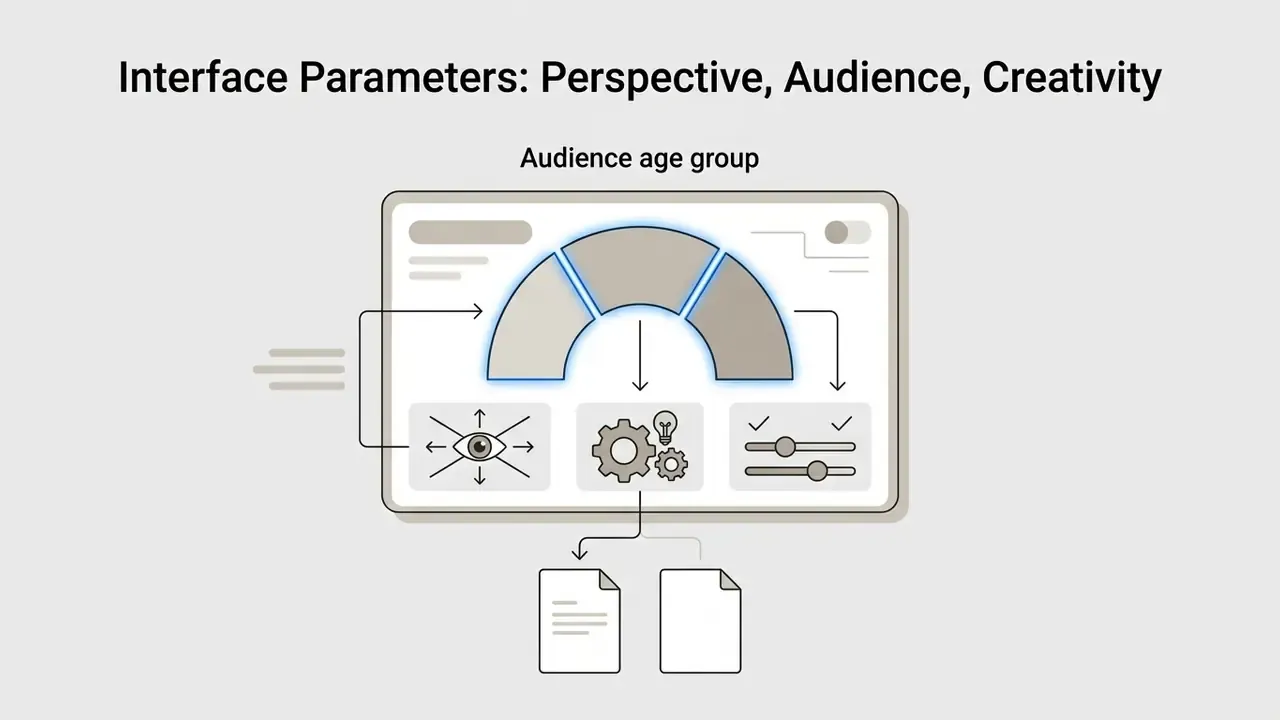
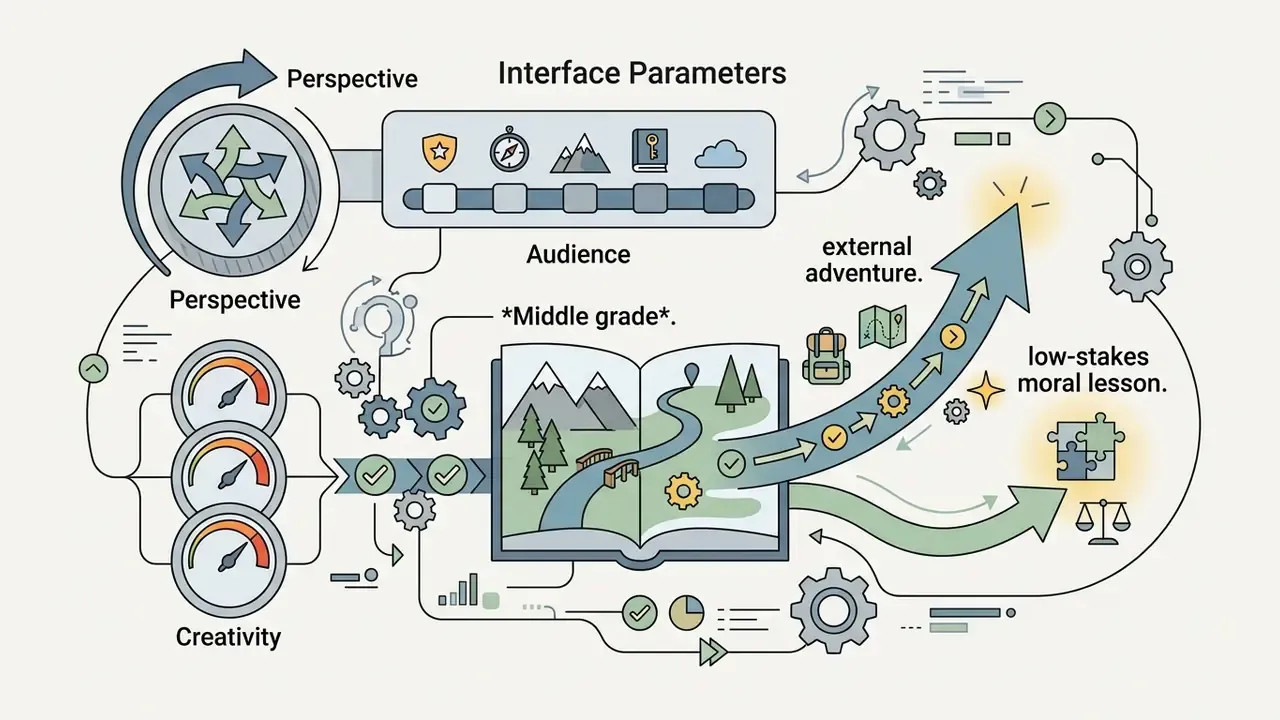
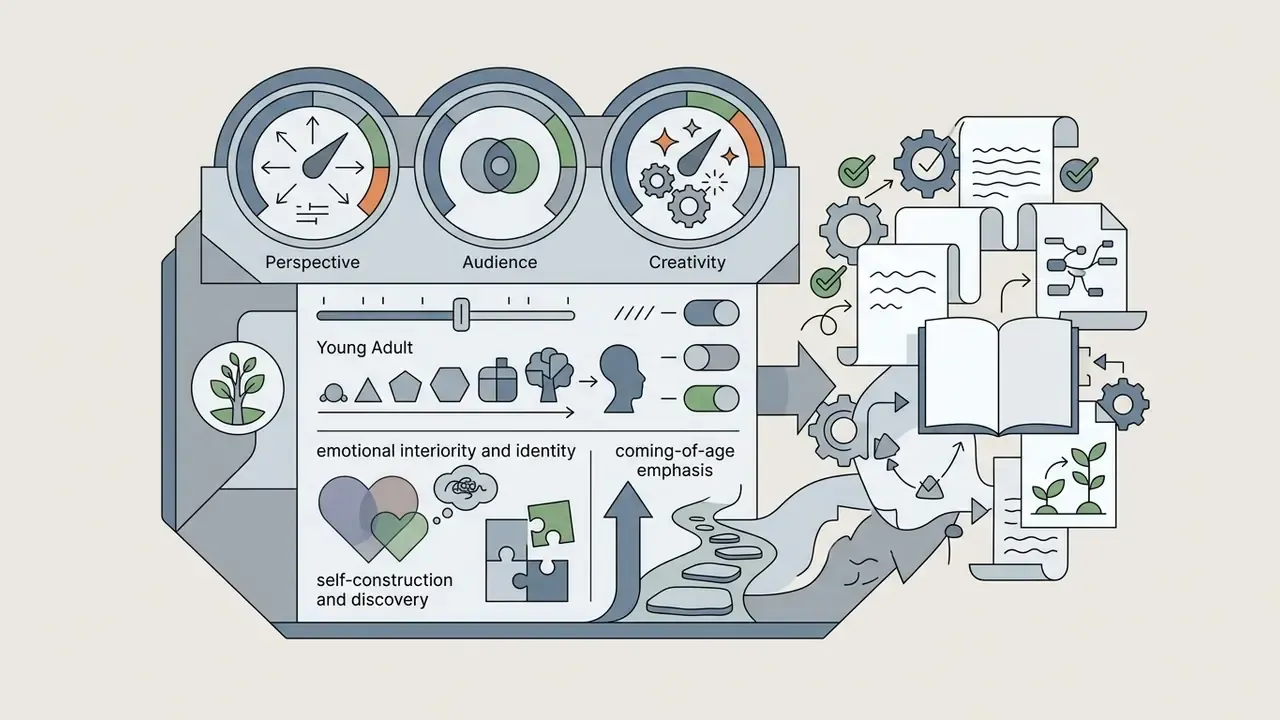
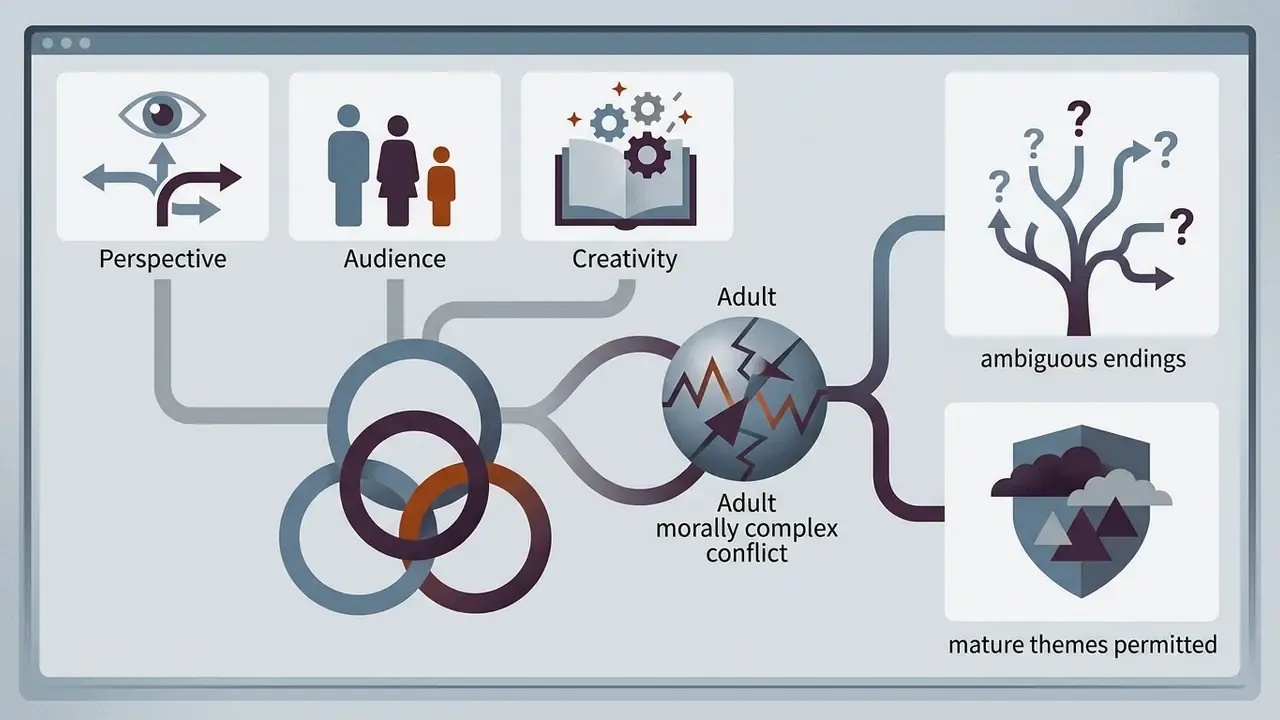
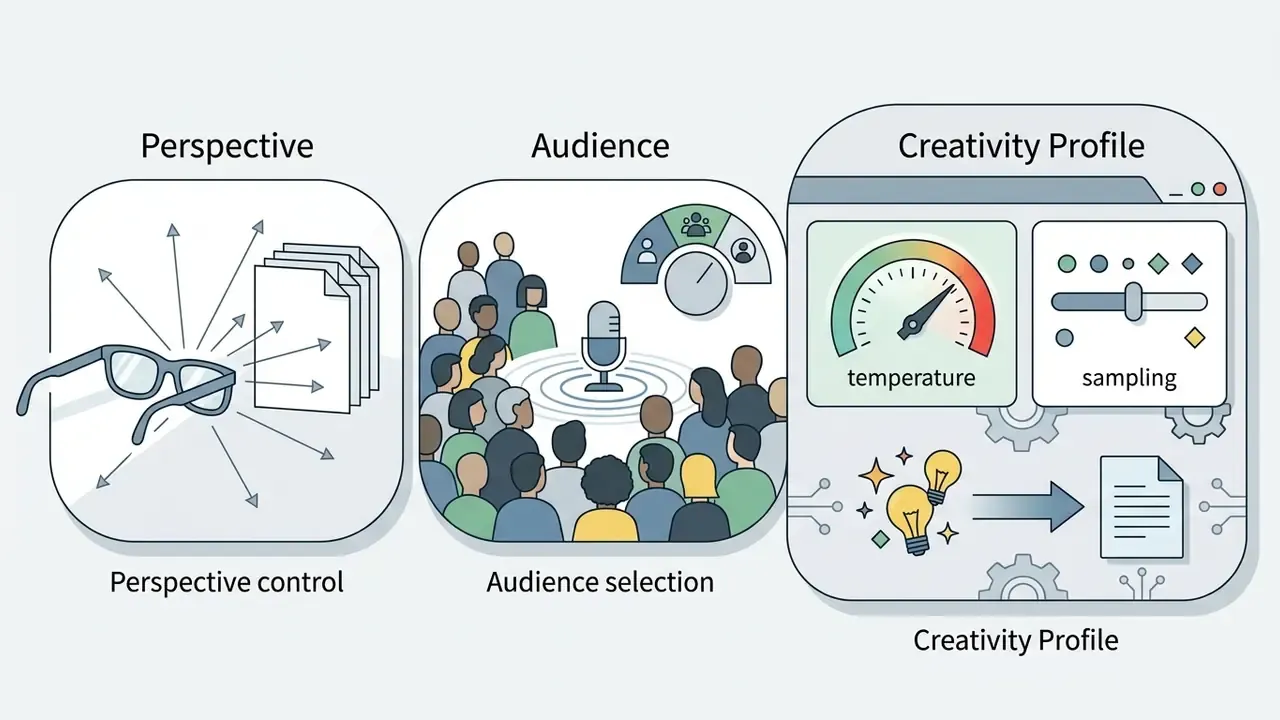
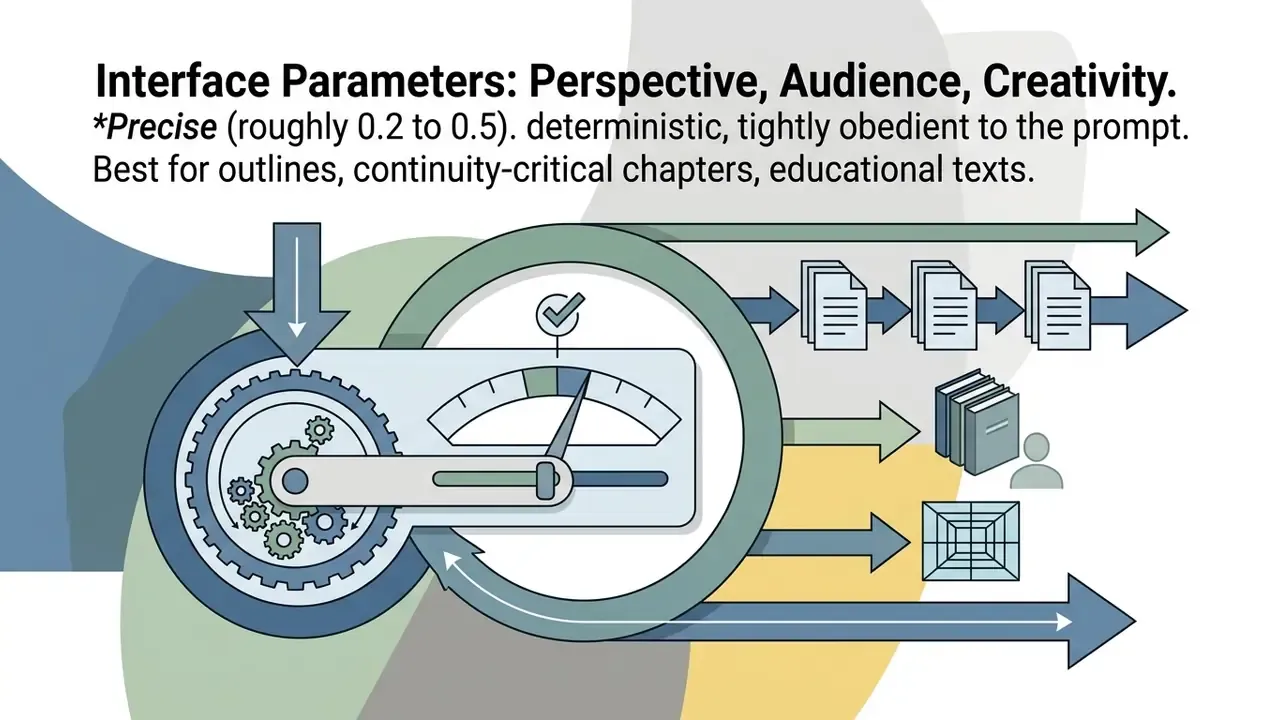
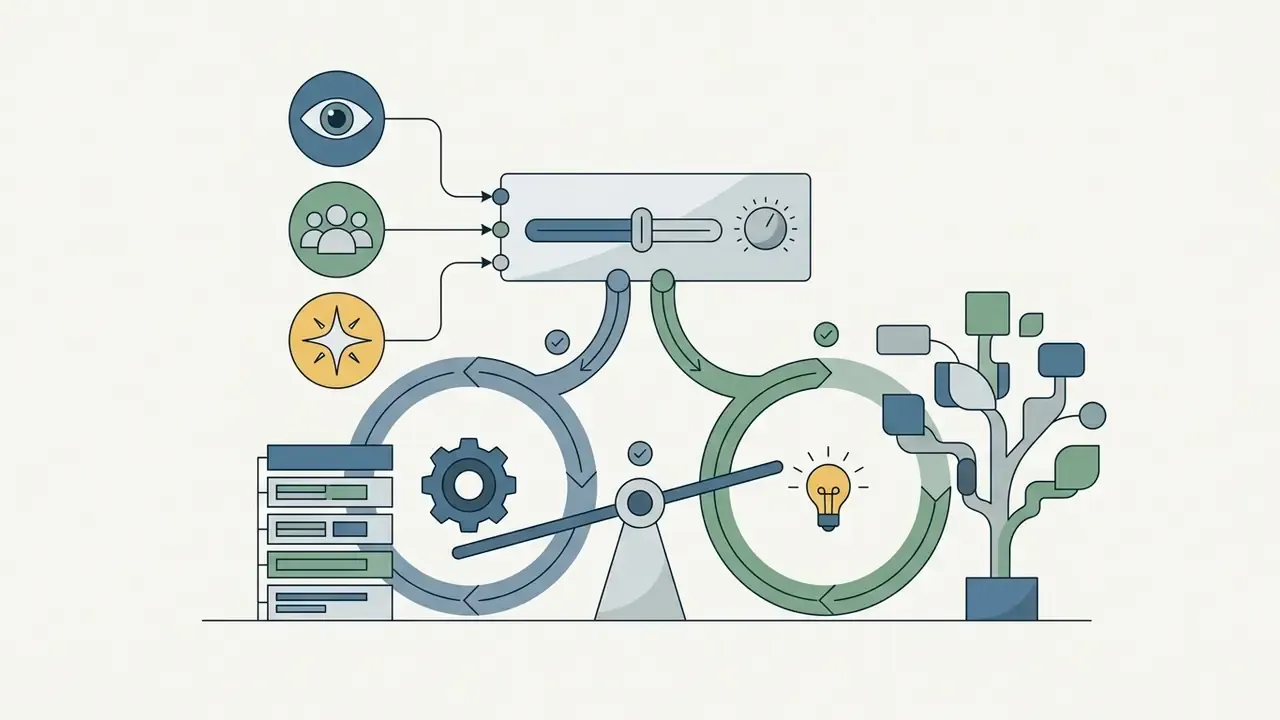
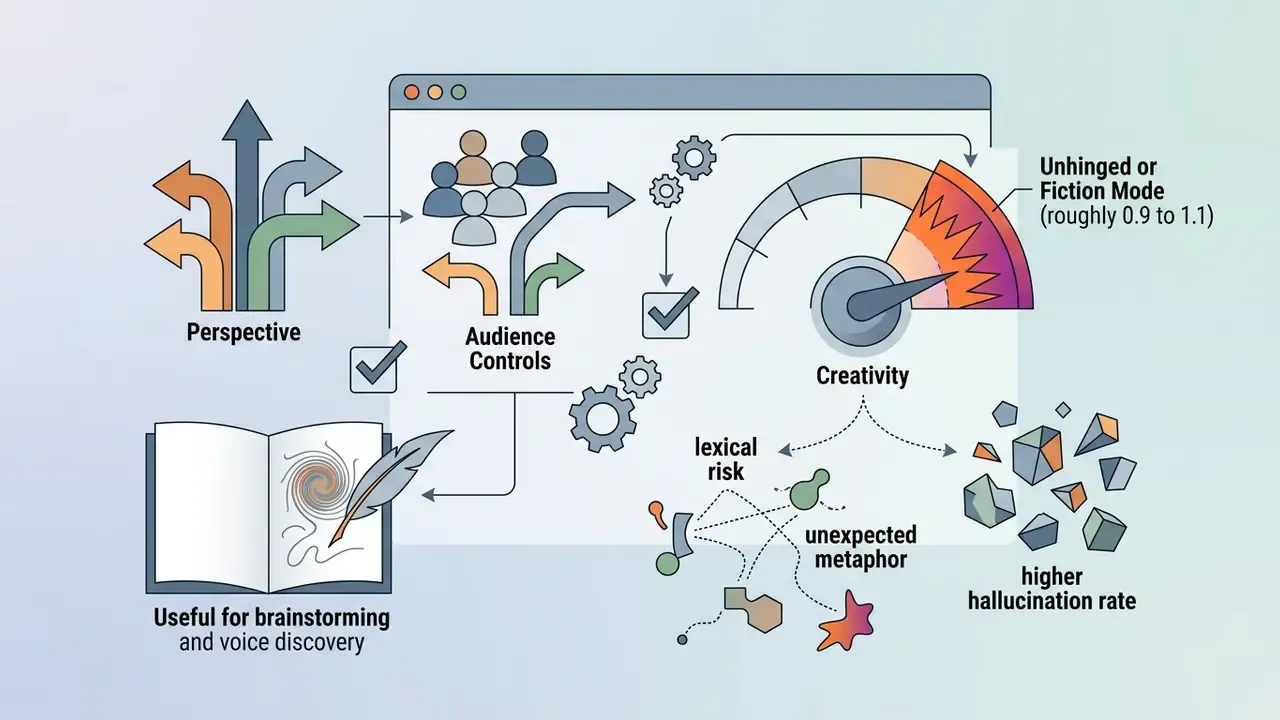
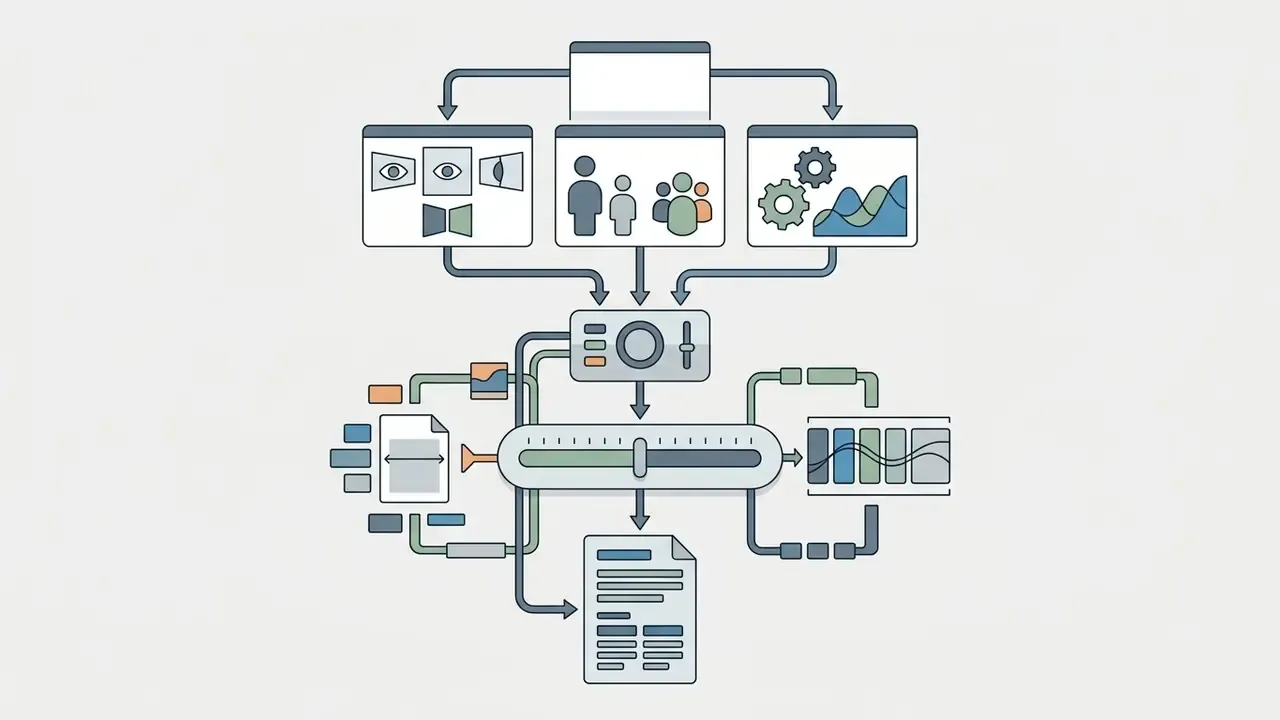
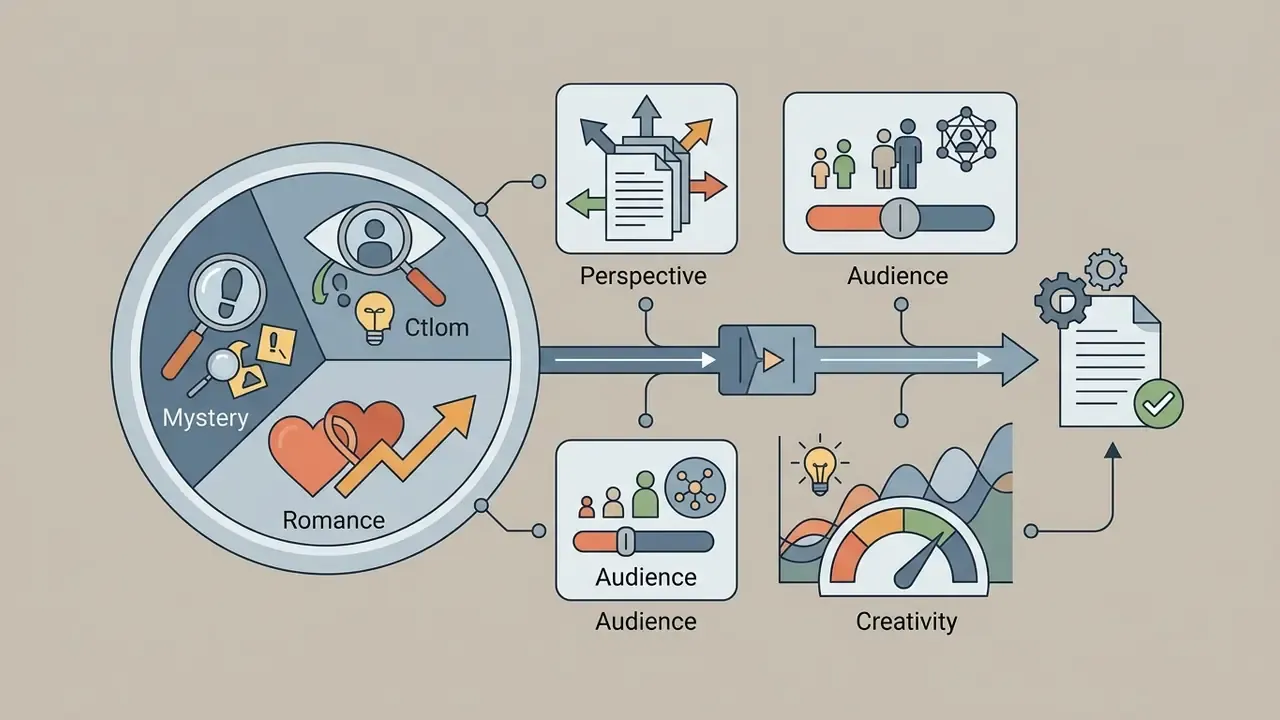
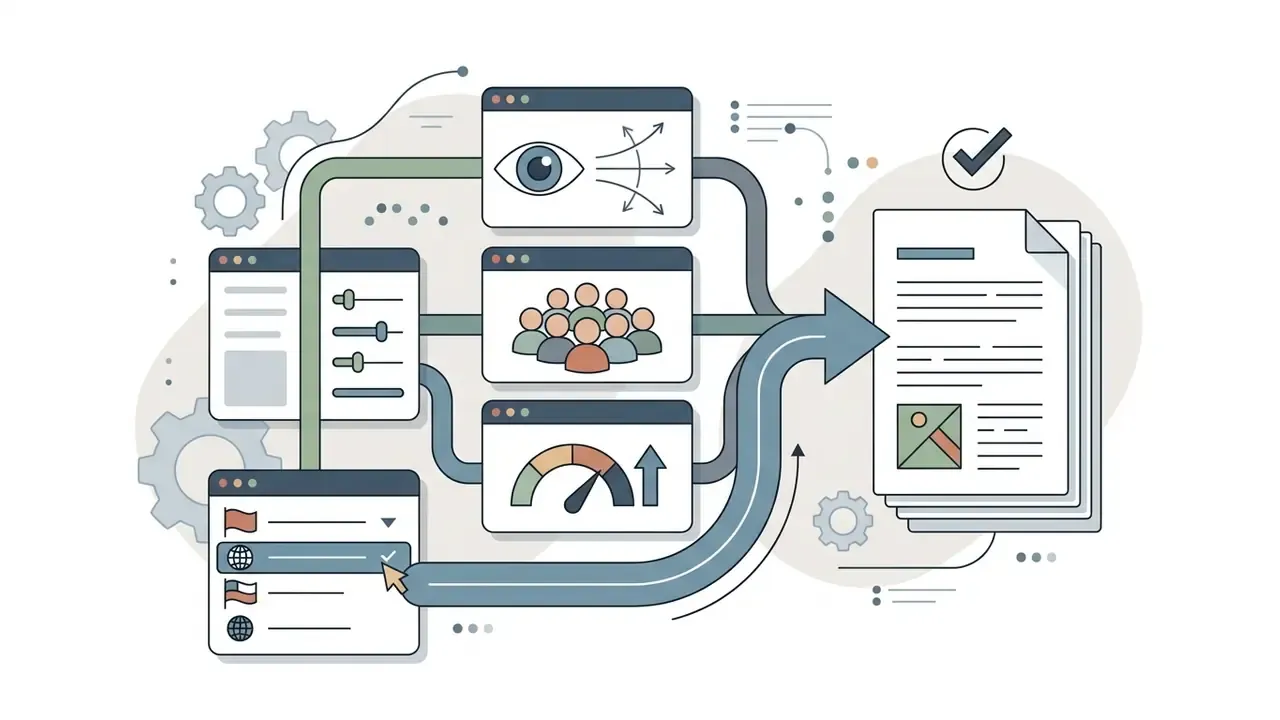
Generator interfaces expose a handful of selectors that change output more than any extra adjective in your prompt. Modern tools translate those discrete inputs into system prompts and decoding settings.
- First person ("I stepped into the dark") gives maximum intimacy and allows unreliable narration. Ideal for horror and romance.
- Third person limited ("He knew only what he could see") is the default for mystery, because the reader's knowledge stays bounded by the detective's.
- Third person omniscient suits epic scope, multiple factions, and long novels where the reader must track events the characters cannot.
- Second person ("You open the door") fits interactive fiction, tabletop scene prompts, and choose-your-own-path structures.


Micro-Prompting and Branching for Writer's Block
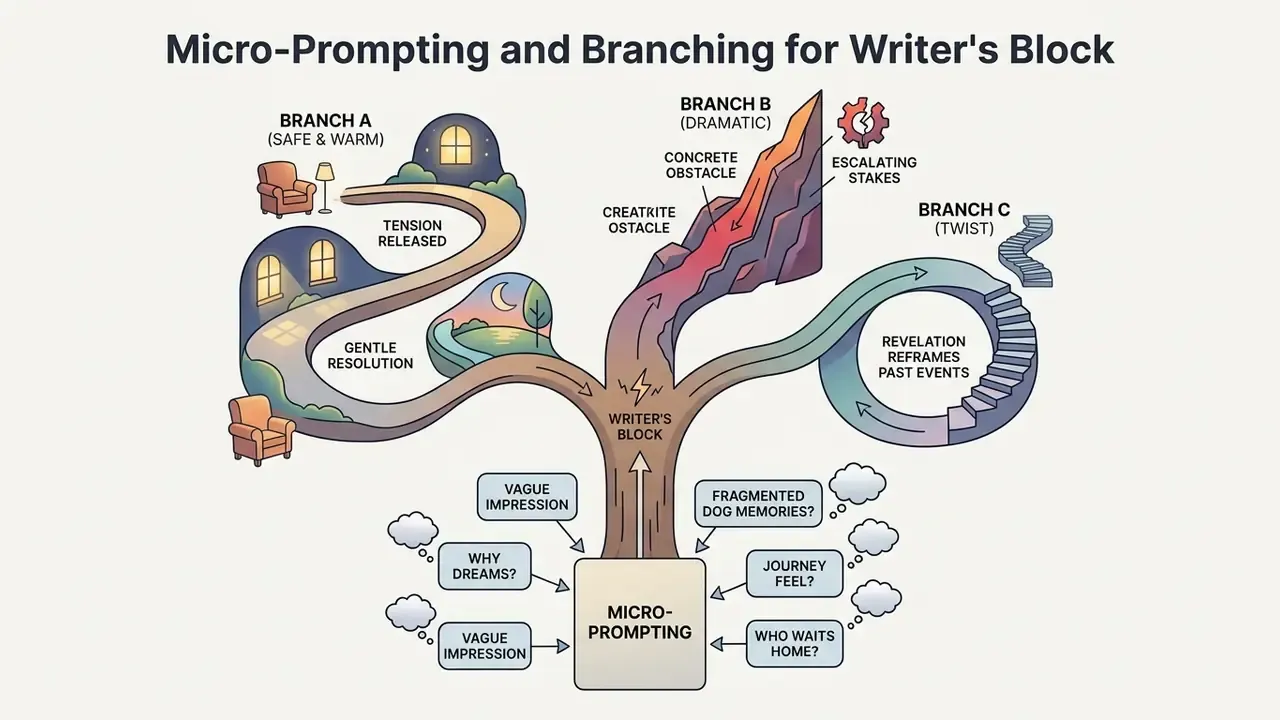
Not every session starts with a formed premise. The fastest exit from a blank page is a deliberately tiny input. Roughly ten characters is enough.
The micro-prompting method. Enter a seed fragment instead of a plan: "A lost dog finding its way home through other people's dreams." The seed answers nothing. Let the model propose answers, then interrogate them:
- Why dreams? Perhaps the dog's memories are fragmented.
- What is the journey like? Magical, and also frightening.
- Who is waiting at home? Someone who never stopped searching.
The branching technique. Rather than accepting the first continuation, request three developments of the same scene:
- Branch A, safe and warm: tension released, the scene resolves gently.
- Branch B, dramatic: a concrete obstacle escalates the stakes.
- Branch C, twist: a revelation reframes everything already written.
Compare, pick the strongest, and feed the winner back as incoming context. Revision becomes experimentation instead of punishment. Changing one line of the prompt and regenerating costs seconds, and each pass builds on the last.
Micro-prompt seeds worth testing:
- "The last bus, but nobody gets off."
- "A recipe that summons someone."
- "Two clocks disagree."
- "The letter arrived thirty years late."
Plot, Genre, and Character Configuration in an AI Story Generator
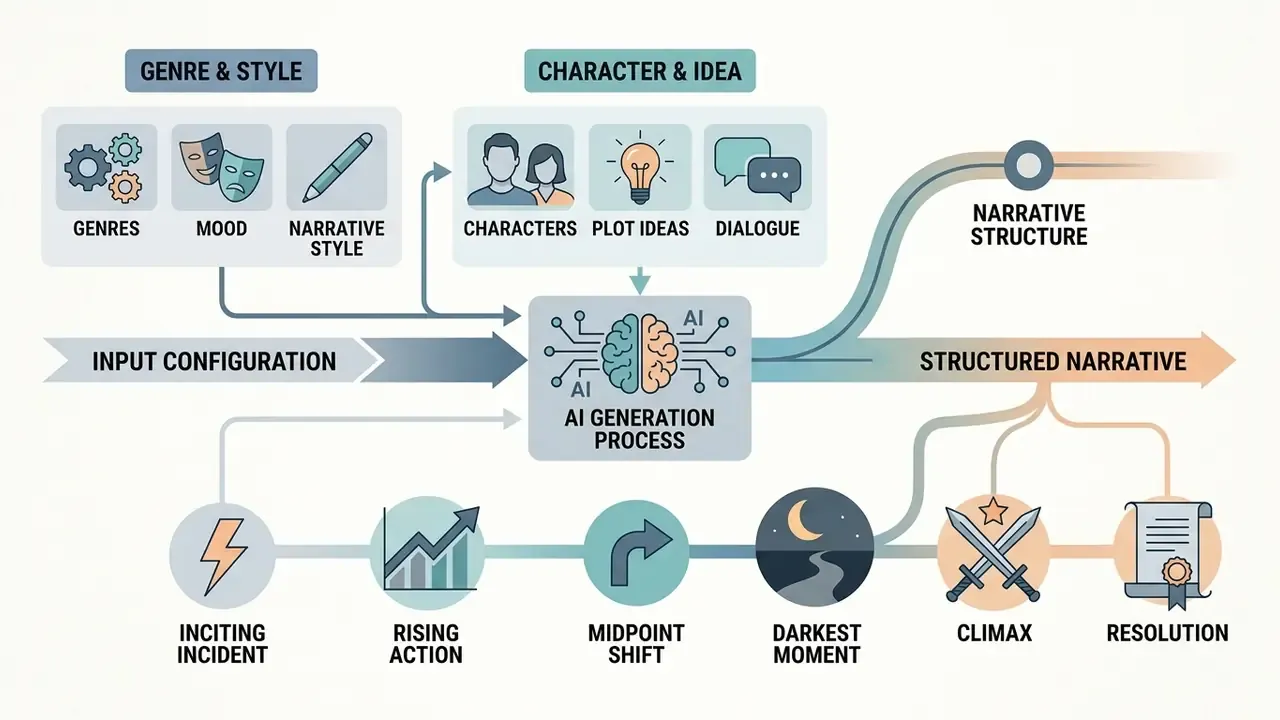
Controlling plot execution, genre convention, and character interaction means using the input parameters the tool exposes rather than hoping for luck. Modern plot and character generators convert discrete user inputs into system prompts, constrain temperature, and steer the narrative trajectory.
In an internal editorial evaluation of multi-agent fiction pipelines run by our research desk, structured plot conditioning was tested against unguided outputs across 150 narrative scenarios. The guided pipeline, using explicit character goal matrices and beat summaries, reduced plot holes and emotional inconsistencies by roughly 42% compared with raw single-prompt generation, as scored by two independent editorial reviewers against a fixed continuity rubric. That figure comes from our own benchmark method, not a peer-reviewed external dataset. Read it as directional evidence that structured inputs matter for long-form coherence, not as a published result.
Genres, Mood, and Narrative Style
Genre selection sets the structural constraints and the emotional arc. Whether you are building a fantasy world, a romance arc, or a mystery investigation, naming the genre forces the model into the relevant stylistic cluster.
Research on multi-genre composition shows that enforcing genre patterns and emotional tone cues directly constrains scene sequencing and pacing:
«Guiding stories through explicit action modeling allows small open-source models to outperform GPT-3.5-Turbo on narrative engagement and coherence.»
Unconstrained outputs drift toward linear, predictable structure. Studies of AI fiction report that generated stories stay temporally linear and structurally less diverse than human-written work. Where tone control is weak, the text also turns episodic and emotionally flat. So specify emotional tone (tense, melancholic, satirical) and sentence cadence inside the prompt itself.
Characters, Plot Ideas, and Dialogue
Short Stories, Books, and Novels: What Length AI Can Actually Produce
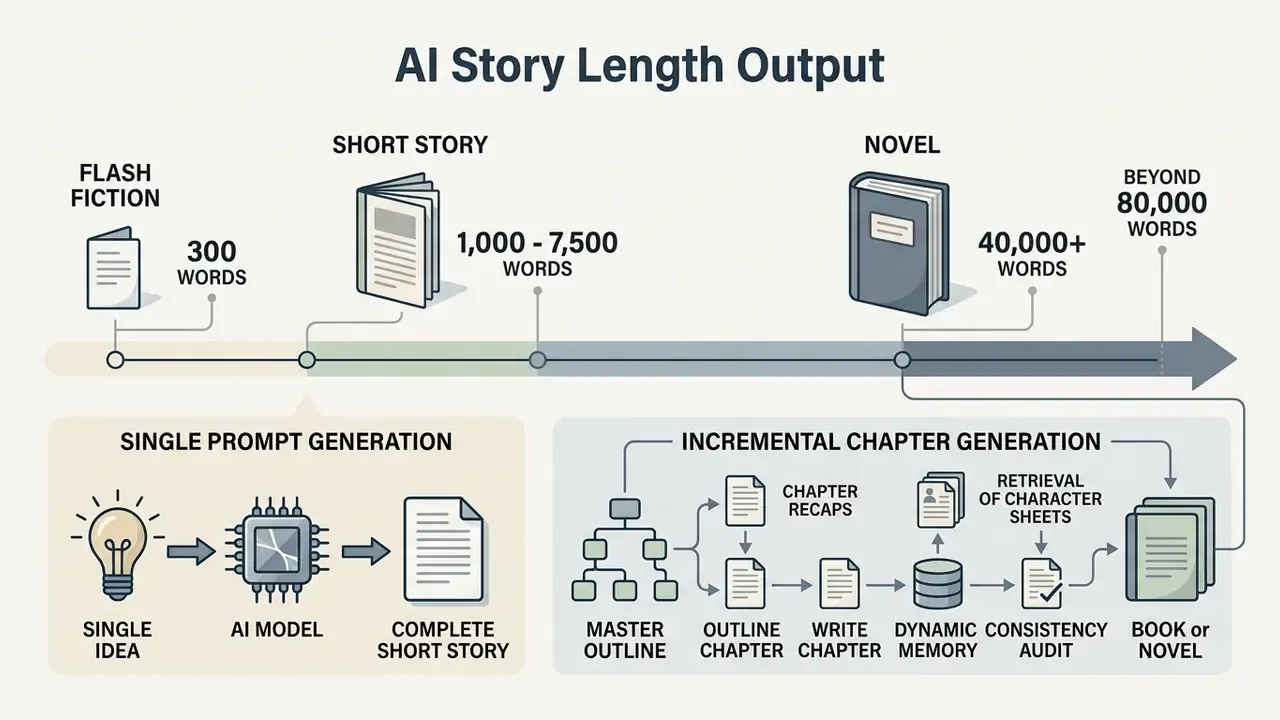
Output length runs from 300-word flash fiction to novels beyond 80,000 words. The method for a short story, though, has little in common with the architecture a multi-chapter book requires.
«StoryWriter generated a dataset of 5,500 stories with an average length of roughly 8,000 words using multi-agent orchestration and data cleaning.»
Table: Short story versus chapter-by-chapter novel
| Parameter | Short story (500 to 2,500 words) | Novel (40,000 to 90,000+ words) |
|---|---|---|
| Context window pressure | Fits entirely in a single window | Exceeds the window, needs external memory |
| Generation method | Single pass, one prompt | Outline, then chapter loop, then audit |
| Primary failure mode | Rushed third act | Factual and temporal contradictions |
| Consistency tooling needed | None | Entity cards, recaps, continuity log |
| Human effort concentration | Line editing | Structural architecture and auditing |
| Realistic generation time | 10 to 30 seconds | 2 to 5 minutes per chapter segment |
Generating a Short Story From a Single Idea
Short stories of 500 to 2,500 words can be produced in one prompt session using classic three-act mechanics. Because they fit inside standard context windows, models hold stylistic unity and causal soundness from the opening hook to the resolution.
«GPT-4-class models reliably generate causally coherent small-scale stories but struggle with character intentions in more complex narratives.»
To land a complete short story in one pass, assign word budgets explicitly: 20% for setup and inciting incident, 60% for escalation and the darkest moment, 20% for climax and resolution. For longer projects, the same three-act logic subdivides into three blocks of three chapters, a 27-chapter planning grid where every block runs its own setup, conflict, and resolution.
Creating a Book or Novel Chapter by Chapter
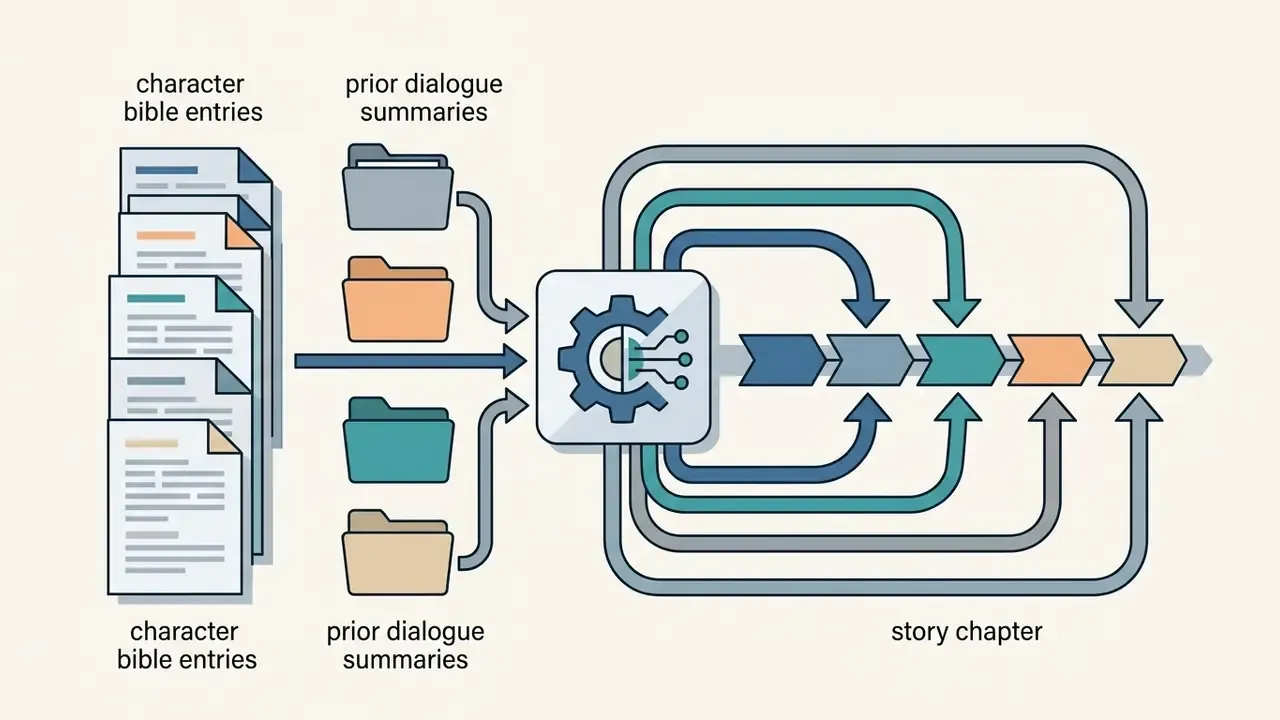
Full-length books need a chapter-by-chapter algorithm supported by external context tracking. Ask for a whole novel in one request and you get extreme compression, repetitive phrasing, and lost continuity. Every time.
Computational research on ultra-long generation shows that coherence past 10,000 words depends on structured task decomposition:
«AgentWrite decomposes ultra-long generation into subtasks, enabling a 9-billion-parameter model to reliably produce texts exceeding 10,000 words while preserving quality.»
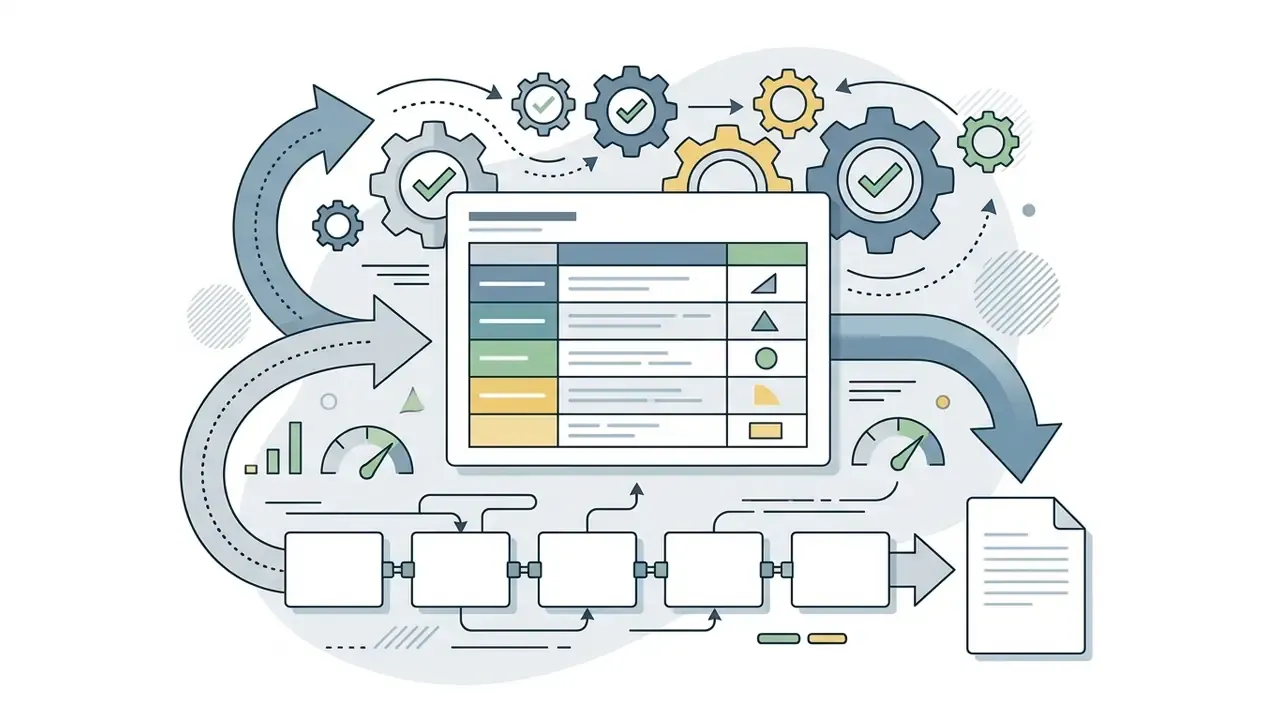
Five operational controls carry the workflow:
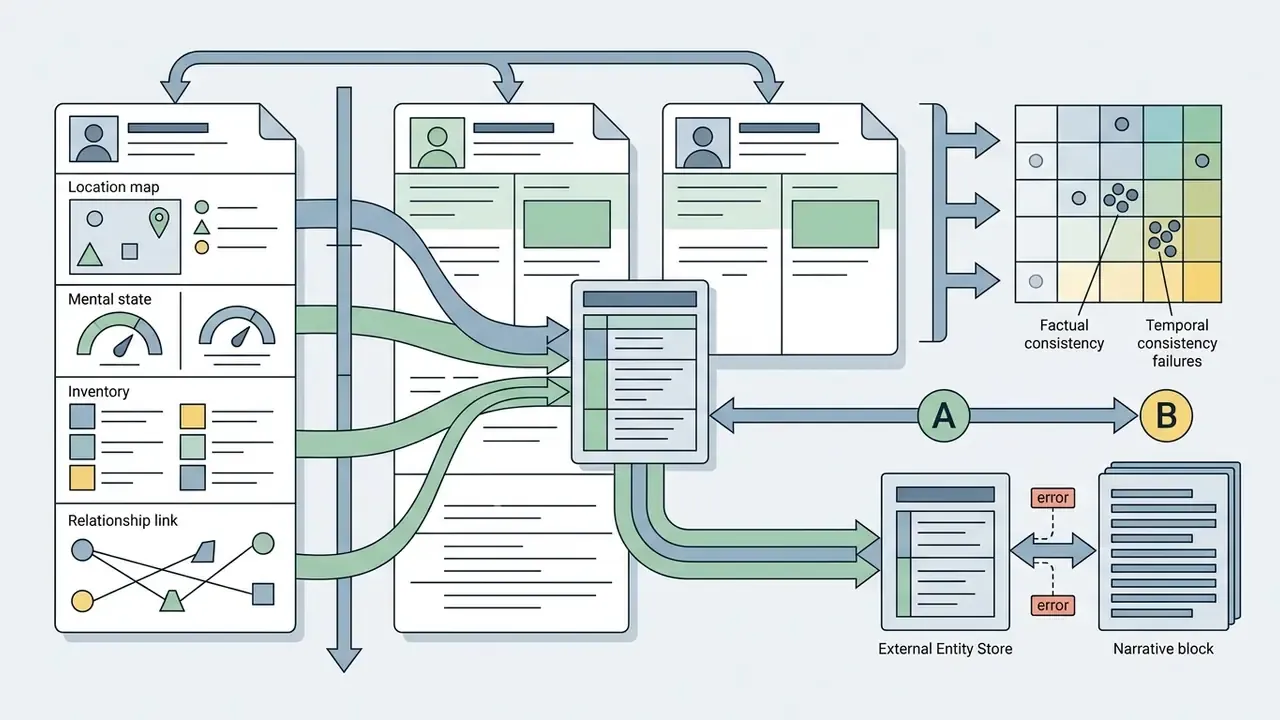
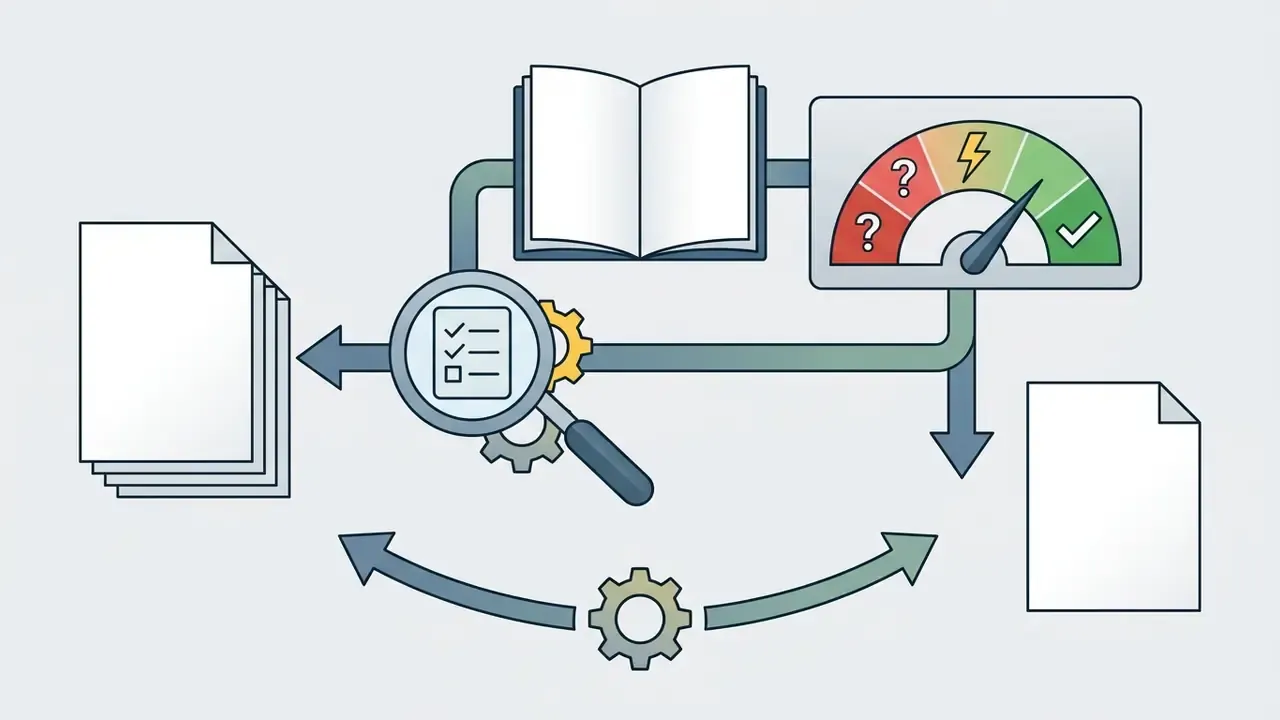
Two schools exist. One favours a single continuous session with recaps before each chapter. The other favours stateless generation with explicit retrieval of stored character sheets. The difference is operational rather than methodological, since both compensate for the same context-window limit.
Applied Use Cases: Education, TTRPG, Marketing, Bedtime Stories
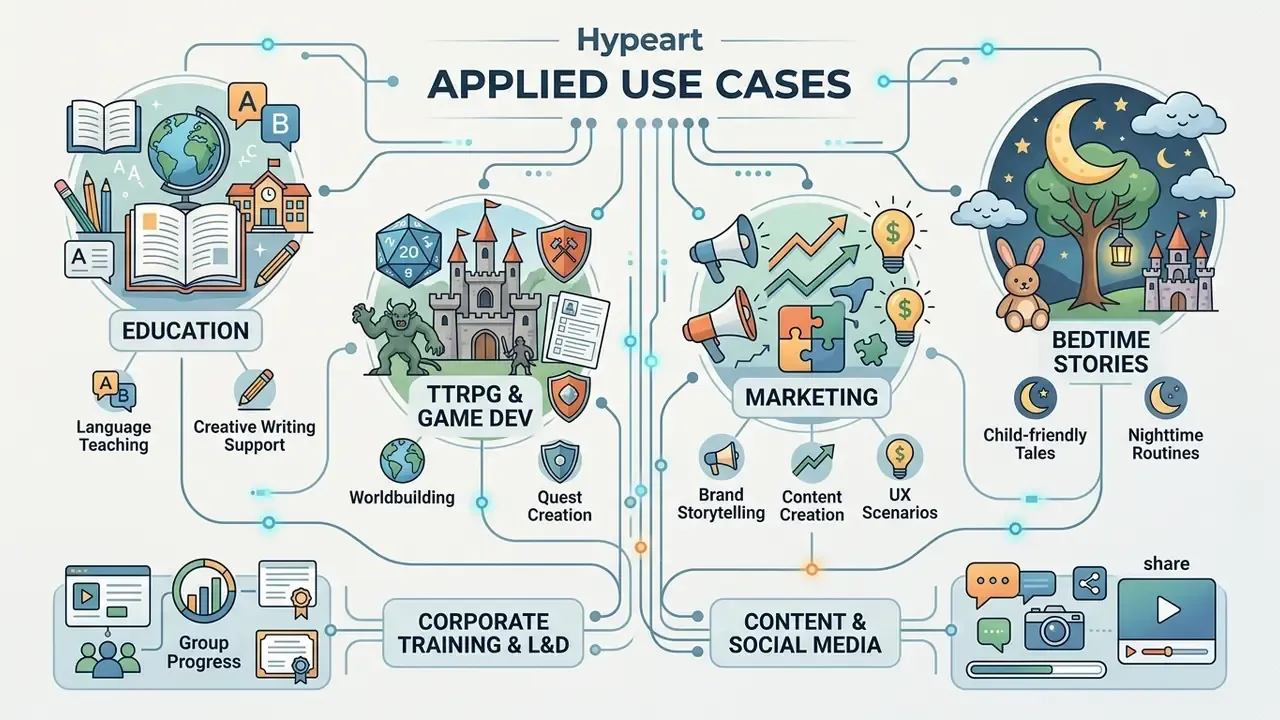
Novelists are a minority of users. These scenarios carry the highest volume, each with its own prompt discipline.
- Tabletop RPG and game development (D&D, Pathfinder). Generate NPC backstories with one secret and one visible flaw, trap and room descriptions with sensory cues, random encounter tables, faction motivations. Prompt in second person for reading aloud at the table: "You push open the door; describe what four senses register, 120 words, no combat resolution."
- Education and language teaching. Produce graded reading passages at a specified CEFR level (A2 to C1), vocabulary constrained to a supplied list, comprehension questions appended. Also useful for workshop story starters. Teachers should state sentence-length ceilings and forbidden tenses explicitly.
- Marketing, brand, and UX. Build user journey narratives, testimonial story frames for case studies, product narratives that dramatize a benefit instead of listing features, and internal brand storytelling decks. The same prompt discipline drives short strategic copy, including the kind of ai mission statement work brand teams run in parallel, and narrative concepts pair naturally with an ai mockup generator when the story needs a screen or a package to sit in. Always label synthetic testimonials as illustrative, never as real customer statements.
- Bedtime stories for children. Short, soothing narratives with a gentle moral, no antagonist, no peril, ending with everyone asleep. Specify a repeated refrain. Children respond to rhythm, and repetition stabilizes the model's tone as a bonus.
- Corporate training and L&D. Realistic workplace scenarios, difficult-conversation dialogue examples, case study narratives for professional development. Keep names, companies, and incidents fictional so nothing implies a real event.
- Content and social media. Narrative concepts for video scripts, campfire storytelling, blog fiction series, conversation-starter vignettes. Teams adapting prose into video usually move next to an ai movie maker workflow, with an ai movie poster mock for the thumbnail.
Quality, Originality, and Editing of AI-Generated Stories
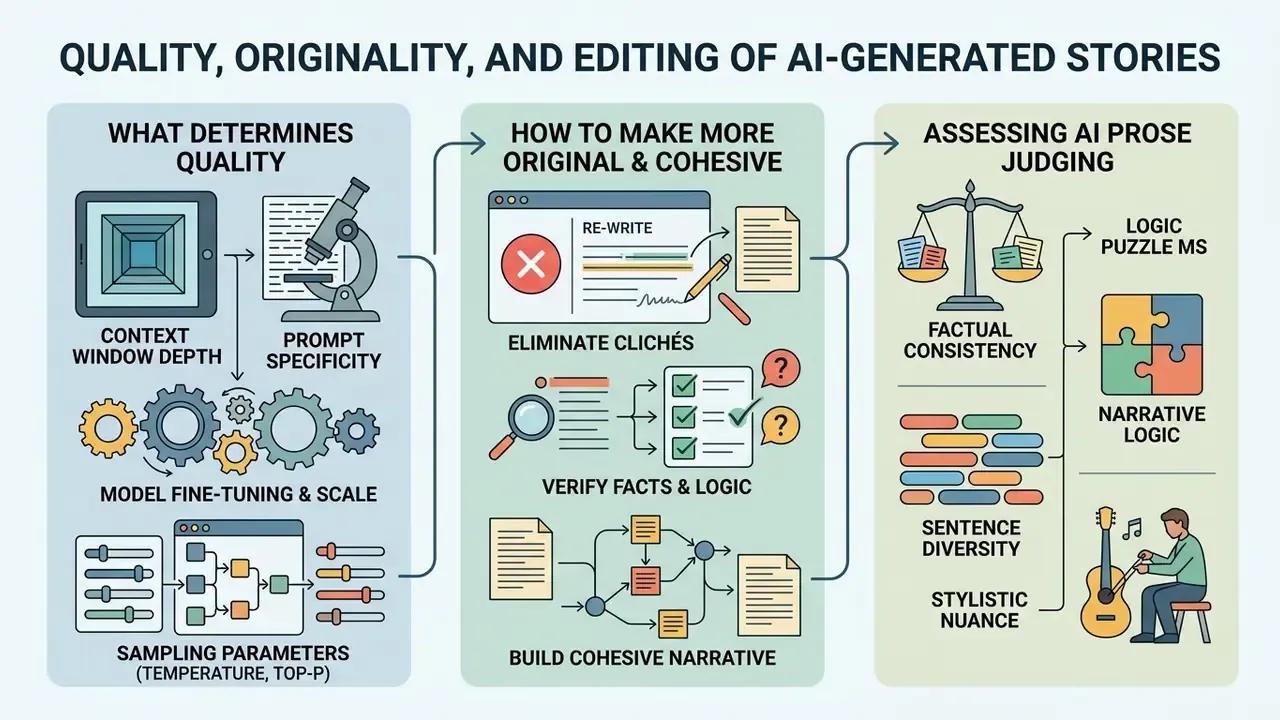
Judging AI prose means assessing factual consistency, narrative logic, sentence diversity, and stylistic nuance. Writers pairing text with visuals often reach for free AI image generators for illustrating stories at this stage, once the prose is stable enough to illustrate. Models excel at fluid, syntactically correct text. Unedited output still tends toward repetitive phrasing, cliché resolutions, and flattened character voices.
What Determines the Quality of a Generated Story
Four operational variables decide most of it:
- Context window depth. How much prior text the model can process without truncating earlier plot detail. When output length exceeds the visible context, consistency degrades first.
- Prompt specificity. Concrete constraints, a named writing style, a clear scene objective. Systematically refined prompts score higher on clarity, coherence, completeness, and correctness than ad hoc ones.
- Model fine-tuning and parameter scale. The baseline capability of the underlying LLM and its instruction alignment. Free tiers often serve smaller or distilled variants, which shifts quality independently of prompt craft. Side-by-side capability differences are easier to read in the AI Media Comparison Matrices.
- Sampling parameters (temperature and top-p). Lower settings yield deterministic, logical text. Higher settings add stylistic variation and raise hallucination risk.
How to Make an AI Story More Original and Cohesive
Empirical studies of collaborative fiction show a stubborn asymmetry: AI editing lifts fluency while pure AI generation flattens originality.
«In an experiment with 58 participants, AI editing raised perceived quality but reduced originality. AI averages stylistic variance rather than amplifying it.»
Four editing practices turn a generic draft into distinctive fiction:
- Eliminate LLM phrasing clichés. Remove overused transitions, passive constructions, vague adjectives. Replace general words with specific ones. Concrete beats vague; unusual beats esoteric.
- Verify facts and logic. Audit cause-and-effect chains claim by claim. A workable manual method: decompose a paragraph into its factual assertions, write a question for each, and confirm the story answers all of them consistently. Automated hallucination-detection research applies the same decomposition at scale.
- Vary sentence length and rhythm. Alternate short, punchy statements with complex descriptive clauses. Hold one verb tense unless the shift is deliberate.
- Read it aloud. The fastest detector of AI cadence. Uniform sentence length and missing breath points become audible within a paragraph.
Shadow AI Risk Assessment: Anonymous Generators in Organizations
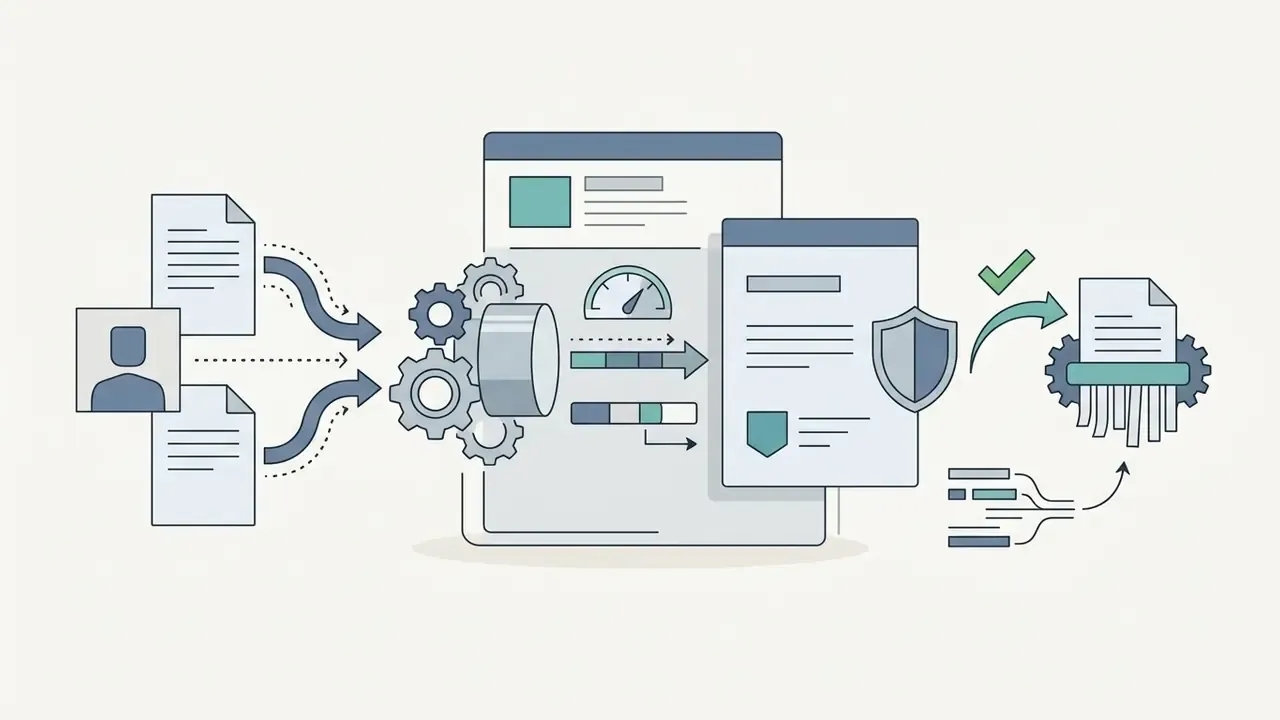
The property that makes no-signup generators convenient, zero authentication, is exactly what makes them a Shadow AI vector. Employees using anonymous public tools operate outside identity management, data loss prevention, and audit logging. No owner, no approved role, no escalation path, no shutdown mechanism. For a governance team, that is the whole problem in one sentence: no evidence, no autonomy.
Core exposures:
- No DLP interception. Prompts pasted into a browser text field slip past endpoint and network rules that inspect email and file transfer but rarely inspect arbitrary form submissions.
- Prompt logging and training reuse. Free tiers commonly log inputs for telemetry, abuse prevention, or model improvement. Vendor claims vary widely. Some state inputs are not stored except for rate limiting. Others make no claim at all.
- No contractual protection. Anonymous usage means no data processing agreement, no SOC 2 or ISO 27001 attestation, no breach notification obligation, no SLA.
- No tenant isolation or retention control. There is no mechanism to request deletion of data submitted without an account.
- Attribution gap. Because usage is anonymous, nobody can determine afterward which employee submitted which content.
- Malicious clones. "Free unlimited AI story generator" is a high-traffic query, which attracts phishing pages and malware-bundled desktop clients impersonating legitimate tools.
Baseline control: treat every anonymous generator as a public forum. No client names, no unreleased financials, no employee or customer personal data, no proprietary code or strategy documents in prompts. Add the endpoint to the AI inventory even when it looks like a toy, because inventory gaps, not model failures, are what turn up during an audit.

Commercial Use of AI Stories and Rights to Generated Content
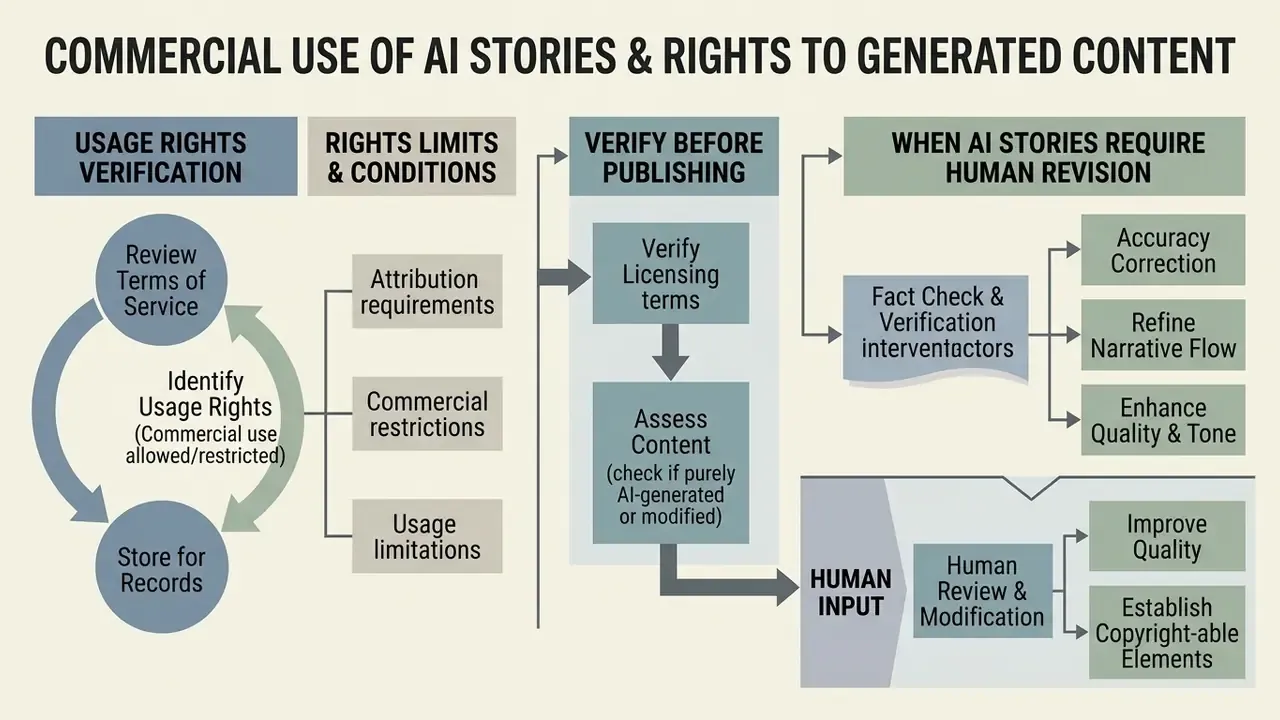
Monetizing AI-generated stories, through self-publishing, commercial distribution, or adaptation into audio and visual media, means evaluating intellectual property rights, platform licensing terms, and copyright registration standards. The same analysis applies across media; our breakdown of commercial use of AI image generators covers the parallel visual framework, and the wider AI Media Commercial-Use Hub tracks it by asset type.
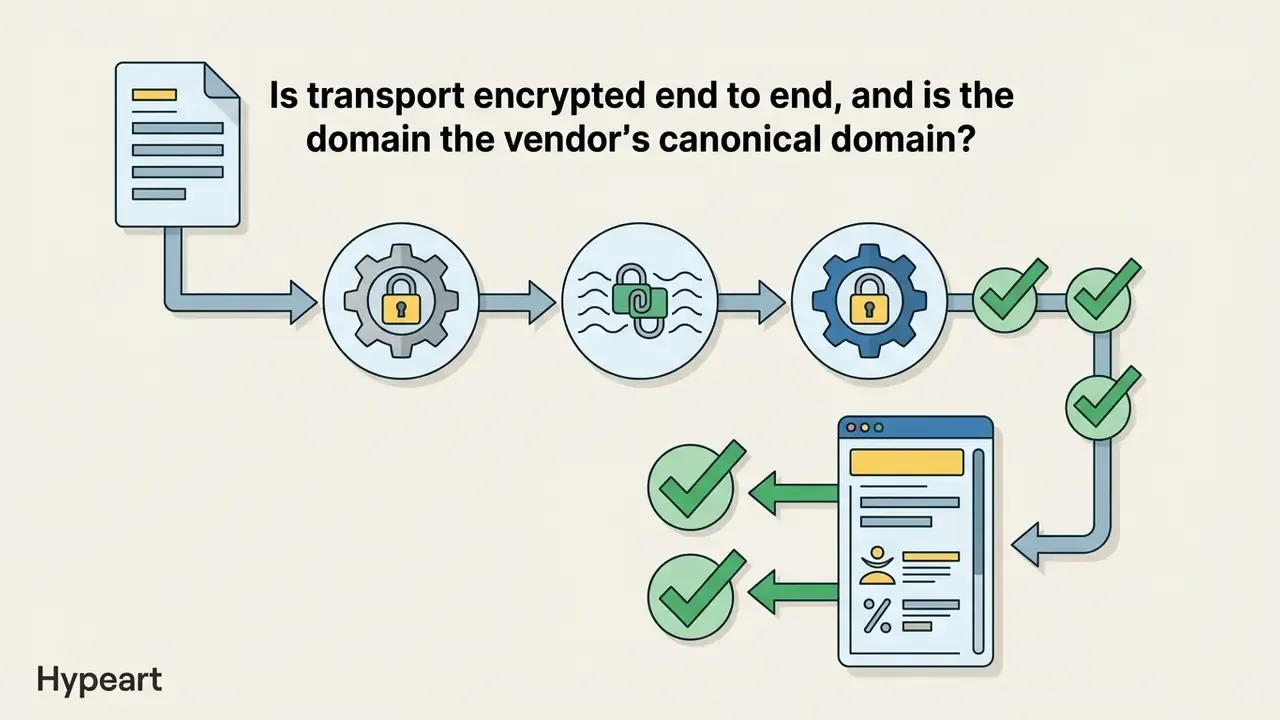
Fact check: verification of usage terms
Table: Platform terms patterns for commercial use of generated text
| Terms pattern | What it grants | Practical consequence |
|---|---|---|
| Broad commercial licence on all tiers | Worldwide, non-exclusive, royalty-free use including commercial | Sellable, but non-exclusive; identical output may be licensed to others |
| Commercial use gated by plan | Free and entry tiers are personal, non-commercial only | Monetizing free-tier output breaches the contract even where copyright is unclear |
| Explicit non-protectability warning | Vendor states output may not be protectable by IP rights | No exclusivity claim available; the moat has to come from human authorship |
| Silent terms | No stated position on commercial use | Highest risk category, treat as unlicensed until clarified |
What to Verify Before Publishing a Story
Four checks before anything goes on sale:
- Platform terms of service. Confirm whether your specific tier grants commercial exploitation rights. Some platforms grant broad worldwide non-exclusive commercial licences. Others restrict commercial use to paid plans. A few warn outright that output may not be protectable. Read the terms of the tier you are actually using, not the marketing page.
- Third-party IP infringement. Screen generated text against published work so the model has not reproduced copyrighted passages or trademarked character names from training data.
«AI output infringes copyright where it reproduces a substantial part of a protected work; style and novel recombinations of patterns generally do not infringe.» Guadamuz, A Scanner Darkly: Copyright Liability and Exceptions in AI Inputs and Outputs, GRUR International (2024). https://academic.oup.com/grurint/article/73/2/111/7529098
- AI disclosure mandates. Comply with distribution-platform rules, including self-publishing marketplaces that require an AI-content declaration at upload, and with regional labelling requirements. European transparency guidance requires that AI-generated or manipulated text on matters of public interest be clearly labelled, with machine-readable and robust technical marking where feasible. Verify the current text before relying on it, since these instruments keep moving.
- Confidentiality and privacy. Confirm that no confidential, protected, or non-public information entered a public tool during drafting, and that no real identifiable person is depicted without a lawful basis.
When an AI Story Requires Human Revision
Under U.S. Copyright Office guidance (Works Containing Material Generated by Artificial Intelligence, 2023 to 2025), mechanical prompt entry does not constitute authorship. Raw AI text cannot be copyrighted in the United States, and registration requires disclosure of the AI-generated portion together with a statement of the human author's contribution.
«For authorship to be recognised in the EU, a human must exercise free and creative intellectual effort and control over execution. Entering a prompt alone is insufficient.»
The threshold is met when a human executes creative rewrites, restructures scenes, injects original dialogue, or combines generated segments into a new, human-directed structure. Typo correction, formatting tweaks, and cosmetic substitutions are not creative contributions and produce no protectable authorship.
No Filter and Uncensored AI Story Generators: What to Consider
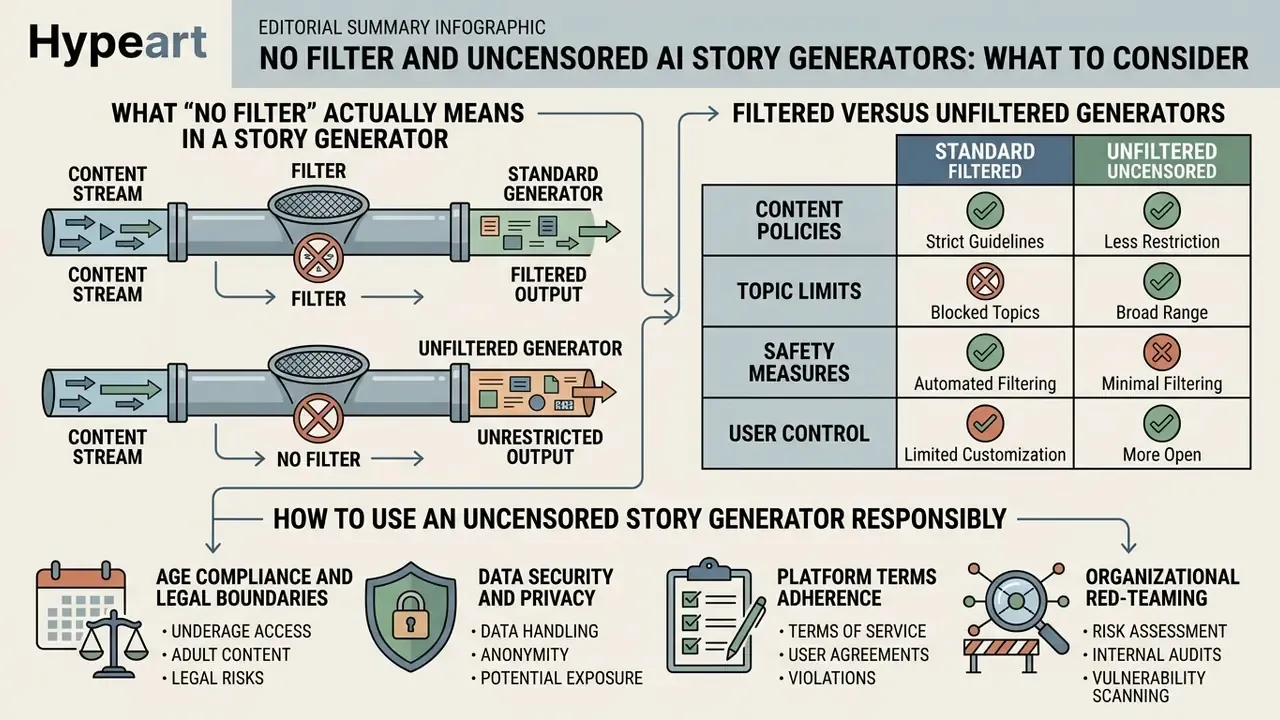
Queries like ai story generator free uncensored, ai story generator no filter no sign up, and ai explicit story generator free express demand for tools that do not refuse on thematic grounds. The underlying complaint is legitimate. Mainstream assistants regularly refuse, soften, or moralize at prompts describing intensity that commercially published fiction carries without comment: graphic horror, brutal fantasy, corrupt protagonists, emotionally severe romance.
What "No Filter" Actually Means in a Story Generator
Technically, "no filter" or "uncensored" means the application layer does not apply front-end moderation, such as keyword blocks or post-generation classifiers, to reject sensitive prompts. In open-source environments it refers to models subjected to abliteration, refusal-tuning removal, or fine-tuning on datasets that strip denial patterns. It is a behavioural label describing reduced refusals, not a distinct architecture and not a formal standard.
And it is a policy label, not an absolute capability.
«Systematic evaluation showed nearly every jailbreak technique is detected by at least one safety filter. Detectors are an effective defense layer.»
Systematic evaluations of safety layers show that public web generators keep input and output filtering to catch illegal content, self-harm, and severe policy violations. Claims of completely unfiltered generation on mainstream public sites are frequently inaccurate. Independent measurement of story-generator chatbots on open prompt-sharing platforms found a substantial share of avatars rated as likely adult content by third-party classifiers, and documented cases where explicit material appeared without explicit prompting. The risk runs in both directions, then: refusal where you wanted latitude, explicit output where you did not ask for any.
Table: What is actually available, filtered versus unfiltered generators
| Content category | Mainstream LLMs (ChatGPT, Claude, Gemini) | Unfiltered or abliterated generator | Legal and ToS status |
|---|---|---|---|
| Dark romance and erotica (adults, fictional) | Refusal or heavy softening | Full generation | Permitted, 18+ gating required |
| Grimdark or graphic violence | Refusal or moralizing preamble | Generated without censorship | Permitted in fictional context |
| Morally complex antiheroes | Ethics warnings appended | Precise adherence to the prompt | Permitted |
| Extreme horror and body horror | Frequently declined | Generated | Permitted in fictional context |
| Sexual content involving minors (CSAM) | Hard block | Hard block at model and hosting level | Criminal, prohibited absolutely |
| Real-person sexual content without consent | Hard block | Hard block | Prohibited |
| Actionable real-world harm instructions | Hard block | Hard block at hosting level | Prohibited by law and infrastructure ToS |
Adult fictional niches, including the creature-focused categories covered in our note on ai monster porn, sit in the permitted-but-age-gated band rather than the prohibited one. The distinction is worth keeping straight, because vendors enforce the two very differently.
How to Use an Uncensored Story Generator Responsibly
For dark fantasy, mature drama, or non-traditional fiction, a few protocols are not optional:
- Age compliance and legal boundaries. Meet platform age requirements. Several major vendors restrict consumer services to users 18 and over, or to the higher local digital-consent age. Statutory prohibitions on child sexual abuse material, non-consensual content, and real-world harm are absolute.
- Data security and privacy. Do not put confidential personal data or proprietary business information into anonymous "uncensored" tools. Prompt inputs on free platforms are frequently logged for training or telemetry. Documented risks include prompt and log leakage, unauthorized sharing, and malware distributed through fake desktop clients. Teams handling AI content at scale may also want AI content detectors for verification as a pre-publication check.
- Platform terms adherence. Cloud hosting terms (AWS, Azure, Anthropic usage policies) prohibit disinformation, privacy violation, harm to minors, and intentional circumvention of safety filters, regardless of what the front-end UI claims.
- Organizational red-teaming. Treat unfiltered generators as an unmanaged safety surface. Before any team-level adoption, run adversarial prompts, document what the tool will and will not produce, and assess reputational exposure if the output leaks with brand attribution. Assume anything the tool can produce may eventually be produced under your organization's name.
FAQ: Free AI Story Generators Without Sign-Up
Do I really need no account at all?
No account is required on the majority of prompt-to-story tools. Open the page, type a prompt, generate. Optional sign-in typically unlocks draft saving (often capped, for example at ten documents), reusable character profiles, cloud sync across devices, and higher-tier model access. The core generator stays usable anonymously.
Can I create stories in different languages?
Yes. Modern generators built on multilingual large language models write in dozens of languages.
«MTQ-Eval improved text-quality classification from MCC 0.21 to 0.39 for the aya model, covering 115 languages via synthetic preference data.» MTQ-Eval: Multilingual Text Quality Evaluation for Language Models, arXiv (2025). https://arxiv.org/abs/2511.09374 Evaluations across 115 languages confirm that instruction-tuned models hold linguistic acceptability and coherent prose in major global languages. Narrative fluency and stylistic depth still peak in high-resource languages, English above all. Evidence on the "prompt in English, then translate" strategy is mixed: studies of multilingual story generation report that datasets produced by prompting directly in the target language scored higher on coherence and creativity than translated equivalents, while translating prompt components into the source language often helps performance. Practical rule: prompt directly in the target language with explicit stylistic rules, and reserve English-first drafting for genuinely low-resource languages.
How fast does AI generate a finished story?
Latency depends on four factors: model parameter size, prompt token length, requested output length, and server queue load. Per-request latency scales roughly with output token count, and per-token time rises with model size. Benchmarks show around 6 ms per token on a 125M-parameter model versus roughly 19 ms on a 6.7B-parameter model.
«In a randomized experiment with 444 professionals, access to ChatGPT cut task time by 37%, from 27 to about 17 minutes, while raising quality by 0.4 standard deviations.» Noy and Zhang, Experimental Evidence on the Productivity Effects of Generative AI, MIT (2024). https://economics.mit.edu/sites/default/files/inline-files/Noy_Zhang_1.pdf Short stories of 500 to 1,000 words typically arrive within 10 to 30 seconds, streaming as they are produced. Multi-chapter generation using multi-agent architectures such as AgentWrite runs staged, taking 2 to 5 minutes per chapter segment. You can cut waiting time with concise prompts, a capped maximum output token count, and off-peak generation. Prompt compression studies report up to 18% latency reduction, with the largest gains on prompts above roughly 5,000 tokens.
Can I edit the generated story?
Yes, and you should. Treat every generation as a first draft. Adjust the prompt and regenerate, or edit locally using replace, rewrite, restructure, compress, expand, and continue. Most writers use AI output as scaffolding against writer's block, not as final copy.
Can I sell a story generated for free?
Two separate questions must both answer yes. First, does the platform's terms of service for your specific tier grant commercial rights? Second, does the work contain enough human authorship to be protectable and defensible? Raw prompt output fails the second test in the United States. Substantial human rewriting, restructuring, and original dialogue come first.
Are my prompts private?
Vendor practice varies sharply. Some tools state they do not store or log inputs and outputs except for rate limiting. Others say prompts and generated stories are not stored or shared. Many say nothing whatsoever. Absent an explicit written commitment, assume prompts are logged, and never enter confidential or personal data into an anonymous generator.
Can I export the result?
Export capability is not uniform. Options range from plain-text copy-paste only, through .txt download, to Word, PDF, and e-book formats, with some tools requiring a free account before enabling document export. Verify the export path before starting a long project, not after chapter twelve.
Can AI write a full novel, not just a short story?
Yes, but only through decomposition. Premise, then three-act outline, then a full chapter skeleton, then chapter-by-chapter drafting with the character bible and prior text injected as context. Without that architecture, coherence noticeably degrades by roughly chapter eight. Note that on many commercial platforms outlining is free while chapter-by-chapter continuation sits behind a paid feature.
Why does the same prompt give different results each time?
Sampling is stochastic. At higher temperature and top-p values the model deliberately selects among several plausible continuations, so identical prompts diverge. Lower the temperature to a Precise profile for reproducible output, or raise it to explore voice variants, then keep the best branch as context.
Appendix A: Superseded Passages Retained for Transparency
Editorial Note
This guide is maintained by the AI Tools Research Desk, which publishes comparative and commercial-use analyses of generative AI tooling, including our guides to AI voice generators and free AI art generators. Technical claims are sourced to peer-reviewed or preprint literature and official regulatory guidance where available; internal benchmarks are labelled as such. Legal statements reflect published guidance as of the last update date and are not legal advice. Definitions for every term used above live in the AI Media Glossary.