Why should a risk or compliance leader care about a creative tool? Because every prompt is a data transfer, and every published frame is a statement your institution owns.
Last updated: 2026 editorial review cycle.
Reviewed by: Marcus Hale, author.
Executive Summary
- What it is An AI movie maker synthesizes new footage from prompts, scripts or images instead of re-arranging pre-recorded clips inside a timeline. It is a generation pipeline first, an editor second.
- Hard technical ceiling Native continuous generation stays capped at roughly 4 to 8 seconds per request across leading foundation models, with iterative extension reaching about 141 seconds. Feature-length output is assembled, never generated in a single pass.
- Where quality comes from Structured prompt architecture, persistent character anchors, explicit camera trajectories and a documented human-in-the-loop review gate. Not from longer prompts.
- Model routing matters Different foundation engines (Sora 2, Kling 3.0, Veo 3.1, WAN 2.7, Seedance 2.0, Minimax) hold distinct strengths in physics, lip-sync, reference fidelity and camera language.
- Governance requirements Copyright protection depends on demonstrable human authorship. Data-handling policies, zero-data-retention terms and audit trails decide whether a tool is deployable inside a regulated enterprise.
- Cost reality Subscription price is a fraction of total cost of ownership. Validation, human review and audit evidence belong in any honest ROI calculation.
How to Read This Guide
The article moves from capability to control, in that order. Sections one to three explain what the technology actually does, including its runtime limits and input modalities. Sections four and five cover directorial control, audio assembly and the quality gates that make output reviewable. The last sections cover use cases, pricing, total cost of ownership and the procurement questions a second-line function will ask before approval.
If you only have ten minutes, read the model matrix, the data security checklist and the escalation matrix. Those three blocks carry most of the decision weight.
What is an AI Movie Maker and What Films Can It Create?
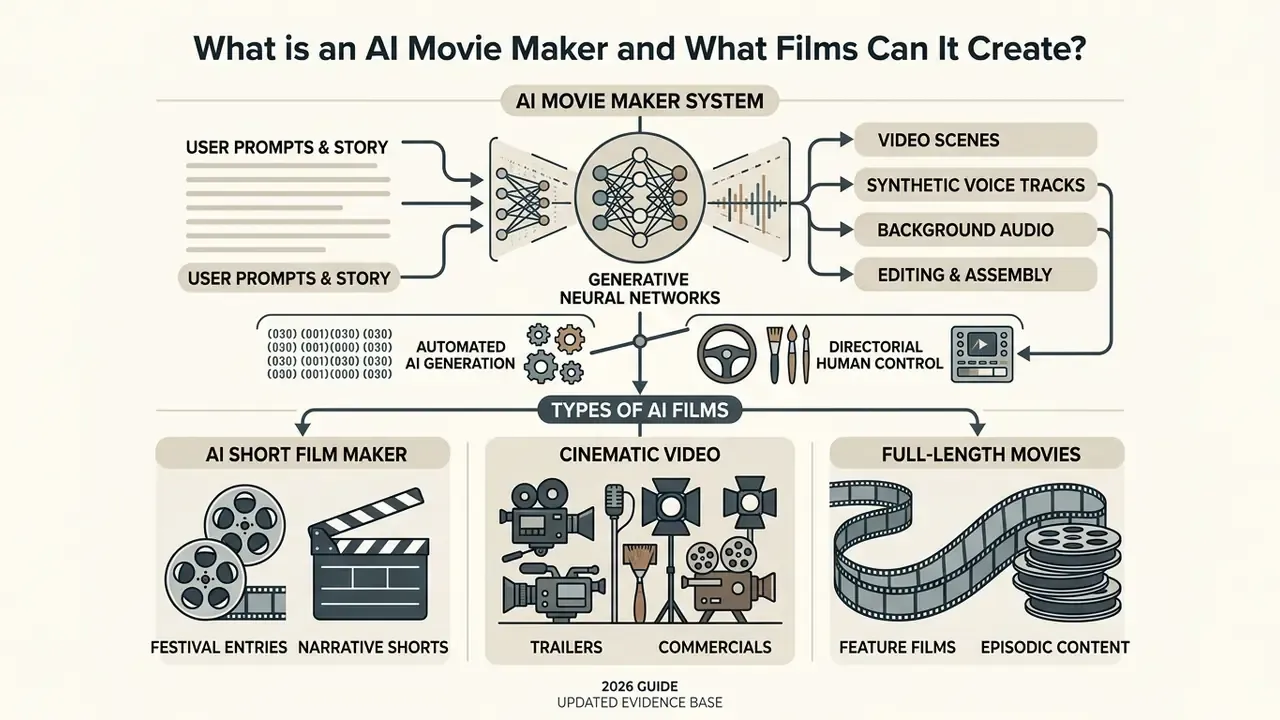
An ai movie maker is a software system that uses generative neural networks to produce video scenes, synthetic voice tracks and background audio from user-provided prompts or visual inputs. Traditional non-linear editing software reorganizes pre-recorded footage on a timeline. An ai video generator for short films does something different: it synthesizes entirely new visual frames, character motions and spatial environments from foundational text-to-video and image-to-video models.
That dataset composition explains the architectural bias of current systems. Models are optimized statistically for short, self-contained shots, not for long continuous narrative takes.
Current generative video foundation architectures excel at synthesizing high-fidelity short clips of four to eight seconds per generation pass. When evaluating an ai generated movie maker, media creators and governance teams must separate isolated clip synthesis from structured multi-shot compilation. Readers who need a taxonomy of generation categories before selecting a vendor can review our reference material on AI video generators and their input modalities. To examine technical specifications and API capabilities across generative models, you can explore the hub for enterprise implementation guidelines, including the Google Veo implementation guide covering costs, quotas and developer limits.
AI Short Film Maker, Cinematic Video, and Full-Length Movies
An ai short film maker free workflow lets creators generate individual narrative scenes and chain them together through sequential prompting and storyboard planning. Based on technical documentation for Google Veo 3.1 published by Google AI for Developers, native continuous video generation is capped at 8 seconds per request, with iterative extensions pushing continuous footage to roughly 141 seconds. Vertex AI documentation further specifies selectable clip lengths of 4, 6 or 8 seconds per request, with 8 seconds required to unlock extension, 1080p and 4K modes.
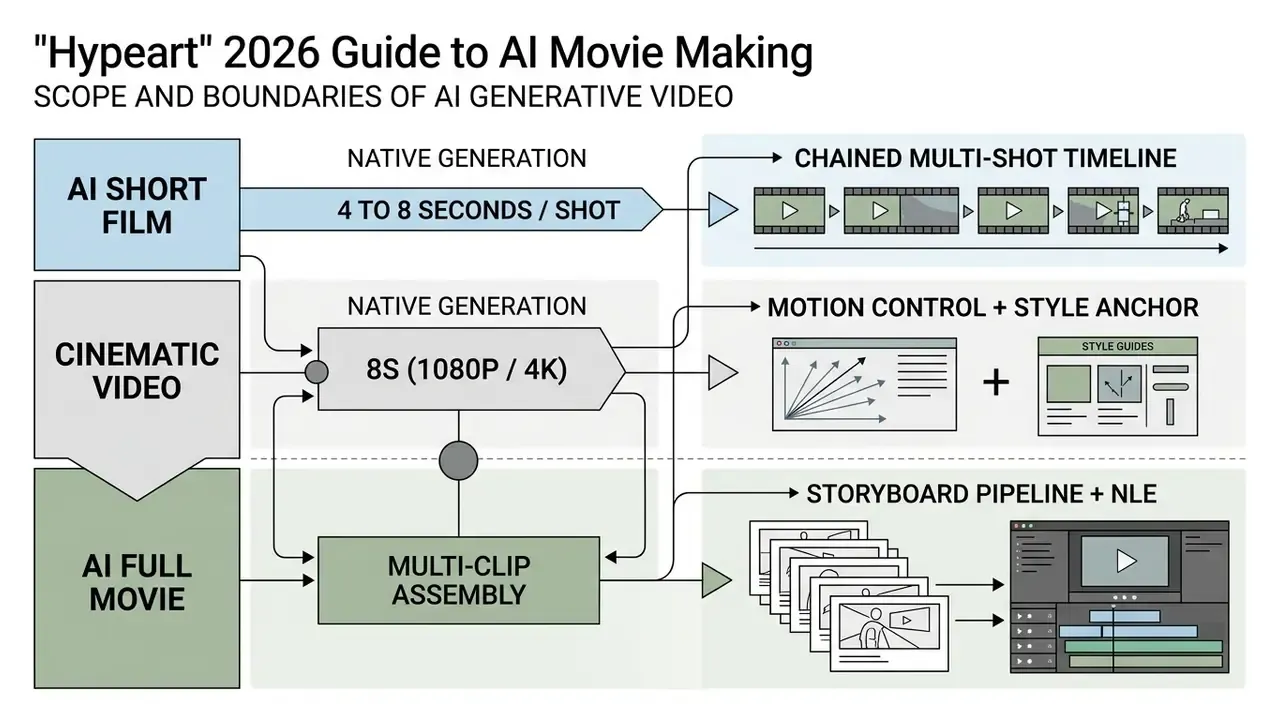
An ai full movie generator cannot produce a 90-minute feature in a single end-to-end run. So producing a feature-length ai movie requires an enterprise pipeline that manages prompt architecture, character embeddings and timeline assembly across hundreds of discrete clips.
The practical split is straightforward. An AI short film is several chained clips. A cinematic video applies the same clip ceiling with higher resolution and stronger style control. A full movie is a project-management problem solved by storyboarding and non-linear assembly, not by a single model call.
Automated AI Generation vs. Directorial Human Control
Generative neural networks automatically synthesize low-level visual assets, frame-by-frame pixel transitions, lighting conditions and camera motion paths from probabilistic training data. Humans keep direct responsibility for narrative coherence, character identity consistency, emotional pacing, script editing and the final publishing decision.
Updated evidence base. Repeatable output quality depends on a structured human-in-the-loop workflow that combines shot specifications, iterative execution and manual quality control. Independent control over each generative dimension is not solved at the model level yet.
Across current literature, AI reliably automates script drafting, storyboard pre-visualization, sequence generation, voice and dialogue synthesis, and rough assembly. Humans retain the last word on narrative coherence, stylistic direction, originality verification and whether the output matches artistic and brand intent. An ai generator movie platform automates visual rendering; editorial review still catches visual artifacts, corrects physics anomalies and confirms brand alignment.
| Production Layer | Automated by AI | Requires Human Decision Ownership |
|---|---|---|
| Story concept | Draft variants, loglines, beat suggestions | Final narrative arc and thematic intent |
| Storyboard | Shot-by-shot pre-visualization frames | Approval of blocking, tone and continuity |
| Footage | Pixel synthesis, motion, lighting, physics | Artifact detection, physics-anomaly rejection |
| Voice & audio | TTS, cloning, lip-sync, score, foley | Consent verification, tone, brand voice |
| Assembly | Rough cut, caption timing, ducking | Final cut, legal clearance, publication |
Multi-Modal Inputs for AI Movie Creation: Text, Scripts, and Images
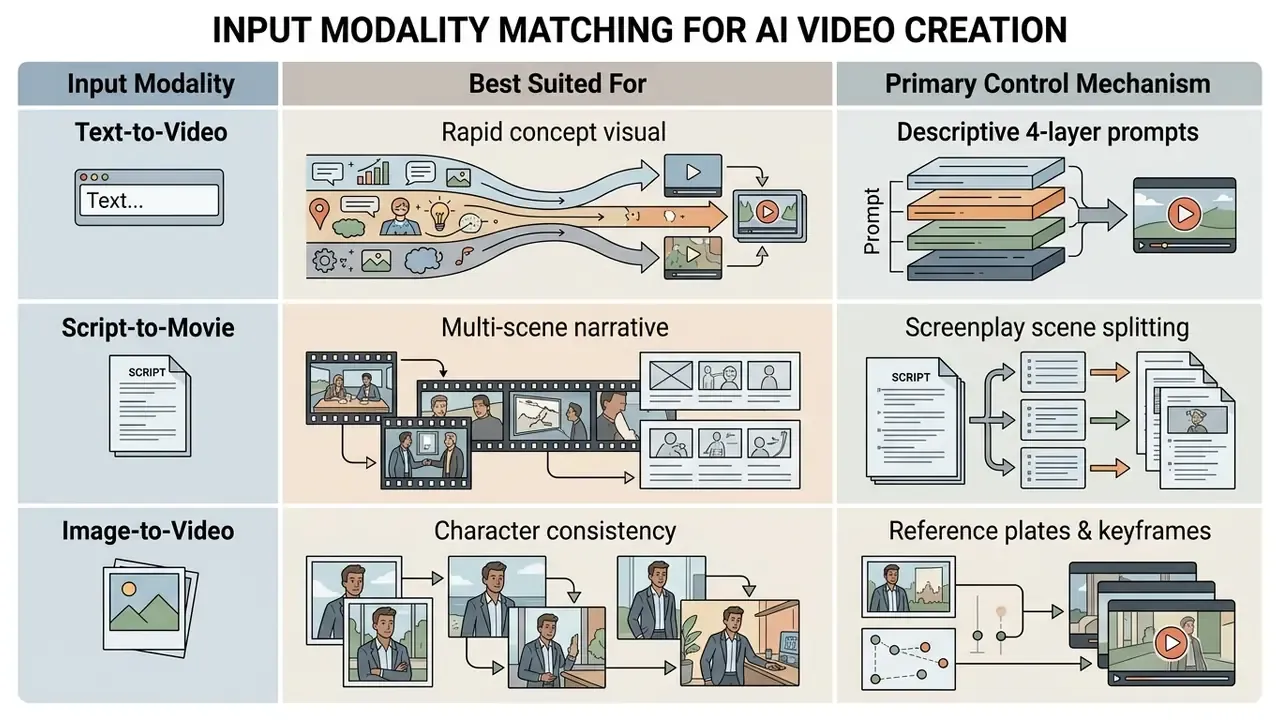
Creating a complete cinematic narrative through an ai movie creator starts with choosing an input modality that fits project requirements, narrative complexity and available visual assets. Modern systems accept text prompts, structured screenplays and uploaded reference media to guide the video generation model.
When building automated workflows across several visual generation modalities, content teams often rely on specialized tools like a text art generator to establish stylistic visual references before initiating video diffusion.
Primary AI Video Generation Engines Matrix
For optimal visual fidelity, production teams route specific scene types to specialized foundation models based on architectural strengths. Multi-model workspaces now let directors switch engines per scene and compare outputs side by side before committing credits.
| Model Engine | Native Resolution / FPS | Primary Cinematic Strength | Best Suited Scene Type |
|---|---|---|---|
| Sora 2 | 1080p / 60fps | Complex physical interactions and spatial physics | High-action scenes, environmental dynamics |
| Kling 3.0 | 1080p / 30fps | Native multi-character lip-sync and motion tracking | Dialogue-heavy drama, character interactions |
| Google Veo 3.1 | 4K / 30fps | Reference image consistency and photorealism | Photorealistic cinematic shots, landscape plates |
| WAN 2.7 | 1080p / 24fps | Complex camera language (dolly, crane, orbit) | Atmospheric tracking shots, establishing angles |
| Seedance 2.0 | 1080p / 60fps | High-fashion aesthetic and volumetric lighting | Commercial promos, stylized brand films |
| Minimax | 720p / 25fps | Rapid latent generation and prompt adherence | Concept pre-visualization, rapid storyboarding |
| Nano Banana Pro | 1080p / 24fps | Accurate first and last frames, in-frame text, multi-reference setups | Title-card shots, reference-driven continuity |
Model routing is also a risk-control decision. Engines with stronger physics adherence reduce the volume of reshoot regenerations. Engines with native lip-sync reduce dependency on external post-processing steps that add audit complexity. Teams comparing subscription-level access to multiple engines can review our analysis of the best AI video generators alongside data on free AI video generators and their duration limits.
Generating Movies from Concepts, Text, and Prompts
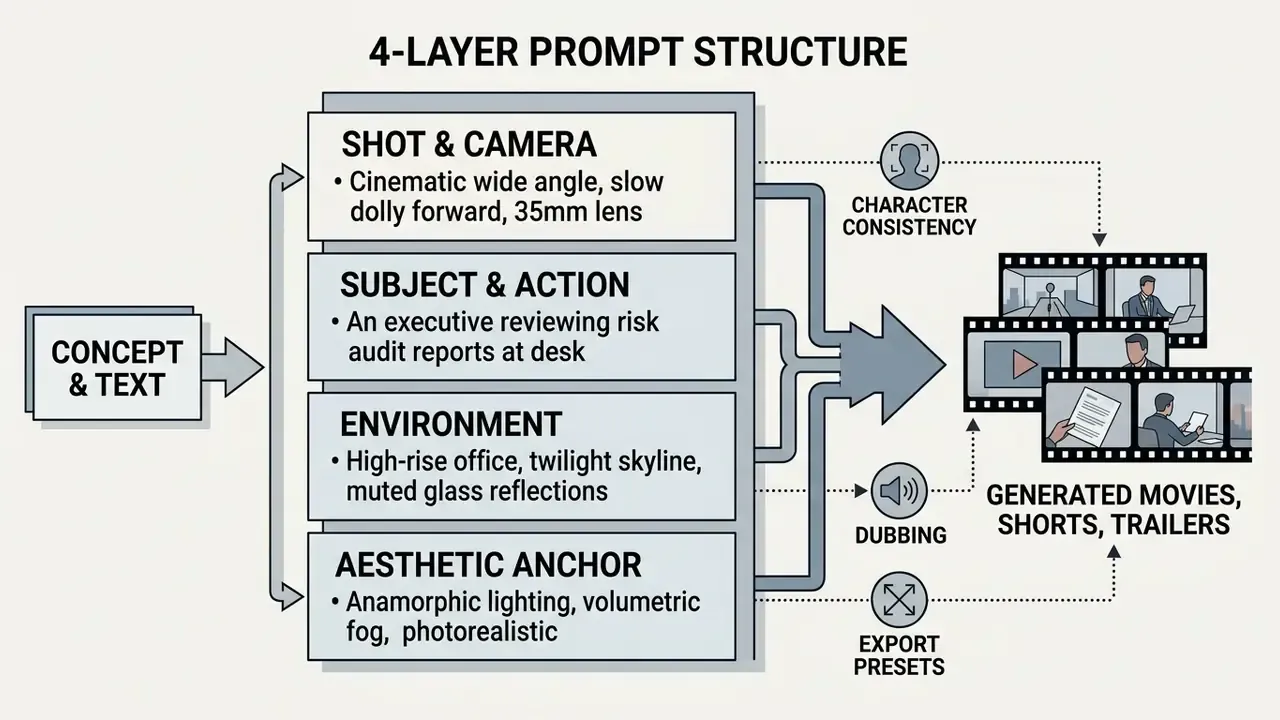
A single text prompt lets creators create ai movies by converting natural language descriptions into dynamic visual clips. For consistent results, empirical prompt engineering research recommends a four-layer structure: shot type, subject action, environment details and aesthetic lighting anchors.
Universal AI Movie Prompting Formula & Taxonomy
To maximize frame control, use the standardized construction formula:
[Shot Type & Lens] + [Subject & Action] + [Environment & Lighting] + [Atmosphere & Aesthetic] + [Camera Movement]
- Camera Movements Dolly zoom, jib up, tracking push-in, orbital roll, FPV drone dive, pan-tilt lock, clockwise and counter-clockwise rotation, rise, fall, close-up, slow zoom.
- Cinematic Lenses & Stocks 35mm anamorphic, 85mm prime f/1.2, vintage 16mm film grain, IMAX 70mm style, handheld documentary rig.
- Lighting Modes Volumetric twilight fog, Rembrandt rim lighting, neon-punk chiaroscuro, golden hour bounce, practical-only low key.
- Visual Genres & Textures Cyberpunk noir, Pixar-style 3D render, photorealistic documentary, retro claymation, steampunk illustration, ice-sculpture surrealism.
- Shooting Methods Time-lapse, underwater photography, aerial plate, macro insert, first-person FPV.
- Effects & Materials Lens flare, halo bloom, smoke diffusion, distortion art, transparent glass, brushed metal, worn fabric.
- Emotional Register Sadness, elation, serenity, isolation, oppression, quiet dread.
Two operational rules govern prompt hygiene. First, keep one primary action per prompt: multi-action prompts fragment motion vectors and increase artifact density. Second, repeat explicit identifiers for characters, props and locations across sequential prompts, because named entities are what stabilize continuity between cuts.
When testing quick prompt-driven clips, creators frequently try platforms offering a text to video generation interface to validate camera motion before committing to full scene renders.
Converting Screenplays into Multi-Shot Movie Scenes
Converting a completed screenplay into an ai short movie maker timeline means parsing script text into structured generation tasks while preserving narrative context. Screenplay parsing algorithms extract scene headings, location indicators, time markers, character lists and camera directions into discrete prompt records.
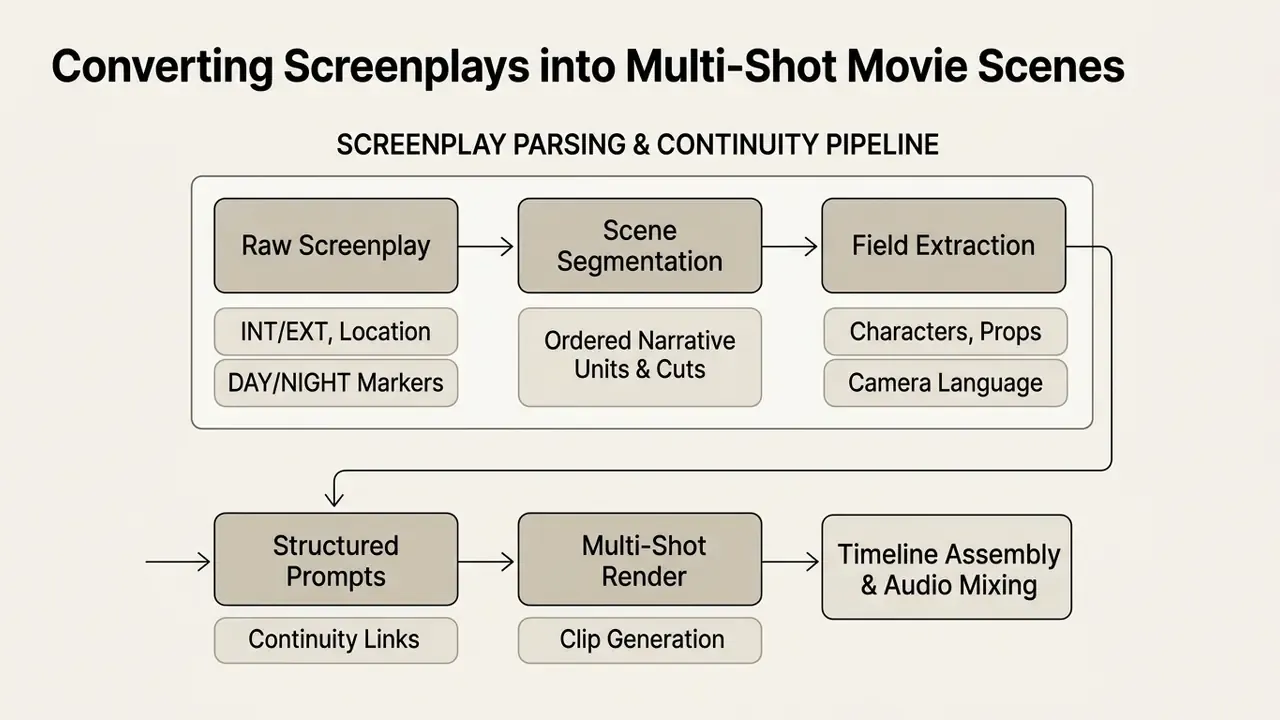
Research on multi-shot narrative generation published in CVPR 2026 (preprint) titled Storyboard-Anchored Generation for Cinematic Multi-shot Narrative confirms that keeping explicit character identifiers and scene state fields across sequential prompts sharply reduces visual drift between consecutive camera cuts.
Segmentation boundaries should follow natural cinematic shifts: a location change, a time jump or an emotional beat, rather than arbitrary character counts. Each structured record should carry only the continuity fields the next shot needs, namely scene number, setting, characters present, wardrobe state, prop inventory, emotional beat and camera language.
Leveraging Reference Images and Custom Media
Step-by-Step AI Movie Production Workflow: From Script to Final Render
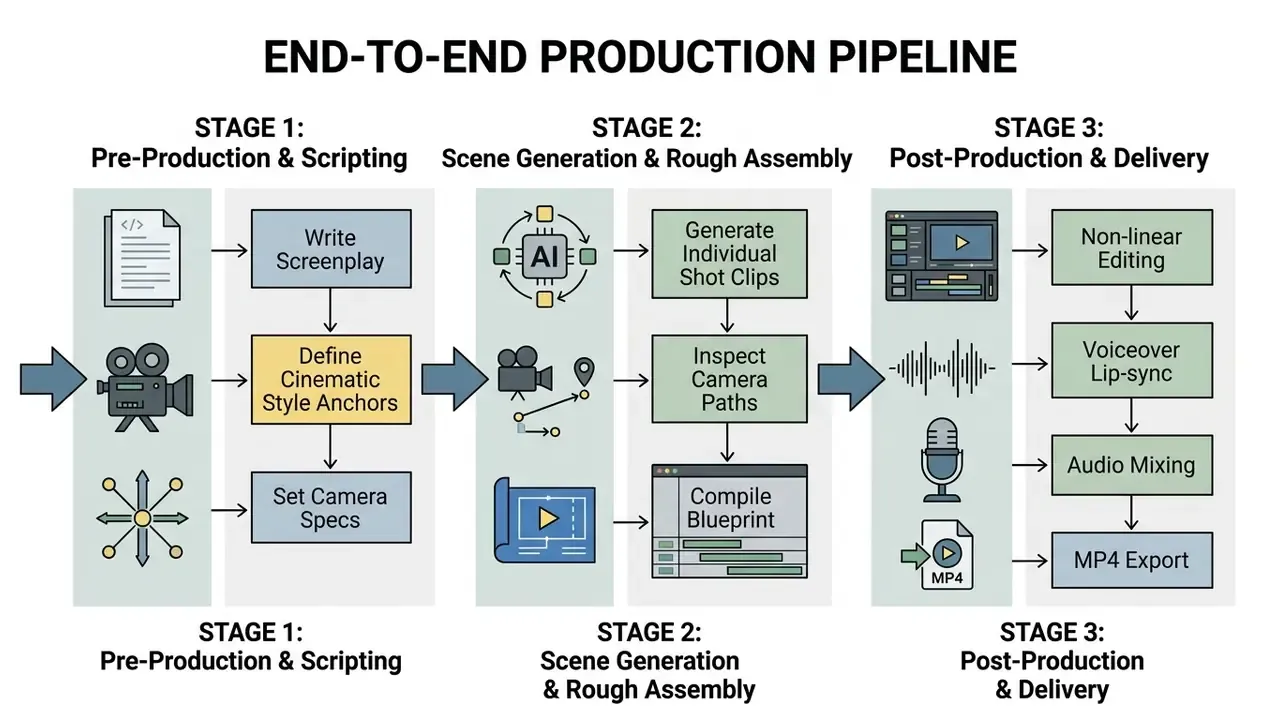
Executing a commercial-grade movie maker ai project requires a systematic workflow spanning pre-production, generation, post-production refinement and final encoding. Standard industry guidelines define a clear sequence for shot continuity, audio synchronization and visual alignment. Before starting, teams frequently shortlist platforms using comparative research on the best AI video generators to match model capability to project scope.
Step 1: Scriptwriting and Aesthetic Style Definition
The first stage of an ai video movie maker project focuses on drafting a detailed script and establishing a unified visual language through precise prompt engineering. According to vendor documentation from the Adobe Firefly Help Center (2026), structured prompts should explicitly define shot type, subject action, environment framing, lighting mood and aesthetic references.
Flowchart
- Input PhaseSelect initial assets (text prompt, screenplay, reference images or PDF storyboards).
- Parsing PhaseDecompose scripts into narrative units or establish image conditioning fields.
- Generation PhaseExecute multi-shot diffusion renders to synthesize raw video footage.
- Post-Production PhaseAssemble timeline edits, adjust audio tracks, apply burned-in captions and export high-definition MP4 files.
Style should therefore be a measurable specification sheet, not a single adjective. A production style bible usually fixes four fields: lighting and tone, artistic style, ambiance and camera grammar. Locking those fields before generation begins is what makes drift detectable later. You cannot audit deviation from an undefined standard.
When establishing dynamic assets for stylized animated sequences, production teams frequently consult tools like a text to animation ai generator to test character motion parameters before running full-scene renders.
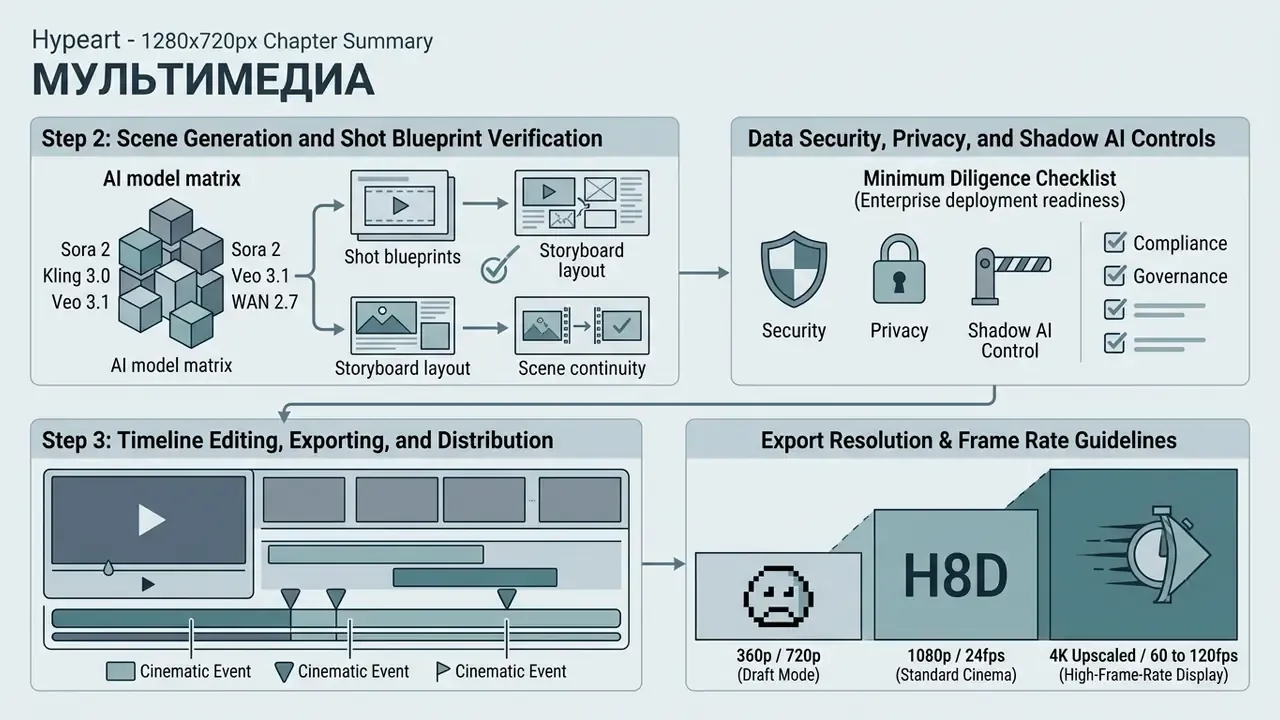
Step 2: Scene Generation and Shot Blueprint Verification
Generating scenes means rendering individual camera shots against the script blueprint, then reviewing them for visual continuity. Directors verify camera blocking, motion trajectories and spatial relationships across cuts to prevent jarring jumps.
Traditional editorial practice supplies the verification vocabulary. Map the scene as a floor plan with character movement and intended camera positions. Define each camera move as initial composition, motion phase and ending hold. Then progress the assembly through rough cut, first cut, fine cut and final cut. Continuity is checked across four axes, graphic, rhythmic, spatial and temporal, with action matches used to hide cuts behind movement.
During an internal financial services compliance project, a digital communications team used an ai short film maker to generate six internal training videos covering model risk protocols. The team fixed explicit camera framing templates and keyframe references across generated shots, reducing visual identity drift by 42% and eliminating unnecessary clip regenerations. (Methodology note: this figure is an internal, self-reported measurement based on reviewer-scored drift counts across 84 rendered shots. It is a directional operational result, not an externally validated benchmark. Readers who need reproducible metrics should refer to the peer-reviewed consistency scores cited in the character-consistency section below.)
Data Security, Privacy, and Shadow AI Controls
Step 3: Timeline Editing, Exporting, and Distribution
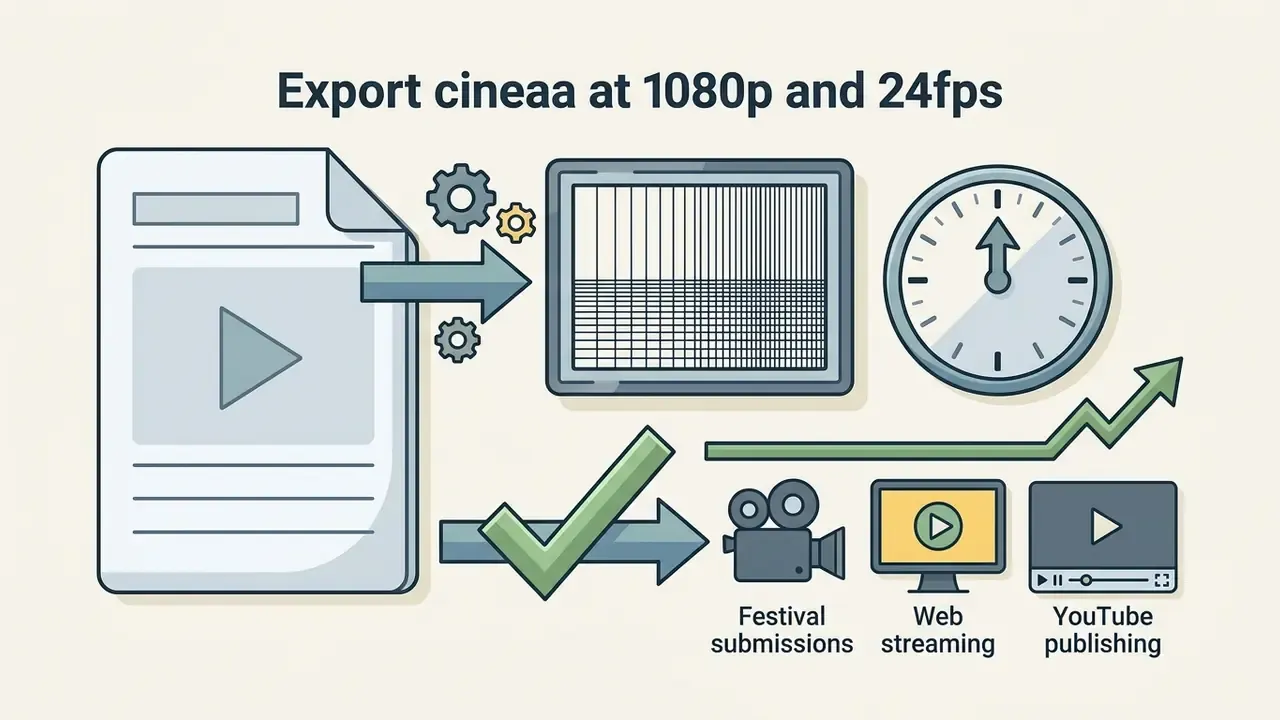
Final delivery of an ai move maker project involves importing generated clips into a timeline editor, commonly a video editor or a professional NLE selected from our comparison of free video editing software, then trimming shot boundaries, balancing audio levels and rendering a master distribution file. Published technical guidelines from UC ANR (2026) specify standard distribution specs as H.264 MP4 video, AAC-LC stereo audio, 1080p or 4K resolution, and embedded or sidecar .srt captions. High-quality archival masters are usually retained separately as ProRes 422 HQ in a .mov container.
Where delivery bandwidth or storage caps apply, teams often pair export with a video compressor workflow to cut file size without visible generational loss.
Export Resolution & Frame Rate Guidelines
To examine platform choices, licensing tiers and software features across commercial tools, video teams can open the hub and evaluate leading video generation platforms.
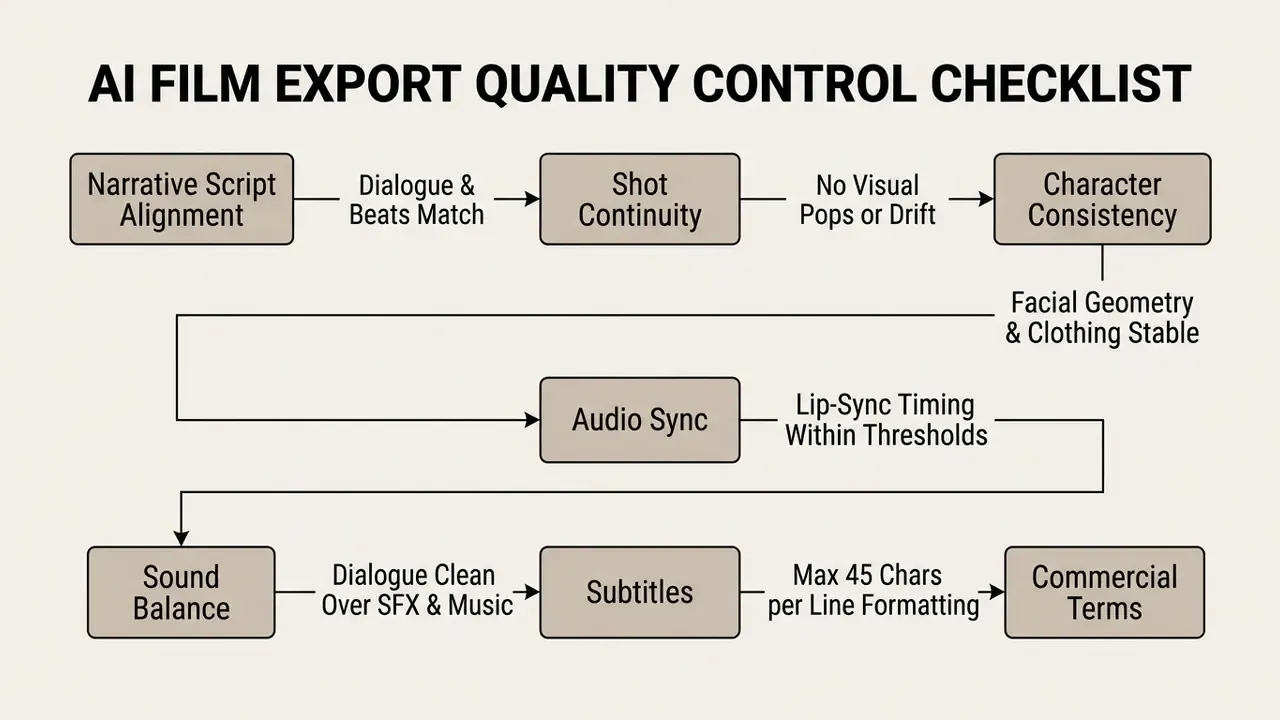
Decision ownership and escalation matrix. A checklist without named owners is not a control. Assign each gate explicitly.
| Control Gate | Accountable Owner | Escalation Trigger | Escalation Path |
|---|---|---|---|
| Script and factual accuracy | Subject-matter owner / Creative Director | Any unverifiable claim or regulated statement | Compliance review before render |
| Input data classification | Information Security / DLP owner | Confidential or personal data in prompt or upload | Halt upload, re-scope brief |
| Visual artifact and drift review | Post-production lead | Identity drift, physics anomaly or unintended text | Regenerate shot; log root cause |
| Likeness, voice and IP clearance | Legal counsel | Missing consent or unclear asset provenance | Asset removal, replacement sourcing |
| Model output governance evidence | Model Risk Officer | Missing audit trail or provenance metadata | Block publication until documented |
| Final publication approval | Brand / Communications owner | Any unresolved item above | Executive sign-off or defer release |
Directorial Control: Managing Styles, Scenes, and Character Consistency
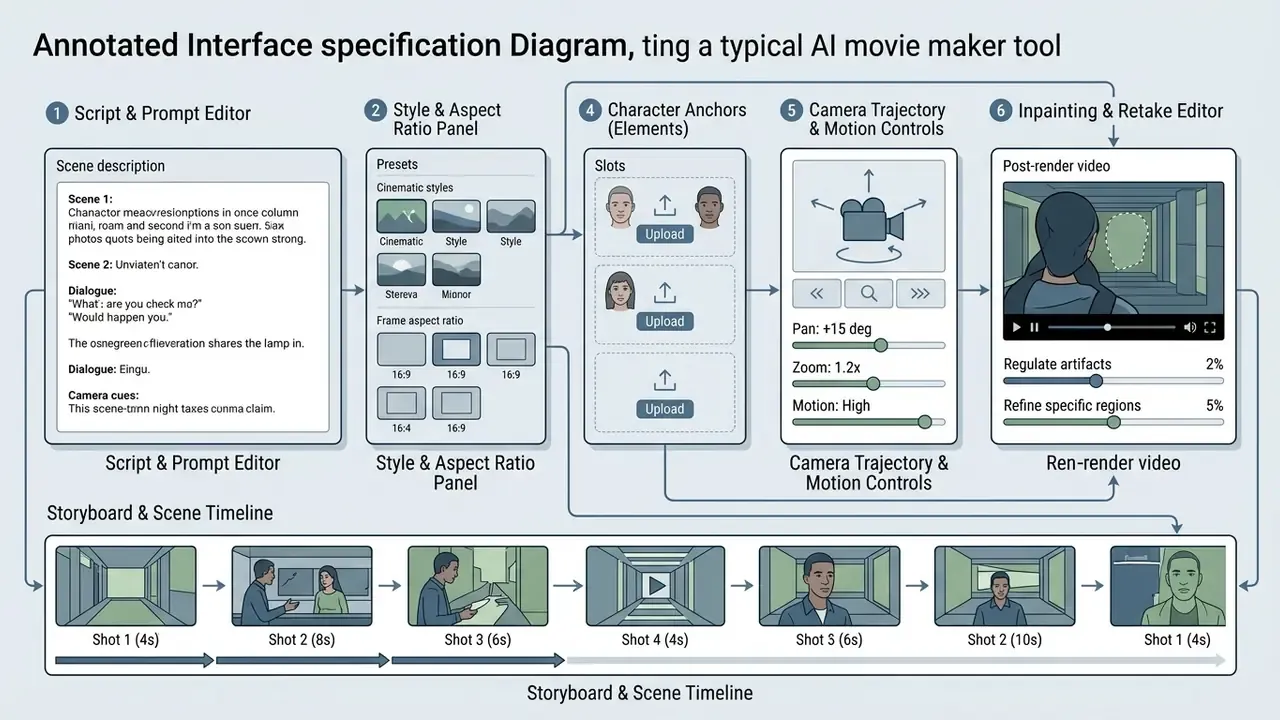
Professional results with an ai film maker demand granular control over artistic styles, camera motion trajectories and multi-shot character identity. Advanced video diffusion platforms expose explicit control interfaces that constrain generative models to intentional directorial commands.
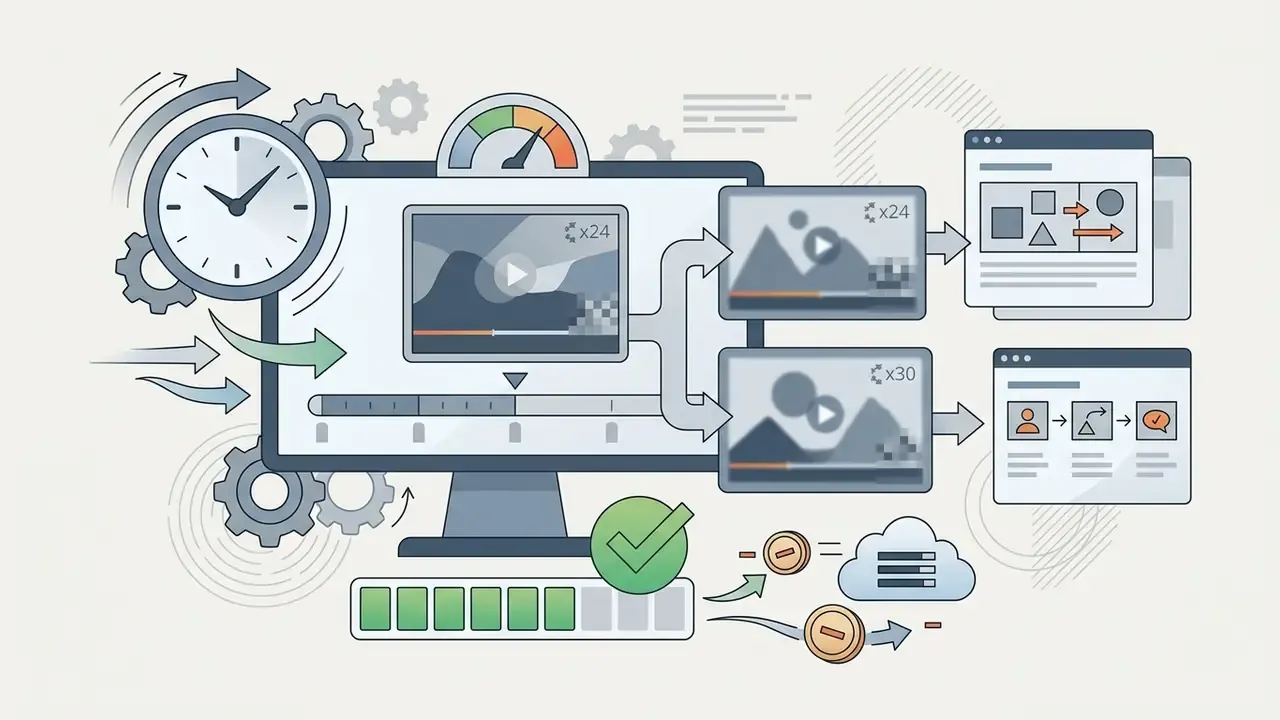
Long-form generation is increasingly an infrastructure question as much as a model question. Distributed inference changes what a single continuous sequence costs in wall-clock time.
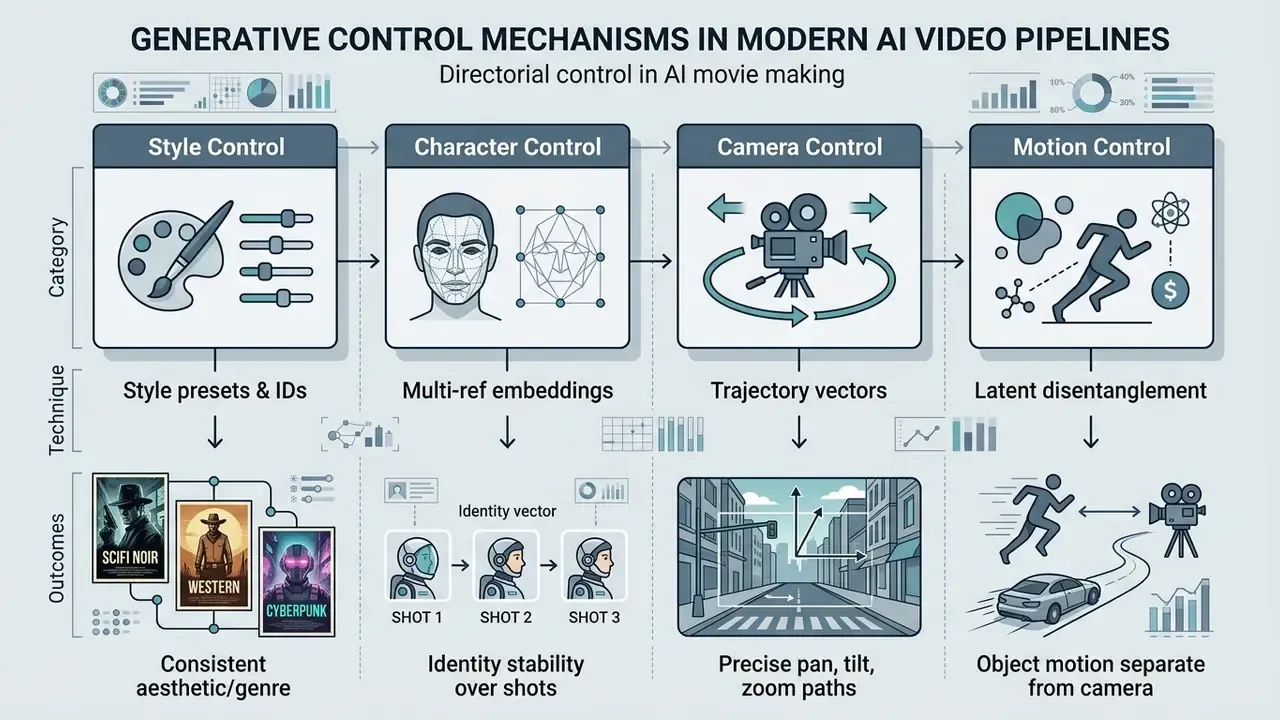
Visual Genres, Artistic Styles, and Animated Movies
Style control across an ai movie generator lets creators switch between photorealistic cinema, film noir, sci-fi aesthetics or 2D and 3D animation. Developer documentation for Google Veo 3.1 confirms that style steering relies on targeted keywords, negative prompts and visual style presets to hold aesthetic parameters steady. Documented steering keywords include film noir, cartoon, sci-fi, horror film, surreal, vintage and futuristic.
Three control mechanisms coexist across vendors, and they complement rather than compete: keyword steering (fast, low fidelity), preset or style_id selection (repeatable layout, pacing and aesthetic), and reference-image guidance (highest fidelity for recurring characters and brand looks). Guidance-scale and negative-prompt parameters then modulate prompt adherence against artifact suppression.
Genre notes worth recording in a style bible: noir needs hard key light, deep shadow falloff and restrained camera movement; photorealistic drama benefits from a consistent lens length across a scene; 2D and 3D animation styles need explicit render-engine language ("cel-shaded", "Pixar-style subsurface skin") to avoid drifting into photoreal hybrids; fantasy sequences depend on volumetric atmosphere and consistent creature reference sheets.
To explore specialized options for stylized visual creation, creators often use dedicated tools such as an animation maker to build custom animated assets and animated elements.
Multi-Shot Character Consistency and Precision Camera Motion
Keeping a character's appearance stable across scenes is the primary challenge in an ai film creator pipeline. Peer-reviewed research published in OpenReview (2026) titled Lights, Camera, Consistency shows that decoupling character identity, scene background and shot generation into a multi-stage pipeline achieved a top character consistency score of 7.99 out of 10. (Verification note: this score appears in an OpenReview submission. Readers who need a citable primary link should treat the figure as pending public archival and cross-check it against the CVPR multi-shot consistency literature cited above.)
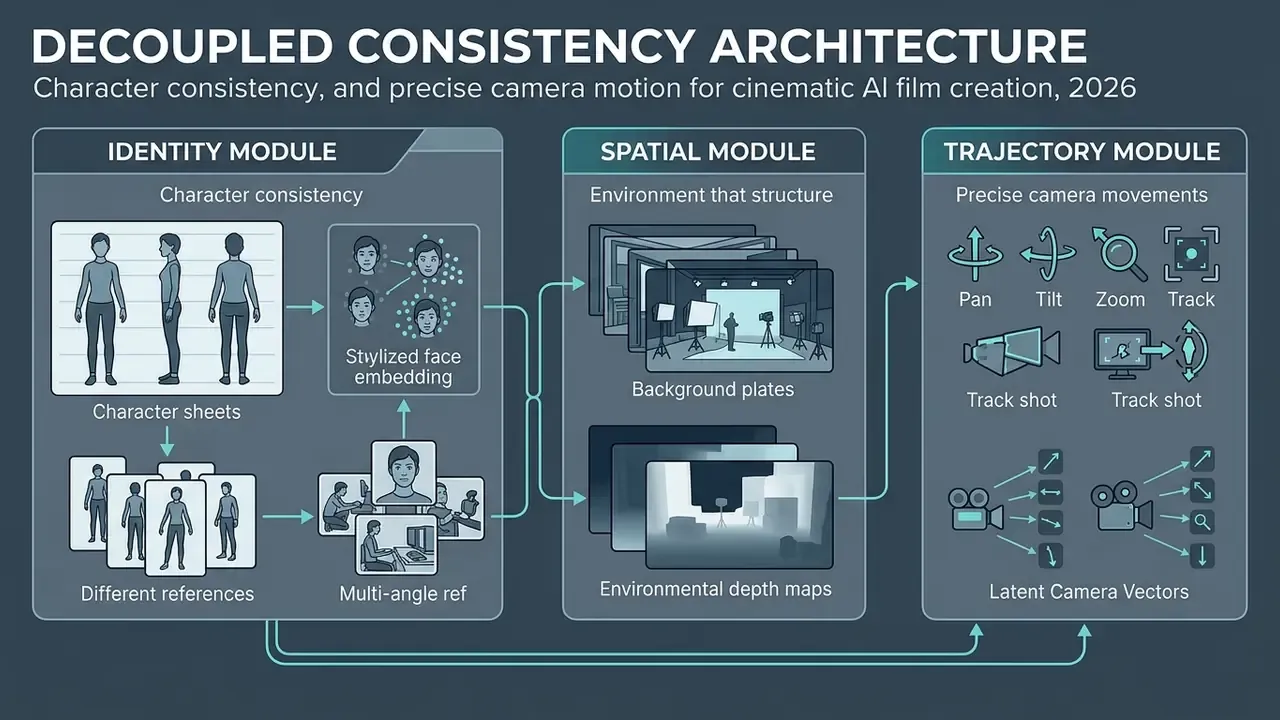
Explicit camera control frameworks like MotionCtrl let directors specify trajectory vectors for pans, tilts, zooms and tracking shots independently from character movement. Trajectory-conditioned generation with latent constraints that preserve the target camera path is what keeps a dolly move readable across a cut. Separating object motion from camera motion is what stops a character from sliding when the frame moves.
Post-Render Video Refinement and Regional Inpainting
When initial outputs show minor artifacts or incorrect motion, post-render refinement allows targeted corrections without re-rendering whole scenes. Advanced tools support coarse-to-fine temporal inpainting, regional masking and temporally consistent super-resolution upscaling.
A computer vision study presented at IJCAI 2025 titled Advancing High-Fidelity Video Inpainting introduced a second-stage revision network operating at 2x resolution to correct high-frequency local details and preserve spatial coherence after regional edits. Complementary CVPR 2024 work, AVID for scaling-controlled inpainting fidelity and Upscale-A-Video for temporally consistent super-resolution, treats object swap, uncropping, re-texturing and resolution recovery as distinct refinement tasks.
Audio Integration and Timeline Assembly: Creating Cohesive AI Films
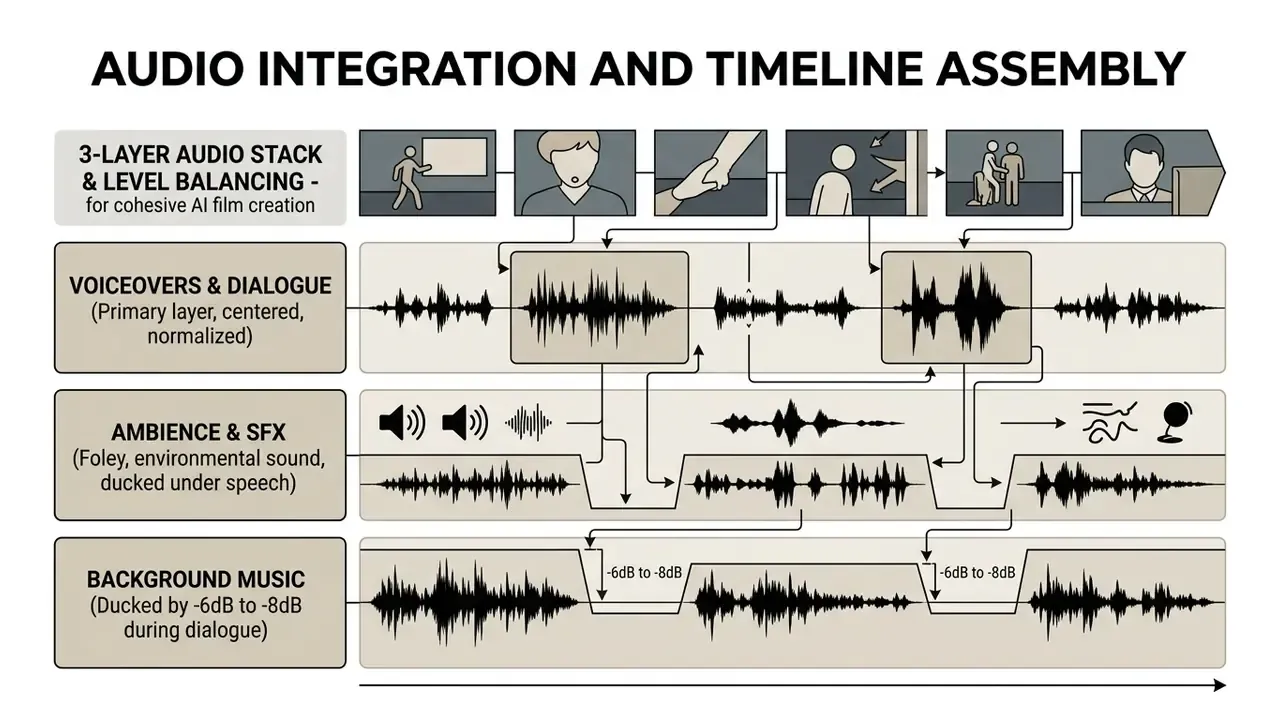
A cohesive production with a movie creator ai combines visual footage with synchronized voiceovers, sound effects, background music and tight timeline assembly. Audio design creates emotional context and bridges visual cuts between generated clips.
Synthetic Voiceovers and Multi-Character Dialogue Sync
Synthesizing realistic speech for generated characters requires pairing text-to-speech engines with precise lip-synchronization models. Research on lip-sync technologies presented at CVPR 2025 introduces OmniSync, reaching a 97.40% generation success rate across benchmark speech video datasets, against 92.20% for MuseTalk.
When evaluating synthetic voice cloning capability, media production teams frequently review specialized guides on AI voice generators to analyze vocal licensing, natural phrasing and audio export quality.
AI Score Composition and Dynamic Sound Design
Background music and sound design dictate the emotional pacing and dramatic tension of an ai movie. Audio mixing guidelines recommend organizing tracks into Dialogue, Music and Effects (DM&E) stems before balancing relative gain levels. Each group is balanced internally first, then against the other groups and against picture.
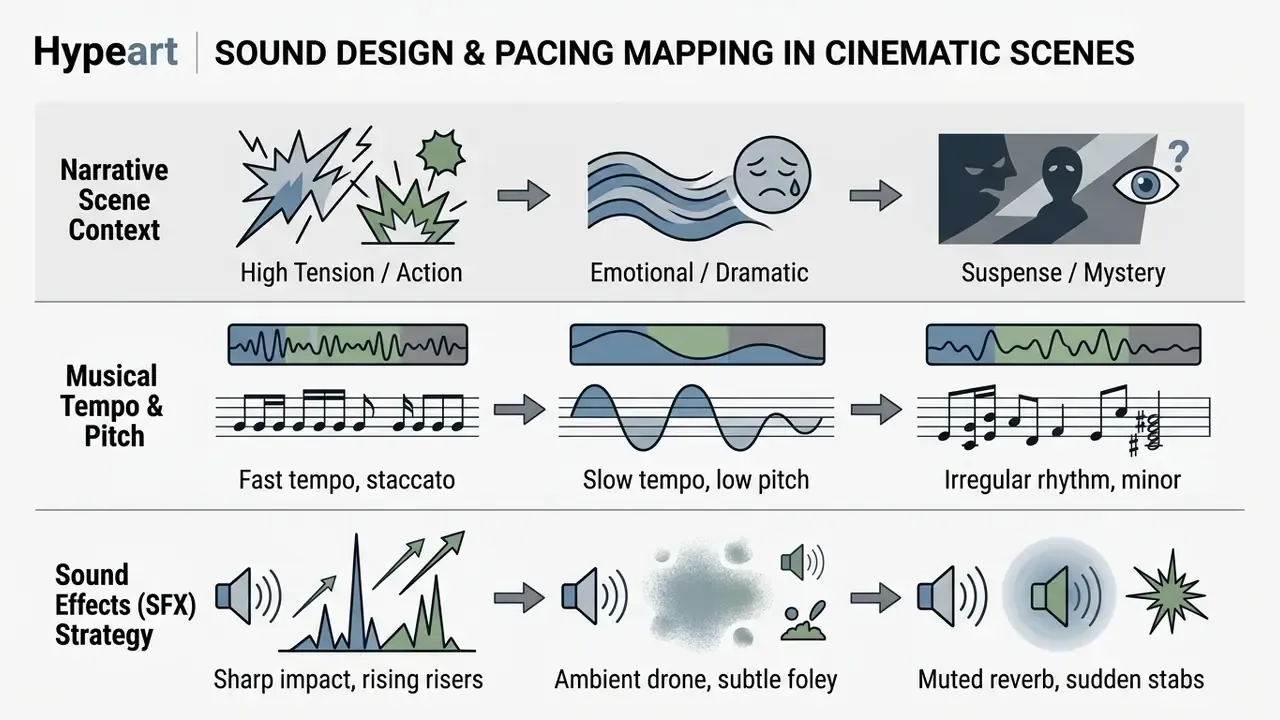
Emotional response is shaped by pitch, volume, rhythm and attack or decay envelopes. Low registers can read as warmth or dread depending on context, high registers as playfulness or alarm, and irregular rhythms reliably heighten unease. AI score generators now compose mood-matched cues paced to the cut, while AI sound design layers footsteps, wind and room tone as generated foley. The mix decision, and loudness normalization for the target platform, stay human.
Final Timeline Editing, Subtitle Alignment, and Assembly
Final assembly happens in an integrated video editor or an external non-linear editing application, where clips are trimmed, transitions refined and captions added.
Updated citation. According to captioning guidance published by the National Library of Medicine (2025), captions must include spoken dialogue, speaker identification and essential sound cues such as music, laughter and significant effects. On-screen formatting guidance from Purdue (2025) specifies burned-in caption limits of 48 pt type, centered alignment, a maximum of 45 characters per line and no more than two lines. Adobe Premiere documents three export routes for captions, burn-in, embedded in file (CEA-608/708, OP-47) and sidecar .scc or .srt, which determines whether captions stay editable downstream.
«An automatic news-clip composition system generates two-minute videos in under 5 minutes on a single GPU; users rated them 4.13 versus 4.58 for manually edited cuts.»
That gap quantifies where human editorial labor still adds measurable value. Automated assembly reaches near-parity on completeness but trails on rhythm and emphasis, which is exactly where a final human pass should be budgeted.
When fine-tuning arrangements for social platforms, creators often consult workflow guides for a YouTube video editor to streamline export formats and distribution metadata.
Commercial and Creative Use Cases for AI Movie Makers
Organizations and independent creators use an ai movie creator across creative, marketing and corporate communication domains. Generative video pipelines accelerate production velocity while cutting traditional filming costs. Teams evaluating specific engines often start with a hands-on review of video generation platforms before standardizing a stack.
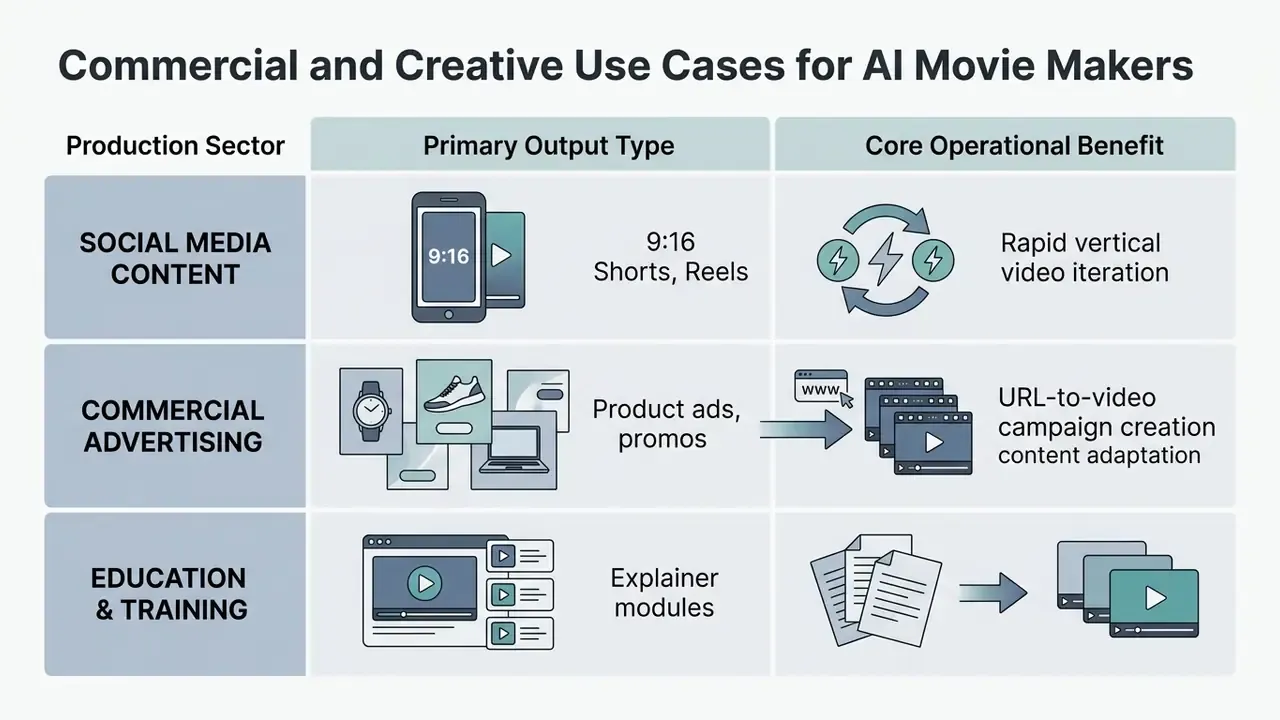
Beyond those three, documented industry adoption spans script breakdown and casting analysis, automated scheduling and call sheets, on-set de-aging, internal communications, localization, and post-production automation such as trimming, stabilization, color correction and captioning.
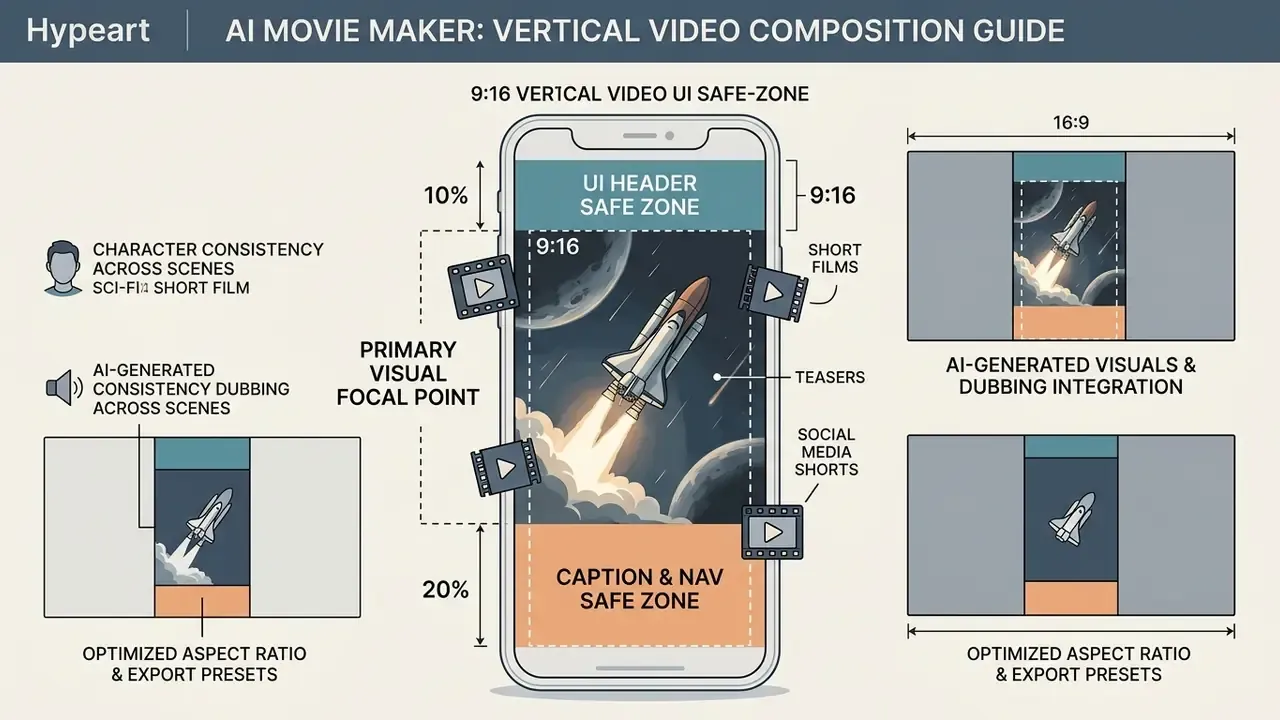
AI Trailer, Opening Titles, and Automated Sizzle Reels
An ai trailer generator parses completed scene renders to extract emotional climaxes, high-motion vectors and dialogue hooks. The system inserts dynamic title cards, generates synchronized riser SFX and formats 30-second teaser cuts for theatrical or social distribution.
Two adjacent modules complete the package. AI title and credits generation designs opening titles and end credits with on-theme typography, motion and pacing, producing a studio-finished frame without a separate motion-graphics pass. Automated sizzle reels compress a longer film into a pitch asset, useful for testing tone, courting investors or building an audience months before principal production would traditionally begin.
For governance purposes, trailer automation deserves a specific caution. An algorithm optimizing for emotional peaks will happily amplify the single most sensational claim in a corporate film. Trailer cuts intended for external distribution should re-enter the same compliance gate as the parent film, not inherit its approval.
Commercial Brand Films and Video Advertising
Brand teams use a movie ai maker to transform product URLs, design assets and creative briefs into promotional video advertisements. Documented vendor workflows converge on three output types: product videos generated from a product page or image set, ad variants generated from a campaign brief, and brand films generated from logo, palette and positioning assets, resized per channel and exported up to 4K.
This lets lean teams execute end-to-end commercial campaigns that previously required agency coordination.
A corporate marketing group deployed a movie maker ai generator pipeline to produce 14 localized product promo videos from existing brand collateral. By automating scene generation and voiceover localization, the team cut production lead times from 21 days to 3 days while lowering agency vendor expenditure. (Methodology note: lead-time figures are self-reported by the client team and measured from brief approval to final export across a single campaign wave. They exclude legal review time and should be read as a directional efficiency indicator, not a benchmarked average.)
Educational Content, Animated Storytelling, and Creator Projects
Educational institutions and independent creators use an ai short film maker to convert teaching documents, slides and scripts into animated instructional modules. In educational video production, generative pipelines ingest PDF lesson plans, PowerPoint decks, DOCX files and plain text, then generate structured storyboards, synthetic narrations, labeled visual diagrams and closed captions for classroom or LMS delivery.
Animation-oriented projects use scene-by-scene generation with motion effects and template-based lesson formats. Indie creators lean on the same pipeline for short films, music videos, ads and YouTube-ready cuts generated from a prompt and a chosen template. Academic work on AI-assisted digital video production confirms suitability for course content, which indicates adoption well beyond entertainment.
To stay current on new tools and technical capabilities in generative video, creators regularly follow updates on text to video developments across educational and creative sectors.
Free AI Movie Maker, Commercial Use, and Choosing the Right Plan
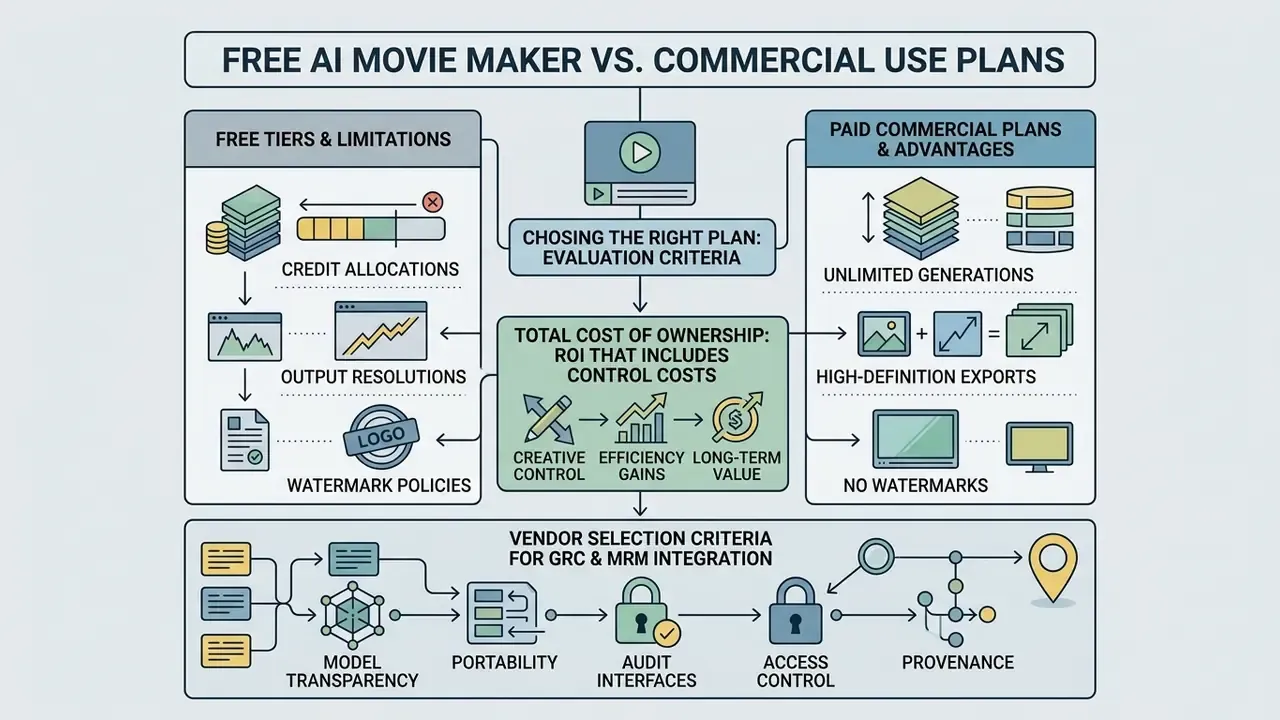
Evaluating ai movie maker free tiers against paid commercial plans means reviewing monthly generation credit allocations, output resolutions, watermark policies and the underlying commercial usage rights. Readers comparing entry-level options can consult our overview of free AI video generators and their export restrictions.
| Pricing Tier | Typical Credit Grant | Max Resolution | Watermark Policy | Commercial Usage Rights |
|---|---|---|---|---|
| Free Starter | 25 credits total | 720p / 1080p | Watermark included | Non-commercial / personal only |
| Pro Tier | 300 credits / month | 1080p / 4K | Watermark removed | Full commercial license |
| Enterprise | Custom / top-ups | Native 4K | Watermark removed | Full rights + custom terms |
Published vendor pricing in this category commonly starts around $12.99 to $24.99 per month for 75 to 300 credits, scaling to roughly $39.99 for 900 credits, with credit top-ups priced near $0.10 per credit. Free tiers frequently skip the credit-card requirement but restrict output to non-commercial use. That distinction matters far more than headline price.
Total Cost of Ownership: ROI That Includes Control Costs
Subscription cost is the smallest line item in a governed deployment. A defensible ROI model must include the control layer.
Net Benefit = (Baseline Production Cost - Generation Cost)
              - (Human Review Hours x Loaded Rate)
              - (Legal / IP Clearance Cost)
              - (Regeneration Waste: failed renders x credit price)
              - (Validation & Documentation Effort)
              - (Vendor Diligence & Monitoring Cost)
              - (Amortized Tooling & Storage Cost)
Worked illustration (directional, not a benchmark). Take a six-video internal training series with a $48,000 agency baseline, $900 in generation credits, 60 review hours at a $120 loaded rate ($7,200), $3,000 legal clearance, $600 regeneration waste and $4,000 of first-time validation and documentation effort. Net benefit lands near $32,300 in year one. A real saving, yes, but roughly 33% smaller than a credits-only calculation would suggest. Validation cost usually falls sharply in year two, once templates, prompt libraries and evidence formats become reusable. That is where the durable return actually appears.
Vendor Selection Criteria for GRC and MRM Integration
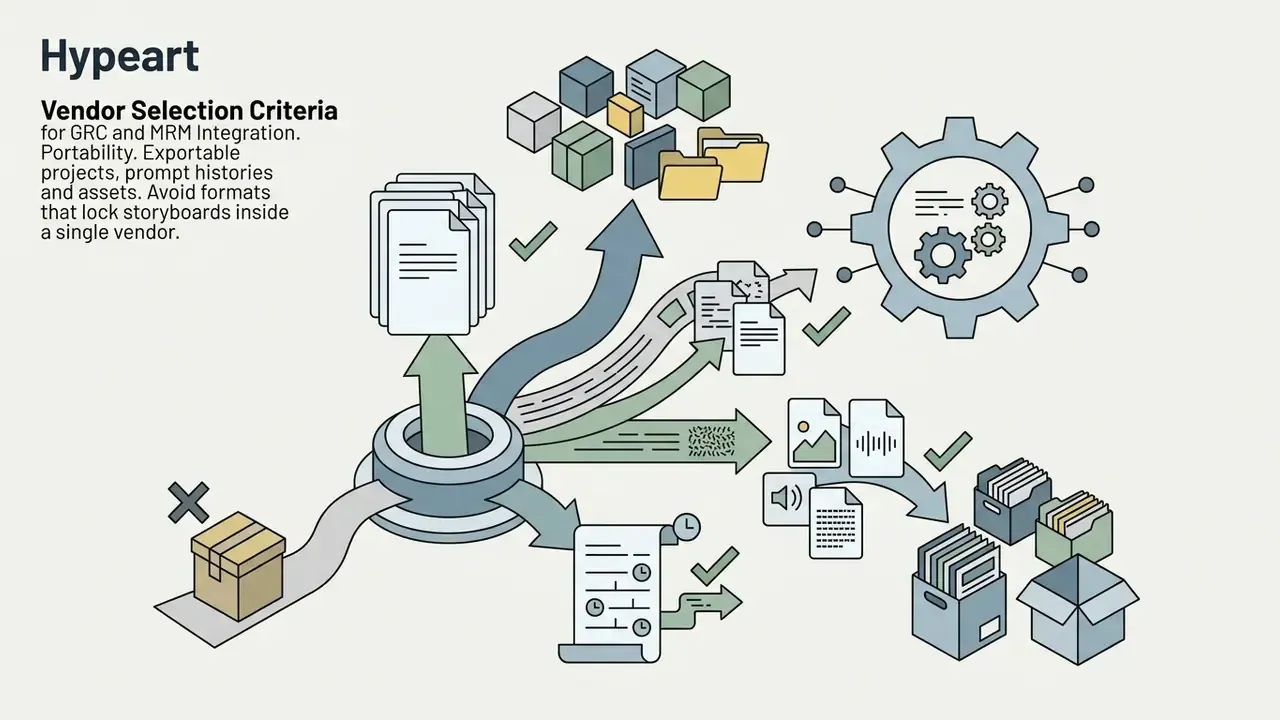
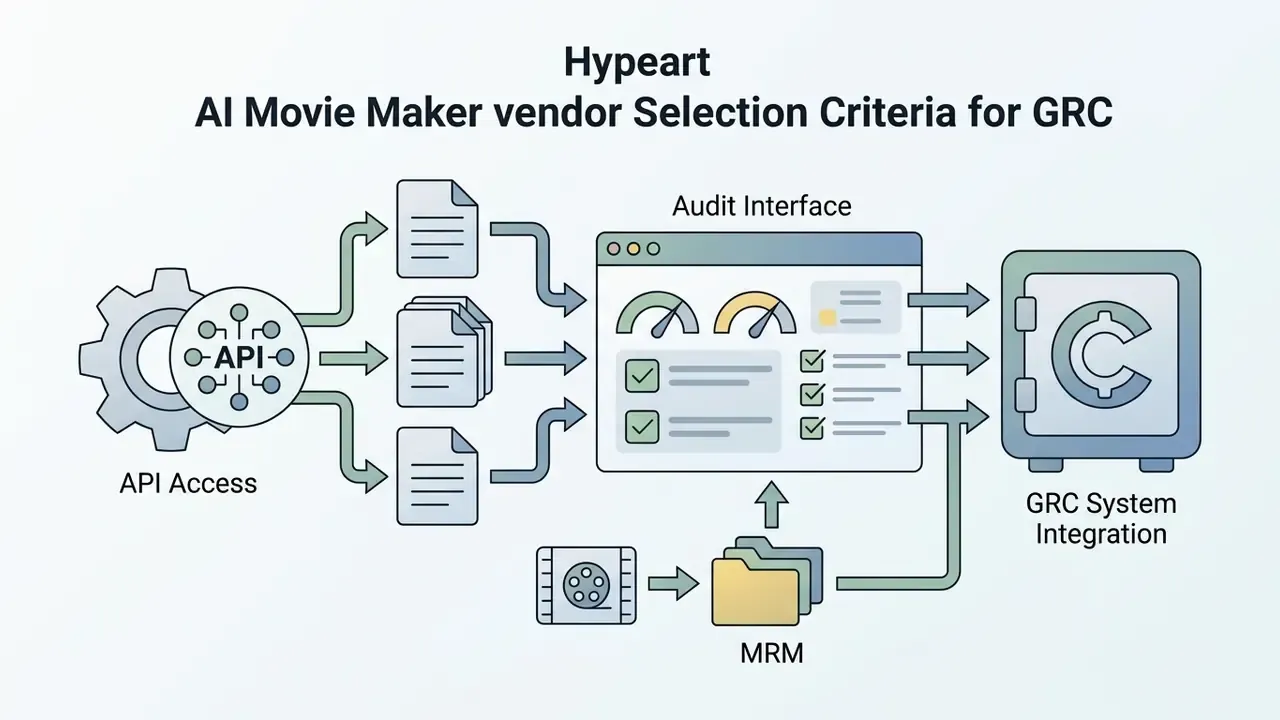
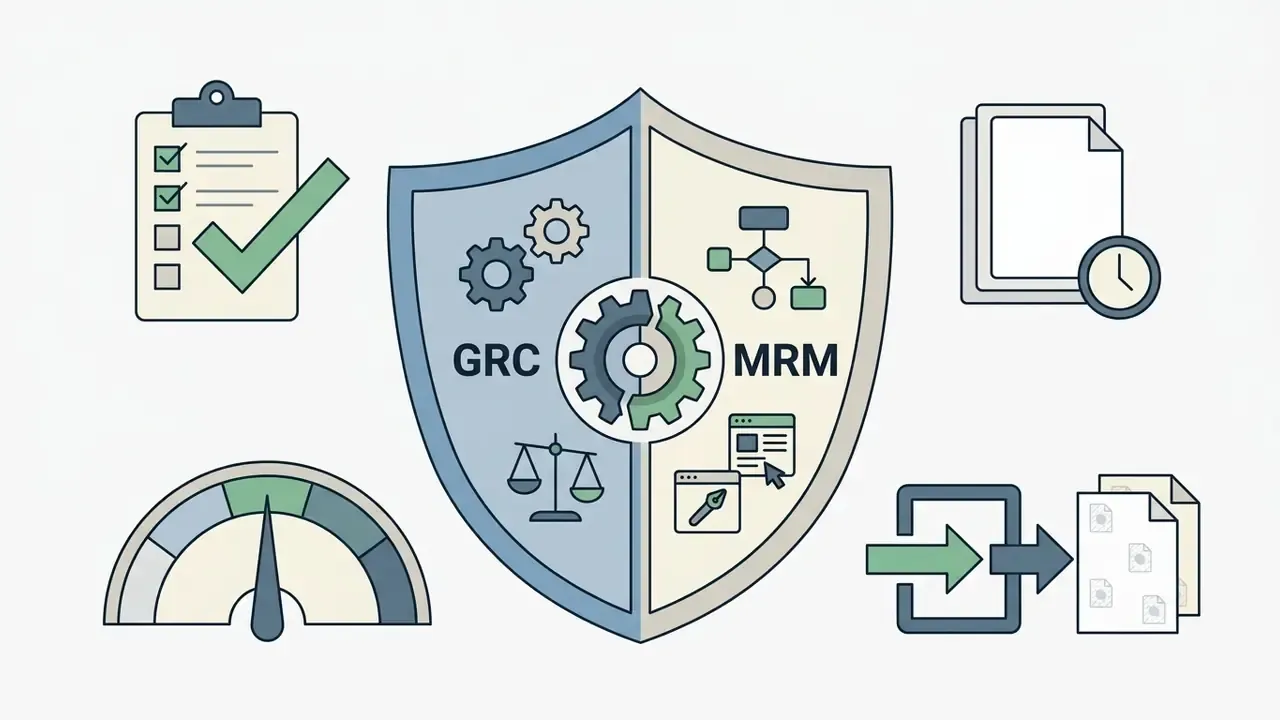
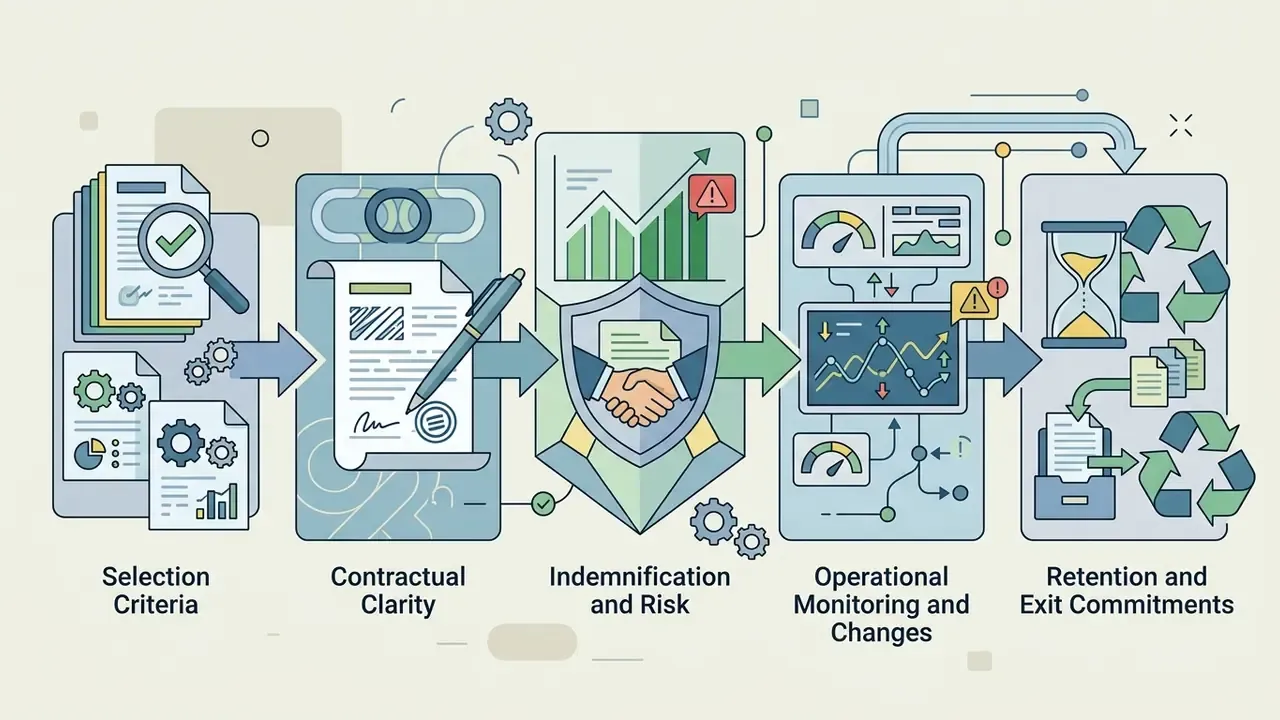
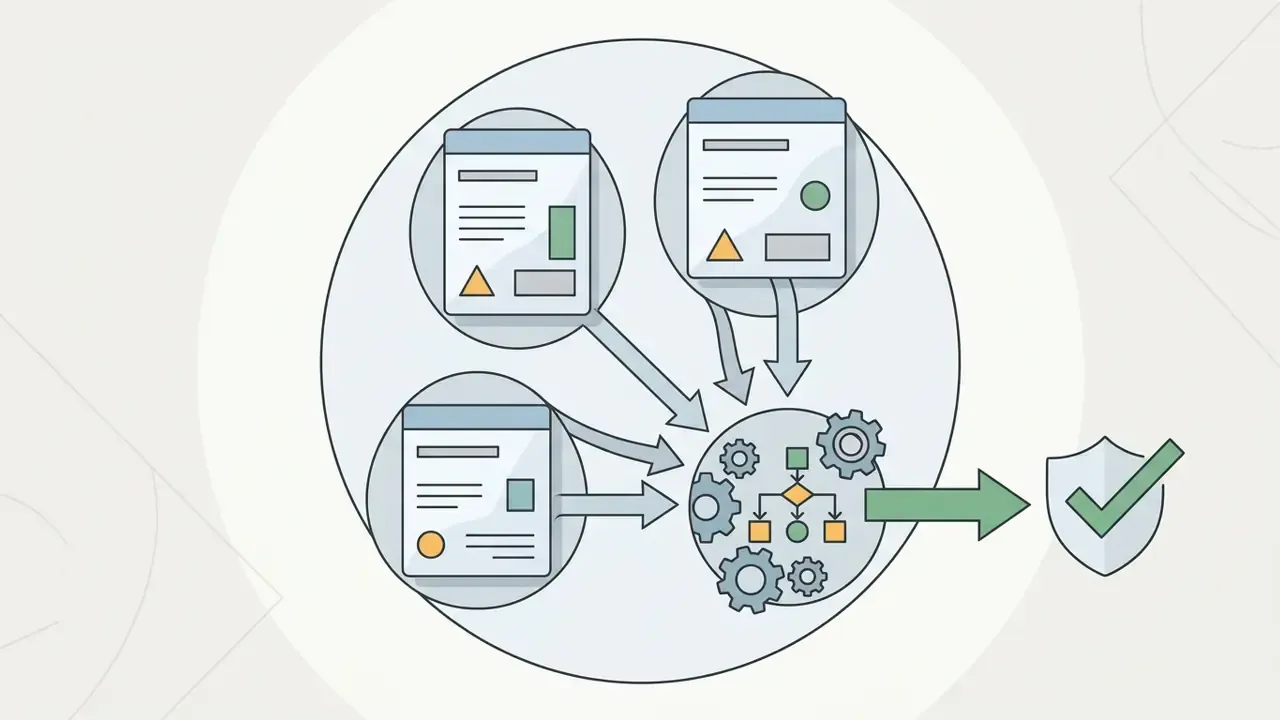
Before publishing or monetizing generated media assets, review platform terms of service, watermarking policies, privacy agreements and licensing terms for commercial use. We apply the same framework in our guidance on commercial use of AI-generated content. For an official overview of plan options, feature limits and subscription tiers, you can see the overview page.
To review legal frameworks, intellectual property disputes and regulatory compliance guidelines around synthetic media, you can explore the litigation research portal.
When evaluating enterprise video tools, risk officers and compliance teams frequently test platforms by reviewing specialized guides on text to video capabilities before approving procurement.
If you need help selecting subscription tiers, enterprise API connections or governance controls, you can compare options through customer support channels.
Limitations and Unresolved Questions
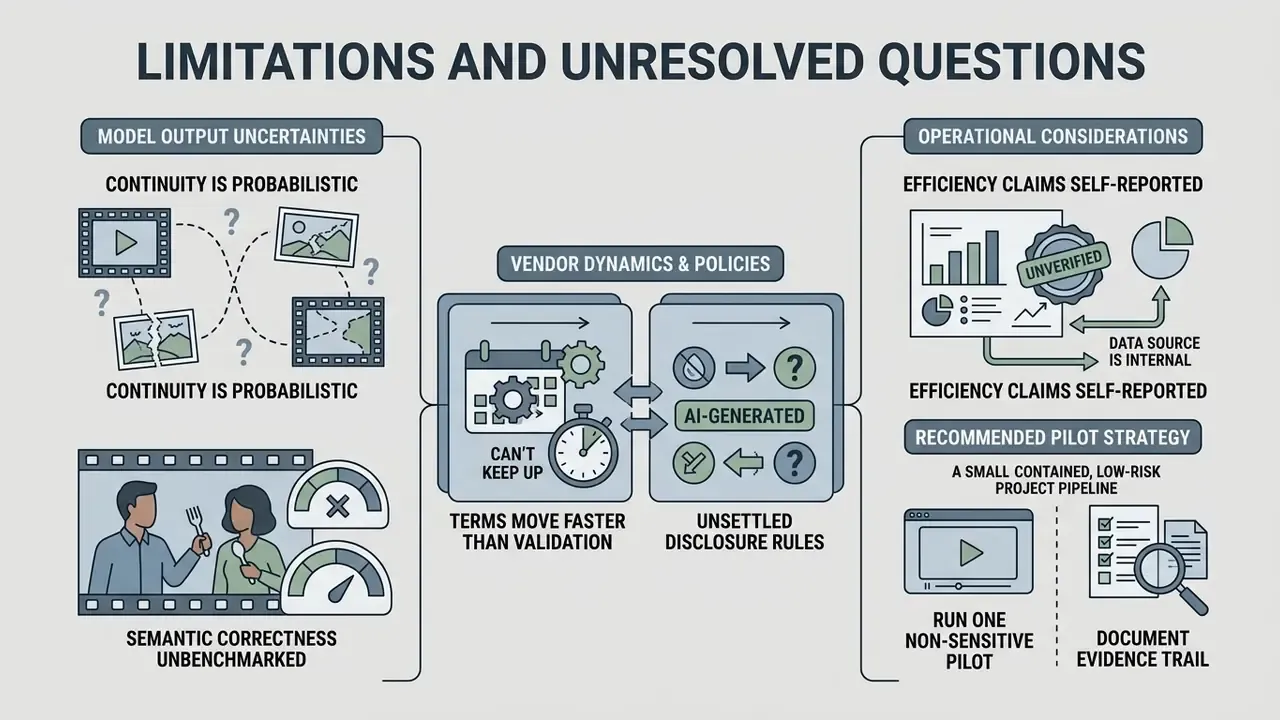
Honest reporting means naming what the evidence does not yet settle.
- Continuity remains probabilistic. Even decoupled identity pipelines report consistency scores below 8 out of 10. Expect residual drift on long sequences and budget review hours accordingly.
- Semantic correctness is unbenchmarked in practice. UI2V-Bench results indicate attractive footage can still violate spatial relations. There is no accepted industry metric for "compliance-grade factual accuracy" in generated video.
- Vendor terms move faster than validation cycles. A model version change can alter output behavior between two renders of the same campaign. Version pinning is not universally offered.
- Disclosure rules are unsettled. Synthetic-media labeling expectations vary by jurisdiction and platform, and enforcement practice is still forming.
- Internal efficiency claims are self-reported. The 42% drift reduction and the 21-day-to-3-day figures in this guide come from single-project measurements, not controlled studies.
A reasonable next step is small and reversible: run one non-sensitive pilot, document the evidence trail end to end, and only then discuss scale.
Procurement and Governance FAQ
Can AI actually make a full movie?
Not in one pass. Current engines generate 4 to 8 second shots natively, extending to roughly 141 seconds through iterative extension. A feature-length result is an assembly project: hundreds of clips, persistent character anchors, storyboard discipline and a non-linear edit.
How do I keep the same character's face across every scene?
Use multi-angle reference sheets or a trained identity anchor, repeat explicit character identifiers in every prompt, and decouple identity, background and camera into separate control layers. Peer-reviewed multi-stage pipelines report their highest consistency scores using exactly this separation.
Is AI movie output cheaper than filming?
Substantially, on direct production cost. No crews, sets or reshoot logistics. The honest comparison, though, includes review hours, legal clearance, regeneration waste and validation documentation. Use the TCO formula above rather than the credit price alone.
Can I use AI-generated films commercially?
Generally yes on paid tiers, provided uploaded media is cleared for commercial use and any human likeness or voice has documented consent. Free tiers frequently restrict output to personal use and apply watermarks.
Who owns the copyright?
Vendor terms typically assign output ownership contractually to the user. Copyright protection is a separate matter and depends on demonstrable human authorship. Keep records of scriptwriting, prompt architecture, shot selection and editorial decisions.
What export resolution should we deliver?
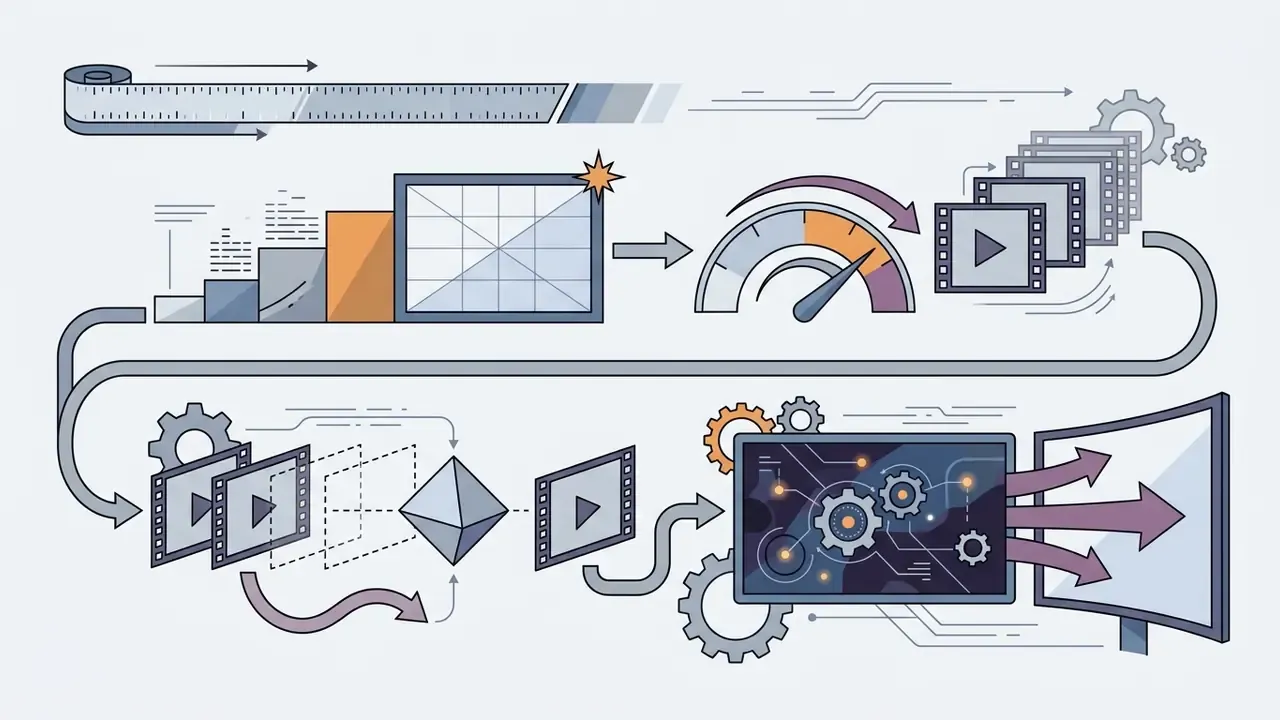
1080p at 24fps for festival and web distribution. 4K with frame interpolation up to 120fps for large-screen exhibition or slow-motion compositing. 360p or 720p for draft passes that should not consume credit budget.
Can one film be released in multiple languages?
Yes. Voice cloning combined with generative lip-sync re-voicing supports localization across 175+ languages while preserving the original vocal character. Treat each cloned voice as a consent-governed asset.
How do we prevent Shadow AI use of these tools?
Maintain an approved-tool register, monitor egress to known generative-video domains, run DLP screening on prompt inputs, and, most effectively, provide a fast sanctioned alternative so teams do not route around procurement.
What evidence should we retain for model risk documentation?
Prompt and version history, model engine and version per shot, reviewer sign-offs against the QC checklist, asset provenance and licensing records, consent artifacts for likeness and voice, and the exported provenance metadata.
Do these platforms train on our uploads?
It varies by vendor and by tier. Require written confirmation of retention and training-use policy, and prefer contractual zero-data-retention terms for any workspace handling non-public material.
Appendix A: Superseded and Corrected Source References
Retained for transparency and version traceability. The main text above carries the updated, corrected versions.
For additional documentation, detailed term breakdowns and feature guides across generative creative tools, open the hub to navigate our complete reference library.
- Superseded citation (human-in-the-loop)
- "Research on generative video workflows published in a 2026 preprint by University of Nottingham Ningbo China (https://zenodo.org/records/19304134) framing AI filmmaking demonstrates that repeatable output quality depends on a structured human-in-the-loop workflow combining shot specifications, iterative execution and manual quality control." Retained as the originating framing reference; replaced in the main text by the controllable-video-generation survey citation, which supplies a verifiable scope figure (708 works reviewed).
- Corrected date
- "According to captioning standards published by the National Library of Medicine (3025)" was a typographical error. Corrected to 2025 in the main text.
- Verification flag
- The CVPR 2026 multi-shot narrative reference is marked in the main text as a preprint, to avoid ambiguity about publication status.
- Unverified internal metrics
- The 42% identity-drift reduction and the 21-day-to-3-day lead-time figures are self-reported internal measurements. Methodology notes appear inline in the main text; neither figure is externally benchmarked.
- Pending primary link
- The 7.99 character-consistency score is reported in an OpenReview submission without a stable archival URL at time of review. A verification note accompanies the figure in the main text.