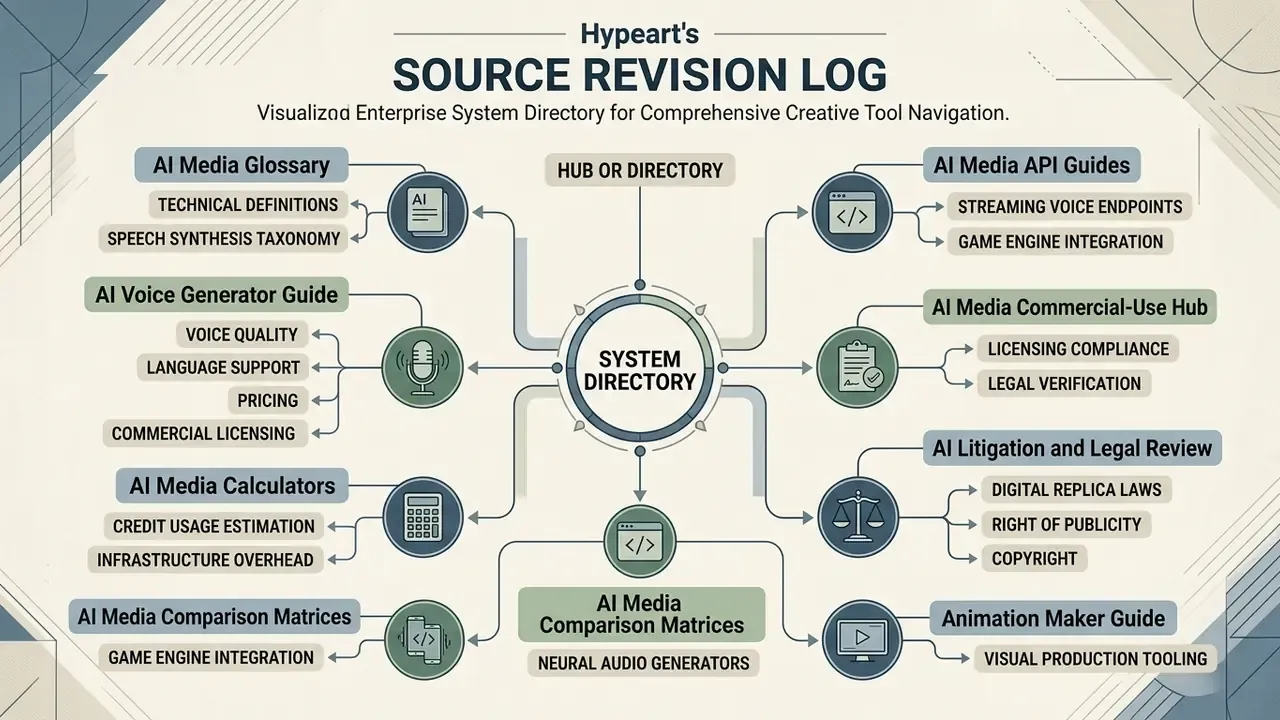
Last updated: June 2026 · Reviewed by: AI Governance & Model Risk editorial desk · Scope: technical architecture, prompt and SSML control, enterprise security, licensing and regulatory compliance.
Why does a bank risk officer care about a "villain voice"? Because the same model that voices a dragon can voice a fake CFO. The technology stack is identical; only the control environment differs.
Executive Summary
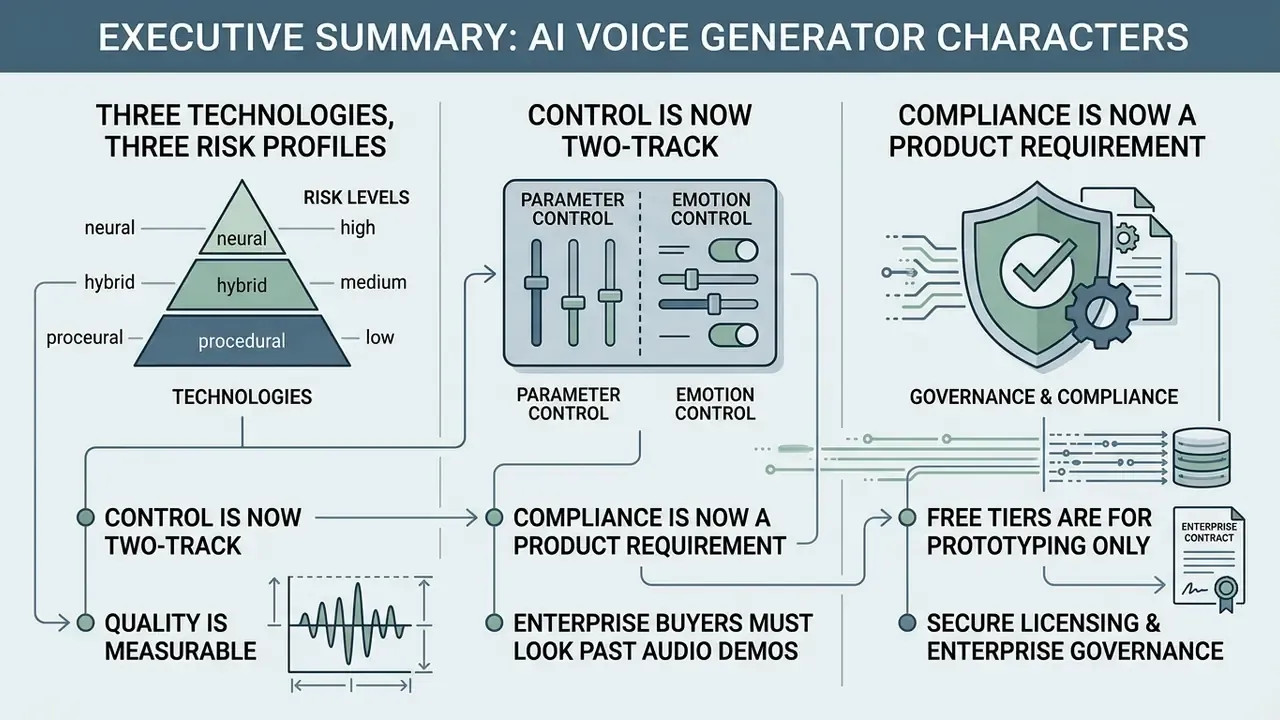
- Three distinct technologies, three risk profiles. Text-to-speech turns text into speech in a pre-selected voice; voice conversion transforms an existing audio signal into another timbre in real time; voice cloning reproduces a specific person's vocal identity from a short reference sample. Cloning carries the highest legal and biometric exposure.
- Control is now two-track. Engineering teams use SSML (
prosody,break,phoneme), while creators and writers can use plain-text emotion directives such as(excited),(whispering, fearful),(tired, deep sigh), with no XML required. - Quality is measurable. Winning expressive-TTS systems in the IEEE ICAGC 2024 challenge reached Mean Opinion Scores of 3.85 to 3.89 out of 5 with under 15 minutes of training speech; real-time conversion models run under 20 ms on consumer CPUs.
- Compliance is now a product requirement. EU AI Act Article 50 transparency and machine-readable marking duties for synthetic audio apply from 2 August 2026; the FCC already classifies AI voices as "artificial" under the TCPA; Tennessee's ELVIS Act and California Civil Code § 3344 penalize unauthorized commercial voice imitation.
- Enterprise buyers must look past audio demos. Prioritize SOC 2 Type II, ISO/IEC 27001, ISO/IEC 42001, zero-data-retention (ZDR) guarantees, on-premise or VPC deployment, consent audit trails, and anti-spoofing controls for voice biometrics.
- Free tiers are for prototyping only. Typical free plans cap output at 2,500 to 10,000 characters, deliver 128 kbps MP3 with watermarks, and explicitly prohibit commercial use.
What Is an AI Character Voice Generator?
An ai character voice generator is a specialized neural speech synthesis system designed to convert written scripts or voice inputs into role-specific, expressively modulated vocal performances for imaginary characters, digital avatars, and interactive media. Unlike standard text-to-speech tools engineered for uniform narration, an ai character voice generator isolates acoustic variables such as fundamental frequency (), micro-prosody, vocal tract resonance, and affective inflection to produce natural, distinct character voices. Modern frameworks use deep neural networks, diffusion transformers, and neural audio codecs to deliver expressive speech that holds vocal identity steady across changing emotional states and dialogue contexts.
The practical distinction matters for production planning. A narrator voice works as a stable structural anchor across long-form audio: consistent pacing, warmth, and gravity across thousands of words. A character voice is tuned for performance granularity, meaning a different delivery profile per line, per scene, or per emotional beat. Vendor documentation from 2025 and 2026 confirms this split: character-focused products expose emotion tags, style directives, and dialogue-level workflows, whereas narration products expose global rate, pitch, and volume settings only.
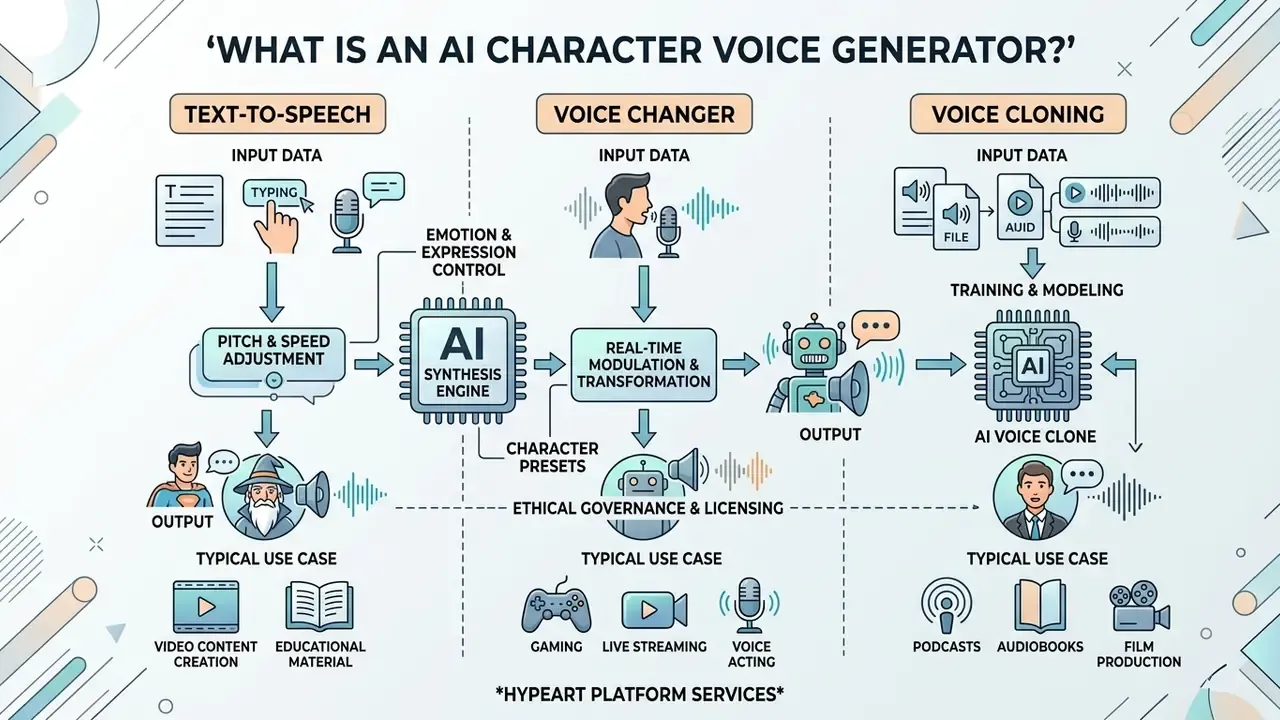
Technical comparison: text-to-speech vs. voice conversion vs. voice cloning
| Technology Paradigm | Primary Input Data | Primary Output Stream | Typical Processing Latency | Target Operational Scenario |
|---|---|---|---|---|
| Text-to-Speech (TTS) | Plain text script, SSML tags, or natural-language style prompts | Synthesized spoken audio matching a generic or pre-selected voice model | 100 ms to 300 ms (time-to-first-byte) | Long-form storytelling, generic narration, e-learning, structured voiceover |
| Voice Conversion (voice changer) | Live or pre-recorded source speech audio signal | Real-time modified speech preserving linguistic content with target timbre | under 20 ms to 150 ms (streaming pipeline) | Live streaming voice masks, real-time in-game chat, spatial avatar audio |
| Voice Cloning (zero/few-shot) | Text script plus 5 to 30 seconds of target speaker reference audio | Synthesized audio reproducing the unique vocal identity of the target speaker | 150 ms to 400 ms (batch/inference) | Digital doubles for voice actors, personalized agents, branded voice assets |
Text-to-Speech, Voice Changing and Voice Cloning
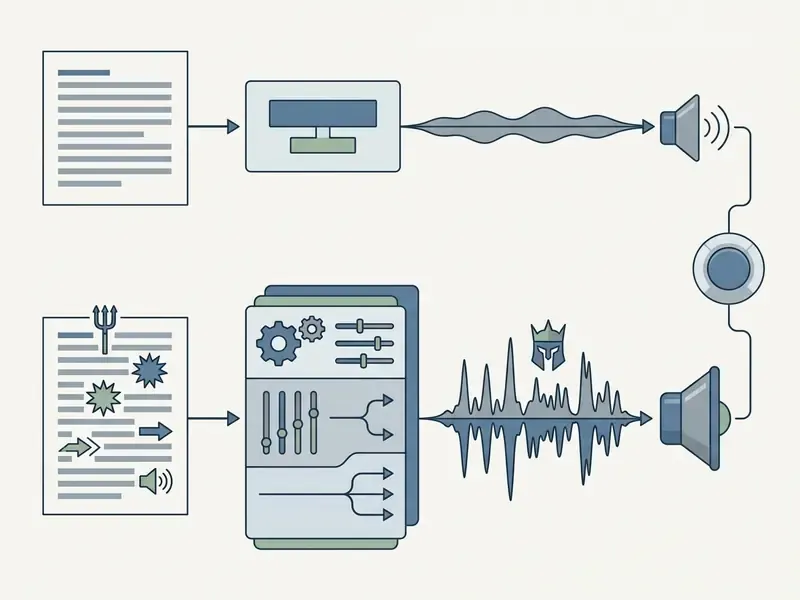
Modern synthetic audio platforms operate across three distinct technological paradigms: text-to-speech synthesis, real-time voice conversion, and neural voice cloning. Standard TTS synthesizes speech in a pre-selected voice, whereas cloning reproduces the identity of a specific speaker from an audio sample. That single distinction determines the entire consent and licensing chain.
"Speech generators differ by whether the target identity belongs to a real, identifiable person, and that boundary determines the harm profile."
Text-to-speech (TTS) processes written linguistic input through g2p (grapheme-to-phoneme) conversion models and neural decoders to output speech from standard libraries, a category explained in depth in our reference guide to AI voice generators and in the AI Media Glossary. It offers predictable stability for corporate presentations and reference material. Voice changing (speech-to-speech voice conversion) captures an incoming audio signal, separates content from timbre using soft acoustic units, and re-synthesizes the speech with a target voice mask. That method suits real-time applications where preserving the speaker's original prosodic timing is essential. Neural voice cloning combines textual input with a brief acoustic sample, from 5 seconds to several minutes, to condition the generative decoder, so an ai character voice generator can replicate a specific actor's vocal identity for narrative continuity across media franchises.
One habit transfers well from adjacent generative tools: writers who already draft structured briefs in an art prompt generator tend to write cleaner voice prompts, because they are used to naming style, mood, and constraint separately.
How AI Models Generate Character Speech
Generative speech models synthesize emotional character dialogue by disentangling vocal timbre, prosodic style, and linguistic content inside latent representations. Recent research in discrete diffusion transformers and neural audio codecs, including DEmoFace (2025), which pairs a discrete diffusion transformer with a multi-level neural audio codec, and EmoVoice (2025), an LLM-based emotional TTS model driven by freestyle text prompts, shows that separating acoustic features lets models modify emotional intensity, for example shifting from calm dialogue to aggressive shouting, without distorting speaker identity. Newer work on emotion-preserving codecs and smooth intra-utterance emotion transitions extends this into mid-sentence affect changes, so a line can start resigned and end furious inside a single render.
Autoregressive language-model architectures now interpret natural-language instructions alongside phone-aligned pitch, duration, and loudness vectors. The measured result is quantifiable rather than anecdotal:
"The LLM-based system achieved a MOS of 3.89 for quality, 3.83 for speaker similarity and 3.85 for emotion, trained on under 14.5 minutes of speech."
These neural pipelines let an ai character voice generator deliver stable phonation, natural breath insertions, and coherent emotional transitions across multi-turn scripts. Peer-reviewed reviews of prosody modelling identify fundamental frequency, duration, and intensity as the three primary controllable variables, with the most heavily studied. Which is exactly why nearly every commercial API exposes pitch and rate before it exposes anything else.
How to Choose the Right AI Voice for a Character
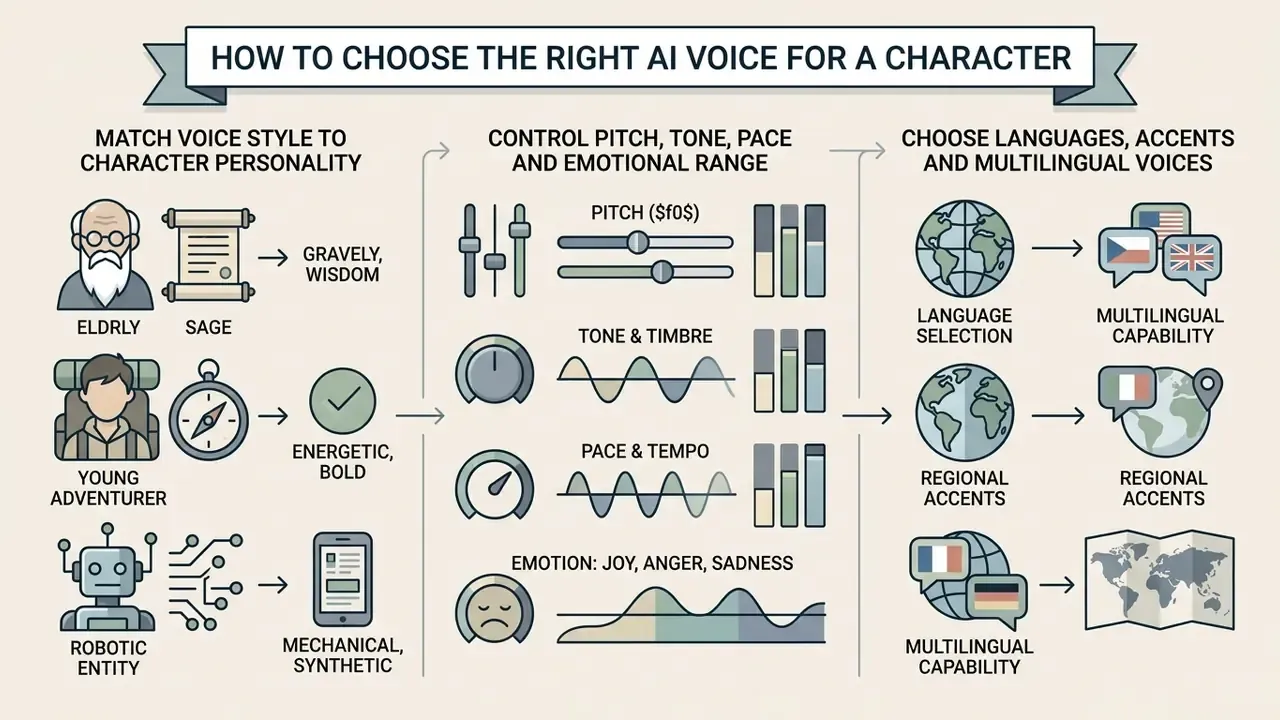
Selecting the correct synthetic voice means evaluating acoustic parameters, including fundamental frequency (), vocal placement, tempo, dynamic range, and emotional elasticity, against the narrative archetype of the persona. Creative teams comparing options inside an ai voice generator for character voices should align vocal timbre with character age, physiological traits, and narrative function rather than trusting raw audio demos. Explicit vocal profiles prevent persona mismatch, improve listener retention, and hold performance consistent across complex production pipelines.
Professional voice-acting worksheets and modern vendor documentation converge on the same selection grid: pitch, pitch character, placement, tempo, rhythm, volume, attitude, and emotion. Acoustic research on emotional speech adds a measurable mapping. High-activation emotions such as joy and anger correlate with faster rate, higher , shorter pauses, and greater intensity; low-activation emotions such as sadness and tenderness correlate with slower rate, lower , longer pauses, and reduced volume. Two constraints from traditional voice direction still apply to synthetic voices: the voice must be sustainable across hundreds of lines and duplicable across future sessions.
Character voice selection matrix: archetype mapped to measurable acoustic parameters, prosodic texture, emotional range, and production use case.
| Character Archetype | Core Acoustic Tone | Pitch Placement & Range | Pacing & Prosodic Texture | Emotional Elasticity | Recommended Operational Use |
|---|---|---|---|---|---|
| Protagonist / Lead Narrator | Warm, resonant, authoritative | Mid-range ; stable contour | Moderate, steady cadence; deliberate pauses | Broad (calm, empathetic, resolute) | Main quest lines, documentary narration, corporate media |
| Antagonist / Villain | Gritty, raspy, or cold and calculated | Low ; narrow variance or abrupt drops | Slower tempo; prolonged phrase endings | Controlled (menacing, icy calm, intense) | Cinematic cutscenes, boss encounters, dramatic audio dramas |
| Comedic / Sidekick Persona | Bright, dynamic, energetic | High ; wide dynamic swings | Fast, rapid-fire delivery; sharp inflection | High volatility (surprise, panic, irony) | Animated shorts, interactive companion bots, casual gaming |
| Systems / Guide AI | Neutral, clear, balanced | Mid-high ; flat contour | Highly uniform pacing; crisp articulation | Narrow (reassuring, objective, stable) | In-app assistants, software tutorials, interactive onboarding |
| Anime / High-Energy Shonen Hero | Bright, forward, slightly strained at peaks | High ; very wide dynamic swings | Staccato phrasing; explosive attack on stressed syllables | Very high (determination, rage, shouted resolve) | Shonen battle dialogue, anime dubbing, anime voice generator workflows |
| Dark Fantasy / Eldritch Entity | Cavernous, sub-harmonic, layered | Ultra-low ; minimal contour movement | Very slow cadence; long reverb tails between phrases | Narrow but heavy (dread, contempt, ritual calm) | Boss encounters, horror games, villain voice generator scenes |
| Cartoon Mascot / Kids Sidekick | Squeaky, nasal-bright, elastic | Very high register; exaggerated inflection peaks | Accelerated tempo (about 1.3×); bouncy rhythm | High volatility (glee, mock-panic, silliness) | Children's animation, casual mobile games, cartoon character voice assets |
| Cyberpunk AI / Sci-Fi Synth | Metallic, thin-harmonic, filtered | Flat pitch contour; near-monotone | Mechanically even pacing; micro-artifacts at phrase breaks | Deliberately suppressed (clinical, ominous neutrality) | Sci-Fi UI voices, dystopian NPC voice generation, spacecraft systems |
Match Voice Style to Character Personality
To build a memorable persona, map psychological archetypes to specific physical vocal traits. An authoritative hero profile wants chest-resonant placement with stable pitch dynamics; a deceptive character benefits from lower-register phonation with irregular pause rhythms. Research on artificial personality in speech synthesis found that voice-quality manipulations measurably shift perceived Big Five traits, which means voice choice shapes personality inference, not just sonic colour. Selecting an ai character voice through standardized matrices lets production teams catalogue assets systematically instead of drifting into generic delivery. When building complex interactive characters, operators often consult structured entries in our AI Media Comparison Matrices to see how different generative models handle the shift between formal narration and dramatic dialogue.
Benchmark note: the 3.85 MOS figure is consistent with the emotion-dimension score reported by the winning IEEE ICAGC 2024 expressive-TTS system (MOS 3.85 for emotion, σ ≈ 0.22). The studio-internal cost reduction figure is self-reported and not independently audited. Treat it as illustrative, not as a planning baseline.
Control Pitch, Tone, Pace and Emotional Range
Fine-tuning synthetic speech means precise manipulation of prosodic variables before the final render. Standard API controls expose pitch shift in semitones (typically on Google Cloud Text-to-Speech), speaking rate scaling from to depending on endpoint, with some vendors documenting to , plus explicit emotional directives. Empirical results from the IEEE ICAGC 2024 challenge confirm that fine-tuning generative models on expressive emotional speech yields Mean Opinion Scores of to out of for emotional authenticity.
"The winning ICAGC 2024 system reached an average MOS of 3.89 with a standard deviation of 0.22, the highest score in the track."
A separate 2025 comparison of expressive-speech strategies found that fine-tuning on expressive data outperformed both prosody scaling and training from scratch, reaching MOS 4.47 with 72% emotion-recognition accuracy. Adjust pitch dynamics together with micro-pauses; otherwise synthetic speech collapses into flat, robotic monologue exactly when a scene needs intensity.
Choose Languages, Accents and Multilingual Voices
Cross-lingual voice generation lets a single character persona speak multiple languages while retaining core timbre and identity attributes.
"GLOBE contains 535 hours of speech from 23,519 speakers with 164 accents at 24 kHz, delivering better speaker similarity than LibriTTS and VCTK."
Modern zero-shot models use dual-level language injection and Language Identification (LID) embeddings to prevent accent leakage, so a character rendered in Spanish or Japanese keeps the vocal identity established in the original English recording. Cross-lingual cloning research published in 2026 still reports accent leakage as the primary open problem: some systems optimize for native-like target-language pronunciation, others deliberately preserve the source accent as a character trait. Decide which behaviour you want before localization begins. Teams producing multilingual media should plan the visual layer in parallel, and our comparison of AI video generators covers how localized audio tracks are matched to generated footage.
Character Voice Presets and Genre Categories
Named presets shorten casting time because they encode a full acoustic recipe behind a single label. The table below documents transferable preset profiles rather than brand-specific voice IDs, so the recipes can be reproduced on any platform exposing pitch, timbre, rate, and emotion controls.
Reusable character voice presets: descriptive label, acoustic recipe, and matching genre category.
| Preset Label | Character Description | Acoustic Recipe | Genre Category |
|---|---|---|---|
| Arcane Sage | Wise, mysterious mentor with measured authority | Low-mid , breathy onset, slow cadence, long inter-phrase pauses | Fantasy, RPG mentors, audio drama narration |
| Iron Overlord | Deep, commanding antagonist infused with power | Very low , chest-dominant resonance, minimal pitch variance, hard consonant attack | Dark fantasy, boss encounters, villain trailers |
| Spark Companion | High-energy, expressive young companion | High , wide inflection range, fast tempo, bright formants | Animation, mobile games, chatbot companions |
| Nova Guide | Clear, calm systems voice with neutral affect | Mid-high , flat contour, uniform pacing, crisp articulation | Sci-Fi UI, onboarding assistants, tutorials |
| Static Sentinel | Metallic machine intelligence with cold precision | Filtered harmonics, near-monotone contour, mechanical timing | Cyberpunk NPCs, robot characters, dystopian narration |
| Hollow Whisper | Sub-audible horror presence | Ultra-low , sub-harmonic layering, heavy reverb tails, whispered dynamics | Horror games, thriller trailers, creature dialogue |
| Blade Resolve | Shonen-style hero at emotional peak | High with strained peaks, staccato phrasing, explosive stressed syllables | Anime dubbing, fighting games, sports anime |
| Bounce Mascot | Squeaky comedic sidekick | Very high register, about 1.3× tempo, exaggerated pitch inflections | Children's animation, casual games, ads |
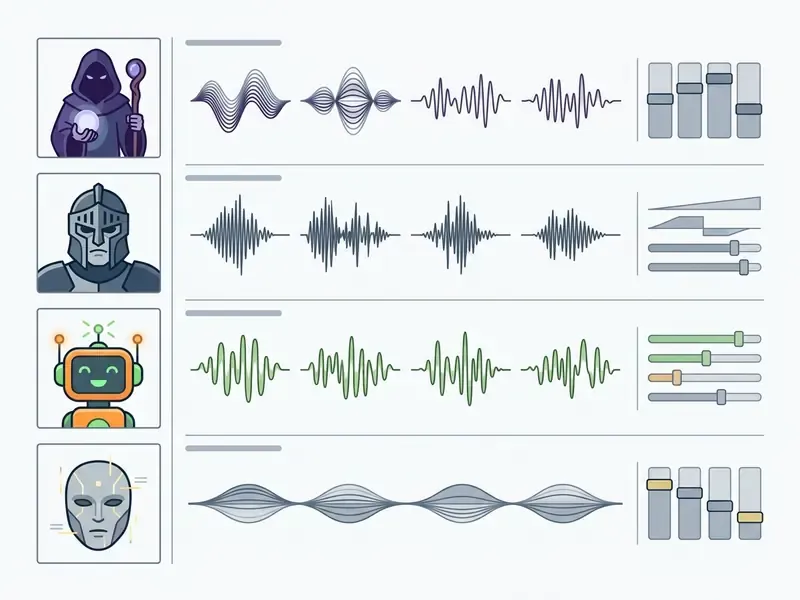
Public voice catalogues cluster demand around pop-culture categories: anime, cartoon, animation, film characters, games, TV, superheroes, sci-fi, and celebrity-adjacent styles. Two operating rules apply. First, generic style categories, for example "gruff cartoon bear" or "high-energy anime rival", are safe to build and monetize. Second, voices that imitate an identifiable real performer or a protected fictional performance, even when labelled a "sound-alike", trigger right-of-publicity, trademark, and character-copyright exposure. Style is broadly usable. Identity is not.
How to Create Character Voices With an AI Voice Generator
Generating production-grade synthetic dialogue takes a systematic workflow spanning script markup, parameter calibration, rendering, and master file export. A repeatable pipeline is also what makes the output auditable later, which matters if the audio ever appears in a regulated channel.
Operational checklist: from script to logged asset
- Script preparation and SSML formatting.Import plain text, escape reserved XML characters (ampersand, less-than, greater-than), and insert breakdown tags, emphasis marks, or custom phonetic transcriptions in IPA.
- Consent and provenance check.Confirm the voice asset is a licensed library voice, an owned custom model, or a clone backed by a signed consent recording before any render is scheduled.
- Voice selection and profile calibration.Select a base model from the library or load a target voice embedding; set baseline parameters for pitch (), speaking tempo, and emotional state.
- Pre-generation fine-tuning.Apply inline style directives, for example [whisper] or [excited], or adjust phoneme-level duration and stress vectors to match the character's dramatic context.
- Preview listening and iterative refinement.Run short sample renders on critical dialogue lines; judge prosodic naturalness, clarity, and emotional resonance before full generation.
- Final synthesis and multi-format export.Render full-length dialogue tracks and export uncompressed 24-bit/48 kHz WAV masters for mastering, alongside compressed web streams.
- Asset logging.Record voice ID, model version, prompt or markup used, render timestamp, and licence reference in the media asset register for auditability.
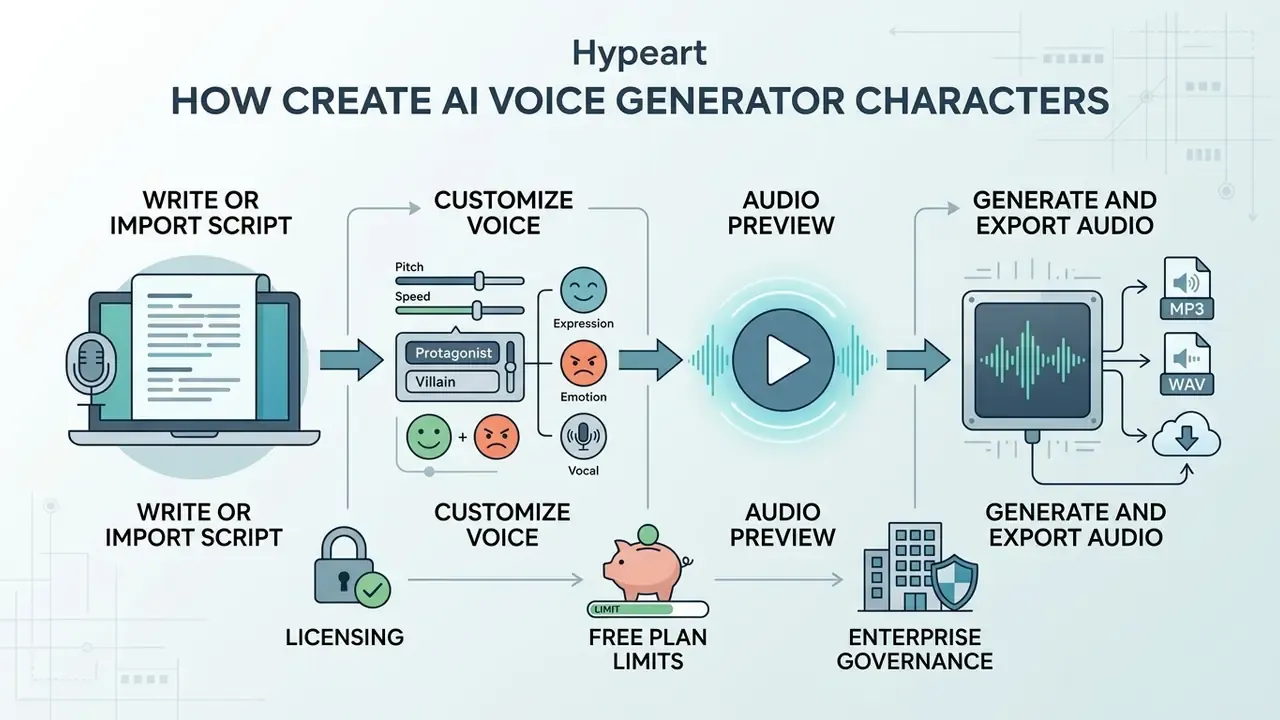
Write or Import a Script for Character Speech
Preparing text for an ai character speech generator means structuring dialogue to mirror human speech patterns, including natural pause placement and conversational punctuation. Raw text must be sanitized to escape reserved XML entities when using Speech Synthesis Markup Language (SSML), as specified in the W3C SSML recommendation and mirrored in Microsoft Azure Speech Service documentation. Explicit stage directions or inline tags let the model parse emotional intent accurately.
"13,460 dialogues and 251,575 utterances (about 160 hours), each annotated for emotion, pitch and speaking rate to condition synthesis."
That annotation scheme is a useful template for production scripts: label every line with an emotion, a relative pitch target, and a relative rate target before rendering. Teams running an automated script pipeline can refer to workflow documentation such as the auto video editor guide and our breakdown of automated video publishing workflows to wire text generation directly into audio processing.
Customize the Voice Before You Generate Audio
Pre-synthesis customization means configuring global acoustic variables and inline prosodic modifiers before the full neural render starts. Operators adjust baseline pitch, rate variance, and emotional style presets inside the ai voice character generator interface. Phonetic hints written in the International Phonetic Alphabet via phoneme alphabet="ipa" tags correct mispronunciations of fictional names, specialized terminology, or foreign phrases. Stress placement follows documented conventions: primary stress /ˈ/ and secondary stress /ˌ/ sit at the start of the stressed syllable in IPA and X-SAMPA, while some engines use digit notation (1 = primary, 2 = secondary, 0 = unstressed) positioned left of the syllable vowel. Small step, large payoff: it removes acoustic artifacts and keeps output aligned with the artistic brief.
Two adjacent habits help here. Teams that experiment with an artist ai toolchain usually build reference sheets before generating; do the same for voices, with one page per character listing pitch band, tempo, catchphrases, and forbidden pronunciations.
Preview, Generate and Export Audio
Before committing rendering credits to full-length assets, run short preview passes on high-impact dialogue lines. Modern game engines import 16-bit and 24-bit PCM .wav at any sample rate, and Unreal Engine documentation confirms support for up to 8 channels; professional video editors want uncompressed 24-bit/48 kHz PCM WAV masters for mixing headroom, while web applications rely on compressed MP3 or AAC streams. Choose the master format first, then derive delivery formats from it. If bandwidth is the constraint on the distribution side, apply compression downstream with a dedicated video compressor rather than degrading the audio master. Reviewing speech samples during preview lets teams refine pause durations and stress accents, which prevents expensive re-renders during final mastering.
Character Voice Library, Custom Voices and Cloning
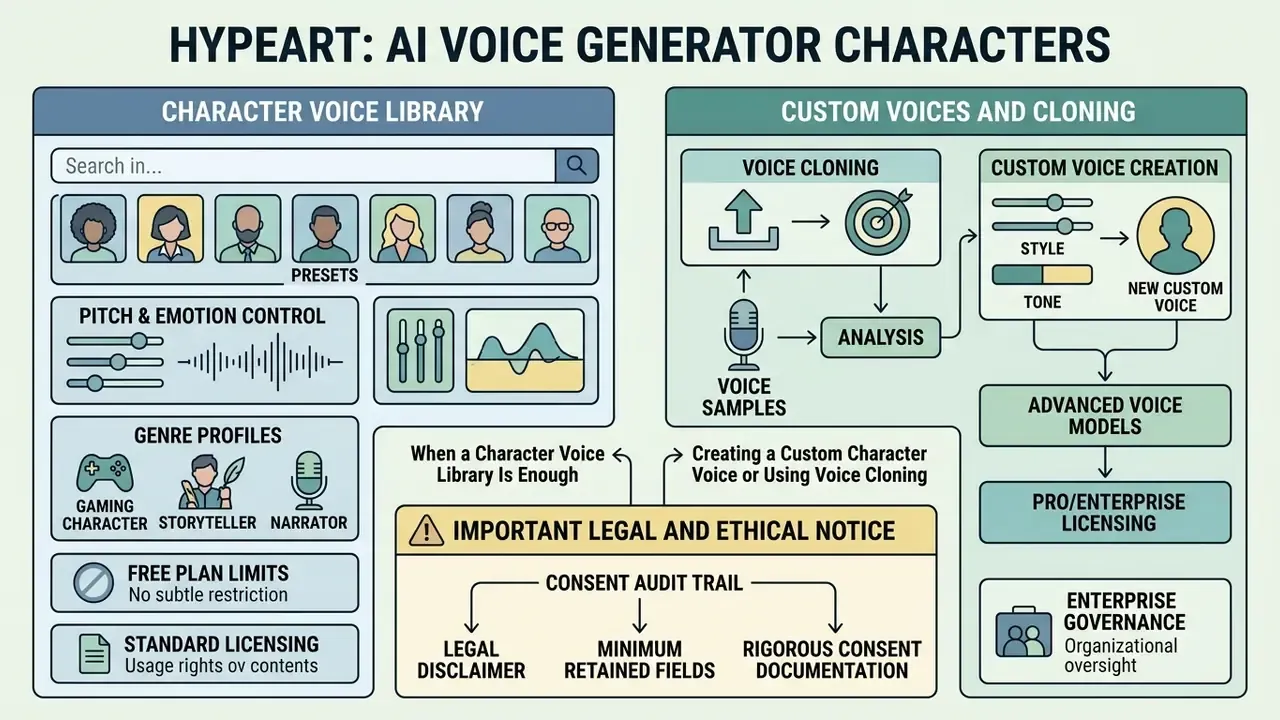
Choosing between prebuilt voice libraries, custom acoustic model training, and zero-shot voice cloning depends on budget, timeline, and how exclusive the voice must be. Pre-curated libraries give immediate deployment at low cost; custom-trained models and licensed clones give exclusive vocal signatures for flagship characters and global brand mascots.
When a Character Voice Library Is Enough
Creating a Custom Character Voice or Using Voice Cloning
Developing an exclusive custom voice or running neural voice cloning demands higher computational overhead, clean source data, and strict consent management. Vendor specifications converge tightly on audio hygiene: single-speaker mono WAV, 24 kHz/16-bit PCM (Microsoft Azure) or 48 kHz/24-bit Linear PCM (Inworld AI), peak volume between −3 and −6 dB, signal-to-noise ratio above 35 dB, leading and trailing silence limited to roughly 100 ms and never above 200 ms, and start-of-file noise below −70 dB. Consent capture is now a technical step, not only a contractual one. Google Cloud, OpenAI, Descript, and Sarvam all require a recorded consent statement alongside the reference sample before a clone can be created.
Advanced models reach zero-shot voice adaptation with speaker similarity above cosine similarity in independent cross-model benchmarking, with the strongest open systems scoring highest across most evaluation datasets. Production environments deploying custom assets often manage these parameters alongside visual pipelines, such as those detailed in our guide to animation makers for cross-modal storytelling.
"Since March 2023 the OECD AI Incidents Monitor records a sharp rise in voice-related incidents, including identity theft and unauthorized use of actors' voices."
Important legal and ethical notice:
Consent audit trail, minimum retained fields: consenting party identity and verification method; recorded consent statement file hash; permitted use scope (titles, channels, territories); permitted duration and expiry date; revocation procedure and contact; model artefact version and storage location; downstream render log reference. Regulated organizations should map these fields to their existing records-retention schedule rather than leaving the evidence inside a vendor console that may be decommissioned.
Where to Use AI-Generated Character Voices
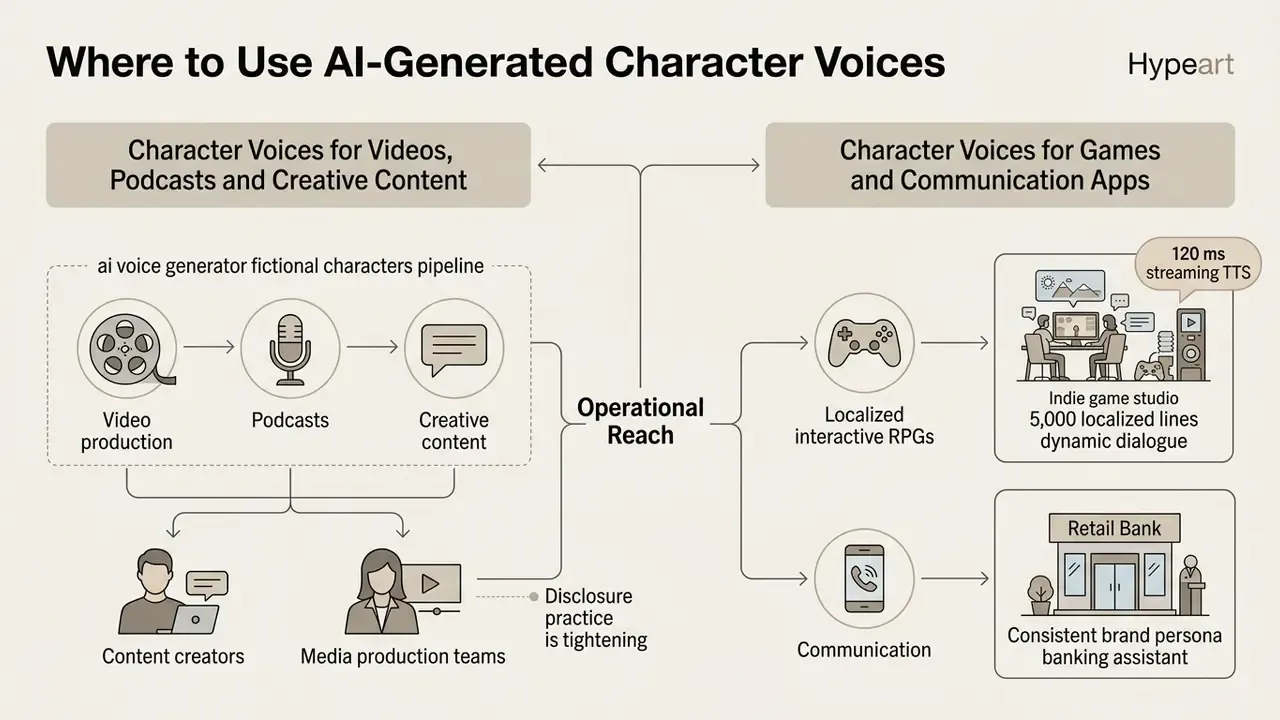
The operational reach of an ai voice generator for characters spans digital entertainment, interactive gaming, localized marketing, regulated customer communications, and real-time communication systems. Synthetic dialogue compresses localization work and enables dynamic content generation at volumes traditional voiceover sessions cannot match.
Benchmark note: the 120 ms figure is consistent with vendor-documented streaming TTS time-to-first-byte ranges (sub-100 ms to about 150 ms), but the 80% task-reduction figure is studio-reported and not independently audited.
This banking scenario is illustrative and composite, not a documented client engagement.
Character Voices for Videos, Podcasts and Creative Content
Content creators and media production teams use an ai voice generator imaginary characters pipeline to produce expressive audiobooks, YouTube video essays, animated series, and narrative podcasts. Model documentation from major vendors positions entertainment use cases explicitly around "games, films, podcasts, audiobooks, and immersive AR/VR experiences", which confirms that character and narrative audio is a first-class deployment target rather than a side effect. Synthetic dialogue removes the need to coordinate multi-actor recording schedules, so a single creator can render a full multi-character dramatic script in an afternoon.
Disclosure practice is tightening in this segment too. The Publishers Association's AI Narration Naming Guidelines (2024) require ONIX metadata tagging that distinguishes "AI Voice" from "Authorized Voice Replica", and recommend surfacing that distinction in retailer narrator fields. Platform-side disclosure guidance from major model providers adds that disclosures must adapt to the context of use, meaning when and how the listener actually hears the voice. When managing complex video workflows, creators frequently pair speech generation with visual tooling, using resources such as our comparison of AI video generators for animated content to keep visual and auditory decisions aligned. Even low-fidelity assets have a place: title cards built with an ascii art generator or an ascii art text generator still pair well with synthetic narration in retro-styled shorts.
Character Voices for Games and Communication Apps
In interactive gaming and live voice applications, synthetic speech engines must run inside strict latency budgets, ideally under 100 ms time-to-first-byte, to feel responsive. Game engines integrate generative speech endpoints via C++ or C# APIs to produce dynamic non-player character responses conditioned on player behaviour. Unreal Engine 5.6 exposes a Voice API and Voice Chat Interface for capturing, encoding, decoding, and transmitting voice data in-engine; on the Unity side, the official voice stack is Vivox Core for voice and text chat, so AI voice generation is typically integrated as an external streaming service rather than a native runtime. Streaming endpoints built for time-sensitive interaction usually expose both a /stream HTTP route and a WebSocket route returning audio with per-word timestamps. The latter is what drives lip-sync and subtitle alignment.
"LLVC runs about 2.8× faster than real time on a consumer CPU with under 20 ms latency at 16 kHz, the lowest resource footprint among open conversion models."
That headroom lets players apply real-time character voice masks during multiplayer chat without audible lag. Integration details for streaming endpoints and engine bindings sit in our AI Media API Guides.
Real-Time Character Voice Changer: Low-Latency Setup
Real-time voice conversion is a different engineering problem from batch TTS. The entire signal chain, capture, feature extraction, conversion, playback, must fit inside a buffer budget the listener cannot perceive. For live streaming, competitive gaming, and voice chat, target end-to-end latency of 15 to 30 ms; anything above roughly 50 ms starts to disrupt conversational turn-taking.
Low-latency voice conversion signal chain: configuration targets for live character voice masking.
| Stage | Configuration Target | Failure Symptom If Misconfigured |
|---|---|---|
| 1. Audio capture | 16-bit/48 kHz mono; buffer size 128 samples (about 2.7 ms at 48 kHz); exclusive-mode ASIO or WASAPI driver | Crackling, dropouts, or 100 ms and more added delay from shared-mode drivers |
| 2. Feature extraction | Mel-spectrogram or encoder-based soft acoustic units (LLVC-class encoders) at streaming frame rate | Smeared consonants, unstable pitch tracking on plosives |
| 3. Timbre transformation | Apply target acoustic mask; substitute formants and spectral envelope while preserving original timing and prosody | Robotic "pitch-shift" artefact, loss of speaker intent |
| 4. Output routing | Low-latency ASIO/WASAPI virtual output device into Discord, OBS, or the game client | Echo, double-monitoring, or desynchronized stream audio |
| 5. Monitoring | Direct hardware monitoring, not software loopback | Perceived self-delay that disrupts the performer's own delivery |
Practical guardrails: pin CPU affinity for the conversion process, disable non-essential audio effects in the OS mixer, test with a headset rather than open speakers so nothing feeds back into the encoder, and verify that the model preserves rather than resynthesizes timing, because prosodic timing carries most of the performative information in live speech. Because voice conversion masks the speaker's identity in real time, live deployments should apply the same disclosure logic as batch synthesis wherever the audience could reasonably mistake the output for an authentic recording of a real, identifiable person.
Enterprise Security, Data Governance and Model Risk
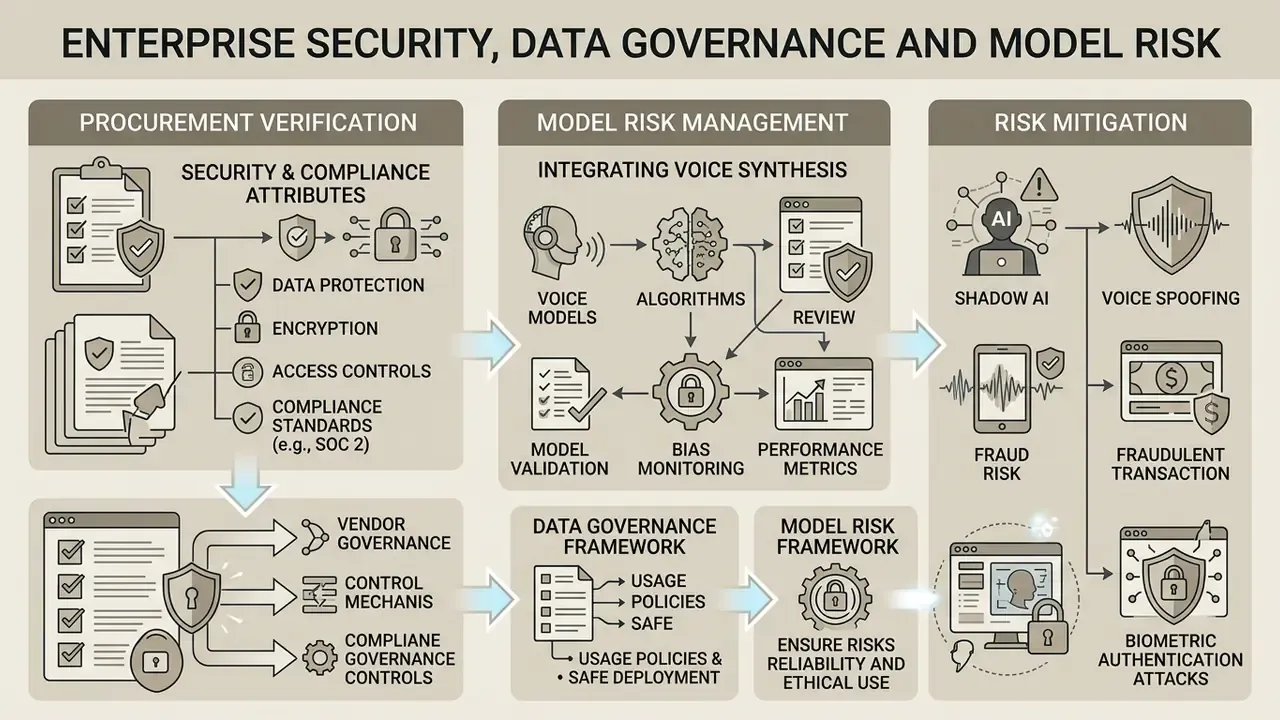
Character voice synthesis is rarely blocked by audio quality in regulated environments. It is blocked by data handling, third-party risk, and auditability. Voice samples are treated as biometric and personal data in most modern legal analyses, which places voice pipelines inside the same control perimeter as other sensitive-data processing.
Security and Compliance Attributes to Verify Before Procurement
Vendor security and governance attributes: what to require in the contract, not just on the marketing page.
| Attribute | Why It Matters | Evidence to Request |
|---|---|---|
| SOC 2 Type II | Demonstrates operating effectiveness of controls over a period, not a point in time | Current report plus bridge letter; read the exceptions section |
| ISO/IEC 27001 | Information security management system certification | Certificate with scope statement covering the inference service |
| ISO/IEC 42001 | AI management system certification; maps directly to AI governance expectations | Certificate and statement of applicability |
| Zero data retention (ZDR) | Prevents prompts, scripts, and reference audio from persisting or being used for training | Contractual ZDR clause with retention window stated in seconds or hours |
| Deployment model | On-premise, VPC, or dedicated tenancy limits cross-tenant exposure | Architecture diagram and data-flow map, including sub-processors |
| Data residency | Required under GDPR-style transfer rules and sector regulation | Region pinning guarantee and sub-processor list by region |
| Consent artefact storage | Consent recordings are evidence; they must survive vendor churn | Export capability for consent recordings and metadata |
| Watermarking / provenance | Machine-readable marking of synthetic audio is an EU AI Act Article 50 obligation from 2 Aug 2026 | Technical description of watermark, detector availability, robustness testing |
| Model versioning | Model risk management requires reproducibility of validated behaviour | Version pinning, deprecation notice period, changelog access |
| Audit and incident rights | Needed for third-party risk oversight | Contractual audit clause, breach notification SLA, log retention |
Integrating Voice Synthesis Into Model Risk Management
Treat a synthetic voice service as a third-party model with a defined intended use. A workable control set: register the model in the inventory with owner, intended use, and prohibited uses; validate output on a fixed, versioned script library covering edge cases such as numbers, currency, product names, and regulated disclosures; define acceptance thresholds, including pronunciation accuracy on a mandated-terminology list, disclosure presence rate, and a naturalness score such as MOS; require human review for any script containing regulated language; log model version, prompt or markup, voice ID, and output hash for every production render; and re-validate on every model version change, because expressive models can shift prosody materially between releases.
No evidence, no autonomy. If a render cannot be reproduced from a logged model version and a logged script, it should not reach a customer. Policy tracking on digital replica law sits in our AI Litigation and Legal Review hub.
Shadow AI, Voice Spoofing and Fraud Risk
Two risks are specific to voice and are frequently under-modelled.
Shadow AI. Employees and contractors can generate branded or executive-sounding audio on consumer accounts in minutes, outside any retention, licensing, or disclosure control. Mitigations: block unapproved voice-generation domains at the egress layer, publish an approved-tool list with a fast approval path, prohibit uploading colleague or customer audio to consumer tools, and require that any externally published synthetic audio carry an asset-register entry.
Voice spoofing against biometric authentication. Cheap, high-similarity cloning undermines voice-as-a-password schemes and raises social-engineering success rates. Mitigations: never treat voice as a sole authentication factor; deploy liveness detection and anti-spoofing countermeasures; add out-of-band verification for high-value instructions; train contact-centre and treasury staff on synthetic-voice pretexting; and monitor inbound call streams for synthetic-audio indicators. Regulatory momentum supports that posture, since the FTC's Voice Cloning Challenge explicitly solicited solutions across prevention, real-time detection, and post-hoc evaluation of cloned voices.
"Submissions were sought across three intervention points: prevention, real-time detection, and post-hoc evaluation of cloned voices."
Free AI Character Voice Generator: Pricing and Plan Limits
Evaluating an ai character voice generator free plan means checking character quotas, functional restrictions, and export licensing before the tool touches a commercial pipeline. Free tiers are genuinely useful for testing model fidelity. They are not a production licence.
| Operational Feature | Standard Free Plan Limits | Enterprise / Paid Plan Standards | Production Impact of Upgrade |
|---|---|---|---|
| Monthly character quota | 2,500 to 10,000 characters (about 5 to 10 minutes) | 100,000 to 5,000,000+ characters | Enables long-form media production and batch renders |
| Audio export formats | Compressed MP3 (128 kbps) or web stream | Uncompressed 24-bit/48 kHz WAV, PCM, FLAC | Provides broadcast-ready audio quality for mixing |
| Custom voice / cloning | Restricted or limited to 1 sample slot | Multiple instant clones and fine-tuned models | Unlocks custom character creation and brand exclusivity |
| Commercial usage rights | Strictly prohibited (personal, non-commercial) | Full commercial license and legal coverage | Allows monetization across YouTube, games, and ads |
| API access and latency | Web UI only; standard queue priority | REST/WebSocket API; dedicated low-latency priority | Enables direct integration into game engines and apps |
| Security and data handling | Shared multi-tenant inference; training on inputs may be permitted | ZDR option, VPC or on-premise, SOC 2 / ISO evidence, DPA | Makes deployment viable in regulated environments |
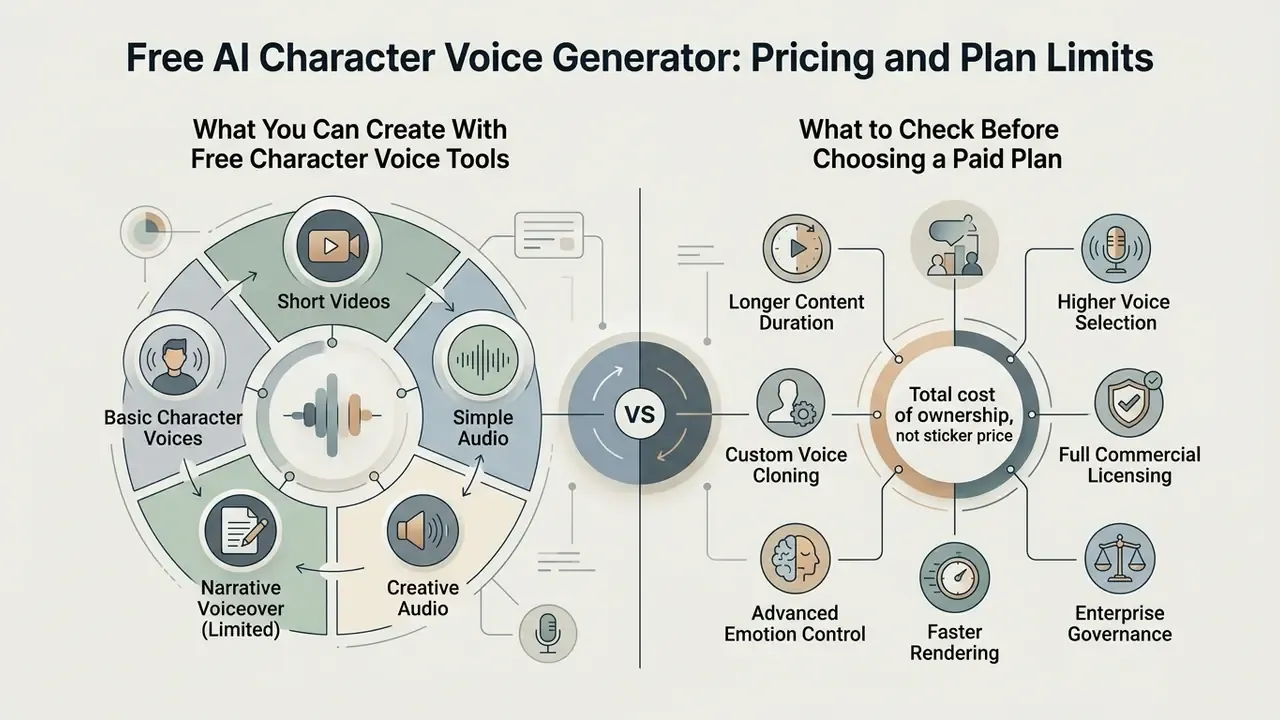
What You Can Create With Free Character Voice Tools
Free tiers on platforms running a free character ai voice generator let creators generate short clips, test prompt styling, and browse voice selection libraries. In practice, free accounts are constrained by low single-generation caps, compressed output, watermarking, and non-commercial licence terms. Publicly documented examples include per-generation caps around 2,500 characters, monthly quotas near 10,000 credits, 128 kbps MP3 export, one custom voice slot, and watermarked video exports; cloud providers instead grant monthly free character allowances, for example 0.5M neural characters on Azure, or first-year allowances on Amazon Polly. (Updated: exact limits vary by vendor and change often, so verify on the vendor's current pricing page before planning.) Fine for personal experimentation. Not viable for commercial publishing. The same pattern appears in adjacent categories, as documented in our comparison of free AI video generators.
What to Check Before Choosing a Paid Plan
Before committing to a commercial plan, production leads should read the documentation on credit consumption rates, concurrency limits, and commercial licensing. Four features usually justify the upgrade on their own: commercial-use rights, cloning access, clean WAV export, and priority generation. Organizations planning multi-channel deployment should review standard commercial terms on our pricing reference page and model usage with the AI Media Calculators.
Total cost of ownership, not sticker price. For enterprise deployments, budget with a fuller formula:
where = monthly characters rendered, = per-character rate, = validation and QA hours multiplied by loaded hourly cost, = integration and engineering build, = ongoing monitoring, logging, and storage, and = audit, legal review, and consent administration. In regulated environments, , , and frequently exceed raw generation spend. That is why the cheapest per-character rate is rarely the cheapest programme.
Can You Use AI Character Voices for Commercial Projects?
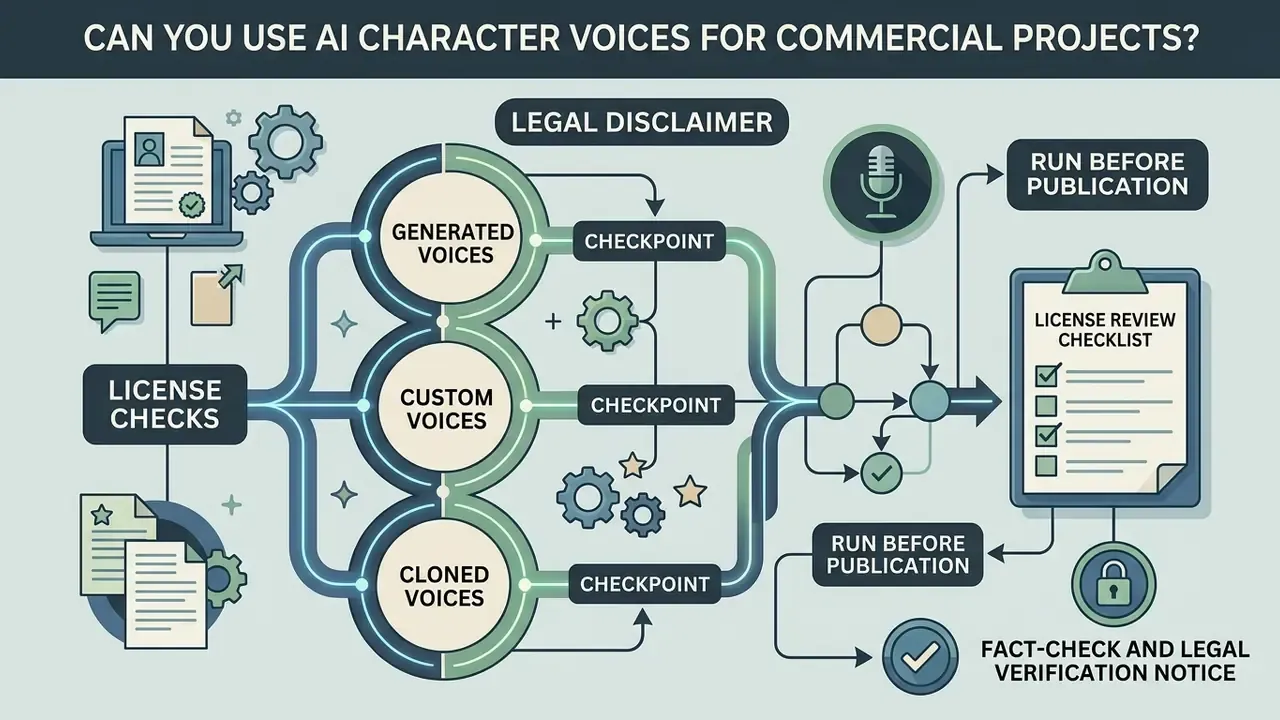
Whether synthetic character speech can be monetized depends on asset licensing, platform terms of service, and regional regulatory compliance. Organizations shipping synthetic audio in commercial products need documented legal provenance for every voice model in use.
License Checks for Generated, Custom and Cloned Voices
Commercial licensing frameworks separate stock library voices, user-created custom voices, and cloned voices of real individuals. Standard library voices on paid enterprise plans typically grant broad commercial exploitation rights; see our overview of commercial licensing frameworks for AI tools for how comparable output-rights clauses are structured in adjacent generative categories. Custom voice clones, by contrast, need verifiable authorization from the original speaker, and several platform terms make commercial use conditional on both a paid tier and the user's demonstrated right to clone that voice. Note also that output-use rights and rights in the voice model are separate questions: some providers grant broad commercial output rights while retaining a licence to the user-created voice model for service improvement. In jurisdictions like New York, 2025 statutes mandate explicit disclosures for advertisements containing AI-generated synthetic performers and require consent from heirs or representatives for commercial use of a deceased person's digital voice replica. Broader legal usage standards are collected in our AI Media Commercial-Use Hub.
License review checklist, run before publication: scope of permitted use (media, territory, term); output ownership and IP assignment; whether inputs may be used for training; rights retained in user-created voice models; prohibited-use clauses; disclosure and labelling obligations; indemnity and liability caps; termination and post-termination use of already-published assets; data protection addendum and sub-processor list; audit rights.
Fact-check and legal verification notice:
The U.S. Copyright Office's Copyright and Artificial Intelligence, Part 1: Digital Replicas (2024) confirms that federal copyright law does not preempt laws restricting unauthorized voice digital replicas, and that sound-alike imitations which do not sample a fixed recording generally fall outside copyright, since 17 U.S.C. § 114(b) expressly permits independent re-recordings of sound recordings. Disputes therefore shift to state right-of-publicity law, as seen in Lehrman v. Lovo (S.D.N.Y. 2025), and to statutes such as California Civil Code § 3344 and Tennessee's ELVIS Act, which aggressively penalize unauthorized commercial voice imitation.
"AI-generated voices are 'artificial' under the TCPA; callers need prior express consent, and the FCC has proposed AI-use disclosure at the start of each call." Declaratory Ruling and Notice of Proposed Rulemaking on AI-Generated Calls, Federal Communications Commission (2024). fcc.gov
"Providers of systems generating synthetic audio must mark outputs in a machine-readable format, detectable as artificially generated or manipulated." EU AI Act, Article 50 (applicable from 2 August 2026), European Parliament briefing (2025). europarl.europa.eu
Enforcement scope differs by regime, and the difference is structural rather than contradictory. U.S. rules are sector-specific: telecom robocalls, state publicity rights, advertising disclosure. The EU AI Act imposes horizontal transparency duties on synthetic audio regardless of sector. Verify platform licence terms and internal legal sign-off before commercial launch, every time.
How to Make AI Character Voices Sound Natural
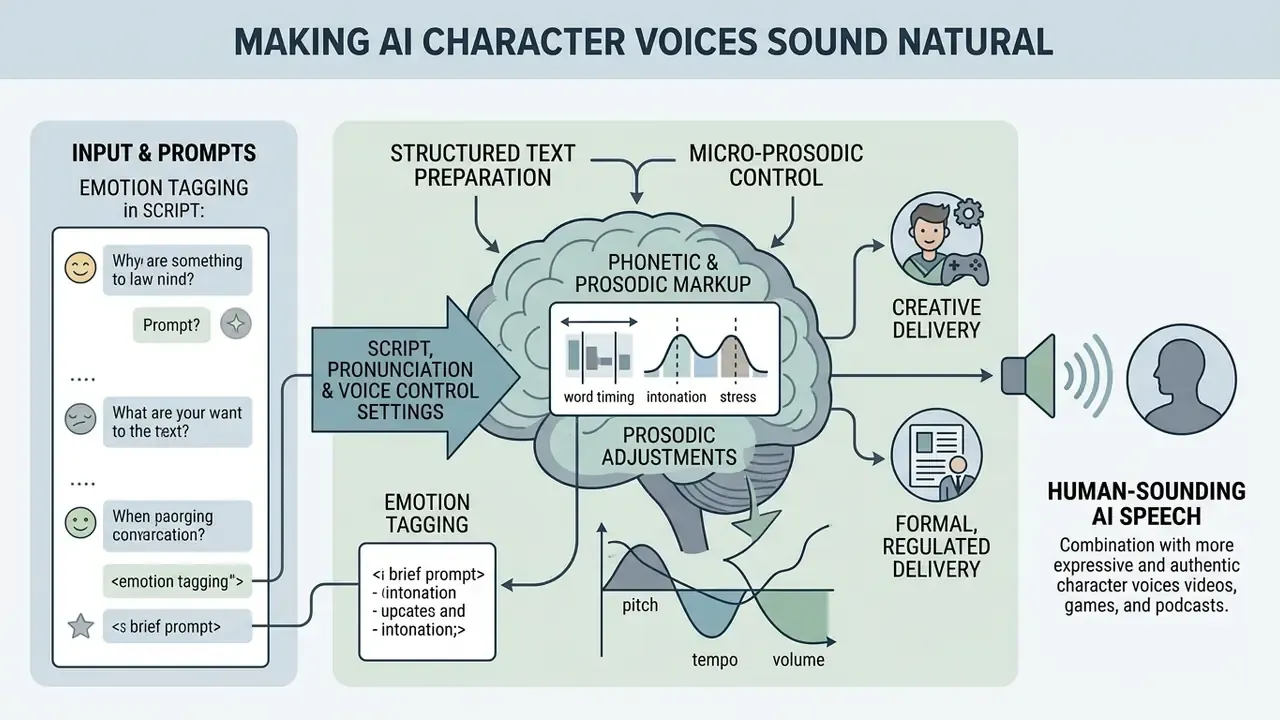
Human-sounding output from an ai character voice generator comes from structured text preparation plus micro-prosodic control. Removing robotic artifacts depends on pause durations, pitch contour transitions, and phoneme stress patterns. Listener studies published in 2025 agree on the diagnosis: insufficient emotional expressiveness and unnatural intonation or rhythm are the most common causes of perceived artificiality, not timbre.
Simplified Emotion Tagging in Prompts
Not every team wants to write XML. For fast dialogue prototyping, most modern expressive models accept inline emotion directives in parentheses or brackets, then translate them internally into offsets, loudness-envelope changes, pause insertion, and voice-quality shifts:
(whispering, fearful) Keep quiet, they're somewhere close.(manic laughter, high pitch) At last, the experiment actually worked!(tired, deep sigh) We've been walking for three days without stopping.(excited) Let's go on an adventure! (nervous) Although... I heard there are monsters ahead. (confident) But I'm sure we can handle this.
Practical rules for tag-based control: keep tags short and emotionally unambiguous; place a tag immediately before the span it governs; use no more than two stacked descriptors, since (angry, shouting) works while (angry, shouting, sarcastic, tired) usually collapses into noise; and re-tag on every emotional beat rather than once per paragraph. Vendor documentation exposes comparable capabilities under different names: audio tags such as [excited], [crying], [deadpan], an emotion parameter in generation configs, or free-form style prompts describing age, persona, and delivery. When you need deterministic, reproducible control for regulated or long-running production, meaning exact pause lengths and exact pronunciations, move the same intent into SSML.
Phonetic and prosodic markup structure for natural speech synthesis
<speak version="1.0" xmlns="http://www.w3.org/2001/10/synthesis" xml:lang="en-US">
  <voice name="en-US-Character-Hero">
    <p>
      <s>The gate is locked.<break time="250ms"/> <prosody pitch="+5%" rate="95%">Listen carefully.</prosody></s>
      <s>We only have one chance at <phoneme alphabet="ipa" ph="ˈðɪs">this</phoneme>.</s>
    </p>
  </voice>
</speak>
The example above applies pause breaks, pitch modulation, and phonetic pronunciation control to reach natural dialogue delivery.
Script, Pronunciation and Voice Control Settings
To kill flat, monotone delivery, insert explicit breath segments and micro-pauses at major syntactic boundaries. Speech-science literature classifies pauses as respiratory, discursive, or expressive, with expressive pauses carrying attitude and emotion; one study on synthetic speech found that adding a breath noise before a phrase measurably improved listener recollection.
"Each utterance annotated for emotion, pitch and speaking rate; 160 hours of dialogue perceived as more conversational than standard TTS."
Using SSML tags such as break time="150ms" for cadence, prosody pitch for intonation swings, emphasis level="strong" for key-word highlighting, and say-as or sub for controlled verbalization of numbers, dates, and abbreviations turns synthetic output into a performance. Well-formedness is non-negotiable: reserved characters must be escaped, and every tag must close inside a valid speak root with the correct xmlns declaration, or the engine will silently fall back to flat default prosody. Silently, which is the annoying part. Teams working on broader interactive workflows can consult our guides to animation makers for cross-modal storytelling and AI video generation workflows, and quick visual QA questions can be triaged by tools that let you ask ai with a reference frame attached.
Applying the same controls to formal, regulated delivery. Character work is not only fantasy. A compliance-constrained assistant persona for collections, dispute resolution, or premium banking needs the opposite configuration from a shonen hero: mid-range , narrow pitch variance of roughly ±3%, rate at 92 to 96% of baseline, deliberate 200 to 300 ms pauses before regulated disclosures, forced pronunciation of product names via phoneme, say-as interpret-as="currency" for amounts, and zero emotional volatility tags. The disclosure line itself should be a locked, version-controlled SSML fragment that cannot be edited by prompt, so the wording the customer hears matches the approved text exactly.
Limitations and Unresolved Questions
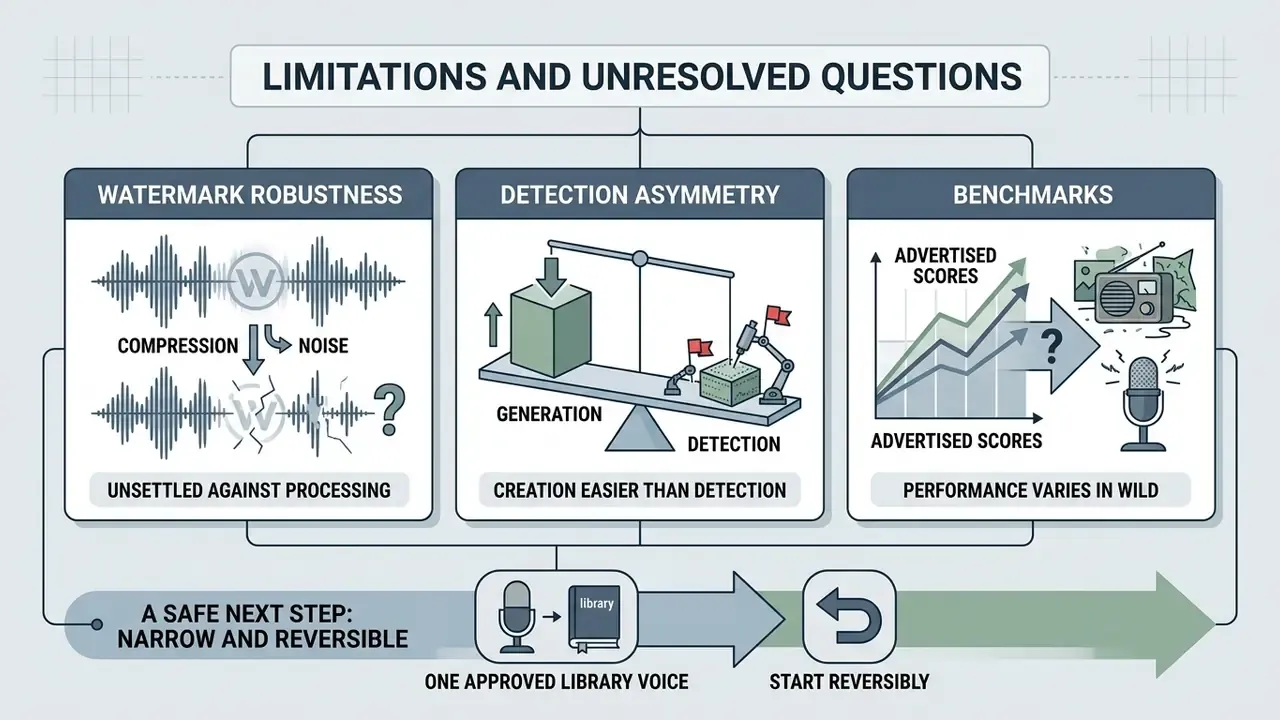
Three honest caveats, because the evidence base is younger than the marketing.
Watermark robustness is unsettled. Machine-readable marking is an obligation from 2 August 2026, but published research still reports that many audio watermarks degrade under re-encoding, time-stretching, or re-recording through a speaker. Ask vendors for robustness test results, not just a feature checkbox.
Detection is asymmetric. Cloning quality has improved faster than detection accuracy in operational conditions such as telephony codecs and noisy call centres. Build controls that do not depend on detecting a fake, for example callback verification and transaction-level limits.
Benchmarks are not your environment. MOS scores between 3.85 and 4.47 come from curated evaluation sets. Your product names, currency formats, regulatory disclosures, and accents are not in those sets. Validate on a script library that mirrors real traffic, then re-validate whenever the vendor ships a new model version.
A safe next step for most institutions is narrow and reversible: one approved library voice, one non-regulated use case, full render logging, and a written decision on who may authorize cloning. Nothing else. Expand only after the evidence trail holds up in an internal review.
FAQ: AI Voice Generator Characters
How does AI character voice generation actually work?
A neural model converts text into acoustic features, then a vocoder or neural audio codec turns those features into a waveform. Character behaviour comes from conditioning: a speaker embedding fixes identity, while style, emotion, and prosody vectors, set by tags, prompts, or SSML, control delivery per line.
Can AI character voices express different emotions?
Yes. Expressive models support directed emotional states, with neutral, happy, angry, fearful, surprised, and disgusted as a common discrete set, and 2026-era research adds smooth intra-utterance transitions so affect can shift mid-sentence. Measured emotion MOS for leading challenge systems sits around 3.85 of 5.
How much reference audio do I need to clone a voice?
Zero-shot cloning works from roughly 5 to 30 seconds; benchmarks show quality becoming strong in the 5 to 20 second range, with cosine similarity commonly above 0.70. Higher-fidelity custom models benefit from 1 to 20 minutes of clean single-speaker audio at 24 to 48 kHz, mono, with SNR above 35 dB.
Do I have to disclose that a voice is AI-generated?
In many contexts, yes. EU AI Act Article 50 transparency and machine-readable marking obligations for synthetic audio apply from 2 August 2026; the FCC treats AI voices as artificial under the TCPA for calls; New York requires disclosure for ads with synthetic performers; and publishing metadata standards distinguish "AI Voice" from "Authorized Voice Replica".
Can I use character voices commercially on a free plan?
Generally no. Free tiers almost universally restrict output to personal, non-commercial use and often add watermarking. Commercial rights, clean WAV export, cloning access, and priority generation are the standard paid-tier unlocks.
Is it legal to imitate a famous character or performer's voice?
Imitating a style is usually low-risk; imitating an identifiable person for commercial purposes is high-risk. State right-of-publicity statutes such as California Civil Code § 3344 and the Tennessee ELVIS Act target unauthorized commercial voice imitation even when no recording is sampled, and character voices may carry additional copyright and trademark exposure through the underlying work.
What latency should I target for real-time voice in games and chat?
Aim for 15 to 30 ms end-to-end for live voice conversion, using 128-sample buffers and exclusive-mode ASIO or WASAPI, and under 100 ms time-to-first-byte for streaming TTS in dialogue systems. Open real-time conversion models have demonstrated sub-20 ms latency at 16 kHz on consumer CPUs.
What should a regulated organization require from a voice vendor?
At minimum: SOC 2 Type II, ISO/IEC 27001 and ideally ISO/IEC 42001, contractual zero data retention, VPC or on-premise deployment options, data residency guarantees, exportable consent artefacts, model version pinning, watermark and provenance documentation, breach notification SLAs, and audit rights.
How do I integrate character voices into Unreal Engine or Unity?
Unreal exposes a Voice API and Voice Chat Interface for in-engine voice data handling and imports 16-bit and 24-bit PCM WAV assets at any sample rate. Unity's native voice stack is Vivox for chat, so AI generation is typically wired in as an external streaming service. Use a WebSocket endpoint with per-word timestamps when you need lip-sync or subtitle alignment.
Who owns the voice model I create from my own recordings?
It depends on the contract, and this is the clause teams miss most often. Some providers grant broad rights to the generated audio while retaining a licence to the trained voice model itself. Ask for explicit language on model ownership, export rights, deletion on termination, and whether your reference audio can be used for service improvement.
Appendix A: Source Revision Log
For transparency, the following citations from the previous version of this guide were revised because they lacked verifiable identifiers, publication URLs, or stated methodology. The superseded references are preserved here; the main text now carries the replacement sources.
| Superseded reference (previous version) | Reason for revision | Replacement in current text |
|---|---|---|
| AffectCodec, 2026 (no URL, no metrics) | Forward-dated, unverifiable; no methodology or figures | DEmoFace (2025), EmoVoice (2025), and 2026 emotion-preserving codec and transition research described with methods |
| FlexiVoice (2026) / CtrlSpeech (2026) (no figures) | Cited without quantitative results | LLM-Based Expressive TTS with Style and Timbre Disentanglement, IEEE ISCSLP / ICAGC (2024), MOS 3.89 / 3.83 / 3.85; FlexiVoice retained as preprint with human-evaluation claim |
| ICAGC Challenge, IEEE, 2024 (no URL) | Correct data, missing source link | Same source, now quoted with σ ≈ 0.22 and linked |
| GLOBE Corpus (2024) (no URL) | Correct figures, missing source link | GLOBE corpus paper quoted with 535 h / 23,519 speakers / 164 accents / 24 kHz |
| ClonEval Benchmark, 2026 (no methodology) | Similarity threshold cited without evaluation detail | Cross-model benchmarking framing (above 0.70 cosine, 5 to 20 s reference audio) plus FlexiVoice human evaluation |
| LLVC, 2023 (no URL) | Correct latency claim, missing source and resource data | LLVC quoted with about 2.8× real-time on consumer CPU, under 20 ms at 16 kHz |
| ISCA Expressive Speech Studies (unspecified) | Non-specific collective citation | Breath-segment and pause-typology research described explicitly, plus Spoken DialogSum (2025) annotation data |
| U.S. Copyright Office Report on Digital Replicas, 2024 (no URL) | Correct report, missing statutory detail | Same report plus 17 U.S.C. § 114(b) and Lehrman v. Lovo (S.D.N.Y. 2025) |
| Pricing and free-tier figures stated as universal | Vendor-specific and volatile | Now attributed to published vendor pricing pages with a re-verification note |
Enterprise Navigation & System Directory