That is the promise. The governance question is narrower: can you prove what the model saw?
«In financial operations and risk management, an autonomous vision model must operate under strict evidence constraints. If an AI agent cannot explain its visual token alignment or verify ground truth, it cannot be granted decision autonomy. Controlled visual AI requires verifiable inputs, deterministic escalation paths, and explicit residual risk bounds.» Marcus Hale, AI Governance & Model Risk Editorial Lead
Executive Summary
- What it is. An
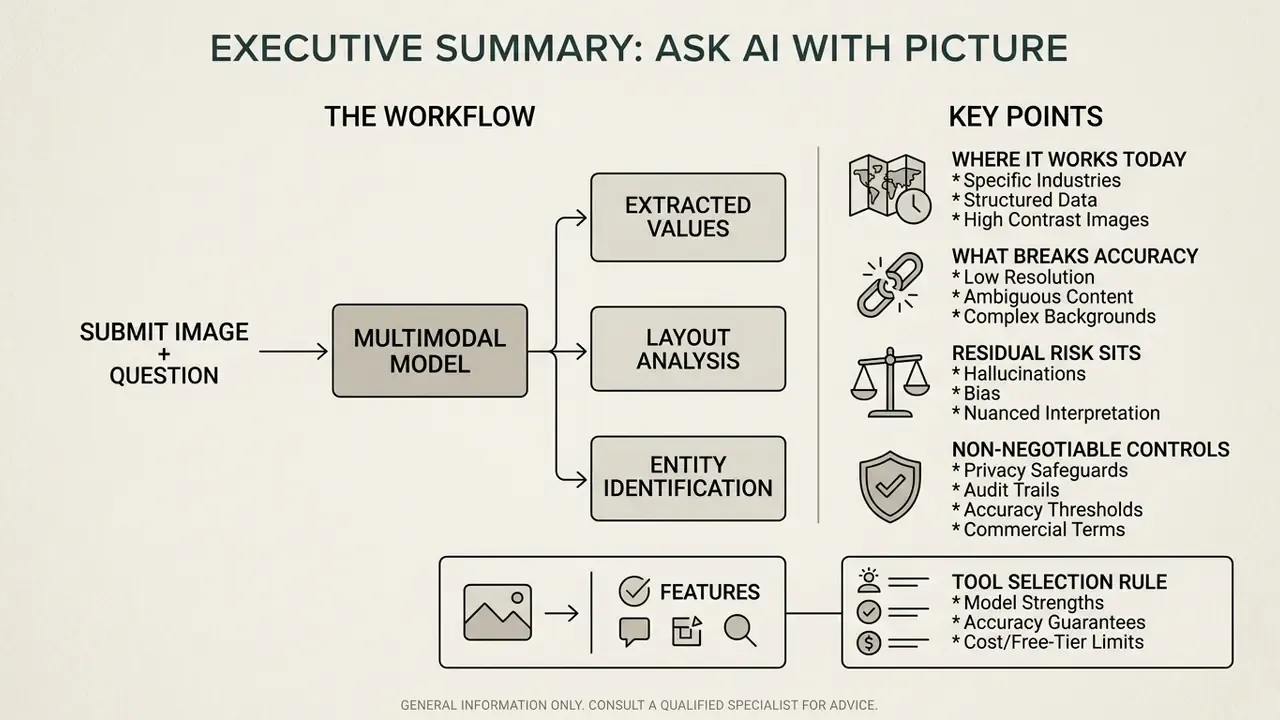
ask ai with pictureworkflow submits an image plus a natural-language question to a multimodal model, which returns text: extracted values, layout analysis, entity identification, or step-by-step reasoning. - Where it works today. Document triage, invoice and statement parsing, KYC/AML form review, dashboard and chart interpretation, UI/UX audit of application screens, engineering schematics, and academic problem solving.
- What breaks accuracy. Resolution below the 300 DPI equivalent, perspective tilt beyond 10 degrees, glare and compression artifacts, and underspecified prompts. Diagram misreading, not arithmetic, drives most visual reasoning errors.
- Where the residual risk sits. Systematic visual hallucination and overconfident calibration. Independent benchmarks (HallusionBench, VHTest) show models reporting objects that are not present when prompts are leading or ambiguous.
- Non-negotiable controls. PII redaction and EXIF stripping before upload, vendor retention and training opt-out review, encryption in transit and at rest, human-in-the-loop validation, and reproducible audit logs (image hash, prompt text, model version, timestamp, response).
- Tool selection rule. General multimodal chat for exploratory and low-stakes work; a specialized visual pipeline when throughput, spatial precision, SLA, and indemnity matter. Domain-tuned models still beat general assistants on narrow visual reasoning subsets.
This material is general information and does not replace advice from a qualified specialist.
Decision Snapshot for Risk Owners
Before reading the mechanics, note the four decisions this article is built to support. They are the ones that usually stall a pilot at the model risk committee.
- Scope.Which visual tasks are permitted, and which are explicitly out of bounds until validated? Reading a chart is not the same act as adjudicating an identity document.
- Data boundary.What may leave the perimeter as an image payload, and what must be redacted, cropped, or stripped of metadata first?
- Evidence standard.What has to be logged so an internal auditor can reproduce the answer six months later, after the vendor has silently upgraded the model?
- Autonomy limit.Which outputs trigger automated action, and which route to a named human reviewer with a documented escalation path?
Everything below feeds one of those four boxes. If a section does not, skip it.
What Ask AI with Picture Is and Which Tasks It Solves
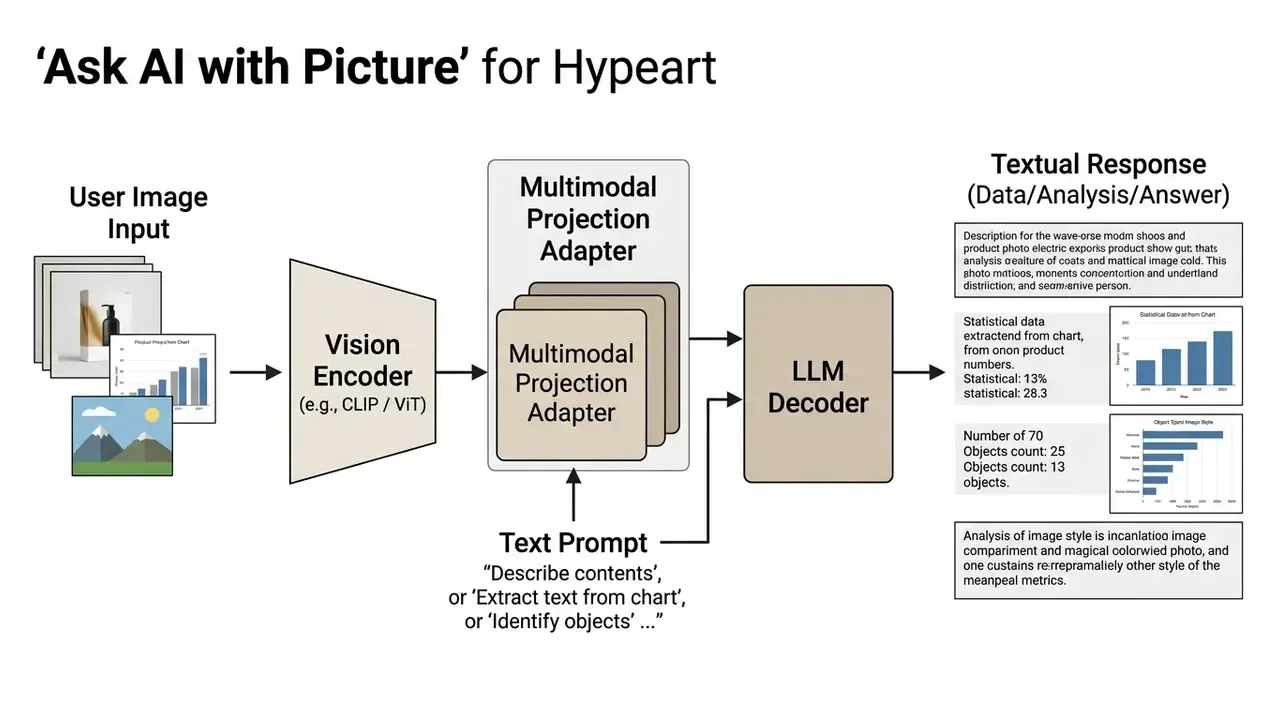
An ask ai with picture workflow allows users to submit an image alongside a natural-language query to extract data, recognize entities, or interpret visual structure. The plumbing is multimodal: a vision encoder projects visual tokens into an alignment adapter, which feeds an autoregressive language decoder together with the user's prompt.
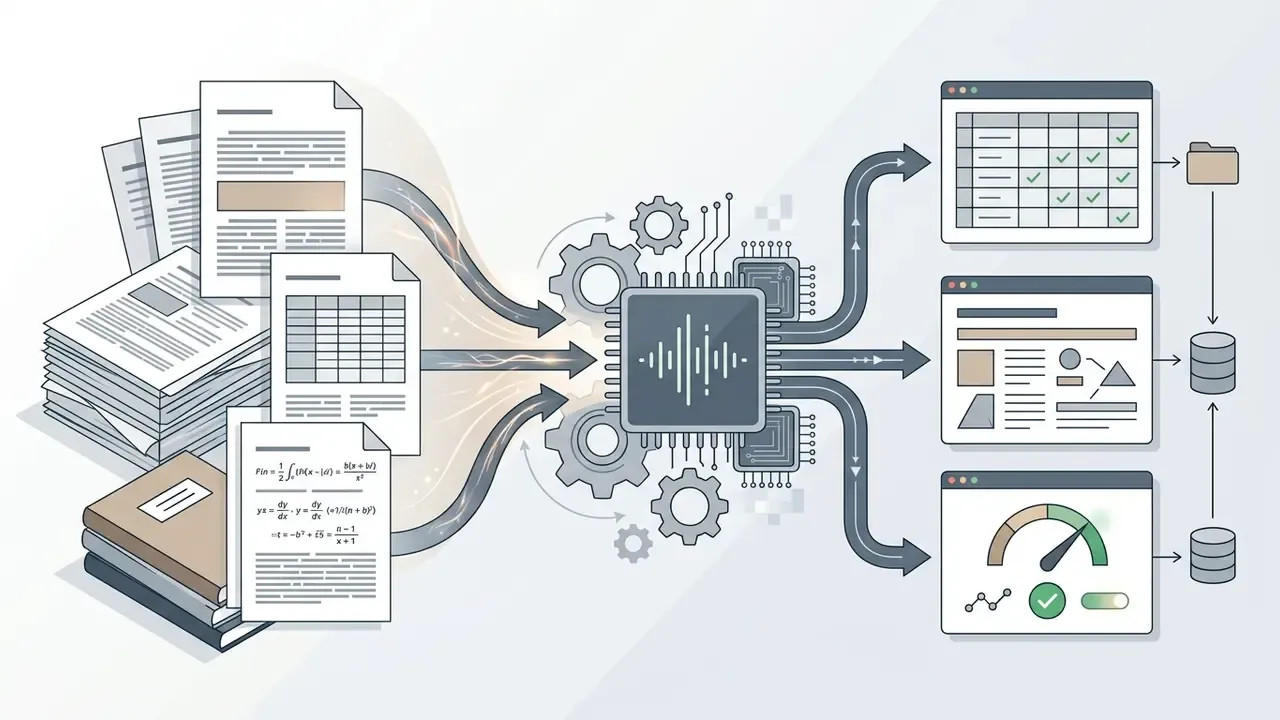
Modern visual language systems clear operational bottlenecks by parsing complex media without manual transcription or a dedicated single-purpose optical character recognition (OCR) script. Institutions deploy ai ask picture models to analyze financial charts, read scanned identity papers, process technical architecture schematics, and evaluate interface states.
The breadth of the shift is measurable outside consumer use cases. On aerial landmark recognition, GPT-4V reaches 0.67 zero-shot accuracy, materially ahead of open-weight vision models evaluated on the same task set.
«GPT-4V achieves 0.67 accuracy on zero-shot aerial landmark recognition, substantially outperforming open-source vision-language baselines.»
What Answers AI Can Give From a Photo, Screenshot, or Image
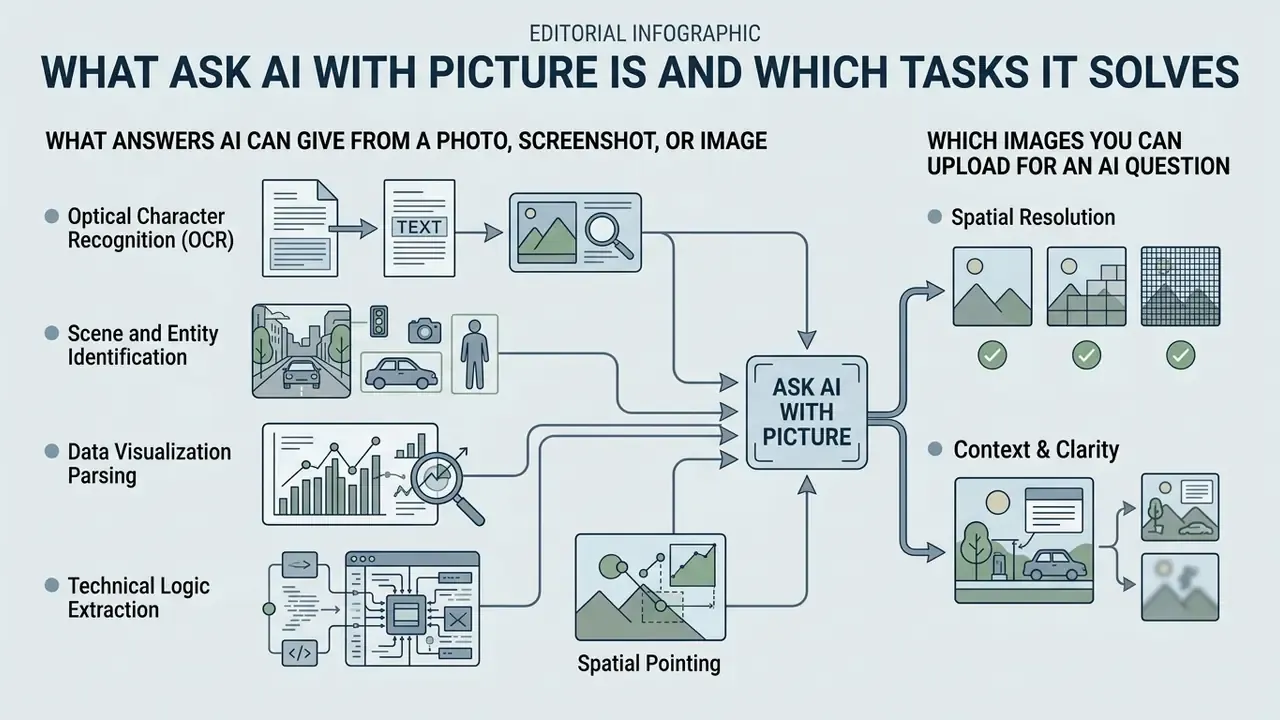
An ai that answers questions from images delivers structured visual descriptions, character extraction, layout analysis, and relational reasoning. When it evaluates an image, an ai answer can range from verbatim text extraction to a semantic read of diagrams and data trends.
NIST IR 6231 defines document recognition as building on standard OCR to extract higher-level physical, logical, and linguistic structures from page content (NIST, 2003). Teams that need raw transcription rather than reasoning should compare dedicated image-to-text and OCR tools against a general VQA endpoint before committing to a pipeline. The cheaper tool often wins on transcription and loses badly on interpretation.
When an analyst submits an image to ask ai about an image, the model executes several distinct capabilities:
That last capability is the one governance teams undervalue. Without it, you have an opinion. With it, you have reviewable evidence.
Which Images You Can Upload for an AI Question
Users can ask ai upload image files in standard raster and vector formats, including PNG, JPEG, WebP, and multi-page PDF documents. The model handles screenshots of software interfaces, photographs of physical objects, high-resolution scans of paper contracts, and digital charts.
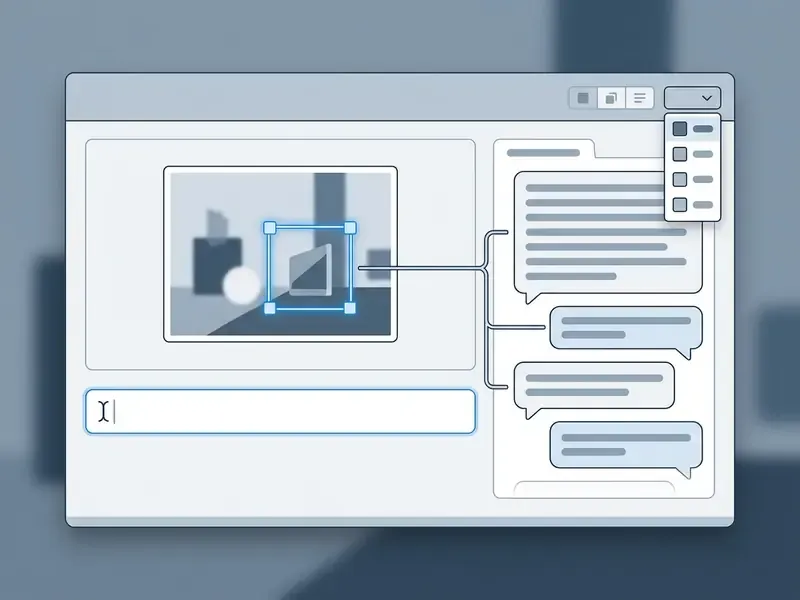
Current VQA services accept more than the classic raster set. Mobile containers HEIC/HEIF (the iPhone default) are supported by most modern endpoints, as is direct ingestion by image URL and drag-and-drop of clipboard screenshots. On large or dense images, the model can anchor its output to bounding boxes, meaning pixel coordinates, and name the exact row, cell, or quadrant that produced the answer.
Technical standards such as ISO/TS 19264-1:2021 specify that digital image analysis quality depends on target resolution, noise metrics, and spatial distortion parameters.
For an accurate ai picture ask evaluation, uploaded media must satisfy basic technical criteria:
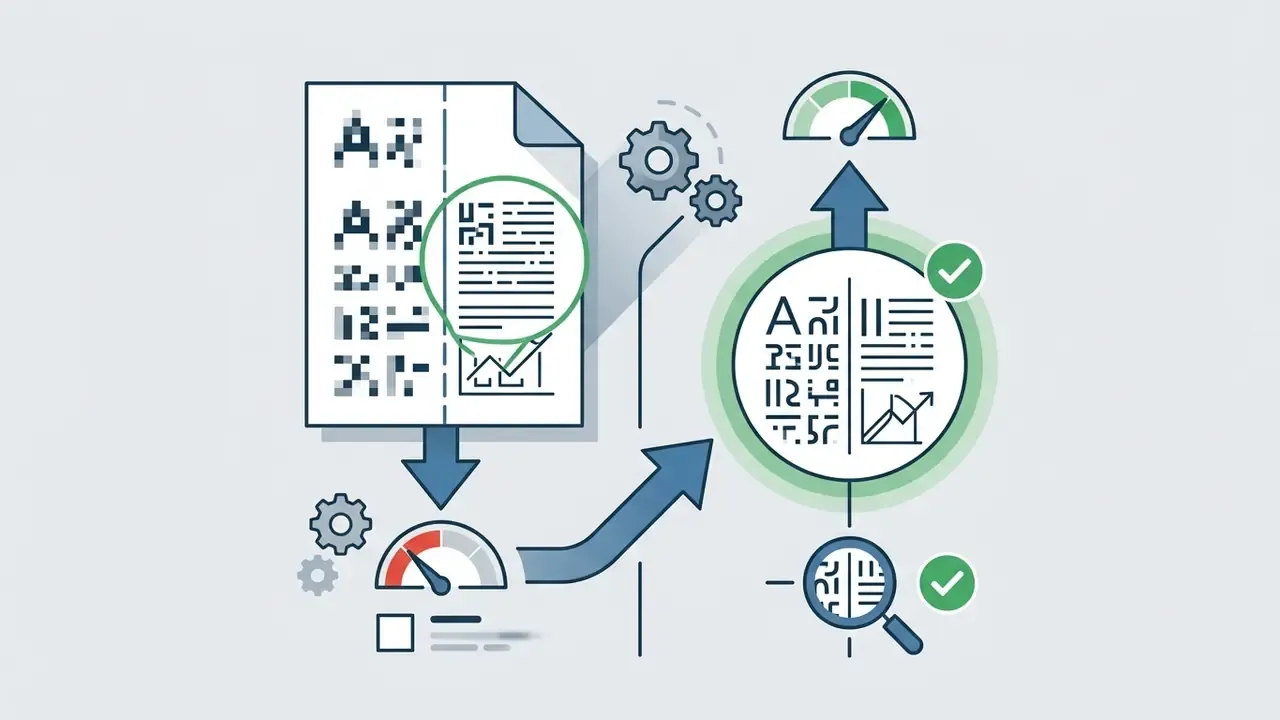
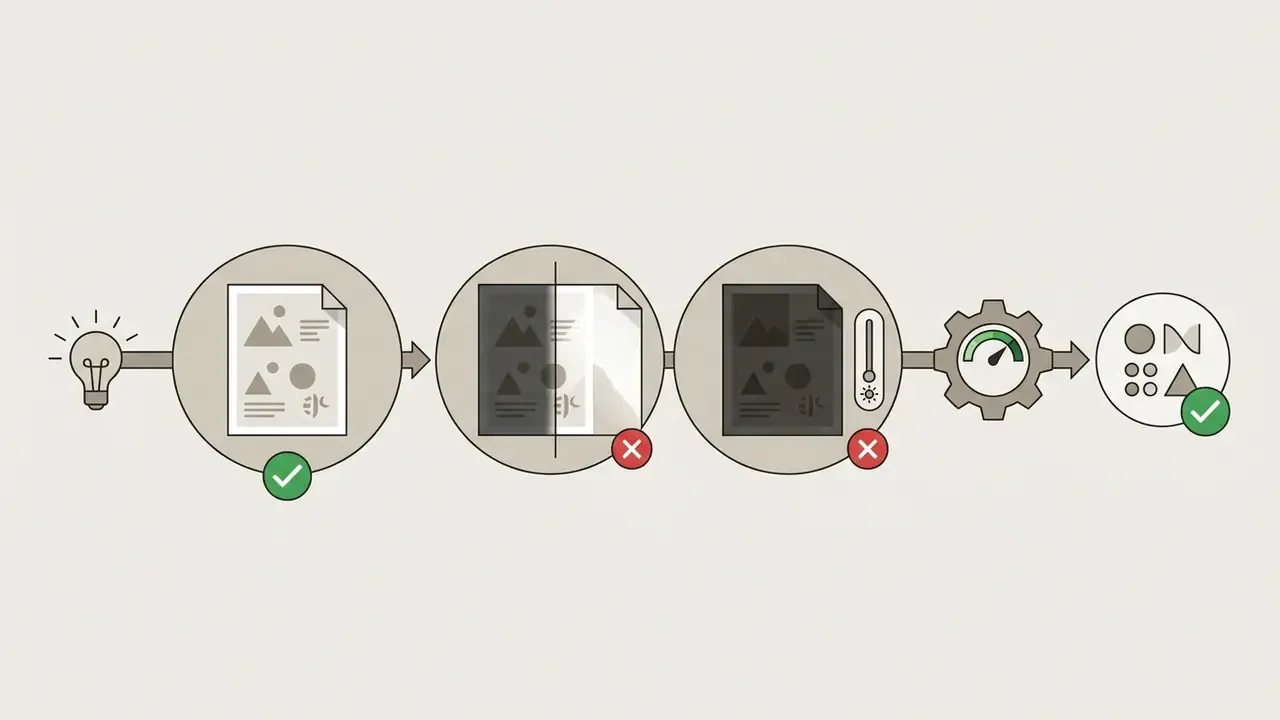
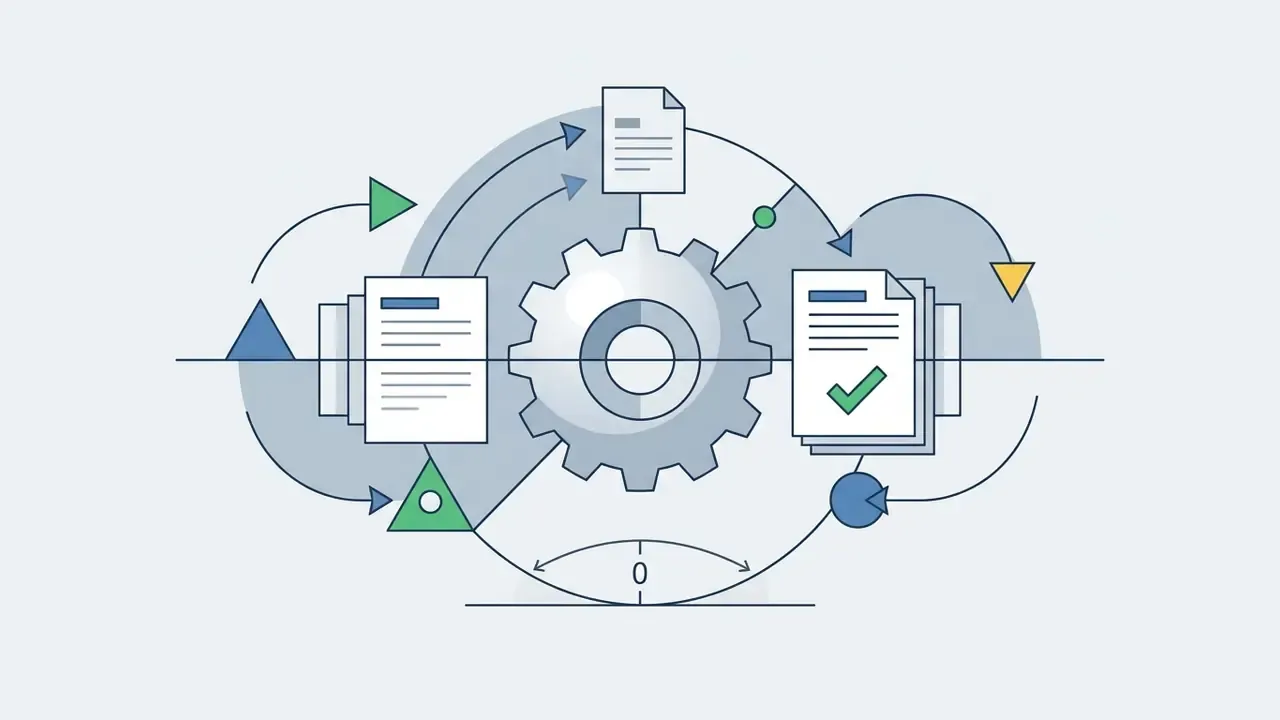
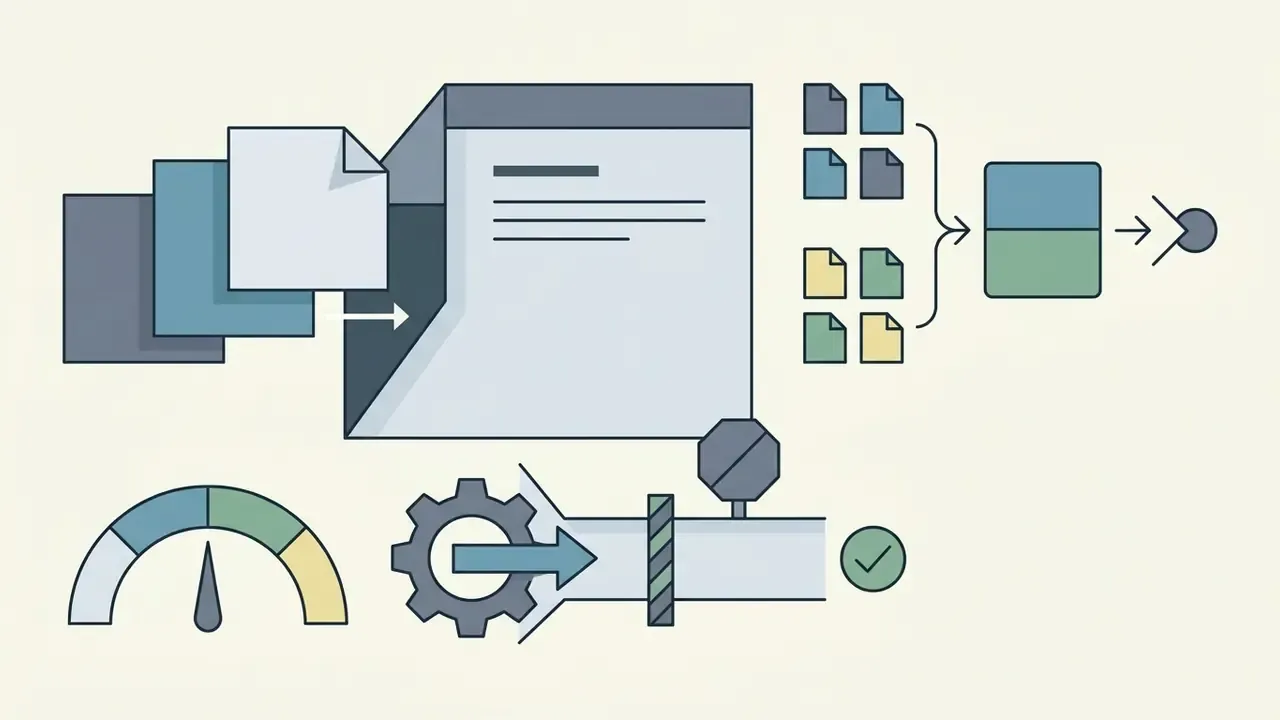
file_id.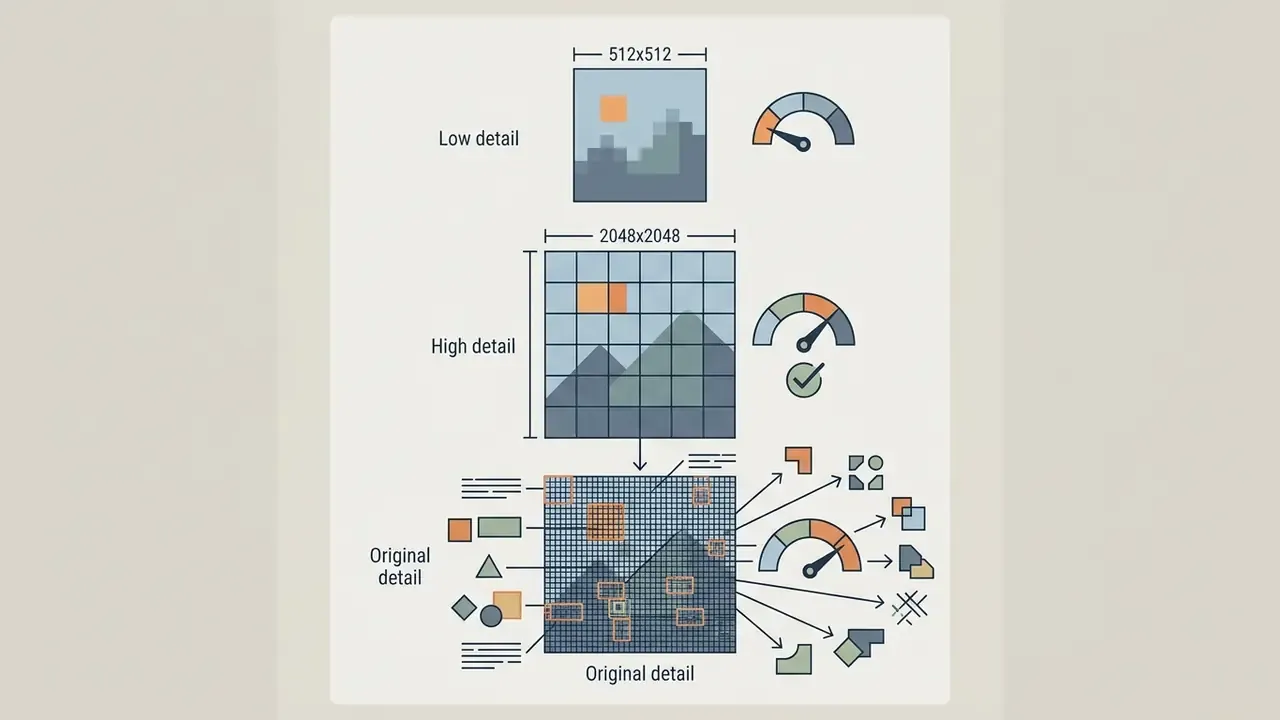
detail=low (a 512×512 render), detail=high (fit within 2048×2048, roughly 2,500 patches), and up to 30,000 patches per image; detail=original is documented for OCR, small-object detection, bounding boxes, and localization.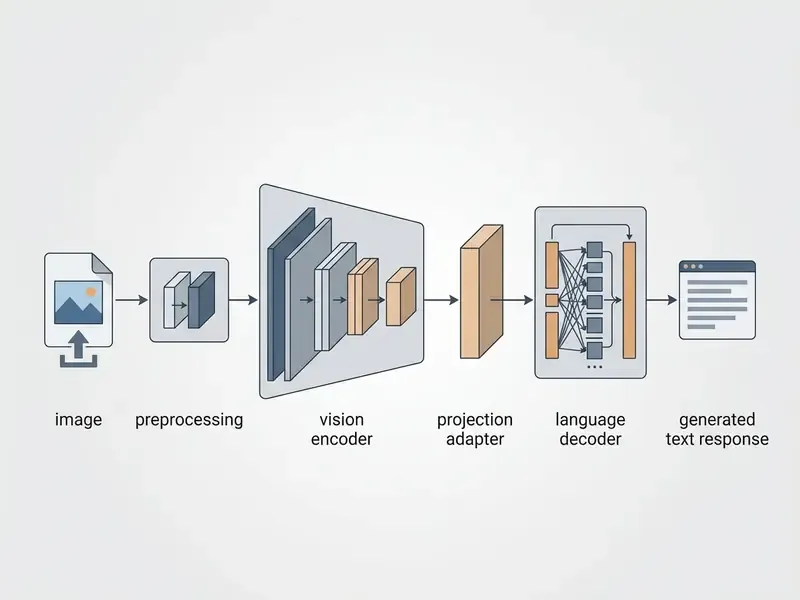
How to Ask AI a Question About an Image: Step-by-Step
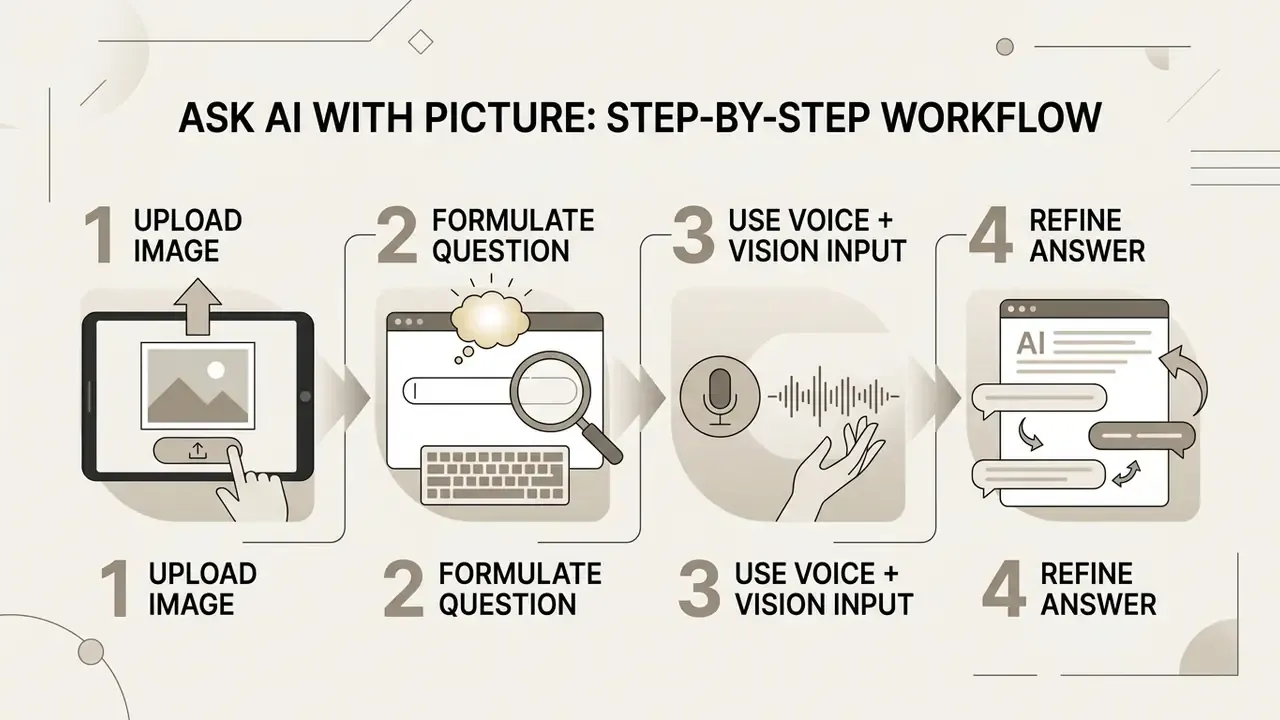
To get high-precision responses when you ask ai a question with picture, follow a structured four-stage workflow. Explicit prompt ordering and strict contextual boundaries prevent ambiguous spatial references and invented details.
1. Upload the Photo or Screenshot Containing the Target Information
Start with a clean payload and attach it via the model interface or an API endpoint. If you need a specific detail, crop the background noise before you run the ask ai upload image step. Strip EXIF metadata (GPS coordinates, device identifiers, capture timestamps) before any upload that leaves your perimeter. The payload is the picture, not the location history riding along with it.
With multi-page forms or multi-angle photos, submit distinct primary views and designate one as the default image.
«Automated visual systems show significant error escalation when processing uncalibrated or cluttered background visual vectors.»
Vendor documentation and standards guidance converge on two hard capture limits.
«Character recognition error rates rise sharply once document sampling drops below 300 DPI or perspective tilt exceeds 10 degrees.»
For baseline model configuration context, review our reference notes on free generative ai tooling before you lock pipeline defaults.
2. Formulate the Question the AI Must Resolve
Build your ai question picture prompt with clear structural constraints and an explicit task definition. State the scene context first, name the primary subject next, and close with the required output format.
OpenAI's multimodal prompt guidance (2026) specifies that structured prompt sequences, separating task definition, visual focus areas, and output schema, yield higher response accuracy. Microsoft Foundry guidance adds two rules: break complex requests into step-by-step sub-goals, and define the output format explicitly. When you submit an ask ai picture question, write something closer to this:
That final clause does more work than the rest of the prompt. It converts a guess into a flag.
3. Use Voice Plus Vision Input When Your Hands Are Busy
Latest-generation VQA tools support combined voice and visual input. Attach a photograph of a damaged asset, a meter reading, or an engineering schematic, then dictate the question aloud: the system transcribes the audio stream, aligns it with the visual tokens, and returns text. In field inspection, branch operations, and warehouse audit workflows this removes the keyboard from the loop, and the transcript becomes part of the audit record. Useful side effect, that.
4. Refine the Answer With Follow-Up Questions
After the first response, use targeted follow-ups to test edge cases or probe an uncertain calculation. If you ask ai questions iteratively, you can isolate visual parsing errors before results reach a downstream enterprise report.
«The system first decides whether the input is ambiguous; below a confidence threshold it asks a clarifying question and incorporates the reply into the next turn.»
Refinement research adds a discipline that matters for reproducibility: review the prior answer step by step, stop at the first detected fault, and regenerate from that point with corrected context rather than re-asking the whole question (MMRefine, arXiv, 2025, https://arxiv.org/html/2506.04688v1). Change one variable per turn. If an initial ai answer reads vague, request line-by-line verification against specific coordinates of the uploaded image.
Ready-Made Prompt Templates (Intention Templates)
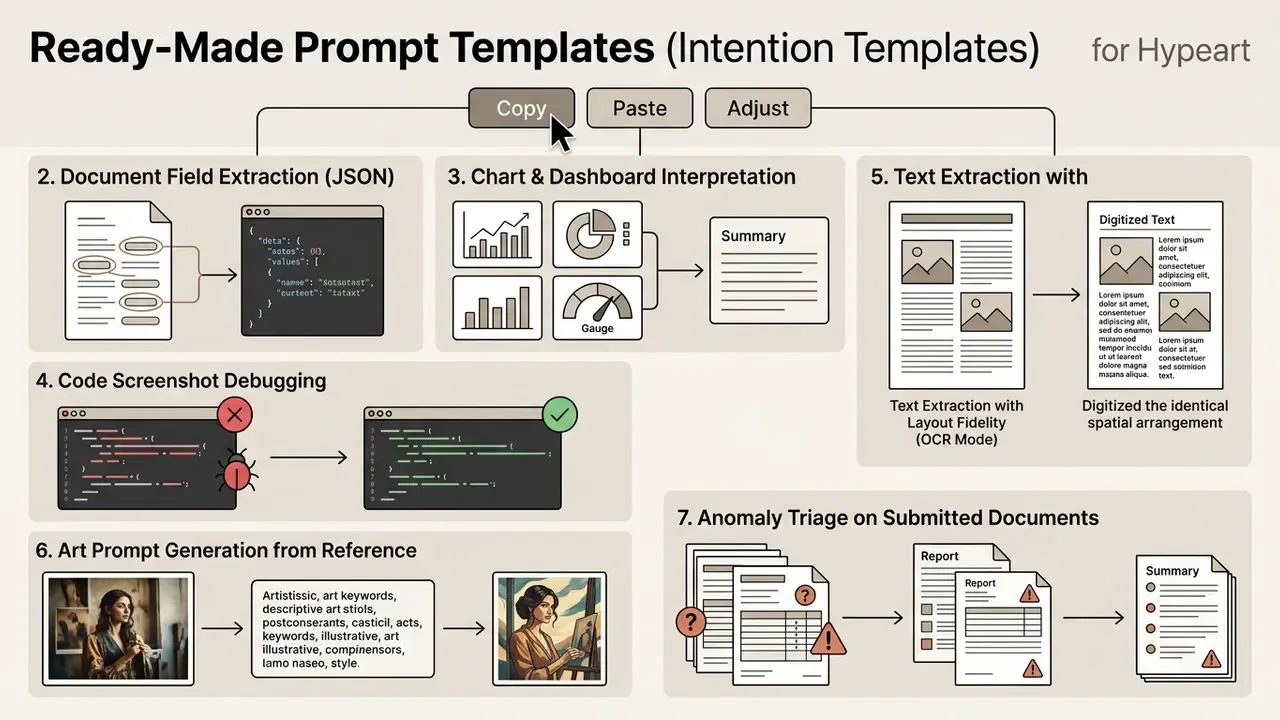
Copy, paste, adjust. Each template fixes the task, the visual focus, and the output schema. Those three variables decide whether an ai ask question picture turn is auditable.
1. Table digitization to CSV
2. Document field extraction to JSON
3. Chart and dashboard interpretation
4. Code screenshot debugging
5. Text extraction with layout fidelity (OCR mode)
6. Art prompt generation from a reference image (creative teams)
7. Anomaly triage on submitted documents
Note the boundary in template 7. The model reports observations; the human adjudicates authenticity. In a KYC or AML file, that split is the difference between a supported control and an unvalidated decision model.
Teams building creative pipelines from reference material can compare capability tiers in our review of the best AI image generators before standardizing on a single prompt format.
What Questions You Can Ask AI About a Photo or Image
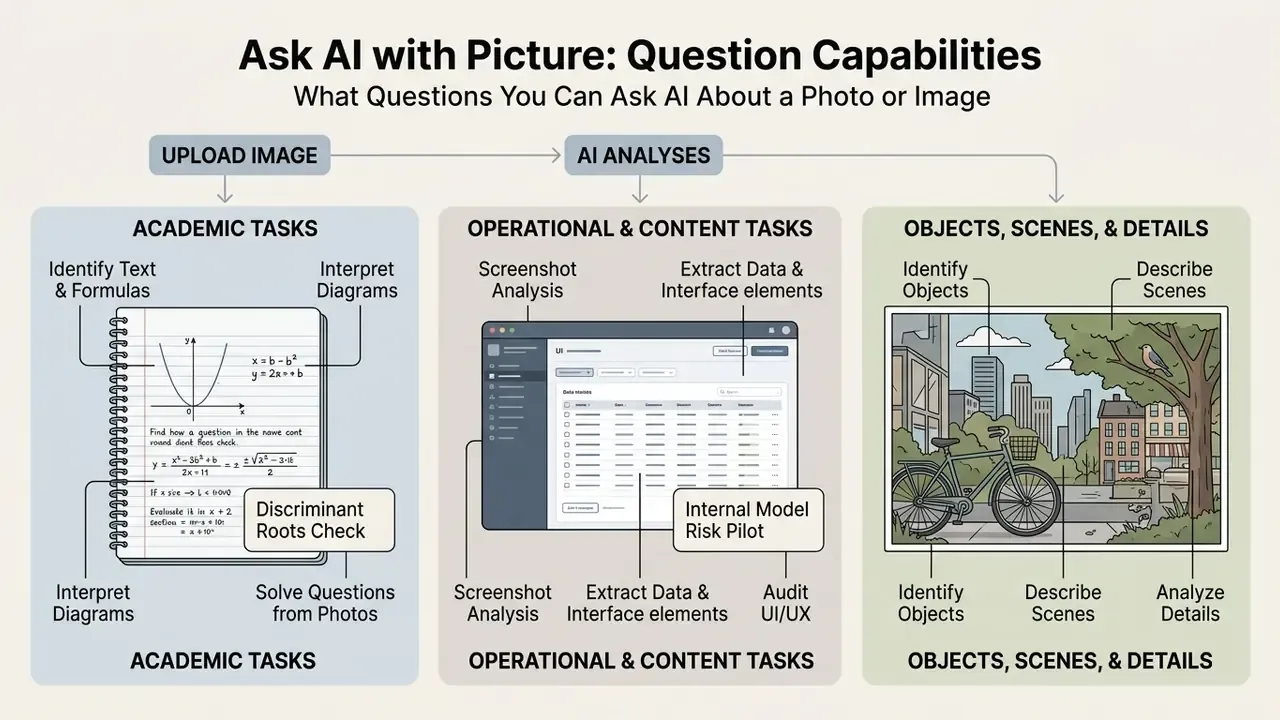
Deploying ai ask questions with images capabilities lets organizations and individual users automate visual interpretation across operational, analytical, and educational cases. The practical filter is simple: does a wrong answer cost money, or only time?
Academic Tasks: Text, Formulas, Diagrams, and Questions in a Photo
Students, analysts, and technical trainers ask ai about a photo of handwritten notes, printed exercises, and geometric diagrams to generate step-by-step explanations. Plenty of professionals do the same with a whiteboard photo after a meeting.
In specialized benchmarks such as MathVista and MATH-Vision, domain-tuned multimodal models outperform general assistants:
«MathCoder-VL-8B reaches 73.6% on the MathVista GPS subset, exceeding GPT-4o by 8.9% and Claude 3.5 Sonnet by 9.2% on geometry problem solving.»
The dominant failure mode is not arithmetic. It is perception.
«Diagram misinterpretation accounts for more than half of all errors in process-level evaluation of multimodal mathematical reasoning across ten tested models.»
Cross-language visual math benchmarks confirm the ceiling: on the Kangaroo visual mathematics set, Gemini 2.0 Flash reaches 58.8% and GPT-4o 48.2%, with no model approaching human performance (Igualde-Sáez et al., 2026, preprint; a full arXiv identifier was not available at publication, so treat the figures as indicative pending verification).
Worked example, a formula photographed from a notebook.
Input: a handwritten note reading .
Model output in LaTeX:
When users ask ai questions about images containing mathematical notation, the system:
- transcribes handwritten variables and equations into clean LaTeX markup;
- solves multi-step algebraic problems while documenting intermediate logical steps;
- explains geometric theorems illustrated in textbook diagrams.
Readers evaluating adjacent visual tooling can review our comparison of the best AI image generators for quality and control parameters.
Operational and Content Tasks: Screenshot Analysis, Data, and Interface Audit
Enterprise analysts rely on ask ai using picture workflows to pull data from financial tables, audit application interfaces, reconcile multi-page statements, and generate metadata for digital asset management. Published research supports the pattern: dashboard usability inspection (heuristic evaluation, cognitive walkthrough, action analysis) and screenshot-based GUI testing with computer vision are both documented practice in 2023 to 2026 literature.
Finance transformation teams tend to reach here first. Accounts payable exception queues, remittance advice scans, bank statement reconciliation, month-end close support: each one is a pile of images that a human currently reads at 40 to 60 seconds per page.
Case example (illustrative internal model risk pilot, unverified externally). A bank compliance team used automated vision prompts to review 1,200 scanned loan applicant IDs and financial statements. The vision model extracted tabular figures and flagged document tampering indicators with 94% alignment against manual audit baselines, cutting initial triage from 45 minutes to under two minutes per file. This is a hypothetical internal pilot figure, not published or independently audited. Treat it as directional, not as a benchmark, and do not use it to size a business case.
Teams managing large visual asset libraries alongside these workflows can review capability baselines for AI photo editors and downstream processing tools.
Questions About Objects, Scenes, and Details in an Image
Users frequently ask ai about picture elements to identify physical assets, equipment models, product SKUs, or architectural and interior features captured in field photos. Analysts who ask ai questions with pictures of collateral rather than typing descriptions of it usually get cleaner structured output, simply because nothing was lost in translation.
Vision-language models use large-scale pre-trained visual embeddings to map regional image patches to semantic knowledge bases. A user can ask ai for pictures classification to determine the make and model of machinery from a factory-floor photograph, verify collateral condition in an asset-backed lending file, or assess interior finish quality in a real estate listing. For transformation and stylization of existing visual assets, see our overview of AI image generators that work from an image.
Maturity varies by domain. Plant and product recognition have strong dataset and benchmark support (CNN-based leaf recognition above 97% on standard datasets), while architectural style and interior-element recognition remain research-grade rather than standardized. Do not build a valuation control on the second category yet.
What Determines the Accuracy of an AI Answer About an Image
The accuracy of an ai answer derived from visual input is governed by four things: input quality, model alignment, prompt structure, and the model's own hallucination boundary.
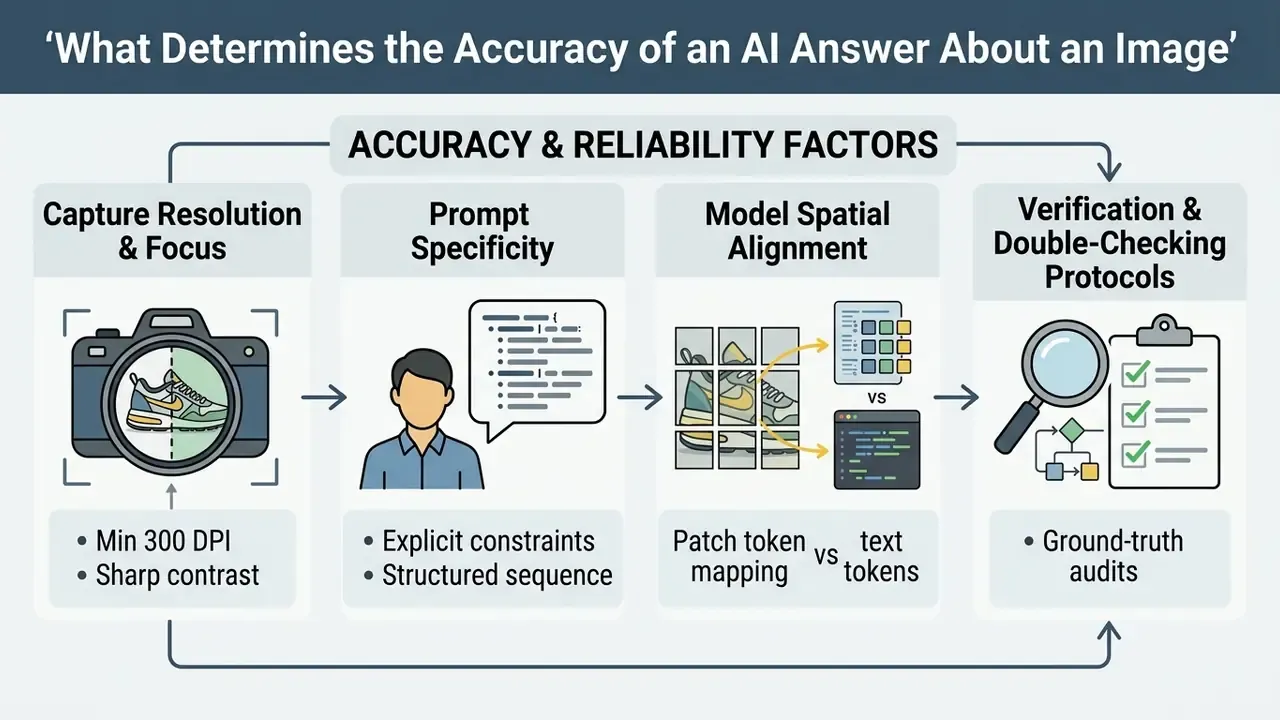
Photo Quality, Lighting, and Text Legibility
Recognition degrades when input media carries compression artifacts, low spatial resolution, lens distortion, or harsh shadows. Structured retrieval closes part of the gap:
«A scene-graph-based RAG framework consistently outperforms baseline MLLMs on object recognition, localization, and counting in aerial and first-person imagery.»
Standardized NIST evaluations on OCR accuracy show character recognition error rates spiking once document sampling drops below 300 DPI or perspective tilt exceeds 10 degrees (NIST, 2024). When an ask ai pic payload is blurry or unevenly lit, vision encoders misread digits (confusing "8" with "3" is the classic), and every downstream calculation inherits the error.
Pre-processing helps more than prompt engineering here. Orientation classification, geometric distortion correction, denoising, cropping, alignment correction, and binarization are standard steps before model input. Practical remediation paths include AI image enhancement tools for contrast and noise recovery, plus AI image upscalers for lifting scans toward the 300 DPI threshold. One caution: upscaling restores legibility for a human reader without adding information the sensor never captured.
Question Context and Verification of the Returned Answer
A precise ask ai picture prompt must supply domain context, otherwise the language model fills visual gaps with probabilistic assumptions.
«Multimodal LLMs exhibit systematic visual hallucination, frequently reporting objects that are not present when prompts are leading or underspecified.»
«VHTest exposes high hallucination rates in GPT-4V, LLaVA-1.5, and MiniGPT-v2 across eight modes, including orientation, OCR symbols, and relative object size.» Huang et al., VHTest (2024). https://arxiv.org/abs/2406.09411
Confidence signals cannot be taken at face value:
«Vision-language models show high calibration error and remain overconfident in the majority of cases, especially on visually ambiguous scenes.»
Fact Check and Verification Protocol:
Domain evidence for why autonomy must stay bounded:
«GPT-4V records a macro-average F1 of just 6.8% in gastroenterology and 6.2% top-1 diagnostic accuracy in dermatology, ruling out autonomous clinical use.»
Medicine is not banking, granted. The transferable lesson is about the shape of the failure: strong general fluency, weak narrow-domain reliability, and confident phrasing throughout.
This material is general information and does not replace advice from a qualified specialist. Model outputs used in credit, compliance, clinical, or legal decisions must be validated under your institution's model risk framework.
Ask AI with Picture vs Other AI Tools
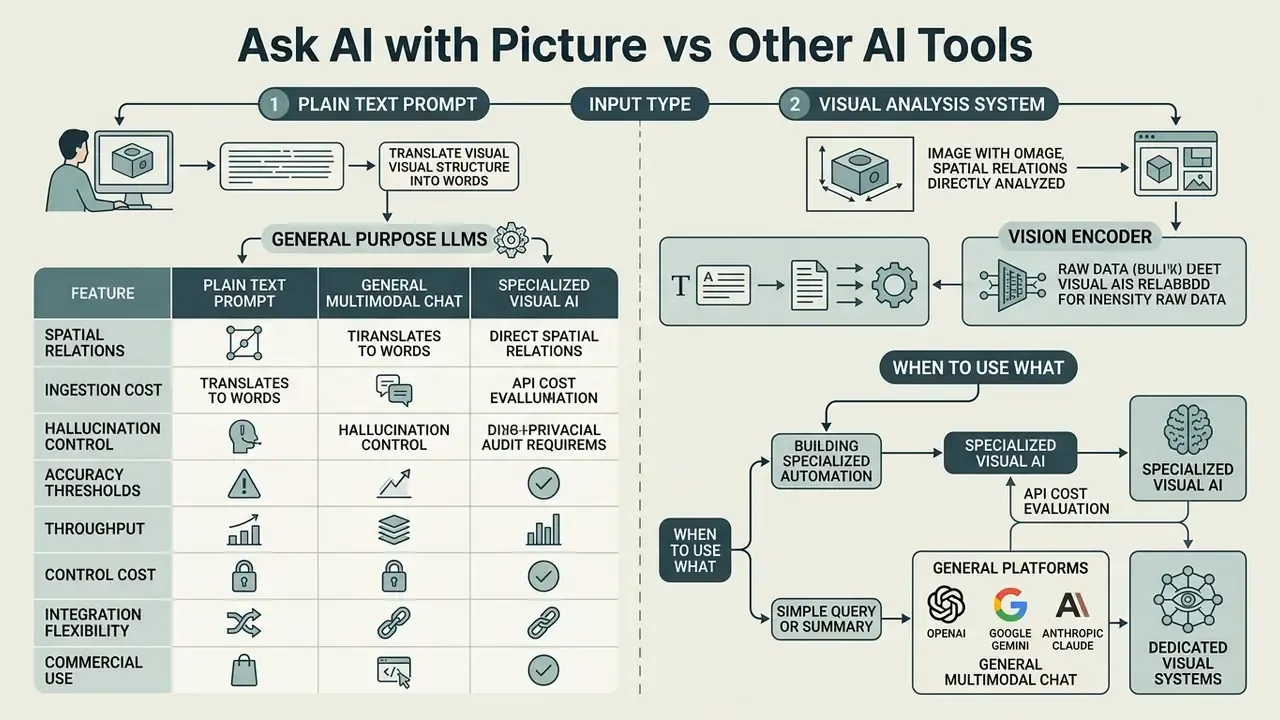
Choosing between plain text prompts, general multimodal chat, and a dedicated visual analysis system depends on workflow complexity, throughput, control cost, and integration requirements.
An Image-Based AI Question vs a Plain Text Prompt
A text-only prompt forces the user to translate visual structure into words. That introduces human transcription error and discards spatial layout entirely.
When you ask ai for images parsing instead, the vision encoder handles raw spatial relations directly. In a 2024 controlled user study, multimodal prompting achieved higher target-image similarity than text-only baselines: average Structural Similarity Index 0.648 versus 0.479. The study is cited in secondary literature and a primary identifier was not available at publication, so read the figures as direction of effect rather than a certified benchmark. Related controlled work (2022) found image prompts improved subject representation across all subject types, with the largest gain on concrete singular subjects.
Order matters too. Research on commercial multimodal LLMs reports task-dependent accuracy shifts depending on whether the image precedes or follows the text in the payload. Worth pinning in your prompt template, and worth re-testing after any model swap.
When to Use ChatGPT, Gemini, or a Specialized Tool
General platforms such as OpenAI ChatGPT-4o, Google Gemini 1.5 Pro, and Anthropic Claude 3.5 Sonnet offer broad multimodal comprehension, well suited to exploratory and everyday work. Specialized enterprise vision pipelines win on narrow, high-volume production tasks. Readers weighing platform differences can start from our ChatGPT versus alternative image tools comparison and the Midjourney versus competing generators evaluation.
Ingestion details deserve a look before procurement. ChatGPT accepts attach, paste, and drag-and-drop in the composer and supports both analysis and generation via API. Gemini's documentation recommends the File API for larger images or images reused across requests. Claude analyzes images (base64, URL, or file_id, up to 20 per chat) but neither generates nor edits them, so an ask ai image workflow that expects new assets back needs a different vendor.
| Feature / Metric | Text-Only AI Prompt | General Multimodal Chat (ChatGPT / Gemini / Claude) | Specialized Visual AI Pipeline |
|---|---|---|---|
| Input Format | Text strings only | Images (PNG/JPEG/WebP/HEIC/PDF) plus text, URL or base64 | High-resolution image/video streams, batch queues |
| OCR & Data Extraction | Manual entry required | High accuracy on legible text | Optimized for dense or handwritten tables |
| Context Window Size | Standard text context | Up to 1M+ tokens (Gemini 1.5 Pro) | Domain-specific token budgets |
| Spatial Reasoning | None | Moderate (approximate boundaries) | High (exact pixel and bounding box metrics) |
| Processing Throughput | Very fast | Standard chat latency | Batch processing, API optimized |
| Hidden Control Costs | Low | Human-in-the-loop review, prompt QA, re-runs on ambiguity | Validation harness, drift monitoring, annotation labor |
| Vendor Lock-In Risk | Low | Moderate to high (model deprecation, prompt portability) | Moderate (schema and pipeline coupling) |
| Auditability | Prompt logs only | Chat export, limited coordinate evidence | Full logs: hash, coordinates, model version, confidence |
| Commercial Licensing | Plan dependent | Standard platform terms | Enterprise SLA and IP indemnity |
Comparison of visual question answering approaches across enterprise operational parameters. The two rows that usually decide a procurement are Hidden Control Costs and Auditability, not accuracy.
The specialization premium is measurable rather than rhetorical:
«Domain-tuned models such as MathCoder-VL outperform GPT-4o by 8.9% on geometry problem solving, showing the advantage of task-specific training over general-purpose systems.»
For teams building specialized automation, evaluating API cost structures via AI Media API Guides and comparing platform capabilities through AI Media Comparison Matrices keeps scaling predictable. Enterprise users considering dedicated commercial deployments should review our AI Media Commercial-Use Hub for licensing and compliance guidance.
Privacy, PII, and Regulatory Exposure When Uploading Photos
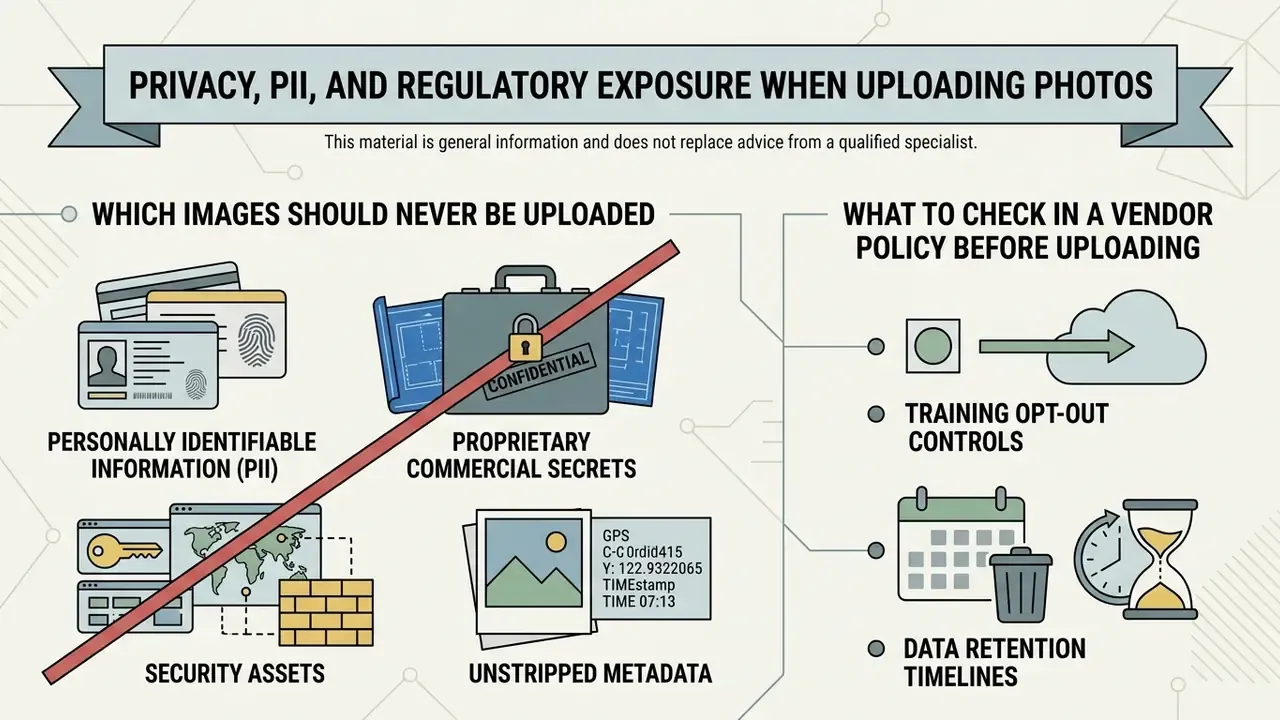
This material is general information and does not replace advice from a qualified specialist. Validate all data-handling decisions with privacy counsel and your compliance function.
Sending media files to an external cloud environment creates privacy, compliance, and regulatory exposure that needs systematic oversight. Regulator guidance is explicit: where an AI system generates or infers personal information, including from images, that constitutes a collection of personal information subject to privacy obligations (OAIC guidance, 21 October 2024, APP 3).
Shadow AI lives here, incidentally. An analyst photographing a statement page on a personal phone and pasting it into a consumer chat is the most common uncontrolled path into a regulated data set.
Which Images Should Never Be Uploaded
Organizations must prohibit staff from uploading sensitive media to unvetted public visual AI services. Never submit:
- Personally Identifiable Information (PII) unredacted photos of passports, driver's licenses, national ID or social security cards, bank cards, signatures, or medical records.
- Proprietary Commercial Secrets screenshots of unannounced product schematics, internal balance sheets, pricing models, contract terms, or customer databases.
- Security Assets images showing access badges, server room layouts, network credentials, API keys, tokens, private keys, or QR access codes.
- Unstripped Metadata any file whose EXIF payload still carries GPS coordinates, device serials, or capture timestamps that leak location or staffing patterns.
Where creative or consumer-grade media tooling touches the same perimeter, for example AI image generators evaluated for commercial use, risk owners must enforce the same data boundary instead of trusting the tool category.
What to Check in a Vendor Policy Before Uploading
Before authorizing an ask ai about picture tool for organizational use, privacy officers should test vendor documentation against APP 3 (Australian OAIC guidance, 2024), GDPR, CCPA/CPRA, and, for U.S. banking institutions, model risk expectations under SR 11-7 (Federal Reserve) and OCC Bulletin 2011-12, plus FFIEC examination guidance.
Key governance checkpoints:
- Training Opt-Out Controls confirm whether uploaded image payloads are retained to train public foundation models. OpenAI's service terms state models can accept images and video as inputs, and prohibit using visual capabilities to identify a person or infer sensitive attributes.
- Data Retention Timelines verify whether uploaded files are purged at session end, held for a defined window (commonly 24 hours to 30 days), or stored indefinitely.
- Encryption Standards ensure images are encrypted in transit (TLS 1.3) and at rest (AES-256).
- Third-Party Processing Terms audit whether visual inputs move to secondary sub-processors, and in which jurisdictions.
- Deletion Mechanism confirm an operative deletion path (account setting or written request) with a stated deadline, and confirm it covers derived embeddings, not only source files.
- Publicity Clause Review OpenAI's terms note that publicly sharing an image grants rights to reproduce, distribute, modify, display, and perform it for operating and promoting the services. That is a material clause for brand and confidential assets.
Point 5 is the one most often waved through. Deleting a JPEG while the embedding survives is not deletion in any sense a regulator will accept.
Audit Evidence: Logging a Visual AI Interaction
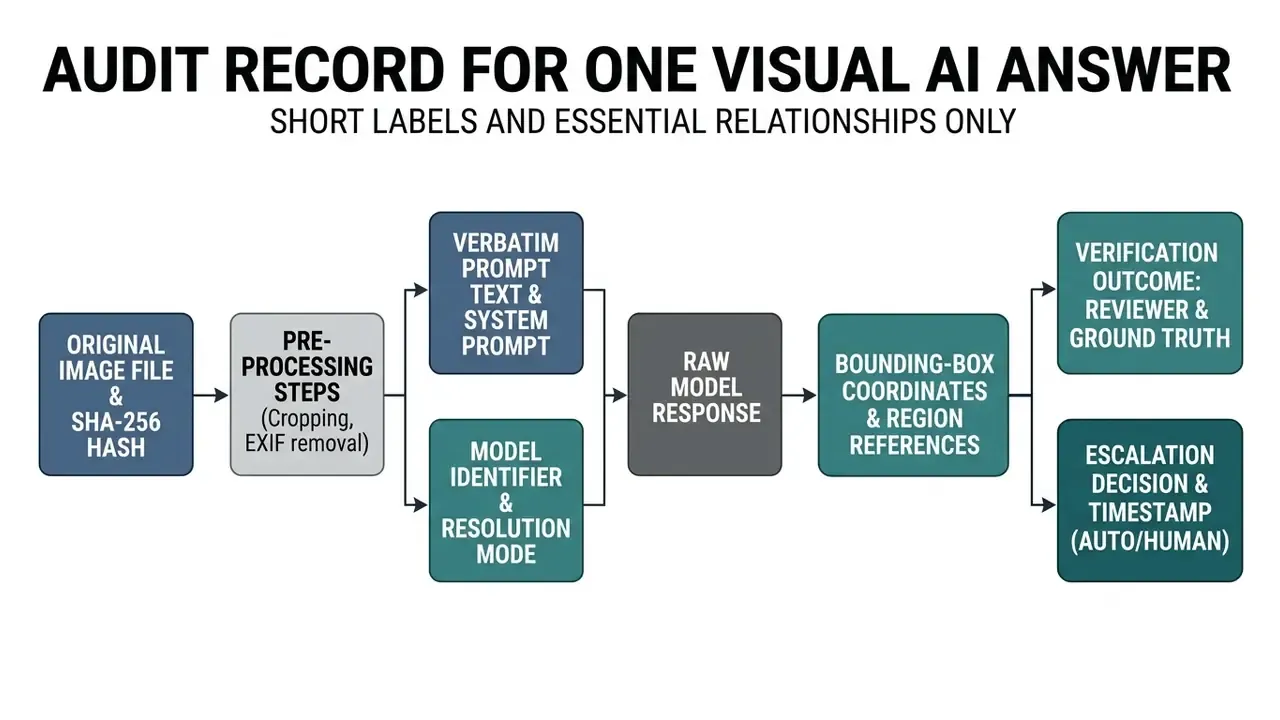
Three operating rules make this workable at volume. First, log the model snapshot, not the product name; a silent upgrade invalidates prior validation evidence. Second, store the hash of the source image, so an auditor can prove the artifact reviewed is the artifact processed. Third, define a deterministic escalation threshold in advance (any UNREADABLE token, any value above a monetary limit, any tampering observation routes to human review), so exception handling stays a policy rather than a judgment call made under deadline.
Measurable Impact, and Where the Numbers Get Soft
Executives will ask for ROI. Give them the full equation, not the flattering half of it.
Gross benefit is straightforward to model: pages per month, minutes saved per page, blended reviewer cost, error-rate delta against the manual baseline. The part that gets omitted is the control stack: prompt QA, the golden test set, human review on escalated exceptions, drift monitoring, re-validation after each model version change, and the cost of a wrong answer that reached a customer.
A workable rule of thumb from model risk practice: if the control cost is not at least a visible line item in the business case, the business case is incomplete rather than strong. Residual risk should also be stated as a number, even a rough one, so the approving committee is accepting something specific instead of a vibe.
Unresolved questions, stated plainly. Calibration remains unreliable, so confidence scores cannot yet drive automated routing. Bounding-box fidelity varies by model and detail mode, and there is no cross-vendor standard for it. Long-run drift on visual tasks is under-measured compared with tabular credit models. None of that blocks deployment. All of it belongs in the limitations section of your validation memo.
Free Access, Limits, Latency Cost, and Commercial Use
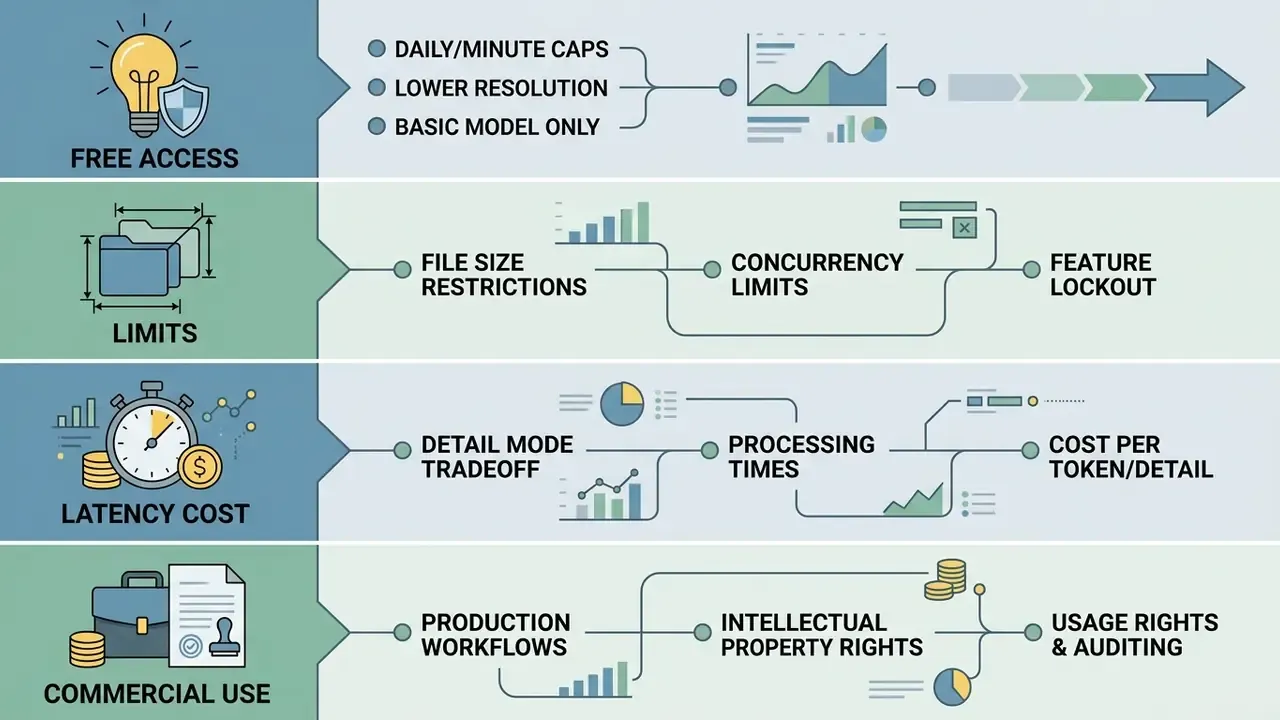
Pricing, latency budgets, and intellectual property rights all shift when a visual AI tool moves from pilot to production workflow.
What Is Typically Available on a Free Tier
Most platforms offer an entry tier with operational constraints. Teams that start with an ask ai free allowance can review free AI image tools that require no sign-up alongside our ranking of the best free AI image generators to see where the limits bite first.
Free access typically includes:
One practical warning. A free tier is fine for feasibility testing and useless for validation evidence, because rate limits and undocumented model routing make results hard to reproduce.
Latency and Token Cost by Detail Mode
Image detail is a cost and latency dial, not a quality toggle. Google's Gemini API sets maximum tokens per image via media_resolution: LOW = 280 tokens, MEDIUM = 560, HIGH = 1120, ULTRA_HIGH = 2240. OpenAI's detail=low renders a 512×512 image, detail=high fits within 2048×2048 (roughly 2,500 patches), and image inputs can reach 30,000 patches.
The operational implication: a document-triage pipeline running high detail on every page can consume four to eight times the image tokens of a low-detail pass, with proportional latency growth. The efficient pattern is a two-pass architecture. Cheap low-detail classification routes the page; high detail or original mode runs only where digits, small print, or bounding-box precision decide the outcome.
Users modeling deployment costs across tiers can use our AI Media Calculators to estimate API consumption. Detail on subscription structures sits on the dedicated pricing analysis page.
Can AI Answers and Images Be Used Commercially
Commercial rights for visual AI output depend on platform terms and on evolving legal precedent for machine-generated content.
«Purely AI-generated material lacking human authorship cannot be registered for copyright protection.»
UK consultation material adds the mirror-image risk: AI model output may infringe copyright where it reproduces a substantial part of a protected work (UK Government, Copyright and AI Consultation, 2024/2025).
Commercial teams should read platform licenses directly. OpenAI's terms assign its rights in output to the user. Google Cloud's service-specific terms state that generated output is Customer Data and that Google asserts no ownership in new IP in that output, subject to a restriction on developing competing services. Some regional providers go the other way: a freemium tier permits personal non-commercial use only, while granting the provider a broad license over generated content. Read before you publish.
Organizations running creative media workflows, including outpainting via an ai photo generator or any ask ai photo generator that produces new assets rather than reading existing ones, must verify commercial clearance terms, and should check provenance of inbound visual material with AI image detectors before republication. For ongoing tracking of legal precedent, consult our index on AI Litigation and Case Timelines. For platform-specific questions, reach out through technical support channels.
FAQ
Can I save and export multimodal chat histories containing uploaded images?
Yes. Google Chat exports include messages plus attachments from direct messages, group messages, and spaces. Microsoft Teams data-export requests can include chat history and media, delivered as a ZIP archive of HTML and media folders. Telegram Desktop supports batch export filtered by type, maximum file size, and date range. If you need to retain ask ai images threads as records, treat the export as a copy, not as the system of record.
Where is my visual chat history actually stored, in the browser or the cloud?
It depends on the tool class. Privacy-oriented browser utilities keep session history locally in IndexedDB or LocalStorage, so nothing leaves the device and clearing site data destroys the record. Cloud platforms (ChatGPT, Gemini, Claude) persist history server-side and expose export as .zip archives containing structured files such as chat.json plus attached media. For audit purposes, local-only storage is a liability rather than a feature. Mirror the record into your own logging system.
How does batch processing work when I need to ask AI questions about multiple images at once?
Batch evaluation means submitting an array of base64 strings or S3 image URIs inside a single API request payload. High-capacity models such as Gemini 1.5 Pro and GPT-4o accept multiple visual items in one prompt turn, which enables cross-image comparison, multi-page document reconciliation, and trend analysis across sequential screenshots. Claude accepts up to 20 images per chat turn. When you send ask ai pictures in bulk, number them explicitly in the prompt so the answer can be traced back to a specific file.
What should I do if the AI misinterprets text or details in an uploaded image?
Crop the file to the target region, raise contrast, increase the detail or resolution mode, and name exact spatial coordinates in the prompt ("focus on the top-right quadrant"). Ask the model to transcribe before it answers, so you can see what it actually read. Re-submitting with explicit formatting rules and an UNREADABLE fallback removes most background noise.
Do HEIC/HEIF photos from an iPhone work, and can I pass an image URL instead of a file?
Most current services accept HEIC/HEIF alongside JPG, PNG, WebP, and BMP, and support direct image URLs as an input path. Where a legacy endpoint rejects HEIC, convert to PNG or JPEG first, then re-check DPI after conversion, since some converters downsample quietly.
Should I strip EXIF metadata before uploading?
Yes, for any file leaving your perimeter. EXIF can carry GPS coordinates, device identifiers, and capture timestamps that expose site locations, staffing patterns, or customer addresses. Strip metadata in pre-processing, and log that stripping occurred as part of the audit record.
What audit logs does a regulator or internal auditor expect for visual AI decisions?
At minimum: the immutable source image plus its hash, the verbatim prompt, the model identifier and snapshot version, the detail or resolution mode, the unedited response, the region or bounding box cited, the human reviewer's verification outcome, and the escalation decision with a timestamp. Without model version and image hash, the result is not reproducible, and therefore not evidence.
How do I limit vendor lock-in on a visual AI pipeline?
Keep prompts in a version-controlled repository separate from vendor SDKs. Define output schemas (JSON, CSV) that are model-agnostic. Maintain a golden test set of images with known ground truth to re-validate any model swap. Confirm contractually that model deprecation triggers advance notice. Budget explicitly for control costs, since validation harness, human review, and drift monitoring, not per-token pricing, tend to dominate total cost of ownership.
How do I verify whether a visual AI vendor is credible for regulated use?
Require documented answers on retention, training opt-out, sub-processors, encryption, deletion SLA, and jurisdiction. Require a model card with version history. Require evidence of independent security attestation. As a worked negative example: the domain hypeart.ai does not resolve through public DNS as of August 2026, and its operational credentials, pricing, and compliance certifications remain unverified. A vendor you cannot resolve, let alone attest, cannot be placed inside a model risk framework. Apply the same test to any name that reaches a procurement shortlist without primary documentation.
Additional Glossary and Resource Navigation
For broader reference on visual editing capabilities, enterprise asset management, and platform specifications, consult our central knowledge base:
- Explore core terminology in the main glossary hub.
- Compare specialized media transformation engines including a video compressor, an animation maker, or an ai voice generator.
- Review utility parameters for tools such as a free photo editor or an ai headshot generator.
- Access developer integration steps via the Google Veo AI video generator guide.
- Compare visual engine performance using matrices for the best AI art generator, best free AI art generator, best free AI video generator, or dedicated evaluations such as ChatGPT picture generator versus alternatives and the Midjourney AI image generator comparison.
- Examine commercial integration guides for Bing AI image generator, AI expand image outpainting, Canva AI generator, Microsoft AI image generator, Google AI image generator, AI reverse image search, Ghibli AI image generator, and publishing workflows such as the YouTube video editor guide.
Appendix A: Revision Log and Superseded Claims
Retained for transparency. The following statements appeared in earlier versions of this article and have been superseded by sourced or caveated formulations in the body text above.
- "Guidelines from NIST IR 8485 indicate that automated visual systems experience significant error rates when processing uncalibrated or cluttered background visual vectors (NIST, 2023)." Superseded by the quoted NIST IR 8485 formulation with DOI, plus the 300 DPI and 10-degree thresholds from NIST OCR evaluations.
- "Research on multimodal dialogue clarification (Yuan et al., arXiv, 2024) demonstrates that a three-step refinement loop … significantly reduces multi-turn error propagation." Superseded by the quoted Yuan et al. (2024) formulation with a resolvable URL, plus the MMRefine (2025) single-fault refinement rule.
- "Fine-tuned multimodal models such as MathCoder-VL achieve over 73% accuracy on geometry and symbol-parsing subsets (Wang et al., 2024)." Superseded by the specific MathVista GPS figure (73.6%) and comparative deltas against GPT-4o and Claude 3.5 Sonnet, with arXiv identifier.
- "Evaluating models on the HallusionBench benchmark (CVPR 2024) reveals that multimodal LLMs exhibit systematic visual hallucination." Superseded by the quoted HallusionBench formulation with arXiv identifier and the VHTest failure-mode breakdown.
- "Research on uncertainty calibration (JUS Dataset, 2024) shows vision models remain overconfident even when delivering incorrect visual interpretations." Retained with an explicit verification-pending note; no primary identifier or Net Calibration Error values were available at publication.
- "Benchmark tests … show that multimodal prompting yields significantly higher target alignment (average Structural Similarity Index of 0.648 vs 0.479 for text-only baselines, according to controlled multimodal prompt studies)." Retained with an explicit verification-pending note; the figures come from a 2024 user study cited in secondary literature without a resolvable primary identifier.
- The internal loan-file pilot figures (94% alignment, 45 minutes to under two minutes) are labeled hypothetical and illustrative. They are not audited results and must not be used to size a business case.
- Consumer-entertainment tool references (hairstyle, lyric-video, and NSFW generators) present in earlier drafts were removed as out of scope for an operational and governance audience, and replaced with domain-relevant resources: OCR and image-to-text comparison, image enhancement and upscaling, AI image detection, and commercial-use licensing guidance.