An ai voice generator hindi text to speech platform converts written Devanagari or Romanized text into natural synthetic speech using deep neural networks. Modern systems support natural male, female, and expressive hindi voices for corporate videos, localized media, e-learning, automated support systems, and regulated customer communications.
Last updated: 2026. Reviewed for factual accuracy against vendor terms of service, published research, and Indian public-sector documentation.
Executive Summary for Risk, Compliance and Content Leaders
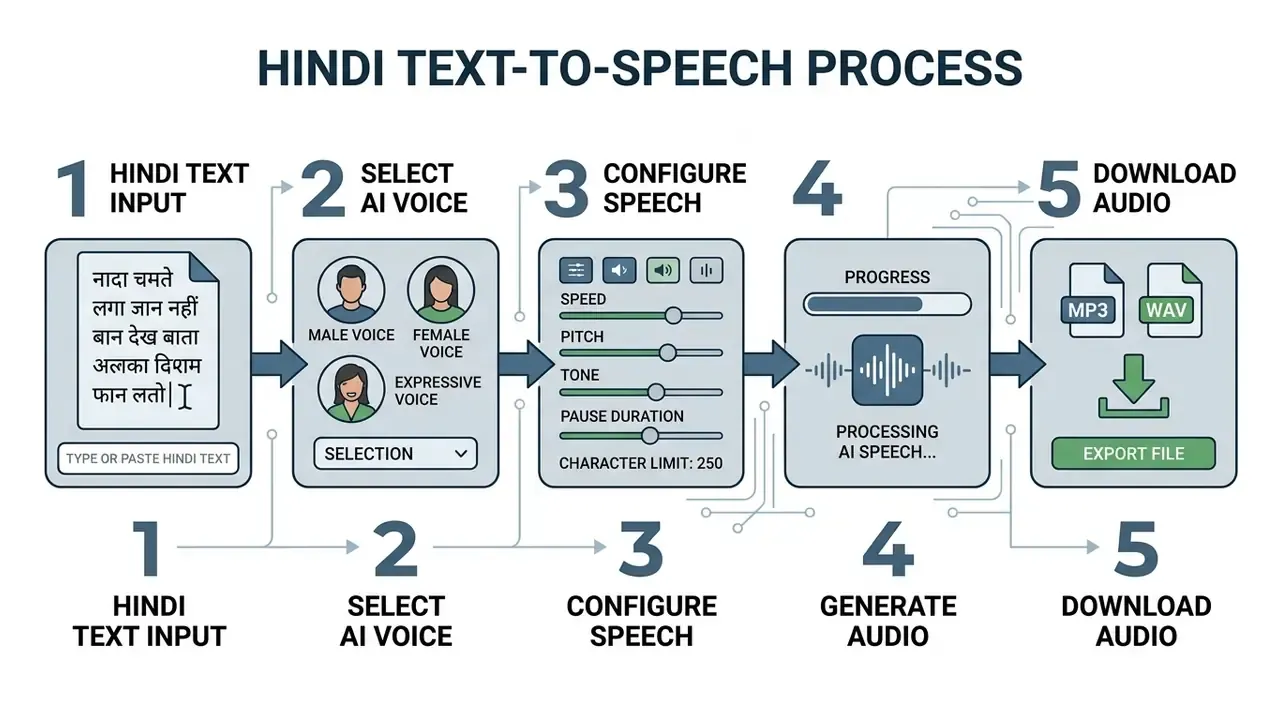
- What the technology is Neural Hindi TTS runs a four-stage pipeline. Text normalization, grapheme-to-phoneme (G2P) conversion, prosody modeling, then neural vocoder synthesis. Quality depends less on marketing labels and more on how the engine handles Devanagari conjuncts, schwa deletion, and Hinglish code-switching.
- Where quality stands in 2026 Leading Indic models reach MUSHRA 81.7 versus 89.7 for recorded human speech, and long-form Hindi audiobook synthesis reaches MOS 4.00. Good enough for narration and IVR, but not yet indistinguishable from a studio voice actor.
- The biggest operational risk is not audio quality. It is Shadow AI. Employees pasting confidential scripts (customer names, account numbers, collection notices, unreleased regulatory language) into free browser TTS tools create data-leakage exposure that no audio QA process will catch.
- Licensing is binary, not gradual. Free tiers on most major platforms are explicitly non-commercial; paid tiers grant commercial rights. Voice cloning always requires documented consent from the voice owner.
- Minimum enterprise controls contractual Zero Data Retention (ZDR) and no-train clauses, SOC 2 Type II or ISO 27001 evidence, encryption in transit and at rest, RBAC on the generation console, immutable logging of prompts and rendered audio, and a Word Error Rate (WER) or Character Error Rate (CER) validation gate before any customer-facing deployment.
- Practical limits to plan around 3,000 to 15,000 characters per generation session on most web interfaces, exports in MP3, WAV or M4A, and 10-second preview samples for pronunciation testing before credits are consumed.
On this page: what an AI Hindi voice generator is, what drives Hindi speech quality, how to choose female, male and expressive voices, how to generate a Hindi voiceover online, governance, security and licensing, production use cases, the FAQ, and Appendix A with revision notes.
What Is an AI Voice Generator for Hindi Text to Speech?
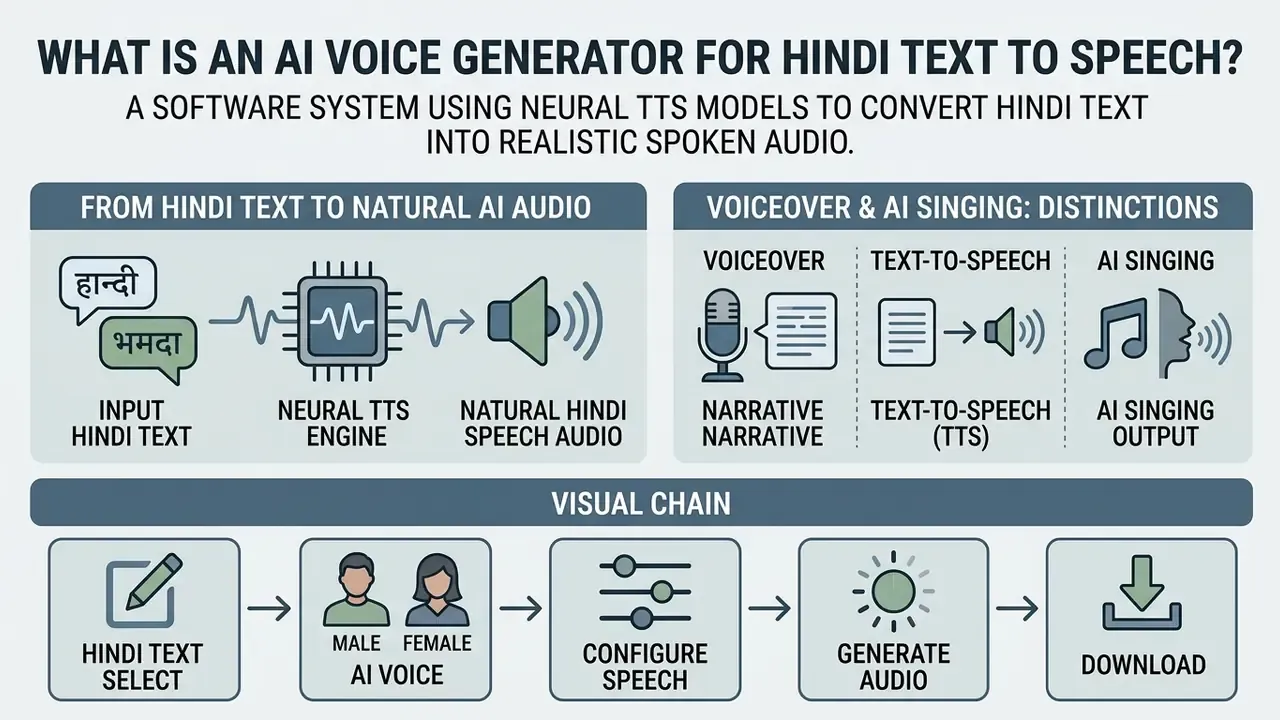
An ai hindi voice generator is a software system powered by neural text-to-speech (TTS) models that convert hindi text into realistic, spoken speech hindi audio. For a broader technology overview covering voice quality, language coverage, pricing and licensing across vendors, see our guide to AI voice generators. These platforms use advanced deep learning architectures, such as latent diffusion models, transformer encoders, and neural vocoders, to analyze Devanagari script and synthesize human-like pitch, timing, and cadence. Organizations deploy an ai voice generator hindi text to speech tool to automate audio creation for localized media, educational modules, and interactive voice response (IVR) systems.
From Hindi Text to Natural AI Audio
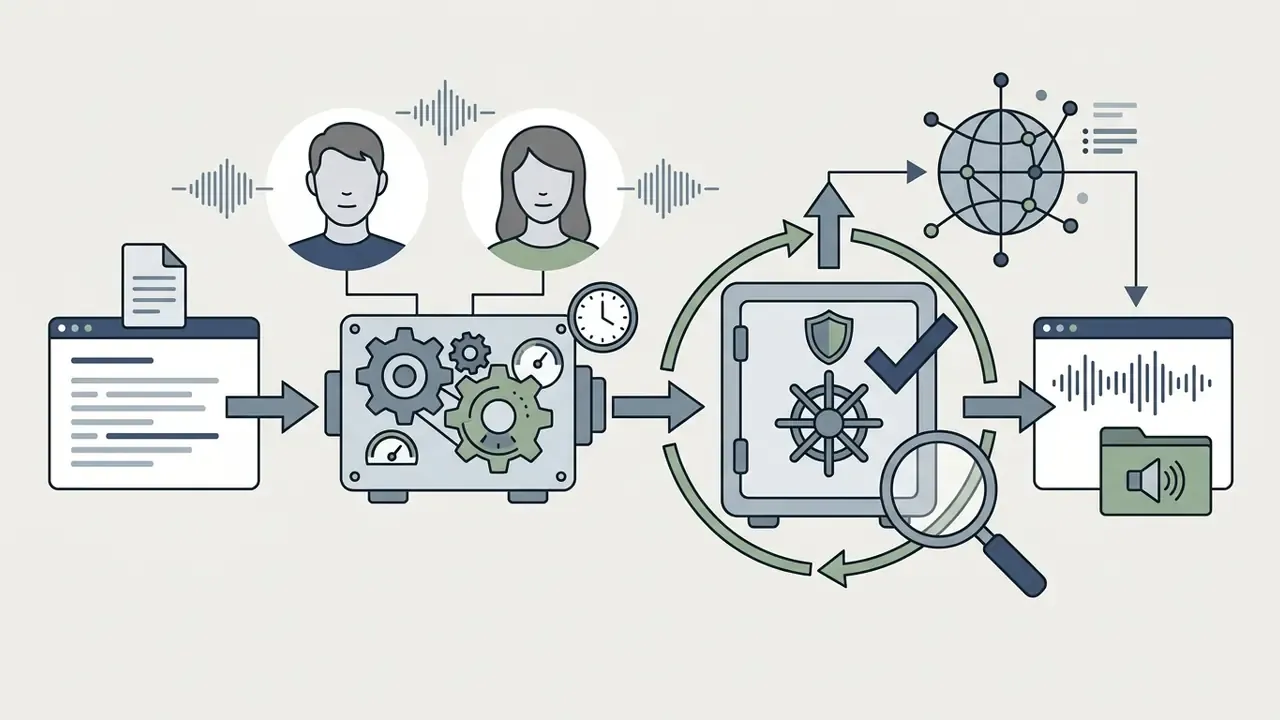
Converting typed hindi text into natural audio involves a structured multi-stage neural pipeline. The system first normalizes raw text by expanding numbers, dates, years, times, acronyms, and abbreviations into full spoken words. It also has to handle complex Devanagari orthography: conjuncts (संयुक्त अक्षर), matras, nukta, and chandrabindu. Next, a grapheme-to-phoneme (G2P) module or acoustic encoder maps text tokens into phonetic representations and prosodic frames. Finally, a neural vocoder synthesizes those frames into high-fidelity speech in the target hindi language. Recent research on diffusion-based models, such as BharatGen's A2TTS-v0.5 and AI4Bharat's IndicParlerTTS, shows that neural architectures can achieve high speaker fidelity and prosodic accuracy across Indian languages (A2TTS Paper, 2025).
«IndicParlerTTS reaches an average MUSHRA score of 81.7 for expressive speakers, compared with 89.7 for recorded human speech.»
That gap of roughly eight MUSHRA points is the practical reason regulated teams still keep a human review step. Synthetic Hindi is close to natural, but not identical, and residual errors cluster around proper nouns, financial amounts, and English loanwords. Worth remembering before anyone promises a fully unattended pipeline.
Deployment economics have also improved. Compact distilled models now make browser-scale and on-premise inference realistic without datacenter GPUs, which matters for organizations that cannot send text to a public endpoint at all.
Hindi Text to Speech, Voiceover and AI Singing: What Is the Difference?
Standard text to speech focuses on reading written copy clearly. Professional voiceover and AI singing add control layers over emotion, pacing, and musical alignment. Standard TTS converts plain text or SSML into clear speech for screen readers and basic navigation. An ai hindi voiceover generator offers document-level pacing, expressive style modulation, and document import designed for long-form video narration, matching a script to an existing scene, slide, or performance. An ai singing voice generator hindi pipeline, by contrast, accepts lyrics alongside musical pitch contours, tempo, note duration, and score constraints to produce an ai voice generator hindi song vocal track rather than spoken narration (LAPS-Diff Study, 2024). Vocal range and genre configuration. When configuring an ai singing voice generator hindi model for music production (Bollywood playback, Indian pop, or folk), acoustic models operate across defined pitch bands rather than an unlimited range. Dynamic Hindi male vocal models typically perform best within the F3 to C#5 frequency band. That corresponds to a medium tenor or baritone register and preserves natural timbre without robotic aliasing during pitch shifting. Production suites let creators transpose input stems up or down directly in the browser before conversion, so a demo recorded outside the model's comfortable range can still be matched to it. Responsible vendors also state that their singing models are trained with vocalist consent and compensation under Fairly Trained style standards, and that cleared output is royalty-free for commercial release. That distinction matters far more than raw audio quality once music is distributed on streaming platforms.
| Capability | Standard Hindi TTS | AI Hindi Voiceover | AI Hindi Singing |
|---|---|---|---|
| Input | Plain text / SSML | Script, DOCX, PDF, PPTX notes | Lyrics + melody / audio stem |
| Primary control | Rate, pitch, volume | Pacing, emphasis, emotion, pauses | Pitch contour, tempo, note duration |
| Typical output | Short utterances, IVR prompts | Long-form narration, video tracks | Sung vocal track (F3 to C#5 for male pop models) |
| Consent requirement | Cloning only | Cloning only | Vocalist consent for trained voice models |
What Affects Hindi Text-to-Speech Quality and Naturalness?
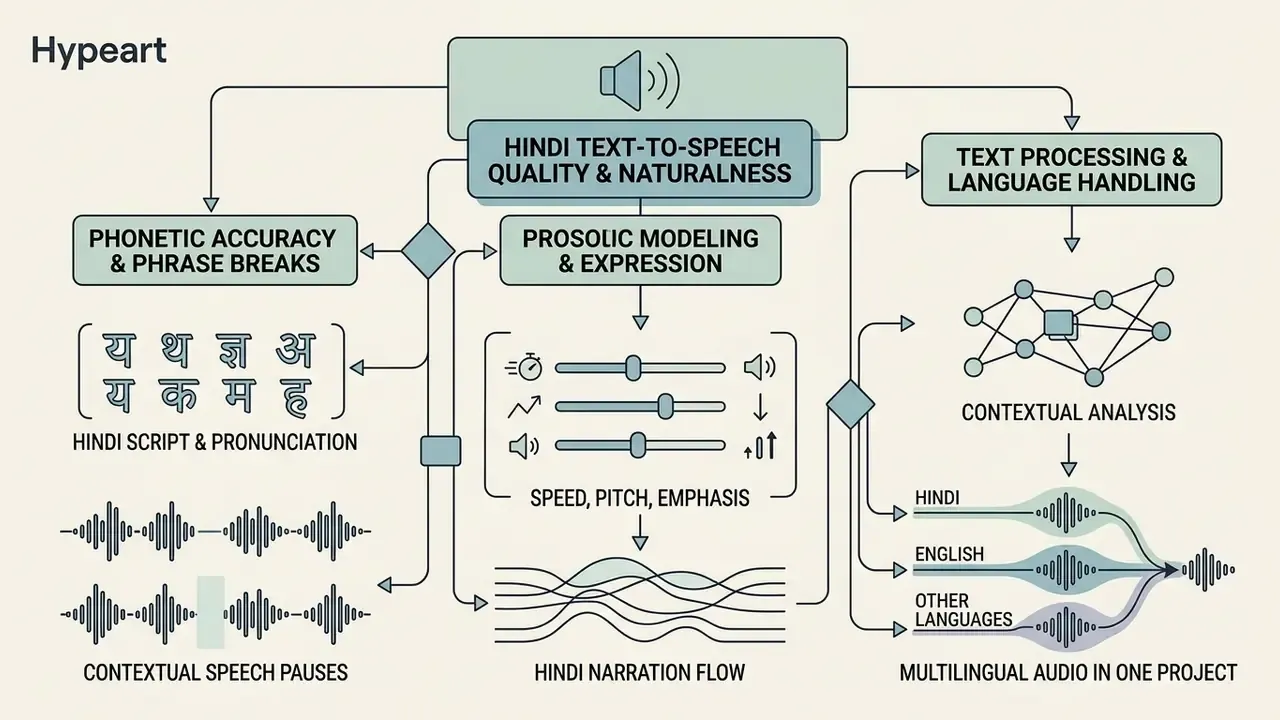
The realism of an ai voice generator hindi language model depends on phonetic accuracy, prosodic modeling, and contextual text processing. Hindi carries subtle phonetic contrasts, including dental versus retroflex consonants, aspirated versus unaspirated stops, and contextual nasalization. Each one needs careful neural handling to sound authentic.
The practical takeaway for anyone building a vendor scorecard: do not accept a single MUSHRA or MOS figure at face value. Ask which listeners were recruited, whether the human anchor was included, and whether test sentences contained the numerals, names, and code-switched terms your own scripts contain. One number, stripped of method, tells you almost nothing.
Hindi Script, Pronunciation and Contextual Speech
Accurate pronunciation in Hindi requires correct handling of Devanagari orthography, schwa deletion rules, and context-dependent characters such as anusvara (ं) and chandrabindu (ँ). Schwa deletion, where an inherent vowel is dropped in specific phonetic environments, is essential for natural-sounding speech; failing to apply it produces robotic, syllable-by-syllable delivery (BIS Hindi-Devanagari Standard, 2024). Official Devanagari script-behaviour guidance for Hindi also specifies that superscript nasal signs must attach unambiguously, bindu for anunasika and chandrabindu for anuswara, precisely because the nasal contrast is context-dependent and easily mis-normalized by automated pipelines. Anusvara before a stop consonant frequently surfaces as a homorganic nasal, which means letter-to-sound mapping cannot be fixed and must be resolved from surrounding context. Modern neural models therefore process context across full sentences to disambiguate homographs and apply the right phonetic realization.
Pauses, Speed, Pitch and Emphasis in Hindi Narration
Prosody, meaning the rhythm, stress, and intonation of speech, dictates how natural a synthetic voice sounds to native listeners. Updated: research on Hindi narrative speech and on focus marking in Hindi indicates that phrase-boundary and focus perception rely on a combination of fundamental frequency (F0) contours, syllable and word duration, intensity variation, and pause placement, with a phrase break typically following the focused element. Hindi has comparatively weak lexical stress, so perceived prominence is carried mainly at phrase level rather than by word stress. Inserting appropriate pauses and adjusting speaking rate keeps synthetic audio from sounding rushed, which improves listener comprehension during long-form audiobooks or educational lectures.
«Transfer learning when adapting TTS models to new languages raises mean MOS by 1.53 points and recognition accuracy by 37.5% compared with training from scratch.»
Two further perceptual findings are useful when tuning narration. Longer pauses consistently make speech sound slower to listeners even when word rate is unchanged. And lower F0 with falling terminal intonation, plus a moderately faster rate, raises perceived speaker confidence. That is why authoritative Hindi corporate narration usually benefits from tightened pauses rather than a slower voice.
Hindi, English and Multilingual Audio in One Project
In modern media, content often mixes languages (Hinglish), blending Hindi sentence structure with English technical terms. Neural models handle this with bilingual joint training and transliteration layers, synthesizing seamless code-switched audio from a single synthetic voice profile.
This capability lets creators maintain one brand voice across multilingual campaigns without switching speaker models mid-sentence. It is also the technical foundation of Hinglish banking IVR, where a single voice must read Hindi sentence frames containing English terms such as "credit limit" or "OTP". Interspeech-reported bilingual code-switching systems now achieve MOS around 3.83 on code-switched output, while multilingual voice-cloning work confirms that one cloned voice can be conditioned across several languages inside a single system. For technical implementation details on API integrations for multi-language projects, developers consult AI Media API Guides.
How to Choose a Hindi AI Voice: Female, Male and Expressive Styles
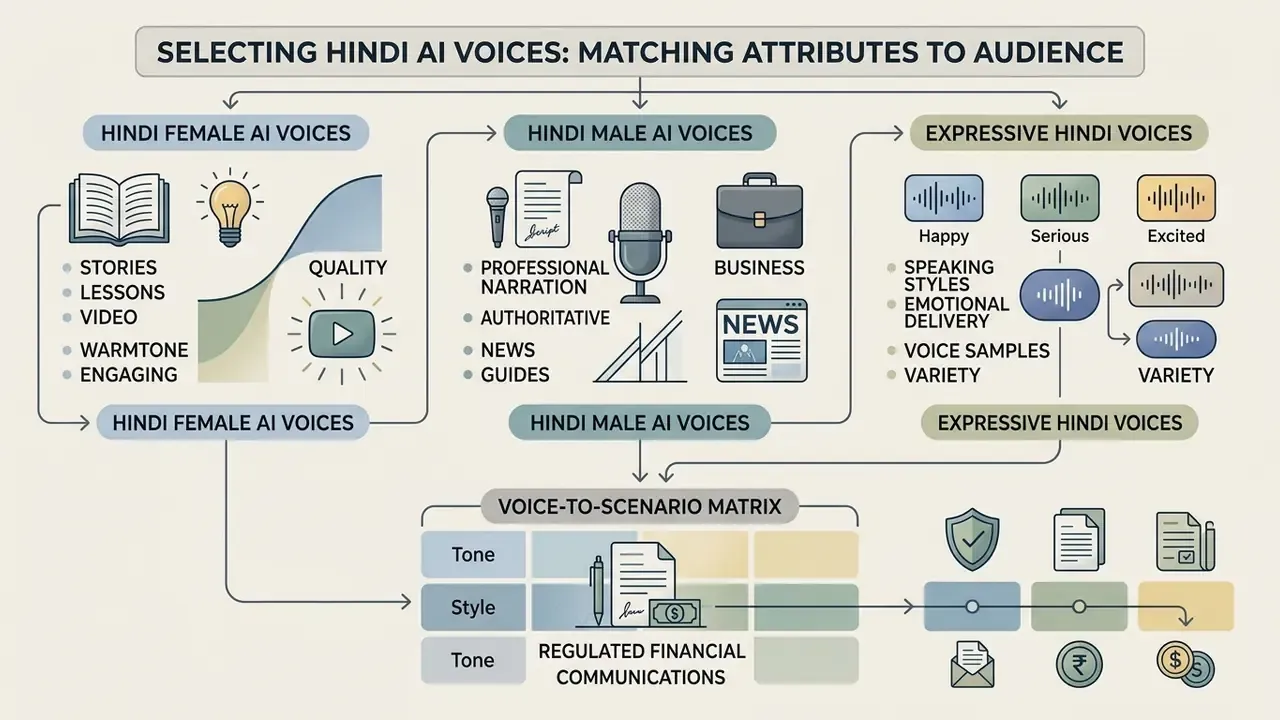
Selecting the optimal hindi ai voice means matching speaker gender, acoustic depth, and emotional delivery to your channel and audience. Platforms ship diverse libraries of hindi voices, so users can filter by formal narration, warm storytelling, or dynamic marketing styles. Reviewing pre-recorded voice samples confirms that the synthetic voice keeps clarity and regional appropriateness before full audio rendering.
«A large-scale study of 120,000 pairwise comparisons from 1,900 native speakers ranked GEMINI 2.5 PRO TTS (1128 points), ELEVEN LABS V3 and SONIC 3 highest for Indian-language voice quality.»
Use rankings like these as a shortlist filter, then run your own blind test on domain scripts. A model that wins on general prose can still mispronounce sector-specific terminology.
Hindi Female AI Voices for Stories, Lessons and Video
An ai female voice generator hindi model provides a warm, clear tone well suited to instructional content, e-learning, and narrative videos. Updated: voice-perception research reports that speaking fundamental frequency is the dominant cue in gender perception, explaining roughly 41.6% of variance in one systematic review and meta-analysis. Experimental work published in 2024 found that feminine-sounding voices are judged warmer and less discomforting than masculine voices, which is why an ai voice generator hindi female voice performs well in online tutorials, children's fables, and corporate training modules. Published Hindi datasets support this positioning directly: the AI4Bharat Rasa collection includes 27.05 hours of Hindi female audio alongside 23.78 hours of male audio, plus expressive speech across six emotions, and an IIT-Bombay storytelling corpus (16.8 hours) is narrated by a single female speaker who modulates her voice for different characters.
«A 190M-parameter distilled Hindi TTS model retains 96% of teacher naturalness (UTMOS 3.65 vs 3.79) and runs in real time on a 6 GB GPU.»
Users looking for an ai text to speech hindi female voice generator often start with an ai voice generator hindi female voice free online interface, previewing conversational tones before embedding audio into video projects. Teams pairing narration with generated footage can review our overview of AI video generators to plan the full production chain, and cost owners can model per-minute spend with the AI Media Calculators.
Hindi Male AI Voices for Professional Narration
An ai voice generator hindi male option delivers a resonant, lower-frequency tone suited to formal broadcasts, corporate presentations, and documentary narration. Selecting an ai voice generator hindi male voice establishes authority in financial explainer videos, executive updates, and technical product demos. Vendor libraries commonly describe male Hindi voices as deep, resonant, and dramatic, mapping them to news reading, audiobooks, and corporate decks. Many web platforms offer an ai voice generator hindi male voice free online preview, so teams can test voice clarity against corporate scripts before purchasing commercial access. In practice a single Hindi voice catalogue may expose dozens of options. One commercial documentary library lists 35 Hindi voices split 17 female and 18 male, so filtering by pitch depth and reading style matters more than browsing the whole list.
Expressive Hindi Voices, Voice Samples and Speaking Styles
Modern neural voice generators include emotion-conditioned models that adjust emphasis, cadence, and breath control. Expressive hindi ai models let creators pick a delivery mode: empathetic for customer support and e-learning, newscast for journalism and documentary reporting, or cheerful for promotional spots and festival greetings. Platforms like IndicParlerTTS use attribute-labeled datasets (such as Rasmalai) to generate contextual nuance directly from textual prompts, delivering expressive narration that closely mirrors natural human speech (IndicParlerTTS Study, 2025).
«Models with accent and emotion conditioning cut WER from 15.4% to 11.8% and reach 85.3% emotion-recognition accuracy with native listeners.»
| Voice Profile | Pitch & Tone Profile | Expressiveness Level | Primary Content Applications | Optimal Export Format |
|---|---|---|---|---|
| Hindi Female Narrative | Warm, medium-high pitch, clear articulation | High (emotional flexibility) | E-learning, audiobooks, storytelling, social media Reels | MP3 / WAV (44.1 kHz) |
| Hindi Female Conversational | Soothing, balanced pitch, natural pauses | Medium-high (friendly) | Customer support IVR, app walkthroughs, virtual assistants | WAV / PCM (16 kHz) |
| Hindi Male Corporate | Resonant, low pitch, steady rhythm | Medium (authoritative) | Financial reports, executive presentations, documentaries | WAV (48 kHz) |
| Hindi Male Commercial | Energetic, dynamic inflection, clear emphasis | High (persuasive) | Radio ads, product teasers, promos, YouTube Shorts | MP3 (320 kbps) |
| Hindi Male Pop / Singing (F3 to C#5) | Medium vocal range, dynamic timbre | High (musical phrasing) | Bollywood-style tracks, Indian pop, folk vocal stems | WAV (48 kHz, 24-bit) |
No matching rows Clear one or more filters to restore the matrix.
Summary of table: Female Hindi AI voices excel in educational and narrative contexts thanks to warm tone profiles, while male Hindi AI voices offer the resonance required for corporate, news, and authoritative broadcasting. Singing models sit in a separate category defined by pitch range rather than reading style.
Voice-to-Scenario Matrix for Regulated Financial Communications
Regulated communications have tighter tonal constraints than marketing content. A collections reminder read in a "cheerful" style is a conduct risk, not a creative choice. The matrix below maps Hindi voice configurations to common banking and insurance scenarios.
| Regulated Scenario | Recommended Voice Profile | Style / Emotion Setting | Prohibited Configurations | Review Owner |
|---|---|---|---|---|
| IVR main menu / self-service | Female conversational, Hinglish-capable | Neutral, steady rate 1.0x | Enthusiastic, promotional | CX + Compliance |
| Balance, statement, OTP prompts | Female or male conversational | Neutral, slowed numerals, explicit pauses | Emotional modulation on digits | Model Risk |
| Collections and overdue notices | Male corporate, low pitch | Calm, factual, empathetic | Cheerful, urgent, aggressive emphasis | Compliance / Conduct |
| Regulatory disclosures and T&C read-outs | Male corporate | Newscast, 0.95x rate | Any expressive style, background music | Legal |
| Product marketing and offers | Male or female commercial | Cheerful, dynamic | Newscast (misleading authority cue) | Marketing + Compliance |
| Grievance redressal / complaint status | Female conversational | Empathetic | Flat robotic delivery | CX + Compliance |
| Internal training and compliance modules | Female narrative | Instructional, 1.0x | Character voices | L&D |
How to Generate a Hindi AI Voiceover Online
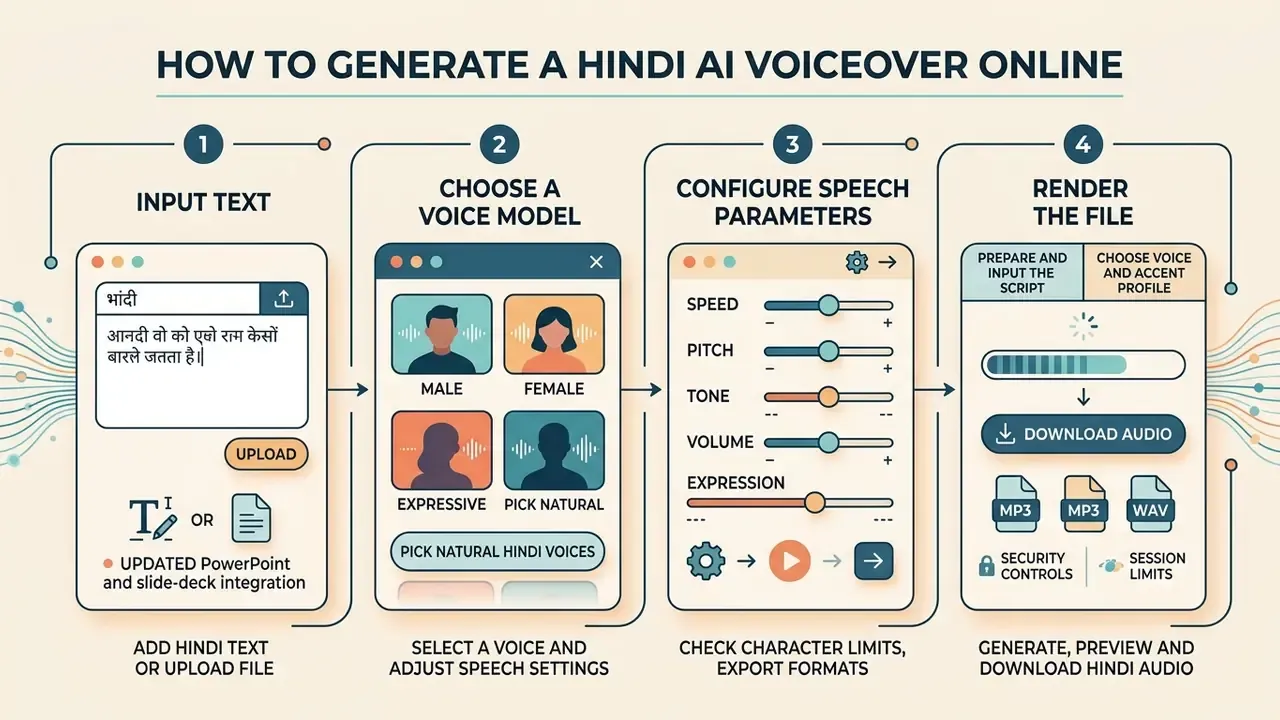
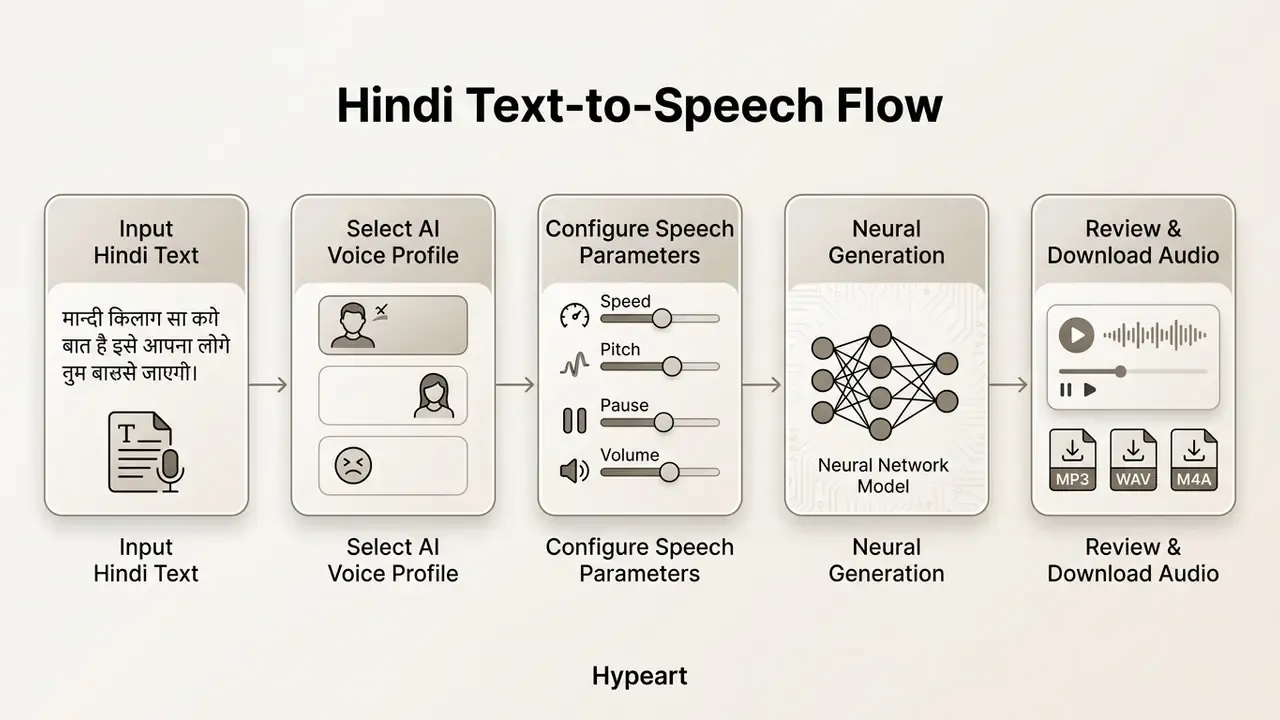
Generating a professional voiceover with an ai hindi voiceover generator takes four moves: input text, choose a voice model, configure speech parameters, render the file. Online platforms let creators complete the whole workflow inside a web browser without installing local software. Enterprise teams add security review, API integration, and audit logging around those same four core actions.
Add Hindi Text or Upload a File
Updated. To begin, paste your Devanagari script directly into the editor of an ai hindi voice over generator, or upload files in TXT, DOC, DOCX, PDF, EPUB, ODT, MD, JSON, or CSV format. For tabular data (XLS, XLSX, ODS), modern neural engines parse cell rows sequentially to preserve reading context, which helps with price lists, product catalogues, and rate cards. If you are working with scanned documents or graphics, integrated OCR modules extract Devanagari characters from PNG or JPEG files straight into the voice-rendering pipeline before synthesis. Typical platform ceilings for uploads sit around 100 MB per file, or 60 minutes of source media for transcribable audio and video inputs.
Modern neural systems fully support Unicode Devanagari encoding, parsing complex characters, conjuncts, nukta, chandrabindu, and punctuation marks correctly, in line with Unicode Chapter 12 and W3C Devanagari layout requirements for web and eBook text. EPUB and PDF ingestion is what makes book-to-audiobook conversion practical without manual retyping. In an illustrative corporate compliance scenario, a localization team pasted a 4,000-word regulatory compliance script into an ai text to speech hindi voice generator, then validated that Devanagari numerals and specialized terminology were normalized accurately before voice rendering.
PowerPoint and slide-deck integration. Corporate training teams can import presentation files (.ppt, .pptx) directly. The system parses speaker notes and on-slide text separately, then generates time-synced audio clips mapped to individual slides, producing narrated video or per-slide MP3 assets in one pass. This removes manual script extraction from localized corporate presentations, onboarding decks, and compliance modules, and it keeps narration aligned when a deck is later re-ordered. Markdown scripts are handled the same way, which suits documentation teams that already maintain source content in .md.
Select a Voice and Adjust Speech Settings
Once text is loaded, select your target hindi voice from the library and refine speech parameters to match the project. Fine-tuning controls typically include speaking rate, pitch modulation, overall volume, and pause insertion between sentences. Documented ranges on major cloud engines run from 0.25x to 2.0x speaking rate, with pauses expressed as explicit markup tags. Advanced editors add pronunciation lexicons or SSML (Speech Synthesis Markup Language) support, which allows precise adjustment of specific terms, homographs, brand names, and English loanwords.
Session limits. Standard web generation modules process up to 15,000 characters per session (roughly 2,500 words), while lighter free editors cap input at 3,000 characters per file or generation. For high-throughput needs, batch document conversion queues and streaming APIs allow continuous processing without session timeouts, and daily quotas on paid Indian-market plans commonly reach 50,000 characters per day. Before committing a long script, generate a short sample containing names, numerals, abbreviations, and mixed-language terms. That is the fastest way to catch normalization errors while corrections are still cheap.
Generate, Preview and Download Hindi Audio
After configuring settings, click generate to process the script and create a preview track. Most platforms return a file in under a minute, depending on script length. Listen to the generated audio and verify pronunciation, numeral handling, and cadence, then adjust pause markers or speed if needed. Once satisfied, download the final voiceovers or export timestamped subtitle files (SRT, VTT, TXT) for video integration.
Supported export containers include compressed MP3 (up to 320 kbps) for web-stream efficiency, loss-free WAV / PCM (16-bit, 48 kHz) for video editing suites, and M4A (AAC) for mobile playback compatibility. API-level outputs additionally expose ogg_vorbis and raw PCM with configurable sample rates. Chapter-based audiobook projects can usually be exported either as one continuous file or as a ZIP archive of per-chapter tracks. Creators building multi-deck business presentations often combine audio outputs with tools like an ai pitch deck generator to assemble fully automated decks, and publishing teams route finished tracks through a YouTube video editing workflow for captions and final assembly.
- Prepare and input the scriptInsert clean Devanagari text or Unicode Hinglish into the editor; confirm punctuation, numerals, and abbreviation formatting are correct.
- Choose voice and accent profileSelect a male or female Hindi voice model based on content style, regulated scenario, and target audience.
- Adjust speech prosodyFine-tune speed (0.9x to 1.1x), adjust pitch, and insert pause tags (for example 500 ms) at sentence and clause breaks for natural flow.
- Preview, render, and exportPlay back the sample, verify pronunciation on names and amounts, then export high-resolution audio (WAV, MP3 or M4A) with SRT captions.
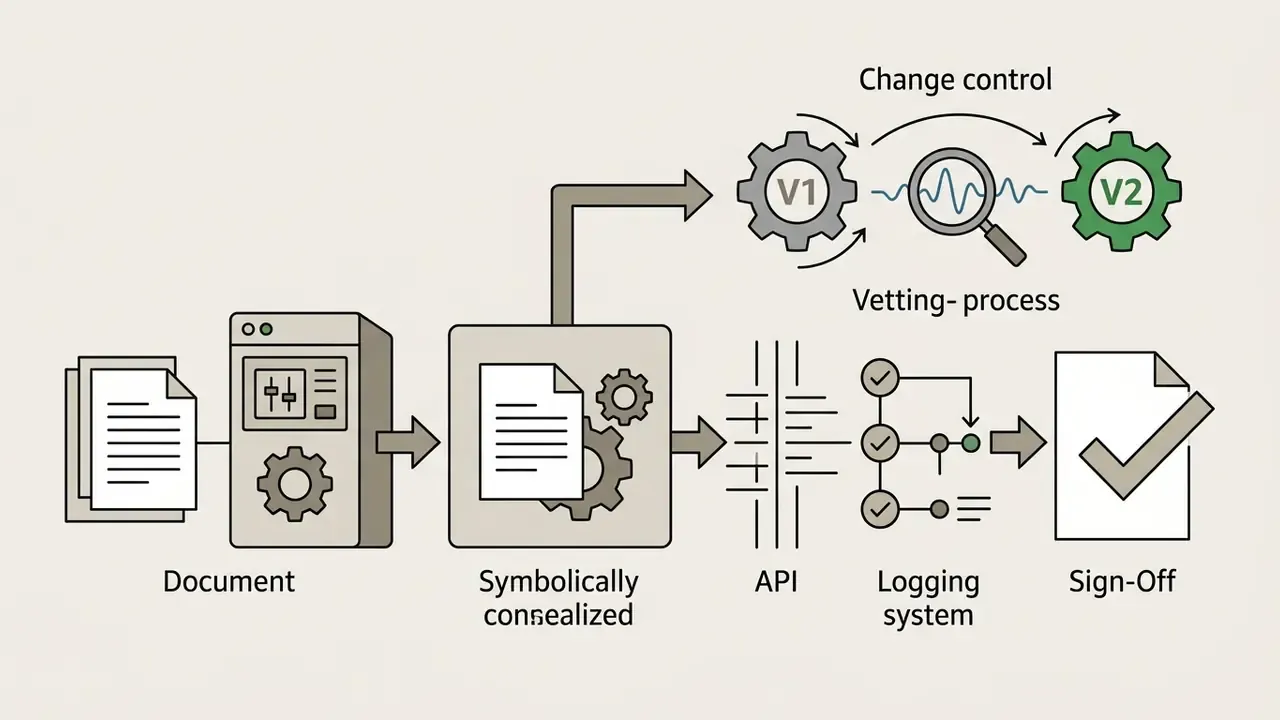
Enterprise Deployment Checklist: API, Logging and Sign-Off
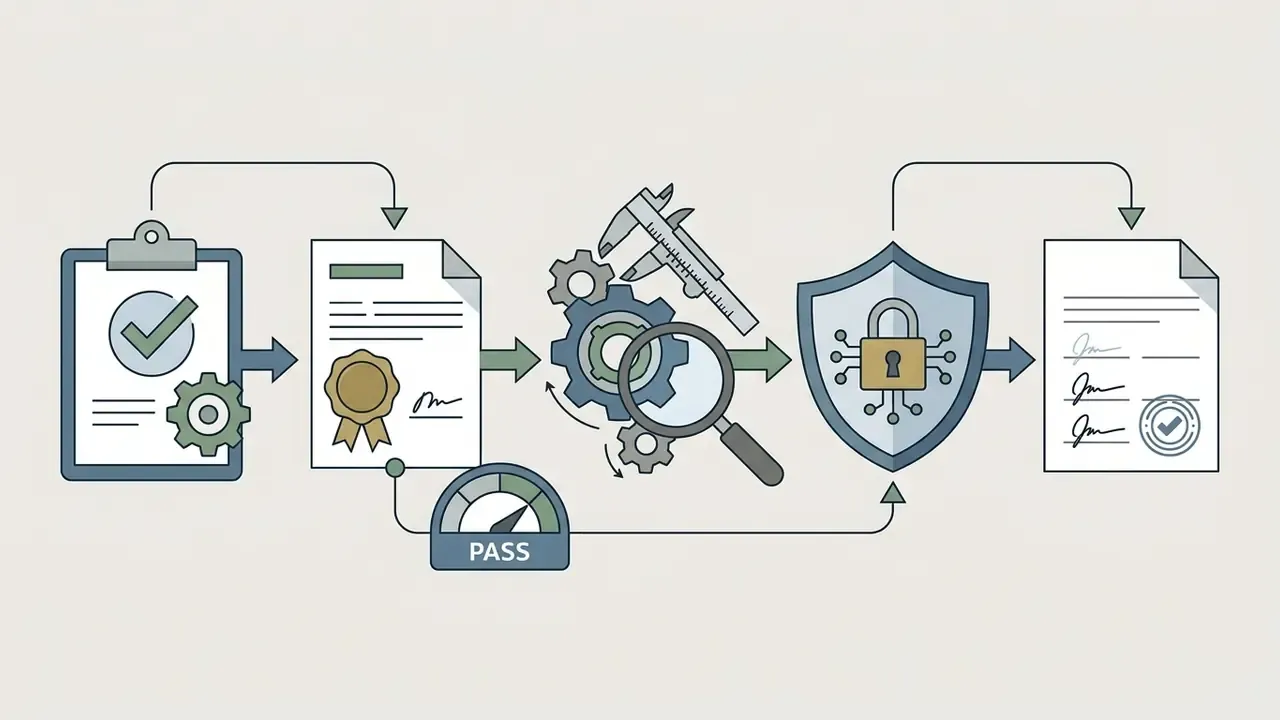
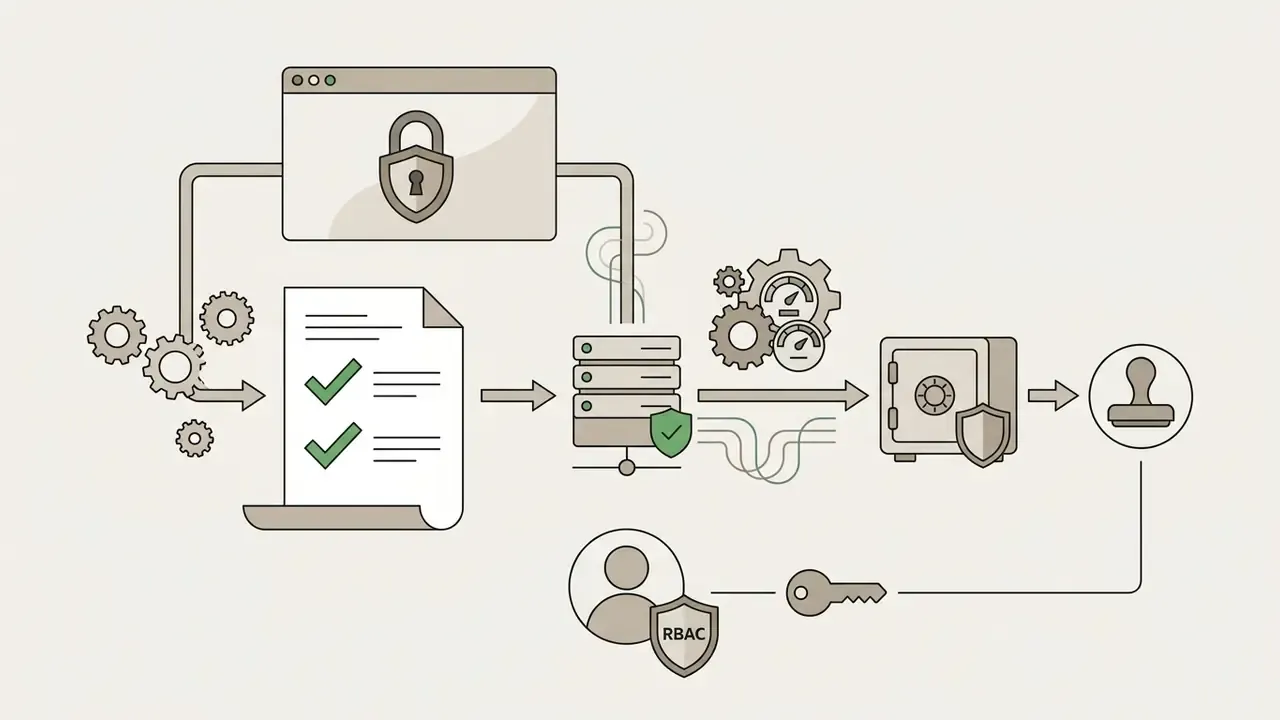
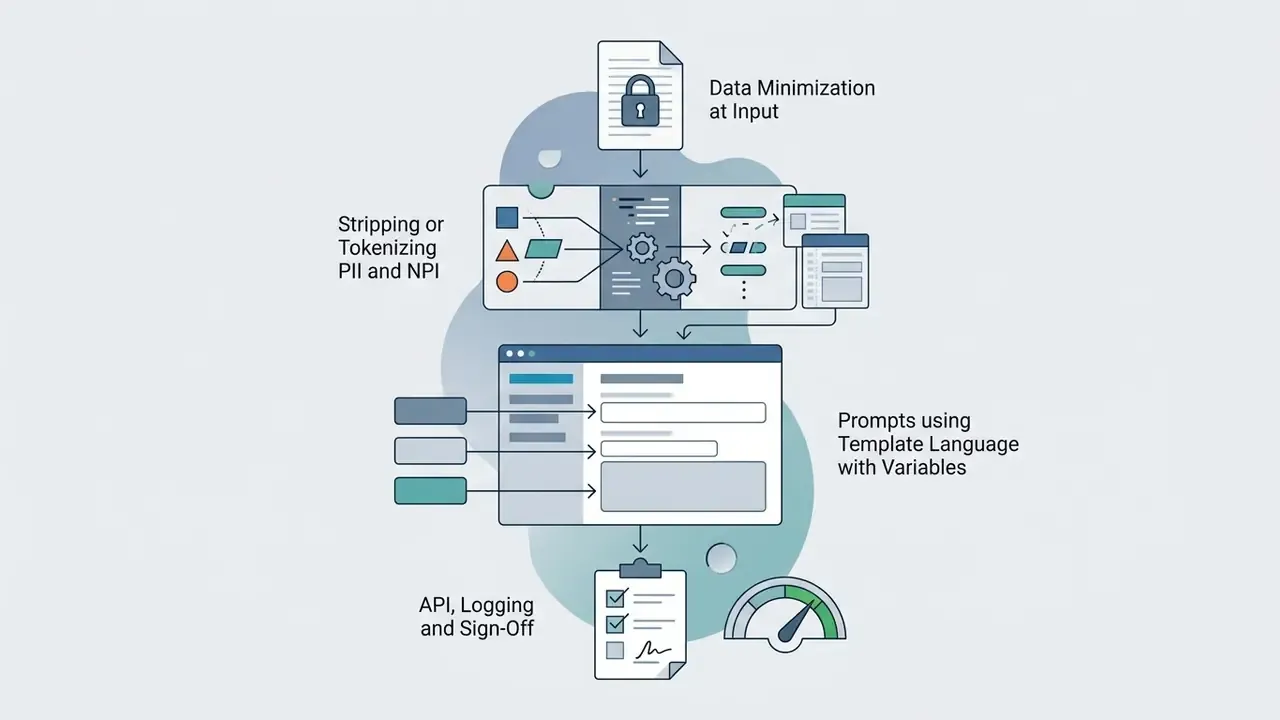
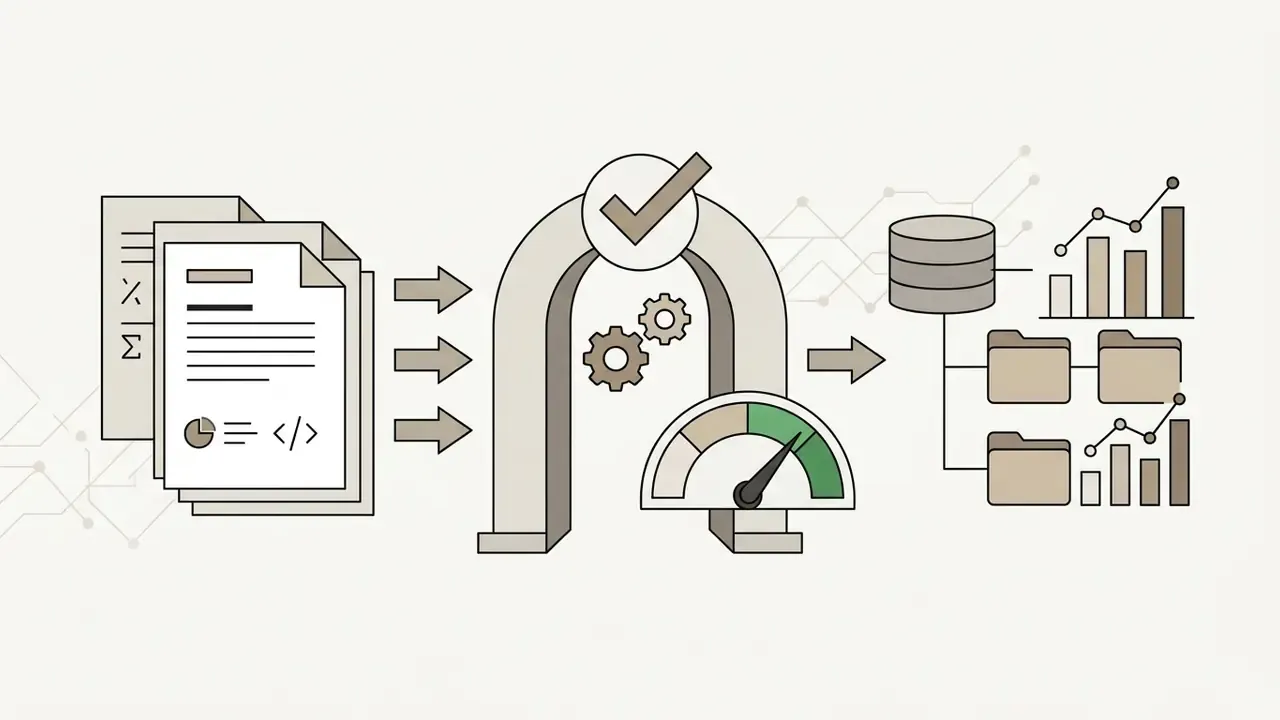
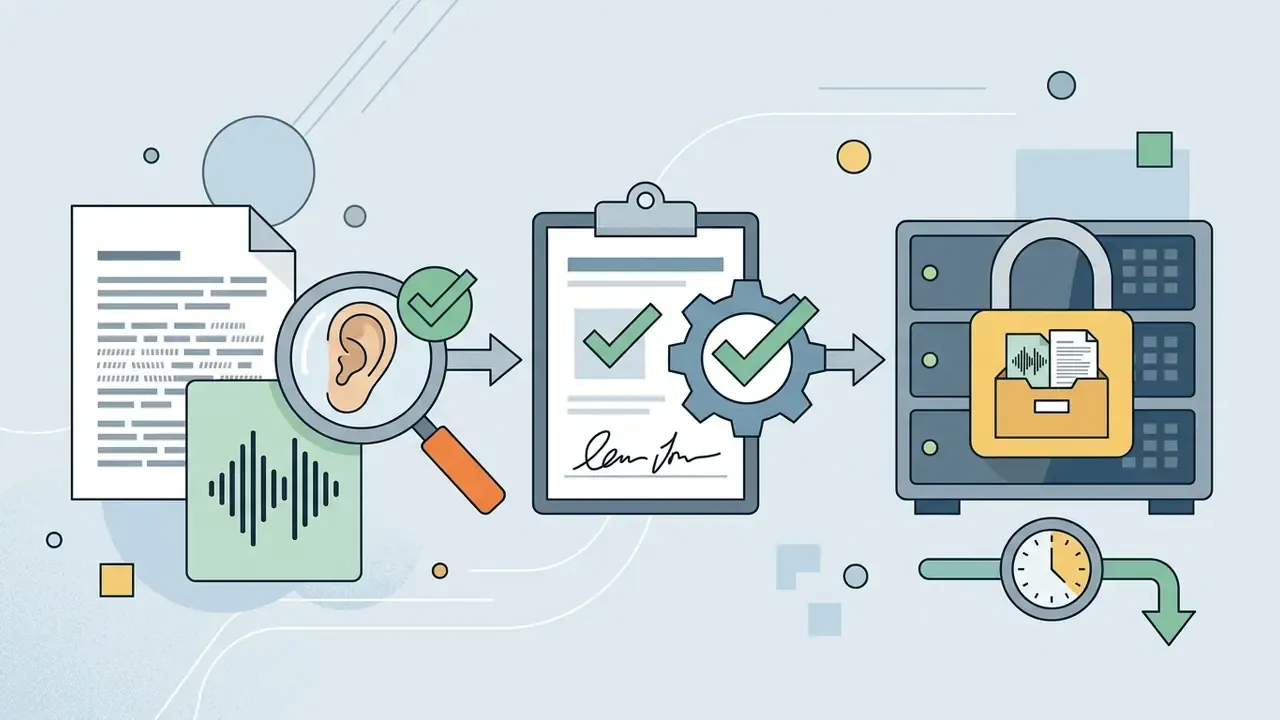
The four steps above describe the creator workflow. Regulated deployments, meaning IVR prompts, customer notifications, and disclosure read-outs, need an auditable wrapper around them:
Free Hindi AI Voice Generator vs Paid Plans: Governance, Security and Commercial Licensing
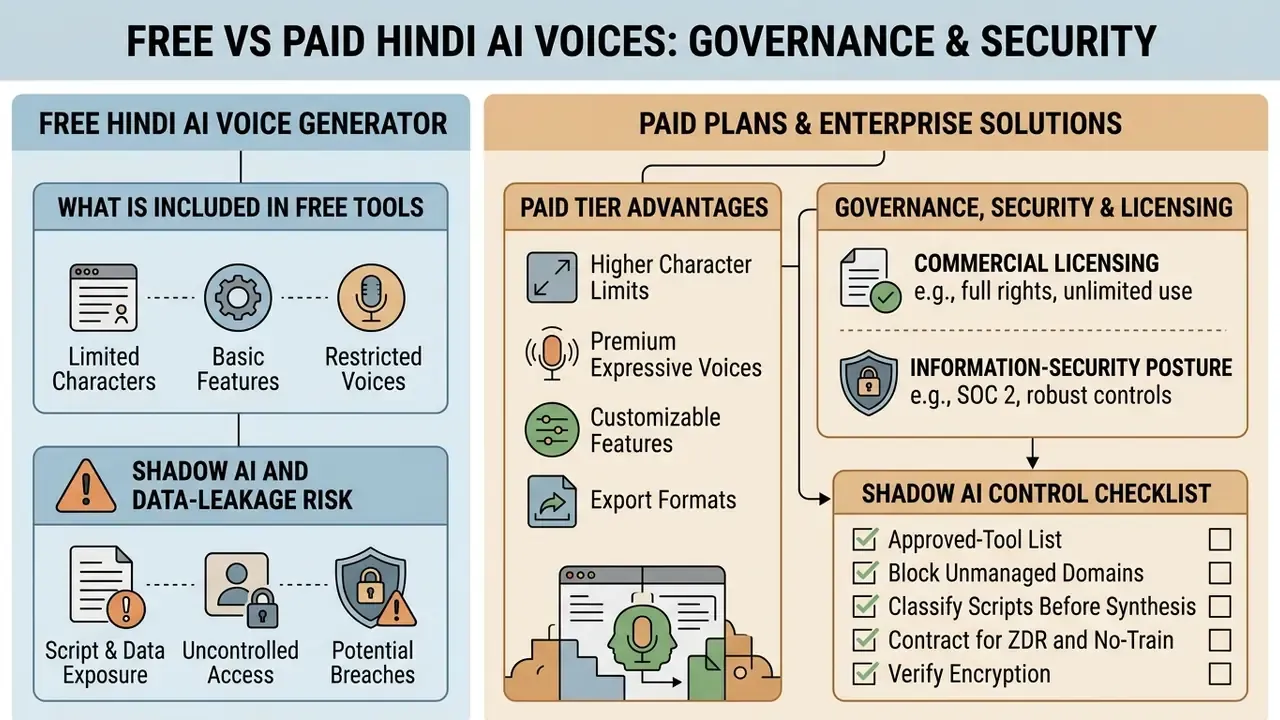
Choosing between a free hindi voice generator and a paid tier means evaluating character limits, feature sets, information-security posture, and legal licensing terms. Free tiers give an accessible entry point for evaluation, and the same logic applies when teams compare free AI video generators. Commercial projects, though, need paid subscriptions that grant explicit commercial usage rights and enforceable data protections.
What Is Included in a Free Hindi Text-to-Speech Tool?
A typical ai hindi voice generator free tool lets users test core synthesis capabilities within basic character quotas. Most free plans offer online generation, a selection of standard voices, and browser-based playback. Updated: an ai voice generator hindi free online service usually imposes daily, monthly, or one-time character caps. Observed values across vendors range from 500 characters on a one-time trial to 3,000 characters per file, 2,500 to 5,000 characters per day, or 10,000 to 20,000 characters per month, depending on account registration status. Free tiers also frequently restrict audio downloads, offer only a short preview instead of a full file, or exclude commercial usage rights. Free voice catalogues can still be large, from 13 to 300 or more voices depending on vendor, and exports on some free tiers already include MP3 and WAV. Users looking for an ai voiceover generator free online option can evaluate basic voice models, but must upgrade to convert longer documents, remove attribution, or access high-definition audio exports.
Shadow AI and Data-Leakage Risk in Free Hindi TTS Tools
The most common failure mode in enterprise Hindi voice adoption is not a bad-sounding voice. It is an employee pasting a confidential script into an unvetted free web tool. Because these services are frictionless (no login, no installation, no procurement), usage grows outside any inventory, and submitted text may be retained, logged, or used for model improvement under permissive consumer terms.
Shadow AI control checklist:
- Maintain an approved-tool list for voice generation and publish it alongside the acceptable-use policy; treat everything else as unapproved by default.
- Block or gateway unmanaged TTS domains at the proxy or CASB layer for teams handling customer data, and monitor DLP for Devanagari text uploads containing account patterns.
- Classify scripts before synthesis: public marketing copy, internal-only, and restricted (containing PII/NPI or unreleased regulatory language). Only the first class may ever touch a consumer-grade free tool.
- Contract for ZDR and no-train with the approved enterprise vendor, with retention windows stated in days and confirmed in writing.
- Verify encryption in transit (TLS 1.2+) and at rest, plus data-residency options where local storage of customer content is required.
- Require SOC 2 Type II or ISO 27001 attestations and, where the voice touches customer journeys, an independent third-party model or security validation.
- Provide a fast sanctioned path. Shadow AI grows fastest where the approved route is slow; a same-day self-service option for public-class scripts removes most of the incentive to go around it.
Validating Hindi TTS Models Inside Model Risk Management (MRM)
Voice models belong in the model inventory. Because Hindi output failures are usually linguistic rather than statistical, validation needs Hindi-specific test suites rather than generic accuracy checks. The table below gives a workable validation frame. Thresholds should be calibrated to your own risk appetite and channel criticality, and we would treat any single vendor benchmark as a hypothesis until reproduced in-house.
| Validation Dimension | Test Method | Suggested Metric | Failure Signature |
|---|---|---|---|
| Intelligibility | Re-transcribe generated audio with an independent Hindi ASR system and compare to source | WER / CER on held-out scripts (published Hindi audiobook research reports WER around 17% on unconstrained text) | Systematic misreads on conjuncts and loanwords |
| Numeral and amount accuracy | Targeted set of currency amounts, account digits, dates, percentages in Devanagari and Latin numerals | 100% exact match required for customer-facing finance | Digit grouping read as ordinary numbers |
| Proper-noun rendering | Fixed list of customer names, branch names, product names, regional place names | Native-listener pass/fail per item | Anglicized or truncated pronunciation |
| Schwa deletion and nasalization | Curated minimal-pair list (anusvara vs chandrabindu contexts) | Native-listener accuracy % | Syllable-by-syllable robotic delivery |
| Code-switching (Hinglish) | Mixed Hindi and English sentence bank drawn from real scripts | CMOS vs baseline engine; native-listener acceptability | Accent flip or pause at every switch point |
| Prosody and tone fit | Blind listening against the scenario matrix above | MOS / MUSHRA with human anchor included | Cheerful delivery on adverse-action content |
| Stability across versions | Re-run the full suite after each vendor model upgrade | Delta vs previous baseline | Silent regression after upgrade |
| Bias and dialect coverage | Test with regional accent variants and both genders | Score dispersion across cohorts | Quality collapse for one cohort |
Document owner, frequency (at minimum annually and on every model change), evidence location, and remediation path for each row, exactly as you would for a credit or fraud model.
Commercial Use, Pricing and Legal Terms for Hindi Voiceovers
Hindi AI Voice Generator Use Cases
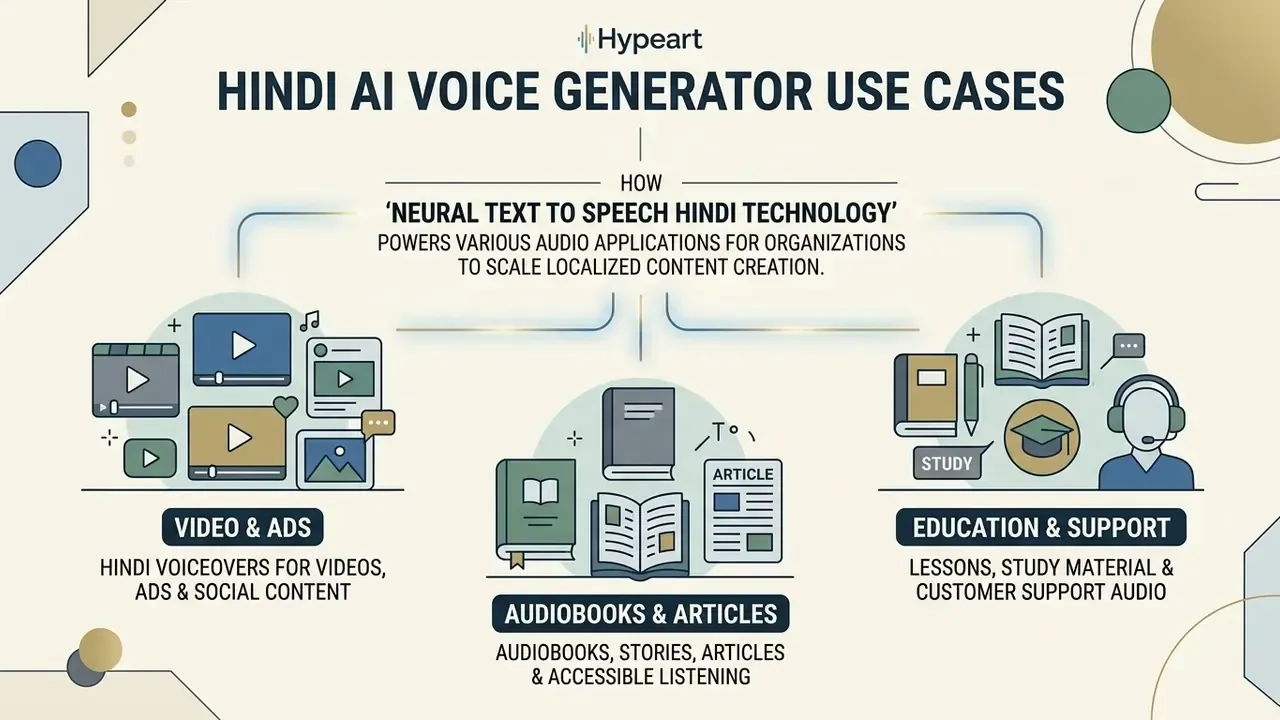
Neural text to speech hindi technology powers a wide range of audio applications, letting organizations scale localized content creation across sectors. A 2026 case study on generative audio for Indic languages reported that Hindi and Hinglish pipelines improved speaker similarity by 27% and approached commercial-benchmark MOS, which explains the shift from experimentation to production deployment.
Audiobooks, Stories, Articles and Accessible Listening
Publishers use expressive Hindi voice models to convert printed books, digital articles, and web content into accessible audiobooks. Studies on long-form speech synthesis show that sentence-level neural generation concatenated into full book chapters yields high naturalness scores (MOS 4.00), making long listening sessions comfortable (Expressive Hindi Audiobook Study, 2026). Integrating TTS into digital publishing also supports accessibility compliance, such as WCAG 2.1, whose Success Criterion 1.1.1 for non-text content is referenced in India's own ICT accessibility guidance, so visually impaired readers can consume written content seamlessly (W3C Accessibility Principles, 2026). Read-aloud deployments extend beyond books: public-interest projects now use Hindi TTS to voice PDFs for users across India, and Indian-language screen-reader integrations with NVDA and ORCA established the assistive baseline more than a decade ago.
Lessons, Study Material and Customer Support Audio
Educational institutions and corporate learning platforms deploy synthetic speech to narrate digital textbooks, online courses, and instructional materials. Programs like the NCERT ePathshala initiative embed text-to-speech functionality into Unicode digital textbooks to support accessibility across schools in India (NCERT ePathshala, 2026). In customer operations, major financial institutions, such as Axis Bank with its AXAA voice bot, integrate Hindi and Hinglish speech synthesis into automated IVR systems, so customers can complete account inquiries through natural spoken dialogue (Axis Bank AXAA Press Release, 2020). Vendor model cards now list Hindi explicitly for IVR use cases, while older Indian IVR technical requirements remain a documentation baseline rather than a voice-quality standard. Meaning the burden of proving Hindi pronunciation adequacy sits with the deploying organization, not the regulator.
FAQ About Hindi AI Voice Generators
Can I Generate Hindi Audio Online Without Installing Software?
Yes, you can generate Hindi audio directly inside any modern web browser without installing third-party software. Updated: vendor documentation from browser-based Hindi TTS services (2026) describes the same pattern across providers. Paste Devanagari text, select an ai voice generator free hindi or paid voice model, configure speech parameters, generate, and download the finished MP3 or WAV file, with no sign-up or API key required on some tools. The workflow runs on desktop, tablet, and mobile browsers, including iPhone Safari, because processing happens server-side. An internet connection is therefore mandatory, and fully offline generation is not available on hosted platforms. If you hit rendering issues or browser compatibility errors, visit AI Media Support and Troubleshooting for assistance.
Can I Preview Generated Hindi Audio Before Consuming Character Credits?
Yes. Most online platforms provide a 10-second real-time audio sample preview, or free starter credits (commonly 500 to 2,000 characters on registration), so you can verify pronunciation, pitch, and voice-profile suitability before rendering full-length documents. Use the preview on a sentence containing your hardest content: a customer name, a currency amount, and one English technical term. Not on generic prose.
What Are the Character Limits and Export Formats?
Web editors typically cap input between 3,000 and 15,000 characters per session, with paid Indian-market plans offering daily allowances up to 50,000 characters, and API tiers removing per-session limits through batching or streaming. Exports are available as MP3 (up to 320 kbps), WAV / PCM (16-bit, 48 kHz), and M4A (AAC), with subtitle sidecars in SRT, VTT, or TXT. Generated files are final renders: to edit them further, download the audio and use a standard audio editor.
Which File Types Can I Upload for Hindi Text to Speech?
Supported inputs across mainstream platforms include TXT, MD, DOC, DOCX, ODT, PDF, EPUB, JSON, CSV, spreadsheets (XLS, XLSX, ODS), presentation decks (PPT, PPTX), images with OCR for Devanagari extraction (PNG, JPEG), and transcribable audio or video files. Common ceilings are 100 MB per file or 60 minutes of media.
Is Hindi TTS Compliant With GDPR, SOC 2 and Data-Residency Requirements?
Compliance depends on the specific vendor tier and contract, not on the technology. For regulated deployments, request SOC 2 Type II or ISO 27001 attestation, a data-processing agreement with sub-processor disclosure, documented encryption in transit and at rest, region-specific data residency where required, and a written Zero Data Retention plus no-training commitment covering submitted text and generated audio. Consumer free tiers rarely offer any of these, which is why they should be restricted to public-class content only. This is general guidance, not legal advice.
How Do We Prevent Employees From Using Unapproved Hindi TTS Tools?
Combine three controls. A published approved-tool list with a same-day sanctioned request path. Technical blocking or CASB gateways for unmanaged TTS domains, with DLP monitoring for sensitive-text uploads. And script classification training, so staff know which content may never leave the perimeter. Audit the control by sampling outbound traffic and by reviewing which voice assets in production lack an entry in the model inventory.
How Do We Validate a Hindi Voice Model Before Customer-Facing Use?
Run the eight-dimension suite in the MRM table above: independent ASR re-transcription for WER/CER, exact-match testing on numerals and amounts, native-listener review of proper nouns and nasalization minimal pairs, Hinglish code-switching acceptability, prosody fit against the regulated-scenario matrix, cohort dispersion checks, and a regression re-run after every vendor model upgrade. Record results, model version, and sign-off in the model inventory.
Can I Use Free-Tier Hindi Audio in a Monetized Video or Advertisement?
Usually not. On the major platforms the free plan is expressly non-commercial, and monetized YouTube, paid social, broadcast, or client-deliverable use requires a paid plan carrying commercial rights. A minority of vendors do grant royalty-free commercial use on free tiers. Verify the current terms of your specific provider in writing before publication, and retain a copy of the terms as of the render date.
Does an AI Hindi Voice Handle Mixed Hindi and English (Hinglish) Sentences?
Yes, when the model is trained or conditioned for code-switching. Transliteration-based Hinglish systems score on par with general-purpose engines on code-mixed sentences (CMOS +0.02 in the SPECOM 2023 study) and can adapt a new voice with about three hours of data, while bilingual code-switching systems report MOS around 3.83. Test your own vocabulary, since brand names and product terms are the usual failure points.
Creative Suite Integrations (Adjacent Visual Tools)
Voice production rarely stands alone. Teams building complete campaigns often combine Hindi narration with visual generation tools kept deliberately separate from the governance workflow above: an ai photo to video pipeline for turning stills into motion, an ai picture to video tool for synthesizing matching footage, an ai photoshop generator for editing key art, an ai pixel art generator for retro-styled or stylized promotional assets, and content-policy documentation such as ai photo to video nsfw guidance where filtering rules and platform restrictions apply. These integrations are creative-side options. None of them substitutes for the security, licensing, and validation controls required on the audio pipeline itself.
Limitations, Open Questions and a Safe Next Step
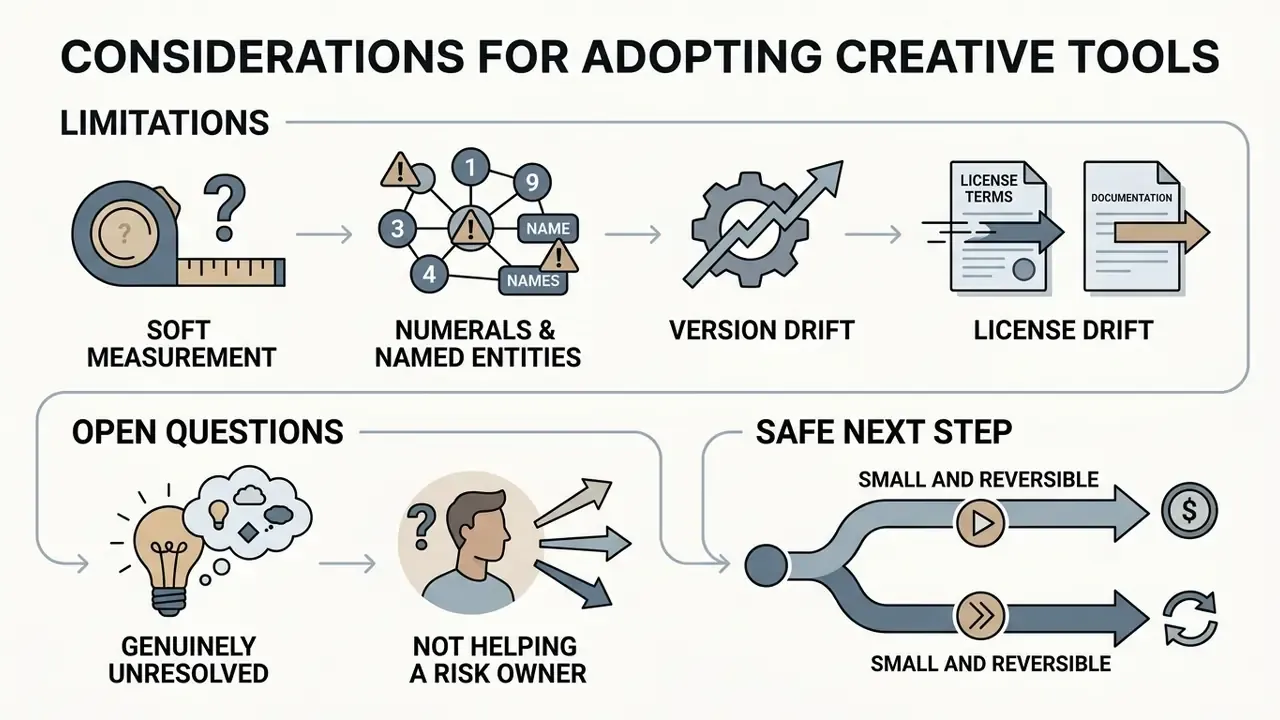
A few things remain genuinely unresolved, and pretending otherwise would not help a risk owner.
Measurement is still soft. MUSHRA and MOS scores in Hindi vary with listener recruitment, anchor inclusion, and script content. Until an institution builds its own domain test set, published scores are directional evidence, not assurance.
Numerals and named entities are the real risk surface. Most reported failures in financial narration cluster on amounts, account digits, and branch or product names. That argues for exact-match testing rather than average naturalness scoring.
Version drift is under-controlled. Vendors upgrade voice models continuously, and prosody can shift without notice. We have not seen a market standard for voice-model change notification, so contractual notice periods are worth negotiating explicitly.
Licence terms move faster than documentation. Free-tier commercial rights differ across vendors and dates. Archive the terms page as of each render.
A safe next step is small and reversible. Pick one low-risk, public-class use case, for example an internal Hindi training module or a marketing explainer with no customer data. Run it through the validation table, log the evidence, and record the voice model in the inventory. If the control chain holds for that, extend cautiously to IVR prompts, then to notifications. Speed can come later; ownership cannot.
Appendix A: Superseded Statements and Revision Notes
Retained for transparency and version traceability. The main text above carries the corrected versions.