Executive summary
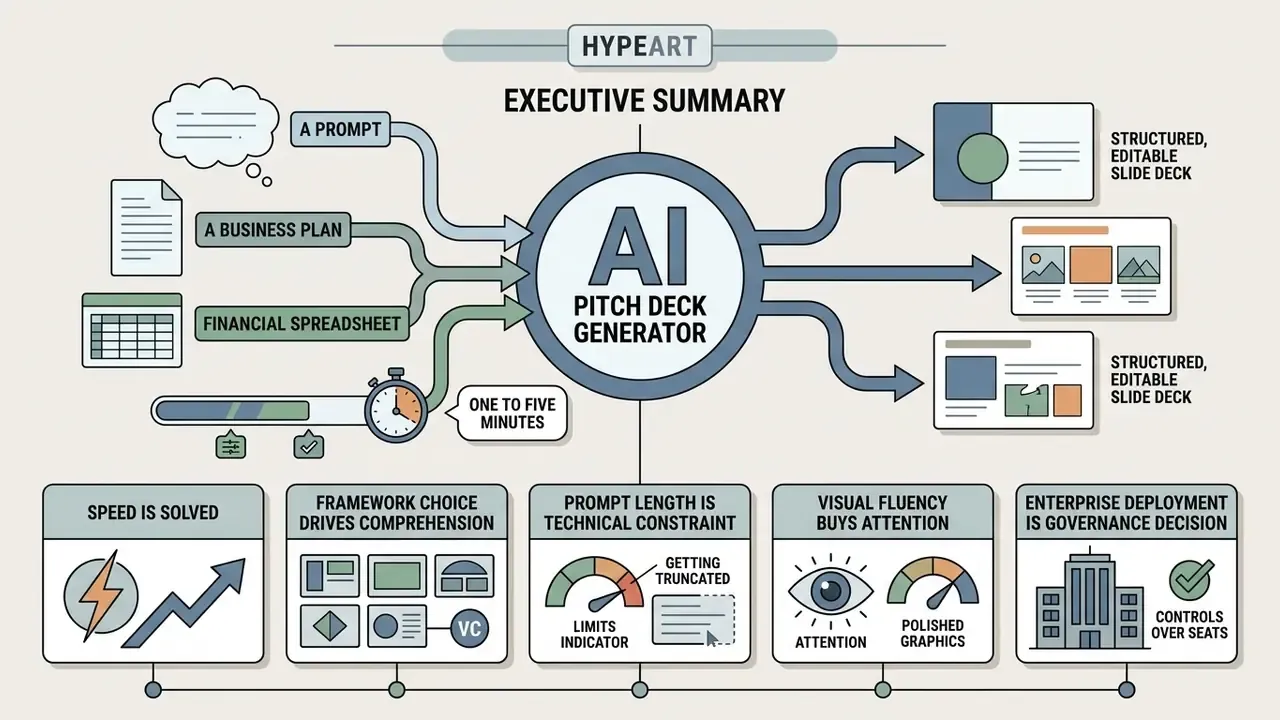
An ai pitch deck generator converts a prompt, a business plan, or a financial spreadsheet into a structured, editable slide deck in one to five minutes. The technology is ready for first drafts. It is not ready for unsupervised external distribution.
- Speed is solved. Accuracy is not. A 10 to 14 slide draft now takes under a minute in tools such as Gamma, and under five minutes in document-ingestion engines. Factual grounding, financial math, and brand compliance still need a human pass.
- Framework choice drives investor comprehension. Tell the model to follow a recognized structure (Sequoia 10-slide, Y Combinator Demo Day, Airbnb 2009 storytelling model) and the deck starts matching how investors actually scan.
- Prompt length is a hard technical constraint. Context windows run from roughly 400 characters (Pitch "Start with AI") to about 100,000 characters (Plus AI Pro). One business brief cannot serve both classes of tool.
- Visual fluency buys attention. Content wins the cheque. In the MERIT field experiment, high visual fluency raised slide viewing time by 34%, while investment intent tracked content quality.
- Enterprise deployment is a governance decision. Regulated buyers should require SOC 2 Type II, SOC 3, ISO 27001, ISO 27017, contractual zero data retention, SSO, role-based access control, and audit logs before anyone uploads a financial model. Skip that step and the workflow quietly becomes Shadow AI.
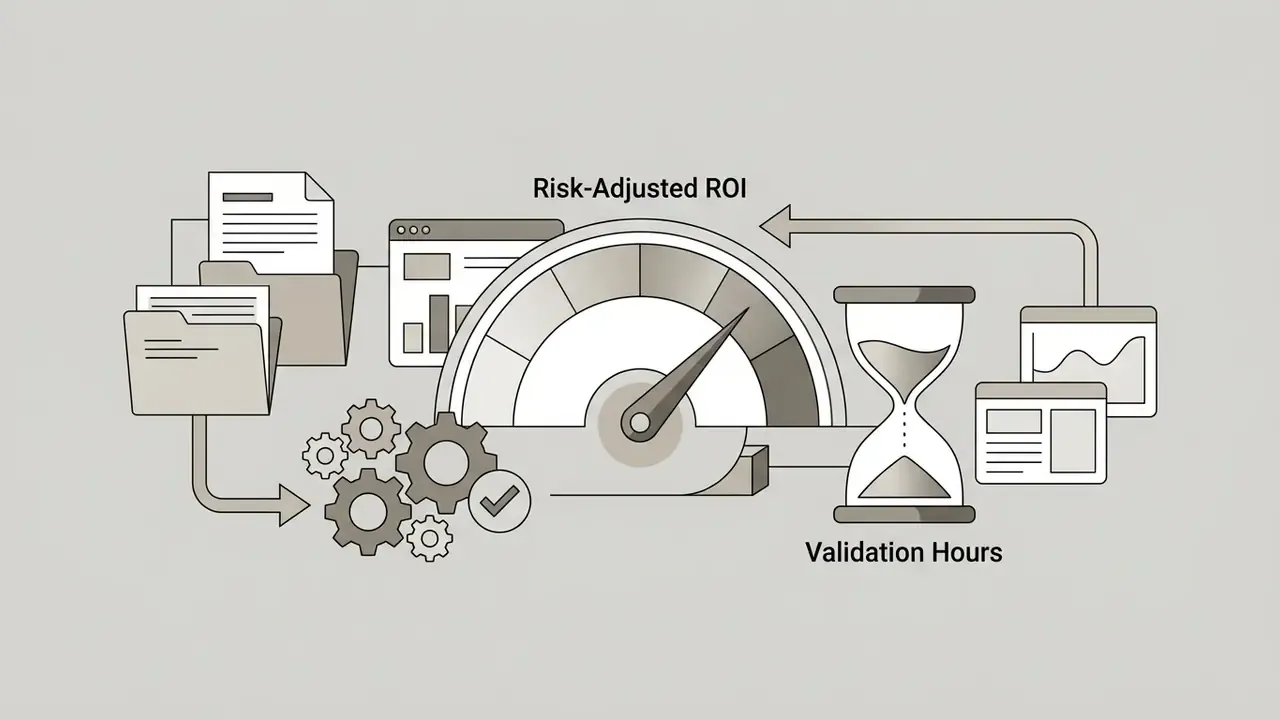
- Budget for controls, not just seats. Real total cost equals licence fees plus the human validation hours needed to certify every generated number.
Who this guide is for and what it decides
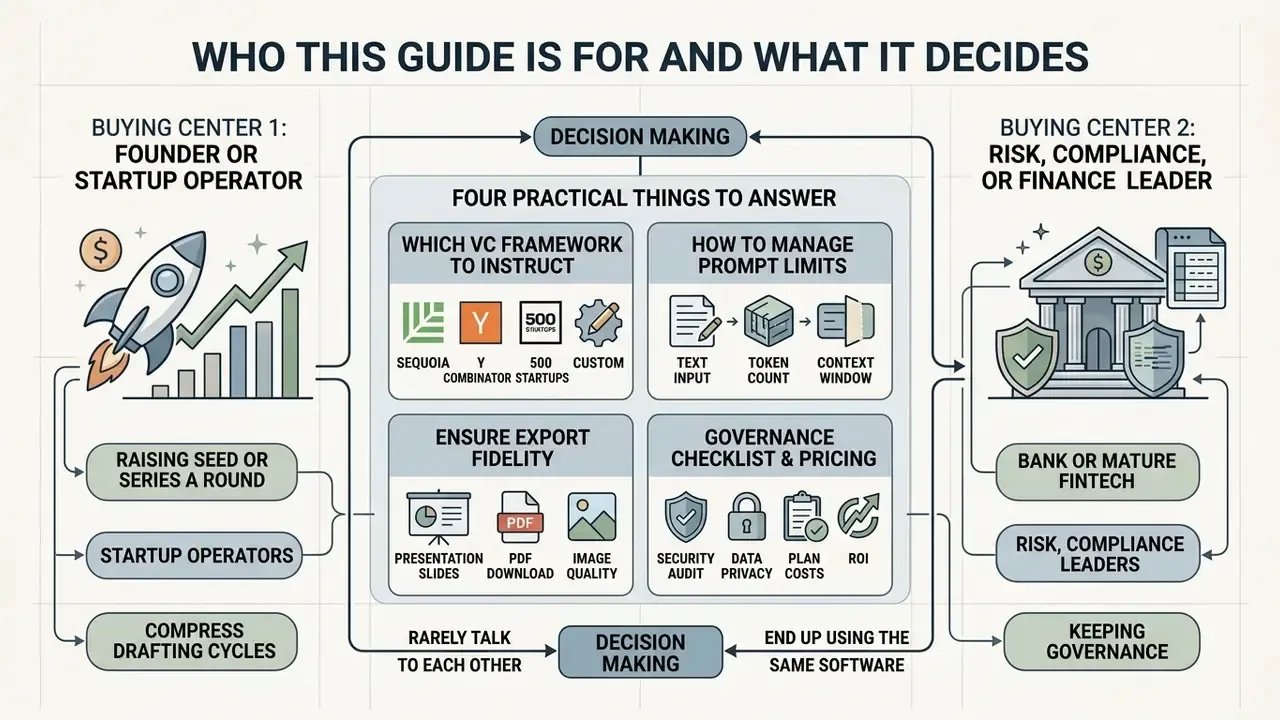
This guide is written for two buying centres that rarely talk to each other, yet end up using the same software.
The first is the founder or startup operator raising a seed or Series A round. Their question is narrow: which ai pitch deck creator produces an investor-ready draft fastest, with export files that survive contact with PowerPoint?
The second is the risk, compliance, or finance leader inside a bank or mature fintech. Their question is different: under what conditions may an employee upload a confidential model, and what evidence remains afterwards if internal audit asks?
By the end you should be able to answer four practical things: which framework to instruct the model to follow, how long your prompt is allowed to be, which security controls are non-negotiable for regulated data, and how to calculate a risk-adjusted return that includes validation effort. Everything else is detail.
Generative artificial intelligence has changed how founders, corporate strategy teams, and executive operators assemble business presentations. Modern automated presentation platforms turn structured briefs, uploaded financial spreadsheets, and strategy documents into full decks within minutes. Selecting and operating an ai pitch deck generator responsibly still requires an understanding of model architecture, visual formatting standards, and investor evaluation criteria.
Deploying an ai based pitch deck generator lets teams compress drafting cycles while keeping governance over sensitive business data and brand standards. Those two goals pull in opposite directions, which is the tension the rest of this guide tries to resolve.
What is an AI pitch deck generator and how does it work?
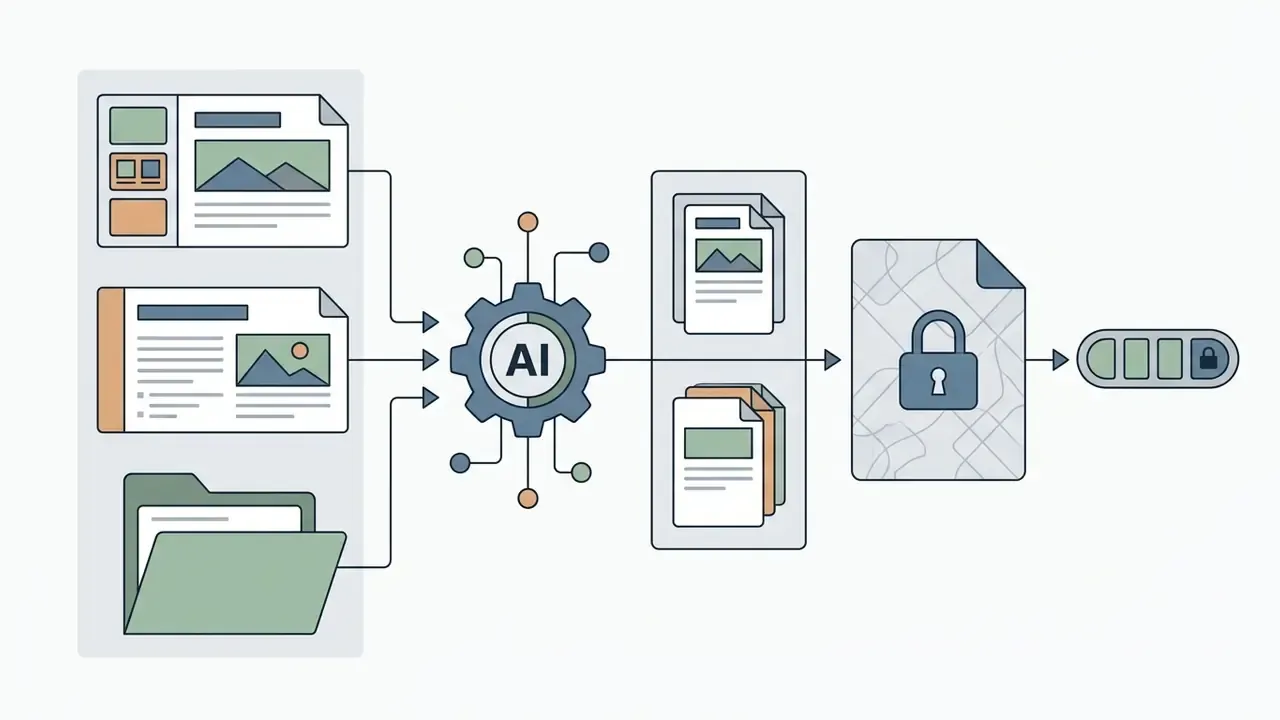
An ai pitch deck generator is an automated software application that uses multimodal artificial intelligence to transform prompts, text outlines, or uploaded documents into structured presentation slides. It moves raw input through document parsing, hierarchical summarization, layout engine selection, and visual design synthesis, then outputs an editable pitch deck.
Rather than dropping content into a static template, an ai pitch deck generator tool parses semantic content, works out narrative hierarchy, and formats each slide for readability and visual impact.
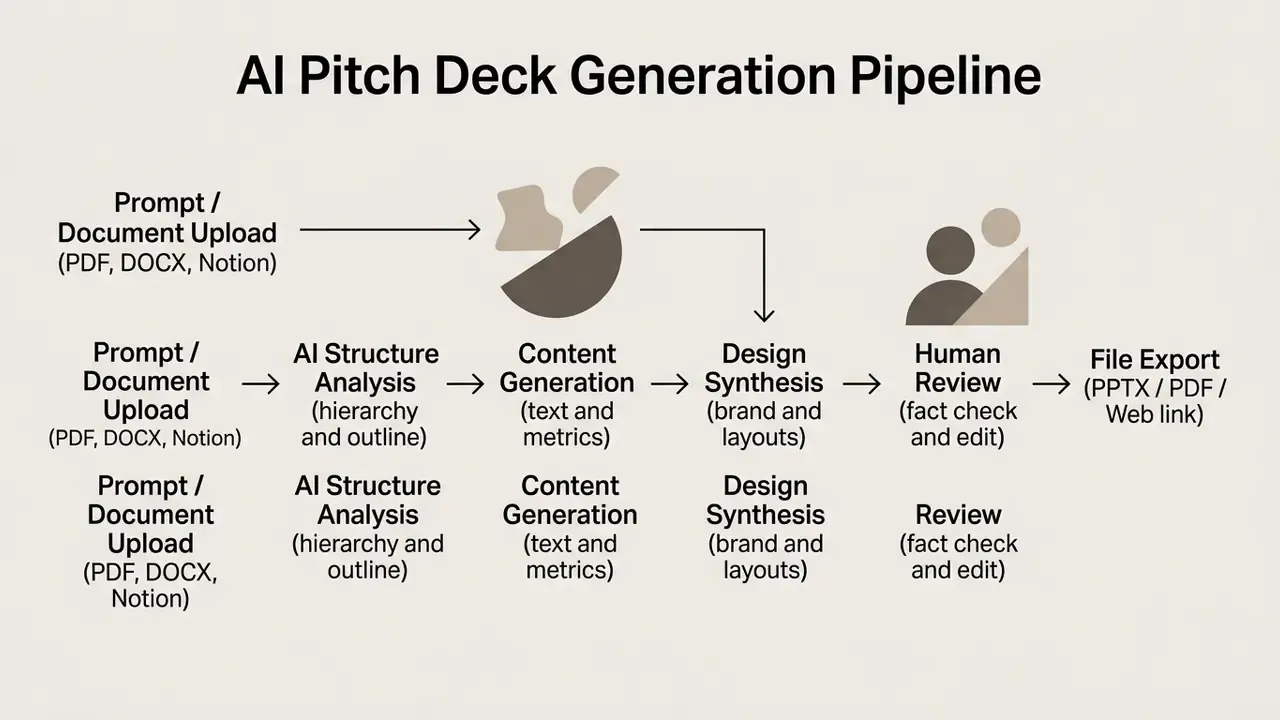
From prompt or document to a complete presentation deck
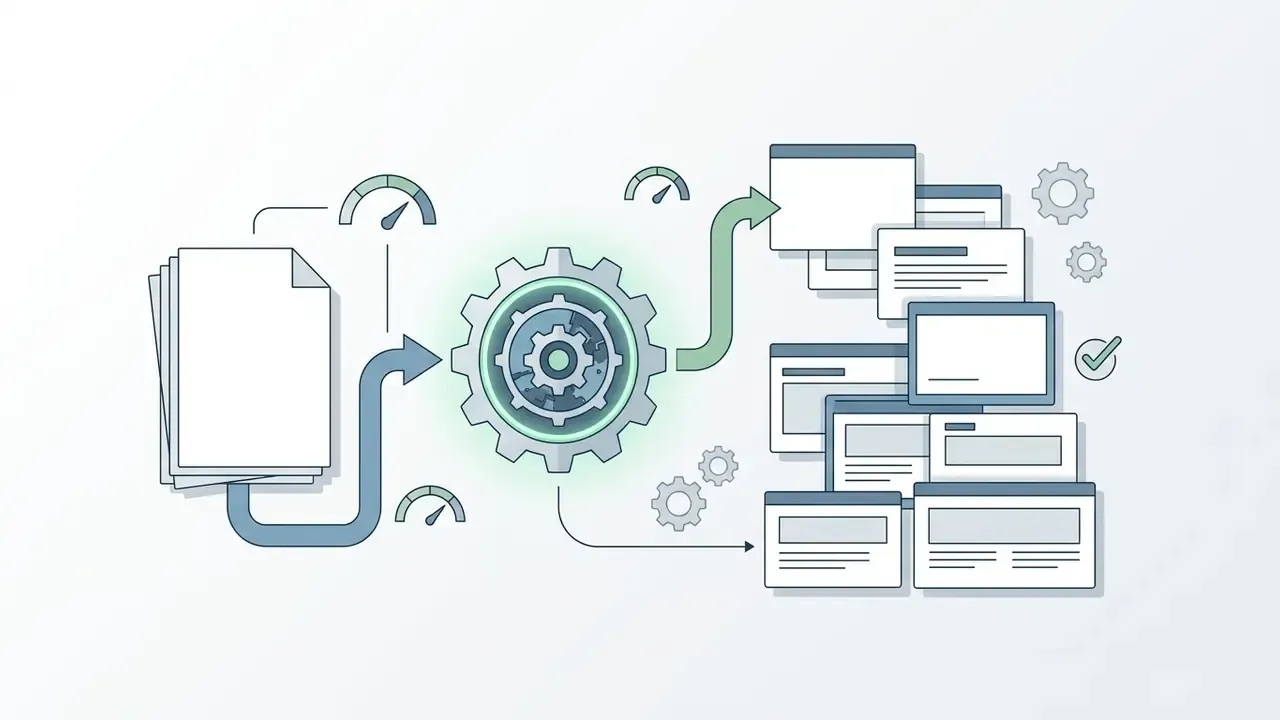
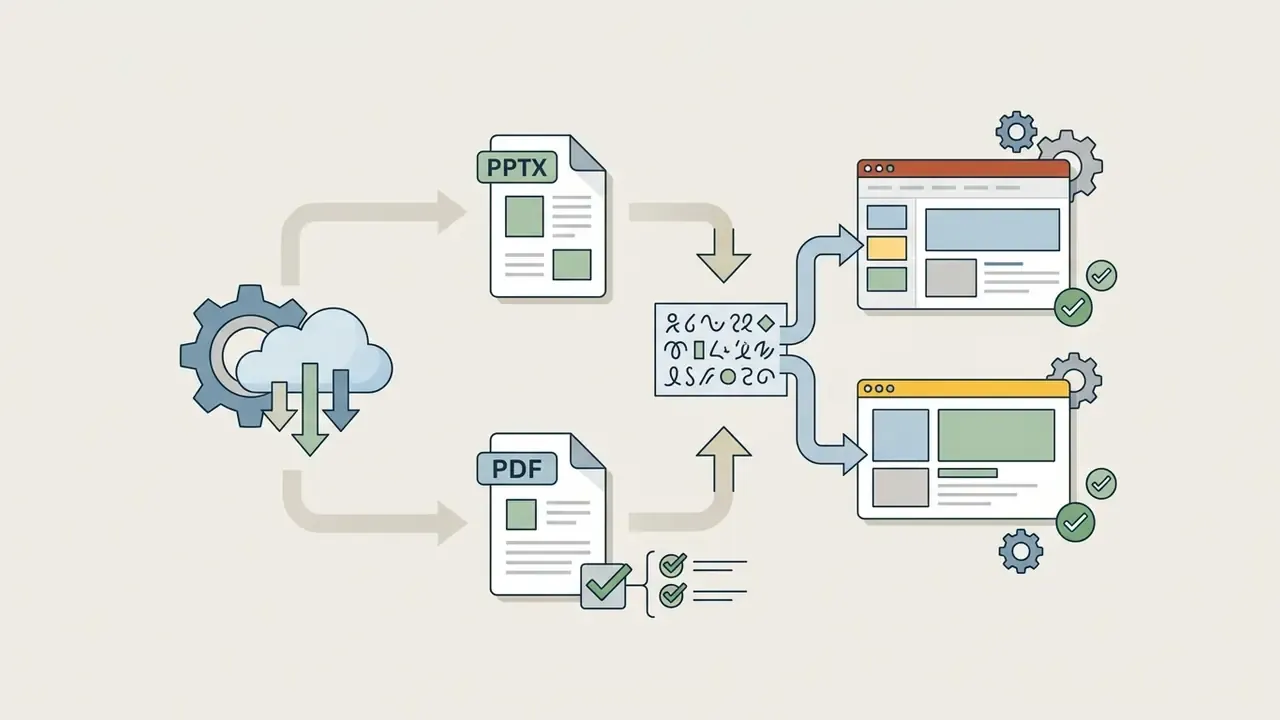
Modern ai pitch deck creation systems convert unstructured prompts or uploaded documents into complete presentations through a three-stage ingestion engine. First, optical character recognition and document layout parsers extract text, tables, and section hierarchies from business plans, financial models, or Notion pages. Second, large language models perform hierarchical summarization, mapping narrative points to individual slide concepts. Third, an automated layout planner assigns functional slide types, such as problem statements, market size charts, or financial tables, so information flows logically from cover to closing ask.
In academic research on automated presentation generation, frameworks like DocPres and SlideGen show that multi-stage agentic pipelines prevent content loss during conversion.
This matters operationally. Outline-first generation reduces hallucinated metrics because each slide is anchored to a retrievable source segment instead of the model's general knowledge. The PASS pipeline works similarly, using specialized layout classifiers to keep reading order and table structures intact when a Word document becomes a slide file.
In one enterprise evaluation, a fintech team handed an unstructured 20-page strategic memo to an ai pitch deck generator startup tool. The system pulled the core metrics, built a 12-slide outline, and assigned financial projections to dedicated charts in under three minutes. Preliminary assembly time fell by roughly 75%, which let the operators spend their attention on strategic refinement and verification rather than dragging text boxes.
What AI generates: content, slide design and visuals
An AI pitch deck engine generates typography, layout grids, iconography, and data visualizations from textual input and brand rules. Large language models compress verbose paragraphs into short, high-impact bullets and subheadings built for fast scanning. Design engines then apply responsive layout rules or native presentation vectors, aligning text blocks, images, and brand palettes without manual drag-and-drop.
Visual elements arrive through three routes: direct asset retrieval, custom AI image generation, or chart rendering frameworks. Platforms such as Canva Magic Design, Microsoft PowerPoint Copilot, and Gamma read text semantics to choose relevant icons, background shapes, and contextual diagrams. Before embedding synthetic imagery in a fundraising document, confirm licensing terms using a comparison of AI image generators for commercial use, since resolution ceilings and commercial rights differ sharply between engines.
Research on presentation generation is blunt about where quality comes from: visual-textual alignment.
Platforms using dual-agent architectures, where one model writes copy while a vision-language model inspects the rendered layout, score noticeably higher on visual clarity. That inspection layer catches text overflow, weak contrast, and misaligned chart callouts before the user ever sees the deck.
Pitch-specific visual vocabulary
Generic AI slide tools default to bulleted lists. High-converting pitch deck generators reach for specialized visual primitives built for investor data scanning:
- Bottom-up TAM pyramids nested triangles showing TAM (Total Addressable Market), SAM (Serviceable Addressable Market), and SOM (Serviceable Obtainable Market), derived from ARPU multiplied by total target accounts.
- Competitive feature matrices grid layouts with ticks and crosses positioning your platform against incumbents across four to six core capabilities.
- Traction timelines horizontal milestone graphs connecting product launches, regulatory approvals, and MRR inflection points.
- Hub-and-spoke architecture diagrams a centralized core showing ecosystem integrations, API channels, or multi-sided market interactions.
- Cohort retention funnels waterfall charts tracking user or revenue retention across 30, 60, and 90-day windows.
- Compare-two matrices and quadrants two-column "before and after" or "legacy versus platform" layouts used on the competition slide.
Tools trained specifically on fundraising material, for example engines trained on thousands of historical decks, pick these primitives on their own. General-purpose design assistants usually need to be asked, explicitly, in the prompt.
What slides belong in an investor-ready pitch deck?
An investor-ready pitch deck usually contains 10 to 12 core slides covering the venture's value proposition, market opportunity, operational traction, and capital requirement. Publicly circulated templates modelled on Y Combinator and Sequoia Capital guidance converge on a similar narrative arc: problem, solution, scalability, funding request. The Sequoia-style structure adds competition and financials; the YC-style structure leans harder on traction and metrics.
When using an ai business pitch deck generator, founders should verify that the automated output follows a recognized venture capital structure rather than an arbitrary slide order invented by the model.
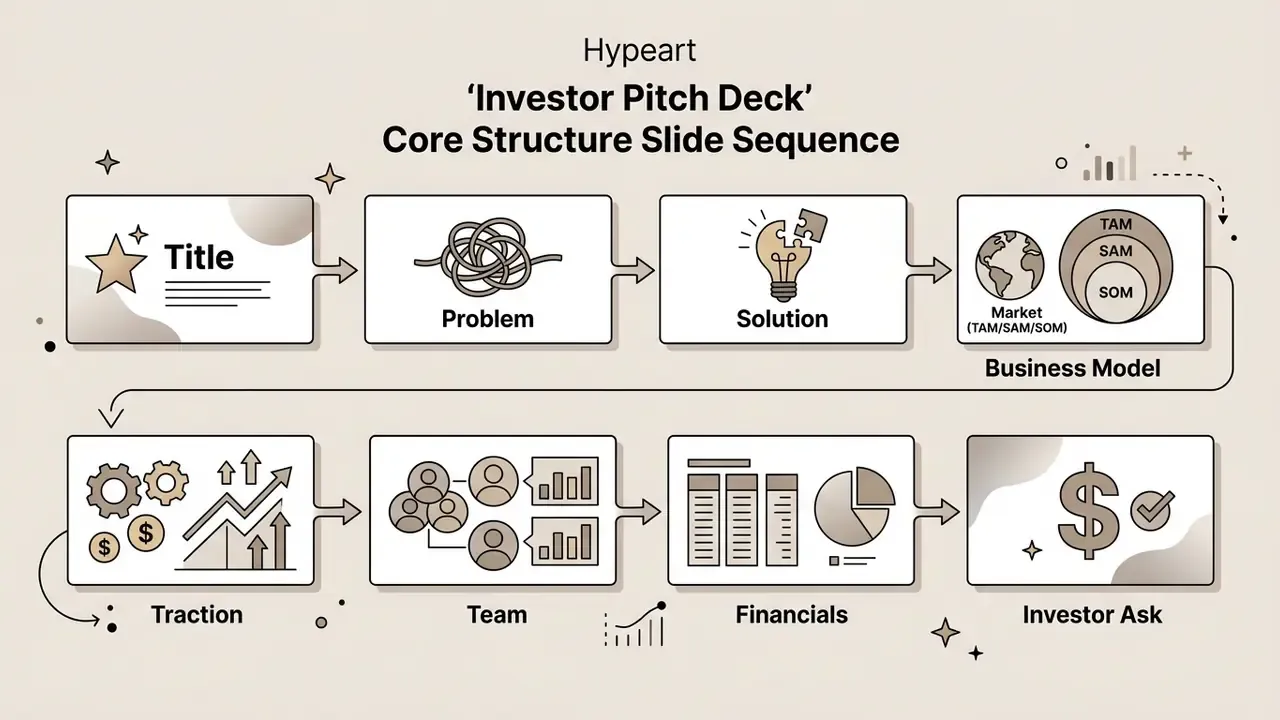
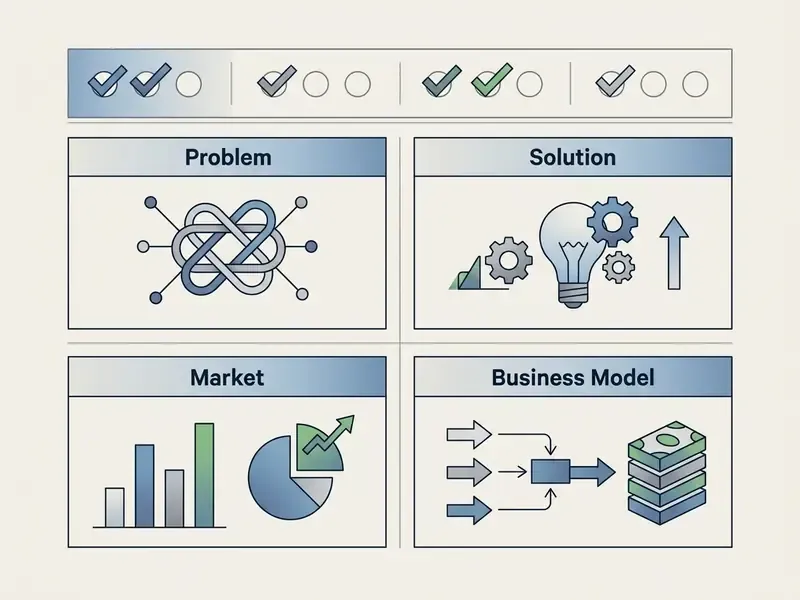
Core slides: problem, solution, market and business model
The foundational slides produced by an ai business pitch deck generator must define customer pain, product value, addressable market, and revenue mechanics. The problem slide isolates one validated industry inefficiency. The solution slide shows how the product removes it, ideally in 10 to 15 words.
- Title / cover slidecompany name, a clear category tagline, brand identity.
- Problem slidequantified customer pain and the limits of existing options.
- Solution slideconcise value proposition, core capabilities, competitive differentiation.
- Market opportunity (TAM/SAM/SOM)total, serviceable addressable, and serviceable obtainable market, calculated bottom-up.
- Business modelmonetization structure, pricing tiers, acquisition channels, go-to-market unit economics.
Publicly available academic pitch templates, including the Harvard Business School pitch template and the SMU Institute of Innovation and Entrepreneurship pitch guide, both tell founders to size markets bottom-up (customer count multiplied by price) and to compress the solution statement into 10 to 15 words. Top-down industry estimates tend to collapse during due diligence. So an AI generation tool must be fed actual customer counts and average revenue per user (ARPU) if the market sizing visual is going to hold up.
The implication is not cosmetic. A machine-readable, unambiguous description of what the company does carries predictive signal, and that is exactly what a well-built problem and solution slide delivers.
When designing product showcases, founders often bring in custom visual assets. A comparison of the best AI art generators, the best AI art generator guide, or free AI art generator options helps teams pick compliant software for proprietary product mockups.
Investor-tested pitch framework blueprints (YC, Sequoia, Airbnb)
| Framework | Target round | Slide count | Core narrative focus | Best AI prompt directive |
|---|---|---|---|---|
| Sequoia Capital | Seed / Series A | 10 slides | Market size and defensive moat | "Structure the deck using the Sequoia 10-slide capital arc with heavy emphasis on unit economics." |
| YC Demo Day | Pre-seed / Seed | 8 slides | Rapid traction and founder insight | "Format for a 120-second pitch, leading with month-over-month metric growth and a concise problem statement." |
| Airbnb (classic) | Seed round | 14 slides | Customer storytelling and adoption | "Build a consumer marketplace story, highlighting organic adoption channels and visual product mockups." |
Platforms that expose framework selection as a setting, for example "classic VC pitch", "accelerator demo day", or a custom narrative, sequence the story for you. Where the tool has no selector, encode the framework in the prompt itself. It takes one sentence.
Traction, team, financials and the investor ask
The second half of the deck quantifies momentum, presents forecasts, evidences team expertise, and states the funding request. Investors read these slides to judge execution capability, financial discipline, and capital efficiency.
- Traction and metrics: monthly recurring revenue (MRR), active user growth, retention cohorts, named enterprise partnerships.
- Team and advisors: leadership backgrounds, domain experience, prior exits, strategic board advisors.
- Financial projections: three to five year profit and loss summaries, gross margins, EBITDA, burn rate, runway.
- Investor ask and use of funds: exact capital allocation, milestones targeted, runway duration (typically 18 to 24 months).
In a randomized controlled trial by the MERIT Research Group (Judging a Pitch by its Cover, 2024 to 2026), researchers analysed investor behaviour across 34,000 early-stage decision-makers.
MERIT Research Group Study (2024–2026) "High visual fluency increases initial slide engagement and viewing duration, but substantive data quality, specifically verifiable traction and financial rigor, determines final capital commitment." (MERIT Field Experiment on Investor Behavior.)
Design gets you read. Data gets you funded. Worth remembering before you spend a weekend on gradients.
Enterprise internal pitch and strategy decks: a second scenario
Not every deck built with an ai pitch maker goes to a venture fund. Corporate strategy, risk, and finance functions use the same engines for board committee updates, transformation business cases, and vendor selection memos. The slide logic changes.
| Dimension | Investor pitch deck (startups) | Enterprise internal pitch / strategy deck |
|---|---|---|
| Primary audience | Seed or Series A investment committee | Board, executive committee, risk or steering committee |
| Core question answered | "Is this a venture-scale return?" | "Is this decision defensible, funded, and controlled?" |
| Anchor slides | Problem, TAM, traction, ask | Objective, baseline data, options analysis, risk register, funding request |
| Data source | Founder-maintained model | System of record (ERP, CRM, data warehouse) |
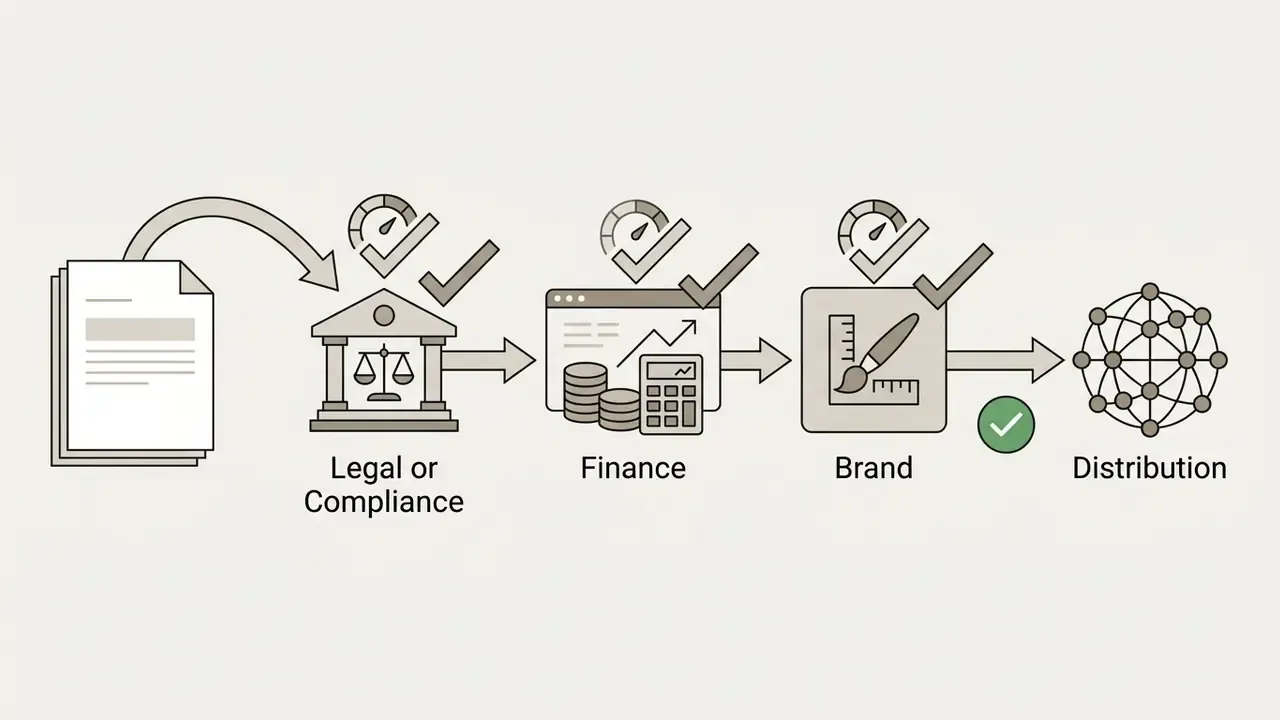
| Mandatory review path | Founder plus advisors | Business owner, then Finance, then Legal and Compliance, then brand governance |
| Retention requirement | A version per investor | Auditable version with source references and approvals |
For regulated organizations the deck itself becomes a record. That means the generation workflow has to preserve traceability from every chart back to the source extract, which is the audit trail requirement covered further down.
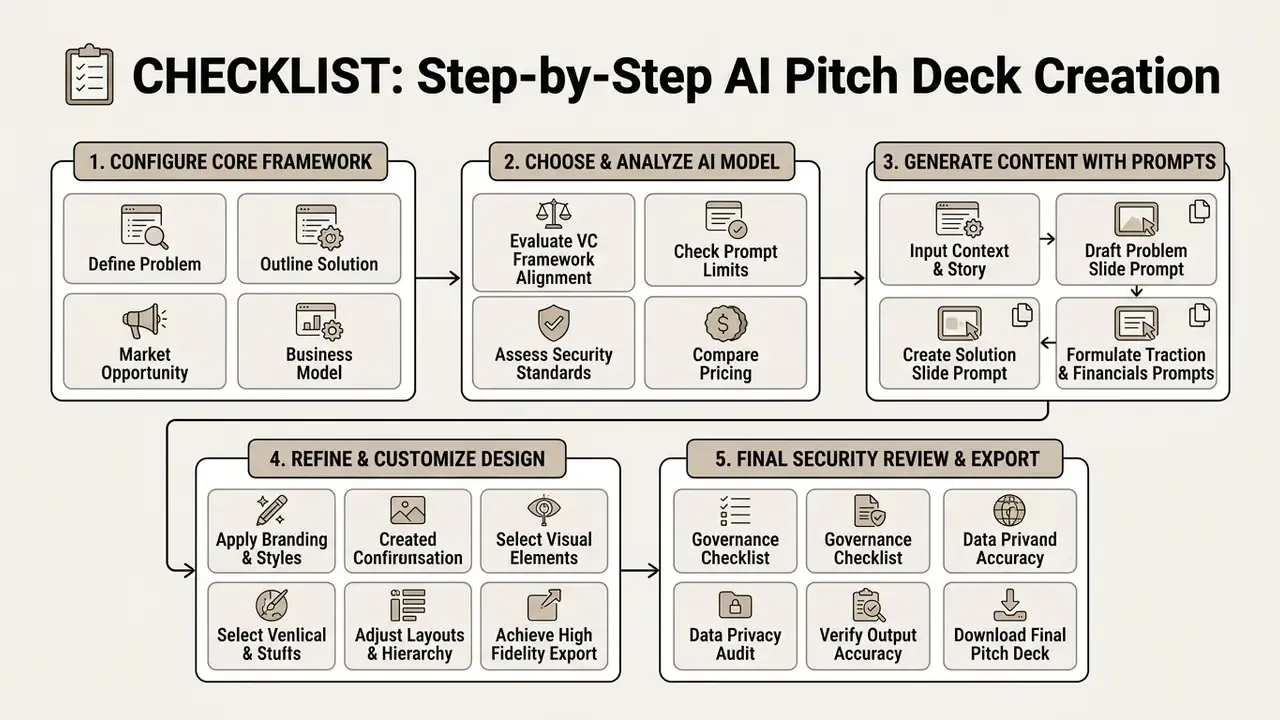
How to create a pitch deck with AI step by step
To create a pitch deck with AI, prepare a structured business brief, feed it into an ai tool to create pitch deck slides, refine the generated layouts, then fact-check before exporting to editable formats.
A systematic method keeps narrative coherence, factual integrity, and visual polish in the same file. Skipping stages is how decks end up beautiful and wrong.


Prepare a clear prompt, source content and business data
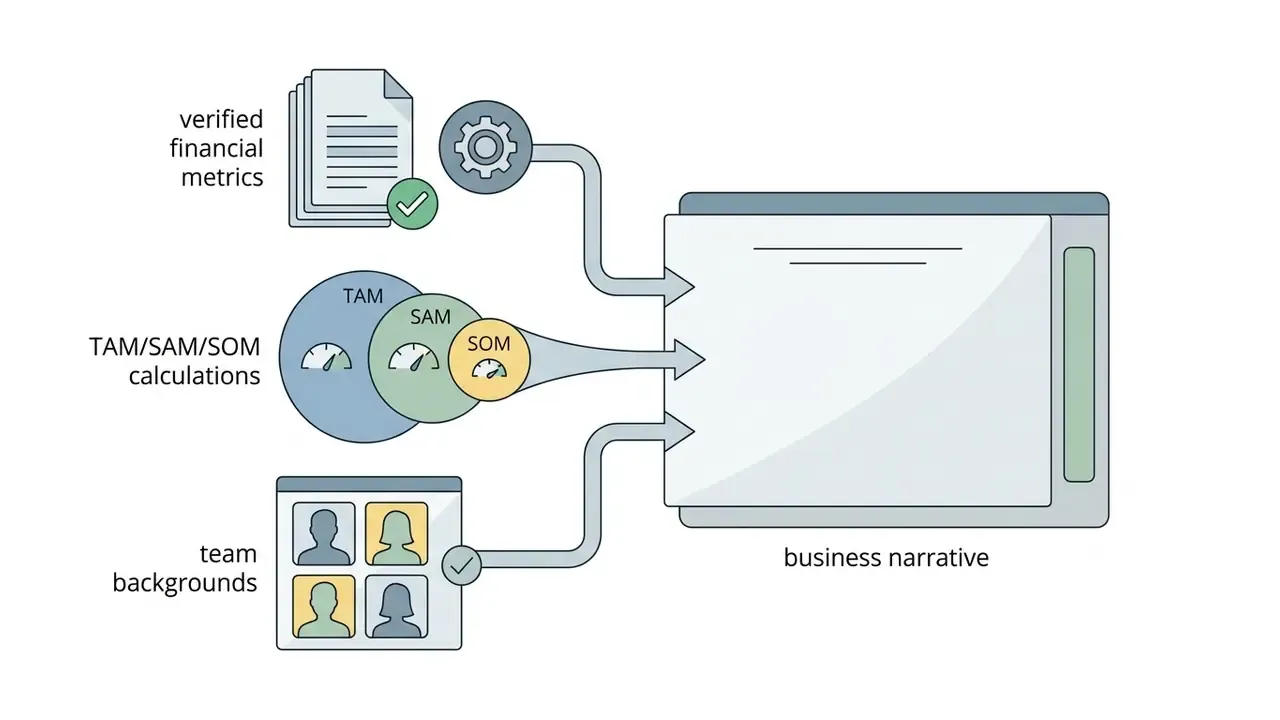
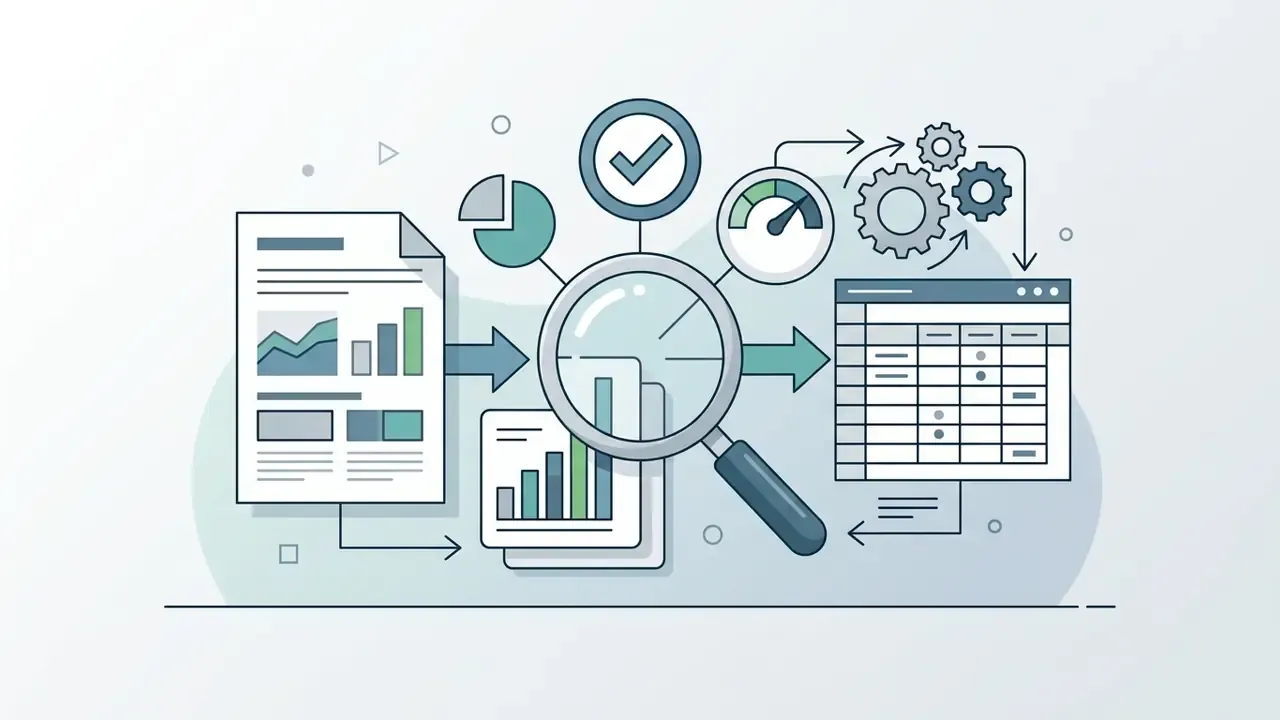
Good AI slide generation needs a comprehensive input brief: audience parameters, problem and solution statements, TAM metrics, verified financials. Not a one-line wish. Structured raw text stops the model from filling context gaps with invented industry claims or generic market estimates.
When writing a prompt for an ai pitch maker, structure the input with explicit parameters:
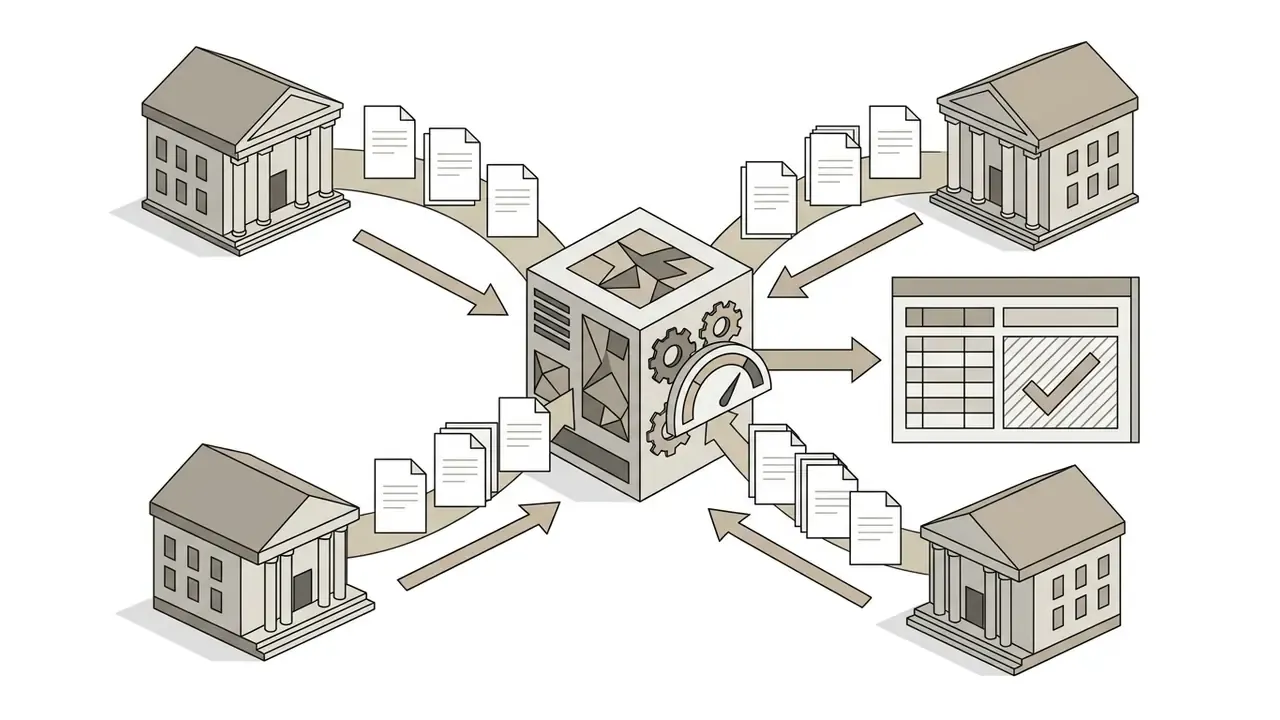

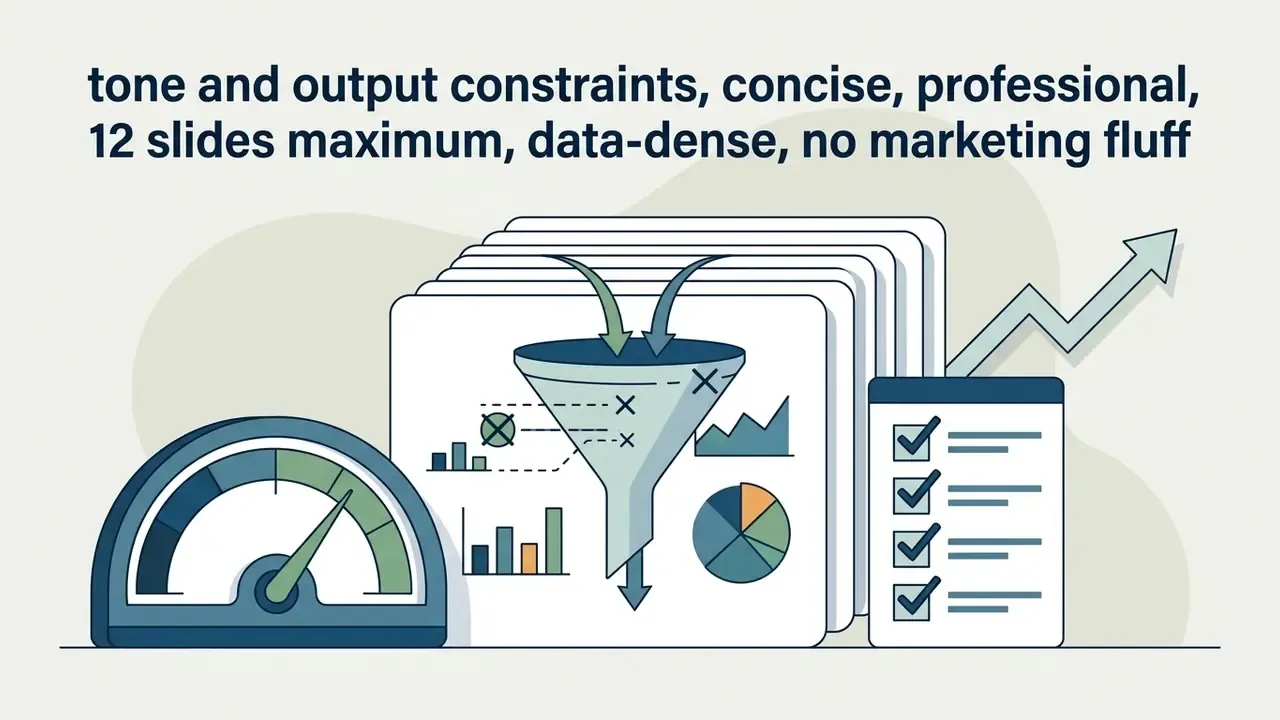
In one seed round, an enterprise software team pulled product documentation and financial spreadsheets into a structured markdown brief before generating anything. With explicit slide constraints in the prompt, the ai to create a pitch deck platform returned a 10-slide draft with zero missing data fields. The preparation removed several prompt iterations, and every metric matched internal accounting records. Boring discipline, good outcome.
Know your context window before writing the prompt
Prompt length is a hard limit, not a stylistic preference. Documented context windows differ by two orders of magnitude:
- Roughly 100,000 characters (about 20,000 words) Plus AI Pro accepts a full business plan pasted straight into the prompt window.
- 10,000 to 50,000 plus characters Presentations.AI and Alai support long briefs alongside file uploads.
- Roughly 2,000 characters Gamma-class prompt fields expect a short brief, with detail supplied through document upload instead.
- Roughly 400 characters (about 50 words) Pitch's "Start with AI" field. A 400-character brief yields attractive layouts and thin content, so plan for manual enrichment.
- 600 characters Slidebean-class startup tools, where templates carry more weight than the prompt.
Master prompt templates for AI pitch deck generation
Copy and adapt these based on your tool's context window.
Option A: high-context prompt (tools supporting 10,000 plus characters, such as Plus AI or Alai)
SYSTEM ROLE: You are an elite Venture Capital Pitch Strategist preparing a Seed-Stage deck for top-tier VCs.
INPUT DATA: [Paste complete Markdown Business Plan & Financial Model]
OUTPUT CONSTRAINTS:
- Format: 12 slides strictly following the Sequoia Capital framework.
- Data Density: High. Quantify every claim with provided source metrics.
- Slide 1 (Cover): One-line category-defining tagline.
- Slide 2 (Problem): Identify 3 quantified industry inefficiencies ($ or time lost).
- Slide 3 (Solution): Define product capability in <15 words + 3 key features.
- Slide 4 (TAM/SAM/SOM): Bottom-up calculation showing $1B+ TAM.
- Slide 5 (Traction): Highlight current $X MoM growth and $Y MRR.
- Tone: Direct, analytical, zero marketing fluff.
- Do not invent metrics. If a value is missing, insert [DATA REQUIRED].
Option B: short-context prompt (tools with sub-500 character limits, such as Pitch or legacy engines)
Create a 10-slide Seed pitch deck for [Company Name], a B2B SaaS platform for [Industry]. Key metrics: $[X] MRR, [Y]% MoM growth, $[Z] TAM. Audience: VC investors. Structure: Problem, Solution, Market, Product, Traction, Business Model, Team, Financials, Ask ($[Amount] for [Months] runway). Style: minimalist, data-heavy, dark mode.
Option C: enterprise strategy deck prompt (internal committee use)
ROLE: Corporate strategy analyst preparing a decision deck for a risk and finance steering committee.
SOURCE: [Attach approved data extract + options analysis memo]
OUTPUT: 9 slides - Objective, Baseline Metrics, Options Analysis (3 options with cost/benefit), Recommended Option, Implementation Timeline, Risk Register, Controls & Compliance Impact, Funding Request, Decision Requested.
RULES: Use only figures present in the attached extract. Label every chart with source file name and date. Flag any assumption as [ASSUMPTION].
Generate the first deck and customize each slide
After the first draft lands, adjust visual hierarchy, typographic scale, layout grids, and content density on every slide. Automated engines give you a fast foundation. Fine-grained design work is what makes it match institutional brand requirements.
As a practical typographic baseline, presentation design systems that publish their rules openly, including the U.S. Department of Veterans Affairs OIT Brand System with its 12-column modular grid and 12pt base type scale, offer a defensible starting hierarchy. Translated to pitch decks:
Customization also means bringing in decent visual assets. Teams often lean on online photo editors for marketing assets or free photo editor tools to clean up corporate headshots and product screenshots before embedding them.
- Slide title
- 36pt to 48pt bold.
- Section subheadings
- 24pt to 36pt.
- Body copy
- 14pt to 18pt regular, never below 12pt.
- Captions and source notes
- 10.5pt to 12pt italic.
- Accents
- use weight, colour, and scale. Avoid underlines as emphasis.
Review the narrative and export the final presentation
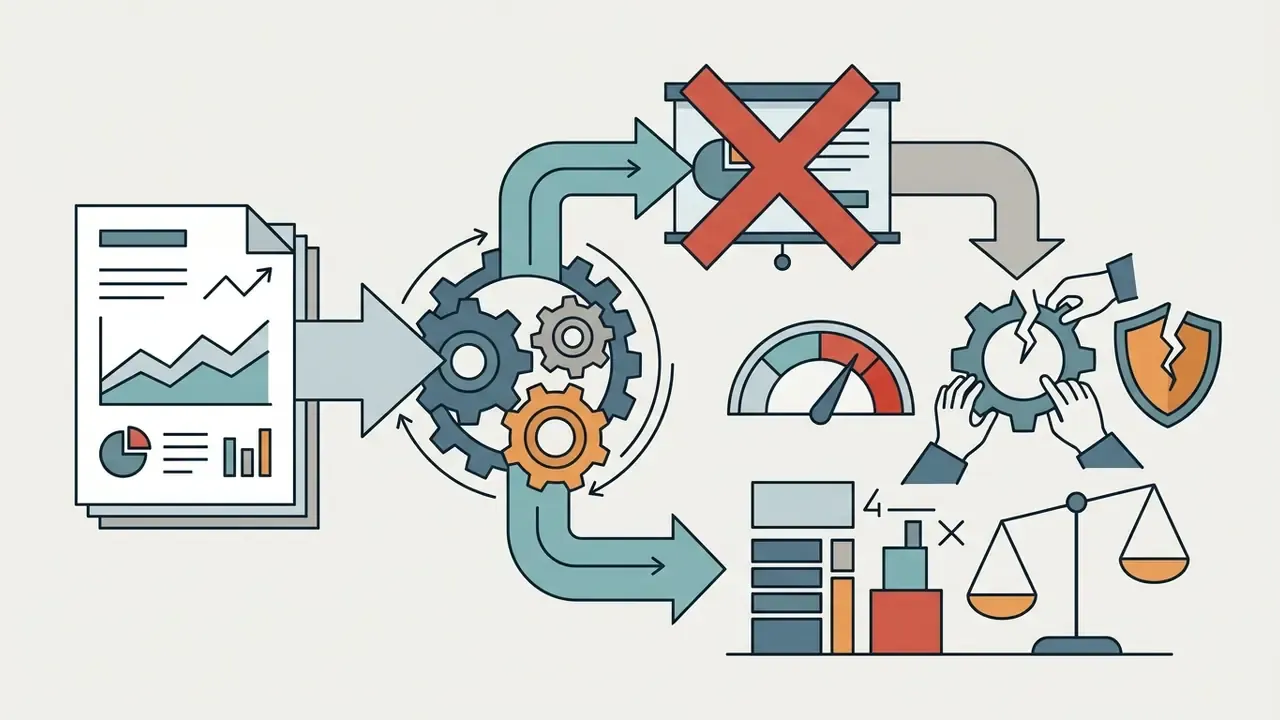
Known failure modes when AI parses financial spreadsheets
Model risk teams should test for these defects before trusting a generated financial slide.
| Failure mode | How it appears on the slide | Prevention control |
|---|---|---|
| Nested or linked formula misread | Chart uses a cached value instead of the calculated result | Export the model to flat CSV values before upload |
| Currency conflation | Mixed USD and EUR series plotted on one axis | Enforce single-currency extracts and label the unit in the header row |
| Period misalignment (Q1 vs Q2, FY vs CY) | Growth rate looks inflated or reversed | Use explicit ISO period labels (2026-Q1) in column headers |
| Row or column header inference error | Legend labels swapped with categories | Provide a tidy table: one header row, no merged cells |
| Unit scaling drift (thousands vs millions) | Revenue off by 1,000 times | State the unit in the prompt and re-check axis maxima |
| Silent gap filling | Model interpolates a missing month | Instruct the model to output [DATA REQUIRED] instead of estimating |
The last row causes the most damage, because an interpolated month looks exactly like a real one.
Preserve the audit trail
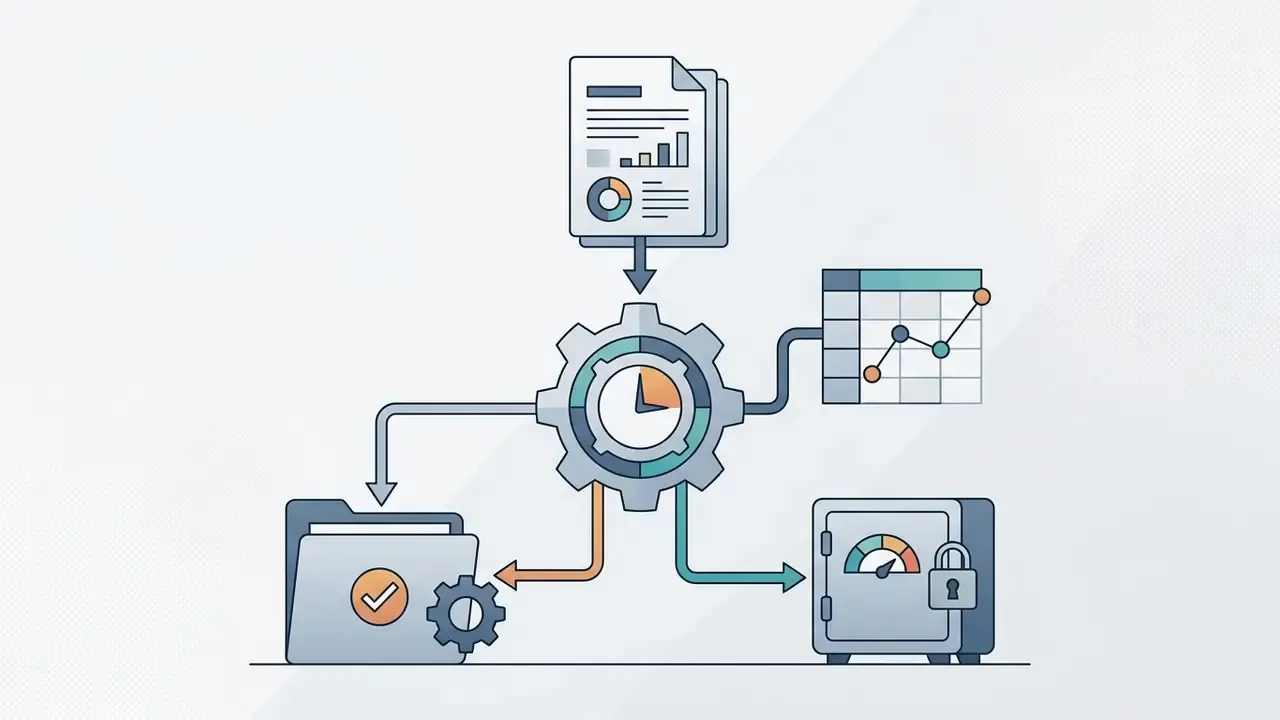
In regulated environments the deliverable is not only the deck. Archive alongside the final file: the exact prompt text, the tool and model version, the uploaded source documents, the extraction date, and a map of each chart to its originating spreadsheet range. That makes any external number reproducible on request and turns an opaque generation event into a reviewable control.
When exporting, produce both an editable PowerPoint (.pptx) file for live presenting and a tagged PDF for digital distribution. Following W3C PDF accessibility guidance keeps reading order and document outlines navigable across PDF viewers, and W3C guidance also discourages distributing material in non-adaptable PDF-only form.
Features to look for in AI pitch deck creation tools
Essential features in ai pitch deck creation tools include automated brand kit enforcement, real-time collaborative editing, document parsing, slide-level analytics, and multi-format export.
When evaluating an ai pitch deck generator tool, corporate buyers and founders should test functionality across several operational dimensions rather than judging the demo gallery.
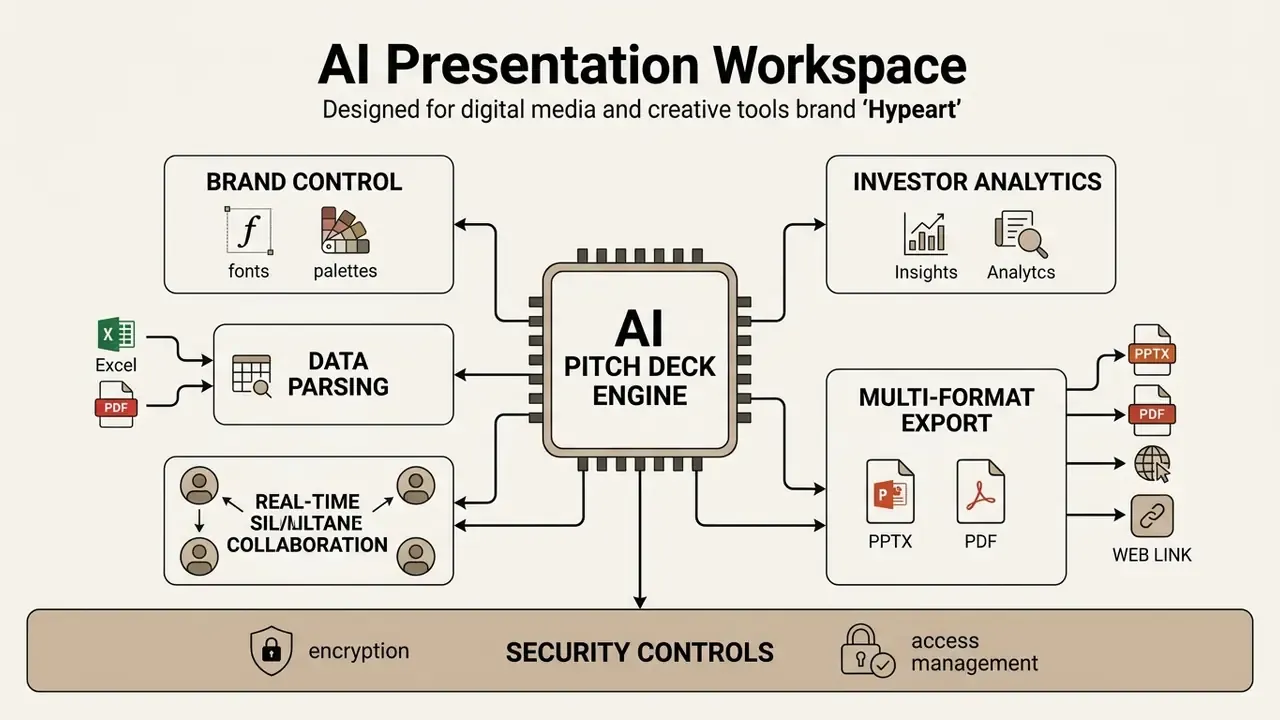
Templates, brand control and professional slide design
Professional ai tools for pitch deck creation ship large template libraries plus automated brand controls that hold visual identity steady across palettes, custom fonts, and logo placements. Brand control systems apply the corporate style guide automatically, which stops well-meaning colleagues from introducing off-palette colours or non-compliant typography.
Modern brand kit generators apply hex codes, primary and secondary font pairings, and vector logo lockups across newly generated slides. Founders building identity assets from scratch often start with a review of AI logo generators for brand identity before locking a theme. Tools such as GetGenAI Brand Compliance and Brnd.ink inspect layouts continuously, flagging violations like insufficient contrast, unapproved font scales, or a misplaced logo.
URL-based brand scraping: automated brand extraction
A differentiating capability in 2026 is automated brand ingestion from a domain. Instead of uploading a logo, typing hex codes, and installing font files, the operator pastes the company URL once and the platform scrapes the site for:
- Logo assets SVG or high-resolution PNG lockups, including inverse variants.
- Colour palette primary, secondary, and accent values extracted from CSS variables and rendered pages.
- Typography the web font families and weights actually served to visitors.
- Imagery style product screenshots and hero images available for reuse on slides.
The brand profile is stored and reapplied to every later deck, so slide one is on-brand with no setup. Tools without this feature require brand rules to be re-entered per workspace or per theme, a small friction that becomes real when a team produces dozens of personalized decks a month.
For multimedia presentations, secondary assets need reliable editing. Guides to animation makers for presentations and AI headshot generator tools help keep those elements inside corporate brand standards. Where synthetic imagery is needed for a cover slide, the licensing constraints described in the Bing AI image capabilities analysis and the Microsoft AI Image Generator guide decide whether an asset can legally appear in external fundraising material.
Collaboration, document upload, analytics and export formats
Enterprise-grade presentation tools support multi-user co-authoring, direct ingestion of financial spreadsheets, investor engagement tracking, and native export to PowerPoint and PDF.
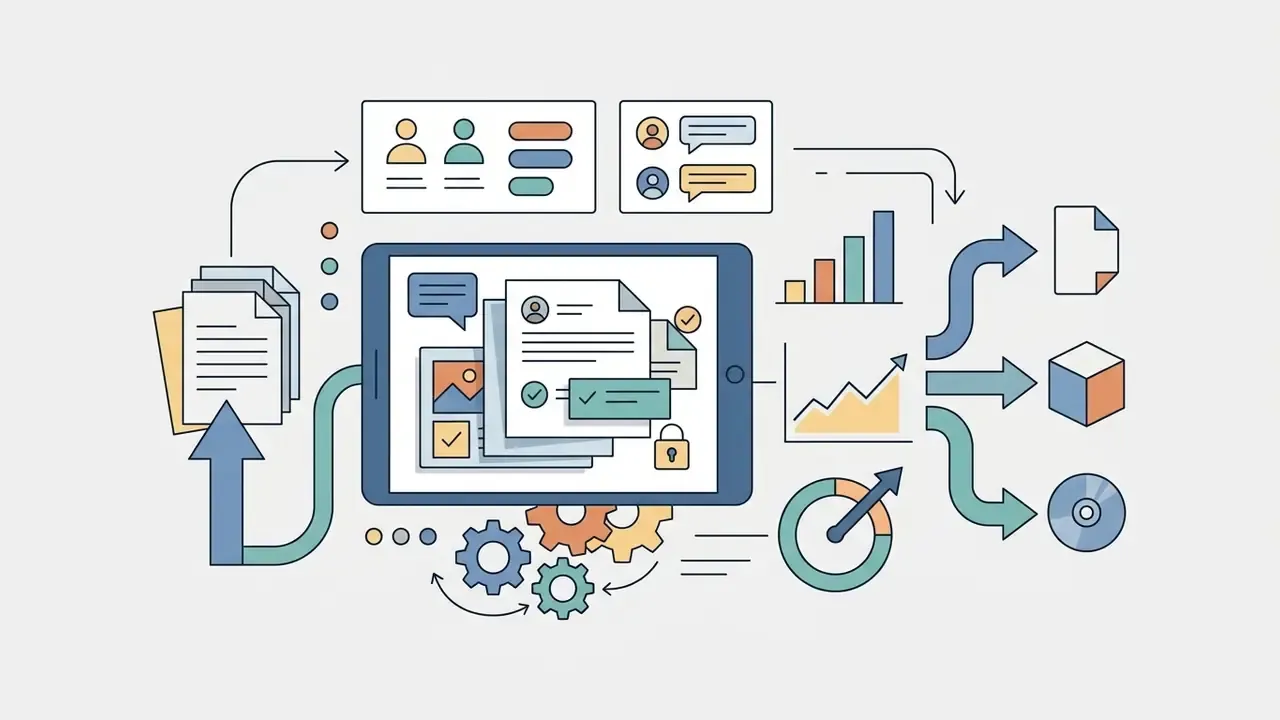
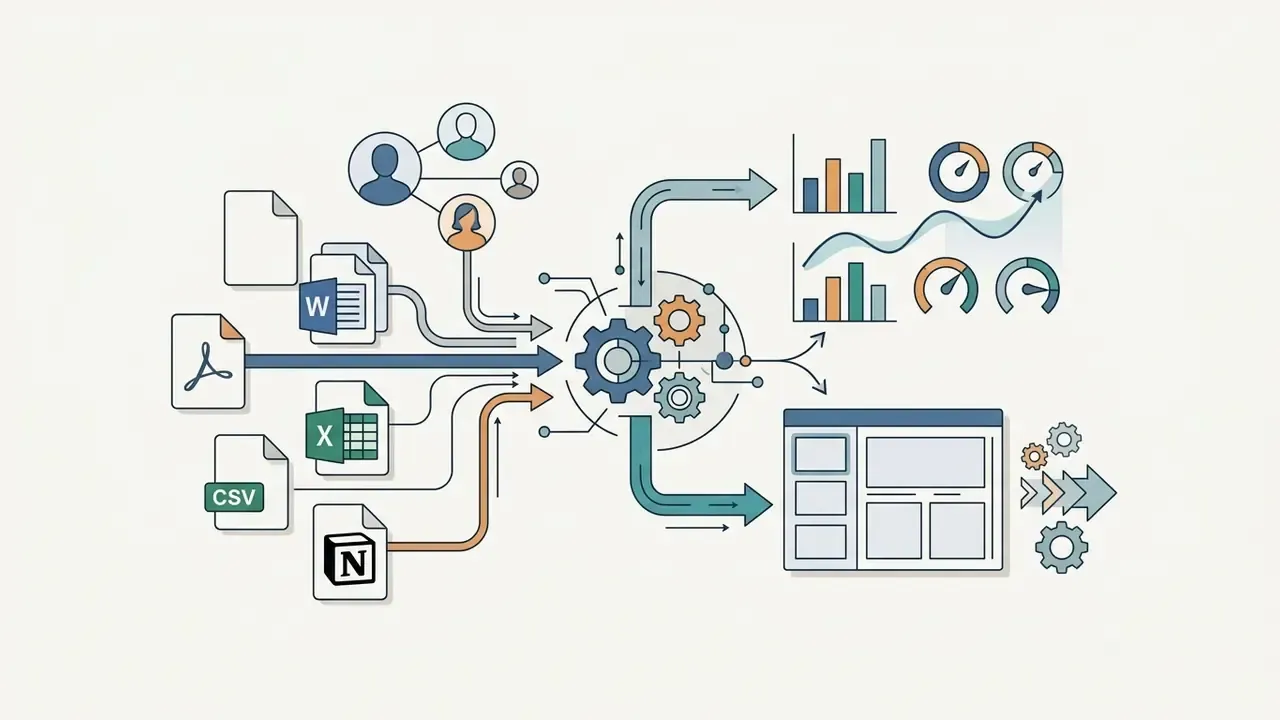

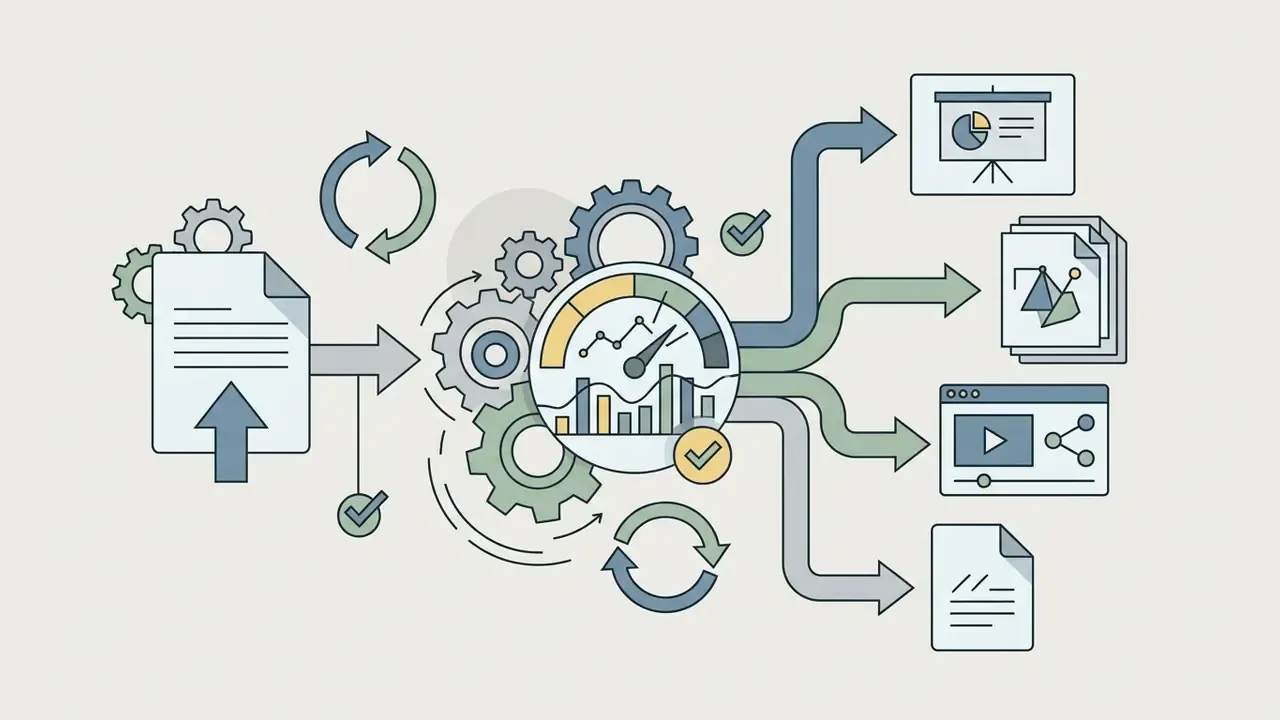
Teams running commercial workflows often connect deck generation with broader digital media production. The AI Media Commercial-Use Hub and the AI Media Pricing Guides give operational clarity on licensing and commercial rights, while dedicated calculators help budget enterprise platform subscriptions before procurement asks.
Investor link tracking and dwell-time analytics
Sending a static PDF tells you nothing about interest. Modern AI pitch platforms issue tracked web links that log visitor behaviour in real time:
- Slide-level dwell time exact seconds per slide, for example showing that a partner skipped Traction and spent three minutes on Financials.
- Drop-off point the last slide viewed before the session ended, which reveals whether anyone reached The Ask.
- Forwarding notifications alerts when a partner shares the link with associates, usually a sign of internal circulation before a partner meeting.
- Visitor context organisation, approximate location, device, repeat-visit counts.
- Access controls passcode protection, expiring links, NDA gates before viewing, remote revocation once a process closes.
There is a trade-off here. Exported PPTX and PDF files are static and report nothing back. If engagement data matters, distribute the tracked link and supply a PDF only on request.
How to choose the best AI pitch deck generator
Selecting the best ai pitch deck generator depends on your primary objective: seed-stage fundraising, high-volume sales outreach, or governed corporate reporting.
Comparing tools means evaluating design quality, generation speed, manual editing flexibility, export fidelity, and security posture together, not one at a time.
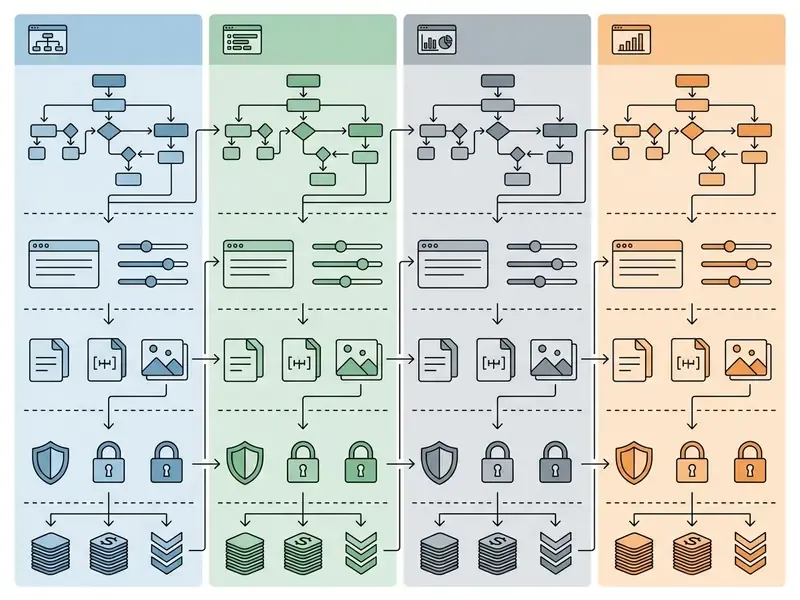
Testing methodology and fact-checking framework
Which AI deck maker is best for startups and fundraising?
Dedicated ai pitch deck maker for startups solutions such as ChatSlide, SlidesPilot, Alai, and Gamma prioritize financial table ingestion, data room PDF parsing, and VC-compliant storytelling. They are built to process complex business models and output slides that match investor expectations.
For fundraising, financial model processing decides the shortlist. Platforms that can parse multi-tab Excel files or financial PDF memos let founders generate clean EBITDA charts and unit economics tables without rebuilding them.
Platforms offering native pitch frameworks also keep generated slides inside recognized venture capital norms rather than generic corporate layouts.
That finding cuts both ways. Machine evaluation of pitch quality is becoming reliable enough to pre-screen your own narrative before a partner meeting, which is a legitimate use of an AI reviewer even when the deck itself is written by hand.
When comparing production workflows, teams often check adjacent software guides. Creators preparing video-based pitch assets can review the YouTube video editor workflow guide or the best free AI video generator review.
Which tool fits sales decks and collaborative teams?
An ai sales deck generator such as Pitch or Canva Magic Design is stronger on personalized deal rooms, CRM data integration, team commenting, and visitor analytics. These platforms optimize for volume: many tailored B2B proposal decks, quickly.
Enterprise sales workflows need bulk personalization, custom deal room URLs, and real-time viewing notifications. When a prospect opens the link, tracked analytics show which slides held attention longest, and the account executive can shape follow-up around demonstrated interest rather than guesswork.
Organizations expanding marketing workflows frequently evaluate related media generation software. Overviews such as the Canva AI Generator guide for design workflows or the Google AI Image Generator overview help assemble a coherent creation toolstack instead of a pile of trials.
Google Slides, PowerPoint, PDF and PPTX compatibility
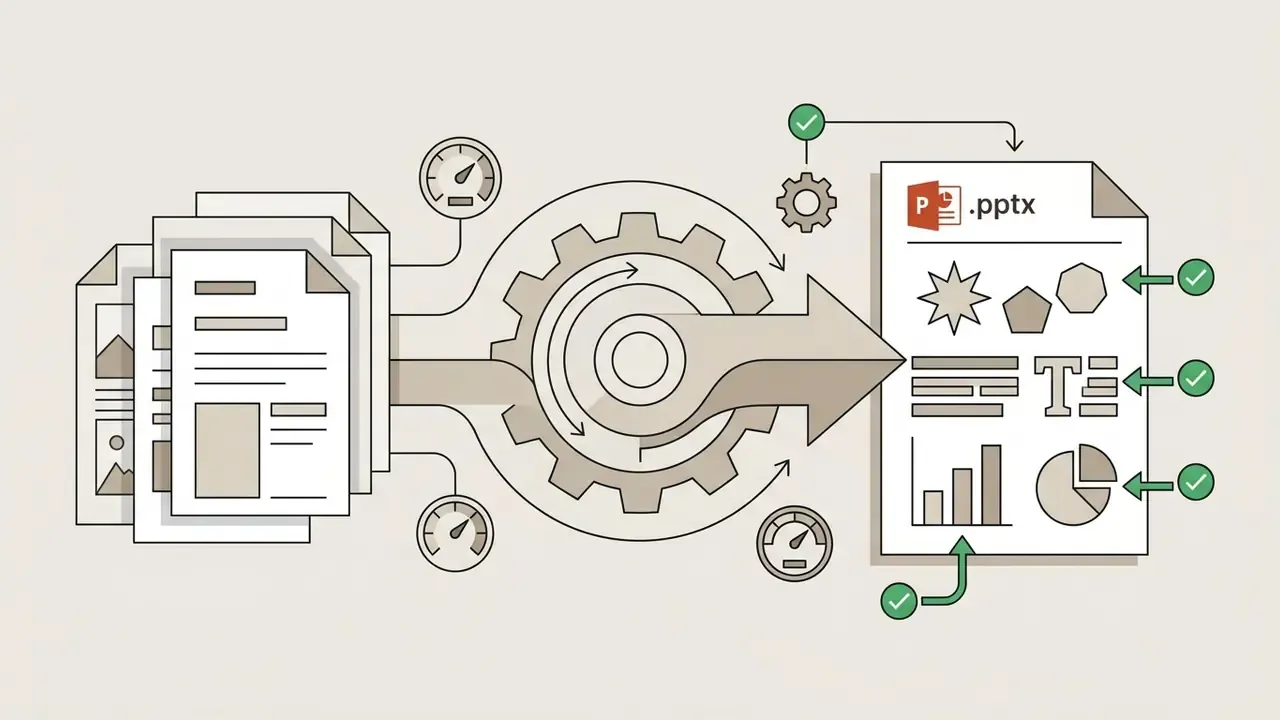
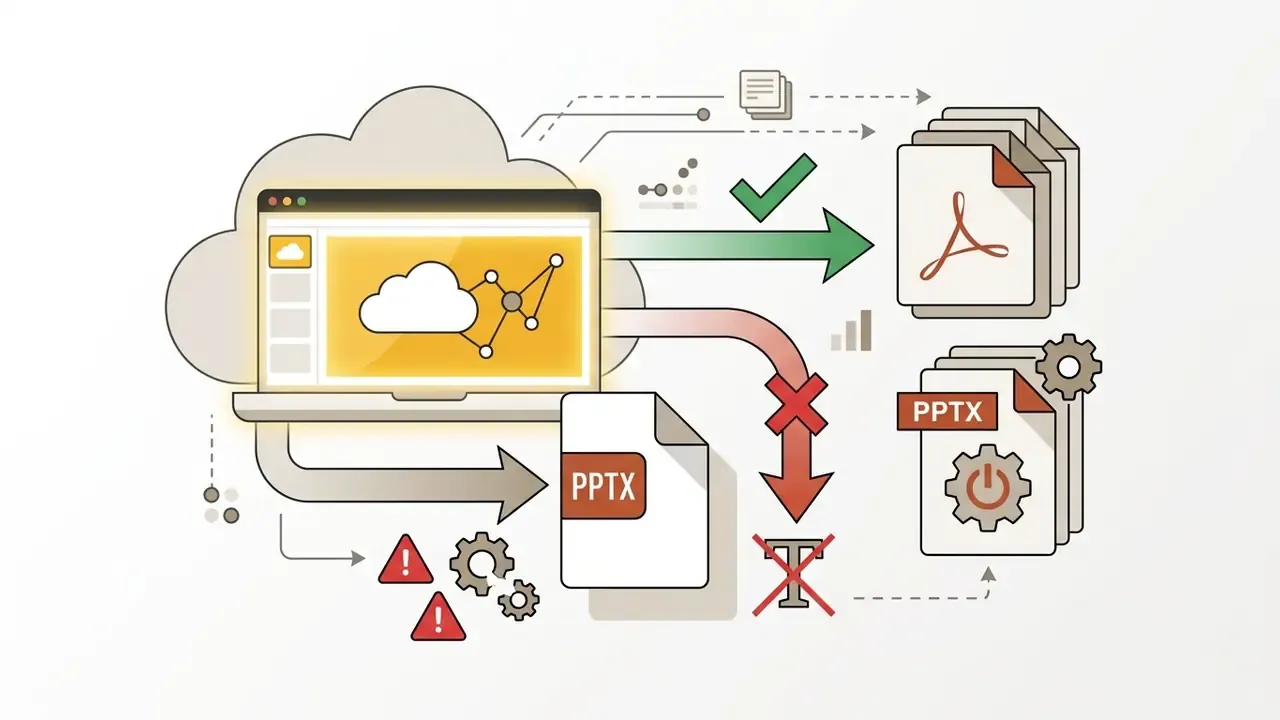
Native .pptx export gives the highest cross-platform fidelity. Converting between PowerPoint and Google Slides invites font substitution and layout drift.
Format choice affects downstream editing and visual fidelity:
To hold fidelity across systems, embed standard system fonts or use widely available Google Web Fonts during creation. Then test: open the export on a second machine and check container margins and chart callouts.
| Platform / Tool | Target segment | Primary strength | Export formats | Brand control | Analytics |
|---|---|---|---|---|---|
| Gamma App | Startups and creators | Fast prompt-to-deck drafting (under 1 min) | PPTX, PDF, PNG, web link | Custom themes and colours | Card view and duration analytics |
| Pitch.com | Sales and B2B teams | Collaborative deal rooms and CRM flow | PPTX, PDF, live link | Enterprise brand kit | Visitor tracking and slide analytics |
| Microsoft Copilot | Corporate enterprises | Deep Microsoft 365 and document ingestion | PPTX, PDF | Corporate master templates | Native Office 365 audit |
| ChatSlide / SlidesPilot | Fundraising and finance | Spreadsheet and financial PDF parsing | PPTX, PDF | Standard custom fonts | Basic link tracking |
| Canva Magic Design | Marketing and media | Template library and visual assets | PPTX, PDF, PNG, MP4 | Brand hub enforced | View and engagement metrics |
Technical capabilities and compliance matrix
| Platform | Context window limit | URL brand scraping | PPTX vector export fidelity | Real-time data API | Governance and security |
|---|---|---|---|---|---|
| Plus AI | About 100,000 characters | Manual input | High (native PPTX / Google Slides) | No | Workspace permissions |
| Presentations.AI | 10,000 plus characters | Automated via URL | High (native vector PPTX) | Yes (agent-based refresh) | SOC 2 Type II |
| Gamma App | About 2,000 characters | Manual theme setup | Medium (layout drift risk) | No | Basic privacy controls |
| Pitch.com | About 400 characters | Manual brand hub | High (native PPTX) | No | Enterprise SSO |
| Templafy | Effectively unlimited (document agent) | Enterprise asset library | Native Microsoft 365 integration | Direct CRM / database sync | SOC 2, SOC 3, ISO 27001, ISO 27017, Azure |
| Alai | 50,000 plus characters | Custom theme lock | High (vector PPTX) | Live API connectors | SOC 2 Type II |
| Slidebean | About 600 characters | Website-based generation | Paid plans only | No | Standard SaaS controls |
Read that matrix as a trade-off map, not a ranking. A 400-character engine can still produce the best-looking layout, and an unlimited-context enterprise agent can still be the wrong choice for a two-minute demo-day deck.
Pricing, free plans and commercial-use considerations
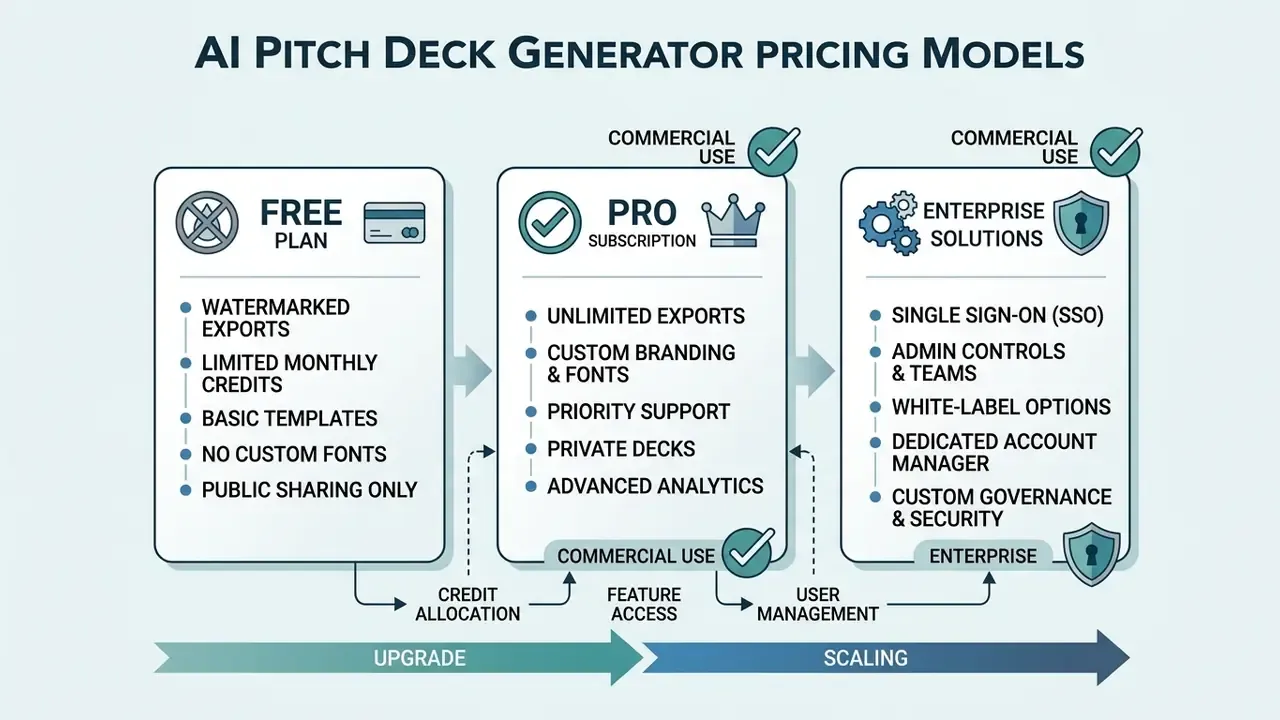
Evaluating pricing for an ai pitch deck maker means looking at generative credit limits, export resolution, watermark removal, brand kit access, and seat-based enterprise tiers.
Understanding the licensing model is what keeps a cheap subscription from becoming an expensive surprise at renewal.
What to check in free and paid plans
Free tiers usually offer a limited one-time credit balance, watermark restrictions, and PDF-only exports. Paid Pro and Enterprise plans unlock unlimited generation, PPTX downloads, and custom fonts.
Across AI presentation tools, buyers meet three billing structures:
- Credit-based freemium an initial balance, for example 400 credits in Gamma. Generating decks or running AI rewrites consumes credits, and once exhausted you top up or subscribe.
- Per-seat monthly subscriptions a flat fee per user, roughly $10 to $40 per seat per month across Plus AI, Presentations.AI Pro, Pitch, and Beautiful.ai team tiers, covering unlimited generation, advanced analytics, and custom brand kits.
- Credit pack add-ons pay-as-you-go packages for intermittent users who need an occasional deck without an ongoing commitment.
Confirm two things before standardising: whether the free tier removes watermarks, and whether it allows native PPTX download. Some free plans block sharing and export entirely, which makes them unusable mid-fundraise. Check the date on any pricing page you rely on, since these tiers change quarterly.
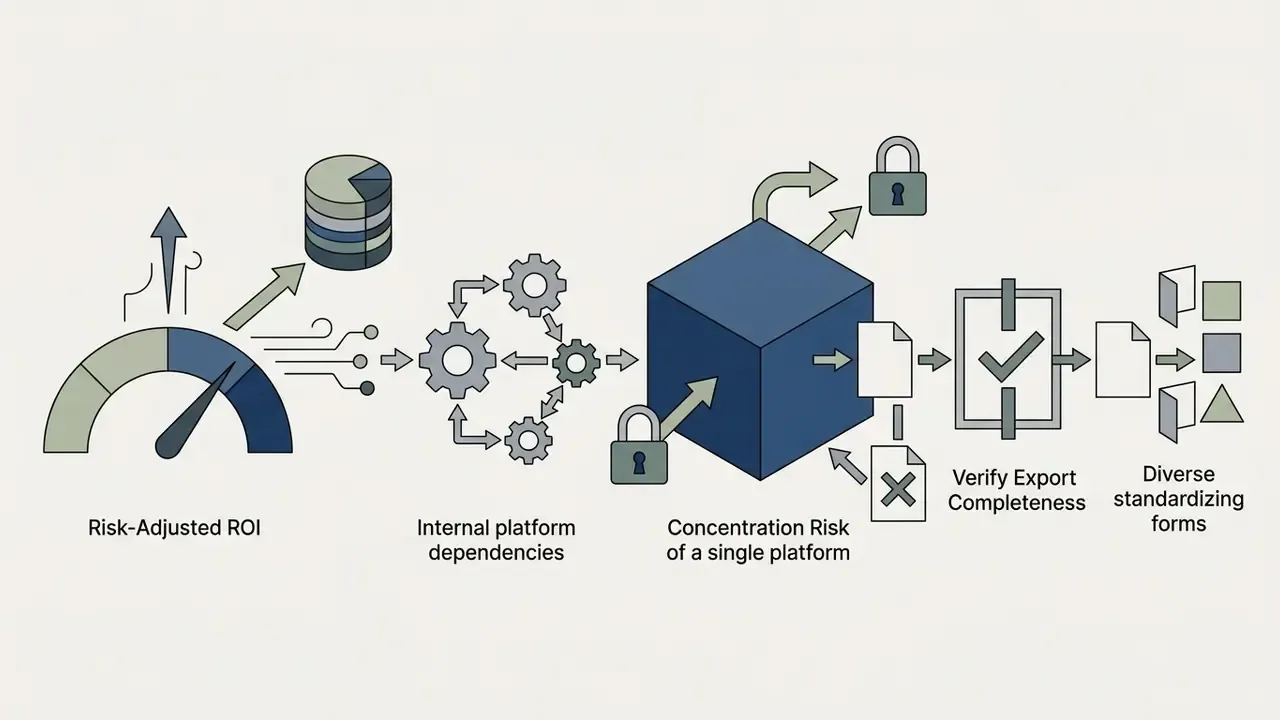
Calculating risk-adjusted ROI
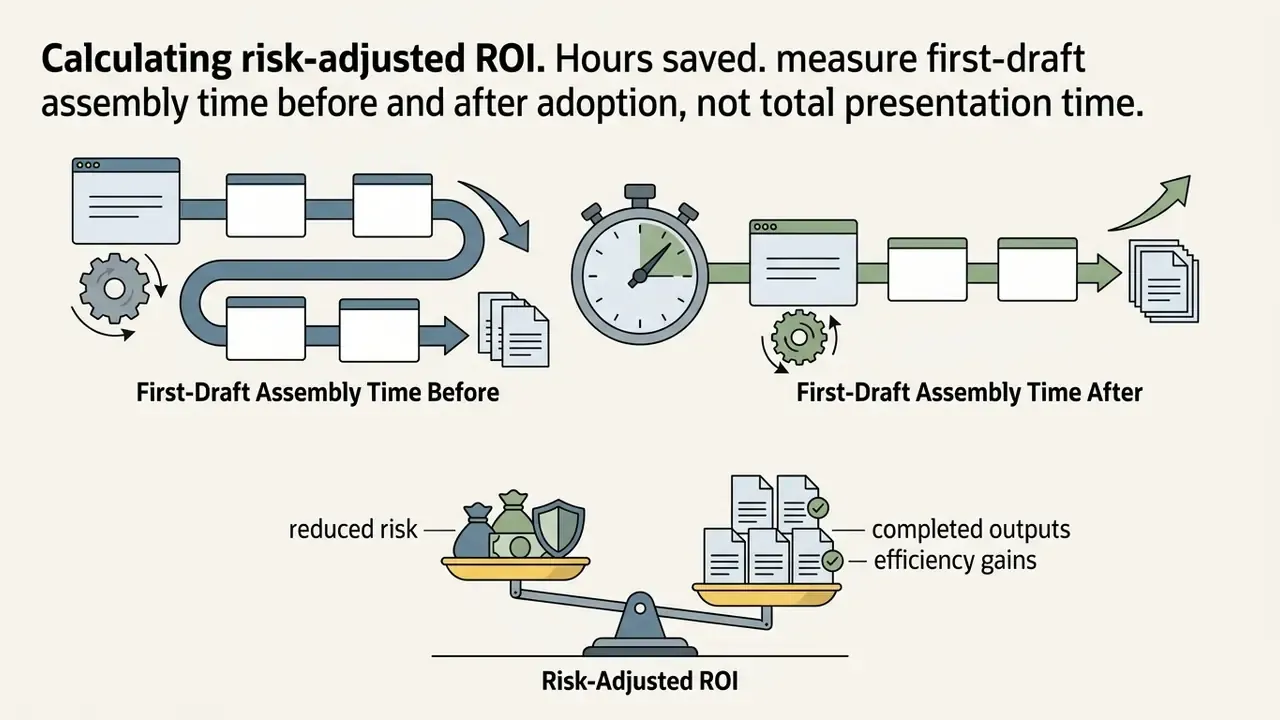
Design hours saved are the easy half of the business case. A defensible calculation for finance and risk leaders adds the cost of controls:
Risk-adjusted ROI = (hours saved × loaded hourly cost) − (licence cost + validation hours × loaded hourly cost + remediation cost × probability of an undetected error)
How to populate it:
If validation effort exceeds drafting savings, the honest answer is to restrict AI generation to narrative slides and keep financial exhibits on a human-maintained template. That is not a failure of the tool. It is a scoping decision.
Brand consistency, quality control and team workflows
Commercial deployment of AI slide generators requires governance over data privacy, ownership of generated output, enterprise admin controls, and human-in-the-loop quality assurance.
Under enterprise terms of service, such as OpenAI business plans or comparable commercial SaaS agreements, corporate subscribers generally retain ownership of output text, slides, and synthesized visuals, subject to the vendor's terms. Organizations in regulated sectors still need to verify that the platform enforces zero data retention, so that sensitive projections or business plans never feed public model training.
Enterprise workflows should centralize administration. Administrators assign roles, manage API keys, enforce brand kits, and retain logs of generated material. A strict human-in-the-loop editorial workflow then guarantees that every deck passes executive fact-checking and brand verification before it leaves the building.
Model capability therefore has direct commercial value. Paid tiers routing generation through frontier models produce fewer redundant slides and less rework, which belongs in the pricing calculus rather than in the vanity-upgrade column.
Enterprise security, compliance and data governance
Rolling out AI pitch deck generators across teams demands technical compliance to prevent data leakage and regulatory breach:
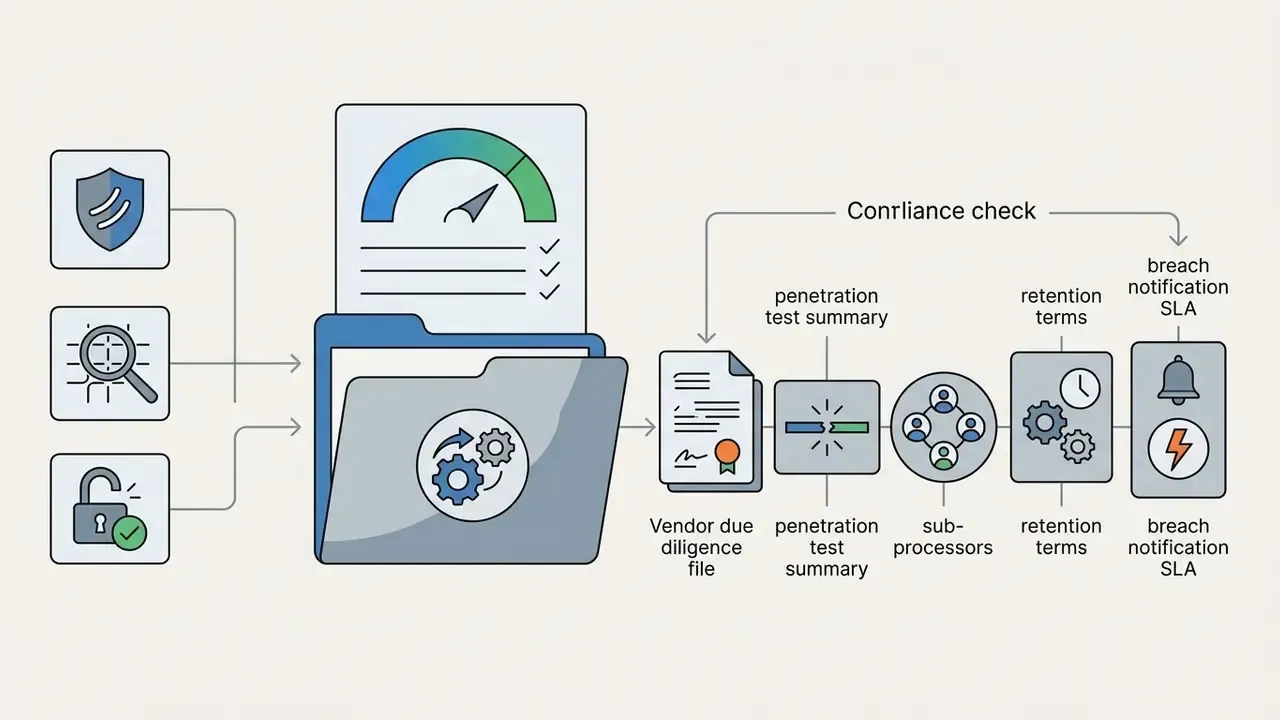
- Security certifications require SOC 2 Type II, SOC 3, ISO 27001, and ISO 27017. Hosting should sit in encrypted Azure or AWS environments, ideally with customer-managed encryption keys (CMEK) and documented third-party audit reports.
- Zero data retention (ZDR) obtain contractual guarantees that prompts, uploaded financial models, and generated slide text are not logged or used for base-model fine-tuning, plus a defined deletion window for transient processing data.
- Identity and access SSO and SAML, SCIM provisioning, role-based access control, and workspace separation between client-facing and internal material.
- Auditability immutable logs of generations, exports, share links, and permission changes, exportable to the organisation's SIEM.
- Live CRM and database API connectors enterprise platforms connect through REST APIs to Salesforce, HubSpot, or Snowflake, enabling automated refreshes for monthly investor and board updates without manual CSV uploads, which also removes a common source of stale numbers.
- Residency and sub-processors confirm data residency regions and review the sub-processor list, since model inference is frequently subcontracted.
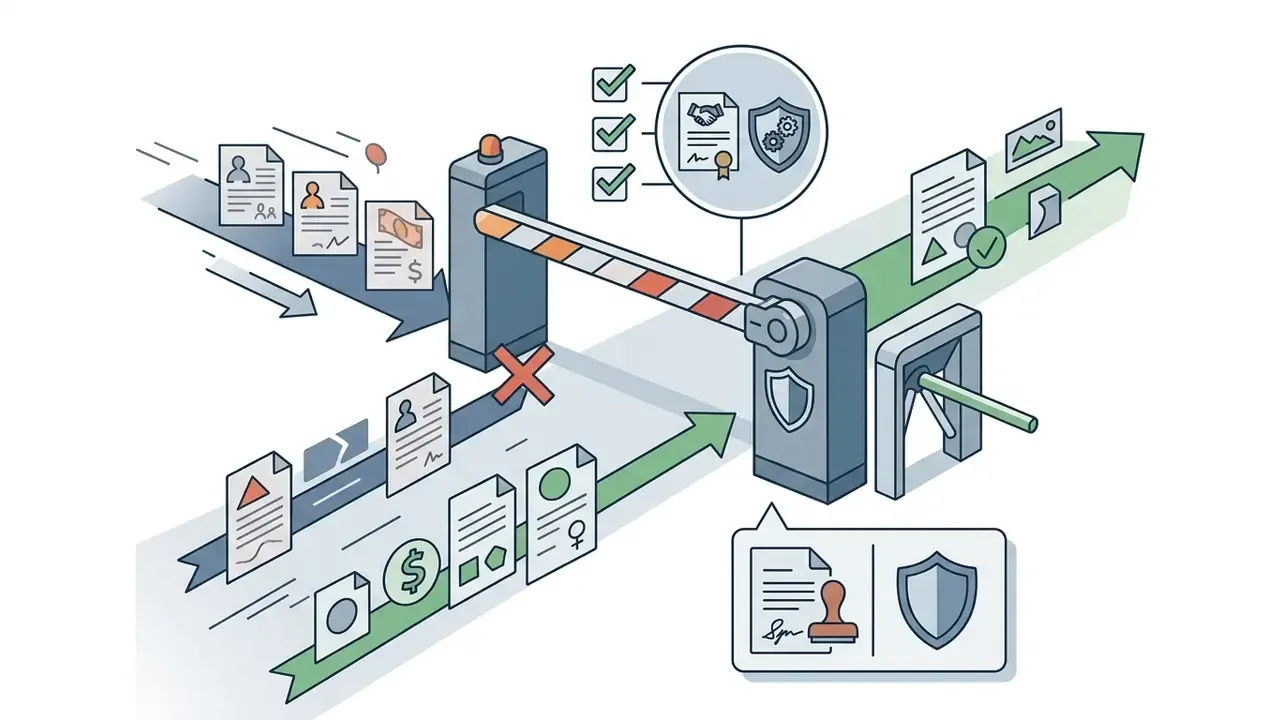
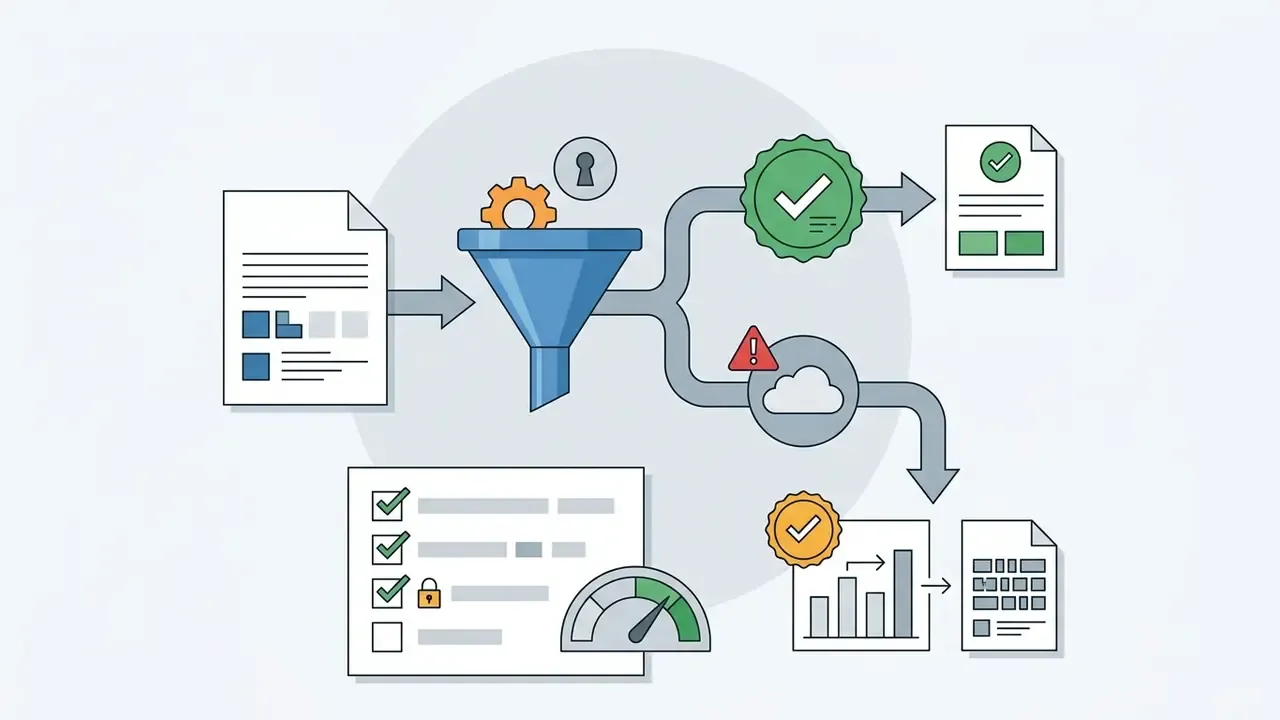
Shadow AI and compliance controls checklist
Unapproved consumer accounts are the dominant real-world risk. An employee pasting an unpublished financial model into a free tier can create a disclosure event with no malicious intent whatsoever. Controls that reduce that exposure:
- Approved tool list published to all staff, with at least one sanctioned option per use case, so nobody is pushed off-platform by necessity.
- Network and CASB rules restricting uploads to unapproved generative presentation domains.
- Model risk sign-off for any workflow where AI output feeds a financial or regulatory disclosure.
- Periodic recertification of tool access and of the audit trail requirement, at least annually.
| Service tier | Average pricing | Generative credits | Brand kit access | Export options | Enterprise governance |
|---|---|---|---|---|---|
| Free / Starter | $0 per month | 100 to 400 one-time credits | Basic template palettes | PDF with watermark | Public workspace only |
| Pro / Individual | $10 to $25 per seat per month | Unlimited or monthly refresh | Custom fonts and brand colours | Unbranded PPTX, PDF, PNG | Individual privacy controls |
| Team / Business | $25 to $40 per seat per month | High-volume pooled credits | Full brand hub enforcement | PPTX, PDF, live analytics | Centralized billing and admin controls |
| Enterprise / Gold | Custom quote | Unlimited or dedicated API | Automated compliance checks | White-label and custom formats | SSO, SOC 2, ISO 27001, ZDR, audit logs |
FAQ about AI pitch deck generators
Short answers on technical capability, founder accountability, enterprise governance, and B2B document scenarios.
Can ChatGPT create a pitch deck?
Partly. ChatGPT can generate text outlines, write slide copy, and run Python for financial analysis, but it does not natively render polished visual slides without a downstream presentation tool or a desktop integration. It is strong at drafting narrative outlines, tightening bullets, and summarizing financial models in its data-analysis environment, which runs Python in a stateful notebook and can build tables and charts from uploaded files. To turn that text into slides, export markdown into a platform such as Gamma or Slidev, or use the desktop app's presentation capability to create and edit PowerPoint files from source material.
"PASS with GPT-4o significantly outperforms existing methods on coherence and relevance when generating slides from general documents." (Source: PASS: Presentation Automation with Speech Synthesis, 2024 to 2025.)
Can AI help write a pitch deck without replacing the founder?
Yes, as an editorial co-pilot. It structures business logic and sharpens phrasing, while investors are still assessing the founder's market vision, domain expertise, and judgment. Venture investors read a deck as evidence of strategic clarity. An ai pitch maker optimizes layout and narrative structure, but the substance, meaning customer validation, technology differentiation, unit economics, and vision, has to come from the founding team. Founders preparing asynchronous versions for remote investors often pair slide generation with AI voice generators for presentation delivery. The tool assists execution. It does not supply conviction.
"DeepPresenter designs AI roles around user intent: a research agent compiles structured material, while a presenter agent iteratively converts it into slides." (Source: DeepPresenter: Environment-Grounded Reflection, 2024 to 2025.)
Can I create a proposal deck with AI?
Yes. Teams can create a proposal deck with ai by supplying deal-specific context, client pain points, and commercial terms to generate a tailored B2B presentation. Unlike an investor deck built around equity and market sizing, a B2B proposal deck focuses on the client's problem, deliverables, implementation timeline, and pricing schedule. Teams pairing proposals with short explainer clips can compare options in the guide to free AI video generators for pitch presentations. Feed an ai sales deck generator a proper discovery brief and it will produce brand-compliant proposal decks in minutes.
"SlideGen consistently produces expert-level slides in visual design and logical flow from research papers, indicating applicability to complex proposal documents." (Source: SlideGen: Multimodal-Agentic Framework for Slide Generation, 2024 to 2025.)
Is an AI pitch deck generator safe for confidential financial data?
Only when the contract and the configuration support it. The minimum bar for confidential material is a signed data processing agreement, contractual zero data retention, SOC 2 Type II or equivalent attestation, SSO with role-based access control, exportable audit logs, and a documented data residency region. Where those conditions are absent, restrict the tool to non-sensitive narrative drafting and keep financial exhibits in the internally controlled template.
How many slides should an AI-generated investor deck have?
Ten to fourteen. Sequoia-style structures land at ten, standard seed decks at ten to twelve, Airbnb-style storytelling formats at fourteen. Push supporting detail, meaning cohort tables, the full P&L, technical architecture, and regulatory analysis, into an appendix available on request rather than presented live.
Which is better for a first draft: a prompt or a document upload?
Document upload, if a written business plan already exists. Grounding generation in a source document improves coverage and reduces invented metrics, whereas short free-text prompts are the input class most associated with grounding failures. Use the prompt to specify structure, audience, tone, and slide count. Use the upload to supply facts.
What is still unresolved about AI-generated decks?
Several things, and it is better to say so. Export fidelity claims are rarely reproducible across vendors. There is no shared benchmark for brand compliance accuracy. Long-term retention terms differ between the marketing page and the contract more often than buyers expect. And no published study yet isolates the effect of AI-generated decks, as opposed to human-designed decks, on final funding outcomes. Treat every number in this guide as evidence to re-test in your own environment.
Technical appendix and resources
For platform evaluations, technical API documentation, or media asset guides, use the following resources.
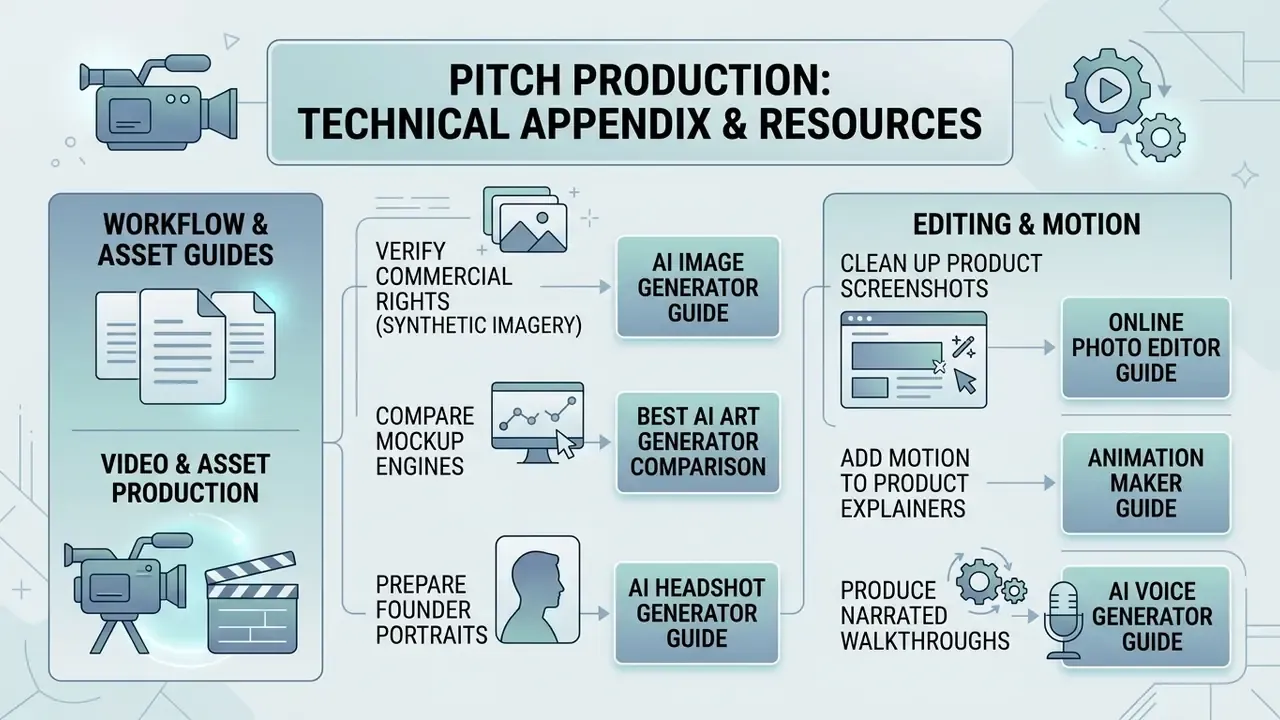
Video and asset production tools for pitch supporting material
Many pitch processes now ship a short video alongside the deck, especially for remote investor screening and demo-day follow-up. These guides cover that adjacent workflow.
- Assemble a quick founder update clip with a free video editing app
- Build in-house editing skills through a free video editing course online
- Edit demo footage on Apple hardware using a free video editor
- Localize investor material for cross-border rounds with a free video translator
- Produce simple title cards and cover typography with a free word art generator
- Outsource heavier post-production to a freelance video editor
Research references cited in this guide: DocPres: Document to Presentation Generation (2024); UniPPTBench Presentation Generation Study (2025); PPTAgent: Edit-Based Presentation Generation (2024 to 2025); DeepPresenter: Environment-Grounded Reflection (2024 to 2025); DeepSlide: Dual-Scoreboard Presentation Generation (2024 to 2025); PASS: Presentation Automation with Speech Synthesis (2024 to 2025); SlideGen: Multimodal-Agentic Framework for Slide Generation (2024 to 2025); Judging a Pitch by its Cover, MERIT Research Group (2024 to 2026); Maarouf et al., Startup Success Prediction via Crunchbase Profiles (2024 to 2025); Minaee et al., Large Language Models: A Survey (2024); AI-Based Prediction of Business Angel Decisions via CFA Factors (2025); NIST AI 600-1 Generative AI Profile and NIST GenAI evaluation plan; W3C PDF accessibility guidance; U.S. Department of Veterans Affairs OIT Brand System publications and layout guidelines.