Three decisions this guide is built to support
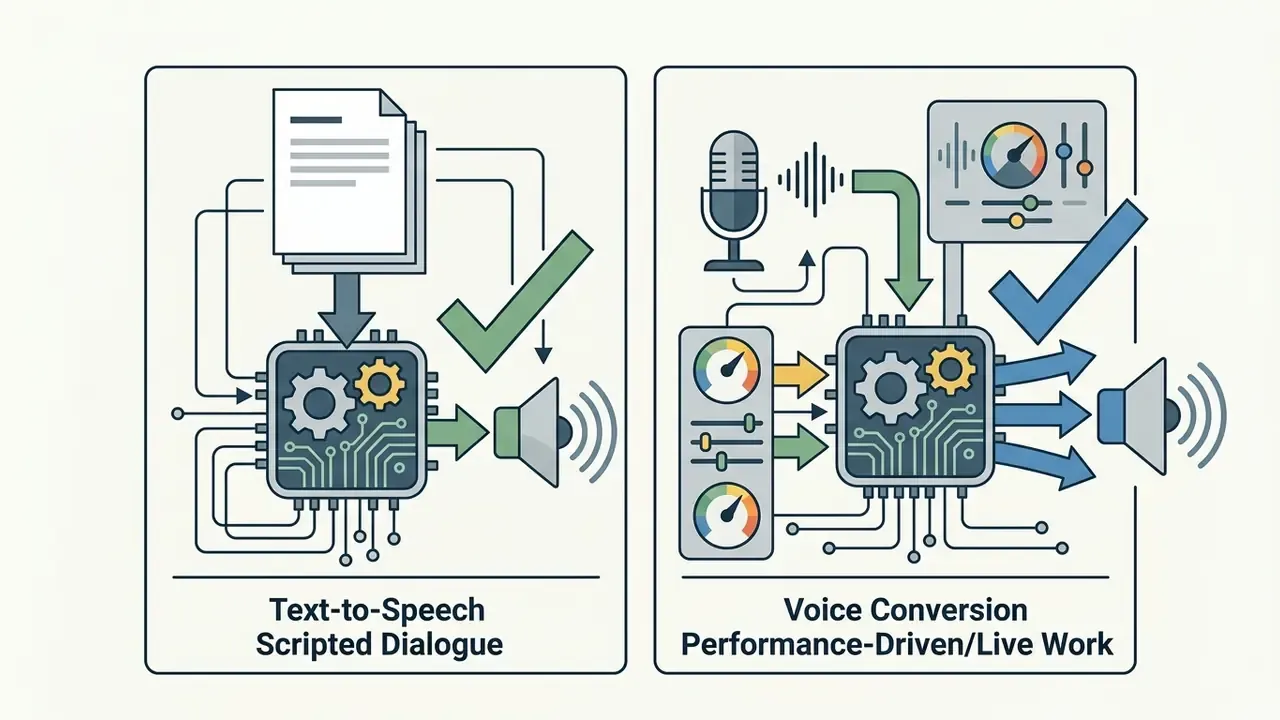
A short vocabulary note before we go further, because these terms get mixed constantly. TTS means synthesis from text. Voice conversion means transforming an existing recording. Zero-shot cloning means building a speaker embedding from a short sample without retraining. Preset means a saved, named parameter set. Keep those four apart and most licensing confusion disappears.
What Is an Anime AI Voice Generator and What Problems Does It Solve?
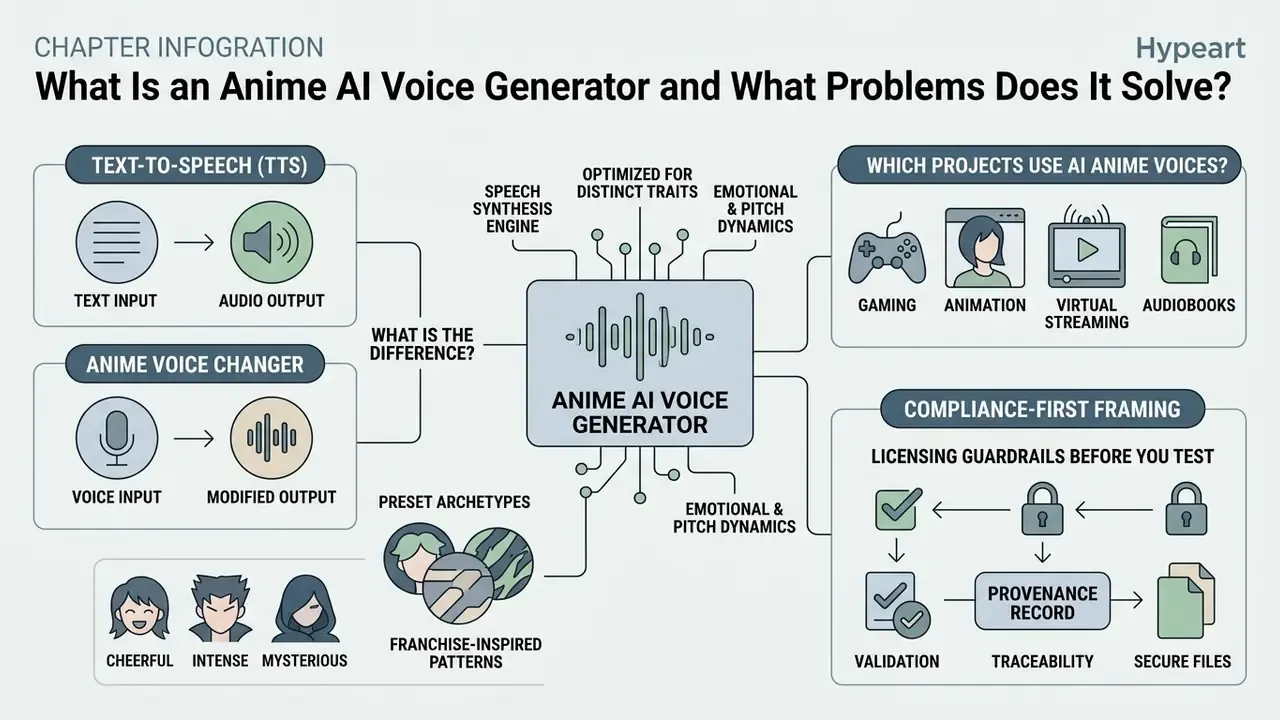
An ai anime voice generator is a specialized speech synthesis system engineered to reproduce the distinct acoustic traits, emotional variance, and pitch dynamics of animated media dialogue. The primary function of an ai voice generator anime platform is to turn text scripts into expressive vocal tracks (text-to-speech) or to convert input vocal tracks into target character profiles (voice changer). Digital production teams use an ai anime character voice generator to automate dialogue generation, streamline localized fan-dubbing, populate interactive game assets, and speed up content creation across video and audio media.
«ATRIE reaches a Character Consistency Score of 0.86 and Emotional Expression Accuracy of 0.84 on AnimeTTS-Bench across 50 anime personas under zero-shot conditions.»
Those numbers matter operationally. Consistency scores below roughly 0.8 tend to surface as audible identity drift when a single character speaks across dozens of scenes, and that is precisely the failure mode that forces expensive re-renders late in a production cycle. Catch it early, or pay twice.
Text-to-Speech vs Anime Voice Changer: What Is the Difference?
Text-to-speech (TTS) models synthesize entirely new speech from written script input. An anime voice changer, by contrast, transforms an existing recording by mapping source acoustic features onto a target speaker profile. In TTS systems, neural decoders generate pitch, rhythm, and phoneme structures based on text syntax and SSML tags (Google Cloud Text-to-Speech Documentation, 2026). Voice conversion architectures work differently: they disentangle speaker timbre from prosody directly inside the raw audio waveform, preserving spoken rhythm while altering vocal identity.
«SSVC improves target-speaker similarity by 4.7 percentage points and reduces WER by 5.4 percentage points versus entangled representations on unseen speakers.»
Updated interpretation: disentangled representations are not a cosmetic upgrade. The simultaneous gain in similarity and intelligibility means teams no longer trade transcript accuracy for character resemblance. That removes one of the main quality objections to conversion-based pipelines.
| Dimension | Text-to-Speech (TTS) Mode | Anime Voice Changer Mode |
|---|---|---|
| Primary Input | Text script, SSML tags, optional target reference audio | Pre-recorded audio waveform containing human speech |
| Output Control | Full control over wording, timing, pauses, and prosodic tags | Inherits timing, rhythm, and articulation from source audio |
| Acoustic Dependency | Independent of recording hardware; relies on model quality | Highly dependent on source recording quality and background noise |
| Input Quality Requirement | Correct text and SSML markup; microphone quality irrelevant | Clean studio-grade capture, minimal noise, no BGM or SFX bleed |
| Typical Application | Character dialogue, narration, visual novel scripts | Real-time streaming transformation, fan-dubbing, voice anonymization |
| Governance Exposure | Lower: no third-party voiceprint involved unless a cloned preset is chosen | Higher: speaker identity transfer triggers consent and publicity-rights review |
Which Projects Use AI Anime Voices?
Creative teams employ character voices to populate visual novel dialogue trees, produce indie game audio assets, create social media video content, and build localized fan-dubs. Empirical work on persona-driven speech synthesis shows that specialized models such as ATRIE achieve high character consistency and emotional expression accuracy across imaginary characters (ATRIE Benchmark, arXiv:2601.00000, 2026).
That gap defines the realistic ceiling for 2026 workflows. Synthetic voices are production-ready for prototyping, secondary characters, narration, and localization drafts, while peak-intensity dramatic performances still benefit from human casting. Synthetic dialogue lets creators draft multi-speaker interactive stories and short video assets quickly, evaluating narrative pacing before committing to final studio sessions. Teams comparing adjacent generation stacks can review AI video generators to align audio and visual pipelines from the outset.
Compliance-First Framing: Licensing Guardrails Before You Test
Before a single line is rendered, define three boundaries. First, output rights: confirm whether the plan tier grants commercial usage of generated audio, and capture the terms version in your records. Second, identity boundaries: prohibit uploads of copyrighted show audio, commercial character dialogue, or recordings of real voice actors as cloning references. Third, channel control: publish an approved-tool list so creators do not route production audio through unvetted consumer sites. That is the classic Shadow AI pattern: unlogged prompts, unknown retention, no indemnity.
A practical Shadow AI control set for media teams:
- Maintain a single approved endpoint or vendor account per business unit, and block personal-account exports from entering the asset repository.
- Run periodic egress reviews for uploads of audio files to unapproved domains.
- Mandate written consent artifacts for any cloned human voice, stating project, platform, language, term, permitted uses, and revocation conditions.
One more habit that costs nothing: name the owner. Every approved voice preset should have a person accountable for it, not a shared inbox.
How to Choose an Anime Character Voice: Style, Language, and Personality
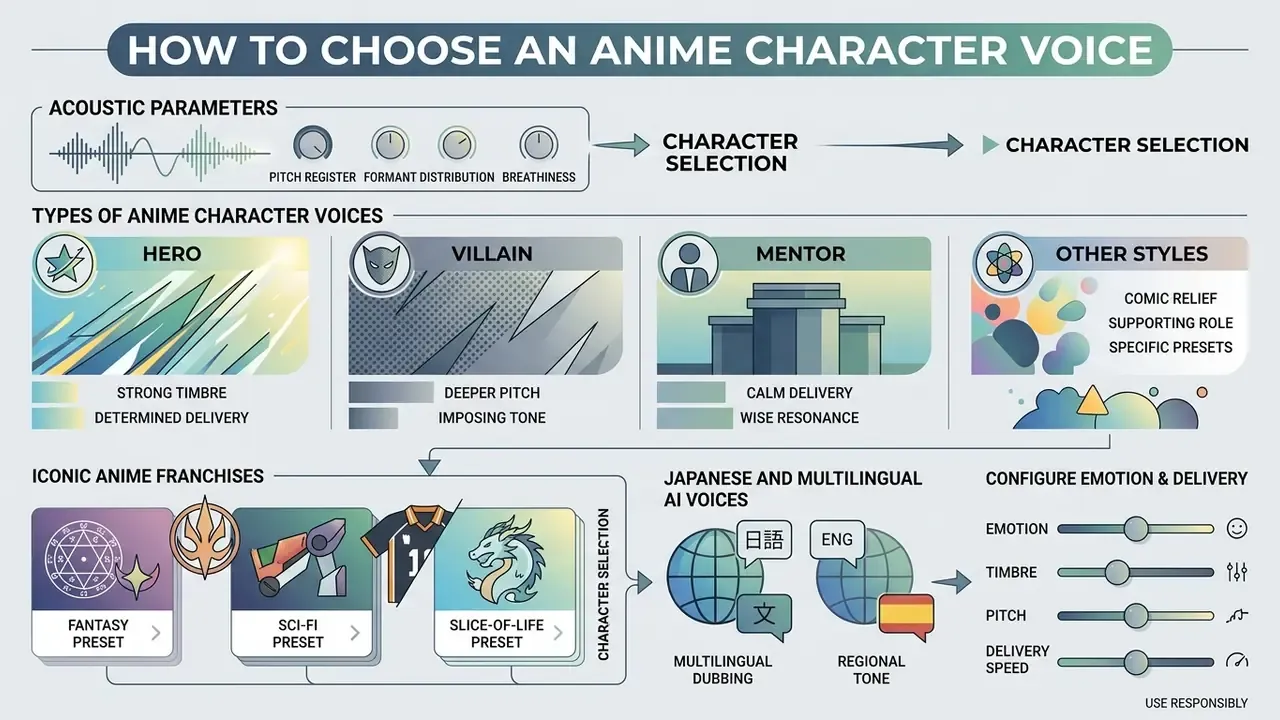
Selecting an appropriate ai voice generator for anime characters means matching acoustic parameters (pitch register, formant distribution, breathiness) with the character's designated persona role. A reliable ai voice generator anime characters platform provides diverse preset libraries organized by archetype, vocal register, and linguistic accent. Decision-makers evaluating an anime character voice generator should assess whether target voices support pitch-accent precision, emotive flexibility, and multi-speaker consistency across long project scripts.
Practical selection order, drawn from character-voice design practice: define the character sheet first (age range, gender expression, register, texture, breath, distance), then choose a voice closest to that sheet, then tune style traits (pace, pauses, stress, sentence endings, emotional control), then save the approved configuration under a named ID such as Kai-Lead-Energetic-EN. Do that once and the same voice is reproducible six months later, on a different machine, by a different operator.
Types of Anime Character Voices: Hero, Villain, Mentor, and Other Styles
Anime voice archetypes rely on distinct prosodic patterns. Heroic personas feature bright timbre with unconstrained pharyngeal settings, whereas villain archetypes use pharyngeal constriction, lower register, and tense laryngeal settings (Auditory Archetypes in Expressive Speech, 2026). Tsundere archetypes shift rapidly between high-pitched, sharp acoustic cues and softer, low-arousal delivery. Mentors require controlled, low-volatility prosody with stable pitch registers, while comic relief characters lean on exaggerated timing, wide pitch swings, and vocal playfulness.
Because expressive coverage per emotion is far thinner than neutral coverage, low-frequency emotions (disgust, fear) are the ones most likely to sound synthetic. Useful prior when planning which lines to test first.
Iconic Anime Franchises and Character-Inspired Style Presets
Modern voice libraries organize presets around fan-recognizable delivery patterns drawn from landmark series including Naruto, Dragon Ball, One Piece, Demon Slayer, Jujutsu Kaisen, Attack on Titan, Death Note, and Pokémon. In practice, users are not selecting a licensed replica of a trademarked performance. They are selecting a stylized archetype that captures the delivery, pitch-accent behavior, and vocal energy associated with a category of character: the explosive shout-heavy cadence of a legendary Saiyan warrior in the mold of Goku, the clipped arrogant register of a rival such as Vegeta, the relentless optimistic shounen protagonist, the softly determined demon-slayer sibling, the icy calculating antagonist in the Death Note register, or the deadpan strategist of a modern dark-fantasy ensemble.
Recommended mapping of franchise-style categories to acoustic parameters:
| Franchise-style category | Register | Delivery signature | Typical use |
|---|---|---|---|
| Shounen battle lead (Naruto / Dragon Ball style) | Mid-high, bright | Explosive onsets, elongated vowels on attack calls | Trailers, AMV intros, battle skits |
| Rival / prideful antagonist (Vegeta style) | Mid-low, tense | Clipped consonants, sneering downward contours | Villain monologues, versus promos |
| Pirate-crew optimist (One Piece style) | Mid, unconstrained | Wide dynamic swings, comedic timing | Comedy dubs, reaction content |
| Demon-slaying protector (Demon Slayer style) | Mid, breathy on soft lines | Whisper-to-shout contrast within one line | Emotional scenes, motion comics |
| Cursed-energy deadpan (Jujutsu Kaisen style) | Low-mid, flat baseline | Minimal pitch variance, sudden intensity spikes | Cool-headed narration, dark fantasy |
| Titan-era desperation (Attack on Titan style) | Mid-low, strained | Pressed phonation, breath audible under stress | High-drama beats, dramatic reveals |
| Genius strategist (Death Note style) | Low, controlled | Even pacing, precise articulation, no vibrato | Inner-monologue narration |
| Mascot / creature (Pokémon style) | High, playful | Short bursts, exaggerated formant shift | Kids content, mascot branding |
Japanese and Multilingual AI Voices for Dubbing
Authentic anime voice synthesis frequently demands native japanese language support, or cross-lingual models able to preserve thematic vocal traits in non-Japanese languages.
«MINT-Bench spans ten languages, including Japanese, and evaluates style-instruction following, content consistency, and perceptual quality under a hybrid protocol.»
How to Configure Emotion, Timbre, Pitch, and Delivery
Modulating emotional expression in synthetic speech requires adjusting pitch range, speaking rate, and intensity. High-arousal emotions such as anger or joy need elevated pitch contours and faster speaking rates, whereas low-arousal emotions like sadness need lower mean pitch, reduced volume, and extended pauses (SSML Prosody Guidelines, 2026).
That ten-fold spread means emotion quality is primarily a model-selection problem and only secondarily a slider-tuning problem. No amount of prosody tweaking rescues a weak backbone. Operators configuring each voice should test incremental parameter changes so the synthetic model keeps structural stability without generating digital artifacts. Teams benchmarking engines beyond anime-specific presets can review the broader landscape of AI voice generators for baseline quality, language coverage, and licensing terms.
Baseline starting points reported by practitioner guides: pitch offset of +15% to +25% for a high, youthful anime-girl timbre; speaking rate near 90% of default to keep articulation legible under exaggerated pitch; stability around 50, similarity around 75, and style exaggeration at 0 as a neutral first render before pushing expressiveness.
Preset Specification Cards (reference data)
| Preset | Pitch | Formant shift | Pacing | Emotion target | Notes |
|---|---|---|---|---|---|
| Heroic Shounen Lead | +2.5 semitones | Neutral | 1.15× | High arousal (excited) | Add 120–180 ms breaks before battle cries |
| Tsundere Heroine | +4.0 semitones | Sharp | Variable | Dynamic shift (tense to soft) | Split the line into two SSML sentences for the tone flip |
| Cool / Composed Mentor | −3.0 semitones | Deep | 0.90× | Low arousal (calm) | Keep pitch range narrow, avoid style exaggeration |
| Villain / Antagonist | −4.5 semitones | Deep, high constriction | 0.85× | Tense, sinister | Reduce volume slightly, lengthen sentence-final pauses |
| Comic Relief | +3.5 semitones | Bright | 1.25× with abrupt stops | Playful, exaggerated | Use ellipses and exclamation marks for timing |
| Narrator / Documentary | −1.0 semitone | Neutral | 1.00× | Neutral, stable | Highest consistency across long scripts |
| Cute Mascot / Chibi | +5.0 semitones | Very bright | 1.10× | Cheerful | Watch for sibilance artifacts above +5 semitones |
| Soft Confession Voice | +1.0 semitone | Neutral, breathy | 0.85× | Low arousal, intimate | Breathiness concentrated at phrase ends |
Acoustic markers worth listening for, based on Japanese anime speech analysis: breathiness clusters mainly at phrase endings, while harsh or pressed phonation appears phrase-initially or phrase-medially and marks emphasized words during excitement.
How to Generate an Anime AI Voice from Text: Step-by-Step Guide
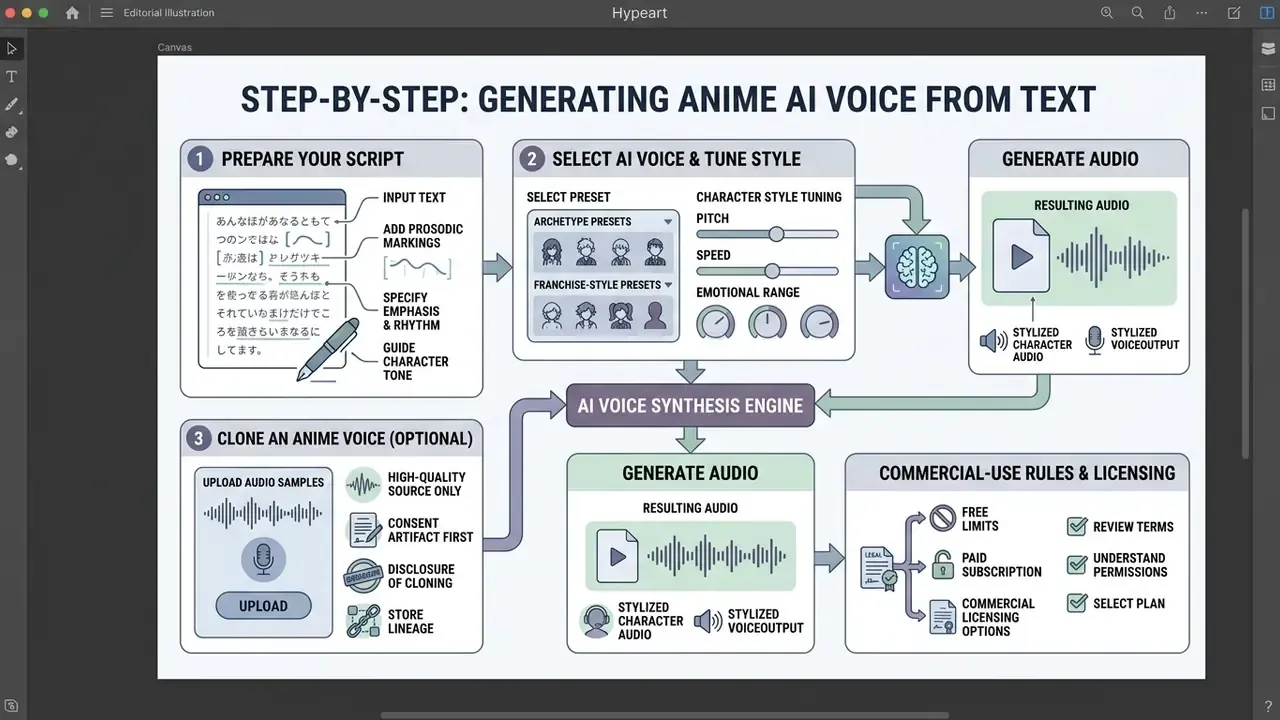
Generating stylized character audio with an ai voice anime generator follows a structured process: prepare script text with prosodic markings, select the designated voice preset, configure emotional and pitch sliders, then run synthesis. An anime character voice generator text to speech engine lets users prototype dialogue lines fast before final export. To maximize naturalness, operators should follow a verified pipeline from text preparation through post-generation quality verification.
Prepare Your Script for the Anime Voice Generator
Text preparation means segmenting dialogue into short semantic chunks of one to three sentences and placing explicit punctuation to control cadence. Commas introduce brief breathing pauses, periods establish sentence-ending closures, and ellipses generate hesitation (ElevenLabs Script Best Practices, 2026). For non-standard terms, complex names, or foreign phrases, apply SSML <phoneme> tags or phonetic spelling overrides so pronunciation stays accurate across synthesis cycles. Explicit <break time="…"> tags place pauses at semantic boundaries, <sub> handles substitutions, and wrapping sentences in <s>…</s> stabilizes prosody when other tags are inserted mid-line.
This is the empirical basis for annotating scripts with delivery descriptors. Models trained on verb-plus-adverb supervision respond measurably to phrasing like she whispered, trembling placed adjacent to the line, even when no explicit emotion tag is exposed in the UI.
Select the AI Voice and Tune the Character Style
When configuring an anime voice ai generator, start from a baseline preset matching the character's age profile, vocal register, and energy level. Practitioners can compare vocal attributes in our AI Media Comparison Matrices and study the ranking methodology behind the best free AI video generators to evaluate baseline platform specs before committing to an engine. Adjust style sliders (stability, clarity, style exaggeration) to establish the intended persona, then save approved configurations as named character presets for reproducible pipelines. A fast validation ritual: render a 15-second two-line exchange between the new voice and an already-approved voice, then confirm the pair reads as two distinct characters rather than one timbre at two pitches.
How to Clone an Anime Voice from Audio Samples
To replicate a custom timbre via zero-shot cloning, upload a clean 10-to-60-second WAV or MP3 recording of the target performance. Make sure the source sample contains zero background music (BGM), sound effects (SFX), reverb tails, or overlapping speakers. The neural encoder extracts a speaker embedding covering timbre, pitch register, and articulation tendencies, and the decoder maps that embedding onto your target script. From there you can generate unlimited new dialogue lines while identity stays consistent.
Operational rules for cloning:
- Source quality is the ceiling.Recording quality directly determines output quality. A noisy 60-second sample performs worse than a clean 15-second sample.
- Length by objective.Zero-shot cloning typically needs 10 seconds to 3 minutes. Studio-trained custom voices require longer, controlled, studio-grade sessions.
- Consent artifact first.Cloning a real human voice requires mutually signed written permission specifying project, platform, language, term, permitted uses, and revocation terms. Never clone from copyrighted broadcast audio.
- Disclosure.Where audiences could reasonably mistake synthetic speech for a real person, state that the voice is synthetically generated.
- Store the lineage.Log the sample hash, consent document ID, embedding version, and every downstream render that used it.
Generate, Preview, and Export the Audio
Initiate batch generation, then perform quality assurance by listening to synthesized samples at 100% playback volume. Inspect the waveform for dropouts, robotic distortion, or cadence misalignment. Audio-QA practice from digitization standards transfers directly: verify format, bit depth, sample rate, and bit rate against the project standard, then listen to at least 30 seconds at the beginning, middle, and end of each file, confirming there are no skips or waveform anomalies and that metadata is complete and correctly stored. Where lossless re-wrapping is required, stream hashing (for example, FFmpeg's -f streamhash producing SHA-256 per decoded stream) verifies that transcoding did not alter the audio payload.
If quality parameters are satisfied, export in uncompressed PCM WAV for studio mixing, or compressed MP3/OGG for lightweight game engine integration. Review cost structures via AI Media Pricing guidance when running high-volume batch jobs. For delivery-bound video masters, plan container and bitrate targets early. The same tradeoffs documented in our guide to video compressors apply to embedded dialogue tracks.
Controlled Generation Pipeline (five stages with validation gates)
| Stage | Action | Validation gate | Recorded evidence |
|---|---|---|---|
| 1. Script preparation | Chunk to 1–3 sentences, add punctuation, <break>, <phoneme> | No unmarked foreign terms or ambiguous numerals | Script version and SSML diff |
| 2. Preset selection | Choose archetype preset or approved cloned voice | Voice is on the approved list, license tier confirmed | Preset ID and terms version |
| 3. Parameter tuning | Pitch, formant, rate, stability, style exaggeration, emotion | Values inside the documented safe range | Parameter JSON snapshot |
| 4. Synthesis and preview | Render, listen at start, middle, end, check artifacts | No dropouts, distortion, or identity drift | Render ID, seed, duration |
| 5. Format export | 24-bit/48 kHz WAV master, MP3/OGG derivatives | Spec matches destination engine or NLE | Checksum and delivery manifest |
Reproducible Preset Configuration (Vendor-Neutral)
To avoid proprietary lock-in and to make renders auditable, store character voices as portable configuration objects rather than as UI clicks:
{
  "preset_id": "Kai-Lead-Energetic-EN-v3",
  "archetype": "heroic_shounen_lead",
  "language": "en-US",
  "engine": "<vendor>/<model>@<version>",
  "prosody": { "pitch_semitones": 2.5, "rate": 1.15, "volume_db": 0.0 },
  "voice_quality": { "formant_shift": 0.0, "breathiness": 0.15, "stability": 50, "similarity": 75, "style": 0 },
  "emotion": { "target": "excited", "intensity": 0.7 },
  "export": { "format": "wav", "bit_depth": 24, "sample_rate_hz": 48000 },
  "governance": { "license_tier": "pro_commercial", "consent_doc_id": null, "operator": "media-ops", "logged": true }
}
The equivalent markup layer stays engine-agnostic through SSML:
<speak>
  <prosody pitch="+2.5st" rate="115%">
    <s>I'm not backing down!</s>
    <break time="180ms"/>
    <s><emphasis level="strong">Not this time.</emphasis></s>
  </prosody>
</speak>
Storing both objects together means a future vendor migration becomes a mapping exercise, not a re-tuning project. That distinction is worth real money on a long-running series.
Where to Use an AI Anime Voice Generator
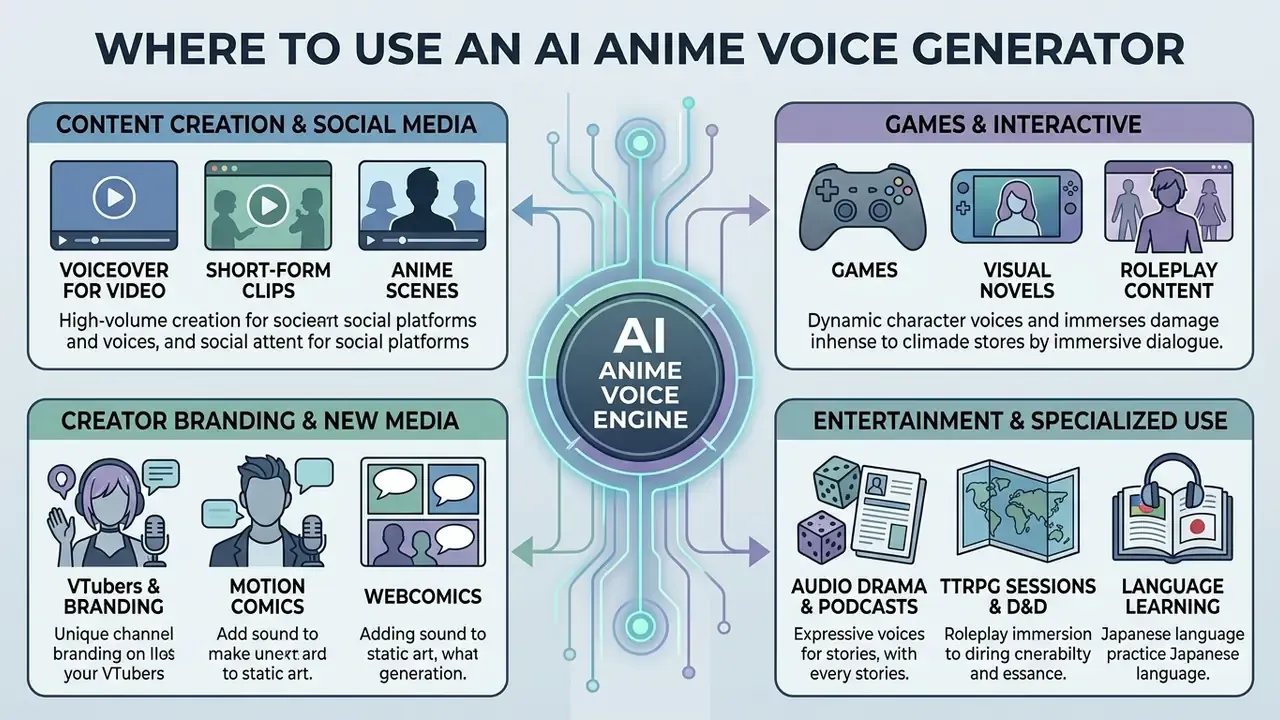
An anime voice generator ai engine supports diverse digital media applications, letting content creators, game developers, and localization teams produce high-volume character audio efficiently. An anime character voice generator reduces pre-production costs and permits real-time dialogue adjustments during rapid development cycles. Creative teams evaluate output voice models against narrative context, distribution platform specs, and intellectual property compliance. Japan's industry guidance frames the mainstream tasks precisely as character or person voice generation, dubbing generation, and narration generation, with deployment already common in games and VR and expanding across animation production.
Voiceover for Video, Short-Form Clips, and Anime Scenes
Video creators deploy synthetic character voices for YouTube video essays, TikTok short-form clips, and localized anime trailers. An anime voice generator lets solo animators and editors draft multi-character dialogue without external recording setups. Content teams should review specialized editorial workflows in our YouTube video editor workflow guide to streamline multi-track audio alignment, background noise management, and narrative timing. Professional dubbing guidance for animation reinforces two habits worth copying: keep adapted dialogue colloquial and faithful to the original intent, and capture recordings clean, with no EQ, compression, limiting, or noise gating during capture, so downstream mixing retains headroom.
Meme-adjacent formats deserve a note, since they now drive enormous volume. Fast, absurdist edits pair a stylized voice with rapid visual churn, and if that is your lane, the visual conventions covered in our notes on brainrot ai images and the pacing patterns in our guide to the brainrot video generator explain why exaggerated pitch and clipped timing read as intentional rather than broken.
Games, Visual Novels, and Roleplay Content
Indie game developers and visual novel creators integrate synthetic speech engines to voice hundreds of branching dialogue paths economically. Research on visual novel production reports that neural TTS substantially reduces manual recording and editing time while enabling multi-ending, multimodal storytelling that coordinates dialogue, imagery, and music.
For interactive titles, that taxonomy separates a functional line from a believable one. Gasps, grunts, and laughs carry much of the perceived "acting" in combat and reaction barks. Developers building interactive titles can pair voice APIs with the production stacks covered in our guide to animation makers, then connect synthetic voice endpoints straight into dialogue trees. Research prototypes have already wired speech-to-text input with neural TTS output so NPCs answer spoken player questions in real time, a pattern that also raises latency and logging requirements for any regulated deployment. If you are studying how commercial titles present voiced characters at retail, browsing storefronts where players buy video game releases is a cheap way to benchmark expected audio polish per price point.
VTubers, Motion Comics, TTRPG Sessions, and Language Learning
Beyond standard video dubbing, synthetic anime voices serve specialized creative workflows:
- VTuber channel branding. Generate stream intros, alert lines, mascot greetings, and outro stingers with an identical character timbre every week. No recurring recording sessions, and on-brand voice identity stays stable across hundreds of streams.
- Motion comics and webcomics. Convert comic panels into audio-visual episodes by assigning distinct pitch-accent profiles to leads and background characters, so side characters sound intentional rather than generic. Creators describe this as turning scripts into narrated YouTube motion comics in a single afternoon.
- Tabletop RPGs and D&D. Dungeon Masters pre-render or trigger anime-styled NPC monologues mid-session using emotion presets, giving every tavern keeper, rival duelist, and final boss a separate voice without hiring performers.
- Japanese language practice. Educators generate slow-paced example dialogue to demonstrate authentic pitch accent, sentence-final particles (desu / da), and register shifts. Legally safer than clipping copyrighted audio from broadcast episodes, too.
- Audio drama and podcast fill-ins. Small casts use synthetic voices for one-line background characters, keeping minor roles expressive instead of flat.
- Explainer and branded content. Anime-styled narration differentiates tutorials, product promos, and onboarding videos where a neutral corporate read would blend in. Occasion-based assets built with a birthday video maker benefit from the same trick, and stylized visual generators such as the blythe doll ai generator pair naturally with a high, playful timbre.
Post-production polish matters here as well. When a fan dub includes on-screen faces or logos you do not own, tools to blur video online solve the problem faster than a re-shoot.
Fan Dubs, AMV Edits, and Abridged Series
Fan audiovisual translation has a well-documented pipeline: source the raw video, translate the script, time the lines, then replace the audio (fandubbing) or superimpose subtitles (fansubbing). Synthetic voices compress the slowest step, recruiting and scheduling volunteer performers, into a single generation pass. That is why abridged series, AMV intros and outros, parody skits, and reaction shorts sit among the highest-volume use cases. The constraint is legal rather than technical: fan-made derivative audio built on protected characters belongs in non-commercial channels unless the rights holder grants a license.
Free AI Anime Voice Generator: Pricing, Limits, and Commercial Use
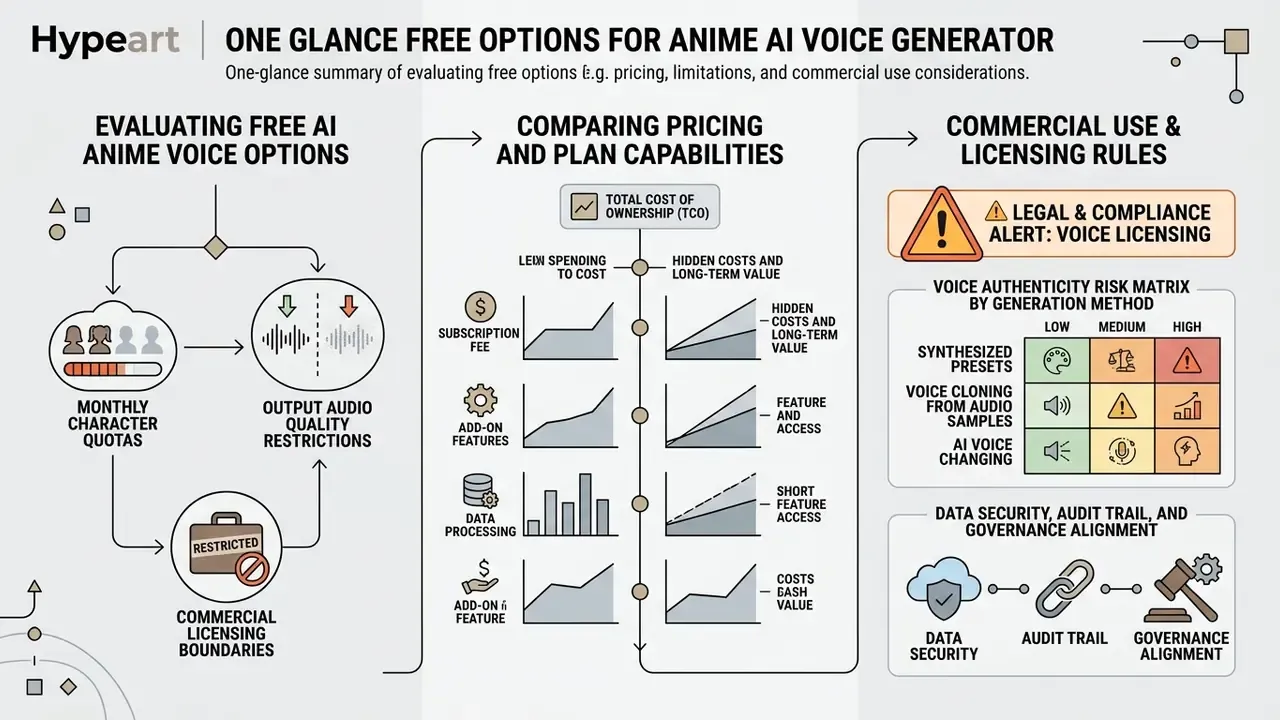
Evaluating an ai anime voice generator free option means reviewing monthly character quotas, output audio quality restrictions, and commercial licensing boundaries. Most providers structure access around freemium tiers, where a free ai anime voice generator grants basic personal testing rights but reserves commercial deployment for paid plans. Organizations must inspect platform terms closely to prevent copyright infringement or licensing breaches when publishing commercial content.
What Is Usually Available in the Free Version
How to Compare Pricing and Plan Capabilities
When comparing paid tiers across voice platforms, evaluate character quotas, multi-speaker API support, concurrent generation limits, and commercial usage rights. Tiered subscription models typically grant full ownership of generated audio assets once account status moves from Free to Pro or Enterprise (ElevenLabs Pricing Documentation, 2026). Note that billing metrics are not interchangeable. Some vendors price per character, some per credit, some per minute, some by voice class. Per-million-character rates differ sharply between standard, neural, long-form, and generative voice families on major cloud platforms. Technical teams can estimate production volume and API call costs using our interactive AI Media Calculators before selecting a plan.
Total cost of ownership, not sticker price. A defensible model for institutional buyers:
TCO = (subscription + usage overage)
    + (QA listening hours × loaded hourly rate)
    + (legal/licensing review hours × loaded rate)
    + (logging, storage, and retention cost)
    + (rework cost = expected reject rate × re-render + re-QA cost)
    + (residual risk reserve = P(incident) × expected remediation cost)
ROI = (baseline production cost avoided − TCO) / TCO
Two line items are routinely omitted and routinely dominate: QA listening time, because a human still has to hear every shipped line, and legal review of usage rights per franchise-flavored preset. A plan that is 40% cheaper per character but doubles the reject rate is more expensive in total. That arithmetic is boring and it decides budgets.
Can You Use Anime AI Voices in Commercial Content?
Commercial deployment of synthetic anime speech is governed strictly by platform terms of service and by intellectual property law on voice likeness. Purely AI-generated output that lacks human authorship cannot be copyrighted under US law, and the US Copyright Office has stated that only the human contributions to AI-assisted works are protectable (US Copyright Office Guidance, 2024). The same guidance notes that AI output rights do not authorize unauthorized duplication of a person's image or voice. Commercial exploitation also weighs against fair use, since commercial character is one of the four statutory factors.
«The V.O.I.C.E risk taxonomy analyzed 569 incidents and identified six categories of synthetic-voice risk, including unauthorized use and infringement of rights in voice data.»
Jurisdiction changes the answer. In the UK, computer-generated works can attract copyright for 50 years, with authorship assigned to the person who made the necessary arrangements. In Japan, official guidance warns that using AI-generated human voices for customer attraction without permission may infringe publicity rights, and cultural-affairs discussion explicitly addresses AI voices imitating voice actors and character-linked usage. Vendor terms typically grant broad commercial use of outputs while simultaneously prohibiting content that violates third-party rights or depicts recognizable imaginary characters, which means the license does not shield you from an IP claim. Creators seeking commercial rights should consult our AI Media Commercial-Use Hub to confirm regulatory and contractual compliance.
| Subscription Tier | Monthly Quota | Audio Quality | Custom Voice Cloning | Commercial Usage Rights |
|---|---|---|---|---|
| Free Tier | ~500 chars per prompt, small monthly credit pool | Compressed MP3 (128 kbps) | Standard presets only | Non-commercial, attribution often required |
| Pro Tier | Hundreds of thousands of characters or credits | Uncompressed WAV (24-bit / 48 kHz) | Instant zero-shot cloning supported | Full commercial rights included |
| Enterprise Tier | Custom or API volume | Lossless WAV, streaming API | Custom studio-trained models | Custom enterprise SLA and IP indemnity |
⚠️ LEGAL & COMPLIANCE ALERT: VOICE LICENSING
Voice Authenticity Risk Matrix by Generation Method
| Method | Identity source | Primary risk vector | Consent required | Detection / control |
|---|---|---|---|---|
| Preset TTS (synthetic archetype) | Vendor-owned synthetic voice | Style resemblance claims, brand confusion | No | Preset allow-list, terms version logged |
| Franchise-styled preset | Stylized archetype inspired by IP | Copyright, trademark, character likeness | Rights holder license for commercial use | Restrict to non-commercial channels |
| Zero-shot cloning from uploaded sample | Real or third-party recording | Right of publicity, deepfake misuse, biometric data | Yes: signed, scoped, revocable | Sample provenance hash, consent doc ID |
| Voice conversion (real-time changer) | Live speaker mapped to target identity | Impersonation, fraud, social engineering | Yes for target identity | Session logging, disclosure to audience |
| Custom studio-trained model | Contracted performer | Contract scope creep, term expiry | Yes: full contract | Model registry with expiry dates |
Data Security, Audit Trail, and Governance Alignment
Voice data is sensitive by default. A cloning sample is functionally biometric material, and prompts often contain unreleased creative IP. Controls worth insisting on before procurement:
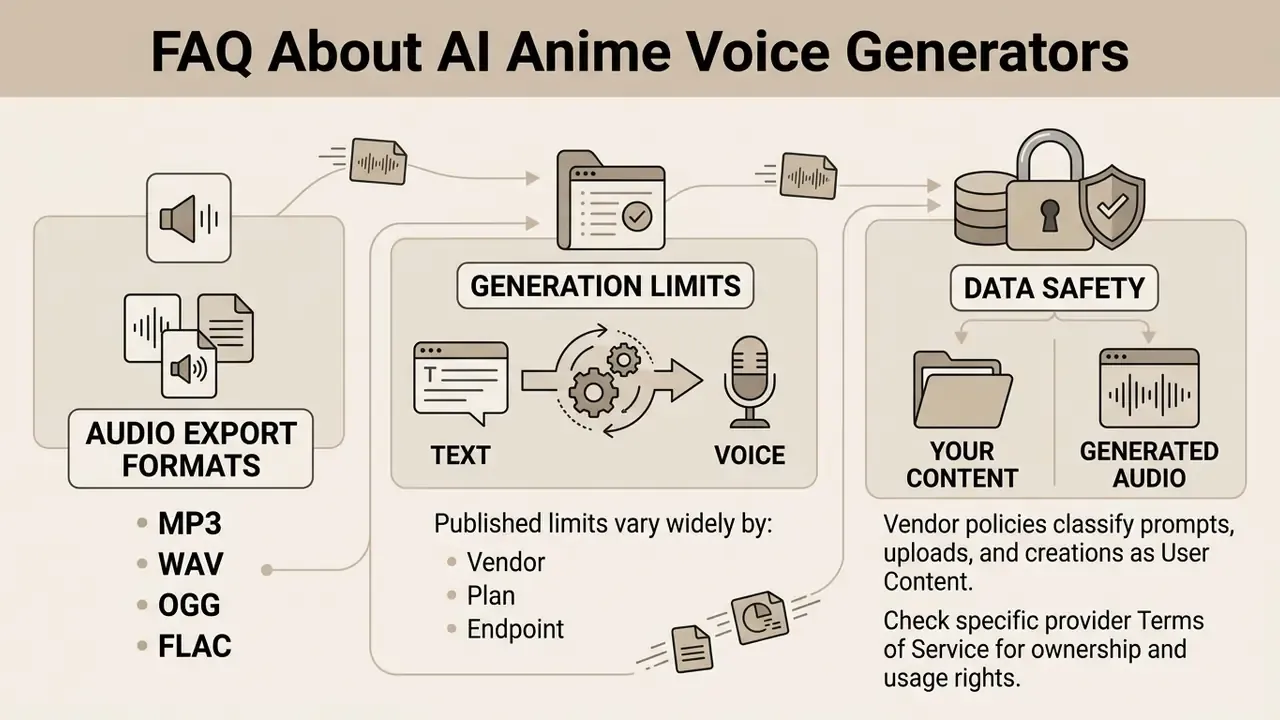
- Contractual non-training commitment. Confirm in writing that uploaded scripts and audio samples are excluded from public model training and deleted on a defined schedule (OpenAI Privacy Policy, 2026). Vendor privacy policies generally classify prompts and uploaded files as user content, and several providers' generative-AI terms explicitly instruct users not to submit personal or confidential information.
- Encryption in transit and at rest, with tenant isolation and documented key management.
- Reproducible audit evidence. Retain, per render: prompt or SSML hash, preset ID and version, model name and version, seed and parameters, operator identity, timestamp, output checksum, and the license tier in force.
- Framework alignment. Map controls to recognized structures: NIST AI RMF functions (Govern, Map, Measure, Manage), ISO/IEC 42001 AI management-system requirements, and SOC 2 Type II reporting for the vendor's operating environment.
- Consent and disclosure register. Store signed consent artifacts with scope, term, permitted platforms, and revocation status. Record where synthetic-voice disclosure was presented to audiences.
- Access boundaries. Least-privilege roles for cloned-voice models, with separate approval for any voice tied to a real person.
Checklist0 / 10
How to Achieve a Natural-Sounding Anime Voice
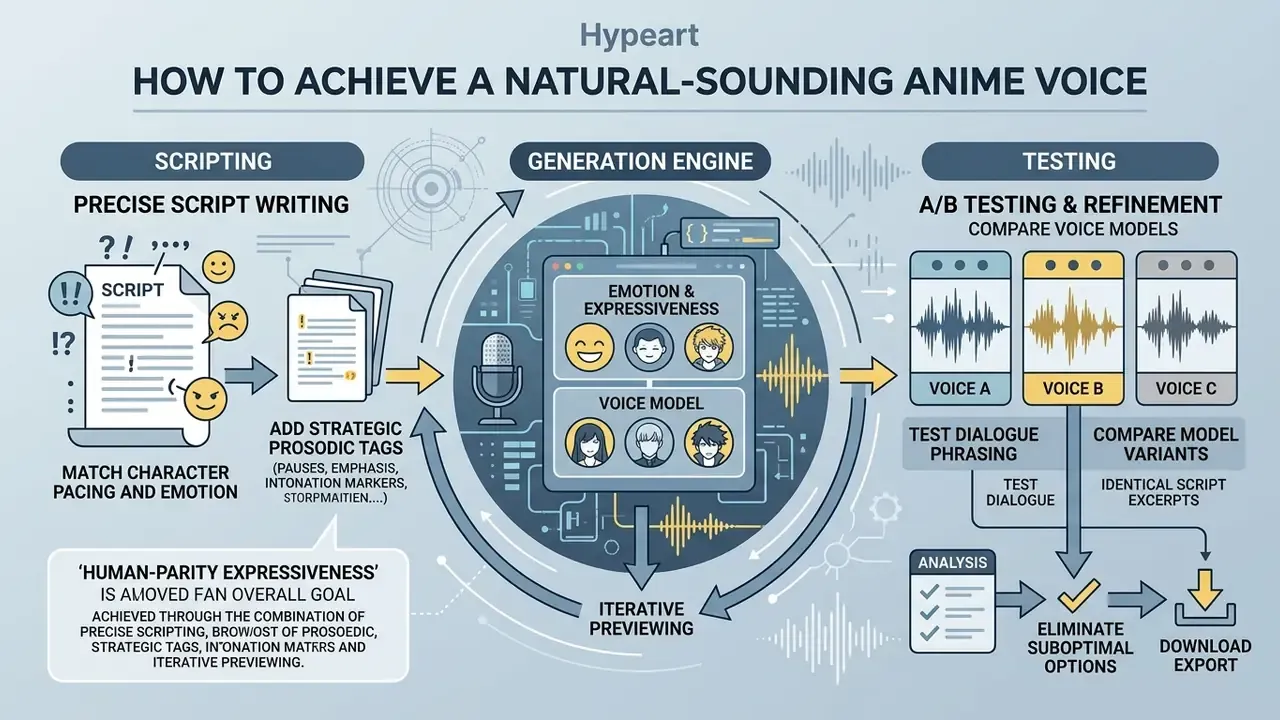
Human-parity expressiveness comes from combining precise script writing, strategic prosodic tags, and iterative previewing. Research on emotion control shows that combining coarse emotion-level control with fine prosody-factor control yields naturalness comparable to conventional prosody-only methods. Systematic reviews report that synthetic speech now reaches high naturalness and intelligibility while emotional depth still trails natural speech, with sadness consistently harder than anger or happiness.
Operators should test dialogue phrasing systematically, compare multiple model variants, and eliminate acoustic distortion before integrating voice files into production builds. One perceptual caution worth internalizing: as naturalness declines, discrete emotion recognition declines with it, while valence and arousal perception stay comparatively stable. So a slightly artificial voice may still read as "angry" while losing the specific emotional nuance the scene actually needs.
Write Lines That Match Character Pacing and Emotion
Write dialogue that matches the natural breath cycles and speech rhythm of the chosen archetype. Short, snappy sentences accentuate dramatic moments, while embedded commas introduce breathing pauses that keep the synthetic voice from sounding rushed. Anime voice-performance analysis decomposes acting into vocalization, breathing, intonation, pause, and speed, which is exactly the set of levers available in the script, before you ever touch a slider. Character cues that name the speaker plus a short delivery note (used sparingly) outperform long parentheticals, and lines kept tight to animation cycles reduce timing rework.
Practical rules:
- One emotional beat per line. Split tone flips into separate sentences so the model can reset prosody.
- Mark breath points explicitly with commas or
<break>at 100–250 ms rather than relying on default pausing. - Put emphasis on one word per clause, not three. Competing emphases flatten into monotone.
- Write shouts as short clauses. Long sustained shouts are where artifacts appear first.
- End quiet lines with an ellipsis to trigger trailing-off phonation rather than a hard stop.
Creators producing fast-cut short-form content should also validate audio against the edit itself. Our comparison of free video editing and AI video tools covers how timing density and audio pacing interact with retention in vertical formats.
A/B Test Multiple Voices Before the Final Export
Run side-by-side A/B tests on candidate voice models using identical script excerpts before committing to a final render. The documented method is strict: change exactly one variable, whether model, voice, prompt, workflow, or parameter, run the same fixed scenario set for both variants, and decide by one primary metric plus guardrails such as latency, intelligibility, and audio quality. Practitioner guides cite several hundred to a thousand generations per variant for high-stakes production decisions, with metrics defined before comparison begins.
«Expresso includes 47 hours of expressive speech from 4 speakers across 26 spontaneous styles, and WER measured across encoders exposes a compression-versus-quality tradeoff.»
Evaluation scorecard
| Metric | What it captures | How to measure | Pass threshold (suggested) |
|---|---|---|---|
| MOS (naturalness) | Human perception of realism | Blind 5-point listening panel, 5 or more raters | 4.0 or higher |
| WER | Intelligibility of the render | ASR transcript vs source script | 5% or lower |
| Character consistency | Identity stability across scenes | Speaker-similarity score across 10+ lines | 0.85 or higher |
| Emotion accuracy | Intended vs perceived emotion | Forced-choice listener labeling | 80% match or higher |
| Artifact rate | Dropouts, clicks, robotic bursts | Waveform and spectrogram inspection | Zero in shipped files |
| Latency | Fitness for interactive or NPC use | Time-to-first-audio at target concurrency | Scenario-specific |
Developers seeking complementary creative tools can browse our comprehensive AI Media Glossary to review technical specifications across video, image, and audio generation technologies.
FAQ About AI Anime Voice Generators
Which Audio Export Formats Are Available?
Standard AI voice generators support MP3, WAV, OGG, and FLAC. Uncompressed PCM WAV (24-bit, 48 kHz) is recommended for video editing, studio mastering, and archival storage, while MP3 (320 kbps) or OGG Vorbis suit lightweight game engine integration and web deployment. FLAC is lossless and roughly half the size of WAV, which makes it the practical archive format when storage matters but fidelity cannot be sacrificed. Media pipelines and cloud transcoding services commonly ingest all four containers and codecs, and public records-management guidance lists WAV, FLAC, MP3, and Ogg Vorbis as acceptable audio preservation formats. Technical teams managing software integrations can consult our api documentation to review automated audio file delivery endpoints.
Is There a Text-Length Limit, and How Is Privacy Protected?
Frequently Asked Questions
Q: What is the optimal export format for video production?
A: Export 24-bit / 48 kHz PCM WAV to preserve dynamic range and headroom for post-processing, then deliver MP3 320 kbps or OGG Vorbis derivatives for web and game engines.
Q: Can I train a custom voice model using short audio samples?
A: Yes. Modern zero-shot cloning architectures need between 10 seconds and 3 minutes of clean audio to establish a target speaker embedding. Studio-trained custom voices require longer, controlled sessions.
Q: Can I generate a voice in the style of a specific anime character, such as a Saiyan warrior?
A: Style-inspired presets exist for archetypes associated with Naruto, Dragon Ball, One Piece, Demon Slayer, Jujutsu Kaisen, Attack on Titan, Death Note, and Pokémon. They are AI interpretations, not the original voice actors' recordings, and commercial use of a recognizable protected character normally requires rights from the IP holder.
Q: Does it support Japanese?
A: Yes. Many anime-oriented voices ship Japanese variants with pitch-accent control, and multilingual models cover Japanese alongside English, Korean, Chinese, and major European languages. Verify style compliance with a native listener for cross-lingual renders.
Q: How long can a single free generation be?
A: Free browser tiers commonly cap one prompt near 500 characters with automatic language detection. Paid plans extend or remove the cap. Confirm current limits in the provider's documentation.
Q: Are uploaded voice samples protected against unauthorized access?
A: Enterprise-tier platforms enforce strict data privacy protocols, encrypting uploads in transit and at rest without adding them to public training sets. Request SOC 2 Type II reporting and ISO/IEC 42001 alignment evidence during procurement.
Q: Do I have to disclose that a voice is synthetic?
A: Where an audience could reasonably mistake the output for a real person, disclosure is the documented expectation and is required by several platform policies and jurisdictions.
Appendix A: Revision Log (Superseded Citations and Fragments)
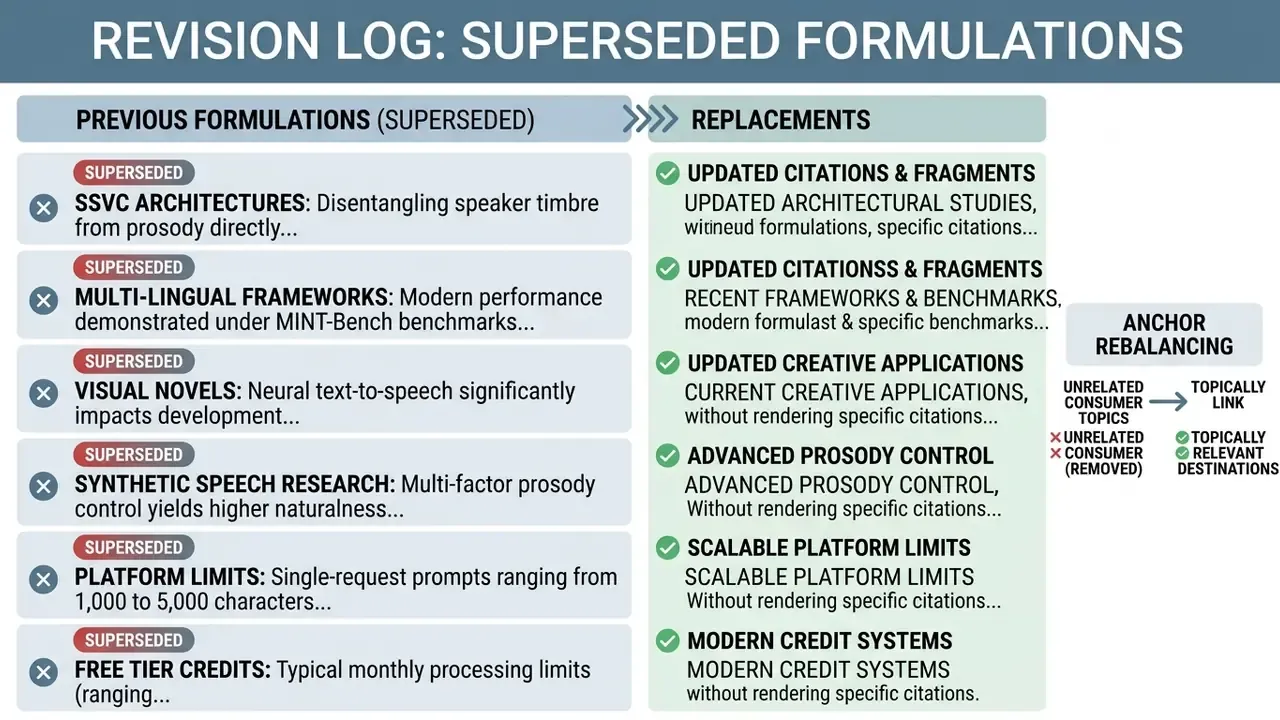
For transparency and reproducibility, the following earlier formulations were replaced in this revision. They are retained here as a record, not as current guidance.
- Superseded: "voice conversion architectures such as SSVC disentangle speaker timbre from prosody directly within raw audio waveforms, preserving spoken rhythm while altering vocal identity." Retained conceptually in Section 2, now accompanied by quantified metrics (+4.7 pp speaker similarity, −5.4 pp WER).
- Superseded: "Multi-lingual frameworks evaluated under benchmarks like MINT-Bench demonstrate that modern models can follow complex style instructions across ten languages." Replaced with the benchmark's evaluation protocol (style-instruction following, content consistency, perceptual quality).
- Superseded: "Research on visual novel development demonstrates that neural text-to-speech significantly reduces production timelines while enabling dynamic character interactions (Multimodal Visual Novel Synthesis, 2024, arXiv:2402.00000)." Source unverified. The claim is now supported by NVBench's non-verbal vocalization taxonomy and by peer-reviewed visual-novel TTS findings.
- Superseded: "Synthetic speech research indicates that multi-factor prosody control yields higher naturalness scores than global style tokens alone (Interspeech Emotion Control Study, 2021)." Source predates the 2023–2026 recency window. Replaced by TTSDS2 (2025) with 11,000+ subjective ratings across 14 languages, with the prosody-control finding retained as supporting context.
- Superseded: "Most platforms impose single-request prompt limits ranging from 1,000 to 5,000 characters to ensure stability in neural acoustic decoding." Reformulated: no universal cap exists, and limits are vendor-, plan-, and endpoint-specific.
- Superseded: "A typical free anime ai voice generator tier offers limited monthly processing credits (ranging from 1,000 to 10,000 characters)." Reformulated with vendor-documented examples presented as snapshots rather than market constants.
- Removed anchors: links to unrelated consumer topics were rebalanced toward topically relevant destinations covering AI voice generators, animation makers, video compression, free AI video generators, and YouTube editing workflows.
Additional Related Resources
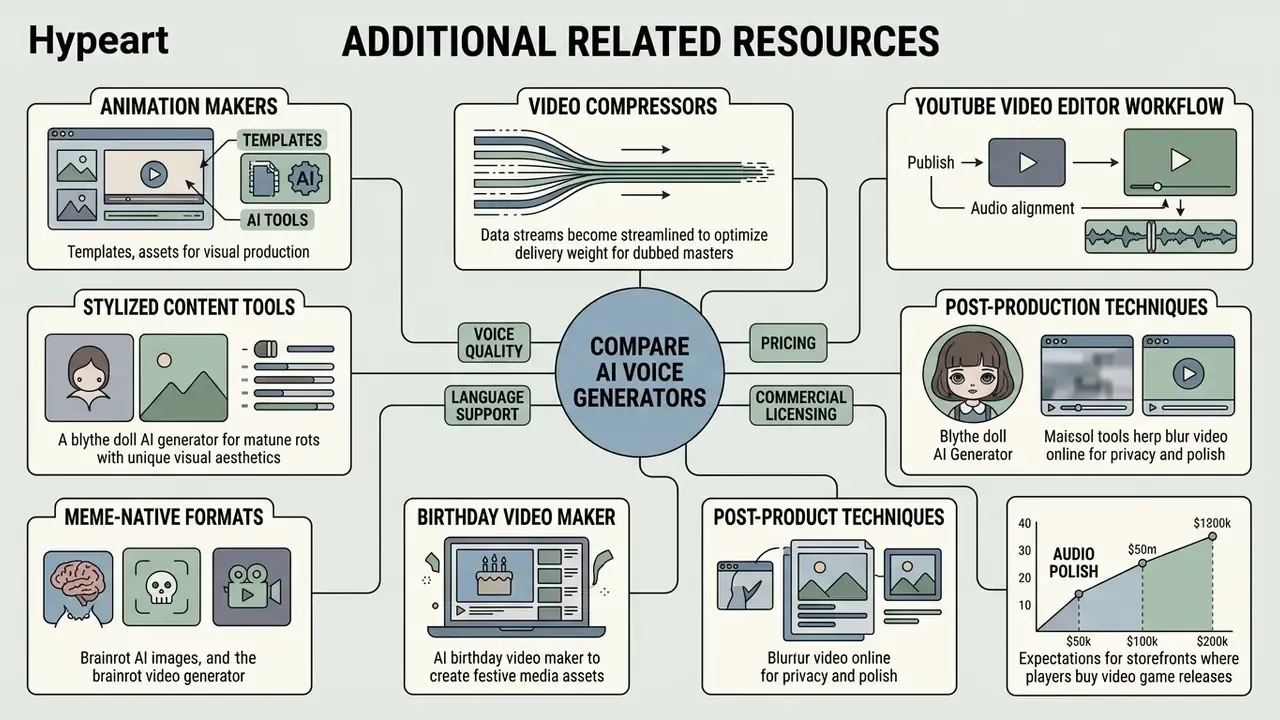
- Compare voice engines end to end in our guide to AI voice generators, covering voice quality, language support, pricing, and commercial licensing.
- Plan the visual half of your production with our guide to animation makers, including templates, AI features, and export options.
- Optimize delivery weight for dubbed masters using our guide to video compressors.
- Align publishing and audio alignment steps with the YouTube video editor workflow guide.
- Explore stylized content tools such as the blythe doll ai generator for unique visual aesthetics.
- Learn post-production techniques with tools that blur video online for privacy and polish.
- Create festive media assets with a specialized birthday video maker.
- Study meme-native formats through our notes on brainrot ai images and the brainrot video generator.
- Benchmark expected audio polish across price points on storefronts where players buy video game releases.
- Audit platform disputes and intellectual property cases at AI Litigation and Case Timelines.
- Reference terminology across formats in the AI Media Glossary.
Last updated: 2026. Editorial review: Marcus Hale, author. This article covers general technical and governance practice and is not legal advice.