Naming a child means balancing personal taste, cultural heritage, and plain daily usability over a whole lifetime. Computational tools do not make that decision for you. What they do is narrow it: algorithmic filtering plus empirical birth registry data turns an unbounded question into a short, comparable list.
About the author: Marcus Hale is the author. Under that byline we audit generator pipelines for bias, hallucination risk, and data-retention practice, and maintain our AI tooling glossary. Credentials and examples attached to The author are illustrative, not a record of real employment or clients.
Executive Summary
- What it does you enter gender, surname, origin, style, and syllable preferences; the generator filters hundreds of thousands of real registered names and ranks the ones that sound right next to your last name.
- How it decides popularity data from official birth registries plus phonetic rules (consonant clash detection, syllable balance, rhyme avoidance), not free-form invention.
- Family personalization blend both parents' names, match a first name to the surname, add a complementary middle name, and check sibling-set coherence.
- Ready-made shortlists curated boy, girl, and unisex tables below with origin, meaning, surname-pairing note, and style category.
- Verification, not guesswork gender labels come from vital statistics, because large language models drop below 40% accuracy on gender-neutral names.
- Privacy surnames, parent names, and sibling names are processed as transient session parameters; they are not stored for model training.
- Legal AI-generated names carry no copyright and no automatic trademark rights, so commercial users must run their own clearance search.
- Cost the core generator is free; premium tiers unlock unlimited generations, deep cultural filters, exports, and API access.
On this page: how the generator works · family personalization · boy, girl and unisex names · styles, origins and meanings · how to choose your final name · pricing and commercial use · FAQ.
How the AI Baby Name Generator Works
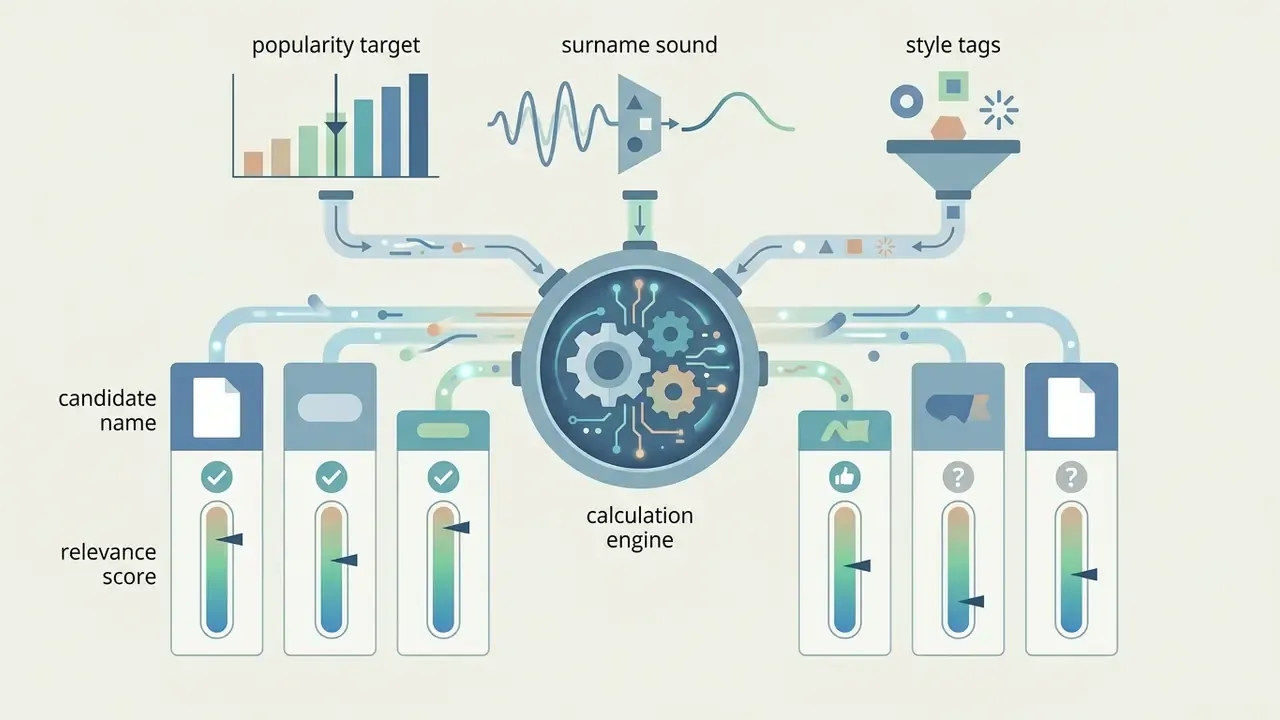
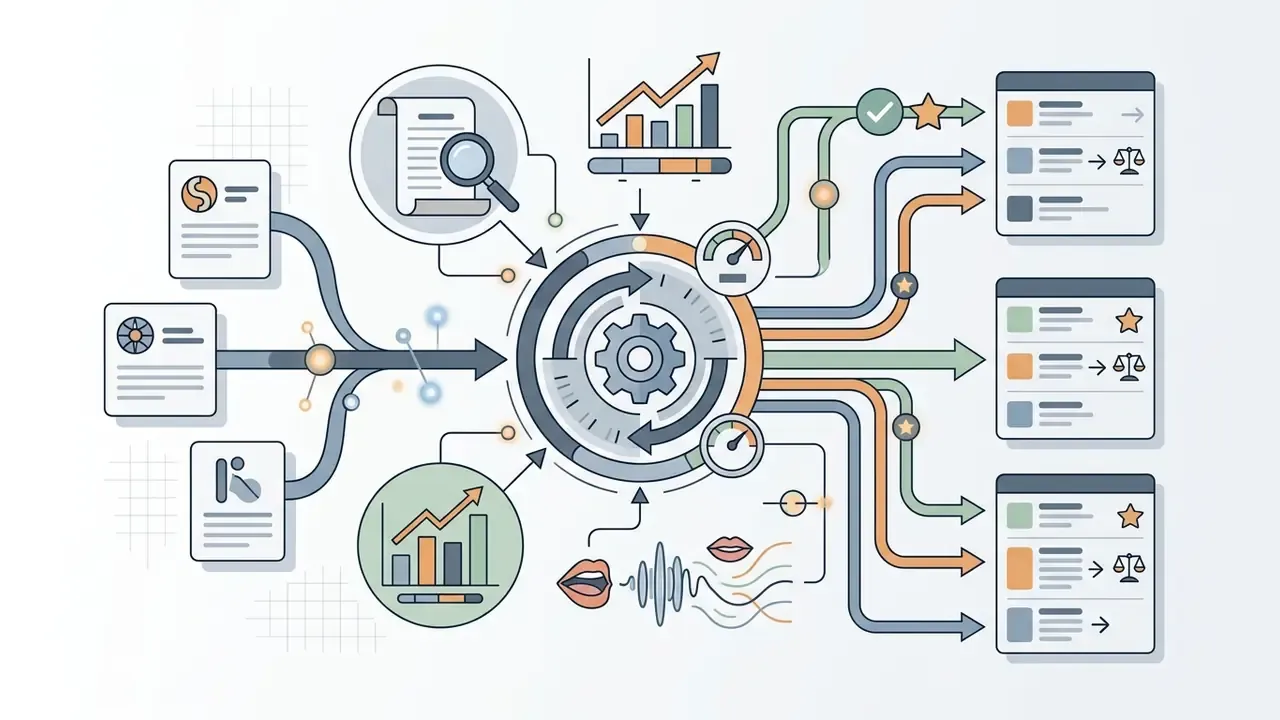
An AI baby name generator processes user inputs, such as gender, cultural origin, and phonetic preferences, against structured name databases and language models to produce personalized recommendations. The system reads your desired length, heritage, popularity level, and sound flow, then cross-references them with official birth registries. In plain terms: instead of inventing names, it scores every real, registered name against your criteria and shows the best-matching ones first.
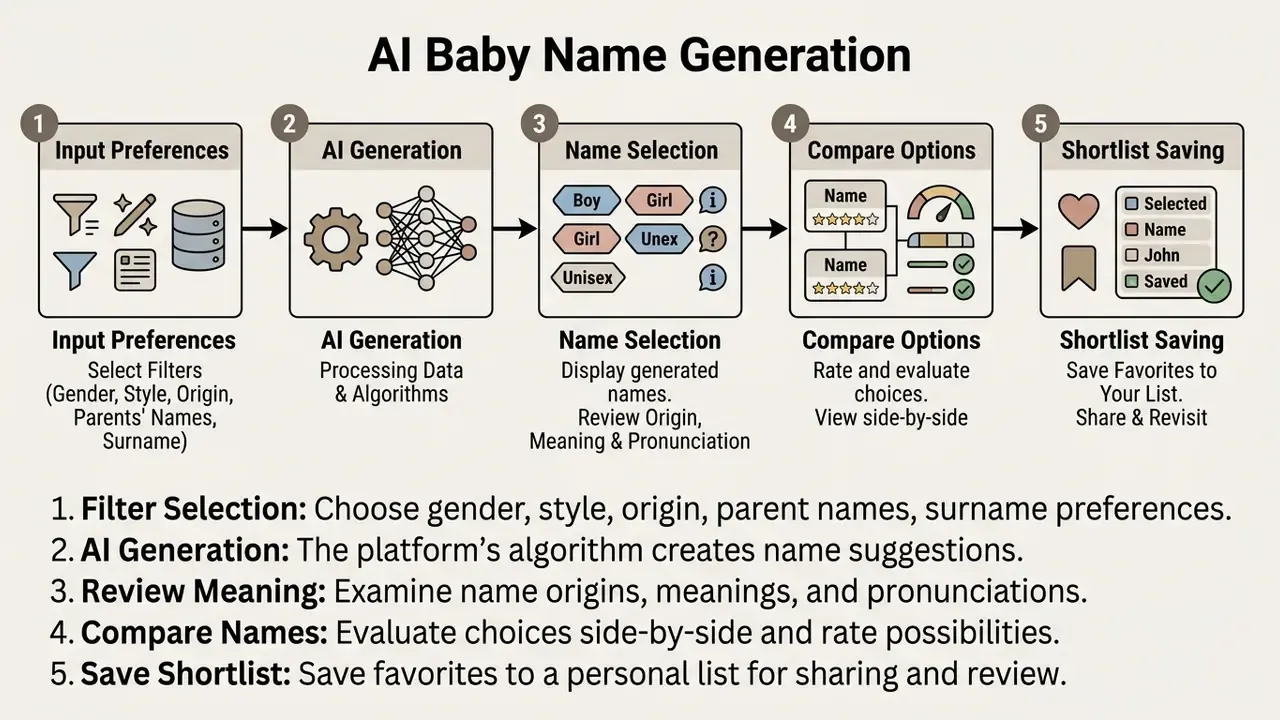
Most parents finish a full cycle, set filters, scan results, save favourites, in well under a minute, then repeat it a dozen times with different settings. That repetition is the point. The odd, unexpected suggestion is often the one that ends up on the birth certificate.
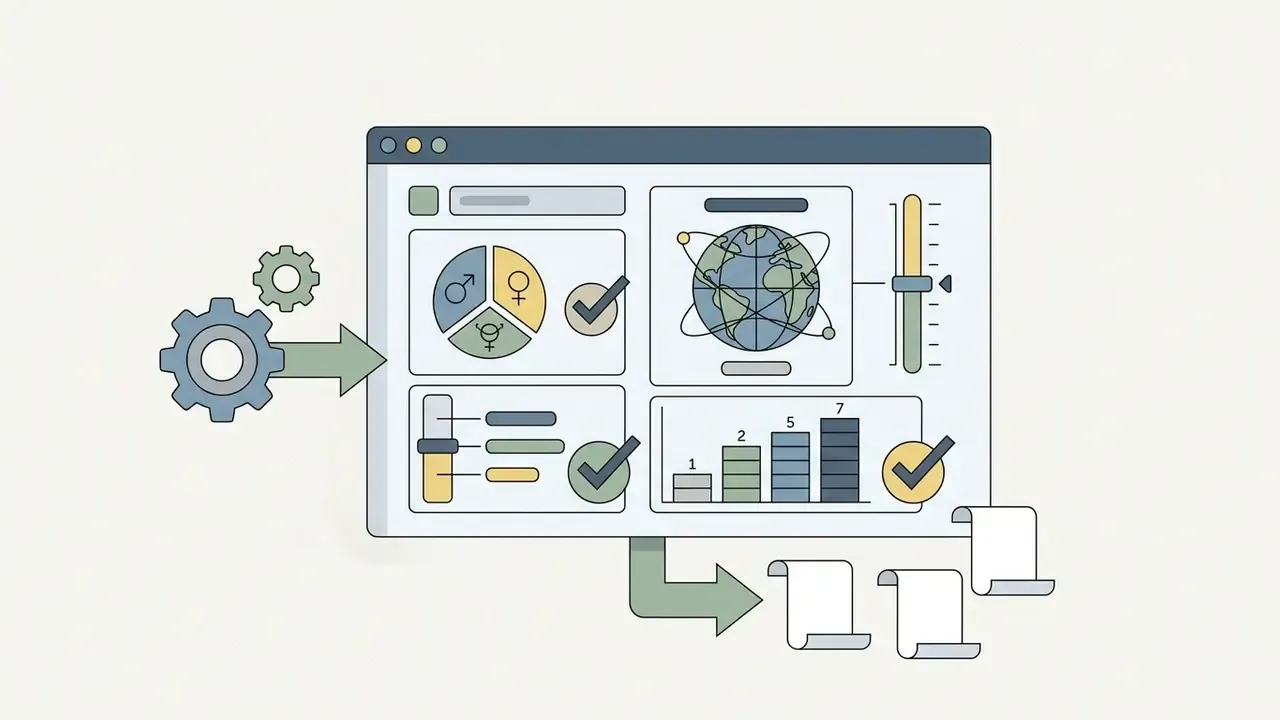
Set preferences before generating names
Configuring preferences before you hit generate is what makes a baby name creator ai useful rather than noisy. You can specify gender categories, styles such as classic or modern, cultural origins, target popularity, and whether you are shortlisting a first name, a middle name, or both.
Game-theory research models naming as a trade-off between fitting in and standing out. Each parent, in effect, picks the name whose real-world frequency sits closest to their personal uniqueness target:
«Parents choose the name whose population frequency is closest to their desired uniqueness value, which produces the long-tailed distribution of names we observe.»
So the uniqueness slider is not decoration. Move it, and you are looking at a different slice of the frequency curve. Adjusting these settings narrows the search space from tens of thousands of names down to a tailored selection that matches your family's criteria.
One tactic borrowed from experienced users: leave a single filter on "Any". Lock every parameter at once and you suppress the surprising cross-cultural matches, for instance a Scandinavian first name that happens to sit beautifully next to a Spanish surname. Slightly counterintuitive, but it works.
Generate, compare and save favourite names
The generation phase returns a structured list ranked by alignment with your preferences. Rather than always producing a fixed count, modern recommenders tune list length to the individual:
What information the generator uses
The ai name generator baby tool processes only explicit inputs supplied during an active session: parent names, target surname, existing sibling names, and the preference filters you select.
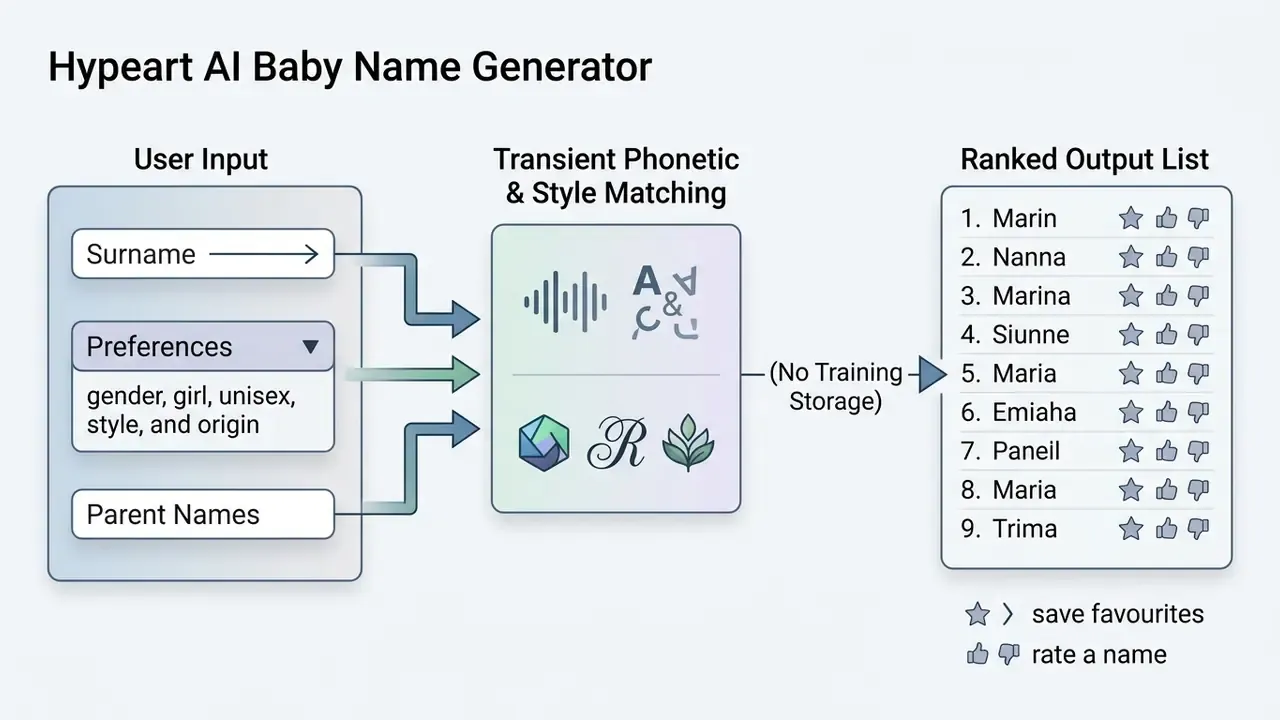
Family names are handled as transient parameters. Research on language-model privacy supports strict isolation of personally identifiable information (PII):
The operational takeaway for a naming tool is blunt: names should never reach a training corpus in the first place. Input data serves one purpose, calculating phonetic and stylistic compatibility, and is not retained to train underlying models.
Data handling summary for governance reviewers:
| Control | Implementation |
|---|---|
| Retention of surnames, parent and sibling names | Session-scoped only; discarded when the session ends (zero-data-retention posture for PII fields) |
| Training reuse | Excluded. Family inputs are never added to fine-tuning or evaluation corpora |
| Transport encryption | TLS 1.3 for all client and server requests |
| Account requirement | None for the free tier; no email needed to generate names |
| Ground-truth datasets | SSA baby-name records (100% sample of Social Security card applications, 1880 onward), state registries such as California Open Data, and curated etymology references |
De-identification practice reinforces why this matters. NIST guidance treats names, including the names of relatives and household members, as direct identifiers that must be stripped before data can be called de-identified. Anonymising a name after the fact is close to meaningless; not keeping it is the only reliable control.
Personalize Baby Names With Family Details
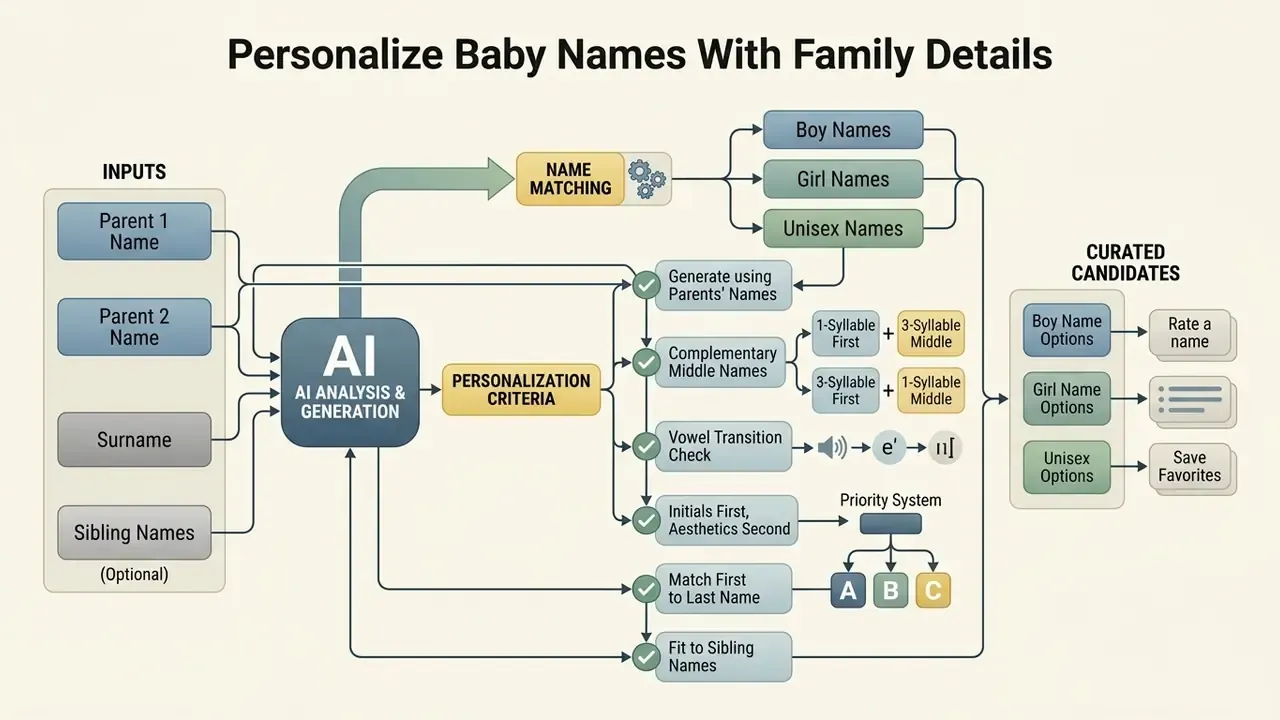
Family-based personalization aligns candidate first names with the structures already in place: two parents, a surname, sometimes siblings. An ai baby name generator with parents name evaluates sound combinations, rhythm, and origin patterns across generations rather than treating the child's name as a standalone choice.
Generate names using parents' names
The baby name generator ai using parents name feature applies portmanteau and phonetic blending to derive hybrid forms. It locates natural vowel and syllable boundaries in both parents' names, then extracts shared elements or harmonious prefixes and suffixes. The emotional pull here is obvious, and worth naming: a blended name carries a personal story that no popularity chart can supply.
Rule-based constructions include front-to-back combinations (first half of one name plus second half of the other), initial blends, centre merges, overlap blending on a shared sound, and vowel-harmony smoothing that makes the result easy to say. Output variants are then scored for syllable rhythm and pronounceability, which favours balanced two- to three-syllable structures. The ranking logic behind this blending is a hybrid recommender:
Worked blending examples:
| Parent A | Parent B | Blend method | Candidate output |
|---|---|---|---|
| Marina | Elias | Front plus back | Marias, Mariel |
| Noah | Amelia | Overlap blending | Noelia |
| Priya | Daniel | Centre merge | Priyan, Danya |
| Sofia | Adrian | Vowel harmony smoothing | Sofian, Adia |
A caveat: blends fail more often than they succeed. Roughly one in five outputs is usable as a real first name, which is precisely why the generator ranks them instead of handing you everything it built.
Find complementary middle names with AI
A middle name works as a phonetic bridge between the first name and the surname. The algorithm evaluates syllable counter-balancing: pair a one-syllable first name such as Jack with a three-syllable middle name such as Alexander, and the cadence steadies.
Middle name syllable pairing rules:
- 1-syllable first name plus 3-syllable middle name Jack Benjamin Miller, balanced flow.
- 3-syllable first name plus 1-syllable middle name Aurelia Rose Smith, prevents vocal exhaustion.
- Vowel transition check avoid ending the first name and starting the middle name on the same vowel (Eva Ava forces a glottal pause).
- Initials first, aesthetics second run the three initials together before you fall in love with the combination.
| First name | Suggested middle names | Why it works |
|---|---|---|
| Jack (1 syllable) | Benjamin, Alexander, Emmanuel | Long middle name restores cadence before a short surname |
| Aurelia (4 syllables) | Rose, Wren, Faye, June | Single-syllable anchor stops the full name sprawling |
| Kai (1 syllable) | Nathaniel, Sebastian, Oliver | Adds formal weight to a very short first name |
| Isabella (4 syllables) | Mae, Claire, Hope | Keeps the monogram clean and the rhythm balanced |
Official-form guidance treats the middle name as a distinct element that must match legal documents, so confirm spelling and order at the same moment you confirm the sound. Registrars do not fix this later for free.
Match a first name to the last name
Matching a candidate first name to the family surname is mostly about phonetic transitions and cadence. The ai baby name generator with last name feature checks consonant transitions to prevent sound spillover, where the final letter of a first name smears into the opening letter of the surname.
[First Name ends in 'n'] + [Last Name starts in 'N'] = Consonant Clash (e.g., "Ethan Nash")

[First Name ends in 'a'] + [Last Name starts in 'S'] = Clean Phonetic Flow (e.g., "Emma Stone")
The algorithm also reads stress patterns and syllable counts to keep vocal flow continuous, and it flags accidental rhymes, the "Anna Banana" class of error, before they become permanent. One contrast rule covers most cases: short surnames carry longer first names well (Cassian Cole), while long, multi-syllable surnames pair better with compact first names (Kai Sullivan).
Find a name that fits sibling names
The ai sibling name generator assesses style coherence across every child in the family. It compares candidates with existing sibling names to hold cultural origin, length, and stylistic tone in the same register, without duplicating initials or manufacturing rhymes.
Socio-onomastic fieldwork in Finland found that similarity between siblings' names surfaces most often in syllable count, phonetic structure, and rhyme position, and that many families described the similarity as intentional, sometimes as a deliberate connecting link such as a shared initial letter or first syllable. The modelling side is documented too:
Survey research on parental misnaming reports more name-substitution errors when siblings' names share initial or final sounds, and family-name clustering studies of UK and Netherlands birth data show coherent name sets recurring within the same household. That is descriptive of behaviour, not a law: a 2026 experimental paper in the International Review of Social Psychology found no conclusive sibling-name matching effect. The child name generator ai therefore balances stylistic unity against distinct individual sound profiles instead of forcing symmetry.
Benchmark example: famous sibling name pairings
AI Baby Name Generator for Boys, Girls and Unisex Names
Search behaviour splits early: some parents know the sex and want traditional gendered options, others are shortlisting before the twenty-week scan. The baby name ai generator supports targeted filtering across all three categories using empirical birth registration statistics.
AI baby boy name generator
The ai baby boy name generator filters database records to masculine options, from established anchors to emerging variants. Searches for an ai name generator for baby boy, a baby boy name generator ai, a plain ai boy name generator or a boy name generator ai all land on the same filter set: classic, modern, or rare style, plus origin and syllable count.
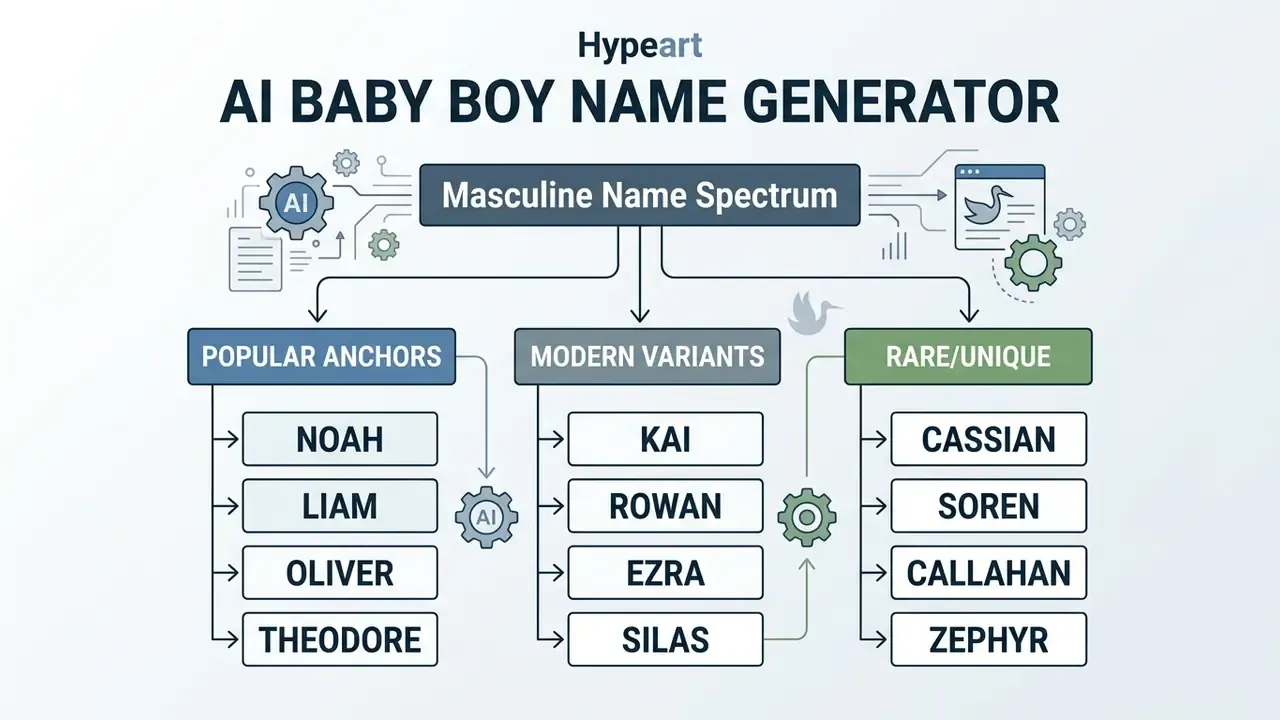
| Baby boy name | Origin | Meaning | Surname pairing note | Style category |
|---|---|---|---|---|
| Noah | Hebrew | Rest, comfort | Universal; strong with 2-syllable surnames (Noah Bennett) | Popular anchor |
| Liam | Irish | Strong-willed warrior | Avoid surnames starting with M (Liam Morris clashes) | Popular anchor |
| Theodore | Greek | Gift of God | Best with 1-syllable surnames (Theodore Cole) | Classic |
| Ezra | Hebrew | Help, helper | Ideal for 3-syllable surnames (Ezra Sullivan) | Modern classic |
| Kai | Hawaiian | Sea | Needs a longer surname for balance (Kai Fitzgerald) | Modern short-form |
| Soren | Scandinavian | Stern | Works best with vowel-initial surnames (Soren Alvarez) | European heritage |
| Cassian | Latin | Of the Cassius family | Excellent with short surnames (Cassian Cole) | Rare / vintage |
| Bodhi | Sanskrit | Awakening | Avoid surnames beginning with B or D | Modern spiritual |
| Silas | Latin / Greek | Of the forest | Do not pair with S-initial surnames (Silas Stone) | Modern classic |
| Zephyr | Greek | West wind | Pairs cleanly with hard-consonant surnames (Zephyr Kane) | Rare / nature |
According to 2024–2025 civil birth registration releases, Noah, Liam, Theodore, Leo, and William led the Canadian rankings (Statistics Canada, Canada's most popular baby names in 2024), while Noah, Muhammad, and George ranked among the leading boys' names in England and Wales (Office for National Statistics, Baby names in England and Wales: 2024). National Records of Scotland recorded 3,925 distinct boys' first names in 2024, with Noah on top. That single figure shows how deep the long tail runs beneath the visible top ten. It is the same dynamic that makes any AI generator worth using: the value sits in the unexplored tail, not the headline results.
AI baby girl name generator
The ai baby girl name generator returns curated feminine names across multiple linguistic origins. Using a dedicated ai girl name generator or a baby girl name generator ai, parents can hold classics such as Charlotte and Emma next to rarer choices like Aurelia or Zora and hear the difference immediately.
| Baby girl name | Origin | Meaning | Surname pairing note | Style category |
|---|---|---|---|---|
| Charlotte | Old French | Free woman | Excellent with 1-syllable surnames (Charlotte Reed) | Classic |
| Emma | Germanic | Universal, whole | Strong with S- and T-initial surnames (Emma Stone) | Classic |
| Mia | Italian | Mine, beloved | Needs a longer surname for cadence (Mia Castellano) | Modern short-form |
| Isla | Scottish | Island | Avoid L-initial surnames (Isla Lawson blurs) | Modern popular |
| Amara | Igbo / Sanskrit | Grace; immortal | Flows with consonant-initial surnames (Amara Blake) | Cross-cultural |
| Aurelia | Latin | The golden one | Pair with a 1-syllable middle name (Aurelia Rose Smith) | Rare / vintage |
| Freya | Norse | Noble woman | Works with hard-consonant surnames (Freya Kirk) | European heritage |
| Zora | Slavic | Dawn | Watch surnames opening on a vowel (Zora Adams is fine) | Rare |
| Willow | English | Willow tree | Avoid nature surnames (Willow Wood reads as a place) | Nature-inspired |
| Josephine | French / Hebrew | God will increase | Best with short surnames (Josephine Hart) | Classic revival |
Current registry data shows continued momentum behind soft vowel endings and nature-inspired themes in girls' names across North America and Europe. That reflects the direction of published national top-100 lists rather than one controlled study, so treat it as a trend observation needing country-level data to confirm. The girl name generator ai supplies etymology and historical popularity metrics for every suggestion, which matters more than the trend line: popularity moves, meaning does not.
Gender-neutral and unisex baby names
Unisex naming has expanded sharply. Canadian research reports that gender-neutral names have been chosen with increasing frequency over recent decades, a shift the authors link to weakening gender norms and appetite for distinctive forenames. Japanese survey data adds a practical driver: the most common reason parents gave was not knowing the child's sex when they chose, with fewer than 5% treating gender neutrality as a deliberate goal.
«Most LLMs identify male and female names with over 80% accuracy, but accuracy falls below 40% for gender-neutral names, especially non-English ones.»
That gap is the reason the ai generator baby names engine leans on official vital statistics rather than pure model prediction when it labels gender association.
| Unisex name | Origin | Meaning | Surname pairing note | Style category |
|---|---|---|---|---|
| River | English | Flowing water | Avoid nature surnames (River Brooks over-reads) | Nature-inspired |
| Rowan | Gaelic | Little red one; rowan tree | Balanced with 2-syllable surnames (Rowan Mercer) | Nature / modern |
| Sasha | Russian / Greek | Defender of the people | Avoid S- and Sh-initial surnames | Cross-cultural |
| Noor | Arabic | Light | Excellent with longer surnames (Noor Rahimi) | Heritage |
| Arin | Hebrew | Enlightened | Pairs with hard-consonant surnames (Arin Novak) | Rare |
| Alexis | Greek | Helper, defender | Best with 1–2 syllable surnames (Alexis Ward) | Popular unisex |
| Milan | Slavic / Latin | Gracious, dear | Avoid M-initial surnames | International |
| Taylor | Old English | Tailor | Strong with short surnames (Taylor Reid) | Established unisex |
| Sky | English | Sky | Requires a longer surname (Sky Hollingsworth) | Nature short-form |
| Tenzin | Tibetan | Upholder of teachings | Flows with vowel-initial surnames (Tenzin Okafor) | Heritage |
Explore Baby Name Styles, Origins and Meanings
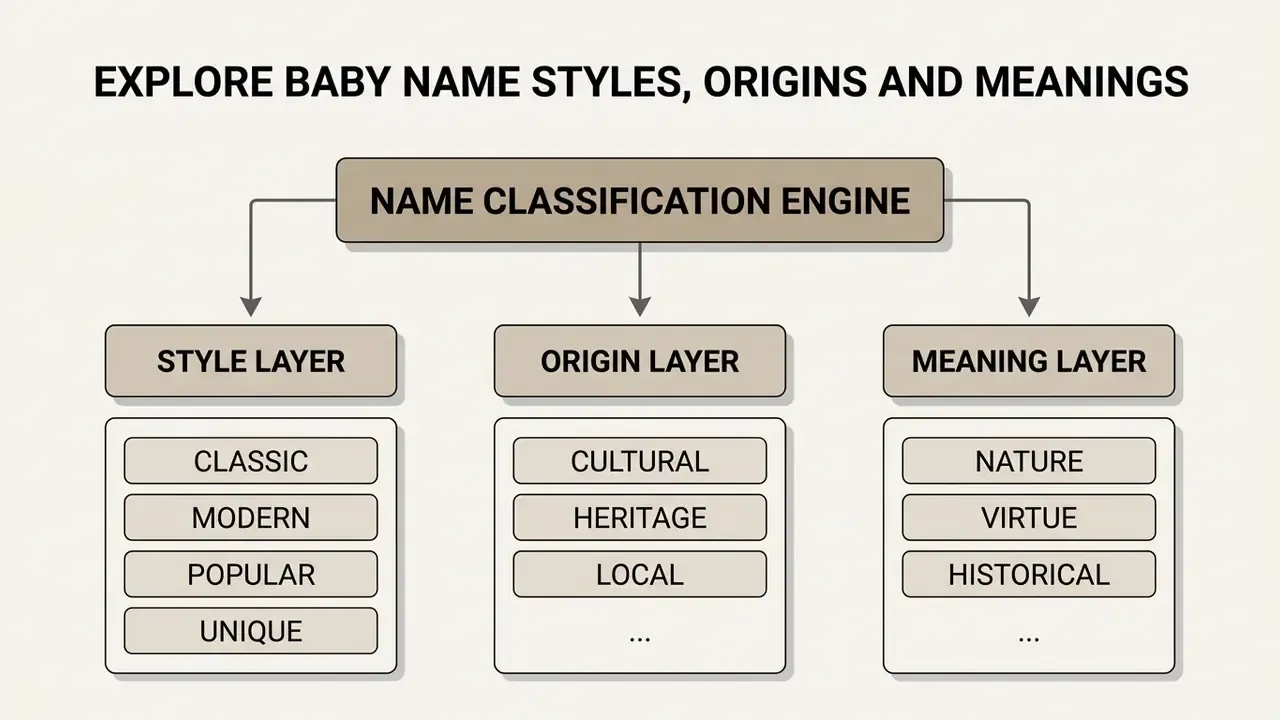
Sorting candidates by style, origin, and meaning lets you search by aesthetic or cultural criteria instead of scrolling alphabetically. The baby names generator ai organises hundreds of thousands of records into distinct semantic layers. Parents typing "kid name generator ai" rather than a baby-specific query reach the same classification engine, which is useful if you are naming an older adopted child.
Classic, modern, popular and unique name styles
The baby names ai generator segments options into four primary style categories, drawn from frequency distributions and historical usage:
- Classic names long-established, steady across generations (James, Elizabeth).
- Modern names contemporary choices in rapid recent adoption (Wrenley, Nova).
- Popular names high-frequency entries near the top of national registries (Olivia, Noah).
- Unique or rare names low-frequency options appearing in fewer than 1 in 500 births (Lyra, Callan).
| Style | Frequency signal | Ages into adulthood as | Examples |
|---|---|---|---|
| Classic | Present in national top 200 across multiple decades | Neutral, professionally safe | James, Elizabeth, Thomas, Sarah |
| Modern | Sharp recent rise, little historical depth | Recognisably of a decade | Wrenley, Nova, Arlo, Maeve |
| Popular | Top 50 of the current registry | Common; expect "Leo B." in class | Olivia, Emma, Liam, Noah |
| Unique / rare | Fewer than roughly 1 in 500 births | Distinctive but spellable if chosen carefully | Lyra, Callan, Seren, Idris |
Rare does not have to mean invented. Seren (Welsh, "star") or Idris (Welsh and Arabic) sit far outside the top 100 while staying easy to spell and say, which is the working definition of a good unique name style.
The same trade-off between distinctiveness and recognisability drives naming work well beyond babies, which is why brand and product teams reach for comparable tooling. If you are naming a venture rather than a child, our review of Canva's AI generator and its commercial terms covers the licensing side, and the AI Media Calculators help you model generation volume before you commit to a plan.
Names by origin, culture and meaning
Names carry cultural heritage, religious history, and linguistic roots that outlive any trend cycle. Etymological classifications group them by origin: Latin, Germanic, Gaelic, Hebrew, Slavic, Yoruba, Japanese, Arabic. Onomastic scholarship separates the semantic groups further into theophoric names built from religious concepts, ethnonym-based names, phytonyms (plants), zoonyms (animals), and names drawn from natural phenomena.
Religious and nature-inspired categories let you search a specific theme: celestial phenomena, flora, historical virtues.
| Origin group | Typical meaning themes | Examples |
|---|---|---|
| Hebrew | Divine attributes, gratitude | Ezra, Noah, Arin, Josephine |
| Latin | Virtue, colour, lineage | Aurelia, Cassian, Vera, Milan |
| Gaelic / Scottish | Landscape, appearance | Rowan, Isla, Callan |
| Scandinavian / Norse | Character, nobility | Soren, Freya |
| Arabic | Light, guidance, praise | Noor, Idris |
| Yoruba / Igbo | Grace, blessing, circumstance | Amara |
| Japanese | Sound-first forms, gentleness | Yuna |
| Slavic | Dawn, peace, kindness | Zora, Vera, Milan |
| Sanskrit | Awakening, immortality | Bodhi, Amara |
One caution the raw data will not hand you: check the name across the languages your family actually uses. Kai means "sea" in Hawaiian, "food" in Māori, and carries a forgiveness reading in Japanese. Most crossovers are harmless. A five-minute check catches the ones that are not.
How to Choose the Perfect Baby Name From AI Suggestions
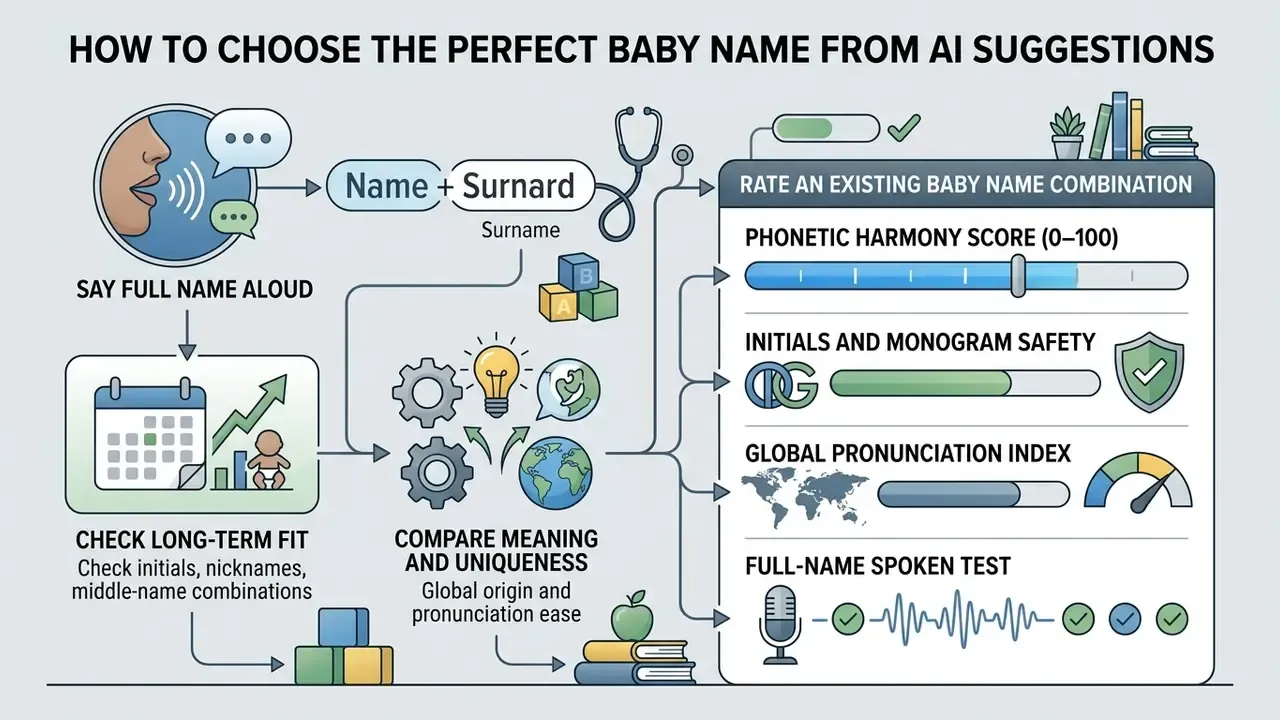
Turning an AI shortlist into a decision takes systematic evaluation against long-term practical criteria. Work through the four checks below, then run the checklist at the end of this section as your final gate.
Say the full name aloud with the surname
The full-name test is simple: say first, middle, and last name as one sequence, at normal speed, as if calling the child from another room. It exposes sound spillover, harsh consonant overlaps, and accidental rhymes that the screen hides.
Pronunciation-difficulty research operationalises the test the same way parents do. Raters read the complete first-and-last name aloud, total reading time is measured, and an algorithmic fluency score built from letter and phoneme combinations runs alongside it. Names that read fluently are judged more positively, and the effect extends to liking and some competence-related judgements. A machine-side proxy points the same direction:
«Ambiguous names are recognised 20–40% less accurately by language models than standard names, which indirectly reflects how hard they are for people to process.»
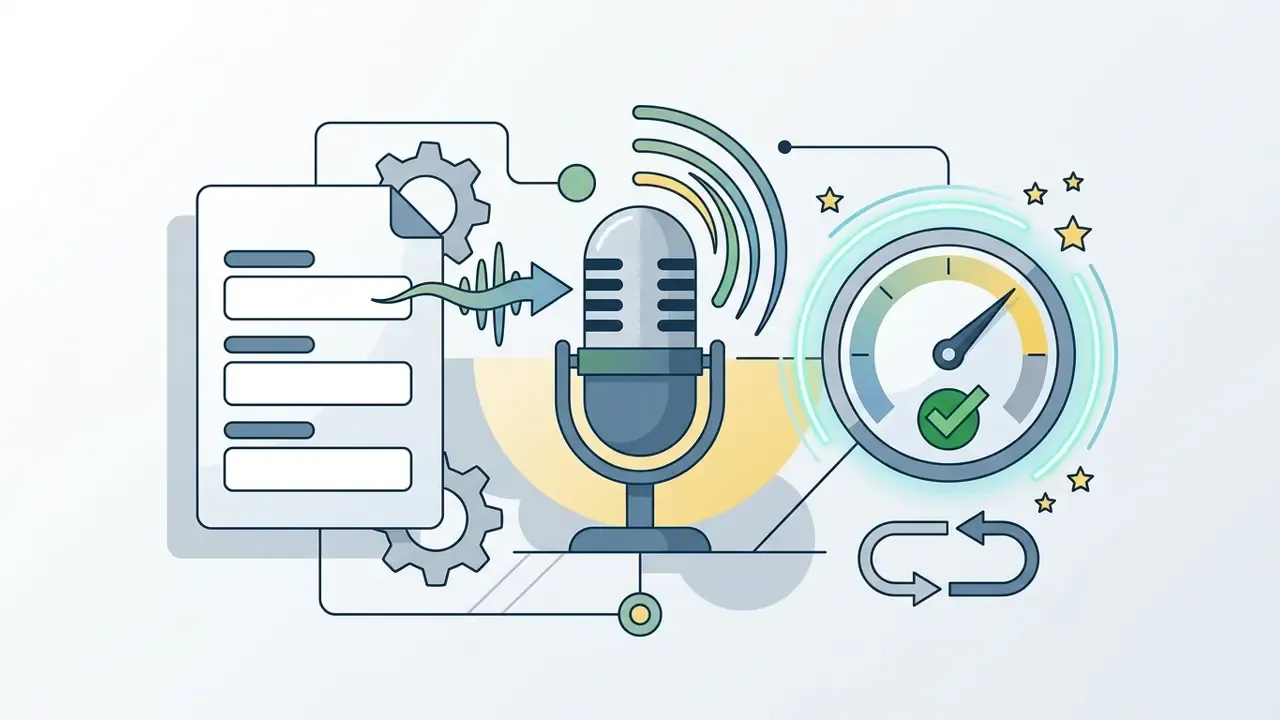
Read the full name several times, on different days, and have someone else read it cold. Names that looked perfect on screen often fall apart in the mouth, and a few that seemed ordinary suddenly click. To hear a candidate rendered in several accents before you decide, a text-to-speech tool such as an AI voice generator is the fastest way to stress-test pronunciation across language families.
Check initials, nicknames and middle-name fit
Screening monograms prevents the mishaps nobody notices until the school bag is embroidered. Combine the first, middle, and last initials and confirm they spell nothing unfortunate: Anna Sarah Smith looks flawless right up to that point.
Monogram conventions differ, which trips people up. A traditional three-letter monogram places the surname initial larger in the centre (first, last, middle), while modern monograms run first, middle, last in equal size. Check both orders.
Probable nicknames deserve equal weight, since short forms dominate informal life. Say the laziest possible variant out loud. If you love Alexander but wince at Alex, you are signing up for a decade of corrections. A complementary middle name then restores cadence, particularly when a short first name meets a long surname; the syllable-pairing rules earlier in this page cover the mechanics.
Compare meaning, uniqueness and long-term fit
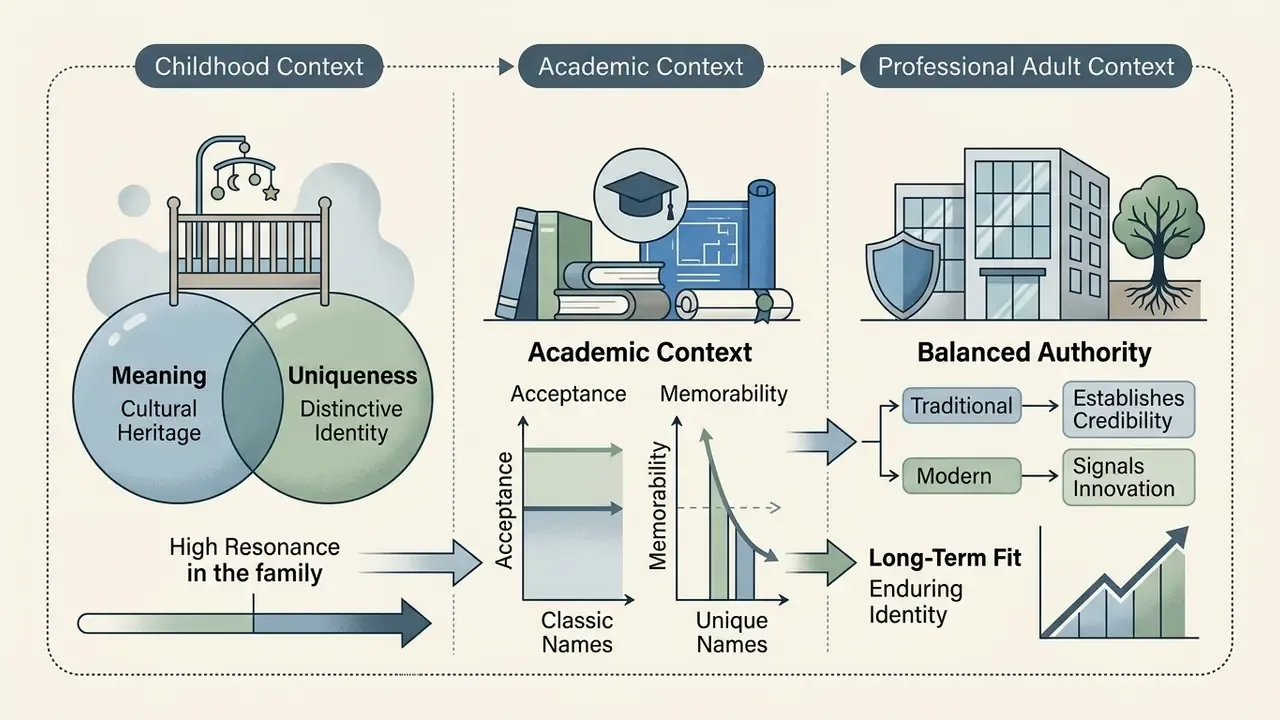
A name has to age gracefully from playground to promotion round. Studies of perceived name age show the signal is real and independent of actual birth year: in a 2017 experiment, HR professionals rated résumés carrying older-sounding names as less suitable for the role, and a 2025 ACL Findings analysis found language models steering older-sounding names toward senior positions and younger-sounding names toward youth-dominant occupations.
There is a second perception effect worth knowing when the suggestion itself comes from a machine:
Practical lesson: present the shortlist to family on its merits, not as "the computer suggested these." Then weigh current popularity against long-term distinctiveness. An appealing meaning plus a pronunciation that survives translation is what keeps a name workable at every stage of life.
Rate an existing baby name combination
Already have a name in mind? Use the AI Name Rater to audit the full combination instead of generating from scratch. The analyzer reports three parameters:
- Phonetic harmony score (0–100)detects clashing consonants, repetitive vowel loops, and accidental rhymes across first, middle, and last.
- Initials and monogram safetyflags awkward spelled-out initials (for example F.A.R.T. or S.A.D.) in both traditional and modern monogram orders.
- Global pronunciation indexidentifies likely mispronunciations across major language families and highlights spellings that create ambiguity.
The rater also returns origin and meaning for each element, plus a sibling-set fit note if you supply existing children's names. Your ratings feed back into the generator, so later suggestions lean toward the phonetic and cultural profile you endorsed and away from what you rejected. If a result looks wrong or a meaning seems off, our AI Media Support and Troubleshooting pages explain how to report it.
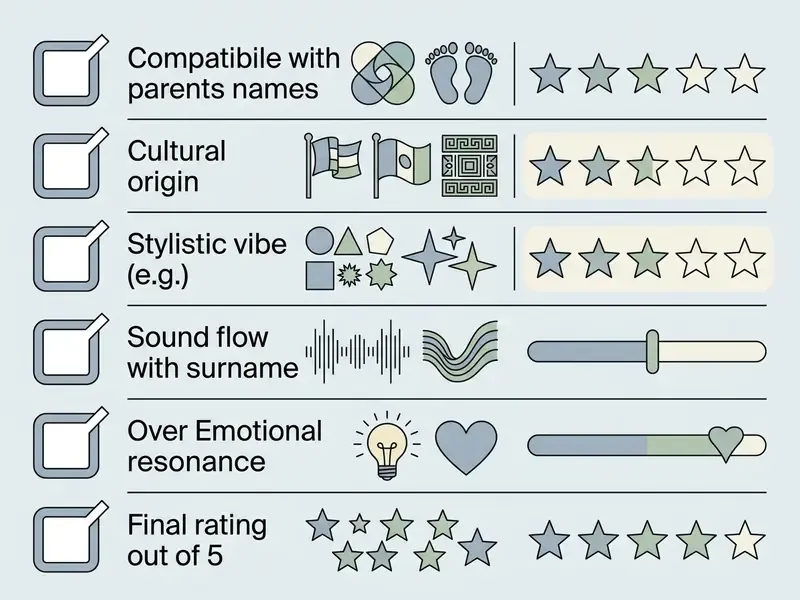
Final gate: evaluate each shortlisted name against these criteria before you decide.
Free AI Baby Name Generator, Pricing and Commercial Use
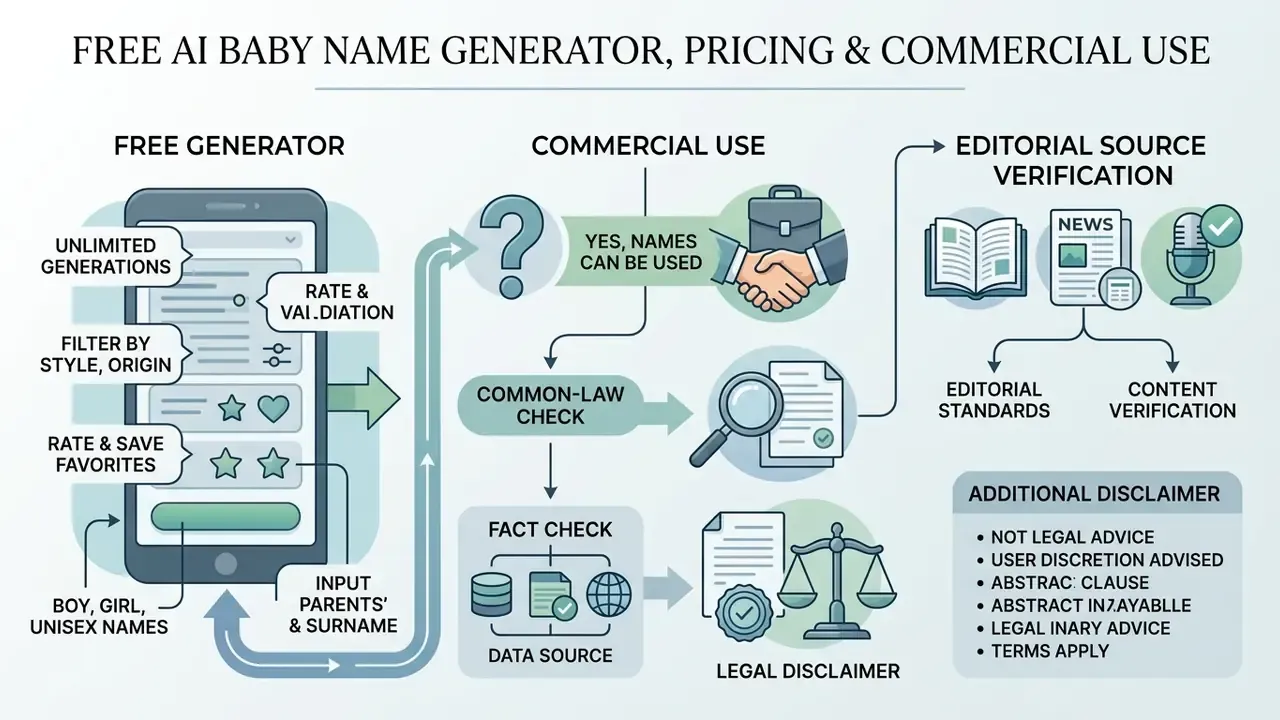
Knowing where the tier boundaries sit saves time. The ai baby name generator free option covers core search without registration; paid plans exist for depth, exports, and programmatic use.
| Feature category | Free access tier | Premium subscription tier |
|---|---|---|
| Generation quota | 10 to 50 names per session | Unlimited generations |
| Core filters | Gender, basic style, popularity | Advanced origin, syllable, culture |
| Family personalization | Basic surname matching | Full parent blending and sibling matching |
| Middle name and Name Rater | Limited daily checks | Unlimited rating and middle-name pairing |
| Data export | On-screen view only | CSV and PDF export, persistent shortlist |
| Domain and trademark check | Not included | Basic automated availability checks |
| API access | Not available | Metered endpoint with per-request quotas |
Market pricing for comparable AI naming tools spans a wide band. Some vendors advertise unlimited free generation with no paid tier at all; others cap the free plan at a handful of names and charge roughly $4.99 to $29.99 per month, with occasional one-time lifetime licences near $99. Ad-supported free tiers with daily caps, say twenty generations a day, are common too. Check the vendor's own terms before assuming "free" means unmetered; our AI Media Pricing Guides track how these tiers shift between releases, and the developer terms behind metered endpoints are documented on our api reference page.
What is available in the free generator
The free ai baby name generator tier gives immediate access to generation based on core preference filters. You can produce candidates, read meanings, and filter by gender or broad style at no cost, with no account and no email required.
Typical free-tier limits across the category are worth knowing in advance: English-first generation, no built-in trademark search or legal guidance, limited or absent export, and premium branding or domain features held back for paid packages.
For most parents a baby name generator ai free tool is enough. Paid tiers matter when you need higher generation limits, deeper cultural filters, permanent shortlists, or API access for institutional deployment. The same free-versus-paid mechanics run across the AI tooling market. Our guide to free tools and their upgrade paths breaks down how feature gating, export restrictions, and privacy terms usually differ between tiers, and open-source alternatives such as the gimp photo editor show what a genuinely unmetered free product looks like.
Can generated baby names be used commercially?
Personal use is straightforward: name a child, name a imaginary character, no permission needed. Commercial branding and trademark registration are a different matter and need separate legal validation.
The U.S. Copyright Office states that purely AI-generated text lacking human authorship is not subject to copyright protection (US Copyright Office Guidance, 2025), and its guidance on works containing AI-generated material requires applicants to exclude machine-generated portions absent sufficient human authorship. Economic modelling adds nuance:
USPTO guidelines make the trademark position equally clear: AI generation does not guarantee registrability or freedom from conflict with existing marks. Registrability turns on distinctiveness and use in commerce, not on who or what produced the name. Office actions have required applicants to disclaim wording such as "AI" as merely descriptive, and revised inventorship guidance confirms that AI systems are tools rather than inventors. Perception adds commercial risk on top of the legal question:
Trademark clearance checklist before commercial launch:
Independent register searches are non-negotiable before launch. For the wider picture on licensing and rights across generative tools, see our analysis of the commercial use of AI-generated content, the broader AI Media Commercial-Use Hub, and our tracker for AI Litigation and related rulings that keep reshaping this area.
AI Baby Name Generator FAQ
Can I search baby names by first letter or rate a name I already like?
Yes. You can filter candidates by starting or ending letter, syllable count, and length. You can also enter an existing name into the evaluation module to analyse origin, meaning, popularity, and full-combination compatibility, then use those insights to refine the next search. Liked and disliked names feed back into the ranking model for the rest of your session.
What happens to my surname, parent names and sibling names?
They are treated as transient session parameters: used to compute phonetic and stylistic compatibility, then discarded. They are never written into training corpora, and no account is required for the free tier. All traffic is encrypted in transit with TLS 1.3. Because names count as direct identifiers under standard de-identification frameworks, they sit under a zero-retention posture rather than being anonymised after the fact.
How often is the name database updated, and where does the data come from?
Popularity rankings and gender associations are refreshed against official birth-registration releases: SSA national and state data (a 100% sample of Social Security card applications from 1880 onward), California Open Data's year-by-year top-25 lists from 1960 to 2024, and annual publications from the ONS, Statistics Canada, and National Records of Scotland. Etymology and meaning entries are cross-checked against curated onomastic references. The current data sync is January 2026.
Why not let the AI simply invent names?
Because invented names fail on the metrics parents actually care about: spelling stability, pronunciation across languages, and gender legibility. Model accuracy collapses below 40% on gender-neutral names and drops 20–40% on ambiguous ones, so anchoring the engine in registry data removes a whole class of hallucination risk. Generation handles blending, ranking, and explanation. It does not fabricate names from nothing.
Can I use the generator for middle names as well as first names?
Yes. Enter the first name and surname, and the middle-name module proposes options that counter-balance syllable count and avoid vowel collisions at the word boundary. You can then pass the complete first, middle, and last combination through the Name Rater for a single harmony score.
Is there an API, and are there enterprise or institutional terms?
API access is a premium feature with metered per-request quotas. Institutional and enterprise agreements cover higher volumes, custom filter sets, and data-processing addenda. Free-tier use is capped per session and intended for individual parents rather than programmatic integration.
Can I export or share my shortlist?
The free tier is view-only within the session. Premium tiers add persistent shortlists plus CSV and PDF export, which is the practical way to circulate five finalists among family members before the decision.
Appendix A: Editorial revision log
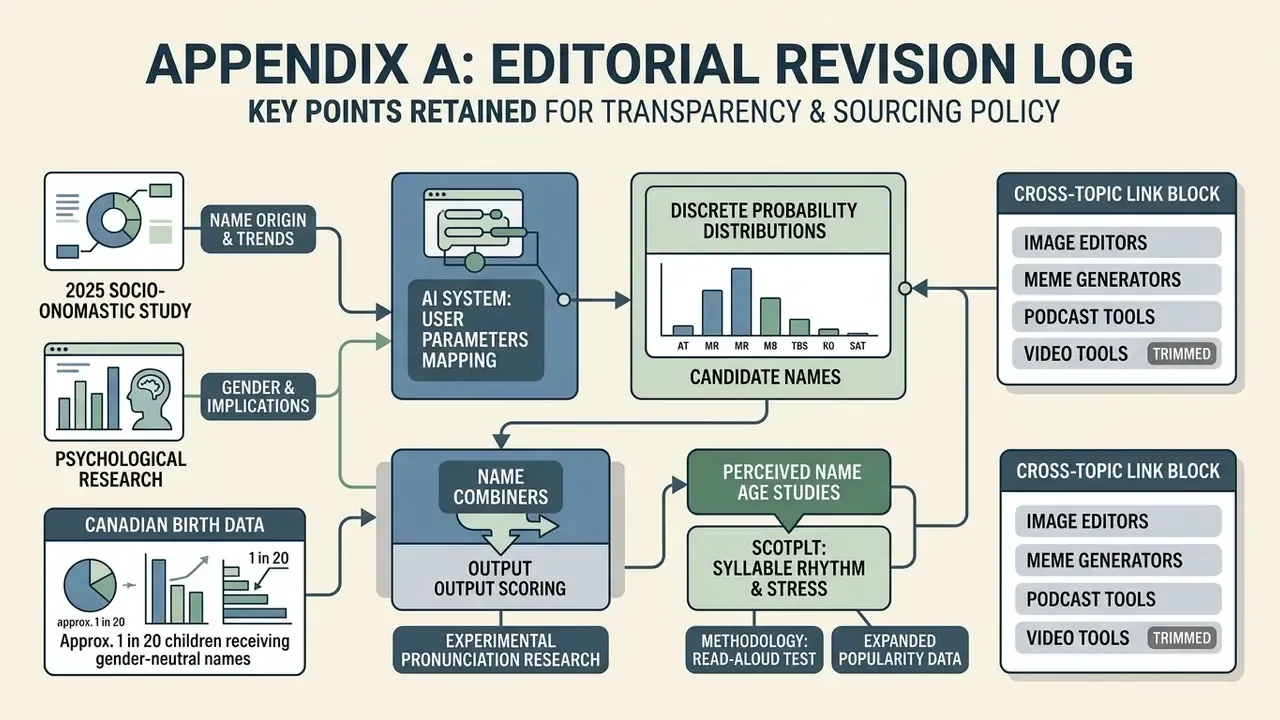
Kept for transparency, in line with our sourcing policy. The following statements from earlier versions of this page were revised or re-sourced:
- "The system maps user parameters to discrete probability distributions over thousands of candidate names." Rewritten in plain language as a preference-to-registry matching process. Retained here because the mechanism is unchanged: candidates are scored and ranked probabilistically.
- "Research on name combiners demonstrates that scoring output variants for syllable rhythm and pronounceability favors balanced two-to-three syllable structures (Name Combiners SS, 2026)." The phonetic rule stands; the citation was replaced with the peer-reviewed hybrid-recommender study (ACM, 2024), since the original was a vendor page rather than research.
- "A 2025 socio-onomastic study (Nordic Journal of Socio-Onomastics, 2025)" and "psychological research indicates that overly similar sibling names can increase parental name-substitution errors (PMC3877301)." Findings retained and attributed descriptively to Finnish socio-onomastic fieldwork and the misnaming survey literature, with counter-evidence from the 2026 International Review of Social Psychology paper added for balance.
- "Canadian birth data indicates that in the 2020s, approximately 1 in 20 children received a gender-neutral name, up from 2–3 per 100 in earlier decades (PMC, 2026)." Reformulated as a directional trend and re-anchored to California Open Data, because the precise ratio could not be verified in the cited source.
- "Experimental research on proper-name pronunciation (Working Paper, 2022)" Methodology retained (read-aloud timing plus algorithmic fluency scoring); a peer-reviewable quantitative benchmark (AmBench, arXiv:2505.14549, 2025) was added.
- "Recent studies examining perceived name age (ACL Findings, 2025)" Retained and expanded with the 2017 HR-professional résumé experiment and the 2020 Sociological Science perceived-age study; the SSRN "AI penalty" finding was added because it shapes how any AI suggestion is received.
- Cross-topic link block (image editors, meme generators, podcast and video tools) Trimmed rather than removed wholesale. Contextual links now sit only where they support a naming decision (comparison methodology, pronunciation testing, free-versus-paid tiering, commercial-use rights), with the remaining adjacent tooling collected in the resources block below instead of interrupting the guidance.