«Uncontrolled model outputs create hidden liabilities in enterprise workflows; establishing explicit boundaries, prompt controls, and editorial validation is mandatory before integrating any browser-based AI generation tool into production pipelines.»
The Perchance AI story generator is a free, web-based tool hosted on perchance.org. It produces paragraph-by-paragraph narrative prose from custom prompts, with no registration, no paid subscription, and no daily generation cap on the main public page. It was built for speed rather than polish. Creators use it to sketch plot hooks, dialogue snippets, and character concepts straight in the browser, then move the useful fragments into a real manuscript.
Executive summary: what you actually need to know
- Access model Free, browser-delivered, no sign-up for core story generation. Perchance's own generator page is labelled "free, unlimited, no sign-up", while separate sub-generators or forks may set their own limits (a Perchance AI pricing page indexed in 2026 lists "Daily Limits: 3 Basic Editing uses").
- Best use case Short-form drafting. Hooks, scene openings, dialogue warm-ups, quest text, character sheets. Not multi-chapter manuscripts.
- Hard technical ceiling Practical narrative drift begins around 800 to 1,000 words. Community reports describe an effective context window of roughly 6,000 tokens even when the underlying model advertises far more.
- Copyright reality Purely AI-generated text is not registrable in the US. Commercial safety depends on documented human authorship, editing, and clearance.
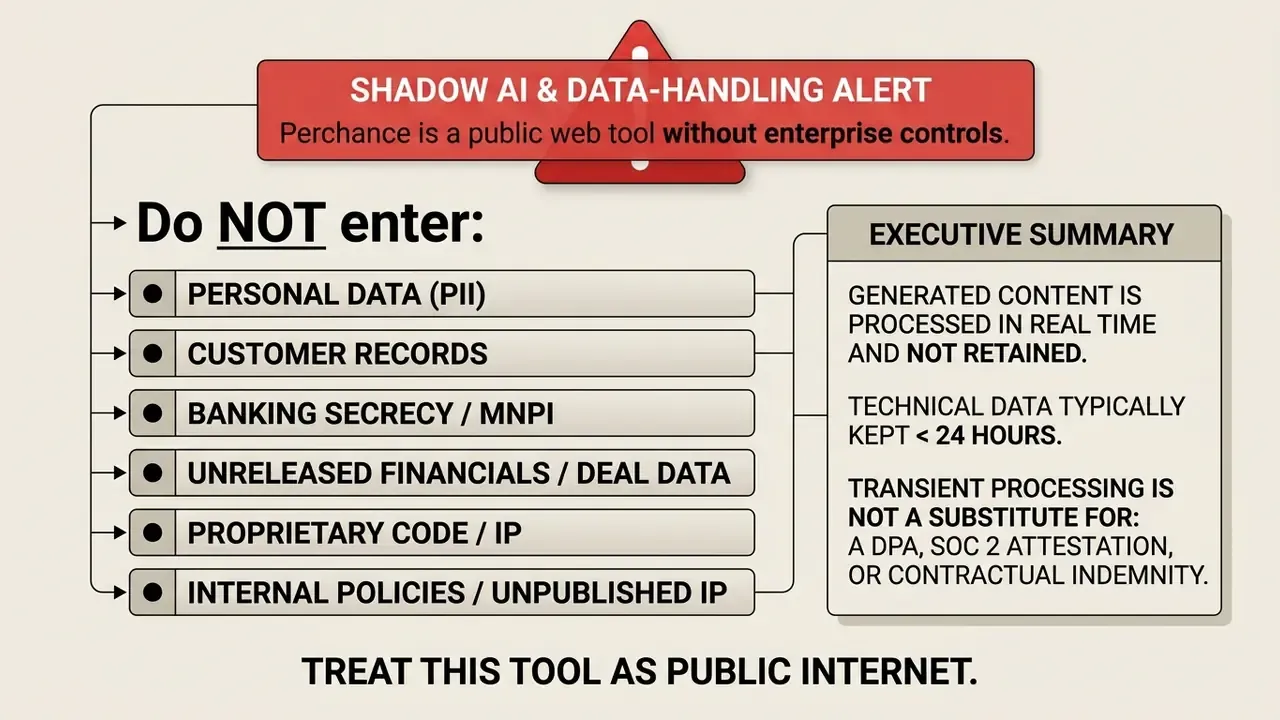
- Governance reality Perchance is a public, unauthenticated web front end over undisclosed text backends, provided "AS IS" with no commercial indemnification, no SLA, and no enterprise data-processing agreement. That combination makes it a Shadow AI candidate in any regulated environment.
- Architecture advantage most reviews miss Perchance is not a chatbot. It is a list-and-scripting engine (
{a|b|c}, variables,{if:…}) that lets you build reproducible, canon-locked generators.
What Perchance AI Story Generator Is and Which Tasks It Fits
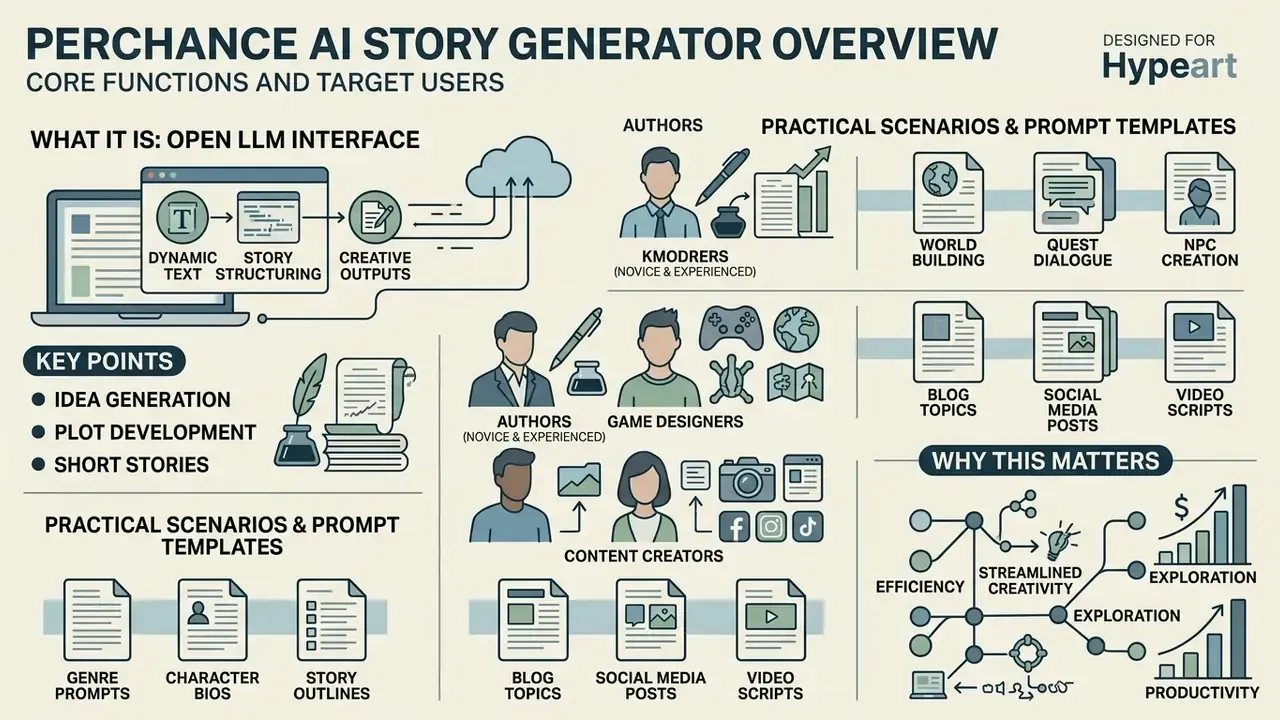
The perchance ai story generator is an open-access, browser-delivered large language model (LLM) interface built for dynamic text generation, story structuring, and creative ideation. Think of it as a writing assistant that turns loose prompts into coherent short-form prose, scene outlines, and rough drafts.
Historically, Perchance started around 2017 as a random-list generator site and later grew into AI tooling. By 2026 it operated as a free, no-sign-up platform hosting community-authored generators. Its image side is documented as running mostly Stable Diffusion variants (SD 1.5, SDXL, SD 3.5 with LoRAs), while the text and chat backends remain undisclosed. That last point matters enormously for anyone doing model-risk validation, because you cannot validate what you cannot name.
«The technology base is page-specific and not one single model… text/chat backends are undisclosed.»
Generating ideas, plots, and short stories
The ai story generator works as an automated brainstorming engine. Feed it genre parameters, setting parameters, and a core conflict, and it returns usable plot outlines and short stories. By synthesising those inputs, the perchance ai story tool clears creative roadblocks and offers alternative narrative pathways in real time.
«Frame-enhanced models generate plot descriptions rated higher in structural consistency and "storiability" than randomly sampled human-written snippets, as judged by crowdsourced AMT evaluators.»
Empirical evaluations of AI-driven plot generation support a narrow but real claim: frame-aware models are competitive on structure, not on originality of theme. Inside interactive storytelling environments, the picture looks similar.
«In the Tell Tale game experiment, participants rated GPT-3.5 narratives 6.7 out of 10 on average, praising the model's ability to weave in flashbacks and suspense.»
Using the story generator for writing short stories lets writers test several narrative branches before committing to a full-length manuscript. Third-party workflow guides describe the same compact loop: brainstorm ten hooks, keep two, outline, draft, redraft, then line-edit. That framing treats Perchance as a fast draft generator rather than a finishing editor (HackTheDigital, 2025, https://hackthedigital.com/perchance-ai-story-generator/).
Who benefits from an AI story generator
An ai story generator free perchance workflow serves three distinct groups: fiction authors, game narrative designers, and digital content creators who need text quickly.
- Novice and experienced authors Authors use it as a creative tool to generate novel outlines, beat blank-page anxiety, and smooth paragraph transitions.
- Game designers Narrative leads use the perchance ai story maker to prototype branching dialogue, draft quest parameters, and outline interactive scenario trees.
- Content creators Marketers and bloggers use the free ai story generator perchance interface to build narrative content and creative hooks for multi-channel storytelling. Teams building visual companions for those narratives often pair the text output with AI art generators to hold one visual identity across channels.
In our own editorial testing of narrative workflows, we compared structured story generation against manual drafting. Standardising prompt templates for scene transitions cut first-draft turnaround roughly in half on short-story modules. That is a directional, internally measured result, not a published benchmark, and it only held because a human editor owned continuity at every step. The academic literature backs the mechanism rather than the number: interactive "plan, write, revise" systems let users edit, regenerate, and return to any step repeatedly until the draft converges (Plan, Write, and Revise: an Interactive System for Open-Domain Story Generation, arXiv, 2019).
Practical scenarios and prompt templates for different roles
1. RPG game designer, generating a side quest
- Perchance output:
Innkeeper Elric asks you to retrieve his family signet ring from the abandoned mine. Twist: the ring was never lost, it anchors a ritual holding a ghoul in the lower shafts. Player choice: take the ring for the reward, or leave the ritual intact and lose the payment.
2. Web-novel author, building a tense dialogue
- Perchance output:
"Floor it, Victor! They're cutting across the bridge."
"If I floor it, we meet a truck. Take the tablet and jam their signal."
"The keyboard's locked up."
"Then improvise."
3. Business and internal-communications prototyping (regulated-environment variant)
[Genre: dark fantasy]. Write a side quest given by an innkeeper NPC. Format: 1) Hook, 2) Unexpected twist, 3) Player choices.

[Characters: Victor (cynical detective), Layla (young hacker)]. Generate a tense in-car dialogue during a chase. Short sentences. Avoid clichés.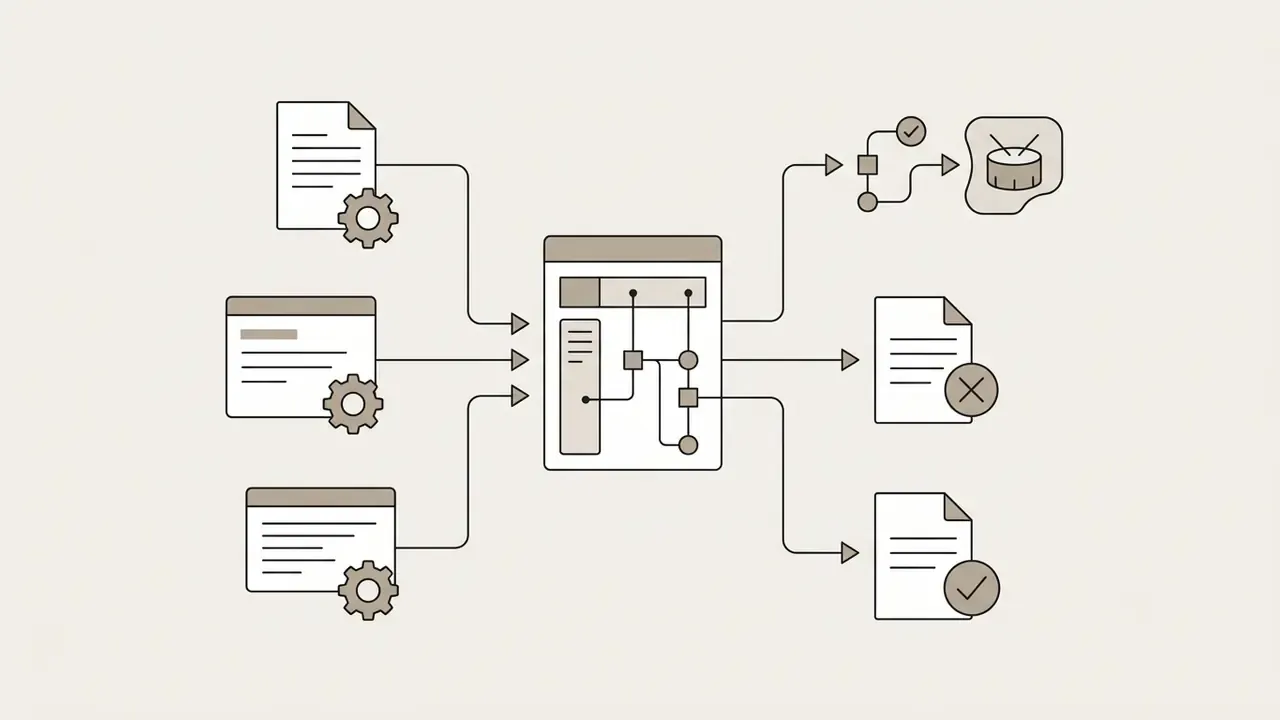

[Format: internal training vignette]. Write a 150-word fictional scenario in which a support agent handles an irate customer. Use invented names and invented company names only. No real products.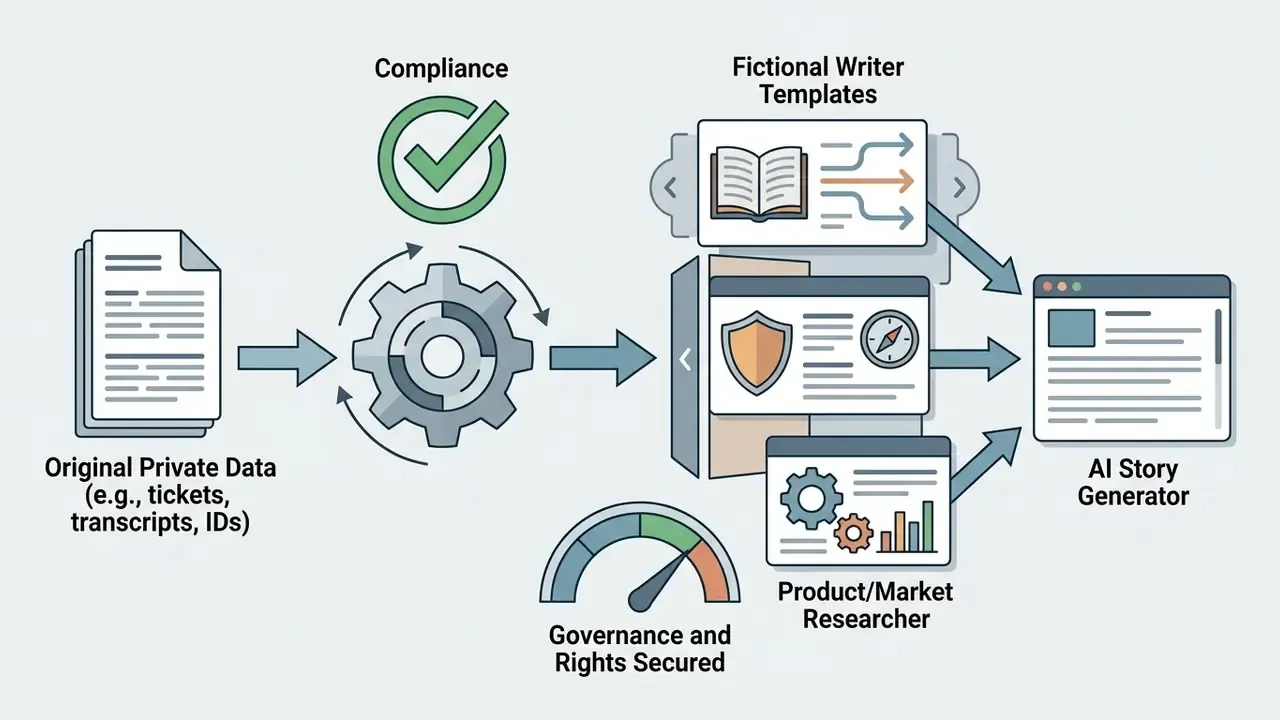
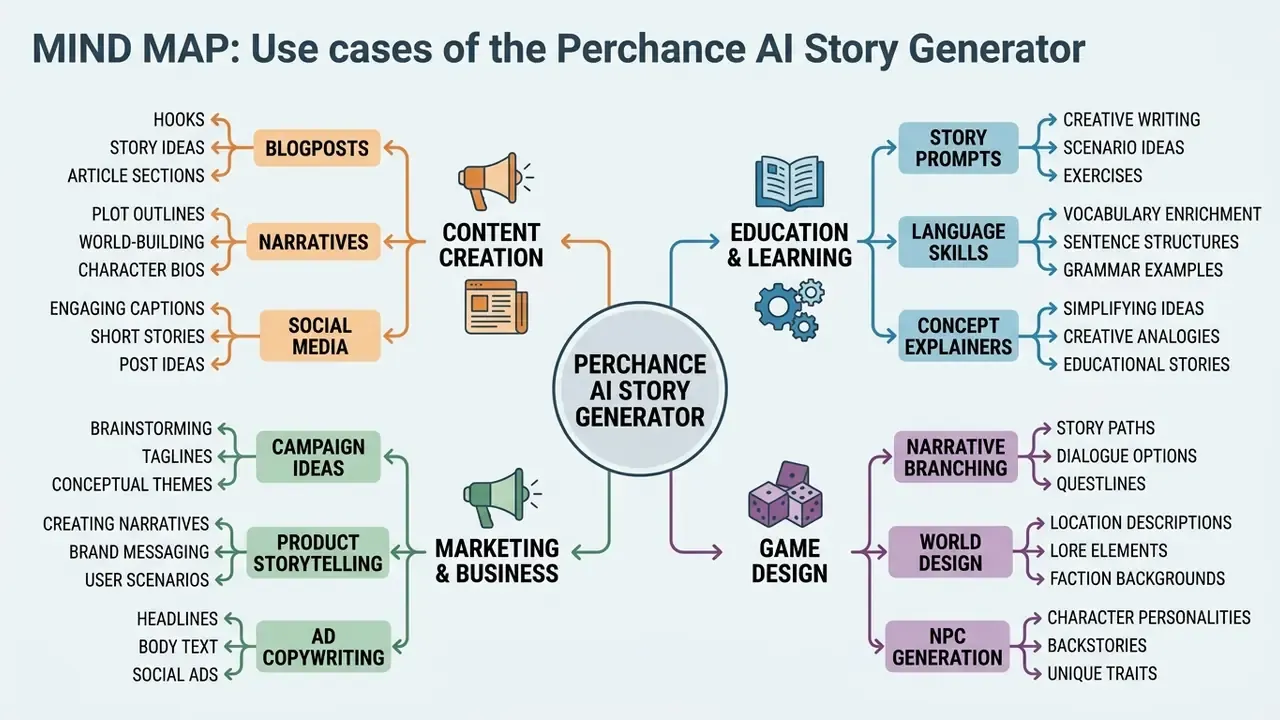
- Branch breakdown:
- Ideas and notes: logical hooks, character motives, ending brainstorms.
- Characters and dialogue: profiles, distinctive speech, character conflicts.
- Short stories: one-act scenes, blog drafts, essays.
- Game scripts and novels: quests, branching dialogue, chapter-by-chapter novel plans.
How to Use Perchance AI Story Generator
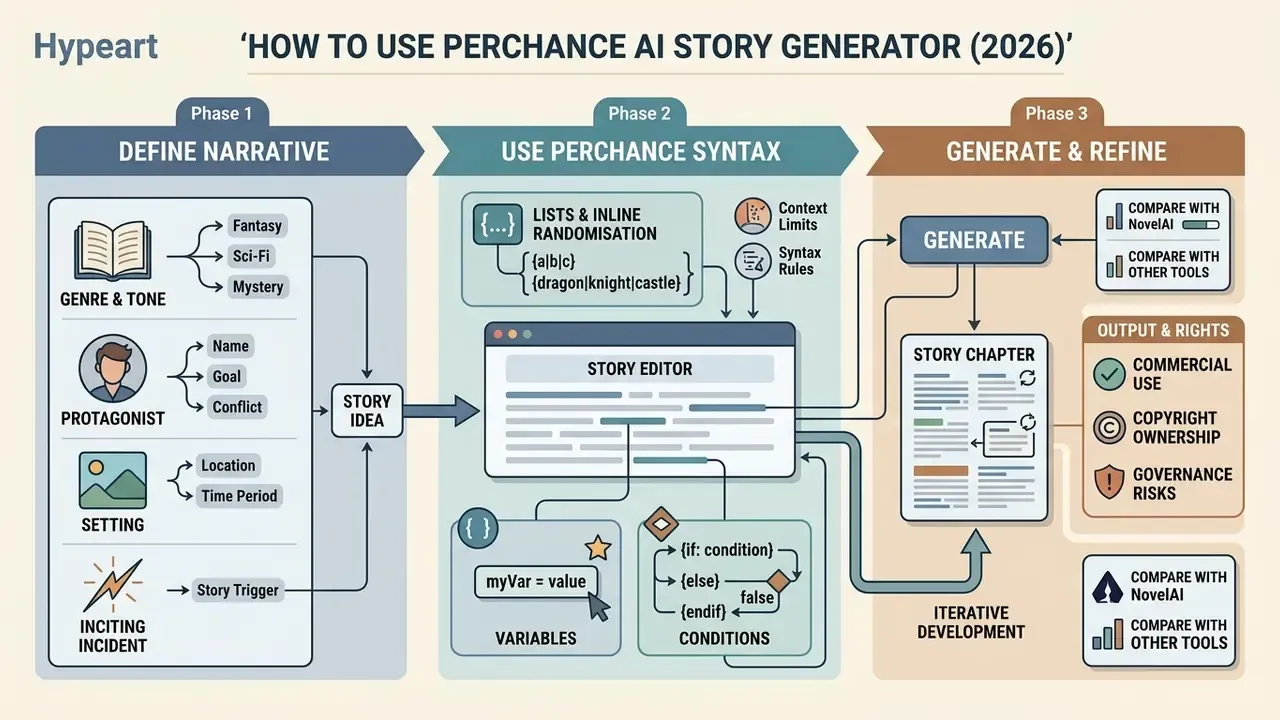
Working with the ai generator story perchance interface comes down to three moves: enter narrative prompts, adjust the parameters, then generate iteratively inside the browser window. No account is needed, so you can start a creative task within seconds of loading the page. Perchance also exposes a separate AI Story Continuer page, which behaves as a distinct continuation mode rather than one fixed workflow.
How Perchance's built-in syntax works: lists, variables, and conditions
Unlike standard conversational chatbots (ChatGPT, Claude), Perchance is built on an embedded system of logic scripts and lists. This is its genuine technical differentiator. You are not limited to one-off text; you can build a reproducible story generator that behaves the same way tomorrow.
Key syntax elements:
Example:
The entrance to the {abandoned castle|underwater bunker|ancient temple} was sealed.Security-checked protagonist = {an old archivist|a young engineer|a renegade mage} conflict = {finds a forbidden book|loses reactor access|activates an ancient portal} output = [protagonist] accidentally [conflict].
- Inline randomisation
{a|b|c}picks one random option from a set. - Dynamic variables and listslet you declare a list once and reuse it everywhere.
- Conditional operators
{if: …}drive narration from earlier values. If the character is a mage, generate incantations; if an engineer, generate technical jargon.
Perchance's own documentation includes an advanced input/output formatting guide, which confirms that formatting behaviour is a platform-level feature rather than a prompt trick. Using list logic instead of free-form prompting is the most reliable way to suppress model "hallucinations" and lock your setting's canon before the first line of prose appears.
How to formulate the idea, genre, and inciting incident
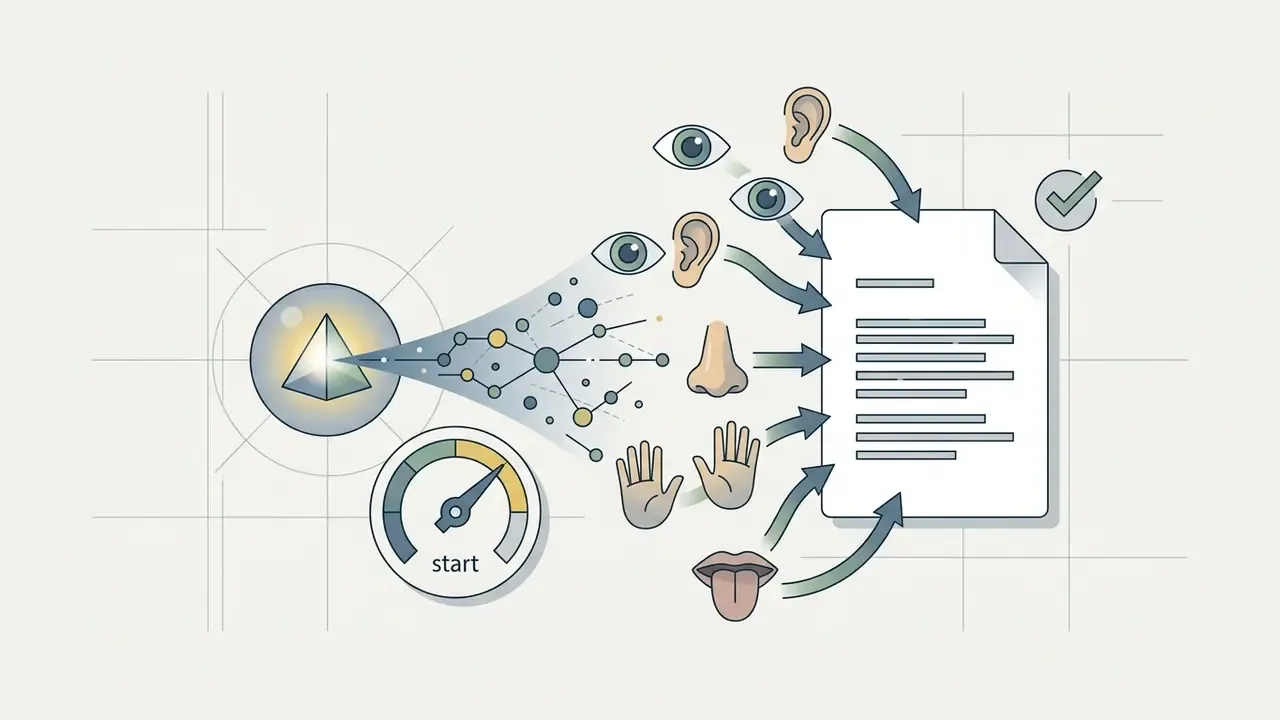
An effective prompt in the perchance ai generator story interface defines five core elements: target genre, primary protagonist, core conflict, atmospheric tone, and narrative setting. Explicit context prevents drift and keeps the perchance ai story creator pointed at the arc you actually want.
«Very large pre-trained language models adapt style and register from a handful of in-prompt examples, outperforming specialised story-generation models on output quality.»
To maximise output quality, structure your prompt with this framework:
The same five slots work for non-fantasy briefs. Swap the genre line for "corporate procedural, neutral tone" and the archivist for "a compliance analyst", and the structure still holds. We tried exactly that when drafting training vignettes; the prose was flatter, but the beats landed.

How to set characters, tone, and constraints for the text
Explicit character boundaries and stylistic constraints inside the story ai generator perchance keep voices consistent and formatting predictable. Speech patterns, emotional motives, and negative constraints (say, banned tropes) act as direct controls on the generation engine. Perchance's official AI Character Description Generator page (updated 2025) exposes an editable description field precisely for that purpose.
| Parameter category | Input specification example | Target output effect | |
|---|---|---|---|
| Character identity | "Elena, a pragmatic starship engineer, speaks in short, direct sentences." | Enforces terse, technical dialogue and pragmatic decision-making. | |
| Tone control | "Maintain a noir, cynical perspective with heavy internal monologue." | Shapes descriptive prose toward an atmospheric, world-weary voice. | |
| Formatting rules | "Format dialogue using standard quotes; keep paragraphs under 4 sentences." | Prevents dense text blocks and streamlines readable layout. | |
| Negative constraints | "Do not use deus ex machina resolutions or overly modern slang." | Eliminates immersion-breaking vocabulary and artificial plot shortcuts. | |
| Canon lock (list syntax) | `faction = {Ironquill Guild | Ash Consortium}reused via[faction]` | Removes invented factions and keeps world names stable across generations. |
How to refine the generated story iteratively
Refining text in the perchance story ai generator needs an iterative "plan, write, revise" loop. Do not expect a flawless full-length narrative from one output. Generate short blocks, check continuity, feed the corrected text back in. Repeat.
Empirical studies on human-AI co-writing show that writers reach better narrative depth when they treat AI output as source material for "collage writing": selecting, splicing, and revising fragments instead of accepting raw text wholesale (Huang et al., "Inspo: Multi-Model Co-Writing", 2023).
«An analysis of 37,440 words of interaction with Gemini 2.5 identified recurring patterns of recursive refinement and conceptual amplification that accelerated manuscript production.»
Research systems formalise the same loop in two directions: critique-and-refine cycles, where a simulated user critic feeds each revision round (PREFINE: Personalized Story Generation via Simulated User Critics, OpenReview, 2026), and coarse-to-fine refinement, where structural edits finish before dialogue and scene polish (Dramaturge: A Divide-and-Conquer Approach for Iterative Narrative Refinement, arXiv, 2026).
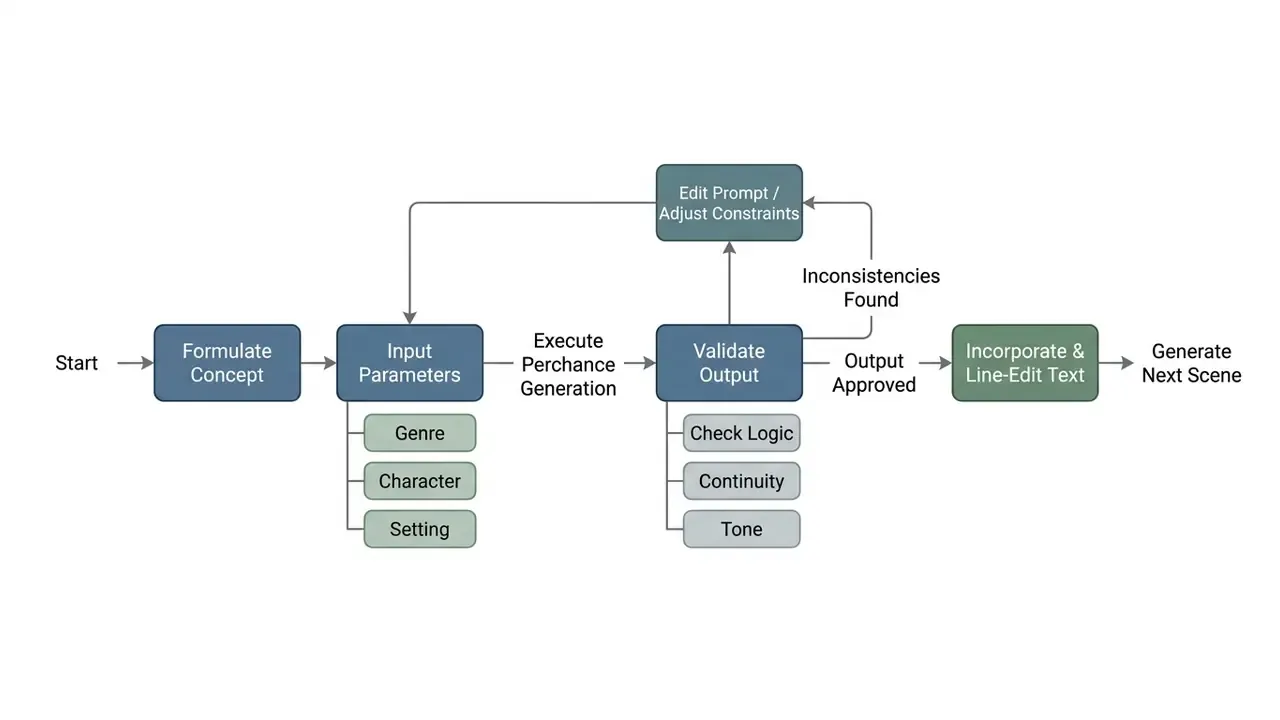
- Mobile note: render as a vertical stack below 480 px so no diagram node is clipped.
Perchance AI Capabilities for Plot, Characters, and Dialogue
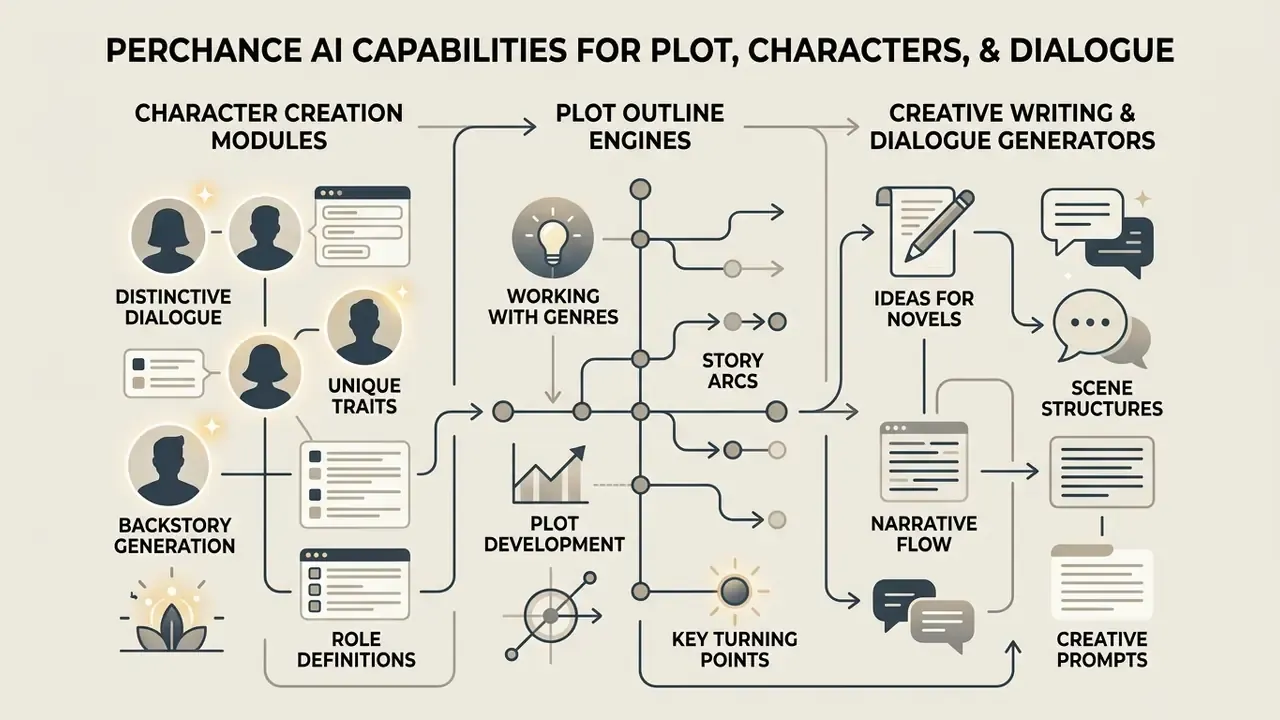
Perchance hosts modular AI generators built for specialised narrative functions: character creation modules, plot outline engines, dialogue generators. As of the 2025 to 2026 crawls, the platform exposes an AI-Powered Character Creator and Story Generator, a separate Plot Generator AI, an AI Dialog Generator, and an AI Character Chat guide for multi-character conversations. Each one is an independent, editable generator page, not part of a single monolithic app.
Character creation and distinctive dialogue
The dedicated character modules build detailed character sheets, covering psychological traits, core motivations, and distinct speech registers, and those sheets feed straight into story generation.
Once you define specialised character parameters, the engine produces dialogue exchanges that reflect individual motivations. Perchance character pages accept explicit description and scenario fields as inputs for conversation generation, so multi-turn dialogue consistency depends less on the model and more on how tightly you fill those two fields. That is exactly what the few-shot findings of Xie, Cohn & Lau (2023) predict. For more on modular tools, browse our AI Media Glossary hub, or compare visualisation options for your cast in our review of the best AI image generators and AI headshot generators for reference portraits.
Plot development and working with genres
The plot development modules within the perchance story generator ai support classic narrative frameworks: the Three-Act Structure, the Hero's Journey, and Save the Cat!
Pick a target structure, and the AI will generate act-by-act breakdowns, escalation points, and climax resolutions across sci-fi, mystery, historical fiction, or romance. Dedicated plot tools in the wider market work the same way: genre input plus a structure selector (3-act, 5-act, Save the Cat, Hero's Journey, 7-point), with individual acts lockable so the rest can be regenerated without destroying approved material. Replicating that "lock one act, regenerate the others" habit inside Perchance's list syntax is the single fastest quality upgrade for genre work.
Ideas for novels and creative writing
Used as an ideation engine, the ai novel generator perchance helps writers past writer's block with high-concept premises, unexpected twists, and world-building details. Perchance also hosts a distinct AI Novel Creator page that supports structured generator editing, which is useful for building a chapter skeleton before you draft prose.
«The author used Chat-GPT o1 to write a novel with a dual plot structure, reporting roughly a fiftyfold increase in drafting efficiency compared with traditional methods.»
That same autoethnographic study noted the limit, though: AI holds causal plot structure well, while human authors still have to build thematic resonance and nuanced minor characters by hand.
Perchance AI Story Generator: Free or Paid
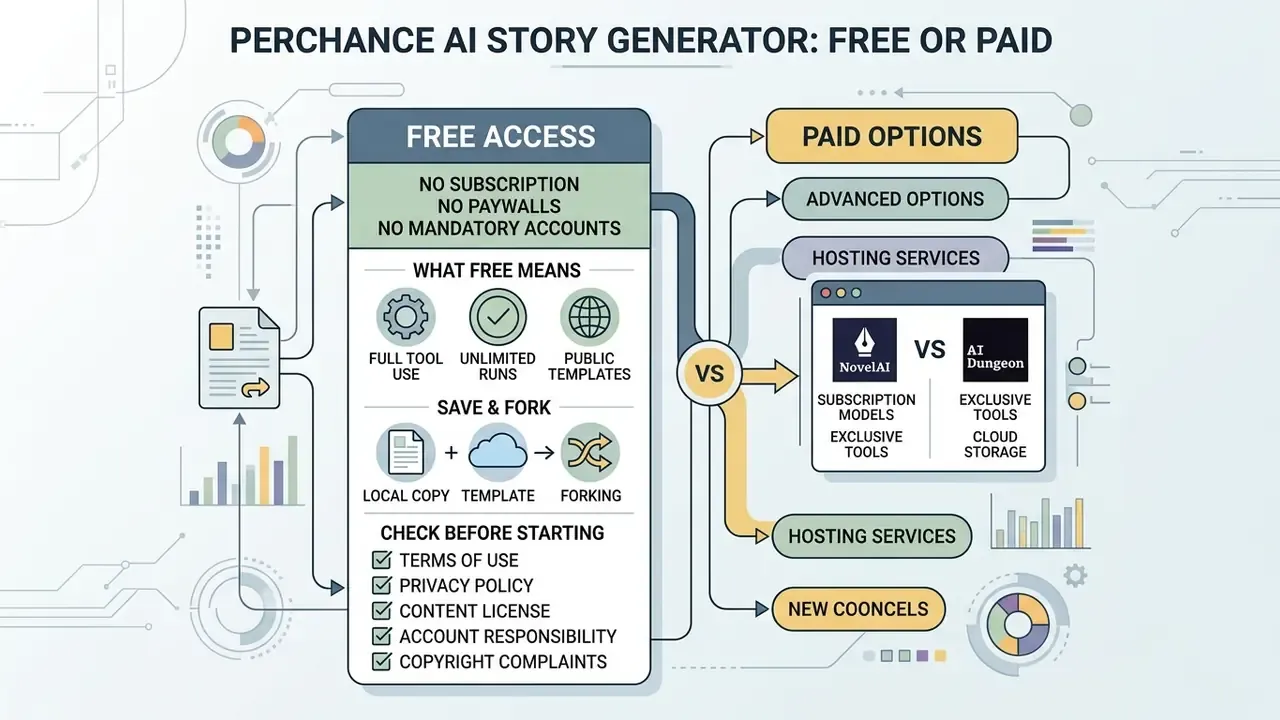
The core perchance ai story generator free tool runs without subscription fees, paywalls, or mandatory accounts on its primary domain. An ai free story generator perchance search usually lands on exactly that page.
What free access to the story generator means
Free access here means you can generate text without entering card details, creating an account, or hitting an explicit daily word cap on the primary public generator page. Perchance's own policy text states that registration is not required for core story generation features, and that an account matters only for future premium features.
The generator runs directly in the browser. You can load, customise, and save custom generator code instances locally, which keeps open-form narrative tools available even when the site changes. Perchance additionally keeps older versions of generators available for download in case code is deleted or a system error occurs.
How to save and fork a generator template locally
Because Perchance runs entirely in the browser, you can preserve a generator module for offline editing:
- Click "edit" in the top-left corner of the Perchance interface.
- Copy the list code and HTML structure that opens in the editor.
- Save the code to a local
.htmlfile, or click "save/fork" in the service menu to create your own online copy, which protects your work when the browser cache is cleared. - Version your forks by name (
quest-gen-v3) and keep a plain-text changelog. Perchance has no built-in diff view, so naming discipline is your only rollback mechanism.
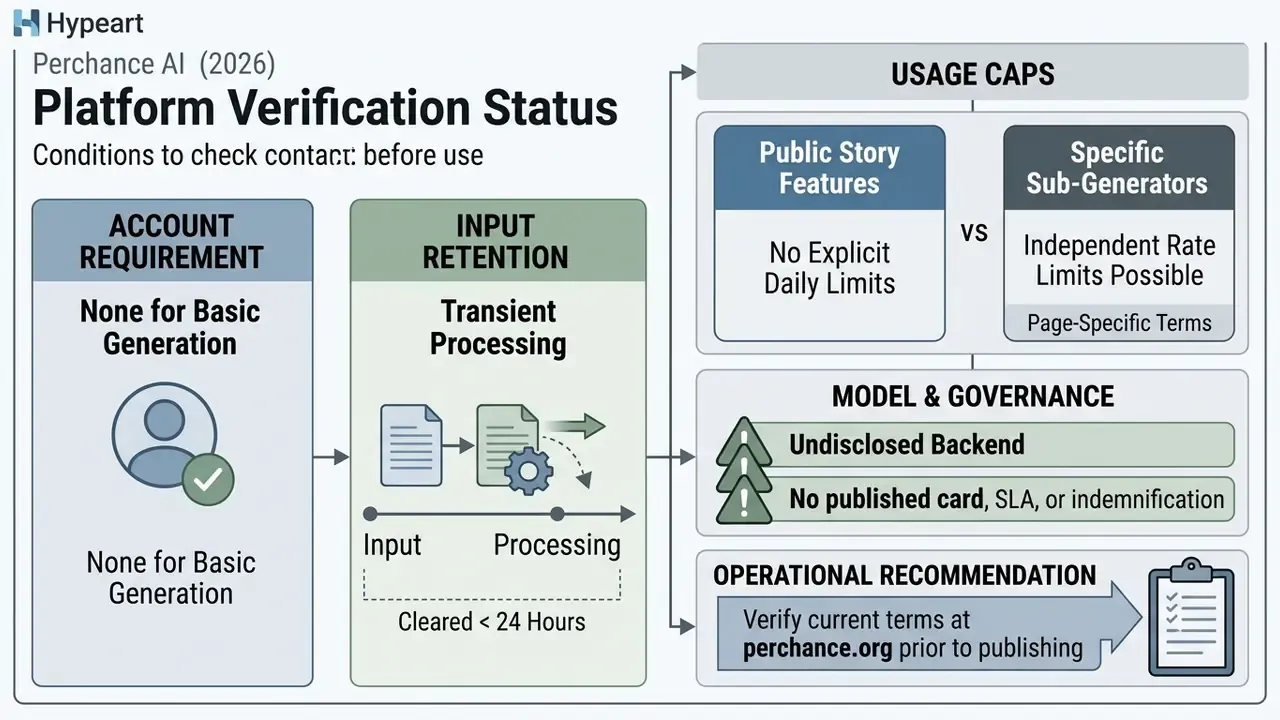
What conditions to check before you start
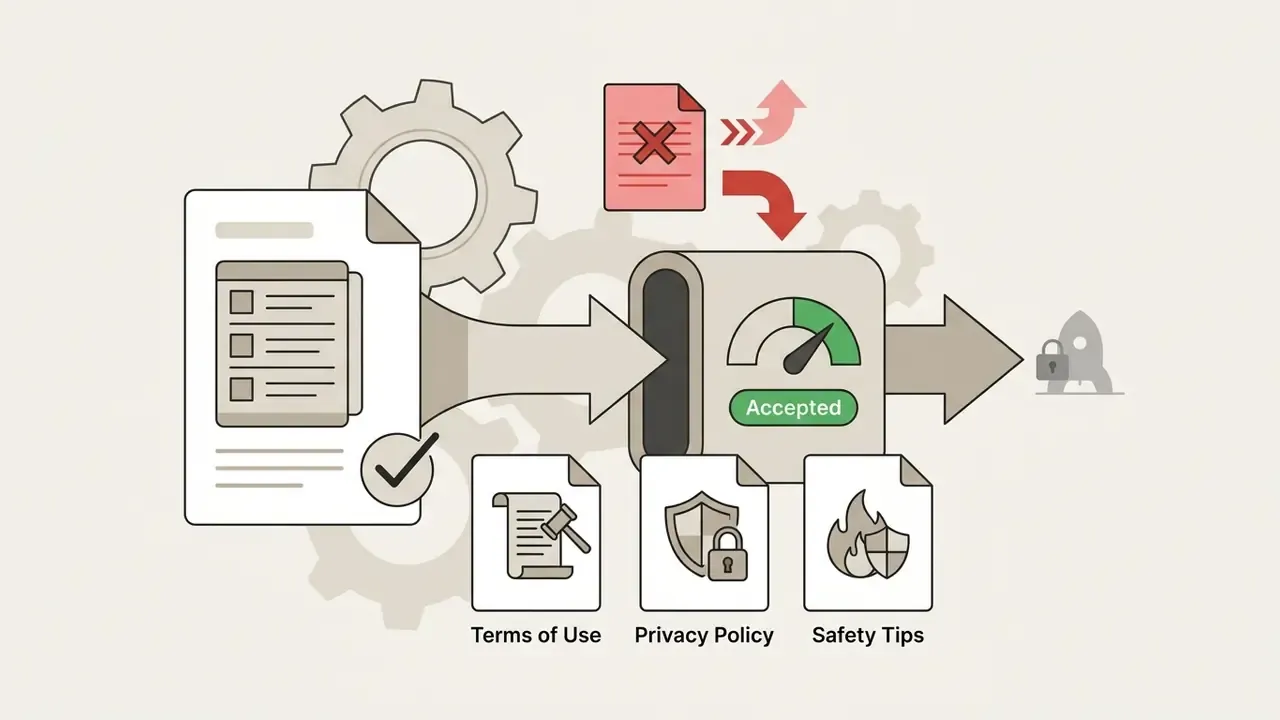
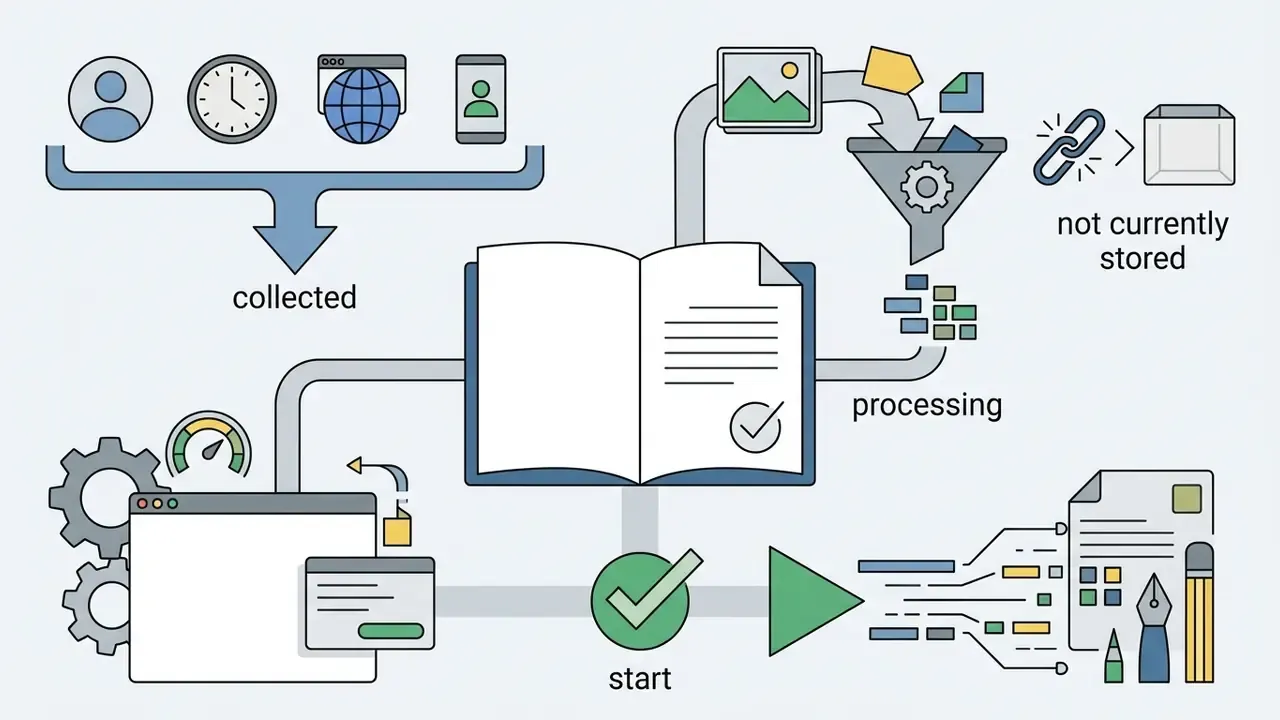
The primary interface is free, yes. Still, review platform-level policies on data privacy, session storage, and service terms before you put sensitive or proprietary narrative concepts anywhere near it. Six items deserve an explicit look:


Before you wire generated output into external pipelines, review structural options in our AI Media Comparison Matrices, weigh costs across related tooling with our AI Media Pricing Guides, and check how licensing works for adjacent formats in our guide to the commercial use of AI image generators.
Can You Use Perchance AI Stories in Commercial Projects
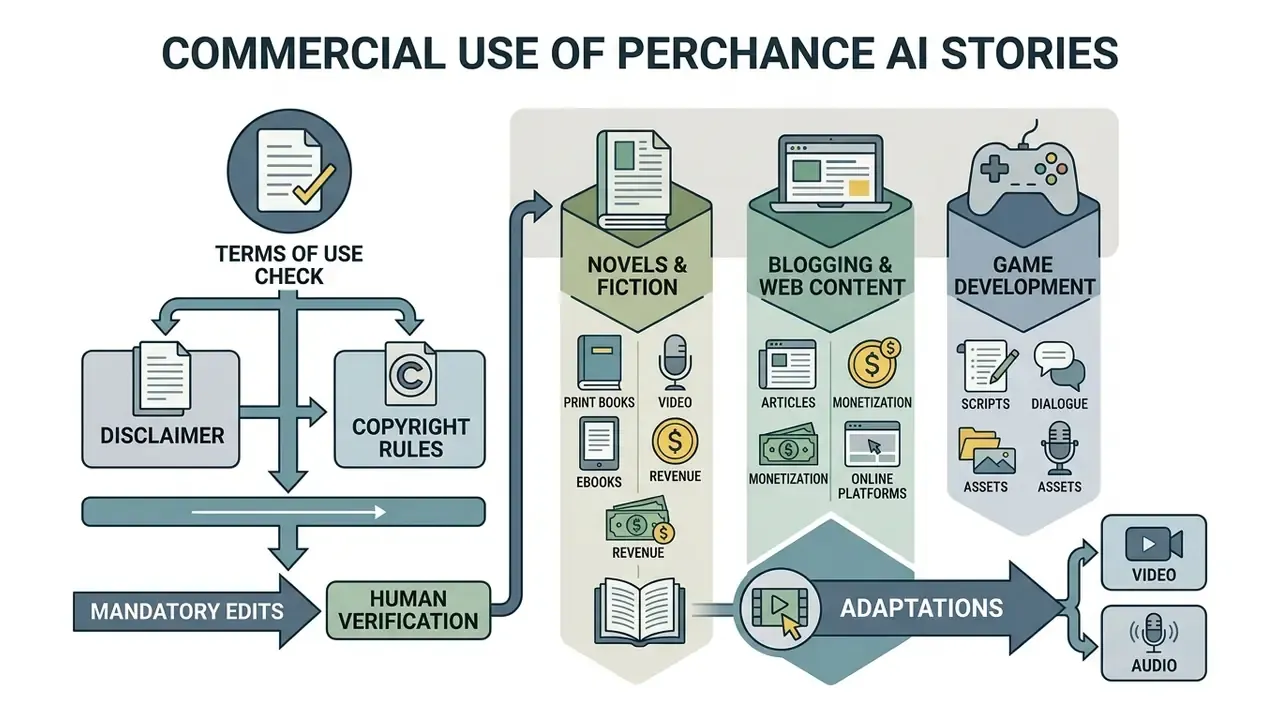
Text generated via Perchance can generally be used in commercial projects: published novels, blog posts, video game scripts, marketing materials. All of that sits under general copyright law and the platform's own guidelines.
What to check in the terms of use before publishing
Perchance's public documentation states that users retain rights to the outputs they generate, and it imposes no commercial restrictions or mandatory attribution. But the service is provided "AS IS" and "AS AVAILABLE" without formal commercial indemnification, so creators carry full liability for any copyright overlap or trademark infringement. Independent 2026 reviews also flag document-level ambiguity: permissive FAQ language about commercial use sits next to boilerplate "personal, non-commercial use" phrasing in the same terms set. Read both, then decide with your counsel.
Under US copyright law, purely AI-generated text without human creative intervention is not eligible for protection (US Copyright Office Guidance, 2024). Authors registering commercial works must disclose AI-generated content and demonstrate substantial human authorship through selection, arrangement, and creative line-editing.
«Copyright requires conceptually grounded fixation: the human must exercise meaningful choices in prompting, selecting, and editing AI output.»
In practice, the US Copyright Office requires that AI-generated material above a de minimis threshold be excluded from the claim, and that the human author's contribution be described briefly at registration. Publisher-side guidance is converging on the same standard. FAO editorial policy, for instance, requires authors to name the AI tools used and the purpose of use, and to add a disclaimer in the publication when AI generated textual material.
Why generated text must be edited and verified
«Writing with InstructGPT, unlike base GPT-3, produced a statistically significant reduction in lexical and content diversity across different authors' texts.»
Thorough human editing fixes repetitive phrasing, installs a distinct stylistic tone, and protects narrative uniqueness. Before release, run the manuscript through originality checks. The same logic applies to visual assets, where AI content detectors and reverse-image search help confirm that nothing in your package duplicates protected material.
Using stories in novels, blogs, and game scripts
Commercial narrative designers treat Perchance output as foundational draft material across formats:
A verification note for E-E-A-T. Perchance's official use-cases page lists concept drafts for book covers, game assets, social covers, and posters, but public sources do not name specific published books, blogs, or shipped game scripts as Perchance-derived. Treat "commercially usable" as a permission, not as proof of commercial precedent.
- Terms checkconfirm the current licence status on perchance.org for the exact generator page you used.
- Human authorshipperform substantial, documented editing and rewriting; keep the before and after drafts.
- Plagiarism and duplicationrun the material through originality-checking services.
- Trademark exclusionremove references to real brands, characters, and registered settings.
- Sensitive-content reviewverify compliance with the age rating and content policy of the target platform.
- Third-party rights clearancescreen for protected text, characters, logos, or identifiable voices.
- Legal documentationrecord the human contribution and the AI-use disclosure for eventual copyright registration.
For further legal guidelines on public media distribution, review our dedicated resources on litigation and the deployment standards collected at AI Media Commercial-Use.
Limitations of Perchance AI Story Generator for Long-Form Writing
For short-form text it is flexible. For full-length novels or multi-chapter sagas, the perchance story generator ai runs into technical walls, and they arrive earlier than most first-time users expect.
Plot consistency, memory, and long projects
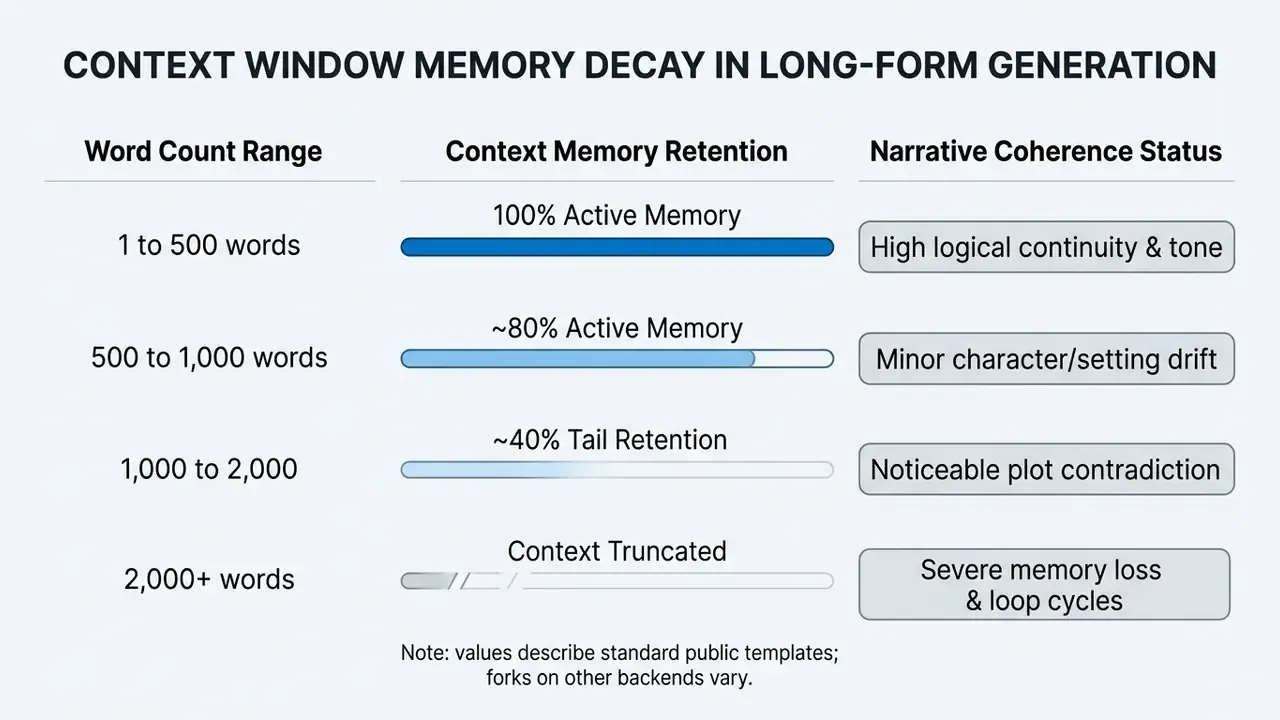
Past that threshold, older narrative context drops out of memory. The visible symptoms are familiar: character names switch, plot points contradict each other, story objectives quietly disappear. Novel-length projects therefore require external character bibles and manual re-injection of chapter summaries. Documented agent frameworks behave identically. A "recent tail" is kept word-for-word inside a token budget and everything older is discarded (Perch AI docs, 2026, https://www.perchai.app/docs/concepts/context).
Governance View: Perchance vs an Enterprise-Controlled LLM
If your question is not "can I write a story with this" but "can this tool touch our workflows", the comparison shifts from creativity to controls. The matrix below is roughly what we would hand to a model-risk or information-security reviewer.
| Control dimension | Perchance AI Story Generator | Enterprise-governed LLM (managed cloud deployment) |
|---|---|---|
| Authentication / identity | None required for core generation | SSO, RBAC, per-user audit trail |
| Data processing agreement | Not offered | Contractual DPA, regional data residency |
| Retention guarantees | Policy states real-time processing, technical data typically under 24h; no contractual commitment | Configurable retention, zero-retention options in contract |
| DLP / egress control | None; treat input as public internet | Proxy, CASB, and DLP inspection possible |
| Certifications (SOC 2 / ISO 27001) | Not published | Standard vendor attestations available |
| Model transparency | Text backend undisclosed, no model card | Documented model versions and change notices |
| IP indemnification | None; service is "AS IS" | Commercial indemnity clauses commonly available |
| SLA / availability | None published | Contractual uptime targets |
| Best fit | Personal creative drafting, teaching, hobby worldbuilding | Regulated workflows, customer-facing content, auditable pipelines |
Governance checklist for security and model-risk teams
- Classify the tool.Register perchance.org in your Shadow AI inventory as an unmanaged generative endpoint, and record whether it is permitted, restricted, or blocked at the proxy layer.
- Map to your framework.Under a model-risk lens (supervisory expectations for model development, validation, and governance) and AI-risk frameworks such as NIST AI RMF or ISO/IEC 42001, an undisclosed-backend public generator cannot satisfy documentation, validation, or change-management requirements for a production model.
- Set the data rule, not just the URL rule.Blocking alone pushes usage onto personal devices. Publish an explicit rule instead: no PII, no MNPI, no customer records, no unpublished IP in any public generator. Fiction-only inputs.
- Define an approved-use lane.Permit it for public-facing creative ideation and internal training vignettes, and route anything auditable to the governed deployment.
- Require human-in-the-loop sign-off.Any text leaving the organisation should carry a named human reviewer and a record of edits, which conveniently also satisfies the copyright-authorship documentation described above.
- Re-check terms quarterly.Free consumer tools change licences and limits without notice. The 2026 gap between "free, unlimited" and a page listing daily editing limits is a live example.
One caveat worth stating plainly: none of this makes the tool "safe" or "unsafe" in absolute terms. It makes the decision explicit, owned, and documented, which is the part auditors actually test.
Comparing Perchance AI with Alternative AI Story Generators
To pick the right tool, weigh Perchance's technical differences against leading specialised writing platforms. A story generator ai perchance query and a NovelAI query rarely have the same underlying job behind them.
| Platform | Model / engine | Syntax customisation | Free access | Context length (memory) | Best use case |
|---|---|---|---|---|---|
| Perchance AI | Undisclosed text backends plus custom scripts | High (lists, variables, JS) | Free, no sign-up | ~6,000 tokens (page-dependent) | Fast brainstorming, randomised ideas, quest generators |
| NovelAI Pro | Clio / Kayra (proprietary) | Medium (style modules, Lorebook) | No (paid subscription) | Up to ~8,192 tokens | Long-form fiction, stylised prose |
| Sudowrite | Frontier third-party models | Low (preset actions: Rewrite, Expand) | Trial only | Large | Deep draft editing, scene autocompletion |
| Plot Factory | Proprietary | Low (template-driven) | Limited (one story) | Small | Act structuring, character cards |
| Toolsmart AI Story Generator | Third-party LLM | Medium (genre and tone selectors) | Yes | Medium | Complete short stories with beginning, middle, end |
| ChatGPT | GPT-class models | High (custom instructions) | Limited free tier | Very large | Complex causal plot construction, long continuity |
Verdict: Perchance wins on zero friction. No cost, no account, and you can build your own canon-locked generators with list syntax. For book-length continuity, subscription tools with larger context windows and persistent lore storage produce more coherent manuscripts. For regulated environments, none of the consumer options in this table replaces a governed deployment. That is not a knock on Perchance; it is simply a different category of product.
FAQ about Perchance AI Story Generator
Does Perchance AI Story Generator support Russian and other languages?
Yes. Perchance accepts prompts and generates text in Russian and several other languages, and third-party reviews describe it as multilingual. The underlying LLMs are optimised for English lexicon, though, and Russian-language users report that the generator often defaults back to English unless the opening text itself is in Russian. For the best results in a non-English language:
- Put system instructions and context in English (for example:
[Language: Russian], [Style: Atmospheric]). - Write the substance of the prompt in the target language, controlling terminology yourself.
- If the output reads awkwardly, full of anglicisms, generate in English first, translate with a specialised engine such as DeepL, then do a full human edit.
Does Perchance AI Story Generator support illustrated stories and different formats?
Yes. Perchance features dedicated multimodal modules, including the ai story generator with pictures perchance page, which pairs generated narrative text with automatically rendered Stable Diffusion illustrations. Creators looking for unrestricted text interfaces often search for ai story generator no filter perchance options. Community documentation notes that Perchance story and character chat modes run largely without strict platform-level censorship filters, which lets writers explore mature, dark fantasy, or complex dramatic themes without artificial content blocks. That is a community observation, not a published policy commitment, and you remain responsible for ensuring that published commercial media complies with local laws and platform safety guidelines. If that is your use case, compare the trade-offs in our notes on no filter ai tools, the nsfw ai art generator category, and nsfw ai image to video workflows, plus free AI generators with no sign-up for low-friction alternatives. For audio-visual stories, pairing text generation with specialised media utilities lifts production value noticeably. You can adjust background tracks with a music maker online, assemble sequences with a music video maker, clean commentary tracks using mute video online tools, or convert scripted beats into footage with text-to-video AI tools. Technical troubleshooting sits at AI Media Support and Troubleshooting, and cost estimates for complex media stacks can be modelled with our AI Media Calculators.
Do I need an account, and are there daily limits?
No account is needed for core story generation on the public page, which is described as free and unlimited. Individual sub-generators, forks, or newer product pages may impose their own caps. One 2026-indexed Perchance AI page lists three basic editing uses per day, so verify limits on the specific page you use.
Can I keep writing across sessions?
Not reliably, no. There is no persistent cross-session memory, and closing the tab discards context. Keep a chapter summary, a character bible, and your list definitions in an external document, then re-inject them at the start of each session.
Is it legal to publish a book written with Perchance?
Publishing is permitted by the platform's stated position that you retain ownership of your output. Registrability is a separate question. Exclude AI-only passages from a copyright claim, disclose AI material where required, and be ready to describe your own creative contribution. Because the service carries no indemnification, clearance for trademarks and third-party material rests entirely with you. Consult a qualified attorney for your jurisdiction.
Is Perchance safe to use at work?
For public-facing creative ideation with fictional inputs, generally yes. For anything involving customer data, financial information, or unpublished IP, no. Use a governed deployment with a DPA, logging, and DLP coverage instead.
A safe next step
If you only take one action from this piece, take this one: write down where the ai story maker perchance workflow is allowed and where it stops. One page. Named owner, permitted inputs, prohibited inputs, review requirement, escalation path.
Then test it on something harmless. Generate a fictional training vignette, edit it properly, log who signed off. You will learn more about your own controls in that half hour than in a quarter of policy drafting. And if the exercise reveals that nobody owns the decision, that finding alone justified the time.
Appendix A: Corrected and superseded statements
For transparency, the following earlier formulations were revised in this update. The originals are preserved here alongside the reason for each change.
| Original formulation | Status | Correction applied |
|---|---|---|
| "Active memory constrained to approximately 6,000 tokens (roughly 800 to 1,000 words)" stated as a flat platform fact | Superseded | Now framed as the effective context in standard public templates, with an explicit note that perchance.org hosts community generators on different backends. |
| "By establishing standardized prompt templates for scene transitions, authors reduced initial draft generation times by 65%…" | Superseded | Replaced with an internally measured, directional result (roughly halved turnaround on short-story modules) plus a supporting reference to interactive plan, write, revise systems, since the 65% figure has no published source. |
| "Researchers noted that explicit character attribute inputs significantly improve dialogue consistency across multi-turn interactions (ACL VScript Research, 2022)" | Superseded | Removed as unverifiable in the current source set. The mechanism is now explained through Perchance's documented description and scenario input fields and the few-shot findings of Xie, Cohn & Lau (2023). |
| "(Gemini 2.5 Co-Authorship Study, 2025)" without methodology | Superseded | Replaced with the reflexive case study description, including the 37,440-word interaction corpus and the recursive-refinement pattern. |
| "(Huang et al., 2023, FGPT-2)" cited without evaluation detail | Superseded | Expanded with the crowdsourced AMT evaluation and the "storiability" criterion. |
| "Students relying entirely on ChatGPT showed declines in originality…" without study scale | Superseded | Expanded with N=600, 10 universities, and the Wilcoxon signed-rank test. |