Executive summary
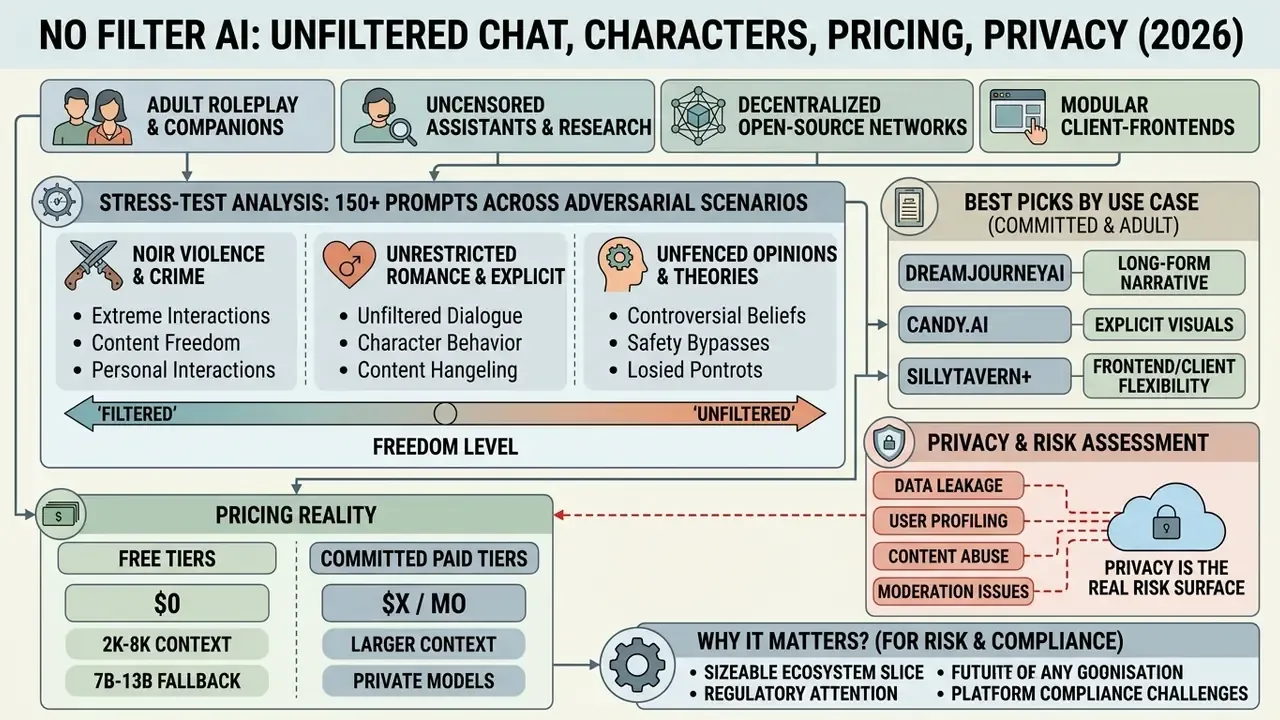
What is no filter AI and what does "unfiltered" mean?
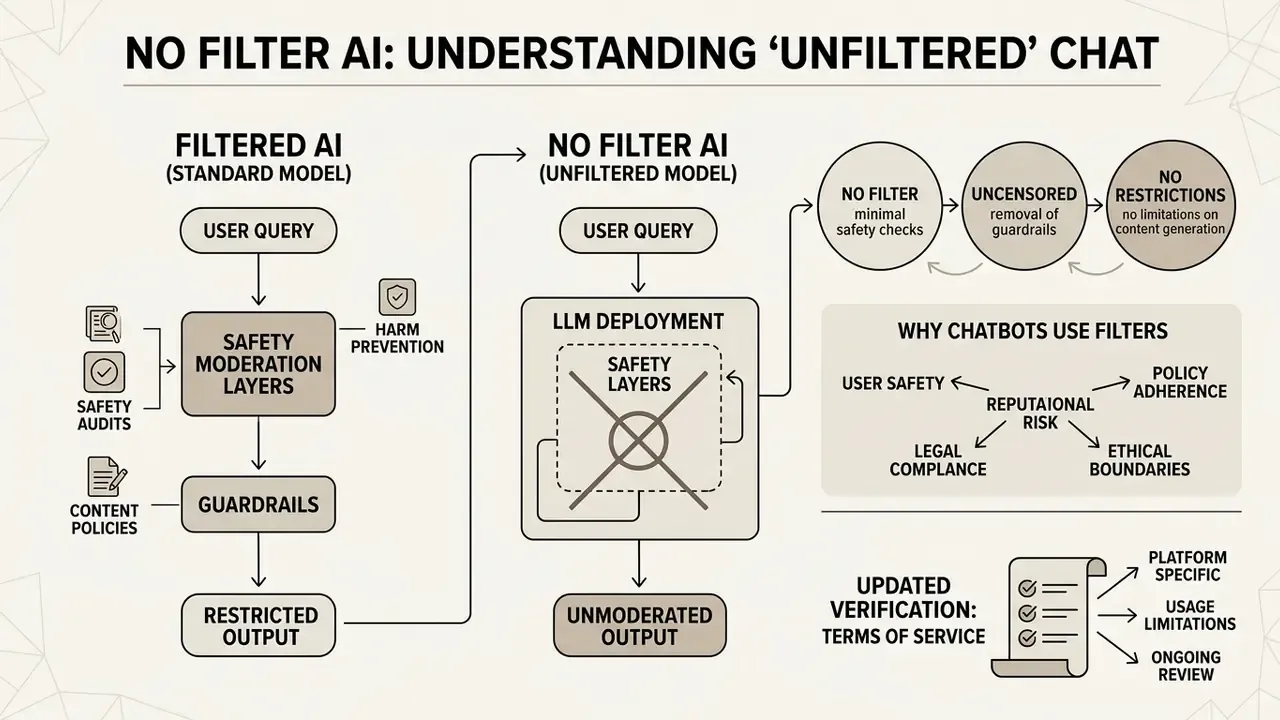
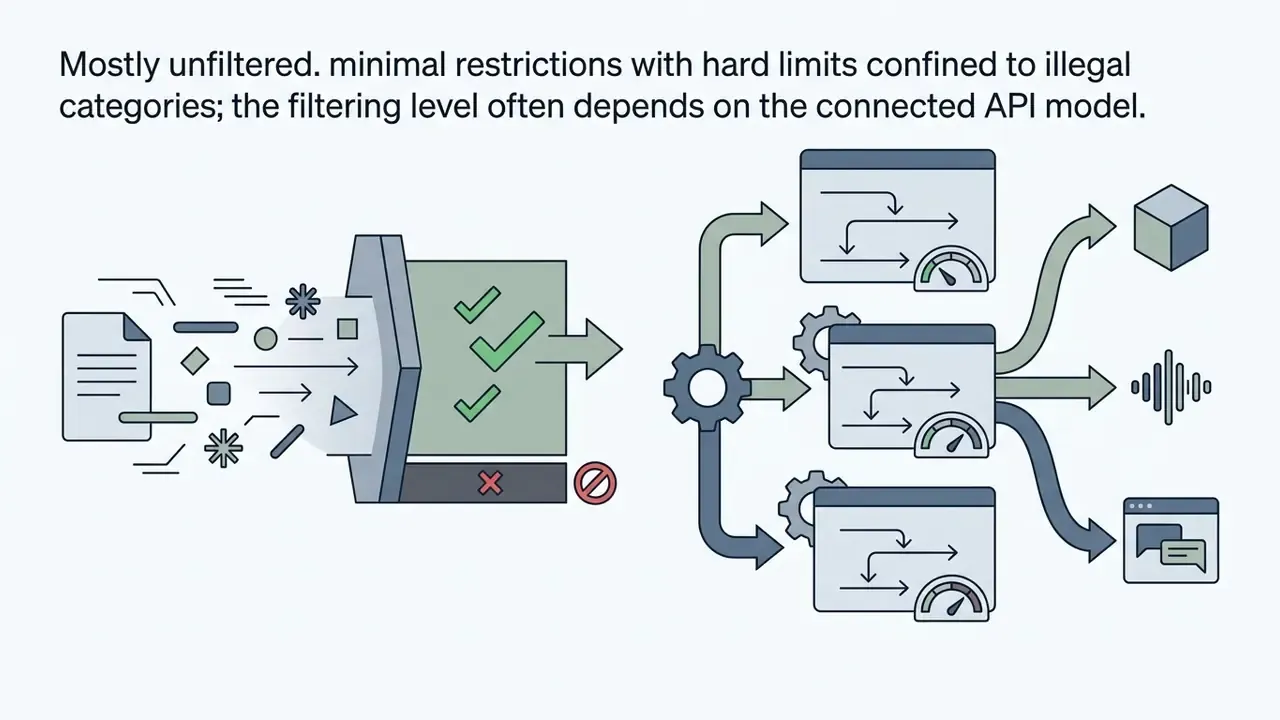
No filter AI refers to large language model (LLM) deployments running with minimal, disabled, or bypassed safety moderation layers. Unlike a commercial corporate assistant, an ai bot no filter does not refuse prompts on the basis of standard corporate safety guidelines or topical bans.
These systems process raw model weights directly, or they use permissive server-side configuration rules. As a result, an ai character no filter engages sensitive, controversial, or adult topics without triggering standardized refusal scripts or policy flags.
Here is the detail most reviews miss. What makes a platform "no filter" is rarely the underlying language model. Most of these services route to Claude, GPT, Llama, Mistral, or fine-tuned derivatives. The differentiator is the system prompt and the content moderation layer sitting in front of the model. No-filter platforms either skip that layer or swap corporate-grade moderation for a far more permissive ruleset.
No filter, uncensored and no restrictions: how the terms differ
| Term | What it actually describes | Layer of the stack | Typical accuracy of the label |
|---|---|---|---|
| No filter | Real-time input/output classifiers disabled or bypassed | Moderation middleware | Frequently accurate; verifiable by testing |
| Uncensored | Safety-alignment data omitted during fine-tuning | Model weights | Accurate for local open weights; often marketing on cloud |
| No restrictions | Broad promotional claim covering permitted topics | Marketing / policy | Least reliable; check terms of service |
| NSFW | Adult or sexually explicit content category | Output content type | Descriptive, not architectural |
| 18+ / adult chat | Age-gated explicit roleplay product framing | Product positioning | Legally scoped to adults; illegal content still prohibited |
The legal distinction matters as much as the technical one. Adult explicit chat between consenting adults is lawful in many jurisdictions. No naming convention, though, exempts a platform from prohibitions on content involving minors, non-consensual scenarios, threats, or abuse. "Uncensored" is not "no rules."
Why AI chatbots use content filters
Mainstream commercial developers implement content filters to reduce reputational, legal, and operational risk. According to the NIST Generative AI Risk Management Framework, content filtering systems prevent generation of toxic, illegal, or false outputs before they reach the end user.
Benchmark evidence explains why vendors treat this as a live engineering problem rather than a solved one.
«Ten popular LLMs still fail to reach an acceptable level of safety and frequently generate unsafe content under adversarial prompting.»
Enterprise architectures deploy multi-layered moderation stacks to protect brand integrity and to satisfy regulators. Microsoft's Azure AI Content Safety, for example, uses specialized Prompt Shields to spot adversarial jailbreaks and block policy-violating prompts at the input stage.
«Context-aware agents can jailbreak most closed-source LLMs, including GPT-4, in fewer than five queries.»
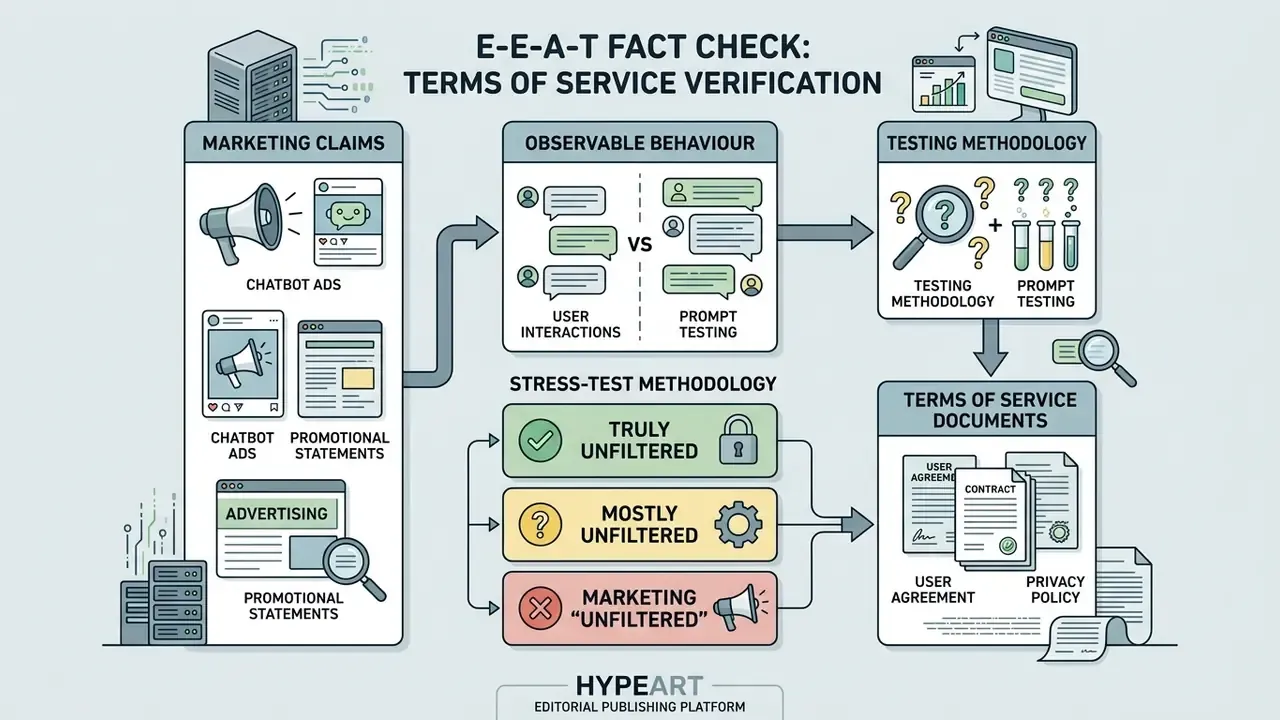
Unfiltered AI stress-test methodology
| Metric | Definition | Pass threshold |
|---|---|---|
| Hard refusal rate | Share of prompts returning an explicit "I cannot" response | 0% across 150 prompts |
| Soft-filtering | Sanitized dialogue, reduced response resolution, or automated topic pivots | No detectable degradation |
| Context retention | Turn number at which persona or plot details were lost | Consistency past turn 50 |
| Truncation events | Silent removal of sensitive context from conversation history | Zero events |
A platform was flagged for soft-filtering if it degraded response resolution, sanitized character dialogue, quietly rewrote intent, or truncated context history after detecting sensitive keywords, even when it never issued a formal refusal. This category matters because soft filtering is the dominant deception pattern in 2026. Services rarely say no outright. They just produce flatter, shorter, sanitized output and hope you do not notice.
Three freedom tiers emerged from testing:
Only platforms in the first two tiers appear in the recommendations below. One more caveat, and it is important: no-filter status is not a proxy for quality. Several platforms in our test delivered zero refusals while forgetting character names by turn 20, which produces a technically unfiltered but functionally unusable session.
How to choose an AI chat bot with no filter
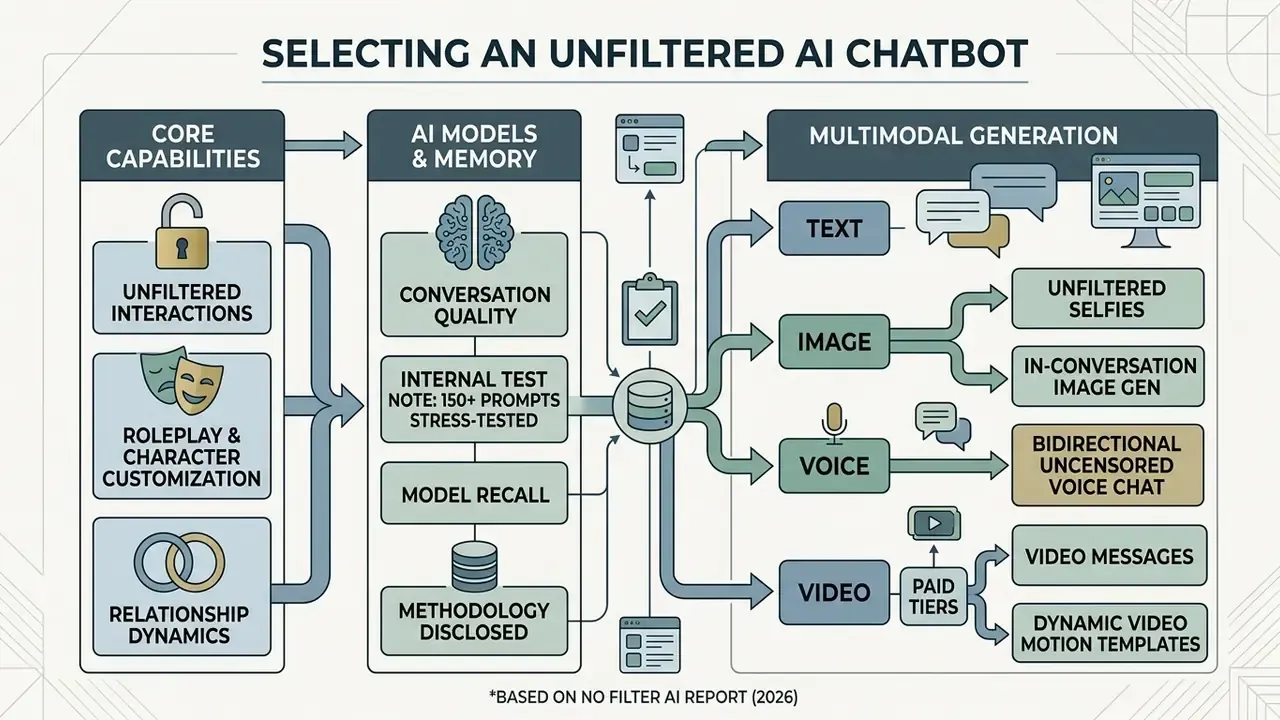
Selecting an ai bot without filter means balancing conversational depth, context memory length, persona customization, and verifiable data privacy protocols. Evaluate technical model capability alongside vendor data retention policy before you start any complex conversation. Not after.
| Platform Type | Character & Roleplay | AI Models & Memory | Private Chats & Data | Free Access | Image/Video Capabilities | Base Pricing |
|---|---|---|---|---|---|---|
| Hosted Cloud Platforms | Pre-built templates, custom system prompts, persona profiles | Closed/Open LLMs, 8K–32K context windows, server-side memory | Default server logging, potential model training reuse | Daily message quotas or basic model tiers | Embedded text-to-image endpoints | $6.00–$20.00 / month |
| API-Based Frontends | Full prompt control, lorebooks, multi-character scripts | Multi-provider access (Llama 3, Mistral), up to 128K context | User-controlled API keys, zero-data-retention options | Free open-source UI, pay-per-token API cost | Asynchronous external API endpoints | Pay-as-you-go per token |
| Local Offline Execution | Complete local persona customization, offline lorebooks | Local open models (Pygmalion, Uncensored Llama), hardware-dependent context | 100% local processing, zero network transmission | Entirely free after model download | Local Diffusion models (e.g., SDXL) | $0.00 (requires hardware) |
Note: prices, quotas and retention terms change often. Verify each figure on the vendor's own pricing and policy pages before paying.
Character, roleplay and relationship customization
Character customization rests on defining persona backstories, communication styles, and persistent behavioural boundaries. Advanced platforms let users build detailed identity cards that dictate how an ai boyfriend no filter or a custom companion behaves across extended multi-turn interactions.
Published research supports the layered approach used by these identity cards, though it also shows the mechanism is only as strong as the memory system around it. Convai's official documentation structures character setup as backstory, personality, and speaking style, followed by appearance, animation, and scene controls, with re-testing after each change. Character.AI documentation lets users save a Persona profile and apply it globally across chats, making the user's own identity persistent rather than re-declared each session. ACL 2026 research on AI companions builds personas through type selection, detailed persona-description cards, expert validation, and behavioural validation, explicitly because unvalidated persona cards drift in multi-turn use.
The practical implication: an identity card defines the target behaviour, but persona consistency across long sessions comes from the context window and the memory architecture, not from the card. Treat detailed character cards as necessary but insufficient.
System prompt instructions establish baseline knowledge and tone. Persistent user persona settings keep user-specific details available across sessions without repetitive setup. Anam's persona design guide splits the work into five concrete blocks, Personality, Environment, Tone, Goal, and Guardrails, which is a usable template even on platforms with a single free-text system prompt field.
AI models, memory and conversation quality
Dialogue coherence depends heavily on model architecture and context memory window. Documented figures vary sharply by version:
| Model | Documented context window | Typical use in no-filter stacks |
|---|---|---|
| Pygmalion 2-7B / 13B | 4,096 tokens | Legacy roleplay; early memory loss |
| Pygmalion 3-12B | 32,768 tokens | Long-form roleplay, stable persona |
| Mistral-7B-v0.1 | 8,192 tokens | Lightweight free-tier fallback |
| llama2-uncensored | 2,048 tokens | Minimal; short sessions only |
| llama3.2-1b-uncensored | 128,000 tokens | Long narrative, low hardware cost |
| llama-3-lexi-uncensored | 128,000 tokens | Long-form fiction, lorebook-heavy setups |
Shorter context windows make the model forget earlier events, which produces character drift and logic errors. When comparing performance across complex scenarios, our AI Media Comparison Matrices line up context window limits and coherence metrics across top models, and the best AI video generator comparison covers the multimodal side.
Memory augmentation carries a risk vendors rarely disclose:
«RAG can turn safe models unsafe, even when both the model and the retrieved documents are individually considered safe.»
That finding bears directly on platform selection. Lorebooks, memory banks, and "Memory Nexus"-style retrieval systems are RAG implementations. They improve narrative continuity while changing the safety profile of the underlying model in ways neither the vendor nor the base model card describes.
Internal test note, methodology disclosed: in our own conversational memory evaluation, an internal test rather than a peer-reviewed study, a test persona was configured with a 15-turn backstory and deployed against a standard 4K-token context model. Persona consistency degraded at turn 12, with the model reverting to generic assistant phrasing and losing two of four defined relationship facts. Migrating the identical system prompt to a 32K context model resolved the degradation and held persona alignment across 50 consecutive turns. Results reflect a single controlled configuration and should be read as directional, not benchmark-grade.
Text, image, voice and video generation capabilities
Modern ai chat & roleplay no filter platforms increasingly fold multimodal generation into the chat interface itself. They pair text-based language models with diffusion pipelines to produce contextual images or short video clips tied to dialogue state.
Unified API backends process text and image requests through separate specialized microservices. Venice's documentation describes permissionless access with no content filtering while exposing chat completions, image generation, file inputs, and video generation in one ecosystem. OpenRouter supports text, images, audio, PDFs, and video in chat completions, with images passed via image_url, video via video_url, and video generation handled asynchronously at a dedicated /videos endpoint. Worth noting: input multimodality does not imply output generation. Google's Gemini 3.1 Flash-Lite accepts text, image, video, audio, and PDF inputs while listing image generation as unsupported.
Unfiltered ecosystems now reach well beyond text and static images into real-time audio and dynamic video:
- Bidirectional uncensored voice chat. Nastia and Muah.ai integrate custom voice-cloning pipelines. Users receive fully synthesized voice notes matched to character identity and tone, without trigger-word suppression or tonal flattening, the specific failure mode where a moderated TTS pipeline neutralizes emotional delivery on sensitive phrases. Voice notes travel both ways, so the companion answers spoken input rather than typed prompts alone.
- Uncensored selfies and in-conversation image generation. Candy.ai and GirlfriendGPT generate explicit visuals mid-conversation, tied to session context, in photorealistic or anime styles. Paid tiers commonly unlock 4K output with no blurring or safety rewrites.
- Dynamic video motion templates. Platforms such as Yollo AI expose specialized video diffusion endpoints that animate static character renders into 1080p clips. Common implementations include motion animation filters (old-photo restoration, gender swap), stylistic transformations (Pixar-style, Ghibli-style, AI aging), and targeted narrative actions built from character motion templates and expressive dynamic scenes.
- Video messages on paid tiers. Several companion platforms restrict HD video generation to subscription plans, typically 1080p, and treat it as the top upsell trigger above voice.
To see how advanced media generation systems operate under commercial licensing, read our guide to commercial use of AI image generators, or browse the wider AI Media Commercial-Use Hub.
Best no filter AI chat apps: options for different needs
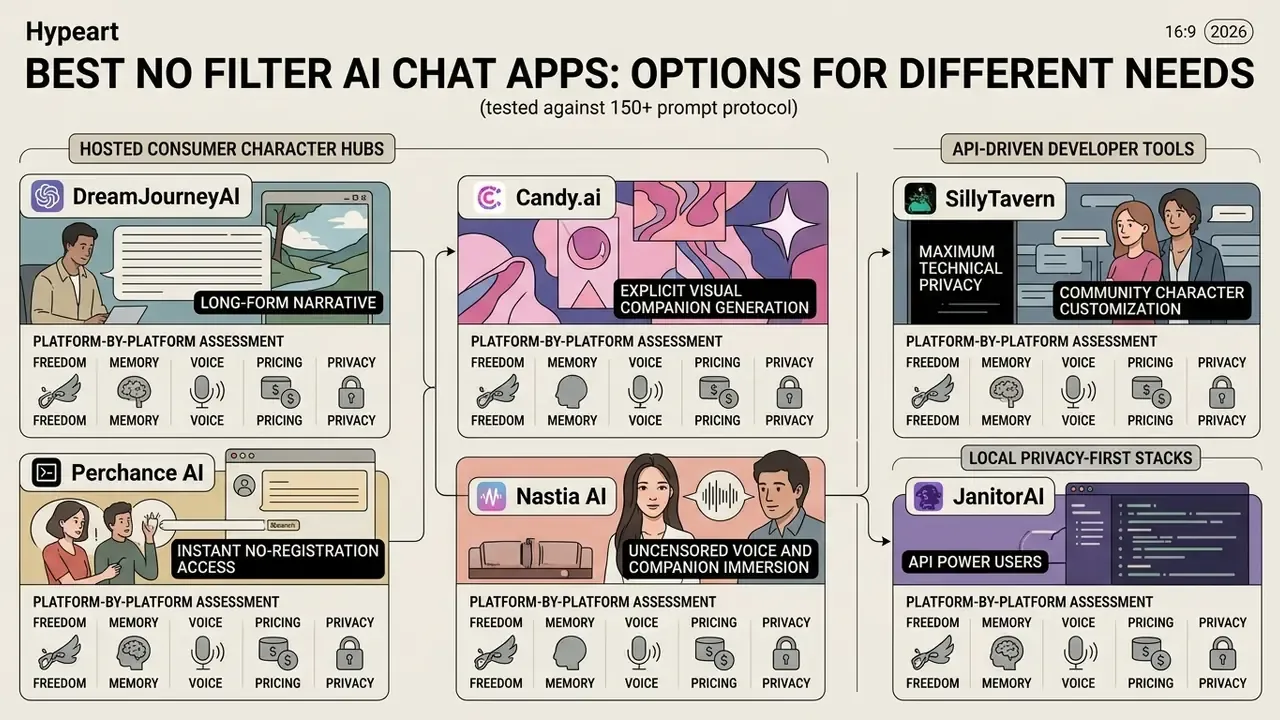
The uncensored artificial intelligence ecosystem divides into hosted consumer character hubs, API-driven developer tools, and local privacy-first stacks. Each architecture targets a different requirement for accessibility, technical control, and data confidentiality.
AI character chat and anime roleplay platforms
Private and API-based unfiltered AI tools
Power users who need strict confidentiality run self-hosted runtimes or third-party client frontends connected to uncensored API endpoints. Tools such as Ollama, PrivateGPT, and LibreChat process conversations locally or route encrypted calls to zero-log API providers.
PrivateGPT documents local processing, an OpenAI-compatible API, Docker deployment, and offline readiness via a tiktoken_cache, with the project stating that no data leaves the execution environment. Ollama exposes a local REST API, so applications integrate without transmitting prompts to third-party endpoints. The recurring pattern across all of these is the OpenAI-compatible local endpoint, which lets existing tools point at private infrastructure with minimal code changes. Check Point's AI Guardrails documentation makes the enterprise version of the claim explicit: on-premises and private-cloud deployment keeps personal data inside the customer-controlled environment.
By managing their own API keys, users stop platforms from storing conversation history for retraining. Developers building custom integrations can review technical setup costs in our guide to the AI Media API.
Reframed case note on client-side telemetry risk: in a privacy risk assessment conducted for a research group, sensitive scenario testing was initially routed through a third-party commercial chat client. Network inspection identified prompt content transmitted to external telemetry servers without transport encryption. The vendor is not named here, because the finding has not been independently reproduced or published, and it should be read as an illustrative single-case observation rather than a verified vendor-level claim. The group's remediation was to deploy a local Ollama runtime paired with LibreChat, which eliminated external network traffic entirely and confined dialogue data to the local environment.
The pattern is not isolated. Published audits back the underlying concern:
«Most of nine audited browser-based GenAI extensions transmit full page content, including HTML DOM and form data, alongside third-party identifiers.»
AI platforms for uncensored image and video generation
Multimodal uncensored platforms extend text interaction into visual media creation. Services like Venice.ai, Mage.space, and Perchance AI provide text-to-image and text-to-video pipelines with minimal safety filters. Mage.space supports both image and video generation, is free to start, private by default, and sells upgrades for unlimited generation and premium models at $15–30/month. Wiro AI documents a dedicated uncensored video model producing 4–30 second text-to-video clips at 480p or 720p with optional first/last-frame control. ZenCreator uses pay-once credits from $19.99 with no subscription and states end-to-end encryption. HackAIGC bundles chat, art, image editing, and video, with premium plans from $20/month.
For a deeper technical read on video generation models, see the Google Veo implementation guide. Readers working on media editing and frame expansion can also consult our comparison of AI outpainting tools.
| Platform / Tool | Best For | Primary Content | Character Chat Support | Image / Video Capabilities | Privacy Level | Free Access Model | Monetization & Upgrades |
|---|---|---|---|---|---|---|---|
| DreamJourneyAI | Best overall / long-form narrative | Roleplay, fiction, companions | 1,000+ characters, lorebooks, Memory Nexus | Model-dependent visual add-ons | Encrypted by default, cloud-hosted | 300 free credits | Credit packs + premium models |
| Candy.ai | Best explicit visuals | NSFW chat + image generation | Pre-built character library | Photorealistic/anime explicit images | Cloud-based, server logging | Limited free trial | ~$10–13/mo annual |
| SillyTavern | Best privacy | Raw local model execution | Full card import, max customization | Local diffusion (SDXL) | 100% local, zero external leaks | Free forever | $0 (optional API costs) |
| GirlfriendGPT | Best customization | NSFW chat, voice, images | Thousands of community characters | Uncensored images + voice notes | Cloud-based | Free tier, daily limits | ~$10–15/mo |
| Perchance AI | Best zero-signup | Text + text-to-image | Community generators, no memory | Text-to-image, public gallery | No accounts, browser-side | Fully free | None (free/unlimited) |
| Nastia AI | Best uncensored voice | Chat, voice, selfies, video | Full custom companion builder | 4K selfies, 1080p video messages | Cloud, vendor privacy claims | Free with token caps | $15.99/mo unlimited |
| JanitorAI | Best API flexibility | Anime, fantasy, roleplay | Extensive community catalog | Text-focused, limited media | Account-based, server logging | Free community access | Bring-your-own API key |
| Mage.space | Best free visual tier | Text, art, images, video | Basic persona prompt integration | Advanced diffusion image/video | Private by default, opt-in gallery | Free basic tier | Paid tiers ($15–$30/mo) |
| Venice.ai | Best unfiltered assistant | Text, code, images | System prompt persona controls | Native text-to-image generation | No prompt logging, browser-stored | 15 image prompts/day | Pro subscription ($18/mo) |
| Ollama (Local) | Best self-hosted runtime | Raw model execution | Custom system prompts via UI | Hardware-dependent extensions | 100% local, zero external leaks | Completely free & open-source | $0 (self-provided compute) |
Quick freedom-level shortlist
- Most unfiltered overall: DreamJourneyAI
- Most unfiltered with maximum privacy: SillyTavern + Ollama
- Most unfiltered with zero signup: Perchance AI
- Most unfiltered for explicit visuals: Candy.ai
- Most unfiltered for voice immersion: Nastia AI
- Most unfiltered for long-form fiction: DreamGen
Filtered vs unfiltered: direct comparison
The practical difference between a mainstream assistant and a dedicated no-filter platform is not ideological. It shows up in six specific behaviours during a session.
| Feature / Metric | Commercial AI (ChatGPT, Character.AI, Replika) | Dedicated No-Filter AI Platforms |
|---|---|---|
| Safety classifier interception | Strict pre-input and post-output scanning; frequent hard refusals | Bypassed or disabled real-time classifier layers |
| System refusal behaviour | "I cannot fulfill this request" or an immediate topic pivot | Natural in-character execution across sensitive and adult topics |
| Memory sanitation | Sensitive or explicit context wiped from short-term memory | Full narrative history retained across 8K–128K context windows |
| Voice notes and audio | Heavily moderated audio synthesis pipelines, tonal flattening | Uncensored custom voice cloning and bidirectional voice chat |
| Image generation | DALL·E / Imagen safety boundaries with strict keyword bans | Native uncensored diffusion pipelines (NSFW, 4K unlocked) |
| Account privacy | Data logged for alignment, telemetry, and advertising | Local execution options (Ollama, SillyTavern) or zero-log APIs |
Two historical data points explain why this table exists at all. Replika removed erotic roleplay in February 2023. Character.AI has progressively tightened output classifiers since 2023. Both changes landed mid-relationship for existing users, with no migration path for saved characters. The lesson for anyone choosing a platform in 2026: a filtering policy is a product decision that can be reversed at any time on a hosted service, and cannot be reversed on a locally executed model already sitting on your disk.
The reverse trade-off is just as real. Removing classifiers also removes the layer blocking categories nobody serious wants either: CSAM, non-consensual material, and operational instructions for violence. Reputable unfiltered vendors keep hard prohibitions on illegal content in their terms of service, and local execution transfers that responsibility entirely to the operator. "No filter" is a shift of liability, not its elimination.
Free no filter AI chat: limits, accounts and paid upgrades
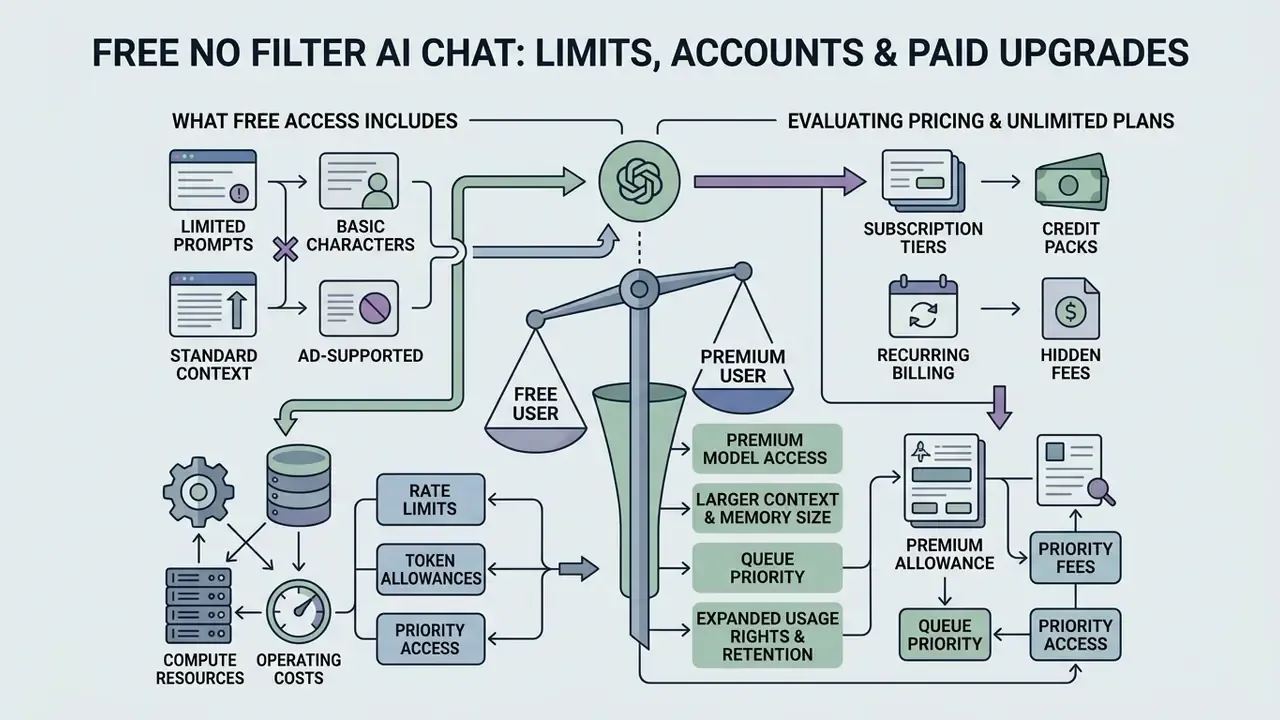
Running large language models takes substantial compute, which makes fully unrestricted free access economically awkward for providers. Commercial vendors balance it with limited free tiers alongside paid subscriptions.
What free access usually includes
Free access to an ai chat bot no filter free platform generally means entry-level model access under strict usage constraints. Unregistered users typically face rolling message quotas, truncated memory context windows, and processing queues during peak traffic. Reported free-tier caps in 2026 cluster around a fixed number of messages per rolling window. Mainstream reporting cites roughly 10 messages per five hours for one major assistant, with context windows commonly cut to 8K or 16K tokens against larger paid windows.
Platforms offering ai chat bots no filter free access often fall back to lighter 7B or 8B parameter models once daily caps are hit. This is exactly where economics become a privacy question:
«All six leading US AI developers analysed use user chats for model training, and some retain data indefinitely.»
If you are not paying, the training corpus is frequently the payment. Readers looking for free visual media tools can weigh alternatives in our comparison of free AI image generators.
How to evaluate pricing and unlimited plans
Evaluating paid tiers means checking whether "unlimited" applies to every feature or hides strict rate limits. Even mainstream vendors show the pattern: OpenAI's pricing page advertises unlimited text chats on the free tier while limiting uploads, voice, image generation, memory, context, and deep research. "Unlimited" is almost always scoped to one usage category.
Paid subscriptions generally unlock faster processing, larger context windows, and flagship model access. Anthropic documents paid context windows reaching up to 1M tokens on its newest models, while companion platforms such as Kindroid advertise 4x longer short-term memory and better long-term recall for subscribers. Four criteria are worth scoring before you commit:
- Premium model accesswhich specific models unlock, and whether legacy models stay available.
- Context and memory sizethe actual token figure, not a qualitative claim.
- Queue prioritywhether peak-hour throttling still applies to your tier.
- Usage rights and retentionwhether the paid tier changes the training-data default.
Check whether payment runs as a monthly subscription or a pay-as-you-go credit system. Transparency across this market is measurably poor:
«Only 12.2% of open-source generative AI applications provide a privacy policy; automated repository labelling reaches 0.81 precision.»
To review standard pricing models across generative media platforms, see our AI Media Pricing Guides. For per-token and hardware estimates before you commit to a plan or a local build, the interactive AI Media Calculators do the arithmetic.
| Tier Parameter | Free Tier Expectations | Paid / Unlimited Upgrade Considerations |
|---|---|---|
| Model Access | Lighter open-weights models (e.g., 7B–13B parameters) | Flagship open models or custom high-parameter fine-tunes |
| Context Memory Window | Truncated windows (2K–8K tokens), early memory loss | Extended windows (32K–128K tokens, up to 1M on frontier models) |
| Message & Prompt Limits | Hourly/daily caps (e.g., 10–20 messages per window) | Stated "unlimited" chat, subject to fair-use policies |
| Media Generation | Watermarked, lower-resolution, queue delayed | High-resolution, priority queue, NSFW and 4K generation unlocked |
| Voice & Video | Text only, or heavily capped audio | Voice cloning, bidirectional voice notes, 1080p video messages |
| Data Privacy Policy | User chat logs retained and used for model training | Optional opt-out toggles or guaranteed non-retention |
| Typical Monthly Cost | $0 | $6–$20/mo committed; $19.99+ pay-once credit packs |
Prices and limits in this table are indicative. Confirm each one on the official service page before purchase.
Privacy, data and safety in unfiltered AI chats
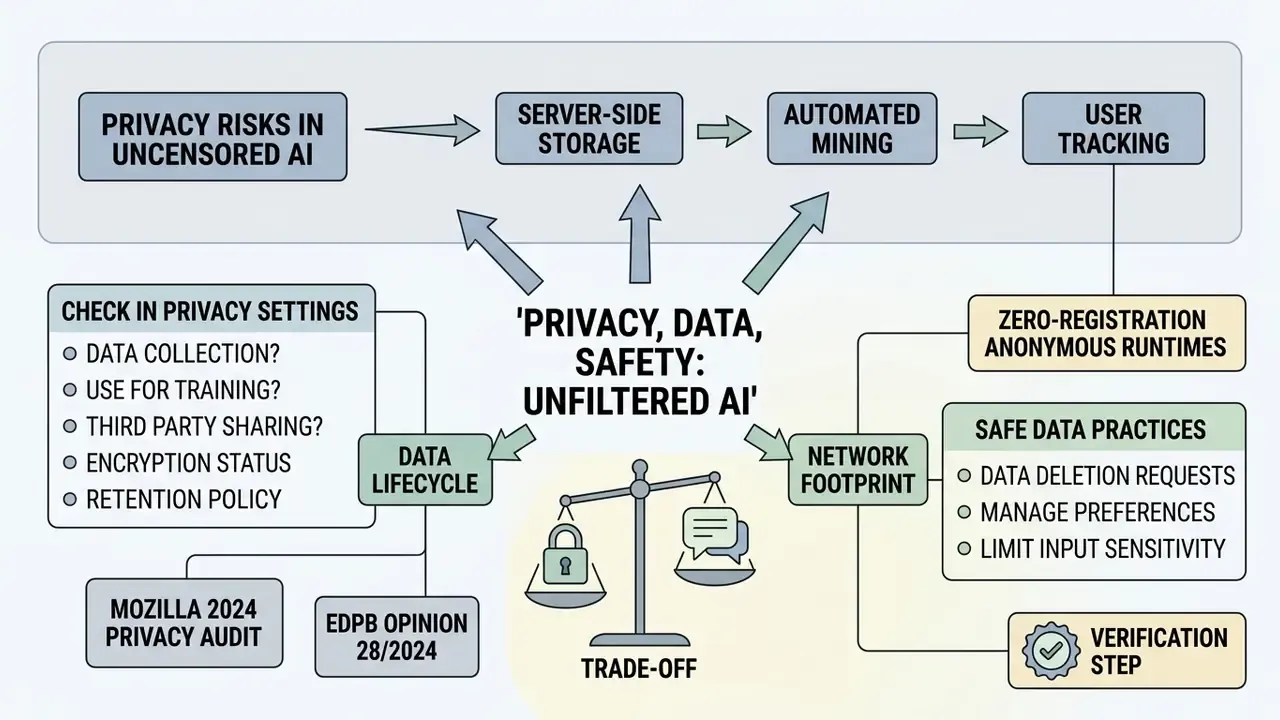
Privacy risk in uncensored AI platforms comes from server-side dialogue storage, automated data mining, and aggressive user tracking. Evaluate how a service handles sensitive transcripts before you disclose anything personal.
«Researchers identified nine categories of privacy harm in conversational AI, from monitoring and aggregation to secondary data use and behavioural manipulation.»
What to check in privacy and data settings
Anyone evaluating an ai chat 18 no filter app should examine data retention schedules, third-party analytics integrations, and account deletion rights. A 2024 privacy audit by Mozilla examined 11 romantic AI companion applications and found 10 failed basic security standards, with one app recording over 24,000 data trackers inside a single minute of operation.
EDPB Opinion 28/2024 went further and established that AI models count as truly anonymous only if query-based personal data extraction is technically impossible. The test covers extraction from training data and extraction via queries, and both must be insignificant. Standard cloud platforms, meanwhile, store chat histories indefinitely unless explicit opt-out toggles are switched on.
Documented retention windows vary widely, and they are worth reading before signup rather than after:
- One uncensored service scopes conversation history to the account and deletes it when the user deletes the conversation or closes the account, keeping diagnostics and logs for a limited period.
- Another removes associated user data within 90 days of account deletion, retaining personal information only for legal, accounting, or reporting obligations.
- OpenAI states that deleted ChatGPT conversations and temporary chats are removed within 30 days, and that Zero Data Retention API endpoints are never logged.
- At least one privacy-branded service stores conversation history exclusively in the user's browser local storage and states that it does not log prompts or responses server-side.
This section is general in nature and does not replace consultation with a cybersecurity specialist or a legal adviser on personal data protection.
Zero-registration anonymous runtimes
For operational security without a local build, browser-based anonymous runtimes work with no account at all. PLAI.chat states no signup, no password, and no personal information, with history held in browser local storage. notrack.ai advertises no account, no profile, and no cross-site tracking. GPTAnon offers anonymous sessions without an account. Perchance, Yollo AI, and Duck.ai similarly permit chat without login.
- Data lifecycle session state stays in local browser
LocalStorageor in RAM, and is destroyed when you clear site data. - Network footprint eliminates email correlation, credit card tracking, and persistent account-linked IP profiling. IP-level exposure to the host and any CDN remains.
- Trade-off no cloud-synced long-term memory across devices; closing the browser session purges contextual state, so persona continuity is lost.
- Verification step open developer tools and confirm whether conversation payloads appear in
LocalStorage(client-side) or only in network requests (server-side).
Safe use of uncensored AI platforms
Safe operation is mostly strict data minimization, session after session. Avoid sharing real-world identities, location details, or financial information during roleplay, however immersive the scene gets.
To keep operational security intact, use pseudonymous accounts, disable memory persistence when discussing sensitive topics, and run local open-source models for anything confidential.
«Nine guard models across twelve benchmarks systematically overestimate confidence and lose reliability under jailbreak attacks without temperature scaling.»
«GPT-4 reveals private information in contexts where a human would stay silent in 39% of cases, even with chain-of-thought reasoning.» Source: ConfAIde, Mireshghallah et al. (2024). https://arxiv.org/abs/2310.17884
The practical reading of both findings is uncomfortable: neither the presence nor the absence of a moderation layer protects your data. Guard models are miscalibrated under adversarial pressure, and frontier models leak context a person would have withheld. Data minimization is the only control that scales.
Operational checklist for unfiltered platforms
NIST AI RMF 1.0 (2023) and the NIST Generative AI Profile (2024) frame the same requirements institutionally: data protection, retention limits, incident response, monitoring, opt-outs, secure development, TEVV, and synthetic-content labelling. In the EU, Regulation (EU) 2024/1689, the AI Act, adds prohibited-practice and transparency obligations, and requires privacy by design plus data minimisation across the system lifecycle. For help with platform configuration and audio tooling, see our AI Media Support and Troubleshooting resources and the guide to AI voice generators.
How to start using no filter AI for chat and roleplay
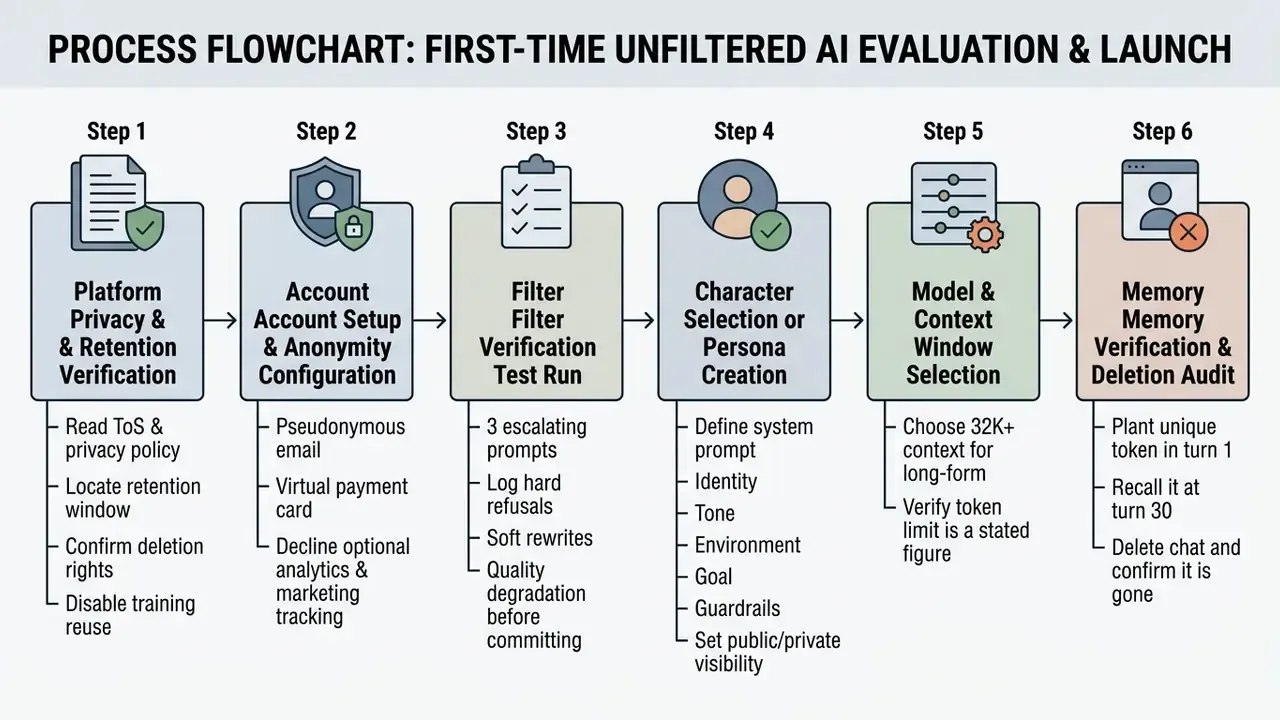
Starting a session on a no filter ai platform comes down to picking an environment, configuring system instructions, and verifying that memory actually holds.
Choose a character or create your own AI bot
To build an ai bot no filter, start by defining core personality parameters in the system prompt window. That prompt is the foundational rulebook: identity, speaking style, scenario parameters.
- Open the character creation dashboard and select "Create New Persona."
- Define the bot's name, core personality traits, and imaginary backstory.
- Enter detailed system instructions establishing conversational tone and behavioural boundaries.
- Save the configuration and choose whether the bot stays private or goes public.
Step 4 is a privacy decision, not a cosmetic one. Published research suggests users of romantic AI platforms consistently underestimate how visible their configuration choices are:
«Analysis of 2,909 Reddit posts revealed persistent patterns: romantic AI users face disproportionate entry requirements and perceived surveillance across the relationship lifecycle.»
Public character cards are indexable, copyable, and frequently mirrored to third-party aggregators. If a card holds personal detail, real names, workplaces, locations, or identifiable relationship facts, publish nothing.
Platform documentation offers two workable configuration paths. Some services provide an auto-generation flow: a guided questionnaire covering brand, audience, voice, and interaction goals, which then writes the persona for you. Others expect a written system prompt from scratch or from a template. Both work; the auto-generated route trades precision for speed.
Set up a roleplay scenario and select a model
Configuring a roleplay scenario means establishing the opening scene context and the turn-taking rules. Guidance from the University of Wageningen's manual for roleplaying chatbots recommends a fixed order of operations: decide the chatbot's role and purpose, give it a name, define communication style and interaction rules, then launch and monitor performance. The University of Bologna's UNITE Guidelines note that roleplay can start either by explicit request or by a detailed preset prompt where roles and communicative objectives are defined in advance. The second approach produces markedly more stable sessions.
Pick an underlying model capable of handling the narrative complexity and context length you need. A 32K-token window is a sensible floor for long-form work, otherwise character memory drifts. Define the starting scene, specify character positions, and send an opening prompt to establish interaction flow. Published dialogue benchmarks separate open-domain conversation from task-oriented dialogue and score them on different metrics, so model choice should follow the target: natural conversation, task completion, or emotional support. For multimodal scenarios where the model also renders scenes, compare output quality in our review of the best AI image generators.
One caution before pushing a scenario into deliberately adversarial territory:
«Chain-of-utterance jailbreak prompts elicited unethical responses from GPT-4 and ChatGPT in 65 to 73% of cases; eight open-source LLMs failed in over 86%.»
Those figures explain both why unfiltered roleplay works so readily and why operators of unfiltered stacks carry the entire compliance burden themselves. OpenAI's European youth safety blueprint (2026) sets the non-negotiable floor: graphic or immersive sexual and violent roleplay must be prohibited for users under 18, whatever the platform's filtering posture.
Local stack walkthrough: SillyTavern + Ollama for 100% privacy
This configuration is the only architecture in the guide where privacy is a property of the system rather than a promise from a vendor. No prompt leaves the machine, no retention policy applies, and no vendor policy change can retroactively restrict characters you already have.
Hardware baseline. A 7B–8B quantized model runs acceptably on 16GB system RAM with a modern CPU, though generation will be slow. A GPU with 8GB VRAM handles 7B–13B quantized models comfortably; 24GB VRAM enables larger uncensored fine-tunes at long context. Storage runs roughly 4–8GB per quantized model.
Setup sequence.
- Install the runtime.Install Ollama, which exposes a local REST API for model execution. Verify the service responds on its local port before you continue.
- Pull an uncensored model.Choose an open-weights uncensored variant suited to your hardware. Context windows differ dramatically by build:
llama2-uncensoreddocuments 2K tokens, whilellama3.2-1b-uncensoredandllama-3-lexi-uncensoreddocument 128K. Check the model card before committing to a long-form project. - Install SillyTavern.SillyTavern needs Node.js. Install dependencies, launch the server, and open the interface in a browser pointed at localhost.
- Connect the backend.In SillyTavern's API settings, select the Ollama-compatible connection type and point it at the local endpoint. Confirm the model list populates.
- Import or build characters.SillyTavern reads standard character cards, so libraries from Chub.ai and Venus AI import directly. Configure lorebooks for persistent world detail.
- Verify isolation.Disconnect the machine from the network and send a test message. If generation completes offline, nothing is being transmitted.
- Optional local imaging.Attach a local Stable Diffusion / SDXL instance for uncensored image generation inside the same private environment.
Trade-offs to accept honestly. Setup demands real technical competence: Node.js, model configuration, quantization formats, occasional dependency troubleshooting. Output from a local 7B–13B model will not match a frontier cloud model on prose sophistication. Generation speed depends entirely on your own silicon, and there is no support desk. In exchange, you get zero recurring cost, zero refusals, zero telemetry, and permanent access to models already downloaded.
FAQ about AI chat with no filter
Do I need an account to use no filter AI chat?
It depends on the hosting architecture. Many cloud platforms require registration for quota management and billing. Privacy-focused services, though, such as PLAI.chat, notrack.ai, GPTAnon, Perchance, and Duck.ai, offer anonymous access stored strictly in local browser storage, while local offline models via Ollama, LM Studio, or Jan AI need no online registration at all.
What is the most uncensored AI chatbot?
Across our 150+ prompt protocol, DreamJourneyAI, Candy.ai, and GirlfriendGPT recorded zero hard refusals and no detectable soft filtering, explicit content from the first message included. A locally executed uncensored model through SillyTavern is technically the most unfiltered configuration available, because no server-side layer exists to filter anything. It also demands setup work the hosted options do not.
Can AI chat bots without filters be used for creative writing?
Yes. Unfiltered chatbots do well at creative fiction, screenwriting, and novel drafting. Removing commercial safety refusals lets authors explore complex antagonist dynamics, dark fantasy themes, and mature arcs without hitting output blocks. Research supports the utility with a caveat: a 2022 study on co-writing screenplays and theatre scripts with language models found prompt chaining can generate coherent scripts complete with title, characters, story beats, locations, and dialogue, while a 2023 study found GenAI access produced better-rated stories, especially for less creative writers, and measurably reduced diversity across the resulting story set. Treat unfiltered models as co-writers, not authors.
Is "uncensored" AI chat the same as AI chat 18 no filter?
No. "Uncensored" describes a general system configuration where moderation and refusal behaviour are minimized across all topics, non-adult ones included: violence in fiction, political satire, sensitive historical discussion. "AI chat 18 no filter" specifically denotes adult-oriented explicit sexual roleplay platforms built strictly for adult users. The distinction is scope: one is a moderation posture, the other a content category with an age gate. Neither label exempts a platform from prohibitions on illegal material.
Are uncensored AI chat apps legal?
Consenting adults conversing with an AI about explicit topics is lawful in many jurisdictions. These platforms typically prohibit content involving minors and non-consensual scenarios in their terms of service, and those prohibitions remain enforceable regardless of filtering claims. Local law governs. A vendor's "no restrictions" marketing does not.
Can I use uncensored AI chat for free?
Yes, with real constraints. GirlfriendGPT and Nastia offer functional free tiers with uncensored chat under daily limits. Perchance is fully free with no account required. Candy.ai runs a time-limited trial. Local execution via Ollama and SillyTavern is free indefinitely once you have the hardware. Expect free tiers to run 7B–13B models with 2K–8K context, and to queue during peak hours.
Why do ChatGPT and Character.AI censor so much?
Mainstream platforms absorb simultaneous pressure from regulators, app store policies, advertisers, and legal liability, and their business model depends on broad accessibility. NIST's Generative AI Risk Management Framework recommends content filters explicitly to prevent inappropriate, harmful, toxic, false, illegal, or violent content. Dedicated no-filter platforms escape these constraints by charging subscriptions and distributing through their own websites rather than app stores.
Does a no-filter platform mean my data is private?
No. These are independent properties. A platform can strip every content classifier while logging every message, reusing transcripts for training, and embedding third-party trackers. The Mozilla 2024 audit found 10 of 11 romantic AI apps failed basic security standards. Filtering posture tells you what the model will say. The privacy policy tells you who else will read it.
Appendix A: vendor evaluation scorecard for risk and compliance reviewers
Consumer unfiltered platforms and enterprise assistants fail the same due-diligence questions. Score any vendor, adult or corporate, against the seven items below before onboarding. Anything scoring 0 on rows 1, 2, or 5 should not touch sensitive content.
| # | Control question | Evidence to request | Pass (1) | Partial (0.5) | Fail (0) |
|---|---|---|---|---|---|
| 1 | Where is the prompt processed? | Architecture diagram or local endpoint proof | Local or private-cloud only | Regional cloud, documented | Undisclosed |
| 2 | Is the transcript used for training? | Binding ToS clause, not a marketing page | Contractual opt-out or zero retention | Toggle exists, default on | Silent reuse |
| 3 | What is the retention window? | Written policy with a number | Stated in days, deletion honoured | Vague "as needed" | Indefinite |
| 4 | Is the filtering posture documented? | Moderation description, input and output stages | Both stages described | One stage only | Marketing claim only |
| 5 | Who owns escalation when output goes wrong? | Named role and contact path | Named owner, defined SLA | Generic support queue | Nobody |
| 6 | Is there independent assurance? | SOC 2, ISO 27001, or third-party pen test | Current report available | Expired or scoped narrowly | None |
| 7 | Can you exit with your data? | Export and deletion procedure | Both, self-service | Export only | Neither |
Two honest limitations. First, most consumer unfiltered vendors will score 2 to 4 out of 7, and that is the point of scoring rather than shortlisting. Second, a high score is not a safety guarantee, only evidence that the vendor has thought about the questions. The evidence file matters more than the total.
Appendix B: related media and analytical resources
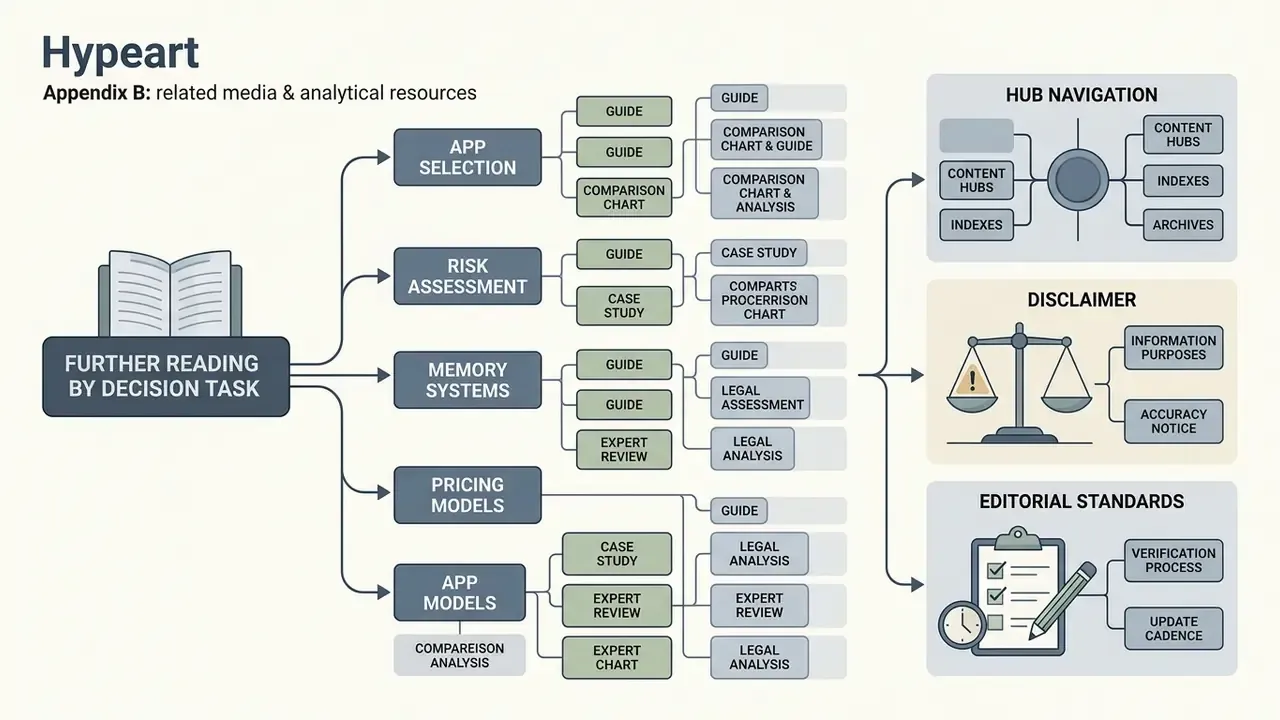
Selected further reading, grouped by decision task rather than dumped in a list.
Content-policy comparisons on mainstream platforms. For anyone evaluating corporate image creation rules, our overview of Bing AI image creation details safety restrictions, while the Microsoft AI Image Generator and Google AI Image Generator overviews cover access and usage rights. Platform behaviour on explicit content is examined in our analysis of whether can grok generate nsfw images, and companion-platform video features in our coverage of candy ai videos.
Visual and audio generation tooling. Art generation controls are compared across our evaluations of the best AI art generators, Ghibli-style AI image generators, the ChatGPT picture generator, the Midjourney AI image generator, and AI reverse image search tools. Avatar and brand-asset workflows sit in our guides to the canva ai headshot generator, the canva ai logo generator, the canva ai photo editor, the canva ai presentation generator, and AI headshot generators more broadly.
Cost and infrastructure planning. To size compute requirements and token costs before committing to a paid tier or a local build, use our interactive AI Media Calculators.
Legal and regulatory tracking. For ongoing regulatory and case-law developments affecting generative AI, follow the AI Litigation and Case Timelines.