Synthetic media generators can now reproduce the voice and video avatar of Donald Trump from a plain text script. Tools in this class combine voice cloning, text-to-speech synthesis, and lip sync alignment. That mix looks harmless on a phone screen. It is not harmless on a bank's brand account, and the difference matters to anyone who signs off on content, vendors, or fraud controls.
So the question splits in two. Creators ask how to make a clip. Risk owners ask what the availability of such a tool changes in their threat model.
Executive Summary: Key Takeaways
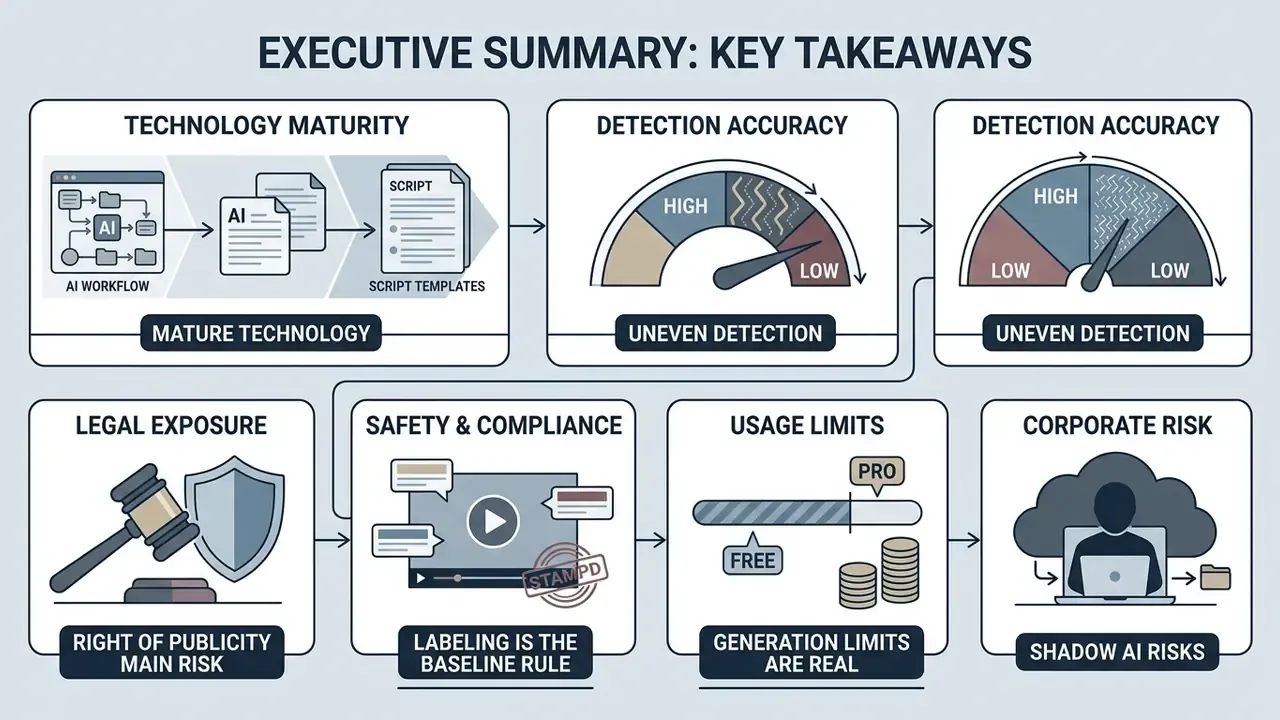
A compressed view for fast scanning, written for both content teams and the people who approve risk.
- The technology is mature. Current models reproduce prosody, timbre, and the characteristic pauses of Donald Trump. Lip sync pipelines run from 256x256 research resolution up to HD and Full HD output. A 15 to 30 second clip takes roughly 30 seconds to 2 minutes, and on some platforms 10 minutes or more with long text.
- Detection works, but unevenly. Lab detectors report above 98% accuracy on video. Yet the DeepFake Detection Challenge winning model classified only 69% of the Presidential Deepfakes Dataset correctly and accepted 6 of 8 Trump deepfakes as authentic.
- Right of publicity is the main legal exposure. Thirty-five US states recognize the right of publicity, and the Tennessee ELVIS Act (2024) extended protection to voice simulations and digital replicas.
- Labeling is the baseline safety rule. Disclosure duties appear in the EU AI Act (Article 50), in state law (Colorado HB24-1147, Utah), and in institutional policy. NASA, for example, requires a persistent watermark plus embedded metadata.
- Generation limits are real. A single script is usually capped at 500 to 1,000 characters, about 30 to 60 seconds of speech. Free tiers allow roughly 5 to 66 generations per day or month, at 720p, with a watermark.
- The corporate risk vector is shadow AI. An employee who uploads an internal script or audio sample into an unapproved SaaS generator creates a data leakage risk and a reputational-legal risk at the same time.
What a Trump AI Generator Is and What You Can Create
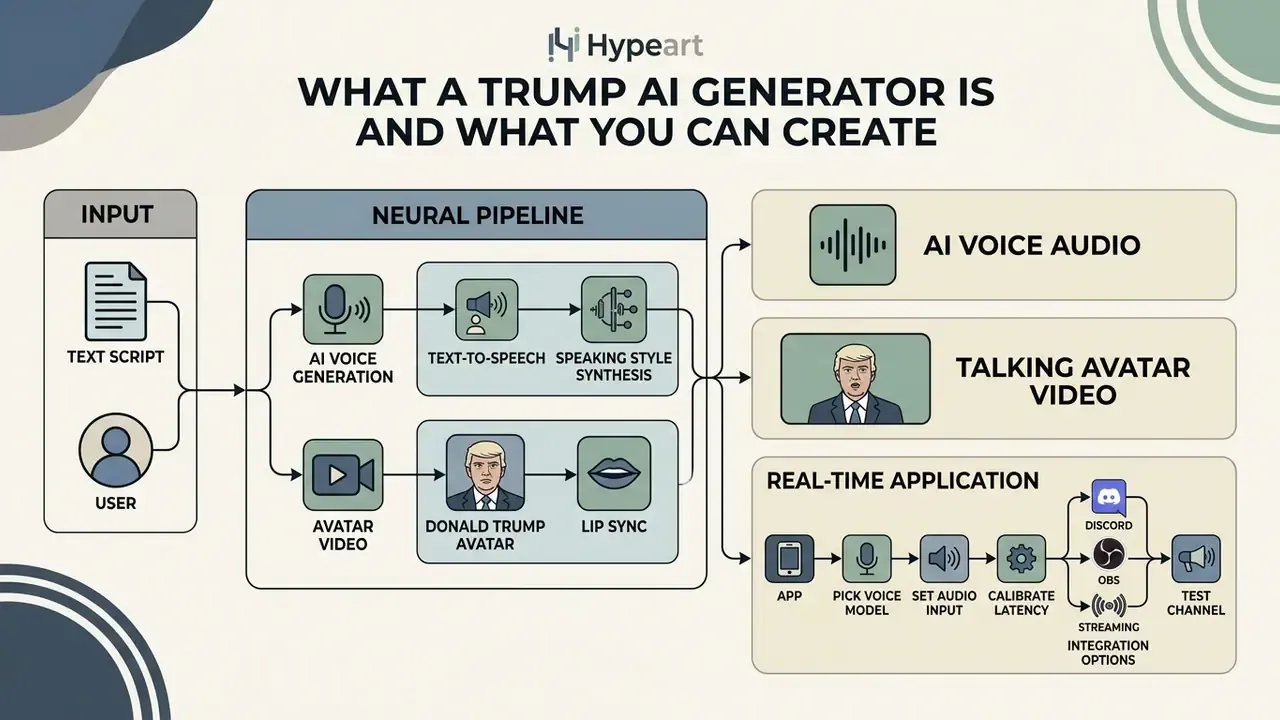
A trump ai generator is a neural pipeline that turns text into synthesized Donald Trump speech and produces video of a talking avatar. The platform bundles voice cloning models, a lip sync network, and scene templates that assemble publishable media.
Tools marketed as a trump ai generator or donald trump ai generator belong to the wider family of AI video generators. They solve one job: content production without a shoot or a recording session. Depending on the task, the system returns a clean voiceover audio file, or facial animation where mouth movement and expression track the spoken text.
In synthetic media, donald trump is among the most requested celebrity voice targets. Developers train on public speeches, interviews, and debates, capturing a recognizable speaking style. Output then travels to social media, from fast TikTok cuts to longer commentary formats.
«The DeepFake Detection Challenge winning model correctly classified only 69% of dataset videos, mistakenly accepting 6 of 8 Trump deepfakes as authentic.»
That asymmetry, easy production against hard automated verification, explains why the Trump likeness became a default benchmark for generators and detectors alike. Related terms in audio and video synthesis are collected in the AI Media Glossary.
AI Voice, Text to Speech, and Speaking Style
Donald Trump voice synthesis rests on text-to-speech (TTS) and neural audio cloning that reproduce intonation, rhythm, and timbre. The architecturally adjacent text-to-video technologies handle the visual layer. You type text, the system returns an audio stream whose diction imitates donald trump's voice.
Modern voice models expose many parameters: pitch, loudness, tempo, and pause placement.
«The ReVoice system synthesizes speech in a target speaker's voice using only text and a few audio samples, applying deep learning models to generate the audio signal.»
Because of that control surface, a voice generator can render trump voice as performance rather than flat narration, with emphatic accents and rhetorical pauses. Practical input guidance: 1 to 2 minutes of clean speech is enough for cloning, inputs beyond five minutes add little, and emotional-prosodic modeling raises tonal variety by about 17.8% and energy expressiveness by about 21.3%. For audio guides or scripted fiction, authors often pair scripts with lighter creative formats, where an ai poem generator or an ai plot generator helps draft the skeleton.
Donald Trump Avatar Video and Lip Sync
A donald trump video generator joins the synthesized AI voice track with a 2D or 3D face model and aligns mouth shapes frame by frame (lip sync). The output is a finished video file in which the avatar speaks your text.
During AI video generation the system maps audio phonemes to visemes, the visual mouth and facial positions. Research talking-head implementations normalize frames to 256x256 or 512x512 pixels and score quality in three groups: synchrony (LSE-D/LSE-C, Sync-C/Sync-D), visual fidelity (FID, IQA), and temporal smoothness (FVD). Commercial services push resolution to HD or Full HD through upscaling and post-processing.
«Drexel University's MISLnet algorithm reaches 98.3% accuracy in detecting synthetic video, yet image detectors lose 20 to 30% accuracy when moved to video.»
The finished clip is available for preview and download. For stylized graphic inserts in the same project, teams sometimes use ai pixel art instead of another photoreal asset.
Using the Donald Trump Voice in Real Time (Discord, OBS, Streaming)
Besides offline text-to-audio synthesis, cloning can stream a Donald Trump voice live. That path requires a virtual audio driver on Windows 10 or 11, or on macOS 14 and newer with Apple Silicon.
Live voice changer setup, step by step:
- Launch the app.Install and open the desktop client (for example, a live voice tool that ships a virtual microphone driver).
- Pick the voice model.Activate the "Donald Trump" preset in the voice library.
- Set the audio input.In the target app (Discord, OBS Studio, Zoom, TeamSpeak, or a game) select "AI virtual microphone" as the input device instead of your physical mic.
- Calibrate latency.Set the audio buffer to 128 to 256 samples to avoid drift between voice and video.
- Test the channel.Record a short check inside the messenger or streaming software. Live mode gives you no second take, so levels and delay must be verified before you go on air.
One caveat worth repeating: automatic labeling is impossible in live mode. Parody disclosure moves to the channel level, through a line in the stream description, a persistent OBS overlay caption, and a spoken notice at session start.
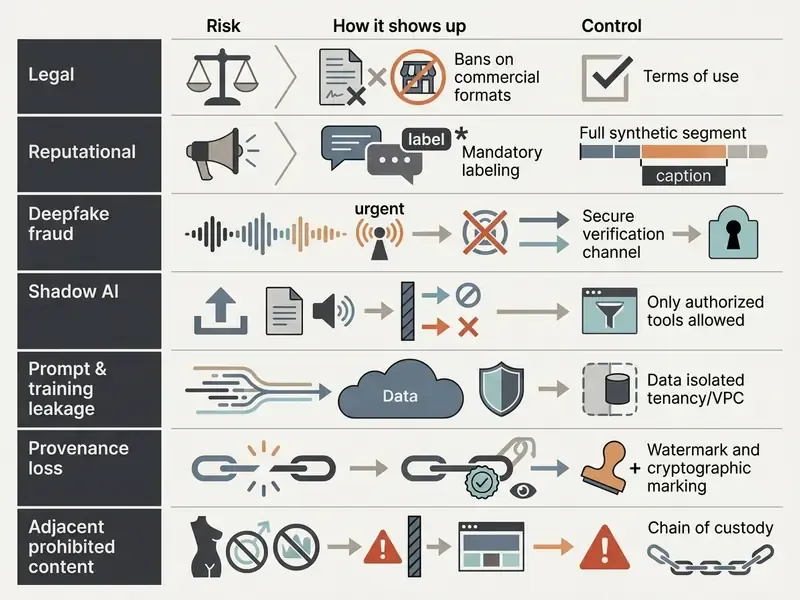
Risk and Control Matrix for Synthetic Avatars
For an institution the question is not how to cut a clip. It is what the availability of such tools changes, and which controls close the gap. Below is a compact risk and control matrix applicable to any service in the donald trump ai voice and video generator category.
How to Make a Trump AI Video: Step by Step
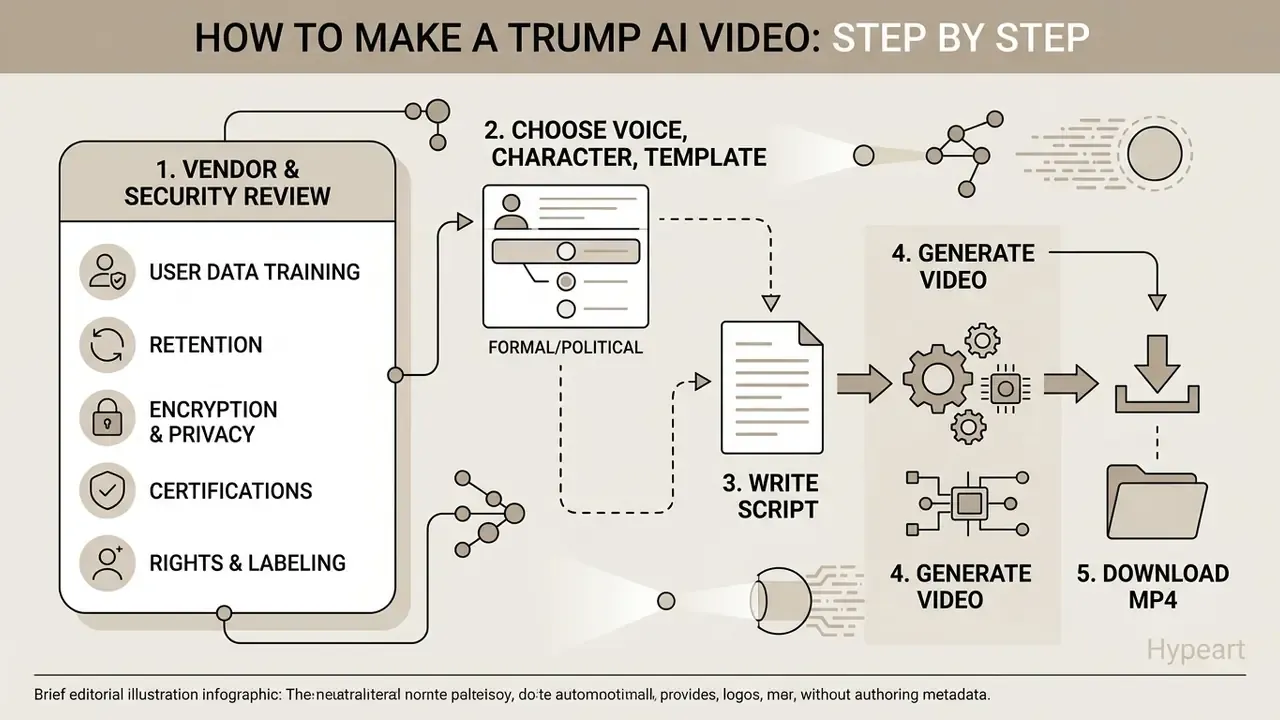
Making a clip with a Donald Trump AI avatar means choosing a voice model and template, writing the script, running generation, and downloading an MP4. The full cycle takes seconds to two minutes and needs no editing skills.
Anyone searching how to make a trump ai video can stay inside a browser interface. The pipeline handles audio mixing, frame rendering, and articulation sync. Products positioned as create trump ai video, create donald trump ai video, or an ai trump video maker are tuned for creators who want output fast, without installing software. For multi-clip projects, estimate spend first with the AI Media Calculators.
Vendor and Security Review Before You Start
Five minutes of diligence before the first generation is cheap insurance, especially when the script mentions internal information, client names, or unreleased announcements.
- Training on user data. Does the policy state plainly that prompts and uploads are not used for model fine-tuning?
- Retention. Is there a specific retention period, for example automatic deletion within 24 to 48 hours or within 36 hours, plus manual history deletion?
- Encryption and output privacy. Is transfer and storage encrypted, and is free-tier content published in an open gallery?
- Certifications and legal regime. Is SOC 2 or GDPR alignment claimed, where are servers located, and who are the subprocessors?
- Rights and labeling. What do the Terms of Use say about commercial licensing, watermarks, and the prohibition on misleading the audience?
The normative frame already exists. The generative AI profile of the NIST AI Risk Management Framework calls for data collection and retention policies, plus monitoring of generated text, images, video, and audio for personal data disclosure. Guidance from Australia's OAIC (2024) requires developers to notify individuals about personal information collection at or before the time of collection.
Choose the Voice, Character, and Video Template
First, select the Donald Trump voice model in the voice library, then the visual avatar and background template: a podium, a press conference, or a studio set.
Your select voice model choice sets the emotional color of the delivery. An ai trump video maker then pairs that AI voice with a specific template. Template choice fixes camera angle, lighting, and composition, which is what keeps the ai video generator output visually coherent instead of uncanny.
Template libraries usually split into two classes of scenario presets:
- Oval Office / Desk Formal, the avatar seated at a desk, best suited to political commentary;
- Podium Patriotic / Podium Speech / Flag Statement, a speech behind a lectern against the US flag;
- Air Force One Formal, an address staged in front of the presidential aircraft;
- Seated Interview / Indoor Statement, a close studio interview angle;
- Formal Gesturing / Hands Chest Emphasis / Explaining Hands Up, gesture presets for emphatic statements.
- Baby Trump 1/2, Drive Bumper Cars, Macdonald Staff, Wizard Magic, Barbie Pink, Chicken Banana, stylized avatars for short TikTok and Reels cuts;
- Outdoor Serious / Flag Serious / Indoor Solemn Speech, vertical (9:16) and horizontal variants for mobile and YouTube.
- Formal and political templatesFormal and political templates:
- Parody and viral templatesParody and viral templates:
Technical requirements for a custom avatar upload: frontal face position, no large head movements, forehead and chin unobstructed. One to five minutes of source footage is enough for the driving model.
Write the Script and Tune the Output
Step two is the script itself, where you set the spoken lines and adjust speaking style parameters for high quality delivery.
Personalized formats dominate here: happy birthday clips, friendly congratulations, joking roast lines, and encouraging message pep talks. Short sentences help, and explicit punctuation is what actually places the pauses. For complex audio projects creators often add an ai podcast generator to the stack, or source background beds through an ai playlist generator.
Script Engineering Rules for TTS
To avoid synthesis glitches and get natural prosody, follow a few rules that are boring but effective.
- Separate setup lines from punchlines. Split the setup and the payoff with a period or a hyphen, never a comma, so the model takes a full pause. For a mock announcement use one intro line, then the announcement, then a short closer.
- Numbers and dates. Spell numbers out ("twenty four" instead of "24"). If a sentence carries more than two numeric values, break it in two and listen again.
- Check names and acronyms. Re-listen to personal names, place names, and dates. Replace difficult terms with phonetic spellings so stress lands correctly.
- Punctuation test. Compare two or three punctuation variants on a short fragment, learn where the model breathes, and only then render the full script.
- Source audio requirements if you upload your own: mono WAV or PCM, 22 to 48 kHz, 16 to 24 bit, loudness near minus 23 to minus 18 dB RMS, true peak no higher than minus 3 dBFS, no clipping, no room noise.
- Automated restyling. If the service offers an AI news rewriter, paste the source snippet and apply the prompt: "Rewrite this snippet in Donald Trump's speaking style using signature phrases". Then read the result manually. Restylers tend to invent claims that were never in the source, and that is exactly the kind of error nobody notices until publication.
Generate, Review, and Save the Video
The last step is to hit click generate, wait out the render, inspect lip sync in the preview window, and download the file.
After click generate the network mixes the video track and the audio track. Check articulation naturalness and look for artifacts at frame seams. Watch the sync mode parameter separately, since it decides what happens when audio and video durations disagree. The finished file exports in MP4 at 480p, 720p, or 1080p depending on plan, ready for use as social media content.
Which Trump AI Video Formats Work for Social Media
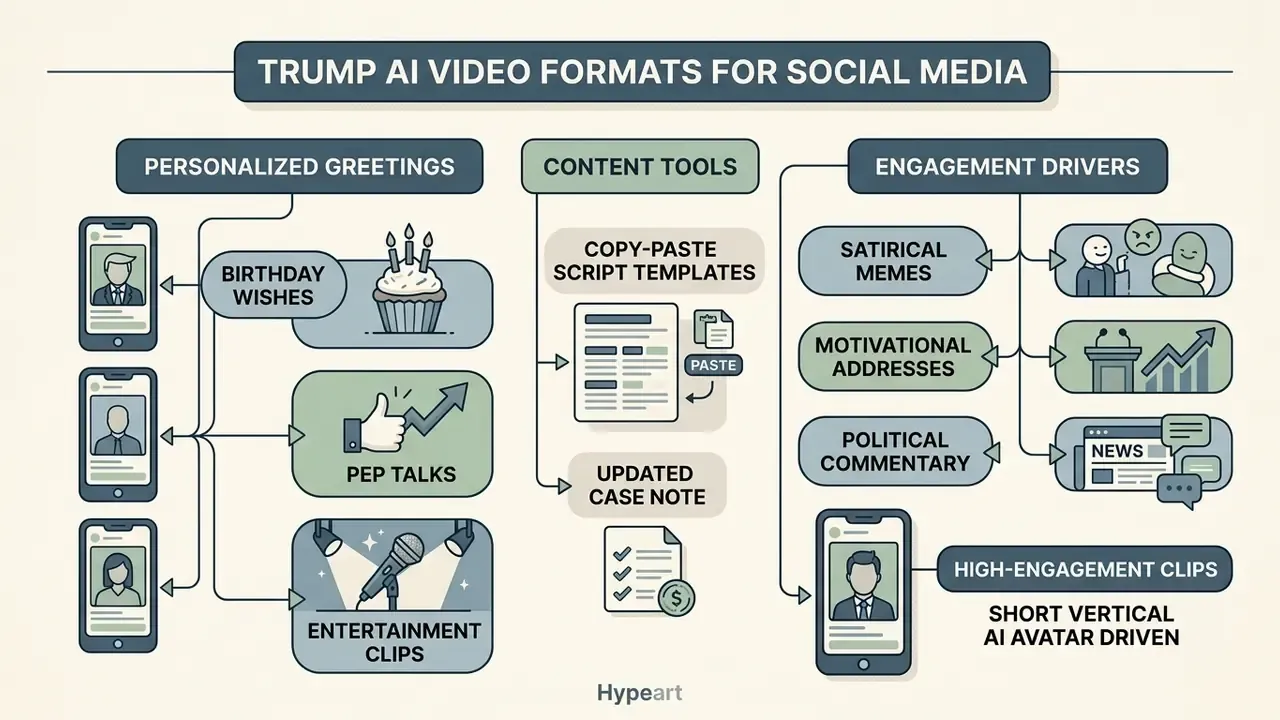
Short vertical clips with a Donald Trump AI avatar drive the highest engagement: personalized greetings, satirical memes, motivational addresses, and political commentary. To match a platform to a format, start from the overview of the best AI video generators.
Format choice drives completion rates and reactions. Generated content spreads mainly through TikTok, Instagram Reels, and YouTube Shorts.
«Syracuse University researchers documented a deepfake with manipulated audio of Trump and Tucker Carlson used in political advertising on social platforms.»
Updated. In place of an earlier citation to an unverifiable publication, here is the checkable pattern: 2025 short-video studies report that engagement is driven by emotional storytelling, trending audio, and interactivity, with TikTok leading on engagement rate, Reels on reach, and Shorts on subscriber conversion. Meme-like, easily forwarded formats therefore remain the most durable use of a trump ai video.
Birthday Wishes, Pep Talks, and Entertainment Clips
The entertainment lane covers personalized birthday wish cards, holiday greetings, and joking send-offs built on recognizable delivery and facial expression.
A greeting script usually has three parts: the name, the wish, and a signature line in the familiar register ("this is going to be a tremendous day"). The Donald Trump voice format stays popular with any content creator producing one-off messages for friends or subscribers.
Copy-Paste Script Templates
For the AI voice to land as authentic, the script needs the signature rhetoric: heavy use of tremendous, unbelievable, huge, clipped short sentences, and abrupt intonational pauses.
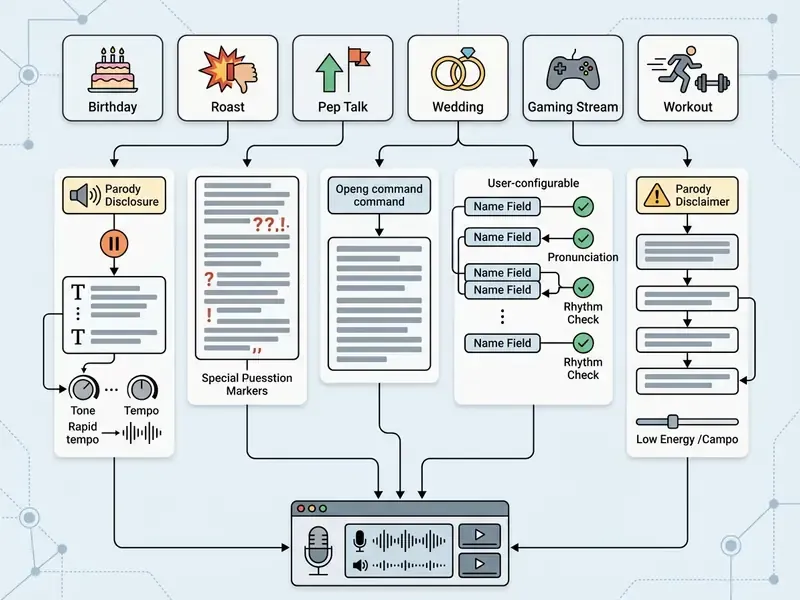
Notice that every template carries the parody notice in the first line. That is the simplest way to satisfy platform disclosure rules inside the audio track itself. Generated sound does not explain its own origin to a listener, and a caption stripped during re-upload explains nothing at all.
Memes and Political Commentary with Donald Trump AI
Meme and political commentary formats use political likenesses for satire, reaction clips, and trend takes.
A content creator building satire has to work inside platform limits. Updated: rather than the blanket claim that "satire is allowed", it is more accurate to quote published policy. Meta frames its satire exception through irony, exaggeration, mockery, or absurdity in criticism of political, religious, and social matters, and applies it only when intent is evident. Its manipulated and synthetic media policy permits memes and satire when they do not create substantial confusion about the authenticity of a recording. TikTok requires clear labeling of content that looks or sounds like a real person, including AI audio imitating a real voice. DSA-related analysis in the EU likewise excludes satire, parody, and clearly identified partisan commentary from the definition of disinformation.
«An experiment with 1,346 participants found that all three deepfake video variants featuring Trump reduced belief in wind energy misinformation, even though about 80% of viewers recognized the video as fake.»
Free and Paid Capabilities of the Trump AI Video Generator
Free tiers give basic access for testing, with caps on clip length and resolution plus a watermark. Paid Pro tiers remove watermarks, unlock HD or 4K rendering, and grant commercial rights to the software output. Before buying, compare conditions against the review of free AI video generators.
The choice between free ai access and a subscription depends on the project. A trial needs nothing more than the basic feature set, while professional production needs high quality rendering and clean download rights. Price bands are broken down in the AI Media Pricing Guides.
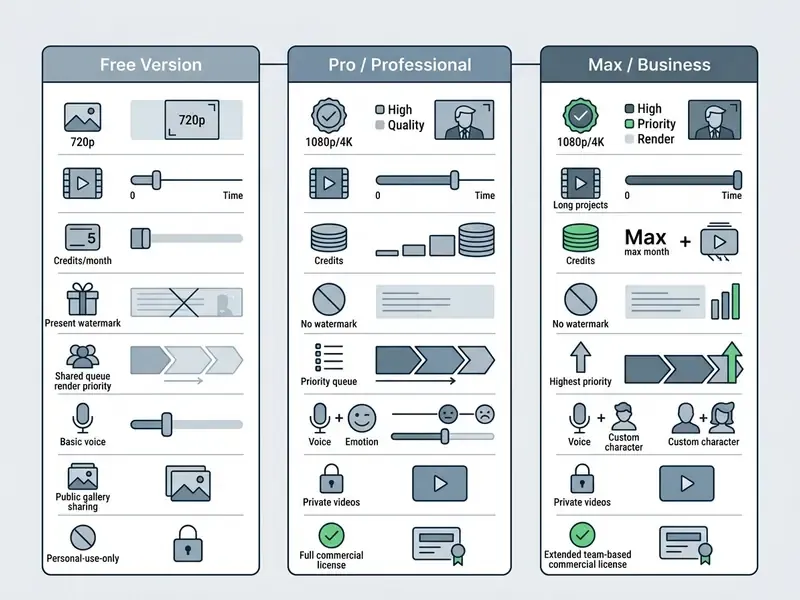
Prices and limits are market reference points drawn from public pricing pages and they change. Verify current values on the checkout page of the specific platform. A commercial license to the service output is not the same thing as a right to use a real person's likeness. See the legal section below.
What the Free Version Includes
A free trump ai video generator lets you explore the interface, render a short clip (usually up to 10 seconds), and judge the base voice model and template.
Products labeled donald trump ai video generator free, free donald trump ai video generator, or ai trump video generator free are useful for evaluation, and their feature sets are easiest to compare through the comparison of free AI video generators. The exported file often carries the service watermark, and generation caps are tight. Keep one more thing in mind: on several platforms free-tier output is public by default and appears in a shared gallery. For any work-related script that alone is a confidentiality problem.
When You Need a Professional or Pro Plan
A Professional plan becomes necessary for commercial use, HD or 4K rendering, watermark removal, and priority queue processing.
Agencies and regular publishers hit that threshold quickly. Access to high quality rendering and extended speaking style settings produces clips without visible defects, and running 3 to 5 jobs in parallel compresses the production cycle when you publish in series. For subscription or rendering issues, the AI Media Support and Troubleshooting hub is the practical starting point.
How Realistic Are the Donald Trump AI Voice and Video
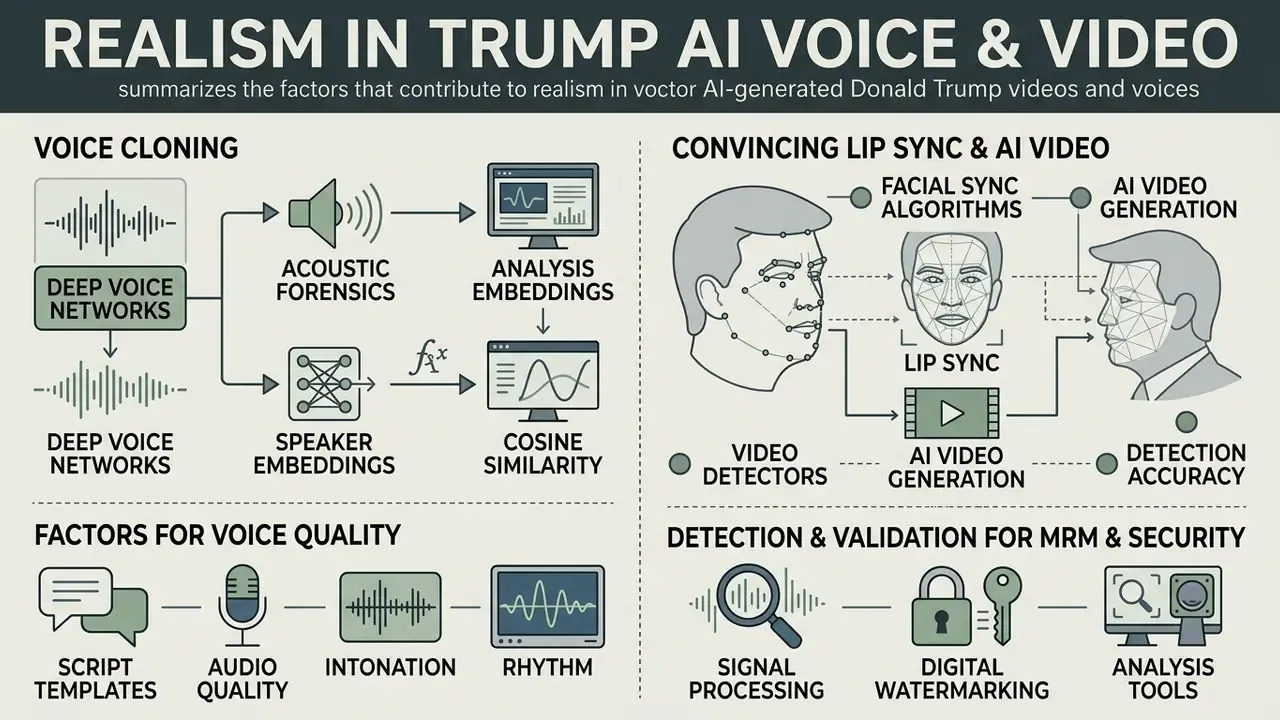
Realism comes from deep voice cloning networks plus facial sync algorithms. Expert forensic analysis and purpose-built detectors can still surface synthetic artifacts, though not reliably enough to lean on a single tool.
Updated. This paragraph previously claimed that a synthesized donald trump's voice passes as real "in 40 to 50% of cases", with no stated method. The defensible version cites published results: on the Presidential Deepfakes Dataset, models erred far more often on Trump videos than on Biden videos (50% accuracy against 87.5%), and the DFDC winning model classified only 69% of the dataset correctly while accepting 6 of 8 Trump deepfakes as genuine.
«The DFDC winning model correctly classified only 69% of dataset videos, mistakenly accepting 6 of 8 Trump deepfakes as authentic.»
Voice cloning has advanced enough to reproduce the prosody and rhythm of political speech. NIST records a wide spread in synthetic audio detection quality: EER from 0.43% to 42.5%, accuracy from 50% to 99% depending on the generation method. The political effect of such content, however, should not be overstated.
«A review of 11 election campaigns in 2023 found that in no case did deepfakes decisively influence the outcome, though a minor effect was recorded in two cases.»
Service-level differences are laid out in the AI Media Comparison hub.
What Determines Trump AI Voice Quality
Cloning quality depends on source audio cleanliness, the AI models used, script length, and emotional emphasis settings tied to speaking style.
Clean source audio without background noise, sampled at 22 to 48 kHz, yields a natural trump's voice timbre. Models with prosodic control avoid the robotic flattening that gives away older TTS and preserve the intonation of a celebrity voice. Long scripts and cross-lingual cloning degrade timbre, emotion, and content fidelity, a pattern confirmed by current audio-generation benchmarks.
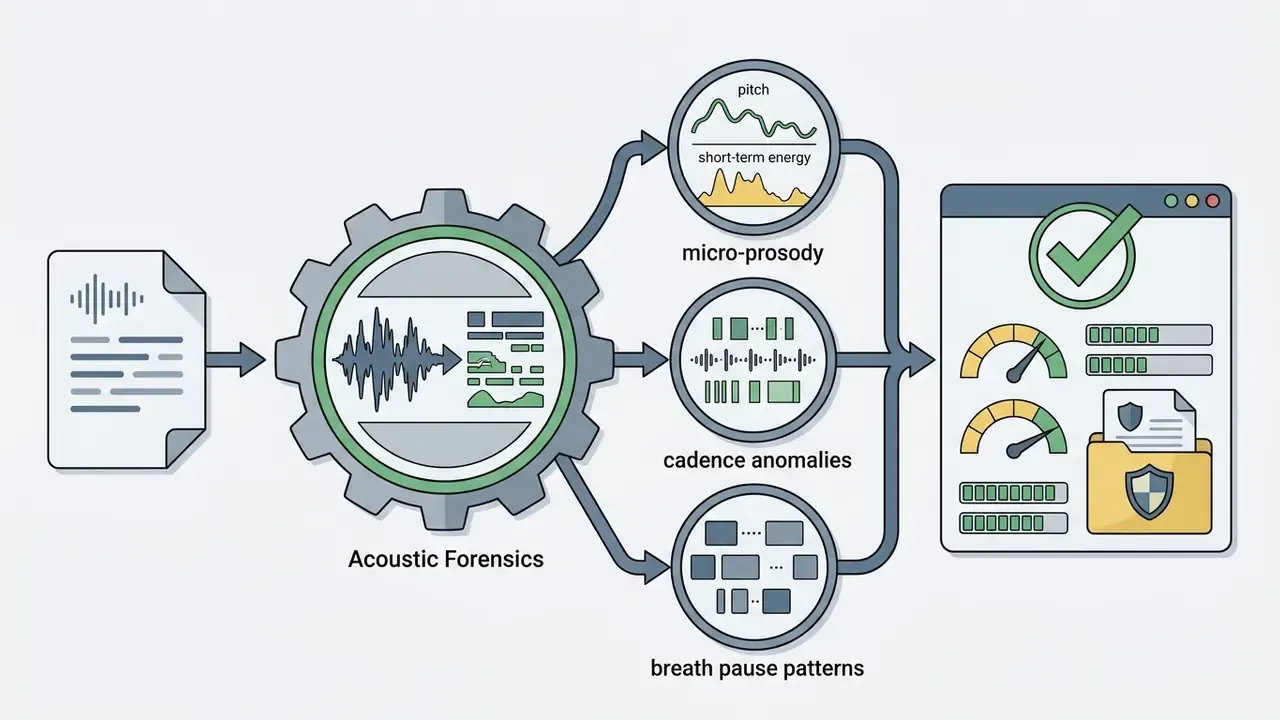
«Hany Farid's forensic analysis of a viral Trump video found that machine learning models "confidently classified the voice as AI-generated" based on cadence and intonation anomalies.»
How to Get More Convincing Lip Sync and AI Video
Better sync starts with better audio, deliberate pause placement, and avatar templates with a frontal face position.
Lip sync quality correlates directly with phoneme clarity. Modern audio-driven models align speech and articulation at phoneme level through audio cross-attention, so a quiet, dry recording without reverberation produces the most accurate mouth movement. Before you download the finished clip, check articulation against the audio in the AI video preview. If it drifts, change the duration reconciliation mode (sync mode) rather than regenerating the whole script. Small fix, large time saving.
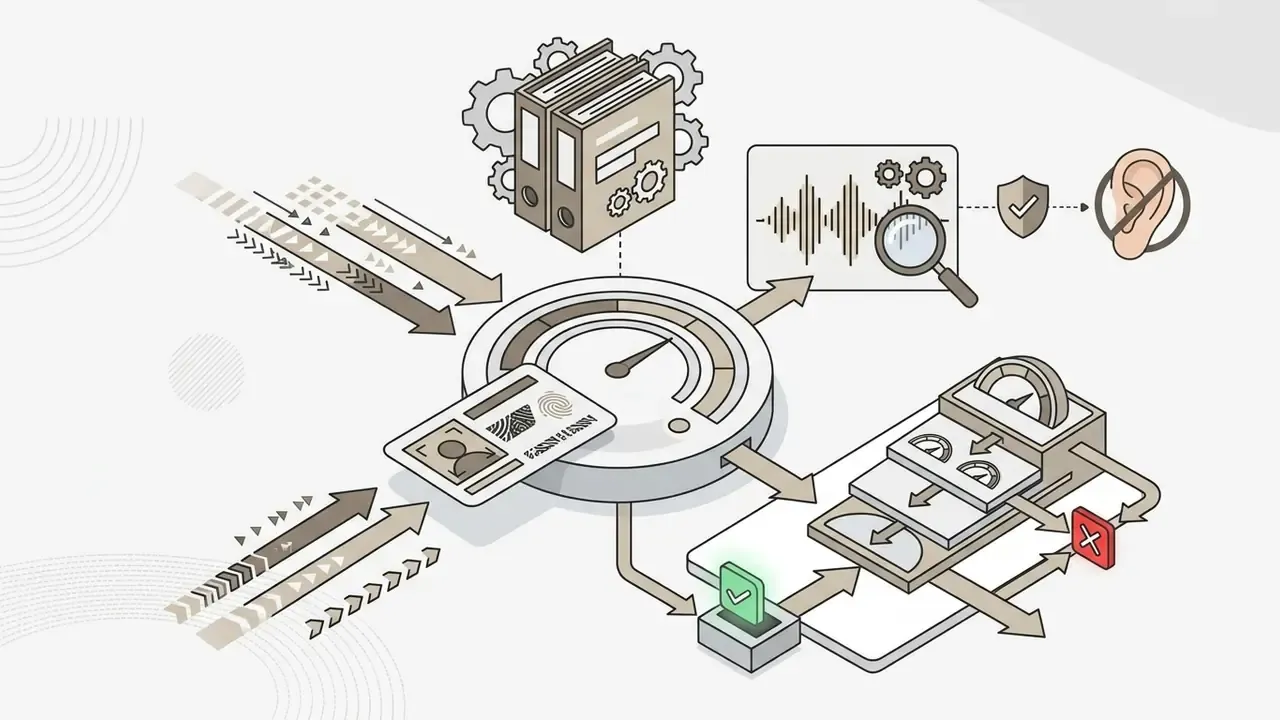
Detection and Validation Methods for MRM and Security Teams
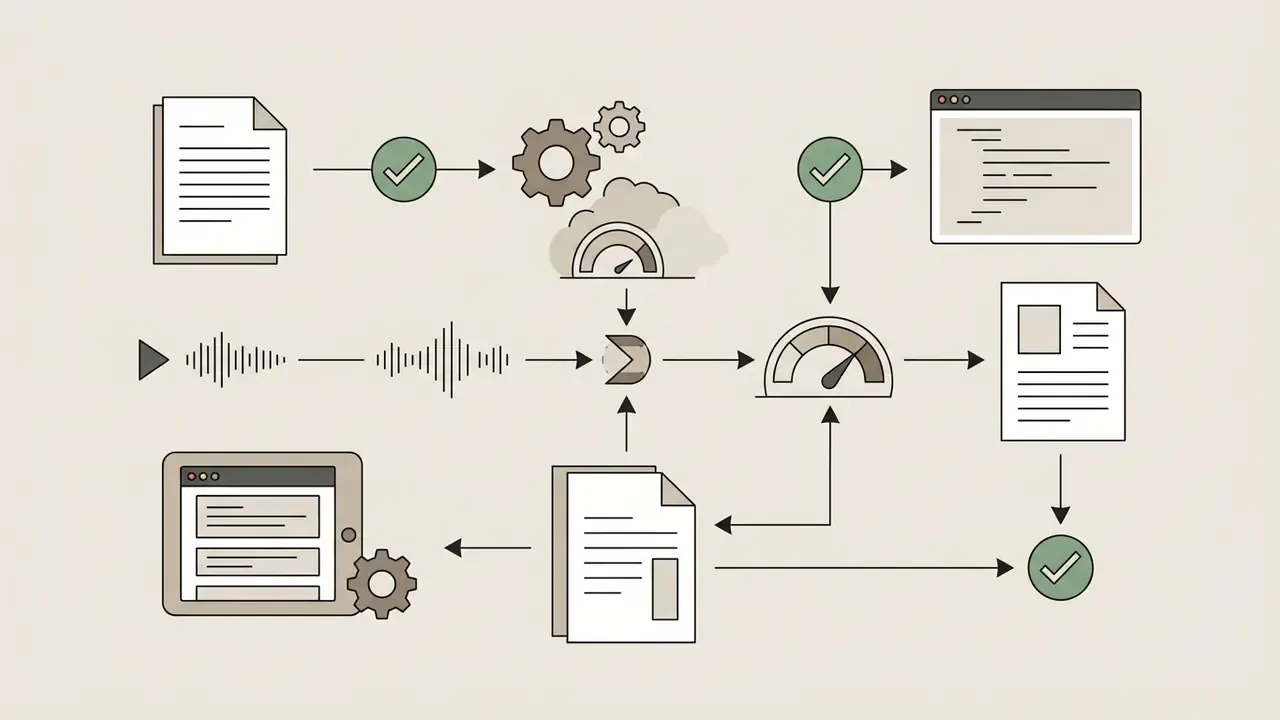
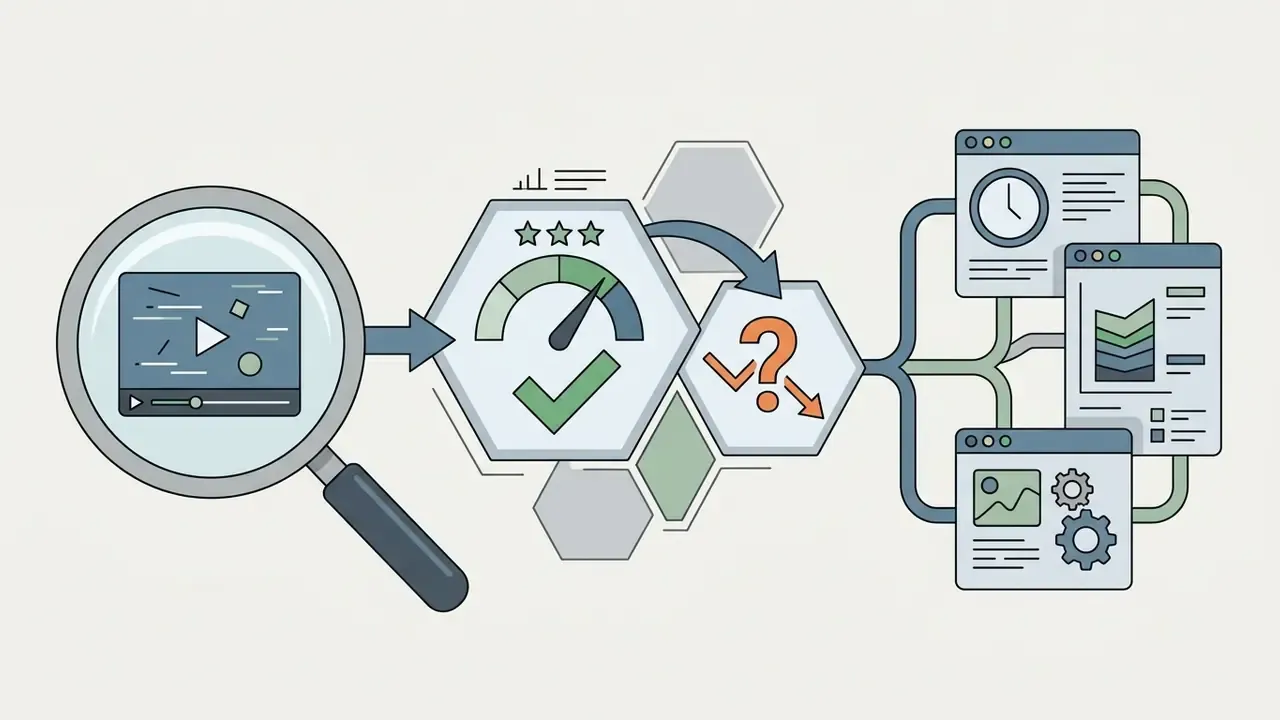
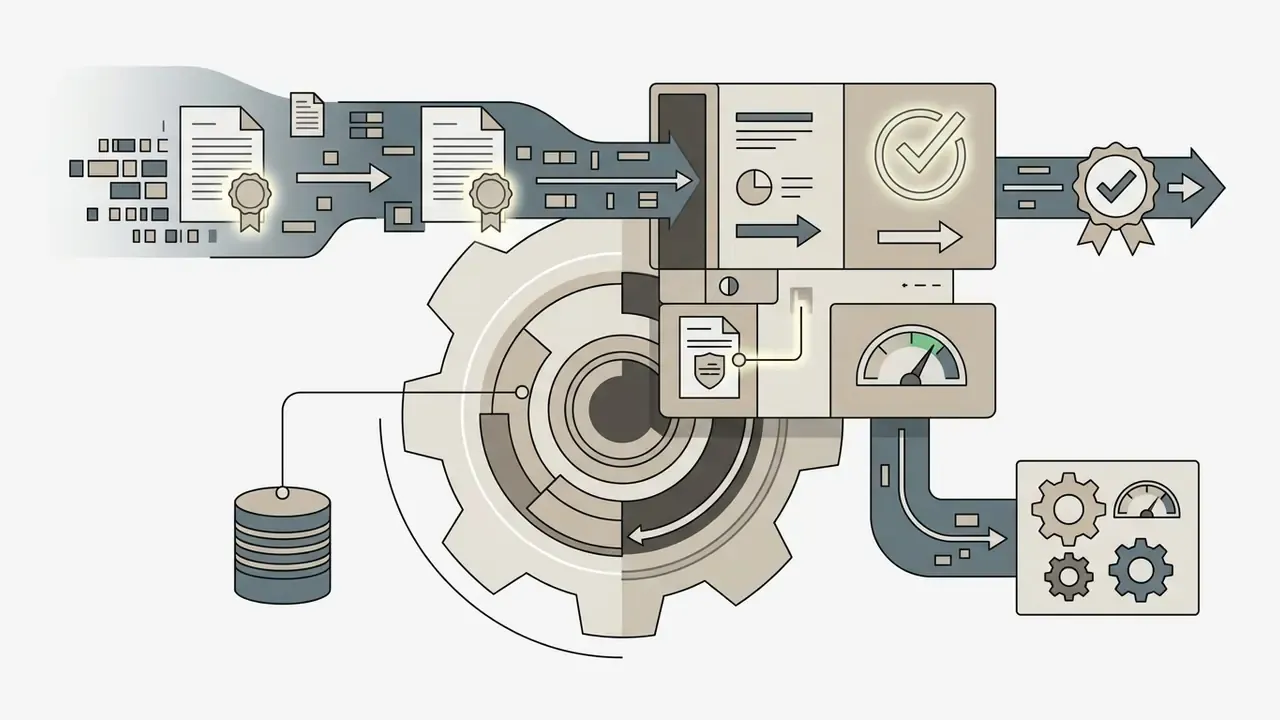
A separate practical question for model risk and security functions: how do you verify inbound audio or video algorithmically? A baseline toolkit looks like this.
Residual uncertainty stays high here. Detector performance drifts as generators improve, which is why provenance and procedure outrank any single model score.
Can You Use the Donald Trump AI Voice and Video Commercially
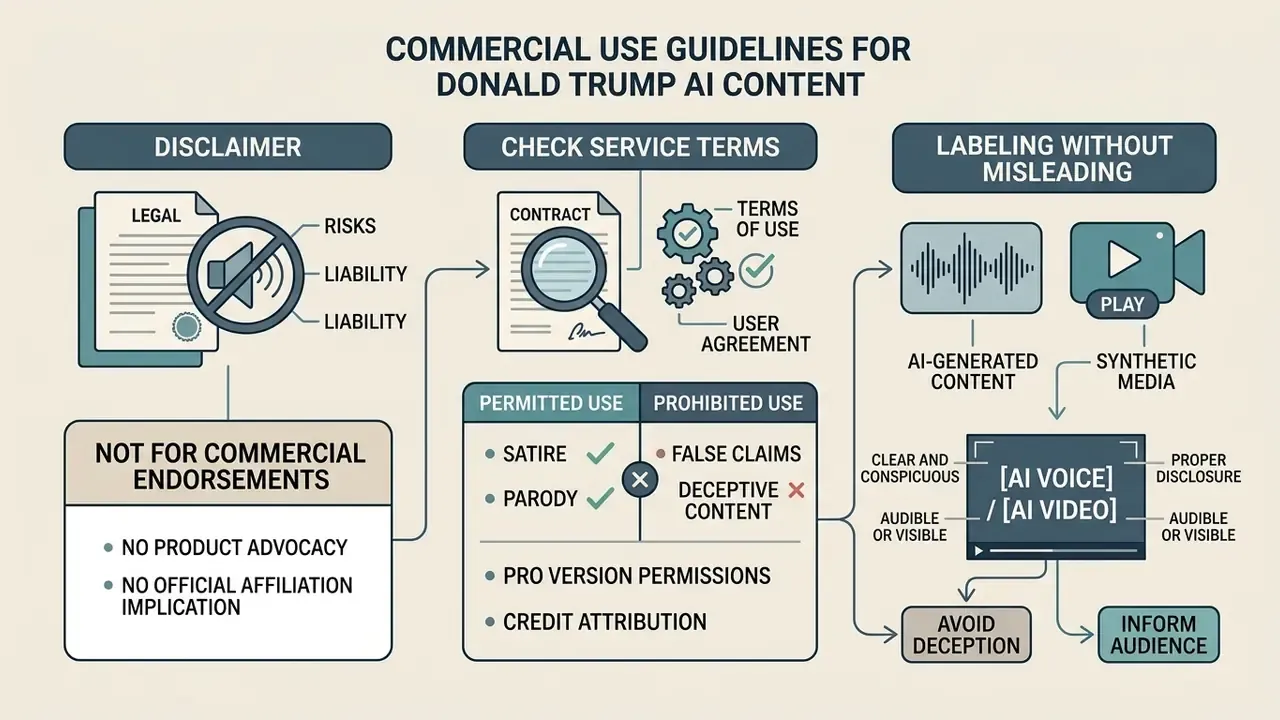
Commercial use of a generated Donald Trump voice or likeness without explicit consent is constrained by right of publicity law and platform policy, even on a paid subscription. If you want the technology context first, start with the overview of AI voice generators.
The answer to "Can I use this voice commercially?" or "Can I use it commercially?" depends on jurisdiction and on the nature of the use. US law, in particular state right of publicity statutes and the Tennessee ELVIS Act of 2024, protects the voice and name of well-known individuals against unauthorized use in commercial advertising and monetized products.
«According to the Congressional Research Service, 35 states recognize the right of publicity; Tennessee extended it to voice simulations and all forms of unauthorized distribution of digital replicas.»
There is no single federal right of publicity in the United States. The No AI FRAUD Act (H.R.6943) proposed a federal property right in likeness and voice, requiring written consent for digital replicas in advertising, but it was not enacted. A second layer of restriction concerns false implication of endorsement: the FTC treats the depiction of a well-known person's name, signature, or likeness as a testimonial, and presidential library materials record a prohibition on using a president's name and image in advertising in a way that suggests affiliation or support.
What to Check in the Service Terms Before Publishing
Read the Terms of Use of the specific generator before publication, with attention to copyright and to the commercial license covering generated media content.
Even when a donald trump ai voice and video generator grants a commercial license to the output, that license does not override third-party rights in a protected celebrity voice. Vendor wording varies radically in practice. Some explicitly permit commercial use on paid plans. Some restrict output to entertainment purposes. Others disclaim ownership of the result while assigning all third-party rights liability to the user. Read all three clauses, not just the marketing page.
«The Congressional Research Service notes that no federal law yet regulates AI in political campaigns specifically, although advertising attribution rules apply to AI content as well.»
Developers planning programmatic integration will find endpoint patterns and auth models in the AI Media API Guides.
How to Label an AI Recording Without Misleading the Audience
Synthetic content featuring public figures should carry an explicit disclaimer, for example "This video was created with AI".
Using an AI recording in political commentary or entertainment social media demands transparency. Labeling protects the author from account penalties and reduces exposure to legal claims. It also costs nothing, which makes skipping it hard to justify.
«Colorado law HB24-1147 requires political advertising to state explicitly: "This message has been edited and depicts speech or conduct that falsely appears to be authentic", with font and metadata requirements.»
Comparable duties apply elsewhere. Article 50 of the EU AI Act prescribes machine-readable marking of synthetic audio, images, video, and text, plus deepfake disclosure. Utah law (Utah Code 20A-11-1104, 2024) requires a notice such as "This video content generated by AI" to remain on screen throughout the synthetic segment. NASA, effective 15 September 2025, requires a persistent watermark and embedded metadata indicating that material is not authentic. The practical minimum for a creator: a text notice in the first script line, an on-screen caption, a disclaimer in the post description, and preserved provenance metadata on export. Litigation patterns around generated material are collected in AI Litigation and coverage.
FAQ about the Trump AI Generator
This section answers the recurring questions: generation time, server retention, data privacy, and operating system support.
Users most often ask How long does generation take?, How long are videos saved?, Is my content private?, Can I use the Trump voice on iPhone or Android?, and Can I use this voice on Windows and Mac?. Detailed answers follow.
How Long Does Generation Take and How Long Are Videos Saved
A 15 to 30 second clip typically renders in 30 seconds to 2 minutes, and finished files stay on the servers from a few hours up to 30 days depending on plan. The Generate & Download cycle depends on platform load. Free tiers queue longer, and files are deleted automatically after 7 to 30 days if you never export them. Some platforms warn honestly that long text can take several minutes or more than ten, and that it is easier to collect the result later from generation history than to sit on the page.
Is the Text, Audio, and Generated Content Private
Most privacy policies provide for automatic purging of user scripts and uploaded files within 24 to 48 hours as a privacy & security measure. Some vendors commit to a hard deletion window for prompts, images, and finished videos no later than 36 hours after creation. Processing generally follows recognized security standards. Services do not display private scripts publicly. Videos you publish yourself can still be indexed if privacy settings are left open, and on several platforms free-account output is public by default.
«An experiment by Lucas, Barari and Munger showed that deepfake video persuaded 42% of participants of fabricated scandals, the same share as text headlines (42%) and audio recordings (44%).» Lucas, Barari, Munger, Journal of Politics, summary by Washington University in St. Louis (2024). https://news.wustl.edu The practical conclusion is sober: video holds no magical persuasive advantage over text, and it is no less dangerous either. So privacy mode and labeling matter across every output format, audio included.
Can You Create and Save the Trump Voice on Phone and Desktop
Trump AI generators run as cross-platform web applications, accessible from a browser on iPhone, Android, Windows, and Mac, with no mobile app install required. You can start generation and use download from mobile devices (iOS, Android) and from desktops (Windows, Mac). Files save in standard MP3 and MP4 formats, ready for editing and publication. Supporting terminology lives in the AI Media Glossary.
Can You Use the Trump Voice in Discord and Games on Windows and Mac
Yes, but not through the web interface. You need a desktop client with a virtual microphone. Such apps usually support Windows 10 and newer, and Macs on Apple Silicon with macOS 14 and newer. After selecting the voice model in the client, set the virtual microphone as the input device in Discord, OBS, Zoom, TeamSpeak, or the game. Voice availability and credit consumption in live mode differ from offline synthesis, so verify both in the app before you start streaming.
What Remains Prohibited Even on a Paid Plan
Neither a commercial license nor the absence of a watermark grants you the right to present a generated statement as a real speech by a politician; to use the likeness in advertising that implies product endorsement; to use a synthetic voice to confirm identity, payments, or instructions; or to publish "breaking news" without labeling. Access to an AI voice creates neither endorsement nor commercial rights in a real person's image. That distinction is the whole legal argument in one sentence.
Appendix A. Log of Factual Clarifications
For fact-checking transparency, the original formulations that were revised in the main text are preserved below, together with the reason for each edit.
| Original formulation | Status | What appears in the main text |
|---|---|---|
| "(ReVoice IEEE Conference, 2024)" with no quote or method | Clarified | Direct quote describing the method, ReVoice, IEEE (2024) |
| "(OmniAvatar, 2025; AudioAvatar, CVPR 2026)" | Clarified | Description of talking-head metrics plus verifiable MISLnet research, Drexel University (2024) |
| "Engagement studies… (Journal of Media Research, 2025)" | Replaced | Checkable short-video engagement drivers and the IDJC, Syracuse University case (2024) |
| "donald trump's voice… perceived as real in 40 to 50% of cases" | Clarified | Model accuracy of 50% on Trump videos against 87.5% on Biden videos (PDD, 2024), and 69% for the DFDC winner |
| "Under the moderation rules of most social networks (Meta, TikTok), satirical content is allowed…" | Reformulated | Quoted Meta policy language on satire and manipulated media, plus TikTok labeling requirements for AI audio |
| "engagement rate grew by 34%" | Removed from factual claims | Case described without the unverifiable metric, with an A/B test recommendation |
| "Commercial use is strictly prohibited" (market phrasing) | Clarified | Software license separated from third-party likeness rights (right of publicity, ELVIS Act) |
Open Questions and a Safe Next Step
Some things remain genuinely unresolved, and pretending otherwise would be dishonest.
First, detector durability. Accuracy figures above 98% come from controlled datasets, and the 20 to 30% drop between image and video detection suggests those numbers will not survive the next generator release untouched. Second, federal rules. Without a national right of publicity, a US institution has to reconcile 35 state regimes plus EU AI Act duties for any cross-border campaign. Third, cost of control. Most ROI models for generative media still exclude review time, legal sign-off, and provenance tooling, which makes the business case look better than it is.
A conservative next step for a risk owner is small and cheap. Add every synthetic-media tool in use to the AI inventory, name one accountable owner per tool, prohibit sensitive data in prompts, and require provenance marking on output. Then run a single tabletop exercise on a voice-cloning fraud scenario and see whether your callback verification actually holds. If it does not, you have learned something useful before an attacker does.
For definitions, adjacent formats, and tool categories referenced throughout this article, see the AI Media Glossary.