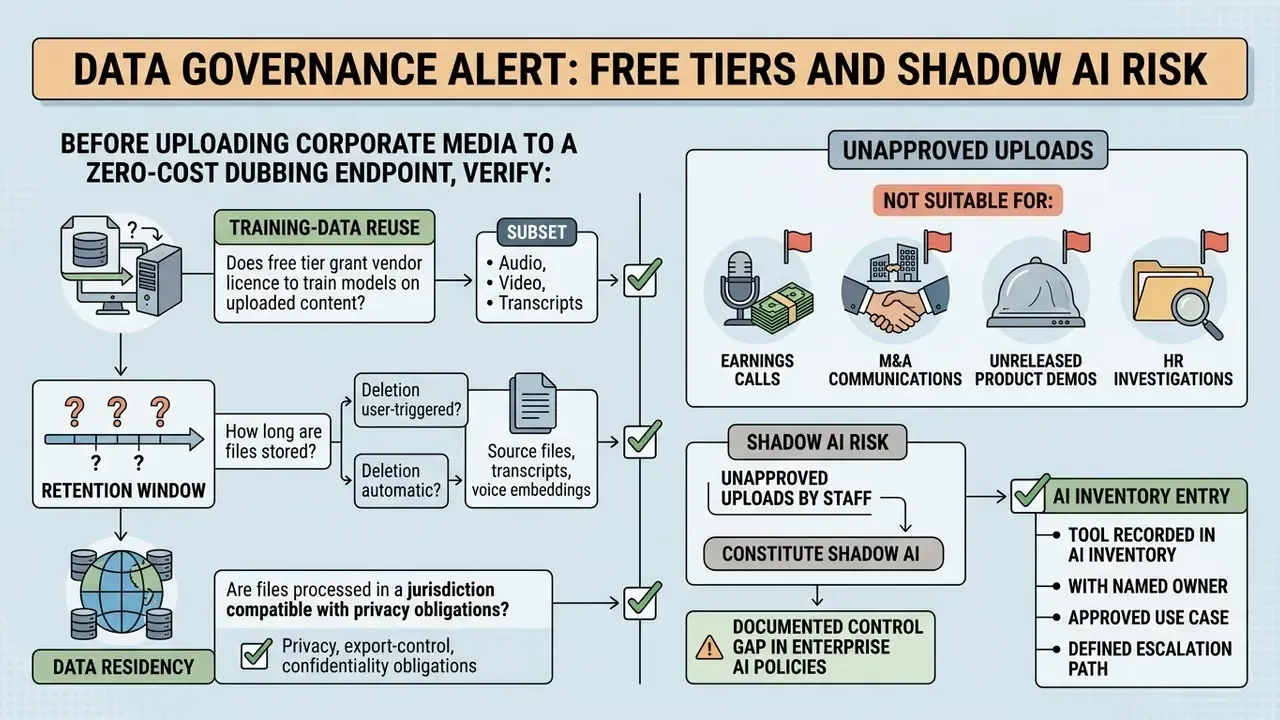
Why should a risk or compliance leader care about a consumer-grade dubbing tool? Because staff are already using them. A marketing associate uploading an unreleased product demo to a free endpoint is a governance event, not a productivity story. This guide covers both halves: how the technology actually works, and the controls that make it safe to ship.
Executive Summary
- What it is Free AI video dubbing replaces a video's original dialogue with synthesized target-language speech, aligning timing and on-screen articulation inside a browser. No studio, microphone, or voice actor required.
- Scale available in 2026 Leading platforms now cover up to 175+ languages and regional dialects, with voice libraries exceeding 850 pre-verified neural voices, and voice cloning available across 29 to 74 languages depending on the underlying model.
- What "free" really means Free tiers typically cap output at 1 to 3 minutes per video, export at 720p to 1080p with a watermark, and rarely grant documented commercial redistribution rights. Transcript review before rendering is usually free and consumes no credits.
- Two engine classes matter A Precision engine delivers context-aware translation plus frame-accurate lip sync; a Speed engine (and Audio-Only mode) trades neural re-rendering for throughput and lower credit consumption.
- Quality is measurable Semantic translation fidelity, vocal expressiveness, and audio-visual sync, the last of these quantified with LSE-D / LSE-C SyncNet-style metrics.
- Governance is non-negotiable EU AI Act Article 50 transparency and machine-readable labeling obligations for synthetic audio and video apply from 2 August 2026. Voice cloning of a real person requires informed, documented consent.
- Enterprise scaling Bulk dubbing via spreadsheet add-ins and dubbing APIs, plus multilingual smart players that auto-detect viewer locale, remove the file-by-file bottleneck.
Who This Guide Is For, and What Decision It Supports
This is written for two overlapping buyers. The first is a creator or marketing lead asking a narrow, practical question: can I dub this video today, for free, without wrecking the audio? The second is a governance owner in a bank or mature fintech asking a harder one: under what conditions may this tool touch our media at all?
Both questions share the same decision gate. You need to know the free-tier limits, the export rights, the quality thresholds you will accept, and the consent evidence you can produce on request. Everything below is organized around that gate. If you only read three blocks, read the free-tier governance alert, the engine selection table, and the commercial-use checklist.
One caveat up front. Vendor capability claims in this market change quarterly, and language counts are not standardized. Treat every number here as a figure to re-verify against current documentation for your specific locale before you commit budget.
What Is Free AI Video Dubbing Online?
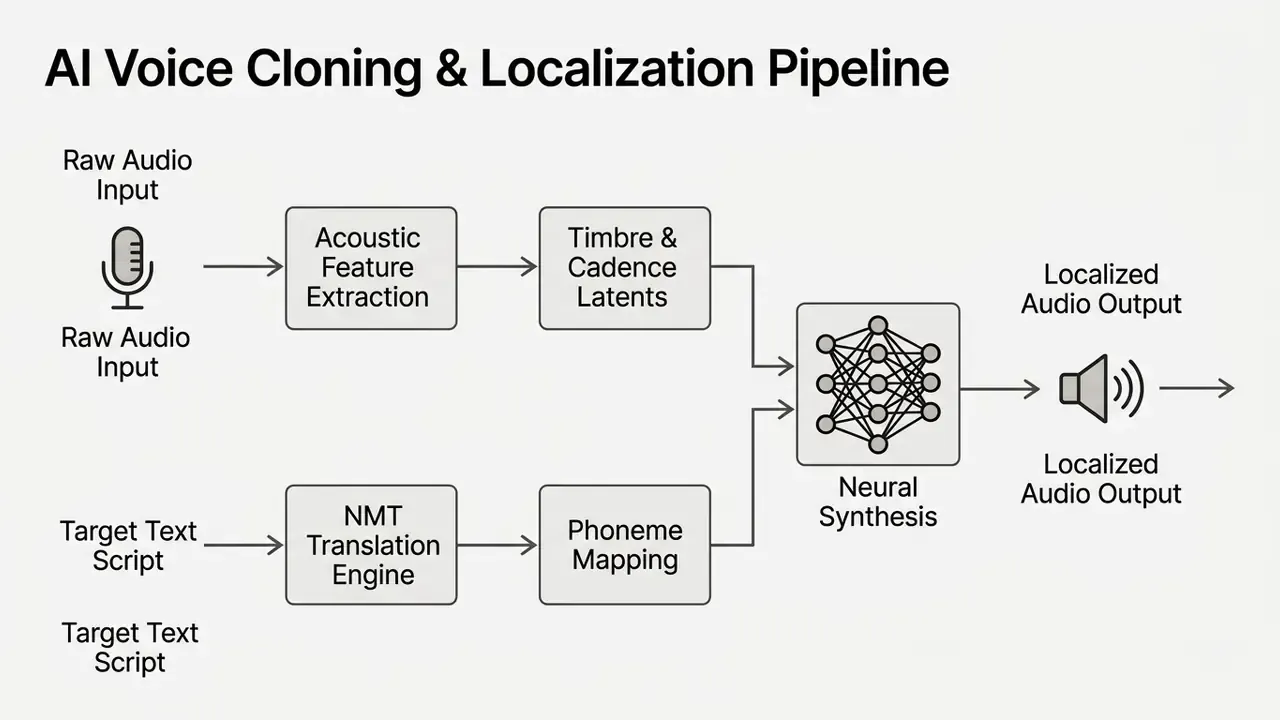
Free AI video dubbing online is an automated process that replaces or layers a video's original spoken dialogue with synthesized speech in a new target language while matching vocal timing and visual articulation. Unlike traditional manual re-voicing, modern AI video generation platforms use automated speech recognition (ASR), neural machine translation (NMT), and neural text-to-speech (TTS) to generate localized content directly inside a web browser.
Enterprise teams and digital creators run a video dubbing online free workflow to test cross-border audience engagement without upfront studio production costs. By combining neural speech generation with algorithmic video re-alignment, an ai video dubbing free online tool converts raw footage into multi-language video assets in minutes. Minutes, not weeks.
AI Dubbing, Voice Over and Video Translation
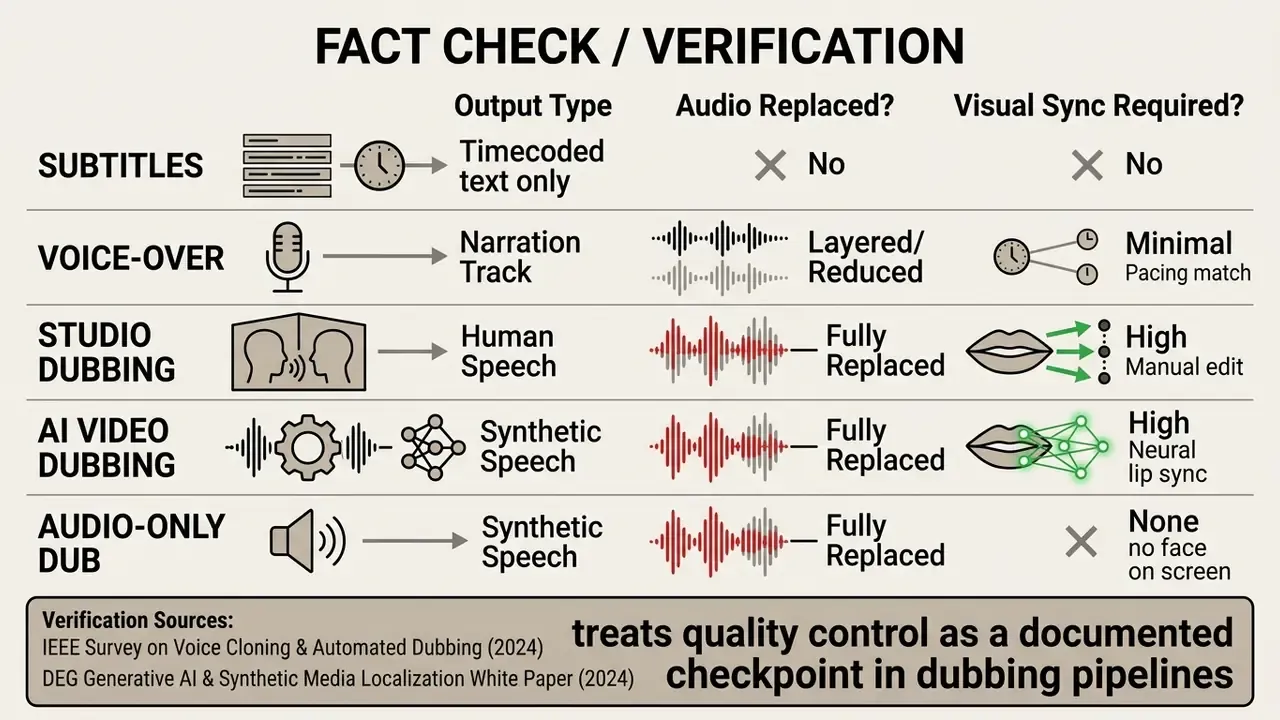
AI dubbing replaces the primary speech track with synthetic target-language audio. Voice-over layers narration over reduced original sound. Video translation is the end-to-end processing pipeline that contains both. A comprehensive video translator pipeline ingests source media, extracts speech, translates script text, and generates synthesized speech matching the cadence of the original speaker.
When creators dub audio over video online, they must distinguish between basic narration and full dialogue substitution. Voice-over retains background ambient sound and original dialogue at lower decibel levels. Automated audio dubbing substitutes dialogue entirely, which requires dynamic audio re-mixing to preserve natural background acoustics.
Academic revoicing literature treats dubbing as full dialogue-track replacement with lip-sync and timing adaptation. Vendor documentation uses "AI dubbing" to describe the automation pipeline that performs the same substitution. That is a difference of scope, not a contradiction, and it matters when you are reading a contract rather than a paper.
What "Free" Means in an AI Dubbing Tool
Free tiers in AI dubbing tools usually provide restricted access bounded by monthly minute caps, resolution constraints, mandatory vendor watermarks, and non-commercial licensing terms. Platforms advertise dubbing video online free loudly, yet zero-cost accounts typically limit rendering to 1 to 3 minutes per video and cap monthly generation credits.
Documented free-tier patterns across the 2026 market illustrate the range:
Free review-before-render phase. Leading platforms let users run speech-to-text transcription and review the target-language script completely free of charge, without consuming rendering credits. Correcting brand names, technical jargon, executive titles, and regulated terminology before pressing "Generate" prevents wasted credits on mispronounced output and eliminates a second render cycle. Treat this step as mandatory in any production workflow, not as an optional convenience. It is, honestly, the cheapest quality control available anywhere in the pipeline.
How to Dub a Video Online with AI
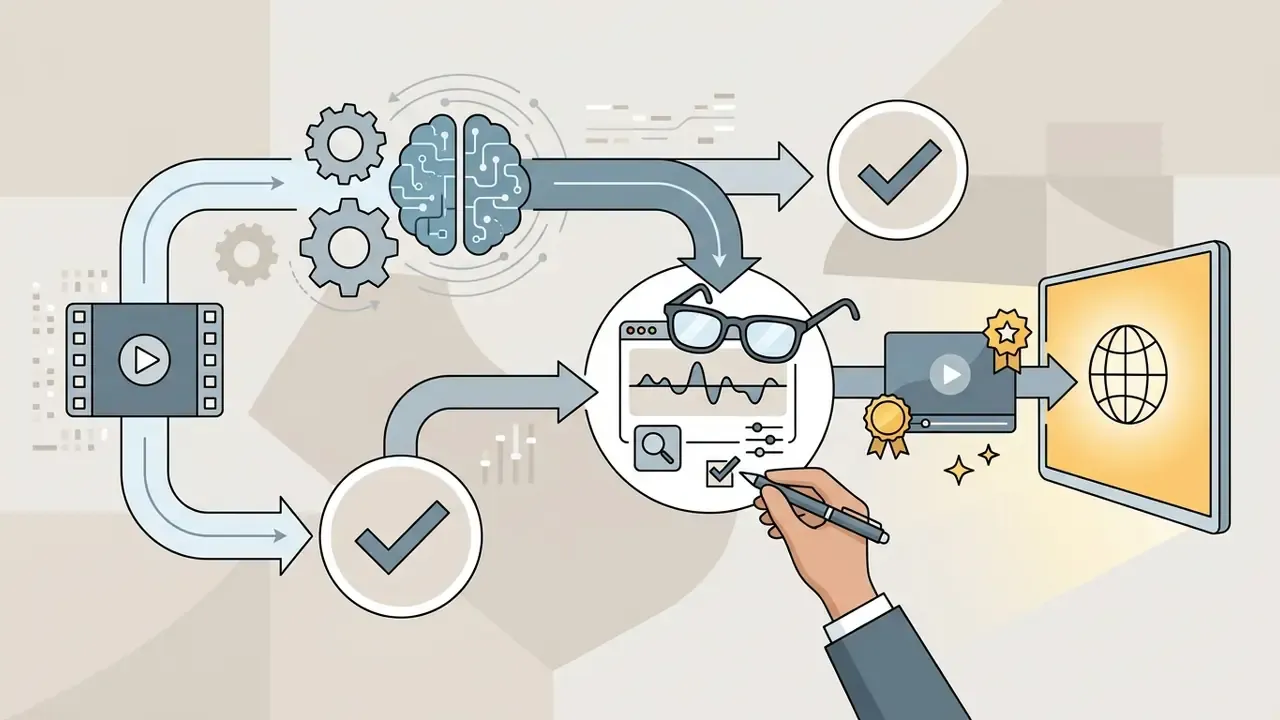
To dub a video online, users follow a six-stage digital pipeline: upload media, generate transcripts, select target languages and voices, compute lip synchronization, review output, export final files. Modern cloud platforms automate these steps to turn single-language videos into localized multi-lingual assets.
Using an ai to dub videos approach simplifies localization by replacing manual studio recording with algorithmic processing. Operators keep full editorial control, with manual adjustments to text transcripts, audio timing, and synthetic voice pitch available before rendering the final product.
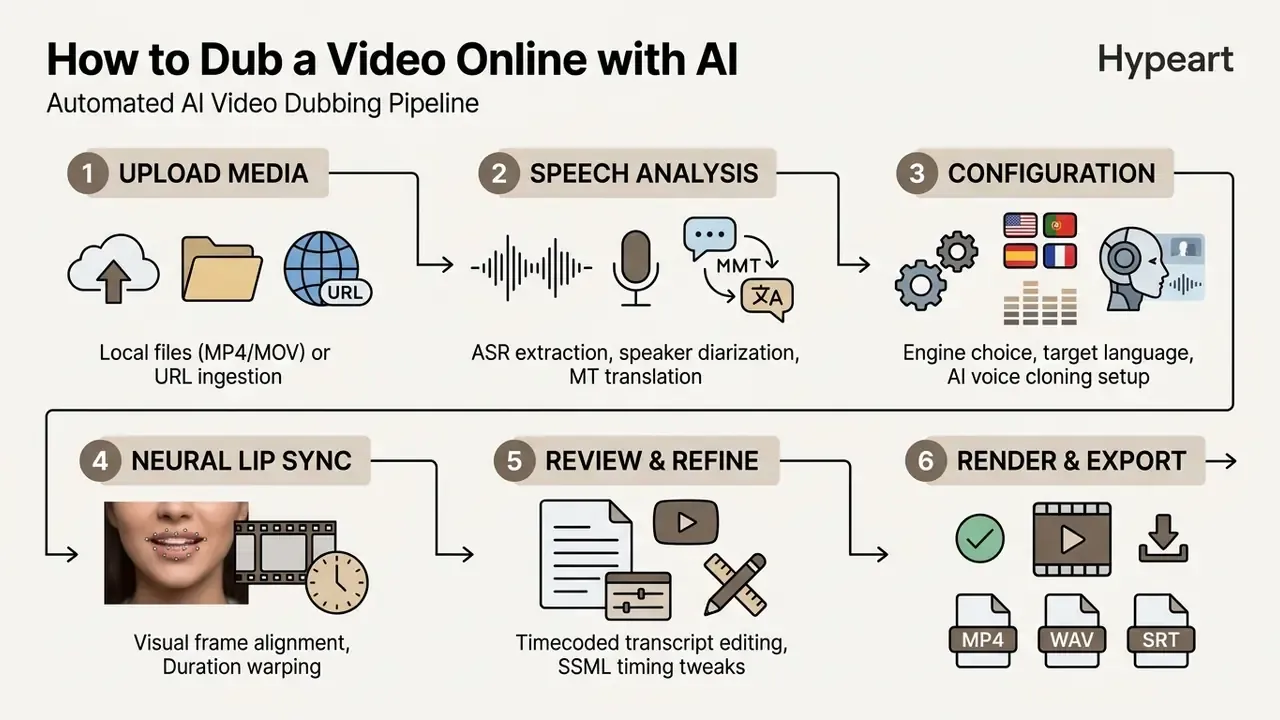
The same six steps written as a working checklist: (1) upload the source video or paste a supported link; (2) let the engine transcribe and translate, then read what it produced; (3) pick the target language, AI voice or cloned voice, and engine mode; (4) allow lip-sync computation if a face is on screen; (5) fine-tune wording, pauses, emotion tags, and per-line duration; (6) render and export MP4, WAV, and SRT together.
Choosing the Right Engine: Speed, Precision or Audio-Only
When configuring an automated workflow, mature platforms expose two or three distinct execution modes. Picking the wrong one is the single most common cause of both budget overrun and disappointing visual quality.
- Precision Neural Engine.Uses context-aware machine translation combined with frame-accurate lip synchronization and improved speaker and gender detection. Duration warping is applied so generated phonemes track on-screen articulation. Best suited to high-converting marketing ads, headshot interviews, executive communications, and customer-facing tutorials where visual alignment is critical.
- Speed Engine.Bypasses heavy neural video re-rendering to process transcripts substantially faster; vendors position this mode for "fast translations at scale." Ideal for high-volume enterprise localization backlogs, internal knowledge bases, and slide-driven presentations where the speaker is not the visual focus.
- Audio-Only Dubbing.If the source media contains no visible faces (screencasts, product walkthroughs, slide decks, podcasts, voice-over documentaries, archival audio), Audio-Only mode replaces the voice track without modifying the underlying video stream. This removes lip-sync computation entirely, cutting credit consumption and render latency.
| Decision Input | Precision Engine | Speed Engine | Audio-Only Mode |
|---|---|---|---|
| Visible speaking face | Required | Optional | Absent |
| Lip-sync computation | Frame-accurate neural | Limited / none | None |
| Relative credit cost | Highest | Moderate | Lowest |
| Typical render latency | Slowest | Up to several times faster | Fastest |
| Best-fit content | Ads, interviews, exec comms | Bulk catalogues, internal comms | Screencasts, podcasts, slides |
| Translation handling | Context-aware | Throughput-optimized | Context-aware (audio only) |
Upload Video and Prepare the Original Audio
Preparing source media means uploading high-fidelity video files with isolated, undistorted dialogue tracks to maximize automatic speech recognition accuracy. Source audio should maintain clear separation between speakers and minimal background acoustic interference, otherwise transcription errors propagate through every later stage.
Professional voice synthesis documentation recommends input dialogue recorded between -23 dB and -18 dB RMS with true peak levels capped at -3 dB, and explicitly warns against background music or noise in reference audio.
Three further preparation rules show up consistently across vendor and research documentation:
- One speaker per reference track. Overlapping voices degrade speaker identity and can produce hybrid, unrecognizable clones.
- Separate dialogue from music. Where speech is mixed with score or effects, run source separation before ingestion. Hums, clicks, echo, and reverb all depress ASR accuracy.
- Compress after, not before. Heavy pre-upload compression destroys the high-frequency detail that timbre modelling depends on. If file size is the constraint, use a purpose-built video compressor with a dialogue-preserving bitrate floor rather than a generic export preset.
When evaluating raw footage in an mp4 video editor, stripping background music and heavy room reverberation before ingestion noticeably improves downstream translation precision.
Internal pilot observation. During an enterprise localization pilot, a financial services communications team processed unedited webcasts with heavy ambient noise. In that internal, non-peer-reviewed measurement the automated system produced roughly a 14% word error rate during initial speech-to-text conversion. After inserting an audio cleanup stage to strip background acoustics and balance levels, the team reduced measured transcription errors to under 2%, which gave automated translation a clean foundation to work from. These figures are a single-team internal benchmark. Re-measure against your own corpus rather than treating them as an industry constant.
Choose a Target Language, AI Voice and Dubbing Settings
Configuring dubbing parameters involves specifying the target output language, selecting synthetic voices from a curated neural library, and adjusting speech rate dynamics. Modern ai dubbing tools for videos support granular controls, letting operators set speaking speeds between 0.1x and 3.0x, where 1.0 corresponds to average human speech.
Selecting an appropriate ai voice generator means matching the tone, demographic profile, and pacing of the original speaker. Advanced platforms accept SSML markup tags such as <sil[t]>, allowing precise pause insertions up to 7,000 milliseconds to maintain natural speech rhythms across localized language tracks.
Fine-Tuning Voice Emotion and Line Pacing
Beyond basic speed controls, professional localization workflows need line-level expressive control. Two mechanisms do most of the work:
- Emotional style injections. Intersperse emotional prompt tags directly within the script:
[Whispering]for confidential asides,[Authoritative]for compliance and policy statements,[Excited]for product launches,[Calm]for wellbeing or onboarding content,[Energetic]for coaching and fitness,[Mysterious]for narrative openers. These shift vocal resonance without swapping the AI voice or re-cloning the speaker. Tags are interpreted per segment, so one monologue can move from measured to urgent and back. - Temporal line stretching and compression. If a target-language translation runs materially longer than the source (German and Finnish frequently expand against English; Spanish expands against Japanese), the audio editor lets operators stretch or compress specific phrases without pitch distortion. That maintains natural dialogue cadence and prevents the video freeze-frames or abrupt duration padding that betray automated dubbing. Research on prosodic phrase alignment formalizes exactly this operation, mapping source phrase durations onto target phrases and applying a bending ratio to phonemes and pauses.
| Control Layer | Mechanism | Typical Range / Syntax | Governance Note |
|---|---|---|---|
| Global rate | Speaking-speed multiplier | 0.1x to 3.0x (1.0 default) | Log final value per asset for reproducibility |
| Pause insertion | SSML silence tag | <sil[t]> up to 7,000 ms | Use for legal disclaimers and breath points |
| Emotion | Inline style tags | [Whispering], [Authoritative], [Excited] | Avoid affect that misrepresents regulated claims |
| Line duration | Stretch / compress per phrase | Per-segment, pitch-preserved | Prevents freeze-frames on expansion languages |
| Pronunciation | Custom spelling / lexicon override | Per-term dictionary entry | Mandatory for brand and ticker names |
Review, Fine Tune and Export the Dubbed Video
Reviewing localized video means verifying line-by-line translation fidelity, adjusting timecodes, applying custom pronunciation rules for proprietary terms, and rendering final output files. Editorial review is what prevents awkward phrasing, mispronounced brand names, and visual drift between audio cues and mouth movements.
A disciplined review pass compares original and translated text inside each timecoded segment, then checks claims, numbers, units, dates, and pronunciation before approval. Map subtitles to source timecode rather than to the dubbed track; this prevents cumulative drift during long-form export. Flag names, brand terms, acronyms, tickers, and place names in advance so a pronunciation decision is made once and applied globally.
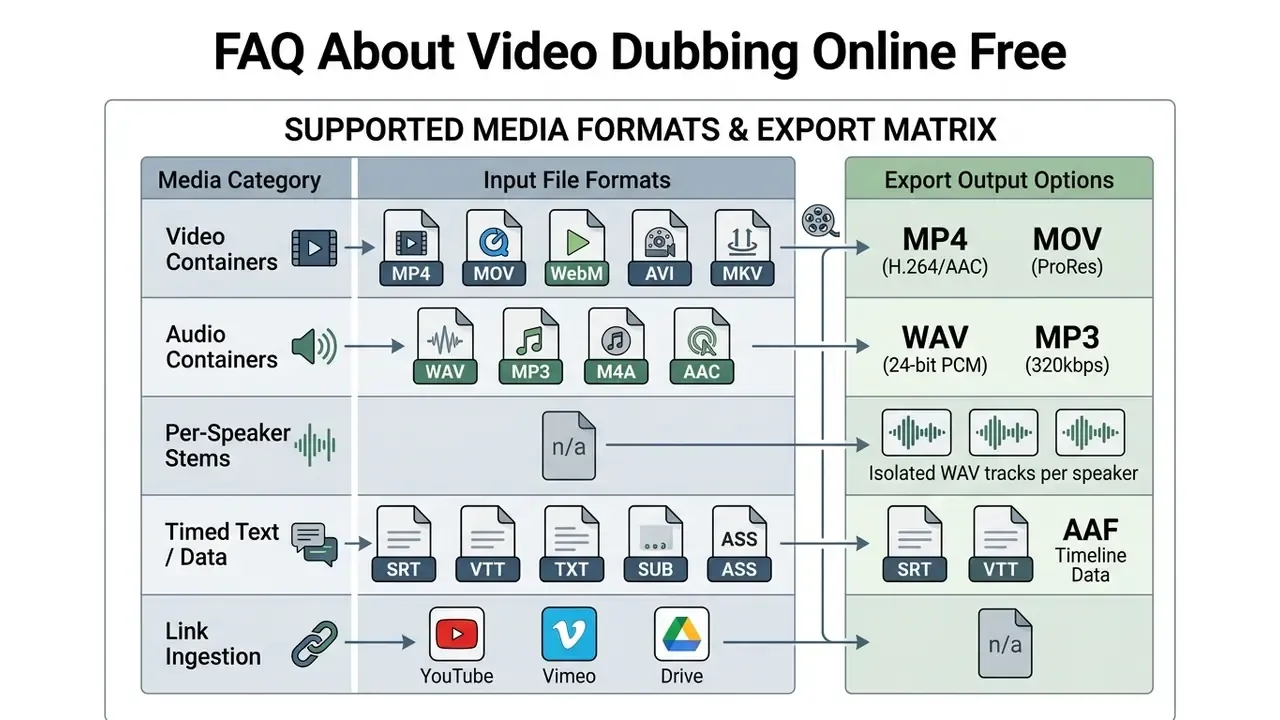
Once fine-tuning is complete, platforms generate downloadable localized media packages. Standard export options include composite MP4 video files, standalone WAV or MP3 audio tracks, AAF timeline data for downstream editorial, isolated per-speaker WAV stems, and timecoded SRT or VTT subtitle files for multi-channel distribution.
One practical habit worth adopting: record who approved each language version, and when. Reviewer sign-off is the evidence artifact an internal audit will ask for, and reconstructing it later is painful.
Languages, AI Voices and Voice Cloning for Video Dubbing
Modern automated video dubbing platforms support over 175 global languages and regional dialects, paired with libraries exceeding 850 pre-verified neural voices and instant voice cloning capabilities. Published vendor figures in 2026 range from 125+ languages with 850+ AI voices, to 140+ languages and accents, to 175 or 177+ languages and dialects. These technologies let media creators and enterprise teams scale localized video production across diverse international markets.
Using an ai dubbing generator removes the logistical overhead of booking international voice actors and recording studios. Content managers render localized versions of a single video asset across major world languages while keeping brand voice consistency intact.
Language counts are not directly comparable across vendors, because some enumerate dialects and locales separately while others count base languages only. One official model card reports 15 languages across 18 locales. A major synthesis provider documents 74 languages for its newest model, 32 for its low-latency model, and 29 for its established multilingual model. Always verify that your specific target locale, not merely the parent language, is supported before committing a campaign.
Dubbing Videos into Different Languages
Localizing video content for global markets requires adapting scripts to regional linguistic expectations, dialects, and cultural norms. Major European markets, including Spanish, French, and German speaking regions, show strong audience preference for dubbed audio tracks over plain text subtitles. Industry material describes dubbing as the expected market norm in France and Germany rather than an optional enhancement.
Academic analysis of human English to German and English to Spanish dubbing shows that production practice is built around segmenting dialogue by line length, synchronizing to picture, and respecting hard timing constraints. Those are precisely the constraints automated pipelines must now replicate. Industry white papers describe the full chain as transcription, translation, dubbing script, casting, recording, and quality control.
Large-scale speech research projects demonstrate that multi-lingual speech models can map timing and semantic meaning across distinct language families with usable accuracy.
Whether you are adapting marketing campaigns for Latin America or technical training for Europe, automated tools deliver consistent output across target locales, provided the locale (not merely the language) has been verified first.
Voice Library, Own Voice and AI Voice Cloning
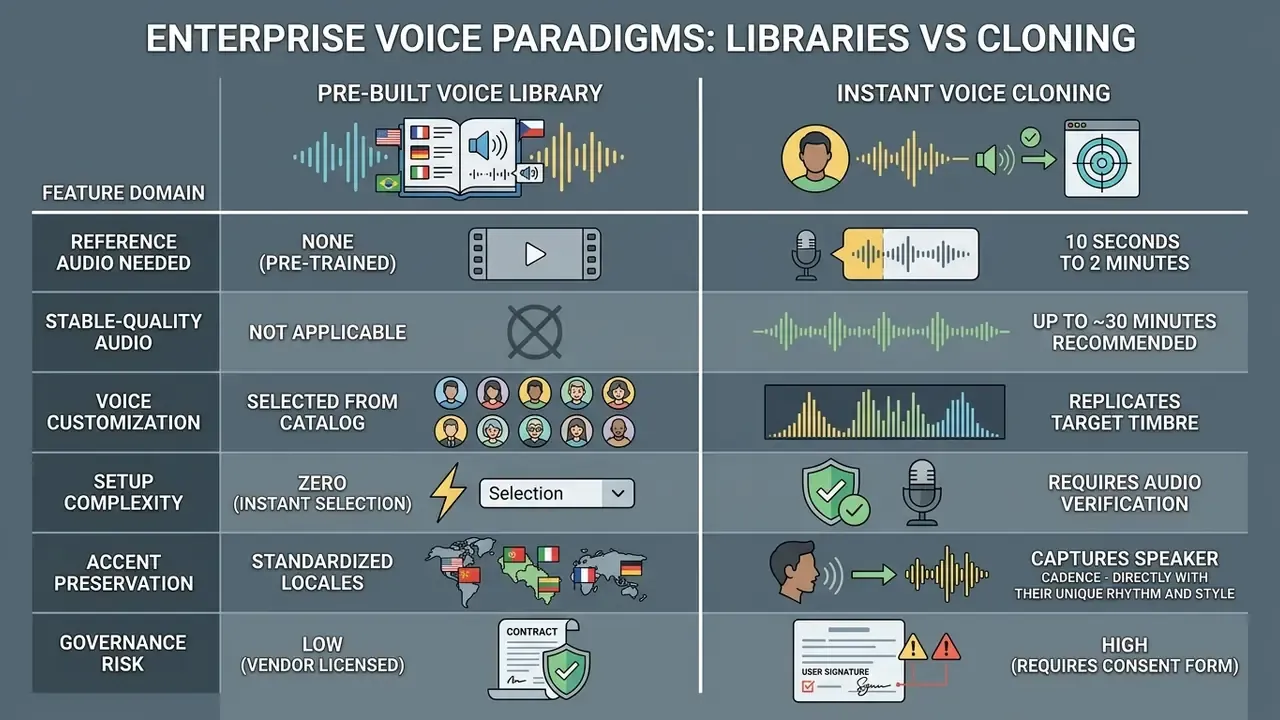
Voice cloning technologies analyze short audio reference clips, ranging from 10 seconds to 2 minutes, to synthesize new speech matching the original speaker's timbre. For more stable, production-grade clones, vendor guidance recommends substantially more material; one provider suggests roughly 30 minutes of high-quality recordings, while academic work has produced usable clones from about four minutes per speaker. The payoff is that creators can publish localized videos in their own recognizable voice across foreign languages.
Accent fidelity is measured separately from overall voice similarity. Research on accent bias in synthetic speech evaluates reproduction using a dedicated Accent Mimicry Accuracy score, confirming that a clone can sound like the right person while still flattening the regional accent that identifies them.
When custom voice models are unnecessary, operators select pre-verified acoustic profiles from standard voice libraries. For organizations managing background narration, pre-trained synthetic options avoid the legal and consent verification workflows that digital voice replication demands. That is a meaningful reduction in compliance surface area for high-volume, low-stakes content, and often the right default for internal material.
What Determines AI Dubbing Quality?
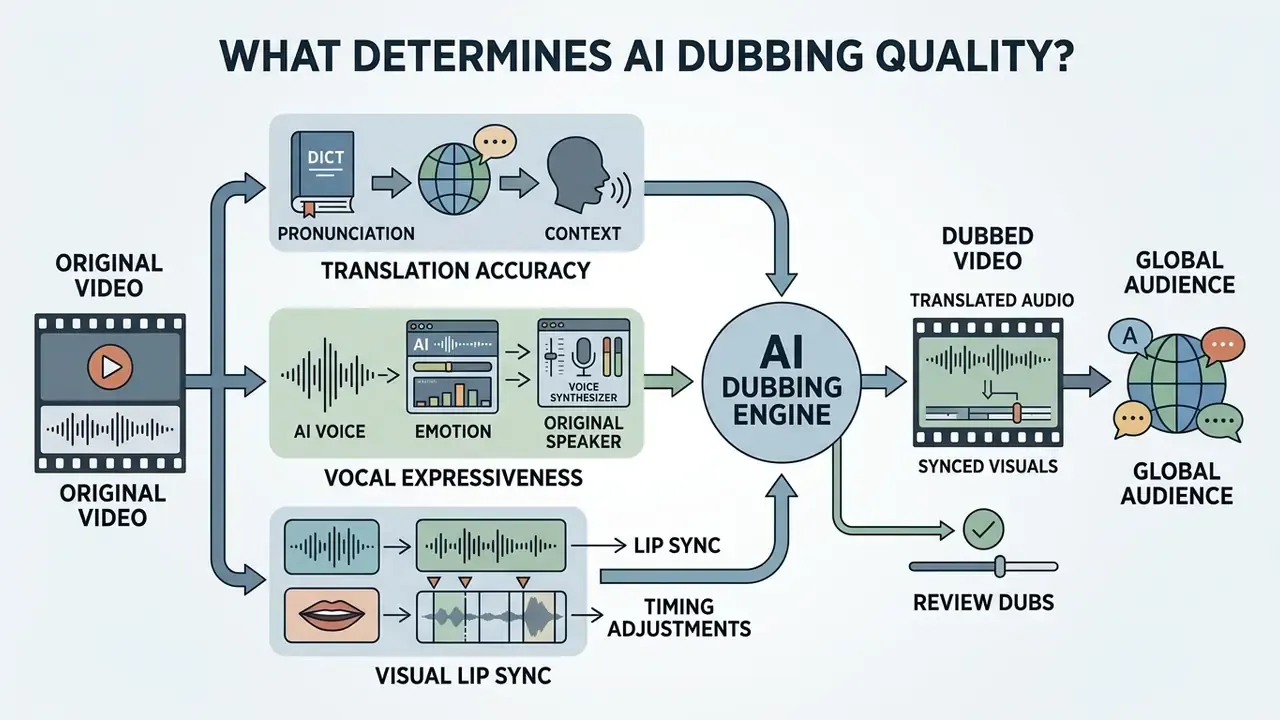
AI dubbing quality rests on three technical factors: semantic translation accuracy, vocal emotional expressiveness, and precise visual lip synchronization. High-performing systems balance linguistic nuance with acoustic realism so localized media feels natural to native speakers.
Evaluating an ai dub videos workflow means auditing neural translation outputs alongside visual frame alignment metrics. Deficits in any single domain, such as monotone vocal delivery or misaligned mouth movements, degrade viewer comprehension and immersion. Notably, a large-scale 2026 dubbing study found that translation quality and vocal naturalness mattered more to localization outcomes than isometric length constraints or strict lip-sync constraints. Which argues against optimizing sync at the expense of meaning.
| Quality Layer | Primary Metric Family | Direction | Practical Validation Step |
|---|---|---|---|
| Transcription | Word Error Rate (WER) | Lower is better | Spot-check named entities and numerals |
| Translation | Meaning preservation / semantic scores | Higher is better | Bilingual reviewer, sentence-by-sentence |
| Voice naturalness | MOS, DNSMOS, UTMOS | Higher is better | Blind listening panel of native speakers |
| Emotion transfer | emoSIM (emotion similarity) | Higher is better | Compare affect against source segment |
| Lip sync | LSE-D / LSE-C (SyncNet-style) | LSE-D lower, LSE-C higher | Frame-step review of close-up shots |
Translation Accuracy, Pronunciation and Context
Translation accuracy relies on contextual machine translation models that can handle specialized industry jargon, colloquial expressions, and localized grammar rules. Literal translation frequently fails on complex business concepts, legal terminology, or culturally specific idioms.
To hold context across multi-lingual content, enterprise workflows integrate custom dictionaries, brand glossaries, and pronunciation override rules.
Federal translation guidance converges on four repeatable controls: build a glossary, use specialized dictionaries and usage guides, compare the draft to the source sentence by sentence, and route the output to a second reviewer. Procurement guidance is equally explicit that unsupervised machine translation is the wrong tool for certain linguistic categories.
Practical corollaries: supply a context statement naming the purpose and audience before translation begins; use a bilingual proofreader for consistency, grammar, spelling, punctuation, and formatting; and treat "faithful to meaning and audience" as the accuracy standard rather than word-for-word equivalence. Together these steps form the human-in-the-loop layer that no current automated pipeline replaces.
AI Voice, Emotion and the Original Speaker
Preserving emotional resonance requires neural speech models able to transfer timbre, prosody, and vocal intensity from the source speaker into the target language. Advanced multimodal models separate linguistic tokens from speaker identity markers, so synthesized voices can reflect excitement, seriousness, or empathy.
Expressive speech-to-speech translation benchmarks now score emotion category, emotion intensity, and subtle attitude separately from text accuracy. That is evidence that "does it sound like them" and "does it feel like them" are distinct engineering problems. Cascaded systems can carry paralinguistic features such as emotion, intonation, and speaking style alongside content, though current literature presents this as a targeted architectural capability rather than a solved guarantee.
Recent empirical research indicates that voice cloning functions primarily as an acoustic style transfer process, introducing subtle vocal standardization across localized media assets.
The governance implication is direct. A cloned executive voice may sound more credible than the executive. For regulated communications, that perceived-authority uplift is a disclosure consideration, not a feature.
Lip Sync and Timing Adjustments
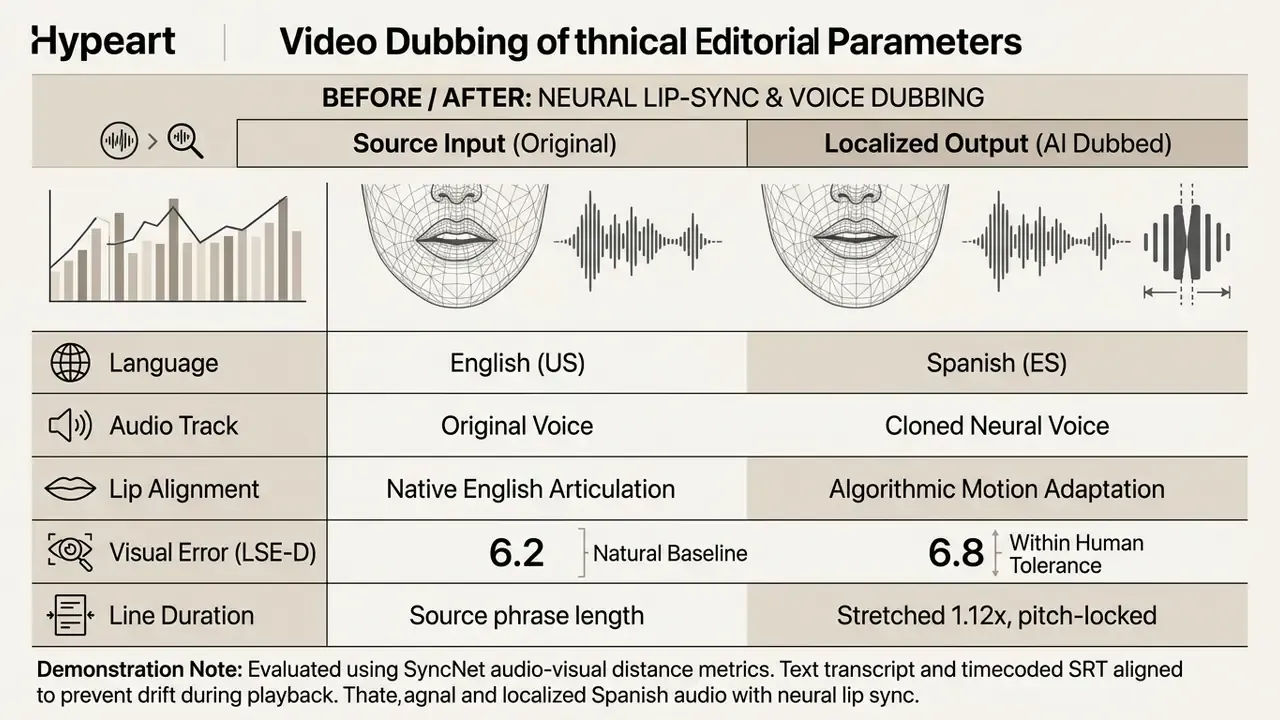
Realistic visual dubbing needs dynamic temporal alignment to synchronize generated speech phonemes with on-screen lip movements. Because word lengths vary significantly between languages, systems apply duration warping and neural video re-rendering to prevent visual mismatch.
Advanced models use audio-visual alignment metrics such as Lip Sync Error Distance (LSE-D) and Lip Sync Error Confidence (LSE-C) to measure frame-accurate synchronization. LSE-D is lower-is-better, LSE-C is higher-is-better; both derive from SyncNet-style audio-visual embedding distances.
Two distinct technical generations now coexist. Older alignment work warps the audio signal to match existing lip motion. Newer dubbing systems control phoneme duration before synthesis.
For teams with limited reference footage, data-efficient rendering has narrowed the gap considerably.
Detection research offers a useful sanity check on where sync failures become visible: authentic videos have been measured at a median normalized Levenshtein distance of 0.26 versus 0.69 for lip-sync manipulated video, with clean separation on full-length clips. In practice, review close-up shots frame by frame and accept wider tolerance on medium and wide shots.
Free AI Dubbing vs Paid Tools for Commercial Use
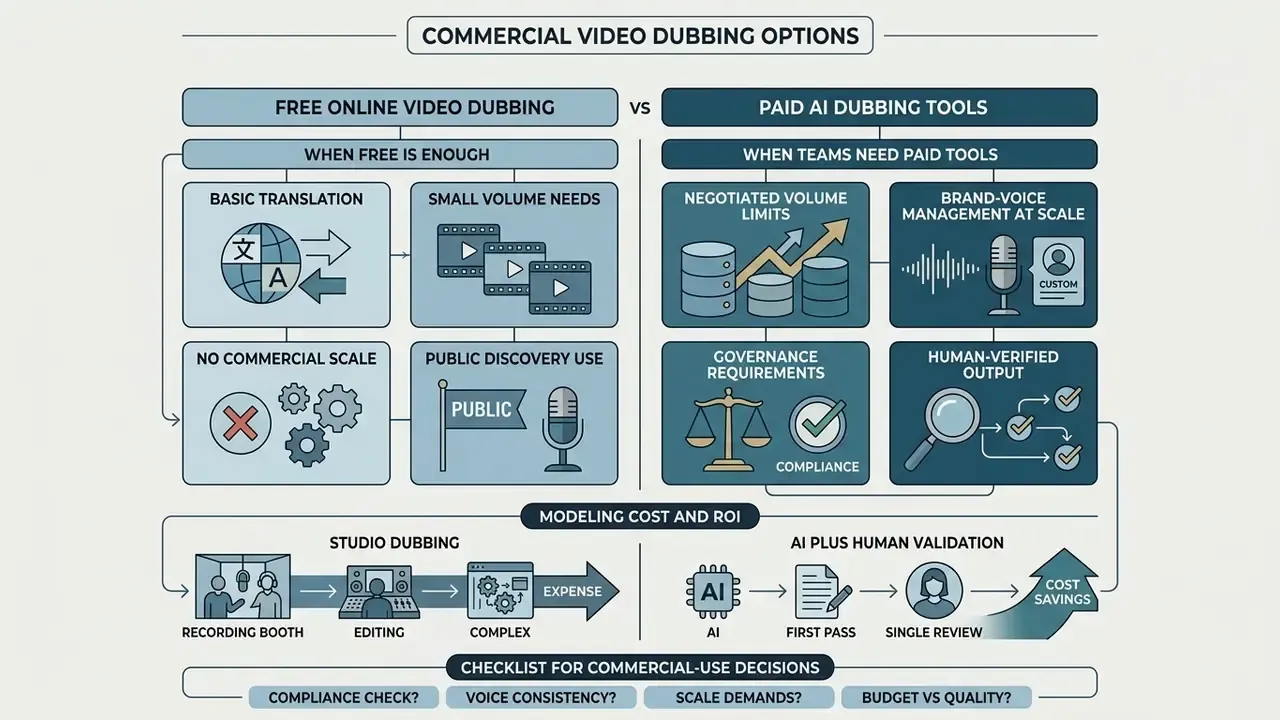
Choosing between zero-cost dubbing tools and paid enterprise platforms depends on required volume, export permissions, quality control, and legal compliance needs. Free platforms serve initial testing well. Enterprise operations need dedicated governance features. Buyers benchmarking adjacent tooling often start with a structured comparison of AI video generators before narrowing to dubbing-specific vendors.
Organizations evaluating commercial deployment consult dedicated reference resources, such as the AI Media Commercial-Use Hub, to review operational models. Reviewing platform trade-offs helps teams select tools aligned with their risk appetite and production requirements.
| Evaluation Feature | Free AI Dubbing Services | Paid Professional Platforms |
|---|---|---|
| Monthly Usage Quotas | 1 to 3 minutes per month | Unlimited or tiered credit packages |
| Export Video Quality | 720p to 1080p with platform watermark | 1080p / 4K clean un-watermarked exports |
| Language Coverage | 5 to 29 standard languages | 80 to 175+ languages and regional dialects |
| Voice Library Depth | Generic presets | 850+ pre-verified neural voices |
| Engine Selection | Single default pipeline | Speed / Precision / Audio-Only modes |
| Neural Lip Sync | Basic, unavailable, or enterprise-gated | Frame-accurate neural rendering |
| Emotion & Pacing Control | None or global speed only | Inline emotion tags, per-line stretch/compress |
| Voice Cloning Access | Restricted or generic presets | Custom voice cloning & API access |
| Bulk / Batch Processing | Manual, one file at a time | Spreadsheet add-in, dubbing API, bulk import |
| Distribution | Local MP4 download | Multilingual smart player, embed code, CDN |
| Commercial Usage Rights | Unclear / non-commercial tier | Full commercial licensing & indemnification |
| Audit & Governance | No audit trail or controls | SSO, RBAC, data residency, SOC 2 compliance |
Read the table as a decision, not a feature list. If your work is short, self-owned, and internal, the free column is sufficient. If output is monetized, client-facing, or regulated, the paid column is the only one that survives a rights review.
Vendor documentation reinforces the split. Paid tiers publish explicit commercial grants: one platform states paid plans include dubbing in 80+ languages, voice cloning, lip-synced output, and watermark-free exports with full commercial usage rights; another states 150+ languages with full commercial rights for monetized YouTube, ads, client work, and course sales. Conversely, at least one major creative suite restricts lip sync to select enterprise plans only, and several free-tier pages that advertise commercial use still tie it to trial quotas rather than unrestricted production volume.
When Free Online Video Dubbing Is Enough
Free online video dubbing tools cover short, self-owned, informational video projects where the goal is basic cross-language access rather than broadcast-grade localization. Creators testing new audience markets or localizing personal video logs get rapid automated translation with no financial commitment.
Content types where free tiers are genuinely adequate include product demos, marketing clips, short training clips, software tutorials, policy explainers, public lectures, and explainer videos paired with a transcript. Where visual instruction already carries the meaning, a translated spoken track plus subtitles extends reach effectively.
One important boundary. Translation dubbing is not an accessibility substitute. Dubbing conveys speech in another language; WCAG-style captioning additionally requires non-speech audio description and speaker identification. Teams with statutory accessibility obligations must produce captions as a separate deliverable rather than assuming dubbed audio satisfies the requirement.
For internal video prototyping, educational explainers, or informal media trials, free tiers let teams verify language accuracy before committing capital. When videos need simple background music, creators pair free dubbing tools with a music maker online free no sign up utility.
When Teams Need Paid AI Dubbing Tools
Enterprise media teams need paid platforms to support high-volume localization, programmatic API access, customized brand voices, and strict data governance. Professional workflows demand un-watermarked high-definition exports, multi-track audio downloads, and line-by-line timing adjustments.
Four criteria reliably trigger the upgrade decision:
Organizations scaling global video distribution integrate automated dubbing APIs directly into content management systems. Developer teams benchmarking generation and localization endpoints frequently review video model API economics in parallel. For comparative analysis of vendor tiering structures, enterprise buyers reference AI Media Pricing Guides and AI Media Comparison Matrices during software selection.
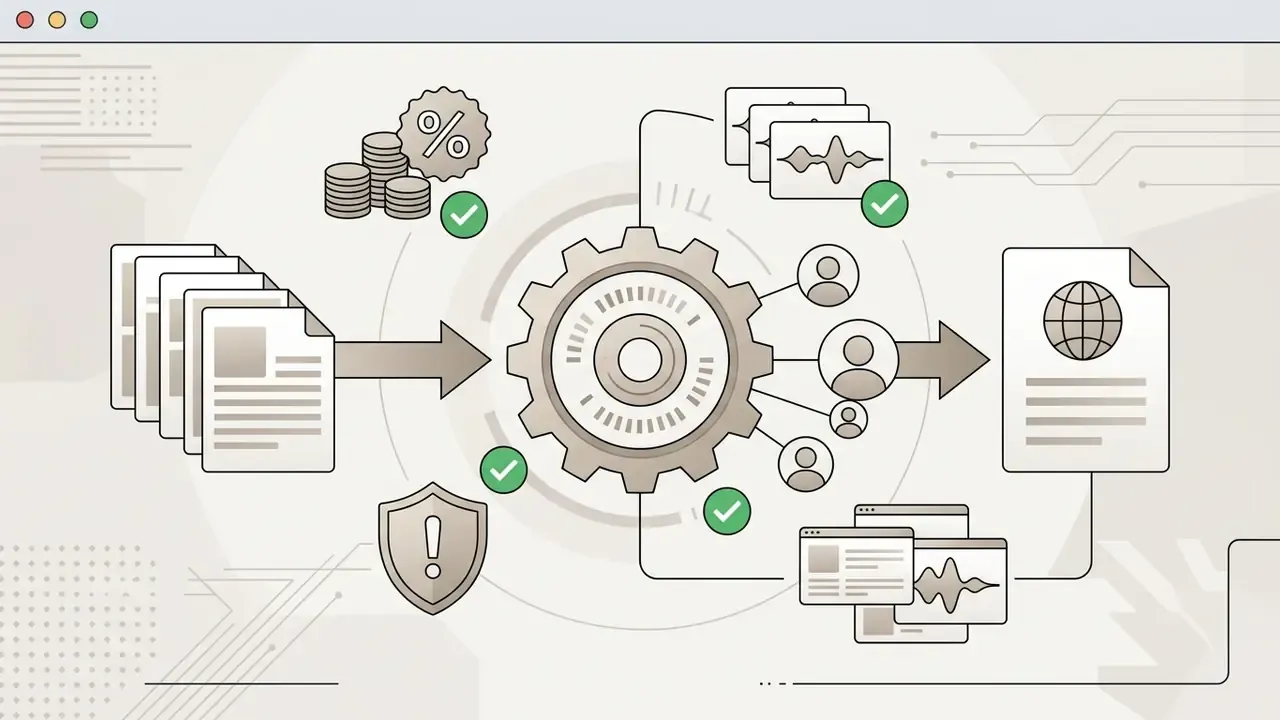
Modeling Cost and ROI: Studio Dubbing vs AI Plus Human Validation
Finance approval rarely hinges on feature tables. It hinges on cost per finished localized minute. Rather than quoting market rates that swing by language, union status, and territory, model both paths with the same structure and populate the inputs from your own quotes.
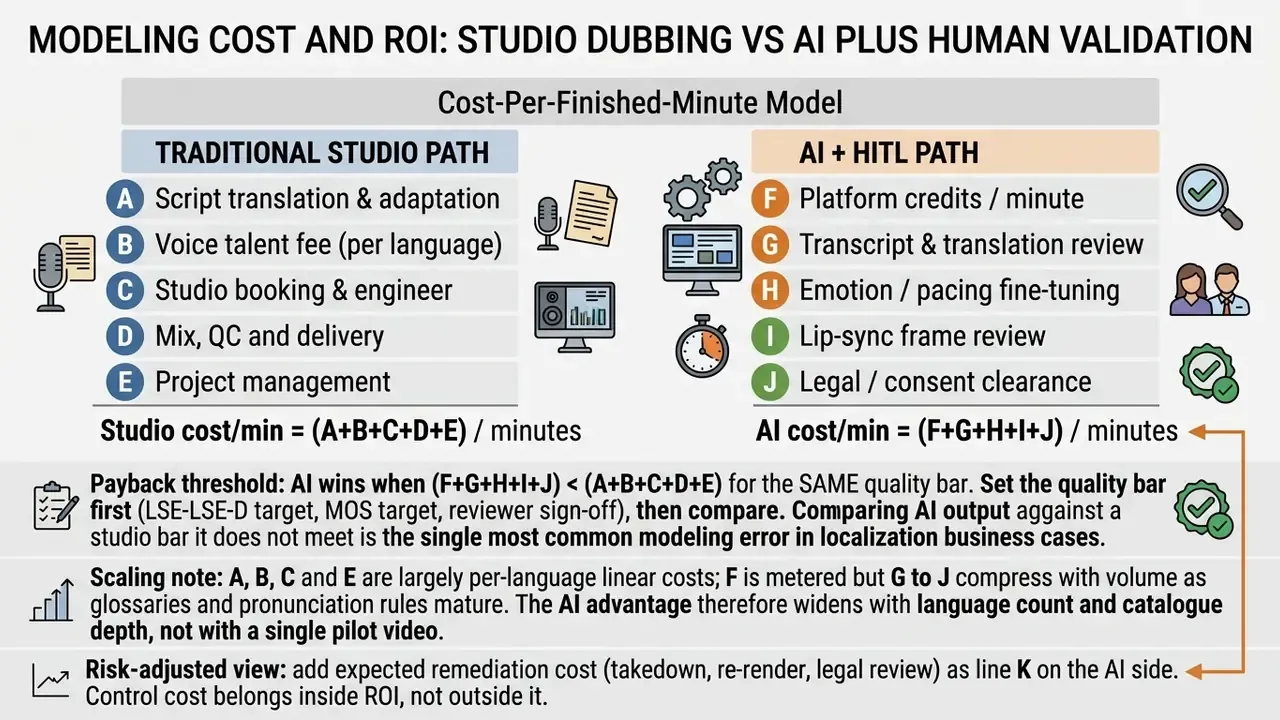
Model the scenario across your real language matrix using AI Media Calculators, and include the cost of not localizing, meaning forgone watch time and forgone regional conversion, as a line item on the benefit side.
Checklist for Commercial-Use Decisions
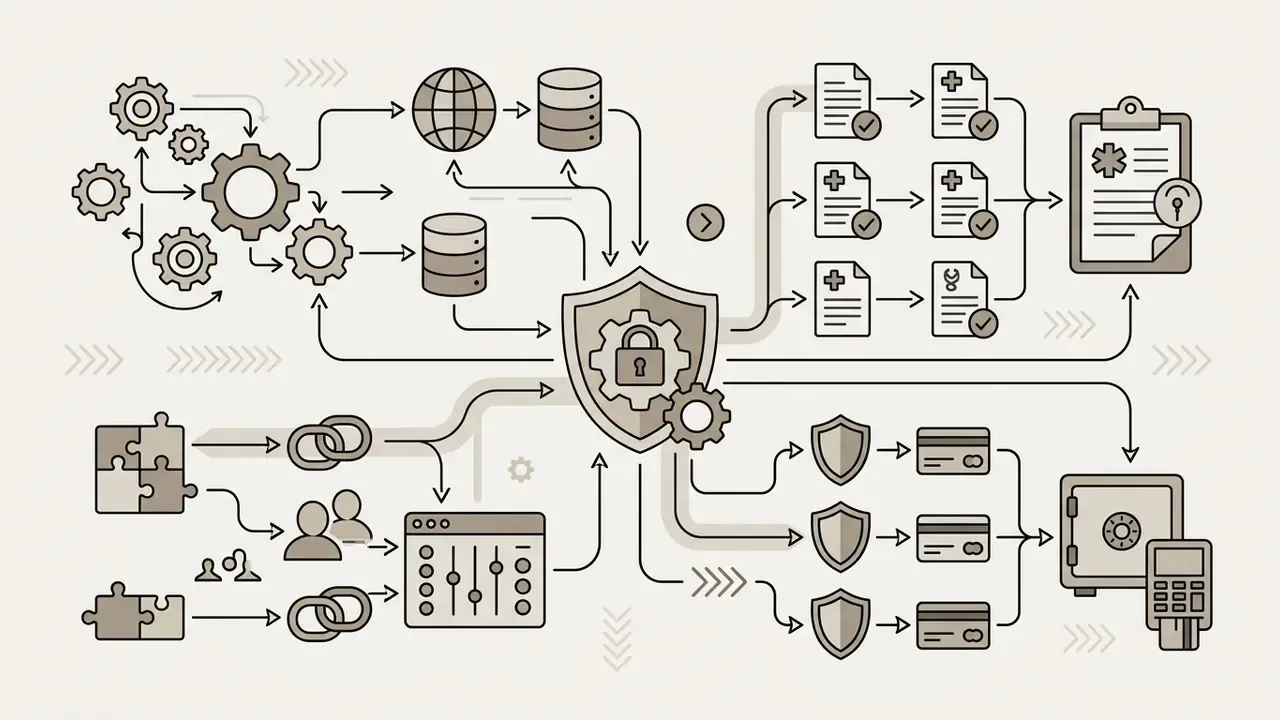
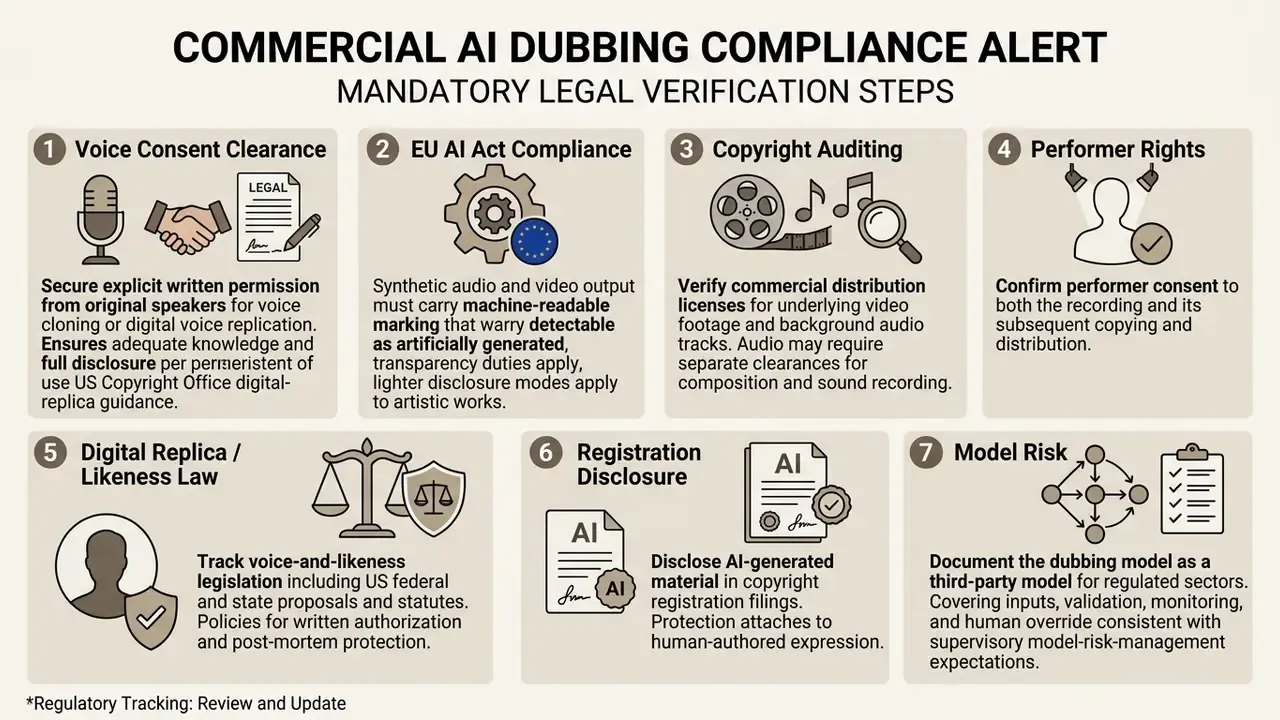
Before releasing AI-dubbed video content for commercial monetization, organizations must run formal legal and technical compliance checks. Failing to verify licensing permissions exposes the business to copyright infringement and right-of-publicity claims.
A regional consumer financial platform localized an educational video series for Spanish-speaking markets using a third-party synthetic voice generator. The team published the videos without verifying whether the vendor's free plan granted commercial redistribution rights.
During an internal audit, legal counsel identified the licensing oversight, which forced the temporary removal of 45 commercial assets. The institution upgraded to an enterprise tier with verified commercial indemnification, added a mandatory rights-clearance step, and republished the campaign without further compliance disruption. The operative lesson is sequencing: rights clearance belongs before render, in the same gate as transcript review, not after publication. This example is illustrative and composite, not a documented client engagement.
AI Video Dubbing Use Cases for Creators and Teams
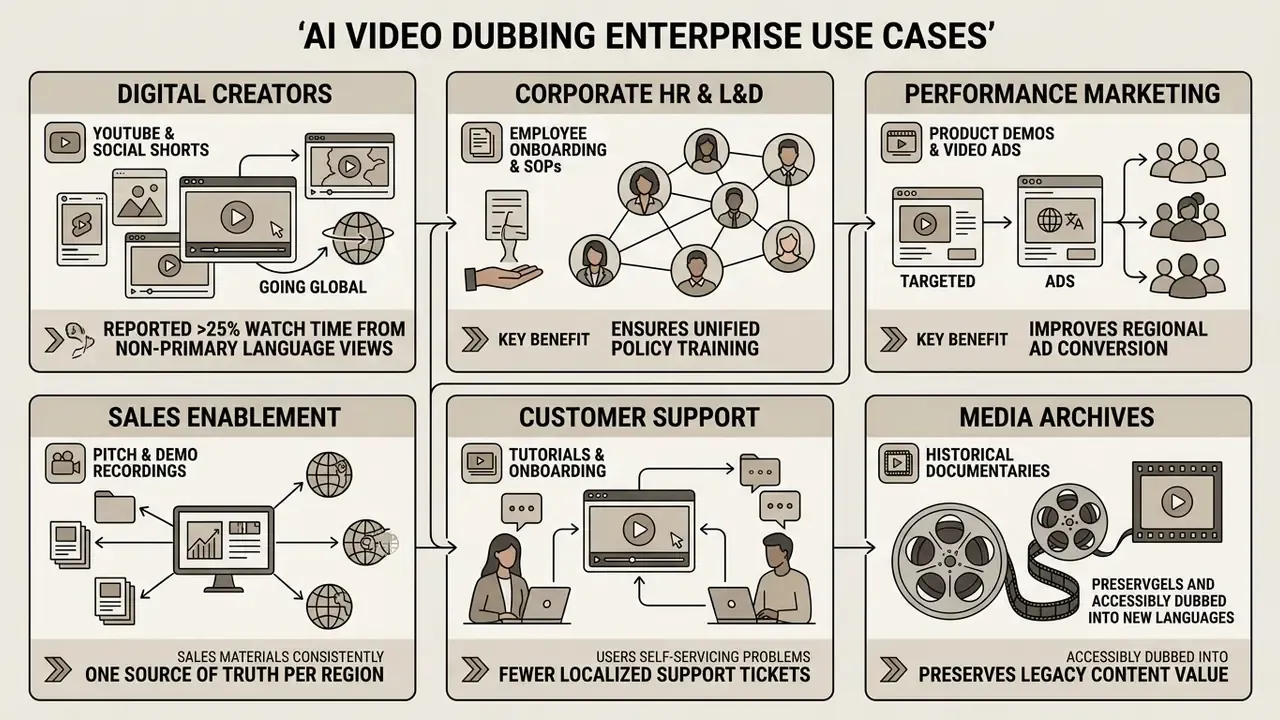
Automated video dubbing serves a wide span of operational applications: digital content creation, corporate training, advertising campaigns, and media archiving. By lowering localization costs, organizations extend operational reach across global audience segments.
Whether you are localizing marketing assets or adapting corporate communications, automated voice tools streamline international publishing workflows. Teams seeking broader technical terminology definitions consult the AI Media Glossary to standardize internal documentation.
Training Videos and Historical Video Localization
Corporate learning and development teams deploy AI dubbing to convert internal training videos, compliance modules, and standard operating procedures into multiple employee languages. Automated localization gives global workforces consistent instruction without maintaining separate regional media production teams.
Documented L&D workflows follow a consistent pattern. A script, PDF, or slide deck becomes a training video. That video is translated into the target language set with lip-synced dubbing and optional voice cloning. The result exports in SCORM-ready form for ingestion into an LMS. Internal-communications workflows are similar: upload the original training video, choose languages and voice-over, then auto-generate translated transcripts, subtitles, and dubbed audio. Published language counts for these workflows vary widely by vendor (one platform cites 175+ languages, another 29 simultaneous languages, another gives no count), so validate coverage against your actual employee-language matrix.
Educational institutions and documentary producers use specialized tooling, including ai dubbing for historical videos, to restore and translate archival footage. Archive-scale localization typically relies on drag-and-drop batches, platform links, or bulk import across video, audio, podcast, and audiobook formats. Converting legacy media into modern localized audio formats preserves historical content while making educational material reachable for global audiences.
High-Volume Bulk Dubbing and Enterprise Workflows
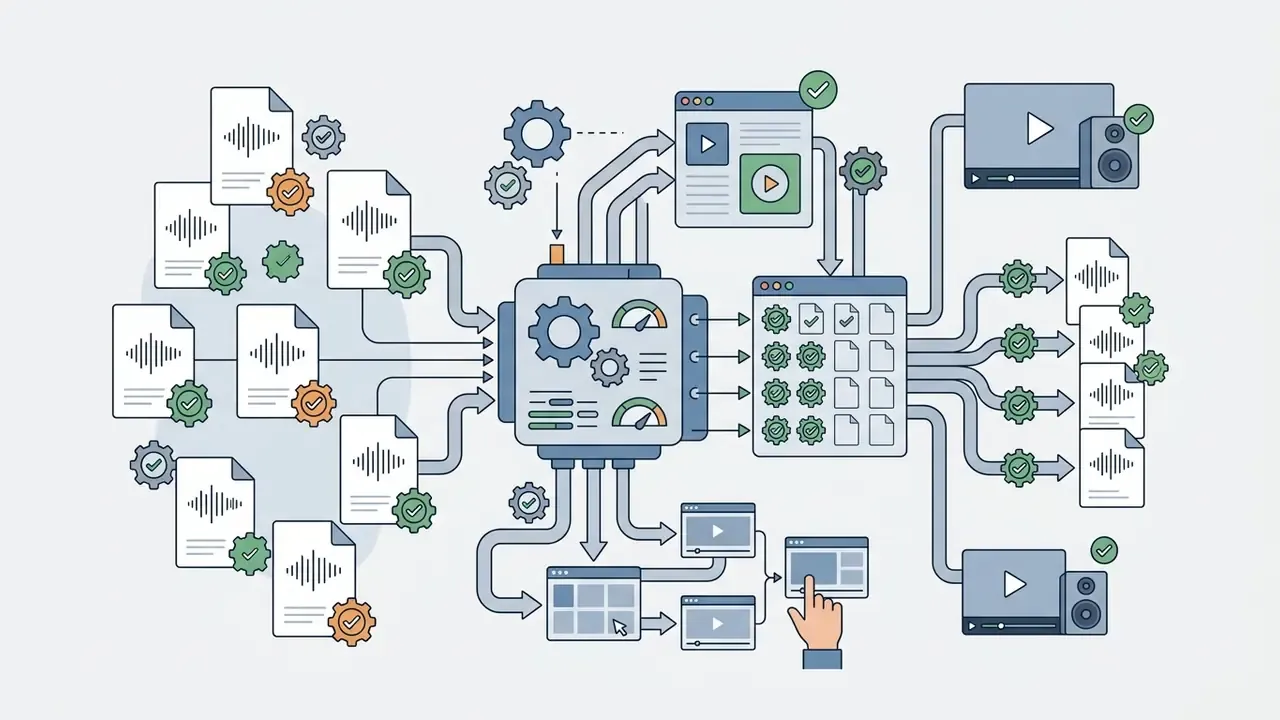
For organizations managing extensive video catalogues, manual file-by-file uploads create operational bottlenecks that no per-asset quality improvement can offset. Enterprise automation strategies implement three scalable ingestion methods:
- Spreadsheet-driven batching (Excel / Google Sheets). Connect dubbing API triggers directly to media inventory sheets. Content managers map source URLs to target-language columns and execute batch localization jobs for hundreds of assets at once. One major platform ships an Excel add-in specifically to manage and trigger dubbing jobs from a spreadsheet.
- Programmatic dubbing APIs. Submit multiple videos to a dubbing endpoint from a CMS, DAM, or CI pipeline, then poll for completion and write the returned MP4, WAV, and SRT assets back to the repository. This is the correct integration point for teams localizing hundreds of projects without handling each video manually.
- Bulk import and link ingestion. Drag-and-drop batches, direct media URLs, or platform links let archive teams queue legacy catalogues without re-uploading masters.
Pair bulk ingestion with a glossary and translation-rules layer. Setting terminology rules once means each subsequent dub needs less review, and that is what converts batch dubbing from a throughput exercise into a genuine cost reduction.
Distribution via Multilingual Smart Players
Rendering and hosting a separate video file per region multiplies storage, CDN, and analytics overhead, and it forces the viewer to hunt for the right link. Instead, teams deploy a single embed code backed by a multilingual player:
- The player detects the viewer's browser locale and automatically streams the corresponding dubbed audio track and synchronized subtitle track.
- Viewers can switch language at any time without leaving the page or loading a different asset.
- Subtitles are auto-generated for dubbed versions and can be toggled on or off independently of the audio language.
- Analytics consolidate into one asset record, so watch time per language becomes a directly comparable metric rather than a reconciliation exercise across separate uploads.
For teams already distributing on YouTube, the platform equivalent is multi-language audio on a single video ID, which preserves the original URL, comments, and engagement history while serving localized audio.
FAQ About Video Dubbing Online Free
Which Video and Audio Files Can Be Used for AI Dubbing?
Most online AI dubbing platforms accept standard video containers including MP4, MOV, and WebM, alongside standalone audio formats such as WAV, MP3, and M4A. Several also accept AVI, MKV, and direct platform links (YouTube, Vimeo, Google Drive) or microphone recordings. Input files should carry clean dialogue audio without heavy compression or background music. Export documentation from major providers confirms this matrix. One dubbing API returns dubbed video plus isolated WAV audio and SRT subtitles when requested, and video plus audio plus MP3 when not. Another documents MP4 video, AAC audio, AAF timeline data, SRT captions, per-speaker WAV stems, and MP3. When input footage carries pre-existing background audio that interferes with voice isolation, creators use a mute video online utility to strip unwanted soundtracks before running the dubbing engine.
Is AI Dubbing Actually Free, or Is It a Trial?
Both models exist. Some platforms offer a genuinely recurring free allowance measured in minutes or videos per month; others offer a one-time trial that ends after a single file. The distinguishing question is whether the allowance resets on a billing cycle. Also verify three secondary conditions: whether output carries a watermark, whether the free tier permits commercial redistribution, and whether transcript review before rendering consumes credits (on most platforms it does not).
Can I Dub a Video If There Is No Face on Screen?
Yes, and you should not pay for lip sync in that case. Select Audio-Only Dubbing, which replaces the speech track without re-rendering video frames. This applies to screencasts, slide-based presentations, voice-over documentaries, podcasts, and archival audio. It is faster, cheaper in credits, and it removes an entire class of visual artefacts from the output.
How Do I Fix a Mispronounced Brand Name or Technical Term?
Three mechanisms, in order of preference. First, correct the term during the free transcript-review step so the error never reaches synthesis. Second, add a custom pronunciation or lexicon override so the fix applies consistently across every asset and every language. Third, retype the phrase in the affected segment and regenerate only that segment. Maintaining a standing glossary of brand names, acronyms, tickers, product SKUs, and place names cuts review effort on every subsequent job.
Can I Dub Multiple Speakers in One Video?
Yes. Speaker diarization identifies distinct voices and assigns a separate dubbed voice to each, which preserves multi-character dialogue structure. Some platforms detect and preserve each speaker's voice automatically via cloning; others require you to declare the number of speakers at upload. For interviews and panels, verify speaker-to-voice mapping before render. A swapped assignment is far more jarring to viewers than imperfect lip sync.
What Rights and Permissions Are Needed to Dub a Video?
Dubbing a video requires copyright ownership or explicit licensed permission for the original video footage, audio soundtrack, script text, and the speaker's vocal likeness. Replicating a real individual's voice using AI voice cloning requires verifiable consent under digital replica legislation. Under US Copyright Office guidance and international copyright frameworks, unauthorized commercial deployment of synthetic voice replicas exposes operators to legal liability.
«Licensing for digital replicas should require adequate knowledge and full disclosure of the intended uses.» Source: US Copyright Office, Copyright and Artificial Intelligence, Part 1: Digital Replicas (2024). https://www.copyright.gov/ai/ «AI systems generating synthetic audio, image, video or text must mark outputs in machine-readable format as artificially generated or manipulated, with obligations applying from 2 August 2026.» Source: European Commission / EU AI Act Article 50 (2024 to 2026). https://eur-lex.europa.eu/legal-content/EN/TXT/?uri=CELEX:32024R1689 Jurisdiction changes the pressure point. US guidance centres on digital-replica consent and contract drafting. UK material emphasises performer economic rights, where performers consent both to the recording of a live performance and to its later copying and distribution. Where audio is involved, composition and sound recording may require separate clearances. Voluntary frameworks add a further practice standard: informed consent from depicted subjects, plus disclosure where synthesis would change audience perception. Organizations auditing platform compliance model financial projections using AI Media Calculators to factor legal clearance into overall adoption costs. Disclaimer: The regulatory and copyright material summarized above is general information, not legal advice. Requirements differ by jurisdiction and continue to evolve. Obtain qualified legal counsel before commercial deployment. For technical assistance with media processing, users access AI Media Support and Troubleshooting documentation. Integrators deploying automated dubbing workflows review developer documentation via the platform api portal.
Limitations, Open Questions and a Safe Next Step
A few things remain genuinely unresolved, and pretending otherwise would be dishonest.
Language counts are marketing artifacts as much as engineering facts, because dialects and locales are counted inconsistently. Lip-sync metrics correlate with perceived quality but do not fully predict it, especially on close-up footage with strong lateral head movement. Emotion transfer is improving fast, yet no published benchmark shows reliable preservation of sarcasm, irony, or regional humour. And the perceived-authority uplift of cloned voices is a new finding, not a settled one; its disclosure implications for regulated communications will likely be argued for several more years.
The safe next step is small and reversible. Pick one non-sensitive asset, run it through a free tier's transcript review, and record what the review caught. Then decide whether your control environment can support the paid path at volume. No autonomy without evidence, and no production rollout without a named owner for the workflow.
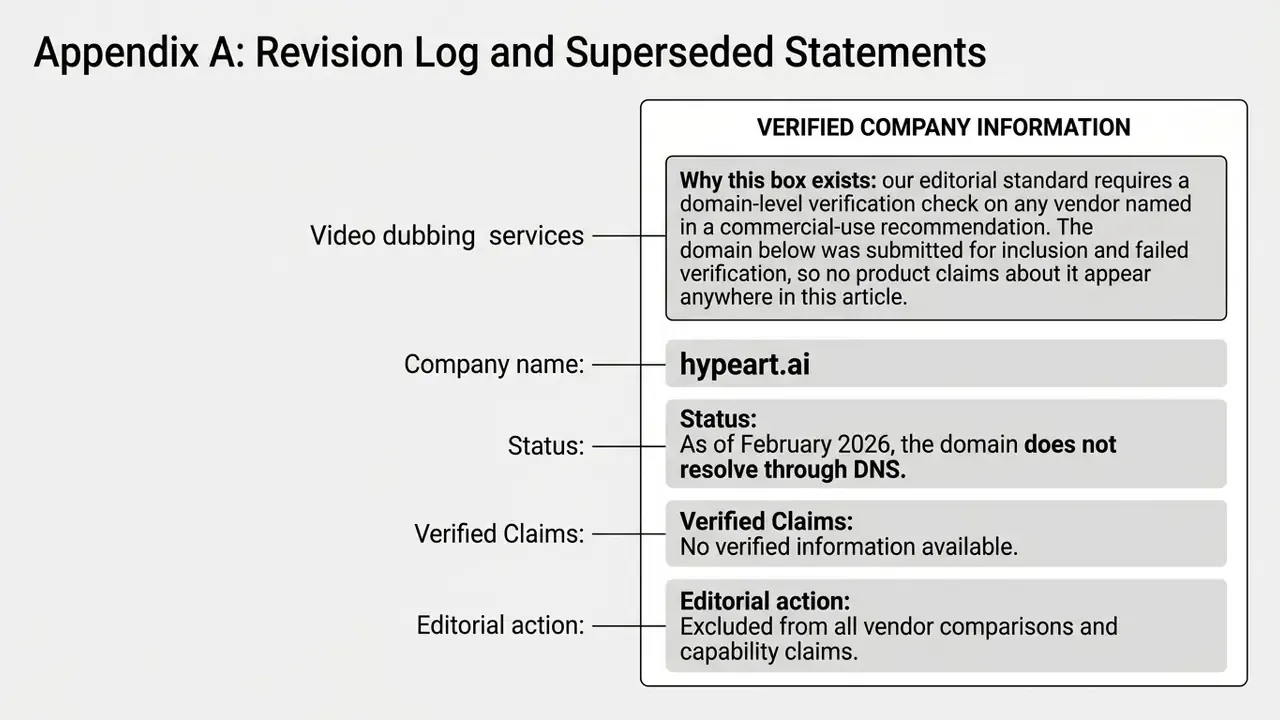
Appendix A: Revision Log and Superseded Statements
This appendix preserves earlier phrasings that have been superseded in the main text, so readers comparing versions can see exactly what changed and why.
| Superseded statement (previous version) | Replacement in current text | Reason |
|---|---|---|
| "Technical benchmarks published in ICASSP and EMNLP research confirm that duration-based translation models achieve over 99% alignment accuracy within human-perceptible visual thresholds." | Direct attribution to Dynamic Temporal Alignment of Speech to Lips (ICASSP 2019) for the >99% figure, plus the EMNLP 2025 duration-based translation demo for phoneme-duration prediction, plus MuseTalk 30fps/256×256 fidelity results. | The original conflated two research generations and named venues without identifying papers. |
| "A 2026 study on synthetic voice dynamics revealed that cloned neural voices are systematically perceived by listeners as more authoritative and polished than source speakers." | Attributed quotation from Voice 'Cloning' is Style Transfer (arXiv preprint, 2026), with the homogenization finding added in the cloning section. | Unnamed study; now identified and quoted. |
| "Large-scale speech research projects, such as the Anim-400K dataset comprising over 425,000 aligned video clips..." | Attributed quotation specifying 425,000+ aligned dubbed clips and 763 hours across Japanese and English. | Dataset was cited without source or full scale. |
| "Department of Homeland Security translation guidelines highlight that automated translation pipelines must incorporate human review to resolve slang, technical terms of art, and stylistic ambiguities before public deployment." | Split into two attributed sources: GSA ordering guidance on machine-translation failure modes (slang, nuance, colloquialisms, terms of art) and DHS translator guidelines on glossary, sentence-by-sentence comparison, and colleague review. | The original attributed the machine-translation limitation to the wrong document. |
| "Professional voice synthesis guidelines recommend input dialogue recorded between -23 dB and -18 dB RMS with true peak levels capped at -3 dB." | Same figures, now attributed to ElevenLabs Professional Voice Cloning documentation (2026). | Technical thresholds required a named source. |
| "the team reduced transcription errors to under 1.8%" | "reduced measured transcription errors to under 2%," explicitly labelled as a single-team internal benchmark. | Precision implied external validation that does not exist. |
| "Modern automated video dubbing platforms support dozens of global languages" | "over 175 global languages and regional dialects... libraries exceeding 850 pre-verified neural voices," with a vendor-comparability caveat. | "Dozens" understated documented 2026 market capability. |
| "DEG Generative AI & Synthetic Media Quality Control White Paper (2026)" | "DEG Generative AI & Synthetic Media Localization White Paper (2024)." | Forward-dated citation replaced with the published edition. |