Executive Summary for Decision Makers
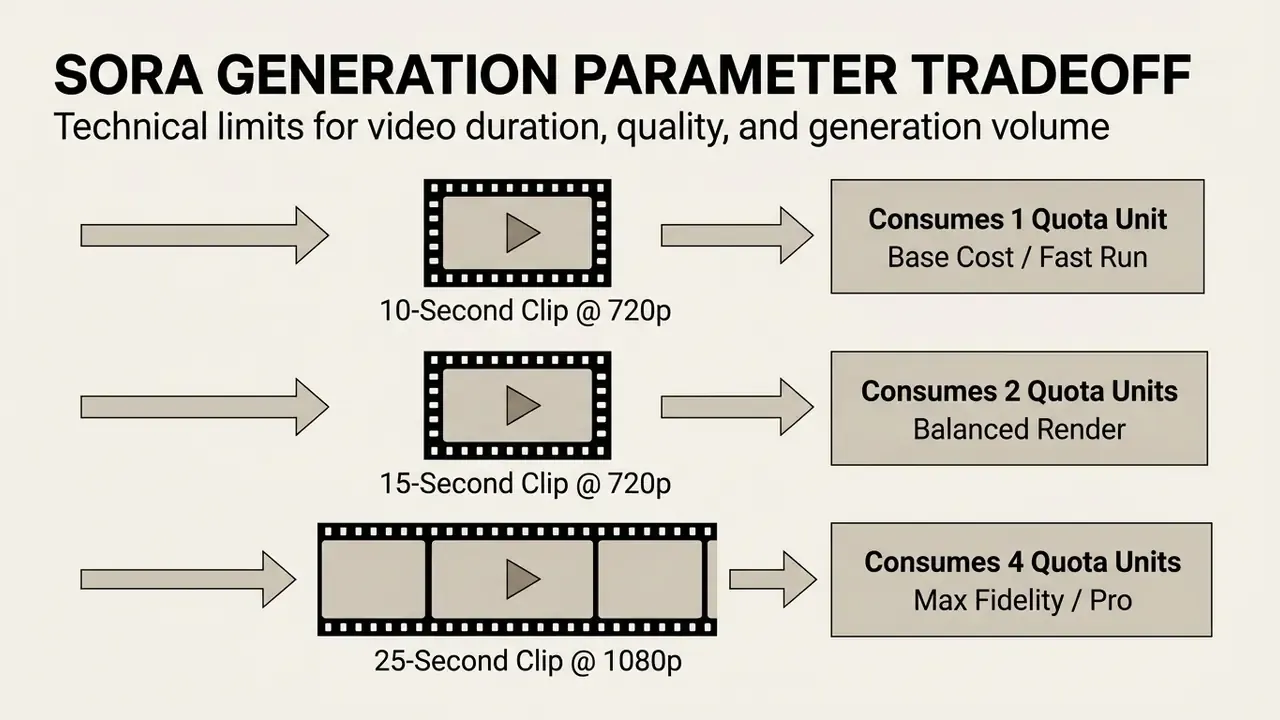
- Duration A single API generation call renders 4, 8, 12, 16, or 20 seconds. Completed clips can then be chained through the Video Extensions endpoint in +20-second increments, up to a cumulative 120 seconds per asset. Consumer web surfaces capped clips at 10s (default), 15s (extended), and 25s (Pro storyboard).
- Cost API billing is strictly per generated second. That means $0.10/sec for
sora-2at 720p and $0.30 to $0.70/sec forsora-2-proacross 720p, 1024p, and 1080p. Asynchronous Batch API submissions render at roughly 50% of standard rates. Storage of generated assets adds $0.10/GB/day. - Quotas Consumer quotas operated on a rolling 24-hour window, not a midnight reset, with duration-weighted accounting: 10s = 1 unit, 15s = 2 units, 25s = 4 units. API throughput is governed by tier-based Requests Per Minute (RPM) ceilings ranging from 25 RPM (Tier 1) to 375 RPM (Tier 5) on
sora-2. - Lifecycle risk Consumer Sora web and app experiences were retired on April 26, 2026. The
sora-2andsora-2-promodels plus the Videos API are deprecated, with a hard shutdown on September 24, 2026, and OpenAI lists no drop-in replacement. Any production dependency requires a documented migration path to Veo 3.1, Kling 3.0, Wan 2.7, or Grok Imagine before that date.
Critical Lifecycle Risk Notice (Read First)
Who This Reference Is For and What It Decides
This document is written for the people who sign off, not the people who prompt. Four decisions sit behind it.
First, feasibility: does the required clip length fit inside a 20-second call plus extensions, or does the workflow need external assembly? Second, unit economics: which per-second band applies, and what retry ratio should the forecast assume? Third, throughput: will the account tier RPM ceiling survive a peak-hour batch? Fourth, evidence: can every generated asset be traced back to a prompt, an owner, and a disclosure marker.
A short warning before the numbers. Consumer-tier figures and developer-tier figures are frequently mixed together in secondary coverage, and that conflation is where budget errors start. Subscription quotas describe a product that no longer exists. API rate cards describe a service with a scheduled end date. Both are documented below, kept separate on purpose.
Secondary readers, typically CFOs and finance transformation leads, tend to care about one line only: cost per usable clip. We get to that in the pricing section.
What OpenAI Sora Video Generation Limits Include
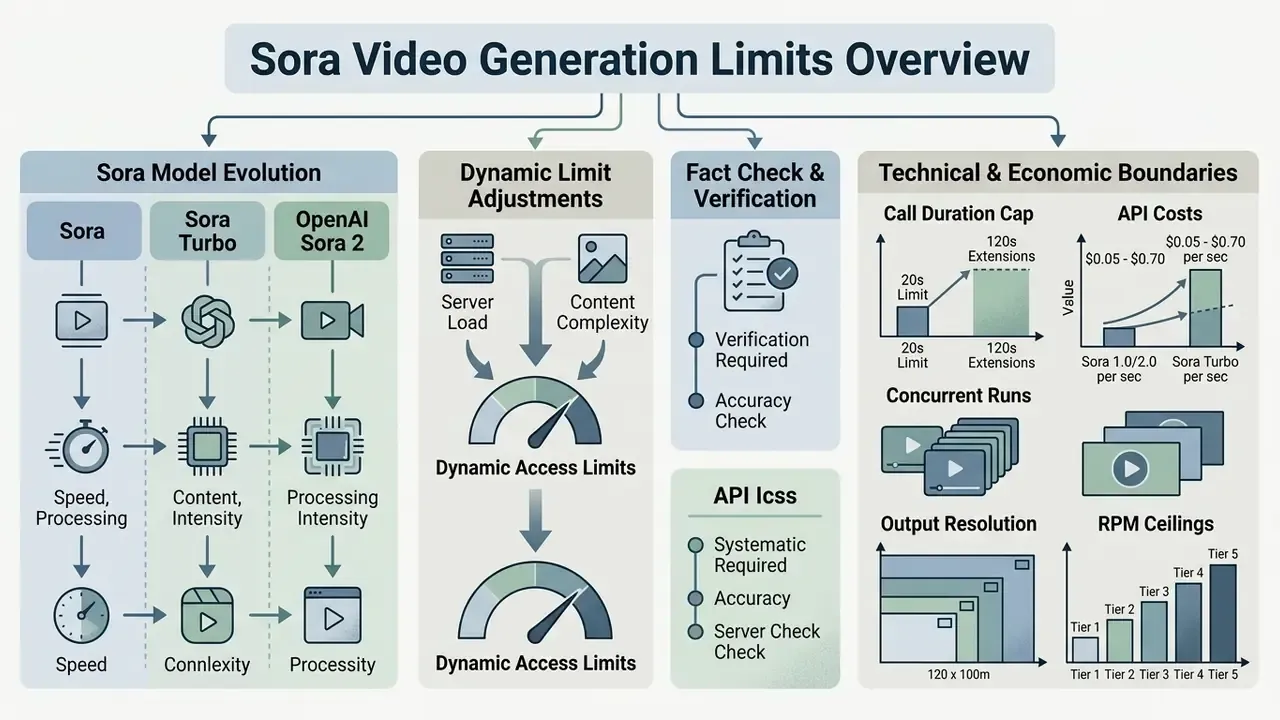
OpenAI Sora video generation limits comprise technical, account-level, and economic boundaries governing video duration, output resolution, concurrent runs, and API consumption. These limits determine how the generation model executes requests and prevent operational system saturation (OpenAI API Documentation, 2026).
Understanding the distinction between model capabilities and product-surface constraints is essential for enterprise planning. The underlying video model processes multi-modal diffusion tasks. The user-facing application layers then enforce separate quotas to balance infrastructure availability against cost (OpenAI System Card, 2026).
In practice, documented Sora limits split across four independent axes that must be budgeted separately: duration (single-call caps plus extension chaining), quality tiers (480p through 1080p, with 1024p as an intermediate API band), throughput (concurrency for consumer surfaces, RPM tiers for API keys), and model selection (sora-2 for speed versus sora-2-pro for fidelity). Treating these as a single "limit" is the most common source of budget overruns in enterprise pilots. It sounds obvious. It still happens in almost every pilot review.
Sora, Sora Turbo, and OpenAI Sora 2: Models Compared
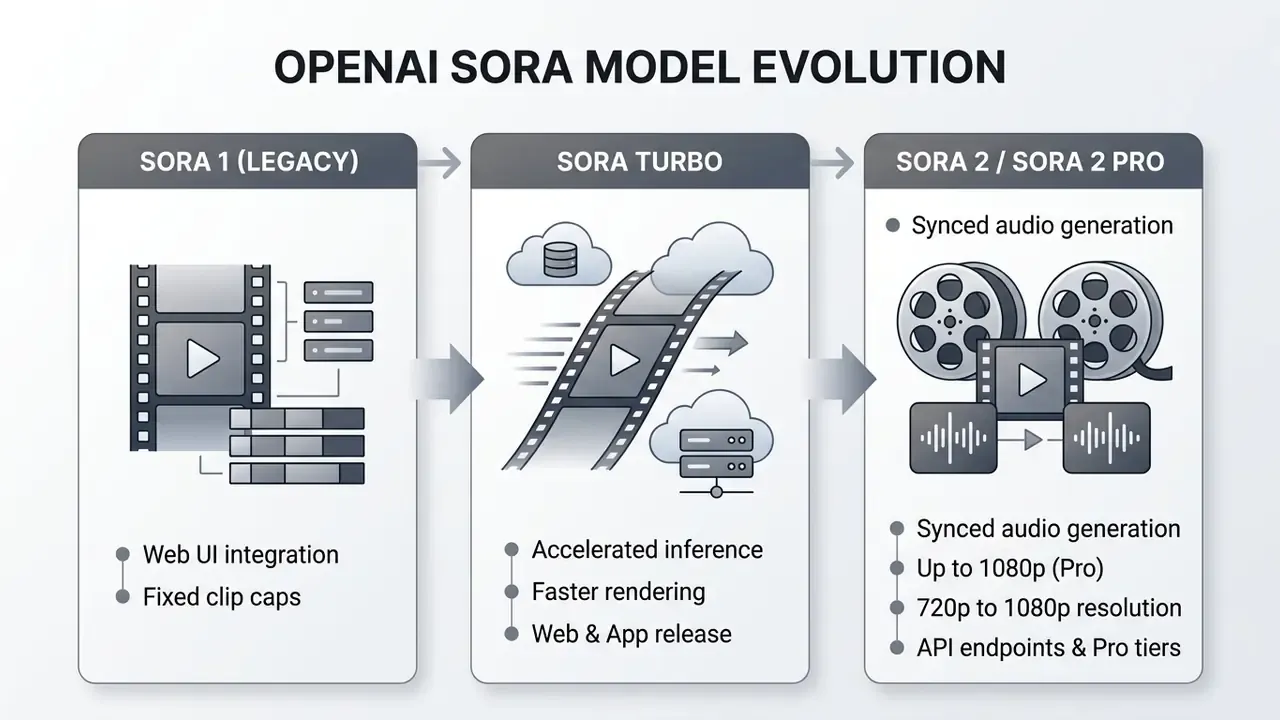
OpenAI's video generation ecosystem evolved across distinct architecture tiers that vary in rendering speed, physical realism, and access channels. The initial release established baseline diffusion mechanics, while Sora Turbo prioritized accelerated inference for web users (OpenAI Product Announcement, 2024). Readers benchmarking this lineage against other AI video generators will find that Sora's real differentiator was synchronized audio rather than raw resolution.
OpenAI Sora 2 introduced enhanced motion physics, stronger prompt instruction-following, and synchronized multi-track audio generation. Where Sora Turbo focused on rapid visual rendering, Sora 2 and Sora 2 Pro handle high-fidelity cinematic physics and complex spatial consistency across landscape and portrait aspect ratios (OpenAI API Documentation, 2026).
That official split matters for cost engineering. sora-2 is the correct default for exploration, concepting, and rough cuts where turnaround beats fidelity. sora-2-pro is reserved for 1080p exports at 1920x1080 or 1080x1920, where visual precision is contractually required.
Why Sora Access Limits Change Dynamically
Sora access limits fluctuated with global GPU compute constraints, rolling tier usage, account security status, and regional infrastructure rollouts. OpenAI adjusted rate limits and queue wait times dynamically to maintain service availability during peak demand (OpenAI Help Center, 2026).
New users faced staged onboarding constraints tied to age verification, geographic location, and subscription tier. Users had to be at least 18 years old, and accounts originating from restricted jurisdictions stayed subject to automated geo-blocking guardrails (OpenAI Access Policy, 2026).
«Sora is not available in the United Kingdom, Switzerland or the European Economic Area; access began for invited iOS users in the US and Canada on September 30, 2025.»
Regional posture shifted afterwards. OpenAI extended availability to the EU, the United Kingdom, Switzerland, Norway, Liechtenstein, and Iceland for Plus and Pro subscribers on February 27, 2025. Which is precisely why governance teams should validate jurisdictional availability at deployment time rather than trusting launch-era documentation.
Fact check and access verification notice
Technical Limits for Video Duration, Quality, and Generation Volume
Technical limits in OpenAI Sora restrict single-clip duration, spatial resolution, aspect ratios, and total output frames per generation job. Selecting higher quality tiers scales processing time and quota consumption directly (OpenAI API Documentation, 2026).
Duration Limit and Length Caps for Single Video Clips
Single video clips in the standalone Sora interface defaulted to 10-second outputs, with optional 15-second extensions across active subscription tiers. ChatGPT Pro accounts using web-based storyboard workflows could generate continuous clips up to 25 seconds (OpenAI Help Center, 2026).
Through the programmatic API endpoints, both sora-2 and sora-2-pro support fixed generation targets of 16 and 20 seconds per request. OpenAI's prompting documentation additionally enumerates supported clip lengths of 4, 8, 12, 16, and 20 seconds, which gives budget owners shorter draft options that cost proportionally less per attempt.
«Sora 2 and Sora 2 Pro support 16 and 20 second generations; for longer scenes, generate multiple clips.»
Video Extensions API: reaching up to 120 seconds without an external editor. A single-pass generation request is capped at 16 or 20 seconds, but developers can extend completed clips using the Video Extension endpoint. Each extension call appends up to 20 additional seconds of contextually coherent video, supporting a maximum cumulative duration of up to 120 seconds per video asset. Because each extension is billed as a fresh per-second render, a 120-second 1080p sora-2-pro asset costs the same as six independent 20-second renders, roughly $84.00 at $0.70/sec, before storage. Extension chaining preserves scene continuity and character geometry far better than offline concatenation. It does not bypass tier RPM ceilings, and each call passes the same moderation pre-filter as an initial generation.
For assets exceeding 120 seconds, multi-clip sequencing stays mandatory: generate discrete scenes, then assemble them with free video editing software or an automated pipeline. Compressing the final master with a video compressor before distribution cuts the $0.10/GB/day retention cost materially on high-volume libraries.
Resolution, Quality Tiers, and Video Creation Options
Resolution options in Sora span standard definition (480p), high definition (720p), and full high definition (1080p at 1920x1080 or 1080x1920). The API additionally exposes an intermediate 1024p band (1792x1024 and 1024x1792) on sora-2-pro. Higher resolution tiers require greater compute allocation and elevate credit consumption (OpenAI API Documentation, 2026).
Choosing 1080p resolution or high-fidelity model variants increases generation latency and disables multi-variant batch exports on single API calls (Azure OpenAI Service Documentation, 2025).
«Sora 2 supports up to four variants per request at 720p or lower; Sora 2 Pro at 1080p is limited to one variant per call.»
| Parameter | Sora 1 (Legacy Web) | Sora App / Sora 2 (Web) | Sora 2 API (sora-2) | Sora 2 Pro API (sora-2-pro) |
|---|---|---|---|---|
| Max Single Clip Duration | 10s (Plus) / 20s (Pro) | 10s, 15s (All) / 25s (Storyboard) | 16s / 20s | 16s / 20s |
| Max Duration via Extensions | Not supported | Not supported | Up to 120s cumulative (+20s per call) | Up to 120s cumulative (+20s per call) |
| Supported Clip Lengths | Fixed caps | 10s / 15s / 25s | 4s, 8s, 12s, 16s, 20s | 4s, 8s, 12s, 16s, 20s |
| Max Resolution | 480p (Plus) / 1080p (Pro) | 720p (Plus) / 1080p (Pro) | 720p (1280x720 / 720x1280) | 1080p (1920x1080 / 1080x1920) |
| Batch Variants per Job | 1 Variant | 1 Variant | Up to 4 (at ≤720p) | 1 Variant (at 1080p) |
| Audio Generation | Not Supported | Synchronized Audio | Synchronized Audio | Synchronized Audio |
All values above are dated September 2026 and were read from the developer guide and model card rather than third-party summaries.
Sora Limits Across Free, ChatGPT Plus, and ChatGPT Pro Tiers
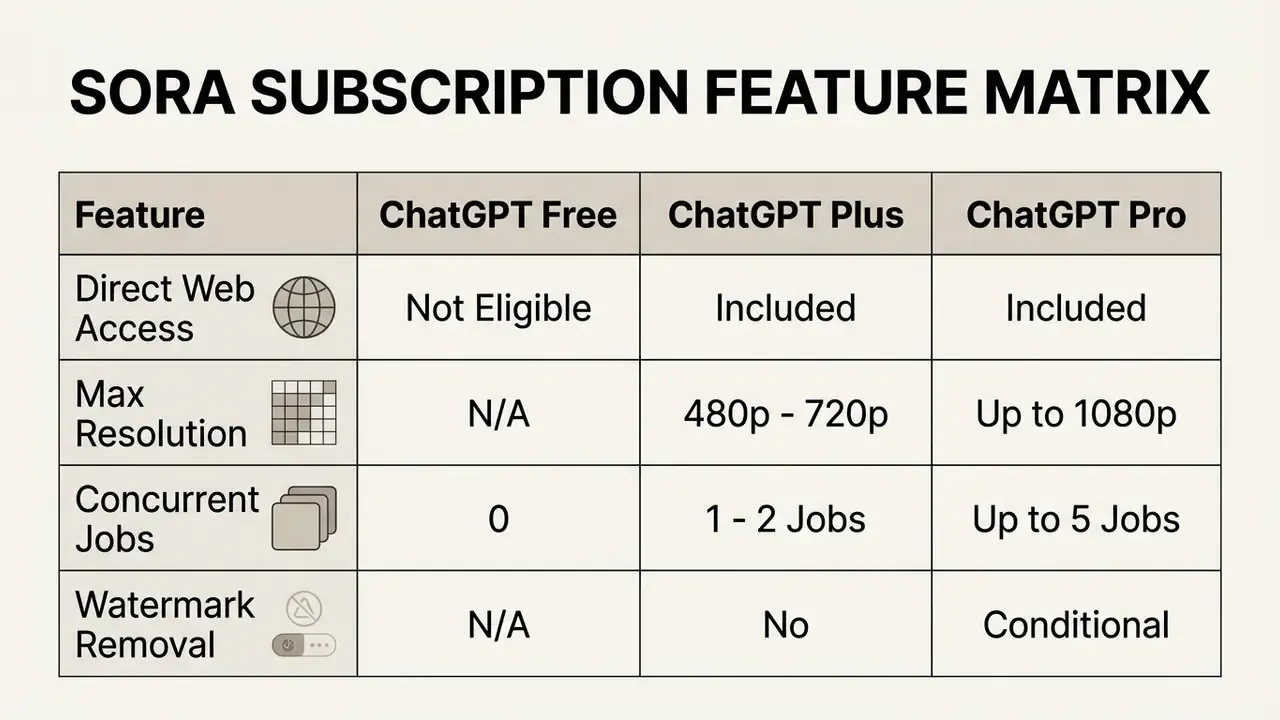
Sora access and feature privileges were segmented strictly by subscription tier, reserving high-resolution exports and queue priority for paid accounts. Free accounts never had native web access to the Sora video model (OpenAI Billing FAQ, 2026).
«On Sora.com, Plus users get up to 50 videos per month at 480p, or fewer at 720p; Pro users get ten times more, at higher resolution and duration.»
Included Features and Limits for ChatGPT Plus Accounts
ChatGPT Plus subscribers received access to Sora video generation at no extra monthly fee, subject to monthly volume caps and resolution limits. A Plus account could generate videos up to 720p with single-clip length caps of 10 to 15 seconds (OpenAI Help Center, 2026).
Under standard usage rules, Plus accounts ran with a baseline monthly allocation of up to 50 videos at 480p, or a reduced total when exporting at 720p (OpenAI Launch Announcement, 2024). Plus accounts were restricted to one or two concurrent generation tasks, with processing queued behind priority workflows. Worth flagging: OpenAI's own help pages diverged on whether Plus ceilings were 480p or 720p across successive updates. That discrepancy came from rollout timing, not conflicting specifications, and governance teams should resolve it by screenshotting live limits at contract signature.
Exclusive Sora Benefits and Extended Limits for ChatGPT Pro
ChatGPT Pro subscribers received elevated quota allowances, expanded resolution options up to 1080p, faster queue execution, and up to five concurrent generation runs. Pro users also gained access to experimental model variants such as Sora 2 Pro (OpenAI Help Center, 2026).
On the web interface, Pro accounts could use storyboard tools to render continuous 25-second sequences.
Pro subscribers could also download qualifying text-to-video exports without visible moving watermarks when strict content conditions were met (OpenAI Video Guidelines, 2026). Priority queueing was never a delivery guarantee. OpenAI documented that during peak hours Pro wait times could still stretch to several hours, which is exactly why SLA-bound workflows need asynchronous handling instead of synchronous user-facing waits. Teams evaluating tier selection can see the overview for cross-platform feature breakdowns.
Free Access Eligibility and Rules for New Users
ChatGPT Free, Enterprise, and Edu accounts were not eligible for standard web-based Sora video generation. Free users could only explore public feeds or gain invitation-based access during specific geographic app rollouts (OpenAI Billing FAQ, 2026). Budget-constrained teams should instead evaluate free AI video generators or the curated free AI video generator comparison, rather than waiting for a consumer tier that no longer exists.
Historical status note: Consumer web and app generation interfaces were retired on April 26, 2026. Current access is restricted to legacy developer API keys ahead of the final September 24, 2026 shutdown. Sora 2 was initially announced as "available for free" with generous introductory limits subject to compute constraints, but that free allocation did not survive the consumer product retirement.
To prevent platform abuse and manage compute overhead, new users entering via trial or promotional access faced strict rate limits and mandatory 18+ age verification. Accounts exceeding trial limits had to upgrade to Plus or Pro, or purchase credit top-ups (OpenAI Access Documentation, 2026).
Comparison of Sora access parameters by subscription tier (historical record, 2026)
| Subscription Tier | Sora Access Eligibility | Max Resolution & Length | Monthly Quota / Credits | Concurrency & Queue Priority |
|---|---|---|---|---|
| ChatGPT Free | Not eligible (app invites only) | N/A | None | No access / lowest priority |
| ChatGPT Plus | Included ($20/mo) | 720p / 10s to 15s clips | ~50 clips @ 480p (fewer @ 720p); ~1,000 credits | 1 to 2 concurrent jobs / standard queue |
| ChatGPT Pro | Included ($200/mo) | 1080p / 20s to 25s clips | 10x Plus volume (~10,000 credits) plus add-ons | Up to 5 concurrent jobs / priority queue |
Read that table as a historical baseline, not a purchasable offer. It matters only for reconstructing what an internal team actually consumed before April 26, 2026.
Daily, Monthly, and Per-User Usage Limits in Sora
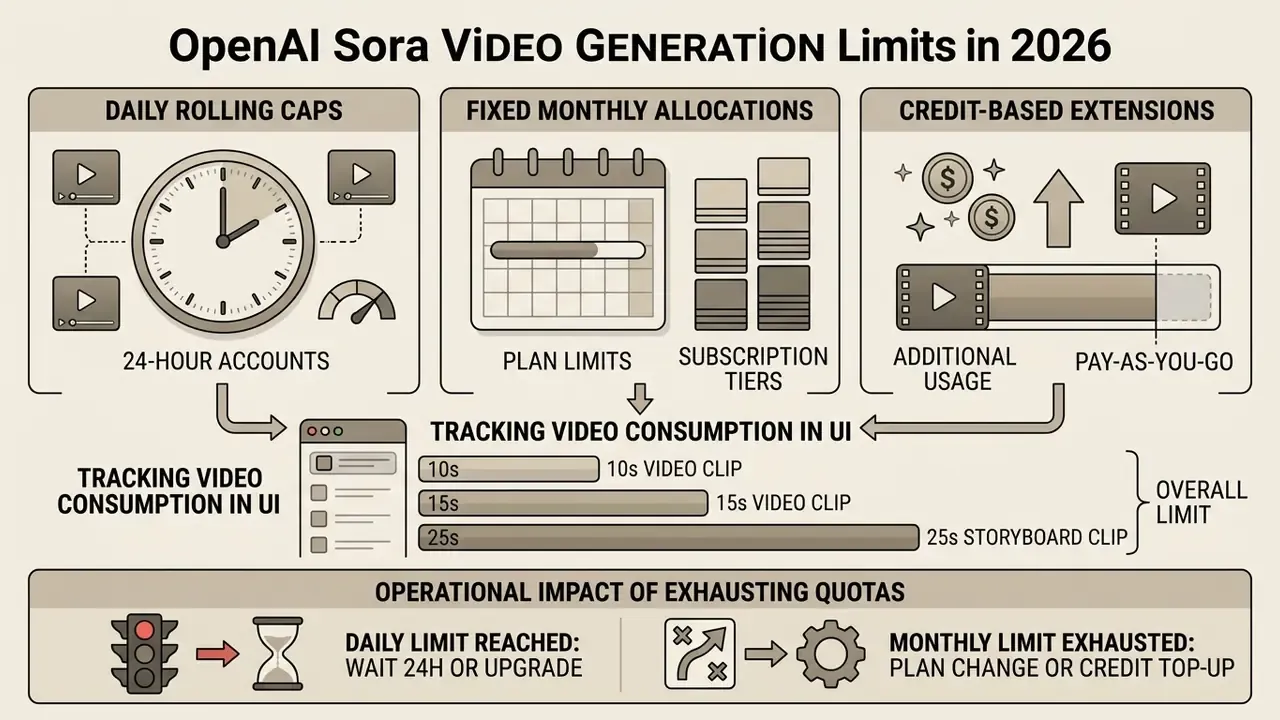
Usage quotas in Sora combined rolling 24-hour account caps, fixed monthly plan allocations, and credit-based extensions. Quota accounting weighted each video request by clip duration and selected resolution (OpenAI Help Center, 2026).
Tracking Video Generation Consumption in the User Interface
The Sora app and web interfaces monitored quota consumption through real-time rolling usage meters in account settings. Consumption was accounted for on a rolling 24-hour cycle rather than resetting at a fixed midnight schedule (OpenAI Help Center, 2026).
«Every submitted request counts immediately; you can submit again once one of your recent requests falls outside the last 24 hours.»
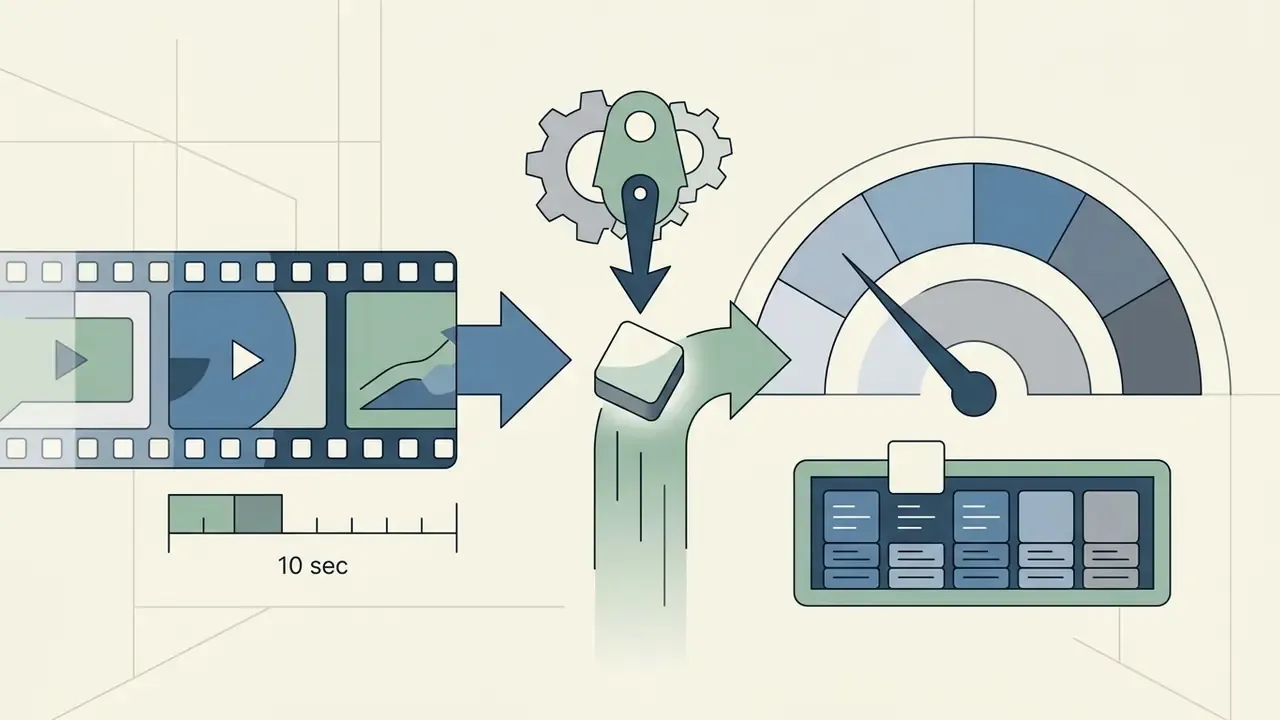
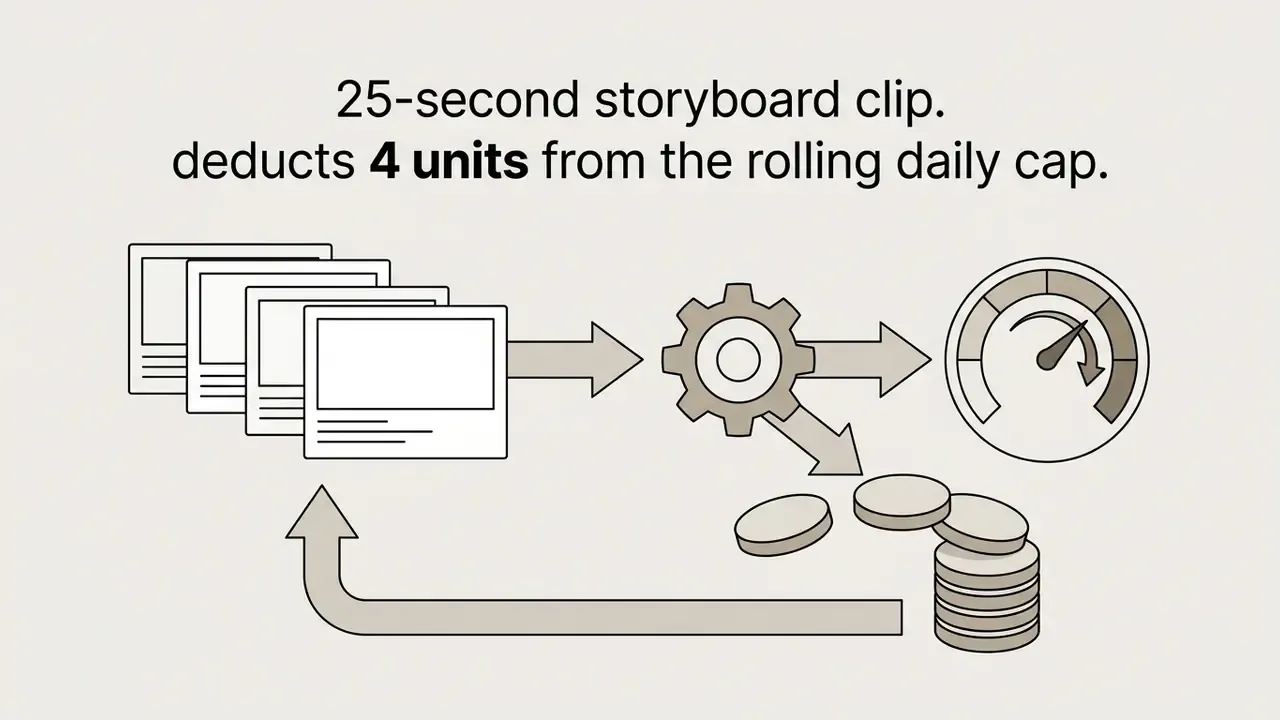
Each video generation request deducted units from the rolling account quota immediately on submission, weighted by duration:
«15-second videos count as two videos against daily limits; 25-second videos count as four.»
One operational nuance deserves emphasis for retry accounting: a resubmitted prompt is a new request against the same budget. Rejections triggered by moderation pre-filters still consume the submission slot, so prompt validation has to happen client-side before dispatch. When evaluating production workloads, developers can inspect the openai sora video generation tool resource hub for integration patterns.
Operational Impact of Exhausting Daily or Monthly Quotas
Exhausting daily rolling units or monthly plan allocations paused new generation requests until prior requests fell outside the trailing 24-hour window. Users attempting further runs received throttling warnings (OpenAI Help Center, 2026).
To maintain production continuity without upgrading a plan, account holders could purchase pay-as-you-go OpenAI credits. Those credits remained valid for 12 months and covered excess generation calls across Sora and Codex environments (OpenAI Credit Policy, 2026).
«Credits are a pay-as-you-go add-on for Codex and Sora beyond plan limits; unused credits expire 12 months after purchase.»
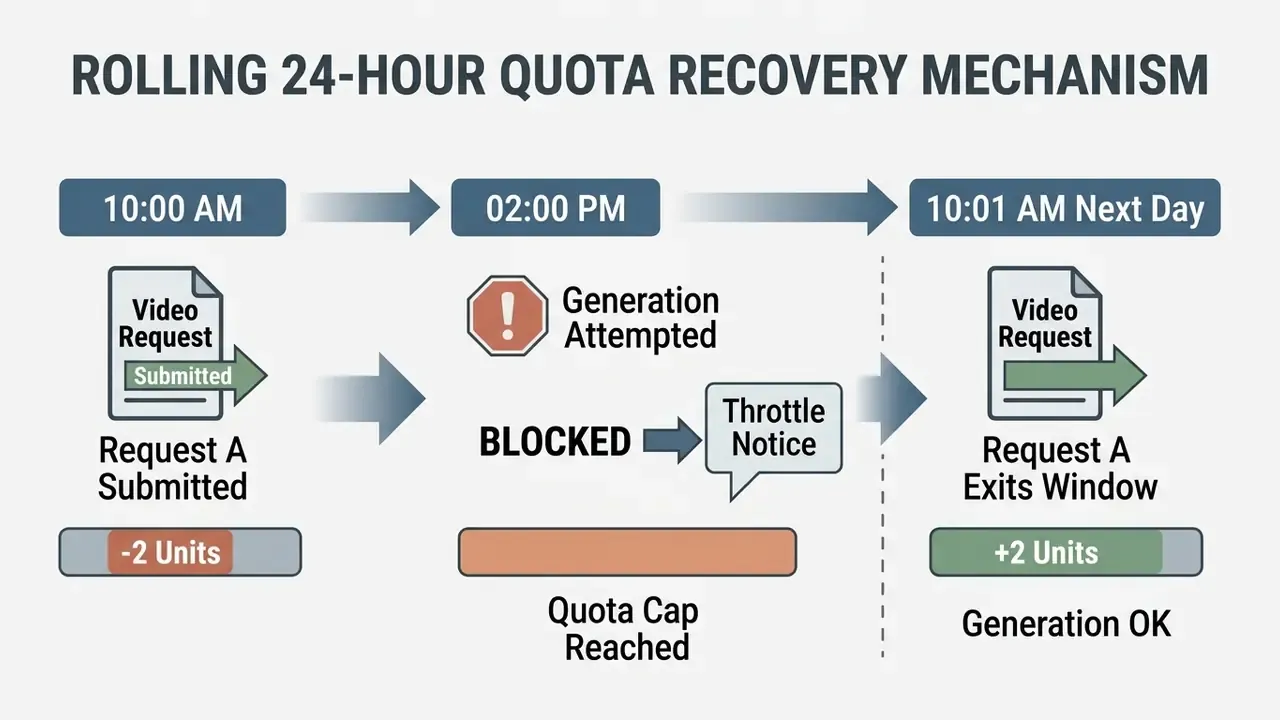
Monthly spend caps behave differently from rolling windows. Once a monthly ceiling is reached, usage pauses until 00:00 UTC on the first day of the following month, with no partial mid-cycle restoration. Systems that mix rolling daily quotas with monthly spend caps therefore need two independent circuit breakers, monitored by the same owner.
Sora API Pricing and Video Generation Economics for Developers
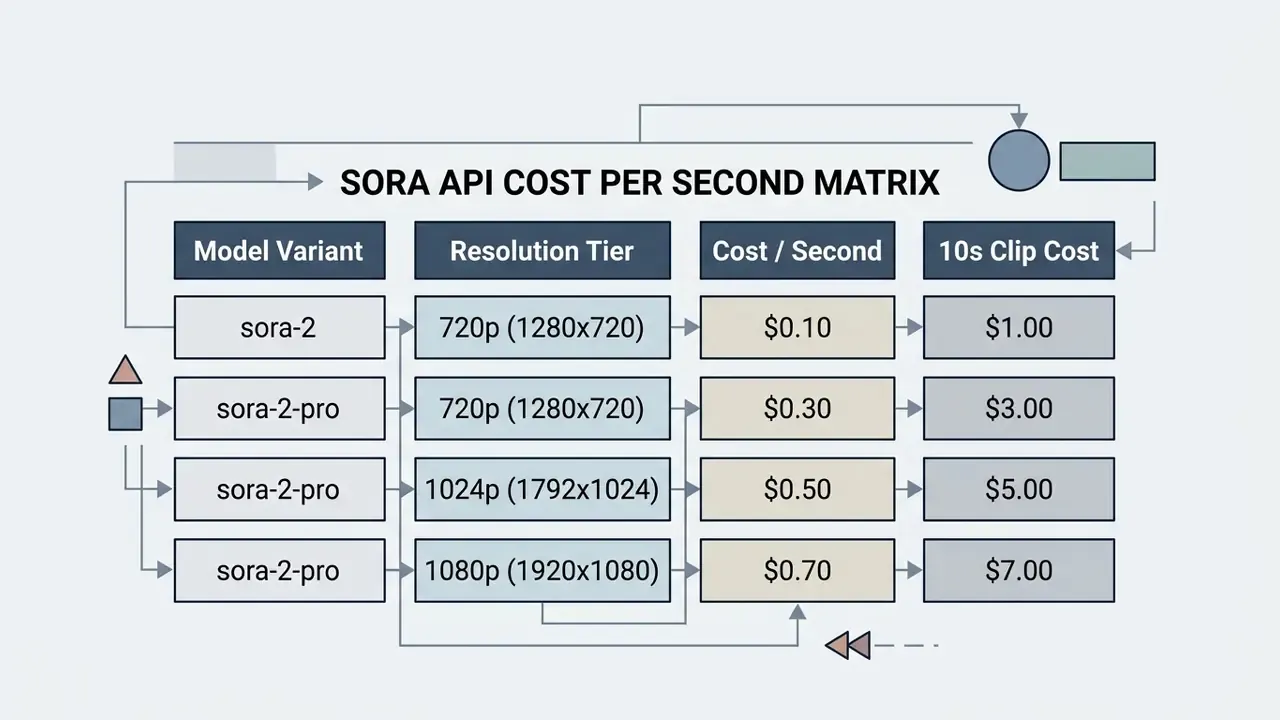
Sora API integration uses a per-second billing structure determined by model selection, frame resolution, and output duration. Storage of generated assets adds $0.10/GB/day on platform servers (OpenAI Developer Pricing, 2026).
Illustrative deployment pattern (methodology note). A representative pattern across regulated-industry pilots is automated visual reporting built on standard sora-2 at 720p for 10-second compliance summaries. Teams that add deterministic client-side pre-validation, enforcing prompt length, banned-term screening, and template conformance before dispatch, report the largest reductions in redundant generation calls. Monthly API overhead for low-volume reporting workloads typically lands in the low hundreds of dollars. These figures are directional estimates derived from the published per-second rate card, not an audited vendor case study. Model your own retry ratio before committing budget.
Key Parameters Driving Sora API Costs
API billing depends on three core parameters: output resolution tier, exact clip duration in seconds, and choice between the standard and pro models (OpenAI Developer Pricing, 2026).
sora-2(720p) fixed rate of $0.10 per generated second.sora-2-pro(720p) fixed rate of $0.30 per generated second.sora-2-pro(1024p) fixed rate of $0.50 per generated second.sora-2-pro(1080p) fixed rate of $0.70 per generated second.
«OpenAI's pricing page confirms: Sora 2 costs $0.10 per second at 720p; Sora 2 Pro costs $0.30 (720p), $0.50 (1024p) and $0.70 (1080p) per second.»
Batch API Pricing (roughly 50% Off for Offline Processing)
Non-urgent render queues submitted through the asynchronous Batch API are billed at approximately half the synchronous rate. Batch jobs trade latency guarantees for cost, which suits overnight rendering of marketing libraries, training-material refreshes, and regression test suites.
| Model / Resolution | Standard Rate | Batch Rate | 20s Clip (Batch) |
|---|---|---|---|
sora-2 at 720p | $0.10 / sec | $0.05 / sec | $1.00 |
sora-2-pro at 720p | $0.30 / sec | $0.15 / sec | $3.00 |
sora-2-pro at 1024p | $0.50 / sec | $0.25 / sec | $5.00 |
sora-2-pro at 1080p | $0.70 / sec | $0.30 to $0.35 / sec | $6.00 to $7.00 |
For a 500-clip monthly library at 10 seconds and 1080p, the standard bill is roughly $3,500 against approximately $1,750 on Batch. That delta alone justifies building an offline queue for anything that does not require same-session delivery.
API Rate Limits by Account Tier (Requests Per Minute)
Throughput, not price, is the constraint that most often breaks enterprise pipelines. RPM ceilings are assigned per account tier and differ sharply between the standard and pro models.
| Account Tier | sora-2 Rate Limit | sora-2-pro Rate Limit |
|---|---|---|
| Free | Not supported | Not supported |
| Tier 1 | 25 RPM | 10 RPM |
| Tier 2 | 50 to 75 RPM | 30 RPM |
| Tier 3 | 125 to 150 RPM | 60 RPM |
| Tier 4 | 200 to 250 RPM | 100 RPM |
| Tier 5 | 375 RPM | 150 RPM |
«Sora 2 rate limits: Tier 1 is 25 RPM, Tier 3 is 125 RPM, Tier 5 is 375 RPM; the free tier is not supported.»
Deprecation notice: The sora-2 and sora-2-pro models and the associated Videos API endpoints are scheduled for complete shutdown on September 24, 2026 (OpenAI Developer Guide, 2026). Teams building new video capabilities should inspect alternative architectures, including the best AI video generators landscape and the Google Veo API, plus the sora 2 ai video generator reference and the API Retry and failure cost model, before deploying production workloads.
Methodologies for API Budget Planning and Spend Control
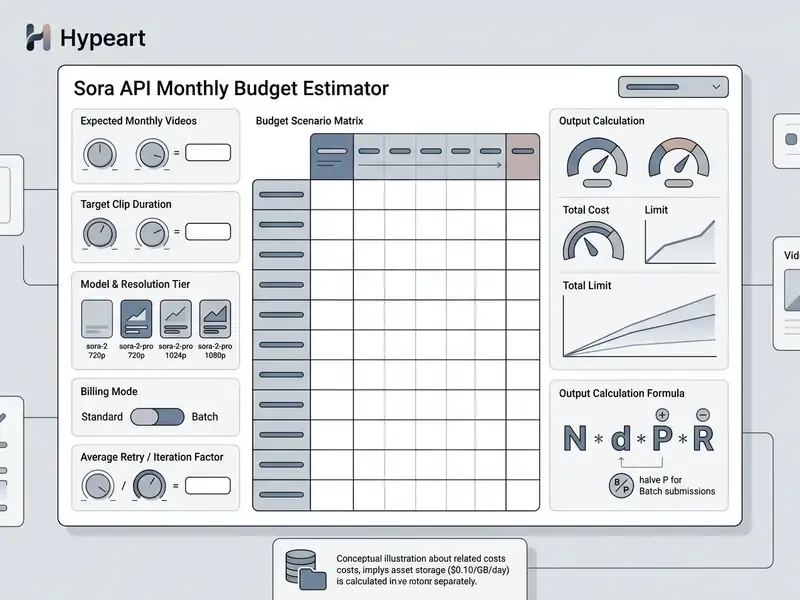
Predictive spend modeling has to account for successful renders, failed processing runs, retry multipliers, and higher resolution tiers. Enterprise architectures should enforce strict rate ceilings at the API key level (OpenAI Platform Limits, 2026).
The model for estimating monthly Sora API spend () is:
Where:
- = total planned unique video assets.
- = average clip duration in seconds.
- = per-second model price ($0.10, $0.30, $0.50, or $0.70).
- = average iteration ratio including prompt retries (for example, 1.5).
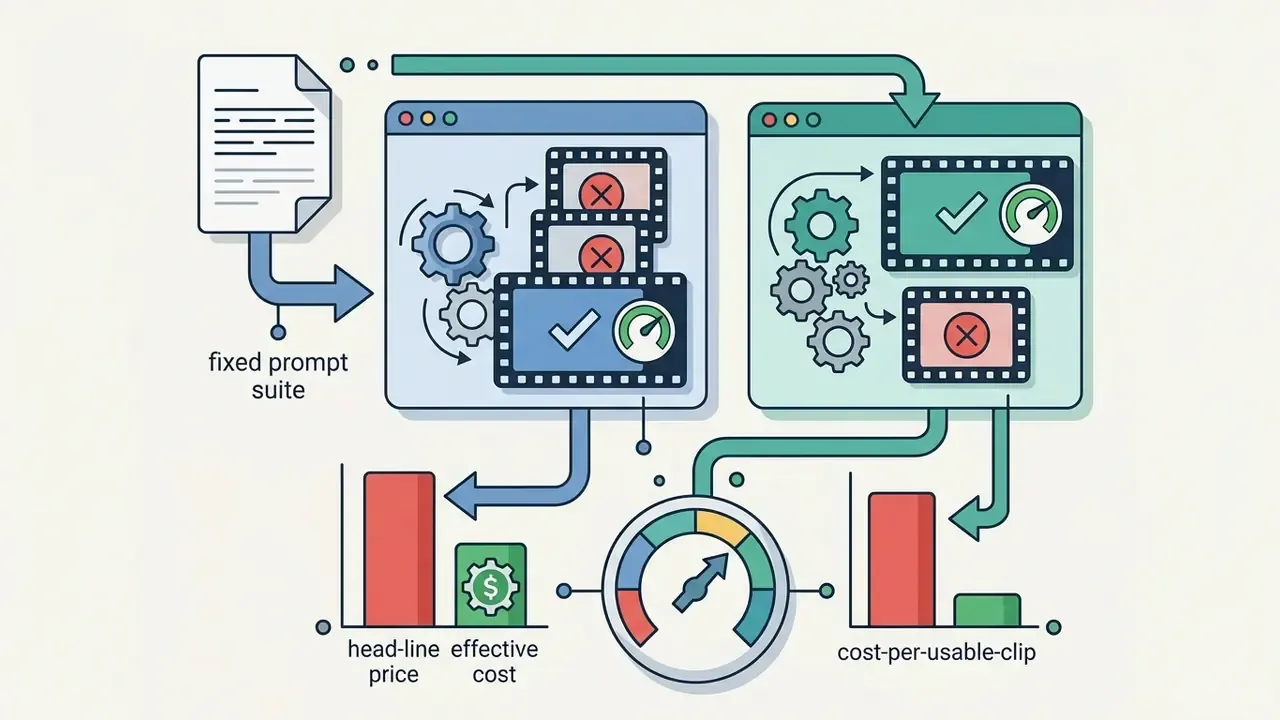
A disciplined control model layers four constraints on top of the formula: maximum duration and resolution per attempt, maximum attempts per accepted asset, a hard cost ceiling per accepted clip, and automated stop conditions for repeatedly failing jobs. Vendor-side budget caps per project or per API key, combined with pre-launch budget alerts, turn the formula from a forecast into an enforceable limit. The metric worth tracking is cost per usable clip, not cost per generation. A $1.00 render that fails acceptance three times costs $4.00 in practice.
Budget Scenario Matrix
| Scenario | Assets () | Duration () | Model / Tier () | Retry Factor () | Standard Monthly Cost | Batch Monthly Cost |
|---|---|---|---|---|---|---|
| A. Small pilot (proof of concept, internal review) | 50 | 8s | sora-2 720p at $0.10 | 1.6 | $64 | $32 |
| B. Mid-scale department (marketing plus internal training) | 250 | 10s | sora-2-pro 720p at $0.30 | 1.4 | $1,050 | $525 |
| C. High-volume automation (multi-channel production library) | 1,000 | 15s | sora-2-pro 1080p at $0.70 | 1.3 | $13,650 | $6,825 |
Calculation basis: . Totals reflect direct generation fees only. Asset retention is billed separately at $0.10/GB/day, and moderation rejections consume rate-limit capacity without producing output.
Teams modelling total cost of ownership can view the guide for compliance-cost estimation alongside raw generation spend.
Videos API Endpoint Specifications and Job Lifecycle
Video generation through the Videos API is fully asynchronous. A create call returns a job object immediately, and the rendered MP4 becomes retrievable only after the job reaches a terminal state. Building for this lifecycle correctly is the single largest determinant of whether retry costs stay near or drift past .
Payload: model, prompt, size, seconds, plus an optional reference image or character asset. Returns a job id and an initial status of queued.
Returns current status, progress percentage where available, and any error object. States run queued to in_progress to completed or failed.
Returns the binary MP4 stream once the job reaches completed.
- Create render job
POST /v1/videos - Check job status (polling)
GET /v1/videos/{video_id} - Download result
GET /v1/videos/{video_id}/content - Extend a completed clipan extension call against a finished
video_id, appending up to +20 seconds per invocation to a 120-second cumulative ceiling.
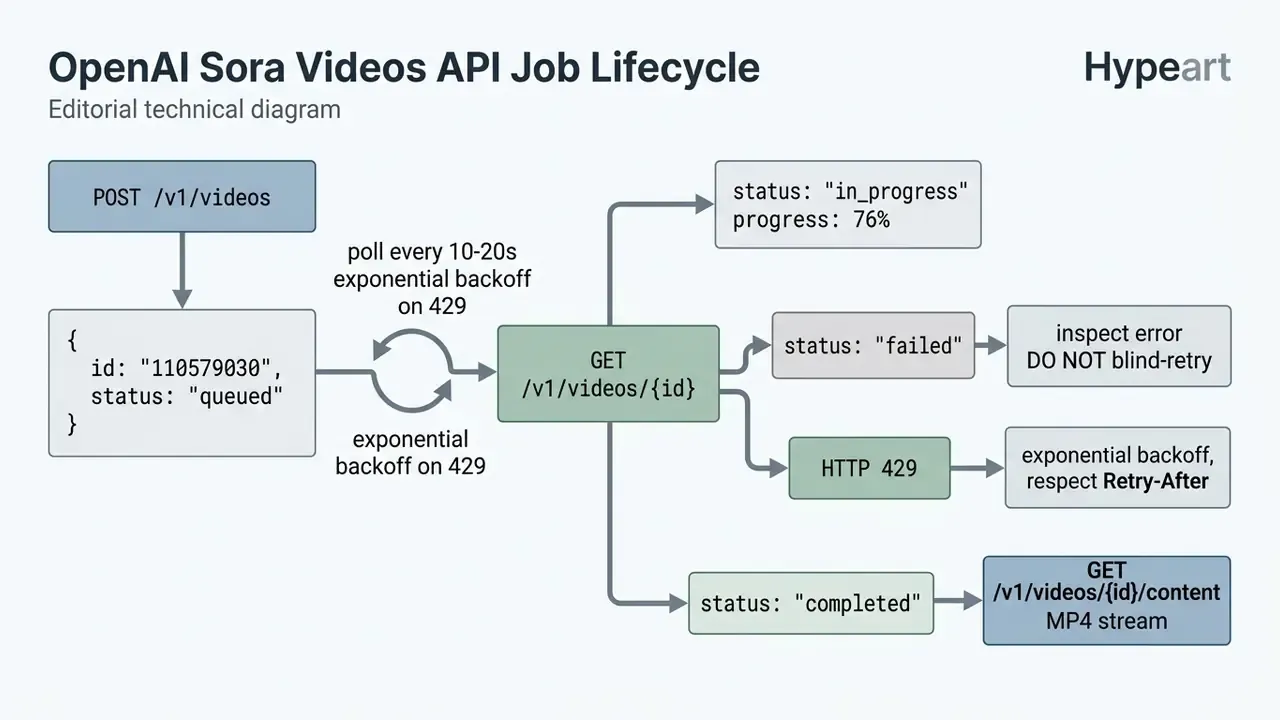
Operational guidance: poll at 10 to 20 second intervals rather than sub-second loops, apply exponential backoff on HTTP 429 responses, and prefer webhook notifications over polling for high-volume queues so that status checks stop burning RPM capacity. A failed status should route into an error-classification branch. Moderation rejections require prompt revision; transient infrastructure failures are safe to retry. Blind retries on policy violations inflate without ever producing output, and they look careless in an audit log.
Strategies to Reduce Limit Consumption in Sora
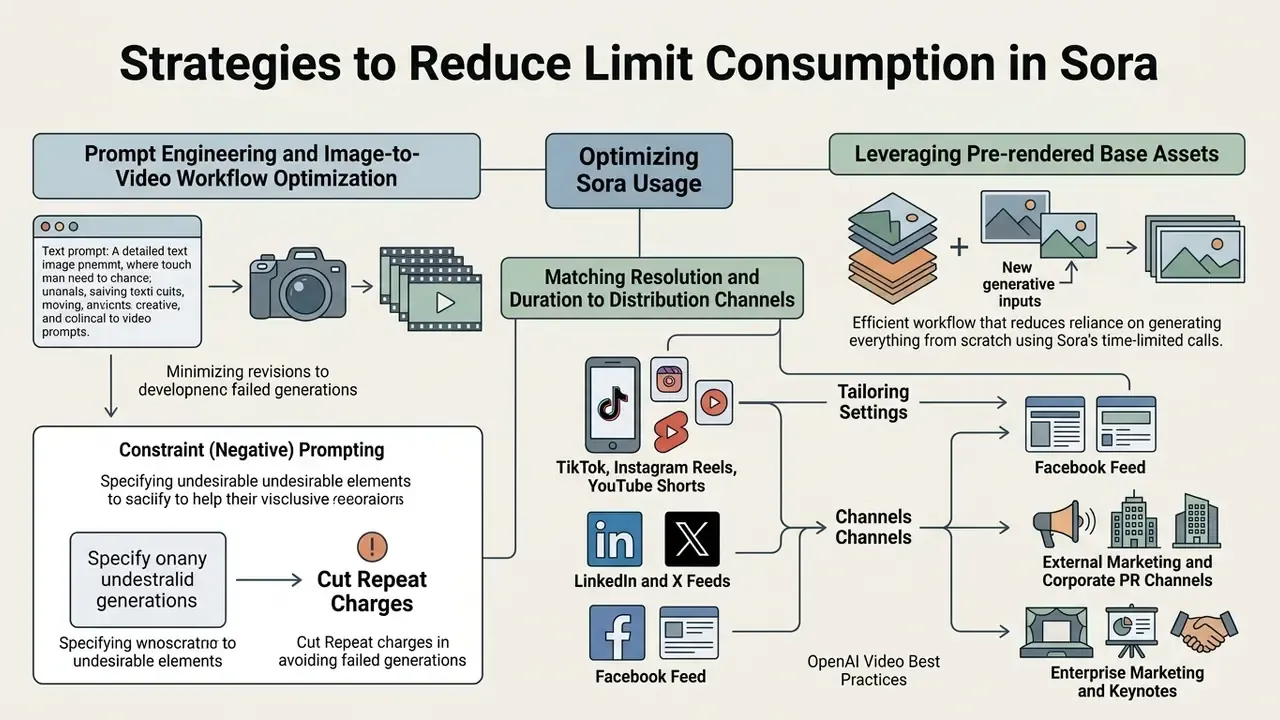
Optimizing Sora usage means minimizing prompt revisions, leveraging pre-rendered base assets, and tailoring resolution settings to the target media channel (OpenAI Video Best Practices, 2026). The dominant lever is sequencing: generate short, low-resolution drafts first, then spend premium credits only on selected finals.
Prompt Engineering and Image-to-Video Workflow Optimization
Structuring prompts with clear spatial, lighting, subject, and camera movement directives minimizes generation failures and conserves quota. Incomplete prompts produce visual artifacts that demand costly re-runs (OpenAI Prompting Guide, 2026).
«Sora documentation recommends naming subject and setting: who or what, where, time of day, plus camera and motion, to reduce failed generations.»
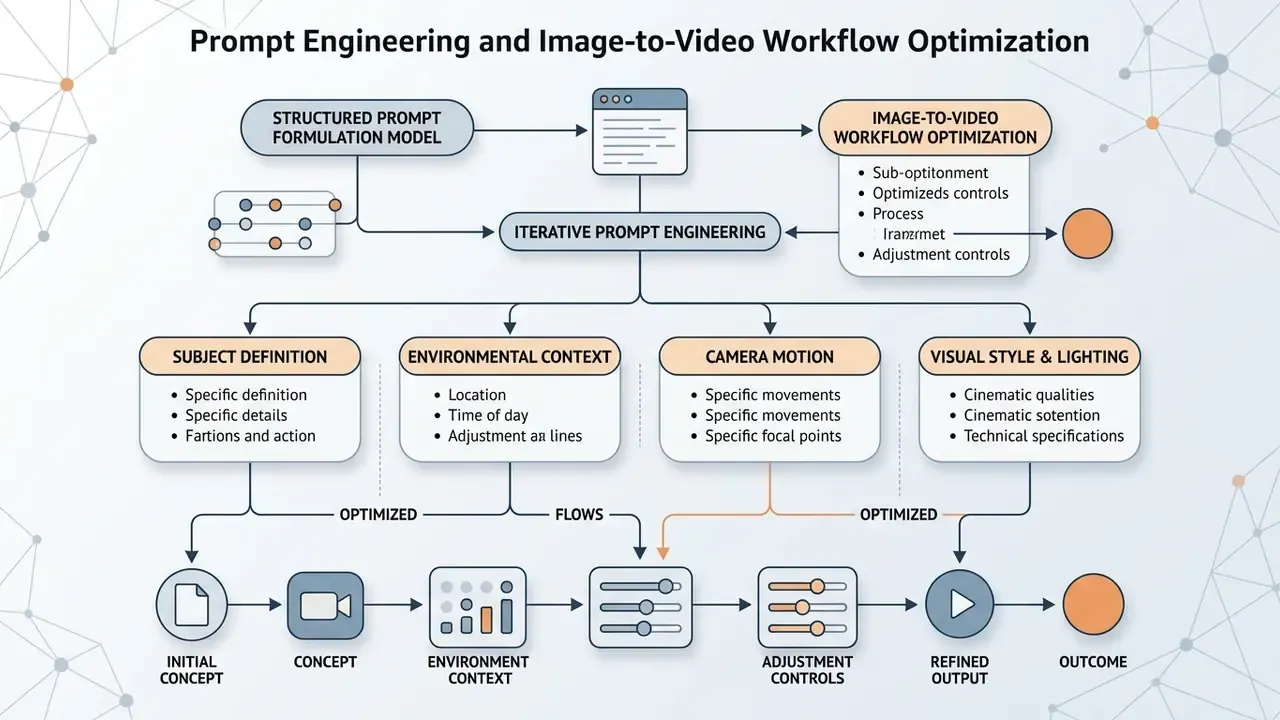
Constraint (negative) prompting to cut repeat charges. Because rejected and unusable renders still consume quota, explicitly bounding what must not appear reduces the retry ratio . Effective constraint clauses for regulated-industry footage include: no on-screen text or numerals, no recognizable faces or logos, no handheld camera shake, no lens flare, no crowd scenes, single continuous shot with no cuts. Each excluded element is one fewer failure mode to re-render at full per-second cost.
Matching Resolution and Duration to Distribution Channels
Content bound for short-form social channels does not need max-tier 1080p output. Mobile feeds compress video streams anyway, which makes 720p vertical visually sufficient while halving credit consumption (Platform Media Guidelines, 2026). Practitioners comparing pipelines can review text-to-video AI tools for channel-specific presets.
External marketing and corporate PR channels:
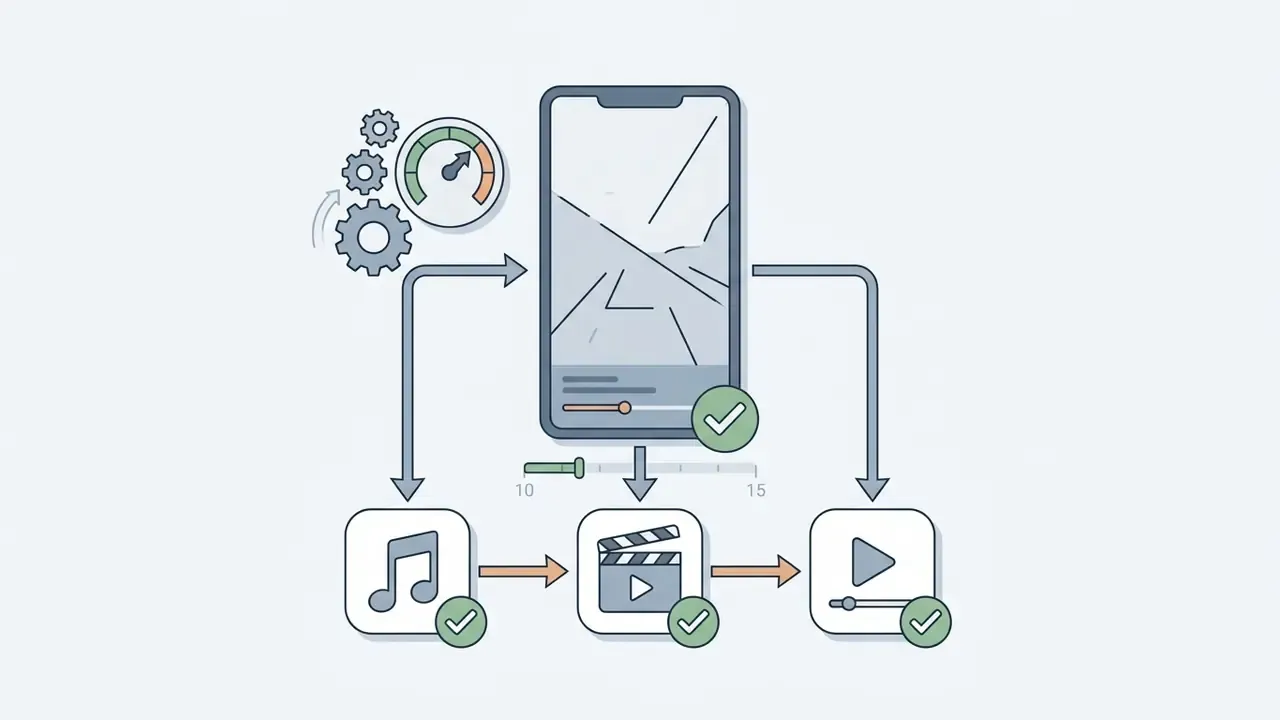



Internal enterprise and regulated-industry channels. The same resolution discipline applies to non-marketing use cases, and 720p is almost always enough because playback happens in a browser-embedded LMS player, not a cinema.
These formats help users in operations absorb a control change in under twenty seconds, which is usually the whole point. Creators evaluating automation can see the overview, review the YouTube video editor workflow for publishing pipelines, or explore the hub for specialized tools.
Content Moderation and Regional Restrictions in Sora
OpenAI applies strict safety filters, regional compliance controls, and provenance requirements across all Sora video outputs. Violating content policies produces job rejections that still deduct usage quota (OpenAI Safety Center, 2026).
Which Content Restrictions Affect Generation
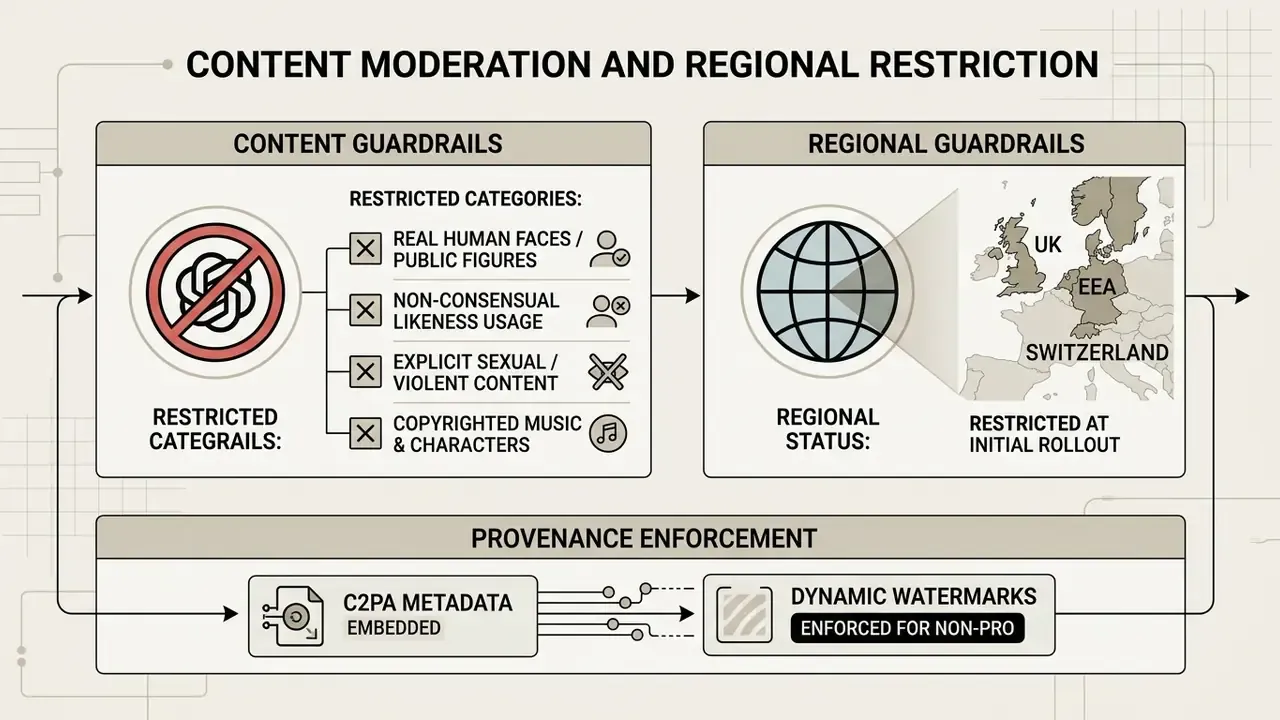
Sora safety mechanisms automatically reject input prompts or image uploads containing real human faces, public figures, copyrighted music, sexually explicit material, or violent imagery (OpenAI Usage Policies, 2026).
«The Videos API explicitly prohibits 18+ content, copyrighted characters, copyrighted music, real people, and image uploads containing human faces.»
Broader usage policies also prohibit non-consensual intimate imagery, promotion of suicide, self-harm or disordered eating, glorification of terrorism, targeted harassment and bullying, age-inappropriate material, and any content designed to defraud or mislead. Recreating a living person's likeness requires explicit consent in most contexts.
API endpoints enforce automated pre-filtering. Requests containing forbidden concepts trigger HTTP 400 validation errors, which blocks execution while still consuming rate-limit capacity (OpenAI API Documentation, 2026). Those potential risks are not theoretical for a regulated brand: one careless prompt referencing a named executive is a policy incident, not a rendering error.
Regional Availability and Visible Watermarks
Sora availability followed ChatGPT's supported regions, with specific exclusions. At launch, the United Kingdom, Switzerland, and the European Economic Area were excluded because of local regulatory frameworks (OpenAI Access Policy, 2026). Availability later extended to the EU, the United Kingdom, Switzerland, Norway, Liechtenstein, and Iceland for Plus and Pro subscribers on February 27, 2025.
All exported Sora videos embed machine-readable C2PA provenance metadata.
«Every Sora video contains visible and invisible provenance signals, and all outputs carry a visible watermark»
Moving visible watermarks are applied automatically unless the output came from a ChatGPT Pro subscriber meeting strict non-public-figure text-prompt conditions (OpenAI System Card, 2026).
«Pro users can download a video without a watermark only if it was made from a text prompt, shows no public figure, and uses no characters.»
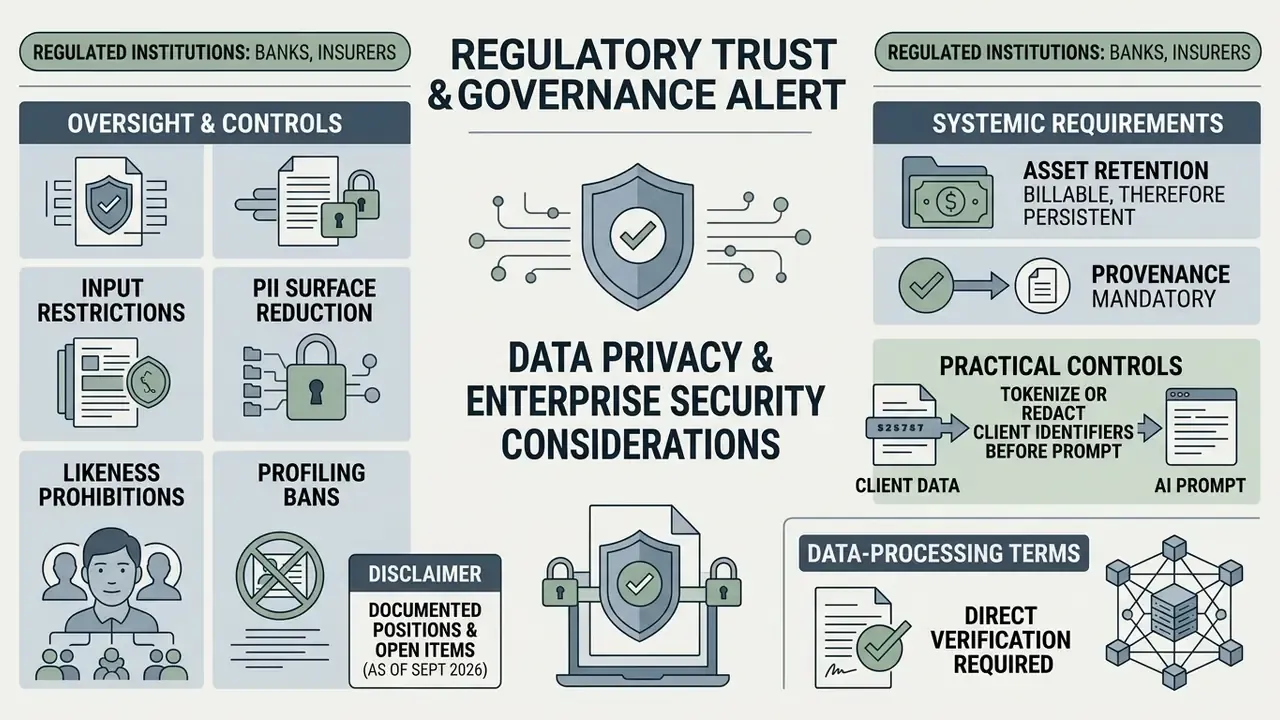
Regulatory trust and governance alert
Data Privacy and Enterprise Security Considerations
Migration Plan: Life After the Sora API Shutdown
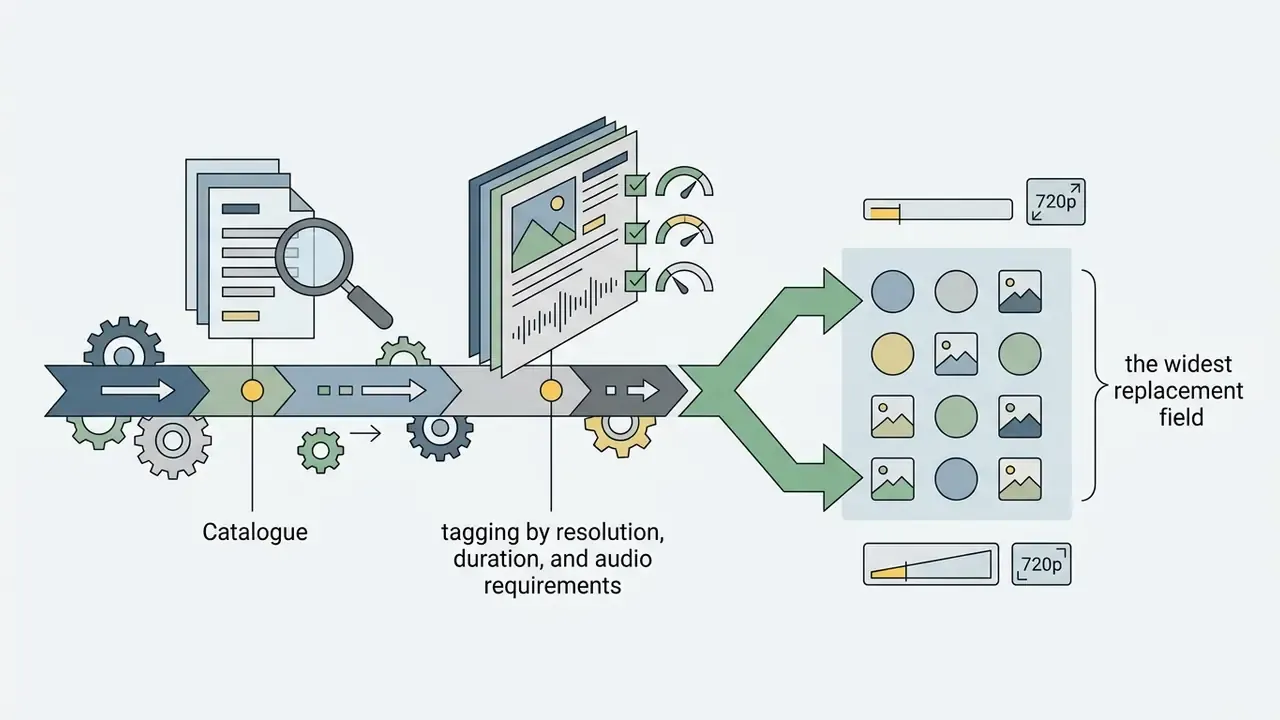
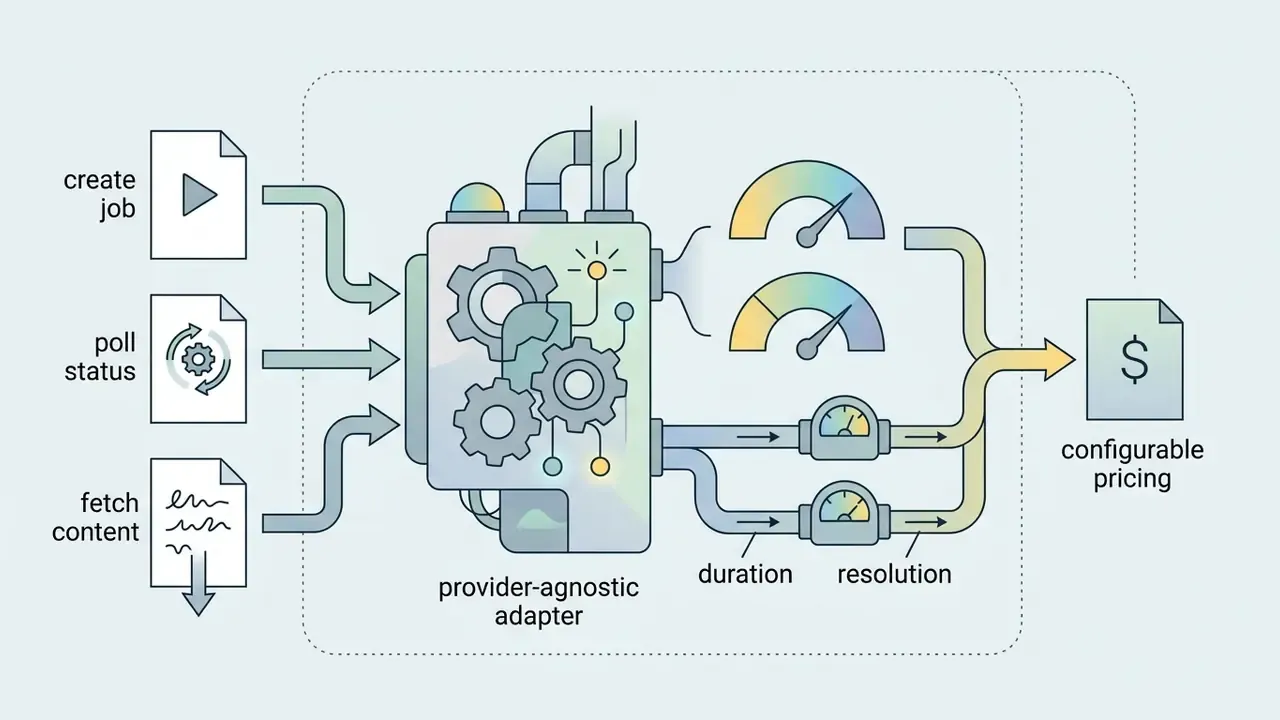
The Videos API shuts down on September 24, 2026, and OpenAI lists no replacement in its deprecation table. So every Sora-dependent workflow needs an exit plan. Lock-in mitigation is unusually easy here because the integration surface is tiny: a create call, a status poll, a content download. Abstract those three operations behind an internal interface and provider substitution becomes a configuration change instead of a rewrite.
Recommended enterprise alternatives post-deprecation (September 2026):
| Model / Platform | Max Resolution | Key Strengths vs Sora 2 | Best Use Case |
|---|---|---|---|
| Google Veo 3.1 | 1080p / 4K | Superior temporal physics, visual coherence, native audio, strong image-to-video prompt adherence | High-end commercial production |
| Kling 3.0 | 1080p | Native multi-shot prompt adherence and audio sync | Social media and marketing campaigns |
| Wan 2.7 | 1080p | Open-weights flexibility and low API latency | Self-hosted enterprise pipelines |
| Grok Imagine | 720p / 1080p | Rapid iteration on short-form clips | Dynamic real-time visual feeds |
| Nano Banana Pro | Platform-dependent | Fast asset generation inside multi-model workspaces | Mixed image and video creative workflows |
Technical evaluators can start with the Google Veo API implementation guide and the broader best AI video generators comparison.
FAQ: OpenAI Sora Limits
Can Sora Turbo be used for high-volume video generation?
Sora Turbo provided accelerated generation speeds suitable for rapid creative iteration, but it stayed subject to rolling account quotas and concurrency limits (OpenAI Help Center, 2026). Faster rendering never bypassed account-level daily limits or monthly subscription caps. High-volume enterprise generation required credit add-ons or multi-tier API rate allocations (OpenAI Billing FAQ, 2026). Teams priced out of premium tiers can compare free AI video generators for lower-stakes drafting work. Note also that the Sora web and app experiences hosting Turbo were discontinued on April 26, 2026, so Sora will not serve that workflow again.
What happens if an API call fails due to rate limits?
Requests exceeding assigned Requests Per Minute tiers return HTTP 429 (Too Many Requests). Rate limits exist to keep API access fair and reliable, so systems should implement exponential backoff and respect any Retry-After header (OpenAI API Documentation, 2026). Concretely: Tier 1 keys are limited to 25 RPM on sora-2 and 10 RPM on sora-2-pro, rising to 375 RPM and 150 RPM at Tier 5. A 429 response is not billable, but it does consume wall-clock time in the job lifecycle, which is why status polling should move to webhooks in high-throughput deployments.
How does resolution selection affect credit consumption in Sora Web?
Higher resolution settings raise credit costs. Standard 720p Sora 2 videos cost 10 to 20 credits, while high-resolution 1080p Sora 2 Pro renders consume between 250 and 500 credits per clip depending on duration (OpenAI Rate Card, 2026).
«Rate card: Sora 2 at 10s costs 10 credits and at 15s costs 20 credits; Sora 2 Pro high resolution costs 250 credits at 10s and 500 at 15s.» OpenAI, "Credits for Sora and Codex", Help Center (2026). https://help.openai.com/en/articles/12460853-creating-videos-with-sora
Are Sora videos generated by Plus users cleared for commercial use?
Commercial usage rights depend on adherence to OpenAI's Terms of Use and content policies. Watermark removal was a Pro-tier privilege subject to strict conditions, which means Plus-tier exports retained the visible moving watermark in normal operation.
«Pro users can download a video without a watermark only if it was made from a text prompt, shows no public figure, and uses no characters.» OpenAI, "Creating videos with Sora", Help Center (2026). https://help.openai.com/en/articles/12460853-creating-videos-with-sora Regardless of tier, every export carries C2PA provenance metadata, and EU AI Act Article 50 transparency obligations effective August 2, 2026 require machine-readable marking of synthetic content plus visible disclosure for deepfake material. Stripping provenance signals to disguise ai generated origin creates regulatory exposure at any subscription level.
Can developers request duration extensions beyond 20 seconds in the API?
Yes, with a caveat. A single generation call is capped at 20 seconds, but that is not the ceiling for the finished asset. Completed clips extend through the Video Extensions endpoint, each call appending up to 20 additional seconds of contextually coherent footage, to a cumulative maximum of 120 seconds per video asset. Each extension bills at the standard per-second rate for the chosen model and resolution. Sequences beyond 120 seconds still need multi-clip generation and programmatic stitching, so plan longer videos as scene sets from the start.
What is the cheapest way to produce a large video library?
Combine three levers. Draft at 720p on sora-2, taking four variants per call. Submit all non-urgent finals through the Batch API at roughly 50% of standard rates. Then enforce constraint prompting to hold the retry factor near 1.2. Applied to Scenario C above, that combination moves a 1,000-clip monthly library from about $13,650 to under $7,000.
Does a rejected prompt still cost money?
A moderation rejection returns HTTP 400 before rendering begins, so no per-second generation fee applies. But the request still consumes rate-limit capacity and, on consumer surfaces, the submission slot inside the rolling 24-hour window. Client-side pre-validation against the prohibited-content list is therefore a throughput optimization as much as a compliance control.
Technical and Financial Reference Summary
| Parameter Category | Standard Sora 2 Model | Sora 2 Pro Model |
|---|---|---|
| API Base Price | $0.10 / generated second | $0.30 (720p) to $0.70 (1080p) / sec |
| Batch API Price | $0.05 / generated second | $0.15 (720p) to $0.35 (1080p) / sec |
| Supported Resolutions | 720x1280, 1280x720 | Up to 1920x1080 / 1080x1920 (incl. 1024p band) |
| API Single Clip Cap | 20 seconds | 20 seconds |
| Max Asset Duration via Extensions | Up to 120 seconds | Up to 120 seconds |
| Batch Variants per Call | Up to 4 at 720p or lower | 1 at 1080p |
| Rate Limits (Tier 1 to Tier 5) | 25 to 375 RPM | 10 to 150 RPM |
| Consumer Web Clip Cap | 10s default / 15s extended | 25s (web storyboard) |
| Asset Storage | $0.10 / GB / day | $0.10 / GB / day |
| API Lifecycle Status | Scheduled shutdown September 24, 2026 | Scheduled shutdown September 24, 2026 |
To evaluate alternative video architectures, technical teams can review the openai sora video developer guide, assemble generated clips with free video editing software, or compare options in the developer hub.
Model Risk Pre-Deployment Checklist
Use this before promoting any Sora-based pipeline beyond a sandbox pilot.
Checklist0 / 22
Appendix A: Superseded and Corrected Statements
Retained for audit transparency. The statements below appeared in earlier revisions of this analysis and have been corrected in the main text.
- Superseded (duration)"Single API video generation calls are hard-capped at 20 seconds. Applications requiring longer sequences must generate individual scenes and stitch them programmatically." Partially incorrect. The 20-second figure applies to a single generation call only. The Video Extensions endpoint appends +20 seconds per call up to 120 seconds cumulative, and programmatic stitching is required only beyond that. Corrected in Duration Limit and Length Caps and in the FAQ.
- Superseded (longer assets)"Longer video assets require multi-clip sequencing or offline stitching tools." Now qualified with the extension pathway and sourced to OpenAI's Videos API guide (https://developers.openai.com/api/docs/guides/video-generation).
- Superseded (quota units, unsourced)the original unsourced list stating "10-second video clip: deducts 1 unit... 15-second: 2 units... 25-second: 4 units." Values are confirmed, but now attributed to OpenAI's Sora app release notes (15s counts as two videos, 25s as four, against daily limits).
- Superseded (watermarks, unsourced)"videos generated under Plus accounts include visible watermarks that cannot be removed natively." Directionally correct, now sourced and reframed through the documented Pro-tier watermark-free conditions (text prompt only, no public figure, no character usage).
- Reframed (case study)the anonymous fintech figure "eliminating 92% of redundant generation calls, maintaining monthly API overhead under $450" is reframed as a directional deployment pattern, because no verifiable methodology, sample size, or audited source accompanied the original claim.
- Clarified (timeline)earlier revisions cited only the September 24, 2026 API shutdown. The consumer web and app retirement on April 26, 2026 is now stated separately, to stop subscription limits being conflated with developer access.