Author note: Marcus Hale writes about AI governance and model risk for this publication.
If you run risk, compliance, or model governance at a US bank or a mature fintech, a video model looks like a marketing problem until the day it isn't. Then it becomes your problem: a synthetic executive in a customer-facing clip, a performance claim rendered on screen, a vendor endpoint that disappears mid-campaign. That is why this piece treats video generation as a controlled model, not a creative toy.
The openai sora video generation tool is OpenAI's diffusion-transformer system for turning natural language descriptions and reference imagery into temporal, high-definition video assets. Evaluating it properly means analyzing programmatic access routes, compute economics, identity-verification controls, content provenance obligations, operational risks, and current lifecycle status across enterprise deployment pipelines.
Executive Summary: Strategic Risk Alert (Read This First)
If you are a CRO, CCO, Head of Model Risk, or AI governance lead deciding whether Sora belongs in a regulated workflow, these are the decision-critical facts in 30 seconds.
- Lifecycle risk is the top-line issue.OpenAI discontinued the consumer Sora web and app experiences on April 26, 2026, and the developer Videos API (
sora-2,sora-2-pro) is scheduled for full shutdown on September 24, 2026. Any production dependency must sit behind a model-abstraction layer. - Vendor economics drove the sunset.Public reporting indicates Sora cost an estimated $1,000,000 per day to operate, with worldwide users peaking near one million before falling below 500,000. Compute shortages and cost pressure closed the product, not feature failure.
- Commercial demand was real but legally contested.In December 2025, Disney announced a $1 billion, three-year licensing investment allowing more than 200 copyrighted characters to be generated inside Sora 2. The deal drew formal objections from performer and writer guilds.
- Provenance controls are breakable.Sora outputs carried visible moving watermarks and C2PA metadata, yet third-party watermark-removal tools appeared within roughly a week of the Sora 2 launch. Provenance is not a sufficient control on its own.
- Unit economics are per-second, not per-token.
sora-2bills $0.10/sec at 720p;sora-2-probills $0.30 to $0.70/sec depending on resolution, with a 50% Batch API discount on non-real-time jobs. - Rate limits are tier-gated.The free billing tier has no API access; Tier 1 = 25 RPM, scaling to Tier 5 = 375 RPM.
- Governance, not prompt craft, is the cost driver at scale.Legal review, model validation evidence, C2PA verification, and human post-production frequently exceed raw API spend.
Terms Used in This Guide (Defined Once)
- Model abstraction layer an internal adapter that keeps vendor model names out of business logic, so a model swap is a config change rather than a rebuild.
- C2PA Content Credentials cryptographically signed provenance metadata attached to a generated asset, describing how it was produced.
- Cameo a verified digital likeness (appearance plus voice) that can be injected into a generated scene under consent controls.
- Batch API tier a non-real-time processing queue priced at roughly half the standard per-second rate, with limited output retention.
- RPM requests per minute, the hard ceiling attached to your billing tier.
- First-pass yield accepted clips divided by clips started. The single most honest quality metric in a video pipeline.
- Shadow AI unapproved employee use of generative tools outside the sanctioned toolchain.
- LSE-D / LSE-C SyncNet-derived lip-sync error distance and confidence, the standard quantitative pair for audio-video alignment.
What Is the OpenAI Sora Video Generation Tool and Which Use Cases Does It Serve?
The openai sora video generation tool is a multimodal generative model that synthesizes high-definition visual clips from natural language text prompts and still image inputs. It serves technical workflows across digital publishing, concept pre-visualization, product advertising, and automated video asset creation. Teams comparing the wider category can review the broader class of AI video generators before committing engineering budget to a single vendor.
In enterprise and media pipelines, teams deploy openai sora ai video generation to generate marketing collateral, storyboard sequences, and short-form social media assets. The platform processes spatial-temporal latents to maintain visual style, object persistence, and camera movement across frames. By using a transformer backbone that operates on spacetime patches, the underlying video model evaluates global composition alongside frame-to-frame motion transitions. Advanced AI of this class is impressive on composition and unreliable on consequence, which is the whole governance story in one sentence.
«Sora is a diffusion model trained jointly on videos and images of variable duration, resolution and aspect ratio, using a transformer architecture that operates on spacetime patches.»
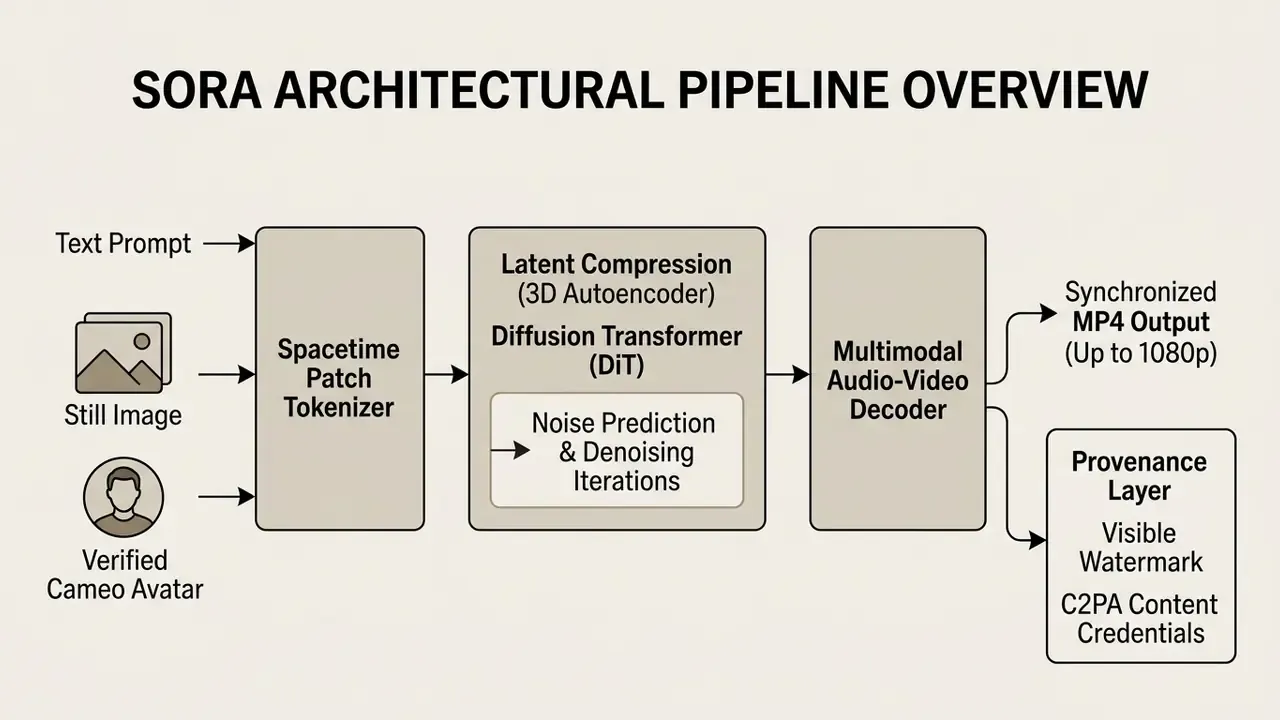
Organizing digital creation around an openai sora video generation model lets organizations scale content output while managing production overhead. Architecture detail sits in our openai sora video generation model breakdown, and teams can explore the hub to see how generative frameworks fit wider digital automation initiatives.
Text-to-Video, Image-to-Video, and Multimodal Input
Text-to-video, image-to-video, and multimodal input modes let Sora ingest text prompts, still photographs, or existing video frames and produce contiguous sequences. These input pipelines allow developers to anchor generations to specific visual assets or build entirely synthetic scenes from natural language.
In a standard openai sora ai text to video workflow, natural language text prompts specify subjects, environmental conditions, lighting direction, and camera trajectories. Teams new to the category can review the wider landscape of text-to-video AI tools to understand where diffusion-transformer models sit against template-driven generators.
When teams supply an input_reference using an ai image, the model treats that image as the initial anchor frame. That anchors character design and visual style before the model computes subsequent frame transformations. Practitioners should also compare dedicated image-to-video AI tools, because anchor-frame fidelity varies sharply between architectures. According to the OpenAI Sora Technical Report (2024), the diffusion transformer processes variable resolution inputs and aspect ratios directly in latent space, which keeps spatial consistency across complex prompts.
«Open-Sora supports text-to-image, text-to-video and image-to-video generation in a unified architecture using a 3D autoencoder and a DiT-like transformer.»
Multi-Frame Conditioning: Start Frame, End Frame, and Interpolation Control
Beyond single-anchor conditioning, production teams usually want deterministic control over both ends of a shot. Interface implementations and API wrappers around Sora-class models expose a two-frame conditioning pattern that materially reduces retake rates on brand-critical shots:
start_frame(string / base64 /file_id): the first-frame visual anchor. Must match target output resolution and aspect ratio.end_frame(string / base64 /file_id): the final target frame used for temporal interpolation, so the model solves motion between two fixed compositions instead of improvising an ending.interpolation_bias(float 0.0 to 1.0): controls whether motion accelerates toward the end frame or progresses linearly across the clip.- Aspect ratio selection: 16:9, 9:16, 1:1, 4:3, and 3:4 are the standard delivery ratios. Mismatched reference assets remain the single most common cause of rejected jobs.
Two-frame conditioning is the preferred pattern for product hero shots, logo reveals, and packaging transitions, because it converts an open-ended generative task into a constrained interpolation task. For character work and background continuity, reference-conditioned approaches such as those described in the SkyReels-V3 technique report encode each reference image with the video VAE and concatenate reference latents with video latents, supporting up to four reference images for subject appearance and background structure.
Programmatic Cameos: Digital Likeness and Identity Verification Architecture
Sora 2 introduced the Cameos subsystem, which injects verified human avatars (likeness plus voice profile) into generated scenes. For regulated organizations this is the single highest-risk capability in the whole feature set. It is also the feature most competitors describe only in marketing language.
Functionally, Cameos captures a user's appearance, gestures, and voice so their digital self can act inside a generated environment: an animated action sequence, a dramatic monologue, a scenic establishing shot, with audio and lip movement synchronized to the visual track. An identity verification step gates the feature, so the subject keeps control over where their likeness appears.
Programmatically, the pattern requires submitting a pre-verified avatar_id alongside the prompt. OpenAI enforced an identity-verification protocol using consent tokens to prevent unauthorized deepfakes. If an avatar_id arrives without a matching authorization signature in the request header, the API returns HTTP 403 Forbidden (identity_verification_failed). Public-figure likenesses could not be generated without permission, and moderation evaluated image and video uploads together with text prompts in a multimodal context.
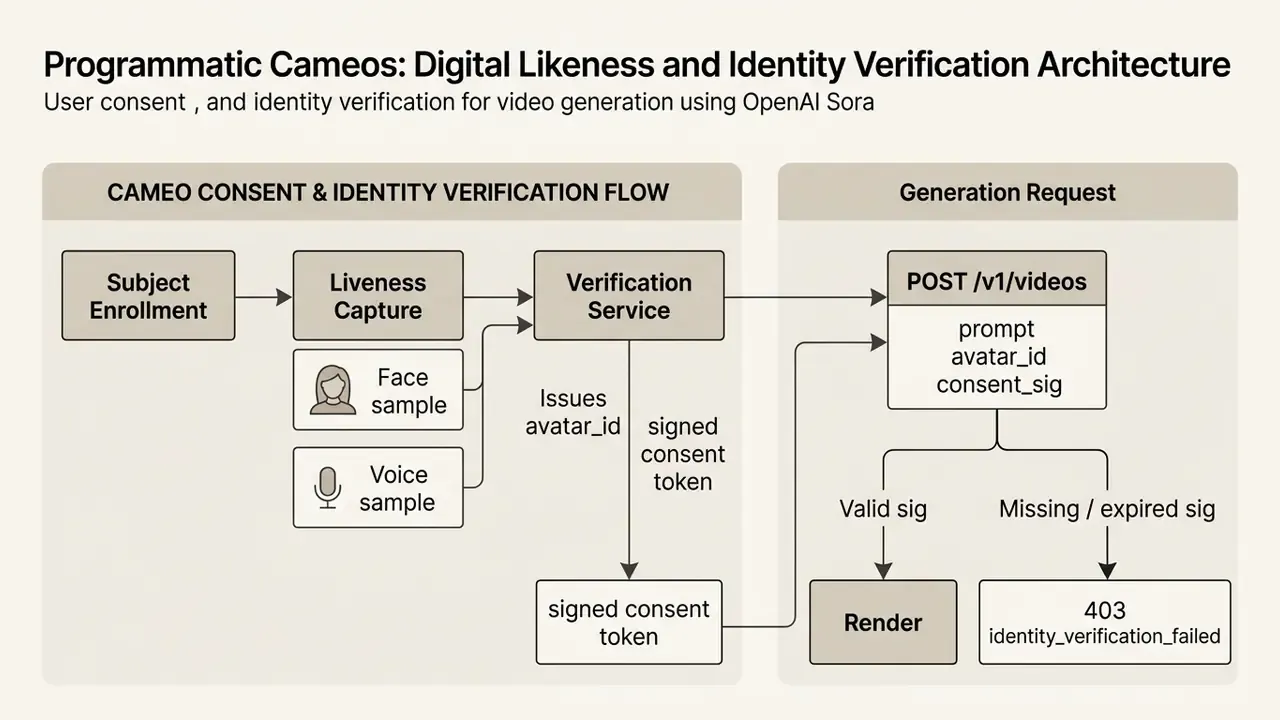
Governance requirement: any organization using likeness-based generation for executives, brand ambassadors, or employees must retain the signed consent artifact, its expiry date, and a revocation path in the same evidence store used for model validation records. Consent without retained proof is not a control. It is a story.
What AI Videos Does Sora Create?
Sora generates short videos, conceptual animatics, art video pieces, AI animation, and cinematic sequences characterized by camera movement, movement lighting, and physical scene composition. Output formats run from vertical 9:16 social clips to widescreen 16:9 cinematic shots.
«Sora can generate videos up to a minute long in high definition while maintaining subtle motion, interactive scenes and multi-plane composition.»
In OpenAI's own framing, the model generates complex scenes with multiple characters and specific motion patterns, and Sora 2 follows intricate instructions across multiple shots while persisting world state. That is why the output distribution spans both quick concept clips and multi-shot cinematic sequences.
The system produces realistic videos with physical dynamics such as liquid reflections, atmospheric fog, and complex lighting transitions. Creators use ai sora videos to preview camera movement choices, including drone sweeps, dolly zooms, and steady tracking shots, before a physical production shoot. Teams evaluating deployment tooling can consult the openai sora video generator hub page to review related programmatic interfaces.
Comparison of Text-to-Video, Image-to-Video, and Two-Frame Generation Modes
| Parameter / Feature | Text-to-Video Mode | Image-to-Video Mode | Start + End Frame Mode |
|---|---|---|---|
| Primary Input | Natural language text prompt describing scene, motion, lighting, and camera paths | Reference image (input_reference) plus optional text prompt | start_frame + end_frame plus optional text prompt |
| First Frame Conditioning | Synthesized dynamically from text prompt latents | Fixed to the supplied image asset | Fixed to start_frame |
| Final Frame Control | None (model-determined) | None (model-determined) | Fixed to end_frame |
| Controllable Parameters | Aspect ratio, clip duration, resolution, motion descriptors, camera direction | Aspect ratio, duration, resolution, image-adherence weighting, motion speed | All of the above plus interpolation_bias |
| Style Persistence | Inferred entirely from text semantic tokens | Anchored directly to visual attributes of the input image | Anchored at both temporal endpoints |
| Primary Use Cases | Abstract concepts, rapid storyboarding, new scene ideation | Character continuity, animating static brand assets, product hero shots | Logo reveals, packaging transitions, deterministic A to B motion |
| Typical Retake Rate | Highest | Moderate | Lowest for constrained shots |
| Output Format | MP4 container (up to 1080p, synchronized audio on supported tiers) | MP4 container (matching input aspect ratio) | MP4 container (matching frame pair resolution) |
How to Access OpenAI Sora and Verify API Availability
Access via OpenAI Interface and ChatGPT
Consumer access through sora.com and the ChatGPT interface provided the first web-based route to try Sora on subscription tiers. OpenAI formally ended the standalone consumer web experience on April 26, 2026.
«On January 10, 2026 OpenAI restricted Sora access to Plus and Pro subscribers, removing the free tier entirely; the Sora app shut down on April 26, 2026.»
During the active web release, subscribers asking how to access sora openai video generation tool features used the chatgpt video generator sora surface on Plus, Business, and Pro accounts. ChatGPT Plus capped generations at 480p resolution and 10-second durations with single-job concurrency. ChatGPT Pro unlocked 1080p exports, 20-second clip lengths, up to 5 concurrent jobs, and watermark-free downloads. Free accounts, Enterprise plans, and Edu tiers stayed ineligible for consumer web access. In-app generation was additionally governed by a rolling 24-hour quota: a 10-second clip counted as one video, a 15-second clip as two, a 25-second clip as four, with stitched sequences reaching up to 60 seconds total. Anyone still searching how to get access to sora openai video generator through that route is chasing a closed door; organizations seeking current generation tools can open the hub to inspect alternative video production resources.
Access via API and AI Video Model Aggregator Platforms
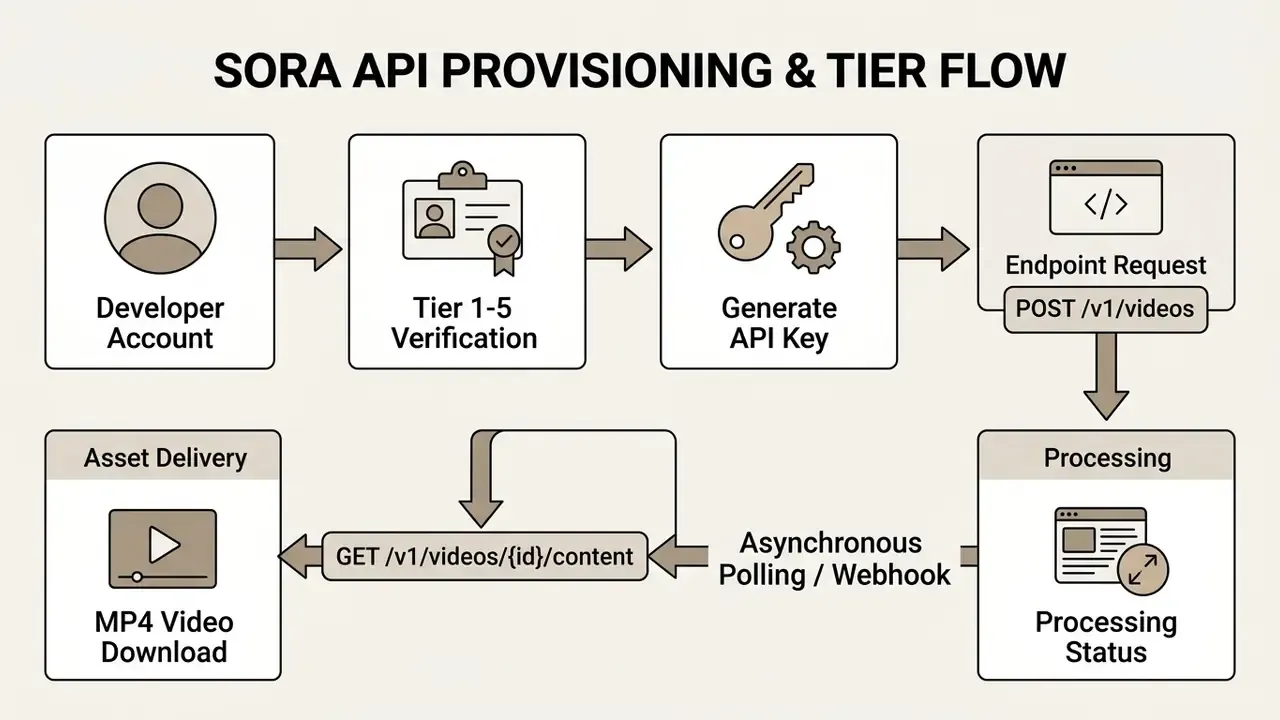
Programmatic API access operated asynchronously through OpenAI's Videos API endpoints using model=sora-2 or model=sora-2-pro. Developers configured HTTP requests, SDK drivers, or CLI commands to submit jobs and retrieve MP4 files.
To execute an open sora ai video generator workflow programmatically, engineers submit JSON payloads to POST /v1/videos. The service returns a job identifier for polling via GET /v1/videos/{video_id}. Once complete, the asset downloads from GET /v1/videos/{video_id}/content. Adjacent endpoints documented in OpenAI's prompting guide covered /characters for reusable identities, /extensions for clip continuation, and /{video_id}/edits for targeted revisions. For broader system design, review our guide to the sora ai video pipeline.
Third-party aggregator platforms also offer unified API routes, and this is where governance teams should slow down. Aggregator access is a commercial reseller claim, not a vendor guarantee. Several such platforms advertise "100% free Sora 2 generation," which contradicts OpenAI's per-second billing model and usually reflects credit-subsidised wrappers rather than free capacity. Verify data handling, retention, sub-processor lists, and SLA terms directly against official vendor documentation before routing regulated content through an intermediary. Anyone researching how to get access to openai sora video generator via a wrapper is really buying someone else's data-processing posture.
E-E-A-T API Status Verification:
As of September 2026, official OpenAI API documentation indicates that the
sora-2andsora-2-promodels and the associated Videos API endpoints are deprecated, with a scheduled API shutdown date of September 24, 2026 (OpenAI Developer Docs, page updated 2026-09-04). Rate limits apply strictly by account billing tier: Tier 1 = 25 RPM, Tier 2 = 50 RPM, Tier 3 = 125 RPM, Tier 4 = 200 RPM, Tier 5 = 375 RPM. Accounts on the free billing tier have no API access. Factor these deprecation schedules into near-term product roadmaps.«On March 24, 2026 OpenAI notified developers that the Videos API and all
sora-2andsora-2-proaliases would be removed on September 24, 2026.»
E-E-A-T Enterprise Market Insight: Operational Costs, Licensing, and Legal Risk
According to industry disclosures and contemporaneous reporting, running Sora infrastructure cost OpenAI roughly $1,000,000 per day in compute overhead, with worldwide usage peaking near one million users before declining below 500,000. Those economics, plus compute shortages and a strategic pivot toward core enterprise products, drove the decision to deprecate the consumer app and then the public API.
Commercial demand was nevertheless demonstrable. On December 11, 2025, Disney announced a $1 billion, three-year licensing investment in OpenAI, permitting Disney+ users to generate more than 200 copyrighted characters inside Sora 2. The deal drew immediate objections from performer and writer organizations, which characterised it as theft of creative work and committed to monitoring implementation for compliance. Separately, Sora launched with copyrighted-material generation enabled by default unless rightsholders opted out, a posture OpenAI tightened toward granular, opt-in rightsholder control in October 2025 after public criticism.
Provenance controls also proved fragile. All Sora 2 outputs carried a visible moving watermark plus C2PA metadata, yet by October 7, 2025, roughly one week after launch, third-party watermark-removal utilities were widely available. Enterprise teams therefore need to price in asset-protection vulnerability and vendor lifecycle volatility at the same time, and should treat watermarking as a deterrent rather than an enforcement mechanism.
Data Privacy, Content Provenance, and Enterprise Governance Controls
Before a generative video model enters a regulated workflow, the governing questions have nothing to do with lens choice. Where do prompts go? Who can see them? What is retained? Can you prove the output is synthetic six months later?
1. Prompt and asset confidentiality. Every POST /v1/videos call transmits a prompt and, in image or cameo modes, a reference asset. Treat prompts as data egress: scripts, unreleased product imagery, campaign timing, and named individuals are all disclosable content. Where zero-retention handling (ZDR) and enterprise data-processing terms are required, contract them explicitly at the API-agreement level. Do not infer them from consumer-product documentation. Aggregators add a second processor to this chain and must be assessed separately.
2. Moderation scope. OpenAI's published safety material states that guardrails screened prompts and outputs across multiple video frames and audio transcripts before content was created, with enforcement covering privacy violations, impersonation, fraud, harassment, non-consensual intimate imagery, and minor exploitation. For governance purposes this means your prompt text and generated audio transcript are inspected content, which changes how you classify confidentiality.
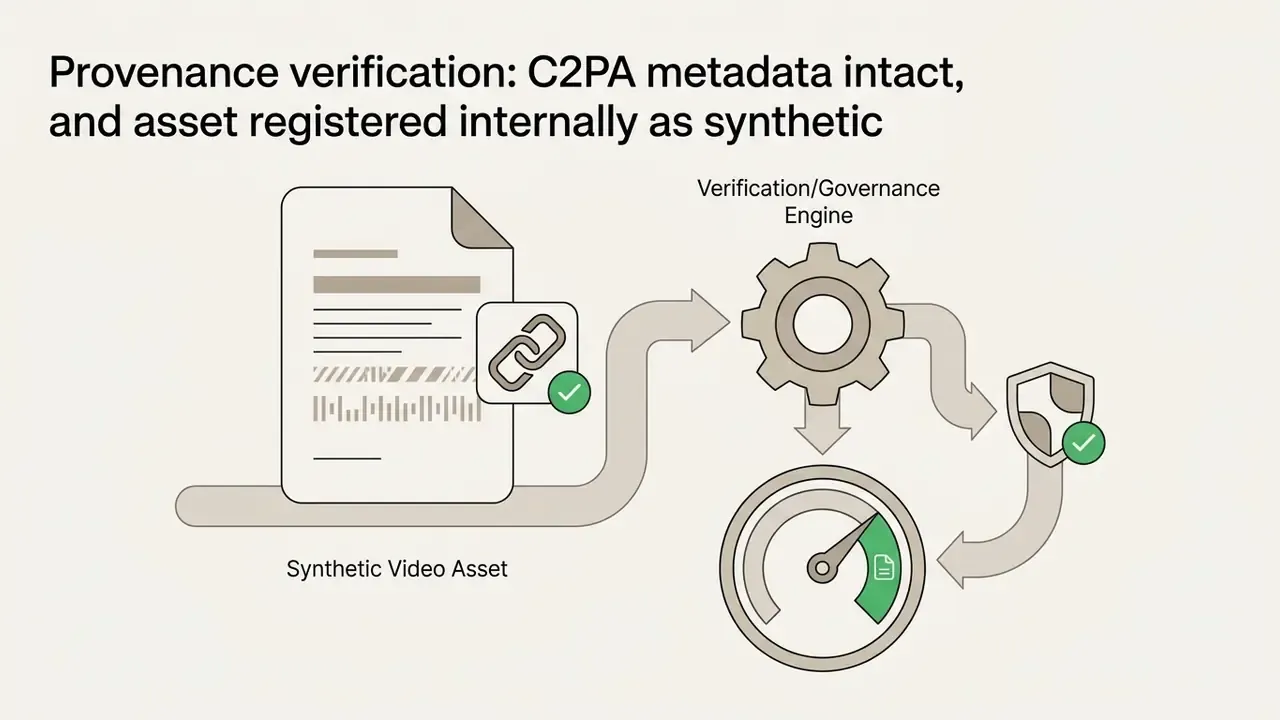
3. Provenance and C2PA. Generated videos embedded C2PA Content Credentials and a visible moving watermark. Governance teams should:
- verify C2PA manifests on ingest into the DAM, not on export;
- store a cryptographic hash of every accepted asset alongside its generation record;
- assume downstream watermark stripping is possible and maintain an internal registry of synthetic assets used in external communications.
4. Shadow AI containment checklist. Unapproved employee use is the most common real-world failure mode:
Checklist0 / 5
How Sora Integration Works in a Product or Internal Workflow
Integrating Sora into a production application requires asynchronous orchestration for prompt ingestion, job queueing, status polling, and asset retrieval. Developers build queue management to prevent application timeouts during multi-second rendering.
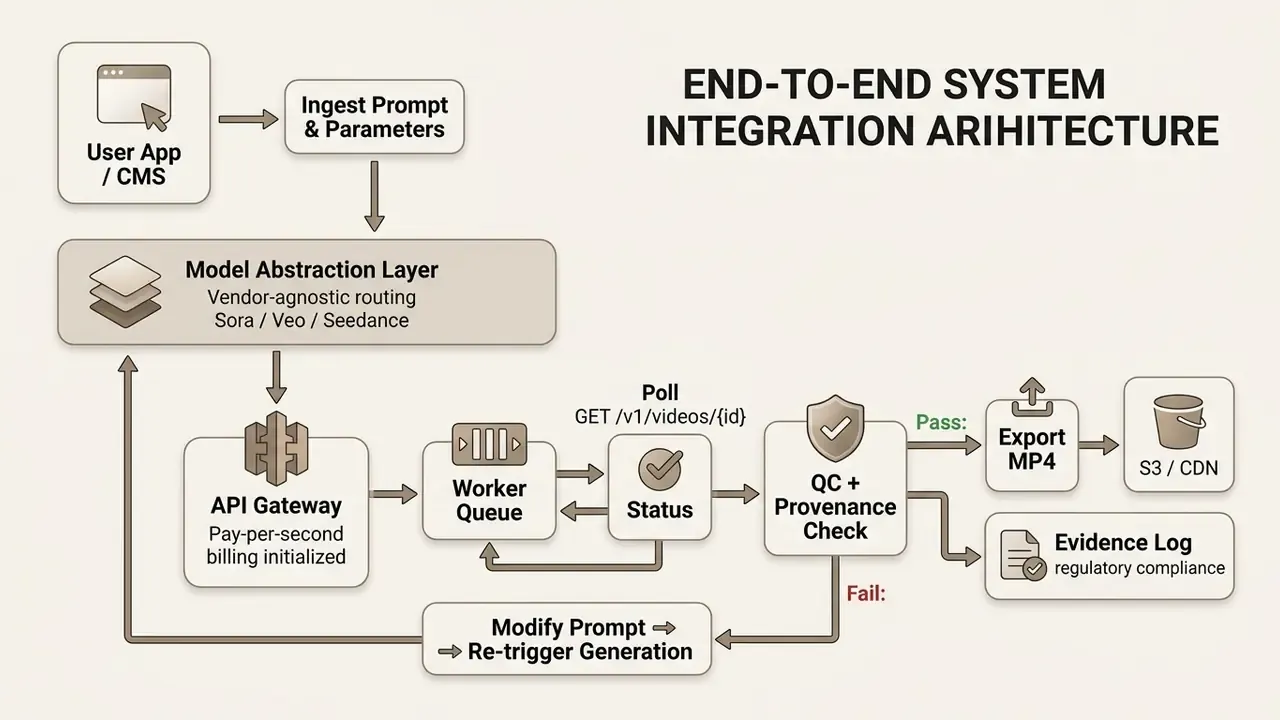
Building an enterprise pipeline around openai sora video generation text to video APIs means connecting user-facing inputs to automated backend validation. Architects design retry logic and rate-limit backoffs to hold operational resilience under demand spikes. The model abstraction layer is the single most important architectural decision in 2026: with a confirmed September 24, 2026 sunset, any integration that hardcodes sora-2 into business logic turns a vendor decision into an unplanned migration project.
Generation Pipeline: Prompts, Parameters, Output, and Export
The programmatic pipeline runs from structured prompt construction through parameter definition, asynchronous submission, and platform-ready MP4 export. Choosing the right resolution parameters prevents unnecessary compute expense.
Updated (September 2026), operational reliability pattern. In high-volume integrations the dominant failure class is not model quality. It is unhandled rate-limit bursts during peak processing windows. Because tier ceilings are hard (Tier 1 = 25 RPM), a pipeline that submits synchronously from a campaign trigger will drop jobs the moment concurrency spikes. The mitigation pattern is consistent across implementations:
- implement an exponential backoff queue with jitter on
429responses; - route all non-real-time renders to the Batch API tier, which halves per-second cost;
- cap in-flight jobs below the tier ceiling instead of relying on retry alone;
- persist
video_idplus submission timestamp so retries never duplicate billable generations.
Batch routing is the clearest lever available:

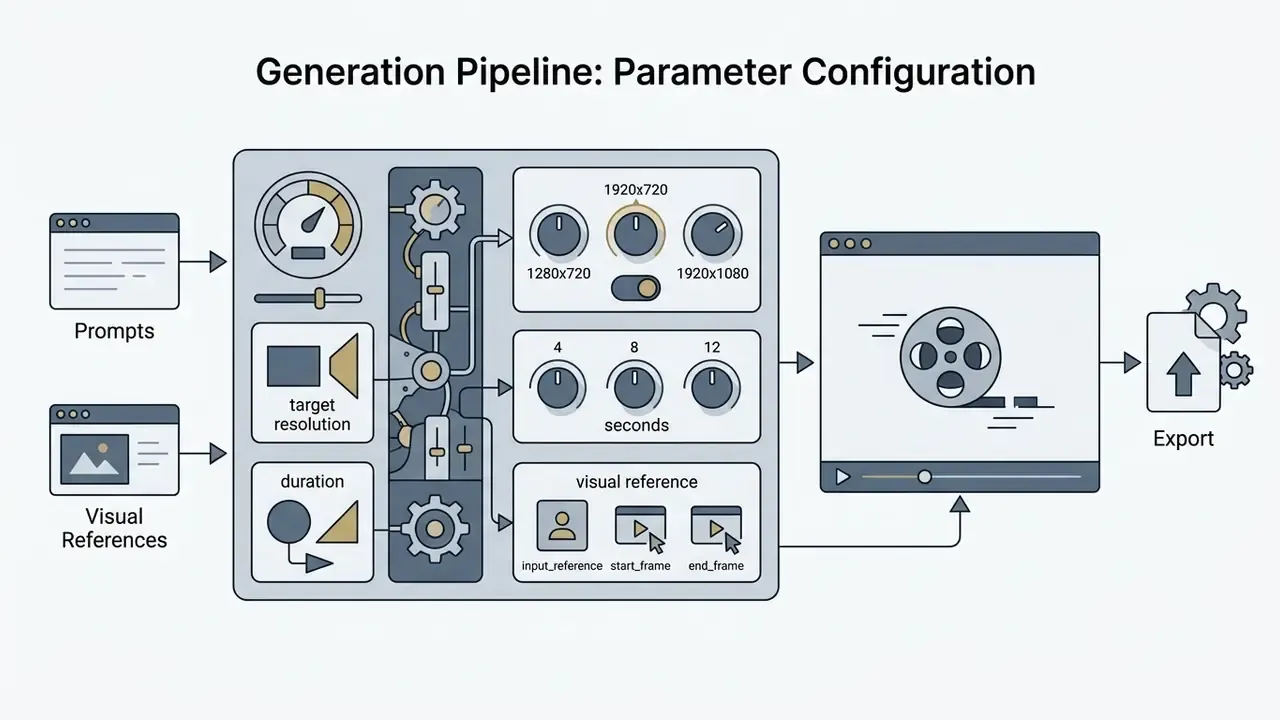
size="1280x720" or "1920x1080"), duration (seconds=4, 8, or 12), and optional visual reference (input_reference, or start_frame / end_frame where supported). Documented output sizes include 720x1280, 1280x720, 1024x1792, and 1792x1024.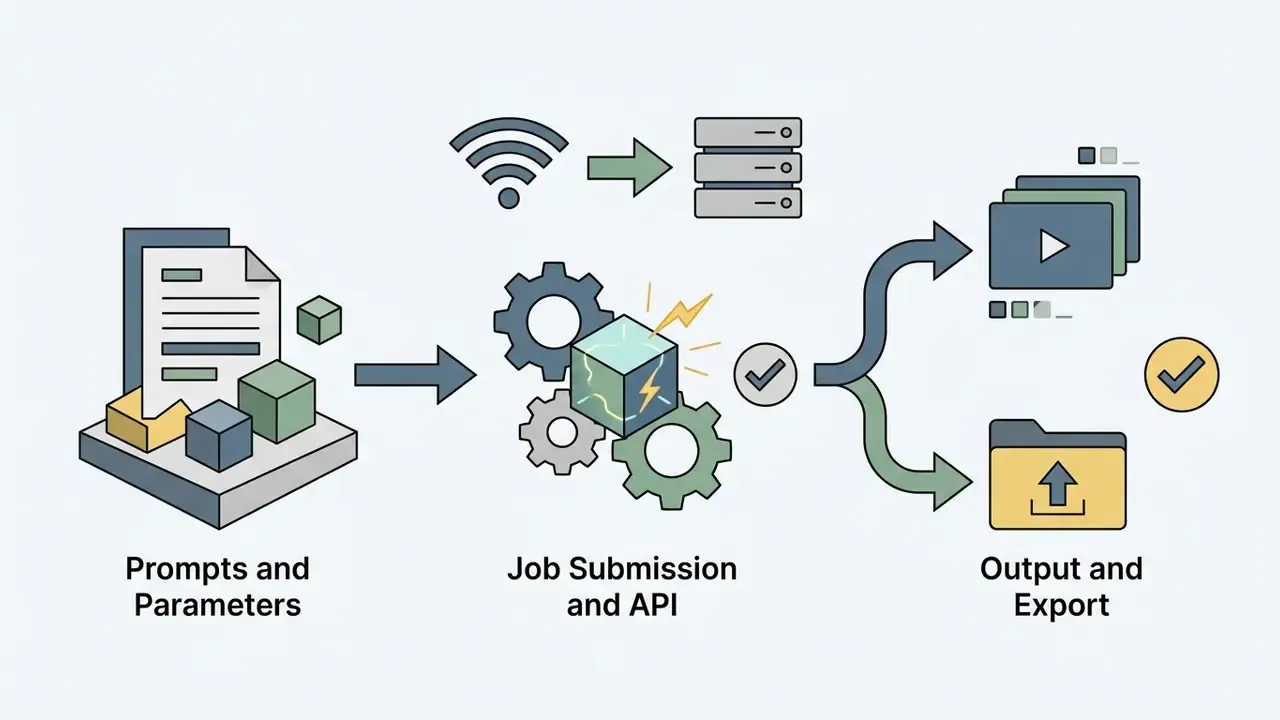
POST /v1/videos. The API responds with HTTP 202 Accepted and a JSON payload containing the video_id.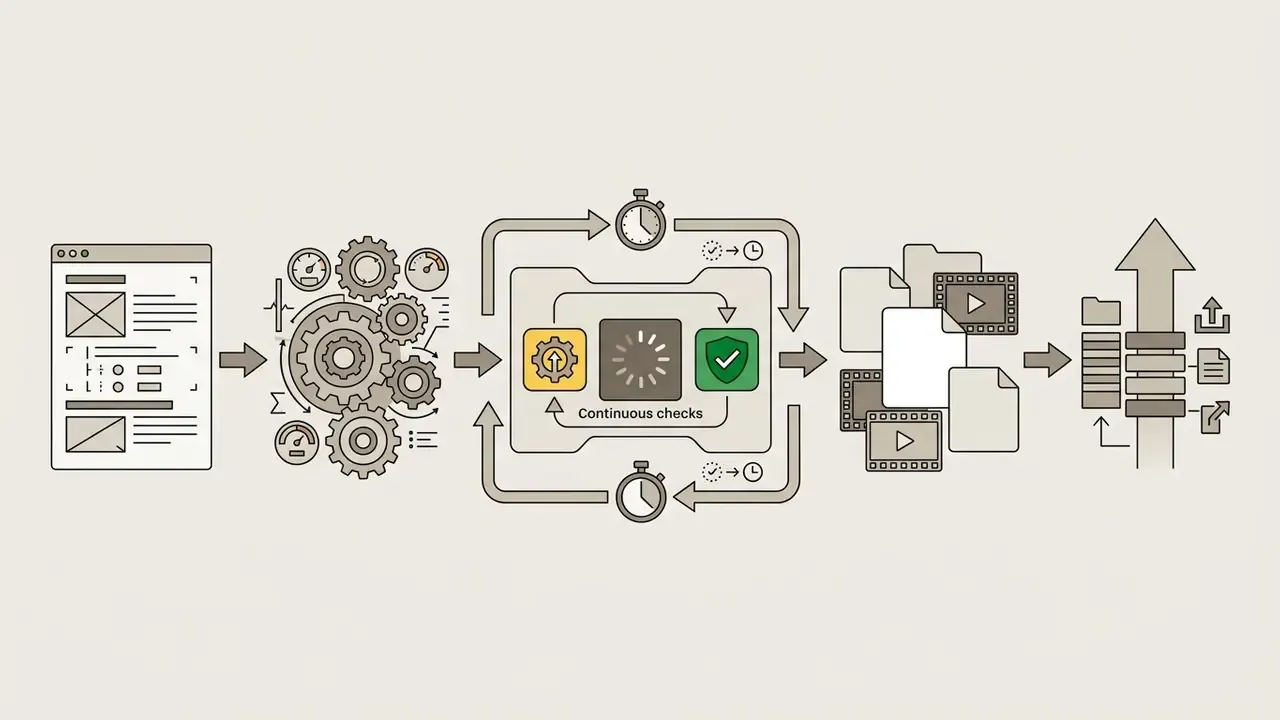
GET /v1/videos/{video_id} at 5 to 10 second intervals until status moves from processing to completed. Webhooks are preferred at volume.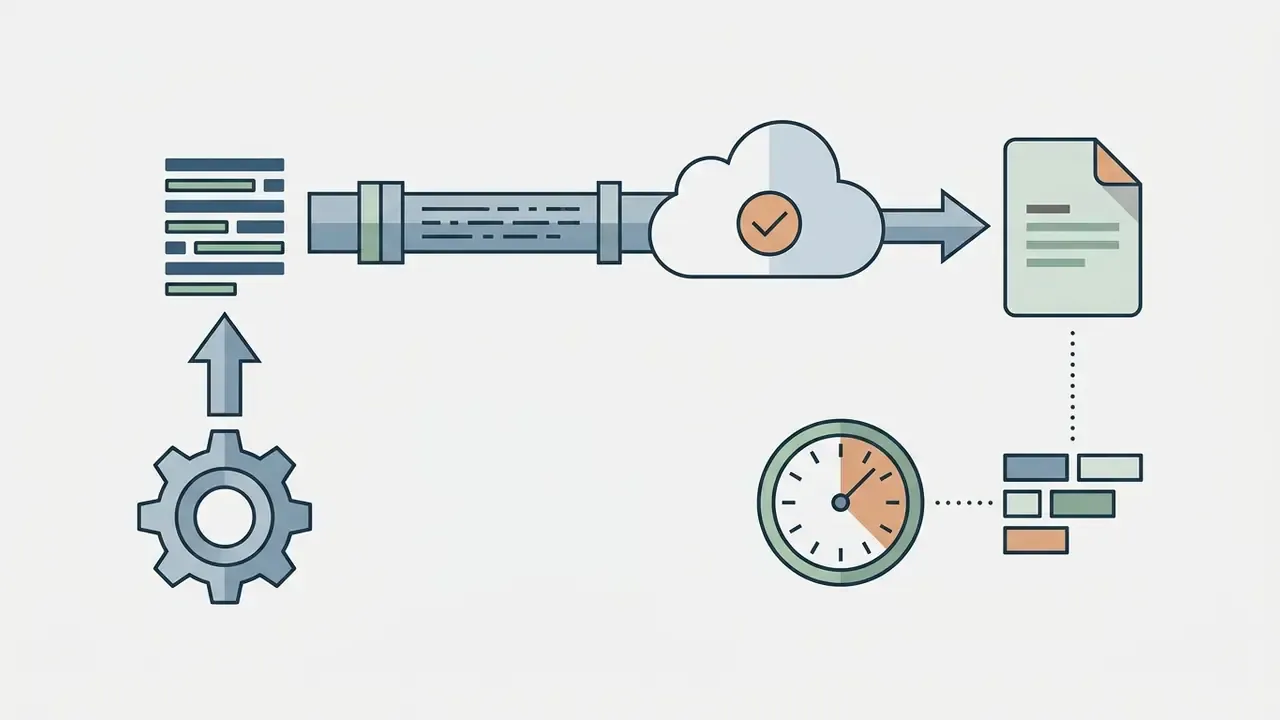
GET /v1/videos/{video_id}/content, streams the MP4 binary to cloud storage (for example AWS S3), and serves it to client frontends. Batch-submitted outputs are retained for a limited window, commonly 24 hours after batch completion, so retrieval must be automated rather than manual.«Batch processing lowers cost to $0.05/sec for Sora 2 and $0.15 to $0.35/sec for Sora 2 Pro; videos are retained for 24 hours after batch completion.»
Developers reviewing failure recovery strategies can analyze our guide on API Retry and error management models. (The earlier, unsourced framing of this passage is preserved verbatim in Appendix A.)
Quality Control Before Publication
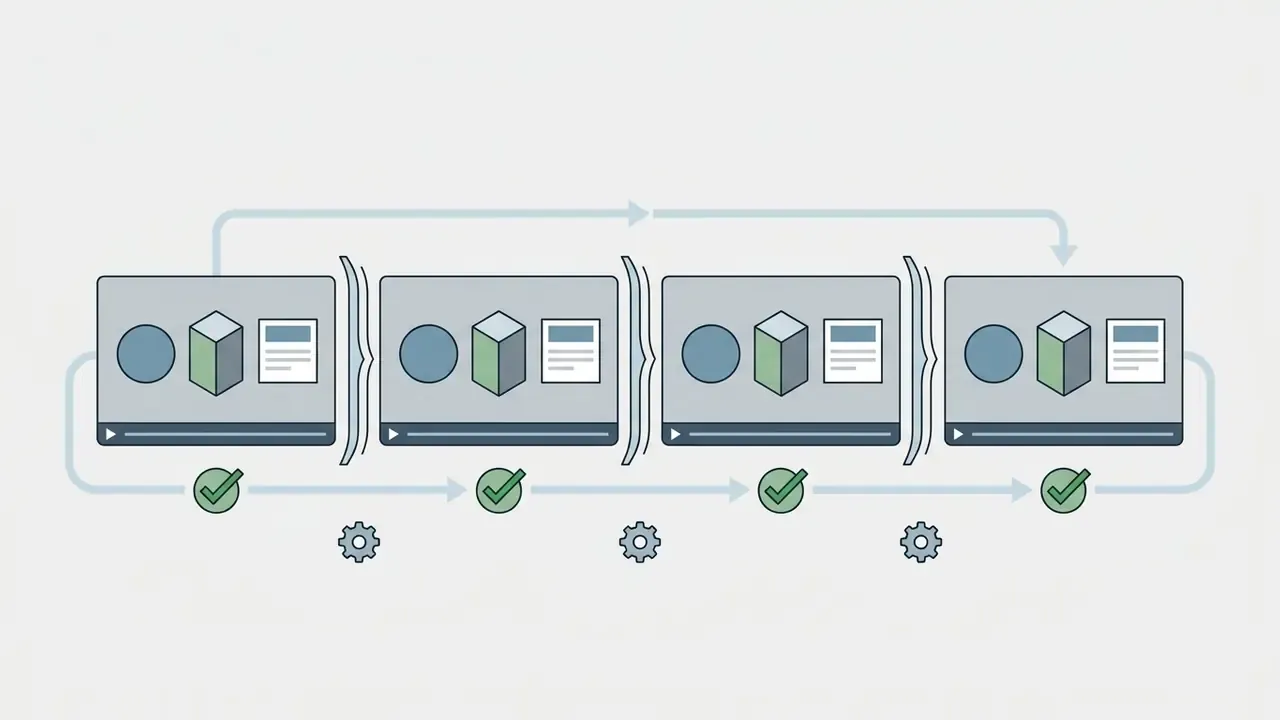
Automated and human-in-the-loop quality control checks evaluate generated clips for temporal artifacts, visual warping, physics violations, and audio-video synchronization errors before publication.
In production, raw ai generated video sora outputs get visual inspection to catch frame jitter, unnatural limb movement, and sudden background shifts. QC reviewers check lip sync alignment and synchronized audio whenever character dialogue is present. When outputs show defects, operators either adjust prompt descriptors or route the asset to external non-linear video editing software for post-production refinement.
Three verification signals dominate the forensic literature and should map directly to checklist lines: low-level visual artifacts (blending boundaries, warping, colour inconsistency, flicker), cross-modal misalignment (lip-speech mismatch), and temporal or physics incoherence (broken motion continuity across frames). Lip-sync alignment is measurable: SyncNet-derived Lip-Sync Error-Distance (LSE-D) and Lip-Sync Error-Confidence (LSE-C) remain the standard quantitative pair, where lower LSE-D and higher LSE-C indicate better alignment. Published work also reports that face-restoration models such as VQFR preserve lip synchronization while improving visual metrics, which means cleanup need not degrade sync if the model is chosen deliberately.
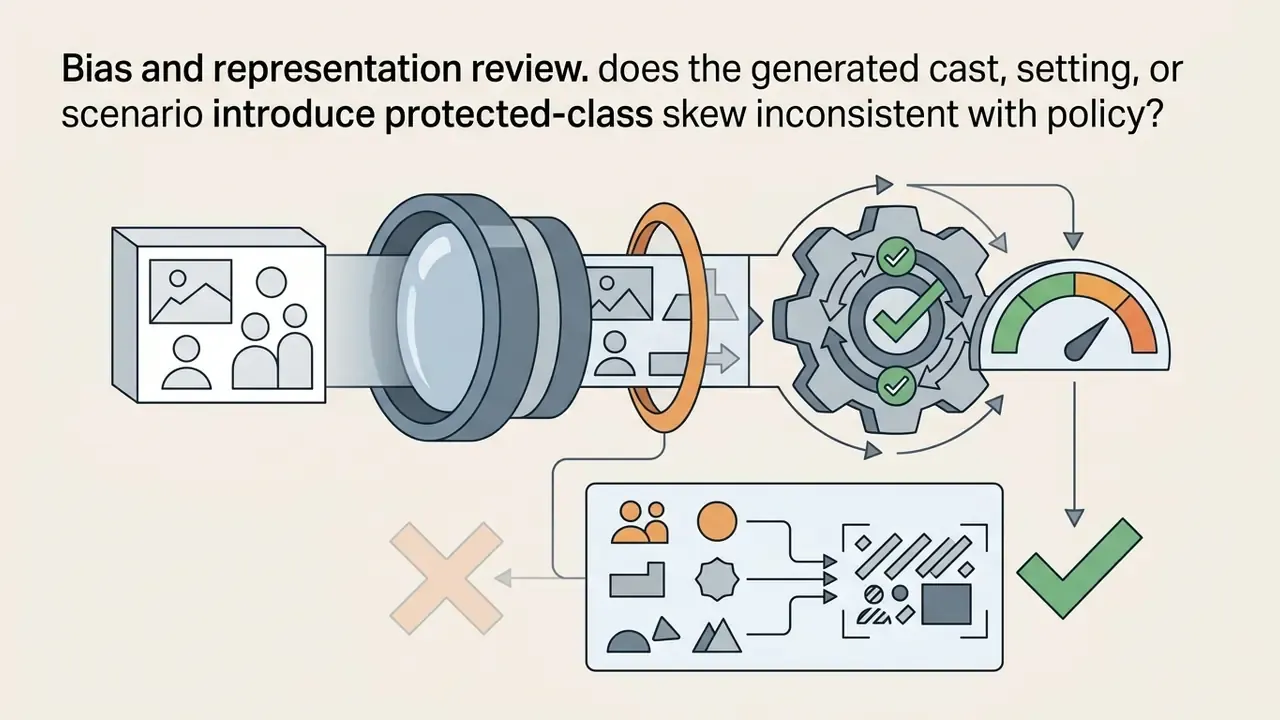
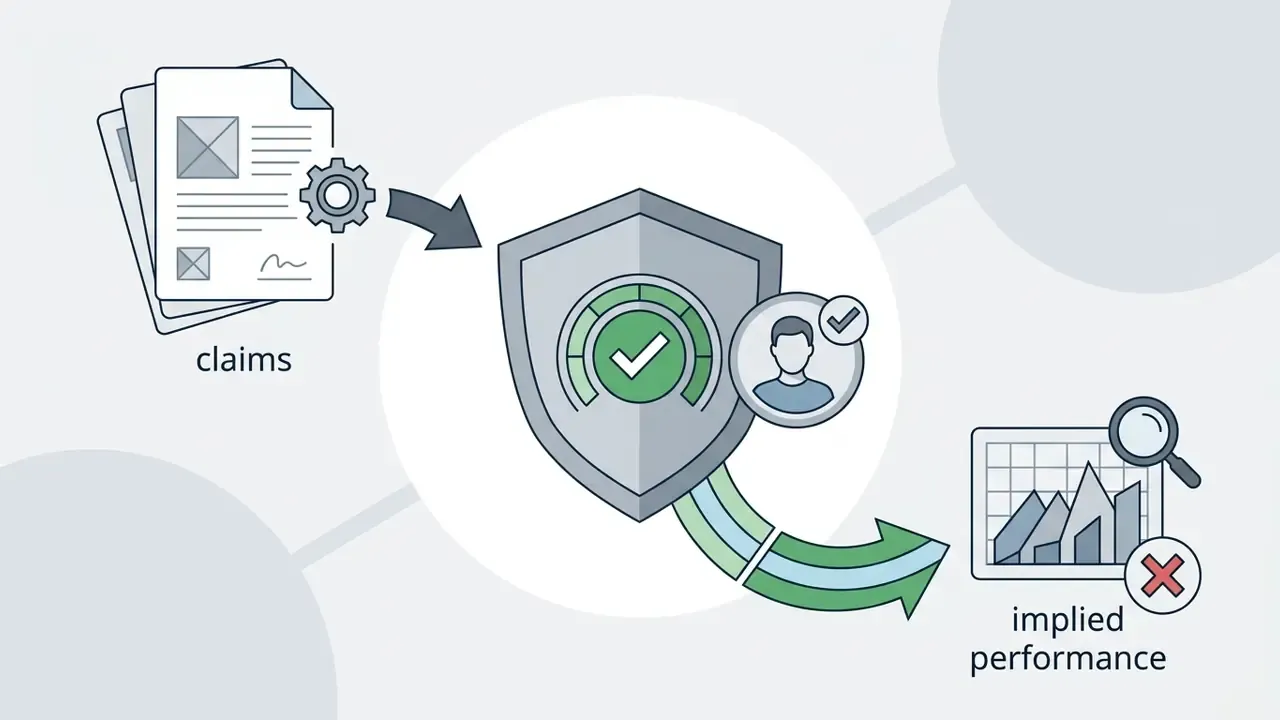
Regulated-content QC additions. Media QC is necessary but insufficient in banking, insurance, and healthcare contexts. Add:
Model Risk Management: Validating a Non-Deterministic Video Model
Generative video is non-deterministic, which makes conventional "recompute and compare" validation useless without deliberate controls. Institutions operating under model-risk supervisory expectations, notably the Federal Reserve and OCC guidance commonly cited as SR 11-7 / OCC 2011-12, and organisations mapping to the NIST AI Risk Management Framework, need reproducible evidence. Not screenshots.
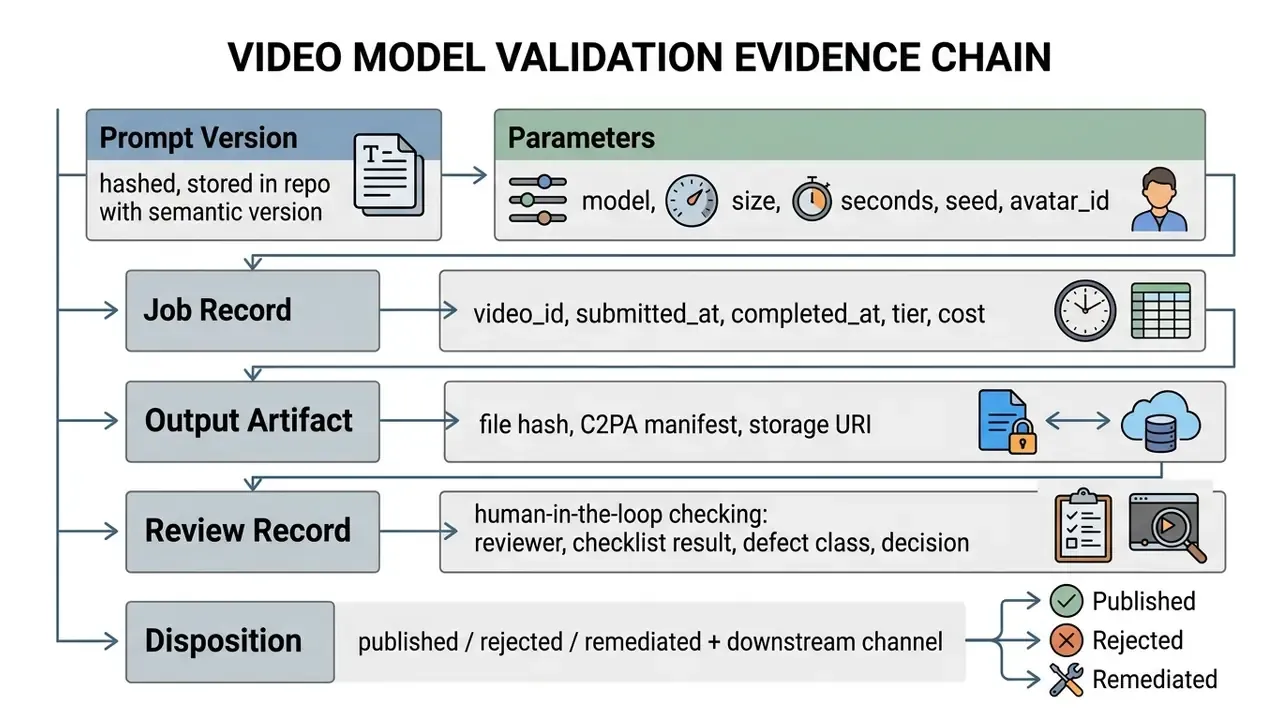
Validation checklist for generative video models (SR 11-7 and NIST AI RMF aligned):
Checklist0 / 12
Audit-trail minimum. For each accepted asset, an auditor should be able to reconstruct: who requested it, what prompt and parameters produced it, which model version and tier served it, what it cost, who reviewed it, what defects were found, and where it was published. If any one of those fields is missing, the control is not evidenced.
What Drives the Cost of Implementing Sora and AI Video Generation
The cost of running the openai sora video generation ai stack is calculated per second of generated output, adjusted by target resolution, model tier, and processing speed. Compute expense scales linearly with total output volume and retry rates. In regulated settings, governance labour frequently exceeds compute.
Unlike text-based LLMs billed per input and output token, openai sora ai text to video model sora API pricing depends strictly on output duration and pixel density. Teams building budgets should compare standard real-time rendering rates against batch discounts, and benchmark against the wider field of best AI video generators before locking in a single provider.
«Sora 2 is billed at $0.10 per second at 720p; Sora 2 Pro ranges from $0.30 to $0.70 per second depending on resolution.»
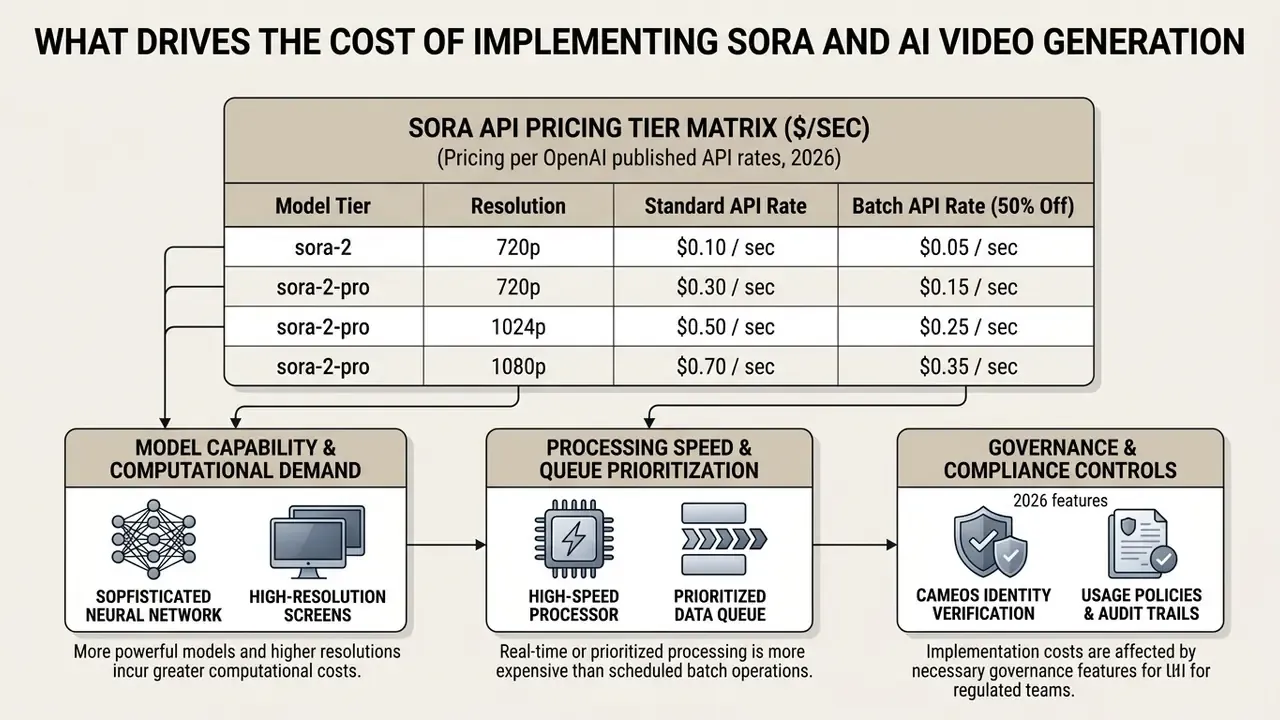
Generation Parameters Affecting Resource Consumption
Resolution tier, clip duration, iteration count, and audio integration are the primary parameters that determine API resource consumption. Higher resolutions require substantially more compute per second.
- Resolution Tier standard
sora-2at 720p costs $0.10 per second. Moving tosora-2-proraises rates to $0.30/sec for 720p, $0.50/sec for 1024p, and $0.70/sec for 1080p. - Duration Selection clip lengths are configured in discrete blocks (4, 8, or 12 seconds). An 8-second 1080p clip on
sora-2-procarries a baseline cost of $5.60 per generation pass ($0.70 x 8). - Processing Mode real-time on-demand requests execute at standard rates. Non-urgent background jobs submitted through the Batch API receive a 50% discount ($0.05/sec for standard 720p).
- Regional Data Residency regional processing compliance features carry an optional 10% rate uplift on eligible processing tiers released on or after 2026-03-05. Compliance-driven deployments should assume that line item by default rather than treat it as optional.
- Multi-Clip and Audio Caps stitched or extended sequences bill on total stitched duration, and audio generation is typically constrained by its own clip and duration caps, so long-form deliverables are assembled from multiple billable passes.
«A typical 10-second Sora 2 Pro clip at 1024p costs about $5.00; the same clip on standard Sora 2 at 720p costs $1.00 (verified June 2026).»
Calculating the Economics of Pilots and Scaling
Pilot and scaling economics require modeling baseline API rates alongside expected retake (defect) rates and post-production labour. Cost per accepted video is the only figure that prevents budget overruns.
To calculate true cost per usable asset, engineering leads apply the following model:
Where:
- = total generation passes executed, including rejected retakes
- = duration of generated clip in seconds
- = API rate per second, based on model and resolution
- = post-production editing time per clip, in hours
- = fully burdened hourly wage rate for video editors
- = number of finalized, publication-grade clips produced
This mirrors standard rework accounting. Rework rate is defective units divided by total units produced, and first-pass yield is accepted units divided by units started, so pilots must log accepted, reworked, and rejected generations as three separate counters rather than one blended number.
Risk-Adjusted Cost per Accepted Video (Regulated Environments)
Compute is rarely the binding constraint in a bank or an insurer. Legal review, model validation evidence, provenance verification, and disclosure sign-off are. The risk-adjusted form adds those controls explicitly:
\text{Risk-Adjusted Cost per Accepted Video} = \frac{(N_{\text{attempts}} \times T_{\text{sec}} \times R_{\text{API}}) + (H_{\text{edit}} \times W_{\text{labor}}) + C_{\text{risk_controls}}}{N_{\text{accepted}}}Where C_{\text{risk_controls}} is the fully loaded per-asset cost of:
- legal, IP, and advertising-compliance review hours multiplied by counsel rate;
- model validation and outcome-testing effort amortised across the asset batch;
- consent capture, likeness registry maintenance, and revocation handling;
- provenance verification, hashing, and evidence retention tooling;
- a migration reserve, a provision for the known vendor sunset expressed as a per-asset levy.
Calculator algorithm (for implementation as an interactive widget):
INPUTS
  n_videos          = number of final deliverables required
  attempts_per_video= expected generation passes per accepted clip (retake factor)
  seconds           = clip duration in seconds
  rate_per_sec      = API rate from pricing matrix (apply 0.5x if Batch)
  residency_uplift  = 1.00 or 1.10
  edit_hours        = post-production hours per accepted clip
  editor_rate       = fully burdened hourly editor cost
  risk_hours        = legal + validation + provenance hours per clip
  risk_rate         = blended compliance/counsel hourly cost
  migration_levy    = per-asset reserve for vendor change
COMPUTE
  compute_cost = n_videos * attempts_per_video * seconds * rate_per_sec * residency_uplift
  labor_cost   = n_videos * edit_hours * editor_rate
  risk_cost    = n_videos * risk_hours * risk_rate
  reserve      = n_videos * migration_levy
  total_budget = compute_cost + labor_cost + risk_cost + reserve
  unit_cost    = total_budget / n_videos
OUTPUT
  total_budget, unit_cost, compute_share_pct, risk_share_pct
When risk_share_pct exceeds compute_share_pct, which is common for externally published, likeness-bearing, or claim-adjacent assets, the correct optimisation lever is scope reduction and template reuse. Not a cheaper resolution tier.
When scaling ai powered video creation sola workflows across enterprise media divisions, teams inspect cost structures through dedicated AI Media Calculators to benchmark API expense against traditional production, and cross-check low-budget pilots against free AI video generator comparisons.
How to Write Prompts for OpenAI Sora Text-to-Video
Writing effective prompts for openai sora text to video ai sora workflows requires explicit scene descriptions, defined subjects, structured camera directives, precise lighting terms, and clear spatial movement instructions. Vague descriptors produce unpredictable renders, and because billing is per generated second, prompt discipline is a direct cost control rather than a creative preference.
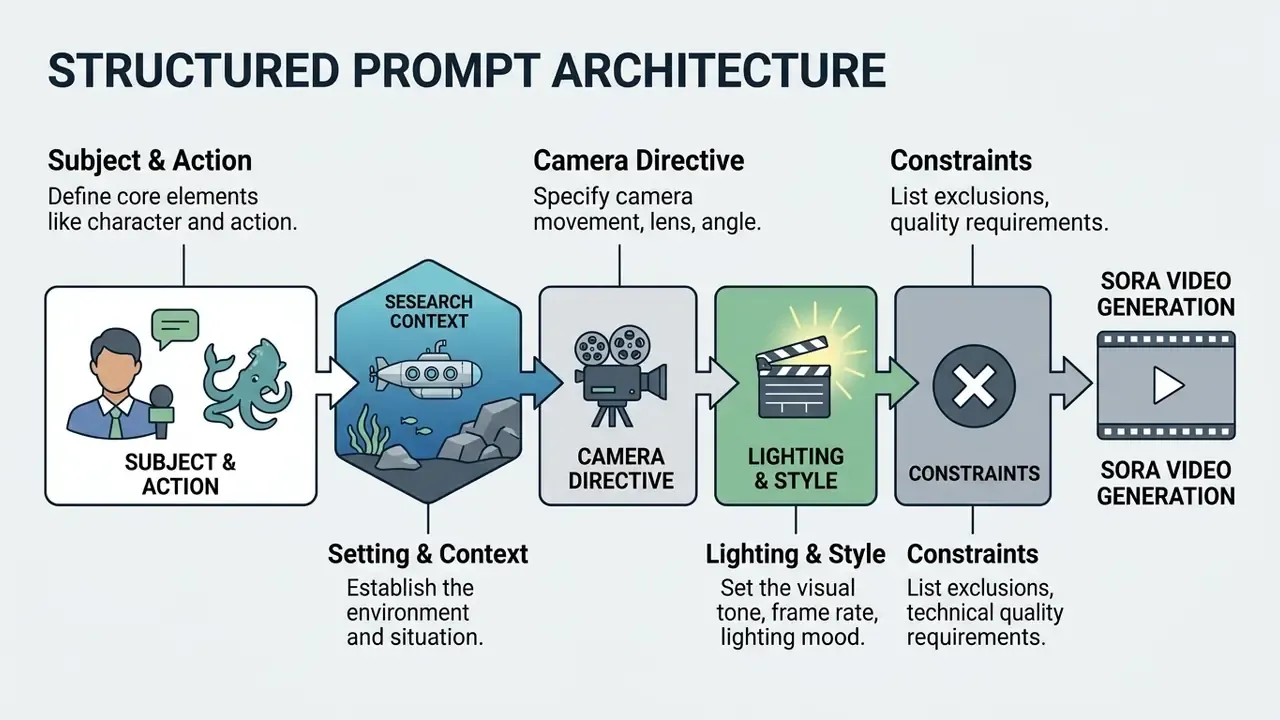
Mastering openai sora ai text-to-video prompting mostly means separating environmental context from physical motion directives. Structured instructions and smart prompt enhancement reduce iterations, and fewer iterations cut API cost directly.
What to Include in Text Prompts for Realistic Motion
To get realistic motion and believable object interaction, prompts should specify cause-and-effect actions, lighting parameters, camera trajectories, and framing composition in plain language.
- Subject and Action Chain define the subject and its exact movement sequence with explicit motion verbs. Write believable motion as a chain of cause, movement, contact, consequence (for example, "a runner steps onto wet asphalt, splashing standing water upward"), never as an abstract label such as "runs realistically."
- Camera Movement specify a single primary camera move per shot using standard film terminology, such as "slow pan right," "low-angle tracking shot," or "dolly forward." One camera move plus one subject action per shot is the reliable ceiling.
- Lighting Specifications detail four attributes, namely quality, direction, colour temperature, and contrast (for example, "dramatic side key light from a sunset window, soft warm fill, high contrast").
- Physical Environment describe factors affecting motion, such as wind direction, fog density, surface friction, or water turbulence.
- Negative Constraints state what must not appear. Explicit exclusions reduce retakes more cheaply than upgrading resolution.
Copy-Paste Production Prompt Library for Sora 2
These are production-grade starting points, structured to the block architecture above. Each is written for a single billable pass and includes constraints that trim retake spend.
1. Photorealistic Sci-Fi Pre-Visualization (16:9, 1080p)
Cinematic wide shot. A futuristic research vessel floating slowly near Jupiter's rings. Soft ambient light from the planet casting amber highlights on metallic hull plates. Camera performs a slow 24fps dolly-in toward the main observation deck. High contrast, atmospheric dust particles, 35mm anamorphic lens quality. No visual jitter, no on-screen text, no additional vessels.
2. Product Hero Shot with Parallax Motion (1:1, 1080p)
Close-up product commercial shot. A matte black luxury smartwatch resting on wet basalt stone. Water droplets slowly bead and slide down the glass face. Studio key light sweeping across from left to right, creating sharp specular reflections. Shallow depth of field, 85mm macro lens, fluid 60fps slow-motion motion dynamics. Preserve exact product geometry, no logo distortion, no hands in frame.
3. Character Continuity Walk (9:16, 1080p, reference-conditioned)
Vertical medium tracking shot. The same character from the reference image walks steadily through a narrow neon-lit corridor at night. Subtle cloth movement and natural arm swing, consistent facial features and wardrobe throughout. Camera follows behind at walking pace with gentle handheld float. Cool cyan key light from overhead strips, warm amber bounce from the far end, medium contrast. No morphing limbs, no wardrobe changes, no background crowd.
4. Environment Flythrough for Location Scouting (16:9, 1024p)
Aerial establishing shot. A slow crane-and-forward flythrough over a coastal cliff town at dawn. Low fog drifting between rooftops, waves breaking against rock at the base of the cliff. Soft directional sunrise light from the right, long shadows, natural cool-to-warm gradient, medium-high contrast. Steady 24fps motion, realistic scale and parallax between foreground rooftops and distant horizon. No camera shake, no lens flare, no human figures.
5. Deterministic Brand Transition (Start Frame to End Frame, 16:9, 1080p)
Two-frame interpolation. Begin on the closed product packaging on a seamless white surface (start frame). End on the opened packaging with the product upright and centered (end frame). Motion is a single continuous reveal with the lid lifting and rotating away. Even studio softbox lighting, neutral 5600K, low contrast, no background change. interpolation_bias = 0.4 for steady linear motion. Preserve logo proportions exactly, no additional objects entering frame.
6. Atmospheric Narrative Beat (16:9, 720p, low-cost pass)
Static interior shot, quiet room at night, rain striking the window. A single lamp flickers slightly; reflections shift on the glass. Camera holds still with almost imperceptible drift. Storytelling through mood and pacing only, no dialogue, no on-screen text. Warm low-key practical light from the lamp, cool blue spill from the window, high contrast. Maintain stable geometry, no object morphing.
Cost note: run ideation passes at sora-2 720p ($0.10/sec), then re-render only the approved prompt at sora-2-pro 1080p ($0.70/sec). Iterating at the top tier is the most common avoidable budget error in pilots we have reviewed.
When to Use an Image as a Reference
Supplying a reference image alongside a text prompt makes sense when brand asset consistency, character identity, or a specific visual style must hold across multiple generation passes.
Using an ai image as an input_reference anchors the first frame of the clip to an existing asset. Input images must match the target output resolution and can be supplied as a multipart upload or as a JSON file_id / image_url. The technique stops the diffusion model from reinterpreting facial features or product details mid-synthesis, which protects the creative vision the team actually signed off. Research supports the pattern: ConsistI2V applies spatiotemporal attention over the first frame with low-frequency noise initialisation to hold spatial and motion consistency, while StyleCrafter disentangles content (text prompt) from visual style (reference image) through a dedicated style adapter. For broader tooling options, our sora 2 ai resource provides comparative breakdowns.
Sora Limitations: Physics, Sound, Lip Sync, and Multi-Shot Video
Sora generates visually impressive clips, and it still shows hard operational limits in real world physics modeling, audio-visual lip sync precision, and multi-shot narrative continuity. Identifying these constraints up front prevents deployment failures in high-precision commercial applications.
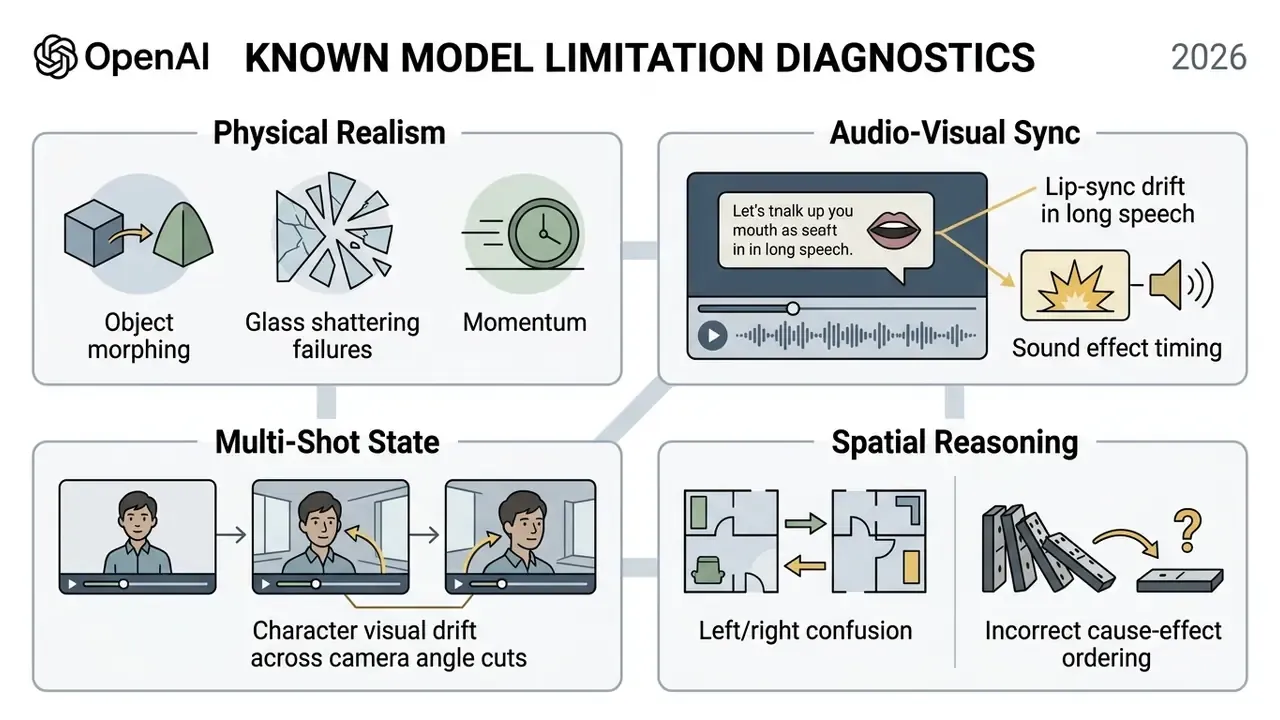
Understanding physical realism boundaries helps engineers set honest production boundaries for ai sora text to video deployments. Where physical interaction fidelity is mandatory, complex scenes should be decomposed into simpler visual components.
Complex Scenes, Characters, and Physical Interactions
Sora can struggle with complex physical interaction: glass shattering, liquid fluid dynamics, intricate hand movement, and cause-and-effect collisions. OpenAI's own technical documentation acknowledges that the model "does not accurately model the physics of many basic interactions," and that some actions do not reliably update object state.
«Diffusion transformers optimise for visual plausibility rather than physical law: objects may pass through barriers or display incorrect momentum preservation.»
Objects may therefore morph, pass through solid barriers, or show incorrect momentum preservation during high-speed action. OpenAI has also noted limited capacity to differentiate left from right, which is a small detail with large consequences in instructional or compliance content. To mitigate, directors break complex scenes into single-action shots instead of attempting single-pass long takes. Recent research reinforces decomposition: object-centric pipelines segment and re-compose foreground, background, and motion tracks separately, while physics-guided systems stage background construction, trajectory generation, and composition as discrete steps, because end-to-end generation still fails on real-world interaction fidelity.
Working with Sound and Multi-Shot Frame Sequences
Managing synchronized audio, dialogue lip sync, and multi-shot camera cuts requires careful post-production oversight or specialized audio alignment tools.
Sora 2 Pro introduces native synchronized dialogue, ambient soundscapes, and sound effects, yet long speech sequences can drift on lip sync over extended durations. Note on evidence: OpenAI's Sora 2 system card claims synchronized audio and improved steerability but publishes no numeric lip-sync error rate or long-form drift benchmark. Secondary coverage asserts stronger multi-shot continuity without a shared test method. Teams requiring certainty must measure LSE-D and LSE-C on their own sample set rather than rely on vendor claims. Holding character feature consistency across multi-shot transitions also demands strict prompt engineering or reference-image conditioning.
«The T2AV-Compass benchmark evaluates 11 systems, including Sora-2 and Veo-3.1, under a unified audio-visual quality methodology.»
Where dialogue quality is critical, many teams decouple the audio track entirely and rebuild it with a dedicated AI voice generator, then re-align in post. That trades one billable generation pass for deterministic control over speech. Usually worth it.
E-E-A-T Alert Box: Pre-Publication Quality Inspection
Sora and Alternative AI Video Models: When Comparison Is Justified
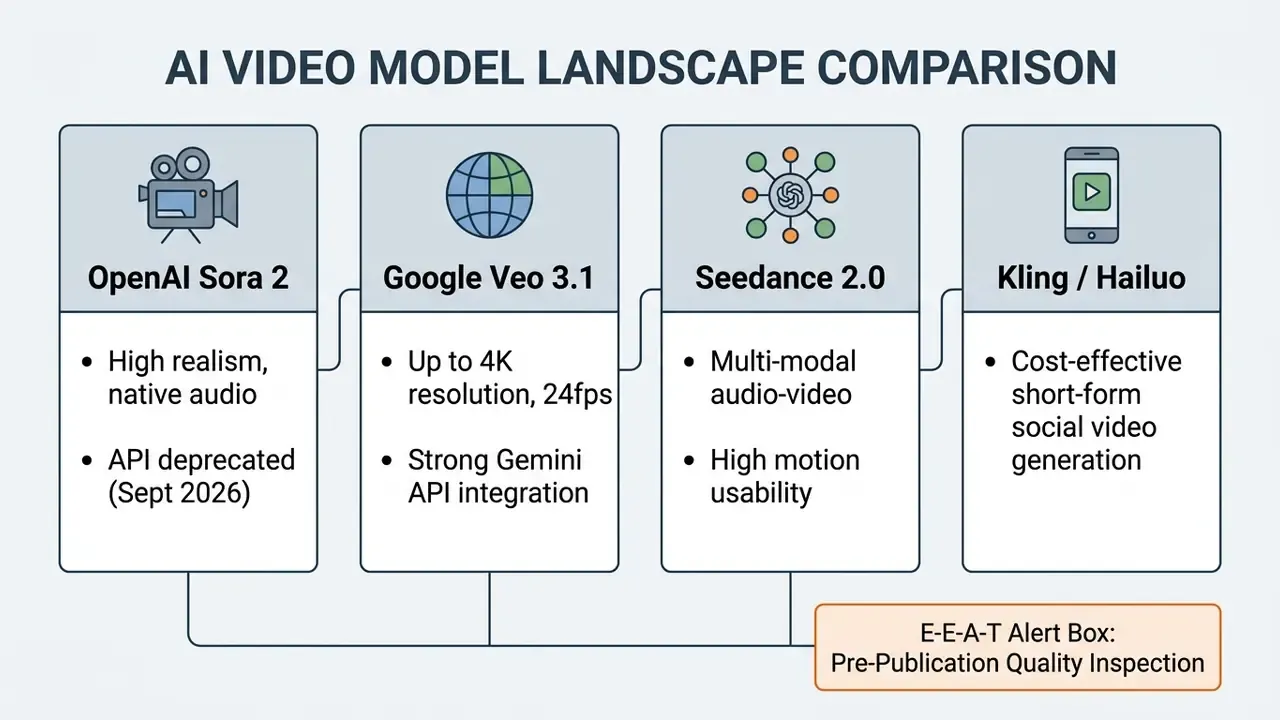
«Seedance 2.0 reports 97.6% motion usability and 83.9% audio-prompt adherence, outperforming Kling 3.0 and Vidu Q2 Pro on instruction following.»
Independent leaderboard positioning is worth noting too. The Artificial Analysis text-to-video leaderboard has placed Sora 2 Pro below several competitors, with Seedance 2.0 (ByteDance), Runway 4.5, and Kling 3.0 ranking higher. Brand recognition and measured output quality are not the same signal, and adjacent image-generation hype cycles (the Nano Banana wave, for instance) showed how quickly perceived leadership moves.
Model Selection Criteria for Teams and Products
Choosing an ai video models vendor for production depends on output resolution, audio integration, multi-shot capability, inference latency, and API availability guarantees. Current benchmarks treat physical realism, audio-visual synchronisation, multi-shot capability, latency and throughput, and API parameter surface as separate axes rather than one score. Product teams should score them separately too.
When selecting between platforms, engineers decide whether native synchronized audio (present in Sora 2 Pro and Seedance 2.0) is genuinely necessary, or whether post-production audio synthesis gives more flexibility at lower risk.
«Veo 3.1 supports 4, 6 or 8-second clips at resolutions up to 4K and 24 fps, with video extension and first/last-frame conditioning.»
For educational reviews of generation architectures, teams examine our ai study guide compilation.
Comparative Matrix of Commercial AI Video Generation Models (Technical)
| Model Name | Primary Developer | Input Modalities | Native Audio Support | Max Output Resolution | Typical Duration | API Status & Lifecycle (2026) |
|---|---|---|---|---|---|---|
| Sora 2 / Pro | OpenAI | Text, Image, Video, Cameo avatar | Yes (Sora 2 Pro) | 1080p | 4 to 12 sec (API); up to 20 sec in product | Deprecated (shutdown Sept 24, 2026) |
| Google Veo 3.1 | Google DeepMind, see our Google Veo implementation guide | Text, Image, Video | Yes (natively generated audio) | Up to 4K | 4 to 8 sec | Active (Gemini API, documented Jan 2026) |
| Seedance 2.0 | ByteDance | Text, Image, Audio, Video | Yes (native multi-modal, lip sync) | 720p to 2K tiers | 4 to 15 sec | Active (BytePlus / ModelArk) |
| Kling AI (3.0) | Kuaishou | Text, Image | Partial | 1080p | 5 to 10 sec | Active (largely aggregator-mediated) |
| Hailuo AI | MiniMax | Text, Image | Partial | 768p / 2K | 4 to 15 sec | Active (MiniMax platform API) |
Enterprise Risk and Governance Comparison Matrix
Technical specs decide output quality. The table below decides whether a model can be deployed at all in a supervised environment. Fields marked contract-dependent must be confirmed in writing with the vendor. They are not reliably documented in public product pages, and marketing claims (especially from aggregator wrappers) are not evidence.
| Governance Criterion | Sora 2 / Pro (OpenAI) | Google Veo 3.1 | Seedance 2.0 | Kling / Hailuo (via aggregators) |
|---|---|---|---|---|
| Primary vendor documentation | Yes (deprecated) | Yes | Yes (BytePlus/ModelArk) | Limited / reseller-mediated |
| Lifecycle certainty | Low, confirmed sunset Sept 24, 2026 | Higher, actively documented 2026 | Moderate | Low visibility |
| Content provenance (C2PA / watermark) | C2PA metadata plus visible watermark; removal tools observed in the wild | Provenance tooling available via Google ecosystem | Vendor-dependent | Often absent or unverified |
| Identity / likeness controls | Cameo consent tokens plus identity verification | Policy-gated likeness restrictions | Vendor-dependent | Weak or undocumented |
| Data handling / zero-retention terms | Contract-dependent (enterprise API agreement) | Contract-dependent (Google Cloud/Gemini terms) | Contract-dependent | High risk, extra processor in chain |
| Security attestations (e.g., SOC 2 Type II) | Contract-dependent, request current report | Contract-dependent, request current report | Contract-dependent | Frequently unavailable |
| Regional processing / data residency | Optional, about 10% rate uplift on eligible models | Region selection via cloud platform | Vendor-dependent | Usually unspecified |
| Enterprise SLA availability | Tier-based rate limits; SLA contract-dependent | Cloud SLA available | Platform-dependent | Rarely offered |
| Auditability of generations | Job IDs, C2PA, request payload logging by client | Job IDs plus cloud logging | Job IDs | Depends on wrapper logging |
| Recommended posture (regulated use) | Migrate off before Sept 2026; do not start new builds | Viable primary with contracted terms | Viable secondary | Not recommended for regulated content |
Vendor-concentration guidance. Treat any single video model as replaceable infrastructure. The minimum resilient pattern: a model-agnostic internal prompt schema, an adapter per vendor, a defect-rate baseline per vendor, and a quarterly tested failover render. OpenAI's abrupt Sora withdrawal, which prompted at least one technology outlet to label the company a "product-killer" alongside other large platforms with long deprecation histories, is the clearest available argument for that architecture.
A safe next step. If you are still deciding, do not start with procurement. Run one non-customer-facing pilot behind an abstraction layer, log the full evidence chain described above, and measure risk-adjusted cost per accepted video. Then decide whether the category earns a place in your risk appetite.
FAQ About OpenAI Sora Video Generation Tool
Can Sora Be Used for Social Media and Commercial Projects?
Yes. Outputs generated via paid OpenAI accounts can generally be deployed in social media campaigns and commercial marketing materials, subject to contractual terms of service. Commercial usage rights are governed contractually by OpenAI's business terms and by local copyright legislation. OpenAI's terms assign the user OpenAI's interest in the output "to the extent permitted by law," which supports commercial use at the contract level but does not itself create statutory copyright. In many jurisdictions, including under U.S. Copyright Office guidelines, purely machine-generated visual content without sufficient human authorial expression may not qualify for statutory protection. The Office's position is that protection attaches only where a human author determined sufficient expressive elements.
«Purely machine-generated visual content without sufficient human authorial contribution may not receive legal protection in most jurisdictions.» Source: "Sora: A Review on Background, Technology, Limitations, and Opportunities", arXiv (2024). https://arxiv.org/abs/2402.17177 Additional constraints apply to people and characters. Public-figure likenesses could not be generated without permission, and rightsholder control over copyrighted characters moved from opt-out toward granular opt-in handling after October 2025. Content creators and brand teams using AI video for high-stakes assets should combine model output with human post-production editing, and should review the parallel rules governing commercial use of AI image generators, since any image generator follows the same authorship logic. Disclaimer: The above is general information, not legal advice. Copyright, publicity, advertising, and sector-specific communications rules differ by jurisdiction and regulator. Consult qualified counsel before publishing AI-generated video in a commercial or regulated context.
Can Sora-Generated Videos Be Monetized on YouTube and Social Platforms?
Yes. Content generated via paid Sora API tiers or ChatGPT Pro and Business accounts can be monetized under OpenAI's commercial terms, and such videos can generally be monetized on YouTube provided the channel complies with YouTube's monetization policies. Three conditions matter in practice. First, disclosure: YouTube requires creators to flag realistic synthetic content using the altered-or-synthetic content setting in the Content Classification step. Second, human creative contribution: because raw, unedited output lacks human authorship and may not be copyrightable, teams should add substantial human input, including voiceover recording, editing and pacing decisions, colour grading, narrative structure, and original music. That strengthens rights claims and satisfies originality expectations in platform monetization reviews. Third, third-party rights: reused copyrighted characters, music, or footage still require permission, whatever produced the video. Teams building repeatable publishing pipelines can reference our YouTube video editor workflow guide for disclosure, export, and publishing steps.
What Happens to My Pipeline After the September 24, 2026 API Shutdown?
All sora-2 and sora-2-pro aliases plus the Videos API endpoints stop serving requests on that date. Any hardcoded integration will fail with model-not-found or endpoint errors rather than degrade gracefully. Recommended migration sequence: (1) inventory every call site and every stored asset generated by Sora; (2) export and archive assets plus their generation records before the vendor export window closes, since OpenAI's sunset guidance provides for export ahead of permanent deletion; (3) introduce or verify a model abstraction layer; (4) re-baseline defect rates and cost per accepted video on the replacement model, because retake rates rather than list price determine true unit cost; (5) revalidate under your model-risk process, treating the model swap as a material change.
Are Special Hardware, Templates, or Local Installation Required?
No. No specialized local GPU hardware or local software installation is required, because all rendering executes on OpenAI's cloud infrastructure. Users reach the service through standard web browsers or programmatic HTTP REST API calls. Offline local execution is not supported for proprietary Sora models, and no official source documents mandatory presets, templates, or pre-set video styles. Captions or subtitles are also not a guaranteed model output: teams that need them typically burn in or attach caption tracks during post-production, which keeps wording under editorial and compliance control. Organizations requiring fully self-hosted, offline pipelines usually evaluate open-source alternatives such as Open-Sora frameworks on custom GPU clusters, or start by surveying free AI video generators to understand feature and licensing limits before buying infrastructure. For structured planning, consult our guides on AI Media Workflows to design hybrid cloud-and-desktop editing pipelines, and add a video compressor step to normalise deliverable file sizes across channels.
Does Sora Generate Sound and Dialogue?
Yes. Sora 2 generates video with synchronized audio, including sound effects, ambient soundscapes, and dialogue aligned to on-screen action and mouth movement. Sora 2 Pro is the tier associated with the strongest audio-visual synchronisation and higher resolutions. Because OpenAI publishes no numeric lip-sync accuracy figure, teams with strict dialogue requirements should benchmark on their own content and keep a decoupled audio path available as a fallback.
How Long Can Sora Videos Be?
Limits differ by surface. The consumer product supported clips up to 20 seconds, extendable in the editor, with stitched sequences reaching 60 seconds. API creation used discrete 4, 8, or 12-second blocks, with longer deliverables assembled from multiple billable passes. OpenAI's earlier technical materials described the model as capable of generating video up to one minute long, which is a capability statement rather than a per-request API limit.
Appendix A: Superseded and Revised Passages (Transparency Log)
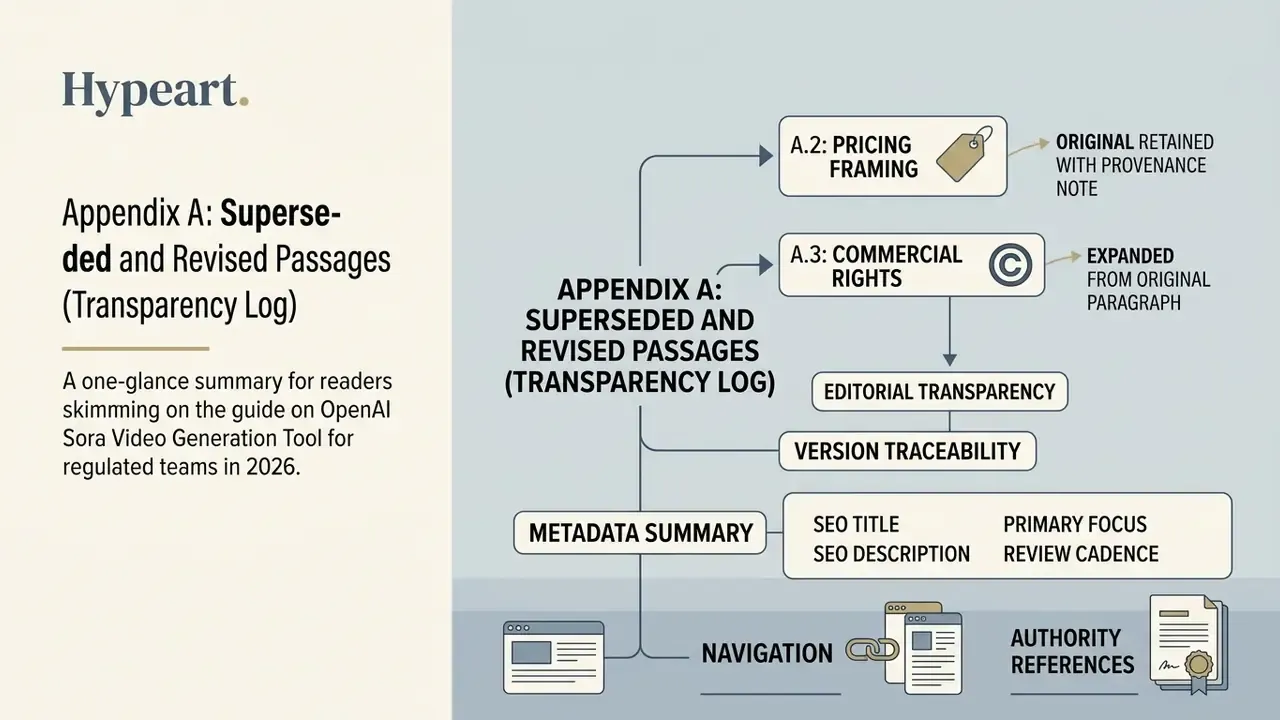
Retained for editorial transparency and version traceability. The main text above carries the corrected, sourced versions.
A.1, original integration-test claim (superseded, unverified):
Reason for revision: the sample size and failure percentage were not accompanied by a published methodology or verifiable source. The operational recommendation (exponential backoff plus Batch API routing) is retained in the main text and supported by Unifically (2026) pricing documentation for Batch-tier savings.
A.2, original pricing framing (retained with provenance note):
Status: now attributed in the main text to OpenAI's published API pricing page (2026) and cross-checked against CometAPI's June 2026 verification of per-clip costs.
A.3, original commercial-rights paragraph (expanded): the earlier version referenced U.S. Copyright Office guidance in a single sentence. The main text now distinguishes contract-level output ownership from statutory copyright protection, adds likeness and rightsholder-consent constraints, and appends a legal disclaimer.
Metadata Summary
- SEO Title OpenAI Sora Video Generation Tool: Access, API Pricing & Governance (2026)
- SEO Description Complete 2026 guide to the OpenAI Sora video generation tool: API access and shutdown timeline, per-second pricing, Cameos identity verification, start/end frame control, risk-adjusted ROI, governance checklists, and model comparisons.
- Primary Focus Generative AI video engineering, API deployment economics, identity and provenance controls, model risk management, and platform comparison.
- Review cadence reviewed quarterly; next scheduled review prior to the September 24, 2026 API shutdown.