Five Decisions in One Screen
- Cost free with a personal Microsoft Account (MSA). No credit card, no waitlist, no installation.
- Throughput 15 fast-mode boosts per 24-hour cycle, then unlimited standard-queue generations up to roughly 200 total prompt transactions per day.
- Hard limits 1024×1024 px output only, no image-to-image, no reference uploads, no public API, no CMYK.
- Commercial rights permitted under the current Microsoft Terms of Use (2024 through 2026), but with no indemnification. The publisher carries all third-party IP liability.
- Provenance every output ships with a visible watermark plus cryptographically signed C2PA Content Credentials. That is an audit asset and a disclosure obligation at the same time.
Who this briefing is written for. Model risk, compliance, and brand teams who keep hearing the same question from business units: can we just use the free Bing AI image generator for this campaign? The honest answer depends on the channel, the subject matter, and whether anyone signs off on the asset. The sections below map each of those variables to a control.
What Is Bing Image Creator and Is DALL·E 3 Available Free?
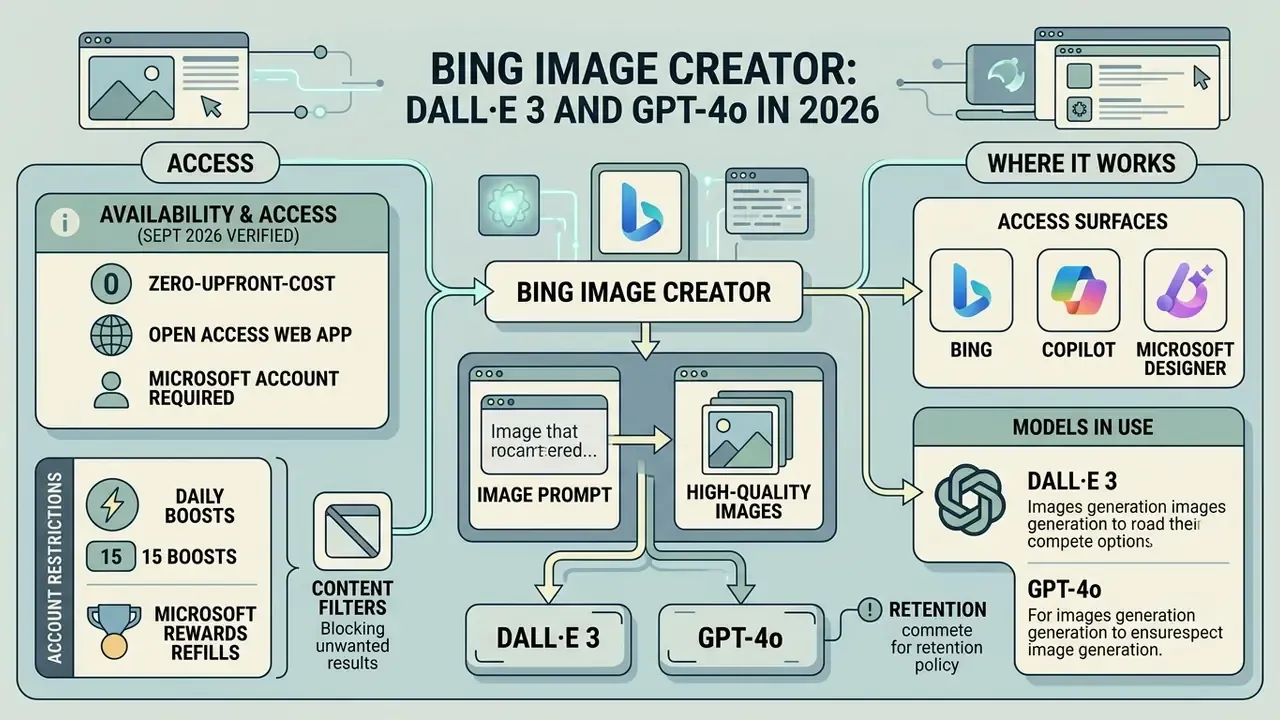
«The free version of Bing Image Creator allowed 15 image generations per day when accessed with a personal Microsoft account.»
Readers benchmarking the tool against the wider market can compare it with other AI-based image generators before committing a production workflow to a consumer surface.
The platform is a consumer-grade gateway to generative AI art and photorealistic imagery. According to Microsoft's official Bing blog announcements, the feature began rolling out in Bing and Microsoft Edge in English in March 2023, and DALL·E 3 arrived in Bing Chat and bing.com/create free of charge in October 2023. In August 2025, Microsoft confirmed that Bing Image Creator added GPT-4o alongside DALL·E 3, giving users a choice of two generation engines. So the answer to the common search, is Bing Image Creator free, stays yes into 2026. One caveat for corporate environments: Microsoft Entra ID (formerly Azure AD) work or school accounts are excluded from the free consumer interface, which means separate licensing decisions for regulated workflows.
Fact box: availability and access terms (verified September 2026)
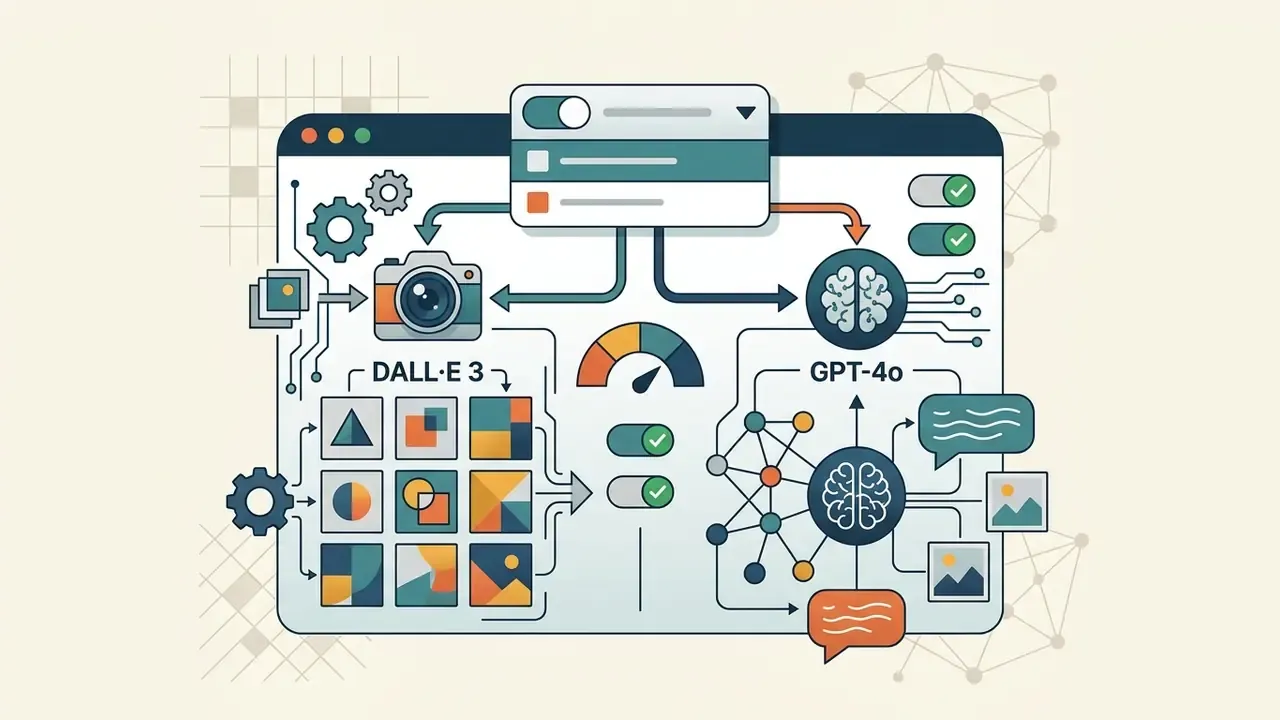
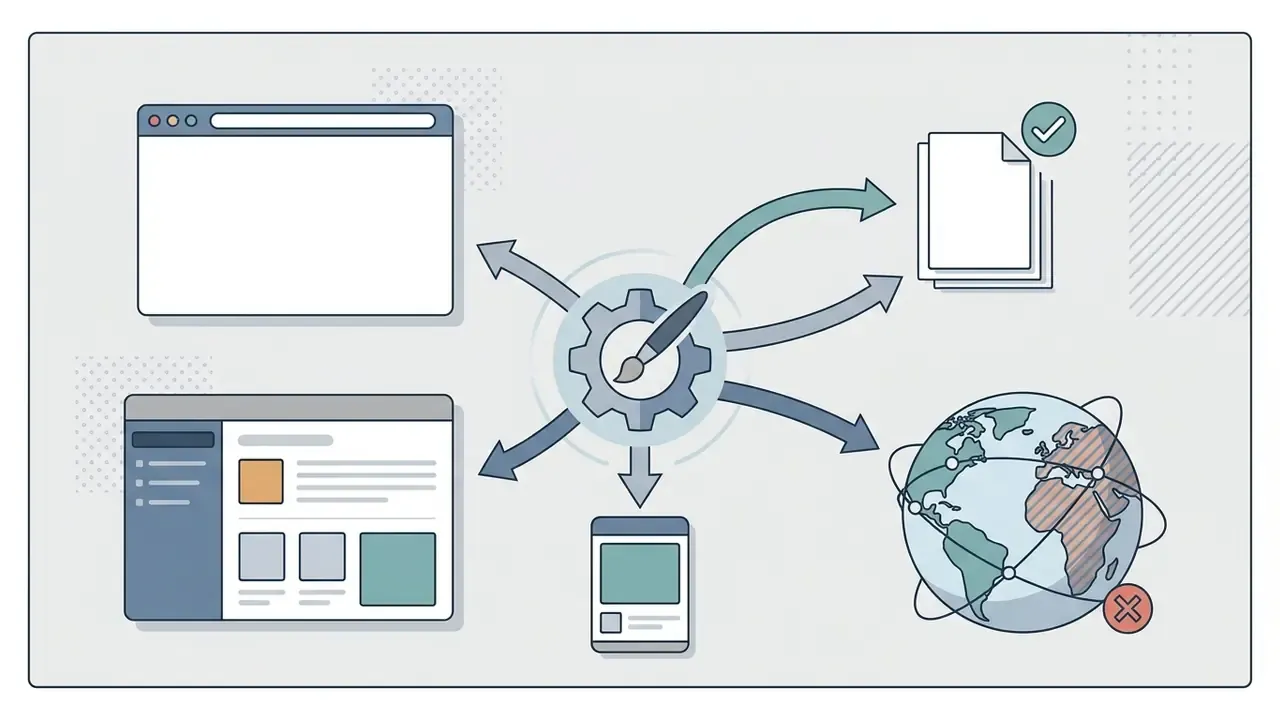
bing.com/create, Microsoft Copilot, the Bing mobile miniapp, and the Edge sidebar globally, excluding Russia and Mainland China.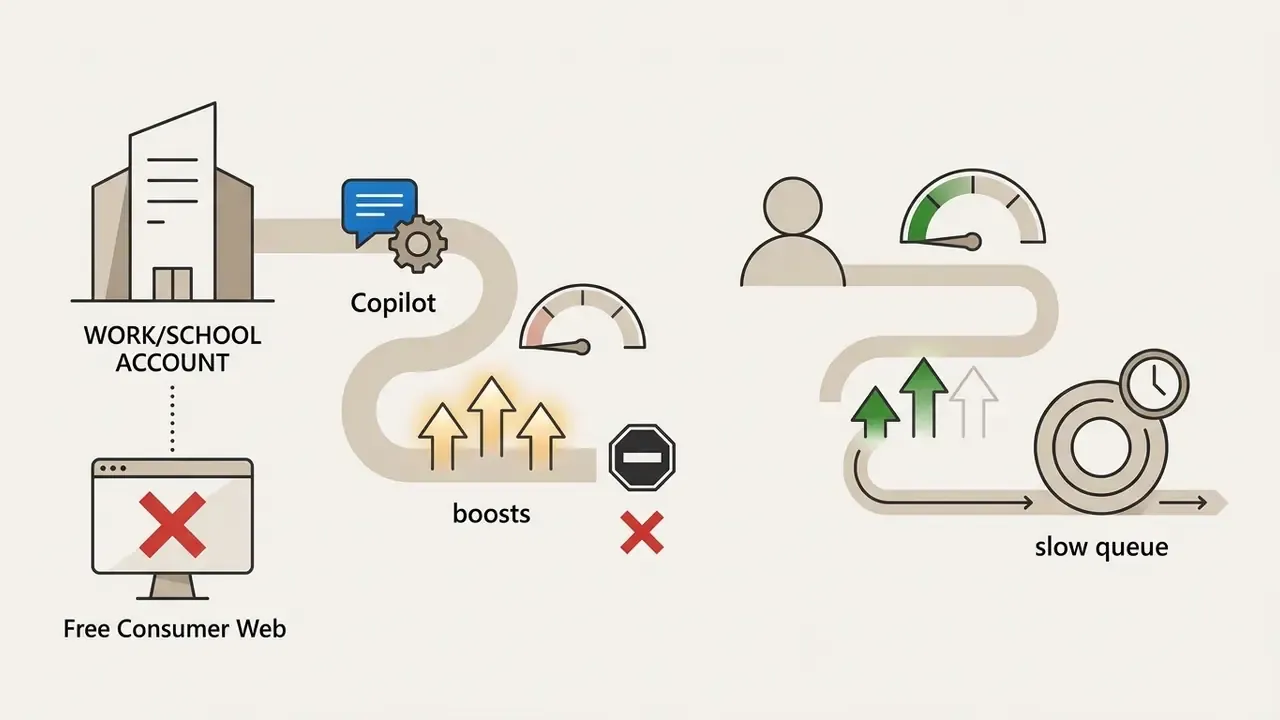
Where Bing AI Image Creator Works: Bing, Copilot, and Microsoft Designer
Bing AI Image Creator runs from three main entry points inside the Microsoft ecosystem: the standalone portal at bing.com/create, conversational prompts inside Microsoft Copilot (formerly Bing Chat), and the visual canvases in Microsoft Designer, branded as "Image Creator from Designer."
Each interface calls the same backend generation services hosted on Azure OpenAI infrastructure. Working via Bing Search allows fast conversational prompt iteration. Copilot additionally supports prompt-driven transformation of uploaded images inside the chat surface. Microsoft Designer adds layout editing, landscape formats, and richer canvas customization, with 100 boosts per day historically reserved for Copilot Pro subscribers. Teams weighing enterprise deployment can compare options across specialized generation frameworks to check feature parity and infrastructure boundaries.
Which AI Model Is Used for Image Generation
Bing Image Creator uses OpenAI's DALL·E 3 alongside GPT-4o rendering to convert complex text prompts into high-fidelity raster output. The image model handles spatial positioning, short embedded text, and anatomical consistency better than legacy diffusion systems. Microsoft specifically cites improved accuracy for hands, faces, and lettering.
According to OpenAI API technical specifications, native DALL·E 3 inference returns a single 1024×1024 output per request and exposes no variations endpoint. The consumer Bing surface fires parallel samples instead, which is why you see four generated images in a 2×2 grid. OpenAI documents two style modes (vivid and natural) and two quality modes (standard and hd); the Bing consumer surface hides both from the user. For specialized creative pipelines, a dedicated art generator breakdown helps place these parameters against open-source diffusion standards.
How to Use Bing Image Creator Free: Generating an Image From a Text Prompt
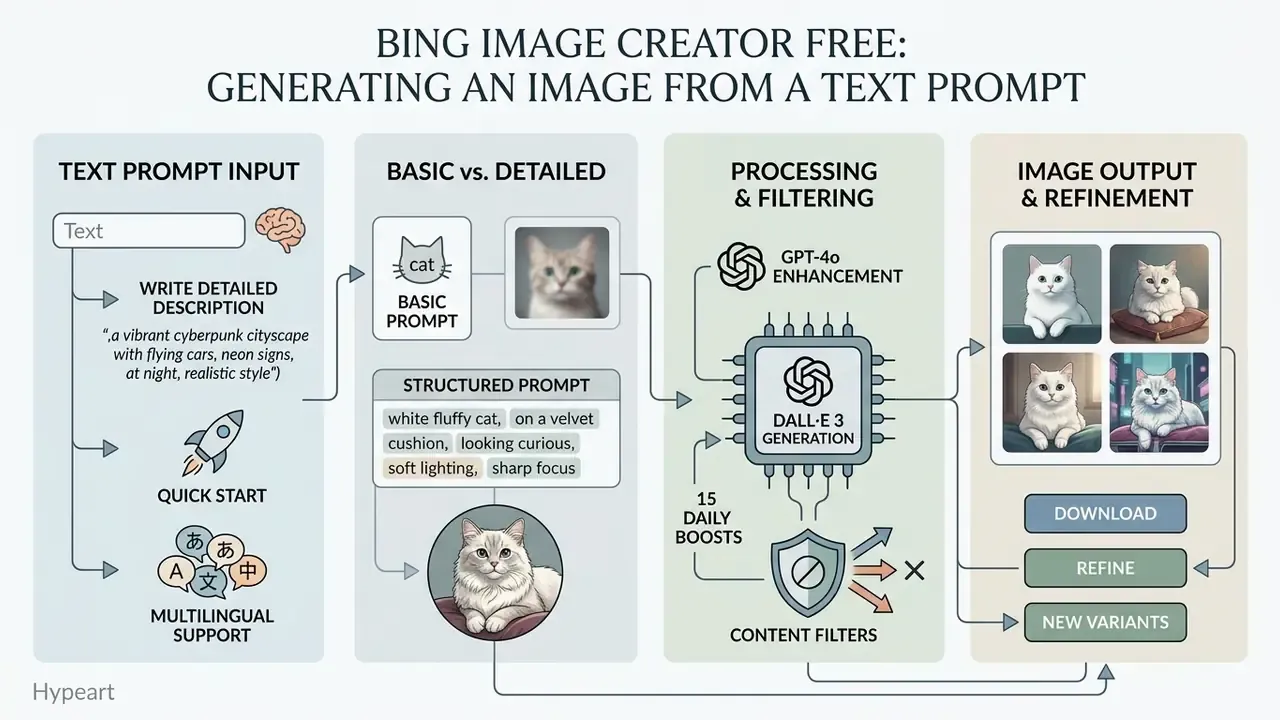
To create images with the Bing AI photo creator, sign in with a personal Microsoft account, type a descriptive prompt into the input field, and press "Create". The backend returns four candidates within seconds while fast-mode boosts remain.
The workflow is short: authenticate, submit the prompt, judge the candidates, retrieve the file. Images stay in your online history for up to 90 days, after which your own asset repository has to carry them.
flowchart TD
    A[Open bing.com/create] --> B{Signed in with personal MSA?}
    B -- No --> C[Sign in / Join & Create]
    B -- Yes --> D[Enter detailed text prompt<br/>or press Surprise Me]
    C --> D
    D --> E{Fast boosts remaining?}
    E -- Yes, 1 of 15 deducted --> F[Fast queue: 5-12 s, 4 variants]
    E -- No --> G[Standard queue: 30-120 s]
    G --> H{Redeem Microsoft Rewards?}
    H -- Yes, 500 points --> F
    H -- No --> I[Wait for 24-hour reset]
    F --> J[Inspect variants and safety outcome]
    J --> K[Download 1024x1024 file with<br/>watermark + C2PA manifest]
    K --> L[Compliance review before publication]
- Navigate and authenticate.Open
bing.com/createin any modern browser, or the Bing mobile miniapp, and sign in with a personal Microsoft account. - Input a detailed text prompt.Describe subject, environment, lighting, camera angle, and art style in the main text bar.
- Execute generation.Click "Create", or "Join & Create" on a first session, which consumes one fast boost and starts model inference.
- Inspect and download.Pick the strongest of the four generated images, review the embedded Content Credentials, then download the full-resolution render.
How to Write a Detailed Text Prompt for Better Results
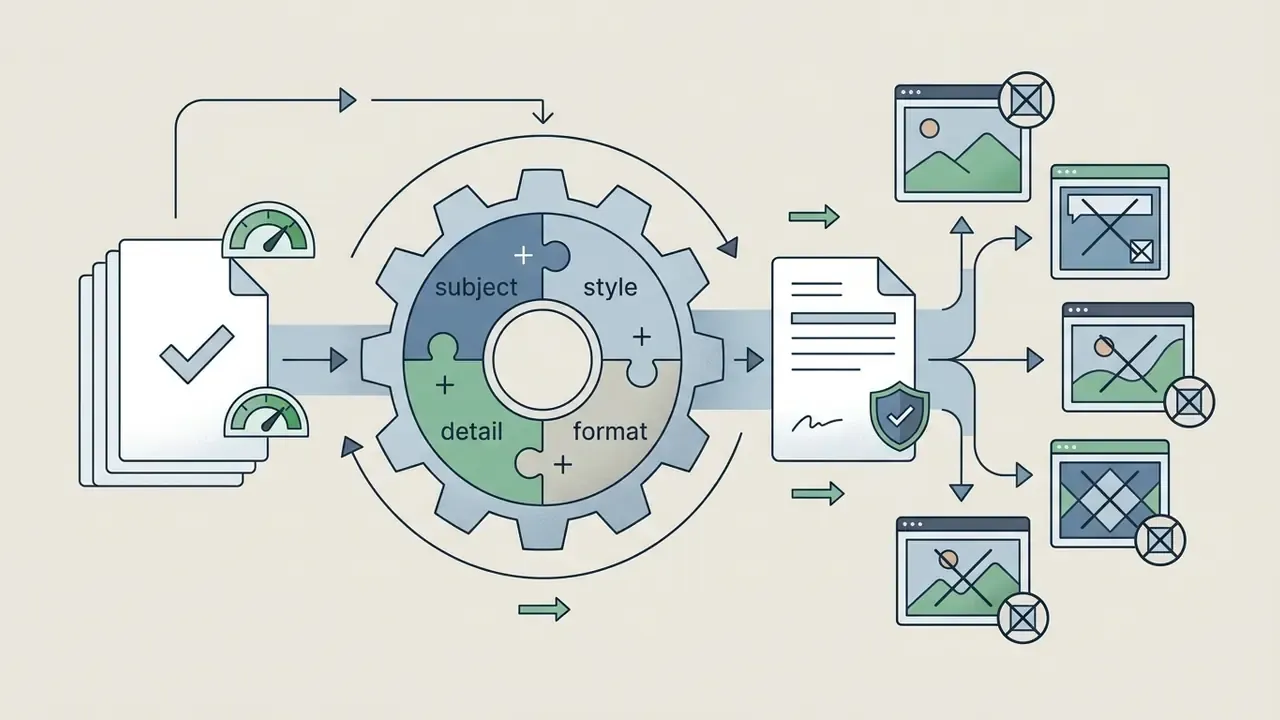
Good image creation in DALL·E 3 rests on detailed text that specifies five structural elements: subject, background environment, lighting quality, camera angle, and artistic medium. Concrete nouns beat abstract adjectives, every time.
Empirical work on prompt engineering in diffusion models shows that effectiveness rises when the key descriptors sit at the front of the string and filler words get cut.
«Prompts work better when they emphasize subject and style keywords over connecting words; 3 to 9 different seeds help estimate prompt quality.»
A companion ACM study on initial images adds a practical nuance. Concrete singular subjects gain coherence from a tightly specified visual anchor, while abstract subjects only improve after several attempts. Operationally: budget 3 to 4 boosts per concept instead of expecting a first-pass hit.
Quick start and multilingual input. If composing descriptions feels like work, the bing.com/create interface has a "Surprise Me" button. It writes an expanded test prompt with a ready-made style and level of detail, and it is honestly the fastest way to learn the syntax the model rewards. The interface accepts input in more than 100 languages, yet the internal translator converts the request into English before inference. To avoid semantic drift and stay inside the 77-token CLIP window, write in English from the start.
Before and after: basic prompt versus structured enterprise prompt
| Prompt text | Typical outcome | |
|---|---|---|
| Basic | a picture of a bank vault | Generic stock-like composition, flat lighting, inconsistent metal textures, unpredictable framing |
| Structured (recommended) | close-up photograph of a reinforced steel bank vault door, volumetric studio lighting, crisp brushed-metal textures, shallow depth of field, 85 mm lens perspective, neutral corporate colour palette, no text, no logos | Repeatable material realism, controlled depth of field, brand-neutral output that survives trademark clearance |
Two details matter for teams chasing best results. Adding the negative instructions no text, no logos measurably reduces the number of assets rejected later in trademark review. And keeping rendered text under roughly 200 characters keeps you inside the encoder's reliable range.
How to Download, Refine, or Generate New Variants
After rendering, you can download full-resolution 1024×1024 JPEG files, share direct links, or push outputs into a Microsoft OneDrive collection. Refinement means a new prompt, or Microsoft Designer's conversational edit tools for adjusting specific layers. The Bing consumer surface itself has no inpainting brush, no masking, no layer stack. For social media that rarely matters. For brand work it matters a lot.
In corporate risk assessments, content handlers often need to turn static output into motion. Teams evaluating that step can explore animate photo ai solutions and examine frame interpolation controls and motion vector artifacts.
Free Limits of Bing Image Creator: Boosts, Speed, and Generation Constraints
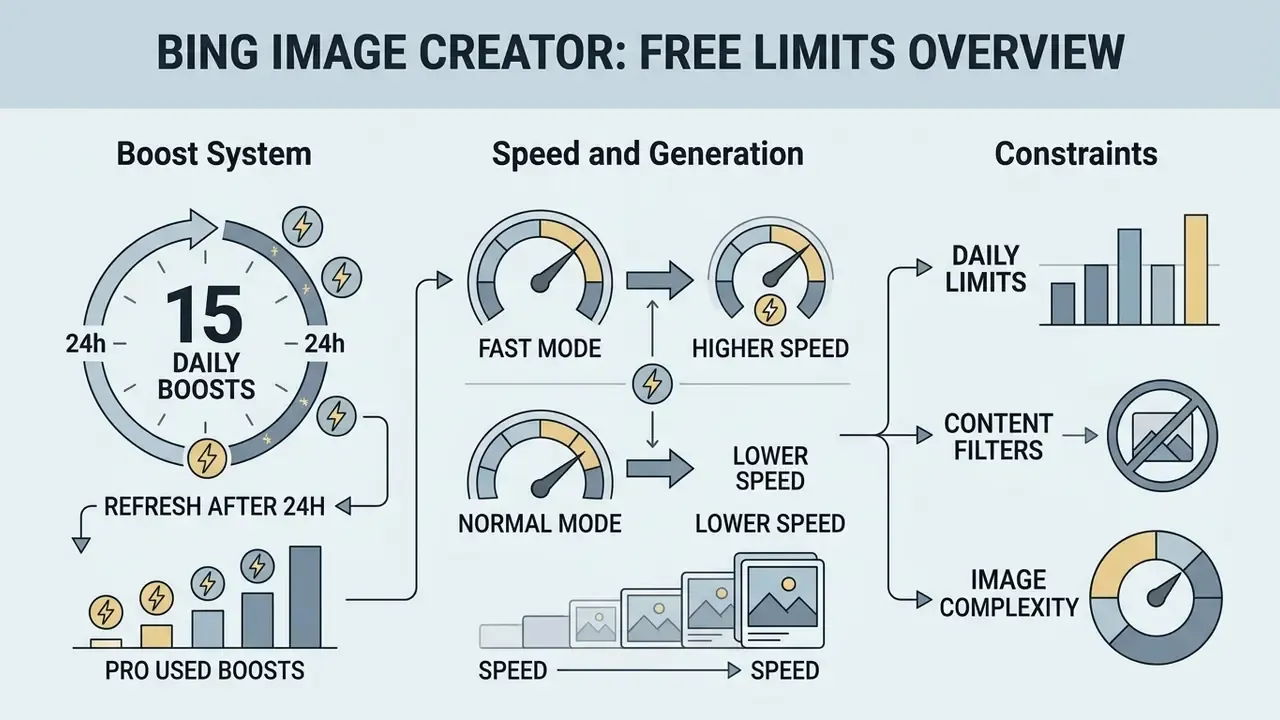
Bing Image Creator runs a freemium throttling model that grants personal account users 15 fast-mode boosts per 24-hour cycle. That figure is not a marketing claim: it appears on Microsoft's own Bing Image Creator page and has been reproduced independently in academic benchmarking, cited below. When the boost balance hits zero, image creation continues, just in a lower-priority standard queue with visibly higher latency.
Structural constraints worth budgeting for before you read the table:
- No image-to-image mode. Bing Image Creator processes text prompts exclusively. It accepts no file uploads, sketches, or reference images for restyling or inpainting. Reference-driven output requires Copilot's separate transformation surface, or a different tool entirely.
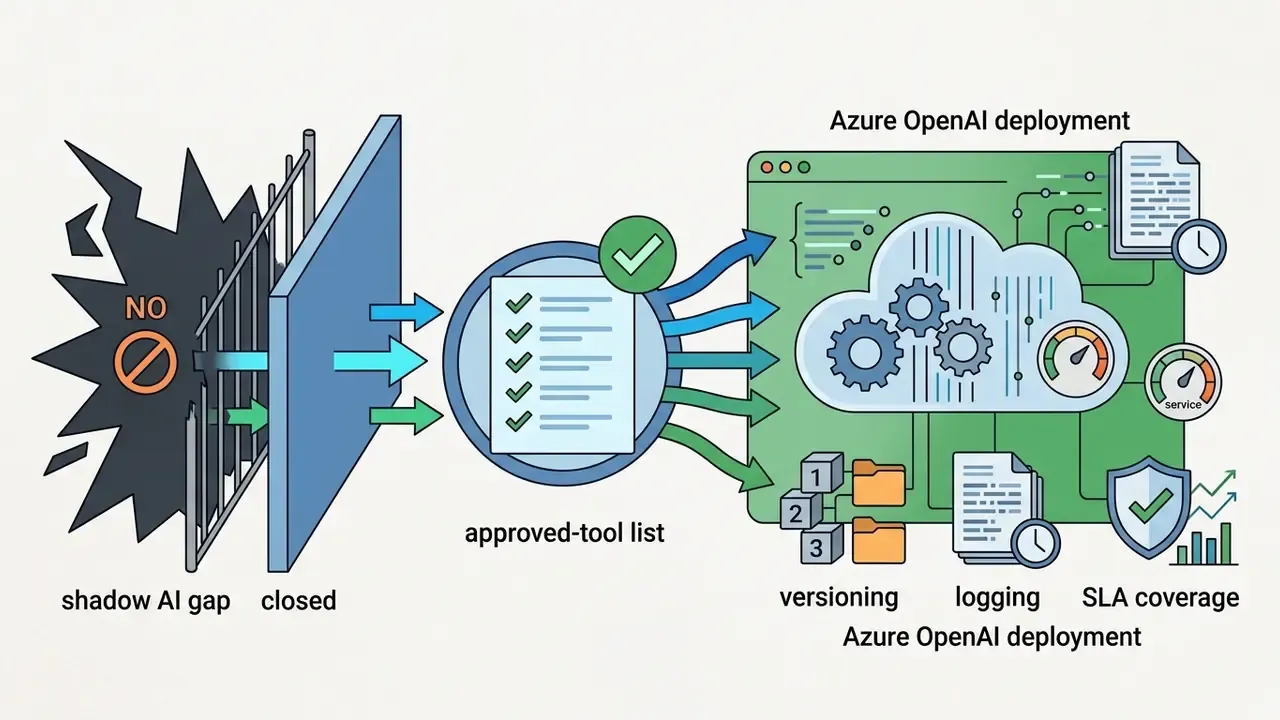
- No public API on the free tier. There is no documented endpoint, no SLA, no service credit. Automation belongs on Azure OpenAI.
- Fixed square canvas. Only 1024×1024 px in the consumer web flow, with no CMYK profiles and no vector export.
- Prompt-only editing. Refinement is re-prompting, and each re-prompt spends another boost.
- Account gating. Entra ID work and school identities are excluded from the free consumer surface.
Microsoft does not publish a hard cap on total daily generations for personal accounts, though the practical ceiling sits near 200 prompt transactions per 24 hours, edits and variations included.
| Access parameter | Fast mode (boosted) | Standard mode (after boosts are exhausted) |
|---|---|---|
| Daily call allowance | 15 boosts / 24 hours | Unlimited (up to ~200 total prompts per day) |
| Average generation time | 5–12 seconds | 30–120 seconds, load-dependent |
| Maximum resolution | 1024 × 1024 px | 1024 × 1024 px |
| Variants returned | 4 images per request | 1–4 images, may drop at peak load |
| Reference image upload | Not supported | Not supported |
| Account type | Personal Microsoft Account (MSA) | Personal Microsoft Account (MSA) |
| Cloud retention | Up to 90 days | Up to 90 days |
How the Boost System Works in Bing Image Creator
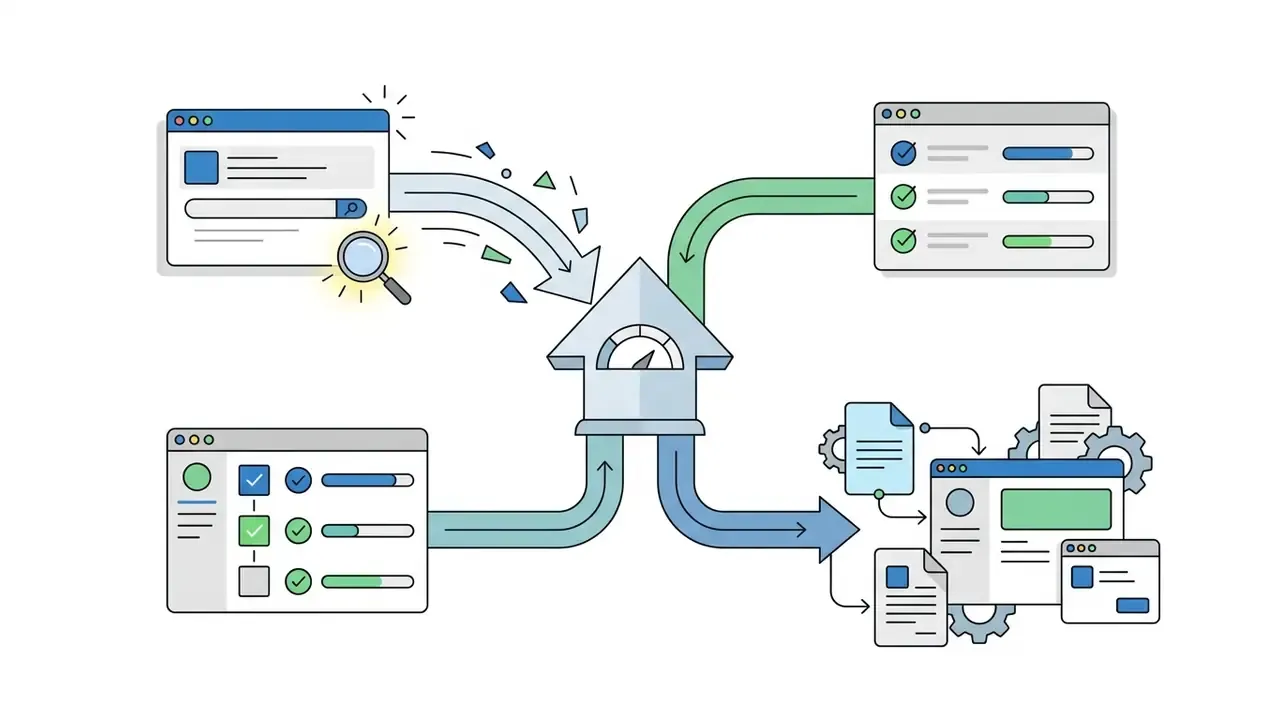
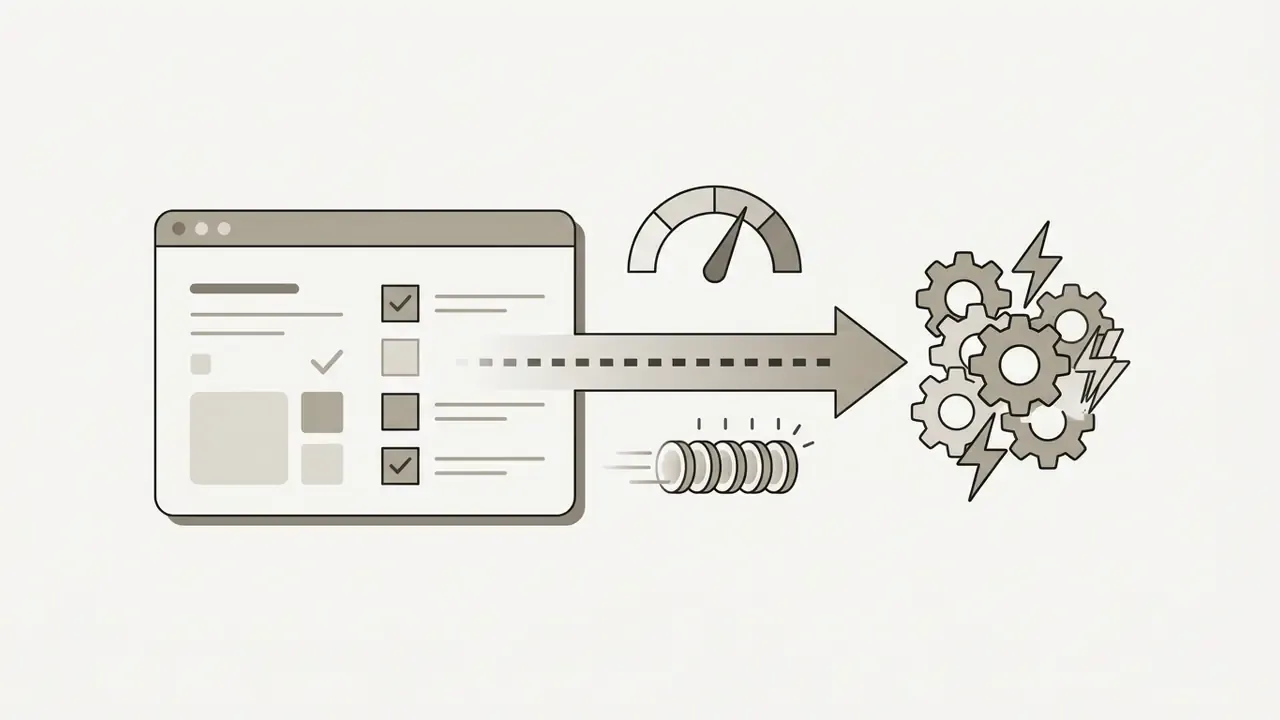
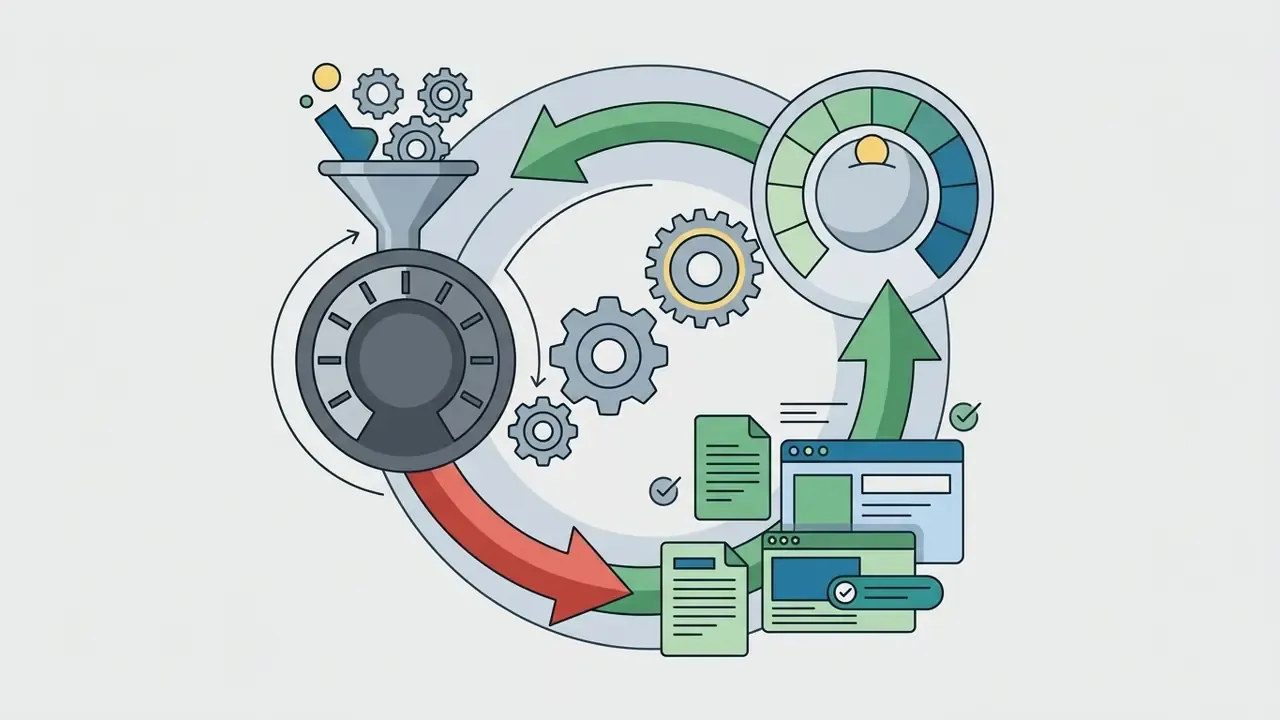
Boosts behave like priority tokens. They push your request to the front of Microsoft's Azure OpenAI GPU compute queue, and one token is deducted every time you submit a new prompt or an edit request.
Once the 15 tokens are gone, requests fall into the standard priority queue. You can top up before the automatic 24-hour reset by redeeming Microsoft Rewards points earned through Bing search activity and general ecosystem engagement.
«Resourify's audit found a discrepancy: the live Bing page listed 10 fast creations while the FAQ listed 15; limits can vary by region and account type.»
Microsoft Q&A threads from 2025 describe the allowance refreshing every 24 hours, while several 2026 third-party summaries describe a weekly refill. Treat the number as a moving operational parameter and verify it in-product before you plan a campaign sprint.
Which Constraints Can Affect the Result
Technical constraints of DALL·E 3 inside Bing Image Creator include the 1024×1024 native canvas, visual artifacting on multi-word text overlays, and spatial misalignment once a frame holds more than three distinct subjects. Character anatomy is still the most common failure mode: fingers, feet, and facial symmetry degrade noticeably. That is precisely why multi-sample generation is a necessity rather than a luxury.
Academic evaluations of diffusion scaling show that synthesis beyond native training resolution causes semantic distortion and compositional decay.
«Fixed training resolution causes a noticeable decline in image quality and semantic deviation at higher resolutions, including 1024×1024, 1920×1080 and 2048×2048.»
Text rendering accuracy also drops sharply once embedded strings exceed 77 tokens, the CLIP text encoder limit, which produces the familiar spelling anomalies in generated signage. A 2025 EMNLP study on text rendering reports degradation past roughly 200 characters, and a 2024 multilingual study measured close to zero visual spelling accuracy for non-Latin scripts in some commercial systems.
Regressions like that are a governance signal, not a nuisance. Consumer surfaces can change behaviour overnight, with no release notes and no rollback guarantee for the customer.
Safety, Filters, and Watermarks in the Bing AI Image Generator
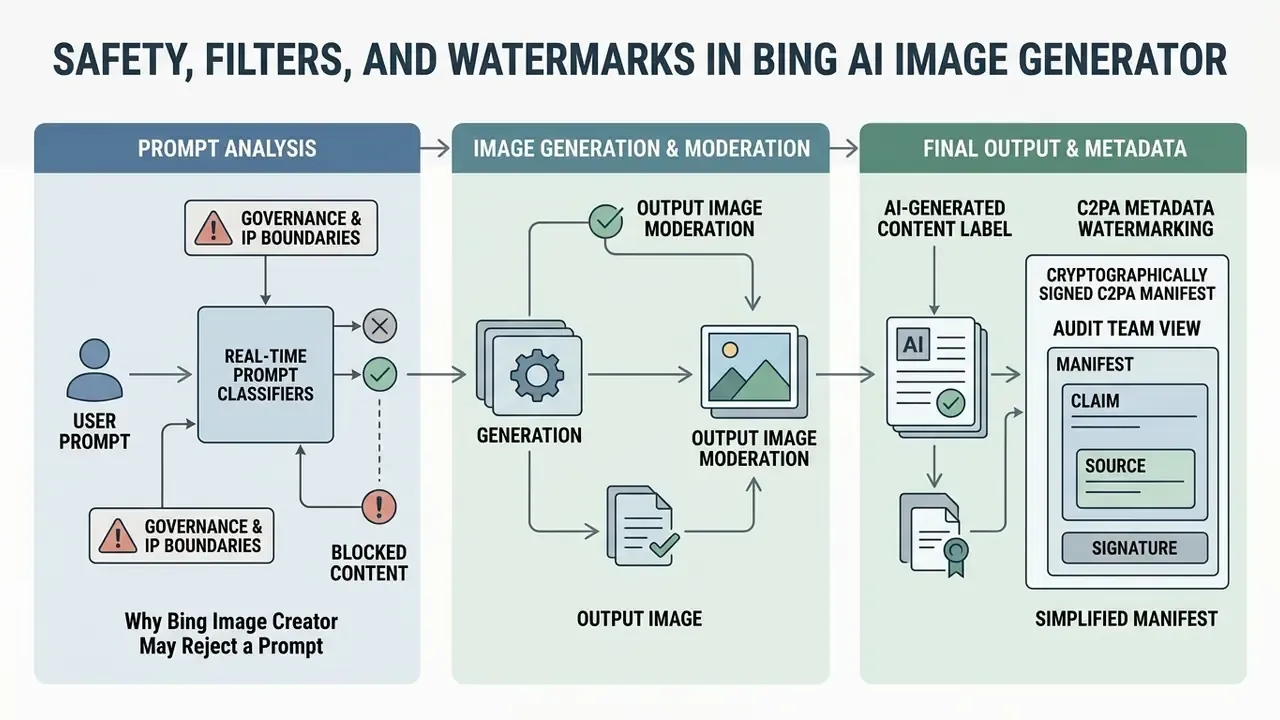
Bing Image Creator enforces layered safety: real-time prompt classifiers, output image moderation, and cryptographically signed C2PA metadata watermarking. Prompts with harmful, explicit, or clearly infringing intent are blocked before inference starts.
Microsoft wires open provenance standards directly into Azure OpenAI backend services, which gives synthetic media a traceable lineage.
Alert box: governance and intellectual property boundary. Automated content filters prevent explicit safety violations. They do not guarantee non-infringement of third-party IP rights. A successful generation is not legal clearance for commercial distribution, and treating it as clearance is how brand incidents start.
Why Bing Image Creator May Reject a Prompt
The Bing AI image generator blocks requests through automated Azure OpenAI classifiers, with default blocking at medium severity across hate, violence, sexual content, and self-harm categories. Beyond the obvious NSFW and hate-speech prohibitions, moderation rejects prompts aimed at forged documents (fake IDs, insurance claims, financial statements), fabricated profiles of real people, and anything imitating protected holograms or controlled official forms. Celebrity likeness exploitation is refused as its own category. False positives cluster around homonyms and domain jargon, words such as "strike," "shoot," "execution," "kill the process" in photography, sports, or business contexts, plus phrasing that resembles prompt injection, which trips Microsoft's Prompt Shields layer.
«An audit of 805 generation attempts across five platforms identified six distinct moderation behaviours in Bing, from a black screen to blurred outputs; 24.17% of requests were blocked.»
Those six behaviours run from outright refusal to blank black canvases and silently blurred output. That distinction matters for audit logs, because a technically "successful" response can still be an implicit refusal. To clear a false positive without violating platform policy, strip ambiguous descriptors, add explicit benign context, and drop jailbreak-style phrasing. Teams that need to verify the origin of a delivered asset after the fact can use AI-generated image detectors as a second control layer.
What the AI-Generated Content Label Means
Every asset from Bing Image Creator carries embedded C2PA (Coalition for Content Provenance and Authenticity) Content Credentials plus a subtle visual watermark logo in the lower-left corner. These markers identify synthetic origin and generation timestamp cryptographically, and they can be cross-checked with AI image detection tools or the public Content Credentials verify page.
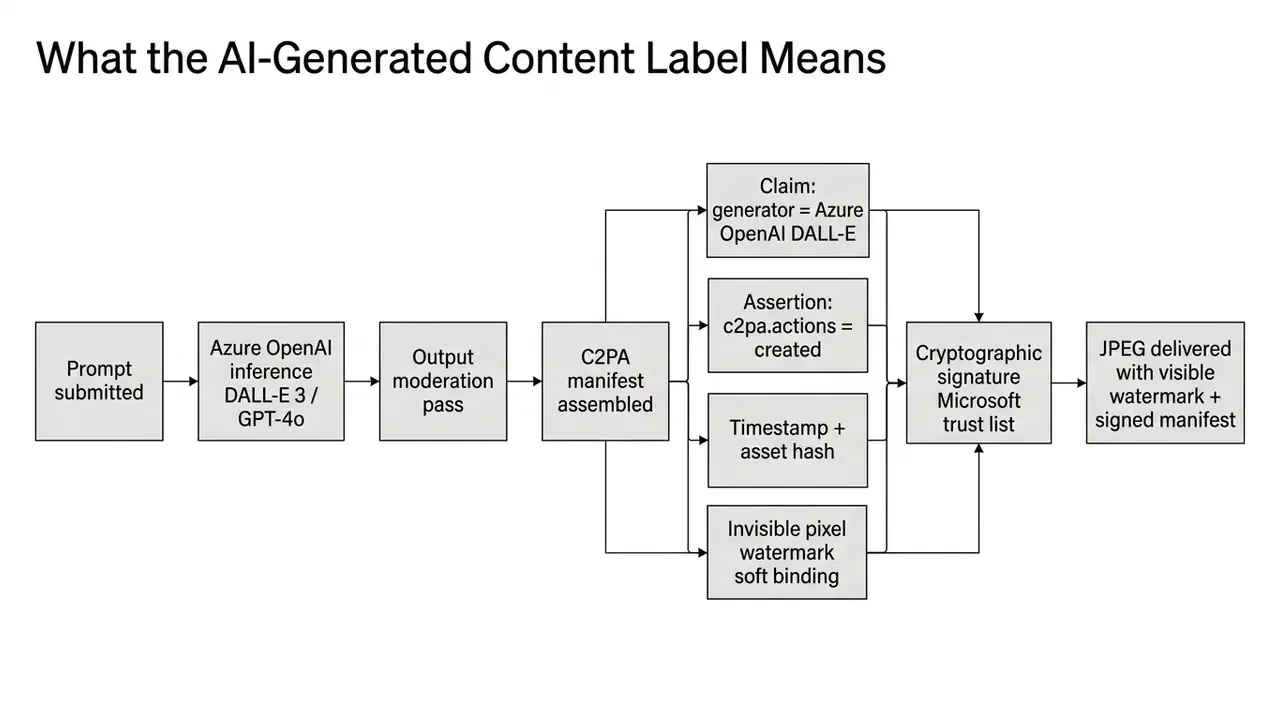
Simplified manifest structure an audit team sees on inspection:
{
  "active_manifest": "urn:uuid:xxxxxxxx-xxxx-xxxx-xxxx-xxxxxxxxxxxx",
  "claim_generator": "Azure OpenAI DALL-E",
  "signature_info": {
    "issuer": "Microsoft Corporation",
    "time": "2026-09-12T09:41:07Z"
  },
  "assertions": [
    { "label": "c2pa.actions",
      "data": { "actions": [ { "action": "c2pa.created",
                               "digitalSourceType": "trainedAlgorithmicMedia" } ] } },
    { "label": "c2pa.hash.data", "data": { "alg": "sha256" } }
  ],
  "validation_status": "valid"
}
According to Microsoft's EU Digital Services Act transparency documentation, the embedded metadata carries a signed manifest with the issuing software agent (Azure OpenAI DALL-E), the generation date, and asset history. The 2024 report also describes a pixel-based hidden watermark built to survive minor edits, while the 2023 systemic-risk report states that all Bing Image Creator outputs are labelled as AI generated. Media platforms and newsrooms use these manifests to flag synthetic content automatically, and the 2026 C2PA Deployment Guidance confirms that platforms can surface a verification indicator for supported assets.
«Invisible watermarks in AI-generated images reach PSNR ≈ 51 and SSIM ≈ 0.998 with decoding accuracy above 97% even after compression and cropping.»
«After the dedicated Designer safety system was deployed, the share of problematic content in output images fell from 12% to 3.6%.» Microsoft Responsible AI Transparency Report (2024), research synthesis reference [11]
One correction to a widely repeated claim. The Bing watermark is visible, a logo in the lower-left corner, whereas date and time live in the cryptographic C2PA manifest and the invisible pixel layer. Not in the badge. Auditors who screenshot the badge and stop there are collecting decoration, not evidence.
Organizations facing regulatory inquiry or an IP dispute should review the relevant precedent guidance in our litigation research portal.
Can You Use Bing Image Creator Images for Commercial Purposes?
This information is general in nature and does not replace advice from a qualified professional.
Commercial use of images generated via Bing Image Creator is permitted under Microsoft's updated Terms of Service, revised across 2024 to 2026, which removed the legacy "personal non-commercial use only" restriction for consumer Image Creator output. Commercial use still sits under third-party copyright, trademark, and right-of-publicity law.
Microsoft claims no copyright ownership over your prompts or your generated images, and grants no absolute indemnification against third-party IP claims either. Read that sentence twice; it is the whole risk posture in one line. Anyone deploying AI generated images has to audit them independently for proprietary logos, protected designs, and recognizable individuals. For a deeper walkthrough of access rules and licence wording, see our guide to the commercial use of Bing AI images.
Fact check: Microsoft terms of service and commercial rights, 2026 baseline
- Terms alignment
- current Microsoft Bing Terms of Use do not explicitly prohibit commercial exploitation of Image Creator output, which lines up with OpenAI DALL·E commercial licensing.
- User licence to Microsoft
- users grant Microsoft a non-exclusive, worldwide, royalty-free licence to copy, distribute, display, reproduce, edit, translate, reformat, and sub-license prompts and creations for platform business operations.
- Designer contrast
- consumer Microsoft Designer templates remain explicitly licensed for personal, non-commercial use under the consumer FAQ, updated September 2026.
- Services Agreement nuance
- the Microsoft Services Agreement states that Bing and MSN materials are for noncommercial personal use. That is a separate clause from Image Creator output rights, and a frequent source of internal confusion.
- Legal responsibility
- the person or entity publishing the output retains full liability for third-party copyright or trademark infringement.
What to Verify Before Publishing or Selling AI-Generated Images
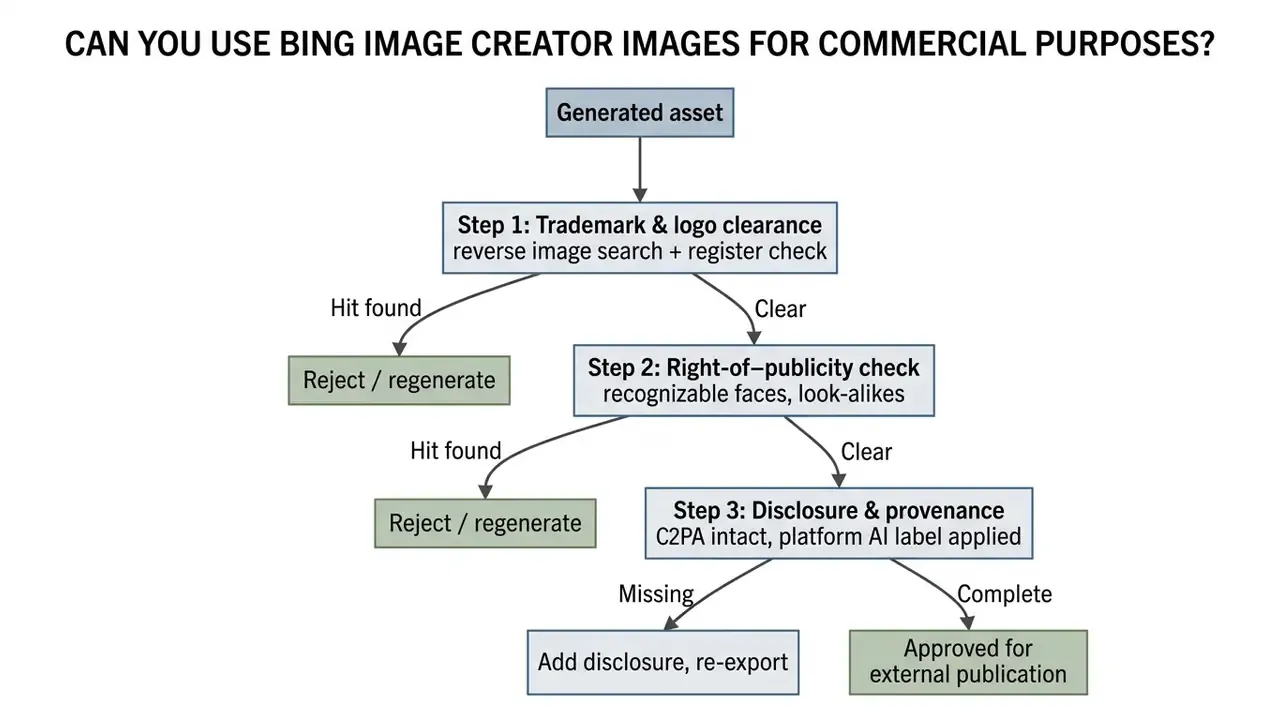
Before you publish or monetize AI generated media, run a three-point audit: clearance of visible trademarks and logos, right-of-publicity checks for recognizable human likenesses, and verification of platform-specific AI disclosure requirements.
Pre-publication checklist
- Reverse-image search executed against the final asset, not the prompt.
- Visible marks, wordmarks, packaging shapes, and trade dress screened against active registers.
- Identifiable faces, look-alikes, and likeness proxies cleared for right of publicity.
- C2PA manifest validated as intact after resizing or export.
- Platform-level AI disclosure applied, covering EU AI Act transparency expectations and platform labels.
- Human sign-off recorded with named reviewer and date for the model-risk evidence file.
Methodology note. Documented compliance failures in this category follow a pattern rather than scattered bad luck: automated generation reproduces mark-like elements that pass safety filters and then fail trademark review. In one commercial risk review of a regional financial services firm expanding its visual marketing, internal compliance flagged 3 of 50 AI-generated stock concepts for subtle marks resembling active federal registrations, and mandated automated reverse-image checks plus human legal clearance before any external ad campaign shipped. That figure comes from an anonymized, illustrative engagement, not from a peer-reviewed benchmark. Build your own baseline rejection rate across the first 100 assets and track it.
The regulatory context points the same way. The U.S. Copyright Office (2023) requires applicants to disclose AI-generated content and claim only the human contribution. The EU's 2025 transparency code requires providers to mark AI output and mandates human review and editorial responsibility for public-interest publications. And CRS analysis notes that the right of publicity generally protects against unauthorized commercial use of a person's name, image, or likeness, independently of copyright.
«DALL·E 3 accessed through Bing Image Creator continues to sexualize women and reproduce stereotyped depictions of children when asked for professional portraits.»
For campaigns involving people, that finding converts into one concrete control: never ship the first variant of a human-subject prompt without a bias review, and log the reviewer's name.
To keep governance consistent across marketing and operations pipelines, teams can work through our b2b trust checklist and standardize vendor verification alongside AI asset compliance.
When Bing Image Creator Is Enough, and When You Need Another Tool
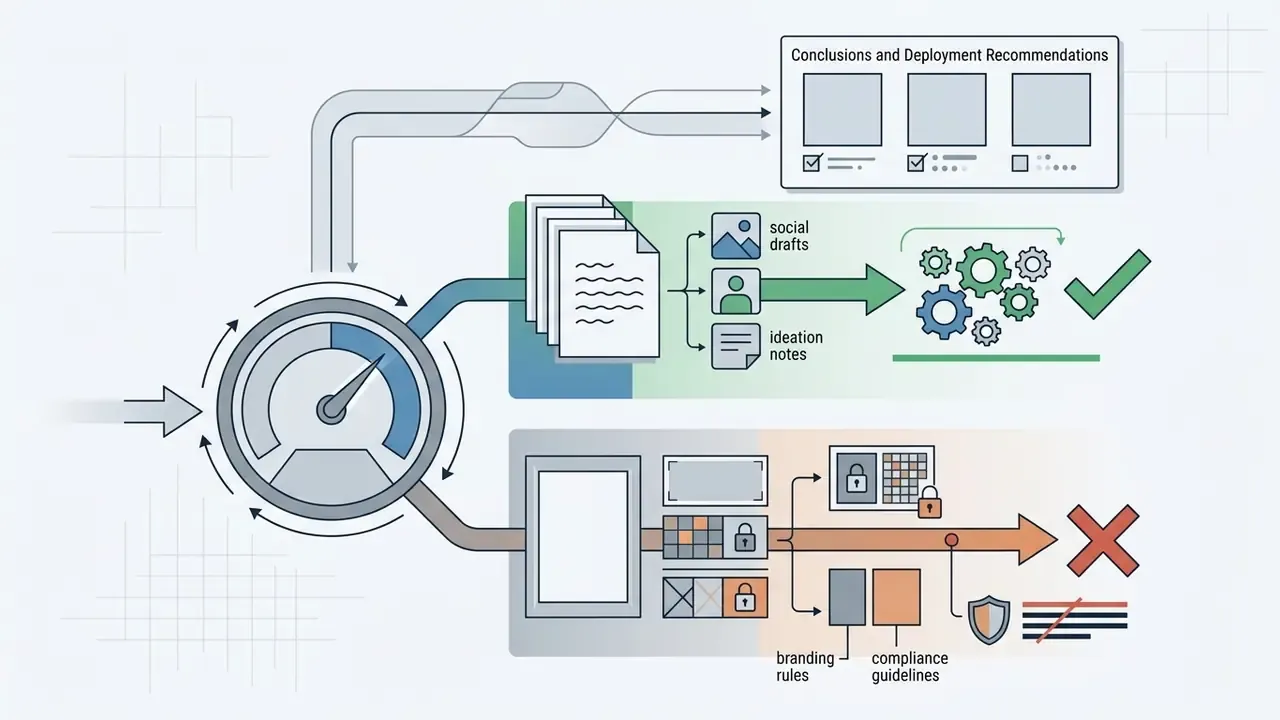
Bing Image Creator delivers enough fidelity for ad-hoc social media visuals, editorial concept sketches, and internal deck graphics. High-stakes advertising, packaging design, and corporate identity systems need enterprise platforms with API integration, vector export, and contractual indemnification.
| Control dimension | Bing Image Creator Free | Azure OpenAI / enterprise image APIs |
|---|---|---|
| Access model | Consumer web plus personal MSA | Resource endpoint, keys, RBAC |
| Automation | None, manual UI only | REST/SDK, images/generations endpoint |
| SLA and support | No SLA, no service credits | Contractual SLA and support tiers |
| Data handling | Consumer telemetry, prompts under consumer terms | Tenant-scoped, enterprise data commitments, SOC 2 / ISO scope |
| Output control | 1024×1024 only | 1024×1024, 1792×1024, 1024×1792; quality, style parameters |
| Model lifecycle | Silent updates | Versioned deployments, documented retirement dates (for example dall-e-3 retired 2026-03-04) |
| Audit evidence | Screenshot plus C2PA manifest | Request logs, deployment IDs, policy configuration exports |
Midjourney restricts commercial use to paid plans for companies grossing over USD 1,000,000 per year, while Adobe Firefly documents a dedicated API for Adobe-centred production. Both are documentation-rich where Bing's consumer surface stays silent, and documentation is what an examiner asks for. When comparing alternatives, review our analysis of the apple ai image generator ecosystem, explore dedicated workflows through the bing ai art documentation, or use our comparison of leading AI image generators to shortlist an indemnified vendor.
Strengths and Limitations of Bing Image Creator Free Across Tasks
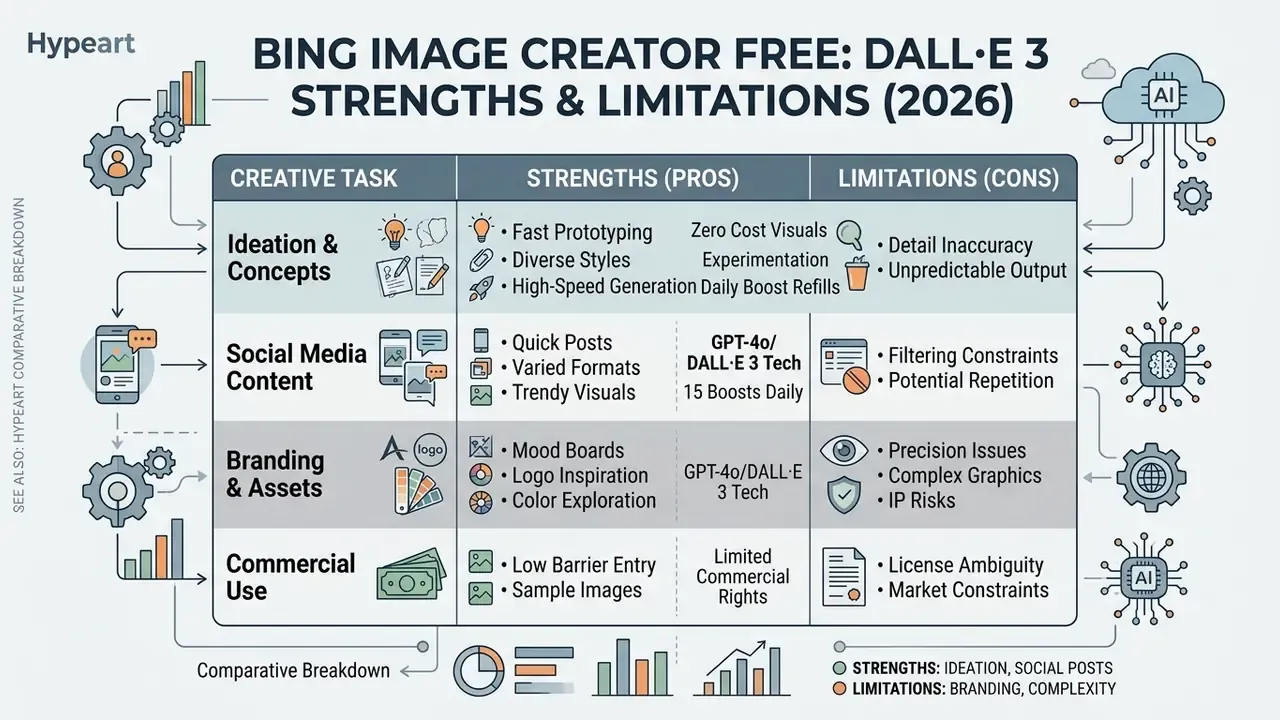
The free Bing image generator shines at zero-cost visual prototyping and fast prompt experimentation. It falls short on resolution control, enterprise API access, and fine-grained editing. Those two sentences cover most procurement questions, though the nuance below is where budgets actually get decided.
«Moderation systems in GPT-4 and DALL·E 3 "straighten" representations of bodies and sexuality, constraining queer artists from producing normatively neutral content.»
For inclusive campaigns that conservatism is a production risk as real as a rate limit. Refusals cluster exactly where a brand may need non-normative representation.
Fit assessment means balancing accessibility against control:
| Use-case scenario | Suitability | Key advantage | Principal limitation |
|---|---|---|---|
| Concept art and sketching | High | Instant generation, zero cost | No precise local object editing |
| Social media content | High | Strong DALL·E 3 aesthetics, ready square posts | Mandatory watermark and C2PA metadata |
| Print outdoor advertising | Low | Fast idea visualization | 1024×1024 px cap, no CMYK profiles |
| Corporate branding | Medium | Rich stylistic palette | Competitors can generate near-identical elements |
| API integration into B2B software | Not suitable | No infrastructure required | No public API on the free tier |
| Reference-based restyling (image-to-image) | Not suitable | None | Uploads and inpainting unsupported |
Reading the table row by row: ideation and social posts are safe ground, branding sits in the grey zone where legal review pays for itself, and anything requiring automation or print-grade colour belongs elsewhere. For print formats, the 1024×1024 ceiling can be partly mitigated with AI image upscalers, although ISO TC 130 print workflows still demand PDF/X delivery, preflight, and controlled proofing that no consumer generator can supply. Users without a Microsoft account, or blocked by regional availability, may prefer free AI generators with no sign-up.
Teams that want a wider market read can use our comparative breakdown of bing ai art tools for extra context on features and pricing tiers.
FAQ About Bing Image Creator Free
Do you need to download a separate app for Bing Image Creator?
No. No desktop or mobile download is required. The service runs in standard browsers at bing.com/create, inside the native Microsoft Edge sidebar, and within the official Bing and Copilot mobile apps for iOS and Android, where it appears as the Bing Image Creator miniapp. Readers weighing no-cost options can also consult our roundup of the best free AI image generators.
Is Bing Image Creator related to Bing AI Video Creator?
They are separate products. Image Creator handles static raster graphics with DALL·E 3 and GPT-4o. Bing Video Creator is a distinct module built on video-diffusion models that produces short free clips, initially 5 seconds, rolling out first on Bing mobile and later to desktop and Copilot Search. Prompt syntax and visual cues look similar, but the ai video pipeline consumes separate compute, keeps its own reward-point configuration, and never draws down the Image Creator boost allowance. Independent temporal pipelines, independent queues. Our overview of AI video generators explains the distinction further.
Can work or school accounts use the free tier?
Microsoft Entra ID work and school accounts are excluded from the free consumer surface. Where such accounts do reach Image Creator through Copilot, generation halts once boosts are exhausted rather than degrading to a slow queue. This is exactly why unmanaged personal-account use by employees remains the classic Shadow AI vector in regulated organizations.
How long are generated images stored?
Creations stay in the Bing Image Creator history for up to 90 days. Anything needed for audit evidence, campaign archives, or licence defence must be exported to a controlled repository with the C2PA manifest intact.
Does free access to DALL·E 3 still hold in 2026?
Yes, as of this review. The free DALL·E 3 tier that users searched for as "bing image creator dall e 3 free 2025" survived into 2026, now with GPT-4o alongside it. Quotas and model availability shift without notice, so verify in-product before you commit a deadline to it. Readers exploring dynamic editing capabilities can browse the hub for implementation guides, or see the overview of enterprise video solutions. Practitioners mapping broader synthetic media taxonomy may prefer to view the guide and align internal terminology first.
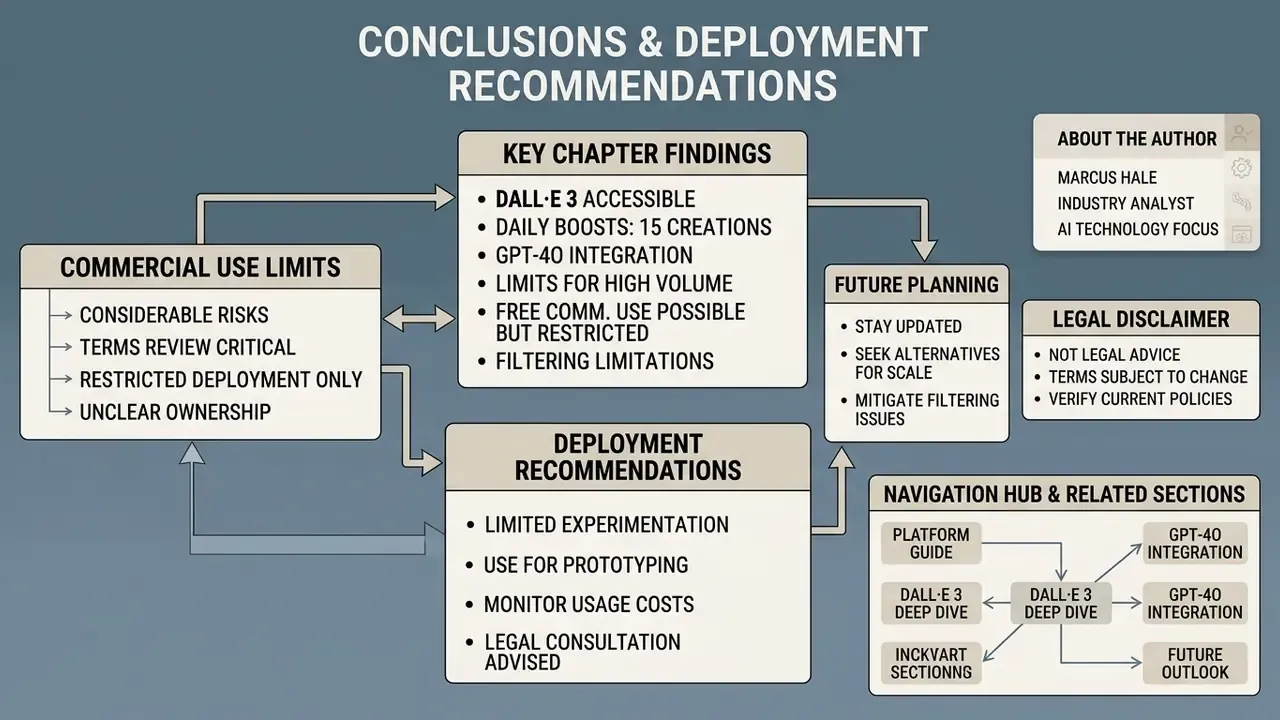
Conclusions and Deployment Recommendations
Bing Image Creator Free is an accessible and genuinely capable entry point for DALL·E 3 visual assets at no subscription cost. Financial institutions and mature fintech operators still need explicit controls over asset verification, trademark clearance, and metadata transparency before any synthetic output reaches a public channel. A broader view of the vendor ecosystem sits in our overview of the Microsoft AI Image Generator.
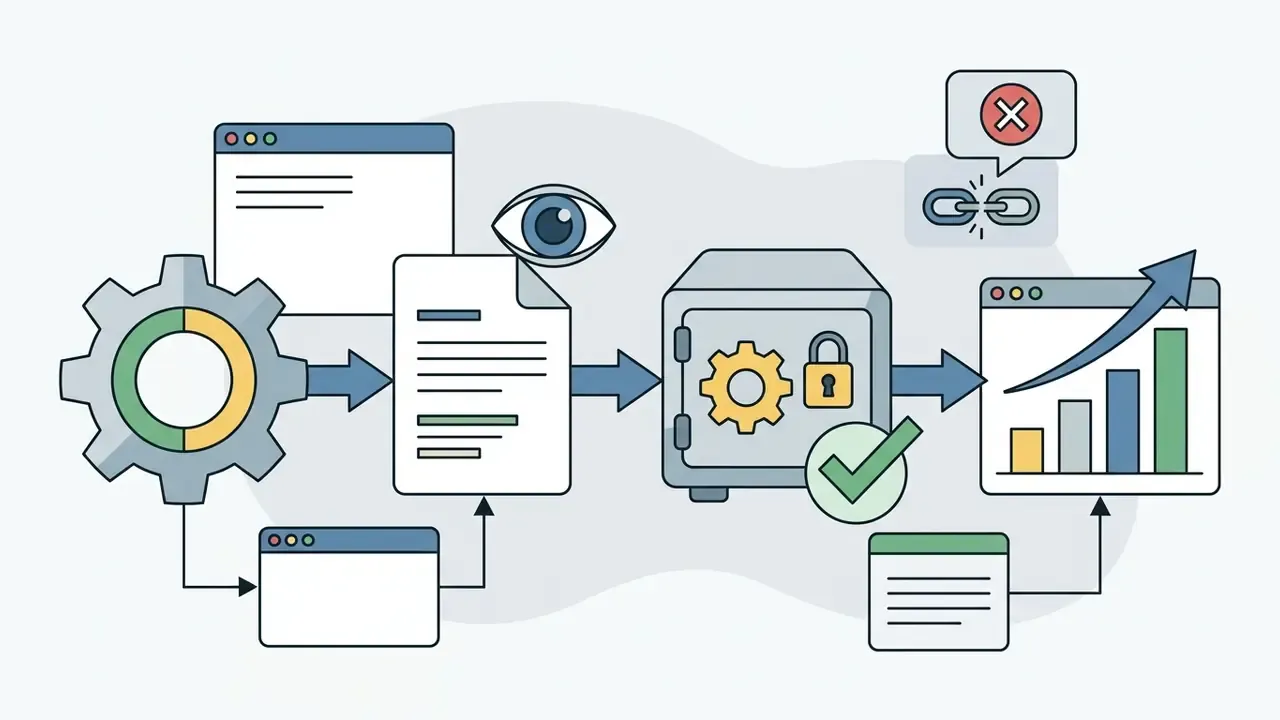
A practical sequence for a governed rollout:
Open question, stated plainly: nobody knows how consumer-surface terms and quotas will read twelve months from now. Build the control around the evidence, not around the vendor's current generosity.
no text, no logos into templates.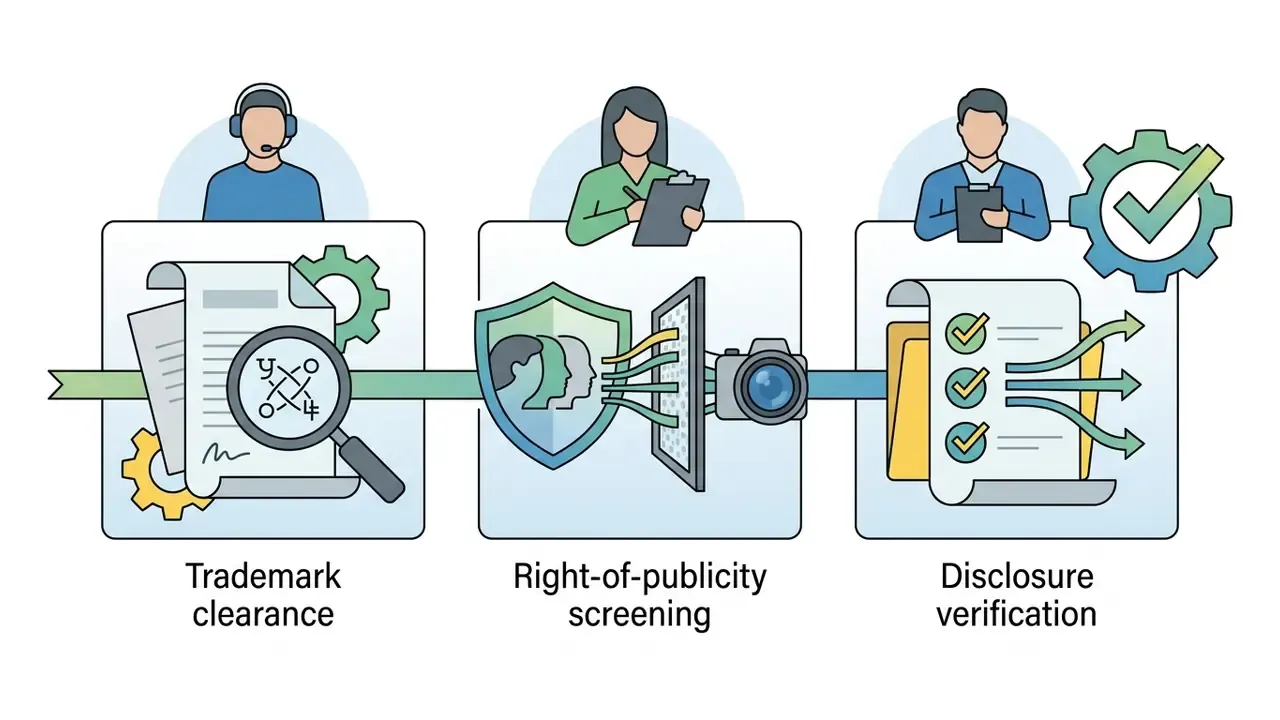
Legal Disclaimer
This material is provided for general informational purposes only. It does not constitute legal, financial, or compliance advice, and it creates no professional relationship. Licensing terms, quotas, and model availability for Bing Image Creator change frequently and vary by region and account type. Verify current terms with Microsoft and consult qualified counsel before commercializing AI-generated assets.