Executive Summary
- An AI celebrity voice generator synthesizes speech that imitates a recognizable public figure, actor, singer, or character using three distinct technologies: text-to-speech (TTS), voice conversion (voice changer), and zero-shot or few-shot voice cloning.
- Legal exposure is the binding constraint, not the technology. Tennessee's ELVIS Act (2024), the proposed No AI FRAUD Act (2024), FCC rulings on AI voices in calls, and the SAG-AFTRA / Replica Studios (2024) framework all converge on consent, disclosure, and auditable provenance.
Who this guide is for: content creators and video teams choosing a tool; media producers clearing rights; and risk, compliance, and AI-governance leaders assessing synthetic-audio exposure, including fraud and Shadow AI.
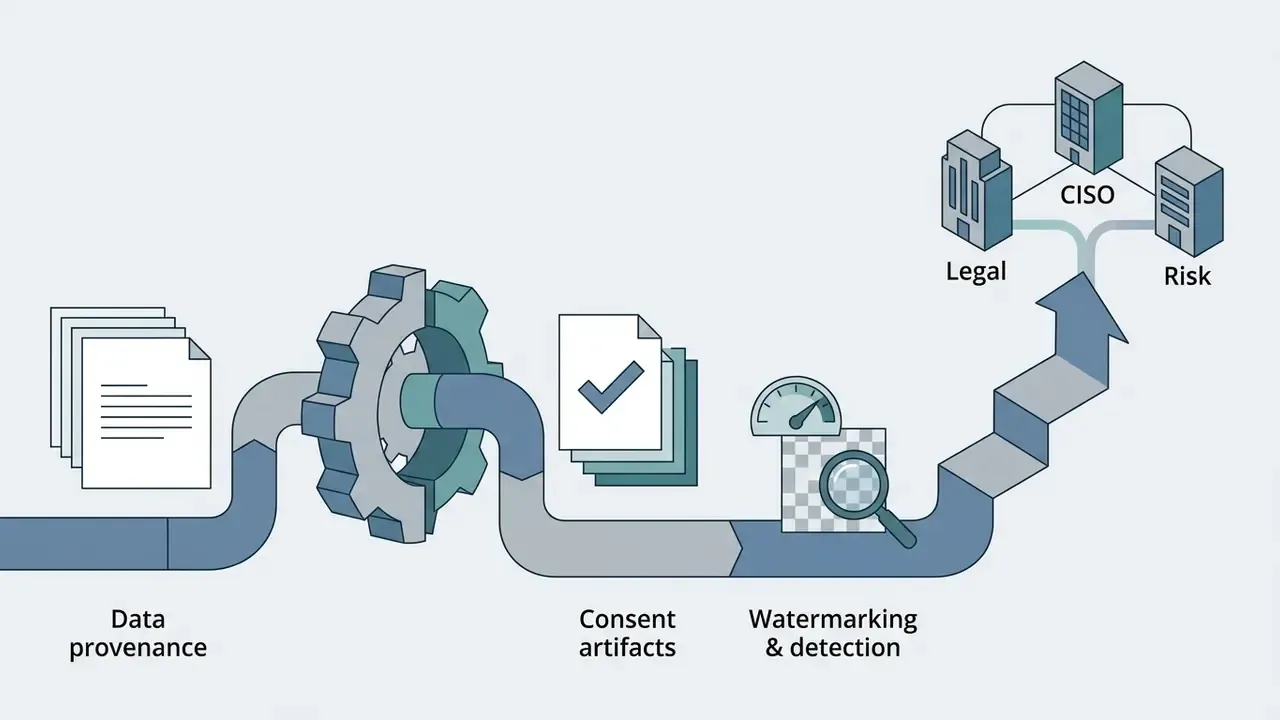
Key Terms at a Glance
Before the detail, five words that people routinely mix up. Getting them straight saves an argument later, usually with Legal.
- Speaker embedding a numeric fingerprint of a voice. It is the artifact that makes a cloned voice reusable, and the artifact you should be able to delete on request.
- Zero-shot cloning building a usable voice profile from a few seconds of reference audio, with no model retraining.
- Prosody pitch movement, rhythm, timing, and intensity. This is where "AI-sounding" audio gives itself away.
- Provenance the durable record of how a file was made, including watermarks and metadata that survive editing.
- Digital replica the legal term of art now used in US state statutes and union agreements for a synthetic version of a real person's voice or likeness.
One caution. Vendors use these words loosely in marketing copy. Ask which one they actually mean before you sign anything.
An AI celebrity voice generator is a software application powered by deep learning models that synthesizes spoken audio mimicking recognizable public figures, actors, or characters. Modern systems combine text-to-speech, voice-changing algorithms, real-time voice conversion, and zero-shot voice cloning to reproduce speaker timbre, cadence, and intonation from written scripts or audio inputs.
Legal note: this article is general information about technology and regulation. It is not legal advice. Voice-rights, publicity-rights, and digital-replica rules vary by jurisdiction and are changing fast.
What Is an AI Celebrity Voice Generator?
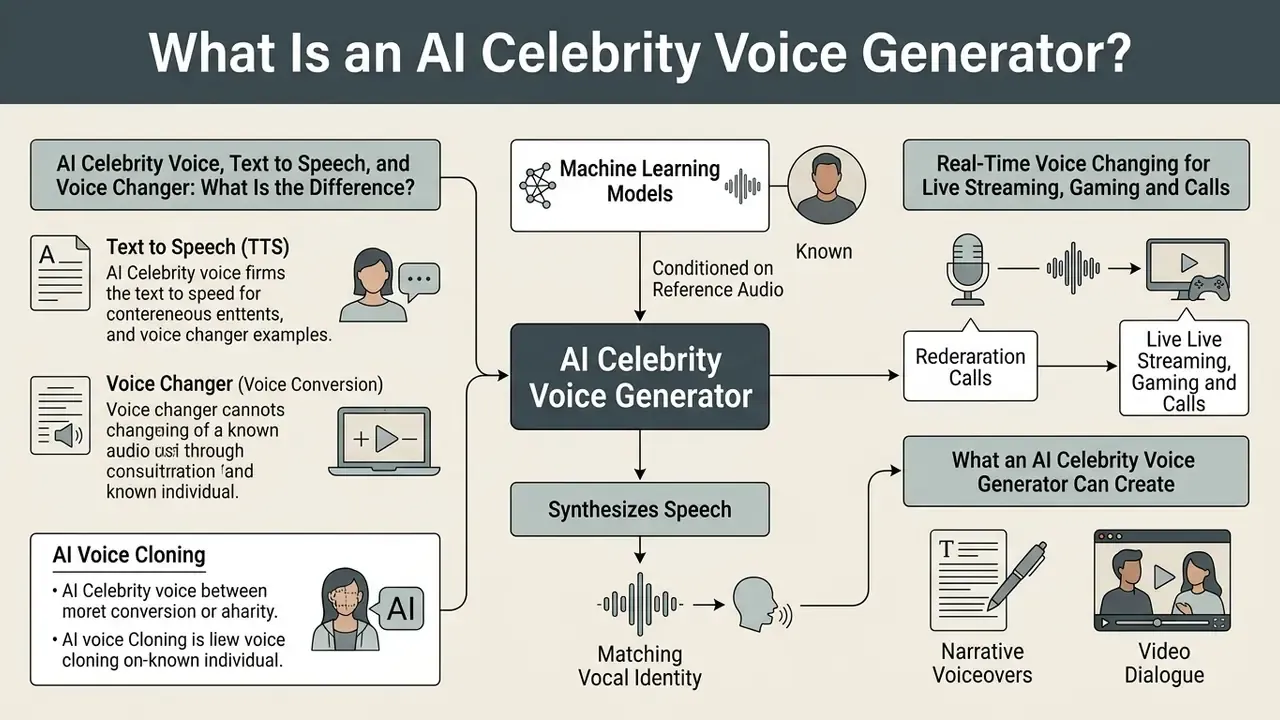
An AI celebrity voice generator uses machine learning models conditioned on reference audio to synthesize speech matching the vocal identity of a specific individual. These systems process text input or transform existing audio, letting content creators, media teams, and developers produce voiceovers with realistic acoustic characteristics.
"Modern zero-shot TTS systems can clone the voice of an unseen speaker from a short reference sample, without speaker-specific training."
AI Celebrity Voice, Text to Speech and Voice Changer: What Is the Difference?
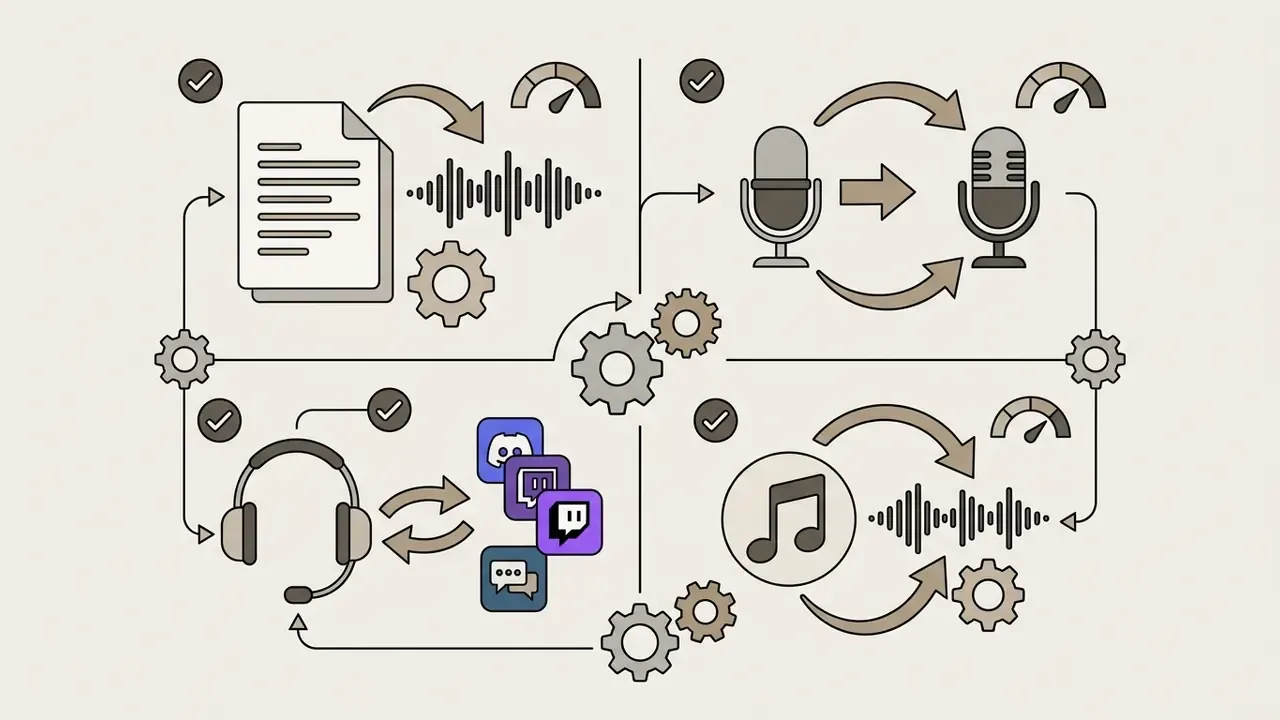
Text-to-speech generates spoken audio from written text. Voice changers alter an existing recording into a target timbre. AI voice cloning creates a reusable digital voice profile from short reference samples. Three different tools, three different risk profiles.
- Text to Speech (TTS) Converts text strings into synthesized speech using acoustic and neural vocoder models. The system relies on underlying language models to infer prosody, stress, and timing. TTS needs text input only.
- Voice Changer (Voice Conversion) Accepts an input audio signal and maps its pitch, timbre, and formants onto a target speaker while preserving the original speech rhythm and verbal content (NIST AI 100-4, 2024).
- AI Voice Cloning Uses zero-shot or few-shot speaker embeddings, such as those implemented in OpenVoice or CosyVoice, to extract a target voice's identity from a 3 to 10 second reference file. That embedding then lets TTS or voice-conversion models synthesize continuous speech in that specific voice (OpenVoice, 2024; CosyVoice, 2024). OpenVoice separates a base speaker TTS model from a tone-colour converter, which is what allows independent control of emotion, accent, rhythm, and pauses. For a broader overview of the wider category, see our reference guide to AI voice generators.
"CosyVoice uses supervised semantic tokens from a multilingual ASR encoder, which substantially improves content consistency and speaker similarity in zero-shot cloning."
| Mode | Required Input | What Is Preserved | Typical Latency Profile |
|---|---|---|---|
| Text to Speech | Text or SSML | Script wording only | Batch or near-real-time |
| Voice Changer (offline) | Recorded audio file | Rhythm, phrasing, emotion of the source performance | Seconds to minutes per clip |
| Real-Time Voice Changer | Live microphone stream | Live delivery, timing, laughter, interjections | Sub-100 ms target |
| Voice Cloning | 3-30 s reference audio plus text or source speech | Speaker identity as a reusable profile | Profile once, reuse indefinitely |
| Streaming TTS | Continuous text stream | Uninterrupted narration for live agents | Chunked, incremental |
"LiveSpeech 2 applies a Mamba architecture with a sliding window, enabling speech generation for an unbounded text stream without length limits."
Real-Time Voice Changing for Live Streaming, Gaming and Calls
Low-latency acoustic models route direct microphone input through a virtual audio device (a VB-Audio style virtual cable, for example) so voice conversion happens live during Discord calls, Twitch streams, in-game chat, or voicemail greetings. Practical configuration notes:
- Latency budget: aim for under roughly 50 ms of added processing latency. Above about 100 ms, conversational turn-taking degrades noticeably.
- Routing: install a virtual audio cable, set the voice changer's output as the cable input, then select the cable as the microphone inside Discord, OBS, or the game client.
- Buffer and sample rate: match the interface buffer (typically 128 to 256 samples) and sample rate (44.1 or 48 kHz) across the driver, the changer, and the capture app. Mismatches produce crackle and drift.
- Monitoring: use hardware monitoring rather than software loopback, otherwise you get double-processing and echo.
- Consent and platform rules: live impersonation of a real, identifiable person in calls or streams carries the same publicity-rights and platform-policy exposure as pre-rendered audio. For outbound telephone calls, add regulatory exposure under US telemarketing rules.
What an AI Celebrity Voice Generator Can Create
AI celebrity voice tools produce vocal assets across several creative and commercial formats, from digital media narration to character dialogue.
- Narrative Voiceovers Scripted voice tracks for long-form content, digital marketing, and podcast intros.
- Video Dialogue Character voices for short-form clips, YouTube videos, and animated projects. Creators often pair audio generation with a video script template to streamline pre-production, and frequently combine the audio with output from modern AI video generators.
- Interactive Audio and Game Tracks Non-player character (NPC) dialogue and localized gaming voice lines.
- Custom Sound Effects and Vocalizations Stylized vocal cues, atmospheric soundscapes, and expressive voice samples generated from text descriptions (ambience, impacts, UI sounds, cinematic booms).
- Music and Song Covers Melody-following vocal renders and cover-song vocals produced from isolated stems. See the dedicated section below.
- Live Audio Real-time microphone transformation for streams, calls, and voice chat.
Rights Checkpoint Before You Generate
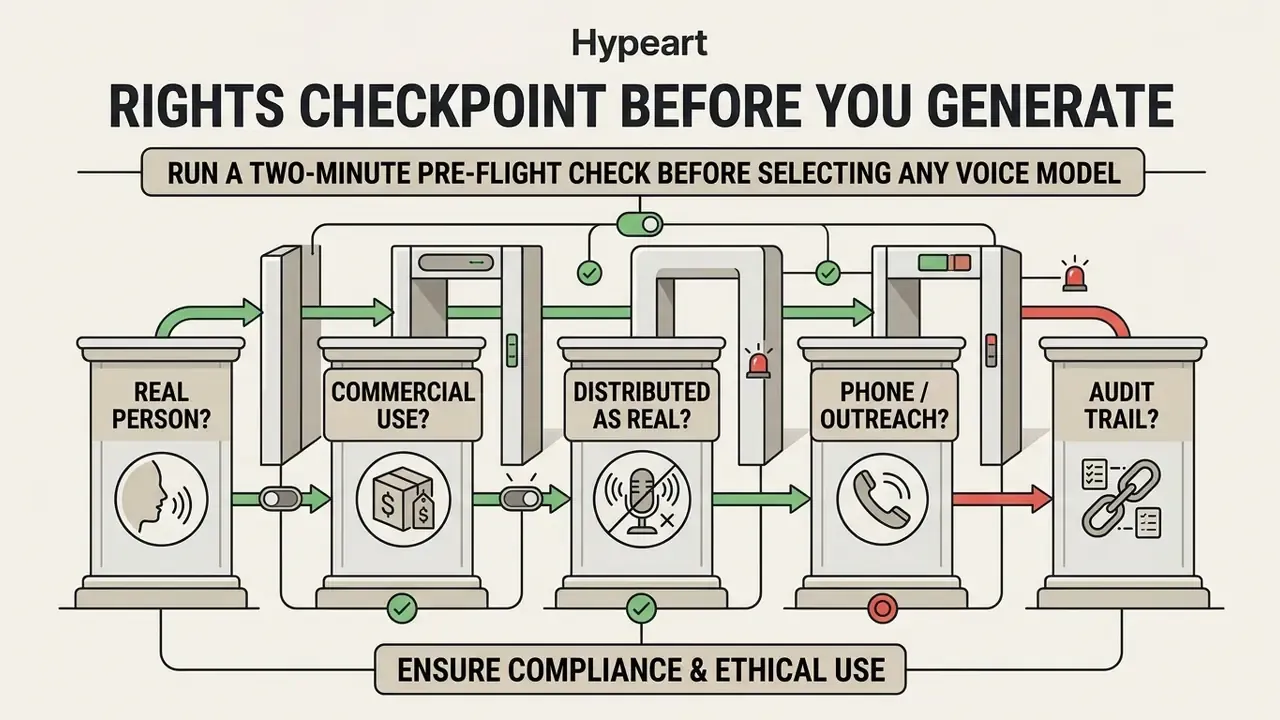
Before selecting any voice model, run a two-minute pre-flight check. Detailed legal analysis follows later in this guide. This box exists so the check happens before rendering, not after publication.
How to Generate a Celebrity Voice with AI
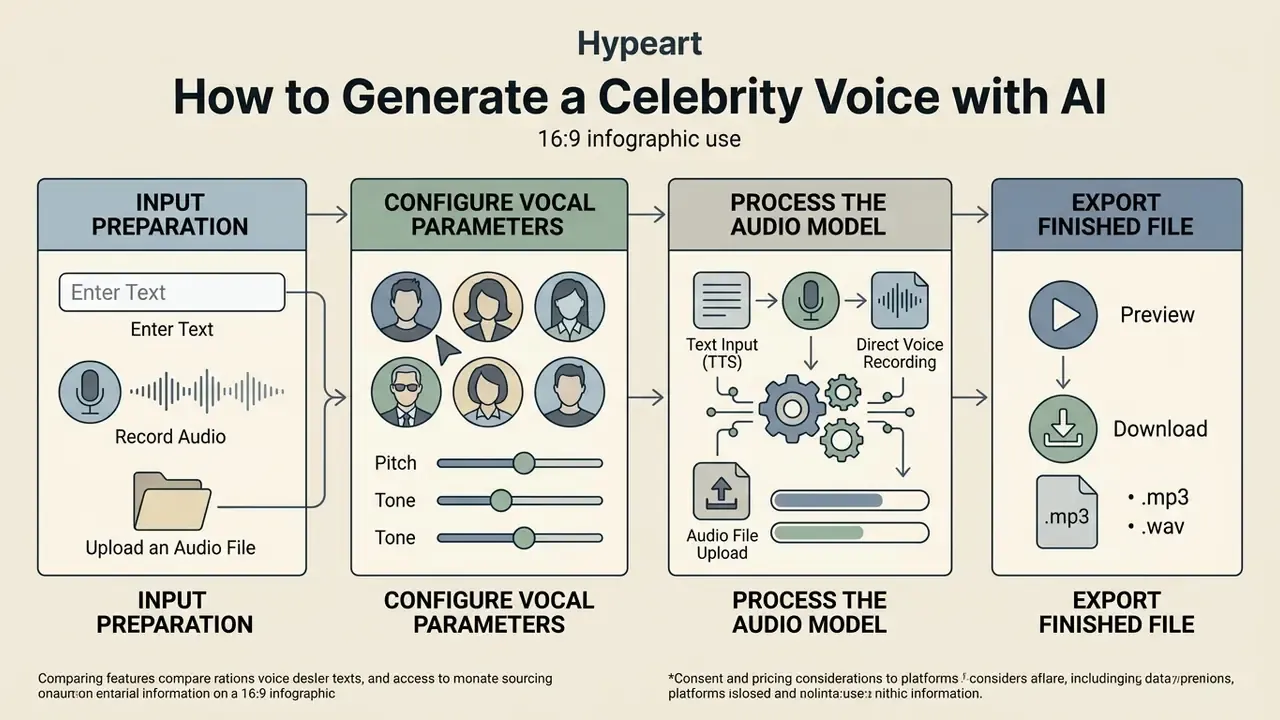
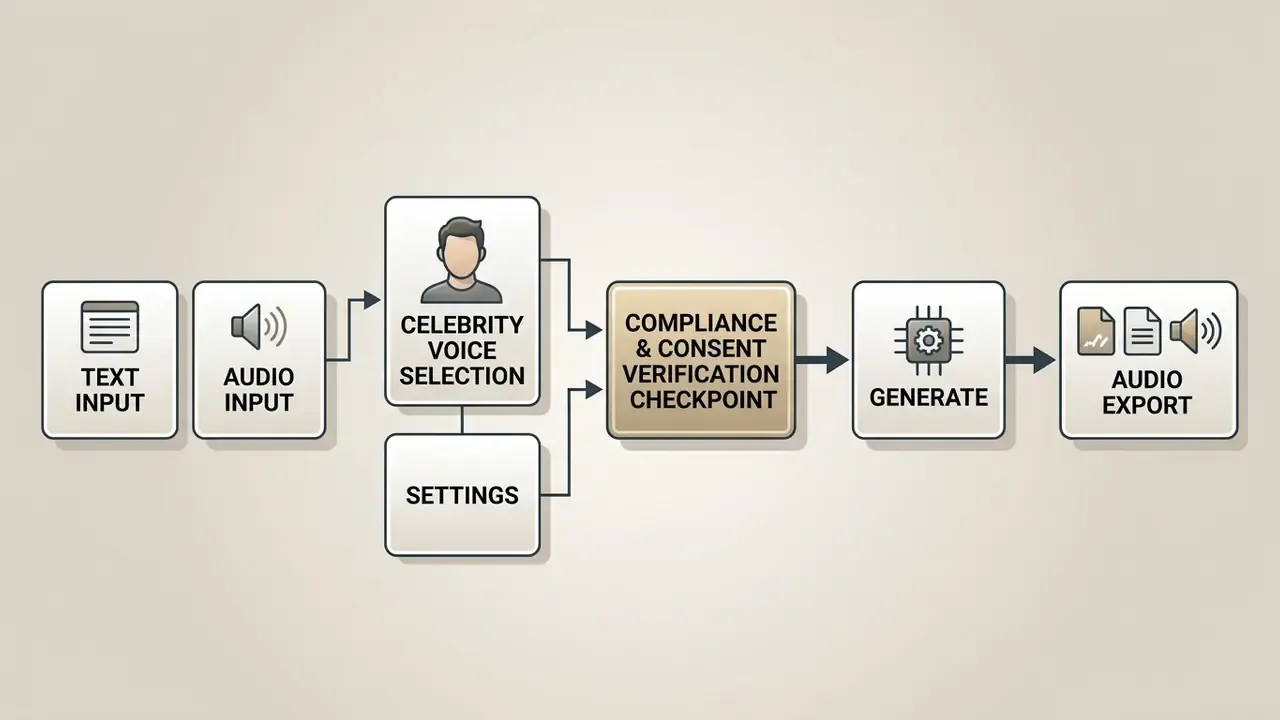
Generating a synthetic celebrity voice involves four moves: choose an input format, configure vocal parameters, process the audio model, and export the finished file.
Enter Text, Record Audio or Upload an Audio File
Users start synthesis through one of three input modes, depending on the project and the capabilities of the chosen platform:
Supported input and output formats, typical across major platforms:
- Text Input (TTS)
- Type or paste text into the editor, relying on neural text normalization to expand numbers, symbols, currencies, dates, and abbreviations before phonemization (Updated: aligned with W3C SSML 1.1 text-normalization recommendations rather than a regional national standard.)
- Direct Voice Recording
- Record live audio via a microphone to serve as a speech-to-speech reference, to build a dataset, or to establish a spoken consent baseline (NVIDIA Riva dataset guidance, 2024).
- Audio File Upload
- Import pre-recorded audio to extract speaker embeddings or to drive voice conversion. Zero-shot cloning pipelines accept either a direct upload or a previously stored reference clip (Fish Audio documentation, 2024; Coqui TTS
speaker_wav, 2024).
| Category | Formats | Practical Notes |
|---|---|---|
| Script import | .txt, .docx, .srt | Subtitle files allow automated timecode matching for dubbing and localization |
| Audio or video upload | WAV, MP3, AAC, OGG, MP4 | Commonly capped at 100-200 MB per file; 10 to 20 seconds of clean speech is usually enough for a reference clip |
| Recording limits | Browser mic capture | Frequently limited to about 60 seconds per take in free web tools |
| Export | WAV (44.1 kHz / 16-bit), MP3 (128-192 kbps, up to 320 kbps on paid tiers), FLAC, OGG | Keep WAV or FLAC as the master; deliver MP3 for web distribution |
Choose a Celebrity Voice and Adjust Voice Settings
Once the input is set, pick a voice model from the library and tune its performance parameters:
- Pitch and Prosody: Adjust fundamental frequency (F0) levels to control vocal depth and inflection. Vendor SSML implementations usually expose pitch as a bounded range (for example,
[-3, 3]semitone-style steps in NVIDIA Riva) or as relative percentages (Amazon Pollyprosody). - Speaking Rate: Tune output speed between 25% and 250% of the baseline rate to match video pacing (NVIDIA Riva, 2024). Amazon Polly documents a 20-200% SSML rate range.
- Emotional Expressiveness: Apply style tags or emotion prompts to introduce the pitch variation associated with urgency, humour, or formal delivery. Emotional-TTS research maps sadness to a slower rate and a narrower pitch range, and anger or joy to a faster rate and higher pitch.
- Temperature (0.0-1.0): Controls output randomness. Lower values (0.2-0.5) enforce strict, repeatable script adherence for corporate narration; higher values (0.7-0.9) increase emotional inflection and vocal variance for character work. Reference implementations commonly default to around 0.9.
- Top P (Nucleus Sampling): Filters the candidate distribution of acoustic tokens, balancing stability against expressiveness. Reduce Top P when you hear mispronunciations or drifting timbre. Raise it when delivery sounds flat.
- Pauses and Emphasis: Insert explicit SSML
- Language and Accent Selection: Map target phonemes across languages using BCP-47 locale codes for stable multilingual synthesis.
"MultiVerse addresses prosodic similarity through multi-task learning, because scaling data improves synthesis but often neglects prosody."
Generate, Preview and Download the Audio
Once configured, the system processes the request through its neural engine. Preview the rendered sample and check for phonetic accuracy, unnatural pauses, homograph errors, and audio artifacts before exporting. Treat preview as a separate QA stage, not a formality: lower-latency model variants can trade audible quality for speed, so compare at least two model tiers on the same script before committing to a bulk render (OpenAI TTS documentation, 2024).
Benchmark context for quality expectations (Updated: replaces an unsourced internal pilot statistic):
"MaskGCT, trained on 100,000 hours of speech, surpasses state-of-the-art zero-shot TTS systems in quality, similarity, and intelligibility on standard benchmarks."
Practical preview protocol: render two or three short segments containing your hardest content (numbers, proper nouns, brand names, foreign words), audit pitch flattening and sibilance, adjust SSML prosody and sampling parameters, and only then queue the full script.
For long-form projects, teams frequently use a video summary generator free tool to condense lengthy transcripts into concise scripts before sending text to the speech generator, then move the render into timeline video editors for alignment with visual cuts.
- Input Preparation
- Enter written text, import a
.txt,.docx, or.srtscript, record live speech, or upload a clear reference audio file, and capture the consent artifact if the voice belongs to a real person. - Voice Selection and Tuning
- Choose the target voice profile, adjust pitch, speed, emotion, temperature, and Top P, then select the output language and locale.
- Generation and Verification
- Render an audio preview, audit phonetic accuracy, add AI disclosure where required, and export the high-fidelity WAV, FLAC, or MP3 file with provenance metadata retained.
Celebrity Voice Library: Famous People, Actors and Characters
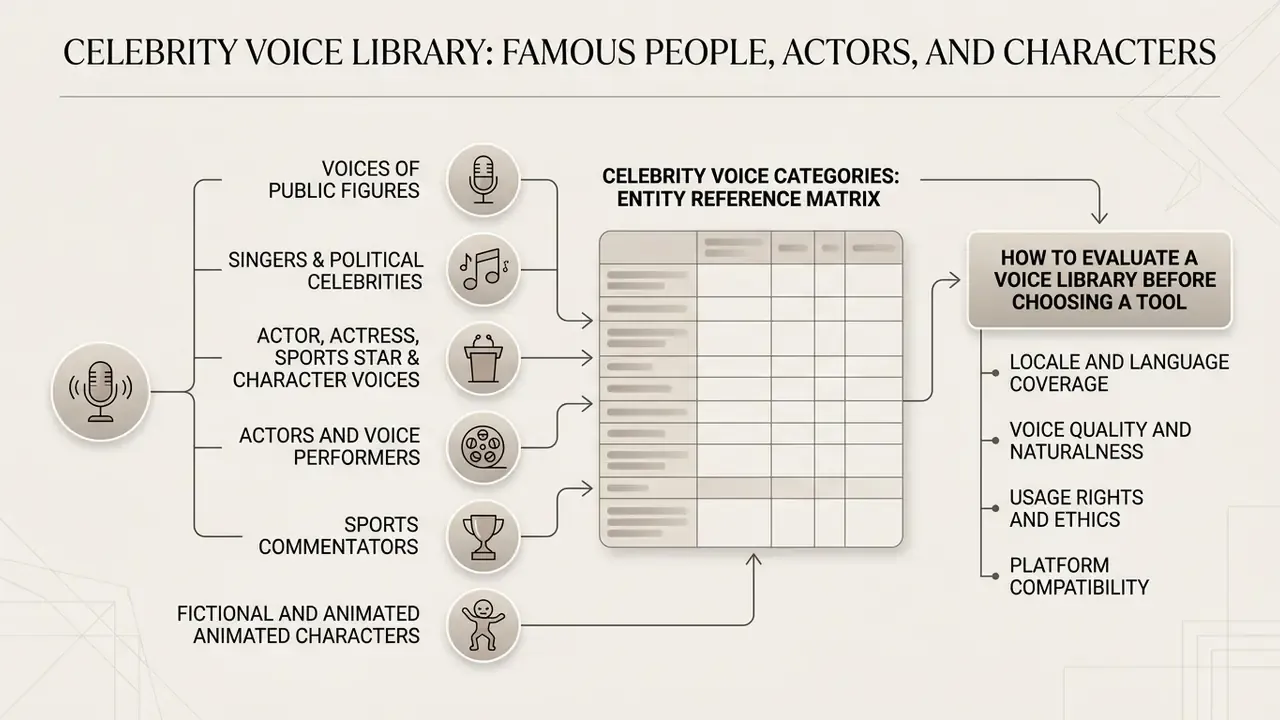
Commercial and open-source AI voice platforms organize their libraries into categories that serve different creative and organizational workflows. Consumer platforms commonly advertise libraries of 300 or more named voices and 140 to 154 supported languages. The marketing count matters far less than the licensing status behind each entry.
Voices of Public Figures, Singers and Political Celebrities
Public figure libraries typically feature voices inspired by well-known personalities, commentators, and historical figures. Commercial deployment of such voices carries heavy regulatory scrutiny under US right-of-publicity law and state legislation such as Tennessee's ELVIS Act (2024), which explicitly protects an individual's vocal identity from unauthorized commercial imitation. Illinois' Digital Voice and Likeness Protection Act (Public Act 103-0830) adds contract-level constraints, restricting clauses that substitute a person's voice or likeness without specific written terms and union or counsel safeguards. California's AB 1836 (2024) extends liability to digital replicas of deceased personalities in audiovisual works, sound recordings, video games, and audiobooks.
"In 2024, voice actors filed a class action against LOVO Inc., alleging their voices were used to train AI without consent or compensation."
Actor, Actress, Sports Star and Character Voices
Entertainment-focused libraries offer vocal styles tuned for dramatic reads, sports commentary, and imaginary character performances:
- Actors and Voice Performers
- Cinematic timbres tuned for dramatic narration, video voiceovers, and audiobooks. Documented authorized examples include estate-licensed archival voices used for in-app narration and documentary recreation of a narrator's voice from archival recordings.
- Sports Commentators
- Energetic, fast-paced vocal profiles designed for live-style play-by-play recreation and sports recap clips.
- Fictional and Animated Characters
- Highly stylized voices representing cartoon, anime, or video game personalities. (Updated: the previous reference to a forward-dated public voice-actor dataset has been withdrawn.) Where character voices were performed by identifiable actors, two separate rights layers apply, the performer's voice rights and the character's underlying intellectual property, and both must be cleared. Under the January 2024 SAG-AFTRA agreement with Replica Studios, union performers can license digital voice replicas for approved game projects with consent and transparency requirements attached.
Celebrity Voice Categories: Entity Reference Matrix
Search demand in this category is dominated by named-entity queries. The table below maps the archetypes users look for to the applications and the clearance burden behind them.
| Voice Category | Popular Model Archetypes | Primary Application | Clearance Burden |
|---|---|---|---|
| Political and Public Figures | Current and historical presidents, prime ministers, ministers, TV commentators | Satire, news recaps, educational parodies | Very high: publicity rights plus election and disinformation rules |
| Cinematic Actors and Narrators | Iconic documentary narration timbres, dramatic film actors | Audiobooks, video essays, commercials | High: performer consent and estate agreements |
| Music Artists and Vocalists | Pop, hip-hop, R&B, and classic rock timbres | Song covers, pitch-matched melody renders | Very high: voice rights plus composition and master rights |
| Sports Stars and Commentators | Footballers, boxers, play-by-play announcers | Highlight reels, fan podcasts, sports recaps | High: endorsement and publicity exposure |
| Animated and Game Characters | Sci-fi villains, anime heroes, cartoon mascots, NPC archetypes | Modding, fan animation, social clips, prototyping | Mixed: character IP plus original performer rights |
| Virtual Assistants and Synthetic Personas | Assistant-style neutral voices, robot and creature timbres | Product demos, UI prototypes, sound design | Low: usually fully licensed platform voices |
| Custom Cloned Voices (your own) | Your recorded voice, in-house talent, licensed brand voice | Brand narration, scalable localization, accessibility | Low, with signed consent and retention terms |
How to Evaluate a Voice Library Before Choosing a Tool
To choose a platform sensibly, evaluate voice libraries against these structural criteria:
- Locale and Language CoverageVerify supported BCP-47 language codes and regional accent variations, counted by locale rather than by broad language name (Google Cloud Text-to-Speech
voices.list, 2024). - Audio Sample TransparencyUncompressed, pre-rendered demos for every voice profile in the library, plus a documented use-case tag (conversational, narration, characters, social, educational, advertisement, entertainment).
- Rights and Licensing ClarityExplicit documentation stating whether a voice is fully licensed from the original artist or provided purely for non-commercial personal experimentation.
- Consent Enforcement MechanismWhether cloning requires a spoken consent phrase, identity verification, or only a self-declaration checkbox.
- Provenance and WatermarkingWhether exports carry durable provenance metadata or an inaudible watermark that supports later attribution.
"Consumer Reports evaluated six voice-cloning platforms: four allowed a clone to be built from public audio without meaningful consent verification."
| Voice Category | Primary Content Types | Recommended Audio Format | Key Library Verification Checks |
|---|---|---|---|
| Public Figures | Educational commentary, satire | WAV (44.1 kHz, 16-bit) | Consent verification, legal risk disclosure, AI labeling |
| Actors and Performers | Audiobooks, video voiceovers | MP3 (192 kbps) or WAV | Commercial usage rights, estate agreements, emotion presets |
| Sports Commentators | Gaming streams, sports recap clips | MP3 (128-192 kbps) | Speed control range, dynamic prosody stability |
| Music Artists | Cover vocals, hooks, jingles | WAV or FLAC (stem-level) | Voice rights plus composition and master clearance |
| Fictional Characters | Fan content, interactive games | WAV or MP3 | IP licensing status, accent fidelity, performer credit |
For a wider view of tooling decisions across a production stack, see our comparison of AI tools for media production and the platform review of Canva's AI generator and its commercial terms.
What Determines Natural and Realistic AI Celebrity Voice Quality
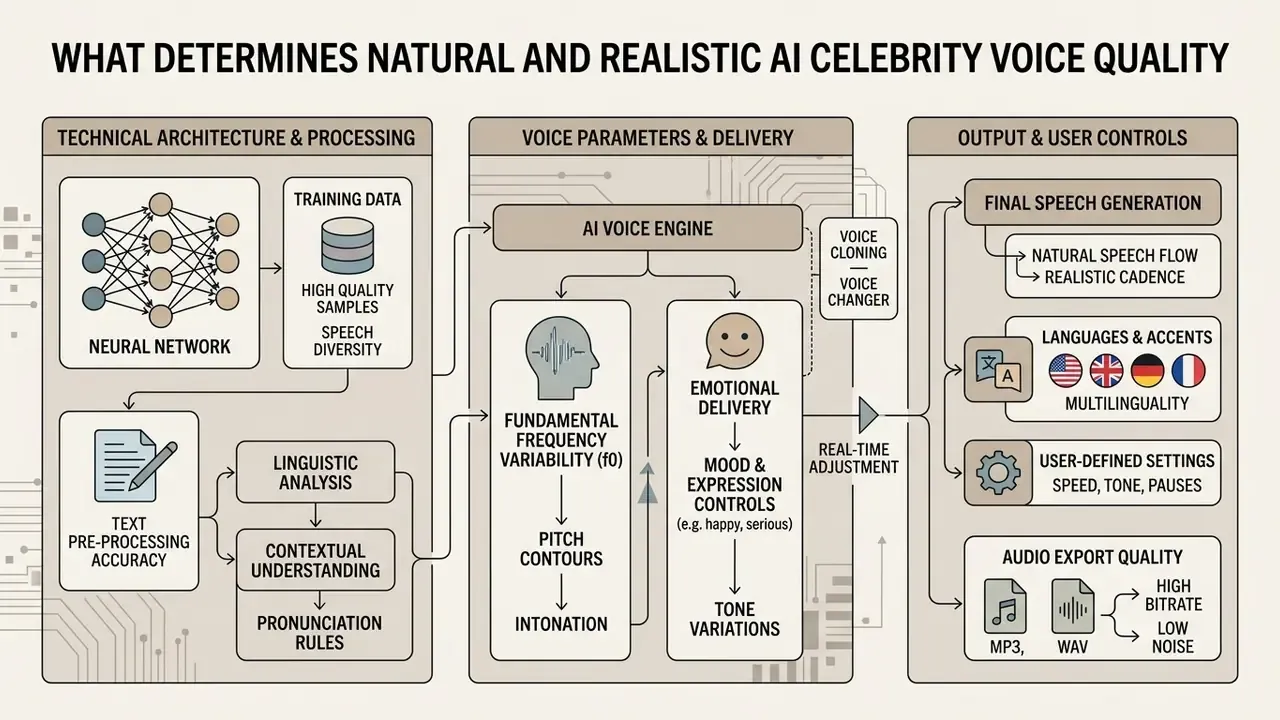
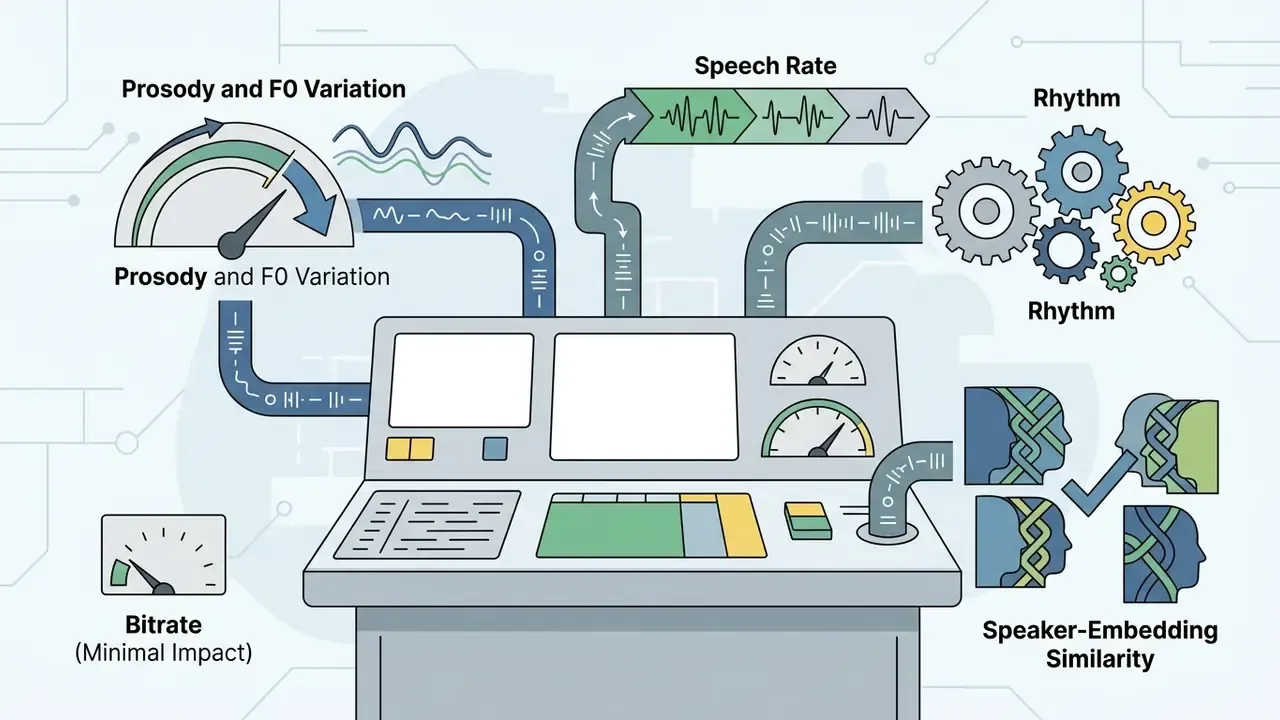
The perceived naturalness of an AI celebrity voice depends on the neural network architecture, fundamental frequency variability, and text pre-processing accuracy. Recent perception studies converge on prosody, meaning F0 variation, rhythm, speech rate, duration, intensity, and speaker-embedding similarity, as the dominant driver, ahead of raw waveform fidelity.
Natural Speech, Pronunciation and Text Quality
Synthesis realism begins with text normalization, the accurate conversion of raw text, symbols, and dates into spoken phonemes. Advanced engines rely on explicit SSML (Speech Synthesis Markup Language) tags such as <phoneme> to eliminate homograph ambiguity, distinguishing "read" past tense from "read" present tense, and to enforce humanlike intonation (Microsoft Azure Speech TTS SSML documentation, 2024). Normalization quality covers number expansion, abbreviation disambiguation, stress placement, homograph resolution, and intonation formatting. Failures at this stage cannot be repaired by pitch or emotion controls downstream. Test short, ugly phrases first: dates, tickers, product codes.
Voice Settings, Effects and Emotional Delivery
Prosody modeling dominates listener perception. In an empirical study published in Interspeech, researchers established that dynamic fundamental frequency variation is the primary driver of perceived voice-clone realism (Bakkouche et al., 2025). When pitch variability is artificially suppressed, naturalness scores fall regardless of the underlying model's acoustic fidelity.
"ElevenLabs clones were rated on par with human speech for naturalness and similarity, while reduced F0 variation lowered ratings regardless of the tool used."
A 2025 systematic review of prosody in speech synthesis identified F0, duration, and intensity as the core controllable parameters, with F0-RMSE the most common objective metric. That is a useful validation measure if you ever need to prove that a rendered take matches an approved reference performance.
Languages and Audio Export Quality
High-fidelity audio pipelines preserve signal quality from text processing to file serialization. Standard production guidance is to master in uncompressed WAV at 44.1 kHz / 16-bit and to distribute compressed copies at a bitrate appropriate to the channel.
"Save the spoken output as an audio file in a widely supported format, and identify the format used."
Supporting specifics for the bitrate recommendation (Updated): vendor documentation defines WAV output as 44.1 kHz / 16-bit and MP3 output at 128 kbps by default, with 192 kbps available on higher tiers (ElevenLabs documentation, 2024). W3C accessibility guidance also advises selecting the clearest available voice when several are offered, which matters most in multilingual delivery, where accent mismatch degrades intelligibility faster than bitrate does.
When combining generated speech with visual media, creators frequently rely on a video presentation framework or integrate a video subtitle generator to align audio tracks with exact visual timestamps.
Free AI Celebrity Voice Generator, Apps and Pricing Options
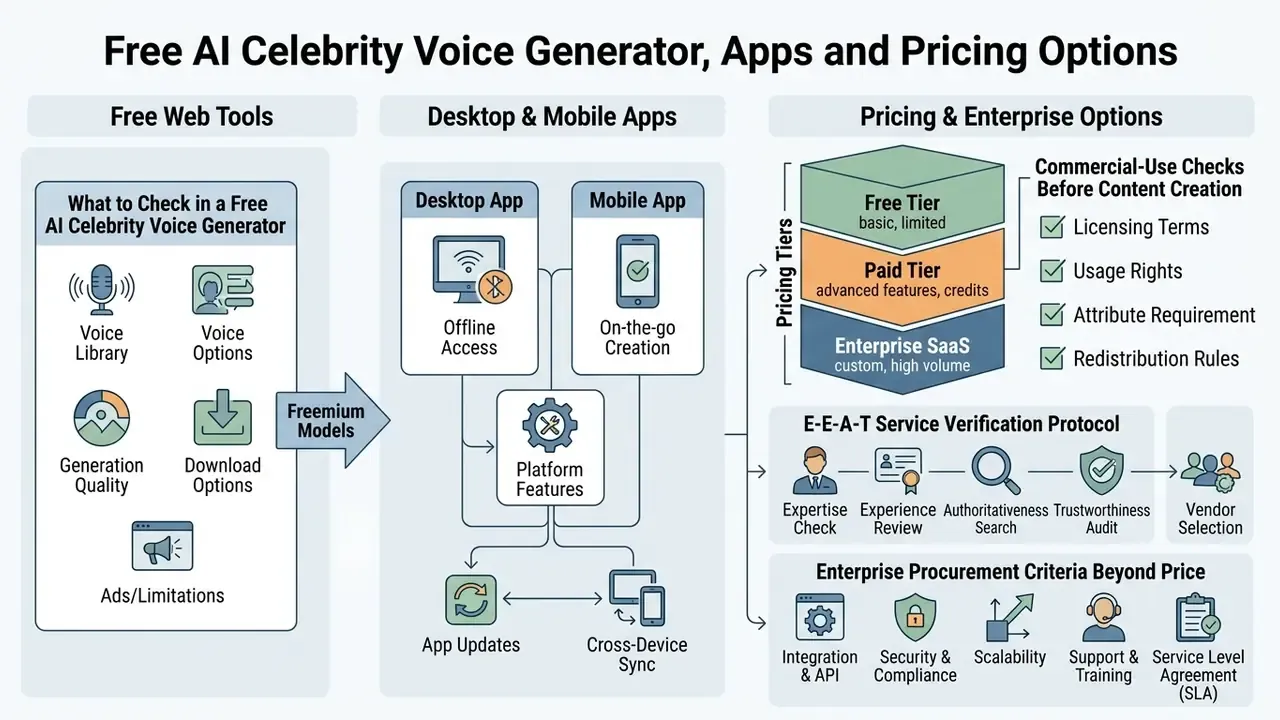
The market for AI voice generators spans free web tools, mobile applications, and enterprise SaaS platforms with tiered access. Free tools are useful for evaluation and personal experimentation. See our related overview of free AI content-creation tools for adjacent categories.
What to Check in a Free AI Celebrity Voice Generator
"Most tested platforms required only a checkbox affirming rights, with no technical verification that the cloned voice belonged to the user."
Online Website, Desktop or AI Celebrity Voice Generator App
Web-based platforms offer desktop editing depth, detailed parameter tuning, batch rendering, and API integration. Mobile applications on iOS and Android prioritize speed: rapid creation, real-time voice filters, offline modes, and direct social exports to TikTok, Reels, or Shorts, typically sold through app-store subscriptions. (Updated: previously stated price points are now attributed rather than asserted as market-wide.) Public app-store listings in this category advertise free downloads with in-app purchases spanning weekly, monthly, yearly, and lifetime bundles. Prices differ by app, region, and currency, so treat any single figure as illustrative and check the live listing.
| Dimension | Web / Desktop | Mobile App (iOS / Android) |
|---|---|---|
| Best for | Long scripts, batch rendering, client work | Quick clips, live filters, social publishing |
| Editing depth | Full parameter control, SSML, multi-track | Presets and simplified sliders |
| Offline capability | Rare | Common for playback; some offline TTS |
| Export control | WAV/FLAC masters, custom sample rates | MP3/M4A optimized for social |
| Billing model | Character or credit subscriptions, API metering | Weekly, monthly, yearly, lifetime in-app purchases |
| Compliance fit | Audit logs, SSO, admin controls on higher tiers | Limited governance, higher Shadow AI risk |
Pricing and Commercial-Use Checks Before Creating Content
Before putting synthetic voices into client work, read the platform terms of service. Unauthorized commercial exploitation of synthetic celebrity voices creates substantial exposure under right-of-publicity statutes and federal trademark law.
"The No AI FRAUD Act (2024) establishes a property right in each individual's voice and likeness, including post-mortem control for a minimum of ten years."
Licensing practice is also being set by labour agreements, not statute alone. Under the SAG-AFTRA arrangement reported in 2024, advertisers must obtain performer consent for each advertisement using a digital voice replica, the performer sets the price, and union minimums for audio commercials apply. The US Copyright Office's digital-replica work similarly concludes that individuals should be able to license their voice and image for replicas without fully assigning those rights. In practice that means perpetual, unlimited buyouts are the clearest red flag in any contract you are asked to sign.
E-E-A-T Service Verification Protocol:
| Plan Tier | TTS Access | Voice Cloning | Download Formats | Commercial License | Typical Limits |
|---|---|---|---|---|---|
| Free Tier | Basic models | Restricted or none | MP3 (128 kbps), often watermarked | No, personal only | Vendor-specific character or minute caps |
| Pro / Paid Tier | Advanced neural models | Zero-shot and custom | Uncompressed WAV, MP3 192-320 kbps | Yes, for licensed voices | Higher character or credit quotas |
| Enterprise | Full API access | Custom cloning with consent workflow | Custom sample rates, WAV, FLAC | Custom legal agreement plus indemnification | Dedicated quota, SLA, admin controls |
(Note: pricing structures, token allocations, and licensing terms must be verified directly on the platform's official website at the time of purchase.)
Enterprise Procurement Criteria Beyond Price per Character
For regulated organizations, per-character pricing is rarely the deciding factor. Score vendors against the following:
| Requirement | What to Ask For | Why It Matters |
|---|---|---|
| Zero Data Retention (ZDR) | Contractual ZDR for prompts, reference audio, and outputs | Prevents voice biometrics and scripts persisting in vendor systems |
| Security certification | SOC 2 Type II, ISO/IEC 27001, penetration-test summaries | Baseline for third-party risk assessment |
| Consent tooling | Spoken-consent capture, identity verification, revocation workflow | Produces the audit artifact regulators and unions expect |
| Provenance and watermarking | Durable metadata, detectable watermark, verification API | Supports disclosure, takedowns, and incident response |
| Indemnification | Written IP and publicity-rights indemnity with defined caps | Transfers a defined share of legal exposure to the vendor |
| API SLA and residency | Uptime commitment, latency targets, data-region choice | Required for production and cross-border compliance |
| Admin governance | SSO/SCIM, role-based access, per-user logs, export controls | Contains Shadow AI and enables model-inventory reporting |
| Model documentation | Model card, training-data provenance statement, eval results | Feeds model-risk validation and change management |
Disclaimer: This section is general information, not legal advice. Licensing and commercial-use conditions must be verified directly on the platform's website at the time of use, and material deployments should be reviewed by qualified counsel.
Enterprise Risk, Fraud Vectors and Model Validation
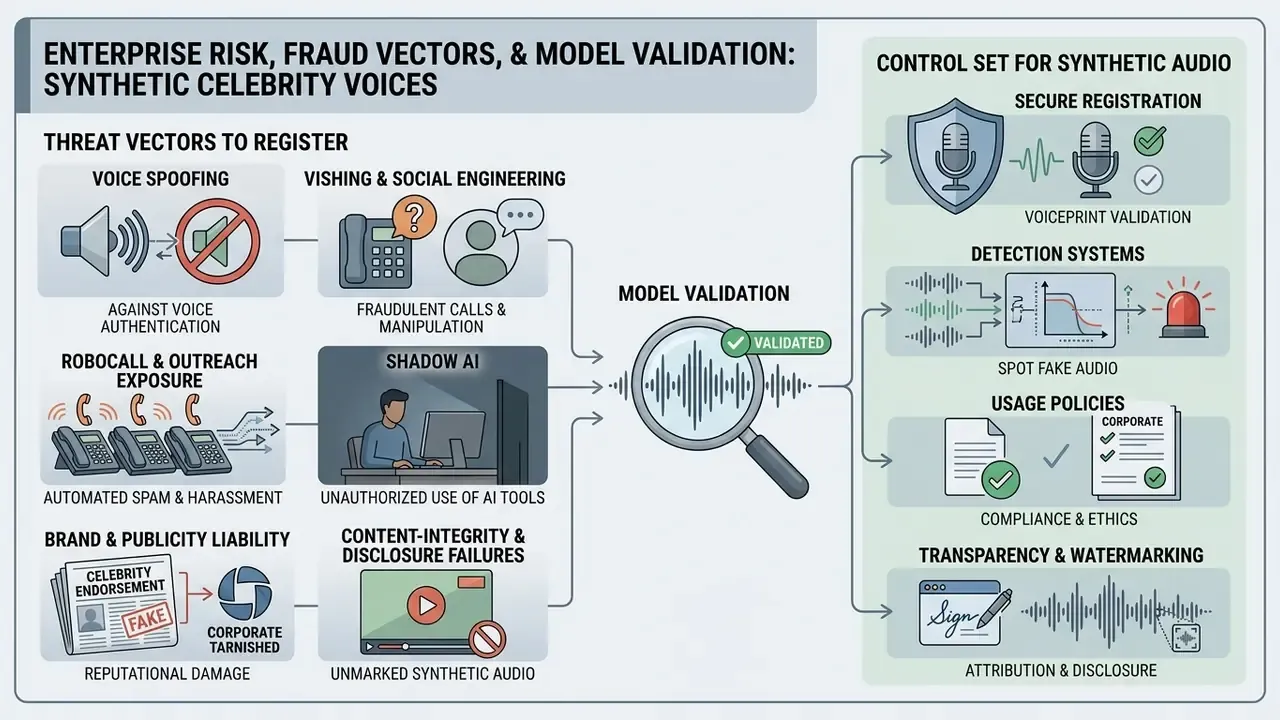
Synthetic celebrity voices are not only a creative capability. They are also an attack surface and a governed model class. This section is written for risk, compliance, security, and AI-governance owners.
Threat Vectors to Register
- Voice spoofing against voice authentication Any process that treats voice as an identity factor, including telephone banking, helpdesk verification, and executive approvals, needs re-assessment now that few-second cloning is commodity technology.
- Vishing and social engineering Cloned voices of executives, family members, or officials are used to pressure targets into payments or credential disclosure.
- Robocall and outreach exposure US FCC guidance (2024) confirms AI-generated human voices fall within existing "artificial or prerecorded voice" restrictions, so automated calls using cloned voices require prior express consent.
- Shadow AI Employees using consumer voice apps for customer-facing or internal content, uploading scripts and recordings to unvetted vendors, and creating undisclosed synthetic assets.
- Brand and publicity liability Marketing use of a recognizable voice without documented consent, including "sound-alike" prompts intended to evoke a specific person.
- Content-integrity and disclosure failures Distributing synthetic audio as authentic, particularly in political or news-adjacent contexts.
"Participants correctly identified synthetic speech only 73% of the time, and deepfake-detection training improved results only marginally."
Control Set for Synthetic Audio
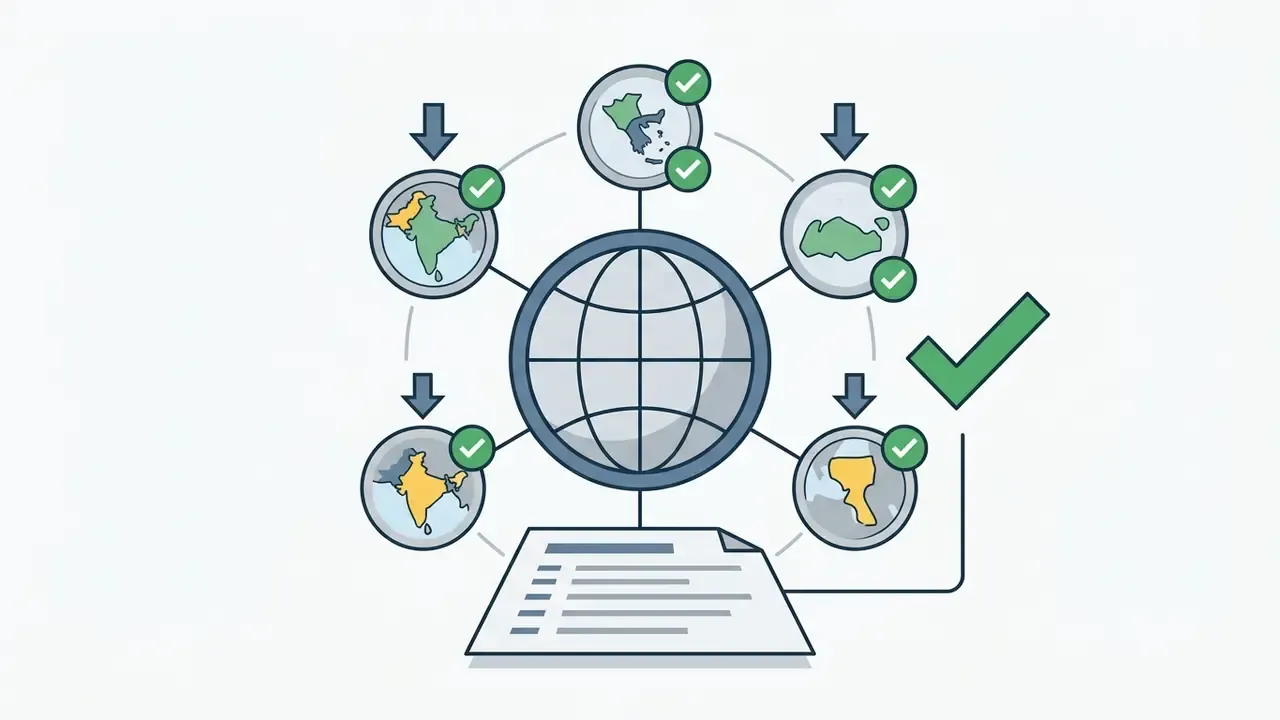
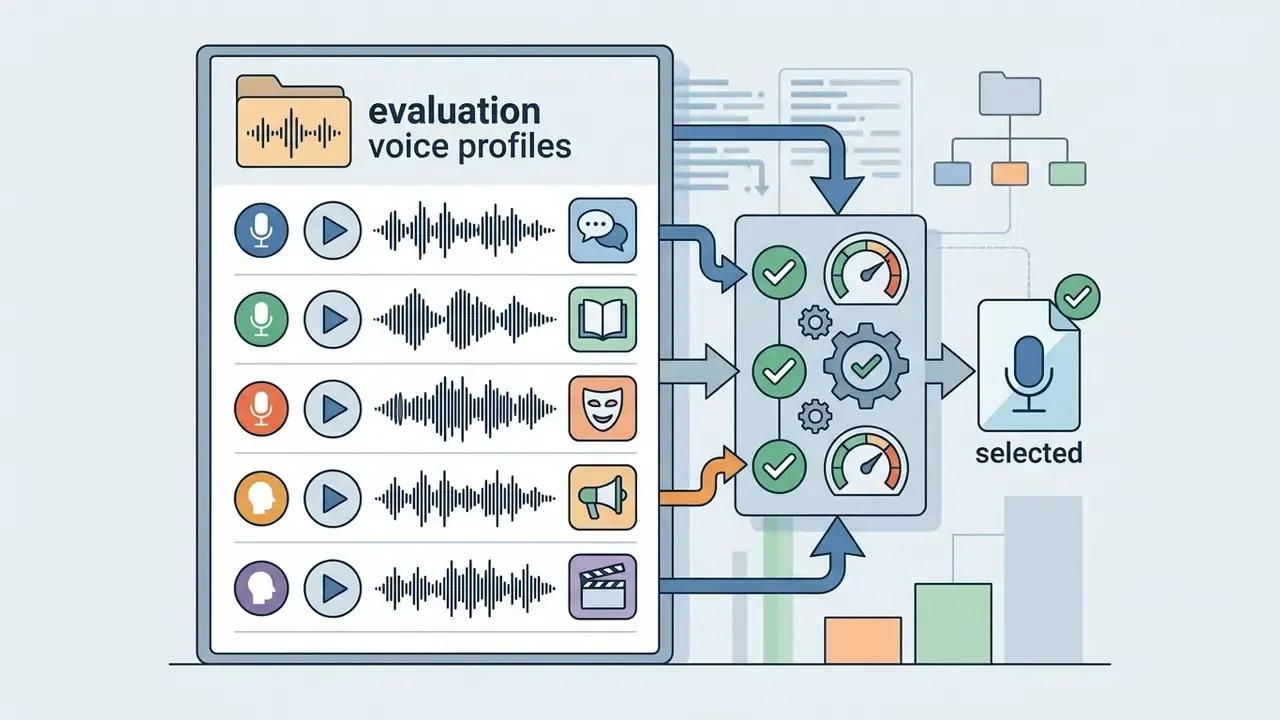
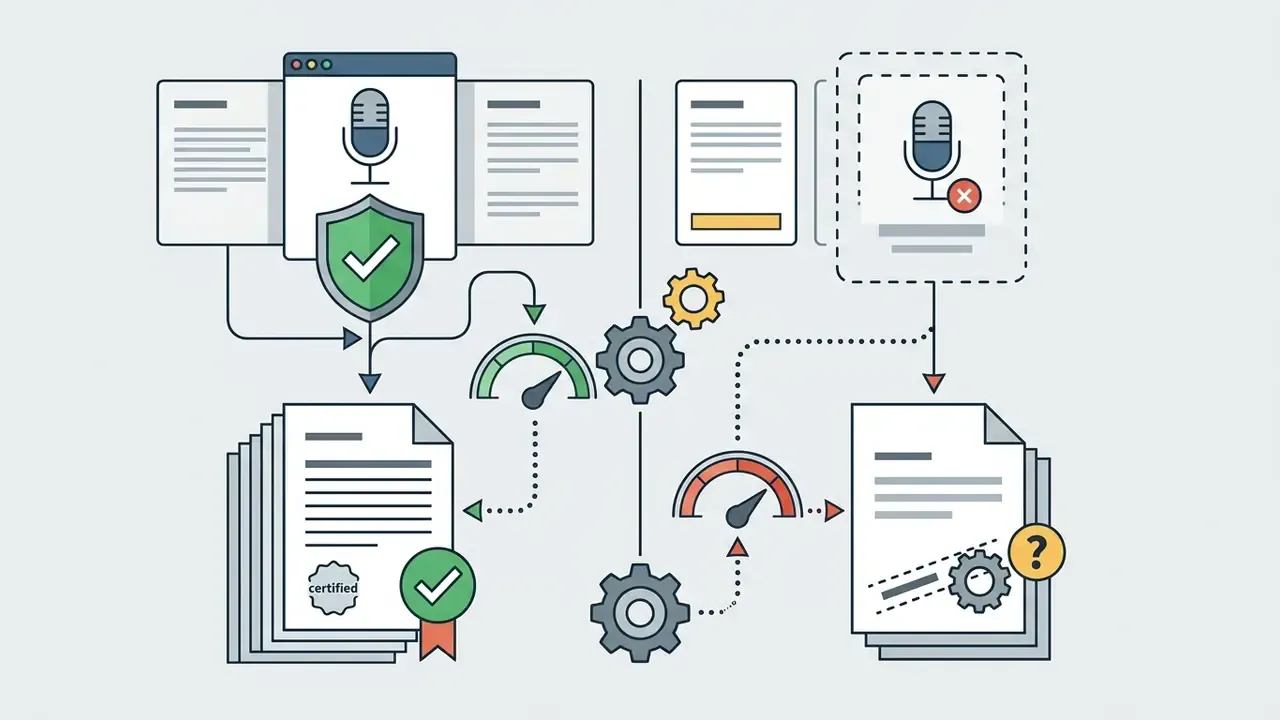
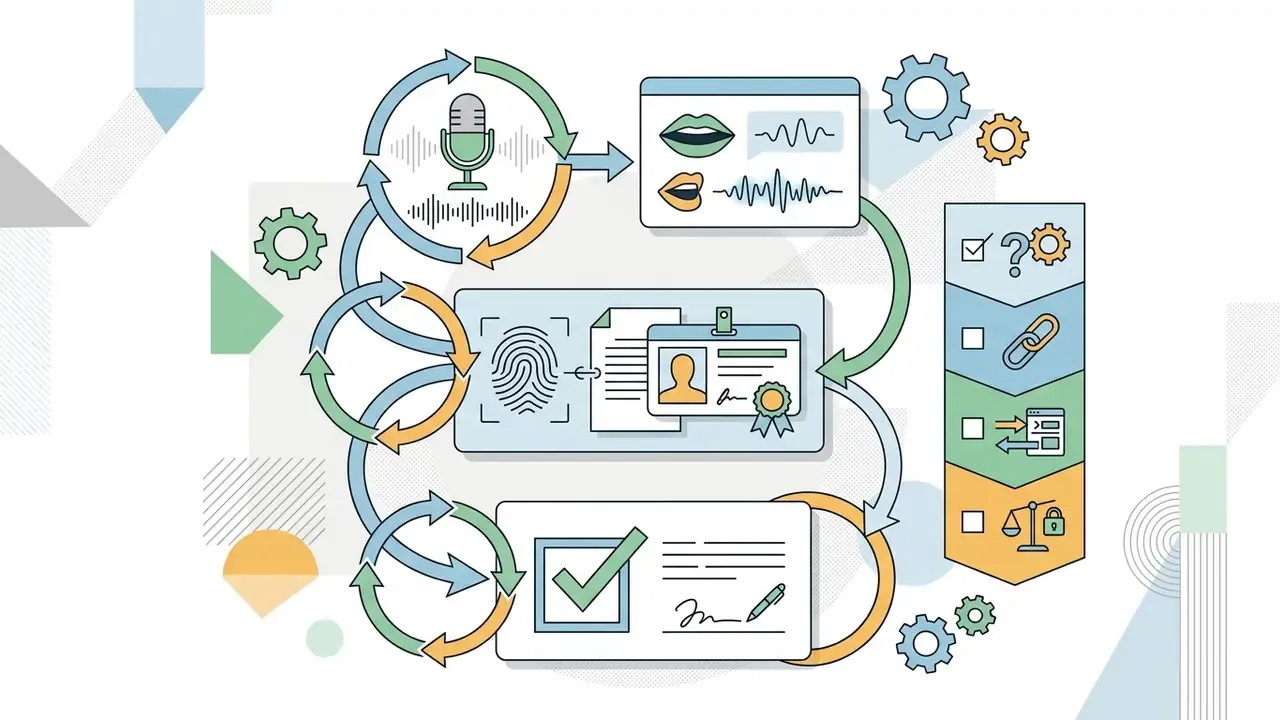
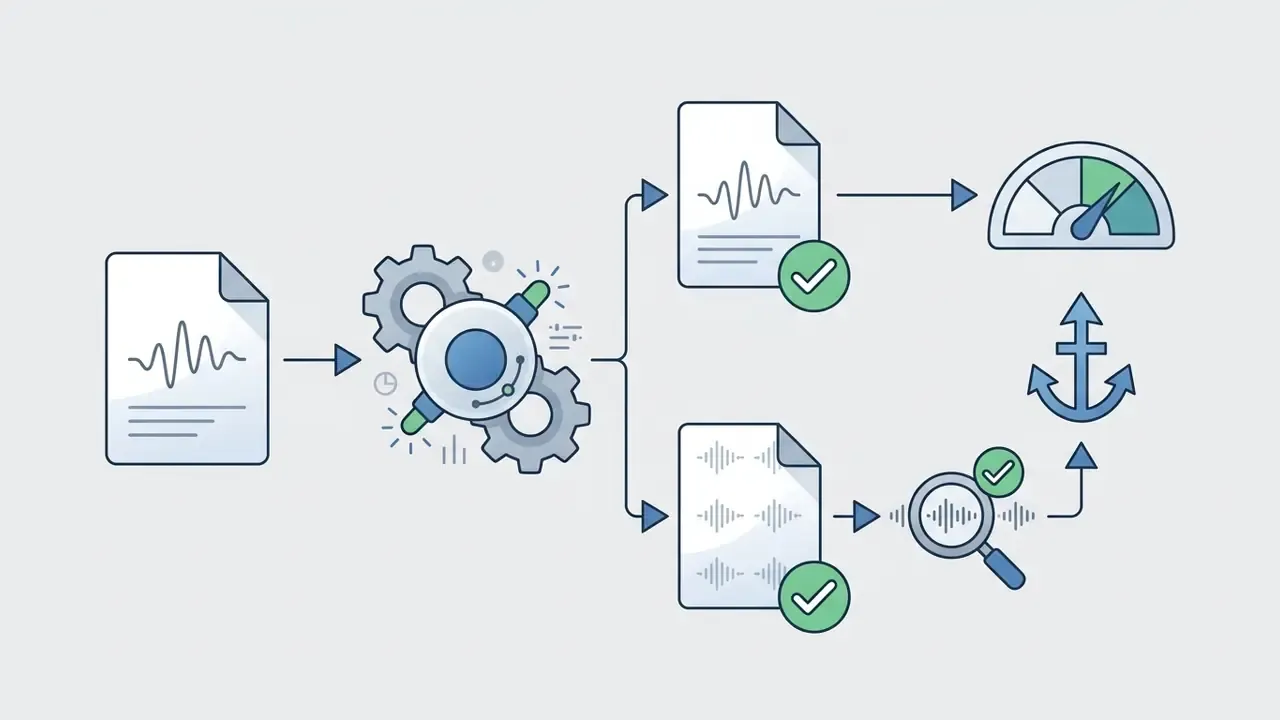
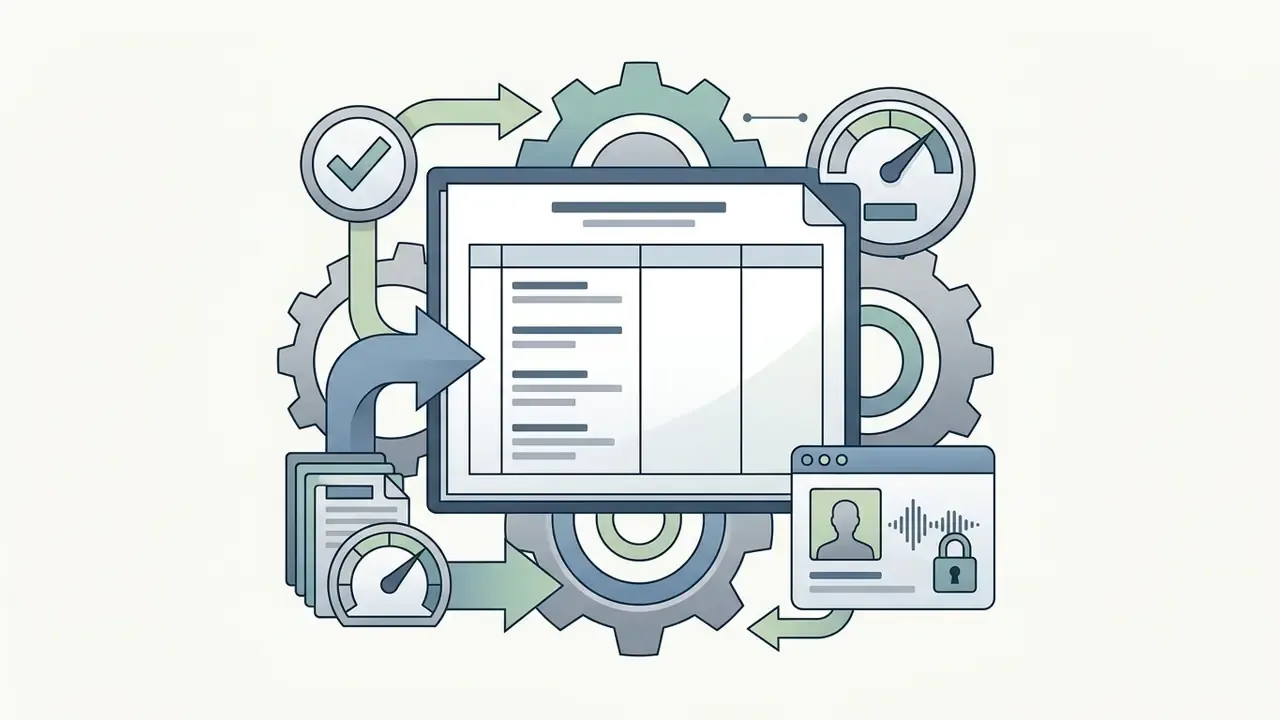
Validation Metrics for Generative Audio Models
| Validation Dimension | Example Metric | What It Tells You |
|---|---|---|
| Speaker similarity | Speaker-embedding cosine similarity | Whether the render matches the licensed reference identity |
| Prosodic fidelity | F0-RMSE, duration and intensity error | Whether delivery matches the approved performance |
| Perceptual quality | MOS or comparative MOS on blind listening panels | Human-perceived naturalness of the output |
| Signal quality | PESQ, STOI | Objective intelligibility and degradation after processing |
| Spoof detection | EER of the detection model on your own audio | Whether your controls can flag your own synthetic output |
| Content accuracy | WER of ASR transcription versus source script | Whether normalization or sampling introduced wording errors |
| Stability under load | Latency percentiles, failure rate, drift over releases | Production reliability and change-management triggers |
Document these tests the way you document any model validation exercise: purpose, data, thresholds, results, limitations, reviewer, date. Where your organization follows a model-risk framework, treat vendor model updates as change events requiring re-validation, and align acceptable-use policy, human-in-the-loop review, and transparency requirements with recognized AI risk-management guidance (NIST AI RMF and NIST AI 100-4, 2024). One honest limitation: detection performance on your own audio is not a guarantee against a determined external attacker.
Escalation and Approval Matrix
| Use Case | Approver(s) | Minimum Evidence Required |
|---|---|---|
| Internal training narration with licensed platform voice | Content owner | Vendor licence terms, AI disclosure in materials |
| Custom clone of an employee or in-house talent | HR, Legal, security owner | Signed consent, scope, term, revocation, ZDR confirmation |
| Voice of a named external person (celebrity, athlete, artist) | Legal, brand, senior risk owner | Written licence from rights holder, territory and term, indemnity |
| Any synthetic voice in outbound calls or IVR | Compliance, Legal, CISO | Consent basis for the call, disclosure script, call-recording audit |
| Political, election, or news-adjacent content | Executive risk committee | Formal risk assessment, disclosure plan, publication controls |
| Real-time voice changing on corporate channels | CISO, Legal | Business justification, logging, prohibition on impersonation |
Disclaimer: Regulatory and supervisory expectations differ by jurisdiction and sector. Use this matrix as a starting template and calibrate it with your own legal, compliance, and audit functions.
Ways to Use AI Celebrity Voices for Creative Content
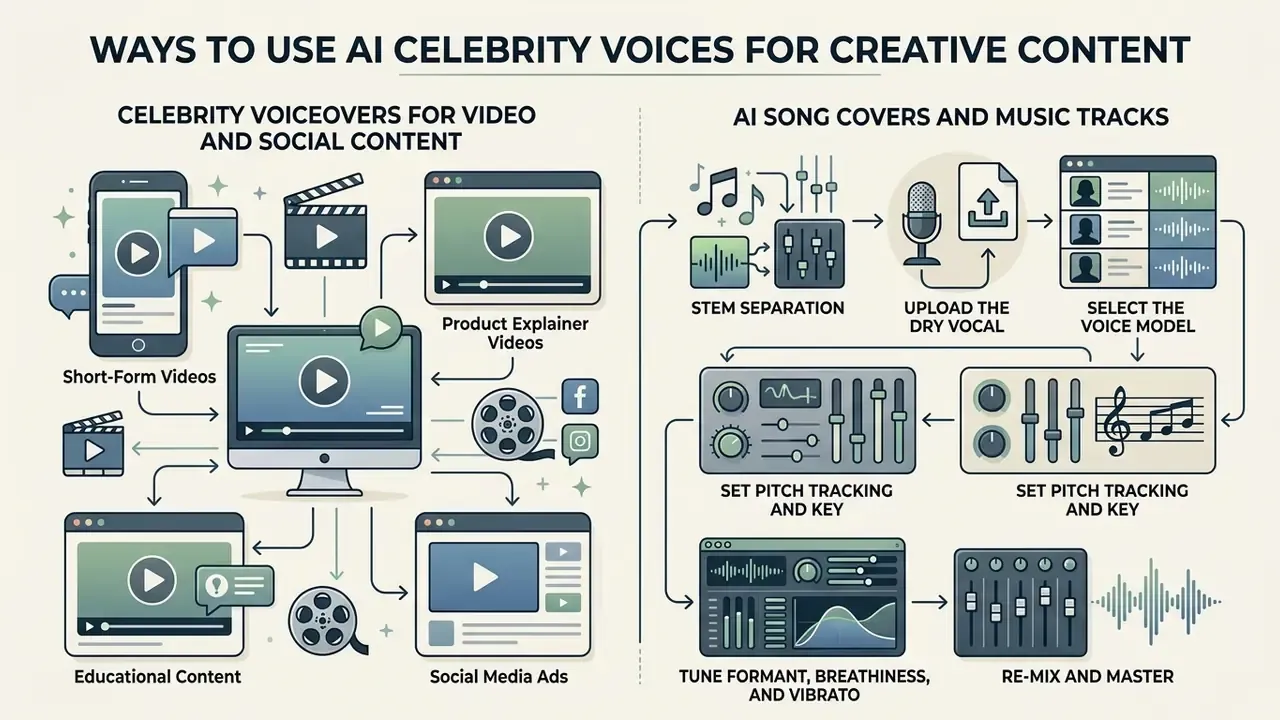
Synthetic celebrity audio serves a range of applications across video editing, game design, music production, and digital content workflows. The subsections below separate consumer-creative use from organizational communication, because the clearance burden differs sharply.
Creating AI Song Covers and Music Tracks
Beyond spoken narration, advanced zero-shot models isolate vocal stems and re-render melody lines with a target timbre. The practical pipeline:
- Stem separationsplit the source track into isolated vocals and instrumental accompaniment. Polyphonic or reverb-heavy vocals produce artifacts.
- Upload the dry vocalsubmit an isolated vocal in WAV or FLAC for maximum headroom. MP3 uploads lose the transient detail that pitch tracking relies on.
- Select the voice modelchoose an artist archetype or licensed voice, and confirm whether the platform permits music use at all.
- Set pitch tracking and keymatch the musical scale and transpose in whole semitones. Large pitch shifts introduce formant distortion and "chipmunk" artifacts.
- Tune formant, breathiness, and vibratothese controls, not raw pitch, are what make a cover sound like a performance instead of a filter.
- Re-mix and masteralign the rendered vocal to the instrumental, re-apply reverb and compression, then export a WAV master plus an MP3 distribution copy.
- Text-to-music generationsome platforms also generate full tracks from a style prompt with optional lyrics. That avoids sampling an existing recording, but still raises voice-likeness questions if the output evokes a specific artist.
Rights reality check for music: a cover using a cloned artist voice can implicate three separate layers, the artist's voice and publicity rights, the composition or publishing rights, and the master recording rights. Policy analysis has specifically flagged cloned celebrity voices inserted into songs as a core copyright and artists'-rights problem, and copyright doctrine does not protect a voice itself, which pushes control into state publicity law and contract. Distribution platforms increasingly remove unauthorized artist-voice covers on request. Treat parody and commentary carve-outs as jurisdiction-specific and fact-specific, not as a general licence.
Entertainment, Games and Character-Based Audio
In game development and podcasting, synthetic voices let studios prototype character interaction and dynamic voice tracks without booking preliminary studio sessions. Under union agreements such as the 2024 SAG-AFTRA Replica Studios framework, voice actors can license digital voice replicas for approved video game projects under transparent consent terms. Documented adjacent applications include AI dubbing and lip-sync for localization that preserves the original performer's tone, personalized podcast delivery in a game character's voice, and estate-licensed narration of text content in reader apps.
"Games that disclose generative AI use receive lower recommendation ratings and negative reviews: players read it as a signal of low developer investment."
The governance implication is blunt. Disclosure is legally and ethically necessary, yet it carries a commercial cost, so plan the messaging (what was generated, what was performed, who consented) rather than burying it in a credits scroll.
Enterprise and Organizational Communication
Distinct from creator use, organizations deploy synthetic voice for internal training modules, accessibility narration, multilingual localization of compliance material, IVR and contact-centre prompts, and product demos. In these contexts the preferred pattern is a licensed brand voice or a consented in-house clone, not a celebrity archetype. It removes publicity-rights exposure, keeps provenance inside the organization, and makes revocation and retention terms enforceable.
Content Creation Workflow: From Script to Audio
An optimized production pipeline moves systematically from text preparation to final mixdown:
When establishing operational costs for automated creative pipelines, teams often consult financial estimation frameworks. To analyze cost parameters, see the overview of platform operational models, or review developer-side API economics for generative media at scale.
How to Choose the Best AI Celebrity Voice Generator for Your Needs
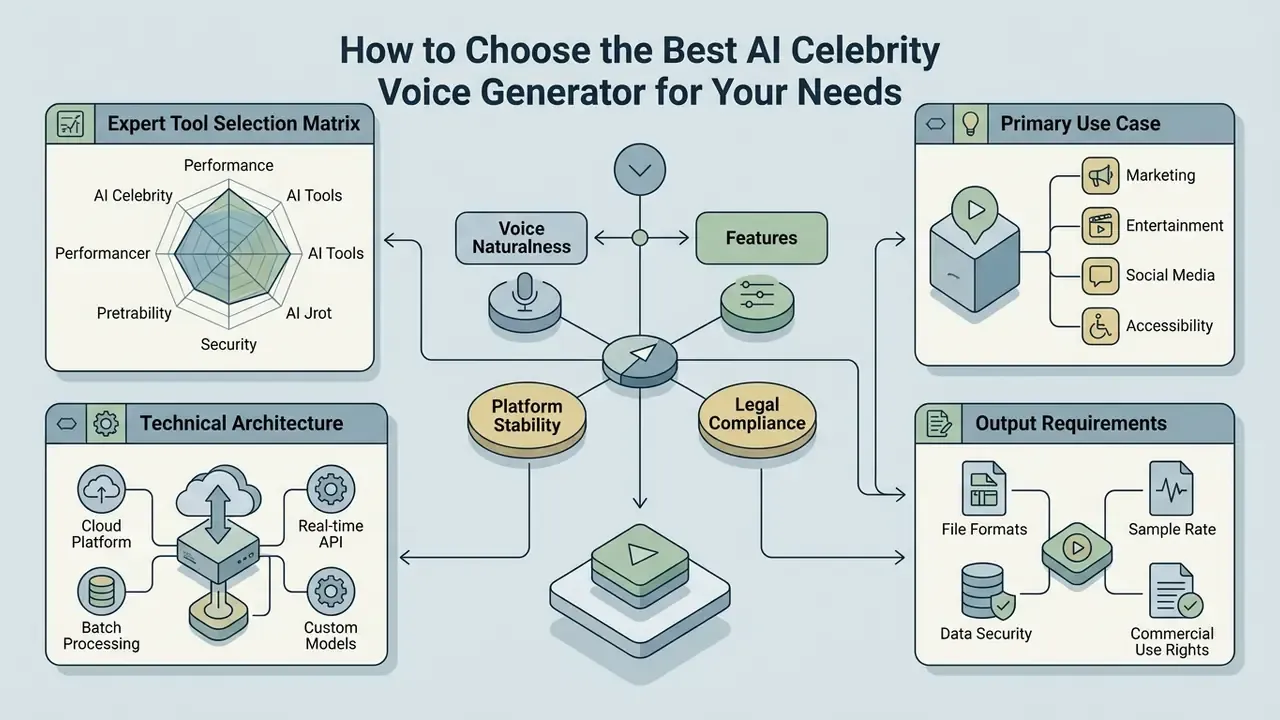
Selecting the best AI celebrity voice generator means balancing voice naturalness, features, platform stability, and legal compliance. Rarely all four at the same price.
- Legal Compliance and Rights Audit: confirm the platform enforces robust consent verification, such as a spoken consent script match (Consumer Reports, 2024), to reduce exposure under privacy and publicity laws.
- Governance Evidence: require a model card, a training-data provenance statement, watermarking and provenance support, and a documented revocation and deletion process.
"OECD recommends watermarking AI-generated content, disclosing training data, and implementing risk monitoring for generative systems." — OECD, Facts not Fakes: Tackling Disinformation, Strengthening Information Integrity (2024). https://www.oecd.org/en/publications/facts-not-fakes_d909ff7a-en.html
For organizations evaluating broader media rights, legal precedents, and enterprise licensing options, compare options across software APIs, or visit the AI Media Commercial-Use Hub for deep-dive regulatory analyses, including our breakdown of commercial use of AI generation tools. To examine precedents on voice rights and synthetic media, review our breakdown of AI Litigation and intellectual property enforcement.
FAQ: AI Celebrity Voice Generators
What is an AI celebrity voice?
It is speech generated by a neural model trained or conditioned to reproduce the timbre, accent, and prosody of a recognizable person or character. The output is a re-creation, not a recording of that person.
How accurate is celebrity voice cloning?
Modern zero-shot systems reach human-comparable naturalness ratings in listening tests, but subtle differences remain. Think of the result as a highly capable impersonation rather than an identical copy. Accuracy depends heavily on the cleanliness of the reference audio and on prosody control.
Is it legal to use a celebrity voice with AI?
Private experimentation is generally low-risk. Publishing or monetizing a recognizable voice without permission is not. Voice itself is generally not protected by copyright, so control comes from right-of-publicity statutes (including Tennessee's ELVIS Act, 2024), state digital-replica laws, contract and union terms, telecom consent rules, and consumer-protection enforcement. Seek legal advice for commercial projects.
Can I use a free AI celebrity voice generator commercially?
Usually not. Free tiers almost always restrict output to personal, non-commercial use and may watermark exports. Commercial rights typically require a paid plan and a licence covering the specific voice.
Which file formats can I import and export?
Common script imports are .txt, .docx, and .srt. Common audio and video uploads are WAV, MP3, AAC, OGG, and MP4, frequently capped at 100-200 MB. Exports usually include WAV (44.1 kHz / 16-bit), MP3 (128-320 kbps), and sometimes FLAC or OGG.
How much reference audio do I need to clone a voice?
Zero-shot models can work from a few seconds. Ten to twenty seconds of clean, dry, single-speaker speech is a common practical recommendation, and longer high-quality samples improve prosodic similarity.
Can I change my voice live in Discord or on Twitch?
Yes, with a real-time voice changer routed through a virtual audio device. Target under roughly 50 ms added latency, match sample rates across the chain, and remember that impersonating a real person live carries the same legal exposure as pre-rendered audio.
Can I make an AI song cover?
Technically yes, using stem separation plus a voice model with pitch tracking. Legally, a cover can involve voice rights, composition rights, and master rights at the same time. Clear all three before distribution.
What do Temperature and Top P do?
Temperature controls randomness in generation: lower means more literal and repeatable, higher means more expressive. Top P narrows the candidate set of acoustic tokens, trading expressiveness against stability. Start near 0.7-0.9 for character work and 0.2-0.5 for corporate narration.
Can people tell that a voice is AI-generated?
Often not. In a UCL-affiliated study published in PLOS ONE (2023), listeners identified synthetic speech correctly only about 73% of the time, and training helped only marginally. That is exactly why disclosure and provenance matter more than "it sounds obviously fake."
How should an organization govern this technology?
Register every voice model and vendor in the AI inventory, require documented consent, validate outputs against similarity and quality metrics, enforce disclosure and watermarking, remove voice-only authentication as a sole factor, and route named-person voices through Legal and senior risk approval.
Checklist for Enterprise AI Audio Adoption
Checklist0 / 17
Open Questions and Limitations
A short note on what this guide cannot settle. Three things remain genuinely unresolved as of 2026.
First, watermark durability. Provenance markers survive some editing chains and not others, and no vendor claim should be accepted without your own re-encoding test.
Second, detection at scale. Published spoof-detection error rates come from curated datasets, not from your call centre traffic at 4 p.m. on a Friday.
Third, legal convergence. State digital-replica statutes, federal proposals, and union agreements overlap unevenly, and a use that is defensible in one jurisdiction may not be in another. If a decision hinges on that gap, escalate it rather than resolve it in a content brief.
Appendix A: Superseded Passages