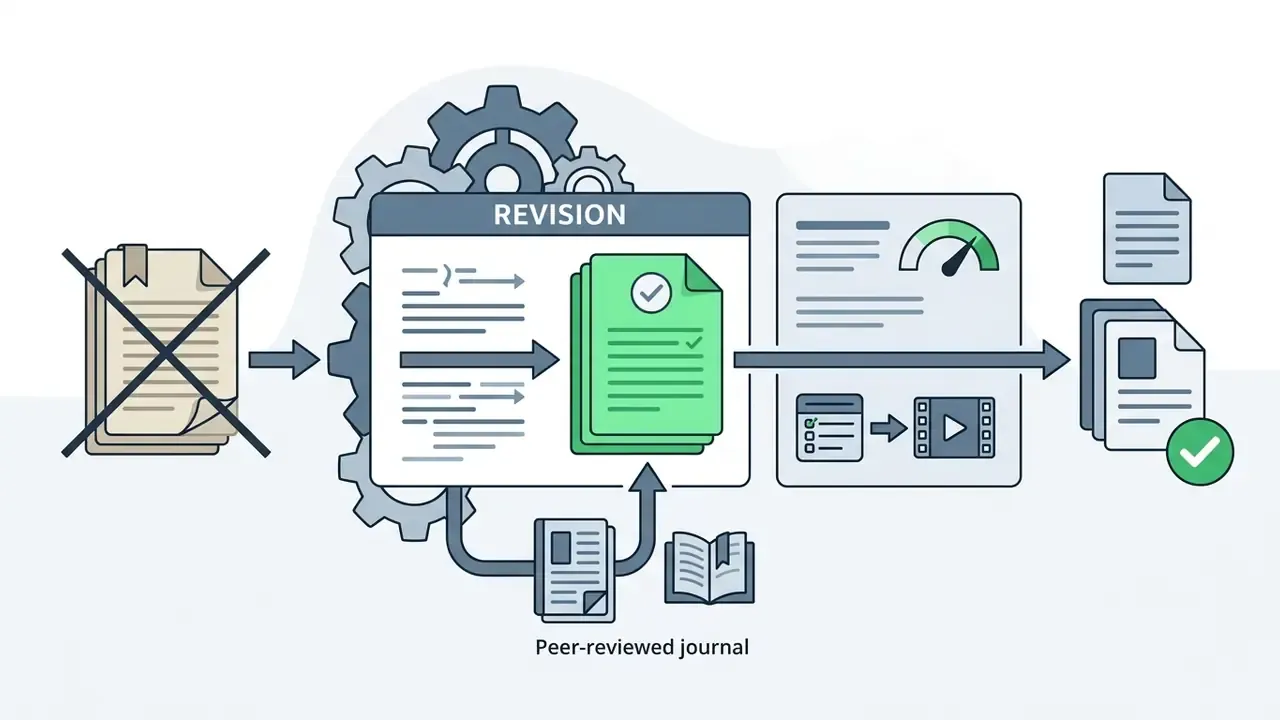
For US financial institutions, enterprise L&D teams, and academic organizations, an ai course creator tool bridges raw domain knowledge and formal instruction. Documented enterprise deployments show large efficiency gains: in a case reported by Forbes, contact-center provider TTEC rebuilt a full curriculum in roughly two hours instead of about one week, a 95% reduction in build time, alongside a 72% reduction in redesign cost (Forbes, 2026, forbes.com/sites/kevinkruse/2026/03/05/this-companys-ai-instructional-designer-cuts-curriculum-costs-by-88-and-the-training-is-actually-better/). Updated: earlier drafts of this guide cited an unattributed "88% cost / 80% time" benchmark; those figures are now replaced by the sourced TTEC case and by the survey data below (see Appendix A: Editorial Revision Log). Establishing business value, though, requires moving beyond raw generation to structured risk management, so that every piece of AI-generated content passes human validation before deployment.
What This Guide Covers
An AI course creator drafts course structure, lesson text, quizzes, and media from prompts or uploaded documents; a human subject-matter expert (SME) must validate every output before publication. This guide explains the architecture layers, the six-stage authoring workflow, document-ingestion mechanics, Model Context Protocol (MCP) integrations, data-privacy boundaries for regulated industries, distribution and SCORM/xAPI/cmi5 export options, and a procurement framework with pricing, free-tier limits, and enterprise-security criteria.
How to Read This Guide by Role
Different buyers need different entry points, so here is the short routing map.
- Heads of L&D and instructional design leads start with the six-stage workflow and the outline-generation mechanics. Those sections describe the day-to-day production change.
- CROs, CCOs, and model-risk owners read the data-boundary checklist in section [4.2], the Model Risk Assessment checklist in section [20], and the enterprise-security procurement matrix in section [24] before you sit through any vendor demo.
- CFOs and finance transformation leads go straight to the ROI model in section [3], then check the total-cost-of-ownership formula. Gross savings without validation cost is not a number you want in a board deck.
- Independent educators and growth teams section [18.1] covers micro-learning, zero-barrier distribution, and marketplace disclosure rules.
What an AI Course Creator Is and Which Tasks It Solves
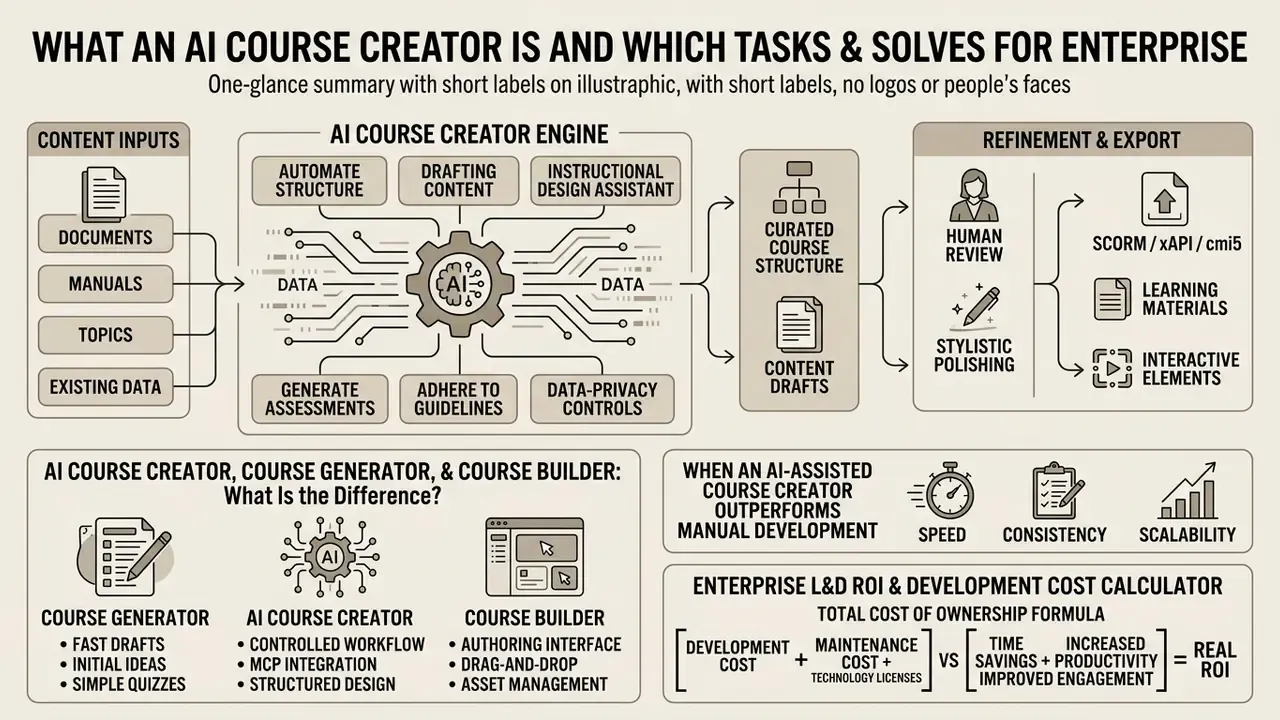
An ai course creator is an enterprise authoring solution designed to automate the structural and drafting phases of instructional design. The primary intent of this technology is to accelerate the move from unstructured knowledge, such as internal manuals, regulatory policy files, or executive briefs, into deployment-ready online courses. Working as an intelligent ai assistant, the system analyzes incoming source data, formulates measurable learning objectives, maps core concepts, and constructs structured lesson paths.
«Generative AI supports a broad task range: producing open-question prompts, generating rubrics, drafting lesson plans, and developing customized learning materials.»
Organizations use an ai course generator across three primary operational domains: corporate upskilling, institutional eLearning, and regulatory training. In traditional L&D workflows, building a comprehensive digital course takes hundreds of hours of manual writing, slide design, and assessment crafting. An ai course creation tool compresses those initial stages by auto-populating module shells, drafting clear explanations, and suggesting formative assessment questions.
Unlike static authoring applications, modern ai course creation solutions treat content generation as an iterative process. According to the 2024 research report in EuroDL, generative engines excel at translating benchmark statements and policy guidelines into active learning prompts, rubrics, and scenario-based exercises (Bektik et al., EuroDL, 2024). Combined with central management platforms, ai for course creation turns manual L&D pipelines into scalable, data-driven instructional engineering processes.
It is equally important to define what these systems do not automate. Vendor and academic documentation describes reliable extraction, structuring, and formatting of source material; none of the reviewed sources claims automatic validation of pedagogy. So "module creation" should be read as content structuring under expert supervision, not autonomous curriculum design.
AI Course Creator, Course Generator, and Course Builder: What Is the Difference
The terminology around AI-driven instructional tools reflects distinct operational layers inside the software architecture. An ai course generator (or ai course maker) refers specifically to the underlying algorithmic engine that ingests prompts or documents and turns them into raw text, outlines, and test questions. Its role is content generation, not structural delivery or administrative management. Some vendors market the same engine as an ai courses generator, which describes batch production across a catalogue rather than a single module.
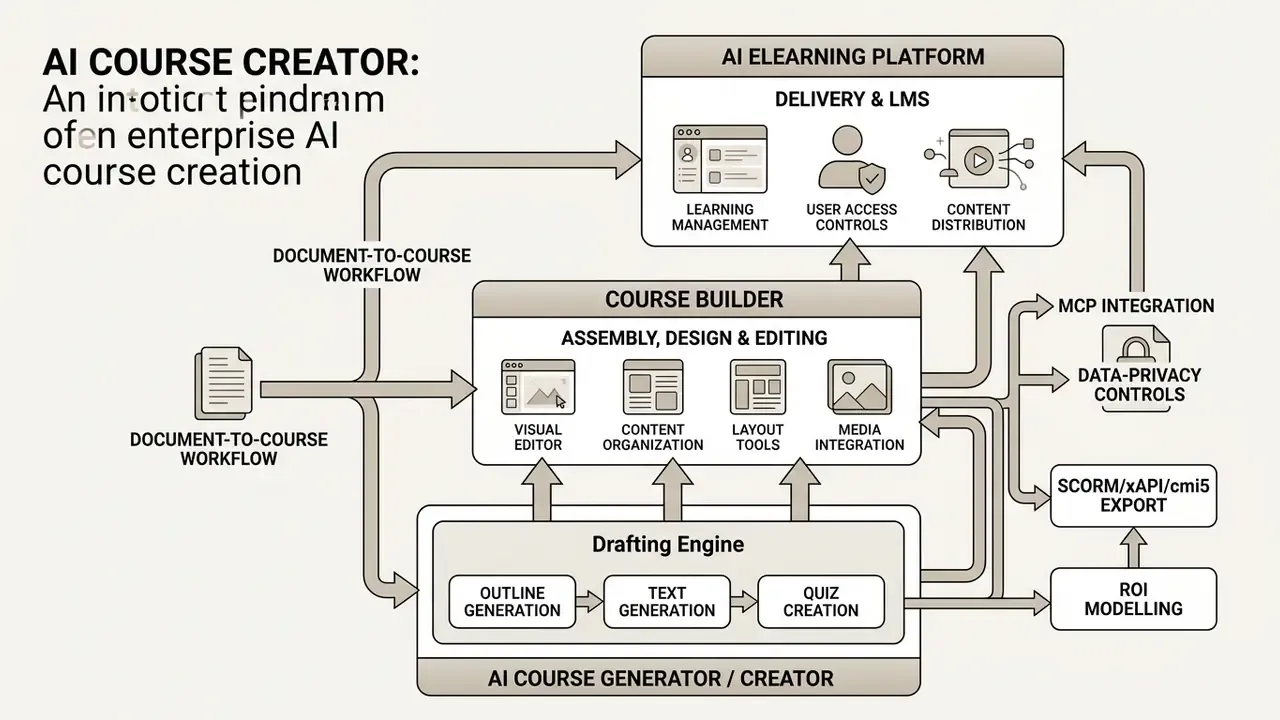
Conversely, a course builder is the visual and structural workspace where instructional designers arrange modules, adjust layouts, refine wording, and add interactive elements. A full ai course creator platform (or ai course creator tool) combines both layers, linking automated generation engines with advanced authoring interfaces. Finally, an ai eLearning platform covers the whole delivery ecosystem, joining generation and design tools with Learning Management System (LMS) capabilities such as learner enrollment, tracking, and compliance reporting.
This layering also clarifies the difference from classical authoring suites. Articulate's AI Assistant, for example, converts a prompt or uploaded document into a target duration, course information, learning objectives, an outline, and a full draft inside Rise 360, after which authors edit text or regenerate individual sections (Articulate 360 product documentation, 2026, articulate.com/features/localization/ and articulate.com). Legacy tools such as Adobe Captivate and iSpring remain strong for PowerPoint-based authoring and SCORM/xAPI packaging, yet their documented AI features focus on text assistance rather than end-to-end course planning. The functional distinction is therefore architectural: AI course creators begin from intent and produce a populated course shell; classic authoring tools mainly support manual assembly.
When an AI-Assisted Course Creator Outperforms Manual Development
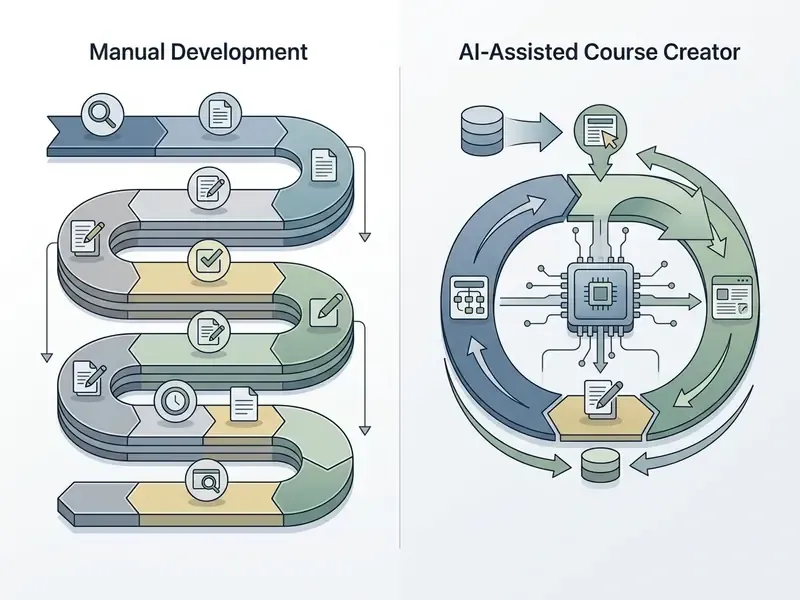
An ai assisted course creator outperforms manual development when organizations need rapid training updates, must process large volumes of static documentation, or want to scale multi-role upskilling programs. Manual curriculum design routinely takes between 12 and 33 weeks per major course, which creates significant operational lag whenever regulatory policies or software systems change.
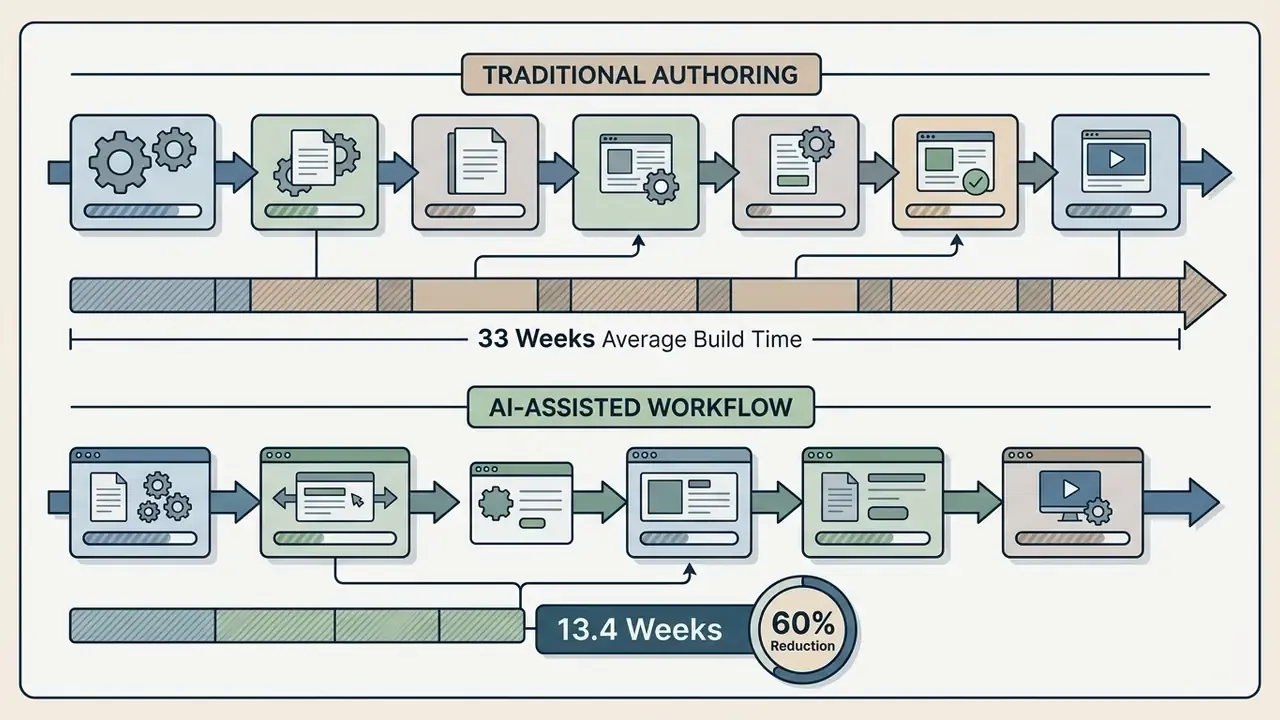
Empirical data reported by eLearning Industry shows that enterprise L&D teams using AI authoring tools cut average curriculum production time from 33.1 weeks to 13.4 weeks, roughly a 60% efficiency improvement (eLearning Industry benchmark interviews, 2024–2026, elearningindustry.com/how-ai-is-changing-the-speed-of-course-creation). Adoption is already mainstream inside L&D functions: among surveyed L&D leaders, 82% use generative AI to draft learning courses and 78% use it to design personalized learning pathways (2024 Generative AI Report, University of Phoenix and ExecNetworks). Complementary survey evidence from the PwC HR Pulse Survey (2024) reports that organizations actively embedding generative AI in L&D observe lower delivery costs together with more adaptive, more effective training programs.
Independent vendor ROI documentation points in the same direction while measuring different baselines. CYPHER Learning reports AI course creation saving approximately 80% of build time and about $12,000 per course (CYPHER Agent ROI, CYPHER Learning, 2025–2026, cypherlearning.com/hubfs/resources/infographics/cypher/CYPHER-Agent-ROI.pdf), while Guidde claims 75–85% faster course creation than traditional methods (Guidde AI Course Creator Complete Guide, 2026). Treat these numbers as directional: the largest figures come from full curriculum redesign programs, not single-course drafting. In high-turnover or rapidly evolving environments, the time reduction lets institutions align training delivery with business shifts almost in real time. Human subject-matter experts still stay in the loop, running mandatory reviews, tuning pedagogical nuance, and removing model hallucinations.
| Input field | Default | Notes |
|---|---|---|
| Number of courses per year | 12 | Planned catalogue volume |
| Instructional designer rate ($/hr) | 65 | Blended internal or agency rate |
| SME / compliance review hours per course | 16 | Higher in examined institutions |
| SME / compliance officer rate ($/hr) | 110 | Includes legal sign-off time |
| Annual platform and licensing cost ($) | 6,000 | Seats, admin roles, integrations |
| Target course depth | 200 hours | 120 standard / 200 comprehensive / 350 complex technical |
Outputs to display: design hours saved per year, gross design savings, added SME validation cost, and estimated net savings after review and licensing. The model assumes a 60% design-hour reduction benchmark (eLearning Industry, 2024–2026). Courses still need formatting, accessibility testing, and validation.
Total cost of ownership formula for risk-aware finance teams. Governance work is not free, so the defensible calculation subtracts validation and residual-risk handling from gross efficiency gains:
Net Annual Benefit =
   (Courses × Build Hours × 0.60 × ID Rate)          // design hours released
 - (Courses × SME Review Hours × SME Rate)           // validation & sign-off
 - (Platform Licence + Admin Seats + Integration)    // direct software cost
 - (Remediation Reserve: % of courses re-drafted)    // residual model risk
In a recent operational deployment at a regional financial institution, the compliance department faced a strict 30-day mandate to train 1,200 branch employees on revised anti-money laundering (AML) reporting protocols. By feeding verified policy PDFs into an AI authoring tool, the L&D team drafted five role-specific modules and knowledge checks in two business days. Subject-matter experts spent four days reviewing and refining the output, and the firm deployed the complete compliance course two weeks ahead of the regulatory deadline. Institution-scale results are documented elsewhere too: after deploying an AI-enabled learning platform, the Vanuatu Institute of Technology reported roughly 40% lower administrative workload, 30–40% higher learner engagement, and around 20% higher course completion, with an estimated saving of about $11,200 per course across 295 courses (CYPHER Learning / Vanuatu Institute of Technology case study, 2024).
How AI Builds a Course From a Topic, Prompt, or Document
Modern AI systems create structured training courses by analyzing input data, extracting key operational concepts, and mapping them into logical instructional sequences. Users can start generation with a concise topic prompt, a target skill framework, or an upload of existing reference materials such as PDFs, DOCX files, or presentation decks.
When an author submits a request to ai create course workflows, the system runs document ingestion and semantic chunking. The platform evaluates the material against established cognitive frameworks, then generates a course outline, lesson modules, and associated knowledge checks. This lets institutions ai create online course environments directly from legacy policy manuals and operational guidelines. Adobe's Acrobat AI Assistant illustrates the underlying document-intelligence layer: it supports asking, analyzing, modifying, and generating from PDFs, and its outputs can be reused in downstream documents and presentations (Adobe Acrobat AI Assistant documentation, 2026).
Using an ai course outline generator alongside an ai course content creator allows L&D teams to turn your documents into courses within hours. To evaluate broader media capabilities across enterprise applications, teams can examine the AI Media Commercial-Use Hub. Where source materials include recorded sessions, an online video recorder often becomes the first capture step in the same pipeline.
Direct Model Integration via Model Context Protocol (MCP)
Beyond manual file uploads inside platform interfaces, modern enterprise course creation architectures use the Model Context Protocol (MCP) to connect generative AI clients, for example Anthropic Claude Desktop or OpenAI ChatGPT Enterprise, directly to the course authoring engine. In practical terms, an instructional designer stops exporting drafts between tools and instructs the authoring platform from the conversation window they already work in.
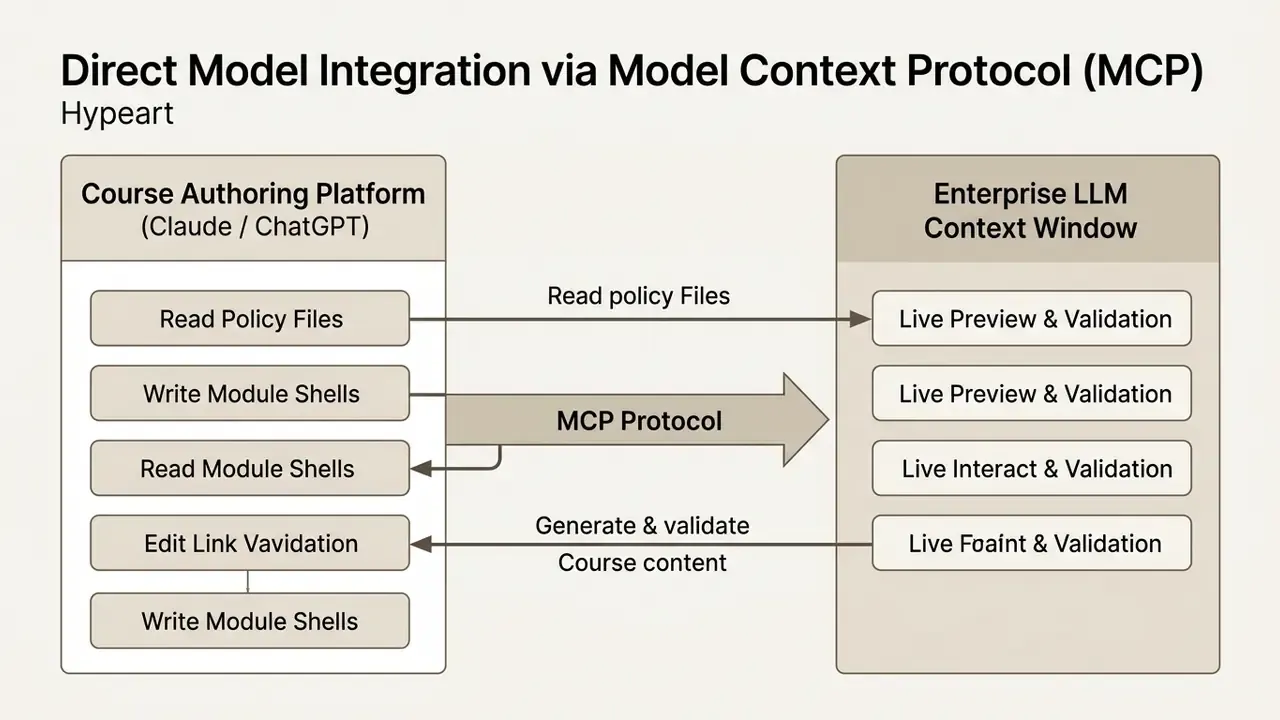
With an MCP server connection in place, instructional designers can generate, update, sequence, and localize whole training modules through natural-language conversations inside their existing AI workspaces. Vendor implementations describe the same pattern: connecting Claude, ChatGPT, and comparable clients so that each course is built from the content and context those assistants already hold, with the administrator setting permissions and keeping the ability to revoke access at any time (Mini Course Generator MCP, product documentation, 2026). This architecture removes export/import overhead, enforces explicit data-permission boundaries, and lets the authoring engine build courses from live enterprise context. Developers weighing programmatic alternatives can compare options before committing to a protocol bridge.
Governance requirements for MCP deployments. Before enabling a protocol bridge in a regulated environment, document four controls: (1) scoped read/write permissions per repository, so the model cannot reach unrelated confidential stores; (2) revocable tokens with expiry and audit logging of every write action; (3) a contractual zero-retention clause confirming that prompts and documents are excluded from model retraining; and (4) mandatory human approval before any MCP-generated module moves from draft to published state.
Data Privacy, Model Isolation, and Leakage Prevention During Document Ingestion
Uploading internal policy manuals, credit procedures, or customer-handling scripts into an external tool is a data-transfer event, not merely a productivity choice. Security reviewers should treat the ingestion pipeline as an in-scope system and require written answers on the following points before any pilot begins.
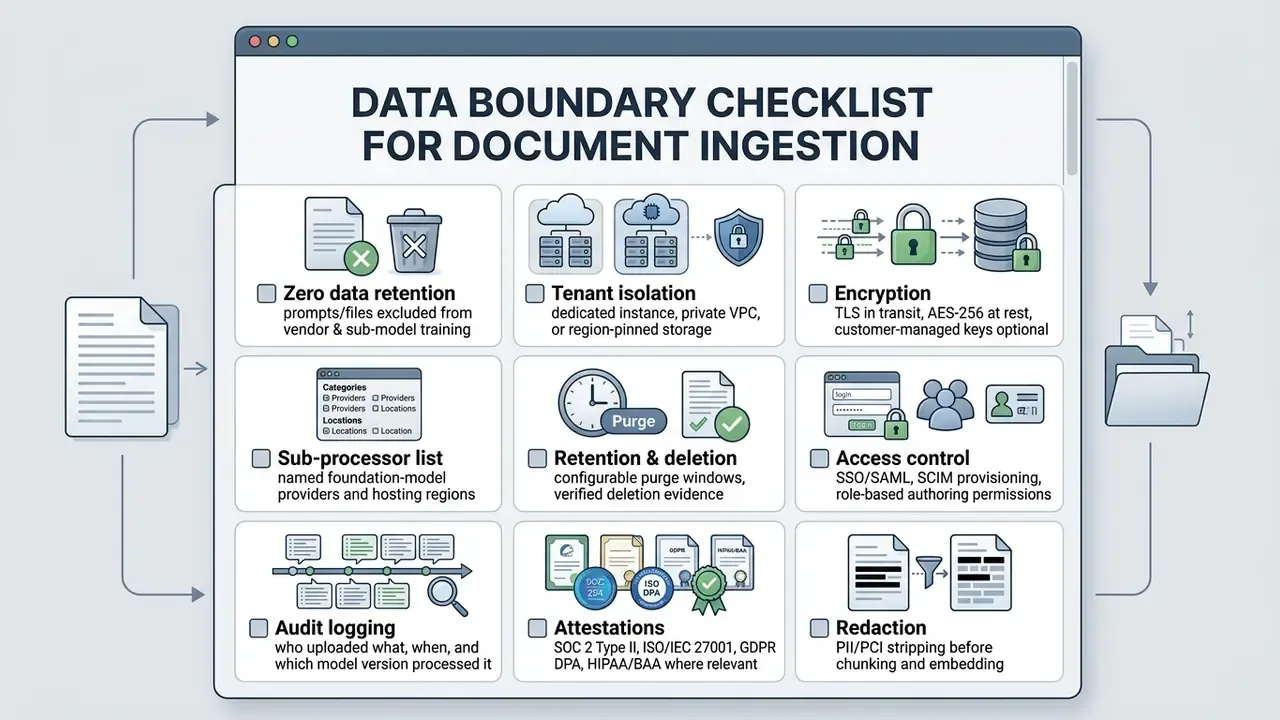
Institutional practice supports this posture. The Open University's Scribe assistant is built on Azure OpenAI and is documented as guaranteeing that user data is not used to train external models, which is what allows staff to work with copyright-protected and confidential material (Open University / Scribe institutional implementation, 2024). In banking specifically, sector guidance on generative-AI guardrails states that training modules built with generated content must clearly inform users of that fact and remain governed by disclosure, watermarking, and bank-level controls (The Association of Banks in Singapore, generative AI guardrails handbook). A practical mitigation pattern for high-sensitivity content is retrieval-augmented generation over an internal document store: the model reads a private index at inference time, and no proprietary text is used for weight updates. Teams considering self-hosted media components sometimes pair this with an open source ai rendering stack to keep media processing inside the perimeter.
Course Outline and Module Structure Generation
An ai course outline generator structures learning paths by establishing a hierarchy of modules, lessons, and assessment points based on pedagogical taxonomy principles. Rather than producing random text blocks, advanced systems apply Bloom's Taxonomy to map cognitive progression from baseline recall to practical application.
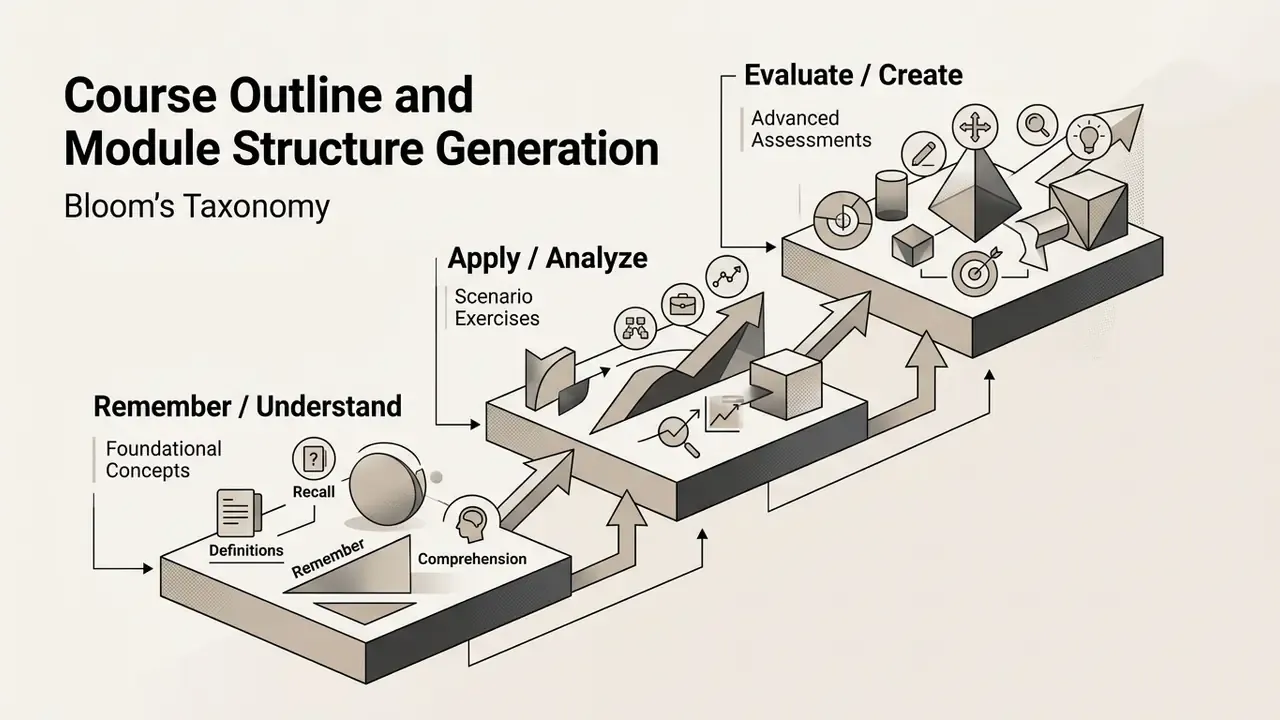
«The ARCHED framework prescribes Bloom's Taxonomy for phrasing learning objectives and for selecting task types at each cognitive level, from recall through creation.»
Converting Documents and Existing Course Content Into a Course
The document ingestion pipeline lets enterprise platforms parse raw corporate documents, such as policy guides, standard operating procedures, and slide decks, and convert them into interactive digital lessons. The system reads document semantics, identifies structural headings, extracts core definitions, and strips redundant formatting.
Reliable ingestion is a staged process rather than a single conversion step: load → parse → clean → extract metadata → chunk and embed → validate. Generic text extraction destroys structure and metadata, which is why format-aware parsing matters. Guidance from the PDF Association states that AI engines should ingest page content together with semantics, bookmarks, layers, metadata, annotations, and embedded files, and recommends Tagged PDF with PDF/UA-1 or PDF/UA-2 conformance for dependable structure transfer (PDF Association guidance on AI and PDF, 2025). For scanned or image-based files, OCR must run before downstream processing.
During ingestion, common technical failure modes include corrupted or unsupported document tags, missing metadata, scanned PDFs without proper OCR, and misparsed multi-column layouts. When ingestion errors occur, human authors must intervene to restructure section breaks and re-align lesson topics. Audio-first source material adds another step: recorded webinars usually pass through an online video to audio conversion and transcription stage before the text ever reaches the outline engine.
«AI-driven document conversion requires verification for completeness and regulatory conformity, particularly where meaning must not drift.»
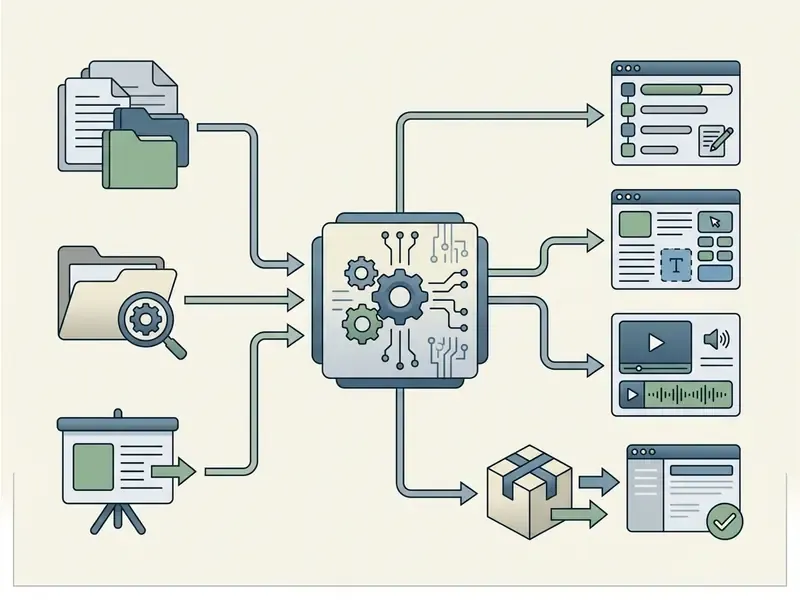
Figure 1: End-to-End AI Course Creation Workflow. To be implemented at publication as an accessible diagram with all stage labels present as text in the DOM and alt text keyed to "ai course creation". Stages to render in sequence: (1) Ingestion, PDF, DOCX, prompts; (2) AI Outline, Bloom's Taxonomy; (3) Generation, lessons and quizzes; (4) SME Review, fact check and refine, visually highlighted as the control gate; (5) Distribution, LMS, SCORM, link.
Step-by-Step Workflow: How to Create an Online Course With AI
Executing a structured ai course creation workflow means moving methodically from target setting through automated drafting to expert review. Prompting a platform to "generate a course" without parameters yields generic, superficial material. Professional L&D teams follow a six-stage operational pipeline: Sequence matters. Instructional-design guidance recommends fixing measurable outcomes first, defining assessment criteria second, and only then selecting tools for ai for online course creation and deciding where they apply, followed by accessibility and quality testing (captions, transcripts, alt text, contrast and cognitive-load checks) before release. To create a course that delivers measurable skill improvements, teams must invest heavily in prompt parameterization during the early stages. Teams building narrated video segments can benchmark generation costs in the Google Veo implementation guide.
- Objective settingestablish target audience personas, prerequisite skill baselines, and measurable business outcomes.
- Contextual promptingsupply specific source documentation, domain constraints, and tone requirements to the engine.
- Structural generationrun the outline generator to create the module hierarchy, then review structural logic.
- Drafting and interactivity generationproduce lesson texts, scenario checks, and formative assessments.
- Human refinement and fact-checkingSME verification of factual accuracy, regulatory alignment, and pedagogical tone.
- Packaging and deploymentexport the finalized course via SCORM packages or direct LMS integration.
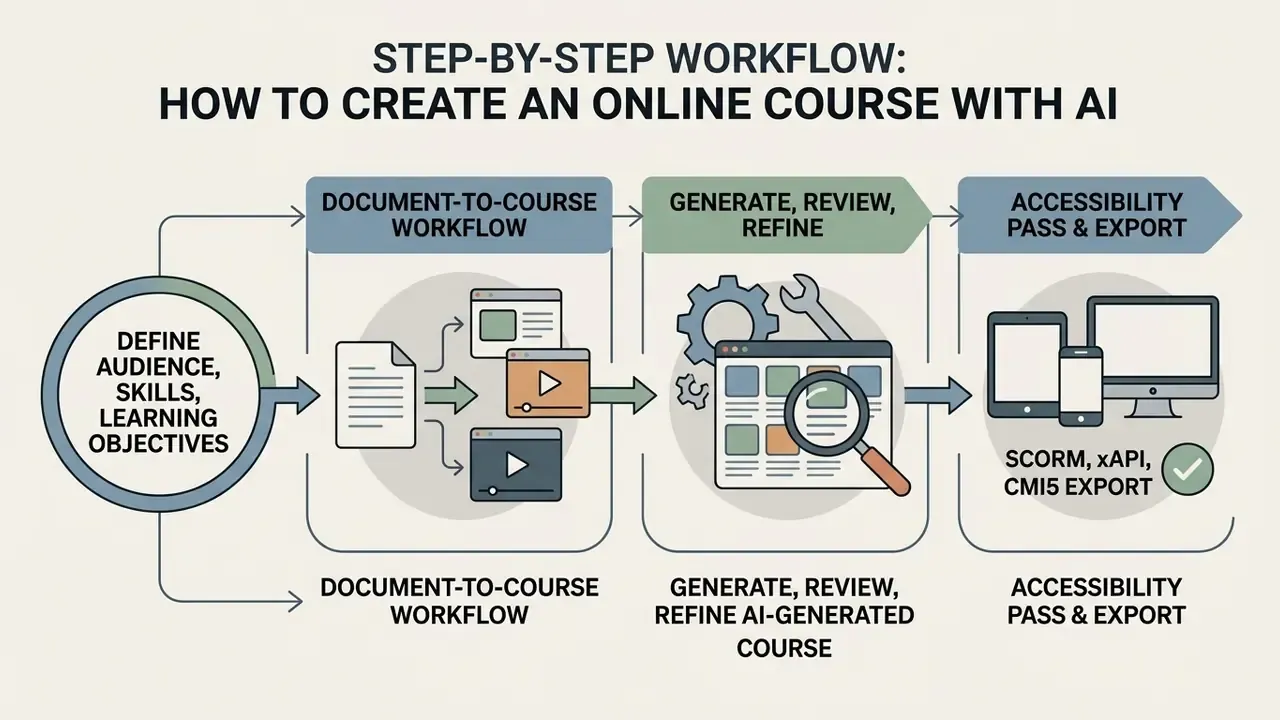
Define Audience, Skills, and Learning Objectives
Defining target audience parameters sets the boundary conditions for text generation engines. Frameworks published by the National Institute of Standards and Technology (NIST) recommend structured prompt parameters, namely Context, Objective, Style, Tone, Audience, and Response format (CO-STAR), to align outputs with operational requirements (NIST SP 1353 IPD, 2026). In the same draft, Audience determines the level of abstraction, term precision, and response structure, while Tone stays objective or authoritative for the target group.
«Define learner characteristics, prior knowledge, and contextual constraints before generation begins, not after.»
Complementary public-sector prompting guidance recommends stating audience and learning level explicitly, for instance "undergraduate non-physics majors" versus "graduate-level scholarly audience", and tying each prompt to a learning objective and Bloom level (PNNL Prompt Guide, Pacific Northwest National Laboratory, 2025). When specifying the target audience, authors define prior knowledge limits, professional roles, and terminology constraints. Explicit audience baselines stop the engine from producing oversimplified explanations for senior personnel, or dense academic jargon for introductory onboarding groups. A small detail with outsized effect: naming the learner's job title in the prompt usually improves example quality more than any style instruction.
Generate, Review, and Refine the AI-Generated Course
The refinement phase turns raw drafts into polished, high-integrity instructional modules. Authors evaluate generated text for clarity, tone consistency, and factual accuracy. To review comparative performance data across media models, authors can consult the AI Media Comparison Matrices.
During refinement, instructional designers inspect generated quiz items to make sure distractors represent plausible operational errors rather than obvious filler options. Guidelines from NIST AI 600-1 emphasize evaluating generative outputs against verifiable ground-truth data using structured human oversight, automated evaluation, review of content inputs, plus filters and monitoring for harmful or false content (NIST AI 600-1, 2024). Peer-reviewed work on pedagogical steering adds the underlying reason: LLMs have no built-in instructional judgment and must be externally governed to hold alignment with learning goals (Puech et al., 2024). Any section containing ambiguous statements or unverified claims must be manually edited or re-prompted.
Checklist0 / 9
Independent validation practice from health-technology guidance reinforces the method: use unseen test sets, pilot before full release, obtain independent peer review, and retrain or rebuild if pre-specified performance targets are not met (WHO evidence guidance on AI software validation).
Which Features an AI Course Creator Needs to Build Complete Courses
To make sure an ai course creator build complete courses that drive real learning outcomes, platforms must offer capabilities beyond basic text output. Complete course suites require multi-modal content generation, including embedded interactive widgets, scenario-based knowledge checks, automated visual assets, and cross-platform accessibility support.
Modern enterprise systems integrate rich interactive tools, automated quizzes, and structured assessments. When platforms support ai-generated visual assets and localized language layers, L&D teams gain the complete features set that keeps engagement up. These options also let course authors refine overall visual design and hold institutional branding standards across every published module. Across 2025–2026 product documentation, four capability clusters recur consistently: media-rich content, interactive blocks, AI-generated quizzes and assessments, and adaptive or personalized learning paths.
Interactive Content, Quizzes, and Assessments
Interactive components convert passive reading into active learning. Modern authoring platforms generate accordion blocks, flip cards, expandable process diagrams, and scenario-based decision trees directly from source text. Teams producing motion-based explainers alongside these blocks can compare tooling in the guide to animation makers.
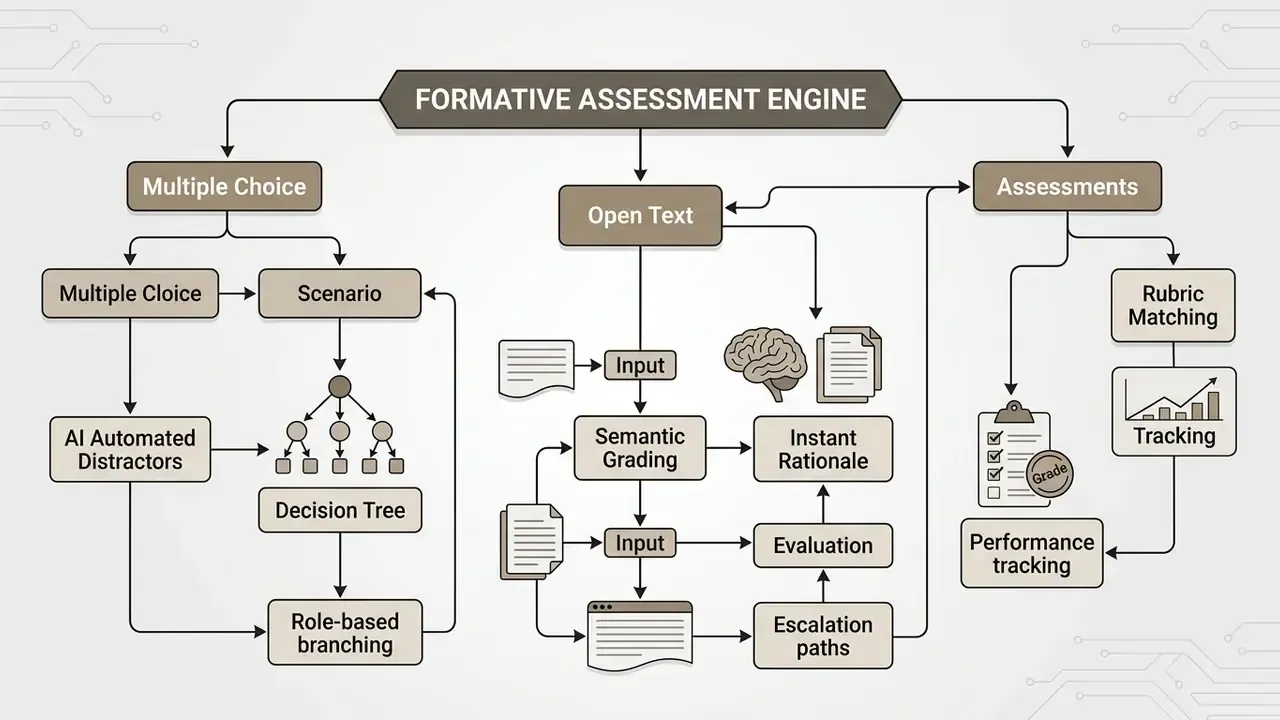
Assessment engines construct multiple-choice questions, fill-in-the-blank items, and open-ended case prompts aligned with module learning objectives. According to platform documentation, systems such as Coursebox generate quizzes and assessments directly from source material, support multiple-choice, scenario-based, and open-ended formats, and grade open-ended answers automatically (Coursebox product documentation, 2026). Interoperability matters as much as generation: assessment tools now export to QTI 2.1, Moodle XML, GIFT, JSON, and PDF, which keeps generated item banks portable between platforms.
«AI-generated gamified quizzes reach acceptable quality for formative assessment and help flag at-risk students, but each item still requires expert verification.»
To prevent "static slide fatigue," advanced authoring suites act as central integration hubs for third-party interactive media. Instead of constraining courses to native text and simple images, authors embed external rich-media blocks via iframe standards inside generated lesson structures:
For regulated deployments, add one rule to the embed policy: every external frame is a third-party data flow and must be reviewed against the data-boundary checklist in section [4.2] before publication.
AI-Generated Imagery, Video, and Audio Narration
Multi-modal generation features improve knowledge retention by combining visual, auditory, and textual streams. Text-to-Speech (TTS) engines generate clear audio narration for lesson blocks, enabling hands-free listening and supporting accessibility compliance; teams standardizing narration quality can review the guide to AI voice generators. Vendor APIs document the mechanics precisely: HeyGen's Text-to-Speech endpoint converts text to audio with SSML support, playback speed from 0.5× to 2.0×, and timestamped audio output (HeyGen API documentation, 2026), while Microsoft documents Azure Speech text-to-speech for humanlike synthesized narration in applications (Microsoft Azure Speech documentation).
For visual media, integrated generative tools produce contextual diagrams and illustrative graphics inside lesson interfaces. Platform documentation from Synthesia and HeyGen shows that an ai course video creator layer can deliver script walkthroughs from plain text, enabling automated visual instruction without a dedicated studio team (Synthesia documentation, 2026; HeyGen documentation, 2026). Independent research corroborates the workflow value rather than the vendor claim: the EuroDL review records that generative AI can draft video scripts from textual materials and propose graphic-content ideas, reducing dependence on studio production (Bektik et al., EuroDL, 2024). University teaching guides similarly list DALL·E and Midjourney for course imagery and Synthesia for avatar-based instruction. Teams selecting a production stack can compare zero-cost options in the roundup of free AI video generators, and privacy-sensitive institutions sometimes prefer an open source ai video generator free of licence dependencies for internal-only assets.
One compliance caveat applies across all synthetic media: NIST's synthetic-content guidance treats AI-generated or modified images, video, audio, and text as content that must be identifiable, authenticated, and labelled (NIST AI 100-4, 2024). Disclosure labels on avatar narrators and generated illustrations are part of the build, not a post-launch afterthought. Where rights questions around generated assets escalate into disputes, see the overview of active cases before you publish externally.
Design, Branding, Languages, and Mobile Learning Experience
Enterprise platforms need comprehensive design customization to hold corporate brand standards. Course builders let administrators lock custom colour palettes, corporate typography, logos, and header layouts across every generated content shell. Vendor documentation exposes these controls explicitly: logos, colours, fonts, custom domains, branded emails, and branded certificates (Coursebox, 2026).
Language support is another core requirement for global deployments. Localization platforms advertise course translation across more than 280 languages and dialects while preserving brand voice, with live preview before LMS export (Smartcat AI eLearning builder, 2026), whereas Articulate documents automatic translation into 80+ languages, including right-to-left scripts (Articulate localization documentation, 2026). Peer-reviewed evidence supports the learning value of these layers: a study of 100 international students found that AI language tools measurably improved personalized support and cultural understanding, while flagging interface and interaction-depth limitations (Yu et al., Can ChatGPT Revolutionize Language Learning?, 2025).
All generated course interfaces must also be mobile-responsive, rendering cleanly across desktop, tablet, and smartphone screens. Accessibility is a procurement criterion in its own right: authoring tools should create and edit content meeting WCAG 2.0 Level A/AA for supported features, allow authors to override required accessibility information, preserve accessibility data across format conversion, and, where PDF export exists, produce PDF/UA-1 conformant files (U.S. Section 508 authoring-tool requirements; W3C ATAG 2.0).
How to Publish, Share, or Export an AI-Generated Course
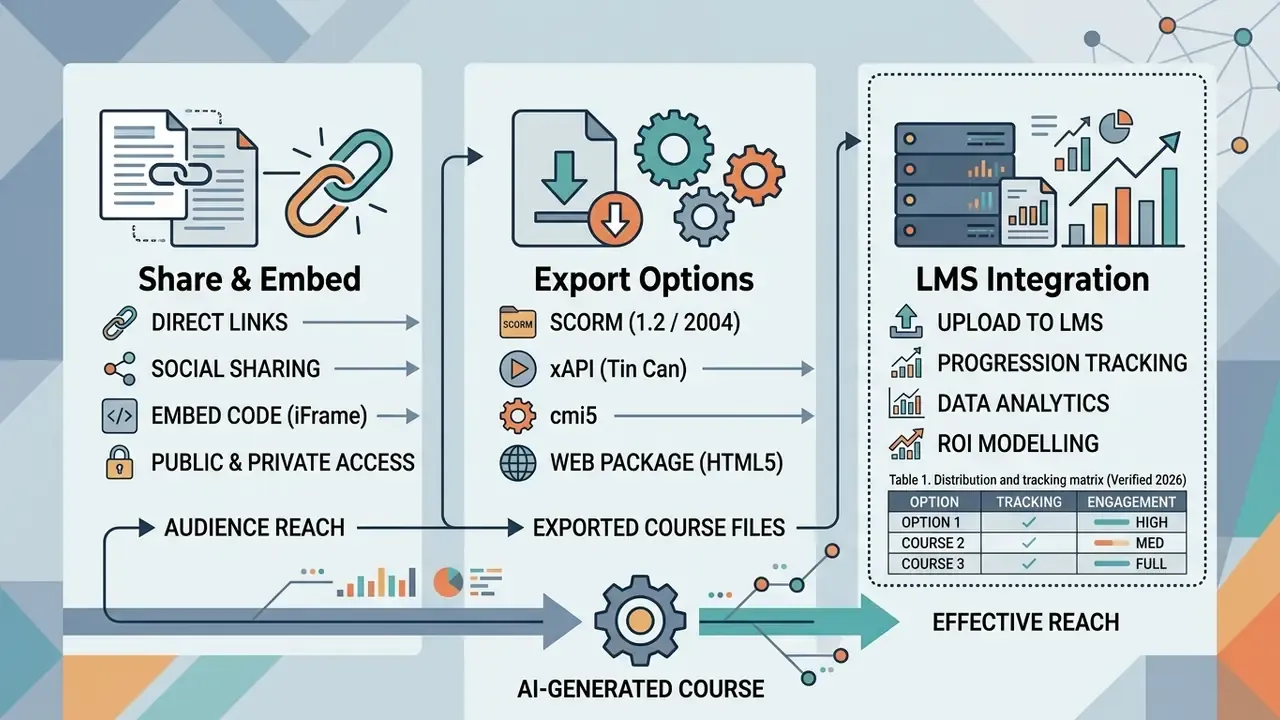
Publishing and distribution mechanisms decide how effectively a finalized course reaches its audience. Enterprise platforms support flexible options to share or export your course anywhere, keeping compatibility with existing corporate technology infrastructure.
Depending on security and tracking requirements, organizations deliver courses through direct web links, iframe embeds, native lms environments, or standardized scorm export packages. Picking the right export strategy lets L&D leaders deliver content smoothly while maintaining robust export workflows and central access controls. PDF export remains useful as a static, offline, or archival artifact, though it carries no runtime data exchange with an LMS.
LMS, SCORM, and Progression Tracking
Enterprise L&D operations depend on Learning Management Systems to enforce mandatory training, manage enrollments, and log completion records for compliance audits. Standardized export formats keep courses generated in an AI platform working reliably inside third-party LMS environments such as Cornerstone, Canvas, Moodle, Blackboard, or SAP SuccessFactors.
Table 1. Distribution and tracking matrix for AI-generated courses (verified early 2026).
| Delivery mode | Target audience | Tech requirements | Tracking depth |
|---|---|---|---|
| Direct web link | External / temporary | Web browser | Aggregate visits |
| Embedded iframe | Intranet users | HTML webpage | Page views only |
| SCORM 1.2 / 2004 | Enterprise staff | LMS environment | Completion and score |
| xAPI / cmi5 | Multi-system learning | LRS / modern LMS | Detailed events |
| PDF export | Offline / archival | PDF reader | None (static) |
Read the table as a control decision, not just a format choice: only SCORM, xAPI, and cmi5 produce per-learner evidence suitable for examination, while links and embeds serve low-risk audiences.
Export standards such as SCORM 1.2 and SCORM 2004 package course content into ZIP archives containing tracking scripts. Loaded into an LMS, SCORM packages report individual completion statuses, quiz scores, total time spent, and pass/fail metrics; SCORM 2004 adds sequencing and navigation control on top of the SCORM 1.2 data model. Advanced formats such as xAPI (Experience API) and cmi5 extend tracking further, capturing granular learner interactions across external apps and mobile environments. Official cmi5 material describes interoperable runtime communication between an LMS and Assignable Units, which is what makes cmi5 suitable for LMS-launched content that still emits detailed xAPI statements to a Learning Record Store (cmi5 specification materials, cmi5.project).
Tracking depth translates into measurable operating results. Following its AI-enabled platform rollout, the Vanuatu Institute of Technology reported roughly 40% lower administrative workload, 30–40% higher learner engagement, and approximately 20% higher course completion rates (CYPHER Learning / Vanuatu Institute of Technology case study, 2024).
Where AI Course Creators Are Used: Corporate Training, Education, and Banking
AI authoring systems serve different operational requirements across commercial corporations, academic institutions, and regulated financial environments. Foundational generation mechanics stay similar, but deployment priorities, content sources, and compliance requirements vary sharply by sector.
Commercial firms focus on corporate training to accelerate ai course creator for employees onboarding and continuous upskilling; teams producing supporting video assets can consult the YouTube video editor guide for publishing workflows. Academic institutions deploy an ai course creator for education to help faculty with course design, while financial institutions need an ai course creator for banking to translate complex regulatory frameworks into trackable compliance programs. Guidance intensity differs accordingly: education guidance emphasises privacy, human agency, and provider safeguards (UNESCO Guidance for generative AI in education and research), while banking guidance treats generated training content as a controlled compliance artifact.
Corporate Training, Onboarding, and Employee Skills Development
In corporate L&D, rapid market changes force continuous workforce upskilling and reskilling. AI authoring tools let enterprise teams convert technical documentation, product specifications, and sales guides into interactive micro-learning modules within hours. This is the core promise of an ai course creator for corporate training: consistent content, produced fast, reviewed by a named owner.
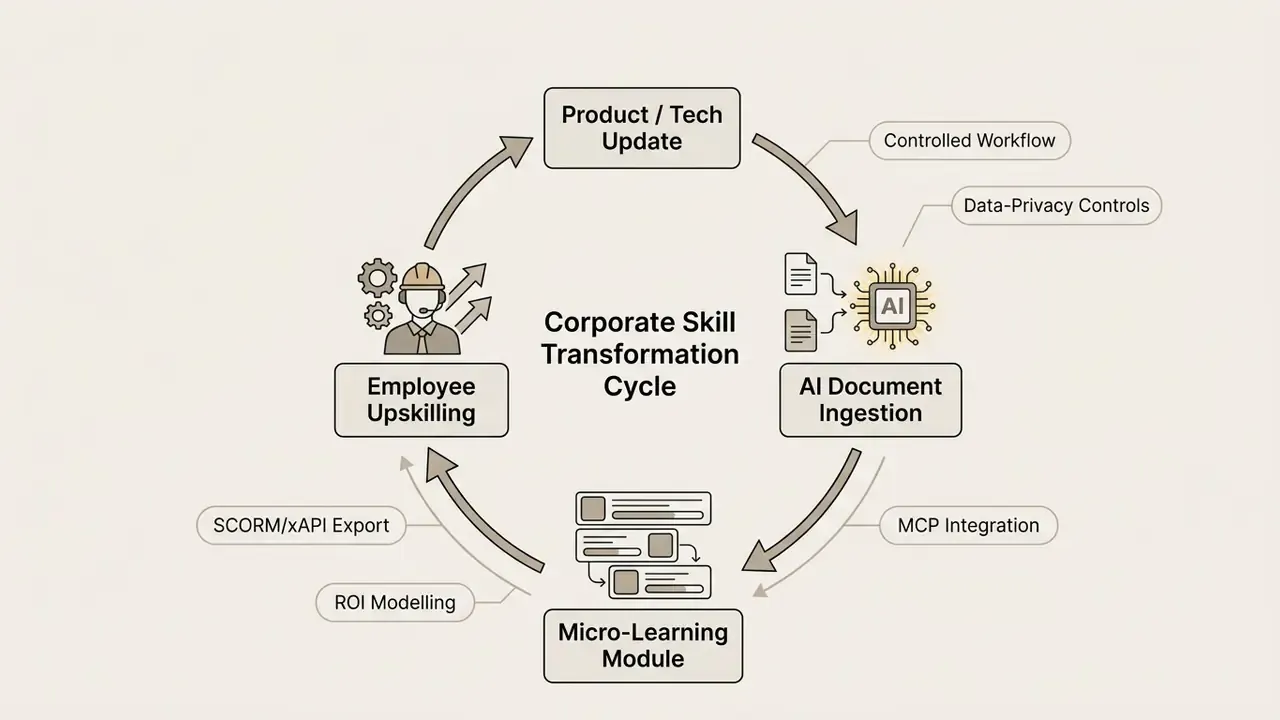
According to the 2024 Generative AI Report by the University of Phoenix and ExecNetworks, 82% of surveyed L&D leaders use generative AI to draft learning courses, while 78% deploy AI to design personalized learning pathways (University of Phoenix / ExecNetworks, 2024). The PwC HR Pulse Survey (2024) adds the financial dimension: organizations actively embedding generative AI in learning functions report reduced costs together with greater adaptability and effectiveness of training programs. Automated drafting frees L&D staff from manual writing and moves them toward instructional strategy and talent coaching.
Documented deployment patterns include rapid skills-inventory building, co-designed learning paths, micro-learning delivery, and quarterly refresh of skill maps at scale (Upskilling and reskilling for an AI-driven workforce, Kaplan, 2025). Academic analysis of the technology sector similarly reports that generative AI can prototype learning materials quickly, create modules tailored to distinct learner profiles, and support onboarding through learning assistants and chatbots (The Role of AI in Upskilling and Reskilling the Tech Industry, 2026). UK government case-study material on AI upskilling shows organizations making AI training mandatory and treating capability building as a shared responsibility across firms (What Works for AI Upskilling in the UK: Supporting Case Studies, 2026).
Micro-Learning, Lead Generation, and Zero-Barrier Distribution
While enterprise deployments prioritize deep compliance and formal tracking, independent creators, growth marketers, and SaaS customer-success teams use ai course creator platforms for micro-learning and lead acquisition. Mini-courses, bite-sized modules that take five to ten minutes to complete, usually sustain higher completion rates than long-form training because each segment delivers a self-contained outcome.
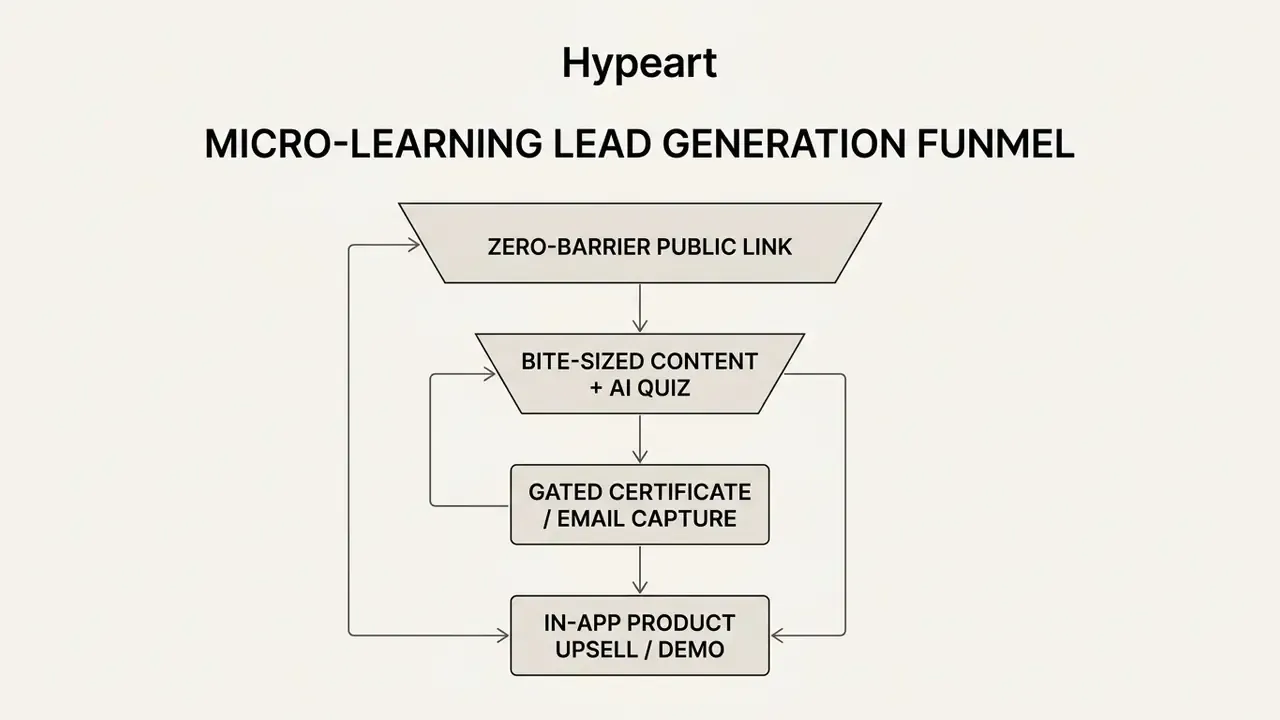
By removing mandatory LMS account creation and using frictionless browser links or embedded web frames, organizations turn bite-sized courses into interactive lead magnets. Authors configure gated access points where learners complete a short diagnostic assessment and submit contact details to receive an automated certificate of achievement, bridging educational value with top-of-funnel acquisition. Vendor documentation describes the same distribution flexibility: login-free public access, payment gateways, email capture, learner-specific access grants, or in-app access through SSO, plus collections and showcase pages for grouping courses (Mini Course Generator product documentation, 2026).
Practical patterns reported by creators include short explainer courses embedded on a website, public-facing catalogues for a specific genre, revision modules that break large chapters into digestible segments, and micro-courses used as first-touch lead magnets for coaching or consulting offers. Three commercial applications recur: selling to individuals and organizations, customer education for online products (academies, in-app training, just-in-time help), and training for partners, staff, and community members. Certificates, badges, collaborator invitations, custom domains, detailed reporting, and automation via Zapier, Make, or Pabbly extend the same mini-course into a lightweight, agile learning operation.
AI Course Creator for Education and Independent Course Creators
In academic settings, faculty members and instructional designers use AI authoring assistants to streamline syllabus design, build problem sets, and generate supplementary reading materials. Systems like the Open University's Scribe assistant help educators draft course content while keeping strict data privacy and intellectual-property protection (Open University, 2024). Scribe is built on Azure OpenAI and guarantees that user data is not used to train external models, which is what permits work with copyrighted and confidential materials.
Institutional adoption is measurable at scale. Anthology reports that in the first 12 months of availability, 618 institutions activated the Blackboard AI Design Assistant and used it to complete 738,414 instructional tasks, from module generation to rubric creation (Anthology, Blackboard AI Design Assistant white paper, 2024). Research prototypes push further: Stanford SCALE's Instructional Agents work (2025) describes a multi-agent LLM system automating syllabus creation, lecture scripts, slides, and assessments end to end. Sector guidance frames the boundaries: TEQSA notes AI tools may support assessment design, feedback forms, and exams under institutional policy, while UNESCO's guidance requires privacy protection, human agency, and age-appropriate ethical validation.
Independent educators and commercial course creators use AI platforms to test market demand for specialized topics fast. By generating outlines and initial video scripts automatically, an independent ai creator course workflow can launch a prototype, gather student feedback, and iterate far quicker than traditional media publishing models allow. Marketplace policy is an added constraint for this audience: Udemy's course-quality guidance restricts fully AI-generated courses, requires disclosure of AI use, and permits AI assistance only where quality stays high and human review is present (Udemy Course Quality Checklist: Use of AI, 2025). Authors exploring external media creation workflows can also review practical editing guidance in the photo editor guide for lesson imagery.
Banking Training, Policy Updates, and Compliance Training
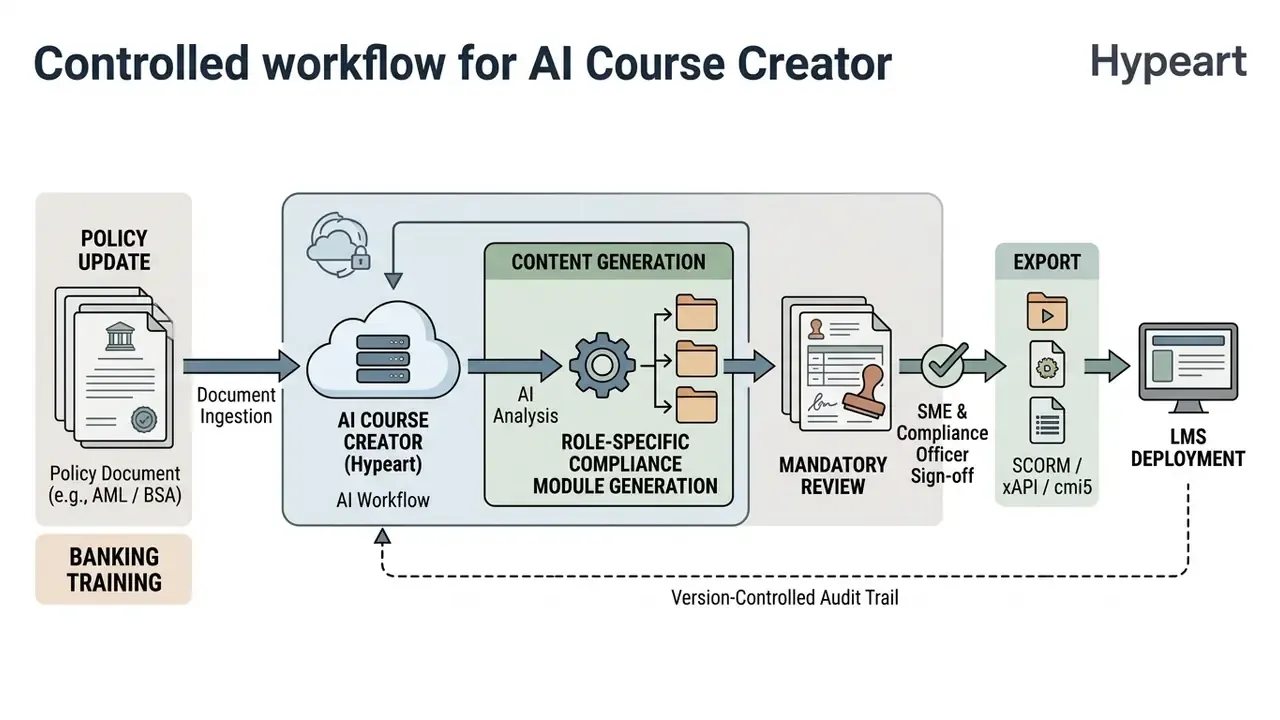
AI course creators for banking parse dense regulatory manuals and draft scenario-based compliance training covering anti-money laundering (AML), Bank Secrecy Act (BSA) rules, and consumer-protection standards. Vendor-documented workflows convert a policy document into a course, assign it to the relevant employee groups, and record completion against the specific policy version and employee role, so examiners can review who completed which version (KnowledgeCity, 2026, knowledgecity.com/blog/how-an-ai-course-creator-helps-banks-turn-policy-updates-into-branch-training-within-days/). Comparable compliance-LMS products describe automated assignment, real-time monitoring, permanent completion logging, and tracking of skipped sections, answer precision, and retention.
«AI should adapt content to employee profiles and roles, but interpretation of regulatory text must remain with human experts.»
To satisfy audit requirements, platforms must track completion against specific policy document version numbers, giving examiners clear evidence of employee acknowledgment.
Model Risk Assessment checklist for AI-generated compliance courses. Before an AI authoring tool enters production in an examined institution, document the following, aligned with your internal model-risk framework (for example, SR 11-7-style validation practice):
Checklist0 / 11
How to Choose an AI Course Creation Platform: Features, Price, and Limits
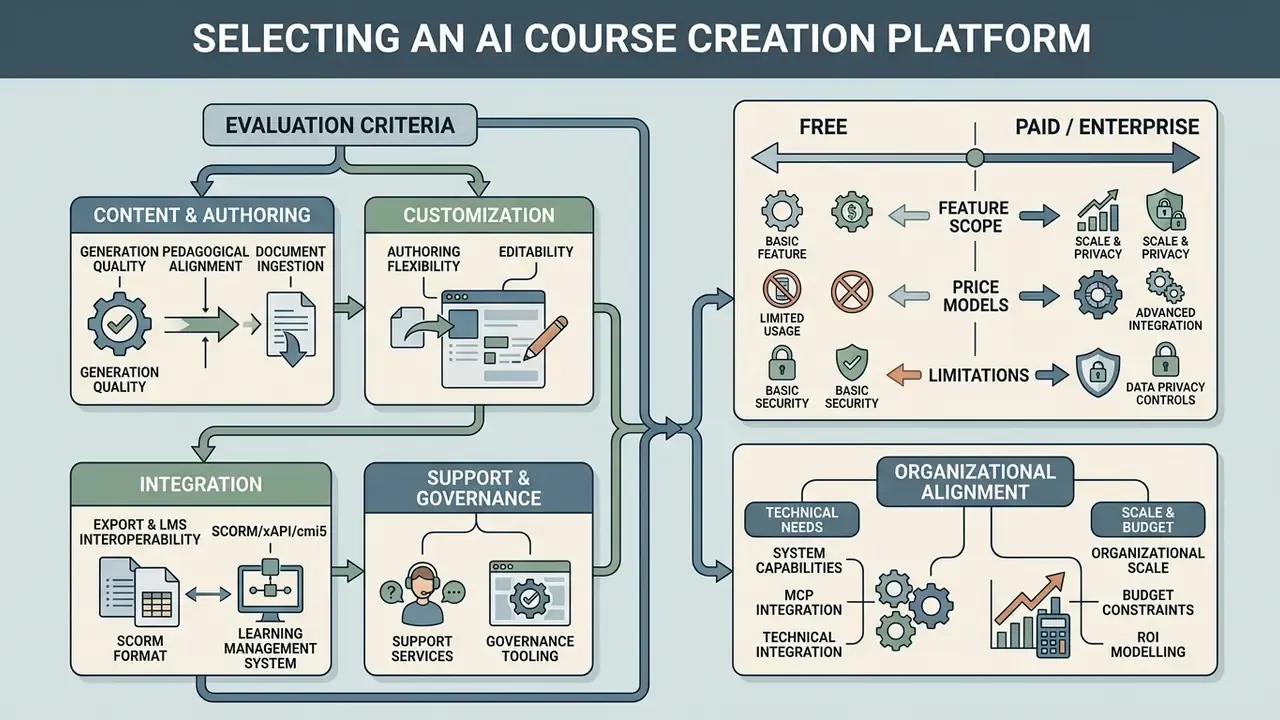
Selecting an appropriate ai course creation platform means evaluating system capabilities against organizational scale, technical integration needs, and budget constraints. Procurement leads must weigh generative quality against administrative controls when choosing between standalone tools and enterprise authoring suites.
Evaluating ai course creation tools involves analyzing both pricing models and feature availability. Decision-makers assess free options against paid enterprise subscriptions to choose a platform that supports long-term L&D growth. For broader cost analyses across digital tools, teams can view the guide. A defensible evaluation framework spans three dimensions: interoperability, accessibility, and security; plan limits versus required usage; and organizational scale. The 1EdTech AI-Generated Content Best Practices v1.0 (2026) formalises the first dimension, requiring WCAG / EN 301 549 / WAI-ARIA accessibility, open standards such as QTI, Common Cartridge / Thin CC, LTI, and Caliper, plus metadata labelling of AI-generated course content. A peer-reviewed evaluation matrix groups criteria into ethical compliance, pedagogical effectiveness, technological readiness, cultural and linguistic relevance, and implementation and cost sustainability (A novel matrix for evaluating AI-powered learning platforms, Frontiers in Education, 2025).
AI Course Maker Free and Paid Plans: When a Free Tier Is Enough
Many platforms offer an ai course maker free tier or trial mode with basic generation features and usage caps. Free plans usually limit published courses, restrict credit allowances, and omit advanced features such as SCORM export or custom branding.
Free Tier vs. Paid Enterprise Plan Capabilities:
FREE TIER:
- 1 to 3 Prototype Courses
- Basic Text Generation & Quizzes
- Hosted Web Link Only
- Standard Vendor Branding
PAID ENTERPRISE PLAN:
- Unlimited Course Generation
- SCORM / xAPI Export Support
- Custom White-Label Branding
- Dedicated Security & SME Approval Controls
Documented free-tier limits show exactly where upgrade pressure begins: Coursebox allows 3 courses with unlimited learners on its free plan, with paid tiers unlocking white-label LMS and additional AI credits, and extra admin seats priced separately (Coursebox pricing, 2026, coursebox.ai/pricing); PersonWise offers 3 demo courses of up to 5 slides each with no expiry (PersonWise pricing, 2026); Mini Course Generator provides 14 days of full access before a paid plan is required (Mini Course Generator pricing, 2026); Mexty grants 1 admin, 1 free seat, and a one-time 20 credits (Mexty pricing, 2026); ContentBuilder.ai issues 200 one-time credits and 100 MB storage (ContentBuilder.ai pricing, 2026). In short, the upgrade triggers are hard caps on published courses, AI credits, storage, seats, export formats, or trial expiry.
A free tier is generally enough for individual creators, freelancers, or small teams testing platform mechanics. Enterprise L&D departments, though, need paid plans to unlock white-label branding, multi-admin collaboration, LMS export formats, and dedicated data processing agreements. The financial case for full deployment can be substantial: the Vanuatu Institute of Technology case reports roughly $11,200 saved per course across 295 courses, approximately $3.3 million in total (CYPHER Learning / Vanuatu Institute of Technology case study, 2024), while CYPHER's own ROI documentation cites about $12,000 saved per course against roughly $10 in generation cost (CYPHER Agent ROI, 2025–2026).
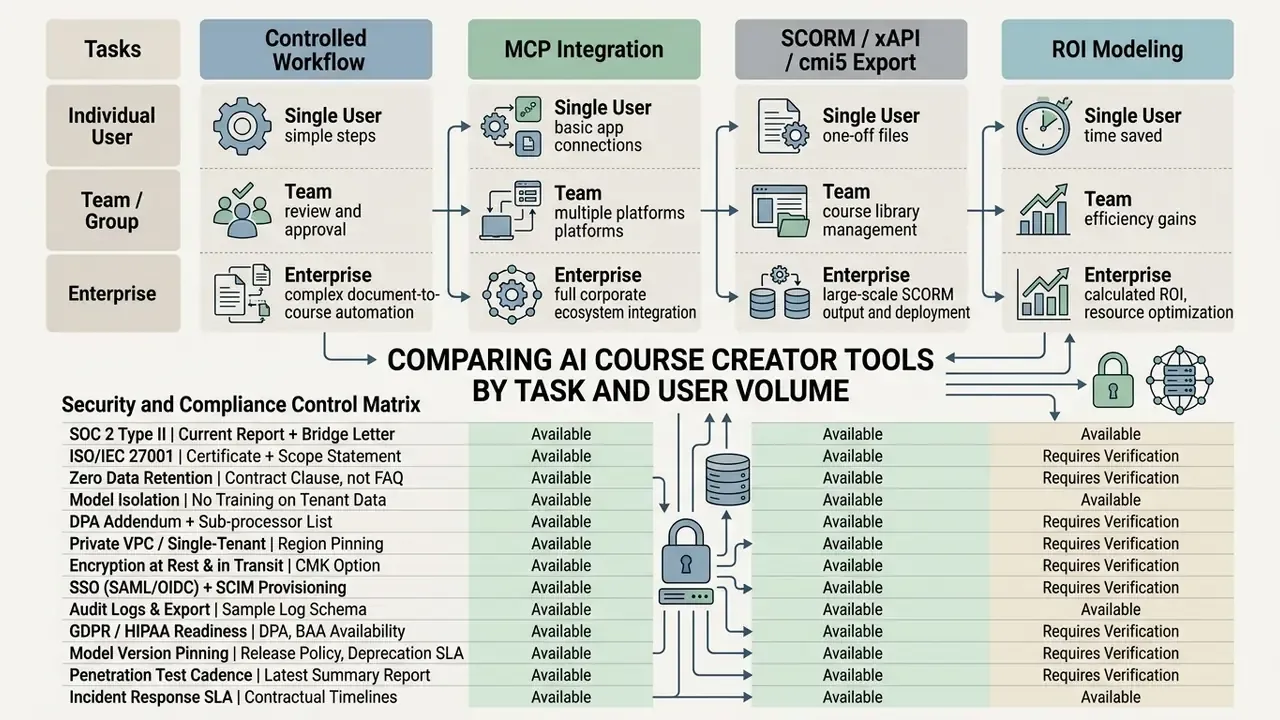
Comparing AI Course Creator Tools by Task and User Volume
Comparing top authoring platforms means analyzing functional capabilities alongside audience focus and deployment pricing.
Table 2. Comparison of AI course creator platforms (vendor documentation verified early 2026).
| Platform | Document ingestion | Interactivity and quizzes | LMS / SCORM export | Branding customization | Free tier | Pricing model | Primary target audience |
|---|---|---|---|---|---|---|---|
| Coursebox | PDF, Word, PPT, web links | Interactive widgets, AI-graded quizzes | SCORM 1.2 / 2004 and LTI | Full white-labeling, custom domains | Free tier (3 courses) | Freemium, paid from $17/mo | Corporate L&D and independent creators |
| LearningStudioAI | PDF, DOCX, TXT, PPT | Standard quizzes, knowledge checks | SCORM 1.2 / 2004 | Basic colour and logo options | No free tier (paid trial) | Flat subscription from $39/mo | Educators and small L&D teams |
| CourseAgent | PDF and text prompts | Multiple-choice assessments | SCORM on paid tiers | Standard theme options | Free tier (1 course, 2k credits) | Paid plans after 14-day trial | Individual course creators |
| Colossyan | Script and document prompts | Video quizzes, branching scenarios | SCORM 1.2 / 2004 (Business, Enterprise) | Custom AI avatars, brand templates | Free starter tier | Tiered business / enterprise | Enterprise AI video and L&D training |
| SCORMBuilder.ai | DOCX, PDF, slide decks | Graded assessments, interaction blocks | One-click SCORM, xAPI, cmi5 | Full brand style locking | 14-day full feature trial | Single licence $29/mo | Instructional designers and developers |
| Mini Course Generator | PDF-to-course, prompts, MCP context | AI interaction builder, flashcards, tabs, quizzes | SCORM and PDF export, embed/share links | Complete white-label, custom domains | 14-day full access trial | Paid plans (roughly $29–43/mo tiers reported) | Micro-learning, customer education, lead magnets |
Limitations and Open Questions
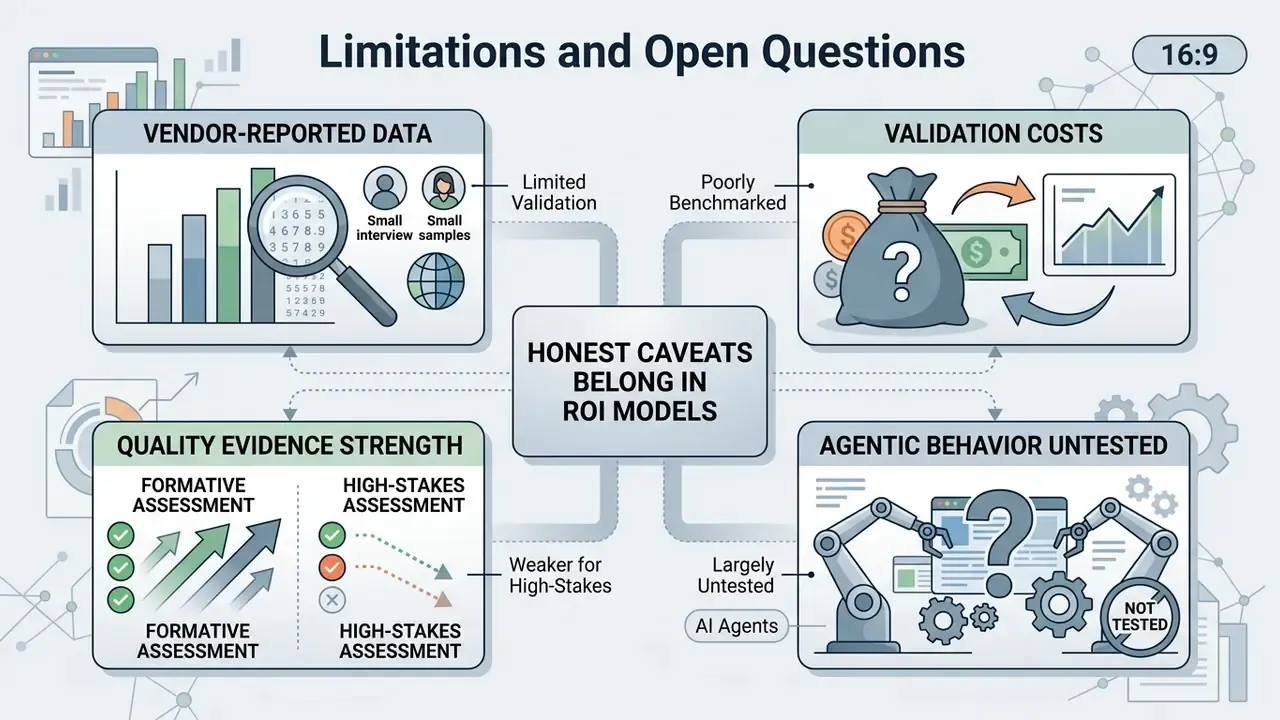
Honest caveats belong in the same document as the ROI numbers. Four gaps deserve explicit attention before you present a business case.
First, most published efficiency figures are vendor-reported or drawn from small interview samples. None of the sources reviewed here provides an audited, like-for-like comparison of manual versus AI-assisted build cost in a regulated bank.
Second, validation cost is poorly benchmarked. We have solid data on drafting hours saved and thin data on SME review hours added, which is exactly the variable that decides net benefit in compliance training.
Third, quality evidence is stronger for formative assessment than for high-stakes assessment. The gamified-quiz research supports practice items; it does not support unreviewed certification exams.
Fourth, agentic behaviour is largely untested here. Multi-agent prototypes such as Stanford SCALE's Instructional Agents (2025) show technical feasibility, not control maturity. Until an agent has a named owner, a bounded role, an audit trail, and a shutdown path, treat it as an experiment rather than a production worker. No evidence, no autonomy.
FAQ: Expert Guidance on AI Course Creation
What is the primary risk when using AI for compliance training creation?
The primary risk is model hallucination, where the system generates plausible but legally inaccurate interpretations of regulatory rules. Institutions mitigate this by requiring mandatory SME review, logging strict source document mapping, and pinning each published module to a specific policy version.
Can AI-generated courses be exported directly into existing LMS platforms?
Yes. Most enterprise AI course creators support standard SCORM 1.2, SCORM 2004, xAPI, or cmi5 export, allowing upload into systems such as Moodle, Canvas, Blackboard, Cornerstone, and SAP SuccessFactors. SCORM stays the most broadly compatible option; xAPI and cmi5 provide richer event-level tracking through a Learning Record Store.
How much time does an AI course creator typically save?
Reported reductions cluster between 60% and 95% depending on baseline and scope. Benchmark interviews describe average build time falling from 33.1 weeks to 13.4 weeks (about 60%), while a full curriculum-redesign case reported completion in two hours instead of about one week (95%). Always net out SME validation hours before presenting savings to finance.
Can an AI course creator connect directly to ChatGPT or Claude?
Yes. Platforms exposing a Model Context Protocol (MCP) server let authors generate, update, and localize modules from inside their existing AI client, with the administrator controlling scoped permissions and revoking access at any time. In regulated settings, pair this with zero-retention contract terms and mandatory human approval before publishing.
Which documents can be converted into courses, and what breaks most often?
PDF, DOCX, PPTX, plain text, and web links are commonly supported; scanned files need OCR first. The most frequent failures are unsupported or corrupted PDF structures, missing document tags and metadata, and multi-column or table-heavy layouts that break parsing, which is why Tagged PDF and PDF/UA conformance materially improve ingestion quality.
How do we keep internal policy documents out of public model training?
Require contractual zero data retention, a named sub-processor list, tenant isolation or a private VPC, region-pinned storage, and configurable deletion windows. Institutional examples such as the Open University's Azure-OpenAI-based Scribe assistant show that "no training on customer data" can be a documented guarantee rather than an assumption.
Is a free plan enough for a business pilot?
For a mechanics test, usually yes: typical free tiers allow one to three courses or a time-boxed full-access trial. Upgrade becomes necessary once you need SCORM/xAPI export, white-label branding, multi-admin roles, audit logging, or a data processing agreement.
Do we have to disclose that a course was AI-generated?
Increasingly, yes. NIST synthetic-content guidance treats generated media as content that should be identifiable and labelled; banking guardrail handbooks require informing users when training content is AI-generated; and marketplaces such as Udemy require disclosure of AI use and prohibit fully AI-generated courses without human review.
Can AI generate assessments that are valid, not just plausible?
Research on AI-generated gamified quizzes finds acceptable quality for formative assessment and usefulness in identifying at-risk learners, though every item requires expert verification. Export formats such as QTI 2.1, Moodle XML, and GIFT let you move validated item banks between systems without regenerating them.
Summary Checklist for Platform Evaluation
Checklist0 / 10
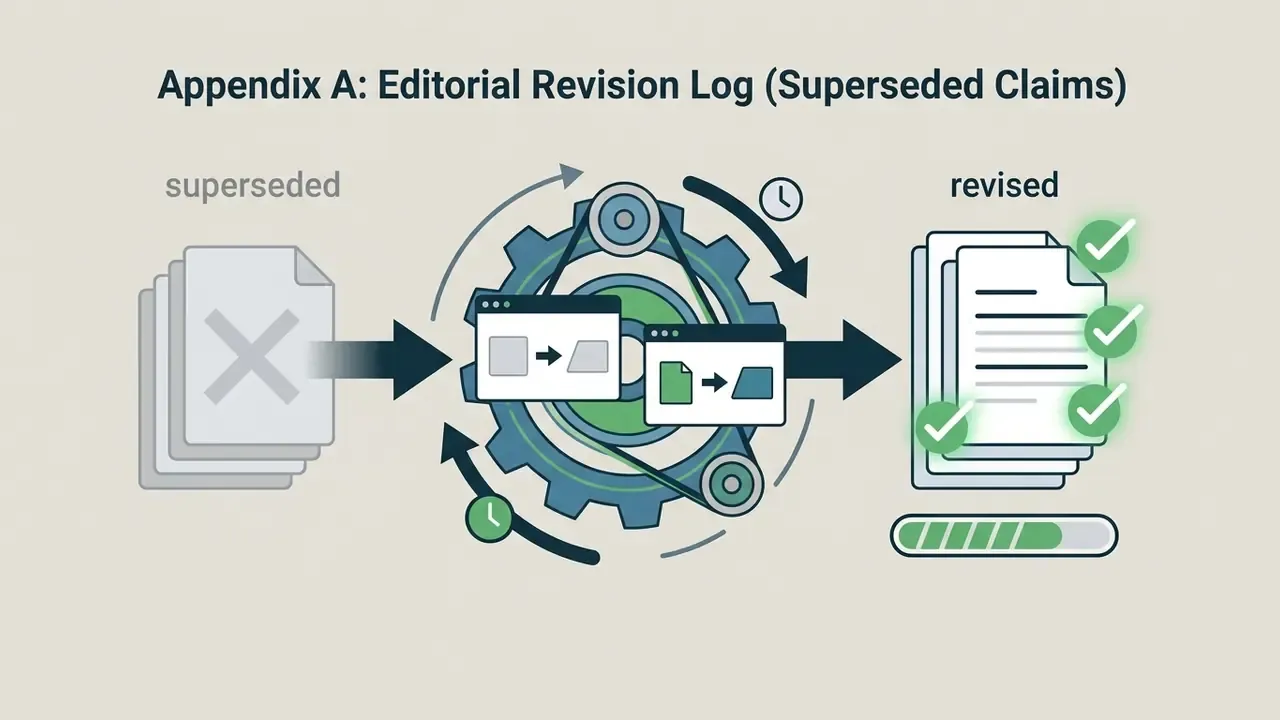
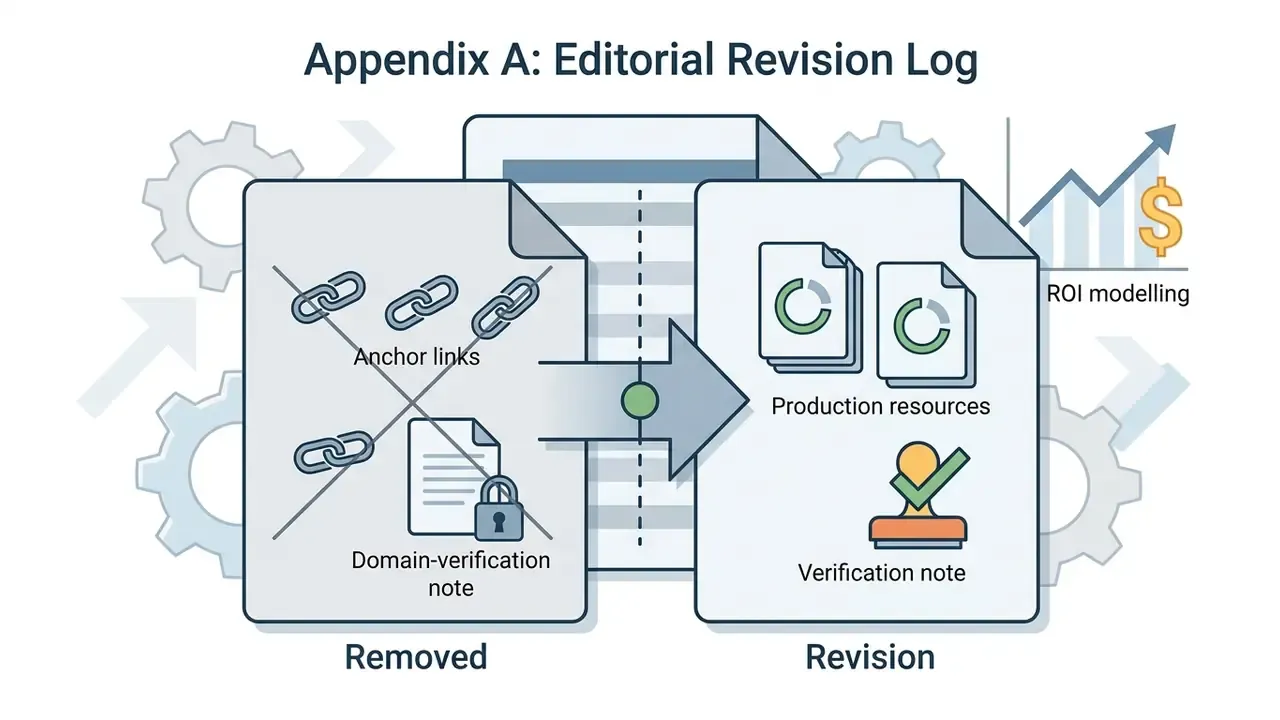
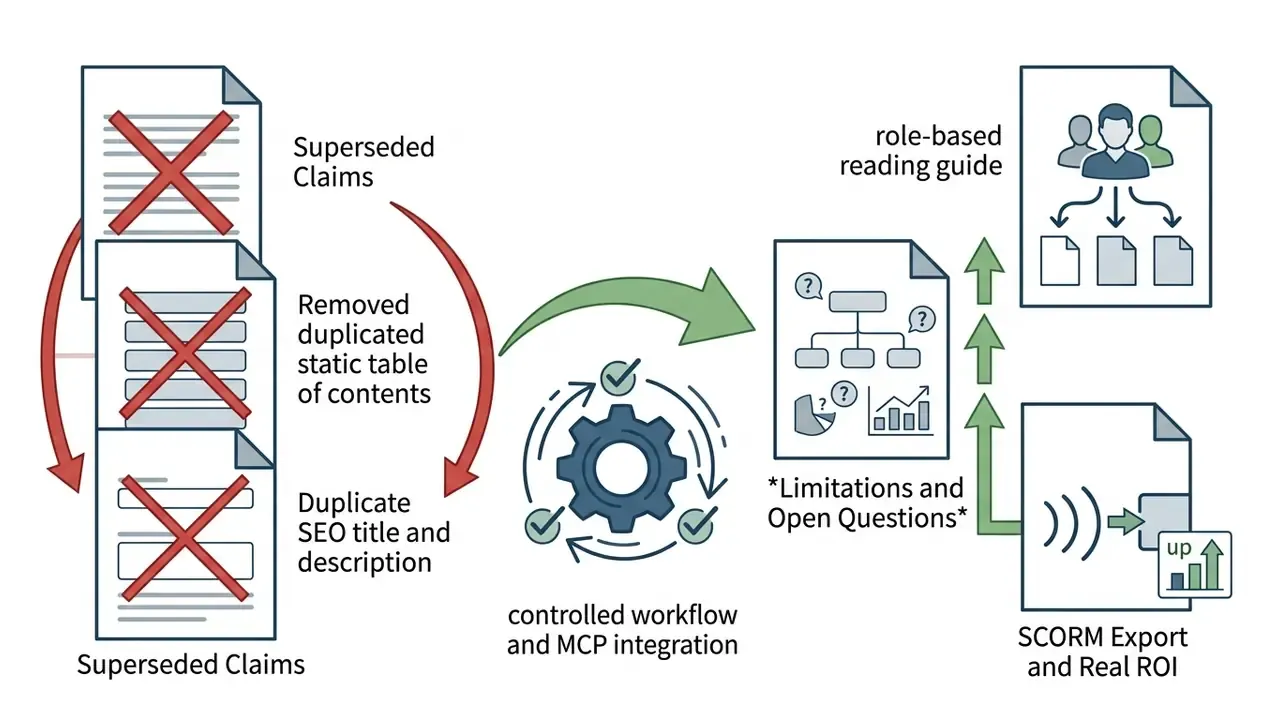
Appendix A: Editorial Revision Log (Superseded Claims)
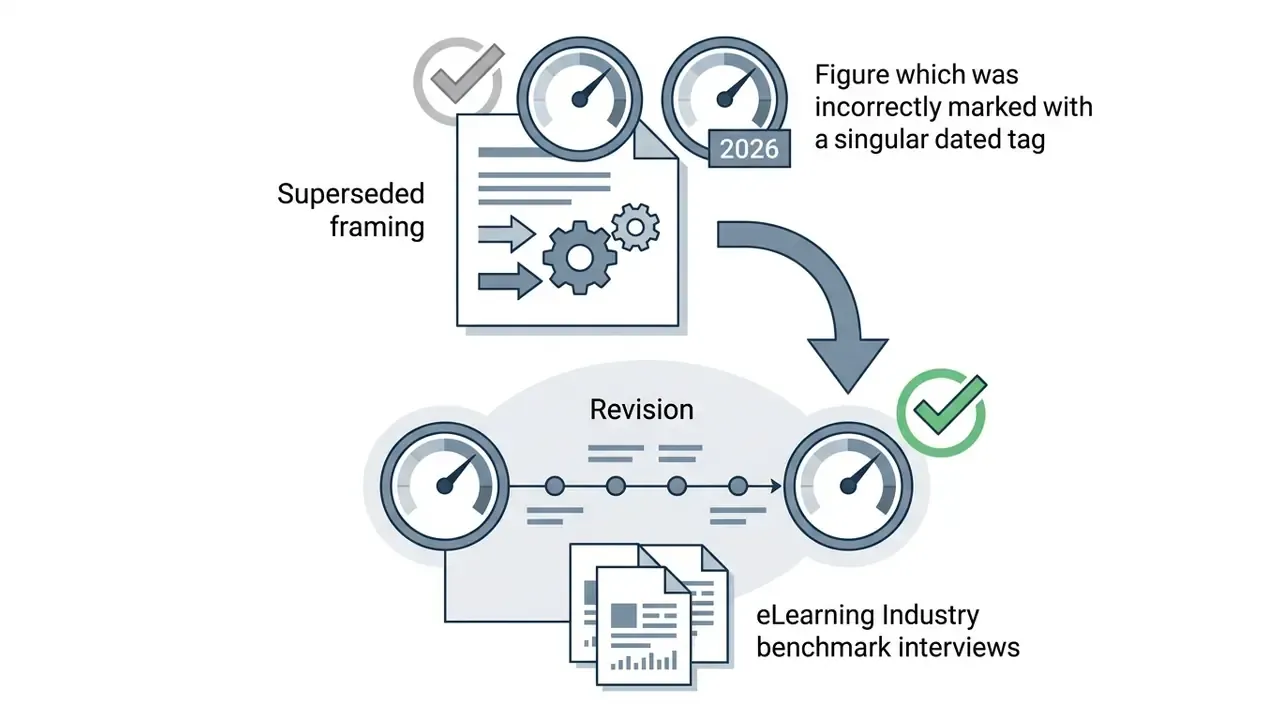
For transparency, the following statements appeared in earlier drafts of this guide and have been revised. Original wording is preserved here; the main text carries the corrected version.

Editorial Verification and Methodology
This guide was compiled from primary standards documents (NIST SP 1353 IPD, NIST AI 600-1, NIST AI 100-4, 1EdTech AI-Generated Content Best Practices v1.0, cmi5 specification materials, Section 508 authoring-tool requirements, W3C ATAG 2.0), peer-reviewed and preprint research (EuroDL 2024; ARCHED 2025; Puech et al. 2024; Yu et al. 2025; Education and Information Technologies 2025; Frontiers in Education 2025; Harvard Kennedy School Misinformation Review 2025), institutional guidance (UNESCO, TEQSA, WHO validation guidance, Central Bank of the UAE Rulebook, The Association of Banks in Singapore), survey data (University of Phoenix / ExecNetworks 2024; PwC HR Pulse Survey 2024), and current vendor documentation reviewed in early 2026. Vendor figures are labelled as vendor-reported and are not independently audited. Pricing, plan limits, and feature availability change frequently; verify directly with each vendor before procurement.
Governance review context: model-risk framing in sections [3], [9], [20], and [24] follows supervised-use principles described by AI Governance & Model Risk Analyst Marcus Hale in the brief quoted at the top of this guide. Marcus Hale, author.
Last updated: 2026. This article is general information and does not constitute legal, regulatory, financial, or security advice. Regulated institutions should validate any AI authoring tool under their own model-risk management, vendor-management, and data-protection policies before production use.