Last updated: 2026. Reviewed by the editorial team for licensing accuracy, acoustic terminology, and regulatory references.
Executive Summary
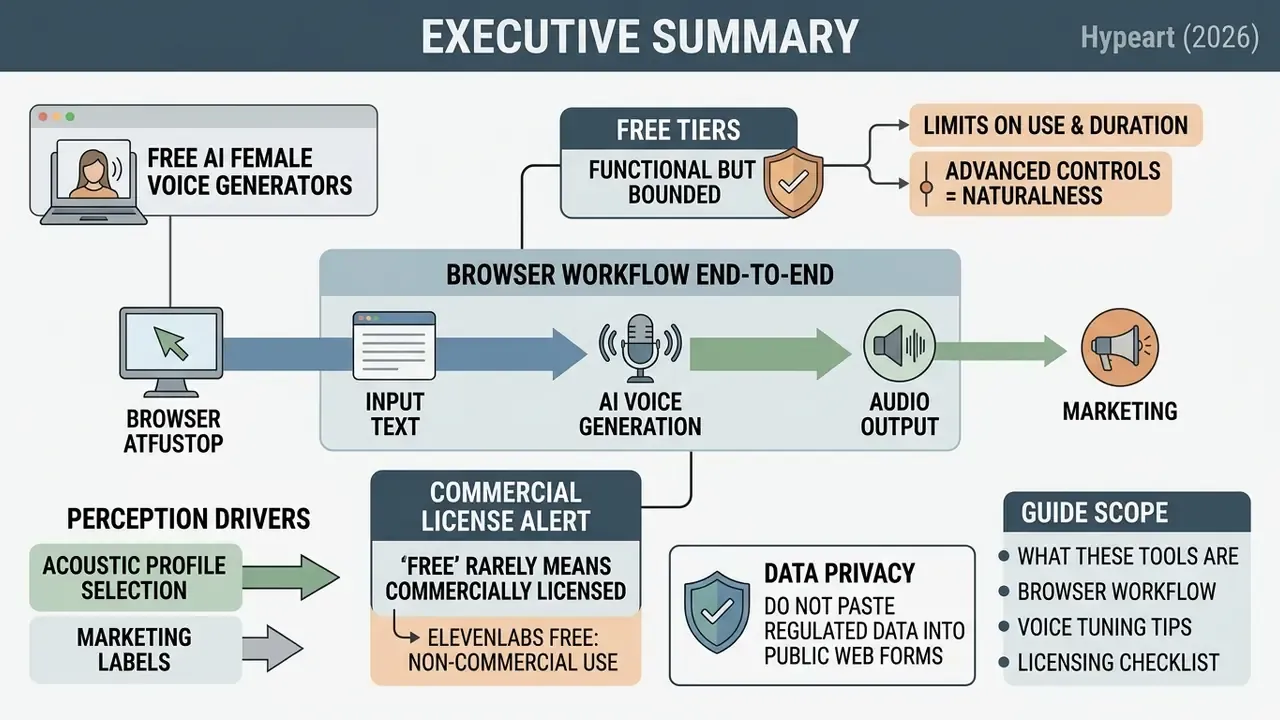
- Free tiers are functional but bounded. Most browser platforms cap output between 1,000 and 15,000 characters per month, restrict exports to 128 kbps MP3, and reserve premium neural voices, 24-bit WAV downloads, and watermark removal for paid plans.
- "Free" rarely means "commercially licensed." ElevenLabs restricts free-tier output to non-commercial use with mandatory attribution. Some smaller vendors advertise unrestricted commercial rights, which reads as marketing copy rather than a durable legal guarantee.
- Acoustic profile selection drives perception, not marketing labels. Adult female voices sit at a fundamental frequency () baseline of roughly 180 to 240 Hz. Stylized "girl voice" presets exceed 260 Hz with narrower formant spacing. A 2018 meta-analysis found that speaking fundamental frequency alone explained 41.6% of the variance in listener gender perception.
- Advanced controls decide naturalness. Temperature, Top P, word-level pitch offsets, SSML pause tags, and eight-state emotion presets matter far more than whichever voice preset loads by default.
- Do not paste regulated data into public web forms. Free browser generators typically operate without a Data Processing Agreement (DPA), which turns any script containing PII, NPI, patient data, or confidential commercial terms into a Shadow AI exposure.
This guide walks through what these tools are, how the browser workflow actually runs end to end, how to pick a voice profile, which controls create natural delivery, what free plans really cost you in rights and quality, how to validate output like a model risk function would, and where synthetic female narration performs best.
What Is a Free AI Female Voice Generator?
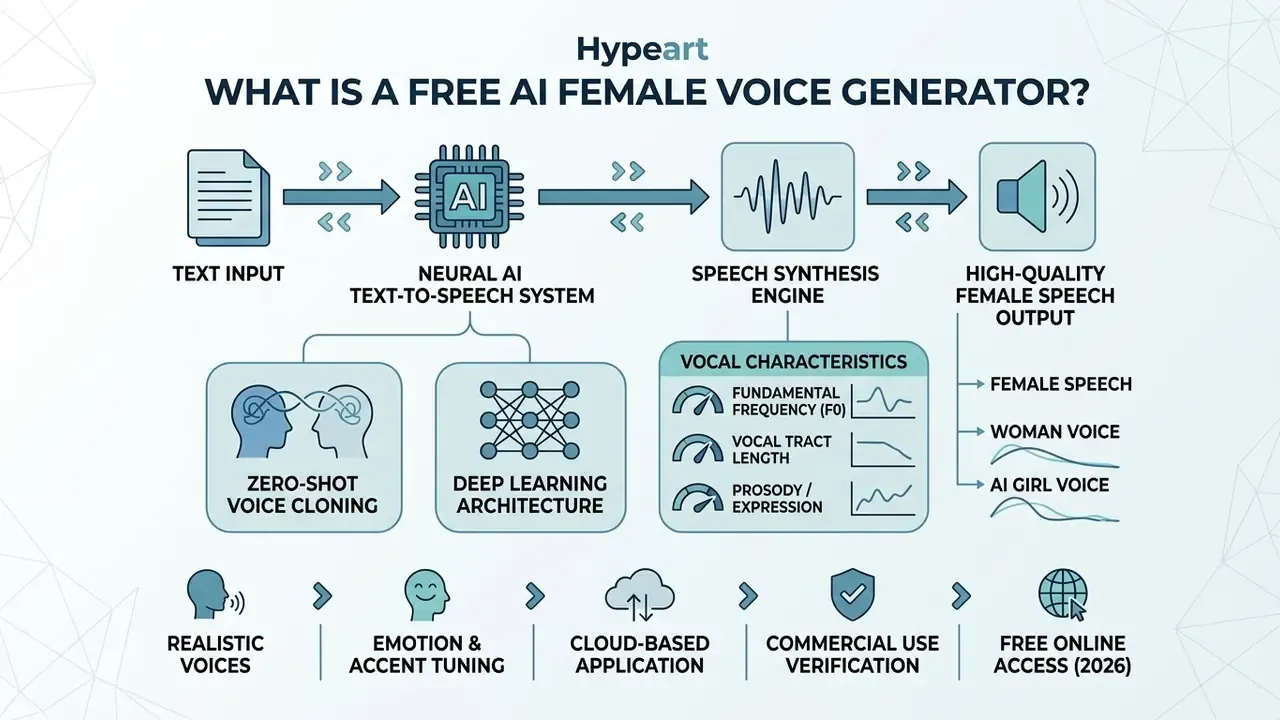
A free AI female voice generator is a cloud-based application that synthesizes human-like female vocal tracks directly from text input. Modern engines rely on deep neural networks trained on large multi-speaker speech corpora rather than stitched-together sound clips. Inside the browser you can test localized accents, emotional delivery, and structural pauses before spending a single credit. Readers comparing the wider tool category can review our reference material on AI voice generators, which covers voice quality, language support, pricing, and commercial licensing.
For organizations evaluating broader speech synthesis suites, you can explore the hub to analyze cross-platform feature sets and operational workflows.
How AI Text to Speech Creates Female Speech
Neural AI text to speech systems transform digital text into acoustic waveforms through a multi-stage deep learning pipeline. The process begins with text normalization and grapheme-to-phoneme conversion, which establish syntactic boundaries and pronunciation guides. A neural acoustic model then predicts prosodic features such as pitch, duration, and stress, conditioned on learned female speaker embeddings.
«Speech synthesis progressed from formant and concatenative methods to end-to-end neural architectures using neural vocoders and diffusion models.»
Recent research on end-to-end speech architectures shows how deep models map text to expressive acoustic features (Do, Nguyen, & Nguyen, 2026, Discover Artificial Intelligence). Finally, a neural vocoder synthesizes the time-domain waveform, rendering realistic speech tuned to a specific vocal register. Content producers frequently pair these speech generators with an ai sound generator to build the background soundscape around the narration.
Zero-shot voice cloning has become a standard companion capability in 2026 platforms. Current vendor documentation describes cloning from 3 to 10 seconds of clean WAV reference audio, with multilingual transfer across roughly a dozen languages and built-in female and male preset voices. Cloning is powerful. It is also the single highest-risk feature from a compliance standpoint, because it can replicate an identifiable person without that person's authorization.
Female Voice, Woman Voice, and AI Girl Voice: What Is the Difference?
Vocal classifications in speech synthesis engines differ mainly by fundamental frequency (), vocal tract formant spacing, and perceived age styling. A standard woman voice profile reflects an adult female acoustic structure, with resonant tone and an baseline between 180 Hz and 240 Hz. An ai girl voice generator preset, by contrast, uses higher baseline frequencies, narrower formant spacing, and altered prosodic contours to simulate youthful or character-based delivery.
The broader category of ai voice generator female covers both mature and stylized acoustic profiles, and most libraries file an ai woman voice generator preset and an ai voice girl generator preset under the same menu.
«Perceived voice age and gender are determined jointly by fundamental frequency and vocal tract resonance characteristics.»
How to Generate a Female AI Voice Online for Free
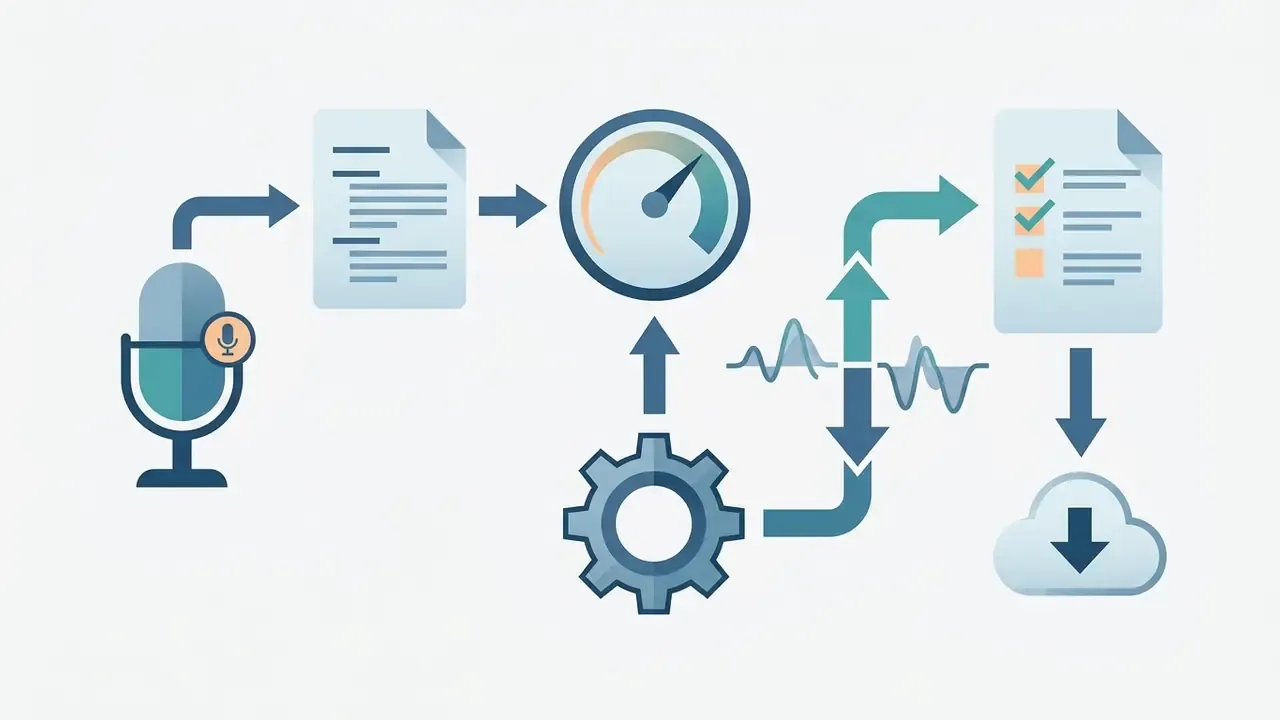
Creating synthetic female voiceovers in a web browser follows a structured, three-step workflow.
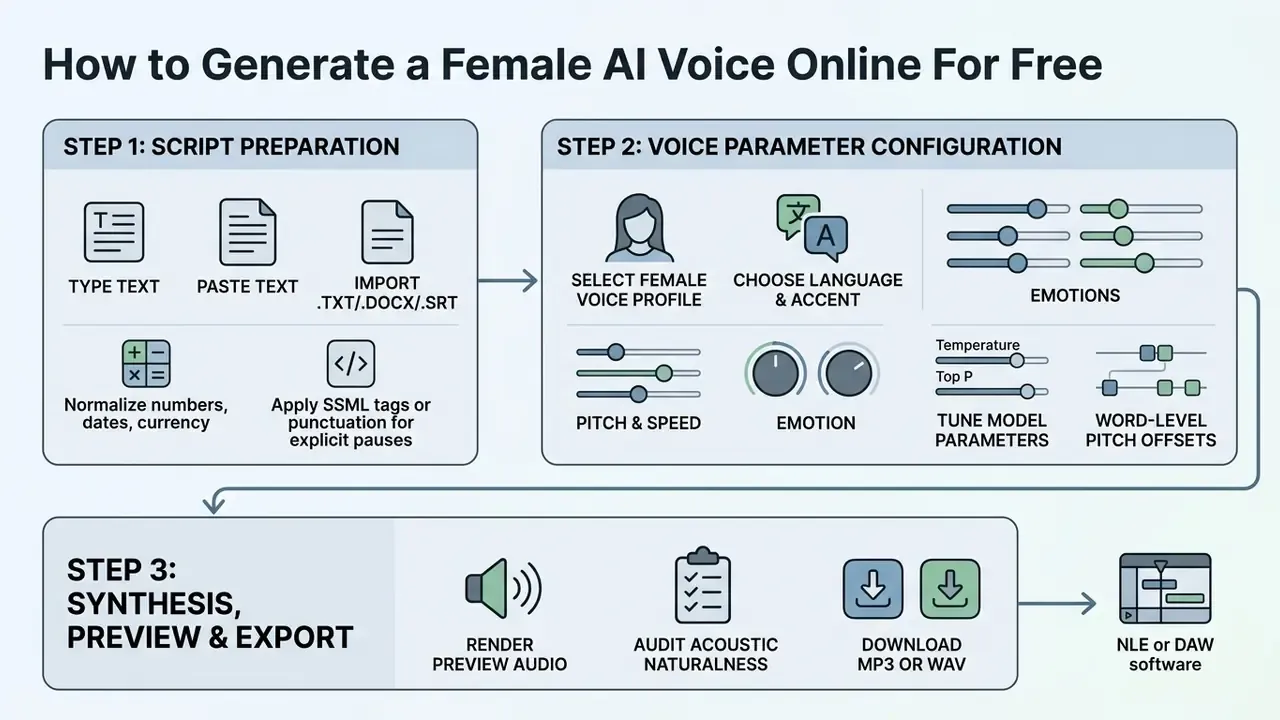
Step 1 prepares the text. Step 2 configures the voice. Step 3 renders, checks, and exports the audio file. An ai female vocal generator online free interface will expose all three stages on a single screen, which is convenient and slightly dangerous: it is easy to hit generate before the script is clean.
Enter or Paste Your Text and Script
Generation starts with clean script text pasted into the platform editor. Correct grammatical punctuation helps the neural model infer sentence breaks and natural breathing cadence, so a well-punctuated draft is doing acoustic work, not just editorial work.
Advanced browser platforms accept direct script ingestion via .txt, .docx, and .srt uploads. When importing subtitle files, the TTS engine strips timecodes automatically while preserving the pause boundaries that match line breaks. That is a practical advantage when you are re-voicing a video that already has a timed caption file. For commercial scripts containing numbers, currency symbols such as "$150.50", or technical acronyms, check that the normalization parser expands each target into a phoneme-ready string ("one hundred fifty dollars and fifty cents") to prevent pronunciation artifacts.
Pronunciation normalization checklist for difficult entities:
| Input Type | Raw Text Example | Risk if Unnormalized | Recommended Handling |
|---|---|---|---|
| Currency | $150.50 | "dollar one fifty point five zero" | Expand manually: "one hundred fifty dollars and fifty cents" |
| Dates | 03/04/2026 | Locale ambiguity (US vs EU order) | Write out: "March fourth, twenty twenty-six" |
| Cardinals / ordinals | 1,204 / 3rd | Digit-by-digit read-out | "one thousand two hundred four", "third" |
| Phone numbers | +1 415 555 0199 | Grouped as a single large number | Insert spacing or SSML say-as digits |
| Acronyms & brands | SQL, AIOps, NVIDIA | Spelled letter-by-letter or mispronounced | Use phonetic respelling or SSML <phoneme> |
| Units | 12 kWh | "twelve kwh" | "twelve kilowatt hours" |
Advanced platforms support Speech Synthesis Markup Language standards such as W3C SSML 1.1, which let authors insert explicit phonetic breaks and stress markers (W3C SSML 1.1 Recommendation). The EPUB 3 Text-to-Speech Enhancements 1.0 specification goes further: TTS-capable reading systems must support pronunciation attributes such as ssml:ph and ssml:alphabet, and must ignore empty values. A useful signal, that. Phoneme-level markup is now an interoperable standard rather than a single vendor's extension. Standardizing text preparation reduces acoustic anomalies at synthesis time.
Choose a Female Voice, Language, and Emotion
After the script is in, you pick the vocal persona from the platform library. Anyone filtering for an ai female voice generator online free option can compare profiles side by side, from corporate narrators to specialized character voices.
Selecting an emotional preset such as professional, empathetic, or enthusiastic adjusts the model's underlying activation parameters rather than just applying a filter.
«EmoSteer-TTS applies activation vectors for continuous emotional tone control and outperforms baseline methods in emotion control accuracy.»
Research on fine-grained emotion control shows that neural activation steering permits real-time modulation of emotional intensity without breaking speaker identity (EmoSteer-TTS, 2025).
Advanced model parameters. Professional-grade browser interfaces now expose the same sampling controls used in text generation models:
- Temperature (0.0 to 1.0): Controls vocal randomness. Lower values (0.2 to 0.4) deliver deterministic, stable speech, ideal for corporate IVR prompts and repeated announcement lines. Higher values (0.7 to 0.9) introduce intonation shifts suited to imaginary characters and dramatic narration. A common vendor default sits near 0.9, which favors expressiveness over repeatability.
- Top P (nucleus sampling): Filters the phonetic token pool. Around 0.9, it preserves natural acoustic variance while cutting off low-probability pitch anomalies that produce robotic or glitching syllables.
- Speed and pitch offsets: Speed multipliers typically range from 0.1x to 3.0x, with 1.0x as default. Pitch is expressed as a semitone or percentage offset from the speaker baseline. Expressive neural voices often accept only percentage-based
rateandpitchvalues in SSML rather than absolute Hz figures. - Word-level granular control: Instead of applying pitch changes globally, highlight individual words in the editor to shift local offset (roughly plus or minus 50 Hz) or insert precise delays such as
Generate, Preview, and Download Audio
Clicking generate starts neural synthesis and renders the text into audio within seconds. Platforms provide an inline player for immediate quality checks. Auditing that preview before a full render conserves generation quota on freemium plans, which matters more than it sounds when the monthly cap is 1,000 characters.
Once satisfied, download the track as compressed MP3 or uncompressed WAV. Documented export specifications for speech APIs place MP3 bitrates between 32 kbps and 320 kbps. WAV is uncompressed and therefore carries no bitrate parameter; supported WAV sample rates commonly span 8 kHz to 48 kHz. Free tiers usually lock output near 128 kbps MP3 at 16 kHz, which is acceptable for internal drafts and audibly thin next to a music bed.
Post-production workflow integration. Exported 24-bit 48 kHz WAV files drag straight into non-linear editors such as Adobe Premiere Pro, After Effects, Final Cut Pro, and DaVinci Resolve, and into DAWs such as Audition or Reaper. When aligning synthetic dialogue to a visual timeline, use dynamic processing to seat the vocal properly: a gentle high-pass filter below 80 Hz removes low-frequency rumble, a subtle parametric dip near 3 kHz reduces synthetic harshness, and light compression with sidechain ducking on the music bed keeps narration intelligible. Preview the mix on studio monitors and on a phone speaker, since consumer playback exposes clipping artifacts that good headphones politely hide.
To compare hardware and system resource calculations for media workflows, check our AI Media Calculators.
How to Choose the Right Female AI Voice
Selecting a vocal profile means matching acoustic attributes such as tone, pitch, and accent to the intent of the project. Get that alignment right and listener engagement improves while vocal fatigue drops.
| Voice Profile Category | Pitch () & Timbre Profile | Prosody & Emotion Control | Recommended Language / Accent | Primary Target Applications |
|---|---|---|---|---|
| Adult Female Narrator | Moderate pitch (190 to 220 Hz), warm timbre | Balanced prosody, subtle emotional adjustments | General American, British RP | Corporate explainers, documentary narration, e-learning |
| Happy Female Instructor | Mid-high pitch (210 to 240 Hz), bright resonance | Energetic, highly expressive intonation | Neutral regional accents | Educational modules, dynamic tutorials, onboarding |
| Youthful Female Voice | Higher pitch (230 to 260 Hz), lively dynamics | High prosodic variation, punchy delivery | Regional or modern colloquial | Social media short-form ads, product promo videos |
| Character / Girl Voice | Very high pitch (above 260 Hz), light vocal mass | Stylized inflection, exaggerated pauses | Specialized or accent-neutral | Games, animated content, storytelling characters |
| Soft Female Voice | Lower volume, relaxed , breathy quality | Smooth cadence, suppressed dynamic peaks | Clear standard accents | Guided meditation, quiet audiobooks, relaxation apps |
| Authoritative Female Announcer | Lower-mid pitch (180 to 200 Hz), dense resonance | Controlled dynamics, deliberate terminal falls | Standard US / UK, low regional marking | IVR menus, PSAs, safety and compliance briefings |
Read the table as a shortlist, not a rulebook. Narration and e-learning reward the mature, moderate-pitch profiles in the first two rows. Short-form marketing tolerates, and often needs, the brighter youthful register. Anything safety-related belongs with the authoritative announcer.
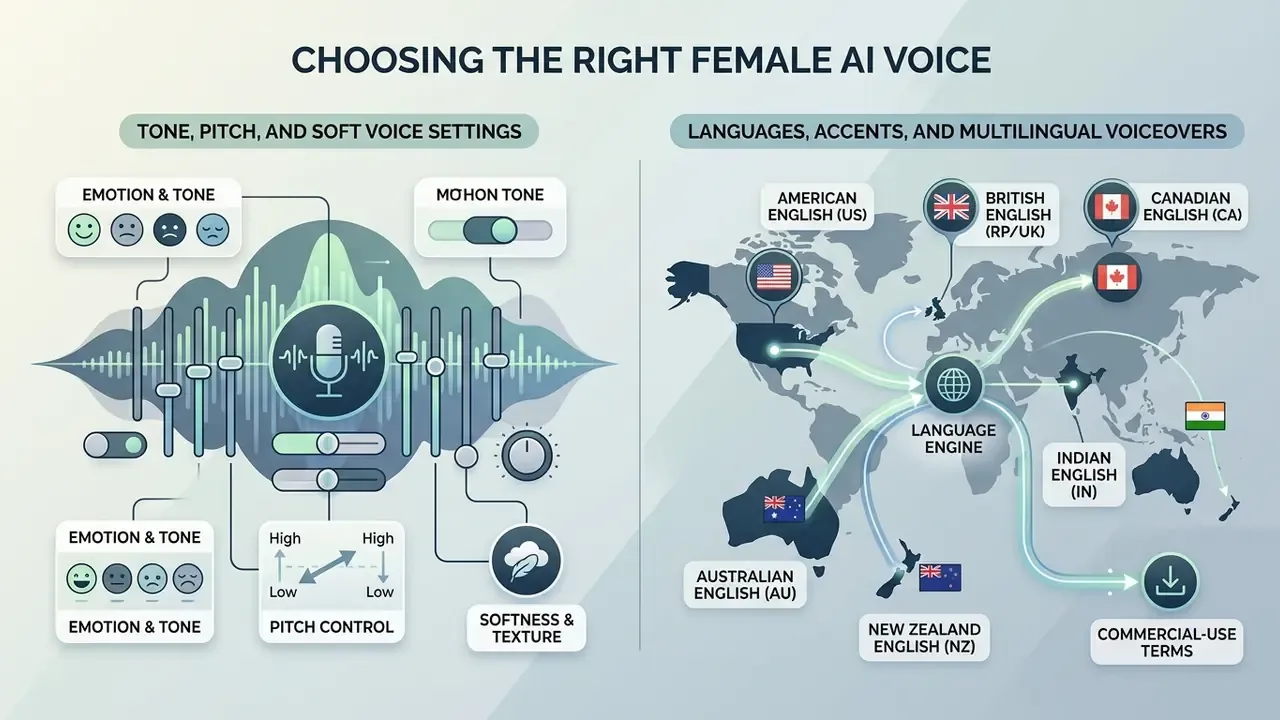
Tone, Pitch, and Soft Voice Settings
Acoustic customization lets creators tune delivery to a specific narrative need. Adjusting pitch shifts the base fundamental frequency, which changes perceived authority or warmth. An ai voice generator female soft voice configuration introduces breathier quality and smoother cadence, well suited to intimate storytelling or meditation tracks.
«A happy computer voice increases perceived engagement and listeners' own reported happiness, especially with female voices.»
Empirical evaluation indicates that emotional tone and voice quality strongly shape perceived warmth, engagement, and attractiveness (Zhao & Mayer, 2023). Voice-attractiveness research adds one specific acoustic detail: breathy voice quality was the strongest single cue, and the most favorably rated female voice was described as breathy at a high but not extreme pitch. A parallel 2023 morphing study found that when emotion was carried by alone, or by timbre alone, listeners judged the result less natural than an unmodified voice. In practice, then, extreme pitch adjustments and artificial voice morphing degrade naturalness. Move pitch and timbre together, in small increments.
Languages, Accents, and Multilingual Voiceovers
Modern speech engines offer multilingual synthesis and accent switching for global content. A single female ai voice generator free tool can deliver the same script in English, Spanish, German, or Mandarin while holding persona characteristics steady. Firefly-class platforms cover 20 or more languages, and partner multilingual models extend that to 30 or more locales including Japanese, Korean, Portuguese for Brazil and Portugal, Arabic, Turkish, and Ukrainian.
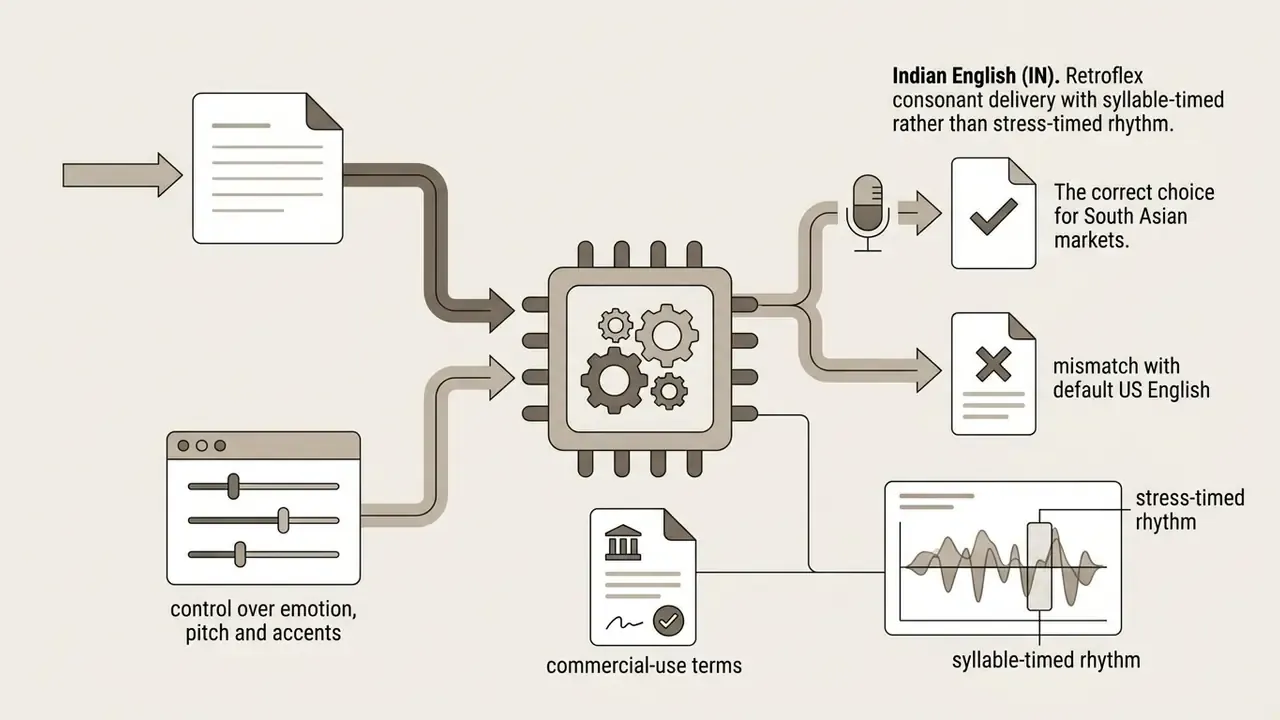
When generating English female voiceovers, picking the right regional profile prevents cultural dissonance:
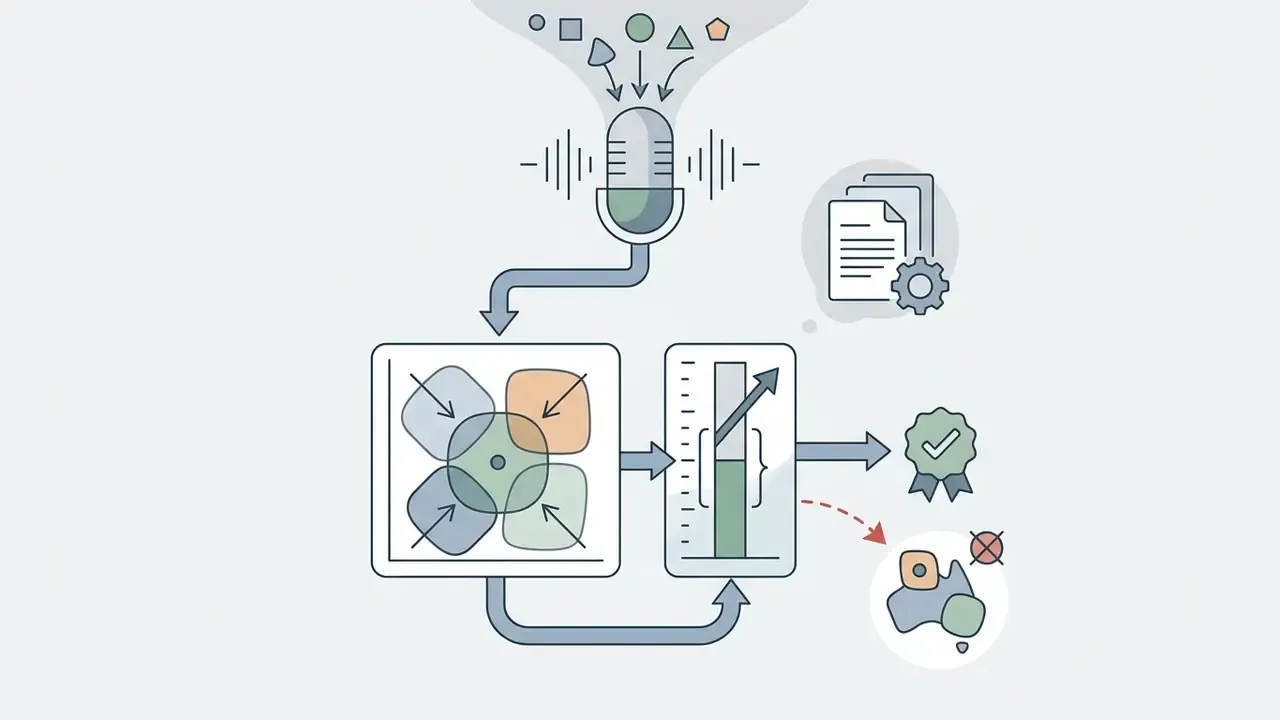
Cross-accent naturalness, however, varies by model.
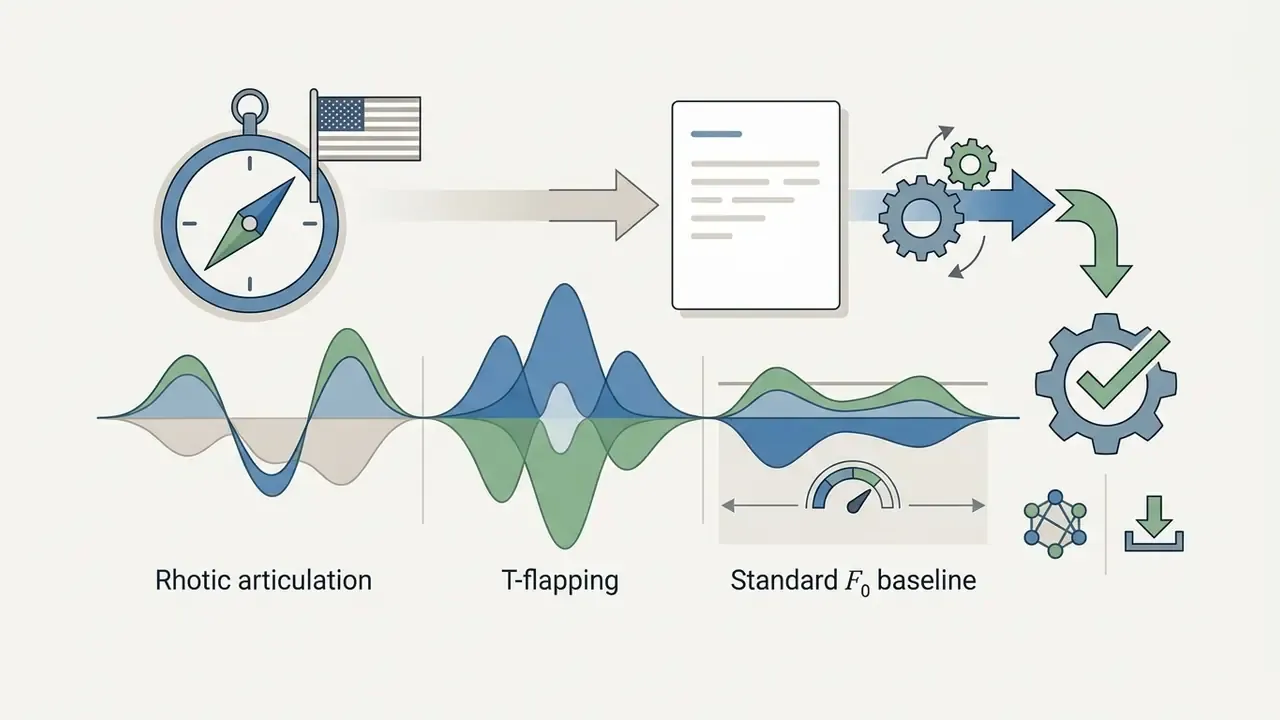
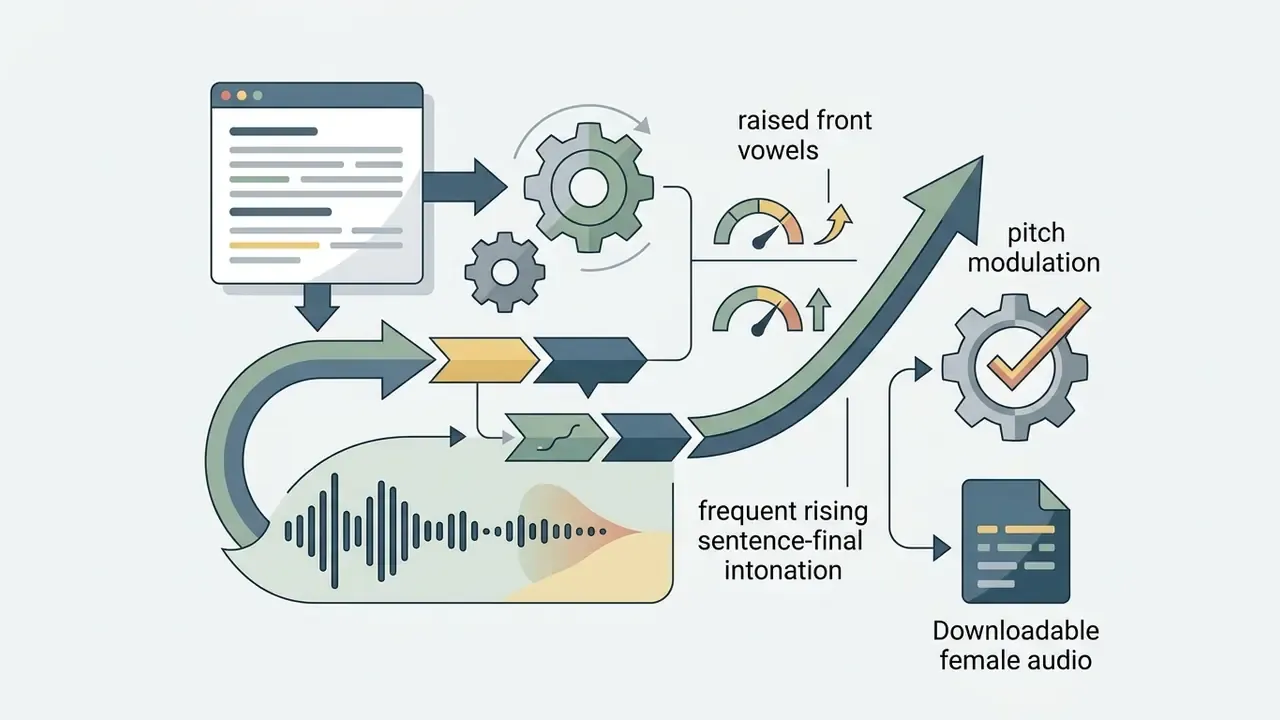
«A corpus of 4,000 samples from 24 systems across 10 English accents showed substantial differences in naturalness and accent-similarity ratings between systems.»
Benchmark studies on multi-accent speech codecs show that synthesis quality fluctuates with training corpus density across non-standard regional accents (CodecMOS-Accent Benchmark, 2026). Research models trained with explicit accent conditioning demonstrate control across General American, British Received Pronunciation, Scottish, and General Australian lexicons, which confirms that accent is an addressable parameter and not a fixed property of the voice. Teams building localized asset libraries can align audio deliverables with their visual pipeline using AI video generators, and can use an ai spreadsheet generator to keep localized voiceover schedules in order.
Voice Styles for Narration, Characters, and Professional Content
Delivery requirements shift sharply between media formats. Professional narration needs consistent pacing, clean articulation, and restrained emotional variance so comprehension holds across long stretches. Character voiceover depends on distinct acoustic markers, dramatic pitch shifts, and stylized cadence that separate dialogue roles.
Advertising is a third and separate register. A 2023 Frontiers study of audio advertising found that likable female performances correlated with lower pitch, faster articulation rate, lower loudness, fewer abrupt loudness changes, and breathier voice quality. The same study found that synthesized advertising styles split cleanly into "calm" and "energetic" rather than into male and female. Artistic reading sits closer to controlled literary delivery, where rhythm, breath placement, and internal pacing matter more than raw expressiveness.
For creators syncing synthetic dialogue with animated or generated footage, our overview of text-to-video AI tools explains how audio and visual pipelines connect, and an ai sprite generator helps align character design with the voice you chose.
Controls That Make Female AI Voices Sound Natural
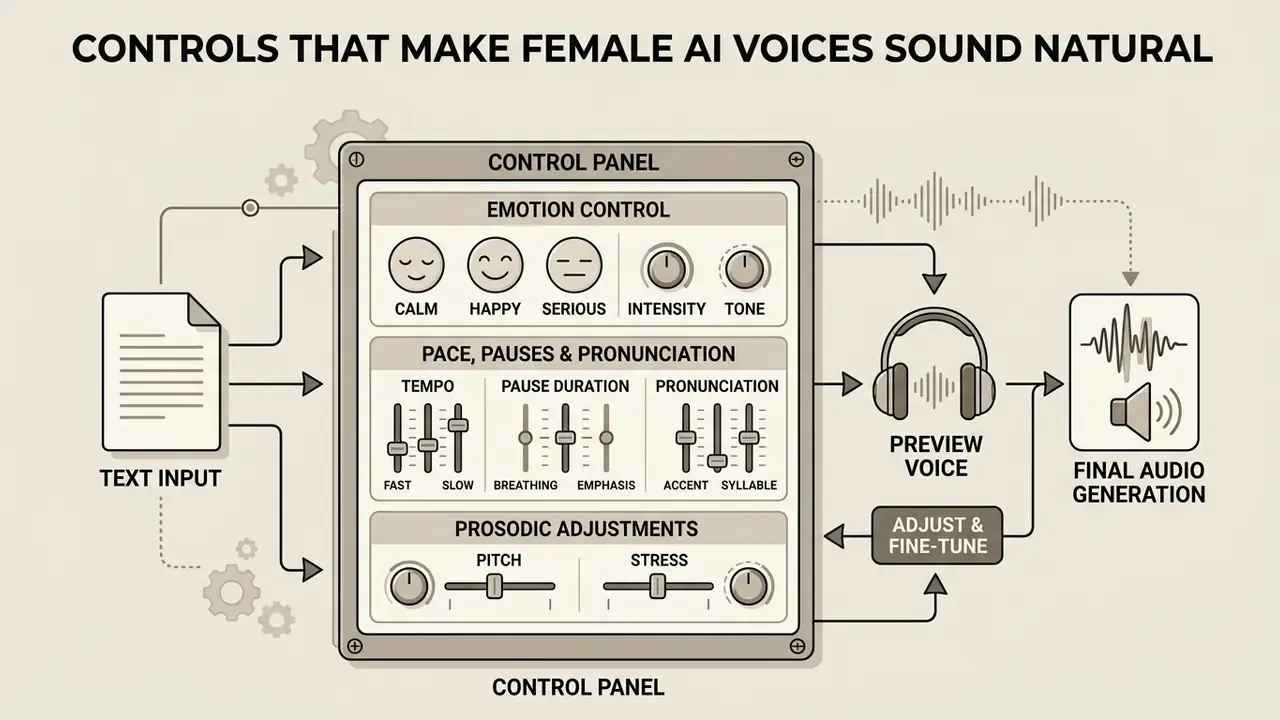
Human-like delivery comes from precise prosodic adjustments, not from trusting the engine's defaults.
Emotion Control for Human-Like Delivery
Emotion steering lets synthetic voices carry believable affect.
«Neuron-level emotion control changes affective intensity without retraining, preserving content and speaker identity.»
Neural audio models use specialized latent representations to modify emotional intensity on the fly (Neuron-Level Emotion Control, 2026). Contemporary interfaces expose eight base states, plus an automatic mode that infers emotion from the script. The table below maps each preset to the acoustic behavior you should expect, so you can verify that the engine is genuinely applying the label rather than renaming a filter:
| Emotion Preset | Baseline Shift | Speaking Rate Multiplier | Dynamic Range / Intensity | Recommended Use Case |
|---|---|---|---|---|
| Neutral | 0 Hz (standard near 200 Hz) | 1.0x (about 140 WPM) | Moderate, flat contour | Technical documentation, news reading, compliance copy |
| Cheerful / Happy | +20 Hz to +40 Hz | 1.1x (about 155 WPM) | High dynamic peaks | Promotional social ads, tutorials, onboarding |
| Calm / Soft | −10 Hz to −20 Hz | 0.9x (about 125 WPM) | Low volume, high breathiness | Guided meditation, sleep stories, ASMR |
| Angry / Intense | +30 Hz with sharp attack | 1.15x (about 160 WPM) | High compression, sudden stress | Video game dialogue, dramatic audiobooks |
| Sad / Somber | −25 Hz | 0.8x (about 110 WPM) | Suppressed peaks, long pauses | Dramatic storytelling, somber documentaries |
| Fearful | Variable jitter (+15 Hz) | 1.2x (about 170 WPM) | Irregular prosodic contours | Horror audio drama, high-stakes narration |
| Surprised | Sudden spike (+50 Hz) | 1.05x (about 145 WPM) | Wide pitch excursion on final syllable | Reaction videos, promotional hooks |
| Disgusted | Low baseline (−15 Hz) | 0.85x (about 120 WPM) | Vocal fry on terminal phonemes | Character dialogue, comedic commentary |
Applied deliberately, presets such as warmth for customer support or excitement for a promo hook prevent flat, monochrome delivery. A 900-participant 2026 experiment on voice-assistant emotion found that expressive, positively valenced voices produced stronger emotional response, higher perceived human-likeness, and higher trust, while negatively valenced voices had weaker effects. That is a reasonable argument for defaulting to Cheerful or Calm in service contexts and reserving Angry, Fearful, and Disgusted for narrative work. One more caveat: emotion support is often language-scoped. Some commercial APIs enable emotion parameters only for specific locales and voices, so validate the preset in your target language before production.
Creators can review AI Media Comparison Matrices to see how different audio synthesis tools handle emotion parameters.
Pace, Pauses, and Pronunciation in Voiceovers
Speech rate and pause management govern comprehension more than voice choice does. Standard narration performs best between 130 and 150 words per minute. General presentation guidance cites roughly 120 words per minute as a comfortable baseline, and speech-training material recommends placing longer pauses at grammatical boundaries to slow a rushed read. Inserting punctuation breaks or explicit pause tags gives listeners time to process dense information. Place the pause before the key number or the punchline, not after it, and mark speech chunks with a combination of short pauses, reduced rate, and stress on the final key word in each chunk.
Correcting phonetic mispronunciation of technical terms or brand names requires custom phonetic spellings. There is no universal rule for brand names, so each one has to be auditioned and overridden case by case. For project pricing estimates across media tools, see our current pricing documentation.
Previewing Voices Before Final Audio Generation
Preview features let you audit stress patterns, intonation curves, and clarity before committing credits. The workflow mirrors professional audio practice. In Adobe Audition, the documented sequence is to click Preview, adjust settings while watching the Levels panel, compare processed against original audio, and only then Apply. That pattern prevents wasted full renders.
Previewing shorter blocks surfaces mispronunciations early and protects quota. On a 1,000-character free tier, one misread acronym discovered after a full render can eat a meaningful share of the monthly allowance. Teams building music-driven projects can test an ai song generator or an ai song maker free tool to harmonize synthetic voiceovers with backing tracks.
Is a Free AI Female Voice Generator Really Free?
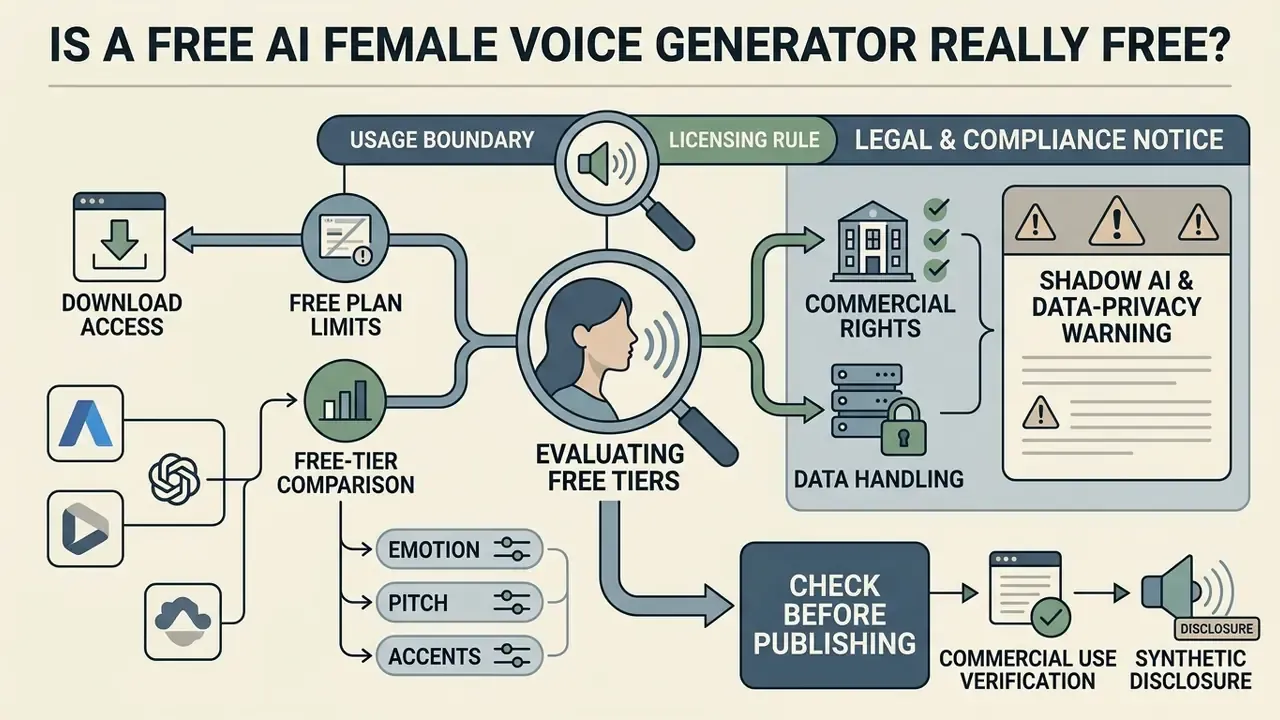
Evaluating free tiers means reading two things at once: the usage boundary and the licensing rule. They are not the same, and the second one is where teams get hurt.
Free Plan Limits and Download Access
Freemium voice platforms impose usage restrictions to control infrastructure cost. Common limits on free tiers include:
- Character caps: monthly allocations of roughly 1,000 to 15,000 characters, sometimes split into a smaller daily quota.
- Export quality: audio capped at standard MP3 bitrates such as 128 kbps and sample rates near 16 kHz, rather than uncompressed 24-bit 48 kHz WAV.
- Voice access: premium neural voices reserved for paid subscribers, with free users limited to trial voice sets.
- Watermarking: audible tags, mandatory attribution, or restricted download availability.
- Model access: advanced or partner models, and their extended language coverage, gated behind paid tiers.
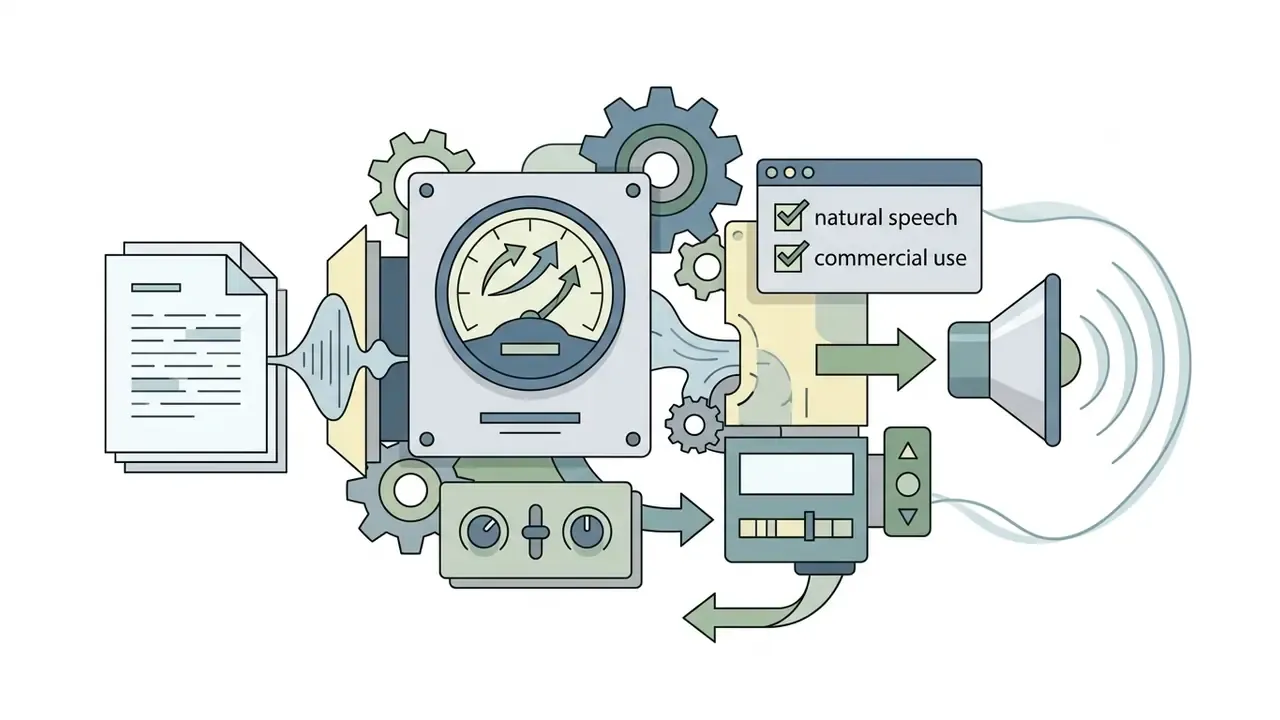
An ai voice generator female voice free online plan is therefore best treated as an evaluation environment. Draft there, then decide whether the output justifies a paid tier for production.
Free-Tier Comparison Across Popular Platforms
The matrix below summarizes publicly documented free-tier conditions as of 2026. Terms change often, so verify the current agreement before production use.
| Platform | Free-Tier Volume Limit | Commercial Rights on Free Tier | Attribution / Watermark | Export Quality (Free) |
|---|---|---|---|---|
| ElevenLabs | about 10,000 characters/month | No, non-commercial only; commercial use requires a paid plan | Attribution to "elevenlabs.io" required when sharing | MP3, standard bitrate; user retains rights to Output |
| Adobe Firefly (Speech) | Free daily generation allowance with an Adobe account | Yes for Firefly Speech models; partner-model output is the user's responsibility to clear | No forced attribution stated for Firefly models | WAV export; imports into Premiere Pro / After Effects |
| Narakeet | about 20 conversions without registration | No, commercial usage rights require a paid account | Capacity-limited free access | Standard export; higher limits on paid plans |
| FreeTTS | 15,000 characters/month, 5,000/day | Restricted; watermarked output | Watermark on free MP3 downloads | Watermarked MP3 |
| SpeechGen | 1,000 characters instantly; 3,000/day for 7 days after free registration | Restricted on free usage | Limited free access | MP3 / WAV, capped quality |
| Typecast | Trial voices only | Restricted | Trial-voice limitation | Standard quality (16 kHz) |
| Descript | Limited free exports | Restricted | Watermarked exports | MP3 at 128 kbps; premium voices locked |
| Azure Speech (F0) | Free evaluation tier | Ambiguous. Microsoft pricing pages describe F0 as evaluation and testing, while product terms are read as not restricting output rights | None | Configurable, but paid tier recommended for production |
| aidubbing.io | about 500 characters per generation, no sign-up | Advertised as unrestricted commercial use | None stated | Standard export |
Two cautions on this table. First, where documentation conflicts, as with Azure's F0 tier, treat the more restrictive reading as your operating assumption until you hold written confirmation. Second, a vendor saying "yes, use it commercially" resolves only the platform contract. It does not resolve personality-rights or publicity-rights exposure if the underlying voice resembles an identifiable person.
Commercial Use of Generated Female Voices
Whether generated audio can appear in a monetized project depends on the vendor contract. ElevenLabs states that free-tier output is restricted to personal use and requires platform attribution, while paid subscriptions grant ownership of commercial output (ElevenLabs Terms of Service). Play.ht's terms, by contrast, grant use for "personal or commercial use" while the user retains ownership of submitted content.
Platforms embedded in larger creative suites sometimes offer broader rights. Adobe states that female AI voices generated with Firefly Speech models are safe for commercial use across audiobooks, podcasts, digital ads, and YouTube videos, while placing responsibility for partner-model output on the user. Guidance from the U.S. Copyright Office adds a separate point: purely AI-generated output is not copyrightable absent human authorship, and AI-generated portions must be identified and disclaimed at registration. So "cleared for commercial use" and "protectable as your own work" are two different questions, and mixing them up is a common planning error.
For a broader view of how licensing terms differ across generative media categories, see our analysis of commercial use rights for AI-generated media. To review legal precedent on AI media, see the overview of frameworks and copyright rulings.
What to Check Before Publishing AI Voiceovers
Before a synthetic voice track goes into a public campaign, run a verification pass:
- Licensing rights: confirm the tier grants explicit commercial distribution rights, and archive a dated copy of the terms you relied on.
- Voice identity consent: ensure the profile does not replicate a real individual's voice without documented authorization (No AI FRAUD Act, H.R. 6943).
«The No AI FRAUD Act sets a minimum of $5,000 in damages for unauthorized publication of a voice digital replica and $50,000 for distributing a cloning service.»
- Synthetic disclosure: verify compliance with regional disclosure rules such as EU AI Act Article 50(4), which requires deployers to disclose artificially generated or manipulated audio.
- Acoustic quality: check for artifacts, distortion, or clipping across playback devices, including phone loudspeakers.
- Data handling: confirm the script carried no PII, NPI, or confidential material, or that generation ran through an endpoint covered by a DPA with defined retention and deletion terms.
- Traceability: retain generation logs, model and version identifiers, parameter settings, and consent records, so the asset can be reconstructed or withdrawn if a rights claim arrives. Public-sector deepfake guidance consistently recommends audit logs, access control, encryption, watermarking, and authenticity verification before release.
For developer options and API integration paths, consult our AI Media API Guides.
Validating Synthetic Voice Quality: Model Risk Perspective
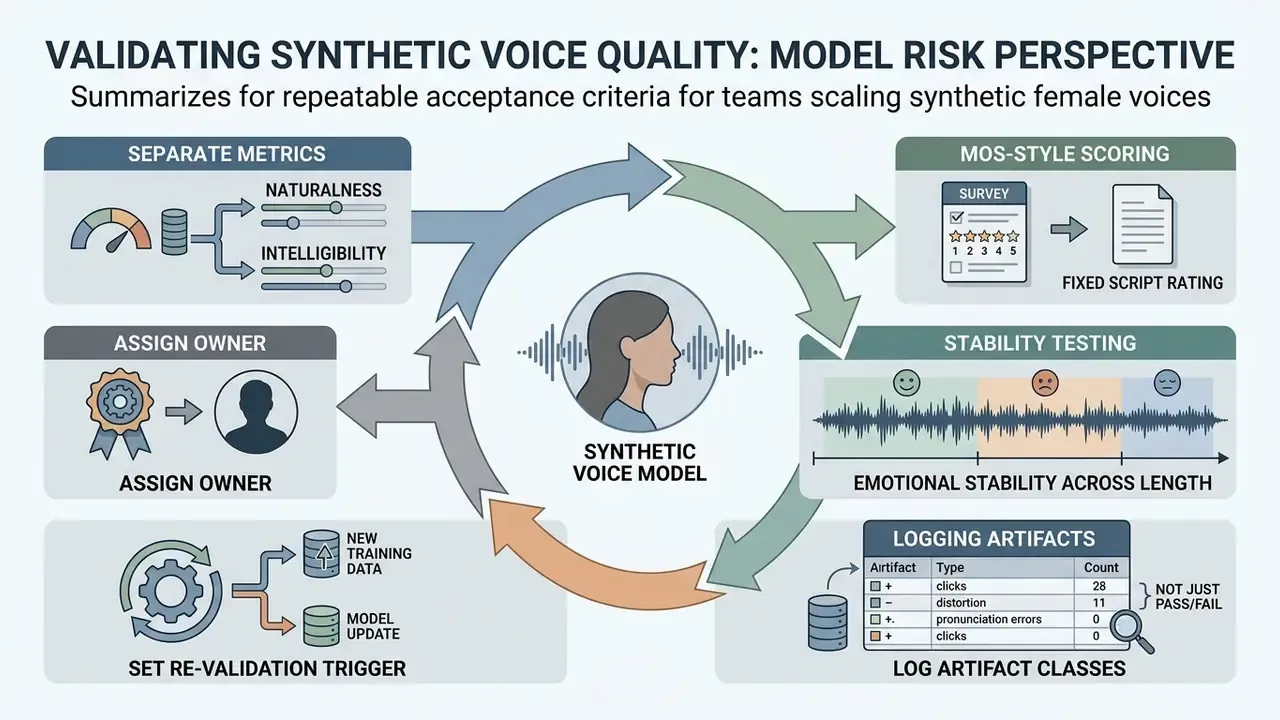
Teams scaling synthetic voice beyond a single video need repeatable acceptance criteria, not subjective listening sessions. A practical validation frame borrows from speech-research methodology:
- Separate naturalness from intelligibility. Naturalness comes from emphasis, intonation, pitch, intensity, and pause placement. Intelligibility measures whether words are correctly understood. A voice can score well on one and badly on the other, so score them independently.
- Use MOS-style scoring on a fixed script. Have three to five reviewers rate a standard 200-word evaluation script on a five-point scale for naturalness, accent similarity, and pronunciation accuracy. Accent-focused benchmarks such as the CodecMOS-Accent corpus show why per-accent scoring is needed: system rankings shift materially across the ten English accents evaluated.
- Test emotional stability across length. Activation-steering approaches like EmoSteer-TTS allow continuous emotion control, yet long scripts can drift in intensity. Check the first, middle, and final paragraphs of a long render for consistent affect before approving a full audiobook or course.
- Log artifact classes, not just pass or fail. Track recurring failure types such as mispronounced acronyms, clipped sibilants, dropped pause boundaries, and unstable pitch on numerals, then route each to a remediation control: phoneme override, SSML break, lower Temperature.
- Set a re-validation trigger. Vendor model updates change acoustic output without notice. Re-run the evaluation script whenever the platform announces a new model version, or whenever a previously approved voice suddenly sounds different in production.
- Assign an owner. Every approved voice profile should have a named accountable owner, a documented approved use, and a defined path for withdrawal. No evidence, no autonomy: that principle applies to a voice asset just as it applies to a model.
Best Uses for Female AI Voice Generation
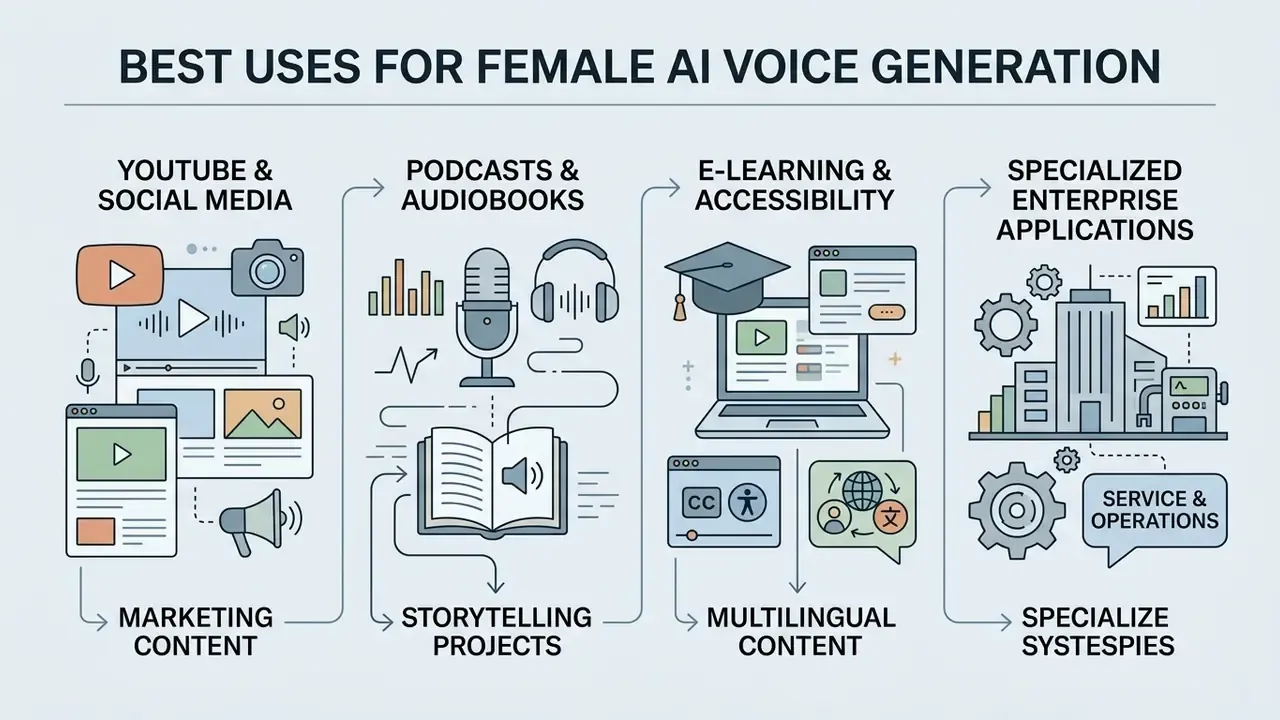
Synthetic female voices cover a wide range of production formats and scale cheaply for both creators and organizations. Where they fit best is a question of register, not capability.
Podcasts, Audiobooks, and Storytelling Projects
Long-form media rewards clear, neutral female narration that stays comfortable across whole chapters.
The 2026 study Who cares about artificial intelligence? Human and artificial voices in audiobook narration reported that listener-rated differences between AI and human voices were minute, and that perceived narrator gender played only a marginal role. Direct speech passages did not interact with voice type, meaning dialogue-heavy fiction did not disadvantage the synthetic voice. Tooling maturity, though, lags model quality. A 2025 review of synthetic narration tools, "Audiobooks and Artificial Intelligence: Tools for Synthetic Narration," found that only 4 of 28 analyzed tools, or 14.3%, were purpose-built for audiobook production. That gap explains why chapter segmentation and multi-voice assignment remain manual steps in most workflows.
Creators producing extended narration can integrate custom voice models to hold narrative continuity across a series. Practical guidance from long-form listening studies: dense nonfiction favors a clear, slightly slower, neutral-accent voice, while fiction rewards warmer and more expressive delivery.
E-Learning, Accessibility, and Multilingual Content
Educational materials and online learning modules use synthetic female voices to deliver instruction at scale, and an ai women voice generator preset library is often the fastest way to keep a course consistent across modules.
«Female students who received a lesson narrated by a "happy" computer voice rated instructor engagement and their own emotional state higher than with a "sad" voice.»
Educational technology studies show that positive, expressive vocal tone raises perceived learner engagement and course satisfaction (Zhao & Mayer, 2023, ETR&D).
Text-to-speech integration also serves as a foundational accessibility tool under WCAG technique G79, which lets visually impaired users access digital text smoothly (W3C WCAG Guidelines). Notably, G79 explicitly permits synthetic speech alongside recorded human speech and advises authors to select the clearest available voice. Comprehension gains reach beyond visual impairment: research on reading support found that text-to-speech significantly improved reading comprehension in children with reading difficulties, outperforming silent reading both with and without synchronized text highlighting (Keelor et al., Annals of Dyslexia, 2023).
For multilingual course delivery, mark foreign-language passages correctly so the engine switches pronunciation rules. That requirement is formalized in W3C technique PDF19 and mirrored in Section 508 guidance on document language properties, reading order, and tagging.
Specialized Enterprise Applications
Beyond creator media, female synthetic voices are standard in operational and public-facing systems:
- Interactive Voice Response and call centers: neutral, warm adult female voices near 200 Hz reduce hold friction and read as organizationally reliable. Keep Temperature low so repeated menu prompts render identically on every regeneration.
- GPS and navigation systems: clear articulation with exaggerated consonant boundary stress survives cabin and road noise. Normalize street names and numerals explicitly, since navigation prompts are the most frequent source of mispronounced entities.
- Healthcare and patient reminders: gentle, low-intensity synthesis delivers reassuring medication and appointment alerts, particularly in elderly-care settings. Route patient-specific scripts only through DPA-covered endpoints.
- Public service announcements: authoritative, calm female voice models maintain trust during emergency instructions. Avoid Fearful or Angry presets, which reduce perceived credibility.
- Virtual assistants: warm, approachable female voices remain the default persona choice, where perceived friendliness affects task completion.
- Animation and games: distinct high-pitch character presets separate roles without booking several actors, and word-level pitch editing lets one embedding cover multiple minor characters. Teams shipping full video pipelines can plan the edit stage with our YouTube video editor workflow guide.
FAQ: AI Female Voice Generation
How can I generate an AI female voice online for free?
Open a browser-based TTS tool, enter or import your script (.txt, .docx, or .srt), select a female voice preset, adjust pitch, speed, and emotion, then click generate to preview and export the file as MP3 or WAV.
Can I use free AI-generated female voices for commercial projects?
Commercial rights depend on the platform's licensing terms. Many free plans restrict audio to personal or non-commercial evaluation and require a paid subscription or explicit license upgrade for monetized YouTube videos, ads, or products. Even where a platform permits commercial use, you still need consent from any real person whose voice the output resembles. Read our detailed breakdown on commercial use rights.
What is the acoustic difference between an AI woman voice and an AI girl voice?
An AI woman voice reflects an adult female acoustic structure, with a baseline fundamental frequency () typically between 180 Hz and 240 Hz and standard vocal tract resonances. An AI girl voice uses higher baseline pitch above 260 Hz, shorter prosodic phrasing, and altered formant spacing to simulate a younger or character-style persona.
What do Temperature and Top P actually change in a voice generator?
Temperature controls how much randomness enters the prosody. Low values of 0.2 to 0.4 produce stable, repeatable reads for IVR and announcements, while 0.7 to 0.9 adds expressive variation for characters. Top P limits the sampling pool of phonetic tokens; around 0.9 it keeps natural variance while suppressing low-probability pitch glitches.
Which file formats can I import into a female voice generator?
Advanced platforms accept plain text (.txt), Word documents (.docx), and subtitle files (.srt). Subtitle imports strip timecodes automatically while preserving line-break pause boundaries, which helps when re-voicing existing video.
How many emotions can I apply to a female AI voice?
Current interfaces commonly expose eight base states: Neutral, Cheerful or Happy, Calm, Angry, Sad, Fearful, Surprised, and Disgusted, plus an automatic mode. Emotion support is often language-scoped, so confirm the preset works in your target locale before production.
Which English accents are available for female AI voices?
Mainstream platforms cover American, British, Canadian, Australian, New Zealand, and Indian English, with more accents available through partner multilingual models. Naturalness varies by accent because training-corpus density differs, so audition each regional profile against your own script.
Is it safe to paste confidential scripts into a free voice generator?
No. Free browser tools generally operate without a Data Processing Agreement and may retain inputs for service improvement. Keep PII, patient data, nonpublic financial figures, and confidential commercial terms out of public web forms, and use an approved enterprise endpoint for regulated content.
Can I use the exported audio in Premiere Pro or DaVinci Resolve?
Yes. Exported WAV and MP3 files drop straight into NLE timelines in Adobe Premiere Pro, After Effects, Final Cut Pro, and DaVinci Resolve. Apply a high-pass filter below 80 Hz and a gentle dip near 3 kHz to seat the vocal over a music bed.
Key Takeaways and Operational Recommendations
- Audit platform licensing confirm whether the free plan grants commercial distribution rights or demands attribution before you publish, and archive the dated terms you relied on.
- Optimize script formatting use standard punctuation, normalized numbers and currency, and SSML pause tags to produce natural breathing cadence instead of robotic phrasing.
- Match timbre to intent pick mature, neutral female narrators for e-learning and corporate explainers, and reserve higher-pitched or energetic profiles for social clips.
- Tune the model, not just the voice lower Temperature for repeatable operational prompts, raise it for character work, and use word-level pitch and break editing to place emphasis precisely.
- Preview before export audit mispronunciations and stress patterns in preview mode to preserve free generation credits.
- Validate at scale score naturalness and intelligibility separately on a fixed evaluation script, log artifact classes, and re-validate whenever the vendor ships a new model version.
- Contain Shadow AI risk keep regulated and confidential scripts out of unapproved consumer tools, and maintain generation logs and consent records for every published asset.
Metadata
TITLE: Free AI Female Voice Generator: Create Realistic Voices Online (2026)
DESCRIPTION: Use an ai female voice generator free online: turn text into natural female speech, tune emotion, pitch and accents, and verify commercial-use terms before you download.