Why should a risk or finance leader care about a music tool? Because the failure modes are the familiar ones: unlicensed third-party content, unlogged model versions, and staff pasting confidential copy into a public endpoint.
Executive Summary
- What it does Lyrics-to-song systems encode written text, align syllables to beats, synthesize a singing voice, and generate matching accompaniment, producing an exportable MP3 or WAV master in 10-60 seconds.
- What you control Genre, sub-genre, BPM, key, vocal gender and timbre, structure tags (
[Verse],[Chorus],[Bridge]), instrumental-only mode, stem separation, and iterative track extension up to roughly 8 minutes. - Where the value is Fast soundtrack turnaround for video, podcasts, games, social media, fitness content, e-learning, film scoring, and advertising jingles, without the stock-library search tax.
- Where the risk is "Royalty-free" is a contractual permission, not copyright ownership; training-data litigation against major music AI vendors is unresolved; and pasting unreleased campaign copy or confidential scripts into a public generator is a Shadow AI data-leakage event, not a creative shortcut.
- The trade-off to manage Generation speed is high and marginal cost is low, but the net return depends on legal review, vendor indemnification, model-risk validation, and data-retention controls. The governance, licensing, and risk-adjusted ROI sections below quantify that trade-off.
One line to remember. Speed is cheap; evidence is not.
What Is an AI Song Generator from Lyrics?
An ai song generator from lyrics processes written text to produce a complete song featuring synchronized singing vocals, harmonic structure, and full instrumental production. Unlike simple text tools that only output rhyming stanzas, a lyric to song generator maps textual timing to musical beats. Systems convert written input into acoustic tokens using specialized neural architectures, then render end-to-end audio files.
Research shows that architectures such as SongCreator use dual-sequence language models to process lyrics alongside accompaniment tokens, with a lyrics encoder extracting pronunciation-related information before separate autoregressive decoders handle vocals and backing instrumentation.
«SongCreator uses a dual-sequence language model that jointly models vocals and accompaniment, achieving state-of-the-art results across eight song-generation tasks.»
This dual-sequence design lets an ai lyric to song generator hold structural coherence across verses, choruses, and instrumental bridges instead of stitching together disconnected audio segments.
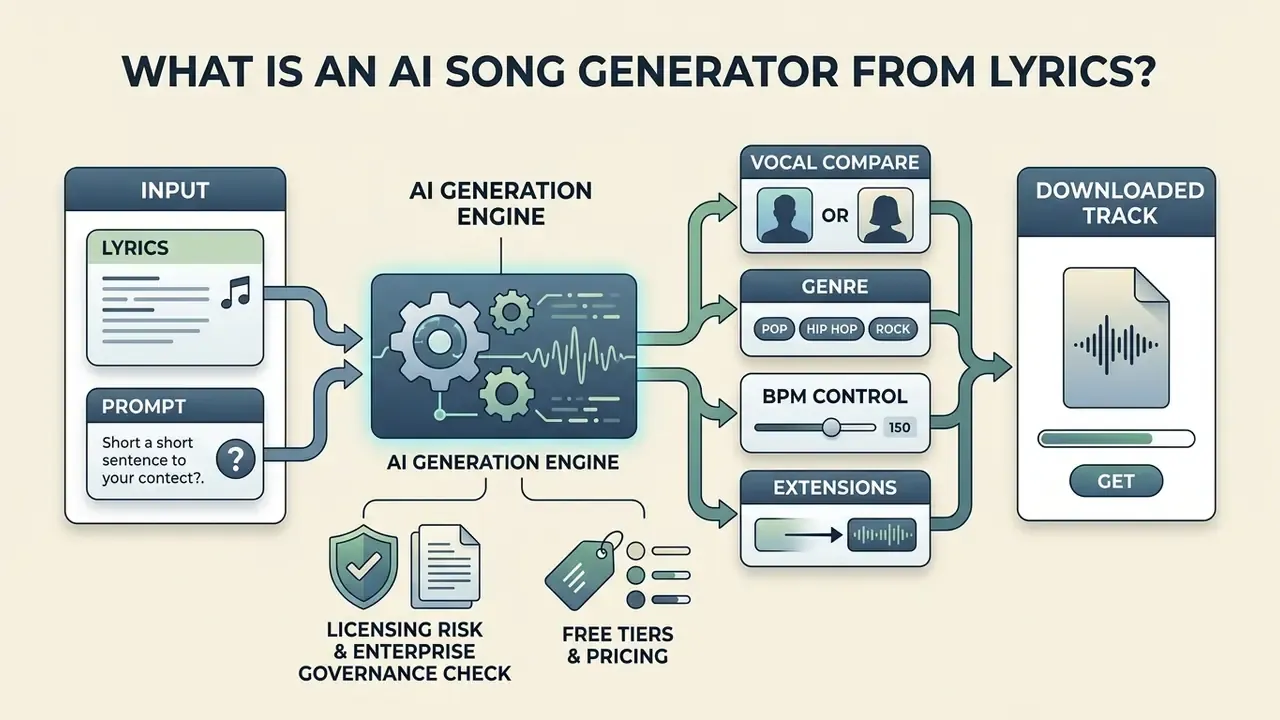
Each stage is also a control point. That matters later, when you need to reproduce an approved asset during an audit.
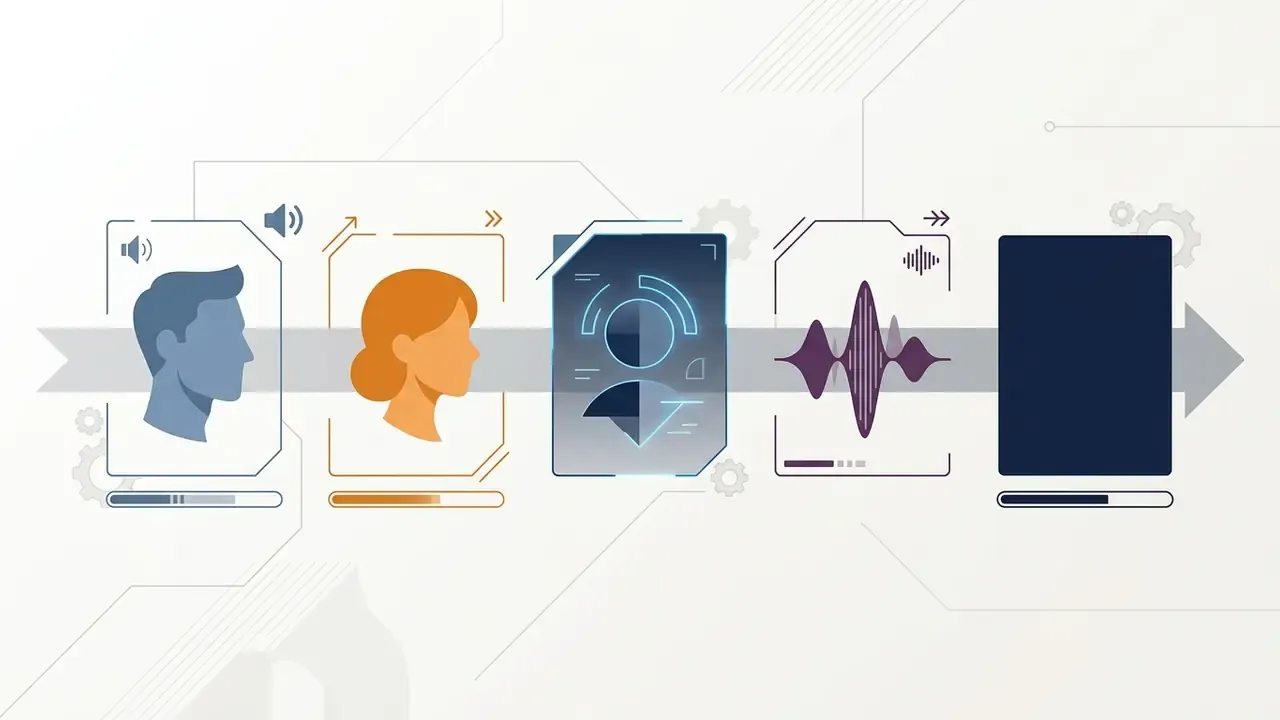
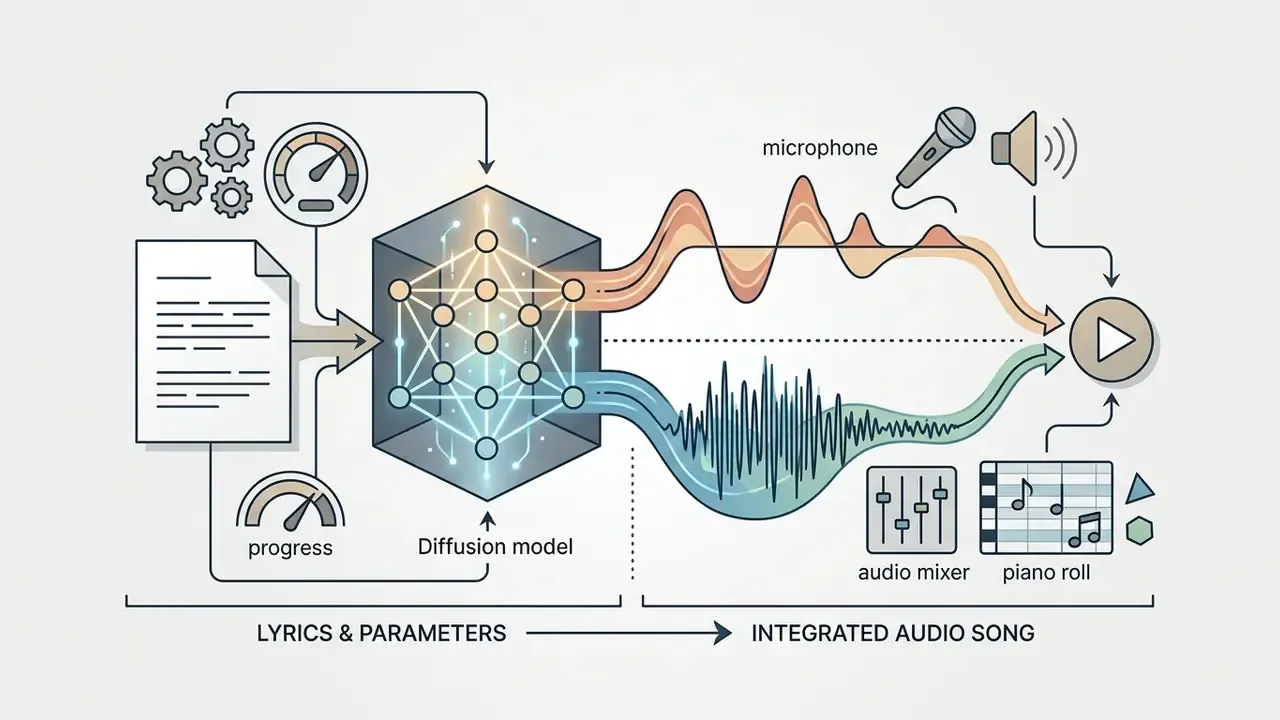
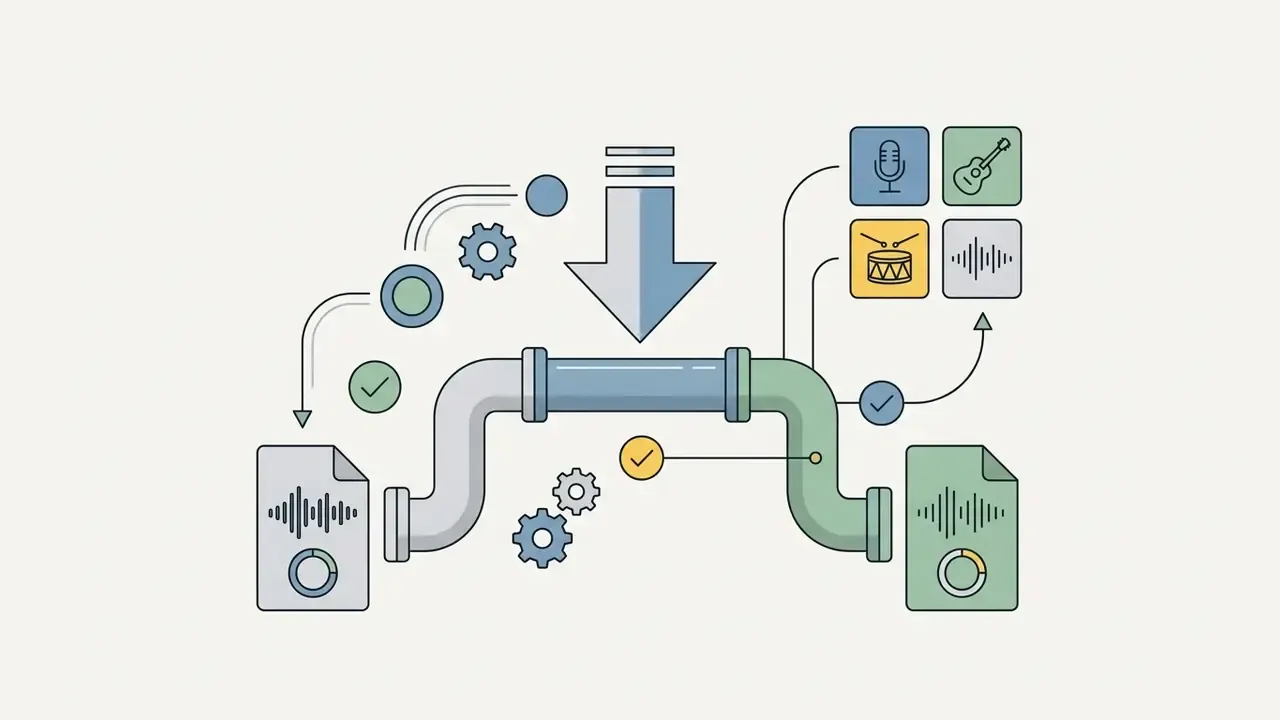
From lyrics to melody, vocals and instrumental
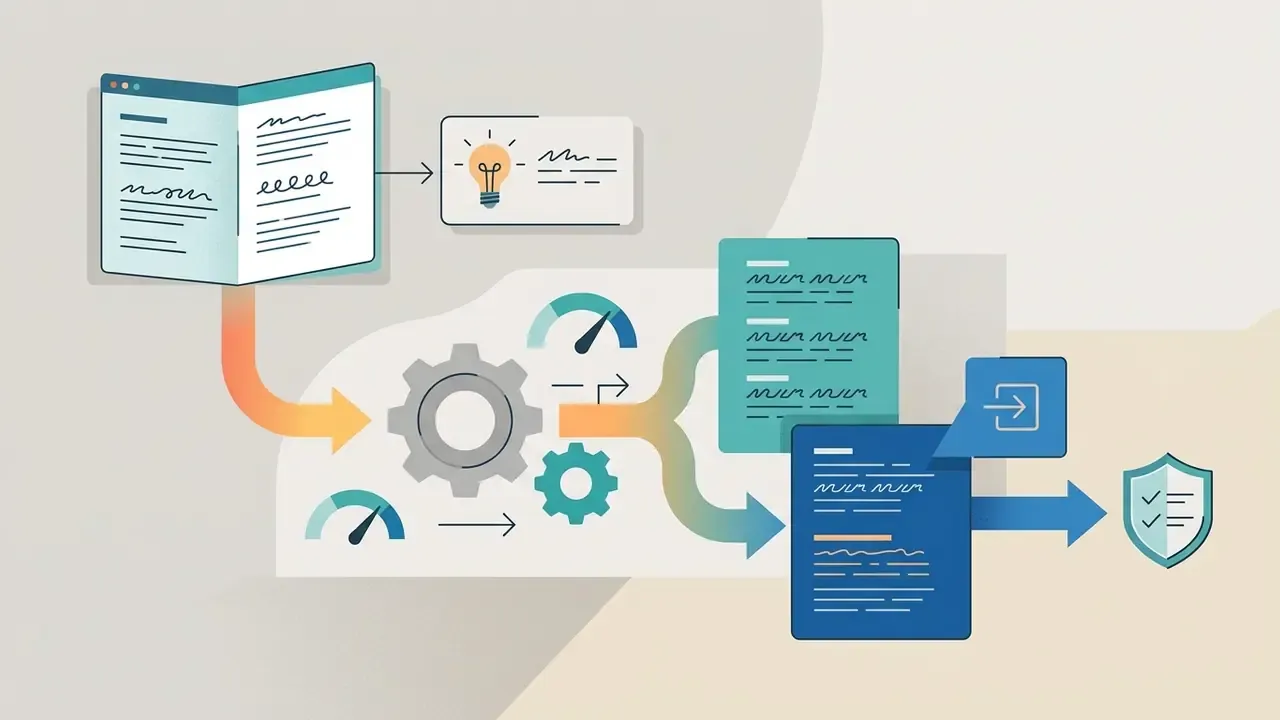
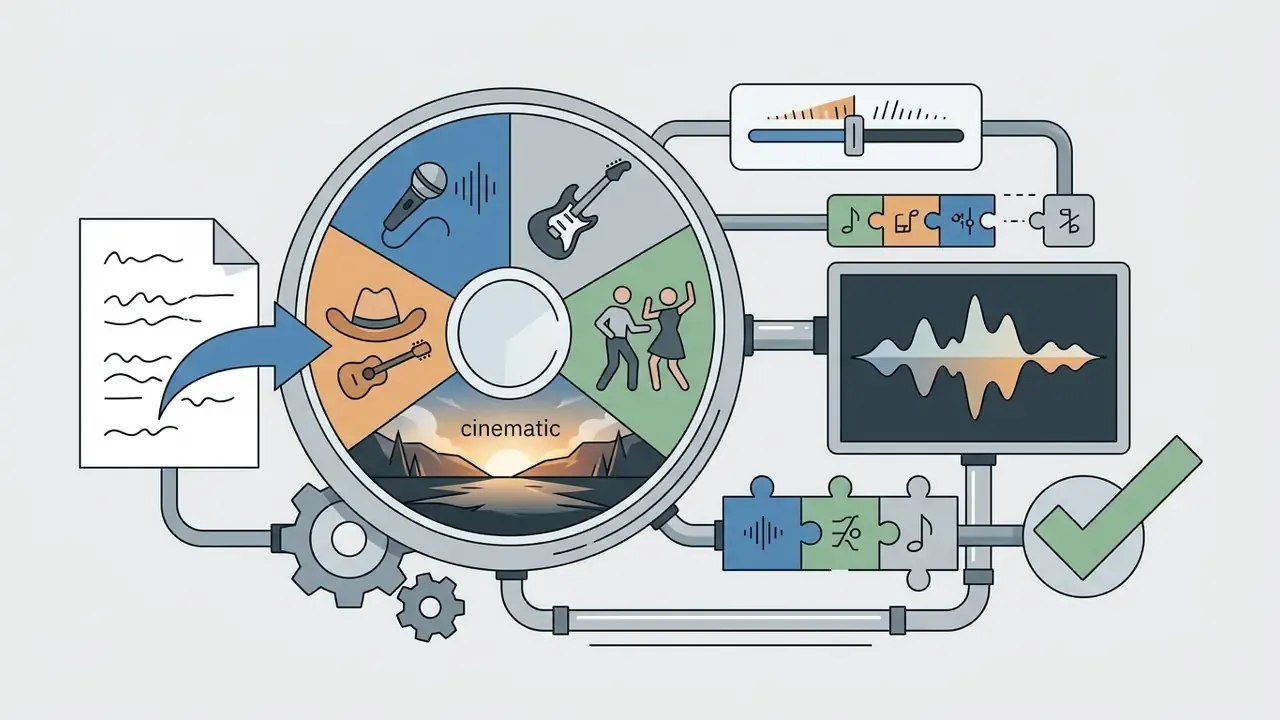
Transforming lyrics into a complete song requires aligning linguistic stress with musical pitch contours, vocal timbre, and backing arrangements. An ai lyric to music generator extracts phonetic timing from text lines and uses cross-attention mechanisms to synchronize singing voices with instrumental tracks. Training pipelines described in recent literature crawl paired audio and lyric data, clean the text, slice segments of roughly ten seconds, apply source separation, transcribe the singing voice, and only then learn lyric-to-melody mappings.
Modern systems use learned encoders so that pitch transitions preserve natural phrasing. Full-song architectures also demonstrate that joint tokenization of vocal lines and backing instrumentation prevents phase artifacts between elements.
«The 2026 unified system achieves the highest average score on 15 of 18 measured dimensions, including melody, arrangement and mixing quality.»
The result is generated music that behaves like a balanced arrangement rather than separate acoustic layers glued together. Alignment research explains why formatting matters: textsetting that places stressed syllables on strong metrical beats measurably improves perceived rhythm and comprehension. Which is exactly why bracket-tagged, evenly measured lyric lines outperform unformatted prose blocks.
Lyrics-to-song mode versus text-to-song mode
Lyrics-to-song mode treats user-provided stanza text as the exact vocal foundation. Text-to-song mode generates both lyrics and music from a descriptive prompt. Choosing between them depends on one question: does approval require exact lyrical compliance, or rapid conceptual exploration?
- Lyrics-to-Song Mode Accepts pre-written verses and choruses. Gives strict control over messaging, brand compliance, and script alignment. This is the correct mode when legal or compliance teams have already approved copy word-for-word.
- Text-to-Song Mode Accepts short descriptive prompts about mood or genre. The platform leans on an auxiliary ai lyrics generator to write text before generating music, lowering the prompt burden for early ideation and style exploration.
A third pattern is worth naming: mobile-first tools marketed as an ai app create song from lyrics utility usually expose only the text-to-song path, with fewer structural tags and no seed logging. Fine for personal use, weak for regulated production.
When evaluating automated text engines, operational teams often cross-reference media utilities using our AI Media Glossary to standardize terms. Teams building multi-format campaigns benchmark lyric pipelines against text-to-video AI tools so terminology and approval gates stay consistent across audio and video assets. In exploratory media design, some teams also compare conversion workflows against specialized interfaces such as an ai to human generator to keep delivery natural across digital channels.
How to Create a Song with Lyrics Using AI
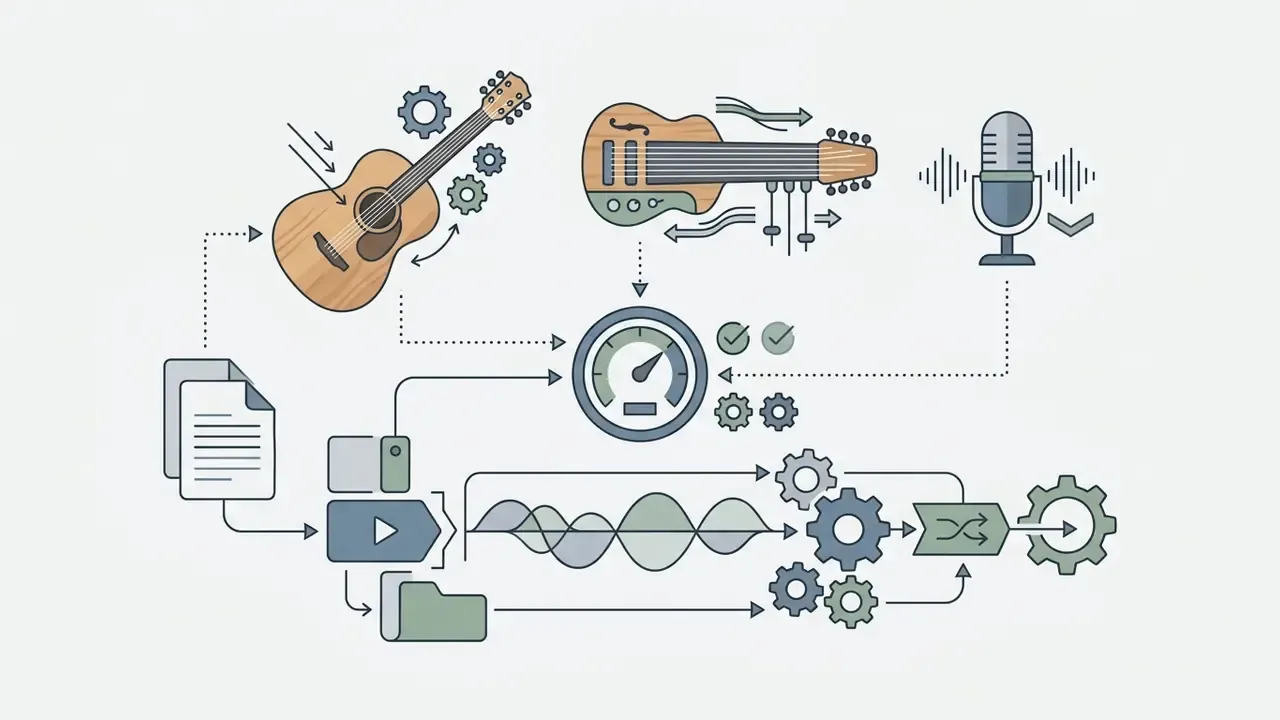
Creating a song with an ai lyric song maker involves supplying formatted lyrics, configuring style descriptors, selecting vocal parameters, and starting synthesis. Most browser platforms process these requests within 10 to 60 seconds and return audition previews before export.
Structured inputs reduce model drift and improve metric alignment across musical bars. Sloppy inputs produce sloppy syllable placement, every time.
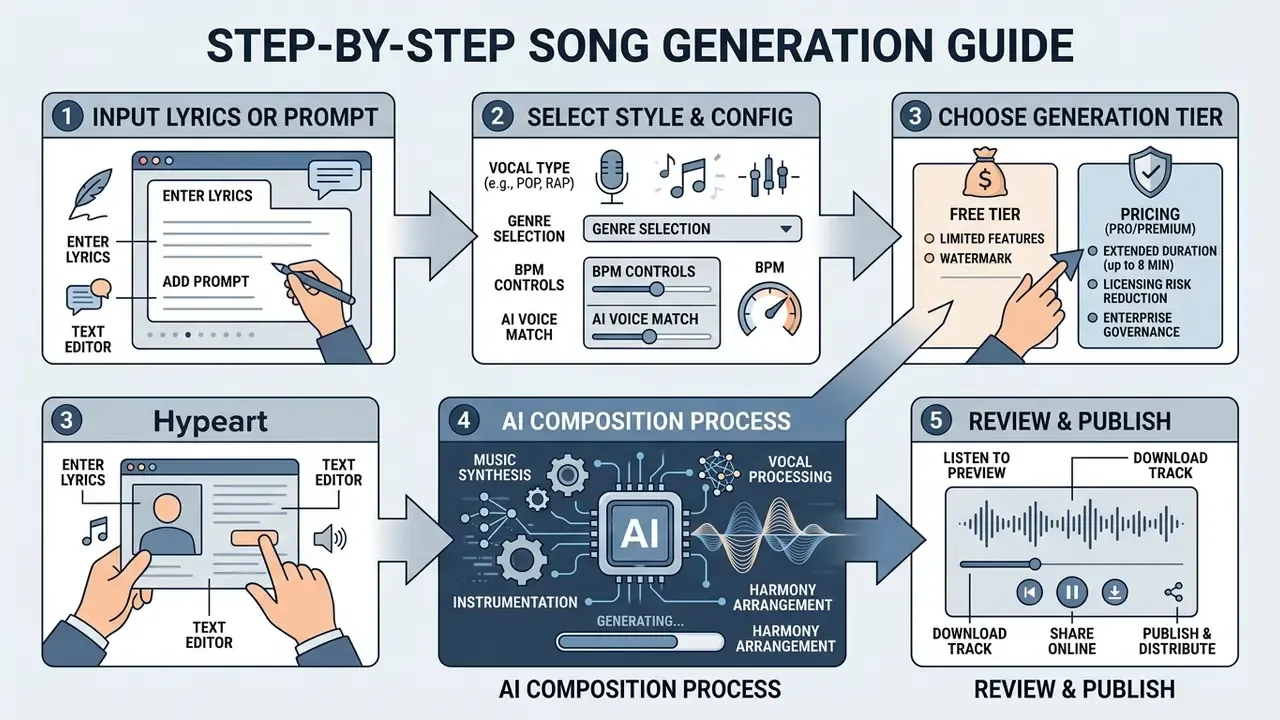
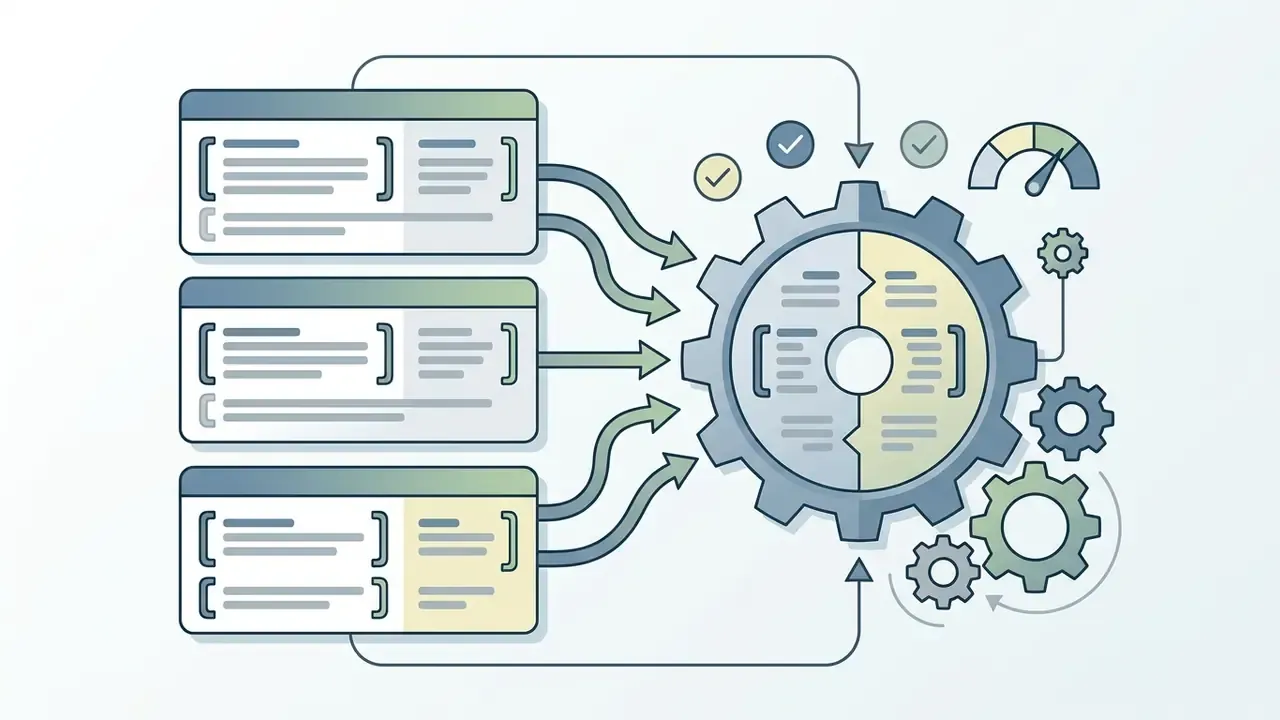
[Verse] and [Chorus] to mark sections.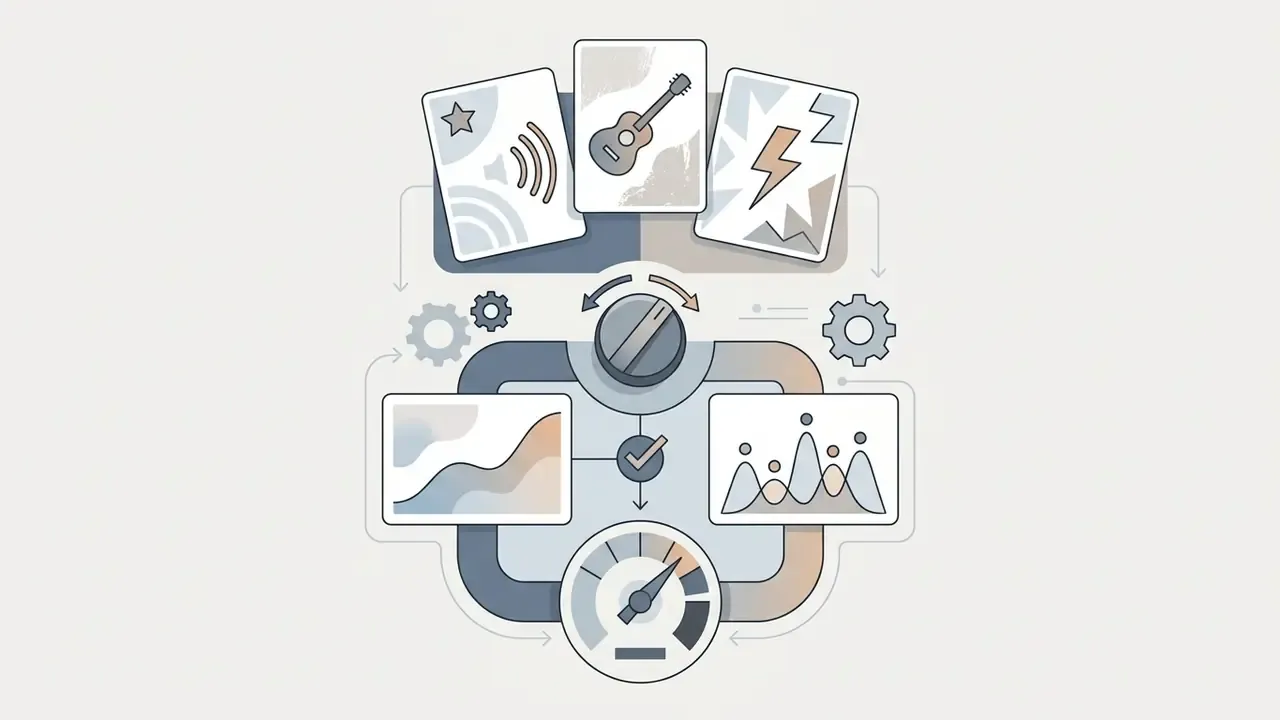
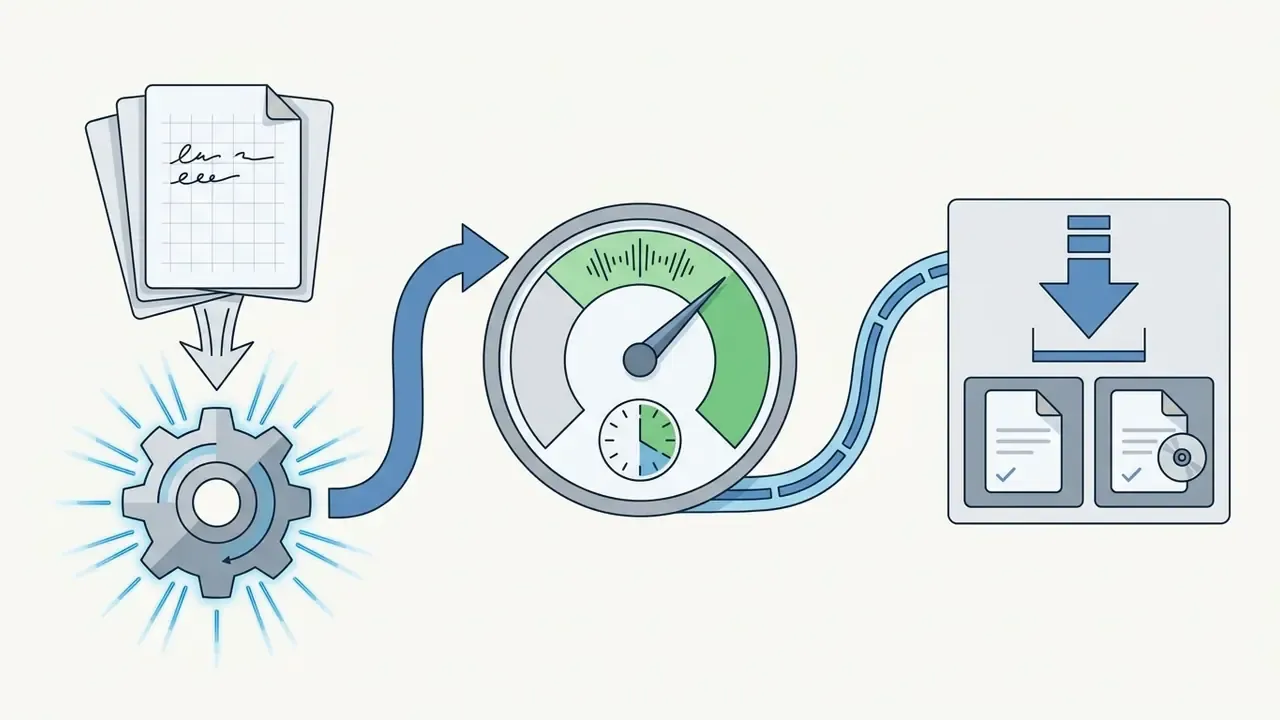
AI Generate, audition the 30-second preview, then export final audio in MP3 or WAV format.Prepare lyrics, title and song description
Preparing input text means defining structural boundaries so the ai lyrics song generator assigns musical phrases to the right verses and choruses. Standardized bracket tags guide model cadence and prevent lyrical overlap across transitions.
- Use
[Verse]for narrative progression and lower dynamic intensity. - Use
[Chorus]for repeated hooks and main melodic themes. In verse-chorus form the chorus is lyric-invariant and usually carries the title and hook. - Add
[Bridge]or[Outro]tags to signal atmospheric shifts or song conclusions. - Keep line lengths inside each block roughly equal, so syllable counts map cleanly to bars.
A concise song title plus explicit mood tags in the description box strengthens style adherence. Classic songwriting instruction recommends picking the title first and writing the chorus around it, which happens to produce a stronger, more machine-readable prompt too.
Field experience (illustrative composite): During a production trial for video ad scoring, a creative agency formatted campaign copy into structured verse-chorus tags. The pipeline rendered four coherent pop tracks in under two minutes and cut soundtrack turnaround time by 65 percent. The same team logged an extra 3 hours of legal review per campaign, a cost captured in the risk-adjusted ROI model later in this guide.
Choose genre, style and voice
Genre and voice selections instruct the ai melody generator for lyrics on instrumentation, rhythm density, and vocal timbre. Explicit tags push the underlying diffusion or language model toward a precise acoustic profile. Vendor prompt guides treat genre/style and vocal style as separate fields, where vocal style can specify gender, delivery (rapping versus sustained singing), range, and language.
Available genre options include:
Advanced platforms permit custom voice selection, so creators can assign male, female, or synthetic vocal profiles, plus "no vocals" and "humming" tags for background beds. Teams standardizing synthetic voice assets across audio channels can compare timbre control, language coverage, and licensing terms in our guide to AI voice generators.
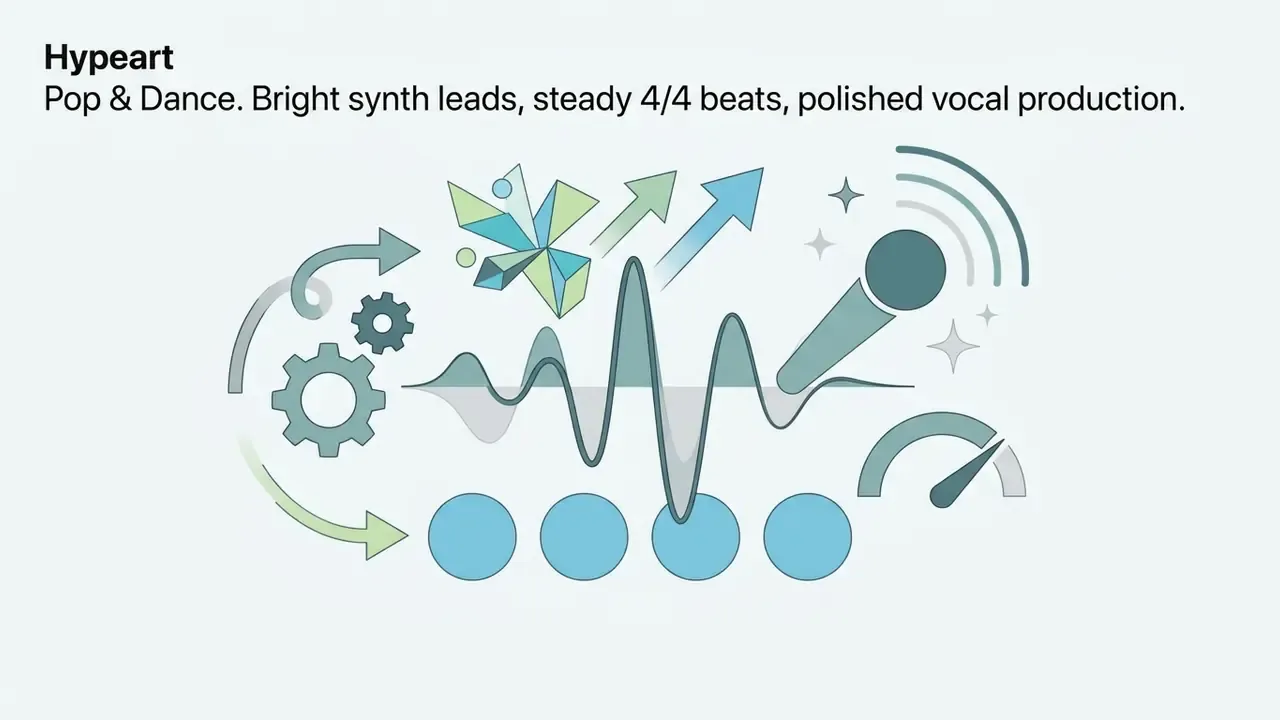
Generate, preview and download the song
Executing the generation command submits the input payload to server-side GPUs, where models synthesize discrete audio frames. Update: production models such as the Google Lyria series expose a fast clip endpoint that returns rapid low-bitrate 30-second previews, plus a pro endpoint that renders multi-minute full songs. Preview and master are separate calls, not one long wait.
After generation finishes, audition the preview for vocal clarity, beat synchronization, and structural timing. Once validated, download the final track in a standard audio format:
| Format | Bitrate / Quality | Recommended Usage |
|---|---|---|
| MP3 | 128 - 320 kbps | Social media clips, rapid prototyping, web streams |
| WAV | 24-bit / 44.1-96 kHz | Professional video editing, broadcast, master mixing |
Archival guidance treats 192 kbps as a practical MP3 baseline and 320 kbps as the high-fidelity ceiling, while uncompressed LPCM WAV at 96 kHz / 24-bit remains the reference standard for masters. Editors moving a finished track straight into a timeline can compare timeline audio handling in our overview of free video editing software and platform-specific workflows in the YouTube video editor guide.
Controls That Shape AI Music from Lyrics
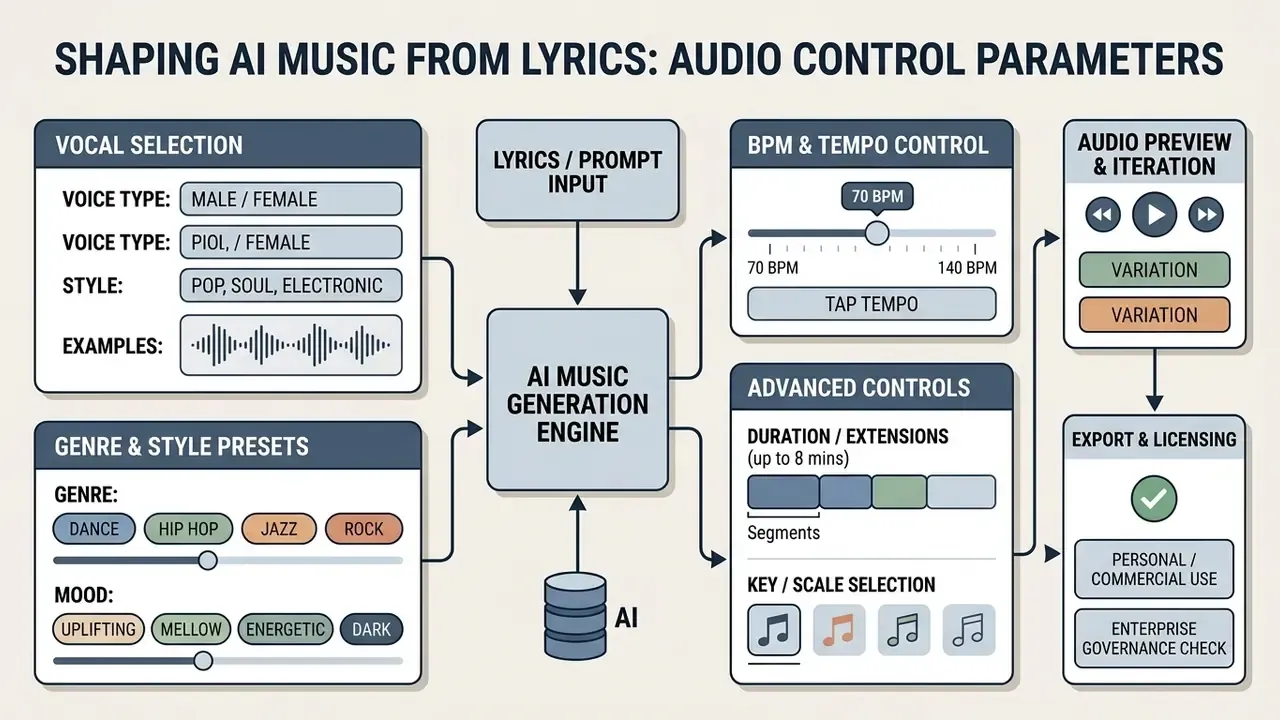
Fine-tuning an ai beat maker from lyrics means configuring specific acoustic parameters before processing starts. Vocal balance, tempo, key, and section extensions give operators precise control over the output composition.
Controllability studies show that injecting symbolic music conditions, such as key, downbeats, and chord progressions, substantially improves prompt adherence compared with unconditioned text models.
«Mustango delivers state-of-the-art quality and substantially outperforms MusicGen and AudioLDM2 on controllability through music-specific text prompts.»
Vocals, voice and instrumental-only generation
Vocal synthesis settings let creators toggle between full vocal songs, isolated vocal tracks, or instrumental backing arrangements. An ai instrumental generator from lyrics bypasses vocal synthesis layers and focuses GPU capacity entirely on harmonic composition.
Teams working with separated vocal stems, cloned narration, or bilingual hooks should benchmark timbre fidelity and licensing conditions in our reference on AI voice generators. Teams deploying synthetic visual assets alongside custom soundtracks often consult guides on ai ugc video generator platforms to align audio timing with automated video assets.
Beat, melody, genre and sound customization
Beat intensity, melodic complexity, and genre parameters change how an ai create music from lyrics engine builds rhythmic foundations. Specifying exact Beats Per Minute prevents tempo drift across multi-verse arrangements.
«MusiConGen is the first transformer-based text-to-music model to follow user-specified rhythm and chord conditions without requiring reference audio.»
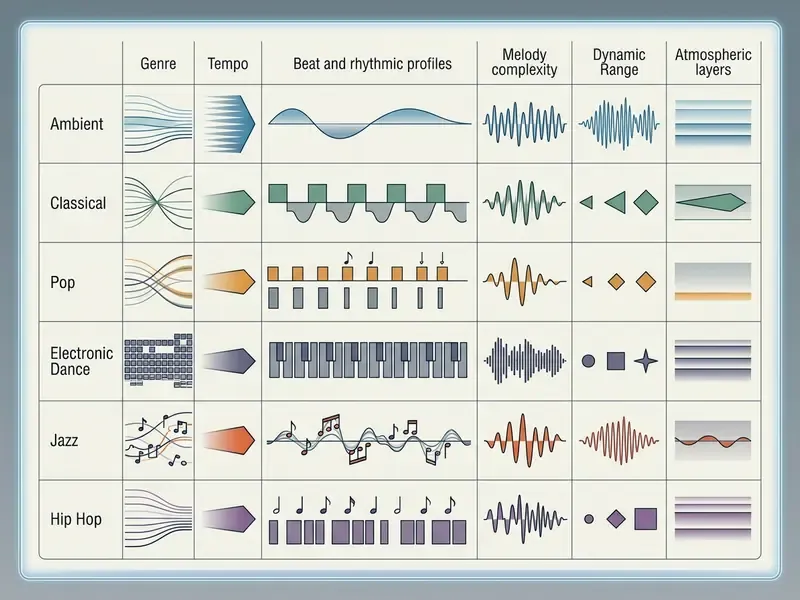
| Genre Category | Standard BPM Range | Rhythmic Signature | Key Instrumentation |
|---|---|---|---|
| Hip-Hop / Trap | 85 - 110 BPM | Syncopated hi-hats, heavy 808 sub-bass | Synthesizers, drum machines |
| Pop / Synthpop | 115 - 130 BPM | Four-on-the-floor kick, steady snare | Digital synths, acoustic bass |
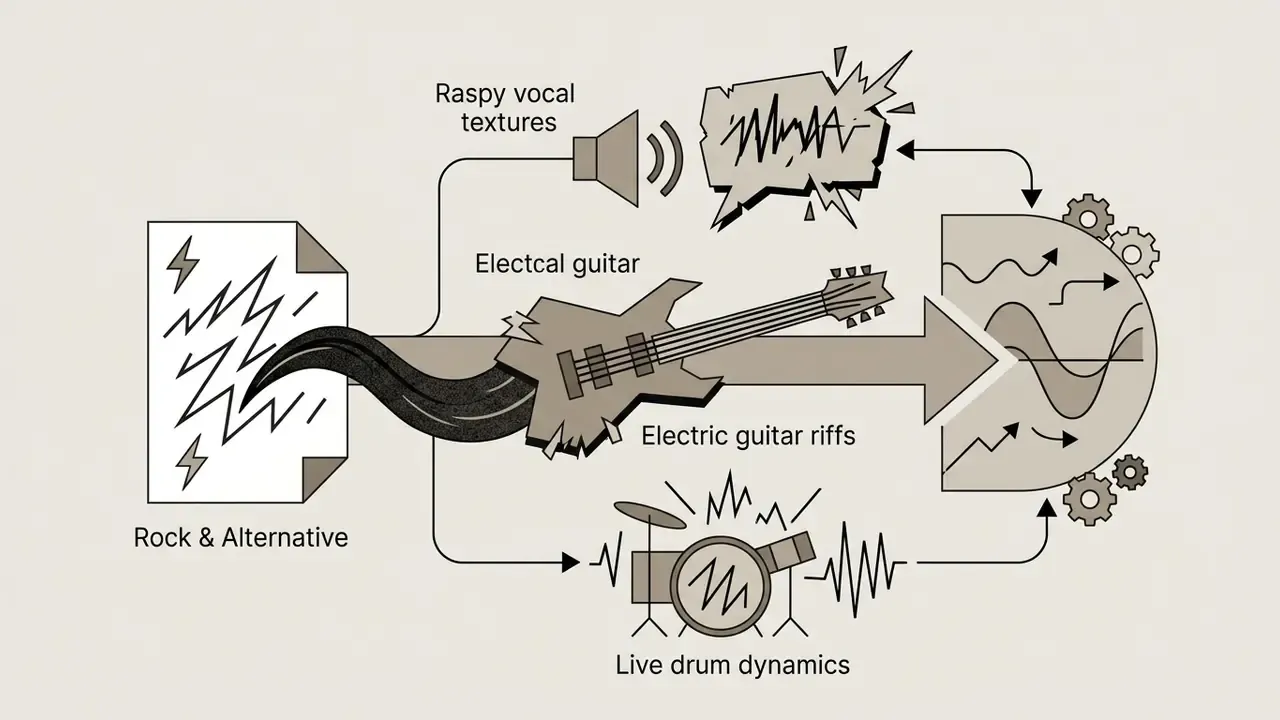
| Rock / Alternative | 120 - 145 BPM | Driving bassline, acoustic/electric drums | Distorted guitars, bass guitar |
| Country | 80 - 112 BPM | Shuffle rhythm, acoustic strumming | Steel guitar, fiddle, acoustic guitar |
| House / Techno | 100 - 130 BPM | Sidechained 4/4 pulse, off-beat open hats | Analog synths, sampled percussion |
| Trance / Drum & Bass | 130 - 170 BPM | Rolling breakbeats, sustained supersaw pads | Layered synths, sub-bass, reverse cymbals |
Setting structural parameters early keeps generated arrangements aligned to visual editing timelines, which spares you manual time-stretching later. Production teams synchronizing generated audio to automated visuals can cross-check render lengths and frame rates against our comparison of AI video generators.
Extending and refining generated songs
Song extension lets operators lengthen an existing audio clip by appending new lyrical verses or instrumental bridges. Production platforms such as ElevenLabs Music (2026) process context windows from the initial render to keep harmonic transitions seamless, and expose variant selection, section insertion or removal, lyric edits, and per-section style controls.
To refine a track, select an end-timestamp on the preview waveform, enter additional lyrics, and trigger an extension pass. The model reads the previous bar's key and tempo, then continues the composition without boundary clicks or key shifts. Academic work frames this as music continuation, extending a short audio prompt into longer-form output, while latent-diffusion research reports coherent single-pass generations up to 4 minutes 45 seconds.
One practical caveat: every extension pass is a new inference call with its own seed. Log them, or you will not be able to reproduce the approved version.
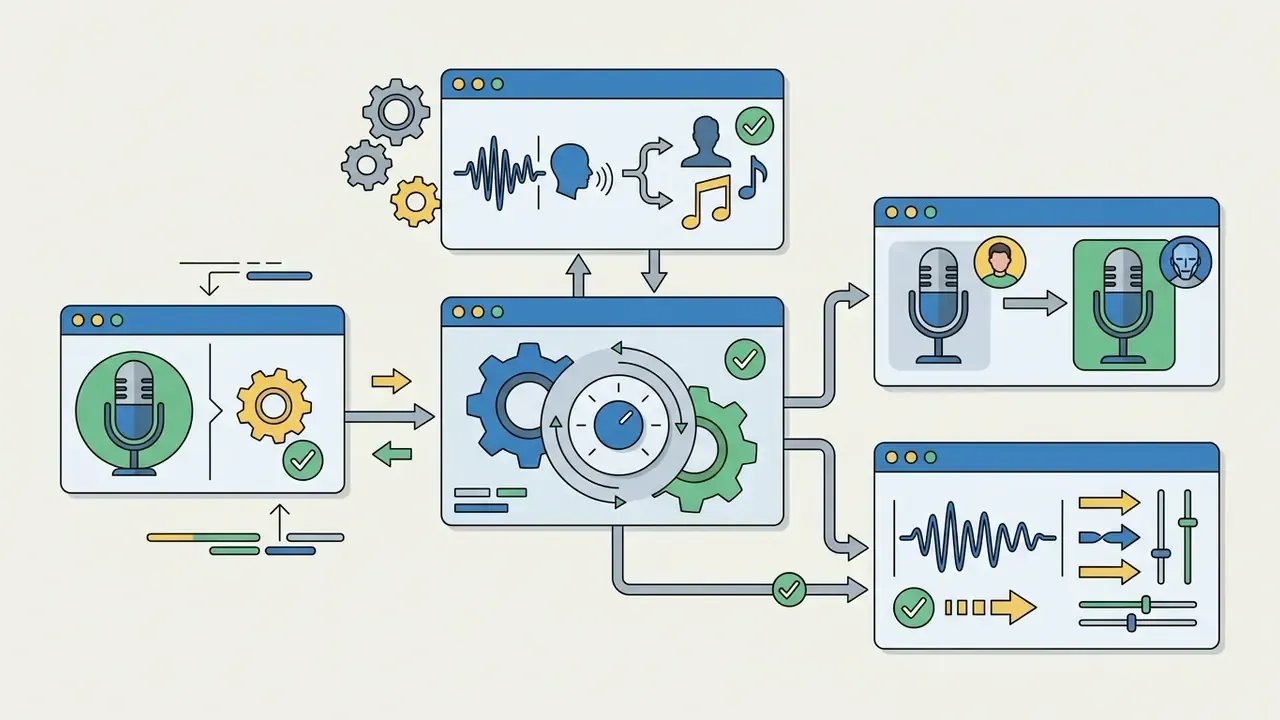
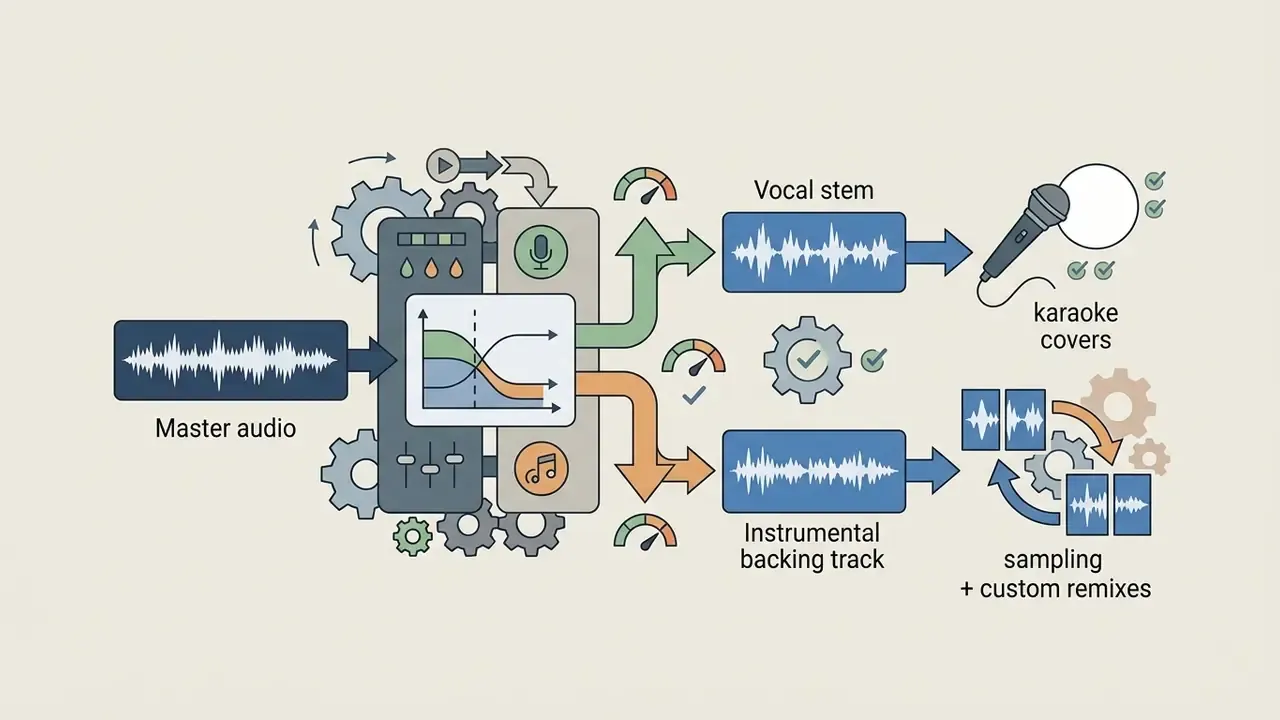
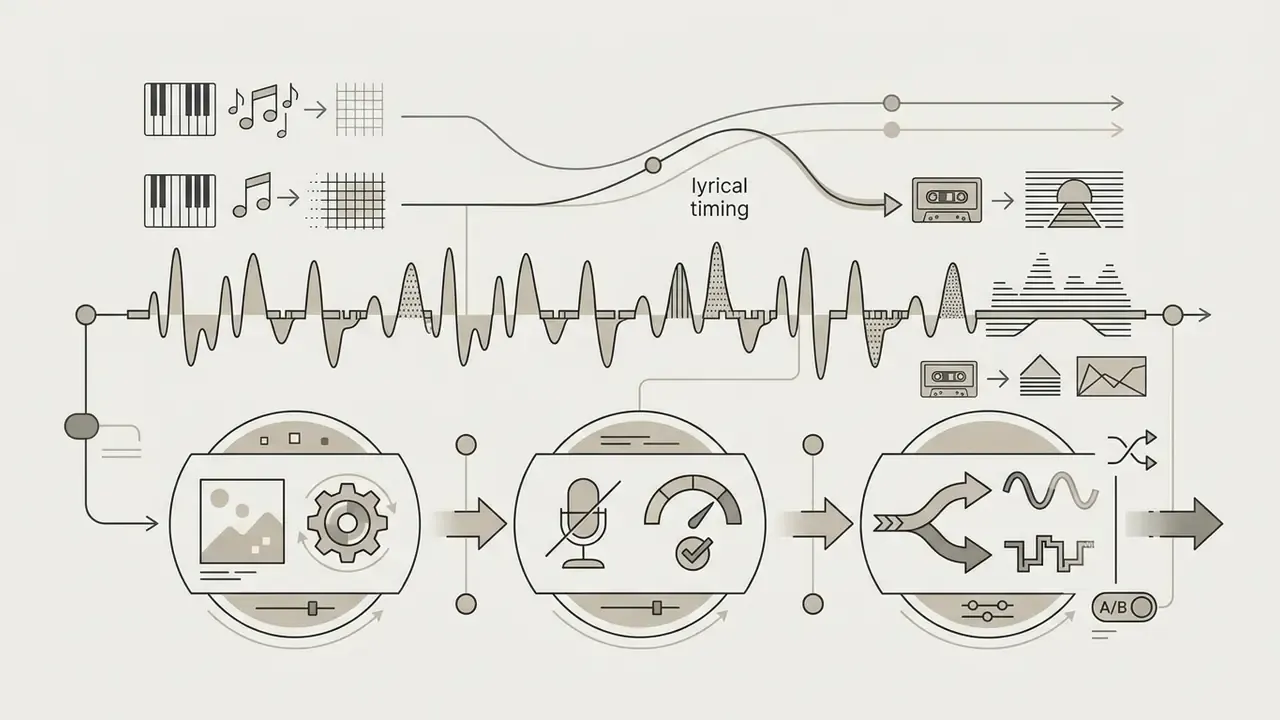
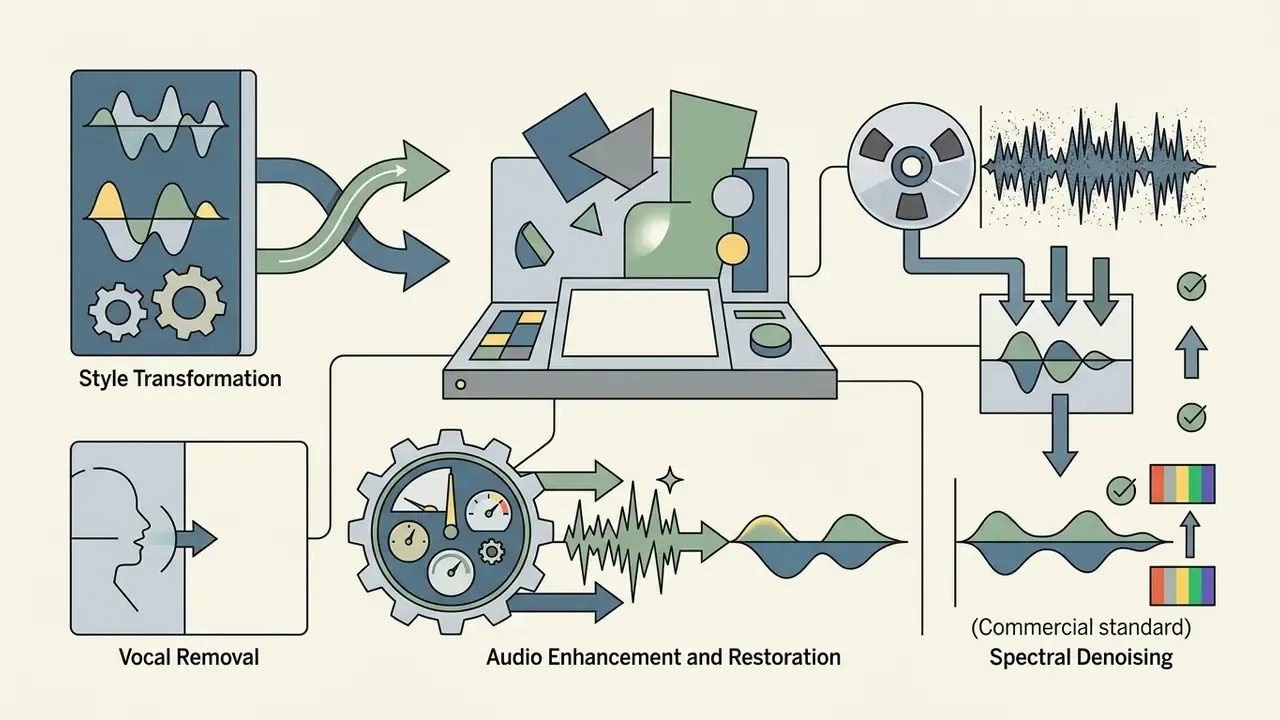
Advanced production modules: covers, vocal removal, and style transformation
Modern AI music ecosystems reach beyond initial text-to-audio generation and offer post-production utilities in the browser:
Governance note: each module introduces a second rights question. Covers and genre transforms operate on an uploaded source recording, so the uploader, not the platform, carries the risk of processing third-party masters. Restrict upload-based modules to assets your organization owns or licenses in writing.
Which AI Songs Can You Create from Lyrics?
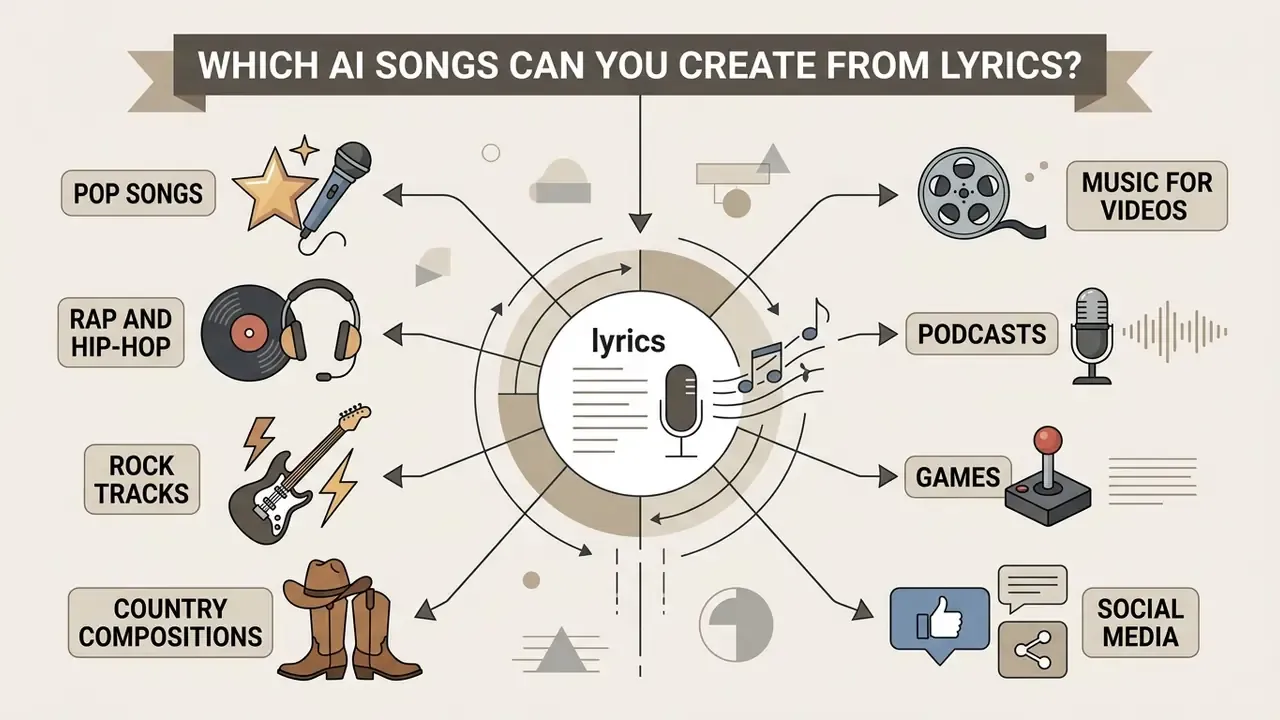
An ai create song with lyrics engine can synthesize diverse musical genres and production formats adapted for commercial media projects. From high-energy advertising jingles to ambient soundtrack loops, text-conditioned models match varied creative specifications.
«SongEval contains 2,399 full-length songs (over 140 hours of audio) across nine genres, rated by 16 professional annotators on five aesthetic dimensions.»
Evaluation on that dataset shows contemporary models holding genre consistency across nine distinct style categories, scoring well for structural clarity and memorability.
Pop, rap, rock, country and other music styles
Different genres present different acoustic signals during synthesis. Modern ai lyrics and music generator tools adapt vocal delivery and harmonic balance to the style prompt:
- Pop songs Clear lead vocal positioning, punchy chorus hooks, polished compression profiles.
- Rap and hip-hop Rhythmic vocal cadences, rhyming speed, heavy low-end alignment.
- Rock tracks Distorted instrument textures, energetic drum fills, dynamic vocal delivery.
- Country compositions Narrative lyric clarity, acoustic backing warmth, traditional melodic phrasing.
«SongEval spans nine major genres, including pop, rap, rock and country, confirming the stylistic breadth of current song generators.»
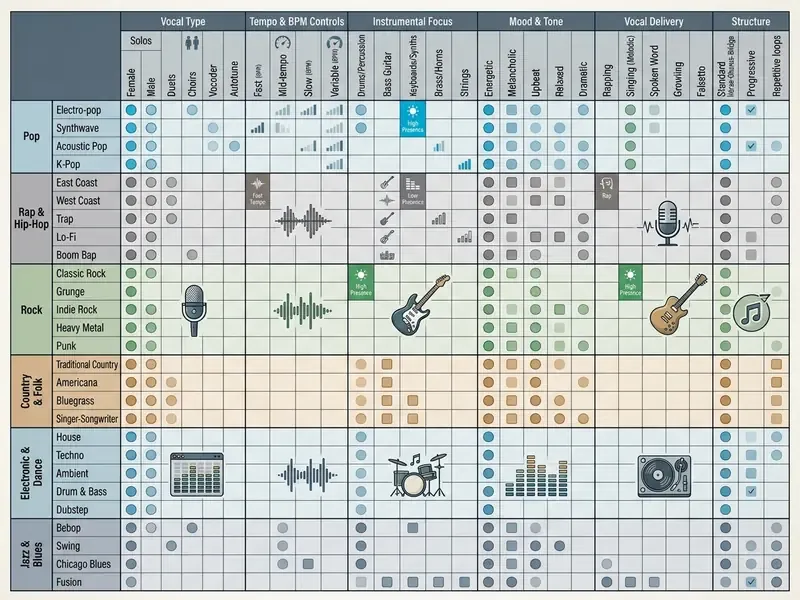
| Primary Genre | Popular Sub-Genres & Niche Styles | Key Acoustic Identifiers |
|---|---|---|
| Electronic & Dance | House, Techno, Trance, Dubstep, Synthwave, Electropop, Cyberpunk, EDM, Disco | Heavy synth basslines, quantized 4/4 beats, sidechain compression |
| Rock & Metal | Alternative Rock, Nu Metal, Grunge, Grungegaze, Punk, Pop Punk, Hard Rock, Doom Metal, Mathcore, Hardcore, Psychobilly | Distorted guitars, dynamic acoustic drum kits, aggressive or raspy vocals |
| Hip-Hop & Urban | Trap, Boom Bap, Abstract Hip Hop, UK Drill, West Coast Rap, Sad Rap, Dark Wave Rap, Jazz Hip Hop | Syncopated hi-hats, sub-808 basslines, fast rhythmic cadences |
| Folk & Traditional | Dark Folk, Celtic Rock, Celtic Music, Country, Honky Tonk, Corridos Tumbados, Bluegrass, Spiritual, Blues | Acoustic fingerpicking, brass/accordion/fiddle accents, storytelling vocal delivery |
| Soul, Latin & World | Soul, Soul Jazz, Funk, Reggae, Latin, Samba, Salsa, Bachata, Afrobeats, World Music, Shamisen | Groove-led rhythm sections, syncopated percussion, warm horn and organ layers |
| Jazz & Orchestral | Modal Jazz, Nu Jazz, Big Band, Swing, String Quartet, Light Opera, Musical | Live-feel brushed drums, walking bass, acoustic ensemble dynamics |
| Cinematic & Ambient | Film Score, TV Theme, Slowcore, Meditation, Lo-Fi, Ambient | Atmospheric pads, dynamic orchestral swells, relaxed tempos |
| Asian Pop & Anime | K-Pop, J-Pop, Anisong, Anime OST, Indie Music | Layered vocal stacks, bright mix ceilings, rapid section changes |
When designing interactive experiences that include dynamic media selection, teams review technical benchmarks using our guide on ai ui generator tools to build usable asset-selection dashboards.
How to Choose an AI Music Generator for Lyrics
Evaluating an ai music generator means matching platform capabilities against operational requirements. The decision factors: prompt adherence, generation speed, export format flexibility, security posture, and legal risk mitigation.
Enterprise technical buyers should review feature availability against business objectives and, in regulated industries, against third-party risk policy before the first prompt is submitted. Order matters here.
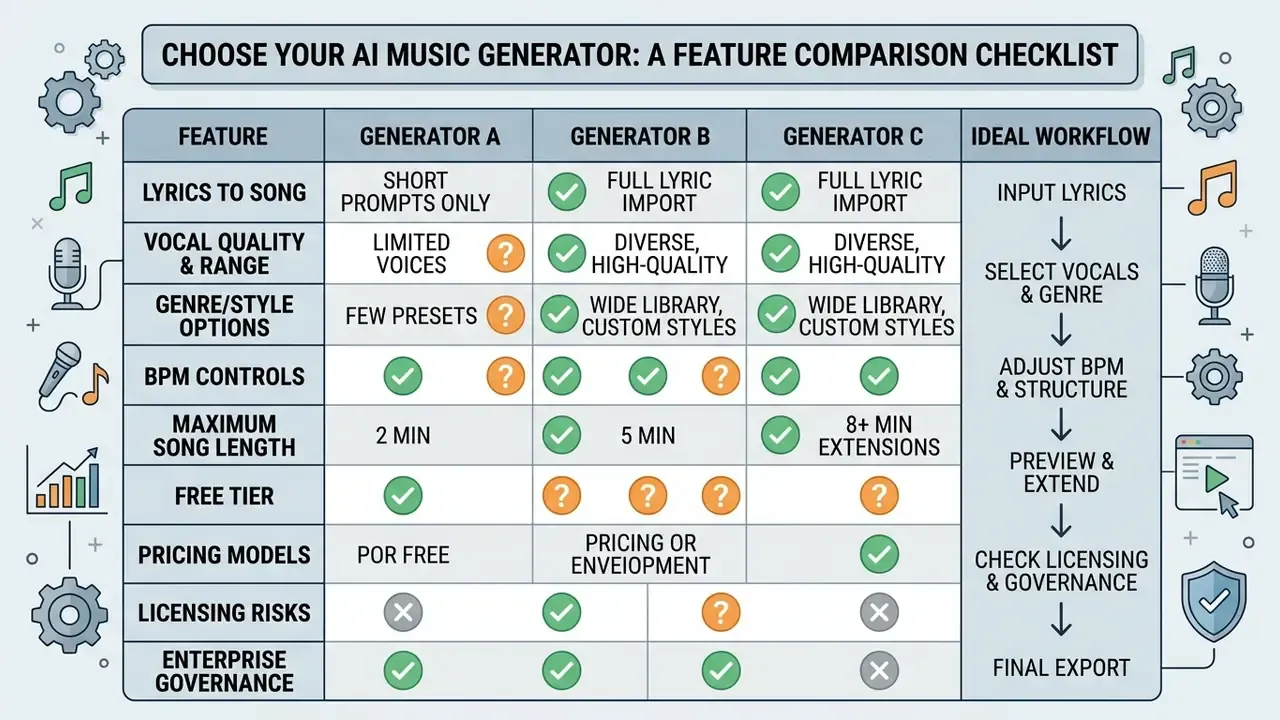
Quick AI music prompt formula
[Genre] + [Sub-Genre/Vibe] + [Tempo BPM] + [Lead Instrument] + [Vocal Profile] + [Mood]
- Example:
Pop, Synthwave, 120 BPM, Analog Synths, Female Soprano Vocal, Nostalgic Mood - Instrumental example:
Cinematic, Documentary Underscore, 78 BPM, Solo Piano + Strings, No Vocals, Restrained and Hopeful - Exclusion tags (where supported):
-distorted guitar, -spoken word, -trap hats
Essential features for lyric-to-music creation
A robust ai lyric to song generator should offer controls for input processing, stem generation, and audio editing:
- Lyrics-to-song and text-to-song flexibility.Support for both structured user lyrics and prompt-based text generation.
- Built-in lyric assistant.Integrated text expansion to refine rhyme schemes before music synthesis.
- Track extension and editing.Ability to add sections, insert instrumental solos, and lengthen tracks cleanly.
- Stem separation.Export isolated vocal and instrumental tracks for post-production in external DAWs.
- Cover and genre transformation.Re-voicing and style-transfer passes on existing approved masters.
- Deterministic reproduction.Seed logging and model-version pinning, so an approved asset can be regenerated identically during audit.
An ai lyric music generator that cannot pin a model version is a creative toy, not a production dependency. Operators evaluating enterprise API implementations can cross-reference technical documentation via our AI Media API Guides to verify integration protocols.
Output quality, speed and export options
Audio fidelity and synthesis speed drive production efficiency. High-performance models render stereo audio within seconds, which keeps iterative creative sessions from stalling.
- Fidelity standards. Look for uncompressed 24-bit / 44.1 kHz WAV output to avoid compression artifacts; archival-grade masters go to 96 kHz / 24-bit LPCM.
- Generation speed. Benchmark against published figures, not marketing claims. Peer-reviewed latent-diffusion work reports stereo audio up to 95 seconds rendered in about 8 seconds on an A100 GPU, while vendor documentation states latency varies with model choice and request size. Data required: no vendor currently publishes an audited median latency for full multi-minute songs under production load, so run your own timed trials at peak hours.
- Objective quality metrics. Ask vendors for FAD (Fréchet Audio Distance) and CLAP text-alignment scores, not adjective-based claims.
«JEN-1 reaches an FAD of 2.0 versus 14.8 for Riffusion and a CLAP score of 0.33 versus 0.19, showing substantial gains in quality and text alignment.»
- Format versatility. Ensure MP3, WAV, and OGG/Opus exports for diverse distribution channels. Export rights are frequently tier-gated: several platforms restrict free and entry tiers to standard-quality MP3 and reserve high-fidelity or WAV export for higher plans.
Buyers who benchmark export pipelines across media types can compare quality ceilings and licensing in our roundup of the best AI video generators. To model workflow efficiency and production cost savings across projects, technical leads use our AI Media Calculators.
Free AI Lyric to Song Generator, Pricing and Commercial Use
Selecting an ai create song from lyrics free tool requires assessing tier limits, output bitrates, and commercial usage rights. Free plans allow basic testing; paid plans provide non-watermarked downloads and explicit commercial licensing.
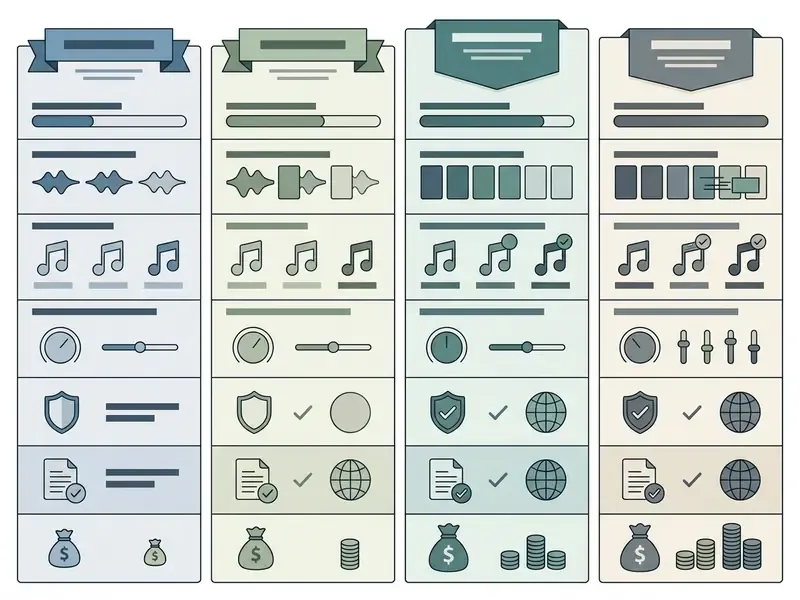
| Plan Tier | Daily / Monthly Credits | Export Formats | Commercial License | Advanced Features |
|---|---|---|---|---|
| Free | 5 - 50 daily credits | MP3 (standard quality) | ❌ Non-commercial / personal only | Basic text-to-song generation |
| Starter | 500 monthly credits | MP3 / 24-bit WAV | ✅ Commercial license included | Custom voice tags, priority queue |
| Standard | 2,000 monthly credits | Uncompressed WAV + stems | ✅ Full commercial rights | Track extension, stem isolation |
| Premium | Unlimited / high quota | Multi-track WAV / stems | ✅ Enterprise commercial rights | Dedicated API access, custom models, SSO |
Treat the table as an orientation model, not a quote. Licence wording and credit maths change quarterly, so verify both on the vendor's current pricing page before you commit budget.
What the free AI song generator includes
Free tiers in tools like Suno or Udio provide initial access for testing prompt mechanics and song structures. That said, an ai lyrics song generator free plan usually imposes strict operational limits:
- Daily quotas. Limited generation attempts. Documented models range from a single daily credit to 50 daily credits, or a one-time signup allocation of around 75 credits.
- Export restrictions. Downloads restricted to standard-bitrate MP3, occasionally with audio watermarks; WAV export is often a paid add-on charged in extra credits.
- Usage rights. Terms of service limit output to personal, non-monetized projects, sometimes with mandatory attribution.
So an ai lyrics to song generator free tier is a sandbox for prompt craft, not a production channel. Objective evaluation of free tiers should include measured quality, not just quota counts:
«MusicEval contains 2,748 music clips from 31 systems rated by 14 expert annotators; automatic predictors correlate strongly with human quality judgements.»
Teams that routinely test freemium creative tools across media types can reuse the same evaluation grid documented in our analysis of free photo editors. Feature limits, export restrictions, privacy posture, and paid upgrade triggers apply identically to audio platforms.
How to review pricing, royalty-free terms and commercial rights
Training-data litigation, indemnification and rights-holder exposure
Beyond output ownership sits the larger exposure: input provenance, meaning what the model was trained on. Recording-industry plaintiffs, including RIAA-affiliated labels, have pursued high-profile infringement actions against leading music generation services over the use of copyrighted sound recordings in training corpora. Some vendors respond by asserting licensed or purchased datasets with a documented chain of custody; others decline to disclose corpus composition at all. Because these matters stay unresolved and jurisdiction-dependent, enterprise users should treat vendor indemnification, not vendor confidence, as the operative control.
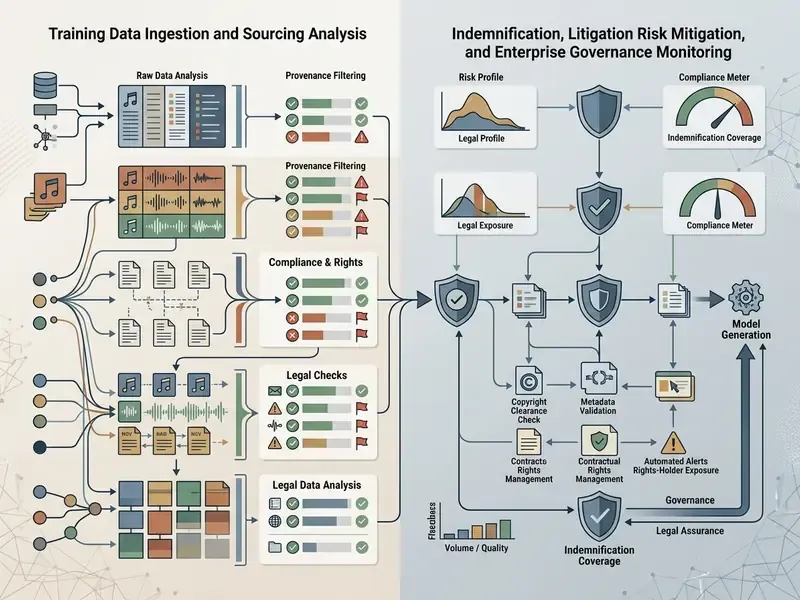
| Contract Criterion | What to Require in Writing | Red Flag |
|---|---|---|
| IP indemnification clause | Vendor defends and indemnifies customer against third-party infringement claims arising from generated output | "Customer bears all risk of use" language with no carve-out |
| Indemnity cap | Cap stated as a multiple of fees, or uncapped for IP claims | Cap equal to one month of subscription fees |
| Training-data provenance | Written statement of licensed or purchased datasets plus chain-of-custody documentation | "Proprietary datasets" with no disclosure |
| Output similarity controls | Filters preventing reproduction of recognizable protected recordings, artist names, or trademarks | Prompt fields that permit named-artist imitation |
| Rights continuity after cancellation | Perpetual licence for assets generated during the paid term, surviving subscription end | Rights terminate with the subscription, stranding published campaigns |
| Change-of-terms notice | Advance written notice before licence or feature withdrawal (for example, removal of download or stem export) | Unilateral change with immediate effect |
| Litigation disclosure | Vendor discloses pending IP litigation material to the service | Silence or refusal to warrant non-infringement |
Enterprise Governance, Shadow AI Controls and Model Risk Assessment
Creative speed is only realizable if the tool clears security, privacy, and model-risk gates. Public lyric-to-song services are, functionally, third-party SaaS endpoints that accept free-text input. That is precisely the risk profile Shadow AI programs exist to contain.
Shadow AI and data-privacy controls
Unreleased campaign copy, product launch names, internal slogans, embargo dates, and confidential scripts get pasted into public prompt fields because staff read the tool as "just a music toy." Treat the lyric field as a data-egress channel, because that is what it is.
Minimum control set before pilot approval:
- Zero data retention (ZDR). Contractual guarantee that prompts, lyrics, and uploads are not retained beyond processing and not used to train or fine-tune models.
- Training opt-out by default. Enterprise tenants configured with opt-out at account level, not per user.
- Private generation mode. Outputs excluded from public discovery feeds and community libraries. Several consumer platforms publish generations by default.
- Identity and access. SSO/SAML, SCIM provisioning, and RBAC separating who may generate, who may download, and who may publish.
- Certifications and assurance. SOC 2 Type II report, ISO/IEC 27001, and for AI-specific governance ISO/IEC 42001 alignment; map controls to NIST AI RMF and its generative-AI profile guidance on provenance, disclosure, and third-party IP review.
- Regional processing and retention. Documented data residency, sub-processor list, and deletion SLAs.
- Egress monitoring. DLP rules covering known generative-audio domains; block unmanaged consumer endpoints and route staff to the approved tenant.
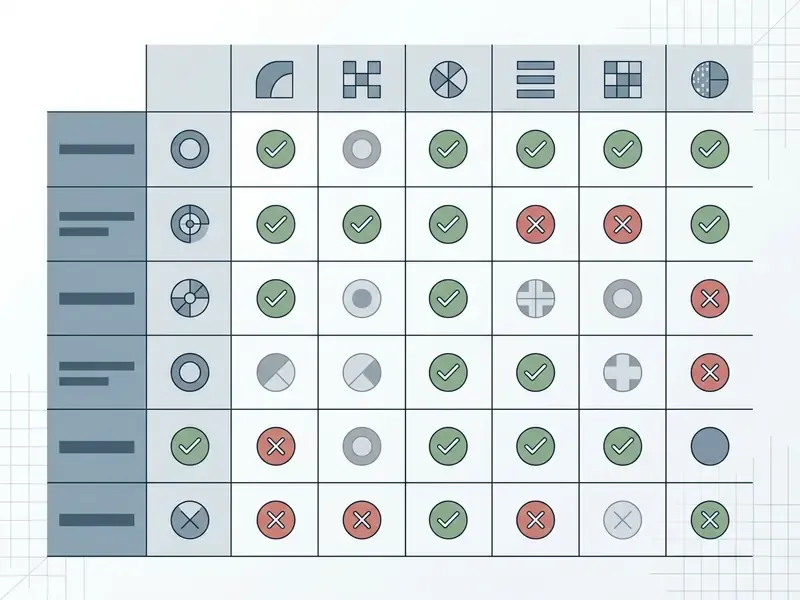
| Usage Pattern | Data Exposed | Inherent Risk | Required Control |
|---|---|---|---|
| Personal free account, public tier | Unreleased brand copy in prompt; output published to public feed | High | Block via DLP; migrate to managed tenant |
| Managed tenant, generic mood prompts only | Non-confidential descriptors | Low | Standard logging and periodic review |
| Managed tenant, approved lyrics pasted | Approved marketing copy | Medium | ZDR clause, private generation, retention SLA |
| Upload-based cover or genre transform | Third-party or owned master recording | High | Ownership attestation per upload; legal pre-clearance |
| API integration into production pipeline | Programmatic prompt payloads, possibly customer data | Medium-High | Key rotation, prompt-field allowlist, seed and version logging |
Model risk validation checklist (MRM / SR 11-7 alignment)
Generative audio is rarely a "model" in the credit-risk sense. Still, if the output is customer-facing, it belongs in the AI inventory with a proportionate validation record.
- Inventory entry.Register vendor, model name, model version, endpoint, business owner, and use-case tier (internal versus customer-facing).
- Purpose and limitation statement.Document intended use (background scoring, jingles) and prohibited use (implying artist endorsement, imitating living performers, regulated product claims in lyrics).
- Determinism and reproducibility.Log random seed, prompt text, style tags, model version, and timestamp for every approved asset, so the exact output can be regenerated during audit.
- Version-change monitoring.Track vendor model upgrades (v4 to v5) as change events; re-test approved prompts, because acoustic character and lyric handling shift between versions.
- Output defect taxonomy.Monitor lyric hallucination and mis-sung words, phase artifacts at extension boundaries, key drift, clipping, unintended profanity, and stylistic proximity to identifiable protected recordings.
- Human review gate.A named reviewer signs off on lyrics (brand and compliance), audio (production standards), and rights (legal) before publication. That human contribution also strengthens the authorship record.
- Fallback plan.Documented alternative, such as a licensed stock library or a second vendor, if the service withdraws downloads, stems, or commercial terms mid-campaign.
- Periodic reassessment.Annual re-validation, or immediate re-validation on vendor litigation disclosure, terms change, or security incident.
Ownership is the quiet failure point. If no named person owns the endpoint, no one is accountable when a jingle turns up in a takedown notice.
Risk-adjusted ROI: modelling the real economics
Headline savings from generated audio are gross, not net. A defensible business case subtracts governance cost:
Risk-Adjusted ROI (%) =
  [ (Hours Saved × Blended Creative Rate) + Avoided Stock/Sync Licence Fees
    − Subscription & API Spend
    − Legal Review Hours × Counsel Rate
    − Model Risk Assessment & Validation Cost
    − Security/DLP & Onboarding Cost
    − (Estimated Claim Exposure × Probability, net of Vendor Indemnity Recovery) ]
  ÷ ( Subscription & API Spend + Governance Cost ) × 100
Worked illustration (campaign-level, indicative and hypothetical): the agency trial cited earlier saved roughly 65 percent of soundtrack turnaround time across four tracks. If that equals 12 creative hours saved and $1,800 in avoided sync fees, set against $300 subscription spend, 3 hours of counsel review, a one-time $2,500 validation record amortized across the year's campaigns, and a residual claim reserve, the first campaign lands close to break-even. Subsequent campaigns turn strongly positive, because governance cost is largely fixed while creative savings recur. Model your own inputs with our AI Media Calculators before committing to an enterprise tier.
Limitations and unresolved questions
Honesty beats polish here, so a short list of what remains open:
- Provenance is unverifiable from the outside. No public method lets a buyer confirm training-corpus composition independently of vendor statements.
- Similarity thresholds are undefined. There is no accepted numeric test for when a generated melody becomes substantially similar to a protected recording.
- Latency claims are unaudited. Vendor-published speed figures for full-length songs lack third-party verification.
- Authorship is partially settled. Human editing strengthens the record, but the boundary between "sufficient" and "insufficient" contribution is still being drawn case by case.
- Audience assumptions. All statements about buyer priorities in this guide remain hypotheses until confirmed by analytics, interviews, or CRM data.
FAQ About AI Song Generators from Lyrics
Can an AI song generator create music in different languages?
Yes. Leading AI song generators accept multilingual text input across major global languages, including English, Spanish, Mandarin, Japanese, French, and German. Update: rather than one universal mechanism, systems combine language or accent conditioning with grapheme-to-phoneme handling, so syllabic stress lands correctly on beats. Multilingual synthesis research reports fluent output across target languages and accents, with older studies noting no measurable quality penalty versus monolingual synthesis.
«SongEval includes songs in English and Mandarin across nine genres, confirming the multilingual capability of current song generators.» - SongEval: Evaluating Song Aesthetics (2025). https://arxiv.org/abs/2506.07850 Practical tip: state the language explicitly in the style field ("vocals in Spanish") rather than relying on the lyric script alone, since some engines default to English phonetics.
How many languages are supported by AI song generators?
Consumer platforms commonly advertise 20+ major languages, including English, Chinese, Japanese, Korean, Spanish, Portuguese, German, French, Russian, Thai, and Vietnamese. Coverage quality is uneven. High-resource languages produce cleaner diction, while low-resource languages may show accent bleed or mis-stressed syllables. Audition a 30-second preview per language before scaling a multi-market campaign.
What is the maximum song length an AI generator can produce?
Standard generation parameters output tracks between 1 and 3 minutes. Using iterative track extension passes, appending contextual windows bar by bar, advanced platforms can render structurally coherent compositions up to 8 minutes without losing harmonic continuity. Peer-reviewed long-form latent-diffusion work reports single-pass generations up to 4 minutes 45 seconds, so multi-pass extension remains the practical route to longer runtimes.
How long does AI music generation take?
On average, a full 2- to 3-minute song takes 10 to 45 seconds. Processing speed depends on GPU server load, chosen model complexity (fast clip preview versus pro full-song models), prompt and lyric length, and whether stem separation is requested during synthesis.
«Moûsai generates multiple minutes of high-quality 48 kHz stereo music and supports real-time inference on a single consumer GPU.» - Moûsai: Text-to-Music Generation with Long-Context Latent Diffusion (2023). https://arxiv.org/abs/2301.11757
Can AI create a song from a short idea instead of full lyrics?
Yes. Text-to-song mode accepts a brief idea, for example "an upbeat pop track about summer travel". The platform's internal text model writes complete verses and choruses, which pass straight to the music synthesis engine. Some APIs also return the generated lyrics, BPM, key, and section structure alongside the audio, which is useful if you need to log an ai create song lyrics artifact for review.
«MAGNET is evaluated on text-to-music and text-to-audio tasks, delivering competitive quality with significantly lower latency than MusicGen and AudioLDM2.» - MAGNET: Masked Audio Generation using a Single Non-Autoregressive Transformer, ICLR (2024). https://arxiv.org/abs/2401.04577
Can I remove or replace the vocals on a finished track?
Yes. Vocal remover and stem separation modules split a master into an a cappella file and an instrumental backing track, and multi-stem modes can isolate drums, bass, and other elements. Cover and voice-swap modules go further, re-rendering the vocal line with a different AI voice persona while preserving melody and pitch contour. Restrict these upload-based features to recordings your organization owns or licenses.
Is AI-generated music safe to use in regulated industries?
It can be, with controls. The gating questions: does the vendor guarantee zero data retention for prompts and uploads; does the contract include IP indemnification; are model version and seed logged for audit; and has a named human reviewer signed off on lyrics, audio, and rights before publication? Absent those four controls, treat public lyric-to-song tools as unapproved Shadow AI.
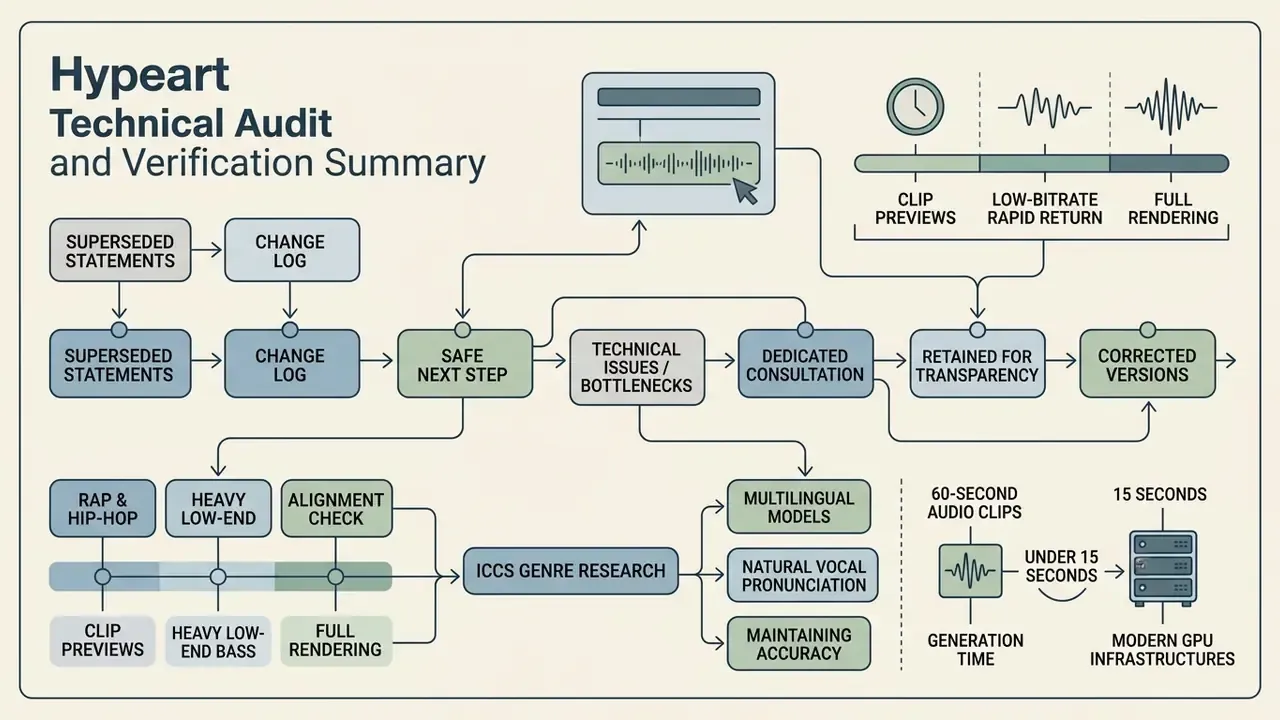
Technical Audit and Verification Summary