In a hypothetical review of automated media workflows for enterprise teams, the decisive variables were never the model brand. They were prompt structure, export resolution, and the human editing step that follows the first generation. Keep that order in mind, and most of this guide becomes practical rather than theoretical.
What Is an AI Flag Generator and What Can It Create?
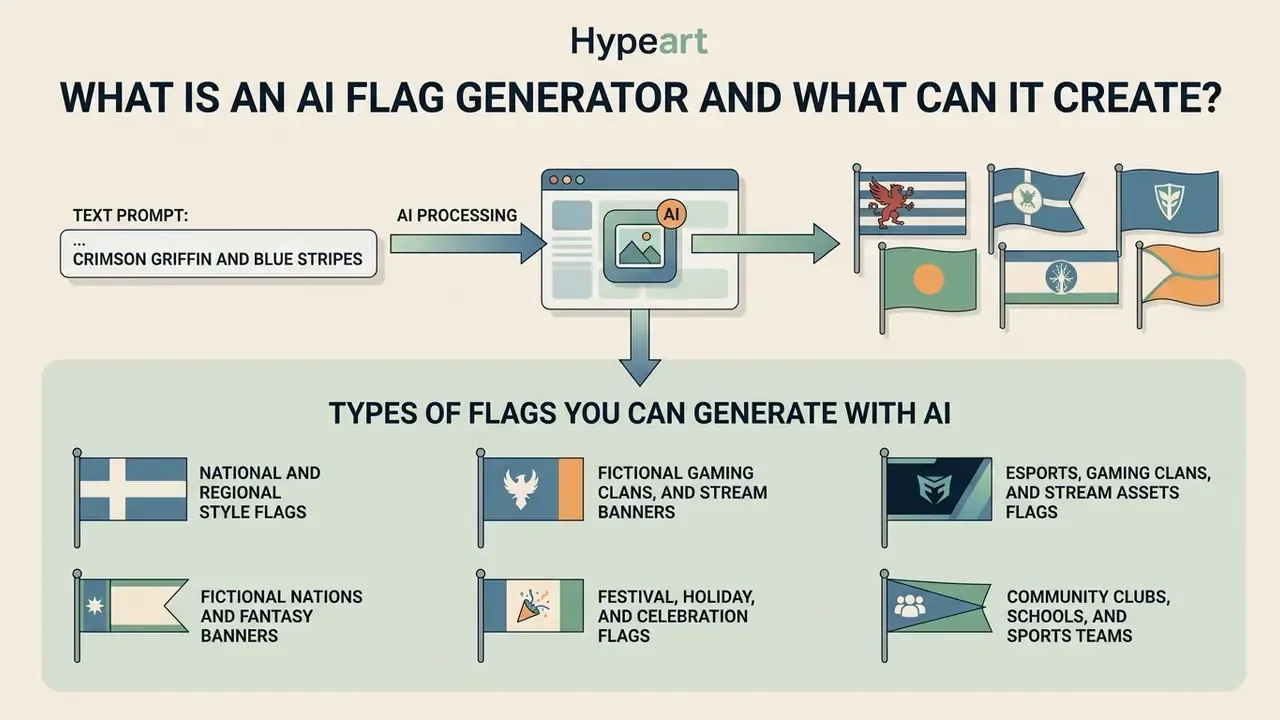
An ai flag generator is a specialized text-to-image interface tuned for graphic banners, heraldic symbols, and geometric flag layouts built from user-written prompts. These tools apply diffusion models or neural transformers to convert natural language specifications into high-contrast visual compositions.
Traditional design tools require manual layer work and precise spatial alignment to construct a readable emblem. A flag generator ai automates that spatial assembly by mapping words to trained visual primitives such as stripes, chevrons, and cantons.
From Text Prompt to a Custom Flag Design
The generation process converts textual concepts into image embeddings, which then guide a latent diffusion model toward a custom flag layout. Modern generative pipelines read structural commands (horizontal bands, vertical bars, centered symbols) and build a cohesive visual asset from them.
Contemporary text-to-image architectures are trained explicitly on spatial reasoning and style control. That training is what allows an ai flag creator to place a specific object inside a defined visual boundary instead of scattering it across the canvas.
«The dataset spans 11 domains and 51 subtasks, including style control (13,000 pairs) and spatial reasoning (8,000 pairs).»
That domain coverage explains why one model can translate detailed instructions into a balanced flag design with accurate symbols and proportional fields, then switch to a completely different aesthetic on the next prompt. Same engine, different vocabulary.
Types of Flags You Can Generate with AI
Users can create flag assets across several distinct domains, from official civic concepts to stylized fantasy imagery. An ai country flag generator produces sovereign-style tricolors, Nordic crosses, and heraldic state symbols suitable for worldbuilding projects.
Beyond fictional nations, a flag maker ai produces esports banners, corporate branding flags, festival identity marks, and social media headers. Multi-domain datasets let the same model render flat minimalist graphics and complex textured emblems, because style control and in-image text rendering are trained as separate subtasks rather than a single generic objective.
The categories that show up most often in production work:
- National and regional style flags tricolors, tri-bands, Nordic crosses, chevrons, and canton layouts for civic concepts or alternate-history projects.
- Fictional nations and fantasy banners medieval velvet banners, guild sigils, sci-fi faction marks, and tabletop campaign heraldry.
- Esports, gaming clans, and stream assets mascot emblems (an ai animal generator pass helps here), shield compositions, neon cyberpunk palettes, and panel-ready 16:9 crops.
- Corporate, conference, and event flags brand-color fields with generous negative space for a logo and a short slogan, plus storefront and pop-up booth banners.
- Festival, holiday, and celebration flags birthdays, weddings, graduations, national days, and seasonal decoration banners.
- Community clubs, schools, and sports teams club flags, school emblems, debate-team banners, and tournament flags that build unity and morale.
- Social awareness and equality flags designs for human rights, gender equality, LGBTQ+ pride, racial equality, environmental protection, and peace campaigns, usually built from bold contrasting bands, gradient glows, and unity symbols for marches, rallies, and online campaigns.
- Souvenirs and personalized gifts names, dates, photos, or artwork applied to a flag for anniversaries, travel memories, and family events.
- Tourism and cultural displays city, heritage-site, and museum-exhibit flags for travel shows and cultural festivals.
Hybrid mascots deserve one caution. Chimeric emblems produced by an ai animal hybrid generator look striking on a screen and often collapse into visual mush at 20 metres. Simplify before you print.
Animating AI Flags for Video Projects and Stream Overlays
Static AI flags convert into dynamic video assets through image-to-video models. Motion prompts such as "gentle breeze waving effect", "slow-motion fabric ripple", or "cinematic flagpole reveal" turn 2D graphics into looping overlays for Twitch banners, game intros, trailers, digital signage, and short social clips.
The workflow is sequential: generate the flag as a still image, refine the emblem and palette, then feed the finished frame into an image-to-video model or an animation maker as the first keyframe. Because the motion model inherits the composition of the source frame, a clean, high-contrast still with correct proportions animates far more predictably than a cluttered one. Keep loop length between two and six seconds for overlays, and export at the destination player's aspect ratio so the emblem is not cropped out of frame.
How to Create a Flag Using AI
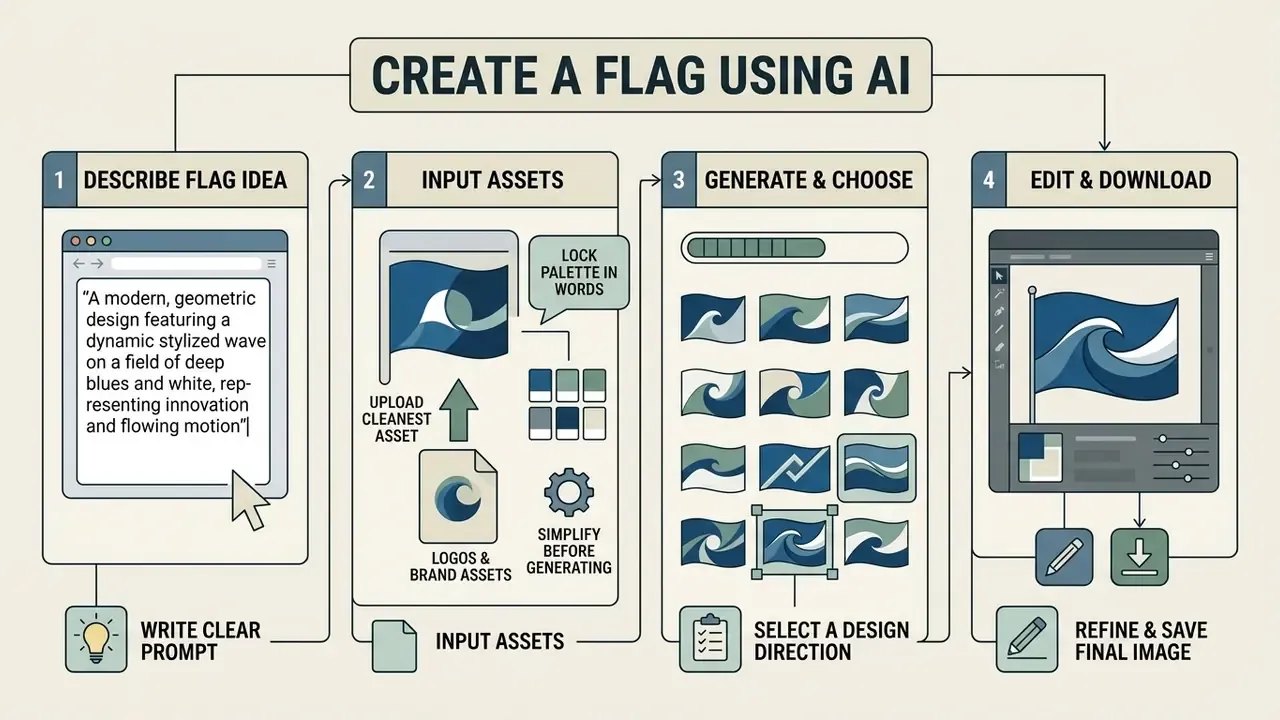
To create a flag using ai, you define the visual layout in text, generate initial iterations, adjust design details, then export at the resolution you need. Online tools compress this into a browser-based interface with no installation.
A structured sequence keeps quality predictable: prompt → generation → customization → download or share. Four steps, and the third one is where most of the value sits.
Describe the Flag Idea in a Clear Prompt
Start by drafting a descriptive prompt that fixes the background colors, the central symbol, and the overall balance. Effective prompts state placement: an icon in the upper-left canton, a crest centered on a field of blue.
Established vexillological guidance, including the design principles published by the Flag Institute and the "good flag, bad flag" rules used by the North American Vexillological Association, recommends two or three contrasting colors, meaningful symbolism, and no intricate lettering, seals, or coats of arms that degrade at a distance. A useful test: could a child redraw the flag from memory?
Clear spatial instructions let an ai generator flag process structural elements without blurring geometric boundaries. Write the field first, the emblem second, the render style last.
Turn Existing Logos and Brand Assets into Custom Flags
If you already own a corporate logo or brand mark, image-to-image workflows convert static 2D vector files into realistic fabric banners. Upload the source (logo, product shot, poster, packaging), specify the background geometry, for example a horizontal tricolor or a solid brand-color field, then instruct the diffusion model to preserve original brand colors while adding realistic fabric texture, folds, stitching, or a flagpole.
Three rules make this reliable:
This is the fastest route to consistent branding across event flags, storefront banners, pop-up booths, and merchandise mockups without commissioning a designer for each variation. Teams that already maintain a brand kit inside a design suite can compare options and test a Canva AI generator workflow before committing to print.
Generate Several Flag Designs and Choose a Direction
Pick your style, then let the ai flag maker produce several concepts at once. Comparing four to six distinct iterations shows which composition actually carries the project.
Evaluating several layout directions prevents settling on a weak symbol placement. A two-column scoring sheet (legibility at distance versus brand fit) is usually enough to pick the finalist, and it leaves a record of why you chose it.
Edit and Download the Final Flag Image
Use the built-in editor to refine colors, crop boundaries, and contrast before saving the final ai image. When the result holds up, choose your file format and download the asset.
Browser editors commonly support background removal, color balance tweaks, and export scaling to 2K or 4K. High-density output keeps line edges crisp on both screens and physical banners.
Most current editors also support prompt-based local editing, so a single failed element does not force a full regeneration. Inpainting and canvas-edit modes let you mask the canton and swap the symbol while the striped field stays untouched, replace a mascot without disturbing the neon background, or recolor one band to match a brand palette. If the composition is right but the framing is too tight for a pole sleeve, an AI expand image pass extends the field instead of forcing a fresh generation. Finish with a general photo editor pass for sharpening and color proofing before export.
How to Write an Effective AI Flag Prompt
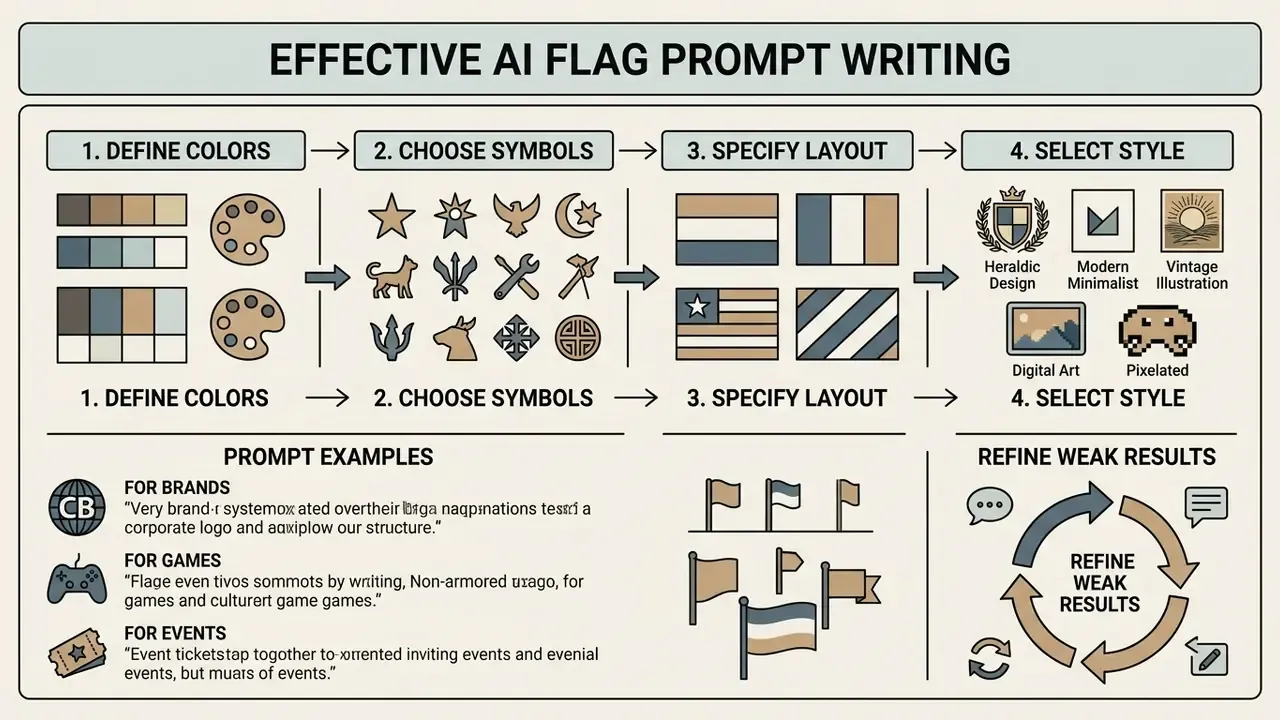
Writing an effective prompt for a flag creator ai means covering composition, color scheme, focal symbols, and artistic style in a fixed order. Clear formatting stops the model from inventing cluttered background elements or stray visual noise.
A reliable prompt order: scene/field → subject/emblem → key details → style → constraints. State what must be preserved (geometry, symmetry, band count) and what must be excluded (text, watermark, extra symbols).
Include Colors, Symbols, Layout, and Style
A complete flag prompt names exact color fields, symbolic icons, structural layout, and rendering style in a logical sequence. Background pattern first, central emblem second, aesthetic tags such as "flat vector" or "heraldic crest" last.
To preserve contrast, name two or three primary colors explicitly: navy blue, crimson red, bright gold. Adding layout constraints ("centered emblem on a horizontal tricolor, symmetrical, no lettering") measurably reduces spatial alignment errors during synthesis, and the effect is documented rather than anecdotal.
«Adding structured style descriptors to prompts improved semantic consistency by 16% and text–image alignment by 5%.»
Prompt Examples for Brands, Games, and Events
Adapting prompts by project type keeps the banner aligned with audience expectations. The negative-prompt column is what prevents the two most common artifacts in flag generation: invented lettering and duplicated emblems.
| Flag Type | Required Prompt Elements | Negative Prompt (Exclude) | Target Result Style |
|---|---|---|---|
| Corporate Brand (see corporate flag branding workflow) | Primary brand colors, central abstract icon, clean background, high contrast | text, gibberish letters, gradients, drop shadows, multiple logos | Minimalist flat vector, corporate identity |
| Esports / Gaming | Dark background, aggressive mascot emblem, neon accent lines, symmetrical shield | blurry edges, watermark, low contrast, extra mascots, jpeg artifacts | Dynamic vector emblem, gaming banner |
| Festival / Event | Bright multi-color field, organic geometric shapes, celebratory motif, top banner text | muddy colors, cluttered background, unreadable text, more than four hues | Vibrant graphic poster style, modern banner |
| Fantasy Kingdom | Deep crimson and gold, heraldic dragon or crown emblem, vertical banner shape | modern typography, photographic realism, plastic texture, mirrored emblem | Medieval heraldic crest, textured fabric |
| Social Awareness / Equality | Bold horizontal bands, unity or hand symbol, high-saturation contrast palette | national insignia, political party marks, text overlays, asymmetric bands | Clean symbolic banner, campaign-ready |
| Sports Club / Tournament | Team colors, simplified crest, chevron or diagonal split field, pole sleeve visible | busy patterns, tiny numerals, sponsor clutter, distorted crest | Bold athletic emblem, high-visibility |
Improve Weak Results with Prompt Updates
If a generation returns skewed geometry or extra symbols, add negative constraints or clarify placement. Rephrasing vague description into explicit spatial commands removes most synthesis artifacts.
Consider an illustrative case. In a hypothetical corporate branding review for a fintech client, the first banner generation produced overlapping symbols and illegible typography. Rewriting the prompt into three explicit parts, a flat blue field, one central white circle, zero background text, produced a clean, compliant result within two iterations. Two, not twelve.
«Systematic prompt refinement improved text–image semantic alignment by 5%, output consistency by 16%, and output safety by 48.9% versus baseline prompts.»
A repeatable refinement loop: diagnose the specific defect → rewrite only the clause that caused it → regenerate with the same seed where possible → compare side by side. Change five variables at once and you never learn which edit fixed the flag.
Copy-Paste Prompt Library
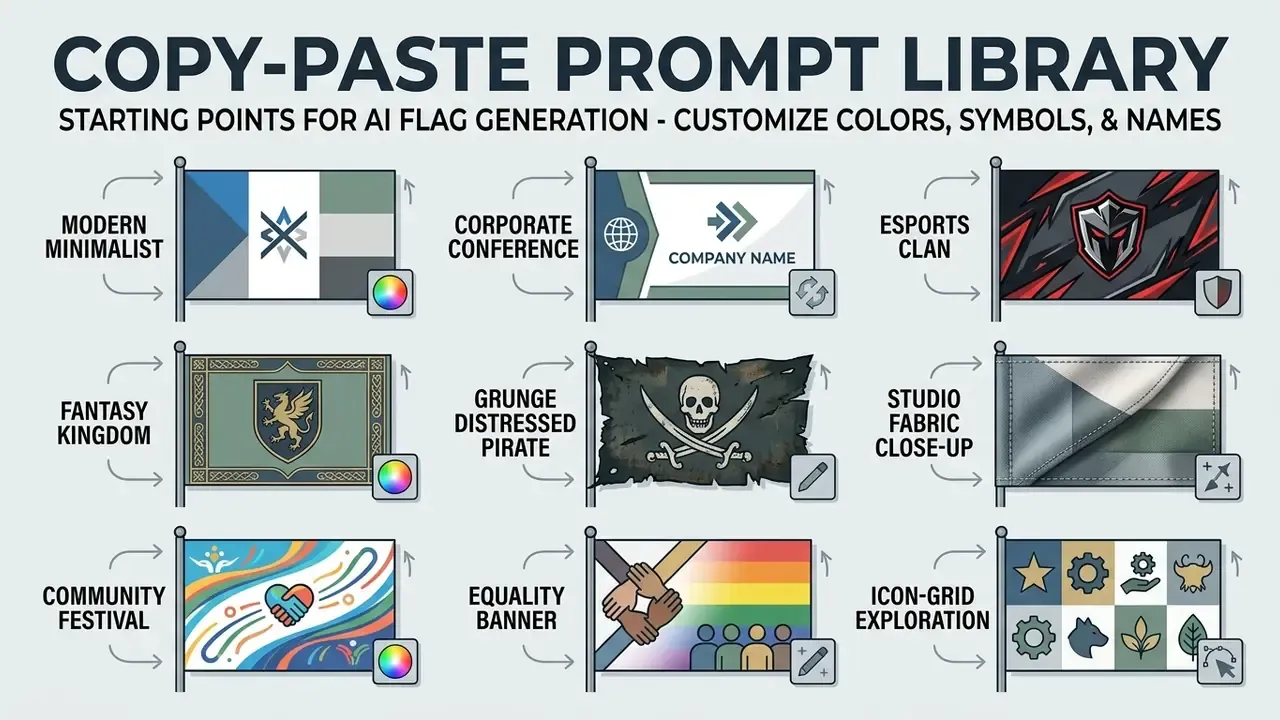
Use these as-is, then substitute your own colors, symbol, and brand name. Each one follows the recommended order (field → emblem → detail → style → constraints).
1. Cinematic 3D fabric flag
2. Modern minimalist vector flag
3. Corporate and conference flag layout
4. Esports and gaming clan flag
5. Fantasy kingdom banner
6. Grunge distressed pirate flag
7. Studio fabric close-up for print mockups
8. Community, festival, and equality banner
9. Icon-grid exploration board
10. Outdoor event flag scene
The same prompt discipline transfers to adjacent formats. If you build a full visual identity, the structure that works for a flag also works for an ai album cover or a campaign key visual: field, subject, detail, style, constraints.
Is an AI Flag Generator Free and Does It Require Sign Up?
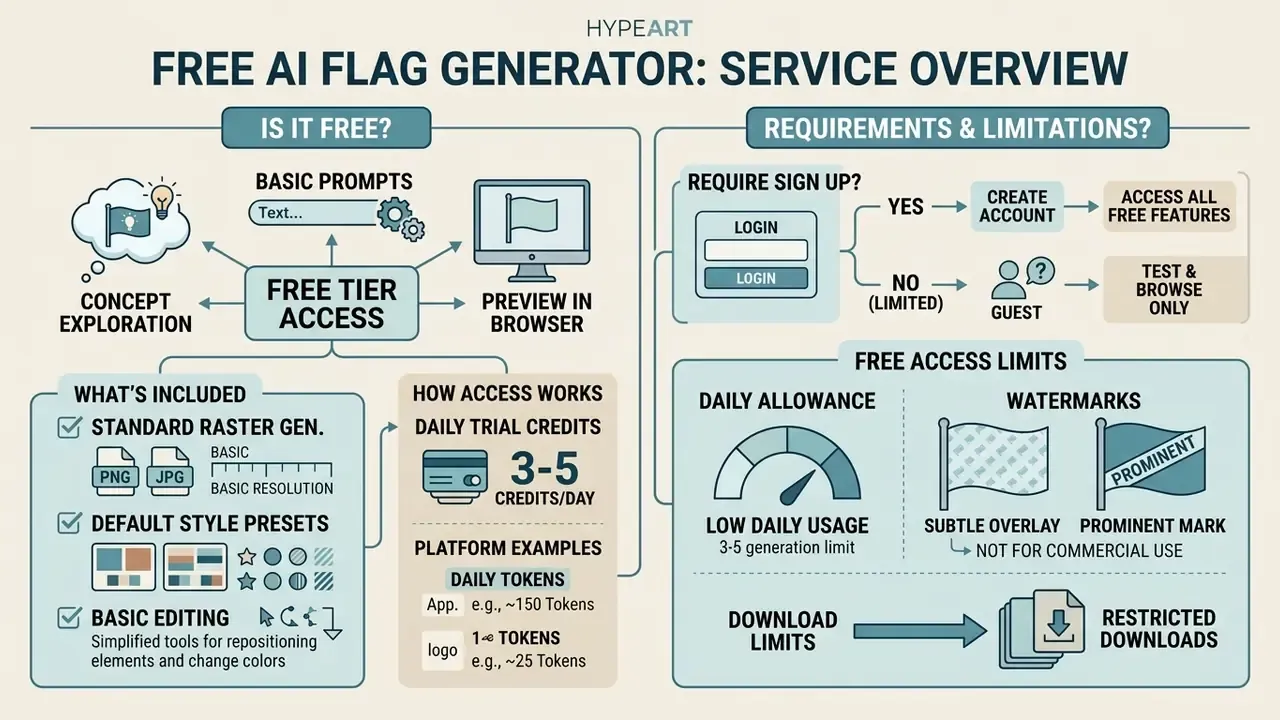
Most services offer an ai flag generator free tier for testing basic prompt generation and previewing graphics in the browser. Premium tiers or credit packs cover high-resolution exports, vector conversion, and commercial rights.
A free ai flag generator is fine for concept exploration. Advanced export usually requires registration or purchased credits, and you can browse the hub of plan comparisons before you commit budget.
What a Free AI Flag Generator Usually Includes
Free access normally covers standard raster generation, default style presets, and basic editing. An ai flag generator no sign up option lets you test prompts without handing over contact details, though saving a project or reusing it later almost always needs an account.
Platforms offering an ai flag generator online free workflow typically issue daily trial credits or allow standard-definition downloads with basic privileges. A practical rule from vendor documentation: editor access and PNG export are commonly free, while generation quotas, SVG/PDF export, and watermark removal sit behind the paywall. Broader comparisons of free AI art generators show the same split across the wider text-to-image market. An ai flag maker free plan therefore gets you a concept, rarely a print-ready file.
Watermarks, Credits, and Download Limits
Free generative tiers apply limits: a daily allowance of three to five credits, or a subtle watermark on downloaded raster files. High-resolution 4K exports and vector SVG conversion usually require paid credits, which is where a flag generator ai free plan runs out of runway.
Published vendor pages indicate free daily allocations of roughly 150 daily tokens on Leonardo AI, about 25 monthly generations on Adobe Firefly, around 15 daily boosts on Microsoft Copilot Image Creator, and 3 daily credits on Media.io. These reflect standard freemium credit architectures across the text-to-image market. Exact numbers change often by plan version and region, so verify the current allowance on the vendor's own pricing page before planning a batch of flags. If a number in a comparison table has no date, treat it as unverified.
Watermarking behaves in two distinct ways, and the difference matters for commercial work. Some services stamp a visible logo on free downloads. Others deliver a clean image but embed invisible provenance metadata, for example SynthID-style marking. Stripping provenance information is prohibited by several major vendors' terms, and that prohibition survives your download.
Tool Comparison: Credits, Resolution, Watermarks
Platform choice is mostly a trade-off between free volume, export ceiling, and editor depth. The table summarizes what vendors publish. Treat it as a starting shortlist, not a benchmark: no independent comparative test of flag-specific output quality exists yet. You can also compare options on cost per usable asset rather than cost per generation.
| Tool | Free access | Export ceiling | Watermark on free tier | Editor depth for flags |
|---|---|---|---|---|
| NightCafe | Free generations plus daily credits | High-resolution raster | Typically none on standard output | Template fields for colors, layout, central symbol, style; the most explicit flag controls |
| VEED | Credit-based, cost shown before generating | High-resolution raster | Not applied on paid credits | Prompt-based image editor plus image-to-video animation |
| Media.io | 3 credits per day | Up to 4K, ratios 1:1, 16:9, 9:16, 3:2 | Possible on free downloads | Style switching, reference-image upload, model choice |
| Fotor | Credit-based, credits earned via tasks | High-quality raster, multiple ratios | Stated as watermark-free | Post-generation editor for text, stickers, backgrounds |
| insMind | Free prompt and image-to-flag generation | High-resolution raster | Not applied on standard output | Aspect-ratio presets plus element and color editing |
| General-purpose models (see Midjourney vs alternatives, Microsoft AI image generator) | Varies by plan | 1024×1024 to 2048×2048 typical | Varies; provenance metadata common | No flag-specific presets; maximum stylistic control |
Commercial Use, Intellectual Property, and Enterprise AI Governance
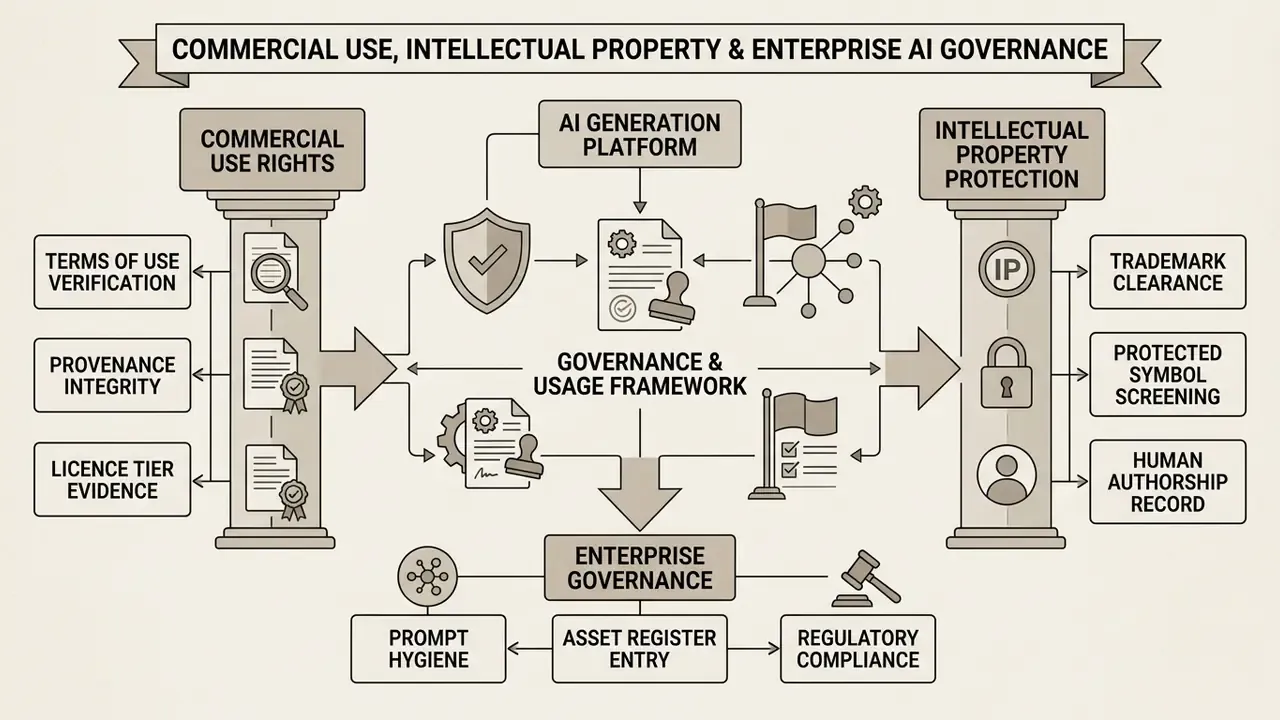
Commercial rights over AI-generated images depend on the platform's terms of service and the relevant jurisdiction. If you plan to register a custom flag as a corporate trademark, review the terms tied to your subscription tier first.
In the United States, Copyright Office registration guidance on works containing AI-generated material states that output produced without sufficient human creative input cannot be registered. Registration covers the human-authored contributions only.
«EU and US frameworks recognise only human authorship: AI output without sufficient human contribution is not protected by copyright.»
The picture is not uniform worldwide. In 2023 the Beijing Internet Court recognised copyright in an image generated through Stable Diffusion from text prompts, a precedent that runs counter to the current US position.
«The Beijing Internet Court granted copyright protection to a Stable Diffusion image created from text prompts.»
Regulatory disclosure is the second layer. The EU AI Act, Regulation (EU) 2024/1689, requires providers of generative systems to mark outputs in a machine-readable format as artificially generated, with the relevant transparency obligations applying from August 2026 (European Commission, regulatory framework for AI: https://digital-strategy.ec.europa.eu/en/policies/regulatory-framework-ai). Institutions tracking downstream disputes over training data and output ownership can view the guide to active cases.
Fact Check: Terms of Use Verification
Inside regulated environments the calculus changes. Financial institutions and large corporate brands evaluating generative graphic pipelines should route them through existing model-risk frameworks rather than treating image generation as a marketing tool with no owner. Practically, that means defined usage boundaries, an audit trail for every generated media asset, and legal review before external publication. Independent evaluation work gives that review a quantitative basis. Broader licensing context sits in the AI Media Commercial-Use reference set.
«Stable Diffusion achieved the highest R-Precision among tested models across 10,000 real images from COCO and Flickr30k.»
Enterprise IP and Governance Checklist
- Prompt hygieneconfirm no third-party trademark, protected emblem, or copyrighted character was named in the prompt or uploaded as a reference.
- Protected symbol screeningcheck output against restricted insignia, including national flags, Red Cross emblems, and official seals, before commercial deployment.
- Human authorship recordlog the editing steps (recolor, inpaint, vectorization, typography) that establish human contribution for any registration attempt.
- Licence tier evidencearchive the plan invoice and the terms version in force on the generation date.
- Provenance integritynever strip invisible watermarks or C2PA-style metadata; record where AI-content labelling is applied.
- Asset register entryadd the flag to the internal AI-generated media inventory with model name, prompt, date, operator, and intended use.
- Trademark clearancerun a similarity search before filing a generated flag or emblem as a mark.
- Retention and privacyverify how long the vendor stores prompts and uploads, and whether uploads feed model training.
One more governance note, since content policy and IP get conflated. Adjacent generative categories carry different acceptable-use exposure. A restricted class such as ai adult video generation, or a consumer novelty like an ai aging filter applied to identifiable people, triggers consent and likeness questions that a corporate flag simply does not. Keep the policy scoped to the asset class. If a question stays open after review, open the hub and escalate it rather than shipping the asset.
Disclaimer: this section is general in nature and is not legal advice. Copyright, trademark, and AI-disclosure rules differ by jurisdiction and change over time. Consult a qualified professional before commercial deployment or registration.
AI Country Flag Generator vs Custom Flag Maker
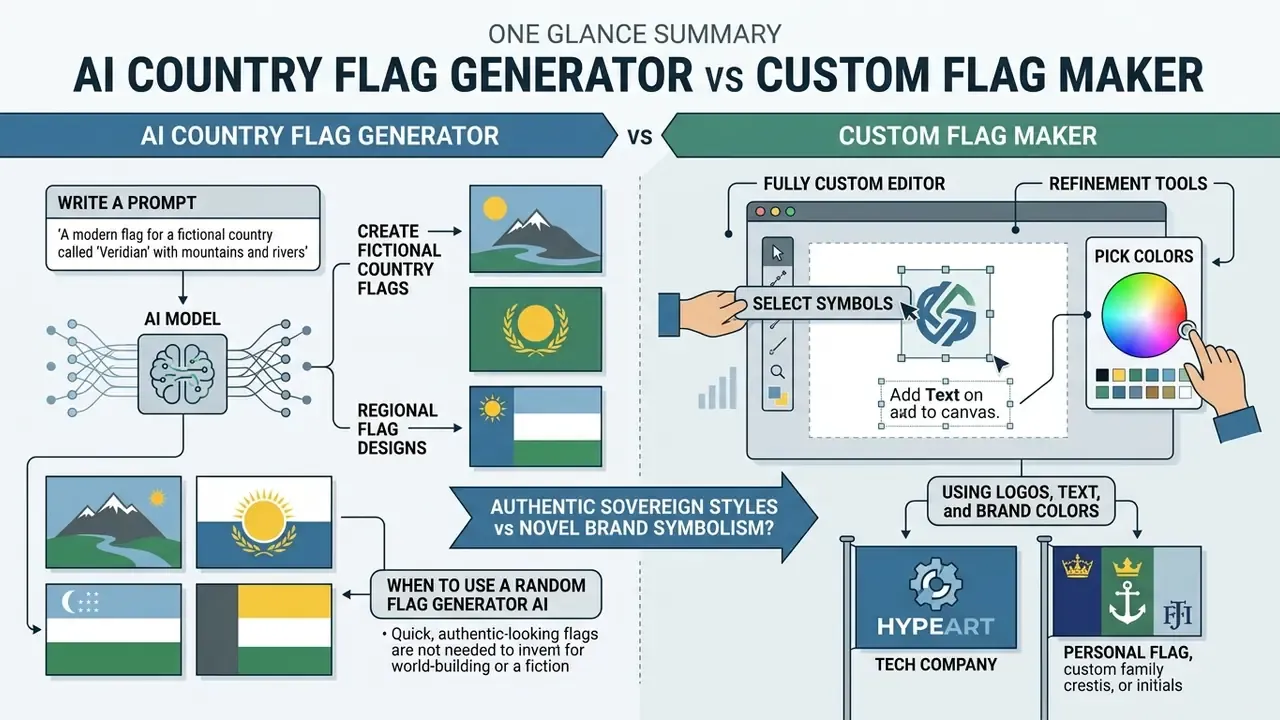
Choosing between a country flag generator ai tool and a fully custom editor depends on one question: do you need authentic sovereign styling or novel brand symbolism? Country-style tools lean on established vexillological convention. Custom makers hand you total creative freedom, and the responsibility that comes with it.
Creating Fictional Country and Regional Flag Designs
Designing fictional nation banners means balancing heraldic tradition against clear visual identity. A random flag generator ai quickly outputs regional designs with classic chevrons, cantons, and national heraldry for worldbuilding or historical simulation.
Vexillological practice for translating coats of arms into flyable flags relies on a fixed set of moves: rotate the charge toward the hoist, place the primary symbol hoist-side or centered, reduce the number of charges and colors, and apply pars pro toto simplification so one element stands for the whole achievement. FIAV-affiliated work also notes that flags avoid heraldic metals, enamels, and furs, substituting bunting colors and simplified stripes or geometric figures for legibility at distance. The principle is well established in the discipline; specific dated guidance should be checked against the primary source before citation.
That constraint set is precisely what a diffusion model needs stated out loud. The same style-control capability covering 13,000 training pairs in the OpenGPT-4o-Image dataset can render either an ornate crest or its simplified geometric equivalent. Only the prompt decides which.
Using Logos, Text, and Brand Colors in Custom Flags
Placing a company logo or brand typography on a flag demands precise positioning and contrast management. Text on flags should be short, thick, and high-contrast.
«The dataset includes 3,000 pairs dedicated to in-image text rendering tasks.»
That subtask coverage explains why current models can embed short, readable lettering inside a defined style layout. It does not remove the physical constraint. Commercial print practice consistently favors simplified icon marks over full text-based logos for outdoor fabric flags, because fine lettering and thin internal details go unreadable at medium viewing distance. If text fails the distance test, cut it. Brand-guide practice adds a second rule: define both a colored-logo-on-white and a white-logo-on-color variant so the flag stays legible against either field.
When to Use a Random Flag Generator AI
A random flag generator ai earns its place during early brainstorming, when you want rapid visual inspiration without writing a complex prompt. Unexpected color combinations and layout patterns help creative teams break a block.
Research on generative ideation converges on one practical conclusion. Prompt variation and hybrid prompting widen semantic breadth during exploration, while productivity keeps rising even as originality plateaus. Randomized output is stimulus material for human selection, never a substitute for it.
Pre-Print and Pre-Launch Checklist
Run this before sending a generated flag to a printer or publishing it as a brand asset.
Checklist0 / 10
AI Flag Generator FAQ
Can AI Generate Real Country Flags?
AI models can produce recognizable versions of official national flags, but outputs often carry minor spatial inaccuracies or simplified emblem details. Vexillology communities and academic projects describe these as look-alikes rather than exact reproductions. For legal or official representation, use vector graphics from official government registries instead of synthetic generation.
Can I Print an AI-Generated Flag?
Yes. A flag ai generator output prints on physical fabric if the raster source is exported at sufficient pixel resolution or converted into a vector format. Large fabric printing requires scaling the graphic to real physical dimensions, and most textile printers accept a user-supplied PDF or high-resolution PNG.
What Size and Format Should I Choose for a Flag Image?
For digital displays, a high-density PNG at 1024×1024 or 2048×2048 pixels works. For social posts and stream panels, 1080×1080 px (1:1) or 1920×1080 px (16:9) covers most placements. For outdoor fabric flags, standard production follows the 3×5 feet (about 90×150 cm) format at a 3:2 or 5:3 ratio. Generate or upscale raster artwork to a minimum of 4500×3000 pixels to hold 300 DPI print density without distortion. Large-format textile printers frequently accept 100 to 150 DPI at real scale because of viewing distance, but 300 DPI remains the stricter print-ready target for detailed emblems. Safest result: export your design as PDF or SVG, since vector output is resolution-independent. Remember that many diffusion models default to 1024×1024, which equals roughly 8.7 cm of physical width at 300 DPI. Upscaling or vectorization is not optional for a real flag.
How Do I Remove Text Artifacts from a Generated Flag?
Add explicit negative constraints ("no text, no lettering, no watermark, no signature") and regenerate. If the composition is otherwise correct, use the editor's inpainting mode to mask and clear the affected area instead of rebuilding the whole flag.
Can I Animate My AI Flag?
Yes. Feed the finished still into an image-to-video model with a motion prompt such as "gentle breeze waving effect" or "slow cinematic flagpole reveal", then export a two-to-six-second loop at the destination aspect ratio for stream overlays, intros, or digital signage.
What Is the Best AI Flag Maker for My Project?
It depends on the control level, resolution, and budget you need. Browser tools such as NightCafe, Media.io, Fotor, and VEED offer accessible prompt-based flag generation; see the tool comparison table above and broader reviews of free AI art generators. Dedicated design platforms give deeper editor control for custom vector branding. NightCafe currently exposes the most explicit flag-specific fields (colors, layout, central symbol, style), while a flag ai maker built into a video suite like VEED is the stronger pick when the flag has to end up inside a timeline.
Are AI-Generated Flags Free to Use Commercially?
Sometimes. Several platforms grant commercial rights on paid tiers and make no copyright claim over your output. Others restrict commercial exploitation or require attribution. Always confirm the terms version in force on your generation date, and keep one distinction in mind: "permitted by the platform" is not the same as "protected by copyright."
Internal Resources & Reference Hub
- Guide to online photo editors and commercial workflows
- Comparison of the best AI art generators
- Comparison of free AI art generators: limits, watermarks, licensing
- Canva AI Generator: features, pricing, commercial licensing
- Microsoft AI Image Generator: access, limits, commercial terms
- AI outpainting tools for expanding images and backgrounds
- Guide to animation makers and export options
- Midjourney versus competing image generators
- AI animal styles for mascots and crests
- Terminology reference: explore the hub
Appendix A: Revision Notes on Superseded Statements