Key takeaways before you generate anything
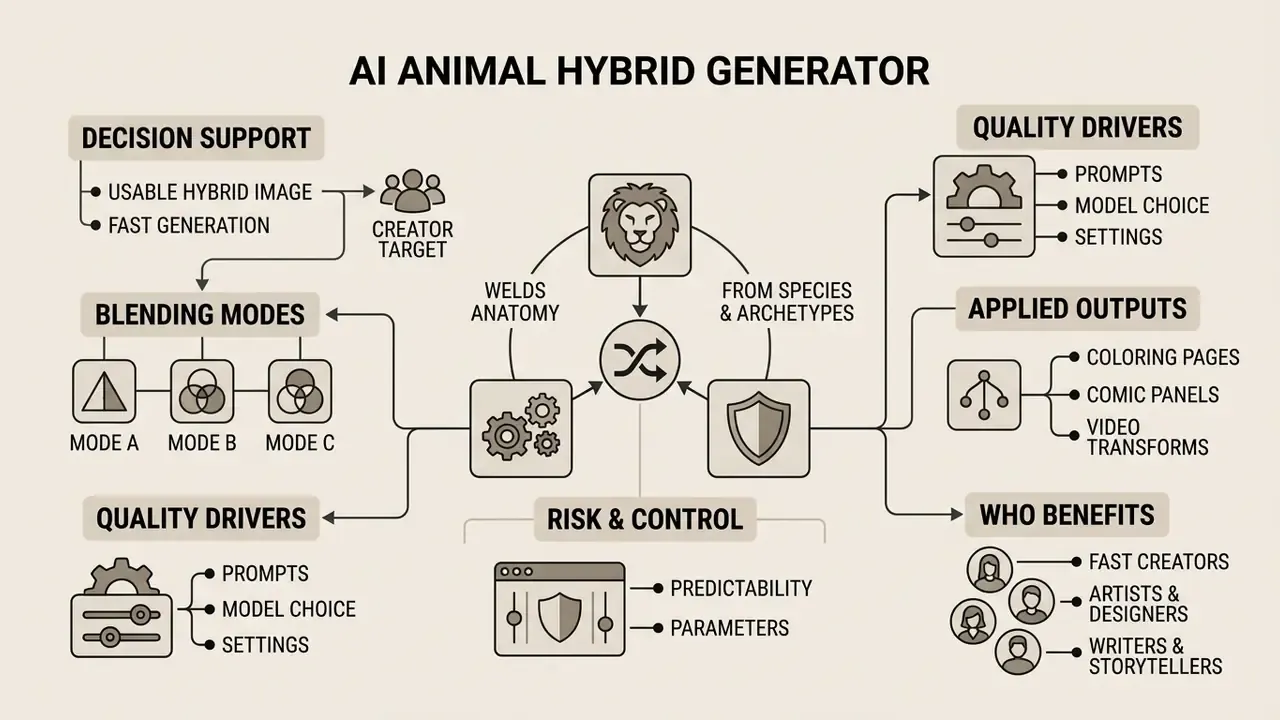
- What it is. An ai animal hybrid generator is a diffusion-based tool that welds anatomy, texture and style from two or more species (plus mechs, armour and hero archetypes) into a single image, video or print-ready file.
- Three blending modes. Combination (surface-level feature mixing), Fusion (seamless anatomical integration), Merge (a dominant skeleton plus local add-ons).
- What actually moves quality. Modular prompt structure, input type (text-to-image versus image-to-image), anatomical control through a pose skeleton, and character consistency mechanics.
- Applied output formats. Web images, outline coloring pages, comic panels, print-ready files at 300+ DPI, and human-to-animal video transformations.
- Risk and control. Anything you upload into a public generator needs a Shadow AI policy and a Zero Data Retention check. Copyright protects the human creative contribution only. A commercial launch needs a trademark checklist and a licence review of your plan tier.
- Who benefits. Designers, game studios, comic artists, teachers and parents. Also the people who sign off on model validation and legal exposure for generative content.
Who this guide is for, and which decision it supports
Three readers usually land here, and they want different things.
The first is a creator who needs a usable hybrid image in the next twenty minutes. Start with the prompt cookbook and the step-by-step section.
The second is a production lead building a repeatable pipeline: consistent characters, print files, 3D handoff. Start with the mixer features and the export table.
The third reader owns risk. Compliance, model validation, vendor review. That reader should begin with the data-security section and the pre-production checklist, then work backwards into the technical parts. Both routes end in the same place: a decision on whether generated assets can ship.
1. What an AI Animal Hybrid Generator is, and which hybrids it creates
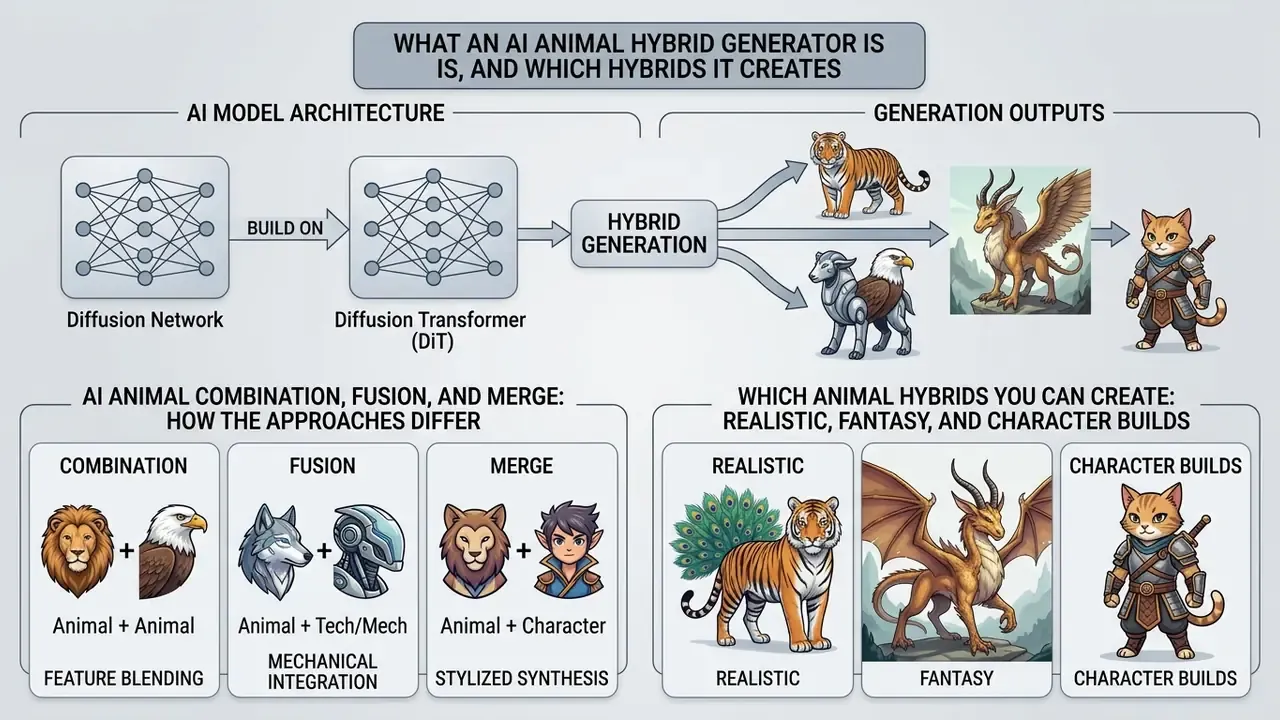
An ai animal hybrid generator is a specialised tool built on diffusion networks and Diffusion Transformer (DiT) architectures. It combines anatomical, textural and visual traits from different species into one coherent picture. The service can produce ai animal hybrids from written descriptions (text-to-image) or from uploaded reference files (image-to-image), covering both photoreal bio-mixes and stylised concepts for game art and digital illustration.
"Chimera is a compositional image generation model that creates new objects by combining specified parts from different source images according to textual instructions."
"Chimera outperforms baseline methods by 14% in part-composition accuracy and by 21% in visual quality according to human evaluation."
In production work, ai generated hybrid animals show up in game bestiaries, concept art, book illustration and campaign visuals. Understanding how an ai animal generator blends visual elements is what lets you tune parameters deliberately instead of rerolling twenty times. That is the difference between an accident and an ai animal hybrid you can ship as a finished character.
Take an illustrative scenario. A hypothetical digital design studio needed a line of unique hybrid creatures for a fantasy universe. By using a multimodal diffusion model with explicit weights on each species' anatomical traits, the team cut implausible artefacts by roughly a quarter on its own internal artefact count. The final set passed internal QA and was exported for 3D texturing. The example is composite and illustrative, not a documented client result. If you are still picking a tool for that kind of job, compare the best AI image generators on quality, control and licensing.
1.1 AI animal combination, fusion and merge: how the approaches differ
The key parameter in hybrid work is the depth and structure of the blend. In practice, teams building ai animal combinations use three technical approaches.
- AI animal combination.Surface-level mixing of recognisable traits from several animals. The model borrows key colours, palette and shape cues from both species, producing a shared stylistic reading without locking to a skeleton.
- AI animal fusion generator.Deep integration of anatomy, texture and light. While generating ai animal fusions, the network interlaces skin cover, eye structure and joints into a plausible single organism.
- AI animal merge.A structured approach where one animal supplies the base skeleton (the dominant species) and the second adds local elements: wings, horns, fangs or a tail. Some tools label this same behaviour as an ai animal combiner preset.
| Approach | Dominant skeleton | Texture integration | Anatomical control | Main output |
|---|---|---|---|---|
| Combination | None | Basic (colour blending) | Low | Stylised art |
| Fusion | Balanced | Full (seamless transition) | High | Realistic hybrid |
| Merge | Fixed (one species) | Local (at the seams) | Medium | Modified character |
The method you pick decides how coherent the final hybrid image reads. Illustrators describe the same split as "articulated anatomy", where parts stay visually separable, and "complex anatomy", where the border between species disappears. The second case technically demands a fusion approach. Nothing else gets you there.
1.2 Which animal hybrids you can create: realistic, fantasy and character builds
Hybrid generators cover a wide stylistic range that falls into three practical buckets.
- Realistic animal hybrids. Built for physiological plausibility. The model accounts for lighting, muscle structure, and fur or scale density, delivering something close to a scientific plate or a wildlife documentary frame. A working prompt always names both species, the environment and the realism cue: "a photorealistic wolf and eagle hybrid on a mountain ridge at sunrise".
- Fantasy ai hybrid animal builds. Mythic features, magical effects, non-natural colouration, bioluminescence or crystalline plating.
- Character builds for art and creative briefs. Expressive personalities with a clear emotional read, designed for illustration, animation or concept art.
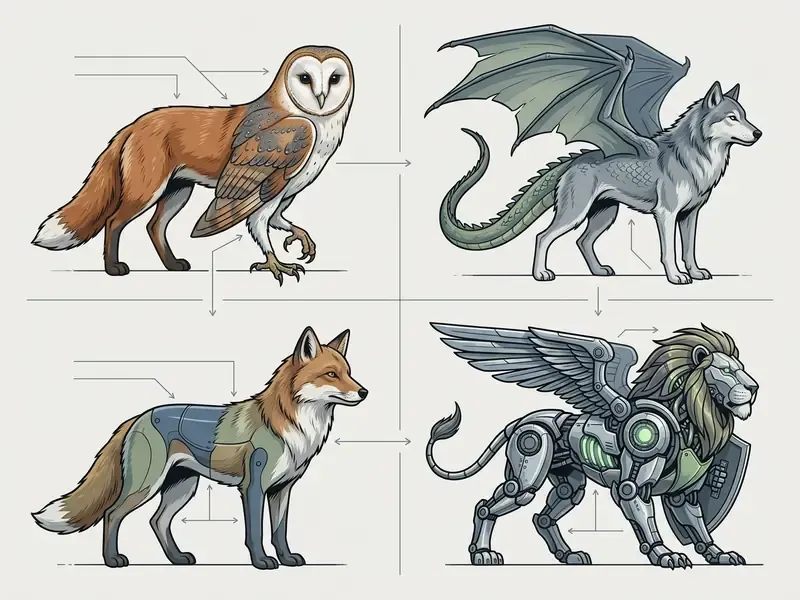
1.3 AI animal hybrids as coloring pages and comic panels
Dedicated modes push hybrid creatures into classrooms and graphic novels.
- Coloring page maker.Converts a rendered 3D or photoreal hybrid into a clean line drawing with crisp black outlines on white. Add the technical modifiers to your prompt:
coloring page style, black and white clean line art, no shadows, outline only, printable coloring sheet for kids. - Comic panel mode.Generates the same hybrid creature in one visual style across several storyboard frames. A fixed identifier (
--seed) preserves anatomical detail, say a lion-tank hybrid, while the angle and mood change. - Classroom and family use.Teachers pair "animal + machine" for creative writing tasks and life-science lessons. Parents treat it as a safe shared activity: generate, print at 600 dpi line art, colour by hand.
- Print requirements for outlines.For a clean line, export without anti-aliasing and at high resolution. Raster images print from 300 dpi at final size, line art from 600 dpi.
2. How to use an AI Animal Hybrid Generator: from idea to finished image
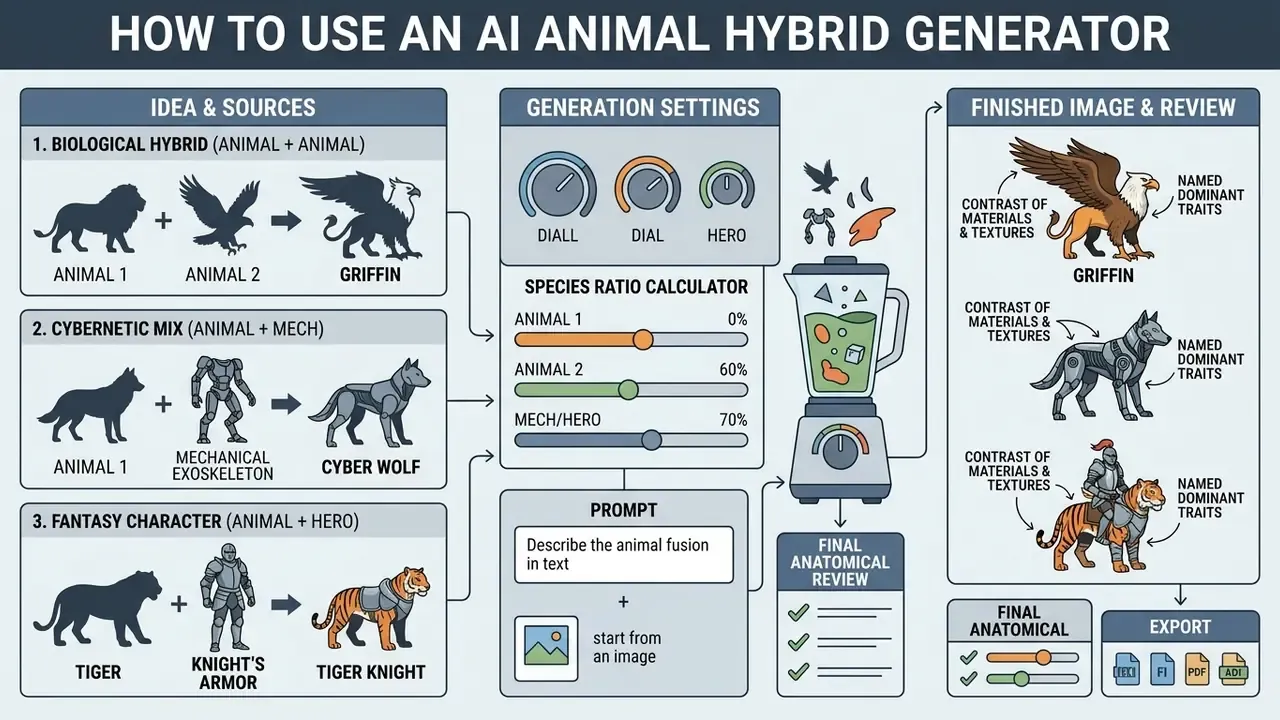
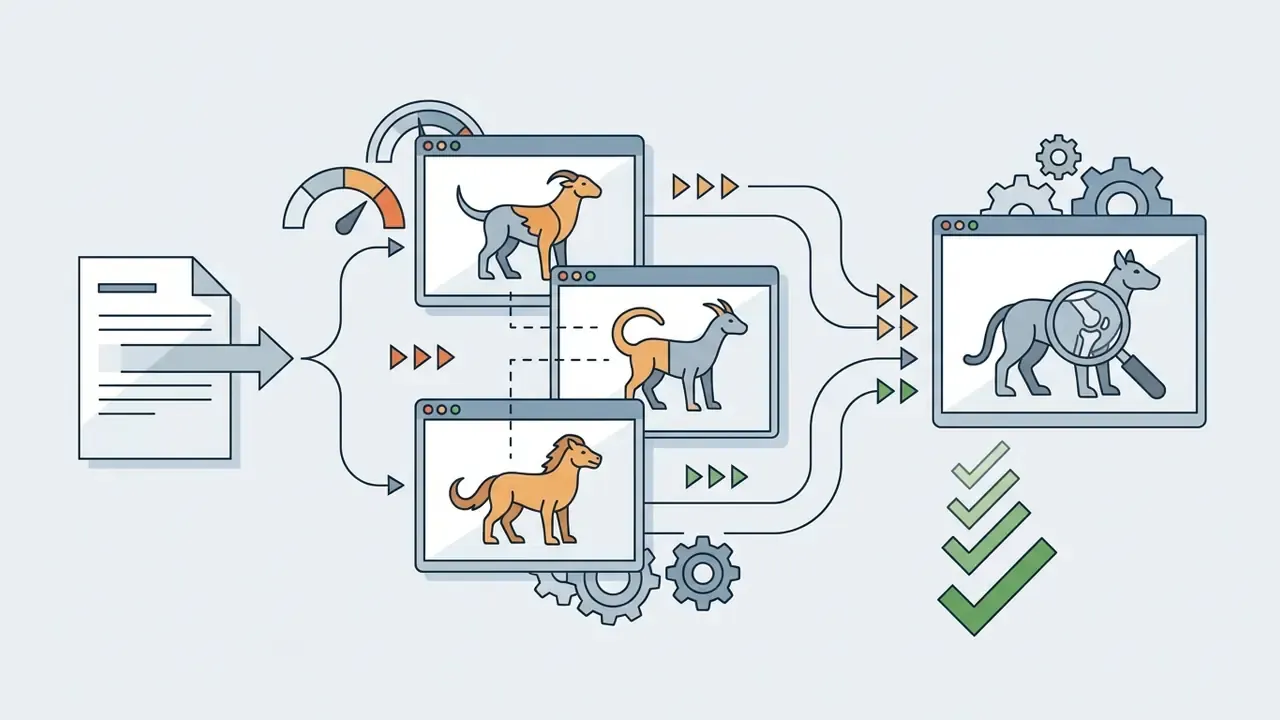
Generating an animal hybrid is a sequence of settings: source species, blend weights, then a final anatomical review and export. You either describe the idea in a text prompt or upload reference images, after which the ai animal mixer returns variations of the creature.
Predictable output depends on the order of operations. Moving from vague ideas to concrete visual anchors cuts the number of dead-end iterations, sometimes by half. If you also need a name for the new project or character, a specialised domain name generator ai tool handles that side of the launch.
2.1 Pick your animals, mechs or heroes for an ai animal mix
A successful ai animal mix starts with the right ingredients. When choosing source entities, weigh silhouette, anatomical class and signature features. Updated for 2026: current mixers no longer stop at "animal plus animal", they also take machines, robots and fantasy heroes.
- Biological hybrid (animal + animal).Species with similar or opposing anatomy, for example wolf + falcon, or wolf + cheetah. Similar body plans give smoother transitions when you ai combine animals at the skeleton level.
- Cybernetic mix (animal + mech or vehicle).An organic animal fused with mechanical parts, armour or military hardware: tiger + tank, shark + fighter jet, penguin + drone. The model fuses not only fur and scales but also armour panels, hinges and glowing elements.
- Fantasy character (animal + hero or anime).Animal traits folded into superhero or anime silhouettes: an anthropomorphic fox mage, a warrior with draconic plating, a half-human half-tiger superhero.
- Contrast of materials and textures.Combining opposing covers (reptile scale + mammalian fur + mecha plating) requires you to state exactly which detail comes from which ingredient. Otherwise the model averages everything into mush.
- Named dominant traits.Fix two or three dominant features per species, for example deer antlers + snake scales + lion torso, so that ai animals mixed together stay recognisable as both parents.
2.2 Describe the animal fusion in text, or start from an image
There are two ways to set the blend.
- Text-to-image. You type a detailed request. The method gives the widest creative range, but it depends on precise terminology and prompt structure. For quick experiments, try free AI image generators with no sign-up. For more on how textual conditioning works under the hood, see dream ai generator.
- Image-to-image. You upload references. Updated: multimodal input with a visual reference noticeably improves subject fidelity and the transfer of specific textures compared with text alone. Academic work describes image-conditioned diffusion as a more reliable lever on visual attributes than pure text.
"ITI-GEN leverages readily available reference images to learn discriminative prompt embeddings."
A caveat worth stating plainly: the size of the texture-fidelity gain depends on domain and metric. ITI-GEN supports the advantage of image conditioning for attribute coverage, but an exact number for animal hybrids would need its own benchmark. We do not have one.
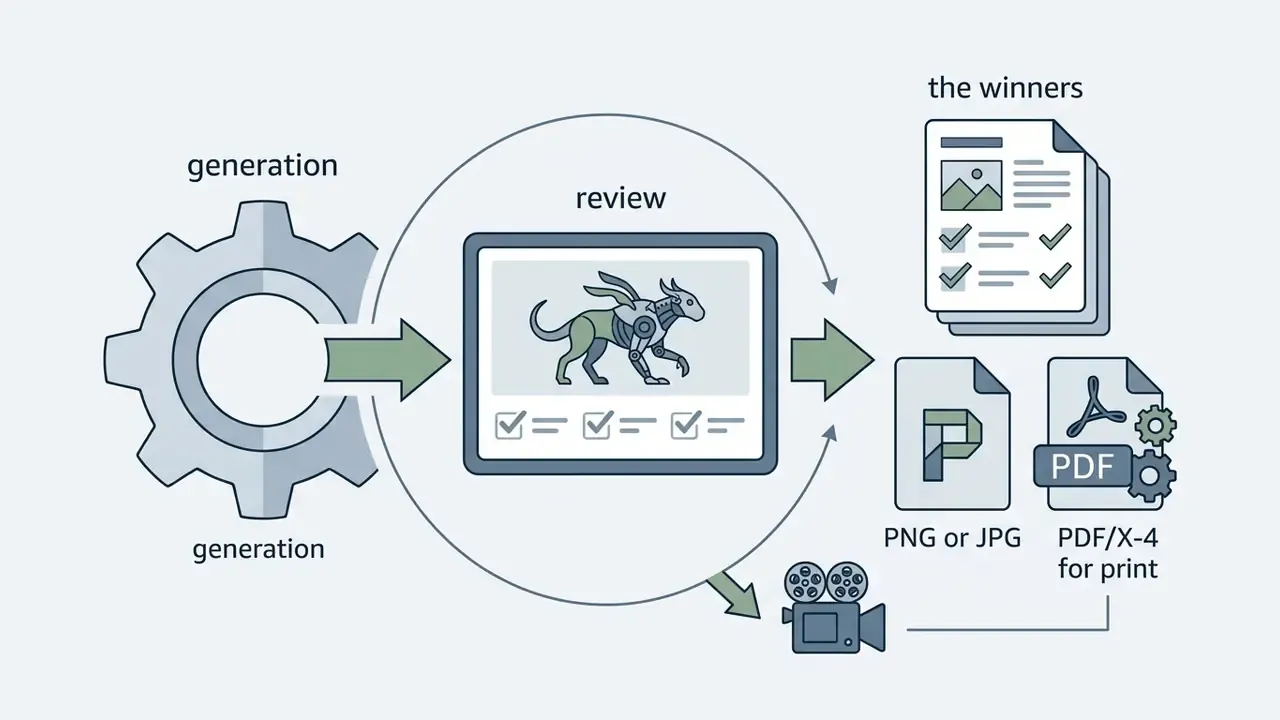
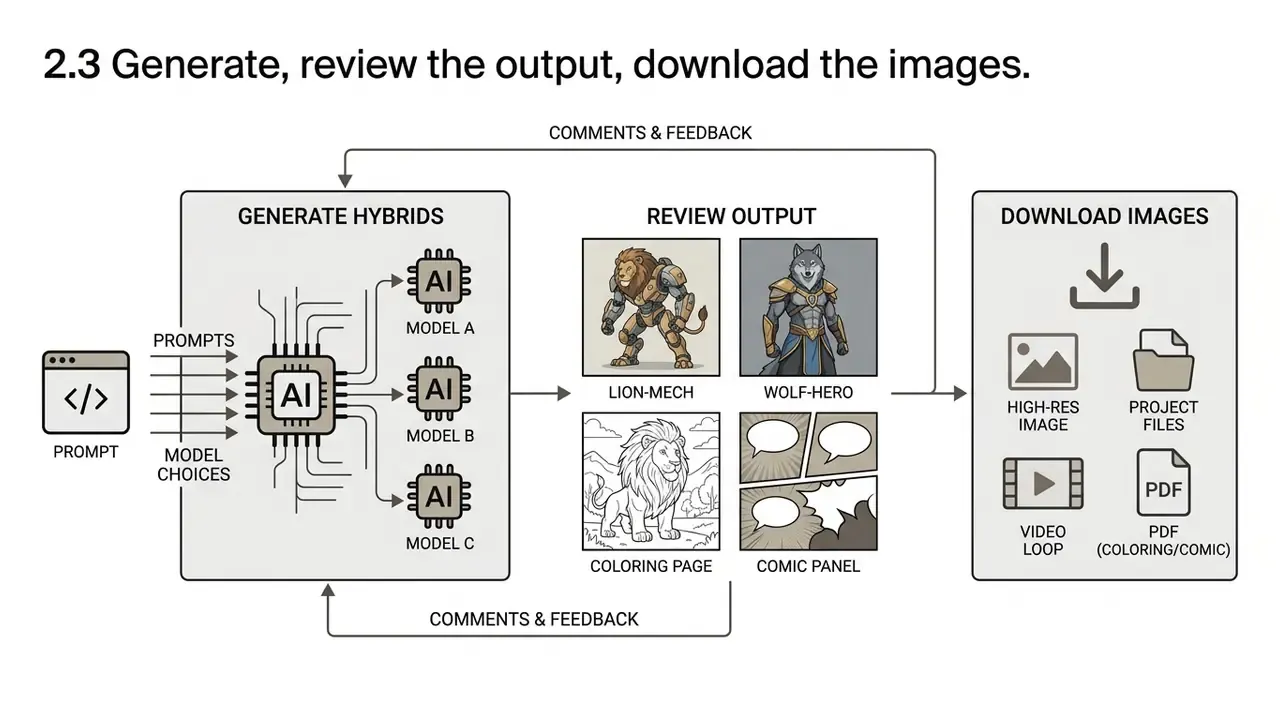
2.3 Generate, review the output, download the images
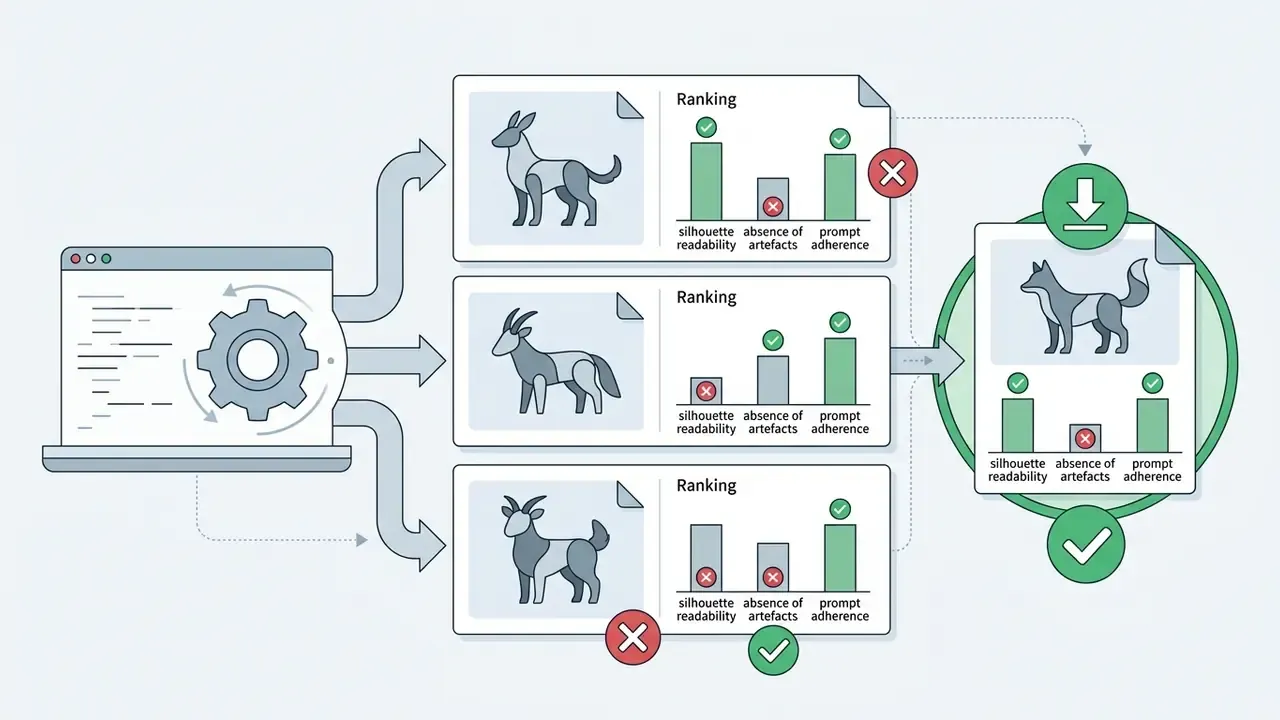
Press generate and the system returns several settings and variations. Assessment follows a short loop.
3. Ideas for AI animal combinations and animal mashup work
3.1 Animal combinations built on contrasting traits
Contrast is one of the most reliable concept-art levers. When you build ai animals combined, try pairing across categories.
- Scale contrast. A very large animal with a very small one: elephant + chameleon, elephant + mouse, blue whale + seahorse, red kangaroo + four-toed jerboa.
- Habitat contrast. A land predator with a deep-sea organism: snow leopard + anglerfish, African leopard + bobtail squid. Jungle plus Arctic. Desert plus ocean.
- Speed and dynamics. A fast species with a slow one: falcon + sloth, cheetah + tortoise.
- Class and integument. Bird + reptile, mammal + fish, insect + plant.
A balanced ai animal merger produces a harmonious read because the network smooths proportions across the seam. Reviewers often prefer these ai combined animals over cleaner but duller pairings, and the same holds for ai generated mixed animals used as background fauna.
3.2 The animal hybrid as a character for art and creative images
For a hybrid creature to work as a character, it needs a personality. Three things to design deliberately.
- Expression and emotion. Set the mood through gaze, posture, ear and tail position: wary, regal, predatory.
- Attributes and context. Add environment cues or props that state the character's role in the fictional world.
- A single stylistic code. Keep integument materials consistent with scene lighting. To widen the toolkit, a doodle video creator can turn static concepts into explainer motion.
- Production practice. Game studios describe fantasy fauna openly as "fantastical insect and beast hybrids", with a pipeline of concept art, photo-bashing, photoreal texturing and 3D model variants. The AI generator sits at the front of that chain as a fast-iteration device, not as a replacement for the chain.
4. How to write a good prompt for an AI animal hybrid
Using a dedicated ai hybrid animal generator still demands precise keyword choice for hybrid forms, otherwise styles cross-contaminate. To see which engine holds a style best, check the round-up of best AI art generators.
4.1 Base structure of a text request for an animal hybrid generator
An effective prompt formula has five modules.
A baseline example:
"A majestic animal hybrid of a snowy owl and a grey wolf, white feathered wings on a wolf body, thick fur, standing on a snowy mountain cliff, dramatic sunset lighting, digital art, highly detailed, 8k resolution, no watermark, no extra limbs."
"PromptMagician retrieves similar prompt-image pairs from DiffusionDB and recommends keywords that significantly improve generation accuracy and creative potential." PromptMagician: Interactive Prompt Engineering for Text-to-Image Creation, IEEE VIS (2023). https://arxiv.org/abs/2307.11534
For animals specifically, pin down the zoological attributes: breed or subspecies, size, colouration, behaviour and natural habitat. That narrows variance between runs. Negative constraints (no extra digits, no distorted limbs, no duplicate tails) act as insurance against anatomical artefacts.
4.2 How to refine style, character and animal fusion detail
For deeper detail, add qualifying blocks.
- Style block.Name the technique: photorealistic, dark fantasy, watercolor, 3D render, concept art. If you are heading into animation, look at what a drawing animation maker can do with the same asset.
- Anatomy block.Specify proportions and transitions (seamless transition between scales and fur, sharp claws, glowing eyes) plus measurable traits: skull shape, limb length, eye placement, paw structure.
- Character and pose.Describe behaviour (poised to strike, resting calmly, majestic stance) and personality anchors: calm, aggressive, heroic.
- Consistency anchors.Repeat identical anatomical wording across every variation and change only the scene. That is the base rule for holding a character's identity.
4.3 Example requests for an ai animal mix and an ai animal human hybrid
Different briefs need different templates.
- Classic ai animal mix "A realistic hybrid creature combining a jaguar and a raven, sleek black fur with rosette patterns, feathered wings, resting on a jungle branch, natural sunlight, cinematic photo."
- Anthropomorphic ai animal human hybrid "A fantasy character, half human half lion warrior, athletic human torso with golden lion fur, lion head with a majestic mane, wearing ornate bronze armor, studio lighting, highly detailed concept art."
- Mythic creature via an ai animal fusion generator "A mythical hybrid of a deer and a dragon, crystal antlers emitting soft blue light, iridescent scales along the spine, standing in an enchanted forest at twilight, volumetric lighting."
| Task | Prompt formula | Expected output |
|---|---|---|
| Two-species bio-mix | [Species A] + [Species B] + [Trait split] + [Environment] | Realistic hybrid with proportional anatomy |
| Anthropomorphic character | [Human base] + [Animal traits] + [Gear] + [Style] | Expressive humanoid hybrid for game art |
| Fantasy creature | [Base animal] + [Mythic elements] + [Glow effects] + [Atmosphere] | Art piece with magical attributes |
| Stylised concept | [Hybrid] + [Graphic style] + [Accent colours] + [Clean silhouette] | Vector-like or 2D drawing for illustration |
| Cybernetic mix | [Animal] + [Machine / mech] + [Armour materials] + [Sci-fi setting] | Mech hybrid for mobs and concept art |
| Coloring page | [Hybrid] + [outline only] + [no shadows] + [printable] | Printable outline sheet |
4.4 Prompt cookbook: fast templates for popular hybrids
- Eagle + lion (griffin)
A majestic eagle-lion hybrid soaring above a vast canyon, golden feathers blending into lion mane, cinematic lighting, 8k --ar 16:9 - Shark + tank (mech-shark)
A cybernetic hybrid of a great white shark and a heavy military tank, steel armor plates, glowing red visor, underwater sci-fi base --v 6.0 - Chameleon + owl
A surreal chameleon-owl hybrid perched on a glowing night branch, iridescent scales with feathery texture, big expressive eyes, dark fantasy style - Cobra + wolf
A terrifying wolf-cobra hybrid, sleek black fur with a hooded snake neck, glowing yellow venomous eyes, dramatic shadows - Panda + mech robot
Cute panda robot hybrid, glossy white and black armor, mechanical joints, anime style concept art, soft studio lighting - Fish + bird
A colorful fish-bird hybrid gliding over a coral reef, translucent fins turning into wings, tropical sunlight - Insect + plant
A vibrant insect-plant hybrid perched delicately on a leaf, chitin blending into petals, macro detail, botanical illustration - Arctic blend
A fluffy arctic animal blend navigating snowy landscapes, thick white fur, frost on whiskers, overcast diffused light - Desert hybrid
A rugged desert hybrid adapted to arid sandy environments, cracked scaly skin, sand-toned fur, harsh noon sunlight - Tiger + superhero
Half-human half-tiger superhero, athletic build, striped fur, tactical suit, dynamic hero pose, comic book ink style
5. AI animal mixer features that change the result
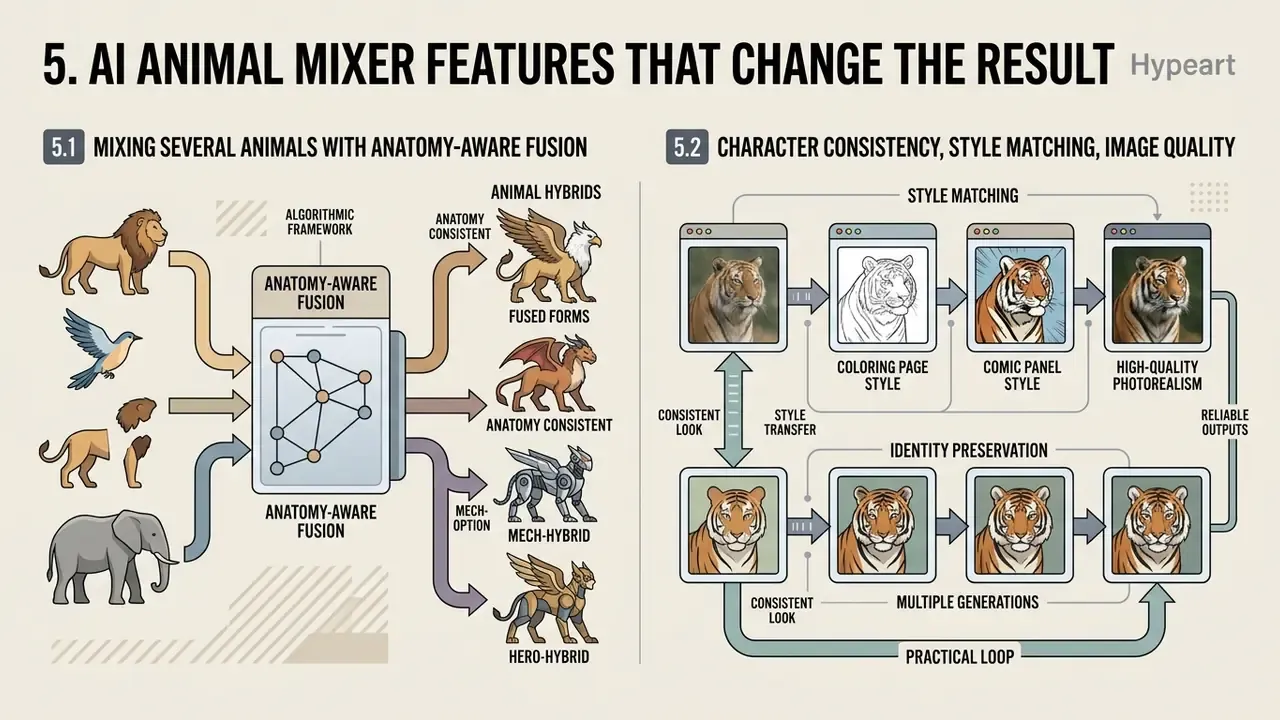
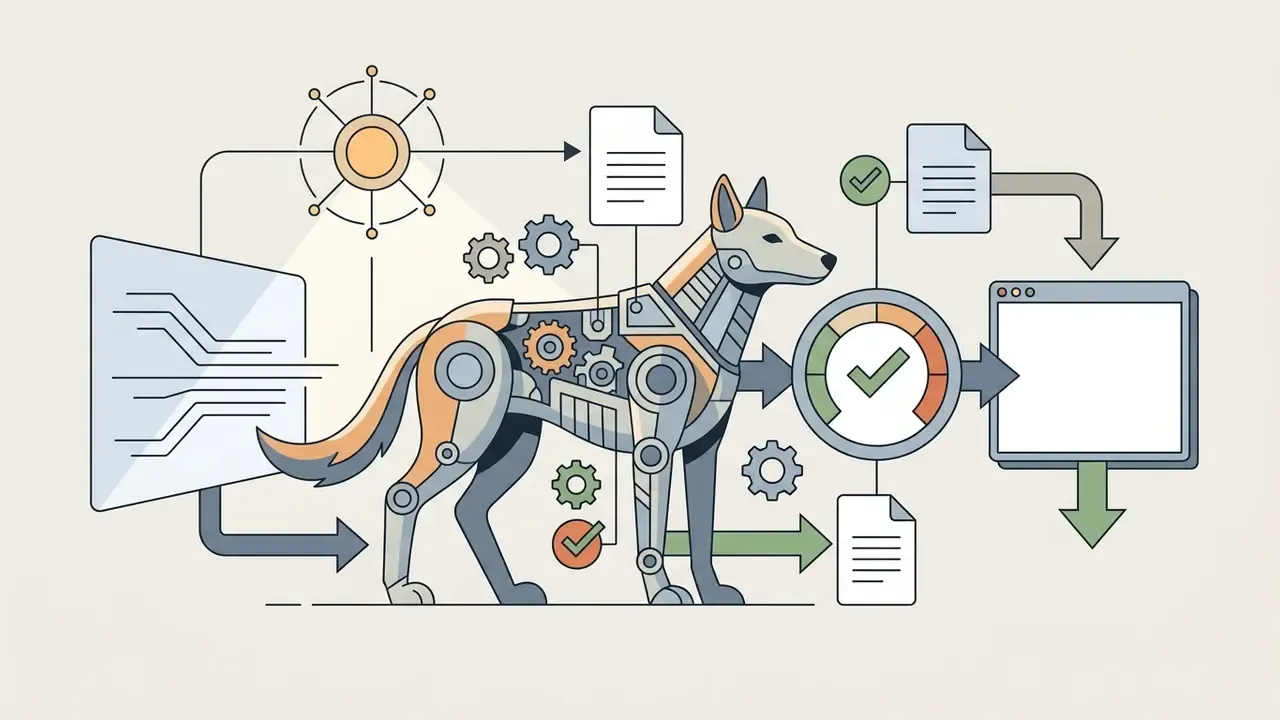
A modern ai animal mixer is a stack of algorithmic modules, each governing part of the generation. Stability and fidelity depend on the architecture underneath, not on luck.
"MixNMatch disentangles background, pose, shape and texture, allowing separate control over each factor with minimal supervision."
The main advantage of a specialised animal generator is factor disentanglement: shape, texture, pose and background travel through parallel layers of the model. Diffusion methods with adjustable conditioning strength then let you trade realism against compositional control.
5.1 Mixing several animals with anatomy-aware fusion
Anatomy-aware fusion carries the physiological logic of hybridisation. The network reads joint flex points, spine placement and natural body proportions for each animal.
While combining species, the algorithm builds an intermediate anatomical frame, a pose skeleton. That is what prevents duplicated paws, asymmetric wings and warped muzzles, and it keeps hybrids convincing even across unrelated biological classes.
"AP-CAP demonstrates that controllable generation with animal pose and appearance control yields anatomically correct images suitable for training pose estimation models."
When you mix an animal with hardware, the anatomy-aware layer takes on more work. It reconciles the skeleton with balance and support logic, so armour plates and hinges follow flex lines instead of floating over fur at random.
5.2 Character consistency, style matching and image quality
For an illustration series or a comic, holding the character's appearance becomes the hard part.
- Style matching. Style-injection attention and super-resolution modules keep one graphic language across sessions and across upscales.
"ReMix achieves a +6.7% improvement in CLIP-I and +8.2% in DINO similarity over existing methods on consistent character generation tasks."
- Identity preservation. Checkpoints and context-consistent training keep the hybrid's fur pattern, horn shape and eye colour intact across angle and pose changes.
"The Chosen One proposes an iterative procedure that identifies, at each step, a coherent set of images sharing a common identity, from which a more consistent character is extracted."
- Practical loop. Fixed seed, identical anatomical anchors, plus a custom model trained on 10 to 30 images of the character. That combination yields a stable panel series. For character voice-over in video, an elevenlabs ai voice generator closes the pipeline.
6. How to choose an AI animal hybrid generator for your job
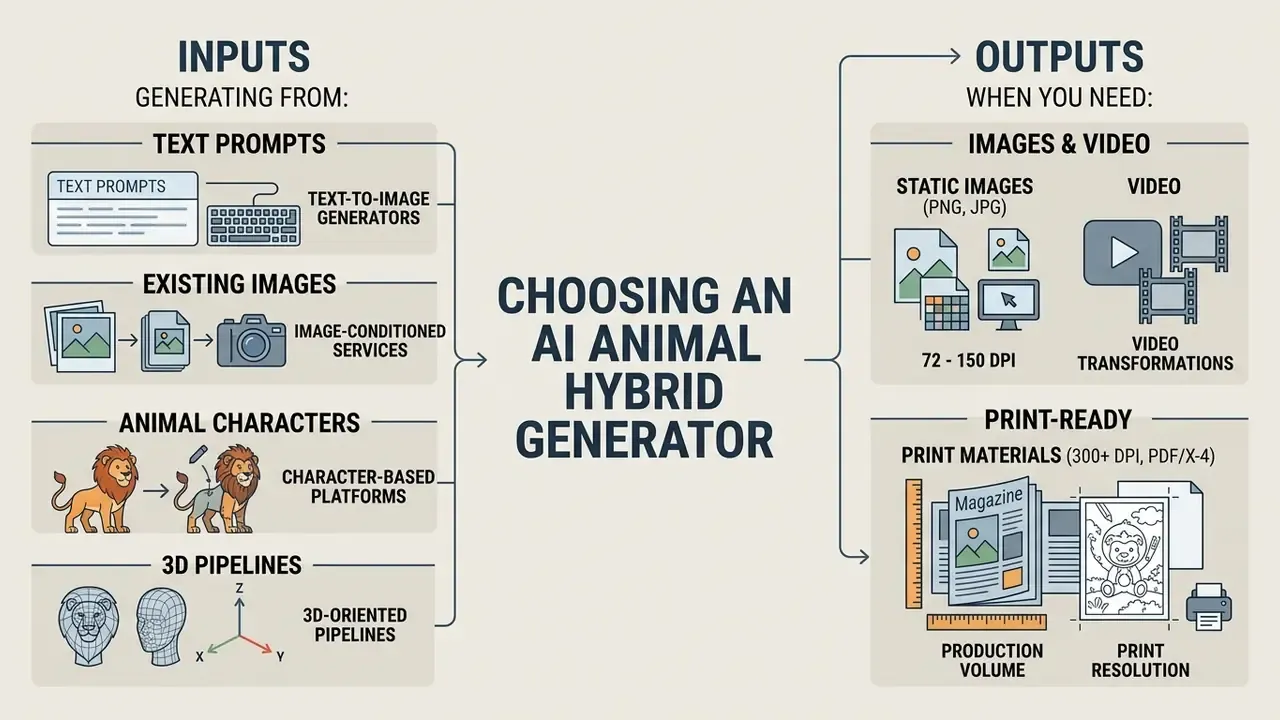
Tool choice depends on the end product, production volume and how much control you need. International AI governance guidance points toward platforms with transparent data terms and reproducible output. The NIST AI Risk Management Framework (https://airc.nist.gov/RMF) requires mapping, measuring and managing risks of bias, opacity and harmful content. The Generative AI Framework for HMG (https://www.gov.uk/government/publications/generative-ai-framework-for-hmg) requires labelling AI content, reviewing output, testing prompts for bias and honouring provider terms. To see how all of that lands on usage rights, read the material on AI image generators and commercial rights.
Pay attention to the underlying engine.
- Flux.1 and Stable Diffusion XL (SDXL). Strongest anatomical accuracy and realistic fur-to-scale texture fusion, with fine control over steps, guidance and aspect ratio.
- DALL·E 3. Best at parsing complex prompts with several objects and cyber details.
- Ideogram 2.0. Good for hybrid characters that need accurate text or graphic marks on armour and clothing.
- Midjourney v6. Highest aesthetic ceiling for fantasy concept art.
- Other engines. Seedream, Nano Banana and specialised video models widen your stylistic options, but each needs its own licence review.
Compare candidates on supported input type, speed and export options. To collect that analysis in one place, work through the AI Media Comparison Matrices.
6.1 Generating from text, image or an existing animal character
Each input type gives a different amount of control.
- Text-to-image generators.Good for fast ideation and concept scouting. Very quick, but sensitive to prompt phrasing. To start at zero cost, see the best free AI image generators.
- Image-conditioned services.Maximum control over texture and form through uploaded source photos.
"Chimera requires no explicit masks or part annotations from the user, the system automatically determines which parts to combine and how to arrange them."
To estimate subscription and export costs, open the hub of interactive calculators, and for plan detail explore the hub on pricing.
6.2 When you need images, video or print-ready resolution
The export format decides the use case.
- Static images (PNG or JPG, 72 to 150 DPI). Social posts, websites, blog headers.
- Print materials (300+ DPI, PDF/X-4). Posters, board games, merchandise and general print. Line art from 600 dpi. To lift a low-resolution generation, use AI upscalers for print resolution. File preparation is covered in the AI Media API Guides.
- Video and 3D animation. Game production and video output.
| Generation format | Degree of control | Speed | Fusion support | Export formats |
|---|---|---|---|---|
| Text-to-image | Medium | High (5 to 15 sec) | Automatic (prompt-driven) | PNG, JPG (web) |
| Image-to-image | High | Medium (15 to 30 sec) | Controlled (mask or layer) | PNG, TIFF, PDF/X |
| Character-based | Maximum | Medium (20 to 40 sec) | High (identity preserved) | PNG, SVG, 3D mesh, MP4 |
| Video / morphing | Medium | Low (1 to 5 min) | Dynamic (frame to frame) | MP4, GIF, WebM |
Read the table as a shortlist filter. If your deliverable is a single social image, text-to-image is enough. If it is a print run or a character bible, you need image-to-image or a character-based platform, and you should budget for review time.
6.3 Generating video transformations (AI animal fusion video)
Multimodal generators now handle animated fusion, not only stills.
- Human-to-animal video. Produces a short MP4 or GIF showing a face and body morphing into animal morphology, a werewolf transformation being the classic case. Flow: upload a photo, give an instruction such as "create a human to animal transformation into a wolf", preview, download.
- Text-to-video with no reference. Descriptions like "generate a half-human, half-tiger superhero" or "create a Venom-style werewolf" return a clip without any source photo.
- Dynamic effects. Video diffusion models (Runway Gen-2, Luma Dream Machine, Sora) let you direct motion: feathered wings beating on a tiger body, a cyber-dragon breathing, a mech-wolf running through a moving environment.
- Format limits. Free tiers usually cap duration and resolution (1K, 2K, 4K) and may stamp a watermark. To assemble finished clips, the YouTube video editor workflow is a reasonable next step.
7. Data security, Shadow AI and validation of generative models
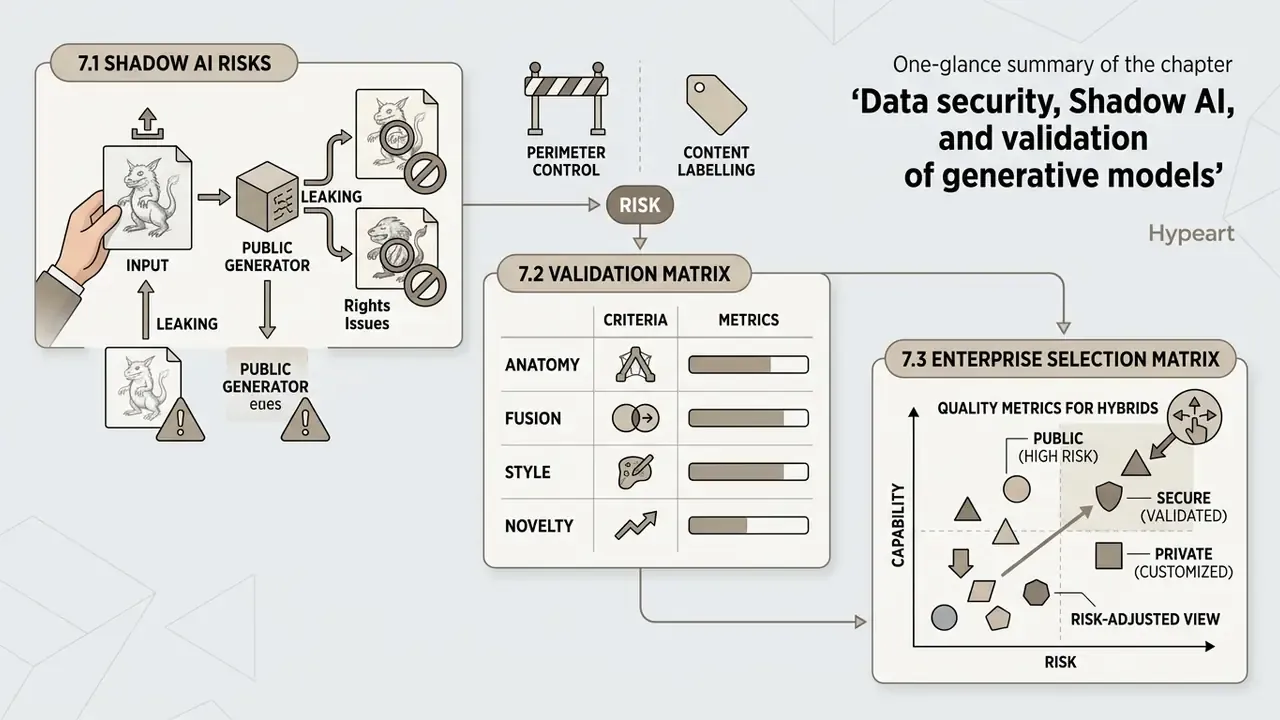
This section is for the reader who owns process rather than pixels: compliance, risk and reproducibility. Hybrid generation is a probabilistic process, so quality control cannot rest on taste. It rests on measurable metrics and written rules.
7.1 Shadow AI risks in public generators
- Leakage through reference uploads. Any image you upload to a public service, an employee photo, an unreleased layout, an unpublished brand asset, leaves your perimeter. Check for a Zero Data Retention (ZDR) policy and the ability to opt out of training on user data.
- Rights over input and output. Some services leave the user holding rights to both input and output. Canva's product terms, for example, state plainly that the platform does not claim copyright in user output. Elsewhere commercial rights arrive only with a paid tier.
- Perimeter control. For sensitive work, prefer an API or private deployment over the public web interface. Keep a register of approved tools and block the rest at the proxy.
- Content labelling. Government frameworks require explicit disclosure of AI origin and human review before publication.
7.2 Validation matrix: quality metrics for hybrids
| Metric or control | What it measures | How to apply it to hybrids |
|---|---|---|
| FID | Distribution drift versus a reference set | Track degradation across model and version changes |
| CLIP score / CLIP-I | Prompt adherence | Verify both species and mech elements are actually present |
| DINO similarity | Character identity retention | Control a comic panel series |
| Anatomical artefact rate | Share of frames with extra limbs or distortion | Score sheet: 0 for visible errors, top score for clean frames |
| Reproducibility audit | Repeatability from seed + prompt + model version | Log the triple for every release |
| Human-in-the-loop review | Final acceptance | Mandatory. The model does not guarantee clean anatomy |
7.3 Enterprise selection matrix
| Criterion | Public SaaS | API / managed | Private deployment |
|---|---|---|---|
| Data control | Low | Medium (contractual ZDR) | High |
| Time to deploy | Hours | Days | Weeks |
| Reproducibility across versions | Low | High | Highest |
| Fit for confidential references | No | Conditional | Yes |
| Total cost of ownership | Minimal | Medium | High, plus infrastructure |
Risk-adjusted view. Add review effort in person-hours, legal clearance of assets and audit-trail storage to the direct cost of generations. Otherwise your ROI figure is fiction. Run the numbers in the calculator section linked above.
Technology limitation disclaimer. Visual generation is probabilistic. No generator guarantees zero anatomical or stylistic distortion without a human in the loop. Every metric here is conditional on model version, prompt and seed.
8. Free AI animal hybrid generator options, pricing and commercial use
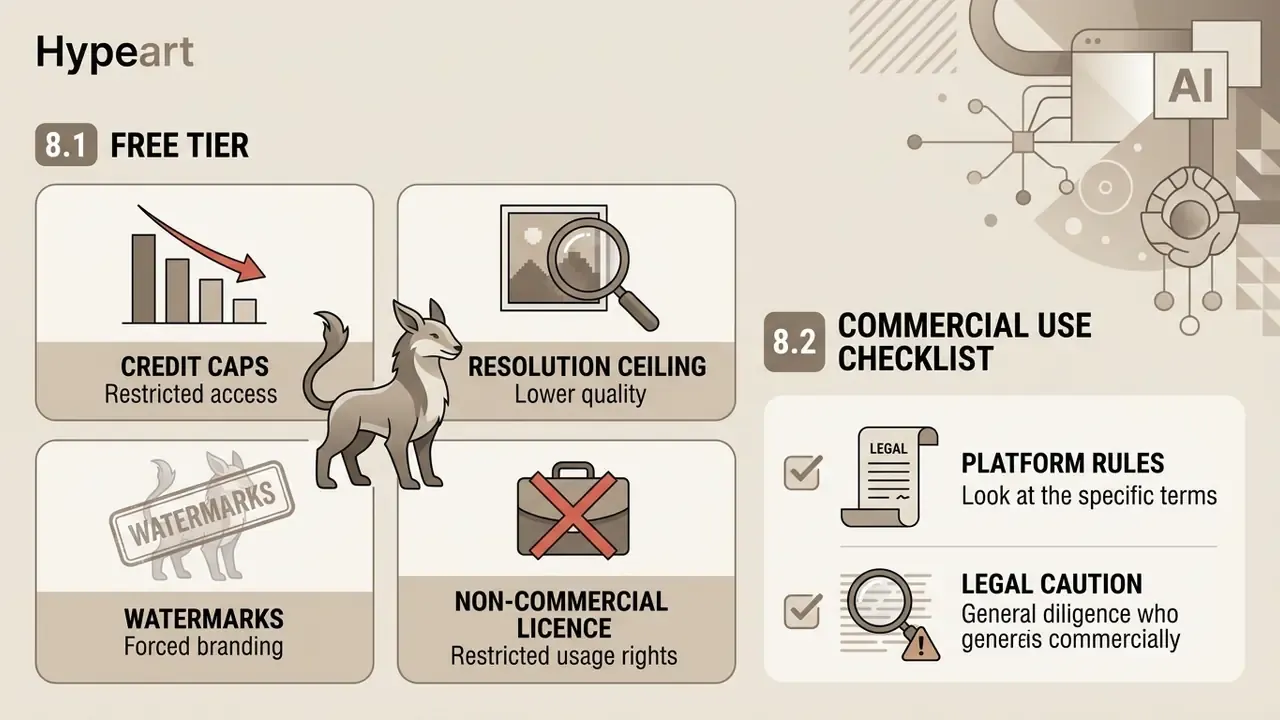
Commercial use of generated images calls for a bit of legal caution. Services differ widely in what they grant on free and paid tiers. For the full legal picture on generative content, see the overview of commercial-use guidance.
Before you ship anything, confirm that the terms actually grant a full commercial licence for the media you created. If you work from uploaded photos, review image-to-image generators for commercial tasks separately, because input rights and output rights are not the same question.
8.1 What the free tier of an animal hybrid generator gives you
Free access, the ai animal hybrid generator free tier, usually carries these limits.
- Credit caps. A fixed number of generations per day or per account lifetime. Models vary: a daily credit drop with no card required; unlimited runs on a few base models plus a starter pack of trial credits for premium features; a no-registration preview mode. To compare, browse the round-ups of free AI art generators and free AI video generators.
- Resolution ceiling. Web-grade export, commonly up to 1024 by 1024 pixels. Some services unlock 1K, 2K or 4K only on paid plans.
- Watermarks. A service logo baked into the file, typical for free video and image runs.
- Non-commercial licence. No commercial use without a paid plan. On several platforms, images generated for free cannot be monetised even after you subscribe later. Occasionally commercial use is allowed with mandatory attribution and a backlink. For anything unclear, explore the hub on the support side.
8.2 What to check before commercial use of AI-generated images
Run this check before a commercial launch built on AI hybrids.
- Platform rules.Confirm your current plan grants commercial rights. Service-by-service detail sits in the breakdown of commercial use for AI image generators.
- Copyright and originality.Under guidance from the U.S. Copyright Office (2023) and WIPO (2024), protection attaches only to elements where a human made a substantive creative contribution: editing, composition, distinctive rework.
"Survey respondents attribute authorship and rights to users of AI tools in more than 60% of cases, across both commercial and non-commercial use scenarios."
- No trademark collision. Make sure the hybrid does not accidentally reproduce a protected character or a well-known brand mascot. AI image detectors and AI reverse image search help with the similarity check.
"PREGen reduces the likelihood of generating copyrighted characters by more than half when their names are used in prompts."
- Indemnification.Ask whether the vendor covers third-party copyright claims, and up to what limit.
- Audit trail.Keep prompt, seed, model version and generation date. That record is your evidence of human contribution and reproducibility. If a dispute does arise, compare options for handling it.
8.3 Pre-production checklist for legal and compliance
Checklist0 / 7
Fact check on commercial terms. Before exporting or publishing hybrid images, verify the current Terms of Service and licensing agreement of your chosen AI service. Rights over free-tier content often differ from paid-subscriber rights, and vendors revise commercial clauses periodically. Note one distinction that trips people up: a platform's permission to use output commercially is a contractual right, not automatic copyright ownership.
9. FAQ about the AI animal hybrid generator
Can I mix animals with mechs, robots and sci-fi objects?
Yes. Current AI animal hybrid generators support fusing organic animals with inorganic objects: cybernetic implants, mechanical exoskeletons, armour, vehicles, crystal. Name the cyberpunk or mecha register in the prompt, for example "a wolf hybrid with cybernetic mechanical wings and glowing neon circuits" or "a fox-tank mech hybrid, armored plating, glowing sensors". A separate popular branch mixes animals with superheroes, villains and anime characters.
How do I generate several variations of the same hybrid character for a story or comic?
Use a fixed seed value, keep control references in image-to-image mode, or apply identity modules such as character consistency presets, LoRA or custom models trained on 10 to 30 images of the character. Mind the API limits: image variation modes are not available in every model, and the number of variations per request is usually capped, often at 1 to 10. With that in place, the same hybrid can move through different scenes and angles.
How do I turn a hybrid into a printable coloring page?
Generate the colour version first, then rerun the request with the modifiers coloring page style, black and white clean line art, outline only, no shadows, printable. For classroom or home printing, export line art at 600 dpi at final size. For colour posters, use 300 dpi and PDF/X-4.
Can I get a video transformation rather than a still image?
Yes. Some services accept a photo of a person plus a text instruction ("transform into a wolf") and return a short MP4 or GIF with a smooth morph. Others build the clip entirely from text. Watch the free-tier limits on duration, resolution and watermarks.
Where do I find ready-made prompts and ideas for ai animal hybrids?
Public generative galleries such as PromptBase, Lexica and developer Discord channels carry structured prompts. Open diffusion prompt datasets like DiffusionDB and interactive keyword tools such as PromptMagician are useful for exploration. For a fast start, the prompt cookbook above covers ten popular ai animal mixes.
What legal limits apply to creating an ai animal human hybrid?
For anthropomorphic characters, most platform policies prohibit obscene, hateful or shocking content, including NSFW material and deepfakes of real people. Beyond that, anthropomorphic art concepts fall under the generator's standard terms of use. One clarification: biological restrictions on real human-animal chimeras (licensing, the 14-day or primitive-streak limit, the ban on implantation) belong to laboratory research and have nothing to do with image generation.
Is it safe to upload corporate photos and layouts to a free generator?
By default, no. Free web services may use uploads to improve models and offer no Zero Data Retention guarantee. For sensitive material, use an API with contractual data-handling commitments or a private deployment, keep a register of approved tools, and log generations.
How do I judge whether a hybrid is anatomically correct?
Use a score sheet. Rate limb count, symmetry, integument seams, gaze direction and single-light-source consistency separately. Frames with no visible error take the top score and go to production. The rest go back for regeneration with negative constraints (no extra limbs, no duplicate tails, no distorted joints).
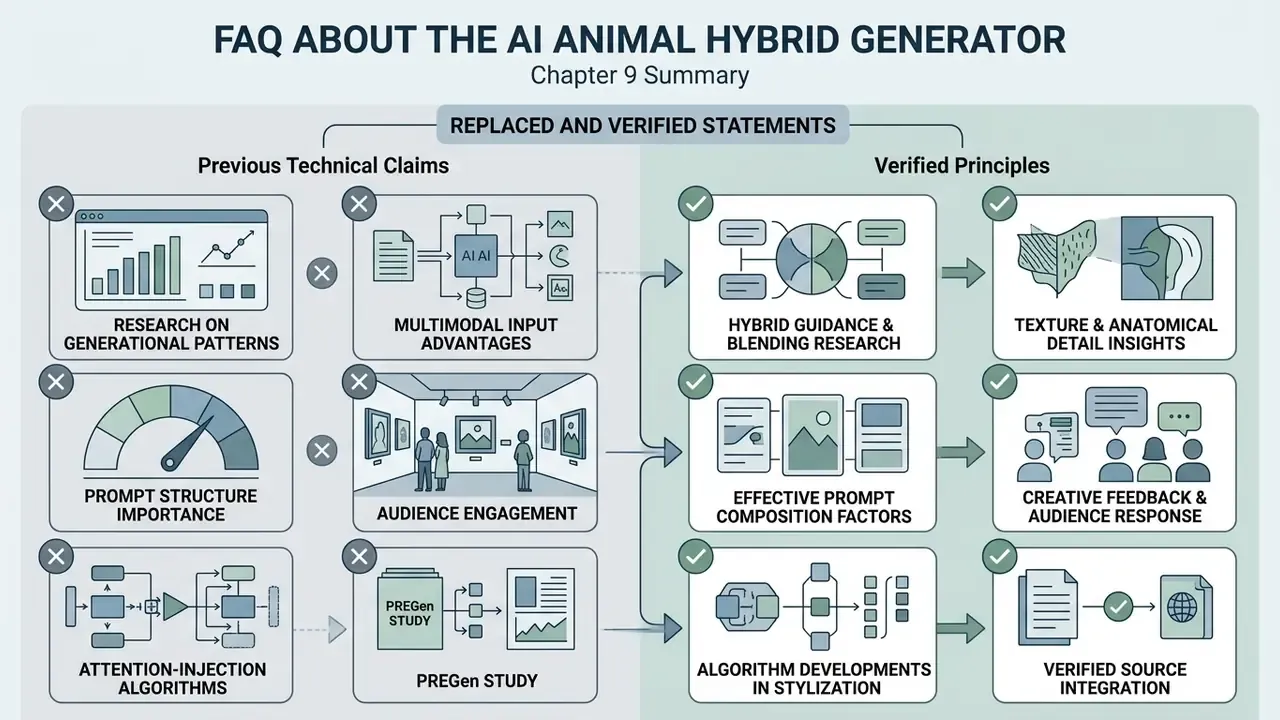
Appendix A. Earlier wording and corrections
Further reading and hub sections
To go deeper on generative tooling and the full terminology base, see the overview in our main reference section. Also useful: AI art generators, animation maker and AI voice generator, which together close the pipeline from hybrid to animation to voice-over.