Both concerns are legitimate. This guide holds them together.
Last updated: Q1 2026. Pricing, free-tier limits, and feature availability were verified against vendor documentation at the time of publication.
Executive Summary: What Decision-Makers Need First
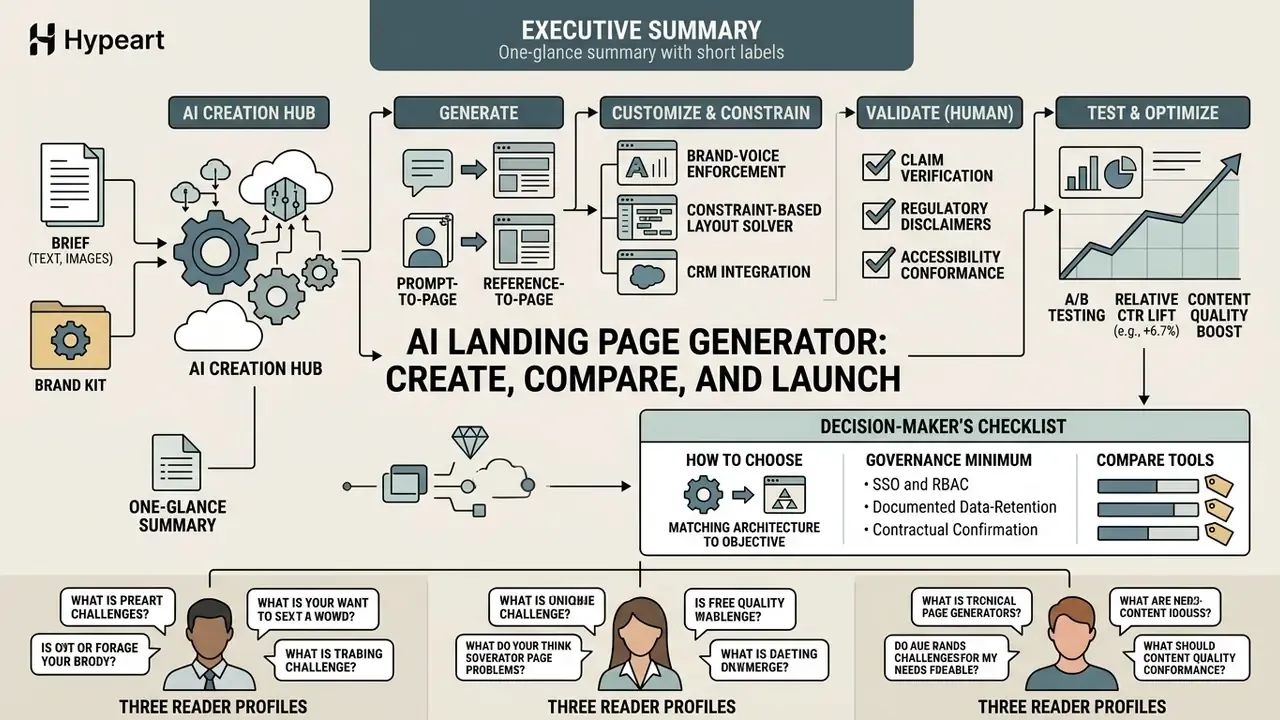
Who This Guide Is For
Three reader profiles keep showing up in this topic, and they ask different questions.
Growth and demand-generation owners want throughput: more pages, more variants, less design queue. Finance and operations leaders want unit economics: cost per verified lead, not cost per generated page. Risk, compliance, and model-governance leaders want reproducibility: who approved which claim, generated by which model version, on which date.
If you sit in a bank, a lender, or a regulated fintech, the third question decides whether the first two ever get funded. So the practical framing here is not "which tool is best" but "which tool can be approved, instrumented, and audited without slowing the campaign calendar to a crawl."
What Is an AI Landing Page Generator and How Does It Work?
An ai landing page generator is a software system combining large language models (LLMs), vision-language models (VLMs), and structured layout algorithms to convert natural-language prompts into complete, functional web pages. Rather than relying on static drag-and-drop templates, an ai based landing page generator dynamically builds visual sections, headlines, body copy, form fields, and calls to action (CTAs) around a stated campaign objective.
Modern ai landing page creator tools work as multi-agent orchestration pipelines. When a user enters a business description, the system parses that input to extract core attributes: value propositions, audience demographics, competitive differentiators, and functional requirements. A multimodal generation engine then constructs the page architecture. In parallel, copy sub-models draft text variants tuned to specific visitor motivations, while layout solvers position modules into responsive grids.
«Hybrid systems pair MaxSAT solvers with LLMs so generated page elements strictly satisfy structural UX constraints, preventing broken visual hierarchies.»
Put plainly: an ai landing page maker hands non-technical teams a production-ready baseline that can be audited, edited, and published to a live domain. Baseline, not final.
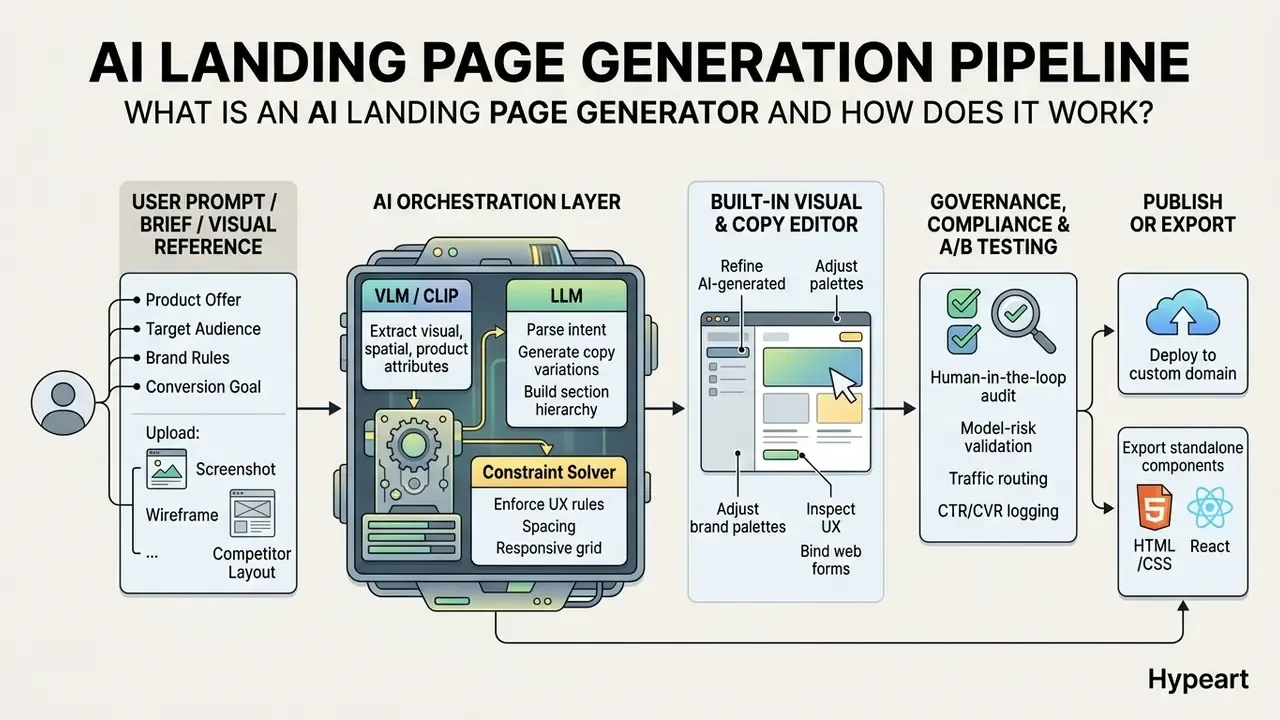
Text description of the diagram above: a brief or visual reference enters the orchestration layer, where a vision-language model extracts attributes, an LLM writes copy and section hierarchy, and a constraint solver enforces layout rules. The draft then moves to a visual editor, through human review and compliance checks, and finally to publication or code export.
From a Prompt to a Complete Landing Page
A text prompt becomes a complete page by passing through intent classification, structural layout mapping, and copy synthesis. When an operator feeds a brief into a landing page generator, the system uses retrieval-augmented prompting and structured output frameworks to map that text onto standardized web design blocks.
Take a concrete case. A prompt describing a corporate loan platform triggers a hero section with a value hook, a trust badge row, an interactive loan calculator, a dynamic feature grid, social proof testimonials, and a lead capture form. Research on multimodal content creation frameworks, such as Pinterest's PinLanding architecture, shows how vision-language models extract product attributes while coupled LLMs convert those attributes into coherent structured feeds (PinLanding Study, Pinterest, 2024). Hybrid layout systems go further, using Maximum Satisfiability (MaxSAT) solvers alongside LLMs so that generated elements satisfy structural UX constraints instead of quietly breaking the visual hierarchy (UX-Compliant Layout Generation Research, 2024).
One caution worth stating early: the model does not know your rate table. It will happily invent one.
Generating Pages from Screenshots and Wireframe References
Multimodal generators now go well beyond text prompts. Advanced systems let operators upload visual references, including desktop screenshots, Figma wireframes, hand-drawn sketches, or competitor layouts, instead of describing structure from scratch.
The vision-language model deconstructs the uploaded image into layout hierarchy tokens, spatial margins, typographic scale, and component boundaries. The orchestration layer then regenerates a functionally similar but fully editable page, substituting your own copy, brand palette, and CTA logic. What that means in campaign practice:
A compliance caveat applies, and it is not a small one. Uploading a competitor's page as a reference transfers no rights to its copy, imagery, or trademarked assets. Reference-based generation should be treated as structural inspiration only, with all text and visual assets replaced by owned or licensed material. Teams sourcing those replacements usually review adjacent tooling such as AI image generators, plus licensing terms, before production use.
What You Can Edit, Export and Publish After Generation
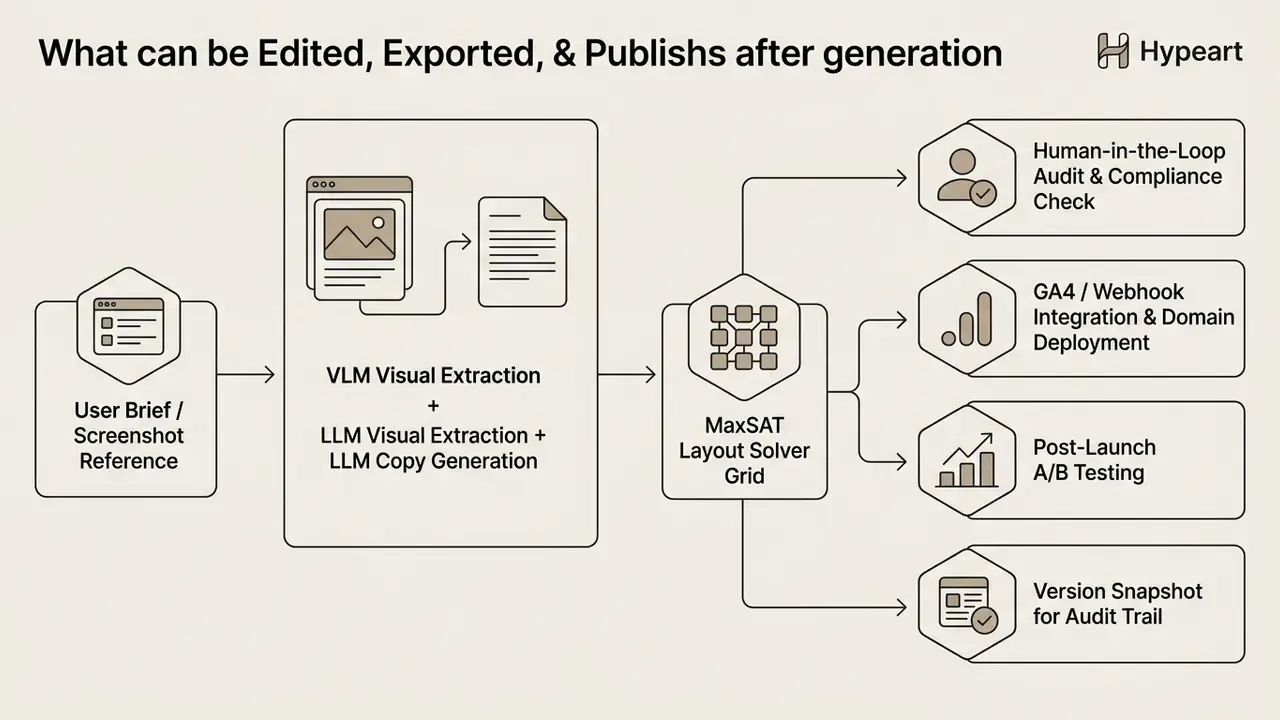
After initial synthesis, an ai landing page generator opens the output in a visual editor where copy, colors, structural elements, and integration points can be changed. Generated content should be handled as a draft subject to human-in-the-loop review, brand validation, and compliance verification.
Visual editors let operators drag and drop page components, update text blocks, swap image assets, and configure interactive elements such as form validation scripts. Advanced platforms support multi-format export, so engineering teams can extract clean HTML and CSS markup, a JSON layout schema, or native React components. React documentation confirms that exported styling attaches through standard <link> elements or build-tool integration, and that raw HTML injection via dangerouslySetInnerHTML should be reserved for trusted content only (React Documentation, 2026, https://react.dev/).
For hosting and deployment, platforms publish to cloud infrastructure or to custom corporate domains. Documentation from production platforms such as cloud.gov Pages notes that custom domain integration combined with static asset hosting keeps single-page applications (SPAs) fully route-capable while holding strict security standards (cloud.gov Pages Documentation, 2026, https://cloud.gov/pages/).
When weighing automated creative workflows against multimedia asset needs, teams often browse the hub to compare capabilities across generation pipelines, and engineering groups checking programmatic deployment paths can browse the hub for integration specifics.
Prompt-to-publish workflow, end to end:
Which Landing Pages Can You Create With AI?
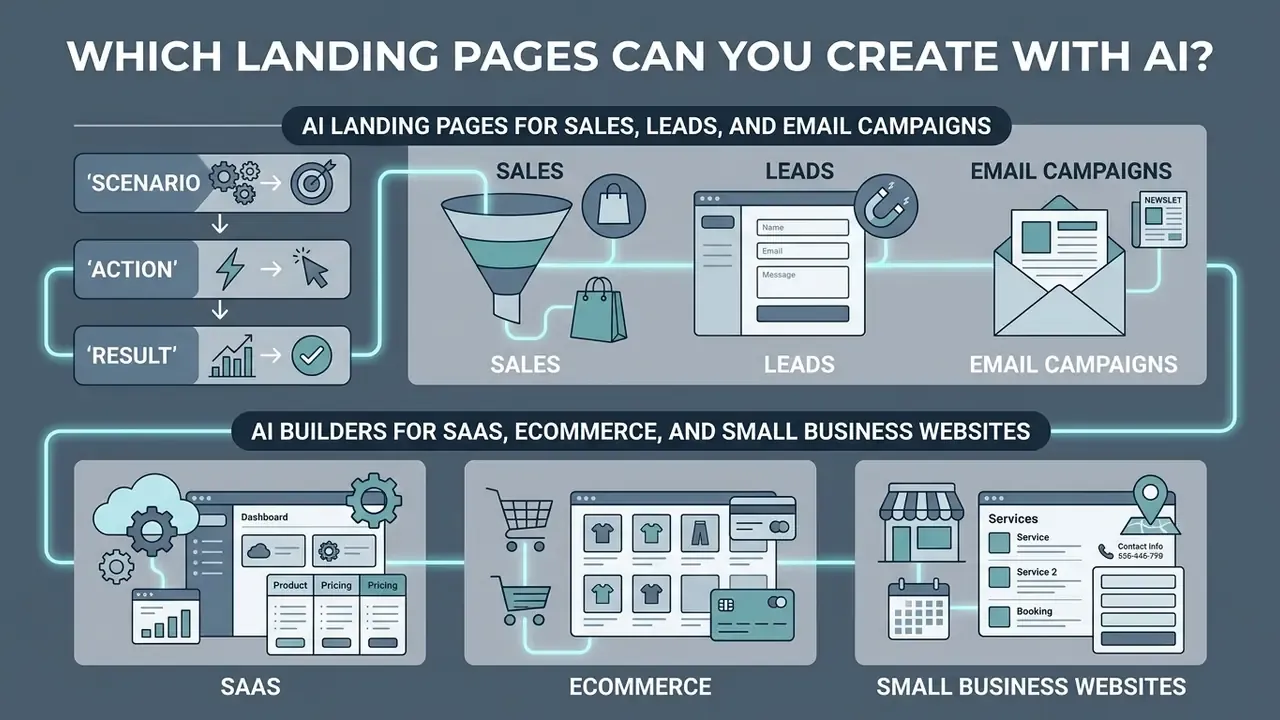
An ai website landing page generator can build specialized pages tailored to specific conversion goals, audience segments, and business verticals. Whether you are launching a consumer product, generating B2B enterprise leads, or feeding paid ad campaigns, these platforms adapt structural hierarchy and tone of voice to the task.
Using an ai landing page creator for sales, growth teams bypass the traditional design bottleneck and deploy target-tailored acquisition funnels. In regulated environments and financial institutions, the same tools accelerate prototyping of product registration pages, digital portals, and client onboarding flows, provided every disclosure, rate table, and risk statement clears legal review before publication. Pairing algorithmic layout generation with controlled copywriting lets organizations ship high-volume, niche-targeted landing pages without inflating engineering overhead.
| Business Model / Use Case | Core Structural Elements Required | Key AI Generation Focus | Target Conversion Action |
|---|---|---|---|
| B2B SaaS | Hero section, interactive pricing matrix, feature comparison table, trust badges, FAQ | Technical value alignment, feature-benefit translation | Free trial signup / Demo booking |
| Fintech & Financial Services | Rate or fee table, eligibility criteria, regulatory disclosures, security certifications | Disclosure-safe phrasing, jurisdiction-specific terms, calculator modules | Application start / Advisor booking |
| Regulated Client Onboarding | KYC form stages, document upload widget, consent checkboxes, privacy notice | Progressive disclosure, plain-language compliance copy | Verified account creation |
| E-Commerce & Retail | High-impact product hero, customer reviews, delivery terms, stock status badges | Persuasive benefit framing, urgency cues, visual harmony | Direct checkout / Add-to-cart |
| B2B Lead Generation | Concise benefit headline, minimal friction lead form, authority proof, privacy terms | Social proof, clear value exchange | Form submission / Asset download |
| Small Business Services | Localized hero hook, service checklist, verified client ratings, contact widget | Geographic relevance, trust signals, clear contact CTA | Phone call / Quote request |
Structured-data guidance reinforces these differences. SaaS pricing pages should expose every plan, billing model, and pricing basis in plain HTML with Offer schema per tier. E-commerce product pages need price, availability, options, and a concise description. Local business pages must carry name, address, telephone, URL, image, description, and areaServed, with aggregateRating used only when genuine on-page reviews are visible and the counts match the markup (Google Search Central structured data documentation, 2026, https://developers.google.com/search/docs/appearance/structured-data).
AI Landing Pages for Sales, Leads and Email Campaigns
Sales and lead-generation pages need a linear narrative path pointing at one action. An ai landing page maker structures them by placing the primary value hook above the fold, then pain-point framing, then risk-reduction proof, then the form.
In email marketing workflows, landing pages act as explicit destinations for defined subscriber segments. Field studies on AI-generated sales productivity found that AI-optimized product descriptions and marketing messages lifted message click-through rates by 3.1% and order volume by 2.8% (Generative AI and Sales Productivity Study, 2024).
«A multi-objective LLM content optimization system delivered a 12.5% CTR increase and an 8.3% CVR increase in live-traffic A/B tests on an e-commerce platform.»
Perception research points the same way. In a study of 470 respondents, AI-generated advertising reached a 59.1% preference rate in persuasive contexts (χ²=26.65, p<0.001), beating human-written baselines (LLM-Generated Ads Study, 2024). The effect, though, was concentrated: authority appeals reached 63.0% preference and consensus appeals 62.5%, while other appeal types showed much thinner margins over human copy. So the honest reading is "AI copy competes well in some persuasion modes," not "AI copy wins."
An illustrative deployment, presented as a hypothetical composite rather than a documented client result:
AI Builders for SaaS, Ecommerce and Small Business Websites
Different commercial structures demand different layouts. For B2B SaaS, an ai landing page generator builds feature grids, security certifications, and multi-tier pricing tables. Guidance on SaaS pricing architecture stresses plain-text pricing structures, clear billing cycles, semantic comparison tables, and structured schema, so that both human buyers and AI answer engines can parse the offer before recommending a vendor.
For e-commerce, AI tools assemble product asset clusters into converting product pages. Research shows the highest conversion stability on pages combining detailed text, price clarity, return terms, and consumer reviews (E-Commerce Content Optimization Study, 2024).
«With a diversification parameter of λ=0.6, the system achieved a 10.4% CTR lift and a 4.1% CVR lift in low-traffic A/B tests while preserving content novelty.»
Small business sites use generation to establish instant credibility. A local service provider can enter operating basics, geographic coverage, core services, and a few customer quotes, and get a mobile-responsive landing page builder setup in seconds.
«Websites using AI content showed median year-over-year growth of 29.08% versus 24.21% for sites without it, a gap of roughly five percentage points.»
That differential holds only where output is edited and verified. The same body of research shows unedited AI text underperforming in competitive SERPs. When building brand assets or supporting visuals, including AI logo generators for identity systems and lighter-weight ai clipart for section icons, teams should browse the hub and confirm usage rights before shipping anything generated.
Essential AI Landing Page Generator Features to Evaluate
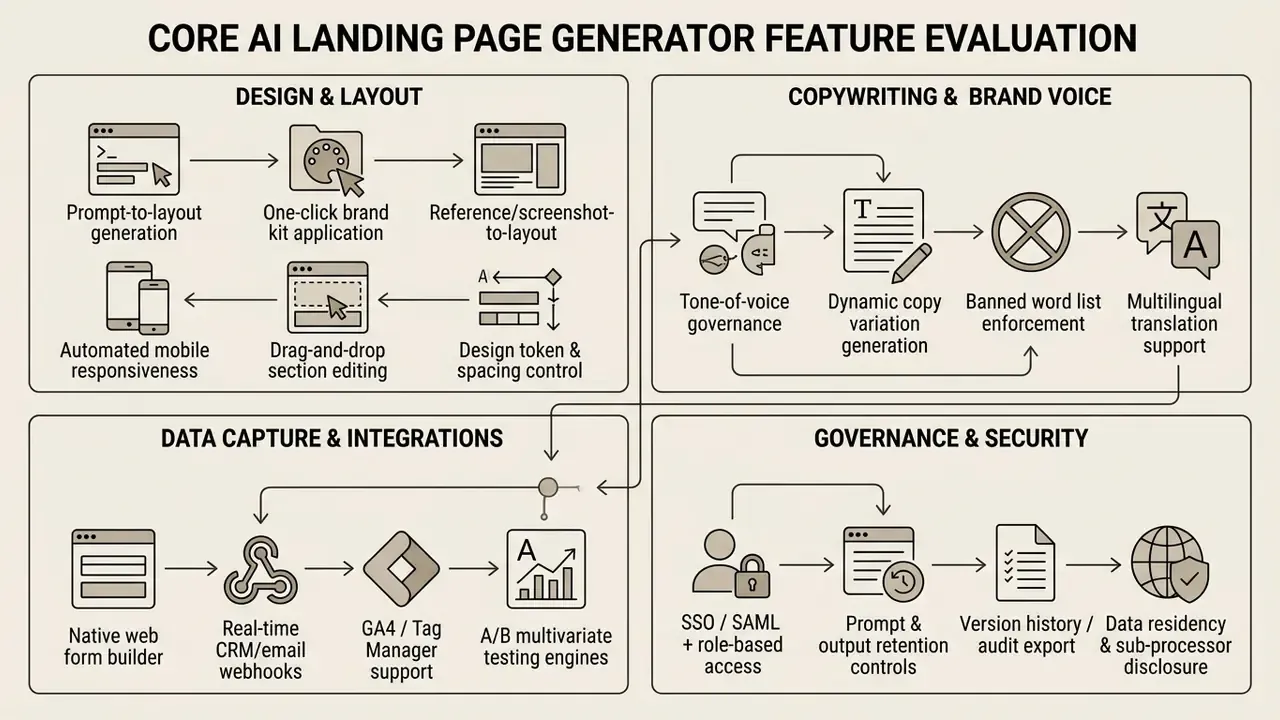
Choosing an ai landing page generator service means assessing design flexibility, copy accuracy, administrative controls, and system integrations together. A capable ai landing page design generator balances automated drafting with granular visual editing.
Assembly speed matters, but enterprise utility depends on analytics, dynamic form handling, and security compliance. Evaluating ai landing page generator tools in 2026 therefore means auditing features against infrastructure requirements, data privacy policy, and your existing marketing technology stack.
Design Generation, Templates and the Built-In Editor
The design engine of an ai landing page creator must produce responsive, visually balanced layouts that respect corporate brand kits. Modern systems apply style rules so organizations can push predefined color palettes, typography scales, and logo guidelines across generated templates in one click.
A flexible visual editor lets teams adjust elements without breaking the underlying grid. Operators change container padding, swap imagery, edit microcopy, restyle interactive components. Better tools include design assistants that re-prompt individual sections, for example "rewrite this headline to be more direct" or "convert this bullet list into a three-column feature grid." Brand-guideline generators now emit verbal rules (approved vocabulary, banned buzzwords, sentence rhythm) alongside visual tokens (logo clear space, font scales, accessible color pairs). One governance layer, two output types. That is a genuine improvement over the old split between a PDF style guide and a design system nobody read.
Forms, Analytics, Integrations and Conversion Testing
A landing page produces no business value without lead capture, analytics, and testing. Strong ai landing page generator features include native form builders that validate inputs, enforce required fields, and connect to external systems.
| Evaluation Metric | Basic / Free Tier Standard | Enterprise / Paid Tier Standard | Impact on Conversion & Operations |
|---|---|---|---|
| Form Capabilities | Basic text inputs, CSV export, basic email notification | Custom validation, webhooks, direct CRM sync, conditional logic | Removes manual lead routing delay, improves lead quality |
| Analytics Integration | Basic view counters, internal page metrics | Native GA4 event tracking, custom pixel triggers, heatmap logging | Supplies verified data for attribution and conversion auditing |
| Experimentation (CRO) | Manual duplicate page creation | Automated A/B split testing, dynamic text replacement, multi-arm bandits | Optimizes conversion continuously against live traffic |
| Export & Hosting | Subdomain hosting, platform watermarks, locked code | Custom domain hosting, zero watermarks, clean HTML/React export | Preserves brand authority, allows integration with core codebases |
| Governance & Access | Single user, no audit log | SSO/SAML, RBAC, version history export, retention configuration | Provides evidence for model-risk and third-party oversight reviews |
For analytics, look for immediate integration with Google Analytics 4 (GA4), Google Tag Manager, and custom tracking pixels. Official documentation confirms GA4 depends on third-party integrations or external experiment engines to execute and evaluate A/B variations (Google Analytics Help, 2026, https://support.google.com/analytics/answer/13468470).
«In a randomized trial covering 34,849 advertisers and roughly 640,000 ad variants, advertisers with access to AI generation produced on average 3.1 more text variants without increasing total campaign count.»
That finding has an operational edge. AI does not only write copy faster, it changes experimentation behavior, raising the number of testable hypotheses per campaign. Native webhook support and connectors such as Zapier put form leads into HubSpot or Salesforce immediately, while REST endpoints and form-submission webhooks documented by Leadpages and Landingi support backend-driven dynamic content and personalized rendering from CSV or database parameters.
To match software tiers against operational requirements, and to run the same discipline teams use when they compare the best AI image generators for campaign assets, procurement leads can compare options before committing budget.
Enterprise Security, Data Privacy and Audit Trails
For regulated buyers, feature parity rarely decides anything. Data handling does. Before a marketing team is authorized to publish AI-generated pages that collect consumer information, the platform has to satisfy documented control requirements. The NIST AI Risk Management Framework treats generative systems as requiring explicit governance, measurement, and management functions rather than informal oversight (NIST AI RMF 1.0 and Generative AI Profile, 2024, https://www.nist.gov/itl/ai-risk-management-framework).
Vendor due-diligence checklist for AI landing page platforms:
Audit-trail pattern that survives model-risk review:
- Independent assurance
- Current SOC 2 Type II report, or ISO/IEC 27001 certificate, with a reporting period and scope covering the generation service, not just the hosting layer.
- Model training exclusion
- Written confirmation that customer prompts, uploaded reference images, generated copy, and captured form data are excluded from training of general-purpose or shared models.
- Sub-processor transparency
- Named upstream model providers, inference regions, data residency options, and notification terms for changes.
- Retention and deletion
- Configurable retention windows for prompts and outputs, documented deletion SLAs, and confirmation that deletion propagates to logs and backups.
- Access control
- SSO/SAML, SCIM provisioning, and role-based access so publish rights are separated from draft-generation rights.
- Audit trail
- Exportable version history capturing prompt text, model or agent version, timestamp, editor identity, and reviewer approval for each published revision.
- Consumer data scope
- Where forms capture financial, health, or identity data, confirm the applicable obligations (GLBA, HIPAA where relevant, state privacy statutes) and whether the vendor will sign the required contractual terms.
- Third-party risk alignment
- Map the vendor into your existing third-party oversight programme, including exit and portability terms. Clean HTML and React export materially reduces lock-in risk.
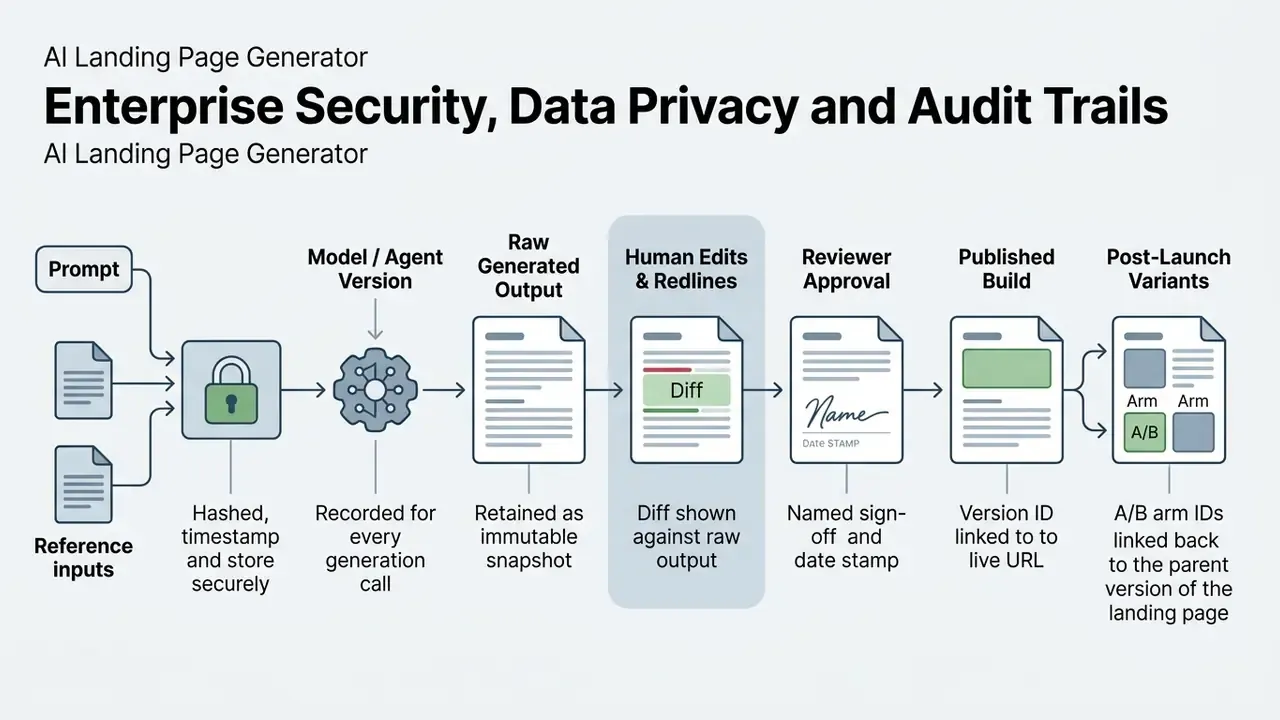
Keep that chain intact and a regulator or internal validator can reconstruct exactly which inputs produced a live consumer-facing claim. That is the practical meaning of "no evidence, no autonomy." Lose one link, usually the raw output snapshot, and the rest of the chain proves very little.
How to Create a Landing Page With AI Step by Step
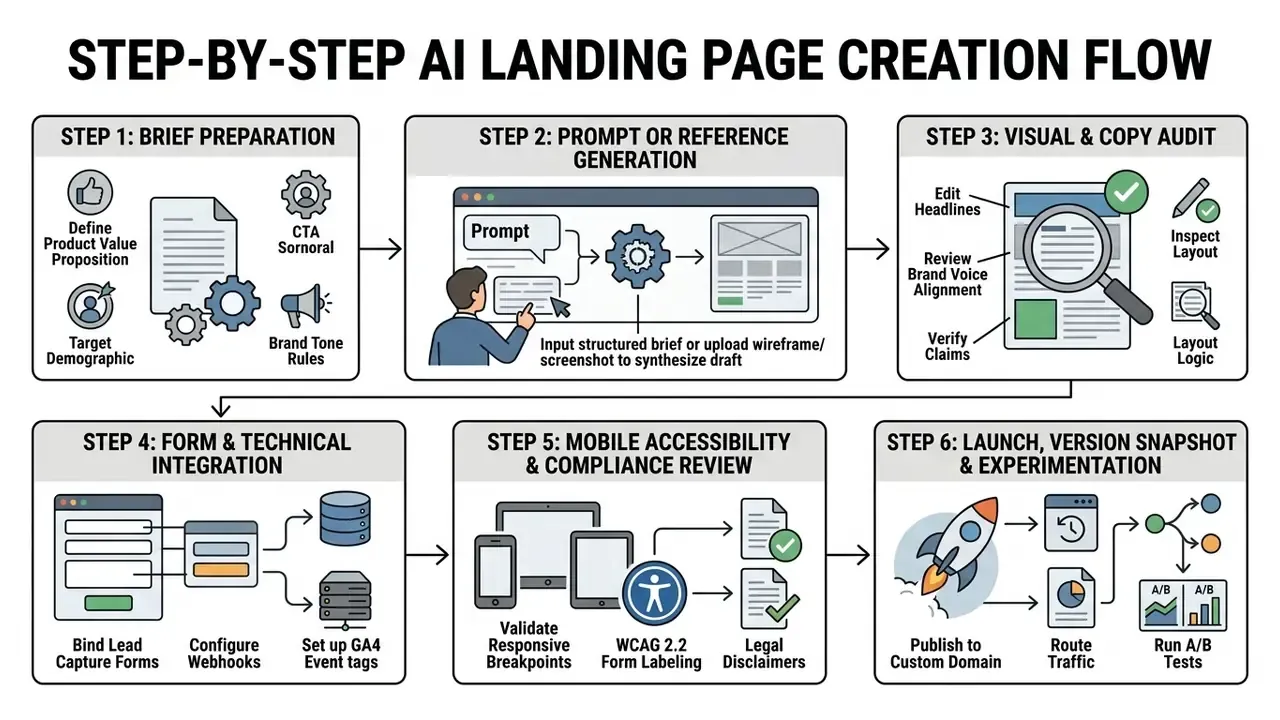
Creating a high-converting page with AI takes a structured workflow spanning strategy, prompting, editing, and deployment. A defined process keeps generated pages aligned with business objectives, brand guidelines, and technical compliance standards. Validation is not an optional final step: every layout, form, and copy variant clears documented review before it meets live traffic.
When operators try to create a landing page using ai without clear inputs or verification gates, output tends to be generic, off-brand, or structurally weak. A systematic process lets non-technical teams reliably create a landing page with ai that is both conversion-oriented and compliance-ready.
Write a Prompt That Describes the Product, Audience and Goal
Page quality tracks prompt quality more closely than most buyers expect. An effective prompt defines five parameters: product category, target audience, unique value proposition, tone of voice, and primary call to action. A sixth, required output format and section order, noticeably improves consistency across regenerations.
- Weak prompt "Make a landing page for an AI credit risk tool."
- Structured prompt "Create a high-converting landing page for an enterprise credit risk assessment software platform. Target audience: Chief Risk Officers and heads of credit underwriting at regional US banks. Key value proposition: automated model risk compliance with full auditability. Tone of voice: analytically confident, executive, direct. Avoid the words 'revolutionary', 'seamless', 'game-changing'. Primary CTA: 'Schedule Model Audit'. Include hero section, security trust badges, feature comparison grid, ROI calculation breakdown, customer testimonial block, regulatory disclaimer strip, and contact form. Output section order exactly as listed."
For regulated deployments, add a fixed system-level constraint block that the marketing team cannot override: mandatory disclaimer text, prohibited performance claims, required disclosure placement, and a rule that no statistic may appear unless supplied in the brief. That single move converts compliance from post-hoc editing into a generation constraint. It is cheaper, and it fails less often.
Marketing prompt frameworks show that explicitly stating customer pain points, value propositions, and CTA constraints prevents generic output and pushes copy toward business benefits rather than feature lists (Marketing Prompt Engineering Frameworks, 2026).
«In the PinLanding system, GPT-4 converts attribute combinations into coherent queries inside a multi-task framework; effectiveness depends directly on the completeness and structure of the input attributes.»
Review the Layout, Refine the Copy and Test Before Launch
Once an ai tool to create landing pages returns the initial layout, run a structured pre-launch audit. Three things dominate: copy refinement, mobile verification, technical integration testing.
First, edit generated copy toward brand voice, correcting overstated claims and passive phrasing. Second, inspect the layout across mobile, tablet, and desktop viewports, applying the same scrutiny used when preparing hero imagery with AI photo editors. On accessibility, note a common misstatement: the W3C Web Content Accessibility Guidelines do not mandate a single label position. They require explicit programmatic association between labels and inputs (<label for="…"> or aria-labelledby), high visual proximity, adequate target sizing, and clear submit indicators (W3C, How to Meet WCAG 2.2, 2025, https://www.w3.org/WAI/WCAG22/quickref/). Labels above fields remain a well-established usability convention for mobile forms, not a normative rule. Third, submit test entries so you can confirm webhooks route lead data correctly, and check that success and error states are announced to assistive technology (W3C WAI Forms Tutorial, 2026, https://www.w3.org/WAI/tutorials/forms/).
Pre-launch checklist:
Checklist0 / 8
Teams wiring automated workflows into existing systems can browse the hub for technical guides and integration requirements.
Common Pitfalls and Risks in AI-Generated Landing Pages
Speed reintroduces failure modes that slower design workflows filtered out by default. Five matter most.
- Fabricated proof.Generators invent customer counts, award badges, uptime figures, and testimonial quotes, because those patterns saturate training data. Trace every number, logo, and quotation to an owned source before publication. On a financial or health page, an unverifiable claim is a regulatory exposure, not a copy defect.
- Regulatory omission.Drafts optimize for persuasion, not disclosure. Rate assumptions, eligibility limits, risk warnings, and jurisdictional restrictions drop out routinely. Encode them as non-overridable constraints and re-verify after every regeneration.
- Silent brand drift.Across dozens of variants, tone and vocabulary slide toward generic SaaS phrasing. A banned-word list plus annotated voice samples curbs drift far better than manual line editing.
- Search visibility risk.Unedited output competes poorly. Semrush's analysis of 42,000 pages found top-ranked content roughly eight times more likely to be human-written (80.5% probability) than AI-generated (9 to 10%) (Semrush, "Does AI Content Rank Well in Search?", 2024).
- Untracked versions.Pages regenerated in place, with no snapshot, destroy the audit chain. If you cannot reproduce which prompt produced a live claim, you cannot defend it.
A sixth category deserves its own line: accessibility and layout regressions. Generators sometimes collapse multi-column grids incorrectly at small breakpoints, drop label associations when a section is re-prompted, or emit contrast ratios below conformance thresholds. Re-run the accessibility audit after every structural regeneration, not only before first launch. This is the step teams skip when a campaign date slips, and it is the one that later shows up in a complaint.
How to Create a Free Landing Page With AI and Assess Pricing
Understanding what separates free plans from paid subscriptions helps organizations match tooling to operational scale. Free tiers vary in purpose more than the marketing suggests. Some are explicitly evaluation-only environments where publishing is blocked, others permit limited production publishing under traffic caps and branding constraints. Landingsite.ai, for example, labels its $0 plan as "perfect for testing," while GetResponse permits free publishing up to 1,000 unique monthly visits, and LanderLab allows 5 published pages with 2,500 monthly visits. Read the plan terms; there is no category-wide rule.
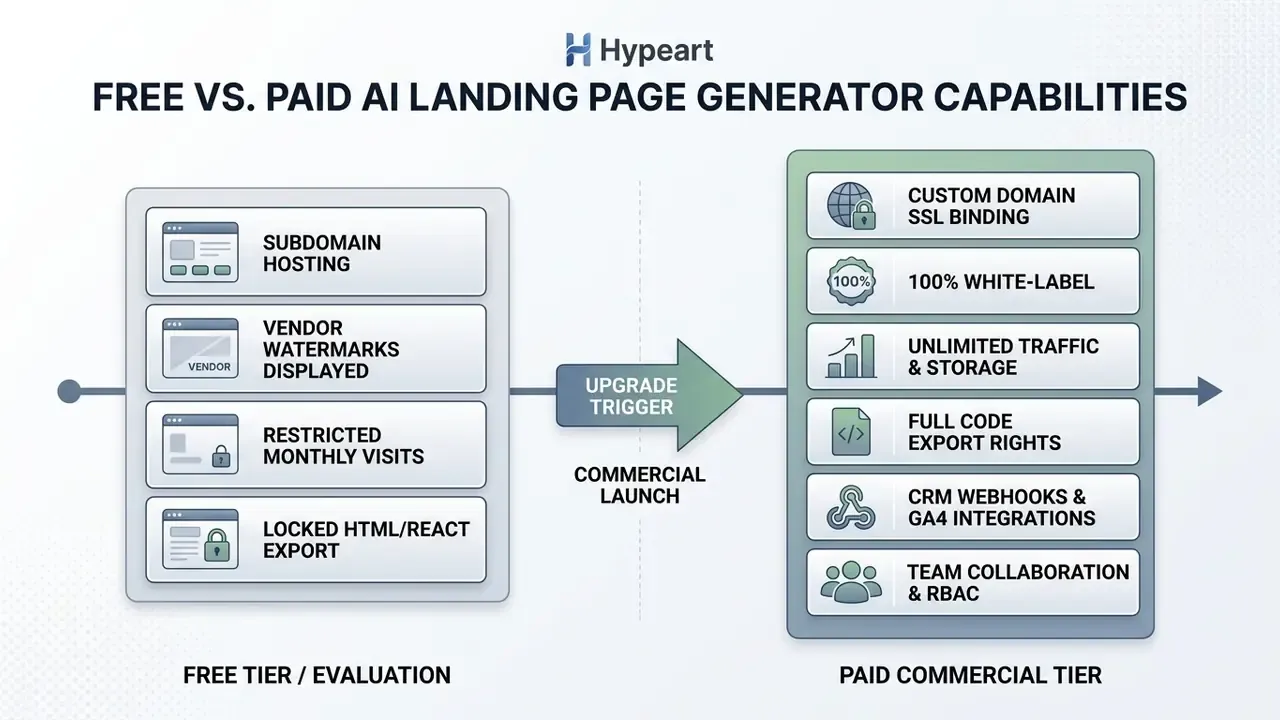
Evaluating an ai landing page generator free tier against paid upgrades means checking bandwidth caps, domain rights, branding restrictions, and export capability. Knowing the upgrade trigger prevents a launch being blocked by an account limit at the worst moment.
«More than 20% of all US keywords now display an AI Overview, and pages holding position one lose an average of 34.5% of clicks when one is present.»
That shift changes the ROI arithmetic. If organic click volume into a landing page is compressing, paid features that lift on-page conversion (A/B testing, dynamic text replacement, faster hosting) matter more than raw page volume.
What a Free AI Landing Page Generator Can Cover
A free plan is enough to test prompt responsiveness, editor usability, and layout prototyping. Many tools let users create a landing page with ai free of charge, with access to basic templates and the visual editor.
The limits, though, are consistent:
- Subdomain restrictions: Pages publish on vendor subdomains such as
company.vendorpage.siteinstead of corporate domains. - Vendor branding: Free pages carry permanent watermarks or badges. Gamma, for instance, appends a "Made with Gamma" mark to free exports.
- Traffic and generation caps: Monthly visitor volume is typically capped between 500 and 2,500 unique visits, and generation credits are limited. The same pattern documented for free AI video generators applies across free creative tiers.
- Integration gates: CRM webhooks, GA4 scripts, and custom code injection sit behind paid plans.
- Governance gaps: SSO, role separation, and audit-log export are almost never available on free plans, which alone disqualifies them for regulated campaigns.
When Paid Pricing Makes Sense for a Commercial Landing Page
Upgrade when you launch live commercial campaigns, buy paid traffic, or capture sensitive customer leads. Paid tiers deliver custom domain binding, watermark removal, higher-bandwidth hosting, and full code export rights.
The workflow features usually justify the spend: automated A/B split testing, dynamic URL parameter replacement (the same free-versus-paid calculus teams run when comparing the best free AI image generators against licensed alternatives), multi-user role permissions, and direct webhook routing.
«AI content is on average 4.7x cheaper than human-written content and enables 47% more published material per month.»
Total cost of ownership should include the line item no vendor quotes: human review time. A realistic model is generation cost plus editorial review hours plus compliance sign-off hours plus audit storage. In regulated organizations, review labour frequently exceeds subscription cost. Any ROI case built on subscription price alone will be wrong, and usually wrong by a wide margin.
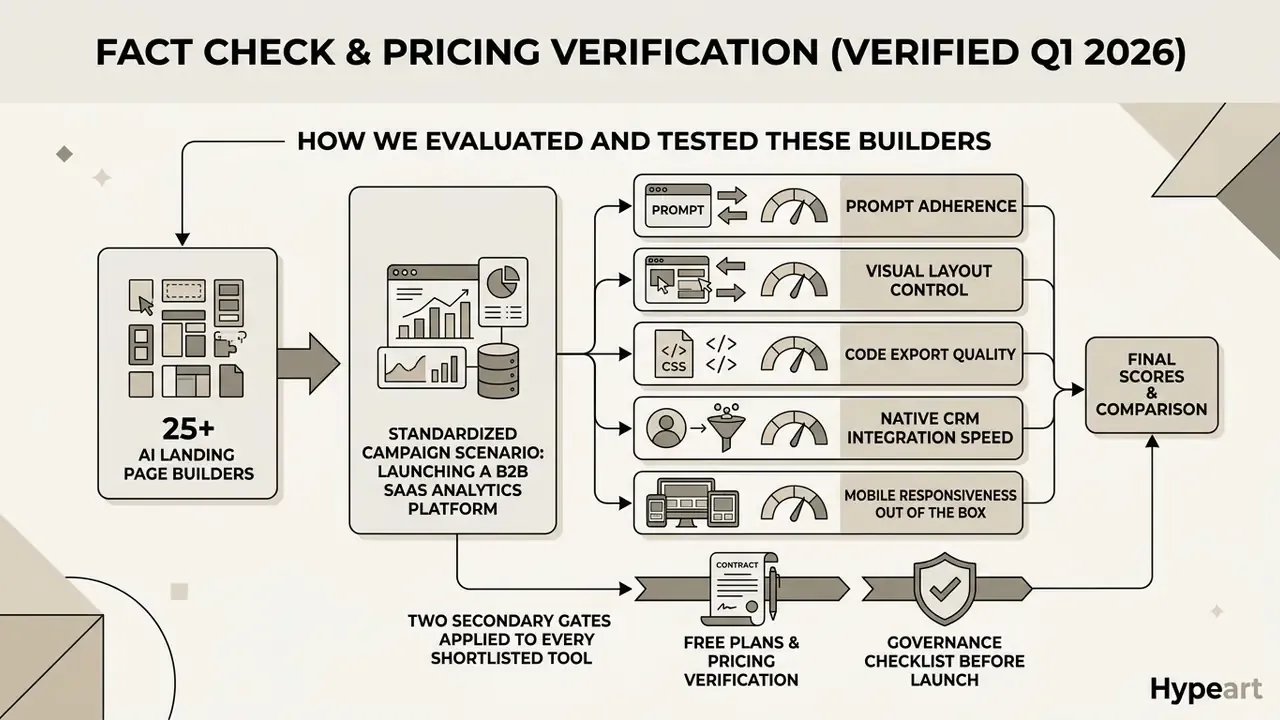
Fact check and pricing verification (verified Q1 2026):
Finance teams modelling software expenditure across creative tooling can compare options and estimate return before approving upgrades.
How We Evaluated and Tested These Builders
Best AI Landing Page Generator Tools: How to Compare Options
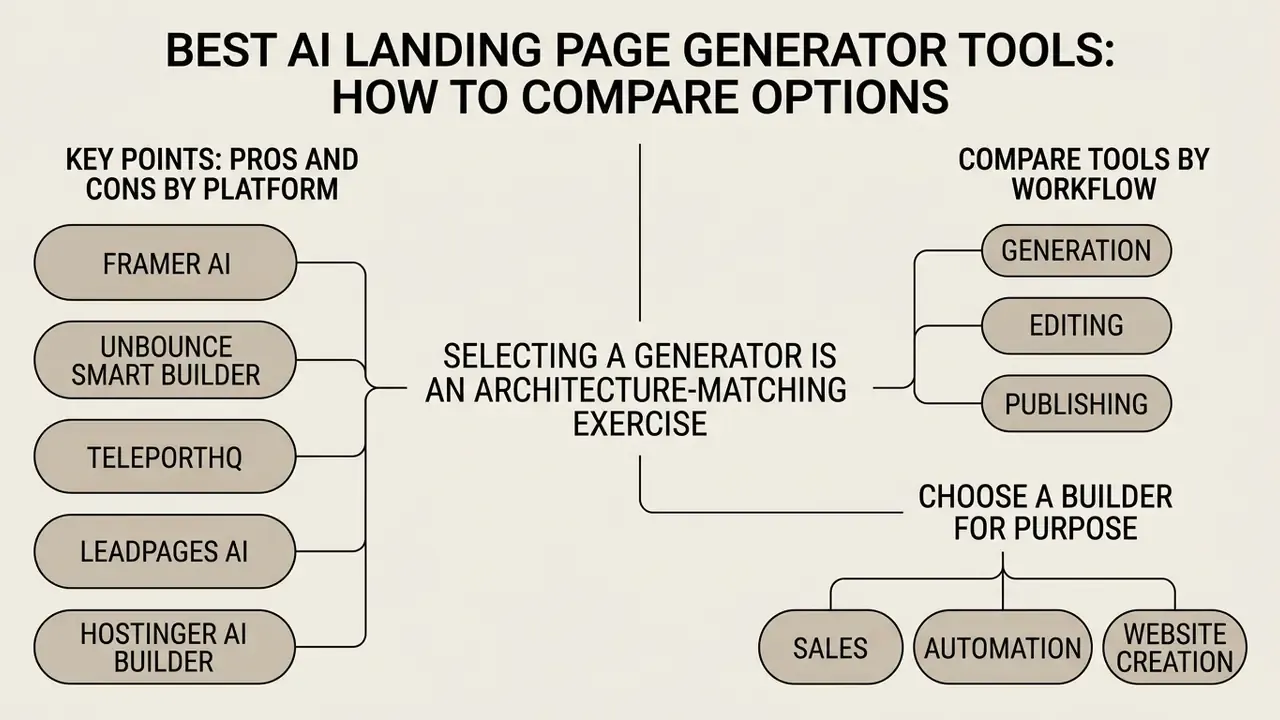
Selecting the best ai landing page generator is really an architecture-matching exercise. Some tools excel at rapid prompt-to-page drafting, others at enterprise design systems, complex data integrations, or conversion rate optimization (CRO).
Comparing ai landing page generator tools means looking past text generation. Procurement leaders should weigh visual editor performance, mobile adaptation, code export quality, CRM integration, and the security posture that determines whether the tool can be approved at all.
| AI Landing Page Builder Platform | Primary Generation Workflow | Visual Editor Type | Code Export Formats | CRM & Webhook Capabilities | Security / Governance Signals | Best Commercial Use Case |
|---|---|---|---|---|---|---|
| Framer AI | Text-to-canvas layout and copy generation, canvas-aware agent re-prompting | Advanced visual canvas (Figma-like) | React components, clean web code | Native integrations via webhooks and custom code | Team roles on paid tiers, verify retention terms and sub-processors | Design-centric SaaS and marketing prototypes |
| Unbounce Smart Builder | Data-informed section assembly and Smart Copy generation | Block-based visual editor | Subdomain or custom domain hosting, no clean code export | Native HubSpot, Salesforce, Mailchimp integrations | Enterprise plans expose user roles, confirm SSO availability per tier | Paid ad campaign conversion optimization |
| TeleportHQ | Prompt-to-wireframe with natural-language refining | Drag-and-drop code-level editor | HTML/CSS, React, Vue, Angular | Webhook data POSTing and API endpoints | Code export minimizes lock-in, self-host to control data residency | Technical teams needing portable code |
| Leadpages AI | Template-driven AI copy generation and layout builder | Drag-and-drop block editor | Standalone hosting, WordPress plugin | REST API, form webhooks, CSV export, CRM sync | Documented API and webhook surface aids logging | High-volume lead capture and SMB funnels |
| Hostinger AI Builder | Guided business questionnaire to full site generation | Simplified block editor | Hosted ecosystem deployment | Basic contact form collection and email routing | Minimal enterprise controls, unsuitable for regulated data | Ultra-fast small business and local service launches |
Pros and Cons by Platform
Framer AI
Pros: Figma-like canvas with precise design control, strong React export, native animation and interaction states. The canvas-aware agent can be re-prompted in session to extend existing sections.
Cons: Steeper learning curve for non-designers, higher tiers needed for multiple custom domains, and AI credits on lower tiers drain fast during variant exploration.
Unbounce Smart Builder
Pros: Data-driven section recommendations, Smart Traffic routing that sends visitors to the variant most likely to convert, a solid A/B testing suite, and conversion-goal tracking configured inside the builder.
Cons: No clean HTML export, which creates platform lock-in. High entry price at $99 per month. Design flexibility narrower than canvas-first tools.
TeleportHQ
Pros: Direct export to React, Vue, and Angular, granular HTML and CSS control, code-level prompts, editable mobile views. The strongest option for teams that must own the deployment artifact.
Cons: Needs front-end knowledge to pay off, less opinionated about CRO patterns, hosting and custom-domain features tied to paid access.
Leadpages AI
Pros: Fast branded page generation with built-in forms, webhooks, CSV export, and conversion attribution. Real-time analytics with click tracking, scroll depth, and heatmaps. Documented REST API.
Cons: Template-anchored aesthetics can look familiar, and deeper design customization is limited next to canvas editors.
Hostinger AI Builder
Pros: Fastest brief-to-live path through a guided questionnaire, bundled domain and managed hosting, very low barrier for non-technical owners.
Cons: Limited export and integration depth, minimal governance controls, not appropriate where sensitive form data or audit trails are required.
Compare Tools by Generation, Editing and Publishing Workflow
Workflows differ sharply across ai landing page creation tools. Framer AI is canvas-first: a prompt produces interactive, styled canvases that can be edited with precise visual controls, and the agent reads the existing canvas so follow-up prompts extend work rather than overwrite it.
TeleportHQ, by contrast, is output-first. Operators generate layouts through natural language and export standard React or HTML and CSS packages for self-hosted deployment (TeleportHQ Documentation, 2026, https://teleporthq.io/). Unbounce Smart Builder prioritizes conversion architecture, using performance data to recommend sections, form placement, and copy variants.
«In Meta's randomized experiment, advertisers using AdLlama, an RLPF-trained model, achieved a 6.7% higher click-through rate (p=0.0296) than those using the imitation-learning baseline.»
A third architectural family is template-guided generation, exemplified by Adobe Journey Optimizer, where the assistant generates variants inside an approved brand template using explicit brand, text, image, and reference-content settings. That pattern trades some drafting freedom for brand governance. In regulated environments, that is usually the right trade.
Choose a Builder for Sales, Automation or Website Creation
Align the tool with the operational objective, not the demo video.
Teams evaluating adjacent content utilities, such as an ai citation generator for research-heavy pages, apply the same structured feature review to keep software choices inside corporate governance standards.
AI Landing Page Design Practices for Higher Conversion
Publishing an AI-generated page without optimization rarely produces the commercial result promised in the pitch deck. An ai landing page design generator delivers structure quickly. Conversion still depends on copy that matches brand identity, a clear visual hierarchy, and structured mobile testing.
Applying established CRO frameworks keeps AI-drafted pages clear, accessible, and action-oriented. Standards such as the W3C Web Content Accessibility Guidelines (WCAG 2.2) and NIST interface design guidance help pages perform across visitor segments (NIST Usability Guidelines, 2024, https://www.nist.gov/). NIST's process framing transfers directly: define context of use, define user requirements, produce the design solution, then evaluate, including usability, accessibility, and conformance testing.
«Across 42,000 analyzed pages, first-position content was roughly eight times more likely to be human-written than AI-generated: 80.5% probability versus 9 to 10%.»
The operational reading is not "avoid AI." It is "never ship raw output." Generation supplies structure and speed. Human editing supplies the differentiation that ranks.
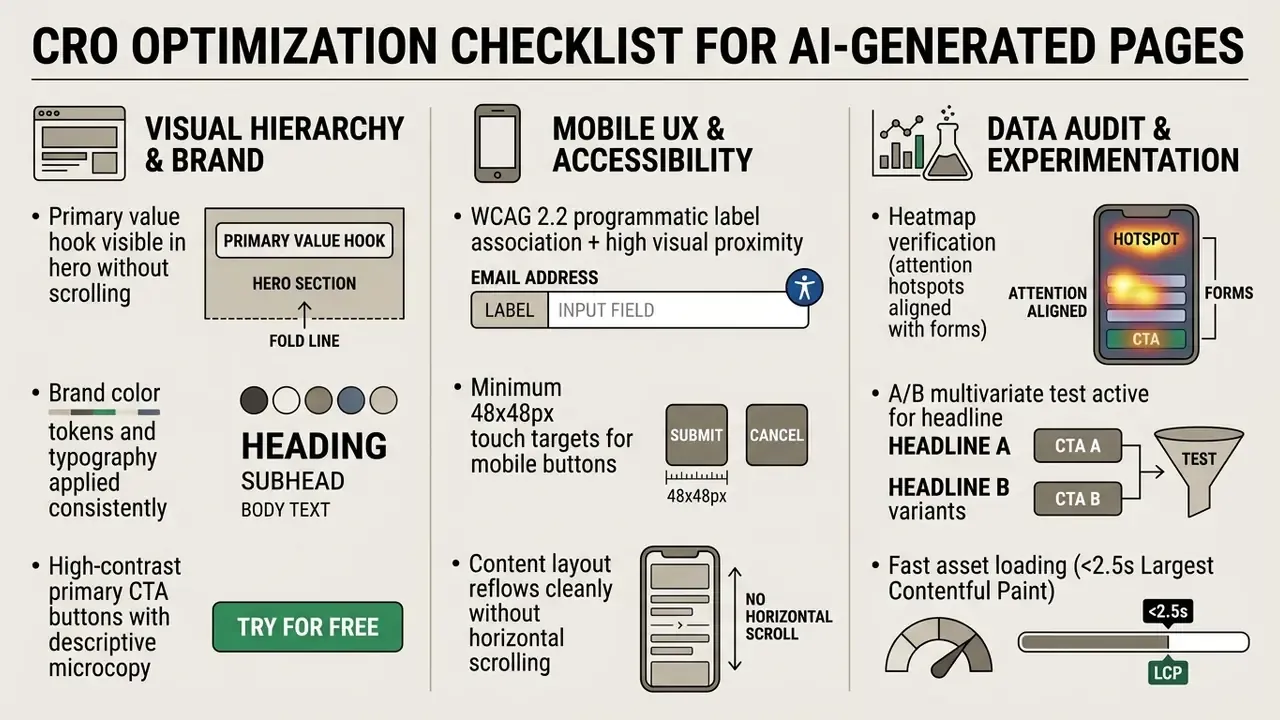
Align AI-Generated Copy and Design With Your Brand
Models love buzzwords: "revolutionize," "game-changing," "seamless." Strip them. Replace vague claims with concrete data points, verified metrics, and precise product descriptions, applying the same substantiation discipline used for visuals produced with AI art generators, where provenance and usage rights must be documented.
Brand identity guidance for AI content recommends explicit writing rules: three to five voice principles, scenario-based tone ranges, banned and preferred vocabulary lists, and annotated sample passages showing the voice in use (Brand Voice Optimization Guides, 2025). Visually, enforce a global brand style kit so primary colors, readable font scales, accessible color pairings, and official assets replace generic stock graphics.
Test Mobile Layouts, Forms and Page Variations
Mobile performance moves conversion directly. Mobile viewports account for a large share of campaign traffic in most consumer verticals, but confirm the actual split from your own GA4 device reports before prioritising breakpoints. Either way, generators occasionally misalign complex multi-column layouts on small screens, which makes device-level verification mandatory rather than optional. W3C mobile guidance is explicit that testing must happen on real devices as well as emulators (W3C Mobile Accessibility, 2026, https://www.w3.org/WAI/standards-guidelines/mobile/).
Mobile optimization practice comes down to three habits:
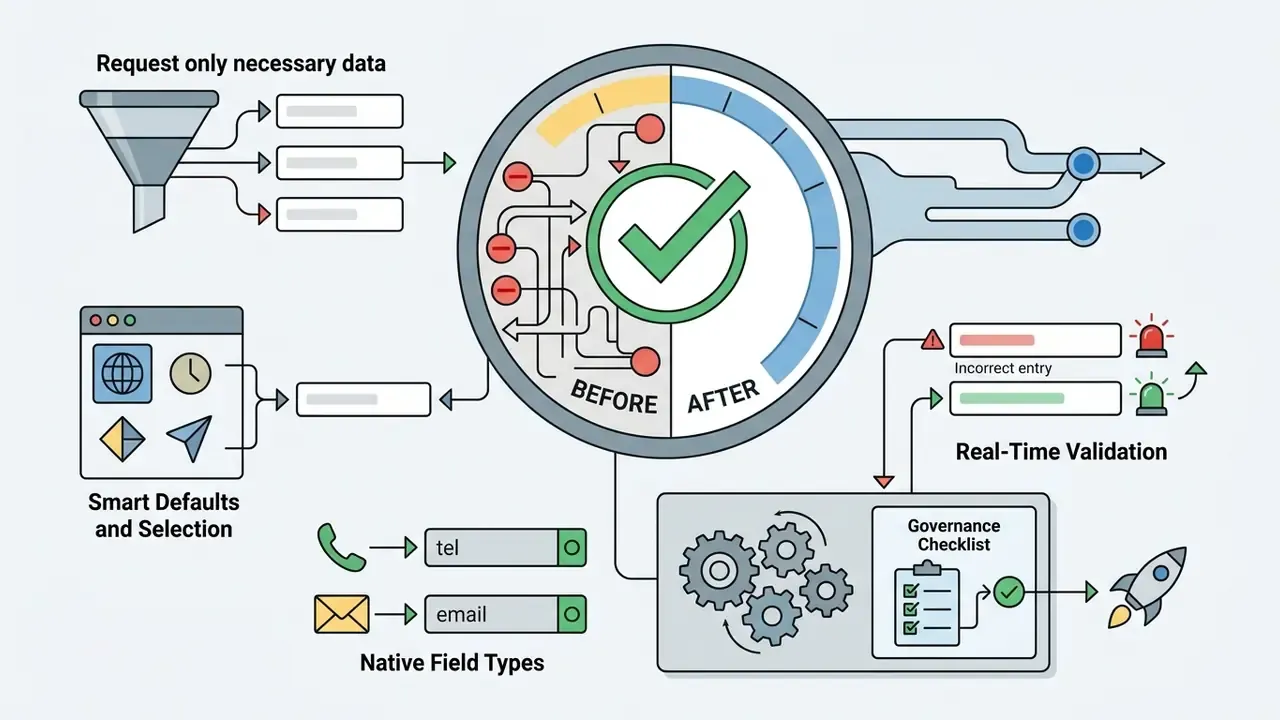
tel and email with clearly associated labels (University of Washington Form Design Guide, 2025).
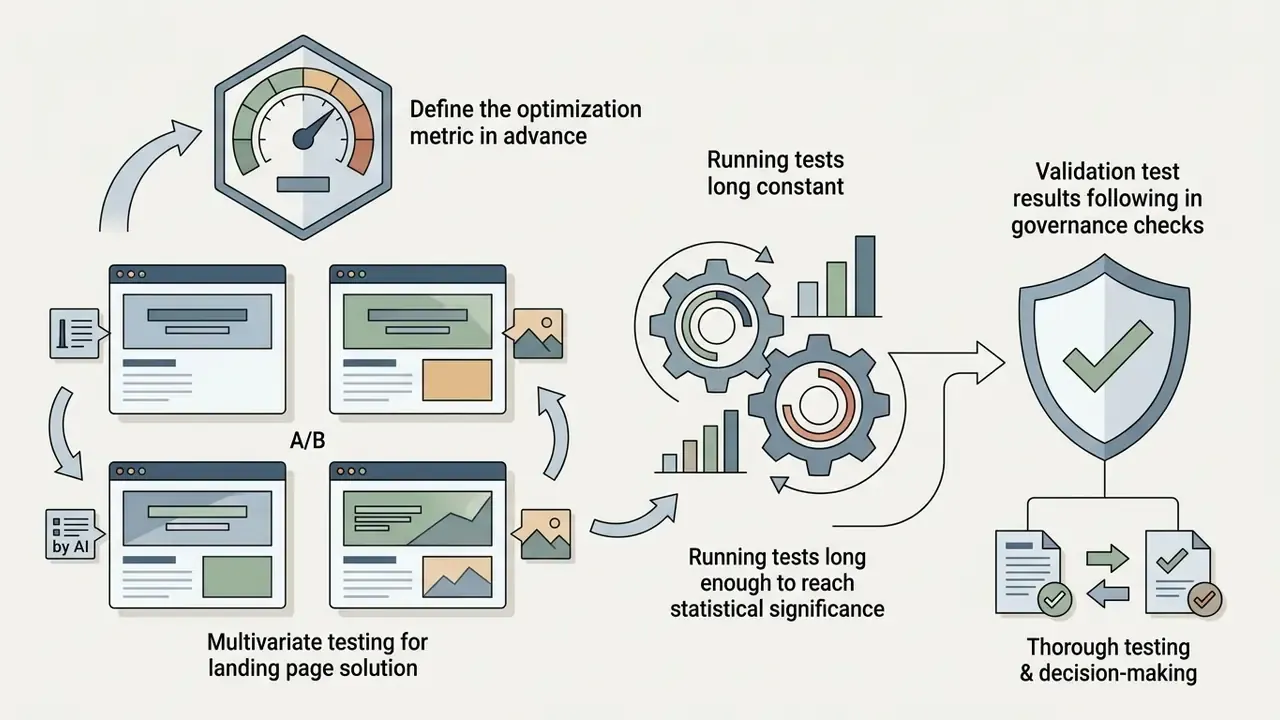
«Over seven-day live-traffic A/B tests, multi-objective copy optimization delivered a 10.4% CTR lift and a 4.1% CVR lift while preserving content diversity.»
Log every test arm against its parent page version. Without that link, a winning variant cannot be traced back to the prompt and reviewer that produced it, which quietly breaks the audit chain described earlier. One field in a spreadsheet prevents a lot of retrospective archaeology.
Limitations and Open Questions
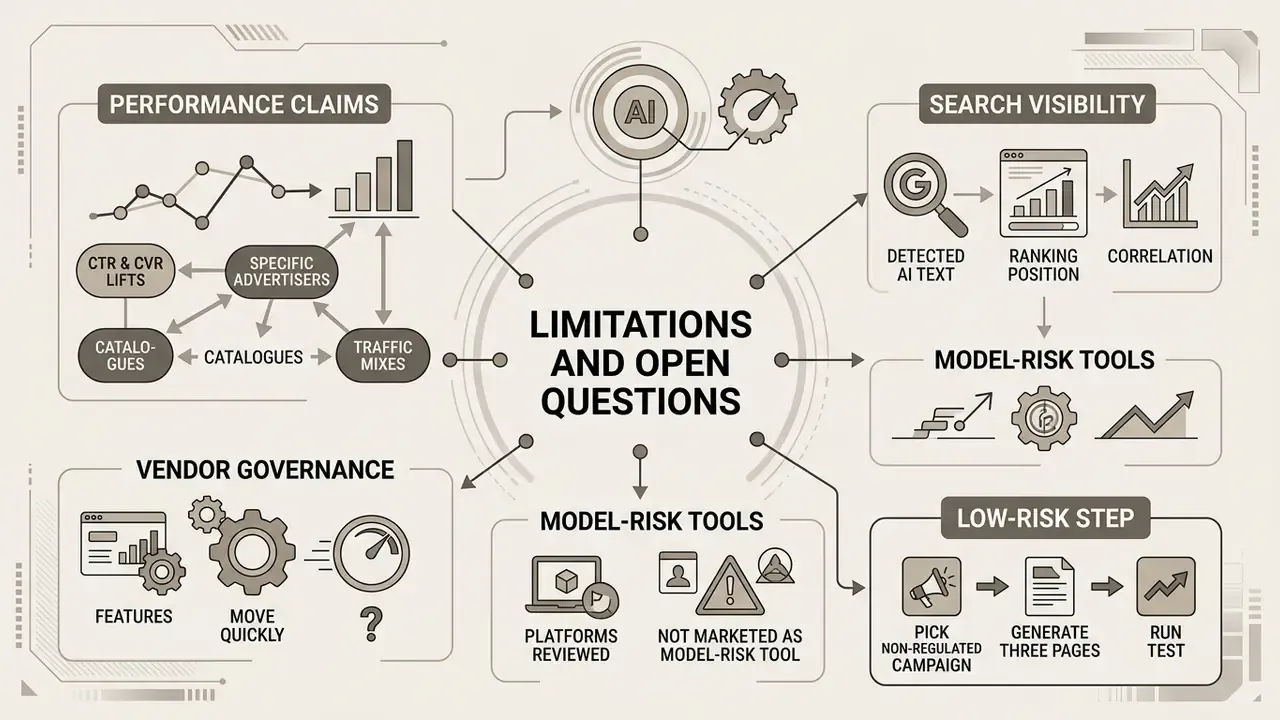
Several claims in this space remain under-evidenced, and it seems fair to name them.
First, the reported CTR and CVR lifts come from specific advertisers, catalogues, and traffic mixes. Whether a 6.7% relative lift transfers to a regulated lending offer with mandatory disclosure blocks is unknown. Disclosure text changes page length, scroll depth, and perceived risk, all of which affect conversion.
Second, the search-visibility evidence measures correlation between detected AI text and ranking position, not causation. Edited hybrid content sits awkwardly between both categories, and detection accuracy is itself contested.
Third, vendor governance features move quickly. A platform without SSO in Q1 2026 may ship it next quarter, and a retention setting can change with a sub-processor update. Treat any vendor assessment as a point-in-time snapshot with a re-review date attached.
Fourth, none of the platforms reviewed here markets itself as a model-risk tool. The audit trail described in this guide is something buyers assemble from version history, prompt logs, and their own approval records. If a vendor claims a turnkey compliance solution, ask which control objective it satisfies and what evidence it exports.
A reasonable next step, and a low-risk one: pick one non-regulated campaign, generate three pages, and run the full snapshot and review process end to end. Measure review hours honestly. That number, not the subscription price, tells you whether the workflow scales inside your institution.
FAQ About AI Landing Page Generators
Do You Need Coding Skills to Use an AI Landing Page Builder?
No, standard operations do not require coding skills. No-code AI builders let operators generate, edit, and publish complete pages through natural-language prompts and drag-and-drop editors. Vendors including Figma Make and Sitekick state explicitly that no HTML, CSS, or JavaScript knowledge is required for the core workflow.
«Structure content with clear headings and subtopics so key information can be extracted by LLM-based search engines as citable fragments, which raises AI visibility for the brand.» Ahrefs, "What We Actually Know About Optimizing for LLM Search" (2024 to 2025). https://ahrefs.com/blog/ Basic web literacy still helps. On developer-focused platforms like TeleportHQ, HTML and CSS knowledge makes it far easier to customize exported React components, configure CSS variables, run QA on generated code, or wire complex webhook integrations (TeleportHQ Developer Guide, 2026).
Can an AI Landing Page Use Real Data, Forms and Backends?
Yes. Modern AI landing pages connect to live backends, databases, and CRM platforms. Built-in forms collect visitor entries and pass data through REST APIs or secure webhooks to systems such as HubSpot, Salesforce, or Google Sheets (Leadpages API Documentation, 2026). Dynamic page engines go further, ingesting external CSV files or database parameters to render personalized content, pricing tables, or localized offers based on visitor URL parameters (Landingi API Documentation, 2026). Enterprise form platforms extend this with data models that read from RESTful, SOAP, OData, and relational sources for prefill and validation. When managing specialized content workflows, such as producing hero motion with AI video generators, technical teams can view the guide covering copyright, regulatory, and compliance frameworks around commercial AI output.
Can AI Generate a Landing Page From a Screenshot or Wireframe?
Yes. Multimodal generators accept image inputs, including screenshots, Figma wireframes, and sketches, then reconstruct an editable page with equivalent structure. The VLM extracts layout hierarchy, spacing, and component boundaries, and the LLM repopulates that structure with your copy. It is faster than describing a layout in words, and particularly handy for turning an existing mobile page into a desktop equivalent. Rights caution again: structural inspiration is not a licence to reuse a competitor's copy, imagery, or trademarks.
Is AI-Generated Landing Page Content Safe for Regulated Industries?
Only with controls. Drafts frequently omit mandatory disclosures and sometimes fabricate figures. Regulated deployments need non-overridable disclaimer constraints in the system prompt, documented human review, exportable version history linking prompt to published claim, and vendor terms confirming that prompts and captured lead data stay out of public model training. Treat AI generation as a drafting control point inside your existing model-risk and third-party oversight programmes, not as an exception to them.
How Do You Measure Whether an AI-Generated Page Actually Performs?
Instrument before launch, not after. Configure GA4 conversion events for form submits, scroll depth, and CTA clicks, verify each event fires exactly once, then run a predefined A/B test with a single success metric and a duration sufficient for statistical significance. Remember that GA4 does not host experiments natively: testing runs in a third-party tool while results are interpreted in Analytics (Google Analytics Help, 2026). Track cost per verified lead rather than page-generation volume.
Appendix A: Revision Notes (Transparency Log)
- Superseded wording (accessibility) an earlier version stated that WCAG 2.2 requires mobile form labels positioned "directly above fields." The corrected statement, used above, is that WCAG 2.2 requires explicit programmatic association and high visual proximity between labels and inputs. Label-above placement is a usability convention, not a normative requirement.
- Superseded wording (free tiers) an earlier version asserted that free tiers "generally function as evaluation environments rather than long-term commercial hosting solutions." The revised framing separates evaluation-only plans, where publishing is blocked, from limited-publishing plans with traffic and branding caps, since vendor terms differ materially.
- Superseded wording (mobile traffic) an earlier version claimed that "modern web traffic is predominantly mobile" without a cited figure. The revised text advises confirming the device split from first-party GA4 data.
- Placeholder removed an unrendered flowchart marker was replaced with the prompt-to-publish diagram in the generation section.
- Structured data guidance the previous inline script block was replaced with a plain-language implementation spec, see Appendix B, so the article carries no executable markup.
Appendix B: FAQ Structured Data Implementation Spec
If you publish this page or a similar one, implement FAQ structured data at template level rather than pasting markup into body copy. The specification is simple.
Declare a single FAQPage type for the page, with mainEntity holding one Question object per FAQ item. Each Question needs a name field matching the visible H3 text exactly, and an acceptedAnswer of type Answer whose text field reproduces the visible answer without adding claims that do not appear on the page. Four questions are recommended as a starting set: coding skills required, real data and backend integration, generation from a screenshot or wireframe, and safety for regulated industries.
Two rules keep this compliant. Markup must mirror visible content, and answers must not contain promotional language absent from the page. Validate with Google's Rich Results Test before deployment, then re-validate after any copy edit, because a headline rewrite that leaves the schema untouched is one of the most common causes of silent eligibility loss.