Executive Summary for Risk, Compliance, and Creative Leadership
- Capability: An AI music generator converts text prompts, lyrics, reference audio, or chord charts into full vocal songs, instrumental beds, stems, and sound effects. Academic framing is explicit: text-conditioned generation of symbolic or acoustic music for controllable output, as opposed to unconditional models.
- Rights are tiered, not absolute: Commercial usage rights and output ownership are granted by subscription tier and vendor Terms of Service. Suno assigns output rights to Pro and Premier subscribers for content generated during a paid term. Udio's Terms state that the company and/or its licensors own the Output while granting usage permissions. Free tiers are, in nearly all audited cases, non-commercial.
- Copyright is not automatic: Under current U.S. practice, purely AI-generated material without meaningful human authorship is not copyrightable. A vendor may assign contractual rights to a file. That is legally distinct from a registrable copyright.
- Quality must be audited, not assumed: Four mandatory output checks (vocal intelligibility, acoustic signal clarity, genre fidelity, rhythmic consistency), plus documented metric filtering with PER and MAD, before any asset enters a production pipeline.
- Two under-managed risk classes: voice cloning with Right of Publicity exposure when a generated vocal resembles an identifiable artist; and vendor data retention, where prompts, lyrics, and uploaded reference audio may be reused for model training.
- Governance requirement: Generative audio models used at institutional scale belong in the model inventory, with logged prompts, seeds, model versions, output hashes, and data-lineage records to satisfy internal validation and audit expectations.
- Economics: Risk-adjusted ROI must include licence cost, audit labour, legal review, and residual indemnification gaps. Not only the subscription fee.
How to Read This Guide
Creative leads will find prompt frameworks and export specifications. Risk, legal, and compliance readers will find inventory, logging, and licence-verification controls. Finance readers will find a cost structure that includes the unglamorous lines: iteration labour, audit minutes, legal review, residual reserve.
One caveat before the detail. Vendor claims in this category age fast, faster than most software segments, because model versions and pricing pages move independently of the legal terms attached to them. Treat every quoted quota as volatile and every licence sentence as a contract clause, not marketing copy.
What Is an AI Music Generator and What Problems Does It Solve
An AI music generator is a software platform powered by deep learning models, such as auto-regressive transformers or diffusion pipelines, that synthesizes original audio compositions, instrumental tracks, and vocal songs from text descriptions, lyrics, or structural parameters. These systems compress media workflows by removing manual sound-design bottlenecks and supplying instant, customizable background audio for videos, advertisements, games, and podcasts.
«Text-to-music generation is defined as producing symbolic or acoustic music from descriptive text for controllable generation, in contrast with unconditional models.»
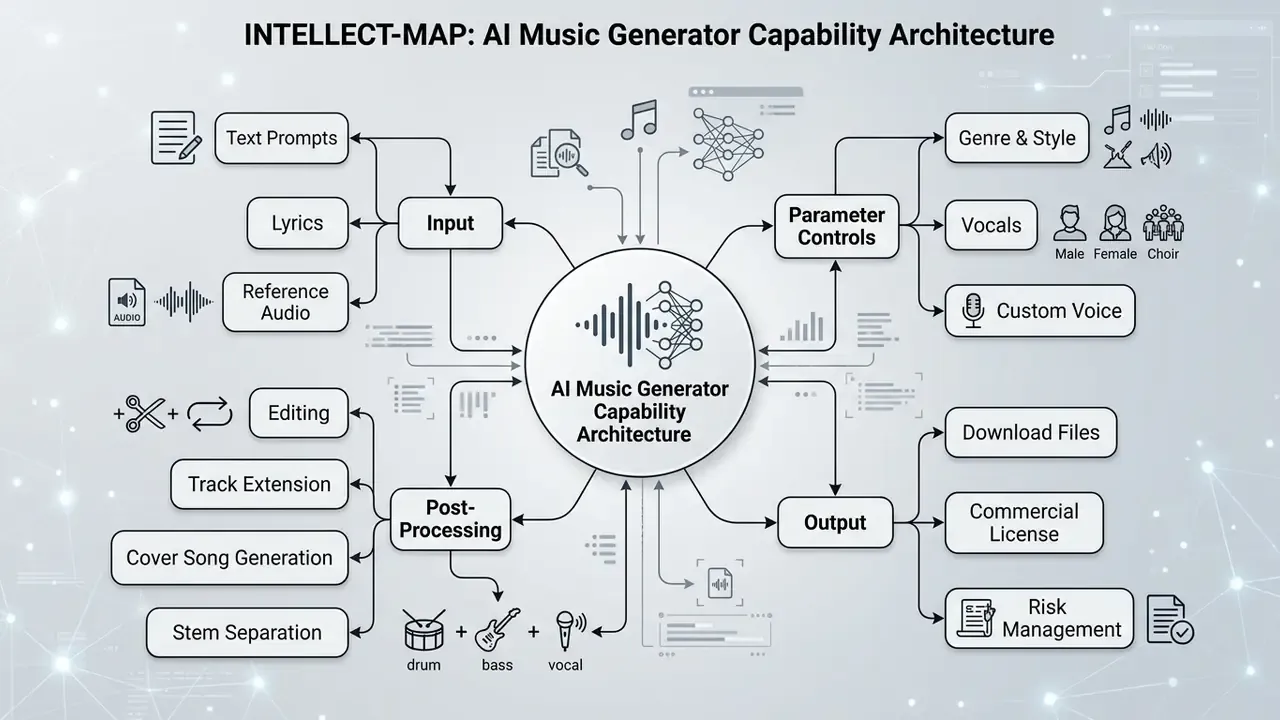
Functional Capabilities Overview
- Input Modalities Free-text descriptions (text to music), structured lyrics (lyrics to song), audio prompt references, uploaded vocal samples, and symbolic chord sequences.
- Style and Character Calibration Genre-specific arrangements, vocal timbre toggles, tempo control, and multilingual vocal synthesis.
- Output Formats Full songs with singing vocals, instrumental beds, ambient textures, sound effects (foley), and stem separations (acapella and instrumental).
- Post-Generation Control Contextual track extension, segment-level inpainting, cross-genre cover transformation, vocal removal, and style-based remixing.
- Distribution and Rights Commercial usage tiering, royalty-free licensing models, and lossless export options (WAV, MP3).
What Music Formats Does an AI Generator Create
An AI music generator produces four primary audio formats: full vocal songs, instrumental backing beds, stem-separated assets, and short sound effects. Full songs integrate synthesized vocals with multi-instrumental arrangements, relying on architectures such as ACE-Step 1.5 or MiniMax Music 2.0 to harmonize singing voices with background tracks. Instrumental beds provide non-vocal arrangements suited for background scoring, while stem exports isolate vocals or instruments for further mixing in digital audio workstations (DAWs). Short outputs include cinematic transitions, ambient textures, and effects generated from targeted text prompts.
«MusicGen, a single-stage transformer language model, generates high-quality mono and stereo audio conditioned on textual descriptions or melodic features.»
In institutional media production, technical teams usually need tailored workflows to process multimedia assets alongside audio tracks. For image asset preparation and vector pipelines, operators can compare options and, where logo or icon assets sit in the same release package, review the ai svg generator entry to standardize digital media pipelines across creative units.
Who Is AI Music Creation Suitable For
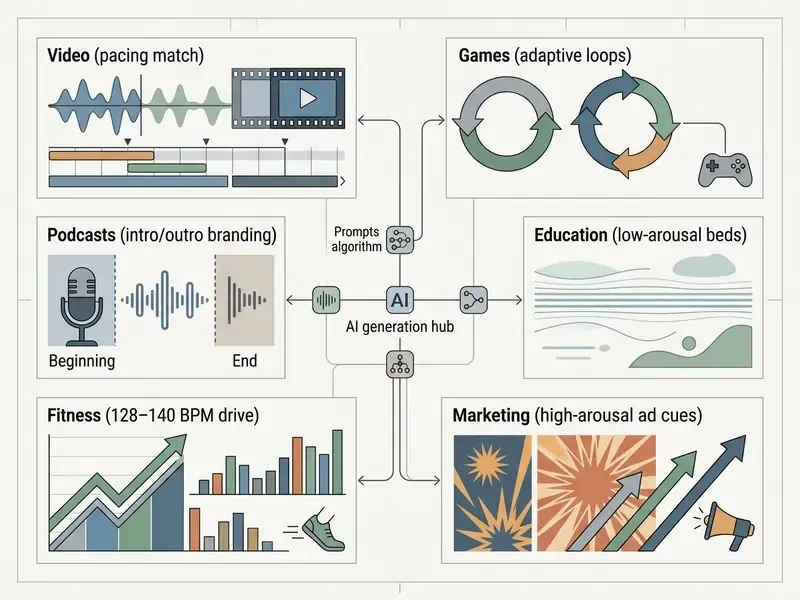
Music ai creation serves digital creators, game developers, podcasters, marketing agencies, educators, fitness content producers, and enterprise media teams that need rapid audio prototyping with clear licensing boundaries. Content creators use an ai song generator to produce custom background tracks matched to specific video pacing without triggering automated copyright flags. Game developers lean on generative audio for dynamic loops that shift with gameplay states. Marketing teams generate ad cues fast enough to cover global campaign variations.
«A procedural videogame music generator conditioned through video emotion recognition demonstrated adaptive accompaniment effectiveness in perceptual experiments with players.»
Creators building complete media pipelines around synthesized audio commonly pair music generation with free AI video generators so visual and audio assets stay under one licensing review.
There is one user group enterprises almost always forget: the internal approval chain. Brand, legal, and compliance reviewers need the same asset metadata (prompt text, model version, licence tier, generation timestamp) that creative teams routinely discard. Which is why prompt logging should be configured before the first production request, not after the first complaint.
Integration Guidelines for Educators and Fitness Instructors
- Educational Media and E-Learning Online instructors need non-distracting, neutral-arousal background tracks. Ambient instrumental beds at 60–80 BPM support learner retention without competing with spoken narrative frequencies. Recommended prompt pattern:
soft ambient piano and warm pad bed, 72 BPM, no percussion transients, low-mid frequency emphasis, instrumental only. - Fitness and High-Intensity Training Fitness creators need driving rhythms with stable metric structures. Tracks configured to 128–140 BPM with emphasized kick-drum transients give the pacing required for HIIT intervals and group instruction routines. Interval classes benefit from two variants in the same key, a 128 BPM work block and a 90 BPM recovery block, which allows seamless DAW crossfades.
How to Create a Song in an AI Music Generator: Text, Lyrics, and Ideas
Creating a song in an ai generator for music involves selecting an input method (descriptive text prompts or structured lyrics), defining musical attributes such as genre and style, and executing model inference. Modern platforms push these inputs through conditioning pipelines that translate semantic descriptions into acoustic tokens or diffusion noise targets.
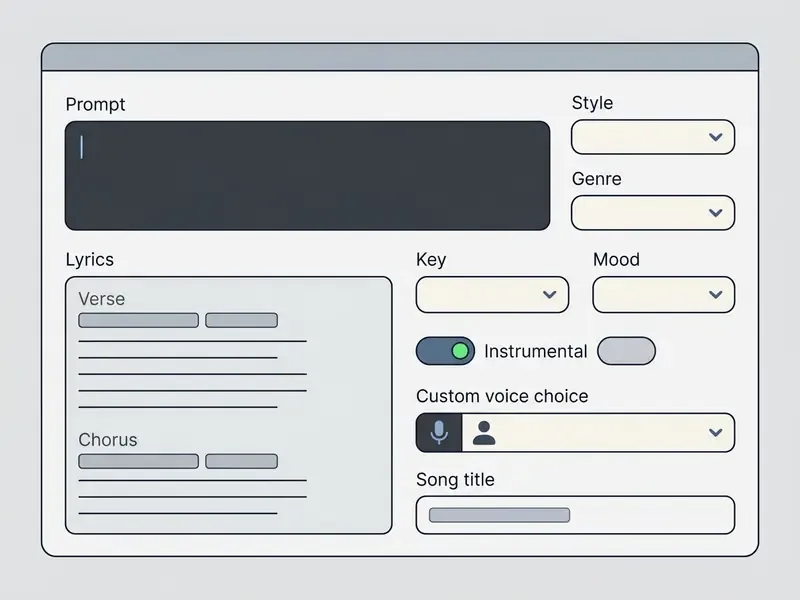
UI Interface Guide
- Text Prompt Input: Field for atmosphere, instrument, mood, and tempo descriptors.
- Lyrics Editor: Dedicated input area supporting structural tags such as
[Verse],[Chorus], and[Bridge]. - Genre and Style Selectors: Dropdown or tag interface defining arrangement boundaries (style fields typically accept up to 1,000 characters).
- Vocal Control Toggle: Switch to enable singing voice synthesis or force instrumental-only output.
- Custom Voice Selector: Assignment field for uploaded vocal samples or saved AI Singer profiles.
- Song Title Field: Track metadata input, usually constrained to 80 characters in API schemas.
Generating Music from a Text Description
Generating music from a text description relies on text-to-music models that map natural language descriptors to musical structure, tempo, and instrumentation. To generate music with predictable results, prompts should follow a fixed sequence: Genre and Style + Mood + Instrumentation + Tempo/Rhythm + Vocal Character. According to Google Cloud's Lyria prompt documentation (2026), explicit musical attributes such as "120 BPM upbeat disco pop with slap bass and brass accents" improve generation consistency markedly compared with abstract emotional terms.
A mid-sized marketing firm (illustrative example) needed 40 localized ad cues across six markets within 48 hours. By standardizing prompt structures with explicit tempo and instrument constraints, the team cut track rejection from 35% to under 4%. The resulting assets cleared brand compliance on the first iteration. Small change, large downstream saving.
When prompt-based generation extends to text-heavy marketing assets, creators often inspect an ai text generator to align written copy with synthesized audio cues. Teams handling narration alongside music should also review AI voice generator licensing and quality standards.
Automated Prompt Optimization Mechanisms
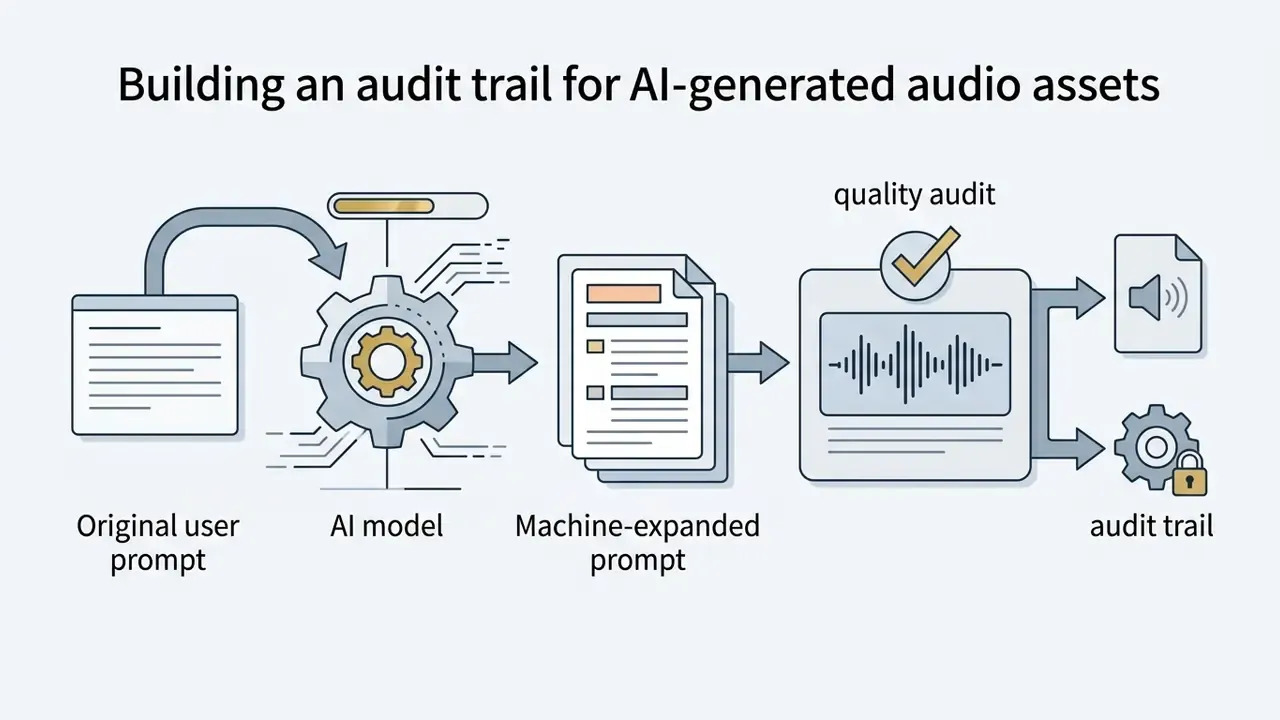
To help non-technical users, modern interfaces bundle LLM-based prompt enhancers. Enter a bare concept ("sad piano song") and the optimization engine expands it into a multi-attribute vector, for example "melancholic solo grand piano ballad, 65 BPM, minor key, subtle room reverb, soft velocity keys", before inference runs. In governed workflows, log both strings. The expanded prompt is the actual conditioning input, so it is the auditable artefact, and the one your reviewer will ask for.
Turning Lyrics into a Finished Song
Converting written lyrics into a completed song requires the generator to process textual phonemes, align them to rhythmic grids, and synthesize singing voices over accompaniment. Architectures such as Melodist and SongGen use structure-aware conditioning to parse section markers like [Verse], [Chorus], and [Bridge], so melodic phrasing and repetition match standard song forms. Benchmarks show that models optimized via Direct Preference Optimization (DPO), LeVo among them, reach Phoneme Error Rates (PER) as low as 7.2%, which keeps lyric intelligibility high.
«SongGen, a fully open single-stage auto-regressive transformer, converts text and lyrics into songs with harmonized vocals and accompaniment, offering control over genre, timbre and mood.»
«LeVo achieves a Phoneme Error Rate of 7.2%, the lowest among open systems, and the highest MuQ-T (0.34) and MuQ-A (0.83) scores among academic approaches.» LeVo: High-Quality Song Generation with Multi-Preference Alignment, arXiv (2025). https://arxiv.org/abs/2503.03474
Creating a Song with Custom Ideas and Settings
Custom song creation lets users bypass random generation by defining explicit parameters: song titles, custom style tags, chord sequences, vocal arrangements. In platforms using Suno-compatible API structures, custom mode splits inputs into discrete fields, namely Title (up to 80 characters), Style and Genre Tags (up to 1,000 characters), and Lyrics (Suno API Documentation, 2026). Models such as MusiConGen go further and accept external chord progressions plus target BPM values, so a creator can enforce precise harmonic structure on the generated audio rather than hoping for it.
«MusiConGen builds on pre-trained MusicGen and integrates automatically extracted rhythm and chords as conditioning signals, enabling realistic backing tracks with specified BPM and progressions.»
Operators curious how automated template structures govern digital content workflows can review the ai template generator resource for framework standards.
Prompting Framework for Cinematic Sound Effects (SFX) and Foley
To generate isolated sound effects and ambient layers rather than full compositions, build prompts around physical description, microphone placement, and recording characteristics. Strip out musical descriptors entirely. Key, BPM, and genre tokens push the model back toward melodic output.
| SFX Target Category | Recommended Text Prompt Structure | Audio Character Output |
|---|---|---|
| Environmental Foley | Heavy thunderous rain pounding on a tin roof, binaural spatial audio, distance 2 meters | Immersive ambient loop, high detail |
| Mechanical Sound | Roaring V8 sports car engine accelerating, crisp mechanical intake, close-mic studio recording | Transient-rich cinematic accent |
| Organic Accent | Joyous child laughter, isolated vocal acoustic room, dry output without reverb | Isolated vocal sound effect asset |
| Interface / UI Sting | Short digital confirmation blip, glassy transient, 0.4 seconds, no reverb tail | Clean UI micro-asset for apps and games |
| Cinematic Impact | Deep sub-bass braam impact with metallic debris tail, trailer hit, wide stereo field | Trailer-grade transition accent |
Two practical constraints. Request dry, reverb-free output whenever the asset lands in a game engine or DAW that applies its own spatial processing. And state duration explicitly for stings and impacts, because unconstrained generation tends to return loop-length material you then have to trim by hand.
Selecting Genre, Style, Vocals, and Language for AI-Generated Music
Controlling the sonic character of ai generated music means setting genre definitions, calibrating stylistic fidelity, and configuring vocal parameters such as language and timbre. Generative models apply these settings as conditioning vectors during synthesis.
| Control Dimension | Technical Input Method | Operational Impact | Primary Model Mechanism |
|---|---|---|---|
| Genre and Style | Descriptive text tags, curated presets | Sets instrumentation, arrangement rules, and mix texture | Multi-style discriminators, CLAP embeddings |
| Vocal Control | Toggle switch (vocal/instrumental), preset voice models | Enables or disables voice synthesis; selects timbre | Singing Voice Synthesis (SVS) decoders |
| Custom Voice | Uploaded vocal sample, saved AI Singer profile | Anchors generation to a specific verified timbre | Vocal timbre embedding, speaker conditioning |
| Language Selection | Language tags per note or section | Governs phoneme pronunciation and prosody | Multilingual acoustic conditioning |
| Harmonic Structure | Chord charts, reference audio input | Preserves melody and progression stability | Chord-conditioned diffusion, attention masks |
Before configuring these controls at scale, procurement teams reviewing rights frameworks across generative media categories can consult the commercial licensing analysis of Canva's AI generator as a structural reference for how vendors phrase usage grants.
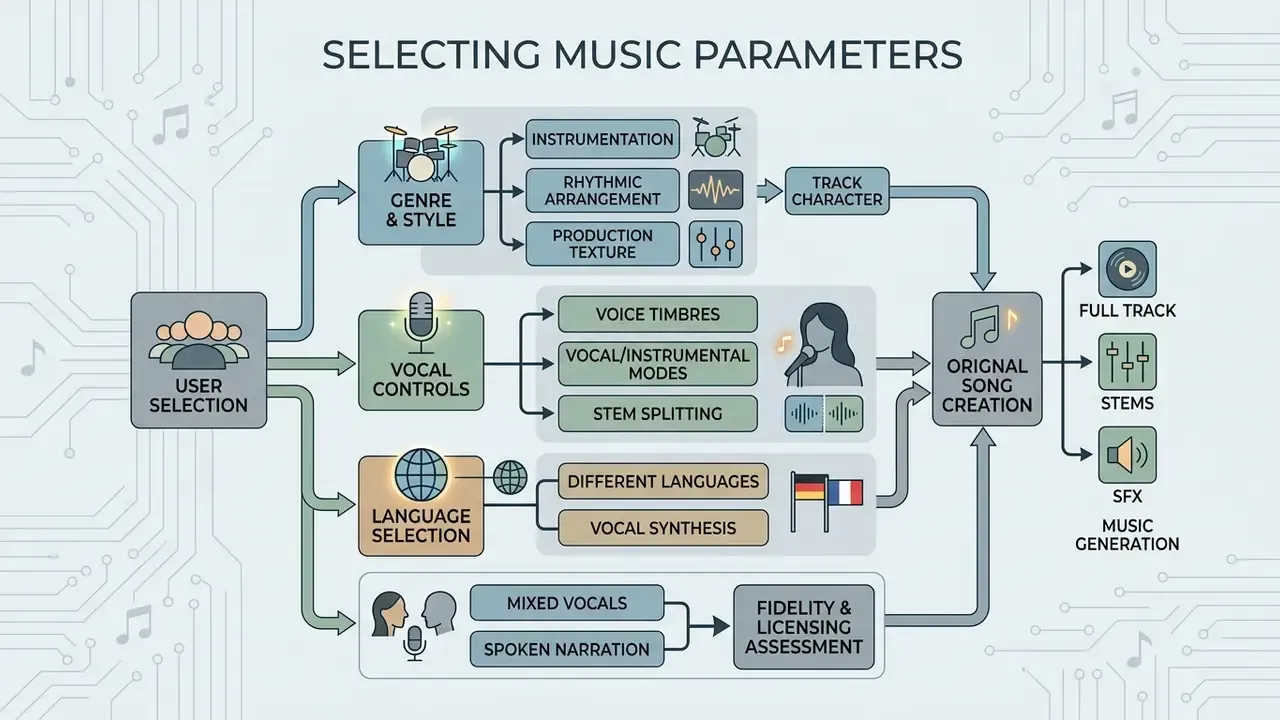
Genre and Style: How to Set the Track's Character
Genre and style parameters define instrumentation, rhythmic arrangement, and production texture. Updated: independent audits of commercial systems in 2026 report prompt coverage spanning classical, jazz, heavy metal, synthwave, Afrobeats, K-pop, and dance pop, with meaningful divergence between platforms. Some preserve genre boundaries; others collapse them. So verify genre fidelity per vendor instead of assuming it as a universal capability. Harmonic integrity across styles is maintained by chord-conditioned architectures and multi-style discriminators that prevent arrangement collapse. Combining disparate style tags ("orchestral hip-hop bed with cinematic percussion") produces hybrid textures while keeping rhythmic coherence, at least when tempo is stated explicitly.
«The AImoclips study (991 clips, 111 participants) found that all systems exhibit a bias toward emotional neutrality, while emotions are conveyed more accurately at high arousal.»
Vocals, Voice Control, and Creating Songs in Different Languages
Vocal controls let users choose timbres, switch between vocal and instrumental modes, or split vocals into standalone acapella tracks. Updated: vendor documentation reviewed in 2026 indicates that ElevenLabs Music and ACE Studio support multilingual delivery, with Google's Lyria documentation specifying eight vocal languages (English, German, Spanish, French, Hindi, Japanese, Korean, Portuguese) and ElevenLabs listing English, Spanish, German, and Japanese. Language coverage changes between model versions, so re-check the supported-language list against live documentation before any localization plan is signed off. In professional voice editing environments, note-by-note language assignment allows regional accents and multilingual lyrics inside a single track without vocal breakdown.
For projects that mix sung vocals with spoken narration, teams assessing synthesis fidelity and licence terms should review the AI voice generator reference for voice-quality and commercial-use criteria.
Custom Voice Uploading and AI Singer Calibration
Advanced platforms support custom vocal synthesis, so creators can anchor generation to their own singing voice or to a dedicated custom voice model rather than a preset timbre.
- Audio Sampling Upload a clean, dry vocal recording, typically 30–120 seconds, free of background noise, reverb, or instrumental bleed. Sample quality drives timbre stability far more than clip length does.
- Identity Verification Complete the platform's automated vocal verification prompt, usually a phrase recorded live, to confirm ownership rights and block unauthorized voice cloning.
- Model Embedding The system converts the sample into a reusable vocal timbre embedding, an "AI Singer" profile, assignable to any generated lyrics or melodic sequence.
- Profile Reuse and Governance Treat saved voice profiles as biometric-adjacent assets. Restrict access, log every generation that uses them, and hold written consent for any voice that is not the account holder's own.
Note the asymmetry of risk here. Uploading an employee's or contractor's voice creates a persistent identity asset that outlives the campaign it was built for. A written release specifying permitted uses, territories, and retention period is the minimum control, and honestly the cheapest one on this list.
How to Generate, Verify, and Download the Finished Track
The end-to-end workflow runs from prompt entry and multi-variant synthesis through quality verification to export. A structured verification protocol is what keeps exported audio inside professional broadcast and technical mix standards.
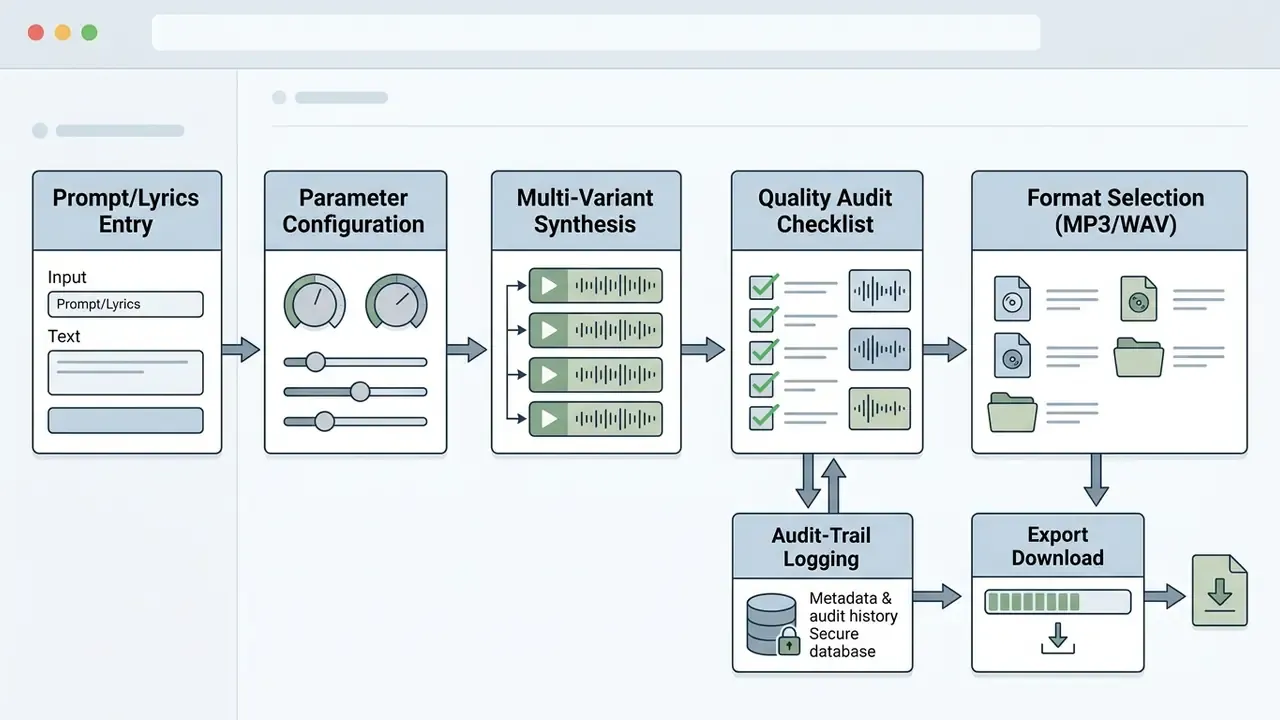
Step-by-Step Process: Input, Generate, and Variant Selection
- Input ConfigurationEnter descriptive text prompts, structured lyrics, and title metadata.
- Parameter SelectionSet target genre, tempo, vocal type, and language; set the variant counter, usually 2 to 4 candidate outputs.
- Synthesis ExecutionTrigger inference. The platform generates discrete audio tokens or denoised waveforms matching the prompt.
- Variant SelectionCompare candidates. Systems that rank audio outputs use prompt-alignment scoring to surface the closest match; in the LeVo alignment protocol, a winning sample must be strongly prompt-aligned and exceed the losing sample by at least 0.1 similarity score (LeVo, arXiv 2025, https://arxiv.org/abs/2503.03474).
What to Check in AI-Generated Audio Quality Before Download
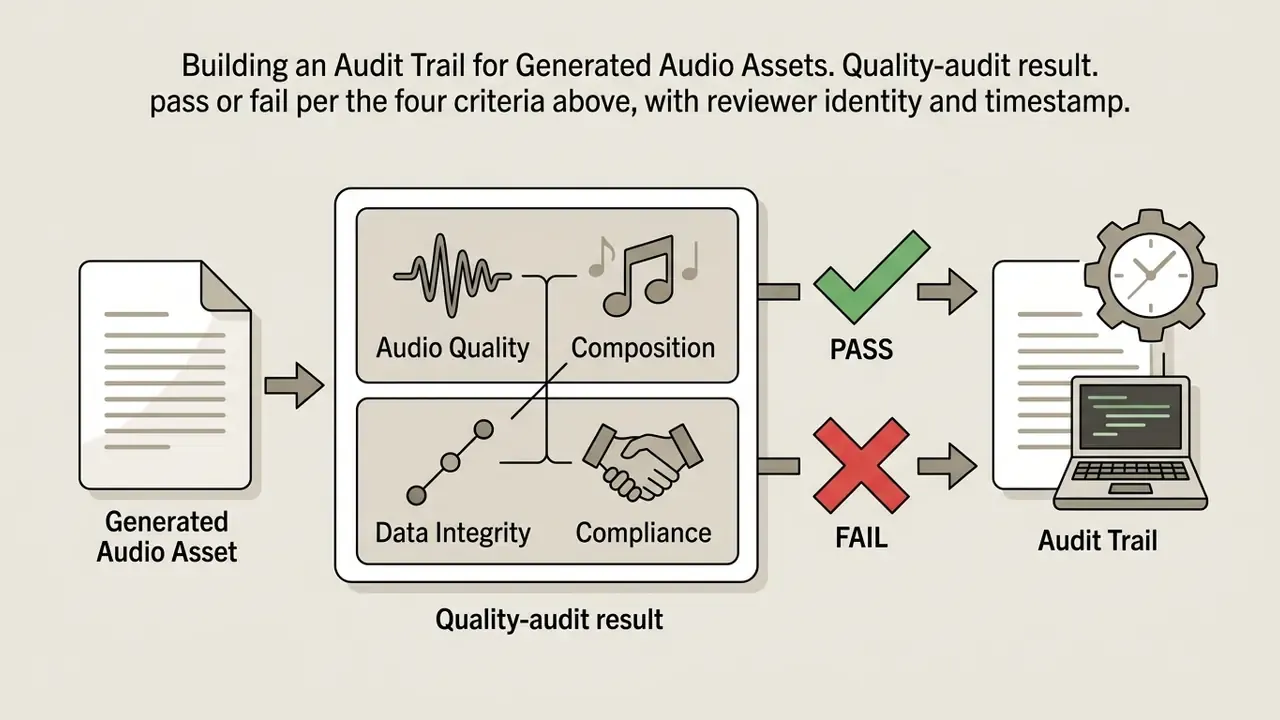
Before download, audit each asset against four criteria. Skipping this step is how flawed tracks reach a client review call.
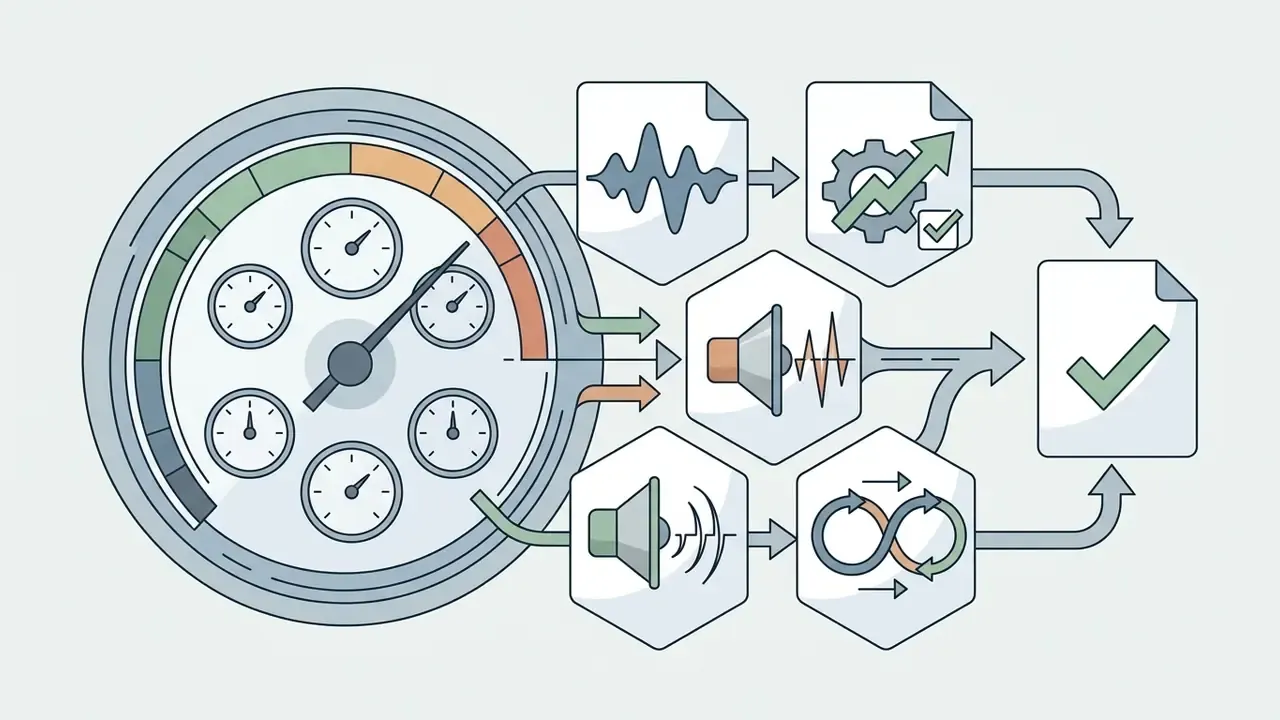
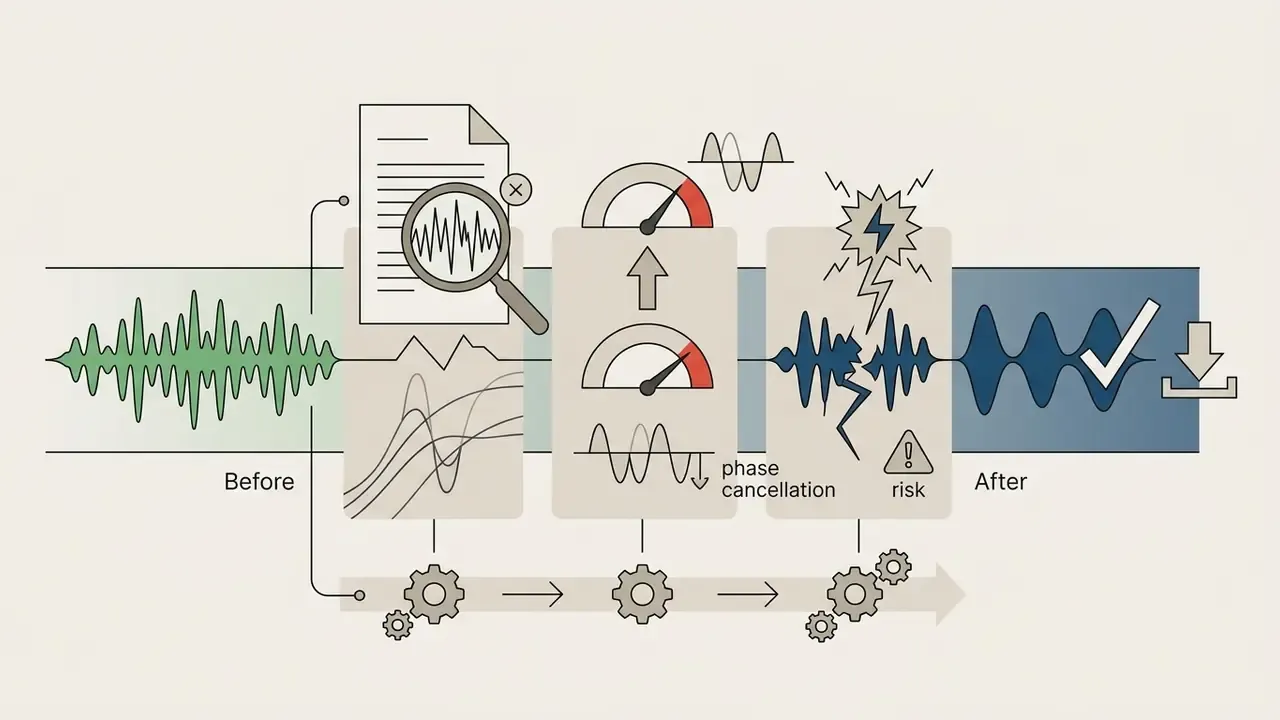
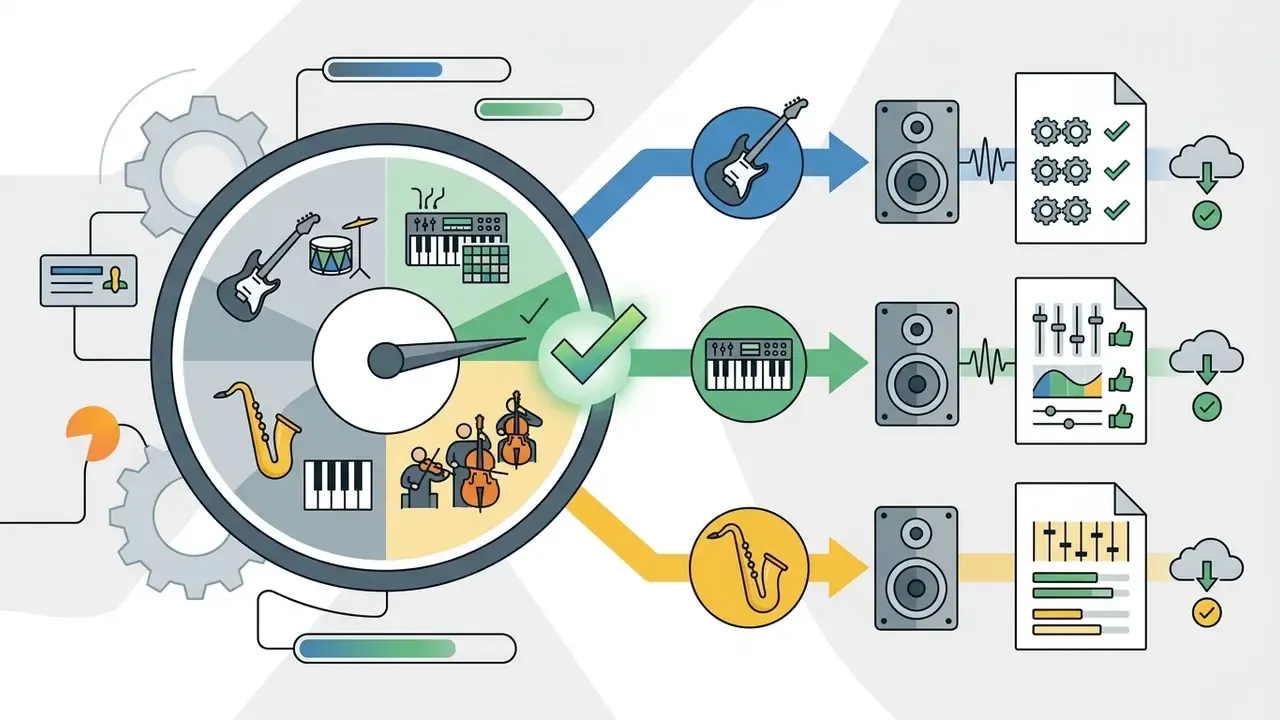
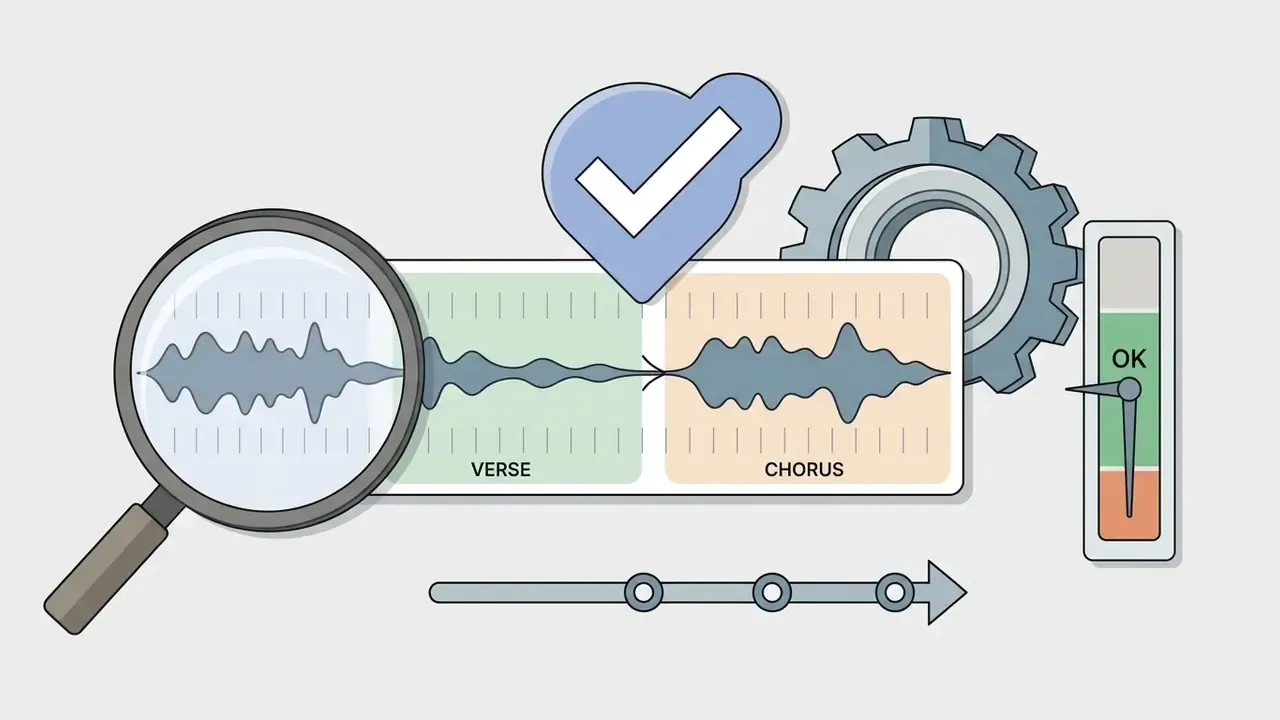
«The MAD (Mauve Audio Divergence) metric reaches rank correlation τ=0.84 on synthetic degradation tests and τ=0.62 on human preference data, versus τ=0.14 for FAD.»
«A survey of music generation metrics highlights Tone Spans, Polyphony and Melody Distance as structural measures of pitch variation, note simultaneity and melodic similarity.» A Survey on Evaluation Metrics for Music Generation, arXiv (2024). https://arxiv.org/abs/2408.01790
A digital media production team (illustrative) kept hitting recurring high-frequency distortion in ambient electronic beds for video clips. After adding an automated checklist focused on signal clarity plus MAD score filtering, they caught defective renders before export and saved roughly 12 hours of manual editing per project cycle.
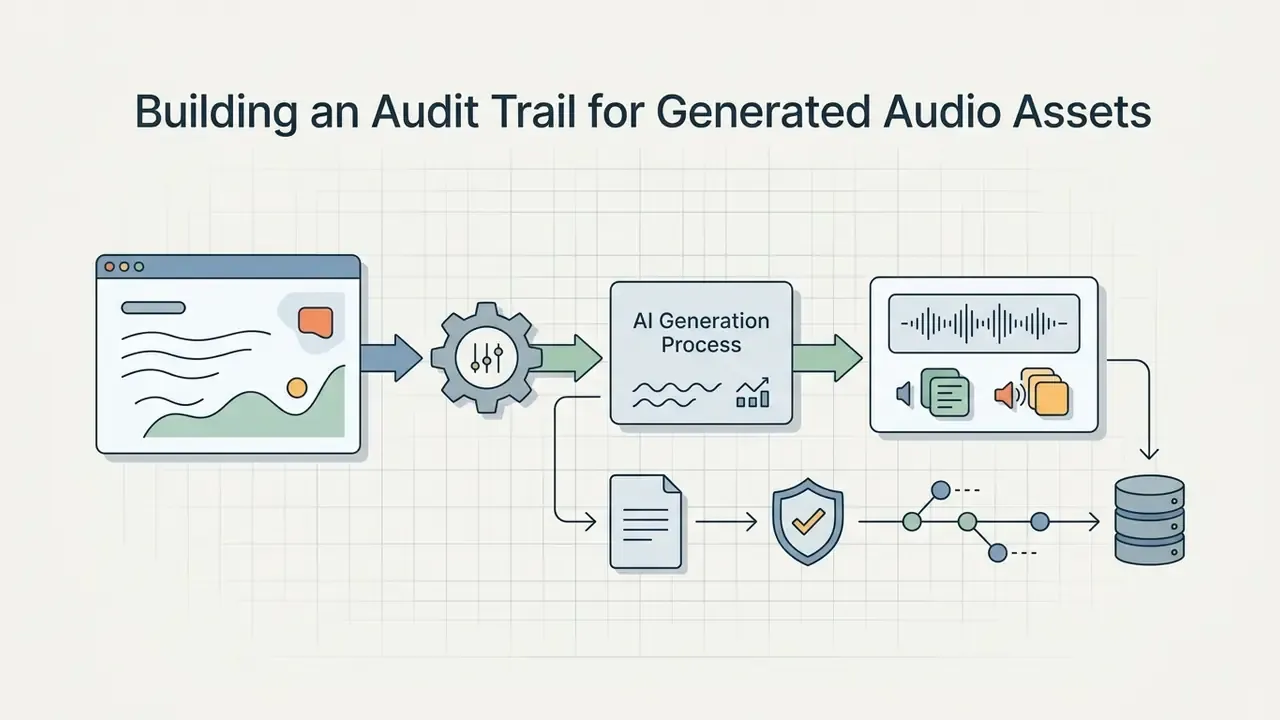
Building an Audit Trail for Generated Audio Assets
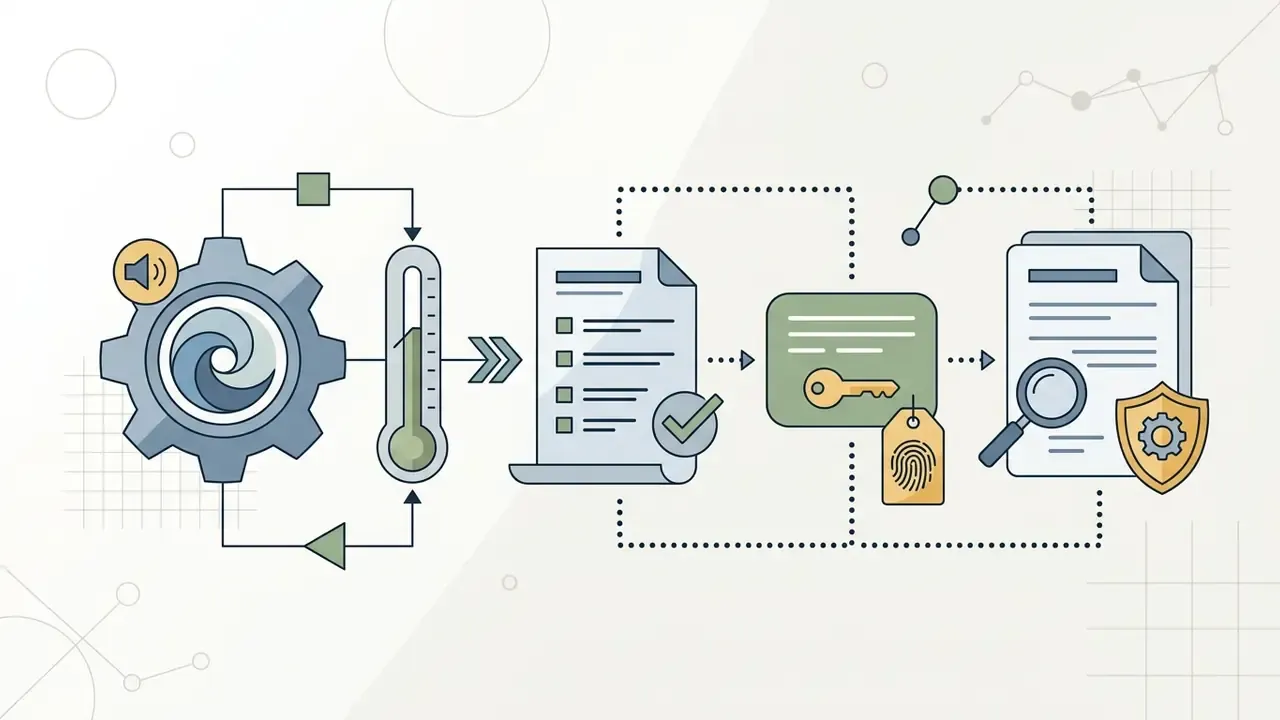
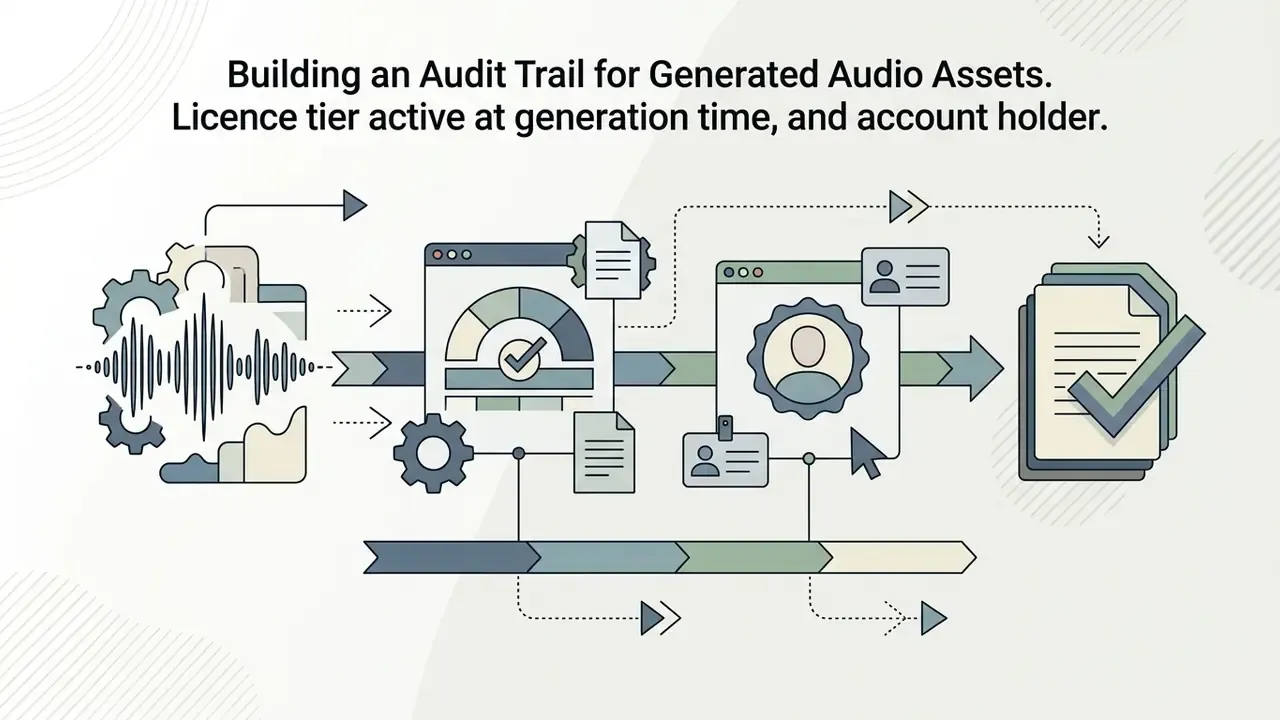
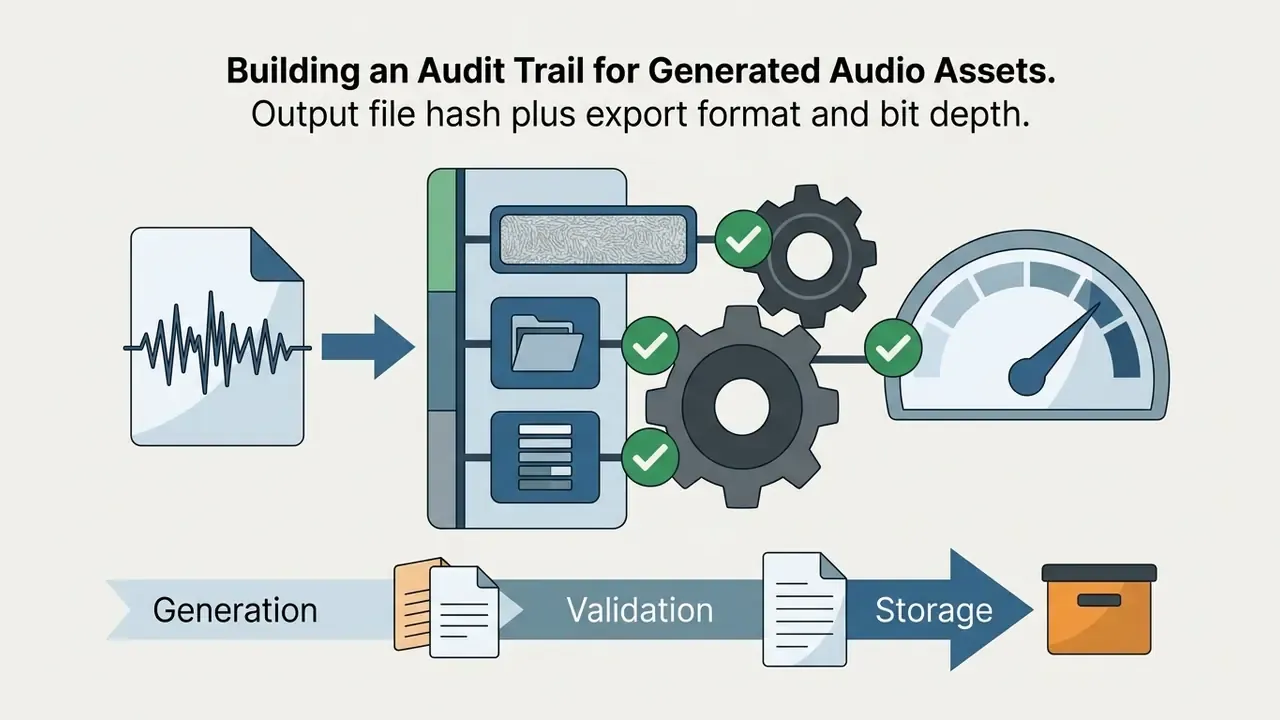
Quality checks are only defensible if they are recorded. For each approved asset, capture and retain seven fields alongside the audio file:
This record set answers the three questions raised in any downstream dispute. What was requested, which model produced it, under which licence the file was created. Creators integrating synthesized copy alongside audio scripts can examine an ai text generator gpt guide for model-specific text generation standards.
music_v2 or ACE-Step 1.5.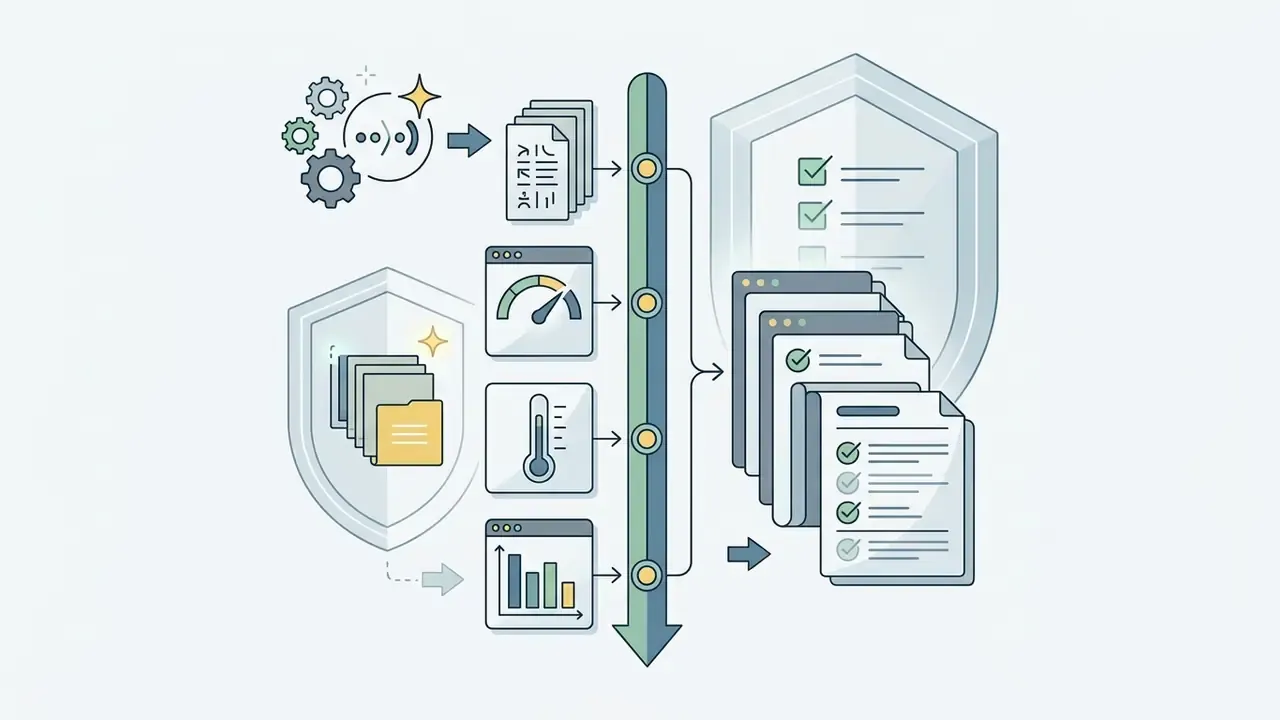
Downloading Tracks in Available Formats
AI music generators export in compressed (MP3) or uncompressed (WAV, AIFF) formats depending on subscription tier and intended usage. Updated: professional and archival delivery specifications converge on uncompressed Linear PCM WAV at 24-bit/48 kHz as the preferred broadcast and film master, with 16-bit/44.1 kHz treated as the accepted minimum baseline and 96 kHz/24-bit recommended where music preservation is the goal. Compressed MP3, rendered between 128 kbps (archival minimum), 192 kbps (recommended) and up to 320 kbps for distribution at 44.1–48 kHz, suits web previews, rough cuts, and draft reviews.
Teams handling large volumes of exported media alongside video deliverables can reference video compression and format support to keep audio and video encoding decisions aligned. To evaluate analytical tools and operational metrics across production platforms, administrators can view the guide for functional assessment methodologies.
Editing, Extension, Remixing, Covers, and Vocal Removal
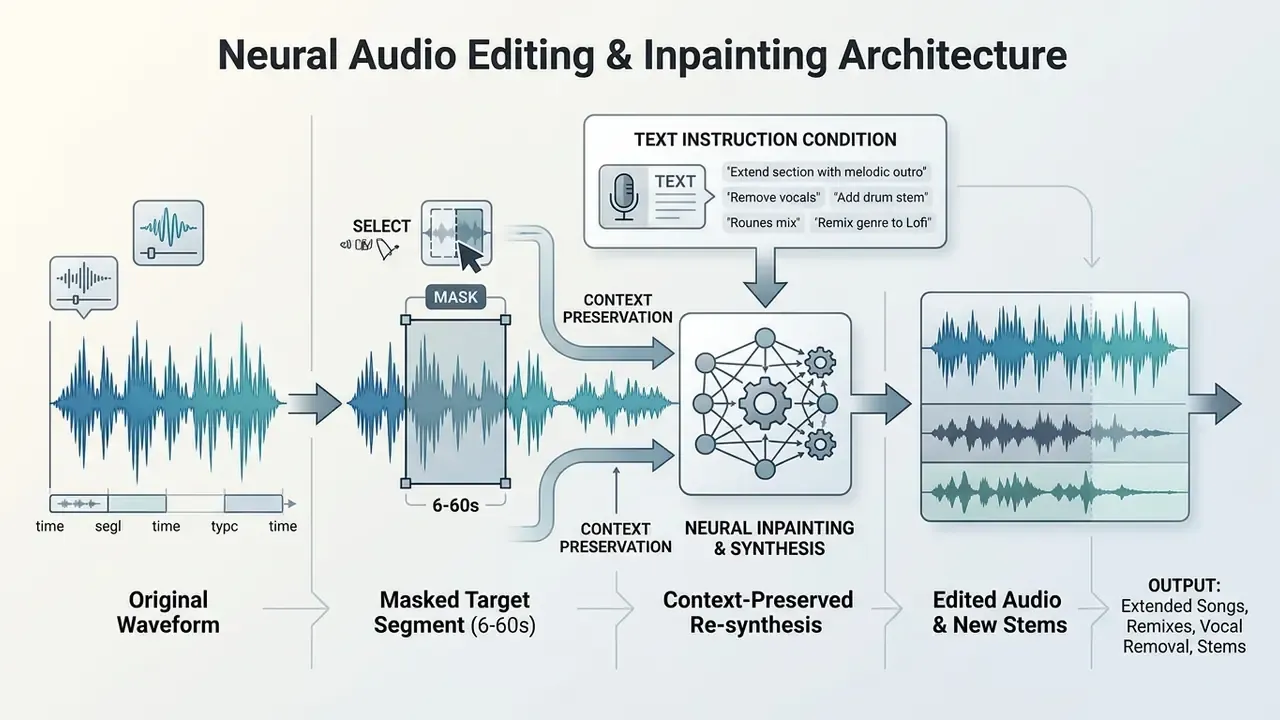
Post-generation editing lets creators modify completed tracks, extend length, transform genre, and isolate vocals without re-rendering the entire file. These capabilities rest on neural audio inpainting, context-conditioned autoregressive modeling, and masked spectral separation.
How to Continue and Extend a Created Track
Music extension, or contextual continuation, grows short clips into full-length compositions by feeding the latent representation of the original as a conditioning prefix. Autoregressive latent-diffusion systems and neural chunk-based continuators hold thematic motifs, tempo, and key across extended boundaries, producing seamless 8-bar or minute-long continuations. That is how a 30-second teaser becomes a 3-minute backing bed for long-form video, and how bridges, extended outros, or breakdowns get inserted at defined points.
«MelodyFlow, the first single-stage flow-matching model for generating and editing stereo 48 kHz audio, outperforms ReNoise and DDIM on objective zero-shot editing metrics.»
How to Edit and Remix Individual Music Fragments
Granular editing lets users select a specific time window, commonly a 6 to 60 second segment, and apply localized changes through text instructions. Updated: current vendor documentation describes masked acoustic token modeling as the dominant mechanism for regenerating targeted sections, whether that means altering lyrics, replacing an instrument, or adding a vocal harmony, while surrounding audio stays intact. Platform-specific minimum segment lengths differ (6 seconds on some editors, 6 to 60 second windows on others), so confirm segment granularity per tool. Section-and-stem editors additionally allow reshaping arrangement layers, adjusting duration, BPM, and key, then regenerating a remix variant.
«MuseCPEval records metric correlation with gold labels of 100% for rhythm and meter and 93.2% for harmony when assessing context preservation in editing tasks.»
Creating AI Song Covers and Cross-Genre Transformations
An AI song cover generator re-imagines existing audio inside an entirely different musical style while preserving the melodic contour and harmonic progression. Melodic-integrity engines analyze the input reference, isolate the core melodic structure, and synthesize a replacement instrumental and vocal bed.
Workflow for AI cover generation:
- Audio Reference UploadProvide a clean source track (MP3 or WAV; upload ceilings commonly range from 10 MB to 8 minutes of audio depending on tier).
- Melodic ExtractionThe network maps pitch contours, phrase boundaries, and vocal cadences.
- Style Re-calibrationSelect a destination genre, for example turning an acoustic folk track into industrial synthwave, or a classical theme into a trap production.
- Inference ExecutionThe model applies target acoustic tokens over the extracted harmonic frame, producing a new composition still instantly recognizable as the source melody.
Rights caution specific to covers: melodic preservation is exactly what creates legal exposure. Transforming a track you do not own reproduces its protected composition no matter how radically the instrumentation changes. Restrict cover workflows to source material that is original, public domain, or explicitly licensed for derivative use. No exceptions worth the legal bill.
AI Vocal Removal and Multi-Track Stem Isolation
Working with mixed audio, creators frequently need isolated instrumental backings or dry acapellas. Modern platforms bundle neural stem separation pipelines built on masked spectral analysis.
- Acapella Extraction Strips percussive and harmonic instrumentation, leaving a vocal stem for remixing, karaoke production, or lyric-video alignment.
- Instrumental Isolation Removes lead and backing vocals while limiting high-frequency degradation and phase-alignment distortion.
- Multi-Stem Export Splits a mix into vocals, drums, bass, and other instrumentation for DAW-level rebalancing.
- Processing Speed Neural separation typically renders a standard 3-minute mixed file into WAV stems in 45 to 60 seconds.
Accuracy note: vendor claims of "no artifacts, no quality loss" are marketing shorthand. Any spectral-masking separation from a finished mix introduces measurable residue; bleed at transient onsets and phase smearing in the 8–16 kHz range are the two most common. Treat separated stems as production-grade but not master-grade, and always audition them in solo before committing to a final mix.
For further reading on enterprise licensing and media usage, creators can visit the AI Media Commercial-Use Hub for operational compliance frameworks. Teams that also commission personal-use visual assets alongside audio, such as merchandise artwork, can compare rights language in the ai tattoo generator entry, where personal-versus-commercial boundaries are drawn differently.
Free AI Music Generators, Pricing Tiers, and Commercial Licensing
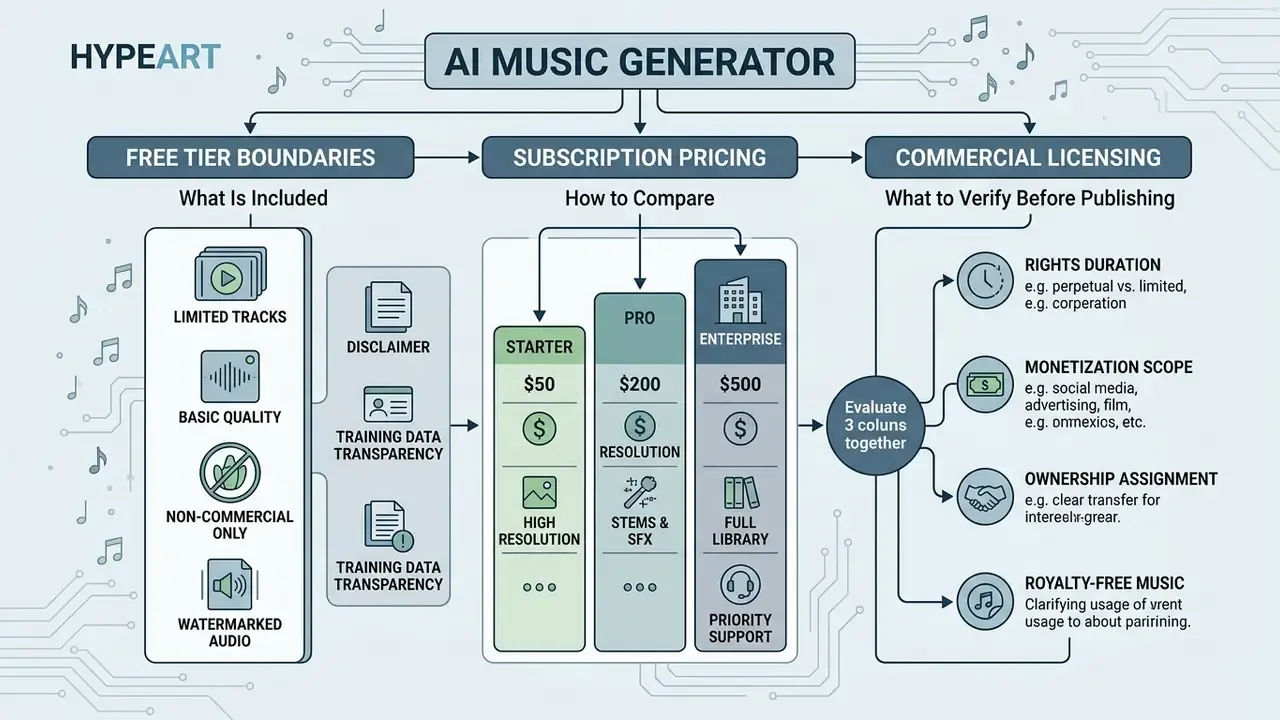
Evaluating platforms means reading three things together: free tier boundaries, subscription pricing, and commercial licensing terms. Terms of service diverge sharply across vendors on copyright ownership and monetization rights.
| Platform Tier | Typical Usage Quotas | Available Formats | Commercial Usage Rights | Stem Separation and Editor Access |
|---|---|---|---|---|
| Free / Basic | ~10–50 credits/day (~2–10 tracks) | MP3 only, watermarked on some platforms | Prohibited (personal, non-commercial only) | Basic creation only; no stem export or advanced editing |
| Pro / Creator | ~2,500 credits/month (~500 tracks) | MP3 and lossless WAV | Granted for assets generated during a paid active subscription | Full song editor, stem isolation (vocals, instruments) |
| Premier / Enterprise | Custom, high-volume quota | MP3, WAV, multi-track stems | Full commercial licence and ownership-assignment options | Priority GPU queuing, full API access, dedicated support |
What Is Included in a Free AI Music Generator
Free tiers on platforms such as Suno and Udio give entry-level access bounded by daily credit caps (50 daily credits on one platform; roughly 10 per day and 100 per month with a 2:10 maximum track length on another), limited export options (MP3 only, sometimes no download at all), and non-commercial restrictions. Free outputs may carry audio watermarking or mandatory attribution. Free accounts also generally lock advanced editing, stem separation, and high-fidelity WAV downloads. One warning: free-tier limits change frequently and inconsistently between vendor documentation and public pricing pages, so treat every quota above as volatile.
Users exploring high-volume text generation on complimentary tiers can review the ai text generator free unlimited overview for comparison.
Commercial Use and Royalty-Free Music: What to Verify Before Publishing
«The U.S. district court decision of 18 August 2023 confirmed that "human creativity is the sine qua non of copyrightability", excluding AI authorship under current U.S. law.»
Two additional compliance layers apply to advertising use. Registration practice requires disclosure of AI-generated content and exclusion of more-than-de-minimis AI material when seeking copyright registration. Industry disclosure frameworks require consumer-facing labelling when AI materially shapes content in ways that could mislead a reasonable consumer. Some regional advertising codes go as far as specifying label wording and timing, for example announcing "audio created using AI" at the beginning and end of an audio spot.
How to Compare Pricing and Licensing Before Choosing a Service
Voice Cloning, Data Retention, and Model Risk Management
Voice Cloning and Right of Publicity Exposure
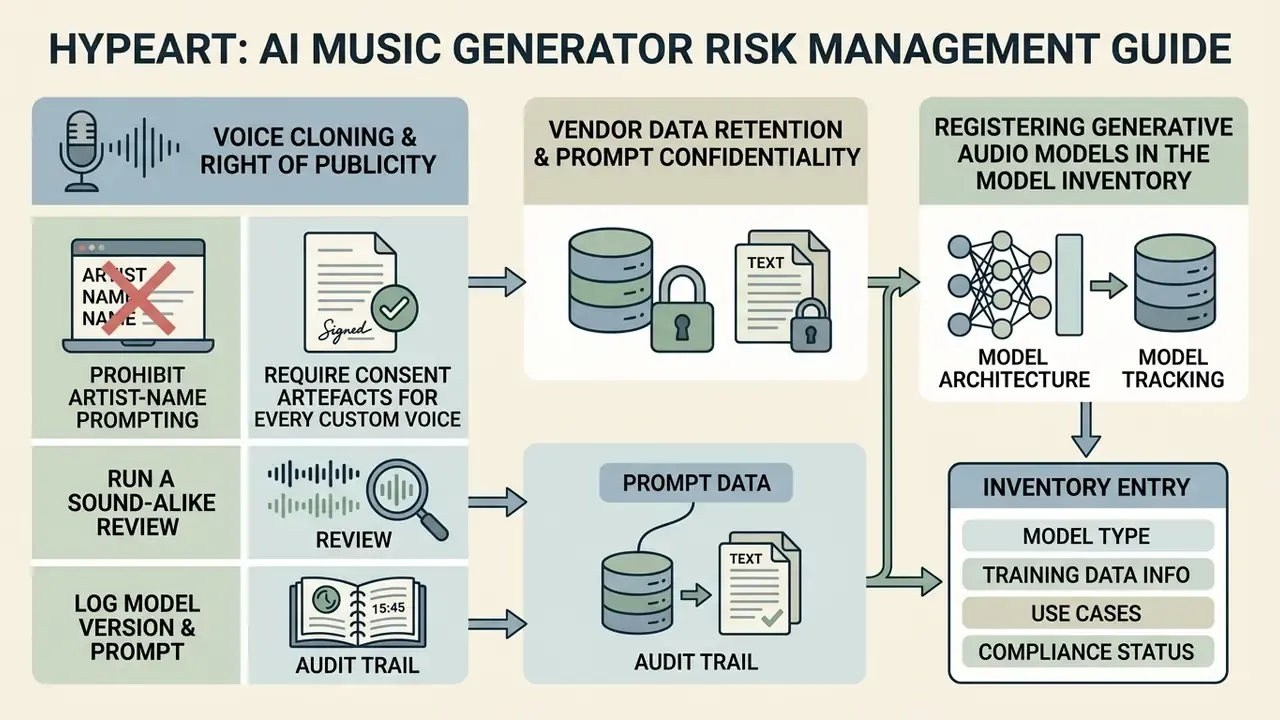
Generated singing voices form a risk class separate from composition copyright. Even where no protected recording is used as input, an output that is recognizably "sound-alike" to an identifiable performer can trigger right-of-publicity, personality-rights, or unfair-competition claims depending on jurisdiction. Platform enforcement teams, meanwhile, increasingly action sound-alike complaints on their own, without waiting for formal legal process.
Practical controls:
- Prohibit artist-name prompting. Ban prompt tokens naming living or recently deceased performers ("in the voice of…", "sounds like…"). Enforce with prompt-filter lists, not policy documents alone.
- Require consent artefacts for every custom voice. Store the signed release with the voice embedding, and treat the embedding as inaccessible without the release on file.
- Run a sound-alike review for any vocal-led asset destined for paid media, ideally by a reviewer who has not seen the prompt.
- Log the model version and prompt so a challenged asset can be reproduced and explained.
Vendor Data Retention and Prompt Confidentiality
Prompts, lyrics, and uploaded reference audio are corporate inputs. Before enabling a tool for a marketing, product, or client-facing team, confirm in writing:
- Whether prompts, lyrics, and uploaded audio feed model training or evaluation, and whether opt-out exists at account or tier level.
- Retention period for generated outputs and uploads, and whether deletion is hard or logical.
- Whether generated tracks publish to a public feed or explore page by default; several consumer platforms do exactly this on free tiers.
- Sub-processor list and data residency, plus available security attestations on enterprise plans.
- Encryption in transit and at rest, and administrative access controls on stored voice profiles.
Assume that unreleased campaign concepts typed into a consumer free tier are not confidential unless the contract says otherwise. That assumption has saved more than one brand launch.
Registering Generative Audio Models in the Model Inventory
For regulated organizations, an AI music generator is a third-party model consumed as a service. A minimum onboarding checklist:
- Inventory entry: register the tool with owner, business purpose, vendor, model family and version, and criticality rating.
- Tiering: classify by exposure. Internal-only ambient audio and paid-media broadcast assets do not warrant the same control depth.
- Control mapping: document the human-in-the-loop approval step, the four-point quality audit, and the licence-verification gate as named controls with named owners.
- Logging: retain prompt, expanded prompt, seed, model version, output hash, licence tier, reviewer, and decision for every released asset.
- Data lineage: record input provenance for any uploaded reference audio or vocal sample, consent documentation included.
- Version-change monitoring: vendor upgrades (a move from
music_v1tomusic_v2, say) alter output characteristics and must trigger re-validation of quality thresholds. - Shadow-AI detection: watch expense reports and network telemetry for unsanctioned consumer subscriptions used on client work. This is the single most common route by which unlicensed assets enter production.
- Periodic re-attestation: re-review vendor Terms of Service at fixed intervals, since licensing language on these platforms has shifted several times inside single calendar years.
Risk-Adjusted ROI Structure
Cost modelling for generative audio should not stop at the subscription price. A defensible structure:
Net benefit = (Traditional production cost avoided + Cycle-time value) − (Licence & API cost + Prompt/iteration labour + Quality-audit labour + Legal review + Residual risk reserve)
Line-item guidance:
- Licence and API cost per-seat subscription or per-generation API spend, failed generations included, because they are billed too.
- Iteration labour average generations per accepted asset. In the marketing example above, prompt standardization moved rejection from 35% to under 4%, a direct multiplier on this line.
- Audit labour minutes per asset for the four-point quality check plus logging.
- Legal review one-time licence review per vendor, plus per-campaign review for vocal-led or cover material.
- Residual risk reserve the share of exposure not covered by vendor indemnification, particularly where indemnity is capped at fees paid.
The strongest risk-adjusted returns come from instrumental, non-vocal, non-derivative beds generated on a paid tier with logged provenance. Vocal-led, artist-adjacent, or cover-based assets carry the thinnest margins once legal review is priced in. That ranking rarely changes, whatever the model roadmap promises.
When assessing legal risk around synthetic media and automated content generation, operators can review the litigation overview for regulatory case studies.
AI Song Generators for Video, Games, Podcasts, and Creative Projects
Integrating ai music into media production means matching track selection to the structural, emotional, and technical demands of the target medium.
Tracks for Games, Podcasts, and Film Production
In game development, generators produce adaptive soundtrack layers and seamless ambient loops that adjust to gameplay intensity and player location.
«A procedural videogame music generator conditioned through video emotion recognition passed perceptual validation with players and confirmed applicability to open-world settings.»
For podcast production, creators generate short branded intro and outro themes plus transition stings that hold a consistent audio identity across episodes. Where episodes carry sponsored segments, advertising guidance recommends marking ad breaks with music or sound-effect cues in addition to spoken disclosure. In film scoring, script-conditioned audio tools (such as EchoScript) help composers prototype ambient beds and themes mapped directly to scene scripts.
A game studio building an indie open-world title (illustrative case) used procedural generation for 120 adaptive background loops conditioned on player stress levels. Soundtrack production cost fell by roughly 60% while emotional alignment held across dynamic gameplay events. Worth noting: the saving came mostly from iteration speed, not from replacing the composer.
Podcast and film teams finishing assets for distribution can align audio and video stages using established YouTube video editing workflows. To review general customer support frameworks and enterprise assistance channels, organizations can browse the hub for platform service standards.
Technical and Operational Integrity Summary
Vendor Due Diligence Case Study: Verifying a Claimed Provider
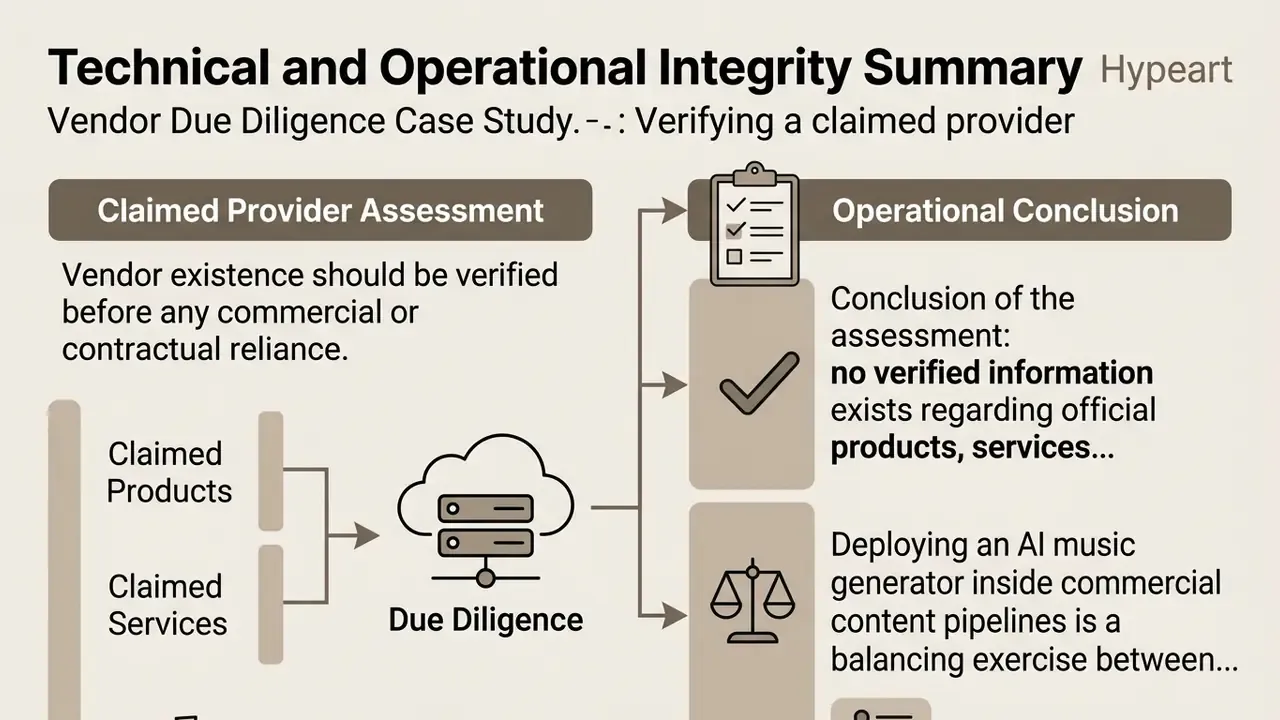
Vendor existence should be verified before any commercial or contractual reliance. The worked example below shows the minimum verification sequence applied to a claimed provider identified as hypeart.ai:
| Verification Step | Method | Result (as of August 19, 2026) |
|---|---|---|
| Domain resolution | DNS lookup | Does not resolve |
| Registry record | WHOIS / registry query | Object not found |
| Legal entity | Corporate registry search | No verified registration |
| Product documentation | Official docs / ToS retrieval | None available |
| Customer evidence | Verifiable customer statistics | None available |
Conclusion of the assessment: no verified information exists regarding official products, services, legal-entity registration, or customer statistics for this name. Any operational framing associated with it remains hypothetical and unsuitable for procurement. Run the same five steps (resolution, registry, entity, documentation, customer evidence) before evaluating any ai song generator sites you encounter through advertising or social recommendation, because licence grants from an unverifiable entity are unenforceable no matter how generous the published terms look.
Operational Conclusion
Deploying an AI music generator inside commercial content pipelines is a balancing exercise between technical capability and legal risk control. Modern transformer and diffusion models genuinely deliver text-to-music, lyrics-to-song, cover transformation, stem separation, and granular editing. Creative leadership still has to enforce mandatory quality audits and keep documented licence verification in place before release. Vendor-reported quality claims alone are not enough, because model-level metrics correlate poorly with what listeners actually hear.
«A large-scale study (6,000 songs, 12 models, 15,000 pairwise comparisons from 2,500 participants) found that most widely used metrics correlate weakly with human preferences.»
FAQ: AI Music Generator, Licensing, and Risk
Can I monetize music generated on a free plan?
In nearly all audited platforms, no. Free and basic tiers restrict output to personal, non-commercial use, and some watermark the audio or withhold download entirely. Monetization rights attach to paid tiers and, in several cases, only to files downloaded while the subscription was active.
Do I own the copyright to an AI-generated track?
Contractual ownership and copyright are different things. A vendor may assign you all of its right, title and interest in an output, yet under current U.S. practice a work lacking meaningful human authorship is not eligible for copyright protection, and AI-generated material must be disclosed and excluded when registering a work. Read vendor claims of "100% copyright" as commercial licence language, not a legal determination.
What happens to my rights if I cancel my subscription?
This is the single most important clause to read. Some vendors confirm that commercial rights persist for tracks downloaded during the paid term; others tie rights to an active subscription. Verify per vendor, and archive the applicable Terms version alongside the asset.
Is a stem-separated instrumental safe to release commercially?
Only if you hold rights to the source mix. Separation does not create new rights in existing material. Separated stems also carry residual artifacts at transient onsets and in high frequencies, so audition them in solo before mastering.
Can I generate a song in a specific artist's voice?
No, and internal policy should prohibit it. Sound-alike vocals raise right-of-publicity and unfair-competition exposure independent of composition copyright, and platform enforcement teams act on such complaints directly.
Which export format should I request?
WAV at 24-bit/48 kHz for broadcast, film, and game masters. 16-bit/44.1 kHz as the accepted minimum. MP3 at 192 to 320 kbps for previews, review cuts, and web delivery.
How do I build a repeatable prompt library for my team?
Store approved prompts as templates with fixed slots for genre, mood, instrumentation, tempo, and vocal character, then version them like code. Record which template produced each accepted asset. Over a quarter this turns prompt craft from individual habit into shared, auditable practice.
What should I do next?
- Select two candidate vendors and complete the five-step existence verification. 2. Extract and archive the current Terms of Service. 3. Run 10 pilot generations with logged prompts and seeds. 4. Apply the four-point quality audit and record pass rates. 5. Register the tool in the model inventory before opening access beyond the pilot team.
Appendix A: Superseded Source Attributions
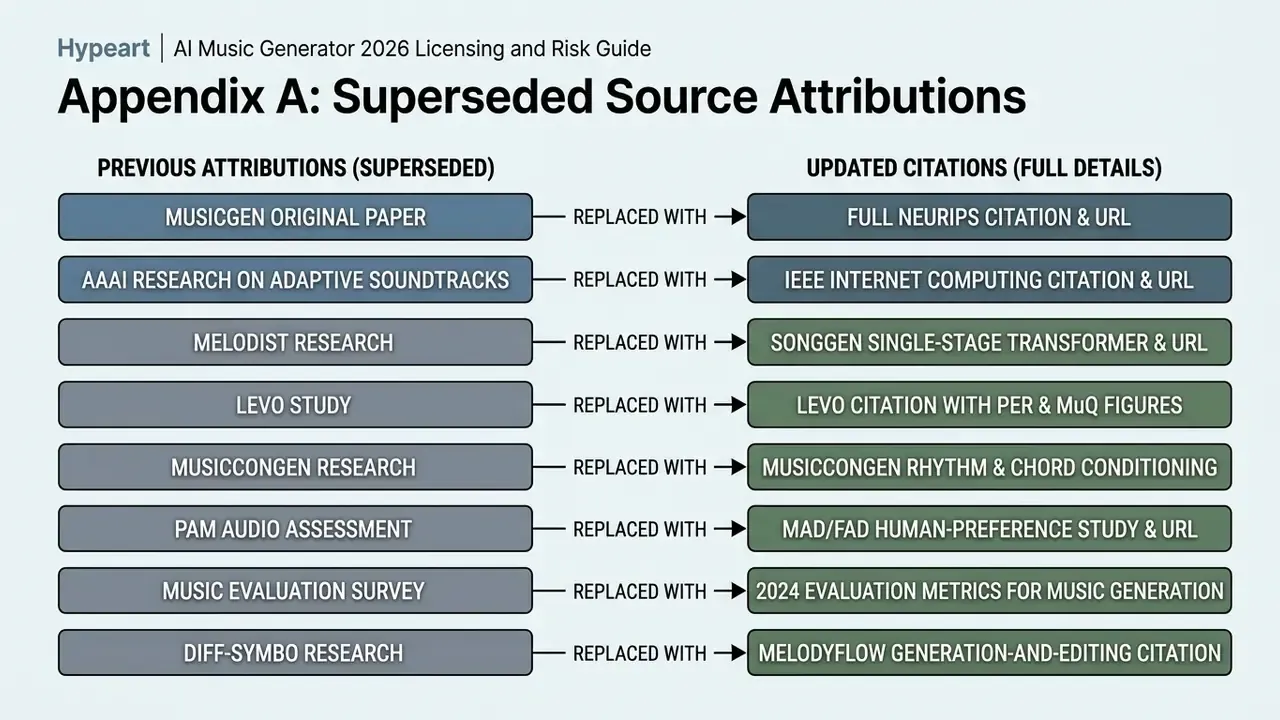
For transparency, the short-form attributions below appeared in earlier versions of this article and have been replaced in the main text with fully cited, verifiable sources containing methodology and figures. They are retained here as a change record:
- "(Copet et al., NeurIPS 2023)" replaced with the full MusicGen citation and URL.
- "(AAAI Research, 2024)" and "(AAAI Research on Adaptive Soundtracks, 2024)" replaced with the IEEE Internet of Sounds (2023) procedural game-music study and URL.
- "(Melodist Research, 2024)" supplemented with the SongGen single-stage transformer citation and URL.
- "(LeVo Study, 2025)" replaced with the LeVo citation including PER and MuQ figures.
- "(MusiConGen Research, 2024)" replaced with the MusiConGen citation describing rhythm and chord conditioning.
- "(PAM Audio Assessment, 2024)" replaced with the MAD/FAD human-preference alignment study and URL.
- "(Music Evaluation Survey, 2025)" replaced with the 2024 survey on evaluation metrics for music generation.
- "(Diff-Symbo Research, 2026)" replaced with the MelodyFlow generation-and-editing citation.
- "(MuseCPEval Study, 2024)" replaced with the MuseCPEval citation including correlation figures.
- "(AImoclips Benchmark, 2024)" replaced with the full AImoclips citation and finding.
- "(2026 AI Music Audit)", "(Archival Audio Guidance, 2026)", "(Google Lyria Docs, 2026)", "(ElevenLabs Docs, 2026)", "(MusicWave AI Specs, 2026)", "(YouTube Creator Guidance, 2026)", "(Twitch DMCA Guidelines, 2026)" reformulated in the main text with explicit verification caveats where no stable public source could be confirmed.