Executive Summary
- What it is a prompt-conditioned language model that predicts the next token to assemble readable text. It drafts, summarizes, translates, and structures. It never "knows" a fact.
- Which model to pick GPT-3 (175B parameters, 2,048-token context) is a legacy baseline. GPT-4 and GPT-4o handle 8K to 128K tokens. GPT-4.1 extends to 1,047,576 tokens, and GPT-5-family variants are documented at 400K to 1.05M tokens.
- What it costs GPT-4 API billing is $30 per 1M input tokens and $60 per 1M output tokens. ChatGPT Plus is $20 per user per month, and ChatGPT Business (formerly Team) is $25 per user per month annually or $30 billed monthly.
- Evidence of value 444 professionals with ChatGPT access completed writing tasks 37% faster, with quality ratings up 0.45 standard deviations (MIT, 2023).
- Non-negotiable control Human-in-the-Loop review, a logged audit trail, and documented ownership of output before commercial publication. Model behavior drifts measurably over time, so one-time acceptance is not validation.
- SEO reality check Google ranks helpful, people-first content regardless of production method. AI assistance is not a penalty trigger. Scaled content abuse for search manipulation is.
What this guide covers




What Is an AI Text Generator GPT and Which Tasks It Solves
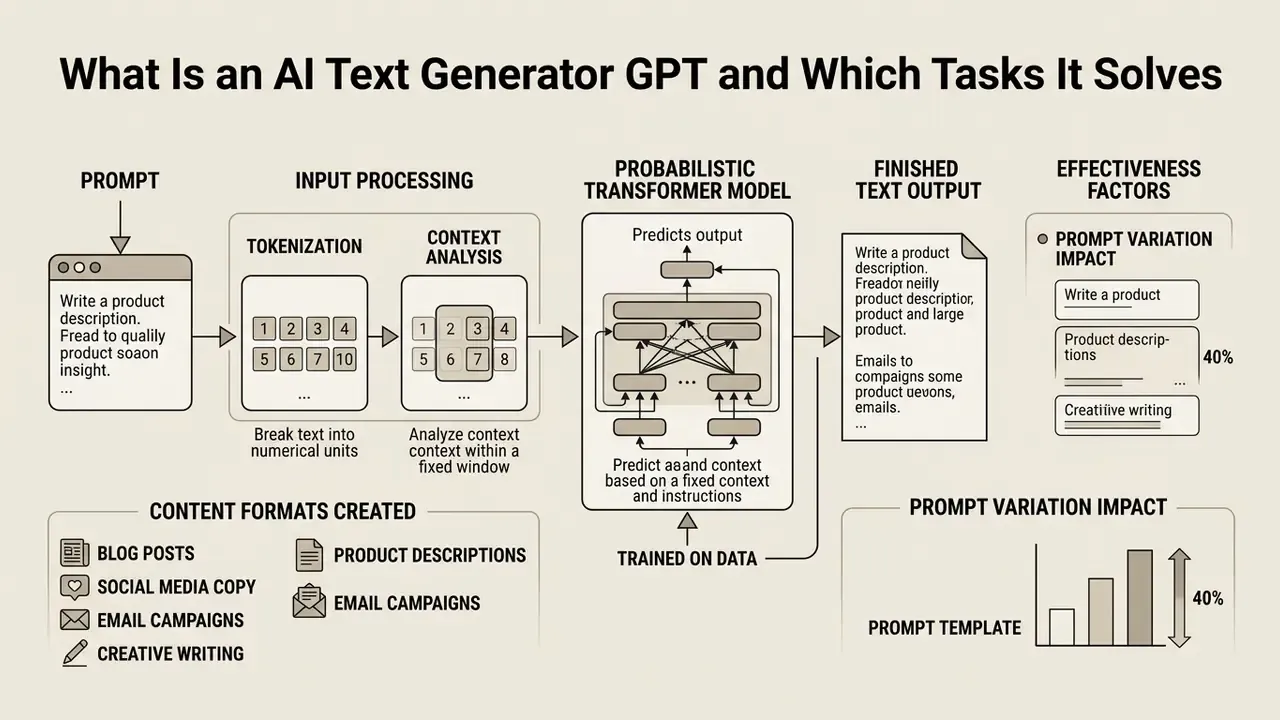
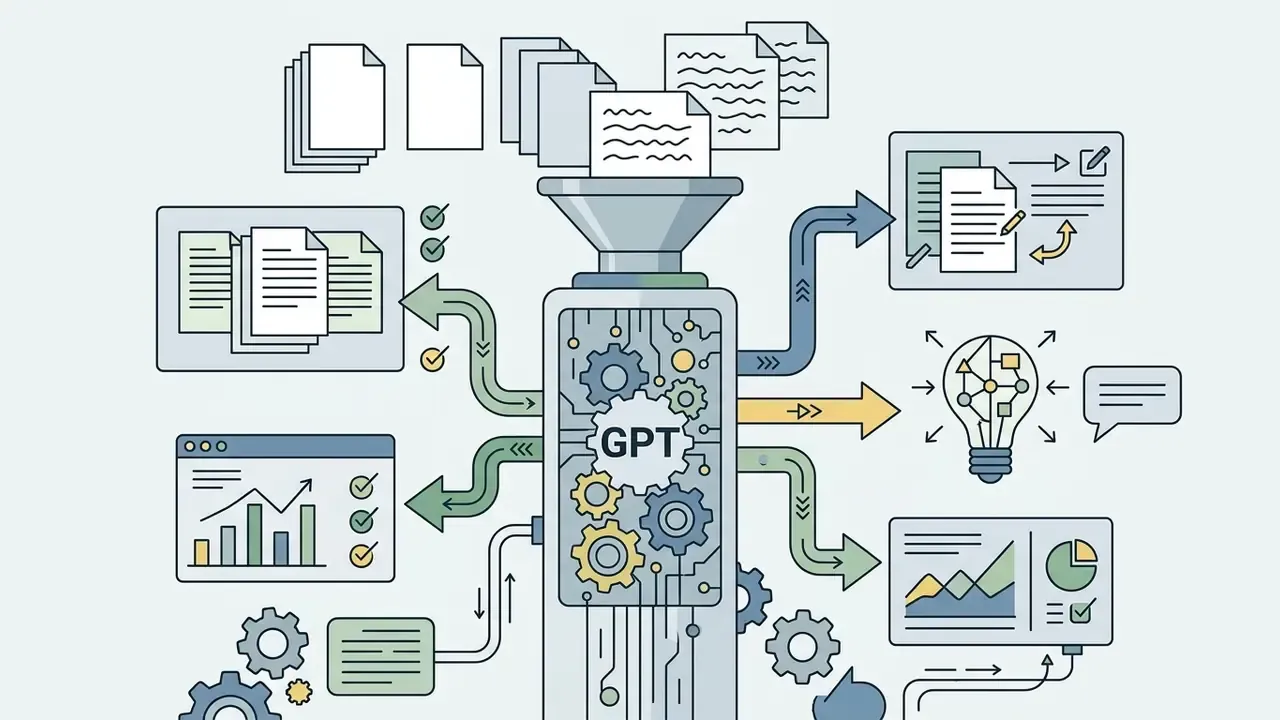
An ai text generator gpt is a natural language generation system that transforms user-supplied prompts into contextual text using probabilistic transformer models. Enterprises deploy these systems to automate high-volume drafting, summarize dense data, prepare customer communications, and assemble structured operational documentation.
A text generator powered by artificial intelligence relies on deep learning architectures trained on very large textual datasets. Instead of retrieving static templates, the underlying language model calculates the probability of the next word and synthesizes new content on the fly. That accelerates drafting. It also means the model will confidently fill any gap you leave in the instruction, which is exactly where governance starts.
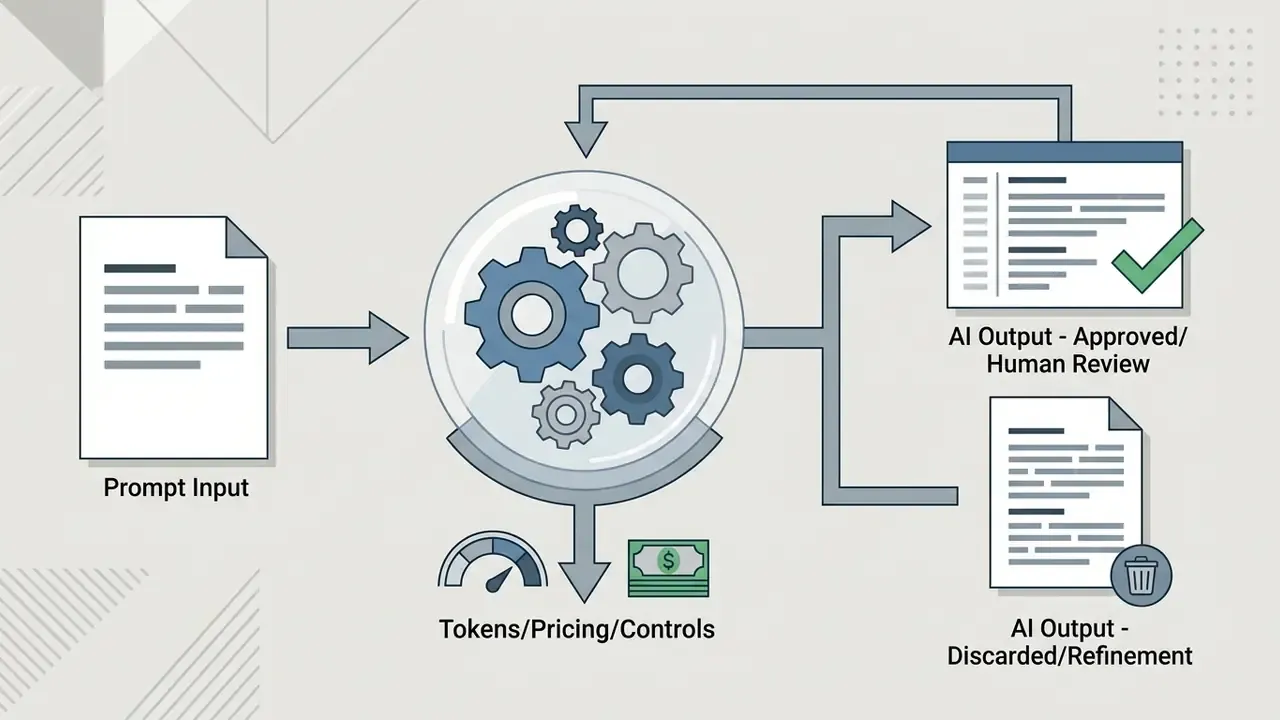
Diagram 1. Sequential transformation of a prompt into finished text
| Step | Actor | Operation | Control point |
|---|---|---|---|
| 1 | User | Submits a prompt with role, context, task, constraints | Prompt version stored |
| 2 | GPT model | Tokenizes input and evaluates it inside the context window | Context and token budget check |
| 3 | AI generator | Produces output via autoregressive decoding | Model and parameter version logged |
| 4 | User or reviewer | Runs human review, fact-checks, refines instructions | Approval recorded in audit trail |
How a Language Model Turns Instructions Into Finished Text
A generative language model converts raw input text into numerical tokens, analyzes context inside a fixed context window, then predicts subsequent tokens one at a time. This autoregressive decoding evaluates the probability distribution P(w_i | w_<i) across the full vocabulary to build an output that reads as intentional prose.
The prompt is the primary constraint on that prediction. When you supply explicit context, tone rules, and structural boundaries, the generator narrows its probabilistic search space. Conditioning of that kind is what keeps ai generated text aligned with a style guide, reduces arbitrary word choice, and produces documentation an auditor can follow.
Which Content Formats You Can Create With an AI Generator
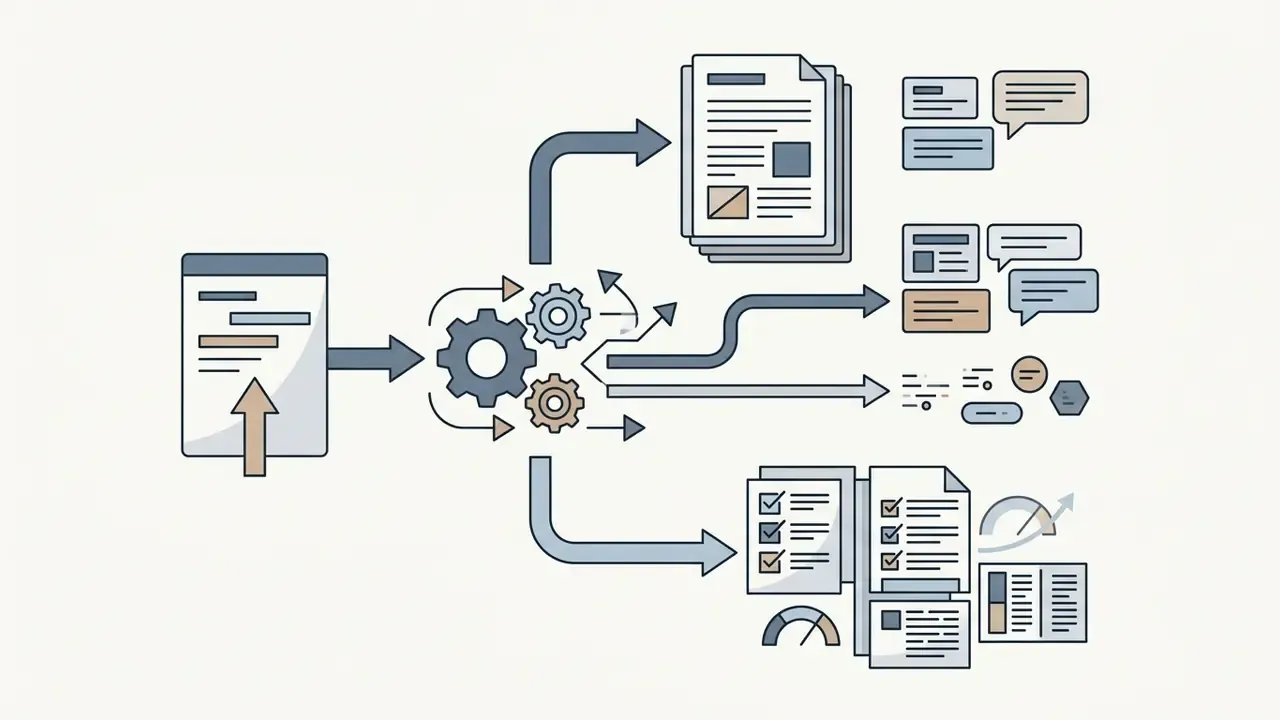
An ai text generator gpt supports a wide format range: long-form blog posts, executive summaries, social media copy, customer service messages, and granular microcopy. Professional creators and corporate users lean on these systems across both technical and client-facing workflows. Search logs even show the misspelled query "tekst ai generator" for the same intent, which tells you how mainstream the tooling has become.
In regulated environments the same mechanics apply to higher-stakes documents: risk-report narratives, credit memoranda, control-testing summaries, incident write-ups, and first drafts of responses to regulator information requests. The format changes. The requirement for source-anchored review does not.
«444 professionals with ChatGPT access completed tasks 37% faster, and output quality ratings rose by 0.45 standard deviations.»
Source note: the productivity claim now carries the sample size (444 participants), the design (randomized access to ChatGPT for occupational writing tasks) and a direct link to the working paper. By shifting human effort from blank-page drafting to structural editing, teams can create standardized communications, longer reports, and sentence-level marketing copy without losing throughput. Worth flagging one limitation: the MIT tasks were short professional writing exercises, not 40-page credit memoranda, so extrapolation to regulated documentation remains a hypothesis rather than a proven result.
ChatGPT, GPT-3 and GPT-4: How Text Generation Models Differ
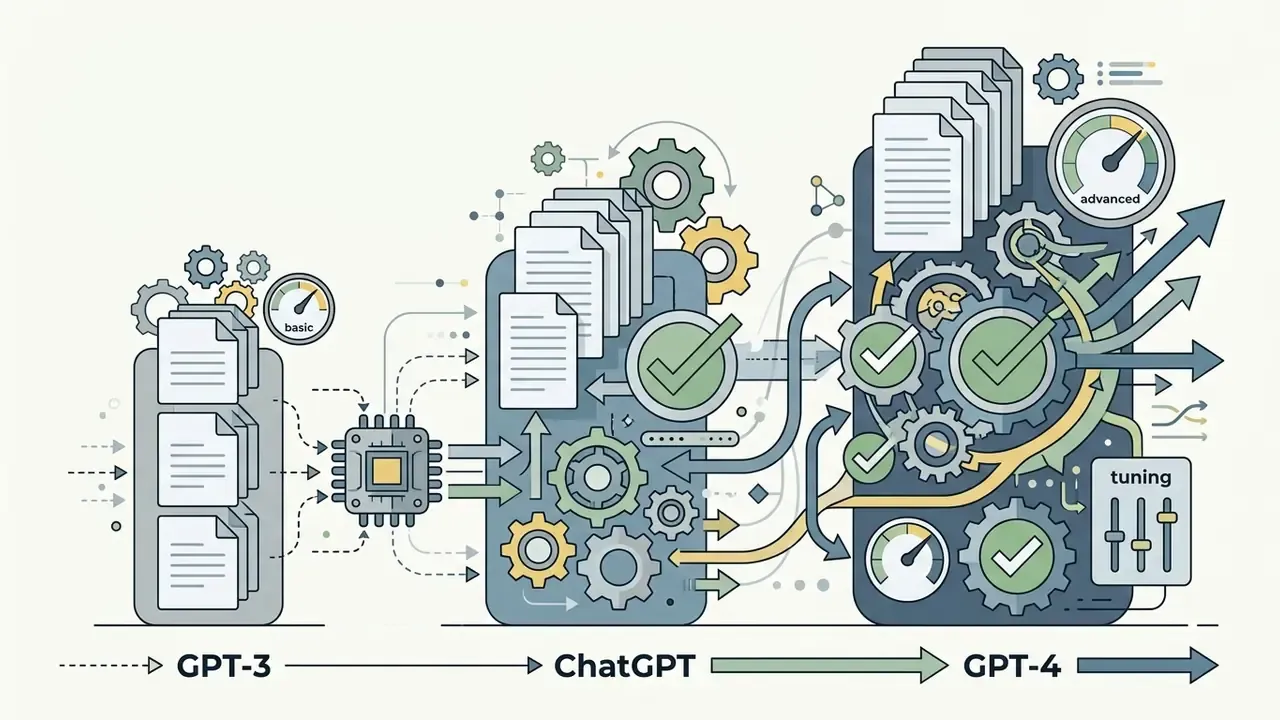
Architecture, context window capacity, and instruction-following precision separate GPT-3, GPT-4, and the ChatGPT application interface. Choosing a model means balancing computational cost, output quality, and reasoning demand against your deployment scenario.
| Criterion | GPT-3 (legacy baseline) | GPT-4 / GPT-4o / GPT-4.1 | ChatGPT (interface / application) |
|---|---|---|---|
| Primary purpose | Basic autoregressive text generator, zero-shot NLP tasks | Complex reasoning, multimodal input, long-context writing | Interactive conversational interface and workflow management |
| Context window | 2,048 tokens | 8,192 (GPT-4), 128,000 (GPT-4o), 1,047,576 (GPT-4.1) | Managed dynamically based on the underlying plan |
| Output quality | Coherent short drafts, vulnerable to logic errors on complex tasks | High reasoning accuracy, preferred in 70.2% of comparative prompt evaluations | Depends on the selected underlying model (free vs paid tier) |
| Prompt precision | Basic instruction following, highly sensitive to format changes | Stronger adherence to complex constraints, tone, system rules | Optimized for multi-turn refinement and custom instructions |
| Access and pricing | Obsolete, historical API token billing | Usage-based API pricing ($30/1M input, $60/1M output for GPT-4) | Free tier ($0), Plus ($20/mo), Business/Team ($25/user/mo annual, $30 monthly) |
| Enterprise data handling | Legacy API terms | API inputs excluded from training by default | Business and Enterprise tiers: no training on business data by default |
GPT-3 AI Text Generator: Baseline Generation Capabilities
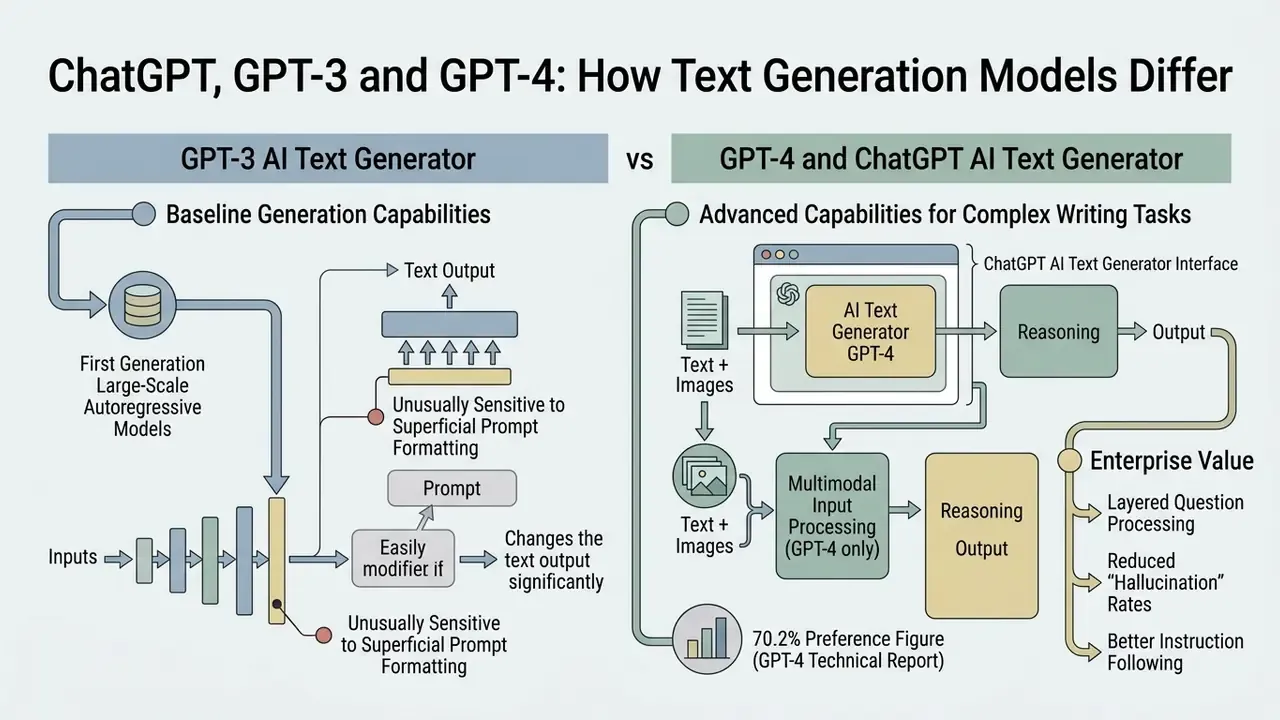
The gpt 3 ai text generator represents the first generation of large-scale autoregressive language models at real scale: a 175-billion parameter transformer with a 2,048-token context window (Brown et al., Language Models are Few-Shot Learners, OpenAI, 2020. https://arxiv.org/abs/2005.14165). It handles basic ai text generation, zero-shot drafting, and simple classification. It struggles with multi-step logical reasoning and long-document coherence.
Comparative benchmarks show early gpt models are unusually sensitive to superficial prompt formatting, with task performance moving by up to 40% on structural template changes (arXiv, 2024, linked above). GPT-3 has therefore been superseded in enterprise environments by instruction-aligned models that hold long context and respect operational constraints. For model-inventory purposes, treat GPT-3-era deployments as end-of-life dependencies. A 2K context window cannot hold a policy document, a loan file, or a regulator letter in one pass. That is not a quality opinion; it is arithmetic.
GPT-4 and ChatGPT AI Text Generator for Complex Writing Tasks
An ai text generator gpt 4 running inside the chatgpt ai text generator interface adds multimodal input, better reasoning efficiency, and far larger context windows: 8,192 tokens for the original GPT-4, 128,000 for GPT-4o, and 1,047,576 for GPT-4.1 according to OpenAI model documentation (https://developers.openai.com/api/docs/models/gpt-4o).
«GPT-4 outperformed GPT-3.5 in 70.2% of 5,214 comparative prompts, with gains in logical structure and vocabulary richness.»
Source note: the 70.2% preference figure is now attributed to the GPT-4 Technical Report with the prompt sample size stated, replacing an earlier vague reference to "blind evaluation studies".
The enterprise value of an ai text generator chat gpt sits in three places: it processes layered instructions, holds a consistent brand voice across long documents, and refines content iteratively without losing the thread. OpenAI's prompt-engineering documentation notes that the instructions parameter controls tone, goals and examples, and takes priority over the input text. That priority order matters for compliance work, because it lets you pin non-negotiable boundaries above whatever a business user pastes in.
How to Use the ChatGPT AI Text Generator: From Prompt to Output
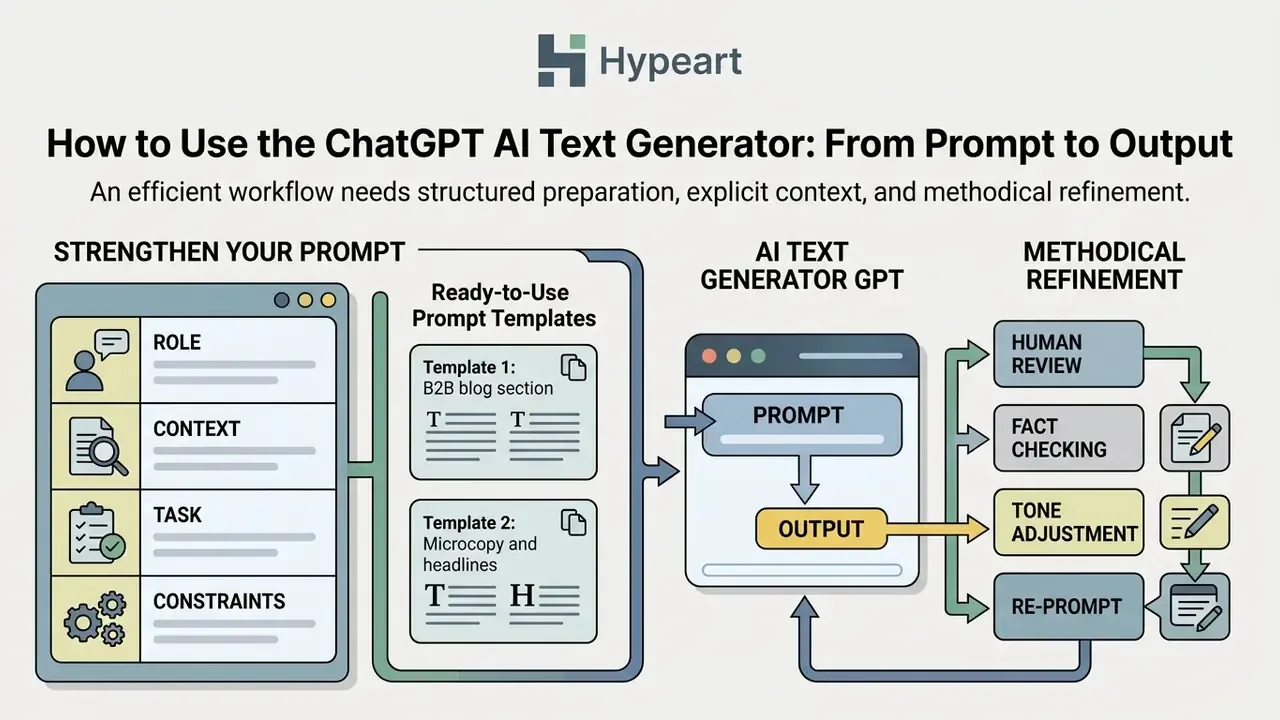
An efficient workflow with a chat gpt ai text generator needs three things: structured prompt preparation, explicit context, and methodical refinement of the output. Treat the system as an iterative draft engine and the results become predictable. Treat it as an oracle and you will eventually publish a fabricated number.
How to Write Prompts for More Accurate Output
Effective prompts for an ai text generator chatgpt specify four components: Role or Persona, Context, Specific Task, and Operational Constraints. Explicit boundaries, target length, forbidden phrases, required structure, curb verbosity and reduce hallucination risk.
A workable framework puts system instructions before user input:
- Role: define the operational identity, for example "Act as a senior risk compliance officer".
- Context: provide the background data or source documentation.
- Task: state the generation objective with active verbs.
- Constraints: set exact word counts, tone, and formatting rules such as Markdown tables or bulleted lists.
Two further components matter in production: Examples (few-shot) and Workflow steps ("1. review the source, 2. summarize, 3. flag gaps"). OpenAI's own guidance frames larger prompts around Goal, Context, Output and Boundaries, including an explicit statement of what the model must avoid or verify before acting.
«The Prompt Report catalogues 58 prompting techniques. Explicit task framing, structured examples and format constraints consistently reduce model error.»
Ready-to-Use Prompt Templates (Copy-Paste)
Generic advice fails at the keyboard. The four templates below are production-ready and can be pasted straight into a chatgpt ai text generator session or an API system prompt.
Template 1. B2B blog section
[ROLE]: Senior B2B marketing expert writing for a technical audience.
[CONTEXT]: Article for IT directors evaluating GPT-based text generators for internal
documentation. Source material is pasted below the instruction block.
[TASK]: Write the section "Benefits of GPT-4 for documentation automation".
[CONSTRAINTS]: Max 300 words. Business register. Exactly one bulleted list of 4 items.
No buzzwords ("revolutionary", "game-changer", "unlock"). No invented statistics.
If a number is required, insert [DATA NEEDED] instead.
[OUTPUT]: Markdown, H3 heading + body.
Template 2. Microcopy and headlines
[ROLE]: Conversion copywriter.
[CONTEXT]: Landing page for an AI text generator aimed at in-house content teams.
Primary pain: manual fact-checking eats 40% of the writing cycle.
[TASK]: Produce 5 headline variants and 5 CTA button labels.
[CONSTRAINTS]: Headlines under 10 words, active verb first, one benefit each.
CTA labels max 3 words. Required keyword: "AI text generator". Forbidden words:
"simply", "just", "effortless".
[OUTPUT]: Numbered table with columns: Variant | Headline | CTA | Angle.
Template 3. Business email
[ROLE]: Account manager at a SaaS vendor.
[CONTEXT]: Client missed two onboarding calls, renewal is in 30 days,
relationship is otherwise positive.
[TASK]: Draft a re-engagement email offering two concrete time slots.
[CONSTRAINTS]: 120-150 words. Neutral-warm tone, no guilt framing,
no discount offers. Subject line under 45 characters. One clear ask.
[OUTPUT]: Subject line + body, plain text.
Template 4. Regulated document draft (risk summary)
[ROLE]: Model risk analyst preparing an internal memo.
[CONTEXT]: Source data is the attached quarterly control-testing log. Use ONLY the
attached data. Do not add external facts, benchmarks or citations.
[TASK]: Draft a 1-page summary of control exceptions with severity ranking.
[CONSTRAINTS]: Neutral, non-promotional language. Every statement must be traceable
to a row in the source log. Append the row ID in brackets. Where the log is silent,
write "not evidenced in source" rather than inferring.
[OUTPUT]: Table (Exception | Severity | Evidence row ID) + 5-sentence narrative.
[REVIEW]: Flag any statement you assess as low-confidence with (LOW CONFIDENCE).
That last constraint pattern, forcing the model to declare uncertainty and cite source row IDs, is the single most effective mechanical defence against fabricated figures in compliance drafting. It is not elegant. It works.
Adapting to Buyer Persona and Brand Voice
An AI generator produces bland, faceless text when the prompt omits the audience. Competing commentary often claims a text generator "cannot write for a buyer persona". In practice the limitation lives in the prompt, not the model. Pass the persona explicitly:
- Audience pain: state two or three concrete problems, for example "no time for manual fact-checking" or "legal blocks publication of unverified claims".
- Vocabulary barrier: supply negative keywords, the words and clichés the brand never uses, plus mandatory terminology and product naming rules.
- Few-shot sample: paste one or two reference paragraphs from your strongest writer with the instruction "imitate this syntax, rhythm and paragraph length, do not copy the content".
- Register and reading level: specify a sentence-length ceiling, allowed jargon density, and whether first person is permitted.
- Objection map: list the top three objections the text must pre-empt, so the model spends words there instead of on generic benefits.
Enterprise brand governance guidance recommends checking outputs against the style guide itself: tone of voice, nomenclature, product naming, banned phrases, with human oversight in the loop. Put plainly, brand voice is a testable specification, not a vibe. Teams that keep a machine-readable voice spec next to their ai writing generator reference notes tend to argue less about tone and more about evidence.
How to Refine AI-Generated Text After the First Draft
Refining an initial ai generated draft means firing targeted follow-up prompts, not vague requests to "make it better". Evaluate the first output against factual accuracy, brand voice, and structural completeness, then change one variable at a time.
A structured critique-and-refine cycle keeps stylistic edits separate from factual corrections. If the copy reads too casual for a risk audience, instruct the chatgpt ai text generator to adjust sentence complexity and vocabulary while leaving technical assertions and figures untouched.
Refinement sequence used by editorial teams:
- Fact pass: "List every factual claim in the draft as a numbered table with the source you relied on. Mark any claim not present in the material I provided."
- Structure pass: "Reorder sections so decision criteria precede the pricing table. Do not rewrite sentences."
- Tone pass: "Rewrite for a compliance audience: shorter sentences, no marketing adjectives, keep all numbers unchanged."
- Compression pass: "Cut 20% of the word count without removing any factual claim or list item."
University writing centres and public-sector prompt playbooks converge on the same rule: change one variable per iteration, otherwise you cannot attribute the improvement, or the regression. When a template starts producing regressions after a model update, log it and treat it as an incident, not an annoyance. Recurring failure patterns and fixes are collected in AI Media Support and Troubleshooting.
E-E-A-T verification and official resources
What You Can Generate: Writing, Blog, Copy and Other Content Types
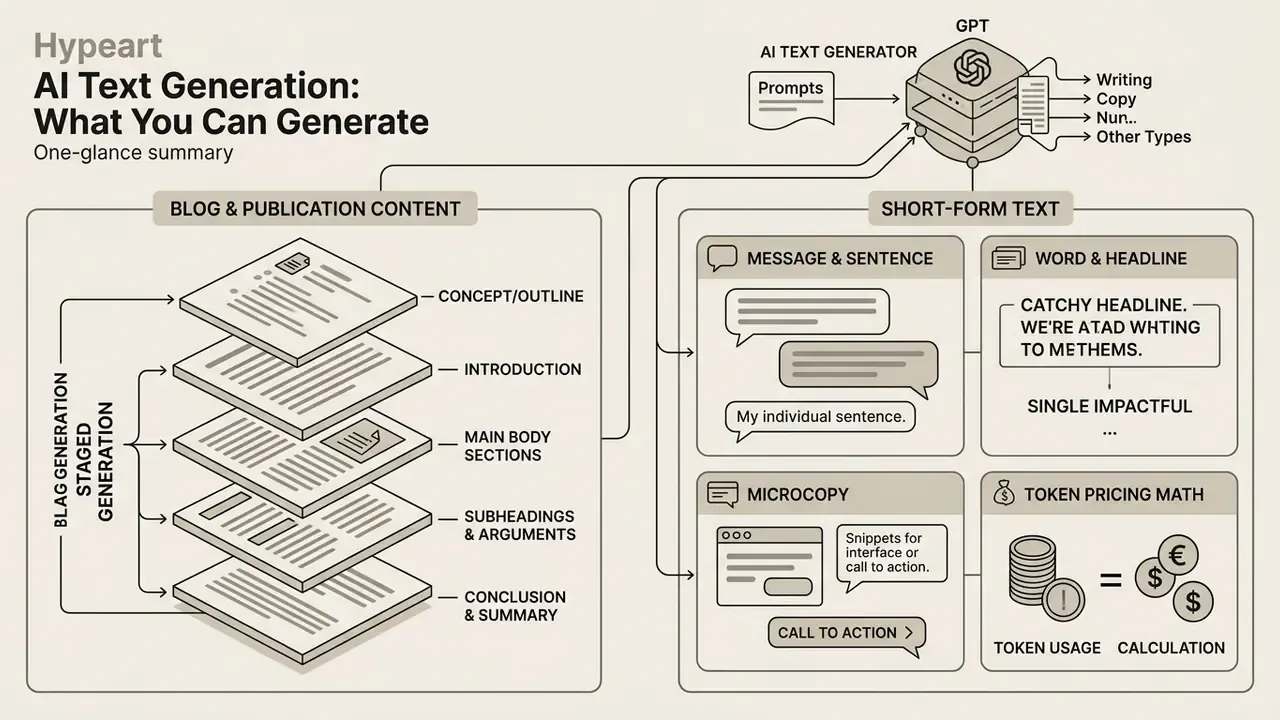
An ai generator text gpt flexes across formats, from long-form articles to tightly capped microcopy. Knowing the operational parameters of each format is what keeps post-processing effort low for creators.
Generating Blog and Publication Content
Using a text generator ai gpt for blog articles and long-form publications works best in stages. Rather than asking for a full article in one shot, generate a detailed outline first, then draft section by section under explicit sub-topic prompts.
Diagram 2. Staged generation of long-form content
| Stage | Input | Prompt objective | Output artifact |
|---|---|---|---|
| 1. Topic definition | Search intent plus audience | Fix scope and exclusions | One-paragraph brief |
| 2. Outline | Brief | Generate H2/H3 hierarchy, one idea per section | Approved outline |
| 3. Section drafting | Outline node plus source data | Draft one section under word and format caps | Section drafts |
| 4. Assembly and fact-check | All sections | Deduplicate, unify tone, verify claims | Publish-ready draft |
«GPT-4 informative passages scored 4.45 of 5 from 89 reviewers, statistically on par with expert human-written texts.»
Source note: the quality-parity claim now includes the mean rating (4.45 of 5), the reviewer sample (89 raters) and a direct link, replacing an earlier "exceeding 4.2 on a 5-point scale" phrasing with no source. Strict paragraph-level focus is what keeps long-form writing coherent across thousands of words. W3C accessibility guidance reinforces the same structural discipline: descriptive headings, one main idea per paragraph, front-loaded topic sentences, active voice.
Short-Form Text: Message, Sentence, Word and Headline
Short-form content, a promotional message, a headline, a single-sentence call to action, a block of product copy, needs explicit character and word caps in the prompt. Unconstrained language models drift toward verbosity, so hard numeric limits are not optional.
To produce tight microcopy with an ai text generator gpt, pair length limits with semantic constraints. Asking for variations helps too: "Provide 5 headline options under 10 words using active verbs" gives a marketing team something to choose between rather than something to fix. Public-sector style guidance on headlines is equally blunt: one line, a specific subject, an active verb, a length that fits the space available.
The same discipline governs regulated microcopy, meaning disclosure lines, consent text, error messages and in-product warnings. W3C guidance requires unambiguous link and instruction text and rules out vague labels such as "click here" or "read more". If you generate compliance-facing microcopy, set the character cap and the mandatory legal wording as hard prompt constraints, not as clean-up tasks for the editor.
AI Content and Google SEO Requirements
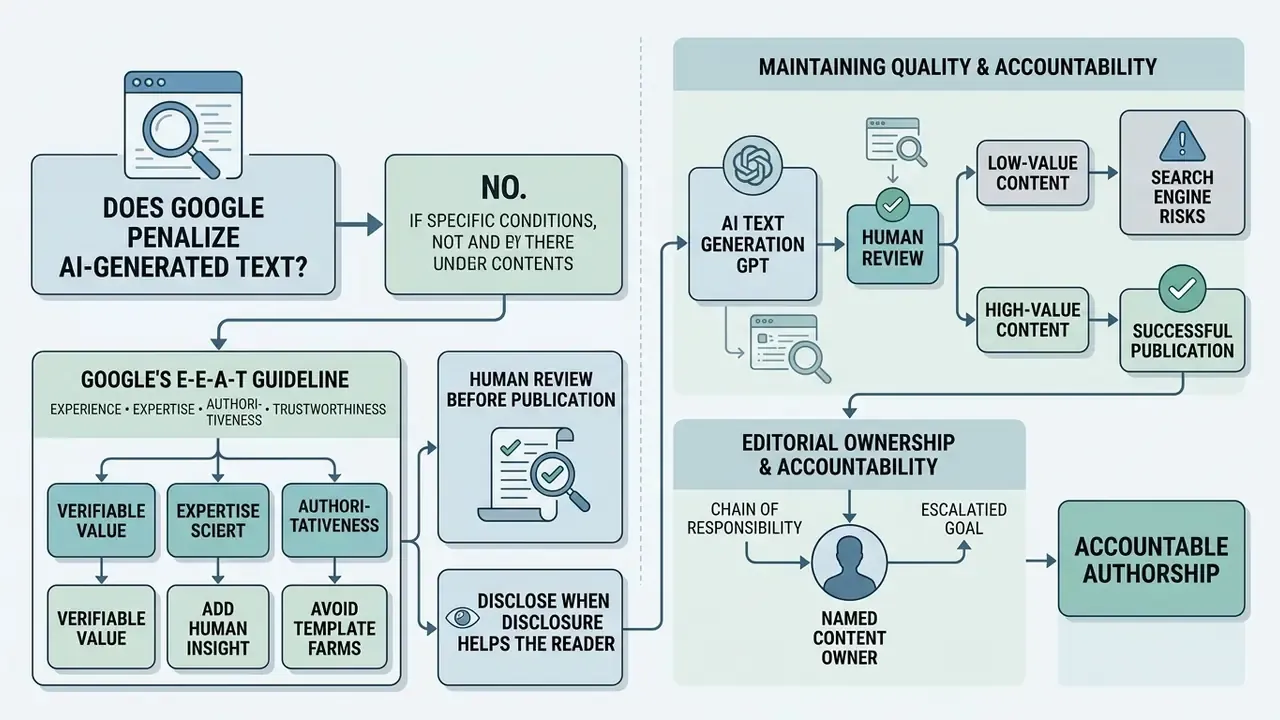
The most common commercial fear about a gpt ai text generator is search-engine punishment. The answer is documented, and it is narrower than the myth.
Does Google Penalize AI-Generated Text?
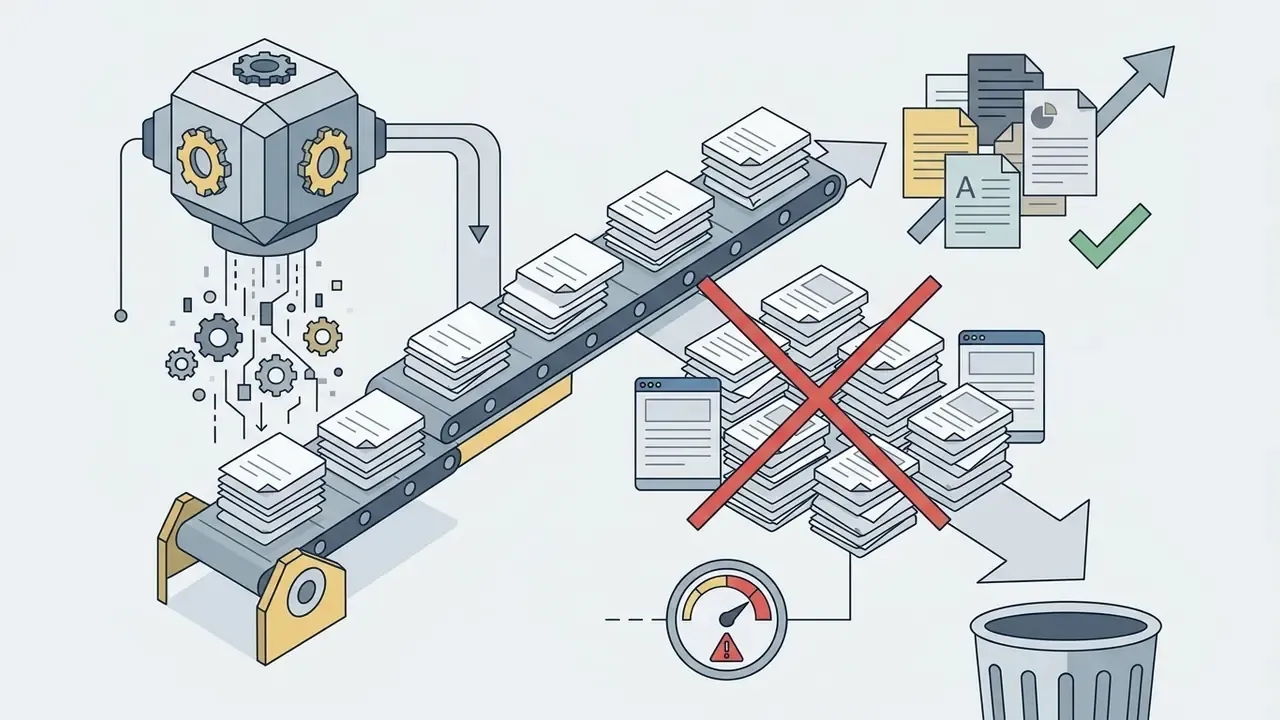
No. Google Search's guidance on AI-generated content states that ranking systems reward helpful, original, people-first content demonstrating experience, expertise, authoritativeness and trustworthiness, regardless of how it was produced. Automation is not the violation. Scaled content abuse, mass-producing pages primarily to manipulate rankings rather than to help people, is. Using an ai text generator gpt to accelerate research, structuring and drafting does not trigger a penalty by itself.
Older commentary still circulates claiming that "any automatically generated content violates the Webmaster Guidelines and will be penalized as spam". That reflects pre-2023 policy language and is outdated. Current spam policies target manipulative intent and low-value output, not the toolchain.
Operational consequences for publishers:


Editorial Ownership and Escalation Before Publication
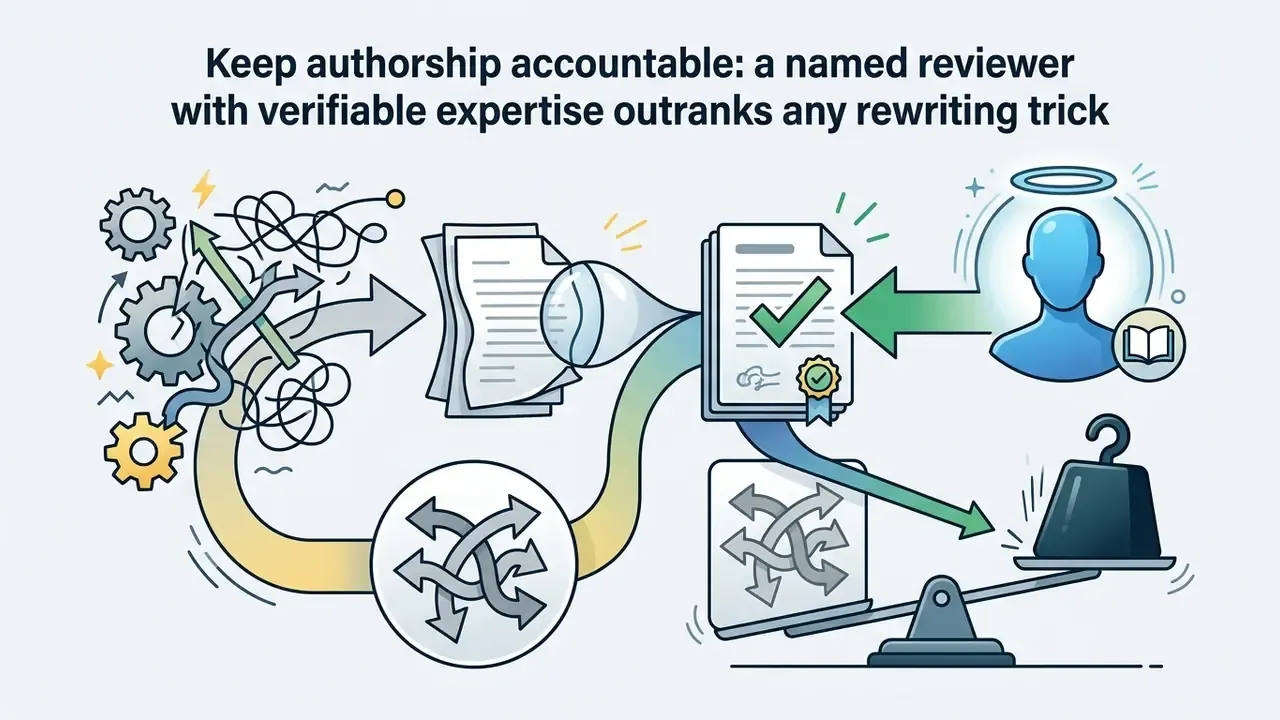
Most publishing failures are ownership failures, not model failures. Fix the accountability chain before you tune the prompt:
- Named content ownerper use case, recorded in the same inventory that holds your other models. If nobody owns it, nobody validates it.
- Reviewer competence test: the reviewer must be able to independently verify the subject matter. A marketer signing off on a capital-adequacy claim is a control in name only.
- Claim binding rule: every factual, numerical and legal assertion carries a primary source before sign-off, or it is deleted.
- Escalation path for disputed claims: legal, compliance or the relevant subject-matter owner, with a stated response window.
- Template kill switch: any prompt template producing repeated factual errors is suspended, not patched quietly. Who can pull it, and how fast, should be written down.
- Sampling audit: internal audit re-checks a percentage of approved outputs, because rubber-stamping fluent text is a documented human tendency.
Unresolved question, stated honestly: there is no settled industry benchmark for what sampling rate is sufficient. Most organizations pick a number, then adjust it based on their observed edit rate.
How to Choose the Best AI Text Generator: ChatGPT, OpenAI and Other Tools
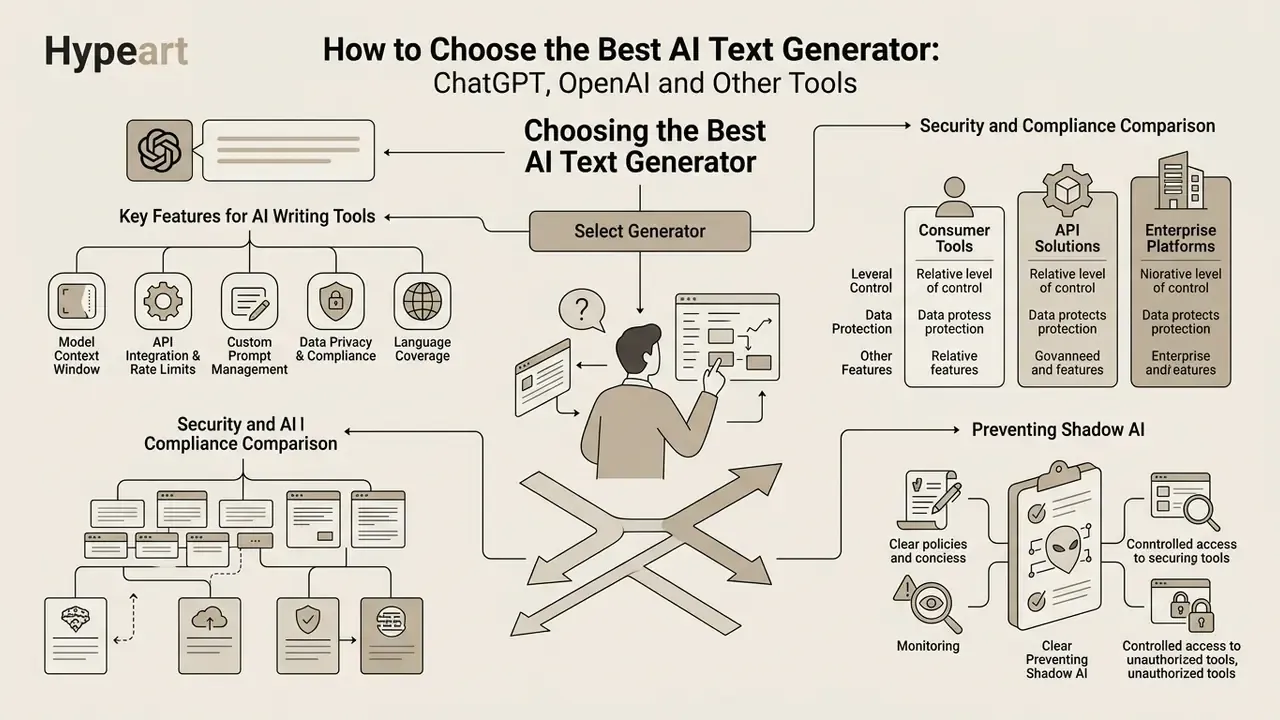
Selecting the best ai text generator means evaluating platform features, underlying models, data privacy protections, and integration capability. Decide early whether an interface subscription or a custom api build fits your scale and compliance posture. Teams reviewing visual assets alongside copy usually benchmark text tools against the best AI image generators and the best AI art generators so licensing terms stay consistent across formats.
| Purpose / scenario | Recommended tool / model | Key features | Optimal plan |
|---|---|---|---|
| Short messages and social copy | ChatGPT Base / Plus | Fast generation, conversational refinement, mobile access | Free or Plus ($20/month) |
| Blog and long-form content | ChatGPT Plus / custom GPTs | Long context handling, file uploads, project folders | Plus ($20/month per user) |
| Mass content and automated pipelines | OpenAI API (GPT-4o, GPT-4.1, GPT-5 series) | Programmatic access, custom system prompts, high TPM/RPM limits | Usage-based token pricing |
| Enterprise team collaboration | ChatGPT Business / Team | Shared workspaces, admin controls, no training on business data by default | Business/Team ($25-30/user/month) |
| Regulated document drafting | API with retrieval and logging layer | Source-bound prompts, full audit trail, retention controls | Enterprise agreement |
Which Features Matter for AI Writing Tools
When assessing an ai writing generator or a broader generator ai platform, audit four architectural criteria plus one often forgotten:
For multimedia and cross-platform asset workflows, technical leaders often cross-reference text tools with the utilities catalogued in our AI Media Comparison Matrices and voice-side equivalents such as the AI voice generator guide, which keeps full-stack generative coverage in one evaluation sheet.
Security and Compliance Comparison: Consumer vs API vs Enterprise
Procurement decisions in regulated organizations rarely hinge on writing quality. They hinge on data handling. Use this matrix as the opening checklist for a vendor questionnaire.
| Control dimension | Consumer (Free / Plus) | API / developer platform | Business / Enterprise |
|---|---|---|---|
| Training on your data | May be used for model improvement unless opted out | Not used for training by default | Not used for training by default (contractual) |
| Admin controls / SSO | None (individual account) | Organization and project keys, roles | SSO, domain verification, role management |
| Retention controls | Limited user-level history controls | Configurable retention, zero-retention options negotiable | Contractual retention and residency terms |
| Audit logging | Not designed for audit | API-level request logging on your side | Workspace-level admin and compliance logs |
| Shadow-AI risk | High, unmanaged personal accounts | Medium, key sprawl if unmanaged | Low, centralized provisioning |
| Suitable for confidential documents | No | Conditional, with logging and DLP | Yes, under signed terms |
Verify every row against the provider's current documentation before signing. Terms and retention options change, and a screenshot from last quarter is not evidence.
Preventing Shadow AI
Unmanaged personal accounts are the primary leakage vector for confidential text. A minimal control set:
- Publish a sanctioned tool list with an approved default, so employees do not improvise.
- Route traffic through organization-managed keys or workspaces, and disable personal-account use for work data.
- Classify what may never be pasted into a generator, with concrete examples instead of abstract categories.
- Run quarterly access reviews of API keys, projects and seats, and revoke orphaned keys.
- Provide a fast approval path for new use cases. Restriction without an alternative guarantees workarounds.

When a Free Generator Is Enough and When You Need a Paid Plan
A free ai text generator covers entry-level drafting, which suits individual users with occasional, low-volume needs. Free tiers usually impose strict rate limits, restrict access at peak hours, and route requests to lighter baseline models.
Teams needing high-volume generation, stronger reasoning, shared workspaces, and contractual data privacy have to move to a paid plan. Commercial tiers unlock advanced models such as GPT-4, offer higher usage ceilings, and keep organizational inputs out of training by default. That last point, not the feature list, is usually what unblocks the security review.
Free and Paid Plans: How to Estimate the Cost of AI Text Generation
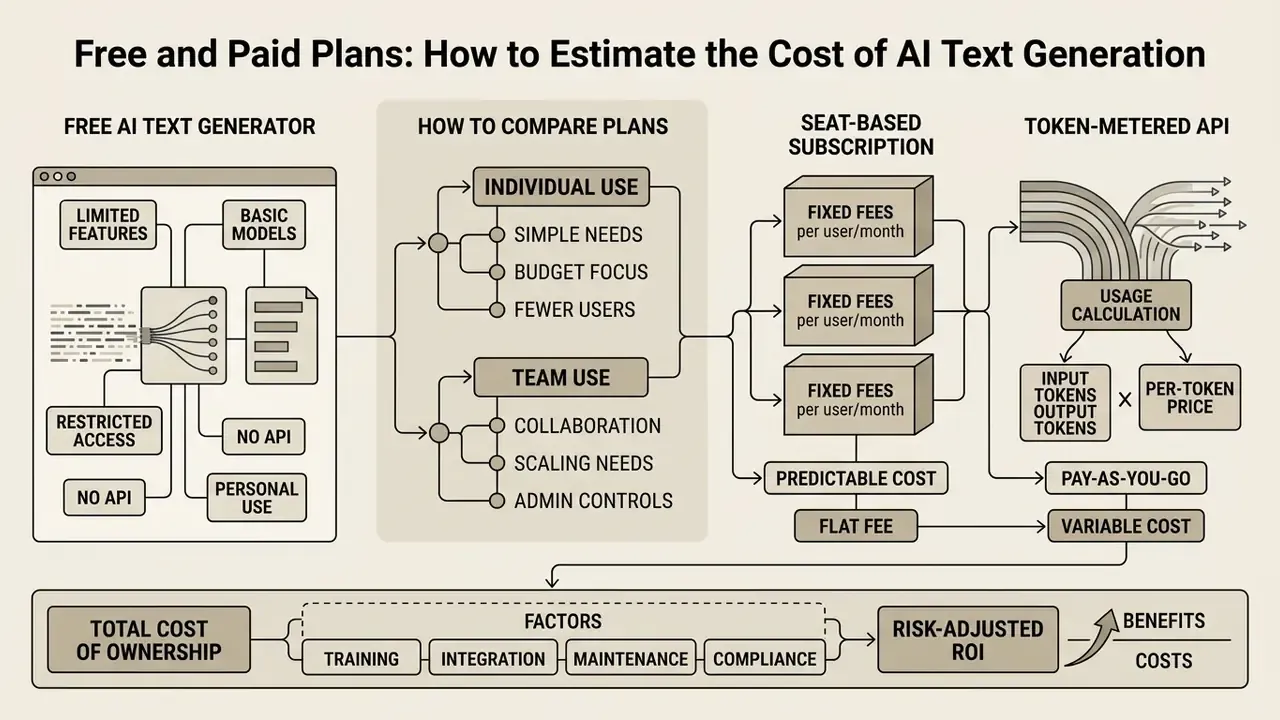
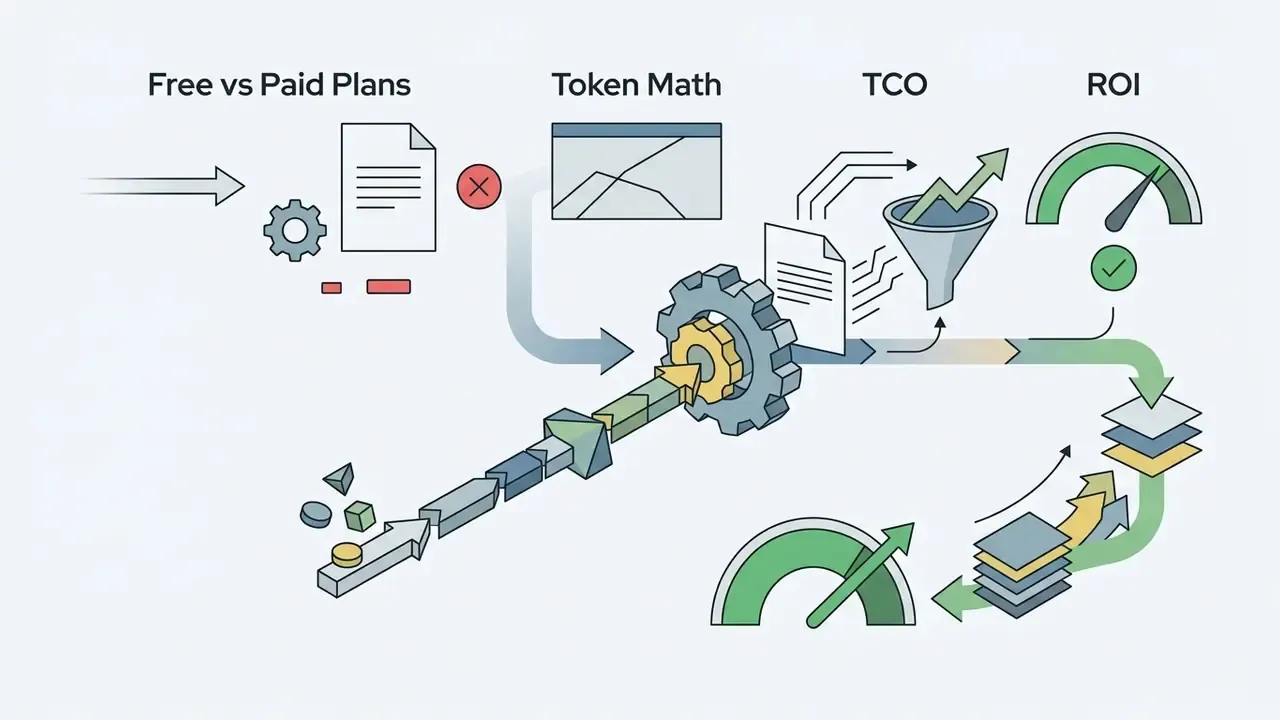
Assessing the economics of an ai text generator gpt deployment means comparing seat-based subscription costs against token-metered API pricing. Start with expected monthly volume, then pick the tier.
Three-question plan selector If the answer is "yes" on confidentiality and "high" on volume, the decision is an enterprise agreement with an audit trail, whatever the price sensitivity in the room.
- What is your monthly generation volume? Low, occasional drafts, use Free. Medium, daily drafting by individuals, use Plus. High, pipelines and thousands of documents, use the API or Business.
- Do you process confidential or regulated data? Yes, go Business or Enterprise with contractual terms. No, a consumer tier is acceptable.
- Do you need programmatic access? Yes, use the API with per-token billing and your own logging layer. No, an interface subscription is fine.
What a Free AI Text Generator Typically Includes
A free text generator allocation usually grants standard baseline models with daily or hourly caps. Useful enough to try basic drafting, generate short content, and see how the model responds to your prompts, without spending anything.
Limits bite quickly, though. Comparable services publish caps such as a handful of advanced-model prompts per day, a small number of deep-research reports per month, and a reduced context window. Free consumer services may also use inputs for general model alignment unless you opt out, which rules them out for confidential corporate documentation or regulated financial communications. Free tiers also frequently restrict, or say nothing about, commercial rights. For published work that silence is a blocker, not a detail.
How to Compare Plans for Individual and Team Use
Comparing subscription models means weighing individual seats ($20 per month for Plus) against team administration ($25 per user per month billed annually, or $30 per user per month billed monthly for Team/Business). Team plans add the controls a security reviewer asks for: Single Sign-On, centralized billing, shared project spaces, admin permissions, connectors, and contractual guarantees against training on business data (OpenAI, ChatGPT Business overview. https://help.openai.com/en/articles/8792828-what-is-chatgpt-business).
For internal tooling, direct API billing gives granular cost control. Calculate input and output token ratios ($30 per 1M input vs $60 per 1M output for GPT-4) and you can forecast spend from document volume. Credit-based enterprise billing uses the same arithmetic:
total credits = (input tokens / 1,000,000 × input rate)
             + (cached input tokens / 1,000,000 × cached rate)
             + (output tokens / 1,000,000 × output rate)
Cached input is materially cheaper than fresh input, so reusing stable system prompts and reference documents is a genuine cost lever rather than a micro-optimization. Scenario modelling for mixed seat plus token spend is easier with the AI Media Calculators, and current published rate cards across vendors are tracked in our AI Media Pricing Guides.
Total Cost of Ownership and Risk-Adjusted ROI
Token price is the smallest line item in a governed deployment. A defensible business case prices the cost of control:
TCO = licenses/tokens
    + human validation time (reviewer hours × loaded hourly rate)
    + prompt/template engineering and maintenance
    + integration, logging and retention infrastructure
    + legal/compliance review of published output
    + residual-risk reserve (expected cost of an escaped error × probability)
Risk-adjusted ROI = (documented time savings valued at loaded rates
                    − TCO) / TCO
Illustrative example for a 20-person documentation team. Suppose drafting time falls by 30% across 400 documents per month, and a reviewer spends 12 minutes verifying each AI draft. That is roughly 80 reviewer hours per month, which must sit inside the model before anyone claims a saving. Deployments that skip the validation line item routinely report gains that evaporate on the first published error. This example is hypothetical, built to show the structure of the calculation rather than a benchmark you can borrow.
Commercial Use of AI-Generated Content: What to Check Before Publishing
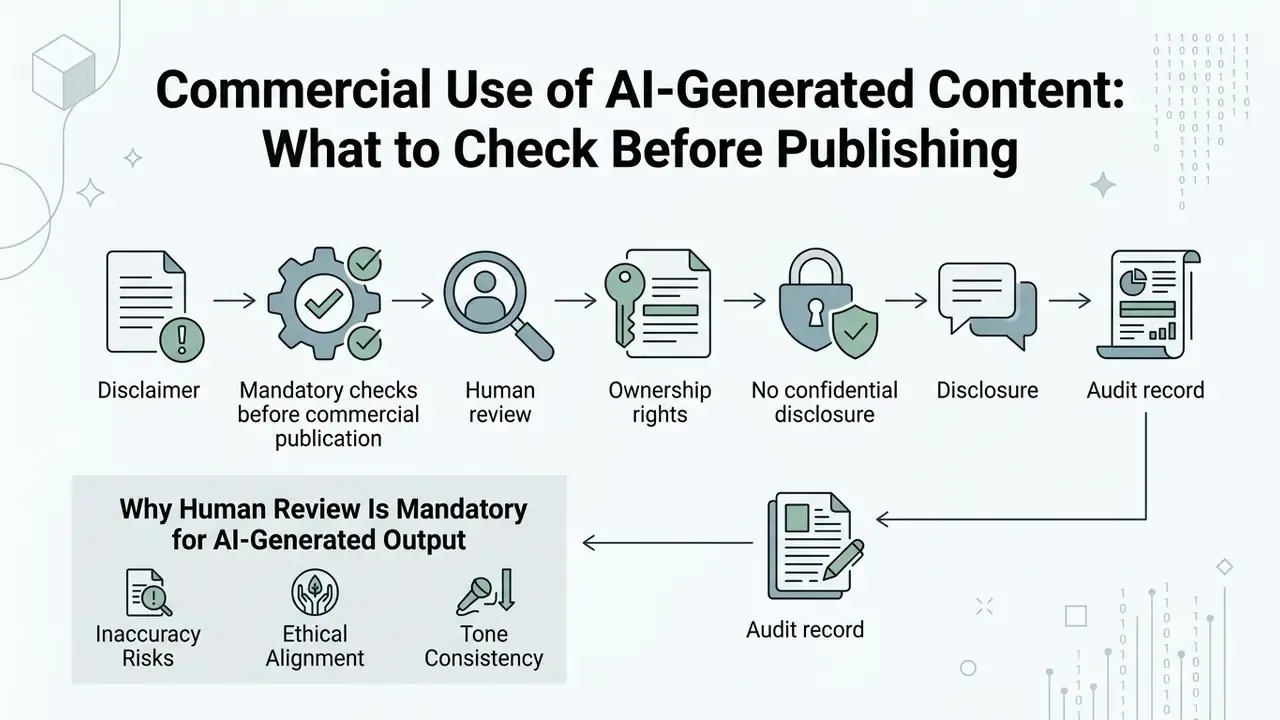
Deploying ai-generated text in commercial products, marketing channels, or public communications requires human oversight and legal verification. Check copyright eligibility, model accuracy, and vendor service terms before distribution. Teams publishing mixed media should apply identical diligence to visual assets, covered in our guidance on commercial use of AI images and the wider commercial use reference set.
Why Human Review Is Mandatory for AI-Generated Output
A human reviewer operating in a Human-in-the-Loop capacity is required to audit ai-generated content for factual hallucinations, logical inconsistencies, and brand voice drift. Generative language models work probabilistically and can fabricate plausible yet entirely wrong citations, figures, or legal assertions. Publishers verifying provenance across formats sometimes pair editorial review with AI content detectors as a secondary signal, never as a substitute for source checking.
«GPT-4 accuracy on prime-number identification dropped from 84.0% to 51.1% between March and June 2023.»
That single finding is the operational argument for continuous validation. A prompt that passed evaluation last quarter is not guaranteed to pass today, which is why regulated deployments need periodic re-testing rather than one-time acceptance.
Source note: the oversight requirement is now anchored in the provider's own binding policy alongside public-sector guidance. Government and regulatory frameworks say much the same. The UK Government's Generative AI Framework requires human reviewers to assess outputs and track hallucinations, toxicity and fairness, while US state-level guidance defines human review as a responsible individual confirming that output is factually correct and appropriate, backed by written policies and reviewer logs. Reviewer logs plus editorial verification are what let you demonstrate, later, that the control existed and functioned.
Model Risk Register for Generative Text
Risk functions cannot place a generator in the model inventory without a documented risk-and-mitigation mapping. A minimum viable register:
| Risk | Manifestation in text output | Primary mitigation | Control owner |
|---|---|---|---|
| Hallucination | Invented figures, fake citations, non-existent regulations | Source-bound prompts, claim-extraction review, citation validation | Content owner and reviewer |
| Factual drift over time | Same prompt degrades after a model update | Scheduled regression tests on a fixed prompt fixture set | Model validation |
| Bias or unfair framing | Skewed characterizations in customer or HR communications | Bias review checklist, diverse reviewer pool, tracked metrics | Compliance |
| IP and copyright exposure | Output resembling protected text, unclear ownership | Terms verification, originality checks, disclosure in filings | Legal |
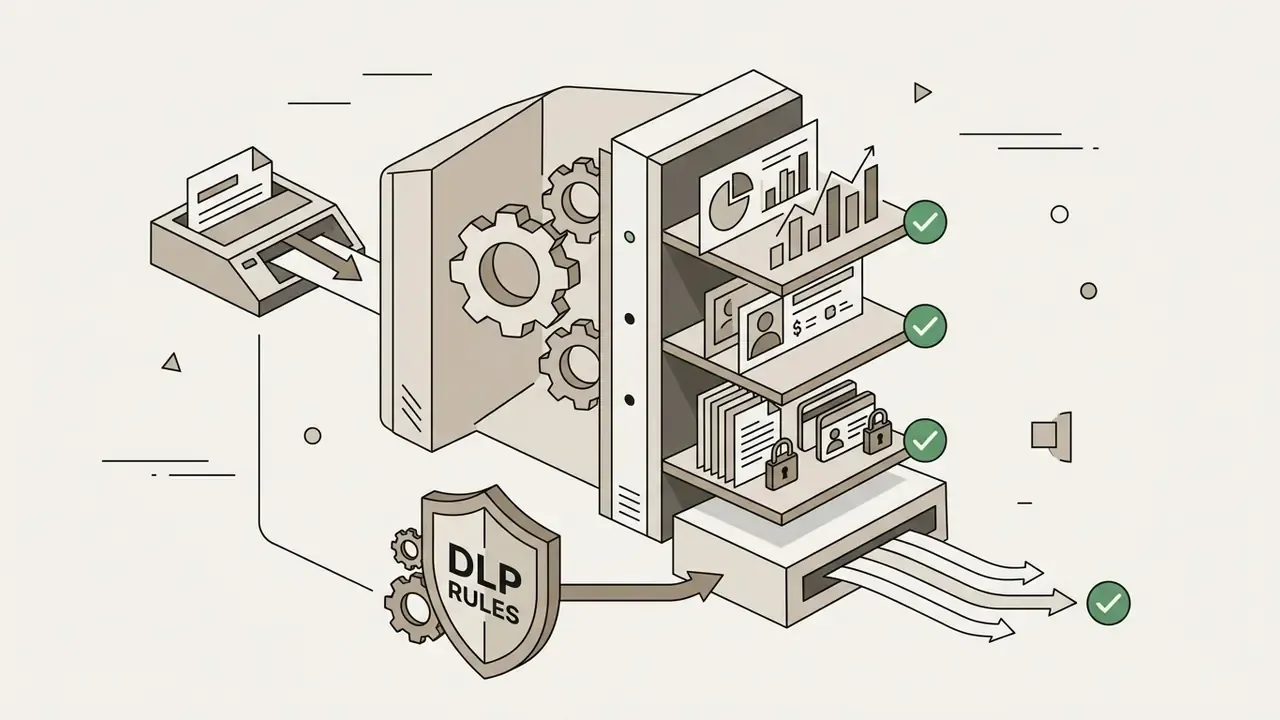
| Confidential data leakage | Restricted data pasted into prompts | Data classification, DLP, sanctioned tooling, no-training terms | Security |
| Over-reliance and automation bias | Reviewers rubber-stamp fluent output | Mandatory evidence linking, sampling audits of approvals | Internal audit |
| Vendor or policy change | Terms, retention or model availability shifts | Contract monitoring, periodic re-verification of official terms | Vendor management |
Align this register with your existing model risk management framework. For US banks that means supervisory guidance on model risk management such as SR 11-7. For general AI governance, the NIST AI Risk Management Framework. The aim is simple: generative text should face the same validation, documentation and effective-challenge standards as a credit scorecard or an AML transaction-monitoring model. Ongoing copyright and liability disputes worth tracking are summarized in our AI Litigation and copyright case tracker.
Audit Trail: What to Log
Regulator-ready oversight needs the record, not the intention. Capture at minimum:
| Field | Example value | Why it matters |
|---|---|---|
timestamp | 2026-03-11T14:22:09Z | Sequencing and retention policy |
user_id | analyst.4471 | Accountability for the request |
use_case_id | RISK-SUMMARY-Q1 | Links output to an approved use case |
prompt_version | v3.2 | Reproducibility after template changes |
prompt_payload_hash | sha256:… | Integrity without storing raw sensitive text |
model_version | gpt-4o-2024-xx-xx | Explains behavior differences over time |
parameters | temperature 0.2, max_tokens 900 | Reproducibility of the generation |
output_id | out_88213 | Traceability to the published artifact |
source_documents | doc_112, doc_119 | Evidence for every factual claim |
human_approver_id | reviewer.902 | Named accountability for publication |
review_decision | approved / edited / rejected | Effectiveness evidence for the HITL control |
edits_summary | 3 factual corrections | Quantifies model error rate over time |
retention_expiry | 2031-03-11 | Records-management compliance |
Two derived metrics turn this trail from decoration into evidence: edit rate per 1,000 words, a proxy for model reliability in your domain, and escaped-error count, errors found after publication. Together they either justify continued use of the tool or make the case to pull it.
Which Plan and Tool Terms to Verify Before Commercial Use
Before commercial distribution, legal teams should review the Terms of Use tied to the selected tool and subscription plan. Under standard OpenAI terms, users own the generated output and receive assignment of rights to the extent permitted by law, provided they comply with the usage policies.
Limitations and Open Questions
Three honest gaps remain in this space, and pretending otherwise would be a disservice:
- No accepted validation standard for generative text.Traditional model validation assumes stable inputs and measurable error rates. Free-text output resists both, and supervisory expectations are still forming.
- Agentic behavior is harder still.Once a generator triggers actions rather than producing drafts, the control question shifts from accuracy to authority: what may it do, with whose approval, and how is it stopped?
- ROI evidence is thin at document scale.Published productivity studies use short writing tasks. Whether the same gains hold for credit memoranda or regulator responses is an open empirical question.
A safe next step is deliberately small. Pick one low-severity, high-volume document type, run it through a source-bound template for a quarter, log the edit rate, and let the data decide whether to widen scope.
FAQ
Does Google penalize AI-generated text?
No. Google ranks content on helpfulness and E-E-A-T signals, not on production method. Penalties apply to scaled content abuse, meaning mass-produced pages created primarily to manipulate rankings, and to unhelpful, unverified output. Human review before publication is the practical requirement.
Who owns the text produced by an AI text generator GPT?
Under standard OpenAI terms, the user owns the output and OpenAI assigns its rights in that output to the user, to the extent permitted by law. Separately, copyright protection in the US requires human authorship, and AI-generated material must be disclosed in registration filings.
Which GPT model should I use for long documents?
Match the context window to the document. GPT-4 (8,192 tokens) suits short pieces, GPT-4o (128,000 tokens) handles most reports, and GPT-4.1 (1,047,576 tokens) is built for very long-context work. Verify current limits in OpenAI's model documentation, since they move.
How much does GPT text generation cost?
Two billing modes. Seat subscriptions: ChatGPT Plus at $20 per user per month, Business at $25 per user per month annually or $30 monthly. Token metering: GPT-4 at $30 per 1M input tokens and $60 per 1M output tokens. Enterprise credit rate cards use the same input, cached-input and output arithmetic.
Can I publish AI output without editing it?
No. Claims that a generator produces "perfect texts with no post-processing" are false. All language models can fabricate facts and citations, and measured model behavior changes over time. Publishing without verification breaches both internal quality standards and provider publication policies.
Is a free plan enough for commercial content?
Rarely. Free tiers throttle throughput, limit context, may use inputs for model improvement unless you opt out, and often stay silent on commercial rights. That combination makes them unsuitable for confidential or published business content.
How do I make AI text sound like our brand?
Pass the persona and voice explicitly: audience pain points, banned words, mandatory terminology, register and sentence-length limits, plus one or two few-shot reference paragraphs to imitate in syntax and rhythm.
What should a model risk team ask before approving a text generator?
Four questions. Who owns the use case, what evidence binds each claim to a source, how is drift detected after model updates, and what is the shutdown path if error rates climb?
Human Verification Checklist Before Publication
- Every factual claim is bound to a primary source, and unverifiable claims are removed.
- Every citation and link is opened and confirmed to exist and to say what is claimed.
- All numbers, dates, prices and legal references are re-checked against official documentation.
- Brand style guide applied: tone, banned phrases, product naming, register.
- No confidential, client or personal data appears in prompts or output.
- Commercial rights confirmed for the specific plan and output type in use.
- AI disclosure applied where policy or platform rules require it.
- Accessibility and structure verified: descriptive headings, one idea per paragraph, unambiguous link text.
- Prompt version, model version, output and approver recorded in the audit trail.
- Edit rate logged, so model reliability can be tracked over time rather than assumed.
About This Guide
This guide is maintained by our AI tooling editorial desk and reviewed against primary vendor documentation (OpenAI model, pricing, usage and terms pages), peer-reviewed research (MIT, Springer, Stanford and UC Berkeley, arXiv) and public-sector AI governance frameworks (UK Government Generative AI Framework, NIST AI RMF). Pricing, context windows and policy language change frequently. Re-verify every figure against the linked official source before using it in a 2026 procurement or compliance decision.
Governance commentary in this article is attributed to Marcus Hale, author. No vendor sponsored this page.
Adjacent entity references for media production teams: animated explainer video, animated explainer video company, animated logo maker, android photo editor, and akool image to video conversion.
Definitions of AI compliance terminology, model risk governance metrics and technical standards live in the AI Media Glossary, with sibling entries such as the AI art generator glossary entry for cross-format reference.