Executive Summary
- What it does An AI paper generator turns a topic, rubric, or rough draft into a structured academic document: outline, thesis, body sections, in-text citations, and a formatted reference list. Minutes, not hours.
- Where the risk sits Fluency is not fidelity. In one systematic audit of 333 citation-attributed claims, only 43.5% were fully accurate, and 19.8% were fabricated outright. Every reference needs manual verification.
- What you must control Human authorship of ideas and analysis, DOI-level source verification, institutional disclosure of AI use, and an auditable record of prompts, model version, and edits.
- What it costs Functional free tiers exist (typically 1,500 to 5,000 words, or 3 test generations, no credit card), with paid tiers from roughly $9 to $99 per month. Institutional and enterprise tiers add security controls, SSO, and audit logging.
Who This Guide Is For and How to Read It
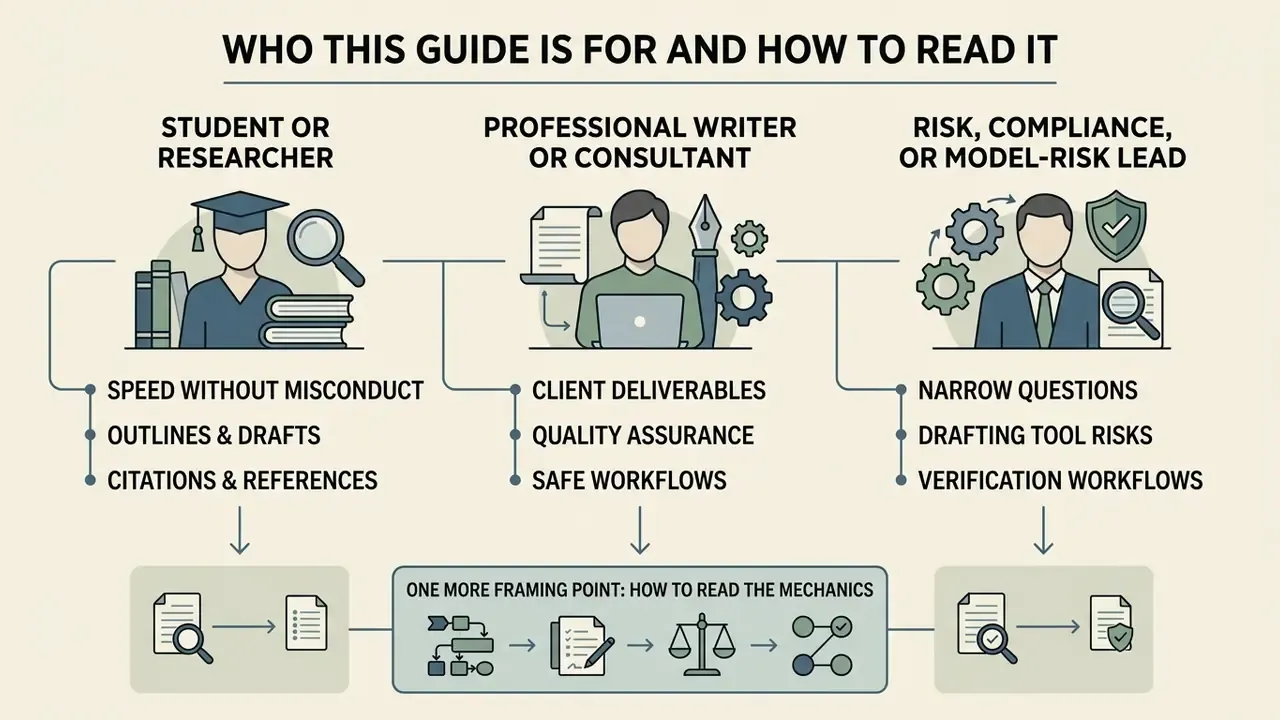
Three very different readers land on this page, and they need different things from it.
The student or researcher wants speed without a misconduct problem. Read the workflow section, then the verification checklist, then the disclosure rules for your department. Skip the pricing math if you are on a free tier.
The professional writer or consultant wants to know what can safely reach a client deliverable. Start with commercial use, copyright, and liability. Then read the total-cost-of-ownership formula, because verification labour usually costs more than the subscription.
The risk, compliance, or model-risk lead at a bank or fintech has a narrower question: can a drafting tool touch regulated content at all, and under what controls? Go to the governance note. Short answer: a paper generator is a drafting assistant, not a validated model, and it should never be treated as one.
One more framing point before the mechanics. A generator that writes beautifully and cites badly is worse than one that writes plainly and cites accurately. That single trade-off explains almost every recommendation below.
What Is an AI Paper Generator and How Does It Work?
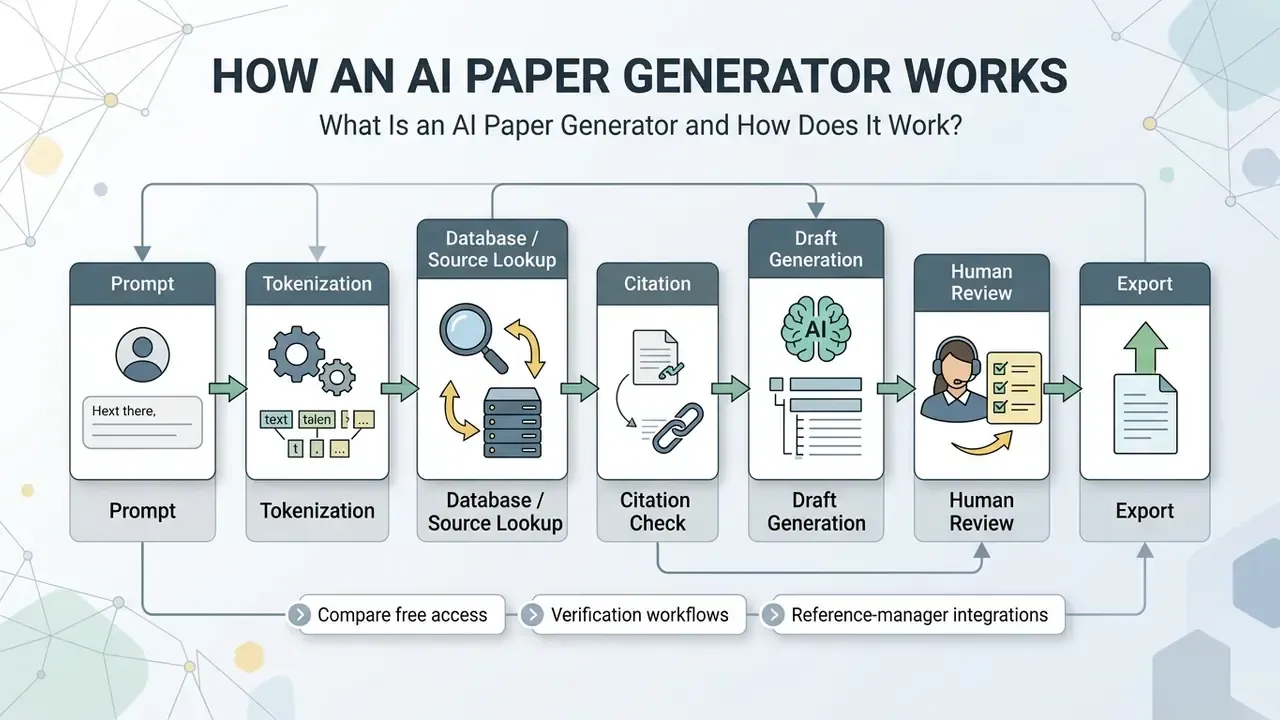
An AI paper generator is a writing platform built on large language models (LLMs) that converts user-supplied topics, assignment briefs, or rough outlines into structured academic text. It breaks input prompts into numeric tokens, processes structural constraints through transformer neural networks, and predicts sequential prose that follows academic conventions. Using an ai paper generator or an ai generator for papers lets students, researchers, and professionals accelerate the drafting phase of a research paper or essay. Analytical ownership, though, stays with the human author. Always.
Technically, three layers stack on top of one another: tokenization (the prompt is segmented into numeric units), transformer decoding (each subsequent token is predicted from the preceding context window), and instruction or prompt conditioning (role, context, task, format, and tone constraints bias the decoder toward organized academic prose). Prompt frameworks used in official guidance, such as the CO-STAR pattern of Context, Objective, Style, Tone, Audience, Response format, exist precisely because explicit structural constraints, not model size alone, decide whether the output reads like a term paper or an unstructured blog post.
From Topic to Structured AI Paper Draft
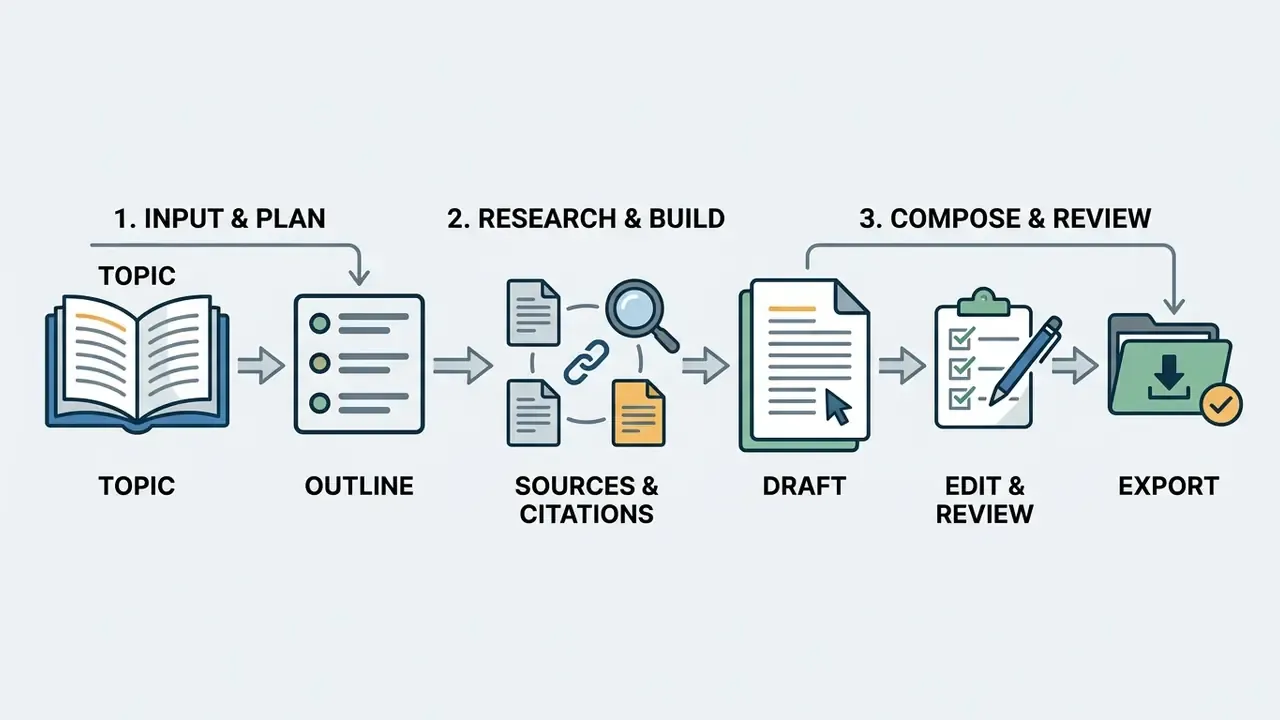
Turning a raw research topic into a structured draft follows a systematic three-step progression: prompt conditioning, thesis and outline generation, then section expansion. The software analyses the topic prompt, identifies key thematic concepts, and builds a logical hierarchy with an introduction, argument-driven body paragraphs, and a synthesizing conclusion. A paper ai generator converts broad concepts into concrete sub-claims, giving the author an organized baseline so they can start writing instead of staring at a blank page.
In practice the chain runs: topic, then brainstormed angles, gaps, and contradictions, then a working thesis, then two to four main claims grouped into sections, then a background, claim, evidence, counterargument, implications sequence. Official university writing guidance treats this as legitimate use. AI is appropriate for ideas, outlines, and templates. Original analysis, claims, and conclusions remain assigned to the author.
What an AI Writer Can and Cannot Do
An ai writer is strong at grammatical consistency, fluid transitions, and prose that matches standard academic templates. It cannot perform independent empirical reasoning, and it cannot verify factual truth. Instruction-tuned models produce information-dense, highly readable text, yet they lack real-world contextual understanding and will generate plausible-sounding falsehoods without hesitation. A controlled evaluation of AI feedback on student writing quantifies where the benefit lands, and where it stops:
How to Use an AI Paper Generator in Three Steps
Using an AI paper generator well comes down to three things: set clear prompt parameters, generate and refine a structural draft, then edit rigorously while verifying sources. A controlled workflow captures the drafting speed of an ai paper generator without inheriting its factual and formatting failures.
Enter a Topic, Assignment Details, or Existing Draft
The first step toward a usable paper is giving the ai paper writer detailed context: explicit assignment rubrics, target word counts, structural constraints. You can enter a brand-new research question or upload an existing rough draft to steer the output. NIST's prompt-engineering guidance recommends a clear task description, specific background context, output-format instructions, and explicit constraints or parameters. Research on prompt design reports the same thing from a different angle: added context and worked examples improve output quality and reduce hallucination risk.
Inputs that measurably change output quality include the assignment rubric (attach or paste it), the discipline, the required section order, forbidden sources, and the tone your department expects. A small observation from editing hundreds of AI drafts: pasting the rubric verbatim does more for structure than any clever prompt phrasing.
Choose Structure, Style, and Paper Length
Configuring output parameters keeps the generated text aligned with formal academic expectations and institutional guidelines. Select a formatting framework, such as a standard five-paragraph essay, a literature review, or a multi-section term paper, and set the tone to formal, objective, and analytical. Precise length boundaries and a fixed section order stop the paper generator from drifting into generic filler.
University writing guides usually define structure as title page, contents, introduction, main body, conclusion, references, and appendices, with introduction and conclusion each taking roughly 5 to 10% of total length. Length itself comes from the assignment, in pages, words, or characters: seminar papers around 15 pages, bachelor theses around 30 pages, master theses 60 to 70 pages. Academic tone is formal, objective, factual, and impersonal. Guides explicitly reject narrative flourishes, slang, and contractions. Stylistic precision means concise sentences, logical flow, clear sectioning with parallel headings, and exact adherence to departmental formatting rules.
| Generation Setting | Recommended Input | Effect on Output |
|---|---|---|
| Academic level | High School / Undergraduate / Master's / PhD | Controls terminology density, citation depth, argument complexity |
| Section list | Introduction, Literature Review, Methodology, Results, Discussion, Conclusion, References | Fixes the document skeleton and prevents drift |
| Length | Short (1,000–2,000), Medium (2,000–3,500), Long (3,500–5,000) words | Sets the paragraph budget per section |
| Citation style | APA, MLA, Chicago, Harvard | Determines in-text markers and reference-list template |
| Tone | Formal, objective, impersonal | Removes narrative and conversational phrasing |
| Knowledge source | Uploaded PDFs, DOI list, personal reference library | Grounds claims in sources you already trust |
Generate, Review, Edit, and Export the Paper
Once the settings are applied, the tool generates the draft, and the author reviews it immediately, then edits it directly. Weak sections can be regenerated on their own, tone can be adjusted inline, and grammar checks run before export to PDF, DOCX, or LaTeX. The documented editing sequence has four stages: fix structure and logical connections, remove ambiguity and redundancy, standardize terminology, then run a final pass for academic style, sentence flow, and citation-claim consistency.
Do not skip stage four. That is where fabricated citations tend to surface, usually in the paragraphs that read best. To review advanced workflow integrations and operational tooling, you can explore the hub of calculators and workflow utilities.
What Types of Papers Can an AI Paper Writer Create?
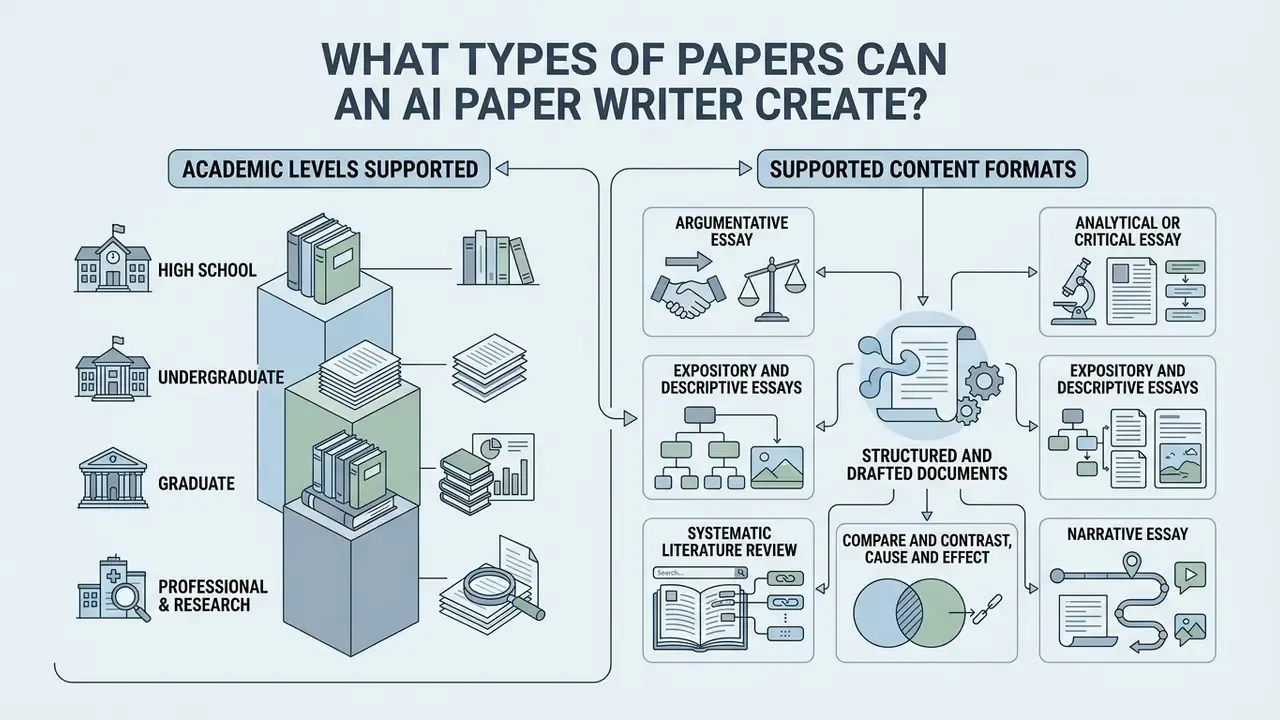
An ai paper writer can structure and draft a wide spectrum of academic and professional documents, from short analytical essays to multi-chapter literature reviews. By changing its underlying prompt conditions, an ai essay writer adjusts tone, complexity, and section organization to match assignment types across disciplines.
Academic Levels Supported
The same topic produces four materially different documents depending on the declared level, because level controls vocabulary, evidence density, and how deeply counterarguments get handled:
- High school: clear thesis, simple linear structure, 3 to 5 sources, basic APA or MLA formatting.
- Undergraduate: organized argumentation, 6 to 12 sources, discipline-appropriate terminology, complete reference list.
- Master's: methodology awareness, critical synthesis across sources, formatted literature review sections, explicit limitations.
- PhD or doctoral: research-gap framing, theoretical positioning, methodological justification, dissertation-chapter and proposal shells with reference-manager-ready citations.
Supported Content Formats
A single generator typically covers at least ten academic document classes:
- Argumentative essayclaim, evidence, rebuttal, conclusion.
- Analytical or critical essayinterpretation of a text, dataset, or case.
- Expository and descriptive essaysexplanation without persuasion.
- Narrative essayfirst-person structured account, common in applications.
- Compare and contrast, cause and effectmatrix or chain structures.
- Systematic literature reviewthematic grouping, evidence tables, synthesis.
- Research proposalproblem statement, objectives, methodology, references.
- Term paper and courseworkmulti-section semester assignments.
- Admission statement, statement of purpose, cover letterstructured personal documents.
- Technical report, case study, white paperprofessional analytical deliverables.
Research Papers, Literature Reviews, and Research Proposals
For complex scholarly projects, an ai paper generator helps build initial section shells, sketch methodology frameworks, and summarize broad thematic literature. Empirical work on AI-assisted scientific writing shows models can draft readable abstracts. It also exposes a subtler behavioural risk:
Term Papers, Coursework, and Academic Essays
Students frequently use an ai term paper generator or essay writer to organize coursework, sharpen thesis statements, and draft structured body paragraphs. These tools let you test different argument angles quickly, which is genuinely useful in the first hour of a project. Institutional guidance is granular here: AI use is broadly accepted for brainstorming, outlining, organization, tone, clarity, vocabulary, spelling, punctuation, and citation-style checking, while several universities explicitly prohibit AI-written first drafts or verbatim AI reference generation without human verification.
Presentations and posters usually travel alongside the paper. When you need visual collateral, the practical references are the guide to online photo editors and the guide to animation makers; for lighter explainer visuals, an ai cartoon maker or an ai cartoon generator can produce diagram-style figures, and short ai cartoon video clips work for seminar slides. Budget-limited students often start with an ai cartoon generator online free tier instead. Two caveats worth stating plainly: generated likenesses through an ai celebrity video generator raise publicity-rights problems in academic and commercial contexts, and filler imagery such as ai cat pictures belongs in a lecture warm-up, not in a methods section.
Personal Statements and Other Structured Writing Tasks
AI writing assistants also support non-research application documents: personal statements, cover letters, statements of purpose. The software helps organize individual background experiences into a coherent narrative arc while tightening grammar. Official university career guidance permits AI for structural feedback and editing, provided the applicant's authentic voice stays central and no personal experiences are invented:
Career-center guidance from the University of South Carolina (2025) draws a parallel boundary: brainstorming, clarity, and structure support are acceptable, pasting ready-made AI text directly into application materials is not.
Citations, References, and Academic Formatting
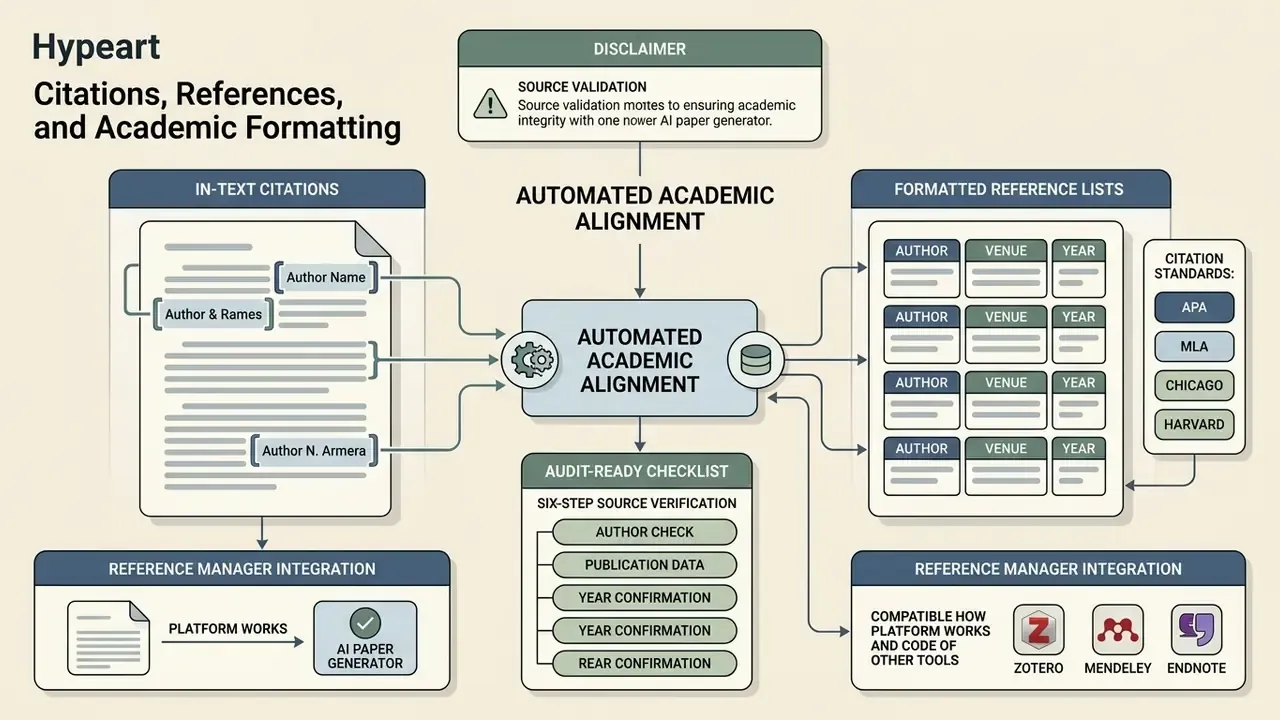
Academic formatting features in an ai paper generator aim to align inline citations with the matching bibliographic reference list under an established citation standard. Proper citation management keeps every external claim in an ai paper traceable to its originating source.
In-Text Citations and Formatted Reference Lists
In-text citations are the markers that connect a claim to its full entry in the reference list. Automated systems format those entries using author-date or numeric systems, and users must verify that each cited source actually exists.
Mechanically, the safeguards are simple and enforceable. APA 7 requires author surname plus year in text, a matching reference entry for every in-text citation, and page or paragraph locators for quotations. Vancouver-style systems use sequential numbering in first-citation order rather than alphabetical ordering. GOST-based conventions typically use bracketed numbers, with list order defined by journal rules. Hallucinated citations get caught by matching DOI, title, authors, venue, and pagination against the source record before the draft is accepted. Not after.
APA, MLA, Chicago, and Harvard Citation Styles
Disciplines require different formatting rules, and automated citation engines implement them from preset templates. APA relies on author-date structures for the social sciences, MLA uses author-page parameters for the humanities, Chicago offers notes-bibliography or author-date formats, and Harvard follows institution-specific author-date guidelines. Note that Harvard is a style family, not one global template. Punctuation, capitalization, and access-date handling differ between universities, which is exactly why generator presets should be checked against your institution's official guide.
| Citation Style | In-Text Citation Format | Reference List Title | Primary Academic Disciplines |
|---|---|---|---|
| APA 7th | (Author, Year, p. X) | References | Social sciences, psychology, business |
| MLA 9th | (Author Page) | Works Cited | Humanities, English, cultural studies |
| Chicago 18th | Footnote or (Author Year, Page) | Bibliography / References | History, fine arts, social sciences |
| Harvard | (Author, Year, Page) | Reference List | Interdisciplinary, UK and Australian institutions |
Guidance on citing the AI tool itself also diverges by standard. Chicago-based guidance usually places the AI acknowledgement in a footnote or in-text note (tool, developer, date, version) and omits it from the bibliography unless a public URL exists. APA-style guidance requires a full reference entry with company, date, chat title, model, and URL.
How an AI Paper Generator Compares With Zotero, Mendeley, and EndNote
Reference managers organize what you have already found. An AI paper generator drafts text from that library and cites it inline. The two categories overlap on import formats and diverge sharply on generation and verification:
| Function / Integration | AI Paper Generator | Zotero | Mendeley | EndNote |
|---|---|---|---|---|
| Automated text generation with inline citations | ✅ | ❌ | ❌ | ❌ |
| File import (BibTeX, RIS, PDF, DOI, URL) | ✅ | ✅ | ✅ | ✅ |
| Automatic DOI verification against live databases | ✅ | ❌ | ❌ | ❌ |
| Google Scholar / PubMed integration | ✅ | ✅ | Limited | Limited |
| AI summaries of uploaded papers | ✅ | ❌ | ✅ | ✅ |
| PDF annotation | ✅ | ✅ | ✅ | ✅ |
| Thousands of citation styles (CSL) | ✅ | ✅ | ✅ | ✅ |
| Built-in plagiarism and AI-detection checks | ✅ | ❌ | ❌ | ❌ |
| Collaboration and shared libraries | ✅ | ✅ | Limited | Limited |
Practically, this means you can point the generator at a curated folder from an existing Zotero or Mendeley library, restrict generation to those sources only, and get a draft where every in-text marker resolves to a reference you personally vetted. That constraint is the single most effective structural defence against fabricated citations, more effective than any prompt instruction telling the model not to invent sources.
How to Verify Sources Before Submission
Quality Control: Grammar, Plagiarism, and Responsible AI Use
Keeping academic quality intact while using an ai paper generator means combining automated grammar correction, real originality analysis, and adherence to ethical usage rules. Quality-control protocols are what keep a submission original, clear, and policy-compliant.
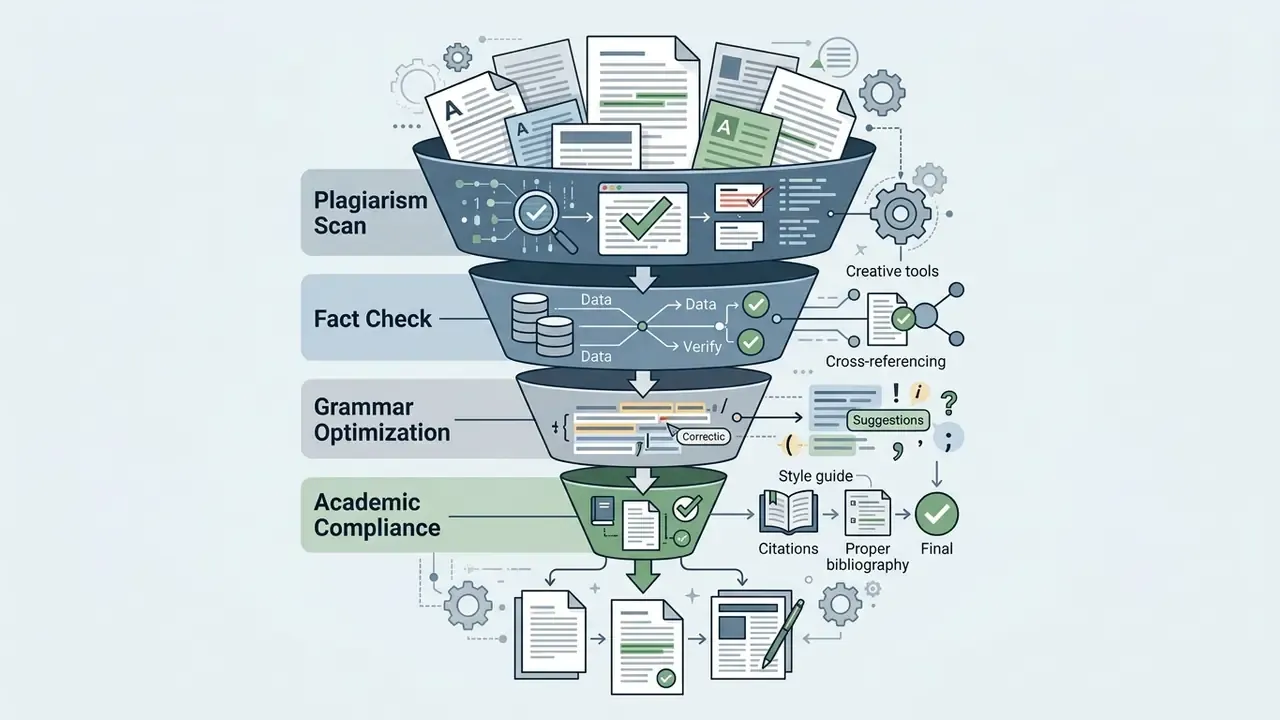
Plagiarism Checks and Originality Review
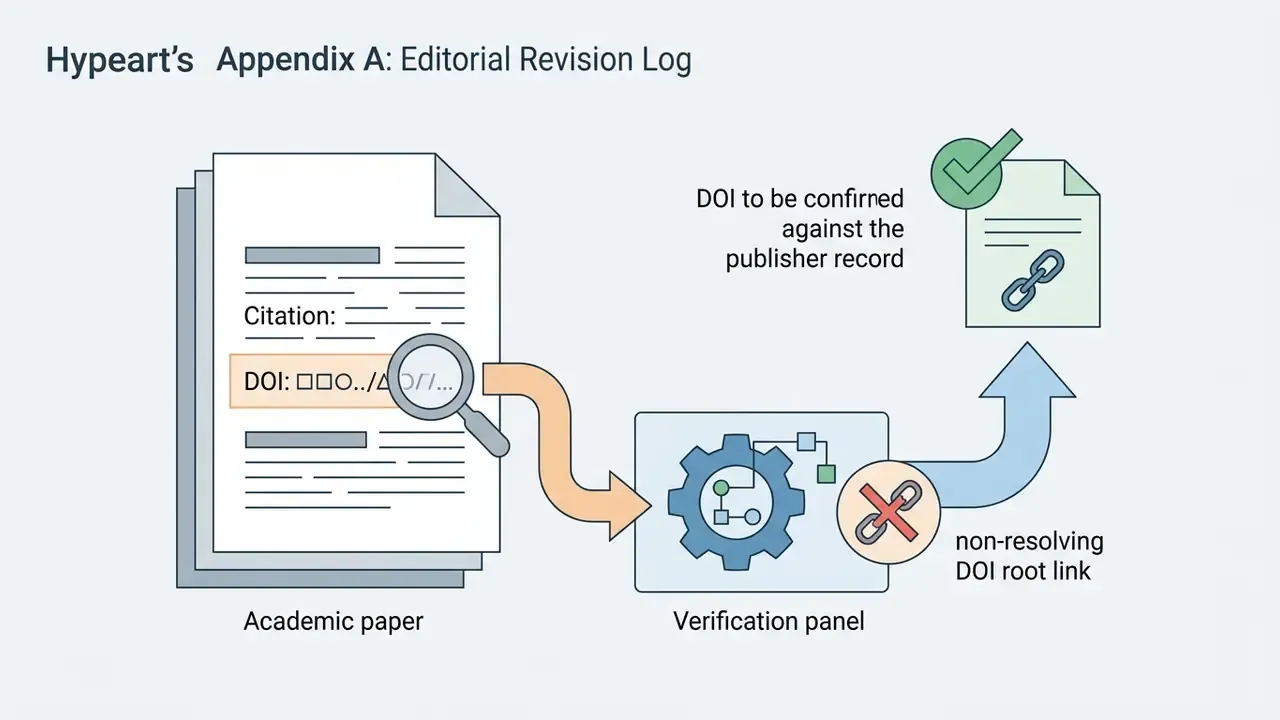
Generative models produce novel word combinations, so they often score low on traditional text-matching software. Low similarity does not mean ethical originality. Elkhatat's 2023 study of text-matching behaviour in ChatGPT-3.5 and ChatGPT-4 output shows the gap directly: generated passages can register as highly "original" simply because they were never copied from an indexed source (Elkhatat, 2023, DOI to be confirmed against the publisher record). Standard checkers compare text against static databases, while AI-generated text creates new sequences that still require critical evaluation for idea attribution. Every concept, data point, and paraphrased argument needs proper citation, and a dedicated originality check before submission is cheap insurance.
The behavioural implication is uncomfortable, and useful: the more a student trusts model output, the more likely they are to submit unattributed material. Verification discipline is a habit you build deliberately, not a step you add when there is time.
How to Handle AI Detection Tools (Turnitin, Pangram, ZeroGPT)
Editing AI Content for Clarity and Accuracy
Editing AI-generated text works in three stages: structural logic, sentence-level clarity, then terminology standardization. Editor guidelines emphasize cutting redundant phrasing, replacing inflated vocabulary with concise terms, and checking that paragraph transitions reflect actual reasoning rather than connective decoration:
University writing guidance adds concrete micro-rules: keep terminology consistent, prefer affirmative wording, vary sentence length, avoid inflated vocabulary that hurts readability. To weigh platform options and service architectures side by side, you can compare tools and technology frameworks.
Academic Integrity and Submission Rules
Leading universities enforce strict integrity policies on AI usage and require students to disclose when and how AI tools were used (Penn State Academic Integrity Policy, 2026). Submitting unedited AI prose as original personal work counts as academic misconduct across major institutions. PennWest's Policy AC072 (2026), for instance, forbids submitting work generated entirely or substantially by AI and requires clear attribution for AI-generated text, data, or calculations, while CUNY revised its integrity policy in 2024 specifically to address AI. Meanwhile the enforcement tools are demonstrably imperfect:
European research policy converges from the institutional side. The European Commission's Living guidelines on the responsible use of generative AI in research (2026) require disclosure of AI use, logging of tool version and date, and human accountability for outputs, while journal policies such as IPSA's (2026) and JCOM's (2026) prohibit AI authorship outright and mandate verification of every reference. For licensing terms and operational policy detail, you can view the guide to support and compliance.
Is There a Free AI Paper Generator?
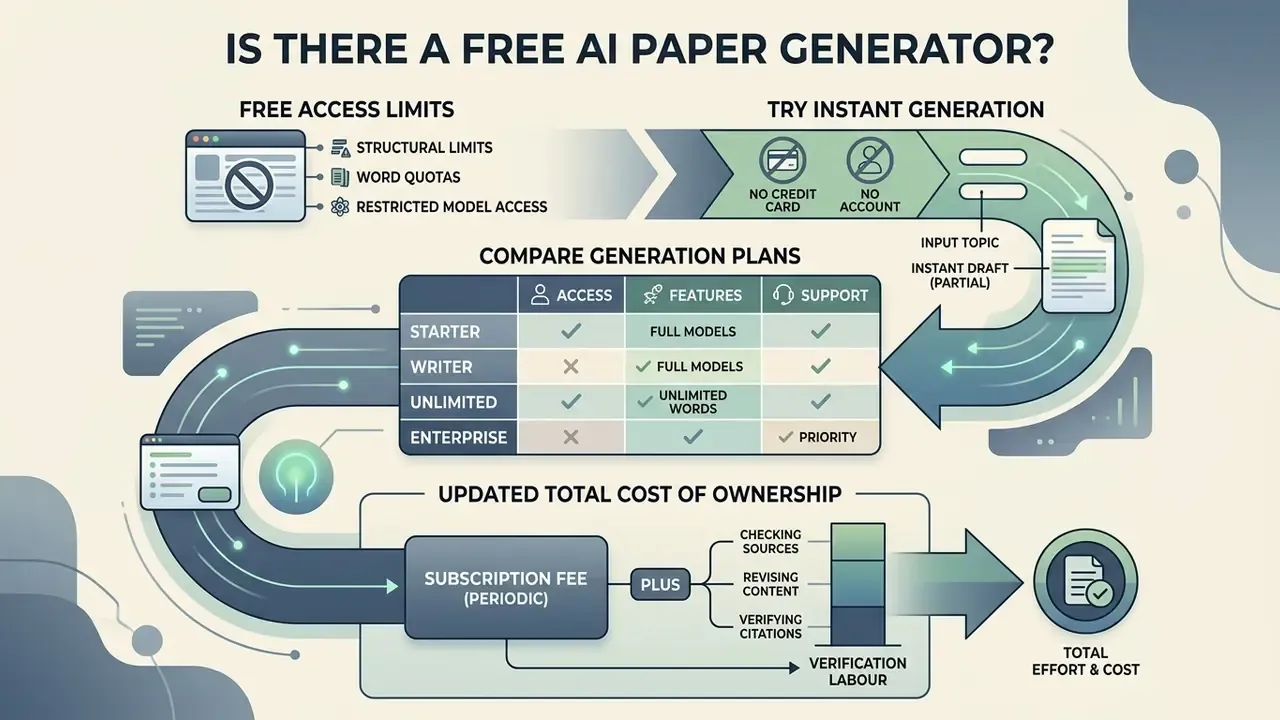
Plenty of platforms market a free ai paper generator or offer trial access, but zero-cost tiers come with structural limits, word quotas, and restricted model access. Comparing free functionality against paid tiers is how you pick a tool that matches your actual research volume rather than your optimism about it.
What Is Included in Free Access?
Free tiers usually give you basic topic-to-outline generation, limited daily credits, and standard editing.
Vendor documentation is consistent enough to generalize, though. Free plans commonly expose core generation, a basic editor, and limited templates, with caps such as 3 papers per day, 3 AI generations per day, or a fixed monthly word allowance. Export is often restricted to PDF and DOCX, sometimes to TXT or clipboard copy only, and some products block export entirely on trial access. So an ai paper generator free plan, or any writer free option, lets you test the interface and copy for free short selections, while the capabilities that matter most, automated DOI cross-checking, unlimited exports, and complex style formatting, sit behind paid plans. Readers who habitually stress-test zero-cost AI tooling before paying can apply the same criteria used in the comparison of free AI image generators: output caps, watermarking, export rights, licensing.
Try Instant Generation Without a Credit Card or Account
Test the full pipeline first: 3 free generation runs or up to 1,500 words, with no sign-up, email address, or credit card for initial draft testing. That is enough to validate the three things that decide any purchase. Does the outline structure match your rubric? Is the citation-style output genuinely correct? Do the cited sources resolve? Saving drafts, exporting to Word or PDF, and running plagiarism checks require an account, which stays free at the entry tier.
How to Compare Starter, Writer, Unlimited, and Enterprise Plans
Paid subscription structures vary by word volume, model access, and features across individual, team, and institutional tiers. Reading plan specifications carefully is how you balance operating cost against real writing capacity.
| Feature / Parameter | Free Tier | Starter Plan | Writer Plan | Unlimited Plan | Enterprise / Institutional |
|---|---|---|---|---|---|
| Monthly word limit | 1,500–5,000 words, or 3 test runs | 30,000–50,000 words | 150,000 words | Unlimited | Unlimited plus pooled seats |
| Model access | Standard LLM | Standard LLM | Advanced LLM | Advanced LLM plus priority | Advanced LLM in an isolated instance |
| Citation verification | Basic manual templates | Automated formatting | Automated plus DOI lookup | Full cross-database audit | Full audit plus exportable verification log |
| Reference manager import | ❌ | BibTeX, RIS | BibTeX, RIS, PDF, DOI | All formats plus Zotero folders | All formats plus library-wide sync |
| Plagiarism and AI-detection checks | Not included | 5 checks per month | 25 checks per month | Unlimited | Unlimited plus institutional reporting |
| Export formats | TXT, copy to clipboard | DOCX, PDF | DOCX, PDF, LaTeX | All formats plus API | All formats, API, bulk export |
| Security and governance | not included | not included | not included | Priority support | SSO, SOC 2 posture, audit logging, data-boundary controls, SLA |
| Estimated cost | $0 | $9–$15 per month | $29–$49 per month | $79–$99 per month | Custom, per-seat contract |
Total Cost of Ownership: Subscription Plus Verification Labour
The subscription price is rarely the real cost. A workable TCO formula for any AI-assisted document workflow:
TCO = subscription cost + (references × verification minutes × hourly rate) + (editing hours × hourly rate) + residual risk cost
Worked example. A 4,000-word paper with 25 references, at 4 minutes of DOI-level verification per reference, consumes about 100 minutes of human time. At a $30 hourly internal rate, that is roughly $50 of labour against a $29 monthly subscription. The conclusion is operational rather than rhetorical: features that cut verification minutes per reference, such as grounded generation from a vetted library, automatic DOI resolution, and exportable verification logs, save more measurable money than a higher word cap ever will.
One more line item people forget. Residual risk cost is not zero. A single fabricated citation in a client deliverable can cost a rewrite, a credibility hit, and in regulated work, a control finding.
Can You Use AI-Generated Papers for Commercial Work?
Using generated paper content in commercial or professional deliverables raises three separate questions: copyright ownership, platform terms of service, and liability for factual accuracy.
Under US Copyright Office guidance, purely AI-generated text without substantial human creative input is not eligible for copyright protection:
Protection attaches only to the human-authored elements, selection, or creative arrangement inside a mixed document. The European Parliament's 2025 study reaches a parallel conclusion for the EU: purely AI-generated output without substantial human intervention falls outside copyright and may be freely reproduced or adapted. UK guidance (GOV.UK, 2025) keeps a distinct computer-generated works regime with 50-year protection. Jurisdiction changes the answer, so check yours before you promise a client exclusivity.
Commercial users also stay fully liable for fabricated citations or defamatory content the model produces:
Governance Note for Regulated and Enterprise Environments
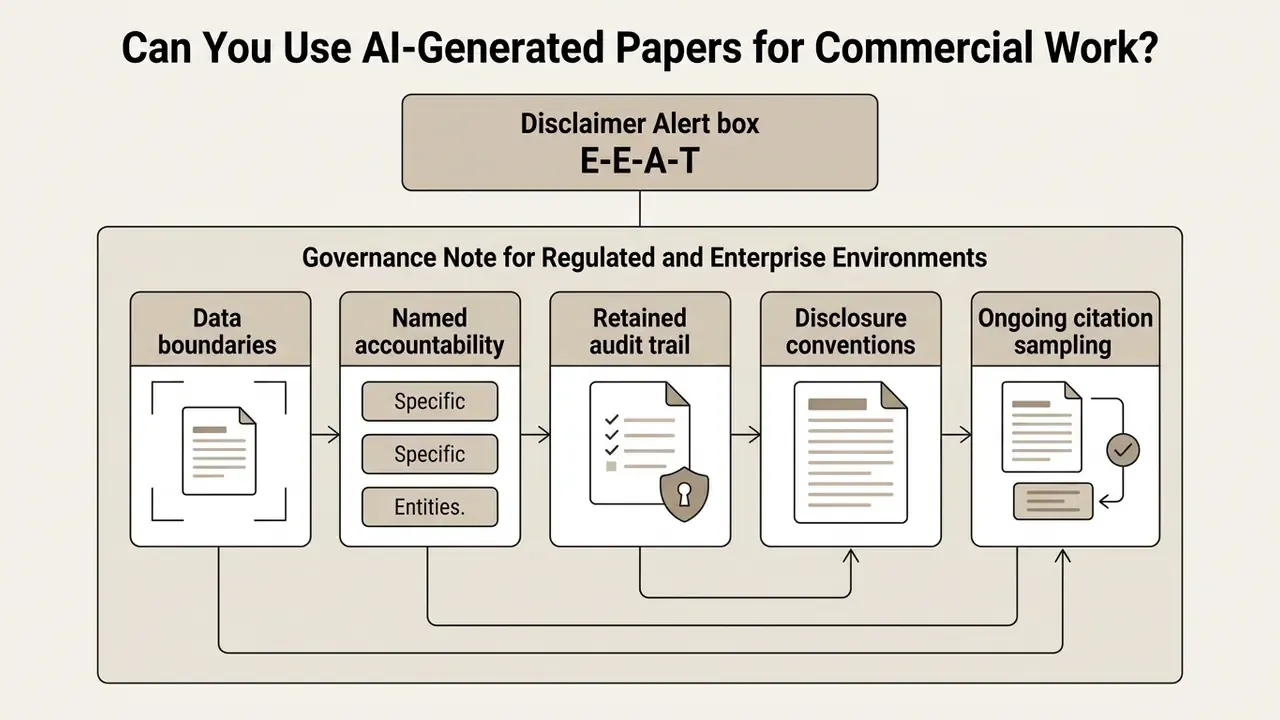
An AI paper generator is a drafting tool, not a validated model. It does not constitute or replace model validation under supervisory frameworks such as SR 11-7, and it does not satisfy risk management under the NIST AI Risk Management Framework or its generative-AI profile. Treating a text generator as an approved model is the fastest way to turn a productivity win into an audit finding.
Before any AI-assisted document enters a regulated deliverable, confirm five controls:
- Data boundaries.Explicit rules on what may be entered into a prompt, including a hard prohibition on confidential client or personal data in non-isolated instances.
- Named accountability.A human owner for every published claim, by name, not by team.
- Retained audit trail.Prompts, model version, sources supplied, verification outcomes, reviewer sign-off.
- Disclosure conventions.Hybrid authorship language agreed with legal and compliance in advance.
- Ongoing citation sampling.Periodic testing for fabrication, treated as a recurring control test rather than a one-time check.
For a governance lead, the framing is familiar: a drafting tool is a digital worker with a defined owner, an approved role, access limits, an escalation path, an audit trail, and a shutdown mechanism. No evidence, no autonomy. Where the evidence is thin, and on generative-AI productivity claims it usually is, keep the scope narrow and the logging complete.
FAQ About AI Paper Generators
Do I need to create an account to use a free AI paper generator?
Not for initial testing. The entry tier allows 3 generation runs or up to 1,500 words with no sign-up, email, or credit card. Most platforms then require a free account to manage daily generation limits, save drafts, and enable file exports.
Can AI paper generators guarantee 100% accurate citations?
No. Generative models frequently produce hallucinated or inaccurate citations. In a systematic audit of 333 citation-attributed claims, 19.8% were fabricated and 18.3% contained material inaccuracies that distorted the meaning of the source (Fluency Without Fidelity, 2026). Check every reference manually against Google Scholar, PubMed, or Crossref before submission.
Will university plagiarism detectors flag AI-generated papers?
Possibly. Institutional plagiarism and AI-detection tools such as Turnitin, Pangram, or ZeroGPT scan for predictable statistical patterns. Accuracy is limited: all tools tested by Weber-Wulff et al. (2023) scored below 80%, with substantial false negatives and false positives. Submitting unedited AI content still carries real detection and policy risk, so keep drafts, timestamps, and prompt logs as provenance evidence.
Does the free version support exporting to Word and PDF?
No. On the free tier you can read, edit inline, and copy the full output to your clipboard at no cost, plus export plain text (.txt). Formatted export to Microsoft Word (.docx) and PDF, including title page, in-text citations, and reference list, starts at the Starter plan, with LaTeX (.tex) added on the Writer plan.
What file formats can I export my paper to?
Depending on the tier: Microsoft Word (.docx), PDF, plain text (.txt), and LaTeX (.tex) for mathematical and technical papers, with bulk and API export on Unlimited and Enterprise plans.
Can I import my existing library from Zotero, Mendeley, or EndNote?
Yes. BibTeX and RIS import is available from Starter, PDF, DOI, and URL import from Writer, and full Zotero folder selection plus library-wide sync on Unlimited and Enterprise. Restricting generation to your own vetted references remains the most reliable way to prevent fabricated citations.
Which academic levels and paper types are supported?
Four levels, high school, undergraduate, master's, and PhD, and at least ten document classes: argumentative, analytical, expository, narrative, descriptive, persuasive, compare-and-contrast, and cause-and-effect essays, plus systematic literature reviews, research proposals, term papers, case studies, and admission statements.
Is my data safe when I paste an unpublished draft into the tool?
Inputs are transmitted over encrypted connections and are not used to train models. For confidential, personal, or client-regulated material, use an isolated enterprise instance with contractual data-boundary controls, SSO, and audit logging. Never paste identifiable personal or client data into a shared consumer tier.
Do I have to disclose that I used an AI paper generator?
In most cases, yes. The European Commission's Living Guidelines (2026), journal policies such as IPSA's and JCOM's (2026), and university policies including Penn State's require disclosure of AI use, often with tool name, version, and date. Some departments also require retention of prompts or transcripts. Check the rule that applies to your assignment or target journal.
Can an AI paper generator replace a human author or supervisor?
No. AI cannot be listed as an author under current journal and institutional policy, and every substantive claim, method, and reference stays the human author's responsibility. Treat generated text as a first-pass structure to be verified, reasoned over, and rewritten.
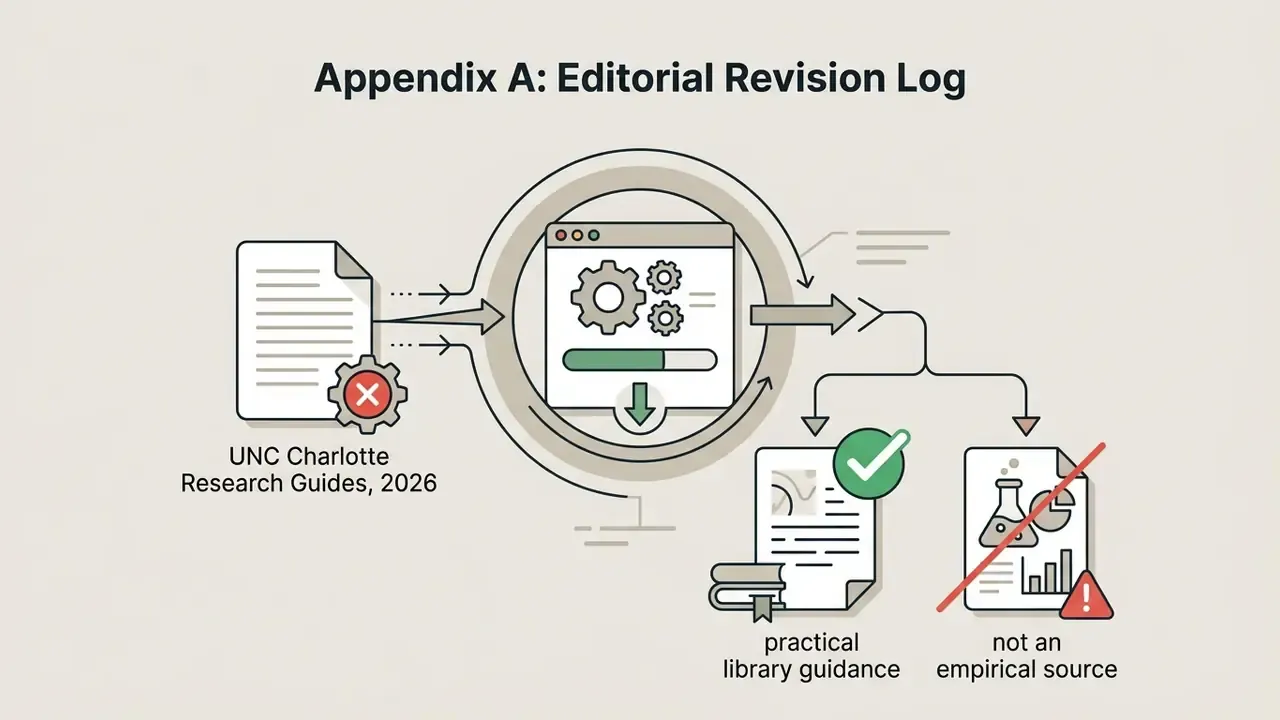
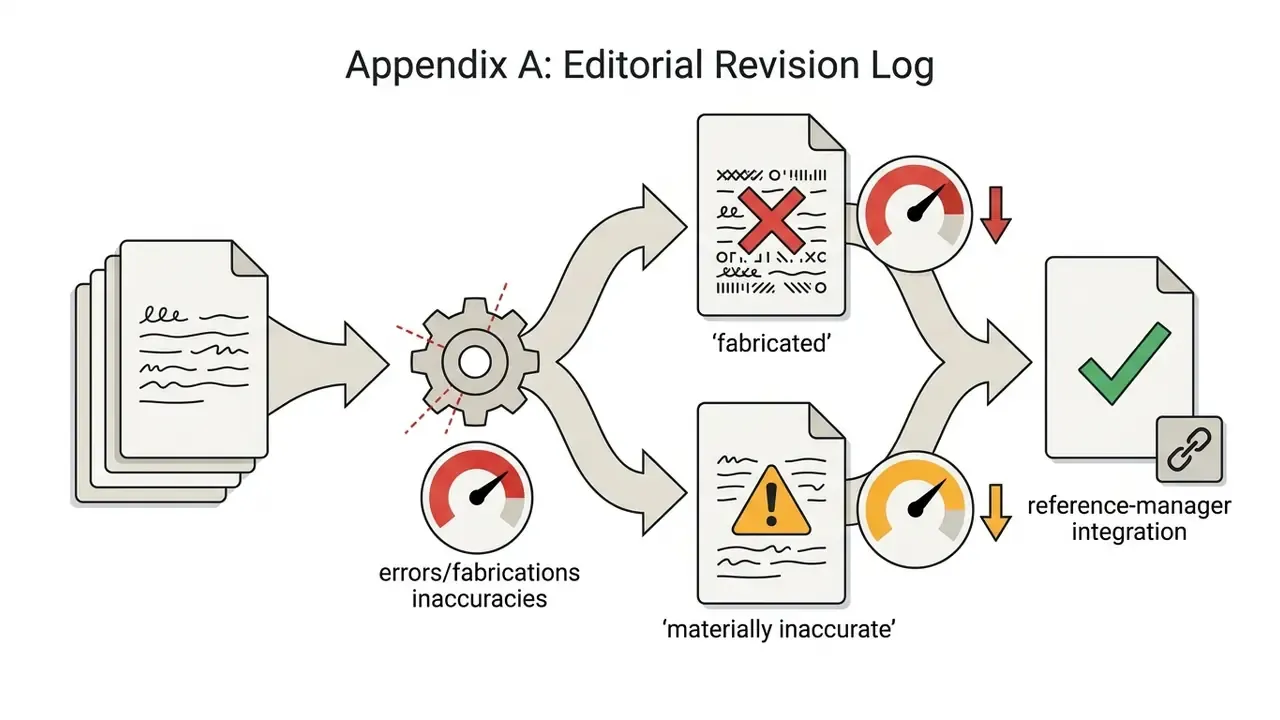
Appendix A: Editorial Revision Log
Retained for transparency, per our fact-check policy. Superseded statements from earlier versions of this article:
Footer Navigation